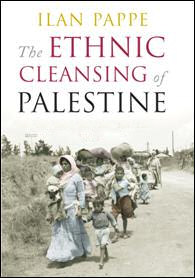
 A Review of Ilan Pappe's
'The Ethnic Cleansing of Palestine'
by Stephen Lendman
Ilan Pappe is an Israeli historian and senior lecturer at Haifa University. He's also Academic Director of the Research Institute for Peace at Givat Haviva and Chair of the Emil Touma Institute for Palestinian Studies. Pappe is an expert on Israel and Zionism and the Palestinians' Right of Return to their homeland, is considered "an honourable academic with integrity and conscience," and is a member of the Advisory Board of the Council for Palestinian Restitution and Repatriation (CPRR), an organization declaring that "every Palestinian has a legitimate, individual right to return to his or her original home and to absolute restitution of his or her property."
Pappe is also one of Israel's "new historians" whose scholarship and writings are based on access to material now available from British Mandate period and Israeli archives that provide the most accurate and authentic documented history of Israel before and after it became a state and which now serve to debunk the myths about the years leading up to the Jewish State's founding and those following it to this day.
Pappe has also authored, contributed to or edited nine books. His latest is the one this review covers in detail so readers will know about its powerful and shocking content, unknown to most in the West and in Israel, that hopefully will arouse them enough to get the book and learn in full detail what Pappe documented. He proves from official records how the Israeli state came into being with blood on its hands from lands forcibly seized from its Palestinian inhabitants who'd lived on it for hundreds of years previously. Since the 1940s, they were ethnically cleansed and slaughtered without mercy so their homeland would become one for Jews alone.
The shameful result is that Palestinians then and today have almost no rights including being able to live in peace and security on their own land in their own state that no longer exists. Survivors then and their offspring either live in Israel as unwanted Arab citizens with few rights or in the Occupied Palestinians Territories (OPT) where their lives are suspended in limbo in an occupied country in which they're subjected to daily institutionalized and codified racism and persecution. They have no power over their daily lives and live in a constant state of fear with good reason. They face economic strangulation; collective punishment for any reason; loss of free movement; enclosures by separation walls, electric fences and border closings; regular curfews, roadblocks, checkpoints, loss of their homes by bulldozings and crops and orchards by wanton destruction and seizure; arrest without cause, and routine subjection to torture while in custody.
They're targeted for extra-judicial assassination and indiscriminate killing; taxed punitively and denied basic services essential to life and well-being including health care, education, employment and even enough food and water at the whim of Israeli authorities in a deliberate effort to destroy their will to resist and eliminate those who won't by expulsion or extermination. Palestinians have no power to end these appalling abuses and crimes against humanity or receive any redress for them in Israeli, the West or through the International Criminal Court Israel ignores when it rules against its interests.
How can they as Muslims in a racist Jewish state where Israelis oppressive them with impunity, the US goes along with huge financing and supplying of the most modern and destructive weapons of war, and the West and most Arab states are indifferent preferring to ally with Israel and the US for benefits received while writing off Palestinians as a small price worth paying. It created state of appalling human misery and desperation severely aggravated by crushing economic sanctions for the past year imposed for the first time ever on an occupied people. They're responsible for poverty and unemployment levels of 80% or more and increasing instances of starvation and unreported deaths from all causes because Israel controls everything and everyone allowed in and out of the territories. Those inside them suffer painfully as a result. Others with power to help, don't care and do nothing.
Pappe documents how it all began in 12 chapters with a short epilogue plus 18 graphic pictures needing no explanation. He calls the book his "J'Accuse against the politicians who devised the plan and the generals who carried out the ethnic cleansing" naming the guilty, the villages and urban areas destroyed, and the cruelest crimes committed against defenseless people only wanting to live in peace on their own land and were willing to do it with Jews as neighbors but not as overlords or oppressors.
This review is lengthy so readers will know in detail what Israeli authorities successfully suppressed for decades. Pappe courageously revealed it in a book begging to be read and discussed by all people of conscience and good faith. They need to take the lead building a groundswell consensus to stand up to this long-festering injustice against defenseless people fighting for their rights and existence against overwhelming odds.
Pappe provides them help with his extensive documentation and other suggested reading on the origins of Zionist ideology leading to the ethnic cleansing in the 1940s and thereafter. He particularly mentions two of Nur Masalha's important books - Expulsion of the Palestinians: The Concept of Transfer in Zionist Political Thought, 1882 - 1948 and The Politics of Denial: Israel and the Palestinian Refugee Problem. Readers are encouraged to explore this issue further with these and other books exposing ugly truths long suppressed in the West and needing to be freely aired.
The Beginning - Initial Planning for Ethnic Cleansing
In his preface, Pappe writes about the "Red House" in Tel-Aviv that became headquarters for the Hagana, the dominant Zionist underground paramilitary militia during the British Mandate period in Palestine between 1920 and 1948 when the Jewish state came into being. He details how David Ben-Gurion, Israel's first prime minister, met with leading Zionists and young Jewish military officers on March 10, 1948 to finalize plans to ethnically cleanse Palestine that unfolded in the months that followed including "large-scale (deadly serious)intimidation; laying siege to and bombarding villages and population centres; setting fire to homes, properties and goods; expulsion; demolition; and finally, planting mines among the rubble to prevent any of the expelled inhabitants from returning."
The final master plan was called Plan D (Dalet in Hebrew) following plans A, B, and C preceding it. It was to be a war without mercy complying with what Ben-Gurion said in June, 1938 to the Jewish Agency Executive and never wavering from later: "I am for compulsory transfer; I do not see anything immoral in it." Plan D became the way to do it. It included forcible expulsion of hundreds of thousands of unwanted Palestinian Arabs in urban and rural areas accompanied by an unknown number of others mass slaughtered to get it done. The goal was simple and straightforward - to create an exclusive Jewish state without an Arab presence by any means including mass-murder.
Once begun, the whole ugly business took six months to complete. It expelled about 800,000 people, killed many others, and destroyed 531 villages and 11 urban neighborhoods in cities like Tel-Aviv, Haifa and Jerusalem. The action was a clear case of ethnic cleansing that international law today calls a crime against humanity for which convicted Nazis at Nuremberg were hanged. So far Israelis have always remained immune from international law even though names of guilty leaders and those charged with implementing their orders are known as well as the crimes they committed.
They included cold-blooded mass-murder; destruction of homes, villages and crops; rapes; other atrocities; and massacres of defenseless people given no quarter including women and children. The crimes were suppressed and expunged from official accounts as Israeli historiography cooked up the myth that Palestinians left voluntarily fearing harm from invading Arab armies. It was a lie covering up Israeli crimes Palestinians call the Nakba - the catastrophe or disaster that's still a cold, harsh festering unresolved injustice.
Even with British armed presence still in charge of law and order before its Mandate ended, Jewish forces completed the expulsion of about 250,000 Palestinians the Brits did nothing to stop. It continued unabated because when neighboring Arab states finally intervened, they did so without conviction. They came belatedly and with only small, ill-equipped forces, no match for a superior, well-armed Israeli military easily able to prevail as discussed below.
Ethnic Cleansing Defined
Pappe notes that ethnic cleansing is well-defined in international law that calls it a crime against humanity. He cites several definitions including from the Hutchinson encyclopedia saying it's expulsion by force to homogenize the population. The US State Department concurs adding its essence is to eradicate a region's history. The United Nations used a similar definition in 1993 when the UN Commission on Human Rights (UNCHR) characterized it as the desire of a state or regime to impose ethnic rule on a mixed area using expulsion and other violence including separating men and women, detentions, murder of males of all ages who might become combatants, destruction of houses, and repopulating areas with another ethnic group.
In 1948, Zionists waged their "War of Independence" using Plan D to "cleanse" Palestine according to the UN definition. It involved cold-blooded massacres and indiscriminate killing, targeted assassinations and widespread destruction as clear instances of crimes of war and against humanity, later expunged from the country's official history and erased from its collective memory. It was left it to a few courageous historians like Ilan Pappe to resurrect events to preserve the truth too important to let die. His invaluable book provides an historic account of what, in fact, happened. It needs broad exposure but won't get it in the corporate-controlled Israeli, US or Western media overall. It will on this important web site with the courage to publish it.
Zionism's Ideological Roots
Pappe traces the roots of Zionism to the late 1880s in Central and Eastern Europe "as a national revival movement, prompted by the growing pressure on Jews in those regions to assimilate totally or risk continuing persecution." Founded by Theodor Herzl, the movement became international in scope supporting a Jewish homeland in the Land of Israel, or Eretz Israel, even though early on many in the movement were ambivalent about its location. That changed following Herzl's death in 1904 when it was decided the goal was to colonize Palestine because of its biblical connection that happened to be land occupied inappropriately by "strangers" meaning anyone not Jewish having "no right" to be there.
So as justification, the myth was created of "a land without people for a people without a land" even though this "empty land" had a flourishing Palestinian Arab population including a small number of Jews. Zionist leaders wanted a complete dispossession of indigenous Arabs to reestablish the ancient land of Eretz Israel as a Jewish state for Jews alone and got help doing it from the British after Palestine became part of its empire post-WW I. With duplicity, the Brits crafted the 1917 Balfour Declaration supporting the notion of a Jewish homeland in Palestine while simultaneously promising indigenous Arabs their rights would be protected and land would be freed from foreign rule.
Palestinian Arabs saw through the scheme wanting no part of it. It was their land, and they weren't about to give it up without a struggle. They strongly opposed further Jewish immigration but to no avail, as their wishes conflicted with British plans for the territory. It set off decades of conflict leading to the establishment of the Jewish state in 1948 with British help under their Mandate and neighboring Arab state indifference doing little to prevent it. Palestinians lost their homeland, their struggle for justice goes on unresolved, and these beleaguered people are virtually isolated from the West and their Arab neighbors preferring alliance with Israel for their own interests that exclude helping Palestinian people get theirs served including a viable independent state free from Israeli occupation.
Pappe traces the early post-Balfour history when Palestinians comprised 80 - 90% of the population. Even then they fared poorly under British Mandate rule giving Zionist settlers preferential treatment. It led to uprisings in 1929 and 1936, the later one lasting three years before being brutally suppressed. In its wake, Britain expelled Palestinian leaders making their people vulnerable to Jewish forces post-WW II that led to their defeat and subjugation. The sympathetic British Mandate made it possible by helping Jewish settlers transform their 1920 paramilitary organization into the Hagana, a name meaning defense. It then became the military arm of the Jewish Agency or Zionist governing body now called the Israel Defense Forces or IDF.
Planning the Expulsion of the Palestinians
David Ben-Gurion, Israel's first prime minister, led the Zionist movement from the mid-1920s until well into the 1960s. He played a central role and had supreme authority planning the establishment of a Jewish state serving as its "architect" with full control over all security and defense issues in the Jewish community. His goal was Jewish sovereignty over as much of ancient Palestine as possible achieved the only way he thought possible - by forceable removable of Palestinians from their land so Jews could be resettled in it.
To do it, he and other Zionist leaders needed a systematic plan to "cleanse" the land for Jewish habitation only. It began with a detailed registry or inventory of Arab villages the Jewish National Fund (JNF) was assigned to compile. The JNF was founded in 1901 as the main Zionist tool for the colonization of Palestine. Its purpose was to buy land used to settle Jewish immigrants that by the end of the British Mandate in 1948 amounted to 5.8% of Palestine or a small fraction of what Zionists wanted for a Jewish state. Early on, Ben-Gurion and others knew a more aggressive approach was needed for their colonization plan to succeed.
It began with the JNF Arab village inventory that was a blueprint completed by the late 1930s that included the topographic location of each village with detailed information including husbandry, cultivated land, number of trees, quality of fruit, average amount of land per family, number of cars, shop owners, Palestinian clans and their political affiliation, descriptions of village mosques and names of their imams, civil servants and more. The final inventory update was finished in 1947 with lists of "wanted" persons in each village targeted in 1948 for search-and-arrest operations with those seized summarily shot on the spot in cold blood.
The idea was simple - kill the leaders and anyone thought to be a threat the British hadn't already eliminated quelling the 1936-39 uprising. It created a power vacuum neutralizing any effective opposition to Zionists' plans. The only remaining obstacle thereafter was the British presence Ben-Gurion knew was on the way out by 1946 before it finally ended in May, 1948.
Partition, Ethnic Cleansing, War, and Establishment of the State of Israel
Ethnic cleansing began in early December, 1947 when Palestinians comprised two-thirds of the population and Jews, mostly from war-torn Europe, the other third. The British tried dealing with two distinct ethnic entities choosing partition as the way to do it. By 1937, this solution became the centerpiece of Zionist policy, but it proved too hard for the Brits to resolve and be able to satisfy both sides. It instead handed the problem to the newly formed UN to deal with before their Mandate ended.
It put the Palestinians' fate in the hands of a Special Committee for Palestine (UNSCOP) whose members had no prior experience solving conflicts and knew little Palestinian history. It was a recipe for disaster as events unfolded. UNSCOP opted for partition favoring the Jews as compensation for the Nazi holocaust that became General Assembly Resolution 181 on November 29, 1947 giving them a state encompassing 56% the country with one-third of the population while making Jerusalem an international city. Palestinians were justifiably outraged. They were excluded from the decision-making process concluded against their will and at their expense.
From that moment on, the die was cast leading to partition, ethnic cleansing, the first Arab-Israeli war, the others to follow, and decades of disregard for their rights to this day creating their desperate state with no resolution in prospect. Resolution 181 was even worse than an unfair 56 - 44% division of territory as it allotted the most fertile land and almost all urban and rural territory in Palestine to the new Jewish state plus 400 of the over 1000 Palestinian villages their residents lost with no right of appeal.
Pappe explains Ben-Gurion simultaneously accepted and rejected the resolution. He and other Zionist leaders wanted official international recognition of the right of Jews to have their own state in Palestine. He was also determined to make Jerusalem the Jewish capital, intended final borders to remain flexible wanting to include within them as much future territory as possible, and today Israel is the only country in the world without established borders. Ben-Gurion decided borders would "be determined by force and not by partition resolution." He headed the Consultancy or Consultant Committee, an ad-hoc cabal of Zionist leaders created solely to plan the expulsion of Palestinians to cleanse the land for Jewish habitation only.
The process began in early December, 1947 with a series of attacks against Palestinian villages and neighborhoods. They were engaged ineffectively from the start on January 9 by units of the first all-Arab volunteer army. It resulted in forced expulsions beginning in mid-February, 1948. On March 10, final Plan Dalet was adopted with its first targets being Palestinian urban centers that were all occupied by end of April with about 250,000 Palestinians uprooted, displaced or killed including by massacres, the most notorious and remembered being at Deir Yassin even though Tantura may have been the largest.
Deir Yassin was Palestinian land on April 9 when Jewish soldiers burst into the village, machine-gunned houses randomly killing many in them. The remaining villagers were then assembled in one place and murdered in cold blood including children and women first raped and then killed. Recent research puts the number massacred at 93 (including 30 babies), but dozens more were killed in the fighting that ensued making the total number of deaths much higher.
The Arab League finally decided on April 30 to intervene militarily but only after the British Mandate ended on May 15, 1948, the day the Jewish Agency declared the establishment of the state of Israel in Palestine. The US and Soviet Union officially recognized the new state legitimizing it, and on the same day Arab forces entered the territory.
Pappe details the Zionist leadership's plan and steps it followed to gain as much of Palestine as possible with the fewest number of Palestinians remaining in it, irrespective of Resolution 181 it ignored. They wanted over 80% of Mandatory Palestine or over 40% more land than the UN allotted them taken forcibly from the Palestinians. To get it, they colluded tacitly with the Jordanians, effectively neutralizing the strongest Arab army, buying them off with the remaining 20% of the territory.
On the eve of battle in 1948, Jewish fighting forces were around 50,000 (increasing by summer to 80,000). They included a small air force, navy and units of tanks, armored cars and heavy artillery. The army was comprised of the main Hagana force plus elements of the two extremist terrorist groups - the Irgun led by future prime minister and fanatical Arab-hater Menachem Begin and the Stern Gang whose most notorious member was also a future prime minister, Yitzhak Shamir, another extreme racist. It also included special commando Palmach units, founded in 1941 and whose leaders included future Israeli prime minister Yitzhak Rabin and noted general and war hero Moshe Dayan. They faced a hopelessly outmanned and outgunned Palestinian irregular force of about 7000.
Outside Arab intervention only began on May 15, 1948, five and a half months after UN Resolution 181 was adopted and during which time the Palestinians were defenseless against the Zionist ethnic cleansing onslaught against them. Arab states waited because they were indifferent, and when they finally acted they sent an inferior force proving no match for the superior Jewish one it faced to be discussed further below.
Finalizing Plans to De-Arabize Palestine
In December, 1947, the Palestinian population numbered 1.3 million of which one million lived in the territory of the future Jewish state. The Jewish minority stood at 600,000. Zionist leaders needed a way to dispose of this large number of people "cleansing" the land for Jewish habitation only. They weren't planning to do it gently. Instead it became a systematic campaign of state-sponsored terror against a near-defenseless population unable to withstand the horrific onslaught unleashed against it step by step. It included threats and intimidation, villages attacked including while its inhabitants slept, shooting anything that moved, and blowing up homes with their residents inside plus other violent acts sparing no one, especially fighting-age men and boys who might pose a combat or determined resistance threat.
Ben-Gurion exulted in the progress as events unfolded with comments like: "We are told the army had the ability of destroying a whole village and taking out all its inhabitants, let's do it." Another time he explained: "Every attack has to end with occupation, destruction and expulsion." He meant the entire population of a village had to be removed, everything in it leveled to the ground and its history destroyed. In its place, a new Jewish community would be established as part of the new Jewish state he and others in the Consultancy believed wasn't possible without a mass ethnic cleansing transfer and/or extermination of Palestinians living there.
Their plan also included cleansing urban neighborhoods that were attacked beginning with Haifa picked as the first target. It was where 75,000 Palestinians lived in peace and solidarity with their Jewish neighbors until it ended with the outbreak of violence. It moved on to other cities including Jerusalem where initial sporadic attacks later became intense. It was part of an overall initiative of occupation, expulsion and slaughter of anyone resisting or just having the misfortune to live on land Zionists wanted for themselves and intended taking by force.
As ethnic cleansing progressed, it got more vicious as the Consultancy decided to ransack whole villages and massacre large numbers in them including women, children and babies. Shamefully, it began and intensified under Mandate authority with a large British military presence on the ground to maintain order that never did. It chose instead to look the other way and let all horrific events on the ground go on unimpeded. By March, 1948, Plan Dalet became operational as the battle plan to remove the entire Palestinian population from the 78% of the country Zionists established as the state of Israel on May 15 when the Mandate ended.
The campaign included disingenuous rhetoric and propaganda about Jews in Palestine being under threat from a hostile population having to go on the offensive in self-defense. The truth turned that notion on its head because of the military, political and economic imbalance between the two communities. It was so lopsided, the outcome was never in doubt as long as the British stayed out of it. They did, and after the Mandate ended in mid-May it was the UN's problem to deal with. It also failed the test as discussed below.
Plan Dalet began in the rural hills on the western slopes of the Jerusalem mountains half way on the road to Tel-Aviv. It was called Operation Nachshon, and it served as a model for future campaigns. It employed sudden massive expulsions using terror tactics that proved the most effective way to clear an area preparing it for Jewish resettlement to follow. Early on, the plan wasn't to spare a single village, and orders given to carry it out were clear: "the principle objective of the operation is the destruction of Arab villages (and) the eviction of the villagers so that they would become an economic liability for the general Arab forces."
To motivate attacking Israeli forces, Palestinians were dehumanized as sub-humans worthy of no respect or consideration making them legitimate targets for destruction. It's the same tactic US forces used against the Japanese in WW II, in Vietnam and today in Iraq and Afghanistan. In each instance, targets were people of color or others not white enough like Arabs.
Pappe details what he calls the "urbicide of Palestine" that included attacking and cleansing the major urban centers in the country. They included Tiberias, Haifa, Tel-Aviv, Safad and what Pappe calls the "Phantom City of Jerusalem" changed from the "Eternal City" once Jewish troops shelled, attacked and occupied its western Arab neighborhoods in April, 1948. The Brits stood aside shamelessly doing nothing to stop it except in one area, Ahaykh Jarrah, where a local British commander intervened.
It was a rare exception proving how much better Palestinians would have fared if their British "protectors" had actually done their job. They didn't, and the result was anarchy and a state of panic with Israelis having free reign to ravage Northern and Western Jerusalem with heavy shelling, pillaging and destruction while ethnically cleansing the population in eight Palestinian neighborhoods and 39 villages in the greater Jerusalem area transferring them to the Eastern part of the city.
The urbicide continued into May with the occupation of Acre on the coast and Baysan in the East on May 6. On May 13, Jaffa was the last city taken two days before the Mandate ended. The city had 1500 volunteers against 5000 Jewish troops. It survived a three week siege and attack through mid-May, but when it fell its entire population of 50,000 was expelled. With its fall, Jewish occupying forces had emptied and depopulated all the major cities and towns of Palestine, and most of their inhabitants never again got to see their former homes.
Pappe explains this all happened between March 30 and May 15, 1948 "before a single regular Arab soldier had entered Palestine (to help Palestinians which they did ineffectively when they finally came)." His account also undermines the Israeli-concocted myth that Palestinians left voluntarily before or after Arab forces intervened. Nearly half their villages were attacked and destroyed before Arab countries sent in any forces, and another 90 villages were wiped out from May 15 (when the Mandate ended) till June 11 when the first of two short-lived truces took effect.
The UN's partition plan caused the problem, and yet the world body did nothing to remediate a situation that was out of control. Early on it was clear a potential disaster loomed that, in fact, ended up worse than first imagined. Still, the British through May 15, the UN, and neighboring Arab states of Egypt, Syria, Lebanon, Jordan and Iraq procrastinated as long as possible before reluctantly stepping in, and when they did it was too little, too late. Pappe calls Jordan's (Transjordan then) King Abdullah "the odd man out." He had army units inside Palestine, some were willing to protect villagers' homes and lands, but they were restrained by their commanders.
It was because earlier the King and Zionists cut a deal allowing Jordan to annex most of the land the partition allocated to the Palestinians that became the West Bank. In return, Jordanian forces agreed not to engage Jewish troops militarily. To their shame and discredit, the Brits agreed to this scheme effectively sealing the Palestinians' fate. Still, once the British Mandate ended, Jordan had to fight Jewish forces for what it got because Ben-Gurion reneged on his deal. All along, he wanted as much territory as possible for a new Jewish state on more land than the 78% he ended up with. The Jordanian military prevailed, spoiling his plans. It saved 250,000 Palestinians in the West Bank from being ethnically cleansed the way other Palestinians were who weren't as fortunate.
As already explained, after waffling during March and April, the Arab League finally sent regular armies to intervene in Palestine. Ironically at this time, it was learned the US State Department on March 12, 1948 drafted a new proposal to the UN suggesting the partition plan failed and an alternate approach was needed. The proposal was for an international trusteeship over Palestine to last five years during which time the two sides would work out a mutually agreed solution. It concluded partitioning failed and was causing violence and bloodshed. Pappe notes in the long history of Palestine and its relationship to the West, this was the most sensible proposal ever made.
Shamefully it was stillborn because even then a Zionist lobby was influential in Washington, it dealt with Harry Truman in the White House, and it succeeded in derailing the State Department's efforts even though Department Arabists convinced Truman to rethink the partition plan and proposed a three month armistice to both sides to consider it. That also failed as a new Jewish People's Board was created and met on May 12. Ben-Gurion and almost all others present rejected Truman's offer. Three days later they established the state of Israel which the White House recognized almost immediately.
The Phony and Real Wars Over Palestine
As explained above, Jordan's King Abdullah cut a deal with Zionists to get what turned out to be the West Bank in return for not committing troops to the short-lived conflict beginning in May although Abdullah, if fact, had to fight for what he got because of Jewish duplicity. Zionists needed to neutralize Jordan because it had the strongest army in the Arab world and would have been a formidable threat had it become part of the overall Arab force that went to war with the new Jewish state. Their staying out of it was the reason the Arab League's English Commander-in-Chief, Glubb Pasha, called the 1948 war in Palestine the "Phony War." Pasha knew Abdullah cut a deal for his own territorial gain and other Arab armies entering the war planned to do it "pathetically" as some on the Arab interventionist side called their campaign.
Cairo only committed forces the last minute on May 12. It set aside 10,000 troops for the engagement, but half of them were Muslim Brotherhood volunteers opposed to Egyptian collaboration with imperialism, and they'd just been released from prison because of their opposition. They had no training, were likely picked as convenient cannon fodder, and despite their fervor were no match for the Jewish military.
Syrian forces were better trained, their political leaders more committed, but only a small contingent was sent, and they performed so ineffectively the Consultancy considered seizing the Golan Heights later gotten in the 1967 war. Even smaller and less committed were Lebanese units most of which stayed on their side of the border defending adjacent villages. Iraqi troops were also involved but only numbered a few thousand. Their government ordered them not to attack Israel but only to defend the West Bank land allocated to Jordan. Still, they defied orders, became more broadly engaged, and temporarily saved 15 Palestinian villages in Wadi Ara until 1949 when the Jordanian government ceded the area to Israel as part of a bilateral armistice agreement.
Overall, invading Arab forces performed "pathetically." They overstretched their supply lines, ran out of ammunition, used mostly antiquated and malfunctioning arms, and there was no command and control coordination vital for a successful campaign. It showed their lack of commitment to the final outcome although in fairness to them their main British and French suppliers declared an arms embargo on Palestine hamstringing their effort.
In contrast, Jewish forces had a ready source of armaments from the Soviet Union and its Eastern bloc countries like Checkoslovakia. As a result, their weapons easily outgunned the combined Arab force, and its force size outnumbered and outclassed them. Jewish forces were never threatened, and Pappe exposed the Israeli-concocted myth that the very existence of a Jewish state was at stake. It never was, and Ben-Gurion and other Zionist leaders knew it early on.
The war's outcome was never in doubt, and it allowed ethnic cleansing to go on unimpeded. It spared no one from removal, slaughter and loss of their homes and land. They were dynamited, torched, and leveled to the ground to make way for new Jewish settlements and neighborhoods to be built on vacated land. Still Arab forces continued fighting getting Israelis to agree to the first of two brief truces. The first one was declared on June 8 and begun on the 11th. It lasted until July 8, during which time the Israeli army continued its cleansing operation that included mass destruction of emptied villages.
A second truce began on July 18 that was violated immediately. The Israeli leadership was undeterred and continued engaging in widespread ethnic cleansing and seizure of as much land as possible. Truce or no truce, the campaign went on unhindered to conclusion that was mostly completed by October and wrapped up finally in January, 1949 except for some mopping-up operations that continued until summer.
In September, 1948, the war, such as it was, continued but subsided. It finally ended in 1949 when Israel signed separate armistice agreements with its four major warring adversaries. The agreements allotted Israel 78% of British Mandatory Palestine, over 40% more than the UN partition allowed. The cease-fire lines agreed to became known as the "Green Line." Gaza was occupied by Egypt and the West Bank by Jordan. For the victorious Israelis, this was their moment of triumph in their "War of Independence", but for the defeated and displaced Palestinians it became known as "al Nakba" - "The Catastrophe." An unknown number of Palestinians were killed and about 800,000 became refugees. Their lives were destroyed, and they were left to the mercy of neighboring Arab countries and conditions in the camps where they barely got any.
Toward the end of 1948, Israel focused on its anti-repatriation policy pursuing it on two levels. The first was national, introduced in August that year, with the decision taken to destroy all cleansed villages transforming them into new Jewish settlements or "natural" forests. The second level was diplomatic to avoid international pressure to allow Palestinian refugees to return to their homes and villages.
Nonetheless, Palestinians had an ally in the UN Palestine Conciliation Commission (PCC) that spearheaded efforts for refugees to return and called for their unconditional right to do it. Their position became UN Resolution 194 giving Palestinians the unconditional option to return to their homes or be compensated for their losses if they chose not to. This right was also affirmed in Article 13 of the Universal Declaration of Human Rights adopted as General Assembly Resolution 217 A (III) on December 10, 1948, the day before it passed Resolution 194. To this day, all Israeli governments have ignored both resolutions and gotten away with it because of support and complicity by the West and indifference by Israel's Arab neighbors preferring strategic alliances for their own benefit and writing off the Palestinians as a small price to pay for it to their shame and disgrace.
The Ugly Face of Occupation
Even at war's end and Israel's ethnic cleansing completed, Palestinians' agony and hardships were only beginning. Throughout 1949, and beginning a precedent continuing to this day, about 8,000 refugees were put in prison camps while many others escaping cleansing were physically abused and harassed under Israeli military rule. The Palestinians lost everything including their homes, fields, places of worship and other holy places, freedom of movement and expression and any hope for just treatment and redress according to the rule of law not applied to them. They were afflicted with such indignities as needing newly-issued identity cards. Not having them on their person at all times meant imprisonment up to 1.5 years and immediate transfer to a pen for "unauthorized" and "suspicious" Arabs. This went on in cities and rural areas as undisguised racism and persecution.
Other kinds of Israeli harshness were also introduced at this time that all Palestinians are still subjected to today in the Occupied Palestinian Territories (OPT). There were roadblocks that now include checkpoints and curfews with violators shot on sight. These conditions were imposed to make life so unbearable, those subjected to them might opt to leave the territories for relief elsewhere.
Worse still in 1949 were labor camps where thousands of Palestinian prisoners were held under military rule for forced labor for all tasks that could strengthen the economy or aid the military. Conditions in them were deplorable and included working in quarries carrying heavy stones, living on one potato in the morning and half a dried fish at noon. Anyone complaining was beaten severely, and others were singled out for summary execution if they were considered a threat.
Life outside prison and labor camps wasn't much better. Red Cross representatives sent their Geneva headquarters reports of collective human rights abuses including finding piles of dead bodies. Overall, Palestinians surviving expulsion and now Israeli citizens gained nothing. They had no rights and were subjected to constant random violence and abuse with no protection from the law applying only to Jews. Their places of worship were profaned and schools vandalized. Those still with homes were robbed with impunity by looters in broad daylight. They took everything they wanted - furniture, clothing, anything useful for Jewish immigrants entering the new Jewish state. Palestinians reported that there wasn't a single home or shop not broken into and ransacked. The authorities did nothing to stop it or prosecute offenders. It was like living under a perpetual "Kristallnacht."
Further, Palestinian areas were "ghettoised" as a way to imprison people other than by putting them behind bars or in camps. In Haifa, for example, they were ordered from their homes and transferred to designated parts of the city, then crammed into confined quarters the way it was done in Wadi Nisnas, one of the city's poorest areas. The UN and Red Cross also reported many cases of rape, confirmed by uncovered Israeli archives and from the oral history of victims and their boasting victimizers.
Finally, with the war over and ethnic cleansing completed, the Israeli government relaxed its harshness and halted the looting and ghettoisation in cities. A new structure was created called The Committee for Arab Affairs that dealt with growing international pressure on Israel to allow for repatriation of the refugees. Israeli officials tried to sidestep efforts by proposing instead refugees be settled in neighboring Arab states like Lebanon, Jordan and Syria. Their efforts succeeded as discussions produced no results nor was there much effort to enforce Resolution 194.
Other issues also remained unresolved including money expropriated from the former 1.3 million Palestinian citizens of Mandatory Palestine as well as their property now in Israeli hands. The first governor of the Israeli national bank estimated it was valued at 100 million British pounds. There was also the question of cultivated land confiscated and lost that amounted to 3.5 million dunum or almost 22,000 square miles. The Israeli government forestalled international indignation by appointing a custodian for the newly acquired properties pending their final disposition. It dealt with the problem by selling them to public and private Jewish groups which it claimed the right to do as the moment confiscated lands came under government custodianship they became property of the state of Israel. That, in turn, meant none of it could be sold to Arabs which is still the law in Israel today.
As this took place, the human geography of Palestine was transformed by design. Its Arab character in cities was erased and with it the history and culture of people who lived there for centuries before Zionists arrived to depopulate their state making it one for Jews alone. They only succeeded partially but managed to transform ancient Palestine into the state of Israel creating insurmountable problems Palestinians now face in it and the OPT. In 1949, about 150,000 Palestinians survived expulsion in the territory of Israel and were now citizens designated by the Committee of Arab Affairs as "Arab Israelis." That designation meant they were denied all rights given Jews.
They were put under military rule, comparable to the Nuremberg Laws under the Nazis and no less harsh. It denied them the basic rights of free expression, movement, organization and equality with the "chosen Jewish people" of the new Jewish state. They still had the right to vote and could be elected to the Israeli Knesset, but with severe restrictions. This regime lasted officially until 1966, but, in fact, never ended to this day and has been especially severe since the democratic election of Hamas in January, 2006 as well as throughout the Second Intifada that began with Ariel Sharon's provocative visit to the al-Aqsa Mosque on September 28, 2000.
The Committee of Arab Affairs continued meeting, and as late as 1956 considered plans for mass removal of all remaining Arabs in Israel. Even though ethnic cleansing formerly ended in 1949, expulsions continued throughout this period until 1953, but never really ended to this day. Palestinians surviving it paid a terrible price with the loss of their possessions, land, history and future still unaddressed with justice so far denied them and ignored.
The theft of their land by ethnic cleansing led to new Jewish settlements in their place and now are built on occupied Palestinian land in the OPT. In 1950, disposition of it was placed in the hands of the Settlement Department of the Jewish National Fund (JNF). The JNF law was passed in 1953 granting the agency independent status as landowner for the Jewish state. That law and others, like the Law of the Land of Israel, stipulated the JNF wasn't allowed to sell or lease land to non-Jews. The Knesset passed a final law in 1967, the Law of Agricultural Settlement, prohibiting the subletting of Jewish-owned land to non-Jews. The law also prohibited water resources from being transferred to non-JNF lands.
After ethnic cleansing completion, Palestinians remaining comprised 17% of the new Israeli state but were was allotted only 2% of the land to live and build on with another 1% for agricultural use only. Today, 1.4 million Palestinian Arabs are Israeli citizens or about 20% of the population. The still have the same 3% total, an intolerable situation for a population this size. The 1.4 million Palestinians in occupied, ghettoized and quarantined Gaza live under even harsher conditions in what's now considered the world's largest open air prison with a population density three times that of Manhattan. The 2.5 million others in the West Bank aren't treated much better living under severe repression from a foreign occupier.
"Memoricide" of the Nakba
Palestinian lands under JNF control also included authority to rename them to destroy centuries of history they signified. The task went to archaeolgists and biblical experts volunteering to serve on an official Naming Committee to "Hebraisize" Palestine's geography. The goal was to de-Arabize the lands, erase their history, and use it for new Jewish colonization and development as well as create European-looking national parks with recreational facilities including picnic sites and children's playgrounds for Jews only. Hidden beneath them were destroyed Palestinian villages erased from the public memory but not from that of people who once lived there who'd never forget or allow their descendents to.
The JNF website features four of the larger, most popular resort parks belying and defiling the long history beneath them - the Birya Forest, Ramat Menashe Forest, Jerusalem Forest and Sataf. They all symbolize Pappe's poignant prose that: "better than any other space today in Israel, (these lands represent) both the Nakba and the denial of the Nakba." Today, descendents of families displaced six decades ago still live in refuge camps and diasporic communities in neighboring Arab countries and elsewhere. Their collective memories won't ever be erased nor will justice be served until they receive redress for the crimes committed against their ancestors and those still living.
Pappe emphasizes what other regional experts like him believe - the key to peace in the Middle East is a just and lasting settlement of the Palestinian refugee problem as well as equity for those living in the OPT and all Palestinian Israeli citizens long denied any rights and forced to live in an Israeli apartheid state under harsh conditions of severe repression.
Pappe believes two main factors deter conflict resolution today - the Zionist ideology of ethnic supremacy and the so-called "peace process" that's always been structured to avoid peace at all costs. The first factor continues denying the Nakba's legitimacy, and the second one always succeeds in foiling an international will to bring justice to the region by maintaining a state of conflict to justify Israel's harsh response to it pretending it's for self-defense. It works because the US supports and funds the Jewish state allowing it to get away with mass-murder, property destruction, land theft and denial of everything Palestinians hold dear including their lives and freedom. Nothing has changed since 1948 because the West goes along as well as do most Arab states for their own political and economic gain. Palestinians have no bargaining power and can do nothing to alleviate their plight.
The UN world body should have aided them but never did. It's flawed partition plan caused the conflict to begin with. It cost Palestinians everything, and nothing happened since to win them redress. Even after its early missteps, the UN might have made a difference but erred again by not involving the International Refugee Organization (IRO) that always recommends repatriation as a refugee entitlement. Instead it backed Israel's wish to avoid IRO involvement by creating a special agency for Palestinian refugees that became UNRWA in 1950 or the UN Relief and Work Agency. UNRWA wasn't committed to the Right of Return and only looked after refugees' daily needs to provide employment and fund permanent camps to house them. Its efforts amounted to little more than putting band-aids on gaping wounds still raw and unaddressed.
It's typical of how the UN still operates today under the thumb of its dominant member country where it's headquartered. It's so-called "peacekeeping" function is a pathetic and disgraceful example as keeping the peace is the one thing Blue Helmets almost never do. Its first ever operation began in 1948 as the United Nations Truce Supervision Organization (UNTSO) mandated to supervise the armistice agreements and earlier uneasy truces between warring Israeli and Arab forces. It's been there ever since, never prevented wars in 1956, 1967 and 1973 nor did it ever succeed in establishing or maintaining peace. The operation is still active, but it's little more than a pathetic presence without purpose observing violations on the ground and doing nothing to stop them or even report them properly to superiors. The IDF controls everything, operates freely, and UN "peacekeepers" keep quiet but no peace.
Out of this mess earlier, Palestinian nationalism emerged as the Palestinian Liberation Organization (PLO) that became the sole legitimate representative of the Palestinian people. It was founded by the Arab League in 1964 and committed to the Right of Return. It also had to confront what Pappe calls "two manifestations of denial" - international peace brokers' denial of Palestinian concerns as part of a future peace arrangement and refusal to deal with Israelis' denial of the Nakba and their unwillingness to be held accountable for it. To this day, refugee issues and Nakba crimes are excluded from the so-called "peace process" assuring there never will be a one unless that changes.
At first, in the spring of 1949, the UN made some conflict resolution effort by organizing a conference in Lausanne, Switzerland. Nothing came from it, however, because prime minister Ben-Gurion and King Abdullah scuttled it to get on with their partition scheme. Two more decades were then lost until after the 1967 war when the US got more involved, began colluding with the Israelis, and couched all new peace efforts within an overall context of a Middle East Pax Americana. It meant from that time till now, an equitable resolution of the conflict and attention to Palestinians' needs and rights were sidelined in favor of addressing Israeli needs and those of its US partner.
In 1967, Israel excluded the 1948 Nakba and Right of Return from any peace discussions. Thenceforth, it based all negotiations on the notion that the conflict began in 1967 when Israel seized and occupied the West Bank and Gaza in the June Six Days' War that year. This was how Israel sought to legitimize its 1948 "War of Independence" and all its crimes it wanted erased from the public memory. No longer were they on the table to be considered in any future conflict resolution negotiation. For Palestinians, the 1948 Nakba is their core issue, and without it being settled equitably there can never be closure or a real lasting peace in the region.
Nonetheless, by the mid-seventies, the PLO softened its stance enough to accept a US-led international consensus favoring a two-state solution. It led to the 1978 Camp David Accords and peace treaty between Israel and Egypt, but it left Palestinians out in the cold by implicitly renouncing their Right of Return and failing to address the issue of an independent state.
The predictable result was festering anger in the OPT that led to the first Intifada in 1987 that, in turn, led to the Madrid peace conference following the 1991 Gulf war. From it, the 1993 Oslo Accords and so-called Declaration of Principles emerged that once again betrayed Palestinian hopes for redress denied them to this day. Israel got an agreement to establish a new Palestinian Authority (PA) to act as its comprador enforcer to control a restive people. All the tough issues were left unaddressed meaning they never would be - an independent Palestinian state, the Right of Return, status of Jerusalem, settlements in the OPT and established borders.
Oslo I led to Oslo II in 1995 and further betrayal. The new agreement divided the West Bank into three zones - Areas A, B, and C plus a fourth area of Israeli occupied East Jerusalem. It established a complicated system of control allowing Israel in Area C to build settlements on the most valuable land with its water resources mostly denied the Palestinians. By 2000, 59% of the West Bank was in Area C. Israel is slowly annexing more of the territory by expanding settlements and building new ones. It's also getting it by its Separation or Apartheid Wall on seized Palestinian land, building new roads for Jews only on more of it, and defining one-third of the West Bank as Greater Jerusalem.
So-called "permanent status" talks began in July, 2000 at Camp David that once again resulted in betrayal. Israelis never made a good faith offer in writing or intended to. They provided no documentation or maps. All Palestinians got was a plan dividing the West Bank into four isolated "Bantustan" cantons surrounded by Israeli settlements and continued occupation with no resolution of their fundamental long-standing problems and core issues.
Predictably it led to the second al-Aqsa Mosque Intifada triggered by Ariel Sharon's provocative visit to the Muslim Noble Sanctuary on September 28, 2000 as explained above. It then spun out of control when Palestinians, fed up with Fatah betrayal, democratically elected a Hamas government in January, 2006 foiling Israeli efforts to assure their complicit allies would again prevail. When they didn't, Israel denounced the results, never accepted Hamas as a peace partner, refused to negotiate with them in good faith, and acted ever since in bad faith to destroy Hamas and punish the Palestinian people for their "wrong" choice. That's how things always work under rules of imperial management practiced by the US and its Israeli partner complicit in their collective attempt to destroy a democratically elected government misportraying them as "terrorists" to get the West to go along and the public to believe it.
Today, Israel is slowly annexing more of the West Bank in a relentless process wanting all useful parts of it for exclusive Jewish habitation only. It made the job easier by defining one-third of it as Greater Jerusalem while expropriating Palestinian land to expand existing settlements, build new ones, add new roads for Jews only, and erect the Separation Wall falsely claimed for security to disguise its real land-grab purpose plus another way to cantonize Palestinians in isolated areas cut off from all others and effectively enclose them in large open-air prisons.
This is part of the appalling daily oppression and persecution ongoing against Palestinians in the OPT and also against Israeli Arab citizens living in Israel. Former US president Jimmy Carter pierced the "last taboo" daring to open a forbidden window on part of it in his new best-selling book Peace Not Apartheid that got him vilified by the Israeli Lobby implying he's anti-semitic. He courageously wrote about a rigid system of segregation in the OPT even though he failed to acknowledge the same injustices go on inside Israel he called a model democratic state which it is not.
Palestinian Israeli citizens living get none of the democratic rights afforded Israeli Jews, and Carter, of course, knows that or should know it. He distanced himself from that consideration that might have been too much truth to reveal at one time. Nonetheless, his bold, if partial, step represents an important breakthrough that may encourage other high-level officials in the US and elsewhere to add their voices to his exposing all Israeli crimes demanding redress. They won't ever be addressed until enough prominent figures step forward to denounce them and finally reveal their extent to an uninformed public.
Redress one day will come just like it did for Jews no longer persecuted as they were for centuries. But it won't happen until the power of the Israeli Lobby is neutralized by forces for truth and justice surpassing it in power and influence. That day is nowhere in sight, but when it arrives, Jews and Arabs will again live in peace the way they once did in pre-Zionist times. It's the way Jews and Christians now easily mix in the US unlike decades ago when anti-semitism was significant enough to deny Jews the kinds of opportunities and rights they now take for granted including achieving positions of high influence in government, business, academia and other prominent public and private institutions in the country. There's no reason Jews and Arabs can't coexist as easily provided there's a will to do it or events intervene.
An Intractable Problem Caused by "Fortress Israel"
Pappe's final chapter deals with what Israel calls its "demographic problem" and need to limit future Palestinian population growth. The problem is an old one understood by early Zionists as the major obstacle in the way of their dream of a homeland for Jews alone. Theodor Herzl wrote his solution in his diary in 1895: "We shall endeavour to expel the poor population across the border unnoticed, procuring employment for it in the transit countries, but denying it any employment in our own country."
In 1947, Ben-Gurion adopted his own version of Herzl's solution with his ethnic cleaning plan that's gone on ever since in various forms under succeeding prime ministers to this day. It's meant continual displacement of Palestinians in the West Bank by new and expanded Israeli settlement developments and Separation Wall land seizures. Pappe explains the "Zionist project (today is trying) to construct and then defend a 'white' (Western) fortress in a 'black' (Arab) world. At the heart of the refusal to allow Palestinians the Right of Return is the fear of Jewish Israelis that they will eventually be outnumbered by Arabs." To assure this won't happen, Israel intends to maintain an overwhelming Jewish majority regardless of world public opinion. There's no dissent in the West or among most Arab leaders because US administrations won't tolerate any.
Pappe believes the consensus in Israel today is for a state comprising 90% of Palestine "surrounded by electric fences and visible and invisible walls" with Palestinians given only worthless cantonized scrub lands of little or no value to the Jewish state. In 2006, 1.4 million Palestinians live in Israel on 2% of the land allotted them plus another 1% for agricultural use with six millions Jews on most of the rest. Another 3.9 million live concentrated in Israel's unwanted portions of the West Bank and concentrated in Gaza that's three times the population density of Manhattan. It's made for intolerable conditions throughout the OPT that guarantee resistance to them and the same harsh Israeli responses in an unending cycle of violence, repression and unresolved and unaddressed injustices.
The growing demographic imbalance only exacerbates things, and it's already a nightmare for Israeli leaders. They haven't gotten enough new Jewish immigration or adequately increased Jewish birth rates to counteract it. They also haven't been able to reduce the number of Arabs in Israel. All solutions so far considered only lead to an Arab population increase barring mass expulsion or worse some extremists in Israel favor and one day may be able to make policy unless cooler heads stop them.
For Pappe and all people of conscience and good faith, there's only one solution - Israel's willingness one day to transform itself into a civic and democratic state ending the last postcolonial European enclave in the Arab world. The Palestinian people will accept nothing less nor should they, and growing numbers of Israelis are aware of the horror and injustice of the Nakba. So far, they only comprise a small minority, but they may hold the key to a future resolution if their numbers grow enough and they become vocal as is now slowly happening.
Today, however, the situation for Palestinians is grim with unrelenting daily Israeli assaults against them in Gaza and the West Bank along with Jerusalem slipping away by an ethnic cleansing process to make the city one for Jews only. At the end of his book, Pappe explains "The problem with Israel was never its Jewishness....it is its ethnic Zionist character." It represents a "tempest that threatens to ruin (Jews and Palestinians alike)," and it's now raging in the OPT as it did in Lebanon over the summer where an uneasy peace could again erupt in conflict on any pretext.
The future of Jews and Arabs depends on finding an equitable solution to their unresolved problems and issues and avoiding further escalation that threatens to engulf the whole region in raging conflict if extremists in Israel and Washington get their way and extend the Iraq war to Iran and Syria. Kuwait-based Arab Times Editor-in-chief Ahmed al-Jarallah cites what he calls a reliable source saying a military strike against Iranian oil and nuclear facilities is planned before April to be launched from warships in the Persian Gulf that grow in number and readiness.
He may be right based on former Russian Black Sea Fleet commander Admiral Eduard Baltin's judgment about US activity in the Gulf. Currently, US nuclear submarines are maintaining a vigil there and Admiral Baltin told Interfax News: "The presence of US nuclear submarines in the Persian Gulf region means that the Pentagon has not abandoned plans for surprise strikes against nuclear targets in Iran. With this aim a group of multi-purpose submarines ready to accomplish the task is located in the area." Admiral Baltin added the presence of these submarines indicates the Pentagon wants to control navigation in the Gulf and conduct strikes against Iranian targets.
One other report adds still more credibility to the current danger of a wider regional war. It comes from former US State Department Middle East intelligence analyst Wayne White who said: "I've seen some of the planning....You're not talking about a surgical strike. You're talking about a war against Iran. We're talking about clearing a path of targets" against the Iranian Air Force, Kilo submarines, anti-ship missiles and even ballistic missile capability that could target commerce and US warships in the Gulf as well as the country's nuclear infrastructure.
More pressure still is coming from Israeli officials calling Iran's nuclear program an "existential threat" and Israeli opposition leader and former prime minister Benjamin Netanyahu whose rhetoric makes him sound like he's criminally insane. On January 21, he addressed a security conference in Herzliya stoking the flames of war by calling the Iranian government a "genocidal regime" and adding "Either it will stop the nuclear programme without the need for a military operation, or it could prepare for it....who will lead the charge if not us. No one will come defend the Jews if they do not defend themselves." Also at the conference, US Under-Secretary Nicholas Burns spoke hawkishly saying "There is no doubt Iran is seeking nuclear military weapons (and) the policy of the United States is that we cannot allow Iran to become a nuclear weapons state....Iran has refused to back down in its attempt to destabilize the region....We have an absolute right to defend our soldiers."
If the US and/or Israel attack Iran, all bets are off, and Palestinians already under an Israeli siege will suffer even more. It means cooler heads on both sides must denounce this kind of talk and find a way to avoid a wider war and bring the present conflicts in Iraq, Afghanistan and Palestine to an end. It won't be easy at a perilous time looking like conflict escalation is planned, not its resolution with the potential fallout from it too horrendous to allow for all parties in the region, but especially for those suffering under occupation.
Now there's the further threat of one Palestinian faction facing off against the other. On one side is the besieged Hamas-led government already in tatters from months of harsh sanctions and daily Israeli assaults. On the other are corrupted Fatah forces loyal to PA chairman Mahmoud Abbas acting as a quisling proxy comprador enforcer for Israeli and US imperial interests for everything he stands to gain selling out his people for crumbs handed him and his cronies. They're being armed to the teeth to do it, and George Bush announced he's helping further by transferring $86 million to Abbas while starving Hamas and most Palestinians. It's taken the lives of dozens of Palestinians in recent days. They're in the middle having no dog in this fight except their oppressive occupier they want expelled.
They cry out as a colonized people struggling to be free with things at this stage looking pretty grim. But sooner or later conflicts and repression end when bloodshed and suffering from them no longer are tolerated and outside forces see the injustice and futility and are willing to help. It's happening in Iraq and will in Afghanistan, and it's coming to the OPT with force strength too great to be restrained. When it arrives, ethnic cleansing and injustice will end, replaced by ethnic victory for Jews and Palestinians alike and others in the region who'll model their own struggle for justice on the one they saw succeed in Palestine.
Stephen Lendman lives in Chicago and can be reached at lendmanstephen@sbcglobal.net. Also visit his blog site at sjlendman.blogspot.com


