Where the Wounds Refuse to Heal
It is getting dark and my friend Manuel, a local journalist, is
driving me in his battered old pick up truck through the ruined streets
of the tough and violent Panamanian city on the Caribbean coast – Colon.
Near the first corner where we stop I spot an old woman puffing on something wrapped in a makeshift paper cone. The smoke is heavy and it stinks: it is neither tobacco nor marijuana; it is something unidentifiable and thoroughly vile. She spits on the ground and then looks straight at me with provocative and bloodshot eyes. I say nothing, she says very little; but those few words that she utters represent the lowest grade of the language that used to serve such great poets like Cervantes and Octavio Paz. Her Spanish is indeed as degraded as the stuff she is smoking, but she does not care, nothing seems to matter to her anymore.
Two kids aged roughly 8 and 12, are carrying some dirty carton boxes on their heads. They first salute me with the thumb-up sign, than with some complex gangster finger-twisting gestures. I try to imitate them but cannot match the complexity and so I reply with a grin, which evokes bewilderment on their faces and which they refuse to return.
The stench all around us is bad – of rotting food, an open sewage, probably a decomposing rat or other unfortunate creature that passed away somewhere nearby.
“Work quickly and get into the car!” says Manuel. “This is ‘red zone’ – ‘zona roja.’”
“What is red zone?” I ask. “A brothel district?”
Almost every country in Latin America has its own terminology, at least for brutality, sex, and poverty and for public buses.
“No”, he replies. “Simply the most dangerous part of the city. The epicenter of the gang violence.”
I take a few more still images, then film for two minutes and finally get into the car.
“The best is still to come. Frankly you saw nothing, yet”, explains Manuel. “But for the time being, let’s follow some common sense: don’t buckle up, don’t roll down the windows unless you are really ready to film; don’t make any eye contacts and please keep extremely low profile. You are in the most dangerous place in the Western Hemisphere.”
Of course you hear the same warnings all over the region: “The meanest streets of the Western hemisphere are those of Port-Au-Prince in Haiti, of Tijuana in Mexico, of San Salvador, Tegucigalpa, Rio de Janeiro, Cali or Medellin. And if you buy into the Western defamation coverage of El Proceso in Venezuela, you would certainly believe that the murder capital of the Western hemisphere was Caracas.
But no matter how bad the other contenders are; Colon is unique in its hopeless decay and ferocity.

The city never truly recovered from the brutal US invasion of
December 1989, cynically code-named “Operation Just Cause”. The
operation was launched to oust the strongman Manuel Noriega who used to
be backed by the US, but at some point opted for the worst crime
imaginable in the eyes of the Empire: to part ways with the West,
embarking on a semi-independent course. To do it in the country that
literally sits on one of the most important waterways in the world –
Panama Canal – proved to be synonymous to committing a ritual suicide.
There had to be some fig leaf to justify the unlawfulness of the invasion, in this case the drug trafficking in which Noriega was involved.
During the invasion, thousands of people died. Entire cities, towns and neighborhoods were leveled to the ground. The people of Panama and entire Latin America were once again reminded that the Monroe Doctrine was still the main ‘law’ by which the Western Hemisphere had been governed. And so, in 1989, Panama joined the long list of devastated countries that experienced the brutality of direct or indirect invasions from the North: Granada, Dominican Republic, Cuba, Guatemala, Brazil, Colombia, Bolivia, Chile, Argentina, Uruguay to name at least some.
The city of Colon was never rebuilt. Until now it feels as if the US jets and helicopters were still periodically flying over its roofs, as if the armored vehicles were driving through the fronts of cafes and bars, as if the gunshots could be heard right behind the next corner. Colon does not actually look like a city, but more like a huge ship wreck, a frightening monument to destruction.

“If you use professional cameras: Leica or big Nikons, everything looks better than in the real life”, I explain to Manuel. “You have to get very close if you want to capture things accurately; if you want your images to make an impact.”
He ignores my musing; he is scared. And I have no heart to tell him that the Leica I am now using has almost no zoom; the zoom is my own body, so I have to actually get very close to the street scenes of his battered native city of Colon.
I see a girl – she is walks by; she almost levitates. Her legs are fully and provocatively exposed but the entire upper part of her body is covered in white. She looks like a fragile ghost, or, from the waste up as a saint, but with provocatively painted lips. There is definitely a strong doze of poetry in all that I see around me. She smiles at me; I nod.
And then the children appear, young girls, as young as ten. They make suggestive motions while I am trying to look the other way. The poetry is gone. The images become extremely raw – everything here seems to be overexposed.
There are young boys with the stares as sharp as knives. And there are two old men having a dispute, their fingers pointing at each other’s faces menacingly. There are entire families with children living on the streets.
The decay is everywhere and it is quite an unimaginable decay; entire blocks of houses turned into skeletons, half-fallen churches, open garbage dumps, child sexual workers and gangs of desperately looking tiny boys. I see no guns but I see knives and gang symbols, I hear extremely violent music, the toughest grade of Panamanian rap.
“The violence came with the invasion”, says Manuel. “It never left. The tanks left but the violence did not. Then gang culture got its inspiration from the streets of LA and other US cities, as hopelessness translated itself into increased immigration to the North where many families ended up living in the toughest ghettos. The children became the foot soldiers of the gangs, moving back and forth between the North American inner cities and their native Panama.”
It all did not sound unfamiliar. I have witnessed the same pattern for years in places as far apart as Honduras, Samoa and Cambodia.
“This building was bombed by the US forces”, Manuel points at the huge, ghost-like, still surprisingly inhabited skyscraper. “If you want to film it, do so, but do it very quickly.”
To Manuel’s desperation I take my time. The building and its past fascinate me: the story is just incredible – the US forces bombed the tower inhabited by hundreds of civilians simply because it was tall and because it was ‘there’. I recall my work in Grenada, a decade after the US invasion. I studied in disbelieve what was left of the mental hospital blasted to pieces in 1983 in the so-called Operation Urgent Fury, with all its patients inside, simply because it had a green roof, unlike the rest of St. George’s with its iconic red roof tops.
We pass by the place of worship belonging to Jehovah Witnesses. Houses of Christian sects are all over the city, and so are the mosques, even one huge Hindu temple. As always, wherever there is no hope left and fear reigns, religions move in, quickly and efficiently, instantly filling the void.
What is striking is that in Colon even the houses of worship are fortified: with several layers of barbed wire, some armed with surveillance systems.

The contrasts are everywhere and they are monstrous – on one side is the port designed for the cruise ship liners, with several empty restaurants and the Radisson Hotel. Not far away is the dark and frightening city overrun by violence, desperation and permanent decay.
As we come closer to the port, it strikes me that there are no civilian ships. Instead I see one huge US battleship docked at the pier.
“But they are not supposed to be here, are they?” I drop my naïve rhetorical question, listing Philippines and other places where the US marines are actually ‘not supposed to be’ docking their ships.
“But they are”, Manuel shrugs his shoulders.
“Is this a cruise ship?” Two well-groomed women with very good middle class accents approach me after spotting me filming the vessel. I smile and reply that this is actually a war ship, with the cannons sticking out in all directions. For a moment I think they came for sightseeing: two nice and naïve teachers or young doctors or office workers. But then I see miniskirts and incredibly high heels, and the piercing scent of cheap perfume penetrates my nostrils.
I move to the main entrance to the jetty: “No dogs” it says: “The Entrance”.

I film for just a few seconds, before one tough looking and uniformed US marine comes running towards me: “No filming!” he screams.
I try a Kafkaesque approach on him: “But could I photograph?”
“Yes, but not too much”, he barks at me. Whatever that means. I switch one of my still cameras to an HD video mode and film a little bit more.
The ship is being refueled.
“How many people died during the invasion?” I ask an old man who is smoking some cheap cigar, right next to a huge plastic replica of a bottle of local rum serving as advertisement.
“Thousands, sunny”, he says, laconically.
”Some say 3,500 in the whole country,” I suggest.
“More”, he says. “I think more died in Colon alone”.
“Father, but how is life now?” I ask him with my exaggerated Chilean accent, to make sure he does not take me for gringo.
He pretends that he is thinking; although we both know the answer that is coming. He spits tobacco on the ground before speaking.
“Life is shit, sunny”, he replies pensively, leaving no space for further inquiries. “Una mierda, hijo.”
Life music in café is very loud but good; a corpulent local starlet is pouring out her heart in classic boleros, and then teasing the audience with good Columbian cumbias. It is all as it should be on a Friday night: “I die without you… You are my life… If you leave me…” It all goes well, and the dish of shredded beef and friend plantains is delicious. One could easily forget that the city outside resembles a war zone and that the gangs and child prostitutes are roaming the streets.
But then the music stops and the expression on the face of the singer changes. Something is going to happen, I think. With one bizarre, unnecessary and vulgar gesture she lifts up her skirt above her waste. The audience roars.
As I am leave the casino, I clearly hear the gunshots nearby.
“It is falling apart, I know”, he says. “They – the administration – do nothing. But it is like this for decades, at least since the invasion…”

In January 2009 Grisel Bethancourt wrote for La Critica:
“Of course I did not experience those days of segregation”, says Manuel. “It all happened before I was born, but my parents and grandparents told me all about the past. There were shops, even supermarkets for the whites only and others for the rest of the people.”
Then he returned back to the invasion:
Manuel does not want to have his real name mentioned. He would lose his job if he would be associated with the opposition intellectuals and their reports.
Before we part, he drives me to a former police station in the center of the battered city.
“It was totally destroyed; bombed. Now you only see the gate.
”Apparently everything had been destroyed around here”, I say.
He nods.
Above all I want to see the Panama Canal; that fortified monster, the engineering masterpiece, the pride and damnation of this country.
As enormous ships are majestically pulling through the locks, as tugboats and locomotives are performing their precision work, as the flags of dozens of countries from around the world are flying above the vessels and along the Canal, one could not avoid thinking about the striking contrast between this ribbon of high technology and precision connecting two oceans, and the naked misery just a few miles away.
Between the city of Colon and the Gatun Locks, frenetic construction is under way: the new canal, new locks and new waterway that will increase maritime traffic through Panama.
The companies that were awarded construction contract belong to Belgium, Spain, Italy and other nations. And the ownership of the original Canal had been officially transferred from the United States to Panama in 1999.
But it is no secret that the sole superpower is firmly in charge of this strategically crucial country with only around 3.5 million inhabitants. Since May 2009, the super-conservative, pro-US supermarket magnate Ricardo Martinelli runs the country.
The legacy of the US invasions and interventions is still visible all over Central America, it is scarring entire communities, entire nations.
“Gang violence, drug culture, extremely high crime rate: these are all legacies of the imported conflicts and wars”, legendary Spanish priest padre Pepe explained to me several years ago, who is, since 1985, fighting gang violence in El Salvador by trying to bring opportunities and skills to the youngsters who were recruited to some of the most brutal gangs in the world, particularly “M18” and Mara Salvatrucha (MS13).
In San Salvador, at Polígono Industrial Don Bosco, I witnessed hundreds of young men and women learning trades and trying to find their place in the society. Some of them had terrible histories shattering their young lives: they had to kill, to murder in cold blood, in order to survive and to prove their allegiance to the gang. Many of them lost relatives during the civil war, some were ‘sent’ to the United States for education. Some joined the gangs here, others in California or elsewhere.
The gang-wars in El Salvador, Honduras, Guatemala, and Mexico and at much smaller extent in other Central American countries have been reaching epic proportions for many years. Activities of the gangs are range from extortion, killings, rape, arson and illegal gambling to bank robberies and property fraud. The brutality is unimaginable: beheading and body part dismembering are the usual forms of executions. One of the former members of MS13 once confessed to me that after being gang-raped a female victim had her chest cut open with a knife and her heart eaten by the gang members while she was still alive.

In Central America, as in the real war, there are usually two sides
to the ‘conflict’. It could be the war between two gangs, or as it was
for years in El Salvador, a war between the gangs and equally (or even
more) brutal vigilante paramilitary groups like the Sombra Negra
(“Black Shadow”) death squad, which consists of the members of the
military and police and executes on the spot anyone suspected of
belonging to the maras.
As brutal as the gangs are, their members are products of the violence that was often brought to this part of the world from outside. This was clearly the point being made by a great French filmmaker Christian Poveda who spent years documenting Salvadorian gangs and who himself was murdered by maras in 2009. Poveda often described maras as “Victims of society”.
In June I drove to the same neighborhood of Soyapango where the filmmaker was allegedly murdered. I filmed the gang insignias and then I asked the driver to come back to allow me to take still photographs. As we were making the second approach, our car came under fire.
The same afternoon I visited the town of Guazapa, a place where some of the most terrible atrocities during the civil war took place. I was shown electric poles with the bullet holes, the places where the military and death squads (many of them trained in the United States) charged against the civilians. I was taken to the places where the people were murdered in broad daylight.
I crossed the river, stopping at the concrete wall where the names of the victims were once engraved into the simple monument, but were now fading. The river flowed lazily by and it was getting dark and eerie.
“This was the border between the land controlled by the revolutionary FLMN and the rest of the country”, explained my guide, a basketball trainer Henrique (not his real name). “Thousands of people were massacred here by the military, by paramilitaries, by the US covert operations. The slopes of the volcano are like some massive graveyard. And why? Just because the majority of our people wanted their left-wing government!”
The area is dotted with craters from intensive bombing (not unlike those I saw in Laos and Cambodia), with some remnants of schools and peasant houses.
The civil war in El Salvador (1980-1992) took, according to the official counts, between 70.000 and 75.000 lives, but it is widely believed that much more than 100.000 people were killed or disappeared in this small country with just slightly over 6 million inhabitants (2012 estimate).
I visit an old man – the only member of the family of over 30 that was massacred during the war. “They came with a truck, loaded all of us to the back of it and then shot and killed everybody just a few kilometers away. I was the only one who survived.” We agree on a formal interview and filming in the future. As the darkness begins to descend on the villages around Guazapa, my driver begins to panic. “This area is controlled by maras”, he explains.
Henrique calms him down. “They will not attack us. I coach many of their members. We play basketball together.” Sport is his way to draw young people away from violence.
“Most of them are good kids”, he says. “But look at this country: when they were children, their parents and relatives were disappearing, being slaughtered like animals. Weapons were everywhere. Death was hiding behind every corner and life was cheap; it had hardly any value.”
Now former FMLN guerillas are governing El Salvador, and things are slowly beginning to improve. But the legacy of violence will remain in the country for many long decades.
The US involvement in El Salvador (and in the rest of the region) has had a devastating impact on the local societies. Even with the new winds blowing though Latin America, it is very difficult to change the old power structures that are firmly in place. Not only financial, but also moral corruption has been implanted here for generations.
In 1987, John Stockwell, former high-ranking CIA agent, gave a powerful speech on the Secret Wars of the CIA. He mentioned El Salvador where the war was then still in full swing:
Even before the war, the U.S. government ordered the Central Intelligence Agency to launch Operation PBSUCCESS (1953–54) and halt Guatemala’s “communist revolt”, basically progressive forces – “October Revolutionaries” – who took control of the country after 1944, implementing countless socially- oriented reforms; another terrible crime in the eyes of the Empire.
In the neighboring Honduras, the United States established its continuous military presence and from there it was supporting (illegally, even according to the US Constitution) the terrorist Contras across the border in Nicaragua.
The military of Honduras was taking for years direct orders from the United States and there were entire waves of extra-judicial killings in the country’s history, backed by the CIA. Notorious “Battalion 316” performed the worst ones. There were also kidnappings and disappearances of countless Left wing opposition figures (including members of ‘Cinchoneros Popular Liberation Movement’) by the armed forces.
Recently, in 2009, the Left-Wing President Manuel Zelaya had been deposed in what was widely believed to be a US-backed coup.
Both Guatemala and Honduras are suffering from some of the highest levels of gang violence and delinquency anywhere in the world, the fact linked directly to the militias and death squads supported and trained for decades by the United States, as well as by the past wars ignited and fueled from the North.

There is no other country in Central America that had suffered more in the hands of the Empire. An adventurer William Walker declared himself a King here in 1856 before being driven from his ‘throne’ by other Central American countries one year later.
At the beginning of the 20th Century President Zelaya dared to make an attempt to regulate foreign access to Nicaraguan natural resources and the United States reacted by predictable fury, invading the country in 1909 and staying, with one brief interval, until 1933. Nicaragua was converted to a de facto colony. Shortly after the Marines left, long and horrible era of Somoza Dynasty (1936 – 1979) was installed and sponsored from the North. Anastasio Somoza García was a strange brew, a fascist and caudillo, but above all the fateful servant of the Empire. His offspring followed the same line; Anastasio Somoza Debayle, first the head of the notorious National Guard later the President, was ‘educated’ at West Point.
During the brutal dictatorship of Somoza clan, Nicaragua lost almost all of its coastal pines; there was unbridle deforestation, soil erosion and the land grabs by ruling elites. Hundreds of thousands of people were constantly on the move – relocated, displaced, forced to abandon their land. Lethal pesticides like DDT and Dieldrin were poisoning the land. The US interests and the local elites were ruining the country, systematically and without mercy.
The violence of destruction reached unimaginable heights.
But unlike elsewhere, the opposition was well organized and disciplined. The fight against fascism did not only include weapons, it encompassed education, revolutionary pathos ventilated through poetry, literature and music.
After the devastating “Managua Earthquake” which killed 10.000 and left 500.000 homeless on December 1972, the government had stolen much of the money from international relief funds. This was the last straw and on 27 December 1974, a group of FSLN guerrillas went to action and the war for the liberation of Nicaragua erupted.
For almost seven years the government used death squads and bombed civilians. Martial law was declared and entire villages were razed. The US was unconditionally supporting its ally. The Soviet Union and Cuba felt obliged to join the fight and support FSLN.
On July 19, 1979, Somoza dictatorship was over. The new – Sandinista – government was proclaimed, led by 35-years old Daniel Ortega. Young revolutionaries took over the city, with their songs and good humor, bringing hope to a ghostly capital.
Fabulous creative energy was unleashed; several years of rebuilding the nation began. After brutal pro-US dictatorship, Sandinistas had to fight malnutrition, pollution, widespread misery and illiteracy.
But success and the independent course unleashed, as always, a furious reaction from the United States, who embraced Contras, established by Somoza’s National Guard and strongly supported by former Nicaraguan business elites. Contras were allegedly funded by the CIA elements involved in cocaine trade in Central America, and the United Sates itself.
In Reagan years, the US unleashed nothing short of a war against the poor Central American nation, destroying its ports, infrastructure and terrorizing civilians. Contras were brutalizing local population, making excursions from their bases in Honduras and Costa Rica.
As always in similar scenarios, the US was enjoying absolute impunity. Although the International Court of Justice (ICJ) condemned its actions in 1986, the U.S. refused to pay restitution to Nicaragua, even after The United Nations General Assembly passed a resolution in order to pressure the U.S. to pay the fine. Only El Salvador and Israel voted against.
Brutality of the civil war exhausted the country and broke its revolutionary spirit. Sandinistas lost elections in 1990, and then again in 1996.

I drove all around the country in October 1996. The remnants of the
violence were everywhere. Destroyed towns and villages, the bullet
holes. In Rama, I hired a small boat and sailed down the Rio Escondido.
There, some of the most vicious fighting had been taking place during
the war. And it was there where I witnessed the most symbolic remnant of
the war – long and ghostly wreck of the cargo boat rotting in the
middle of the river; the boat sank by Contras. Its name was “Hope”.
Imagine “Free and fair” elections (that is how they were described by Western mass media) where most of the people you ask say they would vote for Sandinistas, but vote for the Right-wing instead, too scared of the threats coming from the US embassy that is almost openly suggesting that the war would resume would the Left win again in democratic elections.
In those years I tried to make sense of all that was happening in Nicaragua and I spoke to Daniel Ortega and I spoke to Eden Pastora, Commander Zero, first the hero of the Revolution and later the leader of one faction of the Contras, the man who apparently refused to accept the US command and tactics and suggested to his North American counter-parts to “eat shit”.
One thing was clear to me: no matter how broken the country felt, no matter how depressing were regressive policies of the right wing governments, it was obvious to anyone that Nicaragua was “different” from other Central American nations. It was a place where people still knew how to dream about a better world. There was much more solidarity and awareness here than anywhere else in the region.
When the Left (Republicans) lost the civil war in Spain, they used to say: “We lost, but we had better songs!” Even when I worked one year in Costa Rica, a ‘region’s star”, I felt relief driving across the border to Nicaragua. They had always better jokes and much better songs there.
To have good songs and good education certainly helps. The nation finally pulled together and in November 2006 Daniel Ortega won elections once again. Of course he is far from being a perfect leader. Pastora, who came back and is now a cabinet minister, is also far from being ‘clean’. But what a difference between Nicaragua and those other Central American countries that also went through the deadly spiral of violence like Guatemala, Honduras, or Panama!
It was already late afternoon when I arrived. Before entering the city center, I noticed a large and welcoming park in front of the historic train station. It was dotted with impressive modern sculptures of great Nicaraguan poets. Each sculpture had one poem engraved in white color to its black surface. I read the names and the poems with reverence: Ernesto Cardenal, Enrique Fernandez Morales, Manolo Cuadra, Jose Coronel Urtecho, Joaquin Pasos…
Children were playing all around the park and lovers were sitting underneath those engraved poems, holding hands, embracing and kissing, whispering promises that were whispered by those who are in love since the very beginning of the world.
There was something moving and good about this entire atmosphere. It was an image of peace, of simple joy, of goodness.
It hit me that this was all very symbolic – this was the spirit of Central America, the beautiful and tender part of the world with its great ancient civilizations and communal and sharing spirit. In this world many great poems and songs were born. The couples would dance here until the early morning hours while the stories would flow often for days and nights. The beautiful land and the sea produced more than enough to sustain those few millions who lived here.
But outside of Nicaragua and Costa Rica, the violence is still torturing and scarring the people; blood is still flowing, women are crying at night remembering all those horrors they had to witness, remembering the men they loved and lost, the children they breastfed and lost, and all that injustice that is impossible to ever forgive and forget.
All that injustice… And all that violence unleashed by the generations of those who only knew wars and monstrous
dictatorships, the death squads.
Chances are that the child who grows up playing on the metal replica of old steam train under the statues of great writers will grow up to recite poems to his first love, somewhere in the park like this one in Granada. Chances are that a child who played with knifes and grew up witnessing indescribable violence will join some gang, will turn to killing and raping with no second thought.
In Guatemala, in El Salvador, in Nicaragua: people were certain what societies they wanted to live in. At one point or another they opted for progressive, humane governments. But their choices were drowned in blood. The Empire; the United States of America, put business and colonial interests ahead of any considerations for human lives. Hundreds of thousands of men, women and children were slaughtered. No apology, no compensation ever came.
Entire nations ruined, entire cities ruined. The gangs, the violence, the misery – this is what replaced the hope and natural strife for justice.
Two countries, two places only in this tortured strip of land between Mexico and Darien Gap are now rising from the ashes again: Nicaragua and El Salvador. Honduras tried but was cut in the middle by yet another US-backed shameless coup. The only way for Nicaragua and El Salvador to survive is to join hands, to cling with all their strength to their bigger brothers in South America, those who are uniting, those who are finally coming through, those who, after centuries of servility, are standing proudly on their own feet.
Andre Vltchek is a novelist, filmmaker and investigative journalist. He covered wars and conflicts in dozens of countries. His book on Western imperialism in the South Pacific – Oceania – is published by Lulu . His provocative book about post-Suharto Indonesia and market-fundamentalist model is called “Indonesia – The Archipelago of Fear” and will be released by Pluto Publishing House in August 2012. After living for many years in Latin America and Oceania, Vltchek presently resides and works in East Asia and Africa. He can be reached through his website.
Near the first corner where we stop I spot an old woman puffing on something wrapped in a makeshift paper cone. The smoke is heavy and it stinks: it is neither tobacco nor marijuana; it is something unidentifiable and thoroughly vile. She spits on the ground and then looks straight at me with provocative and bloodshot eyes. I say nothing, she says very little; but those few words that she utters represent the lowest grade of the language that used to serve such great poets like Cervantes and Octavio Paz. Her Spanish is indeed as degraded as the stuff she is smoking, but she does not care, nothing seems to matter to her anymore.
Two kids aged roughly 8 and 12, are carrying some dirty carton boxes on their heads. They first salute me with the thumb-up sign, than with some complex gangster finger-twisting gestures. I try to imitate them but cannot match the complexity and so I reply with a grin, which evokes bewilderment on their faces and which they refuse to return.
The stench all around us is bad – of rotting food, an open sewage, probably a decomposing rat or other unfortunate creature that passed away somewhere nearby.
“Work quickly and get into the car!” says Manuel. “This is ‘red zone’ – ‘zona roja.’”
“What is red zone?” I ask. “A brothel district?”
Almost every country in Latin America has its own terminology, at least for brutality, sex, and poverty and for public buses.
“No”, he replies. “Simply the most dangerous part of the city. The epicenter of the gang violence.”
I take a few more still images, then film for two minutes and finally get into the car.
“The best is still to come. Frankly you saw nothing, yet”, explains Manuel. “But for the time being, let’s follow some common sense: don’t buckle up, don’t roll down the windows unless you are really ready to film; don’t make any eye contacts and please keep extremely low profile. You are in the most dangerous place in the Western Hemisphere.”
Of course you hear the same warnings all over the region: “The meanest streets of the Western hemisphere are those of Port-Au-Prince in Haiti, of Tijuana in Mexico, of San Salvador, Tegucigalpa, Rio de Janeiro, Cali or Medellin. And if you buy into the Western defamation coverage of El Proceso in Venezuela, you would certainly believe that the murder capital of the Western hemisphere was Caracas.
But no matter how bad the other contenders are; Colon is unique in its hopeless decay and ferocity.
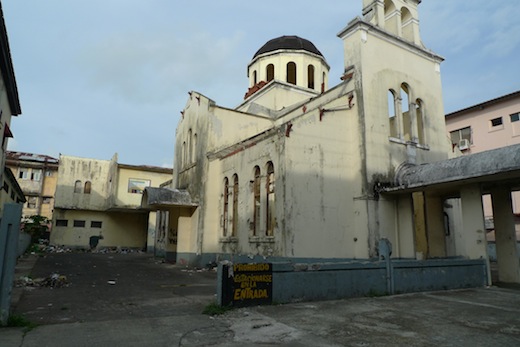
Abandoned church, Colon, Panama.
There had to be some fig leaf to justify the unlawfulness of the invasion, in this case the drug trafficking in which Noriega was involved.
During the invasion, thousands of people died. Entire cities, towns and neighborhoods were leveled to the ground. The people of Panama and entire Latin America were once again reminded that the Monroe Doctrine was still the main ‘law’ by which the Western Hemisphere had been governed. And so, in 1989, Panama joined the long list of devastated countries that experienced the brutality of direct or indirect invasions from the North: Granada, Dominican Republic, Cuba, Guatemala, Brazil, Colombia, Bolivia, Chile, Argentina, Uruguay to name at least some.
The city of Colon was never rebuilt. Until now it feels as if the US jets and helicopters were still periodically flying over its roofs, as if the armored vehicles were driving through the fronts of cafes and bars, as if the gunshots could be heard right behind the next corner. Colon does not actually look like a city, but more like a huge ship wreck, a frightening monument to destruction.

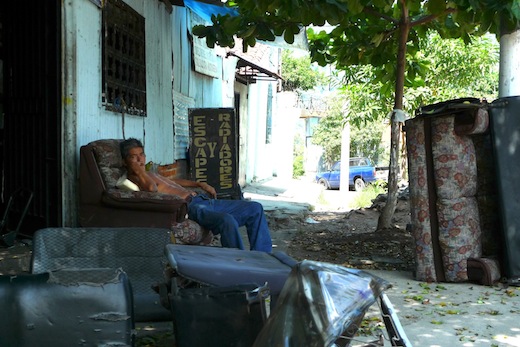
Beggar, Colon, Panama.
* * *
We are cruising slowly and despite Manuel’s warning I keep my window down, photographing and filming all along the way.“If you use professional cameras: Leica or big Nikons, everything looks better than in the real life”, I explain to Manuel. “You have to get very close if you want to capture things accurately; if you want your images to make an impact.”
He ignores my musing; he is scared. And I have no heart to tell him that the Leica I am now using has almost no zoom; the zoom is my own body, so I have to actually get very close to the street scenes of his battered native city of Colon.
I see a girl – she is walks by; she almost levitates. Her legs are fully and provocatively exposed but the entire upper part of her body is covered in white. She looks like a fragile ghost, or, from the waste up as a saint, but with provocatively painted lips. There is definitely a strong doze of poetry in all that I see around me. She smiles at me; I nod.
And then the children appear, young girls, as young as ten. They make suggestive motions while I am trying to look the other way. The poetry is gone. The images become extremely raw – everything here seems to be overexposed.
There are young boys with the stares as sharp as knives. And there are two old men having a dispute, their fingers pointing at each other’s faces menacingly. There are entire families with children living on the streets.
The decay is everywhere and it is quite an unimaginable decay; entire blocks of houses turned into skeletons, half-fallen churches, open garbage dumps, child sexual workers and gangs of desperately looking tiny boys. I see no guns but I see knives and gang symbols, I hear extremely violent music, the toughest grade of Panamanian rap.
“The violence came with the invasion”, says Manuel. “It never left. The tanks left but the violence did not. Then gang culture got its inspiration from the streets of LA and other US cities, as hopelessness translated itself into increased immigration to the North where many families ended up living in the toughest ghettos. The children became the foot soldiers of the gangs, moving back and forth between the North American inner cities and their native Panama.”
It all did not sound unfamiliar. I have witnessed the same pattern for years in places as far apart as Honduras, Samoa and Cambodia.
“This building was bombed by the US forces”, Manuel points at the huge, ghost-like, still surprisingly inhabited skyscraper. “If you want to film it, do so, but do it very quickly.”
To Manuel’s desperation I take my time. The building and its past fascinate me: the story is just incredible – the US forces bombed the tower inhabited by hundreds of civilians simply because it was tall and because it was ‘there’. I recall my work in Grenada, a decade after the US invasion. I studied in disbelieve what was left of the mental hospital blasted to pieces in 1983 in the so-called Operation Urgent Fury, with all its patients inside, simply because it had a green roof, unlike the rest of St. George’s with its iconic red roof tops.
We pass by the place of worship belonging to Jehovah Witnesses. Houses of Christian sects are all over the city, and so are the mosques, even one huge Hindu temple. As always, wherever there is no hope left and fear reigns, religions move in, quickly and efficiently, instantly filling the void.
What is striking is that in Colon even the houses of worship are fortified: with several layers of barbed wire, some armed with surveillance systems.
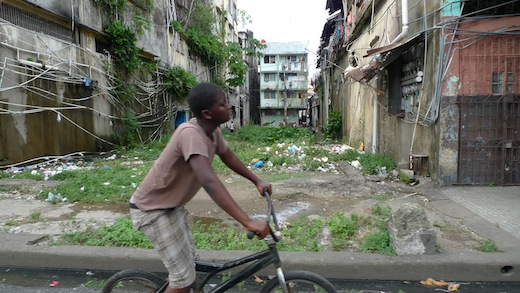
Colon almost quater century after the invasion.
* * *
In the very center of the city I hear the howl of the ambulance
sirens. I spot a tall hospital, not far from the ridiculously out of
place looking Radisson Hotel and decaying cruise ship port. There is a
crowd of desperate relatives at the entrance to the medical facility.
Everything in Colon seems to be overanxious, loud and unsettling.
Observing the state of its infrastructure and services it is astonishing
and hardly credible that the country ranks 58 on the Human Development
Index (UNDP, HDI, 2011), above nations like Kuwait and Malaysia.The contrasts are everywhere and they are monstrous – on one side is the port designed for the cruise ship liners, with several empty restaurants and the Radisson Hotel. Not far away is the dark and frightening city overrun by violence, desperation and permanent decay.
As we come closer to the port, it strikes me that there are no civilian ships. Instead I see one huge US battleship docked at the pier.
“But they are not supposed to be here, are they?” I drop my naïve rhetorical question, listing Philippines and other places where the US marines are actually ‘not supposed to be’ docking their ships.
“But they are”, Manuel shrugs his shoulders.
“Is this a cruise ship?” Two well-groomed women with very good middle class accents approach me after spotting me filming the vessel. I smile and reply that this is actually a war ship, with the cannons sticking out in all directions. For a moment I think they came for sightseeing: two nice and naïve teachers or young doctors or office workers. But then I see miniskirts and incredibly high heels, and the piercing scent of cheap perfume penetrates my nostrils.
I move to the main entrance to the jetty: “No dogs” it says: “The Entrance”.

I film for just a few seconds, before one tough looking and uniformed US marine comes running towards me: “No filming!” he screams.
I try a Kafkaesque approach on him: “But could I photograph?”
“Yes, but not too much”, he barks at me. Whatever that means. I switch one of my still cameras to an HD video mode and film a little bit more.
The ship is being refueled.
“How many people died during the invasion?” I ask an old man who is smoking some cheap cigar, right next to a huge plastic replica of a bottle of local rum serving as advertisement.
“Thousands, sunny”, he says, laconically.
”Some say 3,500 in the whole country,” I suggest.
“More”, he says. “I think more died in Colon alone”.
“Father, but how is life now?” I ask him with my exaggerated Chilean accent, to make sure he does not take me for gringo.
He pretends that he is thinking; although we both know the answer that is coming. He spits tobacco on the ground before speaking.
“Life is shit, sunny”, he replies pensively, leaving no space for further inquiries. “Una mierda, hijo.”
* * *
Then it is night and I feel hungry and near my hotel what is open are
only several North American fast food joints and a disproportionally
huge casino. I go through the security, then enter the casino. It is
Friday but nobody is gambling. The roulette and blackjack tables are
empty and so are the stools in front of flashing and noisy slot
machines.Life music in café is very loud but good; a corpulent local starlet is pouring out her heart in classic boleros, and then teasing the audience with good Columbian cumbias. It is all as it should be on a Friday night: “I die without you… You are my life… If you leave me…” It all goes well, and the dish of shredded beef and friend plantains is delicious. One could easily forget that the city outside resembles a war zone and that the gangs and child prostitutes are roaming the streets.
But then the music stops and the expression on the face of the singer changes. Something is going to happen, I think. With one bizarre, unnecessary and vulgar gesture she lifts up her skirt above her waste. The audience roars.
As I am leave the casino, I clearly hear the gunshots nearby.
* * *
The same night I stalk a police officer, whose name is D. Rodriguez.
He is bored, guarding nothing more exciting than a large parking lot. He
is eager to talk, as there is nothing better to do than to talk. I ask
him how bad is really life in Colon? He thinks for a few seconds than
begins his long litany:“To tell you the truth, earlier, things were much better for the poor. No matter what they say, Noriega was actually helping many poor people. In his days, most of the families were able to get by easily. Now they squeeze you with taxes and regulations but you get almost nothing in return. In the past, one could encounter plenty of respect. One man; just one police officer would be able to guard an entire prison… Now forget it: security forces are being taken hostages; there is no safety in this country, anymore.”I ask him about the terrible state in which his city appears to find itself, but he does not seem to understand my question. He is a man of concrete questions and answers. He was born and raised here and this is all he knows; there is no point of comparison.
“It is falling apart, I know”, he says. “They – the administration – do nothing. But it is like this for decades, at least since the invasion…”

* * *
But others do seem to know and they compare.
In January 2009 Grisel Bethancourt wrote for La Critica:
The City of Colón is the most violent in the Republic of Panama, according to an analysis of crime statistics taken from around the entire country announced by the Minister of Government and Justice Dilio Arcia. According to Arcia, this conclusion is derived from the numbers of homicides in Colón during 2008. There were 33 homicides for every 100,000 residents, which is greater than the 27 homicides for every 100,000 residents in Panama City. This report on the violence occurring along the Atlantic coast form part of the diagnosis of the criminal situation faced by the entire country. Most of the murders in Colón are tied to gang activity, said Arcia. In 2008 there were a total of 652 homicides in the entire Republic of Panama, where gang activity, the settling of accounts, quarrels between rival groups and revenge are the main causes. Even though Panama is not a drug producing country, most crime is tied to drug trafficking and 80% of the murders are caused with firearms. The statistics also indicate that in the prisons the average age of the inmates is 30 years, and more than two thirds of the inmates started their criminal careers at age 12, where school drop-outs are a big part of the problem.The editor of the publication replied:
At 33 murders per 100,000 inhabitants, Colón could very well be the most dangerous city in Latin America.In his book What Uncle Sam Really Wants, Noam Chomsky wrote about the state of post-invasion Panama:
The US put the bankers back in power after the invasion. Noriega’s involvement in drug trafficking had been trivial compared to theirs. Drug trafficking there has always been conducted primarily by the banks – the banking system is virtually unregulated, so it’s a natural outlet for criminal money. This has been the basis for Panama’s highly artificial economy and remains so – possibly at a higher level – after the invasion. The Panamanian Defence Forces have also been reconstructed with basically the same officers.
In general, everything’s pretty much the same, only now more reliable servants are in charge. The same is true of Grenada, which has become a major centre of drug money laundering since the US invasion. Nicaragua, too, has become a significant conduit for drugs to the US market, after Washington’s victory in the 1990 election. The pattern is standard – as is the failure to notice it.)
* * *
One of the managers working at the Hotel Four Points by Sheraton at a
suburb of Colon called Rainbow City originally comes from the capital.
He is ready to compare and to talk, but does not want to be named:“Life here is very tough. Not much seems to be working here now: the medical care is terrible and so is education… Noriega was no saint, but during his government the poor and the middle class were just fine. The rich of course hated him, as he was making their life difficult. Like the President that we have now – for decades he has been an arch enemy of Noriega.”The name “Rainbow City” where we speak comes from the days when the North Americans were building the Panama Canal. It is said that when they came here, they began housing and racially segregating local workers, similarly as they had been doing at home in the United States.
“Of course I did not experience those days of segregation”, says Manuel. “It all happened before I was born, but my parents and grandparents told me all about the past. There were shops, even supermarkets for the whites only and others for the rest of the people.”
Then he returned back to the invasion:
“It all depends to whom you decide to talk, of course. You hear one thing from the military and from the official press, which is owned by the rich, and you hear the opposite things from those whose children were killed during the bombing and invasion. What I can tell you is that this country was used as one enormous training ground by the US military. They tested all sorts of latest and the most sophisticated equipment here, to check it and to see how it would work in much more challenging war scenarios. They even brought some stealth bombers to this backwater. Why, to fight against the owners of Laundromats and minimarkets? And don’t forget that we have very good jungle here. You know what I mean by ‘good’ – it fits to thousands of diverse war scenarios.”“Many Panamanian people died”, concluded Manuel. “Yes, many people died here – in Colon; they were bombed, they were shot. But you know what? You will hardly find anything that would remind you of those horrors. Although the whole city looks now like one enormous war zone, like something that had been bombed to the ground, there are almost no bullet holes left and no remnants of the structures that were bombed. All proofs of the crime were painstakingly removed.”
Manuel does not want to have his real name mentioned. He would lose his job if he would be associated with the opposition intellectuals and their reports.
Before we part, he drives me to a former police station in the center of the battered city.
“It was totally destroyed; bombed. Now you only see the gate.
”Apparently everything had been destroyed around here”, I say.
He nods.
* * *
The next day I drive around, to posh marinas outside the city where
to speak Spanish is clearly considered déclassé and where catamarans are
flying flags of the United States, Canada and European Union. I drive
to the series of ancient fortifications now designated as a world
heritage site by UNESCO.Above all I want to see the Panama Canal; that fortified monster, the engineering masterpiece, the pride and damnation of this country.
As enormous ships are majestically pulling through the locks, as tugboats and locomotives are performing their precision work, as the flags of dozens of countries from around the world are flying above the vessels and along the Canal, one could not avoid thinking about the striking contrast between this ribbon of high technology and precision connecting two oceans, and the naked misery just a few miles away.
Between the city of Colon and the Gatun Locks, frenetic construction is under way: the new canal, new locks and new waterway that will increase maritime traffic through Panama.
The companies that were awarded construction contract belong to Belgium, Spain, Italy and other nations. And the ownership of the original Canal had been officially transferred from the United States to Panama in 1999.
But it is no secret that the sole superpower is firmly in charge of this strategically crucial country with only around 3.5 million inhabitants. Since May 2009, the super-conservative, pro-US supermarket magnate Ricardo Martinelli runs the country.
“Panama’s Torrijos was succeeded by the right wing Ricardo Martinelli, who comes from one of Panama’s oldest economic and political oligarch families”, wrote Annie Bird for The Red Phoenix. “JIATF-S, a unit under the U.S. military’s Southern Command (SouthCom), left Panama for Miami 19 years ago when the U.S. left the Canal Zone. Last year JIATF-S came back to Panama providing “Operational Support” in a newly reopened U.S. military base which serves as the Center of Operations for the Central American System for Regional Integration’s Regional Security Strategy (SICA-COSR). COSR will most likely be the regional center for the JIATF-S’s C4I border surveillance program, which creates technology canals of radars and other electronic surveillance equipment linked to Colombian and Mexican border control technology.”Elsewhere in Central America
The legacy of the US invasions and interventions is still visible all over Central America, it is scarring entire communities, entire nations.
“Gang violence, drug culture, extremely high crime rate: these are all legacies of the imported conflicts and wars”, legendary Spanish priest padre Pepe explained to me several years ago, who is, since 1985, fighting gang violence in El Salvador by trying to bring opportunities and skills to the youngsters who were recruited to some of the most brutal gangs in the world, particularly “M18” and Mara Salvatrucha (MS13).
In San Salvador, at Polígono Industrial Don Bosco, I witnessed hundreds of young men and women learning trades and trying to find their place in the society. Some of them had terrible histories shattering their young lives: they had to kill, to murder in cold blood, in order to survive and to prove their allegiance to the gang. Many of them lost relatives during the civil war, some were ‘sent’ to the United States for education. Some joined the gangs here, others in California or elsewhere.
The gang-wars in El Salvador, Honduras, Guatemala, and Mexico and at much smaller extent in other Central American countries have been reaching epic proportions for many years. Activities of the gangs are range from extortion, killings, rape, arson and illegal gambling to bank robberies and property fraud. The brutality is unimaginable: beheading and body part dismembering are the usual forms of executions. One of the former members of MS13 once confessed to me that after being gang-raped a female victim had her chest cut open with a knife and her heart eaten by the gang members while she was still alive.
Gangland, El Salvador.
As brutal as the gangs are, their members are products of the violence that was often brought to this part of the world from outside. This was clearly the point being made by a great French filmmaker Christian Poveda who spent years documenting Salvadorian gangs and who himself was murdered by maras in 2009. Poveda often described maras as “Victims of society”.
In June I drove to the same neighborhood of Soyapango where the filmmaker was allegedly murdered. I filmed the gang insignias and then I asked the driver to come back to allow me to take still photographs. As we were making the second approach, our car came under fire.
The same afternoon I visited the town of Guazapa, a place where some of the most terrible atrocities during the civil war took place. I was shown electric poles with the bullet holes, the places where the military and death squads (many of them trained in the United States) charged against the civilians. I was taken to the places where the people were murdered in broad daylight.
I crossed the river, stopping at the concrete wall where the names of the victims were once engraved into the simple monument, but were now fading. The river flowed lazily by and it was getting dark and eerie.
“This was the border between the land controlled by the revolutionary FLMN and the rest of the country”, explained my guide, a basketball trainer Henrique (not his real name). “Thousands of people were massacred here by the military, by paramilitaries, by the US covert operations. The slopes of the volcano are like some massive graveyard. And why? Just because the majority of our people wanted their left-wing government!”
The area is dotted with craters from intensive bombing (not unlike those I saw in Laos and Cambodia), with some remnants of schools and peasant houses.
The civil war in El Salvador (1980-1992) took, according to the official counts, between 70.000 and 75.000 lives, but it is widely believed that much more than 100.000 people were killed or disappeared in this small country with just slightly over 6 million inhabitants (2012 estimate).
I visit an old man – the only member of the family of over 30 that was massacred during the war. “They came with a truck, loaded all of us to the back of it and then shot and killed everybody just a few kilometers away. I was the only one who survived.” We agree on a formal interview and filming in the future. As the darkness begins to descend on the villages around Guazapa, my driver begins to panic. “This area is controlled by maras”, he explains.
Henrique calms him down. “They will not attack us. I coach many of their members. We play basketball together.” Sport is his way to draw young people away from violence.
“Most of them are good kids”, he says. “But look at this country: when they were children, their parents and relatives were disappearing, being slaughtered like animals. Weapons were everywhere. Death was hiding behind every corner and life was cheap; it had hardly any value.”
Now former FMLN guerillas are governing El Salvador, and things are slowly beginning to improve. But the legacy of violence will remain in the country for many long decades.
The US involvement in El Salvador (and in the rest of the region) has had a devastating impact on the local societies. Even with the new winds blowing though Latin America, it is very difficult to change the old power structures that are firmly in place. Not only financial, but also moral corruption has been implanted here for generations.
In 1987, John Stockwell, former high-ranking CIA agent, gave a powerful speech on the Secret Wars of the CIA. He mentioned El Salvador where the war was then still in full swing:
They don’t meet the death squads on the streets where they’re actually chopping up people or laying them down on the street and running trucks over their heads. The CIA people in San Salvador meet the police chiefs, and the people who run the death squads, and they do liaise with them, they meet them beside the swimming pool of the villas. And it’s a sophisticated, civilized kind of relationship. And they talk about their children, who are going to school at UCLA or Harvard and other schools, and they don’t talk about the horrors of what’s being done. They pretend like it isn’t true.But it was true and it is true even now. In El Salvador the civil war fought for ideals and sovereignty ended two decades ago, but the violence never stopped – it mutated to senseless gang wars and endless assassinations. There are thousands of literally sick elements of society, including members of the Sombra Negra, who are simply too accustomed to killing and too sure of their impunity.
* * *
In Guatemala, one of the most racially divided and feudal countries
on earth, the civil war (1960-1996) took almost a quarter of a million
people: 200,000 were killed and 50.000 disappeared. The conflict was
mainly between the right-wing governments and the military and
indigenous Maya groups, which actually represented the great majority of
the country. Left-wing guerilla MR-13 fought for 36 years both the
pro-Western fascist governments and the US direct (Green Berets
“advisors”, for instance) and indirect interventions.Even before the war, the U.S. government ordered the Central Intelligence Agency to launch Operation PBSUCCESS (1953–54) and halt Guatemala’s “communist revolt”, basically progressive forces – “October Revolutionaries” – who took control of the country after 1944, implementing countless socially- oriented reforms; another terrible crime in the eyes of the Empire.
In the neighboring Honduras, the United States established its continuous military presence and from there it was supporting (illegally, even according to the US Constitution) the terrorist Contras across the border in Nicaragua.
The military of Honduras was taking for years direct orders from the United States and there were entire waves of extra-judicial killings in the country’s history, backed by the CIA. Notorious “Battalion 316” performed the worst ones. There were also kidnappings and disappearances of countless Left wing opposition figures (including members of ‘Cinchoneros Popular Liberation Movement’) by the armed forces.
Recently, in 2009, the Left-Wing President Manuel Zelaya had been deposed in what was widely believed to be a US-backed coup.
Both Guatemala and Honduras are suffering from some of the highest levels of gang violence and delinquency anywhere in the world, the fact linked directly to the militias and death squads supported and trained for decades by the United States, as well as by the past wars ignited and fueled from the North.
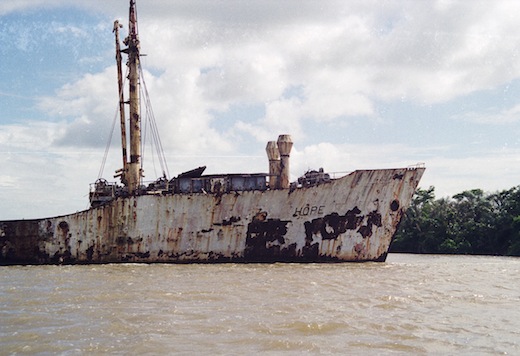
Abandoned ship “Hope.”
* * *
Nicaragua is different.There is no other country in Central America that had suffered more in the hands of the Empire. An adventurer William Walker declared himself a King here in 1856 before being driven from his ‘throne’ by other Central American countries one year later.
At the beginning of the 20th Century President Zelaya dared to make an attempt to regulate foreign access to Nicaraguan natural resources and the United States reacted by predictable fury, invading the country in 1909 and staying, with one brief interval, until 1933. Nicaragua was converted to a de facto colony. Shortly after the Marines left, long and horrible era of Somoza Dynasty (1936 – 1979) was installed and sponsored from the North. Anastasio Somoza García was a strange brew, a fascist and caudillo, but above all the fateful servant of the Empire. His offspring followed the same line; Anastasio Somoza Debayle, first the head of the notorious National Guard later the President, was ‘educated’ at West Point.
During the brutal dictatorship of Somoza clan, Nicaragua lost almost all of its coastal pines; there was unbridle deforestation, soil erosion and the land grabs by ruling elites. Hundreds of thousands of people were constantly on the move – relocated, displaced, forced to abandon their land. Lethal pesticides like DDT and Dieldrin were poisoning the land. The US interests and the local elites were ruining the country, systematically and without mercy.
The violence of destruction reached unimaginable heights.
But unlike elsewhere, the opposition was well organized and disciplined. The fight against fascism did not only include weapons, it encompassed education, revolutionary pathos ventilated through poetry, literature and music.
After the devastating “Managua Earthquake” which killed 10.000 and left 500.000 homeless on December 1972, the government had stolen much of the money from international relief funds. This was the last straw and on 27 December 1974, a group of FSLN guerrillas went to action and the war for the liberation of Nicaragua erupted.
For almost seven years the government used death squads and bombed civilians. Martial law was declared and entire villages were razed. The US was unconditionally supporting its ally. The Soviet Union and Cuba felt obliged to join the fight and support FSLN.
On July 19, 1979, Somoza dictatorship was over. The new – Sandinista – government was proclaimed, led by 35-years old Daniel Ortega. Young revolutionaries took over the city, with their songs and good humor, bringing hope to a ghostly capital.
Fabulous creative energy was unleashed; several years of rebuilding the nation began. After brutal pro-US dictatorship, Sandinistas had to fight malnutrition, pollution, widespread misery and illiteracy.
But success and the independent course unleashed, as always, a furious reaction from the United States, who embraced Contras, established by Somoza’s National Guard and strongly supported by former Nicaraguan business elites. Contras were allegedly funded by the CIA elements involved in cocaine trade in Central America, and the United Sates itself.
In Reagan years, the US unleashed nothing short of a war against the poor Central American nation, destroying its ports, infrastructure and terrorizing civilians. Contras were brutalizing local population, making excursions from their bases in Honduras and Costa Rica.
As always in similar scenarios, the US was enjoying absolute impunity. Although the International Court of Justice (ICJ) condemned its actions in 1986, the U.S. refused to pay restitution to Nicaragua, even after The United Nations General Assembly passed a resolution in order to pressure the U.S. to pay the fine. Only El Salvador and Israel voted against.
Brutality of the civil war exhausted the country and broke its revolutionary spirit. Sandinistas lost elections in 1990, and then again in 1996.
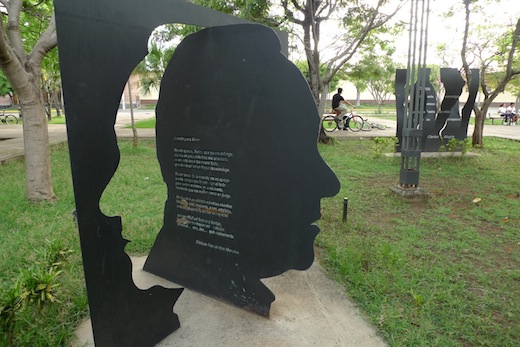
Poetry Park, Managua.
Imagine “Free and fair” elections (that is how they were described by Western mass media) where most of the people you ask say they would vote for Sandinistas, but vote for the Right-wing instead, too scared of the threats coming from the US embassy that is almost openly suggesting that the war would resume would the Left win again in democratic elections.
In those years I tried to make sense of all that was happening in Nicaragua and I spoke to Daniel Ortega and I spoke to Eden Pastora, Commander Zero, first the hero of the Revolution and later the leader of one faction of the Contras, the man who apparently refused to accept the US command and tactics and suggested to his North American counter-parts to “eat shit”.
One thing was clear to me: no matter how broken the country felt, no matter how depressing were regressive policies of the right wing governments, it was obvious to anyone that Nicaragua was “different” from other Central American nations. It was a place where people still knew how to dream about a better world. There was much more solidarity and awareness here than anywhere else in the region.
When the Left (Republicans) lost the civil war in Spain, they used to say: “We lost, but we had better songs!” Even when I worked one year in Costa Rica, a ‘region’s star”, I felt relief driving across the border to Nicaragua. They had always better jokes and much better songs there.
To have good songs and good education certainly helps. The nation finally pulled together and in November 2006 Daniel Ortega won elections once again. Of course he is far from being a perfect leader. Pastora, who came back and is now a cabinet minister, is also far from being ‘clean’. But what a difference between Nicaragua and those other Central American countries that also went through the deadly spiral of violence like Guatemala, Honduras, or Panama!
* * *
After coming under fire in San Salvador, after seeing all that
hopelessness and decay of the city of Colon in Panama, I arrived in
Nicaragua. I came for just two days, for B roll I had to collect for one
of my documentary films. I rented a car and after checking in my hotel
in Managua, drove to splendid Granada on the Lake Nicaragua.It was already late afternoon when I arrived. Before entering the city center, I noticed a large and welcoming park in front of the historic train station. It was dotted with impressive modern sculptures of great Nicaraguan poets. Each sculpture had one poem engraved in white color to its black surface. I read the names and the poems with reverence: Ernesto Cardenal, Enrique Fernandez Morales, Manolo Cuadra, Jose Coronel Urtecho, Joaquin Pasos…
Children were playing all around the park and lovers were sitting underneath those engraved poems, holding hands, embracing and kissing, whispering promises that were whispered by those who are in love since the very beginning of the world.
There was something moving and good about this entire atmosphere. It was an image of peace, of simple joy, of goodness.
It hit me that this was all very symbolic – this was the spirit of Central America, the beautiful and tender part of the world with its great ancient civilizations and communal and sharing spirit. In this world many great poems and songs were born. The couples would dance here until the early morning hours while the stories would flow often for days and nights. The beautiful land and the sea produced more than enough to sustain those few millions who lived here.
But outside of Nicaragua and Costa Rica, the violence is still torturing and scarring the people; blood is still flowing, women are crying at night remembering all those horrors they had to witness, remembering the men they loved and lost, the children they breastfed and lost, and all that injustice that is impossible to ever forgive and forget.
All that injustice… And all that violence unleashed by the generations of those who only knew wars and monstrous
dictatorships, the death squads.
Chances are that the child who grows up playing on the metal replica of old steam train under the statues of great writers will grow up to recite poems to his first love, somewhere in the park like this one in Granada. Chances are that a child who played with knifes and grew up witnessing indescribable violence will join some gang, will turn to killing and raping with no second thought.
In Guatemala, in El Salvador, in Nicaragua: people were certain what societies they wanted to live in. At one point or another they opted for progressive, humane governments. But their choices were drowned in blood. The Empire; the United States of America, put business and colonial interests ahead of any considerations for human lives. Hundreds of thousands of men, women and children were slaughtered. No apology, no compensation ever came.
Entire nations ruined, entire cities ruined. The gangs, the violence, the misery – this is what replaced the hope and natural strife for justice.
Two countries, two places only in this tortured strip of land between Mexico and Darien Gap are now rising from the ashes again: Nicaragua and El Salvador. Honduras tried but was cut in the middle by yet another US-backed shameless coup. The only way for Nicaragua and El Salvador to survive is to join hands, to cling with all their strength to their bigger brothers in South America, those who are uniting, those who are finally coming through, those who, after centuries of servility, are standing proudly on their own feet.
Andre Vltchek is a novelist, filmmaker and investigative journalist. He covered wars and conflicts in dozens of countries. His book on Western imperialism in the South Pacific – Oceania – is published by Lulu . His provocative book about post-Suharto Indonesia and market-fundamentalist model is called “Indonesia – The Archipelago of Fear” and will be released by Pluto Publishing House in August 2012. After living for many years in Latin America and Oceania, Vltchek presently resides and works in East Asia and Africa. He can be reached through his website.
All photographs by Andre Vltchek.


