Sunday, September 02, 2012

Sun Sets on Moon: Remembering the Reverend's Effect on American Politics


How Rev. Moon’s ‘Snakes’ Infested US

by Robert Parry - Consortium News

From the Archive: The death of Rev. Sun Myung Moon at 92 ends the long personal saga of a Korean theocrat whose life intertwined his bizarre religion with threads into organized crime and right-wing politics. Moon also showed how a fortune spent on media could change Washington’s political dynamic, as Robert Parry wrote in 2010.

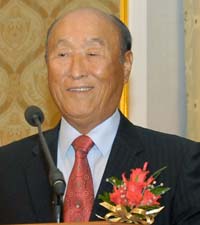
Rev. Sun Myung Moon, founder of the Unification Church, who died on Monday at age 92.


by Robert Parry (Published on May 1, 2010)

As an investigative journalist, I’m not much for catchy political metaphors, but the revelation that snakes and rodents are infesting the Washington Times building as the Rev. Sun Myung Moon’s newspaper sinks into a financial swamp does have some poetic justice about it.

After all, for several decades, the right-wing Washington Times has sent disinformation slithering through the U.S. political system while creating a nest for propagandists who have befouled American democracy with irrationality and dirty tricks. Indeed, one could say that Moon’s newspaper pioneered the modern style of deceptive “journalism” that is the daily fare on Fox News, angry talk radio and right-wing blogs.

The immediate cause of the Washington Times’ financial plight was the bitter succession fight among children of the aging Unification Church founder who was no longer capable of maintaining personal control over his global religious-political-business empire.

That empire had split into competing factions, with one of Moon’s children, Justin Moon, who was in charge of the Asian operations, deciding to slash the church’s massive subsidy to the Washington Times headed by another son, Preston Moon. Staffers who have survived a series of draconian layoffs reported that snakes and mice had slipped into the newspaper’s building because the owners couldn’t afford exterminators to combat the infestations.

“There was a three-foot-long black snake in the main conference room the other day,” said reporter Julia Duin. “We have snakes in the newsroom.”

A Curious Case

It has long been amazing that Official Washington has been so blasé about the curious case of the Washington Times, where a Korean theocrat – known for brainwashing his followers and for maintaining close ties with international drug cartels and foreign intelligence agencies – has been allowed to spend billions of unregulated dollars to influence U.S. political decision-making.

The fact that Moon wrapped himself in “conservative” political garb – and was quick to denounce any investigations of his organization as “religious bigotry” – helped fend off inquiries into exactly where his money was coming from.

But what proved most important was how Moon made himself useful to Ronald Reagan, the Bush Family and other Republican heavy-hitters – often by putting into play propaganda smearing their political enemies. These Republicans, in turn, helped protect Moon, at least since the late 1970s.

During the Carter administration, the congressional “Korea-gate” probe into South Korean influence-buying in Washington revealed Moon’s foreign intelligence ties and some of his criminal activities, leading to his conviction on tax fraud charges in 1982.

In that same year, however, Moon took steps to insulate himself from further inquiries, most notably by launching the Washington Times. Since then, Moon’s empire – from its local fundraising scams to its international money-laundering – has escaped any serious government examination.

It didn’t even matter when Church insiders, including Moon’s former daughter-in-law Nansook Hong, provided first-hand evidence of systematic criminality. In an era dominated by Republican control of the federal government, U.S. authorities never seemed to put two and two together.

Though Moon’s operations in both Asia and South America were linked to major crime syndicates including the Japanese yakuza and Latin American cocaine cartels, federal prosecutors and congressional committees chose to look the other way.

That way Moon was allowed to continue pouring an estimated $100 million a year into his newspaper and other pro-Republican media outlets. Additional millions went to fund right-wing political conferences; to pay speaking fees to world leaders, including George H.W. Bush; and to bail Republican political allies out of financial troubles.

When I was investigating Moon’s activities in the mid-1990s, I interviewed former church insiders who explained how Moon’s U.S. business operations, such as restaurants and real estate deals, served to launder overseas money that his followers would first sneak past U.S. Customs, a practice confirmed by Moon’s ex-daughter-in-law.

In her 1998 memoir, In the Shadow of the Moons, Nansook Hong alleged that Moon’s organization had engaged in a long-running conspiracy to smuggle cash into the United States and to deceive U.S. Customs agents.

“The Unification Church was a cash operation,” Nansook Hong wrote. “I watched Japanese church leaders arrive at regular intervals at East Garden [the Moon compound north of New York City] with paper bags full of money, which the Reverend Moon would either pocket or distribute to the heads of various church-owned business enterprises at his breakfast table.

“The Japanese had no trouble bringing the cash into the United States; they would tell customs agents that they were in America to gamble at Atlantic City. In addition, many businesses run by the church were cash operations, including several Japanese restaurants in New York City. I saw deliveries of cash from church headquarters that went directly into the wall safe in Mrs. Moon’s closet.”

Personal Confession

Mrs. Moon even pressed her daughter-in-law into one cash-smuggling incident after a trip to Japan in 1992, Nansook Hong wrote. Mrs. Moon had received “stacks of money” and divvied it up among her entourage for the return trip through Seattle, Nansook Hong wrote.

“I was given $20,000 in two packs of crisp new bills,” she recalled. “I hid them beneath the tray in my makeup case. … I knew that smuggling was illegal, but I believed the followers of Sun Myung Moon answered to higher laws.”

U.S. currency laws require that cash amounts above $10,000 be declared at Customs when the money enters or leaves the country. It is also illegal to conspire with couriers to bring in lesser amounts when the total exceeds the $10,000 figure.

Moon “demonstrated contempt for U.S. law every time he accepted a paper bag full of untraceable, undeclared cash collected from true believers” who smuggled the money in from overseas, Nansook Hong wrote. Despite Nansook Hong’s revelations, which corroborated longstanding claims by other Moon insiders, no known criminal investigation ensued.

There is also the question of where the mysterious money originated. Some Moon watchers believe much of the cash came from scams of superstitious Japanese widows who were sold miniature pagodas and other ornaments dedicated to their dead husbands.

Yet, while the Japanese scams might explain part of Moon’s fortune, others who have looked into Moon’s operation suspect that a major source of money derived from Moon’s close relationships with underworld figures in Asia and South America.

Those ties date back several decades to negotiations conducted by one of Moon’s early South Korean supporters, Kim Jong-Pil, who founded the Korean CIA and headed up sensitive negotiations on improving bilateral relations between Tokyo and Seoul.

The negotiations put Kim Jong-Pil in touch with two important figures in the Far East, Japanese rightists Yoshio Kodama and Ryoichi Sasakawa, who had been jailed as fascist war criminals at the end of World War II. A few years later, however, both Kodama and Sasakawa were freed by U.S. military intelligence officials.

The U.S. government turned to Kodama and Sasakawa for help in combating communist labor unions and student strikes, much as the CIA protected German Nazi war criminals who supplied intelligence and performed other services in Cold War battles with European communists.

Kodama and Sasakawa also allegedly grew rich from their association with the yakuza, a shadowy organized crime syndicate that profited off drug smuggling, gambling and prostitution in Japan and Korea. Behind the scenes, Kodama and Sasakawa became power-brokers in Japan’s ruling Liberal Democratic Party.

Far-Right Extremism

Kim Jong-Pil’s contacts with these right-wing leaders proved invaluable to Moon, who had made only a few converts in Japan by the early 1960s. Immediately after Kim Jong-Pil opened the door to Kodama and Sasakawa in late 1962, 50 leaders of an ultra-nationalist Japanese Buddhist sect converted en masse to the Unification Church, according to Yakuza, a book by David E. Kaplan and Alec Dubro.

“Sasakawa became an advisor to Reverend Sun Myung Moon’s Japanese branch of the Unification Church” and collaborated with Moon in building far-right anti-communist organizations in Asia, Kaplan and Dubro wrote.

Moon’s church was active in the Asian People’s Anti-Communist League, a fiercely right-wing group founded by the governments of South Korea and Taiwan. In 1966, the group expanded into the World Anti-Communist League, an international alliance that brought together traditional conservatives with ex-Nazis, overt racialists and Latin American “death squads.”

Authors Scott Anderson and Jon Lee Anderson wrote in their 1986 book, Inside the League, that Sun Myung Moon was one of five indispensable Asian leaders who made the World Anti-Communist League possible.

The five were Taiwan’s dictator Chiang Kai-shek, South Korea’s dictator Park Chung Hee, yakuza gangsters Sasakawa and Kodama, and Moon, “an evangelist who planned to take over the world through the doctrine of ‘Heavenly Deception,’” the Andersons wrote.

WACL became a well-financed worldwide organization after a secret meeting between Sasakawa and Moon, along with two Kodama representatives, on a lake in Yamanashi Prefecture, Japan, according to the Andersons. The purpose of the meeting was to create an anti-communist organization that “would further Moon’s global crusade and lend the Japanese yakuza leaders a respectable new façade,” the Andersons wrote.

Mixing organized crime and political extremism, of course, has a long tradition throughout the world. Violent political movements often have blended with criminal operations as a way to arrange covert funding, move operatives or acquire weapons.

Drug smuggling has proven to be a particularly effective way to fill the coffers of extremist movements, especially those that find ways to insinuate themselves within more legitimate operations of sympathetic governments or intelligence services.

In the quarter century after World War II, remnants of fascist movements managed to do just that. Shattered by the Allies, the surviving fascists got a new lease on political life with the start of the Cold War. They helped both Western democracies and right-wing dictatorships battle international communism.

Though some Nazi leaders faced war-crimes tribunals after World War II, others managed to make their escapes along “rat lines” to Spain or South America or they finagled intelligence relationships with the victorious powers, especially the United States.

Argentina became a natural haven given the pre-war alliance that existed between the European fascists and prominent Argentine military leaders, such as Juan Peron. The fleeing Nazis also found like-minded right-wing politicians and military officers across Latin America who already used repression to keep down the indigenous populations and the legions of the poor.

In the post-World War II years, some Nazi war criminals chose reclusive lives, but others, such as former SS officer Klaus Barbie, sold their intelligence skills to less-sophisticated security services in countries like Bolivia or Paraguay. Other Nazis on the lam trafficked in narcotics. Often the lines crossed between intelligence operations and criminal conspiracies.

French Connection

Auguste Ricord, a French war criminal who had collaborated with the Gestapo, set up shop in Paraguay and opened up the French Connection heroin channels to American Mafia drug kingpin Santo Trafficante Jr., who controlled much of the heroin traffic into the United States. Columns by Jack Anderson identified Ricord’s accomplices as some of Paraguay’s highest-ranking military officers.

Another French Connection mobster, Christian David, relied on protection of Argentine authorities. While trafficking in heroin, David also “took on assignments for Argentina’s terrorist organization, the Argentine Anti-Communist Alliance,” Henrik Kruger wrote in The Great Heroin Coup.

During President Richard Nixon’s original “war on drugs,” U.S. authorities smashed the famous French Connection and won extraditions of Ricord and David in 1972 to face justice in the United States. However, by the time the French Connection was severed, powerful Mafia drug lords had forged strong ties to South America’s military leaders. An infrastructure for the multi-billion-dollar drug trade, servicing the insatiable U.S. market, was in place.

Trafficante-connected groups also recruited displaced anti-Castro Cubans, who had ended up in Miami, needed work, and possessed some useful intelligence skills gained from the CIA’s training for the Bay of Pigs and other clandestine operations. Heroin from the Golden Triangle of Southeast Asia soon filled the void left by the broken French Connection and its mostly Middle Eastern heroin supply routes.

During this time of transition, Moon brought his evangelical message to South America. His first visit to Argentina occurred in 1965 when he blessed a square behind the presidential Pink House in Buenos Aires, but he returned a decade later to make more lasting friendships.

Moon first sank down roots in Uruguay during the 12-year reign of right-wing military dictators who seized power in 1973. He also cultivated close relations with military dictators in Argentina, Paraguay and Chile, reportedly ingratiating himself with the juntas by helping the military regimes arrange arms purchases and by channeling money to allied right-wing organizations.

“Relationships nurtured with right-wing Latin Americans in the [World Anti-Communist] League led to acceptance of the [Unification] Church’s political and propaganda operations throughout Latin America,” the Andersons wrote in Inside the League.

“As an international money laundry, … the Church tapped into the capital flight havens of Latin America. Escaping the scrutiny of American and European investigators, the Church could now funnel money into banks in Honduras, Uruguay and Brazil, where official oversight was lax or nonexistent.”

Cocaine Coup

In 1980, Moon made more friends in South America when a right-wing alliance of Bolivian military officers and drug dealers organized what became known as the Cocaine Coup. Moon’s WACL associates, such as Alfred Candia, coordinated the arrival of some of the paramilitary operatives who assisted in the violent putsch.

Right-wing Argentine intelligence officers mixed with a contingent of young European neo-fascists as they collaborated with Nazi war criminal Barbie in carrying out the bloody coup that overthrew the elected left-of-center government. The victory put into power a right-wing military dictatorship indebted to the drug lords. Bolivia became South America’s first narco-state.

One of the first well-wishers arriving in La Paz to congratulate the new government was Moon’s top lieutenant, Bo Hi Pak. The Moon organization published a photo of Pak meeting with the new strongman, General Garcia Meza. After the visit to the mountainous capital, Pak declared, “I have erected a throne for Father Moon in the world’s highest city.”

According to later Bolivian government and newspaper reports, a Moon representative invested about $4 million in preparations for the coup. Bolivia’s WACL representatives also played key roles, and CAUSA, one of Moon’s anti-communist organizations, listed as members nearly all the leading Bolivian coup-makers.

Soon, Colonel Luis Arce-Gomez, a coup organizer and the cousin of cocaine kingpin Roberto Suarez, went into partnership with big narco-traffickers, including Trafficante’s Cuban-American smugglers. Nazi war criminal Barbie and his young neo-fascist followers found new work protecting Bolivia’s major cocaine barons and transporting drugs to the border.

“The paramilitary units – conceived by Barbie as a new type of SS – sold themselves to the cocaine barons,” German journalist Kai Hermann wrote. “The attraction of fast money in the cocaine trade was stronger than the idea of a national socialist revolution in Latin America.”

A month after the coup, General Garcia Meza participated in the Fourth Congress of the Latin American Anti-Communist Confederation, an arm of the World Anti-Communist League. Also attending that Fourth Congress was WACL president Woo Jae Sung, a leading Moon disciple.

As the drug lords consolidated their power in Bolivia, the Moon organization expanded its presence, too. Hermann reported that in early 1981, war criminal Barbie and Moon leader Thomas Ward were seen together in apparent prayer.

On May 31, 1981, Moon representatives sponsored a CAUSA reception at the Sheraton Hotel’s Hall of Freedom in La Paz. Moon’s lieutenant Bo Hi Pak and Bolivian strongman Garcia Meza led a prayer for President Reagan’s recovery from an assassination attempt.

In his speech, Bo Hi Pak declared, “God had chosen the Bolivian people in the heart of South America as the ones to conquer communism.” According to a later Bolivian intelligence report, the Moon organization sought to recruit an “armed church” of Bolivians, with about 7,000 Bolivians receiving some paramilitary training.

Moon’s Escape

But by late 1981, the cocaine taint of Bolivia’s military junta was so deep and the corruption so staggering that U.S.-Bolivian relations were stretched to the breaking point. “The Moon sect disappeared overnight from Bolivia as clandestinely as they had arrived,” Hermann reported.

The Cocaine Coup leaders soon found themselves on the run, too. Interior Minister Arce-Gomez was eventually extradited to Miami and was sentenced to 30 years in prison for drug trafficking. Drug lord Roberto Suarez got a 15-year prison term. General Garcia Meza became a fugitive from a 30-year sentence imposed on him in Bolivia for abuse of power, corruption and murder.

Ex-Gestapo official Barbie, known as the “butcher of Lyon,” was returned to France to face a life sentence for war crimes. He died in 1991.

But Moon’s organization suffered few negative repercussions from the Cocaine Coup. By the early 1980s, flush with seemingly unlimited funds, Moon had moved on to promoting himself with the new Republican administration in Washington. Yet, where Moon got his cash remained one of Washington’s deepest mysteries – and one that few U.S. conservatives wanted to solve.

“Some Moonie-watchers even believe that some of the business enterprises are actually covers for drug trafficking,” wrote Scott and Jon Lee Anderson.

While Moon’s representatives have refused to detail how they’ve sustained their far-flung activities, Moon’s spokesmen have angrily denied recurring allegations about profiteering off illegal trafficking in weapons and drugs.

In a typical response to a gun-running question by the Argentine newspaper, Clarin, Moon’s representative Ricardo DeSena responded, “I deny categorically these accusations and also the barbarities that are said about drugs and brainwashing. Our movement responds to the harmony of the races, nations and religions and proclaims that the family is the school of love.” [Clarin, July 7, 1996]

Without doubt, however, Moon’s organization has had a long record of association with organized crime figures, including ones implicated in the drug trade. Besides collaborating with leaders of the Japanese yakuza and the Cocaine Coup government of Bolivia, Moon’s organization developed close ties with the Honduran military and the Nicaraguan contra movement, both permeated with drug smugglers. [See Robert Parry’s Lost History.]

On the Offensive

Moon’s organization also used the Washington Times and its political clout in the nation’s capital to intimidate or discredit government officials and journalists who tried to investigate Moon-connected criminal activities. In the mid-1980s, for instance, when journalists and congressional investigators began probing the evidence of contra-drug trafficking, they came under attack from the Times.

An Associated Press story that I co-wrote with Brian Barger about a Miami-based federal probe into gun- and drug-running by the contras was denigrated in an April 11, 1986, front-page Washington Times article with the headline: “Story on [contra] drug smuggling denounced as political ploy.”

When Sen. John Kerry, D-Massachusetts, conducted a Senate probe and uncovered additional evidence of contra-drug trafficking, the Washington Times denounced him, too. The newspaper first published articles depicting Kerry’s probe as a wasteful political witch hunt. “Kerry’s anti-contra efforts extensive, expensive, in vain,” announced the headline of one Times article on Aug. 13, 1986.

But when Kerry exposed more contra wrongdoing, the Washington Times shifted tactics. In 1987 in front-page articles, it began accusing Kerry’s staff of obstructing justice because their investigation was supposedly interfering with Reagan administration efforts to get at the truth.

“Kerry staffers damaged FBI probe,” said a Jan. 21, 1987, Times article that opened with the assertion: “Congressional investigators for Sen. John Kerry severely damaged a federal drug investigation last summer by interfering with a witness while pursuing allegations of drug smuggling by the Nicaraguan resistance, federal law enforcement officials said.”

Despite the attacks, Kerry’s contra-drug investigation eventually concluded that a number of contra units – both in Costa Rica and Honduras – were implicated in the cocaine trade.

“It is clear that individuals who provided support for the contras were involved in drug trafficking, the supply network of the contras was used by drug trafficking organizations, and elements of the contras themselves knowingly received financial and material assistance from drug traffickers,” Kerry’s investigation stated in a report issued April 13, 1989.

“In each case, one or another agency of the U.S. government had information regarding the involvement either while it was occurring or immediately thereafter.”

Kerry’s investigation also found that Honduras had become an important way station for cocaine shipments heading north during the contra war. “Elements of the Honduran military were involved … in the protection of drug traffickers from 1980 on,” the report said. “These activities were reported to appropriate U.S. government officials throughout the period.

“Instead of moving decisively to close down the drug trafficking by stepping up the DEA presence in the country and using the foreign assistance the United States was extending to the Hondurans as a lever, the United States closed the DEA office in Tegucigalpa and appears to have ignored the issue.”

The Kerry investigation represented an indirect challenge to Vice President George H.W. Bush, who had been named by President Reagan to head the South Florida Task Force for interdicting the flow of drugs into the United States and was later put in charge of the National Narcotics Border Interdiction System.

In short, Vice President Bush was the lead official in the U.S. government to cope with the drug trade, which he himself had dubbed a national security threat. If the American voters came to believe that Bush had compromised his anti-drug responsibilities to protect the image of the Nicaraguan contras and other rightists in Central America, that judgment could have threatened the political future of Bush and his politically ambitious family.

By challenging press and congressional investigations of this touchy subject, the Washington Times helped keep an unfavorable media spotlight from swinging in the direction of the Vice President – and bought some cover for Moon’s drug-connected right-wing allies, too.

Mounting Evidence

The resistance of the Reagan and the first Bush administrations prevented anything like a complete story of the contra-drug scandal from emerging in a timely fashion. However, the evidence – eventually assembled by investigators at the CIA, the Justice Department and other federal agencies – now indicates that Bolivia’s Cocaine Coup operatives were only the first in a line of clever drug smugglers who tried to squeeze under the protective umbrella of Reagan’s favorite covert operation, the contra war.

Other cocaine smugglers soon followed, sharing some of their drug profits with the contras as a way to minimize investigative interest by the Reagan-Bush law enforcement agencies. Based on official investigations, we now know that the contra-connected smugglers included Bolivians, the Medellin cartel, Panama’s government of Manuel Noriega, the Honduran military, the Honduran-Mexican smuggling ring of Ramon Matta Ballesteros, and the Miami-based anti-Castro Cubans with their connections to Mafia operations throughout the United States.

In some cases, U.S. intelligence officials bent over backwards not to take timely notice of contra-connected drug trafficking out of fear that fuller investigations would embarrass the contras and their patrons in the Reagan-Bush administrations.

For instance, on Oct. 22, 1982, a cable written by the CIA’s Directorate of Operations stated, “There are indications of links between [a U.S. religious organization] and two Nicaraguan counter-revolutionary groups. These links involve an exchange in [the United States] of narcotics for arms.”

The cable added that the participants were planning a meeting in Costa Rica for such a deal. When the cable arrived, senior CIA officials were concerned. On Oct. 27, CIA headquarters asked for more information from a U.S. law enforcement agency.

The law enforcement agency expanded on its report by telling the CIA that representatives of the contra FDN and another contra force, the UDN, would be meeting with several unidentified U.S. citizens. But then, the CIA reversed itself, deciding that it wanted no more information on the grounds that U.S. citizens were involved.

“In light of the apparent participation of U.S. persons throughout, agree you should not pursue the matter further,” CIA headquarters wrote on Nov. 3, 1982. Two weeks later, after discouraging additional investigation, CIA headquarters suggested it might be necessary to label the allegations of a guns-for-drugs deal as “misinformation.”

The CIA’s Latin American Division, however, responded on Nov. 18, 1982, that several contra officials had gone to San Francisco for the meetings with supporters, presumably as part of the same guns-for-drugs deal. But CIA inspector general Frederick Hitz – when he investigated in the mid-to-late 1990s – found no additional information about that deal in CIA files.

Also, by keeping the names of the participants censored when the documents finally were released in 1998, the CIA prevented outside investigators from examining whether the “U.S. religious organization” had any affiliation with Moon’s network of quasi-religious groups, which were assisting the contras at that time.

Studied Disinterest

Over the past quarter century – as Moon invested heavily in prominent Republicans – this pattern of government disinterest in his illicit operations remained one consistency. That disinterest wasn’t even shaken when disenchanted Moon insiders went public with confessions of their own first-hand involvement in criminal conspiracies.

Besides Nansook Hong’s account of money-laundering, other disaffected Moon disciples told similar stories. For instance, Maria Madelene Pretorious, a former Unification Church member who worked at Moon’s Manhattan Center, a New York City music venue and recording studio, testified at a court hearing in Massachusetts that in December of 1993 or January of 1994, one of Moon’s sons, Hyo Jin Moon, returned from a trip to Korea “with $600,000 in cash which he had received from his father. … Myself along with three or four other members that worked at Manhattan Center saw the cash in bags, shopping bags.”

In an interview with me in the mid-1990s, Pretorious said Asian church members would bring cash into the United States where it would be circulated through Moon’s business entities as a way to launder it.

At the center of this financial operation, Pretorious said, was One-Up Corp., a Delaware-registered holding company that owned many Moon enterprises including the Manhattan Center and New World Communications, the parent company of the Washington Times.

“Once that cash is at the Manhattan Center, it has to be accounted for,” Pretorious said. “The way that’s done is to launder the cash. Manhattan Center gives cash to a business called Happy World which owns restaurants. … Happy World needs to pay illegal aliens. … Happy World pays some back to the Manhattan Center for ‘services rendered.’ The rest goes to One-Up and then comes back to Manhattan Center as an investment.”

In 1996, the Uruguayan bank employees union blew the whistle on another Moon money-laundering scheme, in which some 4,200 female Japanese followers allegedly walked into the Moon-controlled Banco de Credito in Montevideo and deposited as much as $25,000 each.

The money from the women went into the account of an anonymous association called Cami II, which was controlled by Moon’s Unification Church. In one day, Cami II received $19 million and, by the time the parade of women ended, the total had swelled to about $80 million.

It was not clear where the money originated, nor how many other times Moon’s organization has used this tactic – known as “smurfing” – to transfer untraceable cash into Uruguay. Authorities did not push the money-laundering investigation, apparently out of deference to Moon’s political clout and fear of disrupting Uruguay’s banking industry. However, other critics condemned Moon’s operations.

“The first thing we ought to do is clarify to the people [of Uruguay] that Moon’s sect is a type of modern pirate that came to the country to perform obscure money operations, such as money laundering,” said Jorge Zabalza, who was a leader of the Movimiento de Participacion Popular. “This sect is a kind of religious mob that is trying to get public support to pursue its business.”

While Moon’s criminal enterprises may have been operating at one level, Moon’s political influence-buying was functioning at another, as he spread around billions of dollars to the top echelons of Washington power.

For instance, when the New Right’s direct-mail whiz Richard Viguerie fell on hard times in the late 1980s, Moon had a corporation run by his lieutenant, Bo Hi Pak, buy one of Viguerie’s properties for $10 million. [See OrangeCounty Register, Dec. 21, 1987; Washington Post, Oct. 15, 1989]

Moon also used the Washington Times and its affiliated publications to create seemingly legitimate conduits to funnel money to individuals and companies. In another example of Moon’s helpful largesse, the Washington Times hired Viguerie to conduct a pricy direct-mail subscription drive.

Falwell’s Savior

Another case of saving a right-wing icon occurred when the Rev. Jerry Falwell was facing financial ruin over the debts piling up at Liberty University. But the fundamentalist Christian school in Lynchburg, Virginia, got a last-minute bail-out in the mid-1990s ostensibly from two Virginia businessmen, Dan Reber and Jimmy Thomas, who used their non-profit Christian Heritage Foundation to snap up a large chunk of Liberty’s debt for $2.5 million, a fraction of its face value.

Falwell rejoiced and called the moment “the greatest single day of financial advantage” in the school’s history, even though it was accomplished at the disadvantage of many small true-believing investors who had bought the church construction bonds through a Texas company.

But Falwell’s secret benefactor behind the debt purchase was Sun Myung Moon, who was kept in the background partly because of his controversial Biblical interpretations that hold Jesus to have been a failure and because of Moon’s alleged brainwashing of thousands of young Americans, often shattering their bonds with their biological families.

Moon had used his tax-exempt Women’s Federation for World Peace to funnel $3.5 million to the Reber-Thomas Christian Heritage Foundation, the non-profit that purchased the school’s debt. I stumbled onto this Moon-Falwell connection while examining the Internal Revenue Service filings of Moon’s front groups.

The Women Federation’s vice president Susan Fefferman confirmed that the $3.5 million grant had gone to “Mr. Falwell’s people” for the benefit of Liberty University. [For more on Moon’s funding of the Right, see Robert Parry’s Secrecy & Privilege.]

Moon also used the Women’s Federation to pay substantial speaking fees to former President George H.W. Bush, who gave talks at Moon-sponsored events. In September 1995, Bush and his wife, Barbara, gave six speeches in Asia for the Women’s Federation. In one speech on Sept. 14 to 50,000 Moon supporters in Tokyo, Bush said “what really counts is faith, family and friends.”

In summer 1996, Bush was lending his prestige to Moon again. The former President addressed the Moon-connected Family Federation for World Peace in Washington, an event that gained notoriety when comedian Bill Cosby tried to back out of his contract after learning of Moon’s connection. Bush had no such qualms. [Washington Post, July 30, 1996]

In fall 1996, Moon needed the ex-President’s help once more. Moon was trying to replicate his Washington Times influence in South America by opening a regional newspaper, Tiempos del Mundo. But South American journalists were recounting unsavory chapters of Moon’s history, including his links to South Korea’s intelligence service and various neo-fascist groups.

Some newspaper articles noted that in the early 1980s, Moon had used friendships with the military dictatorships in Argentina and Uruguay – which had been responsible for tens of thousands of political murders – to invest in those two countries. There also were allegations of Moon’s links to the region’s major drug traffickers.

Moon’s disciples fumed about the critical stories and accused the Argentine news media of trying to sabotage Moon’s plans for an inaugural gala in Buenos Aires on Nov. 23, 1996. “The local press was trying to undermine the event,” complained the church’s internal newsletter, Unification News.

Trump Card

Given the controversy, Argentina’s elected president, Carlos Menem, decided to reject Moon’s invitation to attend. But Moon had a trump card: the endorsement of an ex-President of the United States, George H.W. Bush. Agreeing to speak at the newspaper’s launch, Bush flew aboard a private plane, arriving in Buenos Aires on Nov. 22. Bush stayed at Menem’s official residence, the Olivos.

As the headliner at the newspaper’s inaugural gala, Bush saved the day, Moon’s followers gushed. “Mr. Bush’s presence as keynote speaker gave the event invaluable prestige,” wrote the Unification News. “Father [Moon] and Mother [Mrs. Moon] sat with several of the True Children [Moon’s offspring] just a few feet from the podium” where Bush spoke.

“I want to salute Reverend Moon,” Bush declared. “A lot of my friends in South America don’t know about the Washington Times, but it is an independent voice. The editors of the Washington Times tell me that never once has the man with the vision [Moon] interfered with the running of the paper, a paper that in my view brings sanity to Washington, D.C.”

Bush’s speech was so effusive that it surprised even Moon’s followers. “Once again, heaven turned a disappointment into a victory,” the Unification News exulted. “Everyone was delighted to hear his compliments. We knew he would give an appropriate and ‘nice’ speech, but praise in Father’s presence was more than we expected. … It was vindication. We could just hear a sigh of relief from Heaven.”

While Bush’s assertion about Moon’s Washington Times as a voice of “sanity” may be a matter of opinion, Bush’s vouching for its editorial independence simply wasn’t true. Almost since it opened in 1982, a string of senior editors and correspondents have resigned, citing the manipulation of the news by Moon and his subordinates.

The first editor, James Whelan, resigned in 1984, confessing that “I have blood on my hands” for helping Moon’s church achieve greater legitimacy. But Bush’s boosterism was just what Moon needed in South America.

“The day after,” the Unification News observed, “the press did a 180-degree about-turn once they realized that the event had the support of a U.S. President.” With Bush’s help, Moon had gained another beachhead for his worldwide business-religious-political-media empire.

After the event, Menem told reporters from La Nacion that Bush had claimed privately to be only a mercenary who did not really know Moon. “Bush told me he came and charged money to do it,” Menem said. [La Nacion, Nov. 26, 1996]

But Bush was not telling Menem the whole story. By fall 1996, Bush and Moon had been working in political tandem for at least a decade and a half. The ex-President also had been earning huge speaking fees as a front man for Moon for more than a year.

Throughout these public appearances for Moon, Bush’s office refused to divulge how much Moon-affiliated organizations have paid the ex-President. But estimates of Bush’s fee for the Buenos Aires appearance alone ran between $100,000 and $500,000. Sources close to the Unification Church told me that the total spending on Bush ran into the millions, with one source saying that Bush stood to make as much as $10 million from Moon’s organization.

The senior George Bush may have had a political motive, too. By 1996, sources close to Bush were saying the ex-President was working hard to enlist well-to-do conservatives and their money behind the presidential candidacy of his son, George W. Bush. Moon was one of the deepest pockets in right-wing circles.

Moon’s pattern of putting into Bush family causes continued into George W. Bush’s presidency. In 2006, Moon again used money-laundering techniques to funnel a donation to the George H.W. Bush Presidential Library.

The Houston Chronicle reported that Moon’s Washington Times Foundation gave $1 million to the Greater Houston Community Foundation, which in turn acted as a conduit for donations to the library. The Chronicle obtained indirect confirmation that Moon’s money was passing through the Houston foundation to the Bush library from Bush family spokesman Jim McGrath.

“President Bush has been very grateful for the friendship shown to him by the Washington Times Foundation, and the Washington Times serves a vital role in Washington,” McGrath said.

But Moon has earned the deepest gratitude of the Bush Family and the Republican Party via his multi-billion-dollar investment in the Washington Times, a powerful propaganda organ that helped the GOP build its political dominance over the past quarter century.

Over those years, the Times has targeted American politicians of the Center and Left with journalistic attacks – sometimes questioning their sanity, as happened with Democratic presidential nominees Michael Dukakis and Al Gore. Those themes then resonated through the broader right-wing echo chamber and often into the mainstream media.

In 2000, the Washington Times was at the center of the assault on Al Gore’s candidacy – highlighting apocryphal quotes by Gore and using them to depict him as either “Lyin’ Al” or delusional. [See Consortiumnews.com’s “Al Gore vs. the Media.”]

Aiming at Obama

The intervention by Moon’s media outlets into U.S. presidential politics continued into Campaign 2008 when Moon’s online magazine Insight tried to sabotage Sen. Barack Obama’s campaign before it even got started. The Insight article cited opposition research supposedly dug up by Hillary Clinton’s campaign that Obama had attended a fundamentalist Muslim “madrassa” while a child and had sought to conceal his allegiance to Islam.

“He was a Muslim, but he concealed it,” a source supposedly close to Clinton’s background investigation of Obama told Insight. “The idea is to show Obama as deceptive.” Insight used no named sources for the allegations, nor did the magazine check out the facts about the school.

After Moon’s online magazine published the “madrassa” story, it quickly spread to the wider audiences of Rupert Murdoch’s right-wing media outlets, Fox News and the New York Post, and then into the mainstream press. To further the subliminal link between Obama and Islamic terrorism, the New York Post ran its story under the headline “‘Osama’ Mud Flies at Obama.”

“The allegations are completely false,” said Obama spokesman Robert Gibbs. “To publish this sort of trash without any documentation is surprising, but for Fox to repeat something so false, not once, but many times is appallingly irresponsible.” Clinton spokesman Howard Wolfson termed the Insight article “an obvious right-wing hit job by a Moonie publication that was designed to attack Senator Clinton and Senator Obama at the same time.” [Washington Post, Jan. 22, 2007]

When CNN checked out the Insight article on Jan. 22, 2007, the story collapsed. The Indonesian school that Obama attended as a child turned out not to be some radical “madrassa” where an extreme form of Islam would be taught, but a well-kept public school in an upper-middle-class neighborhood of Jakarta.

The boys and girls wore school uniforms and were taught a typical school curriculum today as they were 39 years ago when Obama was a student there, while living with his mother in Indonesia, reported CNN correspondent John Vause. While most of the school’s students are Muslim – Indonesia is a Muslim country, after all – Vause reported that the religious views of other students are respected and that Christian children at the school are taught that Jesus is the son of God.

Though this Moon-financed propaganda may have been debunked, the subliminal doubt was planted about whether Obama might be a secret agent of radical Islam, a theme that has continued to resonate within the right-wing media and the Tea Party movement.

In 2010, however, it appeared that the days of Moon’s news outlets initiating or circulating smears against political enemies may have finally been nearing an end. What ultimately caused the crisis within Moon’s money machine – besides the infighting of Moon’s children – remained a mystery, at least to outsiders.

It was possible that Moon’s lucrative connections to the netherworld of right-wing extremism, drugs and money simply were dependent on his personal relationships – and as they died off, so did his ability to access those financial channels. It was possible, too, that the value of Moon’s propaganda operation had been eclipsed by less problematic right-wing media moguls and self-made talk-show hosts who were now rich themselves.

Though Moon played a key early role in building the right-wing echo chamber, other wealthy individuals, from media titan Rupert Murdoch to newly minted multi-millionaires like Rush Limbaugh and Glenn Beck, could carry on quite well without the help of a Korean theocrat who believed he was the new Messiah.

Still, even the eventual passing of Moon’s Washington Times [and Moon’s own death on Monday] would not mean that the snakes and other vermin that Moon let loose in the American political system would soon disappear. In fact, they may be more prevalent than ever.

To read more of Robert Parry’s writings, you can now order his last two books, Secrecy & Privilege and Neck Deep, at the discount price of only $16 for both. For details on the special offer, click here.]

Robert Parry broke many of the Iran-Contra stories in the 1980s for the Associated Press and Newsweek. His latest book, Neck Deep: The Disastrous Presidency of George W. Bush, was written with two of his sons, Sam and Nat, and can be ordered at neckdeepbook.com. His two previous books, Secrecy & Privilege: The Rise of the Bush Dynasty from Watergate to Iraq and Lost History: Contras, Cocaine, the Press & ‘Project Truth’ are also available there.

Aggressive War Defender Ban Ki-Moon Admonishes Iran at NAM

NAM Summit: Ban Ki-Moon in Disgraceful Show of US Puppetry


by Finian Cunningham - Global Research


Seated alongside Iranian leader Mahmoud Ahmadinejad on the day that Iran took over presidency of the NAM of 120 nations, the presence of Ban could be seen as a blow to the diplomatic machinations of the United States and its Western allies, including Israel.

But, rather than making a forthright statement of support for Iran, the veteran South Korean diplomat showed his true colours as a servile puppet of American imperialism.

In the weeks leading up to the 16th summit of the NAM, Washington had been calling on the UN top official to decline attending the conference in Tehran. When Ban announced last week that he was going ahead, the US government was evidently peeved, calling his decision “a bit strange”.

Israeli Prime Minister Benjamin Netanyahu was predictably more strident, denouncing Ban’s visit to Iran as “a big mistake”. In typical vulgar and provocative language, Netanyahu subsequently attacked the NAM summit as “a stain on humanity”.

What the United States and its Western allies feared most from the NAM summit was a global display of goodwill and solidarity towards Iran. For more than three decades now, Washington has invested huge political capital in a global campaign of vilification against Iran, denouncing the Islamic Republic as a “rogue state”, a sponsor of “international terrorism” and, over the last 10 years, as “a threat to world peace” from alleged nuclear weapons development.

The Western powers of the US, Britain and France in particular continually arrogate the mantle of “international community” to browbeat Iran, claiming that the nation is in “breach of its obligations”.

In attempting to portray Iran as a “pariah state” these powers, along with Israel, have partly succeeded in turning reality on its head and to assume the outrageous right to threaten Iran with pre-emptive military strikes and enforce crippling economic sanctions.

However, the attendance of some 120 nations in Tehran this week – two-thirds of the UN General Assembly – is a clear statement by the international community that resoundingly rejects this Western campaign of vilification.

Clearly, the majority of the world’s people do not see Iran as a rogue state or a threat to world peace. Indeed, the endorsement of Iran’s presidency of the NAM for the next three years is vindication of the country’s right to develop on its own terms, including the pursuit of peaceful nuclear technology.

In one fell swoop, the NAM summit liquidated Washington’s political capital for denigrating and isolating Iran as worthless. Seated at the top of the summit’s gathering in Tehran, the mere presence of the UN General Secretary to witness the appointment of Iran as the new leader of the Non-Aligned Movement was partially a symbolic vote of confidence.

But then, in his speech on this historic day, Ban engaged in a disgraceful diplomatic offensive. He pointedly denounced those who “deny the [Nazi] holocaust” and who call for the Zionist state’s destruction. Ban championed “Israel’s right to exist” without a word of condemnation of Israel’s decades-long crimes against humanity on the Palestinian people and its violation of countless UN resolutions. In that way, the UN chief was peddling the spurious Western propaganda that seeks to besmirch Iran’s principled opposition to the Zionist state’s record of criminality.

Ban went on to cast bankrupt Western aspersions on Iran’s nuclear rights. He said that Iran needed to use its presidency of the NAM to demonstrate peaceful intent, allay fears that it was developing nuclear weapons and to engage positively with the International Atomic Energy Agency and the Western-dominated P5+1 group – the group that has used every step in bad faith to hobble and hamper a negotiated agreement with Iran.

The question is: what planet has Ban Ki-Moon been living on? The fact is that Iran has done everything to comply with the IAEA and its obligations to the Non-Proliferation Treaty. Iran has consistently demonstrated its peaceful nuclear ambitions and its responsibility to the NPT – unlike the Western powers and their illegal nuclear-powered Zionist rogue state. Just this week, Iran even invited the member states of the NAM to visit its nuclear facility at Natanz – an unprecedented show of openness.

For Ban to reiterate such unfounded, scurrilous suspicions against Iran on the day that it assumes the presidency of the NAM is a reflection more of his abject servility to Western powers – and it underscores the urgent need for a total structural reformation of the UN to make it more democratically accountable.

What was even more telling was what Ban omitted to say in his speech at the NAM summit. Unlike his pointed jibes at Iran, he only used the vaguest language to condemn the violence raging in Syria whenever the evidence is glaring that the US, Britain, France and their Turkish, Israeli and Persian Gulf Arab allies are now openly flouting international law by fuelling a covert war of aggression in that country.

Just this week, a US Congressional report revealed that the United States is responsible for nearly 80 per cent of all global arms sales in 2011 – some $66 billion worth – a figure that has tripled on previous years. Half of this trade in weapons and death has been plied by the US to the Persian Gulf monarchies who are in turn laundering the arms to Syria. No words of condemnation from Ban on that.

Nor did the UN chief speak out to condemn the illegal economic sanctions that Washington and its coterie of imperialist allies have slapped on Iran – sanctions that are, in effect, an act of war and are viciously imposing hardship on Iranian civilians, including thousands of infirmed people in need of vital medicines.

Nor did Ban condemn the Western powers’ covert war of sabotage and assassination of Iranian scientists, some of whose bereaved families were attending the NAM summit as he spoke.

In a further reprehensible omission, the UN General Secretary lauded the Arab Spring pro-democracy movements. He mentioned several countries by name, but significantly did not include Bahrain even though the people of that country are being butchered and incarcerated daily since their uprising in February 2011. The Western powers and their corporate media do not mention the depredations of their despotic ally in Bahrain against women and children. And neither does Ban Ki-Moon.

No, he would rather engage in pejorative, baseless innuendoes against Iran, while disgracefully covering up Western crimes of aggression in Palestine, Afghanistan, Iraq, Libya, Syria, Iran and the ongoing slaughter of innocents with US drones in Pakistan, Somalia and Yemen.

NAM stands for solidarity against imperial aggression. In his address to the NAM, Ban Ki-Moon was acting like an ambassadorial puppet for his Western masters. Maybe in reforming the UN, the Non-Aligned Movement should from now on seek to ensure that any future head of the United Nations be truly representative of the concerns and anguish of the world’s majority, and not a diplomatic salesman for imperialist powers.

Way to Go O: No Stinkin' Charges for CIA Torture, Murder of Detainees

 US Justice Department Closes CIA Probe with No Charges in Torture, Murder of Detainees

by Bill van Auken - World Socialist Web Site


On Thursday US Attorney General Eric Holder shut down a more than three-year investigation into CIA torture and murder of detainees, with no charges being brought against anyone.

This final ignominious chapter in the Obama administration’s protection of those responsible for the crimes carried out under the Bush administration concerned the CIA’s torturing to death of two detainees, one in Afghanistan in 2002 and another in Iraq in 2003.

In a statement announcing that no one would be prosecuted, Attorney General Holder claimed, “admissible evidence would not be sufficient to obtain and sustain a conviction,” adding that this conclusion had been reached following a review of “substantive criminal statutes as well as the statutes of limitations and jurisdictional provisions.”

He did not say what charges had been contemplated and provided no concrete explanation of why they could not be brought.

He included in his statement an obsequious tribute to those responsible for the torture and murders carried out under the Bush administration: “I also appreciate and respect the work of and sacrifices made by the men and women in our intelligence community on behalf of this country. They perform an incredibly important service to our nation, and they often do so under difficult and dangerous circumstances. They deserve our respect and gratitude for the work they do.”

Incredibly, Holder also praised the Justice Department’s investigation: “I continue to believe that our Nation will be better for it,” adding that the probe “was not intended to, and does not resolve, broader questions regarding the propriety of the examined conduct.”

In other words, after three years of investigation, the Obama administration has not only granted full impunity to those involved in the crimes of rendition, torture and murder carried out under Bush. It has failed to even issue a ruling on the “propriety” of torturing detainees to death. The clear implication is that the US government and legal system sanction such practices, and they will continue.

The American Civil Liberties Union issued a blistering criticism of Holder’s announcement, summing up what it called the “shameful record” of the Obama administration in protecting those responsible for the crimes carried out in the so-called global war on terrorism.

“That the Justice Department will hold no one accountable for the killing of prisoners in CIA custody is nothing short of a scandal,” ACLU deputy legal director Jameel Jaffer said in a statement. “The Justice Department has declined to bring charges against the officials who authorized torture, the lawyers who sought to legitimate it, and the interrogators who used it. It has successfully shut down every legal suit meant to hold officials civilly liable.”

The action, Jaffer continued, “sends the dangerous signal to government officials that there will be no consequences for their use of torture and other cruelty.”

Thursday’s announcement is the final installment in the Obama administration’s continuous retreat from any effort to hold anyone accountable for torture under the Bush administration.

This began with the granting of immunity to those who directed and oversaw torture from the White House—including Bush, Cheney, former CIA Director George Tenet, former National Security Advisor Condoleezza Rice, and ex-Justice Department officials, like Jay Bybee and John Yoo, who drafted memos arguing that torture was legal.

In June of last year, Holder announced that the investigation of CIA torture had been reduced to a probe involving the deaths of the two men, effectively ending any broader consideration of CIA crimes committed at its secret “black sites” and infamous prisons such as Guantanamo, Abu Ghraib and Bagram.

While the Justice Department refused to name the two victims, their identity has been widely reported. The first was Gul Rahman, a young man abducted in Pakistan and dragged to a secret Afghan prison known as the “Salt Pit,” where he was beaten and chained to a concrete floor without blankets. He froze to death in 2002.

The second was Manadel al-Jamadi, who died in CIA custody in 2003 at the Abu Ghraib prison in Iraq after being beaten by Navy Seals and then hung crucifixion-style from a grated window with a sandbag on his head, resulting in his asphyxiation. His killing became widely known after a photograph of his corpse packed in ice and wrapped in plastic was released, together with the other images of torture at Abu Ghraib.
The Justice Department decided to focus on these two cases after previously restricting its investigation to so-called “rogue” CIA personnel, meaning only those whose brutality exceeded the guidelines set by the Bush administration’s Justice Department, which sanctioned a whole range of torture techniques, including waterboarding, in which a prisoner is subjected to induced drowning.

Holder took over a federal probe already initiated under the Bush administration, in which organized crime prosecutor John Durham investigated the CIA’s destruction of videotapes of the interrogation of a so-called “high-value detainee,” Abu Zubaydah, who was waterboarded 83 times in just one month. Federal courts had previously issued orders for the government to preserve all records of the so-called “enhanced interrogation” sessions.

In 2005, at the direction of Jose A. Rodriguez, Jr., the head of the CIA’s clandestine service, personnel at a CIA clandestine prison in Thailand destroyed 92 videotapes of the torture session.

In November of 2010, the Obama administration allowed the statute of limitations for prosecuting this cover-up and destruction of evidence to expire without bringing any charges. Earlier this year Rodriguez published a book bragging about his role in the crime, while defending the agency’s use of torture.
Meanwhile, the Obama administration Justice Department intervened repeatedly to quash lawsuits brought in connection with torture under its predecessor, invoking “state secrets.”

The only CIA agent to be prosecuted by the Obama administration in connection with torture is John Kiriakou, a 14-year veteran of the intelligence agency, who was indicted under the Espionage Act for talking to journalists about Abu Zubaydah’s waterboarding. In a television interview in 2007, he became the first CIA official to publicly confirm the use of waterboarding, describing it as torture.

In the meantime, the government, which previously described Zubaydah as Al Qaeda’s chief of operations and one of the masterminds of the 9/11 plot, acknowledged last year that he had no advance knowledge of, or participation in September 11, and indeed had no affiliation with Al Qaeda. Nonetheless, it refuses to either release or try him, as there is no evidence to prosecute him and his case only exposes the crimes of the CIA itself.

Described by his attorneys as mentally and physically shattered by years of torture, Zubaydah is imprisoned at Guantanamo, selected by the Obama administration for indefinite detention without charges.
The New York Times observed in its report on Thursday’s decision that Holder’s announcement was designed to “remove a possible target for Republicans during the presidential election.”

No doubt, the Obama administration has no intention of invoking opposition to torture as a campaign theme. Since taking office, Obama has continuously backpedaled from his condemnations of torture in 2008, insisting that he would “look forward, not backward” and declaring his opposition to any “witch-hunt,” while reneging on his promise to shut down the Guantanamo prison camp.

More fundamentally, however, the decision to end the CIA probe and provide impunity for torturers is in line with the administration’s own policies, which have gone beyond those of the Bush administration itself in their assault on core democratic and constitutional rights. These have included the Obama White House arrogating to itself the power to condemn alleged enemies of the state to indefinite military detention without charges, as well as the “right” of the president to order the assassination of American citizens alleged to be involved in “hostilities” towards the US government.
 
Articles by: Bill Van Auken


Gorilla Radio with Chris Cook, Kevin Pina, Steven Starr, Janine Bandcroft Monday Sept. 3, 2012

This Week on GR

by C. L. Cook


This week: As we ready to welcome Fall and the 2012 school year here at UVic, the Occupy movement is readying itself for a second year of mobilization against the gross disparities of the economic system. From ground zero at Wall Street in New York, and financial districts around the United States, (and in Canada too) last year's explosion of dissent and demonstration leaves behind hundreds of stories.

Many of these stories went viral on the internet as they happened; as they revealed police state styled repression and brutality most Americans haven't seen since the Vietnam War protests of the 1960's. Arguably, the worst of that repression was witnessed at Occupy Oakland.

Kevin Pina is an American journalist and filmmaker who has reported from Haiti on and off for more than twenty years, and who lived in the capital for more than seven years.

From his early days as a KPFA radio reporter documenting the human rights abuses in Port au Prince's poorest neighbourhoods, to covering the initial 1991 coup d'état against populist president, Jean-Bertrand Aristide to his own imprisonment there in 2005, Pina has borne witness in a way few foreign correspondents can equal. His film titles include: 'El Salvador: In the Name of Democracy,' 'Amazonia: Voices from the Rainforest,' 'Haiti: Harvest of Hope,' 'Haiti: The UNtold Story,' and 'HAITI: We Must Kill the Bandits.' 

Kevin's latest effort produced the documentary, 'Occupy the Bay.' Directed by Jonathan Riley, Occupy the Bay chronicles the Occupy Wall Street Movement in the San Francisco Bay Area. Kevin Pina in the first half.

And; nearly eighteen months have passed since the earthquake and tsunami disaster that killed tens of thousands in Japan, and rendered Fukushima's Daiichi nuclear facility a smoldering wreckage. Though you would be hard-pressed to find the story in your local paper, or covered on the nightly newscasts; a year and a half later, the smashed plant spews radiation still into the sea and atmosphere with no near end to it in sight. Worse yet, there is tonnes of spent nuclear rods in cooling pools at Daiichi, pools that could fail catastrophically in another earthquake.

Steven Starr is a senior scientist at Physicians for Social Responsibility and an associate member of the Nuclear Age Peace Foundation. He is the Director of the Clinical Laboratory Science Program at the University of Missouri, and a medical technologist who has spent years detailing the real and possible effects of the nuclear weapons issue from his site, www.NuclearDarkness.org. Appearing at the UN and other fora to give expert testimony on the environmental consequences of waging, and readying for, nuclear war, Starr has, since the Fukushima calamity, collaborated with renowned Japanese diplomat Akio Matsumura, founder and Secretary General of the Global Forum of Spiritual and Parliamentary Leaders on Human Survival, who famously warned recently of the precarious situation at Daiichi's reactor #4.

Steven Starr and Fukushima's present and continuing danger in the second half.

And; Victoria Street Newz publisher and CFUV broadcaster, Janine Bandcroft will be here at the bottom of the hour to bring us newz from the city's streets and beyond. But first, Kevin Pina, welcoming the Fall and rise of Occupy the Bay.

Chris Cook hosts Gorilla Radio, airing live every Monday, 5-6pm Pacific Time. In Victoria at 101.9FM, 104.3 cable, and on the internet at: http://cfuv.uvic.ca. He also serves as a contributing editor to the web news site, http://www.pacificfreepress.com. Check out the GR blog at:  http://gorillaradioblog.blogspot.ca/

Catastroika: From Russia Without Love


Catastroika


The creators of Debtocracy, a documentary with two million views broadcasted from Japan to Latin America, analyze the shifting of state assets to private hands.

They travel round the world gathering data on privatization in developed countries and search for clues on the day after Greece’s massive privatization program.


Catastroika is a crowdfunded documentary under creative commons license. http://www.catastroika.com

Reflections on the Effects of Fukushima's Cesium Pollution


In Response to 'Fuku Kids Unwitting Radioactive Guinea Pigs'

 by Steven Starr, Senior Scientist, Physicians for Social Responsibility

 Studies in Belarus, by Dr. Yuri Bandazhevsky, have conclusively demonstrated, through human autopsy and tissue analysis, that radioactive cesium *bioaccumulates in humans*, especially in infants and children (see Swiss Med article," Chronic Cs-137 incorporation in children's organs", at http://www.smw.ch/docs/pdf200x/2003/35/smw-10226.pdf ).  Bandazhevsky found that cesium-137 will concentrate in the heart and endocrine tissues at rates up to ten times higher than in surrounding muscle tissues; Bandazhevsky's research demonstrates that Cs-137 is strongly associated with heart disease in children; damage to the kidneys was also observed after ceisum bioaccumulated there, producing hypertension and compounding pathological processes in the heart.

Furthermore, Bandazhevsky found increased levels of insulin-dependent diabetes in juveniles that he associated with damage to pancreatic tissues from radioactive cesium.  I would suggest that this the mechanism producing the observed increased rates of diabetes in Fukushima children (although I was not able to use the provided URL to check the reference listed in the above article). 

Bandazhevsky noted the increased rates of heart disease and juvenile diabetes in Belarus, which received massive fallout from the destruction of the Chernobyl nuclear reactor, and which has hundreds of thousands of children living in regions severely contaminated with radioactive cesium.  These children must subsist upon foodstuffs that are contaminated with Cs-137, and it is the routine ingestion of so-called "low-dose" Cs-137 that leads to its bioaccumulation inside their bodies and subsequent development of disease.

Radioactive cesium makes up about 40% of the long-lived radionuclides in used or "spent" nuclear fuel, it is also volatile and thus is spread as fallout when reactors melt and fuel rods ignite and burn.  Cs-137 becomes ubiquitous in contaminated ecosystems and makes its way into waters, soils, flora and fauna, it is more concentrated in some foodstuffs like mushrooms and berries, and it biomagnifies as it moves up the food chains, becoming more concentrated in dairy products and milk.  This includes human breast milk. 

Note also that because Cs-137 concentrates in the endocrine tissues, it will concentrate in the thyroid gland.  Thus children get a double dose of radiation, from radioactive iodine, but also from radioactive cesium.  If their foodstuffs are routinely contaminated with cesium-137, they will have essentially a continuous exposure, because the Cs-137 that is being eliminated (biological half-life is about 110 days) will be constantly replaced.

CETA: Canada/EU Deal Opposition Growing

Growing Opposition to the Canada-EU Trade Agreement

 by Dana Gabriel  

 With the final rounds of negotiations sessions planned for September and October, Canada and the EU are closing in on a free trade deal that would go far beyond the reach of NAFTA. Meanwhile, there is growing opposition to the agreement as the whole process has lacked openness, transparency and any public consultations. In Canada, there are concerns over the threat it poses to local democracy. This includes fears of deregulation and privatization, as well the expansion of corporate investor rights. There are also warnings that the deal could be used as a backdoor means to implement ACTA which was rejected by the European Parliament in July.

As the Canada-European Union (EU) Comprehensive Economic and Trade Agreement (CETA) talks near their end, the Council of Canadians continue to voice their opposition to the deal. While I don't agree with their position on some different issues, they have been championing the fight against CETA. In an effort to counter misleading statements made by the Conservative government regarding the trade pact, they have released the report, the CETA Deception. Trade campaigner, Stuart Trew explained how this is an effort to, "challenge the government's reassurances that its EU trade deal will not affect public health or environmental regulations, will not allow foreign corporations to challenge public policy, will not undermine public services or municipal democracy, will not increase drug prices or hurt Canada's supports for arts and culture. In each case, the government's position is either misleading or demonstrably false." As a result of the threat CETA poses to local sovereignty, a growing number of Canadian municipalities have passed resolutions seeking more information and a greater say in negotiations with some also requesting to be excluded from the agreement.

In her recent visit to Canada, German Chancellor Angela Merkel pledged support for the Canada-EU free-trade pact and promised to see to it that talks come to a speedy conclusion. The endorsement was seen as a much needed boost for Prime Minister Stephen Harper who is eager to get a deal signed before the end of the year. The Conservative government maintains that deeper trade with the EU will create jobs, economic growth and long-term prosperity. They have also tried to convince the public that CETA has been one of the most transparent trade negotiations in Canadian history. In an article for iPolitics, Stuart Trew stressed that, "If CETA and agreements like it are supposed to be 21st century or 'next-generation' free trade deals, they should be negotiated in 21st century ways ¯ openly, transparently, and with broad public input. Failure to do so in the ACTA negotiations led to that agreement's demise in the European Parliament. The same fate could easily await CETA on both sides of the Atlantic."

Last month, after mounting public pressure, the European Parliament rejected the Anti-Counterfeiting Trade Agreement (ACTA). The vote was the result of, "unprecedented direct lobbying by thousands of EU citizens who called on it to reject ACTA, in street demonstrations, e-mails to MEPs and calls to their offices. Parliament also received a petition, signed by 2.8 million citizens worldwide." The U.S., Canada, Australia, Japan and New Zealand, as well as other countries have also signed on to ACTA, but have yet to ratify the deal. ACTA poses a serious risk to internet freedom and privacy. It would also give an unfair advantage to patented medicines and limit access to affordable generic options. Academic researcher and law professor Michael Geist warned that, "In the coming weeks and months, we can expect new efforts to revive the agreement within Europe and to find alternative means to implement its provisions." It now appears that EU negotiators are trying to use CETA to sneak in ACTA.

Just days after ACTA was defeated, Michael Geist reported that leaked documents show the, "EU plans to use the Canada-EU Trade Agreement (CETA), which is nearing its final stages of negotiation, as a backdoor mechanism to implement the ACTA provisions." He noted that, "The European Commission strategy appears to be to use CETA as the new ACTA, burying its provisions in a broader Canadian trade agreement with the hope that the European Parliament accepts the same provisions it just rejected with the ACTA framework." After initially refusing to comment on the leak, the European Commission issued the statement, CETA is not ACTA in which they claimed that, "The accusations are unfounded since they rely on outdated and incomplete information." In a recent update, Geist reaffirmed that the, "concerns that CETA may replicate ACTA appear to be very real despite the denials from the European Commission." This whole issue has caused an uproar across Europe and in Canada and has brought much needed attention to CETA.

In their article, A trade deal that sets a bad precedent, Stuart Trew and Blair Redlin emphasized other CETA dangers besides ACTA which may threaten European policy and interests. They pointed out that CETA will be the first EU-wide investor-rights treaty covering all member states. Trew and Redlin posed the question, "What difference would a new treaty with Canada make? It is important to keep in mind the deep integration of the North American economy. The same U.S. firms that have taken Canada before investor-state panels under the North American free-trade agreement (NAFTA) 17 times will be able to challenge EU policy through their Canadian investments." As far as NAFTA rules go, any rights granted to EU corporations as part of CETA would also apply to North American companies. CETA is being used to bridge the NAFTA and EU trade models. Ultimately, what happens with CETA will affect how the U.S. and EU move forward with their own future free trade plans.

According to legal analysis by international trade and public interest lawyer, Steven Shrybman, CETA would expand NAFTA investor rights and protections. He acknowledged that, "With CETA, Canada is proposing to accord EU investors and services providers far more expansive rights than those accorded (to) their U.S. and Mexican counterparts. Canada would therefore be required to provide this 'most-favoured' treatment to its NAFTA partners, even though neither is making reciprocal commitments." Shrybman also described how the trade deal will give European corporations new rights at the expense of provincial powers. He cautioned that, "CETA represents a dramatic expansion of the application of international rules to spheres of provincial and local governance." He went on to say, "policy and regulatory options of provincial, territorial and municipal governments will be curtailed to a much greater extent than has been the case under these earlier free trade agreements." Modeled in the same fashion as NAFTA's Chapter 11, the investor-state dispute process in CETA would give EU corporations the right to challenge government policies that restrict their profits.

As negotiations enter their final stretch, it is imperative to get the word out on how CETA could further jeopardize our political and economic sovereignty. A NAFTA-style free trade agreement with Europe that gives corporations further powers to influence Canadian laws would be dangerous and destructive. Considering the deepening economic crisis in Europe and the real possibility that the Eurozone could break up, this is also the wrong time for Canada to be entering into this trade deal with the EU.


Dana Gabriel is an activist and independent researcher. He writes about trade, globalization, sovereignty, security, as well as other issues. Contact: beyourownleader@hotmail.com. Visit his blog at Be Your Own Leader

In Defense of Assange: Former British Amabassador on His Speech Before Ecuador Embassy Crowds

The Assange Case

by Craig Murray


Many thanks indeed to “Me in Us” for this transcript.

Thanks, Jon, I really would rather do it here. I am truly low to no tech. Here’s the blob, I don’t know what the interviewer’s name was:

00:12 ONN: Hello. We’re here today at the home of Craig Murray, the whistleblower and former ambassador to Uzbekistan. Craig, thank you for being here with us on ON today. On Sunday you spoke out publicly defending Julian Assange in giving a speech in front of the Ecuadorean assembly. What made you want to stand up and be counted as among his supporters?

CRAIG MURRAY: Well, the main reason is that I’ve been a whistleblower myself and active with other whistleblowers, and I’ve seen so many whistleblowers fitted up with false charges, and as soon as anybody blows the whistle, particularly on any aspects of, if you like, neoconservative foreign policy and war, you’re going to get fitted up and you’re going to get defamed with false charges, and if you’re male I think in every case those charges are going to involve sexual allegations. So I could just see, if you like, a miscarriage of justice in the process of being done, and I wanted to do anything I can to help stop it.

01:16 ONN: You said that individual whistleblowers are not charged with political offenses, they are fit up with criminal ones. Would you care to elaborate on that?

CRAIG MURRAY: Yes, certainly, and I’ll give a few examples. James Yee, who was a chaplain at Guantanamo Bay, he blew the whistle on torture and mistreatment of inmates at Guantanamo Bay. He was first of all charged with espionage and acts of espionage benefiting a foreign country. Then those charges were dropped and he was charged with adultery, which apparently under US military law is an offense, and he was charged with having pornography on his government computer at work, and he was convicted of both of those, and then later the conviction was overturned.

Brigadier Janis Karpinski was the lady in charge of all Iraqi prisoners of war in Iraq, not just at Abu Ghraib. She was in charge of all military installations. She wasn’t actually at Abu Ghraib, and actually she’d only ever been to Abu Ghraib once. When the story broke about all the torture at Abu Ghraib, she came forward and she said that she had personally seen a document signed by Donald Rumsfeld detailing forms of torture to be used at Abu Ghraib, including stress positions, including threatening naked prisoners with dogs. She said those techniques were detailed in the document which was signed by Donald Rumsfeld. She was recalled to the United States, and the day after she returned to the United States she was allegedly caught shoplifting and charged with shoplifting.

Scott Ritter was an Iraqi weapons inspector on the same UN team as David Kelly. He was a captain in the US Marines. He stated that there were no Iraqi weapons of mass destruction. On his return to the United States he was entrapped in a computer sex honey trap by an FBI agent, and this was admitted in court, that it was an FBI agent who entrapped him.

03:51 ONN: For those who don’t know, what does this term “honey trap” refer to?

CRAIG MURRAY: Honey trap is where you put, if you like, sexual bait in order to catch someone, to entice someone into a sexual act which they otherwise might not have committed had you not put the temptation right in their way. It’s a term frequently used in espionage and diplomatic circles because it’s a well-known technique of the security services. And Scott Ritter fell for this honey trap and he was actually convicted of pedophilia, because although the agent in concern was an adult female, she was using an Internet persona of an underage person. But — and Scott Ritter’s case is the only one where I think there may be any truth at all in the allegations, and in his case it wouldn’t have happened, the whole thing wouldn’t have happened had the FBI not set up the situation and gone out to get him.

And I should say these are all people I knew personally. Two of them are people I knew before they were accused. And it happens to everyone. And the same thing happened to me. I blew the whistle on British complicity in torture, MI6′s complicity with torture in Uzbekistan and on extraordinary rendition. I was immediately charged with sexual allegations, in effect with extorting sex from visa applicants. It took me, you know, 18 months of real hell, to be honest, to clear my name. Because, you know, I know once people throw those kind of allegations at you, it tarnishes your name forever. It’s very easy to destroy someone’s reputation by sexual allegations.

So, for me, the absolutely extraordinary thing is that, you know, after this has happened to James Yee, happened to me, happened to Scott Ritter, happened to Janis Karpinski, they pulled the same trick again and again, and now it’s pulling it with Julian Assange, and anybody taking seriously these accusations astonishes me, because the idea that people just can’t see what is happening in the world and the way that whistleblowers are being persecuted, to me it’s astonishing. And the fact that none of what I’ve just said to you will you find reported in the mainstream media, you know, ought to really, really alarm people about the kind of world we live in.

06:30 ONN: Yes, there does seem to be a rather consistent failure by the mainstream media to address these issues. I mean, in your opinion, are journalists doing their job right?

CRAIG MURRAY: No. I mean, it seems to me there is very little actual journalism in the what you might call the paid media. And part of that, of course, is that, you know, the media is owned by a very small number of people, and really people have to write what their bosses want them to write. It’s very, very difficult to get the truth into the media on any subject at all. On top of which also, of course, newspapers actually employ far less journalists than they used to. There used to be a time when individual newspapers in Fleet Street had 30 or 40 foreign correspondents per newspaper. There aren’t actually now 30 or 40 foreign correspondents between the whole of the British newspaper industry. So just the number of them has gone down, and mostly they spend their time, you know, cutting and pasting government press releases and putting out the story, the story which the people who own the papers want them to hear.

The same goes for broadcast media, which again has precisely the same restricted private ownership, unless it’s owned by the government. Though the government of course is owned by the same people who own the newspapers — it really doesn’t make a great deal of difference.

08:10 ONN: So what do you think about the actual allegations, the actual substance of the allegations made against Julian Assange? I mean, is there any evidence at all that you can see of – ?

CRAIG MURRAY: I mean, to some extent it almost doesn’t matter because, as I say, having been through it myself and having seen all the whistleblowers I know go through it, it was only a matter of time before they did it to Julian Assange. So the question of what they charged him with or what evidence they managed to fake is almost irrelevant.

I would say, I think, you know, choosing rape and sexual allegations is very clever. The CIA do know what they are doing. Firstly, because nothing tarnishes your name in that way. People might forgive you for being a bank robber, they might even eventually forgive you for being a murderer, if you said you did it in the heat of the moment, but nobody will ever forgive you for being a rapist or a pedophile. So the choice of allegation is very clever.

Also, it splits the left. If the Birmingham Six had been charged with rape, they would still be in jail today, because nobody would ever have been allowed in public campaigning to query the evidence against them, because unfortunately, because of the genuine problems with rape, genuine rape, going unpunished in society, the reaction to that has been that many perfectly decent people think the only way to correct that imbalance is by removing essentially all protection to people accused of rape. And that view is deeply held by genuine and decent people who are concerned about the position of women in society. But once you have a social acceptance that you ought not to be allowed in public discourse to challenge people making accusations of rape, that makes it the perfect tool for a security service to use, because everyone has agreed in advance that it’s the one crime that no one’s going in campaigning against miscarriage of justice to challenge the evidence or challenge the accusers.

And, as I say, you have so many people on the left whose primary political concern is feminism, who are being used as useful idiots by the CIA, who have been sidetracked into vitriolic attacks on Julian Assange, who are calling people like me rape apologists, just because the CIA has been very, very careful to choose the one accusation which they will always uphold, be it true or not. That’s the main problem with the allegations.

But, no, I mean, it is well worth studying the detail both of the allegations themselves and of the people making the allegations and of the procedures which have been adopted. Because even if you didn’t know all the background I’ve given you about how whistleblowers are always fitted up with these allegations, even if you didn’t know that, just from a careful close examination of the evidence in this case, which is widely available on the Internet, anybody would conclude this was a fit-up. I don’t see how anyone can seriously study the facts of the case and not think it’s a fit-up.

11:46 ONN: You mentioned the other day, you were giving an interview, and you mentioned one of Assange’s accusers by name, Anna Ardin, and this caused a big uproar. I’ve been doing some digging and I found out that she is in fact a Social Democrat politician. Do you feel that these are facts that need to be made widely available to public? Do you stand by the fact that you named Anna Ardin as one of his accusers?

CRAIG MURRAY: Absolutely. The most important single point in this is that Anna Ardin named herself. She has given a number of interviews to the media under her own name accusing Julian Assange, the first one of which I can find was in August of 2010. But I found at least 30 media interviews that she has given where she is reported as Anna Ardin making these accusations. Now the idea — and saying that she does not work for the CIA. It was interesting that she feels the need to say that. Most of us don’t go around denying we work for the CIA. And also saying that, you know, Assange is a misogynist and a rapist and goodness knows what else.

The idea that you should be able to make such accusations to the media – I don’t mean privately in court – that you should be able under your own name to make such media accusations and nobody should be allowed to reply to you and nobody should be allowed to use your name, even though you put it yourself in the newspapers, is sort of Kafkaesque. I actually cannot understand for the life of me why I ought not be allowed to use it when she openly puts it in the public domain herself.

And there are, you know, over 200,000 Google hits on her name, and she has been named in the mainstream media of every single major country I can find except for the UK She’s been named in the New York Times. She’s been named in the Times of India. She’s been named in Paris Match. She’s been named in La Republica. She’s been named in Der Spiegel. The UK is actually the only country where she has never been named by the mainstream media, which again is very strange.

But, no, she herself is a character with a very, very interesting history and very, very interesting ties, political ties, which don’t relate only to the Social Democrat Party in Sweden but that network of people in the police, the prosecution and Anna Ardin who are all connected, who are all working on this case together, who all have party links, is something which would itself make the case inadmissible in any decent jurisdiction. But she also has a history that relates to work with CIA-funded agencies in Miami and Cuba and Buenos Aries. So the more people study Anna Ardin, the better.

15:04 ONN: You’ll be referring, of course, to the Ladies in White, a feminist organization in Cuba based in Miami as well. Is that –

CRAIG MURRAY: That’s right. Look, she has an interesting and varied history of working in causes which, let’s say where there’s a mutual area of interest in South America with the CIA.

15:33 ONN: It’s also interesting now that it is Ecuador that has come out, that originally granted protection to Assange within the embassy and has now granted him full asylum. So if extradited to Sweden, what do you think would be the fate that would await Julian Assange there?

CRAIG MURRAY: Well, his fear is that he would very quickly be extradited on from Sweden to the United States, either extradited or rendered. And the Swedes actually now have a sort of legal rendition law for speedy temporary rendition to the United States, as it’s called. That’s what is worrying Julian Assange. Though I should say, I mean, my experience of the way they treat whistleblowers and my experience of what we have seen of the process in Sweden, I would say there must be just as big a fear that he will be unjustly convicted of rape, which I’m quite sure he hasn’t done. But if he arrives in Sweden, he will immediately be jailed. There’s no provision for bail. And the thing which most people don’t understand is that rape trials in Sweden are held entirely in secret, so nobody would ever see any of the evidence. The next thing we will hear is the verdict. My own view is the most likely scenario is that it’s been cooked up well in advance and that verdict will be guilty. And it’s very possible to do that because not only is the trial held in secret but there is no jury.

Now I’m not one of those people who believes that only the British system of law is okay. Many countries have different systems and often those systems work very well. But what you do have with the jury system is a situation where ordinary men and women do have that chance to stand up to the authorities and to say what they believe to be true. It may not be a chance that they take very often, but that possibility is there. Where you don’t have a jury, as in Sweden, the chances of the government if it wishes to seriously influencing the result are pretty firm.

18:15 I would look at the Jean Charles de Menezes inquest, for example, in the United Kingdom. In that case, the judge, who’s appointed by the government – and remember that it’s basically a government decision not just which judges get appointed but allocating judges to particular cases. In that case the judge, and sadly his name’s escaped me because he was a complete bloody disgrace, he gave a summing up which was totally tendentious and in which he said that the jury would not be allowed to return a verdict of unlawful killing, and he would only give them the choice of two verdicts, one of which was an open verdict, and the other one was that the killing had been lawful, but he wouldn’t let allow them to bring a verdict of unlawful killing, he would rule that verdict out of order, which again is a complete disgrace. He made absolutely plain that the verdict he wanted was that it was lawful. But it didn’t happen. The jury came back and said no, we’re going to bring back an open verdict. And they did, much to the annoyance of the judge.

19:37 The Clive Ponting case, when he leaked the fact that the Belgrano was actually sailing away from the Falkland Islands at the time it was destroyed with hundreds of people killed, he was charged with that under the Official Secrets Act. There was no doubt he was guilty. He was undoubtedly technically guilty. The judge said so, pretty well, in his summing up of that case. And the jury basically told the judge to get knotted and found him not guilty. So there’s always that possibility with a jury system.

Assange wouldn’t have a jury. He would be judged by a professional judge and two lay assessors. And the lay assessors are actually party political appointments, quite literally. One will be appointed by the Swedish Conservative Party and one by the Swedish Social Democratic party. The Swedish Conservative Party is very strongly aligned to George Bush and the neocons and the Social Democratic Party are precisely the people that Anna Ardin and the prosecutor and the police investigator and Anna Ardin’s lawyer all come from. So, there is every chance that this secret process would result in a complete stitch-up.

And I think although people have focused on the fear of him being extradited from Sweden to the United States, and I think that’s true and I think it’s legitimate, my personal view is an even bigger danger is of a secret trial where nobody ever gets to know what the evidence was and they announce to a complacent media that he’s been found guilty of rape at the end of it.

21:17 ONN: And then it’s a done deal and there can be no preventing it.

CRAIG MURRAY: Exactly. Then it’s a done deal and they shove him in jail for 10 years. Then when at the end of that period he comes out, he’s sent over to the United States and tried on terrorism charges, whatever, and by that stage, of course, he’s a convicted rapist as far as the media is concerned, and anyway 10 years have passed and nobody cares anymore.

21:40 ONN: That would be a terrible outcome. What would you think, do you think would be the result if William Hague carried out his threat to storm the Ecuadorean embassy at this point?

CRAIG MURRAY: Well, it’s an absolutely astonishing threat. I should say that I know for certain from colleagues, ex-colleagues within the Foreign Office, that in issuing that threat, William Hague was very closely pushed by the Americans. He was under a lot of pressure from the United States of America to get Assange to Sweden. Which again, you know, rather contradicts those who say he would be under no fear of extradition if he went to Sweden. Why are the Americans so keen to get him there? Why are they interested?

But it was an astonishing threat, because everyone in the world, except perhaps the heads of government in the United Kingdom and the United States, would view that as a grossly illegal act. It would be an absolute diplomatic outrage and it would be a, you know, a crime of aggression against Ecuador. The diplomatic repercussions would be astonishing for the United Kingdom. First of all, no British embassy would be safe around the world, because everyone would say, “Well, we can do the same as you, we can de-designate your embassy and move in and take it over.” And secondly, our relations with not just Latin America but most of the developing world at least would be very, very seriously set back.

And you must remember that we have enough problems in Latin America already. First of all we’ve got the crazy jingoistic, on both sides, dispute over the Falkland Islands. Then you’ve got the fact we would not extradite Pinochet when we’re so keen on extraditing Assange for offenses which even if they were true wouldn’t add up to a hundred thousandth of what Pinochet did. And then you have, of course, as I said earlier, the killing of Jean Charles de Menezes. The idea that the Metropolitan Police, having killed Jean Charles de Menezes, we would let them launch a physical attack on a Latin American embassy, is just astonishing.

So you know the repercussions would be enormous. And I think Hague has absolutely made a fool of himself because he’s made a threat which it would be totally disastrous were he to carry it out.

24:24 ONN: And what about the legality of such a thing? Using the 1987 Diplomatic Consular Premises Act is what Hague said, the legislation he said he’d use?

CRAIG MURRAY: Well, this is just utter nonsense because it can’t trump international law. You can’t have domestic legislation which is in conflict with international law, particularly an international treaty to which we are a party. We were actually I think the second signatory on the 1961 Vienna Convention, and it’s the single most subscribed to international treaty in the world. And interestingly enough, even the 1987 act in itself says that its provisions must be in accordance with international law, and it actually says that even in the 1987 act. Well it would be completely against international law for Hague to do what he’s planned to do. Article 22 of the Vienna Convention, Part 1, states absolutely baldly, without any qualification at all, that diplomatic premises are inviolable. Full stop. And they are. You know, you’re not allowed to enter anybody else’s diplomatic premises.

Even in the chaos of Afghanistan, Britain abandoned its embassy in Afghanistan, withdrew all its diplomats. I’m not sure of that. I don’t think we were chucked out. I think we left voluntarily. But at the time of the Soviet invasion of Afghanistan, Britain withdrew, and our embassy sat there empty for decades, through the Soviet occupation, through the Taliban rule in Afghanistan, and the embassy building was only opened up again – although eventually we moved to new premises, it’s not the building we’re in now – but the original embassy building was only opened up again after the invasion in 2001, 2002. But it had been, for 20 years, it had sat there empty, under the Soviets and under the Taliban, and neither the Soviets nor the Taliban had entered the British embassy. Even though there was nobody there except a resident Afghan caretaker, they accepted the inviolability of embassy premises and they didn’t enter it, not the Soviets nor the Taliban. Now William Hague is proposing we should act much, much worse than either the Soviets or the Taliban, and this to me is absolutely astonishing. It beggars belief.

27:18 ONN: Okay, just one more question before we wrap up here, which was, what do you think the actual chances of Julian Assange running the gauntlet, so to speak, and making it to Ecuador safely? Do you see a way that he can manage to leave Britain now and get there to South America in safety?

CRAIG MURRAY: Physically it’s going to be very difficult. The chances of getting to Ecuador from the embassy in the middle of London without the agreement of the British authorities are limited. You can, you know, we can all think of sort of physical escape scenarios, but they’re not easy. There’s going to have to be a diplomatic solution. My guess would be that it will take a long while in coming, I think six months from now. There’s not going to be much public awareness that anything has changed, although talks will have been going on behind the scenes.

The obvious solution is for the Swedes to agree that they won’t extradite him to the United States, but the Swedes absolutely refuse to do that, and the United States refuses to say that it won’t apply for extradition, because frankly there’s no doubt whatsoever that the United States has convened a grand jury to look at prosecuting Assange and Wikileaks and has every intention of extraditing him to the United States. So all of that is very, very difficult.

You can see a kind of Lockerbie solution. The alleged Lockerbie bomber, Mr. Megrahi, was tried in the Hague under Scottish law by Scottish judges because they didn’t want to send him to Scotland and they agreed to hold the trial on mutual premises, and the Dutch agreed that a court in the Hague could actually be in effect under Scottish law for the period of the trial. It’s not the happiest precedent, because I think the trial was itself a stitch-up and a miscarriage of justice, but it does set a precedent for somebody being tried by another state on somebody else’s territory, so there is a precedent in international law if people were looking for that.

Now, as I’ve said myself, my own view is that a condition of any trial should be that it should be public. I think this case is so high-profile that people are entitled to know what evidence has been given, are entitled to know what the defense is, and frankly the defense is so strong that it would make it very, very difficult to do a stitch-up conviction. So something along those lines.

I really do not know at this stage what the end game is. The hope of the British government is that the Ecuadorean government will change. There’s an election coming up in Ecuador in the not so distant future. The British and American governments are relying on President Correa’s opponents — and his opponents are of course backed by the CIA anyway – will manage to win that election and then cancel his diplomatic asylum and hand him over, and that’s the end game as far as the British and Americans are concerned. So my guess is that they will wait for the outcome of the Ecuadorean election. I don’t think they will make any compromise at all until after the Ecuadorean election, in the hope that the government of Ecuador changes and that they will get a, basically a US puppet administration in Ecuador which will just hand him over.

31:49 ONN: Well, thank you very much for speaking with us today, Mr. Murray. It’s been fascinating and very informative. And thank you to our viewers. Thank you for watching this ONN interview. I hope you’ve enjoyed it. Okay.

CRAIG MURRAY: Thank you.

* I have added in italics phrases on one particular point where I thought my meaning was obvious in context, but evidently from comments on another thread it was not.

Economic Apartheid Behind Mass Murder at Lonmin Mines


Mass Murder of Miners and Neo-Liberalism in South Africa

by TRNN


Vishwas Satgar Pt2: The murder of striking miners reveals that the deep apartheid pattern of the labor market, particularly in the mining industry, has not changed Watch full multipart Mass Murder of Miners and Neo-Liberalism in South Africa