Tuesday, November 20, 2012

Petraeus Legacy: Farce and a Swift Fall from Grace

The Fall of the American Empire (Writ Small): History, Farce, and David Petraeus

by Tom Engelhardt - TomDispatch

History, it is said, arrives first as tragedy, then as farce. First as Karl Marx, then as the Marx Brothers. In the case of twenty-first century America, history arrived first as George W. Bush (and Dick Cheney and Donald Rumsfeld and Paul Wolfowitz and Douglas Feith and the Project for a New America -- a shadow government masquerading as a think tank -- and an assorted crew of ambitious neocons and neo-pundits); only later did David Petraeus make it onto the scene.

It couldn’t be clearer now that, from the shirtless FBI agent to the “embedded” biographer and the “other other woman,” the “fall” of David Petraeus is playing out as farce of the first order. What’s less obvious is that Petraeus, America’s military golden boy and Caesar of celebrity, was always smoke and mirrors, always the farce, even if the denizens of Washington didn’t know it.

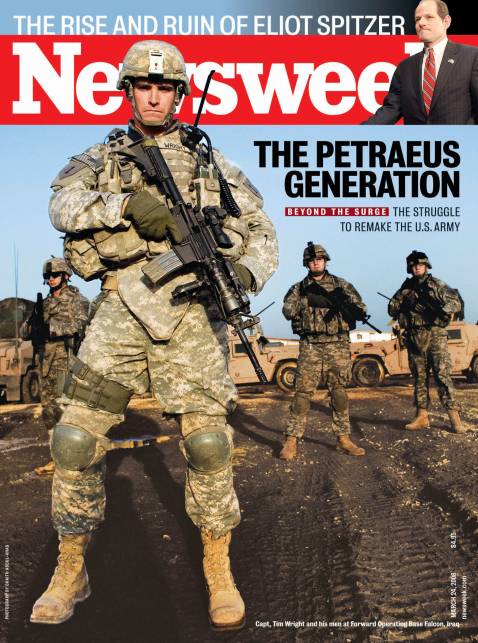
Until recently, here was the open secret of Petraeus’s life: he may not have understood Iraqis or Afghans, but no military man in generations more intuitively grasped how to flatter and charm American reporters, pundits, and politicians into praising him. This was, after all, the general who got his first Newsweek cover (“Can This Man Save Iraq?”) in 2004 while he was making a mess of a training program for Iraqi security forces, and two more before that magazine, too, took the fall. In 2007, he was a runner-up to Vladimir Putin for TIME’s “Person of the Year.” And long before Paula Broadwell’s aptly named biography, All In, was published to hosannas from the usual elite crew, that was par for the course.

You didn’t need special insider’s access to know that Broadwell wasn’t the only one with whom the general did calisthenics. The FBI didn’t need to investigate. Even before she came on the scene, scads of columnists, pundits, reporters, and politicians were in bed with him. And weirdly enough, many of them still are. (Typical was NBC Nightly News anchor Brian Williams mournfully discussing the “painful” resignation of “Dave” -- “the most prominent and best known general of the modern era.”) Adoring media people treated him like the next military Messiah, a combination of Alexander the Great, Napoleon, and Ulysses S. Grant rolled into one fabulous piƱata. It’s a safe bet that no general of our era, perhaps of any American era, has had so many glowing adjectives attached to his name.

Perhaps Petraeus’s single most insightful moment, capturing both the tragedy and the farce to come, occurred during the 2003 invasion of Iraq. He was commanding the 101st Airborne on its drive to Baghdad, and even then was inviting reporters to spend time with him. At some point, he said to journalist Rick Atkinson, “Tell me how this ends.” Now, of course, we know: in farce and not well.

For weeks, the news has been filled with his ever-expanding story, including private rivalries, pirate-themed parties, conspiracy theories run wild, and investigations inside investigations inside investigations. It’s lacked nothing an all-American twenty-first-century media needs to glue eyeballs. Jill Kelley, the Tampa socialite whose online life started the ball rolling and ended up embroiling two American four-star generals in Internet hell, evidently wrote enough emails a day to stagger the imagination. But she was a piker compared to the millions of words that followed from reporters, pundits, observers, retired military figures, everyone and anyone who had ever had an encounter with or a thought about Petraeus, his biographer-cum-lover Paula Broadwell, Afghan War Commander General John Allen, and the rest of an ever-expanding cast of characters. Think of it as the Fall of the House of Gusher.

Here was the odd thing: none of David Petraeus’s “achievements” outlasted his presence on the scene. Still, give him credit. He was a prodigious campaigner and a thoroughly modern general. From Baghdad to Kabul, no one was better at rolling out a media blitzkrieg back in the U.S. in which he himself would guide Americans through the fine points of his own war-making.

Where, once upon a time, victorious commanders had to take an enemy capital or accept the surrender of an opposing army, David Petraeus conquered Washington, something even Robert E. Lee couldn’t do. Until he made the mistake of recruiting his own “biographer” (and lover), he proved a PR prodigy. He was, in a sense, the real life military version of F. Scott Fitzgerald’s Jay (“the Great”) Gatsby, a man who made himself into the image of what he wanted to be and then convinced others that it was so.

In the field, his successes were transitory, his failures all too real, and because he proved infinitely adaptable, none of it really mattered or stanched the flood of adjectives from admirers of every political stripe. In Washington, at least, he seemed invincible, even immortal, until it all ended in a military version of Dallas or perhaps previews for Revenge, season three.

His “fall from grace,” as ABC's nightly news labeled it, was a fall from Washington’s grace, and his tale, like that of the president who first fell in love with him, might be summarized as all-American to fall-American.

Turning the Lone Superpower Into the Lonely Superpower


David Petraeus was a Johnny-come-lately in respect to Petraeus-ism. He would pick up the basics of the imperial style of that moment from his models in and around the Bush administration and apply them to his own world. It was George W. and his guys (and gal) who first dreamed the dreams, spent a remarkable amount of time “conquering Washington,” and sold their particular set of fantasies to themselves and then to the American people.

They were the original smoke-and-mirrors crew. From the moment, just five hours after the 9/11 attacks, that Secretary of Defense Donald Rumsfeld -- in the presence of a note-taking aide -- urged planning to begin against Saddam Hussein’s Iraq ("Go massive. Sweep it all up. Things related and not..."), the selling of an invasion and various other over-the-top fantasies was underway.

First, in the heat of 9/12, the president and top administration officials sold their “war” on terror. Then, after “liberating” Afghanistan and deciding to stay for the long run, they launched a massive publicity campaign to flog the idea that Saddam Hussein had weapons of mass destruction and was linked to al-Qaeda. In doing so, they would push the image of mushroom clouds rising over American cities from the Iraqi dictator’s nonexistent nuclear program, and chemical or biological weapons being sprayed over the U.S. East Coast by phantasmal Iraqi drones.

Cheney and Rice, among others, would make the rounds of the talk shows, putting the heat on Congress. Administration figures leaked useful (mis)information, pressed the CIA to cherry-pick the intelligence they wanted, and even formed their own secret intel outfit to give them what they needed. They considered just when they should roll out their plans for their much-desired invasion and decided on September 2002. As White House Chief of Staff Andrew Card infamously explained, "From a marketing point of view, you don't introduce new products in August."

They were, by then, at war -- in Washington. Initially, they hardly worried about the actual war to come. They were so confident of what the U.S. military could do that, like the premature Petraeuses they were, they concentrated their efforts on the homeland. Romantics about U.S. military power, convinced that it would trump any other kind of power on the planet, they assumed that Iraq would be, in the words of one of their supporters, a “cakewalk.” They convinced themselves and then others that the Iraqis would greet the advancing invaders as liberators, that the cost of the war (especially given Iraq’s oil wealth) would be next to nothing, and that there was no need to create a serious plan for a post-invasion occupation.

In all of this, they proved both masters of public relations and staggeringly wrong. As such, they would be the progenitors of an imperial tragedy -- a deflating set of disasters that would take the pop out of American power and turn the planet’s “lone superpower” into a lonely superpower presiding over an unraveling global system, especially in the Greater Middle East. Blinded by their fantasies, they would ensure a more precipitous than necessary American decline in the first decade of the new century.

Not that they cared, but they would also generate a set of wrenching human tragedies: first for the Iraqis, hundreds of thousands of whom became casualties of war, insurgency, and sectarian strife, while millions more fled into exile; then there were the Afghans, who died attending weddings, funerals, even baby-naming ceremonies; and, of course, tens of thousands of U.S. soldiers and contractors, who died or were injured, often grievously, in those dismal wars; and don’t forget the inhabitants of post-Katrina New Orleans left to rot in their flooded city; or the millions of Americans who lost jobs, houses, even lives in the economic meltdown of 2008, a disaster that emerged from a set of globe-spanning financial fantasies and snow jobs that Bush and his crew encouraged and facilitated.

They were the ones, in other words, who took a mighty imperial power already in slow decline, grabbed the wheel of the car of state, put the peddle to the metal, and like a group of drunken revelers promptly headed for the nearest cliff. In the process -- they were nothing if not great salesmen -- they sold Americans a bill of goods, even as they fostered their own dreams of establishing a Pax Americana in the Greater Middle East and a Pax Republicana at home. All now, of course, down in flames.

In his 1987 Princeton dissertation, David Petraeus wrote this on perception: "What policymakers believe to have taken place in any particular case is what matters -- more than what actually occurred." On this and other subjects, he was certainly no dope, but he was a huckster -- for himself (given his particular version of self-love), and for a dream already going down in Iraq and Afghanistan. And he was just one of many promoters out there in those years pushing product (including himself): the top officials of the Bush administration, gaggles of neocons, gangs of military intellectuals, hordes of think tanks linked to serried ranks of pundits. All of them imagining Washington as a battlefield for the ages, all assuming that the struggle for “perception” was on the home front alone.

Producing a Bedside Manual


You could say that Petraeus fully arrived on the scene, in Washington at least, in that classic rollout month of September (2004). It was then that the three-star general, in charge of training Iraq’s security forces, gave a president in a tight race for reelection a little extra firepower in the domestic perception wars. Stepping blithely across a classic no-no line for the military, he wrote a well-placed op-ed in the Washington Post as General Johnnie-on-the-spot, plugging “tangible progress” in Iraq and touting “reasons for optimism.”

Given George W. Bush’s increasingly dismal and unpopular mission-unaccomplished war and occupation, it was like the cavalry riding to the rescue. It shouldn’t have been surprising, then, that the general, backed and promoted in the years to come by various neocon warriors, would be the military man the president would fall for. Over the first half of the “surge” year of 2007, Bush would publicly cite the general more than 150 times, 53 in May alone. (And Petraeus, a man particularly prone toward those who idolized him -- see: Broadwell, Paula -- returned the favor.)

But there was another step up the ladder of perception that would make him the perfect neocon warrior. While commanding general at Fort Leavenworth, Kansas, in 2005-2006, he also became the “face” of a new doctrine. Well, actually, a very old and particularly dead doctrine that went by the name of counterinsurgency or, acronymically, COIN. It had been part and parcel of the world of colonial and neocolonial wars and, in the 1960s, became the basis for the U.S. ground war and “pacification” program in South Vietnam -- and we all know how that turned out.

Amid the greatest defeat the U.S. had suffered since the burning of Washington in 1814, counterinsurgency as a doctrine was left for dead in the rubble of Vietnam. With a sigh of relief, the military high command turned back to the task of stopping Soviet armies-that-never-would from pouring through Germany’s Fulda Gap. Even in the military academies they ceased to teach counterinsurgency -- until Petraeus and his team disinterred it, dusted it off, polished it up, and turned it into the military’s latest war-fighting bible. Via a new Army and Marine field manual Petraeus helped to oversee, it would be presented as the missing formula for success in the Bush administration’s two flailing, failing invasions-cum-occupations on the Eurasian mainland.

It would gain such acclaim, in fact, that the University of Chicago Press would publish it as a trade paperback on July 4, 2007. Already back in Baghdad filling the role of Washington’s savior, the general, who had already written a foreward for that “paradigm shattering” manual, would flog it with this classic blurb: “Surely a manual that’s on the bedside table of the president, vice president, secretary of defense, 21 of 25 members of the Senate Armed Services Committee, and many others deserves a place at your bedside too.”

And really, you know the rest. He would be sold (and, from Baghdad, sell himself) to the public the same way Saddam’s al-Qaeda links and weapons of mass destruction had been. He, too, would be rolled out as a product -- our “surge commander” -- and soon enough become the general of the hour, and Iraq a success story for the ages. Then, appointed CENTCOM commander, the military man in charge of Washington’s two wars, by Bush, he made it out of town before it became fully apparent that his successes in Iraq would leave the U.S. out on its ear a few years down the line.

The Fall of the American Empire (Writ Small)


Afghanistan followed as he maneuvered to box a new president, Barack Obama, into a new “surge” in another country. Then, his handpicked war commander General Stanley McChrystal, newly minted COIN believer, “ascetic,” and “rising superstar” (who would undergo his own Petraeus-like media build-up), went down in shame over nasty comments made by associates about the Obama White House. In mid-2010, Petraeus would take McChrystal’s place to save another president by bringing COIN to bear in just the right way. The usual set of hosannas -- and even less success than in Iraq -- followed.

But as with Saddam Hussein's mythical WMDs, it seemed scarcely to matter when there was no there there. Even though Afghanistan’s two COIN commanders had visibly failed in a war against an under-armed, undermanned, none-too-popular minority insurgency, and even though the doctrine of counterinsurgency would soon be tossed off a moving drone and left to die in the Afghan rubble, Petraeus once again made it out in one piece. In Washington, he was still hailed as the soldier of his generation and President Obama, undoubtedly fearing him in 2012, either as a candidate or a supporter of another Republican candidate, promptly stashed him away at the CIA, sending him safely into the political shadows.

With that, Petraeus left his four stars behind, shed COIN-mode just as his doctrine was collapsing completely, and slipped into the directorship of a militarizing CIA and its drone wars. He remained widely known, in the words of Michael O’Hanlon of the Brookings Institution (praising Broadwell’s biography), as “the finest general of this era and one of the greatest in modern American history.” Unlike George W. Bush and crew who, despite pulling in staggering speaker's fees and writing memoirs for millions, now found themselves in a far different set of shadows, he looked like the ultimate survivor -- until, of course, books and “bedsides” resurfaced in unexpected ways.

In the Iraq surge moment, the liberal advocacy group MoveOn.org unsuccessfully tried to label him “General Betray Us.” Now, as his affair with Broadwell unraveled into the reality TV show of our moment, he became General Betray Himself, a figure of derision, an old man with a young babe, the “cloak-and-shag-her” guy (as one New York Post screaming headline put it).

So here you have it, the two paradigmatic figures of the closing of the “American Century”: the president’s son whose ambitions were stoked by Texas politics after years in the personal wilderness and the man who married the superintendent’s daughter and rose like a meteor in a military that could never win a war. In the end, as the faces of American-disaster-masquerading-as-success, neither made it out of town before shame caught up with them. It’s a measure of their importance, however, that Bush was finally put to flight by a global economic meltdown, Petraeus by the local sexual version of the same. Again, it’s history vs. farce.

Or think of the Petraeus version of collapse as a tryout for the fall of the American empire, writ very small, with Jill Kelley and Paula Broadwell as our Gibbons and the volume of email, including military sexting, taking the place of his six volumes. A poster general for American decline, David Petraeus will be a footnote to history, a man out for himself who simply went a bridge or a book too far. George W. and crew were the real thing: genuine mad visionaries who simply mistook their dreams and fantasies for reality.

But wasn’t it fun while it lasted? Wasn’t it a blast to occupy Washington, be treated as a demi-god, go to Pirate-themed parties in Tampa with a 28-motorcycle police escort, and direct your own biography... even if it did end as Fifty Shades of Khaki?


Tom Engelhardt, co-founder of the American Empire Project and author of The United States of Fear as well as The End of Victory Culture, his history of the Cold War, runs the Nation Institute's TomDispatch.com. His latest book, co-authored with Nick Turse, is Terminator Planet: The First History of Drone Warfare, 2001-2050. You can see his recent interview with Bill Moyers on supersized politics, drones, and other subjects by clicking here.

[Note for TomDispatch Readers: A small bow to several sites that I always find particularly helpful: my daily companion Antiwar.com, Juan Cole’s invaluable Informed Comment blog, the always provocative War in Context run by Paul Woodward, and Noah Shachtman’s Danger Room at Wired magazine. (At that site, I particularly recommend Spencer Ackerman’s mea culpa for having been drawn into the cult of Petraeus. Scores of other journalists and pundits had far more reason to write such a piece -- and didn’t.) By the way, in case you think that, until recently, it wasn’t possible for anyone to see what is now commonly being written about the general, check out a piece I posted in 2008 under the title “Selling the President’s General.”]

Follow TomDispatch on Twitter @TomDispatch and join us on Facebook. Check out the newest Dispatch book, Nick Turse’s The Changing Face of Empire: Special Ops, Drones, Proxy Fighters, Secret Bases, and Cyberwarfare.

Copyright 2012 Tom Engelhardt

Israeli Media Paints a Virtuous Portrait of Gaza Attacks


Israel's Media Joins the War 

 by TRNN


Israel's media rallies support for war as politicians jump on bandwagon for attack ahead of elections.

Watch full multipart The Humanitarian Crisis in Gaza

Monday, November 19, 2012

The Global Responsibility to Protect Gaza


U.N. Special Rapporteur Calls for Global Protection for Gaza Civilians from U.S.-Backed Israeli Assault

by Democracy Now!

Richard Falk, the United Nations special rapporteur on human rights in the Palestinian territories, calls on the international community to help defend the people of Gaza from the ongoing U.S.-backed Israeli assault. "It’s time, it seems to me, for the international community to take some responsibility for protecting the people of Gaza,"

Falk says. "The responsibility to protect norm was very self-righteously invoked in relation to Gaddafi’s Libya, but there’s utter silence when it comes to the people of Gaza." Falk is a professor emeritus of international law at Princeton University and the author of more than 50 books on war, human rights and international law. We also speak with Raji Sourani, an award-winning human rights lawyer and director of the Palestinian Center for Human Rights in Gaza.


Guests: Richard Falk, United Nations special rapporteur on human rights in the Palestinian territories, professor emeritus of international law at Princeton University, and the author of more than 50 books on war, human rights and international law. He now teaches at University of California at Santa Barbara.

Bearing the Brunt in Gaza


 Palestinian Civilians Bear the Brunt of Unrelenting Bombing in US-Backed Attack on Gaza

by Democracy Now!

President Obama has announced his full support for Israel’s ongoing assault on the Gaza Strip even as dozens of Palestinians, including many civilians, continue to be killed by U.S.-supplied weaponry. At least 95 Palestinians have been killed in air strikes by warplanes and drones. More than 700 have been wounded, including 200 children.

On Sunday, a massive air strike leveled a home in Gaza City killing 12 people, including 10 members of the same family. Over the past week, rockets fired from Gaza have killed three Israelis. We go to Gaza to speak with Raji Sourani, an award-winning human rights lawyer and director of the Palestinian Center for Human Rights in Gaza.

 
Guest: Raji Sourani, an award-winning human rights lawyer. He is the director of the Palestinian Center for Human Rights in Gaza and is on the executive board of the International Federation for Human Rights. In 1991, he won the Robert F. Kennedy Human Rights Award.

Canadian Interoperability


Canadian Armed Forces an Adjunct to US - The Ugly Canadian 

by TRNN


Yves Engler: The Canadian government played a major role in the bombing of Libya. It was a Canadian general that oversaw the whole NATO mission and approved the bombing targets.


Yves Engler is a Canadian commentator and author. His most recent book is The Ugly Canadian - Stephen Harper's Foreign Policy, and previously he published The Black Book of Canadian Foreign Policy and Canada in Haiti: Waging War on The Poor Majority


Watch full multipart The Ugly Canadian

Tidal Energy Firm Withdraws Contentious Site Plan

Tidal Energy Dispute Resolved

by OrcaLab


OrcaLab, a whale research station on Hanson Island, B.C., and SRM Projects Ltd., a renewable energy engineering firm from Nanaimo, B.C., jointly announced today that they have found common ground after SRM Project’s tidal energy investigative license application for Blackney Passage raised concerns with OrcaLab and others because the site is located within Critical Habitat for whales.

The parties agree that minimizing threats to species at risk and clean energy generation are both important for B.C. In recognition of this, SRM Projects is withdrawing the investigative license application. OrcaLab commended SRM for this move and reiterated their support for ocean energy initiatives; provided all proposed projects go through a transparent and rigorous environmental and regulatory review process that includes First Nations and stakeholders.

Dr. Paul Spong, founder of OrcaLab states “We see this as a win-win situation.” and adds;

“We are very pleased with how receptive SRM Projects was to the concerns we raised.”
Whale researcher and marine educator, Jackie Hildering of Port McNeill who is the
author of “The Marine Detective” blog, which drew public attention to the proposed
project, agreed. “With SRM Projects withdrawing the Blackney Pass application, they
have shown a true dedication to sustainability.”

Scot Merriam, principal of SRM Projects, says'

 “Tidal energy is a new and relatively unknown source of clean electrical power in BC. While preliminary research and demonstration studies from Europe indicate the promise of the technology, we need to introduce it here in small steps, outside of critical habitat areas, to gain local knowledge and social acceptance.”

Reflecting on the initial dispute resulting from the investigative license application, Paul Spong says “One thing is clear – there is a crucial disconnect in our land acquisition process if Critical Habitat areas don’t show up on the BC GIS mapping database used by proponents to search for suitable development opportunities.”

SRM Projects and OrcaLab intend to maintain a dialogue going forward to share knowledge as new information becomes available about marine mammals and ocean energy. Scot Merriam concludes “Ultimately, our common goal is to look for ways we can coexist with nature and minimize our footprint.”

Contacts:
Dr. Paul Spong – OrcaLab

Sunday, November 18, 2012

Who FN Cares?


Blogging and Nothingness: Progressives Turn Their Gaze from Gaza

 by Chris Floyd - Empire Burlesque

"Too much of nothing
Can make a man a liar."

-- Bob Dylan

"Nothing will come of nothing. Speak again."

-- Shakespeare, King Lear

It sure was a quiet weekend in the progressive blogosphere, where peace, justice and the alleviation of human suffering is an earnest, burning concern. At Eschaton, Atrios gave an amiable shrug and declared, "I got nothing to say." Digby and her co-pilot, David Atkins, did have a few things to say -- about Sarah Palin, General Pants-Down Petraeus, the grubby "Grand Bargaining" in the Beltway, and several examples of the stupidity and perfidy of right-wing Republicans. The posters at Daily Kos plied the same themes.

But even for those who didn't got nothing to say, it was all very much in a low-key, mopping-up, post-election mode. It seemed as if there were no major news events going on anywhere in the world that involved the violent, unjust infliction of human suffering, with the direct monetary, military and political support of United States government and its entire bipartisan political and media establishments. Nothing that might grab the attention -- even in passing -- of writers publicly and professionally dedicated to discussing and analyzing major news events involving American policy, politics and the media.

Anything like that going on this weekend? Anyone? Digby, Dave? No? Kos and the gang? Anything? Atrios?

Nope. They got nothing.

Not on Friday. Not on Saturday. Not by Sunday evening (as I write this).

If you were a follower of many of the major "progressive" bloggers, you could have passed the weekend blissfully unaware that the American-armed, American-backed Israeli military was busily raining death into the cramped and crowded concentration camp of Gaza. Children dying, old people being blown to bits in their houses, the Israeli government ordering a massive call-up of troops and reserves for a possible invasion; top officials from Egypt and Tunisia flying into the besieged camp to show solidarity, mass demonstrations across the Middle East, some meeting with violent repression, others threatening to escalate into revolutionary outpourings. On every side: death, turmoil, suffering, chaos, whole nations in ferment -- and Barack Obama standing shoulder-to-shoulder with Benjamin Netanyahu in defending assassination, aggression and the bombardment of defenseless civilians with massive military force.

For many of our leading progressives, none of this was of the slightest interest. Even as the stage is clearly being set for a rerun of the "Cast Lead" operation in 2008-2009 -- a bloodbath that killed hundreds of innocent people and was followed by a strangulating blockade -- our earnest concerners could not be stirred to even a passing comment on the developments. The idea that someone somewhere was touting Sarah Palin for 2016 was obviously far more interesting -- far more concerning -- than the American-backed bloodshed in Gaza. After all, what if Sarah Palin did become president, huh? (Get your 2016 lesser evilism going now! Start early, avoid the rush!) Why, she might declare her full support for military assaults on civilian areas in Gaza, just like that evil George Bush did in 2008. And you know you don't want anyone like that to be president, do you?

But beyond the Palin-haunted, poll-poring, got-nothing confines of the progressosphere, here's what been going on just today, as reported in the New York Times (which most top progressives at least take a glance at occasionally, I believe):

Israeli forces killed at least 11 people, including several children, in a single airstrike that destroyed a home here on Sunday ... Among the dead were five women and four small children, The Associated Press reported, citing a Palestinian health official. ... Prime Minister Benjamin Netanyahu of Israel warned of a “significant” expansion in the onslaught, which has already killed over 50 people, many of them civilians.

... Speaking on Sunday from Bangkok, President Obama condemned missile attacks by Palestinian fighters in Gaza and defended Israel’s right to protect itself. “There’s no country on earth that would tolerate missiles raining down on its citizens from outside its borders,” Mr. Obama said in his first public comments since the violence broke out. “We are fully supportive of Israel’s right to defend itself.”

Here the president ignores the fact, also reported -- albeit obscurely -- by the NYT, that the few sporadic and ineffective missiles from Gaza "raining down" on Israel before the attack were in fact retaliation for repeated missile strikes, mortar fire, assassinations and civilian deaths caused by Israeli military incursions into Gaza. But, as we noted here the other day, Gaza has no "right to defend itself;" indeed, it very clearly must "tolerate missiles raining down on its citizens from outside its borders." Thus saith the Nobel Peace Prize Laureate.

But that was not all he saith. As the NYT reports:

Mr. Obama said Sunday that he had spoken several times with Mr. Netanyahu, Mr. Morsi and Prime Minister Recep Tayyip Erdogan of Turkey in hopes of finding a way to address Israel’s security concerns without further ramping up military operations. “We are actively working with all the parties in the region to see if we can end those missiles being fired without further escalation of violence in the region,” he said.

This is strange; for before the attack began, there was already an "actively working" deal to "end the missiles being fired without further violence in the region" -- as the New York Times itself reported on Friday. But as Israeli negotiator Gershon Baskin wrote in the Times, this agreement was aborted when the Israelis assassinated the very Hamas minister who was negotiating the deal. This "extrajudicial killing" -- part of an attack that, of course, killed several civilians as well, including the 11-month-old son of a BBC cameraman -- was the start of the current operation. And it led, as the Israelis knew -- and hoped -- it would, to retaliatory strikes by Hamas. Baskin writes:

I was able to learn firsthand that Mr. Jabari wasn’t just interested in a long-term cease-fire; he was also the person responsible for enforcing previous cease-fire understandings brokered by the Egyptian intelligence agency. Mr. Jabari enforced those cease-fires only after confirming that Israel was prepared to stop its attacks on Gaza. On the morning that he was killed, Mr. Jabari received a draft proposal for an extended cease-fire with Israel, including mechanisms that would verify intentions and ensure compliance. This draft was agreed upon by me and Hamas’s deputy foreign minister, Mr. Hamad, when we met last week in Egypt. ...

Israel has used targeted killings, ground invasions, drones, F-16s, economic siege and political boycott. The only thing it has not tried and tested is reaching an agreement (through third parties) for a long-term mutual cease-fire. ... The difference between the proposal I drafted in cooperation with my Hamas counterpart and past proposals was that it included both a mechanism for dealing with impending terror threats and a clear definition of breaches. This draft was to be translated and shared with both Mr. Jabari and Israeli security officials, who were aware of our mediation efforts.

The proposal was at least worth testing. Moreover, it included the understanding that if Israel were to take out a real ticking bomb — people imminently preparing to launch a rocket — such a strike would not be considered a breach of the cease-fire and would not lead to escalation.

Instead, Mr. Jabari is dead — and with him died the possibility of a long-term cease-fire.

In other words, the Netanyahu government deliberately scuttled a deal which would have provided exactly what it says it is seeking. They knew the assassination would kill the deal; they knew it would provoke violent relatiation. That is precisely what they wanted.

What's more, it is absolutely impossible that Barack Obama did not know this as well. The US government had to know these negotiations were going on. And even if one takes the position of the extreme Obamalators and believes that the innocent president was kept uninformed of these developments before the attack -- just as he was protected from all knowledge that his FBI was investigating his CIA director for months on end -- he certainly knew of the plan after it was published in the New York Times on November 16 -- two days before he made his statement on November 18.

In other words -- and brace yourself for this shocking revelation -- Barack Obama was lying through his teeth when he regurgitated his empty pieties on Sunday.

Imagine the kind of play Kos would have given to such sinister mendacity had it issued from the gorge of evil George. Imagine what razor-sharp slashings of moral outrage we would have seen from Digby n' Dave had Dick Cheney trotted out such threadbare lies to support the murder of a key official in the midst of peace negotiations. And is it conceivable that Atrios would have "got nothing" if Condi Rice had been issuing "full-throttle support" for an operation that has set the most volatile region in the world ablaze with death and turmoil? No; yet if a Democrat arms, pays for and supports such things, there is no outrage, there is no criticism, there is no analysis. There is only ... nothing.

But Shakespeare knew the self-deluded Lear was wrong: something can indeed come from nothing. In fact, the whole murderous course of the tragedy issues from Cordelia's "nothing." And although the assault on Gaza is as nothing to the progressives, something is happening there. Even as I've been writing this, more details have come in about the attack mentioned in the NYT story above. From the Guardian:

At least 11 members of one family, including five women and four children, were killed when Israel bombed a house in Gaza City on Sunday as the five-day-old war claimed more civilian lives with no sign of a letup in the intense bombardment.

The air strike flattened the home of the Dalou family in the Sheikh Radwan district of Gaza City, causing the biggest death toll in a single incident since the offensive began last Wednesday.

The bodies of the children were pulled from the rubble and taken to the morgue at the Shifa hospital. The dead also included an 80-year-old woman. ... Witnesses said there were chaotic scenes as the dead and injured were brought to the Shifa hospital, which has been on emergency footing since the start of Operation Pillar of Defence. The bodies of four young children lay on two metal trays in the morgue, covered in dust and blood. A crowd of onlookers outside became increasingly distressed as the body of the children's mother was wheeled in, covered in blankets.
But this is of no apparent concern to those so earnestly concerned with peace, justice and the alleviation of human suffering. Those children, that old woman, the grieving survivors -- they must be the wrong people suffering. Or perhaps it's just that the right person is aiding, abetting and supporting their suffering. No need for comment. No need to notice. Nothing to see here.

And thus political tribalism curdles into moral cretinism.

Fracture Prospects: A Secret World of Activist War with a Planet in the Balance


Frack Fight: A Secret War of Activists -- With the World in the Balance

by Ellen Cantarow - TomDispatch

There’s a war going on that you know nothing about between a coalition of great powers and a small insurgent movement. It’s a secret war being waged in the shadows while you go about your everyday life.

In the end, this conflict may matter more than those in Iraq and Afghanistan ever did. And yet it’s taking place far from newspaper front pages and with hardly a notice on the nightly news. Nor is it being fought in Yemen or Pakistan or Somalia, but in small hamlets in upstate New York. There, a loose network of activists is waging a guerrilla campaign not with improvised explosive devices or rocket-propelled grenades, but with zoning ordinances and petitions.

The weaponry may be humdrum, but the stakes couldn’t be higher. Ultimately, the fate of the planet may hang in the balance.

All summer long, the climate-change nightmares came on fast and furious. Once-fertile swathes of American heartland baked into an aridity reminiscent of sub-Saharan Africa. Hundreds of thousands of fish dead in overheated streams. Six million acres in the West consumed by wildfires. In September, a report commissioned by 20 governments predicted that as many as 100 million people across the world could die by 2030 if fossil-fuel consumption isn’t reduced. And all of this was before superstorm Sandy wreaked havoc on the New York metropolitan area and the Jersey shore.

Washington’s leadership, when it comes to climate change, is already mired in failure. President Obama permitted oil giant BP to resume drilling in the Gulf of Mexico, while Shell was allowed to begin drilling tests in the Chukchi Sea off Alaska. At the moment, the best hope for placing restraints on climate change lies with grassroots movements.

In January, I chronicled upstate New York’s homegrown resistance to high-volume horizontal hydraulic fracturing, an extreme-energy technology that extracts methane (“natural gas”) from the Earth’s deepest regions. Since then, local opposition has continued to face off against the energy industry and state government in a way that may set the tone for the rest of the country in the decades ahead. In small hamlets and tiny towns you’ve never heard of, grassroots activists are making a stand in what could be the beginning of a final showdown for Earth’s future.

Frack Fight 2012


New York isn’t just another state. Its largest city is the world’s financial capital. Six of its former governors have gone on to the presidency and Governor Andrew Cuomo seems to have his sights set on a run for the White House, possibly in 2016. It also has a history of movements, from abolition and women’s suffrage in the nineteenth century to Occupy in the twenty-first. Its environmental campaigns have included the watershed Storm King Mountain case, in which activists defeated Con Edison’s plan to carve a giant facility into the face of that Hudson River landmark. The decision established the right of anyone to litigate on behalf of the environment.

Today, that activist legacy is evident in a grassroots insurgency in upstate New York, a struggle by ordinary Americans to protect what remains of their democracy and the Earth’s fragile environment from giant corporations intent on wrecking both. On one side stands New York’s anti-fracking community; on the other, the natural gas industry, the state’s Department of Environmental Conservation, and New York’s industry-allied Joint Landowners Coalition.

As for Governor Cuomo, he has managed to anger both sides. He seemed to bow to industry this past June by hinting that he would end a 2010 moratorium on fracking introduced by his predecessor David Paterson and open the state to the process; then, in October, he appeared to retreat after furious protests staged in Washington D.C., as well as Albany, Binghamton, and other upstate towns.

“I have never seen [an environmental movement] spread with such wildfire as this,” says Robert Boyle, a legendary environmental activist and journalist who was central in the Storm King case and founded Riverkeeper, the prototype for all later river-guardian organizations. “It took me 13 or 14 years to get the first Riverkeeper going. Fracking isn’t like that. It’s like lighting a train of powder.”

Developed in 2008 and vastly more expansive in its infrastructure than the purely vertical form of fracking invented by Halliburton Corporation in the 1940s, high-volume horizontal hydraulic fracturing is a land-devouring, water-squandering technology with a greenhouse gas footprint greater than that of coal. The process begins by propelling one to nine million gallons of sand-and-chemical-laced water at hyperbaric bomb-like pressures a mile or more beneath Earth's surface. Most of that fluid stays underground. Of the remainder, next to nothing is ever again available for irrigation or drinking. A recent report by the independent, nonpartisan U.S. Government Accountability Office concluded that fracking poses serious risks to health and the environment.

New York State’s grassroots resistance to fracking began about four years ago around kitchen tables and in living rooms as neighbors started talking about this frightening technology. Shallow drilling for easily obtainable gas had been done for decades in the state, but this gargantuan industrial effort represented something else again.

Anthony Ingraffea of Cornell University’s Department of Engineering, co-author of a study that established the global warming footprint of the industry, calls this new form of fracking an unparalleled danger to the environment and human health. “There’s much more land clearing, much more devastation of forests and fields. . . thousands of miles of pipelines. . . many compressor stations [that] require burning enormous quantities of diesel. . . [emitting] hydrocarbons into the atmosphere.” He adds that it’s a case of “the health of many versus the wealth of a few.”

Against that wealth stands a movement of the 99% -- farmers, physicists, journalists, teachers, librarians, innkeepers, brewery owners, and engineers. “In Middlefield we’re nothing special,” says Kelly Branigan, a realtor who last year founded a group called Middlefield Neighbors. “We’re just regular people who got together and learned, and reached in our pockets to go to work on this. It’s inspiring, it’s awesome, and it’s America -- its own little revolution.”

Last year, Middlefield became one of New York’s first towns to use the humblest of tools, zoning ordinances, to beat back fracking. Previously, that had seemed like an impossible task for ordinary people. In 1981, the state had exempted gas corporations from New York’s constitutionally guaranteed home rule under which town ordinances trump state law. In 2011, however, Ithaca-based lawyers Helen and David Slottje overturned that gas-cozy law by establishing that, while the state regulates industry, towns can use their zoning powers to keep it out. Since then, a cascade of bans and moratoria -- more than 140 in all -- have protected towns all over New York from high-volume frack drilling.

This Is What Democracy Looks Like


Caroline, a small hamlet in Tompkins County (population 3,282), is the second town in the state to get 100% of its electricity through wind power and one of the most recent to pass a fracking ban. Its residents typify the grassroots resistance of upstate New York.

“I’m very skeptical that multinational corporations have the best interests of communities at heart,” Don Barber, Caroline’s Supervisor, told me recently. “The federal government sold [Americans] out when they exempted fracking from the Clean Water and Air Acts,” he added. “Federal and state governments are not advocating for the civil society. There’s only one level left. That’s the local government, and it puts a tremendous load on our shoulders.”

Caroline’s Deputy Supervisor, Dominic Frongillo, sees local resistance in global terms. “We’re unexpectedly finding ourselves in the ground zero for climate change,” he says. “It used to be somewhere else, mountaintop removal in West Virginia, deep-sea drilling in the Gulf of Mexico, tar sands in Alberta, Canada. But now...it’s right here under our feet in upstate New York. The line is drawn here. We can’t keep escaping the fossil fuel industry. You can’t move other places, you just have to dig in where you are.”

Two years of pre-ban work in Caroline included an election that replaced pro-drilling members of the town board with fracking opponents, public education forums, and a six-month petition drive. “We knocked on every single door two or three times,” recalls Bill Podulka, a retired physicist who co-founded the town’s resistance organization, ROUSE (Residents Opposed to Unsafe Shale Gas Extraction). “Many people were opposed to gas-drilling but were afraid to speak out, not realizing that the folks concerned were a silent majority.” In the end, 71% of those approached signed the petition, which requested a ban.

On September 11th, a final debate between drilling opponents and proponents took place, after which Barber called for the vote. A ban was overwhelmingly endorsed. “For the first time,” he told the crowd gathered in Caroline’s white clapboard town hall, “I will be voting to change the balance of rights between individuals and civil society. This is because of the impacts of fracking on health and the environment. And the majority of our citizens have voted to pass the ban.” The board then ruled 4 to 1 in favor.

Stealth Invasion


About a year and a half ago, as Caroline and other towns were moving to protect their land from the industry, XTO, a subsidiary of Exxon-Mobil Corporation, began preparing for a possible fracking future in the state. It eyed tree-shaded, Oquaga Creek, a trout-laden Delaware tributary in upper New York State’s Sanford County, leased the land, and applied to the Delaware River Basin Commission (DRBC) for a water-withdrawal permit. XTO required, it said, a quarter of a million gallons of water from the creek every day for its hydraulic fracturing operations.

Delaware Riverkeeper, an environmental organization, found out about the XTO application and spread the word. Within days, the DRBC received 7,900 letters of outrage. On June 1, 2011, hundreds of citizens, organized by grassroots anti-frackers, packed a hearing in Deposit, a village in Sanford Township that lies at the confluence of the creek and the western branch of the Delaware River. Only two people spoke at the meeting in favor of XTO. One was the Supervisor (mayor) of Sanford, Dewey Decker. He applauded the XTO application and denounced protestors as “outsiders.” He is among a group of landowners who have leased land to XTO for hundreds of millions of dollars. (Decker refused to be interviewed for this article.) The rest of the crowd spoke up for the creek, its fish, and its wildlife. The Delaware River Basin Commission indefinitely tabled the XTO application.

While a grassroots victory, the episode also served as a warning about how determined the industry is to move forward with fracking plans despite the state-enforced moratorium still in place. As a result, Caroline and other towns are continuing to develop local anti-fracking measures, since they know that the 2010 ban on the process will end whenever Governor Cuomo okays rules currently being written by the Department of Environmental Conservation (DEC).

When it comes to those rules and fracking more generally, the DEC has a conflict of interest. While it is supposed to protect the environment, it is also tasked with regulating the very industries that exploit it through the agency’s Mineral Resources Division. Last year, the DEC received over 80,000 written comments on the latest draft of its guidelines for the industry, the 1,500-page “SGEIS” (which stands for “Supplemental Generic Environmental Impact Statement"). Drilling opponents outnumbered proponents 10 to 1. The deluge was a record in the agency’s history.

Activists weren’t the only ones with a keen interest in the SGEIS, however. Documents obtained through New York’s Freedom of Information Law indicate that, in mid-August 2011, six weeks before the DEC made its statement public, the agency shared detailed summaries of it with gas corporation representatives, giving the industry a chance to influence the final document before it went public.

Two days before the SGEIS was opened to public scrutiny, an attorney for the Oklahoma-based Chesapeake Energy Corporation and other companies asked regulators to “reduce or eliminate” a requirement for the sophisticated testing of fracking fluids. Such fluids are laden with toxins, including carcinogens, which storms could wash away from drilling sites -- an especially grim prospect given the catastrophic flooding experienced in the state over the last three years.

At the same time, two upstate New York journalists revealed that Bradley Field, the head of the DEC’s Mineral Resources Division, had signed a petition that denied the existence of climate change. Formerly of Getty Oil and Marathon Oil, Field also serves as the state’s representative to the Interstate Oil and Gas Compact Commission and the Ground Water Protection Council, both industry fronts which maintain that fracking is benign. As this was coming to light, state officials anonymously leaked word of a plan to open five counties on New York’s border with Pennsylvania to fracking as long as communities there supported the technology.

This is What Autocracy Looks Like


In May 2012, Dewey Decker and his board passed a resolution pledging that the town of Sanford would take no action against fracking, while awaiting the decision of the DEC. There was no prior notice. Citizens were left to read about it in their local papers. “You wake up the next morning and say, ‘What happened?’” commented Doug Vitarious, a retired Sanford elementary school teacher.

In June, a headline in the Deposit Courier, a Sanford paper, read “Local Officials in Eligible Communities Approve Pro-Drilling Resolutions.” Accompanying the piece was a map of towns that had passed such resolutions. The subscript under the map read: “Joint Landowners Coalition of N.Y.” The JLCNY is the state’s grassroots gas industry ally, whose stated mission is to “foster... the common interest... as it pertains to natural gas development.” Decker represents the organization in Sanford.

During the summer, Vitarious and other citizens asked their town board where the resolution had originated, but were met with silence. They requested that the board rescind the resolution and conduct a referendum. Decker refused.

By the end of August, 43 towns in the region had passed resolutions modeled on one appearing at the JLCNY website. It stipulates that at the local level “no moratorium on hydraulic fracturing will be put in place before the state of New York has made it’s [sic] decision.” Under New York’s Freedom of Information Law, Catskill Citizens for Safe Energy and the National Resources Defense Council obtained records from Sanford and two other towns about how they achieved their objectives. The records, says Bruce Ferguson of Catskill Citizens for Safe Energy, “detail contacts between gas industry operatives and officials.”

Two months before superstorm Sandy swamped parts of the state, Sue Rapp, a psychotherapist from the town of Vestal, told me that flooding worries her as much as anything else about fracking. Upper New York State suffered flooding in 2010 and 2011. And then came Sandy. Floods turn millions of gallons of fracking waste-water for which there is no safe storage into streams of poisons that wash into waterways.

Unlike Sanford’s board, Vestal’s has not formally blocked debate. It has heard arguments for a moratorium by Rapp and an organization she co-founded, Vestal Residents for Safe Energy (VERSE), as well as pleas for a moratorium by physicians and academics. Its reaction, however, has simply been to sit on its hands, waiting for the DEC and Cuomo to make a final decision. This amounts to adopting the JLCNY position in all but formal vote. “What is happening?” asked Rapp rhetorically at a demonstration in Binghamton this past September. “They are trying to shut us down. But we do vote and we will vote. We do not constitute [what pro-drillers call] the tyranny of the majority, but simply the majority. That is called democracy.”

Demonstrations against Cuomo’s frack plan, which drew thousands to Washington D.C., Albany, and elsewhere in New York, included pledges to commit sustained acts of civil disobedience should the governor carry out plans to open the Pennsylvania border area of the state to fracking. At the end of September, the New York Times announced that Cuomo had retreated from his June stance. The report credited the state’s grassroots movement for his change of mind. Legendary for his toughness and political smarts, the governor will confront a political challenge in the coming months. Either he will please gas-industry supporters or his Democratic base. Whichever way he goes, it could affect his chances for the White House.

The stakes, however, are far larger than Cuomo’s presidential aspirations. Opening any part of the state to fracking will certainly damage the local environment. More importantly, a grassroots win in New York State could open the door to a nationwide anti-fracking surge. A loss might, in the long run, result in a cascade of environmental degradation beyond the planet’s ability to cope. As unlikely as it sounds, the fate of the Earth may rest with the residents of Middlefield, Caroline, Vestal, and scores of tiny villages and small towns you’ve never heard of.

“All eyes are on New York,” says Chris Burger, a former Broome County legislator and one of a small group who persuaded New York’s last governor, David Paterson, to pass the state’s moratorium on fracking. “This is the biggest environmental issue New York has ever faced [and not just] New York, the nation, and the world. If it’s going to be stopped, it will be stopped here.”


Ellen Cantarow first wrote from Israel and the West Bank in 1979. A TomDispatch regular, her writing has been published in The Village Voice, Grand Street, Mother Jones, Alternet, Counterpunch, and ZNet, and anthologized by the South End Press. She is also lead author and general editor of an oral-history trilogy, Moving the Mountain: Women Working for Social Change, published in 1981 by The Feminist Press/McGraw-Hill, widely anthologized, and still in print.

Follow TomDispatch on Twitter @TomDispatch and join us on Facebook. Check out the newest Dispatch book, Nick Turse’s The Changing Face of Empire: Special Ops, Drones, Proxy Fighters, Secret Bases, and Cyberwarfare.

Copyright 2012 Ellen Cantarow

Gorilla Radio with Chris Cook, Jon Elmer, Paul Spong, Janine Bandcroft Nov. 19, 2012


This Week on GR

by C. L. Cook


Clearly we are living in an age of mass dementia. Over the weekend, scofflaw Israel rained bombs and missiles upon the heads of civilian homes, civil infrastructure, media studios, hospitals, and shot up anything that moved through the streets of Gaza City.

While there is nothing particular new about that, after all, Israel has treated the Gaza Strip and its benighted citizens like so many concentration camp inmates for years, picking them off with high-powered rifles and automated machine-gun turrets for no apparent reason beyond to terrorize them, and perhaps break up the monotony of a long shift in the watchtowers.

No, what punctuates the surreal insanity of this festering injustice is the reality defying gymnastics Western government spokespersons perform to somersault the truth of the matter, and how eagerly, in turn, their media collaborators parrot rather than challenge them.

Listen. Hear.

Yes, Gaza is under full scale attack by Israel again, and as during the Christmas carnage of 2009, the demented few in power in Ottawa and London and Washington and Brussels will again provide cover for this egregious and obvious crime against humanity.

Jon Elmer is a Canadian freelance photo-journalist and author of the website JonElmer.ca. Jon has reported from and about Israel's occupation of Palestine for more than a decade, his dispatches appearing at Al Jazeera English, the Inter Press Service, and Le Monde Diplomatique among others. Jon also completed an honours degree in political science at Dalhousie University in Halifax, Nova Scotia; his thesis - "Pulling from the roots" - being a study of Israel's policy of assassination during the al-Aqsa intifada.

Jon Elmer in the first half. 


And; British Columbia's energy needs, and perceived need, is at the heart of several divisive debates, and full-blown civil disobedience campaigns in the province. From the proposed toxic Enbridge Tar Sands throughway and the fracked gas Pacific Trail Pipeline, to controversial Run of Rivers hydro power schemes, the province is at a crucible moment. Now entering the arena where hotly contested visions of what the future of this place will look like, where potentially apocalyptic environmental destruction, and the dire economic consequence of standing still vie for primacy in the public mind, comes another player, equally imbued with the power to spark a political powder keg.

SRM Projects Ltd. of Nanaimo has a modest proposal put in to start up a tidal energy plant. Like the Run of Rivers, the prospect of "Lunar," or ocean tidal energy is an alluring one, and at first glance it's a win for both commerce and environmental stewardship. But, a closer look at SMR's plan has ignited a furore amongst those concerned about the coast's marine life, and especially those concerned for its at risk species. You see, SRM's project is proposed for the middle of one of the most vital feeding grounds for the northern resident killer whale popualtion, not to mention the negative impact it would have on humpback whales, Steller sea lions, Dall’s porpoise and others who congregate in Blackney Passage.

Dr. Paul Spong is marine researcher and founder of OrcaLab, a land-based observatory located on Hanson Island. Spong has tracked whale and other marine mammals from the idyllic location since 1970. The SRM Project, if approved, would become OrcaLab's new neighbour, plonked right in the midst of his network of hydrophones and cameras.

Dr. Paul Spong a habitat issue roiling just beneath the surface of B.C.'s environmental debate in the second half.


And; Victoria Street Newz publisher and CFUV Radio broadcaster, Janine Bandcroft will join us at the bottom of the hour to bring us news from our city's streets and beyond. But first, Jon Elmer and Cast Iron II over Gaza.

Chris Cook hosts Gorilla Radio, airing live every Monday, 5-6pm Pacific Time. In Victoria at 101.9FM, and on the internet at: http://cfuv.uvic.ca. He also serves as a contributing editor to the web news site, http://www.pacificfreepress.com. Check out the GR blog at: http://gorillaradioblog.blogspot.ca/

G-Radio is dedicated to social justice, the environment, community, and providing a forum for people and issues not covered in the corporate media.

Israel Targets Media Operations in Gaza


Attack on journalists marks new stage of Israeli assault on Gazay IMEMC Staff - IMEMC News 

by IMEMC

The attacks late Saturday night and Sunday morning on the Ash-Shawwa Al-Husari and ash-Shuruq buildings in Gaza City mark a new type of escalation in the Israeli assault on Gaza, with direct attacks on the media. The buildings house a number of satellite TV news stations and radio stations, which were the direct targets of the attacks.
Six journalists were wounded in the attack on Ash-Shawwa Al-Husari, including one cameraman who lost his leg. A few minutes before the attack, the Israeli military phoned the Al Quds media agency saying that their headquarters were about to be bombed. As the journalists in the building rushed to evacuate while continuing to report on the situation, the bomb dropped. The building houses Al Quds radio, which is loosely affiliated with the Hamas party, as well as Russia Today, and Lebanese, German and Italian news teams.

According to the British Guardian newspaper, a second air strike struck another media complex in the city just before 7 am, the ash-Shuruq building. It houses Sky News, the al-Arabiya news network, Dubai TV and an office of al-Aqsa TV, which is affiliated with Hamas.

Israeli military spokesperson Avital Liebovitch made a statement to the press in Israel a few hours later, saying “We obviously know there are journalists in the building, so we did not attack any other floor in the building, but my advice to journalist visiting Gaza is to stay away from any Hamas positions, or Hamas sites, or Hamas posts for their own safety.” Liebovitch confirmed that Al Quds radio and Al Aqsa TV were the targets of the attack.

The Israeli military spokesperson tweeted “Roofs of the two buildings targeted tonight, were used by Hamas to place their electronic and communication infrastructure.” A spokesperson for the Hamas media office in Gaza, Salama Marouf, called the attack an “immoral massacre against the media”, and said that this shows that Israel has “lost the media battle”.

Since Hamas won the popular election in Palestine and began running the Palestinian Authority in Gaza, Israeli officials have refused entry to nearly all journalists attempting to enter Gaza, and have made it extremely difficult to obtain a permit to be able to report from the ground in Gaza. Since this invasion began last week, Israeli officials have refused to allow any journalists into the Gaza Strip, as it controls the borders.

During its massive invasion of the Gaza Strip four years ago in 2008-9, Israeli officials created a 'media blackout' on Gaza by refusing entry to all international journalists, carefully crafting a media message that it provided directly to international media outlets, and directly attacked media outlets inside Gaza that were managing to get images and videos of the ground invasion out to the rest of the world.

Israeli forces also cut off internet access for most of that invasion, and bombed the three main power plants supplying electricity to Gaza, thrusting virtually the entire coastal Strip into months of blackout.

Israeli attacks on journalists are common, despite the fact that these attacks are a direct violation of international law. In August 2012 for example, Israeli forces attacked a non-violent protest in Kufr Qaddoum village, and abducted 6 Palestinian journalists for reporting on the demonstration; Jaafar Shtayi (Associated Free Press), Nidal Shtayi (Chinese Press), Faris Faris (Palestine Today), Bakir Abd al-Haq (TV Nablus), Odai Qudoomi (B’tselem), and Noah Qudoomi (Alfajir Tulkarem). Among the 6 journalists arrested, 2 were beaten, with Jaafar Shtayi suffering a broken arm. The journalists were released several hours later under the condition that they face imprisonment if they attempt to document the demonstrations in Kufr Qaddoum again.

The last comprehensive report on the issue, published by the Palestinian Center for Human Rights in 2011, found that the ten month period leading up to the report, “witnessed 112 attacks by Israeli forces against local and international media personnel and institutions, including: violations of media personnel's right to life and right to safety and security of person; beating media personnel and subjecting them to other means of violence and humiliating and degrading treatment; arresting and holding media personnel; denying media personnel access to certain areas and preventing them from covering certain incidents; confiscation of media equipment and devices; preventing media personnel from traveling abroad; raiding media personnel's houses; and destroying equipment and cars of media personnel while on duty.”

Article 79 of Additional Protocol I of the Fourth Geneva Convention, to which Israel is a signatory, provides that journalists are entitled to all rights and protections granted to civilians in international armed conflicts. The same holds true in non-international armed conflicts by virtue of customary international law, according to Robin Geiss, a legal expert with the International Committee of the Red Cross. 

London Gaza Protests Emphasize Distance Between Cameron Regime and Populace


London Protests in Solidarity with Gaza 

by TRNN


Protestors are furious with both Israel and their own government, as the UK's foreign office supports Israeli action

 
Watch full multipart The Humanitarian Crisis in Gaza

Gang of Four: Why Gaza Must Suffer


Why Gaza must suffer again: The four guilty parties behind Israel’s attack

by Jonathan Cook in Nazareth - Redress


A short interview (see the clip below) broadcast by CNN late last week featuring two participants – a Palestinian in Gaza and an Israeli within range of the rocket attacks – did not follow the usual script.

For once, a media outlet dropped its role as gatekeeper, there to mediate and therefore impair our understanding of what is taking place between Israel and the Palestinians, and inadvertently became a simple window on real events.

The usual aim of such “balance” interviews relating to the Israeli-Palestinian conflict is twofold: to reassure the audience that both sides of the story are being presented fairly; and to dissipate potential outrage at the deaths of Palestinian civilians by giving equal time to the suffering of Israelis.

But the deeper function of such coverage in relation to Gaza, given the media’s assumption that Israeli bombs are simply a reaction to Hamas terror, is to redirect the audience’s anger exclusively towards Hamas. In this way, Hamas is made implicitly responsible for the suffering of both Israelis and Palestinians.

The dramatic conclusion to CNN’s interview appears, however, to have otherwise trumped normal journalistic considerations.

Brief glimpse of terror


The pre-recorded interview via Skype opened with Mohammed Sulaiman in Gaza. From what looked like a cramped room, presumably serving as a bomb shelter, he spoke of how he was too afraid to step outside his home. Throughout the interview, we could hear the muffled sound of bombs exploding in the near-distance. Mohammed occasionally glanced nervously to his side.

The other interviewee, Nissim Nahoom, an Israeli official in Ashkelon, also spoke of his family’s terror, arguing that it was no different from that of Gazans. Except in one respect, he hastened to add: things were worse for Israelis because they had to live with the knowledge that Hamas rockets were intended to harm civilians, unlike the precision missiles and bombs Israel dropped on Gaza.

The interview returned to Mohammed. As he started to speak, the bombing grew much louder. He pressed on, saying he would not be silenced by what was taking place outside. The interviewer, Isha Sesay, interrupted – seemingly unsure of what she was hearing – to inquire about the noise.

Then, with an irony that Mohammed could not have appreciated as he spoke, he began to say he refused to be drawn into a comparison about whose suffering was worse when an enormous explosion threw him from his chair and severed the internet connection. Switching back to the studio, Sesay reassured viewers that Mohammed had not been hurt.


The bombs, however, spoke more eloquently than either Mohammed or Nissim.

If Mohammed had had more time, he might have been able to challenge Nissim’s point about Israelis’ greater fears as well as pointing to another important difference between his and his Israeli interlocutor’s respective plights.

The far greater accuracy of Israel’s weaponry in no way confers peace of mind. The fact is that a Palestinian civilian in Gaza is in far more danger of being killed or injured by one of Israel’s precision armaments than an Israeli is by one of the more primitive rockets being launched out of Gaza.

In Operation Cast Lead, Israel’s attack on Gaza in the winter of 2008-09, three Israelis were killed by rocket attacks, and six soldiers died in fighting. In Gaza, meanwhile, nearly 1,400 Palestinians were killed, of whom at least 1,000 were not involved in hostilities, according to the Israeli group B’Tselem. Many, if not most, of those civilians were killed by so-called precision bombs and missiles.

If Israelis like Nissim really believe they have to endure greater suffering because the Palestinians lack accurate weapons, then maybe they should start lobbying Washington to distribute its military hardware more equitably, so that the Palestinians can receive the same allocations of military aid and armaments as Israel.

Or alternatively, they could lobby their own government to allow Iran and Hizbullah to bring into Gaza more sophisticated technology than can currently be smuggled in via the tunnels.

The other difference is that, unlike Nissim and his family, most people in Gaza have nowhere else to flee. And the reason that they must live under the rain of bombs in one of the most densely populated areas on earth is because Israel – and to a lesser extent Egypt – has sealed the borders to create a prison for them.

Israel has denied Gaza a port, control of its airspace and the right of its inhabitants to move to the other Palestinian territory recognized by the Oslo accords, the West Bank. It is not, as Israel’s supporters allege, that Hamas is hiding among Palestinian civilians; rather, Israel has forced Palestinian civilians to live in a tiny strip of land that Israel turned into a war zone.

So who is chiefly to blame for the escalation that currently threatens the nearly two million inhabitants of Gaza? Though Hamas’s hands are not entirely clean, there are culprits far more responsible than the Palestinian militants.

First culprit: the state of Israel


The inciting cause of the latest confrontation between Israel and Hamas has little to do with the firing of rockets, whether by Hamas or the other Palestinian factions.

The conflict predates the rockets – and even the creation of Hamas – by decades. It is the legacy of Israel’s dispossession of Palestinians in 1948, forcing many of them from their homes in what is now Israel into the tiny Gaza Strip. That original injustice has been compounded by the occupation which Israel has not only failed to end but has actually intensified in recent years with its relentless siege of the small strip of territory.

Israel has been progressively choking the life out of Gaza, destroying its economy, periodically wrecking its infrastructure, denying its inhabitants freedom of movement and leaving its population immiserated.

One only needs to look at the restrictions on Gazans’ access to their own sea. Here we are not considering their right to use their own coast to leave and enter their territory, simply their right to use their own waters to feed themselves. According to one provision of the Oslo accords, Gaza was given fishing rights up to 20 miles off its shore. Israel has slowly whittled that down to just three miles, with Israeli navy vessels firing on fishing boats even inside that paltry limit.

Palestinians in Gaza are entitled to struggle for their right to live and prosper. That struggle is a form of self-defence – not aggression – against occupation, oppression, colonialism and imperialism.

Second culprit: Binyamin Netanyahu and Ehud Barak


The Israeli prime minister and defence minister have taken a direct and personal hand, above and beyond Israel’s wider role in enforcing the occupation, in escalating the violence.

Israel and its supporters always make it their first priority when Israel launches a new war of aggression to obscure the timeline of events as a way to cloud responsibility. The media willingly regurgitate such efforts at misdirection.

In reality, Israel engineered a confrontation to provide the pretext for a “retaliatory” attack, just as it did four years earlier in Operation Cast Lead. Then Israel broke a six-month ceasefire agreed with Hamas by staging a raid into Gaza that killed six Hamas members.

This time, on 8 November, Israel achieved the same end by invading Gaza again, on this occasion following a two-week lull in tensions. A 13-year-old boy out playing football was killed by an Israeli bullet.

Tit-for-tat violence over the following days resulted in the injury of eight Israelis, including four soldiers, and the deaths of five Palestinian civilians, and the wounding of dozens more in Gaza.

On 12 November, as part of efforts to calm things down, the Palestinian militant factions agreed a truce that held for two days – until Israel broke it by assassinating Hamas military leader Ahmad Jabari. The rockets out of Gaza that followed these various Israeli provocations have been misrepresented as the casus belli.

But if Netanyahu and Barak are responsible for creating the immediate pretext for an attack on Gaza; they are also criminally negligent for failing to pursue an opportunity to secure a much longer truce with Hamas.

We now know, thanks to Israeli peace activist Gershon Baskin, that in the period leading up to Jabari’s execution Egypt had been working to secure a long-term truce between Israel and Hamas. Jabari was apparently eager to agree to it.

Baskin, who was intimately involved in the talks, was a credible conduit between Israel and Hamas because he had played a key role last year in getting Jabari to sign off on a prisoner exchange that led to the release of Israeli soldier Gilad Shalit. Baskin noted in the Haaretz newspaper that Jabari’s assassination “killed the possibility of achieving a truce and also the Egyptian mediators’ ability to function”.

The peace activist had already met Barak to alert him to the truce, but it seems the defence minister and Netanyahu had more pressing concerns than ending the tensions between Israel and Hamas.

What could have been more important than finding a mechanism for saving lives, on both the Palestinian and Israeli sides. Baskin offers a clue: “Those who made the decision must be judged by the voters, but to my regret they will get more votes because of this.”

It seems Israel’s general election, due in January, was uppermost in the minds of Netanyahu and Barak.

A lesson learnt by Israeli leaders over recent years, as Baskin notes, is that wars are vote-winners solely for the right wing. That should be clear to no one more than Netanyahu. He has twice before become prime minister on the back of wars waged by his more “moderate” political opponents as they faced elections.

Shimon Peres, a dove by no standard except a peculiar Israeli one, launched an attack on Lebanon, Operation Grapes of Wrath, that cost him the election in 1996. And centrists Ehud Olmert and Tzipi Livni again helped Netanyahu to victory by attacking Gaza in late 2008.

Israelis, it seems, prefer a leader who does not bother to wrap a velvet glove around his iron fist.

Netanyahu was already forging ahead in the polls before he minted Operation Pillar of Defence. But the electoral fortunes of Ehud Barak, sometimes described as Netanyahu’s political Siamese twin and a military mentor to Netanyahu from their commando days together, have been looking grim indeed.

Barak desperately needed a military rather than a political campaign to boost his standing and get his renegade Independence Party across the electoral threshold and into the Israeli parliament. It seems Netanyahu, thinking he had little to lose himself from an operation in Gaza, may have been willing to oblige.


Third culprit: the Israeli army


Israel’s army has become addicted to two doctrines it calls the “deterrence principle” and its “qualitative military edge”. Both are fancy ways of saying that, like some mafia heavy, the Israeli army wants to be sure it alone can “whack” its enemies. Deterrence, in Israeli parlance, does not refer to a balance of fear but Israel’s exclusive right to use terror.

The amassing of rockets by Hamas, therefore, violates the Israeli army’s own sense of propriety, just as Hizbullah’s stockpiling does further north. Israel wants its neighbouring enemies to have no ability to resist its dictates.

Doubtless the army was only too ready to back Netanyahu and Barak’s electioneering if it also provided an opportunity to clean out some of Hamas’s rocket arsenal.

But there is another strategic reason why the Israeli army has been chomping at the bit to crack down on Hamas again.

Haaretz’s two chief military correspondents explained the logic of the army’s position last week, shortly after Israel killed Jabari. They reported:

For a long time now Israel has been pursuing a policy of containment in the Gaza Strip, limiting its response to the prolonged effort on the part of Hamas to dictate new rules of the game surrounding the fence, mainly in its attempt to prevent the entry of the IDF [“Israel Defence Forces”] into the “perimeter”, the strip of a few hundred metres wide to the west of the fence.

In short, Hamas has angered Israeli commanders by refusing to sit quietly while the army treats large areas of Gaza as its playground and enters at will.

Israel has created what it terms a “buffer zone” inside the fence around Gaza, often up to a kilometre wide, that Palestinians cannot enter but the Israeli army can use as a gateway for launching its “incursions”. Remote-controlled guns mounted on Israeli watch-towers around Gaza can open fire on any Palestinian who is considered to have approached too close.

Three incidents shortly before Jabari’s extra-judicial execution illustrate the struggle for control over Gaza’s interior.

On 4 November the Israeli army shot dead a young Palestinian man inside Gaza as he was reported to have approached the fence. Palestinians say he was mentally unfit and that he could have been saved by medics had ambulances that had been prevented from reaching him for several hours.

On 8 November, as already noted, the Israeli army made an incursion into Gaza to attack Palestinian militants and in the process shot dead a boy playing football.

And on 10 November, two days later, Palestinian fighters fired an anti-tank missile that destroyed a Jeep patrolling the perimeter fence around Gaza, wounding four soldiers.

As the Haaretz reporters note, Hamas appears to be trying to demonstrate that it has as much right to defend its side of the “border fence” as Israel does on the other side.

The army’s response to this display of native impertinence has been to inflict a savage form of collective punishment on Gaza to remind Hamas who is boss.

Fourth culprit: the White House


It is near-impossible to believe that Netanyahu decided to revive Israel’s policy of extra-judicial executions of Hamas leaders – and bystanders – without at least consulting the White House. Israel clearly also held off from beginning its escalation until after the US elections, restricting itself, as it did in Operation Cast Lead, to the “downtime” in US politics between the elections and the presidential inauguration.

That was designed to avoid overly embarrassing the US president. A fair assumption must be that Barack Obama approved Israel’s operation in advance. Certainly he has provided unstinting backing since, despite the wildly optimistic scenarios painted by some analysts that he was likely to seek revenge on Netanyahu in his second term.

Also, it should be remembered that Israel’s belligerence towards Gaza, and the easing of domestic pressure on Israel to negotiate with Hamas or reach a ceasefire, has largely been made possible because Obama forced US taxpayers to massively subsidize Israel’s rocket interception system, Iron Dome, to the tune of hundreds of millions of dollars.

Iron Dome is being used to shoot down rockets out of Gaza that might otherwise have landed in built-up areas of Israel. Israel and the White House have therefore been able to sell US munificence on the interception of rockets as a humanitarian gesture.

But the reality is that Iron Dome has swung Israel’s cost-benefit calculus sharply in favour of greater aggression because it is has increased Israel’s sense of impunity. Whatever Hamas’s ability to smuggle into Gaza more sophisticated weaponry, Israel believes it can neutralize that threat using interception systems.

Far from being a humanitarian measure, Iron Dome has simply served to ensure that Gaza will continue to suffer a far larger burden of deaths and injuries in confrontations with Israel and that such confrontations will continue to occur regularly.

Here are the four main culprits. They should be held responsible for the deaths of Palestinians and Israelis in the days and, if Israel expands its operation, weeks ahead.