Tuesday, December 18, 2012

Guatemala: America's Other Drug War


Strategies of a New Cold War: US Marines and the Drug War in Guatemala

by Dawn Paley - Toward Freedom

GUATEMALA CITYThe news broke in the United States during the lazy summer days of late August: 200 US Marines were stationed in Guatemala as part of the war on drugs.[1] The deployment of US combat troops to Guatemala was part of Operation Martillo, a military plan meant to disrupt cocaine trafficking routes that pass through Central America on their way from Colombia to the United States.

Fighting organized crime and drug trafficking is the most recent justification for US incursions in Guatemala, also serving to justify the increased activity of Guatemalan military around the country. This militarization is taking place in areas where there are fierce social and land conflicts related to the imposition of mega-resource extraction projects, such as in mining and oil industries. In addition, communities that resist displacement and the extractive industries have been tarred with accusations that they are involved in the organized crime; in some cases entire peasant villages have even been labeled “narco-communities.”

“We have the sense that [fighting narcotrafficking] is a pretext to return to the level of military deployment that was maintained during the height of the armed conflict, which resulted in acts of genocide,” said Iduvina Hernandez Batres, of the Guatemala City-based NGO Security and Democracy (Sedem). The Guatemalan Army, which is still formally ineligible for receiving US military assistance, was responsible for the vast majority of the 200,000 killed and the 50,000 disappeared during the internal armed conflict, which officially ended in 1996.

The Guatemalan army was called upon “to put an end to the external threats and contribute to neutralizing illegal armed groups by means of military power," by Guatemalan President Otto Pérez Molina the day after his inauguration in January 2012.[2] Pérez Molina, a former General and head of army intelligence, also promised to increase military spending. So far, he has kept his promise. According to Plaza Publica, a Guatemalan investigative journalism outlet, projected spending on military and security equipment in 2013 alone will surpass all such spending between 2004 and 2012.[3]

The arrival of US Marines in Guatemala represents more than a military maneuver to disrupt drug trafficking. It demonstrates that in allied countries like Guatemala, the US can champion a military invasion under the discourse of the war on drugs with little fanfare or criticism. The deployment of US troops to Guatemala is arguably the most blatant example of an evolving strategy that the US military establishment is betting on in order to expand and exercise control in the hemisphere, all within an international framework of formal democracy and law and order.

“The predominant hemispheric security challenges no longer stem principally from state–on-state conflict, right-wing paramilitaries, or left-wing insurgents,” reads the US’s Western Hemisphere Defense Policy Statement, released in October of 2012. “Today’s threats to regional peace and stability stem from the spread of narcotics and other forms of illicit trafficking, gangs, and terrorism, the effects of which can be exacerbated by natural disasters and uneven economic opportunity.”[4]

Guatemala, and Central America as a whole, is a testing ground for one iteration of the US military’s new strategy of control, which is being applied unevenly throughout the hemisphere. Here, it includes the presence of US combat troops – something the US can’t get away with in Mexico. It also includes the involvement of military officials from Canada, Chile, and Colombia as trainers in regional security matters.[5]

Events in Guatemala are taking place in the context of an ongoing escalation of the US-backed drug war in Mexico, which has pushed the number of murders to around 100,000 over the past six years, according to some estimates.[6]

While Mexico has been a central focus for US anti-narcotics funds and media attention, its neighbors to the south have already seen their share of action. The deployment of US Marines to Guatemala came just two months after a controversial massacre of civilians in Ahuas, Honduras, when US backed anti-drug efforts there went awry. According to human rights groups, Drug Enforcement Administration agents and Honduran police shot from State Department Helicopters killing four Indigenous people in the country’s northwest in May.[7]
“The aircraft that were used in that operation were at that time piloted by officials of the Guatemalan Army,” said Sedem’s Hernandez. “Later, [Operation Martillo] appeared publicly in Guatemala, getting its official start midway through this year, but the operations had already begun.”
According to official sources, between July and October, members of the US Marine Corps Forces, South —the naval component of the US Southern Command— flew helicopters destined for trafficking interdiction efforts in Guatemala out of Santa Elena, Petén, and aircraft out of La Aurora in Guatemala City, Retalhuleu, and Puerto San José, as well as coordinating with the Guatemalan Navy in Puerto Quetzal, on the Pacific Coast.[8]

Beyond a handful of wire stories, news of the deployment of active duty US combat troops in Guatemala made barely a blip in the media.[9] It also seemed to go largely unnoticed in the Central American nation. Few outside military and security research circles were aware of the details of the agreement between the US Embassy and Guatemala’s Foreign Relations Ministry.

Nineth Montenegro, the second vice president of Guatemala’s congress, told Toward Freedom she found out about the operations through reports in the newspaper.
“There was no discussion in congress. It was an agreement [made by the executive] that the President approved,” said Montenegro. “Some here think there was a violation, because legislative power is independent and it is the only [power] which can authorize the arrival of troops or military or support. It never went to congress.”

A Quiet Agreement


Instead of moving through constitutional channels, on July 16th, 2012, the US Embassy in Guatemala delivered a verbal note to the Minister of Foreign Relations, proposing the conditions for the regularization of US defense personnel in Guatemala. The note from the Embassy, which was later transcribed and published in Guatemala’s Congressional Gazette, makes reference to military and aviation cooperation agreements signed between the two countries in 1949, 1954, and 1955.[10] One of the documents referenced in the agreement was signed by Castillo Armas, a military dictator who took power after the US backed coup against President Jacobo Arbenz in 1954. Such references make it clear that the legal elements permitting present day US military engagement in Guatemala were created in the wake of the coup in 1954, and have been maintained ever since.

The day after they received the request from the US Embassy, the Guatemalan government responded in the affirmative. Toward Freedom obtained the exchange of notes between the US and Guatemala which legalized the presence of US troops and private security contractors hired by the US Department of Defense in Guatemala for 120 days, beginning July 17th. [11]

The agreement allows US personnel to carry arms, to import and export goods without inspection or taxation by the Guatemalan government, to freely transit into, out of, and throughout the country without interference by the Guatemalan government, and to make free and unlimited use of radiofrequencies.[12] US soldiers and contractors are granted immunity from prosecution in Guatemala should injury or death of civilians or military personnel result from the operation.

According to members of the US Navy, their mission in Guatemala, led by the Joint Interagency Task Force South out of Key West, Florida, represents a move back to what the organization has traditionally done.

“For decades, the Marine Corps has supported engagement in Central and South America with the intent of building partnership capacity and improving interoperability,” wrote Captain Greg Wolf on the Marine Corps official website. “In recent years, though, the wars in Iraq and Afghanistan have curtailed some of that engagement. The Marines of Detachment Martillo relished the opportunity to partner with Guatemalan authorities and strengthen ties in the region.”[13]

According to New York University history professor Greg Grandin, whose book Empire’s Workshop: Latin America, the United States, and the Rise of the New Empire documents the US military’s shift from Vietnam and South Asia to Central America in the late 1970s, the discourse of the US military today masks a continued attempt to control local armies and police.

“We've come a long way from the robust language of the cold war -- which hailed Latin American death squads and dictators as ‘freedom fighters’ on the frontline of a global anticommunist crusade – to the anodyne babble of ‘building partnership capacity and improving inter-operability,’” noted Grandin in an email to Toward Freedom. “But basically the goal has remained the same, to coordinate the work of national security forces on an international level subordinated, either directly or indirectly, to Washington's directive.”


That said, Grandin thinks the reach of the US in the hemisphere has shrunk, making the importance of what takes place in countries like Honduras and Guatemala even greater.

“What is different is the degree that the US's reach has been reduced, from all of Latin America to basically a corridor running from Colombia through Central America to Mexico,” wrote Grandin. “But even there, US's hegemony is threatened by a degree of independence that would have been unthinkable just a few years earlier, whether it be in Juan Manuel Santos' Colombia or Daniel Ortega's Nicaragua.”

The steadfast allegiance displayed by the Government of Guatemala towards Washington, as well as the presence of US troops in Guatemala –both overt and clandestine – has a strong historical precedent.

In 1960, the Central Intelligence Agency (CIA) coordinated directly with Guatemala’s right wing president José Miguel Ramón Ydígoras Fuentes, who offered support for the Bay of Pigs invasion against Fidel Castro in Cuba. According to declassified CIA documents, “Not only did Guatemala sever official relations with Cuba, but before the end of February 1960, President Ydígoras offered the use of his territory to support propaganda activities directed against Castro; and he also made a special offer through the CIA ‘to groups favorably regarded by us [of] training facilities in the Petén area of Guatemala.’”[14]

The US continued to be openly involved in all manner of military operations in Guatemala through to 1978, when official military aid to Guatemala was cut off by US congress after evidence of massacres, rapes, and disappearances by the army became insurmountable.

Extrajudicial assassinations and other scandals continue to dog the Guatemalan military. In October of this year, six people were murdered when soldiers fired on Indigenous demonstrators protesting high electricity prices, changes to the teacher training program, and constitutional reforms in Totonicapán.[15]

Of late, US assistance to the Guatemalan army has come in the form of supports for anti-narcotics initiatives, including the Central America Regional Security Initiative (CARSI), a nearly $500 million program started in 2008, with assistance, equipment and training going to Central American police and armies.

The presence of US troops in Guatemala on non-combat missions is ongoing, consisting of one special deployment after another. Beyond the Horizon, a series of “U.S. Southern Command-sponsored, joint foreign military interaction/humanitarian exercises” in Honduras and Guatemala, ended two days before Marines arrived in Guatemala for Operation Martillo in July.[16] Two days after Operation Martillo soldiers left the Guatemala, members of the United States Navy construction battalions deployed to Coban, Alta Verapaz, as part of a “theater security cooperation mission” with local troops.[17]

But there is a new twist to the engagement of US Marines in Guatemala for Operation Martillo. “This is the first Marine deployment that directly supports countering transnational crime in this area, and it's certainly the largest footprint we've had in that area in quite some time,” Marine Staff Sgt. Earnest Barnes told AP shortly after news of the deployment broke in the US.[18]


Or, as Wired magazine put it, it was “Marines vs. Zetas,” in reference to the Mexican narco-paramilitary group known for mass kidnappings, extortions, and massacres of civilians throughout Mexico and in Guatemala.[19]

Unlikely Allies in an Uncertain World


In an October 2012 speech in Virginia, US Secretary of Defense Leon Panetta outlined his army’s plan in the face of budget constraints, explaining that rotational deployments and joint exercises with local militaries are to become an increasingly important element of US defense strategy.


“We build new alliances, we build partnerships, we build their capacity and capability to be able to defend and provide their own security,” said Panetta. “So we're gonna do that. We're gonna do that in Latin America. We're gonna do that in Africa. We're gonna do that in Europe. We're doing it in the Pacific. Just have a rotational deployment of Marines going into Darwin. We're gonna develop the same capability in the Philippines. Gonna do the same thing in Vietnam. Gonna do the same thing elsewhere.”[20]

The U.S. Southern Command, operating from a new $400 million headquarters just west of Miami, is responsible for all US military activities in Central and Latin America.[21]

“The military’s role is not to act as a law enforcement force, but the unfortunate reality is that it has been called upon to deal with this problem on an interim basis in several countries,” said U.S. Deputy Assistant Secretary of Defense for Western Hemisphere Affairs Frank Mora in June. “When asked to do a job that many of them do not want to do—which is to do law enforcement, like in El Salvador and Guatemala—they have tried to do it the best that they can.”[22]

One of the least acknowledged difficulties of increasing US cooperation with the Guatemalan armed forces is the role the army has played and continues to play in drug trafficking. The Guatemalan army is widely documented to have been involved in drug trafficking, but that hasn’t stopped the US from partnering with it and providing it with technology and training aimed at controlling the flow of narcotics.

“Evidence from various sources, including information from U.S. Drug Enforcement Agency (DEA) reports, indicates that beginning in the 1980s, Colombian traffickers gained access to trafficking networks along key routes throughout the south and west of Guatemala,” reads a publicly available research paper prepared by Navy-linked CNA Analysis and Solutions. “These networks were composed of military intelligence officials, their subordinates and former colleagues, and informants and partners—including military commissioners.”[23]


By the mid 1990s, Guatemala’s top drug lord was Byron Berganza, a former soldier whose “security detail was comprised exclusively of military officials,” according to a 2010 report by the Woodrow Wilson Institute.[24] At that time, Berganza was also a DEA informant and the Guatemalan go-between with Colombian drug trafficking groups. Berganza was extradited to the US in 2003, opening up a power vacuum in the country’s drug transshipment market, eventually filled by members of a handful of powerful Guatemalan families.

Since Mexican President Felipe Calderon launched the war on drug trafficking organizations there in December 2006, Mexican drug traffickers have increasingly staked out territory in Guatemala.

“This has a lot to do with the beginning of the war in Mexico and interests of territorial control on the part of actors who didn’t involve themselves in territorial control because that was the job of local narcotraffickers,” said Claudia Virginia Samayoa, who coordinates UDEFEGUA, a group dedicated to defending activists in Guatemala. 

These days, according to activist and writer Jennifer Harbury, the rising violence in Guatemala “is being carried out by military leaders who took their uniforms off after the war, created large mafias to run drugs, and hired and trained gangs such as the Zetas—that’s very well documented—to help them run the drugs.”[25]

It was a former Kaibil (member of Guatemala’s elite Special Forces) who was accused of directing the single most violent act in Guatemala yet linked to drug trafficking. Hugo Gómez Vásquez was accused of supervising the massacre in Finca Los Cocos, Péten in May 2011, where 27 farmworkers were killed, allegedly as part of a land dispute between Otto Salguero, a local landowner, and the Zetas.[26]

Some Kaibiles trained in the US, as did some of the first members of the Zetas, who defected from the GAFEs, an airborne unit of Mexico’s elite special forces, in the late 1990s. Kaibiles have also trained the GAFEs, and have been involved in training with US Marines.[27]

“It has become normal that when they find an official on active duty among Zetas, or a Kaibil who is still in active service, two or three days go by and the army claims ‘it’s that they deserted’, but the internal process regarding what discipline was applied, and what disciplinary procedures there are aren’t documented,” Hernandez told Toward Freedom.

Regardless of evidence of collaboration with the Zetas and other drug trafficking groups and a history of participation in massacres, Guatemala’s Kaibiles maintain a privileged relationship with the US military.

Drug War Capitalism, From Guatemala to the Caribbean


“These guys, the Marines, they aren’t just here to control narcotrafficking, but to train the Guatemalan military for what I call the continuation of the cold war,” said Kajkok Maximo Ba Tiul, a Maya Poqomchi’ analyst and university professor based in Coban, Alta Verapaz. “A cold war that’s more refined, more academic, more intellectualized, if you’d like. But one that will be just as brutal and damaging for all of us here in Guatemala, and which I don’t think is destined only for Guatemala.” 

The positioning of new military bases in areas of heightened social conflict has raised alarm bells for local activists. One of the new bases is in San Juan Sacatepequez, which is the site of a major struggle against a highway project and a cement company, another in Panzós, near a proposed nickel mine in El Estor and surrounding areas, which are steeped in land conflict related to the industrial production of African Palm, and the third in Peten, the huge northern region of the country which is currently undergoing a wave of oil investment and development.[28]

“In less than 10 months, this government has inaugurated three new military bases, and there's talk about a fourth that could be up and running by the end of this year or the beginning of next, all with the argument –and this is what worries us– of the supposed fight against drug trafficking, this has been the pretext for the participation of the army in civilian law enforcement,” said Hernandez, who proceeded to point out that each of the new bases is located in a resource rich area.

Indeed, if the drug war in Mexico and Guatemala continues to play out as it has in Colombia, the notion of what “success” means in this war must be expanded to include the provision of new opportunities and guarantees for investors and transnational corporations, whose operations may also eventually benefit from increasingly militarized police forces and a beefed up prison system capable of controlling dissent within a “democratic” law and order framework.[29]

It is clear that the US backed war in Mexico is what transformed the narco-landscape of Guatemala. Similarly, there is little doubt that pushing traffickers out of the waters of the Pacific Coast, as Operation Martillo seeks to do, will make the Caribbean Sea a more transited route.

It is widely known that consumers in the first world fuel the drug trade. The United Nations Office on Drugs and Crime reported in 2010 that 85 per cent of the gross profits of the $35 billion cocaine market are generated in the United States.[30] Yet it is also important to consider the ability of the US armed forces to manipulate an enemy, now called transnational organized crime, created by that same demand. The US and other countries have strategic interests in the Caribbean that would be well served by the application of the drug war there.

In fact, last October, just two days after the US Marines departed Guatemala, US drug war tsar William Brownfield arrived in Santo Domingo, the capital of the Dominican Republic. "All of us,” Brownfield declared, “agree that in the months and years to come, the problem, the threat and danger of illicit drugs will increase, but the fault lies not with the Dominican Republic or its people."[31]

Taken in context, it reads almost like a sad repetition of the past. Just as Guatemala served as a staging ground for the failed Bay of Pigs invasion in 1960, it has potentially again served as a base to facilitate the transfer of the drug war back to the Caribbean. If only, like before, the invasion would fail.


Dawn Paley is an investigative journalist from Vancouver, BC. More of her work can be found on her website at dawnpaley.ca, or follow her on twitter @dawn_.


Notes:
*Photo source: US Southcom

[1] Ruiz-Goireina, Romina, Mendoza, Martha. “200 US MARINES JOIN ANTI-DRUG EFFORT IN GUATEMALA.” August 29, 2012. Retrieved November 21, 2012 from: http://bigstory.ap.org/article/200-us-marines-join-anti-drug-effort-guatemala


[2] CNN Wire Staff. “Guatemala's president calls on troops to 'neutralize' organized crime.” January 16, 2012. Retrieved November 21, 2012 from: http://articles.cnn.com/2012-01-16/americas/world_americas_guatemala-military_1_alta-verapaz-peten-civil-war?_s=PM:AMERICAS


[3] Baires Quezada, Rodrigo. “Presupuesto: más represión que investigación y justicia.” Plaza Publica. November 7, 2012. Retrieved November 21, 2012 from: http://www.plazapublica.com.gt/content/presupuesto-mas-represion-que-investigacion-y-justicia


[4] Department of Defense. “Western Hemisphere Defense Policy Statement.” October 2012. P. 6. Retrieved November 24, 2012 from: http://www.defense.gov/news/WHDPS-English.pdf


[5] Department of Defense. “Western Hemisphere Defense Policy Statement.” October 2012. P. 8. Retrieved November 24, 2012 from: http://www.defense.gov/news/WHDPS-English.pdf


[6] Steller, Tim. “Years of killing hard to add up in Mexico.” Arizona Daily Star. Retrieved December 10, 2012 from: http://azstarnet.com/news/local/years-of-killing-hard-to-add-up-in-mexico/article_482c219b-0587-5629-9e50-22fb244dacd8.html


[7] Bird, Annie; Main, Alex. “Collateral Damage in the Drug War: The May 11 killings in Ahuas and the impact of the U.S. war on drugs in La Moskitia, Honduras.” August 2012. Pp. 20. Retrieved November 11, 2012 from: http://www.cepr.net/documents/publications/honduras-2012-08.pdf


[8] Hernández, Carlos. “Estados Unidos concluye “Operación Martillo” en el país.” Diario de Centro América. October 23, 2012. Retrieved November 21, 2012 from: http://www.dca.gob.gt/index.php/template-features/item/5940-estados-unidos-concluye-%E2%80%9Coperaci%C3%B3n-martillo%E2%80%9D-en-el-pa%C3%ADs.html


Further information on the whereabouts of US Marines during Operation Martillo is based on visual evidence posted by the US Southern Command and the US Embassy in Guatemala. Note that the image of Santa Elena is mislabeled with the dateline RETALHULEU: http://www.flickr.com/photos/ussouthcom/7979820592/in/photostream/


The same dateline issue appears here: http://www.2ndmaw.marines.mil/Photos.aspx?mgqs=2207160


Puerto Quetzal: http://www.flickr.com/photos/ussouthcom/7979821816/in/photostream


Guatemala City: http://www.flickr.com/photos/usembassyguatemala/sets/72157631809378179/


[9] The media silence around the deployment of US combat troops to Guatemala has been deafening. By way of example, an LA Times article purporting to review US involvement in anti-narcotics activities in Central America left it out entirely. See: Wilkinson, T., Fausset, R. “U.S. gingerly expands security role in Central America.” LA Times, December 4, 2012. Retrieved December 10, 2012 from: http://www.latimes.com/news/nationworld/world/la-fg-us-central-america-20121205,0,7198665,full.story


[10] The original 1949, 1954 and 1955 original agreements (in Spanish) are available here: https://s3.amazonaws.com/TowardsFreedom/1949+agreement.pdf


https://s3.amazonaws.com/TowardsFreedom/1954+agreement.pdf


https://s3.amazonaws.com/TowardsFreedom/1955+Agreement.pdf


[11] Organismo Ejecutivo. “Acuerdo por Canje de Notas entre el Gobierno de la Republica de Guatemala y el Gobierno de Estados Unidos de America Relativo a la Operacion Martillo.” Diario de Centro América. No 18 Tomo CCXCV. August 20, 2012. Retrieved November 10, 2012 from: https://s3.amazonaws.com/TowardsFreedom/Canje+De+Notas+Martillo+2012.pdf.


[12] Organismo Ejecutivo. “Acuerdo por Canje de Notas entre el Gobierno de la Republica de Guatemala y el Gobierno de Estados Unidos de America Relativo a la Operacion Martillo.” Diario de Centro América. No 18 Tomo CCXCV. August 20, 2012. Retrieved November 10, 2012 from: https://s3.amazonaws.com/TowardsFreedom/Canje+De+Notas+Martillo+2012.pdf. Recall that in February 2011, a US Air Force cargo plane arriving in Argentina for joint police training exercises was discovered to contain weapons and morphine that were not declared by the US soldiers. CNN Wire Staff. “Cargo sparks dispute between Argentina, U.S.” February 16, 2011. Retrieved November 24, 2012 from: http://www.cnn.com/2011/WORLD/americas/02/15/argentina.us.spat/index.html The agreement for the arrival of US Marines to Guatemala prevents Guatemalan agents from revising the contents of aircraft or other vehicles arriving to the country.


[13] Wolf, Greg. “After partnering to disrupt trafficking, Detachment Martillo departs Guatemala.” October 16, 2012. Retrieved November 13, 2012 from: http://www.hqmc.marines.mil/News/NewsArticleDisplay/tabid/3488/Article/128618/after-partnering-to-disrupt-trafficking-detachment-martillo-departs-guatemala.aspx


[14] Central Intelligence Agency. "Official History of the Bay of Pigs Operation: Participation in the Conduct of Foreign Policy" Volume II. October 1979. Pp. 13-14. Retrieved November 9, 2012 from: http://www.gwu.edu/~nsarchiv/NSAEBB/NSAEBB353/bop-vol2-part1.pdf


[15] Paley, Dawn; Watts, Jonathan. “UK owner of Guatemalan energy firm urged to act after protest deaths.” October 12, 2012. The Guardian. Retrieved December 10, 2012 from: http://www.guardian.co.uk/world/2012/oct/12/uk-guatemalan-energy-firm-protest


[16] United States Southern Command. “Beyond the Horizon, New Horizons 2012.” June 19, 2012. Retrieved November 21, 2012 from: http://www.southcom.mil/newsroom/Pages/Beyond-the-Horizon--New-Horizons-2012.aspx


[17] Southcom. “Seabees,-Preventive-Medicine-Specialists-Team-Up-in-Guatemala.” October 23, 2012. Retrieved November 12, 2012 from: http://www.arsouth.army.mil/news/southcomnews/4072-seabees-preventive-medicine-specialists-team-up-in-guatemala.html


[18] Ruiz-Goireina, Romina, Mendoza, Martha. “200 US MARINES JOIN ANTI-DRUG EFFORT IN GUATEMALA.” August 29, 2012. Retrieved November 21, 2012 from: http://bigstory.ap.org/article/200-us-marines-join-anti-drug-effort-guatemala


[19] Beckhusen, Robert. “Marines vs. Zetas: U.S. Hunts Drug Cartels in Guatemala.” Wired. August 29, 2012. Retrieved November 9, 2012 from: http://www.wired.com/dangerroom/2012/08/marinesvszetas/


[20] Panetta, L. “Speech: Hampton Roads Chamber of Commerce.” October 19, 2012. Retrieved November 24, 2012 from: http://www.defense.gov/speeches/speech.aspx?speechid=1729


[21] US Northern Command, or NORTHCOM, is responsible for Mexico, as well as the US Virgin Islands, Puerto Rico, the Bahamas, Canada and the US.


[22] Center for Hemispheric Defense Studies. “12 Questions for Deputy Assistant Secretary of Defense for Western Hemisphere Affairs Frank Mora.” January, 2012. Retrieved November 24, 2012 from: http://www.ndu.edu/chds/news.cfm?action=view&id=57&lang=PT


[23] Espach, Ralph, et al. “Criminal Organizations and Illicit Trafficking in Guatemala’s Border Communities.” December, 2011. CNA Analysis and Solutions. Retrieved November 22, 2012 from: http://www.cna.org/sites/default/files/research/IPR%2015225.pdf


[24] López, Julie. “GUATEMALA’S CROSSROADS: THE DEMOCRATIZATION OF VIOLENCE AND SECOND CHANCES.” In ORGANIZED CRIME IN CENTRAL AMERICA: THE NORTHERN TRIANGLE Edited by Cynthia J. Arnson and Eric L. Olson.


Pp. 151. Retrieved November 22, 2012 from: http://www.wilsoncenter.org/sites/default/files/LAP_single_page.pdf


[25] Democracy Now! “Genocide-Linked General Otto Pérez Molina Poised to Become Guatemala’s Next President.” Septemer 15, 2011. Retrieved November 22, 2012 from: http://www.democracynow.org/2011/9/15/genocide_linked_general_otto_prez_molina In March of 2011, Harbury filed a lawsuit in Guatemala against President Pérez Molina, alleging his role in the disappearance, torture and assassination of her husband, guerrilla commander Efrain Bamaca. See: Orantes, Corelia. “Jennifer Harbury acciona contra Pérez Molina.” Prensa Libre. March 23, 2011. Retrieved November 22, 2012 from: http://prensalibre.com.gt/noticias/Acciona-Perez_0_449355088.html


[26] Siglo21. “Fiscal dice que ex kaibil capturado dirigió massacre.” May 19, 2011. Retrieved November 22, 2012 from: http://www.s21.com.gt/node/39187


[27] Gibler, John. To Die in Mexico. San Francisco: City Lights Books, 2012. Pp. 59.


Negrete, D. “Marines Sweat It Out With Guatemalan Kaibiles.” US Marines. September 18, 2010. Retrieved December 10, 2012 from: http://www.2ndmaw.marines.mil/News/ArticleView/tabid/357/Article/32610/marines-sweat-it-out-with-guatemalan-kaibiles.aspx


Padgett, Tim. “Guatemala’s Kaibiles: A Notorious Commando Unit Wrapped Up in Central America’s Drug War.” July 14, 2011.Time Magazine. Retrieved December 10, 2012 from: http://world.time.com/2011/07/14/guatemalas-kaibil-terror-from-dictators-to-drug-cartels/#ixzz2EguGbDZW


[28] Paley, Dawn. “Conflict, Repression, and Canadian Mining & Oil Companies in Guatemala.” May 14, 2012. Retrieved December 12, 2012 from: http://dawnpaley.tumblr.com/post/23043137951/conflict-repression-and-canadian-mining-oil


Paley, Dawn. “The Spoils of an Undeclared War.” August 1, 2012. Briarpatch Magazine. Retrieved December 10, 2012 from: http://briarpatchmagazine.com/articles/view/the-spoils-of-an-undeclared-war


[29] Paley, Dawn. “Drug War Capitalism.” Against the Current. August 1, 2012. Retrieved December 10, 2012 from: http://www.solidarity-us.org/node/3652


[30] UNODC. “World Drug Report, 2010.” United Nations, 2010. Pp. 18. Retrieved December 10, 2012 from: http://www.unodc.org/documents/wdr/WDR_2010/World_Drug_Report_2010_lo-res.pdf


[31] Dominican Today. “U.S. pledges long term help for Dominican Republic‘s war on drug trafficking.” October 16, 2012. Retrieved November 23, 2012 from: http://www.dominicantoday.com/dr/local/2012/10/16/45449/US-pledges-long-term-help-for-Dominican-Republics-war-on-drug

Threadbare: Wikileak, Climate Deception, and the Illusion of a Liberal Media


Liberal Journalism, Wikileaks And Climate Deceptions

by David Cromwell - Media Lens


In an era of permanent war, economic meltdown and climate weirding’, we need all the champions of truth and justice that we can find. But where are they? What happened to trade unions, the green movement, human rights groups, campaigning newspapers, peace activists, strong-minded academics, progressive voices? We are awash in state and corporate propaganda, with the ‘liberal’ media a key cog in the apparatus. We are hemmed in by the powerful forces of greed, profit and control. We are struggling to get by, never mind flourish as human beings. We are subject to increasingly insecure, poorly-paid and unfulfilling employment, the slashing of the welfare system, the privatisation of the National Health Service, the erosion of civil rights, and even the criminalisation of protest and dissent.

The pillars of a genuinely liberal society have been so weakened, if not destroyed, that we are essentially living under a system of corporate totalitarianism. In his 2010 book, Death of the Liberal Class, the former New York Times reporter Chris Hedges notes that:

‘The anemic liberal class continues to assert, despite ample evidence to the contrary, that human freedom and equality can be achieved through the charade of electoral politics and constitutional reform. It refuses to acknowledge the corporate domination of traditional democratic channels for ensuring broad participatory power.’ (p. 8)

Worse, the liberal class has: ‘lent its voice to hollow acts of political theater, and the pretense that democratic debate and choice continue to exist.’ (pp. 9-10)

This pretense afflicts all the major western ‘democracies’, including the UK, and it is a virus that permeates corporate news reporting, not least the BBC. For example, the BBC’s political editor Nick Robinson has a new book out with the cruelly apt title, ‘Live From Downing Street’. Why apt? Because Downing Street is indeed the centre of the political editor’s worldview. As he explains in the book’s foreword:

‘My job is to report on what those in power are thinking and doing and on those who attempt to hold them to account in Parliament.’ (Added emphasis).

Several observations spring to mind:

1. How does Nick Robinson know what powerful politicians are thinking?

2. Does he believe that any discrepancy between what they really think and what they tell him and his media colleagues is inconsequential?

3. Why does the BBC's political editor focus so heavily on what happens in Parliament? What about the wider spectrum of opinion outside Parliament, so often improperly represented by MPs, if at all? What about attempts in the wider society to hold power to account, away from Westminster corridors and the feeble, Whip-constrained platitudes of party careerists? No wonder Robinson might have regrets over Iraq, as he later concedes when he says:

‘The build-up to the invasion of Iraq is the point in my career when I have most regretted not pushing harder and not asking more questions.’ (p. 332).

4. Thus, right from the start of his book Robinson concedes unwittingly that his journalism cannot, by definition, be ‘balanced’.

But, of course, corporate media professionals have long propped up the illusion that the public is offered an ‘impartial’ selection of facts, opinions and perspectives from which any individual can derive a well-informed world view. Simply put, ‘impartiality’ is what the establishment says is impartial.

The journalist and broadcaster Brian Walden once said: ‘The demand for impartiality is too jealously promoted by the political parties themselves. They count balance in seconds and monitor it with stopwatches.' (Quoted, Tim Luckhurst, ‘Time to take sides’, Independent, July 1, 2003). This nonsense suggests that media ‘impartiality’ means that one major political party receives identical, or at least similar, coverage to another. But when all the major political parties have almost identical views on all the important issues, barring small tactical differences, how can this possibly be deemed to constitute genuine impartiality?

The major political parties offer no real choice. They all represent essentially the same interests crushing any moves towards meaningful public participation in the shaping of policy; or towards genuine concern for all members of society, particularly the weak and the vulnerable.

The essential truth was explained by political scientist Thomas Ferguson in his book Golden Rule (University of Chicago Press, 1995). When major backers of political parties and elections agree on an issue ­– such as international ‘free trade’ agreements, maintaining a massive ‘defence’ budget or refusing to make the necessary cuts in greenhouse gas emissions – then the parties will not compete on that issue, even though the public might desire a real alternative.

US media analyst Robert McChesney observes:

‘In many respects we now live in a society that is only formally democratic, as the great mass of citizens have minimal say on the major public issues of the day, and such issues are scarcely debated at all in any meaningful sense in the electoral arena.’ (McChesney, Rich Media, Poor Democracy, The New Press, 2000, p. 260).

As the Washington Post once noted, inadvertently echoing Ferguson’s Golden Rule, modern democracy works best when the political ‘parties essentially agree on most of the major issues’. The Financial Times put it more bluntly: capitalist democracy can best succeed when it focuses on ‘the process of depoliticizing the economy.' (Cited by McChesney, ibid., p. 112).

The public recognises much of this for what it is. Opinion polls indicate the distrust they feel for politicians and business leaders, as well as the journalists who all too frequently channel uncritical reporting on politics and business. A 2009 survey by the polling company Ipsos MORI found that only 13 per cent of the British public trust politicians to tell the truth: the lowest rating in 25 years. Business leaders were trusted by just 25 per cent of the public, while journalists languished at 22 per cent.

And yet recall that when Lord Justice Leveson published his long-awaited report into 'the culture, practices and ethics of the British press' on November 29, he made the ludicrous assertion that ‘the British press – I repeat, all of it – serves the country very well for the vast majority of the time.’

That tells us much about the nature and value of his government-appointed inquiry.

The Flagship Of Liberal Journalism On The Rocks


Damning indictments of the liberal media were self-inflicted by its vanguard newspaper, the Guardian, in two recent blows. First, consider Decca Aitkenhead’s hostile interview with Wikileaks co-founder Julian Assange in which he is described as a ‘fugitive’ who has been ‘holed up’ in the Ecuadorian embassy in London for six months. Aitkenhead casts doubts over his ‘frame of mind’, with a sly suggestion that he might even be suffering from ‘paranoia’. She claims Assange ‘seems more like an in-patient than an interviewee [...]. If you have ever visited someone convalescing after a breakdown, his demeanour would be instantly recognisable. Admirers cast him as the new Jason Bourne, but in these first few minutes I worry he may be heading more towards Miss Havisham.’

He ‘talks in the manner of a man who has worked out that the Earth is round, while everyone else is lumbering on under the impression that it is flat’. Aitkenhead continues: ‘it's hard to read his book without wondering, is Assange a hypocrite – and is he a reliable witness?’ Indeed ‘some of his supporters despair of an impossible personality, and blame his problems on hubris.’

Aitkenhead asks him ‘about the fracture with close colleagues at WikiLeaks’ and wants him to ‘explain why so many relationships have soured.’ She gives a potted, one-sided history of why the relationship between the Guardian and Wikileaks ‘soured’, saying dismissively that ‘the details of the dispute are of doubtful interest to a wider audience’.

The character attack continues: ‘the messianic grandiosity of his self-justification is a little disconcerting’ and ‘he reminds me of a charismatic cult leader’. Aitkenhead concludes: ‘The only thing I could say with confidence is that he is a control freak.’

The hostile, condescending and flippant tone and content contrast starkly with the more respectable treatment afforded to establishment interviewees such as Michael Gove, Michael Heseltine, Christopher Meyer and Alistair Darling. Aitkenhead almost fawns over Darling, then the Chancellor:

'His dry, deadpan humour lends itself to his ironic take on the grumpy old man, which he plays with gruff good nature. [...] He reminds me of childhood friends' fathers who seemed fearsome until we got old enough to realise they were being funny.'

Darling says that 'I was never really interested in the theory of achieving things, just the practicality of doing things.' Aitkenhead sighs:

'One might say this has been Darling's great strength. The pragmatic clarity made him a highly effective minister... But it may well also be his weakness - for at times he seems almost too straightforward, even high-minded, for the low cunning of political warfare.'

Sometimes people would approach the Chancellor in public and demand that he fix the economy. Darling recalls that one chap accosted him at a petrol station:

' "I know it's to do with oil prices - but what are you going to do about it?" People think, Well, surely you can do something, you are responsible - so of course it reflects on me.'

Aitkenhead asks him sweetly: 'Is it painful to be blamed so personally?'

Two days after the Guardian’s hit job on Julian Assange, it was followed by the paper’s low-key announcement of its public poll for person of the year: Bradley Manning, the US soldier suspected of leaking state secrets to Wikileaks. The implication of the Guardian’s grudging note was that Manning had only won because of ‘rather fishy voting patterns’:

‘Manning secured 70 percent of the vote, the vast majority of them coming after a series of @Wikileaks tweets. Project editor Mark Rice-Oxley said: "It was an interesting exercise that told us a lot about our readers, our heroes and the reasons that people vote."’

Although the short entry appeared in the Guardian’s online news blog, there was no facility for adding reader comments, thus avoiding any possible additional public embarrassment. Perhaps the paper is mortified that it has been shown up by Wikileaks and Manning for not doing its job of holding power to account.

As Jonathan Cook, a former Guardian journalist, wrote last year:

‘The Guardian, like other mainstream media, is heavily invested – both financially and ideologically – in supporting the current global order. It was once able to exclude and now, in the internet age, must vilify those elements of the left whose ideas risk questioning a system of corporate power and control of which the Guardian is a key institution.’

So much for the British flagship of liberal journalism then.


Climate Betrayal And Deceptions


One of the biggest failures of the liberal class has been its inability to see, far less challenge, the inherently destructive and psychopathic nature of corporations.

We once wrote to Stephen Tindale, then executive director of Greenpeace UK, and asked him why they did not address this in their campaigning:

‘Let us see Greenpeace (and other pressure groups) doing more to oppose, not so much what corporations do, but what they are; namely, undemocratic centralised institutions wielding illegitimate power.’ (Email, January 7, 2002)

Ignoring or missing the point, Tindale replied: ‘We will continue to confront corporations where necessary [...] we are an environmental group, not an anti-corporate group. We will therefore work with companies when we can do so to promote our campaign goals.’ (Email, January 28, 2002)

Corporate Watch has pointedly asked of nongovernmental organisations, such as Greenpeace: ‘Why are NGOs getting involved in these partnerships?’ One important factor, it seems, is 'follow the leader'. Corporate Watch notes:

'For many NGOs, the debate on whether or not to engage with companies is already over. The attitude is “all the major NGOs engage with companies so why shouldn't we?” ' (Corporate Watch, ‘What's Wrong with Corporate Social Responsibility?’, 2006, p. 2).

The sad reality is that Greenpeace and other major NGOs accept the ideological premise that the corporate sector can be persuaded to act benignly. To focus instead on the illegitimate power and inherent destructive nature of the corporation is a step too far for today’s emasculated ‘pressure groups’, whether they are working on environmental protection, human rights or fighting poverty.

Adding to the already overwhelming evidence of corporate power protecting itself at almost any cost, a recent book titled Secret Manoeuvres in the Dark (Pluto Books, 2012) exposes the covert methods of corporations to evade democratic accountability and to undermine legitimate public protest and activism. Using exclusive access to previously confidential sources, Eveline Lubbers, an independent investigator with SpinWatch.org, provides compelling case studies on companies such as Nestlé, Shell and McDonalds. ‘The aim of covert corporate strategy’, she observes, ‘is not to win an argument, but to contain, intimidate and ultimately eliminate opposition.’

Lubbers also points out that dialogue, one of the key instruments of ‘corporate social responsibility’, is exploited by big business ‘as a crucial tool to gather information, to keep critics engaged and ultimately to divide and rule, by talking to some and demonizing others.’ Lubbers’ book, then, is yet another exposure of corporate efforts to prevent civil society from obtaining real power.

And yet virtually every day comes compelling evidence showing how disastrous this is for humanity. A new scientific report this month reveals that global carbon emissions have hit a record high:

‘In a development that underscores the widening gap between the necessary steps to limit global warming and the policies that governments are actually putting into place, a new report shows that global carbon dioxide (CO2) emissions will likely reach a record high of 35.6 billion tonnes in 2012, up 2.6 percent from 2011.’

This is a disaster for climate stability. Meanwhile, a new study based on 20 years of satellite observations shows that the planet’s polar ice sheets are already melting three times faster than they were in the the 1990s.

In September, senior NASA climate scientist James Hansen had warned of a ‘planetary emergency’ because of the dangerous effects of Arctic ice melt, including methane gas released from permafrost regions currently under ice. ‘We are in a planetary emergency,’ said Hansen, decrying ‘the gap between what is understood by scientific community and what is known by the public.’

As ever, the latest UN Climate Summit in Doha was just another talking shop that paid lip service to the need for radical and immediate action in curbing greenhouse gas emissions in the face of climate chaos.

The failure of the liberal class to rein in, or seriously challenge, corporate power is typified by this appalling gap between climate change rhetoric and reality. The rhetoric is typified by the political call to keep the average global temperature rise to under 2 degrees Celsius by 2100. The appalling reality is that the rise is likely to be in the region of 4-6 deg C (but potentially much higher if runaway global warming kicks in with the release of methane). This gap - actually a chasm of likely tragic proportions - is graphically depicted by climate scientist Professor Kevin Anderson of Manchester University in a recent powerful and disturbing presentation.

Anderson cites an unnamed ‘very senior political scientist’ who often advises the government. This adviser says:

‘Too much has been invested in two degrees C for us to say it is not possible. It would undermine all that has been achieved. It would give a sense of hopelessness that we may as well just give in.’

Anderson also reports that on the eve of the UN Climate Summit in Copenhagen in 2010, he had a 20-minute meeting in Manchester with Ed Miliband, then the of Secretary of State for Energy and Climate Change. Miliband told Anderson:

‘Our position is challenging enough. I can't go with the message that two degrees C is impossible - it's what we've all worked towards.’

Anderson also relates that he attended a Chatham House event where the message from both ‘a very senior government scientist and someone very senior from an oil company’ – which he strongly hinted was Shell – was this:

‘[We] think we're on for 4 to 6 degrees C but we just can't be open about it.’

Anderson warns that this deception is ‘going on all the time behind the scenes’ and ‘that somehow we can't tell the public’ the truth. The consequences could be terminal for large swathes of humanity and planetary ecosystems.

In short, we desperately need to hear the truth from people like Kevin Anderson, Julian Assange and Bradley Manning.

To return to Chris Hedges on ‘the death of the liberal class’:

‘The liberal class is expected to mask the brutality of imperial war and corporate malfeasance by deploring the most egregious excesses while studiously refusing to question the legitimacy of the power elite's actions and structures. When dissidents step outside these boundaries, they become pariahs. Specific actions can be criticized, but motives, intentions, and the moral probity of the power elite cannot be questioned.’ (Hedges, op. cit., pp. 152-153)

and he warns:

‘We stand on the verge of one of the bleakest periods in human history, when the bright lights of civilizations will blink out and we will descend for decades, if not centuries, into barbarity. The elites, who successfully convinced us that we no longer possessed the capacity to understand the revealed truths presented before us or to fight back against the chaos caused by economic and environmental catastrophe, will use their resources to create privileged little islands where they will have access to security and goods denied to the rest of us.’ (p. 197)

We must have the vision to imagine that, however bleak things appear now, things can change: if we put our minds to it and work together.


SUGGESTED ACTION

The goal of Media Lens is to promote rationality, compassion and respect for others. If you do write to journalists, we strongly urge you to maintain a polite, non-aggressive and non-abusive tone.


Monday, December 17, 2012

Despite "Ceasefire" Gaza's Farmers and Fishers Still in Israeli Sites


Ceasefire Means "Nothing" to Gaza Fishers

first published at IPS - by Eva Bartlett


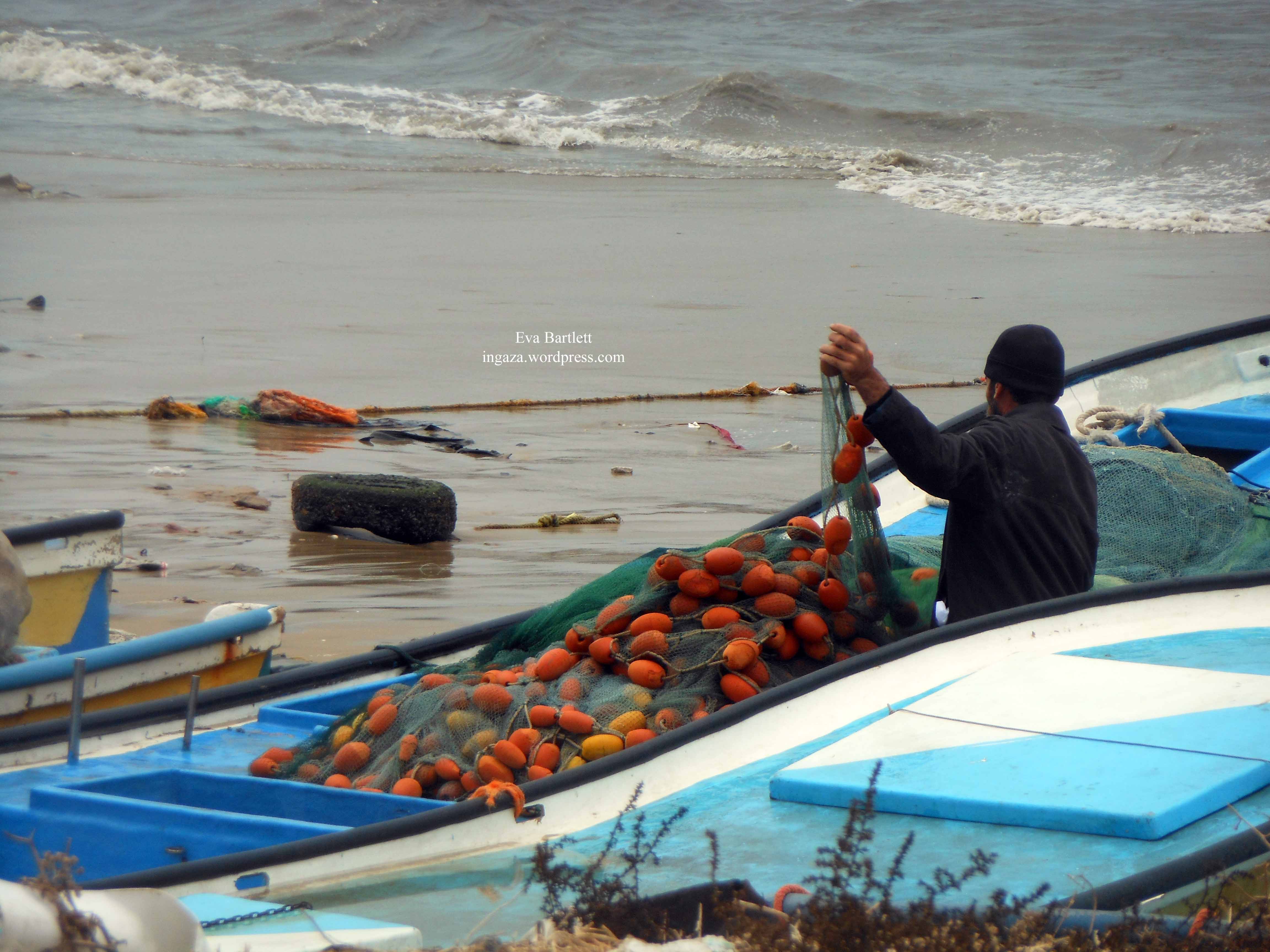
Shortly after Israel and Hamas signed a ceasefire agreement on Nov. 21, the Israeli navy abducted 30 Palestinian fishers from Gaza’s waters, destroyed and sank a Palestinian fishing vessel, and confiscated nine fishing boats in the space of four days.

The Palestinian Centre for Human Rights (PCHR) reported that fourteen fishers from a single family, stationed just three nautical miles from the coast of the Gaza Strip, were all arrested on Dec 1.

Some fishers were only two miles off Gaza’s coast when they were attacked with machine gun fire and arrested by the Israeli Navy. Ranging from the ages of 14 to 52, the majority in their late teens and early twenties, these fishers hail from some of Gaza’s poorest families.

According to Mifleh Abu Riyala, a representative of the General Syndicate of Marine Fishers, the ceasefire has made no difference to Palestinian fishers.

Palestinians are allowed, under the current Israel-Hamas ceasefire, “to fish six miles out”, he told IPS, “but the Israeli gunboats still attack us, whether we are six or three miles out.”

The Oslo accords granted Palestinian fishers the right to fish twenty nautical miles out at sea, a right the Israeli navy has unilaterally vetoed, downsizing the fishing “limits” since the 1990s to a mere three miles, until this past November’s ceasefire allowed a slight increase, to six nautical miles.

“But there are no fish at six miles, the sea floor is still sandy. It is only after seven miles out that the sea floor becomes rocky and the fish are plentiful,” Abu Riyala stressed.

“It is our sea, in order to live we must be able to access it.”

Mohammed Baker (70) has been fishing for half a century. He remembers the days when Gaza’s sea was open to Palestinian fishers, and when there was no fear of being attacked, arrested or killed by the Israeli navy.

Two of his sons, Amar (34) and Omar (21), were among the 14 fishers attacked by Israeli gunboats on Dec 1. The Israeli navy has still not returned their “hassaka” (a small fishing boat).

Like many of Gaza City’s fishers, the Bakers live in the Beach Camp, one of the Strip’s most overcrowded refugee camps.

Amar, married with six children, was still being held by Israeli authorities on Dec. 5 when his father, Mohammed, recounted the events of that fateful day to IPS.

“Israeli gunboats and smaller zodiacs surrounded my sons’ hassaka and made them strip naked, jump into the sea, and swim to one of the Israeli boats,” Mohammed told IPS.

“They put a bag on Amar’s head and took him to Ashdod. Amar has asthma, I’m very worried about his health.” Mohammed has still not been able to speak with his son.

Four days after Amar’s abduction, Mohammed went to the International Committee of the Red Cross (ICRC), whose work includes visiting and monitoring Palestinian prisoners’ conditions in Israeli jails and detention centres.

“They told me Amar is forbidden from talking with anyone. He is under interrogation,” Mohammed said.

Amar now stands accused of “being part of the Palestinian resistance”, a charge based on his previous job of making coffee and tea for Hamas officers.

“My son was a ‘kitchen boy’. People who work for the government are still civilians,” Mohammed stressed, echoing the tenets of international humanitarian law.

Stripped of their only boat and a member of their family, the Bakers face even more dire circumstances than ever.

“There is no ceasefire for fishers. We’re ordinary people, we work to earn just 30 or 40 shekels (seven to 10 dollars) per day to feed our families,” Mohammed lamented.


Jamal Baker’s son Khadr was abused and abducted by the Israeli navy.

Khadr Baker (20) was lucky that he was not killed during an encounter with the Israeli navy on Nov. 28, during which his boat was gunned down as punishment for fishing just over three miles from the Beach Camp coast.

His father, Jamal Baker (50), spoke to IPS about Khadr’s arrest, explaining that Israeli gunboats appeared without warning and began firing at close range on Khadr’s small motorboat.

“The Israelis ordered the four fishers on Khadr’s hassaka to strip and jump into the sea, which is extremely cold this time of year,” Jamal told IPS.

“They made Khadr tread water for half an hour, and kept machine gunning around him,” said Jamal. The hassaka eventually caught fire and exploded, sinking soon after.

“The Israelis took Khadr on their boat, handcuffed him naked, and beat and interrogated him for three hours, accusing him of working with the Palestinian resistance,” the boy’s father told IPS.

Without their boat, the family of ten has no income. “I sold my nets so that we can eat,” Jamal said simply.

PCHR reported other attacks on fishers that day: in one case, the navy attacked and abducted five fishers from the al-Hessi family, damaging – and eventually confiscating – the large fishing trawler they were on. The boat has not yet been returned.

In February 2009, Rafiq Abu Riyala, then 23, was shot in his back – by an Israeli soldier standing less than 20 metres away – with a dum-dum bullet, which explodes on impact.

The hassaka fisher was only two miles off Gaza’s coast when attacked. One of two breadwinners in his family, Rafiq Abu Riyala cannot now fish in cold weather. “The shrapnel bits in my back make it too painful when it is cold out,” he told IPS.

Mahar Abu Amia (40) has sixteen people to provide for. “My wife fishes also,” he told IPS. “But we have no chance: we reach six miles and they shoot, we go only three miles and they shoot. What is this ceasefire? It means nothing for us.”
DSCN5734  DSCN5722 DSCN5738


see also:

Israeli naval abductions and shooting at Palestinian fishermen: it’s routine

Israeli Navy Terrorism: Destroying Boats and Lives

Israeli naval abductions and shooting at Palestinian fishermen

one year later, young fisherman still trying to heal

musings from a fishing boat


B.C. Government Ignores Illegal Wolf Kill Contest


B.C. GOVERNMENT TURNS BLIND EYE ON ILLEGAL WOLF KILL CONTEST

by Pacific Wild


Wildlife conservation group contends that it is a criminal offence for contest to pay hunters to kill wolves

 
DENNY ISLAND, BC - Lawyers from West Coast Environmental Law, on behalf of Pacific Wild, have informed the BC government that a wolf kill contest, currently underway in northern BC, is in violation of the Criminal Code of Canada.

"British Columbians should be furious that our government continues to allow wolves to be killed for money, prizes and other illegal lottery schemes when it is clearly against the law to hold a contest of this nature." said Ian McAllister of the B.C.-based wildlife conservation group Pacific Wild.

On Nov 15, 2012 the Peace Rod and Gun Club, local Fort St. John ReMax realtor Rich Peterson, Raven Oilfield and others announced they were sponsoring a contest with prize money of $1000.00 for the largest wolf killed and $150.00 for the smallest wolf killed with a maximum of three dead wolves per contestant.

On Nov 21st, 2012 after learning of this contest, Pacific Wild formally filed a complaint with BC Gaming expressing concern that this contest was being held without a legal permit citing ethical, legal and wildlife management concerns. On November 23rd, BC Gaming investigator Barry Henetiuk responded that the contest was legal and recommended Pacific Wild seek a further legal opinion.

The West Coast Environmental Law opinion examines whether the Wolf Kill contest, as structured, violates the sections of the Criminal Code of Canada dealing with "lottery schemes." It concludes that as structured, the Contest appears to be a lottery scheme, and would require a licence from the provincial government in order to be legal. West Coast Environmental Law's lawyers also expressed concern that the contest could undermine responsible management of wildlife.

"How many wolves will be killed because of this illegal contest and a BC government that supports this back door policy of wolf culling?" McAllister further stated. "Who is going to be accountable for the illegal killing of these wolves?" "Should it be the contest sponsors, the participants, BC Gaming or Minister Rich Coleman who is ultimately responsible for gaming in BC – or all the above?


FOR IMMEDIATE RELEASE December 17, 2012

  For more information contact:

Ian McAllister
email:  ian@pacificwild.org
link: Legal Opinion and Wolf kill contest poster link: 

www.pacificwild.org <http://www.pacificwild.org>\

Sunday, December 16, 2012

Another Global Meltdown on the Way?


Is the Global Economy on the Verge of Another Meltdown?

by TRNN

Is the Global Economy on the Verge of Another Meltdown? YILMAZ AKYÜZ: From the US to Europe, from China to Brazil, the indications are that if current policies don't change, another major recession is likely


Dr. Yılmaz Akyüz was the Chief Economist and the Director of the Division on Globalization and Development Strategies at the United Nations Conference on Trade and Development (UNCTAD) when he retired in August 2003. He was the principal author and head of the team preparing the Trade and Development Report, and UNCTAD coordinator of research support to developing countries (the Group-of-24) in the IMF and the World Bank on International Monetary and Financial Issues. He taught at various universities in Turkey and Europe before joining UNCTAD in 1984 and after his retirement, and published extensively in macroeconomics, finance, growth and development. He is the second holder of the Tun Ismail Ali International Chair in Monetary and Financial Economics at the University of Malaya, established by Bank Negara. He is now Chief Economist of the South Centre, an Intergovernmental Think Tank of the Developing Countries, based in Geneva.

Why America's Shadow Government Came into the Light

The Visible Government: How the U.S. Intelligence Community Came Out of the Shadows

by Tom Engelhardt  - TomDispatch

Weren’t those the greatest of days if you were in the American spy game? Governments went down in Guatemala and Iran thanks to you. In distant Indonesia, Laos, and Vietnam, what a role you played! And even that botch-up of an invasion in Cuba was nothing to sneeze at. In those days, unfortunately, you -- particularly those of you in the CIA -- didn’t get the credit you deserved.

You had to live privately with your successes. Sometimes, as with the Bay of Pigs, the failures came back to haunt you (so, in the case of Iran, would your “success,” though so many years later), but you couldn’t with pride talk publicly about what you, in your secret world, had done, or see instant movies and TV shows about your triumphs. You couldn’t launch a “covert” air war that was reported on, generally positively, almost every week, or bask in the pleasure of having your director claim publicly that it was “the only game in town.” You couldn’t, that is, come out of what were then called “the shadows,” and soak up the glow of attention, be hailed as a hero, join Americans in watching some (fantasy) version of your efforts weekly on television, or get the credit for anything.

Nothing like that was possible -- not at least until well after two journalists, David Wise and Thomas B. Ross, shined a bright light into those shadows, called you part of an “invisible government,” and outed you in ways that you found deeply discomforting.

Their book with that startling title, The Invisible Government, was published in 1964 and it was groundbreaking, shadow-removing, illuminating. It caused a fuss from its very first paragraph, which was then a shockeroo: “There are two governments in the United States today. One is visible. The other is invisible.”

I mean, what did Americans know at the time about an invisible government even the president didn't control that was lodged deep inside the government they had elected?

Wise and Ross continued: “The first is the government that citizens read about in their newspapers and children study about in their civics books. The second is the interlocking, hidden machinery that carries out the policies of the United States in the Cold War. This second, invisible government gathers intelligence, conducts espionage, and plans and executes secret operations all over the globe.”

The Invisible Government came out just as what became known as “the Sixties” really began, a moment when lights were suddenly being shone into many previously shadowy American corners. I was then 20 years old and sometime in those years I read their book with a suitable sense of dread, just as I had read those civics books in high school in which Martians landed on Main Street in some “typical” American town to be lectured on our way of life and amazed by our Constitution, not to speak of those fabulous governmental checks and balances instituted by the Founding Fathers, and other glories of democracy.

I wasn’t alone reading The Invisible Government either. It was a bestseller and CIA Director John McCone reportedly read the manuscript, which he had secretly obtained from publisher Random House. He demanded deletions. When the publisher refused, he considered buying up the full first printing. In the end, he evidently tried to arrange for some bad reviews instead.

Time Machines and Shadow Worlds


By 1964, the “U.S. Intelligence Community,” or IC, had nine members, including the CIA, the Defense Intelligence Agency (DIA), and the National Security Agency (NSA). As Wise and Ross portrayed it, the IC was already a labyrinthine set of secret outfits with growing power. It was capable of launching covert actions worldwide, with a “broad spectrum of domestic operations,” the ability to overthrow foreign governments, some involvement in shaping presidential campaigns, and the capacity to plan operations without the knowledge of Congress or full presidential control. “No outsider,” they concluded, “can tell whether this activity is necessary or even legal. No outsider is in a position to determine whether or not, in time, these activities might become an internal danger to a free society.” Modestly enough, they called for Americans to face the problem and bring “secret power” under control. (“If we err as a society, let it be on the side of control.”)

Now, imagine that H.G. Wells’s time machine had been available in that year of publication. Imagine that it whisked those journalists, then in their mid-thirties, and the young Tom Engelhardt instantly some 48 years into the future to survey just how their cautionary tale about a great democratic and republican nation running off the tracks and out of control had played out.

The first thing they might notice is that the Intelligence Community of 2012 with 17 official outfits has, by the simplest of calculations, almost doubled. The real size and power of that secret world, however, has in every imaginable way grown staggeringly larger than that. Take one outfit, now part of the IC, that didn’t exist back in 1964, the National Geospatial-Intelligence Agency. With an annual budget of close to $5 billion, it recently built a gigantic $1.8 billion headquarters -- “the third-largest structure in the Washington area, nearly rivaling the Pentagon in size” -- for its 16,000 employees. It literally has its “eye” on the globe in a way that would have been left to sci-fi novels almost half a century ago and is tasked as “the nation’s primary source of geospatial intelligence, or GEOINT.” (Don’t ask me what that means exactly, though it has to do with quite literally imaging the planet and all its parts -- or perhaps less politely, turning every inch of Earth into a potential shooting range.)

Or consider an outfit that did exist then: the National Security Agency, or NSA (once known jokingly as “no such agency” because of its deep cover). Like its geospatial cousin, it has been in a period of explosive growth, budgetary and otherwise, capped off by the construction of a “heavily fortified” $2 billion data center in Bluffdale, Utah. According to NSA expert James Bamford, when finished in 2013 that center will “intercept, decipher, analyze, and store vast swaths of the world’s communications as they zap down from satellites and zip through the underground and undersea cables of international, foreign, and domestic networks.” He adds: “Flowing through its servers and routers and stored in near-bottomless databases will be all forms of communication, including the complete contents of private emails, cell phone calls, and Google searches, as well as all sorts of personal data trails -- parking receipts, travel itineraries, bookstore purchases, and other digital ‘pocket litter.’” We’re talking not just about foreign terrorists here but about the intake and eternal storage of vast reams of material from American citizens, possibly even you.

Or consider a little-known post-9/11 creation, the National Counterterrorism Center (NCTC), which is not even a separate agency in the IC, but part of the Office of the Director of National Intelligence. According to the Wall Street Journal, the Obama administration has just turned that organization into “a government dragnet, sweeping up millions of records about U.S. citizens -- even people suspected of no crime.” It has granted the NCTC the right, among other things “to examine the government files of U.S. citizens for possible criminal behavior, even if there is no reason to suspect them... copy entire government databases -- flight records, casino-employee lists, the names of Americans hosting foreign-exchange students, and many others. The agency has new authority to keep data about innocent U.S. citizens for up to five years, and to analyze it for suspicious patterns of behavior. Previously, both were prohibited.”

Or take the Defense Intelligence Agency, which came into existence in 1961 and became operational only the year their book came out. Almost half a century ago, as Wise and Ross told their readers, it had 2,500 employees and a relatively modest set of assigned tasks. By the end of the Cold War, it had 7,500 employees. Two decades later, another tale of explosive growth: the DIA has 16,000 employees.

In their 2010 Washington Post series, "Top Secret America," journalists Dana Priest and William Arkin caught a spirit of untrammeled expansion in the post-9/11 era that would surely have amazed those two authors who had called for “controls” over the secret world: “In Washington and the surrounding area, 33 building complexes for top-secret intelligence work are under construction or have been built since September 2001. Together they occupy the equivalent of almost three Pentagons or 22 U.S. Capitol buildings -- about 17 million square feet of space.”

Similarly, the combined Intelligence Community budget, which in deepest secrecy had supposedly soared to at least $44 billion in 2005 (all such figures have to be taken with a dumpster-ful of salt), has by now nearly doubled to an official $75 billion.

Let’s add in one more futuristic shocker for our time travelers. Someone would have to tell them that, in 1991, the Soviet Union, that great imperial power and nemesis of the invisible government, with its vast army, secret police, system of gulags, and monstrous nuclear arsenal, had disappeared largely nonviolently from the face of the Earth and no single power has since arisen to challenge the United States militarily. After all, that staggering U.S. intelligence budget, the explosion of new construction, the steep growth in personnel, and all the rest has happened in a world in which the U.S. is facing a couple of rickety regional powers (Iran and North Korea), a minority insurgency in Afghanistan, a rising economic power (China) with still modest military might, and probably a few thousand extreme Muslim fundamentalists and al-Qaeda wannabes scattered around the planet.

They would have to be told that, thanks to a single horrific event, a kind of terrorist luck-out we now refer to in shorthand as "9/11," and despite the diminution of global enemies, an already enormous IC has expanded nonstop in a country seized by a spasm of fear and paranoia.

Preparing Battlefields and Building Giant Embassies

Staggered by the size of the invisible government they had once anatomized, the two reporters might have been no less surprised by another development: the way in our own time “intelligence” has been militarized, while the U.S. military itself has plunged into the shadows. Of course, it’s now well known that the CIA, a civilian intelligence agency until recently headed by a retired four-star general, has been paramilitarized and is now putting a significant part of its energy into running an ever spreading “covert” set of drone wars across the Greater Middle East.

Meanwhile, since the early years of the George W. Bush administration, the U.S. military has been intent on claiming some of the CIA’s turf as its own. Not long after the 9/11 attacks, then-Secretary of Defense Donald Rumsfeld began pushing the Pentagon into CIA-style intelligence activities -- the "full spectrum of humint [human intelligence] operations" -- to “prepare” for future “battlefields.” That process has never ended. In April 2012, for instance, the Pentagon released the information that it was in the process of setting up a new spy agency called the Defense Clandestine Service (DCS). Its job: to globalize military “intelligence” by taking it beyond the obvious war zones. The DCS was tasked as well with working more closely with the CIA (while assumedly rivaling it).

As Greg Miller of the Washington Post reported, “Creation of the new service also coincides with the appointment of a number of senior officials at the Pentagon who have extensive backgrounds in intelligence and firm opinions on where the military’s spying programs -- often seen as lackluster by CIA insiders -- have gone wrong.”

And then just this month the head of the Defense Intelligence Agency, originally a place for analysis and coordination, announced at a conference that his agency was going to expand into “humint” in a big way, filling embassies around the world with a new corps of clandestine operators who had diplomatic or other “cover.” He was talking about fielding 1,600 “collectors” who would be “trained by the CIA and often work with the Joint Special Operations Command.” Never, in other words, will a country have had so many “diplomats” who know absolutely nothing about diplomacy.

Though the Senate has balked at funding the expansion of the Defense Clandestine Service, all of this represents both a significant reshuffling of what is still called “intelligence” but is really a form of low-level war-making on a global stage and a continuing expansion of America’s secret world on a scale hitherto unimaginable, all in the name of “national security.” Now at least, it’s easier to understand why, from London to Baghdad to Islamabad, the U.S. has been building humongous embassies fortified like ancient castles and the size of imperial palaces for unparalleled staffs of “diplomats.” These will now clearly include scads of CIA, DIA, and perhaps DCS agents, among others, under diplomatic “cover.”

Into this mix would have to go another outfit that would have been unknown to Wise and Ross, but -- given the publicity Seal Team Six has gotten over the bin Laden raid and other activities -- that most Americans will be at least somewhat aware of. An ever-greater role in the secret world is now being played by a military organization that long ago headed into the shadows, the Joint Special Operations Command (JSOC). In 2009, New Yorker reporter Seymour Hersh termed it an “executive assassination ring” (especially in Iraq) that did not “report to anybody, except in the Bush-Cheney days... directly to the Cheney office.”

In fact, JSOC only emerged into the public eye when one of its key operatives in Iraq, General Stanley McChrystal, was appointed U.S. war commander in Afghanistan. It has been in the spotlight ever since as it engages in what once might have been CIA-style paramilitary operations on steroids, increases its intelligence-gathering capacity, runs its own drone wars, and has set up a new headquarters in Washington, 15 convenient minutes from the White House.

Big Screen Moments and “Covert” Wars


At their top levels, the leadership of the CIA, the DIA, and JSOC are now mixing and matching in a blur of ever more intertwined, militarized outfits, increasingly on a perpetual war footing. They have, in this way, turned the ancient arts of intelligence, surveillance, spying, and assassination into a massively funded way of life and are now regularly conducting war on the sly and on the loose across the globe. At the lowest levels, the CIA, DIA, JSOC, and assumedly someday DCS train together, work in teams and in tandem, and cooperate, as well as poach on each other’s turf.

Today, you would be hard-pressed to write a single volume called The Invisible Government. You would instead have to produce a multi-volume series. And while you were at it -- this undoubtedly would have stunned Wise and Ross -- you might have had to retitle the project something like The Visible Government.

Don’t misunderstand me: Americans now possess (or more accurately are possessed by) a vast “intelligence” bureaucracy deeply in the shadows, whose activities are a mass of known unknowns and unknown unknowns to those of us on the outside. It is beyond enormous. There is no way to assess its actual usefulness, or whether it is even faintly “intelligent” (though a case could certainly be made that the U.S. would be far better off with a non-paramilitarized intelligence service or two, rather than scads of them, that eschewed paranoia and relied largely on open sources). But none of that matters. It now represents an irreversible way of life, one that is increasingly visible and celebrated in this country. It is also part of the seemingly endless growth of the imperial power of the White House and, in ways that Wise and Ross would in 1964 have found inconceivable, beyond all accountability or control when it comes to the American people.

It is also ready to take public credit for its “successes” (or even a significant hand in shaping how they are viewed in the public arena). Once upon a time, a CIA agent who died in some covert operation would have gone unnamed and unacknowledged. By the 1970s, that agent would have had a star engraved on the wall of the lobby of CIA headquarters, but no one outside the Agency would have known about his or her fate.

Now, those who die in our “secret” operations or ones launched against our “invisible” agents can become public figures and celebrated “heroes.” This was the case, for instance, with Jennifer Matthews, a CIA agent who died in Afghanistan when an Agency double agent turned out to be a triple agent and suicide bomber. Or just last week, when a soldier from Seal Team Six died in an operation in Afghanistan to rescue a kidnapped doctor. The Navy released his photo and name, and he was widely hailed. This would certainly have been striking to Wise and Ross.

Then again, they would undoubtedly have been no less startled to discover that, from Jack Ryan and Jason Bourne to Syriana, the Mission Impossible films, and Taken, the CIA and other secret outfits (or their fantasy doppelgangers) have become staples of American multiplexes. Nor has the small screen, from 24 to Homeland, been immune to this invasion of visibility. Or consider this: just over a year and a half after Seal Team Six’s super-secret bin Laden operation ended, it has already been turned into Zero Dark Thirty, a highly pre-praised (and controversial) movie, a candidate for Oscars with a heroine patterned on an undercover CIA agent whose photo has made it into the public arena. Moreover, it was a film whose makers were reportedly aided or at least encouraged in their efforts by the CIA, the Pentagon, and the White House, just as the SEALs aided this year’s high-grossing movie Act of Valor (“an elite team of Navy SEALs... embark on a covert mission to recover a kidnapped CIA agent”) by lending the film actual SEALs as its (unnamed) actors and then staging a SEAL parachute drop onto a red carpet at its Hollywood premier.

True, at the time The Invisible Government was published, the first two James Bond films were already hits and the Mission Imposible TV show was only two years from launch, but the way the invisible world has since emerged from the shadows to become a fixture of pop culture remains stunning. And don’t think this was just some cultural quirk. After all, back in the 1960s, enterprising reporters had to pry open those invisible agencies to discover anything about what they were doing. In those years, for instance, the CIA ran a secret air and sizeable ground war in Laos that it tried desperately never to acknowledge despite its formidable size and scope.

Today, on the other hand, the Agency runs what are called “covert” drone wars in Pakistan, Yemen, and Somalia in which most strikes are promptly reported in the press and about which the administration clearly leaked information it wanted in the New York Times on the president’s role in picking those to die.

In the past, American presidents pursued “plausible deniability” when it came to assassination plots like those against Congolese leader Patrice Lumumba, Cuba’s Fidel Castro, and Vietnam’s Ngo Dinh Diem. Now, assassination is clearly considered a semi-public part of the presidential job, codified, bureaucratized, and regulated (though only within the White House), and remarkably public. All of this has become part of the visible world (or at least a giant publicity operation in it). No need today for a Wise or Ross to tell us this. Ever since President Ronald Reagan’s CIA-run Central American Contra wars of the 1980s, the definition of “covert” has changed. It no longer means hidden from sight, but beyond accountability.

It is now a polite way of saying to the American people: not yours. Yes, you can know about it; you can feel free to praise it; but you have nothing to do with it, no say over it.

In the 48 years since their pioneering book was published, Wise and Ross’s invisible government has triumphed over the visible one. It has become the go-to option in this country. In certain ways, it is also becoming the most visible and important part of that government, a vast edifice of surveilling, storing, spying, and killing that gives us what we now call “security,” leaves us in terror of the world, never stops growing, and is ever freer to collect information on you to use as it wishes.

With the passage of 48 years, it’s so much clearer that, impressive as Wise and Ross were, their quest was quixotic. Bring the “secret power” under control? Make it accountable? Dream on -- but be careful, one of these days even your dreams may be on file.


Tom Engelhardt, co-founder of the American Empire Project and author of The United States of Fear as well as The End of Victory Culture, his history of the Cold War, runs the Nation Institute's TomDispatch.com. His latest book, co-authored with Nick Turse, is Terminator Planet: The First History of Drone Warfare, 2001-2050. You can see his interview with Bill Moyers on supersized politics, drones, and other subjects by clicking here.

Follow TomDispatch on Twitter @TomDispatch and join us on Facebook. Check out the newest Dispatch book, Nick Turse’s The Changing Face of Empire: Special Ops, Drones, Proxy Fighters, Secret Bases, and Cyberwarfare.

Copyright 2012 Tom Engelhardt

Hamas at 25: Beyond the Verbiage to Understanding


Understanding Hamas at 25: Beyond the Tired Language

 by Ramzy Baroud


In a moment of high theatre he dropped to his knees, placed his lips on the ground and kissed the land he has commanded by proxy”. This is how Robert Tait of the British Telegraph worded the moment Khaled Meshaal arrived in Gaza on Dec 07. Tait’s report on what many in Gaza and elsewhere consider a watershed event in the history of the Islamic movement, was mostly consistent with mainstream reporting on any event concerning the impoverished and besieged Strip: often biased, selective and devoid of real understanding or empathy.

Media reporting on Hamas is doubly provocative, controversial and similar to political stances towards Hamas. However, in the eyes of Israel, through the prism of its media and among Israel’s western supporters, Hamas is an unequaled terrorist organization, sworn to destroy Israel and unlike the other ‘moderate’ Palestinians – for example, western-backed Palestinian Authority – it refuses to recognize Israel’s ‘right to exist’. The latter point was faithfully emphasized by Tait. He, like many others, unthinkingly or deliberately fails to question the incredulous condition placed on a relatively small movement as it faces a powerful and habitually brutal military.

Hamas’ supporters, on the other hand, see the 25-year-old movement as the pinnacle of Palestinian resistance; an iconic organization that unlike leading secular Palestinian factions, refuses to compromise. To make the point, they cite various battles and numerous assassinations of Hamas’ leaders, including that of quadriplegic Sheikh Ahmad Yassin, who was pitilessly murdered by an Israeli missile in 2004. They argue that a movement which is willing to pay this kind of a price – life itself - for its political and moral stances must be above suspicion, if not criticism.

However, for many in the left that is barely enough. The notion that the movement was an outright creation of the Israeli internal intelligence Shin Bet, has been stable in leftist discourse for many years. The idea is often accepted without any serious attempts at qualification or discussion, like many leftist ideals on Palestine and Israel. 

Each party does its utmost to defend their anti and pro Hamas arguments.

Pro-Israeli media is anchored in the suicide bombings line of reasoning, which, again, is selective, lacks context and conveniently overlooks the fact that thousands of Palestinians were killed by the Israeli military, even years after Hamas abandoned such tactics.

Hamas supporters reference battles, notwithstanding the Nov 14, 8-day war on Gaza, where Hamas, Islamic Jihad and other resistance groups, earned what they perceive as an unprecedented victory against Israel.

There are also those who, while sympathizing with Palestinian aspirations and resistance, have a difficult time accepting Hamas’ turnabout regarding Syria, its suspicious closeness to Qatar, and what they see as shifty and dubious political style.

Peculiarly, there is a common denominator between all of these perceptions of Hamas. They all brand the movement using single, uniform logic, devoid of any accommodating analysis that examines facts, overt and subtle discourses, and places such intricate phenomena in larger political contexts. Such a unitary view is of course not unique to Hamas, but it also applies to everything Palestinian. It is a natural outcome of media distortions and political bias. Anyone Israel perceives as an enemy, is instantly dehumanized and presented with crude and inane language. Social media helps correct the imbalance to a degree, although it also contributes to the polarization: a Palestinian thus becomes either a cold-blooded terrorist or a would-be martyr, bad or good, pro-US or pro-Iran, and so on.

However, an unpretentious analysis requires breaking away from all the fixed ideas and preemptive conclusions, where Hamas is neither a violence-driven menace nor a flawless organization with a perfect track record; neither a brainchild of Israeli intelligence, nor a political conduit of Qatar.

Some of those who reported on Meshaal’s visit to Gaza, emphasized the militant or religious symbols that awaited him upon arrival. He was “greeted by a throng of hundreds of chanting supporters – some armed to the teeth with Kalishnikovs and rocket propelled grenades,” wrote Tait right in the first paragraph. Others highlighted his ‘wish’ to one day die a ‘martyr’ in Gaza (AFP). Once again, such reporting confounds terms with deep cultural references – as in his willingness to pay the ultimate price for his beliefs. Interestingly, Meshaal was in fact all but dead in an Israeli assassination attempt at his life in Amman, Jordan in 1997, another fact conveniently omitted from many reports.

Since its inception, Hamas has grown in every pertinent way. Its very first statement was a true depiction of the inexperience of the movement at the time and the nature of the relationship that governed ill-fated Palestinians and the rest of the Arab world: “It’s our duty to address the word to the Arab rulers, and particularly to the rulers of Egypt, the Egyptian army and the Egyptian people, as follows: What has happened to you, O rulers of Egypt? Were you asleep in the period of the treaty of shame and surrender, the Camp David treaty?”

Since then, the political landscape has been repeatedly altered. While Hamas’ own evolution had itself impacted some of the change – for example, its decision to participate in the legislative elections in 2006, its conflict with Fatah, and its handling of the situation in Gaza since then – much of the transformation, especially in the last two years has not been of its own making.

As violence flared in Syria, Hamas attempted to develop a unique neutral position which failed. The political schisms in Syria proved impossible to navigate and the June 2012 assassination of Kamal Ghanaja, a Hamas mid-level leader in Damascus was the bloody culmination of that failure.

Fearing that Hamas’ anxiety would lead to further closeness to Iran – especially as the political score in tumultuous Egypt is yet to be settled - a major campaign, led by Qatar was initiated to sway Hamas from Iran, which was a major source of support to Hamas and other Palestinian factions. The push to influence Hamas was topped by a late October visit to Gaza by Sheikh Hamad bin Khalifa Al Thani, emir of Qatar. It was then that Hamas' Prime Minister Ismail Haniyeh declared that the siege was over, only to be reminded three weeks later by a massive Israeli war that it was not. However, deterring Hamas backfired and Israel soundly lost that battle. In the process there were new discoveries that the resistance in Gaza was much more resourceful than previously thought.

Days after Gazans celebrated the defeat of Israel’s war objectives, several billboards thanking Iran for its help of the resistance were erected in Gaza. It was perhaps Hamas’ (and the Islamic Jihad) way of sending a clear message that it will continue to play by its own rules, that it is a member of no camp, that its allegiance remains to principles and not to governments or funds. Interestingly though, the billboards were not signed.

Now that Meshaal has visited Gaza and was greeted by a large number of Palestinians, the movement seems to operate with greater clarity and confidence than any other time in the last two years. “Politics without resistance has no meaning,” he said soon after arrival. The statement is rife with meanings and suggestions.

At 25, Hamas has morphed in its status and importance, and within that prominence lays its strengths and weaknesses. In order to maintain a level of power and to safeguard its political evolution, it has no other option but to become even more dependent on other parties, Egypt notwithstanding, whose prospects for stability are receding by the day.

The Israeli prescription of understanding everything Palestinian, including Hamas, no longer suffices. Western journalists need to take notice of that complex reality and quit stereotyping and cataloging Palestinians using the same old language. There is more to understanding such issues than a tired division between good guys and others “hell-bent on the destruction of Israel.” Hamas should be understood properly within its local context, and then in relations to all of its surroundings, including Israel.

25-years later, Hamas is still understood within limited confines of an ever-redundant discourse obsessed with Israel’s security, and later with an imagined Iranian threat. A new understanding is desperately required, one that is sensible enough to take into account the uniqueness of the Palestinian narrative itself, Palestinian history, the struggle and rights, as opposed to Israel’s security - the cornerstone of western media reporting on Palestine and the Middle East.


Ramzy Baroud (ramzybaroud.net) is an internationally syndicated columnist and the editor of PalestineChronicle.com. His latest book is My Father Was a Freedom Fighter: Gaza’s Untold Story (Pluto Press, London).

Gorilla Radio with Chris Cook, Stephen Dunifer, Ramzy Baroud, Janine Bandcroft Dec. 17, 2012


This Week on GR

by C.L. Cook

The modern media age began with radio. In the United States, it was determined, the airwaves belonged to the people and those wanting to access the people's resource must conform to certain standards; namely: "serving the public interest, convenience, and necessity."

This was the first edict of the 1927 Radio Act, proscribing access and defining content suitable for the new medium. It was followed by myriad more orders, demands, and regulations that would create, in less than a century, a media environment almost entirely bereft of its cardinal command: serving the public interest."

Stephen Dunifer is the founder of Free Radio Berkeley of Berkeley, California. Stephen and Free Radio have, over nearly twenty years, fought to bring the public back to the airwaves.

Listen. Hear.

It's a fight waged on varying levels, and in differing venues; a slightly lop-sided battle, with community volunteers, tech. geeks, and anarchists struggling to provide; "...community news, discussions and interviews, information, a wide range of music, and more..." facing the FCC and deep-pocketed corporate concerns. Forced from the air, Free Radio Berkeley nonetheless, created an example and fostered a; "... movement to liberate the airwaves and break the corporate broadcast media's stranglehold on the free flow of news, information, ideas, cultural and artistic creativity." 

Stephen Dunifer in the first half.

And; last month, Palestine was granted "nonvoting observer non-member state" status in the United Nations General Assembly. (This not weeks following yet another unprovoked Israeli military assault against the cities, towns, and overall infrastructure of Gaza, an assault that at the latest count includes at least 172 killed, more than a third of those being children). The conditional recognition has been hailed as the beginning of a new era for Palestine and Palestinians; but is it?

Ramzy Baroud is an internationally syndicated columnist and the editor of the PalestineChronicle.com, whose book titles include: 'Searching Jenin: Eyewitness Accounts of the Israeli Invasion,' 'The Second Palestinian Intifada: A Chronicle of a People's Struggle,' and his latest, 'My Father Was a Freedom Fighter: Gaza’s Untold Story.'

Ramzy Baroud and Palestine's New Status: A History Rerun or a New Palestinian Strategy in the second half.

And; Victoria Street Newz publisher and CFUV Radio broadcaster, Janine Bandcroft will join us at the bottom of the hour to bring us up to speed with some of the good things going on on our city's streets and beyond. But first, Stephen Dunifer on freeing radio, and the FCC's Low Power Deception.

Chris Cook hosts Gorilla Radio, airing live every Monday, 5-6pm Pacific Time. In Victoria at 101.9FM, and on the internet at: http://cfuv.uvic.ca. He also serves as a contributing editor to the web news site, http://www.pacificfreepress.com. Check out the GR blog at: http://gorillaradioblog.blogspot.ca/

G-Radio is dedicated to social justice, the environment, community, and providing a forum for people and issues not covered in the corporate media.

Ending American Massacres Great and Small


Ending Massacres At Home and Abroad

by Sherwood Ross

We are a nation that is not only starts wars around the world but which is at war with itself. That's a generality. But add up the availability of 300 million firearms with the psychological impact of saturation violence filling the eyes and ears of our people from all forms of media and you have a lethal combination that predictably leads to massacres by unstable individuals.

There aren’t enough medical professionals in America to identify and treat every disturbed person with a notion to wreak violence. We have to take away the means by which disturbed individuals kill; we need to outlaw handguns and assault weapons right off. We’ve also got to stop the wave of psychological impressions that are pouring in over the airwaves and from video games and TV commercials that suggest it is okay to commit violence, that it is all right for Marvel Comics heroes, for Batman and Captain America to take the law into their own hands and use violent means to bring the “bad guys” to justice.

We could also remove from video game arcades the machine guns players use to mow down their enemies and to ban sale of violence-filled “games” that make random violence appear “normal” to our children. There is also the matter of those Pentagon recruitment videos that depict armed young men storming across a battlefield holding lethal weapons who are supported by tanks and fighter planes----as these pictures glorify warfare.

No law passed by Congress is going to work (and I support such legislation) without a basic change in our culture.


This is a change that needs to being with President Obama, who is consoling that relatives of the massacre victims while he is himself a culpable war criminal responsible for the illegal deaths of thousands of innocent victims in the Middle East, including children, by his military assaults and drone warfare----drone warfare that the Bureau of Investigative Journalism in UK says has killed more than a hundred children. Why is the life of a child in Pakistan worth less than a child in Connecticut?

Capital punishment, even with due process, is revolting but taking human lives without legal proceedings is madness.The use of drone planes in the Middle East is terrorizing populations, making parents reluctant to send their children to school or into the street to play---and President Obama bears direct responsibility for this. No, we need to put down our weapons everywhere, overseas in Pakistan and Yemen and Afghanistan and also in Chicago----where more citizens are being murdered by gun violence annually than the U.S. is losing troops in Afghanistan.

Yielding to public pressure, President Obama may propose “gun control” legislation. But let him begin in the Oval Office. Let him call back U.S. troops from around the world and close down those 1,000 foreign military bases. Let him slash the Pentagon’s budget and expand the Peace Corps budget.

The United States today is an insane asylum, and the President, tragically, is responsible for the deaths and wounds of those he sends needlessly and illegally into battle. And his past inaction on gun control makes him responsible in part for the slayings at home, just like former presidents and members of Congress who support him.

We have slaughtered 160,000 of our own people by firearms since 2000 and we have killed several million abroad. I am deeply ashamed of my country, especially as we are capable of better things. After all, this is the nation that gave the world the Bill of Rights and the electric light, winged flight, the skyscraper, the motion picture, open heart surgery, great art, great literature, and much, much more.

We need to make our culture glorify non-violence and diplomacy rather than aggression and war, and suit our foreign policy to that standard. Otherwise, we will continue to pay lip-service to the memory of Rev. Martin Luther King, whose call for non-violence the U.S. has never tested abroad, even though love is its animating power and must triumph in the end.

The UN Charter says that wars begin in the minds of men. We need to pass laws, yes, but as well we must change the pictures we are putting into the minds of our people---or else.

Where Men Tote Guns Tots Tremble

When Men Tote Guns

by Betty Krawczyk - Betty's Early Edition


As a rule when gun toting men become angry or despairing, women tremble and try to hide the children. And there are a lot of gun packing men in the US, Mexico, and other places like the Congo, Afghanistan, Syria, etc. There are even some in Canada. And if these men get angry enough at a situation (whatever it is) and especially if they run out of medication (alcohol, street drugs, subscription drugs or simply lose patience with infidels or rival biker gangs or annoying women and children) they reach for the emotional security they have faith in. The gun. The US Supreme Court has ruled that men (and women) can now carry concealed weapons as well as unconcealed ones, and furthermore, university students can lug them around with their school books.

Have they gone completely and absolutely collectively mad down there? Yes. And I believe that it is our job as Canadians not to go mad with them.

This is going to be difficult. We are so close. But I think we can do it with Quebec leading the way. And if we can just get Stephen Harper out of the way. While it is some time before we can vote this man out, I think even before the school shooting in Newtown, Connecticut happened, Harper was feeling just a tiny bit squeamish about announcing publicly that he had just destroyed the long gun registry records in Canada. They were all destroyed. Except in the province of Quebec. The Supreme Court of Quebec ordered that the records of the Quebec registry be preserved. According to the National Post (Nov. 2, 2012) Harper has no plans for holding a press conference to announce the destruction of the records of all the other provinces. A little strange since he campaigned on the destruction of the long gun registry. So why isn’t he crowing about accomplishing this? Well, Harper is shrewd.

Harper is aware that women as a group aren’t as keen on guns as men are and that women helped sink the Republicans in the recent US elections. And Harper got a severe dressing down from the Quebec Supreme Court judge for attempting to destroy Quebec records. The harm has already been done to the rest of the provinces, the records are destroyed. But we can demand the beginning of new gun registries, more stringent than the one destroyed by Harper.

While I admit that the hunting culture in northern Canada is not the same as the cut loose of the cowboys in the US, it is still troublesome to have unregistered guns anywhere in Canada. Long guns are weapons. They can be sold, or stolen. People are killed by these guns as well as hand guns, or sorely wounded. Children are killed by them. Registering a gun is not the magic bullet, so the speak, but it might make the owner of the gun count his bullets more carefully and be more mindful of his duty as a good citizen to clean, lock, and store this death weapon extremely carefully.

I think President Obama’s tears over the murdered children in Connecticut were crocodile tears. I don’t think it too outrageous to say that Obama is a murderer and assassin himself. The drones he is sending into Afghanistan and other parts of the world also kill children, little people like the ones he wept over in the White House after the school shootings. I believe these other little people being killed by US policies increasingly tied to Obama’s drone kill list are meaningless to him.

In my opinion, what is most meaningful to Barack Obama is the good will of the gun lobbies, the American Rife Association, the trillion dollar arms sales, the military weapons, the profit of shoddy reconstruction corporations, and the human waste of war. All these wars, bankrolled by corrupted international banking systems are coming home to America. Obama’s crocodile tears are for show. And even if they were sincere it wouldn’t matter.

From The Rubaiyat by Omar Khayyam:
“The Moving Finger Writes; and having Writ moves on, nor all thy Piety nor Wit shall lure it back to cancel half a line, nor all thy tears wash out a word of it.”

But let’s not go mad along with Obama and the American right wing cow boys and gun culture. We must also try to stay sane under the extreme provocation of Harper’s give away of our country’s resources, in his war on women and the poor, his contempt for the environment, in his lust for extreme prison sentences for small infractions while the drug gangs launder money in our banks under his nose, for his war on crime while mandating lax gun laws in this country. I admit it is enough to drive people mad. However I am reminded of a scene in the movie “The Dresser”.

The movie is about the man who dresses a Shakespearean actor for his change scenes during World War Two. Under the pressure of the constant bombing and ensuing chaos in London the actor begins to lose it. During a performance change of scene the actor tells the dresser he thinks he is going mad. The dresser will have none of it. “You can’t,” he says, or words to that effect. “You can’t go mad. This is a crisis. It is your patriotic duty not to go mad.”

I love that scene. It speaks to me during these weird times we are living through. Can we all stay cool and purposeful? It is our patriotic duty. The laws and leaders that are tearing up our world were put there by ordinary people who mistook greed and cruelty for strength. We were mistaken. But like the poet said, while our tears cannot wash away what has already happened, we can certainly wipe the tears away and get on with it.

Let’s demand of our politicians that we want a new gun registry, one so strong that any every gun in Canada can be accounted for at any given time, and traced to an address, driver’s license, vehicle tags, employment, and medical history. People who have guns in their possession should be required to report every six months to a fire arms registry. Northern people who hunt for food would have to be accommodated by sending government agents to them, or opening offices in their territories, rather than having food hunters bear the burden of travel. All of the applications and paper work should take place in separate government offices so there is no confusion. Using target practice as a need for owning a gun is not good enough. Let’s cut the gun toting cowboys off at the border. Impossible? Not if we mean it.

©2012 Betty K | Blog: http://bettysearlyedition.blogspot.com Books: www.schiverrhodespublishing.com