Wednesday, February 06, 2013

Questioning Canada's FIPA Deal with China


Questioning Canada's FIPA Deal with China

by Elizabeth May


Elizabeth May: Mr. Speaker, I rise today to pursue a matter that I have been raising since the month of September. The specific matter for tonight’s discussion relates to a question I put to the Prime Minister in question period on October 23. It relates to the Canada-China investment treaty.


I would like to take us back to where we were on October 23. With no ceremony, no warning, no briefing for parliamentarians and no lock-up, on September 26 the Canada-China investment treaty was quietly tabled in the House by the Parliamentary Secretary to the Minister of Foreign Affairs. Under rules adopted by the current administration, we were given 21 sitting days to essentially sit on it. There was no opportunity for debate. There was no opportunity for a vote.

As I had been anticipating, this treaty fairly closely models what has been done in other investor state treaties, but it is more egregious than usual in that we are allowing the People’s Republic of China and its state-owned enterprises the ability to circumvent our courts, bypass our court system, and go directly to an international arbitration and challenge any law passed at the municipal level, provincial level, federal level, or even any decision of our courts. They can challenge that it has cost them profits and therefore they demand an arbitration process, which is set out in the Canada-China investment treaty.

The practice of previous governments in this circumstance is well documented in constitutional law texts. I would refer anyone who is concerned to review the foundational text by Professor Peter Hogg. Even with treaties such as this one that did not require implementing legislation, which is the usual reason that treaties must be put to a vote in the House of Commons and the Senate, the usual practice by previous prime ministers was to bring such treaties to a vote in the House whether they required implementing legislation or not. I would refer briefly to the Kyoto protocol. There was no need for implementing legislation, but it was brought to the House of Commons for a vote.

Instead, and this has been lauded by representatives from the other side of this House, they adopted a practice called mandatory tabling of a treaty for 21 sitting days. The timing on those sitting days, taking into account weekends, Thanksgiving and so on, was from September 26 to November 1. Thereafter, at any point, the treaty could be ratified by a decision of cabinet in order in council.

The question I put to the Prime Minister was whether or not the constitutional aspects of this had been properly considered. I will quote my question: “Do arbitrations for damages against Canada for decisions at the provincial level not demand explicit agreement” with the provinces before the treated is ratified?

In support of the case that I have made that this treaty violates constitutional rights and promises–and let me also say in light of the Idle No More movement of first nations–I put into discussion this evening a letter to the Prime Minister dated October 12, from the recognized international law expert in arbitration process, Gus Van Harten, associate professor at Osgoode Hall Law School.

What he wrote to the Prime Minister on this topic was this:

The treaty clearly impacts on provincial powers on natural resources, taxation, land and property rights, and other matters. It applies to provincial legislation, regulations, or court or tribunal decisions that affect Chinese-owned assets, with limited exceptions. It does not contain a NAFTA-style carve-out for provincial performance requirements or any carve-outs for provincial measures regarding the treaty’s expropriation and fair and equitable treatment provisions.Thus, there is a real possibility that, over the lifespan of the treaty, Canada will face billion dollar-plus awards due to provincial decisions that are not reviewable in Canadian courts.

This is clearly unacceptable. I await the parliamentary secretary’s response.

Kerry-Lynne D. Findlay: Mr. Speaker, exporting Canada’s world-class goods, services and expertise to new, fast-growing markets around the world is a key part of Canada’s economic action plan for jobs, growth and long-term prosperity. Our government is delivering on this commitment. In fact, the Minister of International Trade is leading a trade mission to Ghana and Nigeria this week to do just that. Africa is one of the fastest-growing regions in the world. According to the International Monetary Fund, five of the world’s twenty fastest-growing economies are in sub-Saharan Africa. Canadian companies are creating jobs and prosperity throughout Africa, and our government is creating new opportunities for Canadian exporters by opening new markets in this dynamic region.

However, promoting Canadian interests internationally also means creating the conditions for Canadian investors to invest with confidence. That is exactly what our government is doing with our foreign investment promotion and protection agreements. In fact, our government has concluded several such agreements with our partners in Africa, including Tanzania, Benin and Senegal. We have also concluded such an agreement with China, the world’s second-largest economy. This agreement will provide stronger protection for Canadians investing in China and create jobs and economic growth right here at home. This agreement establishes a clear set of rules under which investments are made and under which investment disputes are resolved. This treaty is about protecting the interests of Canadians. The FIPA also ensures that all investment disputes are resolved under international arbitration, ensuring that adjudications are independent.

I emphasize that ours is the first bilateral investment agreement China has signed that expressly includes language on transparency of dispute settlement proceedings. Let me be clear. It is Canada’s long-standing policy that all dispute resolutions should be open to the public and that the submissions made by the parties be available to the public. It is unfortunate that anti-trade activists have continued to spread such misinformation about this agreement.

Part Two: http://elizabethmaymp.ca/parliament/questions/2013/01/30/adjournment-proceedings-foreign-investment-2/

Then and Now: The Lies that Began Iraq, and Those that Hope to Destroy Iran


Decade After Iraq WMD Speech at UN, Ex-Powell Aide Lawrence Wilkerson Debates Author Norman Solomon

by Democracy Now!


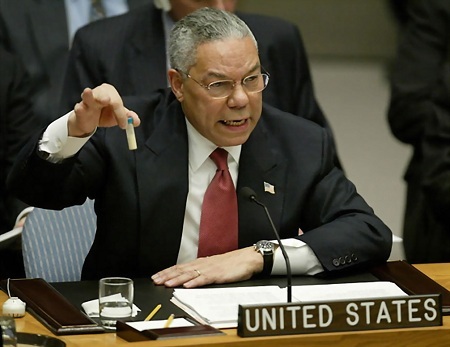
Ten years ago this week, a defining moment occurred in the Bush administration’s push to invade Iraq. On Feb. 5, 2003, then-Secretary of State General Colin Powell addressed the United Nations Security Council. His message was clear: Iraq possessed extremely dangerous weapons of mass destruction and Saddam Hussein was systematically trying to deceive U.N. inspectors by hiding prohibited weapons. A decade later, we host a debate between Powell’s former aide, Col. Lawrence Wilkerson — who prepared the U.N. speech, only to later renounce it — and media critic Norman Solomon, author of "War Made Easy."

"I don’t believe the hype about that presentation having been the ultimate presentation ... that led us to war with Iraq," Wilkerson says of Powell’s speech. "George W. Bush, Dick Cheney and others had decided to go to war with Iraq long before Colin Powell gave that presentation. ... It added to the momentum of the war. ... Frankly, we were all wrong.

Was the intelligence politicized in addition to being wrong at its roots? Absolutely." In response, Solomon says, "We were not all wrong. As a matter of fact, many experts and activists and researchers, from the get-go, in 2002, were saying that the administration case for weapons of mass destruction in Iraq was full of holes. ... So, now to say, 'Well, it wasn't just us at the administration; other people believed it,’ people believed it because they were propagandized by the administration, with massive assistance from the mass media."


Guests:  Col. Lawrence Wilkerson, served as chief of staff to Secretary of State Colin Powell from 2002 to 2005. Colonel Wilkerson prepared Powell’s infamous Iraq WMD speech to the United Nations.


Norman Solomon, longtime activist, founding director of the Institute for Public Accuracy, co-founder of RootsAction.org, and author of many books, including War Made Easy: How Presidents and Pundits Keep Spinning Us to Death.

Tuesday, February 05, 2013

Ten Years In and No Sating the International Community's Blood Lust


Ten Years After Powell’s U.N. Speech, Old Hands are Ready for More Blood

by Norman Solomon

Ten years later -- with Powell’s speech a historic testament of shameless deception leading to vast carnage -- we may not remember the extent of the fervent accolades. At the time, fawning praise was profuse across the USA’s mainline media spectrum, including the nation’s reputedly great newspapers.

When Secretary of State Colin Powell spoke to the U.N. Security Council on February 5, 2003, countless journalists in the United States extolled him for a masterful performance -- making the case that Saddam Hussein’s Iraq had weapons of mass destruction. The fact that the speech later became notorious should not obscure how easily truth becomes irrelevant in the process of going to war.

The New York Times editorialized that Powell “was all the more convincing because he dispensed with apocalyptic invocations of a struggle of good and evil and focused on shaping a sober, factual case against Mr. Hussein’s regime.”

The Washington Post was more war-crazed, headlining its editorial “Irrefutable” and declaring that after Powell’s U.N. presentation “it is hard to imagine how anyone could doubt that Iraq possesses weapons of mass destruction.”

Yet basic flaws in Powell’s U.N. speech were abundant. Slanted translations of phone intercepts rendered them sinister. Interpretations of unclear surveillance photos stretched to concoct the worst. Summaries of cherry-picked intelligence detoured around evidence that Iraq no longer had WMDs. Ballyhooed documents about an Iraqi quest for uranium were forgeries.

Assumptions about U.S. prerogatives also went largely unquestioned. In response to Powell’s warning that the U.N. Security Council would place itself “in danger of irrelevance” by failing to endorse a U.S.-led invasion of Iraq, the adulation from U.S. media embraced the notion that the United Nations could only be “relevant” by bending to Washington’s wishes. A combination of cooked intelligence and geopolitical arrogance, served up to rapturous reviews at home, set the stage for what was to come.

The invasion began six weeks after Powell’s tour de force at the United Nations. Soon, a search for Iraqi weapons of mass destruction was in full swing. None turned up. In January 2004 -- 11 months after Powell’s U.N. speech -- the Carnegie Endowment for International Peace released a report concluding that top officials in the Bush administration “systematically misrepresented the threat from Iraq’s WMD and ballistic missile programs.”

Left twisting in the wind was Powell’s speech to the U.N. Security Council, where he’d issued a “conservative estimate” that Iraq “has a stockpile of between 100 and 500 tons of chemical weapons agent.” The secretary of state had declared: “There can be no doubt that Saddam Hussein has biological weapons and the capability to rapidly produce more, many more.”

Nineteen months after the speech, in mid-September 2004, Powell made a terse public acknowledgment. “I think it’s unlikely that we will find any stockpiles,” he said. But no gingerly climb-down could mitigate the bloodshed that continued in Iraq.

A decade ago, Colin Powell played a starring role in a recurring type of political dramaturgy. Scripts vary, while similar dramas play out on a variety of scales. Behind a gauzy curtain, top officials engage in decision-making on war that gives democracy short shrift. For the public, crucial information that bears on the wisdom of warfare remains opaque or out of sight.

Among the powerful and not-so-powerful, in mass media and on Capitol Hill, the default position is still to defer to presidential momentum for war. Public candor and policy introspection remain in short supply.

The new secretary of state, John Kerry -- like the one he just replaced, Hillary Clinton -- voted for the Iraq war resolution in the Senate, nearly four months before Powell went to the U.N. Security Council. During the crucial lead-up months, Senator Kerry was at pains to show his avid support for an invasion. In early October 2002, appearing for an hour on MSNBC’s “Hardball” program live from The Citadel as an audience of young cadets filled the screen, Kerry said: “I’m prepared to go. I think people understand that Saddam Hussein is a danger.”

Since then, Kerry has publicly said that he would have voted for the war resolution even if he’d known that Iraq actually had no weapons of mass destruction. But on the Senate floor, Kerry prefaced his vote for war by rhetorically demanding to know why Saddam Hussein was “attempting to develop nuclear weapons when most nations don’t even try.” The senator emphasized that “according to intelligence, Iraq has chemical and biological weapons.”

Months later, when Powell trumpeted that theme at the United Nations, the landslide of testimonials included this one from a future U.S. ambassador to the U.N., Susan Rice: “I think he has proved that Iraq has these weapons and is hiding them, and I don’t think many informed people doubted that.”

Meanwhile, the Washington Post edition with the editorial headlined “Irrefutable” also included unanimous agreement from each of the opinion columns on the facing page.

Longtime Post columnist Richard Cohen attested to Powell’s unquestionable veracity with these words: “The evidence he presented to the United Nations -- some of it circumstantial, some of it absolutely bone-chilling in its detail -- had to prove to anyone that Iraq not only hasn’t accounted for its weapons of mass destruction but without a doubt still retains them. Only a fool -- or possibly a Frenchman – could conclude otherwise.”
Inches away, another venerable pundit held forth. Powell managed to “present the world with a convincing and detailed X-ray of Iraq’s secret weapons and terrorism programs yesterday,” wrote Jim Hoagland, a Post foreign-policy specialist. He concluded: “To continue to say that the Bush administration has not made its case, you must now believe that Colin Powell lied in the most serious statement he will ever make, or was taken in by manufactured evidence. I don’t believe that. Today, neither should you.”

Fast forward to the current era. What are Richard Cohen and Jim Hoagland writing -- about Iran?

On February 6, 2012, exactly nine years after proclaiming that “only a fool” could doubt Iraq had weapons of mass destruction, Cohen’s column declared flatly: “The ultimate remedy is Iranian regime change.” Four months ago, Cohen wrapped up a column by observing “there is still time for Iran to back down before President Obama’s red line -- no nuclear weapon -- is crossed. This is a war whose time has not yet come.” Not yet.

Hoagland -- a decade after telling readers they should put their trust in Colin Powell’s “convincing and detailed X-ray of Iraq’s secret weapons” -- is now making clear that his patience with Iran is wearing thin. “Until recently,” Hoagland wrote five weeks ago, “I had been relatively comfortable with Obama’s assertions that there is time to reach a peaceful resolution with Iran.” Hoagland’s column went on to say that military strikes on Iran “threaten disastrous political and economic consequences for the world,” so diplomatic efforts should try to avert the need for such strikes -- before they become necessary.

So goes the dominant spectrum of opinionating and policymaking for war, from eagerness to reluctance. Propaganda lead-ups to warfare are as varied as wars themselves; and yet every style of such propaganda relies on deception, and every war is unspeakable horror.

After jumping onto ghastly bandwagons for one war after another, the nation’s media establishment is available to do it again. So is the current U.S. ambassador to the United Nations. So is the new secretary of state. They’re old hands, dripping with blood. They have not had enough


Colin Powell's UN Presentation on Iraq WMD

02-05-2003
My colleagues, every statement I make today is backed up by sources, solid sources. These are not assertions. What we are giving you are facts and conclusions based on solid intelligence.

Good Neighbours Build Harmonized Borders


U.S.-Canada Harmonizing Border Security and Immigration Measures

by Dana Gabriel  - Be Your Own Leader

 
The U.S. and Canada have made significant progress in advancing the Beyond the Border deal and continue to implement various perimeter security initiatives. Without much fanfare, they have signed an immigration agreement that would allow them to share biographic and at a later date, biometric information. As part of a North American security perimeter, both countries are further harmonizing border security and immigration measures. Canada is further taking on U.S. security priorities and this could include a bigger role in the war on terrorism.
 
It’s been over a year since Prime Minister Stephen Harper and President Barack Obama announced the Beyond the Border and the Regulatory Cooperation Council action plans. On December 14, 2012, the U.S. and Canada issued the Beyond the Border implementation report that highlights the objectives that were achieved over the past year and the work that has yet to be done. 
 
It explained that moving forward, “Key future initiatives include harmonizing our trusted trader programs, making significant infrastructure investments at our key land border crossings, fully implementing an entry/exit program at the land border, expanding preclearance operations to the land, rail, and marine domains.” 
 
The report also acknowledged challenges facing the Next-Generation pilot project which would permit teams of cross-designated officers to operate on both sides of the border. It was originally scheduled to begin last summer. While steady progress has been made, a lot more work is needed to meet the goals of the Beyond the Border action plan. Over the next several years, other aspects of the deal will be phased-in incrementally with specific deliverables due this year, in 2014 and also in 2015.
 
Another important facet of the economic and security perimeter agreement is the U.S.-Canada Regulatory Cooperation Council (RCC). A progress report to the leaders outlines accomplishments made in aligning regulations in the areas of agriculture and food, transportation, the environment, health and personal care products, workplace chemicals, as well as nanotechnology. This includes cooperation on pilot projects, scientific and technical collaborations and harmonized testing procedures. RCC working groups have developed detailed work plans for the various initiatives with objectives that will be implemented over the next couple of years. In Canada, some fear that deepening regulatory integration with the U.S. could weaken and erode any independent regulatory capacity. This could lead to a race to the bottom with respect to regulatory standards.
 
In December of last year, the U.S. and Canada signed the Immigration Information Sharing Treaty which is tied to the Beyond the Border deal. Citizenship, Immigration and Multiculturalism Minister Jason Kenney stated that the, “agreement builds on our countries’ mutual efforts to protect our common borders and the surrounding perimeter, through improved screening of immigrants and visitors.” He went on to say, “Enhanced information sharing of foreign nationals will protect the safety and security of Canadians by helping us prevent terrorists, violent criminals, and others, who pose a risk, from entering Canada or the United States.” Under the treaty, Canada and the U.S. will share biographic information from third country nationals who apply for a visa, a travel permit or claim asylum. In 2014, it will also include the sharing of biometric information. There are privacy concerns on how far-reaching the data collected will be shared. This threatens the sovereignty of Canada with regards to retaining control over information at its own borders.
 
On December 28, 2012, President Obama signed into law, the Countering Iran in the Western Hemisphere Act which is designed to curb Iran's presence and activity in the region. The bill calls on the Department of Homeland Security to work with Canada and Mexico, “to address resources, technology, and infrastructure to create a secure United States border and strengthen the ability of the United States and its allies to prevent operatives from Iran, the IRGC, its Qods Force, Hezbollah, or any other terrorist organization from entering the United States.” Julie Carmichael, spokeswoman for Public Safety Minister Vic Toews discussed Canada’s efforts to counter any perceived hostility from Iran in the Americas. She is quoted in the Globe and Mail as saying, “We continually assess threats while co-operating with international partners, including the U.S., to address threats to our common security.” Carmichael added, “The Beyond the Border Action Plan as announced by Prime Minister Harper and President Obama provides a framework to identify threats before they reach North America.” Under the perimeter security deal, Canada is further aligning itself with U.S. foreign policy interests and could be expected to play a greater role in the global war on terror. 
 
Through the Beyond the Border agreement, the U.S. and Canada are deepening economic and security integration which is laying the foundation for a North American security perimeter. Both countries are also engaged in the Trans-Pacific Partnership negotiations with Mexico and other member nations. This is part of efforts to create a free trade area of the Asia-Pacific and could be used to update and expand NAFTA. Another key priority for U.S.-Canada relations is North America’s energy future. President Obama is expected to make a final decision on the Keystone XL pipeline sometime this year. Meanwhile, there is growing environmental opposition to the proposed project which would carry oil from western Canada to the Texas gulf coast. 
 
 
Dana Gabriel is an activist and independent researcher. He writes about trade, globalization, sovereignty, security, as well as other issues. Contact: beyourownleader@hotmail.com. Visit his blog at Be Your Own Leader
 

What Else Those Infamous E-Mails Say About L'Affair Petraeus


Petraeus: The Plot Thickens 

by Douglas Lucas and Russ Baker  - WhoWhatWhy


Was the ambitious General David Petraeus targeted for take-down by competing interests in the US military/intelligence hierarchy—years before his abrupt downfall last year in an adultery scandal?

Previously unreported documents analyzed by WhoWhatWhy suggest as much. They provide new insight into the scandalous extramarital romance that led to Petraeus’s resignation as CIA director in November after several years of rapid rise—going from a little-known general to a prospective presidential candidate in a stunningly brief time frame.

Among other revelations the documents show that:
-Petraeus was suspected of having an extramarital affair nearly two years earlier than previously known.

-Petraeus’s affair was known to foreign interests with a stake in a raging policy and turf battle in which Petraeus was an active party.

-Those providing the “official” narrative of the affair—and an analysis of why it led to the unprecedented removal of America’s top spymaster— have been less than candid with the American people.

According to internal emails of the Austin-based private intelligence firm Stratfor, General David Petraeus was drawing attention to his private life much earlier than previously believed. Because it was his private life that resulted in his being forced out as CIA director, alterations in our understanding of the time frame are significant.

Until now, the consensus has been that Petraeus began an affair with his biographer, Paula Broadwell, in the fall of 2011, after he retired from the military and took over the CIA.

Lt. Col. John Nagl, a friend of Petraeus, claims the Petraeus-Broadwell extramarital affair did not begin until after Petraeus became CIA director, which was in September 2011. And retired US Army Col. Steve Boylan, a former Petraeus spokesperson, says the affair did not begin until several months after August 2011, when Petraeus retired from the Army.

But documents—researched by WhoWhatWhy and published for the first time as part of an investigative partnership with WikiLeaks—suggest otherwise. These documents characterize Petraeus as having regular dinners in early 2010 with Abdulwahab al-Hajri, then Yemen’s ambassador to the US, and note that Petraeus brought to at least one of those dinners a woman “not his wife”—whom the Yemenis believed was “his mistress.” It’s possible—although not confirmed—that this woman was Paula Broadwell, Petraeus’s biographer and mistress, who sent allegedly threatening emails that spawned the strange FBI investigation that precipitated the former Army general’s resignation on November 9, 2012.

Stratfor has a longstanding position of not commenting on the emails obtained by WikiLeaks. The company’s boilerplate public response regarding the internal documents in WikiLeaks’ possession is that it “will not be victimized twice by submitting to questioning about them.”

Petraeus’s attorney, Robert Barnett, declined to comment.

***

According to the Stratfor emails, Petraeus brought a woman believed to be his mistress to at least one dinner at al-Hajri’s house as early as January or February 2010. It is known that by late 2010, after Petraeus took command for the Afghanistan war, Paula Broadwell had already established what has been called “unfettered” and “unprecedented” access to Petraeus, including lodging on his Kabul base.

By bringing to such a gathering a younger woman who aroused such suspicion, Petraeus was already exhibiting the kind of recklessness not uncommon to highly ambitious people on the rapid ascent. This was especially true given the stakes involved—and Petraeus’s own formidable enemies within the US government.

If the young woman was Broadwell, her willingness to accompany a top military official to such a closed-door, high-level event should draw additional attention to her thinking and motivations. Broadwell was a military intelligence reservist—and her take on what was discussed at precisely those kinds of dinners would have been of interest to her superiors.

By the date of these 2010 dinners, Broadwell had known Petraeus for four years—and had been working closely with him on his biography since the previous year. She says she first met him in the spring of 2006, when she was a graduate student at Harvard’s Kennedy School of Government and asked if she could write his biography. She began work on the biography in 2009 when he headed CENTCOM, the US Central Command. With the biography as her justification, she followed him to Afghanistan where he led the US forces.

Thus, if Stratfor’s Yemeni diplomat source is correct, and the woman was Broadwell, an attractive military intelligence reserve officer was far more deeply entwined than previously known with a controversial, fast-climbing figure at the center of some of America’s and the world’s hottest disputes—at the risk of compromising him and his future.

Stratfor’s Source: a Yemeni diplomat based in DC


Mohammed al-Basha, press attaché for the Yemen embassy in Washington DC, is one of Stratfor’s informants, referred to by DC-based Stratfor analyst Reva Bhalla as her “Yemeni diplomatic source.”

In an interview with us, al-Basha confirmed that Petraeus dined with Abdulwahab al-Hajri at the former ambassador’s house in DC for “an event or a party” while Petraeus was head of CENTCOM. Petraeus was CENTCOM commander from October 31, 2008 until July 18, 2011— which is within the scope of the Stratfor emails and before the dates Nagl and Boylan give for the start of the affair.

Al-Basha told WhoWhatWhy he had “no idea” whether Paula Broadwell attended a dinner with Petraeus and the Yemeni ambassador. “I have no idea. No, no, I have no idea,” he said. “That’s the first I’ve heard this.” He then denied being Stratfor’s source.

However, there are at least one hundred and twenty emails between the Yemen embassy’s al-Basha and Stratfor’s analyst Bhalla in the WikiLeaks cache; many consist of al-Basha answering her questions. In Email-ID 81508, sent January 15, 2010, Bhalla and al-Basha discuss Yemen’s terms for surrendering American citizen Anwar al-Awlaki; al-Basha tells Bhalla he is “not sure about the terms… I will assume a fair prosecution can be part of the plea”; in Email-ID 1098283, sent the same day, Bhalla forwards his exact words to other Stratfor analysts, telling them they came from her “Yemeni diplomatic source.”

In Email-ID 90306, sent February 5, 2010, Stratfor Watch Officer Michael Wilson tells the firm about a champagne party where he learned that Petraeus brought an intriguing woman to a dinner with al-Hajri. The email states that a Stratfor source, a “Yemeni diplomat based in DC” and handled by Bhalla, provided the information. Unless Stratfor has multiple Yemeni diplomat sources in DC handled by Bhalla, that source is al-Basha. Furthermore, the WikiLeaks cache appears to contain no email contacts with any other Yemeni diplomats.

Having acknowledged the Petraeus/al-Hajri dinner, al-Basha nonetheless requested that the event not be reported. Then, in a follow-up email exchange, he cited an unnamed former colleague’s assertion that “the General never came over with his biographer to any of our events public or private.” That statement is constructed in such a way that it does not actually deny Petraeus’s presence at the dinners with a woman who was not his wife, or even deny that the woman was Broadwell. Technically, it only excludes a scenario in which Petraeus arrived with Broadwell. We were unable to clarify further because repeated requests that al-Basha identify the former colleague went unanswered.

Why Champagne Hangovers Suck


Email-ID 90306 (with the droll subject line “Re: INSIGHT – YEMEN – why champagne hangovers suck”) contains Wilson’s report of “a hectic, late night” meeting occasioned by Abdulaziz bin Fahd, a son of Fahd bin Abdulaziz Al Saud, former king of Saudi Arabia, challenging “everyone to a champagne bottle drinking contest.”

Wilson, writing of what he learned that night, says:

“Petraeus has become BFF [slang for best friends forever] with the Yemeni ambassador here. Dinners every other week at the amb’s house. Last time he came with this woman, not his wife. The Yemenis think she was his mistress, but i seriously doubt that he’d be that stupid considering how high profile he is. You can see Petraeus taking a much deeper interest in Yemen these days though. Petraeus (after he drinks a few) says privately there is an Iranian link in Yemen, but it is not yet critical.”

A 2010 US diplomatic cable published by WikiLeaks reports that on January 2, 2010 — that is, around the time of Petraeus’s dinners with the ambassador — Petraeus met with then-president of Yemen Ali Abdullah Saleh, who, referring to secret US air strikes in Yemen, promised Petraeus “We’ll continue saying the bombs are ours, not yours.” Broadwell’s biography of Petraeus, All In: The Education of General David Petraeus, briefly mentions Petraeus trips to Yemen, but does not indicate if she went along.

The Turf War


Control over US policy in Yemen was at stake, and General Petraeus was right in the midst of it. The CIA and the Pentagon had competing objectives in Yemen. The CIA was pushing Obama to authorize the agency to deploy its pilotless drones against radical Islamist forces, while the military wanted to train and supply Yemeni special forces to handle the country’s problems. Debate raged over whether US drone operations—which often involve civilian casualties—were not just further alienating the local population and thereby playing into those Islamists’ hands. Both sides were leaking information to the press to try to influence the White House, and Petraeus himself was one of the leakers. (Later, as CIA director, Petraeus would advocate for increased use of drones.)

Email-ID 1204569, sent September 4, 2010, while Petraeus was CENTCOM commander, contains Stratfor analyst Bhalla’s report of a discussion over hookah (“sheesha”) with her “Yemeni diplomat source” and two younger sons of President Saleh.

She mentions “leaks from a couple weeks ago on CIA recommendations to the [Obama] administration to carry out drone strikes in Yemen,” and says: “There’s a huge turf war between CIA and JSOC over this, which is why all these leaks are coming out,” and notes that:

CENTCOM leaked their rec for $1.2 billion assistance funding for Yemeni special forces (this was all Petraeus, who has a very good relationship with the Yemenis and goes to the Yemeni ambo’s house pretty regularly for dinner.) The Yemenis are nervous about [General James] Mattis taking over Centcom. They could deal well with Petraeus, whom they consider a ‘diplomat.’ Don’t know yet how to read Mattis.

Why Yemen?


Powerful competing US (and international) interests and factions have stakes in Yemen that are not transparent to the public nor shared with it. The political landscape in Yemen is complex and shifting (Saleh is no longer in power, and some reforms are underway), but certain realities must be understood. Some of these were noted nearly a year ago on the site Small Wars Journal, put out by ex-Marines with an interest in nuances that often get lost:

Over the last decade the US has viewed Yemen almost exclusively through a counterterrorism lens. This has proven short-sighted and often counter-productive. Some make a compelling case that Ali Abdullah Saleh kept the terrorism threat alive to secure both US funding and ultimately his regime, which was dubbed by Yemen expert Robert Burrowes as nothing short of a “kleptocracy.”

[snip]

A careful look at the map reveals that Yemen is the hinge between East and West. The Bab-el-Mandeb – which links the Suez Canal to the Indian Ocean via the Red Sea and Gulf of Aden – highlights Yemen’s vital geostrategic location. Most will be familiar with the strategic and economic importance of the area, particularly the Canal, which remains at the heart of world trade and commerce.

[snip]

[A] restructured, well-led and well-equipped Yemeni Coastguard active in the Red Sea and Gulf of Aden could be leveraged in support of Combined Task Force 150 and Gulf Cooperation Council (GCC) forces to counter piracy and also quell the aspirations of both Al-Shabaab and Al Qaeda in the Arabian Peninsula (AQAP). Additionally, the US would have a trusted ally acting across the CENTCOM – AFRICOM boundary.

That tracks with public discussions of regional policy. But what is the interest of Stratfor in Yemen, besides generating content for its subscription newsletters? According to its internal emails, in 2010 the private intelligence firm was providing custom analysis on Yemen for its clients National Oilwell Varco (a Houston-based multinational which builds oil rigs), and Hunt Oil (for more on Ray Hunt—a member of President George W. Bush’s Foreign Intelligence Advisory Board—and his Middle Eastern operations, including in Iraqi Kurdistan, see this.) Email ID 5300460, sent May 23, 2011, shows Stratfor’s work for Hunt Oil included creating a database of incidents of violence, with precise information such as GPS coordinates. This is yet another reminder that where political struggles play out, the pursuit of profit cannot be far afield.

Petraeus, a canny man, surely understood the factors besides pure military strategy that underlie foreign policy calculations. Also, it was during this period that he was being mentioned as a possible opponent to Obama (Listen here to a top Fox News executive repeating speculation to Petraeus that he was being brought into the CIA to derail a possible run against Obama—and how Rupert Murdoch, Roger Ailes and their Fox News team would get behind him if he chose to run. Petraeus deflected the talk about a presidential run, saying, with a laugh, “My wife would divorce me.”)

Who Gets Credit?


One of the more revealing aspects of the Stratfor memos is their candor about the narrow and self-serving behavior of agencies and departments whose official justifications are too seldom questioned by the media.

In Email-ID 1204569, coming a year before the US raid on Bin Laden’s haven in Abbottabad, Pakistan, Bhalla writes, with brutal cynicism:

There’s been a ton of media spin and leaks later about Anwar al Awlaki being the next bin Laden. OBL is becoming old news now. CIA and JSOC want a new target to claim success, so there’s a concerted campaign going on right now to play up al Awlaki as the #1 terrorist. Al Awlaki is much easier to target anyway and they have leads on him, so every agency wants to be the one to say they got him. [Emphasis added.]

The month before this September 4, 2010 email, the Obama Administration had placed Anwar al-Awlaki on a “kill or capture” list. A little over a year later, on September 30 2011, a US drone strike killed al-Awlaki in Yemen without his having been charged, given any due process or trial, and without any of the evidence against him being made public—an unprecedented attack on a US citizen.

That Stratfor analysts report a “turf war” between the CIA and JSOC also foreshadows what many see as the biggest fallout from installing a military general as head of what had been regarded as a civilian agency — the further militarization of the CIA’s mission. The fact that the general had a mistress in tow (or—if one assumes that the woman mentioned in Stratfor’s intelligence about that dinner in Yemen wasn’t Paula Broadwell—a series of mistresses) can only add to the disquiet.

It may be that Petraeus shared foreign policy secrets with Broadwell, possibly granting her unauthorized access to classified information. A speech Broadwell gave at the University of Denver near or within the time frame of the FBI investigation of her suggests she may have had inside information about the controversial response to the attacks on the US consulate and the CIA annex in Benghazi.

It is unfortunate how little interest the media has shown in Broadwell’s work as a military intelligence officer. She directed the Counterterrorism Studies Center at Tufts, which stresses advance planning and soft power over military efforts: “We’re playing chess, they’re playing poker.” Clearly, she was not just an eager young scribe falling in love with a brave commander.

Ostensibly, Petraeus was toppled for his involvement in a secret extramarital affair— which became public knowledge with the revelation of Broadwell’s reportedly threatening behavior toward socialite Jill Kelley, whom Broadwell allegedly perceived as a romantic rival.

By agreeing to Broadwell’s original request that he admit her into his life as his biographer, the ambitious general may have unwittingly allowed himself to be set up. If he did invite her along to private dinners where confidential international strategy was discussed, she presumably was quite glad to go, and may even have suggested it. Their affair thus became a sub rosa time-bomb, the fuse of which was in her control.

General David Petraeus’s headlong fall from grace cannot be dismissed as the denouement of yet another peccadillo in an unforgiving moral climate. The plot is thicker than that—perhaps as thick as the often-unnamed heart of the story: oil.

Paying the Bin Laden Tax


The American Lockdown State: Post-Legal Drones, the Bin Laden Tax, and Other Wonders of Our American World

by Tom Engelhardt  - TomDispatch 

 Consider Inauguration Day, more than two weeks gone and already part of our distant past. In its wake, President Obama was hailed (or reviled) for his “liberal” second inaugural address. On that day everything from his invocation of women’s rights (“Seneca Falls”), the civil rights movement (“Selma”), and the gay rights movement (“Stonewall”) to his wife’s new bangs and Beyoncé’s lip-syncing was fodder for the media extravaganza. The president was even praised (or reviled) for what he took pains not to bring up: the budget deficit. Was anything, in fact, not grist for the media mill, the hordes of talking heads, and the chattering classes?

One subject, at least, got remarkably little attention during the inaugural blitz and, when mentioned, certainly struck few as odd or worth dwelling on. Yet nothing better caught our changing American world. Washington, after all, was in a lockdown mode unmatched by any inauguration from another era -- not even Lincoln’s second inaugural in the midst of the Civil War, or Franklin Roosevelt’s during World War II, or John F. Kennedy’s at the height of the Cold War.

Here’s how NBC Nightly News described some of the security arrangements as the day approached:

“[T]he airspace above Washington... [will be] a virtual no-fly zone for 30 miles in all directions from the U.S. capital. Six miles of the Potomac and Anacostia Rivers will be shut down, with 150 blocks of downtown Washington closed to traffic, partly out of concern for car or truck bombs... with counter-snipers on top of buildings around the capital and along the parade route... [and] detectors monitoring the air for toxins... At the ready near the capital, thousands of doses of antidotes in case of a chemical or biological attack… All this security will cost about $120 million dollars for hundreds of federal agents, thousands of local police, and national guardsmen from 25 states.”

Consider just the money. It’s common knowledge that, until the recent deal over the renewal of the George W. Bush tax cuts for all but the richest of Americans, taxes had not been raised since the read-my-lips-no-new-taxes era of his father. That’s typical of the way we haven’t yet assimilated the new world we find ourselves in. After all, shouldn’t that $120 million in taxpayer money spent on “safety” and “security” for a single event in Washington be considered part of an ongoing Osama bin Laden tax?

Maybe it's time to face the facts: this isn’t your grandfather’s America. Once, prospective Americans landed in a New World. This time around, a new world’s landed on us.

Making Fantasy Into Reality


Bin Laden, of course, is long dead, but his was the 9/11 spark that, in the hands of George W. Bush and his top officials, helped turn this country into a lockdown state and first set significant portions of the Greater Middle East aflame. In that sense, bin Laden has been thriving in Washington ever since and no commando raid in Pakistan or elsewhere has a chance of doing him in.

Since the al-Qaeda leader was aware of the relative powerlessness of his organization and its hundreds or, in its heyday, perhaps thousands of active followers, his urge was to defeat the U.S. by provoking its leaders into treasury-draining wars in the Greater Middle East. In his world, it was thought that such a set of involvements -- and the “homeland” security down payments that went with them -- could bleed the richest, most powerful nation on the planet dry. In this, he and his associates, imitators, and wannabes were reasonably canny. The bin Laden tax, including that $120 million for Inauguration Day, has proved heavy indeed.

In the meantime, he -- and 9/11 as it entered the American psyche -- helped facilitate the locking down of this society in ways that should unnerve us all. The resulting United States of Fear has since engaged in two disastrous more-than-trillion dollar wars and a “Global War on Terror” that shows no sign of ending in our lifetime. (See Yemen, Pakistan, and Mali.) It has also funded the supersized growth of a labyrinthine intelligence bureaucracy; that post-9/11 creation, the Department of Homeland Security; and, of course, the Pentagon and the U.S. military, including the special operations forces, an ever-expanding secret military elite cocooned within it.

Given the enemy at hand -- not a giant empire, but scattered jihadis and minority insurgencies in distant lands -- all of these institutions, which make up the post-9/11 National Security Complex, expanded in ways that would have boggled the minds of previous generations (as would that most un-American of all words, “homeland”). All of this, in turn, happened in a poisonously paranoid atmosphere in Washington, and much of the rest of the country.

Even if you ignore that Inauguration Day no-boating zone or the 30-mile no-fly zone (the sort of thing the U.S. once imposed on enemy lands and now imposes on itself), consider those “thousands of doses of antidotes in case of a chemical or biological attack.” Just about nothing on this planet is utterly inconceivable, but it’s worth noting that, as far as we know, the national security bureaucracy made no preparations for an unexpected tornado on Inauguration Day. Given recent extreme weather events, including tornado warnings for Washington, that would at least have been a plausible scenario to consider.

Certainly, a biological or chemical attack is a similarly imaginable possibility. After all, it actually happened in Tokyo in 1995, when followers of the Aum Shinrikyo cult set off Sarin gas in that city’s subway system, killing 11. But the likelihood of any conceivable set of Islamic terrorists attacking those inaugural crowds with either chemical or biological weapons was, to say the least, microscopic. As something to protect Washington visitors against, it ranked at least on a par with the (nonexistent) post-9/11 al-Qaeda sleeper cells and sleeper-assassins so crucial to the plot of the TV show “Homeland.”

And yet, in these years, what might have remained essentially a nightmarish fantasy has become an impending reality around which the national security folks organize their lives -- and ours. Ever since the now largely forgotten anthrax mail attacks that killed five soon after 9/11 -- the anthrax in those envelopes may have come directly from a U.S. bioweapons laboratory -- all sorts of fantastic scenarios involving biochemical attacks have become part and parcel of the American lockdown state.

In the Bush era, for instance, among the apocalyptic dream scenes the president and his top officials used to panic Congress into approving a much-desired invasion of Iraq were the possibility of future mushroom clouds over American cities and this claim: that Iraqi autocrat Saddam Hussein had drones (he didn’t) and the means to get them to the East Coast of the U.S. (he didn’t), and the ability to use them to launch attacks in which chemical and biological weaponry would be sprayed over U.S. cities (he didn’t). This was a presidentially promoted fantasy of the first order, but no matter. Some senators actually voted to go to war at least partially on the basis of it.

As is often true of ruling groups, Bush and his cronies weren’t just manipulating us with the fear of nightmarish future attacks, but themselves as well. Thanks to New Yorker journalist Jane Mayer’s fine book The Dark Side, for instance, we know that Vice President Dick Cheney was always driven around Washington with "a duffel bag stocked with a gas mask and a biochemical survival suit" in the backseat of his car.

The post-9/11 National Security Complex has been convulsed by such fears. After all, it has funded itself by promising Americans one thing: total safety from one of the lesser dangers of our American world -- “terrorism.” The fear of terrorism (essentially that bin Laden tax again) has been a financial winner for the Complex, but it carries its own built-in terrors. Even with the $75 billion or more a year that we pump into the “U.S. Intelligence Community,” the possibility that it might not discover some bizarre plot, and that, as a result, several airliners might then go down, or a crowd in Washington be decimated, or you name it, undoubtedly leaves many in the Complex in an ongoing state of terror. After all, their jobs and livelihoods are at stake.

Think of their fantasies and fears, which have become ever more real in these years without in any way becoming realities, as the building blocks of the American lockdown state. In this way, intent on “taking the gloves off” -- removing, that is, all those constraints they believed had been put on the executive branch in the Watergate era -- and perhaps preemptively living out their own nightmares, figures like Dick Cheney and former Secretary of Defense Donald Rumsfeld changed our world.

The Powers of the Lockdown State


As cultists of a “unitary executive,” they -- and the administration of national security managers who followed in the Obama years -- lifted the executive branch right out of the universe of American legality. They liberated it to do more or less what it wished, as long as “war,” “terrorism,” or “security” could be invoked. Meanwhile, with their Global War on Terror well launched and promoted as a multigenerational struggle, they made wartime their property for the long run.

In the process, they oversaw the building of a National Security Complex with powers that boggle the imagination and freed themselves from the last shreds of accountability for their actions. They established or strengthened the power of the executive to: torture at will (and create the “legal” justification for it); imprison at will, indefinitely and without trial; assassinate at will (including American citizens); kidnap at will anywhere in the world and “render” the captive into the hands of allied torturers; turn any mundane government document (at least 92 million of them in 2011 alone) into a classified object and so help spread a penumbra of secrecy over the workings of the American government; surveil Americans in ways never before attempted (and only “legalized” by Congress after the fact, the way you might backdate a check); make war perpetually on their own say-so; and transform whistleblowing -- that is, revealing anything about the inner workings of the lockdown state to other Americans -- into the only prosecutable crime that anyone in the Complex can commit.

It’s true that some version of a number of these powers existed before 9/11. “Renditions” of terror suspects, for instance, first ramped up in the Clinton years; the FBI conducted illegal surveillance of antiwar organizations and other groups in the 1960s; the classification of government documents had long been on the rise; the congressional power to make war had long been on the wane; and prosecution of those who acted illegally while in government service was probably never a commonplace. (Both the Watergate and Iran-Contra scandals, however, did involve actual convictions or guilty pleas for illegal acts, followed in some of the Iran-Contra cases by presidential pardons.) Still, in each case, after 9/11, the national security state gained new or greatly magnified powers, including an unprecedented capacity to lockdown the country (and American liberties as well).

What it means to be in such a post-legal world -- to know that, no matter what acts a government official commits, he or she will never be brought to court or have a chance of being put in jail -- has yet to fully sink in. This is true even of critics of the Obama administration, who, as in the case of its drone wars, continue to focus on questions of legality, as if that issue weren’t settled. In this sense, they continue to live in an increasingly fantasy-based version of America in which the rule of law still applies to everyone.

In reality, in the Bush and Obama years, the United States has become a nation not of laws but of legal memos, not of legality but of legalisms -- and you don’t have to be a lawyer to know it. The result? Secret armies, secret wars, secret surveillance, and spreading state secrecy, which meant a government of the bureaucrats about which the American people could know next to nothing. And it’s all “legal.”

Consider, for instance, this passage from a recent Washington Post piece on the codification of “targeted killing operations” -- i.e. drone assassinations -- in what’s now called the White House “playbook”: “Among the subjects covered... are the process for adding names to kill lists, the legal principles that govern when U.S. citizens can be targeted overseas, and the sequence of approvals required when the CIA or U.S. military conducts drone strikes outside war zones.”

Those “legal principles” are, of course, being written up by lawyers working for people like Obama counterterrorism “tsar” John O. Brennan; that is, officials who want the greatest possible latitude when it comes to knocking off “terrorist suspects,” American or otherwise. Imagine, for instance, lawyers hired by a group of neighborhood thieves creating a “playbook” outlining which kinds of houses they considered it legal to break into and just why that might be so. Would the “principles” in that document be written up in the press as “legal” ones?

Here’s the kicker. According to the Post, the “legal principles” a White House with no intention of seriously limiting, no less shutting down, America’s drone wars has painstakingly established as “law” are not, for the foreseeable future, going to be applied to Pakistan’s tribal borderlands where the most intense drone strikes still take place. The CIA’s secret drone war there is instead going to be given a free pass for a year or more to blast away as it pleases -- the White House equivalent of Monopoly’s get-out-of-jail-free card.

In other words, even by the White House’s definition of legality, what the CIA is doing in Pakistan should be considered illegal. But these days when it comes to anything connected to American war-making, legality is whatever the White House says it is (and you won’t find their legalisms seriously challenged by American courts).

Post-Legal Drones and the New Legalism


This week, during the Senate confirmation hearings for Brennan’s nomination as CIA director, we are undoubtedly going to hear much about “legality” and drone assassination campaigns. Senator Ron Wyden, for instance, has demanded that the White House release a 50-page “legal” memo its lawyers created to justify the drone assassination of an American citizen, which the White House decided was far too hush-hush for either the Congress or ordinary Americans to read. But here’s the thing: if Wyden got that bogus document, undoubtedly filled with legalisms (as a just-leaked 16-page Justice Department "white paper" justifying drone killings is), and released it to the rest of us, what difference would it make? Yes, we might learn something about the vestiges of a guilty conscience when it comes to American legality in a White House run by a former “constitutional law professor.” But we would know little else.

Once upon a time, an argument over whether such drone strikes were legal or not might have had some heft to it. After all, the United States was once hailed, above all, as a “nation of laws.” But make no mistake: today, such a “debate” will, in the Seinfeldian sense, be an argument about nothing, or rather about an issue that has long been settled.

The drone strikes, after all, are perfectly “legal.” How do we know? Because the administration which produced that 50-page document (and similar memos) assures us that it’s so, even if they don’t care to fully reveal their reasoning, and because, truth be told, on such matters they can do whatever they want to do. It's legal because they've increasingly become the ones who define legality.

It would, of course, be illegal for Canadians, Pakistanis, or Iranians to fly missile-armed drones over Minneapolis or New York, no less take out their versions of bad guys in the process. That would, among other things, be a breach of American sovereignty. The U.S. can, however, do more or less what it wants when and where it wants. The reason: it has established, to the satisfaction of our national security managers -- and they have the secret legal documents (written by themselves) to prove it -- that U.S. drones can cross national boundaries just about anywhere if the bad guys are, in their opinion, bad enough. And that's “the law”!

As with our distant wars, most Americans are remarkably unaffected in any direct way by the lockdown of this country. And yet in a post-legal drone world of perpetual “wartime,” in which fantasies of disaster outrace far more realistic dangers and fears, sooner or later the bin Laden tax will take its toll, the chickens will come home to roost, and they will be able to do anything in our name (without even worrying about producing secret legal memos to justify their acts). By then, we’ll be completely locked down and the key thrown away.


Tom Engelhardt, co-founder of the American Empire Project and author of The United States of Fear as well as a history of the Cold War, The End of Victory Culture, runs the Nation Institute's TomDispatch.com. His latest book, co-authored with Nick Turse, is Terminator Planet: The First History of Drone Warfare, 2001-2050.

Follow TomDispatch on Twitter @TomDispatch and join us on Facebook. Check out the newest Dispatch book, Nick Turse’s The Changing Face of Empire: Special Ops, Drones, Proxy Fighters, Secret Bases, and Cyberwarfare.

Copyright 2013 Tom Engelhardt

Monday, February 04, 2013

Into Africa


US Protects Rwandan and Ugandan Interference in Congo

by TRNN

Maurice Carney: US policy is seeking "stability" by militarizing Africa


Maurice Carney is a co-founder and Executive Director of the Friends of the Congo. He is an independent entrepreneur and human rights activist who has fought with Congolese for fifteen years in their struggle for human dignity and control of their country.

A Dissonance of the Times


Cognitive Dissonance at the New York Times

by Dave Lindorff - This Can't Be Happening


For a masterpiece in cognitive dissonance, just look to the foreign editors and the managing editor of the New York Times, who managed to run two closely related stories making opposite points in Saturday’s paper without referencing each other at all.

The first, Algeria Sowed Seeds of Hostage Crisis as It Nurtured Warlord, by Adam Nossiter and Neil MacFarquhar, reports on how the Algerian government essentially enabled and encouraged the crisis in neighboring Mali by backing — even hosting in Algiers — an Islamic militant leader and local warlord, Iyad Ag Ghali, who then tried to take over Mali by force, including taking Algerians and other foreigners hostage at an oil drilling site, leading to a deadly Algerian battle and now a war in Mali that has drawn in the old colonial powers. The article talked at length about the risks of working with such militants. The risks for Algeria, that is; not the risks in general of such a practice.

On the same day, the paper ran a second article, this one by C.J. Chivers, titled A Rebel Commander in Syria Holds the Reins of War. This piece is a glowing paen to Abdulkader al-Saleh, aka Hajji Marea, a rebel leader in the Syrian civil war. The article paints the man whose nom de guerre is comfortingly (and incorrectly) translated as meaning “the respectable man from Marea” (it actually means “the man from Marea who has made the pilgrimage to Mecca), is clearly aligned with a radical Muslim group, the Al Nusra Front, which the article notes, is “blacklisted” by the US as a terrorist organization.

Typically, when two articles that are clearly related run in a newspaper, they are run side-by-side, with one appearing as a kind of side-bar to the other. In this case, though, the first article, on the warlord Iyad Ag Ghali, ran on page one, jumping to page eight, while the second, on Hajji Marea, ran on page 9, separated by several other articles in the intervening columns of both pages. Even in the Times’ online edition, where it is easy– and standard procedure — to include links to relevant other articles, there is no link between these two stories.

Nor do the reporters on either piece include any historical background or context in their reports. Thus Timesreaders are left blissfully unaware of the many examples of blowback that the US has experienced from its decades of faustian bargains. The most damaging of these, of course, was the CIA’s setting up of the Al Qaeda organization during the Jimmy Carter presidency, when he and his national security advisor Zbigniew Brzezinski came up with the brilliant idea of encouraging, funding and arming local and foreign Islamic fanatics to foment a civil war in Afghanistan with the goal of undermining the pro-Soviet regime in Kabul and “bleeding” the Soviet Union. Of course, the Mujahadeen became the Taliban, and among those foreign Islamic fanatics the CIA- trained and armed to fight the Soviets was Osama Bin Laden and his merry band.

And we know how that turned out.

Surely at least a paragraph reference to that debacle would be in order when one is writing about the latest Algerian experience with blowback, or about America’s latest support for religious fundamentalist fighters in its campaign to oust Syria’s current government. (The Obama administration has floated stories suggesting that it isn’t arming Syrian rebels, but the London Times has reported otherwise, citing a decision to go forward doing so on a covert basis. History suggests that the London Times has it right.)

But no. We’re instead given two disjointed and poorly written pieces that add little to the readers’ understanding of these latest hotspots in the Middle East. And yet, incredibly, one offers an example of what can go wrong when a government — Algeria — cozies up with a bloodthirsty killer and religious fanatic, while the other tells how the US government is doing exactly the same thing in Syria.


Dave Lindorff is a founder of This Can’t Be Happening and a contributor to Hopeless: Barack Obama and the Politics of Illusion, published by AK Press. Hopeless is also available in a Kindle edition. He lives in Philadelphia.

Cuba in from the Cold


Cuba Not Isolated in Latin America 

by TRNN

 Alex Main: Cuba becomes president of Community of Latin American and Caribbean Countries as even close American allies defy US policy of isolating Cuba

Sunday, February 03, 2013

The End of Ascendancy? America an Unbecoming 2nd Rate Power


U.S. to become a second-rate power!!

by Mike Ferner- VFP

February 4, 2013

(Cue sound of emergency alarms.  Insert graphics for panic, terror, devastation and collapse  here ______.)

Yes, believe it, friends.  That is exactly what Outgoing Secretary of War Panetta said in a Feb. 1 exit interview with USA Today, when asked what effects looming cuts will have on the War Department if Congress fails to reach a budget deal by March 1.

Red-blooded Senate and House members eager to protect the military from even a rumor of a budget cut will certainly welcome Panetta’s words.  Whether it will result in the U.S. becoming a “second-rate power” is a little less certain, considering we now spend as much for war as the rest of the world put together, with perhaps the exception of Upper Volta and the Cayman Islands. 

To put the Secretary’s America-as-second-rate-power fears in perspective, the dreaded “sequestering” of the budget means the Pentagon will have to cut 8 to 9 percent out of this year’s $535 billion dollar budget. 

In the near term, according to USA Today, the cuts would require the Air Force to throttle back on flight training, the Navy to keep ships in port longer and the Army to reduce utility costs at its posts.  The U.S. would be able to handle its commitments in Afghanistan and the Middle East but little else.  And continued sequestration cuts over the next decade would leave the Army with only 390,000 soldiers to guard the Empire’s reaches.

“We are the world's most powerful military, and we use that to promote peace and stability in the world,” Panetta stated.  Whether the sequestration cuts would reduce world peace and stability by more than eight or nine percent this year was not clear, nor were any estimates given on peace and stability reductions over the next decade.

"When we're called upon to do other crises, whether it is in Syria or Mali or North Africa or elsewhere, we may not be able to respond," Panetta said…as the Syrians, Malians, North Africans and Elsewherians breathed a sigh of relief.

But let’s give the devil his due.  In truth, I think the War Secretary is on to something.  For most of us in this country, coming in second would be highly welcome, a real improvement over the current state of affairs, considering that among the nations of the world we are now in:

22nd place when it comes to keeping our people out of long-term unemployment

26th place in school performance  and the same in literacy 

35th place in keeping our fellow citizens above the poverty line

37th place in providing health care, or to state it another way

48th place in infant mortality – keeping babies alive until their first birthday – generally accepted as the best overall indicator of a nation’s health

50th place in life expectancy at birth

91st place in overall equality of income distribution and

116th place in the share of income held by the poorest 10% of the population.

But take heart, Mr. Outgoing Secretary, we just missed a blue ribbon at something – the amount of money spent on health care.  A “We’re Number One!” award just slipped through our grasp when those cagey Maltans figured out how to spend even more than we do, so now we’re only…well, a second rate power on health care expenses.  You’ve sounded the alarm not a moment too soon.


Mike Ferner is a writer from Ohio.  He served as a Navy corpsman during the Vietnam war and is a former president of Veterans For Peace. 

Email him at mike.ferner@sbcglobal.net


Gorilla Radio with Chris Cook, Daniel Kovalik, Christina Nikolic, Janine Bandcroft


This Week on GR

by C. L. Cook


In these last years, say since Armenia and Auschwitz, we here in the West have been taught: Genocide is bad. But, even so, it seems a lesson slowly learnt by a variety of corporate and governmental operatives who continue to promote this most ancient practice.

Couched in the meta-language of modern trade negotiations, at this moment diplomats and other factotums in the service of the international business elite are hammering and sawing together vehicles that, in the guise of sane and prudent investment policy, serve to carry millions through the nightmare of mass displacement, dispossession, and deprivation to the gates of a manufactured Hell on Earth.

Slavery, abuse, and an early pauper's grave is the best most of these caught in the maw of this New World Order can hope for. It's everywhere, and it's growing, and yet it's barely recognized by its ultimate supporters, We the people.    

Listen. Hear. 

Daniel Kovalik is Senior Associate General Counsel for the USW, or United Steel Workers union, and teaches international human rights law at the University of Pittsburgh School of Law. Daniel's recently published article, 'How the Colombia Trade Agreement Accelerates Human Rights Abuses' explores the predictable, and so necessarily desired outcomes of these policies constituting corporate crimes against humanity.

Daniel Kovalik in the first half.

And; last month yours truly took a turn down Cuba way. The idea was for me and my partner in tourism, Christina Nikolic to explore the besieged Caribbean nation while shooting a video chronicling the achievements of Cuba in its shift to organic, urban agriculture; a shift fostered by the so-called 'Special Period,' a time that saw the island cut adrift from its erstwhile Soviet Union supporter. I also recorded some audio impressions while walking through the capital.

Your Ape in La Habana in the second half.

And; Victoria Street Newz publisher and CFUV broadcaster, Janine Bandcroft will join us at the bottom of the hour to bring us up to speed with some of the goings on going on on our streets, and beyond. But first, Daniel Kovalik and "constructive genocide" and its consequences for us all.

Chris Cook hosts Gorilla Radio, airing live every Monday, 5-6pm Pacific Time. In Victoria at 101.9FM, and on the internet at: http://cfuv.uvic.ca.  He also serves as a contributing editor to the web news site, http://www.pacificfreepress.com. Check out the GR blog at: http://gorillaradioblog.blogspot.ca/

G-Radio is dedicated to social justice, the environment, community, and providing a forum for people and issues not covered in the corporate media.

Some past guests include: M. Junaid Alam, M. Shahid Alam, Gilad Atzmon, Joel Bakan, Maude Barlow, Ramzy Baroud, William Blum, Luciana Bohne, William Bowles, Mordecai Briemberg, Helen Caldicott, Noam Chomsky, Michel Chossudovsky, Diane Christian, Paul Cienfuegos, David Cromwell, Ezili Danto, Jon Elmer, Yves Engler, Laura Flanders, Amy Goodman, Denis Halliday, Chris Hedges, Julia Butterfly Hill, Robert Jensen, Dahr Jamail, Diana Johnstone, Malalai Joya, Kathy Kelly, Naomi Klein, Frances Moore Lappe, Dave Lindorff, Alexandra Morton, Loretta Napoleoni, Andrew Nikiforuk, Ken O'Keefe, Greg Palast, Michael Parenti, Robert Parry, John Pilger, Kevin Pina, Paul Craig Roberts, David Rovics, Danny Schechter, David Schindler, Vandana Shiva, Tim Shorrock, Norman Solomon, Jean Saint-Vil, Harvey Wasserman, Paul Watson, Bernard Weiner, Andy Worthington, Mickey Z., Howard Zinn and many others. 

Trade Deals Supporting Colombia's "Constructive Genocide"


How the Colombia Trade Agreement Accelerates Human Rights Abuses

by Daniel Kovalik


In October of 2011, President Obama, over the objections of the U.S. and Colombian labor and human rights community, submitted the Colombia Free Trade Agreement (FTA) for passage by the U.S. Congress. Congress quickly passed the FTA — which was originally negotiated by George W. Bush who was unable to obtain passage due largely to the protests of U.S. labor – and Obama signed the agreement into law. At the time, those opposing this agreement argued that, just as NAFTA in Mexico and like policies toward Haiti, the FTA would lead, indeed by design, to the immiseration and mass displacement of rural peoples, especially Indigenous and Afro-Colombian. The experience of the past year has proven these predictions to be correct.

Thus, as just publicized by ColombiaReports.com, the well-respected Colombian human rights group known as the Consultancy for Human Rights and Displacement (CODHES) has reported that there were 83% more mass displacements in 2012 than in 2011, and that these displacements have disproportionately affected Colombia’s Indigenous and Afro-Colombian communities. (1) 

Overall, CODHES estimates that well over 259,000 Colombians were forcibly displaced in 2012.

As CODHES explains,

. . . the most vulnerable populations, including children, adolescents and families with women as heads of households, are disproportionately affected. Most especially, indigenous and black populations have been hit not only individually but as a collective to the extent that their physical and symbolic territories continue to be invaded by both legal and illegal armies that clandestinely work to further the interests of extractive industries and their territorial consolidation . . .

CODHES relates that children and adolescents affected by such invasions of their lands are also at “risk of recruitment or use as informants or logistical support by the armed groups,” and are also at risk of being raped by these same groups.

In terms of the “economic industries” threatening the land of the Indigenous and Afro-Colombians, CODHES relates that these are “multinational agribusiness and mining” corporations – that is, the very corporations whose interests the Colombia FTA was designed to support and advance. CODHES explains that these corporations, and the conflicts they are fueling, are driving a number of indigenous groups [64 indigenous groups to be exact], including the Awa people, to the point of “physical and cultural extermination.”

At the same time, there is resistance to this process. Thus, CODHES explains that the Nasa and Awa peoples have been demonstrating against the militarization of their territories and against the multi-national interests driving this militarization. As CODHES reports,

indigenous communities undertook the harmonization of mining territories where, as in the case of Canoas where “a group of nearly 600 Indians came to where the machinery was and forced employees to leave.”

These actions are mechanisms to reassert indigenous autonomy over the territories, and therefore, are ways to keep their culture and defend their principles. However, the resistance to the imposition of war and the extractive economic model is considered a “threat” by the different actors.

Consequently, those that attempt to defend or re-claim their land are at great risk of violent retaliations.

Thus, as Amnesty International (AI) explains in a recent report entitled, “Transforming Pain Into Hope,” human rights defenders campaigning for the restitution of forcibly-seized land are at great risk of assassination, with 45 such defenders killed in 2011 alone. (2) 

AI relates that “most attacks on defenders campaigning for justice in cases of human rights abuses and for the return of land misappropriated have been attributed to paramilitary groups” aligned with the Colombian state. One such paramilitary group is indeed known as the “Anti-Land Restitution Army.” AI notes that the Colombian state, despite all evidence to the contrary, denies the existence of these paramilitary groups (a.k.a., death squads).

AI also acknowledges that,

 “[t]he seriousness of the attacks against this group of defenders in large part reflects the enormous economic and strategic interests in certain territories.” AI explains that “the failure of the government to recognize the legitimacy of the work of human rights defenders leaves them at the mercy of powerful, violent vested interests emboldened by the knowledge that they will probably never be held to account for their actions. In some cases active state collusion with those committing human rights violations increases the dangers to defenders almost to the point of certain attack.”

As AI, concludes, in Colombia, “millions of hectares of land have been appropriated, often through violence,” and 5 million people have been driven from their homes in the process, making Colombia the world leader in terms of internally displaced peoples. And, while one would think that things could not get much worse, the U.S.-Colombia Free Trade Agreement (and a similar agreement between Canada and Colombia) is accelerating this process of mass, forced displacements at a staggering pace. As a consequence, indigenous tribes and Afro-Colombian communities are being pushed to the point of extinction, meaning that these trade policies, backed by massive military assistance, are indeed genocidal.

And yet, the outcry in this country is faint at best. And this is so, as Edward Herman and David Peterson detailed in The Politics of Genocide, because this genocide is viewed as “constructive” by our political and economic rulers. It is this cynical view of the world, with all of its horrific consequences, which we must struggle against.


Daniel Kovalik is Senior Associate General Counsel of the United Steelworkers (USW), and teaches international human rights law at the University of Pittsburgh School of Law.

Notes:
(1) You can find CODHES’s report, in Spanish, here: http://www.codhes.org/index.php?option=com_docman&task=cat_view&gid=64&Itemid=50

(2) Amnesty International’s report is here: http://www.amnesty.org/en/campaigns/human-rights-defenders-americas