Thursday, February 14, 2013

Media Lens: Challenging Corporate Journalism


Jousting with Toothpicks: The Case for Challenging Corporate Journalism

by David Edwards  - Media Lens

A critic responding to a recent alert, objected to our use of the term 'corporate journalist':

'The problem is it has no clear meaning. Chomsky regularly writes for "corporate media", as does Pilger, Klein, and Michael Moore. Pilger has had his documentaries aired by "corporate media". Klein promotes her books through the "corporate media". I could go on...'

Worse still: 'Not only is this phrase intended as a passive aggressive pejorative, it is meant to dehumanise those it is aimed at, to group them, and then discredit en masse.' (Dom, Media Lens message board, January 24, 2013)

In fact the meaning of 'corporate journalist' could hardly be clearer: it describes someone paid to write for a corporation.

Certainly anyone familiar with our work will not imagine we are using the term as a form of flattery. After all, the key principle of corporate law was established in the 19th century by England's Lord Bowen:

'The law does not say that there are to be no cakes and ale, but there are to be no cakes and ale except such as are required for the benefit of the company... charity has no business to sit at boards of directors qua charity.' (Lord Bowen, cited, Joel Bakan, The Corporation, Constable, 2004, pp.38-39)

This quite literally outlawed authentic corporate compassion. More recently, the American Bar Association observed:

'While allowing directors to give consideration to the interests of others, [the law] compels them to find some reasonable relationship to the long-term interests of shareholders when so doing.' (p.39)

Put more bluntly, the rule that corporations exist solely to maximise returns to their shareholders is 'the law of the land', business journalist Marjorie Kelly comments, 'universally accepted as a kind of divine, unchallengeable truth'. (p.39)

Canadian lawyer Joel Bakan asks us to imagine how we would regard an individual who refused to help the sick and dying unless it made solid financial sense. He argues that such a person would be deemed a psychopath. If readers find the description extreme, they might like to consider the barely believable response of the fossil fuel industry to the catastrophic threat of climate change.

Journalists working for the corporate media are choosing to work for just such an employer guided by the same cold-blooded priorities. So what should our reaction be?

Well how would we have responded to a journalist taking big salaries from Pravda in Stalinist Russia or from Der Stürmer in Nazi Germany during the 1930s? The question might seem outrageous, but is a global psychopathic corporate system more or less destructive than a national Stalinist or fascist system?

Part of the difficulty in considering the question rationally lies in the very nature of the problem being addressed. The corporate media are as skilled at promoting their non-existent virtues as they are at marginalising critics. They also have an astonishing ability to make even the most appalling state crimes ('mistakes') seem somehow trivial, unimportant, 'not that bad'. So the very deceptiveness of the system makes the comparison with totalitarian media seem far more outrageous than it really is.

In fact the question is reasonable. If we look around us today - at the devastating Western wars of aggression, at the mass killings fuelled by corporate militarism, at the truly awesome, perhaps terminal, exploitation of people and planet – we are looking at a world being devastated by psychopathic greed. Former New York Times journalist, Chris Hedges, comments of 'the liberal class', the 'quality' corporate media included:

'The liberal class has become a useless and despised appendage of corporate power... as [it] pollutes and poisons the ecosystem and propels us into a world where there will be only masters and serfs.' (Hedges, Death Of The Liberal Class, Nation Books, 2011, p.12)

Journalists are participants in this system. But mere willingness to cooperate says nothing about the motives of the individuals involved. Some are indeed cynically serving greed and power. But others are sincere, attempting to improve and even reform the system from within. Although we don't agree with their strategy, we accept that it is a reasonable position to take, one that may even offer the best hope of spreading progressive views to a mass audience (we are certainly open to the possibility that we are wrong).

Our real interest and effort has never been to stand in judgement but to highlight what even the best journalists are unable to say about the system that employs them. For example, corporate journalists can almost never answer questions of this kind honestly:

'What impact does your newspaper's dependence on advertising for 75 per cent of its revenues have on the contents of the paper?'

Noam Chomsky can answer the question honestly, as can Edward Herman. Their book, Manufacturing Consent, published 25 years ago this year, is the most rational analysis of structural media bias we have seen. Both authors are still alive, Chomsky is a ground-breaking linguist and one of the world's most-read political analysts. And yet the book has been ignored by the great and the good of corporate journalism. It has been mentioned eight times in the last five years in all national UK newspapers, all of them mentions in passing (one or two sentences) with zero serious analysis of the contents. The words 'Noam Chomsky' and 'propaganda model' (the central theme of the book) have appeared in a total of two national UK press articles over the last 20 years.

In our experience, a corporate journalist is unlikely to respond to the question at all. He or she might make a vague gesture in the direction of truth from the safe confines of a book in the style of the BBC's former political editor Andrew Marr:

'But the biggest question is whether advertising limits and reshapes the news agenda. It does, of course. It's hard to make the sums add up when you are kicking the people who write the cheques.' (Marr, My Trade, Macmillan, 2004, p.112)

But, as in this case, there will be no attempt to explore the implications of what is an obviously crucial problem, no attempt to offer key examples from experience, to discuss alternatives, and absolutely no attempt to call the public to action.

Another question might be posed, perhaps to a journalist at the Independent:

'What impact does the goal of profit-maximisation under its billionaire owner have on your newspaper's capacity to report honestly?'

One really has to be wilfully blind, or perhaps not have worked for a corporation, to fail to understand that criticising the company, the product, the owner - suggesting that the product is harmful and that customers should look elsewhere - is incompatible with the corporate profit drive. It cannot be tolerated because, from the perspective of profit, it is self-destructive and absurd. It is like deciding to play a game of football in which one of the teams tries to score own goals. What would be the point? Why bother at all?

The problem goes much deeper, because the de facto ban on structural self-criticism extends beyond journalists discussing their own media company to the contradictions afflicting the 'corporate free press' generally. Whistle-blowers who speak out honestly become 'radioactive', unemployable and are not welcome anywhere.

Walking Through Media Walls


None of the above should be taken to imply that independent commentators like Chomsky and Herman are able to persuade senior press managers to publish honest material about their newspapers in those newspapers. Chomsky, for example, has never published a structural analysis of the Guardian in the Guardian. Comparative freedom does not empower dissidents to walk through media walls.

Our analysis should also not be taken to suggest that answers to these taboo questions never appear. The Guardian did offer some quite candid analysis on the problem of advertising in an age of climate change. But this was really an editorial sop to a high-profile journalist under pressure from media activists to demonstrate that he was as uncompromisingly honest as claimed. Point made, the fig leaf of concern has since been discarded, leaving Guardian advertising policy and practice unaffected.

Critics like to personalise our arguments, responding that this, for example, is a 'nasty' and 'ungrateful' response to the Guardian's well-intentioned efforts. We do not at all intend it 'nastily'. Also, we do not consider rare glimpses of honest commentary from the corporate media something to be received with gratitude. We perceive this, and very much more, as a human right.

Ironically, leftists are often our fiercest opponents. Corporate dissidents are viewed, sometimes with good reason, as heroic figures doing battle in the belly of the corporate beast. Leftists argue that they should be 'supported' to the utmost – by which they mean they should be spared the ordeal of receiving rational challenges. Our criticism is sometimes viewed as a kind of personal betrayal, as dangerously morale-sapping. Perhaps these (often quite fierce) political commentators will lose heart and give up! The argument – in response to a tiny dissident outfit on the margins of debate - shows real contempt for open discussion and free speech.

There is also a concern that corporate gatekeepers should not be provoked in a way that might cause them to eject left infiltrators. The corporate Moloch should be placated, persuaded to see reason, converted to a more benevolent path.

This last argument carried considerable weight for a very long time, not least with us. But a change has taken place in recent years that cannot be ignored and which demands that left and green activists take a long hard look at their assumptions. That change is climate change.

Despite a quarter of a century of growing, now undeniable, evidence of looming climate catastrophe, media coverage is a fraction of what it was when we, for example, began campaigning in the late 1980s. The last decade, in particular, has seen green movements more or less routed on climate change by corporate interests, with the media very much leading the assault. The argument that progressives should continue placating these media, supporting corporate leftists, and not declaring obvious truth, is more vulnerable now than it has ever been.

The lack of comment from corporate dissidents like Robert Fisk, Naomi Klein, Mark Weisbrot, Owen Jones and Glenn Greenwald gives the impression that structural media analysis is a take it or leave it issue: one might find it interesting and discuss it, or not, almost as a matter of taste. But in fact public information relating to everything these writers do find interesting - civil rights, war, climate change, economic injustice, mass consumerism – passes through structural media filters, which are undeniably a key issue for all of these discussions. The unspoken assumption that they are not is one of the propaganda system's required illusions.

Trying To Move A Ten-Ton Truck With A Toothpick


Criticism of our analysis also overlooks our attempt to address a crucial imbalance built into the media system. Just as journalists have plenty to lose from criticising their own and other media, they stand to gain from hyping their virtues. Twitter is chock full of journalists praising their colleagues, editors, potential allies and future employers, with points also scored for lambasting recognised 'bad guys' like Chomsky, Julian Assange and Hugo Chavez. As Chomsky has noted, the political classes are 'the masters of self-adulation'. It hardly needs us to point out that broadcast and print journalists are often feted as national treasures.

Our obvious point is that there is little or no opinion challenging the media's presentation of itself as fundamentally benign, marred only by a few Murdochian gremlins. It is hard to imagine how anyone could think that our offering a tiny counter to this self-adulation is in some way 'unkind' or 'unfair'. As Chomsky once wrote to us:

'Am really impressed with what you are doing, though it's like trying to move a ten-ton truck with a toothpick. They're not going to allow themselves to be exposed.' (Chomsky, email to Media Lens, September 14, 2005)

This refusal to be exposed facilitates criminality on an awesome scale.

In the face of the disaster that has overtaken Iraq in the ten years since the 2003 invasion, a number of journalists have quietly lamented their own performance. The BBC's political editor Nick Robinson writes in his book Live From Downing Street:

'The build-up to the invasion of Iraq is the point in my career when I have most regretted not pushing harder and not asking more questions...' (Robinson, Live from Downing Street, Transworld, 2012, p.332)

The BBC's Jeremy Paxman has admitted of US-UK claims:

'I'm perfectly open to the accusation that we were hoodwinked. Yes, clearly we were.'

The fiercely pro-Iraq war (then) Independent columnist Johann Hari offered a mea culpa under the title: 'I was wrong, terribly wrong - and the evidence should have been clear all along.'

But the fact is that even the most cynical, hard-right media propagandists complicit in this horrendous crime have not paid any kind of price - they continue, unaffected, with their lucrative, high-profile careers. This facilitation of the killing of hundreds of thousands of innocent civilians abroad is a function of the media's power without responsibility.

Conclusion


In an attempt to break the spell and challenge the silence, we do deliberately use provocative language. We believe the media is far more toxic than most people imagine. From our perspective, the truth about the corporate media's mass deception can only be communicated honestly by language that many media consumers will find outrageous.

If nothing else, we are a rare voice. Most political commentators dream of a contracted, regular column in the Guardian or Independent, of becoming a TV 'name'. We have watched as younger writers on the left – some of them enthusiastic contributors to our message board – have carefully tailored their words and tone to achieve corporate media inclusion. The moment inclusion becomes possible or actual, they stop posting on our site, stop mentioning our work, and join the shaking mainstream heads denouncing us as 'irresponsible' and 'extreme'.

In 2001, we decided, almost for the fun of it, as a kind of experiment, that we would no longer abide by the media's 'gentleman's agreement' on what should and should not be written. Amazingly, thanks to the tremendous generosity of our readers, we are able to feed ourselves and write honestly. Unlike so many commentators, we really do have nothing to lose.

This does not make us saints, or even right. But it does challenge the claim that we – tragicomically charging the media's ten-ton truck with a toothpick - are doing more harm than good.


Write to Media Lens: editor@medialens.org

Palestinian Prisoners Society Holding Mass Solidarity Hunger Strike


360 Detainees To Hold Solidarity Hunger Strike

by Saed Bannoura - IMEMC & Agencies 


The Palestinian Prisoners Society (PPS) reported Wednesday that 360 Palestinian detainees will be holding a one-day hunger strike in solidarity with the hunger striking detainees. The strike will be conducted on Thursday by returning the meals in an initial step towards further measures in protest to the escalating Israeli violations.

The PPS said that 360 detainees at the Ramon Israeli prison, and detained Islamic Jihad leaders in all Israeli prisons and detention facilities, will be holding the one-day hunger strike this Thursday.

The strike will likely escalate to include all detainees in Israel’s detention centers due to the ongoing Israeli violations and in solidarity with detainee Samer Al-Eesawy.

Al-Eesawy has been on hunger strike for close to six and a half months, demanding his release as he is being illegally held without charges or trial.

He is currently in a very bad, and continuously deteriorating, health condition; his internal organs are starting to shut down, he is vomiting blood, can barely talk and when he does it is very difficult to understand what he is saying.

Two days ago, the PPS reported that Al-Eesawy, in addition to hunger striking detainees Jafar Ez Ed-Deen, and Tareq Qa’dan, are also facing life-threatening health complications.

Israel is currently holding captive more than 4600 Palestinians, including 182 children and 11 women, in addition to 1200 detainees who are ill, including 20 who are continuously held at prison clinic

There are 1200 detainees who suffering from different diseases and health conditions, including cancer, and are not receiving the adequate and specialized medical care they require.

20 of them are continuously staying at the Ramla Prison Clinic that lacks specialists, basic equipment and supplies, 18 detainees suffer from cancer, liver failure, or heart conditions, and 85 detainees who suffer from physical or mental conditions.

The Silence of Samer: Press and Amnesty Fail on Palestinian Hunger Striker Issawi


AP and Amnesty International: Are You Just Waiting for Him to Die?

by Alison Weir - If Americans Knew

Samer Issawi has lived for 33 years, 1 month, and 27 days. I hope he lives another day.

He has been on a hunger strike now for six and a half months. Gandhis’ longest hunger strike was 21 days.

The IRA’s Bobby Sands and nine other Irish hunger strikers died in 1981 after strikes lasting from 46 to 73 days.

Issawi’s internal organs are starting to shut down, he can no longer walk, he is reportedly suffering loss of vision and vomiting blood, it is difficult for him talk, and he is increasingly near death. He has lost half his body weight.

One of the main ideas behind such nonviolent resistance is that world awareness will bring pressure on behalf of the sufferer.

Yet, U.S. news outlets are not covering Issawi’s hunger strike. It appears that the Associated Press has not run a single news story on Issawi’s strike and refuses to answer queries on the subject.

AP’s lack of reporting on the situation is even more inexplicable given that there has been an international campaign on Issawi’s behalf.

There have been banner drops in Washington, D.C, Chicago, Cleveland, Austin, and other parts of the world; demonstrations and vigils in numerous cities; and Issawi’s plight has made it onto Twitter’s world-trending list at least four times this month.

The alleged “crime” for which Issawi is being imprisoned and may die – there has been no trial – is for having allegedly traveled outside Jerusalem. Issawi is one of the Palestinian prisoners released in a prisoner exchange in 2011, and such movement, Israel says, violated the terms of that release. (It is unclear whether Israel has formally charged Issawi.)

However, Issawi supporters point out that Issawi’s “travel” was to an area near Hizma, and Israel does not appear to dispute this, bringing into question Israel’s claimed reason for incarcerating him: Hizma is within Jerusalem’s municipal borders.

Israeli is holding Issawi under “administrative detention,” a system by which Israel holds Palestinian men, women, and even children for as long as the Israeli government wishes without trials or charges; sometimes for decades. Since 2000 Israel has reportedly issued 20,000 such detention orders.

In response to Issawi’s hunger strike, Israel has begun punishing his family. Israel arrested his sister for a period and reportedly cut off water to her house. In early July the Israeli army demolished his brother’s home.

It is difficult to think that if an Israeli soldier were held by Palestinians that the Associated Press would not run a single story about it. (AP ran many dozens of stories on Israeli tank gunner Gilad Shalit when he was held in Gaza.)

It is even more difficult to imagine that if an Israeli held by Palestinians (none are) had been on a hunger strike – let alone one that had lasted months and put him near death – the person would not have been the subject of a single AP report.

Moreover, Issawi is just one of a multitude of Palestinian hunger strikers, almost all ignored by U.S. media. Another, Ayman Sharawna, whose fast was interrupted for a short period, has been on a strike that, in total, is even longer that Issawi’s.

Amnesty International has also been inexplicably negligent.

I have just been informed that Amnesty International plans to issue an announcement about Issawi today. If it does so, this will be its first one on Issawi. In fact, during a hunger strike that lasted over six months, queries to Amnesty and searches of both the American and British websites, have turned up only one mention of him – in the last paragraph of an alert about other prisoners posted on the British site. It is not on the U.S. site.

Phone calls and emails over the past week to Amnesty’s Washington DC, New York, and London offices failed to elicit any information on Issawi or Amnesty’s decision not to alert the public to his situation. (Finally, unable to obtain a response from Amnesty, a few days ago I posted their lack of coverage on Facebook.)

While pro-Israel groups constantly attack Amnesty for insufficiently taking the Israeli line, in reality Amnesty’s record on the Middle East, North Africa, and Afghanistan is often significantly at odds with the organization’s work on behalf of prisoners and human rights in other areas.

There have been analyses and objections to Amnesty actions that appeared to, in the words of one article, “shill for Mideast Wars.” Its executive director Suzanne Nossel spoke in favor of what she termed “hard force,” e.g. wars.

Nossel emphasized that at the top of Amnesty’s list was “defense of Israel,” despite Israel’s long list of violent aggression, ethnic cleansing, and human rights violations. Nossel blasted the UN report on Gaza’s 2008-9 massacre in Gaza as “not supported by facts,” despite massive evidence both in that report and and many others that its statements about Israel were quite accurate, if not slightly tilted toward Israel.

A lengthy article in CounterPunch examined Amnesty’s emphasis (and inaccurate coverage) on the Pussy Riot issue, and compared this to Amnesty’s lack of coverage on the incarceration of whistle blower Julian Assange and on other significant cases.

A 1988 analysis on human rights organizations’ work on Israel-Palestine found a number of shortcomings in Amnesty’s work, and in January 2012 Dutch-English writer Paul de Rooij complained of Amnesty’s “double standards” on Palestinian human rights.

In an email exchange with Malcolm Smart, Director of Amnesty’s Middle East and North Africa Programme, de Rooij wrote that Amnesty’s “unwillingness to publish lists” of Palestinian Prisoners of Conscience and the extreme rarity of applying this designation to Palestinian prisoners “indicate that Palestinians can't expect much from Amnesty International.”

De Rooij continued: “The brutal treatment and dispossession of Palestinians has been going on for decades; the situation is chronic and it has been systematic. But check for yourself in Amnesty's reports or press releases: when was the last time that AI unambiguously indicated that Israeli actions amounted to crimes against humanity?”

De Rooij answered his own question: “You can count such instances with less than half the fingers on your hand.”

Susanne Nossel left Amnesty in January of this year and her replacement has not yet been chosen, so it is possible that its actions will change.

In the meantime, Samer Issawi’s life seems to be hanging by a thread.

Since Americans give Israel over $8 million per day, our tax money is helping to fund Israel’s actions. Those who wish to prevent at least one tragic death may wish to make their opinion known to the U.S. State Department (202-663-1848) and http://www.ap.org/company/contact-us Associated Press (212.621.1500).

#

Samer’s last name is also sometimes given as Al-Issawi or Al-Essawy. For a thorough analysis on Amnesty International's activity on Palestine-Israel see Amnesty International & Israel: Say it isn't so! by Paul de Rooij.

Wednesday, February 13, 2013

The Long War Comes to Africa


Part I: Africa’s New Thirty Years’ War?

by F. William Engdahl - Global Research


Mali at first glance seems a most unlikely place for the NATO powers, led by a neo-colonialist French government of Socialist President Francois Hollande (and quietly backed to the hilt by the Obama Administration), to launch what is being called by some a new Thirty Years’ War Against Terrorism.

Mali, with a population of some 12 million, and a landmass three and a half times the size of Germany, is a land-locked largely Saharan Desert country in the center of western Africa, bordered by Algeria to its north, Mauritania to its west, Senegal, Guinea, Ivory Coast, Burkina Faso and Niger to its southern part. People I know who have spent time there before the recent US-led efforts at destabilization called it one of the most peaceful and beautiful places on earth, the home of Timbuktu. Its people are some ninety percent Muslim of varying persuasions. It has a rural subsistence agriculture and adult illiteracy of nearly 50%. Yet this country is suddenly the center of a new global “war on terror.”

On January 20 Britain’s Prime Minister David Cameron announced his country’s curious resolve to dedicate itself to deal with “the terrorism threat” in Mali and north Africa. Cameron declared, “It will require a response that is about years, even decades, rather than months, and it requires a response that…has an absolutely iron resolve…” [1] Britain in its colonial heyday never had a stake in Mali. Until it won independence in 1960, Mali was a French colony.

On January 11, after more than a year of behind-the-scenes pressure on the neighboring Algeria to get them entangled in an invasion of its neighbor Mali, Hollande decided to make a direct French military intervention with US backing. His government launched air strikes in the rebel-held north of Mali against a fanatical Salafist band of jihadist cutthroats calling itself Al-Qaeda in the Islamic-Mahgreb (AQIM). The pretext for the seemingly swift French action was a military move by a tiny group of Islamic Jihadists of the Tuareg people, Asnar Dine, affiliated with the larger AQIM. On January 10 Asnar Dine – backed by other Islamist groups – attacked the southern town of Konna. That marked the first time since the Tuareg rebellion in early 2012 that Jihadist rebels moved out of traditional Tuareg territory in the northern desert to spread Islamic law to the south of Mali.

As French journalist Thierry Meyssan noted, French forces were remarkably well prepared: “The transitional President, Dioncounda Traore, declared a state of emergency and called to France for help. Paris intervened within hours to prevent the fall of the capital, Bamako. Far-sightedly, the Elysée had already pre-positioned in Mali troops from the 1st Marine Infantry Parachute Regiment (“the Colonials”) and the 13th Parachute Dragoon Regiment, helicopters from the COS (Special Operations Command), three Mirage 2000D’s, two Mirage F-1’s, three C135’s, a C130 Hercules and a C160 Transall.” [2] What a convenient coincidence.

By January 21 US Air Force transport planes began delivering hundreds of French elite soldiers and military equipment to Mali, ostensibly to roll back what we were told was an out-of-control terrorist advance south towards the Mali capital. [3] French Defense Minister Jean-Yves Le Drian told media the number of its ‘boots on the ground’ in Mali had reached 2,000, adding that “around 4,000 troops will be mobilized for this operation,” in Mali and outside bases. [4]

But there are strong indications the French agenda in Mali is anything but humanitarian. In a France 5 TV interview, Le Drian carelessly admitted, “The goal is the total reconquest of Mali. We will not leave any pockets.” And President Francois Hollande said French troops would remain in the region long enough “to defeat terrorism.” The United States, Canada, Britain, Belgium, Germany and Denmark have all said they would support the French operation against Mali. [5]

Mali itself, like much of Africa is rich in raw materials. It has large reserves of gold, uranium and most recently, though western oil companies try to hide it, of oil, lots of oil. The French preferred to ignore Mali’s vast resources, keeping it a poor subsistence agriculture country. Under the deposed democratically-elected President Amadou Toumani Toure, for the first time the government initiated a systematic mapping of the vast wealth under its soil. According to Mamadou Igor Diarra, previous mining minister, Malian soil contains copper, uranium, phosphate, bauxite, gems and in particular, a large percentage of gold in addition to oil and gas. Thus, Mali is one of the countries in the world with the most raw materials. With its gold mining, the country is already one of the leading exploiters directly behind South Africa and Ghana. [6] Two thirds of France’s electricity is from nuclear power and sources of new uranium are essential. Presently, France draws significant uranium imports from neighboring Niger.

Now the picture gets a little complex.

According to usually reliable former US military experts with direct familiarity with the region, speaking on condition of anonymity, US and NATO Special Forces actually trained the same “terrorist” bands now justifying a neo-colonial US-backed invasion of Mali by France. The major question is why would Washington and Paris train the terrorists they are now acting to destroy in a “war on terror?” Were they really surprised at the lack of NATO loyalty from their trainees? And what is behind AFRICOM’s American-backed French takeover of Mali?
Part II: AFRICOM and ‘Victoria’s Secrets’

The truth about what is really going on in Mali and with AFRICOM and NATO countries, especially France is a little bit like a geopolitical “Victoria’s Secret”—what you think you see is definitely not what you will get.

We are being told repeatedly in recent months that something supposedly calling itself Al Qaeda—the organization officially charged by the US Government as responsible for pulverizing three towers of the World Trade Center and blowing a gaping hole in the side of the Pentagon on September 11, 2001—has regrouped.

According to the popular media account and statements of various NATO member country government officials, the original group of the late Osama bin Laden, holed up we are supposed to believe somewhere in the caves of Tora Bora in Afghanistan, has apparently adopted a modern business model and is handing out Al Qaeda official franchises in a style something like a ‘McDonalds of Terrorism,’ from Al Qaeda in Iraq to Libyan Islamic Fighting Group in Libya and now Al-Qaeda-in-the Islamic-Maghreb.

I’ve even heard reports that a new Al Qaeda “official” franchise has just been given, bizarre as it sounds, to something called DRCCAQ or Democratic Republic of Congo Christian (sic) Al Qaeda. [7] Now that’s a stretch which reminds one of an equally bizarre sect called Jews for Jesus created back in the hippie days of the Vietnam War era. Can it be that the architects of all these murky groups have so little imagination?

If we are to believe the official story, the group being blamed in Mali for most all the trouble is Al Qaeda in the Islamic Maghreb (AQIM for short). The murky AQIM itself is actually a product of several behind-the-scenes workings. Originally it was based in Algeria across the border from Mali and called itself the Salafist Group for Preaching and Combat (GSPC according to its French name).

In 2006 Al Qaeda’s head guru in absence of Osama bin Laden, Egyptian jihadist Ayman al-Zawahiri, publicly announced the granting to the Algerian GSPC the Al Qaeda franchise. The name was changed to Al-Qaeda-in-the Islamic-Mahgreb and Algerian counter-terror operations pushed them in the past two years over the desert border into northern Mali. AQIM reportedly is little more than a well-armed criminal band that gets its money from running South American cocaine from Africa into Europe, or from arms dealing and human trafficking. [8]

A year later, in 2007, the enterprising al-Zawahiri added another building block to his Al Qaeda chain of thugs when he officially announced the merger between the Libyan LIFG and al-Qaeda in the Islamic Mahgreb (AQIM).

The LIFG or Libyan Islamic Fighting Group, was formed by a Libyan-born jihadist named Abdelhakim Belhaj. Belhaj was trained by the CIA as part of the US-financed Mujahideen in Afghanistan during the 1980s alongside another CIA trainee then named Osama bin Laden. In essence, as the journalist Pepe Escobar notes, “for all practical purposes, since then, LIFG/AQIM have been one and the same – and Belhaj was/is its emir.” [9]

That becomes even more interesting when we find that Belhaj’s men – who, as Escobar writes, were at the forefront of a militia of Berbers from the mountains southwest of Tripoli, the so-called Tripoli Brigade—were trained in secret for two months by US Special Forces. [10]

LIFG played a key role in the US and French-backed toppling of Libya’s Qaddafi, turning Libya today into what one observer describes as the “world’s largest open air arms bazaar.” Those arms are reportedly flooding from Benghazi to Mali and other various hotspot targets of destabilization, including, according to what was suggested at the recent US Senate Foreign Relations testimony of outgoing Secretary of State Hillary Clinton, by the boatload from Libya to Turkey where they were being channeled into the various foreign terrorist insurgents sent into Syria to fuel the destruction of Syria. [11]

Now what does this unusual conglomerate globalized terror organization, LIFG-GPSC-AQIM intend in Mali and beyond, and how does that suit AFRICOM and French aims?
Part III: Curious Mali Coup and AQIM terror—exquisite timing

Events in the formerly peaceful, democratic Mali began to get very strange on March 22, 2012 when Malian President Amadou Toumani Toure was ousted and driven into exile in a military coup one month before a scheduled presidential election. Toure had earlier instituted a multi-party democratic system. The putsch leader, Captain Amadou Haya Sanogo, received military training in the US, at Fort Benning, Georgia and the Marine Corps base in Quantico, Virginia according to AFRICOM’s spokesman. [12] Sanogo claimed the military coup was necessary because Toure’s government was not doing enough to quell Tuareg unrest in northern Mali.

As Meyssan points out, the March 2012 military coup against Toure was suspicious in every regard. A previously unheard-of group called CNRDRE (in English: National Commitee for the Recovery of Democracy and the Restoration of the State) overthrew Touré and declared intention to restore Mali law and order in the north.

“This resulted in great confusion,” Meyssan goes on, “since the putschists were incapable of explaining how their actions would improve the situation. The overthrow of the President was even stranger since a presidential election was to be held five weeks later and the outgoing President was not running for office. The CNRDRE is composed of officers who were trained in the United States. They halted the election process and handed power to one of their candidates, who happened to be the Francophile Dioncounda Traore. This sleight of hand was legalized by the CEDEAO (or in English, ECOWAS—Economic Community of West African States), whose President is none other than Alassane Ouattara, who was placed in power in the Ivory Coast by the French army a year earlier.” [13]

Alassane Ouattara, educated in economics in the US, is a former senior IMF official who in 2011 forced out his Ivory Coast presidential rival with French military assistance. He owes his job not to “the New York Times,” but to French Special Forces. [14]

At the time of the military coup, the unrest in question was from an ethnic tribe, Tuareg, a secular, nomadic group of pastoral cattle-herding people who demanded independence from Mali in early 2012.

The Tuareg Rebellion was reportedly armed and financed by France who repatriated Tuaregs who had been fighting in Libya for the purpose of splitting the north of Mali along Algeria’s border, from the rest of the country and declaring Sharia law. It only lasted from January to April 2012, at which time the nomadic Tuareg fighters rode off to their nomad haunts in the central Sahara and borders of the Sahel, a vast borderless desert area between Libya and Algeria, Mali and Niger. That left the Algerian-Libyan LIFG/Al Qaeda in the Islamic Maghreb and their associates in the Jihadist Asnar Dine to carry out the dirty work for Paris. [15]

In their 2012 battle for independence from Mali, the Tuareg had made an unholy alliance with the Jihadist AQIM. Both groups, briefly joined together with Asnar Dine, another islamist organization led by Iyad Ag Ghaly. Asnar Dine is believed to have ties to Al-Qaeda in the Islamic Maghreb which is led by Ag Ghaly’s cousin, Hamada Ag Hama. Ansar Dine wants the imposition of strict Sharia law across Mali.

The three main groups briefly joined forces the moment Mali was plunged into chaos following the March 2012 military coup. The coup leader was Captain Amadou Haya Sanogo, who received military training at the Marine Corps camp at Quantico, Virginia and Special Forces training at Fort Benning, Georgia in the US. In a bizarre play of events, despite the claim the coup was driven by the civilian government’s failure to contain the rebellion in the north, the Malian military lost control of the regional capitals of Kidal, Gao, and Timbuktu within ten days of Sanogo’s assuming office. Reuters describe the farcical coup as “a spectacular own-goal.” [16]

The violation of Mali’s constitution by the military was used to trigger severe sanctions against the central military government. Mali was suspended from membership in the African Union; the World Bank and African Development Bank have suspended aid. The US has cut half of the $140 million in aid that it sends each year, all of which created chaos in Mali and made it virtually impossible for the government to respond to the growing loss of territory in the north to Salafists.
Part IV: Terror-Anti-Terror

What then ensued is like a page ripped out of the insurgency-counter-insurgency textbook of Britain’s Brigadier Frank E. Kitson during the 1950s British Mau Mau operations in Kenya. The Jihadist insurgency in the North and the simultaneous military coup in the capital led to a situation in which Mali was immediately isolated and massively punished with economic sanctions.

Acting with indecent haste, the US and French-controlled regional 15-member Economic Community of West African States (ECOWAS) demanded the coup leaders restore civilian rule. On March 26, the US cut off all military aid to the impoverished country, ensuring maximum chaos just as the Jihadists made their major push south., Then at a meeting April 2 in Dakar, Senegal, ECOWAS members closed their countries’ borders with land-locked Mali and imposed severe sanctions, including cutting off access to the regional bank, raising the possibility that Mali will soon be unable to pay for essential supplies, including gasoline.

The same military that “trains” the terrorists also trains the “anti-terrorists.” This seems a bizarre contradiction in policy only when we fail to grasp the essence of US and British-developed methods of irregular warfare employed actively since the early 1950’s.

The method was originally termed Low Intensity Warfare by the British Army officer who developed and refined the method for control of subject areas in Malaysia, Kenya during the Mau Mau 1950’s freedom struggles and later for the British Army in Northern Ireland. Low intensity warfare as he termed it in a book by that name, [17] involves use of deception, of infiltration of double-agents, provocateurs, and use of defectors into legitimate popular movements such as those struggles for colonial independence after 1945.

The method is sometimes referred to as “Gang/Counter-Gang.” The essence is that the orchestrating intelligence agency or military occupying force, whether the British Army in Kenya or the CIA in Afghanistan, de facto controls the actions of both sides in an internal conflict, creating small civil wars or gang wars to the aim of dividing the overall legitimate movement and creating the pretext for outside military force in what the US now has deceptively renamed as “Peace-Keeping Operations” or PKO. [18]

In his advanced course on American Military Intervention Since Vietnam, Grant Hammond of the US Air War College refers openly to Low Intensity Conflict aka Peace Keeping Operations as “war by another name.” [19]

We begin to see the bloody footprints of a not-so-well-disguised French recolonisation of former French Africa, this time using Al-Qaeda terror as the springboard to direct military presence for the first time in more than half a century. French troops will likely stay on to help Mali in a “peace keeping operation.” The US is fully backing France as AFRICOM’s “cat’s paw.” And Al Qaeda in the Islamic Maghreb and its spinoffs make the whole NATO military intervention possible.

Washington claimed to have been caught blind-sided by the military coup. According to press reports, a confidential internal review completed July 2012 by the Pentagon’s Africa Command (AFRICOM) concluded that the coup had unfolded too fast for American intelligence analysts to detect any clear warning signs. “The coup in Mali progressed very rapidly and with very little warning,” said AFRICOM spokesman, Col. Tom Davis. “The spark that ignited it occurred within their junior military ranks, who ultimately overthrew the government, not at the senior leadership level where warning signs might have been more easily noticed.” [20] That view is strongly disputed. In an off-the-record interview with The New York Times, one Special Operations Forces officer disagreed, saying, “This has been brewing for five years. The analysts got complacent in their assumptions and did not see the big changes and the impacts of them, like the big weaponry coming out of Libya and the different, more Islamic fighters who came back.” [21]

More accurate it seems, AFRICOM had been “brewing” the crisis for five years since it began operations in late 2007. Mali for the Pentagon is but the next building block in the militarization of all of Africa by AFRICOM using proxy forces like France to do the dirty work. The Mali intervention using France upfront is but one building block in a project for the total militarization of Africa whose prime goal is not capturing strategic resources like oil, gas, uranium, gold or iron ore. The strategic target is China and the rapidly growing Chinese business presence across Africa over the past decade. The goal of AFRICOM is to push China out of Africa or at least to irreparably cripple her independent access to those African resources. An economically independent China, so goes thinking in various Pentagon offices or Washington neo-conservative think-tanks, can be a politically independent China. God forbid! So they believe.
Part V: AFRICOM Agenda in Mali: Target China

The Mali operation is but the tip of a huge African iceberg. AFRICOM, the Pentagon’s US Africa Command was signed into existence by President George W. Bush in late 2007. Its prime purpose was to counter the dramatically growing Chinese economic and political influence across Africa. Alarm bells went off in Washington in October 2006 when the Chinese President hosted an historic Beijing summit, the Forum on China-Africa Cooperation (FOCAC), which brought nearly fifty African heads of state and ministers to the Chinese capital. In 2008, ahead of a twelve-day eight-nation tour of Africa—the third such journey since he took office in 2003—Chinese President Hu Jintao announced a three-year, $3 billion program in preferential loans and expanded aid for Africa. These funds came on top of the $3 billion in loans and $2 billion in export credits that Hu announced earlier.

Trade between China and African countries exploded in the ensuing four years as French and US influence over the “Dark Continent” waned. China’s trade with Africa reached $166 billion in 2011, according to Chinese statistics, and African exports to China – primarily resources to fuel Chinese industries – rose to $93 billion from $5.6 billion over the past decade. In July 2012 China offered African countries $20 billion in loans over the next three years, double the amount pledged in the previous three-year period. [22]

For Washington, making AFRICOM operational as soon as possible was an urgent geopolitical priority. It began operation on October 1, 2008 from headquarters in Stuttgart, Germany. Since the Bush-Cheney Administration signed the directive creating AFRICOM in February 2007, it has been a direct response to China’s successful African economic diplomacy.

AFRICOM defines its mission as follows: “Africa Command has administrative responsibility for US military support to US government policy in Africa, to include military-to-military relationships with 53 African nations.” They admit working closely with US Embassies and State Department across Africa, an unusual admission which also includes with USAID: “US Africa Command provides personnel and logistical support to State Department-funded activities. Command personnel work closely with US embassies in Africa to coordinate training programs to improve African nations’ security capacity.” [23]

Speaking to the International Peace Operations Association in Washington, D.C. on Oct. 27, 2008 General Kip Ward, Commander of AFRICOM defined the command’s mission as, “in concert with other US government agencies and international partners, [to conduct] sustained security engagements through military-to-military programs, military-sponsored activities, and other military operations as directed to promote a stable and secure African environment in support of US foreign policy.” [24]

Various Washington sources state openly, AFRICOM was created to counter the growing presence of China in Africa, and China’s increasing success, to secure long-term economic agreements for raw materials from Africa in exchange for Chinese aid and production sharing agreements and royalties. By informed accounts, the Chinese have been far shrewder. Instead of offering savage IMF-dictated austerity and economic chaos as the West has, China is offering large credits, soft loans to build roads and schools in order to create good will.

Dr. J. Peter Pham, a leading Washington insider and an advisor of the US State and Defense Departments, states openly that among the aims of the new AFRICOM, is the objective of, “protecting access to hydrocarbons and other strategic resources which Africa has in abundance … a task which includes ensuring against the vulnerability of those natural riches and ensuring that no other interested third parties, such as China, India, Japan, or Russia, obtain monopolies or preferential treatment.”

In testimony before the US Congress supporting creation of AFRICOM in 2007, Pham, who is closely associated with the neo-conservative think-tank, Foundation for Defense of Democracies, stated:


This natural wealth makes Africa an inviting target for the attentions of the People’s Republic of China, whose dynamic economy, averaging 9 percent growth per annum over the last two decades, has an almost insatiable thirst for oil as well as a need for other natural resources to sustain it. China is currently importing approximately 2.6 million barrels of crude per day, about half of its consumption;…roughly a third of its imports come from African sources…perhaps no other foreign region rivals Africa as the object of Beijing’s sustained strategic interest in recent years…

… many analysts expect that Africa—especially the states along its oil-rich western coastline—will increasingly becoming a theatre for strategic competition between the United States and its only real near-peer competitor on the global stage, China, as both countries seek to expand their influence and secure access to resources. [25]

To counter the growing Chinese influence across Africa Washington has enlisted the economically weak and politically desperate French with promises of supporting a French revival of its former African colonial empire in one form or another. The strategy, as becomes clear in the wake of the French-US use of Al Qaeda terrorists to bring down Ghaddafi in Libya and now to wreak havoc across the Sahara from Mali, is to foster ethnic wars and sectarian hatred between Berbers, Arabs, and others in North Africa—divide and rule.

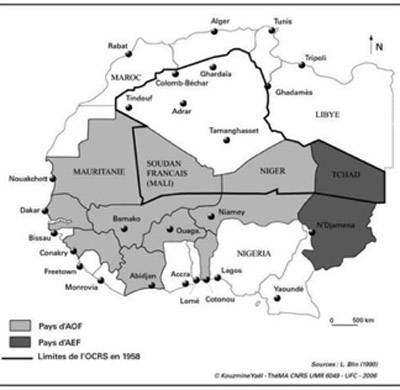
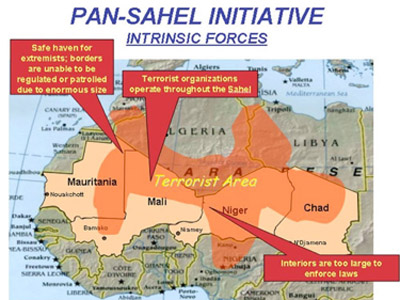
It appears they have even co-opted an earlier French blueprint for direct control. In a groundbreaking analysis, Canadian geopolitical analyst and sociologist, Mahdi Darius Nazemroaya writes, “The map used by Washington for combating terrorism under the Pan-Sahel Initiative says a lot. The range or area of activity for the terrorists, within the borders of Algeria, Libya, Niger, Chad, Mali, and Mauritania according to Washington’s designation, is very similar to the boundaries or borders of the colonial territorial entity which France attempted to sustain in Africa in 1957. Paris had planned to prop up this African entity in the western central Sahara as a French department (province) directly tied to France, along with coastal Algeria.” [26]

The French called it the Common Organization of the Saharan Regions (Organisation commune des regions sahariennes, OCRS). It comprised the inner boundaries of the Sahel and Saharan countries of Mali, Niger, Chad, and Algeria. Paris used it to control the resource-rich countries for French exploitation of such raw materials as oil, gas, and uranium. French map of Sahara in 1958 compared with USAFRICOM Pan-Sahal Initiative map (below) of terror threat in Sahara today.Source: GlobalResearch.ca)

He adds that Washington clearly had this energy-rich and resource-rich area in mind when it drew the areas of Africa that need to be “cleansed” of alleged terrorist cells and gangs. At least now AFRICOM had “a plan” for its new African strategy. The French Institute of Foreign Relations (Institut français des relations internationals, IFRI) openly discussed this tie between the terrorists and energy-rich areas in a March 2011 report. [27]

The map used by Washington for combating terrorism under the Pentagon Pan-Sahel Initiative shows an area of activity for the terrorists, inside Algeria, Libya, Niger, Chad, Mali, and Mauritania according to Washington’s designation. The Trans-Saharan Counterterrorism Initiative (TSCTI) was begun by the Pentagon in 2005. Mali, Chad, Mauritania, and Niger were now joined by Algeria, Mauritania, Morocco, Senegal, Nigeria, and Tunisia in a ring of military cooperation with the Pentagon. The Trans-Saharan Counterterrorism Initiative was transferred to the command of AFRICOM on October 1, 2008. [28]

The Pentagon map is remarkably similar to the boundaries or borders of the colonial territorial entity which France attempted to sustain in Africa in 1957. Paris had planned to prop up this African entity in the western central Sahara as a French department (province) directly tied to France, along with coastal Algeria—the Common Organization of the Saharan Regions (Organisation commune des regions sahariennes, OCRS). It comprised the inner boundaries of the Sahel and Saharan countries of Mali, Niger, Chad, and Algeria. The plans were foiled during the Cold War by the Algerian and other African countries’ independence wars against French colonial rule, France’s “Vietnam.” France was forced to dissolve the OCRS in 1962, because of Algerian independence and the anti-colonial mood in Africa. [29] The neo-colonial ambitions in Paris however, did not vanish.

The French make no secret of their alarm over growing Chinese influence in former French Africa. French Finance Minister Pierre Moscovici stated in Abidjan last December that French companies must go on the offensive and fight the growing influence of rival China for a stake in Africa’s increasingly competitive markets. “It’s evident that China is more and more present in Africa…(French) companies that have the means must go on the offensive. They must be more present on the ground. They have to fight,” Moscovici stated during a trip to Ivory Coast. [30]

Clearly Paris had in mind a military offensive to back the economic offensive he foresaw for French companies in Africa.


Notes

[1] James Kirkup, David Cameron: North African terror fight will take decades, The Telegraph, London, 20 January 2013.

[2] Thierry Meyssan, Mali: One war can hide another, Voltaire Network, 23 January 2013.

[3] Staff Sgt. Nathanael Callon United States Air Forces in Europe/Air Forces Africa Public Affairs, US planes deliver French troops to Mali, AFNS, January 25, 2013.

[4] S. Alambaigi, French Defense Minister: 2000 boots on ground in Mali, 19 January 2013.

[5] Freya Petersen,France aiming for ’total reconquest’ of Mali, French foreign minister says, January 20, 2013.

[6] Christian v. Hiller, Mali’s hidden Treasures, April 12, 2012, Frankfurter Allgemeine Zeitung.

[7] Sources include private discussion with retired US military active in Africa.

[8] William Thornberry and Jaclyn Levy, Al Qaeda in the Islamic Maghreb, CSIS, September 2011, Case Study No. 4.

[9] Pepe Escobar, How al-Qaeda got to rule in Tripoli, Asia Times Online, August 30, 2011.

[10] Ibid.

[11] Jason Howerton, Rand Paul Grills Clinton at Benghazi Hearing: ‘Had I Been President…I Would Have Relieved You of Your Post,www.theblaze.com, Jan. 23, 2013.

[12] Craig Whitlock, Leader of Mali military coup trained in U.S., March 24, 2012, The Washington Post.

[13] Thierry Meyssan, op. cit.

[14] AFP, [Ivory Coast’s ex-President Gbagbo ‘arrested in Abidjan’ by French forces leading Ouattara troops, April 11th, 2011.

[15] Thierry Meyssan, op. cit.

[16] Cheick Dioura and Adama Diarra, Mali Rebels Assault Gao, Northern Garrison“, The Huffington Post, Reuters.

[17] Frank E. Kitson, Low Intensity Operations: Subversion, Insurgency and Peacekeeping, London, 1971, Faber and Faber.

[18] C.M. Olsson and E.P. Guittet, Counter Insurgency, Low Intensity Conflict and Peace Operations: A Genealogy of the Transformations of Warfare, March 5, 2005 paper presented at the annual meeting of the International Studies Association.

[19] Grant T. Hammond, Low-intensity Conflict: War by another name, London, Small Wars and Insurgencies, Vol.1, Issue 3, December 1990, pp. 226-238.

[20] Defenders for Freedom, Justice & Equality, US Hands Off Mali An Analysis of the Recent Events in the Republic of Mali,. MRzine, May 2, 2012.

[21] Adam Nossiter, Eric Schmitt, Mark Mazzetti, French Strikes in Mali Supplant Caution of US, The New York Times, January 13, 2013.

[22] Joe Bavier, French firms must fight China for stake in Africa—Moscovici,, Reuters, December 1, 2012.

[23] AFRICOM, US Africa Command Fact Sheet, September 2, 2010.

[24] Ibid.

[25] F. William Engdahl, NATO’s War on Libya is Directed against China: AFRICOM and the Threat to China’s National Energy Security, September 26, 2011.

[26] Mahdi Darius Nazemroaya and Julien Teil, America’s Conquest of Africa: The Roles of France and Israel, GlobalResearch, October 06, 2011.

[27] Ibid.

[28] Ibid.

[29] Ibid.

[30] Joe Bavier, Op. cit.

Walking and Talking for the Wild Salmon


Voice to Salmon

by Alexandra Morton

I was given the name, Gwayum’dzi by chief Alice Smith of the Kwicksutaineuk-ah-kwa-mish. I was adopted into the family of Dr. Evelyn Willie Voyageur and Carla Voyageur of the Dzawa”da”enuxw and Beatrice Smith of the Kwicksutaineuk-ah-kwa-mish. My naming was completed in the big house in Fort Rupert. I was invited this winter to walk with Beau Dick and his family to give voice to the salmon.


The reason I left my woodstove and cozy home to walk and camp in February is because the work I am doing tracking European viruses has made me realize there is no time to waste. The viruses detected by the labs cause serious sickness in salmon and the salmon of the Pacific won't have any immunity to these European pathogens.


While the governments of British Columbia and Canada turn a blind-eye, I believe the Norwegian salmon feedlots operating in BC are perpetrating one of the greatest threats known to the living world. Turning feedlot viruses from the Atlantic Ocean loose into the Pacific is damage that might not ever be repaired. You cannot recall these pathogens. The wild salmon can only die to fight this, but if the viruses keep pouring out the wild fish may simply die until they are gone.


The reason Beau Dick and his family undertook this journey was to cut a copper on the steps of the BC Legislature. This ceremony has not been performed since the 1950's at which time the weight of the ceremony was too great and that copper was repaired. The copper carried down the island is so old no one knows when it was made.


The copper embodies their family, the past and the future, life itself.

We were a core group of about 15 people and they asked me how I test the Atlantic salmon for viruses. And so as we walked through Duncan, we went to Superstore, and went to the seafood counter, got a pack of farm salmon and bought it.


Superstore took offence calling the regalia costumes and told us to leave, although they could not identify why we should leave. Customers were smiling, clapping, taking pictures with phones, and it became a story on CTV News watched by almost 3,000 people.

The next day we walked to the Cermaq hatchery and I told them how Atlantic salmon are raised in this strict biosecurity and then placed into the territories of the people of Kingcome Inlet and others. A sadness swept through the group. The strict biosecurity existed only to protect the Atlantic salmon, not the Pacific salmon that sustain First Nations, wildlife, the forests and most coastal communities of BC as well as the communities along the Fraser River. The people of Duncan did not realize this was occurring here.


The reason I went on this journey was to have the chance to explain my work with the viruses to the people as we walked through each town and reserve. In the gatherings I was given the talking stick and I spoke. I don't have a million dollar advertising budget but I have legs and I have a voice and I use them because I don't think killing off the wild salmon of British Columbia is going to be good for anyone.

On the final day we walked the 18 km from Goldstream park to the Parliament buildings. It was a very uplifting time spent talking, drumming, waving to people who cheered us on.


There were about 1000 people at the Parliament as we walked into them.


The speeches lasted several hours, very passionate speeches expressing concern for the future of Canada, the future for our children and expressions of distrust for what Stephen Harper and BC Liberals are doing to us, giving away the land and water to foreign corporations, talking away the rights of people to protect what it is they need to survive. Shelley Joseph, daughter of the great and beloved chief, Bobby Joseph who gave Beau Dick his tunic to wear on this day, spoke.


Henry Hunt spoke


and many others:


And then in a powerful and ancient ceremony the copper was cut, as iPhones captured and shared the event widening the circle of awareness.


That something has gone very wrong in the relationship between the people and the government.


I was there, I carried my white face into this ceremony to be a part of it, to communicate the destruction to the life blood of this coast and to communicate that Canadians do not need to fear this movement. As was so often repeated in big houses, roadside, over dinner, everywhere, this is a movement about Canadians expressing to government that they cannot rob the very life out of this country, leaving the people to come after us with far less than they need to survive and irreversible pollution caused by viruses, cancer-causing chemicals, shattering the very ground beneath us with fracking. I think virtually everyone is worried about where we are headed. Events like this journey are meant to wake people to the possibilities, that there is another way that will benefit even Stephen Harper's children who are stuck on the same planet as all the rest of us.

British Columbians, you have an opportunity to be heard as we go into the upcoming elections. One thing you can do right now and everyday until the vote is tell your MLA hopefuls that the licences of occupation the Province of BC has given to the salmon feedlots have to be revoked. No one in their right mind would leave it up to foreign shareholders to decide the fate of wild salmon, no one would wait for people who have never drawn a single breath in this province to stop the European salmon viruses from pouring into the Pacific Ocean.

It is time for everyone of you to lean into this. You can also tell the stores you will not be contributing to this damage, you will not be buying feedlot salmon. Sign this petition

Year Ten in Iraq: A Decade Past Destruction


Iraq at the Brink: A Decade after the Invasion

by Ramzy Baroud

Soon after the joint US-British bombing campaign ‘Operation Desert Fox’ devastated parts of Iraq in Dec 1998, I was complaining to a friend in the lobby of the Palestine Hotel in Baghdad.

I was disappointed with the fact that our busy schedule in Iraq – mostly visiting hospitals packed with injured or Depleted Uranium Victims - left me no time to purchase a few Arabic books for my little daughter back in the states. As I got ready to embark on the long bus journey back to Jordan, an Iraqi man with a thick moustache and a carefully designed beard approached me. “This is for your daughter,” he said with a smile as he handed me a plastic bag. The bag included over a dozen books with colorful images of traditional Iraqi children stories. I had never met that man before, nor did we ever meet again. He was a guest at the hotel and somehow he learned of my dilemma. As I profusely, but hurriedly thanked him before taking my seat on the bus, he insisted that no such words were needed. “We are brothers and your daughter is like my own,” he said.

I was not exactly surprised by this. Generosity of action and spirit is a distinct Iraqi characteristic and Arabs know that too well. Other Iraqi qualities include pride and perseverance, the former attributed to the fact that Mesopotamia – encompassing most of modern day Iraq – is the ‘cradle of civilization’ and later due to the untold hardship experienced by Iraqis in their modern history.

It was Britain that triggered Iraq’s modern tragedy, starting with its seizure of Baghdad in 1917 and the haphazard reshaping of a country to perfectly fit the colonial needs and economic interests of London. One could argue that the early and unequalled mess created by the British invaders continued to wreak havoc, manifesting itself in various ways – spanning sectarianism, political violence and border feuds between Iraq and its neighbors – until this very day.

But of course, the US now deserves most of the credit of reversing whatever has been achieved by the Iraqi people to acquire their ever-elusive sovereignty. It was US Secretary of State James Baker, who reportedly threatened Iraqi Foreign Minister Tariq Aziz in a Geneva meeting in 1991 by saying that the US would destroy Iraq and “bring it back to the stone age.” The US war which extended from 1990 to 2011, included a devastating blockade and ended with a brutal invasion. These wars were as unscrupulous as they were violent. Aside from their overwhelming human toll, they were placed within a horrid political strategy aimed at exploiting the country’s existing sectarian and other fault lines therefore triggering civil wars and sectarian hatred from which Iraq is unlikely to cover for many years.

For the Americans, it was a mere strategy aimed at lessening the pressure placed on its and other ally soldiers as they faced stiff resistance the moment they stepped foot in Iraq. For the Iraqis however, it was a petrifying nightmare that can neither be expressed by words or numbers. But numbers are of course barely lacking. According to UN estimations cited by the BBC, between May and June 2006 “an average of more than 100 civilians per day (were) killed in violence in Iraq.” The UN reserved estimates also placed the death toll of civilians during 2006 at 34,000. That was the year that the US strategy of divide and conquer proved most successful.

Over the years, most people outside Iraq – as in other conflicts where protracted violence yields regular death counts – simply became desensitized to the death toll. It is as if the more people die, the less worthy their lives become.

The fact remains, however that the US and Britain had jointly destroyed modern Iraq and no amount of remorse or apology – not that any was offered to begin with – will alter this fact. Iraq’s former colonial masters and its new ones lacked any legal or moral ground for invading the sanctions-devastated country. They also lacked any sense of mercy as they destroyed a generation and set the stage for a future conflict that promises to be as bloody as the past.

When the last US combat brigade had reportedly left Iraq in Dec 2011, this was meant to be an end of an era. Historians know well that conflicts don’t end with a presidential decree or troop deployments. Iraq merely entered a new phase of conflict and the US, Britain and others, remain integral parties of that conflict.

One post-invasion and war reality is that Iraq was divided into areas of influence based on purely sectarian and ethnic lines. In western media’s classification of winners and losers, Sunnis, blamed for being favored by former Iraqi President Saddam Hussein, emerged as the biggest loser. While Iraq’s new political elites were divided between Shi’ite and Kurdish politicians (each party with its own private army, some gathered in Baghdad and others in the autonomous Kurdistan region), the Shi’ite population was held by various militant groups responsible for Sunni unfortunates. On Feb 8, five car bombs blew up in what was quickly recognized as “Shi’ite areas”, killing 34 people. A few days earlier, on Feb 4, 22 people were also killed in a similar fashion.

The sectarian strife in Iraq which is responsible for the death of tens of thousands, is making a comeback. Iraqi Sunnis, including major tribes and political parties are demanding equality and the end of their disfranchisement in the relatively new, skewed Iraqi political system under Prime Minister Nouri al-Maliki. Massive protests and ongoing strikes have been organized with a unified and clear political message. However, numerous other parties are exploiting the polarization in every way imaginable: to settle old scores, to push the country back to the brink of civil war, to amplify the mayhem underway in various Arab countries, most notably Syria, and in some instances to adjust sectarian boundaries in ways that could create good business opportunities.

Yes, sectarian division and business in today’s Iraq go hand in hand. Reuters reported that Exxon Mobil hired Jeffrey James, a former US ambassador to Iraq (from 2010-12) as a ‘consultant.’ Sure, it is an example of how post-war diplomacy and business are natural allies, but there is more to the story. Taking advantage of the autonomy of the Kurdistan region, the giant multinational oil and gas corporation had struck lucrative deals that are independent from the central government in Baghdad. The latter has been amassing its troops near the disputed oil-rich region starting late last year. The Kurdish government has done the same. Unable to determine which party has the upper hand in the brewing conflict, thus future control over oil resources, Exxon Mobile is torn: to honor its contracts with the Kurds, or to seek perhaps more lucrative contracts in the south. James might have good ideas, especially when he uses his political leverage acquired during his term as US ambassador.

The future of Iraq is currently being determined by various forces and almost none of them are composed of Iraqi nationals with a uniting vision. Caught between bitter sectarianism, extremism, the power-hungry, wealth amassing elites, regional power players, western interests and a very violent war legacy, the Iraqi people are suffering beyond the ability of sheer political analyses or statistics to capture their anguish. The proud nation of impressive human potential and remarkable economic prospects has been torn to shreds.

UK-based Iraqi writer Hussein Al-alak wrote on the upcoming tenth anniversary of the Iraq invasion with a tribute to the country's 'silent victims,' the children. According to Iraqi Ministry of Labor and Social Affairs, he reported, there is an estimated 4.5 million children who are now orphans, with a “shocking 70 percent” of them having lost their parents since the 2003 invasion.

“From that total number, around 600,000 children are living on the streets, without either shelter or food to survive,” Al-alak wrote. Those living in the few state-run orphanages “are currently lacking in their most essential needs.”

I still think of the kindly Iraqi man who gifted my daughter a collection of Iraqi stories. I also think of his children. One of the books he purchased was of Sindbad, presented in the book as a brave, handsome child who loved adventure as much as he loved his country. No matter how cruel his fate had been, Sinbad always returned to Iraq and began anew, as if nothing had ever happened.


- Ramzy Baroud (www.ramzybaroud.net) is an internationally-syndicated columnist and the editor of PalestineChronicle.com. His latest book is: My Father was A Freedom Fighter: Gaza's Untold Story (Pluto Press).

Billionaire Banker Bandit Breaking into Obama Cabinet?

Billionaire Banker Bandit Likely to Become Next Commerce Secretary

by Greg Palast - Truthout

A parade of media reports this week name Penny Pritzker as Obama's prime choice for Secretary of Commerce. No longer will criminal bankers have to lobby the administration - because now they'll have one of their own in the Cabinet.

We never heard of this guy Barack Obama until 2004. Less than three years before taking the presidency, he was in the Illinois state senate, a swamp of scammers, backhanders, and party machine tools - not a stellar launch pad for the White House. And then, one day, state Sen. Barack Obama was visited by his fairy godmother. Her name is Penny Pritzker.

Penny's from Heaven?

Pritzger's net worth is listed in Forbes as $1.8 billion, which is one hell of a heavy magic wand in the world of politics. Her wand would have been heavier, and her net worth higher, except that in 2001, the federal government fined her and her family $460 million for the predatory, deceitful, racist tactics and practices of Superior, the bank-and-loan-shark operation she ran on the South Side of Chicago.

Superior was the first of the deregulated go-go banks to go bust - at the time, the costliest failure ever. US taxpayers lost nearly half a billion dollars. Superior's depositors lost millions and poor folk in Sen. Obama's South Side district lost their homes.

Penny did not like paying $460 million. No, not one bit. What she needed was someone to give her Hope and Change. She hoped someone would change the banking regulators so she could get away with this crap.

This article is based on the New York Times bestseller: Billionaires & Ballot Bandits, by Greg Palast with comics by Ted Rall. Available for a donation to Truthout.org.

Pritzker introduced Obama, the neophyte state senator, to the Ladies Who Lunch (that's really what they call themselves) on Chicago's Gold Coast. Obama got lunch, gold and better - an introduction to Robert Rubin. Rubin is a former Secretary of the Treasury, former chairman of Goldman Sachs and, when Robert met Barry, co-chairman of Citibank. Even atheists recognized Rubin as the Supreme Deity of Wall Street.

Rubin opened the doors to finance industry vaults for Obama. Extraordinarily for a Democrat, Obama in 2008 raised three times as much from bankers as his Republican opponent.

So what did Citibank's Rubin get for showering Obama with gold? Obama agreed to take care of Rubin's poodles, Larry Summers and Tim Geithner. They became Obama's first cabinet picks: Summers as Economics Czar and Geithner as his czarina, Secretary of the Treasury.

Geithner and Summers were the gents who, under Treasury Secretary Rubin, designed the deregulation of banking. In effect, they had decriminalized the kind of financial flim-flammery that brought the planet to its knees while bringing Rubin, Pritzker and the banksters loads of lucre.

So, in 2008, Summers and Geithner were put back in the saddle - Obama's horse but Rubin's saddle.

Rubin received more than $100 million from Citigroup, the gargantuan commercial bank/investment bank/casino created by deregulation. It is worth a mention that Rubin's centi-million-dollar payoff went unchallenged by Citi's new owner, the US Treasury, which had put up more than a trillion dollars in loans and guarantees to pull Rubin's creature out of bankruptcy.

Rubin rocked, but Penny was pissed off.

Pritzker had taken this state senator/community organizer from the ghetto, made him a US Senator, then, as Obama's campaign finance chairwoman, raised a mind-blowing three-quarters of a billion dollars to make him president.

In return, in 2008, Obama decided to make his patron Penny the Secretary of Commerce. But then, in November 2008, just as Obama was about to submit her nomination to Congress, a bunch of Pritzker's victims marched on Washington. They were not from her busted bank, but unhappy workers from the lucrative nursing homes that her family owns through a string of complex offshore trusts. Obama slammed the door on Penny pronto.

In the 2012 campaign, Obama, to his credit, kept the door shut on Pritzker, reducing her to hosting an election fundraiser at her Gold Coast digs, which she had to bill as a Goldman Sachs PAC event. This marks possibly the first time anyone has used Goldman Sachs as a PR cover.

The Pritzker family made its billions mostly from Hyatt Hotels and Hyatt nursing homes. Penny, on the Hyatt board of directors, is an infamously combative anti-union apostle. UNITE HERE, the union that represents Hyatt workers, has called for an international boycott of Hyatt hotels. In 2012, UNITE HERE and its parent, the AFL-CIO, were crucial to Obama's winning Ohio, Michigan and Wisconsin. So, in this last campaign, Obama had to keep his billionairess heiress on the down-low.

But today, with the unions' money and votes already pocketed and counted, Obama can give working folks The Finger and give Penny her pound of flesh: the Commerce post.

The New York Times says that, "At Commerce, Ms. Pritzker could provide the president with a new way to reach out to the business community." The last time Pritzker reached out to the business community was to sell them sub-prime mortgage securities, worthless bags of financial feces manufactured by Superior Bank.

If Penny the Piggy Banker gets Commerce, we'll have to drop Obama's rating to sub-prime.

So what are you going to do about it? Join with the union maids at


And get a copy of Billionaires & Ballot Bandits, with chapters by Robert F. Kennedy Jr. and, inside, a 48-page comic book from the fully-loaded assault pen of Ted Rall - available for a donation to Truthout.org.


Greg Palast's investigative reports are broadcast by BBC Television's Newsnight. His new book is Billionaires & Ballot Bandits: How to Steal an Election in 9 Easy Steps (7 Stories Press/Palast Investigative Fund).

Republished at Pacific Free Press with author permission.

Tuesday, February 12, 2013

Israel's Southern Man of the Cosmo Ghetto


Yair Lapid: The southern man and his cosmopolitan ghetto

by Neve Gordon - Al Jazeera English

Although the Israeli centre projects itself as liberal cosmopolitan,
it is actually informed by a racist logic.

Former anchorman and middle-class darling Yair Lapid stunned the Israeli political scene in the recent elections. His party, Yesh Atid (There is a Future) won 19 seats, second in size only to Prime Minister Binyamin Netanyahu and Foreign Minister Avigdor Lieberman's Likud-Beiteinu alliance, thus ensuring that Lapid will play a pivotal role in the next government.

But who is Lapid and what exactly does he stand for?

In Israel he is considered a northerner. The label refers to upper middle-class secular nationalists who live in northern Tel-Aviv. They are hard-working professionals who nonetheless find time to frequent the city's busy cafes and restaurants. With yuppie-like qualities, they brush shoulders with tycoons and bohemians alike and consider themselves to be liberal cosmopolitans, tolerant and progressive.

The problem, of which this social class is well aware, is that northern Tel-Aviv is a tiny bubble that is always in danger of imploding. Yet, for Lapid's hard core followers, northern Tel-Aviv epitomises the desired normal, the way life in Israel should look, while the rest of Israel, populated by ultra-orthodox Jews, Palestinians, and other poverty-stricken or marginalised residents, represents the abnormal and the eminently undesirable.

The goal, then, is to create ever more sections of Israeli society in the image of the northerner. Not surprisingly, Yesh Atid emulated Obama's successful campaign, arguing that they would introduce policies much more amenable to middle-class society. Lapid thus positioned his party as the centre - between the rich and the poor, the left and the right - and appealed to his voters by echoing their yearning for some form of normalcy.

The normalcy of the centre

All of which raises the question of normalcy and its meaning for middle-class Jewish Israelis today.

In this respect, it is telling that Yesh Atid launched its election campaign in Ariel, a settlement located in the heart of the occupied West Bank. Ariel was thus constituted as an eastern suburb of Tel-Aviv, part of normal Israel, rather than an illegal settlement.

Israel Election - News Coverage

During its inauguration ceremony in Ariel, Yesh Atid introduced the party's eight-point platform, which focuses on improving the conditions of the Israeli middle class. First on the list is the redistribution of social burdens, particularly in relation to the ultra-orthodox, which, in the centrist party's view, need to be taken off the dole, drafted into the military and encouraged to seek work. Concluding the list is the Israeli Palestinian conflict, and Yesh Atid's promise that it will "strive for peace according to an outline of two states for two peoples, while maintaining the large Israeli settlement blocs and ensuring the safety of Israel".

This two-state solution, which for many decades was taboo in Israeli society, now stands for the normal. During an interview for Time Magazine, Yair Lapid intimated what exactly this normal means. When asked if he is sincerely interested in resolving the Israeli-Palestinian conflict through a two state solution or whether he is advocating such a solution because this is what the world expects of him, the Israeli politician replied that his proposal is indeed sincere, adding:
You know my father didn't come here from the ghetto in order to live in a country that is half Arab, half Jewish. He came here to live in a Jewish state. And we have 3.3 million Palestinians now between the sea and the eastern border of Israel. If we don't do something about it, her generation [nods toward a 15-year-old girl at our table] is going to spend her time with six or seven or eight million Palestinians. So doing nothing about it is shortsighted.

Lapid's response reminded me of an important distinction the great African-American intellectual James Weldon Johnson made in the beginning of the twentieth century between the relationship of white southerners and northerners towards blacks in the United States.
"Southern white people despise the Negro as a race," Johnson wrote, "and will do nothing to aid in his elevation as such; but for certain individuals they have a strong affection, and are helpful to them in many ways." Johnson then added "that it may be said that the claim that the Southern whites love the Negro better than the Northern whites do is in a manner true. Northern white people love the Negro in a sort of abstract way, as a race; through a sense of justice, charity, and philanthropy, they will liberally assist in his elevation... Yet, generally speaking they have no particular likings for individuals of the race."

This distinction suggests that although Lapid may be a northerner in Israel, in Johnson's parlance he is a southern man, born and bred. Lapid and many members of his party almost certainly have individual Palestinian friends, but they do not like the Palestinian race. Indeed, on the party's Hebrew website, and, interestingly, not on its English site, Yesh Atid justifies its support for their particular two-state solution by claiming that "peace is the only reasonable answer to the [Palestinian] demographic threat and the crazy ideas of a 'state for all its citizens'..."

Demographic threat

The thinly veiled racist phrase "demographic threat" does not really register among most non-Hebrew speakers and therefore was probably not translated into English, but it does reveal that Yesh Atid's objective is very different from the one set out by those inventors of modern democracy, France and the United States. The crucial point is that due to its deep-rooted prejudice against Palestinians, normalcy for the Israeli centre has come to signify a completely illiberal understanding of the political; namely, absolute opposition to a "state for all its citizens". The Israeli centre thus embodies the contradiction of its constituency: while it thinks of itself as projecting a liberal cosmopolitan worldview, its utopian horizon is actually informed by a racist logic.

This is precisely why the centre is more eager to create a coalition with the extreme right wing Likud party and Naftali Bennett's Habayit Hayehudi (The Jewish House) than with the liberal Zionists. The liberals, after all, are Johnson's northerners; unlike the centre and right wing in Israel they don't hate the Palestinian race, yet generally speaking have no particular liking for Palestinian individuals. But since liberal Zionists are now a minute minority, the centre and right will, for the foreseeable future, determine what constitutes the normal in Israel and just like the southern man they will do so by advocating a racist agenda. The only difference between Yesh Atid and the extreme right is that although both would like Israel to become a homogenous ghetto, clean of Palestinians, Lapid believes that he can somehow transform this ghetto into a cosmopolitan enclave.


Neve Gordon is the author of Israel's Occupation and can be reached through his website.