Friday, May 03, 2013

Voting Salmon in BC


Election 2013 – On protecting BC’s Salmon

by Andrew Gage, Staff Lawyer - West Coast Environmental Law Association

Earlier this year, the BC Legislature declared the Pacific Salmon to be BC’s official fish. Which is no doubt nice for the salmon. But even nicer would be real legal protection for the salmon. With the platforms from all four parties now available, what are candidates proposing to do to protect our salmon?

Controversy is developing regarding the NDP’s rather vague election promise on salmon. Later in the post we’ll take a closer look at the NDP’s position, but first, here’s where each party comes down:

  • BC Conservatives: Although John Cummins is a former commercial fisher himself, and has been known to take strong positions on fish-related issues, the Conservative party platform does not mention salmon, fish, fishing or anything else directly aimed at addressing fish or protection of fish.
  • BC Liberals: The BC Liberal platform only makes one specific promise related to fish: “Direct all revenues from fishing licences be provided to the Freshwater Fisheries Society for conservation activities ($2.4 million), by 2015/16.” According to the platform costing, this would represent $2.4 million for fish conservation activities. (Although not in the platform, the current, Liberal government has taken some recent steps related to fish farms, discussed later in this post).
  • BC Greens: The BC Greens have a series of promises related to salmon and other related species, including negotiating to take over the management of fisheries from the federal government, addressing the impacts of run-of-river projects, mining and forestry on fisheries values, etc. The BC Greens also promise to remove fish farms from the “East Coast of Vancouver Island and the West Coast of the Mainland”. More on this below. This brief summary does not fully capture the several promises in the party’s Green Book 2013 related to fish and fisheries, which readers interested in fish protection may wish to review.
  • BC NDP: The BC New Democrats election platform has only one major commitment directly related to salmon. Notably, they promise to: “Protect wild salmon stocks by working with the federal government to implement the Cohen Commission recommendations, and to support sustainable aquaculture.” This is the promise that we’ll examine in more detail below. The NDP platform also commits more generally to “ensur[ing that] government decisions are supported by robust science-based evidence to better manage BC’s wildlife and fisheries resources….”


In this post we’re focused on promises that are actually directed at protecting fish and fish habitat. Other election promises may incidentally protect fish. For example, NDP and Green pronouncements against oil pipelines and tanker traffic are good for fish (the Green party platform explicitly makes this link). Similarly, the NDP and the Liberals are both promising a revised Water Act which is expected (although the platforms don’t say it) to expand government powers to ensure that fish get water (Organizing for Change has more on the party positions on the new Water Act). But fish are only one of the many reasons for taking these stands.

The NDP and the Cohen Commission

So what does the NDP mean by:

Protect wild salmon stocks by working with the federal government to implement the Cohen Commission recommendations, and to support sustainable aquaculture.

The Cohen Commission was appointed by Prime Minister Steven Harper to examine the collapse of the Fraser River Sockeye runs in 2009. The Commission held hearings over two years, heard from 179 witnesses, and examined 573,381 documents, trying to get a sense of what needs to be done to maintain and enhance Fraser sockeye runs. The Commissioner made 75 recommendations, primarily directed at the federal government.

It’s worth noting that the federal government has not, to date, indicated whether it will accept or implement the Cohen Commission recommendations. With a possibly unwilling partner in the federal government, it’s unclear whether the NDP would be able to implement all 75 recommendations, which ones they would prioritize, and what they would do if the federal government will not cooperate.

This vagueness has led one of BC’s foremost salmon activists, Alexandra Morton, to blast the NDP for what she sees as backing away from past commitments to regulate the fish farm industry and protect wild salmon:

The freshly minted NDP Fisheries policy literally that put salmon farms first, sets a course that conflicts with itself and the NDP’s previous position to remove salmon farms from BC waters. … Whoever wrote the NDP fisheries policy feels certain British Columbians don’t read the news because astonishingly they thought telling us the NDP would work with DFO would inspire confidence.

Clearly the NDP platform, if it is to get serious about protecting fish, needs a little more detail.

Confusing matters somewhat is the fact that some individual NDP Candidates have made statements that do provide more detail about their positions on fish farms and salmon, but it is not obvious that the party is standing behind them. For example, Agriculture Critic Lana Popham reportedly posted the following to her Facebook Page, but it doesn’t appear there any longer:


New Democrats have clearly stated that if we form government in May, we will work with the DFO to act on the recommendations from Justice Cohen including:
  • regularly revising salmon farm siting criteria to reflect new scientific information about farms on or near Fraser River sockeye salmon migration routes as well as the cumulative effects of these farms;
  • explicitly considering proximity to Fraser River sockeye when siting farms;∙
  • limiting salmon farm production and licence duration;∙
  • using the precautionary principle to re-evaluate risk and mitigation measures for salmon farms in the Discovery Islands, including closing those farms that are determined to pose more than a minimal risk of serious harm to the health of migrating Fraser River sockeye.

In addition, we will maintain the existing moratorium, introduced in 2008, on new fish farm licenses on the North Coast.

I called the NDP to ask why this post has apparently been taken down and what the specifics of the NDP platform are, but did not receive a call back by the time this post was published. I will update if we hear back from them.

A few more details might be gleaned from statements made by NDP Incumbent, Claire Trevena in the Campbell River Mirror:


It must be remembered that, as a consequence of a legal challenge brought in 2009, the BC Supreme Court ruled that the federal government has exclusive jurisdiction for open-net aquaculture. This ruling severely limits the province’s ability to regulate in this area. …

Last May, my party stated that we are firmly committed to working with and, if necessary, pressuring Fisheries to act if we form the government. …

An area where the province does have jurisdiction is renewing leases for the siting of fish farms.

These statements are interesting. On the one hand, Trevena downplays the provincial government’s ability to regulate fish farms – implying that this is the reason for the narrow campaign promise to work with the federal government on implementing the Cohen Commission recommendations. But at the same time she recognizes that the province has the ability to act on the key question of the siting of fish farms (should they be located on the migration routes of wild salmon, for example). Trevena’s language largely parallels both the NDP’s platform and Lana Popham’s statement, but with the added suggestion that these goals can only be achieved through pressure on the federal government.

BC’s jurisdiction over fish farms

The court case Trevena refers to is a case brought by Alexandra Morton (with financial support from West Coast Environmental Law), and it does indeed establish that the federal government is responsible for regulating fish farms.

But she is equally correct that the province retains jurisdiction for determining where fish farms are located (if anywhere). This is because the provincial government owns the seabed for much of BC’s oceans areas – and so fish farms need a licence from the province to legally operate their open net operations.

The current provincial government has recognized its continued jurisdiction over fish farms through its control over the “tenures” of fish farms, and intends to use these powers, with or without federal government approval, to signal what amounts to a moratorium (as recommended by Commissioner Cohen) on new fish farms in the Discovery Islands:


The Province of British Columbia has no intention of issuing any further or expanded tenures for net-pen salmon farms in the Discovery Islands until at least September 30, 2020. … The Province will work with Fisheries and Oceans Canada, and with industry and First Nations to implement the intent of this recommendation.

Alexandra Morton was quick to point out in this video (recorded before the NDP platform was released) that the Province, through this statement, is accepting its jurisdiction over fish farms.

Similarly, the Green party is clear that they intend to use this control over the seabed to eliminate fish farms:


Ensure that the BC coast is free of finfish farms along the length of the east coast of Vancouver Island and the west coast of the mainland from the Fraser River north to the Broughton Archipelago, by not renewing the licenses of finfish farms with annual tenure and by revoking the licenses of finfish farms with long-term tenure. [Emphasis added]

The fact is that each of the specific objectives listed by Lana Popham in her statement could be addressed through the provincial power to control its own lands. While not every one of the Cohen Commission recommendations could be implemented by the province acting alone, a large number of them could. The NDP, if it is indeed suggesting that the federal government needs to be involved before it can act, is ignoring its powers as landlord of the fish farm companies.

Want to know where your candidate stands on protecting wild salmon and other fish species?

If you’d like to see candidates taking stronger stands on salmon and fish protection, tell them so. On the VoteEnvironment2013 website you can just put in your postal code and then write an email to all your local candidates about salmon (or about any environmental issues of your choice). This election, vote environment!

By Andrew Gage, Staff Lawyer

This post authorized by West Coast Environmental Law Association, sponsor under the Elections Act, 604-684-7378.

Photos courtesy of Andrew S. Wright / www.cold-coast.com

Thursday, May 02, 2013

Barbarians Past the Gates: Obama Picks Bankster Pritzker for Top Commerce Position


Billionaire Bankster Breaks into Obama's Cabinet

by Greg Palast

You made fun of me when I suggested that President Barack Obama would nominate a confessed bank scammer, a loan-sharking mortgage predator, to his cabinet. But thar she blows!

Today, Obama has named Penny Pritzker Secretary of Commerce. As the President says, It's a milestone: the first female fraudster to hold that post. No longer will criminal bankers have to lobby the administration - because now they'll have one of their own in the Cabinet.

The following is taken from the Chapter, "Penny's from Heaven?" you'll find in my bestseller, Billionaires & Ballot Bandits. [Get a copy, I'll sign it, and you send it to the President.]

We never heard of this guy Barack Obama until 2004. Less than three years before taking the presidency, he was in the Illinois state senate, a swamp of scammers, backhanders, and party machine tools - not a stellar launch pad for the White House. And then, one day, state Sen. Barack Obama was visited by his fairy godmother. Her name is Penny Pritzker.

Pritzker's net worth is listed in Forbes as $1.8 billion, which is one hell of a heavy magic wand in the world of politics. Her wand would have been heavier, and her net worth higher, except that in 2001, the federal government fined her and her family $460 million for the predatory, deceitful, racist tactics and practices of Superior, the bank-and-loan-shark operation she ran on the South Side of Chicago.

Superior was the first of the deregulated go-go banks to go bust - at the time, the costliest failure ever. US taxpayers lost nearly half a billion dollars. Superior's depositors lost millions and poor folk in Sen. Obama's South Side district lost their homes.

Penny did not like paying $460 million. No, not one bit. What she needed was someone to give her Hope and Change. She hoped someone would change the banking regulators and the Commerce Department so she could get away with this crap.

Pritzker introduced Obama, the neophyte state senator, to the Ladies Who Lunch (that's really what they call themselves) on Chicago's Gold Coast. Obama got lunch, gold and better - an introduction to Robert Rubin. Rubin is a former Secretary of the Treasury, former chairman of Goldman Sachs and former co-chairman of Citibank. Even atheists recognized Rubin as the Supreme Deity of Wall Street.

Rubin opened the doors to finance industry vaults for Obama. Extraordinarily for a Democrat, Obama in 2008 raised three times as much from bankers as his Republican opponent.

This article is based on the chapter Penny's from Heaven? From Palast's New York Times Bestseller Billionaires & Ballot Bandits with comics by Ted Rall.Donate and get a signed copy.


So what did Citibank's Rubin get for showering Obama with gold? Obama agreed to take care of Rubin's poodles, Larry Summers and Tim Geithner. They became Obama's first cabinet picks: Summers as Economics Czar and Geithner as his czarina, Secretary of the Treasury.

Geithner and Summers were the gents who, under Treasury Secretary Rubin, designed the deregulation of banking. In effect, they had decriminalized the kind of financial flim-flammery that brought the planet to its knees while bringing Rubin, Pritzker and the banksters loads of lucre.

So, in 2008, Summers and Geithner were put back in the saddle - Obama's horse but Rubin's saddle.

Rubin received more than $100 million from Citigroup, the gargantuan commercial bank/investment bank/casino created by deregulation. It is worth a mention that Rubin's centi-million-dollar payoff went unchallenged by Citi's new owner, the US Treasury, which had put up more than a trillion dollars in loans and guarantees to pull Rubin's creature out of bankruptcy.

Rubin rocked, but Penny was pissed off. Pritzker had taken this state senator/community organizer from the ghetto, made him a US Senator, then, as Obama's campaign finance chairwoman, raised a mind-blowing three-quarters of a billion dollars to make him president.

In return, in 2008, Obama decided to make his patron Penny the Secretary of Commerce. But then, in November 2008, just as Obama was about to submit her nomination to Congress, a bunch of Pritzker's victims marched on Washington. They were not from her busted bank, but unhappy workers from the lucrative nursing homes that her family owns through a string of complex offshore trusts. Obama slammed the door on Penny pronto.

The Pritzker family made its billions mostly from Hyatt Hotels and Hyatt nursing homes. Penny, on the Hyatt board of directors, is an infamously combative anti-union apostle. UNITE HERE, the union that represents Hyatt workers, has called for an international boycott of Hyatt hotels. In 2012, UNITE HERE and its parent, the AFL-CIO, were crucial to Obama's winning Ohio, Michigan and Wisconsin. So, in this last campaign, Obama had to keep his billionairess heiress on the down-low.

Obama appeared to keep the door shut on Pritzker throughout the 2012 campaign, reducing her to hosting an election fundraiser at her Gold Coast digs, which she had to bill as a Goldman Sachs PAC event. This marks possibly the first time and last time anyone used Goldman Sachs as a PR cover.

But today, with the unions' money and votes already pocketed and counted, Obama can give working folks The Finger and give Penny her pound of flesh: the Commerce post.

The New York Times says that, "At Commerce, Ms. Pritzker could provide the president with a new way to reach out to the business community." The last time Pritzker reached out to the business community was to sell them sub-prime mortgage securities, worthless bags of financial feces manufactured by Superior Bank.

By giving Penny, the Piggy Banker, Commerce, we have to change Obama's rating to sub-prime.

I do note that some woman's organizations are applauding the appointment of the first female to the Commerce post. But I prefer to honor the victims of the Chicago femme fatale. Most of Penny's victims, busted bank borrowers and underpaid health care workers, are women, too. But, unlike those wounded and destroyed by Pritzker, she worked hard for her money: it was not easy inheriting her first billion from her daddy.

* * * * * * * *

Greg Palast
earned his degree in finance at the University of Chicago but has since gone legit. View his reports for BBC Television, Vice Magazine and more at www.GregPalast.com

Greg Palast is the author of the New York Times bestsellers Billionaires & Ballot Bandits: How to Steal an Election in 9 Easy Steps, The Best Democracy Money Can Buy, Armed Madhouse and the highly acclaimed Vultures' Picnic, just named Book of the Year on BBC Newsnight Review.

Visit the Palast Investigative Fund's store and find great Holiday Gifts for your loved ones.
Or simply make a contribution to keep our work alive!

Subscribe to Palast's Newsletter and podcasts.
Follow Palast on Facebook and Twitter.

www.GregPalast.com

Of What Humankind Might Be: A Truth Teller's Light in the Darkness of Our Times

The Truth Tellers' Lament in a Time of Darkness

by William A. Cook

“When you survey the wreckage of the American imperium, it’s very easy to become overwhelmed by darkness of the times, submerged in the remorseless riptide of blood and official violence. But even facing methods of torture and imprisonment that would unnerve an inmate of Guatanamo, Lilburne never surrendered to defeatism. His writing remains infused with radical purpose, a radiant call from across the centuries for collective resistance” (Jeffrey St. Clair, “Intolerable Opinions in an Age of Shock and Awe," March 20/21, 2004).

Nine years ago, Jeffrey St. Clair drew a graphic if horrific picture of John Lilburne’s years as a Leveler in mid-17th century England, a strident voice demanding justice and the rights of the people against the ruling forces of King Charles and Cromwell. St. Clair and Alex Cockburn as co-editors of Counterpunch, edited what's considered to be the best muckraking newspaper extant, entered the lists against the cabal of Neo-Cons that took control of the United States with the ascendency of George W. Bush to the Presidency at the turn of the 21st century and have been relentless in their Leveler-type polemics ever since.

I recall that article now because “the forces that Lilburne confronted “with violent and bitter expressions” have coalesced once again (not that they ever really dissipated, mind you) and threaten to impose their preemptive will upon the living creatures of the world. What are these forces? Militarism, religious bigotry, official censorship, prosecutorial inquisitions and torture, imperial expansion, monopolists, land grabbers, misogynists and those who buy and sell the earth and humans, too. In short, the whole sick crew.

That was nine years ago. What has been accomplished by the voices of truth against the darkness that has covered America since that date? Bush won reelection in 2004 but a glimmer of hope appeared in the 2006 elections with the defeat of Republicans in the House. By 2008, the demise of the Cabal seemed assured with the election of Barak Obama whose entire campaign and its accompanying promises were based on negation of the Bush Presidency. The voices of truth, the Protesters, the Modern Levelers had won, or so it seemed. We now know that Obama metamorphosed into a Bush echo and the nation has moved inexorably into a fascist state run by corporate wealth and the controls achieved over the American Congress by the Zionist forces.

Yet in November of this past year, the 29th of November, 188 nations of the United Nations allowed the recognition of the rights of the Palestinian people to be a member of the United Nations, lacking only a land mass that could exist free of illegal occupiers. A victory perhaps of right over might, perhaps only a pyrrhic victory. Sixty five years ago this May 14, the world body admitted to its membership the state of Israel even as that self-declared state was in the process of invading, destroying and leveling 418 towns and villages owned by the people of Palestine who suffered death or expulsion out of their homeland to live without human rights anywhere in the world, a self-declared state acting in full defiance of the Resolution that granted them 55% of the land area of Mandate Palestine. That state, ruled by Zionists and their ideology, now occupy and control all but 12% of the land of Palestine.

The government of these United States has sworn obligations to absolute support for this state regardless of its internationally illegal occupation, land theft, and genocidal actions against the indigenous people of Palestine. America like its umbilical-tied offspring has become a nation ruled by forces of “Militarism, religious bigotry, official censorship, prosecutorial inquisitions and torture, imperial expansion, monopolists, land grabbers, misogynists and those who buy and sell the earth and humans, too” as St. Clair noted nine years ago.

I bring this to the attention of all who rest their hope in the never ending voices of those who seek to thwart the militaristic forces that currently control our lives. If any time is meaningful to contemplate this issue it is now.

This May the destruction of the Palestinian peoples’ rights by the forces in control in Israel has lasted 65 years. Stripped of their land, imprisoned behind steel and concrete walls, devastated by unemployment, tormented by torture, witness to a world unwilling or unable to give them aid, the reality of the failure of truth to condemn lies and deceit rings across this globe like the banshees’ cry—shrill, cacophonic, sick, an open declaration of defeat ushering in a personal enslavement to those who would determine how we live.

Here is the reason I am so concerned: two weeks ago I received a note from Debbie Menon, Editor of the Internet site “My Catbird Seat” out of Dubai;

 “I am contemplating folding up, cancelling my websites and forgetting about the whole thing. We are not having any success. I look back at the past two decades and ask myself, what have you achieved Debbie?”

There followed last week Alan Hart’s 'My Last Post;'

“I am withdrawing from the battlefield of the war for the truth of history as it relates to the making and sustaining of the conflict in and over Palestine that became Israel, and the following, for my regular readers, is an explanation of why...”

When I made my commitment to the war for truth more than three decades ago, I believed that calling and holding Israel to account for its crimes, in order for there to be peace based on justice for the Palestinians and security for all, would remain a mission impossible unless the citizens of the Western nations, enough of them and Americans especially, were informed about the truth of history…Over the last 20 years or so, with their books, articles and public speaking, the truth tellers have made an impact but not on a big enough scale to change the outcome of the war. Why?

“On reflection today I believe that Zionism could have been contained and defeated by now if the resources (yes, I do mean money) had been available to assist the promotion and spread the truth of history on the scale necessary to empower the citizens of the Western nations, Americans especially, to make their democracies work for justice and peace, by demanding that their governments end their unconditional support for Israel right or wrong.”

Hart has been a mid-east reporter of renown for over thirty years. His most recent three volumes, 'Zionism: the Real Enemy of the Jews' has absorbed his time and money because the truth tellers, as he labels today’s Levelers, do not do what they do to make money; he now needs to salvage what he can as time absorbs his life.

Debbie Menon received this email from Niloufer Bhagwat (an Indian Judge) when he heard that she might close down her site;

“Unfortunately all changes in history have been accompanied by tremendous upheavals as satanic forces always oppose change and seek to reverse it by terrible violence; however a turning point is reached when humanity can no longer accept the injustices and destruction and gather (en)mass for change. We are at one such turning point in history. So everyone must be at their post including you.”

St. Clair ends his piece on Lilburne with this reflection;

“His pen never stopped, though. The pamphlets continued to flow until his death in 1657. Lilburne refused to be a martyr. He faced the beast, endured prisons and tortures that would give even an inmate at Guantanamo the chills, and remained defiant and upbeat.” 

For all committed to the cause, time swallows our lives as it swallows those who we believe destroy the lives of others, and we must from time to time rest from our labors lest we too be absorbed. But we must also never forget that truth there is and it must be told. It was with that thought I penned a response to Debbie’s note, a response that I believe belongs to all who would spend their lives devoted to the rights that give all meaning.

Your lament, Debbie Menon, is the eternal cry of humankind: it is what Abel grasped as his brother brought him to slaughter; it was the lamentable lies of those who brought my family’s namesake, John Cooke, to his death for defending the rights of humankind against the tyranny of Charles 1 in 1649, declared by those who held power “The King can do no wrong”; it was the fate of John Lilburne who spent a lifetime condemned for seeking justice for the rights of the people during the Christian rule of Cromwell’s Puritans and tortured, jailed, and left to die for his audacity; it was the lament of Henry David Thoreau who knew the silence that attends the wickedness of those in power enabling them to carry out their crimes against humankind; it is what Frederick Douglass damned when he proclaimed before the citizens of this nation on the 4th of July;
“There is not a nation on the earth guilty of practices, more shocking and bloody than are the people of these United States, at this very hour…your celebration is a sham; your boasted liberty, an unholy license; your national greatness, swelling vanity; … your shouts of liberty and equality, hollow mockery; your sermons and thanksgivings … mere bombast, fraud, deception, impiety, and hypocrisy—a thin veil to cover up crimes which would disgrace a nation of savages.”

It is the legacy of Lloyd Garrison, of Martin Luther King, of Malcolm X, of all those who devoted their lives to eradication of slavery and segregation in these United States; it is the eternal legacy of Mahatma Gandhi, of all who lived and died to bring apartheid to an end in South Africa symbolized by their Bishop Tutu; it is the caustic lament of the great satirists from Petronius to Voltaire to Swift to Twain to Vonnegut; it is the strident voice now of Jonathan Cook in Israel, of Uri Avnery and Uri Davis inside the belly of the beast, of Hart and Lawson and Cockburn and St. Claire and Hedges and Atzmon and Finkelstein and those declared to be self-hating Jews who stand for the conscience of humankind not the tribal mentality of ancient days.
And there are thousands of others who spend their days decrying the evil that straddles the world dressed in the flags of the people of Israel and the United States declaring their righteousness and innocence and longing for peace when they are, as Abel understood in his final moments, but the twisted, tortured, inexplicable and pathetically sick side of humankind, the side that revels in infliction of pain, that finds delight in destruction, devastation, deprivation and deceit, the mind that feels no remorse, expects no retribution, lives a soulless, vapid life of isolation from human warmth, sans love or compassion or mercy; they are as the metaphor of Cain and Abel attest, the reality of human nature, evil and goodness, the driven power of calculated greed set against the heart driven desire to nurture life as a gift, the ego driven maniac that seeks self-gratification at the expense of his brother and sister burying the heart that seeks to bind the wonder of the mind for the common good of all.

You Debbie Menon and Alan Hart and all who devote their lives to peace and justice, who stand against the silent tides of humanity that want to recede in silence as their brothers are crucified by the sick Cains of this world, do what you do because you must, because you cannot let these maniacs go unrecognized, because your brothers and sisters need to know that some care, that there are humans who testify against the soulless creatures that crawl to power like the slime that is but residue of what mankind might be if he were but to see the life he lives in the dark recesses of the crevices he must build to hide from those he tortures and damns to suffering and death, unable to walk in the sunlight that bathes the earth in brilliance and warmth, the very cause of life itself without which there is nothing.

Israeli Settlers Attack Olive Trees, Cut Chances for Peace

Settlers Cut Olive Trees Near Ramallah

by Saed Bannoura - IMEMC & Agencies

Thursday May 2 2013, a number of armed extremist settlers of the Ofra illegal settlement, attacked Palestinian orchards in Deir Jareer village, east of the central West Bank city of Ramallah, and cut nearly 50 olive trees.

Local sources in the village reported that the olive trees belong to two residents identified as Mohammad Jihad Shajaeyya, and Mohammad Mahmoud Hamdan.

The settlers left the area after their attack; Israeli soldiers arrived at the scene, attacked and pushed the Palestinians out of their lands.

A few weeks ago, a number of extremist settlers attacked a Palestinian villager in the area causing various injuries, and the local residents responded by burning mobile homes illegally installed by the settlers on Palestinian lands.

On Tuesday, several Palestinians, mainly schoolchildren, were injured after a group of extremist Israeli settlers hurled stones at their vehicles, including a school bus, close to various roadblocks, near the northern West Bank city of Nablus.

The settlers also set ablaze dozens of Palestinian olive trees that belong to villagers of Huwwara, Aseera Al-Qibliyya, Madama and Orif, all near Nablus.

Furthermore, a number of settlers also hurled stones at Palestinian vehicles near the Ennab roadblock, east of the northern West Bank city of Tulkarem.

In related news, a young Palestinian man was stabbed and seriously injured in Jerusalem, and was moved to the Hadassah Israeli hospital in the city.

Also on Tuesday, Israeli sources reported that a Palestinian man stabbed and killed an Israeli settler of the Yitzhar illegal settlement, near Nablus. The attack took place near the Za’tara roadblock.

Finding People and Planet Friendly Financial Alternatives

Putting People and the Planet Before Profits

by Kevin Zeese and Margaret Flowers - CounterPunch

This past week of economic news reveals both the ruthlessness of big finance capitalism on people and the planet and that people are working for alternative, more just and sustainable, solutions.

At the top of the list is more research on austerity. The Reinhart and Rogoff study relied on by advocates of austerity was proven to be false, so now we know that austerity does not work in practice or in theory. Furthermore, new research shows something even worse – austerity is killing people in the US and Europe. For example, HIV/AIDS has increased by 200% in Greece since 2011. There are also malaria outbreaks, shortages of essential medicines, loss of access to healthcare (5 million people in the US), an epidemic of drug abuse, one million cases of depression and 10,000 suicides since the recession.

Though Congress members are providing more money to end the flight delays that affect them and other wealthy travelers, they are not doing anything about lost unemployment, closure of Head Start programs, people lacking housing assistance and healthcare or cuts to meals on wheels. These choices are being made by the political elites that run the country for the elites of the country.

We also see the heartlessness of finance capitalism in the workplace. Americans are 270 times more likely to die in a workplace accident than from a terrorist attack, yet the Department of Homeland Security’s budget in 2012 was $47 billion, while OSHA’s budget was only $588 million.

The massive fertilizer plant explosion in Texas exposed the impact of these mistaken budget priorities. OSHA had not inspected the plant since 1985 when it found seven violations, five of them serious. The plant received a measly $30 fine and was not inspected again. The fertilizer company told the EPA that the risk of explosion was minimal. If the EPA had inspected, they would have found the company had no alarms, no sprinklers, no automatic shut-off valves and no firewall to isolate stockpiles of highly combustible materials. They also would have found immense amounts of explosive material. The Oklahoma City bomber used 4,000 pounds of ammonium nitrate to blow up the Federal Building. Compare that to the 540,000 pounds in storage in West, Texas. Inadequate funding resulted in lost lives and hundreds of injuries.

The decline of unions adds to this problem as evidenced in this report that found 73% of NYC construction deaths are at non-union worksites.

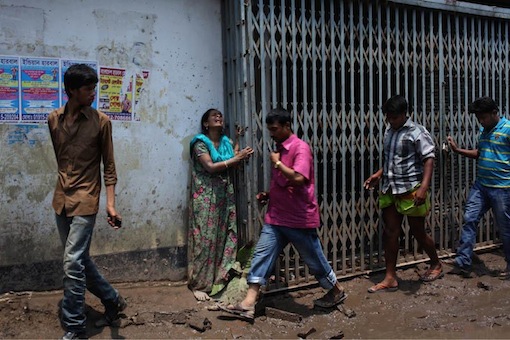
We also witnessed the impact of low-wage labor caused by the current global trade system that puts profits before people. The devastating building collapse in Bangladesh, where workers were pressured to work long hours and forced to enter the building in which exits were blocked, caused over 120 deaths, as these vivid pictures show.

Of course, low wage labor is a problem in the US as well. Les Leopold points out that ten hedge fund managers make us much as 196,000 nurses; and that one hour of work by a Wall Streeter takes 21 years of work for the rest of us. And, we saw this week how little Congress members care about the plight of US workers when only one member showed up at a congressional hearing on the long-term unemployed; and even when the embarrassing photo was tweeted, only a few more of the 19-member Joint Economic Committee joined the hearing.

All of this unfairness in the economy is pushing more and more people to look at worker owned coops. To assist those who are interested in co-ops, American Coop developed worker co-op start-up guides.

The dangers of big finance-based capitalism are also on display when it comes to our health. A report this week showed that the most widely used herbicide in the world, glyphosate or (Roundup), is linked to Parkinson’s, infertility and cancers. But, that is one of many examples of toxins in the air and water, in the walls of our homes and in our furniture. Poisons are in widespread use throughout our lives. In fact, this book shows that we are essentially guinea pigs for corporations that put profit over health. As more people become aware, across the country they are organizing to protect their health from unhealthy foods.

President Obama may not have realized it, but at a memorial service in West, Texas for the victims of the explosion, he showed how a health care system that puts profits ahead of health is a national tragedy when he said: “America needs towns that holds fundraisers to help folks pay the medical bills. . ..” Of course, if he merely improved and expanded Medicare to cover everyone, fundraisers would not be needed.

Already, our health has become even worse under Obama’s leadership. Research shows that austerity is hurting our health. In fact, cancer clinics are turning away patients and some are even closingbecause of the sequester. In addition, rising health care costs are keeping 43% of America’s working-age adults from going to the doctor. Health care has become so ugly in the United States that some describe it as sadism. As ObamaCare is implemented, things will get worse. Spending will increase for insurance premiums and out-of-pocket expenses, but don’t worry because Congress is on it. They are holding secret bi-partisan meetings to exempt lawmakers and their staff from the requirements of ObamaCare. On The Real News Network we explain how ObamaCare will continue to lead to bankruptcies, un-insurance, under-insurance and increasing costs.

One of the greatest examples of profits over the health of people and the planet is the continued carbon-nuclear energy economy. Investors and the political elite are virtually rejoicing at the possibility of the US becoming the ‘United States of Arabia’ because of non-traditional oil and gas, e.g. tar sands, hydro-fracking and methane hydrate (methane gas from the oceans). Most predict there will be more renewable energy in our future, but there will continue to be a dominance of carbon fuels, especially methane gas (don’t fall for calling it “natural” gas). The environmental and health effects of methane gasare not being reported.

Last quarter Exxon’s profits rose, but the company so far has avoided paying for any of the damages caused by the massive oil pipeline spill in Arkansas because of a technicality. The12,000 barrels of the more dangerous tar sands crude oil, diluted bitumen, that were leaked are not classified as oil, and companies transporting bitumen in pipelines are not required to pay into the federal Oil Spill Liability Trust Fund.

Of course, a prized option on the corporate duopoly’s table is creating a carbon market for big finance, but a report this week shows cap and trade schemes don’t work. And, when countries try to do the right thing – switch to clean sustainable energy and create a green new deal, like India, which is working to create 20,000 megawatts of solar power by 2022 as well as local jobs – US business interests and the government use trade laws to try and stop them.

As the truth comes out, more people are taking action to create clean and sustainable energy. Ten cities are joining the fossil fuel divestment campaign and are taking their money out of carbon fuel stocks.Los Angles has announced it will end the use of coal by 2025 (unfortunately doing so in part by relying on methane gas). And, we have more good news. A report found that the US could end reliance on oil, gas, coal and nuclear energy by 2050 and become an economy based solely on solar, wind and other clean, sustainable energies. Other studies have found that a carbon-free/nuclear-free energy economy could be accomplished by 2030.

We know what the problems are, and that solutions to them exist. We must continue to stay informed so that we are not fooled by corporate media. And we must continue to work in our communities on real alternatives that are based on our values. This week on Clearing the FOG, we spoke to people who are doing just that. Jeff Dicken, Paul Glover and Edgar Cahn shared their work on alternative currencies and economies that redefine work and build resilient communities.


Kevin Zeese JD and Margaret Flowers MD co-host Clearing the FOG on We Act Radio 1480 AM Washington, DC and on Economic Democracy Media, co-direct It’s Our Economy and are organizers of the Occupation of Washington, DC. Their twitters are @KBZeese and @MFlowers8.

This article is based on a weekly newsletter for ItsOurEconomy.us. To sign up for the free newsletter, click here.

The Fisher's Tale: Beached in Gaza


Jamal Ismail Faris Baker- The Fisherman’s Narrative

by Palestinian Center for Human Rights - PCHR

I can only give false assurances to my children”

Today, 1 May 2013, marks the International Labour Day, which commemorates peoples right to work, along with their protection of human rights in the work place. However, as the rest of the world celebrates this day, the situation of fishermen in the Gaza Strip continues to deteriorate.

Jamal Ismail Faris Baker (48) a fisherman from Gaza City with a family of 9, has been fishing for 35 years now and has witnessed the steady decline of the fishing industry in Gaza.

Life spiralled out of control for Jamal a few days after the conclusion of Israel’s military operation Pillar Of Defence on the Gaza Strip in November 2012.

Under the November 2012 ceasefire between the Israeli and Palestinian authorities, the fishing limit was supposedly extended from three nautical miles to six nautical miles. However, in March 2013, this fishing limit was reduced to the previous three nautical miles.

Jamal relished the opportunity of the extension of the fishing limit to six nautical miles in November 2012;

“We were very happy to hear the news that the fishing limit had been increased. We thought this would improve our situation. I borrowed my friend Talal’s fishing boat, so that we could fish in deeper waters.”

However, on the morning of 28 November 2012, Jamal’s boat was attacked and destroyed by an Israeli gunboat,

“That day my son Khader (19) and three other fishermen went fishing early in the morning. They went with a group of 4-5 other fishing boats. I was at the shores doing some work and waiting for them to return with the catch. Shortly after they set sail, my phone rang and my son told me that an Israeli gunboat was attacking our boat. I was shocked to hear that. I asked him what was happening there and he told me that they were just around 2 nautical miles from the shore and the Israeli forces were firing bullets at our boat. Khader told me that the motor of the boat was damaged in the firing. Suddenly the call disconnected. I thought that he had been injured in the attack.”

Jamal continues to say;

 “I then called my nephew who was on another one of the fishing boats. He told me that Khader and the other three fishermen had to jump in the seawaters because our boat had been destroyed in the attack. He told me that some fishing boats went to rescue them but he couldn’t see what was happening exactly. I was not concerned about the boat, I was scared about what had happened to my son, as my nephew couldn’t see him. In some more time two fishing boats returned to the shore and they brought the three other fishermen with them. That time I got really worried, as I couldn’t find Khader. I called my nephew again and this time he told me that Khader had been arrested by the Israeli forces.”

Khader spent 4 hours on the Israeli gunboat. Jamal’s anxiousness about his son’s well-being knew no bounds during that time, as he explains;

“I was so scared that I could not speak. My voice just did not come out of my mouth. During the incident some media persons and other people gathered around me and asked me about what was happening but I could not answer any of them. I was too worried to answer anyone’s questions. I just wanted Khader to come back safely. I thought they were going to take Khader to Ashdod, because that’s what they do to fishermen who get arrested. But after 4-5 hours I saw Khader coming back to the shores with the damaged boat. He was tired and scared because of the incident. I cannot tell you how relieved I was to see him. Luckily he was not injured in the attack.”

Jamal wants to know why his boat was attacked, but has not found any satisfactory answers;

 “Khader and other with him were only fishing. They were not even outside the 3-mile limit. I don’t understand why they were attacked.”

Since that terrible day Jamal or Khader have not been able to fish again;

 “After Khader returned we inspected the boat. It was completely destroyed and could not be used again. Luckily Talal did not pressure me to pay him for the boat, and he simply asked if Khader and others were ok. But along with the boat I lost all my fishing equipment, including the fishing rods, which cost around 10,000 Jordanian Dinars (approximately USD 14,000). Also I had taken the fuel and bate on credit. That cost around 4,000 shekels (approximately USD 1200). After the attack the creditors demanded the money from me, but I had absolutely nothing to pay them back. I hardly earned NIS 10-15 every day before they attacked the boat. After that day I have not earned a single penny. How can I pay them back? My creditors filed a complaint with the Gaza authorities. Because of the complaint I cannot go fishing now.”

The Gaza authorities have blacklisted Jamal and his family from fishing for not being able to pay their debts. Jamal expresses his frustration by saying, “what am I supposed to do now? Should I beg and steal to feed my family.”

After the incident Jamal had to borrow money from his brother to support his family;

“I took around 6000 shekels from my brother, but that is not sufficient to feed and take care of 10 people for six months. Khader and I cannot fish anymore and that is the only skill we have, so we cannot work anywhere else too. None of my other children are employed, and 4 of them are still in school. Other than this I have also taken debts from the markets as I just cant pay them. Today I owe around 10,000 shekels and I don’t know how I am going to pay anyone back.”

Jamal explains his family’s dire situation;

“I get very angry at my situation. My son Khader is 19 years old. He has friends who wear nice clothes, and eat good food at good places. When he sees this he feels very sad, but he doesn’t ask me for any money because he knows I cant provide anything. If I had something valuable I would have sold it to pay the debts. Also the roof of my house was cracked in the November attacks. When it rains the whole house gets filled with water. I cannot even get that repaired. My younger children ask me for fruits and sweets, but I cannot give them that. I can only give false assurances to my children.”

Jamal states his frustration for being abandoned by the Gaza authorities, “they do not help me. I get no aid, no food, no money from them. They will not let me work to repay my debts because of the money I owe”.

He also goes on to say that;

 “many fishermen receive help, but to get it you must know someone in power”

Israel’s attacks against Palestinian fishermen in the Gaza Strip, who do not pose any threat to the security of the Israeli naval forces, constitute a flagrant violation of international humanitarian and human rights law.

The fishing exclusion zone, maintained through arbitrary arrests and attacks, constitutes a measure of collective punishment, which is prohibited under Article 33 of the Fourth Geneva Convention.

The right to work, including in just and favourable conditions, is provided for under Article 23 of the Universal Declaration of Human Rights, as well as under Article 6 and 7 of the International Covenant on Economic, Social and Cultural Rights (ICESCR).

Moreover, Article 11 of the ICESCR recognizes "the right of everyone to an adequate standard of living for himself and his family, including adequate food, clothing and housing, and to the continuous improvement of living conditions."

Public Document

**************************************

For more information please call PCHR office in Gaza, Gaza Strip, on +972 8 2824776 - 2825893
PCHR, 29 Omer El Mukhtar St., El Remal, PO Box 1328 Gaza, Gaza Strip. E-mail: pchr@pchrgaza.org, Webpage

Egypt Destroying Gaza's Tunnel Lifeline

Egypt Destroys Border Tunnels With Gaza

by Saed Bannoura - IMEMC & Agencies

Thursday April 2nd 2013; The Egyptian TV reported that the Egyptian Border Police destroyed several border tunnels with the Gaza Strip, including tunnels meant for smuggling cars into Gaza.

According to the report, the Egyptian security forces located, two days ago, a tunnel that was used for smuggling weapons coming from Libya, and destroyed the tunnel after confiscating weapons and explosives that were about to be smuggled into Gaza.

Some of the destroyed tunnels were specifically designed to enable the smuggling of cars

Egypt also arrested seven Palestinians carrying large sums of money meant to be smuggled them into the coastal region.

On Tuesday, February 26, an Egyptian court ruled Tuesday that all border tunnels between the Gaza Strip and Egypt “must be closed and demolished, as they are draining the Egyptian economy and resources, in addition to the fact that some tunnels are used for smuggling weapons into Gaza”.

The ruling was made amidst an ongoing Egyptian campaign that demolished dozens of tunnels, and flooded them with toxic wastewater since the beginning of the year.

Earlier in January, the Egyptian Security Services announced that they managed to uncover a weapons’ storage facility loaded with advances missiles, including antitank and antiaircraft missiles that weapons dealers intended to smuggle into the Gaza Strip via border tunnels.

It is worth mentioning that at approximately 232 have been killed in tunnel collapse accidents, including twenty Palestinians who were killed after the Israeli army bombarded several tunnels as they were in them. Around 800 Palestinians have been injured in these incidents.

Tunnels are also used for smuggling urgently needed medical supplies and medications missing in Gaza Strip hospitals and medical centers due to the Israeli siege.

The siege has left Gazan hospitals and medical center out of basic and specialized supplies and equipment, an issue that has led to the death of more than 400 patients, including infants and children. Many patients died while waiting permits from Israel to cross the border for medical treatment.

Frackin' Right: Media Morons and Lying Pols' BS Spill in the Press

Wishful Fracking Thinking

by James Howard Kunstler - ClusterFuck Nation

Wishful thinking now runs so thick and deep across the USA that our hopes for a credible future are being drowned in a tidal wave of yellow smiley-face stories recklessly issued by institutions that ought to know better.

A case in point is the Charles C. Mann’s tragically dumb cover story in the current Atlantic magazine – “WE WILL NEVER RUN OUT OF OIL” * — setting out in great detail the entire panoply of techno-narcissistic “solutions” to our energy predicament.

Another case in point was senior financial writer Joe Nocera’s moronic op-ed in last week’s New York Times beating the drum for American “energy independence.”

You could call these two examples mendacious if it weren’t so predictable that a desperate society would do everything possible to defend its sunk costs, including the making up of fairy tales to justify its wishes. Instead, they’re merely tragic because the zeitgeist now requires once-honorable forums of a free press to indulge in self-esteem building rather than truth-telling.

It also represents a culmination of the political correctness disease that has terminally disabled the professional thinking class for the last three decades, since this feel-good propaganda comes from the supposedly progressive organs of the media — and, of course, the cornucopian view has been a staple of the idiot right wing media forever.

We have become a nation incapable of thinking, or at least of constructing a consensus that jibes with reality. In not a very few years, the American public will be so disappointed and demoralized by broken promises like these that they will turn the nation upside down and inside out, probably with violence and bloodshed.
Charles Mann’s Atlantic article begins by cheerleading for the mining of methane hydrates from the ocean floor. These are natural gas molecules trapped in ice formations in the muck around the continental shelves. Mann spotlights the efforts of a Japanese research ship conducting tests.

Guess what: the Japanese are engaging in this because they have absolutely no fossil fuels of their own, and a failing consensus about nuclear power, and they are on a course to become the first advanced industrial nation to be forced to return to a medieval economy. That is, they are the most desperate among the desperate. You could say they’ve got nothing to lose (but a few billion of their rapidly depreciating Yen).
Methane hydrates are stable only at extreme pressures or very low temperatures. They also exist in the arctic permafrost- for instance – Siberia, where conventional natural gas drilling operations have been carried out for decades, with no contributions from methane hydrates.

Undersea methane hydrate exploration projects have gone on for decades in the US, Canada, India, Russia, China, and Japan. The hope is that this so-called “hot ice” would turn out to be the gas equivalent of tar sands, which would mean at best a very expensive way to get more fossil fuels as the conventional sources dry up.

That hope has dimmed in nations other than extremely desperate Japan. Like a lot of techno-wonders, the recovery of methane hydrates can be demonstrated on the “science project” scale. For now, no viable technique exists for getting commercially-scaled streams of natural gas out of methane hydrates.
The Japanese themselves state that it would take at least ten years, if ever, to commercially mine methane hydrates. Japan doesn’t have ten years. It’s banking system is imploding, and without capital even the science projects will come to an end.

Charles Mann is equally rapturous about shale oil and gas. He writes:

“Today, though, fracking is unleashing torrents of oil in North Dakota and Texas–it may create a second boom in the San Joaquin Valley–and floods of natural gas in Pennsylvania, West Virginia, and Ohio. So bright are the fracking prospects that the U.S. may become, if only briefly, the world’s top petroleum producer. (“Saudi America,” crowed The Wall Street Journal. But the parallel is inexact, because the U.S. is likely to consume most of its bonanza at home, rather than exporting it.)”

This is very misleading. The US consumes roughly 19 million barrels a day. The Bakken and Eagle Ford shale formations produce about a million barrels a day combined now, and guaranteed to get a whole lot lower within the next five years.

Today’s near-peak production is based on furious drilling and fracking of extremely expensive wells — known as “the Red Queen syndrome”, because they are running as fast as they can to keep production up. Meanwhile, the depletion curve on shale oil is a reverse “hockey stick.”


The situation is similar for shale gas, the difference being that the temporary glut of 2005 – 2012 happened because we didn’t have the means to export surplus gas from the initial burst of development and it briefly flooded the domestic market. The price of shale gas is still below the level that makes it economic to produce and when it eventually rises to that level, and beyond, it will be too expensive for its customers to buy. Shale gas is also subject to the Red Queen Syndrome.

These arguments have been well-rehearsed many times in this blog and elsewhere. But the key to understanding our energy predicament is ignored in cornucopian cases like Charles Mann’s Atlantic piece, which is the role of capital.

Non-cheap oil has already worked its hoodoo on advanced industrial economies: it has already destroyed the process of capital formation.

These economies were not designed to run on non-cheap oil and they can’t… and the capital is no longer there for even the research-and-development to change out the infrastructure, let alone carry out any as-yet-undesigned changes.

Furthermore, there is no prospect that we can rescue the process of capital formation at the scale required to continue financing things like shale oil.

The absence of real growth in the USA, Europe, and Japan has already destroyed the operations of interest and repayment of debt, and any new debt issued will never be repaid, meaning it is functionally worthless (we just don’t know it yet). These impairments of capital formation have left the major commercial banks insolvent and central banks have worked tirelessly to rescue them by issuing more “money” in the form of credit that can never be paid back.

What all this means is that the capital does not exist to run non-cheap oil economies, or to continue indefinitely the production of non-cheap oil and gas, not to mention methane hydrates and other fantasy fuels.
JOE NOCERA’S OP-ED in last week’s New York Times was shorter and even dumber (and lazier) than Charles Mann’s foolish Atlantic article. It was based on remarks made by Canada’s Energy Minister, Joe Oliver, who said (among other patently false and idiotic things) that Canada “has the resources to meet all of America’s future needs for oil.”

Oliver was pimping for the Keystone pipeline project to transport tar sands byproducts from Alberta down to the US. Nocera swallowed everything Oliver said whole, such as “oil mined from the sands is simply not as environmentally disastrous as opponents like to claim.”

Is that so, Joe? And what’s your source for that assertion? Canada’s Energy Minister?

The slug at the bottom of Nocera’s column said he was invited onto the op-ed page because regular columnists Gail Collins and Nicholas Kristoff were off (or on book leave). Nocera’s column was disgracefully ignorant. The editors should send him back to the Times business section where unreality is the order-of-the-day.

Now, many people may draw the conclusion that some conspiracy is underway when the major mainstream media report the news so disingenuously, but that is just not so. The reason we, in effect, lie to ourselves incessantly is because of the master wish behind all the subsidiary wishes:

We want to keep driving to WalMart forever and we can’t imagine any other way of life let alone the way of life that the contraction of industrial economies is tending toward which is to say a way, way downscaled and re-localized economic life centered on farming and artisanal manufacture.

Yes, we are going medieval too, eventually, just like the Japanese, who will get there a little sooner than we will. It’s hard to swallow, I’m sure. That’s why we prefer the more digestible propaganda gummi bear treats like Charles Mann’s Atlantic article and Joe Nocera’s stupid op ed.


* This was the title on The Atlantic’s cover. Charle’s C. Mann’s article inside was titled “Why We Will Never Run Out of Oil.” Shame on the editors of The Atlantic.
____________________________________
For a complete list of books by James Howard Kunstler and purchase links, CLICK HERE.

Wednesday, May 01, 2013

Chile Student Demands Heat Up

"Generation Without Fear" Demands Free Education in Chile

by TRNN

A massive student demonstration raises demand to end economic policies created under Pinochet Dictatorship

Joe Fresh Must Die!

Joe Fresh Must Die!

by C. L. Cook - #JoeFreshMustDie!

May 1, 2013 
 
Why Joe Must Die.

The odious entity is one of a handful of corpse creating foreign corporations at the centre of the Rana Plaza factory collapse in Bangladesh.

On April 24th, 2013 the shoddily constructed, (and illegally altered) Rana Plaza, a sprawling industrial and retail complex employing thousands was ordered closed due to a five-story crack on the side of the building observed by authorities the day before. Most of the companies within Rana closed and sent staff home, but a few refused to obey the order, threatening their workers instead with loss of pay already hard-earned, and allegedly violence too, if they didn't get back to the machines. That action condemned hundreds to a terrible death, crushed beneath the rubble, and hundreds more to an anonymous and uncertain fate - missing and believed killed at work.

Thugs of Bangladesh: An Arrest in Dhaka

Among the Thugs

by VIJAY PRASHAD - CounterPunch

Delhi - “We are mere coolies working at the machines in these terrible times. We are mere dupes and fools to discover the diamond and to make a gift of it to the king, to adorn his crown.” – Nazrul Islam.

Photo by Taslima Akhter

Sohel Rana is a well-known figure in South Asia. He is the guy who, in my youth, would stand at the street-corner, holding court with a bunch of toughs, and offering his threatening ways as protection or intimidation for payment. As South Asian countries entered the pact of globalisation, the Sohel Ranas of the street-corner opened an office. They put up a signboard that said something like Property Dealer or Import-Export, they lost their cheap clothes for designer brands and handed out business cards to sharpen their image. Their clout came in handy for the main political parties, who hired them on to lead their youth wings and to deliver votes from the slumlands of the gradually overflowing cities. As neo-liberal policies became commonplace, these local thugs entered the real estate business, being given tracts of public land at throwaway prices by their grateful political benefactors. This land was either developed into housing or petty industry. Money was to be made from each. And this money strengthened the power of the local thug in his para (neighbourhood). He was a fish out of water as his Pajero went further and further from those few blocks. Locality was everything to him. There he was King. He was Rana.

Sohel Rana dropped out of school in Class 7. That was nothing to him. Now in his thirties, he had established himself in Savar, an industrial suburb of Dhaka. Rana’s father was a local businessman who cultivated favours from local politicians. But neither talent nor timing favoured him. His son knew how to play all sides to his advantage, and the onset of globalisation allowed him to dance around the narrowed political horizons of the political parties. When the Bangladesh National Party was in power, Rana was with them; when the Awami League came back, he headed its local youth wing. Ashrafuddin Khan Imu, one of Rana’s rivals in the Awami party told the Associated Press’ Farid Hossain and Tim Sullivan, “He doesn’t belong to any particular political party. Whatever party is in power, he is there.” Rana is an equal opportunity scoundrel, whose own ideology is power, and its cognate, money.

A local political enforcer handles the transit of political bribery from local businesses to the national political class. As the money slides through his arms, some falls into his pocket. That is probably how Rana financed the apartment building and commercial building that took him into the lucrative property development business. It is also likely that such primary accumulation through bribery allowed him to claim the land upon which he built Rana Plaza in 2010. That land was a swamp, and once more it is likely that Rana was able to circumvent whatever restrictions existed about building on wetlands through his local muscle. It is already known that he only had a permit to build a five-story building. He confidently built eight stories.

The day before the collapse of the building which has so far killed 371 people (with an additional 900 missing) Rana was informed about cracks in the walls. Three thousand two hundred people worked in five factories in this building. “The building has minor damages,” he told the press. “Nothing serious.” Local inspectors, an anaemic bunch in the face of such institutionalised thuggery, had warned that something terrible might happen. Such people are not taken seriously in neo-liberal times. They are the ones who warn of calamities and are said to misjudge the dynamic of history. When the “accident” occurs, as it did the next day, it is these soothsayers who are ignored in the flurry of reportage that wants to suggest that this could not have been foretold, or of establishment voices that would like to point to this Rana as the main culprit and not the system of which he is essentially a minor pillar.

Rana has been booked for a number of infractions, including Section 304 of Bangladesh’s Penal Code – this would be a life sentence if he were found guilty. No-body will stand by the petty thug. The Prime Minister Sheikh Hasina called for his arrest, and his political mentor, Murad Jang, Member of Parliament from Dhaka-19, which includes Savar, tried to say that he did not know him. The Bangladesh Garment Manufacturers and Exporters Association (BGMEA) disassociated itself from him, and of course the international firms along the global commodity chain hastened to say that they have never met him. The journey of someone like Rana from the street corner to the corner office to the corner prison is a familiar one. These are men who are as replaceable as the workers whose bodies are devoured by the garment machines. Loyalty to neither is necessary.

Payment for the deaths will rest with Rana. Arrears will not be collected higher up the commodity chain. At a press conference on Saturday, senior leaders of the BGMEA said that the impact of the tragedy had been “exaggerated.” It had created an “image crisis” for them. They want the building owner, Rana, to be prosecuted. They are not keen to have the factory owners in the dock. The November 2012 fire at Tazreen has only three managers in custody, while the owner is free and uncharged. The BGMEA wants to protect the owners, whose prosecutions woudl reflect badly on Brand Bangladesh. They are also the first line of defence of the commodity chain, with a frisson already passing from the rubble of Savar to the mansions of Gulshan and Bentonville.

The Ready Made Garment (RMG) workers of Bangladesh recognise that this arrest is significant but insufficient. On Saturday, they marched through Savar, Dhaka, Gazipur and Chittagong, unleashing their wrath at factories and cars. The police fired at them, but did not kill anyone. The energy among the RMG workers is clear. How it will run is unclear. Rana has been removed from his street corner. Others are ready to take his place. These old capillaries of thuggish power have thus far held in check the radicalisation of the workers, making them line-up behind the local brokers who ease their immediate consumption needs (water and electricity connections, a job for a child, a berth in a hospital) but who are barriers to any challenge to the status quo. Capitalist democracy on the ground requires this alliance of brutality and reform, of fascism and paternalism. It celebrates the Ranas of the world till it doesn’t; and then it simply replaces them.


Vijay Prashad’s new book, The Poorer Nations: A Possible History of the Global South,
is out this month from Verso Books.

Tuesday, April 30, 2013

Bangladesh's Wage Slaves Need More than Western Boycotts


Bangladeshi Workers Need More Than Boycotts

by Vijay Prashad


Garment labourers are already fighting for fairer conditions. The best the global north can do is support them in their struggle 
When news of the building collapse spread around Savar, not far from Dhaka, the capital of Bangladesh, workers streamed out of the poorly constructed factories ready to help with the rescue effort – and ready, too, to smash cars and barricade roads. They felt in equal parts compassion for their fellow workers and anger at the faceless system that grinds their daily lives into hours making garments and minutes for rest. Fear of police retribution did not stop them. They needed to be on the streets, to register their living humanity before a world that saw them only hunched over their machines or as dead bodies being pulled out of disasters. Workers with blood in their veins are an unfamiliar sight.

Factory owners hastened to shut down their subcontracting units and take refuge behind Atiqul Islam, the president of the Bangladesh Garment Manufacturers and Exporters Association (BGMEA). This man showed little care for the injured and the dead. He worried about "the disruption in production owing to unrest" and said that this worker violence was "just another heavy blow to the garment industry". One expects such officials to be discomfited by idle factories and restive workers. Every second that the machines are silent costs them money. Benevolence is a costly business.

Trade unionism and left political activity had deep roots in Bangladesh at its birth in 1971. In what had been an eastern province of Pakistan, centres of anti-colonial struggle morphed into labour and socialist movements. Out of these currents rose the Awami League of Sheikh Mujibur Rahman, which led the charge towards independence. That legacy remains in the calendar: May Day is a national holiday.

However, privatisation of industry and state operations began in earnest in 1975, and picked up steam in the 1980s. That was the period when the government decided that Bangladesh was to become a link on the global commodity chain for garment manufacturing, which now accounts for 80% of its export earnings. Export Processing Zones (EPZs) were established, where labour organisations were banned. This attracted multinational garment firms to Bangladesh, and they made arrangements with local subcontractors – who in turn controlled the production on very tight margins. The only outlet for workers' grievances at the miserable conditions they were forced to endure was the anarchic outbreak of violence. This was how employees expressed their anger – and it provided both factory managers and the government with an excuse to tighten their repressive hold on the lives of workers.

The credit crunch that started in 2007 dented the export-led model favoured by the Bangladeshi state. A slowdown in the shops in the global north led to the sacking of a quarter of the workers in Dhaka's EPZs. Over the past two years, Bangladeshi workers have taken to the streets to protest about the dismissals of their colleagues.

Workers in Ashulia walked out because one of their own – reported as "Salman" – had been taken into custody. Their protest was met with police force, and one man was shot dead. Workers in Narayanganj went on strike after one of the firms fired 126 workers. When the leaders of the strike were attacked by thugs believed to have been hired by the factory owners, the workers responded by demolishing Kolapatti, a marketplace where the thugs had their HQ. As this struggle unfolded, the Tazreen Garment Factory in Ashulia went up in flames, killing 125 workers. Thousands more took to the streets in anger, demanding the heads of the owners and safer working conditions.

These actions are not a new phenomenon, but draw on labour militancy dating back to the 1920s. In those early years workers' movements could grow out of spontaneous resistance. However, that is harder now due to anomic working conditions in which unions are tough to organise and police repression is intense. Following last year's Ashulia and Narayanganj riots, the government created a crisis management cell and a force of industrial police – but not to monitor labour laws. Their task was to spy on worker organisations.

Despite the difficulty of attracting underpaid and exhausted workers to union meetings, the National Garment Workers' Federation and the Communist-led Garment Workers' Trade Union Centre are still active. NGOs have also entered the fray, notably the Bangladesh Centre for Worker Solidarity, an initiative backed by US unions. However, this backing is no protection: the centre's chief organiser, Aminul Islam, was murdered last year.

Dan Mozena, the US ambassador to Bangladesh, told the BGMEA last June that if it were seen to ignore labour rights it could "coalesce into a perfect storm that could threaten the Bangladesh brand in America".

The reaction in the global north to the latest "accident" in Bangladesh has been to talk about boycotts – to break the global commodity chain at the point of consumption. But that is not enough. What is needed is robust support for the workers as they try to build their own organisations at the point of production. Pressure on north Atlantic governments that mollycoddle multinational firms would create a breathing space for workers who otherwise suffer the full wrath of firms that couch their repression in the syrupy language of hard work and growth rates.

The Bangladeshis are capable of doing their own labour organising; what they need is political backing to do so. What is also needed, then, is clear-cut opposition not to this or that retailer, but to the system that produces pockets of low-wage economies in the south in order to feed a system of debt-fuelled consumption in the north. None among us is against global connections, but it is high time we put our minds to work to reject neoliberal globalisation.

The Life and Death of Words and What Sherlock Holmes Never Said

The Life and Death of Words, People, and Even Nature: From Walking Libraries and a God Named “Word” to What Sherlock Holmes Never Said

by Eduardo Galeano - TomDispatch

Memory on Legs
(January 3)

On the third day of the year 47 BC, the most renowned library of antiquity burned to the ground.

After Roman legions invaded Egypt, during one of the battles waged by Julius Caesar against the brother of Cleopatra, fire devoured most of the thousands upon thousands of papyrus scrolls in the Library of Alexandria.

A pair of millennia later, after American legions invaded Iraq, during George W. Bush’s crusade against an imaginary enemy, most of the thousands upon thousands of books in the Library of Baghdad were reduced to ashes.

Throughout the history of humanity, only one refuge kept books safe from war and conflagration: the walking library, an idea that occurred to the grand vizier of Persia, Abdul Kassem Ismael, at the end of the tenth century.

This prudent and tireless traveler kept his library with him. One hundred and seventeen thousand books aboard four hundred camels formed a caravan a mile long. The camels were also the catalogue: they were arranged according to the titles of the books they carried, a flock for each of the thirty-two letters of the Persian alphabet.

[The following passages are excerpted from Eduardo Galeano’s new book, Children of the Days: A Calendar of Human History (Nation Books).]

Tomgram: Eduardo Galeano, Not So Elementary, My Dear Watson

[Note for TomDispatch Readers: First, a confession. Whenever I read a new Eduardo Galeano book, I drive my wife crazy. I can’t help myself. I wander out every five minutes, saying, “You’ve got to hear this.” And then I read her some moving, dazzling passage, and disappear, only to reappear five minutes later, saying, “You’ve got to hear this.” The arrival of a new book by one of our great writers is always an event. This is publication day for his latest work, Children of the Days: A Calendar of Human History. It follows Mirrors, his history of humanity in 366 well-chosen episodes. You might think of his latest volume as a prayer book for our time: a page a day for 365 days focused on what’s most human and beautiful, as well as what’s most grasping and exploitative, on this small, crowded planet of ours. I would be urging all of you to celebrate the event and buy copies under any circumstances. (Confession: once, long ago in another life, I was Galeano’s U.S. editor and when his Memory of Fire trilogy burrowed into our North American landscape and refused to leave, it was among the best moments of my book publishing life.) Today, however, is a double celebration for me, because Galeano, the single most charismatic (and modest) man I’ve ever met, appears at TomDispatch for the first time. I've chosen six “days” from his new book, just a taste of the year’s worth of pleasures between its covers. What follows is a little introduction in imitation of his distinctive style. Tom]

As a teenager, you dreamed of being a writer and I imagine you dream of it still. When young, you were a cartoonist and, ever since, you’ve noted the exaggeration in our world. You were the editor-in-chief of a newspaper and, with the skills you honed, you’ve never stopped editing our history -- from our first myths to late last night. You were imprisoned and it left you with an understanding of how we’ve imprisoned this planet and its inhabitants. You went into exile and so grasp the way many in this uprooted world of ours never feel, or are allowed to feel, at home.

You’ve traveled this planet so widely that, as a friend of yours once told you, “If it’s true what they say about the road being made by walking, you must be the commissioner of public works.” And on those travels, you’ve discovered that boundaries between states (and states of mind) are not to be trusted, so as a writer you’ve never felt cowed by categories or hesitated to merge journalism, history, scholarship, and the thrilling feel of fiction, of recreating other worlds so intensely that we seem to inhabit them ourselves.

And none of this would have happened if your youthful dream -- to be a soccer player -- had come true. Instead, you’ve played "the beautiful game" on the page. You’ve even explained our unjust, unequal world by noting the only place where North and South meet on “an equal footing” -- a soccer field at the mouth of the Amazon River that the Equator cuts right through, “so each team plays one half in the South and the other half in the North.”

You’re so well known in Latin America that, when Venezuelan President Hugo Chavez met President Barack Obama, the only gift he chose to give him was a copy your early book Open Veins of Latin America, whose subtitle explains why it remains so relevant 42 years after its publication: “five centuries of the pillage of a continent.”

Your work has been translated into 28 languages, which is undoubtedly part of the reason you mourn the loss of words on this planet. You have a way of finding people. Your first English translator, Cedric Belfrage, was a former British journalist who covered the silent movies in Hollywood for the Beaverbrook press, helped found the left-wing National Guardian in the U.S., was deported in the McCarthy period, and ended up in Mexico. You seem to have known everyone who was anyone, for better and sometimes worse, over the last several thousand years, and many who could have been someone if their circumstances and the powers-that-be hadn’t made that impossible. You've taken us with you to visit Sor Juana Inés de la Cruz as she first enters a convent in “New Spain,” studies “the things God created” that were forbidden to women, is set upon by the Inquisition, forced to renounce literature, and “chooses silence, or accepts it, and so America loses its best poet.”

You’ve been with Ben Franklin as he sends up a kite and discovers “that heavenly fires and thunders express not the wrath of God but electricity in the atmosphere,” while his sister Jane “resembling him in talent and strength of will,” has a child every two years and toils raising those that live, forgotten by history, but not by you. You’ve been with Joseph Stalin’s son Yakov, after his suicide attempt, when his father standing at his hospital bedside tells him, “You can’t even get that right.”

You somehow take our embattled world and tell its many stories in ways no one else can. And perhaps because people sense the storyteller in you, they regularly -- I’ve seen this myself -- come up to you and spill their guts. So one more volume from you, Children of the Days: A Calendar of Human History, a daily prayer book for our moment, is cause for elation. We should celebrate you for stealing the fire of the gods, like the Cakchiquels, descended from the Mayas, who reputedly hid it “in their mountain caves,” or in your case, in your books which, from Open Veins to Children of the Days, burn ever bright. Tom


The Life and Death of Words, People, and Even Nature: From Walking Libraries and a God Named “Word” to What Sherlock Holmes Never Said

by Eduardo Galeano

Civilizing Mother
(January 23)

In 1901, the day after Queen Victoria breathed her last, a solemn funeral ceremony began in London.

Organizing it was no easy task. A grand farewell was due the queen who gave her name to an epoch and set the standard for female abnegation by wearing black for forty years in memory of her dead husband.

Victoria, symbol of the British Empire, lady and mistress of the nineteenth century, imposed opium on China and virtue on her own country.

In the seat of her empire, works that taught good manners were required reading. Lady Gough’s Book of Etiquette, published in 1863, established some of the social commandments of the times: one must avoid, for example, the intolerable proximity of male and female authors on library shelves.

Books could only stand together if the authors were married, such as in the case of Robert Browning and Elizabeth Barrett Browning.

The World Shrinks
(February 21)

Today is International Mother Language Day.

Every two weeks, a language dies.

The world is diminished when it loses its human sayings, just as when it loses its diversity of plants and beasts.

In 1974 Angela Loij died. She was one of the last Ona Indians from Tierra del Fuego, way out there at the edge of the world. She was the last one who spoke their language.

Angela sang to herself, for no one else, in that language no longer recalled by anyone but her:

I’m walking in the steps
of those who have gone.
Lost, am I.

In times gone by, the Onas worshipped several gods. Their supreme god was named Pemaulk.

Pemaulk meant “word.”

Fame Is Baloney
(April 23)

Today, World Book Day, it wouldn’t hurt to recall that the history of literature is an unceasing paradox.

What is the most popular scene in the Bible? Adam and Eve biting the apple. It’s not there.

Plato never wrote his most famous line: “Only the dead have seen the end of war.”

Don Quijote de la Mancha never said: “Let the dogs bark, Sancho. It’s a sign we are on track.”

Voltaire’s best-known line was not said or written by him: “I do not agree with what you have to say, but I will defend to the death your right to say it.”

Georg Wilhelm Friedrich Hegel never wrote: “All theory is gray, my friend, but green is the tree of life.”

Sherlock Holmes never said: “Elementary, my dear Watson.”

In none of his books or pamphlets did Lenin write: “The ends justify the means.”

Bertolt Brecht was not the author of his most oft-cited poem: "First they came for the Communists / and I didn’t speak out because I wasn’t a Communist..."

And neither was Jorge Luis Borges the author of his best known poem: "If I could live my life over / I would try to make more mistakes..."

The Perils of Publishing
(April 24)

In the year 2004, for once the government of Guatemala broke with the tradition of impunity and officially acknowledged that Myrna Mack was killed by order of the country’s president.

Myrna had undertaken forbidden research. Despite receiving threats, she had gone deep into the jungles and mountains to find exiles wandering in their own country, the indigenous survivors of the military’s massacres. She collected their voices.

In 1989, at a conference of social scientists, an anthropologist from the United States complained about the pressure universities exert to continually produce: “In my country if you don’t publish, you perish.”

And Myrna replied: “In my country if you publish, you perish.”

She published.

She was stabbed to death.

Nature Is Not Mute
(June 5)

Reality paints still-lifes.

Disasters are called natural, as if nature were the executioner and not the victim.

Meanwhile the climate goes haywire and we do, too.

Today is World Environment Day. A good day to celebrate the new constitution of Ecuador, which in the year 2008, for the first time in the history of the world, recognized nature as a subject with rights.

It seems strange, this notion that nature has rights as if it were a person. But in the United States it seems perfectly normal that big companies have human rights. They do, ever since a Supreme Court decision in 1886.

If nature were a bank, they would have already rescued it.
 
 
Eduardo Galeano is one of Latin America’s most distinguished writers. He is the author of Open Veins of Latin America, the Memory of Fire Trilogy, Mirrors, and many other works. His newest book, Children of the Days: A Calendar of Human History (Nation Books) has just been published in English. He is the recipient of many international prizes, including the first Lannan Prize for Cultural Freedom, the American Book Award, and the Casa de las Américas Prize.

Mark Fried is the translator of seven books by Eduardo Galeano including Children of the Days. He is also the translator of the recently released Firefly by Severo Sarduy. He lives in Ottawa, Canada.

Follow TomDispatch on Twitter and join us on Facebook or Tumblr. Check out the newest Dispatch book, Nick Turse’s The Changing Face of Empire: Special Ops, Drones, Proxy Fighters, Secret Bases, and Cyberwarfare.

Copyright 2013 Eduardo Galeano

This post is excerpted from Children of the Days: A Calendar of Human History Copyright © 2013 by Eduardo Galeano; translation copyright © 2013 by Mark Fried. Published by Nation Books, A member of the Perseus Group, New York, NY. Originally published in Spanish in 2012 by Siglo XXI Editores, Argentina, and Ediciones Chanchito, Uruguay. By permission of Susan Bergholz Literary Services, New York City, and Lamy, N.M. All rights reserved.