Monday, May 13, 2013

Middle East Blowbacks to Come

Mideast Backlashes Yet to Come

By Sharmine Narwani - Sandbox

The Middle East is treading water these days. Two years of rhetoric about ousting dictators, revolution, freedom, honor, dignity, and democracy – without result – has people on edge, their disillusionment now demanding an outlet.

There are no outlets though. Sensing the fast-growing disenchantment with undelivered promises, even the “bright new leaders” are tightening the reins and demanding compliance.

These new heads of state simply can’t deliver the goods for one main reason: they are just as caught up in global and regional power contests as were their predecessors. Nothing has changed with these uprisings – nothing.

Except now the stakes are higher than before. A recession-bound West, the fast-rising BRICS and their respective regional allies are locked in a competition to consolidate power and influence in this important region before it finds its bearings.

The relatively new influencers on the Arab scene like Qatar and Turkey have recognized this as a unique opportunity to slip into region-wide leadership roles. For the entrenched old hands – Washington, Riyadh, Paris, London – a race is on to prevent the region from shrugging off their decades-long dominance and embracing the anti-imperialism of the Resistance Axis.

The result has been an onslaught of interventions. Every tool in the arsenal has come out to play. Money, espionage, propaganda, weapons, assassination and that old colonial trick: divide-and-rule.

The main game is still the old battle of the blocs, Iran versus the United States, with everyone else filing in line behind their team. There have been a few surprises thrown into the mix: the newcomers like Turkey and Qatar have moved over to the US side; the BRICS, however, have lent their considerable clout to team Iran. Iraq has moved behind the latter formation and Hamas still doesn’t know where to stand so it straddles the two.

This is not a game for the faint-hearted, and it permeates every major social, economic, and political decision in the region today. Want a new electrical plant outside Cairo, Beirut, or Kirkuk? Good luck choosing a national supplier who doesn’t offend. IMF loan? Allowing over-flights or passage for ships? Inking a trade deal? Formulating a new constitution? Scheduling a football match?

Mideast states are now paralyzed and polarized over such things, and governance has come to a standstill. But in this paralysis lies a dangerous volatility: a backlash in the brewing, a pressure cooker about to blow.

The Backlash Against Neo-Islamists

After decades of oppression and marginalization by pro-West, secular dictatorships, the Muslim Brotherhood (Ikhwan) and similar Islamist parties have catapulted to power and prominence in several states. Quite counter-intuitively, however, these Islamist governments appear to have lined up behind the US bloc, eager to please, or at least placate, the very powers that colluded in their oppression.

It is an unnatural marriage, and the longer this union endures, the more estranged Islamist parties will become from their domestic constituencies – in much the same way as their autocratic predecessors.

There is volatility in this balancing act between the two blocs, as groups like Hamas have come to discover. But for the new Islamist powerhouses in “post-revolution” states, yet another volatile contest is being played out to their detriment, this time on an entirely regional level: Qatar versus Saudi Arabia – or Sunni versus Sunni.

For years the Ikhwanists have been backed by the Qatari arrivistes, who are a thorn in the side of the other, larger Wahhabi state in the Arab world, Saudi Arabia. The Saudis, for their own part, are throwing dollars and clout behind Salafists in all the countries where they intend to counter the influence of the Ikhwan and similar parties.

But Qatar and Saudi Arabia are now aggressively exporting their very personal competition to other Arab states – Libya, Egypt, Syria, Tunisia, Palestine – creating what I believe will evolve into a ferocious backlash among local populations, even as they reap the rewards of direct financial investment from these two Gulf states.

This competition has drawn in others like the UAE, Jordan, and Kuwait, appalled at the Qatari push to Ikhwanize the region. And it has turned the Arab League positively cannibalistic, devouring the sovereignty and territorial integrity of states like Libya, Syria, and Palestine that it once pledged to protect.

Qatar finds support from AKP-led Turkey in this fight, but the two are a cause for concern in the United States, which secretly suspects that Ikhwanists are harder to control than Saudi-backed Salafists. Much of this fear is because that lynchpin of all US foreign policy calculations, the state of Israel, borders Ikhwan-heavy Egypt, Gaza, and Jordan – none of which have yet sufficiently proven their loyalty to the idea of Israel’s regional hegemony.

But the biggest victim of the Saudi-Qatari competition to influence the direction of political Sunnism is likely to be political Islam itself.

The rise of political Islam – once an inevitable byproduct of democratization – arrived too hard, too fast; too aggressively championed, organized, and weaponized by Qatar and Saudi Arabia. Now, not only have the mentors lost credibility and support, but so have many of their political protégés in Yemen, Egypt, Tunisia, Libya, Syria, and Palestine.

Volatility? We haven’t even started.

What yesterday’s global powerbrokers seek from the incoming class of political Islamists is the maintenance of the status quo, including, among other things, embracing Israel and rejecting Iran. But an open pledge of allegiance to Israel is impossible for the Ikhwan and similar parties – their very legitimacy comes in part from denouncing the legitimacy of the Zionist experiment in Palestine.

Nothing tested their limits as dangerously as last November’s eight days of rocket-volley between Gaza and Israel. Each passing day drove home the fact that, despite their standard rhetoric to domestic and regional constituencies, Islamist heads of state in Turkey, Egypt, and Qatar were rendered paralyzed – and mute – as the Israeli army pounded Gaza.

Instead, it was firepower, training and strategic planning by Iran, Hezbollah, and Syria that propped up defiant Palestinians through those dark hours. The unexpected arsenal of rockets that countered Israeli aggression came from Hamas’ Qassam Brigades, Palestinian Islamic Jihad (PIJ), and other smaller resistance groups, who became the heroes of that conflict.

Not one missile, bullet, or slogan came from the three new Qatari, Turkish, and Egyptian “Sunni kings” vying for power on the coattails of the Arab uprisings.

Had the battle gone on for another week or two, the entire Middle East might have been reconfigured in its aftermath. Never have the Israelis so quickly signed a ceasefire agreement.

The global battle of the blocs and the inter-regional Sunni power struggle crossed paths in that Gaza battle. In it, the US bloc and political Islam exposed their vulnerabilities. Both groups are currently upholding – against a tidal wave of popular sentiment – systems, values, and institutions that were supposed to be swept away by honor-and-dignity revolts. Any incident that highlights this fact can serve as a springboard for a backlash against the interests of the West and its Islamist allies in the region.

The Backlash Against Sectarianism

Shia versus Sunni. Christianity versus Islam. Vilifying the “other” is common in conflict, especially when there exists some historic animosity or tension between sects, nationalities, and communities.

But since the onset of the Arab uprisings there has been a concerted effort to escalate the Shia-Sunni divide and link it wholesale to an Iranian-Arab one.

With the loss of its dictators in Tunisia and Egypt, Washington wasted no time in formulating a divide-and-rule strategy to preserve its regional interests. The US military’s Central Command (CENTCOM) for the Middle East jump-started the task by initiating a secret exercise to divide Arabs and Iranians in March 2011.

Gulf-backed media channels dove headfirst into exaggerating the threat from Iran, while hardline clerics issued increasingly belligerent fatwas against the Shia. Against this backdrop, Shia civilians began to be targeted with violence throughout the region – with very little outcry or objection from the international community, so successfully have they been conflated with a “threatening” Iran and Hezbollah.

But as Christians began to be targeted, assaulted, and killed in Egypt and Syria, the issue of sectarianism exploded beyond the old, more common storylines, and has made avoidance of this subject impossible.

Dragging the sordid issue of sectarianism – which is invariably accompanied by extremism – into the light has had an interesting effect on regional discourse: most Arabs don’t want to be part of it in much the same way they rejected al-Qaeda a decade ago.

A recent Pew Research Center poll of Muslims worldwide reveals, among other things, that 85 percent of Muslims in the Middle East and North Africa view religious freedom for people of other faiths to be "a good thing." A majority of Muslims are "somewhat or very concerned" about Islamic religious extremism, while a minority of Muslims view Shia-Sunni tensions to be a problem at all. The poll indicates that religious strife remains a major cause for concern among Muslims in many MENA states, and that perceived hostilities between Muslims and Christians are on the high side in Egypt, but low in Lebanon, another country that has experienced these hostilities.

But even as sectarian tensions flare in various countries, the headlines do not tell the whole story. Many Arabs are rejecting these divisions, some of which is attributable to the shocking new level of violence now associated with sectarianism:

From Egypt to Kuwait, Bahrain to Syria, young Arabs are hearing – many for the first time – about women being raped because of their sect; about the cutting of heads, the hacking of limbs, the burning of bodies. This is not yesterday’s segregation of sects; this is the stuff of horror movies and genocidal sprees.

The backlash here has already begun. As violent sectarianism rises, so too does the realization that there is another discourse on the rise besides Shia versus Sunni or Muslim versus Christian.

Simply put, there is a new paradigm forming in the region that didn't exist when it was just Iraq suffering the consequences of violent sectarian carnage: Today, throughout the Middle East, "sectarian" Shia, Sunni, Muslims, and Christians are increasingly facing down "anti-sectarian" Shia, Sunni, Muslims, and Christians. The re-framing of this issue is crucial in undermining sectarian strife. It offers millions an alternative communal identity to the one that always forces them to "defend sect first."

Interestingly, one communal identity they are tending to embrace is a national identity, i.e., “I am Bahraini, not Shia or Sunni.”

In Bahrain, despite efforts to paint a two-year popular uprising as an "Iranian project" pitting the majority Shia population against a minority Sunni government, Bahrainis hoist their national flag at every opportunity to defy the negative sectarian characterizations of their "national" democratization project.

In Lebanon, where sectarianism is boiling in reaction to events in neighboring Syria, each incident has so far been thwarted by inter-sect efforts on a national level, and a growing desire among the population to empower the "national" army.

In Syria, widespread revulsion against what has to be the most violent manifestation of sectarianism in the region has morphed into a new language to define the conflict there: Instead of being pro or anti-government/opposition, many Syrians are now underlining their allegiance to Syria first. Despite the international media's partiality toward framing the Syrian conflict as a sectarian one, many pro-government and pro-opposition figures tend to reject this characterization outright. This is certainly notable among pro-government Syrians, many of whom have undergone a hasty conversion from political apathy to intense nationalism in a short time, and who reject being defined as “pro-Assad.”

“It is too limiting,” says one staunchly secular Syrian about that definition. “This is about my country and keeping it whole – it is not about a person or a government,” says another, an observant Sunni who backs her national army’s efforts to weed out mostly Islamist rebels.

The irony is that the very “sectarianism” encouraged by competing Islamists and their allies in pursuit of political objectives in the region may have spawned the backlash to hasten their demise. Nationalism has long been the enemy of political Islam in the Middle East, and nationalism can once more bury it.

Throughout the Arab world, minority sects and non-sectarian groups are being thrust together to protect against the more zealous elements of political Islam, giving form to important civil coalitions that will form the backbone of new grassroots opposition movements in these countries – previously a position held almost exclusively by Islamists.

The backlashes are here, now. They will target all the interventionists clinging on to the status quo, and those keeping progress at bay. They may grow incrementally and tentatively – or they may explode onto a national or regional stage one fine day. “More of the same” will only hasten their arrival.

And it’s okay. These “backlashes” will be the revolutions you thought we already had.


Sharmine Narwani is a commentary writer and political analyst covering the Middle East. You can follow Sharmine on twitter @snarwani.

Following the Clowns in the UK

'You Say What You Like, Because They Like What You Say'

by David Cromwell - Media Lens

The local elections in England earlier this month saw the right-wing UK Independence Party win over 140 council seats, gaining around 25 per cent of the vote where it stood. This led to a deluge of media headlines and stories echoing UKIP leader Nigel Farage's gleeful claim of a 'game changer' in domestic politics. The Conservatives ended up with egg on their face after veteran Tory Ken Clarke had labelled UKIP 'a collection of clowns'.

BBC political editor Nick Robinson declared of the UKIP 'surge':

'It is the day UKIP emerged as a real political force in the land.'

But a BBC estimate of the turnout was a mere 31 per cent – down a whopping 10 points from the last local elections in 2009. The true electoral 'victor' was voter apathy or, more likely, disdain towards the available political options. Perhaps for most of the public - such as the 69 per cent who didn't cast a vote - all too many of the politicians on offer were clowns. After all, who could tell the difference between most of them, or the policies they espouse? There are fine exceptions, but the corporate media routinely ignores, ridicules or vilifies them. So much for 'our' thriving British 'democracy'.

Comedian Frankie Boyle had already put it all in perspective:

'I've never been surprised by low voter turnouts. In fact, I'm surprised anybody ever votes at all. Politicians seem so alien to us, their insincerity taken as a given, behaving inhumanely while they pretend to be human in some symbolic way. If, instead of a nation, we were 500 people living as a tribe, or a bunch of survivors in a lifeboat, would anyone elect Miliband or Cameron as a leader, with their choppy hand gestures, lack of conviction and bizarrely automated range of emotions? In a normal social gathering, most of our leaders would seem to suffer from a hysterical personality disorder.' (Frankie Boyle, 'Work! Consume! Die!', HarperCollins, 2011, p. 319)

There is much more to the degradation of politics, as Boyle recognises, than odd self-regarding personalities and PR-trained, party-approved automatons. But the point is nonetheless very well made.

The Royal Green Trailblazer Arrives On A Train - A Journalist Swoons


The galling lack of genuine political choice is reflected in the sorry state of today's corporate journalism. In a recent astute piece, John Hilley draws a sharp distinction between real journalism, as practiced by the rare examples of John Pilger and Glenn Greenwald, and elite public-relations puff presented to the nation by the likes of the BBC's Nicholas Witchell. Here, for example, is Witchell on the visit of 'three young royals' – William & Kate, and Harry - to the Harry Potter film-set at Warner Brothers studios, 'doing things with that unaffected style that has become their hallmark.'

'These three', said Witchell, 'are becoming the principal supporting stars in the enduring family epic that is The Windsors.'

As the three 'stars' waved their Harry Potter wands for the benefit of the cameras, Witchell concluded oleaginously:

'The British monarchy has shown what a powerful spell it's capable of casting. And in these three, few can doubt that that spell remains in powerful hands.'

If someone wanted to write a satirical news script to accompany a royal visit, would it look much different from that?

Hilley goes on to recall a 2010 sighting of Witchell in the flesh. The royal correspondent was standing at Glasgow Central Station as he delivered a report on Prince Charles 'as we've never quite seem him before'. How so? The man who would be king had just arrived on a private royal train, 'run on bio-diesel', on a week-long 'green' rail tour. The royal aim, we were told, was 'getting people to reduce waste and conserve energy.' Clearly, a super-wealthy and privileged individual far removed from normal life, and sitting atop the country's highly stratified class structure, is the perfect person to show the way towards sustainability.

Hilley comments on the unreality of the 'news event':

'It was strange to see them both in the flesh, Mr Windsor, owner of Cornwall and much else, looking all eco-earnest as he was guided around by bowing lackeys, Witchell all sycophantically enthused as, on cue, he trotted-out cringing lines about "green-caring" royalty. [...] The whole scene was a perfect encapsulation of establishment posturing, royal branding and issue-cloaked reporting.'

He concludes:

'Watching Witchell's grovelling piece later, there was, predictably, no content or commentary on the real problem of corporate-driven climate catastrophe, or any suggestion of this being a "green-washed" event. The idea of having such balancing opinions from the BBC on this or the legitimising function of such royal PR was, apparently, unthinkable.'

But the degradation of journalism is, of course, not limited to vacuous propaganda that shores up the façade of benign royal interest in, and influence over, the great unwashed. In a recent edition of BBC's Newswatch, designed to give the illusion of BBC News really being held to account by the public, one viewer put it succinctly:

'I find it sad that there is a pecking order of the dead for the BBC.'

This was in the context of the the disproportionate coverage given to the bombings at the Boston marathon last month, with three people killed, and the subsequent manhunt. As another viewer pointed out:

'How many hundreds have died in bombings in Iraq just this month?'

Another commented:

'What about the earthquakes in Iraq and China? And bombings in Iraq, Afghanistan, Pakistan...?'

Referring to the deaths of hundreds of people (with the death toll later confirmed as over 1,000) after the collapse of an eight-storey commercial building in Bangladesh, in which garments were made for Western companies such as Primark and Matalan, one viewer said:

'Whether you intend it or not, the message you are giving loud and clear is that the lives of people in Boston are more important than those of the people of Bangladesh. This is disgraceful.'

Commenting on the saturation coverage from the US, another viewer asked bluntly:

'Is it because American lives matter more?'

James Stephenson, deputy head of BBC News and editor of both BBC News at Six and News at Ten, attempted to justify the disproportionate news treatment given to Boston. His response – that this was 'the first bombing on American soil since 9/11' – was factually correct. But it was unconvincing as an explanation of why the huge wall-to-wall BBC coverage from the US overshadowed what was going on elsewhere in the world around the same time. Simply put, if something happens in the United States, or involves the US, it matters more to the British media than anywhere else (other than in the UK itself). At a deep systemic level, media performance from the BBC, and other major Western news media, conforms to the general rule that minimal coverage is granted to 'Unpeople': those unfortunates, typically black or brown-skinned people in the 'Third World', who are 'expendable in the pursuit of power and commercial gain'. (Mark Curtis, 'Unpeople', Vintage, 2004, p. 2). Bizarrely, Stephenson shot himself in the foot when he mistakenly referred to the Bangladesh 'bombing' (rather than building collapse), a slip that went uncorrected.

Although critical viewer comments were read out, the senior BBC editor was not directly challenged by any member of the public, nor pressed particularly hard by Newswatch presenter Samira Ahmed. Instead, Stephenson was let off the hook without conceding any of the public's points put to him, or promising to change a single thing about BBC News coverage. That's par for the course. And so he continues to oversee the continuous pipeline of propaganda emanating from the BBC's flagship news bulletins.

The Endless Renewal Of 'Shadows And Threats'


Another feature of corrupted journalism is the constant unchallenged repetition of messages coming out of Western state and military sources. BBC Newsnight is a serial offender. In a recent edition (May 2, 2013) devoted to UK 'defence' spending and policy, presenter Gavin Esler set the terms of debate thus:

'The Cabinet Office website is clear: "National security is the first duty of government. We will remain a first-rate military power."'

Maintaining a straight face, Esler continued:

'But even as British troops begin to leave Afghanistan, there are new shadows and new threats.'

'Shadows' and 'threats' were conjured up, although there was no mention of any bogeymen, spectres or poltergeists. Esler's words recalled the brilliant quote by the American writer H. L. Mencken:

'The whole aim of practical politics is to keep the populace alarmed (and hence clamorous to be led to safety) by menacing it with an endless series of hobgoblins, all of them imaginary.'

The Orwellian apparatus of government power, bolstered by the media, must always fabricate 'new shadows and new threats' for the public to fear.

Esler then went on to ask, using the inevitable but rarely identified 'we' much loved by establishment reporters:

'So, should we ring-fence defence – as with the NHS or foreign aid – or be less ambitious in our foreign commitments?'

Note that an 'impartial' BBC professional must refer reflexively and blandly to 'our' foreign 'commitments' and 'ambitions'; never to illegal invasions and occupations of resource-rich countries, all to boost Western geostrategic and corporate aims.

Newsnight diplomatic and defence editor Mark Urban, fitted with brain cells that spark synaptically with elite-friendly thoughts, offered his own words of conventional wisdom:

'Just as Gordon Brown tried to demolish boom-and-bust economics, so the coalition came to power with a determination to rescue defence policy from its postwar pattern of trying to do too much, with too little, with periodic cuts to try and balance the books.'

Imagine summing up Britain's awful, murderous post-WW2 'defence policy' as 'trying to do too much, with too little'. Too much blood, spilled by too much machinery of death, was thereby reduced by Urban's weaponised soul to a mere logistical mismatch. Urban blight had struck the BBC news landscape once again. The underlying message from the Ministry of Truth – or BBC News, to give the institution its safe-sounding name - is, as ever:

'Just let us do your thinking for you and all will be well.'

The Synchronised Metronomes Of The Propaganda Machine

It all fits with the observation made by John Pilger that corporate journalists are 'the essential foot soldiers in any network devoted to power and propaganda.'

Obviously this isn't how the majority of influential journalists see themselves (or at least they would never admit to it) - all those smartly-dressed correspondents, news presenters and talking heads who appear before us with their ponderous phrasing and unnatural gestures, weighted down with apparent gravitas, authority and insight. The self-image they like to project is of smart, savvy and obstreperous professionals valiantly pursuing the truth; fierce rottweilers gnawing away at government spokespeople, politicians, establishment figures, trusted insiders and informers, public relations officials, press releases, historical facts and even gut instinct, until they get to the marrow of what matters. Nobody tells them, these serious media professionals, what they can and can't say. And don't even think of insulting them by suggesting otherwise.

So much for myth. In reality, young and independently-thinking journalists are transformed into synchronised metronomes churning out propaganda and meaningless pap, driven by the heartless machine pulse of state-corporate power. In a talk almost twenty years ago, the American political writer and media critic Michael Parenti explained powerfully how journalism works in practice:

'Oddly enough, if you talk to most reporters, most of the reporters I know who are giving me stories about censorship, about top-down control and all, are ex-reporters. They're often people - I began noticing, "Well I used to work for Associated Press...", or "Well, I used to work for CBS..." – "Well I used to..." The ones who are still in there absolutely vehemently deny that there's any such thing like this. They get very indignant. They say: "Are you telling me that I'm not my own man? I'll have you know that in 17 years with this paper I always say what I like." And I say to them: "You say what you like, because they like what you say."
'And, you know, the minute you move too far - and you have no sensation of a restraint on your freedom. I mean, you don't know you're wearing a leash if you sit by the peg all day. It's only if you then begin to wander to a prohibited perimeter that you feel the tug, you see. So you're free because your ideological perspective is congruent with that of your boss. So you have no sensation of being at odds with your boss.' ('Michael Parenti - Inventing Reality', YouTube, talk on 17 October 1993)

Parenti then goes on to quote Nicholas Johnson, former commissioner of the Federal Communications Commission, who said that there are four stages that journalists typically go through in their career:

'In the early stage, you're a young crusader and you write an exposé story about the powers that be, and you bring it to your editor and the editor says: "No, kill it. We can't touch that. Too hot."

'Stage two: You get an idea for the story, but you don't write it and you check with the editor first and he says: "No, won't fly. No, I think the old man won't like it. Don't do that, he has a lot of friends in there and that might get messy."

'Stage three: You get an idea for the story and you yourself dismiss it as silly.

'Stage four: You no longer get the idea for that kind of an exposé story.

'And I would add a stage five: You then appear on panels, with media critics like me, and you get very angry and indignant when we say that there are biases in the media and you're not as free and independent as you think.'

Perhaps when the BBC's John Simpson finally retires, or Channel 4's Jon Snow, or ITV's Mark Austin, or any of the other big beasts in the media jungle, they'll be brave and honest enough to make similar cogent observations about journalism.

In a new book, Digital Disconnect: How Capitalism Is Turning The Internet Against Democracy, media academic and activist Robert McChesney, points out that in the United States:

'so-called "real reporting [...] means: calling up Serious People in Washington and uncritically repeating what they say.' (The New Press, New York, 2013, p. 90; italics in original)

Again, of course, the equivalent happens here in the UK. Just watch and listen to the main political editors and journalists on BBC and ITV any day of the week.

Despite 'serious' journalists being pumped full of state, military and financial propaganda by their government, military and big business sources - and being expected by these sources to relay such messages uncritically to the public - and despite being complicit in war, violence and economic meltdown, McChesney correctly notes that:

'It seems the only time elite journalists exhibit rage is when their practices are exposed.'

He cites an honourable exception in the case of journalist Michael Hastings who famously wrote an eye-opening piece for Rolling Stone after spending considerable time with General Stanley McChrystal, then the senior Nato commander in Afghanistan:

' "The unwritten rule" for journalists is a simple one, Hastings wrote. "You weren't supposed to write honestly about people in power. Especially those the media deemed untouchable."' (McChesney, ibid., p. 90)

And those the media deem 'untouchable' include elite media institutions themselves. A recent article in Press Gazette notes a 'strong undercurrent of fear' amongst BBC employees. A survey of BBC employees, commissioned in the wake of the Jimmy Savile sex abuse scandal, has raised 'alarm bells about bullying and a culture of fear about speaking out.'

The authors of the survey report said:

'Throughout our conversations we heard a strong undercurrent of fear; fear of speaking out, fear of reprisal, fear of losing your job, being made redundant, fear of becoming a victim, fear of getting a reputation as a troublemaker and not getting promoted if an employee, or further work if a freelancer, supplier or contractor.'

Even – perhaps especially - the new BBC director general Tony Hall, is 'barred from making "any derogatory or unfavourable public remark or statement" about the BBC during his time in office or within two years of his departure.' Is it any wonder that the term 'Orwellian' appears ever more appropriate to describe this country's 'best' news organisation?

The BBC: 'Stuck In The Zionist Frame'


Meanwhile, another safe pair of hands has been found to replace Helen Boaden as head of BBC News. (Readers may recall that she famously changed her email address to avoid direct challenges from the public, boasting about it at a media industry conference). James Harding, who was the youngest ever editor of the Rupert Murdoch-owned Times, will soon take charge of 3,000-plus BBC News journalists as they settle into their 'capacious new home, which includes a double-atrium newsroom and 11 floors, in the £1bn New Broadcasting House refurbishment in central London.'

Harding has stated that:

'I am pro-Israel' and that in reporting on the Middle East, 'I haven't found it too hard' because 'The Times has been pro-Israel for a long time.'

Indeed, the recent case of Murdoch apologising for a Gerald Scarfe cartoon in the Sunday Times which actually dared to be critical of Israel is a case in point.

Amena Saleem of Palestine Solidarity Campaign notes that another new senior BBC appointee, James Purnell, who recently became 'Director of Strategy and Digital', is also avowedly pro-Israel. Purnell actually served as chair of the pro-Israeli parliamentary lobby group Labour Friends of Israel from 2002-2004.

Saleem also reports that last month the BBC 'gave up all claims to impartiality when it spectacularly pulled from its schedule a documentary questioning the scale of the Jewish exodus from Jerusalem nearly 2,000 years ago – the exodus on which Zionists base the Jewish "right to return" and to colonize what was once Palestine.' The documentary, scheduled to appear as part of the current BBC Four series on archaeology, was dropped at the eleventh hour. When questioned about this late and dramatic development, a BBC email offered the limp excuse that 'we have decided that it doesn't fit editorially and are no longer planning to show it as part of the season.'

But, adds Saleem, 'Ilan Ziv, the Israeli-born documentary maker who made the hour-long film, has said that the official reason given by the BBC for pulling the documentary contradicts the reasons given to him in private.' Ziv gives his side of the BBC's sudden dropping of the film, and the broadcaster's lack of candour in explaining its decision, summing up:

'This is ultimately a sad saga of what I believe is a mixture of incompetence, political naiveté [and] conscious or subconscious political pressure'.

Tim Llewellyn, the BBC's former Middle East correspondent, has seen it all before and he told Saleem:

'The BBC is now culturally and socially stuck in the Zionist frame. Whether this is fear of the Zionist lobby and its many friends in the three British political parties, sheer inbuilt prejudice, ignorance of the facts, history and nuances that every reporter, producer and editor should by now know, I am not sure. I suspect a combination of all three.'

James Harding, the incoming head of BBC News has already shown himself to be comfortable with this pro-Israel frame. As a former colleague said of Harding: 'He will fit in very well at the BBC.'


SUGGESTED ACTION

The goal of Media Lens is to promote rationality, compassion and respect for others. If you do write to journalists, we strongly urge you to maintain a polite, non-aggressive and non-abusive tone.


A Thank You Note

We would like to thank all our kind and generous supporters who responded to our recent appeal for funds. There were simply too many to thank individually.

Media Lens, by its nature, will likely always lead a precarious existence. Your continuing support is not something we take for granted, and we are very grateful to all our donors.

Sunday, May 12, 2013

Accessorizing the Genocide: Ronnie Raygun Wears Rios Montt

Ronald Reagan: Accessory to Genocide

by Robert Parry - ConsortiumNews

The conviction of former Guatemalan dictator Efrain Rios Montt on charges of genocide against Mayan villagers in the 1980s has a special meaning for Americans who idolize Ronald Reagan. It means that their hero was an accessory to one of the most grievous crimes that can be committed against humanity.

The courage of the Guatemalan people and the integrity of their legal system to exact some accountability on a still-influential political figure also put U.S. democracy to shame. For decades now, Americans have tolerated human rights crimes by U.S. presidents who face little or no accountability. Usually, the history isn’t even compiled honestly.

By contrast, a Guatemalan court on Friday found Rios Montt guilty of genocide and crimes against humanity and sentenced the 86-year-old ex-dictator to 80 years in prison. After the ruling, when Rios Montt rose and tried to walk out of the courtroom, Judge Yasmin Barrios shouted at him to stay put and then had security officers take him into custody.

Yet, while Guatemalans demonstrate the strength to face a dark chapter of their history, the American people remain mostly oblivious to Reagan’s central role in tens of thousands of political murders across Central America in the 1980s, including some 100,000 dead in Guatemala slaughtered by Rios Montt and other military dictators.

Indeed, Ronald Reagan – by aiding, abetting, encouraging and covering up widespread human rights crimes in El Salvador, Honduras and Nicaragua as well as Guatemala – bears greater responsibility for Central America’s horrors than does Rios Montt in his bloody 17-month rule. Reagan supported Guatemala’s brutal repression both before and after Rios Montt held power, as well as during.

Despite that history, more honors have been bestowed on Reagan than any recent president. Americans have allowed the naming of scores of government facilities in Reagan’s honor, including Washington National Airport where Reagan’s name elbowed aside that of George Washington, who led the War of Independence, oversaw the drafting of the U.S. Constitution and served as the nation’s first president.

So, as America’s former reputation as a beacon for human rights becomes a bad joke to the rest of the world, it is unthinkable within the U.S. political/media structure that Reagan would get posthumously criticized for the barbarity that he promoted. No one of importance would dare suggest that his name be stripped from National Airport and his statue removed from near the airport entrance.

But the evidence is overwhelming that the 40th president of the United States was guilty as an accessory to genocide and a wide range of other war crimes, including torture, rape, terrorism and narcotics trafficking. [See Robert Parry's Lost History.]

Green Light to Genocide

Regarding Guatemala, the documentary evidence is clear that Reagan and his top aides gave a green light to the extermination campaign against the Mayan Ixil population in the highlands even before Rios Montt came to power. Despite receiving U.S. intelligence reports revealing these atrocities, the Reagan administration also pressed ahead in an extraordinary effort to arrange military equipment, including helicopters, to make the slaughter more efficient.

“In the tortured logic of military planning documents conceived under Mr. Ríos Montt’s 17-month rule during 1982 and 1983, the entire Mayan Ixil population was a military target, children included,” the New York Times reported from Rios Montt’s trial last month. “Officers wrote that the leftist guerrillas fighting the government had succeeded in indoctrinating the impoverished Ixils and reached ‘100 percent support.’”

So, everyone was targeted in these scorched-earth campaigns that eradicated more than 600 Indian villages in the Guatemalan highlands. But documents from this period indicate that these counterinsurgency strategies predated Rios Montt. And, they received the blessing of the Reagan administration shortly after Reagan took power in 1981.

A document that I discovered in the archives of the Reagan Library in Simi Valley, California, revealed that Reagan and his national security team in 1981 agreed to supply military aid to Guatemala’s dictators so they could pursue the goal of exterminating not only “Marxist guerrillas” but people associated with their “civilian support mechanisms.”

This supportive attitude took shape in spring 1981 as President Reagan sought to relax human-rights restrictions on military aid to Guatemala that had been imposed by President Jimmy Carter and the Democratic-controlled Congress in the late 1970s. As part of that easing, Reagan’s State Department “advised our Central American embassies that it has been studying ways to restore a closer, cooperative relationship with Guatemala,” said a White House “Situation Room Checklist” dated April 8, 1981.

The document added: “State believes a number of changes have occurred which could make Guatemalan leaders more receptive to a new U.S. initiative: the Guatemalans view the new administration as more sympathetic to their problems [and] they are less suspect of the U.S. role in El Salvador,” where the Reagan administration was expanding military aid to another right-wing regime infamous for slaughtering its political opponents, including Catholic clergy.

“State has concluded that any attempt to reestablish a dialogue [with Guatemala] would require some initial, condition-free demonstration of our goodwill. However, this could not include military sales which would provoke serious U.S. public and congressional criticism. State will undertake a series of confidence building measures, free of preconditions, which minimize potential conflict with existing legislation.”

In other words, the Reagan administration was hoping that the U.S. government could get back in the good graces of the Guatemalan dictators, not that the dictators should change their ways to qualify for U.S. government help.

Soliciting the Generals


The “checklist” added that the State Department “has also decided that the administration should engage the Guatemalan government at the highest level in a dialogue on our bilateral relations and the initiatives we can take together to improve them. Secretary [of State Alexander] Haig has designated [retired] General Vernon Walters as his personal emissary to initiate this process with President [Fernando Romeo] Lucas [Garcia].

“If Lucas is prepared to give assurances that he will take steps to halt government involvement in the indiscriminate killing of political opponents and to foster a climate conducive to a viable electoral process, the U.S. will be prepared to approve some military sales immediately.”

But the operative word in that paragraph was “indiscriminate.” The Reagan administration expressed no problem with killing civilians if they were considered supporters of the guerrillas who had been fighting against the country’s ruling oligarchs and generals since the 1950s when the CIA organized the overthrow of Guatemala’s reformist President Jacobo Arbenz.

The distinction was spelled out in “Talking Points” for Walters to deliver in a face-to-face meeting with General Lucas. As edited inside the White House in April 1981, the “Talking Points” read: “The President and Secretary Haig have designated me [Walters] as [their] personal emissary to discuss bilateral relations on an urgent basis.

“Both the President and the Secretary recognize that your country is engaged in a war with Marxist guerrillas. We are deeply concerned about externally supported Marxist subversion in Guatemala and other countries in the region. As you are aware, we have already taken steps to assist Honduras and El Salvador resist this aggression.
“The Secretary has sent me here to see if we can work out a way to provide material assistance to your government. … We have minimized negative public statements by US officials on the situation in Guatemala. … We have arranged for the Commerce Department to take steps that will permit the sale of $3 million worth of military trucks and Jeeps to the Guatemalan army. …

“With your concurrence, we propose to provide you and any officers you might designate an intelligence briefing on regional developments from our perspective. Our desire, however, is to go substantially beyond the steps I have just outlined. We wish to reestablish our traditional military supply and training relationship as soon as possible.
“As we are both aware, this has not yet been feasible because of our internal political and legal constraints relating to the use by some elements of your security forces of deliberate and indiscriminate killing of persons not involved with the guerrilla forces or their civilian support mechanisms. I am not referring here to the regrettable but inevitable death of innocents though error in combat situations, but to what appears to us a calculated use of terror to immobilize non politicized people or potential opponents. …

“If you could give me your assurance that you will take steps to halt official involvement in the killing of persons not involved with the guerrilla forces or their civilian support mechanism … we would be in a much stronger position to defend successfully with the Congress a decision to begin to resume our military supply relationship with your government.”

In other words, though the “talking points” were framed as an appeal to reduce the “indiscriminate” slaughter of “non politicized people,” they embraced scorched-earth tactics against people involved with the guerrillas and “their civilian support mechanisms.” The way that played out in Guatemala – as in nearby El Salvador – was the massacring of peasants in regions considered sympathetic to leftist insurgents.

Reporting the Truth
U.S. intelligence officers in the region also kept the Reagan administration abreast of the expanding slaughter. For instance, according to one “secret” cable from April 1981 — and declassified in the 1990s — the CIA was confirming Guatemalan government massacres even as Reagan was moving to loosen the military aid ban.

On April 17, 1981, a CIA cable described an army massacre at Cocob, near Nebaj in the Ixil Indian territory, because the population was believed to support leftist guerrillas. A CIA source reported that “the social population appeared to fully support the guerrillas” and “the soldiers were forced to fire at anything that moved.”

The CIA cable added that “the Guatemalan authorities admitted that ‘many civilians’ were killed in Cocob, many of whom undoubtedly were non-combatants.” [Many of the Guatemalan documents declassified in the 1990s can be found at the National Security Archive’s Web site.]

Despite these atrocities, Reagan dispatched Walters in May 1981 to tell the Guatemalan leaders that the new U.S. administration wanted to lift the human rights embargoes on military equipment that Carter and Congress had imposed.

According to a State Department cable on Oct. 5, 1981, when Guatemalan leaders met again with Walters, they left no doubt about their plans. The cable said Gen. Lucas “made clear that his government will continue as before — that the repression will continue. He reiterated his belief that the repression is working and that the guerrilla threat will be successfully routed.”

Human rights groups saw the same picture, albeit from a less sympathetic angle. The Inter-American Human Rights Commission released a report on Oct. 15, 1981, blaming the Guatemalan government for “thousands of illegal executions.” [Washington Post, Oct. 16, 1981]

But the Reagan administration was set on whitewashing the horrific scene. A State Department “white paper,” released in December 1981, blamed the violence on leftist “extremist groups” and their “terrorist methods” prompted and supported by Cuba’s Fidel Castro.

Fully Onboard


What the documents from the Reagan Library make clear is that the administration was not simply struggling ineffectively to rein in these massacres – as the U.S. press corps typically reported – but was fully onboard with the slaughter of people who were part of the guerrillas’ “civilian support mechanisms.”

U.S. intelligence agencies continued to pick up evidence of these government-sponsored massacres. One CIA report in February 1982 described an army sweep through the so-called Ixil Triangle in central El Quiche province.

“The commanding officers of the units involved have been instructed to destroy all towns and villages which are cooperating with the Guerrilla Army of the Poor [the EGP] and eliminate all sources of resistance,” the report said. “Since the operation began, several villages have been burned to the ground, and a large number of guerrillas and collaborators have been killed.”

The CIA report explained the army’s modus operandi: “When an army patrol meets resistance and takes fire from a town or village, it is assumed that the entire town is hostile and it is subsequently destroyed.” When the army encountered an empty village, it was “assumed to have been supporting the EGP, and it is destroyed. There are hundreds, possibly thousands of refugees in the hills with no homes to return to. …

“The army high command is highly pleased with the initial results of the sweep operation, and believes that it will be successful in destroying the major EGP support area and will be able to drive the EGP out of the Ixil Triangle. … The well documented belief by the army that the entire Ixil Indian population is pro-EGP has created a situation in which the army can be expected to give no quarter to combatants and non-combatants alike.”

The reality was so grotesque that it prompted protests even from some staunch anticommunists inside the Reagan administration. On Feb. 2, 1982, Richard Childress, one of Reagan’s national security aides, wrote a “secret” memo to his colleagues summing up this reality on the ground:

“As we move ahead on our approach to Latin America, we need to consciously address the unique problems posed by Guatemala. Possessed of some of the worst human rights records in the region, … it presents a policy dilemma for us. The abysmal human rights record makes it, in its present form, unworthy of USG [U.S. government] support. …

“Beset by a continuous insurgency for at least 15 years, the current leadership is completely committed to a ruthless and unyielding program of suppression. Hardly a soldier could be found that has not killed a ‘guerrilla.’”

Rios Montt’s Arrival

But Reagan was unmoved. He continued to insist on expanding U.S. support for these brutal campaigns, while his administration sought to cover up the facts and deflect criticism. Reagan’s team insisted that Gen. Efrain Rios Montt’s overthrow of Gen. Lucas in March 1982 represented a sunny new day in Guatemala.

An avowed fundamentalist Christian, Rios Montt impressed Official Washington where the Reagan administration immediately revved up its propaganda machinery to hype the new dictator’s “born-again” status as proof of his deep respect for human life. Reagan hailed Rios Montt as “a man of great personal integrity.”

By July 1982, however, Rios Montt had begun a new scorched-earth campaign called his “rifles and beans” policy. The slogan meant that pacified Indians would get “beans,” while all others could expect to be the target of army “rifles.” In October, Rios Montt secretly gave carte blanche to the feared “Archivos” intelligence unit to expand “death squad” operations in the cities. Based at the Presidential Palace, the “Archivos” masterminded many of Guatemala’s most notorious assassinations.

The U.S. embassy was soon hearing more accounts of the army conducting Indian massacres, but ideologically driven U.S. diplomats fed the Reagan administration the propaganda spin that would be best for their careers. On Oct. 22, 1982, embassy staff dismissed the massacre reports as a communist-inspired “disinformation campaign.”

Reagan personally joined this P.R. spin seeking to discredit human rights investigators and others who were reporting accurately about massacres that the administration knew were true. On Dec. 4, 1982, after meeting with Rios Montt, Reagan hailed the general as “totally dedicated to democracy” and added that Rios Montt’s government had been “getting a bum rap” on human rights. Reagan discounted the mounting reports of hundreds of Mayan villages being eradicated.

In February 1983, however, a secret CIA cable noted a rise in “suspect right-wing violence” with kidnappings of students and teachers. Bodies of victims were appearing in ditches and gullies. CIA sources traced these political murders to Rios Montt’s order to the “Archivos” in October to “apprehend, hold, interrogate and dispose of suspected guerrillas as they saw fit.”

Despite these facts on the ground, the annual State Department human rights survey praised the supposedly improved human rights situation in Guatemala. “The overall conduct of the armed forces had improved by late in the year” 1982, the report stated.

Indiscriminate Murder

A different picture — far closer to the secret information held by the U.S. government — was coming from independent human rights investigators. On March 17, 1983, Americas Watch condemned the Guatemalan army for human rights atrocities against the Indian population.

New York attorney Stephen L. Kass said these findings included proof that the government carried out “virtually indiscriminate murder of men, women and children of any farm regarded by the army as possibly supportive of guerrilla insurgents.”

Rural women suspected of guerrilla sympathies were raped before execution, Kass said, adding that children were “thrown into burning homes. They are thrown in the air and speared with bayonets. We heard many, many stories of children being picked up by the ankles and swung against poles so their heads are destroyed.” [AP, March 17, 1983]

Publicly, senior Reagan officials continued to put on a happy face. In June 1983, special envoy Richard B. Stone praised “positive changes” in Rios Montt’s government, and Rios Montt pressed the United States for 10 UH-1H helicopters and six naval patrol boats, all the better to hunt guerrillas and their sympathizers.

Since Guatemala lacked the U.S. Foreign Military Sales credits or the cash to buy the helicopters, Reagan’s national security team looked for unconventional ways to arrange the delivery of the equipment that would give the Guatemalan army greater access to mountainous areas where guerrillas and their civilian supporters were hiding.

On Aug. 1, 1983, National Security Council aides Oliver North and Alfonso Sapia-Bosch reported to National Security Advisor William P. Clark that his deputy Robert “Bud” McFarlane was planning to exploit his Israeli channels to secure the helicopters for Guatemala. [For more on McFarlanes's Israeli channels, see Consortiumnews.com's "How Neocons Messed Up the Mideast."]

“With regard to the loan of ten helicopters, it is [our] understanding that Bud will take this up with the Israelis,” wrote North and Sapia-Bosch. “There are expectations that they would be forthcoming. Another possibility is to have an exercise with the Guatemalans. We would then use US mechanics and Guatemalan parts to bring their helicopters up to snuff.”

Hunting Children

What it meant to provide these upgrades to the Guatemalan killing machine was clarified during the trial of Rios Montt with much of the testimony coming from survivors who, as children, escaped to mountain forests as their families and other Mayan villagers were butchered.

As the New York Times reported, “Pedro Chávez Brito told the court that he was only six or seven years old when soldiers killed his mother. He hid in the chicken coop with his older sister, her newborn and his younger brother, but soldiers found them and dragged them out, forcing them back into their house and setting it on fire.

“Mr. Chávez says he was the only one to escape. ‘I got under a tree trunk and I was like an animal,’ Mr. Chávez told the court. ‘After eight days I went to live in the mountains. In the mountain we ate only roots and grass.’”

The Times reported that “prosecution witnesses said the military considered Ixil civilians, including children, as legitimate targets. … Jacinto Lupamac Gómez said he was eight when soldiers killed his parents and older siblings and hustled him and his two younger brothers into a helicopter. Like some of the children whose lives were spared, they were adopted by Spanish-speaking families and forgot how to speak Ixil.”

Elena de Paz Santiago, now 42, “testified that she was 12 when she and her mother were taken by soldiers to an army base and raped. The soldiers let her go, but she never saw her mother again,” the Times reported.

Even by Guatemalan standards, Rios Montt’s vengeful Christian fundamentalism had hurtled out of control. On Aug. 8, 1983, another coup overthrew Rios Montt and brought Gen. Oscar Mejia Victores to power.

Despite the power shift, Guatemalan security forces continued to murder with impunity, finally going so far that even the U.S. Embassy objected. When three Guatemalans working for the U.S. Agency for International Development were slain in November 1983, U.S. Ambassador Frederic Chapin suspected that “Archivos” hit squads were sending a message to the United States to back off even mild pressure for human rights.

In late November, in a brief show of displeasure, the administration postponed the sale of $2 million in helicopter spare parts. The next month, however, Reagan sent the spare parts anyway. In 1984, Reagan succeeded, too, in pressuring Congress to approve $300,000 in military training for the Guatemalan army.

By mid-1984, Chapin, who had grown bitter about the army’s stubborn brutality, was gone, replaced by a far-right political appointee named Alberto Piedra, who favored increased military assistance to Guatemala. In January 1985, Americas Watch issued a report observing that Reagan’s State Department “is apparently more concerned with improving Guatemala’s image than in improving its human rights.”

Reagan’s Dark Side


Despite his outwardly congenial style, Reagan – as revealed in the documentary record – was a cold and ruthless anticommunist who endorsed whatever “death squad” strategies were deployed against leftists in Central America. As Walters’s “Talking Points” demonstrate, Reagan and his team accepted the idea of liquidating not only armed guerrillas but civilians who were judged sympathetic to left-wing causes – people who were deemed part of the guerrillas’ “civilian support mechanisms.”

Across Central America in the 1980s, the death toll was staggering — an estimated 70,000 or more political killings in El Salvador, possibly 20,000 slain from the Contra war in Nicaragua, about 200 political “disappearances” in Honduras and some 100,000 people eliminated during the resurgence of political violence in Guatemala. The one consistent element in these slaughters was the overarching Cold War rationalization emanating from Ronald Reagan’s White House.

It was not until 1999, a decade after Ronald Reagan left office, that the shocking scope of the atrocities in Guatemala was comprehensively detailed by a truth commission that drew heavily on U.S. government documents declassified by President Bill Clinton. On Feb. 25, 1999, the Historical Clarification Commission estimated that the 34-year civil war had claimed the lives of some 200,000 people with the most savage bloodletting occurring in the 1980s. The panel estimated that the army was responsible for 93 percent of the killings and leftist guerrillas for three percent. Four percent were listed as unresolved.

The report documented that in the 1980s, the army committed 626 massacres against Mayan villages. “The massacres that eliminated entire Mayan villages … are neither perfidious allegations nor figments of the imagination, but an authentic chapter in Guatemala’s history,” the commission concluded. The army “completely exterminated Mayan communities, destroyed their livestock and crops,” the report said. In the northern highlands, the report termed the slaughter “genocide.” [Washington Post, Feb. 26, 1999]

Besides carrying out murder and “disappearances,” the army routinely engaged in torture and rape. “The rape of women, during torture or before being murdered, was a common practice” by the military and paramilitary forces, the report found. The report added that the “government of the United States, through various agencies including the CIA, provided direct and indirect support for some [of these] state operations.” The report concluded that the U.S. government also gave money and training to a Guatemalan military that committed “acts of genocide” against the Mayans. [NYT, Feb. 26, 1999]

During a visit to Central America, on March 10, 1999, President Clinton apologized for the past U.S. support of right-wing regimes in Guatemala dating back to 1954. “For the United States, it is important that I state clearly that support for military forces and intelligence units which engaged in violence and widespread repression was wrong, and the United States must not repeat that mistake,” Clinton said.

Despite the damning documentary evidence and now the shocking judgment of genocide against Rios Montt, there has been no interest in Washington to hold any U.S. official accountable, not even a thought that the cornucopia of honors bestowed on Ronald Reagan should cease or be rescinded.

It remains unlikely that the genocide conviction of Rios Montt will change the warm and fuzzy glow that surrounds Ronald Reagan in the eyes of many Americans. The story of the Guatemalan butchery and the Reagan administration’s complicity has long since been relegated to the great American memory hole.

But Americans of conscience will have to reconcile what it means when a country sees nothing wrong in honoring a man who made genocide happen.


Investigative reporter Robert Parry broke many of the Iran-Contra stories for The Associated Press and Newsweek in the 1980s. You can buy his new book, America’s Stolen Narrative, either in print here or as an e-book (from Amazon and barnesandnoble.com).

Out of Luck in the Nuclear Age

Nuclear Terror in the Middle East: Lethality Beyond the Pale

by Nick Turse  - TomDispatch

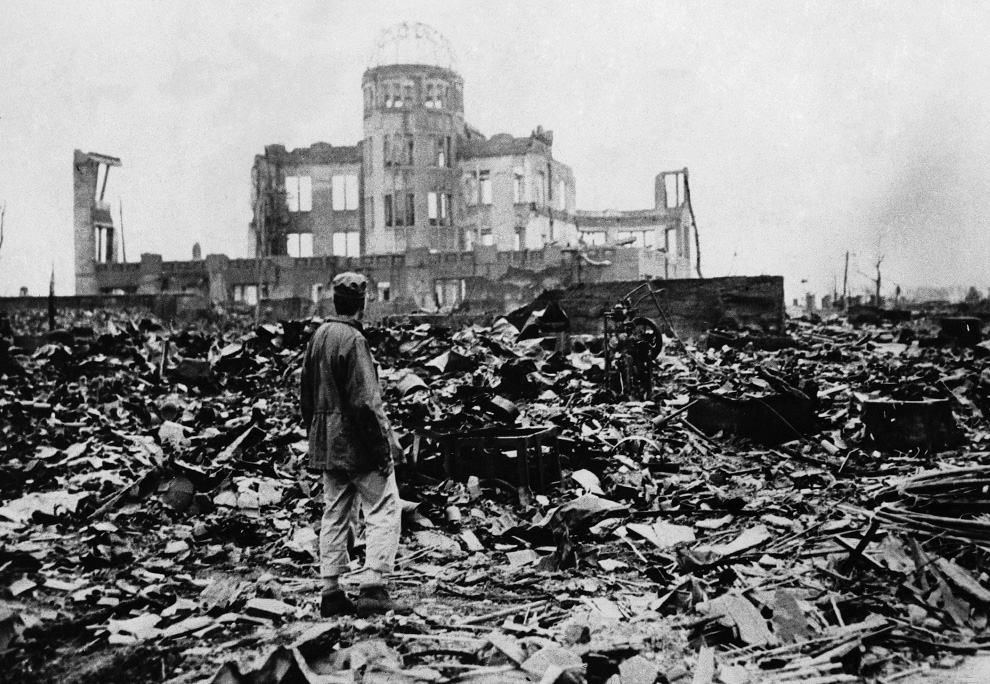
In those first minutes, they’ll be stunned. Eyes fixed in a thousand-yard stare, nerve endings numbed. They’ll just stand there. Soon, you’ll notice that they are holding their arms out at a 45-degree angle. Your eyes will be drawn to their hands and you’ll think you mind is playing tricks. But it won’t be. Their fingers will start to resemble stalactites, seeming to melt toward the ground. And it won’t be long until the screaming begins. Shrieking. Moaning. Tens of thousands of victims at once. They’ll be standing amid a sea of shattered concrete and glass, a wasteland punctuated by the shells of buildings, orphaned walls, stairways leading nowhere.

This could be Tehran, or what’s left of it, just after an Israeli nuclear strike. 
 
Tomgram: Nick Turse, Israel, Iran, and the Nuclear Freight Train

Has a weapon ever been invented, no matter how terrible, and not used? The crossbow, the dreadnought, poison gas, the tank, the landmine, chemical weapons, napalm, the B-29, the drone: all had their day and for some that day remains now. Even the most terrible weapon of all, the atomic bomb, that city-buster, that potential civilization-destroyer, was used as soon as it was available. Depending on your historical interpretation, it was either responsible for ending World War II in the Pacific or rushed into action before that war could end. In either case, it launched the atomic age.

During the Cold War, the two superpowers, the U.S. and the Soviet Union, relied on a strategy that used to be termed, without irony, “mutual assured destruction” or MAD. Its intent was simple enough: to hold off a planetary holocaust by threatening to commit one. With their massive nuclear arsenals, those two imperial states held each other and everyone else on the planet hostage. Each safely secured more than enough nukes to be able to absorb a “first strike” that would devastate its territory, leaving possibly tens of millions of its citizens dead or wounded, and still return the (dis)favor.

After the Soviet Union disappeared in 1991, nuclear weapons did, too -- without going away. The American and Russian arsenals, and the nuclear geography that underlay them, remained in place, just largely unremarked upon. In the meantime, the weaponry itself spread. In those years, the last superpower, which seldom discussed its own arsenal, selectively focused its energies on containing the spread of nuclear weaponry in three nations: the first was Pakistan some part of whose ever-growing nuclear arsenal it feared might fall into the hands of extreme Islamic fundamentalists in a land Washington was in the process of destabilizing via a war in neighboring Afghanistan and a CIA drone campaign in its tribal borderlands; the second was North Korea, a country encouraged in its quest for nuclear weapons by watching the U.S. take down two autocrats, Saddam Hussein and Muammar Qaddafi, who gave up their nuclear programs prior to U.S. interventions; and the third was Iran, which had a nuclear program (started by the U.S. in an era when the country was considered our bulwark in the Persian Gulf), but as far as anyone knows no plans to weaponize it. In the meantime, Washington (and so the American media) simply ignored the very existence of Israel’s massive nuclear arsenal and actually aided the further development of the Indian nuclear program. In these years, it also threatened or, in the case of Iraq, a country that no longer had a nuclear program, actually launched what Jonathan Schell has called “disarmament wars.”

That the spread of nuclear weapons, whatever the country, is a danger to us all is obvious. Who exactly will use such weapons next and where remains unknown. But there is no reason to believe that, sooner or later, nuclear weapons -- which have now spread to nine countries -- and are likely to spread further, will not be used again.

Recently, a Texas-based nonprofit got a lot of publicity by announcing that it had fired the first handgun ever made almost totally by a 3-D printer. This act, modest enough in itself, nonetheless highlights a trend of our time. Weaponry that once only a large state, mobilizing scientists, industrial power, and resources could produce can now be made by ever-smaller states -- say North Korea with limited resources and a malnourished populace. Similarly, weapons once made by large companies can now be assembled by individuals. Or put another way, ever more powerful weaponry is increasingly available to ever less powerful states and even non-state actors. It was, for instance, the Aum Shinrikyo cult that, in 1995, produced sarin nerve gas -- “the poor man’s atomic bomb” -- in its own laboratory and used it in the Tokyo subways, killing 13, just as in the U.S. anthrax began arriving in the mail a week after 9/11, killing five people.

We don’t know where or why a nuclear weapon will be used. We don’t know whether it will be a North Korean, South Korean, Indian, Pakistani, Lebanese, Iranian, Israeli, or even American city that will be hit. All we should assume is that, as long as such weapons are developed, amassed, and stored for use, one day they will be used with consequences that, as Nick Turse, author of the bestselling Kill Anything That Moves, reports today, are -- even for those who have studied the atomic bombings of Hiroshima and Nagasaki -- beyond imagining. Tom


Nuclear Terror in the Middle East: 

Lethality Beyond the Pale

by Nick Turse


Iranian cities -- owing to geography, climate, building construction, and population densities -- are particularly vulnerable to nuclear attack, according to a new study, “Nuclear War Between Israel and Iran: Lethality Beyond the Pale,” published in the journal Conflict & Health by researchers from the University of Georgia and Harvard University. It is the first publicly released scientific assessment of what a nuclear attack in the Middle East might actually mean for people in the region.

Its scenarios are staggering. An Israeli attack on the Iranian capital of Tehran using five 500-kiloton weapons would, the study estimates, kill seven million people -- 86% of the population -- and leave close to 800,000 wounded. A strike with five 250-kiloton weapons would kill an estimated 5.6 million and injure 1.6 million, according to predictions made using an advanced software package designed to calculate mass casualties from a nuclear detonation.

Estimates of the civilian toll in other Iranian cities are even more horrendous. A nuclear assault on the city of Arak, the site of a heavy water plant central to Iran’s nuclear program, would potentially kill 93% of its 424,000 residents. Three 100-kiloton nuclear weapons hitting the Persian Gulf port of Bandar Abbas would slaughter an estimated 94% of its 468,000 citizens, leaving just 1% of the population uninjured. A multi-weapon strike on Kermanshah, a Kurdish city with a population of 752,000, would result in an almost unfathomable 99.9% casualty rate.

Cham Dallas, the director of the Institute for Health Management and Mass Destruction Defense at the University of Georgia and lead author of the study, says that the projections are the most catastrophic he’s seen in more than 30 years analyzing weapons of mass destruction and their potential effects. “The fatality rates are the highest of any nuke simulation I’ve ever done,” he told me by phone from the nuclear disaster zone in Fukushima, Japan, where he was doing research. “It’s the perfect storm for high fatality rates.”

Israel has never confirmed or denied possessing nuclear weapons, but is widely known to have up to several hundred nuclear warheads in its arsenal. Iran has no nuclear weapons and its leaders claim that its nuclear program is for peaceful civilian purposes only. Published reports suggest that American intelligence agencies and Israel’s intelligence service are in agreement: Iran suspended its nuclear weapons development program in 2003.

Dallas and his colleagues nonetheless ran simulations for potential Iranian nuclear strikes on the Israeli cities of Beer Sheva, Haifa, and Tel Aviv using much smaller 15-kiloton weapons, similar in strength to those dropped by the United States on the Japanese cities of Hiroshima and Nagasaki in August 1945. Their analyses suggest that, in Beer Shiva, half of the population of 209,000 would be killed and one-sixth injured. Haifa would see similar casualty ratios, including 40,000 trauma victims. A strike on Tel Aviv with two 15-kiloton weapons would potentially slaughter 17% of the population -- nearly 230,000 people. Close to 150,000 residents would likely be injured.

These forecasts, like those for Iranian cities, are difficult even for experts to assess. “Obviously, accurate predictions of casualty and fatality estimates are next to impossible to obtain,” says Dr. Glen Reeves, a longtime consultant on the medical effects of radiation for the Defense Department’s Defense Threat Reduction Agency, who was not involved in the research. “I think their estimates are probably high but not impossibly so.”

According to Paul Carroll of the Ploughshares Fund, a San Francisco-based foundation that advocates for nuclear disarmament, “the results would be catastrophic” if major Iranian cities were attacked with modern nuclear weapons. “I don’t see 75% [fatality rates as] being out of the question,” says Carroll, after factoring in the longer-term effects of radiation sickness, burns, and a devastated medical infrastructure.

According to Dallas and his colleagues, the marked disparity between estimated fatalities in Israel and Iran can be explained by a number of factors. As a start, Israel is presumed to have extremely powerful nuclear weapons and sophisticated delivery capabilities including long-range Jericho missiles, land-based cruise missiles, submarine-launched missiles, and advanced aircraft with precision targeting technology.

The nature of Iranian cities also makes them exceptionally vulnerable to nuclear attack, according to the Conflict & Health study. Tehran, for instance, is home to 50% of Iran’s industry, 30% of its public sector workers, and 50 colleges and universities. As a result, 12 million people live in or near the capital, most of them clustered in its core. Like most Iranian cities, Tehran has little urban sprawl, meaning residents tend to live and work in areas that would be subject to maximum devastation and would suffer high percentages of fatalities due to trauma as well as thermal burns caused by the flash of heat from an explosion.

Iran’s topography, specifically mountains around cities, would obstruct the dissipation of the blast and heat from a nuclear explosion, intensifying the effects. Climatic conditions, especially high concentrations of airborne dust, would likely exacerbate thermal and radiation casualties as well as wound infections.

Nuclear Horror: Then and Now

The first nuclear attack on a civilian population center, the U.S. strike on Hiroshima, left that city “uniformly and extensively devastated,” according to a study carried out in the wake of the attacks by the U.S. Strategic Bombing Survey. “Practically the entire densely or moderately built-up portion of the city was leveled by blast and swept by fire... The surprise, the collapse of many buildings, and the conflagration contributed to an unprecedented casualty rate.” At the time, local health authorities reported that 60% of immediate deaths were due to flash or flame burns and medical investigators estimated that 15%-20% of the deaths were caused by radiation.

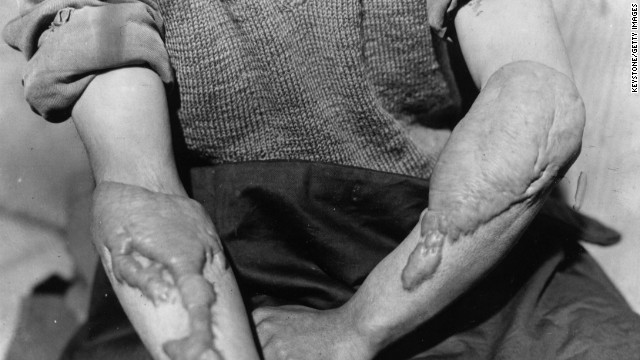
Witnesses “stated that people who were in the open directly under the explosion of the bomb were so severely burned that the skin was charred dark brown or black and that they died within a few minutes or hours,” according to the 1946 report. “Among the survivors, the burned areas of the skin showed evidence of burns almost immediately after the explosion. At first there was marked redness, and other evidence of thermal burns appeared within the next few minutes or hours.”

Many victims kept their arms outstretched because it was too painful to allow them to hang at their sides and rub against their bodies. One survivor recalled seeing victims “with both arms so severely burned that all the skin was hanging from their arms down to their nails, and others having faces swollen like bread, losing their eyesight. It was like ghosts walking in procession… Some jumped into a river because of their serious burns. The river was filled with the wounded and blood.”

The number of fatalities at Hiroshima has been estimated at 140,000. A nuclear attack on Nagasaki three days later is thought to have killed 70,000. Today, according to Dallas, 15-kiloton nuclear weapons of the type used on Japan are referred to by experts as “firecracker nukes” due to their relative weakness.

In addition to killing more than 5.5 million people, a strike on Tehran involving five 250-kiloton weapons -- each of them 16 times more powerful than the bomb dropped on Hiroshima -- would result in an estimated 803,000 third-degree burn victims, with close to 300,000 others suffering second degree burns, and 750,000 to 880,000 people severely exposed to radiation. “Those people with thermal burns over most of their bodies we can’t help,” says Dallas. “Most of these people are not going to survive… there is no saving them. They’ll be in intense agony.” As you move out further from the site of the blast, he says, “it actually gets worse. As the damage decreases, the pain increases, because you’re not numb.”

In a best case scenario, there would be 1,000 critically injured victims for every surviving doctor but “it will probably be worse,” according to Dallas. Whatever remains of Tehran’s healthcare system will be inundated with an estimated 1.5 million trauma sufferers. In a feat of understatement, the researchers report that survivors “presenting with combined injuries including either thermal burns or radiation poisoning are unlikely to have favorable outcomes.”

Iranian government officials did not respond to a request for information about how Tehran would cope in the event of a nuclear attack. When asked if the U.S. military could provide humanitarian aid to Iran after such a strike, a spokesman for Central Command, whose area of responsibility includes the Middle East, was circumspect. “U.S. Central Command plans for a wide range of contingencies to be prepared to provide options to the Secretary of Defense and the President,” he told this reporter. But Frederick Burkle, a senior fellow at the Harvard Humanitarian Initiative and Harvard University’s School of Public Health, as well as a coauthor of the just-published article, is emphatic that the U.S. military could not cope with the scale of the problem. “I must also say that no country or international body is prepared to offer the assistance that would be needed,” he told me.

Dallas and his team spent five years working on their study. Their predictions were generated using a declassified version of a software package developed for the Defense Department’s Defense Threat Reduction Agency, as well as other complementary software applications. According to Glen Reeves, the software used fails to account for many of the vagaries and irregularities of an urban environment. These, he says, would mitigate some of the harmful effects. Examples would be buildings or cars providing protection from flash burns. He notes, however, that built-up areas can also exacerbate the number of deaths and injuries. Blast effects far weaker than what would be necessary to injure the lungs can, for instance, topple a house. “Your office building can collapse… before your eardrums pop!” notes Reeves.

The new study provides the only available scientific predictions to date about what a nuclear attack in the Middle East might actually mean. Dallas, who was previously the director of the Center for Mass Destruction Defense at the Centers for Disease Control and Prevention, is quick to point out that the study received no U.S. government funding or oversight. “No one wanted this research to happen,” he adds.

Rattling Sabers and Nuclear Denial

Frederick Burkle points out that, today, discussions about nuclear weapons in the Middle East almost exclusively center on whether or not Iran will produce an atomic bomb instead of “focusing on ensuring that there are options for them to embrace an alternate sense of security.” He warns that the repercussions may be grave. “The longer this goes on the more we empower that singular thinking both within Iran and Israel.”

Even if Iran were someday to build several small nuclear weapons, their utility would be limited. After all, analysts note that Israel would be capable of launching a post-attack response which would simply devastate Iran. Right now, Israel is the only nuclear-armed state in the Middle East. Yet a preemptive Israeli nuclear strike against Iran also seems an unlikely prospect to most experts.

“Currently, there is little chance of a true nuclear war between the two nations,” according to Paul Carroll of the Ploughshares Fund. Israel, he points out, would be unlikely to use nuclear weapons unless its very survival were at stake. “However, Israel’s rhetoric about red lines and the threat of a nuclear Iran are something we need to worry about,” he told me recently by email. “A military strike to defeat Iran’s nuclear capacity would A) not work B) ensure that Iran WOULD then pursue a bomb (something they have not clearly decided to do yet) and C) risk a regional war.”

Cham Dallas sees the threat in even starker terms. “The Iranians and the Israelis are both committed to conflict,” he told me. He isn’t alone in voicing concern. “What will we do if Israel threatens Tehran with nuclear obliteration?... A nuclear battle in the Middle East, one-sided or not, would be the most destabilizing military event since Pearl Harbor,” wrote Pulitzer Prize-winning national security reporter Tim Weiner in a recent op-ed for Bloomberg News. “Our military commanders know a thousand ways in which a war could start between Israel and Iran… No one has ever fought a nuclear war, however. No one knows how to end one.”

The Middle East is hardly the only site of potential nuclear catastrophe. Today, according to the Ploughshares Fund, there are an estimated 17,300 nuclear weapons in the world. Russia reportedly has the most with 8,500; North Korea, the fewest with less than 10. Donald Cook, the administrator for defense programs at the U.S. National Nuclear Security Administration, recently confirmed that the United States possesses around 4,700 nuclear warheads. Other nuclear powers include rivals India and Pakistan, which stood on the brink of nuclear war in 2002. (Just this year, Indian government officials warned residents of Kashmir, the divided territory claimed by both nations, to prepare for a possible nuclear war.) Recently, India and nuclear-armed neighbor China, which went to war with each other in the 1960s, again found themselves on the verge of a crisis due to a border dispute in a remote area of the Himalayas.

In a world awash in nuclear weapons, saber-rattling, brinkmanship, erratic behavior, miscalculations, technological errors, or errors in judgment could lead to a nuclear detonation and suffering on an almost unimaginable scale, perhaps nowhere more so than in Iran. “Not only would the immediate impacts be devastating, but the lingering effects and our ability to deal with them would be far more difficult than a 9/11 or earthquake/tsunami event,” notes Paul Carroll. Radiation could turn areas of a country into no-go zones; healthcare infrastructure would be crippled or totally destroyed; and depending on climatic conditions and the prevailing winds, whole regions might have their agriculture poisoned. “One large bomb could do this, let alone a handful, say, in a South Asian conflict,” he told me.

“I do believe that the longer we have these weapons and the more there are, the greater the chances that we will experience either an intentional attack (state-based or terrorist) or an accident,” Carroll wrote in his email. “In many ways, we’ve been lucky since 1945. There have been some very close calls. But our luck won’t hold forever.”

Cham Dallas says there is an urgent need to grapple with the prospect of nuclear attacks, not later, but now. 
“There are going to be other big public health issues in the twenty-first century, but in the first third, this is it. It’s a freight train coming down the tracks,” he told me. “People don’t want to face this. They’re in denial.”


Nick Turse is the managing editor of TomDispatch.com and a fellow at the Nation Institute. An award-winning journalist, his work has appeared in the Los Angeles Times, the Nation, and regularly at TomDispatch. He is the author most recently of the New York Times bestseller Kill Anything that Moves: The Real American War in Vietnam (The American Empire Project, Metropolitan Books). You can catch his conversation with Bill Moyers about that book by clicking here. His website is NickTurse.com. You can follow him on Tumblr and on Facebook.

Follow TomDispatch on Twitter and join us on Facebook or Tumblr. Check out the newest Dispatch book, Nick Turse’s The Changing Face of Empire: Special Ops, Drones, Proxy Fighters, Secret Bases, and Cyberwarfare.

Copyright 2013 Nick Turse

Gorilla Radio with Chris Cook, Alexandra Morton, Jon Elmer, Janine Bandcroft May 13, 2013

This Week on GR

by C. L. Cook - Pacific Free Press

Welcome to GR, etc. With BC's provincial election less than 24 hours away, there's one issue that we can cover without fear of trespassing on media elections gag orders. Neither of the two parties likely to lead the next government oppose open-pen fish farming in the province.

Despite mountains of evidence suggesting the folly of concentrated feed lots for fish; the obvious ill effects on the fish bred in cramped captivity; dubious health benefit claims of a human diet including these drugged and unnaturally sustained creatures; proven dangers pathogens from these operations pose to wild fish; the standing on its head of the precautionary principle required to keep this industry afloat, with the many known and suspected negative effects it represents, the BC Liberals and BC New Democratic Party both essentially support business as usual.

Listen. Hear.

It's all so much of more of the same for BC-based scientist and wild salmon crusader Alexandra Morton, who last week, along with Ecojustice filed a best practices law suit against salmon farming giant Marine Harvest and the Department of Fisheries and Oceans, (DFO) for the alleged "transfer of diseased farmed Atlantic salmon into waters shared by wild fish." As disturbing as the ramifications of Marine Harvest's willful, and possibly illegal, endangering of wild salmon in this manner are, (not to mention the apparent lackadaisical policing of its own policies by the Department of Oceans and Fisheries appear to be in this case, and others) more so is what this case reveals about another frightening virus, joining the already devastating and universally feared ISA virus afflicting farmed salmon stock, and its possible release into the wild.

Alexandra Morton back in court in the first half.

And; this May 15th marks Nakba Day for those within occupied Palestine, and the millions more comprising the Palestinian diaspora. Nakba Day's modern manifestation commemorates the day after Israel's 1948 declaration of independence.

Jon Elmer is a Canadian writer and photojournalist specializing in the Middle East and Canadian foreign and military policy. He has lived in and reported from Occupied Palestine for the better part of the last decade, based primarily in Jenin, Bethlehem and Gaza City. Jon's also reported from more than a dozen countries from the middle east, to Nepal, Western Sahara, the Basque country and right here in Canada. His articles and photographs are featured in the Journal of Palestine Studies, Le Monde diplomatique, The Progressive, Al Jazeera English among others. He is also a contributor, with Anthony Fenton to the book, 'Empire's Ally: Canada in Afghanistan.'

Jon Elmer and marking time passed in Occupied Palestine in the second half.

And, Victoria Street Newz publisher and CFUV Radio broadcaster Janine Bandcroft will join us at the bottom of the hour to bring us up to speed with some of what's good to do in and around our city in the coming week. But first, Alexandra Morton and keeping PRV in its cage.

Chris Cook hosts Gorilla Radio, airing live every Monday, 5-6pm Pacific Time. In Victoria at 101.9FM, and on the internet at: http://cfuv.uvic.ca.  He also serves as a contributing editor to the web news site, http://www.pacificfreepress.com. Check out the GR blog at: http://gorillaradioblog.blogspot.ca/
G-Radio is dedicated to social justice, the environment, community, and providing a forum for people and issues not covered in the corporate media.

BC's Declarations of Independents: A New Option for a Tired Political Paradigm?

Independent MLAs, Candidates Shake Up BC Politics

by Damien Gillis - The Canadian.org

Conventional wisdom would suggest there's little an Independent MLA can do make an impact on government. Throughout the past term, BC's three sitting Independents - Bob Simpson from Cariboo North, Vicki Huntington from Delta South, and Abbotsford South's John van Dongen - have proven the pundits wrong, injecting new energy and ideas into a Legislature ordinarily dominated by caucus discipline.

All three are running again in Tuesday's provincial election. Joined by a few other Independents with "long - not impossible - odds," as Martyn Brown put it recently in The Vancouver Sun - this unprecedented batch of serious candidates without a political party promises a more interesting contest and intriguing possibilities should their campaigns lead them into office.

With polls tightening in the final days of the campaign, it's not unthinkable that a handful of Independents could hold the balance of power in a minority government.

Among the 38 candidates running as Independents around the province, Arthur Hadland, from Peace River North, is of particular note, posing a serious challenge to incumbent Liberal MLA Pat Pimm. Hadland ran in 2009, losing by just nine points - the next best showing by an Independent to Delta's Huntington. A lifelong resident of the Peace Valley, Hadland is a respected multi-term director of the Peace River Regional District and has been a strong voice against the proposed Site C Dam.

The three sitting Independents have shaken up the Legislature in surprising ways in recent years. From confronting important energy issues in ways neither party would, to torpedoing a recent forestry bill - making effective use of social media - and raising electoral reform in the lead-up to the provincial election, they are showing the power Independents can wield.

Being an Independent poses its challenges, without the benefit of caucus resources for researching and interpreting the avalanche of legislation that comes their way. "You have to look at every bill yourself," Simpson explained a recent all-candidates debate on environmental issues in Vancouver, noting that he doesn't have the luxury of voting along party lines.

Huntington became just the second MLA elected as an Independent in the history of BC's legislature (and first woman to do so) when she narrowly defeated former Attorney-General Wally Opal in Delta South in 2009. Simpson, after being booted from the NDP caucus over mild public criticism of then-leader Carole James, decided to strike out on his own, rather than apologize. The incident would prove the straw that broke the camel's back for James' leadership, paving the way for the party's resurrection under Adrian Dix.

Van Dongen is easily the most controversial of the bunch. The longest-serving BC Liberal MLA in the Legislature until his resignation from the party in March of 2012, he made more turbulent an already rough patch for the Liberals. His path to independence included a pit stop with John Cummins' BC Conservative Party, becoming its only sitting MLA, until a very public falling out six months later that saw him go Independent. His departure and the manner in which it occurred seriously hampered Cummins' efforts to breathe new life into the party - the effects of which linger to this day.

Huntington and Simpson have teamed up to bring issues like natural gas fracking to the fore in the Legislature. Their call for a science-based investigation into the controversial practice appears to have yielded results, as the NDP have committed to such a program if elected.

Van Dongen has been a wild card, bringing plenty of palace intrigue to the Legislature. It wasn't just his two defections and the embarrassment of a suspended driver's licence while Solicitor General that produced tabloid headlines. In hiring a private lawyer to investigate the Campbell Government's paying off the lawyers of convicted bribers Dave Basi and Bobby Virk, Van Dongen proved he could still kick up a fuss.

The three sitting Independents would also join forces to push for electoral reform. The six-point platform they announced in February includes some laudable suggestions like campaign finance reform, giving bi-partisan legislative committees real power, moving the fixed election date to the Fall so as to not interfere with the Budget, and free votes in the Legislature, to minimize the stifling effects of caucus discipline.

The fact that high-profile, effective politicians like these folks are choosing the independent path reflects growing discontent with the current party system.

Though few of the province's 38 Independent candidates stand a real chance, any one of these four serious contenders - Huntington, Simpson, Van Dongen, Hadland - could well pull off a surprise victory on May 14. And with what is shaping up to be a tighter-than-expected race between the Liberals and NDP, even a few Independents could wind up holding the balance of power in Victoria. In any event, their presence enriches this election campaign and an otherwise predictable, often undemocratic Legislature.


Damien Gillis is a Vancouver-based documentary filmmaker with a focus on environmental and social justice issues - especially relating to water, energy, and saving Canada's wild salmon.