Thursday, August 22, 2013

Weapons of Mass Distraction Dusted Off for Syria Intervention Pitch

‘Chemical Weapons’ media propaganda in US, UK is designed to hide the truth in Syria

by 21st Century Wire - Special Report

Yesterday’s report of an alleged ‘chemical weapon’ attack near Damascus has prompted the US and UK media machines to spin into overdrive in the push for a military intervention and regime change in Syria.

Washington’s official response is predictable by now: “The White House is ‘deeply concerned’ about reports that chemical weapons were used by Syria’s government against civilians”.

In the UK, the mainstream media has put on a full-court press, clearly delivering a guilty verdict even before any claims can be independently verified, a coordinated trial-by-media which looks to be designed to coax a majority public support for either a direct supply of arms to the confab of ‘rebel’ insurgencies in Syria.

Pre-Iraq War talking points have been dusted off by the UK press and others, as the PR war begins for the hearts and minds of voters begins. It is alleged that hundreds have been killed by this latest ‘gas attack’ which is being compared by the UK media to Iraq where thousands of Kurds were gassed by Saddam Hussein in Halabja in 1988.

The focus of the UK and US government-media-complex led efforts to win public support for a “humanitarian intervention” similar that which was perpetrated in Libya in 2011, is now centred around the main victims of the conflict being portrayed as that of children.

No one within the government media complex is asking the most fundamentally important question here: were real military-grade chemical weapons actually used at all? The reason no one is asking this is because the answer to this question so far is a resounding ’no’, which means that despite all the media hype neither the UK nor the US governments have a case against the Assad regime regarding the use of chemical weapons during this conflict.

Media invent a ‘chemical weapons’ incident
In reality, this is nearly an identical government and media PR campaign to that which was launched in the run-up the invasion and bombing of Iraq in 2003.

Varying reports estimate between 90 and 500 killed in this incident, yet, the Guardian was quick to ramp-up the death toll to 1,400. Every media report of the incident is based on the same dubious source material, described by the Daily Mail as:

“Extensive amateur video and photographs purporting to show victims appeared on the Internet. A video puportedly shot in the Kafr Batna neighbourhood showed a room filled with more than 90 bodies, many of them children and a few women and elderly men.”

Today’s Daily Mirror led with the headline, “NOW THEY ARE GASSING OUR CHILDREN”, but when you actually read the article, the ambiguity of the claims becomes obvious. ”At first they were being affected by the gas. But now they’re dying in the regular shelling. The bombs just won’t stop.”

Rupert Murdoch’s newest war promotion paper, The Times, was even more ambiguous and misleading today, with one headline reading, “Horror video is no fake but cannot tell the full story”. This was referring to the Pièce de résistance of this latest chemical attack, a video of the dead. The Times went on to debunk itself, with Dan Kazela, a former chemical warfare officer stating the obvious, “You can’t autopsy a video”, adding, “In the end stages (of a chemical attack) there are tremors and convulsions. There are a lack of the immediate symptoms (in the footage). I am confused.” In other words, the videos do match the allegations.

If there was a military-grade chemical attack involving thousands of death, how come that entire area of the city was not evacuated, and how could videographers and photographers be on the scene so quickly after the attack without suffering the effects they claim to be documenting?

The Times continued in a desperate bid to cover all its bases with the next article entitled, “Ignore the conspiracists: We must find the truth”. This headline is a breathtaking example of high level propaganda, and mixed messaging. It implies that anyone who thinks that the Syrian government are innocent, or the rebel opposition guilty – of chemical weapons charges, is a conspiracist, and that “the truth” must be the opposite conclusions. The article goes on to attack the Russian press coverage of the conflict specifically, stating:

“The Russian press scrambles to demonstrate the depravity of the rebels – making much of the commander who who appeared on film to be eating the body parts of an opponent”.

It seems lost on this Times writer Roger Boyes, that the Russian press didn’t need to scramble, because the rebel cannibal in question was very depraved and was part of the insurgent-terrorist confab backed by both the US and UK governments.

The press continue their PR campaign to intervention in Syria with the headline image (see below) for the Mirror depicts an image of eight children sleeping, and it is a fact that no one can independently verify as yet who these children are and if indeed they were killed in a chemical weapons attack in Syria on Tuesday evening. Nonetheless, the story and pictures run in the press and the desired public perception is created.
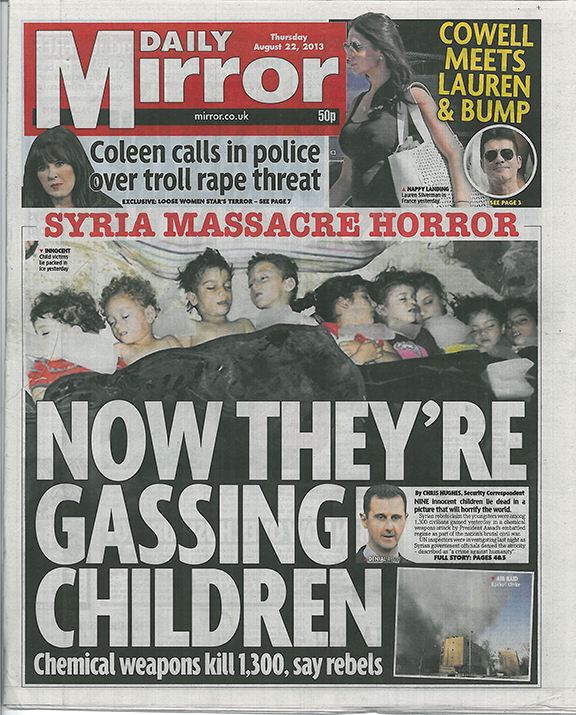
IMAGE: Today’s headline on the UK Daily Mirror. Who are these children in the photo, are they alive and what exactly happened to them?

It’s important that the public educate themselves as to how propaganda campaigns work, particularly those run by the government media complex in countries like the US and the UK.

To demonstrate this, as well as an acute level of bias and pre-judgement by a cast of hand-picked pundits crowing for the establishment’s line on the Syrian issue, we can look again at today’s Daily Mirror. Notice the technique which is used ad nauseam by the British press which employs the use of mixed messaging, which makes the reader believe that the pundit is an objective commentator, when in fact, they are not. One pundit being used help to nail down the Foreign Office’s executive outcome in Syria, is Fawaz A. Gerges, a Professor of International Relations at the London School of Economics and Political Science (LSE), and a man affiliated with Washington DC’s main advocate for war – the Council on Foreign Relations. Note the how the twists and turns are employed by this ‘expert’, only to end with the final verdict of guilt well before any real independently verified evidence has been returned. This is Propaganda 101 for a master’s degree in public opinion making:

GERGES/MIRROR: “We lack independent information to verify opposition claims about the apparent use of poison, and the counter claims of the Assad regime that it is a fabrication to divert attention from rebel losses in strategic Al Ghouta.”

21WIRE says: Seems objective enough. Carry on…

GERGES/MIRROR: “If the attacks have taken place, this would affect the “red line” established by Obama about the use of chemical weapons, and intensify the pressure on him to retaliate militarily against Assad.”

21WIRE says: He’s just flicked the switch for Washington and London’s predetermined outcome for Syria.


GERGES/MIRROR: “The British and French would probably join any US military strikes…”

21WIRE says: Here Gerges and the Mirror lay out what they want the public to accept as the inevitable outcome.

GERGES/MIRROR: “There are several unanswered questions. Why would the Assad government use chemical weapons while there is a UN team in Damascus?”

21 WIRE says: There they go again, sounding objective. How very nice. Carry on…

GERGES/MIRROR: “Why would the Syrian army deploy poison when it has gained the upper hand in Al Ghouta?”

GERGES/MIRROR: “Why would Assad use chemical weapons at this stage and trigger investigations?

21WIRE says: Now that sounds sensible. I’m interested again. Carry on…

GERGES/MIRROR: “This seems illogical, though Assad has confounded us before by irrationality and brutality. We should not be shocked.”

21WIRE says: We see the clear propaganda slight of hand here: President Assad is irrational and brutal – so according to this illustrious expert, without actually saying it, he’s planted the idea: Assad is capable of doing irrational and brutal acts like this insane chemical weapons attack in Damascus, even while the UN inspections team is nearby.

GERGES/MIRROR: “If Assad was intelligent, which he is not, he would allow the inspectors to visit the sites.”

21WIRE says: Clever, sort of. The Mirror and Gerges foreshadowing the pre-boxed outcome that if the Assad government will not allow inspectors in, it proves that he is guilty of the attack.

GERGES/MIRROR: “My instinct would be that he will say it is too dangerous for the UN to travel to Al Ghouta.”

21WIRE says: Too dangerous? It wasn’t too dangerous for all the ‘activists’ who managed to take pristine video and Mirror photo ops of the dead children lined up on the ground as the poison gas was in the air. Gerges is clearly doing a brief back-pedal here. But wait…

GERGES/MIRROR: “Finally, the burden of truth lies on the Assad regime.”

21WIRE says: This is NLP at its finest, and very skilled propaganda by the professor. The ‘burden of truth’ he is referring to is better know in the real world as ‘The Burden of Proof’. The west want the burden of proof to be on Assad regime – and not the opposition accusing the Syrian government of the crime – and that, Ladies and Gentleman, is the crux of this particular psy-op run by the government media complex.

21st Century Wire’s Patrick Henningsen appeared within hours of the attacks live on RT news on August 21st, and called out this very psy-op regarding “the burden of proof”. Watch:

What really happened this week

Only last month, Syrian forces found a large cache of chemical weapons in a Damascus warehouse belonging to the rebels. This is well documented, as RT reported:

Military sources reported that the militants “were preparing to fire mortars in the suburbs of the capital and were going to pack missiles with chemical warheads.”

A video shot by RT’s sister channel Russia Al Youm shows an old, partly ruined building which was set up as a laboratory. After entering the building, Syrian Army officers found scores of canisters and bags laid on the floor and tables. According to a warning sign on the bags, the “corrosive” substance was made in Saudi Arabia.

On July 7, the Syrian army confiscated “281 barrels filled with dangerous, hazardous chemical materials” that they found at a cache belonging to rebels in the city of Banias. The chemicals included monoethylene glycol and polyethylene glycol. Any investigation into the use of chemical weapons in Damascus and Syria should begin with the above report.This week’s effort to hammer a guilty verdict down on the Assad regime is not the first this year. Both the American and British interests have rallied on multiple occasions to try and fabricate a series of ’chemical weapons’ incidents in Syria.

So if this latest alleged ‘nerve gas’ attack in Damascus reveals no real military-grade chemical weapons, then what type of weapons might have been deployed? Were they makeshift chlorine or bombs, or sulphur type bombs or mortars?

One similar incident took place with a series of chlorine bomb attack in Aleppo, Northern Syria in March 2013. Reuters, along with others, reported, “Alleged chemical attack kills 25 in northern Syria”, and stated:

“U.S. President Barack Obama, who has resisted overt military intervention in Syria, has warned President Bashar al-Assad that any use of chemical weapons would be a “red line”. There has, however, been no suggestion of rebels possessing such arms.”

Well, actually, there was suggestion, and evidence too. If the mainstream media had been doing their job, then they would’ve found what we found, published the following week on March 27 in a report by Patrick Henningsen entitled, Iraq 2.0: West will now lean on UN to delivery a WMD verdict in Syria, where, among other important revelations of western-backed al Qaeda attempting to create a chemical false-flag incident in Aleppo, we presented this:

“(…) Jordanian intelligence proceeded to facilitate the smuggling of chlorine gas from Jordan to the (terrorist) organization known as “Islamic State of Iraq”, the first to use chlorine gas technology (with the help of Jordanian Intelligence and Saudi Arabia) as a “chemical weapon” – a taboo issue in the media in the context of covering genocide….”

If any doubt remains as to the nefarious cloak and dagger antics being carried out through the western-controlled terrorist confab and rebel opposition in Syria, we need only look back a few months before, on Jan 29th, when the Daily Mail, and Yahoo News India, published a revealing news piece about a US and British-linked plan to stage a chemical weapons attack in Syria and blame it on Assad, entitled, “U.S. ‘backed plan to launch chemical weapon attack on Syria and blame it on Assad’s regime’.

The Mail quickly pulled the story down within 24 hours, offering no formal retraction, but simply wiped it clean from their website, but we have a screen shot here:
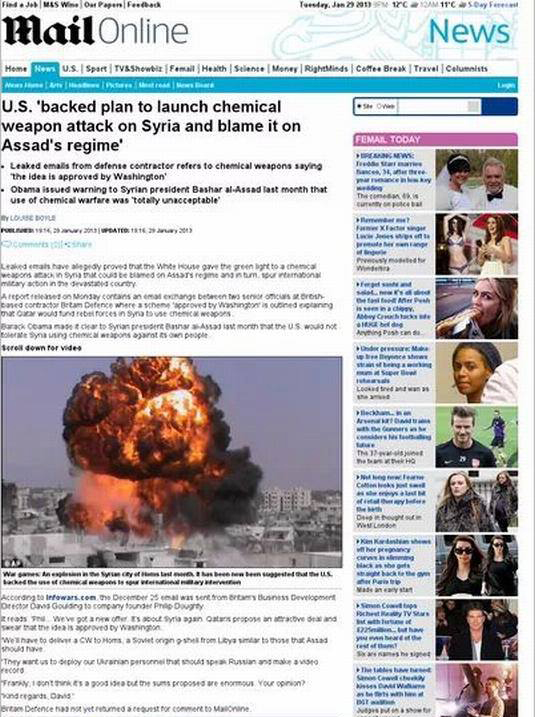

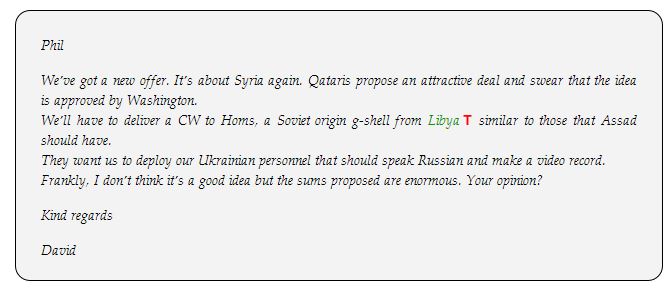
One of the original leaks which led to this brief, but buried story, was contained in the Britam Leaks, which detailed the plan to be carried out via a private British defense contractor Britam Defense, which we are told got the green light from Washington and was to be financed by Qatar, as evidenced by this email contained in the documents cache:


It is clear now, more than ever, that this latest campaign for regime change in Syria is being rolled out like a carbon copy of Libya in 2011 and Iraq in 2003, only, this time the propaganda is much more complex, making it hard for the public – and the mainstream media as we have demonstrated – to actually follow the facts in the midst of all the sensational reporting and political grandstanding by the like of William Hague, the Tory Foreign Secretary in the UK.

 
Remember how the public was lied to and duped by the US and UK government in order to invade, rape, and occupy Iraq in 2003? Well, the same process is in motion again, with the same results waiting for us down the road – but only if you are naive enough to swallow the same propaganda again this time.

Remember those embarrassing scenes, like that of then US Secretary of State Colin Powell – going in front on the UN claiming that Saddam Hussein had a fleet of mobile chemical weapons labs manufacturing weaponised anthrax by the ton, infamously dubbed the “Winnebagos of Death”? It’s the same exact public perception campaign you are witnessing now regarding Syria.

You didn’t trust the government and their talking heads back then, so why trust them with a repeat performance now?

The truth is that the US, Britain, France and others, are involved in a proxy war having allied with Islamic terrorists and imported, non-Syrian militant brigades in Syria being financed by western allies Saudi Arabia and Qatar – the west will do anything to get a green light to upscale their illegal activities there.

Sure, their level of deceptive, high magic propaganda may even make Joseph Goebbels’s head spin, but whatever you do... don’t fall for it a second time.

Opening the Closed Chapters of the Trans-Pacific Partnership Deal

Trans-Pacific Partnership (TPP): Canadian groups demand end to secrecy, want all TPP chapters made public

by Council of Canadians

OttawaMinisters from the 12 Trans-Pacific Partnership countries, including International Trade Minister Ed Fast, should stop their secret negotiations and immediately make public the 26 chapters of the TPP when they meet in Brunei this week, say Canadian groups, citing precedent for transparency in previous trade negotiations of this size and scope.

“It is a scandal that a far-reaching deal like the TPP could be signed in the coming months without anyone across the 12 participating countries having seen or had a chance to challenge some of the many new restrictions an agreement will put on our ability to govern in the public interest. The only acceptable road forward for the TPP is for ministers to publish the text now before it’s too late,” says Stuart Trew, trade campaigner with the Council of Canadians, a national grassroots activist and social justice organization.

“The TPP looks more like a corporate power grab than a trade deal from what we’ve seen of it. It would impose a free-market dogma on governments and override domestic laws in a way that would be rejected if put forward through democratic legislative processes,” says Raul Burbano, program director at Common Frontiers, a network bringing together labour, human rights, environmental, and economic and social justice organizations.

The Council of Canadians and Common Frontiers point out that only two of the 26 chapters relate to trade as most people understand it. The other chapters involve restrictions on government’s ability to make health policy, the criminalization of everyday uses of the Internet, new limits on access to affordable medicines, prohibiting ‘buy local’ policies (e.g. local food), encouraging privatization, discouraging the creation of Crown corporations or new public utilities, and empowering corporations to sue governments before private tribunals outside the court system when they’re unhappy with environmental or other measures that lower profits.

The groups point out that there is a precedent for transparency in a trade negotiation of this size and scope. In July 2001, responding to public pressure about secrecy in the negotiations toward a Free Trade Area of the Americas (FTAA), North and Latin American ministers published the full text of the agreement in four languages. Former U.S. Trade Representative Robert Zoellick called it an “important step” and an “unprecedented effort to make international trade and its economic and social benefits more understandable to the public.”

“What has changed in the past decade that it would no longer be in the interests of countries to make the economic and social benefits of deals like the TPP understandable to the public,” asks Trew.

The Council of Canadians and Common Frontiers have called for a week of action (August 22 to 31) to protest TPP secrecy in partnership with the Canadian Union of Public Employees, Universities Allied for Essential Medicines and OpenMedia.ca. More information: http://canadians.org/action-tpp.


-30-

MEDIA RELEASE
August 22, 2013

Contacts:

Stuart Trew, trade campaigner, Council of Canadians strew@canadians.org

Raul Burbano, program director, Common Frontiers comfront@web.ca

Nestle Free Loading on Backs of BC First Nations

Lax water laws in BC highlights need for recognition of Aboriginal Rights & Title

Joint News Release - August 21, 2013

Chilliwack, BC, Sto:lo Territory - There has been a lot of attention in recent weeks on BC's Water Act as the story broke about Nestle Waters' cost-free extraction of millions of litres of groundwater from the region known as Hope, BC. Not mentioned in the coverage to date is how Nestle operates on the traditional territory of the Chawathil First Nation; without compensation or consultation and without heed to the concerns of the Chawathil people.

"It’s no different than the way business has been done in this province since Europeans first arrived; but its time 'business-as-usual' practices change, because they're not working for our community and its fundamentally unlawful," stated Rhoda Peters, elected Chief of Chawathil First Nation. "We are not anti-business, but we want to see business operate in a way that respects our rights and ensures that our community is benefiting from the use of our lands and waters. Right now there is an opportunity for the provincial government to step up and do the right thing; to change what 'business-as-usual' looks like."

Aboriginal Rights and Title are a core piece of the Canadian constitution, and yet under the BC Water Act First Nations rights are not recognized and their expertise on a local level is often disregarded. The Union of BC Indian Chiefs (UBCIC) have been at the forefront in advocating for the due respect and recognition of First Nations Rights and Title in BC.

"We as Indigenous Peoples have rights and a sacred responsibility to protect water for our people today and for the generations that follow," said Grand Chief Stewart Phillip, President of the Union of BC Indian Chiefs. "It is completely unacceptable for Nestle to remove water from Sto:lo Territory for free and without any consideration and consultation with the affected First Nations, particularly Chawathil First Nation. This issue certainly highlights the overarching failures and serious deficiencies of the provincial water management system, in particular the obvious lack of recognition of Chawathil’s constitutionally-protected Title and Rights to their territories and resources. UBCIC fully supports the Chawathil First Nation and the continued call by First Nations for the Province to step up and meaningfully engage and consult with First Nations on water management issues."

The WaterWealth Project out of Chilliwack, BC is another organization calling for an overhaul of the BC Water Act.

"To bring water legislation in BC into the 21st century, recognition and reconciliation of Aboriginal Rights & Title is essential, but it also offers an opportunity for wide-spread spread benefit to all people who call this region home.” explained Larry Commodore, two-time Chief of the Soowahlie First Nation and Community Advisor to the WaterWealth Project. "First Nations can provide traditional ecological knowledge stemming from the generations of stewardship over our home waters. A step in the right direction for the BC government should be to establish regional watershed authorities, similar to the Cowichan Watershed Board, providing a solution for First Nations and local governments to work together for mutual benefits.”


For more information or to arrange interviews:
Rhoda Peters, Chief, Chawathil First Nation, 604-869-9994
Grand Chief Stewart Phillip, President, UBCIC, 250-490-5314
Larry Commodore, Community Adviser, WaterWealth Project, 604-703-2984

Additional Information:

UBCIC Submission to BC Water Act Modernization Initiative
http://www.ubcic.bc.ca/News_Releases/UBCICNews04301001.htm


Read more: Lax water laws in BC highlights need for recognition of Aboriginal Rights & Title
Follow us: @UBCIC on Twitter | UBCIC on Facebook

Real News Reax on Manning Verdict

The Real News August 22, 2013

by TRNN


ARMY WHISTLEBLOWER BRADLEY MANNING GETS "UNPRECEDENTED" 35 YEARS IN
PRISON
Advocates say sentence is a serious blow to whistleblowers and investigative
journalism, Manning plans to appeal and request President Obama for a pardon
http://premiere.whatcounts.com/t?ctl=16DC76A:A24594C07FAB735761C4C26DDF73215AEDC3615173C7E546&

CHRIS HEDGES ON BRADLEY MANNING BEING SENTENCED TO 35 YEARS IN PRISON
Chris Hedges speaks to The Real News in an exclusive interview responding to
Wikileaks Whistleblower Bradley Manning being sentenced to 35 years in prison
http://premiere.whatcounts.com/t?ctl=16DC76B:A24594C07FAB735761C4C26DDF73215AEDC3615173C7E546&

INTERNATIONAL LAW REQURIED MANNING TO BE A WHISTLEBLOWER
Vijay Prashad: Obama Admin pursuit of Manning probably illegal under
international law
http://premiere.whatcounts.com/t?ctl=16DC76C:A24594C07FAB735761C4C26DDF73215AEDC3615173C7E546&

BRADLEY MANNING SENTENCED TO 35 YEARS IN PRISON
David Swanson: Private Manning becomes latest victim of President Obama's war on
whistleblowers and efforts should be made to remember him as a hero not a traitor
http://premiere.whatcounts.com/t?ctl=16DC76D:A24594C07FAB735761C4C26DDF73215AEDC3615173C7E546&

Wednesday, August 21, 2013

What Wiki Tells Us About Haiti's Paramilitary to Police Transformation


WikiLeaks Reveal: U.S. and UN Officials Oversaw Integration of Ex-Army Paramilitaries into Haiti’s Police Force


by Jeb Sprague - Haiti Liberté

Throughout 2004 and 2005, Haiti’s unelected de facto authorities, working alongside foreign officials, integrated at least 400 ex-army paramilitaries into the country’s police force, secret U.S. Embassy cables reveal.

For a year and a half following the ouster of Haiti’s elected government on Feb. 29, 2004, UN, OAS, and U.S. officials, in conjunction with post-coup Haitian authorities, vetted the country’s police force – officer by officer – integrating paramilitaries with the goal of both strengthening the force and providing an alternative “career path” for paramilitaries.

Hundreds of police considered loyal to President Jean-Bertrand Aristide's deposed government were purged. Some were jailed and a few killed, according to numerous sources interviewed.

At the same time, former soldiers from the disbanded Haitian Armed Forces (FAdH), who were assembled in a paramilitary “rebel” force which worked with the country’s elite opposition to bring down Aristide, were stationed – officially and unofficially – in many towns across the country.

As part of this, an extrajudicial strike brigade was assembled in Pétion-Ville. It carried out brutal raids (sometimes alongside police), often several times a week, in the capital’s coup-resisting neighborhoods, as documented in a November 2004 University of Miami human rights study.

The secret U.S. dispatches detailing the police force’s overhaul were part of 1,918 Haiti-related cables obtained by the media organization WikiLeaks and provided to Haïti Liberté.

The cables show that UN and U.S. officials saw the program as a useful way to disarm and demobilize combatants, but the implications of providing coup-making paramilitaries with government security jobs have been hidden or ignored.

The cables also make clear that the US officials – using “redlines” and “red flags” – took on a leading role in the “reforms,” minutely following the process of repopulating Haiti’s police.

Millions of dollars in funding for the demobilization and integration of the FAdH was gathered — mainly through the UN and the U.S. — but officials also looked to other governments for funding.

Immediately after the coup, the integration process was carried out by officials of the so-called Interim Government of Haiti (IGOH), under U.S., OAS and UN supervision. Then, starting in November 2004, a longer-term apparatus, the UN’s DDR (Disarmament, Demobilization, and Reintegration) program, was set up. Part of its duties included a continued integration of some of the paramilitaries into the Haitian National Police (HNP).

The U.S. Embassy cables go into detail about the integration of paramilitaries into the HNP and other government agencies. One of the most revealing cables is titled “Haiti’s Northern Ex-Military Turn Over Weapons; Some to Enter National Police.”

The Mar. 15, 2005 cable provides an overview of a gathering two days earlier in Cap-Haïtien attended by Haiti’s de facto Prime Minister Gérard Latortue and the UN Secretary-General’s Special Representative to Haiti, Juan Gabriel Valdès. The officials oversaw a “symbolic disarmament,” where more than “300 members of Haiti's demobilized military in Cap-Haïtien” turned in a token seven weapons and then boarded buses to the capital.

The UN and IGOH officials parked the paramilitaries at Port-au-Prince’s Magistrates’ School, where many other ex-soldiers were being placed.

The cable describes how previously high-level IGOH officials had made promises to the ex-FAdH paramilitaries. Some “of the ex-soldiers in Cap-Haïtien said they had been told by the PM's nephew and security advisor Youri Latortue and the PM's political advisor Paul Magloire that they would be admitted into the HNP,” explained the cable by U.S. Ambassador James Foley. “This raised a red-flag for us and the rest of the international community...”

But at the Mar. 13 meeting, Gérard Latortue “made clear this was not the case,” telling the paramilitaries “that integration into the HNP would be a possibility for some, but they had to understand that not everyone would make it into the police. Ex-soldiers not qualified for the HNP could be hired into other public administration positions (e.g., customs, border patrol, etc.),” Foley wrote.

But the UN and IGOH authorities wanted to keep some of the ex-military together as a cohesive unit prepped for integration into the police, the cable reveals. The officials handed the matter over to UNOPS, a wing of the UN that focuses on project management and procurement services.

Accordingly, “UNOPS has been working to relocate both the Managing Office [for Demobilized Military] and the approximately 80 individuals from the Magistrate's School to a former military camp in the Carrefour neighborhood outside of Port-au-Prince,” wrote Foley. (In March 2011, the author visited an ex-FAdH-run training camp in the Carrefour area.)

UN and U.S. officials appear to have often focused on achieving symbolic successes like the “demobilization” of paramilitary forces. “The symbolism of the ex-military disarming and leaving Haiti's second-largest city represents a significant breakthrough,” Foley concluded in his Mar. 15 cable.

At the time, around 800 ex-military men were being housed in Port-au-Prince, with UN help.

Of the 400 former soldiers integrated into the police, about 200 came in 2004 from the 15th graduating class of HNP cadets (called a “promotion” in Haiti), and 200 from the 17th promotion in 2005, the cables say.
The number 200 was no coincidence. The Embassy had told the IGOH that “the USG [U.S. Government] would not support more than 200 former military being included in Promotion 17” because “the USG was concerned that inclusion of ex-FADH in large numbers would detract from ongoing police reform measures; they therefore had to be closely scrutinized,” a May 6, 2005 cable explains.

This cable also reveals Washington’s dominance of the police force’s reconstruction. In a meeting, the Embassy told the HNP’s chief Léon Charles that “the practice of allowing a class of people to receive special quotas for class enrollment (as had happened with the ex-FADH) had to end,” wrote Foley. Dutifully, “Charles agreed and stated that the practice would end immediately.”

This did not mean that ex-soldiers wouldn’t continue to be integrated, only that “future recruitment drives would make no distinction with regard to the former military, but would also not discriminate against anyone for previous duty in the Haitian Armed Forces,” Charles said, according to the cable.

An Apr. 5, 2005 cable explains that the 16th promotion of 370 HNP cadets included “none of [those who] had a history of ex-FADH activity.”

In another Mar. 15, 2005 cable entitled “DG [Director General] Charles Update on Ex-FADH in the Haitian National Police,” Foley outlined how the process of integration was occurring with new HNP cadet classes.
“OAS officials charged with vetting police candidates reported approximately 400 ex-FADH candidates at the Police Academy on March 11 undergoing physical fitness testing,” his cable explained. The men, who had just previously served in paramilitary squads around the country, were vying for 200 slots in the HNP. The cable explains that a number of such individuals had been hired in prior months.

Police chief Charles, stated “that the ex-FADH from the 15th class who were rushed on to the streets last fall [of 2004] would return to class.” It was clear that officials felt somewhat worried about the new men they were bringing into the police force, so they decided that the ex-FAdH cadets from the 17th promotion would, upon graduation, “be deployed throughout Haiti on an individual basis and not as a group.”

Charles added that, among the 200 ex-FAdH in the 15th promotion, most “had been assigned to small stations in Port-au-Prince,” adding that, “although they were disciplined, they were older and physically slower.”

OAS officials noted that Haitian police officials who were now assisting the OAS in its vetting process feared some of the former soldiers they were interviewing: “HNP personnel assisting the OAS with the vetting program were afraid to interview some of the ex-FADH candidates out of concern they might be targeted if the panel disqualified an applicant.”

The U.S. embassy closely supervised how Haitian de facto officials conducted the integration, worried about the impact of any failures. Foley was pleased that Charles was holding ex-soldiers to “the same requirements as civilians for entrance into the HNP,” a policy resulting from “continuous pressure from us,” he wrote in the Mar. 15 cable. But Foley worried about “political pressures and decisions of PM [Gérard] Latortue, Justice Minister [Bernard] Gousse, and others,” his cable reported.

“We have raised this issue with them on countless occasions, pointing out the real danger the IGOH runs of losing international support for assistance to the HNP if the process of integrating ex-FADH into the police does not hew to the redlines we have laid down,” Foley wrote.

Embassy officials, along with the OAS mission, would “monitor the recruitment, testing, and training process, including a review of the written exam, test scores, and fitness results.”

Ambassador Foley added that “the pressure to bring ex-FADH into the HNP remains high.” He was likely referring to the calls made by some of Haiti’s most powerful right-wing politicians and businessmen, many having established relationships with the paramilitaries back when they were soldiers.

Furthermore, Chief Léon Charles was “worried that others in the IGOH had made unrealistic promises to the ex-FADH about jobs in the HNP in order to convince them to demobilize,” the ambassador wrote.

Charles “fretted that the Cap-Haïtien group set an example that others may follow, and indicated the IGOH could have over 1,000 former soldiers looking for jobs soon, including the 235 from Cap-Haïtien; 300 from Ouanaminthe; 200 from the Central Plateau; 150 from Les Cayes; 100 from Arcahaie, and 80 from St. Marc.”

The second Mar. 15 cable concludes “that the USG was willing to contribute $3 million to the DDR process but could not release the funds until the IGOH concluded an agreement with the UN on an acceptable DDR strategy and program.” The U.S. Embassy, playing a dominant role, was also clearly seeking to operate in accord with a transnational policy network — U.S. officials had helped to oversee other such integration processes in El Salvador and Iraq, and the DDR program has been deployed in a number of other countries where UN forces operate, such as Burundi, the Central African Republic, Cote d’Ivoire, Democratic Republic of Congo, Liberia, Sierra Leone, Somalia, Sudan, Uganda, Afghanistan, Nepal, and the Solomon Islands.

After Charles provided information on the monitoring and processes through which the ex-FAdH paramilitaries were integrated into the police force, Ambassador Foley remarked in an Apr. 5, 2005 cable: “The fleeting reply to requests for updates on human rights investigations demonstrate the HNP's inability to perform internal investigations.”

During their first year in office, IGOH authorities appear to have received far less oversight in their handling of ex-FADH integration into the police. “Until now, the Interior Ministry and/or the Managing Office [for Demobilized Soldiers] have been in charge of identifying possible ex-FADH candidates for the HNP,” Foley wrote in one of his Mar. 15 cables. Then he made clear Washington’s oversight: “This needs to change, so that ex-FADH candidates for the police come out of the reintegration/counseling process that the UN (with U.S. support through the International Organization for Migration) will manage.”

While former soldiers were being integrated into the HNP, hundreds of police who had been loyal to Aristide’s government were fired, their names and positions documented in a list put together by Guy Edouard, a former officer with the Special Unit to Guard the National Palace (USGPN). In a 2006 interview, Edouard explained that some of these former police and Palace security officers had been "hunted down" after the coup. Furthermore, with US support, Youri Latortue, a former USGPN officer and Prime Minister Latortue’s security and intelligence chief, had led efforts to "get rid of the people he did not like," Edouard said.

Gun battles continued to occur between the Haitian police and a handful of gangs in the capital’s poorest slums well into 2005, and on numerous occasions, police opened fire on peaceful anti-coup demonstrations. “April 27 was the fourth occasion since February where the HNP used deadly force,” explained a May 6, 2005 cable. The Embassy was vexed that “despite repeated requests, we have yet to see any objective written reports from the HNP that sufficiently articulate the grounds for using deadly force. Equally disturbing are HNP first-hand reports from the scene of these events. These are often confusing and irrational and fail to meet minimum police reporting requirements.”

The HNP, however, was working with UN forces in conducting lethal raids. Léon Charles acknowledged that UN troops had a “standard practice” of putting more lightly armed HNP forces in front of its units as they moved into Cité Soleil, and this “often resulted in the HNP overreacting and prematurely resorting to the use of deadly force,” the May 6 cable notes.

In a 2001 study published in the academic journal Small Wars and Insurgencies, researcher Eirin Mobekk explained in part how the U.S. worked to integrate large numbers of former soldiers into the HNP as Aristide, to thwart future coups, dissolved the FAdH in 1995. Washington’s strategy was to hedge in Lavalas with the new police force.

A decade later, this policy was resurrected. Just as Washington recycled part of the military force that carried out the 1991 coup, it (along with the UN and the IGOH) recycled part of the paramilitary force that carried out violence leading up to the 2004 coup.

The WikiLeaked cables reveal just how closely Washington and the UN oversaw the formation of Haiti’s new police and signed off on the integration of ex-FAdH paramilitaries who had for years prior violently targeted Haiti’s popular classes and democratically elected governments.


Jeb Sprague is the author of a forthcoming book on paramilitarism for Monthly Review Press. He has a blog at jebsprague.blogspot.com and tweets as http://twitter.com/#!/jebsprague

Assad's Dubious Idiocy: Gathering Chemical Inspectors for Chemical Attack?

Media Hypes Latest "Chemical" Attack in Syria But Evidence Does Not Add Up

by 21st Century Wire

Today’s report of the nerve gas attack in the suburbs of Damascus has made its way through the world media, prompting a sweeping condemnation of the Assad government by pundits and politicians in the US and Europe.

Opposition “activists” claim that rockets with nerve gas hit the suburbs of Ain Tarma, Zamalka and Jobar in the Ghouta region – although they would not specify exactly who fired those rockets. The Syrian government denies these accusations, and maintain there is no truth to the reports.

Unfortunately, further confirmation is still required in order to determine exactly what has happened, let alone, who is responsible if indeed it was a chemical weapons attack that took place.

The timing of this sensational report is also suspect, as the UN chemical inspection team had just arrived in Damascus and had checked into a hotel only a few miles away from last night’s alleged nerve gas incident.

Although the headlines we see across media today appear to be definitive, when you read the fine print, it’s anything but final, as evidenced by the Reuters coverage:
“Reuters was not able to verify the accounts independently and they were denied by Syrian state television, which said they were disseminated deliberately to distract a team of United Nations chemical weapons experts which arrived three days ago.”

“Logically, it would make little sense for the Syrian government to employ chemical agents at such a time, particularly given the relatively close proximity of the targeted towns (to the U.N. team),” said Charles Lister, analysts at IHS Jane’s Terrorism and Insurgency Center.”

Who benefits from staging a chemical weapons event in Syria? Answer: the opposition. The West’s has already announced it ambiguous “red line”, stating that its policy will be to intervene militarily if either side is thought to be using chemical weapons in Syria – which makes it all to easy for the opposition to get what they want in the end – which is a Libya-style military coalition with NATO, and perhaps Israel, in order to take power in the country.

21st Century Wire’s Patrick Henningsen reports on this latest attack on RT this morning:


As frustration mounts in Washington, London, Tel Aviv (yes, Israel are deeply involved in the conflict too) and Paris over their inability to directly arm the opposition insurgents in order to overthrow the Assad government in Syria, the west’s final play may be with somehow convincing the UN to deliver a guilty verdict regarding WMD’s in Syria, and thus, pave the way for a No Fly Zone and sustained bombing campaign against the country of Syria.

The Daily Star


AMMAN: Syrian activists accused President Bashar al-Assad’s forces of launching a nerve gas attack on rebel-held districts near Damascus on Wednesday that they said killed more than 200 people.

Activists said rockets with chemical agents hit the suburbs of Ain Tarma, Zamalka and Jobar in the Ghouta region.

Bayan Baker, a nurse at Douma Emergency Collection facility, said the death toll from the attack, collated from medical centres in the region, was 213.

“Many of the casualties are women and children. They arrived with their pupil dilated, cold limbs and foam in their mouths. The doctors say these are typical symptoms of nerve gas victims,” she said.

One photo purportedly taken by activists in Douma showed the bodies of at least 16 children and three adults, one wearing combat fatigues, laid at the floor of a room in a medical facility where the bodies were collected.

The incident took place during the visit to Damascus of a U.N. chemical weapons team investigating the possible use of chemical agents in Syria.

The government denied the reports, with state television quoting a source as saying that there was “no truth whatsover” to the reports, which it said were aimed at distracting the visiting team of U.N. experts from their mission.

The United States and European countries say they believe Assad’s government has used poison gas including the nerve agent Sarin in the past, which Washington called a “red line” that justified international military aid to the rebels.

Khaled Omar of the opposition local council in Ain Tarma said he saw at least 80 bodies at the Hajjah Hospital in Ain Tarma and at a makeshift clinic at Tatbiqiya School in the nearby district of Saqba.

“The attack took place at around 3:00 AM (0000 GMT). Most of those killed were in their homes,” Omar said.

Discovering the Skeena: Petronas Mapping "Error" Extends Proposed LNG Project Comment Period

LNG Plant's Comment Period Extended Over Missing River Controversy

by Damien Gillis - The Canadian.org

The Canadian Environmental Assessment Agency (CEAA) announced today that it's extending the public comment period for a controversial, proposed Liquified Natural Gas (LNG) plant near Prince Rupert. Concerns were raised last week by West Coast Environmental Law (WCEL) over an incorrect map in the project description documents, which made Canada's second largest salmon river, the Skeena, disappear.

As The Common Sense Canadian reported on Friday, the plant, proposed by Malaysian energy giant Petronas' Canadian subsidiary, Progress Energy, would be situated amid vital salmon habitat in the Skeena estuary. According to WCEL, that would have been a red flag for many citizens and environmental groups had the project documents accurately reflected this important fact. As a result, the federal agency reviewing the proposal received less feedback than a project of this nature would ordinarily elicit - a point CEAA conceded with its announcement today that public comments will now be accepted until September 20.

Funding applications for groups and individuals to engage with the project's environmental assessment process will also now be accepted until September 20.

"We are very pleased that CEAA has acknowledged the potential confusion that resulted from this incorrect map," says WCEL Executive Director Jessica Clogg. "It's a small piece of good news for the Skeena salmon...Flora Bank, which sits directly adjacent to the proposed project, is critical salmon habitat that was omitted from the original map."

Clogg's enthusiasm is tempered, though, by larger concerns which remain around the lack of big-picture review for the whole LNG program, which contains up to 12 different proposals in Kitimat and Prince Rupert.

"The 'Case of the missing Skeena' may have been resolved in the short term, but we still have this piecemeal approach to reviewing myriad projects, which makes it harder for people to catch things like a missing river. What we need is a process that takes a strategic look at all of the potential cumulative impacts on the things that British Columbians care about - our salmon, water, air quality and climate."

The engineering firm that produced the faulty map, Stantec, blamed the mistake on an error that arose from combining incompatible federal and provincial mapping data sets, as senior principle Ward Prystay explained yesterday to Metro News:

"The provincial data sets and the federal data sets in this specific area didn’t compliment each other,” he said, explaining that after using layers that show First Nations communities, provincial parks, roads, railways and tidal lines, the Skeena somehow disappeared.

"...Where there was missing data they actually inserted a blue background on it to be able to get the water to show up looking like blue on the [revised] map." According to Karen Fish of CEAA, "The corrected map has also been included retroactively in the original project. Both the original map and the new revised map will be made available on the Agency’s website, along with a notice referring to the revision and the date on which it took place."

Damien Gillis is a Vancouver-based documentary filmmaker with a focus on environmental and social justice issues - especially relating to water, energy, and saving Canada's wild salmon.

Is There Still a Role for America in Egypt?

Few Silver Linings in Egypt for the United States...or China

by Peter Lee - China Matters

Recent events in Egypt provide significant food for thought for China policy idealists and realists.

The liberal West’s chosen panacea for China—millions of young people taking to the streets and voicing democratic slogans—produced an embarrassing military coup and an appalling massacre in Egypt.

If news reports can be trusted, there is a distinct lack of high-minded reflection and remorse, let alone anguished liberal handwringing, among the opponents of the Morsi/MB regime in the wake of the massacres that claimed over 600 lives:
"They deserved it. They wanted to destroy the country, so that's why the military had to step in," Salah Amin, a 17-year-old student from Sharqiya, said on Friday as fresh violence erupted in Cairo. "I'm with the army and the police against the Muslim Brotherhood, who want to ruin Egypt and run it the way they want."

"We agree with what happened at Rabaa and at Nahda," said Mohamed Khamis, a spokesman for the Tamarod (Rebellion) campaign, which mobilised public opinion against the democratically-elected but deeply unpopular Morsi. "We don't like what the Brotherhood did."

The ferocious illiberal pogrom against the MB condoned by Egypt’s liberals has provoked extreme intellectual contortions attempting to reconcile the ideal of Arab Spring democratic nobility with the 2013 reality of massacre, suppression, and slander.

If, on the other hand, the perspective is shifted away from “Egypt broke my heart” liberal solipsism, the Egyptian coup has some important and unfavorable implications for America’s standing in the Middle East.

The most important lesson of the Egyptian coup, for Americans at least, is its demonstration of the increasing marginalization of the US political and diplomatic presence in the Middle East as Saudi Arabia engineers its own aggressive response to the challenge of the Arab Spring. (And Asianists should take note that Japan is poising itself to take on a similar role in its neck of the woods. But that’s another story.)

Both Morsi and the United States were apparently oblivious to the Egyptian government’s deteriorating life expectancy, since they were operating on the theory that the military's deeply-felt detestation of the Muslim Brotherhood would be held in check thanks to the value it attached to its alliance with the United States and the billion-plus dollars of aid that came with it.

For the United States, the Muslim Brotherhood was regarded as “the Islamists we can do business with”, a political movement with a Leninist/modernist perspective on government and nation-building that was infinitely preferable to tussling with the obscurantist Wahabbi/Salafi/jihadi brand of Islam associated with Saudi Arabia that spawned al Qaeda and fueled anti-US struggles in Iraq, Afghanistan, and Pakistan.

The United States not only favored the MB in Egypt; it favored the MB faction that dominated the overseas Syrian opposition in its early days, and supported MB-heavy governments in Tunisia and Libya. For a while, it looked like the MB—with enthusiastic backing from Qatar and its al Jazeera media operation—had run the table, and would serve as an acceptable intermediary for the United States in its dealing with the Arab world, and with the inchoate democratic movements that were destabilizing governments across the region.

Qatar supported Morsi and the MB in Egypt in a big way, as Mike Giglio reported for the Daily Beast in April:
Qatar had already promised Egypt financial aid totaling $5 billion, on top of plans to invest another $18 billion in the country over the next five years. Then, on Wednesday, it sent yet another lifeline, pledging to boost the struggling economy by buying up $3 billion in government bonds. (It also offered to send gas to stave off expected summer blackouts, which will give Morsi some much-needed political relief.)
There was one problem, however.

Saudi Arabia, pretty much the poster child for sclerotic, obscurantist autocracy, hates the Arab Spring. It also hates the Muslim Brotherhood, whose religious and social agenda is predicated upon the achievement of political power, and had demonstrated a considerable ability to piggyback its political fortunes on the Arab Spring uprisings.

The Saudi government also decided, for whatever reason (but probably related at least in part to the Obama administration’s stated desire to pivot away from the Middle East and into Asia), to take matters into its own hands and do something about it.

So, in addition to the highly publicized agenda for anti-Shi’ite rollback which included targeting Iran and Syria, the brutal suppression of Shi’ites in Bahrain, and, possibly, sub rosa support for the increasingly bloody Sunni insurrection against the Maliki government in Iraq, Saudi Arabia took aim at its leading competitor for influence in the Sunni world—Qatar—and Qatar’s chosen solution for riding out the storms of the Arab Spring—the Muslim Brotherhood.

I will confess to the sin of pride in that I was probably one of the first English-language observers to point out the Qatar-Saudi split, on the subject of Syria, when Saudi Arabia boycotted a meeting that was intended to reboot the MB-led and US-backed overseas opposition.

Now, with plausible if MB-friendly reports of active Saudi participation in coup planning and orchestration of the military’s abandonment of Morsi, the Saudi-Qatar split is pretty much out in the open.

In order to keep the doors open in Cairo, Saudi Arabia, Kuwait, and the UAE have pledged $12 billion to support the new military-backed government. Qatar—which has handsomely promised to deliver a scheduled shipment of free gas to the new regime—faces an uphill battle to exert influence in Egypt now that the MB has been deposed and suppressed and may shortly face an outright ban.

As for the United States, Americans are beginning to realize, $1.2 billion in U.S. military aid doesn’t buy a lot of influence in Egypt when put up against the kinds of numbers the the Middle Eastern states are throwing around to bankroll the regime’s fiscal and economic survival. Now, it looks like the United States might need Egypt more than Egypt needs the U.S., which is not the bargaining situation one likes to be in.

When, on top of that, one adds the fact that the U.S. threw another flip-flop into the gears by ditching the whole democracy-love thing and withdrawing its support for Morsi once the determination of the military to mount a coup was apparent, the U.S. appears markedly deficient both in moral cred and political clout in Egypt.

More fundamentally, U.S. obliviousness to the upcoming coup implies that Saudi Arabia and Kuwait, in a de facto alliance with Israel, have decided to lead on security policy in the Middle East, and it’s pretty much up to the U.S. to follow or get out of the way.

The other power dismayed by the overthrow of the Muslim Brotherhood in Egypt is Recip Erdogan’s Turkey.

Prime Minister Erdogan’s vision for the Middle East involves leadership by cautious elected Islamists wearing suits, and he was undoubtedly dismayed that the elected, suit-wearing MB regime in Egypt could be overthrown by the military (Erdogan’s bete noire in Turkey), and to thunderous popular acclaim.

Erdogan provided some inadvertent amusement by declaring that he saw the black hand of Bernard Henri-Levy—the showboating French intellectual who served as cheerleader for French intervention in Libya, an operation that Erdogan enthusiastically endorsed—in the Egyptian fracas.


Haaretz unpacked Erdogan’s remarks:
“Who is behind [the coup]? There is Israel,” Erdoğan told a meeting of party leaders. “We have document in our hands,” he said, citing an open session between a Jewish intellectual from France and an Israeli justice minister before the first free elections in Egypt held in March 2011.

As he was delivering multilayered messages concerning both foreign and domestic policy at the meeting, Erdoğan furthermore maintained that those who have been accusing the government of autocratic governance in Turkey should actually look at Egypt, where the coup rulers have been acting dictatorially. “If you want to see a dictator, go ahead, go to Egypt,” he said.

In an apparent reference to moves to topple his government at the time, Erdoğan recalled that Turkey had experienced coup attempts and undemocratic practices. “Here, at this moment, there are those who want to float again the West’s understanding which says ‘Democracy is not the ballot box,’ or ‘Democracy is not only the ballot box.’ But we say that democracy’s path passes through the ballot box and the ballot box itself is the people’s will. At the moment, this is what is being implemented in Egypt.”

“What do they say in Egypt? They say that ‘Democracy is not the ballot box.’”

A source later told the Associated Press that the evidence on Israel that Erdoğan was referring to was a video “available on the Internet” of a press conference by Israeli Justice Minister Tzipi Livni and French philosopher and author Bernard-Henri Levy.

The official, who spoke on condition of anonymity, said that as far as he knew, that was the only evidence of the claim. A video of the two, dating back to 2011, shows Levy saying: “If the Muslim Brotherhood arrives in Egypt, I will not say democracy wants it, so let democracy progress. Democracy is not only elections, it is also values.”

Pressed further as to whether he would urge Egypt’s military to intervene against the Muslim Brotherhood, Levy said: “I will urge the prevention of them coming to power, but by all sorts of means.”

I should say that Levy, with the idea that national destiny should be guided a Hegelian democracy-geist channeled by infallible values-helmsman Bernard Henri-Levy, instead of that stupid ballot box, is…creepy.

Erdogan, on the other hand, is not racking up the points for democratically-elected Islamist-tinged governments. In response to his unpleasant experience with values-democracy—the demonstrations in Gezi Square—it’s all payback all the time, as Emre Kizilkaya reports in his invaluable Istanbulian blog:
[P]lease check the latest news:
Several actors from famous Turkish TV dramas are arrested in an anti-narcotic operation. Most of them were among dozens of artists who had actively supported the anti-government protests related to Gezi Park in Istanbul.

The founder and 39 members of Eksi Sozluk, the largest Internet forum in Turkey, will be on trial, after prosecutors indicted them on the grounds of "desecrating sacred values." They are accused of insulting Islam and can be sentenced up to one year in prison.

The founder and leading members had actively supported the protests, even distributed gas masks in Gezi Park.

Audit teams of the Ministry of Finance accompanied by police raided nine provincial offices of three major energy-sector companies of Turkey’s largest group, Koc Holding. Consequently, the government cancelled a 1.5-million-euro-worth defence contract with Koc. Divan Hotel, which is owned by Koc, had opened its doors to Gezi protestors.…
And you don't need to be a celebrity or a large institution to get punished, even if you had passively supported the Gezi Park protests. Just two examples: 1) At least 19 people, including an 86 years old woman from Antalya, were fined 5,000 dollars because they supported the protests by banging pots and pans. 2) A driver in Hatay was fined 50 dollars because he supported the protests by honking.

There is a distinct shortage of silver linings in this situation, even for Saudi Arabia which, I imagine itself, is bracing itself for a existential struggle with MB-inspired Islamists who have abandoned any expectation of political accommodation.

As for the PRC, even if it is reveling in another mass democracy-fueled debacle in the Middle East, I think it will draw the unwelcome lesson that its preferred interlocutor, the United States, is increasingly unable to control its allies—either in the Middle East or Asia. No silver linings there, either.

Tuesday, August 20, 2013

Egypt's Massacres and the Death of Liberalism

Why are Egyptian Liberals Celebrating a Massacre?

by TRNN (Pt 1 of 4)

In a new episode of Reality Asserts Itself, Paul Jay and Max Blumenthal discuss how the Egyptian military has manipulated the revolution and the Muslim Brotherhood to reestablish a dictatorship by the generals.

Max Blumenthal is an award-winning journalist and bestselling author whose articles and video documentaries have appeared in The New York Times, The Los Angeles Times, The Daily Beast, The Nation, The Guardian, The Independent Film Channel, The Huffington Post, Salon.com, Al Jazeera English and many other publications. His book, Republican Gomorrah: Inside The Movement That Shattered The Party, is a New York Times and Los Angeles Times bestseller. 

The Government Assault on Britain's Guardian an Attack Against Western Press Freedoms

David Miranda, schedule 7 and the danger that all reporters now face

by Alan Rusbridger - The Guardian

As the events in a Heathrow transit lounge – and the Guardian offices – have shown, the threat to journalism is real and growing

In a private viewing cinema in Soho last week I caught myself letting fly with a four-letter expletive at Bill Keller, the former executive editor of the New York Times. It was a confusing moment. The man who was pretending to be me – thanking Keller for "not giving a shit" – used to be Malcolm Tucker, a foul-mouthed Scottish spin doctor who will soon be a 1,000-year-old time lord. And Keller will correct me, but I don't remember ever swearing at him. I do remember saying something to the effect of "we have the thumb drive, you have the first amendment".

The fictional moment occurs at the beginning of the DreamWorks film about WikiLeaks, The Fifth Estate, due for release next month. Peter Capaldi is, I can report, a very plausible Guardian editor.

This real-life exchange with Keller happened just after we took possession of the first tranche of WikiLeaks documents in 2010. I strongly suspected that our ability to research and publish anything to do with this trove of secret material would be severely constrained in the UK. America, for all its own problems with media laws and whistleblowers, at least has press freedom enshrined in a written constitution. It is also, I hope, unthinkable that any US government would attempt prior restraint against a news organisation planning to publish material that informed an important public debate, however troublesome or embarrassing.

On Sunday morning David Miranda, the partner of Guardian columnist Glenn Greenwald, was detained as he was passing through Heathrow airport on his way back to Rio de Janeiro, where the couple live. Greenwald is the reporter who has broken most of the stories about state surveillance based on the leaks from the former NSA contractor Edward Snowden. Greenwald's work has undoubtedly been troublesome and embarrassing for western governments. But, as the debate in America and Europe has shown, there is considerable public interest in what his stories have revealed about the right balance between security, civil liberties, freedom of speech and privacy. He has raised acutely disturbing questions about the oversight of intelligence; about the use of closed courts; about the cosy and secret relationship between government and vast corporations; and about the extent to which millions of citizens now routinely have their communications intercepted, collected, analysed and stored.

In this work he is regularly helped by David Miranda. Miranda is not a journalist, but he still plays a valuable role in helping his partner do his journalistic work. Greenwald has his plate full reading and analysing the Snowden material, writing, and handling media and social media requests from around the world. He can certainly use this back-up. That work is immensely complicated by the certainty that it would be highly unadvisable for Greenwald (or any other journalist) to regard any electronic means of communication as safe. The Guardian's work on the Snowden story has involved many individuals taking a huge number of flights in order to have face-to-face meetings. Not good for the environment, but increasingly the only way to operate. Soon we will be back to pen and paper.

Miranda was held for nine hours under schedule 7 of the UK's terror laws, which give enormous discretion to stop, search and question people who have no connection with "terror", as ordinarily understood. Suspects have no right to legal representation and may have their property confiscated for up to seven days. Under this measure – uniquely crafted for ports and airport transit areas – there are none of the checks and balances that apply once someone is in Britain proper. There is no need to arrest or charge anyone and there is no protection for journalists or their material. A transit lounge in Heathrow is a dangerous place to be.

Miranda's professional status – much hand-wringing about whether or not he's a proper "journalist" – is largely irrelevant in these circumstances. Increasingly, the question about who deserves protection should be less "is this a journalist?" than "is the publication of this material in the public interest?"

The detention of Miranda has rightly caused international dismay because it feeds into a perception that the US and UK governments – while claiming to welcome the debate around state surveillance started by Snowden – are also intent on stemming the tide of leaks and on pursuing the whistleblower with a vengeance. That perception is right. Here follows a little background on the considerable obstacles being placed in the way of informing the public about what the intelligence agencies, governments and corporations are up to.

A little over two months ago I was contacted by a very senior government official claiming to represent the views of the prime minister. There followed two meetings in which he demanded the return or destruction of all the material we were working on. The tone was steely, if cordial, but there was an implicit threat that others within government and Whitehall favoured a far more draconian approach.

The mood toughened just over a month ago, when I received a phone call from the centre of government telling me: "You've had your fun. Now we want the stuff back." There followed further meetings with shadowy Whitehall figures. The demand was the same: hand the Snowden material back or destroy it. I explained that we could not research and report on this subject if we complied with this request. The man from Whitehall looked mystified. "You've had your debate. There's no need to write any more."

During one of these meetings I asked directly whether the government would move to close down the Guardian's reporting through a legal route – by going to court to force the surrender of the material on which we were working. The official confirmed that, in the absence of handover or destruction, this was indeed the government's intention. Prior restraint, near impossible in the US, was now explicitly and imminently on the table in the UK. But my experience over WikiLeaks – the thumb drive and the first amendment – had already prepared me for this moment. I explained to the man from Whitehall about the nature of international collaborations and the way in which, these days, media organisations could take advantage of the most permissive legal environments. Bluntly, we did not have to do our reporting from London. Already most of the NSA stories were being reported and edited out of New York. And had it occurred to him that Greenwald lived in Brazil?

The man was unmoved. And so one of the more bizarre moments in the Guardian's long history occurred – with two GCHQ security experts overseeing the destruction of hard drives in the Guardian's basement just to make sure there was nothing in the mangled bits of metal which could possibly be of any interest to passing Chinese agents. "We can call off the black helicopters," joked one as we swept up the remains of a MacBook Pro.

Whitehall was satisfied, but it felt like a peculiarly pointless piece of symbolism that understood nothing about the digital age. We will continue to do patient, painstaking reporting on the Snowden documents, we just won't do it in London. The seizure of Miranda's laptop, phones, hard drives and camera will similarly have no effect on Greenwald's work.

The state that is building such a formidable apparatus of surveillance will do its best to prevent journalists from reporting on it. Most journalists can see that. But I wonder how many have truly understood the absolute threat to journalism implicit in the idea of total surveillance, when or if it comes – and, increasingly, it looks like "when".

We are not there yet, but it may not be long before it will be impossible for journalists to have confidential sources. Most reporting – indeed, most human life in 2013 – leaves too much of a digital fingerprint. Those colleagues who denigrate Snowden or say reporters should trust the state to know best (many of them in the UK, oddly, on the right) may one day have a cruel awakening. One day it will be their reporting, their cause, under attack. But at least reporters now know to stay away from Heathrow transit lounges.

• Alan Rusbridger has replied to several comments in the thread below. Here are a selection of his answers:
Lionel said:

I frankly am not clear on the extent to which suspects come into this matter. It has been indicated several times that police at Heathrow can operate without being suspicious. When exactly are they expected to operate?
Alan Rusbridger replied:

You're right. In fact, the point of Schedule 7 is that they are supposedly not "suspects". Because then the authorities would have to arrest them and they would have many rights they don't have as, er, non-suspects.
StopGMO said:

Free speech must be maintained for ALL of us, not just 'reporters', so while we care about this abuse, make sure you are not just supporting 'reporters' rights, but speak up for your OWN. Do not let the greasy UN get it's hands on the internet, and speak up for your rights, and the rights of reporters to furnish the truth. All two of the reporters who still bother to do that.
Alan Rusbridger replied:

You're right of course: it's not just about reporters. But it would be a good start if more journalists saw what was potentially at risk here...
AlanC said:

If you meekly give into their demands without insisting that they take you to court then you've as good as admitted that they can do whatever they like as far as the UK press is concerned. Now if you had made that story a front page feature the day after it happened then you might have a point but, as far as I can remember, there was nary a cheep.
Alan Rusbridger replied:

Play out the scenario for me in which fighting this case in court would have enabled us to do a better job of reporting the Snowden documents. I'm not sure I quite see it...
Crowfoot said:

Ok Alan, There's a tide of us ordinary folks out here, shocked witless, cross, affronted by the degree to which basic democratic rights have been usurped, and fully support The Guardian's David stance against Goliath.
But what does one proactively do with one's anger? How can we help? How to galvanise the public's response?
Alan Rusbridger replied:

Keeping reading the Guardian... and I suppose you could support Snowden's defence fund.
Iskra1903 said:

Is it possible, Mr Rusbridger, for you to acknowledge that the people who held Mr Miranda may have done so with the aim of preventing their efforts to prevent a terrorist attack being compromised? They may well have transgressed their legal powers, and their actions (and the governance over those actions) does indeed need to be scrutinised. But your article only permits the conclusion that these people are acting in bad faith, and abusing their powers in an Orwellian fashion.
Alan Rusbridger replied:

As the article says, there's a balancing act to be done between security, freedom of speech, privacy etc. But it's impossible to have that debate without informed knowledge. For another point of view - in the Guardian - try this.
Gman79 said:

It's called a D Notice. And even if the Guardian had been issued with one, they wouldn't be able to tell us.
Alan Rusbridger replied:

That's not quite how DA Notices operate. They are actually standing notices, available here.
They did (ill-advisedly imho) circulate a reminder of them when the Snowden allegations broke. But there was no "ban" and it didn't stop us from reporting the NSA or GCHQ stories.
dperth said:

Why the basement and who chose to go there? It adds a nice element of the macabre to the story - or is that how spooks always work. (Interestingly, I have just finished reading Le Carre's "A Town in Germany" and that has scenes of unauthorised secretive work being carried out in a British Embassy basement).
Alan Rusbridger replied:

Really smashing up computers turns out to be quite messy work...

The Great Corporate Switcharoo: Disappearing American Job Security

Abracadabra: You’re a Part-Timer: How Corporate America Used the Great Recession to Turn Good Jobs Into Bad Ones

by Barbara Garson  - TomDispatch

Watch closely: I’m about to demystify the sleight-of-hand by which good jobs were transformed into bad jobs, full-time workers with benefits into freelancers with nothing, during the dark days of the Great Recession.

First, be aware of what a weird economic downturn and recovery this has been. From the end of an “average” American recession, it ordinarily takes slightly less than a year to reach or surpass the previous employment peak. But in June 2013 -- four full years after the official end of the Great Recession -- we had recovered only 6.6 million jobs, or just three-quarters of the 8.7 million jobs we lost.

Here’s the truly mysterious aspect of this “recovery”: 21% of the jobs lost during the Great Recession were low wage, meaning they paid $13.83 an hour or less. But 58% of the jobs regained fall into that category. A common explanation for that startling statistic is that the bad jobs are coming back first and the good jobs will follow.

But let me suggest another explanation: the good jobs are here among us right now -- it’s just their wages, their benefits, and the long-term security that have vanished.


Tomgram: Barbara Garson, How to Become a Part-Time Worker Without Really Trying

Bad news out of Bentonville. On Thursday, Walmart, the American retail behemoth, announced that it had slumped through another quarter. Sales were sluggish, and a Walmart executive said the company was downgrading expectations for the rest of 2013. The reason? "The customer doesn't quite have the discretionary income, or they're hesitant to spend what they do have," said Charles Holley, Walmart's chief financial officer.

There is a cutting irony at play here. Yes, one effect of the great recession was to put many people out of work, or to relegate them to part-time status. And yes, the expiration of the payroll tax cut earlier this year took money out of the pockets of millions of Americans. Yet wages for working Americans flatlined long before the financial crisis, and Walmart is one reason for that. Because of its size and buying power, Walmart sets the standard for much of the big-box retail industry and the retailer is infamous for paying low wages. The company says the average wage for a full-time Walmart worker in the U.S. is $12.78 an hour, but the business research firm IBISWorld pegs it at closer to $9. In addition, it generally allots its "associates" less than 40 hours of work a week. In Washington, D.C., Walmart has threatened to cancel plans to build three new stores and possibly close three more stores due to open if the city passes an ordinance mandating that the retailer pay a "living wage" of $12.50 an hour.

In other words, the type of person who shops at Walmart today has less money to shop at Walmart -- because of, among other things, Walmart.

Today, Barbara Garson, author of the book Down the Up Escalator: How the 99% Live in the Great Recession, writes about how the tactics Walmart has used for years to cut costs and goose profits -- cutting employees' hours and keeping wages down -- are spreading as the U.S. economy limps back to health. It's nothing for the executives in the corner offices to fret about: after all, Walmart CEO Mike Duke earned $20.7 million in 2012, a sum so large it would take a Walmart employee earning $12 an hour 785 years to match Duke's compensation. So it goes in post-recession America. Andy Kroll


Abracadabra: You’re a Part-Timer: How Corporate America Used the Great Recession to Turn Good Jobs Into Bad Ones

by Barbara Garson


Consider the experiences of two workers I initially interviewed for my book Down the Up Escalator: How the 99% Live in the Great Recession and you’ll see just how some companies used the recession to accomplish this magician’s disappearing trick.

Freelance Nation

Ina Bromberg genuinely likes to outfit people. Trim and well dressed herself, Ina sells petites at the Madison Avenue flagship store of a designer brand boutique with several hundred outlets. Even I had heard of the label. I had to ask what its exact place in the fashion hierarchy was, though. “We fall into a niche below Barney’s-Bergdorf-Chanel,” she explained.

In the course of a 20-year career, Ina, now in her sixties, had been the company’s top-earning national sales associate more than once. Her loyal clients return each season saying, “You know what I like. What have you got for me?”

When I first met her during the Great Recession, however, her hours had been cut back. “They’ve moved the entire sales staff onto flexible schedules,” she explained. “On Thursday, we are told what our schedule will be for the following week. When they told me my new hours that first week, it was down to ten. I said, ‘Why don’t you just lay me off? I can collect unemployment.’ And [my boss] said, ‘No, no, it won’t be this way every week.’”

“Maybe this is their way of sharing the work in order to keep the experienced people till the recession is over,” I suggested. That used to be standard practice during a downturn.

Ina didn’t think so. She referred me to an article about her firm on a fashion website. “Read the responses,” she said. “These are by people who worked in the office -- probably not anymore. They say that in some of the stores they’ve taken all the full time people and made them part-time. And with that, there’s no more sick days, no more vacation days, no more commissions for anyone. They say they’re going to do that to all the stores, even New York.”

“Do your managers claim that the short hours are just for the recession?” I asked. “Do they thank you for making sacrifices till business picks up?”
“Not that I ever heard,” Ina answered. “I think -- and I’ve been saying this for a year and a half -- their ultimate goal is to have all part-time sales people working shifts of four-and-a-half hours. That way they’re not responsible for lunch, they have a lot of bodies, they pay no commissions, no benefits, and it’s a constant turnover. This is what I think they want even after the recession because,” here she leaned in as though to reveal a secret, “they haven’t stopped hiring people.” She checked to see if I grasped the significance of that.

I did and so did her fellow saleswomen, but it’s hard to go job-hunting during a recession. While a few of the old professionals had already left, most were holding on, chewing over any bits of information they could pick up that might indicate management’s intentions. “In our store we know they’ve continued the health benefits until March,” Ina said. “What will happen after is what we’re trying to find out.”

Eventually, the company broke the suspense. Managers called the remaining full-timers into the office and gave them two choices. They could take a small severance package and collect unemployment or they could stay at truncated versions of their old jobs if they wished, but as part-timers with no benefits and no commissions. In a way, the company had made government unemployment benefits a part of its buyout package. They were saying, in effect: you go voluntarily and we’ll agree that we laid you off.

Four years after the official end of the recession I interviewed Ina again. She was the only one of the former sales staff still working there. Her earnings were less than a quarter of what they’d been a few years earlier.

“I can afford to retire,” she assured me. “In a way, I already am. I just like coming out of the house and seeing my regular customers. But everyone who had to support themselves left. All the new people are young,” Ina complained. “They have no commitment to the job. They skip days whenever they feel like it.

“But why shouldn’t they?” she said suddenly, reversing her judgmental tone. “It used to be if you missed a day, you missed a chance to earn commissions. It mattered. But at nine or ten dollars an hour, if they have something else to do they skip it.

“The job is only worth it if you’re a college student and the hours are a perfect fit for your schedule. If that changes the next term, they leave. And it doesn’t seem to make a difference to the company. They treat employees like nothing now. I don’t mean it has to be a family, but it isn’t even a team.”

I recently checked her company’s website under “careers” and it was true; they were advertising for more than 70 sales assistants for their various North American stores. All but one of the positions was listed as part-time. The sole full time job happened to be in Canada.

In other words, under the shadow of the recession, the company hadn’t sent jobs offshore or eliminated them. It had simply replaced decently paying full-time employment, including benefits, with low-wage, contingent employment without benefits. It had, that is, pulled the old switcheroo, turning good jobs into bad ones on premises.

Entering the Freelance Life

Here’s how the same magic trick works a little higher up the food chain.

Greg Feldman was a full-time professional doing computer graphics for an educational publisher which produces test preparation materials for school districts. One day during the recession, his company laid off some 20 staffers including him. As far as I can tell, its business wasn’t declining. (Standardized test prep must be one of the last things desperate school districts cut.)

“When I got home I went into panic mode,” Feldman remembered. “I said I better redo my resume before the weekend. And I did. But there were a couple of openings I could have applied for that day -- one full time, one long-term temp. But I waited till after the weekend to send it in. That was in November [2008] and this is February [2009]. I’m on the websites every day and I haven’t come across any other regular staff positions since those two.”

Four years later Feldman was piecing together his living by combining a steady but low-paying part-time job with freelance gigs. He still considers himself unemployed. Whenever we speak he enumerates the new computer graphics programs he’s mastered and asks me about job leads.

But is Feldman really unemployed by post-recession standards? He may not have a full-time job with his old company, but neither does just about anyone else who did the work he used to do for them. It’s by no means impossible, I once suggested to Feldman, that he himself might wind up working for his old firm through a subcontractor.

“Possible but not likely,” he answered. “What I heard is that they send that work overseas now.”

The Good Old Switcheroo

When America’s industrial workers were hit hard in the 1970s and 1980s, the excuse for breaking their unions, lowering their wages, and outsourcing their work was that we had to compete with foreign manufacturers. But not to worry, it was then suggested, there might be tough times ahead for a few blue-collar troglodytes who couldn’t be retrained, but the rest of us would soon be data manipulators in a booming postindustrial society.

Feldman is as postindustrial as you can get and his former company doesn’t even compete with foreign firms. It seems, though, that corporate headquarters no longer needs excuses or explanations to make workers cheaper and more replaceable.

The recession itself certainly doesn’t explain such job transformations. Traditionally, during recessions employers reduced hours or laid people off in a way that would enable them to reconstitute an experienced work force when business picked up. In the meantime, they competed on price and took less profit. As a result, the share of national income that went to owners and investors used to decline during such periods, while the share that went to workers actually rose.

No longer. Ina’s and Greg’s employers used the downturn to dump entire departments and reorganize themselves so that the same work, the same jobs, requiring the same skills, would henceforth, in good times and bad, be done by contingent workers. Many other companies seem to be doing the same thing. One sign of that: during the course of the Great Recession corporate profits went up by 25%-30%, while wages as a share of national income fell to their lowest point since that number began to be recorded after World War II.

According to the latest Labor Department figures, 65% of the jobs added to the economy in July 2013 were part-time. The average hourly wage fell slightly. Interpreters of those statistics will make it sound as though it’s simply a matter of factories firing and burger joints hiring. That, at least, would be a situation that could be reversed over time. If, however, golden jobs are being transmuted into lead by the reverse alchemy described in this piece, then they’re not coming back gradually, certainly not without a growing labor movement and a fight.

I checked back recently with Ina Bromberg to see if anything had changed for the saleswomen in her store as the nation crawled into what’s now called “recovery.”

“The hours are creeping back up,” she said, and pointed to an irony. “When they started all this they told us that short shifts make us more efficient. Now, they’re letting a few people work, six, seven, even eight hours some days.”

I asked if benefits and commission were also creeping back.

“Of course not!” she answered.
“It’s sad in a way,” Ina mused. “If one of these young women gets eight hours for a while, she’ll think she has a regular job. None of them can remember what a regular job was like.”

Ina is describing a perfect sleight of hand. Good jobs disappeared into bad jobs so deftly that hardly anyone has noticed the switcheroo. Soon enough the zombie jobs that replace the real ones will move among us as if they were normal. If you sense that there’s something missing, there must be something wrong with you. Get with the program. We’re becoming a freelance nation.

Barbara Garson is the author of a series of books describing American working lives at historical turning points, including All the Livelong Day (1975), The Electronic Sweatshop (1988), and Money Makes the World Go Around (2001). Her new book is Down the Up Escalator: How the 99% Live in the Great Recession (Doubleday). To catch Garson discussing her latest book on Moyers & Company, click here.

[Note: "Ina Bromberg" and "Greg Feldman" are not the actual names of the two workers quoted in this piece.]

Follow TomDispatch on Twitter and join us on Facebook or Tumblr. Check out the newest Dispatch book, Nick Turse’s The Changing Face of Empire: Special Ops, Drones, Proxy Fighters, Secret Bases, and Cyberwarfare.

Copyright 2013 Barbara Garson