Tuesday, October 08, 2013

Snoops Inc. - Getting to Know Your Big Brothers

The Data Hackers: Mining Your Information for Big Brother

by Pratap Chatterjee  - TomDispatch 

Big Bro is watching you. Inside your mobile phone and hidden behind your web browser are little known software products marketed by contractors to the government that can follow you around anywhere. No longer the wide-eyed fantasies of conspiracy theorists, these technologies are routinely installed in all of our data devices by companies that sell them to Washington for a profit.

That’s not how they’re marketing them to us, of course. No, the message is much more seductive: Data, Silicon Valley is fond of saying, is the new oil. And the Valley’s message is clear enough: we can turn your digital information into fuel for pleasure and profits -- if you just give us access to your location, your correspondence, your history, and the entertainment that you like.

Ever played Farmville? Checked into Foursquare? Listened to music on Pandora? These new social apps come with an obvious price tag: the annoying advertisements that we believe to be the fee we have to pay for our pleasure. But there’s a second, more hidden price tag -- the reams of data about ourselves that we give away. Just like raw petroleum, it can be refined into many things -- the high-octane jet fuel for our social media and the asphalt and tar of our past that we would rather hide or forget.
Tomgram: Pratap Chatterjee, Big Bro Wants You

Sometimes, the world sends you back to school. These last months have offered us a crash course -- call it Surveillance 101 -- in how Washington, enveloped in a penumbra of extreme secrecy, went to work creating a global surveillance state on a scale almost beyond the imagination. It was certainly beyond the imaginations, not to say the technological capabilities, of the grim totalitarian states of the previous century, whose efforts were overwhelmingly focused on surveiling and locking down their own citizens, not those outside their borders.

In this schooling process, an unknown 29-year-old, hired by a private contractor to work for the National Security Agency (NSA), became a global figure and most recently a nominee for the European Parliament’s prestigious Sakharov prize, that continent’s leading human rights award -- and a rare European slap in the face to Washington. In the process, a journalist (Glenn Greenwald), a filmmaker (Laura Poitras), and the British Guardian, along with a host of bit players, created a global drama out of the documents Edward Snowden had liberated from the NSA’s secret universe. From Brazil to India, Belgium to China, the man chased implacably across the globe by the Obama administration has opened a genuine debate on the far-reaching nature of surveillance in our world and seems to be changing the mood of the planet.

Every few days now, yet more stories wash out of the crevasses of that secret world. Last week, there was the dramatic tale of Lavabit, a small email encryption site; a court made documents on the case public and so ungagged the owner, who had closed his own business rather than turn over the encryption keys to the kingdom to the government. Then there was Tor, a “tool designed to protect online anonymity” that most people (myself included) will never have heard of, but that the NSA targeted and attacked. And don’t forget that critique by the New York Times public editor: she took out after a front-page story in her own paper that accepted the unverified word of anonymous U.S. government sources on the significance of a piece the McClatchy news service had written about American “communications intercepts” of the online messages of al-Qaeda honchos.

And yet for all that we now know, and all that has been released but we have yet to absorb, it’s clear that we’re nowhere near fathoming the depths of the U.S. surveillance phenomenon. As Corpwatch’s Pratap Chatterjee shows today, for example, we still know remarkably little about the private surveillance outfits that are providing the NSA and other government agencies with the ability to know us far too well. Tom

The Data Hackers: Mining Your Information for Big Brother

by Pratap Chatterjee

We willingly hand over all of this information to the big data companies and in return they facilitate our communications and provide us with diversions. Take Google, which offers free email, data storage, and phone calls to many of us, or Verizon, which charges for smartphones and home phones. We can withdraw from them anytime, just as we believe that we can delete our day-to-day social activities from Facebook or Twitter.

But there is a second kind of data company of which most people are unaware: high-tech outfits that simply help themselves to our information in order to allow U.S. government agencies to dig into our past and present. Some of this is legal, since most of us have signed away the rights to our own information on digital forms that few ever bother to read, but much of it is, to put the matter politely, questionable.

This second category is made up of professional surveillance companies. They generally work for or sell their products to the government -- in other words, they are paid with our tax dollars -- but we have no control over them. Harris Corporation provides technology to the FBI to track, via our mobile phones, where we go; Glimmerglass builds tools that the U.S. intelligence community can use to intercept our overseas calls; and companies like James Bimen Associates design software to hack into our computers.

There is also a third category: data brokers like Arkansas-based Acxiom. These companies monitor our Google searches and sell the information to advertisers. They make it possible for Target to offer baby clothes to pregnant teenagers, but also can keep track of your reading habits and the questions you pose to Google on just about anything from pornography to terrorism, presumably to sell you Viagra and assault rifles.

Locating You

Edward Snowden has done the world a great service by telling us what the National Security Agency does and how it has sweet-talked, threatened, and bullied the first category of companies into handing over our data. As a result, perhaps you’ve considered switching providers from AT&T to T-Mobile or Dropbox to the more secure SpiderOak. After all, who wants some anonymous government bureaucrat listening in on or monitoring your online and phone life?

Missing from this debate, however, have been the companies that get contracts to break into our homes in broad daylight and steal all our information on the taxpayer's dime. We’re talking about a multi-billion dollar industry whose tools are also available for those companies to sell to others or even use themselves for profit or vicarious pleasure.

So just what do these companies do and who are they?

The simplest form of surveillance technology is an IMSI catcher. (IMSI stands for International Mobile Subscriber Identity, which is unique to every mobile phone.) These highly portable devices pose as mini-mobile phone towers and can capture all the mobile-phone signals in an area. In this way, they can effectively identify and locate all phone users in a particular place. Some are small enough to fit into a briefcase, others are no larger than a mobile phone. Once deployed, the IMSI catcher tricks phones into wirelessly sending it data.

By setting up several IMSI catchers in an area and measuring the speed of the responses or "pings" from a phone, an analyst can follow the movement of anyone with a mobile phone even when they are not in use.

One of the key players in this field is the Melbourne, Florida-based Harris Corporation, which has been awarded almost $7 million in public contracts by the Federal Bureau of Investigation (FBI) since 2001, mostly for radio communication equipment. For years, the company has also designed software for the agency's National Crime Information Center to track missing persons, fugitives, criminals, and stolen property.

Harris was recently revealed to have designed an IMSI catcher for the FBI that the company named "Stingray." Court testimony by FBI agents has confirmed the existence of the devices dating back to at least 2002. Other companies like James Bimen Associates of Virginia have allegedly designed custom software to help the FBI hack into people's computers, according to research by Chris Soghoian of the American Civil Liberties Union (ACLU).

The FBI has not denied this. The Bureau "hires people who have hacking skill, and they purchase tools that are capable of doing these things," a former official in the FBI's cyber division told the Wall Street Journal recently. "When you do, it's because you don't have any other choice."

The technologies these kinds of companies exploit often rely on software vulnerabilities. Hacking software can be installed from a USB drive, or delivered remotely by disguising it as an email attachment or software update. Once in place, an analyst can rifle through a target's files, log every keystroke, and take pictures of the screen every second. For example, SS8 of Milpitas, California, sells software called Intellego that claims to allow government agencies to "see what [the targets] see, in real time" including "draft-only emails, attached files, pictures, and videos." Such technology can also remotely turn on phone and computer microphones, as well as computer or cellphone cameras to spy on the target in real-time.

Charting You

What the FBI does, however intrusive, is small potatoes compared to what the National Security Agency dreams of doing: getting and storing the data traffic not just of an entire nation, but of an entire planet. This became a tangible reality some two decades ago as the telecommunications industry began mass adoption of fiber-optic technology. This means that data is no longer transmitted as electrical signals along wires that were prone to interference and static, but as light beams.

Enter companies like Glimmerglass, yet another northern California outfit. In September 2002, Glimmerglass started to sell a newly patented product consisting of 210 tiny gold-coated mirrors mounted on microscopic hinges etched on to a single wafer of silicon. It can help transmit data as beams of light across the undersea fiber optic cables that carry an estimated 90% of trans-border telecommunications data. The advantage of this technology is that it is dirt cheap and -- for the purposes of the intelligence agencies -- the light beams can easily be copied with almost no noticeable loss in quality.

"With Glimmerglass Intelligent Optical Systems (IOS), any signal travelling over fiber can be redirected in milliseconds, without adversely affecting customer traffic," says the company on its public website.
Glimmerglass does not deny that its equipment can be used by intelligence agencies to capture global Internet traffic. In fact, it assumes that this is probably happening. "We believe that our 3D MEMS technology -- as used by governments and various agencies -- is involved in the collection of intelligence from sensors, satellites, and undersea fiber systems," Keith May, Glimmerglass's director of business development, told the trade magazine Aviation Week in 2010. "We are deployed in several countries that are using it for lawful interception."

In a confidential brochure, Glimmerglass has a series of graphics that, it claims, show just what its software is capable of. One displays a visual grid of the Facebook messages of a presumably fictional “John Smith.” His profile is linked to a number of other individuals (identified with images, user names, and IDs) via arrows indicating how often he connected to each of them. A second graphic shows a grid of phone calls made by a single individual that allows an operator to select and listen to audio of any of his specific conversations. Yet others display Glimmerglass software being used to monitor webmail and instant message chats.

"The challenge of managing information has become the challenge of managing the light," says an announcer in a company video on their public website. "With Glimmerglass, customers have full control of massive flows of intelligence from the moment they access them." This description mirrors technology described in documents provided by Edward Snowden to the Guardian newspaper.

Predicting You

Listening to phone calls, recording locations, and breaking into computers are just one part of the tool kit that the data-mining companies offer to U.S. (and other) intelligence agencies. Think of them as the data equivalents of oil and natural gas drilling companies that are ready to extract the underground riches that have been stashed over the years in strongboxes in our basements.

What government agencies really want, however, is not just the ability to mine, but to refine those riches into the data equivalent of high-octane fuel for their investigations in very much the way we organize our own data to conduct meaningful relationships, find restaurants, or discover new music on our phones and computers.

These technologies -- variously called social network analysis or semantic analysis tools -- are now being packaged by the surveillance industry as ways to expose potential threats that could come from surging online communities of protesters or anti-government activists. Take Raytheon, a major U.S. military manufacturer, which makes Sidewinder air-to-air missiles, Maverick air-to-ground missiles, Patriot surface-to-air missiles, and Tomahawk submarine-launched cruise missiles. Their latest product is a software package eerily named “Riot” that claims to be able to predict where individuals are likely to go next using technology that mines data from social networks like Facebook, Foursquare, and Twitter.

Raytheon's Rapid Information Overlay Technology software -- yes, that’s how they got the acronym Riot -- extracts location data from photos and comments posted online by individuals and analyzes this information. The result is a variety of spider diagrams that purportedly will show where that individual is most likely to go next, what she likes to do, and whom she communicates with or is most likely to communicate with in the near future.

A 2010 video demonstration of the software was recently published online by the Guardian. In it, Brian Urch of Raytheon shows how Riot can be used to track "Nick" -- a company employee -- in order to predict the best time and place to steal his computer or put spy software on it. "Six a.m. appears to be the most frequently visited time at the gym," says Urch. "So if you ever did want to try to get a hold of Nick -- or maybe get a hold of his laptop -- you might want to visit the gym at 6:00 a.m. on Monday."

"Riot is a big data analytics system design we are working on with industry, national labs, and commercial partners to help turn massive amounts of data into useable information to help meet our nation's rapidly changing security needs," Jared Adams, a spokesman for Raytheon's intelligence and information systems department, told the Guardian. The company denies that anyone has yet bought Riot, but U.S. government agencies certainly appear more than eager to purchase such tools.

For example, in January 2012 the FBI posted a request for an app that would allow it to "provide an automated search and scrape capability of social networks including Facebook and Twitter and [i]mmediately translate foreign language tweets into English." In January 2013, the U.S. Transportation Security Administration asked contractors to propose apps "to generate an assessment of the risk to the aviation transportation system that may be posed by a specific individual" using "specific sources of current, accurate, and complete non-governmental data."

Privacy activists say that the Riot package is troubling indeed. "This sort of software allows the government to surveil everyone," Ginger McCall, the director of the Electronic Privacy Information Center's Open Government program, told NBC News. "It scoops up a bunch of information about totally innocent people. There seems to be no legitimate reason to get this."

Refining fuel from underground deposits has allowed us to travel vast distances by buses, trains, cars, and planes for pleasure and profit but at an unintentional cost: the gradual warming of our planet. Likewise, the refining of our data into social apps for pleasure, profit, and government surveillance is also coming at a cost: the gradual erosion of our privacy and ultimately our freedom of speech.

Ever tried yelling back at a security camera? You know that it is on. You know someone is watching the footage, but it doesn’t respond to complaint, threats, or insults. Instead, it just watches you in a forbidding manner. Today, the surveillance state is so deeply enmeshed in our data devices that we don’t even scream back because technology companies have convinced us that we need to be connected to them to be happy.

With a lot of help from the surveillance industry, Big Bro has already won the fight to watch all of us all the time -- unless we decide to do something about it.

Pratap Chatterjee, a TomDispatch regular, is executive director of CorpWatch and a board member of Amnesty International USA. He is the author of Halliburton's Army (Nation Books) and Iraq, Inc. (Seven Stories Press).

Follow TomDispatch on Twitter and join us on Facebook or Tumblr. Check out the newest Dispatch book, Nick Turse’s The Changing Face of Empire: Special Ops, Drones, Proxy Fighters, Secret Bases, and Cyberwarfare.

Copyright 2013 Pratap Chatterjee

Monday, October 07, 2013

Fascist Greek Revival, or Monetary Blip?

The Golden Dawn Murder Case: Larry Summers and the New Fascism

by Greg Palast - Truthout

On September 18, hip-hop artist Pavlos Fyssas, a.k.a. Killah P, was stabbed outside a bar in Keratsini, Greece. Larry Summers has an air-tight alibi. But I don't believe it.


Larry didn’t hold the knife: The confessed killer is some twisted member of Golden Dawn, a political party made up of skin-head freaks, anti-immigrant fear-mongers, anti-Muslim/anti-Semitic/anti-Albanian sociopaths and ultra-patriot fruitcakes. Think of it as the Tea Party goes Greek.

Following Fyssas’ killing, other groups of dangerous psychopathic misfits, namely the European Union and Greece’s governing coalition, moved to ban Golden Dawn.

Over the weekend, Greece’s rulers arrested six members of Parliament who belong to Golden Dawn. Apparently, Greece’s political leaders prefer democracy as defined by Egypt’s General Sisi to the precepts of Aristotle and Thomas Jefferson.

To my friends on the Greek Left: It’s sickening to watch you cheer the arrest of Golden Dawn parliamentarians.

Mark my words: You are next.

Listen up:

My investigation reveals that behind the banning of Golden Dawn, besides the usual European distaste for democracy, is something far more sinister: the ruling parties are distracting the public from their own involvement in the crime.

The rise in violence and hate-crimes is no surprise. The official unemployment rate in Greece is 28%, and over 60% among young men. No wonder desperate youths are wrapping batons in Greek flags and beating immigrants: When people are pressed to the wall, they hunt for their tormentors –– and too often find their fellow victims to blame.

Economic devastation breeds fascism. In the 1930s, the hungry and angry sought relief in hyper-patriotism, racism and pogroms. In the 1980s Reagan Recession in the USA, when factories shut down in the Midwest, the hopeless unemployed joined right-wing skinhead cults and went on a killing rampage –– beginning with the murder of Jewish journalist Alan Berg and ending with the bombing of a government building in Oklahoma, killing 168 people.

Vultures Over Athens

Golden Dawn is a symptom of the nation's illness, not its cause. Unfortunately, the Brown-shirts go after easy targets –– Pakistanis, Gypsies, Africans, whoever is different and easy to whack. It's a lot easier to stab a hip-hop rapper than it is to go after a hedge-fund shark.


The real culprits behind the suffering are
well camouflaged. So let me name some:
In Greece, we begin with billionaires
Kenneth Dart and Paul 'The Vulture' Singer.

Dart and Singer bought up Greek government bonds for pennies on the dollar. While the holders of 97% of Greek bonds agreed to accept a loss of 75% of their value, Dart and Singer demanded several hundred percent more than they paid. Then Dart and Singer threatened the dead-broke Greek government. If Greece did not pay this ransom, Dart and Singer would declare Greek bonds in default. Every bank in Europe holding these government debts as reserve funds would face technical bankruptcy; the value of government bonds worldwide would implode in value and the entire hemisphere would face a new financial collapse.

It was financial terrorism, and the Greek government gave in. It paid the full ransom demanded. Dart grabbed over half a billion dollars ($513 million) from the Greek treasury –– and only the gods know how much Singer has pocketed. [Get the full story on Singer the Vulture, read Billionaires & Ballot Bandits and Vultures' Picnic.]

How was this vulture food paid for? With “austerity” — tightening a belt that’s already not much bigger than its buckle. To pay Singer and Dart, the Greek government announced it would fire 15,000 workers.

What’s sick is that the ruling coalition (or misruling coalition) does not say this is to cover the payoffs to the vultures. Rather, the government says it is the just punishment Greeks deserve for their "laziness and greed." The victims’ punishment is called, “austerity.”

The Austerity Fairy Tale

My children often ask me, “Daddy, where does ‘austerity’ come from?” And I tell them:

Once upon a time, there was a good fairy named John Maynard Keynes. He wanted to stop depressions, financial crises and suffering, so he conceived of the International Monetary Fund and the World Bank. He said, When a nation’s foreign exchange earnings drop (say, if the price of oil rises or Greek tourism falls because its currency is over-valued), the countries taking the poor nations’ money, rich countries like Germany and the USA, would lend it back via the IMF.

By this rule, the rich lending to the poor, the world prospered and lived happily ever after … until the 1980s, when a wicked witch, known as the Iron Lady, and America’s gaga grandpa, Reagan of the Rich, insisted that the IMF and the World Bank beat poor nations with a stick called, “structural adjustment.”

Nations facing destitution because of higher oil costs, currency imbalance or predatory interest rate demands were “structurally adjusted.” Structural adjustment is a cruel and debilitating potion of mass firings of public employees, cheap sell-offs of national assets and deregulation of corporate profiteering. This ripping the wings off the better angels of government is called, “austerity.”

The good fairy Keynes had warned about this evil potion, this snake oil called “austerity.” Cutting government spending during a recession, he said, will only make things worse.

And that’s what happened: In every single case, the “adjusted” nations’ economies were devastated.

Structural adjustment reached its cruel apotheosis in the early 1990s under the guidance of the World Bank’s Chief Economist, one Larry Summers.

But then, in 1997, Summers’ post was taken by Prof. Joseph Stiglitz.

In 2001, I met Stiglitz whom I’d heard was quietly expressing grave doubts about austerity and structural adjustment à la Summers. He agreed to go public. Over several hours of discussion, which I recorded for BBC TV, Stiglitz charged that IMF-imposed austerity was “ a little like the Middle Ages, when the patient died they would say well, we stopped the bloodletting too soon, he still had a little blood in him.”

Stiglitz detailed for me the ill effects of the “structural adjustment” demands, including “free” trade, which he likened to the Opium Wars; bank deregulation, which he found ludicrously dangerous; privatization, which Stiglitz called “briberization”; and budget-cutting austerity.

The budget cuts and free-market nostrums, Stiglitz told me, were as cruel as they were stupid. And he said of those who profited off these IMF diktats, “They don’t care if people live or die.”

Stiglitz went on to win the Nobel Prize in economics for his skepticism of Markets über Alles.

So how, a decade after austerity, briberization and all their cruelties exposed and discredited, did Greece (and Spain and Portugal and too many others) end up under austerity’s bloody grip?

To begin with, in 2000, Larry Summers, as US Treasury Secretary, successfully demanded the World Bank fire Stiglitz and purged the Bank and IMF of austerity apostasy.

Why? Austerity may fail the public, but it’s damn profitable for those on the inside.

All you need is a riot and a few dead bodies.

The IMF Riots

Among Stiglitz’ stunning revelations to me was his description of “the IMF riot.” I showed him confidential World Bank and IMF plans for the nation of Ecuador. These included what seemed to be a warning to that nation’s finance minister that austerity could lead to violence in the streets, “social unrest” — which the World Bank recommended be crushed with “resolve”. In Ecuador, “resolve” meant tanks.

Did the IMF really write the riots into the plans?

Yes, Stiglitz said, matter-of-factly. “We had a name for it ‘The IMF Riot’”.

When a nation is “down and out, [the IMF] takes advantage and squeezes the last pound of blood out of them. They turn up the heat until, finally, the whole caldron blows up”.

And that’s what we’re seeing in Greece. It began in May 2010, when some sick, misguided berserker set fire to a bank in Athens and killed four bank employees. The killings did the trick: the Left’s protests against insane austerity and banker gangsterism came to a halt.

Still, people could see that the austerity medicine was making Greece ill. So, they put their hopes in a new party, Syriza, which, from nowhere, became the second highest vote-getter in Greece by promising to oppose austerity. Once in parliament, the faux-Left Syriza completely sold out its positions.

That leaves Golden Dawn, although diseased by racism and violently bent, it is the only one of Greece’s top four parties to stand firm against rabid austerity and the economy being chained like a beaten dog to Germany’s currency.

In 2010, the bank burning was used to discredit protests by the Left. Today, once again, the Greek government, dancing on its hind legs, begging for a biscuit from German bankers, has used a murder as an excuse to outlaw the only major party dissenting from the austerity suicide pact.

I wish I could say that the reason Golden Dawn is being banned is because of the violent bend of its racist followers. But that’s just not what’s going on here.

Dimitris Kazakis, the leader of Greece’s true progressive party, the United People’s Front (EPAM), has spoken out against Golden Dawn’s racist violence — and the greater danger of the bogus charges created to arrest members of Parliament. He scolds Greeks, reminding them that this is how the military dictatorship seized power in 1967.

So, who are the real Fascists?

Fascism, as defined since the days of Il Duce, is the official combine of government and big business. By that definition, Golden Dawn is the only non-Fascist party among Greece’s top four. And that is why Golden Dawn has been targeted for elimination.

I hope my fellow progressives will excuse me for not applauding.

* * * * * *

Greg Palast is the author of the New York Times bestsellers, Billionaires & Ballot Bandits, The Best Democracy Money Can Buy, Armed Madhouse and the highly acclaimed Vultures' Picnic, named Book of the Year 2012 on BBC Newsnight Review.

HELP US FOLLOW THE MONEY. Visit the Palast Investigative Fund's store or simply make tax-deductible contribution to keep our work alive!

Subscribe to Palast's Newsletter and podcasts.
Follow Palast on Facebook and Twitter.

www.GregPalast.com

Sunday, October 06, 2013

Making Sense of Sausage: Understanding America's Untied State over Health Care

It Just Doesn't Compute. Or Does It?

by Betty Krawczyk - Betty's Early Edition

At the moment The US is being held hostage by the Republican Tea Party, proving that a small committed group of people (20-30-60) can indeed change the world. For the worse. And they don’t even have to be intelligent. From listening to a few of these US Congress people of the Tea Party who have managed to partially shut down the US government, i.e. Ted Cruz, Michelle Bachman and Marco Rubio, I get this eerie feeling that they don’t even live in this world.

For them there has been no such thing as social evolution. The Tea Party lives back in the glorious pre and early post-American Revolutionary times, when there was only a smattering of government, and only wealthy people (landowners, male, white) controlled it. But there was a role for dirt farmers, too, they were part of a militia if needed, and the dirt farmers treasured their guns to fend off freed slaves, Indians, roaming Yankees and all manners of landless riff raff who were out to steal their livestock and women. The Tea Partiers to this day, both the wealthy ones and the not so wealthy ones, all love their guns and carry around the same egocentric fears and demands of an idealized revolutionary historic time in America.

In my opinion, the Tea Partiers are pathetic. And dangerous. They are much like the radical Islamists in their zeal. They would see the whole world go up in flames to try to recreate those times they fancy existed before government grew big with social programs that were created by more humane leaders to keep less well-heeled people from starving to death in the streets. The Tea Party fundamentally opposes the concept of equality. Yet, many of the Tea Party people are very wealthy themselves and well educated. It just doesn’t compute. Or does it?

Enter US Senator Elizabeth Warren. Her take on the seemingly irrational fears and determination of this group of people to prevent American people from having adequate health care (Obamacare) doesn’t make sense because it isn’t sensible. It’s religious. And it’s all about women’s right to reproductive health care; not only to abortion, but to birth control. The Tea Party people intend to do what their god wants them to do. The Bible says so. Or these fundamentalist says it does. So what is Sen. Warren’s take on the matter? Her words on the floor of the US Senate (30/9/2013) :
“With millions of people still out of work…with students and families crushed by student loan debt, with millions of seniors denied one hot meal a day with Meals on Wheels and millions of little children pushed out of Head Start because of a sequester that is dragging down the middle class, with the country hours away from a government shutdown…the Republicans have decided the single most important issue facing our nation is to change the law (Obamacare) so that employers can deny women access to birth control coverage. In fact, letting employers decide whether women can get birth control covered on their insurance plan is SO important that the Republicans are willing to shutter the government and potentially tank the economy…”

Sounds crazy? That’s because it is. This kind of religion, whether Christian or Muslim, impedes the progress of the human race. In my opinion the only hope we have of getting to a better place is to ditch religion altogether and concentrate on the spiritual which is where we are when we meet each other as equals in humanity. And perhaps Sen. Elizabeth Warren will run for president in the next US election. And in Canada? I wish Quebec Premier Pauline Marois could run outside Quebec. I would certainly vote for her.


©2013 Betty K | Blog: http://bettysearlyedition.blogspot.com Books: www.schiverrhodespublishing.com

Highlands Watershed Threatened by Department of Defense Toxic Dump


Action: Protect Highlands Drinking Water

by Victoria Chapter Council, CoC


What’s Happening?
  
PROTECT HIGHLANDS DRINKING WATER!

Contaminated waste from the Esquimalt Graving Dock is being dumped in the Craigflower fractured rock aquifer between Thetis Lake Park and Teanook Creek in the Highlands. This was initiated by the Government of Canada and contracted to Tervita Corp. with little public consultation and no proper accommodation of First Nations and Highlands residents. The waste is being trucked through Esquimalt, View Royal and Victoria at the rate of 60-90 trucks per day from June 30th 2013 until March 2014.

Short and long term threats:

  • Safe drinking water for Highland residents
  • Safe swimming water at Thetis Lake Park
  • Health and well-being of all people, plants and animals who live in the Craigflower Watershed
  • Marine ecology – dredging stirs up the contaminants
  • Air quality and soil quality with dust generated from transporting the waste

What’s in the waste?

Chromium, arsenic, lead, copper, zinc, tributyl-tin, PCBs and other chemicals that have accumulated over the last 100 years in Esquimalt Harbour. These chemicals and heavy metals have proven to be hazardous to the health of humans and ecosystems.

Why be concerned?

Tervita does not guarantee that the containment cell liners will outlast the hazards of the contaminated sediments – which can persist for centuries. Two spills have been reported in the last two months, one at the Tervita site in the Highlands, and one in Victoria (VIHA, July, 2013). Research on very similar landfill containment in the US has called into question the longevity of the liners and the adequacy of the peripheral well monitoring system (G.Fred Lee, 2013, retrieved from http://www.gfredlee.com/lffail.htm). The waste has been temporarily stockpiled on clay on top of an old cell (Tervita Open House, July 21, 2013).

What do we need?

We need a stop-work order to be issued immediately, until the following are complete:
  • Improved First Nations and Community consultation
  • A third party, independent environment and health impact study
  • A disaster risk assessment
  • A hydro-geological assessment

What can we do?

  • Download a poster here and share this information
  • Ask the Ministers of Environment (Mary Polak: mary.polak.mla@leg.bc.ca) and Health (Terry Lake:
  • terry.lake.mla@leg.bc.ca) to stop work on this project until the proper assessments are done
  • Advocate and educate to protect all groundwater
  • Work with other communities like Shawnigan Lake residents and Cowichan tribes to ensure that that all watersheds are protected

For more information, or to get involved, contact Darlene Sanderson, Ph.D
250-508-7211, darlenesanderson@shaw.ca
Bharat Chandramouli, Ph.D, Council of Canadians
250-508-2163, info@victoriacouncilofcanadians.ca

Supported by The Wilderness Committee and the Council of Canadians Victoria.

Impossible Seeing: Blind-Eying Climate Change

Bigger Than That: (The Difficulty of) Looking at Climate Change

by Rebecca Solnit  - TomDispatch

Late last week, in the lobby of a particularly unglamorous downtown San Francisco building, a group of passionate but polite activists met with a bureaucrat who stepped forward to hear what they had to say about the fate of the Earth. The activists wanted to save the world. The particular part of it that might be under their control involved getting the San Francisco Retirement board to divest its half a billion dollars in fossil fuel holdings, one piece of the international divestment movement that arose a year ago.

Sometimes the fate of the Earth boils down to getting one person with modest powers to budge.

The bureaucrat had a hundred reasons why changing course was, well, too much of a change. This public official wanted to operate under ordinary-times rules and the idea that climate change has thrust us into extraordinary times (and that divesting didn’t necessarily entail financial loss or even financial risk) was apparently too much to accept.

The mass media aren’t exactly helping. Last Saturday, for instance, the New York Times gave its story on the International Panel on Climate Change’s six-years-in-the-making report on the catastrophic future that’s already here below-the-fold front-page placement, more or less equal to that given a story on the last episode of Breaking Bad. The end of the second paragraph did include this quote: “In short, it threatens our planet, our only home.” But the headline (“U.N. Climate Panel Endorses Ceiling on Global Emissions”) and the opening paragraph assured you this was dull stuff. Imagine a front page that reported your house was on fire right now, but that some television show was more exciting.
 
Tomgram: Rebecca Solnit, The Age of Inhuman Scale

It was the stuff of fantasy, of repeated failed expeditions and dreams that wouldn’t die. I’m talking about the Northwest Passage, that fabled route through Arctic waters around North America. Now, it’s reality. The first “bulk carrier,” a Danish commercial freighter with a load of coal, just traveled from Vancouver, Canada, to Finland, cutting a week off its voyage, skipping the Panama Canal, and even, according to the Finnish steel maker Ruukki Metals, for whom the coal was intended, “reducing its greenhouse gas emissions because of fuel savings.”

When dreams come true, it’s time to celebrate, no? Only in this case, under the upbeat news of the immediate moment lies a far larger nightmare. Those expeditions from the fifteenth to the twentieth centuries failed to find the Northwest Passage because Arctic sea ice made the voyage impossible. There simply was no passage. No longer. Thanks to global warming, the melting of ice -- glaciers are losing an estimated 303 billion tons of the stuff annually worldwide -- staggers the imagination. The Greenland ice shield is turning into runoff ever more rapidly, threatening significant sea level rise, and all of the melting in the cold north has, in turn, opened a previously nonexistent Northwest Passage, as well as a similar passage through Russia’s Arctic waters.

None of this would have happened, as the prestigious Intergovernmental Panel on Climate Change pointed out in its latest report, if not for the way the burning of fossil fuels (like that coal the Nordic Orion took to Finland) has poured carbon dioxide into the atmosphere. In other words, we created that Arctic passage and made it commercially viable, thus ensuring that our world, the one we’ve known since the dawn of (human) time, will be ever less viable for our children and grandchildren. After all, the Arctic with its enormous reservoirs of fossil fuels can now begin to be opened up for exploitation like so much of the rest of the planet. And there can be no doubt about it: those previously unreachable reserves will be extracted and burned, putting yet more CO2 into the atmosphere, and anyone who tries to stop that process, as Greenpeace protestors symbolically tried to do recently at an oil rig in Arctic Russia, will be dealt with firmly as “pirates” or worse. That dream of history, of explorers from once upon a time, is now not just a reality, but part of a seemingly inexorable feedback loop of modern fossil-fuel production and planetary heating, another aspect of what Michael Klare has grimly termed the Third Carbon Age (rather than a new Age of Renewables).

If we don’t need a little perspective on ourselves and our world now, then when? Fortunately, TomDispatch regular Rebecca Solnit is here to offer us both that perspective and some hope for what we can do in the face of well-funded climate denialism and fossil-fuel company boosterism. Tom


Bigger Than That: (The Difficulty of) Looking at Climate Change

by Rebecca Solnit


Sometimes I wish media stories were organized in proportion to their impact. Unfortunately, when it comes to climate change, there is not paper enough on this planet to properly scale up a story to the right size. If you gave it the complete front page to suggest its import, you would then have to print the rest of the news at some sort of nanoscale and include an electron microscope for reading ease.

Hold up your hand. It’s so big it can block out the sun, though you know that the sun is so much bigger. Now look at the news: in column inches and airtime, a minor controversy or celebrity may loom bigger than the planet. The problem is that, though websites and print media may give us the news, they seldom give us the scale of the news or a real sense of the proportional importance of one thing compared to another. And proportion, scale, is the main news we need right now -- maybe always.

As it happens, we’re not very good at looking at the biggest things. They may be bigger than we can see, or move more slowly than we have the patience to watch for or remember or piece together, or they may cause impacts that are themselves complex and dispersed and stretch into the future. Scandals are easier. They are on a distinctly human scale, the scale of lust, greed, and violence. We like those, we understand them, we get mired in them, and mostly they mean little or nothing in the long run (or often even in the short run).

A resident in a town on the northwest coast of Japan told me that the black 70-foot-high wave of water coming at him on March 11, 2011, was so huge that, at first, he didn’t believe his eyes. It was the great Tohoku tsunami, which killed about 20,000 people. A version of such cognitive dissonance occurred in 1982, when NASA initially rejected measurements of the atmosphere above Antarctica because they indicated such a radical loss of ozone that the computer program just threw out the data.

Some things are so big you don’t see them, or you don’t want to think about them, or you almost can’t think about them. Climate change is one of those things. It’s impossible to see the whole, because it’s everything. It’s not just a seven-story-tall black wave about to engulf your town, it’s a complete system thrashing out of control, so that it threatens to become too hot, too cold, too dry, too wet, too wild, too destructive, too erratic for many plants and animals that depend on reliable annual cycles. It affects the entire surface of the Earth and every living thing, from the highest peaks to the depths of the oceans, from one pole to the other, from the tropics to the tundra, likely for millennia -- and it’s not just coming like that wave, it’s already here.

It’s not only bigger than everything else, it’s bigger than everything else put together. But it’s not a sudden event like a massacre or a flood or a fire, even though it includes floods, fires, heat waves, and wild weather. It’s an incremental shift over decades, over centuries. It’s the definition of the big picture itself, the far-too-big picture. Which is why we have so much news about everything else, or so it seems.

To understand climate change, you need to translate figures into impacts, to think about places you’ll never see and times after you’re gone. You need to imagine sea level rise and understand its impact, to see the cause-and-effect relations between coal-fired power plants, fossil-fuel emissions, and the fate of the Earth. You need to model data in fairly sophisticated ways. You need to think like a scientist.

Given the demands of the task and the muddle of the mainstream media, it's remarkable that so many people get it, and that they do so despite massive, heavily funded petroleum industry propaganda campaigns is maybe a victory, if not enough of one.

Four months ago, two bombers in Boston murdered three people and injured hundreds in a way spectacularly calculated to attract media attention, and the media obeyed with alacrity. Climate change probably fueled the colossal floods around Boulder, Colorado, that killed seven people in mid-September, but amid the copious coverage, it was barely mentioned in the media. Similarly, in Mexico, 115 people died in unprecedented floods in the Acapulco area (no significant mention of climate change), while floods reportedly are halving Pakistan’s economic growth (no significant mention), and 166 bodies were found in the wake of the latest Indian floods (no significant mention).

Climate change is taking hundreds of thousands of lives in Africa every year in complex ways whose causes and effects are difficult to follow. Forest fires, very likely enhanced by climate change, took the lives of 19 firefighters facing Arizona blazes amid record heat waves in July. Again, climate change generally wasn’t the headline on that story.

(For the record, climate change is clearly helping to produce many of the bigger, more destructive, more expensive, more frequent disasters of our time, but it is impossible to point to any one of them and say definitely, this one is climate change. It’s like trying to say which cancers in a contaminated area were caused by the contamination; you can’t, but what you can say is that the overall rise in cancer is connected.)

Not quite a year ago, a climate-change-related hurricane drowned people when superstorm Sandy hit a place that doesn’t usually experience major hurricane impact, let alone storm surges that submerge amusement parks, the New York City subway system, and the Jersey shore. In that disaster, 148 people died directly, nearly that many indirectly, losses far greater than from any terrorist incident in this country other than that great anomaly, 9/11. The weather has now become man-made violence, though no one thinks of it as terrorism, in part because there’s no smoking gun or bomb -- unless you have the eyes to see and the data to look at, in which case the smokestacks of coal plants start to look gun-like and the hands of energy company CEOs and well-paid-off legislators begin to morph into those of bombers.

Even the civil war in Syria may be a climate-change war of sorts: over the past several years, the country has been hit by its worst drought in modern times. Climate and Security analyst Francesco Femia says, “Around 75 percent of [Syrian] farmers suffered total crop failure, so they moved into the cities. Farmers in the northeast lost 80 percent of their livestock, so they had to leave and find livelihoods elsewhere. They all moved into urban areas -- urban areas that were already experiencing economic insecurity due to an influx of Iraqi and Palestinian refugees. But this massive displacement mostly wasn’t reported. So it wasn’t factoring into various security analyses. People assumed Syria was relatively stable compared to Egypt.”

Column Inches, Glacial Miles


We like to think about morality and sex and the lives of people we’ve gotten to know in some fashion. We know how to do it. It’s on a distinctly human scale. It’s disturbing in a reassuring way. We fret about it and feel secure in doing so. Now, everything’s changed, and our imaginations need to keep pace with that change. What is human scale anyway? These days, after all, we split atoms and tinker with genes and can melt an ice sheet. We were designed to think about human-scale phenomena, and now that very phrase is almost as meaningless as old terms like “glacial,” which used to mean slow-moving and slow to change.

Nowadays glaciers are melting rapidly or disappearing entirely, and some -- those in Greenland, for example -- have gushing rivers of ice water eating through their base. If the whole vast Greenland ice sheet were to melt, it could raise global sea levels by 23 feet.

We tend to think about climate change as one or two or five things: polar ice, glaciers melting, sea-level rise, heat waves, maybe droughts. Now, however, we need to start adding everything else into the mix: the migration of tropical diseases, the proliferation of insect pests, crop failures and declining crop yields leading to widespread hunger and famine, desertification and flooded zones and water failures leading to mass population shifts, resource wars, and so many other things that have to do with the widest systems of life on Earth, affecting health, the global economy, food systems, water systems, and energy systems.

It is almost impossibly scary and painful to contemplate the radical decline and potential death of the oceans that cover 70% of the Earth’s surface and the dramatic decrease of plankton, which do more than any other type of organism to sequester carbon and produce oxygen -- a giant forest in microscopic form breathing in what we produce, breathing out what we need, keeping the whole system going. If you want to read something really terrifying, take a look at the rise of the Age of Jellyfish in this review of Lisa-Ann Gershwin’s book Stung!: On Jellyfish Blooms and the Future of the Ocean. Maybe read it even if you don’t.

Only remember that like so much about climate change we used to imagine as a grim future, that future is increasingly here and now. In this case, in the form of millions or maybe billions of tons of jellyfish proliferating globally and devouring plankton, fish eggs, small fish, and bigger creatures in the sea we love, we know, we count on, we feed on, and now even clogging the water-intake pipes of nuclear power plants. In the form of seashells dissolving in acidic waters from the Pacific Northwest to the Antarctic Ocean. In the form of billions of pine-bark beetles massacring the forests of the American West, from Arizona to Alaska, one bite at a time.

It’s huge. I think about it, and I read about it, following blogs at Weather Underground, various climate websites, the emails of environmental groups, the tweets of people at 350.org, and bits and pieces of news on the subject that straggle into the mainstream and alternative media. Then I lose sight of it. I think about everything and anything else; I get caught up in old human-scale news that fits into my frameworks so much more easily. And then I remember, and regain my sense of proportion, or disproportion.

The Great Wall, Brick by Brick


The changes required to address climate change are colossal, but they are made up of increments and steps and stages that are more than possible. Many are already underway, both as positive changes (adaptation of renewable energy, increased energy efficiency, new laws, policies, and principles) and as halts to destruction (for example, all the coal-fired plants that have not been built in recent years and the Tar Sands pipeline that, but for popular resistance, would already be sending its sludge from Alberta to the Gulf of Mexico). The problem is planetary in scale, but there is room to mitigate the worst-case scenarios, and that room is full of activists at work. Much of that work consists of small-scale changes.

As Sierra Club Executive Director Michael Brune put it last week, “Here's the single most important thing you need to know about the IPCC report: It's not too late. We still have time to do something about climate disruption. The best estimate from the best science is that we can limit warming from human-caused carbon pollution to less than 3.6 degrees Fahrenheit -- if we act now. Bottom line: Our house is on fire. Rather than argue about how fast it's burning, we need to start throwing buckets of water.”

There are buckets and bucket brigades. For example, the movement to get universities, cities, churches, and other entities to divest their holdings of the top 200 fossil-fuel stocks could have major consequences. If it works, it will be achieved through dedicated groups on this campus or in that city competing in a difficult sport: budging bureaucrats. It’s already succeeded in some key places, from the city of Seattle to the national United Church of Christ, and hundreds of campaigns are underway across the United States and in some other countries.

My heroes are now people who can remain engaged with climate change’s complex and daunting facts and still believe that we have some leeway to determine what happens. They insist on looking directly at the black wall of water, and they focus on what we can do about the peril we face, and then they do it. They do their best to understand scale and science, and their dedication and clarity comes from connecting their hearts to their minds.

I hear people who are either uninformed or who are justifying disengagement say that it’s too late and what we do won’t matter, but it does matter, because a rise in the global temperature of two degrees Celsius is going to be very, very different from, say, five degrees Celsius for almost everything living on Earth now and for millennia to come. And there are still many things that can be done, both to help us adapt to the radical change on the way and to limit the degree of change to which we’ll have to adapt. Because it's already risen .8 degrees and that's been a disaster -- many, many disasters.

I spent time over the last several months with the stalwarts carrying on a campaign to get San Francisco to divest from its energy stocks. In the beginning, it seemed easy enough. City Supervisor John Avalos introduced a nonbinding resolution to the Board of Supervisors, and to everyone’s surprise it passed unanimously in April on a voice vote. But the board turned out only to have the power to recommend that the San Francisco Retirement Board do the real work of divesting its vast holdings of fossil-fuel stocks. The retirement board was a tougher nut to crack.

Its main job, after all, is to ensure a safe and profitable pension fund and in that sense, energy companies have, in the past, been good investments. To continue on such a path is to be “smart about the market.” The market, in the meantime, is working hard at not imagining the financial impact of climate change.

The failure of major food sources, including fishing stocks and agricultural crops, and the resultant mass hunger and instability -- see Syria -- is going to impact the market. Retirees in the beautiful Bay Area are going feel it if the global economy crashes, the region fills with climate refugees, the spectacularly productive state agricultural system runs dry or roasts, and the oceans rise on our scenic coasts. It’s a matter of scale. Your investments are not independent of nature, even if fossil-fuel companies remain, for a time, profitable while helping destroying the world as humanity has known it.

Some reliable sources now argue that fossil-fuel stocks are not good investments, that they’re volatile for a number of reasons and due to crash. The IPCC report makes it clear that we need to leave most of the planet's fossil fuel reserves in the ground in the coming decades, that the choice is either to fry the planet or freeze the assets of the carbon companies. Activists are now doing their best to undermine the value of the big carbon-energy corporations, and governments clued in to the new IPCC report will likely join them in trying to keep the oil, gas, and coal in the ground -- the fossil fuel that is also much of the worth of these corporations on paper. If we're lucky, we'll make them crash. So divesting can be fiscally sound, and there is a very strong case that it can be done without economic impact. But the crucial thing here isn’t the financial logistics of divestment; it’s the necessity of grasping the scale of things, understanding the colossal nature of the problem and the need to address it, in part, by pressuring one small group or one institution in one place.

To grasp this involves a feat of imagination and, I think, a leap of faith: a kind of conviction about what matters, about living according to principle, about understanding what is too big to be seen with your own eyes, about correlating data on a range of scales. A lot of people I know do it. If we are to pull back from the brink of catastrophe, it will be because of their vision and their faith. You might want to thank them now, and while your words are nice, so are donations. Or you might want to join them.

That there is a widespread divestment movement right now is due to the work of a few people who put forth the plan less than a year ago at 350.org. The president has already mentioned it, and hundreds of colleges are now in the midst of or considering the process of divesting, with cities, churches, and other institutions joining the movement. It takes a peculiar kind of genius to see the monster and to see that it might begin to be pushed back by small actions -- by, in fact, actions on a distinctly human scale that could still triumph over the increasingly inhuman scale of our era.

Hold up your hand. It looks puny in relation to the sun, but the other half of the equation of scale is seeing that something as small as that hand, as your own powers, as your own efforts, can matter. The cathedral is made stone by stone, and the book is written word by word.

If there is to be an effort to respond to climate change, it will need to make epic differences in economics, in ecologies, in the largest and most powerful systems around us. Though the goals may be heroic, they will be achieved mostly through an endless accumulation of small gestures.

Those gestures are in your hands, and everyone’s. Or they could be if we learned to see the true scale of things, including how big we can be together.


Rebecca Solnit writes regularly for TomDispatch, works a little with 350.org, and is hanging out a lot in 2013 with the newly arrived Martin, Thyri, Bija Milagro, and Camilo, who will be 80 in the unimaginable year of 2093. Her most recent book is The Faraway Nearby.

Follow TomDispatch on Twitter and join us on Facebook or Tumblr. Check out the newest Dispatch book, Nick Turse’s The Changing Face of Empire: Special Ops, Drones, Proxy Fighters, Secret Bases, and Cyberwarfare.

Copyright 2013 Rebecca Solnit

Gorilla Radio with Chris Cook, Layla AbdelRahim, Maude Barlow, Janine Bandcroft Oct. 7, 2013

This Week on GR

by C. L. Cook - Gorilla-Radio.com

Autumn is truly upon us as, along with shorter days, longer rains, and the falling leaves, that other of the Season's sure harbingers here at the University is evidenced by the lengthening processions of students, chattering to and fro between classes.

Listen. Hear.

It's often said by well-meaning defenders of education, "the young are our future," as if those studious youngsters possessed neither their own present, nor could they expect to enjoy the agency of present in times to come. It's merely a turn of phrase, some might say; but how else do we understand the world and human society within the greater world if not through turns of phrases; phrases drummed into us relentlessly; tattoo-like schooled incantations marking the shared indoctrination we call education?

Layla AbdelRahim is an academic, philosopher, and activist lecturer. A comparatist anthropologist, her study of the narratives of civilization and wilderness contribute to both the fields of literary and cultural studies, and to animal studies, philosophy, sociology, anarcho-primitivist thought, epistemology, and the critique of civilization and education. AbdelRahim views the quickening collapse of diversity within the Earth's bio-systems, and environmental degradation as functions of monoculturalism and anthropocentric utilitarian exploitation; an exploitation necessarily effecting first how we humans view the world.

She is also the author of the books, 'Children’s Literature, Domestication, and Social Foundation: Narratives of Civilization and Wilderness,' and 'Wild Children – Domesticated Dreams: Civilization and the Birth of Education,' studies of the "civilized need for the domestication of children as resources."

Layla AbdelRahim will be here in Victoria next Tuesday, October 15th at Camas Books presenting 'What’s in a Class? On Reproduction of Gender, Species, and Ethnicity as Categories for Labour and Consumption,' a discussion examining how we learn to know and relate to the natural world, and just what the nature, method and purpose of that learning is.

Layla AbdelRahim in the first half.

And; activist, national chairperson for the Council of Canadians and best-selling author, Maude Barlow was in Victoria over the weekend, taking part in the PowerShift environmental confab. Maude also took the opportunity while here to present 'Blue Future: Protecting Water for People and the Planet Forever,' the newly released third in her Blue trilogy of books looking into the global water crisis.

Maude Barlow and a stage being set for unprecedented drought, mass starvation, and the migration of millions leaving parched lands in search of water in the second half.

And; Victoria Street News publisher and CFUV Radio broadcaster in her own right, Janine Bandcroft will join us at the bottom of the hour to bring us up to speed with some of the good things going on in and around the city, and further afield too.

But first, Layla AbdelRahim and "What's in a Class?"

Chris Cook hosts Gorilla Radio, airing live every Monday, 5-6pm Pacific Time. In Victoria at 101.9FM, and on the internet at: http://cfuv.uvic.ca.  He also serves as a contributing editor to the web news site, http://www.pacificfreepress.com. Check out the GR blog at: http://gorillaradioblog.blogspot.ca/
G-Radio is dedicated to social justice, the environment, community, and providing a forum for people and issues not covered in the corporate media.

A Hole in the Heart: Chernobyl's Legacy Our Species' Future


Chernobyl Heart and Children of Chernobyl

by HBO


Saturday, October 05, 2013

Canadian Government Announces Citizens Held without Charge and Tortured by Egyptian Junta to Be Freed

Statement by Minister of State Yelich on Two Canadians Detained in Egypt

by Government of Canada

October 5, 2013 - The Honourable Lynne Yelich, Minister of State (Foreign Affairs and Consular), today issued the following statement:
“Canada welcomes the decision to release Tarek Loubani and John Greyson.
“I look forward to Dr. Loubani and Mr. Greyson being reunited with their families and friends, who have shown tremendous strength during this difficult time.

“Minister Baird and I were in contact with senior Egyptian officials on numerous occasions concerning this case, and the Embassy of Canada to Egypt worked tirelessly to secure their release.

“We are facilitating Dr. Loubani and Mr. Greyson's departure from Egypt, and Canadian officials will continue to offer consular services to them and their families as needed.

“I wish to express our appreciation to the Egyptian authorities for providing consistent consular access.”

- 30 -

For further information, media representatives may contact:

Adria Minsky
Director of Communications
Office of the Minister of State (Foreign Affairs and Consular)
613-944-1291
Adria.Minsky@international.gc.ca

Media Relations Office
Foreign Affairs, Trade and Development Canada
613-995-1874
media@international.gc.ca
Follow us on Twitter: @DFATDCanada

Generational Determination to Save the Free World

The Work of a Generation

by Edward Snowden - Common Dreams

NSA whistleblower Edward Snowden's words were entered as testimony at the European Parliament's Civil Liberties Committee in Brussels on Monday.

Jesselyn Radack of the US Government Accountability Project (GAP) and a former whistleblower and ethics adviser to the US Department of Justice, read Snowden's statement into the record.


Ms. Radack came to prominence after she revealed that the FBI had committed what she said was a breach of ethics in its interrogation of John Walker Lindh, who was captured during the invasion of Afghanistan in 2001 and dubbed the “American Taliban.”

* * *

Edward SnowdenI thank the European Parliament and the LIBE Committee for taking up the challenge of mass surveillance. The surveillance of whole populations, rather than individuals, threatens to be the greatest human rights challenge of our time. The success of economies in developed nations relies increasingly on their creative output, and if that success is to continue, we must remember that creativity is the product of curiosity, which in turn is the product of privacy.

A culture of secrecy has denied our societies the opportunity to determine the appropriate balance between the human right of privacy and the governmental interest in investigation. These are not decisions that should be made for a people, but only by the people after full, informed, and fearless debate. Yet public debate is not possible without public knowledge, and in my country, the cost for one in my position of returning public knowledge to public hands has been persecution and exile. If we are to enjoy such debates in the future, we cannot rely upon individual sacrifice. We must create better channels for people of conscience to inform not only trusted agents of government, but independent representatives of the public outside of government.

When I began my work, it was with the sole intention of making possible the debate we see occurring here in this body and in many other bodies around the world. Today we see legislative bodies forming new committees, calling for investigations, and proposing new solutions for modern problems. We see emboldened courts that are no longer afraid to consider critical questions of national security. We see brave executives remembering that if a public is prevented from knowing how they are being governed, the necessary result is that they are no longer self-governing. And we see the public reclaiming an equal seat at the table of government. The work of a generation is beginning here, with your hearings, and you have the full measure of my gratitude and support.


This work is licensed under a Creative Commons Attribution-Share Alike 3.0 License 

Whistleblower Edward Joseph Snowden is a US former technical contractor for the National Security Agency (NSA) and Central Intelligence Agency (CIA) employee who leaked details of top-secret US and British government mass surveillance programs to the press.

Maude Barlow and Blue Future Tour Hits Victoria Sunday

Victoria: "Blue Future" Book Tour: Protecting water for people and the planet forever

by CoC

  Sunday, October 6, 2013 - 2:00pm

Burnside Gorge Community Centre, 
Activity Centre, 471 Cecelia Road

Meet Maude Barlow and hear her speak about the fight to protect our most precious resource.

Blue Future is a powerful, penetrating, and timely look at the global water crisis — and what we can do to prevent it.

The final installment in Barlow’s Blue trilogy, Blue Future includes inspiring stories of struggle and resistance from marginalized communities, as well as examples of government policies that work for people and the planet. A call to action to create a water-secure world, it is, in the end, a book of hope.

 Read more »

Copies of Blue Future will be available for purchase, and Maude will be signing books after her presentation.

American Government Values Highlighted by Shut Down

Government Shutdown Spares Military but Hurts Children and the Poor

by TRNN

Rania Khalek: Government shutdown means halting social services while maintaining NSA spying, deportations and continuing drone strikes in Afghanistan.

Rania Khalek is an independent journalist reporting on the underclass and marginalized. Her work has appeared at The Nation, Extra, Salon, Truthout, Al Jazeera America and more. For more of her work, check out her website, Dispatches from the Underclass and follow her on twitter @RaniaKhalek. 

Friday, October 04, 2013

Nation/Base Djibouti: America's East Africa Beachhead

Total Militarized Lunacy

by Andre Vltchek - CounterPunch

Imagine a small country, the size of Massachusetts, with no arable land, irrigation, or permanent crops, nor any forests. The rocky desert is everywhere, falling all the way to the sea.

To ‘cheer one up’, there is the lowest point on land, in Africa (and the third lowest on earth); an eerie crater lake called ‘Lac Assal’ (−155 m). And there are countless rock formations, bare, hostile, and frightening.

This tiny country has one of the most strategic locations on earth, at least from the West’s geopolitical interest’s point of view. It lies between Somalia, Ethiopia and what is often called the ‘African Cuba’ – defiant Eritrea. Just 12 miles across the narrowest point of the Red Sea, spreads the Arabian Peninsula, and the country of Yemen.

The capital city of Djibouti is also called Djibouti. That is where two thirds of the population lives. But in reality, this entire area, around the capital, is one huge sprawl of Western military bases, as well as countless facilities servicing them.

There are barracks built for French legionnaires, there is a French naval base, a US military base, and an enormous military airport for Western and allied air-forces, used by the countries that are as distant from Africa, as Japan and Singapore.

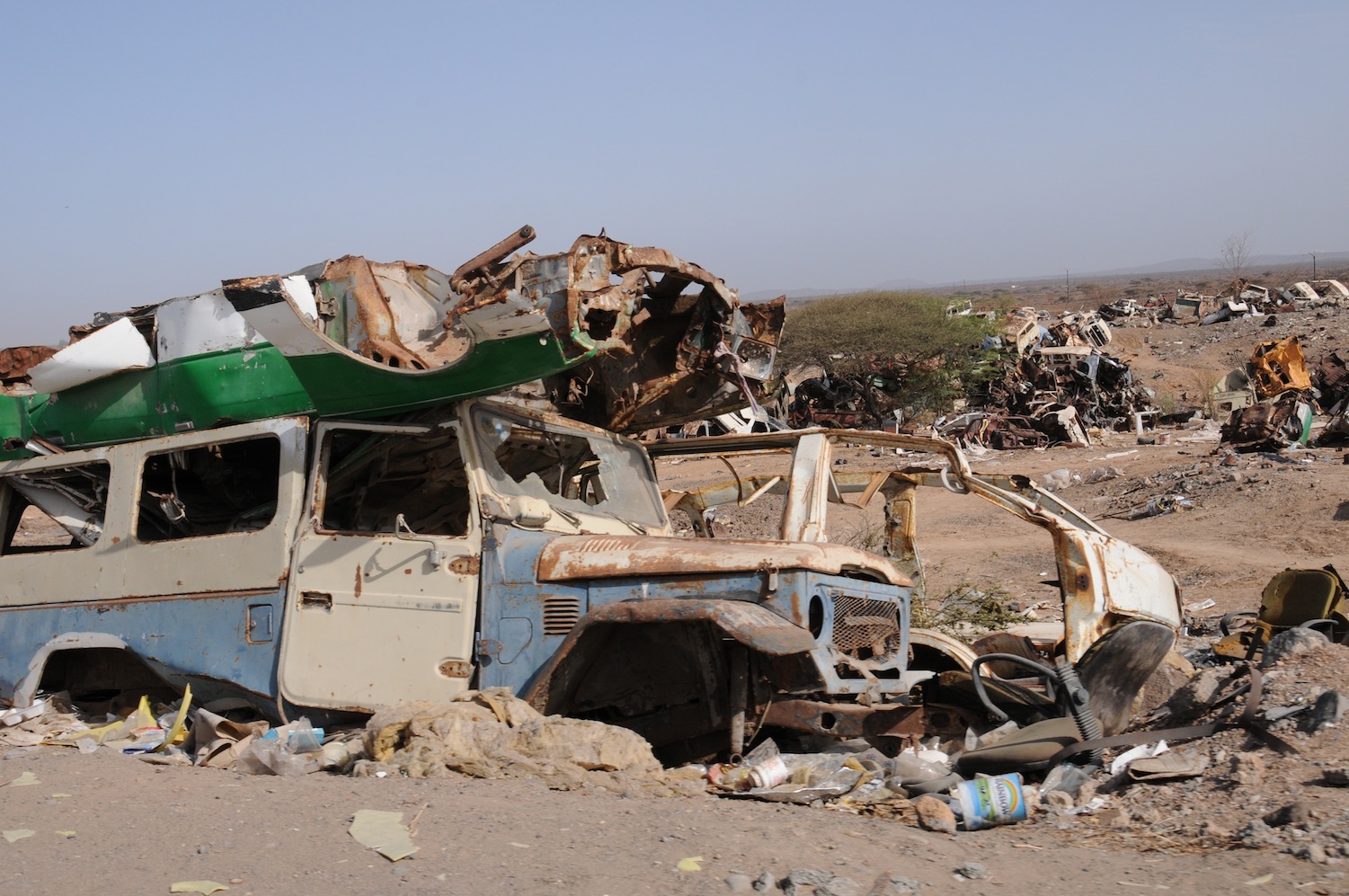
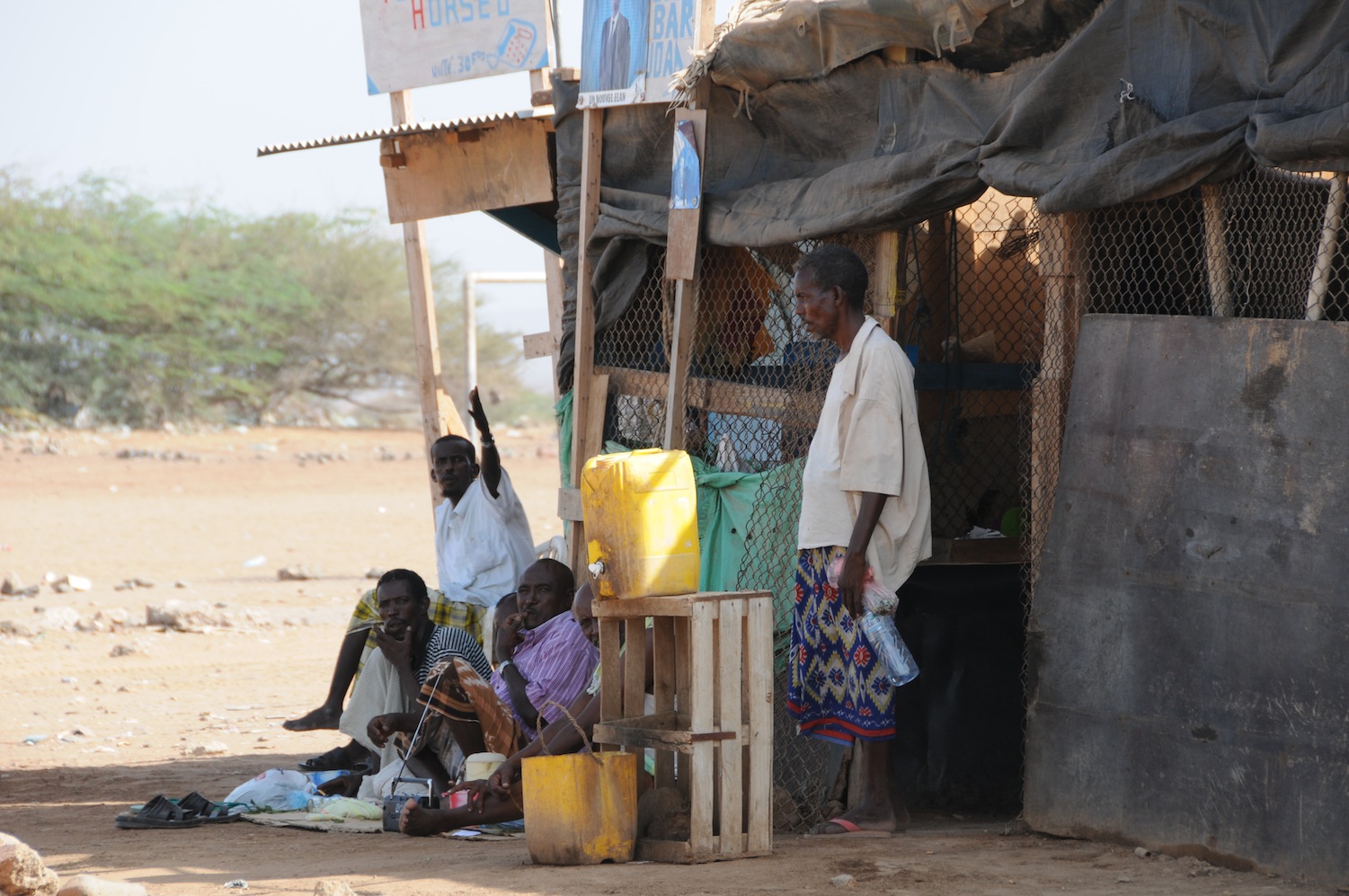
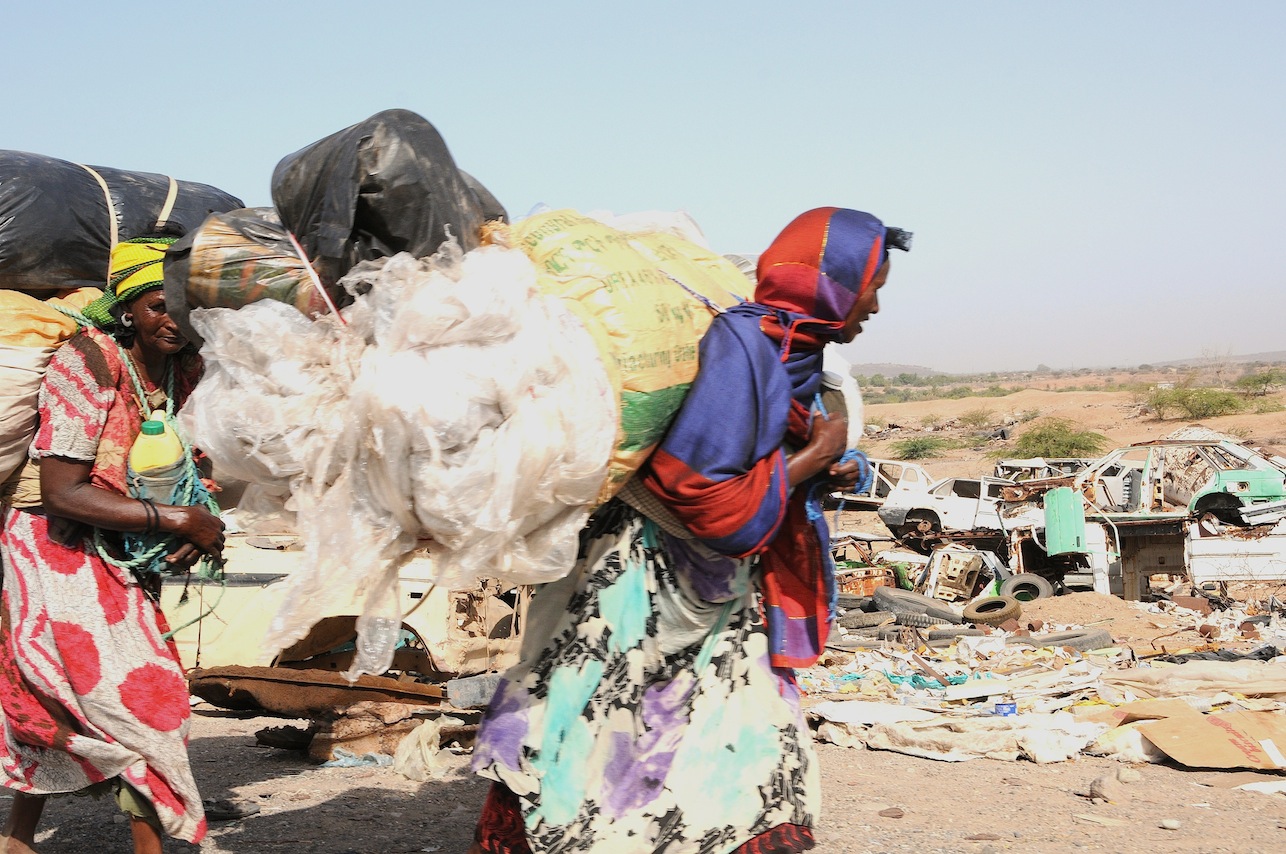
In the meantime, garbage dots the desert, from the border with Somaliland, to the center of the city. The omnipresent Western military presence seems to have almost no positive impact on the country; Djibouti has one of the lowest HDI (UNDP Human Development Index) in the world, 151th out of the 178 countries surveyed. More than half of the population is unemployed and about half is illiterate. The average life expectancy in Djibouti is 43 years of age.

It is a brutal, militarized world, it is aggressive and definitely not at peace with itself. A small Muslim country, with approximately one million inhabitants, has for years basically made a living from being some sort of a service station for foreign legions and regular combat troops. Its only claim to fame is that it allows foreigners to control the Red Sea; that it is at the doorsteps of Somalia and Yemen, helping to keep pressure on Eritrea, and keeping an eye on Ethiopia.

Technically, Djibouti gained independence from France in 1977, but practically it is still fully under the French and Western sphere of influence.

According to the U.S. Department of State report of 21 August 2013:

Djibouti is located at a strategic point in the Horn of Africa, and is a key U.S. partner on security, regional stability, and humanitarian efforts in the greater Horn. The Djiboutian Government has been supportive of U.S. interests and takes a proactive position against terrorism. Djibouti hosts a U.S. military presence at Camp Lemonnier, a former French Foreign Legion base in the capital. Djibouti has also allowed the U.S. military, as well as other militaries with presences in Djibouti, access to its port facilities and airport.

Djibouti is the place where miserable human-pulled carts can be seen right next to decaying vehicles and military equipment, right in the middle of the desert. It is the place where at the Sheraton Hotel, I observed the breakfast room being full of uniformed German troops, and military cooks serving them food.

It is a country with one of the highest infant mortality rates in the world, where many women still go through the horror of genital mutilation. Our kind of place! A good ally; a good client state!

As I was leaving the country, with the Kenyan Airways aircraft waiting on the tarmac, my passport and boarding card were checked on several occasions. Before the gate it all became ridiculous: as two staffers, one in uniform, one in civilian clothing, were performing surveillance only one meter apart from each other.

“Any more of this down the road?” I asked sarcastically.

A soldier, almost 2 meters tall, immediately jumped on me. He threw me and my camera against a concrete wall, and smashed the lens, all in full view of the other passengers, and the Kenyan crew. I tried to fight back.

“Stop and just walk to the plane… Let it be… Or he is going to kill you”, whispered a plain-clothed man. I had no idea who he was, but he most probably saved my life.

There is no place on Earth like Djibouti. Thanks god there really isn’t!


Do not cross his path copy.


Beach games.


Still life in the Djibuti desert.


Poverty.


Loyada – border with Somaliland.


In the middle of Djibuti desert.


Foreign master guarding his airport.

Andre Vltchek is a novelist, filmmaker and investigative journalist. He covered wars and conflicts in dozens of countries. His discussion with Noam Chomsky On Western Terrorism is now going to print. His critically acclaimed political novel Point of No Return is now re-edited and available. Oceania is his book on Western imperialism in South Pacific. His provocative book about post-Suharto Indonesia and market-fundamentalist model is called “Indonesia – The Archipelago of Fear”. He just completed feature documentary “Rwanda Gambit” about Rwandan history and the plunder of DR Congo. After living for many years in Latin America and Oceania, Vltchek presently resides and works in East Asia and Africa. He can be reached through his website or his Twitter.

Canadian Doctor and University Prof Still Held in Disgusting Conditions by Egyptian Junta

Canadians Imprisoned in Egypt Indefinitely After Filming Military Brutality

by TRNN

Upon their arrest, Tarek Loubani and John Greyson reported being beaten and abused, while the military says they could face murder charges.

Justin Podur is an author and Associate Professor at York University's Faculty of Environmental Studies, and one of the organizers in the campaign to free Tarik and John Justin. Podur is the author of Haiti's New Dictatorship (Pluto Press 2012) and has contributed chapters to Empire's Ally: Canada and the War in Afghanistan (University of Toronto Press 2013) and Real Utopia (AK Press 2008).

Thursday, October 03, 2013

The Great Healthcare Rip Off: Creating a Second IRS

Obamacare Is Another Private Sector Rip-Off Of Americans: The private sector allied with government is a second IRS


by Paul Craig Roberts

The government of the “world’s only superpower,” the “exceptional,” the “indispensable” country, claims to know what is best for Syria, Iraq, Afghanistan, Libya, Yemen, Pakistan, Somalia, Mali, Russia, Venezuela, Bolivia, Ecuador, Brazil, China, indeed for the entire world. However, the “indispensable” country cannot even govern itself, much less the world over which the “superpower” desires hegemony. The government of the “world’s only superpower” has shut itself down.

The government has shut itself down, because it cannot deal with the budget deficit and mounting public debt caused by twelve years of wars, by financial deregulation that allows “banks too big to fail” to loot the taxpayers, and by the loss of jobs, GDP, and tax base that jobs offshoring forced by Wall Street caused.

The Republicans are using the fight over the limit on new public debt to block Obamacare. The Republicans are right to oppose Obamacare, but they are opposing Obamacare largely for ideological reasons when there are very good sound reasons to oppose Obamacare.

Last February 3, I posted on this website a column, “Obamacare: A Deception,” written by an expert on the subject. http://www.paulcraigroberts.org/2013/02/03/obamacare-a-primer/

When Republicans for ideological reasons blocked a single-payer health system like the rest of the developed world has and, indeed, even some developing countries have, the Obama regime, needing a victory, went to the insurance companies and told them to come up with a health care plan that the insurance lobby could get passed by Congress. Obamacare was written by the private insurance industry with the goal of raising its profits with 50 million mandated new customers.

Obamacare works for the insurance companies, but not for the uninsured. The cost of using Obamacare is prohibitive for those who most need the health coverage. The cost of the premiums net of the government subsidy is large. It amounts to a substantial pay cut for people struggling to pay their bills. In addition to the premium cost, it is prohibitive for hard pressed Americans to use the policies because of the deductibles and co-pays. For the very poor, who are thrown into Medicaid systems, any assets they might have, such as a home, are subject to confiscation to cover their Medicaid bills. The only people other than the insurance companies who benefit from Obamacare are the down and out who are devoid of all assets.

This might prove to be a growing percentage of Americans. On September 19 the New York Times on the front page of the business section reported what I have reported for years: that real median family incomes in the US are where they were a quarter of a century ago. In other words, in a quarter of a century there has been no income growth for the median American family.

In 2013 payroll employment is below where it was six years ago. During 2013 most of the new jobs, barely sufficient to stay even with population growth and insufficient to recover the job loss from the recession, have been part-time jobs that do not provide any discretionary income with which to drive a consumer economy.

Obamacare has resulted in the health insurance companies, who thought that they would be living in high profits from the mandated health coverage, being outsmarted by employers, who have reduced their full-time workers to part-time in order to avoid Omamacare’s requirement to provide health coverage to those employees who work 30 hours a week or more. http://www.theguardian.com/world/2013/sep/30/us-employers-slash-hours-avoid-obamacare/print

Employers can get away with this, because jobs are hard to find. The lack of employment opportunities results in Americans with engineering degrees working as retail sales clerks and as shelf stockers in Walmart and Home Depot. Despite the abundance of unemployed and under-employed American technical and engineering workers, the large corporations lobby Congress for more H-1B visas to bring in lowly paid foreigners with the argument that there is a shortage of qualified Americans for technical work.

As I have pointed out so many times, if there were a shortage of engineering and technical workers, salaries would be rising, not falling.

For millions of employees, Obamacare means cut hours and less take home pay plus out-of-pocket expenses to purchase an Obamacare health policy. For most people covered by Obamacare, this is a lose-lose situation.

It is also a lose-loss situation for the vast majority of the young. Most young people, unless they have jobs that provide health coverage, do without it, because the chances of the young having heart attacks, cancer, and other serious health problems is low.

Obamacare, however, requires the healthy young to pay premiums for coverage or to pay a penalty to the IRS.

In my day this might not have been a problem. However, today there are few jobs for the young that pay enough to have an independent existence. The monthly payroll jobs reports do not show well-paying jobs. The Labor Department’s projections of future jobs are not jobs that pay well. For the youth, it seems that the penalty is less than the premium, so youthful penalties paid out of waitress and bartender tips will subsidize the unusable Obamacare health policies for the poor adults who are not thrown into Medicaid, which confiscates their assets, if any.

Obamacare benefits only two classes of people. It benefits employers who drop their employees working hours below the hours specified for Obamacare coverage, and it benefits the insurance companies or the IRS who collect the premiums and penalties.

Many of the people who pay the premiums won’t be able to use the policies because of co-pays and deductions.

The very poor with no assets might receive health care if they reside in states that accept the Medicaid provisions of Obamacare.

In 21st century America, the few people who have experienced income gains are the executives and shareholders of firms who offshored their production for US markets, Wall Street which makes bets covered by the Federal Reserve, and the military-security complex which has been enriched by the neoconservatives’ wars.

Every other American has lost.

Paul Craig Roberts was Assistant Secretary of the Treasury for Economic Policy and associate editor of the Wall Street Journal. He was columnist for Business Week, Scripps Howard News Service, and Creators Syndicate. He has had many university appointments. His internet columns have attracted a worldwide following. His latest book, The Failure of Laissez Faire Capitalism and Economic Dissolution of the West is now available.

Energy Alternatives Off the Table in America

Standing in the Sunshine, The Answer is Blowin’ in the Wind

by Walter Brasch  - Wanderings

Tokelau, an independent territory of New Zealand, is a small three island archipelago of about 1,400 residents about 300 miles north of American Samoa in the South Pacific. In October 2012, the Polynesian nation turned off the last of its diesel generators and became the first country to use solar power as its only energy source.

“We know that the longer the fossil fuel industry gets its way, the worse climate change will be, and the more sea-level rise will threaten our islands,” wrote Mikalele Maiava, one of its residents.

About 9,300 miles west of Tokelau is Saudi Arabia. Beneath its sands is an estimated 262.6 billion barrels of oil, the largest reserve in the word. But Saudi Arabia isn’t counting on oil as its sole form of energy. Within the next two decades, Saudi Arabia plans to have 41,000 megawatts of solar energy, enough to generate about one-third of the nation’s electricity. Nuclear, wind, and geo-thermal energy will provide an additional 21,000 megawatts, according to Khalid al-Suliman, vice-president of Renewable Energy at King Abdullah City for Atomic and Renewable Energy. The project is expected to cost about $109 billion, and save about 523,000 barrels of oil a day.

On Saudi Arabia’s northern border is the United Arab Emirates (UAE). Beneath its sands is the world’s seventh largest oil reserve. About 75 miles south of Abu Dhabi, its capital, is the world’s largest solar power plant. The 285,000 parabolic mirrors generate about 100 megawatts of energy, enough to meet the energy needs of 20,000 homes. The solar power plant reduces carbon dioxide emissions by about 175,000 tons a year. The UAE is planning to build additional solar plants.

India, a world leader in wind-generated power, is likely to develop what will become the world’s largest solar energy system. The first phase, being developed on a 23,000 acre site, is expected to be completed by 2016, and will provide about one gigawatt of power. The 30-year plan will allow India to provide one-eighth of its energy needs, through solar power.

Two-thirds of the world’s increase in solar energy in 2011 was in Europe; a two mile section of track between Paris and Amsterdam allows trains to run entirely on solar power; Germany’s solar energy plants produced as much power as 20 nuclear power plants.

Denmark, with the addition of 3.6 megawatts of offshore wind turbines early this year, has more than a gigawatt of wind energy, providing about one-fourth of all power to its citizens. Denmark plans to increase wind power capacity to provide about one-half of all domestic energy needs within the decade.

By the end of 2012, there were 1,662 off-shore wind turbines, generating enough electricity to power 10 million homes in 10 European countries, according to the European Wind Energy Association (EWEA). The EWEA believes that within a decade, off-shore wind turbines could provide electricity to about 39 million homes if countries continued to push for wind energy and rely less upon fossil fuel energy. With political and economic support, according to an EWEA analysis, “The energy produced from turbines in deep waters in the North Sea alone could meet the EU’s electricity consumption four times over.” It would also mean phasing out more than $4 billion in annual taxpayer subsidies to the oil and gas industry.

The U.S. Department of Energy suggests, “Renewable electricity generation from technologies that are commercially available today, in combination with a more flexible electric system, is more than adequate to supply 80% of total U.S. electricity generation in 2050.”

A significant increase of non-fossil fuel energy would produce a cleaner fuel source, reduce workplace accidents and significantly reduce the well-documented health and environmental effects of fossil fuel energy; it would also increase employment, one of the basic reasons why politicians say they like natural gas drilling.

There is some evidence that Americans are beginning to understand the need to abandon fossil fuel energy and prepare for a world of renewable energy.

Lancaster, Calif., a city of about 160,000 in Los Angeles County, was the first American city to require all new houses to produce a minimum of one kilowatt of solar energy, beginning Jan. 1, 2014.

Wind turbines already provide about one-fifth of all power in Iowa and South Dakota.

About three-fourths of Americans want to see more development of solar and wind energy, according to a Gallup poll conducted in March. So, who doesn’t want to see renewable energy replace fossil fuel dependence?

Conservatives and Republicans tend not to want to reduce fossil fuel energy and develop more renewable energy, according to Gallup. The Gallup poll reveals that 78 percent of Republicans want to see more of an emphasis upon fracking and natural gas as a primary energy source.

That’s probably because conservatives don’t like change. It scares them. They understand coal, oil, and gas. They don’t accept solar, wind, and geothermal energy.

But, most of all, most investors in fossil fuel energy—and that includes the frack-at-any-cost Pennsylvania legislature and its governor—have received campaign funds or are heavily invested in fossil fuel energy.

If the oil-rich countries are developing solar, wind, and other forms of renewable energy, maybe they know a lot more about the future. After all, there aren’t any more dinosaurs who are willing to sacrifice their lives so that lobbyists can influence politicians.


[Dr. Brasch’s latest book is Fracking Pennsylvania, an analysis of the effects of fracking upon health the environment. He also looks at the trail of money from the gas industry to politicians, and the claims of economic benefits from fracking.]


Walter M. Brasch, Ph.D.
Latest Books: Before the First Snow: Stories from the Revolution
Fracking Pennsylvania: Flirting With Disaster
(www.greeleyandstone.com)
www.walterbrasch.com
www.walterbrasch.blogspot.com
www.facebook.com/walterbrasch
http://www.youtube.com/watch?v=E6cC4zHnFAY

Getting a Handle on B.C.'s Fracking Policy

BC LNG: The Real Story

by Damien Gillis - CommonSenseCanadian.ca

British Columbians have been hearing a lot of glowing rhetoric from their political leaders about the economic promise of building a new liquefied natural gas (LNG) industry. We’ve heard that our gas – which is fast running out of steam in the North American market – will be transformed into a $100 billion “prosperity” fund for our provincial treasury, all by cooling and exporting it to new markets in Asia.

The extraordinary claims being levied by the BC Liberals have gone largely unquestioned in the mainstream media – which is why, all this week, The Common Sense Canadian will be drilling down on the government’s policy.

For starters, I will be speaking in six different northwest BC communities, alongside local organizations like Skeena Watershed Conservation Coalition, Douglas Channel Watch and NoMorePipelines.ca.

Through these events – highlights of which will be taped and posted to The Common Sense Canadian - along with a series of articles and videos in these pages, we’ll be examining the entire BC LNG plan. From the fracking in northeast BC and Alberta that would need to be dramatically ramped up to feed these coastal plants, to the four-plus major, new pipelines that would cross BC’s wilderness and communities to pump the gas to Kitimat and Prince Rupert, to the plants themselves, to the world’s largest tankers that would carry the liquefied gas to Asia.

We’ll discuss the taxpayer subsidies that would fund the the world’s richest companies – from royalty breaks to infrastructure, to the $10 Billion proposed Site C Dam, whose power is only required for the enormously energy-intensive LNG cooling process.

We’ll expose the truth about the BC Liberals’ claims that this gas will somehow constitute “clean energy” – when it is in fact one of the world’s dirtiest and least efficient energy sources. We’ll examine the massive increase to BC’s greenhouse gases that would arise from this process – potentially upping the province’s total carbon footprint by several fold.

We’ll look at the tens of billions of litres of fresh water that would need to be drained each year from northeast BC’s rivers and lakes and shot full of unknown, toxic chemicals for fracking.

Finally, we’ll examine the economic realities of a program that promises to be the biggest boondoggle in the province’s history – marshalling the best available evidence from around the world, rather than the wishful thinking of Natural Gas Development Minister Rich Coleman and his government.

In short, we will present the other side of the BC LNG fairytale being concocted by BC’s political leaders and media. And we’ll look at some sustainable economic alternatives that could provide a real, healthy future for the people and environment of BC.

If you’re in one of the communities in northwest BC that will be directly affected by these proposed pipelines, LNG plants and terminals, I invite you to join us for one of these presentations – to learn more about the consequences for the health of your community, environment, and economic future (click each link for more details).
Smithers: Sept. 30 – 7pm
Moricetown: Oct. 1 – noon
Old Hazelton: Oct. 1 – 7pm
Terrace: Oct. 2 – 7 pm
Prince Rupert: Oct. 3 – 7 pm
Kitimat: Oct. 4 – 7 pm

And stay tuned to exclusive coverage and analysis from The Common Sense Canadian and our team of expert commentators. Together, we’ll get to the bottom of this BC LNG and fracking pipe dream.