Tuesday, August 26, 2014

Gorilla Radio with Chris Cook, Kevin Pina, Yves Engler, Janine Bandcroft Aug. 27, 2014

This Week on GR

by C. L. Cook - Gorilla-Radio.com

The political situation in Haiti is hotting up and could erupt at any moment. At the heart of the fire this time is President Martelly's determination to again scapegoat Jean Bertrand Aristide, using charges of: "illicit drug trafficking, embezzlement of public funds, forfeiture and concussion, and money laundering." to distract the public from his failures to address the many serious issues Haiti faces.

As it stands, an arrest warrant has been issued for Aristide's failure to appear in court to answer charges on August 13th, and he is at home, surrounded by loyalists protecting the former president from the police.

Kevin Pina is an American filmmaker, journalist, educator, and broadcaster with Pacifica Radio's public affairs program, Flashpoints.

Listen. Hear.

Pina's film credits include: 'El Salvador: In the Name of Democracy,' 'Berkeley in the Sixties,' 'Amazonia: Voices from the Rainforest,' 'Haiti: Harvest of Hope,' 'Haiti: The UNtold Story,' and 'HAITI: We Must Kill the Bandits.' Kevin has lived and reported from Haiti, and was arrested by the infamous Baby Doc Duvalier for reporting on the abuses of that regime.

Kevin Pina in the first half.

And; Israel's bombardment of the captured population of the Gaza Strip continued this week with the Israel Defense Forces capping the seven weeks-long blitzkrieg by upping its game and targeting highrise apartment buildings. Predictably, the government of Canada remained mostly mute on the serial war crimes and crimes against humanity being conducted by its "good friend" Israel, throughout blaming Hamas, the governing body in Gaza, for Palestinians killed, maimed, and made homeless.

Late yesterday, (Aug. 26/'14) an "unlimited truce" was announced by Israel. Canada's Foreign Affairs minister, John Baird welcomed the truce announcement, but cautioned; "Israel will be forced to continue defending itself as long as Hamas continues its rocket attacks against civilians, and Hamas will be solely to blame for any further loss of life." Beyond raising questions about what sort of grip on reality minister Baird is capable of exerting, the Stephen Harper New Government's behaviour begs investigation of the Canada/Israel relationship, and how that relationship abets the horrors repeatedly witnessed in Occupied Palestine.

Yves Engler is a Canadian activist, lecturer, journalist, and author. Some of Yves' titles include; 'The Black Book of Canadian Foreign Policy,'Canada and Israel: Building Apartheid,' 'Lester Pearson's Peacekeeping The Truth May Hurt,' and his latest, 'The Ugly Canadian: Stephen Harper’s Foreign Policy.'

Yves Engler and Canada's tax-deductible aid to Israel's genocide in Gaza in the second half.

And; Victoria Street Newz publisher emeritus and CFUV Radio broadcaster, Janine Bandcroft will be here at the bottom of the hour to bring us up to speed with some of what's good to do in and around our city in the coming week, and beyond there too. But first, Kevin Pina and the ritual pre-election smearing of Haiti's former president, Jean Bertrand Aristide.

Chris Cook hosts Gorilla Radio, airing live every Wednesday, 1-2pm Pacific Time. In Victoria at 101.9FM, and on the internet at: http://cfuv.uvic.ca. He also serves as a contributing editor to the web news site, http://www.pacificfreepress.com. Check out the GR blog at: http://gorillaradioblog.blogspot.ca/

G-Radio is dedicated to social justice, the environment, community, and providing a forum for people and issues not covered in the corporate media.

The Death of Remorse: How Teevee Kills Our Humanity

Sociopathic Syndrome

by Murray Dobbin - CounterPunch

Remorselessness is all the rage in politics, art and commerce. Who’s smiling?

I confess. I have been binge-watching TV series. Lately I have narrowed my watching mostly to The West Wing, an old favourite about a Democratic president, Jed Bartlet, portraying the manic, day-to-day crisis management of the White House. But in my defence I am doing so in part as an antidote to another series I quit watching because the values it displayed and promoted were so execrable.

The award-winning House of Cards stars Kevin Spacey as a ruthless congressman seeking revenge (and higher office) for being betrayed by “his” president. Both these series are exceptionally well-written and well-acted. But one actually features characters who are trying to accomplish laudable social objectives (for the most part) and who treat each other with genuine respect and even affection. House of Cards never allows such sentiment to prevail or even appear, except as a reflection of weakness and naivete. It’s all about varying degrees of ruthlessness and we are clearly supposed to admire Spacey as a masterful practitioner of the Machiavellian arts.

Of course House of Cards is not the only series people are bingeing on. There is another popular series praised for its high production values, writing and its atmospheric tone. The “hero” is Walt, a high school chemistry teacher who starts dabbling in meth production and then gets deeper and deeper into the murderous meth business. He may be the only TV hero who is a psychopathic killer. I quit watching this one after the episode in which he orders the murders of nine convicts who could expose his role.


People who are addicted to this series manage, somehow, to rationalize their attraction by referring to how incredibly well produced and acted it is. I don’t care how well acted it is. It is grotesque, a vehicle for gratuitous violence and the demeaning of life, an assault on human sensibility. 

My advice — which no one will take — is to spend a few minutes asking yourself what a celebration of murderous psychopathy might be doing to your own mental state. While you are at it ask yourself what your limits are: what level of human depravity exploration would finally compel you to switch channels?

I don’t know if watching such series actually does any lasting epigenetic damage but an appeal to simple self-respect and social consciousness should be enough to launch a boycott of this ugly entertainment. Why? Because this sick amorality isn’t just on TV. It is everywhere — in too many politicians (Stephen Harper, Tony Blair, Benjamin Netanyahu, Dick Cheney come to mind), too many CEOs, and if you watched The Wolf of Wall Street (all of which was based on true accounts) virtually all of Wall Street, and in too many of our institutions (like the RCMP). And it’s now in popular non-fiction literature and on the internet.

As reported recently by Canadian author Patricia Pearson: “The celebration of remorselessness is everywhere. Friends on Facebook have lately been reporting their scores on widely circulating psychopathy quizzes that ask users to agree or disagree with statements such as, ‘I never feel remorse, shame or guilt about something I’ve said or done.’ ‘I’m 19 per cent psychopath!’ they announce. Or: ‘I scored five out of 10!’ As if the chilling absence of human empathy I witnessed as a crime reporter in covering trials like that of serial killer Paul Bernardo had become a fun little personality quirk.”

James Fallon, the author of The Psychopath Inside actually refers to himself as a pro-social psychopath “who chooses not to murder people even though, admittedly, he cares not one whit if he harms them in other ways.”

How is it possible that this idiocy passes for rational, acceptable narrative? Pearson rightly asks “What fire, exactly, are we playing with? Have we taken a tolerance of difference, of identity, of moral relativism, too far? … The issue, fundamentally, is moral. What kind of a society do we wish to inhabit, with what kinds of leaders and heroes?”

Pearson quotes Adam Kotsko, author of Why We Love Sociopaths: A Guide to Late Capitalist Television:

“People enjoy watching sociopaths on television as a kind of compensation for their own feelings of powerlessness and helplessness.” 

Now we’re getting closer to the root of the problem: the inexorable imposition of capitalist social relations. What is the source of the average person’s “powerless and helplessness” if not the hyper-competitiveness of late capitalism? It’s a competitiveness in which almost all but the One Per cent lose — with tax cuts, privilege and ever-increasing wealth accumulation fixing the game.

The stronger the imperative to compete, the weaker become family, community and friendship connections, because in rampant consumer capitalism — promoted and reinforced by television culture — such connections are seen as irrelevant. Or worse, they are seen as weak and inefficient means, if not actual barriers, to the end of achieving more stuff. We are competing in a zero-sum game whose rules are written by those with psychopathic tendencies.

As Fred Guerin writes in Truthout,

“Obedience, docility, amorality and careerism will be duly rewarded. Those who can regularly suspend any desire they have to think from the perspective of another, or on behalf of a more universal or common good will be promoted.”

Guerin is getting at the real roots of our crisis in democracy. It is not first-past-the-post voting systems, or the cancellation of government funding for parties, or even the role of TV advertising. It is at its core our gradual acquiescence “to things that are contrary to our individual and communal interests.” This acquiescence, say Guerin, is the “consequence of very gradual political and corporate indoctrination that consolidates power not only by inducing fear and uncertainty, but also by rewarding unbridled greed, opportunism and self-interest.”

Is there an antidote to this death-culture? Can we reclaim our capacity to think beyond our immediate self-interest and regain our political agency — our ability to act as citizens and not just consumers? Can we begin to create a shared space where we can actually imagine a future worth having, talk about big ideas and recover the notion that we can act in concert for the broader good?

It comes down to the question of political agency. So perhaps the more important question is not what should be done but who is going to do it? Our gradual accommodation to the new and enervating normal means that none of our existing institutions are now capable of engineering this recovery. They are spent forces fighting on the edges of the battle.

If that is the case where do we start? While it is naive to suggest that individual action will bring down corporate capitalism it is obvious to anyone not distracted by the shopping mall that it must be ended — or it will destroy life on this planet. So perhaps we do need to start at the political equivalent of the molecular level, with the most basic human principles that provide us with the capacity to resist, to act in concert, to get beyond our possessive individualism.

What is it, for example, that causes otherwise consumption-addled North Americans to suddenly demonstrate generosity, compassion, and benevolence when confronted by the aftermath of some natural disaster like a flood or tornado? What is missing in everyday life without disaster that allows us to acquiesce to things that do us great harm?

British writer Barbara Taylor has suggested in her essay “On Kindness” (co-authored by Adam Phillips) that the missing ingredient is just that: kindness. The authors point out that for almost all of human history, people considered themselves naturally kind. Christian philosophy called on people to “love thy neighbour as thyself.” But by the 17th century kindness was under attack by competitive individualism. Today, says Taylor, “An image of self has been created that is utterly lacking in natural generosity.” This is in spite of numerous studies that show giving provides far more pleasure than taking. People involved in these studies are astonished by the results — and simply don’t trust them.

The recovery of kindness would be a threat to the existing order. That is because “it is not that real kindness requires people to be selfless, it is rather than real kindness changes people in the doing of it, often in unpredictable ways…. It is a risk precisely because it mingles our needs and desires with the needs and desires of others in a way that self-interest never can.” Could this be the key to recovering what Guerin referred to as “possibility and human creativity”? Taylor clearly thinks so, as the kindness she is talking about “creates the kind of intimacy, the kind of involvement with other people that we both fear and crave;… kindness, fundamentally, makes life worth living… everything that is against kindness is against hope.”

Kindness, or “mutual belonging” has become our great taboo. It hangs on by the skin of its teeth in the imperative to carry out “random acts of kindness.” Instead let’s try purposive acts of kindness, challenge competitive individualism and begin imagining the end of capitalism.

Rise of the Muckrakers: A Golden Age of Investigative Journalism?


The Fall and Rise of Investigative Journalism: From Asia to Africa to Latin America, Muckrakers Have Corrupt Officials and Corporate Cronies on the Run

by Anya Schiffrin  - TomDispatch

In our world, the news about the news is often grim. Newspapers are shrinking, folding up, or being cut loose by their parent companies. Layoffs are up and staffs are down. That investigative reporter who covered the state capitol -- she’s not there anymore. Newspapers like the Los Angeles Times, the Washington Post, and the Chicago Tribune have suffered from multiple rounds of layoffs over the years. You know the story and it would be easy enough to imagine that it was the world’s story as well. But despite a long run of journalistic tough times, the loss of advertising dollars, and the challenge of the Internet, there’s been a blossoming of investigative journalism across the globe from Honduras to Myanmar, New Zealand to Indonesia.

Woodward and Bernstein may be a fading memory in this country, but journalists with names largely unknown in the U.S. like Khadija Ismayilova, Rafael Marques, and Gianina Segnina are breaking one blockbuster story after another, exposing corrupt government officials and their crony corporate pals in Azerbaijan, Angola, and Costa Rica. As I travel the world, I’m energized by the journalists I meet who are taking great risks to shine much needed light on shadowy wrongdoing.

And I’m not the only one to notice.

Tomgram: Anya Schiffrin, Who Knew We Were Living in the Golden Age of Investigative Journalism?

[Note for TomDispatch Readers: Here’s my end-of-summer reading list -- three books already highlighted in the most recent TD pieces and a bonus volume. As with today’s post, so Anya Schiffrin’s eye-opening new book, Global Muckraking: 100 Years of Investigative Journalism From Around the World, offers a genuine dose of hope when it comes to investigative reporting on a global level. Patrick Cockburn’s latest book on the rise of ISIS (and the collapse of much of the Middle East), The Jihadis Return: ISIS and the New Sunni Uprising, is a must-read for anyone with an interest in the region, which essentially should mean all of us. Aviva Chomsky’s Undocumented: How Immigration Became Illegal provides a necessary framework for an issue that continues to grip the country. As for my bonus choice of the late summer, I just finished a riveting new thriller by one of my favorite columnists, the Boston Globe’s James Carroll. Warburg in Rome, his novel about the Pope, the Catholic Church, Jews just out of the concentration camps, the U.S. military, and the ways various Nazis escaped from Europe in the wake of World War II, kept me reading late into the night. Tom]

Almost a decade ago, I spent more than a year freelancing for a major metropolitan newspaper -- one of the biggest in the country. I would, on an intermittent basis, work out of a newsroom that appeared to be in a state of constant churn. Whoever wasn’t being downsized seemed to be jumping ship or madly searching for a life raft. It looked as if bean counters were beating reporters and editors into submission or sending them out of the business and into journalism schools where they would train a new generation of young reporters. For just what wasn’t clear. Jobs that would no longer exist?

Before the special series I was working on was complete, my co-writer -- the paper’s Washington investigative editor -- had left for the friendlier confines of academia and the editor who greenlit the series had resigned in the face of management’s demands for steep cuts to newsroom staff. It seemed as if the only remaining person associated with the series was a gifted photographer (who left for greener pastures within a year).

I thought I was witnessing the end of an era, the death of an institution.

At the same time, I was also working for a small but growing online publication that managed to produce three original articles each week -- a mix of commentary, news analysis, and original investigative reporting. More than a decade into that gig, the Nation Institute’s TomDispatch.com is still going strong, still publishing three original articles per week, and syndicating that content out to dozens and dozens of online publications, reaching hundreds of thousands of potential readers.

Over that time, online outlets have come and gone, venerable newspapers have closed up shop, predictions of doom -- of the death of print publications, the demise of investigative reporting (maybe even of journalism itself) -- have been aired repeatedly. And it’s true that in this new era it hasn’t been easy to make a living as a journalist or keep a media outlet afloat. Yet, as a reader, I notice something else: I can’t even hope to read every eye-catching article that flashes by on my Twitter feed or piles up in my inbox from one listserve or another. I end up with 25 open windows in my taskbar -- top-quality journalism from legacy media outlets and new digital magazines that I hope I might be able to skim later that day or the next or sometime before my laptop slows to a crawl under the weight of so much groundbreaking reporting.

It turned out that, 10 years ago, I actually was witnessing the end of an era while living through the formative stages of another. It’s been a moment in which stories published on a relatively tiny website like TomDispatch circle the globe in a flash and a writer like me, who never went to journalism school, can see his articles almost instantly translated into Spanish, Japanese, Italian, and languages I don’t even recognize, and then reposted on websites from South America to Africa to Asia. In other words, they sometimes reach the sort of global audience that once might have been a stretch even for a reporter at a prestigious mainstream media outlet.

Over these years, I’ve also watched others who have passed through the Nation Institute wade into a scary media market and find great success. TomDispatch’s own former intern Andy Kroll, for example, has gone on to break one important story after another at Mother Jones, a print publication that now thrives online, while former Nation Institute program associate Liliana Segura has taken a top post at First Look Media, one of the most dynamic and talked-about new media ventures in years. And they are hardly anomalies.

In her new book, Global Muckraking: 100 Years of Investigative Journalism from Around the World, Anya Schiffrin, the director of the media and communications program at Columbia University’s School of International and Public Affairs, chronicles the brave new world of global journalism in the age of the Internet (and how the stage was set for the new golden age of the reader we’re living in). In her inaugural article for TomDispatch, the longtime foreign correspondent reveals the investigative exposés by today’s top global muckrakers that you missed and explains why investigative journalism is on the rise, not the decline, worldwide.

From Asia to Central America, a new generation of Nellie Blys and Ida Tarbells, Seymour Hershes and Rachel Carsons, is breaking one big story after another with equal parts old-fashioned shoe leather and twenty-first-century knowhow. “The fact that journalists have been calling attention to some of the same problems for more than a hundred years might make one despondent, but it shouldn’t...” Schiffrin writes in her book. “That the battles are still going on should remind us that new abuses, new forms of corruption, are always emerging, providing new opportunities and new responsibilities for the media.” Luckily, there is a new generation of reporters around the world, she points out, rising to the challenge. Nick Turse

The Fall and Rise of Investigative Journalism: From Asia to Africa to Latin America, Muckrakers Have Corrupt Officials and Corporate Cronies on the Run

by Anya Schiffrin


We are in a golden age of investigative journalism,” says Sheila Coronel. And she should know. Now the academic dean at Columbia University’s Graduate School of Journalism, Coronel was the director of the Philippine Center for Investigative Journalism, whose coverage of the real estate holdings of former President Joseph Estrada -- including identical houses built for his mistresses -- contributed to his removal from office in 2001.

These are, to take another example, the halcyon days for watchdog journalism in Brazil. Last October, I went to a conference of investigative journalists there organized by the Global Journalism Investigative Network. There were 1,350 attendees. In July, I was back for another conference, this time organized by the Association of Brazilian Investigative Journalists and attended by close to 450 reporters. Thanks in part to Brazil’s Freedom of Information Act and the “open budget” movement that seeks to shed light on the government’s finances (and let people have a say in how their tax dollars are spent), journalists there have been busy exposing widespread corruption in local government as well as a cash-for-votes scheme that resulted in the arrest of nine senior politicians.

Cross-border news networks funded by foundations and philanthropists are carrying out similar investigations all over the world. Based in New York and edited by a Nigerian, Omoyele Sowore, Sahara Reporters uses leaked stories and documents to expose corruption in Africa’s richest country. Its funders include the Omidyar Network, created by eBay founder Pierre Omidyar and his wife, Pam, and its stated goal is nothing less than “seeking the truth and publishing it without fear or favor.”

A group of students and I studied Sahara Reporters earlier this year. In our report, we described one typical story that outlet broke which detailed how then-Minister of Aviation Stella Oduah purchased two bulletproof BMWs -- at nearly double the normal price -- with funds from the Nigerian Civil Aviation Authority (NCAA). Sahara Reporters posted receipts of the purchases and documents linking Oduah to the scheme. It also located sources who testified that the whereabouts of the cars were unknown and that they were suspected of being employed for Oduah's private use. Meanwhile, Sahara Reporters exposed the budgetary constraints the NCAA was operating under and linked these to several air mishaps, including two crashes resulting in the deaths of 140 people.

Oduah, who was already under fire for the NCAA’s poor performance, initially denied the accusations. Within days, however, numerous news outlets had picked up the story and run with it. The reports triggered a series of reactions from the government, opposing political parties, civil society organizations, and the Nigerian public. Earlier this year, Oduah was fired.

Honorable Mentions


In recent years, I’ve been a judge for the human rights reporting awards given out by the Overseas Press Club in New York. You should see the staggering pile of entries. It takes days to read through them all. Our major “problem”: an overabundance of top-notch reporting we’re unable to acknowledge with prizes. (Happily, some of them received prizes anyway, just not from us).

Among the remarkable pieces we read but didn’t give the human rights prize to was an Associated Press series on the effects of narco-violence on ordinary people in Honduras. It laid out the way they have been forced to flee their villages or vacate neighborhoods block by block as drug dealers moved in and took over their homes. The series described how some homeowners stopped painting their houses or mowing their lawns lest they appeal to drug lords who might seize them. People were even being shaken down by gangs that left notes demanding payments if they wanted to be allowed to stay in their houses.

At the same time, the government was sowing misery of its own. As part of the series, Alberto Arce wrote about a 15-year-old boy -- the son of a college professor -- who went out one night to meet a girl he had friended on Facebook only to be killed at a government roadblock by trigger-happy soldiers.

This year, when the press started to cover the flood of children from Central America crossing the U.S. border, I thought back to that series and how well it explained the kinds of desperate conditions that can lead to mass migration.

Similarly unforgettable was the reporting of Cam Simpson at Bloomberg Businessweek about the workers behind Apple’s iPhone 5. Migrants from Nepal, they fell into debt paying middlemen for jobs assembling that smartphone in factories in Malaysia. After Apple started rejecting the phones, production was cut back and some 1,300 workers were left to fend for themselves for months without food or pay. Since their passports had been taken from them, they were unable to leave the country and essentially confined to a hostel, trying to scrape together a bit of rice each day. Finally, in despair, they began rioting and the Malaysian police were called in. Their response will seem odd indeed to anyone reading recent reports from Ferguson, Missouri. Instead of arresting the workers, the police had food delivered and went to work to get the Nepalese sent home. (Still broke, many of them are likely to go further into debt to again pay brokers to secure overseas jobs that may land them in similarly dire straits.)

A third striking piece of global reportage was E. Benjamin Skinner’s “The Fishing Industry’s Cruelest Catch.” It focused on the conditions Indonesian migrant workers encounter fishing in the waters off New Zealand, for New Zealand companies, aboard Korean boats. A report by academic researchers Christina Stringer and Glenn Simmons, in collaboration with deep sea fishing skipper Daren Coulston, prompted Skinner, a journalist specializing in slavery, to spend six months in several different countries checking out their allegations.

The result was a gripping story of modern day slavery. Indigent Indonesian villagers were, he reported, misled into accepting contracts on vessels that ply the Southern Pacific Ocean and Tasman Sea searching for fish to be sold to giant American chains like Safeway, Walmart, and Whole Foods. Many of the Indonesians thought they were signing on to first world labor conditions on modern New Zealand-owned vessels. Once aboard, however, they found themselves virtual prisoners, forced to work long hours for substandard food and beaten or sometimes sexually assaulted when they tried to resist.

After various deductions were taken from their paychecks, the workers, promised $12 an hour, ended up getting only about a dollar an hour. Not only was Skinner’s story well-written and well-reported, but within months of its appearance, New Zealand had moved to change its laws and Safeway, Whole Foods, and Walmart began investigating their supply chains.

The Future of Global Muckraking


When I began researching my new book, Global Muckraking: 100 Years of Investigative Journalism from Around the World, I assumed that the good old days of investigative reporting were in the past. It was a surprise to learn just how much high quality work is still being done around the planet. The amount of data now available online, the ability of journalists to use the Internet to connect to one another and share information -- a major aid in cross-border reporting -- and a wave of new philanthropy have all helped fuel the current boom. In addition, fresh news operations of every sort seem to be popping up, eager to promote investigative reporting.

I thought I was well versed in innovative twenty-first century methods of news funding when I headed into this project, but I continue to stumble upon exciting experiments. For example, Morry Schwarz, a book publisher and property developer from Melbourne, Australia, funds weekly, monthly, and quarterly publications devoted to long-form writing on serious issues of the day, while also running the publishing house Black Inc. Australian philanthropist Graeme Wood, with money he made from an online business, founded the Global Mail, a nonprofit website that was similarly aimed at promoting long-form journalism. He also underwrites cross-border investigations via the International Consortium of Investigative Journalists. In Brazil, João Moreira Salles, scion of a prominent family enmeshed in the banking sector, has used his money to found a monthly magazine, Piauí, whose recent issue included an investigative piece about indigenous opposition to Belo Monte, a hydroelectric plant under construction in Altamira in the Amazon region.

Moves toward democracy in many countries, along with the Arab Spring (however shortcircuited it was) have also unshackled the global press in a variety of ways. Compared to five, 10, or 20 years ago, Myanmar, Ghana, and Tunisia, to take just three examples from many, have far freer -- sometimes remarkably freewheeling -- media atmospheres. And what’s happening in countries like those has had a knock-on effect on nearby states.

Of course, there are also democratically elected governments in countries like Turkey, Ecuador, and Hungary that have been clamping down on free speech. And from Syria to Ferguson, Missouri, many locales remain dangerous for journalists. On balance, however, the press is ever less under the thumb of government, a situation that only encourages investigative reporting. To take two examples where the press has become at least marginally harder to control thanks to social media, the Internet, and some brave (or nervy) independent-minded journalists, consider China and Vietnam, where once utterly closed media scenes are slowly being pried open.

The mass layoffs of older journalists around the world has had one benefit: there are plenty of experienced hands ready to train the next generation and provide institutional memory at innovative ventures. Some of these oldtimers, who aren’t busy teaching (or taking public relations jobs -- but that’s a story for another time), are busy founding and running nonprofits dedicated to doing hard-driving, investigative reporting. These include: 100 Reporters, Global Journalism Investigative Network, Forum for African Investigative Reporters, Investigative Reporters and Editors, Investigative News Network, SCOOP, and the International Consortium of Investigative Journalists. All of these organizations are benefitting from experienced editors and reporters downsized from traditional media outlets and committed to helping the next generation -- and learning from them, too.

No one can say how this wave of new reporting will continue to be funded in the future, nor can I promise to be as cheery a decade from now as I am today about investigative journalism’s prospects. Already some donors are putting in place stipulations that might constrain future reporting -- like requiring publications to meet benchmarks offering proof of a story’s impact. Still, if the history of investigative reporting in the United States has taught us anything, it’s that outlets come and go, but the legacy of great investigative reporting, the tradition that inspires future generations of crusading journalists, endures.

It can take years for investigative journalism to make a difference and, in the past, many of the most important outlets didn't make money and disappeared. They were sometimes run by passionate crusaders who seized the moment, wrote the stories, and then moved on. Everybody’s Magazine folded long ago, but Upton Sinclair’s takedown of the scandalous Beef Trust, specifically Armour and Co., in 1908 opened American eyes to the way meat was produced in this country. Who remembers In Fact? But George Seldes's prescient 1941 exposé of the dangers of cigarettes in the pages of that now-defunct publication has stood the test of time. And while McClure’s, I.F. Stone’s Weekly, and Ramparts may be increasingly distant memories, the effects of their investigative work ripple all the way to the present.

And this isn’t peculiar to the United States.

Young journalists on their way up are being trained in a craft that, history tells us, will outlast the death of any particular publication. Ory Okolloh of the Omidyar Network regularly makes this point. She notes that after the pioneering Nigerian newspaper Next234 went out of business, its reporters and editors simply moved on to other media outlets in Africa, where they are breaking important stories and training the next generation of reporters.

For investigative reporting, injustice is the gift that just keeps giving. While so much of the business side of journalism remains in flux, fine reporters with an investigative urge are finding ways to shine much needed light into the parts of our global lives that the powerful would rather keep in the shadows. These may be tough times, lean times, difficult times, but don’t be fooled: they’re also boom times. There can be no question that, if you’re a reader with access to the Internet, you’re living in a new golden age of investigative journalism.

Anya Schiffrin is the director of the media and communications specialization at Columbia University’s School of International Affairs. She teaches courses on media innovation and writes on journalism and development as well as the media in Africa. Schiffrin spent 10 years working overseas as a journalist in Europe and Asia and is on the advisory boards of the Open Society Foundation’s Program on Independent Journalism and of the Revenue Watch Institute. Her most recent book is Global Muckraking: 100 Years of Investigative Reporting from Around the World (New Press 2014). Thanks to Hawley Johnson, Jillian Hausman, and Angela Pimenta for their research for this piece.

Follow TomDispatch on Twitter and join us on Facebook and Tumblr. Check out the newest Dispatch Book, Rebecca Solnit's Men Explain Things to Me.

Copyright 2014 Anya Schiffrin

Teachable Moments in Kabul

A Teacher in Kabul


by Kathy Kelly - CounterPunch

Kabul  - Here in Kabul, one of my finest friends is Zekerullah, who has gone back to school in the 8th grade although he is an 18-year old young man who has already had to learn far too many of life’s harsh lessons.

Years ago and miles from here, when he was a child in the province of Bamiyan, and before he ran away from school, Zekerullah led a double life, earning income for his family each night as a construction crew laborer, and then attempting to attend school in the daytime. In between these tasks the need to provide his family with fuel would sometimes drive him on six-hour treks up the mountainside, leading a donkey on which to load bags of scrub brush and twigs for the trip back down. His greatest childhood fear was of that donkey taking one disastrous wrong step with its load on the difficult mountainside.

And then, after reaching home weary and sleep deprived and with no chance of doing homework, he would, at times, go to school without having done his homework, knowing that he would certainly be beaten. When he was in seventh grade, his teacher punished him by adding ten more blows each day he came to school without his homework, so that eventually he was hit sixty times in one day. Dreading the next day when the number would rise to seventy, he ran away from that school and never returned.

Now Zekerullah is enrolled in another school, this time in Kabul, where teachers still beat the students. But Zekerullah can now claim to have learned much more, in some cases, than his teachers.

Much to the surprise of his environmental studies teacher, Zekerullah has a strong grasp of issues related to the environment. For the past two years, living with the Afghan Peace Volunteers, he has occupied himself with presentations and conversations about global warming, climate change, and environmental degradation.

He cares deeply about the issue. Last winter, I was with him as he watched the entire BBC Blue Planet series of videos, and realized that he hungers for more information and deepened understanding about issues hitting far beyond his own beleaguered country. 

When his new teacher, a teacher accustomed to beating pupils, asked the class elementary questions about the environment, Zekerullah had definitely done his homework. But among his other recent studies were the history of nonviolent movements, led by people like Gandhi and Dr. Martin Luther King, to resist oppressive forces.

So without calling any attention to his plans, Zekerullah decided to join the line of students singled out for punishment, in his environmental studies class, even though he wasn’t at fault and didn’t deserve to be punished. The teacher was befuddled. Zekerullah so clearly knew the answers.

Zekerullah calmly explained to the teacher that he also knew, from experience, that beating students doesn’t help them learn, that he himself had lost four years of studies because he could no longer bear the beatings. He respectfully asked the teacher to beat him instead of the next seven students in the row.

The teacher obliged, administering blows to Zekerullah while his fellow students began to wonder about and admire Zekerullah’s unusual stance. Perhaps for the first time in a long while, everyone in that class was learning something.

For several weeks, the teacher was confronted with Zekerullah’s quiet insistence that he be allowed to take the blows in place of students who hadn’t studied. The teacher tried to ignore him and belittle him. Once, the teacher punished him and a few others with the escalated punishment of using a rattan cane to inflict the blows. Adding salt to the wound, the teacher even failed Zekerullah in the mid-year exams, though Zekerullah said he knew the answers and had no trouble finishing the exam.

I asked him what other students thought about his choices. He said that some of them wanted to spare him from being punished, and so they began to study more and complete their homework. He isn’t sure what impact his actions have had. Zekerullah isn’t inclined to brag. But he surely has affected me.

He is also affecting other vulnerable young Afghans. Over the past two years, Zekerullah has worked hard to improve his studies, and with the literacy he has acquired, he now volunteers to teach a literacy class at the APVs Borderfree Center for about 20 street kids who have not had the opportunity to go to school regularly. He and several companions have organized other aspects of the “Street Kids” program, visiting children in their homes and helping distribute oil and rice to each family so that the children can stop working on the streets.

Zekerullah tells me that the current education system in Afghanistan is not a good learning environment. His story alerts educators, officials and the international community to understand that the relatively small funds spent on badly-constructed new school buildings won’t suffice to provide a good education for the young Afghan population. Moreover, the predominantly militarized approach of aid and development, even in the field of education, reinforces the prevalent methods of teaching by force and punishment.

Zekerullah yearns for knowledge as well as justice, and he’s willing to sacrifice for both. I want to learn from him.

Kathy Kelly co-coordinates Voices for Creative Nonviolence (www.vcnv.org). While in Kabul, she is a guest of the Afghan Peace Volunteers (ourjourneytosmile.org)

POW Parades and the NYT's Selective Ukraine Outrage

Selective Outrage over Ukraine POWs

by Robert Parry  - Consortium News

The New York Times has taken deep umbrage over an unseemly parade staged by ethnic Russian rebels in eastern Ukraine featuring captured Ukrainian soldiers.

The Times noted that the Geneva Conventions prohibit humiliation of POWs, surely a valid point.


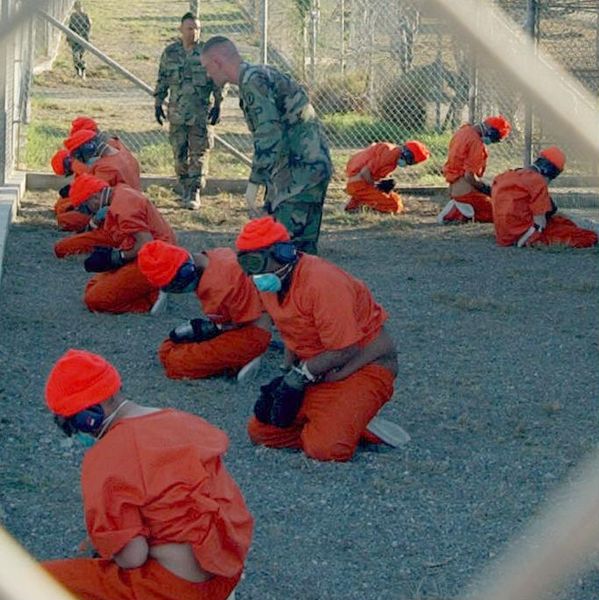
Some of the original detainees jailed at the Guantanamo Bay prison, as put on display by the U.S. military.

But the Times – in its profoundly biased coverage of the Ukraine crisis – apparently feels that other aspects of this nasty civil war are less newsworthy, such as the Kiev government’s bombardment of eastern Ukrainian cities sending the death toll into the thousands, including children and other non-combatants.

Also downplayed has been Kiev’s dispatch of neo-Nazi storm troopers to spearhead the urban combat in ethnic Russian towns and cities in the east.

When the Times finally noticed this street-fighting role of neo-Nazi militias, that remarkable fact – the first time armed Nazis were dispatched by any government to kill people in Europe since World War II – was consigned to the last three paragraphs of a long article on a different topic, essentially a throwaway reference.

Similarly, the Kiev regime’s artillery fire on residential areas – killing many civilians and, over the weekend, damaging a hospital – has been treated by the Times as a minor afterthought. But Times’ readers are supposed to get worked up over the tasteless demonstration in Donetsk, all the better to justify more killing of ethnic Russians.

Though no one was killed or injured during Sunday’s anti-Ukrainian march – and rebel troops protected the captured soldiers from angry citizens – the Times led its Ukraine coverage on Monday with the humiliation of the POWs. The article by Andrew E. Kramer and Andrew Higgins made a point of contrasting the ugly scene in Donetsk with more orderly celebrations of Ukrainian independence elsewhere. The story began:

“On a day when Ukrainians celebrated their independence from the Soviet Union with parades and speeches, pro-Russia separatists in the eastern part of the country staged a grim counter-spectacle: a parade that mocked the national army and celebrated the deaths and imprisonment of its soldiers.

“Leading the procession was an attractive young blond woman carrying an assault rifle, followed by several dozen captured Ukrainian soldiers, filthy, bruised and unkempt, their heads shaved, wearing fetid camouflage uniforms and looking down at their feet.

“Onlookers shouted that the men should be shot, and pelted the prisoners with empty beer bottles, eggs and tomatoes as they stumbled down Artyomovsk Street, Donetsk’s main thoroughfare. … People in the crowd shouted ‘fascists!’ and ‘perverts!’ and separatist fighters held back a man who tried to punch a prisoner.”

The Times then noted: “The Geneva Conventions’ rules for treating prisoners of war prohibit parading them in public, but the treatment of the wounded, disheveled prisoners seemed to offend few of those watching, who in any case had turned out for the promise of seeing a ghoulish spectacle. ‘Shoot them!’ one woman yelled.”

Kiev’s Abuses


While it’s certainly true that POWs shouldn’t be mistreated, it should be at least equally newsworthy when civilians, including children, are being killed by indiscriminate artillery fire directed into cities – or when right-wing storm troopers under Nazi banners are attacking and occupying eastern Ukrainian cities and towns. But the Times’ bias in favor of the Kiev regime has been most obvious in the newspaper’s selective outrage.

At the start of the crisis last winter, the Times sided with the “pro-democracy” demonstrators in Kiev’s Maidan square as they sought to topple democratically elected President Viktor Yanukovych, who had rebuffed an association agreement with the European Union that included harsh austerity measures prescribed by the International Monetary Fund. Yanukovych opted for a more generous offer from Russia of a $15 billion loan.

Along with the entire U.S. mainstream media, the Times cheered on the violent overthrow of Yanukovych on Feb. 22 and downplayed the crucial role of well-organized neo-Nazi militias that surged to the front of the Maidan protests in the final violent days. Then, with Yanukovych out and a new coup regime in, led by U.S. hand-picked Prime Minister Arseniy Yatsenyuk, the IMF austerity plan was promptly approved.

Since then, the Times has behaved as essentially a propaganda organ for the new regime in Kiev and for the State Department, pushing “themes” blaming Russian President Vladimir Putin for the crisis. [For details, see Consortiumnews.com’s “Ukraine, Though the US ‘Looking Glass.’”]

Some of the most egregious New York Times reporting has been its slanted and erroneous summations of the Ukraine narrative. For instance, immediately after the violent coup (from Feb. 20-22), it was reported that among the 80 people killed were more than a dozen police officers. But, as the Times’ pro-coup sympathies hardened, the storyline changed to: “More than 80 protesters were shot to death by the police as an uprising spiraled out of control in mid-February.” [NYT, March 5]

Both the dead police and the murky circumstances surrounding the sniper fire that inflicted many of the casualties simply disappeared from the Times’ narrative. It became flat fact: evil “pro-Yanukovych” police gunned down innocent “pro-democracy” demonstrators.

Whose Life Matters


Just as the deaths of those early demonstrators were played up by the Times – and even spun to create a more black-and-white narrative – the more recent deaths of thousands of ethnic Russians have been played down. And, the anger of eastern Ukrainians over the brutal assaults on their cities – as displayed in Sunday’s Donetsk demonstration – is then used by the Times to, in effect, justify Kiev’s continued “anti-terrorist” operation. In other words, it seems that the Times places a greater value on the lives of the Maidan demonstrators in Kiev than the ethnic Russians in the east.

The Times also displayed this bias after dozens of ethnic Russian protesters were killed by arson and other violence in Ukraine’s southern port city of Odessa on May 2. The victims had taken refuge in a trade union building after a clash with a pro-Kiev mob.

Even the neocon-dominated Washington Post led its editions with the story of “Dozens killed in Ukraine fighting” and described the fatal incident this way:

“Friday evening, a pro-Ukrainian mob attacked a camp where the pro-Russian supporters had pitched tents, forcing them to flee to a nearby government building, a witness said. The mob then threw gasoline bombs into the building. Police said 31 people were killed when they choked on smoke or jumped out of windows. [The death toll later grew.]
“Asked who had thrown the Molotov cocktails, pro-Ukrainian activist Diana Berg said, ‘Our people – but now they are helping them [the survivors] escape the building.’” [In actuality, some of the survivors who jumped from windows were beaten by the pro-Kiev mob.]

By contrast, here is how the New York Times reported the event as part of a story by C.J. Chivers and Noah Sneider which focused on the successes of the pro-coup armed forces in overrunning some eastern Ukrainian rebel positions.

“Violence also erupted Friday in the previously calmer port city of Odessa, on the Black Sea, where dozens of people died in a fire related to clashes that broke out between protesters holding a march for Ukrainian unity and pro-Russian activists. The fighting itself left four dead and 12 wounded, Ukraine’s Interior Ministry said. Ukrainian and Russian news media showed images of buildings and debris burning, fire bombs being thrown and men armed with pistols.”

Note how the Times evades placing any responsibility on the pro-coup mob for trying to burn alive the “pro-Russian activists” who had sought refuge in the building. From reading the Times, you wouldn’t know who had died and who had set the fire.

Embarrassing Lapses


In the Times’ haste to perform its propaganda function, there also have been some notable journalistic embarrassments such as the Times’ front-page story touting photographs that supposedly showed Russian special forces in Russia and then the same soldiers in eastern Ukraine, allegedly proving that the popular resistance to the coup regime was simply clumsily disguised Russian aggression.

Any serious journalist would have recognized the holes in the story – since it wasn’t clear where the photos were taken or whether the blurry images were even the same people – but that didn’t bother the Times, which led with the scoop. However, only two days later, the scoop blew up when it turned out that a key photo – supposedly showing a group of soldiers in Russia who later appeared in eastern Ukraine – was actually taken in Ukraine, destroying the premise of the entire story.

There’s also the issue of U.S. selectivity in defending the principle of not parading or otherwise humiliating POWs. That issue arose last decade during the U.S. invasions of Afghanistan and Iraq when the U.S. news media showed little outrage over the treatment of “war on terror” captives who were displayed in humiliating postures at the U.S. prison camp at Guantanamo Bay, Cuba, or when Iraqi soldiers were paraded before U.S. cameras to demonstrate American military success in Iraq.

By contrast, there was a firestorm during the early days of the U.S. invasion of Iraq when five U.S. POWs were questioned by Iraqi television reporters in the southern Iraqi city of Nasiriya.

U.S. officials immediately denounced the brief televised interviews with the prisoners as a violation of the Geneva Conventions, a charge that was repeated over and over by U.S. television networks. “It’s illegal to do things to POWs that are humiliating to those prisoners,” declared Defense Secretary Donald Rumsfeld.

Yet, the mainstream U.S. media stayed silent about the obvious inconsistency between its outrage over the footage of the American soldiers and the U.S. media’s decision only a few days earlier to run repeated clips of Iraqis identified as prisoners of war.

In that case, Iraqi POWs were paraded before U.S. cameras as “proof” that Iraqi resistance was crumbling. Some of the scenes showed Iraqi POWs forced at gunpoint to kneel down with their hands behind their heads as they were patted down by U.S. soldiers. Yet neither U.S. officials nor U.S. reporters covering the war for the major news networks observed how those scenes might be a violation of international law.

Nor did the U.S. media see fit to remind viewers how President George W. Bush had stripped prisoners of war captured in Afghanistan of their rights under the Geneva Conventions. Bush ordered hundreds of captives from Afghanistan to be put in tiny outdoor cages at Camp X-Ray in Guantanamo Bay.

The prisoners were shaved bald and forced to kneel down with their eyes, ears and mouths covered to deprive them of their senses. The shackled prisoners were filmed being carried on stretchers to interrogation sessions. Their humiliation was broadcast for all the world to see but the treatment was accepted by the U.S. press as just fine. [See Consortiumnews.com’s “International Law a la Carte.”]

That selective outrage was on display again on Monday in the New York Times.


Investigative reporter Robert Parry broke many of the Iran-Contra stories for The Associated Press and Newsweek in the 1980s. You can buy his new book, America’s Stolen Narrative, either in print here or as an e-book (from Amazon and barnesandnoble.com). For a limited time, you also can order Robert Parry’s trilogy on the Bush Family and its connections to various right-wing operatives for only $34. The trilogy includes America’s Stolen Narrative, either in print here or as an e-book (from Amazon and barnesandnoble.com). For a limited time, you also can order Robert Parry’s trilogy on the Bush Family and its connections to various right-wing operatives for only $34. The trilogy includes America’s Stolen Narrative. For details on this offer, click here.

Holding On 'Til Dawn: Surviving Happy Land


Robin Williams and the Happiness Industry

by Greg Palast

I can't help feeling that Robin Williams was a victim of his industry: the happiness industry.

Williams was typecast for those parts with manic, unstoppable joy. Listen up, Aladdin! Williams' genie said, You're not suffering from poverty–what you need is a positive attitude! You know, put on a happy face! Let a smile be your umbrella!

Our culture despises and fears unhappiness. We pathologize unhappiness; we conflate it with a disease, "depression." And it's a disease we insist you can cure–so you don't spread your unhappiness germs to the rest of us. We stigmatize those who are unhappy, like we stigmatize those who are overweight: If you're fat, you just don't have any self-control. If you're unhappy, it's your personal failure to just buck up.

We laud the congenitally happy, like Ronald Reagan, the chipper Gipper, the Grinning Grandpa, who could unleash his death squads and smile all the while.

We are a nation of salesman, commercially optimistic. We don't like downers; we don't like people who spoil the party.

And so we push those who find themselves unhappy to medicate themselves–avoid The Deep, get out of the blues and join the Disney. Williams chose booze, pills and that most devastatingly addictive drug, fame cocaine.

(And no, I don't claim I'm exempt from the pull of let's-forget potions.)

Robin Williams wasn't depressed. He was unhappy. Life, even with your own jet, is sickeningly unfair and difficult. His disease was the human condition. There is no cure. It is always fatal.

Like Robin Williams, Goethe's Faust suffered through fear of the unstoppable horror of aging, the ineluctable withering of talents and fame and sexual power. A stone-deaf God has sentenced us to our inevitable decay and execution. Before you're ready: bam! – you're 63 and suddenly, darkness falls–Walpurgisnacht, the Dark Night of the Soul.

The trick, says Goethe, is to hold on until morning. In dawn's dirty light, we find this barely breathing compensation: gratitude for those that have loved us, not just applauded us. It used to be called Wisdom. And, at the last hour, Grace.

But in our Disney'd world, that deepest unhappiness simply cannot be tolerated, not even for a night. So, we give up the dark night at the cost of giving up our soul.

Forgive me, but I never found Robin Williams funny. He always seem to try too hard, to yuck it up too easily and too much. I found his film persona manic, disturbing and false.

The funniest comic writer I've known was Charles Bukowski. To him, The Darkness was Lady Death, with long legs and lots of sticky lipstick. Bukowski would tell the lady, the Darkness, to come on in, sit down. Let's have a drink together. Bukowski died laughing.

He recognized that the joke's on us, with the same old punch line: Rest in peace, Mr. Williams. Rest in peace.

* * * * * *
Greg Palast is the author of the New York Times bestsellers Billionaires & Ballot Bandits, The Best Democracy Money Can Buy and Armed Madhouse and the highly acclaimed Vultures’ Picnic.

Get Palast's latest film Vultures and Vote Rustlers.

HELP US FOLLOW THE MONEY. Visit the Palast Investigative Fund's store or simply make a tax-deductible contribution to keep our work alive!

Subscribe to Palast's Newsletter and podcasts.
Follow Palast on Facebook and Twitter.

www.GregPalast.com

Monday, August 25, 2014

Forget Butterflies, Kardashian Effect Rules Climate Change and Other Disasters

The Kardashians and Climate Change: Interview with Judith Curry

by James Stafford - Oilprice.com

Climate change continues to drive energy policy, despite the fact that there is no way to reconcile eradicating energy poverty in much of the world with reducing carbon dioxide emissions. This is one of the many conundrums of the climate change debate—a debate that has been taken over by social media and propaganda, while scientists struggle to get back into the game and engage the public.

Judith Curry is an American climatologist and former chair of the School of Earth and Atmospheric Sciences at the Georgia Institute of Technology, as well as the co-author of over 140 scientific papers. Her prolific writings offer a rational view of the climate change debate.

You can find more of Judith’s work at her blog: JudithCurry.com

In an exclusive interview with Oilprice.com, Curry discusses:

• The Koch-funded climate denial machine
• Why the public is losing trust in scientists
• How alarmist propaganda has skewed the climate debate
• How climate change has contributed to a new literary genre
• The impact of social media and the ‘Kardashian Factor’
• Climate and the ‘clash of values’
• Global warming or global cooling?
• The Polar Vortex and ‘global warming’
• Extreme weather hysteria
• Why climate change should not drive energy policy

Oilprice.com: You've talked a lot about the role of communication and public relations in the climate change debate. Where do scientists fail in this respect?

Judith Curry: Climate science communication hasn’t been very effective in my opinion. The dominant paradigm seems to be that a science knowledge deficit of the public and policy makers exists, which is exacerbated by the Koch-funded climate denial machine. This knowledge deficit then results in the public failing to act with the urgency that is urged by climate scientists.

This strategy hasn’t worked for a lot of reasons. The chief one that concerns me as a scientist is that strident advocacy and alarmism is causing the public to lose trust in scientists.

Oilprice.com: What is the balance between engagement with the public on this issue and propaganda?

Judith Curry: There are two growing trends in climate science communications – engagement and propaganda. Engagement involves listening and recognizes that communication is a two-way street. It involves collaboration between scientists, the public and policy makers, and recognizes that the public and policy makers don’t want to be told what to do by scientists. The other trend has been propaganda. The failure of the traditional model of climate science communication has resulted in more exaggeration and alarmism, appeals to authority, appeals to fear, appeals to prejudice, demonizing those that disagree, name-calling, oversimplification, etc.

There is a burgeoning field of social science research related to science communications. Hopefully this will spur more engagement and less propaganda.

Oilprice.com: You've also talked about the climate change debate creating a new literary genre. How is this 'Cli-Fi' phenomenon contributing to the intellectual level of the public debate and where do you see this going?

Judith Curry: I am very intrigued by Cli-Fi as a way to illuminate complex aspects of the climate debate. There are several sub-genres emerging in Cli-Fi – the dominant one seems to be dystopian (e.g. scorched earth). I am personally very interested in novels that involve climate scientists dealing with dilemmas, and also in how different cultures relate to nature and the climate. I think that Cli-Fi is a rich vein to be tapped for fictional writing.

Oilprice.com: How would you describe the current intellectual level of the climate change debate?

Judith Curry: Well, the climate change debate seems to be diversifying, as sociologists, philosophers, engineers and scientists from other fields enter the fray. There is a growing realization that the UNFCCC/IPCC (United Nations Framework Convention on Climate Change/Intergovernmental Panel on Climate Change) has oversimplified both the problem and its solution. The wicked climate problem is growing increasingly wicked as more and more dimensions come into play. The diversification helps with the confirmation bias and ‘groupthink’ problem.

Hopefully this diversification will lead to greater understanding and policies that are more robust to the deep uncertainties surrounding the climate change problem.

Oilprice.com: You've also talked about the "Kardashian Factor" ... Can you expand on this?

Judith Curry: The Kardashian Factor relates to a scientist’s impact in social media. There is a growing disconnect between scientists who impact within the ivory tower, as measured by publications and citations, versus those scientists that are tweeting and blogging. While some of the smartest people on the planet are university professors, most of them simply don’t matter in today’s great debates. The use of the term ‘Kardashian Factor’ is designed to marginalize social media impact as shallow popularity.

Social media is changing the world, and academia hasn’t quite figured out what to do about it. On issues relevant to public debate, social media is rivaling published academic research in its impact. Social media is leveling the playing field and democratizing science. The skills required to be successful in social media include good writing/communication skills and the abilities to synthesize, integrate, and provide context. Those who are most successful at social media also have a sense of humor and can connect to broader cultural issues – they also develop a trustworthy persona. These are non-trivial skills, and they are general traits of people that have impact.

So, why do I do spend a lot of my time engaging with the public via social media? I’m interested in exploring social media as a tool for engaging with the public, group learning, exploring the science-policy interface, and pondering the many dimensions of the wicked climate problem. I would like to contribute to the public debate and support policy deliberations, I would like to educate a broader and larger group of people, and finally I would like to learn from people outside the group of my academic peers (and social media is a great way to network). I am trying to provoke people to think outside the box of their own comfort zone on the complex subject of climate change.

Oilprice.com: Does the current debate seem to lack 'layers' that get lost in the politics and socio-economics?

Judith Curry: The debate is polarized in a black-white yes-no sort of way, which is a consequence of oversimplifying the problem and its solution. Although you wouldn’t think so by listening to the Obama administration on the topic of climate change, the debate is becoming more complex and nuanced. Drivers for the growing number of layers in the climate debate are the implications of the 21st century hiatus in warming, the growing economic realities of attempting to transition away from fossil fuels, and a growing understanding of the clash of values involved.

Oilprice.com: How does the climate change debate differ, in your experience, in varying cultures; for instance, from the United States to Western Europe, or Canada?

Judith Curry: The U.S. is more skeptical of the idea of dangerous anthropogenic global warming than is Western Europe. In the U.S., skepticism is generally associated with conservatives/libertarians/Republicans, whereas in Western Europe there is no simple division along the lines of political parties. In the developed world, it is not unreasonable to think ahead 100 or even 300 years in terms of potential impacts of policies, whereas the developing world is more focused on short-term survivability and economic development.

Oilprice.com: How significant are cultural elements to this debate?

Judith Curry: The cultural elements of this debate are probably quite substantial, but arguably poorly understood. A key issue is regional vulnerability, which is a complex mix of natural resources, infrastructure, governance, institutions, social forces and cultural values.

Oilprice.com: Are we in a period of global warming or global cooling?

Judith Curry: The Earth’s surface temperature has been generally increasing since the end of the Little Ice Age, in the mid 19th century. Since then, the rate of warming has not been uniform – there was strong warming from 1910-1940 and 1975-2000. Since 1998, there have been periods exceeding a decade when there has been no statistically significant warming.

Continually increasing amounts of carbon dioxide and other greenhouse act to warm the planet, so why hasn’t the surface temperature been increasing? This seems to be caused primarily by a change in the circulation patterns in the Pacific Ocean, although solar cooling is also contributing to an extent that is uncertain.

Oilprice.com: What is the 'polar vortex' and what does it have to do with global warming?

Judith Curry: The polar vortex is a circulation pattern in the upper atmosphere that influences surface weather. Ideas linking changes in the polar vortex to global warming are not supported by any evidence that I find convincing.

Oilprice.com: How does the media take advantage of every major -- or even semi-major -- weather event to make dire climate forecasts or support one or another polarized side of this debate? Can you give us some recent examples?

Judith Curry: The impact of extreme weather events in raising concern about global warming became apparent following Hurricane Katrina. The psychology of immediate and visible loss is far more salient than hypothetical problems in the next century. Hence extreme weather events have been effectively used in propaganda efforts. This is in spite of the assessment of the IPCC that doesn’t find much evidence linking extreme weather events to global warming, other than heat waves.

Oilprice.com: Where should energy fit into the climate change debate, and how much of a concern to the climate is the energy resources drive? Does anyone really know?

Judith Curry: It has never made sense to me for climate change to be the primary driver for energy policy. Even if we believe the climate models, nothing that we do in terms of emissions reductions will have much of an impact on climate until the late 21st century. Energy poverty is a huge issue in much of the world, and there is no obvious way to reconcile reducing CO2 emissions with eradicating energy poverty. Again, this conundrum is evidence of the wickedness of the climate change problem.

Oilprice.com: You can see our first interview with Judith here: The IPCC May Have Outlived its Usefulness - An Interview with Judith Curry

Israel and the Banality of Our Silent Collaboration

Transference of Evil: Netanyahu, a Creature without Morality or Mercy

by William A. Cook

“…the pictures out of Gaza are heart wrenching and painful, the painful pictures of children dying… and the thousands of refugees. What goes through your mind when you see that?”
Bibi’s answer is not the “banality of evil” that Hanna Arendt saw as she witnessed Eichmann’s answers at his trial, an evil of “stupidity” that excluded rational thought.
“Hamas targets civilians, we don’t… They want to pile up as many dead as they can…the more dead the better” (Netanyahu interview with Wolf Blitzer, 8/20/2014).

This is a calculated response to transfer the evil to the victims of Israel’s superior power, to blame Hamas, the government of the people, for their own slaughter. It is indeed an intended deception to cloak the true intention that every living Gazan man, woman and child was and will be for the rest of their lives impacted by this horror so calculatingly leveled against a defenseless people, an evil that is decidedly not banal, it is an insidious, barbaric, malicious, merciless evil perpetrated by methodically guided intelligent, deceitful men, Zionists, both on the people of Gaza and on true Jews in Israel and all true Jews around the world.

There is need today to comprehend the mentality of those who rule in Israel. That mentality has dominated the international scene for the past 45 days and counting in Gaza. The mentality governing Israel is most visible through its Prime Minister, a man caught in the vice of a system that forces the continuation of the administration in power to accede to the demands of its radical elements if it is to stay in power, and the necessity of the PM to self-promote his value by promoting actions diametrically opposed to human rights and international law.

Gaza stands as a glaring mirror of human suffering visible to the whole world wherein they see themselves suffering and join the mothers and fathers in sympathy for the oppressed in Gaza; yet that suffering is not visible as such to the vast majority of Israelis; it is as though they cannot see beyond their own internal selves, as though no other humans exist beyond their own conception of self, as though what they believe dictates the conditions and justifies the conditions irrespective of world values and morals. The suffering of Gazans is not theirs to see; what they suffer is not caused by Israel; indeed, Hamas has used Israeli weaponry to destroy their own people without the permission of the Israelis, to have the world condemn Israel and sympathize with the Palestinians, and to force Israel to unwillingly join their insidious end.

Netanyahu’s response ignores international law that allows for the oppressed to act against their occupiers; he hides the truth of Hamas’ rockets under a deluge of obfuscation as though the entire civilian population of Israel had a few seconds to escape death as rockets rained down on the whole of Israel, and not mention that one was killed.

It is a sin of omission, a decidedly deceptive omission of relative facts, that he, Netanyahu, stopped the negotiations for peace, that he chose to send missiles in the thousands (more than the 13000 tons of explosives (TNT) of one of the atomic bombs dropped on Japan in 1945) into Gaza to intentionally destroy them, their sewage, their water, their commercial buildings, their farms, their fishing boats, their schools, their mosques, missiles that did not miss their intended targets and that did indeed rain down on the whole of Gaza (see “How many bombs has Israel dropped on Gaza?” Ali Abunimah, August 18, 2014. Electronic Intifada).
“The easiest type of munition to estimate is artillery shells. On 14 August, Haaretz published the following information, sourced to a “senior official of the general staff” of the Israeli army:

The estimated cost of the total ammunition used in Gaza fighting is estimated at about 1.3 billion shekels [$370 million]. According to the army’s figures, 39,000 tank shells, 34,000 artillery shells, and 4.8 million bullets were supplied during the fighting. Senior military figures estimate that land forces alone used at least 60 percent of the 5,000 tons of ammunition given to them, but the IDF [Israeli army] cannot yet evaluate it accurately.

According to the same senior staff officer, most of the ammunition came from Israeli production lines. Some of the ammunition was purchased from the US during hostilities, within the “advance placement” program. Additional ammunition and fighting equipment, along with medical equipment, were also ordered during hostilities, using an expedited procedure via the Defense Ministry.

Israel expert Dena Shunra notes that the concern here is cost – this is a move in budget negotiations in which the army seeks more money – and that is the context in which the numbers are revealed.
If, as reported, 60 percent of the stores were used, that would mean 23,400 tank shells, 20,400 artillery shells and 2.9 million bullets. That is almost two bullets for every man, woman and child in Gaza.

This section of an article devoted to the explosives dropped on Gaza tells only a portion of the devastation inflicted on the people. But statistics reflect only a means of measuring the tonnage of TNT inflicted on the strip, they do not analyze the why of the strategy Netanyahu and his government used to punish the people of Gaza. Why this excessive power, why kill so many innocents, why devastate once again this piece of land completely controlled by occupation forces? Why tell the world over and over again that Israel “gave up land in Gaza and gave complete control to the Gazans when they left, when it is so blatantly a lie?

The purpose of this article is not to contrast rockets versus state of the art military weapons or to use one to justify action against another people. My intent is to attempt to comprehend the mindset that allows such criminal action to take place.

Israel began to build its case against Hamas when the agreement between Hamas and Fatah was signed. That signaled for Netanyahu the probability that Israel would now have to work out a settlement between all Palestinians and not with Abbas who had played along with the US and Israel as a legitimate representative of Palestinians. Without Gaza in the negotiations Israel could continue to pock mark the West Bank with settlements and settlers and apartheid roads with impunity (as it in fact is doing even as they wage relentless war against Gaza; see Uri Avnery 8/23/2014). Gaza would be isolated even further and, with Egypt as a complicit partner, could be totally controlled and eventually subjugated.

Faced, however, with a united Palestine potentially capable of bringing Israel before the international courts, Netanyahu needed an excuse to topple Hamas; hence the strategy to condemn it as a terror organization, an illegitimate government, and anathema to the western attempt to bring democracy to the mid-East. But he needed an excuse to attack, an excuse that would rally the people of Israel against an organization that threatened the individual’s security.

The kidnapping of the three Settler teens provided that spark, especially if it was strategically used. By withholding the knowledge that the boys were killed from the parents and gagging the press the day of their kidnapping, he was able to mount an intense campaign of hatred against Hamas even though he had no legitimate evidence that Hamas was guilty. In insidious ways he forged even more hatred by claiming that Gazans taught their children to hate Jews making no reference to the prior invasions that resulted in a devastating report to the UNHRC that itemized in detail the destruction of 1400 lives, a third of whom were children, actions that would instill anger in those who suffered the onslaught. Sustained in their impunity from acts against humanity by the US veto, they were able to avoid official condemnation. [see at the end of this article text and pictures that show the facts on the ground today in Gaza.]

It is this manipulation of his people that must be considered. Why instigate such hatred against a neighbor unless you intend to make life for Gazans so horrific that they would grovel at the feet of Netanyahu seeking “calm” rather than unending destruction of their homeland. This evisceration of human rights to avoid creation of a state for Palestinians would serve Israel’s purposes even as it mocks the UN Universal Declaration of Human Rights. It demonstrates for all member states of the UN that Israel is willing to defy any document regardless of world opinion to satisfy its own aggression and needs.

Netanyahu knew he could raise the ire of the far right rapid settlers by appealing to their “chosen-ness” that gave them rights to slaughter those who threatened the state of Israel. After all didn’t Hamas’ charter say exactly that. But he didn’t mention, and no one does, that on January 11, 2006, the Guardian newspaper reported: “Hamas has dropped its call for the destruction of Israel from its manifesto for the Palestinian parliamentary election in a fortnight, a move that brings the group closer to the mainstream Palestinian position of building a state within the boundaries of the occupied territories” (Chris McGreal). Why tell the truth if it undermines your lies?

Should Netanyahu desire to curtail construction of tunnels in Gaza, would one not think it easier to locate and destroy them from inside Israel than to invade the country and its consequent destruction of life and property? Egypt reportedly destroyed the tunnels in the Rafah area and maintained a closing of the Rafah exit without invading Gaza, without killing one Palestinian, without destroying one building. Why not Israel?

Obviously because Israel wanted to kill Gazans. For Netanyahu to claim that Hamas wanted to kill its own people reflects either absolute idiocy or intended deception to force blame on Hamas. There is blatant arrogance in making such an assertion, an arrogance that believes it can manipulate peoples’ thought and belittle the host who asked the question knowing that Blitzer would not laugh at such nonsense.

How explain this mindset? How controlled is this man by his own self-devoted professional promotion to believe he can convince the people of the world that his use of flechette bombs that explode above the ground spreading their steel needles into anything within striking distance, bombs designed to kill and mutilate living beings, mock his pretend weeping before Blitzer when asked “what goes through your mind?” and he says; “Very sad, we’re sad for every civilian casualty, they’re not intended…Hamas targets civilians…”

But there he stands contradicted by the weaponry employed, yet he shows no signs of remorse, no acceptance of his own guilt, no shame at the amorality of his actions, no mercy.

Here is a mind capable of erasing all semblance of human sympathy as he wraps himself in the only defense he can muster, “my enemy made me do it.” Thus do those who have no missiles but homemade ineffective rockets that at best can declare to the occupying power, we are not dead nor have we capitulated; we have rights and spirit and hopes and dreams that someday we can live free of occupation, of constant harassment, of never ending spying, of locked gates, of checkpoints, of denial of a homeland that gives rights of citizenship, of all that others have, and for that brazenness they are condemned as the perpetrators of the inhuman acts of the Israeli military.

This is a world gone mad.

Ultimately it is not just one man, the PM of Israel, that must bear the blame for these 45 days of mass destruction on a defenseless people unable to walk, run, fly or swim away from Gaza as they are pummeled from aircraft thousands of feet above their homes, fired at with missiles from navy vessels, and shot at point blank by thousands of Israelis in tanks, personnel carriers and seized buildings where the residents are forced to stay as shields to protect the soldiers, as devastation is wrought on their schools and mosques, caught at every turn, even when told where to go to seek a safe haven, a UN school for example, while the world witnesses the horror on iphones and note pads and weeps.

Yet the citizens of Israel take lawn chairs and drinks and cameras and family to the viewing of Gaza under siege, a safe distance from the fray to ensure that the military is defending the people of Israel, oblivious to the dangerous rockets pouring down upon them, and snapping the smiles and laughter that erupts as the hapless victims are mutilated or die. This is a mentality that looks at the suffering of others and does not see the suffering that their own endured at the hands of a merciless power just 65 years ago; they have become eyeless to the havoc they impose, senseless to the weeping of children, bereft of all human sympathy that cries in the wilderness of distance witnessing the glee they allow themselves because their beliefs have encrusted their souls with a Teflon bitterness that wipes away the blood pouring from the baby’s mouth, blinds them to the shattered head with a face yet visible but its bloodied innards dripping over the father’s arm, a child on her knees above the dead body of her mother, hundreds running, stumbling, crawling over the shattered ruins of homes and hospitals and schools and mosques attempting to hide from the enveloping death that surrounds them unable to grapple with the minds that willingly accept as their right the genocide of a neighbor.

This is indeed a world gone mad.

Nonetheless these are, as Netanyahu explains to Blitzer, only “telegenic images” that Hamas captures for publicity purposes to instill in the viewers a sympathy for Gazans; they are not Israel’s fault, they are but the accidents of “war.” One must not weep over them for they were unintended casualties. We are after all a civilized society greater than all other developed nations. After all, we have been able to surreptitiously gain control of the governments of Britain, of Canada, of Australia and of the United States ensuring that they will support whatever we do even if it defies international law. That we have as a consequence also disabled the democratic processes in these countries by pirating their representatives thus denying the American citizen his or her rights is simply demonstrating how clever we are.

It’s not that we cannot see, we simply see what we want to see. After all, a state that sees itself as unique, as special, as exceptional must not see others as equals with whom they must share the world, or they lose the only thing that differentiates them from all, the belief they have fostered that gives them free reign to control all.

This is a Zionist world gone mad.

William A. Cook, writer and Professor of English at the University of La Verne in southern California, has focused on the greater Middle East in articles and books: The Plight of the Palestinians: a Long History of Destruction. Editor. Palgrave Macmillan, 2010; Decade of Deceit, 2002-2012: Reflections on Palestine. Lambert Academic Publishing, Germany, 2012; Tracking Deception: Bush Mid-East Policy. Dandelion Books. Tempe, AZ, 2006; The Rape of Palestine. Expathos Books. Netherlands, 2008.

Protecting Our Food Producing Lands: Central Saanich 2014 Municipal Farmland Challenge

Agriculture advocates, Central Saanich Councillor announces 2014 Municipal Farmland Challenge

by Chef Survival Challenge

Greater Victoria, BCAdvocates for agriculture in the Capital Region and Central Saanich Councillor Zeb King have partnered to announce the 2014 Municipal Farmland Challenge.

Prospective candidates for municipal office are invited to attend the Seventh Annual Chef Survival Challenge at Madrona Farm in Saanich’s Blenkinsop Valley on Sunday, September 7 to publicly take a pledge to protect the region’s arable land and participate in a fun farm-style competition.

“With the recent weakening of the Agricultural Land Reserve (ALR) by the provincial government, the November 15 municipal elections are particularly important for the protection of farmland and food systems within the Capital Region,” says Zeb King, who sits on a council in a community where debates over appropriate land use and development run deep.

“Municipal land use bylaws, Official Community Plans and the Capital Region’s Urban Containment Boundary shape land use in the region and determine whether or not urban sprawl will be allowed to intrude further into our region’s finite and fertile arable land.”

Councillor King, Chef Survival Challenge and agriculture advocates are therefore issuing the following 2014 Municipal Farmland Challenge to prospective candidates for municipal office, to assist voters in identifying candidates who share a commitment to protecting the region’s arable land. The challenge involves:

(1) Attending Chef Survival Challenge 2014 and bring 5 new friends/family to the event

(2) Turning soil and planting a row of crops in a fun farm-style competition;

(3) Taking the following Municipal Farmland Pledge publicly on the podium at Chef Survival Challenge 2014: “As an elected official, I pledge to support protection of the Capital Region’s supply of arable land in decisions on land use and Agricultural Land Reserve exclusions, municipally and regionally.”

Prospective candidates are encouraged to contact Chef Survival Challenge to sign up for the pledge, while members of the public and media are invited to the Seventh Annual Chef Survival Challenge to join in fun and watch the candidates complete the challenge, at Madrona Farm, 4317 Blenkinsop Road on Sunday, September 7, 2014 from 12 Noon to 5pm.


-30-

MEDIA RELEASE

August 24, 2014 For further information, contact:

Zeb King, Central Saanich Councillor, 250- 508-4645

Nathalie Chambers, Chef Survival Challenge, 250-893-4505