Thursday, March 12, 2015

The Nuland View: Neo-Con Recycling Pre-Iraq Propaganda Technique for Ukraine

Nuland’s Mastery of Ukraine Propaganda

by Robert Parry - Consortium News

March 11, 2015 


An early skill learned by Official Washington’s neoconservatives, when they were cutting their teeth inside the U.S. government in the 1980s, was how to frame their arguments in the most propagandistic way, so anyone who dared to disagree with any aspect of the presentation seemed unpatriotic or crazy.


Assistant Secretary of State for European Affairs  Victoria Nuland, 
who pushed for the Ukraine coup and helped pick the post-coup leaders.

During my years at The Associated Press and Newsweek, I dealt with a number of now prominent neocons who were just starting out and mastering these techniques at the knee of top CIA psychological warfare specialist Walter Raymond Jr., who had been transferred to President Ronald Reagan’s National Security Council staff where Raymond oversaw inter-agency task forces that pushed Reagan’s hard-line agenda in Central America and elsewhere. [See Consortiumnews.com’s “The Victory of ‘Perception Management.’]

One of those quick learners was Robert Kagan, who was then a protégé of Assistant Secretary of State Elliott Abrams. Kagan got his first big chance when he became director of the State Department’s public diplomacy office for Latin America, a key outlet for Raymond’s propaganda schemes.

Though always personable in his dealings with me, Kagan grew frustrated when I wouldn’t swallow the propaganda that I was being fed. At one point, Kagan warned me that I might have to be “controversialized,” i.e. targeted for public attack by Reagan’s right-wing media allies and anti-journalism attack groups, like Accuracy in Media, a process that did indeed occur.

Years later, Kagan emerged as one of America’s top neocons, a co-founder of the Project for the New American Century, which opened in 1998 to advocate for the U.S. invasion of Iraq, ultimately gaining the backing of a large swath of the U.S. national security establishment in support of that bloody endeavor.

Despite the Iraq disaster, Kagan continued to rise in influence, now a senior fellow at the Brookings Institution, a columnist at the Washington Post, and someone whose published criticism so alarmed President Barack Obama last year that he invited Kagan to a White House lunch. [See Consortiumnews.com’s “Obama’s True Foreign Policy Weakness.”]

Kagan’s Wife’s Coup

But Kagan is perhaps best known these days as the husband of neocon Assistant Secretary of State for European Affairs Victoria Nuland, one of Vice President Dick Cheney’s former advisers and a key architect of last year’s coup in Ukraine, a “regime change” that toppled an elected president and touched off a civil war, which now has become a proxy fight involving nuclear-armed United States and Russia.

In an interview last year with the New York Times, Nuland indicated that she shared her husband’s criticism of President Obama for his hesitancy to use American power more assertively. Referring to Kagan’s public attacks on Obama’s more restrained “realist” foreign policy, Nuland said, “suffice to say … that nothing goes out of the house that I don’t think is worthy of his talents. Let’s put it that way.”

But Nuland also seems to have mastered her husband’s skill with propaganda, presenting an extreme version of the situation in Ukraine, such that no one would dare quibble with the details. In prepared testimony to the House Foreign Affairs Committee last week, Nuland even slipped in an accusation blaming Russia for the July 17 shoot-down of Malaysia Airlines Flight 17 though the U.S. government has not presented any proof.

Nuland testified, “In eastern Ukraine, Russia and its separatist puppets unleashed unspeakable violence and pillage; MH-17 was shot down.”

Now, it’s true that if one parses Nuland’s testimony, she’s not exactly saying the Russians or the ethnic Russian rebels in eastern Ukraine shot down the plane. There is a semi-colon between the “unspeakable violence and pillage” and the passive verb structure “MH-17 was shot down.” But anyone seeing her testimony would have understood that the Russians and their “puppets” shot down the plane, killing all 298 people onboard.

When I submitted a formal query to the State Department asking if Nuland’s testimony meant that the U.S. government had developed new evidence that the rebels shot down the plane and that the Russians shared complicity, I received no answer.

Perhaps significantly or perhaps not, Nuland presented similarly phrased testimony to the Senate Foreign Relations Committee on Tuesday but made no reference to MH-17. So, I submitted a new inquiry asking whether the omission reflected second thoughts by Nuland about making the claim before the House. Again, I have not received a reply.

However, both of Nuland’s appearances place all the blame for the chaos in Ukraine on Russia, including the 6,000 or more deaths. Nuland offered not a single word of self-criticism about how she contributed to these violent events by encouraging last year’s coup, nor did she express the slightest concern about the actions of the coup regime in Kiev, including its dispatch of neo-Nazi militias to carry out “anti-terrorist” and “death squad” operations against ethnic Russians in eastern Ukraine. [See Consortiumnews.com’s “Nuclear War and Clashing Ukraine Narratives.]

Russia’s Fault


Everything was Russia’s fault – or as Nuland phrased it: “This manufactured conflict — controlled by the Kremlin; fueled by Russian tanks and heavy weapons; financed at Russian taxpayers’ expense — has cost the lives of more than 6,000 Ukrainians, but also of hundreds of young Russians sent to fight and die there by the Kremlin, in a war their government denies.”

Nuland was doing her husband proud. As every good propagandist knows, you don’t present events with any gray areas; your side is always perfect and the other side is the epitome of evil. And, today, Nuland faces almost no risk that some mainstream journalist will dare contradict this black-and-white storyline; they simply parrot it.

Besides heaping all the blame on the Russians, Nuland cited – in her Senate testimony – some of the new “reforms” that the Kiev authorities have just implemented as they build a “free-market state.” She said,

“They made tough choices to reduce and cap pension benefits, increase work requirements and phase in a higher retirement age; … they passed laws cutting wasteful gas subsidies.”

In other words, many of the “free-market reforms” are aimed at making the hard lives of average Ukrainians even harder – by cutting pensions, removing work protections, forcing people to work into their old age and making them pay more for heat during the winter.

Nuland also hailed some of the regime’s stated commitments to fighting corruption. But Kiev seems to have simply installed a new cast of bureaucrats looking to enrich themselves. For instance, Ukraine’s Finance Minister Natalie Jaresko is an expatriate American who – before becoming an instant Ukrainian citizen last December – ran a U.S. taxpayer-financed investment fund for Ukraine that was drained of money as she engaged in lucrative insider deals, which she has fought to keep secret. [See Consortiumnews.com’s “Ukraine’s Finance Minister’s American ‘Values.’]

Yet, none of these concerns were mentioned in Nuland’s propagandistic testimony to the House and Senate – not that any of the committee members or the mainstream press corps seemed to care that they were being spun and even misled. The hearings were mostly opportunities for members of Congress to engage in chest-beating as they demanded that President Obama send U.S. arms to Ukraine for a hot war with Russia.

Regarding the MH-17 disaster, one reason that I was inquisitive about Nuland’s insinuation in her House testimony that the Russians and the ethnic Russian rebels were responsible was that some U.S. intelligence analysts have reached a contrary conclusion, according to a source briefed on their findings. According to that information, the analysts found no proof that the Russians had delivered a BUK anti-aircraft system to the rebels and concluded that the attack was apparently carried out by a rogue element of the Ukrainian military.

After I published that account last summer, the Obama administration went silent about the MH-17 shoot-down, letting stand some initial speculation that had blamed the Russians and the rebels. In the nearly eight months since the tragedy, the U.S. government has failed to make public any intelligence information on the crash. [See Consortiumnews.com’s “The Danger of an MH-17 ‘Cold Case.’]

So, Nuland may have been a bit duplicitous when she phrased her testimony so that anyone hearing it would jump to the conclusion that the Russians and the rebels were to blame. It’s true she didn’t exactly say so but she surely knew what impression she was leaving.

In that, Nuland appears to have taken a page from the playbook of her husband’s old mentor, Elliott Abrams, who provided misleading testimony to Congress on the Iran-Contra Affair in the 1980s – and even though he was convicted of that offense, Abrams was pardoned by President George H.W. Bush and thus was able to return to government last decade to oversee the selling of the Iraq War.

Investigative reporter Robert Parry broke many of the Iran-Contra stories for The Associated Press and Newsweek in the 1980s. You can buy his latest book, America’s Stolen Narrative, either in print here or as an e-book (from Amazon and barnesandnoble.com). You also can order Robert Parry’s trilogy on the Bush Family and its connections to various right-wing operatives for only $34. The trilogy includes America’s Stolen Narrative. For details on this offer, click here.

Airing the Laundry: Israel's Republican Senators Attempt to Hijack American Policy

The Message Behind the Senate GOP’s Letter to Iran

by Jim Lobe - CounterPunch

The story of the day on the Iran front is the publication of what its authors titled “An Open Letter to the Leaders of the Islamic Republic of Iran.”

It was signed by 47 Republican senators led by freshman Arkansas Sen. Tom Cotton, who, as reported by LobeLog, received nearly $1 million in advertising support from Bill Kristol’s Emergency Committee for Israel in the closing days of last November’s campaign. The basic thrust of the letter is to warn the recipients that once President Barack Obama leaves office, any deal that he and his P5+1 partners may have reached with Iran regarding the latter’s nuclear program could be revoked “with the stroke of a pen.”

There are already lots of arguments breaking out over whether the basis of the letter was an accurate statement of U.S. law.

One prominent Harvard law professor who also served as a top Justice Department official under George W. Bush, Jack Goldsmith, called at least one of the letter’s assertions about the ratification process “embarrassing.” It was especially embarrassing not only because Cotton graduated from Harvard Law School, but also because Iranian Foreign Minister Javad Zarif, who earned a M.A. and PhD in international law at the Josef Korbel School of International Studies at the University of Denver — Condoleezza Rice’s alma mater — felt compelled to correct Cotton’s understanding of Washington’s international legal obligations.

There is also a dispute over whether the letter constitutes a violation of the Logan Act, which provides:

Any citizen of the United States, wherever he may be, who, without authority of the United States, directly or indirectly commences or carries on any correspondence or intercourse with any foreign government or any officer or agent thereof, with intent to influence the measures or conduct of any foreign government or of any officer or agent thereof, in relation to any disputes or controversies with the United States, or to defeat the measures of the United States, shall be fined under this title or imprisoned not more than three years, or both.

For those who might claim that the letter is protected by the First Amendment, it’s interesting to note that when he was serving in the U.S. Army after law school in 2006, Cotton wrote another “open letter” published by the far-right website Power Line calling for the prosecution and imprisonment of three New York Times reporters for allegedly violating the Espionage Act by disclosing how the government was tracking terrorist financing.

I’ll leave the legal analysis to the specialists, but the political implications of this truly remarkable effort to undermine the duly elected president of the United States and sabotage an international negotiation in which our closest NATO allies are also deeply invested need to be digested and understood. This is a clarifying moment and one which Obama himself made abundantly clear when he said that “it’s somewhat ironic to see some members for Congress wanting to make common cause with the hard-liners in Iran. It’s an unusual coalition.”

For those who follow Iran policy closely, this observation comes as no surprise. The Republican senators who signed that letter are desperate to block any agreement with Iran, just as hard-liners in Iran have long opposed anything that could lead to détente with the “Great Satan.” It’s not that they want a “much better agreement” with Tehran, as Benjamin Netanyahu insisted in his address to Congress. They want no agreement.

Indeed, it was Cotton himself who made this, as I put it, “Kristol clear” in a speech to the Heritage Foundation in mid-January:

“The United States must cease all appeasement, conciliation, and concessions towards Iran, starting with the sham nuclear negotiations. Certain voices call for congressional restraint, urging Congress not to act now lest Iran walk away from the negotiating table, undermining the fabled yet always absent moderates in Iran. But, the end of these negotiations isn’t an unintended consequence of Congressional action, it is very much an intended consequence. A feature, not a bug, so to speak.

And let’s please remember that veteran neoconservative activist Bill Kristol was up there in the same section of the House gallery where Netanyahu spoke as Bibi’s spouse Sara Netanyahu, Alan Dershowitz, Elie Wiesel, and, of course, multi-billionaire casino magnate and staunch Bibi-backer, Sheldon Adelson, who spent at least $150 million for Republican candidates in the 2012 election cycle.

Given ECI’s support for Cotton in the 2014 Senate race, it’s hard to imagine that Netanyahu and his Republican ambassador here, Ron Dermer, would not have approved of this latest initiative to sabotage prospects for an Iran deal.

Democrats on Notice


So let’s be clear: All the commentary and Israeli spin in the Times and elsewhere suggesting that Bibi’s speech had subtly signaled an openness to an agreement with Iran that settles for less than the total dismantling of its nuclear program, including its enrichment capabilities, is — to put it bluntly — bullshit.

For Netanyahu, Kristol, and Adelson, no deal is better than any deal because an agreement between Washington and Tehran could begin a process of rapprochement. And anyone — like Sen. Bob Corker (who, to his credit, did not sign the Cotton letter) or Robert Menendez — who says otherwise is either lying or deluding themselves. Cotton’s letter — and the fact that he spearheaded this effort — makes that abundantly clear.

Hopefully wavering Democrats now understand that.

Certainly, the Democratic leadership is holding up Cotton’s initiative as evidence of bad faith. Calling the letter “juvenile,” Minority Leader Harry Reid accused the Republicans of “undermining our commander in chief while empowering the Ayatollahs.”

He also rightly noted that the letter constituted a “hard slap in the face of not only United States but also our allies” — a point that, in my opinion, has not received nearly enough attention. I’m sure the leaders of Britain, France, and Germany greatly appreciated the Republican warning that their own efforts to achieve a peaceful settlement to Iran’s nuclear program have been a waste of time because the president of the United States can’t really negotiate an agreement with them on behalf of his country.

The Democrats’ number two, Sen. Dick Durbin, warned that Republicans “should think twice about whether their political stunt is worth the threat of another war in the Middle East,” while the ranking member of the Senate Intelligence Committee, Dianne Feinstein, was quite direct in her assessment of the letter:

I am appalled at the latest step of 47 Republicans to blow up a major effort by our country and the world powers to negotiate a peaceful resolution to the Iranian nuclear program.
This is a highly inappropriate and unprecedented incursion into the president’s prerogative to conduct foreign affairs and is not befitting this chamber. This letter only serves one purpose — to destroy an ongoing negotiation to reach a diplomatic agreement in its closing days.

All of this should result in a major reality check by Democrats and the dwindling number of relatively reasonable Republicans who remain in Congress.

Indeed, seven Republicans apparently decided against adding their names to the letter: Mississippi’s Thad Cochran, Maine’s Susan Collins, Indiana’s Dan Coats (which surprises me because he’s been very hawkish on Iran), Arizona’s Jeff Flake, Alaska’s Lisa Murkowski, and the two Tennessee senators, Lamar Alexander and Corker.

Perhaps this will prompt Corker to reassess the problematic provisions that he and Menendez (who will now be preoccupied with defending himself against anticipated federal corruption charges) have included in the legislation they crafted to ensure congressional review of any comprehensive deal with Iran. In any event, this really brazen and exclusively partisan effort to undermine presidential authority will almost certainly solidify Democratic support for a veto, if one is needed, of any legislation designed to sabotage the negotiation.

A Rift in the Israel Lobby


This episode is also likely to create even deeper divisions within the Israel lobby, particularly between mainstream groups like the American Jewish Committee, the Anti-Defamation League, and even the American Israel Public Affairs Committee (AIPAC), which are finding it ever more difficult to retain their bipartisan image and who were, apparently as a result, kept in the dark about House Speaker John Boehner’s invitation to Bibi — about which they were clearly unhappy.

Cotton’s initiative was an exclusively Republican affair, which, like Boehner’s invite, puts these groups in a very difficult position. This marks an intensification of the tensions generated by AIPAC’s decision a year ago to suspend its lobbying for the Kirk-Menendez sanctions bill after it ran into a brick wall of Democratic opposition in the Senate.

That decision drew scorn from Kristol’s ECI, Adelson’s Republican Jewish Coalition, and the far-right Zionist Organization of America (ZOA), which receives substantial support from Adelson. As Kristol himself wrote at the time:

It would be nice if there were universal bipartisan support for acting now to stop a nuclear Iran. But there apparently is not. And it would be terrible if history’s judgment on the pro-Israel community was that it made a fetish of bipartisanship — and got a nuclear Iran.

As this latest maneuver shows, this coalition of right-wing groups, clearly backed by Netanyahu and Dermer and fueled by the largess of Adelson and other RJC billionaires, has essentially taken over the Republican Party’s leadership, at least as it pertains to U.S. policy in the Middle East. Even Rand Paul signed the letter.

As a result, they’ve become by far the most aggressive force in “pro-Israel” activity in Washington, leaving to AIPAC, the ADL, and the AJC the increasingly difficult task of reassuring increasingly alienated Democrats that supporting an Israel headed by the likes of Bibi Netanyahu is somehow consistent with their values and the national interest. This also means that long-faithful congressional champions of AIPAC who pride themselves on working “across the aisle” — notably Illinois Republican Sen. Mark Kirk and New Jersey Democrat Robert Menendez — have found themselves playing second or third fiddle to upstart and ultra-partisan extremists like Cotton and Ted Cruz.

As a result of changes in election laws, we don’t know which specific donors provided ECI with that $960,000 that was then passed along to a pro-Cotton ad campaign in the closing days of the election last November, but the choice of ECI — and the obviously tight relationship between ECI and the Republican Jewish Coalition — as the conduit suggests that it came from people who think very highly of Bibi Netanyahu.

We do know, however, the identity of one important source of direct financing for Cotton’s campaign. According to the Center for Responsive Politics’ Open Secrets website, the second biggest donor to his campaign was Elliott Management, a hedge fund headed by billionaire Paul Singer. While the Club for Growth provided more than half a million dollars to Cotton’s campaign, Elliott supplied $143,100 — about 50 percent more than the Senate Conservatives Fund and four times as much as Koch Industries.

Singer sits on the RJC board and has contributed to such hard-line neoconservative organizations as the Foundation for Defense of Democracies, the Jewish Institute for National Security Affairs, and the American Enterprise Institute — all of which, consistent with Netanyahu, have denounced negotiations — let alone any deal with Iran.

Jim Lobe, the former Washington Bureau Chief of the international news agency Inter Press Service, is best known for his coverage of U.S. foreign policy.
This article originally appeared on Lobelog.

Site C Plans Move Ahead, Despite Sharp Criticism from Joint Review Panel Chair

Shocking Critique from Site C Panel Chair Should Have Gov't. Pulling Plug

by Damien Gillis - Common Sense Canadian

In a highly unorthodox move for a person in his position, the chair of the Joint Review Panel for Site C Dam has come out with harsh words for the $9 Billion project and the BC government’s hurry to get it built.

Harry Swain, a former federal deputy minister with deep experience in the environmental assessment business, made the comments in an eye-opening interview with Desmog Canada’s Emma Gilchrist, almost a year after the panel he led issued its report. Speaking for himself, Swain said:

There’s a whole bunch of unanswered questions, some of which would be markedly advanced by waiting three or four years. And you’d still be within the period of time, even by Hydro’s bullish forecasts, when you’re going to need the juice.

The province and BC Hydro, by contrast, want shovels in the ground on the project – which would flood or disrupt 30,000 acres of prime farmland – as early as this summer.

Cost and need questioned


Recent changes to environmental assessment laws in Canada mean review panels no longer make decisions on projects, instead issuing recommendations to Cabinet, which has the ultimate say. Swain agrees with this approach, noting to Gilchrist, “I’m still strongly of the view that review panels are advisors and governments get paid to make the decisions and live with the consequences at the next election.”

To that end, Swain’s panel gave the provincial and federal governments plenty of food for thought in a 471-page report that raised tough questions about the economic case and need for the project.

And with good reason. In just the few months between the province issuing Site C’s environmental certificate to confirming the project will proceed, the cost ballooned by nearly another billion dollars. This from a government with a long track record of doubling the cost of major capital projects on its watch.

As our resident economist Erik Andersen has demonstrated time and time again in these pages, the power from Site C is simply not needed – not now, nor far into the future. BC’s electrical demand has flatlined, thanks to increased conservation and a decline in industrial demand, and Hydro has consistently, vastly overestimated future demand.

Swain echoed this point in his recent interview. “Frankly, I think their low-demand figure was probably overstated,” he noted. “So far there is no evidence that even their low usage scenario is likely to take place.”

To this point, the stated need for Site C has changed several times, including powering LNG and a new justification that emerged before the panel – that BC could sell this excess power to California.
A $350 million/year loss

The only trouble with this plan is that it’s a losing proposition for BC ratepayers and taxpayers. With power trading consistently for $30/megawatt hour on the spot market and Site C’s anticipated cost at over $100/MWh, it’s not hard to see how the project could end up costing the public far more than the crippling $9 Billion sticker price and financing.

In fact, the panel projected an $800 million operating loss for the project in its first four years. Dan Potts, retired head of the Association of Major Power Users of BC, pegs this figure even higher, at $350 million a year loss going forward.

Then there’s the matter of the risk the project’s escalating cost poses to the province’s credit rating – enough of a concern that it prompted Finance Minister Mike de Jong to take a last-minute trip to Toronto, before announcing Site C would proceed, to meet with ratings agencies and plead the province’s case. So far, we’ve held onto our Triple-A rating. But how long will that last with massive new debts like these and the likelihood of major cost overruns?

Energy watchdog stripped of oversight


Swain is also highly critical of the government’s process in reviewing the project, especially stripping the public’s energy watchdog, the BC Utilities Commission, of its oversight. Says Swain:
Knowing that the province had decided to exempt the project from the scrutiny of the utilities commission, we nonetheless felt that that was not good public policy and recommended otherwise. They of course gave us the back of their hand.

The BCUC specializes in reviewing proposed projects and energy plans based on their need and value to the public. Swain’s panel was not as well equipped to review these issues, as he now acknowledges.

“That requires much, much more time and expertise,” he noted to Gilchrist. “Moreover it is a job that the utilities commission is specifically set up to be able to do.”

Alternatives ignored


Swain calls the government and Hydro’s failure to investigate alternatives to Site C “a dereliction of duty.” While reports from the geothermal industry suggest this untapped energy source could provide for all of the province’s future needs, it has received little to no attention from a government hellbent on this antiquated dam.

“The province or the province and its wholly owned subsidiary BC Hydro should have taken to heart the admonitions of the utilities commission 32 years ago and done some of the basic work that would allow an industry to develop,” Swain told DeSmog Canada. “But they didn’t do it, so there we are.”

First Nations not going away


The panel’s terms of reference restricted it to merely cataloguing First Nations concerns about the project. “We were not to pass an opinion on them,” noted Swain. “We were not to say whether consultation had been adequate and so on and forth. If you are forbidden to talk about that, you can not come to a conclusion about the overall project.”

But the review panel and the governments which issued the project’s environmental certificates only delayed and intensified the threat from First Nations to derail the project. Site C now faces multiple provincial and federal lawsuits, already in progress, from First Nations and farmers. These legal challenges are based, essentially, on the BC Liberal government’s choice to ignore many of the panel’s most critical findings, relating to cost and need.

Recent attempts by BC Hydro to speed up hearings in order to facilitate a summer construction start failed to persuade a federal judge. Then, just last week, the Blueberry River First Nations upped the ante with an ambitious civil claim against the province over longstanding treaty violations. Central among their concerns is Site C, for which they acknowledged they may seek an injunction as part of this lawsuit.
This just doesn’t happen

The most striking fact of Mr. Swain’s recent interview is that it happened at all. I’ve been documenting environmental assessments at the provincial and federal level for close to a decade now and you simply don’t see this. Panel chairs don’t comment publicly on political decisions that relate to their recommendations after they’ve rendered them.

The fact that Mr. Swain felt compelled to unburden himself of his frustration with the government’s haste in building Site C should – on top of all the other noteworthy critiques from agrologists, economists, lawyers, citizens and First Nations – give us all pause. It should convince this government to take a deep breath and reevaluate the most costly capital project in the province’s history.

But then, a government that demands this kind of public chastising is probably the least likely to listen to it.

Damien Gillis is a Vancouver-based documentary filmmaker with a focus on environmental and social justice issues - especially relating to water, energy, and saving Canada's wild salmon - working with many environmental organizations in BC and around the world. He is the co-founder, along with Rafe Mair, of The Common Sense Canadian, and a board member of both the BC Environmental Network and the Haig-Brown Institute.
More articles by Damien Gillis

Wednesday, March 11, 2015

Pustule of the Body Politic

Pustule of the Body Politic:  Me, You, and George

C. L. Cook  - PEJ News


It's tempting to discount George W. Bush and those around him as something alien to humanity, some sort of ghoulish life-force vampires whose joy and sustenance is the misery inflicted on the rest of the race; but, that would be a misunderestimation of their true constitution.

September 10, 2005

You've likely heard the phrase, generally uttered by pachouli scented Sixties types as they huddle about steaming pots of herbal tea: "Everything is connected!"

Beyond the obvious, it's an observation whose simplicity conveys the answer to the question millions have asked these last terrible years: "How on Earth did George Bush become the leader of the planet's most powerful nation?"

The cynics in the crowd may cite the criminal machinations of the Republican party apparatus that employed goons like John Bolton to intimidate voting poll workers; the mobilized racist law enforcement officers sent to intercept and harrass Black voters; stacked state bureaucracies with anti-democratic apparatchiks, happy to obstruct the will of the majority; and a crooked judiciary more interested in its own interests than the public's. And, of course those cynics are correct on all points. But, there's another dimension to Dubya's ascension, one more than the mere corruption and venality he represents, one that has more to do with you and me.

The thin veneer of civility so effectively stripped away by the recent disaster in New Orleans can't honestly be said to reveal anything we all don't already know, at some level at least; our system, the economy, the privilege of race and class, the barbarous measures required to sustain the status quo, is nothing new. Images of the suffering of the underclass, whether at home, or wherever our virulent influence is exacted may shock, but they certainly don't surprise.

That we who aren't suffering can watch images of misery, and then go about our daily business supporting the system that promises its continuity without losing a lot of sleep over it attests to a societal disease, a political pandemic far greater than George W. Bush, or any of the serial killer manifestations of that illness preceding him in the White House. George, and this war, not even His war, is merely the latest symptom of our collective sickness; a poison pustule, boiling to the surface of the body politic, a manifestation of our disregard for all, save narrow self-interest.

That this pimple needs be lanced is beyond dispute, but if we are content to remove the zit without addressing the infection that created it, we run the risk of further septic eruptions; eruptions that will prove increasingly toxic, and perhaps fatal to the organism we all, in turn, feed and are fed by.

Yes, we are all indeed connected: I am you, and you are me, and we are all together. And George is where he is now because we failed to practice preventative medicine.

Chris Cook hosts Gorilla Radio, broad/webcast from the University of Victoria, Canada. He also serves as a contributing editor to PacificFreePress.com.

Friends and Enemies in America's War

Washington and ISIS: The Evidence


by Tim Anderson - Telesur


Reports that US and British aircraft carrying arms to the Islamic State group – better known as ISIS - have been shot down by Iraqi forces have been met with shock and denial in western countries. Few in the Middle East doubt that Washington is playing a ‘double game’ with its proxy armies in Syria, but some key myths remain important amongst the significantly more ignorant Western audiences.

A central myth is that Washington now arms ‘moderate Syrian rebels’, to both overthrow the Syrian Government and supposedly defeat the ‘extremist rebels’. This claim became more important in 2014, when the rationale of US aggression against Syria shifted from ‘humanitarian intervention’ to a renewal of Bush’s ‘war on terror’.

A distinct controversy is whether the al-Qaida-styled groups (especially Jabhat al-Nusra and ISIS) have been generated as a sort of organic reaction to the repeated US interventions, or whether they are actually paid agents of Washington.

Certainly, prominent ISIS leaders were held in US prisons. ISIS leader, Ibrahim al-Badri (aka Abu Bakr al-Baghdadi) is said to have been held for between one and two years at Camp Bucca in Iraq. In 2006, as al-Baghdadi and others were released, the Bush administration announced its plan for a 'New Middle East', a plan which would employ sectarian violence as part of a process of 'creative destruction' in the region.

According to Seymour Hersh's 2007 article, 'The Redirection', the US would make use of ‘moderate Sunni states’, not least the Saudis, to ‘contain’ the Shia gains in Iraq brought about by the 2003 US invasion. These ‘moderate Sunni’ forces would carry out clandestine operations to weaken Iran and Hezbollah, key enemies of Israel. This brought the Saudis and Israel closer, as both fear Iran.

While there have been claims that the ISIS 'caliph' al-Baghdadi is a CIA or Mossad trained agent, these have not yet been well backed up. There are certainly grounds for suspicion, but independent evidence is important, in the context of a supposed US 'war' against ISIS. So what is the broader evidence on Washington's covert links with ISIS?

Not least are the admissions by senior US officials that key allies support the extremist group. In September 2014 General Martin Dempsey, head of the US military, told a Congressional hearing 'I know major Arab allies who fund [ISIS]'. Senator Lindsey Graham, of Armed Services Committee, responded with a justification, 'They fund them because the Free Syrian Army couldn’t fight [Syrian President] Assad, they were trying to beat Assad'.

The next month, US Vice President Joe Biden went a step further, explaining that Turkey, Qatar, the UAE and Saudi Arabia 'were so determined to take down Assad … they poured hundreds of millions of dollars and tens, thousands of tons of weapons into anyone who would fight against Assad … [including] al-Nusra and al- Qaida and extremist elements of jihadis coming from other parts of the world … [and then] this outfit called ISIL'. Biden's admissions sought to exempt the US from this operation, as though Washington were innocent of sustained operations carried out by its key allies. That is simply not credible.

Washington's relationship with the Saudis, as a divisive sectarian force in the region, in particular against Arab nationalism, goes back to the 1950s, when Winston Churchill introduced the Saudi King to President Eisenhower. At that time Washington wanted to set up the Saudi King as a rival to President Nasser of Egypt. More recently, British General Jonathan Shaw has acknowledged the contribution of Saudi Arabia’s extremist ideology: 'This is a time bomb that, under the guise of education. Wahhabi Salafism is igniting under the world really. And it is funded by Saudi and Qatari money', Shaw said.

Other evidence undermines western attempts to maintain a distinction between the 'moderate rebels', now openly armed and trained by the US, and the extremist groups Jabhat al-Nusra and ISIS. While there has indeed been some rivalry (emphasised by the London-based, Muslim Brotherhood-aligned, Syrian Observatory of Human Rights), the absence of real ideological difference is best shown by the cooperation and mergers of groups.

As ISIS came from Iraq in 2013, its Syrian bases have generally remained in the far eastern part of Syria. However Jabhat al-Nusra (the official al-Qaida branch in Syria, from which ISIS split) has collaborated with Syrian Islamist groups in western Syria for several years. The genocidal slogan of the Syrian Islamists, ‘Christians to Beirut and Alawis to the Grave’, reported many times in 2011 from the Farouk Brigade, sat well with the al-Qaida groups. Farouk (once the largest ‘Free Syrian Army’ group) indeed killed and ethnically cleansed many Christians and Alawis.

Long term cooperation between these ‘moderate rebels’ and the foreign-led Jabhat al-Nusra has been seen around Daraa in the south, in Homs-Idlib, along the Turkish border and in and around Aleppo. The words Jabhat al-Nusra actually mean 'support front', that is, support for the Syrian Islamists. Back in December 2012, as Jabhat al-Nusra was banned in various countries, 29 of these groups reciprocated the solidarity in their declaration: 'We are all Jabhat al-Nusra'.

After the collapse of the ‘Free Syrian Army’ groups, cooperation between al-Nusra and the newer US and Saudi backed groups (Dawud, the Islamic Front, the Syrian Revolutionary Front and Harakat Hazm) helped draw attention to Israel's support for al-Nusra, around the occupied Golan Heights. Since 2013 there have been many reports of 'rebel' fighters, including those from al-Nusra, being treated in Israeli hospitals. Prime Minister Netanyahu even publicised his visit to wounded ‘rebels’ in early 2014. That led to a public 'thank you' from a Turkey-based 'rebel' leader, Mohammed Badie (February 2014).

The UN peacekeeping force based in the occupied Golan has reported its observations of Israel's Defence Forces 'interacting with' al-Nusra fighters at the border. At the same time, Israeli arms have been found with the extremist groups, in both Syria and Iraq. In November 2014 members of the Druze minority in the Golan protested against Israel's hospital support for al-Nusra and ISIS fighters. This in turn led to questions by the Israeli media, as to whether 'Israel does, in fact, hospitalize members of al-Nusra and Daesh [ISIS]'. A military spokesman's reply was hardly a denial: 'In the past two years the Israel Defence Forces have been engaged in humanitarian, life-saving aid to wounded Syrians, irrespective of their identity.'

The artificial distinction between 'rebel' and 'extremist' groups is mocked by multiple reports of large scale defections and transfer of weapons. In July 2014 one thousand armed men in the Dawud Brigade defected to ISIS in Raqqa. In November defections to Jabhat al-Nusra from the Syrian Revolutionary Front were reported. In December, Adib Al-Shishakli, representative at the Gulf Cooperation Council of the exile ' Syrian National Coalition', said 'opposition fighters' were 'increasingly joining' ISIS 'for financial reasons'. In that same month, 'rebels' in the Israel-backed Golan area were reported as defecting to ISIS, which had by this time began to establish a presence in Syria's far south. Then, in early 2015, three thousand 'moderate rebels' from the US-backed 'Harakat Hazzm' collapsed into Jabhat al-Nusra, taking a large stock of US arms including anti-tank weapons with them.

ISIS already had US weapons by other means, in both Iraq and Syria, as reported in July, September and October 2014. At that time a 'non aggression pact' was reported in the southern area of Hajar al-Aswad between 'moderate rebels' and ISIS, as both recognised a common enemy in Syria: 'the Nussayri regime', a sectarian way of referring to supposedly apostate Muslims. Some reported ISIS had bought weapons from the 'rebels'.

In December 2014, there were western media reports of the US covert supply of heavy weapons to 'Syrian rebels' from Libya, and of Jabhat al-Nusra getting anti-tank weapons which had been supplied to Harakat Hazm. Video posted by al-Nusra showed these weapons being used to take over the Syrian military bases, Wadi Deif and Hamidiyeh, in Idlib province.

With 'major Arab allies' backing ISIS and substantial collaboration between US-armed 'moderate rebels' and ISIS, it is not such a logical stretch to suppose that the US and 'coalition' flights to ISIS areas (supposedly to ‘degrade’ the extremists) might have become covert supply lines. That is precisely what senior Iraqi sources began saying, in late 2014 and early 2015.

For example, as reported by both Iraqi and Iranian media, Iraqi MP Majid al-Ghraoui said in January that 'an American aircraft dropped a load of weapons and equipment to the ISIS group militants at the area of al-Dour in the province of Salahuddin'. Photos were published of ISIS retrieving the weapons. The US admitted the seizure but said this was a 'mistake'. In February Iraqi MP Hakem al-Zameli said the Iraqi army had shot down two British planes which were carrying weapons to ISIS in al-Anbar province. Again, photos were published of the wrecked planes. 'We have discovered weapons made in the US, European countries and Israel from the areas liberated from ISIL’s control in Al-Baqdadi region', al-Zameli said.

The Al-Ahad news website quoted Head of Al-Anbar Provincial Council Khalaf Tarmouz saying that a US plane supplied the ISIL terrorist organization with arms and ammunition in Salahuddin province. Also in February an Iraqi militia called Al-Hashad Al-Shabi said they had shot down a US Army helicopter carrying weapons for the ISIL in the western parts of Al-Baqdadi region in Al-Anbar province. Again, photos were published. After that, Iraqi counter-terrorism forces were reported as having arrested ‘four foreigners who were employed as military advisers to the ISIL fighters’, three of whom were American and Israeli. So far the western media has avoided these stories altogether; they are very damaging to the broader western narrative.

In Libya, a key US collaborator in the overthrow of the Gaddafi government has announced himself the newly declared head of the 'Islamic State' in North Africa. Abdel Hakim Belhaj was held in US prisons for several years, then 'rendered' to Gaddafi's Libya, where he was wanted for terrorist acts. As former head of the al-Qaida-linked Libyan Islamic Fighting Group, then the Tripoli-based 'Libyan Dawn' group, Belhaj has been defended by Washington and praised by US Congressmen John McCain and Lindsey Graham.

Some image softening of the al-Qaida groups is underway. Jabhat al-Nusra is reported to be considering cutting ties to al-Qaida, to help sponsor Qatar boost their funding. Washington's Foreign Affairs magazine even published a survey claiming that ISIS fighters were 'surprisingly supportive of democracy'. After all the well published massacres that lacks credibility.

The Syrian Army is gradually reclaiming Aleppo, despite the hostile supply lines from Turkey, and southern Syria, in face of support for the sectarian groups from Jordan and Israel. The border with Lebanon is largely under Syrian Army and Hezbollah control. In the east, the Syrian Army and its local allies control most of Hasaka and Deir e-Zour, with a final campaign against Raqqa yet to come. The NATO-GCC attempt to overthrow the Syrian Government has failed.

Yet violent destabilization persists. Evidence of the covert relationship between Washington and ISIS is substantial and helps explain what Syria's Deputy Foreign Minister Fayssal Mikdad calls Washington's 'cosmetic war' on ISIS. The extremist group is a foothold Washington keeps in the region, weakening both Syria and Iraq. Their 'war' on ISIS is ineffective. Studies by Jane's Terrorism and Insurgent database show that ISIS attacks and killings in Iraq increased strongly after US air attacks began. The main on the ground fighting has been carried out by the Syrian Army and, more recently, the Iraqi armed forces with Iranian backing.

All this has been reported perversely in the western media. The same channels that celebrate the ISIS killing of Syrian soldiers also claim the Syrian Army is 'not fighting ISIS'. This alleged 'unwillingness' was part of the justification for US bombing inside Syria. While it is certainly the case that Syrian priorities have remained in the heavily populated west, local media reports make it clear that, since at least the beginning of 2014, the Syrian Arab Army has been the major force engaged with ISIS in Hasaka, Raqqa and Deir eZour. A March 2015 Reuters report does concede that the Syrian Army recently killed two ISIS commanders (including Deeb Hedjian al-Otaibi) along with 24 fighters, at Hamadi Omar.

Closer cooperation between Iran, Iraq, Syria and Lebanon’s Hezbollah is anathema to Israel, the Saudis and Washington, yet it is happening. This is not a sectarian divide but rather based on some clear mutual interests, not least putting an end to sectarian (takfiri) terrorism.

It was only logical that, in the Iraqi military's recent offensive on ISIS-held Tikrit, the Iranian military emerged as Iraq’s main partner. Washington has been sidelined, causing consternation in the US media. General Qasem Suleimani, head of Iran's Quds Force is a leading player in the Tikrit operation. A decade after Washington’s ‘creative destruction’ plans, designed to reduce Iranian influence in Iraq, an article in Foreign Policy magazine complains that Iran’s influence is ‘at its highest point in almost four centuries’.


Tim Anderson is an Australian solidarity activist and academic at the University of Sydney. He studied economic development, human rights, and self-determination in the Asia-Pacific region and in Latin America. He studied in Cuba, publishes essays, produces videos, and works on solidarity campaigns with the people of Cuba.

Delusion Official Policy in Washington


Official Washington’s Delusions on Delusions

by Robert Parry - Consortium News

 March 10, 2015 

The chasm between reality and the U.S. political/media elite continues to widen with Official Washington’s actions toward Iran and Russia making “the world’s sole remaining superpower” look either like a Banana Republic (on Iran) or an Orwellian Dystopia (regarding Russia).

On Iran and the international negotiations to rein in its nuclear program, the American people witnessed Israeli Prime Minister Benjamin Netanyahu striding into the U.S. Congress – like some imperial proconsul – to deliver a faux State of the Union address that undermined the sitting U.S. president. Then, 47 Republican senators furthered Netanyahu’s intent to denigrate President Barack Obama by sending an open letter to Iranian leaders designed to prevent a deal.

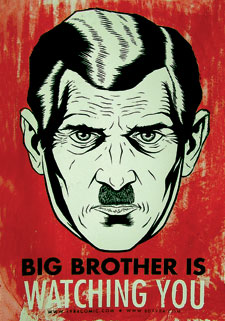
Big Brother poster illustrating Orwell’s novel
about modern propaganda, 1984

Yes, I know many Republicans and their overwhelmingly white “base” don’t consider the African-American Obama the legitimate President despite his two election victories. But never in American history has a major political party as brazenly challenged the constitutional authority of a sitting president to conduct foreign policy.

The letter to the Iranian leaders warned that once Obama is out of office in 2017, “the next president could revoke such an executive agreement with the stroke of a pen and future Congresses could modify the terms of the agreement at any time.” In other words, the Republicans were telling Iran’s leaders that whatever they plan to sign with Obama and five other world leaders isn’t worth the paper that it’s written on.

This stunning congressional intervention into U.S. diplomacy was signed not just by a few backbenchers but by the Senate’s Republican leadership and several prospective GOP presidential candidates, including Sen. Rand Paul, R-Kentucky, who had been viewed by some on the Left as well as the Right as a person who would not toe the Israeli line on Middle East issues.

This double whammy of Netanyahu’s extreme rhetoric on Iran and the Republicans’ extraordinary subversion of the Iranian nuclear talks left people around the world wondering whether the U.S. government had completely lost its bearings. Meanwhile, the U.S. news media continued veering off into its own Bermuda Triangle.

What is particularly striking about this current moment is how the madness that permeates the U.S. government equally pervades the mainstream U.S. media, which is now incapable of covering major international events except through the lens of State Department propaganda, a situation that has reached extreme levels in the reporting on the Ukraine crisis.

The only filter that the MSM can place on the events in Ukraine is one endlessly vilifying Russian President Vladimir Putin. Though this technique of personalizing foreign policy disputes has become standard operating procedure for the U.S. press corps – think of Daniel Ortega, Manuel Noriega, Saddam Hussein, Bashar al-Assad, Viktor Yanukovych, etc. – the U.S. media’s “group think” on Russia may even surpass those earlier examples.

Plus, nothing from the Ukraine crisis can ever be blamed on the U.S. government, even though Assistant Secretary of State Victoria Nuland helped orchestrate the violent coup that overthrew Ukraine’s elected government in February 2014 and threw the nation of 45 million people into a bloody civil war.

Everything must be blamed on Putin and any alternative analysis, recognizing another side to the story, must be dismissed as “Russian propaganda.” [See, for instance, Consortiumnews.com’s “NYT Still Pretends No Coup in Ukraine.“]

‘Russian Propaganda’


On Monday, the Washington Post delivered what could become a textbook case of journalistic self-delusion – noting that the Russian people have developed an intensely negative view of the United States but only because the Russian media portrays the U.S. government in a hostile way.

The Post article by Michael Birnbaum blamed the collapse of U.S. popularity on “furious rhetoric [that] has been pumped across Russian airwaves … a passionate, conspiracy-laden fascination with the methods that Washington is supposedly using to foment unrest in Ukraine and Russia.”

Citing recent polling, the article noted that more than 80 percent of the Russian people hold negative views of the United States. But that couldn’t be because of American behavior! No, it’s impossible that anyone looking at the U.S. today could possibly find anything to criticize! It had to be Putin’s fault, spreading spurious criticism of the U.S. via Russian media. Or as the Post put it:

“Fed by the powerful antagonism on Russian federal television channels, the main source of news for more than 90 percent of Russians, ordinary people started to feel more and more disillusioned [about the U.S.]. The anger seems different from the fast-receding jolts of the past, observers say, having spread faster and wider.”

The article quoted Lev Gudkov, director of the polling firm Levada Center, explaining: “This anti-Western propaganda radically changed the atmosphere in the society. … It has become militarist.”

Another voice cited by the Post was Maria Lipman, described as “an independent Moscow-based political analyst,” saying: “What the government knew was that it was very easy to cultivate anti-Western sentiments, and it was easy to consolidate Russian society around this propaganda.”

In other words, it wasn’t what the U.S. government has done around the world that has provoked this antipathy – from the endless boasting about America’s “indispensable” and “exceptional” qualities to its destructive behavior, including spreading bloody havoc via “regime change” schemes in Iraq, Libya, Syria, Ukraine and elsewhere.

And, it’s not that the U.S. government looks clownish when the majority party in Congress expresses doubts about global warming and other scientific judgments. Nor is it the continued examples of racism and the police shootings of unarmed blacks. Nor the global spying by the National Security Agency. Nor the national self-degradation when members of Congress behave like trained seals jumping up and down to applaud Israel’s Netanyahu.

No, the only reason that the Russian people look askance at the United States is that they are being deceived by the lying “propaganda” dictated by the evil Vladimir Putin. By contrast, the American people always get the straight story from their mainstream U.S. news media, the gold standard for the world!

Official Washington and the mainstream U.S. media have taken on the characteristics of a male stalker who can’t understand why his female target finds him repulsive. It must be because someone is poisoning her mind with negative comments about his sterling personality. We now live in a system of delusions built upon delusions.

Investigative reporter Robert Parry broke many of the Iran-Contra stories for The Associated Press and Newsweek in the 1980s. You can buy his latest book, America’s Stolen Narrative, either in print here or as an e-book (from Amazon and barnesandnoble.com). You also can order Robert Parry’s trilogy on the Bush Family and its connections to various right-wing operatives for only $34. The trilogy includes America’s Stolen Narrative. For details on this offer, click here.

Tuesday, March 10, 2015

iWatching You: Don't Buy It, Man!

Why You Shouldn't Buy The Apple Watch (SPiWatch):

by Russell Brand - The Trews

Reaction to the new Apple Watch launch and why we shouldn't be buying it. 


Subscribe Here Now: http://tinyurl.com/opragcg 
and send links to video news items of topical stories 
that you'd like me to analyse.
Buy a 'Trews' Tshirt here: http://www.russellbrand.com/trinkets/
 
Produced directed & edited by Gareth Roy.
Trews Theme by The Rubberbandits
Thanks to Jimi Mackay: @jimimackay
and Urban Nerds: www.urbannerdscollective.com 
for our creative services

Gorilla Radio with Chris Cook, Carmen Cheung, Scott Horton, Janine Bandcroft Mar. 11, 2015

This Week on GR

by C. L. Cook - Gorilla-Radio.com


That Stephen Harper's government wished to create a new order in Canada was clear from its earliest days, and from foreign policy and immigration, to environmental and labour policies, the country has changed. Now though, with the introduction of Bills C-51 and C-44, the prime minister is making much better his famous boast to make of this once familiar liberal democracy something "unrecognizable."

Just what the transformation could mean for Canadian life, should the Anti-Terrorism Act pass final reading and be enacted, has mobilized resistance across the country, uniting political polar opposites, even while making strange bedfellows of the Liberal and Conservative parties.

Listen. Hear.

Carmen Cheung is Senior Counsel at the B.C. Civil Liberties Association, where she focuses on issues relating to national security and litigation matters for the Association. She's recently back from a leave, serving as acting Director of the International Human Rights Program at the University of Toronto’s Faculty of Law, where she also taught international human rights advocacy and the law of armed conflict.

Carmen Cheung in the first half.

And; it's not just in Canada, Western Civilization as a whole is suffering a crisis of confidence. Where we once sang of our bravery and strength, today's rewritten national anthems could well mewl, beg, and plead for mercy and protection. It seems there's nothing for it now but to surrender our freedoms, the precious way of life George W. Bush so busily beavered to protect from the "evil-doers", and allow democracy die for fear it may be murdered. That is, if you believe what the government and their cohorts in captured media incessantly tell you.

Scott Horton is a practicing emerging markets lawyer, lecturer at Columbia Law School, National Magazine Award-winning columnist for his reporting on the law and national security issues, contributing editor to Harper's Magazine, and author of the freshly-released book, 'Lords of Secrecy: The National Security Elite and America's Stealth Warfare.' A life-long human rights activist, Scott served as counsel to Andrei Sakharov and Elena Bonner, and other activists caught in the former Soviet Union's legal system.

Scott Horton and the Free World enmeshed in the Emergency-Secrecy Cycle in the second half.

And; Victoria Street News publisher emeritus and CFUV Radio broadcaster, Janine Bandcroft will join us at the bottom of the hour to bring us news of some of what's good to do in and around our town in the coming week, and beyond that too. But first, Carmen Cheung and Canada's C-51: A terrorism bill too far?

Chris Cook hosts Gorilla Radio, airing live every Wednesday, 1-2pm Pacific Time. In Victoria at 101.9FM, and on the internet at: http://cfuv.uvic.ca. And now heard at Simon Fraser University's http://www.cjsf.ca . He also serves as a contributing editor to the web news site, http://www.pacificfreepress.com. Check out the GR blog at: http://gorillaradioblog.blogspot.ca/

G-Radio is dedicated to social justice, the environment, community, and providing a forum for people and issues not covered in the corporate media.

Evil Venezuela: Looking for Threats Wherever We Can Make Them

Venezuela, the Latest ‘National Security Threat’- Looking for enemies


by Dave Lindorff  - This Can't Be Happening

Seriously? Venezuela is a “national security threat”?

That is what President Obama has reportedly declared today in a new executive order.

And how exactly is poor Venezuela, a nation of 29 million, with a small military upon which it spends just 1% of GDP, one of the lowest rates in the world (the US spends 4.5% of GDP on its own bloated military), a threat to the US?

Well, according to the new executive order, some of Venezuela’s leading officials have “criminalized political dissent” and are corrupt. That’s about it. There’s nothing in there about Venezuela threatening military action against the US, or promoting terrorism, or threatening Americans.

But hold on. I remember reading in documents obtained through Freedom of Information petitions by the Partnership for Civil Justice from the FBI, Justice Department and Department of Homeland Security, that back in the fall of 2011, during the Occupy movement that swept the nation, the US national security apparatus, including the NSA and the 72 so-called Fusion Centers that had been set up to link federal, state and local intelligence organizations in all major US cities devoted most of its domestic intelligence and police resources to spying on, infiltrating, and ultimately crushing a purely peaceful wave of political protest [1] against the rampant corruption of the political class and the banking industry.


Guess: Is this photo of Venezuela or the United States?


And what about the National Security Agency, which Edward Snowden and others have exposed as being focused, in its unprecedented monitoring of all possible forms of communication among the American people, not as claimed on preventing terrorism but on simply gathering dossiers on millions of law-abiding citizens?

What about the FBI and other national intelligence agencies, which have been labeling anti-war activists, environmental activists and even animal rights activists (and this news site!) as “terrorists” in their files?

Looked at objectively, isn’t it the US that is a national security threat to Venezuela?

After all, there is no indication that the government of Nicolás Maduro Moros in Caracas, or the Chavez government before it, both popularly elected, have ever sought to foment violence in the US, or to subvert a US election. But there is plenty of evidence that the US has sought to undermine elections in Venezuela. Back in 2002, for example, there was a brief, failed military coup attempt, which went so far as to arrest and detain Cesar Chavez, the country’s elected president.

During the short period he was detained, then US President George W. Bush’s administration offered a promise of quick recognition of the coup plotters, hailing them as saviors of Venezuelan democracy. But before Washington could further embarrass itself by formally recognizing this subversion of yet another Latin American democracy, a mass uprising of Venezuelans and of the broad ranks of the country’s military led to Chavez’s release from captivity and his triumphant return to the presidential palace. The coup attempt failed abysmally.

More recently, the US, through its Congressionally funded National Endowment for Democracy (sic), and USAID (a known State Department and CIA front operation), helped fund and foment political unrest last year and appears to have encouraged a failed coup attempt last month [2], which Venezuelan police disrupted, leading to the arrest of a number of right-wing civilian and retired military leaders as well as a few Americans.

President Obama’s latest attack on Venezuela, in the form of an executive order declaring that country to be a “national security threat” is nothing but a formality needed in order for the US to impose economic sanctions. And those as yet unspecified sanctions, let’s be clear, constitute very real “threats to national security” against Venezuela.

This is just the latest example of how the US, which once at least felt the need to act as if it were a part of the world family of nations, now just brazenly and unapologetically interferes in other nations at will, economically, militarily, and politically. Back in the days of the Cold War and earlier, the US least pretended to adhere to international norms by working through the United Nations to win international support for its actions. At least back then it felt the need to hide its more depraved acts of subversion and aggression, whether by creating false flag incidents like the alleged but fictional attack by North Vietnamese gunboats in 1964 on a US destroyer in the Gulf of Tonkin to justify a war against Vietnam, or by orchestrating a coup behind the scenes, as in the case of the military overthrow and murder of Chile’s elected President Salvator Allende Gossens in 1973.

Now it just openly works to overthrow elected governments, as it did in Ukraine last year. Now it openly works to stoke chaos and unrest, as again it is doing now in Ukraine, brazenly undermining the Minsk cease-fire negotiated between the nations of Europe and Russia and the two sides battling in eastern Ukraine by unilaterally offering weapons and military advisors to Kiev’s military and encouraging Kiev’s fascist leaders to continue battling the separatist rebels in the Donbass region.

Where in years past, the US might subvert a government it didn’t like, such as the democratically elected Iranian government lead by Mohammad Mossadegh, now it openly finances, trains and arms Islamic fighters in Syria whom it hopes will topple the government of Syria. And it openly operates killer drones that terrorize many nations, and kill hundreds of innocents while attempting to rub out individuals that the US in its “wisdom” deems to be “terrorists.”

The real threat to national security in Venezuela and around the world today is the government in Washington. And the US is not just a threat to the security of the peoples of the world, whether in third-world nations, in Russia and China, or in the ostensible allied nations of Europe. It is a threat to the national security of the people of the United States too.

History has shown us again and again that repressive and anti-democratic tactics used abroad inevitably find their way home, where they are then turned against the people of the home country. We’ve seen this happening with the militarization of US police, who now operate in most US communities as if they were occupying troops in a foreign country, carrying military weapons, shooting to kill, breaking into homes in night raids and using brutal force to make the most minor of arrests, treating ordinary citizens as criminals who have no right to speak or to challenge how they or a family member or friend are being treated. We’ve seen it in the massive expansion of domestic spying, and we’ve seen it in the corruption of the courts, where judges in national security trials now deny defendants even the right to present a real defense to a jury, and where higher courts give the government permission to violate almost every Constitutionally guaranteed right in the name of “combating terrorism” or defending “national security” interests.

And by the way, where does Obama get off claiming that Venezuela’s politicians are corrupt? Corruption is now so prevalent in Washington that it isn’t even hidden. It’s the new normal.


Links:
[1] http://thiscantbehappening.net/node/1163
[2] http://thiscantbehappening.net/venezuelacoup

Bum's Rushing Bill C-51: Canadian Rights Groups Call for Full Hearings

Canadian rights groups decry limited Parliamentary Committee hearings for Bill C-51, proposed major national security reforms

by BCCLA

Rights groups across Canada reacted with alarm and deep concern to the news that the government has brought forward a motion limiting study of Bill C-51, the Anti-Terrorism Act, 2015, by the House of Commons’ Standing Committee on Public Safety and National Security to only four sessions of two hours each. With the first session devoted to government witnesses, including the Minister of Public Safety, this would leave only six hours for all other potential experts.

Amnesty International Canada, the BC Civil Liberties Association, the Canadian Civil Liberties Association, the Canadian Muslim Lawyers Association, the International Civil Liberties Monitoring Group, La Ligue des Droits et Libertés and the National Council of Canadian Muslims all called on the government to withdraw the motion and agree to a schedule of extensive hearings that will ensure that all relevant expertise and perspectives across the country are available to the Committee during the course of its study of Bill C-51.

“Canadians are being told they should embrace Bill C-51 without question because it will make us safer. Overlooked is that this Bill contains deeply worrying challenges to human rights protection, including the unprecedented proposition of empowering Federal Court judges to authorize violations of the Charter of Rights. To cut short the opportunity for these enormously consequential changes to be thoroughly examined is itself a grave human rights concern.”  - Alex Neve, Secretary General, Amnesty International Canada (English Branch)


“The Committee needs not only to examine what is in the Bill, but what is not in the Bill. It has become clear that a majority of Canadians, including four former Prime Ministers, are deeply concerned that there is no proposal in Bill C-51 to strengthen oversight and review of national security agencies. That critical issue cannot be considered in any meaningful way under this truncated schedule.”  - Carmen Cheung, Senior Counsel, BC Civil Liberties Association

“This is the most significant overhaul of Canadian laws dealing with national security since 2001. At that time there were 19 sessions in Committee allowing 80 expert witnesses to be heard. It has come forward without any accompanying review of existing laws, policies and resources and an analysis of where they fall short. To allow such little time for scrutiny of its provisions runs counter to the expectation Canadians have that their elected representatives will consider legislation carefully before it is adopted.”  - Sukanya Pillay, General Counsel and Executive Director, Canadian Civil Liberties Association

“Already, lawyers across Canada have raised serious concerns about Bill C-51’s compatibility with the Canadian Charter of Rights and Freedoms and with the rule of law. Cutting back on the time for the Committee to study those concerns and hopefully rectify those deeply problematic aspects of the Bill leaves open instead the prospect of years of time-consuming and expensive court challenges after the fact.”   - Ziyaad Mia, Canadian Muslim Lawyers Association

“Our coalition is made up of 41 organizations across the country. They come from many different sectors and have, over the course of many years, developed varied expertise in a range of issues with respect to national security and civil liberties. They are ready to share that input with MPs and have a legitimate expectation that they should be able to do so. Many will have no opportunity to do so with so little time on offer.”  - Roch Tassé, National Coordinator, International Civil Liberties Monitoring Group

“Bill C-51 is complex and very technical legislation that proposes two entirely new statutes and extensive amendments to three others. Each of those should receive thorough consideration. Four two-hour sessions of Committee study will not even begin to offer MPs an opportunity to grapple with and understand its implications.”  - Nicole Filion, Coordonnatrice de la Ligue des droits et libertés

“Bill C-51 should be of concern to all Canadians as it has the potential to impact on all of our rights given its stunningly far-reaching definitions of what constitutes a threat to Canada’s security. As we have learned from past and recent experiences, without robust oversight, review and redress mechanisms security agencies have abused the powers ceded to them. Given the disproportionate impact of anti-terrorism legislation in recent years on Canadian Muslims, these new proposals are of particular interest in our community. Such limited time for study by the Committee offers scant opportunity for those views to be meaningfully shared with Parliamentarians.”  - Ihsaan Gardee, Executive Director, National Council of Canadian Muslims

-30-

Support - Help protect civil liberties and human rights in Canada Donate Now!

Escaping a Criminal System

Possibility of Escape

by Kathy Kelly

March 9, 2015


That is also us, the possibility of us, if the wonderful accident of our birth had taken place elsewhere: you could be the refugee, I could be the torturer. To face that truth is also our burden. After all, each of us has been the bystander, the reasonable person who just happens not to hear, not to speak, not to see those people, the invisible ones, those who live on the other side of the border. - Karen Connelly, The Lizard Cage

It was a little over two weeks ago that Marlo entered Atwood Hall, here in Lexington federal prison. Nearly all the women here are nonviolent offenders. When I first saw Marlo, her eyes seemed glued to the tiled floors as she shuffled along hallways. I guessed her age to be 25 or so. A few days later, she came to a choir rehearsal. She was still shy, but she looked up and offered a quiet smile when she joined the soprano section. The next time our choir gathered, Marlo raised her hand before we ended our rehearsal. "I got something to say," she said, as she stood. "When I first came here, I can tell all of you now, I was terrified. Just plain terrified. I have 70 months, and I felt so scared." The intake process for this, her introduction to the prison system, had badly frightened her, but before sundown that same day, a second intake process had occurred, with several inmates finding her, reassuring her, and getting her beyond that first panic.

During my four stints in U.S. federal prisons, I've witnessed long-term inmates' unconquerably humane response when a newcomer arrives. An unscripted choreography occurs and the new prisoner finds that other women will help her through the trauma of adjustment to being locked up for many months or years. Halfway through a three-month sentence myself, I'm saddened to realize that I'll very likely adapt to an outside world for which these women, and prisoners throughout the U.S. prison system, are often completely invisible.

U.S. state and federal prison populations have risen, since 1988, from 600,000 to an estimated 1,600,000 in 2012. This trend shows inhumane behavior on the part of lawmakers and myriads of employees who benefit from the so-called "criminal justice" system. But our entire society bears responsibility for what now can aptly be labeled a "prison-industrial complex." Constructing prisons and filling prisons with people who posed little or no threat to our security didn't happen secretively, without our consent. We watched, mesmerized perhaps, and allowed ourselves to become a country with the world's largest prison system.

A friend from home recently sent me encouraging news of Illinois Governor Rauner's initiative to address the problems in some of the United States' most brutally overcrowded prisons. A Chicago Tribune article from several weeks ago notes that Rauner plans to reduce the state's prison population by 25% over the next ten years, establishing the reduction as a goal through executive order. The article, by columnist Eric Zorn, cites a widely-cited recent report by the Vera Institute of Justice that "nearly 75% of the population of both sentenced offenders and pretrial detainees are in jail for nonviolent offenses like traffic, property, drugs or public order violations."

Skyrocketing costs of incarceration have finally convinced some lawmakers to work toward "reducing prison populations." Yesterday, I read a long report about how the California Department of Corrections has responded to a court-ordered demand that the state reduce the numbers of people locked up in California state prisons. The order was first issued in 2009 by a three-judge panel. The state appealed the order, but in 2011, the U.S. Supreme Court upheld it, ordering the state of California to comply by 2013. The California government sought and was granted two extensions. As of now, the order insists that California must reduce its prison population, by 2016, to "no more than 137.5 percent of the design capacity" of its state prisons.

Whatever plans Gov. Rauner's committee proposes for Illinois, the notoriously incarceration-minded Illinois state legislature is likely to put up just as vigorous a fight. Meanwhile the California report discusses "cost-effective measures," "recidivism reduction results," "rehabilitative programming" and "programming slots" at "in-state contract facilities." The language, highly impersonal, suggests warehousing. I wonder if zookeepers might be more attentive to the individuality of the beings they cage.

Trapped in a cruel and uncaring system, women here in Atwood Hall reliably find humane ways to cope. Among many signs of daily generosity, one of my favorites is the practice of "window shopping." Women place extra items they can spare in the window sills nearest the stairwells. A new prisoner can find new fresh socks, a warm knit cap, books, magazines, pitchers – items that quickly disappear and are soon replenished.

Perhaps we'll begin to see a trend toward finding humane ways to cope with seemingly intractable problems in today's criminal justice system. The U.S. Supreme Court's insistence that the State of California must release many thousands of prisoners signals a trend in which, as Gov. Rauner's order recognizes, "States across the country have enacted bi-partisan, data driven and evidence based reforms that have reduced the use of incarceration and its costs while protecting and improving public safety." Zorn notes that the Mac Arthur Foundation recently granted $75 million for a 5 year "Safety and Justice Challenge" meant "to reduce over-incarceration by changing the way America thinks about its prisons and jails."

I can't imagine a figure too high to pay, in dollars or in human work hours, to effectively challenge the way U.S. people think about safety and justice. In describing a class that he taught in a New Jersey maximum-security prison, Chris Hedges wrote:

"The mass incarceration of primarily poor people of color, people who seldom have access to adequate legal defense and who are often kept behind bars for years for nonviolent crimes or for crimes they did not commit, is one of the most shameful mass injustices committed in the United States. The 28 men in my class have cumulatively spent 515 years in prison. Some of their sentences are utterly disproportionate to the crimes of which they are accused. Most are not even close to finishing their sentences or coming before a parole board, which rarely grants first-time applicants their liberty. Many of them are in for life. One of my students was arrested at the age of 14 for a crime that strong evidence suggests he did not commit. He will not be eligible for parole until he is 70. He never had a chance in court and because he cannot afford a private attorney he has no chance now of challenging the grotesque sentence handed to him as a child."

Here in Atwood Hall, guards and administrators know that they imprison humane, caring, generous and talented women, people not very different from their own relatives, friends and co-workers. Where are the "bad sisters" that could ever justify the punishment of isolating women like Marlo from their children and other loved ones for long and wearying years? I imagine that many BOP guards admire, as I do, the courage and fortitude of the women facing long sentences here. Do they wonder, sometimes, what courage would be required, in their own lives, to stop working as enforcers of the prison system? Or do they perhaps wish, sometimes, that the general public could muster up the will to stop voting for the prison system?

There is a cynical quote which a cynical friend of mine likes to quote to me, from the philosopher David Hume:

"A prisoner who has neither money nor interest, discovers the impossibility of his escape, as well when he considers the obstinacy of the gaoler, as the walls and bars with which he is surrounded; and, in all attempts for his freedom, chooses rather to work upon the stone and iron of the one, than upon the inflexible nature of the other."

It's the cliché of the prisoner attempting escape: the prisoner sees more hope tunneling out through bricks than appealing to the stone-faced jailer. But who are the jailers? These prisons were built, and filled, in our name - in the name of making us "safer". More guards, more lawyers, judges, wardens, marshals, probation officers and court personnel would be hired even if the present ones resigned. Meanwhile the creative work to create real security, real community in the face of social dislocation and crime, would still need to be done. We, the broader public, must be the jailers. Sometimes we seem to be a stone rolling down the path of least resistance. But we're not stone. We can choose not to be jailers, and choose, instead, to be ever more inflexible in our resistance to injustice and to hatred born of fear.

I'm here among women, some of whom, I've been told, are supposed to be "hardened criminals." Fellow activists incarcerated in men's prisons likewise concur that the system is futile, merciless and wrongheaded. Our jailers, I'm convinced, can see this. Men like Governor Rauner, it seems, can see it, or his advisers can. Where are the inflexible ones keeping women like Marlo isolated from and lost to the world, trembling for their future for the next five years? I would like to make an appeal to you, and to myself two months from now when I've left here and once more rejoined the polite society of these women's "inflexible jailers." I choose to believe that we can be moved and these women can escape. I am writing this, as many have written and will write, to see if we're easier to move than iron and stone.

Kathy Kelly, co-coordinator of Voices for Creative Nonviolence (info@vcnv.org), is in federal prison for participation in an anti-drone protest. She can receive mail at: KATHY KELLY 04971-045; FMC LEXINGTON; FEDERAL MEDICAL CENTER; SATELLITE CAMP; P.O. BOX 14525; LEXINGTON, KY 40512.