Sunday, March 22, 2015

When Saying "No" Isn't Enough: US and EU Insist Crimea Happier Joining Failed Ukraine

Crimeans Keep Saying No to Ukraine

by Robert Parry  - Consortium News

March 22, 2015

A central piece of the West’s false narrative on the Ukraine crisis has been that Russian President Vladimir Putin “invaded” Crimea and then staged a “sham” referendum purporting to show 96 percent support for leaving Ukraine and rejoining Russia. More recently, Assistant Secretary of State Victoria Nuland claimed that Putin has subjected Crimea to a “reign of terror.”

Both elements have been part of the “group think” that dominates U.S. political and media circles, but this propagandistic storyline simply isn’t true, especially the part about the Crimeans being subjugated by Russia.

Consistently, over the past year, polls conducted by major Western firms have revealed that the people of Crimea by overwhelming numbers prefer being part of Russia over Ukraine, an embarrassing reality that Forbes business magazine has now acknowledged.

An article by Kenneth Rapoza, a Forbes specialist on developing markets, cited these polls as showing that the Crimeans do not want the United States and the European Union to force them back into an unhappy marriage with Ukraine. “The Crimeans are happy right where they are” with Russia, Rapoza wrote.

“One year after the annexation of the Ukrainian peninsula in the Black Sea, poll after poll shows that the locals there — be they Ukrainians, ethnic Russians or Tartars are all in agreement: life with Russia is better than life with Ukraine,” he wrote, adding that “the bulk of humanity living on the Black Sea peninsula believe the referendum to secede from Ukraine was legit.”

Rapoza noted that a June 2014 Gallup poll, which was sponsored by the U.S. government’s Broadcasting Board of Governors, found that 82.8 percent of Crimeans said the March 16 referendum on secession reflected the views of the Crimean people. In the poll, when asked if joining Russia would improve their lives, 73.9 percent said yes and only 5.5 percent said no.

A February 2015 poll by German polling firm GfK found similar results. When Crimeans were asked “do you endorse Russia’s annexation of Crimea,” 93 percent gave a positive response, with 82 percent saying, “yes, definitely.” Only 2 percent said no, with the remainder unsure or not answering.

In other words, the West’s insistence that Russia must return Crimea to Ukraine would mean violating the age-old U.S. principle of a people’s right of self-determination. It would force the largely ethnic Russian population of Crimea to submit to a Ukrainian government that many Crimeans view as illegitimate, the result of a violent U.S.-backed coup on Feb. 22, 2014, that ousted elected President Viktor Yanukovych.

The coup touched off a brutal civil war in which the right-wing regime in Kiev dispatched neo-Nazi and other extremist militias to spearhead a fierce “anti-terrorism operation” against resistance from the ethnic Russian population in the east, which – like Crimea – had supported Yanukovych. More than 6,000 Ukrainians, most of them ethnic Russians, have been killed in the fighting.

Despite this reality, the mainstream U.S. news media has misreported the crisis and distorted the facts to conform to U.S. State Department propaganda. Thus, many Americans believe the false narrative about Russian troops crushing the popular will of the Crimean people, much as the U.S. public was misled about the Iraq situation in 2002-03 by many of the same news outlets.

Or, as Forbes’ Rapoza put it: “At some point, the West will have to recognize Crimea’s right to self rule. Unless we are all to believe that the locals polled by Gallup and GfK were done so with FSB bogey men standing by with guns in their hands.” The FSB is a Russian intelligence agency.

The GfK survey also found that Crimeans considered the Ukrainian media, which has been wildly anti-Russian, unreliable. Only 1 percent said the Ukrainian media “provides entirely truthful information” and only 4 percent said it was “more often truthful than deceitful.”

So, the people at the frontline of this conflict, where Assistant Secretary Nuland, detected a “reign of terror,” say they are not only satisfied with being restored to Russia, which controlled Crimea since the 1700s, but don’t trust the distorted version of events that they see on Ukrainian TV.

Practical Reasons


Some of the reasons for the Crimean attitudes are simply pragmatic. Russian pensions were three times larger than what the Ukrainian government paid – and now the Ukrainian pensions are being slashed further in compliance with austerity demands from the International Monetary Fund.

This month, Nuland boasted about those pension cuts in praising the Kiev regime’s steps toward becoming a “free-market state.” She also hailed “reforms” that will force Ukrainians to work harder and into old age and that slashed gas subsidies which helped the poor pay their heating bills.

Last year, the New York Times and other U.S. news outlets also tossed around the word “invasion” quite promiscuously in discussing Crimea. But you may recall that you saw no images of Russian tanks crashing into the Crimean peninsula or an amphibious landing or paratroops descending from the skies. The reason was simple: Russian troops were already in Crimea.

The Russians had a lease agreement with Ukraine permitting up to 25,000 military personnel in Crimea to protect the Russian naval base at Sevastopol. About 16,000 Russian troops were on the ground when the Feb. 22, 2014 putsch occurred in Kiev – and after a crisis meeting at the Kremlin, they were dispatched to prevent the coup regime from imposing its control on Crimea’s people.

That Russian intervention set the stage for the March 16 referendum in which the voters of Crimea turned out in large numbers and voted overwhelmingly for secession from Ukraine and reintegration with Russia, a move that the Russian parliament and President Putin then approved.

Yet, as another part of its false reporting, the New York Times claimed that Putin denied that Russian troops had operated inside Crimea – when, in fact, he was quite open about it. For instance, on March 4, 2014, almost two weeks before the referendum, Putin discussed at a Moscow press conference the role of Russian troops in preventing the violence from spreading from Kiev to Crimea. Putin said:

“You should note that, thank God, not a single gunshot has been fired there. … Thus the tension in Crimea that was linked to the possibility of using our Armed Forces simply died down and there was no need to use them. The only thing we had to do, and we did it, was to enhance the defense of our military facilities because they were constantly receiving threats and we were aware of the armed nationalists moving in. We did this, it was the right thing to do and very timely.”

Two days after the referendum, which recorded the 96 percent vote in favor of seceding from Ukraine and rejoining Russia, Putin returned to the issue of Russian involvement in Crimea. In a formal speech to the Russian Federation, Putin justified Crimea’s desire to escape the grasp of the coup regime in Kiev, saying:

“Those who opposed the [Feb. 22] coup were immediately threatened with repression. Naturally, the first in line here was Crimea, the Russian-speaking Crimea. In view of this, the residents of Crimea and Sevastopol turned to Russia for help in defending their rights and lives, in preventing the events that were unfolding and are still underway in Kiev, Donetsk, Kharkov and other Ukrainian cities.
“Naturally, we could not leave this plea unheeded; we could not abandon Crimea and its residents in distress. This would have been betrayal on our part.”

But to make it appear that Putin was denying a military intervention, the Times and other U.S. news outlets truncated Putin’s statement when he said, “Russia’s Armed Forces never entered Crimea.” The Western press stopped there, ignoring what he said next: “they were there already in line with an international agreement.”

Putin’s point was that Russian troops based in Crimea took actions that diffused a possibly violent situation and gave the people of Crimea a chance to express their wishes through the ballot. But that version of events didn’t fit with the desired narrative pushed by the U.S. State Department and the New York Times. So the problem was solved by misrepresenting what Putin said.

But the larger issue now is whether the Obama administration and the European Union will insist on forcing the Crimean people – against their will – to rejoin Ukraine, a country that is rapidly sliding into the status of a failed state and a remarkably cruel one at that.

Investigative reporter Robert Parry broke many of the Iran-Contra stories for The Associated Press and Newsweek in the 1980s. You can buy his latest book, America’s Stolen Narrative, either in print here or as an e-book (from Amazon and barnesandnoble.com). You also can order Robert Parry’s trilogy on the Bush Family and its connections to various right-wing operatives for only $34. The trilogy includes America’s Stolen Narrative. For details on this offer, click here.

Poison Impunity: Seeking A Moral Compass Other than the Law

Impunity

by Craig Murray


March 16, 2015

After such an extended break from blogging, you will be deeply disappointed that I restart with something as mundane and trivial as Jeremy Clarkson. I have defended the man in the past, because I much enjoy Top Gear and consider that much of what he has been criticised for in the past had been an amusing winding-up of the po-faced of the kind I employ myself. But nasty, indeed vicious bullying of a subordinate should always be a sacking offence.

That did not ought to be the question, though. He hit someone and they had to go to hospital. Where are the police?

They are incredibly fond of sweeping up scores of teenagers for thought crime, but here we have an actual violent assault that spills blood, and it seems completely out of the question the perpetrator is brought to account. Why is that? I had a personal experience a couple of years ago when I was very mildly hurt – less than young Oisin – in an assault, and the police insisted on arresting the perpetrator despite my repeated requests to them not to do so. They told me rather firmly that the idea that it is the victim who has a say in pressing charges, is a myth.

Why was Clarkson not arrested?

I cannot in my mind dissociate this from the non-arrest of Jimmy Savile for his crimes, despite their being well-known and reported at the time. That seems to link in to the wider paedophilia scandal, and the question of why no action was taken even in the most blatant of cases when there was compelling evidence, such as that of the extremely nasty Greville Janner MP.

But then I think still more widely as to why, for example, Jack Straw has not been charged with the crime of misfeasance in public office after boasting of using his position to obtain “under the radar” changes in regulations to benefit commercial clients, in exchange for cash. I wonder why a large number of people did not go to jail for the HSBC tax avoidance schemes or the LIBOR rigging scandal, which involved long term dishonest manipulation by hundreds of very highly paid bankers.

At the top of the tree is of course the question of why Blair has not been charged for the crime of waging illegal war. The Chilcot Inquiry heard evidence that every single one of the FCO’s elite team of Legal Advisers believed that the invasion of Iraq was an illegal war of aggression. Yet now the media disparage as nutters those who say Blair should be charged.

Then I think of all the poor and desperate people who get jailed for stealing comparatively miniscule amounts in benefit fraud, or the boy who was jailed for stealing a bottle of water in the London riots.

The conclusion is that we do not have a system of justice in this country at all. We have a system where the wealthy and governing classes and those associated with them enjoy almost absolute impunity, broken in only the rarest of cases. At the same time those at the bottom of the pile are kicked hard to keep them there. There is no more chance of justice against those in power in the UK than there is of the killers of Nemtsov being brought to book in Russia.

But what has really scared me is this thought. This situation has been like this my entire life: and I have reached the age of 56 before I realised it. A very great many people have still not realised it at all.

What does not scare me is this. I realise that if the system of justice is completely corrupted, then there is no obligation on me to follow the laws of the state. In fact it would be wrong of me to do so. I must seek my ethical compass elsewhere than in the corrupt power structure which weighs so hard upon the people.

El Retorno: The Mexican Drug War Blows Back


Can You Say "Blowback" in Spanish? The Failed War on Drugs in Mexico (and the United States)

by Rebecca Gordon  - TomDispatch


They behead people by the hundreds. They heap headless, handless bodies along roadsides as warnings to those who would resist their power. They have penetrated the local, state, and national governments and control entire sections of the country. They provide employment and services to an impoverished public, which distrusts their actual government with its bitter record of corruption, repression, and torture. They seduce young people from several countries, including the United States, into their murderous activities.

Is this a description of the heinous practices of the Islamic State (IS) in Iraq and Syria? It could be, but as a matter of fact it’s not. These particular thugs exist a lot closer to home. They are part of the multi-billion-dollar industry known as the drug cartels of Mexico. Like the Islamic State, the cartels' power has increased as the result of disastrous policies born in the U.S.A.

There are other parallels between IS and groups like Mexico's Zetas and its Sinaloa cartel. Just as the U.S. wars in Afghanistan, Iraq, and Libya fertilized the field for IS, another U.S. war, the so-called War on Drugs, opened new horizons for the drug cartels. Just as Washington has worked hand-in-hand with and also behind the backs of corrupt rulers in Central Asia, the Middle East, and North Africa, so it has done with the Mexican government. Both kinds of war have resulted in blowback -- violent consequences felt in our own cities, whether at the finish line of the Boston Marathon or in communities of color across the country.

In Mexico, the U.S. military is directly involved in the War on Drugs. In this country, that "war" has provided the pretext for the militarization of local police forces and increased routine surveillance of ordinary people going about their ordinary lives.

And just as both the national security state and the right wing have used the specter of IS to create an atmosphere of panic and hysteria in this country, so both have used the drug cartels' grotesque theater of violence to justify their demonization of immigrants from Latin America and the massive militarization of America’s borderlands.
 Tomgram: Rebecca Gordon, It Didn't Work in Afghanistan, So Let's Do It in Mexico

One of the mysteries of our era is why there seems to be no learning curve in Washington. Over the last 13 years, American wars and conflicts have repeatedly helped create disaster zones, encouraging the fragmentation of whole countries and societies in the Greater Middle East and Northern Africa. In the process, such American wars, drone assassination campaigns, raids, and conflicts have acted as recruitment posters for and aided and abetted the growth of terror outfits. And here’s where the genuine strangeness begins to enter the picture: after all of this is absorbed and assessed in Washington, the response is regularly more of what hasn’t worked and a clamoring for yet more of it.

It turns out, as TomDispatch regular Rebecca Gordon reports today, that the same kind of process has been going on so much closer to home -- right across the border in Mexico, in fact, resulting in the kind of blowback that Chalmers Johnson would have appreciated. Yet while hysteria and panic reign over the barbaric acts of the faraway Islamic State in Syria and Iraq, U.S. involvement in the “war on drugs” in a neighboring country gets just passing attention here. Curiouser and curiouser, hysteria and panic over Mexico only seem to rise when ISIS is reputed to be involved (at least in the fantasy worlds of various right-wingers). Consider it all part of the true mysteries of our strange American age of repetitive war. Tom

Can You Say "Blowback" in Spanish? The Failed War on Drugs in Mexico (and the United States)

by Rebecca Gordon


The War in Mexico 


If there was an official beginning to Mexico's war on drugs, it would have to be considered the election of Felipe Calderón as the country’s president in 2006. The candidate of the right-wing Partido Acción Nacional, the National Action Party (PAN), Calderón was only the second Mexican president in 70 years who did not come from the Partido Revolucionario Institucional, the Institutional Revolutionary Party (PRI). His predecessor, Vicente Fox, had been the first.

It was Calderón who, with encouragement and assistance from the United States, changed Mexico's war on drugs from a metaphor into the real thing, in which guns and grenades would fuel the deaths of more than 60,000 Mexicans through 2012.

The current president, Enrique Peña Nieto of the PRI, admits that another 27,000 Mexicans were murdered in the first year of his presidency. At least another 25,000 have been disappeared since 2007. It was Calderón who brought the Mexican military fully into the fight against drugs, transforming an ineffective policing policy into a full-scale shooting war with the cartels. At least 50,000 military personnel have been deployed.

In addition to ordinary citizens, journalists and politicians have been particular targets in this war. The Committee to Protect Journalists reports that murders of Mexican reporters have increased dramatically since 2006. Among those whose killers have been positively identified, 69% died at the hands of the drug cartels, and at least 22% were killed by government or military personnel.

Wikipedia lists over 100 politicians who have lost their lives in Mexico's war on drugs. That list does not include a woman named Aide Nava González, whose headless body was dumped this month on a road in Guerrero state. Nava was contending for the Partido Revolución Democrática, the Democratic Revolution Party, slot on the ballot in the town of Ahuacuotzingo. Her husband, the former mayor, had been murdered there last year. A note from Los Rojos, a local drug gang, was left with Nava's body. "This is what will happen," it read, "to anyone who does not fall in line, fucking turncoats."

Guerrero is the home of Ayotzinapa, a town where 43 teachers-in-training once attended a rural teachers college. All 43 “disappeared” last September during a demonstration in the neighboring town of Iguala. Their arrest by police, and apparent subsequent murder at the hands of a local drug gang, Guerreros Unidos, was one of the few stories of Mexican suffering to break into the U.S. mainstream media last year. The mayor of Iguala has since admitted that he instructed the police to hand the students over to the gang and has been arrested, along with his wife. The town’s police chief is still on the run.

Like the "war on terror" globally, Mexico’s war on drugs has created endless new pretexts for government repression, which has its own lengthy history in that country. That history includes the long-remembered police murders of some 300 students, among the thousands protesting in Mexico City's Plaza de las Tres Culturas a couple of weeks before the Summer Olympics began in 1968. Juan Méndez, the U.N.'s Special Rapporteur on Torture, wrote in his 2014 mission report on Mexico:

"The National Human Rights Commission recorded an increase in the number of complaints of torture and ill-treatment since 2007 and reported a peak of 2,020 complaints in 2011 and 2,113 in 2012, compared with an annual average of 320 in the six years prior to 2007. Between December 2012 and July 2014, the Commission received 1,148 complaints of violations attributable to the armed forces alone."

According to Méndez, it’s difficult to pinpoint the exact number of torture cases in the country in any year, because there is no national registry that records such complaints. Nor is everyone who was tortured by representatives of the government likely to report their suffering to that same government.

What is not difficult to pinpoint is the nature of the torture. Méndez notes the "disturbing similarities" in the complaints of those tortured. The police and the military are regularly reported to use a combination of "punches, kicks, and beatings with sticks; electric shocks through the application of electrical devices such as cattle prods to their bodies, usually their genitals; asphyxiation with plastic bags; waterboarding; forced nudity; suspension by their limbs; [and] threats and insults."

The purpose of such torture is clear as well. As Mendez reports, it’s "to punish and to extract confessions or incriminating information." A 2008 change to the Mexican constitution makes it easier to do this: under this policy of pre-trial detention (arraigo in Spanish), suspected drug traffickers can be held for up to 80 days without charge. According to the Mexican Commission for the Defense and Promotion of Human Rights, "Supposedly, arraigo is used as a means to investigate suspected criminals, but in practice, it is used as a kind of public scrutiny that allows more time for the authorities to determine whether the detained is guilty or innocent." It's much easier to extract a confession when you have electric cattle prods and waterboarding at your disposal.

Washington Fights a “War” in Mexico


Who pays for Mexico's war on drugs? You won’t perhaps be too surprised to learn that the United States foots a major part of the bill. Between 2008 and 2014, Congress has appropriated $2.4 billion dollars to fight the cartels, as part of the Mérida Initiative, a "security cooperation agreement" between the U.S. and Mexican governments. That money supports a failed war in which tens of thousands have been killed and thousands more tortured.

U.S. involvement, however, goes far beyond money. Along with the publicly acknowledged Mérida Initiative, the Justice Department and the Drug Enforcement Administration (DEA) signed secret agreements with the Fox and Calderón administrations without the knowledge or consent of the Mexican congress. These openly violated the Mexican constitution, which reserves to that congress the right to approve agreements with foreign governments, as well as the U.N. Convention Against Transnational Crime, which requires that activities carried out by one country inside another be approved by the appropriate agency in the country where those activities take place.

Under these secret agreements, U.S. DEA agents met repeatedly with high-level members of particular drug cartels, especially the Sinaloa group, to obtain information about rival organizations. Informants served as go-betweens in contacts between the DEA and "El Chapo" Guzmán, the head of that cartel. Guzmán was arrested in 2014 by the Mexican government. The newspaper El Universal conducted a year-long investigation in which its reporters documented the extent and effects of this illegal cooperation. The DEA arranged to dismiss drug trafficking charges that were pending in the United States against some of their Sinoloa Cartel informants. In other words, it allowed the cartels with which it worked to continue business -- and murder -- as usual.

In at least one case, U.S. Immigration and Customs Enforcement (ICE) issued multiple re-entry visas to informants, allowing them to bring significant quantities of drugs into the United States with impunity. In fact, it appears that, in order to maintain the flow of information, U.S. officials took sides in the drug war that devastated the Mexican city of Ciudad Juárez, killing an estimated 10,500 people. With tacit U.S. permission, the Sinaloa Cartel was able to defeat the rival Juárez Cartel.

Seventy percent of the guns used in Mexico's drug wars also come from this country. Most are purchased at one or another of the 6,700 licensed firearms sales outlets along the U.S.-Mexico border. The University of San Diego's Trans-Border Institute estimates that, between 2010 and 2012, about 253,000 firearms were bought each year for transfer to Mexico. And most of them made it across the border. The Institute reports that "Mexican authorities have seized roughly 12.7% of the total annual trade" in weapons. U.S. interdiction efforts account for a measly 2% of those seized.

And not all of the weapons that ended up in Mexico did so against the wishes of the U.S. government. In the debacle known as "Fast and Furious," the Bureau of Alcohol, Tobacco, Firearms, and Explosives (ATF) allowed "more than 2,000 weapons, including hundreds of AK-47-type semi-automatic rifles and .50 caliber rifles," to "walk" across the border and into the hands of the Mexican cartels. Its ostensible purpose was to follow the guns in hopes that they would lead to the arrest of high-level cartel leaders. But relevant agencies of the Mexican government were never informed about the operation, and it seems that there was no actual effort to track the weapons once they crossed the Mexican border. The weapons turned up at crime scenes in both Mexico and the United States. On December 14, 2010, near the Mexican border in Arizona, one of them killed Brian Terry, a U.S. Border Patrol agent.

ATF wasn't the only agency involved in "Fast and Furious." Personnel from ICE, the Department of Homeland Security, the DEA, and the U.S. Attorney's Office in Arizona also participated, along with the FBI and the IRS.

Nor was the Mexican government entirely informed, although it seems clear that one man, Eduardo Medina Mora, knew about it. A former director of Mexico's equivalent of the CIA, Medina is considered the "legal architect" of that country’s drug war. He was Mexico's attorney general when Fast and Furious got underway. By 2010, he'd been removed from that post (possibly because one of his top deputies was arrested for taking bribes from the cartels) and appointed ambassador to the United Kingdom. Later, he served as ambassador to the U.S. until, in early March 2015, President Peña Nieto barely won Senate approval of Medina's appointment to a 15-year term as head of Mexico's Supreme Court. Mexicans who still remember Fast and Furious were outraged.

The Pentagon and CIA are also involved in Mexico in significant ways. Since at least 2011, the Pentagon has deployed both piloted aircraft and drones in the Mexican war on drugs. The CIA has also sent operatives to do intelligence gathering. And without specifying which agencies are responsible for such activities, the New York Times reports that "the United States has trained nearly 4,500 new [Mexican] federal police agents and assisted in conducting wiretaps, running informants, and interrogating suspects.” Furthermore, the "Pentagon has provided sophisticated equipment, including Black Hawk helicopters.”

In 2011, the State Department recalled career diplomat Earl Anthony Wayne from Kabul. He was then serving as deputy ambassador to Afghanistan and coordinating with the NATO-led occupation forces there. His new assignment based on his counterinsurgency experience? Ambassador to Mexico. In 2013, the U.S. Army opened a special-ops center in Colorado, according to the El Paso Times, "to teach Mexican security forces how to hunt drug cartels the same way special operations teams hunt al-Qaida." Because that worked out so well in Afghanistan and Iraq.

The Drug War Comes Home (Along With Plenty of Blowback)


All in all, the U.S. drug war in Mexico has been an abject failure. In spite of high-profile arrests, including in 2014 Joaquín "El Chapo” Guzmán, who ran the Sinaloa group, and in 2015 Servando "La Tuta" Gómez, head of the Knights Templar Cartel in Michoacán, the cartels seem as strong as ever. They may occasionally split and reassemble, but they are still able to move plenty of product, and reap at least $20 billion a year in sales in the United States. In fact, this country remains the world's premier market for illegal drugs.

The cartels are responsible for the majority of the methamphetamine sold in the United States today. Since 2006, when a federal law made it much harder to buy ephedrine and pseudoephedrine in this country, the cartels have replaced small-time U.S.-based meth cookers. The meth they produce is purer than the U.S. product, apparently because it's made with purer precursor chemicals available from China. The other big product is heroin, whose quickly rising consumption seems to be replacing the demand for cocaine in the United States. On the other hand, marijuana legalization appears to be cutting into the cross-border traffic in that drug.

The Washington Post reports that almost 9% of Americans “age 12 or older -- 22.6 million people -- are current users of illegal drugs, according to the Substance Abuse and Mental Health Services Administration." That represents a one-third increase over the 6.2% in 1998. It takes a lot of infrastructure to move that much product.

And that's where U.S.-based gangs come in. Urban gangs in the United States today are not the Sharks and Jets of West Side Story. Certainly, there are still some small local groups formed by young people looking for family and solidarity on the streets. All too often, however, today's gangs represent the well-run distribution arm of the international drug trade. In Chicago alone, 100,000 people work in illegal drug distribution, selling mostly into that city's African-American community. Gang membership is skewing older every year, as gangs transform from local associations to organized, powerfully armed criminal enterprises. Well over half of present gang members are adults now. The communities where they operate live in fear, caught between the gangs that offer them employment while threatening their safety and militarized police forces they do not trust.

Just like U.S. military adventures in the Middle East and Afghanistan, the U.S.-Mexico war on drugs has only left a larger problem in place, while producing blowback here at home. A particularly nasty example is the cartels' use of serving U.S. military personnel and veterans as hit men here in the United States. But the effects are far bigger than that. The DEA told the Washington Post that Mexican cartels are operating in more than 1,200 U.S. cities. In all those cities, the failed war on drugs has put in prison 2.3 million people -- in vastly disproportionate numbers from communities of color -- without cutting demand by one single kilo. And yet, though that war has only visibly increased the drug problem in the same way that the war on terror has generated ever more terror organizations, in both cases there’s no evidence that any other course than war is being considered in Washington.


Rebecca Gordon, a TomDispatch regular, is the author of Mainstreaming Torture: Ethical Approaches in the Post-9/11 United States. She teaches in the philosophy department at the University of San Francisco. She is a member of the War Times/Tiempo de Guerras collective. You can contact her through the Mainstreaming Torture website.

Follow TomDispatch on Twitter and join us on Facebook. Check out the newest Dispatch Book, Rebecca Solnit's Men Explain Things to Me, and Tom Engelhardt's latest book, Shadow Government: Surveillance, Secret Wars, and a Global Security State in a Single-Superpower World.

Copyright 2015 Rebecca Gordon

Deceptions of the Left: Politics of Delusion and Self-Destruction


Lies and Deceptions on the Left: The Politics of Self Destruction

by James Petras


Over the past year, what appeared as hopeful signs, that Left governments were emerging as powerful alternatives to right-wing pro-US regimes, is turning into a historic rout, which will relegate them to the dustbin of history for many years to come. The rise and rapid decay of left-wing governments in France, Greece and Brazil is not the result of a military coup, nor is it due to the machinations of the CIA. 
The debacle of left governments is a result of deliberate political decisions, which break decisively with the progressive programs, promises and commitments that political leaders had made to the great mass of working and middle class voters who elected them.

Increasingly, the electorate views the leftist rulers as traitors, who betrayed their supporters at the beck and call of their most egregious class enemies: the bankers, the capitalists and the neo-liberal ideologues.

Left Governments Commit Suicide


The self-destruction of the Left is an unanticipated victory for the most retrograde neo-liberal political forces. These forces have sought to destroy the welfare system, impose their rule via non-elected officials, widen and deepen inequalities, undermine labor rights and privatize and denationalize the most lucrative sectors of the economy.

Three cases of Left regime betrayal serve to highlight this process: The French Socialist regime of President Francois Hollande governing in the second leading power in Europe (2012-2015); Syriza, the left regime in Greece elected on January 25, 2015, portrayed as a sterling proponent of an alternative policy to ‘fiscal austerity’; and The Workers Party of Brazil, governing in the biggest Latin American country (2003-2015) and a leading member of the BRICS.

French ‘Socialism’: The Great Leap Backward


In his Presidential campaign, Francois Hollande promised to raise taxes on the rich up to 75%; lower the retirement age from 62 to 60 years; launch a massive public investment program to reduce unemployment; vastly increase public spending on education (hiring 60,000 new teachers), health and social housing; and withdraw French troops from Afghanistan as a first step toward reducing Paris’ role as an imperialist collaborator.

From 2012, when he was elected, to the present (March 2015), Francois Hollande has betrayed each and every political commitment: Public investments did not materialize and unemployment increased to over 3 million. His newly appointed Economic Minister Emmanuel Macron, a former partner of Rothschild Bank, sharply reduced business taxes by 50 billion euros. His newly appointed Prime Minister Manuel Valls, a neo-liberal zealot, implemented major cuts in social programs, weakened government regulation of business and banking and eroded job security. Hollande appointed Laurence Boone from Bank of America as his top economic adviser.

The French ‘Socialist President’ sent troops to Mali, bombers to Libya, military advisers to the Ukraine junta and aided the so-called Syrian ‘rebels’ (mostly Jihadist mercenaries). He signed off on billion-euro military sales to the Saudi Arabian monarcho-dictatorship and reneged on a contracted sale of warships to Russia.

Hollande joined with Germany in demanding that the Greek government comply with full and prompt debt payments to private bankers and maintain its brutal ‘austerity program’.

As a result of defrauding French voters, betraying labor and embracing bankers, big business and militarists, less than 19% of the electorate has a positive view of the ‘socialist’ government, placing it in third place among the major parties.. Hollande’s pro-Israel policies and his hardline on US- Iranian peace negotiations, Minister Vall’s Islamophobic raids in French Muslim suburbs and the support of military interventions against Islamic movements, have increasingly polarized French society and heightened ethno-religious violence in the country.

Greece: Syriza’s Instant Transformation


From the moment in which Syriza won the Greek elections on January 25, 2015, to the middle of March, Alexis Tsipras, the Prime Minister and Yanis Varoufakis, his appointed Finance Minister, reneged in rapid order on every major and minor electoral program. They embraced the most retrograde measures, procedures and relations with the ‘Troika’, (the IMF, and European Commission at the European Central Bank), which Syriza had denounced in its Thessaloniki program a short time earlier.

Tsipras and Varoufakis repudiated the promise to reject the dictates of the ‘Troika’. In other words, they have accepted colonial rule and continued vassalage.

Typical of their demagogy and deceit, they sought to cover up their submission to the universally hated ‘Troika’ by dubbing it ‘the Institution’ – fooling nobody but themselves-- and becoming the butt of cynical cackles from their EU overseers.

During the campaign, Syriza had promised to write off all or most of the Greek debt. In government, Tsipras and Varoufakis immediately assured the Troika that they recognized and promised to meet all of their debt obligations.

Syriza had promised to prioritize humanitarian spending over austerity – raising the minimum wage, rehiring public employees in health and education and raising pension payments. After two weeks of servile groveling, the ‘re-formed’ Tsipras and Varoufakis prioritized austerity – making debt payments and ‘postponing’ even the most meagre anti-poverty spending. When the Troika lent the Syriza regime $2 billion to feed hungry Greeks, Tsipras lauded his overseers and promised to submit a multi-billion euro list of regressive ‘reforms’.

Syriza had promised to re-examine the previous rightwing regime’s dubious privatization of lucrative public enterprises and to stop on-going and future privatizations. In government, Tsipras and Varoufakis quickly disavowed that promise. They approved past, present and future privatizations. In fact, they made overtures to procure new privatization ‘partners’, offering lucrative tax concessions in selling-out more public firms.

Syriza promised to tackle the depression level unemployment (26% national, 55% youth) via public spending and reduced debt payments. Tsipras and Varoufakis dutifully met debt payments and did not allocate any funds to create jobs!

Not only did Syriza continue the policies of its rightwing predecessors, but also it did so in a ludicrous style and substance: adopting ridiculous public postures and demagogic inconsequential gestures:

One day Tsipras would lay a wreath at the gravesite of 200 Greek partisans murdered by the Nazis during WW II. The next day he would grovel before the German bankers and concede to their demands for budget austerity, withholding public funds from 2 million unemployed Greeks.

One afternoon, Finance Minister Varoufakis would pose for a photo spread for Paris Match depicting him, cocktail in hand, on his penthouse terrace overlooking the Acropolis; and several hours later he would claim to speak for the impoverished masses!

Betrayal, deceit and demagogy all during the first two months in office, Syriza has established a record in its conversion from a leftist anti-austerity party to a conformist, servile vassal of the European Union.

Tsipras’ call for Germany to pay reparations for damages to Greece during WW II –a long overdue and righteous demand-- is another phony demagogic ploy designed to distract the impoverished Greeks from Tsipras and Varoufakis sellout to German contemporary austerity demands. A cynical European Union official tells the Financial Times (12/3/15, p. 6), “He’s (Tsipras) giving them (Syriza militants) a bone to lick on”.

No one expects German leaders to alter their hardline because of past injustices, least of all because they come from interlocutors on bended knees. . No one in the EU takes Tsipras demand at face value. They see it as more empty ‘radical’ rhetoric for domestic consumption.

Talking up 70-year German reparations avoids taking practical action today repudiating or reducing payments on illegitimate debt to German banks and repudiating Merckel’s dictates. The transparent betrayal of their most basic commitments to the impoverished Greek people has already divided Syriza. Over 40% of the central committee, including the President of the Parliament, repudiated the Tsipras –Varoufakis agreements with the Troika.

The vast majority of Greeks, who voted for Syriza, expected some immediate relief and reforms. They are increasingly disenchanted. They did not expect Tsipras to appoint Yanis Varoufakis, a former economic adviser to the corrupt neo-liberal PASOK leader George Papandreou, as Finance Minister. Nor did many voters abandon PASOK, en masse, over the past five years, only to find the same kleptocrats and unscrupulous opportunists occupying top positions in Syriza, thanks to Alexis Tsipras index finger.

Nor could the electorate expect any fight, resistance and willingness to break with the Troika from Tsipras’ appointments of ex-pat Anglo-Greek professors. These armchair leftists (‘Marxist seminarians’) neither engaged in mass struggles nor suffered the consequences of the prolonged depression.

Syriza is a party led by affluent upwardly mobile professionals, academics and intellectuals. They rule over (but in the name of) the impoverished working and salaried lower middle class, but in the interests of the Greek, and especially, German bankers.

They prioritize membership in the EU over an independent national economic policy. They abide by NATO, by backing the Kiev junta in the Ukraine, EU sanctions on Russia, NATO intervention in Syria/Iraq and maintain a loud silence on US military threats to Venezuela!

Brazil: Budget Cuts, Corruption and the Revolt of the Masses


Brazil’s self-styled Workers Party government in power an unlucky 13 years, has been one of the most corruption-ridden regimes in Latin America. Backed by one of the major labor confederations, and several landless rural workers’ organizations, and sharing power with center-left and center-right parties, it was able to attract tens of billions of dollars of foreign extractive, finance and agro-business capital. Thanks to a decade-long commodity boom in agro-mineral commodities, easy credit and low interest rates, it raised income, consumption and the minimum wage while multiplying profits for the economic elite.

Subsequent to the financial crises of 2009, and the decline of commodity prices, the economy stagnated, just as the new President Dilma Rousseff was elected. The Rousseff government, like her predecessor, Lula Da Silva, favored agro-business over the rural landless workers’ demands for land reform. Her regime promoted the timber barons and soya growers encroaching on the Indian communities and the Amazon rain forest.

Elected to a second term, Rousseff faced a major political and economic crises: a deepening economic recession, a fiscal deficit, and the arrest and prosecution of scores of corrupt Workers’ Party and allied congressional deputies and Petrobras oil executives.

Workers’ Party leaders and the Party’s campaign treasury received millions of dollars in kickbacks from construction companies securing contracts with the giant semi-public petroleum company. President Rousseff promised “to continue to support popular social programs”, and “to root out corruption”, during her election campaign. However, immediately after her election she embraced orthodox neo-liberal policies and appointed a cabinet of hard-right neo-liberals including Bradesco banker Joaquin Levy as Finance Minister. Levy proposed to reduce unemployment payments, pensions and public salaries. He argued for greater de-regulation of banks. He proposed to weaken job protection laws to attract capital. He sought to achieve a budget surplus and attract foreign investment at the expense of labor.

Rousseff, consistent with her embrace of neo-liberal orthodoxy, appointed Katia Abreu, a rightwing senator, a life-long leader of agro-business interests and sworn enemy of land reform, as the new Agricultural Minister. Crowned “Miss Deforestation” by Greenpeace, Senator Abreu was vehemently opposed by the Landless Rural Workers’ Movement (MST) and the labor confederation to no avail. With Rousseff’s total backing Abreu set out on a course of ending even the minimal land redistribution carried out in Rousseff’s first term in office (establishing land settlements benefiting less than 10% of the landless squatters). Abreu endorsed regulations facilitating the expansion of genetically modified crops, and promises to forcefully evict Amazonian Indians occupying productive land in favor of large-scale agro-business corporations. Moreover, she promises to vigorously defend landlords from land occupations by landless rural workers.

Rousseff’s incapacity and/or unwillingness to fire and prosecute the Workers Party Treasurer, involved in a decade long billion-dollar kickback and bribery scandal, deepened and widened mass opposition.

On March 15, 2015 over a million Brazilians filled the streets across the country, led by rightist parties, but drawing support from the popular classes demanding immediate anti-corruption trials and stern sentences, and the revocation of Levy’s cuts in social expenditures.

The counter demonstration in support of Rousseff by the CUT labor confederation and the MST drew one-tenth that number – about 100,000 participants.

Rousseff responded by calling for ‘dialogue’ and claimed to be ‘open to proposals’ on the issue of corruption but explicitly rejected any changes in her regressive fiscal policies, neo-liberal cabinet appointments and her embrace of their agro-mineral agenda.

In less than two months, the Workers Party and its President has indelibly stained its leaders, policies and backers with the brush of corruption and socially regressive policies.

Popular support has plummeted. The right wing is growing. Even the authoritarian, pro-military coup activists were present in the mass demonstrations, carrying signs calling for ‘impeachment’ and a return of military rule.

As in most of Latin America, the authoritarian right in Brazil is a growing force, positioning itself to take power as the center-left adopts a neo-liberal agenda throughout the region. Parties dubbed ‘center-left’, like the Broad Front in Uruguay, the pro-government Party for Victory in Argentina, are deepening their ties with agro-mineral corporate capitalism.

Uninformed claims by leftist US writers like Noam Chomsky that, “Latin America is the vanguard against neo-liberalism” is at best a decade late, and certainly misleading. They are deceived by populist policy pronouncements and refuse to acknowledge the decay of the center –left regimes and thus fail to recognize how their neoliberal political actions are fostering mass popular discontent. Regimes, which adopt regressive socio-economic policies, do not constitute a vanguard for social emancipation...

Conclusion


What accounts for these abrupt reversals and swiftly broken promises by recently elected supposedly ‘left parties’ in Europe and Latin America?

One has come to expect this kind of behavior in North America from the Obama Democrats or the New Democratic Party in Canada . . . But we were led to believe that in France, with its red republican traditions, a Socialist regime backed (‘critically’) by anti-capitalists leftists; would at least implement progressive social reforms. We were told by an army of progressive bloggers that Syriza, with its charismatic leader, and radical rhetoric, would at least fulfil its most elementary promises by lifting the yoke of Troika domination and begin to end destitution and provide electricity to 300,000 candle-lit households. ‘Progressives’ had repeatedly told us that the Workers Party lifted 30 million out of poverty. They claimed that a former ‘honest auto worker’ (Lula Da Silva) would never allow the Workers Party to revert back to neo-liberal budget cuts and embrace its supposed ‘class enemies’. US leftist professors refused to give credence to the crass billion-dollar robbery of the Brazilian National Treasury under two Workers’ Party Presidents.

Several explanations for these political betrayals come to mind. First, despite their popular or ‘workerist’ claims, these parties were run by middle class lawyers, professionals and trade union bureaucrats, who were organically disconnected from their mass base. During election campaigns, seeking votes, they briefly embraced workers and the poor, and then spent the rest of their time in pricey restaurants working out “deals” with bankers, business bribe granters and overseas investors to finance their next election, their children’s private school and their mistresses luxury apartments…

For a time, when the economy was booming, big corporate profits, payoffs and bribes went hand in hand with wage increases and poverty programs. But when the crisis broke, the ‘popular’ leaders doffed their Party hats and pronounced ‘fiscal austerity was inevitable’ while going with their begging cups before their international financial overlords.

In all these countries faced with difficult times, the middle class leaders of the Left feared the problem (capitalist crisis) and feared the real solution (radical transformation). Instead they turned to the ‘only solution’: they approached capitalist leaders and sought to convince business associations and, above all their financial overlords, that they were ‘serious and responsible politicians’, willing to forsake social agendas and embrace fiscal discipline. For domestic consumption, they cursed and threatened the elites, providing a little theater to entertain their plebian followers, before they capitulated!

None of the academics-turned-left-leaders have any deep and abiding links to the mass struggles. Their ‘activism’ involves reading papers at ‘social forums’, and giving papers at conferences on ‘emancipation and equality’. Political sellouts and fiscal austerity will not jeopardize their economic positions. If their Left parties are ousted by angry constituents and radical social movements, the left leaders pack their bags and return to comfortable tenured jobs or rejoin their law office. They do not have to worry about mass firings or reduced subsistence pensions. At their leisure they will find time to sit back and write another paper on the how the ‘crisis of capitalism’ undermined their well-intentioned social agenda or how they experienced the ‘crisis of the Left’.

Because of their disconnect from the suffering of the impoverished, unemployed voters, the middle class leftists in office are blind to the need to make a break with the system. In reality, they share the worldview of their supposedly conservative adversaries: they too believe that ‘it’s capitalism or chaos’. This borrowed cliché is passed off as a deep insight into the dilemmas of democratic socialists. The middle class leftist officials and advisers always use the alibi of ‘institutional constraints’. They ‘theorize’ their political impotence - they never recognize the power of organized class movements.

Their political cowardice is structural and leads to easy moral betrayals: they plead, ‘Crisis is not a time to tinker with the system’.

For the middle class, ‘time’ becomes a political excuse. Middle class leaders of popular movements, without audacity or programs of struggle, always talk of change…. in the future…

Instead of mass struggle, they run to and fro, between the centers of financial power and their Central Committees, confusing ‘dialogues’ that end in submission, with consequential resistance.

In the end the people will re-pay them turning their backs and rejecting their pleas to re-elect them ‘for another chance’.

There will not be another chance. This ‘Left’ will be discredited in the eyes of those whose trust they betrayed.

The tragedy is that the entire left will be tarnished. Who can believe the fine words of ‘liberation’, ‘the will to hope’ and the ‘return of sovereignty’ after experiencing years of the opposite?

Left politics will be lost for an entire generation, at least in Brazil, France and Greece.

The Right will ridicule the open zipper of Hollande; the false humility of Rousseff; the hollow gestures of Tsipras and the clowning of Varoufakis.

The people will curse their memory and their betrayal of a noble cause.

Anti-Shiism as Media Fuel for Perpetual War

Anti-Shiism, Western Media, the Islamic State and Blatant Lies: A Response to John Bundock and Co., and an Open Letter to Everyone Else

by Haidar Sumeri - Medium.com

Anti-Shiism may not be a concept that the general public is familiar with, but its roots have been ingrained in the Muslim world for centuries and in the Western world after the late 1970's. With the overthrowing of the American and British established Iranian Shah and creation of the Islamic Republic, anti-Shiite rhetoric began to take centre stage in Western press. While negative attitudes towards institutions such as the Iranian government or groups such as Hezbollah may certainly have their justifications, this carelessness has been extended to all Shiites, and has created a general indifference to Shiite suffering.

“Western institutions and even Western government and foreign policy is dominated by anti-Shiism”

Anti-Shiite sentiment and news is propagated by multiple groups, all of which have surprisingly independent motives, but all of whom united by their anti-Shiite positions. This translates into anti-Shiite rhetoric being established as the prevalent narrative in media across the world. Whether it is coming from conservative think-tanks or anti-Shiite governments, the outcome is that elements such as Western press, Western institutions and even Western government and foreign policy is dominated by anti-Shiism.

This sort of anti-Shiism is so blatant among these institutions — and given that there is no powerful independent group to challenge them — that the institutions with an anti-Shiite bias no longer care to even hide it. Perhaps one of the most significant examples is when Kenneth Roth, executive director of Human Rights Watch since 1993, tweeted in July of 2014 that the so-called Islamic State “tried not to alienate [the] local population, unlike [the Prime Minister of Iraq] and his violent, sectarian repression.” Of course, the Islamic State had already began acts that amount to genocide, as well as the slavery of thousands of Yezidi women and girls, wanton murder of thousands of civilians, the implementation of a harsh Sharia law which has LGBTQ people thrown off multi-story buildings, accusations of theft resulting in limb amputation, and special taxes for non-Muslims (which were then followed with ethnic cleansing of the Assyrian and Chaldean communities). No Washington Post article was created to condemn Ken Roth’s tweet. It didn't make a FOX News segment, heck, it didn't even make it to The Daily Mail.


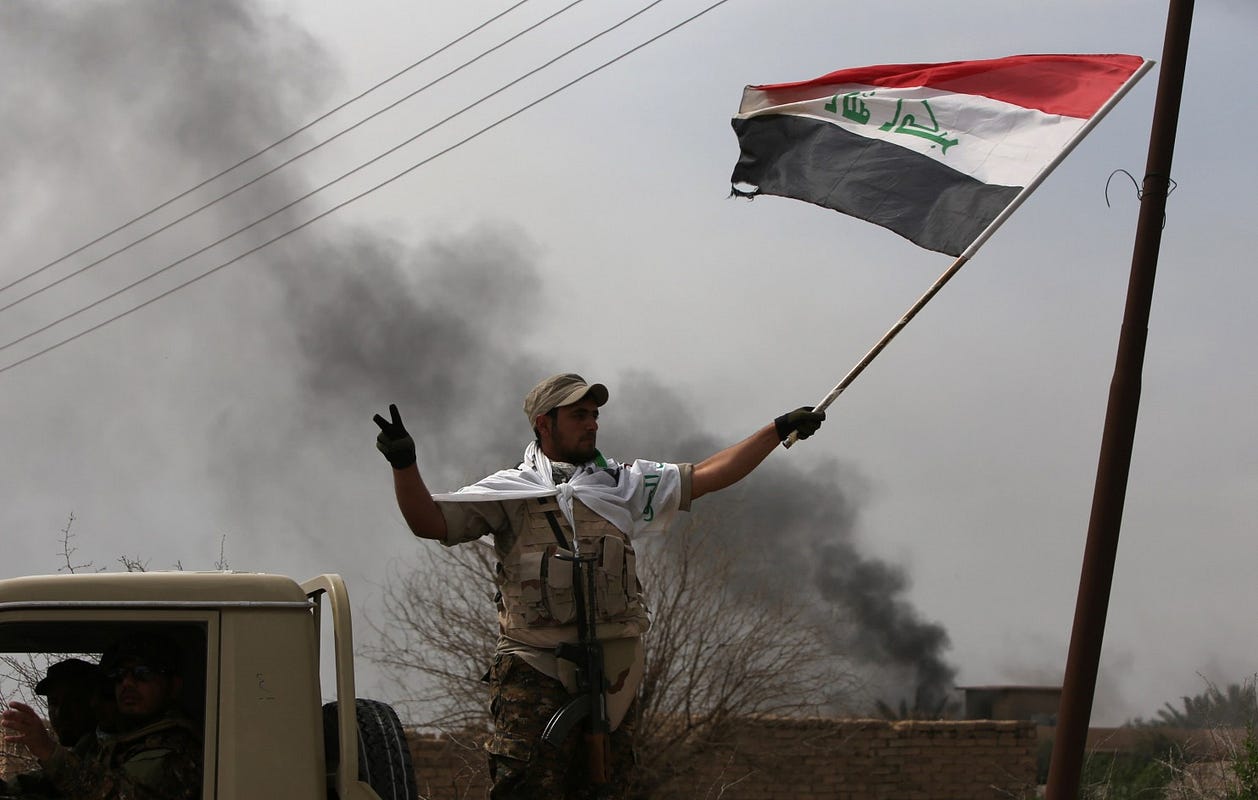
Iraqi civilians board Iraqi military trucks — enlisting for service in
what became the Hashd al-Sha’abi (Popular Mobilization Forces) — 
to defend their friends, family and country.


Although Twitter posts are almost always public, certain journalists, analysts and personalities — as well as those who want to be one of the aforementioned — begin to take off their mask. Just like Kenneth Roth, although on an even more extreme scale, we begin to see the faces of the people who publish our media. Names such as Robert Caruso — a writer for the Daily Beast, The Hill, Boston Globe and others — who write articles on foreign policy, participate in think-tanks and provide information as experts, begin to rear an ugly side.


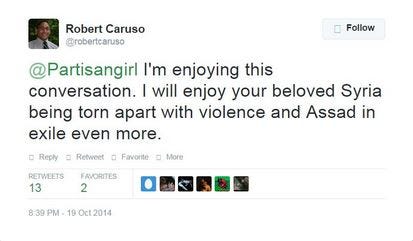
While Caruso discusses and debates the United States’ policies towards Syria on MSNBC, Caruso — with his mask lifted — posts horrific tweets of how he will “enjoy” seeing a Syrian woman’s “beloved Syria torn apart with violence.” Going back to 2013, Caruso’s tweets mentioned things such as how he does not care for the plight of the Syrian people, and how he believes the United States “should let them suffer.” Caruso’s tweets even included suggesting he is “at peace” with a situation where the people in someone’s hometown would be raped and the town pillaged. In one instance against me specifically, he called me a “rejectionist” — an English translation of the Arabic anti-Shiite slur of rafidha used by groups like the Islamic State and al-Qaeda to demean and justify attacking Shiites — somewhat akin in usage to the word “apostate.” Reider Visser, a Norwegian historian and fellow at the Norwegian Institute of International Affairs, mentioned that Caruso’s anti-Shiite language is alarming and emphasized that there is no other plausible English interpretation for Caruso’s remark of “rejectionist” other than rafida.

This form of anti-Shiite bullying even extended to telling me that Shiites are haram  — or “sinful” — using the same nomenclature used by the Islamic State and Al Qaeda to justify their car bombs targeting civilians, detonating Mosques (with people in them), forced displacement, deportation and acts of murder on such a mass scale that they border — if not fulfill — the United Nations requirements for the classification of “genocide.” Caruso then continued on to detail how the United States is at war with Shiites — not just with countries such as Iran or groups like Hezbollah, but with all Shiites. This is the person discussing and debating foreign policy on American media, and acting as an expert for TV stations on American foreign policy.

“Referencing the old adage of “birds of a feather,” it seems that most of these anti-Shiites tend to group themselves — and defend themselves — as a single unit”

Caruso is but a single name in a sea of anti-Shiite journalists, analysts and personalities who slowly reveal themselves on Twitter. Surprisingly, referencing the old adage of “birds of a feather,” it seems that most of these anti-Shiites tend to group themselves — and defend themselves — as a single unit. Another of these names is Michael Weiss, a writer for Foreign Policy, the Daily beast, NOW Lebanon and the editor and founder and Editor-in-Chief of The Interpreter. Reading through Michael Weiss’ Twitter feed you cannot help but get an anti-Shiite sentiment — mostly because almost all of his Tweets revolve around how anything to do with Shiites is a problem. A close associate of Caruso and often supporting and sharing Caruso’s articles, in the same Tweet mentioned above where Caruso called Shiites “haram,” Weiss, rather than criticize his colleague for such a vile statement, began to attack users who felt that Caruso’s tweet was inappropriate. In one such incident, Weiss captured a screenshot of a user commenting on Caruso’s dehumanizing statement and began to attack that person’s character, completely ignoring that his colleague had just used language used by takfiris such as Islamic State and Al Qaeda.

In one instance, Weiss attacked Michael Knights, an analyst for the Washington Institute with almost 20 years of experience in Iraqi political analysis, for retweeting me being patriotic. After being attacked by the likes of Caruso and co for so long, I tweeted that “I have nothing to hide. I’m a passionate supporter of the [full-time] Iraqi armed forces [and volunteer soldiers]. No hidden agenda. They’re my people and I love them.” Innocent enough to most, however, Weiss captured a screenshot of Knights sharing my tweet and commented that it is “sad and alarming” that he shared the Tweet of a “champion” of “terrorist organizations.” Feeding into Caruso’s anti-Shiite remarks, after I expressed that I loved our soldiers that are dying everyday to liberate our lands, Weiss suggests that I am actually a supporter of terrorism. Interestingly enough, on that same tweet, a Twitter user questioned Weiss for his retweeting of Caruso and received no response.


Smoke billows in the background as an Iraqi paramilitary fighter 
flashes the victory sign after pro-government forces regained control 
of the village of Albu Ajil, near the city of Tikrit, from Islamic State.


Weiss’ anti-Shiism and attempts to control the predominant narrative was not born out of the blue; Weiss was the Executive Director of an organization called Just Journalism — a lobby focused “on how Israel and Middle East issues are reported in the UK media.” Just as you would expect, the lobby was created in the pursuit of furthering a pro-Israeli agenda in U.K media, and that’s more or less all it did. It has received scathing criticism in the past — and rightfully so — for its overt Neocon slant. Possibly nobody was better able to comment on Just Journalism other than Adel Darwish, a former director of the lobby group. One quote from his statement about resigning from Just Journalism stands out above the others:

In fact neutrality was very much at the heart of the dispute between myself and the chairwoman of the board (the lady who founded the organisation) as I insisted on neutrality from the start. I wanted the organisation to develop to deal with news coverage of the Middle East in general, and become a source of information and a think tank for the media dealing with the Middle East.
Therefore when the lady holding the purse of the organisation and I had different agenda and different aims, I resigned as from 31 December 2008.
Also for the same reason respected columnist Nick Cohen whom I persuaded to join the Advisory Board has also resigned along with Dr Tarek Heggy, a very prominent Egyptian born international thinker.

Weiss wasn't just affiliated with one Israeli-focused lobby and think-tank, however, as you’ll quickly find that his resume is actually filled with such groups. One group in particular is the Henry Jackson Society, where Weiss served as the Communications Director. One does not need to dig very deep to see this group’s disgustingly anti-Iranian and anti-Shiite (as well as generally Islamaphobic) background, a rap sheet that even includes establishing front groups to create panic and irrational, emotional responses to what literally amounts to falsified Islamaphobic propaganda. Not without irony, Weiss published a paper ‘analyzing’ the tactics of Russian disinformation, commenting on how Russian disinformation tactics seek to “sow confusion via conspiracy theories and proliferate falsehoods.” The irony is, of course, that that is exactly what Weiss has been doing — professionally — for over a decade. Who better to analyze it then him? I guess that is one area where he actually has earned the title of “expert.” And his attacks on myself and others sing to his experience.

This is the person who is writing your media, and the one who has assembled a group of like-minded individuals to drive his anti-Shiite narrative. When asked to make a wish before blowing out his birthday candles, Michael Weiss probably wished to have been the pen Israeli Prime Minister Netanyahu used to show the world where Iran was up to on his cartoon bomb diagram. This is the person who you’re supposed to take seriously for at least a somewhat impartial analysis of the Middle East, let alone Iran or Shiites in general.

Shiite groups in Iraq are somewhat under-appreciated by Western journalists and analysts, however. While they may get some attention after some of these groups expressed support or shared leadership with that of the Lebanese Hezbollah — a group that receives a lot more eyes — the amount of analysts out there is far and few inbetween and, thanks to the blatant anti-Shiite stance of the media indicated above, there is a very large market for such an analyst to enter and continue the status quo. One such analyst, a friend of the aforementioned people, is Phillip Smyth — a researcher at the University of Maryland focused on Shiite militias. Phillip Smyth is the go-to ‘expert’ for multiple news outlets, news stations, publications and is also a common participant of various panels. One of the most “echo chamber” Middle East analysts on Twitter — that is, those who block anyone and everyone who does not agree with what they say verbatim — Smyth is perhaps the most interesting. Walking the fine line between Bibi-style fear mongering and some sort of Bay Area-style hipsterism, Smyth has been promoting the idea that Iran’s foreign policy involves some sort of anti-American, anti-Israeli Islamic caliphate spanning from Iran to Lebanon and beyond.


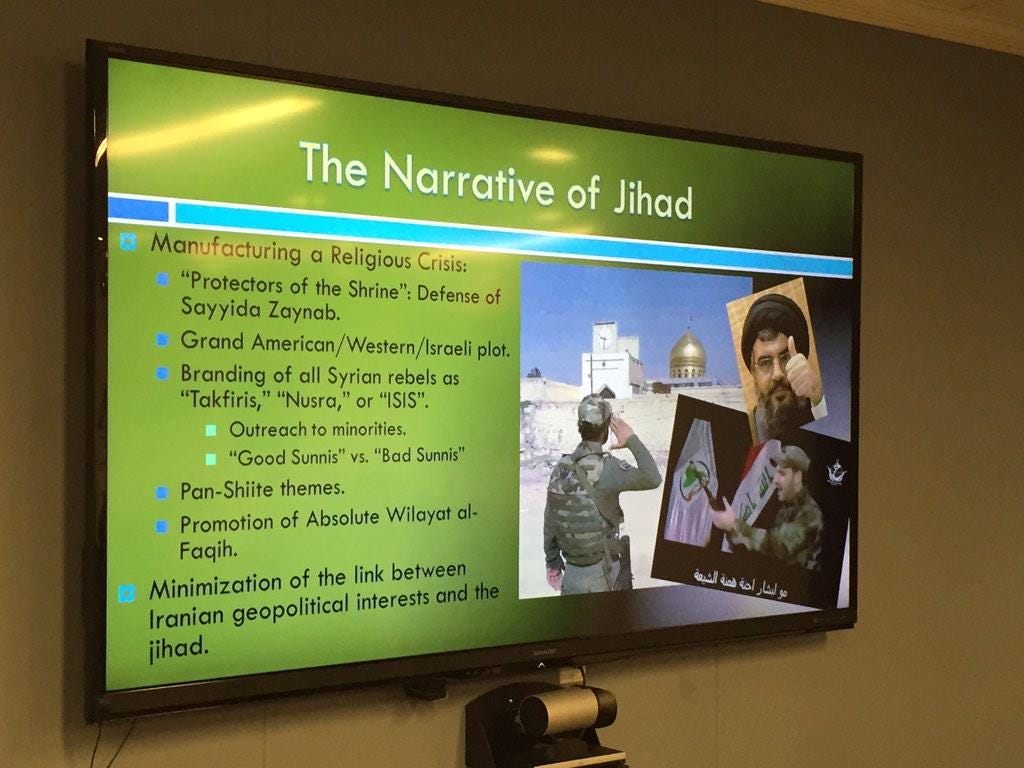
Slide from Smyth’s presentation in February, 2015.


One such slide that Smyth presented earlier this year in a talk of his (shown above) branded every Shiite militia as submissive to Iran and acting as the arm of Iran’s alleged imperialistic goals. The slide suggested that Shiites have fabricated the idea that they are experiencing an existential threat in Iraq and Syria — that it was all a manufactured plot, and also suggests that Shiite militias accuse all moderate Sunni rebels of being takfiris (those who accuse others of disbelief, used interchangeably with words like Salafist, Wahhabi or extremist) in a way to undermine their credibility. Never mind that almost all alledgly-moderate anti-government Sunni militia leadership in Syria have almost completely been absorbed into larger extremist groups like Islamic State, and even before being absorbed they worked with, endorsed, defended and even praised extremist groups including both Jabhat al Nusra (al-Qaeda’s official wing in Syria) and the Islamic State. This even includes the leader of Liwa al-Islam, or the Islamic Front, who also acts as the defacto leader of the allegedly ‘moderate’ rebel union called Liwa al-Sham, or Levant Front, calling for foreign fighters to travel to Syria to join Liwa al-Islam, so they can “fight in the ranks of the Sunni [branch of Islam against the apostates and non-Muslims],” or, more specifically, against the Shiites. But there is no existential threat, and the so-called moderates are not out to attack Shiites. This is what Smyth wants to convince the world.

“In their ‘purely strategic’ assault on Nubl and Zahraa, the ‘moderates’ ended up losing control of the last supply line to Aleppo”

Another member of the anti-Shiite analyst circle embedded with those above also attempts to push the ‘moderate’ Syrian rebel narrative, however, with significantly less success. Kyle W. Orton is a “blogger” who has somewhat less shame than Smyth: while Smyth recognizes that the Shiite militias he talks about are not actually composed of Iranians, Orton skips that and considers them to be — literally — Iranian forces. But his apologism for groups like Jabhat al-Nusra is what really sets him apart from some of the others: in a Tweet earlier this year discussing the an assault on the Syrian Shiite villages of Nubl and Zahraa in Aleppo, Orton candidly mentions how it’s actually being performed by Jabhat al-Nusra as an act of “pure strategy, not sectarianism.” The fact that Nubl and Zahraa are predominantly Shiite towns that have been under siege by Jabhat al-Nusra and co. for two years doesn't seem to phase him, nor do the calls by Jabhat al-Nusra on how they want to “stomp [Shiites] with their shoes” and offer “no mercy.”


Perhaps the most interesting element of Orton’s comment, however, is that in their ‘purely strategic’ assault on Nubl and Zahraa, the ‘moderates’ of Aleppo ended up losing control of the contested last insurgent supply line to Aleppo. If this was strategy, then it was literally the worst strategy in the Syrian conflict so far. Or it was sectarianism. I guess we’ll never really know, right? But then again, what should be expected from the ‘analyst’ who considers it “a slur” to “suggest that Israel would even consider indiscriminate attacks on civilians.” It’s a bit of a shame that that is, alongside the wanton destruction of infrastructure, literally what the Dahiya doctrine is about, and what Bibi has more or less admitted to on camera. It’s no surprise that he has a blatant anti-Shiite slant, and it comes from his obsessive support for Israel. Further, his neoconservative Israeli slant follows the same path as Weiss’ in that both eventually convert into anti-Iranian and anti-Shiite sentiment.


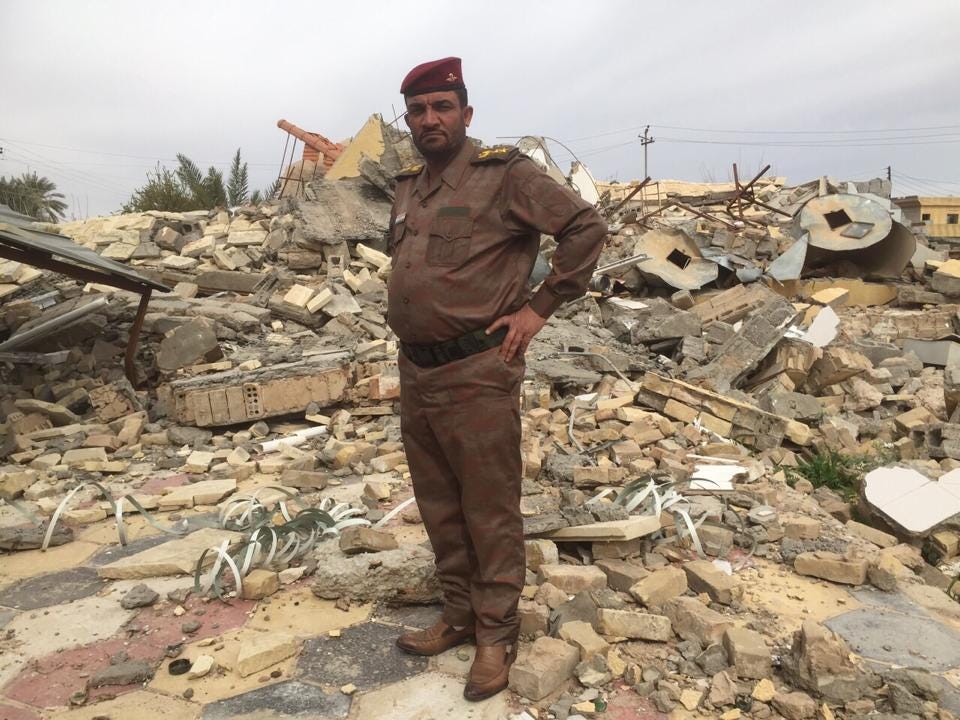
Khamis al-Joubouri, a fighter from a Sunni militia called 
“Umayyad Jbara,” standing on his house that was destroyed by 
Islamic State in the recently liberated area of al-Alam just outside Tikrit.


Weiss, along with Smyth, Orton and various others unmentioned, however, have decided to go the extra step. In an attempt to attack my credibility, they seem to have recruited a friend of theirs — UPS driver assistant John Bundock — to begin his pseudo-analyst career by slandering me and various others on the Lebanese right-wing publication, NOW Media, which Weiss edits. In a somewhat ironic move of accusing the Shiite militias of being Iranian proxies that further alleged Iranian ideology, the anti-Shiite band have formed and created their own proxies to further their own alarmist anti-Shiite ideology and attack anyone who challenges their narrative.

Bundock dedicated an entire paragraph to me — as well as a plethora of links to various Twitter posts of mine — showing how I am apparently an IRGC propagandist, that I “harass genuine experts on militant groups” by commenting on Smyth’s conspiracy theory of Shiites literally infiltrating Western media, that I am sectarian, and that I apparently created a fake Twitter account to mislead people about alleged war crimes by Shiite militias. The account in question is @SunniTribes, and it seems to focus on Sunni tribal militias, their movements, their statements, and similar. This conspiracy theory was formed by a Kurdish ultra-nationalist  — someone who cheers for Islamic State victories against Iraqi forces. Using a screenshot of the @SunniTribes Twitter account and screenshots of my response to him and his allegation that Shiite militias were responsible for what was portrayed in the photographs, he used Twitter time stamps on his screenshots to try to somehow weave a conspiracy theory that I was behind the @SunniTribes Twitter account, had reposted the photographs with amended descriptions, and then used that to disprove his claim that Shiite militias were behind what was depicted.

“It seems that if anybody — even award winning journalists — do not conform to blatantly anti-Shiite rhetoric, then they are slandered.”

That’s it. Apparently, because I referenced that Tweet, it was enough proof for Weiss, Smyth and co. to encourage Bundock to write an article about it on NOW Media. Others attacked in the article were Hala Jaber, an award winning journalist for The Sunday Times, calling her a “stenographer-propagandist for the Assad regime and Hezbollah.” It seems that if anybody — even award winning journalists — do not conform to blatantly anti-Shiite rhetoric, then they are slandered by this circle of anti-Shiite “experts.” Because I have been retweeted by the U.S State Department’s Think Again, Turn Away Twitter account on completely unrelated matters, it apparently has shaken the aforementioned people enough to try to slam the U.S State Department for doing so. But if it’s a matter of guilt by association, then we haven’t even reached the apex of this anti-Shiite group.

One surprising element that seems to have united most anti-Shiite Twitter users — including all of the aforementioned — was their overt support for the Twitter-Jihadist “Shami Witness” — perhaps the most well-known and highest-followed Islamic State supporter on social media — who was eventually unmasked by Channel 4 as an Indian man named Mehdi Masroor Biswas and arrested by the Indian police force for waging war, inciting terrorism, and providing support to terrorists.


A member of the Popular Mobilization Forces holds up a local 
Sunni child in a recently liberated area outside of Tikrit.


Most of the members of the anti-Shiite Twitter circle — including Weiss, Smyth, Orton, and Bundock — played a large role in Biswas’ notoriety, encouraging their followers to follow him and recommending his content. Smyth’s affiliation with Biswas was probably the most interesting, given that Smyth was depending on Biswas to provide him with anti-Shiite content and being visibly upset when Biswas would forget to include Smyth in his postings. This blatant tunnel vision taken on by the anti-Shiites — where they live in a feedback loop of accepting and depending on any anti-Shiite source regardless of their motives , having a confirmation bias in their analysis, and attacking people’s character when they can’t attack their content — is largely the bane of what they do.

“What they were actually defending, recommending and disseminating was Biswas’ anti-Shiite, pro-Islamist rhetoric.”

A typical defense by these names regarding the incident with Biswas has been along the lines of ‘we defended, recommended and worked with Biswas before he came out as an overt Islamic State supporter, and then ceased our support afterwards’ — is fair, except for the fact that what they were actually defending, recommending and disseminating was Biswas’ anti-Shiite, pro-Islamist rhetoric that didn't change after he declared his support for the Islamic State. If we were to mirror this situation with antisemitic publication, the argument would come across as ‘we recommended, disseminated and depended on him for antisemitic content before we knew he was a Nazi’ — it doesn't really change anything, but given that they were depending on such a person (and the fact that they appear to share the same perspective as such a person) is telling. Personally, I’d find it extremely uncomfortable if I ever see myself sharing opinions with extremists of any sort.

But that is if we accepted the excuse as being fair. If we rejected it and considered it unfair, then the argument is that Biswas was openly supporting, defending and disseminating the Islamic State and Islamic State propaganda in 2013 while names like Smyth were still endorsing him. Since Twitter time stamps were used in ‘exposing’ me, here are some time stamps that Smyth and co. might enjoy.

  • 13th November, 2013: General Twitter users have started to pay attention to Biswas’ Islamic State leanings, and Biswas tries to defend himself by saying he is not a “blind supporter.” At this stage, there is no doubt of who Biswas is and what he supports.


When I began posting tweets, it had much less to do with providing information to a large audience and I was much more concerned with informing my friends and family with what was happening in Iraq. After spending — literally — hundreds of hours researching what was happening in Iraq, I managed to identify reliable sources on Twitter and other social media, internet forums, and Iraqi media, and began to disseminate that to my followers on Twitter — saving them the hassle of doing it themselves. Being someone who does not support Muslim extremism of any sort, who does not support sectarianism, and believes that there are democratic avenues to resolve most issues, I am unable to relate to most Syrian rebel groups or the Iraqi insurgency in Iraq, which until August 2014 was being reported on as an “Iraqi revolution.” Even names mentioned above, such as Weiss, tried to suggest that Shiites were responsible for their own massacre — attempting to incriminate Iran as being the mastermind behind the Islamic State. Oh, and it includes a reference to Smyth’s work too, feeding back into the anti-Shiite feedback loop.

I am a Shiite. I am an Iraqi. There is no single group on this planet who has as much to lose from the Islamic State as myself. Christian men are asked to pay jizya or leave, Yezidi men are given the opportunity to “repent” and convert, but Shiite men are actively hunted out, tortured, and executed with no other option on the table. Even the choice to convert — as disgusting as it is — is not offered. What makes it worse, however, is that the rest of the world seems to go on a victim blaming tangent of how Shiites should be held responsible for their own oppression. Throughout this conflict, I have maintained my position: I am not anti-Sunni, I am anti-sectarianism, I am anti-exploitation, anti-oppression and anti-destruction.

Expecting me to support blatant lies said about my people and the people who are defending us from the worst of the worst is at best an insult, and at worst a disgusting act of covert support for the Islamic State. 20-something year old Shiites — no different than me, no different than you, each with their own goals, dreams, friends, hobbies and interests — from Southern Iraq have been called to Central and Western Iraq for their help. They don’t make it home, instead returning in body bags. Nobody cares for them: some call them Jihadists, some call them sectarian and genocidal, and some even refuse to accept that they are Iraqis and just call them Iranians instead. But they go anyway, and they give up their lives to make other people’s lives better. Iranian influence in Iraq is not because of an Iraqi desire, it is because of a lack of any other friends. It seems that in 2015, the Iranians are the only ones who are not reducing the people fighting for Iraq to mere gangsters and thugs, motivated by nothing other than blood lust and religious imperialism. Expecting me and tens of millions of other Iraqis — including Sunnis — to be upset at Iran when they were the only country who came to our aid when we needed it is delusional.

But I digress.

In the timeless words of Steven Nabil, an Assyrian Iraqi American that has embedded himself with Iraqi forces and works with Iraqi IDPs: ننتصر او ننتصر — “We will prevail or we will prevail.” There is no other option for the Iraqi people. And neoconservative think-tanks, anti-Shiite analysts, or Islamic State fighters will not be able to break us or our spirits.

I’ll leave this on a quote from Bundock himself, when he was trying to defend the so-called moderates in Syria from criticism about them working with the Al Qaeda in Syria group, or Jabhat al-Nusra:
“we better stop having sketchy allies while protecting our families; some whitey will be pissed”. - Said no one.

Haidar Sumeri - Updates/analysis on the security situation in Iraq. Middle East geopolitics. Iraqi separatist. IG: iraqiarmedforces.

Heart of the 'Palestine Problem' - Jeff Halper and the Jewish Left

The Jewish Left Is Not The Solution, It Is The Heart Of The Problem

by Gilad Atzmon


I have never met Jeff Halper. What I know about him is that he is an American Jew who settled on Palestinian land but opposes Israeli house demolition. Halper appears to be a participant in the Zionist project while at the same time opposing the measures that have been implemented to sustain that plunderous project.

Halper’s moral discrepancy shouldn’t take us by surprise, he is far from alone. This behavioural mode is symptomatic of Jewish Left thinking in general and the Jewish anti Zionist call in particular.

Instead of presenting a genuine ethical argument, the Jewish Left is a desperate attempt to convey an ‘image’ of Jewish moral awareness. Instead of being ethical they mimic a true ethical argument.

In the last few years, Mondoweiss has become the home for this Hasbara operation. It enthusiastically promotes Judeo-centric half-baked thoughts and comments that are designed to divert attention away from the Jewishness that drives the Jewish State and its lobby. Three years ago Mondoweiss went so far as to ban discussion on the role of Jewish culture and religion in relation to politics. The ‘progressive’ site changed its comment policy, the site’s editorial wrote, “from here on out, the Mondoweiss comment section will no longer serve as a forum to pillory Jewish culture and religion as the driving factors in Israeli and US policy.” As if by banning the discussion, they could influence reality.

Jeff Halper’s commentary on the recent Israeli election is an exemplary case of deceptive left analysis. Halper revealed to the Mondoweiss crowd that “finally the fig-leaf that allowed even liberal Israeli apologists to argue that the two-state solution is still possible has been removed.” As if we needed Halper or Netanyahu’s election in order to grasp that Israel has been one-state dominated by supremacist tribal ideology. But then Halper dropped a prophetic statement of false reassurance.

“We are finally free to move on to a genuine and just solution.” 

I am puzzled, who is ‘we’ exactly? Who is ‘free’ to move? And what is a ‘genuine and just solution’ according to Halper? Knowing that not a single Jewish Knesset member supports the right of return, what makes Halper convinced that justice is on the way?

Halper outlines his vision of a ‘just peace’ a few lines below; 


“Israel has left us with only one way out: to transform that state into a democratic state of equal rights for all of its citizens. In addition to ensuring its population’s individual civil rights, it must also ensure the collective rights of each of the country’s national groups: Palestinian Arabs and Israeli Jews.” 

This is the deception. He fails to address the Palestinian cause or the refugees. The American Jew settler who returned to his ‘promised land’ thanks to the racist Israeli law of return, is preaching ‘justice’ but neglecting the elementary right of the indigenous people of the land to return to their homes, villages, fields and orchards. I guess that when Halper referred to a ‘just solution’ he must have had a kosher one in mind.

More concerning is the fact that Halper deceives his readers. He presents a phantasy as a political mantra. The election’s results clearly prove that there is no Jewish political party that advocates the transformation of Israel into a ‘State of it Citizens; ’ quite the opposite, Israel is likely to become more Jewish than ever. But the Left Hasbara merchant continues;

“Yet another fig-leaf dropped in this election as well, the notion that Israel is genuinely a democratic state.” 

Again, Halper is misleading: the last election in Israel was democratic and provided a true representation of Israeli society. As such, it reflects the true nature of the Jewish state; Israel is racist, supremacist and intolerant. The democratic election in Israel reveals that the Jewish state is suffocated with Goy hatred and is dangerous to itself and to the rest of the universe.

In reflection of the democratic nature of its election, the third biggest party in Israel is an Arab party. This fact puts Israel far ahead of its ‘progressive’ Jewish anti Zionist opponents. The demography of the Israeli Knesset is more diverse than the leadership of JVP or Mondoweiss’ editorial board. And interestingly enough, the only true Left universalist party in the Israel parliament is the United Arab party.

Reading Jeff Halper’s Mondoweiss commentary confirms what we have known for some time – the Jewish left does not provide a solution; it is actually the heart of the problem. It is delusional at best and consciously deceitful at worst. It is not surprising that the left has been eradicated in Israel; it had nothing to offer to either the Israelis or the Palestinians. The ‘Jewish Left’ is an oxymoron – one can be either a universalist or tribal, one cannot be both. And while the progressive Mondoweiss bans discussion of the Jewishness of the Jewish state the previous Israeli cabinet passed the Israeli National Bill that defined Israel as the Jewish State.

The hard core Israeli hawks admit their tribalism and are motivated by the search for a home for their true Jewish nature and the meaning of Jewish politics while our imaginary Jewish ‘dove’ ‘allies’ invest their political energy in concealing what is obvious about a ‘Jewish’ state,’ its Jewishness and the role of that Jewishness in its politics.

I kindly advise Halper and Mondoweiss that with Netanyahu, Bennett and Lieberman leading the Jewish people in accordance to what they believe to be right and Jewish, the left can relax and take a back seat. It is manifestly time to move past this progressive Hasbara spin operation.

Res Ipse Loquitor. We should let the truth speak for itself.