Tuesday, August 18, 2015

FBI Evidence Exonerates Dzhokhar Tsarnaev - And Yet

FBI Evidence Proves Innocence of Accused Boston Marathon Bomber Dzhokhar Tsarnaev

by Paul Craig Roberts - ICH


August 18, 2015

I have been contacted by attorney John Remington Graham, a member in good standing of the bar of the Minnesota Supreme Court and the United States Supreme Court. He informs me that acting in behalf of Maret Tsanaeva, the aunt of the accused Tsamaev brothers and a citizen of the Kyrgyz Republic where she is qualified to practice law, he has assisted her in filing with the US District Court in Boston a pro se motion, including an argument of amicus curiae, and an affidavit of Maret Tsarnaeva. The presiding judge has ordered that these documents be included in the formal record of the case so they will be publicly accessible. The documents are reproduced below.

The documents argue that on the basis of the evidence provided by the FBI, there is no basis for the indictment of Dzhokhar Tsarnaev. The FBI’s evidence clearly concludes that the bomb was in a black knapsack, but the photographs used to establish Dzhokhar’s presence at the marathon show him with a white knapsack. Moreover, the knapsack lacks the heavy bulging appearance that a knapsack containing a bomb would have.

As readers know, I have been suspicious of the Boston Marathon Bombing from the beginning. It seems obvious that both Tsamaev brothers were intended to be killed in the alleged firefight with police, like the alleged perpetrators of the Charlie Hebdo affair in Paris. Convenient deaths in firefights are accepted as indications of guilt and solve the problem of trying innocent patsies.

In Dzhokhar’s case, his guilt was established not by evidence but by accusations, by the betrayal of his government-appointed public defender Judy Clarke who declared Dzhokhar’s guilt in her opening statement of her “defense,” by an alleged confession, evidence of which was never provided, written by Dzhokhar on a boat under which the badly wounded youth lay dying until discovered by the boat owner and hospitalized in critical condition. Following his conviction by his defense attorney, Dzhokhar allegedly confessed again in jihadist terms. As legal scholars have known for centuries, confessions are worthless as indicators of guilt.

Dzhokhar was not convicted on the basis of evidence.

In my questioning of John Remington Graham, I concluded that despite 48 years of active experience with criminal justice, both as a prosecuting attorney and defense attorney, he was shocked to his core by the legal malfeasance of the Tsarnaev case. As Graham is nearing the end of his career, he is willing to speak out, but he could not find a single attorney in the state of Massachusetts who would sponsor his appearance before the Federal District Court in Boston.

This tells me that fear of retribution has now extended its reach into the justice (sic) system and that the America that we knew where law was a shield of the people no longer exists.

Here is the Affidavit of Maret Tsarnaeva:


AFFIDAVIT OF MARET TSARNAEVA CONCERNING THE PROSECUTION OF DZHOKHAR TSARNAEV

Mindful that this affidavit may be filed or displayed as an offer of proof with her authorization in public proceedings contemplated by the laws of the United States of America, and in reliance upon Title 28 of the United States Code, Section 1746, Maret Tsarnaeva deposes and says:

I am the paternal aunt of Dzhokhar Tsarnaev who has been prosecuted before the United States District Court for Massachusetts upon indictment of a federal grand jury returned on June 27, 2013, for causing one of two explosions on Boylston Street in Boston on April 15, 2013. In the count for conspiracy, certain other overt acts of wrongdoing are mentioned. As I understand the indictment, if Dzhokhar did not carry and detonate an improvised explosive device or pressure-cooker bomb as alleged, all thirty counts fail, although perhaps some lingering questions, about which I offer no comment here, might remain for resolution, subject to guarantees of due process of law, within the jurisdiction of the Commonwealth of Massachusetts.

I am currently living in Grozny, the capital of Chechnya which is a republic within the Russian Federation. My academic training included full-time studies in a five-year program of the Law Faculty at the Kyrgyz State University, and I also hold the degree of master of laws (LL. M.), with focus on securities laws, granted by the University of Manitoba while I lived in Canada. I am qualified to practice law in Kyrgyzstan. I am fluent in Russian, Chechen, and English, and am familiar with other languages. I am prepared to testify under oath in public proceedings in the United States, if my expenses are paid, and if my personal safety and right of return to my home in Chechnya are adequately assured in advance.

Aside from other anomalies and other aspects of the case on which I make no comment here, I am aware of several photo exhibits, upon which the Federal Bureau of Investigation (FBI) relied, or of evidence which their crime laboratory has produced, and certain other reports or material. Together, these plainly show that Dzhokhar was not carrying a large, nylon, black backpack, including a white-rectangle marking at the top, and containing a heavy pressure- cooker bomb, shortly before explosions in Boston on April 15, 2013, as claimed by the FBI and as alleged in the indictment for both explosions. On the contrary, these photo exhibits show unmistakably that Dzhokhar was carrying over his right shoulder a primarily white backpack which was light in weight, and was not bulging or sagging as would have been evident if it contained a heavy pressure-cooker bomb. The only reasonable conclusion is that Dzhokhar was not responsible for either of the explosions in question.

On or about June 20-21, 2013, during their first trip to Russia, which lasted about ten days more or less, Judy Clarke and William Fick, lawyers from the federal public defender’s office in Boston, visited my brother Anzor Tsarnaev, and his wife Zubeidat, respectively the father and mother of Dzhokhar. The meeting was at the home of Dzhokhar’s parents in Makhachka which is in the republic of Dagestan adjacent to the republic of Chechnya, and about three hours’ drive from Grozny. My mother, my sister Malkan, and I were present at this meeting. Zubeidat speaks acceptable English. Mr. Fick is fluent in Russian.

Laying aside other details of the conversation on June 20-21, 2013, I wish to note the following:

— The lawyers from Boston strongly advised that Anzor and Zubeidat refrain from saying in public that Dzhokhar and his brother Tamerlan were not guilty. They warned that, if their advice were not followed, Dzhokhar’s life in custody near Boston would be more difficult;

— Mme Clarke and Mr. Fick also requested of Anzor and Zubeidat that they assist in influencing Dzhokhar to accept the legal representation of the federal public defender’s office in Boston. Mr. Fick revealed that Dzhokhar was refusing the services of the federal public defender’s office in Boston, and sending lawyers and staff away when they visited him in custody. In reaction to the suggestion of Mr. Fick, lively discussion followed;

— As Dzhokhar’s family, we expressed our concern that the federal public defender’s office in Boston was untrustworthy, and might not defend Dzhokhar properly, since they were paid by the government of the United States which was prosecuting him, as many believe for political reasons. Dzhokhar’s parents expressed willingness to engage independent counsel, since Dzhokhar did not trust his government-appointed lawyers. Mr. Fick reacted by saying that the government agents and lawyers would obstruct independent counsel;

— I proposed that Dzhokhar’s family hire independent counsel to work with the federal public defender’s office in order to assure proper and effective representation of Dzhokhar. Mr. Fick replied that, if independent counsel were hired by the family, the federal public defender’s office in Boston would withdraw;

— Mr. Fick then assured Anzor and Zubeidat that the United States Department of Justice had allotted $5 million to Dzhokhar’s defense, and that the federal public defender’s office in Boston intended to defend Dzhokhar properly. Zubeidat then and there said little concerning assurances of Mr. Fick. But for my part, I never believed that the federal public defender’s office in Boston ever intended to defend Dzhokhar as promised. And my impressions from what happened during the trial lead me to believe that the federal public defender’s office in Boston did not defend Dzhokhar competently and ethically.

In any event, I am aware that, following the meeting on June 20-21, 2013, Mme Clarke and Mr. Fick continued to spend time with Anzor and Zubeidat, and eventually persuaded Zubeidat to sign a typed letter in Russian to Dzhokhar, urging him to cooperate wholeheartedly with the federal public defender’s office in Boston. I am informed by my sister Malkan, that Zubeidat gave the letter to the public defenders, shortly before their departure from Russia on or about June 29, 2013, for delivery to Dzhokhar.

During subsequent trips Mme Clarke and Mr. Fick to see Dzhokhar’s parents in Makhachkala, the strategy for defending Dzhokhar was explained, as I learned from my sister Malkan. The public defender’s office in Boston intended to contend at trial, as actually has happened since, that Tamerlan, now deceased, was the mastermind of the crime, and that Dzhokhar was merely following his big brother. I was firmly opposed to this strategy as morally and legally wrong, because Dzhokhar is not guilty, as FBI-generated evidence shows. Some ill- feeling has since developed between myself and Dzhokhar’s parents over their acquiescence.

On or about June 19, 2014, during their visit to Grozny over nearly two weeks, three staff members from the public defender’s office in Boston visited my mother and sisters in Grozny. I am told that they also visited Dzhokhar’s parents in Makhachkala.

The personnel visiting my mother and sisters in Grozny on or about June 19, 2014, included one Charlene, who introduced herself as an independent investigator, working in and with the federal public defender’s office in Boston; another by the name of Jane, a social worker who claimed to have spoken with Dzhokhar; and a third, by the name of Olga, who was a Russian- English interpreter from New Jersey. They did not leave business cards, but stayed at the main hotel in Grozny, hence I presume that their surnames can be ascertained.

I was not present at the meeting in Grozny on or about June 19, 2014, but my sister Malkan, who was present, called me by telephone immediately after the meeting concluded. She revealed to me then the details of the conversation at the meeting. Malkan and I have since spoken about the visit on several occasions.

Malkan speaks Russian and Chechen and is willing to testify under oath in public proceedings in the United States through an interpreter in Russian, if her expenses are paid, and if her personal safety and right of return to her home in Chechnya are adequately assured in advance. She relates, and has authorized me to state for her that, during the conversation on June 19, 2014, in Grozny, Charlene the independent investigator stated flatly that the federal public defender’s office in Boston knew that Dzhokhar was not guilty as charged, and that their office was under enormous pressure from law enforcement agencies and high levels of the government of the United States not to resist conviction. [Remember what happened to Lynne Stewart, the federally appointed public defender who actually served her client. She was sentenced to prison.]

This affidavit is executed outside of the United States, but the foregoing account is true to the best of my knowledge, information, and belief, and subject to the pains and penalties of perjury under the laws of the United States of America.

Given on this 17th day of April 2015.

/s/ Maret Tsarnaeva

Here is the Argument of Amicus Curiae:

UNITED STATES DISTRICT COURT DISTRICT OF MASSACHUSETTS

ARGUMENT OF AMICUS CURIAE No. 13-CR-10200-GAO

MAY IT PLEASE THE COURT:

1. Federal jurisdiction: The constitutional authority of the United States cannot be extended to the prosecution of Dzhokhar Tsarnaev in light of the opinion of the court in United States v. Lopez, 514 U. S. 549 (1995), and views of Alexander Hamilton in The Federalist, Ns. 17, 22, and 34 [Clinton Rossiter (ed.), Mentor edition by New American Library, New York, 1961, pp. 118, 143-144, and 209]. Congress has broad power to regulate commerce, including trade and the incidents of trade, but domestic crimes and use of weapons are generally reserved to the States. If there is sufficient evidence to prosecute Dzhokhar for murder and mayhem, he should and can be prosecuted exclusively by the Commonwealth of Massachusetts. Accordingly, amicus urges that the indictment now pending should be dismissed, and the conviction of her nephew Dzhokhar Tsarnaev of charges under several acts of Congress should be vacated.

2. The actual innocence of the accused: Laying aside misgivings of amicus and many others about of the “official” scenario concerning this case, as broadcast to the world by the government and mainstream news media of the United States, evidence generated by the Federal Bureau of Investigation (FBI), confirmed on the judicial record of this cause, and clarified by the indictment, or suitable for judicial notice under Rule 201(b) of the Federal Rules of Evidence, conclusively proves that Dzhokhar Tsarnaev cannot be guilty of the crimes charged in this prosecution.

The formal indictment against Dzhokhar Tsarnaev was returned on June 27, 2013. The document is 74 pages long, and accuses Mr. Tsarnaev (hereinafter called Dzhokhar) of heinous crimes, including many counts punishable by death. The central event for which Dzhokhar is alleged to have been responsible, according to the indictment, took place, on Boylston Street, in front of the Forum Restaurant, near the finish line of the Boston marathon on April 15, 2013. The most important paragraphs of the indictment are numbered 6, 7, and 24 (including several other paragraphs repeating expressly or by implication the substance thereof). Paragraphs 6-7, read in themselves and in context, state that, acting in concert withhis (now deceased) brother, Dzhokhar set down on the sidewalk and detonated one of two “black backpacks” which contained “improvised explosive devices,” these “constructed from pressure cookers, low explosive power, shrapnel, adhesive, and other materials.” Paragraph 24 clarifies that the black backpack carried, and containing the pressure-cooker bomb allegedly detonated by Dzhokhar, was placed in front of the Forum Restaurant and was associated with the second explosion. The indictment says in paragraph 6 that both bombs exploded at about 2:49 in the afternoon (Eastern time), and that the bombs Dzhokhar and his brother placed and detonated each killed at least one person, and wounded scores of others.

On the morning after the explosions, i. e., on April 16, 2013, Richard DesLauriers, special agent in charge of the FBI in Boston, made a public statement at a press conference, which is published in printed form on the FBI website and in the news media concerning the facts later set forth in the indictment. Mr. DesLauriers said, as paragraphs 6-7 of the indictment substantially confirm,

“. . . this morning, it was determined that both of the explosives were placed in a dark-colored nylon bag or backpack. The bag would have been heavy, because of the components believed to be in it.

“. . . we are asking that the public remain alert, and to alert us to the following activity . . . someone who appeared to be carrying an unusually heavy bag yesterday around the time of the blasts and in the vicinity of the blasts.”

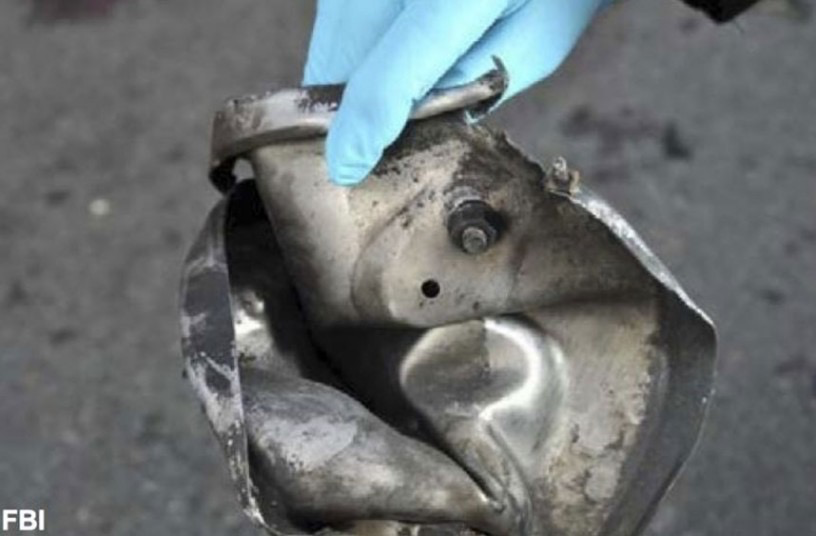
The FBI also published on April 16, 2013, a crime lab photo of a bomb fragment found after the explosions This photo is reproduced as Tsarnaeva exhibit 1 in the appendix hereof, and is believed proper for judicial notice.

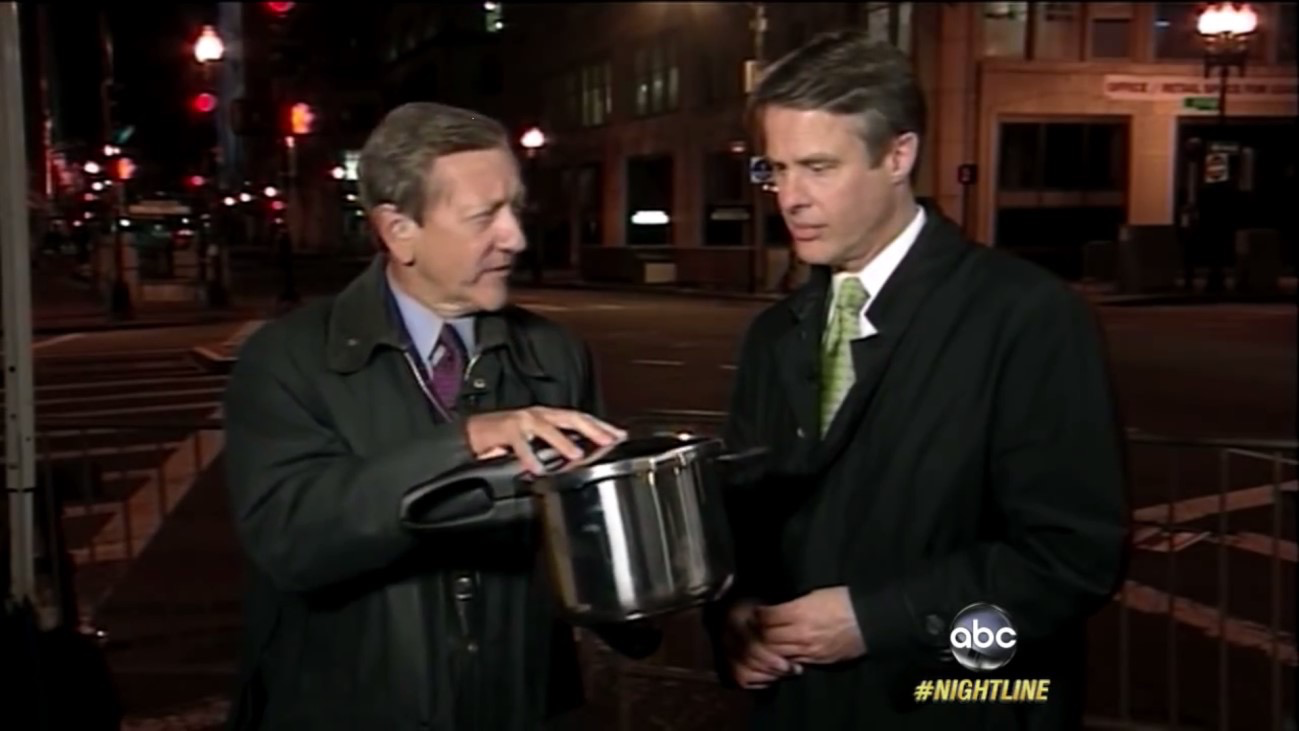
From this bomb fragment, the FBI crime lab was able to reconstruct the size, shape, and type of pressure cookers, as was reported on information published by the FBI to the nation on ABC News Nightline on April 16, 2013. A still-frame, taken from (about 01:39-01:54) of this ABC television report, is reproduced as Tsarnaeva exhibit 2 in the appendix hereof, and is offered for judicial notice. A larger segment of this ABC Nightline News report (at about 01:31-02:14) elaborates facts set forth in paragraphs 6-7 of the indictment, including reference to three of the four exhibits reproduced in the appendix hereof. Each of the pressure cookers in question was a Fagor, 6-quart model, marketed in or near Boston and elsewhere in the United States by Macey’s. Its external dimensions are probably about 81⁄2 inches in height, including cover, and about 9 inches in diameter. Stripped of hard plastic handles and filled with nails, bee bees, and other such metal, then prepared as a bomb, it would cause a bag carrying it to be, as observed by the FBI chief in Boston during his press conference on April 16, 2013, “unusually heavy.”

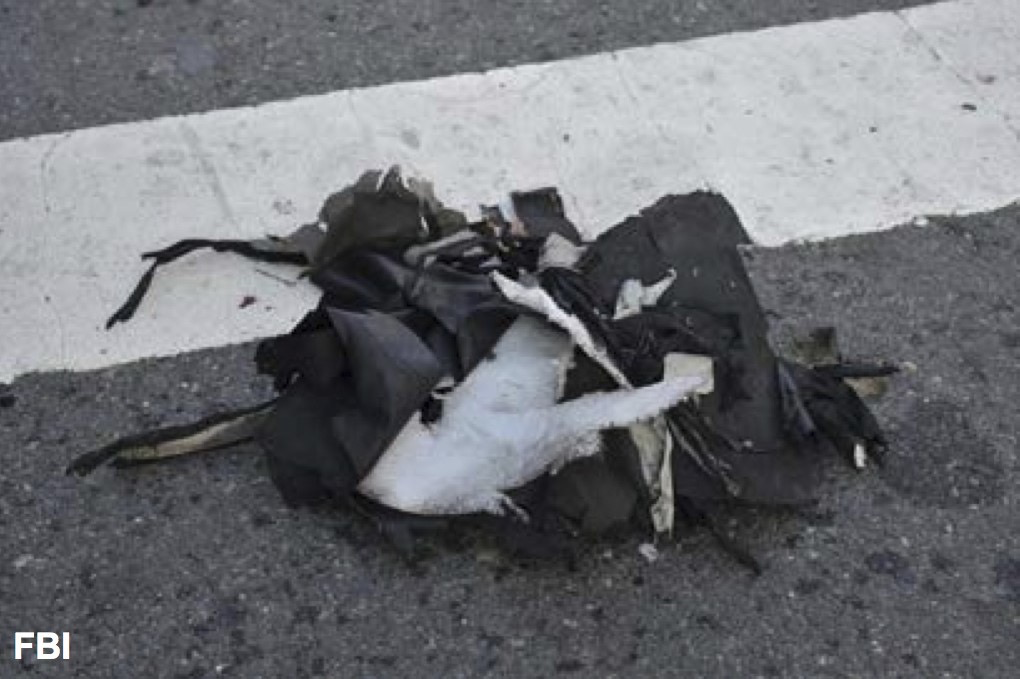
Again on April 16, 2013, the FBI published a crime lab photo, here reproduced as Tsarnaeva exhibit 3 in the appendix hereof, and showing a blown- out backpack which is said to have contained one of the bombs, — a black nylon bag with a characteristic white rectangle marking about 3 by 11⁄2 inches more or less as it appeared following the explosions the day before. This photo pictures the “dark colored nylon bag or backpack” which Mr. DesLauriers described in his press conference on the day after the explosions when he described what was carried by the guilty parties. It was one of the “black backpacks” referenced in paragraph 7 of the indictment. It is pictured in prosecution exhibit 26 which was introduced on the second day of the trial in this cause (day 28 on the transcript, March 5, 2015), showing that the bag or backpack in question was found on the street near the post box in front of the Forum Restaurant on Boylston Street, and, as previously noted, was associated with the second explosion on April 15, 2013, which, in paragraph 24 of the indictment, Dzhokhar is alleged to have detonated. This general impression is confirmed by defense exhibit 3090, showing a backpack with black exterior or covering, and introduced on the sixteenth day of the trial (day 42 on the transcript, March 31, 2015). Tsarnaeva exhibit 3 is also suitable for judicial notice.

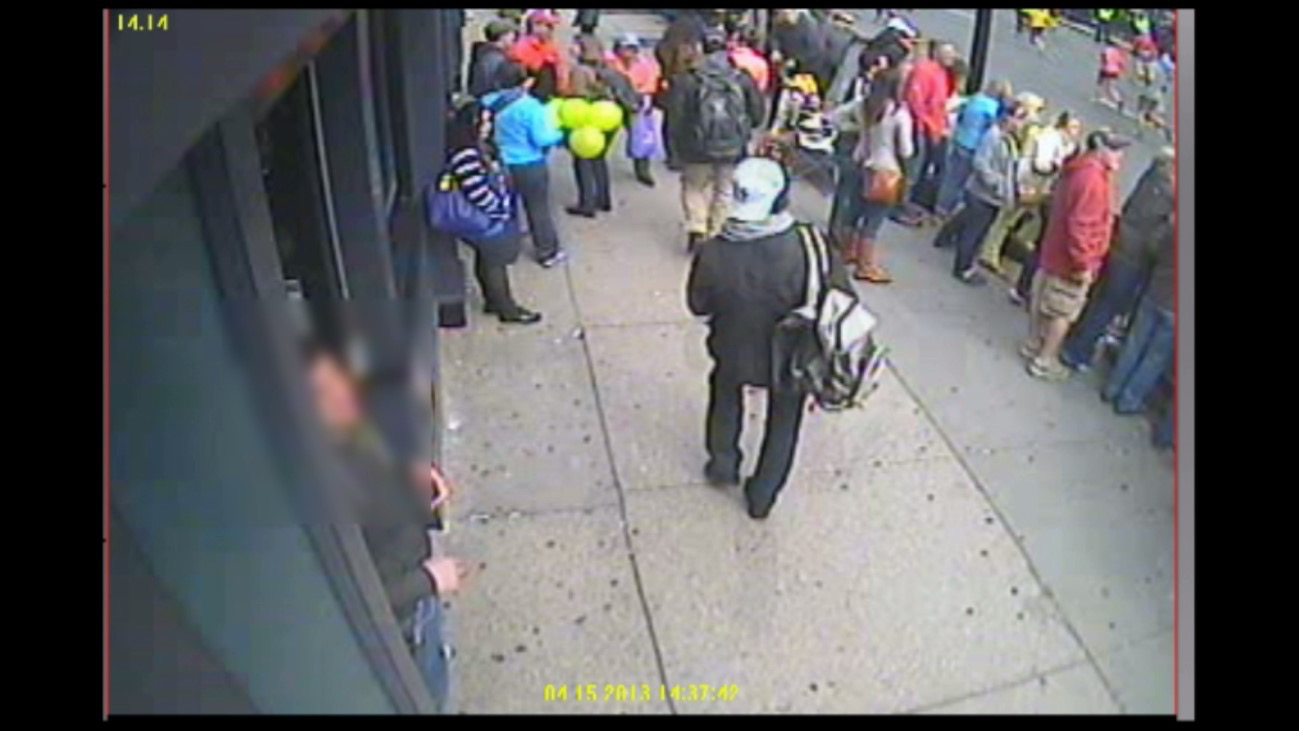
On April 18, 2013, the FBI published a 29-second street video claimed to have been taken from Whiskey’s Steak House on Boylston Street at about 02:37- 38 o’clock in the afternoon (Eastern time), only minutes before the explosions on April 15, 2013. It definitively settles the principal question raised by the indictment and the plea of not guilty interposed against it. Part of this video is tucked into prosecution exhibit 22 introduced on the third day of the trial in this cause (day 29 on the transcript, March 9, 2015). From this street video, three still-frame photos have been extracted. Two of these still-frame photos were published by the FBI on April 18, 2013, on posters which were used to identify suspects. All three photos were published by CNN and the Associated Press on April 19, 2013. The third still-frame photo from this video is most telling, and is reproduced as Tsarnaeva exhibit 4 in the appendix hereof. As already noted, the FBI and the indictment have together affirmed that the culprits who detonated these explosions were carrying large, unusually heavy, black backpacks concealing pressure-cooker bombs; but, the third still-frame photo from the Whiskey’s Steak House video reproduced as Tsarnaeva exhibit 4, and drawn from a street video already used by the FBI to identify the suspects and acknowledged by the government in this prosecution, shows unmistakably that, shortly before the explosions, Dzhokhar was carrying a small-size, white* backpack over his right shoulder the same light in weight, not heavy laden, and displaying no sagging or bulging as would normally be evident if the bag identified contained a pressure-cooker bomb of the size and weight which the FBI has described.

(*For all practical purposes and to the naked eye, the color is white, although technical computer analysis suggests a very whitish shade of gray.)

Dzhokhar is not guilty of carrying and detonating a pressure-cooker bomb, as charged in the indictment, as is literally as obvious as the difference between black and white. There were and remain other suspects whose identities have been credibly suggested. See, e. g., Toni Cartalucci, Land Destroyer Report, April 19, 2013 (illustrated commentary entitled “‘Contractors’ Stood Near Bomb, Left Before Detonation.”). But here it is enough to reflect on the comment of Lord Acton that “historic responsibility has to make up for the want of legal responsibility.” — J. Rufus Fears, Selected Writings of Lord Acton, Liberty Fund, Indianapolis, 1985, Vol. 2, p. 383 (Letter to Mandell Creighton, April 5, 1887). Whatever is done in judicial proceedings, history will judge this case, as surely as history has judged other significant cases.

3. The grievance of amicus: It is impossible that federal prosecutors and counsel for the accused did not know of the exculpatory evidence which has just been identified and illustrated. Yet federal prosecutors went head without probable cause, as if decisive evidence of actual innocence, impossible to ignore in a diligent study of this case, did not exist, as is wholly unacceptable in light of Brady v. Maryland, 373 U. S. 83 at 86-87 (1963).

Moreover, in her opening statement at trial on March 4, 2015, as reflected in the fourth paragraph of the transcript of her comments, court-appointed counsel for the accused forcefully insisted that Dzhokhar was guilty of capital felonies, as is positively disproved by evidence generated by the FBI, reinforced by the indictment itself. She said,

“The government and the defense will agree about many things that happened during the week of April 15th, 2013. On Marathon Monday, Tamerlan Tsarnaev walked down Boylston Street with a backpack on his back, carrying a pressure cooker bomb, and put it down in front of Marathon Sports near the finish line of the Marathon. Jahar [i. e., Dzhokhar] Tsarnaev walked down Boylston Street with a backpack on his back carrying a pressure cooker bomb and placed it next to a tree in front of the Forum Restaurant. The explosions extinguished three lives.”

And in her summation to the jury on April 6, 2015, as the transcript shows, court-appointed counsel for the accused said nothing of the exculpatory evidence in this case. She did not even ask for a verdict of not guilty. She could hardly have done more to promote a conviction and the severest sentence possible, even though the third still-frame photo from the video at Whiskey’s Steak House, reproduced as Tsarnaeva exhibit 4, showed Dzhokhar carrying a white backpack, as alone was enough to defeat the indictment insofar as paragraph 7 thereof averred that the accused and his brother committed the principal acts of wrongdoing by carrying and setting down black backpacks. Such misconduct is altogether unacceptable in light of Strickland v. Washington, 446 U. S. 668 at 687- 688 (1984).

The misconduct of which amicus complains served to conceal decisive exculpatory evidence by legerdemain. Amicus urges not only that the death penalty may not be imposed in this case, for all three opinions in Herrera v. Collins, 506 U. S. 390 (1993), allow that the death penalty may not be constitutionally imposed where the accused is demonstrably innocent, but that sua sponte this court order a new trial with directions that new counsel for the accused be appointed, motivated to provide an authentic defense for Dzhokhar.

4. The corpus delicti: Paragraph 10 of the indictment recites a statement in the nature of a confession by Dzhokhar written on the inner walls of a boat in Watertown. But with respect to any and all evidence offered or treated as suggesting an extrajudicial admission of guilt in this case, amicus cites the penetrating observation by Sir William Blackstone in his Commentaries on the Laws of England, Edward Christian, London, 1765, Book IV, p. 357: “[E]ven in cases of felony at common law, [confessions] are the weakest and most suspicious of all testimony, ever liable to be obtained by artifice, false hopes, promises of favour, or menaces, seldom remembered accurately, or reported with due precision, and incapable in their nature of being disproved by other negative evidence.” Amicus and countless others suspect that the alleged confession in the boat was staged as artifice to suit the government’s case, and not authentic. But she stands on ancient wisdom which casts doubt on all extrajudicial confessions without adequate safeguards, including the rule that an extrajudicial confession is insufficient to convict, unless the corpus delicti be sufficiently proved up. The rule is defined with various degrees of rigor from jurisdiction to jurisdiction. In federal courts, in any event, the corroboration required to sustain a confession or statement in the nature of a confession need only be independent, substantial, and reveal the words in question to be reasonably trustworthy, as appears, e. g., in Opper v. United States, 348 U. S. 84 (1954).

If such be the law here applicable, the required corroboration in this case must include evidence showing that Dzhokhar actually carried a large, heavy, black backpack on Boylston Street before the explosions on the afternoon on April 15, 2013, as claimed by the FBI and alleged in the indictment. Tsarnaeva exhibit 4, a product of investigation by the FBI, shows plainly that Dzhokhar did no such thing, hence no required corroboration has been established

5. Closing remarks: The views here expressed are not unique, but shared by good Americans, and others the world over. The undersigned and her sister Malkan are prepared to testify as expressed in the affidavit filed in support of the motion for leave to file a submission as amicus curiae. This argument is

Respectfully submitted,

May 15, 2015 /s/ Maret Tsarnaeva

Zhigulevskaya Str. 7, Apt. 4
364000 Grozny, Chechen Republic, RF Telephone: 011-7-938-899-1671

E-mail: marettsar@gmail.com 10

Of counsel:

John Remington Graham of the Minnesota Bar (#3664X) 180 Haut de la Paroisse
St-Agapit, Quebec G0S 1Z0 Canada
Telephone: 418-888-5049

E-mail: jrgraham@novicomfusion.com

CERTIFICATE OF COMPLIANCE

The undersigned certifies that this submission is consistent with the rules of this Court, that it is prepared in 14-point Times New Roman font, and that the bare text thereof consists of 2,331 words.

May 15, 2015 /s/ Maret Tsarnaeva

APPENDIX TSARNAEVA EXHIBIT 1


APPENDIX TSARNAEVA EXHIBIT 2


APPENDIX TSARNAEVA EXHIBIT 3


APPENDIX TSARNAEVA EXHIBIT 4


This is the communication I received from attorney John Remington Graham:


TO DR. PAUL CRAIG ROBERTS, GREETING :

Dear Sir, — By way of introduction. I have practiced criminal law for nearly forty-eight years, both prosecuting and defending, and served as a founding professor in an accredited law school in my native Minnesota. I have appeared as counsel before courts of record in sixteen jurisdictions, and have a background in forensic science and medicine. I can provide a résumé on request.

On March 25, 2015, while the trial was underway, I wrote and distributed a short opinion on the prosecution of Dzhokhar Tsarnaev, accused of capital felonies in Boston on April 15, 2013 in United States v. Dzhokhar Tsarnaev, No. 13-CR-10200-GAO on the docket of the United States District Court for Massachusetts, commonly known as the “Boston marathon case”, or “the Boston bomber case”. I used eight photo exhibits to explain my conclusions that, as a matter of law, there was no probable cause to support the indictment, and that Mr. Tsanaev was plainly not guilty as charged. These views were shared by others reporting on the internet, but my opinion was meant to provide professional assurance to fellow citizens that, legally speaking, something was radically wrong with the prosecution. In fact there were then and still are a great many anomalies with the case.

The substance of the Boston marathon case, as I then saw it, and as I still see it, is that, on the day after the explosions on Boylston Street in Boston, the FBI crime lab determined from fragments at the crime scene, the FBI chief in Boston announced, and the indictment itself later confirmed that, shortly before the explosions, the culprits were carrying large, heavy-laden, black backpacks containing pressure cooker bombs. Two days later, the FBI chief in Boston stated publicly that the suspects were identified by a certain street surveillance video, which for some days was later displayed for public viewing on the FBI website. The video had been taken from Whiskey’s Steak House, and was used to create still-frame photos of Tamerlan Tsarnaev (the big brother, now deceased), and Dzhokhar Tsarnaev (the little brother, later accused) as they walked up Boylson Street toward the finish line of the Boston marathon, shortly before the bombs went off. These two still frames were featured on posters distributed by the FBI in soliciting cooperation from the general public. But there is a third still-frame photo, taken from the same video, which shows unmistakably that Dzhokhar was carrying a small, light-weight, white backpack. The backpack carried by Dzhokhar was flat, and did not sag or bulge as would have been apparent if it contained a pressure cooker bomb filled with shrapnel as described in the indictment. This third still-frame photo was published by the major news media of the United States. I retrieved my first copy of this third still-frame photo from an internet report of CNN on April 19, 2015.

The bottom line is that the FBI’s own evidence eliminates Dzhokhar as a suspect, and conclusively proves he is not guilty as charged. This reality is literally as clear as the difference between black and white. The establishment press knew about it, and I cannot imagine how the federal prosecutors and counsel for the accused could not have known about it. So obvious was the actual innocence of Dzhokhar Tsarnaev that there was no need for a trial at all, because a good criminal defense lawyer could have taken the FBI information published the day after the explosions, the text of the indictment, and the third still-frame photo from the street surveillance video used by the FBI to identify suspects, and employed those items to support a pre-trial motion for dismissal of the indictment. I have on many occasions made such motions or seen such motions made by colleagues in federal courts, based on facts revealed by disclosures which prosecutors must and routinely do make available to counsel for the accused under a famous decision of the United States Supreme Court. And I have seen such motions granted on not a few occasions. Such practice is not uncommon, as I know from my own experience.

What was going on in Dzhokhar’s case? Why was there no motion to dismiss the indictment based on indisputable facts? Why was there a trial at all? Why did Judy Clarke, a big-time death-penalty lawyer appointed to defend Dzhokhar, admit to the jury in her opening statement that her client was guilty? She had decisive evidence that her client was not guilty. Why did she not use it, bring the case to an end, and thereby save her client’s life? In her final summation to the jury, Mme Clarke did not even ask for a verdict of not guilty. She made no mention of the exculpatory evidence generated by the FBI and mentioned in the indictment. Available were widely published photographs of possible paramilitary agents near the crime scene in Boston about the time of the explosions, carrying large, heavy-laden, black backpacks with characteristic markings which the FBI crime lab material revealed. But these persons with black backpacks were never investigated by the FBI. Why not?

I contacted Maret Tsarnaeva, the paternal aunt of Dzhokhar living in Chechnya which is part of the Russian Federation, a lawyer trained in the old Russian school of law in the Kyrgyz Republic which was once part of the Russian Empire and the Soviet Union, but has been independent since the conclusion of the former Cold War. A very bright and interesting woman Maret turned out to be, and, from the beginning, she maintained that her nephew was not guilty. My conversations with her over Skype led me to conclude that Judy Clarke and her colleagues in the federal public defender’s office in Boston could not stand up to the political pressure and thus threw the case instead of defending Dzhokhar.

Mme Tsarnaeva executed an affidavit on April 17, 2015, which explains events when representatives of the federal public defender’s office in Boston met with Dzhokhar’s family in Russia. For those interested in details, I attach a copy of her affidavit exactly as sent to me by Maret from Russia and later filed with the federal district court in Boston, except that the affidavit filed in the federal district court includes Maret’s original signature in Russian script which I can verify with my business records.

Maret hoped to call exculpatory evidence to the attention of the presiding judge, because Dzhokhar’s lawyers were not defending the accused and federal prosecutors were acting without probable cause. After diligent research on options was made, Maret decided to attempt an appearance before the federal district court in Boston as a friend of the court. She had to apply to the presiding judge for permission to appear in this capacity, and to make a motion asking the court to appointment me as her personal counsel for this purpose on special occasion. Normally, to be admitted to practice before the court on special occasion, I would need a motion from a member of the local bar. My paralegal assistant and I contacted many lawyers in Massachusetts. Some were sympathetic, but none dared to participate, lest their reputations be harmed. I had practiced before the federal district court in Boston some years previously, and then had no difficulty in securing the routine courtesy of a member of the local bar in sponsoring my appearance on special occasion. But not even the American Civil Liberties Union in Massachusetts dared to assist Maret or myself. I had to assist Maret in making an intervention pro se, representing herself, while she listed me as “of counsel” so as to signal that she was guided by a lawyer, and asked the presiding judge to admit me on special occasion without sponsoring motion of a member of the local bar, due to unusual circumstances. On instructions of court personnel, we could not proceed on the electronic record, and Maret’s pro se motion with supporting documents was served upon the federal district attorney and the federal public defender in paper and by registered mail, and the papers had to be filed with the office of the clerk of the federal district court, again in paper and regular postal service. But our task was accomplished by May 29, 2015.

For your convenience, I attach herewith the formal argument made by Maret Tsarnaeva acting pro se with my guidance, exactly as filed in the federal district court in Boston, except that the copy served and filed included the signature of Maret Tsarnaeva in Russian script, as I can demonstrate from my business records. We showed by text and exhibits, and by reference to the trial record and FBI-generated evidence that Dzhokhar cannot be guilty, because the FBI determined and the indictment alleged that the culprits carried black backpacks, but the FBI’s evidence showed that Dzhokhar was carrying a white backpack.

Maret expressed her grievances against the unethical misconduct of the federal prosecutors in proceeding when they knew they had no probable cause, and the unethical misconduct of court-appointed counsel in not defending in earnest. We enclosed the four most critical photo exhibits, including the results of the FBI crime lab investigation and the exculpatory third still-frame photo from the video used by the FBI to identify the culprits.

I am aware that many incredulous citizens cannot accept that the government of the United States would stage a show trial in Boston to convict an innocent young man and sentence him to death. But such events are not unusual in history. Judicial murder spoils the history of many nations. These incredulous citizens point to Dzhokhar’s alleged confession statements inside the boat in Watertown and at the time of sentencing. But contrary to the beliefs of the uninitiated, it has been clear from ancient times that confession statements are the weakest and most suspicious of all testimony, as is stated by legal scholars going back many centuries. Maret’s pro se argument cited Sir William Blackstone, from whom the founding fathers of the United States learned the law, for this truth. False confessions are very common, and result from fabrication, artifice, duress, unfounded hopes, attempts to curry favor, even brainwashing. Hence, going back centuries the law has struggled to develop safeguards against false confessions.

The intervention by Maret Tsarnaeva in behalf of her nephew in the Boston marathon case is significant because, although denying her motion to appear as a friend of the court, the presiding judge entered an order, which appears on the electronic record, is numbered 1469, and directs that her filings be maintained by the office of the clerk of the federal district court in Boston. These documents should be accessible to those wishing to see and read them. Therefore, it is a matter of public record, not merely a matter of internet protest or gossip, that the federal prosecutors, the court-appointed lawyers for the accused, and the presiding judge are all aware of the FBI’s own evidence which excludes Dzhokhar Tsarnaev as a suspect, and proves his actual innocence. It is also clear that the major news media of the United States, which orchestrated a false appearance that Dzhokhar was guilty of heinous crimes, and called for his execution, were aware that he was not guilty. They knew, as the report of CNN four days after marathon Monday makes plain, that Dzhokhar was in fact carrying a small, light-weight, white backpack, and that the government’s own evidence shows that the culprits, whoever they were, carried large, heavy-laden, black backpacks.

John Remington Graham of the Minnesota Bar (#3664X) 

Dr. Paul Craig Roberts was Assistant Secretary of the Treasury for Economic Policy and associate editor of the Wall Street Journal. He was columnist for Business Week, Scripps Howard News Service, and Creators Syndicate. He has had many university appointments. His internet columns have attracted a worldwide following. Roberts' latest books are The Failure of Laissez Faire Capitalism and Economic Dissolution of the West and How America Was Lost.

Gorilla Radio with Chris Cook, Brandon Martinez, John Newman, Janine Bandcroft Aug. 19, 2015

This Week on GR

by C. L. Cook - Gorilla-Radio.com


If you're just back from the cottage, or travelling abroad, or just enjoying a summer's break from the media news cycle grind, let me be the first to wish you a "Happy election year!" For the rest of you, it may seem the Summer poll has already lasted a year, or more; but before you tune us out...today's show is meant as an anodyne to electioneering banalities and fear-mongering.

Be aware! Stephen Harper plans to scare you witless, because he knows it's the only way you'll vote for he and his agents of the Apocalypse; and the hairiest, scariest Bogie Man in Steve's bag of tricks is ISIS.

Our idea today is to provide you with some karmic Kung Fu to fight campaign jingoism; a little mental Jiu Jitsu for self-defense, a heightened sense of security, and to ease your worried mind.

Listen. Hear.

Brandon Martinez is an independent journalist, broadcaster, and author of the books, 'Hidden History' and 'Grand Deceptions.' His articles on Canada's foreign policy and international affairs have been featured online at PressTV, Global Research, What Really Happened, and Information Clearing House among others. He's also, with Joshua Blakeney, co-founder of the news site, Non-Aligned Media.com, from where he files video reports on war, terrorism, government propaganda, and media deception. His recent report, 'The Buried Canadian State Connection to ISIS' retrieves from the memory hole a tale more troubling than Mr. Harper's Mike Duffy imbroglio.

Brandon Martinez in the first half.

And; it was a bad weekend for Amazon.com founder, Jeff Bezos. The E-commerce billionaire's way of doing business was featured by the New York Times' Jodi Kantor and David Streitfeld in a piece painting a grim portrait of life for Bezos' white collar "Amazonians." The paper says Amazon is engaged in, "[A] little-known experiment in how far it can push white-collar workers," and claim the company is, in the process, "[R]edrawing the boundaries of what is acceptable."

The "blistering account" was no surprise to my second guest, whose own research into Amazon's HR practices affirms the Times' worst revelations, and more.

John Newman is a legal scholar, lawyer, educator, and writer who cut his judicial teeth investigating corporate malfeasance at the US Department of Justice's Antitrust Division in Washington. He's currently a faculty member at the University of Memphis' Humphreys School of Law. John's articles on the law and economics of technology markets are featured by the Pennsylvania Law Review, and the Vanderbilt University of Law and Maryland Law Reviews, among others. His latest piece, 'The Grim Externalities of Amazon.com' appears at the web news site, CounterPunch.org.

John Newman and the long littleness of life in Amazon's workplace jungle in the second half.

And, Victoria Street Newz publisher emeritus and CFUV Radio broadcaster, Janine Bandcroft will join us at the bottom of the hour to bring us news of the coming week on our streets, and beyond there too. but first, Brandon Martinez and daylighting 'The Buried Canadian State Connection to ISIS' and the real nature of the relationship between Harper's New Canadian Government and the Islamic State?
Chris Cook hosts Gorilla Radio, airing live every Monday, 5-6pm Pacific Time. In Victoria at 101.9FM, and on the internet at: http://cfuv.uvic.ca.  He also serves as a contributing editor to the web news site, http://www.pacificfreepress.com. Check out the GR blog at: http://gorillaradioblog.blogspot.ca/
G-Radio is dedicated to social justice, the environment, community, and providing a forum for people and issues not covered in the corporate media.

Monday, August 17, 2015

Grim Reaper: Amazon's Externalized Social Costs

The Grim Externalities of Amazon.com

by John Newman - CounterPunch

In the midst of national debates over raising the minimum wage, the New York Times recently published a blistering account of the working conditions at Amazon, the most valuable retail company in the world.

The mainstream arguments over the minimum wage essentially boil down to two directly opposing ideas. On one hand, conservatives contend that labor markets are already basically efficient, so raising the minimum wage will destroy jobs by artificially setting wages higher than employers will be willing to pay. On the other hand, liberals argue that many employers wield enough power over employees to act like monopolists, so raising the minimum wage will beneficially transfer wealth from big corporations to low-income individuals.

Enter Amazon, whose labor practices suggest a disturbing third alternative. In 2011, a local Pennsylvania newspaper reported that temporary employees in an Amazon warehouse had been passing out under the strain of mandatory overtime hours spent in temperatures sometimes exceeding 100 degrees.

Now comes the Times story, detailing conditions that even Wall Street veterans characterized as “extreme”: sleepless nights, mandatory termination quotas, and discrimination against cancer victims, new parents, and even one woman with a recently stillborn child.

The third alternative to the prevailing minimum-wage arguments is that employers not only wield power over workers, but that they often possess even more power than they currently exercise. Berkeley professor Melvin Eisenberg points out that most corporations are restrained to some degree by social and moral norms. This observance of common decency would create an opportunity for a hardcore libertarian unconcerned with such niceties, one who would view such behavior as an exploitable opportunity. Amazon founder Jeff Bezos (who reportedly wanted to name his start-up “relentless.com”, a URL that still redirects to www.amazon.com) fits the bill.

Traditional social and moral norms would not permit a manager to allow, let alone encourage, a woman who miscarried twins to leave home for a business trip the day after her surgery. But Amazon is not most companies. Traditional social and moral norms would not permit a boss to call an employee “a problem” because she had cut back on working nights and weekends to care for her cancer-stricken father. Clearly, Amazon is not inclined to observe traditional social and moral norms.

Of course, working in Amazon’s offices does not come without any benefits. Salaries are competitive, and some employees point to the exhilaration that comes with being at the center of supply-chain innovation, a “futuristic and magical” feeling. Others celebrate a culture of opportunity, where even junior employees can see their ideas come to fruition.

That said, the real victims of Amazon’s disregard for common social norms may not be the employees themselves, who at least stand a chance of enjoying those benefits. Where the costs or harms stemming from a transaction are imposed on third parties, economists agree that a “market failure” occurs.

Many of the costs created when a company chooses to fully exercise its power over employees are borne by third parties. Destroying work-life balance harms more than just the one doing the work. It harms those who share the life. The fiancée who drove daily to an Amazon campus at 10 p.m. and begged his partner to come home. The family of the woman whose child was stillborn.

By imposing these costs on third parties, Amazon creates (and profits from) a market failure, in much the same way as a factory dumping toxic chemicals into a nearby river. Yet there is today precious little preventing other companies from following in Bezos’ path.

In Amazon’s conduct, one can witness the full extent of the power some employers have at their disposal, and what it looks like when that power is used. Laws like the minimum wage protect not only employees themselves, but also their families, friends, and local communities.

John Newman is assistant professor of law at the University of Memphis’s Humphreys School of Law.

The Refugee Machine: War and Displacement

War Begets War Refugees: The Moral Bankruptcy of Italy and NATO

by Ramzy Baroud

On April 26, 2011, a meeting that can only be described as sinister took place between the then Italian Prime Minister, Silvio Berlusconi, and French President, Nicolas Sarkozy. The most pressing issue discussed at the meeting in Rome was how to deal with African immigrants.

Sarkozy, who was under pressure from his right-wing and far-right constituencies to halt immigration originating from North Africa (resulting from the Tunisian uprising), desired to strike a deal with the opportunistic Italian leader. In exchange for an Italian agreement to join a French initiative aimed at tightening border control (Italy being accused of allowing immigrants to cross through its borders to the rest of Europe), France, in turn, would resolve major disputes involving a series of takeovers, involving French and Italian companies. Moreover, Italy would then secure French support for a bid by Italian Economist and Banker, Mario Draghi, to become the Head of the European Central Bank.

Another point on the French agenda was active Italian participation in the war on Libya, initially spearheaded by France, Britain and the United States, and later championed by NATO.

Initially, Berlusconi hesitated to take part in the war, although certainly not for any moral reasons: for example, because the war was deliberately based on a misconstrued interpretation of United Nations Security Council Resolution 1973 of March 17, 2011. The Resolution called for an 'immediate ceasefire', the establishment of a 'no-fly zone' and using all means, except foreign occupation, to ‘protect civilians’. The war, however, achieved entirely different objectives from the ones stated in the Resolution. It achieved a regime change, the bloody capture and murder of Libyan leader, Muammar al-Qaddafi, and resulted in a bloodbath in which thousands of civilians were killed, and continue to die, due to the chaos and civil war that has gripped Libya since then.

Berlusconi's change of heart had little to do with common sense and much to do with oil and gas. He was walking a tight rope. On one hand, about a quarter of Italy’s oil was imported from Libya, in addition to nearly 10 percent of the country's natural gas. Destabilizing Libya could interrupt the flow of Libyan energy supplies, at a time when Italy was desperately attempting to recover from its deep economic recession.

On the other hand, having France (which seemed to be in the mood for intervention because, following the Libya war, France marched on to Mali) hold all the cards in Libya could be devastating for Italy. “The Franco-Italian spat over immigration follows sharp differences over Libya, where Rome has been dragged into a war it would rather avoid, fearing a Paris-Benghazi nexus will freeze out its substantial interests in Libyan oil and gas,” the Financial Times reported at the time.

The successful meeting between the two leaders paved the way for Italian intervention, which took part in earnest in the war on Libya on April 28. Meanwhile, France kept its part of the bargain, and on November 1 of that same year, Mario Draghi succeeded Jean-Claude Trichet as the President of the European Central Bank.

Both countries benefited, albeit Libya was destroyed.

It is difficult to imagine that Berlusconi, a repulsive and corrupt politician even by the low standards of Italian politics, operated on the basis of any moral standards, aside from personal gains and self-interest. Indeed, neither his 'friendship' with Libyan long-time ruler, Qaddafi, nor the many perks and massive profits he received from Libya were enough to honor his commitment not to participate in a war that was clearly not aimed at saving lives, but maintaining access to Libya's energy supplies.

Equally interesting is the fact that UNSC Resolution 1973 was promoted by its supporters as one aimed at protecting civilians from an imminent massacre about to be carried by the Libyan Army in Benghazi. Regardless of what Qaddafi's intentions were, the NATO war resulted in untold suffering among Libyan civilians on three different fronts:

First, thousands of Libyans were killed and wounded as a direct result of NATO's intervention; second, the war turned Libya into warring fiefdoms, armed and supported by regional and international powers. The hundreds of militias that exist in Libya today have deprived Libyans of any sense of security, and exposed the civilian population to a war reality that, seemingly, has no end in sight. Third, thousands of Libyans, or Africans who once called Libya home, found themselves fleeing the war using every means of transport possible. Tens of thousands of them sought refuge in Europe, while thousands died trying.

Few in the Italian Government would care to remember their country's role in the war on Libya which, despite early hesitation, was embraced with utmost enthusiasm. The refugees who are lucky enough to make it to Italy's shores are constantly demonized by Italian media and perceived as a burden on the still-struggling Italian economy. What they forget is that, thanks to Libya's reasonably-priced and cheaply transported oil and gas, the Italian economy was kept afloat for years. The poor refugees are not as much of a burden on Italy's economy as Italy was a burden on Libya; in fact, on the whole of Africa.

Libya was colonized by Italy from 1911 to 1943, and was driven out along with its German Nazi partners by local resistance and eventually by the Allies in World War II. It was not until 1998 that Italy apologized for the sins of colonizing the country, which came at a terribly high price of death and destruction. Yet, eleven years later, the supposedly remorseful Italy was bombing Libya once more to ensure the flow of cheap oil and to keep African immigrants and refugees at bay.

Neither was the bloody 2011 war an exception. Four years after that war, Italy once more began calling for another war on Libya for, clearly, the desired objectives of the first war have not been met: immigrants and refugees, despite high risks and a mounting death toll, continued to pour into Italy and the flow of oil and gas has been disrupted by a civil war among Libya’s NATO allies.

But there is another factor, according to Marianne Arens:

“The sabre-rattling over Libya also serves to divert attention from the growing domestic social and political tensions” in Italy itself.

The relationship between war and the rising challenge of refugees, immigrants and asylum seekers cannot be overstated. It is both ironic and sad that the many thousands of war refugees are seeking shelter in the same European and NATO countries that either directly (as in Libya, Iraq, Afghanistan) or indirectly (as in Syria) contributed to the destruction and destabilization of their countries.

Even Greece, which is displaying little patience or regard for humanitarian laws in its treatment of the many thousands of refugees coming from Syria, Iraq and Afghanistan, via Turkey, took part, although in a minor role, in the war in Libya (2011) and provided assistance to the US-led war on Iraq (2003).

While one strongly sympathizes with Greece as it stands on the verge of bankruptcy and having just reached a deal with the EU that could keep the impoverished country solvent for the coming months, one cannot fathom the mistreatment of innocent Syrians and Iraqis as they brave the sea to escape the hellish wars back home. The Greeks, who suffered terrible wars in the past, should know this more than anyone else. The scenes from the islands of Lesbos and Kos are heartbreaking, to say the least.

However, the countries that should be confronted most about their moral responsibility towards war refugees are those who ignited these wars in the first place. While Libya continues to descend into chaos, and Syria and Iraq subsist in a state of bedlam, both France and Britain discuss the problem of refugees attempting to cross into both countries as if the refugees are swarms of locusts, not innocent people who were victimized mostly by US-European wars. Meanwhile, the US, geographically removed from the refugee crisis, seems unconcerned by the chaotic scenes of desperate refugees, capsizing boats, and pleading families.

Those who wage war should, at least, shoulder part of the moral responsibility of addressing the horrible consequences that armed conflict inflicts upon innocent people. The Italian example shows how economic interests trump morality, and not a single NATO country, Turkey included, is innocent.

Now that the refugee crisis is worsening, it behooves NATO to deal with the problem, at least with a degree of humanity and - dare one say - with the same enthusiasm that led it to several devastating wars in recent years.

Dr. Ramzy Baroud has been writing about the Middle East for over 20 years. He is an internationally-syndicated columnist, a media consultant, an author of several books and the founder of PalestineChronicle.com. His latest book is My Father Was a Freedom Fighter: Gaza’s Untold Story (Pluto Press, London). His website is: www.ramzybaroud.net.

Time for Israel to Deal with Homegrown Terrorists

Jewish Terrorists and Administrative Detention

by Uri Avnery - CounterPunch

Some of my best friends demand that I write an article condemning unconditionally the “administrative detention” of Jewish terrorists.

Three suspected terrorists have already been arrested under this procedure.

They are members of a group following the teachings of Rabbi Meir Kahane (the leader is actually his grandson). Kahane was an American Rabbi who came to this country and founded a group branded by the Supreme Court as racist and anti-democratic. It was outlawed. He was later assassinated by an Arab in the US. An underground group of his followers is now active in Israel.

This is one of the groups which belong to a clandestine movement, generally called “Price Tag” or “Hilltop Youth”, that has conducted various acts of terrorism, setting fire to Christian churches and Muslim mosques, attacking Arab farmers and destroying their olive trees.

None of the perpetrators has ever been apprehended, either by the army, which acts as a police force in the occupied territories, nor by the police in Israel proper. Many army officers are themselves residents of settlements in the occupied West Bank, which are illegal under international law.

The Israeli public has paid little attention to these outrages, but lately things have happened that shocked even complacent Israelis. One was the firebombing of an Arab dwelling in the small village of Douma in the West Bank. Under cover of darkness, a fire bomb was thrown into the home of a poor Arab family. An 18 month-old baby was burned to death, his father, mother and brother were seriously injured. The father later died in hospital.

Such acts of firebombing are quite usual, though until now the Arab families succeeded in saving themselves.

Another outrage was committed in Jerusalem – against Jews. An ultra-orthodox Jew attacked the annual gay pride march in the center of the city. He succeeded in stabbing several marchers, one of whom – a 16 year-old girl – later died of her wounds. The perpetrator had done exactly the same 10 years ago. He served a long prison term, was released a few weeks ago and did it again. He is an ultra-orthodox Jew, but seemingly has no connection with the Kahanist gang.

This was too much. For years, no one was ever indicted for acts of Jewish terrorism. Many believe that the acts were committed in collusion with the occupation army and the Shin Bet, the interior security service. Now, however, there is a public outcry, and the authorities have come to the conclusion that they must do something.

Hence, the administrative detention orders.

Administrative arrests are a legacy of the British colonial regime that ruled Palestine until May 1948. The Israeli state took it over, changing only some minor aspects.

This form of arrest allows a military commander to put a person in prison without trial. The warrant is in force for six months, but can be renewed without limit. Every few months the prisoner must be brought before a regular judge, but judges interfere only on rare occasions. Mentally, Israeli judges stand at attention when a military officer testifies.

The prisoners have no right to see the evidence against them and confront their accusers, nor are they allowed to be represented by attorney. The official reason is that they cannot be put on trial without “burning” informants and other sources of valuable information that are vital to effectively combat terrorism and save lives.

This instrument is used all the time against Arab suspects. At this moment, many hundreds of Arab administrative prisoners fill the prisons, some of them have been in custody for many years. Since the beginning of the occupation in 1967, hundreds of thousands of Arabs have been incarcerated under this act. For young Palestinians, this is almost a badge of honor.

Hardly any Jew has ever been held in administrative detention. For many years now, this means has not been used against Jews at all. The three Kahanists who were sent to prison this week are the first for a very long time.

Military and civilian officials explain this kind of detention as an essential and irreplaceable means to combat Jewish terrorism. All the Kahanists and other fascist perpetrators are trained to be silent under interrogation. Since they are sure that they will not be tortured, they have no reason to talk. They laugh in the faces of their interrogators.

Arab prisoners, of course, enjoy no such privilege. They know that if they don’t talk, they may be tortured. Under Israeli law, torture is forbidden, but the court allows something called “moderate physical pressure”, which achieves quick results.

Yet even so, many Arabs languish under unlimited administrative detention, because there is not enough legally admissible evidence to indict them in court, without endangering “sources”.

At present, the three Jews held in administrative detention are held in three different prisons, with more to join them soon, the Shin Bet promises.

Many years ago, when I was the editor-in-chief of the Haolam Hazeh news magazine, we published for a time an Arab-language edition. One day, one of my Arab employees – let’s call him Ahmed – was put in administrative detention.

When I started to raise hell, I got a surprise call from the Shin Bet. The relations between this organization and me were strained from the first day of the state. This may be an understatement, since their chief once officially defined me as the “No. 1 enemy of the regime”.

To my utmost surprise, a high-ranking Shin Bet officer invited me for a talk. “I am going to trust you with top secret information,” he said, “because I want you to understand our problems.”

He then told me that his people had caught a messenger who was sent to Israel by one of the major terrorist organizations to contact local collaborators. One of these was our Ahmed.

“What do you want us to do? We cannot put him on trial, because we have no proof that he is member of the organization. But leaving him free could result in deadly terrorist acts. Administrative detention is the only safe option.”

I did not believe that Ahmed was a terrorist. I was still thinking what to do, when I was saved from the dilemma. The Shin Bet agreed to release Ahmed, on condition the he leave the country. He went to the US and obtained a Green Card (perhaps with the help of Shin Bet). At one of my lectures there I saw him sitting in the front row. We embraced.

I am telling this story for the first time in order to illustrate the dilemma. Letting these Jewish fascists roam freely could cost more Arab and Jewish lives, and perhaps a catastrophe, for example if they set fire to the holy Muslim shrines. There seems to be no solid evidence against them. If there are Shin Bet informers in this group, their testimony at a trial would “burn” them.

The Shin Bet and the police are accused by many of us of utter incompetence when confronted with Jewish terrorists, while being extremely efficient when confronted with Arab ones. Worse, we suspect the Shin Bet of being infiltrated by the settlers and of collaborating with them. Depriving the Shin Bet of the means of administrative detention may weaken them even more, or at least provide them with a pretext for total failure.

In my late childhood I witnessed the breakdown of the democratic “Weimar Republic” in Germany. The Nazi hoodlums were roaming the streets, beating up people who looked Jewish, exchanging fire with Communists. The government was ineffective. Police and army were infiltrated by Adolf Hitler’s party. Judges punished the communists severely, but often let the Nazi “patriots” off the hook.

Years later, when Germany lay in ashes, the Weimar Republic (so called, because its constitution was written in Weimar) was accused of cowardice, because it did not dare to use the instruments it had at its disposal – including non-democratic emergency powers – to fight the Nazis in time. Does the Israeli Republic want to risk the same fate?

It is a real dilemma. It demands real answers. Not the easy answers derived from the liberal handbook. Responsible answers. Answers which are relevant to the real world.

I believe that the Kahanists and the other fascist groups in today’s Israel are far more dangerous than most people believe. This is not a handful of wild weeds as we are led to believe. This is a national cancer that can spread quickly in our national body.

I have seen it before.

It is a difficult dilemma. For me, in any case.

Do we approve of administrative detention, detention without trial and democratic safeguards, perhaps saving thereby the lives of Arabs and Jews, perhaps preventing worse disasters?

Or do we uphold strict democratic principles, release all people held in administrative detention, Arabs and Jews alike, knowing that some of them will go on a killing spree?

After much soul-searching, I vote for the second option. Both for moral and pragmatic reasons.

Morally, I do not believe that one can fight the plague with cholera. Administrative detention is a fascist instrument, even when applied to fascists.

Practically, because it will not help. The detainees will be replaced by others, perhaps even worse ones.

There is also the danger that the arrest of a few will serve as an excuse for doing nothing against the many.

To fight this plague, we need better doctors. The Shin Bet, police and army must be cleansed of fascist sympathizers, officers loyal to the Israeli Republic must take their place. Jews and Arabs must receive the same treatment.

As the Bible commanded: “Let your camp be clean!”


Uri Avnery is an Israeli writer and peace activist with Gush Shalom. He is a contributor to CounterPunch’s book The Politics of Anti-Semitism.

"Fool Me Once, Shame on You; Fool Me Twice...Won't Get Fooled Again"

Neocons to Americans: Trust Us Again

by Robert Parry - Consortium News


August 16, 2015

America’s neocons insist that their only mistake was falling for some false intelligence about Iraq’s WMD and that they shouldn’t be stripped of their powerful positions of influence for just one little boo-boo. That’s the point of view taken by Washington Post editorial page editor Fred Hiatt as he whines about the unfairness of applying “a single-interest litmus test,” i.e., the Iraq War debacle, to judge him and his fellow war boosters.

President George W. Bush pauses for applause
during his State of the Union Address
on Jan. 28, 2003, when he made a
fraudulent case for invading Iraq.
Seated behind him are Vice President
Dick Cheney and House Speaker
Dennis Hastert. (White House photo)

After noting that many other important people were on the same pro-war bandwagon with him, Hiatt criticizes President Barack Obama for citing the Iraq War as an argument not to listen to many of the same neocons who now are trying to sabotage the Iran nuclear agreement. Hiatt thinks it’s the height of unfairness for Obama or anyone else to suggest that people who want to kill the Iran deal — and thus keep alive the option to bomb-bomb-bomb Iran — “are lusting for another war.”

Hiatt also faults Obama for not issuing a serious war threat to Iran, a missing ultimatum that explains why the nuclear agreement falls “so far short.” Hiatt adds: “war is not always avoidable, and the judicious use of force early in a crisis, or even the threat of force, can sometimes forestall worse bloodshed later.”

But it should be noted that the neocons – and Hiatt in particular – did not simply make one mistake when they joined President George W. Bush’s rush to war in 2002-03. They continued with their warmongering in Iraq for years, often bashing the handful of brave souls in Official Washington who dared challenge the neocons’ pro-war enthusiasm. Hiatt and his fellow “opinion leaders” were, in effect, the enforcers of the Iraq War “group think” – and they have never sought to make amends for that bullying.

The Destruction of Joe Wilson


Take, for instance, the case of CIA officer Valerie Plame and her husband, former U.S. Ambassador Joseph Wilson. Hiatt’s editorial section waged a long vendetta against Wilson for challenging one particularly egregious lie, Bush’s nationally televised claim about Iraq seeking “yellowcake” uranium from Niger, a suggestion that Iraq was working on a secret nuclear bomb. The Post’s get-Wilson campaign included publishing a column that identified Plame as a CIA officer, thus destroying her undercover career.

At that point, you might have thought that Hiatt would have stepped forward and tried to ameliorate the harm that he and his editorial page had inflicted on this patriotic American family, whose offense was to point out a false claim that Bush had used to sell the Iraq War to the American people. But instead Hiatt simply piled on the abuse, essentially driving Wilson and Plame out of government circles and indeed out of Washington.

In effect, Hiatt applied “a single-issue litmus test” to disqualify the Wilson family from the ranks of those Americans who should be listened to. Joe Wilson had failed the test by being right about the Iraq War, so he obviously needed to be drummed out of public life.

The fact that Hiatt remains the Post’s editorial-page editor and that Wilson ended up decamping his family to New Mexico speaks volumes about the upside-down world that Official Washington has become. Be conspicuously, obstinately and nastily wrong about possibly the biggest foreign-policy blunder in U.S. history and you should be cut some slack, but dare be right and off with your head.

And the Iraq War wasn’t just a minor error. In the dozen years since Bush launched his war of aggression in Iraq, the bloody folly has destabilized the entire Middle East, resulted in hundreds of thousands of deaths (including nearly 4,500 U.S. soldiers), wasted well over $1 trillion, spread the grotesque violence of Sunni terrorism across the region, and sent a flood of refugees into Europe threatening the Continent’s unity.

Yet, what is perhaps most remarkable is that almost no one who aided and abetted the catastrophic and illegal decision has been held accountable in any meaningful way. That applies to Bush and his senior advisers who haven’t spent a single day inside a jail cell; it applies to Official Washington’s well-funded think tanks where neoconservatives still dominate; and it applies to the national news media where almost no one who disseminated pro-war propaganda was fired (with the possible exception of Judith Miller who was dumped by The New York Times but landed on her feet as a Fox News “on-air personality” and an op-ed contributor to The Wall Street Journal).

The Plame-Gate Affair


While the overall performance of the Post’s editorial page during the Iraq War was one of the most shameful examples of journalistic malfeasance in modern U.S. history, arguably the ugliest part was the Post’s years-long assault on Wilson and Plame. The so-called “Plame-gate Affair” began in early 2002 when the CIA recruited ex-Ambassador Wilson to investigate what turned out to be a forged document indicating a possible Iraqi yellowcake purchase in Niger. The document had aroused Vice President Dick Cheney’s interest.

Having served in Africa, Wilson accepted the CIA’s assignment and returned with a conclusion that Iraq had almost surely not obtained any uranium from Niger, an assessment shared by other U.S. officials who checked out the story. However, the bogus allegation was not so easily quashed.

Wilson was stunned when Bush included the Niger allegations in his State of the Union Address in January 2003. Initially, Wilson began alerting a few journalists about the discredited claim while trying to keep his name out of the newspapers. However, in July 2003 – after the U.S. invasion in March 2003 had failed to turn up any WMD stockpiles – Wilson penned an op-ed article for The New York Times describing what he didn’t find in Africa and saying the White House had “twisted” pre-war intelligence.

Though Wilson’s article focused on his own investigation, it represented the first time a Washington insider had gone public with evidence regarding the Bush administration’s fraudulent case for war. Thus, Wilson became a major target for retribution from the White House and particularly Cheney’s office.

As part of the campaign to destroy Wilson’s credibility, senior Bush administration officials leaked to journalists that Wilson’s wife worked in the CIA office that had dispatched him to Niger, a suggestion that the trip might have been some kind of junket. When right-wing columnist Robert Novak published Plame’s covert identity in The Washington Post’s op-ed section, Plame’s CIA career was destroyed.

Accusations of Lying


However, instead of showing any remorse for the harm his editorial section had done, Hiatt simply enlisted in the Bush administration’s war against Wilson, promoting every anti-Wilson talking point that the White House could dream up. The Post’s assault on Wilson went on for years.

For instance, in a Sept. 1, 2006, editorial, Hiatt accused Wilson of lying when he had claimed the White House had leaked his wife’s name. The context of Hiatt’s broadside was the disclosure that Deputy Secretary of State Richard Armitage was the first administration official to tell Novak that Plame was a CIA officer and had played a small role in Wilson’s Niger trip.

Because Armitage was considered a reluctant supporter of the Iraq War, the Post editorial jumped to the conclusion that “it follows that one of the most sensational charges leveled against the Bush White House – that it orchestrated the leak of Ms. Plame’s identity – is untrue.”

But Hiatt’s logic was faulty for several reasons. First, Armitage may have been cozier with some senior officials in Bush’s White House than was generally understood. And, just because Armitage may have been the first to share the classified information with Novak didn’t mean that there was no parallel White House operation to peddle Plame’s identity to reporters.

In fact, evidence uncovered by special prosecutor Patrick Fitzgerald, who examined the Plame leak, supported a conclusion that White House officials, under the direction of Vice President Cheney and including Cheney aide Lewis Libby and Bush political adviser Karl Rove, approached a number of reporters with this information.

Indeed, Rove appears to have confirmed Plame’s identity for Novak and also leaked the information to Time magazine’s Matthew Cooper. Meanwhile, Libby, who was indicted on perjury and obstruction charges in the case, had pitched the information to The New York Times’ Judith Miller. The Post’s editorial acknowledged that Libby and other White House officials were not “blameless,” since they allegedly released Plame’s identity while “trying to discredit Mr. Wilson.” But the Post reserved its harshest condemnation for Wilson.

“It now appears that the person most responsible for the end of Ms. Plame’s CIA career is Mr. Wilson,” the editorial said. “Mr. Wilson chose to go public with an explosive charge, claiming – falsely, as it turned out – that he had debunked reports of Iraqi uranium-shopping in Niger and that his report had circulated to senior administration officials.

“He ought to have expected that both those officials and journalists such as Mr. Novak would ask why a retired ambassador would have been sent on such a mission and that the answer would point to his wife. He diverted responsibility from himself and his false charges by claiming that President Bush’s closest aides had engaged in an illegal conspiracy. It’s unfortunate that so many people took him seriously.”

A Smear or a Lie


The Post’s editorial, however, was at best an argumentative smear and most likely a willful lie. By then, the evidence was clear that Wilson, along with other government investigators, had debunked the reports of Iraq acquiring yellowcake in Niger and that those findings did circulate to senior levels, explaining why CIA Director George Tenet struck the yellowcake claims from other Bush speeches.

The Post’s accusation about Wilson “falsely” claiming to have debunked the yellowcake reports apparently was based on Wilson’s inclusion in his report of speculation from one Niger official who suspected that Iraq might have been interested in buying yellowcake, although the Iraqi officials never mentioned yellowcake and made no effort to buy any. This irrelevant point had become a centerpiece of Republican attacks on Wilson and was recycled by the Post.

Plus, contrary to the Post’s assertion that Wilson “ought to have expected” that the White House and Novak would zero in on Wilson’s wife, a reasonable expectation in a normal world would have been just the opposite. Even amid the ugly partisanship of modern Washington, it was shocking to many longtime observers of government that any administration official or an experienced journalist would disclose the name of a covert CIA officer for such a flimsy reason as trying to discredit her husband.

Hiatt also bought into the Republican argument that Plame really wasn’t “covert” at all – and thus there was nothing wrong in exposing her counter-proliferation work for the CIA. The Post was among the U.S. media outlets that gave a podium for right-wing lawyer Victoria Toensing to make this bogus argument in defense of Cheney’s chief of staff Lewis Libby.

On Feb. 18, 2007, as jurors were about to begin deliberations in Libby’s obstruction case, the Post ran a prominent Outlook article by Toensing, who had been buzzing around the TV pundit shows decrying Libby’s prosecution. In the Post article, she wrote that “Plame was not covert. She worked at CIA headquarters and had not been stationed abroad within five years of the date of Novak’s column.”

A Tendentious Argument


Though it might not have been clear to a reader, Toensing was hanging her claim about Plame not being “covert” on a contention that Plame didn’t meet the coverage standards of the Intelligence Identities Protection Act. Toensing’s claim was legalistic at best since it obscured the larger point that Plame was working undercover in a classified CIA position and was running agents abroad whose safety would be put at risk by an unauthorized disclosure of Plame’s identity.

But Toensing, who promoted herself as an author of the Intelligence Identities Protection Act, wasn’t even right about the legal details. The law doesn’t require that a CIA officer be “stationed” abroad in the preceding five years; it simply refers to an officer who “has served within the last five years outside the United States.”

That would cover someone who – while based in the United States – went abroad on official CIA business, as Plame testified under oath in a congressional hearing that she had done within the five-year period. Toensing, who appeared as a Republican witness at the same congressional hearing on March 16, 2007, was asked about her bald assertion that “Plame was not covert.”

“Not under the law,” Toensing responded. “I’m giving you the legal interpretation under the law and I helped draft the law. The person is supposed to reside outside the United States.” But that’s not what the law says, either. It says “served” abroad, not “reside.”

At the hearing, Toensing was reduced to looking like a quibbling kook who missed the forest of damage – done to U.S. national security, to Plame and possibly to the lives of foreign agents – for the trees of how a definition in a law was phrased, and then getting that wrong, too.

After watching Toensing’s bizarre testimony, one had to wonder why the Post would have granted her space on the widely read Outlook section’s front page to issue what she called “indictments” of Joe Wilson, U.S. Attorney Patrick Fitzgerald and others who had played a role in exposing the White House hand behind the Plame leak.

Despite Toensing’s high-profile smear of Wilson and Fitzgerald, Libby still was convicted of four felony counts. In response to the conviction, the Post reacted with another dose of its false history of the Plame case and a final insult directed at Wilson, declaring that he “will be remembered as a blowhard.”

With Plame’s CIA career destroyed and Wilson’s reputation battered by Hiatt and his Post colleagues, the Wilsons moved away from Washington. Their ordeal was later recounted in the 2010 movie, “Fair Game,” starring Naomi Watts and Sean Penn. Though Libby was sentenced to 30 months in prison, his sentence was commuted by President Bush to eliminate any jail time.

A Pattern of Dishonesty


While perhaps Hiatt’s vendetta against Joe Wilson was the meanest personal attack in the Post’s multi-year pro-war advocacy, it was just part of a larger picture of complicity and intimidation. Post readers often learned about voices of dissent only by reading Post columnists denouncing the dissenters, a scene reminiscent of a totalitarian society where dissidents never get space to express their opinions but are still excoriated in the official media.

For instance, on Sept. 23, 2002, when former Vice President Al Gore gave a speech criticizing Bush’s “preemptive war” doctrine and Bush’s push for the Iraq invasion, Gore’s talk got scant media coverage, but still elicited a round of Gore-bashing on the TV talk shows and on the Post’s op-ed page.

Post columnist Michael Kelly called Gore’s speech “dishonest, cheap, low” before labeling it “wretched. It was vile. It was contemptible.” [Washington Post, Sept. 25, 2002] Post columnist Charles Krauthammer added that the speech was “a series of cheap shots strung together without logic or coherence.” [Washington Post, Sept. 27, 2002]

While the Post’s wrongheadedness on the Iraq War extended into its news pages – with the rare skeptical article either buried or spiked – Hiatt’s editorial section was like a chorus with virtually every columnist singing from the same pro-invasion song book and Hiatt’s editorials serving as lead vocalist. A study by Columbia University journalism professor Todd Gitlin noted, “The [Post] editorials during December [2002] and January [2003] numbered nine, and all were hawkish.” [American Prospect, April 1, 2003]

The Post’s martial harmony reached its crescendo after Secretary of State Colin Powell made his bogus presentation to the United Nations on Feb. 5, 2003, accusing Iraq of hiding vast stockpiles of weapons of mass destruction. The next day, Hiatt’s lead editorial hailed Powell’s evidence as “irrefutable” and chastised any remaining skeptics.

“It is hard to imagine how anyone could doubt that Iraq possesses weapons of mass destruction,” the editorial said. Hiatt’s judgment was echoed across the Post’s op-ed page, with Post columnists from Right to Left singing the same note of misguided consensus.

After the U.S. invasion of Iraq on March 19-20, 2003, and months of fruitless searching for the promised WMD caches, Hiatt finally acknowledged that the Post should have been more circumspect in its confident claims about the WMD.

“If you look at the editorials we write running up [to the war], we state as flat fact that he [Saddam Hussein] has weapons of mass destruction,” Hiatt said in an interview with the Columbia Journalism Review.
“If that’s not true, it would have been better not to say it.” [CJR, March/April 2004]

Concealing the Truth


But Hiatt’s supposed remorse didn’t stop him and the Post editorial page from continuing its single-minded support for the Iraq War. Hiatt was especially hostile when evidence emerged that revealed how thoroughly he and his colleagues had been gulled.

In June 2005, for instance, The Washington Post decided to ignore the leak of the “Downing Street Memo” in the British press. The “memo” – actually minutes of a meeting of British Prime Minister Tony Blair and his national security team on July 23, 2002 – recounted the words of MI6 chief Richard Dearlove who had just returned from discussions with his intelligence counterparts in Washington.

“Bush wanted to remove Saddam, through military action, justified by the conjunction of terrorism and WMD. But the intelligence and facts were being fixed around the policy,” Dearlove said.

Though the Downing Street Memo amounted to a smoking gun regarding how Bush had set his goal first – overthrowing Saddam Hussein – and then searched for a sellable rationalization, the Post’s senior editors deemed the document unworthy to share with their readers.

Only after thousands of Post readers complained did the newspaper deign to give its reasoning. On June 15, 2005, the Post’s lead editorial asserted that “the memos add not a single fact to what was previously known about the administration’s prewar deliberations. Not only that: They add nothing to what was publicly known in July 2002.”

But Hiatt was simply wrong in that assertion. Looking back to 2002 and early 2003, it would be hard to find any commentary in the Post or any other mainstream U.S. news outlet calling Bush’s actions fraudulent, which is what the “Downing Street Memo” and other British evidence revealed Bush’s actions to be.

The British documents also proved that much of the pre-war debate inside the U.S. and British governments was how best to manipulate public opinion by playing games with the intelligence.

Further, official documents of this nature are almost always regarded as front-page news, even if they confirm long-held suspicions. By Hiatt’s and the Post’s reasoning, the Pentagon Papers wouldn’t have been news since some people had previously alleged that U.S. officials had lied about the Vietnam War.

Not a One-Off


In other words, Hiatt’s Iraq War failure wasn’t a one-off affair. It was a long-running campaign to keep the truth from the American people and to silence and even destroy critics of the war. The overall impact of this strategy was to ensure that war was the only option.

And, in that sense, Hiatt’s history as a neocon war propagandist belies his current defense of fellow neocon pundits who are rallying opposition to the Iran nuclear deal. While Hiatt claims that his colleagues shouldn’t be accused of “lusting for another war,” that could well be the consequence if their obstructionism succeeds.

It has long been part of the neocon playbook to pretend that, of course, they don’t want war but then put the United States on a path that leads inevitably to war. Before the Iraq War, for instance, neocons argued that U.S. troops should be deployed to the region to compel Saddam Hussein to let in United Nations weapons inspectors – yet once the soldiers got there and the inspectors inside Iraq were finding no WMD, the neocons argued that the invasion had to proceed because the troops couldn’t just sit there indefinitely while the inspectors raced around futilely searching for the WMD.

Similarly, you could expect that if the neocons succeed in torpedoing the Iran deal, the next move would be to demand that the United States deliver an ultimatum to Iran: capitulate or get bombed. Then, if Iran balked at surrender, the neocons would say that war and “regime change” were the only options to maintain American “credibility.” The neocons are experts at leading the U.S. media, politicians and public by the nose – to precisely the war outcome that the neocons wanted from the beginning. Hiatt is doing his part.

Investigative reporter Robert Parry broke many of the Iran-Contra stories for The Associated Press and Newsweek in the 1980s. You can buy his latest book, America’s Stolen Narrative, either in print here or as an e-book (from Amazon and barnesandnoble.com). You also can order Robert Parry’s trilogy on the Bush Family and its connections to various right-wing operatives for only $34. The trilogy includes America’s Stolen Narrative. For details on this offer, click here.

Corbyn in the Jewish Chronicle's Cross-Hairs

Jeremy Corbyn and the Jews

by Gilad Atzmon


The relationship between Jeremy Corbyn and British Jews can be summarized into a brief observation:

While Corbyn’s success represents a hugely popular shift within British political thinking, the orchestrated Jewish campaign against him is there to suggest that once again, Jews set themselves against the people they dwell upon.

The vastly growing popularity of Jeremy Corbyn amongst Brits can be easily explained.

Following decades of cultural Marxist, divisive Identiterian politics and Zionist-Neocon domination within the British Left, Corbyn brings along a refreshing ideological alternative. Corbyn seems to re-unite the Brits. He cares for the weak. He opposes interventionist wars. He represents the return of the good old left as opposed to New Labour’s affinity with big money, choseness and exceptionalism. He cares for the students and the youth. He thinks about the future and promises to undo the damage created by Blair and Cameron. But as Britain sees the rise of a hugely popular ideological movement, many Jewish institutions see Corbyn as an arch enemy. They would prefer to see him gone and have used nearly every trick in the book to discredit him.

In the last few days we have noticed a tidal wave of Jewish institutional opposition to Corbyn. First it was the Daily Mail that attempted to throw Zionist mud in the direction of the man who is destined to take over what is left out of the Labour party. Surprisingly, not a single British media outlet picked the Mail’s dirt for a few days. Eventually the notorious Zionist Jewish Chronicle had to take the gloves off just ahead of Sabbath and lead the battle against the emerging socialist leader.

In the weekend the Jewish Chronicle (JC) outlined its problems with Corbyn while claiming to “speak for the vast majority of British Jews… expressing deep foreboding at the prospect of Mr Corbyn’s election as Labour leader.”

Apparently, on behalf of ‘the vast majority of British Jews,’ The JC wanted to know whether it is true that Corbyn donated money to Dier Yassin Remembered (DYR), an organisation that was founded to commemorate the brutal massacre of an entire Palestinian village by right wing Jewish paramilitary fighters in 1948. I guess that the tens of thousands who joined the labour party in the last weeks just to support the first true British labour ideologist for generations were delighted to learn that their favourite candidate supported DYR and truly opposes Zionist barbarism.

On behalf of the “vast majority of British Jews” the JC demanded to be fully informed about the non-existent relationship between Corbyn and British DYR chairman Paul Eisen. The JC didn’t approve of the connection between Corbyn and pro-Palestinian Rev Stephen Sizer either. Corbyn was also asked to clarify his association with the Hamas, the Hezbollah and Palestinian cleric Raead Salah. I guess that the JC editorial would like to define the list of kosher ‘friends’ eligible for British elected politicians. Until this happens, the message that is delivered by the Brits is lucid: it is actually Corbyn’s firm stand on justice and his ability to befriend true freedom fighters and humanists which makes him into the most popular politician in Britain at the moment.

If someone in the JC fails to read the picture, I will outline it in the clearest form. British people are expressing a clear fatigue of corrupted party politics as much as they are tired of Zionist interventionist wars. They are begging for a change, they demand equality and the prospect of a better future and a leader with ethical integrity. Whether Corbyn can provide these qualities, time will tell. But the British yearning for a radical change has been formally established.

Disrespectfully and outrageously, in the open and on behalf of “the vast majority of British Jews”, the JC set an ultimatum to the most popular man in British politics.

“If Mr Corbyn is not to be regarded from the day of his election as an enemy of Britain’s Jewish community, he has a number of questions which he must answer in full and immediately.”

One would expect the JC editorial to learn something from Jewish history. Those British Jews who insist to speak ‘on behalf’ of their people should at least pretend to uphold some minimal respect to British good manners.

The JC, however, admitted that Corbyn ignored them for over a week – “No response has been forthcoming” from Corbyn or his office, the JC wrote. Though I do not have any reason to believe that Corbyn has a cell of hatred in his body, I wouldn’t like to see him bowing to Jewish political pressure.

What we need is a firm British leader dedicated to equality, justice, peace and British interests instead of just another Sabbos Goy and servant of the Lobby as well as big money.

Sunday, August 16, 2015

London's New Terror: Jeremy Corbyn

Going Mainstream

by Craig Murray


For a decade, I have argued that democracy in the UK is dysfunctional because an entrenched party system offers no real choice. The major parties offer political programmes which are virtually indistinguishable. As I put it in lectures, if the range of possible political programmes were placed on a linear scale from 1 to 100, the Labour and Conservative parties offer you the choice between 81 and 84.

This exclusion of political possibility is reinforced by a corporate media structure, led by the BBC, in which ideas outside the narrow band of establishment consensus are ridiculed and denigrated.

Therefore even political ideas which have the consistent support of the majority of the population, such as nationalisation of railways and other natural monopolies including utilities, simply cannot get an airing. Of all the broadcast coverage of the Iraq War, less than 3% gave time to anti-war voices, despite a majority opinion against the war.

This phenomenon explains why a large majority of both Conservative and Labour MPs are members of the Friends of Israel when public opinion consistently sympathises more with Palestine. It also explains the quite extraordinary media onslaught against Scottish independence.

I pointed out that Nicola Sturgeon’s appearance in the TV leadership debates was the first major airing of an anti-Trident argument on broadcast media in England for a decade. Actually hearing anti-austerity arguments led to a huge surge in support for the SNP in England as well as Scotland.

Now Jeremy Corbyn, having obtained a platform where on occasion he has been able to have his views broadcast direct without media mediation, is experiencing a massive surge of support. Ed Miliband’s lasting achievement is that he managed to put the ordinary people who marched against the Iraq War in charge of the Labour Party, not the careerist Blairite committee manipulators. The result is stunning.

The sheer panic gripping the London elite now is hilarious to behold. Those on the favoured side of Britain’s enormous wealth gap are terrified by the idea that there may be a genuine electoral challenge to neo-liberalism, embodied in one of the main party structures. This is especially terrifying to those who became wealthy by hijacking the representation of the working class to the neo-liberal cause.

The fundamental anti-democracy of the Blairites is plainly exposed, and the panic-driven hysterical hate-fest campaign against Corbyn by the Guardian would be unbelievable, if we hadn’t just seen exactly the same campaign by the same paper against the rejection of neo-liberalism in Scotland.

I think I am entitled to say I told you so. Many people appear shocked to have discovered the Guardian is so anti-left wing. I have been explaining this in detail for years. It is good to feel vindicated, and even better that the people I have repeatedly shared platforms with, like Jeremy and Mhairi, are suddenly able to have the genuinely popular case they make listened to. Do I feel a little left behind, personally? Probably, but I would claim to have contributed a little to the mood, and particularly my article on the manufactured myth that the left is unelectable has been extremely widely shared – by hundreds of thousands – in the social media storm that is propelling the Corbyn campaign.

There has been very little comment on the impact a Corbyn victory would have on the SNP. Indeed, despite being unbendingly unionist, the Scottish media have been unable to avoid representing by omission the fact that the Labour leadership contest is taking place almost entirely in another country with another political culture. But there is no doubt that a Corbyn-led Labour Party would be more attractive in Scotland than the Tory lite version, although the paucity of Labour’s Scottish leadership would be a constant factor. Much would depend on the wider question of how the careerists who make up most Labour MPs and MSPs would react to a Corbyn victory.

At Westminster, I can see no reason at all why Liz Kendall, Chuka Umunna and their like cannot simply cross the floor and become Tories. Cameron is astute enough to find junior ministerial positions for them and the Tory ranks would be elated enough to swallow it. But most of the careerists will look at their new constituency members and suddenly discover left wing principles. It will be less bloody than people expect.

In Scotland, a Corbyn victory will bring some swing back to Labour from the SNP, but most of the old Labour demographic have now set their hearts on independence. Should Corbyn actually look set to win a UK general election in 2020, that would very possibly dent the enthusiasm for independence at the margins. It would in no sense reduce my own desire for independence, but even I would feel it less urgent. A Corbyn led UK would not cause the same feeling of moral revulsion. All of which is a good argument for having the next referendum early.

Should Corbyn not win the Labour leadership, the effect will be opposite. The SNP will be boosted by the death of the last hope that the Labour Party might actually mean something again, rather than be a vehicle for soulless careerists spouting management-manual jargon. If Corbyn loses, the Labour Party in Scotland really might as well wind up. The cause of independence will be furthered.

So what do I want to happen? I want Jeremy to win, of course, deeply and sincerely. I am an internationalist and not a Machiavellian. I want the chance of a just society and an ethical foreign policy for England and Wales. Like me, Jeremy wants to see Ireland eventually united. I have never discussed Scottish independence with him, but I am quite sure his opposition is not of the Britnat imperialist variety.

You can be sure that the security services are heavily targeted on the Corbyn campaign. Allow me one last “I told you so”. I came in for much ridicule when I stated, from certain knowledge, that MI5 were targeted on Scottish Nationalists (I had actually been shown the tasking). This comes into the category of obvious truths which the media and political consensus seeks to deny. The ridicule even came from some within the SNP – which, like any other organisation deemed a threat to the UK, is itself penetrated by the security services. Well, now that truth has become mainstream too. I do not anticipate any apologies.

Craig Murray is a former British ambassador to Uzbekistan, and was Rector of the University of Dundee. https://www.craigmurray.org.uk/

Bone-Dry Trend-Setter: California's Climate Pandemic Coming Soon Near You

California First: As Both Climate Victim and Responder, the National Style-Setter Leads the Way

by William deBuys - TomDispatch

 
Long ago, I lived in a cheap flat in San Francisco and worked as the lone straight man in a gay construction company. Strangely enough, the drought now strangling California brings back memories of those days. It was the 1970s. Our company specialized in restoring the Victorian “gingerbread” to the facades of the city’s townhouses, and I got pretty good at installing cornices, gable brackets, and window hoods, working high above the street.

What I remember most, though, is the way my co-workers delighted in scandalizing me on Monday mornings with accounts of their weekend exploits. We were all so innocent back then.

We had no idea of the suffering that lay ahead or of the grievous epidemic already latent in the bodies of legions of gay men like my friends, an epidemic that would afflict so many outside the gay community but was especially terrible within it.

It’s unlikely that many of those guys are alive today. HIV was already in the population, although AIDS had yet to be detected or named, and no one had heard of “safe sex,” let alone practiced it. When the epidemic broke out, it was nowhere worse than in trendsetting San Francisco. 

By then I had returned to New Mexico, having traded my hammer for a typewriter. When I announced my intention to leave California, the guys all said the same thing. “Don’t go back there,” they protested. “You’ll just have to go through all of this again!” All of this required no translation. It meant the particular newness of life in that state, which was always sure to spread eastward, as Californian styles, attitudes, problems, tastes, and fads had been spreading to the rest of the country almost since the days of the Gold Rush.

Hippies, flower power, bikers, and cults. The movies we see and the music we listen to. The slang we pick up (I mean like, what a bummer, dude). Wine bars and fern bars, hot tubs and tanning booths, liposuction and boob jobs. The theft of rivers (Forget it, Jake. It’s Chinatown) and the theft of baseball teams (Brooklyn still mourns). Gay rights, car culture, and the Reagan Revolution. Scientology, mega-churches, Buddhist chic, and exercise videos. If they didn’t actually start in California, they got big and came to national attention there. Without the innovations of Silicon Valley, would you recognize your mobile phone or computer? Would you recognize yourself?

It’s the same with climate change. California in the Great Drought is once again Exhibit A, a living diorama of how the future is going to look for a lot of us. And the present moment -- right now in 2015 -- reminds me of San Francisco as the AIDS epidemic broke out. Back then we had no idea how bad things were going to get, and that is likely to be true now, as well. As usual, California is giving us a preview of our world to come.
Tomgram: William deBuys, Entering the Mega-Drought Era in America

The other day here in New England it was chilly, rainy, and stormy and I complained. Where was the sun? The warmth? The summer? I happened to be with someone I know from California and he shook his head and said, “It’s fine with me. I like it rainy. I haven’t seen much rain in a while.” It was a little reminder of how insular we can be. California, after all, is in the fourth year of a fearsome drought that has turned much of the North American West, from Alaska and Canada to the Mexican border, into a tinderbox. Reservoirs are low, rivers quite literally drying up, and the West is burning. In rural northern California, where the fires seem to be least under control, the Rocky Fire has already burned 109 square miles and destroyed 43 homes, while the Jerusalem Fire, which recently broke out nearby, quickly ate up almost 19 square miles while doubling in size and sent local residents fleeing, some for the second time in recent weeks.

Fires have doubled in these drought years in California. The fire season, once mainly an autumnal affair, now seems to be just about any day of the year. (This isn’t, by the way, just a California phenomenon. The latest study indicates that fire season is extending globally, with a growth spurt of 18.7% in the last few decades.) In fact, fire stats for the U.S. generally and the West in particular are worsening in the twenty-first century, and this year looks to be quite a blazing affair, with six million acres already burned across the region and part of the summer still to go. And here’s the thing: though "I’m not a scientist," it’s pretty hard at this point not to notice -- though most Republican candidates for president seem unfazed -- that this planet is heating up, that today's droughts, bad as they are, will be put in the shade by the predicted mega-droughts of tomorrow, and that the problem of water in the American West is only going to deepen -- or do I mean grow shallower? TomDispatch regular William deBuys, an expert on water in that region and author of A Great Aridness: Climate Change and the Future of the American Southwest, has already written dramatically of a future “exodus from Phoenix.” For clues to what we will all experience sooner or later, he now turns to California, that bellwether state in which, as he writes, the future always seems to play itself out first. Tom

California First: As Both Climate Victim and Responder, the National Style-Setter Leads the Way

by William deBuys


The Arrival of the Bone-Dry New Normal


On the U.S. Drought Monitor’s current map, a large purple bruise spreads across the core of California, covering almost half the state. Purple indicates “exceptional drought,” the direst category, the one that tops both “severe” and “extreme.” If you combine all three, 95% of the state is covered. In other words, California is hurting.

Admittedly, conditions are better than at this time last year when 100% of the state was at least “severe.” Recent summer rains have somewhat dulled the edge of the drought, now in its fourth year. Full recovery, however, would require about a foot of rain statewide between now and January, a veritable deluge for places like Fresno, which in good times only get that much rain in a full year.

To be clear, the current drought may not have been caused by climate change. After all, California has a long history of periodic fierce droughts that arise from entirely natural causes, some of them lasting a decade or more. Even so, at a minimum climate change remains a potent factor in the present disaster. The fundamental difference between California’s current desiccation and its historical antecedents is that present conditions are hotter thanks to climate change, and hotter means drier since evaporation increases with temperature. Moreover, the relationship between the two is non-linear: as temperature creeps up, evaporation gallops. Bottom line: the droughts of the future will be much more brutal -- and destructive -- than those of the past.

California is already on average about 1.7° Fahrenheit hotter than a century ago, and its rate of warming is expected to triple in the century ahead. The evaporative response to this increase will powerfully amplify future droughts in unprecedented ways, no matter their causes.

Throughout the state, draconian cutbacks in water use remain in force. Some agricultural districts are receiving 0% of the federally controlled irrigation water they received in past years, while state water deliveries are running at about 15% of normal.

Meanwhile, a staggering 5,200 wildfires have burned in the state’s forests and chaparral country this year, although timely rains everywhere but in the northern parts of California and the rapid responses of a beefed-up army of firefighters limited the burning to less acreage than last year -- at least until recently. The blow-up of the Rocky Fire, north of San Francisco, in the early days of August -- it burned through 20,000 acres in just a few hours -- may change that mildly promising statistic. And the fire season still has months to go.

So how is this a trendsetter, a harbinger for lands to the east? California’s drought is deep and long -- we don’t yet know how long -- and the very long-term forecast for an immense portion of western North America, stretching from California to Texas and north to South Dakota, is for a future of the same, only worse. Here is the unvarnished version of that future (on which an impressive number of climate models appear to agree) as expressed in a paper that appeared in Science Advances last February: “The mean state of drought in the late 21st century over the Central Plains and Southwest will likely exceed even the most severe mega-drought periods of the Medieval era in both high and moderate emissions scenarios, representing an unprecedented fundamental shift with respect to the last millennium.”

Let’s unpack that a little bit: principal author Benjamin Cook of NASA and his colleagues from Columbia and Cornell universities are saying that climate change will bring to the continent a “new normal” more brutally dry than even the multiple-decades-long droughts that caused the Native American societies of Chaco Canyon and Mesa Verde to collapse. This, they add, is now expected to happen even if greenhouse gas emissions are significantly lowered in the decades to come. The impact of such droughts, they conclude, will exceed the bounds of anything known in the history of the continent or in its scientifically reconstructed pre-history.

In other words, the California drought of recent years offers only a foretaste of what is to come. Incidentally, Cook, et al. are by no means outliers in the literature of climate prediction. Other important studies with similar forecasts support a steadily broadening consensus on the subject.

And North American droughts will have to compete for attention with countless other climate change impacts, especially the hundreds of millions of refugees worldwide who will be put into motion by rising sea levels and other forces that will render their present homes unlivable.

A User’s Guide to Climate Change


If California points the way to dry times ahead, it also gives us an early glimpse of how a responsible society will try to live with and adjust to a warmer future. The state has imposed stringent new limits on water use and is actively enforcing them, and in general, individual consumers have responded positively to the new requirements, in some cases even exceeding mandated conservation goals.

In a similar spirit, the state has augmented its wildland fire-fighting capacity to good effect, even as the fire danger has approached levels never before seen.

Perhaps most impressively the state has adopted its own pioneering cap-and-trade program aimed at rolling back total greenhouse gas emissions to 1990 levels. Under cap-and-trade, carbon polluters have to obtain permits to continue their emissions, and only a finite number of such permits are made available. A coal-burning power plant or a refinery has to buy its permit from the state or from another company that already has one. This way, a ceiling is established for total greenhouse gases emitted by the most energy-intensive sectors of the economy.

Although the jury may still be out on how well the program meets its goals, there is no debating its positive impact on the state treasury. In the fiscal year just begun, the auction of permits under California’s cap-and-trade program will net approximately $2.2 billion, a windfall that will be spent on mass transit, affordable housing, and a range of climate-adaptation programs. And by the way, the warnings of nay-sayers and climate deniers that cap-and-trade would prove a drag on the economy have, by the way, proved groundless.

In a manner similar to the U.N.’s prestigious Intergovernmental Panel on Climate Change, California now publishes an assessment every three years of both its vulnerability to climate change and the steps it plans to take to mitigate or adapt to its effects. The report is a model of its kind and draws on copious California-specific scientific research, some of which is funded by the state.

You might think California’s neighbors would follow suit, and eventually, as with most things Californian, they undoubtedly will. If President Obama’s just-announced “Clean Power Plan” withstands the expected court challenges, it will prove a powerful spur in that direction as it mandates state-by-state reductions in power plant carbon emissions that will, in the end, drive them 32% below 2005 levels. Many states will undoubtedly have to adopt cap-and-trade systems in order to comply. As they set about devising their own programs, where do you think they will look for a workable example? You guessed it: California.

An “Island” Again, or Nearly So


In the seventeenth century, Spanish cartographers thought California was an island separated from the rest of North America by the legendary Straits of Anian. In some ways, nothing has changed. In late July, while California Governor Jerry Brown was at the Vatican joining Pope Francis in calling for urgent global action to combat climate change, his opposite numbers across the putative straits continued to assume the posture of startled ostriches.

Doug Ducey, the Republican governor of Arizona, admits that the climate may indeed be changing but doubts that humans play a causal role in it. Susana Martinez of New Mexico, also a Republican, continues to insist that climate science is inconclusive, while former governor of Texas and current presidential candidate Rick Perry adamantly remains “not a scientist,” although he knew enough to inform us in his 2012 campaign screed Fed Up that climate change science is “a contrived phony mess.”

In general, when it comes to climate change, the leadership of statehouses across the country remains as troglodytic as the House of Representatives. Only in Hawaii, Oregon and Washington on the West Coast, Minnesota in the Midwest, and a handful of Northeastern states will governors even acknowledge the importance of acting to curb climate change as well as adapt to it.

This year, the deniers may get a boost from an unlikely source. Warm surface waters seem to be brewing something special in the Pacific Ocean. Says one researcher, “The El Niño event currently ongoing in the eastern and central Pacific is strengthening. The only question is whether it will be just a significant event, or a huge one.”

El Niño draws the winter Pacific storm track southward, bringing precipitation to southern California, Arizona, and points eastward. If the southern tier of states has a wet winter, the Republican rain-dancers will feel confirmed in their official doubt and denialism, much as a broken clock is right at least twice a day.

Occasional El Niños, however, will not avert the long-term new normal for California and much of the West. As that state is showing, adaptation will soften some of the blows, and possibly, if we act soon enough and strongly enough, we may manage to cap the overall changes at some still livable level. The jury will be out on that for quite some time.

Meanwhile, as in pre-AIDS San Francisco, we are all still in a state of at least semi-innocence. Maybe we can imagine in an intellectual way what it might be like to lose the forests across half of the continent, but can any of us conjure the feeling of how that would be?

After many missteps and halting starts, the medical and public health establishments finally came to the assistance of the victims of AIDS. As difficult as that was, it was easy compared to the remedies climate change will demand. And for much of the damage there will be no remedy. Get ready.

William deBuys, a TomDispatch regular, is the author of eight books, the most recent of which is The Last Unicorn: A Search for One of Earth’s Rarest Creatures. He has written extensively on water, drought, and climate in the West, including A Great Aridness: Climate Change and the Future of the American Southwest.

Follow TomDispatch on Twitter and join us on Facebook. Check out the newest Dispatch Book, Nick Turse’s Tomorrow’s Battlefield: U.S. Proxy Wars and Secret Ops in Africa, and Tom Engelhardt's latest book, Shadow Government: Surveillance, Secret Wars, and a Global Security State in a Single-Superpower World.

Copyright 2015 William deBuys