Monday, November 23, 2015

Life and Music of Holland's "National Smokestack" Armand

At the Center of Rebellion: the Life and Music of Armand

by David Rovics - CounterPunch


November 23, 2015

Yesterday, 19 November 2015, was the 100th anniversary of the execution of labor organizer and troubadour, Joel Emanuel Hagglund, aka Joe Hill.

I discovered when I woke up this morning and looked at my phone that it was also the day that my dear friend, Herman George van Loenhout, better known simply as Armand, died at the age of 69.

I had one last Joe Hill-related gig last night, one of scores of Joe Hill-related gigs I’ve done since early in 2015. I had only been in the green room behind the stage at the Alberta Rose Theater in northeast Portland when a member of the local band, General Strike, slowly entered the room. He was walking with difficulty, using a walker to stay upright. He was one of three musicians in the room who did not walk with ease anymore. Observing this fairly obvious fact, he joked in an exaggeratedly old-sounding voice, “is this the infirmary?”

Musicians often die young. It’s often a very public death. They usually keep on performing long after they should have stopped, long after they lost the ability to sing on pitch or to sustain a note, long after they couldn’t really play their instrument anymore, as they struggle with one illness or another, on and off the stage. They often keep performing not out of vanity, but out of necessity, since most musicians are poor – especially the professional ones.

As any self-aware professional musician will tell you, the most likely way for a musician to die is behind the wheel, or in a plane – Buddy Holly, John Denver, Stan Rogers. Then there are the many who die at the peak of their careers while in their twenties because the combination of the fame and the drugs and alcohol was too much for them – Janis Joplin, Jimi Hendrix, Gram Parsons, Amy Winehouse.

Many others who are not quite so inclined toward self-destruction die in their fifties due to too many years of the very exhausting combination of life on the road combined with too much drugs and alcohol over the years. I think of Jerry Garcia, and my dear friend and long-time touring partner, Alistair Hulett.

Armand died too young, but for some reason it seems relevant to point out that he didn’t drink, and his drugs of choice were of the psychedelic variety. The tobacco he mixed with his hashish did not do his lungs any favors, to be sure. But the drugs never got in the way of his spell-binding performances, except to the extent that they were part of the act.

If you look on the web you will find almost nothing in English about Armand. I would have wanted to write something about him anyway, but this fact compels me to do so that much more.

An hour ago, the English-language Wikipedia entry on Armand was just this:

“Herman George van Loenhout (born 10 April 1946 in Eindhoven, died 19 November 2015), better known as Armand, was a Dutch protest singer. He was known as ‘the Dutch Bob Dylan.’ His greatest hit song was ‘Ben ik te min’ (‘Am I not worthy?’). Armand came to the fore during the hippie generation and was an advocate of cannabis.”

Now there’s one more paragraph that has very recently been added, I just noticed. It talks of the “reviving” of his music career after 2011. Media types love to refer to things like that, but really, although he did get some major press attention in the past several years due to various artistic collaborations he was involved with, his career didn’t need reviving. He’s been a successful professional musician since the early 1960’s, and his career was doing fine before and after 2011.

I last saw him a few weeks ago in the hospital in Eindhoven, the city in the Netherlands where he lived, where he grew up. There are many people who knew him far better than I, and many, many others who know his music far better than I. There has never been an English-subtitled video made for any of his songs as far as I know. No documentaries about him with subtitles that I’ve ever found. He was an entirely Dutch phenomenon. And in the Dutch-speaking world, Armand was and is a household name, across the generations.

Armand was often caricatured, and was widely both loved and ridiculed, sometimes by the same people. He came to be the one person who more or less represented the spirit of the 1960’s in the Netherlands, so depending on where you stand in the culture wars, either you loved him, or he made you feel very uncomfortable. For many, especially for people of his generation, he was a constant reminder of something you weren’t — or had once been, but had later rejected.

What a difference fifteen years can make. Fifteen years ago, when I met Armand, he was not yet old, and I was not yet middle-aged. I was 33 and he was 54. In other words, I was one of those people who still nominally qualified as a member of “the youth.” The anti-capitalist movement was thriving throughout Europe, North America and elsewhere at the time, and Armand was hungry to be a part of this phenomenon.

But lest people get the wrong idea, let me clarify what I mean by that. Armand wanted to be at the center of the action, not because he was seeking more fame, but because that’s who he was. If he had been trying to get more famous, he would have sung in English or French (both major languages which he spoke with complete fluency). Aside from covering some old American folk songs and the odd Bob Dylan song (which he did brilliantly), he wrote and sang in Dutch – thus essentially limiting his potential mass appeal to the Netherlands and part of Belgium.

Armand’s influence on society was easy to ascertain. Mention the man by name, and Dutch or Flemish people will often laugh immediately. But mention instead the title to one of his well-known songs such as “ Ben ik te min,” and the tears will well up in their eyes, especially if they’re men of a similar age. Armand’s words spoke to the very essence of what it meant to be a young person in a relatively conservative, stiff, Protestant society who wanted, needed to break out of that restrictive mold and discover an entirely different value system, where love and laughter were infinitely more important than things like money, social status or driving a fancy car.

Today many of us take for granted the cultural victories of the Sixties generation, the overcoming of so many taboos and forms of internalized repression that so many more people suffered from before the Sixties began to make it OK to be an effeminate man, a masculine woman, a free lover, an artist. OK to not give a shit what your neighbors think, to reject careerism in favor of living a full life. OK to reject patriotism and embrace multicultural internationalism.

But for those who were rejecting the repressive aspects of the old society back then, for those who in the Netherlands were known as the Provos, like Armand, it was all much more challenging, much more cutting-edge than many younger people today imagine. People like Armand were not just caricatured back then – they were actively hated, and regularly beaten by police, arrested, imprisoned.

I hope those out there who know more about Armand and more about the Netherlands than I will forgive me if I get anything wrong here – I don’t read Dutch and I’m not inclined to verify facts even if I did. (Never trust a songwriter for that sort of thing. We’re all naturally prone to exaggeration.) But I’ll tell you a little more about the man.

Armand was born on 10 April, 1946, less than a year after the end of the Nazi occupation of the Netherlands. As a child, he lived right near the Philips Electronics factory, and had chronic lung problems of the sort that seem to me to be the direct result of industrial poisoning. The first of many times he was hospitalized with pneumonia was at the age of seven. The doctors at the time didn’t think he’d make it very far into adulthood.

He was, as far as I gather, one of those small, weak boys that develops a great sense of humor in order to survive childhood. He was only a teenager when he was hanging out on the docks, I think in Antwerp, with sailors from somewhere else, I think it was Jamaica, as I recall him recounting to me, and he first discovered marijuana, years before most white people in Europe or North America had done so.

Along with so many others at the time, he also discovered rock and roll, and in so many ways these things – drugs and rock and roll, and sexual liberation – were not just ways of rejecting the repressed, walking-dead society of the dominant culture in the traumatized 1950’s. Not just rebelling in order to embrace a more sensible, more free understanding of the glories that life has to offer us. Not just a rejection of status, wealth, and consumerism. But also an active embracing of other cultures, and an active rejection of empire, colonialism, racism and xenophobia.

I never once visited Armand without him recounting a story about an experience he had hanging out with a friend from Turkey, Morocco, Jamaica or some other place. Yes, the stories usually related to smoking hash. Yes, this kind of thing can be easily caricatured. But for Armand’s generation especially, this embracing of other cultures was a real act of rebellion as well as discovery. Learning that there is such wisdom to be found in the lives, lifestyles, and philosophies of people outside of the Netherlands, outside of the often-stifling West.

Armand was a multi-lingual person who embraced not only the drugs of the Others, but their languages, their intellectuals, and their music. He became a musician in the mold of so many others who were discovering the rest of the world at the time, discovering improvisation, seventh chords, syncopation, electricity and the like. He excelled at all of it, and his excellence was even recognized by the record companies and radio stations, which began to bring into every household in the Netherlands the songs this man wrote — though his songs were very controversial, and many of them were not played, and were censored in one form or another at the time.

Although Armand later came to represent what they might call the Drug Culture in the mainstream press of the past few decades, you need look no further than the covers of his albums to see how engaged he was with international politics. On one of them you will find the widely-viewed, very disturbing photo of a Vietminh soldier being summarily executed by a US-backed South Vietnamese soldier.

The form of rebellion that Armand most represented was a rebellion of values and lifestyle. Underpinning this rebellion is the idea that if you have a society full of people who are too busy having a good time enjoying the finer things in life, there might not be anyone left to do things like join the Army, run the banks, collect taxes, etc. But he was never far from what we might call the more confrontational forms of rebellion.

One of Armand’s best friends was a guy I met at a protest in Germany in 2000, a fellow resident of Eindhoven named Antwan. Antwan was best known at the time for being a very active participant in a struggle to save the village of Ruigoord from destruction by the ever-expanding industrial ports of western Amsterdam. Antwan spent weeks living in a tunnel beneath a road, in which he was almost buried alive by being run over by a bulldozer. Much of the port is now a massive Starbucks bean-roasting and distribution plant. Though the surrounding farmland was lost in the struggle, due to the efforts of people like Antwan, the village of Ruigoord itself was saved.

When I met Antwan, he told me about Ruigoord and about his friend Armand. Soon after, next time I was in the Netherlands, I visited Antwan, and together we went to Armand’s house, where I met him and his long-time partner, Marrit.

They were both dressed like psychedelic hippie Dutch peasants. Marrit still wears wooden shoes, as she always did back then. Armand’s English was so good, you wouldn’t necessarily guess he was Dutch. You could tell he was from somewhere else, but he spoke English with the kind of vocabulary that would have sounded very colloquial if you were hanging out in Greenwich Village in 1968. Marrit, by contrast, with her wooden shoes and braided hair, spoke with a perfect Dutch accent, like the kind of Dutch accent an actor would imitate in a movie if she were trying to sound unmistakably Dutch.

That first conversation was one of many other similar ones – long, intense, moving erratically from the topic of cannabis to civil disobedience to the history of the Ottoman Empire. I had never heard of this phenomenon known as a chillum, but I became intimately familiar with this ridiculous method of smoking hash and tobacco together through a wet cloth. Sort of like putting ice in a bong, except it’s a pipe instead of a bong, and a wet cloth instead of ice. Partially because of his exhibitionist chillum-smoking habits, along with his habit of writing songs with frequent references to cannabis, LSD, and other things like that, he became known in the Dutch press as Holland’s “national smokestack.”

As far as I could tell as a non-Dutch speaker, Armand would allow himself to be put into the role of the Sixties Throwback in the Dutch media regularly, only to regularly break out of the box they put him into, demonstrating again and again his eloquence, his musicianship, and his wit. At his shows, his audiences were laughing uproariously about every thirty seconds. Unfortunately not me, since I don’t speak Dutch, although whenever I was in the audience he’d throw in a couple more English songs than usual for my benefit.

Although he’s a thousand times better-known in the Netherlands than I am, Armand would do gigs with me in squats and punk social centers in Holland as a double-bill. When I sang, he sat in the front row and listened avidly to every word. Soon after I wrote my song, “The Commons,” I sang it at a gig in the Netherlands, and Armand translated it into Dutch and made his Dutch version of the song a standard part of his performances after that.

We discovered we shared a birthday in common, and every April 10 since then, his would generally be the first birthday greeting of the day for me. This is due to the time difference, of course, since most of North America would still be sleeping when the Europeans were starting their day. And also because it’s easy to remember a friend’s birthday when it’s the same as yours.

Four years ago we celebrated our birthday together, going to the Efteling theme park in Holland. Kind of like Disneyland, except way cooler, way cheaper, and way more Dutch. (And smaller.)

It was just after Armand’s “revival” that the new second paragraph of his English Wikipedia entry refers to was happening. He had been on a hiphop-oriented TV show popular among the youth, and he came to the amusement park prepared for what he apparently knew would happen. In his knapsack was not only a day’s supply of pre-rolled joints, but also a stack of color photographs of himself for him to sign for fans.

As soon as we entered the park, he was pretty much swarmed by children. The adults all knew him, too, of course, but they mostly maintained more of Dutch reserve about the situation, not wanting to bother him. The kids didn’t give a shit though, and they all gathered around him, asking him if his orange hair was real (“real hair, but not the original color”), and asking for his autograph. At every ride we went on, he had to stop for a couple minutes to talk to the star-struck worker running the ride. And everywhere we went, we smoked joints, which might seem completely outrageous to many readers, but for Armand, in Holland, was completely anticipated behavior which failed to raise a single eyebrow.

Marrit was with us, and my wife and child as well, and all the rides which looked too sickening for me, Reiko or Marrit to deal with, Armand was up for, so he and Leila were the only ones in our group to survive that swinging pirate ship thing. Why the fuck anyone would want to experience sea-sickness if they’re not on a ship without a choice in the matter is beyond me, but there’s obviously a market for it, otherwise Efteling would go out of business, along with Disneyland.

He was one of those rare people who read every mass email I ever sent out as if it was a personal message to him. One of my best boosters, he would write me frequent emails to tell me how a song I had just posted had moved him to tears. Last February he wrote with great excitement to tell me that he was doing an album with a popular Dutch band called the Kik. It was to be an album of all Armand songs, chosen by the Kik, and one of the dozen songs they chose was Armand’s translation of “The Commons.” (“You’re in the phone book!” he wrote me excitedly once it was clear that this song was going on the album.)

They sang that song and others on TV and radio stations and at shows for large audiences throughout the Netherlands last summer. Armand definitely didn’t fizzle out, no question – he went out on a strong note. He and the Kik did twenty shows last summer. (Which in the Dutch context means playing in every city in the country, plus some other towns.)

I was passing near Eindhoven in September and I dropped by his apartment for a visit. He had just gotten some very bad news about the state of his lungs from the hospital. He was clearly short of breath. He said that over the summer on the tour he was often so weak that he made sure he was always using a really sturdy mike stand, so he could hang on it when he needed to, if he was having trouble standing. Somehow, though, as any listener could tell you, he still delivered great renditions of his songs, even in that condition. He was always at his best when he was on stage – the stage revived him, no doubt, every time (as it will often do).

The next time I saw him was a couple weeks later when I was coming back through Eindhoven for another visit. This time he was in the hospital, with his seventh bout of pneumonia since he was a kid. He was very frail, weak, getting oxygen through a tube. I had long ago noticed how small he was, though not until I knew him for years. Beneath his usually multi-layered, multi-colored hippie outfit, you wouldn’t be able to tell how little he was unless you hugged him hard, and our physical contact usually involved something more like a pat on the back than a real American hug.

I was pretty sure at the time that this would be the last time I would see him. Some of his friends said he had been really sick before and had pulled through, and I hoped they were right, but it was hard to imagine this tiny little sack of skin and bones could survive much longer, despite his intense love of life. It was probably the love of life that had sustained him far beyond when most people would have given up, I’m sure.

I’m not going to try to wrap this up with some kind of effort to summarize the significance of this beautiful man. There are no summaries. Life is way too big for that kind of thing. I’ll just leave you with one of Armand’s favorite poems, one by the English poet Arthur O’Shaughnessy, published in 1873. (In an email from a few months ago, he quoted the poem and raved about how good it was, telling me about how he had just recited it at a gig.)


We are the music makers,
And we are the dreamers of dreams,
Wandering by lone sea-breakers,
And sitting by desolate streams;—
World-losers and world-forsakers,
On whom the pale moon gleams:
Yet we are the movers and shakers
Of the world for ever, it seems.


David Rovics is a singer/songwriter based in Portland, Oregon.

Mass or Anonymous Media an Answer for Peace and Justice?

In the Fight for Peace and Social Justice is Mass Media or Anonymous the Answer?

by Kim Petersen - Dissident Voice


November 22nd, 2015 

In a recent article, “In the fight against ISIS, is Anonymous the answer?,” CBC makes a bold claim in the opening sentence:

“The West wants to put a stop to ISIS.”

Given that the West has armed and protected ISIS, the CBC article loses all credibility from the get-go.1,2,3

Having established at the outset its own bias and mendacity, the CBC, in the article’s second sentence, calls into question the hacktivist resistance group Anonymous that declared itself an enemy of ISIS:

“But is Anonymous the answer?”

In fact, Anonymous reports contrariwise to the CBC about who is behind ISIS.


Given that ISIS is a western spawn, then what purpose does ISIS serve for the West?

Anonymous answers:


CBC spoke to Gabriella Coleman, author of a book on Anonymous, who expressed worry about “doxxing,” releasing someone’s real identity and “outing” them online. She speculated about a scenario whereby Anonymous might incorrectly identify someone as an ISIS member with terrible results.

“The stigma can be horrible,” Coleman said. “They’ll be harassed, the consequences can be very bad.”

But isn’t this what the state and state media does most of the time whenever a suspect is identified and this is published in the media before guilt has been determined in a court of law and even before charges may have been laid?4

Is it not hypocritical for the state and its media to criticize a group based on hypotheticals when the state and its media regularly engage in the self-same behavior for which they criticize another entity — even an entity having never been known to have committed such behavior?

Abomination


ISIS is an abomination. ISIS is, however, in major part a western-created abomination.

Because of the insidiousness of disinformation5 and its use as a tool of repression and oppression, and since the CBC reveals itself to be an instrument of disinformation,6 the CBC (along with western corporate and state media elsewhere) presents itself as an enemy of peace and social justice.

A greater abomination than ISIS is the existence of state actors that create real boogeymen to evoke fear, carry out terrorism, foment wars, and cause death and mayhem. Equally abominable and sordid is mass media which disinforms and manipulates public sentiment, and which allows the planting of false flags to wreak further death and destruction to attain unjustifiable political ends.

If indeed Anonymous is a grouping, however loose, dedicated to exposing disinformation, waging peace, fighting against state intrusions into privacy while revealing state secrets, and supporting social justice — then it seems clear that Anonymous is a group that anti-war types and supporters of a just society should solidarize with.

Kim Petersen is a former co-editor of Dissident Voice. He can be reached at: kim@dissidentvoice.org. Read other articles by Kim.

Notes:

    Ekaterina Blinova, “ISIL ‘Frankenstein’ Created by West and Its Gulf State Allies,” Sputnik News, 7 October 2015. 

    Tyler Durden, “Russia Explains To Clueless US Public Why Obama Can’t Defeat ISIS,” ZeroHedge, 18 November 2015. And let’s not forget the Zionist connection with ISIS that CBC and western corporate media love not to mention. Israeli Colonel captured in Iraq with ISIS terrorists — “Israeli Colonel Leading ISIL Terrorists Captured in Iraq,” Farsnews, 22 October 2015. 


    Philip Weiss, “The way for Americans to take on the Islamic state is to end support for Jewish nationalism,” Mondoweiss, 15 November 2015. 


    E.g., see my recent “Presumption of Innocence and Impugning of Character,” 9 November 9 2015. [↩]
    See Kim Petersen, “Disinformation: A Crime against Humanity and a Crime against Peace,” Dissident Voice, 17 February 2005. 


    Nothing new for the CBC. E.g., Kim Petersen, “The PM doth protest too much, methinks,” Dissident Voice, 21 January 2012. 

Pollard Freed, Israel's War on Children Goes On, and Masters Programs in the Occupied Territory

Israel's War on Children, Master Programs, and More

by Mazin Qumsiyeh - Popular Resistance


Spy for Israel Jonathan Pollard was released from US prisons. He did so much damage to US security and could still do more damage that he should have never been released.

He is to stay in the US for five years and then want to move to Palestine to settle on stolen lands as part of apartheid colonial regime. He divorced his American wife while in prison and married an Israeli wife.

I would not be surprised to see him become an Israeli minister.

Pollard freed after more than 
30 years imprisonment

After all, Israel rewarded those who even killed US Citizens (see for example and http://www.gtr5.com/ ). Yet, Israel continues to infiltrate the US at the highest levels.

Sunday as almost every day, Palestinian natives were murdered by colonial settlers. In an incident Sunday morning Israeli colonial settlement leader Gershon Mesika rammed a teenage girl with his car, claiming 'she had a knife'. When the girl, Ashraqat Taha Qatanany, 16, from Nablus, fell to the ground, another Israeli paramilitary settler pulled over and shot her multiple times.

As in many similar incidents, eyewitness (and in some cases video evidence) showed there was no knives and knives are planted later near the victims. Later Sunday Taxi driver Shadi Mohammad Mahmoud Khseib from al-Bireh was killed when he had an accident and he was murdered by colonial settler as soon as he stepped out of his car to deal with the accident.

A third Palestinian was also murdered. Several young people were kidnapped by occupation forces and children continue to be held and abused in Israeli gulags (see reports below on the war on Children).

In other news, the Israeli Knesset is considering more racist laws to add to the dozens of laws already making life hell for us native Palestinians. One new law will allow actual prison sentences for children under age 14 (of course only if they are Palestinian and do something to resist colonial occupation). Another law will force taxation of Israeli non-governmental organizations and apply draconian measures to them if they speak out for human rights and receive funding from abroad (of course Zionist organizations will be exempt from this law).

But then again other areas of life continue. 


Students are learning great things at our universities. An ecovillage design workshop in Farkha is ongong (I had the privilege of speaking there and visited our friends in Nebi Saleh on the way back and was checked by Israeli military carefully!).

Good people are helping us in unexpected ways; we just got some donations in kind to the museum from a French and Swiss delegations including cameras and children coloring pens and toys for scientific exploration. To accelerate our work we submitted many proposals for funding (and began to get some positive answers ;-) and we invited and are expecting more visits by scientists from abroad. We are conducting field work more regularly and publishing more. Stay tuned with our activities by following us on Facebook (under Palestine Museum of Natural History). We continue to receive delegations from around the world (on average 2-3 delegations every week).


We always welcome visitors and are happy to show you around. We also welcome volunteers and supporters (see http://palestinenature.org )

Overwhelming approval by Anthropologists of Boycots, Divestment, Sanctions (BDS) to bring peace with justice http://mondoweiss.net/2015/11/anthropologists-overwhelmingly-conference
https://anthroboycott.wordpress.com/2015/11/21/american-anthropological-association-clears-the-way-for-final-vote-on-boycott-of-israeli-academic-institutions/

Applications open and due soon for:
Master Program in Environmental Biology (Birzeit University)
http://registration.birzeit.edu/ar/admission/MA
Master Program in Biotechnology (Joint Bethlehem U/Polytechnic U)
http://biotech.ppu.edu/admission_application
http://www.bethlehem.edu/biotech

Kairos Palestine Christmas Alert 2015: PDF file to print and share with your local church
http://kairosusa.org/wp-content/uploads/2015/11/Kairos-Palestine-Christmas-Alert-2015.pdf

Marcel Leme International Human Rights Observor documents in meticulous detail the murder of an innocent girl by the Israeli army
http://sanaud-voltaremos.blogspot.com.br/p/brazil-26th-september-2015.html

Traumatic accounts of minors tortured inside Israeli jails. There is a considerable literature on this over time.
https://www.middleeastmonitor.com/news/middle-east/22216-traumatic-accounts-of-minors-tortured-inside-israeli-jails
See the website of Defence Child International-Palestine.
http://www.dci-palestine.org/

Autumn in Palestine http://www.unz.com/ishamir/autumn-in-palestine/

Mazin Qumsiyeh
Professor and Director
Palestine Museum of Natural History
Palestine Institute of Biodiversity and Sustainability
http://palestinenature.org

Dragon's Teeth: What Role Did French Foreign Policy in Syria Play in Paris Attack?

In France a Whiplash from Rotten Syria Policy

by Sharmine Narwani  - Khamenei.Ir

Considering the fact that “Armed moderates” are practically non-existent in Syria, France announced in 2012 that it was delivering “lethal weapons” to Syrian rebels. French Arms deals were also with Turkey, Saudi Arabia and Qatar; states at the forefront of supporting Salafi networks.

Let’s not beat around the bush.

The terror attacks in Paris last Friday shook the globe, even in countries where these acts are sadly the norm. Europe hasn’t seen carnage on this scale, with this degree of planning, for decades. But was this political violence entirely unexpected?.

Perhaps not. When French commentators railed against the perpetrators for “an attack on our values, our way of life” they couldn’t have been more wrong.

The Paris attacks had one source only and that was the Syrian conflict. True, the alleged terrorists, ISIS, were able to recruit angry, young, European Muslims to the task because of years of disenfranchisement and voicelessness in the heart of their continent. But there would have been no calling, no urgency, no engine driving the recruitment frenzy, out of context of the Syrian storyline.

Nearly five years ago, several regional and western states utilized the larger-than-life symbols of the Arab Uprisings to create regime change in Syria. Syrians had already hit the streets in small numbers, galvanized by the fearlessness of their fellow Arabs to demand political and economic reforms. But it was only when shots rang out and Syrians fell dead that demands turned to rage and larger numbers mobilized.

With the benefit of time and disclosure, we have since learned that Syrian security forces were also being killed from the earliest days – 88 soldiers in the first month – and that there were armed elements shooting at both sides, to stir up conflict for the explicit purpose of effecting regime change in Syria. (1)

In a 2015 report on ISIS leader Abu Bakr al-Baghdadi, the US-think tank Brookings Institution wrote:

“Presented with an opportunity to inject violence into what had been a peaceful revolt, Baghdadi sent one of his Syrian operatives to set up a secret branch of the Islamic State in the country that year. The branch, later known as the Nusra Front, initially followed the Islamic State’s playbook by attacking civilians as part of a clandestine terror campaign to sow chaos.”

And chaos they sowed


Chaos, of course, is a goal for radical, Salafist, militant groups. It creates a political and security vacuum that they are well-equipped to fill. These practices and experiences were honed at the expense of Afghans three decades ago, when the Saudi-funded and CIA-trained Mujahedeen learned how to create, then exploit, power vacuums.

The US-led invasion of Iraq, however, was the pivotal event that began the seeding of these extremist terror networks far and wide. Baghdadi is an Iraqi and ISIS is borne from Al Qaeda in Iraq (AQI) which then merged into the Islamic State of Iraq (ISI), the precursor to ISIS (Islamic State of Iraq and al-Sham).

During the course of the Syrian conflict, we have seen the ease of movement between extremist groups. Free Syrian Army (FSA) members join ISIS, Ahrar al Sham militants join Jabhat al-Nusra, they fight with each other, they break up and re-form under new leadership – avowed enemies fighting on one front form security pacts when fighting on another. And thousands of these western-backed rebels have fought alongside ISIS and Al-Nusra, Al Qaeda's affiliate in Syria.

“Armed moderates” are practically non-existent in Syria, despite countless efforts by western media, analysts and politicians to whitewash the “rebels” and pretend ignorance on the radical character of the militants they armed and assisted. Former US Defense Intelligence Agency Director Lt. Gen. Michael Flynn admitted in August that his government and western allies had taken a “willful decision” to support the establishment of a “Salafist principality in Eastern Syria” - the same area now controlled by ISIS. (2)

At the forefront of the foreign intervention that has supported, financed, armed and assisted militants in Syria are three western states, the US, UK, France, and three main regional states, Turkey, Saudi Arabia and Qatar (UAE too).

In August 2012 when the Syrian conflict ratcheted up to a whole new level of armed political violence, I visited Zaatari Camp in Jordan, near the border with Syria where refugees were encamped. Right outside the camp entrance was a French military hospital, which I was told was providing emergency medical assistance to civilian refugees.

Later, we learned that the French facility was involved in patching up rebel fighters who would then return to the Syrian military theater. These were still early days in the Syrian conflict – around 10,000 dead compared to the 250,000-plus death toll today. (3)

But by the end of 2012, the proactive French role inside Syria was clearly detectable. British daily The Guardian wrote in December 2012:

“France has emerged as the most prominent backer of Syria's armed opposition and is now directly funding rebel groups around Aleppo as part of a new push to oust the embattled Assad regime. Large sums of cash have been delivered by French government proxies across the Turkish border to rebel commanders in the past month, diplomatic sources have confirmed. The money has been used to buy weapons inside Syria and to fund armed operations against loyalist forces.”(4)

At this point, an EU arms embargo on Syria was in effect, but direct French weapons shipments to rebels were also secretly taking place. According to the 2015 book, 'In the Corridors of French Diplomacy' French President Francois Hollande told author Xavier Panon, a diplomatic and military specialist, that France’s “services” were delivering “lethal weapons” to Syrian rebels in the second half of 2012. These arms shipments included canons, machine guns, rocket launchers and anti-tank missiles, and were, according to Hollande, ostensibly earmarked only for vetted FSA militias.

France and the UK teamed up to push through a lifting of EU weapons sanctions on Syria in May 2013, and the following month, at a 'Friends of Syria meeting', Paris committed to further increasing military aid to rebel groups. Furthermore, the French government was arguably the biggest cheerleader for launching airstrikes against Syria in August 2013 – efforts that were ultimately thwarted by widespread public pressure against military intervention in the US and UK.

We know that French funds ended up in the hands of Islamist militant groups like Liwa al-Tawhid for the purchase of ammunition and undoubtedly other military necessities. We also know that a slew of other weapons connected to France have shown up in the Syrian military theater, whether directly or indirectly. These include MILAN anti-tank missiles, Russian Igla anti-air missiles (reportedly transferred to Syria via Libyan Al Qaeda members who claim they were trained by the French), APILAS anti-tank weapons, SNEB rockets, FAMAS assault rifles and others lethal arms.

And just this month, photos of the APILA rocket launcher originally supplied to rebels were spotted in ISIS’ possession. (5)

Why were the French so determined to pursue a policy of military escalation in Syria – given that the proliferation of weapons in the Syrian theater was clearly leading to massive casualties, widespread destabilization and the exacerbation of a humanitarian crisis?

One need only to look at another of Hollande’s foreign policy and economic initiatives to understand his Syria policy.

To bolster a lagging economy, the French president dove headfirst into a series of mega arms deals with Saudi Arabia, Qatar and other Persian Gulf states – selling sophisticated weaponry to despotic, sectarian regimes neck-deep in dealings with jihadi and Salafist networks spanning the Middle East and North Africa.

Last year, US Vice President Joe Biden exposed the dangerous game being played by some of these states – he names Turkey, Saudi Arabia and the UAE in these comments:

“They were so determined to take down Assad and essentially have a proxy Sunni-Shia war, what did they do? They poured hundreds of millions of dollars and tens, thousands of tons of weapons into anyone who would fight against Assad except that the people who were being supplied were Al Nusra and Al Qaeda and the extremist elements of jihadis coming from other parts of the world.”(6) 

While Hollande was raking in the Euros from arms deals with these very states, he was turning a blind eye to their activities in Syria.

France’s weapons exports in 2014 were just over 8 billion Euros. By May of 2015 alone, that number had skyrocketed to 15 billion Euros, primarily due to a $7 billion sale of military hardware to Qatar. The French ministry of defense claimed that 30,000 jobs would be created by this one sale – but at what cost?

And last month, the French inked an additional $12 billion in contracts with the Saudis, including major military hardware and parts.

France isn’t alone in these arms sales – the UK and US are right alongside competing for Persian Gulf petrodollars. Never mind that one of the biggest recipients of weapons is Saudi Arabia (today the number one weapons importer in the world), which has instigated the horrific carpet-bombing of Yemen that has killed thousands and decimated the already impoverished country. Worse yet, the main beneficiaries of the Yemeni bombing campaign appear to be Al Qaeda, who are de facto allies of the Saudis against the Houthis, and have used the chaos to move into new territory throughout the south of the country.

On Monday, the US White House announced a further $1 billion sale to the Saudis of air-to-land munitions for their Yemeni campaign – under the guise of “counter-terrorism” no less - ironic, given that Al Qaeda gains each time the Saudis drop a bomb.

Two years after the September 11 terrorist attacks that claimed almost 3,000 victims in the United States, the US Senate’s Judiciary Committee held hearings on terrorism and its connection to Wahhabism (state religion of Saudi Arabia and Qatar). During the hearings, Saudi Arabia was called the “epicenter” of terror funding for “principally Al Qaeda but many other recipients as well.” The Saudis, according to Senate transcripts, had contributed a whopping $70 billion over 25 years to the funding of “what they call Islamist activities.” (7)

In 2009, a secret US State Department cable signed off by then-Secretary of State Hillary Clinton claims: "Donors in Saudi Arabia constitute the most significant source of funding to Sunni terrorist groups worldwide…Saudi Arabia remains a critical financial support base for al-Qaeda, the Taliban, LeT (Laskhar-e Taiba), and other terrorist groups…It has been an ongoing challenge to persuade Saudi officials to treat terrorist financing emanating from Saudi Arabia as a strategic priority.”

Hollande’s government is hooked on the profits derived from its Persian Gulf allies. But this relationship has also made him hostage to short-term rewards – in exchange for turning France's foreign policy into a subservient arm of Saudi-Qatari geopolitical objectives.

The Paris attacks were surely undeserved, but never unexpected. Over the past three decades we have seen, over and over again, that Salafist extremists bite the hand that feeds its ranks. While mentor states enjoy the fact that militants are convenient foot soldiers and proxies who can fight their foreign battles, they do not yet see the inevitable blowback as a deterrence. Rather, they hunker down when a terror attack heads their way, cut off further civil liberties under the guise of fighting “terrorism,” drop a few bombs and scapegoat an ethnic or religious minority group until the anxiety fades. Then it is back to old business.

In Paris, on Friday, the perpetrators – whether ISIS or another radical Salafist group – had little to lose and much to gain. Chaos is their game, and their goals, operations and cells are easily shifted. Not so France.

Hollande reacted by declaring war, stomping his feet in outrage…and dropping some bombs on Syria. He is not a visionary, but a cog in a business wheel. Under his governance and prior to the Paris attacks, France had conducted all of five airstrikes in their “war on ISIS” in Syria. And collected a lot of cash for it.

Sharmine Narwani is a commentator and analyst of Middle East geopolitics. She is a former senior associate at St. Antony's College, Oxford University and has a master’s degree in International Relations from Columbia University. Sharmine has written commentary for a wide array of publications, including Al Akhbar English, the New York Times, Russia Today, the Guardian, Asia Times Online, the Huffington Post and others.

Notes:

1. https://www.rt.com/op-edge/157412-syria-hidden-massacre-2011

2. http://levantreport.com/2015/08/06/former-dia-chief-michael-flynn-says-rise-of-islamic-state-was-a-willful-decision-and-defends-accuracy-of-2012-memo/

3. http://www.atimes.com/atimes/Middle_East/MID-01-081113.html

4. http://www.theguardian.com/world/2012/dec/07/france-funding-syrian-rebels

5. https://twitter.com/MuradoRT/status/662723467737886720

6. http://mideastshuffle.com/2014/10/04/biden-turks-saudis-uae-funded-and-armed-al-nusra-and-al-qaeda/

7. https://www.rt.com/op-edge/256561-sunni-threat-middle-east-stability/


Sunday, November 22, 2015

Three-Dimensional Chess, or Battleship: How Will America Engage New China Reality?

Will Chess, Not Battleship, Be the Game of the Future in Eurasia?  Silk Roads, Night Trains, and the Third Industrial Revolution in China

by Pepe Escobar  - TomDispatch


The U.S. is transfixed by its multibillion-dollar electoral circus. The European Union is paralyzed by austerity, fear of refugees, and now all-out jihad in the streets of Paris. So the West might be excused if it’s barely caught the echoes of a Chinese version of Roy Orbison’s “All I Have to Do Is Dream.” And that new Chinese dream even comes with a road map.

The crooner is President Xi Jinping and that road map is the ambitious, recently unveiled 13th Five-Year-Plan, or in the pop-video version, the Shisanwu. After years of explosive economic expansion, it sanctifies the country’s lower “new normal” gross domestic product growth rate of 6.5% a year through at least 2020.

It also sanctifies an updated economic formula for the country: out with a model based on low-wage manufacturing of export goods and in with the shock of the new, namely, a Chinese version of the third industrial revolution. And while China’s leadership is focused on creating a middle-class future powered by a consumer economy, its president is telling whoever is willing to listen that, despite the fears of the Obama administration and of some of the country’s neighbors, there’s no reason for war ever to be on the agenda for the U.S. and China. 
Tomgram: Pepe Escobar, The New Great Game Between China and the U.S.

In Washington, voices are rising fast and furiously. “Freedom fries” are a thing of the past and everyone agrees on the need to support France (and on more or less nothing else). Now, disagreements are sharpening over whether to only incrementally “intensify” the use of U.S. military power in Syria and Iraq or go to “war” big time and send in the troops. The editor of the right-wing Weekly Standard, Bill Kristol, is already calling for 50,000 American troops to take the Islamic State’s “capital,” Raqqa. Republican presidential candidate Senator Lindsey Graham, who has been urging that another 20,000 troops be dispatched to the region for months, offers this illuminating analogy to sports: "I'm looking for an away game when it comes to ISIL, not a home game. I want to fight them in their backyard."

And don’t forget that increasingly angry sideline discussion about the Obama administration's plan to let 10,000 Syrian refugees, carefully vetted for up to two years, trickle into the country. Alternatives proposed include setting up even harsher, more time-consuming vetting processes to insure that few of them can make it, allowing only certified, God-fearing Christian Syrians in while -- give a rousing cheer for the “clash of civilizations” -- leaving Muslims to rot in hell, or just blocking the whole damn lot of them.

In such an atmosphere of rancor and pure war-hawkishness, it’s increasingly hard to remember what a more peaceable world looked and sounded like. That’s why TomDispatch’s peripatetic reporter Pepe Escobar, who roams Eurasia, especially the region he long ago dubbed Pipelineistan, is like a breath of fresh air. He reminds us that there are still places where people are talking about -- gasp! -- building up infrastructure in a big way, not defunding it and letting it crumble into dust; places where leaders are intent on thinking about how to unify worlds through commerce and trade, not smash them to smithereens via air power and drones. Maybe that’s just what it means to live in the heartland of a rising power, rather than a declining one.

His focus is China and don’t get me wrong, that country’s no bowl of cherries. Even if not at American levels, it’s pouring money into its military and elbowing its neighbors in nearby waters, as you might expect of a bulking-up regional power. Still, it’s got a dream that its leaders are actually happy to promote and it’s not a warlike one that highlights an ever-more heavily militarized world either. That in itself should count for something. But let Pepe Escobar fill in the details on a Chinese dream of full-time construction across Eurasia that, transposed to this continent, would once have sounded American indeed. Tom


Will Chess, Not Battleship, Be the Game of the Future in Eurasia?  Silk Roads, Night Trains, and the Third Industrial Revolution in China

by Pepe Escobar 


Given the alarm in Washington about what is touted as a Beijing quietly pursuing expansionism in the South China Sea, Xi has been remarkably blunt on the subject of late. Neither Beijing nor Washington, he insists, should be caught in the Thucydides trap, the belief that a rising power and the ruling imperial power of the planet are condemned to go to war with each other sooner or later.

It was only two months ago in Seattle that Xi told a group of digital economy heavyweights, “There is no such thing as the so-called Thucydides trap in the world. But should major countries time and again make the mistakes of strategic miscalculation, they might create such traps for themselves.”

A case can be made -- and Xi’s ready to make it -- that Washington, which, from Afghanistan to Iraq, Libya to Syria, has gained something of a reputation for “strategic miscalculation” in the twenty-first century, might be doing it again. After all, U.S. military strategy documents and top Pentagon figures have quite publicly started to label China (like Russia) as an official “threat.”

To grasp why Washington is starting to think of China that way, however, you need to take your eyes off the South China Sea for a moment, turn off Donald Trump, Ben Carson, and the rest of the posse, and consider the real game-changer -- or “threat” -- that’s rattling Beltway nerves in Washington when it comes to the new Great Game in Eurasia.

Xi’s Bedside Reading


Swarms of Chinese tourists iPhoning away and buying everything in sight in major Western capitals already prefigure a Eurasian future closely tied to and anchored by a Chinese economy turbo-charging toward that third industrial revolution. If all goes according to plan, it will harness everything from total connectivity and efficient high-tech infrastructure to the expansion of green, clean energy hubs. Solar plants in the Gobi desert, anyone?

Yes, Xi is a reader of economic and social theorist Jeremy Rifkin, who first conceived of a possible third industrial revolution powered by both the Internet and renewable energy sources.

It turns out that the Chinese leadership has no problem with the idea of harnessing cutting-edge Western soft power for its own purposes. In fact, they seem convinced that no possible tool should be overlooked when it comes to moving the country on to the next stage in the process that China’s Little Helmsman, former leader Deng Xiaoping, decades ago designated as the era in which “to get rich is glorious."

It helps when you have $4 trillion in foreign currency reserves and massive surpluses of steel and cement. That’s the sort of thing that allows you to go “nation-building” on a pan-Eurasian scale. Hence, Xi’s idea of creating the kind of infrastructure that could, in the end, connect China to Central Asia, the Middle East, and Western Europe. It’s what the Chinese call “One Belt, One Road”; that is, the junction of the Silk Road Economic Belt and the Twenty-First Century Maritime Silk Road.

Since Xi announced his One Belt, One Road policy in Kazakhstan in 2013, PricewaterhouseCoopers in Hong Kong estimates that the state has ploughed more than $250 billion into Silk Road-oriented projects ranging from railways to power plants. Meanwhile, every significant Chinese business player is on board, from telecom equipment giant Huawei to e-commerce monster Alibaba (fresh from its Singles Day online blockbuster). The Bank of China has already provided a $50 billion credit line for myriad Silk Road-related projects. China’s top cement-maker Anhui Conch is building at least six monster cement plants in Indonesia, Vietnam, and Laos. Work aimed at tying the Asian part of Eurasia together is proceeding at a striking pace. For instance, the China-Laos, China-Thailand, and Jakarta-Bandung railways -- contracts worth over $20 billion -- are to be completed by Chinese companies before 2020.

With business booming, right now the third industrial revolution in China looks ever more like a mad scramble toward a new form of modernity.

A Eurasian “War on Terror”


The One Belt, One Road plan for Eurasia reaches far beyond the Rudyard Kipling-coined nineteenth century phrase “the Great Game,” which in its day was meant to describe the British-Russian tournament of shadows for the control of Central Asia. At the heart of the twenty-first century’s Great Game lies China’s currency, the yuan, which may, by November 30th, join the International Monetary Fund’s Special Drawing Rights reserve-currency basket. If so, this will in practice mean the total integration of the yuan, and so of Beijing, into global financial markets, as an extra basket of countries will add it to their foreign exchange holdings and subsequent currency shifts may amount to the equivalent of trillions of U.S. dollars.

Couple the One Belt, One Road project with the recently founded, China-led Asian Infrastructure Investment Bank and Beijing’s Silk Road Infrastructure Fund ($40 billion committed to it so far). Mix in an internationalized yuan and you have the groundwork for Chinese companies to turbo-charge their way into a pan-Eurasian (and even African) building spree of roads, high-speed rail lines, fiber-optic networks, ports, pipelines, and power grids.

According to the Washington-dominated Asian Development Bank (ADB), there is, at present, a monstrous gap of $800 billion in the funding of Asian infrastructure development to 2020 and it’s yearning to be filled. Beijing is now stepping right into what promises to be a paradigm-breaking binge of economic development.

And don’t forget about the bonuses that could conceivably follow such developments. After all, in China’s stunningly ambitious plans at least, its Eurasian project will end up covering no less than 65 countries on three continents, potentially affecting 4.4 billion people. If it succeeds even in part, it could take the gloss off al-Qaeda- and ISIS-style Wahhabi-influenced jihadism not only in China’s Xinjiang Province, but also in Pakistan, Afghanistan, and Central Asia. Imagine it as a new kind of Eurasian war on terror whose “weapons” would be trade and development. After all, Beijing’s planners expect the country’s annual trade volume with belt-and-road partners to surpass $2.5 trillion by 2025.

At the same time, another kind of binding geography -- what I’ve long called Pipelineistan, the vast network of energy pipelines crisscrossing the region, bringing its oil and natural gas supplies to China -- is coming into being. It’s already spreading across Pakistan and Myanmar, and China is planning to double down on this attempt to reinforce its escape-from-the-Straits-of-Malacca strategy. (That bottleneck is still a transit point for 75% of Chinese oil imports.) Beijing prefers a world in which most of those energy imports are not water-borne and so at the mercy of the U.S. Navy. More than 50% of China’s natural gas already comes overland from two Central Asian "stans" (Kazakhstan and Turkmenistan) and that percentage will only increase once pipelines to bring Siberian natural gas to China come online before the end of the decade.

Of course, the concept behind all this, which might be sloganized as “to go west (and south) is glorious” could induce a tectonic shift in Eurasian relations at every level, but that depends on how it comes to be viewed by the nations involved and by Washington.

Leaving economics aside for a moment, the success of the whole enterprise will require superhuman PR skills from Beijing, something not always in evidence. And there are many other problems to face (or duck): these include Beijing’s Han superiority complex, not always exactly a hit among either minority ethnic groups or neighboring states, as well as an economic push that is often seen by China’s ethnic minorities as benefiting only the Han Chinese. Mix in a rising tide of nationalist feeling, the expansion of the Chinese military (including its navy), conflict in its southern seas, and a growing security obsession in Beijing. Add to that a foreign policy minefield, which will work against maintaining a carefully calibrated respect for the sovereignty of neighbors. Throw in the Obama administration’s “pivot” to Asia and its urge both to form anti-Chinese alliances of “containment” and to beef up its own naval and air power in waters close to China. And finally don’t forget red tape and bureaucracy, a Central Asian staple. All of this adds up to a formidable package of obstacles to Xi’s Chinese dream and a new Eurasia.

All Aboard the Night Train


The Silk Road revival started out as a modest idea floated in China’s Ministry of Commerce. The initial goal was nothing more than getting extra “contracts for Chinese construction companies overseas.” How far the country has traveled since then. Starting from zero in 2003, China has ended up building no less than 16,000 kilometers of high-speed rail tracks in these years -- more than the rest of the planet combined.

And that’s just the beginning. Beijing is now negotiating with 30 countries to build another 5,000 kilometers of high-speed rail at a total investment of $157 billion. Cost is, of course, king; a made-in-China high-speed network (top speed: 350 kilometers an hour) costs around $17 million to $21 million per kilometer. Comparable European costs: $25 million to $39 million per kilometer. So no wonder the Chinese are bidding for an $18 billion project linking London with northern England, and another linking Los Angeles to Las Vegas, while outbidding German companies to lay tracks in Russia.

On another front, even though it’s not directly part of China’s new Silk Road planning, don’t forget about the Iran-India-Afghanistan Agreement on Transit and International Transportation Cooperation. This India-Iran project to develop roads, railways, and ports is particularly focused on the Iranian port of Chabahar, which is to be linked by new roads and railways to the Afghan capital Kabul and then to parts of Central Asia.

Why Chabahar? Because this is India’s preferred transit corridor to Central Asia and Russia, as the Khyber Pass in the Afghan-Pakistani borderlands, the country’s traditional linking point for this, remains too volatile. Built by Iran, the transit corridor from Chabahar to Milak on the Iran-Afghanistan border is now ready. By rail, Chabahar will then be connected to the Uzbek border at Termez, which translates into Indian products reaching Central Asia and Russia.

Think of this as the Southern Silk Road, linking South Asia with Central Asia, and in the end, if all goes according to plan, West Asia with China. It is part of a wildly ambitious plan for a North-South Transport Corridor, an India-Iran-Russia joint project launched in 2002 and focused on the development of inter-Asian trade.

Of course, you won’t be surprised to know that, even here, China is deeply involved. Chinese companies have already built a high-speed rail line from the Iranian capital Tehran to Mashhad, near the Afghan border. China also financed a metro rail line from Imam Khomeini Airport to downtown Tehran. And it wants to use Chabahar as part of the so-called Iron Silk Road that is someday slated to cross Iran and extend all the way to Turkey. To top it off, China is already investing in the upgrading of Turkish ports.

Who Lost Eurasia?


For Chinese leaders, the One Belt, One Road plan -- an “economic partnership map with multiple rings interconnected with one another” -- is seen as an escape route from the Washington Consensus and the dollar-centered global financial system that goes with it. And while “guns” are being drawn, the “battlefield” of the future, as the Chinese see it, is essentially a global economic one.

On one side are the mega-economic pacts being touted by Washington -- the Trans-Pacific Partnership and the Transatlantic Trade and Investment Partnership -- that would split Eurasia in two. On the other, there is the urge for a new pan-Eurasian integration program that would be focused on China, and feature Russia, Kazakhstan, Iran, and India as major players. Last May, Russia and China closed a deal to coordinate the Russian-led Eurasian Economic Union (EEU) with new Silk Road projects. As part of their developing strategic partnership, Russia is already China’s number one oil supplier.

With Ukraine’s fate still in the balance, there is, at present, little room for the sort of serious business dialogue between the European Union (EU) and the EEU that might someday fuse Europe and Russia into the Chinese vision of full-scale, continent-wide Eurasian integration. And yet German business types, in particular, remain focused on and fascinated by the limitless possibilities of the New Silk Road concept and the way it might profitably link the continent.

If you’re looking for a future first sign of détente on this score, keep an eye on any EU moves to engage economically with the Shanghai Cooperation Organization. Its membership at present: China, Russia, and four "stans" (Kazakhstan, Uzbekistan, Kyrgyzstan, and Tajikistan). India and Pakistan are to become members in 2016, and Iran once U.N. sanctions are completely lifted. A monster second step (no time soon) would be for this dialogue to become the springboard for the building of a trans-European “one-belt” zone. That could only happen after there was a genuine settlement in Ukraine and EU sanctions on Russia had been lifted. Think of it as the long and winding road towards what Russian President Vladimir Putin tried to sell the Germans in 2010: a Eurasian free-trade zone extending from Vladivostok to Lisbon.

Any such moves will, of course, only happen over Washington’s dead body. At the moment, inside the Beltway, sentiment ranges from gloating over the economic “death” of the BRICS nations (Brazil, Russia, India, China, and South Africa), most of which are facing daunting economic dislocations even as their political, diplomatic, and strategic integration proceeds apace, to fear or even downright anticipation of World War III and the Russian “threat.”

No one in Washington wants to “lose” Eurasia to China and its new Silk Roads. On what former National Security Adviser Zbigniew Brzezinski calls “the grand chessboard,” Beltway elites and the punditocracy that follows them will never resign themselves to seeing the U.S. relegated to the role of “offshore balancer,” while China dominates an integrating Eurasia. Hence, those two trade pacts and that “pivot,” the heightened U.S. naval presence in Asian waters, the new urge to “contain” China, and the demonization of both Putin’s Russia and the Chinese military threat.

Thucydides, Eat Your Heart Out


Which brings us full circle to Xi’s crush on Jeremy Rifkin. Make no mistake about it: whatever Washington may want, China is indeed the rising power in Eurasia and a larger-than-life economic magnet. From London to Berlin, there are signs in the EU that, despite so many decades of trans-Atlantic allegiance, there is also something too attractive to ignore about what China has to offer. There is already a push towards the configuration of a European-wide digital economy closely linked with China. The aim would be a Rifkin-esque digitally integrated economic space spanning Eurasia, which in turn would be an essential building block for that post-carbon third industrial revolution.

The G-20 this year was in Antalya, Turkey, and it was a fractious affair dominated by Islamic State jihadism in the streets of Paris. The G-20 in 2016 will be in Hangzhou, China, which also happens to be the hometown of Jack Ma and the headquarters for Alibaba. You can’t get more third industrial revolution than that.

One year is an eternity in geopolitics. But what if, in 2016, Hangzhou did indeed offer a vision of the future, of silk roads galore and night trains from Central Asia to Duisburg, Germany, a future arguably dominated by Xi’s vision. He is, at least, keen on enshrining the G-20 as a multipolar global mechanism for coordinating a common development framework. Within it, Washington and Beijing might sometimes actually work together in a world in which chess, not Battleship, would be the game of the century.

Thucydides, eat your heart out.

Pepe Escobar is an independent political analyst who writes for RT and Sputnik, and is a TomDispatch regular. His latest book is Empire of Chaos. His next book, 2030, is out this month. Follow him on Facebook.

Follow TomDispatch on Twitter and join us on Facebook. Check out the newest Dispatch Book, Nick Turse’s Tomorrow’s Battlefield: U.S. Proxy Wars and Secret Ops in Africa, and Tom Engelhardt's latest book, Shadow Government: Surveillance, Secret Wars, and a Global Security State in a Single-Superpower World.

Copyright 2015 Pepe Escobar

Kickin' It: Freyja Reed Bends Riptide Soccer, as Marine Harvest Scores Own Goal

Freyja's Soccer

by Ray Grigg - Shades of Green

 
Freyja Reed's October 29th dismissal from the U-15 Riptide girl's soccer team in the Comox Valley was the culmination of complexities arising from the arrival of a new sponsor for the league, Marine Harvest Canada, BC's largest operator of net-pen salmon farms. So began Freyja's principled refusal to refrain from making critical comments about the ecological damage caused by salmon farming.

The resulting controversy received repeated local and national media coverage, becoming a public relations disaster for Marine Harvest.

This was not what Marine Harvest intended. Ian Roberts, its spokesperson, said his corporation's contributions to community groups “have not, and will not, and will never, direct a recipient's right to voice their opinions or their ability to speak freely,” adding that “the disagreement with one member's family is an internal matter between the club and the family.”

Sean Arbour, the chair of the Riptide Steering Committee said that Freyja's criticism had created a “bad spot” for the players and parents, that required her dismissal.

“At the end of the day, it's all about the kids.”

If only the issue were so simple. The controversy is now about social justice, with other overtones that invite exploration — exactly what Marine Harvest was trying to avoid by sponsoring the eight Tier-2 teams of the league.

The decision to dismiss Freyja from the team was conveniently made by the Riptide Steering Committee, a move that seemed to absolve Marine Harvest of any direct responsibility. But the corporation is implicated, at least indirectly. Such corporate sponsorship is intended to seem altruistic and uncontroversial. But the real objective is to elevate the profile of the corporation as a respectable member of the community — with a subtle but implicit quid pro quo — we will support you, if you support us.

Leveraging community support for the controversial practice of salmon farming explains why, as the CBC News noted, “the company sponsors more than 100 community organizations on Vancouver Island, including sports for young people.”


For its part, Ian Roberts said he believes it's legitimate for the soccer association to ask parents not to "speak ill" of the club and its policies. (The Reeds were criticizing the practices of the sponsor, not the club.) Furthermore, explained Roberts, Marine Harvest “provides youth an opportunity to not only participate in sports but participate at a reasonable cost" — a “cost” that would seem to be the suppression of critical thinking and the forfeiture of free expression.

The CBC News coverage placed this “cost” under the heading of “corporate opportunism”. And Dr. Margot Young, a University of BC law professor who specializes in gender discrimination in sports, concluded that, "[Freyja] is being muzzled. To say: 'You give up soccer or you give up free speech' is outrageous." Although, as Dr. Young added, free expression under the Charter does not apply to sport teams or corporations.

But the optics for Marine Harvest are terrible when the ambitions of a talented 14-year-old girl are being thwarted because of a corporation already steeped in environmental controversy.

Sports are about fairness, ethics and principles, qualities that Freyja obviously had in abundance before she got entangled with Marine Harvest. Maybe her standards are too high for any of their teams.

Following Tangled Thread of a Jangled US Middle East Policy

Tangled Threads of US False Narratives

by Robert Parry - Consortium News


November 19, 2015

One way to view Official Washington is to envision a giant bubble that serves as a hothouse for growing genetically modified “group thinks.” Most inhabitants of the bubble praise these creations as glorious and beyond reproach, but a few dissenters note how strange and dangerous these products are. Those critics, however, are then banished from the bubble, leaving behind an evermore concentrated consensus.

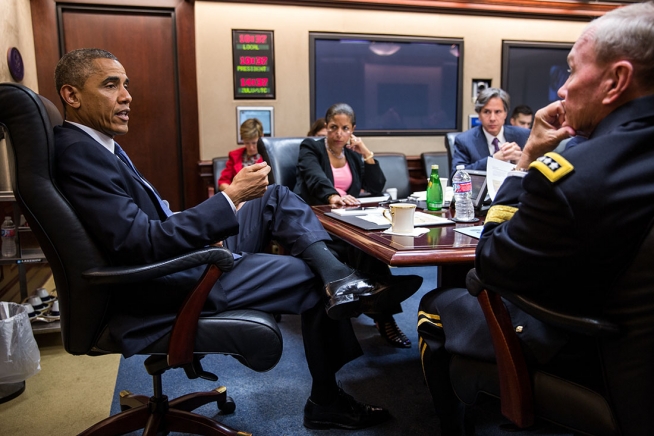
President Barack Obama meets with national
security advisors in the Situation Room -
White House, Aug. 7, 2014.
White House Photo by Pete Souza

This process could be almost comical – as the many armchair warriors repeat What Everyone Knows to Be True as self-justifying proof that more and more wars and confrontations are needed – but the United States is the most powerful nation on earth and its fallacious “group thinks” are spreading a widening arc of chaos and death around the globe.

We even have presidential candidates, especially among the Republicans but including former Secretary of State Hillary Clinton, competing to out-bellicose each other, treating an invasion of Syria as the least one can do and some even bragging about how they might like to shoot down a few Russian warplanes.

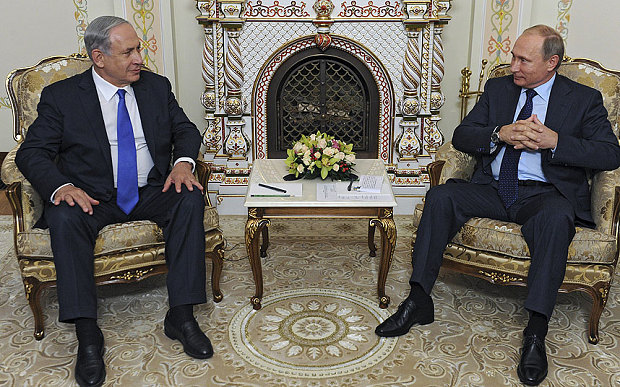
Though President Barack Obama has dragged his heels regarding some of the more extreme proposals, he still falls in line with the “group think,” continuing to insist on “regime change” in Syria (President Bashar al-Assad “must go”), permitting the supply of sophisticated weapons to Sunni jihadists (including TOW anti-tank missiles to Ahrar ash-Sham, a jihadist group founded by Al Qaeda veterans and fighting alongside Al Qaeda’s Nusra Front), and allowing his staff to personally insult Russian President Vladimir Putin (having White House spokesman Josh Earnest in September demean Putin’s posture for sitting with his legs apart during a Kremlin meeting with Israeli Prime Minister Benjamin Netanyahu).


Prime Minister Benjamin Netanyahu meeting with 
President Vladimir Putin in Moscow Sept. 21, 2015


Not surprisingly, I guess, Earnest’s prissy disapproval of what is commonly called “man spread” didn’t extend to Netanyahu who adopted the same open-leg posture in the meeting with Putin on Sept. 21 and again in last week’s meeting with Obama, who – it should be noted – sat with his legs primly crossed. 

This combination of tough talk, crude insults and reckless support of Al Qaeda-connected jihadis (“our guys”) apparently has become de rigueur in Official Washington, which remains dominated by the foreign policy ideology of neoconservatives, who established the goal of “regime change” in Iraq, Syria and Iran as early as 1996 and haven’t changed course since. [See Consortiumnews.com’s “How Neocons Destabilized Europe.”]

Shaping Narratives


Despite the catastrophic Iraq War – based on neocon-driven falsehoods about WMD and the complicit unthinking “group think” – the neocons retained their influence largely through an alliance with “liberal interventionists” and their combined domination of major Washington think tanks, from the American Enterprise Institute to the Brookings Institution, and the mainstream U.S. news media, including The Washington Post and The New York Times.

This power base has allowed the neocons to continue shaping Official Washington’s narratives regardless of what the actual facts are. For instance, a Post editorial on Thursday repeated the claim that Assad’s “atrocities” included use of chemical weapons, an apparent reference to the now largely discredited claim that Assad’s forces were responsible for a sarin gas attack outside Damascus on Aug. 21, 2013.

After the attack, there was a rush to judgment by the U.S. State Department blaming Assad’s troops and leading Secretary of State John Kerry to threaten retaliatory strikes against the Syrian military. But U.S. intelligence analysts refused to sign on to the hasty conclusions, contributing to President Obama’s last-minute decision to hold off on a bombing campaign and to accept Putin’s help in negotiating Assad’s surrender of all Syrian chemical weapons (though Assad still denied a role in the sarin attack).

Subsequently, much of the slapdash case for bombing Syria fell apart. As more evidence became available, it increasingly appeared that the sarin attack was a provocation by Sunni jihadists, possibly aided by Turkish intelligence, to trick the United States into destroying Assad’s military and thus clearing the way for a Sunni jihadist victory.

We now know that the likely beneficiaries of such a U.S. attack would have been Al Qaeda’s Nusra Front and the spinoff known as the Islamic State (also called ISIS, ISIL or Daesh). But the Obama administration never formally retracted its spurious sarin claims, thus allowing irresponsible media outlets, such as The Washington Post, to continue citing the outdated “group think.”

The same Post editorial denounced Assad for using “barrel bombs” against the Sunni rebels who are seeking to overthrow his secular government, which is viewed as the protector of Syria’s minorities – including Christians, Alawites and Shiites – who could face genocide if the Sunni extremists prevail.

Though this “barrel bomb” theme has become a favorite talking point of both the neocons and liberal “human rights” groups, it’s never been clear how these homemade explosive devices shoved out of helicopters are any more inhumane than the massive volumes of “shock and awe” ordnance, including 500-pound bombs, deployed by the U.S. military across the Middle East, killing not only targeted fighters but innocent civilians.

Nevertheless, the refrain “barrel bombs” is accepted across Official Washington as a worthy argument for launching devastating airstrikes against Syrian government targets, even if such attacks clear the way for Al Qaeda’s allies and offshoots gaining control of Damascus and unleashing even a worse humanitarian cataclysm. [See Consortiumnews.com’s “Obama’s Ludicrous ‘Barrel Bomb’ Theme.”]

False-Narrative Knots


But it is now almost impossible for Official Washington to disentangle itself from all the false narratives that the neocons and the liberal hawks have spun in support of their various “regime change” strategies. Plus, there are few people left inside the bubble who even recognize how false these narratives are.

So, the American people are left with the mainstream U.S. news media endlessly repeating storylines that are either completely false or highly exaggerated. For instance, we hear again and again that the Russians intervened in the Syrian conflict promising to strike only ISIS but then broke their word by attacking Al Qaeda’s Nusra Front and “our guys” in Sunni jihadist forces armed by Saudi Arabia, Qatar, Turkey and the CIA.

Though you hear this narrative everywhere in Official Washington, no one ever actually quotes Putin or another senior Russian official promising to strike only at ISIS. In all the quotes that I’ve seen, the Russians refer to attacking “terrorists,” including but not limited to ISIS.

Unless Official Washington no longer regards Al Qaeda as a terrorist organization – a trial balloon that some neocons have floated – then the Putin-lied narrative makes no sense, even though every Important Person Knows It to Be True, including Obama’s neocon-leaning Defense Secretary Ashton Carter.

The U.S. political and media big shots also mock the current Russian-Iranian proposal for first stabilizing Syria and then letting the Syrian people decide their own leadership through internationally observed democratic elections.

Okay, you might say, what’s wrong with letting the Syrian people go to the polls and pick their own leaders? But that just shows that you’re a Russian-Iranian “apologist” who doesn’t belong inside the bubble. The Right Answer is that “Assad Must Go!” whatever the Syrian people might think.

Or, as the snarky neocon editors of The Washington Post wrote on Thursday, “Mr. Putin duly dispatched his foreign minister to talks in Vienna last weekend on a Syrian political settlement. But Moscow and Tehran continue to push for terms that would leave Mr. Assad in power for 18 months or longer, while — in theory — a new constitution is drafted and elections organized. Even a U.S. proposal that Mr. Assad be excluded from the eventual elections was rejected, according to Iranian officials.”

In other words, the U.S. government doesn’t want the Syrian people to decide whether Assad should be kicked out, an odd and contradictory stance since President Obama keeps insisting that the vast majority of Syrians hate Assad. If that’s indeed the case, why not let free-and-fair elections prove the point? Or is Obama so enthralled by the neocon insistence of “regime change” for governments on Israel’s “hit list” that he doesn’t want to take the chance of the Syrian voters getting in the way?

Reality Tied Down


But truth and reality have become in Official Washington something like Gulliver being tied down by the Lilliputians. There are so many strands of lies and distortions that it’s impossible for sanity to rise up.

Another major factor in America’s crisis of false narratives relates to the demonizing of Russia and Putin, a process that dates back in earnest to 2013 when Putin helped Obama sidetrack the neocon dream of bombing Syria and then Putin compounded his offense by assisting Obama in getting Iran to constrain its nuclear program, which derailed another neocon dream to bomb-bomb-bomb Iran.

It became ominously clear to the neocons that this collaboration between the two presidents might even lead to joint pressure on Israel to finally reach a peace agreement with the Palestinians, a possibility that struck too close to the heart of neocon thinking which, for the past two decades, has favored using “regime change” in nearby countries to isolate and starve Lebanon’s Hezbollah and Palestinian groups, giving Israel a free hand to do whatever it wished.

So, this Obama-Putin relationship had to be blown up and the point of detonation was Ukraine on Russia’s border. Official Washington’s false narratives around the Ukraine crisis are now also central to neocon/liberal-hawk efforts to prevent meaningful coordination between Obama and Putin in countering ISIS and Al Qaeda in Syria and Iraq.

Inside Official Washington’s bubble, the crisis in Ukraine is routinely described as a simple case of Russian “aggression” against Ukraine, including an “invasion” of Crimea.

If you relied on The New York Times or The Washington Post or the major networks that repeat what the big newspapers say, you wouldn’t know there was a U.S.-backed coup in February 2014 that overthrew the elected Ukrainian government of Viktor Yanukovych, even after he agreed to a European compromise in which he surrendered many powers and accepted early elections.

Instead of letting that agreement go forward, right-wing ultra-nationalists, including neo-Nazis operating inside the Maidan protests, overran government buildings in Kiev on Feb. 22, 2014, causing Yanukovych and other leaders to flee for their lives.

Behind the scenes, U.S. officials, such as neocon Assistant Secretary of State for European Affairs Victoria Nuland, had collaborated in the coup plans and celebrated the victory by Nuland’s handpicked leaders, including the post-coup Prime Minister Arseniy Yatsenyuk, whom she referred to in an earlier intercepted phone call as “Yats is the guy.”


Assistant Secretary of State for European Affairs 
Victoria Nuland, who pushed for the Ukraine coup 
and helped pick the post-coup leaders.


Nor would you know that the people of Crimea had voted overwhelmingly for President Yanukovych and – after the coup – voted overwhelmingly to get out of the failed Ukrainian state and reunify with Russia.

The major U.S. news media twists that reality into a Russian “invasion” of Crimea even though it was the strangest “invasion” ever because there were no photos of Russian troops landing on the beaches or parachuting from the skies. What the Post and the Times routinely ignored was that Russian troops were already stationed inside Crimea as part of a basing agreement for the Russian fleet at Sevastopol. They didn’t need to “invade.”

And Crimea’s referendum showing 96 percent approval for reunification with Russia – though hastily arranged – was not the “sham” that the U.S. mainstream media claimed. Indeed, the outcome has been reinforced by various polls conducted by Western agencies since then.


Russian President Vladimir Putin addresses a crowd 
May 9, 2014, celebrating 69th anniversary of victory 
over Nazi Germany and 70th anniversary of liberation 
of Crimean port city of Sevastopol from the Nazis. 
(Russian government photo)

The MH-17 Case


The demonization of Putin reached new heights after the July 17, 2014 shoot-down of Malaysia Airlines Flight 17 over eastern Ukraine killing all 298 people onboard. Although substantial evidence and logic point to elements of the Ukrainian military as responsible, Official Washington’s rush to judgment blamed ethnic Russian rebels for firing the missile and Putin for supposedly giving them a powerful Buk anti-aircraft missile system.

That twisted narrative often relied on restating the irrelevant point that the Buks are “Russian-made,” which was used to implicate Moscow but was meaningless since the Ukrainian military also possessed Buk missiles. The real question was who fired the missiles, not where they were made.

But the editors of the Post, the Times and the rest of the mainstream media think you are very stupid, so they keep emphasizing that the Buks are “Russian-made.” The more salient point is that U.S. intelligence with all its satellite and other capabilities was unable – both before and after the shoot-down – to find evidence that the Russians had given Buks to the rebels.

Since the Buk missiles are 16-feet-long and hauled around by slow-moving trucks, it is hard to believe that U.S. intelligence would not have spotted them given the intense surveillance then in effect over eastern Ukraine.

A more likely scenario of the MH-17 shoot-down was that Ukraine moved several of its Buk batteries to the frontlines, possibly fearing a Russian airstrike, and the operators were on edge after a Ukrainian warplane was shot down along the border on July 16, 2014, by an air-to-air missile presumably fired by a Russian plane.

But – after rushing out a white paper five days after the tragedy pointing the finger at Moscow – the U.S. government has refused to provide any evidence or intelligence that might help pinpoint who fired the missile that brought down MH-17.

Despite this remarkable failure by the U.S. government to cooperate with the investigation, the mainstream U.S. media has found nothing suspicious about this dog not barking and continues to cite the MH-17 case as another reason to despise Putin.

How upside-down this “Everything Is Putin’s Fault” can be was displayed in a New York Times “news analysis” by Steven Erlanger and Peter Baker on Thursday when all the “fundamental disagreements” between Obama and Putin were blamed on Putin.

“Dividing them are the Russian annexation of Crimea and its meddling in eastern Ukraine, Moscow’s efforts to demonize Washington and undermine confidence in NATO’s commitment to collective defense, and the Kremlin’s support of President Bashar al-Assad of Syria,” Erlanger and Baker wrote.

Helping ISIS


This tangle of false narratives is now tripping up the prospects of a U.S.-French-Russian-Iranian alliance to take on the Islamic State, Al Qaeda and other Sunni jihadist forces seeking to overthrow Syria’s secular government.

The neocon Washington Post, in particular, has been venomous about this potential collaboration which – while possibly the best chance to finally resolve the horrific Syrian conflict – would torpedo the neocons’ long-held vision of imposed “regime change” in Syria.

In editorials, the Post’s neocon editors also have displayed a stunning lack of sympathy for the 224 Russian tourists and crew killed in what appears to have been a terrorist bombing of a chartered plane over the Sinai in Egypt.

On Nov. 7, instead of expressing solidarity, the Post’s editors ridiculed Putin and Egyptian President Abdel Fattah el-Sisi for not rushing to a judgment that it was an act of terrorism, instead insisting on first analyzing the evidence. The Post also mocked the two leaders for failing to vanquish the terrorists.

Or as the Post’s editors put it: “While Mr. Putin suspended Russian flights on [Nov. 6], his spokesman was still insisting there was no reason to conclude that there had been an act of terrorism. … While Western governments worried about protecting their citizens, the Sissi and Putin regimes were focused on defending themselves. …

“Both rulers have sold themselves as warriors courageously taking on the Islamic State and its affiliates; both are using that fight as a pretext to accomplish other ends, such as repressing peaceful domestic opponents and distracting attention from declining living standards. On the actual battlefield, both are failing.”

Given the outpouring of sympathy that the United States received after the 9/11 attacks and the condolences that flooded France over the past week, it is hard to imagine a more graceless reaction to a major terrorist attack against innocent Russians.

As for the Russian hesitancy to jump to conclusions earlier this month, that may have been partially wishful thinking but it surely is not an evil trait to await solid evidence before reaching a verdict. Even the Post’s editors admitted that U.S. officials noted that as of Nov. 7 there was “no conclusive evidence that the plane was bombed.”

But the Post couldn’t wait to link the terrorist attack to “Mr. Putin’s Syrian adventure” and hoped that it would inflict on Putin “a potentially grievous political wound.” The Post’s editors also piled on with the gratuitous claim that Russian officials “still deny the overwhelming evidence that a Russian anti-aircraft missile downed a Malaysian airliner over Ukraine last year.” (There it is again, the attempt to dupe Post readers with a reference to “a Russian anti-aircraft missile.”)

The Post seemed to take particular joy in the role of U.S. weapons killing Syrian and Iranian soldiers. On Thursday, the Post wrote, “Syrian and Iranian troops have lost scores of Russian-supplied tanks and armored vehicles to the rebels’ U.S.-made TOW missiles. Having failed to recapture significant territory, the Russian mission appears doomed to quagmire or even defeat in the absence of a diplomatic bailout.”

Upping the Ante


The neocons’ determination to demonize Putin has upped the ante, turning their Mideast obsession with “regime change” into a scheme for destabilizing Russia and forcing “regime change” in Moscow, setting the stage for a potential nuclear showdown that could end all life on the planet.

To listen to the rhetoric from most Republican candidates and Democratic frontrunner Hillary Clinton, it is not hard to envision how all the tough talk could take on a life of its own and lead to catastrophe. [See, for instance, Philip Giraldi’s review of the “war with Russia” rhetoric free-flowing on the campaign trail and around Official Washington.]


A nuclear test detonation - Nevada April 18, 1953.


At this point, it may seem fruitless – even naïve – to suggest ways to pierce the various “group thinks” and the bubble that sustains them. But a counter-argument to the fake narratives is possible if some candidate seized on the principle of an informed electorate as vital to democracy.

An argument for empowering citizens with facts is one that transcends traditional partisan and ideological boundaries. Whether on the right, on the left or in the center, Americans don’t want to be treated like cattle being herded by propaganda or “strategic communication” or whatever the latest euphemism is for deception and manipulation.

So, a candidate could do the right thing and the smart thing by demanding the release of as much U.S. intelligence information to cut this Gordian knot of false narratives as possible. For instance, it is way past time to declassify the 28 pages from the congressional 9/11 report addressing alleged Saudi support for the hijackers. There also are surely more recent intelligence estimates on the funding of Al Qaeda’s affiliates and spin-offs, including ISIS.

If this information embarrasses some “allies” – such as Saudi Arabia, Qatar and Turkey – so be it. If this history makes some past or present U.S. president look bad, so be it. American elections are diminished, if not made meaningless, when there is no informed electorate.

A presidential candidate also could press President Obama to disclose what U.S. intelligence knows about other key turning points in the establishment of false narratives, such as what did CIA analysts conclude about the Aug. 21, 2013 sarin attack and what do they know about the July 17, 2014 shoot-down of MH-17.

The pattern of the U.S. government exploiting emotional moments to gain an edge in an “info-war” against some “enemy” and then going silent as more evidence comes in has become a direct threat to American democracy and – in regards to nuclear-armed Russia – possibly the planet.

Legitimate secrets, such as sources and methods, can be protected without becoming an all-purpose cloak to cover up whatever facts don’t fit with the desired propaganda narrative that is then used to whip the public into some mindless war frenzy.

However, at this point in the presidential campaign, no candidate is making transparency an issue. Yet, after the deceptions of the Iraq War – and with the prospects of another war based on misleading or selective information in Syria and potentially a nuclear showdown with Russia – it seems to me that the American people would respond positively to someone treating them with the respect deserving of citizens in a democratic Republic.

Investigative reporter Robert Parry broke many of the Iran-Contra stories for The Associated Press and Newsweek in the 1980s. You can buy his latest book, America’s Stolen Narrative, either in print here or as an e-book (from Amazon and barnesandnoble.com). You also can order Robert Parry’s trilogy on the Bush Family and its connections to various right-wing operatives for only $34. The trilogy includes America’s Stolen Narrative. For details on this offer, click here.

Illegal West Bank Settler Rams Child with Car; Fellow Jew Shoots Her Dead, Claiming She Was Armed with Knife

Israeli Settlement Leader Kills Palestinian Girl, Claims 'she Had A Knife'

by IMEMC News 


November 22, 2015

On Sunday morning Israeli colonial settlement leader Gershon Mesika rammed a teenage girl with his car, claiming 'she had a knife'.

When the girl, Ashraqat Taha Qatanany, 16, from Nablus, fell to the ground, another Israeli paramilitary settler pulled over and shot her multiple times.

While Israeli authorities claim that Mesika "thwarted a terror attack", the claim of Mesika and the other settler that the girl had a knife contradicts other accounts of the incident.


Ashraqat killed by Israeli settlers
(image from Twitter)

The child did not harm or attempt to harm anyone, and a knife photographed at the scene appears to have been tossed near her dead body.

Gershon Mesika, from Elon Moreh illegal colony, is the former head of the Samaria Regional Council, which is a body organized by Israeli settlers living illegally in the occupied West Bank.

He rammed the child with his car, landing the car in the ditch and leaving the girl lying prone on the ground. A paramilitary settler from the car behind Mesika's then got out of his car and fired multiple shots at the girl.

She was pronounced dead at the scene.

The Israeli paper Yedioth Ahranoth reported that the shooting was done by an Israeli driver of a vehicle behind Mesika's. A later article by the Israeli news agency Arutz Sheva claimed that she was shot 'by soldiers on the scene'.

A number of recent incidents in which Palestinians were shot and killed have been questioned by Palestinians and their supporters, as the eyewitness reports that unarmed Palestinian civilians were shot by Israeli paramilitary settlers have been reported in the Israeli and international media as 'thwarted attacks'.

In several cases, the Israeli military appears to have taken credit for shootings that were actually carried out by paramilitary settler groups.