Gorilla Radio is dedicated to social justice, the environment, community, and providing a forum for people and issues not covered in State and Corporate media. The G-Radio can be found at: www.Gorilla-Radio.com, archived at GRadio.Substack.com, and now featuring on Telegram at: Https://t.me/gorillaradio2024. The show's blog is: GorillaRadioBlog.Blogspot.com, and you can check us out on Twitter @Paciffreepress
Fear is the sales pitch for many products: from war on the Euphrates to billion-dollar submarines. Better than toothpaste that makes your teeth whiter than white, this stuff will make us safer than safe. It’s political junk food, the cheap filling in the flashy tube.
True security for life’s dangers—from a real national health insurance program to protecting teachers' jobs, would take a slice of the profits of the owning classes, the Lockheeds, the JP Morgans. The War on Terror has become class war by other means.
Original Art by Winston Smith,
(updated with Trump)
And who will get us next? Don’t assume they’ll be clutching Korans. Until September 11, 2001, the deadliest terror attack in American history was carried out by an all-American Gulf War veteran.
Outside the war zones we create, organized terror’s power is diminishing, and for politicians, especially The Donald and Ted Cruz, that is a political problem. That’s why this latest mayhem by a sick-o ISIS wannabe couple was such a boon to the panic salesmen in Washington. They needed a new terror fix. Even if it wasn’t the real ISIS, it was enough for candidates to mainline into the body politic a big, fat dose of fear.
Once they have the media all jumped up on a new fear high, some presidential candidates, and sadly too, our President The Drone Ranger, can resume their sales pitch for their two-barrel cure: less liberty, more weaponry.
Our leaders are counting on cowardice in the hearts of the Heart-land. The Republicans’ unstated election campaign slogan is, “They are coming to get us.” Americans, scared for their lives, soil their underpants and waddle to the polls crying, “Donald, save us!”
It began with the September 11 attacks. From his bunker, Dick Cheney created a government that is little more than a Wal-Mart of Fear: midnight snatchings of citizens for uncharged crimes, wars to hunt for imaginary weapons aimed at Los Angeles, DNA data banks of kids and grandmas.
In 1933, Franklin Roosevelt calmed a nation when he said, “We have nothing to fear but fear itself.”
Today, our would-be presidents all but admit, “We have nothing to sell but fear itself.”
*
Adapted from Armed Madhouse, the New York Times bestseller by Greg Palast.
In Paris COP 21, or what we here at the Real News
is now calling COPOUT 21, is on its tenth day now. Today another draft
of the agreement was released, and you will find our review of the
previous draft with Dimitri on our site under the Global Warning tab.
That's right, Global Warning tab. And today Dimitri's going to be
talking about something quite different, which is Canada. But we will
review the latest draft that was released today tomorrow morning with
Dimitri, and we'll have that available for you. But today with us again
is Dimitri Lascaris, and he's going to take a closer look at Canada's
presence.
Dimitri is a good person to do that, because when he's not doing this he is a [in aud.] class action lawyer with Siskinds in Canada, and he ran as a candidate for the Green Party, and he's also a serving member of the Real News Network board.
Culture shock is something usually associated with a human being feeling a sense of alienation or confusion when arriving in a place that is strange and new.
It would be no surprise then, if difficulty in adapting cropped up as a culture-shock after-effect.
But what if the concept of culture-shock was applied to, say, placing the Beluga whitewhale in a ‘Bubble’ such as an Aquarium setting — whose ancestors had lived in the Ocean Wide for thousands of years?
Without falling into a debate about anthropomorphism, I would like to us to ‘problematize’ the idea of the ‘strangeness’ of having a huge Whitewhale in, arguably, a fishbowl.
An Arctic and sub-Arctic cetacean, this Whitefish is also occasionally referred to, as the melonhead or sea canary.
I do not wish to be delving too deep into a discussion of Anthropology. If you would like to read more on the topic, ‘Beyond the Human’, Samantha Hurn (2012) researches the idea of animal exploitation, animal-rights theory and the anthropological implications of the evolving cultural ideas and concepts about animal personhood. She asks us to think about our own attitudes towards ‘other’ animals on earth (i.e. other-than-human) and relate this to what it might mean to be human. Perspectivism (e.g. Kohn; Descola; De Castro) asks us to take up seeing the world from the point of view of the ‘other’ in the natural world, while at the same acknowledging our thoughts as being, from a human standpoint (Key words; post-humanist, human exceptionalism).
With this all in mind, try and understand the example I have suggested, of ‘the foreignness’ of the fishbowl (Aquarium) from the perspective of the Beluga.
Granted we can never get into a cetacean’s mind, per se, but we can entertain the idea of ‘seeing the world from the perspective of the ‘Beluga’.
Here is an analogy. We’ve all likely observed the poverty and resignation of people who are on the wrong side of the ‘economic divide’. At times I have been there myself. What if this conceptualization of reality was applied to thinking about the Beluga? ‘Seeing’ the Beluga as being on the wrong side of the ‘divide’— whose fate is unlucky enough to have been captured — whose awesome and glorious natural-habitat nature/subjectivity modified into a mere object of money-making and gawk? Might I be able to force an argument that the Beluga is ‘ecologically impoverished’ i.e. trapped in a container?
Is this the Beluga’s ‘Bubble’ reality? It would be no surprise to see the ‘resignation’ of the Beluga in this scenario. I argue that there doesn’t seem to be a concerted effort to connect the ‘poverty’of the Beluga in the Aquarium setting. I mean the poverty of the identity of the Beluga in the Aquarium setting. Is the Beluga not powerless over its fate, resigned to its working conditions?
Applying social theory to an understanding of the captive Beluga might actually prove useful. I could even push for a focus on the idea of ‘discrimination’ against Belugas. Why not? The fate of Beluga has been shown to be ‘poor’. We need to consider Maris’ recent death in Atlanta.
Keeping Belugas in captivity is really more about controlling the population in order to allow money to be made. It is about the circuits of capitalism reaching the Beluga as an object of profit. We don’t hear much of this phenomena at the moment but it underlies much of what is happening. If a Beluga dies, it is always ‘a complete mystery’. Whether it’s Vancouver or Atlanta.
On October 24, 2015, I read, while in Scotland, that “Maris the beluga whale dies suddenly at Georgia Aquarium [emphasis mine] (Source: Faith Karimi, CNN).
We are told that Maris, who was born in the New York Aquarium, in 1994 lived for 10 years at the site in Atlanta and died on October 22, 2015.
It’s well known that Maris had given birth to two babies, both of whom died. The first baby died in 2012 only days after birth, and the second, after less than a month. There are two Belugas left at the Georgia Aquarium – Grayson and Qinu.
Karimi, the reporter from CNN, obtained this quote from PETA (People for the Ethical Treatment of Animals). “Maris was denied her freedom her entire life. She was transferred from one facility to another, and her babies died, one after the other. Whether or not she had a physical ailment that went unnoticed, she was killed by captivity, plain and simple.”— PETA senior vice president Lisa Lange.
Okay, we know the drill. Aquariums argue that belugas in captivity (modified, with the phrase ‘belugas in human care’) enable scientists to better comprehend them in the wild. Latest ‘ethical’ research, needless to say, focuses on how ‘underwater sounds’ affect belugas — including the human-created noise-pollution created by industrial or military activity? The Aquarium is a lab, effectively. Biologists from respected universities are involved in this project and do not have to wrestle with any sort of conundrum relating to ethics. It is taken as a given that this is, ‘good’ research – no questions asked.
Karimi continues to explain that “The data can be combined and applied to help conserve and protect wild belugas from threats in their natural habitats”, according to the Georgia Aquarium website.
It’s clear that the Georgia Aquarium has been very careful to maintain the position that Maris, 21, “showed no signs of illness before her death. She ate and interacted normally with Grayson and Qinu, the other two beluga whales at the aquarium.This is a case of sudden, acute animal death. Our animals receive exceptional care, and our dedicated team of experts responded to her within minutes to render aid.”— Dr. Gregory Bossart, Chief Veterinarian at the Georgia Aquarium.
All the public is told is: “An autopsy is underway”.
End of discussion.
What is curious is that only recently we heard of one Beluga death and then another at Vancouver Aquarium in Canada. It would not have been difficult to put a sentence about that. The second one was said to have been due to pneumonia.
Care2care.com reports “In 2012, the aquarium filed a controversial petition to bring 18 wild-caught belugas here from Russia who would be split up at different facilities under breeding and loan agreements. Unfortunately for those supporting the effort, in September a federal judge shut down the effort”. We’re told there’s pressure on “The National Marine Fisheries Service to declare the population of belugas, suffering from captures in Russia, as depleted, under the Marine Mammal Protection Act”.
In the context of another published CNN news article, “SeaWorld can expand its tank but not breed whales, board rules” all eyes are likely now focused on the Georgia Aquarium’s desire to ‘grow’ belugas.
I have reflected briefly on ‘animal/human’ interaction and the assumptions humans make when beginning to use models of observation. I have asked that readers reconsider the idea of Belugas in labs. I suggest here, that there may be a benefit in actually applying human social theory to the fate of the captive Beluga.
I will leave you with this final thought.The light/colour/frequency spectrum experienced by humans, that, compared with the receptors that cetaceans/animals/birds experience, confines us to a uniquely human world. We can never enter the complete experiential world that enables the ‘others’ in the animal kingdoms and the seas, to exist on the same planet. Technology will never enable us to ‘see’ the colours/frequencies that non-humans experience – not even with Hubble style magnification. To that extent we should understand an inherent disability — so is this the anthropological blind leading the blind?
If we see that our ways of seeing are blind to the ways that the Beluga sees — just one ‘animal’ example — we might be able to better understand their deaths in the aquarium setting. To understand if the Beluga and the baby beluga experiences culture-shock in the Aquarium fishbowl, the ‘Bubble’ must first be burst.
Western media has published yet another doom and gloom article on Crimea, repeating a worn theme that surely, by now, the people of Crimea must be reconsidering their vote 21 months ago to secede from Ukraine and rejoin the Russian Federation.
‘Crimean Spring’ rally in Simferopol March 2015 marking one year of decision to secede from Ukraine (Evgeny Biyatov, Sputkik News)
The article was published in the New York Times on Dec 1 and is titled, ‘Months after Russian annexation, hopes start to dim in Crimea‘. This one has to skate around an new, added twist to the Crimea story: the electricity and commercial road transport blockade that has been mounted by small numbers of the extreme-right in Ukraine but endorsed by the governing regime in Kyiv while Western governments turn a blind eye.
The article begins:
SHCHYOLKINO, Crimea – When residents in this typical Soviet factory town voted enthusiastically to secede from Ukraine and to become Russians, they thought the chaos and corruption that made daily life a struggle were a thing of the past. Now that many of them are being forced to cook and boil drinking water on open fires, however, they are beginning to reconsider.
The article employs time-honored methods for when a pre-determined, negative theme is required and important facts must be obscured.
One, find disgruntled citizens in the street and cite them. That’s not difficult to do–is there a country in the world without many unhappy citizens? The Times writer cites two such people in his article.
Two, make it appear that the disgruntled citizen(s) speaks for large numbers of his or her fellow citizens.
Three, negative imagery is important. Thus we read in the Times article, “Twenty months after the Kremlin annexed the Black Sea peninsula amid an outpouring of patriotic fervor by the ethnic Russian population, President Vladimir V. Putin’s promise in April 2014 to turn it into a showcase of his rule now seems as faded as Crimea’s aging, Soviet-era resorts.” Very evocative–‘aging, Soviet-era resorts’. This recalls the decades of New York Times reporting of aged-looking buildings in Cuba during the decades of the U.S. embargo of the island. The embargo made it difficult for Cuba to manufacture or obtain paint and building materials; such things as public health care, public education, international aid and solidarity, and national defense took priority. So yes, this writer visited Cuba three times during the 1990s and, indeed, many buildings in Havana looked aged. But the spirit of the people and the outlook for the country was anything but tired and worn out. To my eyes, the people were much more spirited and forward looking compared to what I experienced in wealthy Canada.
Four, the key word in all reporting of Crimea is “annex”, as per the above citation. The people in Crimea voted overwhelmingly in March 2014 for secession from Ukraine, following a violent, right-wing coup against the elected president of that country (a president for whom a large majority of Crimeans had voted in 2010). The secession referendum was organized by the elected and constitutional Crimean legislature, whose legality contrasted sharply with the illegal, coup regime which came into power in Kyiv on Feb 21, 2014. Crimeans have affirmed in survey after survey that they are satisfied with the secession decision. Yet, Crimeans are presented in the Times as hapless people who have been “annexed” by Russia. The Times reference to the secession as happening “amid an outpouring of patriotic fervor” suggests that the people were so swept away by fervor as to be too dumb to realize what was really taking place. They were not choosing a future of their own free will; no, they were undergoing “annexation” without even being aware.
Five, blame the victims for their plight. Thus we read in the Times article , “… people here are not sure whom to blame more for their predicament: the Crimean Tatar activists and Ukrainian nationalists who cut off Crimea’s link to the Ukrainian power grid or the local government officials who claimed to have enough power generators stored away to handle such an emergency.” Here we have an absurd spectacle of the Crimean government being blamed for failing to foresee and prepare for the day that right-wing extremists in Ukraine would blow up the electricity transmission lines serving the peninsula. Even more recklessly, the Crimean government failed to foresee that the blowing up of transmission lines by right-wing terrorists (oops, “cutting off of Crimea’s links” by “activists”) would be endorsed and escalated by the regime in Kyiv and that Western governments would turn a blind eye and Western media would largely be silent.
Six, and finally, choice of headline to convey the negative message is key. In this case, we have “hopes start to dim”. In reality, the Times headline joins a long parade of such headlines. Pick a typical, negative word, use it alongside the word “Crimea” in an internet search, and, voilà, you arrive in a world of negativity over prospects for Crimea. Here is a small sample of the trade in negative Crimea headlines and stories:
Crimea’s football fans shiver at prospect of their team playing in Siberia (The Guardian, March 2014)
Why Russia’s Crimea move fails legal test, (BBC, March 2014)
Crimea after annexation: ‘We feel utterly discouraged,’ resident says (Belsat TV, in Belarus, April 2014)
Crimea euphoria fades for some Russians (Reuters, July 2014)
Tourism suffers in Crimea as Ukraine shuns breakaway region (Washington Post, Aug 2014)
Kremlin preparing to combat demos as signs of Crimea-fatigue appear, (‘Euromaidan Press‘, Sept 2014)
Human rights in decline in Crimea (Human Rights Watch, Nov 2014)
To many in Crimea, corruption seems no less at home under Russian rule, New York Times, Aug 2015)
Oddly–well, not so oddly–the last article in this list was about Crimean citizens trying to take back into public control Black Sea waterfront land which had been lost during Crimea’s time in post-1991 Ukraine.
Funnily enough, the Times article concludes with a quotation from a Crimean woman that is supposed to show that Russians are naïve and habitual complainers who always blame others for their failings and shortcomings. But the quotation is the closest thing to truth in the entire article (leaving aside the suggestion that the extreme rightists in Ukraine who blew up electricity lines are “Tatars”):
As often happens in Russia, some blame Washington rather than Moscow or Kiev.
“If it wasn’t for the Americans, none of it could have happened. The Tatars, who are supported by the United States, would not do a thing,” said Tatyana Bragina, 57, an energetic woman who also once worked construction at a nearby, unfinished nuclear plant.
“Please write that we are not desperate. On the contrary, we are full of joy,” Ms. Bragina said, standing near a black iron kettle boiling away in the courtyard of her apartment block.
Russian legislator Konstantin Kosachev has said that Kyiv’s electricity and road-transport blockades against Crimea constitute a “gesture of final farewell” to Crimea.
Bridge from Russia to Crimea under construction, Sept 2015 (CIT press photo)
Update: Russia is racing to construct electricity, natural gas, road and rail links to Crimea across the 3 km wide Kerch Strait, which separates the Sea of Azov from the Black Sea. The first of the electricity began to flow through a 200MW cable on December 3. A second supply cable of 200MW is due to open on Dec. 21. Crimea will be fully supplied with electricity by the summer 2016. Soon after that, it will be producing its own electricity courtesy of the gas pipeline under construction. By 2019, the road and rail bridge will begin to operate.
Vijay Prashad, author of sixteen books, the latest book Letters to Palestine, says that ISIS oil is smuggled through Turkey to Israel and is a major source of ISIS funding.
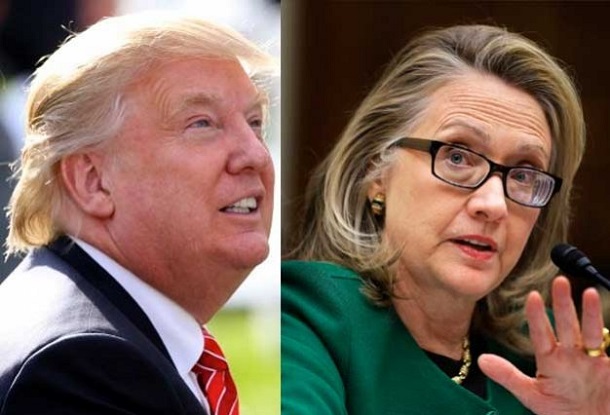
Is Donald J. Trump running a false flag campaign to help Hillary? This idea was originally floated as a Republican Party conspiracy theory back in August, but failed to gain any traction by virtue of Donald Trump’s abrupt surge in national GOP polling. That’s changing now, as reality is starting to dawn on The Donald Show.
The GOP has got a fundamental problem now. Presently, the Republican Party has its own hands half-tied – unable to fully distance themselves or condemn Trump’s recent call to ban all Muslims from entering the US, or even Trump’s somewhat disturbing call on Monday to “close down parts of the internet.”
The reason the GOP’s hands are tied is because Trump isn’t the only candidate invested in this litany of reactionary policy rhetoric in the GOP’s now legendary race to the bottom – as a still bloated field of presidential candidates rush to gather all the lost political souls before February, by pandering to the radical right and the remnants of a scattered Tea Party base. Any remaining Republican moderates, like Rand Paul, are currently buried under Trump headlines, and left to fight for the scraps with a motley crew of war hawks (Christie, Graham, Fiorina), accidental runners (Carson), TV evangelists (Huckabee) and potential Wall Street servants (Cruz, Bush, Rubio, Kasich). In the end, GOP pollsters can only watch as their moderate support gradually melts away and with it, their chances for a November win.
Even RNC Chairman Reince Priebus caved in to the mob recently, treading on egg shells over the ‘Muslim ban’. When questioned about Trump’s near ‘final solution’ to this Muslim problem, Priebus gave a (right-wing) politically correct answer: “I don’t agree,” said Priebus to the Washington Examiner. “We need to aggressively take on radical Islamic terrorism but not at the expense of our American values. That’s as far as I’m going to go” (yes, the right-wing has their own politically correct regime too).
So why is the GOP brain trust so afraid to condemn Trump’s fascist rant? Answer: they are a scared of Trump going third-party independent.
Whether or not Trump’s comic book-style candidacy is intentional or natural might be up for debate, but there can be no debate about the end result – should Trump choose to run a third-party Independent. Any Trump third-party run will guarantee a Hillary Clinton presidential victory.
Today, Trump raised his big, golden Sword of Damocles over the GOP’s neck again:
“The people, the Republican party has been — the people have been phenomenal, the party I’ll let you know about that. And if I don’t get treated fairly, I would consider that. In fact they did a poll… where 68% of the people that were Republicans would follow Trump if I went independent,” Trump touted.
Trump is making no secret of this reality either, constantly war-gaming his options on Twitter, much to the dismay of a paralyzed Republican establishment…
A new poll indicates that 68% of my supporters would vote for me if I departed the GOP & ran as an independent. https://t.co/ztP5d2ctZl
Even the geniuses at FOX News are in denial of this tectonic rift in the GOP structure. Go figure…
This pathogen has also spread to the legions of “conservatives” and “constitutionalists” who have rushed to buy the now iconic red Trump baseball cap (Made in America) are similarly boxed-in by Trump’s exclusionary authoritarian decree to deny members of one religious group, American Muslims and their families, access to rights guaranteed in the US Constitution. The fact that so many who identify themselves politically as ‘conservatives’ and ‘libertarians’ have been handicapped by this dichotomy speaks volumes about the authenticity of their political and ideological labels. In other words, there is nothing conservative about big government police state measures favored by nearly all of the GOP runners, with the most radical being Donald Trump.
Trump and his supporters are also facing another huge wall. Even if Trump somehow wins the GOP primary vote going into the Republican National Convention next July, it is almost certain that the scene at the Quicken Loans Arena in Cleveland on July 18 – 21, 2016, will be a political bloodbath – pitting rabid Trump mobs against the RNC’s traditional rank and file.
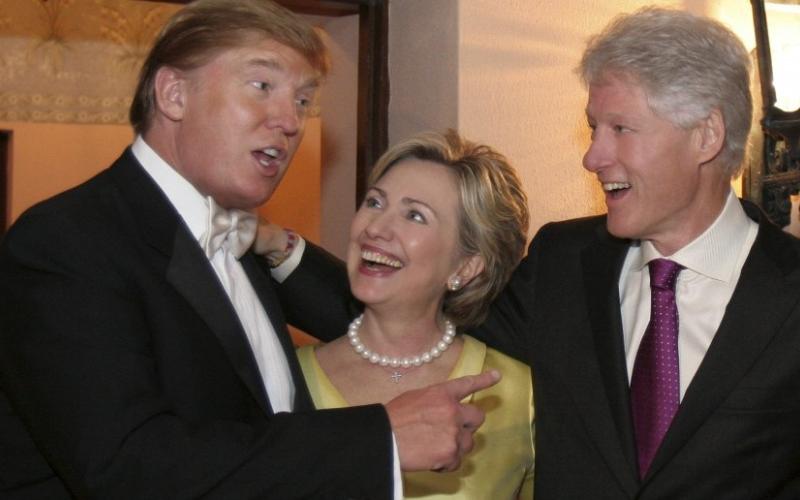
Donald & Hillary: Double Trouble
The trouble doesn’t end there either. The GOP are also scared about the potential that Trump politics could lead to party stereotypes that might end up permanently damaging the party’s image – in way that could be devastating not only for 2016 Congressional and Senate elections, but across the board nationally in local and state seats as well. Again, the Democratic Party must be cheering on Trump because he could deliver them the grand slam sweep of Congress and the White House which they would not have dreamed was possible only a few months ago.
This Summer Meltdown scenario is a very real one. For anyone with a long enough memory (something that’s increasingly rare these days) to recall, this same issue took place in 2012 when chaos broke out on the Tampa Florida GOP Convention floor back in 2012, when Ron Paul supporters were locked-out and delegates disenfranchised by their own party. Clearly, none of today’s Trump supporters raised a fuss back then to protest the railroading of Ron Paul, but come July, they will wish they had. Because of the Ron Paul movement, the RNC moved to further centralize party power at the all-important convention choke-point. As the New American has reported previously:
“The RNC’s rule change effectively disenfranchised Republicans supporting anyone other than the Establishment’s man and left 10 of Maine’s 24 delegates locked out of the process, preventing them from casting votes for Ron Paul.”
“It’s a disgusting, disgusting display of a hostile takeover from the top down,” said Maine delegate Ashley Ryan, according to an article in the Los Angeles Times. “It’s an embarrassment,” she’s quoted as saying.
And here’s the real kicker:
“Additional rule changes all but guaranteed that in the future the RNC will not allow itself to be embarrassed by “grassroots” candidates.”
In other words, no matter how much muscle you think you have coming out of the GOP primaries, the system may already have been gamed in favor of the preferred Establishment candidates. Watch this clip from 2012:
If what happened to Ron Paul 2012 also happens to Trump 2016, it’s almost certain that Trump will look to his mob for support and to restore some of his power lost to a labyrinth of electoral bureaucracy. Most of this will be way too complicated for the average Trump supporter (and Trump himself) to fully grasp, and expect Donald to call for a rebellion. Supports can scream and shout, boo and even threaten violence all they want on the Convention floor this summer, but pundits and supporters would be naive to discount this political reality. Unless the Establishment wants Trump (for instance, if Bilderberg requires an autocrat to fast-track its agenda), which remains a remote possibility, then his supporters will never get the fair shake they think he deserves.
This leads to the third scenario: Trump wins the primaries, but fails to secure his party’s support at the Convention. This will almost certainly lead to his supporters crying foul and demanding a third party independent run, which will, once again, deliver the Democratic Party’s likely nominee, Hillary Clinton, a comfortable victory in the general election come November.
The only real chance then for the GOP is find a way for Trump to not run at all in the general election. Good luck with that one.
The GOP is a party divided, and until they rectify this fundamental flaw of their own making – constantly battling with each other to win the adoration of an increasingly confused, frightened, and ignorant (and shrinking) voting base, they will continue to lose in general elections.
Either way, thanks to Donald Trump, the Republican Party have their work cut-out for them.
Looking back over my four decades in the national news media, it’s hard to identify one moment when American journalism died.
The process was a slow and ugly one, with incremental acts of cowardice accumulating until mainstream reporters were clearly part of the problem, not anything to do with a solution.
But the date Dec. 9 has a special place in that sad progression.
Journalist Gary Webb holding a copy of his Contra-
cocaine article in the San Jose Mercury-News.
It was on Dec. 9, 2004, when the mean-spirited mainstream media’s treatment of investigative journalist Gary Webb led him – his career devastated, his family broken, his money gone and his life seemingly hopeless – to commit suicide. It was a moment that should have shamed all the big-shot journalists who had a hand in Webb’s destruction, but it mostly didn’t.
Webb’s offense was to have revived the shocking story of the Reagan administration’s tolerance of cocaine smuggling by the CIA-backed Nicaraguan Contra rebels in the 1980s. Though the scandal was real – and had been partly exposed in real time – the major newspapers had locked arms in defense of President Ronald Reagan and the CIA. The sordid scandal apparently was deemed “not good for the country,” so it was buried.
My Associated Press colleague, Brian Barger, and I had written the first story exposing the Contras’ involvement in cocaine smuggling in 1985, but our story was attacked by Reagan’s skillful propaganda team, which got The New York Times and other major news outlets to buy into the denials.
Later that decade, a gutsy investigation by then-Sen. John Kerry filled in some of the gaps showing how the Reagan administration’s collaboration with drug-tainted airlines and other parts of the Contras’ cocaine smuggling apparatus had functioned. But Kerry’s probe was also mocked by the major media. Sniffing out that conventional wisdom, Newsweek deemed Kerry “a randy conspiracy buff.”
Kerry’s brush with this near-political-death-experience over the Contra-cocaine scandal taught him some hard lessons about survival in Washington, which help explain why he was such a disappointing candidate during Election 2004 and why he has shown such timidity in challenging Official Washington’s “group thinks” as Secretary of State.
For both U.S. journalists and politicians, there was no upside to doing the hard work of exposing this kind of crime of state. [See Consortiumnews.com’s “What’s the Matter with John Kerry.”]
Same Stonewall
In 1996, Gary Webb encountered the same stonewall when he stumbled onto evidence showing that some of the Contra cocaine, after being smuggled into the United States, had flowed into the production of “crack” cocaine in Los Angeles and contributed to the “crack epidemic” of the 1980s.
When he published his findings in a series for the San Jose Mercury News, the major newspapers had a choice: either admit that they had slinked away from one of the biggest scandals of the 1980s or redouble their efforts to discredit the story and to destroy anyone who dared touch it. They went with option two.
In a tag-team pummeling of Gary Webb, The Washington Post, The New York Times and the Los Angeles Times all denounced Webb and decried his reporting. Soon, Webb’s editors at the Mercury News were feeling the heat and rather than back their reporter, they sought to salvage their own careers. They sold Webb out – and he was soon out of a job and unemployable in the mainstream media.
The bitter irony was that Webb’s reporting finally forced a relatively thorough and honest investigation by the CIA’s Inspector General Frederick Hitz, who concluded in 1998 that not only were the Contras involved in the drug trade from their start in 1980 and through the entire decade but that CIA officers were aware of the problem and helped cover it up, putting the goal of ousting Nicaragua’s Sandinista government ahead of blowing the whistle on these corrupt CIA clients.
Yet, even the CIA’s confession wasn’t enough to shame the major newspapers into admitting the truth and acknowledging their own culpability in the long-running cover-up. It remained easier to continue the demonization of Gary Webb.
At Consortiumnews, we were one of the few news outlets that examined the extraordinary admissions contained in the CIA’s two-volume report and in a corresponding Justice Department Inspector General’s report, which added more details about how criminal investigations of the Contras were thwarted. But, sadly, we lacked the reach and the clout of the major newspapers.
As the controversy bubbled in 1996, I also had joined with Webb in several speaking engagements on the West Coast. Though we sometimes spoke to large and enthusiastic crowds, the power of the Big Media overwhelmed everything, especially the truth. [For details, see Consortiumnews.com’s “The Sordid Contra-Cocaine Saga.”]
Webb’s Demise
In the years after the Contra-cocaine story was buried once again, I lost touch with Webb who had landed a job with a California state legislative committee. So, I didn’t realize that after that job ended, Webb’s life was spiraling downward. Even modest-sized newspapers refused to consider hiring the “disgraced” reporter.
Webb’s marriage fell apart; he struggled to pay child-support and other bills; he was faced with a forced move out of a house near Sacramento, California, and in with his mother. Deeply depressed, according to his family members, Webb chose to end his life.
On Dec. 9, 2004, the 49-year-old Webb typed out suicide notes to his ex-wife and his three children; laid out a certificate for his cremation; and taped a note on the door telling movers — who were coming the next morning — to instead call 911.
Webb then took out his father’s pistol and shot himself in the head. The first shot was not lethal, so he fired once more. (Yes, I know that conspiracy theorists have seized on the two shots to insist that Webb was murdered by the CIA, but there is no proof of that and by pushing that baseless account, people simply let the real culprits – the big newspapers – off the hook.)
After Webb’s body was found, I received a call from a reporter for the Los Angeles Times who knew that I was one of Webb’s few journalistic colleagues who had defended him and his work. I told the reporter that American history owed a great debt to Gary Webb because he had forced out important facts about Reagan-era crimes. But I added that the Los Angeles Times would be hard-pressed to write an honest obituary because the newspaper had essentially ignored Hitz’s final report, which had largely vindicated Webb.
To my disappointment but not my surprise, I was correct. The Los Angeles Times ran a mean-spirited obituary that made no mention of either my defense of Webb, nor the CIA’s admissions in 1998. The obituary was republished in other newspapers, including The Washington Post.
Even though Webb’s reputation posthumously received some rehabilitation with a sympathetic portrayal of his ordeal in Jeremy Renner’s 2014 movie, “Kill the Messenger,” some news executives who aided the Contra-cocaine cover-up in the 1980s and abetted the destruction of Webb in the 1990s still won’t admit their complicity in suppressing one of the most important stories of that era, people such as The Washington Post’s Jeff Leen and Leonard Downie. [See Consortiumnews.com’s “WPost’s Slimy Attack on Gary Webb and “How the Washington Press Turned Bad.”]
A few journalists have continued to find nuggets of the Contra-cocaine scandal, including from accounts by former CIA contract pilot Robert “Tosh” Plumlee, who supplied details about his work ferrying guns and drugs for Reagan’s Contras, as reported by Robert McPhaul of The Tico Times, based in San Juan, Puerto Rico. Even Fox News poked into the Contra-cocaine connection in an article about alleged CIA complicity in the 1985 torture-murder of Drug Enforcement Administration agent Enrique “Kiki” Camarena.
But the resistance from the major U.S. news media and the ferocity from Reagan’s acolytes whenever their hero’s legacy is challenged have left this very real scandal in the netherworld of doubt and uncertainty, a key chapter of America’s Lost History in which Dec. 9, 2004, conveys a baleful message. [As part of our end-of-year fund drive, Consortiumnews is offering a DVD of “Kill the Messenger” and a CD of Webb and Parry speaking about the Contra-cocaine scandal in 1996. For details on this special offer, click here.]
Investigative reporter Robert Parry broke many of the Iran-Contra stories for The Associated Press and Newsweek in the 1980s. You can buy his latest book, America’s Stolen Narrative, either in print here or as an e-book (from Amazon and barnesandnoble.com). You also can order Robert Parry’s trilogy on the Bush Family and its connections to various right-wing operatives for only $34. The trilogy includes America’s Stolen Narrative. For details on this offer, click here.
John Trudell, noted activist, poet and Native thinker, walked on this morning after a lengthy bout with cancer. His family included some of his last messages to Indian country in a press release.
Among them:
“I want people to remember me as they remember me.”
Matika Wilbur/facebook.com/Project562
John Trudell was a Santee Dakota activist, artist, actor, and poet, who led a life dedicated to indigenous human rights, land and language issues. He helped spark a spoken word movement that is a continuation of Native American oral traditions. He walked on December 8 at the age of 69.
Born on February 15, 1946 in Omaha, he spent his early years living on the Santee Reservation in northern Nebraska. His father was Santee and his mother was of Mexican Indian heritage. He had a normal life until his mother died at age 6, and the new rock and roll music resonated with him from ages 9-12. He said high school was not good for him and would enlist in the U.S. Navy from 1963 until 1967, to get away. He married Fenicia “Lou” Ordonez in 1968 in California, briefly attended college, thinking he would go into radio and broadcasting.
Everything changed in 1969 when Native American students and organizers, Trudell among them, occupied Alcatraz Island from November 20, 1969 to June 11, 1970. That group became “Indians of All Tribes,” and they issued the manifesto, We Hold the Rock, and eventually the book, Alcatraz is Not an Island. The Alcatraz Occupation became an incubator for the nascent Native American rights movement, including the American Indian Movement (AIM) in Minneapolis. The legal basis for this occupation was the Treaty of Fort Laramie of 1868, which said that any abandoned federal property would revert to the Indian Nations. This treaty’s legality would also inspire many more actions across Indian country. Trudell has always maintained that all these political actions were not just moral, ethical issues but were legal issues, according to Native treaty rights and federal trust responsibilities.
Trudell used his broadcasting experience on the airwaves of “Radio Free Alcatraz” (a clip from the program can be heard on the 2005 documentary Trudell). His marriage would end during this period as he become a leading Native spokesman attracting national attention. The negotiations over Alcatraz, the proposed Indian Center and the occupation itself fell apart in 1971, but so many names of Native activists, organizers, artists, writers and actors from that time would become prominent in the ensuing struggles, movement and documentation.
Events would cascade from actions related to the Raymond Yellow Thunder beating in 1972, to the nationally organized cross-country caravan Trail of Broken Treaties in 1972 that ended with the occupation of the Bureau of Indian Affairs building in Washington, D.C. and the issuance of The 20 Points Manifesto. The scattering of activists after the BIA take-over led to AIM actions at the Custer County Courthouse, followed by the 1973 Liberation/Occupation of Wounded Knee village by AIM and the Oglala Sioux Civil Rights Organization. In 1973, Trudell became the national spokesperson for AIM, a position that he held until 1979.
Everybody seemed to have a personal relationship with Trudell, even if you met him only once. Some folks who never met him still have that same feeling that he knew their story because they could hear it resonate in his songs, poetry, and movies. While poetry editor at Akwesasne Notes, I reviewed Trudell’s first poetry chapbook, “Living in Reality: Songs Called Poems” (1982). It was a simple chapbook produced straight from “Indian country,” on Franklin Avenue, Minneapolis. My review basically stated, don’t worry that it didn’t sound like “modern” poetry, Trudell had found a voice and had tapped into the collective consciousness; that no matter how well this collection of poems sold, Trudell’s voice would be big, listened to and embraced. What he had to say was that good, it was that needed. Nowadays we must come up with descriptions TO define his voice and presence, words like empowering, authentic, intelligent, inspirational and necessary. He believed in the Spoken Word, that it had power. He didn’t think we should call our music and poetry “political or protest,” as those were labels from those in control. He called them cultural realities and artistic statements: “We are speaking our truth, bringing our energy. Music is its own energy, it’s good and positive in strengthening our communities.”
"Living in Reality" by John Trudell.
The FBI agreed. In the documentary Trudell by Heather Rae (2005), they quote an FBI memo early on: “He is extremely eloquent, therefore extremely dangerous.” They compiled a 17,000-page dossier on him, one of the longest in its history. Trudell said in the documentary, Incident at Oglala, “All I did was talk, and they cracked down hard just for that.” Trudell was referring to a pivotal And Cataclysmic Moment in his life: the deaths of his wife Tina, their children Ricarda Star, Sunshine Karma, Eli Changing Sun, unborn son Josiah Hawk, and Tina’s mother Leah Hicks-Manning, in a suspicious fire in their parents’ house in February 1979 at the Duck Valley Reservation, Nevada. Trudell burned an American flag in protest on the steps of the FBI building in Washington, D.C., within 24 hours of the house fire. His family was known to have local enemies in law enforcement, but they could not prove it was arson even after the private investigator he hired said that the official version was practically impossible.
The period that followed brought most people to identify with the poet, artist and thinker called John Trudell. It is interesting to note that some dubbed him an ex-activist but that is one of those labels he criticized, and he would actually go on to influence another generation of activists and ordinary people. Many artists now use the phrase “Art Saved Me,” and it had to be something like that for Trudell, because after the tragedy he was compelled to write poetry. He said it just came to him, like Tina was talking to him and he was just “following the lines.”
“I didn’t even know what reality was… then these lines came into my head and something said don’t stop writing. I started to write my lines, they’re called poems but in reality they are lines for me to hold onto, my hanging-on lines, it was real to me, it was a parting gift from Tina. Whatever happens just follow the writing and I might be able to find some kind of center. Whatever my future is… to see how long I get to participate… she gave me the lines to follow… so I won’t fall completely… that feeling of falling apart, it doesn’t go away.” – John Trudell, from the 2005 Heather Rae documentary, “Trudell.”
He issued the chapbook, Living in Reality in 1982. That same year he began recording his poetry to traditional Native music by talking his friend Quiltman into backing him on drum and vocals. In 1983, he released his debut album Tribal Voice on his own Peace Company label. His relationship with Jackson Browne led him to other supporters like Kris Kristofferson, Bonnie Raitt, Indigo Girls, John Fogerty, Willie Nelson, and Bob Dylan. Legendary Kiowa guitarist Jesse Ed Davis came up to him in 1986 and said, “I can turn your poems into songs.” They recorded three albums during this time. AKA Graffiti Man was released in 1986, dubbed the best album of the year by Bob Dylan, followed by But This Isn’t El Salavdor and Heart Jump Bouquet, both in 1987.
In 1988, Jesse Ed Davis passed away due to heroin addiction. Trudell was stunned. However, he was able to connect with other performers who kept him out there on stage, like Midnight Oil’s From Diesel and Dust tour and Peter Gabriel’s WOMAD tour. That era is known for the breakthrough of contemporary Native music, yet its main performers, Buddy Red Bow, Jim Pepper and Jesse Ed Davis all died at the height of their popularity due to ailments such as alcoholism and drug addiction. Trudell, however, followed more along the path of Floyd Red Crow Westerman, who walked on in 2007 after a slow deterioration of health.
Trudell’s spoken word and music catalog is formidable. The title track of Fables and Other Realities (1991) jumps at the listener from the speaker and screen thanks to Trudell’s urgent, rhythmed delivery, a style he would use in future songs and videos. It actually prefigures NDN rap and hip-hop beats. The album kicked off a good collaboration period with Mark Shark and other musicians. A.K.A. Graffiti Man from 1992 was remixed as a best of compilation in 1992 to critical acclaim, as was Johnny Damas & Me in 1994, which continued the positive reception. Trudell embarked on another pivotal period when he started up his Bad Dog touring band in 1999. He always said he wanted to bring Bad Dog everywhere with him from then on, but most times people were happy just to hear him speak. He and the band produced Blue Indians that year winning NAMMY awards; 1999 also brought international attention with Stickman: Poems, Lyrics, Talks edited by Paola Igliori. Further success in 2001 came with Bone Days, which was produced by actress Angelina Jolie. Trudell and Bad Dog would release Madness And The Moremes, a double album in 2007, and Crazier Than Hell in 2010.
"Stickman" by John Trudell.
JT – DNA (Descendant Now Ancestor), 2001, is all spoken word, no music, and represents his more popular speeches and themes. He repeats some of those themes, and adds newer Bad Dog lyrics, in his most recent, Through the Dust, 2014, which features the ambient beats of Swiss producer, Kwest. There’s also the rare CD/vinyl, John Trudell & Bad Dog – Live à Fip, a live album recorded in Paris, France in 2005 that now sells from $70 to copy60. In 1992, he also released Children of the Earth: Child’s Voice. Trudell was partnered with Marcheline Bertrand, Angelina Jolie’s mother, as she dealt with cancer, which she succumbed to in 2007. Marcheline and Angelina also executive produced the 2005 documentary with Heather Rae as well.
"Children of the Earth: Child's Voice" was released in 1992.
Trudell’s movie career also created a new generation of fans with feature films like Thunderheart, a 1992 Hollywood thriller by director Michael Apted, who also swung a documentary film into the deal, Incident at Oglala, produced/narrated by Robert Redford. He was also in the 1998 seminal Native-made film, Smoke Signals, written by Sherman Alexie and directed by Chris Eyre. His great line in the film is, “It’s a good day to be indigenous,” in which he is again back to NDN radio roots as DJ Randy Peone of K-REZ. He was also in the Steven Seagal thriller, On Deadly Ground, and played Coyote in Hallmark’s made for TV movie, Dreamkeeper. Incident at Oglala and Trudell were important projects that helped to develop Redford’s Sundance Institute’s Native American Program, as overseen by Bird Runningwater.
Controversy occurred in 2004 when Trudell testified at the trial of AIM members, Arlo Looking Cloud and John Graham, who were sentenced to life imprisonment for the kidnapping and murder of Anna Mae Pictou-Aquash. Trudell was boycotted by Native students in Vancouver, British Columbia, and criticized by AIM hardliners. Trudell said it was a confidential matter involving Looking Cloud relieving his conscience and Trudell only talked about it after it was revealed in media accounts.
John Trudell starred alongside Val Kilmer in Thunderheart in 1992.
(TriStar Pictures)
In constant demand as a speaker, presenter or commentator, he and his fans preferred to post speeches and videos on his website, Facebook or YouTube. His lengthy illness became generally known, and one may assume he was involved in medical marijuana therapy given videos for songs like Wildseed, Grassfire and various Bad Dog concerts and interviews. He has several children, as he has said, “spread around the country so they will always be safe.” His daughters Sage, Song and Star are featured in the 2005 documentary and his daughter Tara and her sisters were at Alcatraz. His youngest boy, Cetan, lives in San Francisco. He was very private about his family life and had managers screening all of his business and social media.
His last big media success was the book, Lines from a Mined Mind: The Words of John Trudell, a collection of 25 years of poetry, lyrics and essays from Fulcrum Publishing, 2008. This collection is a tribute to the man, his legend and legacy. We all felt we knew him. He shared pain, courage, insight and wisdom with all of us. He felt he could mix thoughts, poetry, music and human energy to create… Power. Human Being Power. Some felt him a prophet like Bob Marley, but John also said he was a happy soldier in Elvis Presley’s Army.
When Egypt decided to open the Rafah border crossing which separates it from Gaza for two days, December 3 and 4, a sense of guarded relief was felt in the impoverished Strip. True, 48 hours were hardly enough for the tens of thousands of patients, students and other travelers to leave or return to Gaza, but the idea that a respite was on its way helped to break, albeit slightly, the sense of collective captivity felt by entrapped Palestinians.
Of course, the Rafah border crisis will hardly be resolved by a single transitory decision, mainly because Gaza is blockaded for political reasons, and only a sensible political strategy can end the suffering there or, at least, lessen its horrendous impact.
Palestinians speak angrily of an Israel siege on Gaza, a reality that cannot be countered by all the official Israeli hasbara and media distortions. In fact, not only is it far worse than a blockade as an economic restriction but it is a constant violent process aimed at brutalizing, and punishing a community of 1.9 million people. However, the Egyptian closure of the Rafah border crossing, which has contributed to the ‘success’ of the Israeli siege is rarely discussed within the same context: as a political decision first and foremost.
In a border-related agreement that was reportedly signed mid-November between Palestinian Authority President, Mahmoud Abbas and Egypt’s Abdul Fatah al-Sisi, both sides seemed genial and unperturbed about the tragedy bubbling up north of the Egyptian border.
The ‘activities’ near Rafah were intended to “secure the border,” Sisi told Abbas, according to a statement issued by the Egyptian President’s office. These activities “could never be meant to harm the Palestinian brothers in the Gaza Strip.”
The term ‘activities’ here is, of course, a reference to the demolishing of thousands of homes alongside the 12-kilometer border between Rafah in Gaza and Egypt, in addition to the destruction and flooding of hundreds of tunnels, which have served as Gaza’s main lifeline that sustained the Strip throughout the Israeli siege during most of the last decade.
Abbas, of course, has no qualms about the Egyptian action, the result of which has been the closure of the Rafah crossing for 300 days in 2015 alone, according to a new study originating in Gaza.
Last year, in an interview with Egypt’s ‘Al-Akbar’ newspaper, Abbas said that the destruction of the tunnels was the best solution to prevent Gazans from using the smuggling business for their own benefits. He then spoke about 1,800 Gazans becoming millionaires as a result of the tunnel trade, although no corroboration for this specific number was ever divulged.
Of course, Abbas has rarely been concerned about the rising fortunes of the alleged ‘millionaires’, because his Authority, which subsists on international handouts, is rife with them. His grievance is with Hamas, which has been regulating tunnel trade and taxing merchants for the goods they import into the Strip. Not only were the tunnels a lifeline for Gaza’s economy, the underground business helped fill a void in Hamas’ own budget, a fact that has irked Abbas for years.
Following Hamas’ election victory in January 2006 and the bloody clash between the new Government and Abbas’s Fatah faction, Hamas has experienced immense pressure: Israel launched three massive and deadly wars, while maintaining a strict siege; Egypt ensured the near permanent closure of its border; and Abbas continued to pay the salaries for tens of thousands of his supporters in Gaza, on the condition that they did not join the Hamas Government.
Moreover, the so-called ‘Arab Spring’, the turmoil in Egypt and the war in Syria, in particular, lessened Hamas’ chances of escaping the financial stranglehold that made governing Gaza, broken by war and fatigued by the siege, nearly unviable.
While Israel, from the outset, explained that its siege was based on security requirements, Egypt eventually did the same, alleging that destroying the tunnels, demolishing homes and enlarging the buffer zone were necessary steps to stave off the flow of weapons from Gaza to Sinai’s militants who are responsible for deadly attacks on the Egyptian army.
Oddly, the Egyptian logic is the exact opposite of the Israeli logic, upon which the siege was justified in the first place. Israel claims that Gaza’s factions use the tunnels to smuggle weapons and explosives from Sinai, not the other way around.
Indeed, allegedly smuggling weapons from Gaza to Sinai has little to do with the closure of Rafah or even the destruction of the tunnels.
With American expertise and aid, Egypt began erecting a steel wall along the Gaza border as early as December 2009. This preceded the Egyptian revolution and the political chasm in that society which was followed by the militant chaos. Indeed, there was little violence in Sinai then, at least, not one blamed partly on Palestinians. The construction of the wall took place during the rule of Hosni Mubarak in order to accommodate Israeli-American pressure to contain Hamas and other fighting groups. Abbas, eager to see the demise of his rivals, was in agreement, as he remains until today, ever ready to entertain any ideas that would once more give rise to his Fatah party in the Strip.
The militant violence in Sinai did not usher in the siege on Gaza, but only hastened the demolishing of homes, destruction of tunnels and provided further justification for the permanent closure of the border.
Life in Gaza became impossible, to the extent that the UN Conference on Trade and Development released a report last September warning that Gaza could become ‘uninhabitable’ in less than five years, if current economic trends continue.
But these economic trends are the result of intentional policies, mostly centered at achieving political ends. Moreover, none of these ends have been achieved after nearly a decade of experimentation. True, many have died as they waited to receive proper medical care and thousands perished in war; many of the maimed cannot even acquire wheelchairs, let alone prosthetics, but neither has Israel managed to stop the Resistance, Egypt quell the rebellion in Sinai nor has Abbas regained his lost factional stronghold.
Yet, things are getting much worse for Gaza. The World Bank issued a report earlier this year stating that 43% of Gaza’s population are unemployed, and that unemployment among the youth has reached 60%. According to the report, these unemployment figures are the highest in the world.
Since the establishment of the border between Palestine and Egypt following an agreement in 1906 between the Ottoman Empire - which controlled Palestine then - and Britain, which controlled Egypt, never was the border subject to such deadly political calculations. In fact, between 1948 and 1967, when Gaza was under Egyptian control, the border was virtually non-existent as the Strip was administered as if a part of Egypt.
Although Gazans are still being referred to as ‘brothers’, there is nothing brotherly in the way they are being treated. 25,000 humanitarian cases are languishing in Gaza, waiting to be allowed access to treatment in Egypt or in other Arab and European countries. These ill Palestinians should not be used as political fodder in a turf war which is not of their making.
Moreover, while countries have the right to protect their sovereignty and security, they are obligated by international law not to collectively punish other nations, no matter the logic or the political context.
An agreement must be reached between the Government in Gaza and Egypt, with the help of regional powers and under the monitoring of the United Nations, to end Gaza’s perpetual suffering and open the border, once and for all.
– Dr. Ramzy Baroud has been writing about the Middle East for over 20 years. He is an internationally-syndicated columnist, a media consultant, an author of several books and the founder of PalestineChronicle.com. His books include ‘Searching Jenin’, ‘The Second Palestinian Intifada’ and his latest ‘My Father Was a Freedom Fighter: Gaza’s Untold Story’. His website is: www.ramzybaroud.net
What is the connection between the US bombing of a Syrian military base in Ayyash, Syria, and the Turkish invasion of northern Iraq?
Both of these seemingly isolated events are part of a larger plan to Balkanize the Middle East, to strengthen Washington’s grip on dwindling resources, to draw Russia into a costly and protracted war, and to ensure that ME oil remains denominated in US dollars.
Author Joseph Kishore summed it up like this in a recent post at the World Socialist Web Site. He said:
“The basic force behind the war in Syria is the same as that which has motivated the imperialist carve-up of the Middle East as a whole: the interests of international finance capital. The major imperialist powers know that if they are to have a say in the division of the booty, they must have also done their share of the killing.” (“The new imperialist carve-up of the Middle East“, World Socialist Web Site)
Bingo. Ultimately, the war on terror is a public relations fig leaf designed to conceal Washington’s attempt to rule the world. It’s impossible to make sense of goings-on around the globe without some grasp of how seemingly random acts of violence and terror fit within the broader and more comprehensive geopolitical strategy to create a new unipolar world order, to crush all emerging rivals, and to extend US full-spectrum-dominance across the planet.
Let’s look at the particulars: On Sunday, US warplanes bombed a Syrian military base east of Raqqa killing three Syrian soldiers and wounding thirteen others. The incident took place in the village of Ayyash in Deir Ezzor Province. Coalition spokesman US Colonel Steve Warren denied US involvement in the deadly raid despite the fact that the UK-based Syrian Observatory for Human Rights confirmed ‘that the air strike hit the military camp’. According to the observatory, ‘This is the first time that a strike from the US-led coalition killed Syrian government troops.’ Warren’s denial, which is the reflexive Pentagon response to any claim of culpability, suggests that the attack was a deliberate provocation intended to trigger retaliatory strikes from Russia that would, in turn, justify a larger commitment of US troops and weaponry to the 4 and a half year-long Syrian war. Whether the airstrikes got the greenlight from the White House or from rogue elements acting independently at the Pentagon is unclear. What is clear, however, is that the attack on Syrian troops, a full 30 miles from their designated target, was no mistake. It’s also worth noting, that according to South Front military analysis, the US bombing raid coincided with a “a full-scale ISIS offensive on the villages of Ayyash and Bgelia.” In other words, the US attack provided sufficient air-cover for ISIS terrorists to carry out their ground operations.
Was that part of the plan or was it merely a coincidence?
Less than 24 hours after the attack, US warplanes bombed the village of Al-Khan in north-eastern Syria killing 26 Syrian civilians including at least four women and seven children and four women. The message the US military is sending with these lethal attacks is that it wants to control the air-space over east Syria where it plans to remove ISIS and establish a de facto Sunni state consistent with its scheme to break Syria and Iraq into smaller cantons governed by local warlords, Islamic fanatics, and US puppets. A great deal has been written about this topic already, so we won’t spend too much time on it here. A recent op-ed in the New York Times by neocon John Bolton sums up the basic concept which appears to be supported by virtually the entire US political establishment. Here’s an excerpt from the article:
“Today’s reality is that Iraq and Syria as we have known them are gone. ….. Rather than striving to recreate the post-World War I map, Washington should recognize the new geopolitics. The best alternative to the Islamic State in northeastern Syria and western Iraq is a new, independent Sunni state….
This Sunni state proposal differs sharply from the vision of the Russian-Iranian axis and its proxies (Hezbollah, Mr. Assad and Tehran-backed Baghdad). Their aim of restoring Iraqi and Syrian governments to their former borders is a goal fundamentally contrary to American, Israeli and friendly Arab state interests….
The new “Sunni-stan” may not be Switzerland. This is not a democracy initiative, but cold power politics. It is consistent with the strategic objective of obliterating the Islamic State that we share with our allies, and it is achievable.” (“John Bolton: To Defeat ISIS, Create a Sunni State“, New York Times)
Like we said, the Bolton piece is just one of many articles and policy papers that support the partitioning of Iraq and Syria and the redrawing of the map of the Middle East. ISIS, which is largely an invention of western Intel agencies and their Gulf counterparts, is a critical component in this overall plan. By situating a terrorist organization at the epicenter of world oil supplies, one creates the rationale for intervening in the affairs of other sovereign nations whenever one chooses. This helps explain this week’s bombings in Ayyash and Al-Khan in north-eastern Syria. The US justifies the attacks by waving the bloody shirt of “ISIS, when in fact, the US is merely pursuing its own narrow strategic interests. And while the US has not formally established a no-fly zone in the area, it’s clear now that there are greater risks associated with operating in east Syria then there were just week ago, which is precisely the message the Pentagon wanted to send.
This same rule can be applied Turkey’s invasion of northern Iraq with an estimated 900 troops and 20 tanks. First of all, there is no way that Turkey launched the incursion without first getting the thumbs-up from Washington. We all know how violently the Obama administration reacted when Moscow defended Crimea following the CIA-backed coup in Kiev. Compare that to the subdued response of special presidential envoy, Brett McGurk, who has this to say on Twitter: “The US does not support military deployments inside Iraq in the absence of the consent of the Iraqi government.” (Today’s Zaman)
That’s it? 5,000 US soldiers died fighting in Iraq and all McGurk can say is ‘You really shouldn’t do that, Turkey’?
Keep in mind, Washington hasn’t levied sanctions onTurkey, attacked its currency or financial markets, or threatened it with it with war as it did with Russia. In fact, Obama hasn’t even scolded Turkey. He’s simply looked the other way and ignored the matter altogether. Naturally, that’s incensed US ally in Baghdad, Iraqi Prime Minister Haider al-Abadi, who has threatened to take action if Turkish troops don’t leave in the next 24 hours.
Once again, the Turkish move fits perfectly with the overall imperial strategy of “deconstructing” Syria and Iraq and breaking them into smaller, innocuous statelets that will remain in “a permanent state of colonial dependency” for the foreseeable future.
As for Turkey’s Islamist zealots in Ankara; they feel entirely justified in reclaiming territory they think was stolen from them following WW1. Turkish columnist for A Haber, Cemil Barlas, summed it up like this to RT’s Harry Fear:
“In the past, these lands belonged to us; we have the right to take part in their fate. Moreover, our relatives live in those regions. We are concerned as to what is happening to them….According to Barlas, Turkey has a right over Syrian and Iraqi’s natural resources and he thinks that people living there are not profiting from selling oil as it all goes to the ‘dictator.’” (Sputnik News)
Turkey’s invasion of Iraq signals the beginning of a long-term occupation that will likely expand to Mosul. This will establish a critical beachhead for controlling resources and pipeline corridors that will keep the oil flowing through Turkey and on to the southern port of Ceyhan. Here’s more on what’s going on from Turkish columnist Yavuz Baydar:
“Taking back Mosul in full is on the top of the agenda. For this there is an apparent convergence of interests between Turkey, the Kurdish Regional Government (KRG) and the Western allies….The key figure in the big picture is Khaled Hodja, leader of the Syrian National Coalition (SNC), in close cooperation with KRG leader Masoud Barzani. It was he who declared that there would be a joint combat force built in the canton of Rojava.
A colonel, speaking anonymously to Tunca Öğreten with the Diken news site in İstanbul, confirmed the plans, adding that it was a formation initiated by the US and Turkey and that it would consist of around 5,000 men.
“…. These forces are supported by the US and Turkey, both against the [Syrian President Bashar al-] Assad regime and to cut out the Kurds in northern Syria.”
Idris Nassan, the deputy foreign minister of Kobani, claims that this new force would consist mainly of members of the groups Ahrar al-Sham and al-Nusra, and Turkmens.
Nassan connects the latest moves to an imminent meeting in Riyadh, where Saudis are organizing new alliance-building for the Syrian opposition forces.“Behind the term ‘moderate forces’ are Saudi Arabia and Turkey,’ Nassan told the Diken website.” (“What lies beneath Turkey’s ’Mosul move’?“, Today’s Zaman)
So it looks like an agreement has been struck between Turkey, the KRG and the United States to seize parts of northern Iraq and eastern Syria to create a de facto Sunni state that will be jointly-controlled by Ankara and Washington. It also looks like Obama has agreed to use dodgy jihadi-proxies (aka–Terrorists) to work alongside US Special Forces to carry out future military operations. So while the effort to remove Assad has been temporarily put on the backburner, the determination to destroy Syria is as strong as ever.
Ten thousand kilometers from the Peace River Valley, as the purple martin flies, Brazil's embattled environmental authority has authorized the construction of the Belo Monte Dam; despite the fact the dam does not comply with IBAMA's, the Brazilian Institute of Environment and Renewable Natural Resources, own legislated prerequisites guaranteeing the quote: "conditions necessary to guarantee the life, health and integrity of affected communities."
It's an international disgrace; one Antonia Melo, leader of Movimiento Xingú Vivo para Siempre says is simply a crime. The Interamerican Association for Environmental Defense (AIDA) says: “The authorization clearly violates Brazil’s international human rights commitments, especially with respect to the indigenous communities of the Xingú River basin. Those affected populations are protected by precautionary measures granted in 2011 by the Inter-American Commission on Human Rights, which the Brazilian government continues to ignore.”
And yet, the project is going ahead; clearly a case of government corruption and a callous disregard for the rights of indigenous people and the environment they depend upon for survival. Meanwhile, at the other end of the martin's migration another dam, but the story is the same.
And; as predicted, Haitians are not accepting the massive fraud masquerading as democracy. October's presidential election was farcical, even by Haiti's standards; standards so low, the poll preceding this latest, long-delayed vote, was overturned by edict of foreign powers occupying the Caribbean island. This time around, opposition parties say more than 10,000 Haitian police, aided by as many as 2,500 U.N. personnel from Minustah interfered with voting stations, and are accused of stealing and stuffing ballots.
Kevin Pina is an American filmmaker, journalist, educator, and broadcaster with Pacifica Radio's public affairs program, Flashpoints. Pina's film credits include: 'El Salvador: In the Name of Democracy,' 'Berkeley in the Sixties,' 'Amazonia: Voices from the Rainforest,' 'Haiti: Harvest of Hope,' 'Haiti: The UNtold Story,' and 'HAITI: We Must Kill the Bandits.' Kevin has lived in and reported from Haiti, and was jailed by the infamous Baby Doc Duvalier for reporting on the abuses of that nefarious regime. I spoke with Kevin in September about the then-coming presidential elections.
Kevin Pina and a Haitian deja vu at the ballot box in the second half.
And; Victoria Street Newz publisher emeritus and CFUV Radio broadcaster, Janine Bandcroft will join us at the bottom of the hour to bring us news of the coming week for our city's streets, and beyond there too. But first, Ken Boon and Site C, damning the people's will.
Altamira, Brazil — Brazil’s environmental authority has approved an operating license for the Belo Monte Dam despite evidence the project may harm the lives and health of indigenous communities. The Interamerican Association for Environmental Defense (AIDA) reported:
“The Brazilian Institute of Environment and Renewable Natural Resources (IBAMA) on Tuesday authorized the Belo Monte Dam’s operating license, which allows the dam’s reservoirs to be filled. The authorization was granted despite clear noncompliance with conditions necessary to guarantee the life, health and integrity of affected communities; the same conditions that IBAMA called essential in its technical report of September 22. IBAMA’s decision makes no reference to conditions needed to protect affected indigenous peoples.”
The license will allow two of the dam’s reservoirs on the Xingú River in the Amazon to be filled. It is valid for six years and is contingent on the project complying with certain conditions.
Antonia Melo, leader of Movimiento Xingú Vivo para Siempre, called the decision a crime. Melo was personally displaced by the dam’s construction. “Granting the license for this monster was an irresponsible decision on the part of the government and IBAMA. The president of IBAMA was in Altamira on November 5 and received a large variety of complaints,” Melo told AIDA.
“Everyone – riverside residents, indigenous representatives, fishermen, and members of the movement – talked about the negative impacts we’re living with. And now they grant the license with more conditions, which will only continue to be violated.”
“The authorization clearly violates Brazil’s international human rights commitments, especially with respect to the indigenous communities of the Xingú River basin. Those affected populations are protected by precautionary measures granted in 2011 by the Inter-American Commission on Human Rights, which the Brazilian government continues to ignore,” said María José Veramendi, an attorney with AIDA.
International groups such as AIDA, Justiça Global, and the Para Society of Defense of Human Rights are calling for the project to “guarantee affected and displaced populations access to essential services such as clean water, sanitation, health services and other basic human rights.”
Approval for the Belo Monte Dam comes less than a month after two other Brazilian dams burst, causing massive environmental damage. On November 5th, two dams ruptured at an iron ore mine operated by Samarco Mineração SA, a mining company jointly owned by Vale, a Brazilian corporation, and Australia’s BHP Billiton. The disaster caused the deaths of fourteen people while another 500 were displaced from their homes. The dams are known as tailing dams, which are designed to hold water and waste from the iron ore mine.
“The sheer volume of water disgorged by the dams and laden with mineral waste across nearly 500 km is staggering: 60 million cubic meters, the equivalent of 25,000 Olympic swimming pools or the volume carried by about 187 oil tankers.”
The spills also affected indigenous communities in the area.
The Belo Monte Dam will become functional without the approval of the local community and those who are already being affected. Violations like these will continue to occur as long as the world’s political institutions do not recognize the humanity in all life. Indigenous and Native peoples across the world continue to be deemed second and third class citizens, rarely worthy of consultation or respect.
For the theft and destruction to Native communities and the planet itself to halt, those who are awake amongst the sleepwalking must speak up and resist the machine. If you do not support the system that oppresses your brothers and sisters, stop funding it, stop participating in it, and start building the future we all need.