Monday, December 14, 2015

Shaker Aamer Speaks of Release from Guantánamo

Shaker Aamer Speaks: First Newspaper Interview Since Release from Guantánamo, in the Mail on Sunday 

by Andy Worthington


December 12, 2015

The Mail on Sunday today featured the first interview conducted by Shaker Aamer since his release from Guantánamo six weeks ago, and below are excerpts dealing with his life from 1989 to February 2002, when he arrived at Guantánamo, providing information not previously discussed — in particular, about the circumstances of his visit to Afghanistan and his capture.

As someone who campaigned for many years for his release — including in the last year with the We Stand With Shaker campaign I co-founded last November — it is wonderful to hear from him.

Speaking to David Rose, Shaker spoke about his experiences in the US after he left Saudi Arabia, where he was born in 1966, in Medina.

From 1989 to 1995, he explained, as Rose noted, that he “lived mostly in Atlanta, in the US state of Georgia, working as a chef in restaurants. In those days he lived a Westernised life: a lover of rock music, he often attended concerts by his favourite bands — including AC/DC and Ozzy Osbourne. In this period, in 1990, he responded to a US army recruitment drive for Arabic/English translators during the first Gulf War — which is how he came to find himself working for the US infantry in Saudi.”

“First I was in the south, then at a base in Tabuk, near the Jordanian border,” Shaker said, explaining that he needed security clearance for the job.

“Of course I had to be checked. I was right inside the US base. I got to know those guys very well, especially the colonel — his name was Johansen. Later, I used to tell my interrogators: call Colonel Johansen, he will tell you I’m not a terrorist, that I’m a good guy, and that I’m telling you the truth. I’m sure they never did.”

I’m sure they never did either, as the US authorities were notorious for failing to follow up on any request by prisoners to contact people who would vouch for them — as I made clear in February 2008 in a front-page story I wrote for the New York Times with Carlotta Gall about just one of the many men this happened to, Abdul Razzaq Hekmati, an Afghan who had helped to free a number of prominent opponents of the Taliban from jail, but died of cancer at Guantánamo without the authorities ever checking his story, as he repeatedly requested.

In 1996, Shaker moved to London, where he met and married Zinneera, a British citizen. He worked as a translator for law firms dealing with immigration issues. However, as David Rose described it, they “found it impossible to raise enough money to buy a house.”

Shaker said, “We ended up staying with friends or with my father-in-law. For four years, we were basically homeless.” He decided to take Zinneera and their three young children to Saudi Arabia, to start a new life, but had problems getting a visa for his wife. It was then, in July 2001, that Moazzam Begg, a friend who ran a Muslim bookshop (and who also ended up in Guantánamo, before his release in january 2005), “came up with a plan to set up home in Kabul instead, to do development work in rural Afghanistan,” as David Rose put it. They “planned to set up a school and provide water supplies.”

Shaker said of Afghanistan, “There is a great shortage of wells, so people have to walk miles just to get water. Yet it only costs £200 to make a well for a village of 3,000. That is a beautiful thing.”

Rose asked Shaker why he would go to to Taliban-controlled Afghanistan, to which he replied, “Do you think I saw 9/11 coming? Of course not! I was just a guy who had spent the previous five years taking care of his wife and children. It wasn’t that I thought the Taliban had created some perfect society, but I thought that there, we could have a better life, and do some good. At that time, the UAE, Qatar, Pakistan, the Saudis all had embassies in Kabul. There were British businessmen who were setting up a mobile phone company, investing millions; all kinds of business was starting to boom. I had German neighbours, who like me felt the country needed help — but no one took them to Guantánamo, because they were Europeans. Going to Afghanistan does not mean I was a terrorist.”

Shaker then explained that, for a period of just a few weeks, the two families enjoyed living in Afghanistan. “We were living comfortably, in a big house with a garden, because there it is so cheap,” he said. Then 9/11 happened, whose significance, he said, he did not, at first, recognize. But as the US prepared for war, Shaker and his family, like all the foreigners in their neighbourhood — an upmarket part of Kabul — were told to leave.

Shaker said, “The Taliban came to each house and said you have got to get out of here, this is an order.” However, as Shaker explained, they did not know how to leave. By October, when the US-led invasion began, “Afghanistan had become a bloody and confusing war zone,” as David Rose said, but “[t]hey had a car, and took to the road, trying to survive bombing raids and to find a way to Pakistan, staying on the move for a month. Later, Aamer would face claims by interrogators that he took part in the fighting; that he carried a 75lb mortar. All this, he said, is lies — the product of confessions by other prisoners who were tortured” — lies that I partly exposed in an article in early October following the announcement of Shaker’s intended release, entitled, “The Good, the Bad and the Ugly: Truth, Lies and Distortions in the Coverage of Shaker Aamer, Soon to be Freed from Guantánamo.”

In early November 2001, as David Rose explained, Shaker stated that “they were given shelter in a village near Jalalabad, 50 miles from the border, but the place was insecure.” Shaker said, “It was chaos, and I felt I was being hunted. US planes were not only dropping bombs but leaflets, saying the Arabs are bad people, they want to destroy your country, we don’t have a problem with the Afghani people but we want the foreigners.’ These leaflets, prepared by US PsyOps teams, offered substantial rewards for individuals involved with Al-Qaeda or the Taliban — or those who could be passed off as Al-Qaeda or the Taliban.

One day, as David Rose put it, “Shaker left the house where they were staying — without telling his family — to look at a new place of refuge, where he had been promised they would be safer.” However, when he got back to the village, Zinneera and the children had vanished. As Rose stated, “He was told they were being taken to Pakistan in the company of friendly locals, but had no way of knowing if this was true.”

“It was terrible. I didn’t know what to do,” Shaker said, adding that, as well as not knowing how he would see his family again, he also feared for his life. Soon after that, he was taken prisoner, by a gang led by another village leader, with whom Shaker is still understandable angry. “One day I will go and see that bastard, because I trusted him,” Shaker said, adding, “I gave him my family’s phone numbers in Saudi Arabia, and I said, if you ever go there you can visit my brother, my family will help you.”

This village leader “demanded money, which Aamer no longer had.” As a result, he “presumes that he — like hundreds of those held at Bagram and later Guantánamo — was ‘sold’, for the bounty promised by the US leaflets. The going rate was $5,000. He was taken first to Jalalabad, then Kabul. Finally he was taken by the Americans.”

Speaking about when he first heard American voices, he said, “I was so happy, because before that, I thought I am going to get killed. A chopper came down and landed, and there were five Americans, and I said, wow, that’s it, they’re going to call Britain and find out who I am, and send me back to England.”

Bagram


Instead, as David Rose described it, he “was taken in the helicopter to Bagram, and when he disembarked, he was herded into a pen and made to sit on the ground.” As Shaker put it, “I am sitting there relaxed, with a smile on my face, because I’ve got to safety, and it’s going to be a matter of days and I’m going to be back again with my wife. That’s when they said, ‘Take your clothes off.’ There were so many people in front of me, females and big hefty guys, people with guns. I said no. One of them had a big, heavy stick, like a pick-axe handle, and he smashed it on the ground right next to me. He said: ‘You have to, or we’ll kill you.’ ‘I was like, s***, this is serious. I took off my underwear and they made me squat, naked. Then they made me walk around. It was just for humiliation. They gave me a thin blue overall and tied my feet and hands together with zip locks and put me in a cage.'”

Bagram was a particularly brutal place in 2002, as David Rose noted, pointing out that “US military coroners later found that two prisoners were beaten to death, and 15 guards were charged with crimes including homicide,” even though most were found not guilty. I wrote about these and other deaths in an article in July 2009, “When Torture Kills: Ten Murders In US Prisons In Afghanistan.”

Speaking further about Bagram, Shaker said, “They used to step on my face, they used to jump on my face with their boots. Imagine in the freezing cold winter, on concrete in the middle of the airport, and young guards are beating you, they beat the hell out of you with their M16s, and jumping on your face and your body with their boots. These guards were doing it as a systematic torture. Every time somebody arrived, they had to beat the s*** out of him, to make him know that if he does anything wrong, if he tries or thinks of running away he will never make it.”

Shaker told Rose that he “was deprived of sleep for days, made to stand with arms outstretched — another US-authorized technique, known as a ‘stress position’. Twice, he said, he was left alone in an interrogation room with a loaded gun on the table.” As he asked, “What do you want me to do with a gun there? Either I take the gun and kill myself, or I take the gun and as soon as I do you put a bullet in my head.”

He also explained that US Marines “had laid a wooden floor in the cages and hangars, which provided insulation from the sub-zero temperatures. But after a few days, they took all the wood out, leaving bare concrete.” Shaker said that he “had no shoes, and developed frostbite.” Pointing at Rose’s black laptop bag, he said, “My feet were darker than this colour. I didn’t think I would survive.” As a result, to this day “he has to wear two layers of thick ‘pressure socks’ to stop his legs and feet filling with fluid and swelling like balloons.”

As Rose explained, “The risk of infection was serious,” but, as Shaker said, “they didn’t give me antibiotics, not even paracetamol. Then they moved me out, they said I had to walk to another building. I felt like my feet were going to blow up. Pain, pain, pain. I had to walk because otherwise, I will get beaten.”

He also pointed out that he was “doused with iced water.” As he said, “They have a raku, you know, an Afghan hat, and they fill it with freezing cold water and then they stick it on your head. You are soaked, from your head to your legs, and you are freezing.”

Because of this, he said that “although he had initially denied any involvement with terrorism, he was soon ready to agree to anything.” He added that “he cannot remember exactly what he said, because by this time he was hallucinating, and his memory is hazy.” However, he remembered that on one occasion he said, “You know the Second World War? Do you know what’s behind it? I am. I am behind the Second World War.”

He added, “I’d already told the truth, that I was not a terrorist, but he [the interrogator] wouldn’t accept it. So that’s what I said. They torture you for the torture itself, regardless of what you tell them. People don’t understand, they were not looking for anything, they were looking for a black sheep, a scapegoat.”

It was at Bagram, where he was known as detainee 005, that, “just before 11pm on January 7, 2002,” he “dared to hope,” when a guard told him that Tony Blair was arriving that night. As Rose put it, “He believed if someone in Blair’s entourage saw his desperate condition, they would help him. They could reassure the Americans he was no terrorist.” However, although he “met three British plain-clothed officials who he believed to have arrived on Blair’s flight,” they were not there to help him, even though he “had lost weight, had frostbitten feet, and bore bruises from repeated beatings.”

Shaker said, “The first British guy said his name was John; he said he knew about me from London. He told me openly he was from MI5, and that he had a file on me. But the first thing he said when he saw me was, ‘Shaker, you look like a ghost.’ With the torture, with the beating, I didn’t even know what I looked like. I hadn’t seen my face in months.”

However, “‘John’ did nothing to assist him. Worse, later in the course of the British officers’ visit, Aamer said, one of John’s colleagues was present in an interrogation room when he was subjected to the torture known as ‘walling’ — having his head smashed against a wall while he sat shackled in a chair. The Americans called this an ‘enhanced interrogation technique’, and though it was never approved for use by British officers, it had been authorised by the Bush administration.”

Shaker added that, inside the interrogation room, “They were shooting questions without listening to answers. ‘You did this or that, why did you do that, where did you go.’ “They were accusing me of fighting with Bin Laden in the battle of Tora Bora; of being in charge of weapons stores; of being a terrorist recruiter – though I’d only been in Afghanistan for a few weeks. I start to try to talk but everybody is just shouting and screaming around me. Then suddenly I feel it — douff — this American guy grabs me by the head, and he slams it backwards against the wall. In my mind I think I must try to save my head so I tried to bring it forwards, but as soon as I do he grabs it again and bashes it: douff, then back again, douff, douff, douff.”

Shaker said that he didn’t completely lose consciousness, but “I was completely disorientated. So I sat like this, dizzy and disorientated, my eyes shut, and the guards moved me back to the cage.” The British officer who saw this, he said, had a “posh English accent, a very white guy with blond hair,” but he “did nothing to object or intervene.” The article added that further details of “alleged complicity by UK personnel in [his] ill-treatment” cannot currently be published, because of Shaker’s current lawsuit against the British government.

Three weeks after the British visit, Shaker “was flown to another US base at Kandahar, where the abuse continued, and then, after a further fortnight, he was put on the third detainee flight to Guantánamo. As he said, “My number was five at Bagram, 449 in Kandahar and 239 in Guantánamo.”

Describing what Shaker had said about the journey to Guantánamo, David Rose stated, “The seemingly endless journey, spent shackled, dressed in orange overalls and an adult nappy, blindfolded and unable to hear through ear defenders, was horrific.” He also noted, “Before it started, he had been forced to shower, naked again in front of soldiers with vicious dogs. He had his beard and head forcibly shaved, and had been sprayed all over with insecticide.” As he said, “I just accepted everything. What could I do? I knew if I said something, I was going to get bashed.”

Nevertheless, as he told Rose, he “felt optimistic.” As he said, “After so much fear and torture, I thought that when we got to Guantánamo, that would be the end of it.”

The next 5,000 days, however, would prove how wrong that assessment was.

See more — about Shaker’s experiences in Guantánamo, and his reunion his family and his efforts to readjust to civilian life in the UK — in an article to follow.


Andy Worthington is a freelance investigative journalist, activist, author, photographer, film-maker and singer-songwriter (the lead singer and main songwriter for the London-based band The Four Fathers, whose debut album, ‘Love and War,’ is available for download or on CD via Bandcamp — also see here).

He is the co-founder of the Close Guantánamo campaign, the co-director of We Stand With Shaker, which called for the release from Guantánamo of Shaker Aamer, the last British resident in the prison (finally freed on October 30, 2015), and the author of The Guantánamo Files: The Stories of the 774 Detainees in America’s Illegal Prison (published by Pluto Press, distributed by the University of Chicago Press in the US, and available from Amazon, including a Kindle edition — click on the following for the US and the UK) and of two other books: Stonehenge: Celebration and Subversion and The Battle of the Beanfield. He is also the co-director (with Polly Nash) of the documentary film, “Outside the Law: Stories from Guantánamo” (available on DVD here — or here for the US).

To receive new articles in your inbox, please subscribe to Andy’s RSS feed — and he can also be found on Facebook (and here), Twitter, Flickr and YouTube. Also see the six-part definitive Guantánamo prisoner list, and The Complete Guantánamo Files, an ongoing, 70-part, million-word series drawing on files released by WikiLeaks in April 2011. Also see the definitive Guantánamo habeas list, the full military commissions list, and the chronological list of all Andy’s articles.

Please also consider joining the Close Guantánamo campaign, and, if you appreciate Andy’s work, feel free to make a donation.

Russian UN Envoy Charges US/Turkish ISIS Complicity

"US, Turkey Complicit in ISIS Oil Smuggling" - Russian UN Envoy

by TeleSur


Washington and Ankara stand accused of violating international law by failing to notify the U.N. Security Council of the Islamic State group’s illegal oil activities.

Washington and Ankara have violated international law by failing to provide the United Nations Security Council with adequate information on the Islamic State group's illegal oil activities, RT reported Russia’s ambassador to the United Nations, Vitaly Churkin, to have said Monday morning.

Reminding his counterparts of U.N. Resolution 2199, which was introduced February 2015 as a countermeasure against the trade of “terrorist” groups operating in Iraq and Syria, Churkin pointed out that “countries are obliged to provide information” on the financial activities of the Islamic State group.

“That means the Americans had to provide such information, and of course Turkey, which should have reported any illegal trade going on there. They didn't do it,” Churkin told the RIA Novosti news agency.

Churkin also compared U.S. military operations in Syria to Russia’s role in the country.

“You've been flying there for a year, we've been there for two months and already provided many photos showing that oil is smuggled through the Turkish border,” Churkin told RIA Novosti.

“They must have known, and if they did, they should have reported it to the Security Council,” he continued.

RELATED: Russia Accuses Turkey of ‘Criminal Oil Business’ with Islamic State Group


Resolution 2199 was unaminously adopted Feb. 12, 2015, in order to prevent funding to the Islamic State group, al-Qaida and other militant groups operating inside Iraq and Syria. The resolution was also introduced in an attempt to put a stop to the Islamic State group’s illegal trade of oil, anqituities and hostages in both countries.

Churkin’s comments come as Russian-Turkish ties continue to deteriorate after the latter downed a Russian warplane on Nov. 24. Just days after the incident, Moscow imposed sanctions on Ankara, suspending flights while targeting imports and Turkish businesses. Russian Prime Minister Dmitry Medvedev has warned the downing of the jet was “reason for war.”

Tensions also escalated on Sunday, when a Russian warship was forced to fire warning shots at a Turkish vessel in the Aegean sea. The Russian Defense Ministry immediately summoned the Turkish military attache in Moscow, warning Ankara against such “reckless” behaviour.

The incident follows weeks of hostilities following the downing of the jet. In late November, Russian President Vladimir Putin ordered a build-up of 7,000 troops on the Turkish-Armenian border while a Russian warship equipped with a rocket launcher sailing through Istanbul on Dec. 8.

This content was originally published by teleSUR at the following address:
"http://www.telesurtv.net/english/news/US-amp-Turkey-complicit-in-ISIS-oil-smuggling---Russian-UN-envoy-20151214-0001.html". If you intend to use it, please cite the source and provide a link to the original article. www.teleSURtv.net/english

Sunday, December 13, 2015

Following the ISIS Oil Money Pipeline (Straight to the West)

SPECIAL REPORT: ISIS Oil? Follow the Money (Back to Europe)

by Randy Johnson - 21st Century Wire

 December 12, 2015

Regional Militarization, Resources, Cash, and Iraqi Kurdistan (KRG): Independence, Profit, and Motives within the Middle East Warfare and Terror

While it might be beneficial to not live in the past and focus on the future, today did not get here without a steady amount of yesterdays.

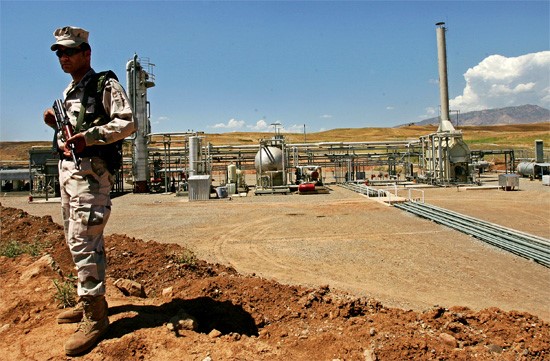
(Image: Oil and Gas People)

In the current age of impulsive #hashtag history and sound-bite ‘solutions’, we would all do well to refocus on how things actually got to where they are today. This tends to be perennially true in the Middle East, and yet politicians and mainstream media are always too eager to pave-over any historical context, instead favoring a boiled-down version of events, normally reduced to overly simplified, binary components like “good guys” and “bad guys”.

The situation in Syria and the Middle East intensified greatly last month after NATO member Turkey shot down a Russian Su-24 fighter, allegedly for violating Turkish airspace. Ever since that moment, the hot subject of investigation has been the black market oil trade of the so-called Islamic State, and more importantly, what is Turkey’s role in either allowing, or facilitating this and other dark enterprises that could be fueling the violent jihadist conclave currently infesting both Syria and Iraq.

If you are still relying on the mainstream media for your information, then what we will reveal below in this report might come as a shock to you. When you follow the ISIS oil money, it traces straight back to the west.

The constant coverage of terror and warfare of the region may subside or rise like the tide, but just like the ocean it always seems to be there. You see the surface and stare out at the horizon and can start to wonder what is really going on down there. To fully understand the full scale and scope of this issue, we will first briefly lay out the historical and geopolitical parameters in this region – but also look at how the story that is being sculpted by western media and political operatives – differs from the reality on the ground.

One key region that drifts in and out of the Middle Eastern narrative with western news coverage is Kurdistan, specifically the Regional Government of Kurdistan in Iraq, commonly referred to as the ‘KRG’. To understand how important Kurdistan is in this story, let’s also look at the wider region.

Since 2003, Iraq has been one of the world’s premier money pits. The billions upon billions of US dollars, money, arms, ‘aid’, contracts, bombs, in essence warfare — whether or not under that name, and endless reams of rhetoric out Washington D.C., London, and Paris – all unfold incessantly on the nightly news.

Everything tried up to now seems to have unilaterally failed to alleviate tensions in the area, and many have rightly argued that western intervention has actually propagated tension. With the endless variables of peoples, interests, tribalism, religious factions and new governments, juxtaposed with allegiance-shifting and double-dealing, all from nations within and outside of the region itself, it can easily stop making sense. Simply put, the Middle East, ISIS, and the crisis in Syria is complexity at its most complex.

Behind the US, other European players have willingly joined the party too. Recently, France has increased its air campaign against ISIS after the recent Paris attacks and within the context of public angst built-up over months from what Europeans perceived as a refugee wave and ‘migrant crisis.’ Britain’s Parliament also voted to start their own ISIS bombing campaign within Syria as reported by 21st Century Wire, and the jets were hitting targets in Syria within hours. Each of these international players has some economic and geopolitical stake in the region.

On top of this, United States is also “taking new steps” against ISIS with its conventional military on the heels of an alleged ISIS-linked attack in San Bernardino, California.

The Arab Spring That Wasn’t


As the Arab Spring made its way to Syria in early 2011, early opposition demonstrations quickly gave way to violence – on both sides of the political divide, protesters and the government forces. Hoping for a repeat of Egypt and Tunisia, the opposition failed to oust Syrian President Assad out of power, and the opposition’s armed insurgency rapidly gave way to a fully internationalized Syrian Conflict which, nearly 5 years later, still has not removed President Assad (much to the frustration of central planners in Washington, London and Paris). Out of these efforts, and from dubious arming of militants in the region for ages, the world now has ISIS and a myriad of other armed Jihadist and Salafist terrorist groups to contend with.

So what became of the Arab Spring? In his article, Shifting Priorities: The Rise and Fall of Arab Revolutionary Discourse, Ramzy Baroud writes:

“The Arab world, and the Middle East, in general, has not experienced such a major geopolitical upheaval since the early 20th Century, when Ottoman territories were divided among old colonial European powers, all the way to War World II. The outcome of this upheaval is likely to be as earth shattering as these past experiences, if not more, due to the popular element in these conflicts. But one of the most defining shifts of “Arab Spring” priorities is the reversal of the narrative from its basic, innocent, unifying, empowering and popular articulation, into a complicated, cunning, disuniting, disempowering and elitist one, where the people do not matter, in the least.

Over time, the most democratic of displays have given way to the most undemocratic of intentions.”

What are those intentions, and have they been there all along?

Regime Change Road Show


In his speech on August 18th, 2011, US President Barack Obama used his position to delineate the western foreign policy goal of regime change, articulated through a mainstream narrative of ‘democracy’ and ‘the rights of the people’. That very same day, the Council on Foreign Relations (CFR), a globalist think tank, also called for regime change. Is it coincidence, or is it coordination?

To understand how this was all shaping-up at the time, this article is a must read, accurately reported on over 4 years ago by 21st Century Wire.

To be clear, despite the endless rhetoric and insistence by western media and politicians, defeating ISIS is not the number one objective in Syria and Iraq. Whether its Obama, John Kerry, Hillary Clinton, David Cameron, Francois Hollande, or Recep Tayyip Erdogan – no matter who is giving the speech – each and every time the Syria discourse advances, a regime change caveat of ‘Assad must go’ is always inserted as the prime objective before anything else. It is this western caveat which many believe all but guarantees a further protracted conflict in the region.

Syria: Anatomy of a Secular Nation State


How did the Middle East, particularly the area in and around modern Syria, become such a ethnic, cultural and religiously diverse place, and the “free-for-all” we see today? Was it prior colonial planning or merely opportunity, or both?

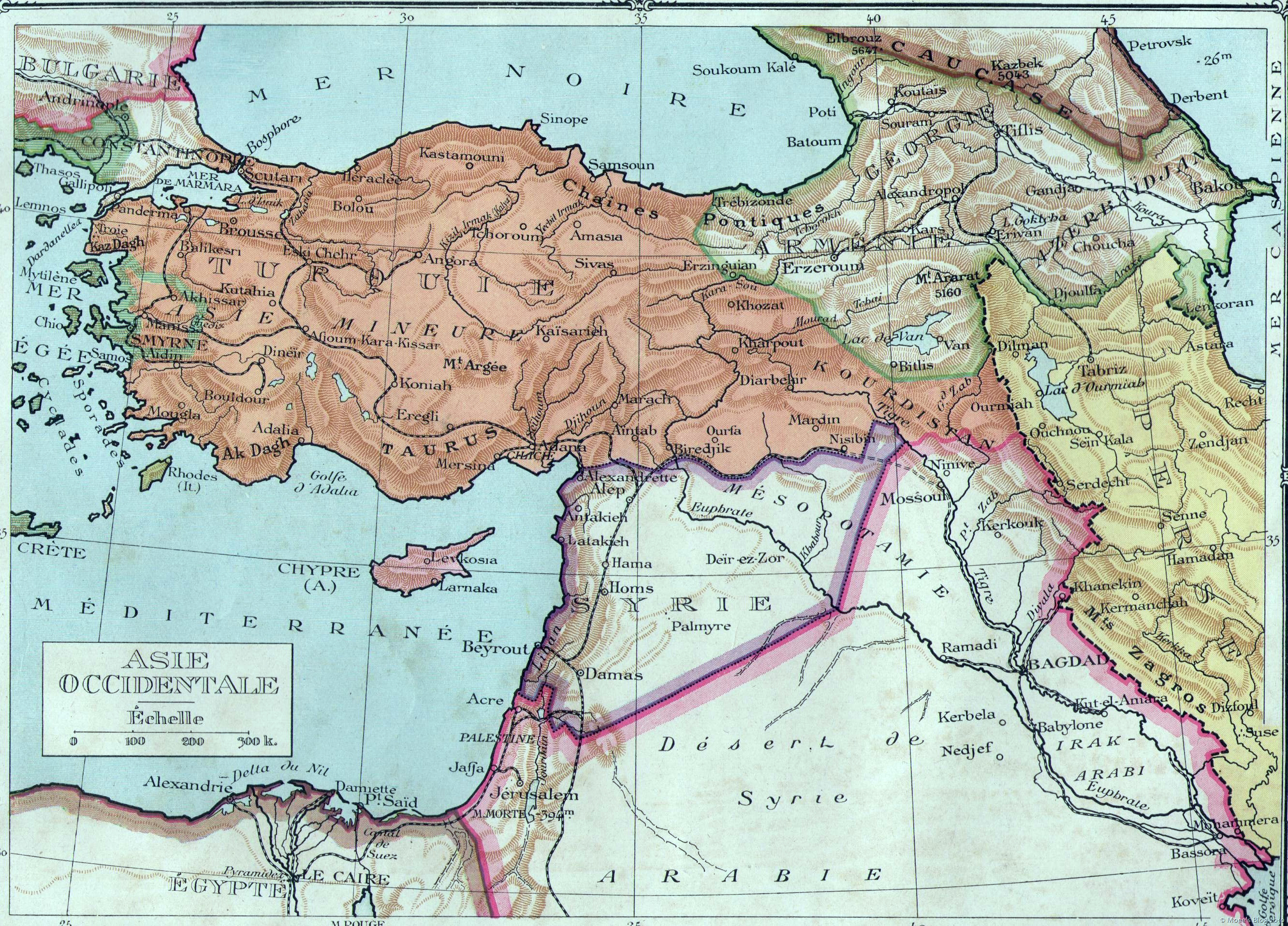
Below is a quick primer, or perhaps a refresher, utilizing maps, as drawn by history’s victors. One can definitely go back further in time, and many veritable libraries have covered the subject, but let’s use the Ottoman Empire as it looked on a map just prior to World War I as a starting point.

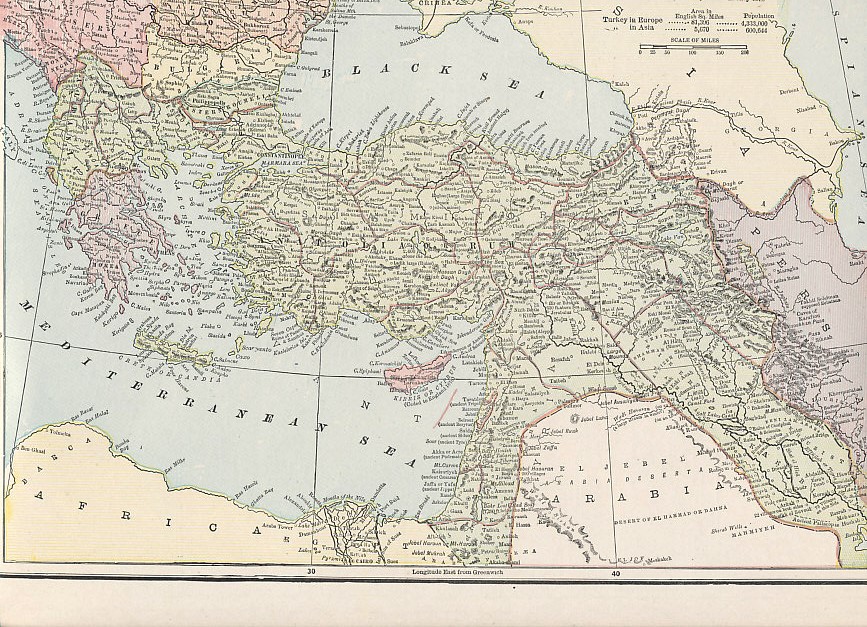
The region in 1914: In existence since the year 1299, the Ottoman Empire expanded and contracted over 700 years but looked something like the following around 1914.


Around 100 years ago there was no Syria, Iran, Iraq, Israel,
Palestine, Saudi Arabia, or a host of others (Image: World War I Today)


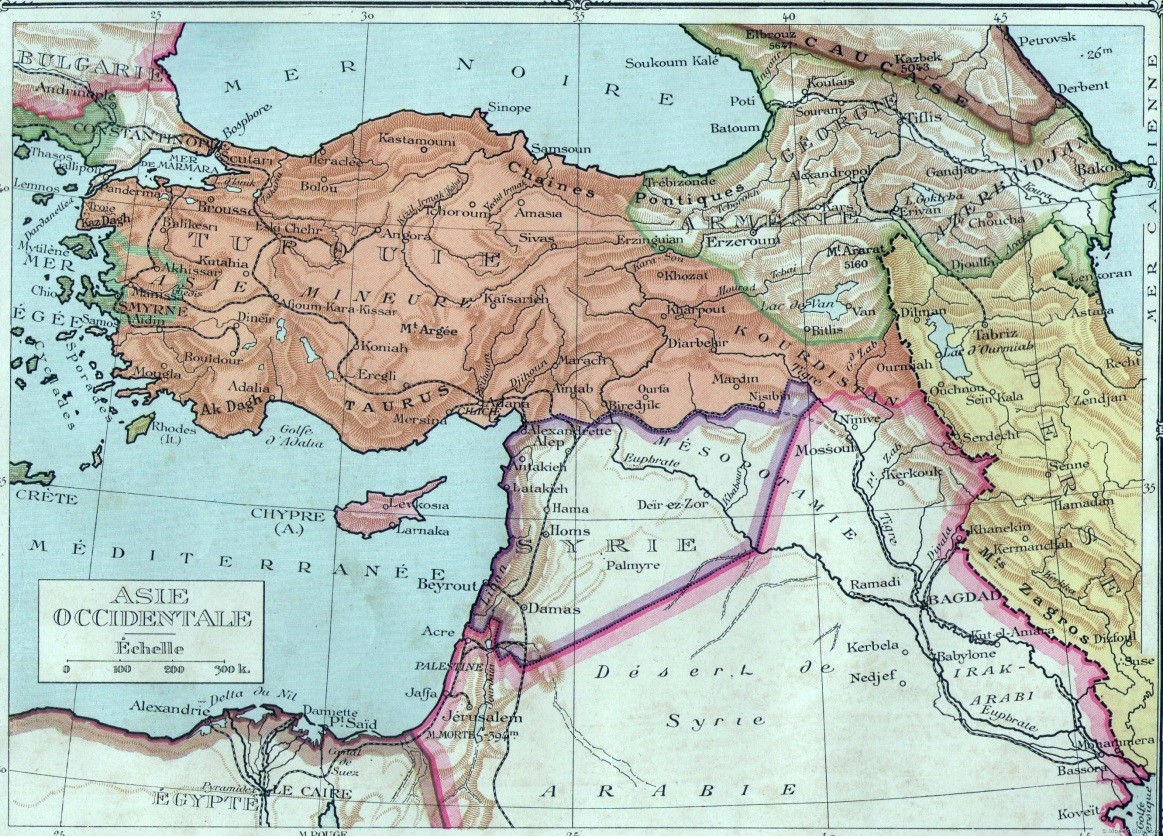
World War I is considered to have officially ended on 11 November 1918, with the post war arrangements worked out in the Treaty of Versailles; however, regional plans for the Middle East were already in the works, as Europe’s grand neocolonial, modern map-making exercise, embodied in the secret Sykes-Picot Agreement.

Here is a Sykes-Picot influenced map after the end of World War I, in 1918.


An area to divide once conquered? (Image: BritishEmpire.co.uk)


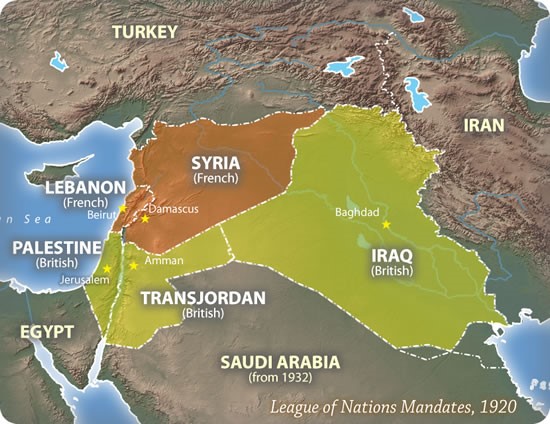
Not really designated outwardly on the above map, below is a better look at the region in terms of ownership – after World War I, and further negotiations could be seen within the League of Nations Mandates.


(Image: NPR)


Note the French and English areas of influence marked, along with Saudi Arabia which became a nation in 1920 within the parenthesis on the above map.

The Middle Eastern map was literally drawn out of plans dating back to the Sykes-Picot Agreement two years before World War I ended. A Smithsonian Magazine article about the 1916 Sykes-Picot Agreement between states:

“Besides carving the region into British and French ‘spheres of influence,’ the arrangement specified various commercial relations and other understandings between them for the Arab lands … Indeed, the treaty set aside the establishment of an independent Arab state or confederation of Arab states, contrary to what had previously been promised, giving France and Britain the rights to set boundaries within their spheres of influence, ‘as they may see fit.”

Ever since then, western powers have literally been busy “mapping the future of the Middle East” — pun intended. Regime changes of recent times, like Iraq’s Saddam Hussein, Libya’s Mummar Gaddafi, and currently with Syria’s Bashar al-Assad, seem to be preliminary attempts to erase, and then re-draw lines within regions long considered spoils of war and possessions of conquerors. A resource dependent, and ally-switching form of Gerrymandering which requires sustained military and geopolitical muscle.

In light of the above, it is interesting that besides Russia (invited to assist in anti-terror operations by the Syrian Government) and United States, the most active nations in the region today are France and the United Kingdom.

As the map changes, or has the potential to, particularly if Syria falls (even partially), the warfare can also be time with territorial opportunity. Bear this in mind as US leaders all insist on establishing a ‘Safe Zone’ (aka No Fly Zone) along the Turkish border in Northern Syria. This is the first step necessary in first balkanizing and then eventually redrawing the region map.

Enter Kurdistan.

One area and group of people left out of original Western considerations, perhaps intentionally, was Kurdistan. Map drawing parties excluded the Kurds despite being seen in earlier Arabic maps which note its existence. While not given much in the ways of national boundaries on any maps, Kurdistan and the Kurds where there for hundreds of years and well before World War I. Being left off maps by Westerners and without a territory to call its own on is different than merely not being there, as was the case with Israel after the Balfour Declaration and prior to its creation in 1947.

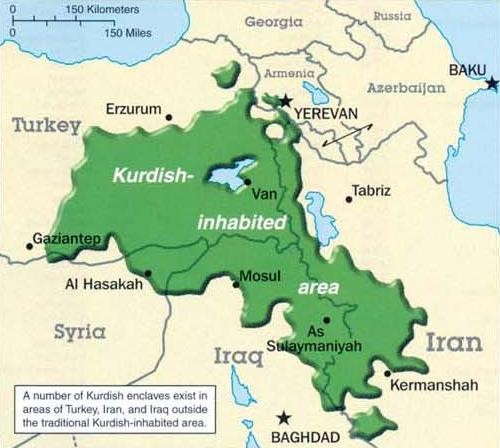
There are many “versions” of what Kurdistan today really is. One version is seen below.


(Image: WikiCommons)


Spanning primarily across Turkey, Syria, Iraq, and Iran, to include geographically isolated pockets between Syria and Turkey, Kurdistan is anything but “united” as it stands today; it is in fact a geo-cultural region, instead of a country.

Far from united, Greater Kurdistan is also rife with its own numerous infighting and competing interests and splinter government structures, but this report will focus on Kurdistan within Iraq, otherwise known as the Kurdish Regional Government or (KRG). This is the portion of Kurdistan that is interfacing directly with international super powers and their transnational corporations, and are involved in defense, and many offensives against ISIS who have surrounded its territory which includes some ground lost by Iraq.

Kurdistan: From Autonomy to Independence


While oil makes the KRG’s relationship with Baghdad a finicky and contentious one, it is also these profits that are keeping it buoyant and still attractive to direct foreign investment. The more the KRG deal with their oil and do not treat it as a “squatters rights” profit share with Iraq, the more they do become their own nation which is unquestionably their desire.

KRG President Barzani pulls no punches as we read from a BBC article in July 2014.

“In the past month, Kurdish Peshmerga fighters have moved into previously disputed areas that have been abandoned by Iraqi security forces in the face of Isis’s advance, such as the oil-rich region of Kirkuk.

‘Everything that’s happened recently shows that it’s the right of Kurdistan to achieve independence,’ Mr. Barzani told the BBC.

‘From now on, we won’t hide that that’s our goal. Iraq is effectively partitioned now. Are we supposed to stay in this tragic situation the country’s living? It’s not me who will decide on independence. It’s the people. We’ll hold a referendum and it’s a matter of months.’”

More recently, during a trip to the United States in 2015 that included closed door meetings with American President Barack Obama, KRG’s President Barzani stated that a referendum for independence “will take place when the security situation is resolved” which implies at least the elimination of ISIS near the KRG borders. Any potentially real estate gained by ousting of Assad in Syria or strong-arming pressure on Baghdad to allow it for the people will likely contribute to popular sentiment for the KRG’s assistance against ISIS and appetite to do business.

Unquestionably, there is much money to be made here, so an arrangement could be worked out.

President Barzani’s drive towards KRG independence was definitely thought out under his leadership since 2005. The KRG are absolutely in the business of bringing in foreign companies and profiting off of oil, as do many others in the region, using the wealth of of other nations to invest and develop KRG-held oil and gas fields.

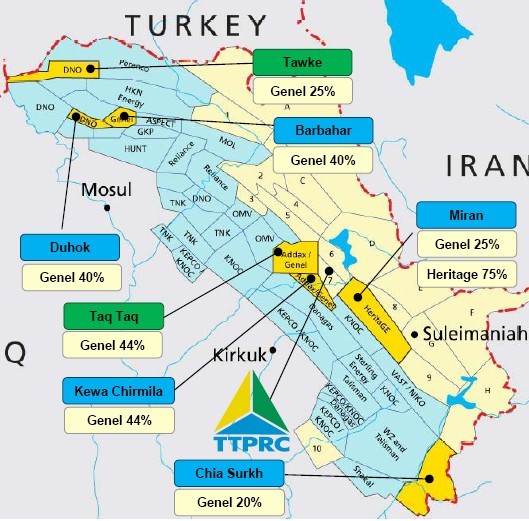
In certain respects, some maps of Kurdistan look like NASCAR sponsorship ornamentation, as seen below.


A number of western firms, including Genel Energy, are prominent
within the landscape (Image: Northern Iraq Info)


Business partners. The fastest way to “un-muddle” the region is to look at everything as a business relationship, or even like a mafia organization complete with kick-backs. The KRG is definitely a business partner with the world, in particular the United States and the United Kingdom.

There have been reports from an oil industry news source in 2010, GEO ExPro, who have reported on energy research into the Iraqi-Kurdistan area as far back in 2004, with western powers literal fawning over the potential of billions of barrels of oil on tap.

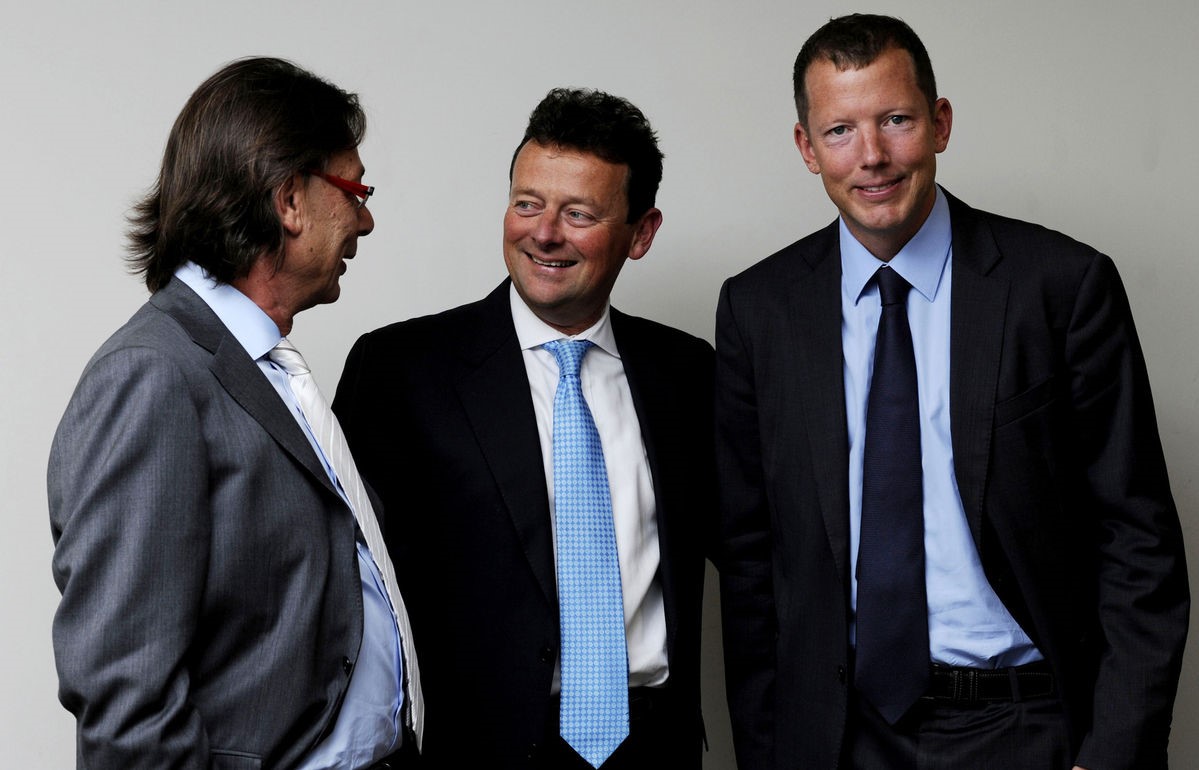
Are these gentlemen avid GEO ExPro readers?


Billionaires United: Why are these men smiling? Left to Right:
Mehmet Sepil, Tony Hayward, and Nathaniel Rothschild


Back in September 2011, Bloomberg Business reported how joint-British oil firm, Genel Energy opened a pipeline into Turkey for eventual export in 2014 and they state they have produced about 90,000 barrels of oil in the first half of 2015.

“Vallares Plc, the investment vehicle led by [British Petroleum] BP Plc’s former Chief Executive Officer Tony Hayward, will merge with Turkey’s Genel Energy International Ltd. in a $2.1 billion deal to gain oil fields in Iraq’s Kurdistan region …Vallares, a so-called “blank check” company founded by Hayward, financier Nathaniel Rothschild and [Goldman Sachs] banker Julian Metherell, raised 1.35 billion pounds ($2.2 billion) from investors … Mehmet Sepil, Genel’s CEO and owner of 29 percent of its shares, will become president of the new company.”

As far as globalist pedigree goes, Genel Energy is in the elite class for sure, led by Anthony Bryan “Tony” Haywood, and banking scion Nathaniel Philip Victor James “Nat” Rothschild, along with their ‘local partner’ Turkish billionaire Mehmet Sepil (who coincidentally ‘retired’ from Genel in October, good timing).

Tony Hayward, of BP Deep Water Horizon oil spill fame in the Gulf of Mexico, can be heard singing the praises of his new petroleum mother load stating, “’These are world scale producing fields,’ Hayward said on a conference call today. Kurdistan is one of the ‘last great frontiers in the oil and gas industry, with low finding and development costs, and proximate to significant markets.”

Business is good, as Bloomberg Business continues:

“The founders are set to receive 6.67 percent of the company’s share capital on completion of the Genel transaction, valued at $286 million. Hayward contributed 8 percent of the founders’ capital, putting him in line to receive $22.9 million of shares. Rothschild contributed 80 percent, yielding him a $100 million profit on his 80 million pound ($128 million) investment.”

These are the individuals involved, and the numbers are truly staggering. It’s good to read GEO ExPro and have a few hundred extra million hanging around. One probably does not throw around that kind of money without assurances.

Big names attract big investors in search of the next “sure thing”. Forbes ran a feature entitled, ‘How To Invest With A Rothschild – In Iraqi Oil’, excited over the prospect of parking your money with an elite rock star like Nat Rothschild.

But is it all really above board?

Blood for oil for cash


Now for the dark side of this trade. It’s also the most profitable too. ISIS is stealing oil in Syria and Iraq, and dumping it on the blackmarket cheaply for quick and easy cash. Whoever is buying this oil can then sell it for double or triple the profit.

In a recent report, investigative journalist Nafeez Ahmed explained who and what is involved here:

“The [British] Foreign Office meetings included three receptions hosted by British Petroleum (BP), including a “high level dinner” to discuss “global energy challenges”; a Genel Energy annual reception; and a lunch meeting with Centrica Energy “on business prospects in the Middle East.”

British firms BP and Genel are heavily invested in Iraq. BP is involved in the giant Rumailah oil field and the huge northern Kirkuk field in the Kurdish region, while Genel is invested primarily in Iraqi Kurdish fields of Taq Taq and Tawke.

An exclusive investigation in July by INSURGE intelligence uncovered startling evidence that the Kurdish Regional Government (KRG) and Genel are tied to local firms secretly facilitating black market Islamic State (ISIS) oil sales. The Foreign Office did not respond to requests to comment on these findings.

In a sister report to this, the author adds:

Using a carefully cultivated network of intermediaries and ‘middlemen’ in the Kurdish region of Iraq, as well as in Turkey, ISIS has been able to produce a phenomenal 45,000 barrels of oil a day, raking in as much as $3 million a day in cash by selling the oil at well below market prices.

But the sheer scale and impunity of this oil smuggling network has caused local politicians to ask whether certain officials in the KRG and Turkey are turning a blind eye to these operations.

Many believe that this sophisticated smuggling network directly implicates the embattled Turkish leader Tayyip Erdogan.

So ISIS is battling Kurdish Peshmerga fighters in Northern Iraq, as ISIS moves its oil through Kurdish territory into Turkey for sale, while Turkey wages airstrikes against Kurdish PKK militias in Kurdistan, Iraq? The inter-workings of these relationships are much more complex than most people would care to know, or any western politician or new anchor would ever want to admit.

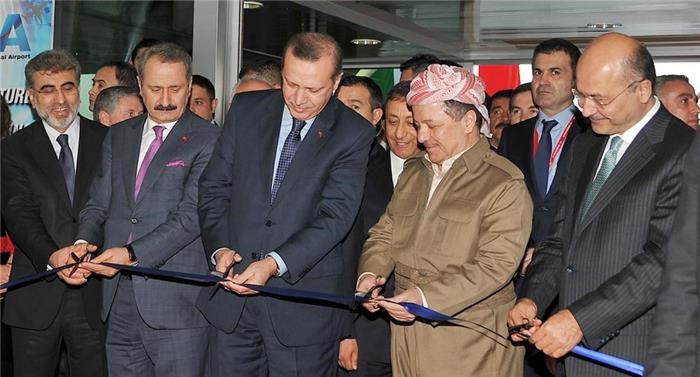
Earlier in 2011, KRG Barzani and Turkey’s Erdogan met in Irbil. The KRG’s website proclaimed:

“In his speech at the opening of the new consulate, Prime Minister Erdoğan said, ‘Last year Turkey did more than $7 billion worth of business in Iraq, and more than half of that with the northern provinces [KRG controlled]. There are more than 20,000 Turkish workers currently holding permits to work in Erbil governorate,’ … As this demonstrates, there is a strong economic relationship between Turkey and this region, he said. The consulate already issues visas to Iraqi citizens, which has helped to strengthen ties. Following the public events, President Barzani and Prime Minister Erdoğan held a private meeting to discuss bilateral relations, economic ties and cooperation on energy.”

One wonders. Did Genel Energy and pipeline security ever come up?


Prime Minister Recep Tayyip Erdoğan in a historic visit today became the 
first Turkish premier to visit the Kurdistan Region. Together with President 
Masoud Barzani, they officially opened Erbil International Airport (EIA) 
and Turkey’s Consulate in Erbil 
(Image Source: Kurdish Regional Government website)


Opportunity knocked in 2011, or planned much earlier? Remember, the Arab Spring and Syrian Civil War, all got going in Syria around 2011.

The Pipelines


Back in October of 2012, 2b1st Consulting published an update regarding Genel Energy:

“Genel energy is reviewing its plans to deploy its oil export pipelines in Kurdistan. A first pipeline is under construction by the Kurdish KAR Group between the Taq Taq field to Khurmala Dome in the northern Kirkuk field. To be commissioned at the end of the year, this pipeline should connect Genel Energy to the Erbil refinery and the Iraq-Turkish export pipeline system. A second pipeline is planned between Khurmala Dome and the Feys Khabour pumping station at the Iraq-Turkey border.” 


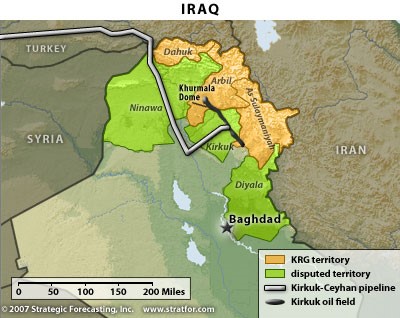
Note the planned oil pipeline on the map is dated 2007 


The eventual pipeline has allowed the KRG to move oil outside of the covetous eyes of Baghdad.

Why is this important?

ALMONITOR, in August 2015, stated, “The Kurdish government [KRG] will pay oil producers $75 million this month and plans to make regular payments for exports in future, it said in a statement last week. It exported 34.5 million barrels of oil valued at a total $2.87 billion through Turkey, bypassing Baghdad. The government received $2.1 billion in cash and $775 million worth of oil products.”

Iraq’s contentious relations with the KRG over signing its own deals with other major players in the oil industry, to include Exxon leaked late in 2011 right on the heels of the Genel Energy deal; Exxon already signed a $25 billion deal with the Iraq government in West Qurna field so this direct relationship drew the ire of Baghdad. However, direct deals seem to increase the chances for KRG autonomy and independence and are considered to be security insurance with regards to KRG strength by President Barzani.

The current list of companies doing business within Iraqi Kurdistan, or KRG is as follows.

Austria: OMV
Canada: Groundstar Resources, Niko Resources, Shamaran Petroleum, Talisman Energy, Vast Exploration, WesternZagros
China: Addax Petroleum
Hungary: MOL
India: Reliance Industries
Norway: DNO International
Papua New Guinea: Oil Search
Russia: Gazprom
South Korea: Korea National Oil Company
Turkey: Dogan Enerji, Genel Energy, Petoil
United Arab Emirates: Abu Dhabi National Energy Company (TAQA)
United Kingdom: Genel, Afren, Gulf Keystone Petroleum, Perenco, Sterling Energy
United States: Aspect Energy, Chevron, Hess, Hunt Petroleum, Murphy Oil Corporation

President Barzani’s tapestry of business partners, some with icy relations amongst each other, does appear to be a way to hedge his bets as a sort of “mutually assured” down payment on autonomy and security. Who would want to harm the oil and gas rich people without a country? Besides, areas in the South of Iraq are making exponentially more money anyway, producing upwards of 4 million barrels a day.

Business deals and monetary gains in terms of hundreds of millions of barrels and hundreds of billions of dollars make things in the Middle East, locally and outside of the region, a little more transparent.

The CFR has been at work educating everyone on how Kurdistan is friendly with the West and simply want autonomy as any group of people would desire. This angle cannot be denied — but is the human story driving the business side of the KRG, or is it the other way around? Watch:


Looking at the Middle East a bit more discerningly, it helps to understand that it has been militarized and set against itself. Kurdistan, and the KRG, is no exception.

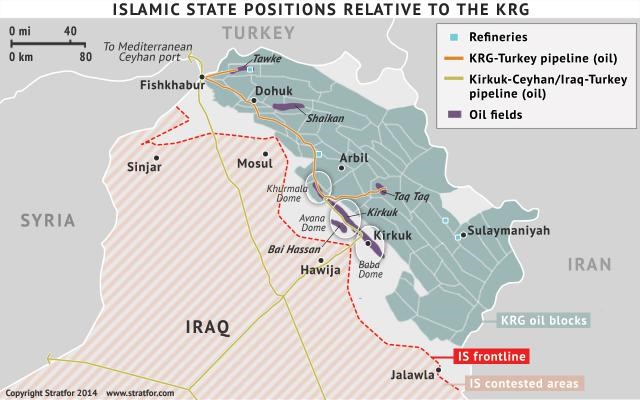
Only a year ago, Kurdistan and the real estate of its business-partners were at risk as we see below.


(Image: Stratfor.com)


This entire situation of course feeds into the military-industrial complex by arming every side of a conflict, stoking geopolitical fears of insecurity, and since at least 2001 — the exporting of terror. It also serves a myriad of other goals such as, securing assets and resources, or by taking them over.

For a veritable “blueprint” of Syria, the Middle East, and the western narrative of the ‘ISIS crisis’ today, written back in 2008, one could do worse than checking the Rand Corporation’s document entitled, The Unfolding Future of The Long War found here.

In this Rand Corporation document, the Long War “has been described by some as an epic struggle against adversaries bent on forming a unified Islamic world to supplant Western dominance, while others characterize it more narrowly as an extension of the war on terror.”

Within the Rand Corporation document you will find a literal course of action primer, or “trajectory”, for the way Middle Eastern nations have been handled by the West. If you have any reservations that Middle Eastern nations and cultures have not been analytically and scientifically reduced to assets or obstacles towards resource acquisition and profit, this document is likely to remove them.

International Racketeering


War for profit is not a new concept either, and resource grabbing and business deals are simply a way to diversify portfolios even beyond the scope of the defense industry.

Marine Corps Major General Smedley Butler is famously attributed the words, “War is a racket. It always has been. It is possibly the oldest, easily the most profitable, surely the most vicious. It is the only one international in scope … It is conducted for the benefit of the very few, at the expense of the very many.”

When wars are fought on a large enough scale, victory can be a time of opportunity for the winners. The benefits of carefully planning national boundaries, selecting allies, and creating amicable trade partners for financial gain, has set up national leaders and their citizens for generations.

War, if maximized to its full potential by the shrewdest politicians, is not unlike organized crime in which loyalty has its rewards. After a resounding victory planned by a nation’s politicians and executed by its citizens, the “trickle down profiteering” can keep the average person complacent or happy with their leaders for lifetimes.

Since World War I, nations within the region and world powers have been ratcheting up their rhetoric and converging in on the nation that is still, for the moment, known as Syria, for some time now.

As militarization, “good business partners”, and control goes in the Middle East, so goes the ever-changing narrative.


These are the folks with the good human interest story and a lot of oil right? 
(Image Source: Thome Review)


READ MORE SYRIA NEWS AT: 21st Century Wire Syria Files

EU's Russia Sanctions Pushback: Italy Breaking Ranks

A Case for Sanity: Italy Is Pushing Back on Renewed EU Sanctions Against Russia

by Patrick Henningsen - 21st Century Wire

December 10, 2015

EU officials are hoping to renew its economic sanctions against Russia. This can only mean one thing: More economic pain for Europe.

The current round of EU sanctions is due to expire on January 31, 2016. The trade ban includes cutting Russia off from European funding sources, industrial trade, food, energy and oil, as well as an endless list of other items and caveats.

While this has certainly hurt the Russian economy, it’s also damaged the West’s bottom line too. A recent study commissioned by the Austrian Institute of Economic Research (WIFO) revealed that sanctions EU against Russia – and Moscow’s reciprocal moves against the EU – are costing Europeans approximately 100 billion euros and is jeopardizing up to 2.5 million jobs, including a loss of 465,000 jobs in Germany, 215,000 jobs in Italy, 160,000 in Spain, 145,000 in France, and 110,000 jobs in Britain.

Luckily, there’s someone in Europe who’s still holding out a candle for sanity. It seems that Italy is offering a remedy to some of Europe’s economic pain. It’s a revolutionary concept: daring to put its own economic and national interests ahead of Washington and Brussels half-baked, geopolitical machinations.

The obvious question for the rest of Europe: is there a good reason for doing it?

To answer that question, you need to understand what is the West’s core political justification for keeping up with the sanctions. The official western propaganda line goes as follows:

“We need sanctions against Russia in order to uphold a peace agreement and end the conflict between Ukrainian government forces and Russian-backed separatists in eastern Ukraine that has killed 9,100 people since April, 2014.”

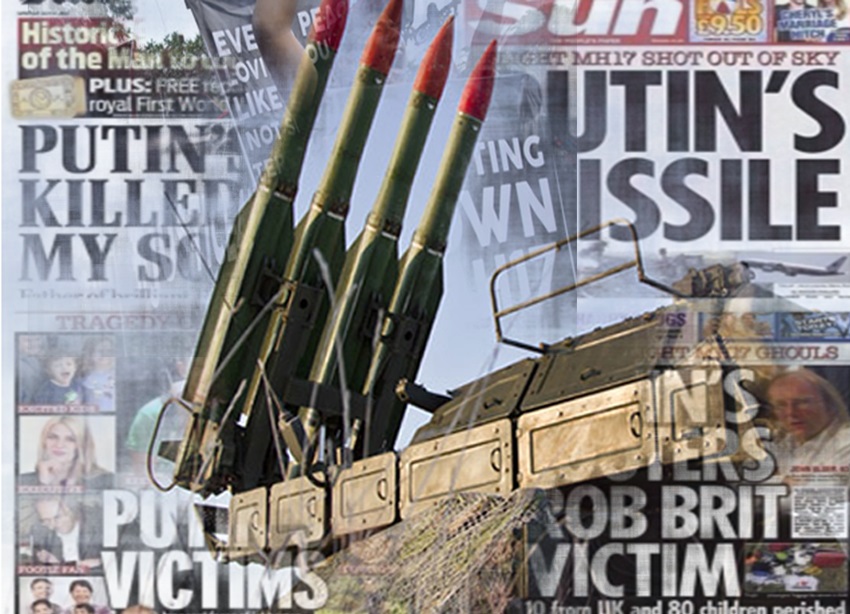
This line might play well in the reality vacuum that exists between Washington DC and Westminster, but not as much elsewhere. It’s a political fiction which is becoming harder and harder to sell. The reason is that the primary sales pitch for Russian sanctions was based on the Downing of Flight MH17 which European and American leaders immediately tried to somehow blame on Moscow. The initial propaganda pushed worked well enough to get sanctions off the ground, but the main problem now for Washington and its reluctant EU surrogate is that no one actually believes the old fairy tale.

Hence, anyone with a brain is now starting to ask: with Europe’s economy suffering, and no proof that Russia had anything to do with MH17 – then what’s the point of sanctions in the first place?

Whether or not you believe that MH17 was a genuine accident, or was a prefabricated event designed to trigger a call for sanctions – makes little difference now. The fact remains that there never was, is, or will be, any real evidence to convict Moscow over the MH17 incident. If there was then it’s certain we would have already seen it by now. Conversely, base on motive, intent and means, there is a very compelling case to suggest that Western interests are behind an MH17 false flag event.


THE MH17 NARRATIVE: One lie led to another.


No matter how you cut it, Europe must have total political unity in order to maintain any international sanctions regime against Moscow. The EU’s original plan was to simply wave through” the extension of Russian sanctions as a minor agenda note, hoping that no one would notice or demand any debate on what appears to be a Washington-imposed policy of geopolitical containment aimed at Russia.

Brussels technocrats may have expressed some public shock that Italy would dare to attempt to force a democratic debate on the issue, but in private you can be sure that Washington dissenters are everywhere.

Thompson Reuters reported earlier today:

“Italy unexpectedly demanded that a mooted extension of the European Union’s economic sanctions on Russia go for further discussion within the bloc rather than be rubber-stamped by EU envoys who met on Wednesday. The envoys aimed to approve a six-month extension to the sanctions, imposed on Moscow last year over the Ukraine crisis, without discussion after an agreement by EU leaders – including Italian Prime Minister Matteo Renzi – in the wings of the Group of 20 summit in Turkey last month.”

Rome breaking ranks on this issue could be risky for Brussels, so expect some push-back or good fashion political blackmail (or another bizarre international incident) waged by sanctions proponents.

If Italy falls, then expect others to follow. Add to this the newly developing situation in Syria and a renewed international imperative for cooperation there, and you’d expect even more reason for European leaders to want to work with its neighbor Russia, rather than against it (as Washington would like).

When Europe eventually sees the futility of the Russian sanctions facade, then Washington will be isolated, alone with its dysfunctional basket case of a regime in Kiev as the surviving partner on this flagging initiative. In terms of the United States as a main broker of international peace and prosperity, no real progress can be made in the Middle East, the Ukraine or anywhere else, so long as Washington insists on a policy of diplomatic aggression against Moscow. It will simply block any route to mutually beneficial bilateral negotiations.

High Hopes in Geneva?


Russian Foreign Minister Sergei Lavrov told Italian newspaper La Repubblica in an interview this week: “As long as Obama’s deputy Joe Biden goes around Europe recommending continued sanctions against us without taking into account how Kiev is behaving under Western pressure, we will not be able to reach any understanding.”

As much as the world would like to see Washington drop its imperialist NATO-driven lunge into the Eurasia heartland, no one is really holding their breathe. Reports of more NATO-backed paramilitary activity in the Crimea (Nazis and Jihadis, fighting shoulder to shoulder, for OTAN?) should be a cause for worry. That’s a story which has been completely blacked out in the western media, for obvious reasons.

Lavrov will join Russian President Vladimir Putin next week to meet U.S. Secretary of State John Kerry, and others – to discuss the conflicts in both Ukraine and in Syria.

That should be interesting.


READ MORE EU NEWS AT: 21st Century Wire EU Files

When Terrorism Isn't: Suspect in Dawabsha Fatal Arson Case Released to House Arrest

Israeli Legislator: Firebombing of Dawabsha family 'not an act of terror'

by IMEMC News 


December 12, 2015

Israeli Knesset Member Bezalel Smotrich stated on Thursday that he did not consider the burning to death of a Palestinian family to be an act of terror.

His statement came on the same day that the main suspect in the attack, an Israeli right-wing settler, was released from prison.

Smotrich published a column in the B’Sheva weekly newspaper, saying that the attacks carried out by extremist Israeli settlers, including so-called “price tag” attacks, are not to be classified as terrorism.

“Terrorism is only violence carried out by an enemy within the framework of war against us, and only that [type of attack] justifies taking severe steps”, he wrote.
“All the rest are serious crimes, abominable crimes, nationalist crimes, but not terrorism.”

Smotrich was referring to the arson attack and murder of a Palestinian father, wife and little child in the village of Douma, in the occupied West Bank city of Nablus, at the end of July:

He wrote, “The murder in Douma is not an incident of terrorism, Period.” He added,

“Whoever calls it terrorism is deviating from the truth, causing mortal and unjustified harm to human and civil rights".

Defending the extremist illegal Jewish settlers who perpetrated the crime, he wrote that characterizing the attack, which involved throwing firebombs into the home of a sleeping family and burning them to death, "cheapen[s] the term 'terrorism', and, as a result, at the end of the day, damaging the effectiveness of the battle against it. We are not in a war against Jews.”

Israeli security arrested a man -- a Shin Bet agent, according to 'Days of Palestine' -- suspecting him of taking part in the attack, but refused to charge him, claiming there is not enough evidence against him. The authorities released him and only put him under house arrest for five days.

Smotrich criticized this arrest, claiming this would lead to [the extremist right-wing Jewish] community feeling oppressed. He then continued with this line of thought, saying that this feeling would lead to an explosion of violence carried out by these right-wingers.

Then, “no one should be surprised when that happens, when more and more people are pushed against their will into acts that they must not commit,” Smotrich wrote.

See: Suspect in Dawabsha Case Released to House Arrest

A Real War on the Christmas Spirit: Yule Tide for Palestine's Christians

Chief Complaint and the Spirit of Christmas

by Mazin Qumsiyeh - Popular Resistance

It is sometimes had to develop a spirit of Christmas under occupation. On Friday 17 Palestinians were injured by Israeli occupation forces in Bethlehem including a friend of mine. Rehab is a photographer who was there to document what is going.

Targeting journalists and photojournalists is not new to the Israeli regime and has been practiced since 1948. One journalists and writer who is held without trial has been on hunger strike since 25 November is Mohammad AlQeeq.

Atrocities continued... 


The Israeli officials continue to call for more racist killing of Palestinian natives who are merely asking for  freedom after decades of Israeli colonial occupation. Ministers call for murder and ethnic cleansing. One member of the Israeli Knesset even supports the burning of Palestinian children alive (saying this is not terrorism for Jews cannot commit terrorist crimes).

The Israeli system refused to punish those who actually did such a horrible deed on a 13 year old Palestinian child. But I digress.

How are we to develop a spirit of Christmas and what actually is the spirit. I was in an exceptionally filled church today in my town of Beit Sahour (the Shepherds’ Field where shepherds were told to go see the newborn Jesus some 2000 years ago according to Christian tradition). My mother and I went to church because of two deaths and we needed to participate and share with families.

Hundreds of town people gather and then go to a big hall where families of the deceased gather to receive condolences. As two deaths were involved both halls of the church were filled with people. I find these gatherings strangely uplifting. There is so much love. So many people sharing and hugging and shaking hands and asking each other genuinely “how are you”; in some other places that is a formality but not here in these gatherings when people actually mean it.

Here as we sipped coffee and ate special “church bread” when they ask me how am I doing, I am free to tell them that I was sad at the injury and death of friends (either naturally or via Israeli actions), sad at continued starvation of Gaza, sad at seeing a video of a young Syrian refugee family that lost one of their two daughters in the sea but I am happy that there are so many good people doing great things to help each other (we just received one more volunteer from Germany yesterday). I then contemplated that I can find the spirit of Christmas (Jesus’ message of love and kindness to one another) even in sad occasions.

I recommend highly for you to send as a gift to your friends and relatives as a gift for Christmas one or both of Dr. Hatim Kanaaneh, MD, MPH books "Chief Complaint: A Country Doctor's Tales of Life in Galilee” Just World Books, 2015 and 'A Doctor in Galilee: the Life and Struggle of a Palestinian in Israel', Pluto Press, 2008 Active Blog: http://a-doctor-in-galilee.blogspot.com/ (Dr. Kanaaneh will donate his portion of the sale of his newer book to the Palestine Museum of Natural History).

We have this calendar of Palestine Natural History available and proceeds help Palestine's children in Gaza and PMNH activity (also involving children but in the West Bank). It is available in Palestine directly from
the Museum or you can order it online at: http://shop.hopeandplay.org/collections/2015-christmas-collection/products/2016-calendar-of-palestine-natural-history

We will have an all-volunteer meeting in Bethlehem December 21. Please notify us if you can come (send email to info@palestinenature.org). We will review accomplishments this year and plans for next. Incidentally we just got our latest research paper accepted for publication (on butterflies) as well as two other papers. We also completed a research paper on reptiles. We further welcome donation to the Museum (see
http://www.palestinenature.org/support-us/ )

Walking with Abraham: a journey through Palestine, Israel and beyond – in pictures
http://www.theguardian.com/world/gallery/2015/dec/11/abraham-path-palestine-israel-walking-tourism

1,000 Black Activists, Artists, and Scholars Demand Justice for Palestine: Full-text of statement from Angela Davis, Cornel West, Talib Kweli, the Dream Defenders, Hands Up United and other prominent organizations and leaders.

Read more at EBONY
http://www.ebony.com/news-views/1000-black-activists-artists-and-scholars-demand-justice-for-palestine-403#ixzz3u09vqBBp

Stay human and come visit us in Palestine

Mazin Qumsiyeh
Professor and Director
Palestine Museum of Natural History
Bethlehem University
Occupied Palestine
http://qumsiyeh.org
http://palestinenature.org

Left Off the COP21 Agenda: "Can Both Capitalism and Mankind Survive?"

US Journalists Duck the Big Climate Question: Can Capitalism and Mankind Both Survive?

by Dave Lindorff  - This Can't Be Happening


December 09,2015

Scientists have for decades recognized climate change as an existential crisis facing mankind, but the US media, hamstrung by a self-inflicted obsession with presenting “both sides” of every story even when there is only one, have only begun recognizing its gravity. And a huge barrier still prevents climate change from being honestly reported.

That barrier is a mainstream journalistic inability to address the central role global capitalism plays in propelling climate change, and to expose the determined, collaborative and usually carefully hidden, role it plays in stymieing the profound government actions needed to prevent or at least fend off catastrophe.

We see plenty of heartening news reports in the mass media about companies becoming “greener,” investing in “sustainable” production technologies like solar panels on rooftops or geothermal heating systems, for example. We learn that some tycoons like Bill Gates plan to pour billions of dollars into research on carbon-free energy alternatives. But wholly missing are stories about how economic growth and marketing-driven consumer demand guarantee increased carbon emissions and enhanced global warming that will swamp any such baby steps.

Consider Newsweek’s annual list of America’s Greenest Companies [1]. It includes many financial corporations which produce nothing but paper, and whose greenhouse gas contribution is limited to their office buildings. Look closer, though, and it’s clear that sustainable or not, such companies don’t belong on any “green” list. Case in point: Topping the list’s financial companies are two insurance firms -- Metlife and Aflac Inc. -- followed by that arch-villian of the 2008 Fiscal Crisis, Goldman Sachs. All three financial giants, while perhaps running green offices, invest heavily in industries that contribute massively to climate change. Metlife, for example, is one of the country’s largest institutional investors, with almost half a trillion dollars invested worldwide. The company touts its goal of becoming carbon neutral in its global operations, but says nothing about running a carbon-neutral investment portfolio, and that’s because it does not run one. The same is true of Aflac.

Investment policies aren’t even considered by the compilers of the Newsweek list.


Goldman Sachs, meanwhile, was the 11th-largest global coal-fired power plant investor in 2011, according to a Banktrack report [2]. This top-ranked Newsweek “green” bank isn’t alone; all the biggest US banks are big on coal. A few have started to back away in the past year, but that’s mainly because coal company stocks are falling, largely due to the temporarily increased availability of relatively cheap natural gas and oil, not because of any climate change concerns.


Companies can say they run green offices so they're "green," even as 
they spew ever more carbon into the atmosphere making their profits and products


Meanwhile, two top industrial companies on the “green” list are General Motors and Coca-Cola! The former aggressively builds and markets grossly over-weight gas-sucking SUVs in China and pushes high-mark-up, gas-swilling large vehicles in the US, and the latter, a massive global water waster, exists to make a product -- flavored sugar water -- that serves no useful purpose whatsoever.

Both companies score high on the Newsweek list for “reducing their carbon footprint.” Great as far as it goes, but corporate journalism fails by not pointing out that sustainability efforts are irrelevant if the larger goal is producing more and bigger cars, or selling ever more bottles of carbonated sugar water, or in the case of financial companies, if they are funding businesses that pump out ever more atmospheric carbon.

Cartoonist Gary Trudeau nailed it in a recent syndicated Sunday strip. In it, public radio host Mark Slackmeyer, interviewing an oil exec who boasts about his industry’s expansion, asks if his guest worries about the world he’s leaving his grandchildren. “Not an issue,” the exec replies smugly. “I told my kids not to have children.”

Trudeau’s fictional journalist has done something mainstream journalists simply won’t, which is to ask corporate executives, including those featured in glowing articles about their “sustainability” programs: “How do you sleep at night when you know your company is helping to trash the climate, even for your own progeny?” We need to hear answers to that question, but we won’t if the question isn’t even posed to them.

Earth’s climate is approaching dangerous tipping points of no return. The UN Intergovernmental Panel on Climate Change (IPCC) has yet to factor into its climate models the near certainty of catastrophic methane releases from the Arctic seabed and the permafrost underlying the Siberian and North American tundra -- releases that threaten to push global temperatures to levels never experienced in mankind’s history.

Some scientists warn this could happen any time -- indeed huge craters recently discovered in the remote tundra of Siberia caused by methane eruptions, and Arctic lakes and sea surface regions now “boiling” with released methane suggest it’s already happening. Meanwhile, Greenland’s ice sheet melt is accelerating, rendering obsolete ice-loss predictions almost as they’re being made.

Yet as bad as that sounds, things may well be worse, because it’s not just journalists who are ducking the issues. Scientists are facing similar pressures to soft-pedal their research findings on climate change. Universities increasingly are requiring professors, particularly in the sciences, to obtain research grants as part of their income -- nearly all of which are funded by corporations. And those corporations or corporate-backed foundations, even if they don’t say they expect a certain research outcome, impose constraints right at the application process on what they want looked into. As Kevin Anderson, a professor of energy and climate change at Manchester University in the UK explains,

“There is a very clear understanding amongst virtually all of the academics I engage with, whether directly on projects or simply through discussions following seminars etc., that 'growth' is sacrosanct. Economics trumps physics – and ultimately , from a funding and career perspective, given that it is unwise to suggest that our scientific conclusions beg questions of the economic framework of society, we find ways of reconciling the two. Not by fiddling data but typically by adopting expedient assumptions -– from the ubiquitous use of BECCS (bio-energy with carbon capture and storage) and very early global peaks in emissions through using increasingly low probabilities of meeting 2°C."

Such skewed academic research and media happy talk about climate-friendly businesses both obfuscate a grim reality: Only by reducing the amount of stuff produced and by dampening, not encouraging society’s acquisitiveness obsession, only by abandoning an economic model where growth is good and companies must grow or die, can there be any hope of avoiding the disaster of runaway climate change.

It’s hard to be optimistic that journalists themselves can do this. If academic researchers, most of whom have tenure and thus don’t have to fear being fired, are caving in to funding pressures to soft-pedal their findings or avoid addressing certain issues, like the role of consumer-driven capitalism and free-market economics in propelling increased greenhouse gas emissions, how much more vulnerable are journalists, who have no such job security? Fighting to tell the truth when the bosses don't want the truth told calls for a courage that is, sadly, in short supply these days in a profession where jobs are scarce and getting scarcer every year.

News organizations are businesses, and like Goldman Sachs and GMC, their sole objective is trying to grow revenues and profits. They want their sponsors or advertisers to prosper too, so they’ll buy more ads. Given that imperative, how can reporters, without jeopardizing their careers, suggest that businesses need to start reducing production? How can they challenge corporate executives who try to boost revenues by selling consumers more junk and unneeded stuff? Ask embarrassing questions like that and you’re likely to find yourself either fired or taken off the environmental beat and put on the restaurant reviewing staff or on obits (as happened to my friend and colleague, the late, great John Hess, when he got too edgy and on point in his reporting at the New York Times as a foreign correspondent in Paris).

US GDP is comprised 72% of consumer spending. If that spending drops, the economy swoons. If companies sell less, their stock plummets, CEOs are dumped and workers are sacked. Yet if rampaging climate change is to be avoided, production of non-essential goods clearly must be slashed. Houses and cars must become fewer, smaller and more efficient, clothing more utilitarian, mass transit more available, agriculture closer to where produce is consumed. Eventually, population growth must be halted and even reversed. And since the vast majority of the world's population that lives in poverty need to raise their standard of living, it means that the wealthy countries, and the rich in those countries, need to drastically reduce their consumption of goods and their carbon footprints. All that means that the whole global socio-economic system has to be radically changed. with far more of a focus on sharing, on equity and on community, and with a turn away internationally from the current focus on war and conflict.

American mainstream journalism isn’t saying these things. And it certainly isn’t asking the big question: Can capitalism and mankind co-exist? The reason journalists aren’t asking is that they know the uncomfortable answer is: No they cannot.

Yet if mankind is to reach the next century, we journalists need to ask that question. We need to ask a follow-up question too: If modern global capitalism is driving catastrophic climate change and is also preventing action to stop it, what needs to be done?

Note: A shorter version of this essay was originally written as a submission to a contest funded by the Women’s Economic Round Table and the Columbia University Knight-Bagehot Program. The topic was to write about “an aspect of climate change that you feel has been overlooked or where the press has missed the mark.” I did not expect my entry to win for obvious reasons, and in fact, this year’s winner was someone who wrote about how “quants” -- those investment managers who use mathematical algorithms to devise investment strategies -- are helping to make so-called “green” investments pay off financially. But of course, as I wrote above, the point is, what are they calling “green”? If for example, a quant develops a strategy to profit by investing in firms on Newsweek’s “green” companies list, that would be Goldman Sachs, GM, Metlife and Coke.


Links:
[1] http://www.newsweek.com/green-2015/top-green-companies-u.s.-2015
[2] http://www.banktrack.org/download/bankrolling_climate_change/climatekillerbanks_final_0.pdf

Russia Debates Banking Response to Western Financial Aggression

Interest Free Banking: Russia Debates Unorthodox Orthodox Financial Alternative

By F. William Engdahl - NEO

 22 November 2015

A significant debate is underway in Russia since imposition of western financial sanctions on Russian banks and corporations in 2014. It’s about a proposal presented by the Moscow Patriarchate of the Orthodox Church. The proposal, which resembles Islamic interest-free banking models in many respects, was first unveiled in December 2014 at the depth of the Ruble crisis and oil price free-fall. This August the idea received a huge boost from the endorsement of the Russian Chamber of Commerce and Industry. It could change history for the better depending on what is done and where it further leads.

Some 20 years ago during the Yeltsin era, within the chaos of Russian hyperinflation and IMF “shock therapy,” the Russian Orthodox Church introduced a similar proposal for interest-free banking as an alternative. During that time a gaggle of liberal pro-free-market Russian economists around Yeltsin, such as Yegor Gaider, prevailed. They instead opened Russia’s state-owned assets to literal plunder by western banks, hedge funds and corporations.

In my first visit to Russia in May 1994 to give a talk at a Russian economic institute on IMF shock therapy, I saw first-hand the lawless mafia, russkaya mafiya, speeding through the near-empty Tverskaya Street near Red Square in new state-of-the-art Mercedes 600 limos without license plates. It was a devastating time in Russia and Washington and the technocrats at the IMF knew exactly what they were doing to foster the chaos.

US sanctions focus attention


By 2014 much has changed in Russia. Most significantly, the infatuation with everything American of two decades ago has understandably vanished. The US Treasury financial sanctions were launched in stages in 1914 against specific individuals around President Putin, specific banks and corporations dependent on foreign credit. They had the effect of forcing a critical rethinking among Russian intellectuals, government officials and in the Kremlin itself.

The Washington attacks, legally-speaking acts of warfare against a sovereign nation, were initiated by the US Treasury’s Office of Terrorism and Financial Intelligence, the only government finance agency in the world with its own in-house intelligence agency. The Office was created under the pretext of going after and freezing the assets and bank accounts of drug cartels and terrorists, something it seems strangely inept at if we judge from their record regarding groups like ISIS or Al Qaeda in Iraq. It seems to be far better going after “undesirable” countries like Iran and Russia. It has offices around the world, including in Islamabad and Abu Dhabi.

Those US Treasury financial warfare sanctions and the prospect of much worse to come have sparked a deep debate within Russia on how to defend the nation from more attacks. Vulnerability to western sanctions in their banking system has led Russia, like China, to develop an internal Russian version of SWIFT interbank payments. Now the very nature of money and its control is at the heart of the debate.

Unorthodox Orthodox Proposal


In January 2015, in the depth of the financial crisis, with a Ruble at half what it had been months earlier and oil prices in a free-fall as a result of the September 2014 John Kerry-King Abdullah agreement, the Moscow Patriarchate reissued its idea.

Dmitri Lubomudrov, the Orthodox Church’s legal adviser told the media at that time, “We realized we couldn’t stay dependent on the Western financial system, but must develop our own. As with the Islamic system, the Orthodox one will be based not just on legislation, but on Orthodox morality as well, and will be an invitation to businessmen seeking security at a time of crisis.” Among its features would be interest-free credit issuance and prohibition of investment in gambling casinos or such activities going against Church moral values.

Then in early August this year the Orthodox plan for interest-free money creation gained a major added support. Sergei Katyrin, head of the Russian Chamber of Commerce and Industry, after meeting with Vsevolod Chaplin, the senior Orthodox cleric overseeing the project, announced, “The Chamber of Commerce and Industry supports the creation of the Orthodox Financial System… and is ready to provide its platform for detailed and professional discussion of these questions together with the relevant committees of the chamber.” The proposal is aimed at reducing Russia’s reliance on the Western banking system, an essential national economic security requirement.

Much as with Islamic banking models than ban usury, the Orthodox Financial System would not allow interest charges on loans. Participants of the system share risks, profits and losses. Speculative behavior is prohibited, as well as investments in gambling, drugs and other businesses that do not meet Orthodox Christian values. There would be a new low-risk bank or credit organization that controls all transactions, and investment funds or companies that source investors and mediate project financing. It would explicitly avoid operations with active financial risks. Priority would be ensuring financing of the real sector of the economy, its spokesman stated.

Interestingly, Russia’s largest Islamic autonomous republic, Tatarstan, recently introduced Islamic banking into Russia for the first time and it was supported positively by German Gref, CEO of the state-owned Sperbank, Russia’s largest bank. This May, Gref called it a very important instrument amid the current problems with raising funds on international markets. In July Sberbank and the Republic of Tatarstan signed an agreement on cooperation in the field of Islamic financing.

Under Czar Alexander III and his Finance Minister Nikolai Bunge, Russia established the Peasant Land Bank in the beginning of the 1880’s to give interest-free loans to the liberated peasantry that had been freed from serfdom in 1861 by his father, Alexander II and given land. The Land Bank invested in the modernization of Russian agriculture with farmers only paying a small handling charge for credits. The result was such a spectacular rise in Russian wheat, and other cereals that Russia became the world “bread basket” up to outbreak of World War I, exceeding the combined production of the USA, Argentina and Canada by some 25%.

Glazyev proposals


The new prominence of the Orthodox Monetary model in Russian discussions comes at a time when one of Vladimir Putin’s economic advisers, Sergei Glayzev, the person advising the President on Ukraine as well as relations with fellow-members of the Eurasian Economic Union, has presented a plan for enhancing Russia’s national economic and financial security under the quite sensible assumption that the financial sanctions and now military pressures from Washington and NATO are no whimsical accident but a deep-seated strategy of weakening and economically destroying one of the two nations which stand in a way of a globalist US New World Order.

In May 2014, a few weeks after the Obama Administration imposed a series of select sanctions on key Russian individuals, banks and energy companies, striking at the heart of the economy, Glazyev made an interview with the Russian financial paper, Vedomosti, in which he proposed a number of prudent defensive measures. Among them were several which are now policy. This has included a credit and currency swap with China to finance critical imports and a shift to settlement in national currencies–Ruble and RMB; creation of a Russian interbank information exchange system, analogous to SWIFT, for payments and settlements within the Eurasian Economic Union and other partner countries.

A strategic proposal of Glazyev that the state impose a halt on all export of gold, precious metals, and rare earth elements, and that the Central Bank buy up gold mined by foreign companies to build monetary gold reserve strength, was, unfortunately, refused by Central Bank Governor Elvira Nabiullina who told the Duma,

“We don’t believe that a moratorium is needed on gold exports. We are able to buy enough gold to diversify our gold and currency reserves.”

Nabiullina has come under criticism from members of the Duma for being far too slow in building the gold reserves of the ruble. Russia today is the world’s second largest gold producer after China, and China has been building its Peoples’ Bank of China gold reserves in recent years at a feverish pace. Western central banks, led by the Federal Reserve, since gold backing for the dollar was abandoned in August, 1971, have done everything, including brazen market manipulation, to discourage gold currency reserves around the world.

Most recently, on September 15 Glazyev presented a new series of economic proposals to the Presidential Russian Security Council to, as he stated it, reduce the vulnerability to western sanctions over the coming five years and achieve foundations for long-term growth and economic sovereignty. Among his proposals were creation of a State Committee on Strategic Planning under the President of the Russian Federation, together with a State Committee for Scientific and Technological Development, modeled on a system created in Iran during the 1990s following the introduction of Western sanctions there.

The first measure, creation of a Committee on Strategic Planning, echoes the highly successful French national Planification model introduced under President Charles de Gaulle, that was credited with transforming France from a stagnant peasant-dominated economy to an advanced, innovative modern industrial nation by the early 1970’s.

In the 1960’s France had a General Commission of the Plan which surveyed the entire economy to identify critical weaknesses that needed attention for overall national development. They would set goals for the coming 5 years. General Commission members were senior civil servants consulting with business leaders, trade unions and other representative groups. Each proposed plan was then sent to the national parliament for voting approval or change.

The crucial difference between France’s 5-year Planification and the Soviet 5-year central planning model was that the French was indicative and not imperative as was the Soviet Five Year Plan. Private or state companies could freely decide to focus on a sector such as railway development knowing the state would encourage the investment with tax incentives or subsidies to lower risk and make it attractive. It was highly successful until the mid-1970’s when the massive oil shocks and increasing Brussels supra-national rule-making made it increasingly difficult to implement.

There are other features to the detailed Glazyev proposal, among the most interesting his proposal to use Central Bank resources to provide targeted lending for businesses and industries by providing them with low interest rates between 1-4 percent, made possible by quantitative easing to the tune of 20 trillion rubles over a five year period. The program also suggests that the state support private business through the creation of “reciprocal obligations” for the purchase of products and services at agreed-upon prices.

Russia is in a fascinating process of rethinking every aspect of her national economic survival because of the reality of the western attacks. It could produce a very healthy transformation away from the deadly defects of the Anglo-American free-market banking model.

F. William Engdahl is strategic risk consultant and lecturer, he holds a degree in politics from Princeton University and is a best-selling author on oil and geopolitics, exclusively for the online magazine “New Eastern Outlook”.