Tuesday, March 22, 2016

This Is a Progressive Alternative? Sanders on Israel

Sanders Outlines Middle East Policy

by Bernie Sanders

I was invited along with other presidential candidates to be at the AIPAC conference in Washington, but obviously I could not make it because we are here.

The issues that AIPAC is dealing with are very important issues and I wanted to give the same speech here as I would have given if we were at that conference.

Let me begin by saying that I think I am probably the only candidate for president who has personal ties with Israel. I spent a number of months there when I was a young man on a kibbutz, so I know a little bit about Israel.

Clearly, the United States and Israel are united by historical ties. We are united by culture. We are united by our values, including a deep commitment to democratic principles, civil rights and the rule of law.

Israel is one of America’s closest allies, and we – as a nation – are committed not just to guaranteeing Israel’s survival, but also to make sure that its people have a right to live in peace and security.

To my mind, as friends – long term friends with Israel – we are obligated to speak the truth as we see it. That is what real friendship demands, especially in difficult times.

Our disagreements will come and go, and we must weather them constructively.

But it is important among friends to be honest and truthful about differences that we may have.

America and Israel have faced great challenges together. We have supported each other, and we will continue to do just that as we face a very daunting challenge and that is the Israeli-Palestinian conflict.

I am here to tell the American people that, if elected president, I will work tirelessly to advance the cause of peace as a partner and as a friend to Israel.

But to be successful, we have also got to be a friend not only to Israel, but to the Palestinian people, where in Gaza unemployment today is 44 percent and we have there a poverty rate which is almost as high.

So when we talk about Israel and Palestinian areas, it is important to understand that today there is a whole lot of among Palestinians and that cannot be ignored. You can’t have good policy that results in peace if you ignore one side.

The road toward peace will be difficult. Wonderful people, well-intentioned people have tried decade after decade to achieve that and it will not be easy. I cannot tell you exactly how it will look – I do not believe anyone can – but I firmly believe that the only prospect for peace is the successful negotiation of a two-state solution.

The first step in that road ahead is to set the stage for resuming the peace process through direct negotiations.

Progress is never made unless people are prepared to sit down and talk to each other. This is no small thing. It means building confidence on both sides, offering some signs of good faith, and then proceeding to talks when conditions permit them to be constructive. Again, this is not easy, but that is the direction we’ve got to go.

This will require compromises on both sides, but I believe it can be done. I believe that Israel, the Palestinians, and the international community can, must, and will rise to the ocassion and do what needs to be done to achieve a lasting peace in a region of the world that has seen so much war, so much conflict and so much suffering.

Peace will require the unconditional recognition by all people of Israel’s right to exist. It will require an end to attacks of all kinds against Israel.

Peace will require that organizations like Hamas and Hezbollah renounce their efforts to undermine the security of Israel. It will require the entire world to recognize Israel.

Peace has to mean security for every Israeli from violence and terrorism.

But peace also means security for every Palestinian. It means achieving self-determination, civil rights, and economic well-being for the Palestinian people.

Peace will mean ending what amounts to the occupation of Palestinian territory, establishing mutually agreed upon borders, and pulling back settlements in the West Bank, just as Israel did in Gaza – once considered an unthinkable move on Israel’s part.

That is why I join much of the international community, including the U.S. State Department and European Union, in voicing my concern that Israel’s recent expropriation of an additional 579 acres of land in the West Bank undermines the peace process and, ultimately, Israeli security as well.

It is absurd for elements within the Netanyahu government to suggest that building more settlements in the West Bank is the appropriate response to the most recent violence. It is also not acceptable that the Netanyahu government decided to withhold hundreds of millions of Shekels in tax revenue from the Palestinians, which it is supposed to collect on their behalf.

But, by the same token, it is also unacceptable for President Abbas to call for the abrogation of the Oslo Agreement when the goal should be the ending of violence.

Peace will also mean ending the economic blockade of Gaza. And it will mean a sustainable and equitable distribution of precious water resources so that Israel and Palestine can both thrive as neighbors.

Right now, Israel controls 80 percent of the water reserves in the West Bank. Inadequate water supply has contributed to the degradation and desertification of Palestinian land. A lasting a peace will have to recognize Palestinians are entitled to control their own lives and there is nothing human life needs more than water.

Peace will require strict adherence by both sides to the tenets of international humanitarian law. This includes Israeli ending disproportionate responses to being attacked – even though any attack on Israel is unacceptable.

We recently saw a dramatic example of just how important this concept is. In 2014, the decades-old conflict escalated once more as Israel launched a major military campaign against Hamas in the Gaza Strip. The Israeli offensive came after weeks of indiscriminate rocket fire into its territory and the kidnapping of Israeli citizens.

Of course, I strongly object to Hamas’ long held position that Israel does not have the right to exist – that is unacceptable. Of course, I strongly condemn indiscriminate rocket fire by Hamas into Israeli territory, and Hamas’ use of civilian neighborhoods to launch those attacks. I condemn the fact that Hamas diverted funds and materials for much-needed construction projects designed to improve the quality of life of the Palestinian people, and instead used those funds to construct a network of tunnels for military purposes.

However, let me also be very clear: I – along with many supporters of Israel – spoke out strongly against the Israeli counter attacks that killed nearly 1,500 civilians and wounded thousands more. I condemned the bombing of hospitals, schools and refugee camps.

Today, Gaza is still largely in ruins. The international community must come together to help Gaza recover. That doesn’t mean rebuilding factories that produce bombs and missiles – but it does mean rebuilding schools, homes and hospitals that are vital to the future of the Palestinian people.

These are difficult subjects. They are hard to talk about both for many Americans and for Israelis. I recognize that, but it is clear to me that the path toward peace will require tapping into our shared humanity to make hard but just decisions.

Nobody can tell you when peace will be achieved between Israel and the Palestinians. No one knows the exact order that compromises will have to be made to reach a viable two-state solution. But as we undertake that work together, the United States will continue its unwavering commitment to the safety of Israeli citizens and the country of Israel.

Let me just say a word about an overall agenda for the Middle East.

Of course, beyond the Palestinian question, Israel finds itself in the midst of a region in severe upheaval.

First, the so-called Islamic State – ISIS – threatens the security of the entire region and beyond, including our own country and our allies. Secretary of State Kerry was right to say that ISIS is committing genocide, and there is no doubt in my mind that the United States must continue to participate in an international coalition to destroy this barbaric organization.

While obviously much needs to be done, so far our effort has had some important progress, as airstrikes have degraded ISIS’ military capacity, and the group has lost more than 20 percent of its territory in the past year.

So we are making some progress.

But we are entering a difficult period in the campaign against ISIS.

The government in Baghdad has yet to achieve a sustainable political order that unites Iraq’s various ethnic and sectarian factions, which has limited its ability to sustain military victories against ISIS. Unless there is a united government, it’s going to be hard to be effective in destroying ISIS.

More inclusive, stable governance in Iraq will be vital to inflict a lasting defeat on ISIS. Otherwise, ISIS could regain its influence or another, similar organization may spring up in its place.

In Syria, the challenges are even more difficult. The fractured nature of the civil war there has often diluted the fight against ISIS – exemplified by the Russian airstrikes that prioritized hitting anti-Assad fighters rather than ISIS. And, just like in Iraq, ISIS cannot be defeated until the groups that take territory from ISIS can responsibly govern the areas they take back. Ultimately, this will require a political framework for all of Syria.

The U.S. must also play a greater role disrupting the financing of ISIS and efforts on the Internet to turn disaffected youth into a new generation of terrorists.

While the U.S. has an important role to play in defeating ISIS, that struggle must be led by the Muslim countries themselves on the ground. I agree with King Abdullah of Jordan who a number of months ago that what is going on there right now is nothing less than a battle for the soul of Islam and the only people who will effectively destroy ISIS there will be Muslim troops on the ground.

So what we need is a coalition of those countries.

Now, I am not suggesting that Saudi Arabia or any other states in the region invade other countries, nor unilaterally intervene in conflicts driven in part by sectarian tensions.

What I am saying is that the major powers in the region – especially the Gulf States – have to take greater responsibility for the future of the Middle East and the defeat of ISIS.

What I am saying is that countries like Qatar – which intends to spend up to $200 billion to host the 2022 World Cup – Qatar which per capita is the wealthiest nation in the world – Qatar can do more to contribute to the fight Against ISIS. If they are prepared to spend $200 billion for a soccer tournament, then they have got to spend a lot spend a lot more against a barbaric organization.

What I am also saying is that other countries in the region – like Saudi Arabia, which has the 4th largest defense budget in the world – has to dedicate itself more fully to the destruction of ISIS, instead of other military adventures like the one it is pursuing right now in Yemen.

And keep in mind that while ISIS is obviously a dangerous and formidable enemy, ISIS has only 30,000 fighters on the ground. So when we ask the nations in the region to stand up to do more against ISIS – nations in the region which have millions of men and women under arms – we know it is surely within their capability to destroy ISIS.

Now the United States has every right in the world to insist on these points. Remember – I want everybody to remember – that not so many years ago it was the United States and our troops that reinstalled the royal family in Kuwait after Saddam Hussein’s invasion in 1990. We put these people back on the throne. Now they have the obligation to work with us and other countries to destroy ISIS.

The very wealthy – and some of these countries are extraordinarily wealthy from oil money or gas money – these very wealthy and powerful nations in the region can no longer expect the United States to do their work for them. Uncle Sam cannot and should not do it all. We are not the policeman of the world.

As we continue a strongly coordinated effort against ISIS, the United States and other western nations should be supportive of efforts to fight ISIS and al-Qaeda. But it is the countries in the region that have to stand up against these violently extremist and brutal organizations.

Now I realize that given the geopolitics of the region this is not going to be easy. I realize that there are very strong and historical disagreements between different countries in the region about how ISIS should be dealt with.

I realize different countries have different priorities. But we can help set the agenda and mobilize stronger collective action to defeat ISIS in a lasting way.

Bottom line is the countries in the region – countries which by the way are most threatened by ISIS – they’re going to have to come together, they’re going to have to work out their compromises, they are going to have to lead the effort with the support of the United States and other major powers in destroying ISIS.

Another major challenge in the region, of course, is the Syrian Civil War itself – one of the worst humanitarian disasters in recent history.

After five years of brutal conflict, the only solution in Syria will be, in my view, a negotiated political settlement. Those who advocate for stronger military involvement by the U.S. to oust Assad from power have not paid close enough attention to history. That would simply prolong the war and increase the chaos in Syria, not end it.

In other words, we all recognize that Assad is a brutal dictator. But I think that our priorities right now have got to be destroy ISIS, work out a political settlement with Russia and Iran to get Assad out of power.

I applaud Secretary Kerry and the Obama administration for negotiating a partial ceasefire between the Assad regime and most opposition forces. The ceasefire shows the value of American-led diplomacy, rather than escalating violence. It may not seem like a lot, but it is. Diplomacy in this instance has had some real success.

Let me also say what I think most Americans now understand, that for a great military power like the United States it is easy to use a war to remove a tyrant from power, but it is much more difficult to comprehend the day after that tyrant is removed from power and a political vacuum occurs.

All of us know what has occurred in Iraq. We got rid of Saddam Hussein, a brutal, brutal murderer and a tyrant. And yet we created massive instability in that region which led to the creation of ISIS. I am very proud to have been one of the members in Congress to vote against that disastrous war.

And the situation is not totally dissimilar from what has happened in Libya. We got rid of a terrible dictator there, Colonel Gaddafi, but right now chaos has erupted and ISIS now has a foothold in that area.

Bottom line is that regime change for a major power like us is not hard. But understanding what happens afterward is something that always has got to be taken into consideration.

In my view, the military option for a powerful nation like ours – the most powerful nation in the world – should always be on the table. That’s why we have the most powerful military in the world. But it should always be the last resort not the first resort.

Another major challenge in the region is Iran, which routinely destabilizes the Middle East and threatens the security of Israel.

Now, I think all of us agree that Iran must not be able to acquire a nuclear weapon. That would just destabilize the entire region and create disastrous consequences.

Where we may disagree is how to achieve that goal. I personally strongly supported the nuclear deal with the United States, France, China, Germany, Russia, the United Kingdom and Iran because I believe it is the best hope to prevent Iran from developing a nuclear weapon.

I want to thank the Obama administration for doing a very good job under very, very difficult circumstances.

I believe we have an obligation to pursue diplomatic solutions before resorting to military intervention.

You know it is very easy for politicians to go before the people and talk about how tough we are, and we want to wipe out everybody else. But I think if we have learned anything from history is that we pursue every diplomatic option before we resort to military intervention.

And interestingly enough, more often than not, diplomacy can achieve goals that military intervention cannot achieve. And that is why I supported the sanctions that brought Iran to the negotiating table and allowed us to reach an agreement.

But let me tell you what I firmly believe. The bottom line is this: if successfully implemented – and I think it can be – the nuclear deal will prevent Iran from obtaining a nuclear weapon. And preventing Iran from getting the bomb makes the world a safer place.

Does the agreement achieve everything I would like? Of course not.

But to my mind, it is far better than the path we were on with Iran developing nuclear weapons and the potential for military intervention by the United States and Israel growing greater by the day.

I do not accept the idea that the “pro-Israel” position was to oppose the deal.
Preventing Iran from getting a nuclear weapon will strengthen not only the United States’ security, but Israel’s security as well.

And I am not alone in that idea. While Prime Minister Netanyahu is vocally opposed to the accord, his is hardly a consensus opinion in Israel and it’s important that everyone understand that. Dozens of former security officials, including retired Army generals and chiefs of the Shin Bet and Mossad intelligence agencies support the agreement. Netanyahu may not, but many others in Israel do.

But let me be clear: if Iran does not live up to the agreement, we should re-impose sanctions and all options are back on the table.

Moreover, the deal does not mean we let Iran’s aggressive acts go unchecked. The world must stand united in condemning Iran’s recent ballistic missile tests as well as its continued support for terrorism through groups like Hezbollah.

Going forward, I believe we need a longer-term vision for dealing with Iran that balances two important objectives.

  • First, we must counter the destabilizing behavior of Iran’s leaders.
  • But secondly we must also leave the door open to more diplomacy to encourage Iranian moderates and the segments of the Iranian people – especially the younger generations – who want a better relationship with the West. While only a small step in the right direction, I was heartened by the results of the recent parliamentary elections in which Iranian voters elected moderates in what was, in part, a referendum on the nuclear deal.

I know that some say there is just no dealing with Iran – in any way at all – for the foreseeable future. And that is the position of some. After all, Iran is in a competition with Saudi Arabia and its allies for influences over that region.

But a more balanced approach toward Iran that serves our national security interests should hardly be a radical idea. We have serious concerns about the nature of the Iranian government, but we have to honest enough, and sometimes we are not, to admit that Saudi Arabia – a repressive regime in its own right – is hardly an example of Jeffersonian democracy.

Balancing firmness with willingness to engage with diplomacy in dealing with Iran will not be easy. But it is the wisest course of action to help improve the long-term prospects of stability and peace in the Middle East – and to keep us safe.

Lastly, these are but some – not all – of the major issues where the interests of Israel intersect with those of the United States. I would address these issues and challenges as I would most issues and that is by having an honest discussion and by bringing people together.

The truth is there are good people on both sides who want peace, And the other truth is there despots and liars on both sides who benefit from continued antagonism.

I would conclude by saying there has a disturbing trend among some of the Republicans in this presidential election that take a very, very different approach. And their approach I think would be a disaster for this country. The Republican front-runner, Donald Trump, suggested limiting immigration according to religion and creating a national database based on religion – something unprecedented in our country’s history.

Now this would not only go against everything we stand for as a nation, but also – in terms of our relationship to the rest of the world – it would be a disaster.

Let me just conclude by saying this: the issues that I’ve discussed today are not going to be easily solved.

Everybody knows that. But I think the United States has the opportunity, as the the most powerful nation on earth, to play an extraordinary role in trying to bring to people together – to try to put together coalitions in the region to destroy ISIS.

And that is a responsibility that I, if elected president, would accept in a very, very serious way. We have seen too many wars, too much killing, too much suffering. And let us all together – people of good faith – do everything we can to finally, finally bring peace and stability to that region.

Thank you all very much.

Monday, March 21, 2016

Fukushima: A Little Radiation Never Killed Anyone

Fukushima Radiation: A Killer

by Robert Hunziker - Dissident Voice


March 21st, 2016


The cocksure pro-nuclear crowd has trumpeted Fukushima as an example of Mother Nature taking lives because of an earthquake and tsunami; whereas, the power plant accident proves nuclear power can withstand the worst without unnecessary death and illness. All of the deaths (16,000) were the fault of Mother Nature, not radiation.

After all, it’s only one year ago that science journalist George Johnson’s article, “When Radiation Isn’t the Real Risk,” appeared in the New York Times, September 21, 2015: “This spring, four years after the nuclear accident at Fukushima, a small group of scientists met in Tokyo to evaluate the deadly aftermath.”

“No one has been killed or sickened by the radiation — a point confirmed last month by the International Atomic Energy Agency. Even among Fukushima workers, the number of additional cancer cases in coming years is expected to be so low as to be undetectable, a blip impossible to discern against the statistical background noise (Johnson).”

A statement worth remembering.

The article goes on to say:

“But about 1,600 people died from the stress of the evacuation— one that some scientists believe was not justified by the relatively moderate radiation levels at the Japanese nuclear plant (Johnson).” 

Oh, please, I am gagging here!

Illness and Death


But people in the streets and on the ground in Japan tell a different story about the risks of radiation. They talk about illnesses and death. Maybe radiation illnesses and deaths are relegated to “behind the curtain” cover-ups because when one looks behind the curtain, an image of death and rampant illness is revealed, thus exposing the failure of a nation to come to grips with the brutal truth.

“Today, the radiation at the Fukushima plant is still so powerful it has proven impossible to get into its bowels to find and remove the extremely dangerous blobs of melted fuel rods, weighing hundreds of tonnes. Five robots sent into the reactors have failed to return.”1 

It’s killing robots!

“It is extremely difficult to access the inside of the nuclear plant,” Naohiro Masuda, TEPCO’s Head of Decommissioning said in an interview.
“The biggest obstacle is the radiation.”2

But, the referenced NYT article claims: “…people died from the stress of the evacuation— one that some scientists believe was not justified by the relatively moderate radiation levels at the Japanese nuclear plant.”

Somebody is confused. Either TEPCO’s Head of Decommissioning or the NYT article is wrong. They cannot both be correct — impossible.

As far as that goes, TEPCO itself has reported few radiation illnesses and no radiation-caused deaths, but suppose it’s not their responsibility in the first instance, as layers of contractors and subcontractors employ workers to clean up the toxic mess. If “subcontractor workers die” from radiation exposure, so what?

According to sources in Japan, death is in the air, to wit:

The ashes of half a dozen unidentified laborers ended up at a Buddhist temple in this town just north of the crippled Fukushima nuclear plant. Some of the dead men had no papers, others left no emergency contacts. Their names could not be confirmed and no family members had been tracked down to claim their remains.

They were simply labeled “decontamination troops” — unknown soldiers in Japan’s massive cleanup campaign to make Fukushima livable again five years after radiation poisoned the fertile countryside… Hideaki Kinoshita, a Buddhist monk… keeps the unidentified laborers’ ashes at his temple, in wooden boxes and wrapped in white cloth.

The men were among the 26,000 workers — many in their 50s and 60s from the margins of society with no special skills or close family ties — tasked with removing the contaminated topsoil and stuffing it into tens of thousands of black bags lining the fields and roads. They wipe off roofs, clean out gutters and chop down trees in a seemingly endless routine… Coming from across Japan to do a dirty, risky and undesirable job, the workers make up the very bottom of the nation’s murky, caste-like subcontractor system long criticized for labor violations.3

Maybe local Japanese officials cannot identify some of the radiation-scared remains or workers, but these same officials are great at monitoring Associated Press journalists: “Officials keep close tabs on journalists. Minutes after chatting with some workers in Minamisoma, Associated Press journalists received a call from a city official warning them not to talk to decontamination crews.”4

Here is part of an interview with Katsutaka Idogawa, former mayor of Futaba (Fukushima Prefecture).5

(This was reported prior to the aforementioned NYT George Johnson article):

SS: The United Nations report on the radiation fallout from Fukushima says no radiation-related deaths or acute diseases have been observed among the workers and general public exposed – so it’s not that dangerous after all? Or is there not enough information available to make proper assessments? What do you think?

KI: This report is completely false. The report was made by a representative of Japan – Professor Hayano. Representing Japan, he lied to the whole world. When I was mayor, I knew many people who died from a heart attack, and then there were many people in Fukushima who died suddenly, even among young people. It’s a real shame that the authorities hide the truth from the whole world, from the UN. We need to admit that actually many people are dying. We are not allowed to say that, but TEPCO employees also are dying. But they keep mum about it.

Mako Oshidori, (whose interview in Germany occurred a year before the aforementioned NYT article), director of Free Press Corporation/Japan, investigated several unreported worker deaths (yes, deaths), and interviewed a former nurse who quit TEPCO:

I would like to talk about my interview of a nurse who used to work at the Fukushima Daiichi Nuclear Power Plant (NPP) after the accident… He quit his job with TEPCO in 2013, and that’s when I interviewed him… As of now, there are multiple NPP workers that have died, but only the ones who died on the job are reported publicly. Some of them have died suddenly while off work, for instance, during the weekend or in their sleep, but none of their deaths are reported. Not only that, they are not included in the worker death count. For example, there are some workers who quit the job after a lot of radiation exposure… and end up dying a month later, but none of these deaths are either reported, or included in the death toll. This is the reality of the NPP workers (Oshidori).

During her interview, Ms. Oshidori commented:

There is one thing that really surprised me here in Europe. It’s the fact that people here think Japan is a very democratic and free country.

Mako’s full interview “The Hidden Truth about Fukushima” is found here

Alas, two hundred U.S. sailors of the USS Ronald Reagan have a pending lawsuit against TEPCO et al claiming that they are already experiencing leukemia, ulcers, gall bladder removals, brain cancer, brain tumors, testicular cancer, dysfunctional uterine bleeding, thyroid illness, stomach ailments and other complaints extremely unusual in such young adults. One sailor has already died from radiation complications.

Among the plaintiffs is a sailor who was pregnant during the mission. Her baby was born with multiple genetic mutations.

The sailors participated in “Operation Tomodachi,” providing humanitarian relief after the March 11th, 2011 Fukushima disaster based upon assurances that radiation levels were okay. According to plaintiffs’ attorneys, more sailors are in the process of coming on board as the tempest of nuclear radiation’s latent effects finally erupts through the ranks (it can take several years for the “accumulation effect” of radiation to show up as cancer. Nevertheless, several U.S. sailors are already showing symptoms.)

The sailors’ lawsuit was initiated well before the aforementioned NYT article by Mr. Johnson. In fact, an article entitled “Judge: Sailors’ Class-Action Suite Can Proceed Over Alleged Radiation Exposure” appeared in Stars and Stripes, October 30, 2014, a good 12 months before the aforementioned NYT article.

“Bonner, and fellow attorney for the sailors Paul Garner, said additional plaintiffs are continuing to come forward with ‘serious ailments from radiation,’ according to a statement released by the legal team.

Hmm, it appears there is confusion within the ranks about the effects of radiation. Indeed, if radiation is killing, which it is according to multiple sources within Japan, then hiding the fact is insidiously disrespectful to Fukushima workers and Japanese citizens as well as hoodwinking the world community; it’s almost criminal. Sure, Tokyo is holding the Olympics in 2020, and the country needs to put its best foot forward, but don’t hide, conceal, avoid an extraordinarily toxic scenario from prospective Olympic attendees. That’s putting the worst foot forward.

To top it off (and this really stinks), the Abe administration enacted a laughable secrecy law that threatens 10-years prison time for “breathing the wrong way,” well not quite that severe but certainly in that spirit.

Still, when considering the risks of exporting toxic food, poisoning sea water, and spewing toxins into surrounding cities, villages, and countryside, and with people dropping dead, isn’t it incumbent upon the government to level with society about the risks of deathly radiation?

Robert Hunziker (MA, economic history, DePaul University) is a freelance writer and environmental journalist whose articles have been translated into foreign languages and appeared in over 50 journals, magazines, and sites worldwide. He can be contacted at: rlhunziker@gmail.com.
Read other articles by Robert.

Sheldrick and Funakoshi, “Fukushima’s Ground Zero: No Place for Man or Robot,” Reuters, March 11, 2016. []
Ibid. []
Mari Yamaguchi, “Fukushima ‘Decontamination Troops’ Often Exploited, Shunned”, AP and ABC News, Minamisoma, Japan, March 10, 2016. []
Yamaguchi: Ibid []

“Fukushima Disaster: Tokyo Hides Truth as Children Die, Become Ill from Radiation – Ex-Mayor”, RT, April 21, 2014. []

DFO Document Release Reveals a Marine Mammal Massacre in Clayoquot Sound

Marine mammal massacre in Clayoquot Sound

by Clayoquot Action

 
21 March 2016

Tofino - Norwegian-owned Cermaq Canada conducted a marine mammal massacre in Clayoquot Sound last December. The federal Department of Fisheries and Oceans (DFO) recently released their Authorized Marine Mammal Control Activities data, showing that between October and December 2015, fifteen California Sea Lions were shot by Cermaq at their Binns Island salmon farm. The wildlife was threatening farmed fish in Cermaq’s open-net pen facility.

Binns Island is located in Herbert Arm, close to the Nuu-chah-nulth First Nations village of Ahousat, in the Clayoquot Sound UNESCO Biosphere Reserve on the west coast of Vancouver Island BC. The salmon farm in Herbert Arm is on the migration route of wild salmon from the Moyeha River, which has been protected in BC’s oldest provincial park since 1910. Salmon runs in this pristine valley are in serious decline, despite the abundance of habitat. There are currently 20 salmon farm sites in Clayoquot Sound.

The feedlot in operation at Binns Island was originally intended for installation at Yaakswiis in September 2015. That installation was blockaded by members of Ahousaht First Nations, until their leaders requested that Cermaq remove the farm, stating “As long as there are Ahousaht people alive, there will never be a salmon farm at Yaakswiis”.

According to a statement on Cermaq Canada’s website, there was a large group of sea lions in the vicinity of Binns Island when smolts intended for Yaakswiis were installed there in November 2015. The sea lions were able to breach the farm’s predator fence and also the perimeter jump fence. In order to protect their farmed fish, Cermaq killed 15 animals, which were then disposed of.

“Killing marine mammals in a UNESCO Biosphere Reserve which is renowned for wildlife viewing is wrong—it’s time for Cermaq to remove their salmon farms from Clayoquot Sound” said Bonny Glambeck of Clayoquot Action, adding;
“While in Norway this winter we learned that the industry there is in a state of crisis due to uncontrollable outbreaks of sea lice and disease, and escapes. The Norwegian model of open-net pen salmon farming is not working in Norway, and should never have been allowed in British Columbia”.

The Binns Island site had been fallowed from 2012 through to 2015—currents in the inlet are too weak to flush away large volumes of feces and uneaten food pellets. Cermaq applied for a new Herbert Arm license in 2014, close to Binns Island. Cermaq’s Herbert application was rejected by DFO because of low current flows, which make that location inappropriate for salmon farming.

-30-

For immediate release

For more info contact:
Bonny Glambeck
bonny@clayoquotaction.org

Map of Clayoquot salmon farms:
http://clayoquotaction.org/wp-content/uploads/2016/01/Map-of-Fish-Farms-Clayoquot-Sound.jpg

An Academic Exercise in Denial: Palestine's History of Dispossession Erased

Censoring Palestinian Maps

by Lawrence Davidson  - Consortium News


March 20, 2016

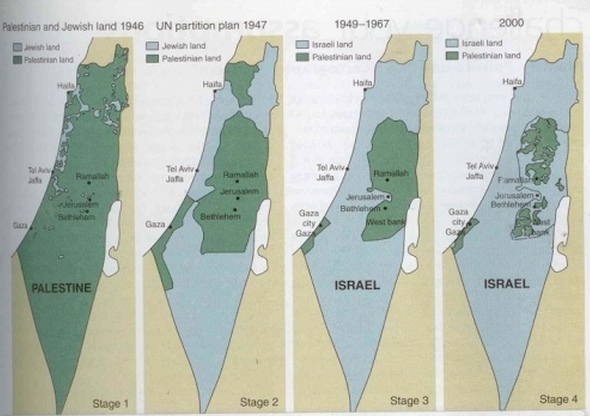
When Zionists denounced a text book with maps showing historical Palestine, McGraw-Hill quickly caved, even destroying the copies in inventory, a victory for ideological censorship, writes Lawrence Davidson.

The Palestinian maps that came under criticism

What is the difference between a textbook publisher giving into pressure from Christian fundamentalists seeking to censor the teaching of evolution, and a publisher giving into Zionists seeking to censor awareness of the ethnic cleansing of Palestine?

[See complete article at Consortium News here.]

Neither phenomenon is a matter of opinion or perspective.


One act of censorship denies facts established by scientific research. The other denies the documented violation of international law (for instance, the Fourth Geneva Convention) and multiple United Nations resolutions. So the answer to the question just asked is – there is no difference.

In early March 2016, executives at McGraw-Hill took the extreme step of withdrawing from the market a published text, Global Politics: Engaging a Complex World, and then proceeded to destroy all the remaining books held in inventory. (Did they burn them?)

Global Politics, which had been on the market since 2012, was a text designed by its authors to “offer students a number of lenses through which to view the world around them.”

Why did McGraw-Hill do this?

Heritage Designation Sought for Vancouver Island's Endangered Rivers

Conservation Group Calls For New Heritage River Designation and a Rivers Foundation for Vancouver Island

by VICCS


March 21, 2016

CEDAR – "Our Island rivers are rich in heritage, and vital to our future," states the letter to AVICC from a Vancouver Island conservation society.

"It's World Water Day on March 22nd, and it's been 15 years since a Heritage River was designated in the province of British Columbia. We're asking the Association of Vancouver Island and Coastal Communities to consider the heritage, cultural, economic and natural values that Islanders enjoy ...and to establish a new Island initiative to recognize and protect Vancouver Island rivers."

"We received a polite refusal from BC's Environment Minister Mary Polak last fall," notes VICCS president Laurie Gourlay, "on the 20th anniversary of the BC Heritage Rivers System, suggesting there were no plans to revisit or nominate additional BC Heritage Rivers."

"We see no reason why the old BC and Canadian Heritage River terms and mandate cannot be adapted to meet Vancouver Island's present needs, and the public interest in our rivers and watersheds," states Gourlay.

The letter raises attention to the hotter and drier summers the Island is experiencing as a result of climate change, suggesting that appreciation of the Island's streams and rivers has soared as the benefits and importance to the environment as well as our cities, towns and communities becomes increasingly clear.

"Canada's 150th birthday in 2017 again reminds us of the early explorer's travel by canoe and ship which led to the development of our country," Gourlay writes. "And our coastal First Nations look back 5500 years and more upon salmon-rich rivers that provided transportation, spiritual rewards and sustainable livelihoods."

VICCS is requesting that the BC Heritage Rivers process be the basis for Vancouver Island Heritage River' nominations, and that funds be invested to establish a Vancouver Island Rivers Foundation.

VICCS letter is addressed to AVICC as they represent local Island governments, and are affiliated with the BC Union of Municipalities. VICCS is requesting that AVICC receive their request as a late addition for consideration at their upcoming AGM in Nanaimo, and has been copied to Premier Christy Clark, Opposition Leader John Horgan and Green Party Leader Andrew Weaver, asking for all-Party support in the Legislature.

VICCS ends their request by offering to help establish a Vancouver Island Rivers Foundation, suggesting that "the Nanaimo River is an excellent candidate for consideration under a Vancouver Island Heritage Rivers process ...and we'd be pleased to tour AVICC delegates along one of the Island's great rivers when they're here in April."

- 30 -


For Immediate Release

For more information:
Laurie Gourlay
President, VICCS


Vancouver Island & Coast Conservation Society,
Box 333, Cedar, B.C., V9X 1W1

(viccs@shaw.ca)
www.viccs.vcn.bc.ca/

Google Me Wha?: Doin' a Little Evil with Hill and State

Google this! Hillary Clinton and the Syrian regime-change conspiracy

by Neil Clark - RT


21 Mar, 2016

If you’d have said a year ago that the US State Department, Google, and Al Jazeera had been collaborating in pursuance of regime change in Syria, chances are you’d have been casually dismissed as a ‘crank’ and a ‘conspiracy theorist’.

Syria was a people’s uprising against a wicked genocidal Russian-backed dictator and the West had nothing to do with the bloodshed which engulfed the country. If you thought otherwise then you were considered an 'Assad apologist'.

However, thanks to Wikileaks, the Freedom of Information Act, and Hillary Rodham Clinton’s use of a private, non-secure email server, we can see what was really going on behind the curtain.

Overall, 30,322 emails and attachments dating from June 30, 2010 to August 12, 2014, including 7,570 written by Clinton herself, have been published.

They haven’t made much of an impact in the mainstream media, which is not surprising considering their explosive content.

The emails reveal how the US State Department, ‘independent’ media and Silicon Valley have worked together to try and achieve foreign policy goals.

Particularly damning is a communication from Jared Cohen, the President of ‘Google Ideas’, (now called ‘Jigsaw'), which was sent on July 25, 2012.

"Please keep close hold, but my team is planning to launch a tool on Sunday that will publicly track and map the defections in Syria and which parts of the government they are coming from," Cohen wrote.

"Our logic behind this is that while many people are tracking the atrocities, nobody is visually representing and mapping the defections, which we believe are important in encouraging more to defect and giving confidence to the opposition," he went on.

The head of Google Ideas added that his organization was partnering with al Jazeera "who will take primary ownership over the tool we have built."

Cohen finished his email by repeating his warning: "Please keep this very close hold… We believe this can have an important impact."

The email was sent to three top officials, Deputy Secretary of State Bill Burns (a former Ambassador to Russia), Alec Ross, a senior Clinton adviser on innovation; and Clinton’s deputy chief of staff, Jake Sullivan.

Sullivan forwarded the email to Hillary Clinton with the message: "FYI-this is a pretty cool idea." On August 4, 2012, Clinton sent the information to her aide Monica Handley. The title heading was: Syria Attachments: Defection Tracker.PDF.

"The Silicon Valley’s technotronic oligarchy have been exposed as a mere extension of the CIA in terms of playing a role in Washington’s state policy of regime change in Syria," was the verdict of 21st Century Wire.

If you think it’s surprising that a top man at Google should be so interested in a ‘tool’ which could help the ‘opposition’ take power in Syria, then a closer look at Jared Cohen’s career background helps shed some light on the matter.

A Rhodes Scholar at Oxford University, Cohen was a bright guy who was clearly fast-tracked for big things. After an internship at the US State Department, he became a member of Condoleeza Rice’s Policy Planning Staff in 2006 when he was just 24 years of age. That same year he had a book published on the Rwandan genocide, while a year later his ‘Children of Jihad - A Young American’s travels among the Youth of the Middle East’ was published.

In 2009, it’s claimed that Cohen personally asked Twitter CEO Jack Dorsey not to interrupt his company’s service in Iran for maintenance. Tehran at the time was preparing for elections and it was apparently believed that the opponents of President Ahmadinejad would be hindered without access to social media.

Since 2010, Cohen has been an Adjunct Senior fellow at the Council on Foreign Relations. In 2013, Time magazine listed the then 32-year-old as one of its 100 Most Influential People in the world.

Wikileaks founder Julian Assange, who met Cohen and Google chairman Eric Schmidt when he was under house-arrest in 2011, has written about Google’s role in assisting US foreign policy goals. "Whether it is being just a company or 'more than just a company,' Google’s geopolitical aspirations are firmly enmeshed within the foreign-policy agenda of the world’s largest superpower," Assange said.

The Wikileaks founder discovered that Jared Cohen had "quietly worked" in Lebanon "to establish an intellectual and clerical rival to Hezbollah, the Higher Shia League." In Afghanistan, Cohen had tried "to convince the four major Afghan mobile phone companies to move their antennas onto US military bases."

In June 2010, when Syria was a country still at peace, Cohen traveled to the Arab Republic with Alec Ross.

"I'm not kidding when I say I just had the greatest frappuccino ever at Kalamoun University north of Damascus," he tweeted. 
Ross, in a more serious mood, tweeted: "This trip to #Syria will test Syria’s willingness to engage more responsibly on issues of#netfreedom".

In an email dated September 24, 2010, entitled '1st known case of a successful social media campaign in Syria’, and which was later forwarded to Hillary Clinton, Ross wrote:

"When Jared and I went to Syria, it was because we knew that Syrian society was growing increasingly young (population will double in 17 years) and digital and that this was going to create disruptions in society that we could potential harness for our purposes"

Those "purposes" were of course "regime change" and break Syria's alliance with Iran.

We already know, courtesy of Wikileaks, that Washington’s plans to destabilize Syria long pre-dated the so-called 'Arab Spring'.

A 2006 cable from US Ambassador to Syria William Roebuck discussed "potential vulnerabilities" of the Assad administration and the "possible means to exploit them".

One of the "possible means" was to seek to divide the Shia and Sunni communities in Syria. In a section entitled PLAY ON SUNNI FEARS OF IRANIAN INFLUENCE, the Ambassador writes:

"There are fears in Syria that the Iranians are active in both Shia proselytizing and conversion of, mostly poor, Sunnis. Though often exaggerated, such fears reflect an element of the Sunni community in Syria that is increasingly upset by and focused on the spread of Iranian influence in their country through activities ranging from mosque construction to business."

Another was listed as ‘ENCOURAGE RUMORS AND SIGNALS OF EXTERNAL PLOTTING'. This would increase "the possibility of a self-defeating over-reaction" from the Syrian government.

Lo and behold when the protests against the Assad government did kick off in early 2011, the US was quick to accuse the Syrian authorities of over-reacting - which is exactly what they had wanted.

The earlier Wikileaks revelations on Syria tie in with what we learn from Clinton’s emails.

While Western leaders and their media stenographers feign horror and outrage over what’s been happening in Syria, Wikileaks shows us that the possibility of the country being torn apart by sectarian conflict was actually welcomed by Syria’s enemies.

"The fall of the House of Assad could well ignite a sectarian war between the Shiites and the majority Sunnis of the region drawing in Iran, which, in the view of Israeli commanders would not be a bad thing for Israel and its Western allies" Sidney Blumental wrote in a 2012 email to Hillary Clinton.

Blumenthal does point out that not all in Israel’s governing circles thought that way, with concern expressed that the spread of "increasingly conservative Islamic regimes" could make Israel "vulnerable".

We must remember that if the US and UK got their way in August 2013 and bombed the Assad government, then its likely that IS and al-Qaeda affiliates would have taken control of the entire country. And the most bellicose voices calling for the bombing of a secular government that was fighting IS and al-Qaeda in 2013 were American neocons. This was the same group of hawks who had pushed so hard for the invasion of Iraq 10 years earlier and who had also propagandized for the NATO bombing of Libya in 2011.

Wikileaks confirms that - as was the case in Libya and Iraq - almost everything about the official "western establishment" version of the war in Syria was false.

Far from being an innocent bystander, the US went out of its way to destabilize the country and exploit ethnic and religious divisions.

A huge amount of weaponry was provided -via regional allies -to violent jihadists, euphemistically referred to as ‘rebels', to try and achieve the goal of ‘regime change’. The rise of ISIS can be directly attributed to the destructive, malignant policies of the US and its allies towards Syria. Don’t forget we’ve already seen a US Intelligence report from August 2012, which stated that "the possibility of establishing a declared or undeclared Salafist principality in eastern Syria" was "exactly what the supporting powers to the opposition want, in order to isolate the Syrian regime".

In 2006, the same year that Ambassador Roebuck sent his cable on how the US might exploit the "potential vulnerabilities" of the secular Assad administration, the Syrian authorities foiled a terrorist attack on the US embassy in Damascus.

You might have thought that it would have earned Syria some brownie points with the State Department and its collaborators. But as the HRC emails confirm, it counted for absolutely nothing.

Neil Clark is a journalist, writer, broadcaster and blogger. He has written for many newspapers and magazines in the UK and other countries including The Guardian, Morning Star, Daily and Sunday Express, Mail on Sunday, Daily Mail, Daily Telegraph, New Statesman, The Spectator, The Week, and The American Conservative. He is a regular pundit on RT and has also appeared on BBC TV and radio, Sky News, Press TV and the Voice of Russia. He is the co-founder of the Campaign For Public Ownership @PublicOwnership. His award winning blog can be found at www.neilclark66.blogspot.com. He tweets on politics and world affairs @NeilClark66 
Follow Neil Clark @NeilClark66

The Fifth Disruptive Paradigm: Bitcoin Computing Arrived and Undervalued

PWC Report – Blockchain Untapped and Underestimated by Financial Services Sector

by Richard Kastelein - BlockChain News

Results from a PwC survey released today, which assesses the rise of new technologies in the financial services (FS) sector and their impact on market players, reveals 83% of respondents from traditional FS firms believe part of their business is at risk of being lost to standalone FinTech companies, reaching a staggering 95% in the case of banks.

The report, ‘Blurred Lines: How FinTech is shaping Financial services’, features the responses of 544 CEOs, Heads of Innovation, CIOs and top management involved in digital and technological transformation across the FS industry in 46 countries. Incumbents believe 23% of their business could be at risk due to further development of FinTech. What’s more, FinTech companies themselves anticipate they could capture 33% of the incumbents’ business.

Blockchain untapped and underestimated by FS


Blockchain, a distributed ledger technology, represents the next evolutionary jump in business process optimisation technology. According to PwC, it could result in a radically different competitive future in the FS industry, where current profit pools are disrupted and redistributed towards the owners of new, highly efficient blockchain platforms. Not only could there be huge cost savings but also large gains in transparency. Yet it ranks low on the agendas of participants.

While the majority (56%) recognise its importance, 57% say they are unsure or unlikely to respond to this trend.

“When faced with disruptive technologies, the world’s leading companies succeed by rapidly weaving them into their DNA, as part of their ‘business as usual’ process,” says Haskell Garfinkell, US FinTech co-leader, PwC.
“Blockchain and disruptive ledger technologies offer a once-in-a-lifetime opportunity for financial services companies to transform the way they do business. In our view, the lack of understanding of blockchain technology and its potential for disruption poses significant risks to existing business models and the firms that do not take the time to understand the impact will underestimate the opportunities and threats that blockchain can provide.”

To put this into perspective, PwC’s Global Blockchain team* has identified over 700 companies entering this space, 150 of whom it says are ‘ones to watch’ and 25 of which it expects will likely emerge as leaders.

Banking and payments feel most heat from FinTech


The survey shows the banking and payments industries are feeling the most pressure from FinTech companies. Respondents from the fund transfer & payments industry anticipate that in the next five years, they could lose up to 28% of their market share to them, while bankers estimate they are likely to lose 24%. This compares to around 22% in the case of asset management & wealth management and 21% in insurance.

Top threats from FinTech


Two-thirds (67%) of FS companies ranked pressure on profit margins as the top FinTech-related threat, followed by loss of market share (59%). One of the key ways in which FinTechs support the margin pressure point through innovation is step function improvements in operating costs. For instance, the movement to cloud-based platforms not only decreases up-front costs, but also reduces ongoing infrastructure costs.

Challenges for FinTech companies and incumbents


PwC’s survey shows the most widespread form of collaboration with FinTech companies is joint partnership (32%), which, says PwC, is indicative FS firms are not ready to go all in and invest fully in FinTech.

Asked what challenges they face in dealing with FinTech companies, 53% of incumbents cited IT security, regulatory uncertainty (49%) and differences in business models (40%).

In the case of FinTech companies, differences in management and culture (54%), operational processes (47%) and regulatory uncertainty (43%) were deemed the top three challenges when dealing with traditional FS firms.

Steve Davies, EMEA FinTech Leader at PwC comments:

“FinTech is changing the FS industry from the outside. PwC estimates within the next 3-5 years, cumulative investment in FinTech globally could well exceed $150bn, and financial institutions and tech companies are a stepping over one another for a chance to get into the game. As the lines between traditional finance, technology firms and telecom companies are blurring, many innovative solutions are emerging and there is clearly no straightforward solution to navigate this FinTech world,” says Davies.

Manoj Kashyap, PwC Global Financial Services FinTech Leader concludes:

“FinTech is shifting the paradigm of traditional intermediary roles by making them obsolete. While FS organisations have acted as intermediaries in the financial system by providing an invaluable service to clients, their functions are being usurped by new technology-driven business models.

“Given how fast technology is developing, incumbents cannot afford to ignore FinTech. Nevertheless, our survey has shown that a non-negligible 25% of firms do not deal with FinTech companies at all. With the pace of change now occurring at increasingly faster intervals, no FS business can rest on its laurels.”

Sunday, March 20, 2016

Subprime on Wheels: Autos the Next "Mortgage" Crash

Subprime Auto Loans: the Next Shoe to Drop?

by Mike Whitney - CounterPunch


March 18, 2016   

Booming auto sales have more to do with low rates and easy financing than they do with the urge to buy a new vehicle. In the last few years, car buyers have borrowed nearly $1 trillion to finance new and used autos.

Unfortunately, much of that money was lent to borrowers who have less-than-perfect credit and who might not be able to repay the debt.

Recently there has been a surge in delinquencies among subprime borrowers whose loans were packaged into bonds and sold to investors.

The situation is similar to the trouble that preceded the Crash of 2008 when prices on subprime mortgage-backed securities (MBS) suddenly collapsed sending the global financial system off a cliff. No one expects that to happen with auto bonds, but story does help to illustrate that the regulatory problems still haven’t been fixed.

In a recent article in the Wall Street Journal, author Serena Ng uses the performance of a bond issue called Skopos Auto Receivables Trust to explain what’s going on. She says:

“The bonds were built out of subprime auto loans and sold in November. Through February, about 12% of the underlying loans were at least 30 days past due, a third of which were more than 60 days delinquent. In another 2.6% of loans, borrowers had filed for bankruptcy or the vehicles had been repossessed.” (“Subprime Flashback: Early Defaults Are a Warning Sign for Auto Sales“, Wall Street Journal)

Check out those dates again. If a loan, that was issued in November, is 60 days delinquent by February, it means the borrower never even made the first payment on the debt. How can that happen unless the lender is deliberately fudging the underwriting to “slam the sale”?

It can’t, which means that dealers are intentionally lending money to people they know won’t be able to pay them back.

But why would they do that?


It’s because they know they can offload the crappy loans on Mom and Pop investors looking for a slightly better rate of return than they’ll get on ultra-safe US Treasuries. That’s the whole nine-yards, right there. Selling vehicles is just a cover for the real objective, which is creaming big profits off toxic paper that will eventually sell for pennies on the dollar. Ka-ching!

The problem is NOT subprime borrowers who pay much higher rate of interest on their loans than more creditworthy customers. The problem is dodgy lenders who game the system to line their own pockets. That’s the real problem, and the problem is getting more serious all the time. According to the WSJ:

“The 60-plus day delinquency rate among subprime car loans that have been packaged into bonds over the past five years climbed to 5.16% in February, according to Fitch Ratings, the highest level in nearly two decades. The rate of missed payments is higher for loans made in more recent years, a reflection of more liberal credit standards and the larger number of deals from lenders serving less creditworthy customers, according to Standard & Poor’s Ratings Services…

“What’s driving record auto sales is not the economy, but record auto lending,” said Ben Weinger, who runs hedge fund 3-Sigma Value LP in New York and who has bearish bets on some auto lenders. He said demand for auto debt has led lenders to systematically loosen underwriting standards, which he predicts will result in higher loan delinquencies.” (WSJ)

“Liberal credit standards”?? Is that what you call it when you lend thousands of dollars to someone who someone who doesn’t have a job, an address or a credit card?

Sheesh.


While it’s true that delinquencies are rising, it’s not true that subprime borrowers don’t pay their bills. They do, in fact, subprime lending can be extremely lucrative provided lenders do their homework. But when a lender is merely the middleman in a larger transaction, (like when the debt is bundled into a bond and sold to Wall Street) he has no incentive to make sure that everything checks out. His goal is to grind out as many loans as possible and let the investor worry about the quality. After all, what does he care if the loan blows up or not? It’s no skin off his nose.

Keep in mind, the auto dealers really clean house on these garbage loans too. The average rates on these turkeys exceed 20 percent while loan duration typically lasts for about 6 years. That’s a serious chunk of money drained directly from the paychecks of the poorest and most vulnerable people in society; the same people who are stuck forever in low-paying service sector jobs that barely pay enough to keep food on the table or gas in the tank. These are the victims in this loan-sharking swindle, the people who desperately need a car to get to work to feed their kids, and then find themselves shackled to a long-term obligation that just makes matters worse. Here’s more from the WSJ:


“Before making loans, Skopos said it verifies information, including borrowers’ employment and whether they actually made cash down payments. For those with no credit score, it looks at alternative metrics, like how they pay phone bills. “We interview every customer before we fund the loan,” Skopos CEO Daniel Porter said, adding that individuals with no credit histories are often young working adults who are more motivated to keep making payments.”

They check to see if they pay their phone bills? That’s what they call “underwriting”? What a joke!

By now you’re probably wondering how this whole subprime nightmare resurfaced just 8 years after Wall Street blew up the financial system? Wasn’t Dodd-Frank supposed to fix all that?

Sure, it was, but the powerful auto lobby in Washington managed to carve out a special exemption for themselves that allows them to shrug off the new reforms and continue the same risky behavior as before. That’s why this auto-loan scam has morphed into a ginormous Hindenburg-like bubble that poses a looming threat to financial stability. It’s because the big money guys twisted a few arms on Capital Hill and got what they wanted. Money talks. Here’s more from the WSJ:

“Banks had $384 billion of auto loans on their books at the end of last year, but households had auto-loan balances of over $1 trillion, according to Federal Reserve data. Indeed, Fitch Ratings warned last week that delinquencies of over 60 days on securities backed by subprime auto loans hit almost 5% in January. That is the highest since September 2009 and close to the record peak hit that same year.

Rock-bottom interest rates and record-breaking car sales have combined to put auto lending into overdrive, making some skids inevitable. While those should be more than manageable for the banking system, individual firms that went too fast into the curve by lowering underwriting standards may have a rougher ride.” (“Why Auto Lenders Are in for a Rougher Ride“, Wall Street Journal)

You know what comes next, don’t you? The delinquencies start piling up, the finance companies begin to creak and groan, the banks and other counterparties hastily selloff assets to try to stay afloat, and, finally, the Fed rides to the rescue with another batch of emergency loans to prevent the whole wobbly, over-leveraged system from crashing to earth.

Of course, we could just pass legislation that made it a criminal offense to intentionally issue loans to anyone who fails to meet strict, government-approved underwriting standards. But then we’d never have these excruciating economy-busting financial crises anymore.

And what fun would that be?

MIKE WHITNEY lives in Washington state. He is a contributor to Hopeless: Barack Obama and the Politics of Illusion (AK Press). Hopeless is also available in a Kindle edition. He can be reached at fergiewhitney@msn.com.
More articles by:Mike Whitney

God-Law and Superstition in the Century of Unending War

Should International Law Supersede Superstition in the 21st Century?

by William A. Cook


March 20, 2016

Does Yahweh’s Liberation of the Jews from Egypt Justify Israel’s Oppression and Occupation of Palestine?

The question posed by the title of this piece arose in a theological discussion. But the answers are complex, engaging as they must the historical role of God in human affairs, the implications of that in defining God and His people, and all subsequent interactions by that God with His people from the liberation to now and beyond.

Furthermore, the discussion must of necessity involve other religions, the engagement of God by them in day to day actions, and the determination of secular decisions, political and international, by theological beliefs or by international law.

Let me open this issue with a personal reflection on the unfortunate yoking of Evangelical end time preachers with Bush’s war against the Iraqi people. Nothing is so graphic as this theological destruction of the nature of the Almighty and the political control of the Christian faith by our contemporary moneychangers as this alliance blessed in the White House.

More than 2600 years separates the destruction of the Canaanites from the destruction of the citizens of Baghdad, both devastations prompted by religious beliefs, both illustrate the need in the 21st century to replace superstition with international law or allow zealots to rule the world. I will begin today.

A watercolor painting of the ancient tower that stands guard before the old city of Prague on the Charles bridge adorns the entrance outside my study, aged by the artist with a dull magenta dye to capture the medieval flavor of the city, offering to my aged mind the ineluctable passing of time as thousands passed beneath to cross the Vltava through the Powder tower into the Lesser city beneath the Prague Castle and the Cathedral of St. Vitus. I purchased the painting for my wife when we attended a conference on Human Evil and Wickedness where I presented a paper. The date was March 20, 2003.

We stayed that night in the Lesser city arriving near dark in the narrow streets and hence to a small hotel not far from the river. I can’t remember if we had dinner before settling in the room, I know we turned on the old TV out of curiosity, it seemed so out of place. A green glow appeared on the screen, a frightening image of lightening blasts shattering the skyline of Baghdad as America declared its overwhelming power to the world through Rumsfeld and Cheney’s Shock and Awe; the very essence of the conference glowed on the screen. Here we stood transfixed in the 21st century in a city that had survived human barbarity from medieval times.

We turned to another channel.


Shock and awe remained! From Trinity Broadcasting, direct from the United States, appeared a prayer service gathered around an enormous American flag held horizontally aloft by raptured singers, eyes shut, an arm held heavenward, swaying back and forth as they sang their war prayer to the Almighty with the red, white and blue relic fluttering above the floor.

Before us stood the loyal celebrants of our beloved crusader, the American President, who had declared his God determined mission to bring liberation to the Iraqi people by invading their land knowing he was appointed for that purpose regardless of international law or truth or justice, the crowned servant of God’s Ministers of War crying from their pulpits in the cathedral of TV that the Day of Wrath, End Time, God’s prophesied Armageddon to usher in the Rapture, could be fulfilled.

It was difficult to adjust the reality presented on the screen from the reality presented by the images on these contrasting channels. Here the shock of witnessing Mark Twain’s “War Prayer” in its full horror, bathed in the choral song of devotion that God Almighty relieve them of the fear that attends the unknown agony of men at war, glows on a green screen in Prague only 43 hours from Canaan on route 80.

“Then came the (minister’s) "long" prayer. None could remember the like of it for passionate pleading and moving and beautiful language. The burden of its supplication was that an ever – merciful and benignant Father of us all would watch over our noble young soldiers and aid, comfort, and encourage them in their patriotic work; bless them, shield them in His mighty hand, make them strong and confident, invincible in the bloody onset; help them to crush the foe, grant to them and to their flag and country imperishable honor and glory.”

Twain’s horror, delivered by God’s Messenger standing next to the minister in his pulpit, garbed in a brown cowl of mourning, addresses the assembled congregants with the “other” prayer, and silences the worshippers -- "God the all-terrible!” he thunders, “Thou who ordainest, Thunder thy clarion and lightning thy sword!" flows in choral cadence from the robed carolers beseeching God Almighty to bless and protect the forces of the United States as they drop tons of bombs on the people of Baghdad.

"O Lord our Father, our young patriots, idols of our hearts, go forth to battle – be Thou near them! With them, in spirit, we also go forth from the sweet peace of our beloved firesides to smite the foe. O Lord our God, help us to tear their soldiers to bloody shreds with our shells; help us to cover their smiling fields with the pale forms of their patriot dead; help us to drown the thunder of the guns with the shrieks of their wounded, writhing in pain; help us to lay waste their humble homes with a hurricane of fire; help us to wring the hearts of their unoffending widows with unavailing grief; help us to turn them out roofless with their little children to wander unfriended the wastes of their desolated land in rags and hunger and thirst, sports of the sun flames of summer and the icy winds of winter, broken in spirit, worn with travail, imploring Thee for the refuge of the grave and denied it – for our sakes who adore Thee, Lord, blast their hopes, blight their lives, protract their bitter pilgrimage, make heavy their steps, water their way with their tears, stain the white snow with the blood of their wounded feet! We ask it, in the spirit of love, of Him Who is the Source of Love, and Who is ever-faithful refuge and friend of all that are sore beset and seek His aid with humble and contrite hearts. Amen.” (1)

That is the prayer we never hear, that is the destruction we hide, that is the price of victory as the vanquished lie strewn in the rubble of Baghdad, unseen, unknown, forgotten—lives lived, lost, erased, victims of zealots’ superstitions offered to a word, an empty, meaningless word they claim to hear in dreams, through voices, moments of inspiration when God visits them in the fantasy world that is their imagination. Thus does belief ride the phantom horses of the apocalypse directing God’s wrath against His enemies.

Recalling this event brings me back to the purpose of this essay: Yahweh’s liberation of the Jews. Who is Yahweh: a creation of a people comprehending Him as a God that intercedes in historical events and indeed commands them to do His bidding or is He an historical figure like Jesus Christ that existed in time and performed acts during that time? Or, and this raises yet another issue, is He a metaphorical figure offering interference for His people? If Yahweh is understood as engaged, proclaiming of His people historical events, like the conquest of Canaan, tied to the liberation of the Jews from Egypt, then the destruction of Canaan is an historical event that fulfills His promise to His people. God gave these instructions:

“In the cities of these peoples that the LORD your God is giving you for an inheritance, you shall save alive nothing that breathes, but you shall devote them to complete destruction, the Hittites and the Amorites, the Canaanites and the Perizzites, the Hivites and the Jebusites, as the LORD your God has commanded” (Deut. 20:16-17). 

These are the words as Moses allegedly wrote them. None of these people had attacked or done any uncivilized actions against the ‘liberated” Hebrews. They had offended God because they did not obey Him and God used the Israelites to destroy them, to inflict genocide on them.

Understood in this context, Yahweh gave land to His people even though that land was lived upon for years by others, and indeed, if Yahweh is understood as God, His gift legitimizes Israel’s claim to the land. Unfortunately this understanding turns the nature of this God into a God of one people only, not a God of all creation. This is the God of Moses and of Joshua giving them license to take the land of the Canaanites, the Hittites et al. in the name of the God they created and literally forced on the Jewish people if they did not obey, as witness the destruction they imposed on those who worshipped other images of God.

Why does this change the nature of God? Because it negates the full biblical description of the God of the Old Testament as a God of “universal justice, righteousness, peace, and salvation.” We need only stress the words of Yahweh in Isa. 49:6b: “I will give you [Israel] as a light to the nations that my salvation may reach to the end of the earth.” This is not a God of destruction and genocide. Psalm 33 states, “Yahweh loves righteousness and justice” and Psalm 82, He is the defender of the weak and the afflicted…universally. This understanding aligns well with the Christian belief in the universality of God as propounded in the New Testament. (2)
  
How then do we explain the destruction of the original peoples of Canaan? If Yahweh is the creation of Moses and Joshua, a construct designed by compilers during the reign of King Josiah (3) to solidify the sundry tribes into one and to image their greatness in strength by massive power, the slaughter of many peoples might be a means to that end. In part then, the eradication of the Canaanites might have been more a fictional narrative than a fact. “The idea that YHWH would ultimately fulfill the promises given to the patriarchs, to Moses, and to King David—of a vast and unified people of Israel living securely in their land—was a politically and spiritually powerful one for Josiah’s subjects” (Unearthed 69).

Unifying the people in the belief of this interventionist God as fulfillment for the liberation following the Exodus from the Pharaoh’s enslavement, solidifies his devotion to them and their devotion to Him. Unfortunately, it would appear to be a fabrication as told both from the archeological evidence and the demographic and political realities of the alleged “flight from Egypt” period which, it turns out, never happened (Unearthed 70).

However, belief in YHWH as involved in historical processes can be understood as a theological construct thus legitimizing the Israeli claim to the historical land of Israel. But, as noted above, that contention alters the nature of YHWH destroying His universal revelation as God of all peoples. (4) “The result is that the theology of annihilation and subjugation cannot be justified. It ignores the rights of the other nations, and ultimately God’s truth itself” (Knierim 321).

This point would appear to be moot given the evidence collected in Unearthing the Bible since it is clearly a century’s old fabrication narrated centuries after the events described, and for specific purposes related to King Josiah’s ambitions. Any attempt then to yoke the promise of a greater Israel to the revealed word of God as a legal precedent for annexing or stealing or assuming control over another’s land is untenable since the land cannot be said to be historically and uniquely belonging to the Israelites. Belief in a God does not establish the historical events, especially when the evidence questions a conquest by the Israeli people or a nation of a size described in the Bible as existing or indeed an exodus from Egypt that necessitated the eradication of people living in land that was at the time a protectorate of the Kingdom of Egypt.

This leaves only the metaphorical understanding of the tale. If YHWH is a living God to the Israeli people, then the Exodus story, the flight from Egypt, the passing through the Nile, the forty years of wandering in the desert, and the eventual genocide of the people of Canaan and surrounding tribes becomes an accomplished deed and an ancient narrative of the Israeli nation as guided by their God, and nothing more; it has accomplished its purpose. That it should become a base of understanding of an Israeli God that has no other purpose than to serve their belief, then it serves a religious purpose, and with tolerance by all will remain just that. If it becomes a weapon to justify further acquisition of lands perceived to belong to the Israeli people because this tale of YHWH’s intervention on their behalf identifies geographic areas assumed to have been conquered by Joshua centuries ago, it denies the existence of a God sympathetic to all His creatures, indeed, a cruel, envious, despicable fabrication that mocks the very image of God as accepted by peoples around the world.

There is need now to return to the present. Since the only claim that the Israeli people have to the land of Palestine is the claim made by YHWH in Exod 23:23-33 and 34:11f. “I will hand over to you the inhabitants of the land, and you shall drive them out before you. You shall make no covenants [peace] with them and their gods” (Exod 23:31b +32), and since we have established that the source of this proclamation was “At its core a sacred scripture of unparalleled literary and scriptural genius. It was an epic saga woven together from an astonishingly rich collection of historical writings, memories, legends, folk tales, anecdotes, royal propaganda, prophecy, and ancient poetry,” (2) there is no meaningful, unquestioned right for the peoples of Israel to claim this land while others living there have as much or greater right since they have continued in residence for centuries beyond those immigrating to Palestine. We will leave for another time the argument that YHWH gave this land solely to the Semitic people which would then deny legitimacy to the Ashkenazi Jews (“For all the land which thou seest, to thee will I give it, and to thy seed for ever” (Genesis, King James Bible).

"Jews" have no blood-link to the Israelites of the Bible. Jewish historian scholars have established that at least 90% of all Jews come from a Turkish-Mongol mix of people and are largely sourced from the Khazar Kingdom. These "Jews" have no blood-link to the Israelites of the Bible (5).

We must now attempt to comprehend the consequences of YHWH as a distinctly Jewish God leading His people to a genocide of another nation as it is a fictional narrative designed to unite tribes under the banner of Josiah hundreds of years after the destruction of the Canaan peoples, and therefore a genocide that did not happen at the hands of the Jews but rather provided a God who serves His people and makes demands on them, a nation’s God alone. Theologically, a fictional narrative would not accept that nation’s historic right to the land since the conquest never happened at the hands of the Jews; a corollary of that denial would recognize that the Jews are not guilty of genocide. Politically, therefore, the judgment that historical rights exist must come from a different source, unaligned with any theology or Nation or Oligarchy for it is only the United Nations and its Charters and Declaration of Human Rights that can bring an objective resolution to matters that determine the interrelationship of all peoples on the earth.

That source is inferred in the opening story of this article. Shock and Awe broad cast to the world that the United States of America had undertaken a war against a member nation of the United Nations without provocation by that nation. Indeed, for the previous twelve years, Western nations including America and Britain, had pulverized Iraq with bombs and sanctions, eliminating in the process the capability of that nation to secure its people from aerial attacks. Sanctions had devastated its economy, its health services and its participation in international affairs. Collaborating in the move toward invasion of Iraq, Christian Zionists, who used the Book of Revelation to justify their belief that Israel must exist if the second coming were to happen, employed “God’s word” to cajole the President to see himself as a missionary of God Almighty responsible to the free world to usher in God’s Armageddon against the infidels.

The Christian Zionists’ interpretation of the Book of Revelation, preaching to millions via television and satellites, enabled a handful of preachers to use the Bible for their own purposes, not unlike the Jewish Zionists using America’s “unconditional support” in money and men, to attack a member nation of the UN and in the process disregard, nay more, defy international laws and Conventions. These men had no rights from any acceptable source, nationally or internationally, to provoke a President and a Congress to war because they believed, if they did, the images in the Book of Revelation “told” them their interpretations were true. No country should be ruled by a few religious zealots especially when the Christianity they preach is categorically at odds with the majority of denominations in the Christian world. Nor should they, the 1% of preachers of Christianity, millionaires all, determine for the humble and righteous ministers throughout America how to use mockery of Christ to satisfy their greed.

How benign the scene from Trinity Broadcasting paralleling the release of bombs from the guts of silver tubes cascading from the heavens on innocent men, women and children shredding their lives into the rubble that had been their homes, thousands dead and blessed that they are dead by ministers of war heralding God’s proclamation that the rapture is imminent, Fools crying in the wilderness of superstitious images drawn from pages of an ancient text that creates a Jesus of hate and vengeance, the very antitheses of the Christ of the gospels.

That these men should proclaim to know God’s will and force it on a gullible man sitting as President is ludicrous in the 21st century. Yet they are still selling this ravenous image of Jesus to the American people
The 20th century erupted in global devastation in two world wars, both resulting in millions dead and untold numbers maimed and mutilated. Those who endured these holocausts joined together to bring a means of order out of this chaos, a League of Nations and the United Nations. That the design of these organizations was flawed does not erase the understanding that the need for a peaceful means to resolution of grievances among nations should exist. Now in this 21st century we have watched the effort made to find agreement and tolerance across the world frayed by a faulty structure in the design. No single nation should have the ability to negate the actions of the majority. We have witnessed the second half of the 20th century dissolve into an oligarchy of powerful men as they control a few nations by purchase of greed ensuring their will will be done.

As a consequence, the last half of that century is known as the century of unending war.
 
In 1945 the United Nations gathered together approximately 53 Nations world-wide all of which agreed to abide by the UN Charters and the Universal Declaration of Human Rights. Today there are 194 Nations including Palestine. It is a voluntary organization constructed on a foundation of moral values protective of human rights everywhere in the world. The principles on which it was founded, guarantee all peoples in all countries equal rights regardless of income, nationality, geographic location and, most importantly, guarantee citizenship in a Nation. Never before has the planet had a united body built expressly to recognize that all humans are created equal partners in the struggle for life, each having equal rights to all thirty articles defined in the Universal Declaration of Human Rights.(6)
 
From 1945 to the present day there exists then a unified body representing all people on the earth; there is no other universal means to accomplish that end, no religion, no philosophy, no Nation, no ideology, no superstition, it alone is inclusive, tolerant and just. For that reason the world must accept the moral power and legitimacy of the UN in General Assembly to adjudicate differences among Nations and peoples.

Let the Preamble address the universal need to establish the United Nations as the only viable source for resolutions among Nations. No Nation or combination of Nations must be allowed to supersede it and its glorious recognition of equality across the globe. The opening declarations of the Preamble speak to all humanity:

Preamble

Whereas recognition of the inherent dignity and of the equal and inalienable rights of all members of the human family is the foundation of freedom, justice and peace in the world,
Whereas disregard and contempt for human rights have resulted in barbarous acts which have outraged the conscience of mankind, and the advent of a world in which human beings shall enjoy freedom of speech and belief and freedom from fear and want has been proclaimed as the highest aspiration of the common people,
Whereas it is essential, if man is not to be compelled to have recourse, as a last resort, to rebellion against tyranny and oppression, that human rights should be protected by the rule of law,

Footnotes:
Anti-war.com: Mark Twain’s “The War Prayer” 1904.
Rolf P. Knierim. The Task of the Old Testament Theology. William B. Eerdmans Publishing Company, Cambridge, UK. 317-321).
see the detailed and archeologically constructed research done by Israel Finkelstein and Neil Asher Silberman in Unearthing the Bible, The Free Press, New York, London 2001.
Knierim 321.
“Most Jews Are Not Semites,”. by Marek Glogoczowski, mglogo@poczta.fm, 6-13-5.


Two recent books by William Cook confront related matters dealt with in this article, Age of Fools and the new paper back edition of The Plight of the Palestinians.

Preamble continued with articles: 
Whereas it is essential, if man is not to be compelled to have recourse, as a last resort, to rebellion against tyranny and oppression, that human rights should be protected by the rule of law,
Whereas it is essential to promote the development of friendly relations between nations,
Whereas the peoples of the United Nations have in the Charter reaffirmed their faith in fundamental human rights, in the dignity and worth of the human person and in the equal rights of men and women and have determined to promote social progress and better standards of life in larger freedom,
Whereas Member States have pledged themselves to achieve, in co-operation with the United Nations, the promotion of universal respect for and observance of human rights and fundamental freedoms,
Whereas a common understanding of these rights and freedoms is of the greatest importance for the full realization of this pledge,

Now, Therefore THE GENERAL ASSEMBLY proclaims THIS UNIVERSAL DECLARATION OF HUMAN RIGHTS as a common standard of achievement for all peoples and all nations, to the end that every individual and every organ of society, keeping this Declaration constantly in mind, shall strive by teaching and education to promote respect for these rights and freedoms and by progressive measures, national and international, to secure their universal and effective recognition and observance, both among the peoples of Member States themselves and among the peoples of territories under their jurisdiction. 
Article 1.
All human beings are born free and equal in dignity and rights. They are endowed with reason and conscience and should act towards one another in a spirit of brotherhood.
Article 2.
Everyone is entitled to all the rights and freedoms set forth in this Declaration, without distinction of any kind, such as race, colour, sex, language, religion, political or other opinion, national or social origin, property, birth or other status. Furthermore, no distinction shall be made on the basis of the political, jurisdictional or international status of the country or territory to which a person belongs, whether it be independent, trust, non-self-governing or under any other limitation of sovereignty.
Article 3.
Everyone has the right to life, liberty and security of person.
Article 4.
No one shall be held in slavery or servitude; slavery and the slave trade shall be prohibited in all their forms.
Article 5.
No one shall be subjected to torture or to cruel, inhuman or degrading treatment or punishment.
Article 6.
Everyone has the right to recognition everywhere as a person before the law.
Article 7.
All are equal before the law and are entitled without any discrimination to equal protection of the law. All are entitled to equal protection against any discrimination in violation of this Declaration and against any incitement to such discrimination.
Article 8.
Everyone has the right to an effective remedy by the competent national tribunals for acts violating the fundamental rights granted him by the constitution or by law.
Article 9.
No one shall be subjected to arbitrary arrest, detention or exile.
Article 10.
Everyone is entitled in full equality to a fair and public hearing by an independent and impartial tribunal, in the determination of his rights and obligations and of any criminal charge against him.
Article 11.
(1) Everyone charged with a penal offence has the right to be presumed innocent until proved guilty according to law in a public trial at which he has had all the guarantees necessary for his defence.
(2) No one shall be held guilty of any penal offence on account of any act or omission which did not constitute a penal offence, under national or international law, at the time when it was committed. Nor shall a heavier penalty be imposed than the one that was applicable at the time the penal offence was committed.
Article 12.
No one shall be subjected to arbitrary interference with his privacy, family, home or correspondence, nor to attacks upon his honour and reputation. Everyone has the right to the protection of the law against such interference or attacks.
Article 13.
(1) Everyone has the right to freedom of movement and residence within the borders of each state.
(2) Everyone has the right to leave any country, including his own, and to return to his country.
Article 14.
(1) Everyone has the right to seek and to enjoy in other countries asylum from persecution.
(2) This right may not be invoked in the case of prosecutions genuinely arising from non-political crimes or from acts contrary to the purposes and principles of the United Nations.
Article 15.
(1) Everyone has the right to a nationality.
(2) No one shall be arbitrarily deprived of his nationality nor denied the right to change his nationality.
Article 16.
(1) Men and women of full age, without any limitation due to race, nationality or religion, have the right to marry and to found a family. They are entitled to equal rights as to marriage, during marriage and at its dissolution.
(2) Marriage shall be entered into only with the free and full consent of the intending spouses.
(3) The family is the natural and fundamental group unit of society and is entitled to protection by society and the State.
Article 17.
(1) Everyone has the right to own property alone as well as in association with others.
(2) No one shall be arbitrarily deprived of his property.
Article 18.
Everyone has the right to freedom of thought, conscience and religion; this right includes freedom to change his religion or belief, and freedom, either alone or in community with others and in public or private, to manifest his religion or belief in teaching, practice, worship and observance.
Article 19.
Everyone has the right to freedom of opinion and expression; this right includes freedom to hold opinions without interference and to seek, receive and impart information and ideas through any media and regardless of frontiers.
Article 20.
(1) Everyone has the right to freedom of peaceful assembly and association.
(2) No one may be compelled to belong to an association.
Article 21.
(1) Everyone has the right to take part in the government of his country, directly or through freely chosen representatives.
(2) Everyone has the right of equal access to public service in his country.
(3) The will of the people shall be the basis of the authority of government; this will shall be expressed in periodic and genuine elections which shall be by universal and equal suffrage and shall be held by secret vote or by equivalent free voting procedures.
Article 22.
Everyone, as a member of society, has the right to social security and is entitled to realization, through national effort and international co-operation and in accordance with the organization and resources of each State, of the economic, social and cultural rights indispensable for his dignity and the free development of his personality.
Article 23.
(1) Everyone has the right to work, to free choice of employment, to just and favourable conditions of work and to protection against unemployment.
(2) Everyone, without any discrimination, has the right to equal pay for equal work.
(3) Everyone who works has the right to just and favourable remuneration ensuring for himself and his family an existence worthy of human dignity, and supplemented, if necessary, by other means of social protection.
(4) Everyone has the right to form and to join trade unions for the protection of his interests.
Article 24.
Everyone has the right to rest and leisure, including reasonable limitation of working hours and periodic holidays with pay.
 Article 25.
(1) Everyone has the right to a standard of living adequate for the health and well-being of himself and of his family, including food, clothing, housing and medical care and necessary social services, and the right to security in the event of unemployment, sickness, disability, widowhood, old age or other lack of livelihood in circumstances beyond his control.
(2) Motherhood and childhood are entitled to special care and assistance. All children, whether born in or out of wedlock, shall enjoy the same social protection.
Article 26.
(1) Everyone has the right to education. Education shall be free, at least in the elementary and fundamental stages. Elementary education shall be compulsory. Technical and professional education shall be made generally available and higher education shall be equally accessible to all on the basis of merit.
(2) Education shall be directed to the full development of the human personality and to the strengthening of respect for human rights and fundamental freedoms. It shall promote understanding, tolerance and friendship among all nations, racial or religious groups, and shall further the activities of the United Nations for the maintenance of peace.
(3) Parents have a prior right to choose the kind of education that shall be given to their children.
Article 27.
(1) Everyone has the right freely to participate in the cultural life of the community, to enjoy the arts and to share in scientific advancement and its benefits.
(2) Everyone has the right to the protection of the moral and material interests resulting from any scientific, literary or artistic production of which he is the author.
Article 28.
Everyone is entitled to a social and international order in which the rights and freedoms set forth in this Declaration can be fully realized.
Article 29.
(1) Everyone has duties to the community in which alone the free and full development of his personality is possible.
(2) In the exercise of his rights and freedoms, everyone shall be subject only to such limitations as are determined by law solely for the purpose of securing due recognition and respect for the rights and freedoms of others and of meeting the just requirements of morality, public order and the general welfare in a democratic society.
(3) These rights and freedoms may in no case be exercised contrary to the purposes and principles of the United Nations.
Article 30.
Nothing in this Declaration may be interpreted as implying for any State, group or person any right to engage in any activity or to perform any act aimed at the destruction of any of the rights and freedoms set forth herein.

Post Footnote (to establish urgency of this thesis.  William A. Cook)

Richard Falk interview in Truth NGO 2/ 2016

Israel has been violating the Fourth Geneva Convention in a variety of ways that can be best summarized by reference to the overriding obligation of an Occupying Power to protect the civilian population of the West Bank, East Jerusalem, and the Gaza Strip. This general obligation is particularly relevant to an assessment of the Israeli settlements in the West Bank and East Jerusalem as serious unlawful transfers of population that alter the character of the occupied society. Also, [there’s] Israel’s reliance on several forms of collective punishment, most frequently and punitively in relation to the 1.7 million Palestinians living in Gaza.

There are many additional violations of international humanitarian law involving disproportionate and indiscriminate uses of force responsible for major suffering endured by the Palestinian civilian population. Also, Israel has defied the near unanimous advisory opinion in 2004 of the International Court of Justice with respect to the unlawfulness of the separation wall, deciding that according to international law Israel should dismantle the wall and compensate Palestinians for any damage.