Sunday, April 17, 2016

A World War Underway: Breaking the Silence on WWIII

A World War Has Begun: Break the Silence

by John Pilger - ICH


April 17, 2016

I have been filming in the Marshall Islands, which lie north of Australia, in the middle of the Pacific Ocean. Whenever I tell people where I have been, they ask, "Where is that?" If I offer a clue by referring to "Bikini", they say, "You mean the swimsuit."

Few seem aware that the bikini swimsuit was named to celebrate the nuclear explosions that destroyed Bikini island. Sixty-six nuclear devices were exploded by the United States in the Marshall Islands between 1946 and 1958 -- the equivalent of 1.6 Hiroshima bombs every day for twelve years.

Bikini is silent today, mutated and contaminated. Palm trees grow in a strange grid formation. Nothing moves. There are no birds. The headstones in the old cemetery are alive with radiation. My shoes registered "unsafe" on a Geiger counter.

Standing on the beach, I watched the emerald green of the Pacific fall away into a vast black hole. This was the crater left by the hydrogen bomb they called "Bravo". The explosion poisoned people and their environment for hundreds of miles, perhaps forever.

On my return journey, I stopped at Honolulu airport and noticed an American magazine called Women's Health. On the cover was a smiling woman in a bikini swimsuit, and the headline: "You, too, can have a bikini body." A few days earlier, in the Marshall Islands, I had interviewed women who had very different "bikini bodies"; each had suffered thyroid cancer and other life-threatening cancers.

Unlike the smiling woman in the magazine, all of them were impoverished: the victims and guinea pigs of a rapacious superpower that is today more dangerous than ever.

I relate this experience as a warning and to interrupt a distraction that has consumed so many of us. The founder of modern propaganda, Edward Bernays, described this phenomenon as "the conscious and intelligent manipulation of the habits and opinions" of democratic societies. He called it an "invisible government".

How many people are aware that a world war has begun? At present, it is a war of propaganda, of lies and distraction, but this can change instantaneously with the first mistaken order, the first missile.

In 2009, President Obama stood before an adoring crowd in the centre of Prague, in the heart of Europe. He pledged himself to make "the world free from nuclear weapons". People cheered and some cried. A torrent of platitudes flowed from the media. Obama was subsequently awarded the Nobel Peace Prize.

It was all fake. He was lying.


The Obama administration has built more nuclear weapons, more nuclear warheads, more nuclear delivery systems, more nuclear factories. Nuclear warhead spending alone rose higher under Obama than under any American president. The cost over thirty years is more than $1 trillion.

A mini nuclear bomb is planned. It is known as the B61 Model 12. There has never been anything like it. General James Cartwright, a former Vice Chairman of the Joint Chiefs of Staff, has said, "Going smaller [makes using this nuclear] weapon more thinkable."

In the last eighteen months, the greatest build-up of military forces since World War Two -- led by the United States -- is taking place along Russia's western frontier. Not since Hitler invaded the Soviet Union have foreign troops presented such a demonstrable threat to Russia.

Ukraine - once part of the Soviet Union - has become a CIA theme park. Having orchestrated a coup in Kiev, Washington effectively controls a regime that is next door and hostile to Russia: a regime rotten with Nazis, literally. Prominent parliamentary figures in Ukraine are the political descendants of the notorious OUN and UPA fascists. They openly praise Hitler and call for the persecution and expulsion of the Russian speaking minority.

This is seldom news in the West, or it is inverted to suppress the truth.

In Latvia, Lithuania and Estonia -- next door to Russia - the US military is deploying combat troops, tanks, heavy weapons. This extreme provocation of the world's second nuclear power is met with silence in the West.

What makes the prospect of nuclear war even more dangerous is a parallel campaign against China.

Seldom a day passes when China is not elevated to the status of a "threat". According to Admiral Harry Harris, the US Pacific commander, China is "building a great wall of sand in the South China Sea".

What he is referring to is China building airstrips in the Spratly Islands, which are the subject of a dispute with the Philippines - a dispute without priority until Washington pressured and bribed the government in Manila and the Pentagon launched a propaganda campaign called "freedom of navigation".

What does this really mean? It means freedom for American warships to patrol and dominate the coastal waters of China. Try to imagine the American reaction if Chinese warships did the same off the coast of California.

I made a film called The War You Don't See, in which I interviewed distinguished journalists in America and Britain: reporters such as Dan Rather of CBS, Rageh Omar of the BBC, David Rose of the Observer.


All of them said that had journalists and broadcasters done their job and questioned the propaganda that Saddam Hussein possessed weapons of mass destruction; had the lies of George W. Bush and Tony Blair not been amplified and echoed by journalists, the 2003 invasion of Iraq might not have happened, and hundreds of thousands of men, women and children would be alive today.

The propaganda laying the ground for a war against Russia and/or China is no different in principle. To my knowledge, no journalist in the Western "mainstream" -- a Dan Rather equivalent, say --asks why China is building airstrips in the South China Sea.

The answer ought to be glaringly obvious. The United States is encircling China with a network of bases, with ballistic missiles, battle groups, nuclear -armed bombers.

This lethal arc extends from Australia to the islands of the Pacific, the Marianas and the Marshalls and Guam, to the Philippines, Thailand, Okinawa, Korea and across Eurasia to Afghanistan and India. America has hung a noose around the neck of China. This is not news. Silence by media; war by media.

In 2015, in high secrecy, the US and Australia staged the biggest single air-sea military exercise in recent history, known as Talisman Sabre. Its aim was to rehearse an Air-Sea Battle Plan, blocking sea lanes, such as the Straits of Malacca and the Lombok Straits, that cut off China's access to oil, gas and other vital raw materials from the Middle East and Africa.

In the circus known as the American presidential campaign, Donald Trump is being presented as a lunatic, a fascist. He is certainly odious; but he is also a media hate figure. That alone should arouse our scepticism.

Trump's views on migration are grotesque, but no more grotesque than those of David Cameron. It is not Trump who is the Great Deporter from the United States, but the Nobel Peace Prize winner, Barack Obama.

According to one prodigious liberal commentator, Trump is "unleashing the dark forces of violence" in the United States. Unleashing them?

This is the country where toddlers shoot their mothers and the police wage a murderous war against black Americans. This is the country that has attacked and sought to overthrow more than 50 governments, many of them democracies, and bombed from Asia to the Middle East, causing the deaths and dispossession of millions of people.

No country can equal this systemic record of violence. Most of America's wars (almost all of them against defenceless countries) have been launched not by Republican presidents but by liberal Democrats: Truman, Kennedy, Johnson, Carter, Clinton, Obama.

In 1947, a series of National Security Council directives described the paramount aim of American foreign policy as "a world substantially made over in [America's] own image". The ideology was messianic Americanism. We were all Americans. Or else. Heretics would be converted, subverted, bribed, smeared or crushed.

Donald Trump is a symptom of this, but he is also a maverick. He says the invasion of Iraq was a crime; he doesn't want to go to war with Russia and China. The danger to the rest of us is not Trump, but Hillary Clinton. She is no maverick. She embodies the resilience and violence of a system whose vaunted "exceptionalism" is totalitarian with an occasional liberal face.

As presidential election day draws near, Clinton will be hailed as the first female president, regardless of her crimes and lies - just as Barack Obama was lauded as the first black president and liberals swallowed his nonsense about "hope". And the drool goes on.

Described by the Guardian columnist Owen Jones as "funny, charming, with a coolness that eludes practically every other politician", Obama the other day sent drones to slaughter 150 people in Somalia. He kills people usually on Tuesdays, according to the New York Times, when he is handed a list of candidates for death by drone. So cool.

In the 2008 presidential campaign, Hillary Clinton threatened to "totally obliterate" Iran with nuclear weapons. As Secretary of State under Obama, she participated in the overthrow of the democratic government of Honduras. Her contribution to the destruction of Libya in 2011 was almost gleeful. When the Libyan leader, Colonel Gaddafi, was publicly sodomised with a knife - a murder made possible by American logistics - Clinton gloated over his death: "We came, we saw, he died."

One of Clinton's closest allies is Madeleine Albright, the former secretary of State, who has attacked young women for not supporting "Hillary". This is the same Madeleine Albright who infamously celebrated on TV the death of half a million Iraqi children as "worth it".

Among Clinton's biggest backers are the Israel lobby and the arms companies that fuel the violence in the Middle East. She and her husband have received a fortune from Wall Street. And yet, she is about to be ordained the women's candidate, to see off the evil Trump, the official demon. Her supporters include distinguished feminists: the likes of Gloria Steinem in the US and Anne Summers in Australia.

A generation ago, a post-modern cult now known as "identity politics" stopped many intelligent, liberal-minded people examining the causes and individuals they supported -- such as the fakery of Obama and Clinton; such as bogus progressive movements like Syriza in Greece, which betrayed the people of that country and allied with their enemies.

Self absorption, a kind of "me-ism", became the new zeitgeist in privileged western societies and signaled the demise of great collective movements against war, social injustice, inequality, racism and sexism.

Today, the long sleep may be over. The young are stirring again. Gradually. The thousands in Britain who supported Jeremy Corbyn as Labour leader are part of this awakening - as are those who rallied to support Senator Bernie Sanders.

In Britain last week, Jeremy Corbyn's closest ally, his shadow treasurer John McDonnell, committed a Labour government to pay off the debts of piratical banks and, in effect, to continue so-called austerity.

In the US, Bernie Sanders has promised to support Clinton if or when she's nominated. He, too, has voted for America's use of violence against countries when he thinks it's "right". He says Obama has done "a great job".

In Australia, there is a kind of mortuary politics, in which tedious parliamentary games are played out in the media while refugees and Indigenous people are persecuted and inequality grows, along with the danger of war. The government of Malcolm Turnbull has just announced a so-called defence budget of $195 billion that is a drive to war. There was no debate. Silence.

What has happened to the great tradition of popular direct action, unfettered to parties? Where is the courage, imagination and commitment required to begin the long journey to a better, just and peaceful world? Where are the dissidents in art, film, the theatre, literature?

Where are those who will shatter the silence? Or do we wait until the first nuclear missile is fired?

This is an edited version of an address by John Pilger at the University of Sydney, entitled A World War Has Begun. Follow John Pilger on Twitter @johnpilger

Canadian Projection and Imperial Reality in the Trudeau Era

Real hypocrisy versus real change: Trudeau backs arms deal with Lords of Terrorism

by Mark Taliano - AHT


April 17, 2016

Reverse Projection”, as described by Canadian professor John McMurtry, is a staple of propagandists as the imperial West imposes its toxic agenda of war and poverty domestically, and throughout the world. Public Relations liars are the new myth makers who create the new stories to sell to an increasingly anesthetized public. All of the lies serve to entrench the transnational oligarch class and to deny wealth, freedom, democracy, and Life itself to the rest of us.
Image UN Women (flikr)

Canada’s governing party, the Liberals, led by the ever charismatic Justin Trudeau, is a perfect front for a criminal agenda where black is sold as white, and white is sold as black. The Liberal party will have a long tenure.

Justin Trudeau’s defense of the sale of military equipment to Wahhabi Saudi Arabia as a matter of “principle” will no doubt solidify his glowing reputation.

Not only is Wahhabi Saudi Arabia a chief financier for NATO’s criminal terrorist proxies who are chopping their way through the Middle East and Africa, but its degenerate ideology, a deformed misinterpretation of Koranic teachings, will also continue to flourish, thanks to countries like Canada, that grow and sustain the spiritual cancer, to the detriment of humanity, and the benefit of the few.

Justin Trudeau’s self-professed “feminism” is a perfect veneer to cover the depravities of Canada’s misogynist foreign policy.

Felicity Arbuthnot describes in “United Nations Farce: Saudi Arabia to Head UN Human Rights Council,” some of the highlights of Saudi Arabia’s domestic human rights record:

“By 15th June this year executions reached one hundred ‘far exceeding last year’s tally and putting (the country) on course for a new record’ according to The Independent (15th June.) The paper adds that the Kingdom is set to beat it’s own grisly, primitive record of one hundred and ninety two executions in 1995.

The paper notes that: ‘ …the rise in executions can be directly linked to the new King Salman and his recently-appointed inner circle …’

In August 2014, Human Rights Watch reported nineteen executions in seventeen days – including one for ‘sorcery.’ Adultery and apostasy can also be punished by death.”

It gets better. Arbuthnot explains:

“At home women are forbidden: ‘from obtaining a passport, marrying, traveling, accessing higher education without the approval of a male guardian.’ (HRW Report, 2014.) Saudi is also of course, the only country in the world where women are forbidden to drive.”

The Axis of Evil, to which Canada so willingly belongs, includes Apartheid Israel , the Persian Gulf monarchies, and the US-led NATO terror organization. Each of these polities has declining rights and freedoms at home which serve as a foundation for the destruction that the Western Axis spreads globally, largely beneath the radar of domestic public perception.

The “matter of principle”, as described by Trudeau, is like a “code of honour” between arms-trafficking mafia clans. The “principle” being honored will be instrumental in the deaths of more innocent people in Yemen , Syria, and beyond. It will also be an instrument for Wahhabism, and against democracy and the rule of law globally.

If, god forbid, the West’s terror proxies win in Syria, then the democratic government of Syria will be replaced by a barbaric puppet regime beholden to the West.

Fortunately, the Syrian people have witnessed the depravities of the West’s destruction of Iraq, its demolition of Libya, and its nazification of Ukraine, so they will be less likely to compromise with the forces of evil that they are defeating at this very moment. Nor should they compromise.

In an article entitled “Syrian 2016 Elections Defy US and NATO “Regime Change” Agenda,” Canadian peace activist Ken Stone describes his observations of the current Syrian elections in these words:

“On the walls of the buildings along the narrow streets were plastered hundreds upon hundreds of election posters. Over the streets were strung banners showing small and large groupings of well-dressed candidates representing each slate. Clearly, the 250 parliamentary seats were being hotly contested.”

Later, he explains:

“Having worked on many Canadian elections, I can attest to the fact that Syrian elections are different from Canadian elections. But that doesn’t mean they don’t represent the national will, as claimed by US State Department.

After all, with the Canadian first-past-the-post system, the representation of political parties in the House of Commons in Ottawa bears little resemblance to their share of the popular vote. And, in Canada, we have, in effect, a two party system. Only the big business-friendly Liberals and Conservatives have ever held power in our country in 150 years.”

“Real change,” as demonstrated by Canada’s covert foreign policy, means more totalitarianism, more misogyny, more terrorism, more displaced peoples, more refugees, more death, and more destruction.

This isn’t exactly the “real change” that the public relations mandarins sold to Canadians.

Mark Taliano is a retired high school teacher.

Forgetting Donald Trump and the Other Things Never Not Written About

This Article Is Not About Donald Trump: (And If You Believe That, You’ll Believe Anything)

by Tom Engelhardt - TomDispatch

 
April 17, 2016
 
Think of the 2016 presidential campaign as the political equivalent of Batman v. Superman: Dawn of Justice. It’s loud; there are plenty of abusive special effects; the critics hate it, but the crowds turn out; a media company or three rake in the dough; and foreigners can’t get enough of this new vision of the American way of life -- or is it of a Bizarro world?

If you prefer, you could think of Campaign 2016, the never-ending blockbuster, as an affirmation that, whatever the hell this country is, it’s still, like Hollywood, at the top of the heap. When it comes to gluing eyeballs, it remains the “sole superpower” on Planet Earth. 
 
Think of it, in fact, any way you like, but just notice that the only thing you can’t do is not think about it.

This came to my mind recently on my daily trip to the gym. A TV is always on in the anteroom you pass through to reach the men’s locker room. A couple of weeks ago, I started to jot down what was onscreen. So let me give you a rundown of one week’s worth of my comings and goings.

Tomgram: Engelhardt, Obsession, Addiction, and the News 
 
Monday: This proved the oddball news day of my exercise week. As I arrived, CNN was reporting from a “locked down” Capitol -- shots of people running hither and yon -- and it was still doing so with remarkably similar shots an hour and 40 minutes later when I left. It turned out that some madman -- and I mean that quite literally since, on an earlier occasion, the same fellow was arrested for shouting that he was “a prophet of God” from the gallery of the House of Representatives -- had pulled out a pellet gun in the Capitol’s visiting area and been shot by the police. In the new American media world in which 24/7 obsession is the definition of news, that minor story played nonstop for the rest of the day and I caught it again leading NBC Nightly News with Lester Holt (“Gunman at U.S. Capitol Shot by Police”).

Tuesday, as I walked in, CNN was focused on the arrest of Donald Trump’s campaign manager, Corey Lewandowski, for an “assault” on Breitbart News reporter Michelle Fields in Jupiter, Florida (the American version of outer space). As I left, Governor John Kasich on MSNBC was just “weighing in” on -- you guessed it -- Lewandowski’s “alleged battery,” with a Washington Post reporter on deck, ready to offer crucial analysis on the same subject, while a Donald Trump tweet was also under discussion.

Wednesday as I arrived, MSNBC was reporting that a new Hillary Clinton ad had just blasted -- you guessed it again -- Donald Trump for “xenophobia” and that she was four percentage points behind Bernie Sanders in the latest Wisconsin poll. On the crawler at the bottom of the screen, Trump’s campaign manager was said to have declared himself “absolutely innocent” of the battery charge. On my way out, I found correspondent Katy Tur “awaiting” Trump’s arrival at a stop in Wisconsin. And oh yes, women, I learned, disliked Trump for his “some form of punishment” abortion comment.

Thursday as I came in, MSNBC was showing a Jimmy Kimmel Live! clip in which Ted Cruz half-jokingly told the nighttime host that, were he to see -- yes, you guessed it yet again! -- The Donald through his rearview mirror in a parking lot as he was backing up, he wasn’t quite sure which pedal he’d hit, the gas or the brake. On leaving, I wandered past a crew of Washington Post writers discussing -- yep! -- Donald Trump’s first meeting with his foreign policy advisers in Washington. He was, I was fascinated to learn, “huddling” with them.

Friday, I arrived just as the CNN Newsroom with Brooke Baldwin was revving up under the logo “America’s Choice 2016.” “Wisconsin,” Baldwin was saying, “is the next big primary for both Democrats and Republicans, but on the GOP side frontrunner Donald Trump is also focusing his attention on the party’s convention in July and how the delegate process will play out.” As I left, she was still yakking away, this time over a caption that read: “Backing off pledge could cost Trump delegates.” On a split screen with her was a Republican National Committee member -- “an expert on GOP nominating processing,” she told us -- discussing the significance of Trump’s recent meeting with Republican Party head Reince Priebus. (Not much, it turned out.)

And that was one week’s exercising news for me. I can’t for a second claim it didn’t keep me in decent shape, but the rest of America?

Now, let me try to sum up that week in American “news” glimpsed in passing at the gym and then watched as it repeated itself at dinner time and other moments. Here goes: Donald Trump. Donald Trump. Donald Trump. Ted Cruz. Donald Trump. Donald Trump. Donald Trump. Hillary Clinton. Donald Trump. Donald Trump. Donald Trump. (Bernie Sanders.) The previous week, it would, of course, have been Brussels, Brussels, Brussels, Donald Trump, Brussels, Brussels, Brussels, Donald Trump, etc., etc.

There. Satisfied? Now, turn off that TV, put down that screen in your hand, I’ve got something to tell you about the news.

The News Zone


It goes without saying that I’m not talking about the news as it once was. Think of it now as a kind of obsessive onscreen activity, sometimes humdrum, remarkably repetitive, yet often riveting. Think of it mainly as something most of us live with but have yet to come to grips with or really define. With the ever-present screens in all our lives, no one can help but tune in these days in one way or another to various versions of what we still call “the news.” In doing so, we largely leave the real world and any sense of balance or perspective behind. Otherwise a startling percentage of Americans wouldn’t be convinced that terrorism of the Islamic variety -- yes, terrorism! -- is America’s number one problem; this in a country in which you’re more likely to be killed or wounded by a toddler with a gun than an Islamic terrorist with the same.

In other words, from Brussels, Brussels, Brussels to Trump, Trump, Trump, this is not in any previously understood sense news at all. It may actually be the opposite of news. Believe it or not, there is still a world out there filled with problems that we know so much less about than we should because we’re all immersed in the same Trump soup.

Here’s what often dominates the news zone these days:

* The Donald, The Hillary, and the others crisscrossing the country, shouting at and insulting each other, and giving more or less the same speeches (or, in the case of Trump, narcissistic rambles).

* Blood-curdling accounts of the latest terror attacks in Europe or the U.S.

* Photogenically weepy or stoic Americans bemoaning the loss of houses, schools, and lives in what the news now regularly refers to as “extreme weather” (without a hint -- 99% of the time -- of why that weather might be increasingly extreme).

* And let’s not forget those remarkably ever-present American “lone wolf” killers who take out their fellow citizens with numbing regularity in workplaces, movie theaters, military bases, schools, etc.

All of this and more, of course, becomes the essential adrenalizing fodder of the 24/7 attention machine. Sometimes, when the story’s just right, its drumbeat lasts nonstop for days, or even weeks (see: San Bernadino), with whole corps of “experts” mobilized by the network news and cable outfits to... well, you know... say whatever it is experts say.

As newspapers shrink and collapse, as local investigative reporting all but disappears, the above has become the repetitive norm for the paperless world most of us inhabit. And keep in mind that, in an age of shrinking reportorial staffs, on TV as well as in print, it’s of obvious economic advantage to pool your resources and focus audience attention on just one (or a few) magnetic events/horrors/nightmares -- stories guaranteed to glue eyeballs. Some of these stories have become so common in our onscreen lives that, as with a mass killing or “violence” at a Trump rally, a formulaic way of reporting them has fallen comfortably into place, making the all-hands-on-deck moment so much easier to organize and handle. So, for instance, from the initial shock of a terror attack in Europe or the U.S. (but not, say, Iraq or Libya) to the funerals of the victims, from the early parade of counterterrorism “experts” to the last grief counselors, there is now a pattern of coverage that normalizes such events for the news zone.

The Comb-Over in the Mirror


So much of this, of course, is about money, ratings, and the coffers of those who own TV networks. Gluing eyeballs to screens (and ads) is, of course, the real news about the news.

CBS CEO Leslie Moonves couldn’t have been blunter on how the present system works. At a Morgan Stanley investors’ conference last month, speaking of the Trump campaign, he said, “It may not be good for America, but it’s damn good for CBS.” And then he added, “The money’s rolling in and this is fun. I’ve never seen anything like this, and this [is] going to be a very good year for us. Sorry. It’s a terrible thing to say. But, bring it on, Donald. Keep going.”

We know, roughly speaking, what Moonves and his ilk make of the frenetic onscreen world their employees present us with -- a world of relative inconsequence that is often, at one and the same moment, horrifying, fascinating, stupefying, shocking, terrifying, enervating, saddening, and even, if you happen to like Donald or Ted or Hillary or Bernie, sometimes uplifting or hopeful. The question is: What are we to make of it?

The most obvious thing that can be said is that it leaves us painfully unprepared to face, or grasp, or begin to deal with the actual world as it actually is. What’s left out? Well, more or less everything that truly matters much of the time: any large, generally unphotogenic process, for instance, like the crumbling of America’s infrastructure (unless cameras can fortuitously zoom in on a bridge collapsing or a natural gas pipeline in the process of blowing up in a neighborhood -- all so much more likely in an age in which no imaginable situation lacks its amateur video); poverty (who the hell cares?); the growing inequality gap locally or globally (a no-interest barrier the WikiLeaks-style Panama Papers recently managed to break through); almost anything that happens in the places where most of the people on this planet actually live (Asia and Africa); the rise of the national security state and of militarism in an era of permanent war and permanent (in)security in the “homeland”; and don’t even get me started on climate change...

But why should I go on when you can do this perfectly well yourself? After all, just about everything that matters much of the time means... well, just about everything that really makes a difference in your life, or national life, or planetary life. What you can see on your screen right now is plenty of Donald Trump, but what you can’t see when it comes to the United States is, for example, the increasingly undemocratic, unrepresentative, semi-demobilized country with a new, informal constitution and new power centers that he -- or some other candidate -- will head in 2017. It’s largely MIA.

The menu of the news, as presently defined, lowers your chance of understanding the world. It is, however, likely to raise your blood pressure and your fears on a planet in which there is plenty of reason to be afraid, but seldom of what’s on screen. In a sense, at its best, what the all-day obsession that’s still called “the news” really provides is the kind of rush that we might normally associate with a drug or an addiction rather than reportage or analysis.

The news -- no matter your screen of choice -- increasingly does several things:

* It creates its own heightened, insular world to replace the world we actually live in.

* At its most effective, it’s like a recurrent floodtide washing over you.

* It has an obsessional quality, with single stories engulfing everything else, inducing a deeply skewed view of the world, no matter what event or events are being followed.

Who can doubt that the Internet, social media, email, and the rest of the package are the signature addictive activities of our age? Anyone who can put away that iPhone without resistance, or not check one last time to see if the email you weren’t expecting has arrived, should join the short line now forming at the exit. For the rest of us, let’s face it, we’re trapped here.

The “news” is a key part of this addictive package. In a sense, in an age of electronic obsession, onscreen news purveyors like Moonves may have little choice but to make it so. It’s that or, assumedly, watch your cable network or key news programs die a grim financial death.

And of course Donald Trump, he of the trademark bouffant comb-over -- yes, I’m back to him -- is certainly sui generis and regularly admired for the deft way he plays the news and the media. He’s less commonly thought of as the creature of the news and the media. In a sense, though, he’s their ultimate creation of this moment, the top-of-the-line drug on offer so far. If he’s also the ultimate narcissist without filters, then perhaps what we still call “the news” is itself a new form of narcissism. When you look in the mirror it holds up, it’s not you or the world that’s reflected. Just tell me, I’m curious: Whose hairdo do you see?

Tom Engelhardt is a co-founder of the American Empire Project and the author of The United States of Fear as well as a history of the Cold War, The End of Victory Culture. He is a fellow of the Nation Institute and runs TomDispatch.com. His latest book is Shadow Government: Surveillance, Secret Wars, and a Global Security State in a Single-Superpower World.

Follow TomDispatch on Twitter and join us on Facebook. Check out the newest Dispatch Book, Nick Turse’s Tomorrow’s Battlefield: U.S. Proxy Wars and Secret Ops in Africa, and Tom Engelhardt's latest book, Shadow Government: Surveillance, Secret Wars, and a Global Security State in a Single-Superpower World.

Copyright 2016 Tom Engelhardt

Deciphering The Hum

A Maddening Sound: Is the Hum, a mysterious noise heard around the world, science or mass delusion?

by Colin Dickey  - The New Republic


April 8, 2016


Sue Taylor first started hearing it at night in 2009. A retired psychiatric nurse, Taylor lives in Roslin, Scotland, a small village seven miles outside of Edinburgh. “A thick, low hum,” is how she described it, something “permeating the entire house,” keeping her awake. At first she thought it was from a nearby factory, or perhaps a generator of some kind.

She began spending her evenings looking for the source, listening outside her neighbors’ homes in the early hours of the morning. She couldn’t find anything definitive.
Photographs by Louviere + Vanessa

She had her hearing checked and was told it was perfect, but the noise persisted. She became dizzy and nauseous, overcome, she says, by a crushing sense of despair and hopelessness at her inability to locate or escape the sound. When things got bad, it felt to Taylor like the bed—and the whole house—was vibrating. Like her head was going to explode. Her husband, who had tinnitus, didn’t hear a thing. “People looked at me like I was mad,” she said.

Lori Steinborn lives in Tavares, Florida, outside of Orlando, and in 2006 she had started hearing a noise similar to the one Taylor was hearing. Steinborn thought it was her neighbors at first: some nearby stereo blasting, the bass coming through the walls. It would start most nights between 7 and 8 p.m. and last until the early hours of the morning. Like Taylor, she began searching for the sound; leaving town helped her get away from it, but it was waiting when she returned.

The experience described by Steinborn and Taylor, and many others, is what’s come to be known as “the Hum,” a mysterious auditory phenomenon that, by some estimates, 2 percent of the population can hear. It’s not clear when the Hum first began, or when people started noticing it, but it started drawing media attention in the 1970s, in Bristol, England. After receiving several isolated reports, the British tabloid the Sunday Mirror asked, in 1977, “Have You Heard the Hum?” Hundreds of letters came flooding in. For the most part, the reports were consistent: a low, distant rumbling, like an idling diesel engine, mostly audible at night, mostly noticeable indoors. No obvious source.

The story of the Hum begins in such places, far from the hustle and bustle of cities, where stillness blankets everything. That’s where you hear it, and that’s where it becomes intolerable. After it was first reported in Bristol, it emerged in Taos, New Mexico; Kokomo, Indiana; Largs, Scotland. A small city newspaper would publish a report of a local person suffering from an unidentified noise, followed by a torrent of letters to the editor with similar complaints.

Sometimes, this would lead to a begrudging official investigation, but these nearly always ended inconclusively. Far more likely was widespread dismissal of the complaints, which made the experience that much more frustrating for those who heard the Hum. Though University of Southampton researchers R.N. Vasudevan and Colin G. Gordon, who investigated claims of the Hum in 1977, established that it was “very probably” a real phenomenon and not an auditory hallucination, Hum sufferers have been consistently written off as either delusional or simply suffering from tinnitus. When asked by The Independent about the Hum in 1994, Jonathan Hazell, head of research at the U.K.’s Royal National Institute for Deaf People, responded, “Rubbish. Everybody who has tinnitus complains at first of environmental noise. ‘Hummers’ are a group of people who cannot accept that they have tinnitus.”

Dismissed by governments and mainstream researchers, Hum sufferers become demoralized, despondent. In such isolation the discourse festers, breeding conspiracy theories and kooks. In 2009, the first episode of the reality show Conspiracy Theory With Jesse Ventura offered a theory of the Hum possibly stemming from a government mind-control device, and in a 1998 X-Files episode the Hum (or something very much like it) caused spontaneous head explosions. On a Facebook page for Hum sufferers, one rambling post describes how “advanced satellite technology” is being used as “a brutal torture instrument by transmitting sounds, voices, and images directly into the brain, creating numerous pains and sensations throughout the body and significantly altering energy level and emotional states.” The post goes on to name several people who have been targeted by this technology, including Miriam Carey, the dental hygienist who drove through a White House checkpoint in 2013, setting off a high-speed chase that led to her death, and Aaron Alexis, the civilian contractor who, on September 16, 2013, entered the Washington, D.C., Navy Yard and killed twelve people before dying in a firefight with police. Alexis has become, for some, proof positive that the Hum is not merely an annoyance but a massive government conspiracy. In a message later recovered by authorities from his computer, Alexis wrote that “Ultra low frequency attack is what I’ve been subject to for the last three months. And to be perfectly honest, that is what has driven me to this.”

There are many things we know the Hum is not, but few things we actually know it is. I’d first heard stories of the Hum a few years ago, in the genre of weird conspiracies and odd occurrences one reads about when traveling the internet: another tin foil hat theory to go with the UFOs, Flat Earthers, and Raelians. But then I learned about Glen MacPherson, a high school math teacher in British Columbia, who had attracted attention not for sharing strange tales of the Hum but for doing serious, scientific work on the phenomenon. Word was that he had undertaken a research project that, if successful, could hold the secret to understanding the Hum once and for all. So I traveled to western Canada to hear about the sound.

As far back as the early nineteenth century, one finds records of strange noises, mysterious humming, inexplicable sounds. A traveler summiting the Pyrenees in 1828 described how, when his party first beheld Mount Maladeta, “we were most forcibly struck with a dull, low, moaning, aeolian sound, which alone broke upon the deathly silence, evidently proceeding from the body of this mighty mass, though we in vain attempted to connect it with any particular spot, or assign an adequate cause for these solemn strains.” These enigmatic sounds were attributed to various causes—insect swarms just out of sight, shifting sands—but, being rare and benign, they were mostly ignored.

The Industrial Revolution changed attitudes toward noise, as machines and urban life introduced a constant, deafening racket into the world. By the end of the nineteenth century we’d begun a war on the noise we had created, particularly in the United States, where it quickly became a question of personal liberty and privacy. “How soon shall we learn,” the magazine Current Literature editorialized in 1900, “that one has no more right to throw noises than they have to throw stones into a house?” In 1930, the Saturday Evening Post commented that “People dare not enter a man’s house or peep into it, yet he has no way of preventing them from filling his house and his office with nerve-racking noise.”


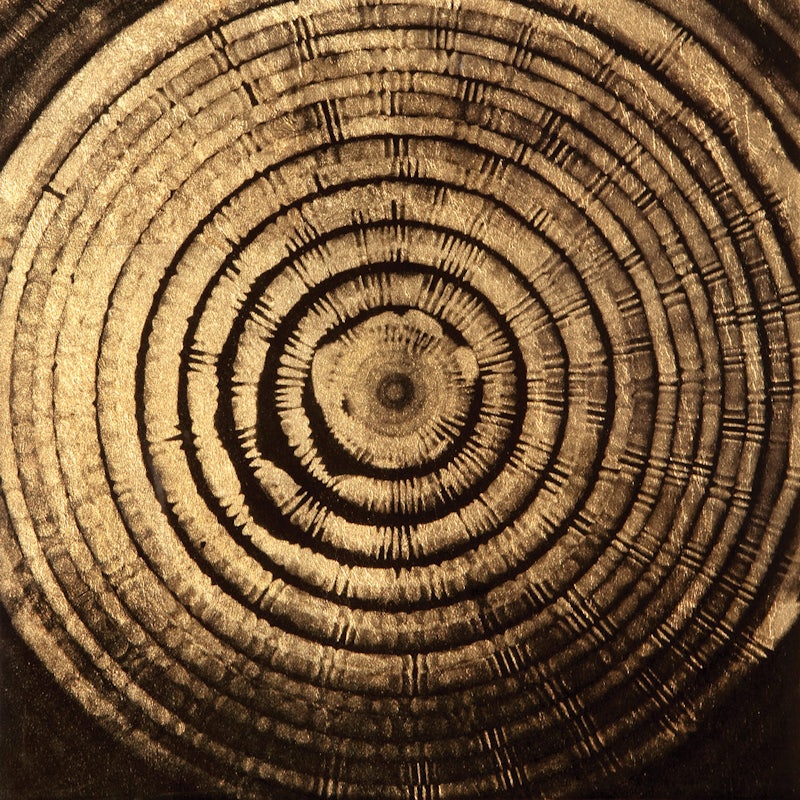
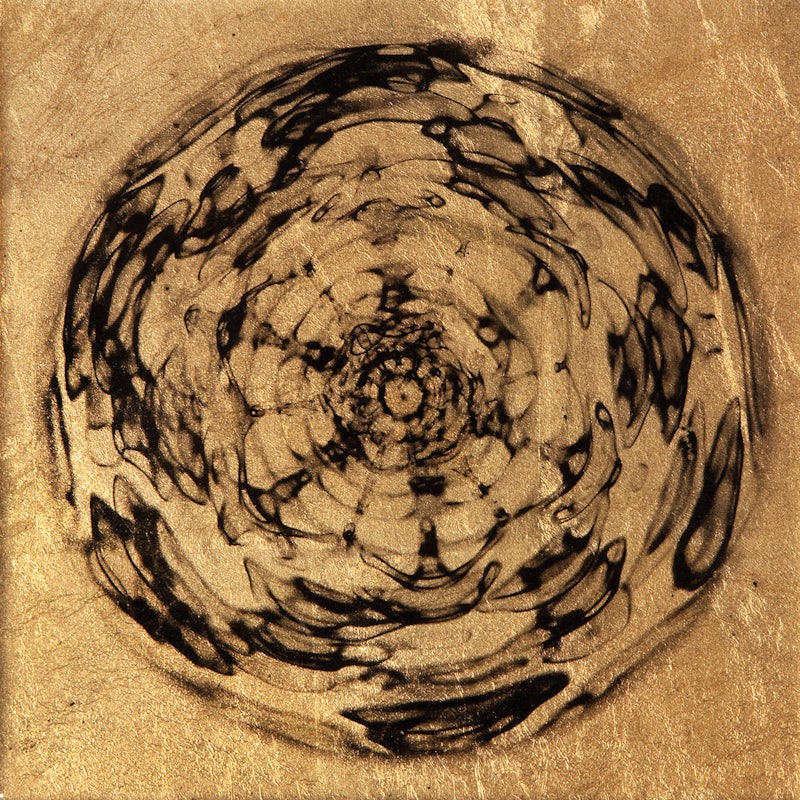
Using recordings uploaded to YouTube, Louivere+Vanessa broadcast audio 
files through a digital spectrometer to create images. These were then printed, 
using archival inkjet printer, onto handmade Japanese kozo paper, which was dibond 
primed with gesso, covered in gold leaf, and coated with resin. The resulting 
photographs are aural visualizations of an elusive noise: the Hum. 
Above is a recording from Bristol, England.

 Different cities tried different tactics. New York set up “Zones of Quiet” around hospitals and schools, and established the Society for the Suppression of Unnecessary Noise, which pushed through a 1907 act prohibiting the needless use of steam whistles in maritime traffic—the first noise-abatement legislation passed by Congress. In Baltimore, a dedicated anti-noise cop named Maurice E. Pease was appointed to instruct any huckster shouting about their wares that business could be conducted more efficiently via printed signs. Chicago banned the hawking of wares outright in 1911, and peddlers responded with a riot that stretched over three days, in what the Tribune called “a day of rioting and wild disorder such as has not been seen in Chicago since the garment workers’ strike.”

After the introduction in the 1920s of the decibel as an objective unit for measuring noise, cities were able to implement noise-abatement policies that cut the overall volume to (mostly) manageable levels. But perversely, it’s precisely these noise-reduction laws that allowed the Hum to emerge. In a loud environment like New York City, it’s far too difficult to hear the Hum, since it tends to just blend in with the din and chaos of everything else. The Hum, you could say, is not so much a sound but what’s left over, the noise you hear once all the other noises have been taken away.

Further confusing matters is the fact that some reports of the Hum have been definitively traced to specific sources and corrected. The Hum was heard in Sausalito, California, in the mid-1980s, but was eventually found to be the result of the mating sounds of a fish called the plainfin midshipman, whose call could penetrate the steel hulls of the houseboats in the marina. The Windsor Hum was investigated by the Canadian government and ultimately traced to factories on Zug Island, across the Detroit River in Michigan. After an extensive study of the Hum in Kokomo, Indiana, researchers determined that it was caused by two nearby manufacturing plants whose production facilities were emitting specific low frequencies.

The Hum soon stopped for some people in Kokomo—but not for everyone. Even in cases where there’s a likely culprit, it’s difficult to prove for sure. Dr. Colin Novak, one of the lead researchers of the Windsor Hum, concluded his report in May 2014, but in a CBC article that year he was quoted saying that while there was a high probability the cause was the Zug Island factories, “Unfortunately, we weren’t able to find that smoking gun.” Without a longer study and more cooperation from U.S. authorities, researchers couldn’t definitively identify the source. “It’s like chasing a ghost,” Novak said.

“I love science. I love mysteries. I love figuring things out,” said Glen MacPherson, the high school teacher and founder of the World Hum Map and Database Project, a site that has, since 2012, gathered and mapped reports of the Hum worldwide, including its location, intensity, and relevant biographical facts on the individual reporting it. MacPherson lives in Gibsons, British Columbia, a tiny town on the far west side of an inlet called Howe Sound. To get there you hook up with the Trans-Canada Highway and take it west until it runs out of road at a place called Horseshoe Bay, and from there a ferry carries you across the sound.

The air in Gibsons is lucid and still; you can hear the call of birds echoing across that pure stillness. Even the ferry and its cargo seem deferential to the silence of the water and its sparsely inhabited islands. The humble city of Vancouver, 30 miles away, seems a noisy urban nightmare.

We were sitting in the conference room of the Gibsons & District Public Library on a Saturday afternoon. It was quiet inside; any kids who could get away with it were out soaking up one of the last good weekends of the season. As I listened to MacPherson’s story of a mysterious noise, I couldn’t help but notice a sign tacked to the wall behind him, written in the big, gentle hand of a kindergarten teacher: “Be kind, be safe, be listening.”

So I listened. MacPherson’s Hum story, at least initially, was fairly typical: In 2012, he was living in Sechelt, just a few miles from Gibsons, when he began hearing at night the droning of what he assumed were seaplanes taking off and landing. “I couldn’t tell if it was a week or two or a month,” he recalled, “but it became quite obvious at one point that this sound was not being caused by planes. So I waited until it started the following evening—it seemed to have a pretty regular onset at 10 to 10:30 p.m.—and I went outside, and the noise stopped.”


“My logic was that if it was louder inside and it stopped outside, then the source was inside: a refrigerator, a piece of machinery, whatever it was. I started walking through the house, and the sound was relatively consistent.” MacPherson began turning off various appliances, all to no avail. 

One oddity he did notice, however, was that the noise would stop if he turned his head sharply or exhaled, though it would instantly return. “And then I ran out of ideas, and so I did what many people ultimately do: I cut the power to the house—and it got louder.”

Rather than dismiss Hum hearers as delusional tinnitus sufferers, the question that might be better asked is why don’t more of us hear it?

Though his experience with the Hum has not been as excruciating as some others (he describes himself as a Hum “hearer” rather than “sufferer”), MacPherson was drawn to the problem of this mysterious noise: “Less than one month after beginning my informal inquiries, I did what essentially every single person who visits the Hum web site has done: You go to Google.” He found an article in The Journal of Scientific Exploration, by a geophysicist named David Deming, titled “The Hum: An Anomalous Sound Heard Around the World.”

Deming, who has taught at the University of Oklahoma since 1992, was one of the first scientists to take the problem of the Hum seriously. (He also heard the Hum.) Crucially, Deming was able to distinguish the Hum from tinnitus. Tinnitus, usually a ringing in the ear, can take a number of forms, but while its intensity may wax and wane, it is more or less omnipresent, and those who suffer from it tend to hear it in any environment. The Hum, which is constant but only under certain circumstances (indoors, rural areas, etc.), defies a simple correlation with tinnitus. Additionally, Deming notes that if the Hum were related to tinnitus, one would expect a fairly normal geographic distribution rather than clusters in small towns.

Deming believed that the Hum wasn’t an acoustic sound, but possibly a low-frequency vibration that some people interpret as sound. The most likely culprit of the Hum was a Navy project known as Take Charge and Move Out, or TACAMO. Begun in the early 1960s, TACAMO is a network of aircraft that carry very low frequency (VLF) antennae to communicate with nuclear submarines. VLF waves, which require extremely long broadcast antennae and massive amounts of energy, can cover the globe and penetrate nearly any surface (they reach submarines a hundred feet below the surface). Deming proposed a simple experiment to test this hypothesis: Three boxes, each large enough to hold a human, one that blocked sound, one that blocked low-frequency waves and other types of electromagnetic radiation, and a control box that blocked neither.

Aside from Deming’s article, MacPherson realized, there was very little out there: The few user forums were rife with nonsense, heavy on anecdote, and light on fact. There were enough reports from far-flung places to suggest that the problem went beyond Taos and Bristol, but no one seemed to be doing anything systematic to gather all this information. As it happens, MacPherson had a background in technology. “My degree major was in computer science programming, minors in mathematics and Russian language. I also worked briefly as a web professional in the early 2000s alongside my teaching.” In 2012, he used a simple Google Docs tool to create a list of self-reported experiences with the Hum. “In combination of that and the Google form, and me knowing how to whip up web sites in a few hours, it began: the World Hum Map.”

MacPherson’s database allows users to input their experience with the Hum, including information on where and when it’s the loudest, if the hearer has tinnitus, if anything makes it stop, and so on. The World Hum Map soon came to the attention of Reddit, and submissions began pouring in; there are now over 5,000 data points. The first thing the site revealed was that the Hum wasn’t restricted to Taos and Bristol. It was everywhere. A purported recording of the Taos Hum anonymously uploaded to YouTube.

It’s in Overland Park, Kansas, where it sounds like “a metallic sound of something vibrating”; in Ankara, Turkey, where it’s a “very deep and quiet rumble that sounds like a very distant diesel generator”; and in Hervey Bay, Australia, where it’s “a pulsating continuous low background aircraft rumble that does not go away.” It seems to show up mostly in rural areas and in small cities: More people have heard it in Boise, Idaho, than in Washington, D.C. Reports dot the globe, from Iceland to the Philippines, but they’re concentrated in North America and Europe; MacPherson surmises this is only because the site is in English.

As I listened to MacPherson tell his story, the wind kept batting a branch against the windows, creating a noise just slight enough to hear but that gradually became maddening, as I found myself unable to tune it out. Hearing is complicated. It’s not just the physical sound waves that matter; it’s also what your brain does with that information. It’s important to remember that there’s so much we still don’t know about how hearing works. We know low-frequency waves can cause pain, nausea, and other deleterious effects on humans—indeed, the United States and other governments have long experimented with using sound and vibration as non-lethal weapons.

Over a decade ago, the WaveBand Corporation introduced a device known as Mob Excess Deterrent Using Sound Audio (MEDUSA), which uses directed microwaves to create a strong, discomforting audio sensation in the victim’s head. More common are Long Range Acoustic Devices (LRADS), which use ear-splitting focused noise and have been used on everyone from protesters in Ferguson, Missouri, to Somali pirates attacking cruise ships. Add to this the fact that since the early twentieth century we’ve been bombarding the atmosphere with all manner of frequencies and waves. Rather than dismiss Hum hearers as delusional tinnitus sufferers, the question that might be better asked is why don’t more of us hear it?

MacPherson liked his map and thought it was useful for creating a community for Hum sufferers. But he knew there was nothing scientific about it, nothing that would lead to a breakthrough in the Hum’s source. “People tell me where they are and what they hear and I put a dot on a map,” he said. Then, a few months after he started hearing the Hum, he realized “this crucial experiment that Deming had envisioned hadn’t been done yet.” The boxes. No one had thought to attempt Deming’s simple proposal of three boxes that could easily and definitively prove whether the Hum was an acoustic noise or a frequency, and no one had thought to try it. “I couldn’t believe it.” So MacPherson crowdsourced a few hundred dollars to cover the material costs and built the first one, the one that would block VLF waves.

MacPherson’s Deming box is six feet by three feet by two feet, and made of black low-carbon steel. It looks like a cross between a coffin and the monolith from 2001. He keeps it in a woodshed not far from his house. “Deming,” MacPherson said, “suggested that the first box out of three—which is what this is—should be able to completely block VLF radio waves.” Deming’s solution was a box with walls made from inch-thick aluminum, which would have been cost-prohibitive, to say nothing of technically difficult.

“Then I went on with my research and discovered that mild steel, with a minimum thickness of 1.2 millimeters, would provide what they call, in the physics lingo, about ten skin depths. Each skin depth of mild steel attenuates the signal to, let’s see,”—he mumbled a few figures, working out some math in his head—“about 30 percent of what the original signal strength would be. Ten skin depths essentially provides 100 percent coverage.” 

If a Hum sufferer were to get in the box, and if the Hum was indeed caused by VLF waves, then the noise should stop once inside the box. This is the test that MacPherson was planning to do while I was there. His goal was to take it on the road, bringing it down the Pacific Coast to meet up with other Hum sufferers and test it.

The welds on the box were thick, running along the edges like long-healed scars; as I ran a finger along one of them, he said, “The welding is crucial, because VLF radio waves have a peculiar habit of being able to penetrate, and find cracks, just like water.”

He pried open the hatch so I could peer inside. It looked claustrophobic, a pure black interior not long enough for an adult to lie in comfortably.

“So you’ll need some kind of oxygen source,” I asked, feeling a bit queasy at the thought of spending time locked in there.

“No need,” MacPherson answered. “There’s plenty of air inside a box that size, enough for, I don’t know, four hours of breathing.” This was probably technically correct but not at all reassuring.

MacPherson propped a foot up on the edge of the box. “If it were a different frequency than VLF,” he said, “like something around microwave, or cell phone frequency, which some people suggest, then this would not have taken me off and on three years to build.” I asked why, and he said that those waves can easily be blocked by thin layers of foil. “You know, the classic—”

“The tin foil hat,” I finished, both of us laughing. That he’s able to joke about this suggests his even-keeled approach to this whole question, but the hint of fringe conspiracy theories always lurks just around the corner and makes actual progress on solving the Hum extraordinarily difficult.

An inexorable attraction to anomalies is one of the ways science moves forward.

Take, for instance, another prominent voice in the Hum community: Steve Kohlhase, a mechanical engineer living in Brookfield, Connecticut, who first started hearing the Hum in 2009. “At one time it was very quiet around here,” Kohlhase told me over the phone.

“We moved up here from New Jersey in 1994, and there were two Algonquin pipelines by us”—gas pipelines—“and an Iroquois pipeline behind us. We bought the house realizing all that. But it was quiet, no issues at all. And during the 2000s, under Bush and all that—and I’m a Republican by the way—they decided they were going to start expanding. They put a couple of compressor stations behind us, and after they installed those, probably seven months later, I started sensing a low-frequency disturbing noise when I was in bed—the typical thing: One person hears it and the rest of the family doesn’t.” 

He wasn’t alone in hearing the noise, he said.

“The dog started acting up, and the coyotes started acting up: They started to walk up and down the street, leaving their habitat. … The dog went on Prozac because he couldn’t handle it.”

Kohlhase believes the pipelines running through his neighborhood and throughout the country are producing the Hum. He claims many of his neighbors hear it too but are afraid to say anything for fear of driving down property values. Other Hum sufferers have connected the Hum to electromagnetic radiation from nearby power plants, cell phone towers, or “smart” utility meters that broadcast their readings. Any facet of modern life that emits a signal or has moving parts has at one point or another been put forward as a potential cause of this unbearable noise, as though the Hum were something of a Rorschach blot of technological woe.

But from this set of information Kohlhase has extrapolated a conclusion more and more sweeping in scope. He believes that most—if not all—mass shootings of the past few decades can be traced to natural gas pipelines emitting low-frequency radiation. I asked Kohlhase about Aaron Alexis, the Washington Navy Yard shooter. “I don’t think he was crazy,” he said.

“I think he was basically sane given the conditions he was experiencing.” 
Nor does he think Alexis was alone. Using MacPherson’s maps of Hum reports, and his own research, Kohlhase claimed to have found a correlation between high numbers of Hum sufferers and mass shootings:
 
“[Alexis] was probably affected mentally by living in these Hum clusters, such as many of these other murderers—in Denver, Albuquerque, Tucson, out in California, even out here in Connecticut, at Newtown.” 

In the wake of the Sandy Hook shooting, Kohlhase submitted material to the Connecticut State Police suggesting that a natural gas pipeline near Adam Lanza’s home may have been what drove him to kill 27 people.

This reading of recent gun tragedies is pretty disturbing in its desire to explain with one stroke the root cause of these violent episodes, neatly sidestepping the problem of mental health, easy access to high-capacity assault weapons, and many other factors. It also sidesteps the deep conflicts, ambiguous problems, and difficult solutions in favor of what you could call a magic bullet that resolves the problem once and for all. But in the absence of serious scientific inquiry, this is precisely the kind of logic that’s allowed to prevail.


Visualization of a Hum recording from Taos, New Mexico.


Perhaps this is the reason so many people have seized on MacPherson’s experiment: its elegant simplicity, its promise of silencing the crackpots. With one simple test, it seems, we’ll know once and for all whether the Hum is related to VLF waves. If this theory is correct, we’ll know right away: If someone can hear the Hum outside of the box but not inside it, there will be strong evidence that it’s a low-frequency issue (the box isn’t soundproof). But the fact that it’s such a simple experiment is also why it’s so frustrating that MacPherson hasn’t tried it yet.

“As it turns out,” MacPherson told me, standing next to his steel monolith, “this unit, despite its very mundane and sepulchral appearance, has not been tested. Nobody has entered this yet, and I’m going to be the first person.”

When I asked him why he hasn’t gone in yet, MacPherson gave me a range of answers. “For one,” he said, “I don’t think this location will work. For many people the Hum is inaudible out of doors.” The woodshed MacPherson uses for the box is covered but not sealed, and has no door on it. He won’t bring it inside his own house, claiming it won’t fit inside the door. So he has to move it.

“In the big picture scientifically, this sounds ludicrous, but I need a trailer. The box looks too much like a coffin. I don’t want it seen out in public too much.”

But it’s not just that he doesn’t want to be seen driving it around; he doesn’t want to be seen testing it, either. “It’ll need to be put in someone’s garage, because that will provide the blocking for the ambient sound, but it’ll also provide the privacy necessary.” When I threw out the possibility of just going ahead and renting him a U-Haul, he demurred, changing the topic back to the theoretical discussion. Having come this far, he seemed suddenly uncomfortable with what he had made.

Gibsons, after all, is a small town of only a few thousand people, and MacPherson has taught high school here for 26 years. Without exaggeration, it’s safe to say that most everyone who lives here or their children has gone through his classroom. Since he’s begun this project he’s become known locally as the Hum guy: When he goes grocery shopping, one of the teenage clerks will stand behind him out of sight and hum quietly. It’s the kind of joke MacPherson takes in stride.

“If I don’t show a sense of humor on this,” he said, “it’s going to be hell.”

David Deming has more or less ended his involvement with the Hum; he’s no longer doing research on it, and he declined an interview on the topic (though he did answer a few brief questions via email). One wonders if this is because of people like Kohlhase, who Deming sees as the main problem standing in the way of understanding the Hum and other scientific anomalies. “They are inexorably attracted to anomalies of all types, but their behavior is fundamentally irrational,” he wrote in a 2007 paper. “On internet discussion forums, these people relentlessly drive out good posters and ruin everything they come into contact with. They need to be condemned swiftly and mercilessly.”

MacPherson is a bit more tolerant. “Everybody gets a chance with me,” he said. An inexorable attraction to anomalies is one of the ways science moves forward. William R. Corliss, the controversial physicist who spent years collecting records of scientific oddities from singing sands to the Nazca Lines, once wrote of such research that, “while not science per se,” it nonetheless “has the potential to destabilize paradigms and accelerate scientific change. Anomalies reveal nature as it really is: complex, chaotic, possibly even unplumbable.”

When Wolfgang Pauli first proposed the existence of neutrino particles in 1930, he almost immediately regretted it, referring to them as a “desperate remedy” to explain anomalous readings of radioactive decay. The work that ultimately proved their existence led to a Nobel Prize in 1995, but there were still problems, and neutrinos continued to confront scientists with unexplained readings, unpredictable data, and other anomalies that confound known models. Ultimately the so-called solar neutrino problem (referring to the fact that only a third of expected neutrinos emitted from the sun are recorded as expected) was solved in 1998, leading to another Nobel in 2015 for neutrino research.

There are many in the Hum community who see MacPherson’s box as an equally important scientific feat. “Regardless of the ultimate findings,” a poster commented on MacPherson’s site, “you have moved the investigation on the Hum forward in an unparalleled manner.” Having come this far, on the verge of finally testing the VLF theory, excitement among the Hum community is pretty high. “Thank you,” another commenter wrote, “for the inspiring initiative which may eventually bring back a life to many wandering spirits.”

But having finally completed the box, MacPherson suddenly stopped. After weeks of telling me that he would conduct his experiment in my presence, he made it clear that it would not happen. Partly, he said, this had to do with the school year starting up again and the increasing demands of his main job and his other hobbies. A few weeks later, when MacPherson still hadn’t tested it, a poster on MacPherson’s web site snarled at him. “Go in already,” he wrote. “What is it with this cliff-hanger shit?”

There was only so long I could stare at a metal box, particularly once MacPherson made it clear that neither of us were going inside it. We’d talked about going out to one of the places where MacPherson has heard the Hum the loudest, but instead he took me to his high school. He was eager to show me the garden he’d set up in the back of his classroom, where his students were growing tomatoes and various herbs. He talked about his other hobbies—surfing, cooking, playing bass guitar. He seemed far more enthusiastic about what his students are doing, and at times seemed quite over the Hum and his role in it.

I’d come to Gibsons to see the thing that was finally going to solve the problem of the Hum, made by the one man best positioned to make that happen. But MacPherson has already begun downplaying the impact of the box he’s built. It doesn’t have much practical use, after all: You can’t live in an airtight steel box all your life. Several people have written about the possibility of living in metal shipping containers as a means to escape the Hum, but since VLF waves can permeate most surfaces, one would have to flawlessly seal the container to get any kind of permanent relief. If it is VLF, in other words, it is inescapable, and MacPherson will at best only be able to verify that the Hum is everywhere.

Rather than hoping to end the problem once and for all, MacPherson hopes that his experiment—if he ever conducts it—will serve as a catalyst for more serious investigation. “I expect at some point I’ll have this taken away from me by a big university lab,” he said. He believes that the entire problem could be solved with a good lab and a small amount of funding.

“The problem is that no one’s paying for this, no one has picked this up,” he said.

“It’s me and a few people sending me PayPal accounts through the mail that’s essentially made a big metal box sitting in a woodshed.”

Colin Dickey is the author of the forthcoming Ghostland: An American History in Haunted Places, along with two other books of nonfiction. He is also the co-editor of The Morbid Anatomy Anthology.

House of Saud Hints at Nuclear Option if 9/11 Connections Chatter Continues

Saudi Arabia Threatens To Liquidate Its Treasury Holdings If Congress Probes Its Role In Sept 11 Attacks

by Tyler Durden  - ZeroHedge


April 17, 2016

Back in January, when the market was watching in shocked silence as oil prices were crashing to decade lows and as concerns emerged that Saudi Arabia may need to commence selling its vast, if unquantified, USD reserves, we wrote a post titled "Attention Finally Turns To Saudi Arabia's "Secret" US Treasury Holdings" where we noted something very surprising: whereas we do know that Saudi Arabia is the owner of the world's third largest USD reserves...


... their actual composition remains as a secret, because while the US discloses the explicit Treasury holdings of all other nations, Saudi Arabia's holdings, for some unknown reason, are not officially disclosed.

"It’s a secret of the vast U.S. Treasury market, a holdover from an age of oil shortages and mighty petrodollars," Bloomberg wrote of Saudi Arabia’s US Treasury holdings.

"As a matter of policy, the Treasury has never disclosed the holdings of Saudi Arabia, long a key ally in the volatile Middle East, and instead groups it with 14 other mostly OPEC nations including Kuwait, the United Arab Emirates and Nigeria," Bloomberg goes on to note, adding that the rules are different for almost everyone else.

Although Saudi Arabia's "secret" is protected by "an unusual blackout by the U.S. Treasury Department," for more than a hundred other countries, from China to the Vatican, the Treasury provides a detailed breakdown of how much U.S. debt each holds."

So who does know how much US paper the Saudis are sitting on? Well, the Saudis of course,"a handful of Treasury officials," and some bureaucrats at the Fed, Bloomberg says, noting that "for everyone else, it’s a guessing game."

Yes, a “guessing game,” but one that will very soon have profound consequences for markets and for geopolitics.

We closed with a simple, if suddenly very prophetic question:

"who would be the new patron saint of the US Treasury Department in the event the Saudis drawdown all of their reserves and decide to diversify away from USD assets... Put differently, who will monetize the US deficit if relations between Washington and Riyadh hit the skids over Iran?"

It is this question that has suddenly reemerged with a bang, and could rock the US administration to its core as what until recently was a "fringe conspiracy theory" is suddenly exposed as an all too unpleasant fact, and becomes the biggest political scandal to rock the U.S. in years, in the process maybe even crushing the friendly diplomatic relations the U.S. has held for years with its biggest Mid-East ally, Saudi Arabia.

* * *

First, a quick tangent: we have been greatly surprised by the reemergence of the topic of September 11 in recent weeks, and specifically the taboo - in official circles - issue whether there was a "Saudi connection" in the biggest terrorist attack on US soil. Just last weekend, out of the blue, 60 Minutes held segment on the "28 pages" that were classified in the Congressional investigative report into 9/11 - pages that allegedly confirm the Saudi connection.

To be sure, Saudi officials have long denied that the kingdom had any role in the Sept. 11 plot, and the 9/11 Commission found “no evidence that the Saudi government as an institution or senior Saudi officials individually funded the organization.” But critics have noted that the commission’s narrow wording left open the possibility that less senior officials or parts of the Saudi government could have played a role. Suspicions have lingered, partly because of the conclusions of a 2002 congressional inquiry into the attacks that cited some evidence that Saudi officials living in the United States at the time had a hand in the plot.

Those conclusions, contained in 28 pages of the report, still have not been released publicly. It was the surprising rekindled focus on these 28 pages in recent days that suggested that something may have been afoot.

Something was.


* * *

In a stunning report by the NYT, Saudi Arabia has told the Obama administration and members of Congress that it will sell off hundreds of billions of dollars’ worth of American assets held by the kingdom if Congress passes a bill that would allow the Saudi government to be held responsible in American courts for any role in the Sept. 11, 2001, attacks.

Or mostly Congress, because Obama has remained steadfast in his support of his Wahhabi petrodollar overlords, and has been busy lobbying Congress to block the bill’s passage, according to administration officials and congressional aides from both parties, and the Saudi threats have been the subject of intense discussions in recent weeks between lawmakers and officials from the State Department and the Pentagon. The officials have warned senators of diplomatic and economic fallout from the legislation.


Deceased Saudi King Abdullah bin Abdul Aziz al-Saud presents
Barack Obama with the King Abdul Aziz Order of Merit


By way of background, the Senate bill is intended to make clear that the immunity given to foreign nations under the law should not apply in cases where nations are found culpable for terrorist attacks that kill Americans on United States soil. If the bill were to pass both houses of Congress and be signed by the president, it could clear a path for the role of the Saudi government to be examined in the Sept. 11 lawsuits.

Suddenly Saudi Arabia is panicking: its response - if the US does pass this bill it would liquidate hundreds of billion in U.S. denominated assets, and perhaps as much as $750 billion in US Treasurys (the NYT's estimate of Saudi Treasury holdings).

The NYT rports that none other than Adel al-Jubeir, the Saudi foreign minister, delivered the kingdom’s message personally last month during a trip to Washington, "telling lawmakers that Saudi Arabia would be forced to sell up to $750 billion in treasury securities and other assets in the United States before they could be in danger of being frozen by American courts."

* * *

This stunning threat has caught America off guard, because until now it had largely been speculated that not the Saudis but China would use the "liquidation of Treasurys" as a bargaining chip. As it turns out, Saudi Arabia was the first.

To be sure, the Saudis whose budget deficit has soared in the past year as a result of collapsing oil prices, would stand to benefit from monetizing their US reserves. According to many, it is only a matter of time anyway. However, a dramatic, immediate liquidation would likely spark a market panic. Outside economists are skeptical that the Saudis will follow through, saying that such a sell-off would be difficult to execute and would end up crippling the kingdom’s economy. But the threat is another sign of the escalating tensions between Saudi Arabia and the United States.

The Obama administration, meanwhile, is far less concerned about the market impact of a Saudi liquidation, and far more worried what a real inquiry into the Saudi role of Sept.11 would reveal (and who it would implicate) and as a result is building strawman arguments that the legislation would put Americans at legal risk overseas. In fact, as the NYT reports, "Obama has been lobbying so intently against the bill that some lawmakers and families of Sept. 11 victims are infuriated. In their view, the Obama administration has consistently sided with the kingdom and has thwarted their efforts to learn what they believe to be the truth about the role some Saudi officials played in the terrorist plot."

“It’s stunning to think that our government would back the Saudis over its own citizens,” said Mindy Kleinberg, whose husband died in the World Trade Center on Sept. 11 and who is part of a group of victims’ family members pushing for the legislation.

Stunning indeed, and yet that's precisely who the "U.S." president sides with when attempting to get to the bottom of the 2001 terrorist attacks.

Incidentally, Obama will arrive in Riyadh on Wednesday for meetings with King Salman and other Saudi officials. It is unclear whether the dispute over the Sept. 11 legislation will be on the agenda for the talks.


President at Sept. 11 ceremony, 2015. Obama administration 
argues that the bill would put Americans at legal risk overseas.


* * *

The Saudi threat comes as the dispute comes as bipartisan criticism is growing in Congress about Washington’s alliance with Saudi Arabia, for decades a crucial American ally in the Middle East and half of a partnership that once received little scrutiny from lawmakers. Last week, two senators introduced a resolution that would put restrictions on American arms sales to Saudi Arabia, which have expanded during the Obama administration.

Meanwhile, families of the Sept. 11 victims have used the U.S. court system to try to hold members of the Saudi royal family, Saudi banks and charities liable because of what the plaintiffs charged was Saudi financial support for terrorism. These efforts have largely been stymied, in part because of a 1976 law that gives foreign nations some immunity from lawsuits in American courts.

It is this law that the proposed Senate Bill intends to overturn; it is this Bill that Saudi Arabia is suddenly in arms over.

And it is the Saudis that Obama is siding over instead of his own people.

But of course, Obama can't openly come out and say he would rather keep the truth of Saudi involvement buried than push for a probe, so Obama administration officials counter that "weakening the sovereign immunity provisions would put the American government, along with its citizens and corporations, in legal risk abroad because other nations might retaliate with their own legislation. Secretary of State John Kerry told a Senate panel in February that the bill, in its current form, would “expose the United States of America to lawsuits and take away our sovereign immunity and create a terrible precedent.”

In a closed-door briefing on Capitol Hill on March 4, Anne W. Patterson, an assistant secretary of state, and Andrew Exum, a top Pentagon official on Middle East policy, told staff members of the Senate Armed Services Committee that American troops and civilians could be in legal jeopardy if other nations decide to retaliate and strip Americans of immunity abroad. They also discussed the Saudi threats specifically, laying out the impacts if Saudi Arabia made good on its economic threats.

In other words, the logic is that if the US pursues a full-blown inquiry into the Saudi role behind 9/11, the US itself would be subject to a comparable stripping of immunity - with respect to alleged U.S. terrorist attacks - and "create a terrible precedent." In effect, the US government is defending its position by saying that if one can get to the bottom of Saudi terrorism in the U.S., the world may next learn about U.S. terrorism across the globe.

And that just can't be allowed to happen.

Meanwhile, even as Obama fights tooth and nail to protect the Saudi's dirty laundry, the administration pretends to side with US citizens: "John Kirby, a State Department spokesman, said in a statement that the administration stands by the victims of terrorism, “especially those who suffered and sacrificed so much on 9/11." It just refuses to reveal those who are truly responsible for their death.

* * *

But back to the Saudi (mostly hollow) threat of dumping US Treasuries should the proposed Bill be passed, which indeed is nothing more than just that, especially since the Fed or BOJ would be delighted to have found a willing seller who has as much as three quarter of a trillion in US paper lying around.

Edwin M. Truman, a fellow at the Peterson Institute for International Economics, said he thought the Saudis were most likely making an “empty threat.” Selling hundreds of billions of dollars in American assets would not only be technically difficult to pull off, he said, but would also very likely cause global market turmoil for which the Saudis would be blamed.

Moreover, he said, it could destabilize the American dollar — the currency to which the Saudi riyal is pegged.

“The only way they could punish us is by punishing themselves,” Mr. Truman said.

Well, they would also punish the Fed, because suddenly the Petrodollar would re-emerge as the main driving force behind the value of the greenback.

* * *

And yet, perhaps the Saudis have reason to panic: the Senate bill is an anomaly in a Congress fractured by bitter partisanship, especially during an election year. It is sponsored by Senator John Cornyn, Republican of Texas, and Senator Chuck Schumer, Democrat of New York. It has the support of an unlikely coalition of liberal and conservative senators, including Al Franken, Democrat of Minnesota, and Ted Cruz, Republican of Texas. It passed through the Judiciary Committee in January without dissent.


“As our nation confronts new and expanding terror networks that are targeting our citizens, stopping the funding source for terrorists becomes even more important,” Mr. Cornyn said last month.

It is almost as if Congress has decided to end the long-running alliance the U.S. has had with Saudi Arabia, despite the bitter protests of the administration; it has decided to use the Sept.11 disclosure as its own bargaining chip.

To be sure, as the NYT notes, the alliance with Saudi Arabia has frayed in recent years as the White House has tried to thaw ties with Iran — Saudi Arabia’s bitter enemy— in the midst of recriminations between American and Saudi officials about the role that both countries should play in the stability of the Middle East. But the administration has supported Saudi Arabia on other fronts, including providing the country with targeting intelligence and logistical support for its war in Yemen. The Saudi military is flying jets and dropping bombs it bought from the United States — part of the billions of dollars in arms deals that have been negotiated with Saudi Arabia and other Persian Gulf nations during the Obama administration.

The war has been a humanitarian disaster and fueled a resurgence of Al Qaeda in Yemen, leading to the resolution in Congress to put new restrictions on arms deals to the kingdom. Senator Christopher S. Murphy, Democrat of Connecticut, one of the resolution’s sponsors and a member of the Senate Foreign Relations Committee, said that Congress has been “feckless” in conducting oversight of arms sales, especially those destined for Saudi Arabia.

“My first desire is for our relationship with Saudi Arabia to come with a greater degree of conditionality than it currently does,” he said.

That also appears to be Obama's last desire; while the only desire Saudi Arabia has is to maintain the status quo, one where nobody looks at who pulled the strings behind Sept. 11 and in exchange for which the Saudis would continue dutifully recycling petrodollars, or if they don't get their way, they will simply proceed to launch the biggest liquidation of US Treasurys in history. Or such is their stunning threat..

Which brings us to the original question: why the Saudi panic, and why immediately threaten with the "nuclear option", namely liquidating US Treasurys, if the Saudis have nothing to hide?

The question is, of course, rhetorical.