AN INTRODUCTION: Smart Power & The Human Rights Industrial Complex
April 19, 2016
Human rights in the West: does the reality live up to the rhetoric? On the surface, the cultural narrative seems innocent enough: billionaire philanthropists, political luminaries and transnational corporations, along with legions of staff and volunteers – all working together in the name of social justice, forging a better, fairer and more accountable world.
(Photo Illustration by Shawn Helton)
The story reads well on paper, and well it should. After all, the 20th century saw a string of apparent failures by various governments to curb and halt some of the most horrific exhibitions of genocide and crimes against humanity. As a result, the door has been opened for many high-profile charities and human rights organizations to play a bigger role in moderating international affairs.
Upon more rigorous inspection, however, a number of uncomfortable realities emerge regarding the 21st century international human rights concern. Though many human rights charities still market themselves as ‘neutral’ and ‘nonpartisan’, the reality is something very different. Below, we will detail a number of high-profile cases where these organisations are being used as public relations organs to further western foreign policy objectives. With public skepticism of the charity sector already at an all-time high, the danger is clear: if conflicts of interest are not addressed in a serious way, they threaten to undermine the credibility of the entire non-governmental organization (NGO) sector internationally.
One difficult aspect in analyzing this battle of ‘perception management’ is that there’s a real risk of wrongly demonising the entire NGO sector. The reality is that most human rights and aid organizations are staffed and run by good, hard-working and extremely well-educated individuals, many of whom carry out their roles with an altruistic heart and with the best of intentions. For the most part, many remain unaware or uninterested in who actually funds their organisations and what those financial strings mean in terms of the what a given organisation’s stance will be on any range of geopolitical issues or military conflicts. It’s certainly true that over the years, sincere and dedicated campaigning by organisations has helped to free individuals who where unjustly imprisoned and achieved due process and justice for the dispossessed. It’s also true that many of these same organizations have helped to raise awareness on many important social and environmental issues.
Due to increased funding from corporate interests and direct links to government and defense policy think tanks in recent years, these organisations have become even more politicised, and more closely connected with western ‘agents of influence.’ As a result, an argument can be made that, on many levels, these ‘human rights’ organisations may be contributing to the very problem they profess to be working to abate: causing more suffering, death and instability worldwide through their co-marketing of the foreign policy objectives of Washington, London, Paris and Brussels.
The problem is both systemic and institutional in nature. As a result, many of the western world’s leading human rights organizations based in North America and Europe have become mirror reflections of a western foreign policy agenda and have become virtual clearing houses for interventionist propaganda.
Writer Stephanie McMillan describes the new role of the non governmental organizations in the 21st century:
“Along with military invasions and missionaries, NGOs help crack countries open like ripe nuts, paving the way for intensifying waves of exploitation and extraction.”
In 1999, the manufacturing of consensus for NATO’s war against
Yugoslavia was a multilateral effort (Image:
Tass News)
Outsourcing‘ConsensusBuilding’
Shaping western public perception and opinion on major international issues is essential if major world powers are to realise their foreign policy goals. Not surprisingly, we can see that many of the public positions taken by NGOs are exactly aligned with western foreign policy. In the BalkansWar of the 1990’s, human rights groups supported partitioning. In the Ukraine in 2014 and with both Syria and Yemen in 2016 they supported regime change. In each instance NGOs function as public relations extension to a United Nations western member Security Council bloc, namely the US, UK and France. This collusion is manifest throughout the upper echelons of these organizations whose streamlined agenda conforms through a lucrative revolving door which exists between a cartel of western NGOs, government and media.
As western governments find themselves more heavily involved in long-term conflicts around the globe, the need to outsource their ethics and morals to NGOs becomes more apparent. Continuity between these symbiotic entities is essential if governments are to successfully frame the geopolitical narratives on which international human rights organizations so often derive their own public relations and fundraising campaigns. Together, all of these things converge to form a highly efficient, functioning alliance which could be described as a type of ‘government-media-human rights’ industrial complex.
Nowhere is this complex more evident than with the United States-led foreign policy towards Syria. By framing the Syrian Conflict (2011 to present) as a “civil war”, both western media and human rights organizations did their part in propping-up an important western foreign policy narrative. Inaccurate and distorted, this narrative has helped shield the US-led clandestine proxy war which has been allowed to carry on almost unimpeded below the surface narrative of western public perception. For mainstream US audiences, if truly known, the reality of Syria might be too much to bear – a US-backed guerrilla war where Washington and Ankara, along with NATO and Gulf Cooperation Council (GCC) allies, flooding Turkey and Syria with weapons, cash, equipment, social media teams, military trainers and foreign fighters from as a far away as Pakistan. When analyzed from this wider perspective, very little is ‘civil’ about the Syrian Conflict.
The Human Rights Industry
What was once a 20th century adjunct to an emerging international progressive movement has since mushroomed into a 21st century multi-billion dollar, internationalised ‘third sector’ concern – underwritten by some of the world’s leading transnational corporations. This impressive labyrinth is led by organizations like Amnesty International, Human Rights Watch (HRW), and the Worldwide Human Rights Movement (FIDH). Each of these organisations has well-developed links leading directly into central governments, and perhaps more surprisingly, links leading straight into the heart of the military industrial complex. Safely cloaked under the official guise of ‘charity organisation’, many of these entities push a political agenda and
effectively serve as public relations outlets for US and NATO forward military planning.
Working behind the public-facing human rights industrial complex is another key component which helps set the geopolitical agenda. Leading western governmental efforts are the White House and the US State Department. Behind the political facade, however, is where the real work takes place; a myriad of think tanks which serve as an unofficial academic-like support structure for managing policy planning,
rolling out grand strategies and other big ideas. Some recognisable names in this industry are the Council on Foreign Relations (CFR), Center for Strategic and International Studies (CSIS), Brookings Institute, Heritage Foundation, American Enterprise Institute (AEI), and Foreign Policy Initiative (
the heir apparent to PNAC). These think tanks and foundations are also referred to as ‘policy mills’ because of their ability to churn-out volumes of policy ‘white papers’, surveys and strategic studies which are then disseminated through various industry journals and at functions, conferences and events in Washington DC and New York City. Certain think tanks,
like the Committee for Peace and Security in the Gulf, were set-up in the 1990’s to push through specific foreign policy objectives – like kick-starting the war in Iraq. Where you find a war, you most certainly will find a think tank advocating behind it.
Follow the Money
To find the common thread between think tanks, foundations and human rights charities, one needs only to follow the money.
Many of these entities receive large portions of their funding from the same sources – transnational corporations. One large contributor of annual funding for human rights organisations, including HRW, is the controversial Wall Street billionaire George Soros,
through his NGO the Open Society Institute. Other human rights organisations like FIDH which draw together some 178 organizations from 120 countries, receives funding from the US State Department by way of the
National Endowment for Democracy (NED). Here we have a direct financial link which forms a ring connecting western governments, NGOs and charities.
One can argue, and successfully, that this nexus ensures that the output, ideas and marketing messages of each leg of a human rights campaign conforms to western foreign policy language and objectives.
Smart Power: Formerly of the US State Dept., now an
NGO luminary, Suzanne Nossel (Image Source:
Pen.org)
Washington’s HR Revolving Door
It’s no secret that a revolving door exists between the US State Department and many of the western world’s leading human rights organisations. That relationship can be gleaned from
this CFR policy paper which states:
“To advance from a nuanced dissent to a compelling vision, progressive policymakers should turn to the great mainstay of twentieth-century U.S. foreign policy: liberal internationalism, which posits that a global system of stable liberal democracies would be less prone to war … Washington, the theory goes, should thus offer assertive leadership – diplomatic, economic, and not least, military – to advance a broad array of goals: self-determination, human rights, free trade, the rule of law, economic development, and the quarantine and elimination of dictators and weapons of mass destruction (WMD).”
hat passage, taken in the context of the Syrian conflict, reveals a stark picture of how Washington really works. It was written by Suzanne Nossel, one of Washington’s most high-profile humanitarian advocates who managed to transition seamlessly from her position as Deputy Assistant Secretary for International Organisations at the US State Department – directly into an executive director position at Amnesty International USA in 2012. Prior to the State Dept., Nossel was also served as chief operating officer for Human Rights Watch, vice president of strategy and operations at the Wall Street Journal and a media and communications consultant to CFR founding corporate member, law firm McKinsey & Company.
Here we see a powerful public relations resumé, combined with established links to Washington’s foreign policy core, and at a time where multiple Middle Eastern nations states, like Libya and Syria, were being forced into submission under the yoke of US-led international pressure. Projecting Washington’s preferred narrative is paramount in this multilateral effort and Nossel would be a key bridge in helping to project US foreign policy messaging internationally through top tier NGO Amnesty.
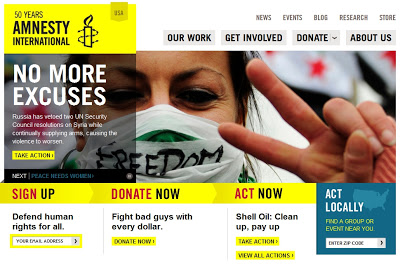
IMAGE: 2012 Amnesty International USA PR campaign.
Around this time, Amnesty USA launched a new PR campaign aimed at millennials and selling the following geopolitical narrative: “NO MORE EXCUSES: Russia has vetoed two UN Security Council resolutions while continually supplying arms, causing the violence to worsen.”
This digital and print campaign was also backed by rallies and other live events used to promote their anti-Russia and Anti-Syria PR effort. At one event in 2012, young school children in Nepal could be seen
holding up signs that read, “Russia: Stop Arms Transfer to Syria!”.
When you consider its mirror reflection of foreign policy lines emanating from the US State Dept., it’s easy to see how this catchy slogan had little if anything to do with human rights, but but could easily be viewed as trying to isolate both the Russian and Syrian governments geopolitically.
In truth, Amnesty’s narrative was a complete inversion: while attempting to lay the blame on Russia as being responsible for the escalation and sustained violence in Syria, the country was being over-run by tens of thousands of foreign terrorist militants, illegally trafficked weapons, along with CIA and other foreign assets,
as part of the wider US-led Coalition presently waging a proxy war in Syria.
Soft Power vs Smart Power
Despite its foreign policy aspirations, the West still needs public opinion backing for any military action. While the public are none the wiser, blinded by the fog of mass media coverage and bombarded with faux moral imperatives and ‘ticking bomb’ style scenarios demanding that, “we must act now to save innocent lives” – soft power agents have provided the crucial communication bridge for most interventions.
Both media and NGOs fall under the classification of ‘soft power’, and it is this soft power complex which provides the soft cushion upon which soft-sounding foreign policies like “humanitarian intervention” and the
Responsibility to Protect (R2P) can comfortably rest on in western discourse. In reality, these foreign policies are anything but soft, and in the absence of declaring war between nation states – these policies now serve as the tip of an imperialist spear. If you surveyed any of the millions of Middle Eastern residents on the receiving end of the west’s recent humanitarian interventions they will tell you it was anything but soft – especially for the people living in Libya, Syria, Yemen, Yugoslavia and Iraq.
Inside Washington’s inner sanctum, ‘soft power’ has given way to Smart Power. Indeed, it was Susan Nossel
who coined the term “Smart Power” while
working alongside US humanitarian hawks like Hillary Clinton, Samantha Power and Susan Rice, and also with Washington’s lesser known
Atrocity Prevention Board, all of whom worked to successfully implement this new range of intervention marketing concepts including humanitarian intervention and R2P.
In this age of professionally staged colour revolutions and ‘Arab Springs’, and wars fought by proxies and front organizations – vaunted human rights organisations should really acknowledge that there are nation-states and central governments who are not long for this world, and who are literally fighting for their survival. Governments who find themselves under the western hammer cannot always afford the luxury of settling internal disputes nicely, or putting down armed rebel factions and terrorists with all affordable due process. If these rebels or terrorists are western-backed, or GCC-backed, then this condition becomes more acute.
Certainly, the United States and its NATO allies, or Israel for that matter, do not afford such civility for any of its victims of collateral damage’ or during a protracted ‘humanitarian intervention’.
‘Agents of Change’ & Emotive Appeals
By now, it’s also
a well-documented fact that America’s CIA and Pentagon intelligence departments have used an array of charities, aid organisations, and even
religious missionary organisations as fronts for conducting espionage overseas, and with the prime directive of to further foreign policy objectives.
In recent years, however, under the banner of ‘human rights’, the US has developed some new and innovative methods of intelligence gathering and achieving an increased military footprint in new countries.
To reach these objectives, western governments enlist ‘change agents’.
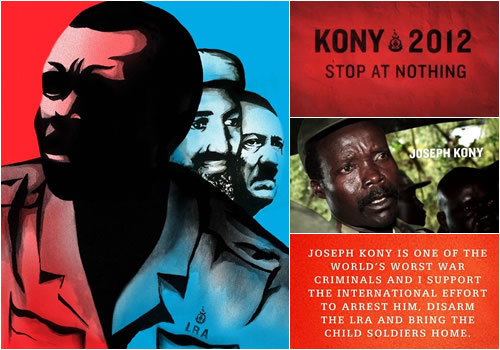
IMAGE: The Kony 2012 marketing campaign was organized by a
human rights
front organization, Invisible Children, using US school-
children to help
lobby for a US military deployment in Uganda, Africa.
No story serves as a better example of how a human rights organisation can be applied as a sharp tool of foreign policy than
Kony 2012, described by the Atlantic Magazine as a viral video campaign which “reinforces a dangerous, centuries-old idea that Africans are helpless and that idealistic Westerners must save them.”
As viral social media campaigns go, Kony 2012 set a new standard for speed and efficiency in penetrating the western youth market. This effort was not with out help from mainstream corporate media in the US, and also from the US government in Washington DC.
Here, soft power was applied in order to manufacture public consent through an emotive public appeal which was eventually exposed as a gross distortion of reality. In this case, the antagonist was the illusive warlord Joseph Kony, leader of the Lords Resistance Army. According to their campaign, if the president could send a military force to “find Kony”, then many children would be saved in the process. The only problem was that no one had actually seen Kony
in over 6 years, with rumors abound that Kony may even have died years earlier. This did not deter the campaign though, as organisers pressed ahead, raising millions along the way. The human rights charity which fronted the project, Invisible Children, actually targeted their viral campaign and fundraising drive at under aged American school children, and even drafted primary school students to raise money on the charity’s behalf. In the end, the project collapsed, but the ultimate objective was achieved: culminating with a successful public relations event and photo opportunity at the White House, and under cover of the Kony 2012 media campaign – President Barack Obama publicly deployed
US military assets to Ugandaunder an expansion of
US AFRICOM operations in Africa.
Trapped inside their own ideological controlled environment where every decision is a virtual fait accompli, western media and government officials will routinely refer to the human rights industry in order to provide a necessary moral back-stop for any foreign policy objective. This same practice is also repeated by the United Nations too, which often cites the very same statistics and reports used by Washington to back-up its foreign policy moves.
Independent human rights activist Rick Sterling
explains this all too familiar cycle in today’s international affairs:
“There is a pattern of sensational but untrue reports that lead to public acceptance of US and Western military intervention in countries around the world: In Gulf War 1, there were reports of Iraqi troops stealing incubators from Kuwait, leaving babies to die on the cold floor. Relying on the testimony of a Red Crescent doctor, Amnesty International ‘verified’ the false claims. Ten years later, there were reports of ‘yellow cake uranium’ going to Iraq for development of weapons of mass destruction. One decade later, there were reports of Libyan soldiers ‘drugged on Viagra and raping women as they advanced.’ In 2012, NBC broadcaster Richard Engel was supposedly kidnapped by ‘pro-Assad Syrian militia’ but luckily freed by Syrian opposition fighters, the “Free Syrian Army”. All these reports were later confirmed to be fabrications and lies. They all had the goal of manipulating public opinion and they all succeeded in one way or another. Despite the consequences, which were often disastrous, none of the perpetrators were punished or paid any price.”
Strange Bedfellows: NATO, Amnesty and HRW
It’s no coincidence that nearly every foreign policy front the US State Department has prioritised is mirrored by Amnesty International USA. The US State Department together with the Pentagon, will also utilise social justice issues in order to advance a foreign policy objective. The most potent of these has to be gender identity politics, seen through the western lens as “woman’s rights”. By projecting this issue on to a non-favoured’ nation, western war planners can quickly construct an important leg in foreign policy messaging.
In 2012, Amnesty International USA ran a national billboard campaign with images depicting Afghan women and girls, accompanied by the slogan: “NATO: Keep the Progress Going.” Not surprisingly, at this same moment, western media were referring to NATO’s military operation in Afghanistan as “
the first feminist war.” In its totality, this is one example of near perfect streamlined marketing campaign which tied together all branches of the interventionist network – the US State Department, the Pentagon, the mainstream media and Amnesty International. This cynical attempt to manipulate public opinion by Amnesty International, on behalf of the Pentagon and Brussels, could be traced back to one Amnesty patron, former US Secretary of State Madeleine Albright, who in the 1990’s,
famously remarked, “We think the price is worth it,” referring to the death of a half million Iraqi children as a result of crippling US economic sanctions.
In early 2015, Ken Roth, Director of Human Rights Watch,
tweeted out an aerial image purporting to be from Kobane, Syria, showing a neighborhood reduced to rubble which he described as, “a drone’s eye tour of what Assad’s barrel bombs have done to Aleppo.” It turned out that Roth’s tweet was a forgery. The image he used was actually taken from Gaza the previous summer, showing the destruction of Palestinian neighborhoods at the hands of Israel’s IDF. This was another example of slipshod propaganda disseminated by high profile human right organization – expressly designed to demonise a foreign government that Washington nation builders are seeking to overthrow. It’s no surprise then that HRW would also appoint CIA operative Miguel Diaz
to serve on its advisory board, or that Javier Solana, former Secretary General of NATO and architect of the 1999 bombing of Yugoslavia (a war which HRW itself condemned in 2000) also serves on HRW’s board of directors.
Beyond the slick marketing and celebrity endorsements, in all actuality HRW is nothing more than a Cold War era propaganda relic which has been retrofitted to serve a 21st century Atlanticist geopolitical agenda.
According to Washington DC-based transparency advocate Keane Bhatt, “HRW was originally called Helsinki Watch. It was created in 1978 during the Cold War to scrutinize and criticize the crimes that were being committed by the USSR and its allies. That Cold War ideology has long played a role in the kinds of priorities and advocacy that HRW engages in.”
Syria’s NGO Kaleidoscope
One of the most egregious examples of a NGO being used to reinforce a US-led geopolitical narrative is the Syrian Observatory for Human Rights (SOHR), created in 2006. Beyond the grandiose name, this ‘organisation’ is basically a one-man show which until recently, was run out of a one bedroom apartment in Coventry, England. SOHR is run by a Syrian dissident named Osama Ali Suleiman, commonly known in the media as “Rahmi Abdul Rahman”. The SOHR has played the key role in developing the all-important “facts on the ground” story for the Washington-London-Paris Axis seeking to topple the government in Damascus through its stoic policy of ‘regime change’ in Syria. When it comes to ‘official’ death toll numbers out of Syria, almost every mainstream report in the US and Europe has cited the SOHR as its data source with hardly a passing thought as to either the accuracy or the credibility of its numbers, and under which category death tolls are counted.
Despite the fact that the SOHR is closely affiliated with the US and UK-backed Syrian opposition, its data sets will often include casualty figures of ‘rebel forces’ (which will often include known foreign terrorist fighters)
within its civilian casualty figures. These dubious figures are also used by a number of UN agencies, as well as leading human right organisations. Similarly, US, UK and European officials will frequently attribute a figure of 250,000 ‘Syrian deaths’ to civilians killed by “the regime” embodied by President Bashar al Assad. One week, a western official will quote a number of 150,000, and the next week it will be 350,000. As a result, most mainstream reports of Syria’s casualty figures are rife with bias and methodological inconsistencies, and as a result no one really seems to know the real figure. The larger the number, the more passionate the plea for western military intervention. Even the Council of the Foreign Relations is on record stating that the numbers being cited by the likes of John McCain simply don’t add up.
Micah Zenko and Amelia M. Wolf of the CFR
admitted in 2014 that,
“most of the reported deaths in Syria have not been committed by forces under Bashar al-Assad’s command.” Meanwhile, western media, politicians and human rights organisations routinely ignore the fact that over 100,000 deaths since 2011 have been Syrian Army and Security personnel killed by foreign-backed militants and terrorists. Zenko later added that, “the types of interventions that proponents have endorsed for Syria … have almost nothing to do with how Syrian non-combatants are actually being killed.”
While the Syrian Conflict is a messy and tragic affair, with brutality and violence affecting every side of the fighting, readers should note exactly how this subtle, yet relentless western campaign of disinformation feeds neatly into the western policy of regime change embodied in the rhetorical demand that “Assad must go.” John Glaser from Antiwar.com adds here:
“A common policy proposal to mitigate the mass suffering in Syria is for the U.S. to help the rebels and undermine the Assad regime, a scheme that just becomes ludicrous after looking at the data.”
It should also be noted that the SOHR receives its funding directly from the EU, and also enjoys substantial support from the British Foreign Office – both of whom are actively seeking to overthrow the government in Syria through guerrilla proxies. At the very least this could be described as a conflict of interest. The SOHR is hardly ‘non partisan’ and more likely to be used as a tool to manufacture consensus for humanitarian intervention in Syria.
Interventionist Digital Marketing
They say that ‘the road to tyranny is paved with good intentions’. That old adage couldn’t be more true today, despite all of our seemingly wonderful internet tools and ‘activist’ platforms online.
A key set piece in any nation building or humanitarian intervention is the ‘No Fly Zone’. Made famous during NATO’s Balkans War in Yugoslavia, the US-led Gulf Wars for Iraq, and later with NATO Libya, securing a No Fly Zone is essential for dictating the terms and conditions of any interventionalist program. The term has since developed an elastic quality and has been subtly altered into what many now refer to a “Safe Zone”, the idea being that by securing the skies above with western air power, the people below will be ‘safe.’
However, it’s still become a hard-sell because of negative connotations associated with past unpopular operation that have been viewed western wars of aggression. New technology is needed in order to repackage and market this damaged brand.
The internet and social networking have provided just that, where a myriad of social networking online petition web portals have been launched in recent years, the most prominent of which is the online organization Avaaz.org
was co-founded in 2007 by Res Publica and Moveon.org, and whose funding sources include the George Soros’ Open Society umbrella foundation network. Key founders and players include Tom Perriello, Ricken Patel, Tom Pravda, Jeremy Heimans, David Madden, Eli Pariser and Andrea Woodhouse, each of whom have working relationships with the UN and World Bank, and
coordinate with US-controlled institutions like the UN Security Council and UN Human Rights Council.
According to the Avaaz website, their mission is to “organise citizens of all nations to close the gap between the world we have and the world most people everywhere want.”
Non-profit Avaaz works closely with its for-profit arm, New York City-based PR firm
Purpose, which refers to itself as a “proud public benefit corporation.”
It is important to understand that by their own admission, these organizations are not meant to be purely altruistic, but rather are enterprise businesses.
In her article entitled “The Rise of the Movement Entrepreneur and its Impact on Business”, writer Allison Goldberg explains the ‘big idea’ which is used a wrapping for their self-styled social license:
“The rise of new technology has drastically lowered the barrier to movement creation while providing an alternative to established institutions, formerly seen as the route to reform. Instead of relying on government bodies or other established organizations often weighed down by bureaucracy, entrepreneurs are utilizing the power of social media to mobilize the masses in favor of large-scale change. As a result, organizations have arisen such as Avaaz.org, which defines itself as “the campaigning community bringing people-powered politics to decision-making worldwide.” Avaaz now boasts seven million members worldwide.”
Together, Avaaz and Purpose create the language and the online consensus-building tools. While maintaining the illusion of grassroots activists advocating for human rights, the core function of their public relations campaigns are outcome-based, or to help herd public opinion in order to provide a pretext for multilateral institutions like the the IMF and NATO to implement programs like economic sanctions, or military intervention.
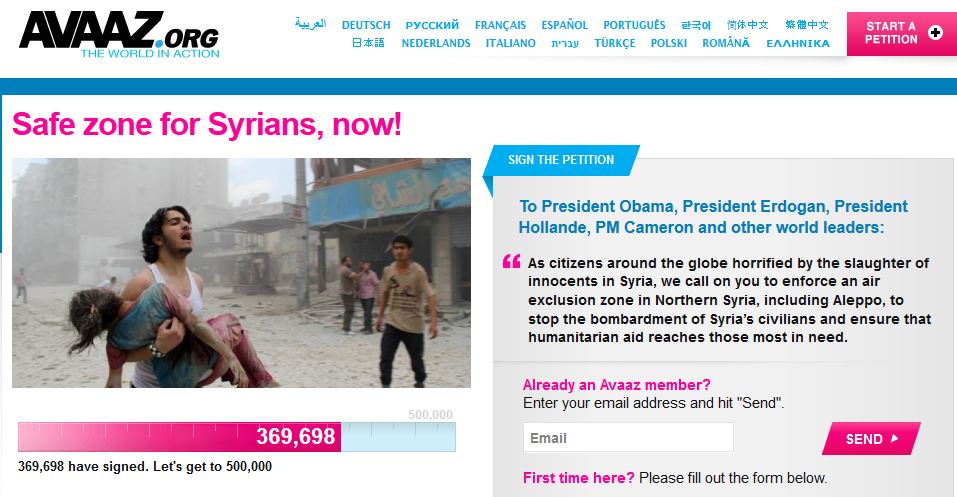
IMAGE: One of the Avaaz ‘Safe Zone’ campaigns for Syria in 2012-2013.
In 2012 and 2013, Avaaz campaigns featured a number of large online petitions which demanded that international bodies (like the UN) send “3,000 international monitors” into the country, and that Western military powers (like NATO) impose a ‘No-Fly Zone’ over the entire country in order to “save innocent lives.” One petition read as follows:
“To the Arab League, European Union, United States, and Friends of Syria: As global citizens, we call on you to take immediate action to stop the deadly terror in Syria. Enough is enough. We ask you to immediately demand a ceasefire to stop the bloodshed so that parties can come to the negotiating table to agree on a way forward. Until a ceasefire is reached, we call on you to work together and with the international community to enforce a no fly zone to stop the bombardment of Syria’s civilians and ensure that humanitarian aid reaches those most in need.”
Again, another NGO public relations messaging campaign mirroring foreign policy planks from the US State Department and Washington’s defense community.
On Avaaz’s website you can often find a number of sensational claims. During their No-Fly-Zone campaign cycle
this statement appeared:
The Syrian air force just dropped chlorine gas bombs on children. Their little bodies gasped for air on hospital stretchers as medics held back tears, and watched as they suffocated to death.
Unfortunately, the incident in question
never actually happened.
Rick Sterling
explains:
“Many well-intentioned but naive members of the U.S. and international public are again being duped into signing an Avaaz petition based on fraud and misinformation. If the campaign succeeds in leading to a No Fly Zone in Syria, it will result in vastly increased war, mayhem and bloodshed.”
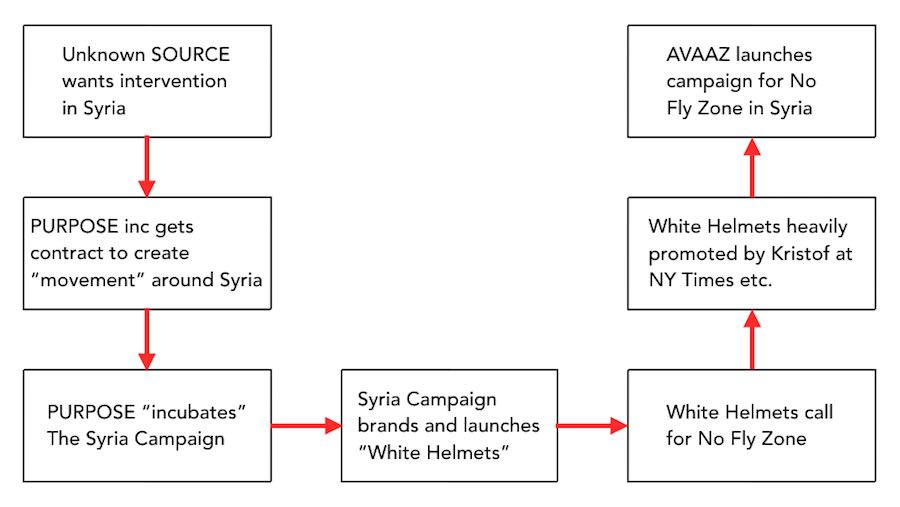
The following illustration outlines to sequence of events that eventually lead to Avaaz calling for a ‘No Fly Zone’ in Syria:
One organization championed in
Avaaz marketing campaigns is a ‘neutral’ organization called the Syrian Civil Defense also known as the ‘
White Helmets‘.
Writer Vanessa Beeley explains the all-too familiar funding sources for the White Helmets in her article entitled, Syria’s White Helmets:
War by Way of Deception – Part I:
“The White Helmets were established in March 2013, in Istanbul, Turkey, and is headed by James Le Mesurier, a British “security” specialist and ‘ex’-British military intelligence officer with an impressive track record in some of the most dubious NATO intervention theatres including Bosnia and Kosovo, as well as Iraq, Lebanon, and Palestine. Le Mesurier is a product of Britain’s elite Royal Military Academy at Sandhurst, and has also been placed in a series of high-profile pasts at the United Nations, European Union, and U.K. Foreign and Commonwealth Office. The origins of The White Helmet’s initial $300k seed funding is a little hazy, reports are contradictory but subsequent information leads us to conclude that the UK, US and the ‘Syrian opposition’ (or Syrian National Council, parallel government backed an funded by the US, UK and allies) are connected. Logistical support has been provided and given by Turkish elite natural disaster response team, AKUT. A further $13 million was poured into the White Helmet coffers during 2013 and this is where it gets interesting. Early reports suggest that these “donations” came from the US, UK and SNC with the previously explored connections to George Soros in the US. However, subsequent investigations reveal that USAID has been a major shareholder in the White Helmet organisation. The website for the United States Agency for International Development (USAID) claims that, “our work supports long-term and equitable economic growth and advances U.S. foreign policy objectives by supporting: economic growth, agriculture and trade; global health; and, democracy, conflict prevention and humanitarian assistance.” In a USAID report update in July 2015 it is clearly stated that they have supplied over $ 16m in assistance to the White Helmets.”
Regarding USAID, Beeley adds that:
“The USAID track record as a primary US Government/CIA regime change facilitator is extensively documented. From South America to the Ukraine and in the Middle East, USAID serve a malevolent and ultimately destructive role in the dismantling of sovereign nations and their reduction to western hegemony vassal states, as always, all in the name of freedom and democracy.”
Even more crucial in this case, is evidence that
links the White Helmets to militant fighting groups in Syria, including al Nusra Front (al Qaeda in Syria). While this does not prove anything beyond association between members of both organizations, it’s significant when one considers that both organizations are receiving material and financial support from
the same member nations of the US-led Coalition.
Geopolitically Correct
For all practical purposes, as a moral and ethical tenet, ‘human rights’ is an anomaly in any western military action.
How one frames a story determines its thesis. In the 21st century, the concept of human rights has been weaponised, pointed at nonaligned and independent nation-states who are seen as obstacles to American and European market-makers and nation builders. A number of target states not geopolitically aligned with the US, NATO or the GCC, are yet to be absorbed, seduced, conquered, or as in the case of Libya, completely collapsed, or in the case of Syria – completely dismembered. These include states listed by former US General and NATO Supreme Commander, Wesley Clark, during his now famous
Commonwealth Club speech in San Francisco in 2007. During the event, Clark intimated a conversation he had after a classified defense briefing where a Pentagon source had told him weeks after 9/11 of the Pentagon’s plan to attack Iraq, as well as a “coup” being plotted by Dick Cheney, Don Rumsfeld, Paul Wolfowitz along with “a half dozen other collaborators from the Project for the New American Century”. According to Clark, his told him about seven countries which were slated for overthrow: Iraq, Syria, Lebanon, Libya, Somalia, Sudan and Iran.
It should also be noted that both Wesley Clark and George Soros
serve on the board of trustees of The International Crisis Group.
For any of these unlucky states, a sustained US or ‘Coalition’ military campaign means that a nation can be under attack 24 hours a day, 7 days a week, and yet, that nation and its residents are given no quarter by western human rights organizations, governments or media. A perfect example of this is Saudi Arabia’s highly illegal undeclared war of aggression against its neighbor Yemen
which began in the spring of 2015.
It’s worth noting here, that despite its own hotly contested human rights record, the Kingdom of Saudi Arabia was somehow managed to get elected to the UN’s prestigious Human Rights Council (UNHRC). Evidence suggests that this appointment was facilitated in part by British officials as part of a larger quid pro quo arrangement. According to classified Saudi foreign ministry files that were passed to Wikileaks in June 2015, and translated by Geneva-based
UN Watch and revealed how UK initiated the secret negotiations by
asking Saudi Arabia for its support. Eventually, both countries were elected to the 47 member state UNHRC. The following passage from the leaked cables reveals how a clear deal was struck:
“The ministry might find it an opportunity to exchange support with the United Kingdom, where the Kingdom of Saudi Arabia would support the candidacy of the United Kingdom to the membership of the council for the period 2014-2015 in exchange for the support of the United Kingdom to the candidacy of the Kingdom of Saudi Arabia.”
According to
The Guardian another cable revealed a Saudi Arabia transfer of $100,000 for, “expenditures resulting from the campaign to nominate the Kingdom for membership of the human rights council for the period 2014-2016.” At the time of their report, no one knows how this money was spent.
In addition, it was later shown that Saudi Arabia pledged $1 million to UNHRC prior to winning the its seat. Then rather amazingly (or not), in the fall of 2015, the UN appointed Saudi as Chair of the UNHRC.
When pressed on the matter, a Foreign and Commonwealth Office spokeswoman said, “as is standard practice with all members, we never reveal our voting intentions or the way we vote.”
This was followed by a standard, throwaway PR platitude:
“The British government strongly promotes human rights around the world and we raise our human rights concerns with the Saudi Arabian authorities.”
While its commendable that Saudi officials would want to take a leading role in advocating for international human rights, one cannot ignore the political hypocrisy at play considering Riyadh’s own soiled laundry regarding this issue which includes, among other items,
the sanctioning of more than a 150 beheadings in 2015 – a number believed to be even higher than Islamic State of Iraq and Sham (ISIS).
To make matters worse, the controversial Saudi appointment also took place amid the a new diplomatic row over a lucrative UK prison building contract in the Kingdom and the proposed execution of 17 year old Shia student activist, Ali Mohammed al-Nimr, who was sentenced to ‘death by crucifixion’ for
joining an anti-government demonstration.
Consider the amount of political and media campaigning against the government of Syria over numerous and largely
unfounded allegations, where an international network comprised of the US State Department, UK Foreign Office, the Responsibility to Protect (R2P) lobby, HRW and humanitarian interventionist luminaries are all backing a policy of regime change in Syria – and then contrast this with Saudi Arabia’s proven record on human rights and abuse of power. It’s impossible not to see the double standard.
As far as the Western political establishment are concerned, if there are any human rights violations or any local casualties mounting in one of its many dirty wars, geopolitical correctness dictates that these are either ignored or neatly filed away as an inconvenient consequence of America’s ‘national security’ or an unfortunate byproduct “collateral damage” along the road to international progress, peace and prosperity (democracy). Because it crosses swords with the US State Department, or NATO HQ, pubic pressure by humanitarian organizations like HRW and Amnesty USA is relatively nonexistent.
Outside of the theater of combat, the international community is also faced with the inconvenient dilemma of illegal detentions of supposed ‘enemy combatants’, ‘enhanced interrogation’ (torture) and ‘extrajudicial killings’ (assassinations). These are the politically correct terms for the age of western militarisation.
Again, because of “bad optics” in Washington DC very little attention or pressure is applied by marquee international human rights charities.
The human rights industry also has its own politically correct lexicon and identifiers like ‘defectors’, ‘detainees’, ‘activists’ and a new emerging category of ‘activist-journalists’. Sometimes these terms can be accurate, but in a war theater like Syria, they are often euphemisms for actors in full spectrum information warfare. In the case of Syria, this information warfare is
designed to embolden a foreign-backed opposition, but more importantly, to apply sustained public relations pressure towards an end goal of regime change.
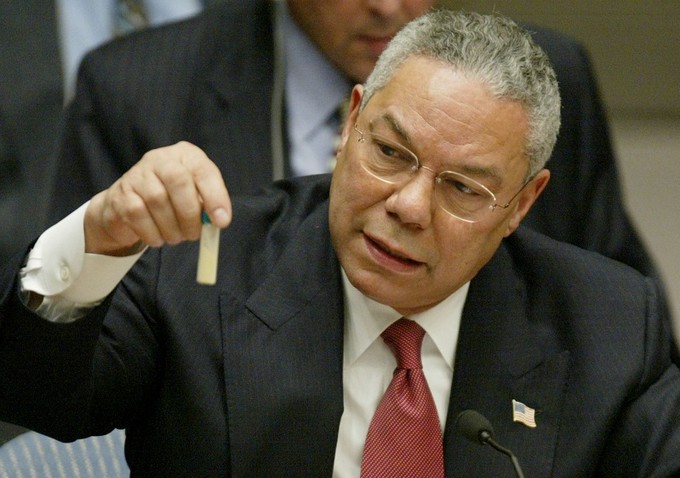
POINT MAN: US Secretary of State Colin Powell was tasked with
selling
the WMD narrative to a UN audience. Here he holds up an
“anthrax” vial
pretending that it is ‘evidence’ of Iraq’s alleged
chemical weapons
programs on Feb. 5, 2003 (Image: Wikicommons)
The WMD Ritual
Conjuring a ‘WMD’ subplot in order to trigger a humanitarian intervention has become commonplace in western foreign policy. After being exposed as a momentous lie in Iraq in 2003, this set-back did not stop Washington from aggressively pursuing the same narrative in Syria in 2013.
Fortunately, the Syrian WMD narrative collapsed in the aftermath of a failed false flag Sarin gas attack
that turned out to be orchestrated by US Coalition-backed ‘moderate’ rebels52. It was hardly a coincidence then to discover that HRW was the NGO tasked with providing the ‘smoking gun’ Washington and London needed to make their R2P case in August 2013.
Elizabeth Palmer reported for CBS News at the time, “on Tuesday, the group Human Rights Watch issued a report that said evidence strongly implies that Syrian government troops’ firing of rockets containing a nerve agent into a Damascus suburb on August 21 that the U.S. said killed over 1,400 people.” In the end, this turned out to be another epic lie.
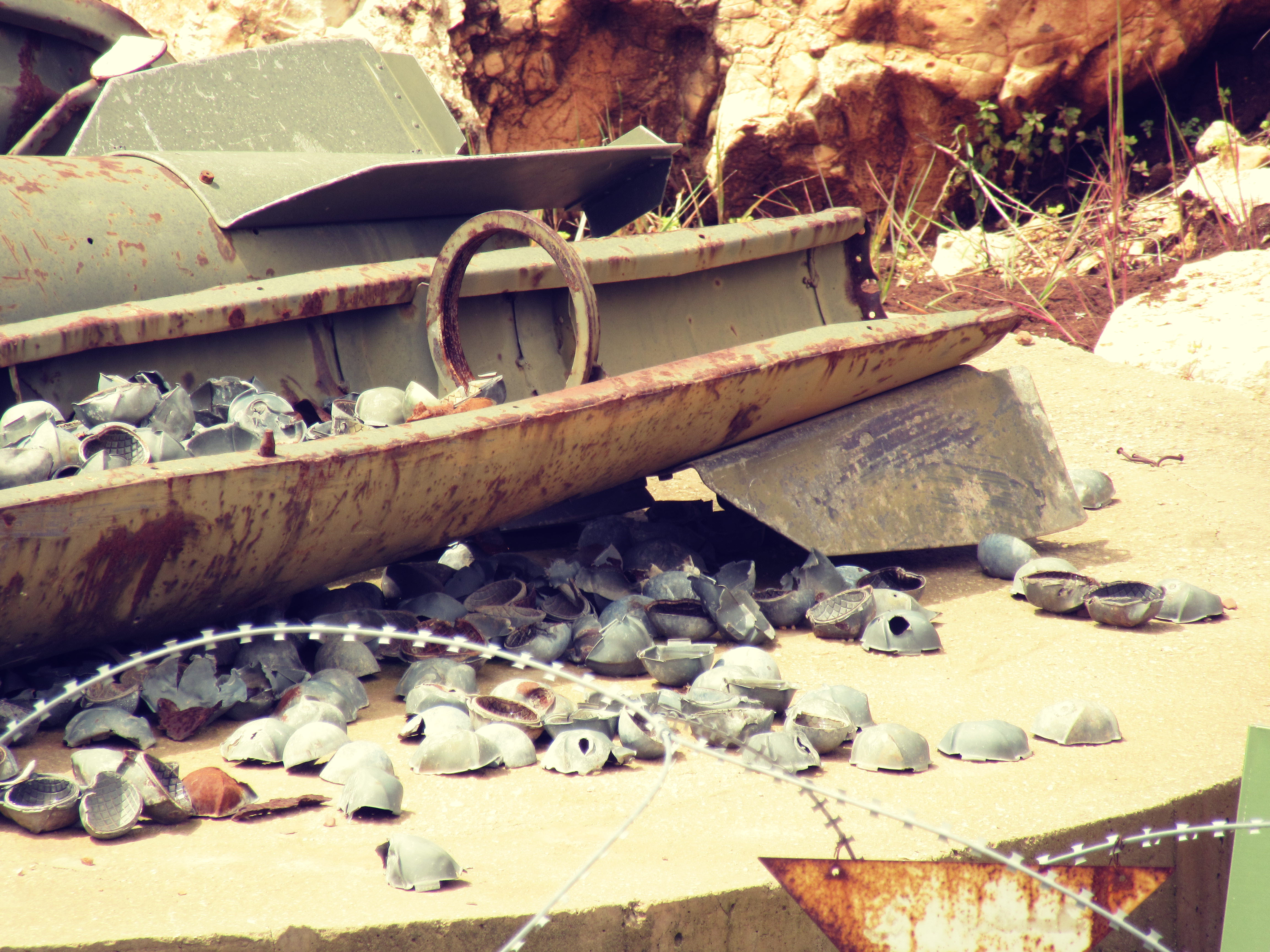
HIDDEN KILLER: Israeli cluster bombs dropped in South Lebanon
(Photo: Patrick Henningsen)
While the US-led ‘Coalition’ is quick to seize upon spurious WMD narratives against its geopolitical targets, it will routinely ignore common Geneva Convention violations like Israel’s use of deadly white phosphorous in Gaza, the use of depleted uranium (DU) munitions by American military units in Iraq and Afghanistan, and American-made cluster bombs being
dropped by Saudi Arabia’s air force on to Yemeni civilian targets.
Western Institutionalised Bias
Wars, whether conventional or covert, are a dirty business.
One argument that the western human rights industry judicially avoids is that an armed opposition cannot rightly be classified as a ‘political opposition’, so long as it is armed. This could certainly be the case in Syria.
Syrian president Bashar al Assad explained this dilemma during
his 2015 interview with CBS News anchor Charlie Rose, stating that, “whenever you hold a gun, and kill people, and destroy public buildings, destroy private properties, that’s terrorism.”
Although most foreign policy officials in Washington DC would beg to differ, especially if the opposition in question is receiving weapons, cash or logistical support from the US or its allies. Assad futher clarifies the position and also exposes the fallacy in western rhetoric, explaining:
“The word opposition, everywhere in the world, including your country, is a political opposition. Do you have military opposition in the United States? Would you accept it? You wouldn’t, and we wouldn’t. No-one accepts military opposition.”
During his speech at Columbia University in 2006, Australian journalist and filmmaker John Pilger explained:
“The oldest cliché is that truth is the first casualty of war. I disagree. Journalism is the first casualty. Not only that: it has become a weapon of war, a virulent censorship that goes unrecognized in the United States, Britain, and other democracies; censorship by omission, whose power is such that, in war, it can mean the difference between life and death for people in faraway countries.”
Pilger’s reference can especially be applied to the institutional media bias that has underpinned the long running international war which the Middle East and Central Asia finds itself currently embroiled in. Some might argue that even if western human rights organisations could somehow be cured of their systemic bias towards Washington and CFR foreign policy narratives – their needs to be an overhaul in defining the concept and the context of what ‘human rights’ are in real terms. A fresh look needs to take into account a level of western subterfuge which maybe western politicians and media are not yet ready to acknowledge.
In Conclusion
Indeed, it was ‘human rights’ campaigning which led directly to the illegal bombing of Libya (NATO’s aggressive bombing campaign in Libya was not authorized in the
UNSC Resolution 1973 which only called for a ‘No-Fly Zone’, and should therefore be considered illegal under international law), where the West’s sole intent was to topple the government of Muammar Gaddafi. Regrettably, thousands of innocent civilians died in the process and the nation state of Libya quickly collapsed, separating into sub-regional, tribal and lawless militant enclaves.
The lesson of Libya was stark. The world should have taken note, but unfortunately it did not. Instead, onlookers saw then US Secretary of State Hillary Clinton, who,
when asked during a CBS News interview about the removal of the Libyan president, could only cackle and laughingly joke, “we came, we saw, he died.”
Is this the new tone of humanitarianism?
Both Amnesty International and Human Rights Watch regularly solicit support from Hollywood celebrities and international recording artists, and spend millions of dollars per year producing films which depict situations around the world through their own political lens. To date, they have yet to produce a film showing the other unsavory side of the ‘rebel insurgency’ in Syria. Is this because that might undermine the entire US and NATO member foreign policy?
The public and private sponsors of NGO’s like HRW and Amnesty have invested, not donated, hundreds of millions collectively into these organisations so that they can portray world events in such a way that will enable their own corporate aspirations to be met. No matter how idealistic the rhetoric might sound coming from leading human rights organisations, the money could stop flowing if they discontinued manufacturing consent for wars.
This also raises the question of whether or not a non-governmental organisation that champions the issue of human rights can remain apolitical – as many such organizations claim to be. What would happen should such an organisation dare to adopt a truly righteous geopolitical (not political) stance advocating opposition to destructive western imperialist policies? Would western governments move to withdraw their 501c3 or tax exempt status which allows these charities to maintain their viability as a nonprofit organisation?
Once again, if conflicts of interest and revolving doors between government and charities are not properly addressed, it could eventually undermine the integrity of the entire NGO sector internationally. Corruption at the top of the pyramid also threatens to damage countless other small to medium sized organisations who do not have access to the US State Department or Hollywood, but who are still performing important services and engaged in real civic aid projects.
For human right organisations to be in lock-step with the US State Department, or hiring military operatives as board members and chief executives, is simply inexcusable by any social standard.
If the international community is to advance beyond defunct neocolonialist paradigms, it will need to place compassion ahead of policy, and humanity ahead of profits. Only then can the reality live up to the rhetoric.
Author Patrick Henningsen is founder and editor of the news and analysis website 21st Century Wire, and is an independent foreign and political affairs analyst for RT International. He is also the host of the SUNDAY WIRE talk radio program which airs live every Sunday on the Alternate Current Radio Network. Find out more at: www.patrickhenningsen.com