Tuesday, June 07, 2016

The Perks of Exceptionalism: Just Desserts for War Criminals

Crimes of the War on Terror: Should George Bush, Dick Cheney, and Others Be Jailed?

by Rebecca Gordon - TomDispatch

June 7, 2016

"The cold was terrible but the screams were worse," Sara Mendez told the BBC. 
"The screams of those who were being tortured were the first thing you heard and they made you shiver.
That's why there was a radio blasting day and night."

In the 1970s, Mendez was a young Uruguayan teacher with leftist leanings. In 1973, when the military seized power in her country (a few months before General Augusto Pinochet’s more famous coup in Chile), Mendez fled to Argentina. She lived there in safety until that country suffered its own coup in 1976. That July, a joint Uruguayan-Argentine military commando group kidnapped her in Buenos Aires and deposited her at Automotores Orletti, a former auto repair shop that would become infamous as a torture site and paramilitary command center. There she was indeed tortured, and there, too, her torturers stole her 20-day-old baby, Simón, giving him to a policeman’s family to raise.

Mendez was an early victim of Operation Condor, a torture and assassination program focused on the region’s leftists that, from 1975 to 1986, would spread terror across Latin America’s southern cone. On May 27th, an Argentine court convicted 14 military officers of crimes connected with Operation Condor, issuing prison sentences ranging from 13 to 25 years. Among those sentenced was Reynaldo Bignone, Argentina’s last military dictator, now 88. (He held power from 1982 to 1983.)

Those convictions are deeply satisfying to the surviving victims and their families, to the legal teams that worked for more than a decade on the case, and to human rights organizations around the world. And yet, as just as this outcome is, it has left me with questions -- questions about the length of time between crime and conviction, and about what kinds of justice can and cannot be achieved through prosecutions alone. 

Tomgram: Rebecca Gordon, Justice for Torturers?

[Note for TomDispatch Readers: Just a reminder that you can still get a signed, personalized copy of Rebecca Gordon’s powerful new book, American Nuremberg: The U.S. Officials Who Should Stand Trial for Post-9/11 War Crimes, for a contribution of $100 or more ($125 if you live outside the United States) to this website. Check out our donation page for the details. Tom]

If you happen to be a potential American war criminal, you've had a few banner weeks. On May 9th, Defense Secretary Ashton Carter presented former Secretary of State and National Security Adviser Henry Kissinger with the Department of Defense Distinguished Public Service Award, that institution's “highest honorary award for private citizens.” In bestowing it on the 92-year-old who is evidently still consulting for the Pentagon, he offered this praise: “While his contributions are far from complete, we are now beginning to appreciate what his service has provided our country, how it has changed the way we think about strategy, and how he has helped provide greater security for our citizens and people around the world.”

Certainly people “around the world” will remember the “greater security” offered by the man who, relaying an order from President Richard Nixon for a “massive” secret bombing campaign in Cambodia, used a line that may almost be the definition of a war crime: “Anything that flies on anything that moves.” The result: half a million tons of bombs dropped on that country between 1969 and 1973 and at least 100,000 dead civilians. And that’s just to start down the well-cratered road to the millions of dead he undoubtedly has some responsibility for. Public service indeed.

Meanwhile, speaking of American crimes in the Vietnam era, former Nebraska Senator Bob Kerrey, who ran for president of the U.S. and then became the president of the New School in New York City, was just appointed to “lead” Fulbright University Vietnam, the first private American-backed school there. Its opening was announced by President Obama on his recent visit to that country. Only one small problem: we already know of some children who won’t be able to apply for admission. I’m thinking of the progeny-who-never-were of the 13 children killed by a team of U.S. SEALs under Kerrey’s command and on his orders in South Vietnam in 1969 (along with a pregnant woman, and an elderly couple whose three grandchildren were stabbed to death by the raiders) -- all of whom were reported at the time as dead Vietcong guerillas.

It seems that if you are a distinguished citizen of the most exceptional country on the planet, even war crimes have their rewards. Consider, for instance, the millions of dollars that were paid for memoirs by top Bush administration officials responsible for creating an American offshore torture regime at CIA “black sites” around the world. Must-reads all! With that in mind, turn to TomDispatch regular Rebecca Gordon, author most recently of American Nuremberg: The U.S. Officials Who Should Stand Trial for Post-9/11 War Crimes, to consider what “justice” for such figures might look like in a different and better world. Tom

Crimes of the War on Terror: Should George Bush, Dick Cheney, and Others Be Jailed?

by Rebecca Gordon


Operation Condor


Operation Condor was launched by the security forces of five military dictatorships: Chile, Argentina, Uruguay, Paraguay, and Bolivia. Brazil soon joined, as did Ecuador and Peru eventually. As a Cold War anti-communist collaboration among the police, military, and intelligence services of those eight governments, Condor offered an enticing set of possibilities. The various services could not only cooperate, but pursue their enemies in tandem across national borders. Indeed, its reach stretched as far as Washington, D.C., where in 1976 its operatives assassinated former Chilean ambassador to the U.S. Orlando Letelier and his young assistant, Ronni Moffitt, both of whom then worked at the Institute for Policy Studies, a left-wing think tank.

How many people suffered grievously or died due to Operation Condor? A definitive number is by now probably beyond recovery, but records from Chile’s secret police suggest that by itself Argentina’s “dirty war” -- the name given to the Argentine junta’s reign of terror, “disappearances,” and torture -- took the lives of 22,000 people between 1975 and 1978. Thousands more are thought to have died before that country’s dictatorship ended in 1983. It’s generally believed that at least another 3,000 people died under the grimmest of circumstances in Chile, while thousands more were tortured but lived. And although its story is less well known, the similar reign of terror of the Uruguayan dictatorship directly affected the lives of almost every family in the country. As Lawrence Wechsler wrote in a 1989 article in the New Yorker:

“By 1980, one in every fifty Uruguayans had been detained at some point, and detention routinely involved torture; one in every five hundred had received a sentence of six years or longer under conditions of extreme difficulty; and somewhere between three hundred thousand and four hundred thousand Uruguayans went into exile. Comparable percentages for the United States would involve the emigration of thirty million people, the detention of five million, and the extended incarceration of five hundred thousand.”

And what was the U.S. role in Operation Condor? Washington did not (for once) plan and organize this transnational program of assassination and torture, but its national security agencies were certainly involved, as declassified Defense Department communications indicate. In his book The Condor Years, Columbia University journalism professor John Dinges reported that the CIA provided training for Chile’s secret police, computers for Condor’s database, telex machines and encoders for its secret communications, and transmitters for its private, continent-wide radio communications network. Chilean Colonel Manuel Contreras, one of Condor’s chief architects (who was then on the CIA payroll), met with CIA Deputy Director Vernon Walters four times. And what did the CIA get in return? Among other things, access to the “results” of interrogation under torture, according to Dinges. "Latin American intelligence services," he added,

“considered U.S. intelligence agencies their allies and provided timely and intimate details of their repressive activities. I have obtained three documents establishing that information obtained under torture, from prisoners who later were executed and disappeared, were provided to the CIA, the FBI and the DIA (Defense Intelligence Agency). There is no question that the U.S. officials were aware of the torture.”

Justice Delayed


Why did it take 40 years to bring the architects of Operation Condor to justice? A key factor: for much of that time, it was illegal in Argentina to put them on trial. In the first years of the new civilian government, the Argentine congress passed two laws that granted these men immunity from prosecution for crimes committed in the dirty war. Only in 2005 did that country’s supreme court rule that those impunity laws were unconstitutional. Since then, many human rights crimes have been prosecuted. Indeed, Reynaldo Bignone, the former dictator, was already in jail when sentenced in May for his role in Operation Condor. He had been convicted in 2010 of kidnapping, torture, and murder in the years of the dirty war. As of March, Argentina’s Center for Legal and Social Studies (CELS) had recorded 666 convictions for participation in the crimes of that era.

But there’s a question that can’t help but arise: What’s the point of bringing such old men to trial four decades later? How could justice delayed for that long be anything but justice denied?

One answer is that, late as they are, such trials still establish something that all the books and articles in the world can’t: an official record of the terrible crimes of Operation Condor. This is a crucial step in the process of making its victims, and the nations involved, whole again. As a spokesperson for CELS told the Wall Street Journal, “Forty years after Operation Condor was formally founded, and 16 years after the judicial investigation began, this trial produced valuable contributions to knowledge of the truth about the era of state terrorism and this regional criminal network.”

It took four decades to get those convictions. Theoretically at least, Americans wouldn’t have to wait that long to bring our own war criminals to account. I’ve spent the last few years of my life arguing that this country must find a way to hold accountable officials responsible for crimes in the so-called war on terror. I don’t want the victims of those crimes, some of whom are still locked up, to wait another 40 years for justice.

Nor do I want the United States to continue its slide into a brave new world, in which any attack on a possible enemy anywhere or any curtailment of our own liberties is permitted as long as it makes us feel “secure.” It’s little wonder that the presumptive Republican presidential candidate feels free to run around promising yet more torture and murder. After all, no one’s been called to account for the last round. And when there is no official acknowledgement of, or accountability for, the waging of illegal war, international kidnapping operations, the indefinite detention without prospect of trial of prisoners at Guantánamo, and, of course, torture, there is no reason not to do it all over again. Indeed, according to Pew Research Center polls, Americans are now more willing to agree that torture is sometimes justified than they were in the years immediately following the 9/11 attacks.

Torture and the U.S. Prison System


In a recent piece of mine, I focused on Abu Zubaydah, a prisoner the CIA tortured horribly, falsely claiming he was a top al-Qaeda operative, knew about a connection between Saddam Hussein and al-Qaeda, and might even have trained some of the 9/11 pilots. “In another kind of world,” I wrote, Abu Zubaydah “would be exhibit one in the war crimes trials of America’s top leaders and its major intelligence agency.” Although none of the charges against him proved true, he is still held in isolation at Guantánamo.

Then something surprising happened. I received an email message from someone I’d heard of but never met. Joseph Margulies was the lead counsel in Rasul v. Bush, the first (and unsuccessful) attempt to get the Supreme Court to allow prisoners at Guantánamo to challenge their detention in federal courts. He is also one of Abu Zubaydah’s defense attorneys.

He directed me to an article of his, “War Crimes in a Punitive Age,” that mentioned my Abu Zubaydah essay. I’d gotten the facts of the case right, he assured me, but added, “I suspect we are not in complete agreement” on the issue of what justice for his client should look like. As he wrote in his piece,

”There is no question that Zubaydah was the victim of war crimes. The entire CIA black site program [the Agency’s Bush era secret prisons around the world] was a global conspiracy to evade and violate international and domestic law. Yet I am firmly convinced there should be no war crimes prosecutions. The call to prosecute is the Siren Song of the carceral state -- the very philosophy we need to dismantle.”

In other words, one of the leading legal opponents of everything the war on terror represents is firmly opposed to the idea of prosecuting officials of the Bush administration for war crimes (though he has not the slightest doubt that they committed them). Margulies agrees that the crimes against Abu Zubaydah were all too real and “grave” indeed, and that “society must make its judgment known.” He asks, however, “Why do we believe a criminal trial is the only way for society to register its moral voice?”

He doubts that such trials are the best way to do so, fearing that by placing all the blame for the events of those years on a small number of criminal officials, the citizens of an (at least nominally) democratic country could be let off the hook for a responsibility they, too, should share. After all, it’s unlikely the war on terror could have continued year after year without the support -- or at least the lack of interest or opposition -- of the citizenry.

Margulies, in other words, raises important questions. When people talk about bringing someone to justice they usually imagine a trial, a conviction, and perhaps most important, punishment. But he has reminded me of my own longstanding ambivalence about the equation between punishment and justice.

Even as we call for accountability for war criminals, we shouldn’t forget that we live in the country that jails the largest proportion of its own population (except for the Seychelles islands), and that holds the largest number of prisoners in the world. Abuse and torture -- including rape, sexual humiliation, beatings, and prolonged exposure to extremes of heat and cold -- are routine realities of the U.S. prison system. Solitary confinement -- presently being experienced by at least 80,000 people in our prisons and immigrant detention centers -- should also be considered a potentially psychosis-inducing form of torture.

Every nation that institutionalizes torture, as the United States has done, selects specific groups of people as legitimate targets for its application. In the days of Operation Condor, Chilean torturers called their victims “humanoids” to distinguish them from actual human beings. Surely, though, the United States hasn’t done that? Surely, there’s no history of the torture of particular groups? Sadly, of course, such a history does exist, and like so many things in this country, it’s all about race.

The practice of torture in the U.S. didn’t start with those post-9/11 “enhanced interrogation techniques,” nor with the Vietnam War’s Phoenix Program, nor even with the nineteenth century U.S. war in the Philippines. It began when European settlers first treated native peoples and enslaved Africans as subhuman savages. As southern farmers started importing captured Africans to augment their supply of indentured English labor, they quickly realized that there was little incentive for those slaves to work -- none but the pain of whippings, mutilations, and brandings, and the threat of yet more pain. Torture and slavery, in other words, were fused at the root. From the first arrival of black people on this continent, it has been permissible, even legal, to torture them.

And it didn’t stop with emancipation. After the end of slavery, southern states began the practice of convict leasing -- arresting former slaves and then their descendants, often on trumped-up charges, and renting them out as labor to farmers and later coal mine owners who had the power and legal right to whip and abuse them as they chose.

Then there’s lynching. Many people think of it as an extrajudicial death by hanging. As it was practiced in the Jim Crow South, however, it was a form of public, state-approved torture, often involving the castration or disembowelment of the living victim, sometimes followed by death by fire. Lynching thus continued the practice of treating black minds and bodies as legitimate targets of torture. So maybe we shouldn’t be surprised that, of the more than two million prisoners in the United States today, 40% are black, while the U.S. population is only 13% black.

Here’s the problem, then. When we say that putting George W. Bush, Dick Cheney, and other top officials in their administration in prison for war crimes would be justice, we endorse a criminal justice system that is more criminal than just, and where torture is a daily occurrence.

Do we want to do to Bush, Cheney, and their accomplices essentially what they did to their victims? There is, of course, a certain appeal to the idea of someday seeing such powerful white men among the suffering, tortured millions in our prison system, or even -- like the supposed “dirty bomber” José Padilla and Abu Zubaydah -- in perpetual solitary confinement.

And yet, would this truly provide even a facsimile of justice, given that American prisons are hardly instruments of justice to begin with? Those opposed to the acts at the heart of America’s never-ending war on terror were heartened when President Obama ordered the CIA “black sites” dismantled globally. We continue to demand the closing of Guantánamo (something that looks increasingly unlikely to happen in his presidency). How, then, can we find justice through a prison system that uses similar methods on an everyday basis here in the U.S.?

Forty Years to Go?


And then, of course, there is the question: Whom should justice truly serve?

The first answer is: the victims of the "war on terror," including those who were tortured, those detained without trial, the civilian "collateral damage" of the wars in Afghanistan and Iraq, and the "unintended" victims of drone assassinations. Then there are all those in the rest of the world who have to live with the threat of a nuclear-armed superpower that has in these years regularly refused to recognize the most basic aspects of the rule of law.

Many who work with survivors of organized repression like Operation Condor say that their primary desire is not the punishment of their oppressors but official acknowledgement of what happened to them. In his New Yorker article, Wechsler, for instance, pointed out that, for the victims of torture, accountability may not be identical to punishment at all.

“People don't necessarily insist that the former torturers go to jail -- there has been enough of jail -- but they do want to see the truth established... It's a mysteriously powerful, almost magical notion, because often everybody already knows the truth -- everyone knows who the torturers were and what they did, the torturers know that everyone knows, and everyone knows that they know.”

Seeing “the truth established” was the purpose behind South Africa’s post-apartheid Truth and Reconciliation Commission. Torturers and murderers on both sides of the anti-apartheid struggle were offered amnesty for their crimes -- but only after they openly acknowledged those crimes. In this way, a public record of the horrors of apartheid was built, and imperfect as the process may have been, the nation was able to confront its history.

That is the kind of reckoning we need in this country. It started with the release of a summary of the Senate Intelligence Committee’s report on the CIA’s torture program, which brought many brutal details into the light. But that’s just the beginning. We would need a full and public accounting not just of the CIA’s activities, but of the doings of other military and civilian agencies and outfits, including the Joint Special Operations Command. We also would need a full-scale airing of the White House’s drone assassination program, and perhaps most important of all, a full accounting of the illegal, devastating invasion and occupation of Iraq.

Justice would also require -- to the extent possible -- making whole those who had been harmed. In the case of the “war on terror,” this might begin by allowing torture victims to sue their torturers in federal court (as the U.N. Convention against Torture requires). With one exception, the Obama administration has until now blocked all such efforts on national security grounds. In the case of the Iraq War, justice would undoubtedly also require financial reparations to repair the infrastructure of what was once a modern, developed nation.

We’re unlikely to see justice in the “war on terror” until that cruel and self-defeating exercise is well and truly over and the country has officially acknowledged and accounted for its crimes. Let’s hope it doesn’t take another 40 years.

Rebecca Gordon, a TomDispatch regular, teaches in the philosophy department at the University of San Francisco. She is the author of American Nuremberg: The U.S. Officials Who Should Stand Trial for Post-9/11 War Crimes (Hot Books). Her previous books include Mainstreaming Torture: Ethical Approaches in the Post-9/11 United States and Letters from Nicaragua.

Follow TomDispatch on Twitter and join us on Facebook. Check out the newest Dispatch Book, Nick Turse’s Next Time They’ll Come to Count the Dead, and Tom Engelhardt's latest book, Shadow Government: Surveillance, Secret Wars, and a Global Security State in a Single-Superpower World.

Copyright 2016 Rebecca Gordon

Oliver's Twist on Debtors' Care

Olivercare

by John Oliver  - Last Week Tonight


John Oliver forgives million$ in medical debt.


Monday, June 06, 2016

Perps Evidence Hangs Up MH-17 Investigators


MH-17 Probe Relies on Ukraine for Evidence

by Robert Parry - Consortium News


June 5, 2016

The Dutch-led investigation into the 2014 shoot-down of Malaysia Airlines Flight 17 relies heavily on information provided by the Ukrainian security service and operates primarily from a field office in Kiev, despite the fact that Ukraine should be a principal suspect in the mystery of who was responsible for killing 298 people.

The cozy relationship between the Joint Investigation Team (JIT) and the Ukrainian government’s secret service emerges from a JIT report presented to Dutch families of MH-17 victims in the last few days, a portion of which was made available to me.


A Malaysia Airways’ Boeing 777 like the one that crashed 
in eastern Ukraine on July 17, 2014. (Photo credit: Aero 
Icarus from Zürich, Switzerland)


What was perhaps most startling in the breezy travelogue-style “e-zine” report was how dependent the investigation has become on data supplied by Ukraine’s security and intelligence service, the SBU, which also is an active participant in the war against ethnic Russian rebels in eastern Ukraine and is responsible for protecting state secrets.

Yet, according to the report, the SBU has helped shape the MH-17 investigation by supplying a selection of phone intercepts and other material that would presumably not include sensitive secrets that would implicate the SBU’s political masters in Ukraine. But the JIT report seems oblivious to this obvious conflict of interest, saying:

“Since the first week of September 2014, investigating officers from The Netherlands and Australia have worked here [in Kiev]. They work in close cooperation here with the Security and Investigation Service of the Ukraine (SBU). Immediately after the crash, the SBU provided access to large numbers of tapped telephone conversations and other data. …

“At first rather formal, cooperation with the SBU became more and more flexible. ‘In particular because of the data analysis, we were able to prove our added value’, says [Dutch police official Gert] Van Doorn. ‘Since then, we notice in all kinds of ways that they deal with us in an open way. They share their questions with us and think along as much as they can.’”

The JIT report continued:

“With the tapped telephone conversations from SBU, there are millions of printed lines with metadata, for example, about the cell tower used, the duration of the call and the corresponding telephone numbers. The investigating officers sort out this data and connect it to validate the reliability of the material.

“When, for example, person A calls person B, it must be possible to also find this conversation on the line from person B to person A. When somebody mentions a location, that should also correlate with the cell tower location that picked up the signal. If these cross-checks do not tally, then further research is necessary.

“By now, the investigators are certain about the reliability of the material. ‘After intensive investigation, the material seems to be very sound’, says Van Doorn, ‘that also contributed to the mutual trust.’”

So, despite the fact that some “cross-checks do not tally” and require “further research,” the JIT has decided that the SBU’s material is “very sound” and underpins a “mutual trust.”

Personnel Concern


Another personnel concern is that the long assignments of investigators in Kiev over a period of almost two years could create compromising situations, especially considering Kiev’s reputation as a European hotbed for prostitution and sex tourism as well as the possibility of less transactional human interaction.

According to the JIT report, four investigating officers from Australia are stationed in Kiev on three-month rotations while Dutch police rotate in two teams of about five people each for a period of a “fortnight,” or two weeks.


 A photograph of a Russian BUK missile system that U.S. 
Ambassador to Ukraine Geoffrey Pyatt published on Twitter in 
support of a claim about Russia placing BUK missiles in eastern 
Ukraine, except that the image appears to be an AP photo 
taken at an air show near Moscow two years earlier.


The relative isolation of the Australian investigators further adds to their dependence on their Ukrainian hosts. According to the report, “The Australian investigators find themselves a 26 hour flight away from their home country and have to deal with a large time difference. ‘For us Australians, it is more difficult to get into contact with our home base, which is why our operation is quite isolated in Kiev’, says [Andrew] Donoghoe,” a senior investigating officer from the Australian Federal Police.

Despite the collegial dependence on the SBU’s information, it has not led to a quick resolution of the mystery of MH-17. Last week, the JIT informed Dutch family members that its investigative report on the case has been postponed again, now not expected until after the summer, more than two years after the disaster, and even then the report will not be open for public examination.

The long delays in the investigation and the curious failure of the U.S. government to share usable data from its own intelligence services have caused concerns among some family members that the inquiry into who was responsible for shooting down the plane has been compromised by geopolitical pressures.

Immediately after the shoot-down of the flight from Amsterdam to Kuala Lumpur, the U.S. government sought to pin the blame on ethnic Russian rebels in eastern Ukraine and their Russian government backers, but – as more evidence emerged – the possible role of a Ukrainian military unit became more plausible.

For instance, according to the Dutch intelligence service in a report released last October, the only anti-aircraft missiles in eastern Ukraine on July 17, 2014, capable of hitting a plane flying at 33,000 feet belonged to the Ukrainian military.

Nevertheless, Ukraine was invited to join the JIT and play a key role in the investigation along with the investigators from Australia and the Netherlands. Under the JIT agreement, participating governments, which also include Belgium and Malaysia, have the right to block the release of information to the public.

Meanwhile, after CIA analysts had time to evaluate U.S. satellite, electronic and other intelligence data, the U.S. government went curiously silent about what it had discovered, including the possible identity of the people who were responsible. The U.S. reticence, after the initial rush to judgment blaming Russia, suggested that the more detailed findings undercut those original claims.


A side-by-side comparison of the Russian presidential 
jetliner and the Malaysia Airlines plane.


A source who was briefed by U.S. intelligence analysts told me that the CIA’s conclusion pointed toward a rogue Ukrainian operation involving a hard-line oligarch with the possible motive of shooting down Russian President Vladimir Putin’s official plane returning from South America that day, with similar markings as MH-17. But I have been unable to determine if that assessment represented a dissident or consensus view inside the U.S. intelligence community.

Ignoring Substance


The new JIT report doesn’t address much of substance, such as the findings of Dutch (i.e., NATO) intelligence that the Ukrainian military had several powerful anti-aircraft missile batteries in eastern Ukraine on July 17, 2014, and that the Russian-backed rebels had none, nor does it reference the dog-not-barking silence of U.S. intelligence.

Still, the JIT “e-zine” report bubbles enthusiastically about the investigators’ comradeship with their Ukrainian hosts, despite some early difficulties.

“An incredible amount of research material; differing legal systems and initial unfamiliarity with each other. Despite this, both Australian and Dutch members working in the Field Office in Kiev have managed to build good relations with each other and with the Ukraine to effectively conduct the investigation into the MH17 crash,” the report said.
“In an office building in Kiev, Australian and Dutch investigating officers are working in cramped conditions in a small room. The working conditions are far from perfect, but the small room has a great advantage: the investigating officers cannot possibly get round each other.

“They are professionals who recognize each other’s love for the police work. They understand each other’s circumstances. And they are, regardless of their country of origin, motivated to do their utmost to uncover the truth. …

“Beyond the investigation area of the MH17 investigators office is a long narrow room filled with desks, after which there is another small room. Not exactly a room like you may imagine on the basis of the name ‘Field Office’, but still, it is the name used for this accommodation. …

“‘The thing is to see how you can keep it workable”, says Van Doorn, ‘we like practical solutions. That means ‘poldering’ [the Dutch practice of policy-making by consensus].”

It’s clear that the JIT investigators from Australia and the Netherlands have fallen into routines from their long stints in Kiev, as the “e-zine” report describes in its golly-gee-whiz style:

“Every morning, a minibus brings investigating officers from the hotel to the Field Office and back again in the evening after their long days. In the meantime, the investigating officers make various interesting discoveries. Every time persons or locations are identified, they experience a eureka moment, especially if after several checks all data prove to be correct.
“‘This is the most complex and difficult investigation I have ever been involved with in my police career’, says Donoghoe, ‘but we are all extremely motivated to do the best investigation possible. We won’t stop before the perpetrators of this tragedy can be brought to court.’” 


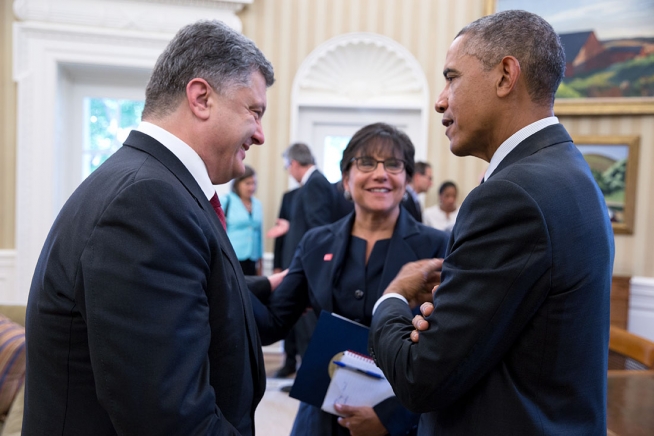
President Barack Obama talks with President Petro 
Poroshenko of Ukraine and Commerce Secretary 
Penny Pritzker following a bilateral meeting in the 
Oval Office, Sept. 18, 2014. (Official White  House 
Photo by Pete Souza)


But the question is whether the investigation has been so tainted by its reliance on the SBU, an intelligence service which is controlled by a chief suspect (the Ukrainian government) and whose responsibilities include shielding the state secrets of that suspect. The SBU is also directly engaged in warfare against the other chief suspect (the ethnic Russian rebels).

That obvious conflict of interest should have prompted the JIT to establish clear parameters that guaranteed the independence of the investigation. But the new report makes clear that no such lines were drawn or observed.

[For more background on this controversy, see Consortiumnews.com’s “More Game-Playing on MH-17.”]

Investigative reporter Robert Parry broke many of the Iran-Contra stories for The Associated Press and Newsweek in the 1980s. You can buy his latest book, America’s Stolen Narrative, either in print here or as an e-book (from Amazon and barnesandnoble.com).

"We're No Experts!" Infer "No Answers" Malaysia Air Downing Investigators

MH17 could have been downed unintentionally – Int’l investigation team

by RT


6 Jun, 2016

Malaysia Airlines flight MH17, which crashed over eastern Ukraine, could have been downed “unintentionally,” a new report by the Joint Investigation Team (JIT) says, adding that experts working on the case often lack the experience and data needed.

“An important question for the criminal investigation is whether a missile can be launched unintentionally. Did anyone accidentally push a button which caused the missile to be launched? Or can this only be done by means of a conscious act? And how exactly does the weapon system select its target?” reads a JIT report on the investigation of the MH17 tragedy, published on Monday on the Dutch Public Prosecution Service's website.

However, the document gives no answers to these questions, complaining instead that it is often difficult to find the relevant information while the investigators involved in the enquiry are “untrained” for dealing with such issues.

It is a “difficult task,” Gerrit Thiry, the weapons system investigation team leader, says in the report, explaining that “ever since the seventies, missiles have been manufactured for war purposes and have been exported to numerous countries. These were the hey-days of the Cold War. Specific technical details are strictly confidential.”

“In addition, the corresponding manuals are not freely available,” Susanne Huiberts, an operational specialist from the Dutch National Criminal Investigation Service, also an investigator, says.

The investigators rely partly on “limited information [that] can be found on the internet, as part of an article, for example.”

“But then you still do not understand what it means, because it is a very specific professional field,” Huiberts says.
“It is not enough either to find interpreters to translate these texts. First they need to get familiar with the jargon, learn to understand the abbreviations and decipher everything step by step. This takes a lot of time and energy.”

The investigators still do not rule out any potential explanation of what happened in July 2014. For the criminal investigation led by the JIT, “the evidential standard is set much higher than for the [Dutch Safety Board] OVV” that concluded in October 2015 that the aircraft had been brought down by a Buk missile.

“Everything we investigate is a point of discussion,” says Thiry.
“We have nothing of which we know for sure whether it is true and genuine. After all, we are dealing with a conflict involving several parties. These parties may have an interest in manipulating or contaminating material. Therefore, we continuously ask ourselves what could be the interest of a source to distribute certain information.”


Lacking experience


The JIT report often stresses that the international team, consisting of investigators and experts from the Netherlands, Belgium, Australia, Malaysia and Ukraine, often lack the specific knowledge and experience needed in such a complicated case.

“Because none of the teams has any experience with such a complex investigation of this type on such a large scale, the researchers must rely on themselves during the examination. That means being innovative, drawing on one’s professional networks and experience, and learning a lot on the job to solve problems as the examination progresses,” the document says.

Some of the evidence is obtained from “self-appointed experts” that should be first verified to check whether they are “indeed experts, rather than amateurs.”


“That is why several experts have been heard. When different sources point in the same direction, investigators can take a step forward. These sources are, for example, sources from industry, several states and ‘open sources’ on the internet,” the document says.

Conditions that the investigators have to work in are often far from ideal.

“In an office building in Kiev, Australian and Dutch investigating officers are working in cramped conditions in a small room. The working conditions are far from perfect, but the small room has a great advantage: the investigating officers cannot possibly get round each other,” the report says.

Investigation at advanced stage


Despite the setbacks and the claim that no version has been ruled out, the JIT claims the probe is at a “very advanced stage.”

In a statement two days before this latest report, they said they would be able to tell which weapon was used to down the plane, and where it was launched from, "after the summer." The findings will be included in a criminal file and will not be made public.

The JIT also claimed that it is “still waiting for information from the Russian Federation about Buk [missile defense systems] installations” – despite Moscow’s repeated calls for it to consider the satellite and technical data it has already provided.

In February, the Russian Federal Air Transport Agency sent an official letter to the Dutch Safety Board, stressing that Russia had repeatedly offered assistance in the investigation of the MH17 tragedy but the JIT “showed no interest” in working with Russia.

As for the technical specifications of the Buk systems, back in October, the rocket’s manufacturer, Russian company Almaz-Antey, published its own report on the MH17 crash, with detailed technical characteristics of the Buk and Buk-M1 systems as well as data from two full-scale experiments involving missile firing tests.

Malaysia Airlines Boeing-777 flight MH17 left from Amsterdam for the Malaysian capital of Kuala Lumpur on July 17, 2014. The airliner was shot down over the Donetsk region in eastern Ukraine. All 298 people on board, from 10 countries, were killed. There were 80 children among the passengers.

Gate Crashing the Other Money Party

Party Crashing and Political Revolution: With the DNC Just Weeks Away, What’s Next for Our Movement?

by Kshama Sawant  - CounterPunch


June 6, 2016


As the California Democratic Primary rapidly approaches, I’m reminded of a small but important event that took place earlier this spring in San Francisco. Gutsy activists protested in April outside a campaign fundraiser for Hillary Clinton, co-hosted by movie megastar and area resident, George Clooney. The party was full of glitz, privilege, glamour, and of course money. Lots of it. The minimum price for entry to the hotel location was $33,400, with a seat inside the house party going for $353,400.

A group of 200 protesters, uninvited and unwelcome at an event unaffordable to them, used the media spotlight outside to call out Hillary Clinton’s corporate record and corporate backing. George Clooney even felt compelled to respond to reporters, acknowledging the “obscene” amounts of money influencing the U.S. political system.

Of course, lots of Clinton fundraisers like this one have happened all over the country, both before and since, while even larger sums of money are amassed quietly with corporate Super PACs. But what was different about this “Golden City” event was the success of activists in breaking through the media blackout with a vivid snapshot into the world inhabited by the Democratic Party establishment, and the fundamental class character of the party itself.

But as we’ve seen over the past year, this establishment which has relentlessly tried to anoint Clinton is not only problematic in basing its funding on the super rich, Super PACs and Wall Street. It’s that these same class loyalties and preferences are fiercely and undemocratically enforced at every level through party and primary structures, from top to bottom, and from state to state. Last week, growing realizations of this (along with the crisis in the Republican party) were reflected in a poll showing 90% of voters have lost confidence in the country’s political system, with an unprecedented 40% going so far as to say that the two party system is “seriously broken.”

But the fact is, these parties were not made for the 99%, and we were never invited.

What is different in this election year has been Bernie Sanders’ incendiary challenge to this establishment and its multi-millionaire and billionaire base. Meanwhile, the base of Bernie’s campaign has been informed by a fundamentally changed political landscape characterized by a growing revolt against neoliberal politics for the rich – from the Occupy Wall Street movement to the Fight for $15 to Black Lives Matter.

In this new period, the left insurgent campaign of this self-described democratic socialist stands in stark contrast to Clinton’s Wall Street-blessed one. Not only because Sanders accepts no corporate money and has an average donation of just $27, but because of his powerful demands in favor of the 99% – such as free college education, Medicare for all, breaking up the big banks – which are all completely unacceptable to the Democratic Party leadership.

From the very beginning there has been a “yuge” contradiction between Bernie’s call for a political revolution against the billionaire class, and his decision to run in the primary of a party controlled by that same billionaire class.

The Trump Card


Nowhere have the contradictions of Bernie’s Democratic Party challenge been made more clear than through the fierce determination the establishment has shown in backing Hillary, in spite of the ever-increasing evidence of her weakness as a candidate against Trump.

And they have done so with all the formidable tools at their disposal. These include the undemocratic superdelegates, the skewed debate schedule, top-down control of caucus processes, voter disenfranchisement, and media smear campaigns. The latest of the coordinated media assaults tried to portray Sanders supporters as “violent” and compared them to Trump supporters because they dared to object to the undemocratic shenanigans at the Nevada state convention.

Having little credibility to convince ordinary people that she would boldly fight for their interests, Clinton has more and more focused her message on fear of Trump.

She presents herself as the “tested”, “experienced” candidate who could see the Democrats through to victory in November. But these arguments fly in the face of a mountain of polling evidence showing Sanders consistently beating Trump by far larger margins than Hillary. This is not incidental, but is grounded in Sanders’ direct appeal to the interests of working people and open rejection of the agenda of Wall Street. But that is also precisely why the establishment has stuck it out with Hillary – because they have full confidence she will reliably serve their interests.

Another factor is the publication of the State Department Inspector General’s report on Clinton’s use of a private email server during her time as Secretary of State. This report confirmed that Clinton knowingly broke State Department rules. Those members of staff who questioned what she was doing were told to “never to speak of the secretary’s personal email system again.” In the end the email scandal may lead to very little, but it has reinforced the widespread perception that Clinton cannot be trusted, while her consistent refusal to release the transcripts of her highly paid Goldman Sachs speeches tells the same story.

Of course there is a long way to go until November but as of right now, Clinton and the blowhard Trump are in a dead heat in national polls. The reason Hillary is struggling against Trump is not just about “trustworthiness”. Trump is completely untrustworthy. It is because Clinton is the personification of 40 years of neoliberal policies, under both Democratic and Republican administrations, that have led to a collapse in middle- and working class living standards.

Trump is not just a monster created by the Republicans, though their longtime appeals to racism and xenophobia certainly played a key role. His rise is also the product of the Democrats’ sharp turn to the right beginning in the late 70s and their wholehearted embrace of attacks on the interests of working people, with policies like NAFTA and the “ending of welfare as we know it” under Bill Clinton.

The question that urgently needs answering is not just “how do we beat Trump in the election” but even more importantly how do we cut out the underlying roots feeding into the growth of Trump’s right populism?

And we need to be crystal clear: we will not be able to do that by turning over the political fate of working people once again to the Democratic establishment.

Bernie Sanders recently stated: “The Democratic Party has a choice. It can open its doors and welcome into the party people who are prepared to fight for real economic and social change – people who are willing to take on Wall Street, corporate greed and a fossil fuel industry which is destroying this planet. Or the party can choose to maintain its status quo structure, remain dependent on big-money campaign contributions and be a party with limited participation and limited energy.”

While I completely agree with Sanders’ description of the Democratic Party as it is, what is deeply unfortunate is that he seems to have concluded that the way forward is for working people – yet again – to attempt to reform this completely undemocratic party. In this vein, he has committed repeatedly to support Hillary Clinton if she wins the nomination.

I hope we can convince him otherwise, or barring that, that we can win over as many Sanders supporters as possible away from this political dead end.

That’s why Movement4Bernie and I have launched a petition calling on Bernie Sanders to continue running all the way through November as an independent or on the Green Party ticket with Jill Stein. In the weeks since it was launched, we have collected over 35,000 signatures. Please sign it, share it, spread it around. The more momentum we can build for an alternative, the harder we will make it for the Clintonites to undermine our movement.

The DNC and its Platform


In recent weeks, the contradictions of Sanders’ Democratic Primary challenge have become ever more pronounced, as Sanders has more and more framed the race around pushing the party to the left.

While it’s very important that Bernie has been continuing to fight instead of conceding the race, I believe it’s a mistake to define the next stage of the battle primarily in terms of party platform and pressure on Clinton.

The inclusion of Cornel West and Bill McKibben are not unimportant concessions from the establishment to Sanders, but it’s an open question what the ultimate effect of this will be.

A determined and public challenge to the normally scripted and bureaucratically controlled platform process could lead to a departure from the recent choreographed conventions. And things can sharpen further if West, McKibben and others do hold firm to a radical reshaping of the platform, including voting against a final platform that does not include their key demands.

But we need to be clear that the platform itself is completely non-binding. There are no rules, no democratic mechanisms, nor even any tradition of the platform guiding real world votes by elected Democrats. The DNC platform normally goes out the window shortly after the convention is over.

Yet in spite of this, the Democratic establishment will likely only make the concessions they feel are necessary. In this they have clear majority control – compared to Bernie’s 5 platform assignments, Hillary has 6 and Debbie Wasserman Schultz has 4 more. This is yet another arrangement with a an undemocratic “buffer” system, not unlike the superdelegates in the primary. Even with a non-binding platform, this establishment leaves nothing to chance.

Lastly, we should recognize that the Democratic leadership may try to use this process, along with the political authority of West and McKibben, to convince Sanders supporters to finally come onboard the Clinton train.

With so many Sanders supporters currently unwilling to cave to this pressure, the potential is raised for a political explosion in Philadelphia against the establishment. The Bernie or Bust mood has in fact increased, with some recent polls showing nearly half of Sanders voters unwilling to support Clinton. There is even discussion of a walkout of delegates from the Democratic Convention. If a big, well organized walkout were to take place against undemocratic maneuvering at the convention it could be historic, and would point in the direction of political independence of the 99%.

The California Primary


As the primaries have gone on, Sanders has gained strength, winning more states and pledged delegates than Clinton since Super Tuesday at the start of March. Now the California primary is too close to call. While the delegate math makes it almost impossible that Sanders could have a majority of pledged delegates going into the DNC, nonetheless a defeat for Hillary in the last major primary would be a humiliating rejection and raise even bigger questions about her campaign. On the other side, a defeat for Bernie would be used to ramp up further pressure on Sandernistas.

With only weeks to go before the Democratic Convention, the party establishment is increasingly desperate to bring Sanders supporters in line by whatever means necessary.

In the coming weeks it will not only be adamant Clinton supporters and corporate media pundits calling for “party unity,” it will increasingly be major progressive leaders as well. This could even include some prominent Bernie supporters for the first time hinting that the time may be nigh to support Hillary, though the worst of this will likely wait until Philadelphia.

Regardless of what happens in California, we can expect to see an increase in all such attempts to force Sanders supporters in line, including calls to the Bernie or Bust movement for “peace”, “order” and “unity” at the Democratic Convention in late July.

We Need a Party of the 99%


In debates with Hillary Clinton, Bernie Sanders repeatedly asked why single-payer healthcare does not exist in the US, while such systems exist in virtually every other major country. A key part of the answer is that almost all these other countries had some form of independent working-class party. For example the National Health Service in Britain was brought in under a Labour government after World War II. In Canada, it was the Cooperative Commonwealth Party, a social democratic party that brought in the first single-payer universal health care system in North America. Many countries also achieved strong public pension systems, fully free higher education, and other reforms as a result of powerful workers’ movements that created parties which fought for their interests.

The Democratic Party has always been a party of the oppressing class. First, as the party of the slave-owners, then after abolition as a political party funded and dominated by big business. Beginning in the 1930s it came to be seen as the party most tied to the interests of organized labor, black people, and women. But all the way through the ‘60s it still had a “Dixiecrat” wing that fiercely defended Jim Crow segregation in the South. At every point in its history, on every essential issue whenever the class interests of the corporate elite was at stake, it has taken the side of that class against the interests of the 99%.

We need a fundamentally different kind of party. A party that like Bernie takes no corporate money and completely rejects corporate influence.

Such a “party of the 99%” will need to be genuinely democratically organized and include an active, mass membership based on ordinary working people. The major policy positions voted for by the membership would be binding. The party’s elected leaders must be able to be held fully accountable by genuine democratic structures, and must be recallable through those structures. In contrast, within the Democratic Party elected leaders and establishment insiders dominate party processes in a top-down, bureaucratic fashion that seeks to avoid debate, to rubber stamp, and to discourage any activist initiative. In many areas the party does not even have meetings, but serves only as an undemocratic electoral machine.

A party of the 99% would work alongside social movements, not against them. When I was elected after campaigning to make Seattle the first major city to pass a $15 minimum wage, my organization, Socialist Alternative, and I seized the opportunity to launch the 15 Now movement to bring the maximum possible pressure to bear on the political establishment to pass $15. We used every opportunity provided by the platform of my seat on the City Council to build this new movement. We called and organized mass rallies, we mobilized to City Hall votes, we launched “action groups” in neighborhoods all around Seattle.

15 Now filed a ballot measure (against the opposition of most of our allies in labor who wanted to maintain friendly relations with the Democratic establishment) and collected 10,000 signatures so that we would have leverage against the political establishment’s attempts to back down from $15 or undermine the planned ordinance. This “credible threat” proved absolutely crucial, as later openly admitted by angry business leaders. Even at the final vote on the $15 ordinance (you can watch footage of this important council session here) we exposed every vote on every corporate loophole, making these sell outs of workers publicly uncomfortable for the corporate politicians. Our movement fought to the final day, the final hour, even the final minute against big business’s efforts to water down $15 in Seattle. 15 Now has since taken the fight all over the nation, and presently is doing battle in Minneapolis to raise the minimum wage there through a ballot initiative.

If Bernie were elected president, he would need to do the same. As he recently said, if he were elected President he would need to become the “organizer in chief,” which would require mobilizing millions of people into organized movements which can bring enormous pressure to bear against the Republicans and Democrats in order to win real gains for the 99%.

The Democrats, as a party of big business, do the opposite – they use elected office to de-escalate, demobilize, and demoralize movements. After Obama was elected as an “anti-war” candidate in 2008, he tripled the troop presence in Afghanistan within months of taking office. If the Republican candidate, John McCain had been elected and escalated the occupation of Afghanistan in this manner, he would have faced massive protests. Instead, because of the anti-war movement’s ties to the Democratic Party and the pressures not to embarrass Obama on this and other issues (such as massive drone expansion and whistleblower crackdowns), the anti-war movement collapsed and never recovered.

If you look beneath the surface at virtually every major gain for the 99% in U.S. history, you will unearth the same story – of Democratic and Republican politicians with their backs up against a wall under enormous pressure from mass movements. Jim Crow segregation existed for more than a century after the Civil War and Lincoln abolished slavery. It was defended by both parties, and it was only the fiercely determined struggle of radical civil rights activists – who rejected an incrementalist approach and organized mass struggles that stood up against violence and police repression – that segregation laws were finally defeated.

These two parties of big business never “lead the way” on major progressive changes, they make concessions out of political calculation and fear of mass movements – that if they do not bend, they may break. FDR defended his New Deal policies explicitly to business people as necessary concessions to save the system, saying “I’m the best friend American capitalism ever had.” At root, Hillary Clinton and the Democratic establishment’s pronouncements in favor of “incremental” change are really a call for working people to step down, back off, and shut up.

While it may seem daunting to launch a new mass party, history shows that it would be far easier than trying to reform this fundamentally broken one. To win any of our key demands – to establish Medicare for all, a national $15 minimum wage, to end mass incarceration – the left will need to sever its connections to the Democratic Party. At best, another attempt to reform it will be a detour from the fundamental conclusion that needs to be reached.

Jill Stein’s Green Party campaign will likely offer the strongest left challenge in November and deserves the broadest possible support, even as we raise the vision for building a new mass party. Every vote for Stein, whose politics have much in common with Bernie, is a vote against neoliberal politics and in favor of our independence from corporate cash and influence.

In the whole history of the United States, there has rarely been a moment with more potential to launch a party based explicitly on the interests of working people and the poor. What is missing are forces with enough weight which are ready to commit. If Bernie was to call a conference to discuss this in the coming months, the process could begin in earnest this year. If he does not, it will be left to our movement to continue what we started, by rejecting Hillary and the Democratic Party, and laying the foundations for a real political revolution.
 
Khama Sawant is Seattle City Council Woman and member of Socialist Alternative.
More articles by:Kshama Sawant

Hillary Seizes the Warrior Mantle

Hillary Comes Out as the War Party Candidate

by Diana Johnstone - CounterPunch


June 3, 2016

Paris - On June 2, a few days before the California primary, Hillary Clinton gave up trying to compete with Bernie Sanders on domestic policy. Instead, she zeroed in on the soft target of Donald Trump’s most “bizarre rants” in order to present herself as experienced and reasonable.

Evidently taking her Democratic Party nomination for granted, she is positioning herself as the perfect candidate for hawkish Republicans.

Choosing to speak in San Diego, home base of the U.S. Pacific Fleet, on a platform draped with 19 American flags and preceded by half an hour of military marching music, Hillary Clinton was certain of finding a friendly audience for her celebration of American “strength”, “values” and “exceptionalism”.

Cheered on by a military audience, Hillary was already assuming the role to which she most ardently aspires: that of Commander in Chief of the Armed Forces.

Whenever Hillary speaks, one must look for the lies. The biggest lies in this speech were lies of omission. No mention of her support for the invasion of Iraq, no mention of the disaster she wrought in Libya, no mention of her contribution to pursuing endless death and destruction in the Middle East.

But she also lied in claiming partial credit for the Iran nuclear deal, which she had tended to block, and most profoundly in presenting herself as a champion of diplomacy. As Secretary of State, she blocked diplomacy that would have prevented or ended conflict, most notoriously concerning Libya, where even senior U.S. military officers were told to cut off their contacts with Gaddafi agents seeking a peaceful compromise.

The Washington Post reported prior to the speech that her campaign “hopes there are many more national-security-minded Republicans and independents who would vote for her, even grudgingly, rather than see Trump win the White House.”

The Washington Post noted that the state of California’s “defense industry and military bases lend a backdrop for her speech.” Indeed! Hillary Clinton is quite simply catering to the military-industrial complex, as she has been doing throughout her career. She is catering to the arms industry, which needs to keep the American people scared of various “threats” in order to continue draining the nation’s wealth into their profitable enterprises. She needs the support of military men and women who believe in all those threats invented by intellectuals in think tanks and editorial offices.

This is the core of the “national-security-minded” electorate that Hillary is targeting. She warned that Trump would jeopardize the wonderful bipartisan foreign policy that has been keeping us great and safe for decades.

In reality, such “national-security-minded” leaders as Dick Cheney and Clinton herself have led the United States into wars that create chaos, inspire enemies and endanger everybody’s national security. Despite the geographically safe position of the United States, it is that bipartisan War Party that has created genuine threats to U.S. national security by prodding the hornets’ nest of religious fanaticism in the Middle East and provoking nuclear-armed Russia by aggressive military exercises right up to its borders.

The basis of Hillary Clinton’s world view is that notorious “American exceptionalism” which Obama has also celebrated. If we don’t rule the world, she suggested, “others will rush in to fill the vacuum”. She clearly cannot conceive of dealing respectfully with other nations. The United States, she proclaimed, is “exceptional – the last best hope on earth.”

Not all people on earth feel that way. So they must be brought to heel. In practice, this “exceptionalism” means acting above the law. It means a unipolar world policed by U.S. armed forces. In practice, Hillary’s devotion to “our allies” means fighting wars in the Middle East for the benefit of Israel and of Saudi Arabia, whose arms purchases are indispensable for our military industrial complex. It means bombing countries and overthrowing foreign governments, from Honduras to Syria and beyond, in order to help them conform to “our values”.

Trump is groping clumsily, at times idiotically, toward a major shift in US foreign policy. He is ill-prepared for the task. If ever elected, he would have to fire the neocons and take on a whole new team of experts to educate and guide him. That would be something of a miracle.

But some of Hillary’s reproaches aimed at Trump’s “reckless, risky” foreign policy statements are not as self-evident as she assumes. For example, his statement that he would sit down to negotiate with North Korean dictator Kim Jong Un. Is that really such a crazy idea?

North Korea is a small country, whose leaders call themselves “communist” but who are essentially a dynasty that emerged from the resistance against Japanese invaders in World War II. Their quarrel with South Korea stemmed from the domination of Japanese collaborators in that part of the country. That is practically ancient history, and today North Korea feels threatened – and is indeed threatened – by the everlasting U.S. military presence on its borders. A small isolated country like North Korea is not a real “threat” to the world. Even with nuclear weapons. Its much-vaunted nuclear weapons are clearly meant both to defend itself from attack and as a bargaining chip.

So would it be so terrible to sit down and find out what the bargain might be? Basically, North Korean leaders would like to make a deal to lessen the U.S. threat and bring their country out of isolation. Why not discuss this, since it could lead to the end of the “North Korean threat” which is artificial anyway?

Hillary’s reaction is typical. She boasts that her solution is to build up an expensive missile defense shield in Japan and increase everybody’s military buildup in the region. As usual, she goes for the military solution, ridiculing the notion of diplomacy.

Hillary Clinton’s speech will certainly sound convincing to the “national security minded” because it is so familiar. The same as George W. Bush but delivered with much greater polish. America is good, America is great, we must remain strong to save the world. This is the road to disaster.

Hillary Clinton is the clear candidate of the War Party.


Diana Johnstone is the author of Fools’ Crusade: Yugoslavia, NATO, and Western Delusions. Her new book is Queen of Chaos: the Misadventures of Hillary Clinton. She can be reached at diana.johnstone@wanadoo.fr
More articles by:Diana Johnstone

Van de Bellen: A Finger Stemming Austria's Right Wing Flood

Austria Elects a New Green President against the Rising Right

by Rene Wadlow - Toward FreedomTRANSCEND Media Service


26 May 2016

There was a widespread sense of relief among many Europeans when on May 23, 2016 it was announced that Alexander Van der Bellen won the election for President of Austria in a razor thin victory over his far right-wing Freedom Party opponent Norbert Hofer. It was only after counting the mail votes which some 12% of voters in Austria use that the result could be official.

In some ways, Austria was split into two nearly equal halves: 50.3% for Van der Bellen, long-time leader of the Green Party and an active ecologist, and 49.7% for Hofer. The vote was also a rural-urban split that also reflected educational levels as well as a generation gap. The urban centers voted largely in favor of Van der Bellen, now at 71 and a retired professor of economics at the University of Vienna. Hofer is 45 with the dynamism of youth who won most of the rural votes as well as a certain percentage of youth.

The two political parties, the Social Democrats and the Christian Democrats who have ruled Austria since the end of the Allied occupation after 1945 were eliminated in the first round of voting.

The score of the Freedom Party was the highest among the right-wing nationalist parties of Europe. The rise of the “reductionists” would be a more accurate term than “nationalist” for the “reductionists” stress an ever reduced number of ideas for ever-smaller territories.

There was once a Yugoslav nationalism with an ideology that it hoped other countries would follow. Now we have a nationalism of Serbia, Croatia, Kosovo and company which can have an appeal to one who is not an ethnic Serb, Croat etc. Hofer has had some pan-German history, having belonged to a student group with the motto “Honour, Freedom, Fatherland”, but pan-Germanism among Austrians is not an ideology of the present, while anti-refugee sentiment has a strong pull.

Some in the Freedom Party tried to play on Van der Bellen’s name as not really Austrian. The Van der Bellen family were Dutch Protestants who had been encouraged to settle new lands in Russia in the 18th century. They became prosperous land owners, socially part of the aristocracy but never with a title. They left Russia at the time of the 1917 Revolution and ended up in rural Austria where Van der Bellen was born in 1944.

Other than an interest in 19th century Russian literature, Van der Bellen’s intellectual and political interests have always been turned to Western Europe. He has not made proposals concerning economic relations with Russia or beyond to Central Asia and China. Hofer has played on anti-European Union sentiment.

“We don’t want to be pushed around by the European Commission rules” he said, but his economic platform was largely empty. 

Rather his drawing card was a fear of refugees and asylum seekers. His speeches had more than a few anti-Islamic overtones.

Many in Europe have been watching closely Austrian elections closely for what they may hold for the EU referendum in Britain and the role that right-wing anti-EU parties may have in other European countries, especially those of Eastern Europe. Van der Bellen made a “We must all work together” plea in his victory statement − a common enough political theme, but in the Austrian case a realistic need. Hofer is young enough that he is unlikely to disappear from the Austrian political scene.

Austria is relatively stable both economically and politically so that references to the 1930s are not valid. However, we need to watch events carefully. Van der Bellen is the first President of a European country from a Green Party. We will have to see if the cosmopolitan values of Green Party platforms will have a new champion.

René Wadlow, a member of the Fellowship of Reconciliation and of its Task Force on the Middle East, is president and U.N. representative (Geneva) of the Association of World Citizens and editor of Transnational Perspectives. He is a member of the TRANSCEND Network for Peace, Development and Environment.

Go to Original – towardfreedom.com

Trumpaloed: A Webbed Tangle of Luth and Ties

Tangled Up in Trump  

by Chris Floyd - Empire Burlesque


5 June 2016

 
My latest column from the CounterPunch print magazine:

The tangled tropes of Trump are many and various. Most have at least a tincture of veracity in them — although the phenomenon of his candidacy is so vast and gaseous it’s not surprising that some discharge from it would fall, like mist, or a wet clump of coagulate matter, on scattered bits of the truth here and there.

One trope says we’ve been here before, with the political triumph of a gleefully ignorant, blustering, bigoted faux populist made famous by show biz: Ronald Reagan. Although he was more closely handled, Reagan’s off-hand idiocies and nasty nativism were very much in the Trumpian vein. Then there’s Dubya Bush, a certified chowderhead riding to power spouting gooberish nonsense and simplistic slogans while, like Reagan, acting as cover for a rapacious agenda of corporatism and militarism. In this view, Trump is just one more in an inglorious line of dimbulb hucksters whose success confirms, yet again, H.L. Mencken’s bleak view of the knuckle-dragging American electorate, whose intelligence can never be underestimated. (Or even misunderestimated.)

Another view sees Trump as a welcome — if inadvertent — heightener of contradictions, exposing the unsustainable hypocrisies of the system and bringing the rancid impostume of our militarized hyper-capitalism to the bursting point. The poisons that ooze from this opened carbuncle — the racism, aggression, nativism, hatred and vulgarity that pour from Trump’s mouth in a gangrenous stream — will provoke a movement that will — eventually, after much struggle and suffering — cleanse the body politic at last. (“The worse, the better” is a stance with a long history in political warfare; Lenin was an adept of the principle, as are the Senate Republicans.)

Others take heart from some of Trump’s sporadic sputterings that seem to echo fragments of a Ron Paul-like desire to rein in the bipartisan imperial project. They point to the fact that Trump declared — in a GOP debate, no less — that Dubya and his cronies should be put on trial for the Iraq War: something no other figure in either major party has ever done. He has also made noises about a more rational policy toward Russia (as opposed to the endless provocations and Cold War chest-beating of the Peace Prize Prez). He even once mentioned in a speech that we should take cognizance of the millions of foreigners who’ve been killed in the War on Terror: again, something that no other Dem/GOP politician has ever dared mention. (Not even Bernie Sanders, whose “radical” stance is that the Saudis should take over some of the killing for us.) Such statements have been seized upon by some who hope that a Trump presidency will break the bipartisan consensus on America’s deadly and sinister foreign policy.

Other tropes view Trump as an unprecedented catastrophe for American politics, a fascist (or fascist-like) figure whose like has never been seen before in our Republic. Or as the undertaker of the Republican Party, which, some savants say, will now go the way of the Whigs. Still others see Trump as a lightning rod for the disaffections of the white working and middle classes whose security and prosperity have been destroyed by globalization and corporate greed; Trump provides them with racist and xenophobic scapegoats for their suffering, while obscuring the true culprits: he and his fellow gorgers in the financial elite (and the politicians whom, he freely admits, the elite buy with their contributions).

This hardly exhausts the meanings that have been attached to Trump’s ascendancy. And as noted, there’s some truth in most of them. (Although I do think the reports of the GOP’s death are greatly exaggerated.) We have had shallow fools in charge of the country before. It is true that the irreconcilable contradictions of the system are coming to a head. Trump has uttered some truths about U.S. imperialism that we never hear from our politicians. He is more openly like a quasi-fascist authoritarian than we’ve seen before. He is tapping into the justified frustrations of millions of Americans at the depredations of the bipartisan neoliberal project.

But almost all of these tropes have been contradicted by Trump himself. Yes, he occasionally critiques American imperialism — then makes bellicose statements about augmenting it, including the possibility of using nukes in the Middle East. (To be fair, he stole that from Hillary’s 2008 campaign). Yes, he speaks to working class loss — then touts economic policies that will exacerbate it, such as lifting the few remaining feeble restraints on Wall Street. Yes, he talks of breaking the militaristic foreign policy paradigm — then promises to put the military in charge of foreign policy, expand the use of torture, “go after” the families of terrorist suspects, and so on.

Despite some garish trappings — such as the continual disgorgement of his id on Twitter — if Trump attains the White House, he will no doubt perpetuate the current system in its essential form. As will Clinton, of course; indeed, that perpetuation is the raison d’être of her whole campaign. In either case, the Deep State — that unfathomably vast network of contracts and covert ops, surveillance and subversion, corruption and corporatism that constitutes the genuine substance of the American government — will carry on.

Sunday, June 05, 2016

Heartwood Enbridge Line 9 Fundraiser

Heartwood Enbridge Line 9 Fundraiser

by Burnaby Mountain Updates


June 5, 2016

Three people are facing life in prison for allegedly shutting down Enbridge Line 9 on December 21st 2015 in Sarnia, Ontario AKA Anishinabek territory. This was the second time that line 9 was allegedly shut down after the line was reversed in the direction of flow.


The next court appearance for the three is on June 14th, to set a date for trial. All funds raised go towards Enbridge Resisters legal fees.


Musicians, poets, and speakers will be performing. Speakers list to be provided soon.

door: $5-$10 sliding scale (no one turned away for lack of funds)

In the past week, a 5 day trial for the Burnaby Mountain Kinder Morgan protests has just finished up with the day for argument coming up on June 27th at the provincial court of British Columbia at 222 Main Street.

The west stands in solidarity with the east.

Saturday, June 04, 2016

The Donald: God's Gift to the Establishment

Trump: The Greatest Gift to the Establishment

by Nick Bernabe - AntiMedia


June 4, 2016

ANTIMEDIA Op-Ed — “It can’t be. Donald Trump is an outsider! Washington hates him!”

I can already predict the comments on this article before I even begin to make my case.

And that’s exactly what the establishment wants.

It doesn’t want you to ingest new information and perhaps change your point of view; it wants you to be loyal to The Party, regardless of which one of the two monoliths it hopes you belong to.

There’s a reason the political establishment is made up of two parties, and for that reason Donald Trump is the greatest gift to that establishment in recent memory.

Before you report this post as spam or react emotionally by accusing me of being a shill for Hillary Clinton, please see my other works, which have taken an equally (if not more) critical look at her awful record of war crimes, deceit, lies, and manipulation. You see, it actually is possible to oppose Trump and Hillary; I’m living proof. With that out of the way, allow me to make my case.

Divide and Conquer: how the establishment preserves the status quo


Trump is running against the status quo, right? Not exactly. He’s working for it, and whether this is being done intentionally or not is of no consequence. It’s no secret Trump is the most polarizing politician in recent memory. But the groundwork for Trump’s ability to tap into the disgruntled American psyche was laid a long time ago.

Bill Clinton was a nation-builder who got the United States tangled in foreign conflicts, helped perpetuate mass incarceration, and implemented the disastrous NAFTA trade agreement that decimated American manufacturing. Though George W. Bush ran against those policies, he simply made them worse by wrongly invading Iraq, then overseeing the housing bubble and subsequent financial crisis.

Obama ran against the wars and Wall Street only to bail out the big banks once elected. He continued the war in Afghanistan, renewed the war in Iraq, and started several new ones all over the Middle East. He also joined a couple more unwinnable civil wars.

Trump will run against all of that, and since Hillary was part of the Obama administration, that makes her an easy target. Every four to eight years it’s the other guy’s fault. I mean, they’re both right; Republican and Democratic policies are detrimental to our freedom and prosperity, but that point is completely missed by the loyal partisans who make up America’s voting populace.

This ebb and flow of disastrous Republican policy to disastrous Democratic policy — and back again — is how the status quo holds onto its power. By pitting everyday Americans against each other based on Party loyalty, the populace is neutralized due to its internal fighting. Meanwhile, the parties themselves — save for a few social policies — are practically identical in their practices and only differ in name and rhetoric. One party is eviscerated while the other one seizes power, only to see that cycle reverse itself each election season.

But how can I claim Donald Trump is helping this duopoly of doom dominate?

Trump is running against the Republican party and the establishment, right?

Well, rhetorically speaking, yes, he is. But politicians say the darndest things. Trump is the Republican party now — he’s their standard-bearer. Trump is simply the culmination of years of the Republican party’s misleading anti-Muslim, anti-immigrant rhetoric finally paying off, though perhaps in a more abrasive way than party leaders had hoped. Trump is merely saying what a large proportion of American demographics have been led to believe through years of right-wing political and media rhetoric. Trump took their most extreme talking points and made them mainstream, and it’s this emergence into the mainstream that has turned 2016 into the most polarizing politicking year since the 1960s. And this plays right into the hands of the establishment.

Trump’s misleading scapegoating of (insert minority here) is creating a culture of divisiveness that may be impossible to repair. White people, who have fallen for this Nazi-like rhetoric of blaming the “other” people for very real economic problems, are now solidified under Trump. With every anti-Trump protest — especially the ones that turn violent like last night in San Jose — CA, his base grows more loyal and afraid of minorities. With every protest, they grow more affectionate of this strong-man who claims he will protect them if elected. Meanwhile, every time Trump blames Mexicans or Muslims for the United States’ problems, American minorities grow more afraid of what might happen to them if he’s elected.

Not only is Trump driving the Republican-Democrat divide, he’s also driving racial demographics apart — further splintering the already fractured American populace. Trump’s rhetoric alone has left Republican voter rolls flush with white nationalists and Democratic rolls overflowing with minorities willing to vote for Hillary for no other reason but to stop Trump.

Trump has grown the Republican party with his candidacy, attracting the fearful to his messaging. He’s also drawn a loyal base of opposition that is visible at every campaign stop. People hate both Hillary Clinton and Donald Trump so much they will literally vote for one to deny the other the presidency. And as Americans, nearly all of whom have a common interest in prosperity, security, a better life, and a better standard of living, equally divide themselves against one another, the Parties relish in it — all of it. The Democrats get to whip up their base against Trump’s radical rhetoric, and the Republicans get to do the same against minorities, religious groups, and Hillary’s criminally dishonest past. Trump serves the establishment by having become the wedge used to separate American society, leaving them to fight amongst themselves while the true “powers that be” and policies they put in place come away unscathed.

Vote all you want, but as long as the conversation is centered around who can stop Trump or who can beat Hillary, the country is in for a long hard disappointment by this time next year — when we realize (again) politicians make promises that are almost never kept. Even worse than do-nothing politicians getting elected, a culture of fear is incubating where whites and non-whites glare at each other in distrust or hate simply because they’ve been captured by the political rhetoric of the status quo that thrives on division. Trump’s divisive, hate-inspiring campaign is setting the stage for decades of safety for the political establishment. The last thing the oligarchs want is unity among disgruntled population that just might just set their gaze on them instead of each other.


This article (Trump Is the Greatest Gift to the Establishment in Modern American Politics) is an opinion editorial (OP-ED). The opinions expressed in this article are the author’s own and do not necessarily represent the views of Anti-Media. You have permission to republish this article under a Creative Commons license with attribution to Nick Bernabe and theAntiMedia.org. Anti-Media Radio airs weeknights at 11pm Eastern/8pm Pacific. If you spot a typo, email edits@theantimedia.org.

Passing: The Greatest

Muhammad Ali Dies


Friday, June 03, 2016

Double Damned: The Alternative to System Collapse is Collapse

The Structure Of Collapse: 2016-2019

by  Charles Hugh-Smith - OfTwoMinds blog


June 2, 2016
 
Leaders face a no-win dilemma: any change of course will crash the system, but maintaining the current course will also crash the system.

The end-state of unsustainable systems is collapse. Though collapse may appear to be sudden and chaotic, we can discern key structures that guide the processes of collapse.

Though the subject is complex enough to justify an entire shelf of books, these six dynamics are sufficient to illuminate the inevitable collapse of the status quo.


1. Doing more of what has failed spectacularly. The leaders of the status quo inevitably keep doing more of what worked in the past, even when it no longer works. Indeed, the failure only increases the leadership’s push to new extremes of what has failed spectacularly. At some point, this single-minded pursuit of failed policies speeds the system’s collapse.

2. Emergency measures become permanent policies. The status quo’s leaders expect the system to right itself once emergency measures stabilize a crisis. But broken systems cannot right themselves, and so the leadership is forced to make temporary emergency measures (such as lowering interest rates to zero) permanent policy. This increases the fragility of the system, as any attempt to end the emergency measures triggers a system-threatening crisis.

3. Diminishing returns on status quo solutions. Back when the economic tree was loaded with low-hanging fruit, solutions such as lowering interest rates had a large multiplier effect. But as the tree is stripped of fruit, the returns on these solutions diminish to zero.

4. Declining social mobility. As the economic pie shrinks, the privileged maintain or increase their share, and the slice left to the disenfranchised shrinks. As the privileged take care of their own class, there are fewer slots open for talented outsiders. The status quo is slowly starved of talent and the ranks of those opposed to the status quo swell with those denied access to the top rungs of the social mobility ladder.

5. The social order loses cohesion and shared purpose as the social-economic classes pull apart. The top of the wealth/power pyramid no longer serves in the armed forces, and withdraws from contact with the lower classes. Lacking a unifying social purpose, each class pursues its self-interests to the detriment of the nation and society as a whole.

6. Strapped for cash as tax revenues decline, the state borrows more money and devalues its currency as a means of maintaining the illusion that it can fulfill all its promises. As the purchasing power of the currency declines, people lose faith in the state’s currency. Once faith is lost, the value of the currency declines rapidly and the state’s insolvency is revealed.

Each of these dynamics is easily visible in the global status quo.

As an example of doing more of what has failed spectacularly, consider how financialization inevitably inflates speculative bubbles, which eventually crash with devastating consequences. But since the status quo is dependent on financialization for its income, the only possible response is to increase debt and speculation—the causes of the bubble and its collapse—to inflate another bubble. In other words, do more of what failed spectacularly.

This process of doing more of what failed spectacularly appears sustainable for a time, but this superficial success masks the underlying dynamic of diminishing returns: each reflation of the failed system requires greater commitments of capital and debt. Financialization is pushed to new unprecedented extremes, as nothing less will generate the desired bubble.

Rising costs narrow the maneuvering room left to system managers. The central bank’s suppression of interest rates is an example. As the economy falters, central banks lower interest rates and increase the credit available to the financial system.

This stimulus works well in the first downturn, but less well in the second and not at all in the third, for the simple reason that interest rates have been dropped to zero and credit has been increased to near-infinite.

The last desperate push to do more of what failed spectacularly is for central banks to lower interest rates to below-zero: it costs depositors money to leave their cash in the bank. This last-ditch policy is now firmly entrenched in Europe, and many expect it to spread around the world as central banks have exhausted less extreme policies.

The status quo’s primary imperative is self-preservation, and this imperative drives the falsification of data to sell the public on the idea that prosperity is still rising and the elites are doing an excellent job of managing the economy.

Since real reform would threaten those at the top of the wealth/power pyramid, fake reforms and fake economic data become the order of the day.

Leaders face a no-win dilemma: any change of course will crash the system, but maintaining the current course will also crash the system.

Welcome to 2016-2019.


This essay was drawn from my new book
Why Our Status Quo Failed and Is Beyond Reform.

Coup Bossa Nova: Brazil's Rogue's Rebellion

A Very Brazilian Coup

by Conn Hallinan - CounterPunch


June 3, 2016

On one level, the impeachment of Brazilian President Dilma Rousseff seems like vintage commedia dell’arte.

For instance, the lower house speaker who brought the charges, Eduardo Cunha, had to step down because he has $16 million stashed in secret Swiss and U.S. bank accounts.

The man who replaced Cunha, Waldir Maranhao, is implicated in the corruption scandal around the huge state-owned oil company, Petrobras.

The former vice-president and now interim president, Michel Temer, has been convicted of election fraud, and has also been caught up in the Petrobras investigation. So is Senate president Renan Calheiros, who’s also dodging tax evasion charges.

In fact, over half the legislature is currently under investigation for corruption of some kind.

But there’s nothing comedic about what the fall of Rousseff and her left-leaning Workers Party will mean for the 35 million Brazilians who’ve been lifted out of poverty over the past decade, or for the 40 million newly minted members of the middle class — that’s one-fifth of Brazil’s 200 million people.

While it was the current downturn in the world’s seventh largest economy that helped light the impeachment fuse, the crisis is rooted in the nature of Brazil’s elites, its deeply flawed political institutions, and the not-so-dead hand of its 1964-1985 military dictatorship.

A Lurch to the Right


Given that the charges against Rousseff don’t involve personal corruption, or even constitute a crime — if juggling books before an election were illegal, virtually every politician on the planet would end up in the docket — it’s hard to see the impeachment as anything other than a political coup. Even the center-right Economist, long a critic of Rousseff, writes that “in the absence of proof of criminality, impeachment is unwarranted” — and “looks like a pretext for ousting an unpopular president.”

That suspicion is reinforced by the actions of the new president.

Temer represents the center-right Brazilian Democratic Movement Party (PMDB), which until recently was in alliance with Rousseff’s Workers Party. As soon as Rousseff was impeached by the Senate and suspended from office for 180 days, Temer made a sharp turn to the right on the economy, appointing a cabinet of ministers straight out of Brazils’ dark years of dictatorship: all white, all male, and with the key portfolios in the hands of Brazil’s historic elites. This comes in a country where just short of 51 percent of Brazilians describe themselves as black or mixed.

At least six of those ministers, moreover, have been implicated in the Petrobras scandal.

Temer announced a program to “reform” labor laws and pensions, using code words for anti-union legislation and pension cuts. His new finance minister, Henrique Meirelles, a former central bank head who once led BankBoston in the United States, announced that while programs for the poor “which don’t cost the budget that much” would be maintained — like the highly popular and successful Bolsa Familia, which raised tens of millions out of poverty through small cash grants — other Workers Party initiatives would go under the knife.

The new government is already pushing legislation that would roll back laws protecting the environment and indigenous people, and has appointed ministers with terrible track records in both areas.

For instance, one of the largest soybean farmers in Brazil, Blairo Maggi, was appointed agriculture minister. Maggi has overseen the destruction of vast areas of the Amazon to make way for soybean crops. Temer’s initial appointment for science minister was an evangelical Protestant minister who doesn’t believe in evolution. Temer also folded the culture ministry into the ministry of education, sparking sit-ins and demonstrations by artists, filmmakers, and musicians.

Corruption and Incoherence


Brazil has long been a country with sharp divisions between wealth and poverty, and its elites have a history of using violence and intimidation to get their way. Brazil’s northeast is dominated by oligarchs who backed the 1964 military coup and manipulated the post-dictatorship constitution.

Political power is heavily weighted toward rural areas dominated by powerful agricultural interests. The three poorest regions of the country where these interests dominate, accounting for only two-fifths of the population, control three-quarters of the seats in the Senate.

As historian Perry Anderson puts it, Brazil’s political system was designed “to neutralize the possibility that democracy might lead to the formation of any popular will that could threaten the enormities of Brazilian inequality.”

Brazil’s legislature is splintered into 35 different parties, many of them without any particular political philosophy. The legislature is elected on the basis of proportional representation, but with an added twist: There’s an “open list” system in which voters can choose any candidate, many of them standing on the same ticket.

The key to winning elections in Brazil, then, is name recognition, and the key to that is lots and lots of money. Most of that money comes from Brazil’s elites, like the oligarchs in the country’s northeast.

Because of the plethora of parties, forming a government is tricky. What normally happens is that one of the larger parties ropes in several smaller parties by giving them ministries. Not only does this encourage corruption — each party knows it needs to raise lots of money for elections — but also results in political incoherence.

When the Workers Party was elected in 2002, it was unwilling to dilute its programs by bringing ideological opponents into a cabinet — yet the party still needed partners. The solution was cash payouts to legislators, a scheme titled mensalao (“monthly payoffs”) that was uncovered in 2005. Once the payoffs were revealed, the party had little choice but to fall back on the old system of handing out ministries in exchange for votes. That’s how Temer and the PMBD entered the scene.

With the reputation of the popular former president Lula da Silva and his Workers Party dented by the payoff scheme, the right saw an opportunity to rid themselves of the left. But Silva’s resilient popularity and the success of his anti-poverty programs made the party pretty much unassailable at the ballot box. Silva won another landslide election in 2006, and his successor Rousseff was elected twice in 2010 and 2014.

A Very Brazilian Coup


In short, the elites could not win elections. But they could still pull off a very Brazilian coup.

First, they hammered at the fact that some Workers Party leaders had been involved in corruption and others implicated in the Petrobras bribery scheme. Rousseff herself headed up Petrobras before being elected president. While she’s never been personally linked to any of the corruption, it did happen on her watch.

Petrobras is the fourth largest company in the world. It’s building tankers, offshore platforms, and refineries. That expansion has opened huge opportunities for graft, and the level of bribery involved could exceed $3 billion. Nine construction companies are implicated in the scandal, as well as more than 50 politicians, legislators, and state governors, from the PMDB as well as the Workers Party.

Rousseff’s biggest mistake was to run on an anti-austerity platform in 2014 and then reverse course after she was elected, putting the brakes on spending. The economy was already troubled and austerity made it worse. The 2005 bribery scheme lost the Workers Party some of the middle class, and the 2014 austerity alienated some of the party’s working class supporters.

But it was most likely Rousseff’s decision to green light the Petrobras corruption investigation that spurred her enemies to strike before the probe could pull down scores of political leaders and wealthy construction owners. Temer’s own anti-corruption minister was recently caught on tape plotting to use the impeachment to derail the investigation, an event that led to his resignation.

Certainly the campaign aimed at Rousseff was well orchestrated. Brazil’s media — dominated by a few elite families — led the charge. According to Reporters Without Borders, the role of the media was “partisan,” its anti-Rousseff agenda “barely veiled.” Judge Sergio Moro, a key figure in the Petrobras investigation, illegally leaked wiretap intercepts that put Silva and Rousseff in a bad light.

Given the makeup of the Brazilian Senate, it’s likely that Rousseff will be convicted and removed as president. It also appears that Temer, who enjoys almost no popular support, will try to roll back many of the programs that successfully narrowed the gap between rich and poor.

On the Ropes


The stakes are high, and not just for democracy.

Brazil’s economy is in trouble, shrinking 3.7 percent last year. Commodity prices are down worldwide, in large part because of the downturn of China’s economy. Brazil’s debt is rising, though it’s still half that of Italy. And unemployment is low, at least compared to the indebted countries of Europe.

A return to the austerity policies that destroyed economies all across the southern cone during the 1980s and ‘90s — and which are decimating parts of Europe today — would be a disaster. The worst thing one can do in a recession is curb spending, which stalls out economies and puts countries into a debt spiral.

For now, the Workers Party is on the ropes, but hardly down and out. It has 500,000 members, and the new government will find it very difficult to take things away from people now that they’ve gotten used to having them. Some 35 million people are unlikely to return to their previous poverty without a fight.

One of Temer’s first acts was to put up 100,000 billboards all over the country with the slogan: “Don’t speak of crisis; work!” That sounds a lot like “shut up.” Yet Brazilians aren’t noted for being quiet, particularly if the government instituting painful cuts is unelected.

The pressure for new elections is sure to grow, although the current government will do anything it can to avoid them. Sooner or later there will be a reckoning.
  
Conn Hallinan can be read at dispatchesfromtheedgeblog.wordpress.com
More articles by:Conn Hallinan