Thursday, June 30, 2016

The Neocon Legacy: Making Bugs of Us All

Trading Places: Neocons and Cockroaches

by Robert Parry  - Consortium News


June 28, 2016

If the human species extinguishes itself in a flash of thermonuclear craziness and the surviving cockroaches later develop the intellect to assess why humans committed this mass suicide, the cockroach historians may conclude that it was our failure to hold the neoconservatives accountable in the first two decades of the Twenty-first Century that led to our demise.

After the disastrous U.S.-led invasion of Iraq – an aggressive war justified under false premises – there rightly should have been a mass purging of the people responsible for the death, destruction and lies. Instead the culprits were largely left in place, indeed they were allowed to consolidate their control of the major Western news media and the foreign-policy establishments of the United States and its key allies.

A cockroach, which some scientists believe has the best chance to survive a nuclear holocaust.

Despite the Iraq catastrophe which destabilized the Middle East and eventually Europe, the neocons and their liberal interventionist chums still filled the opinion columns of The New York Times, The Washington Post, The Wall Street Journal and virtually every other mainstream outlet. Across the American and European political systems and “think tanks,” the neocons and the liberal hawks stayed dominant, too, continuing to spin their war plans while facing no significant peace movement.

The cockroach historians might be amazed that at such a critical moment of existential danger, the human species – at least in the most advanced nations of the West – offered no significant critique of the forces leading mankind to its doom. It was as if the human species was unable to learn even the most obvious lessons needed for its own survival.

Despite the falsehoods of the Iraq War, the U.S. government was still widely believed whenever it came out with a new propaganda theme. Whether it was the sarin gas attack in Syria in 2013 or the Malaysia Airlines Flight 17 shoot-down over eastern Ukraine in 2014, U.S. government assertions blaming the Syrian government and the Russian government, respectively, were widely accepted without meaningful skepticism or simple demands for basic evidence.

Swallowing Propaganda


Just as with the Iraqi WMD case, the major Western media made no demands for proof. They just fell in line and marched closer to the edge of global war. Indeed, the learned cockroaches might observe that the supposed watchdogs in the American press had willingly leashed themselves to the U.S. government as the two institutions moved in unison toward catastrophe.

The few humans in the media who did express skepticism – largely found on something called the Internet – were dismissed as fill-in-the-blank “apologists,” much as occurred with the doubters against the Iraqi WMD case in 2002-2003. The people demanding real evidence were marginalized and those who accepted whatever the powerful said were elevated to positions of ever-greater influence.

If the cockroach historians could burrow deep enough into the radioactive ashes, they might discover that – on an individual level – people such as Washington Post editorial page editor Fred Hiatt wasn’t fired after swallowing the WMD lies whole and regurgitating them on the Post’s readership; that New York Times columnist Roger Cohen and dozens of similar opinion-leaders were not unceremoniously replaced; that Hillary Clinton, a neocon in the supposedly “liberal” Democratic Party, was rewarded with the party’s presidential nomination in 2016; and that the likes of Iraq War architect Robert Kagan remained the toast of the American capital with his opinions sought after and valued.

The cockroaches might observe that humans showed little ability to adapt amid very dangerous conditions, i.e., the bristling nuclear arsenals of eight or so countries. Instead, the humans pressed toward their own doom, tagging along after guides who had proven incompetent over and over again but were still followed toward a civilization-ending precipice.

These guides casually urged the masses toward the edge with sweet-sounding phrases like “democracy promotion,” “responsibility to protect,” and “humanitarian wars.” The same guides, who had sounded so confident about the wisdom of “shock and awe” in Iraq and then the “regime change” in Libya, pitched plans for a U.S. invasion of Syria, albeit presented as the establishment of “safe zones” and “no-fly zones.”

After orchestrating a coup in Russia’s neighbor Ukraine, overthrowing the elected president and then sponsoring an “anti-terrorism operation” to kill ethnic Russian Ukrainians who objected to the coup, Western politicians and policymakers saw only “Russian aggression” when Moscow gave these embattled people some assistance. When citizens in Crimea voted 96 percent to separate from Ukraine and rejoin Russia, the West denounced the referendum as a “sham” and called it a “Russian invasion.” It didn’t matter that opinion polls repeatedly found similar overwhelming support among the Crimean people for the change. The false narrative, insisting that Russia had instigated the Ukraine crisis, was accepted with near-universal gullibility across the West.

A Moscow ‘Regime Change’


Behind this fog of propaganda, U.S. and other Western officials mounted a significant NATO military build-up on Russia’s border, complete with large-scale military exercises practicing the seizure of Russian territory.

Russian warnings against these operations were dismissed as hysterical and as further proof for the need to engineer another “regime change,” this time in Moscow. But first the Russian government had to be destabilized by making the economy scream. Then, the plan was for political disruptions and eventually a Ukraine-style coup to remove the thrice-elected President Vladimir Putin.

The wisdom of throwing a nuclear power into economic, political and social disorder – and risking that the nuclear codes might end up in truly dangerous hands – was barely discussed.

Even before the desired coup, the West’s neoconservatives advocated giving the Russians a bloody nose in Syria where Moscow’s forces had intervened at the Syrian government’s request to turn back Islamic jihadists who were fighting alongside Western-backed “moderate” rebels.

The neocon/liberal-hawk plans for “no-fly zones” and “safe zones” inside Syria required the U.S. military’s devastation of Syrian government forces and presumably the Russian air force personnel inside Syria with the Russians expected to simply take their beating and keep quiet.

The cockroach historians also might note that once the neocons and their liberal interventionist sidekicks decided on one of their strategic plans at some “think-tank” conference – or wrote it down in a report or an op-ed – they were single-minded in implementing it regardless of its impracticality or recklessness.

These hawks were highly skilled at spinning new propaganda themes to justify what they had decided to do. Since they dominated the major media outlets, that was fairly easy without anyone of note taking note that the talking points were simply word games. But the neocons and liberal hawks were very good at word games. Plus, these widely admired interventionists were never troubled with self-doubt whatever mayhem and death followed in their wake.

So, when the decision was made to invade Iraq, Libya and Syria or to stage a coup in Ukraine or to destabilize nuclear-armed Russia, the neocons and their friends never countenanced the possibility that something could go wrong.

And when setbacks and even catastrophes resulted, the messes were excused away as the failure of some politician to implement the neocon/liberal-hawk scheme to the precise letter. If only more force had been used, if only people on the ground were more competent, if only the few critics were silenced and prevented from sowing doubts about the wisdom of the plan, then it would have succeeded. It was never their fault.

As the West’s new foreign-policy establishment, the neocons and their liberal helpers validated their own thoughts as brilliant and infallible. And who was there to doubt them? Who had the necessary access to the West’s mass media and who had the courage to counter their clever arguments and suffer the predictable ridicule, insults and slurs? After all, there were so many esteemed people and prestigious institutions that stamped the neocon/liberal-hawk plans with gilded seals of approval.

Still, the cockroach historians might yet be puzzled by how thoroughly the world’s leadership failed the human species, particularly in the West, which prided itself in freedom of thought and diversity of opinion.

So, the pressures kept building, unchecked, until – perhaps accidentally amid excessive tensions or after some extreme nationalist had exploited Russia’s “regime change” chaos to seize power – the final line was crossed.

‘Extending American Power’


Though much of human information would likely have been lost in the nuclear firestorms that were unleashed, the cockroach historians could learn much if they could get their antennae around a 2016 report by a group called the Center for a New American Security, consisting of prominent neocons and liberal interventionists, including some expected to play high-level roles in a Hillary Clinton administration.
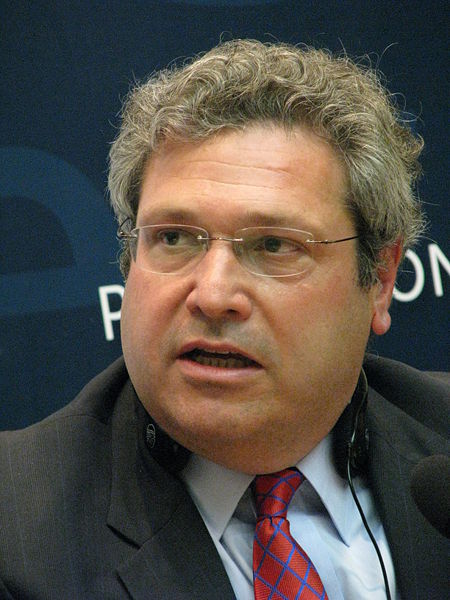


Prominent neocon intellectual Robert Kagan. 
(Photo credit: Mariusz Kubik, http://www.mariuszkubik.pl)


These “experts” included foreign-policy stars such as Robert Kagan (formerly of the Reagan administration’s State Department, a co-founder of the Project for the New American Century – an early advocate for the Iraq War – and later a scholar at the Brookings Institution and a Washington Post columnist), James P. Rubin (who served in Bill Clinton’s State Department and made a name for himself as a TV commentator), Michele Flournoy (the Under Secretary of Defense for Policy during Barack Obama’s first term and touted as Hillary Clinton’s favorite to be Secretary of Defense), Eric Edelman (who preceded Flournoy in her Obama job except he served under George W. Bush), Stephen J. Hadley (George W. Bush’s second-term national security advisor), and James Steinberg (a deputy national security advisor under Bill Clinton and Deputy Secretary of State under Secretary of State Hillary Clinton).

In other words, this group, which included many other big names as well, was a who’s who of who’s important in Washington’s foreign-policy establishment. Their report was brazenly entitled “Extending American Power” and painted an idyllic picture of the world population living happily under U.S. domination in the seven decades since World War II.

“The world order created in the aftermath of World War II has produced immense benefits for peoples across the planet,” the report asserted, ignoring periodic slaughters carried out across the Third World, from Vietnam to Latin America to Africa to the Middle East, often inflicted by the massive application of U.S. firepower and other times by tribal or religious hatreds and rivalries exacerbated by big-power interference.

Also downplayed was the environmental devastation that has come with the progress of hyper-capitalism, threatening the long-term survival of human civilization via “global warming” – assuming that “nuclear winter” doesn’t intervene first.

Even though many of these benighted “experts” were complicit in gross violations of international law – including aggressive war in Iraq, Libya and elsewhere; lethal drone strikes in multiple countries; torture of “war on terror” detainees; and subversion of internationally recognized governments – they deluded themselves into believing that they stood for some legalistic global structure, declaring:

“United States still has the military, economic, and political power to play the leading role in protecting a stable rules-based international order.” Exactly what stability and what rules were left fuzzy.

In line with their underlying delusions, these “experts” called for feeding more money into the maw of the Military-Industrial Complex and flexing American military muscle: “An urgent first step is to significantly increase U.S. national security and defense spending and eliminate the budgetary strait-jacket of the Budget Control Act. A second and related step is to formulate policies that take advantage of the substantial military, economic, and diplomatic power Washington has available but has been reluctant to deploy in recent years.”

Battling Russia over Ukraine


The bipartisan group – representing what might be called Official Washington’s consensus – also urged a tough stand against Russia regarding Ukraine, including military assistance to help the post-coup Ukrainian regime crush ethnic Russian resistance in the east.



Screen shot of the fatal fire in Odessa, Ukraine, 
killing dozen of ethnic Russians who had sought refuge there 
on May 2, 2014. (From RT video)


“The United States must provide Ukrainian armed forces with the training and equipment necessary to resist Russian-backed forces and Russian forces operating on Ukrainian territory,” the report said, adding as a recommendation: “Underwrite credible security guarantees to NATO allies on the frontlines with Russia. Given recent Russian behavior, it is no longer possible to ignore the possible challenge to NATO countries that border Russia. The Baltics in particular are vulnerable to both direct attack and the more complicated ‘hybrid’ warfare that Russia has displayed in Ukraine.
“To provide reassurance to U.S. allies and also to deter Russian efforts to destabilize these nations, it is necessary to build upon the European Reassurance Initiative and establish a more robust U.S. force presence in appropriate central and eastern Europe countries, which should include a mix of permanently stationed forces, rotationally deployed forces, prepositioned equipment, access arrangements and a more robust schedule of military training and exercises. …

“The United States should also work with both NATO and the EU to counter Russian influence-peddling and subversion using corruption and illegal financial manipulation.”

Apparently that last point about “influence-peddling” was a reference to the need to silence dissident voices in the West that object to the new Cold War and dispute U.S. propaganda aimed at justifying the increased tensions with Russia. The report’s Washington insiders clearly understand that their future career prospects are advanced by taking a belligerent approach toward Russia.

Regarding Syria, the bipartisan group of neocons and liberal hawks urged a U.S. military invasion with the goal of establishing a “no-fly zone” while building up insurgent forces capable of compelling “regime change” in Damascus, a strategy similar to those followed in Iraq and Libya to disastrous results.

“In our view, there can be no political solution to the Syrian civil war so long as the military balance continues to convince [Syrian President Bashar al-] Assad he can remain in power. And as a result of Iran’s shock troops and military equipment deployed to Syria, and the modern aircraft and other conventional forces Russia has now deployed, the military balance tilts heavily in favor of the Assad regime,” the report said.
“At a minimum, the inadequate efforts hitherto to arm, train, and protect a substantial Syrian opposition force must be completely overhauled and made a much higher priority. In the meantime, and in light of this grim reality, the United States, together with France and other allies, must employ the necessary military power, including an appropriately designed no-fly zone, to create a safe space in which Syrians can relocate without fear of being killed by Assad’s forces and where moderate opposition militias can arm, train, and organize.”

How a U.S.-led invasion of a sovereign country and the arming of a military force to overthrow the government fit with the group’s enthusiasm for “a rule-based international order” is not explained. Clearly, the prescribed actions are in violation of the United Nations Charter and other international legal standards, but apparently the only real “rules” the group believes in are those that serve its purposes and change depending on the needs for “extending American power.”

Similar hypocrisy pervaded the group’s other recommendations, but the blind obedience to these double standards – indeed the inability to see or acknowledge the blatant contradictions – might be of interest to the cockroach historians because it could help them understand how the U.S. foreign policy establishment lost its mind and blundered into unnecessary conflicts that could easily escalate into strategic warfare, even thermonuclear conflagration.

A Steady Drumbeat


But this collection of neocons and liberal hawks wasn’t just an odd group of careerist “thinkers” trying to impress Hillary Clinton. Their double-thinking “group think” extended throughout the American establishment in the second decade of the Twenty-first Century.


Columnist Roger Cohen

For instance, The New York Times and other major publications were dominated by both neocon and liberal-hawk commentators, writers like Roger Cohen, who was one of the many pundits who swallowed the Iraq War lies whole and — despite the disaster — avoided any negative career consequences. So, in 2016, that left Cohen and his fellow Iraq War cheerleaders still pressing political leaders to expand the war in Syria and ratchet up tensions with Russia at every opportunity.

In a column about the mass shooting at a gay night club in Orlando, Florida, on June 12 – in which the shooter was reported to have claimed allegiance to ISIS – Cohen tacked on a typically distorted account of President Obama’s approach to the Syrian conflict. Ignoring that Obama had the CIA and the Pentagon covertly train and arm rebel groups seeking to overthrow the Syrian government, Cohen wrote:

“Yes, to have actively done nothing in Syria over more than five years of war — so allowing part of the country to become an ISIS stronghold, contributing to a massive refugee crisis in Europe, acquiescing to slaughter and displacement on a devastating scale, undermining America’s word in the world, and granting open season for President Vladimir Putin to strut his stuff — amounts to the greatest foreign policy failure of the Obama administration. It has made the world far more dangerous.”

But Cohen did not acknowledge his own role as a brash supporter of the Iraq War in sparking the creation of Al Qaeda in Iraq, which later morphed into the Islamic State or ISIS. Nor did he address the fact that the United States and its allies, such as Turkey and Saudi Arabia, have essentially kept the Syrian civil war going, a point even acknowledged by some supporters of Syrian “regime change.”

For instance, Thanassis Cambanis of the “progressive” Century Foundation produced a report entitled “The Case for a More Robust U.S. Intervention in Syria,” which acknowledged that “most of the armed opposition has survived only because of foreign intervention.” In other words, much of the death and destruction in Syria, which also has fueled political instability in Europe because of the massive refugee flow, resulted from intervention from the United States and its allies.

So, the cure to the mess created by these not-thought-through interventions, at least in the view of Cohen and other eager interventionists, is more intervention. It was just such obsessive and irrational thinking – embraced as Official Washington’s “conventional wisdom” – that pushed the world toward the eve of destruction in 2016.

Contemplating all this human foolishness, the cockroach historians might be left using one of their six legs to scratch their heads.

[For more on these topics, see Consortiumnews.com’s “A Family Business of Perpetual War“; “Neocons and Neolibs: How Dead Ideas Kill“; and “The State Department’s Collective Madness.”]

Investigative reporter Robert Parry broke many of the Iran-Contra stories for The Associated Press and Newsweek in the 1980s. You can buy his latest book, America’s Stolen Narrative, either in print here or as an e-book (from Amazon and barnesandnoble.com).

Life (Blood) of the Party: Sycophants and Other Political Parasites

The Life of the Parties: The Influence of Influence in Washington

by Thomas Frank - TomDispatch

June 30, 2016
Although it’s difficult to remember those days eight years ago when Democrats seemed to represent something idealistic and hopeful and brave, let’s take a moment and try to recall the stand Barack Obama once took against lobbyists. 
Those were the days when the nation was learning that George W. Bush’s Washington was, essentially, just a big playground for those lobbyists and that every government operation had been opened to the power of money. Righteous disgust filled the air. “Special interests” were much denounced. And a certain inspiring senator from Illinois promised that, should he be elected president, his administration would contain no lobbyists at all. 
The revolving door between government and K Street, he assured us, would turn no more.

Instead, the nation got a lesson in all the other ways that “special interests” can get what they want -- like simple class solidarity between the Ivy Leaguers who advise the president and the Ivy Leaguers who sell derivative securities to unsuspecting foreigners. As that inspiring young president filled his administration with Wall Street personnel, we learned that the revolving door still works, even if the people passing through it aren’t registered lobbyists.

But whatever became of lobbying itself, which once seemed to exemplify everything wrong with Washington, D.C.? 
Tomgram: Thomas Frank, Worshipping Money in D.C.

[Note for TomDispatch Readers: Read today's piece and then get your hands on Thomas Frank's new book, Listen, Liberal: Or, What Ever Happened to the Party of the People? It's the political must-read of this season if you want to know where liberalism went in the last two and a half decades. The next TomDispatch post will be on Tuesday, July 5th. Tom]

I’m no stranger to shakedowns. I’ve experienced them, in one form or another, from Asia to Africa.

Sometimes the corruption is subtle. Sometimes it’s naked. Sometimes you press folded currency into someone’s palm. Sometimes there’s a more official procedure. Sometimes a payment is demanded outright. (A weapon might even be involved.) Other times, it’s up to you to suggest that we somehow work things out privately.

Luckily, I live in the United States, and if the 2016 presidential campaign has reminded me of anything, it’s that America is, by definition (and unlike so many of the other countries on the planet), a corruption-free zone. Mind you, no one would claim that the race for the Oval Office is free of unethical behavior. It’s just that the actions and efforts involved aren’t considered “corrupt” here.

Take an Associated Press (AP) exposé last week. It revealed that the campaign of presumptive Republican nominee Donald Trump had “plowed about $6 million” -- roughly 10% of his expenditures -- “back into Trump corporate products and services.” The campaign paid, for instance, about $520,000 in rent and utilities for its headquarters at Manhattan’s Trump Tower and an astounding $4.6 million to TAG Air, the holding company for the billionaire candidate’s airplanes.

The AP investigation found that the Trump campaign was “unafraid to co-mingle political and business endeavors in an unprecedented way,” while noting that there is, in fact, “nothing illegal about it.” In other words, while it may seem shady, feel fraudulent, and -- to steal a Trumpism -- sound crooked, it’s all on the up and up according to our unique American system.

Today, Thomas Frank, author most recently of Listen, Liberal: Or, What Ever Happened to the Party of the People?, takes us on a tour of another dimly lit corner of corruption-free America, a completely legal and remarkably unethical world that comes with its own guidebook: a newsletter chronicling daily dalliances involving money, alcohol, and political influence. Though it may seem like a foreign world to those of us outside the Beltway bubble, it influences our daily lives in myriad ways. Think of it as a circuit of cocktail hours and cocktail parties linked by a well-greased set of revolving doors; an endless series of social events attended by the influential, the influencers, and those looking -- for the right price -- to be influenced. If it seems like I’m using that word -- influence -- a little too much, it isn’t by chance. Let the influential Thomas Frank explain how influence and Influence have warped Washington and the rest of our world. Nick Turse

The Life of the Parties: The Influence of 

Influence in Washington

by Thomas Frank

Perhaps it won’t surprise you to learn that lobbying remains one of the nation’s persistently prosperous industries, and that, since 2011, it has been the focus of Influence, one of the daily email newsletters published by Politico, that great chronicler of the Obama years. 
Influence was to be, as its very first edition declared, “the must-read crib sheet for Washington’s influence class,” with news of developments on K Street done up in tones of sycophantic smugness. 
For my money, it is one of the quintessential journalistic artifacts of our time: the constantly unfolding tale of power-for-hire, told always with a discreet sympathy for the man on top.


Capitalizing on Influence


It is true that Americans are more cynical about Washington than ever. To gripe that “the system is rigged” is to utter the catchphrase of the year. But to read Influence every afternoon is to understand how little difference such attitudes make here in the nation’s capital. With each installment, the reader encounters a cast of contented and well-groomed knowledge workers, the sort of people for whom there are never enough suburban mansions or craft cocktails. One imagines them living together in a happy community of favors-for-hire where everyone knows everyone else, the restaurant greeters smile, the senators lie down with the contractors, and the sun shines brilliantly every day. This community’s labors in the influence trade have made the economy of the Washington metro area the envy of the world.

The newsletter describes every squeaking turn of the revolving door with a certain admiration. Influence is where you can read about all the smart former assistants to prominent members of Congress and the new K Street jobs they’ve landed. There are short but meaningful hiring notices -- like the recent one announcing that the blue-ribbon lobby firm K&L Gates has snagged its fourth former congressional “member.” There are accounts of prizes that lobbyists give to one another and of rooftop parties for clients and ritual roll calls of Ivy League degrees to be acknowledged and respected. And wherever you look at Influence, it seems like people associated with this or that Podesta can be found registering new clients, holding fundraisers, and “bundling” cash for Hillary Clinton.

As with other entries in the Politico family of tip-sheets, Influence is itself sponsored from time to time -- for one exciting week this month, by the Federation of American Hospitals (FAH), which announced to the newsletter’s readers that, for the last 50 years, the FAH “has had a seat at the table.” Appropriately enough for a publication whose beat is venality, Influence also took care to report on the FAH’s 50th anniversary party, thrown in an important room in the Capitol building, and carefully listed the many similarly important people who attended: the important lobbyists, the important members of Congress, and Nancy-Ann DeParle, the Obama administration’s important former healthcare czar and one of this city’s all-time revolving-door champions.

Describing parties like this is a standard theme in Influence, since the influence trade is by nature a happy one, a flattering one, a business eager to serve you up a bracing Negroni and encourage you to gorge yourself on fancy hors d’oeuvres. And so the newsletter tells us about the city’s many sponsored revelries -- who gives them, who attends them, the establishment where the transaction takes place, and whose legislative agenda is advanced by the resulting exchange of booze and bonhomie.

The regular reader of Influence knows, for example, about the big reception scheduled to be hosted by Squire Patton Boggs, one of the most storied names in the influence-for-hire trade, at a certain office in Cleveland during the Republican Convention... about how current and former personnel of the Department of Homeland Security recently enjoyed a gathering thrown for them by a prestigious law firm... about a group called “PAC Pals” and the long list of staffers and lobbying types who attended their recent revelry... about how the Democratic National Committee Chair Debbie Wasserman Schultz and the gang got together at a much-talked-about bar to sip artisanal cocktails.

There’s a poignant note to the story of former Congressional representative Melissa Bean -- once the toast of New Democrats everywhere, now the “Midwest chair of JPMorgan” -- who recently returned to D.C. to get together with her old staff. They had also moved on to boldface jobs in lobbying, television, and elsewhere. And there’s a note of the fabulous to the story of the Democratic member who has announced plans to throw a fundraiser at a Beyoncé concert. (“A pair of tickets go for $3,500 for PACs,” Influence notes.)

Bittersweet is the flavor of the recent story about the closing of Johnny’s Half Shell, a Capitol Hill restaurant renowned for the countless fundraisers it has hosted over the years. On hearing the news of the restaurant’s imminent demise, Influence gave over its pixels to tales from Johnny’s glory days. One reader fondly recounted a tale in which Occupy protesters supposedly interrupted a Johnny’s fundraiser being enjoyed by Senator Lindsey Graham and a bunch of defense contractors. In classic D.C.-style, the story was meant to underscore the stouthearted stoicism of the men of power who reportedly did not flinch at the menacing antics of the lowly ones.

A Blissful Community of Money


Influence is typically written in an abbreviated, matter-of-fact style, but its brief items speak volumes about the realities of American politics. There is, for example, little here about the high-profile battle over how transgender Americans are to be granted access to public restrooms. However, the adventures of dark money in our capital are breathlessly recounted, as the eternal drama of plutocracy plays itself out and mysterious moneymen try to pass their desires off as bona fide democratic demands.

“A group claiming to lobby on behalf of ordinary citizens against large insurance companies is in fact orchestrated by the hospital industry itself,” begins a typical item. The regular reader also knows about the many hundreds of thousands of dollars spent by unknown parties to stop Puerto Rican debt relief and about the mysterious group that has blown vast sums to assail the Consumer Financial Protection Bureau (CFPB) but whose protesters, when questioned outside a CFPB hearing, reportedly admitted that they were “day laborers paid to be there.”

You will have noticed, reader, the curiously bipartisan nature of the items mentioned here. But it really shouldn’t surprise you. After all, for this part of Washington, the only real ideology around is based on money -- how much and how quickly you get paid.

Money is divine in this industry, and perhaps that is why Influence is fascinated with libertarianism, a fringe free-market faith which (thanks to its popularity among America’s hard-working billionaires) is massively over-represented in Washington. Readers of Influence know about the Competitive Enterprise Institute and its “Night in Casablanca” party, about the R Street Institute’s “Alice in Wonderland” party, about how former Virginia Attorney General Ken Cuccinelli came to sign up with FreedomWorks, and how certain libertarians have flown from their former perches in the vast, subsidized free-market coop to the fashionable new Niskanen Center.

There are also plenty of small-bore lobbying embarrassments to report on, as when a currently serving congressional representative sent a mean note to a former senator who is now an official at the American Motorcyclist Association. Or that time two expert witnesses gave “nearly identical written statements” when testifying on Capitol Hill. Oops!

But what most impresses the regular reader of Influence is the brazenness of it all. To say that the people described here appear to feel no shame in the contracting-out of the democratic process is to miss the point. Their doings are a matter of pride, with all the important names gathering at some overpriced eatery to toast one another and get their picture taken and advance some initiative that will always, of course, turn out to be good for money and terrible for everyone else.

This is not an industry, Influence’s upbeat and name-dropping style suggests. It is a community -- a community of corruption, perhaps, but a community nevertheless: happy, prosperous, and joyously oblivious to the plight of the country once known as the land of the middle class.

Thomas Frank is the author of Listen, Liberal: Or, What Ever Happened to the Party of the People?

Follow TomDispatch on Twitter and join us on Facebook. Check out the newest Dispatch Book, Nick Turse’s Next Time They’ll Come to Count the Dead, and Tom Engelhardt's latest book, Shadow Government: Surveillance, Secret Wars, and a Global Security State in a Single-Superpower World.

Copyright 2016 Thomas Frank

Wednesday, June 29, 2016

Canada's Warkeepers: Supporting ISIS and Assorted Terrorists

Canada Supports the ISIS and Every Other Terrorist Group which is Trying to Destroy Syria

by Mark Taliano - GlobalResearch


June 24, 2016

Any country that openly or covertly supports illegal regime change in Syria, necessarily supports ISIS — they have shared goals.

Canada, like the U.S., has been very open about its support for illegal regime change. Canada’s Defence Minister Harjit Sajjan , for example, publicly stated that Assad “does need to go”.

As with all illegal wars of aggression, Canada’s position is based on well-documented false pretexts, and it categorically rejects international law as well as UN Security Council Resolution 2254, which states that the war on Syria demands a “Syrian-led, Syria-owned political transition to end the conflict.”

ISIS, of course, and all the Western-supported mercenary terrorists invading Syria also want “Assad to go”.

The evidence of the West’s diabolical support of ISIS et al. mercenaries is increasingly transparent.

Apartheid Israel, Canada’s close ally, is now publicly unravelling the ISIS psychological operation (psy op) – where we pretend to be fighting ISIS even as we support ISIS.

Israel’s military intelligence chief, Major General Herzi Halevy recently stated that Israel prefers ISIS over the Syrian government, and he declared unambiguously that Israel does not want to see ISIS defeated.

Furthermore, writer Jason Ditz reports that

Israeli officials have regularly expressed comfort with the idea of ISIS conquering the whole of Syria, saying they find it preferable to the Iran-allied government surviving the war. At the same time, they were never so overtly supportive of ISIS and its survival.

Clearly, should the West’s objectives be realized, Wahhabi terrorist gangs such as ISIS will fill the vacuum left by the illegal “regime change” war.

Israel, like Canada and its allies, including the Persian Gulf Dictatorships/Monarchies, prefers the total destruction of democratic, pluralist, secular, civilized Syria in favour of gangs of Wahhabi-inspired terrorists.

There have never been “moderate” terrorists in Syria. The “moderate” opposition in Syria attends parliament and does not seek the violent overthrow of its elected government. The real “moderates” abhor the genocidal violence of the western-supported terrorists.

http://www.globalresearch.ca/disturbing-reality-in-syria-moderate-and-not-moderate-terrorists-whats-the-difference/5529241

Stephen Lendman explains,

All armed opposition groups in Syria engaged in combat against government forces along with slaughtering defenseless civilians are terrorists.

Washington and its rogue allies support them – imported death squads unable to exist without foreign backing.

No so-called ‘moderate rebels’ exist. Speaking last October at the International Valdai Discussion Club’s annual meeting, Putin forthrightly said ‘(w)hy play with words dividing terrorists into moderate and not moderate. What’s the difference?’

We no longer need to draw on historical memory either – a weak spot with Western MSM consumers.

We can almost be forgiven for forgetting that the West destroyed Libya using al Qaeda proxies, and that Libya is now an ISIS stronghold.

We can almost be forgiven for forgetting that the West continues to destroy Iraq, using proxies, or that it did the same thing in Afghanistan, and Bosnia, or the fact that the West supports an illegal neo-Nazi infested regime in the Ukraine.

But in the here and now, ignorance or forgetfulness is not an excuse.

In an interview with neo-con Wolf Blitzer, on the CNN propaganda channel, Congresswoman Tulsi Gabbard re-iterated what we should all know: The war on Syria is illegal and counter-productive, and a (proposed) “No-Fly Zone” would escalate the war and worsen the current humanitarian and refugee crises.

(embed Blitzer interview here)

She also amplified the fact that Western imperialism has (intentionally) strengthened rather than weakened terrorist groups in Iraq, Libya, and Syria.

In an interview with The Nation, she explained that,


Escalating the war to overthrow Assad will make things even worse. It will cause more suffering and chaos and strengthen ISIS and Al Qaeda to the point where they may be able to take over all of Syria,” and the result, she says, would be disastrous, “including a genocide against religious minorities, secularists, atheists, and anyone who refuses to accept the extremist Wahhabi theology. The refugee crisis will increase exponentially, and it could lead to a direct confrontation with Russia.

The West’s refusal to seek peace and its choice to instead perpetrate an overseas holocaust is consistent with the Israeli intelligence chief’s lament that ISIS is being weakened in Syria.

Evidence demonstrates time and again that the West and its allies actively seek to destroy other sovereign nations by supporting terrorist groups like al Qaeda/al Nursra Front, ISIS, and other terrorists groups.

It’s increasingly a “no-brainer” on many levels: During the U.S. bombing campaign, ostensibly against ISIS, for example, ISIS territory actually increased dramatically.

Once a country is destroyed and/or balkanized, it is less able to oppose any number of Washington’s toxic agendas, including pipeline plans.

Whenever Canada or its allies talk about peace, and combating terrorism, or whenever they vilify President Assad and the Syrian government, we can be assured that they are lying, or that they are politically ignorant, or that they are blindly following illegitimate diktats from above.

The notion that our governments actually represent “the people”, is increasingly absurd.


The original source of this article is Global Research
Copyright © Mark Taliano, Global Research, 2016

If It Ain't Broke, Brexit

Back to the Future

by Craig Murray


29 Jun, 2016 

The priority now of the political “elite” is to ensure voters never again get the chance to make a choice the political class do not want. Jeremy Corbyn is the thing the political class want least.

Do you remember when 184 Labour MPs refused to vote against the Tory benefit cuts that ruined lives and caused suicides? They did so on the grounds that their focus groups showed the public wanted benefit cuts, and so it would be wrong to oppose the Tory Welfare Reform and Work Bill.

Well, I can promise you that the 172 Labour MPs who voted to no-confidence Corbyn are exactly the same people who would not oppose welfare cuts. The net effect of the Corbyn year has been that 12 Labour MPs have decided that they have a purpose in politics which is not just personal gain. The vast majority would vote to push the unemployed off a cliff if they thought it would get them career advancement. Or adapt the John Mann anti-immigrant agenda.

Make no mistake. If Corbyn is deposed, the people of England and Wales will be back to having a choice between two colours of Tory. Labour will go full on anti welfare, anti immigrant and pro-nuclear weapon. Because Jon Cruddas will tell them that is what will get them elected.

In the UK, 78% of people do not know the name of their MP. With Labour MPs it was 82%. The idea that they have a “personal mandate” is rubbish. People vote for the party. In Blackburn I stood as an Independent against Jack Straw and all the main parties, and got 5% of the vote. Not one of those 172 Labour Party MPs would get 5% if they stood as an Independent.

The SNP has mandatory reselection for every MP and MSP for every election. It is a fundamental democratic need. The mainstream media are now trying to generate horror at the idea that the Labour MPs should be accountable to their local members, in whose name they wish to stand again. It is a ridiculous argument that people who have behaved like Simon Danczuk should have the right to represent the Labour Party for life. Yet it is the democratic alternative which the media are seeking to demonise.

NATO's Tottering European Bloc

Huge Scandal Erupts Inside NATO: Alliance Member Germany Slams NATO "Warmongering" Against Russia

by Tyler Durden - ZeroHedge


Jun 19, 2016

As we reported in just the past week, not only has NATO accelerated its encirclement of Russia, with British soldiers deployed in Estonia, US soldiers operating in Latvia and Canadians in Poland, while combat units are being increased in the Mediterranean...

... but even more troubling, was NATO's assessment that it may now have grounds to attack Russia when it announced that if a NATO member country becomes the victim of a cyber attack by persons in a non-NATO country such as Russia or China, then NATO’s Article V “collective defense” provision requires each NATO member country to join that NATO member country if it decides to strike back against the attacking country.

Specifically, NATO is alleging that because Russian hackers had copied the emails on Hillary Clinton’s home computer, this action of someone in Russia taking advantage of her having privatized her U.S. State Department communications to her unsecured home computer and of such a Russian’s then snooping into the U.S. State Department business that was stored on it, might constitute a Russian attack against the United States of America, and would, if the U.S. President declares it to be a Russian invasion of the U.S., trigger NATO’s mutual-defense clause and so require all NATO nations to join with the U.S. government in going to war against Russia, if the U.S. government so decides.

Also recall that the attack on the DNC servers which leaked the Democrats confidential files on Trump and Hillary donors lists were also blamed on "Russian government hackers", before it emerged that the act was the result of one solitary non-Russian hacker, but not before the US once again tried to escalate a development which may have culminated with war with Russia!

Throughout all of these escalations, the popular narrative spun by the "democratic" media was a simple one: it was Russia that was provoking NATO, not NATO's aggressive military actions on the border with Russia that were the cause of soaring geopolitical tension. Ignored in the fictional plot line was also Russia's clear reaction to NATO provocations that it would "respond totally asymmetrically" an outcome that could in its worst oucome lead to millions of European deaths. Still, no matter the risk of escalation, one which just two weeks ago led to assessment that the "Risk Of Nuclear Dirty Bomb Surges On Poor US-Russia Relations", NATO had to maintain its provocative attitude .

All NATO had to do was assure that all alliance members would follow the lead, and nobody would stray from the party line.


And then everything imploded when none other than the Foreign Minister of NATO member Germany, Frank-Walter Steinmeier, criticized NATO for having a bellicose policy towards Russia, describing it as "warmongering", the German daily Bild reported.

And just like that, the entire ficitional narrative of "innocent" NATO merely reacting to evil Russian provcations has gone up in flames.


German Foreign Minister 
Frank-Walter Steinmeier

As AFP adds, Steinmeier merely highlighted all those things which rational persons have known about for a long time, namely the deployment of NATO troops near borders with Russia in the military alliance's Baltic and east European member states.


However, since it comes from a NATO member, suddenly one can't accuse Russian propaganda. In fact, NATO has absolutely no planned response to just this contingency.

"What we should avoid today is inflaming the situation by warmongering and stomping boots," Steinmeier told Bild in an interview to be published Sunday.


"Anyone who thinks you can increase security in the alliance with symbolic parades of tanks near the eastern borders, is mistaken," Germany's top diplomat added.

Needless to say, Russia bitterly opposes NATO's expansion into its Soviet-era satellites and last month said it would create three new divisions in its southwest region to meet what it described as a dangerous military build-up along its borders. This is precisely what NATO wants as it would be able to then blame Russian effect to NATO cause as an irrational move by the Kremlin, one to which the kind folks at NATO HQ would have no choice but to respond in their caring defense of all those innocent people, when in reality it is NATO that is desperate to provoke and launch the conflict with Russia.

And now even its own members admit it!


In its latest ridiculous escalation, blamed on Russia no less, NATO announced on Monday that it would deploy four battalions to Estonia, Latvia, Lithuania and Poland to counter a more assertive Russia, ahead of a landmark summit in Warsaw next month. Well, as Steinmeier made it very clear, NATO's deployment to provoke Russia was precisely that. As a result a Russian "assymmetric" response is assured, and this time it may even spill over into the combat arena, something which would bring infinite delight to Washington's military-industrial complex neocon puppets.

In an interview with Bild on Thursday, NATO chief Jens Stoltenberg said Russia is seeking to create "a zone of influence through military means". "We are observing massive militarisation at NATO borders -- in the Arctic, in the Baltic, from the Black Sea to the Mediterranean Sea," he told the newspaper.

How do we know Steinmeier hit it nail on the head? The neocon Council of Foreign Relations trotted out its "fellow" who promptly took to character assassinations and demanding Steinmeier's resignation, instead of asking if perhaps a NATO-member country accusing NATO of being a warmongering provocateur, is not the real reason why Europe is back deep in the cold war, with an escalating nuclear arms race to go alongside it, courtesy of the US military industrial complex whose profits are entirely dependent on war, conflict and the death of civilians around the globe.

As for the unprecedented reality in which NATO's biggest and most important European member is suddenly and quite vocally against NATO and as a result may be pivoting toward Russian, we for one can't wait to see just how this shocking geopolitical debacle for western neocons and war hawks concludes.

Tuesday, June 28, 2016

The Brexit and Washington's Anti-Russia Campaign

Washington Fears Brexit Will Unravel Its Anti-Russia Policy

by Finian Cunningham - RT


June 28, 2016
 
Britain’s stunning referendum vote to leave the European Union has thrown a cat among the pigeons, not least in Washington, where it is feared that the “Brexit” could scupper its anti-Russian policy.

That tacit policy is a foundation of the postwar international order whereby Washington – thanks to its trusty British acolyte – has been able to exert hegemony over Europe. Nearly seven decades of American transatlantic domination are at risk of crumbling.

The unscheduled, hasty visit by US Secretary of State John Kerry to Brussels followed by London on Monday is a sure sign that Washington is alarmed at the historic decision by the British electorate to quit the EU – after 43-year membership of the bloc.

“Kerry urges Britain, EU to manage their divorce responsibly,” was how American news outlet ABC reported the diplomat’s detour. The outlet went on to say with a pretense of chivalry that Kerry’s concern was “for the sake of global markets and citizens”.

More to the point, Washington’s perplexity is specific and self-serving. In particular, the loss of British influence inside the EU will impact on Washington’s carefully constructed policy of trying to isolate Russia. American objectives to isolate Russia go much further back than the past two years over Ukraine. Indeed, one can trace the anti-Russia policy to immediately after the Second World War, a policy that was intimately shared by the British establishment, as expressed by Winston Churchill in his famous 1946 “Iron Curtain” speech, marking the onset of the Cold War against the West’s erstwhile wartime Soviet ally.

Former US ambassador to Russia, Michael McFaul, gave full expression to these fears in an opinion piece in the Washington Post at the weekend. The headline reads: “How Brexit is a win for Putin”.

The tone is almost panic-stricken. McFaul alludes to Russia’s growing economic and political influence with China and Eurasian integration: “Europe is now weakening as Russia, its allies and its multilateral organizations are consolidating, even adding new members. Putin, of course, did not cause the Brexit vote, but he and his foreign policy objectives stand to gain enormously from it.”

The former US envoy, who also served as national security adviser to the Obama administration, laments how Britain as Washington’s “closest ally” will have less leverage for American interests over the rest of Europe.

With regard to Russia, this means that the EU’s economic sanctions against Moscow and the build-up of NATO military forces are put into serious doubt. Both aspects have been led by Washington, with Britain as a strident advocate of sanctions and NATO militarism. Now that London does not have a vote in Brussels, America’s policy of hostility towards Russia is blunted.

Britain’s exiting of the EU puts Washington’s in a geopolitical dilemma. As the New York Times headlined:

“With ‘Brexit,’ Washington’s direct line to the continent suddenly frays”


The NY Times reports:

“American officials struggling to reimagine their strategy after Britain’s decision to divorce the European Union say the most urgent challenge will be to find a way to replace their most reliable, sympathetic partner in the hallways of European capitals. It will not be easy.” 

When Britain first joined the early European Economic Community in 1973, it was following a policy directed by Washington. With its “special relationship”, as coined by Churchill, Britain would ensure that Washington’s geopolitical interests prevailed on the continental Europeans, in particular the Germans and French, who were always suspected of being inclined towards socialism and rapprochement with Russia.

It is arguable that the EU was a political project engineered by the American Central Intelligence Agency, for which Britain served a crucial steering role.

Britain would thus bring a strong NATO perspective to the emerging EU. The US-led military alliance’s unofficial objective from its postwar inception in 1949 was, according to British Lord Ismay, the first secretary-general, to “keep the Americans in, the Germans down and the Russians out”. And Britain’s presence within the EU – as the second biggest economy after Germany – ensured that this anti-Russian ideology always remained a potent force, even 25 years after the Cold War supposedly ended.

Today, the 28-member EU bloc is barely distinguishable from the 28-member NATO military alliance in terms of adopting US-led policies, and in particular its anti-Russia policy. The renewal of European economic sanctions against Moscow has only served to inflict huge damage on EU nations. It is self-defeating and absurdly based on scant evidence of “Russian aggression”. But the policy prevails in large part due to Washington’s and Britain’s “NATO-ization” of the EU.

This is why the loss of Britain from the EU is so disconcerting to Washington and its Atlanticist advocate in London. British Foreign Secretary Philip Hammond has been most vocal since the referendum, warning that “the Kremlin will be happy with the result”.

Unlike Washington’s admonitions against a Brexit in the run up to the referendum, Moscow refrained from making any such pronouncements, saying that it was an internal British political matter. Russian President Vladimir Putin dismissed comments by British and American politicians who inferred “Kremlin rejoicing” over the Brexit as “a manifestation of low political culture”.

The snide, anti-Russian invective is really a reflection of the malign purpose with which Washington and London have been working for decades in order to impale a wedge between Europe and Russia.

Washington has much to lose as a hegemonic world power if Europe and Russia were to move closer together politically, economically and in terms of mutual security. The US and its transatlantic British cipher – being closely aligned in global finance capital – must do all in their power to make sure that Europe and Russia do not converge as natural partners.

With Britain now reverting to “Little England” as American media are mocking, there are moves ahead for Washington to recruit a new surrogate within the EU for its hegemonic ambitions. Germany is top of the list as the replacement for Britain. France is seen as too unreliable, while Poland and the Baltic states are too lightweight, from Washington’s viewpoint.

However, the Brexit has unleashed a Europe-wide public revolt of anti-EU sentiment. Part of that antipathy stems from the kind of oligarchic politics, financial oppression and NATO militarism that people associate with Washington’s influence on Europe.

Washington will not find an automatic, easy substitute for its British surrogate. No European state could ever replace Britain as the most loyal and fervent servant of American interests.

Russia is entitled to feel relief, if not rejoicing, over the Brexit result. And not just Russia, but many other countries and people who long for more peaceful international relations, free from Washington’s and NATO’s warmongering machinations.

Britain’s diminished influence over European policies means Washington is also curbed.

Nothing can be taken for granted, but there is a fair chance that Europe might be freer henceforth to develop normal, more harmonious relations with Russia.

Germany, whose postwar reconciliation with Russia was once a source of immense hope during the 1960s, 70s and 80s under its “Ostpolitik”, might now be able to resume that trajectory.

And no wonder Washington is panicked.

Gorilla Radio with Chris Cook, Eliza Olson, Finian Cunningham June 29, 2016

This Week on GR

by C. L. Cook - Gorilla-Radio.com


June 29, 2016

MK Delta isn't the latest secret weapon aimed at the latest enemy du jour, but a land scheme targeting a piece of Burns Bog, one of the very last wetland sanctuaries on the west coast.

Perilously situated between hyper-developing Vancouver and the US border, last week, the MK Delta Lands Group development scheme received a preliminary green light from Delta council, a necessary step towards next month's public hearings.

MK Delta's president promises the 2 million plus square feet of industrial space will add to the tax base, while opponents worry about wildlife, the destruction of peatlands, and further diminishing of the Agricultural Land Reserve.

Listen. Hear.

Eliza Olson is president of the Burns Bog Conversation Society, an organization that has, for nearly thirty years, worked to preserve and protect the bog, while proselytizing the necessity of saving the peatland environment.

Eliza Olson in the first half.

And; last week, Russia's president addressed commemorations of the 75th anniversary of Nazi Germany’s invasion of the Soviet Union on June 22, 1941. Vladimir Putin used the sombre occasion to draw uncomfortable parallels of behaviour between Hitler's Reich and the current military masters of Europe residing at Boulevard Leopold Troisieme, Brussels, Belgium.

While oceans of ink have poured these past weeks, devoted to Britain's Brexit from the EU, barely a splash of that verbiage has focused on the role popular revulsion of NATO's war and rumouring for wars played in turning Britons against a continental union guaranteeing perpetual participation in endless wars of aggression.

Finian Cunningham is an East Africa-based freelance journalist and columnist for RT and Sputnik. He's a former editor and/or writer for the Mirror, Irish Times, and the Irish Independent. His reporting on human rights violations is also cited widely across the internet, earning him the enmity of despots, like the monarchical government of Bahrain, the world over.

Finian Cunningham and rejecting NATO's self-appointed role as spearhead for neo-liberalism’s second-wave, trans-global colonial project in the second half.

And, Victoria Street Newz publisher emeritus and CFUV Radio broadcaster, Janine Bandcroft is away on assignment this week. So first up, Eliza Olson and maintaining the centre against corruption of the periphery at Burns Bog.

Chris Cook hosts Gorilla Radio, airing live every Wednesday, 1-2pm Pacific Time. In Victoria at 101.9FM, and on the internet at: http://cfuv.uvic.ca.  He also serves as a contributing editor to the web news site, http://www.pacificfreepress.com. Check out the GR blog at: http://gorillaradioblog.blogspot.ca/
G-Radio is dedicated to social justice, the environment, community, and providing a forum for people and issues not covered in the corporate media.

Europe: Brexiting Western Civilization

Europe

by Mazin Qumsiyeh - Popular Resistance


June 26, 2016

I wrote several articles over the past 20 years suggesting for the sake of Europe’s future to develop a more independent foreign policy and end US led NATO’s adventurism whether in Libya or the Ukraine. But looking at the British poll to exit Europe, we cannot just say “we told you so”. We cannot feel happy seeing Europe collapse even though we here in Palestine suffered and continue to suffer from European colonization (yes Zionism that created Israel is European colonization).

This vote was focused mainly on fear of immigration (not economy as many expected) and this epidemic of fear of the brown people is afflicting the US and Europe and is stoked by Zionist xenophobes. It was not surprising that all of Rupert Murdoch’s vast media empire peddled for Brexit (British exit).

The stock markets collapsed, gold prices surged, and there is a general panic as the rich bankers who control/issue the money do not know what to do. The US Federal Reserve is panicking because interest rates are already so low and can’t be lowered so much further to “simulate the economy.”

The economy is bad in Europe and the US because it is a war economy. For example, some three trillions were spent on the Iraq war (for Israel). These wars to fragment the Arab world even further than what Sykes-Picot created in 1916 (100 years ago) are backfiring and are the real cause of the calamity in Europe (epitomized by what they call a refugee crisis and economic stress). Perhaps the chickens are coming home to roost?

In the US a similar pop culture promoted by Hollywood and other media peddled xenophobic islamophobia to serve Israel, peddled endless wars (divide and conquer), and peddled a diversionary silly culture to draw attention away from the major challenges to a livable world (especially climate change). These Zionists challenged the principled BDS campaign hypocritically crying “anti-semitism” while peddling Islamophobia. The witch hunts in 2016 are reminiscent of the 1950s McCarthy communist scare.

We were thus not surprised that this same Zionist controlled media repackaged the Florida shooter as a “Muslim terrorist” but Madeen was clearly a lunatic gay guy who drank heavily and frequented gay bars regularly and was psychotically depressed for rejection. Without understanding this massive media campaign we cannot explain the popularity in oppressive societies of people like Avigdor Lieberman (“Israel”), Donald Trump (USA), and Boris Johnson (England). The fact that they all support Zionism should give us a hint.

What is clear is that people need to worry about the future of the so called “Western Civilization” as it is clearly in decline. When asked about Western Civilization, Mahatma Gandhi was reputed to have said “I think it would be a good idea”! Many people especially the majority of the globe that is not “white” are worried about this civilization.

Writing in the Guardian, Lola Okolosie said,

“The paradox of this referendum has been that those who have experienced the highest levels of migration turned out to be the least concerned about it. Fear of the unknown often underlines bigotry and xenophobia. We know that.” 

Her article makes more interesting points and is worth reading:
https://www.theguardian.com/commentisfree/2016/jun/25/scary-people-of-colour-migrants-eu

Europe went through the Middle Ages for ten centuries (medieval period), a period not much different from the disarray and religious fervor gripping the Arab world today. Europe paid a heavy price for the transition from these dark ages to the renaissance and then they had the set-backs of colonialism and nationalism (including WW1 and WW2). I am hopeful that Europe will not slip back and its people learned from the past.

Now the focus is on the Arab world to finally rise out of the disarray and weakness into an era of science and technology and knowledge based decision making (our own renaissance) and this is inevitable. But then in 100 years (if climate change has not killed us all), we hope we will not be back into the colonial or nationalist mentality whether here or in Europe. Zionist colonialism like all other colonialism is already struggling to stay alive in a sea of native rejection in the 21st century.

There is so much we can learn from history of Europe and we must all consider it our human history. Humanity is evolving and we must work together to make sure it evolves in a good sustainable direction.

Good news according to a friend (Mai):

Two years ago, Presbyterians passed divestment by a razor thin margin of just 7 votes. This year, they moved boldly forward with huge majority votes on further strong measures. Meanwhile, the Unitarians achieved a majority on their first attempt at divestment (remember, the Presbyterians took 10 years!)...In addition, Re/Max issued a statement to the Presbyterians prior to their Re/Max vote (which passed) that they will no longer profit from Israel's illegal settlements properties- see links below” 

http://www.endtheoccupation.org/article.php?id=4806
http://mondoweiss.net/2016/06/presbyterians-announces-settlements/?utm_campaign=trueanthem


Monday, June 27, 2016

Joining the Potash Rush: Fertilizer Surge Could Lead Food Price Spike for Billions

Potash Price Surge Could Lead to Higher Food Costs for Billions

by James Stafford - Oilprice.com


June 23, 2016

We are on the precipice of a food fight among 7 billion people, and potash will be right at the center of it.

If you can add 200,000 people every day to the global population and account for a significant loss of farmland at the same time, you can begin to understand the dire food situation facing the planet. This is why potash is so important: It’s the fundamental element that everyone takes for granted, despite the fact that a projected 7.7 billion lives will depend upon it by 2020.

No commodity is more fundamental than potash—and there is a lot of pressure riding on an element that many people aren’t even familiar with. Of the key commodities taken for granted, potash is on the top of the list.

The challenge for farmers—and for the world—is to increase crop yields on less land, which is being lost to climate change and increasing urbanization. This means not only steady demand for the three main elements of fertilizer—potash, phosphate and nitrogen—but significantly higher demand.

“A growing population needing to be fed from a limited amount of arable land makes fertilizer and particularly potash a robust commodity,” Potash Ridge President and CEO Guy Bentinck told Oilprice.com.

“Additionally, as the middle class grows, the demand for higher-end food increases, and with that the demand for potash and related fertilizers increases.”

For such a critical element, it’s hard to believe that potash remains so elusive. It took a high-profile US$40-billion hostile takeover attempt of Saskatchewan’s Potash Corp., which failed, by major miner BHP Billiton in 2010 for even the Wall Street Journal to decide to figure out what all the fuss was about.

Potash, and various potassium-containing compounds are used to fertilize crops as a necessary resource for the growth of plants. In many regions of the world, there are large potash-bearing deposits from ancient sea beds that dried up millions of years ago. Most potash comes from these sources and is separated from the salt and other minerals and then graded into a form that can be used to make fertilizer.

So even if you haven’t heard of it, Potash is so big that it eludes radar—until the giant miners start aggressively positioning themselves for bigger pieces of this pie.

If you’re still not sold on potash, consider this: As far as commodities go, though it’s been a tough couple of years, Potash outperformed gold, silver, copper and oil and gas in 2015, and this year, as its cycle comes full circle, it’s back by popular demand.

The Potash Playing Field


This is a huge playing field with some of the biggest miners in the world—all vying for market share. Russia, Belarus, China, Germany, the U.S., Israel, Jordan and China are all major potash miners, with Canada currently holding the top position for the commodity--producing 11 million tons last year and the year before, compared to Number 2 producer Russia’s 7.4 million tons.

Canada is also home to the world’s largest fertilizer company by capacity—Potash Corporation of Saskatchewan, or Potash Corp.—the target of BHP Billiton’s long-running covetousness.

The U.S. came in at 770,000 tons of potash production in 2015, mostly from New Mexico and Utah, which have a total of seven potash mines. Most of the U.S. potash goes to the fertilizer industry, while small amounts are diverted to the chemical industry. The four mines in New Mexico are controlled by two companies—Intrepid Potash (NYSE:IPI) and Mosaic (NYSE:MOS). In Utah, it’s Intrepid again, Compass Minerals (NYSE:CMP), and Canadian explorer Potash Ridge (TSX:PRK) with its Blawn Mountain project. Potash Ridge’s Valleyfield project in Quebec is projected to produce 40,000 tons of SOP (sulfate of potash) annually, with construction slated to begin later this summer.

The movements among the big potash players make huge market ripples. In 2015, a US$500-million loan deal from the Industrial and Commercial Bank of China and China Construction Bank with Russian potash major Uralkali, effectively gave China greater control over global potash production. Uralkali accounts for about 20 percent of the world’s potash production.

China—a major demand center for potash—now has immense influence in the potash market, and is both a major producer and a major importer because demand is far greater than domestic supply. The Chinese potash contracts that are typically made in February every year—but delayed this year—are a critical annual point for producers.

Not all Potash is Equal: Some Potash is Posh


As Mr Bentinck has noted above, the middle class is growing, and they want higher-quality, healthier food, which means cash crops. This demographic change is leading to a health food revolution for which potash is the primary element. But not all fertilizers are equal in this game.

The two most common forms of fertilizer are MOP (muriate of potash) and SOP (sulfate of potash). Right now, MOP is the most common; but while it’s good for some crops, it’s not good for others, and it can create environments that are detrimental to some crops, primarily due to high levels of chloride.

SOP, on the other hand, is the premium end of potash. It’s the posh potash. It improves both the quality and yield of a crop, while at the same time making them more drought, frost, insect and disease-resistant. It’s been said that SOP also improves the taste of the food by improving its ability to absorb nutrients.

The other problem with MOP today is that the market is temporarily over-supplied and prices have dropped, which has prompted some more junior miners—such as Potash Ridge in Quebec and Utah--to swoop in to take advantage of the opportunity for the less common SOP. Potash Ridge, which is one of the fastest-growing juniors on the posh potash scene, says SOP “continues to be one of the best performing commodities across all sectors, which realized prices in North America exceeding US$880 per ton in the fourth quarter of 2015.”

Riding the Cycles: The Potash Catalysts Are Already Visible


Fertilizer demand is set to increase over the long-term. While globally we consumed 35.5 million tons of potash in 2015, the next four years should see this rise to 39.5 million tons.

The catalysts for potash are already clear and present. The grain cycles that affect fertilizer are coming back around now; the long overdue, but now occurring monsoon season in India should relieve several quarters of slumping demand in this major demand venue; a health food boom is increasing demand for the SOP form of potash; long-term global population figures stand starkly against plummeting farmland figures; and major potash production is coming offline in the near-term, making even more room for the juniors to break in.

Remember—grain crops are cyclical, so buying when they are down is when the big investors make all their money. Just because corn and other key crops that rely on potash have been down, adversely affecting fertilizer revenues—doesn’t mean they’re out. Corn has many booms and busts; buy on the bust, right before the next cycle boom.

One of the biggest immediate-term catalysts will be the planned moves by giant Potash Corp., it’s Canadian competitor Agrium (NYSE:AGU) and Mosaic to take potash production offline in order to rebalance the supply side of the market—something everyone’s been trying to get OPEC to do with oil to no avail. This means that in the next few months we should see potash prices recover, so the window to get in on the downside here is only open a crack.


(Click to enlarge)


The last great cycle for potash was 2004-2008, but prices for MOP have dropped 60 percent since then, while prices for SOP have doubled since then.


(Click to enlarge)


(Click to enlarge)


While MOP is experiencing a glut right now that could soon be rebalanced, supply for SOP is tight, making the margins for SOP increasingly attractive, and the juniors breaking into a high-reward versus risk bargain.

“The global SOP market appears to be under-supplied, with current tightness of the market demonstrating demand for additional global capacity outside China,” according to Neil Fleishman, Director of Research for Green Markets.

To Re-Cap: This is Why We Like Potash


There is massive opportunity here in the uncertainty of this market, for which the fundamentals absolutely must re-balance in the medium-term.

And while the MOP fundamentals might take a bit longer to fully rebalance as the global supply-demand picture recovers, the premium-priced posh potash, SOP, is the emerging darling that gives us cause to look more bullishly at the break-out juniors here.

The Existential War: Water as Weapon in Gaza

Palestine’s ‘Prayer for Rain’: How Israel Uses Water as a Weapon of War

by Ramzy Baroud - PalestineChronicle.com


June 22, 2016

Entire communities in the West Bank either have no access to water or have had their water supply reduced almost by half.

This alarming development has been taking place for weeks, since Israel's national water company, “Mekorot”, decided to cut off - or significantly reduce - its water supply to Jenin, Salfit and many villages around Nablus, among other regions.

Israel has been ‘waging a water war' against Palestinians, according to Palestinian Authority Prime Minister, Rami Hamdallah.

The irony is that the water provided by “Mekorot” is actually Palestinian water, usurped from West Bank aquifers. While Israelis, including illegal West Bank settlements, use the vast majority of it, Palestinians are sold their own water back at high prices.

By shutting down the water supply at a time that Israeli officials are planning to export essentially Palestinian water, Israel is once more utilizing water as a form of collective punishment.

This is hardly new. I still remember the trepidation in my parents’ voices whenever they feared that the water supply was reaching a dangerously low level. It was almost a daily discussion at home.

Whenever clashes erupted between stone-throwing children and Israeli occupation forces on the outskirts of the refugee camp, we always, instinctively, rushed to fill up the few water buckets and bottles we had scattered around the house.

This was the case during the First Palestinian Intifada, or uprising, which erupted in 1987 throughout the Occupied Palestinian Territories.

Whenever clashes erupted, one of the initial actions carried out by the Israeli Civil Administration - a less ominous title for the offices of the Israeli occupation army - was to collectively punish the whole population of whichever refugee camp rose up in rebellion.

The steps the Israeli army took became redundant, although grew more vengeful with time: a strict military curfew (meaning the shutting down of the entire area and the confinement of all residents to their homes under the threat of death); cutting off electricity and shutting off the water supply.

Of course, these steps were taken only in the first stage of the collective punishment, which lasted for days or weeks, sometimes even months, pushing some refugee camps to the point of starvation.

Since there was little the refugees could do to challenge the authority of a well-equipped army, they invested whatever meager resources or time that they had to plot their survival.

Thus, the obsession over water, because once the water supply ran out, there was nothing to be done; except, of course, that of Salat Al-Istisqa or the ‘Prayer for Rain’ that devout Muslims invoke during times of drought. The elders in the camp insist that it actually works, and reference miraculous stories from the past where this special prayer even yielded results during summer time, when rain was least expected.

In fact, more Palestinians have been conducting their prayer for rain since 1967 than at any other time. In that year, almost exactly 49 years ago, Israel occupied the two remaining regions of historic Palestine: the West Bank, including East Jerusalem, and the Gaza Strip. And throughout those years, Israel has resorted to a protracted policy of collective punishment: limiting all kinds of freedom, and using the denial of water as a weapon.

Indeed, water was used as a weapon to subdue rebelling Palestinians during many stages of their struggle. In fact, this history goes back to the war of 1948, when Zionist militias cut off the water supply to scores of Palestinian villages around Jerusalem to facilitate the ethnic cleansing of that region.

During the Nakba (or Catastrophe) of 1948, whenever a village or a town was conquered, the militias would immediately demolish its wells to prevent the inhabitants from returning. Illegal Jewish settlers still utilize this tactic to this day.

The Israeli military, too, continued to use this strategy, most notably in the first and second uprisings. In the Second Intifada, Israeli airplanes shelled the water supply of whichever village or refugee camp they planned to invade and subdue. During the Jenin Refugee Camp invasion and massacre of April 2002, the water supply for the camp was blown up before the soldiers moved into the camp from all directions, killing and wounding hundreds.

Gaza remains the most extreme example of water-related collective punishment, to date. Not only the water supply is targeted during war but electric generators, which are used to purify the water, are often blown up from the sky. And until the decade-long siege is over, there is little hope to permanently repair either of these.

It is now common knowledge that the Oslo Accord was a political disaster for Palestinians; less known, however, is how Oslo facilitated the ongoing inequality under way in the West Bank.

The so-called Oslo II, or the Israel-Palestinian Interim Agreement of 1995, made Gaza a separate water sector from the West Bank, thus leaving the Strip to develop its own water sources located within its boundaries. With the siege and recurring wars, Gaza’s aquifers produce anywhere between 5-10 percent of ‘drinking-quality water.’ According to ANERA, 90 percent of Gaza water (is) unfit for human consumption.’

Therefore, most Gazans subsist on sewage-polluted or untreated water. But the West Bank should - at least theoretically - enjoy greater access to water than Gaza. Yet, this is hardly the case.

The West Bank's largest water source is the Mountain Aquifer, which includes several basins: Northern, Western and Eastern. West Bankers’ access to these basins is restricted by Israel, which also denies them access to water from the Jordan River and to the Coastal Aquifer. Oslo II, which was meant to be a temporary arrangement until a final status negotiations are concluded, enshrined the existing inequality by giving Palestinians less than a fifth of the amount of water enjoyed by Israel.

But even that prejudicial agreement has not been respected, partly because a joint committee to resolve water issues gives Israel veto power over Palestinian demands. Practically, this translates to 100 percent of all Israeli water projects receiving the go-ahead, including those in the illegal settlements, while nearly half of Palestinian needs are rejected.

Presently, according to Oxfam, Israel controls 80 percent of Palestinian water resources. "The 520,000 Israeli settlers use approximately six times the amount of water more than that used by the 2.6 million Palestinians in the West Bank.”

The reasoning behind this is quite straightforward, according to Stephanie Westbrook, writing in Israel’s +972 Magazine.

“The company pumping the water out is ‘Mekorot’, Israel’s national water company. ‘Mekorot’ not only operates more than 40 wells in the West Bank, appropriating Palestinian water resources, Israel also effectively controls the valves, deciding who gets water and who does not.”
“It should be no surprise that priority is given to Israeli settlements while service to Palestinian towns is routinely reduced or cut off,” as is the case at the moment.

The unfairness of it all is inescapable. Yet, for nearly five decades, Israel has been employing the same policies against Palestinians without much censure or meaningful action from the international community.

With current summer temperature in the West Bank reaching 38 degrees Celsius, entire families are reportedly living on as little as 2-3 liters per capita, per day. The problem is reaching catastrophic proportions. This time, the tragedy cannot be brushed aside, for the lives and well-being of entire communities are at stake.

Dr Ramzy Baroud has been writing about the Middle East for over 20 years. He is an internationally-syndicated columnist, a media consultant, an author of several books and the founder of PalestineChronicle.com. His books include “Searching Jenin”, “The Second Palestinian Intifada” and his latest “My Father Was a Freedom Fighter: Gaza’s Untold Story”. His website is www.ramzybaroud.net.

Sunday, June 26, 2016

The Power of Pencil and Paper: What Americans Can Learn from the Brexit Referendum

Beating Establishment Power Requires an Honest Election System: What is the Big Lesson of the UK 'Brexit' Vote for Americans? It Was Done With Paper Ballots

by Dave Lindorff  - This Can't Be Happening


June 25, 2016

The decision by a majority of UK voters to reject membership in the European Union in Wednesday's hotly-contested referendum has been a devastating defeat for the corporatist domination of the European political and economic scene. It throws the corporate duopoly in the UK into turmoil, and also has the EU bureaucrats and the banking elite in Brussels and the financial capitals of Europe in a panic, lest other countries' voters, as in Spain and Italy, or even France and the Netherlands, decide to follow suit. (Spain has a national election tomorrow which could be heavily influenced by the British referendum outcome, since if the united left wins, it could eventually lead to Spain's exit from the EU.)

But for the US, which is not a party to the EU, there is also a huge lesson: 'Brexit,' despite being opposed by the political establishment -- Conservative and Labor -- and by the corporate elite of London's City, the financial capital of Europe, won this vote. And the reason the opponents of UK membership in the EU were able to win against all that powerful opposition, has, in no small part, to do with the fact that all the voting was done on paper ballots.

Compare that to the US, where voting, for the vast majority of people, is done on machines, in many cases electronic machines that leave no paper trail of individual votes, or even of vote totals per machine. We are always hearing reports of faulty -- or hacked -- machines that are "flipping" votes, so that someone can cast a vote for a Democratic candidate or party slate and see it switched to Republican, reports of entire tallies for a day's voting being simply lost, machines that don't work, forcing would be voters to wait for hours to vote on a limited number of machines that supposedly are working, limited polling places because county or city governments claim they can't afford to buy an adequate number of machines, a shortage of paper ballots when machines fail, etc.

The list of excuses goes on and on. And why, one might ask, does America vote by electronic machines instead of on readily verifiable paper ballots? The only possible official reason for doing our voting in a way that is costlier, more complicated for voters, and less reliable and trustworthy into the bargain has to be pressure from the corporate media, whose sole interest in our elections is the "horse race" leading to a meaningless competition to get the results out first. Why should it matter though, how fast results are available? If you think about it, whether we learn the results of an election an hour or two after the voting ends, or the next day, or even several days after the voting, so what? Why, in fact, do we allow news organizations like AP or the New York Times to "call" elections based on faulty algorithms that make extrapolations of early counts in specific targeted voting districts based upon prior years' experience?


Voting in the UK is done on paper ballots, as here in the 'Brexit' referendum. 
In the US many vote on easily hacked computers that leave no paper trail.

 
Most recently, we witnessed the outrage of AP calling the Democratic national presidential primary for Hillary Clinton the morning that California and six other states totaling 15% of the total delegate count in the nation were holding primaries. Then AP and the rest of the corporate media prematurely announced the victory in California that evening when less than half of the votes cast had actually been counted (the rest were paper ballots -- both mailed-in ones, and over a million "provisional" ballots that were given to voters who had registered close to election day, and whose registrations had not been provided in time to local voting district officials. As those votes are finally hand counted -- and they are still being counted today, some two and a half weeks after the voting! -- it is becoming clear that far from being a rout by Hillary Clinton, the vote between Clinton and Sanders in California was very close, as will be the delegate count for each of the two candidates. (For the entire one-year Sanders campaign, the corporate media insisted that he "could not win," though clearly had a few states gone slightly different, he could have.)

A number of analysts have pointed out that there is serious evidence of vote rigging in the Democratic primary in favor of Clinton [1], with most of the states that she won outside of the deep South which had electronic voting machines having exit polls that showed Sanders should have won. Exit polling, unlike pre-ballot polling, is usually quite an accurate predictor of final outcome, but there is no way to check those votes, because the machines don't have a paper trail.

And that's not all. This latest primary season, like elections in prior years, has been rife with other examples of interfering with the right of Americans to cast their votes. There was massive voter suppression in New York's Democratic primary, for example, with entire neighborhoods in Brooklyn and other jurisdictions -- all of them likely to have favored Bernie Sanders -- finding that their voter registration records had been wiped, making them ineligible to vote. Other venues, in New York and other states, found that people who had registered as Democrats were recorded as "independents," making them, in closed-primary states, ineligible to vote in the primaries. In California, the Secretary of State instructed voting district officials not to tell independent voters how to request a Democratic Party primary ballot that would include the presidential choice, causing many to either vote on a ballot with no presidential choice, or, if they were smart enough to ask, to fill out a provisional ballot--one reason there are so many of those still being counted.

The list of such abuses and frauds goes on and on and, like the many examples of voter suppression by both Republican and Democratic governments in the past, make it clear that voting in the US is as corrupted as it is in many third-world countries where elections are understood to be only for show.

The lesson of Britain's 'Brexit' referendum, like the hotly contested presidential election I witnessed and covered in Taiwan in 2004, both of which contests were conducted using paper ballots, and the latter which was subjected to a recount that returned an almost identical result after tons of paper and millions of ballots were painstakingly inspected and hand-counted all over again, is that democracy can only work if voting is scrupulously honest and absolutely verifiable. On both those counts the US fails miserably, meaning that besides all the other problems that make American democracy a joke -- the grotesquely biased (and inane) media coverage, the widespread voter apathy and ignorance, a stultifying two-party political system that limits candidate choices to two virtually identical candidates and to two political positions that only differ in meaningless, but emotionally powerful ways, and a campaign-funding system that in reality is nothing but legalized bribery -- American voters cannot really expect their votes to be honestly counted in the end.

If a referendum like 'Brexit' were to be held in a US-type electoral system, involving a major issue affecting powerful economic interests, it would predictably fail. Of this there is little or no doubt. What in the '60s we called "The System" will simply not allowed opponents of major corporate interests to win.

The difference is, to steal an election that uses electronic voting machines, you just need a good hacker. To steal an election that uses paper ballots, you need people with wheelbarrows.


Links:
[1] http://www.inquisitr.com/3207171/election-fraud-study-points-to-rigged-democratic-primary-against-bernie-sanders-video/

Brexit As Repudiation of Globalization and the Arrogance of Empire

A Blow for Peace and Democracy: Why the British Said No to Europe

by John Pilger - CounterPunch


June 24, 2016

The majority vote by Britons to leave the European Union was an act of raw democracy. Millions of ordinary people refused to be bullied, intimidated and dismissed with open contempt by their presumed betters in the major parties, the leaders of the business and banking oligarchy and the media.

This was, in great part, a vote by those angered and demoralised by the sheer arrogance of the apologists for the “Remain” campaign and the dismemberment of a socially just civil life in Britain. The last bastion of the historic reforms of 1945, the National Health Service, has been so subverted by Tory and Labour-supported privateers it is fighting for its life.

A forewarning came when the Treasurer, George Osborne, the embodiment of both Britain’s ancient regime and the banking mafia in Europe, threatened to cut £30 billion from public services if people voted the wrong way; it was blackmail on a shocking scale.

Immigration was exploited in the campaign with consummate cynicism, not only by populist politicians from the lunar right, but by Labour politicians drawing on their own venerable tradition of promoting and nurturing racism, a symptom of corruption not at the bottom but at the top. The reason millions of refugees have fled the Middle East – first Iraq, now Syria – are the invasions and imperial mayhem of Britain, the United States, France, the European Union and Nato. Before that, there was the wilful destruction of Yugoslavia. Before that, there was the theft of Palestine and the imposition of Israel.

The pith helmets may have long gone, but the blood has never dried. A nineteenth century contempt for countries and peoples, depending on their degree of colonial usefulness, remains a centrepiece of modern “globalisation”, with its perverse socialism for the rich and capitalism for the poor: its freedom for capital and denial of freedom to labour; its perfidious politicians and politicised civil servants.

All this has now come home to Europe, enriching the likes of Tony Blair and impoverishing and disempowering millions. On 23 June, the British said no more.

The most effective propagandists of the “European ideal” have not been the far right, but an insufferably patrician class for whom metropolitan London is the United Kingdom. Its leading members see themselves as liberal, enlightened, cultivated tribunes of the 21st century zeitgeist, even “cool”. What they really are is a bourgeoisie with insatiable consumerist tastes and ancient instincts of their own superiority. In their house paper, the Guardian, they have gloated, day after day, at those who would even consider the EU profoundly undemocratic, a source of social injustice and a virulent extremism known as “neoliberalism”.

The aim of this extremism is to install a permanent, capitalist theocracy that ensures a two-thirds society, with the majority divided and indebted, managed by a corporate class, and a permanent working poor. In Britain today, 63 per cent of poor children grow up in families where one member is working. For them, the trap has closed. More than 600,000 residents of Britain’s second city, Greater Manchester, are, reports a study, “experiencing the effects of extreme poverty” and 1.6 million are slipping into penury.

Little of this social catastrophe is acknowledged in the bourgeois controlled media, notably the Oxbridge dominated BBC. During the referendum campaign, almost no insightful analysis was allowed to intrude upon the clichéd hysteria about “leaving Europe”, as if Britain was about to be towed in hostile currents somewhere north of Iceland.

On the morning after the vote, a BBC radio reporter welcomed politicians to his studio as old chums. “Well,” he said to “Lord” Peter Mandelson, the disgraced architect of Blairism, “why do these people want it so badly?” The “these people” are the majority of Britons.

The wealthy war criminal Tony Blair remains a hero of the Mandelson “European” class, though few will say so these days. The Guardian once described Blair as “mystical” and has been true to his “project” of rapacious war. The day after the vote, the columnist Martin Kettle offered a Brechtian solution to the misuse of democracy by the masses. “Now surely we can agree referendums are bad for Britain”, said the headline over his full-page piece. The “we” was unexplained but understood — just as “these people” is understood. “The referendum has conferred less legitimacy on politics, not more,” wrote Kettle. “ … the verdict on referendums should be a ruthless one. Never again.”

The kind of ruthlessness Kettle longs for is found in Greece, a country now airbrushed. There, they had a referendum and the result was ignored. Like the Labour Party in Britain, the leaders of the Syriza government in Athens are the products of an affluent, highly privileged, educated middle class, groomed in the fakery and political treachery of post-modernism. The Greek people courageously used the referendum to demand their government sought “better terms” with a venal status quo in Brussels that was crushing the life out of their country. They were betrayed, as the British would have been betrayed.

On Friday, the Labour Party leader, Jeremy Corbyn, was asked by the BBC if he would pay tribute to the departed Cameron, his comrade in the “remain” campaign. Corbyn fulsomely praised Cameron’s “dignity” and noted his backing for gay marriage and his apology to the Irish families of the dead of Bloody Sunday. He said nothing about Cameron’s divisiveness, his brutal austerity policies, his lies about “protecting” the Health Service. Neither did he remind people of the war mongering of the Cameron government: the dispatch of British special forces to Libya and British bomb aimers to Saudi Arabia and, above all, the beckoning of world war three.

In the week of the referendum vote, no British politician and, to my knowledge, no journalist referred to Vladimir Putin’s speech in St. Petersburg commemorating the seventy-fifth anniversary of Nazi Germany’s invasion of the Soviet Union on 22 June, 1941. The Soviet victory – at a cost of 27 million Soviet lives and the majority of all German forces – won the Second World War.

Putin likened the current frenzied build up of Nato troops and war material on Russia’s western borders to the Third Reich’s Operation Barbarossa. Nato’s exercises in Poland were the biggest since the Nazi invasion; Operation Anaconda had simulated an attack on Russia, presumably with nuclear weapons. On the eve of the referendum, the quisling secretary-general of Nato, Jens Stoltenberg, warned Britons they would be endangering “peace and security” if they voted to leave the EU. The millions who ignored him and Cameron, Osborne, Corbyn, Obama and the man who runs the Bank of England may, just may, have struck a blow for real peace and democracy in Europe.
 
John Pilger can be reached through his website: www.johnpilger.com
More articles by:John Pilger