Wednesday, September 28, 2016

Dutch Joint Investigation Team Announces MH17 Jetliner Downing Findings (Spoiler: Putin Did It!)

FLASHLIGHT FROM MH-17 INVESTIGATION — DUTCH, AUSTRALIAN AND UKRAINIAN POLICE ANNOUNCE END OF TUNNEL; RUSSIAN GENERALS ANNOUNCE TUNNEL VISION

by John Helmer - Dances with Bears


September 28, 2016

Moscow - At a press conference of the Joint Investigation Team (JIT) in The Hague today, police, prosecutors and intelligence agents from The Netherlands, Australia, Belgium, Malaysia and Ukraine have revealed that they have found evidence from a freshly identified Ukrainian “mobile radar”, from secret Ukrainian air traffic controller tapes, and from secret US satellite imagery on the destruction of Malaysia Airlines Flight MH17.

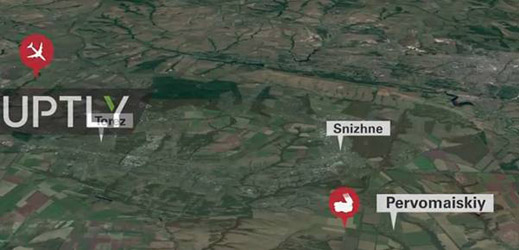
The conclusion reported by JIT is that a BUK missile caused the destruction of the aircraft; that it was brought into Ukraine from Russia and removed to Russia after launch; that it was fired from a patch of farmland near Snizhne, east of the approaching MH17; and that “one hundred persons can be linked” to the movement and operation of the BUK system.

The JIT also announced that no identifications of these people have been made, and that at present there are no “official suspects” .

“We need a clear impression of the chain of command”, declared Fred Westerbeke, the principal Dutch member of the investigation and JIT spokesman. “We appeal for cooperative witnesses”, he said, adding “I can’t tell you how long this investigation will take.” According to the JIT presentation from Westerbeke and a Dutch police officer, Wilbert Paulissen , further investigation is expected to last until at least January 2018.

Westerbeke claimed his group, currently numbering “nearly one hundred”, is continuing to prepare “legal and convincing evidence meeting a very high standard”.

Lawyers and analysts observing the presentation have expressed doubt that the secret Ukrainian and American government evidence can be admissible in court. On questioning by a sceptical Dutch journalist, Westerbeke acknowledged that all the telephone intercepts and wiretaps reported as evidence of Russian involvement in the reported missile operation originated from the Ukrainian secret service. Evidence of the missile movement, ground launch, and smoke trail from social media, photographs and videotapes, and purported witnesses presented at today’s JIT session have all appeared publicly before; much of it already discredited as fakes.

A text of the JIT presentation can be read here.

The live broadcast tape of the press conference is accessible here.


In an unusual disclosure, the JIT revealed it has confirmed only two pieces of warhead shrapnel from a BUK missile warhead in the MH17, one found in a body in the cockpit, and one in the cockpit frame. Until now, the Dutch Safety Board and the JIT have been claiming there were four pieces of shrapnel to substantiate the alleged BUK missile firing, three of them of a bow-tie or butterfly shape, and one of square shape. For more details, read this.
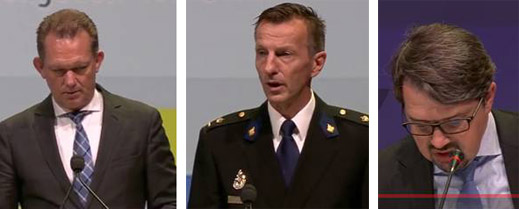

Left to right at today’s JIT briefing: Dutch prosecutor Fred Westerbeke; 
 Dutch police investigator, Wilbert Paulissen; unnamed Belgian state representative 
at JIT whose identity the JIT and Belgian authorities continue to keep secret.


The JIT acknowledged today that it was aware of additional Russian radar and missile detonation evidence, but that it had not yet had time to receive it or investigate it. According to Paulissen, “the absence of evidence [of the Buk missile system in the Russian material] does not prove it was not there.”

Westerbeke added: “The quantity of the other evidence we have doesn’t lead us to another conclusion.” Westerbeke also claimed that the unreceived and uninvestigated evidence from Moscow proves the JIT’s case that there was no aircraft attack on the MH17. “Even the Russian Federation has concluded,” Westerbeke said, “that no aircraft could have shot down [MH17]”.

He was referring to the public briefing by the Russian Defence Ministry on Monday. The presentation then of what was described as new radar evidence turns out, Russian military sources now say, to have been of a civil radar source, with insufficient technical capacity to match the Russian military radar evidence presented by the Ministry two years ago, at a press briefing on July 21, 2014. For the transcript and video of that presentation, click here. For a comparison of the Russian government briefing, and the US government briefing which followed a day later, read this.

The apparent contradictions between the two Russian radar sources has been marked as a propaganda victory by Russian critics at NATO. The presentation of the civil radar evidence “ was a rather bad variant,” a Russian military source says. “An example of inconsistency, even a mistake.”


Here is the full Russian briefing, with English voice-over translation.


The interpreter failed to identify Air Force General Andrei Koban’s name correctly
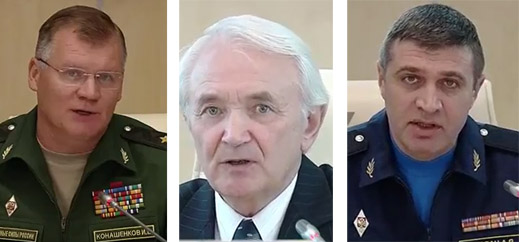

Left to right: Maj-Gen Igor Konashenkov, Defence Ministry spokesman; 
Viktor Meshcheryakov, deputy design chief, Lianozovsky Electromechanical Plant; 
Maj-Gen Andrei Koban, head of radio-technical forces of the Russian Air Force


Here is the Google map of the area covered by the radar images and interpretations, with the location of the Utyos-T station at Ust-Donetsk marked in red:
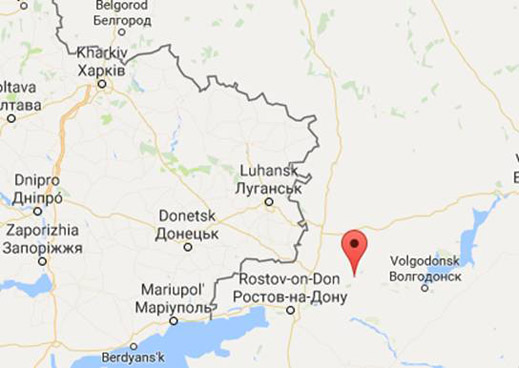


Scale:


 According to Meshcheryakov’s presentation, there are a series of radar images for about fifteen minutes before MH17 reached the point of attack and began to break up in the air. Taking into account the 10-second delays between successive radar images, this is the Utyos-T map of the last 60 seconds before MH17’s destruction, apparently showing civilian flight #4722, behind MH17 and 600 metres higher at 10,670m, flying at the slightly slower speed of 888 km/h:
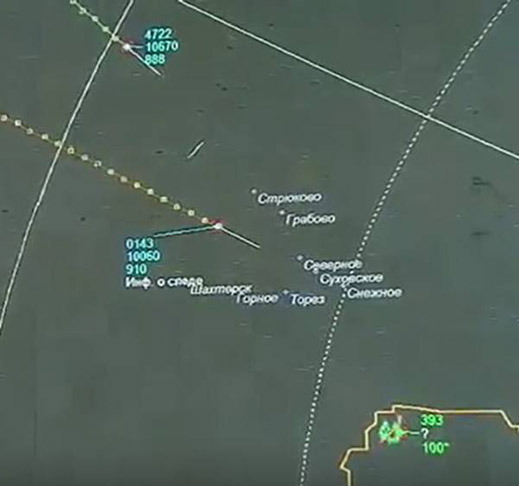

– minute 9:10


After the explosive detonation, this is the Utyos-T image of the cockpit and other parts of the MH17 separating from the main fuselage:
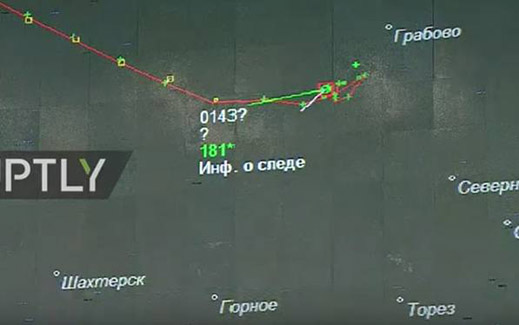

– minute 10:07

 
“These data tell us,” concluded Meshcheryakov, “that the Ust-Donetsk radar station did not see any objects near the Boeing Flight MH17 which could become the reason for its disintegration”. He said — but he didn’t illustrate with radar images — that the area of the MH17’s flight path was monitored for “several minutes” after the aircraft’s destruction.

General Koban repeated the conclusion with data for eight minutes after detonation: “No aerial objects approached the aircraft [MH17] from the east before its disintegration…We need to point out that the equipment of the Russian radar station does not allow us to see whether any aerial projectiles had been launched at Boeing from the south or from the west” (tape minute. 15:26).

The apparent contradiction between the Utyos-T radar evidence, as presented by Meshcheryakov and Koban, and the earlier, two-year old Defence Ministry presentation can be seen from this diagram of the radar images as presented, then interpreted by Colonel-General A.V.Kartapolov. At the time Kartapolov was Deputy Chief of the General Staff and one rank lower. For a US Army assessment that Kartapolov mimics American war-fighting concepts, read page 5 of this.
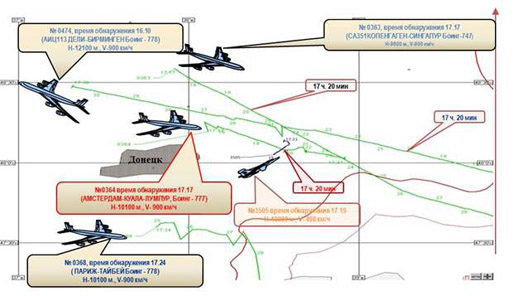


Kartapolov explained the meaning of this diagram: “At that time there were 3 civilian aircrafts:
Flight from Copenhagen to Singapore at 17.17; Flight from Paris to Taipei at 17.24; Flight from Amsterdam to Kuala Lumpur [MH17]. Besides it, Russian system of air control detected the Ukrainian Air Force aircraft, purposed [sic] Su-25, moving upwards toward to the Malaysian Boeing-777. The distance between aircrafts was 3-5 kilometers.”

He went on: “Su-25 can gain an altitude of 10000 meters for a short time. It is armed with air-to-air missile R-60 able to lock-on and destroy target at a distance of 12 kilometers, and destroy it definitely at a distance of 5 kilometers.” Kartapolov did not say the Russians had evidence that the Su-25 had fired either missiles or cannon at MH17. Instead, he asked the question: “What was the mission of the combat aircraft on the airway of civilian aircrafts almost at the same time and same altitude with the civilian craft? We want to have this question answered.”

He added:

“The video of the Rostov Aerial Center of the Joint Air Traffic Management System can corroborate the information. The Chief of Staff of the Air Force Lieutenant-General Igor Makushev will comment the video.”

Makushev did exactly that, again speaking on July 21, 2014. Note that Makushev explained why the military intruder had not been picked up by Russian radars until after it climbed above 5,000 metres. “All the three aircraft have been steadily monitored by the three radar stations of the air traffic control of the Ministry of Defense of the Russian Federation. Boeing-777 is moving towards the Russian Federation state boundary and is to cross it in the point of «TONAK». An air traffic control officer has been controlling the aircraft flight and keeps on enquiring its flight variables to compare them with the given ones. At 17.20 P.M. at the distance of 51 kilometers from the Russian Federation state boundary and the azimuth of 300 degrees the aircraft started to lose its speed obstructively which is quite distinctively to be seen on the table of the aircraft characteristics.”

“At 17.21 35 seconds P.M. with the aircraft speed of 200 km/h at the point of the Boeing crash there is a new mark of the aircraft to be seen. The aircraft was steadily monitored by radar stations of Ust-Donetsk and Butirinskoe during 4 minutes period. Air control officer having enquired the characteristics of newly appeared aircraft couldn’t possibly get them because it is in all likelihood that the aircraft had no secondary deduction system amounted on it, which is put typically for military aircraft. The early detection of this aircraft appeared to be quite impossible because the air situation control is usually performed by radars working in a standby mode which detection possibilities at the given distance are over 5000 m altitude.”

Let’s repeat: “The aircraft was steadily monitored by radar stations of Ust-Donetsk and Butirinskoe during 4 minutes period.” In retrospect, Makushev implied that the Ust-Donetsk station, where the Utyos-T radar was based, detected the Ukrainian military aircraft.

How was it possible to see on radar screen shots presented on July 21, 2014 when the radar screen shots presented this week were apparently empty of the smoking-gun evidence? Dutch, American and NATO critics of Russian veracity claim the first images were fabrications, and the most recent ones expose the Defence Ministry contradicting itself, and lying.

A Russian propagandist, Alexander Mercouris, claims: “During what was apparently a joint presentation by the Russian missile manufacturer Almaz Antey and the Russian military in Moscow, raw radar data was apparently released which allegedly disproves Ukrainian claims that MH17 was shot down by a BUK missile launched from militia controlled territory, and specifically from the town of Snizhnoe from where the Ukrainians claim the BUK missile was launched. The data thereby supposedly confirms that only the Ukrainians could have shot down MH-17… even if it is proved beyond reasonable doubt that the new data is genuine, I doubt that will be enough to convince some people.”

A Dutch propagandist, Robert van de Roer, quoted by an English one, claims:

“Creating contradictions/confusion is part of Russian propaganda, from #mh17 to Aleppo’s food convoy. The diplomatic West has no answer yet.” 

A Swedish propagandist, Carl Bildt, claims:

“Today Russia Defence Ministry acknowledge it lied before about MH17. But doesn’t mean they are coming clean now.”

The JIT briefing in The Netherlands today did not respond to the Utyos-T data. “They have not yet been handed over and not investigated yet”, said the Dutch police presenter Paulissen. He dismissed the Russian Defence Ministry claim that no missile firing had been detected from the Snizhne area. That, said Paulissen, “is incorrect.” According to Westerbeke, “we are not making any statements about Russia as a country or about Russians.”

Reconsidering this week’s Russian Defence Ministry presentation of the Utyos-T evidence, here is a sectioned image of the westward sector, with the radar station at the extreme lower right corner:
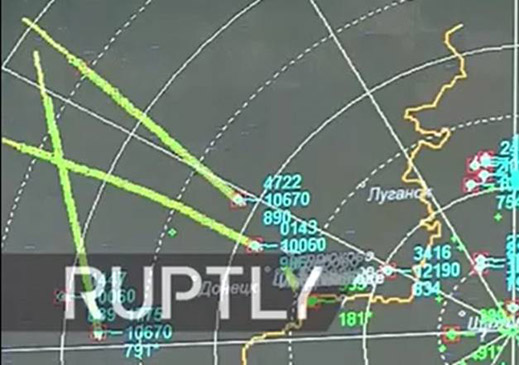


– minute 3:00


The three yellow lines from upper left to right are the trajectories of the three civilian aircraft frying west to east; they include MH17, which is marked as #0143.

According to the presentations by Meshcheryakov and Koban, the range of the Utyos-T radar system was between 360 and 400 kms for primary and secondary identification. That meant coverage of Ukraine Army-occupied areas up to 100 kms west of Donetsk city. When MH17 was first detected by the secondary radar locator, Meshcheryakov said it was at a range of 404 kms west of the station at 1304 local time. Then at 1307 it was picked up by the primary radar locator. It was measured as flying at 906km/h. The evidence shows that it continued on course, flying intact for another 15 minutes at that speed. That means it made about 227 kms from west to east. This also means that for that period of time, the Utyos-T data clearly show a range west of the destruction point of at least 227 kms up to 404 kms.

Also shown on the radar map screen are the trajectories of civilian flights #4722 flying north of MH17, and #1775 flying northwest-southeast, crossing the MH17’s flight path. The second is reported by Meshcheryakov to have been 30 kms from MH17 in the last minutes. How was it possible for Utyos-T to detect and map these trajectories west and south before and during the MH17 flight, if the generals now claim that the system lacked range or capability to detect objects west or south in the last minutes? How was it possible for the Utyos-T radar tracking to miss what Gen Kartapolov’s presentation revealed on July 21, 2014? Is it possible that the military intruder, identified as an Su-25, could remain under the Utyos-T radar, and then at detectable height and range be invisible? Even if the July 21, 2014, radar evidence purports to be for minutes after the aircraft detonation, what can explain invisibility for minutes beforehand?

Finally, if all one had for evidence from the Russian side was the Utyos-T radar data, what can have caused the aircraft’s destruction without being visible for 15 minutes before that happened?

Independent Dutch and German analysts who have been investigating the MH17 case since it began do not reply on the record. A German analyst, who does not wish to be identified, comments: “My point of view is: Russia doesn’t answer to Western propaganda. The Bellingcats of the world distorted the MoD press conference from July 21,2014 by saying Moscow suggested that an SU-25 shot down MH17. The official Moscow never claimed it… of course Ukraine military planes were in the air that day. Most probably some of them under 5 km, below the Russian radar (that’s why inhabitants could see them under the layer of clouds). With the exception of this one plane, which rose above 5 km 1.35 minutes after the shooting. At the press conference today [September 26, 2016] they said that they show ‘random’ primary radar reflections of the disintegration of MH17, but not the surveillance after this, which continued for at least 4 minutes. So they held back less valuable material. Less valuable in Moscow’s eyes.”

On July 21, 2014, following the Defence Ministry presentation in Moscow, the US State Department spokesman, Marie Harf (pictured below), refused to respond directly. “I haven’t seen any of that,” she said.


“Our assessment [is] that this was an SA-11 fired from Russian-backed, separatist-controlled territory; that we know – we saw in social media afterwards, we saw videos, we saw photos of the pro-Russian separatists bragging about shooting down an aircraft that then they then – they then – they then – excuse me – took down once it became clear that it may have been a passenger airline. There is a preponderance of evidence at this point both sort of out there in the public domain and also from our information that points to the fact that there was a SA-11 launched from separatist-controlled territory.”

This Monday, US reporters did not ask, and there was no response from the State Department to the new Defence Ministry presentation.

A credible Russian military source explains the discrepancy between the radar imagery and evidence two years apart.

“MinDef have their own radar systems which are more sensitive for spotting high-speed flying objects like missiles or aircraft. Utyos-T is a civil radar system which could have missed such flying objects.” 

Asked if presenting the Utyos-T data this week contradicted the earlier military radar presentation, the source replied:

“Yes, it was a rather bad variant, an example of inconsistency, even a mistake.”

How Trump Won

The Thrilla at Hofstra: How Trump Won the Debate

by Ted Rall - CounterPunch


September 28, 2016

He won the debate. I know it runs counter to conventional wisdom – that’s so rare for me! – but I award the first 2016 presidential debate to Donald Trump.

This isn’t to say that I disagree with what the mainstream men and women of the pundit class said they witnessed. Like them, I watched a well-prepared Clinton outmaneuver a political amateur who showed up to class after a night of partying following a year of refusing to crack open a book. Trump rambled, repeated himself, interrupted and bullied. He conflated NATO and the EU. He even unleashed a fat joke.

All things being equal, I would agree with the corporate media consensus that Hillary won. But that’s the thing – things are far from equal.

Hillary Clinton is a pro. She should have wiped the floor with Trump. Instead, she delivered a performance on the line between a B+ and an A-. Trump gets closer to a C-. That’s much closer than it ought to have been.

As they say in sports, Trump beat the spread.

It went down the same way during the Democratic primaries. Hillary Clinton had every advantage: domination of the Democratic National Committee, support of a sitting president, massive name recognition, experience and personnel from a previous run, a huge pool of wealthy institutional donors, a marriage to a popular ex-president fondly remembered for presiding over a great economic expansion. Despite all that, she nearly lost to Bernie Sanders – an aging self-identified socialist from a tiny, powerless state, with no name recognition. How, many people asked, could Hillary’s inevitable Goliath of a campaign have come so close to losing to such a David?

The answer was obvious. As we learned in 2008 when she lost to another obscure politician — Obama, with a weird name, who had little experience — Hillary Clinton underperforms. She has no charm. She doesn’t learn from her mistakes. She relies on outdated fundraising methods, like sucking up to big corporate donors. Not only does she lie, she insults our intelligence as when she emerged from her daughter’s Manhattan apartment days after being diagnosed with pneumonia. “I’m fine,” she said. What’s the matter with “pneumonia sucks”?

During the debate, I was struck by how many chances Trump had to nail Hillary. If he were a better debater, she’d be toast.

Hillary tacitly confirmed that the United States was behind the Stuxnet virus that attacked Iran’s nuclear centrifuges, implying that she deserves credit for forcing the Islamic Republic to the negotiating table. Because cyberwarfare is illegal, U.S. officials have always refused to comment on whether or not we helped create Stuxnet – so it remains classified. If Trump had been smarter, he would have said: “Jesus, Hillary! There you go again, revealing America’s secrets to our enemies.”

He also allowed her to weasel out of her on-again, off-again support for the Trans-Pacific Partnership “free trade” agreement. Why didn’t he reference the verbal diarrhea of close Clinton friend Terry McAuliffe, who let slip the all-too-credible assertion that President Hillary would sign TPP shortly after coming to office?

His response to Hillary’s demand that he release his taxes came close to disastrous. If ever there was a time to interrupt, there it was. Instead, he just stood there waiting for her to finish. Clearly Trump has a lot to hide. Then he made a lame gambit: “I will release my tax returns — against my lawyer’s wishes — when she releases her 33,000 e-mails that have been deleted. As soon as she releases them, I will release. I will release my tax returns. And that’s against — my lawyers, they say, ‘Don’t do it.’ I will tell you this. No — in fact, watching shows, they’re reading the papers. Almost every lawyer says, you don’t release your returns until the audit’s complete. When the audit’s complete, I’ll do it. But I would go against them if she releases her e-mails.”

It was incoherent and ridiculous. But once he decided to go that direction, why not mention her secret Goldman Sachs speech transcripts? At least that way, he would have conveyed that she has two types of things to hide (emails, speeches) as opposed to his one (taxes).

Rookie errors. But hey, Trump did great for a guy who has never run for political office before – and didn’t cram for the debate. Hillary has debated at the presidential level so many times she could probably do it half of it in her sleep. If I go into the ring with heavyweight boxing champion Tyson Fury and manage to survive a round with all but one of my teeth, it’s fair to say that I won.

What’s baffling to me is that she wasn’t able to deliver a knockout blow.

Some of it is her inability to just be real.

Part of coming off as an authentic human being is a self-deprecating sense of humor. We saw that when Trump asked Secretary Clinton how she wanted to be addressed: “Now, in all fairness to Secretary Clinton — yes, is that OK? Good. I want you to be very happy. It’s very important to me.” It was deferential. It almost seemed sweet. (Weirdly, she didn’t adjust to the honorific, failing to tack to “Mr. Trump.”)

Hillary seems allergic to humanism. Back to the TPP, for example, she could have countered Trump’s fictional assertion she “heard what I said about [TPP], and all of a sudden you were against it” with something along the lines of: “actually, that was Bernie Sanders.”

Another awkward moment was her apology for using a private email server. This should have been a win for her. It was the first time that she expressed regret in a straightforward manner. But she clearly wanted to keep talking, to make excuses, to mitigate. It was also a missed opportunity to make an email joke.

Maybe the herd is right. Maybe it’s a simple matter of she did better, he did worse. But I keep thinking, debates are graded on a curve. She was supposed to kick his ass. Yet there he is, dead even in the polls with her.
 
Ted Rall, syndicated writer and the cartoonist for ANewDomain.net, is the author of the book “Snowden,” the biography of the NSA whistleblower.
More articles by:Ted Rall

Tuesday, September 27, 2016

First Nations Join Forces to Stop Tar Sands Pipelines

First Nations and Tribes Sign New Treaty Joining Forces To Stop All Tar Sands Pipelines

by TreatyAlliance.org


Sept. 22, 2016

Signatories commit to also pushing for a sustainable economy based on renewable energy


MONTREAL and VANCOUVER/CNW Telbec - First Nation and Tribal Chiefs gathered today in Musqueam Territory (Vancouver) and Mohawk Territory (Montreal), to sign a new continent-wide Indigenous Treaty — the Treaty Alliance Against Tar Sands Expansion — that commits already some 50 First Nations and Tribes from all over Canada and the Northern US to working together to stop all proposed tar sands pipeline, tanker and rail projects in their respective territorial lands and waters.

The First Nations and Tribes are committed to stopping all five current tar sands pipeline and tanker project proposals (Kinder Morgan, Energy East, Line 3, Northern Gateway and Keystone XL) as well as tar sands rail projects such as the Chaleur Terminals Inc. export project at the Port of Belledune in New Brunswick.

"What this Treaty means is that from Quebec, we will work with our First Nation allies in BC to make sure that the Kinder Morgan pipeline does not pass and we will also work with our Tribal allies in Minnesota as they take on Enbridge's Line 3 expansion, and we know they'll help us do the same against Energy East." said Kanesatake Grand Chief Serge Simon.

The Treaty states:

"Our Nations hereby join together under the present treaty to officially prohibit and to agree to collectively challenge and resist the use of our respective territories and coasts in connection with the expansion of the production of the Alberta Tar Sands, including for the transport of such expanded production, whether by pipeline, rail or tanker."

"We are in a time of unprecedented unity amongst Indigenous people working together for a better future for everyone," said Rueben George of the Tsleil-Waututh Sacred Trust Initiative.

"The Kinder Morgan pipeline proposal in our territory represents an unacceptable risk to the water, land and people: we are proud to stand together with all of our relatives calling for sensible alternatives to these dangerous projects."


"The Yinka Dene have already shown in the case of Enbridge's Northern Gateway that a pipeline cannot hope to pass through a unified wall of Indigenous opposition," said Carrier Sekani Tribal Chief Terry Teegee.

"You will now see the same thing play out with all other tar sands pipelines, including another failed BC pipeline – Kinder Morgan."

Tar sands development has already poisoned the water of First Nations in Alberta and beyond and these new tar sands pipelines, trains and tankers would threaten the water of many more Nations. Indigenous Peoples are also suffering intense impacts from climate change in the form wildfires and floods and the ongoing climate emergency is now threatening many of the plants and animals that lie at the heart of Indigenous cultures.

"Indigenous people have been standing up together everywhere in the face of new destructive fossil fuel projects, with no better example than at Standing Rock in North Dakota," said Grand Chief Phillip, President of the Union of BC Indian Chiefs.

"We know that infrastructure that expands the tar sands is both incompatible with reducing Canada's emissions and completely irresponsible."

The Treaty provides that Indigenous Nation signatories also want to be partners in moving society onto a more sustainable path. Already, many Indigenous Nations are leading the way in developing renewable energy projects on their territories.

"We want to work with the Prime Minister and the government to develop a sustainable economy that does not marginalize our people," said Grand Chief Derek Nepinak of the Assembly of Manitoba Chiefs.

 "This is a time of great spiritual awakening for our peoples as we reinvigorate our Nations and ensure a better tomorrow for all."

Please go to treatyalliance.org for more information, including for an always updated list of signatory Nations

SOURCE Assembly of First Nations of Quebec and Labrador


For further information: Rueben George, Tsleil-Waututh Sacred Trust Initiative, Cell: 604-720-4630; Grand Chief Stewart Phillip, Union of BC Indian Chiefs, Cell: 250-490-5314; Geraldine Thomas-Flurer, Yinka Dene Alliance Coordinator, Cell: 250-570-1482; Grand Chief Derek Nepinak, Assembly of Manitoba Chiefs, Cell: 204-795-2733; Melanie Vincent, Assembly of First Nations Quebec-Labrador, Cell: 418-580-4442; Grand Chief Serge 'Otsi' Simon, Mohawk Council of Kanesatake, Cell: 514-269-9152 

RELATED LINKS

www.apnql-afnql.com

Gorilla Radio with Chris Cook, Ben Isitt, Rick, Sterling, Janine Bandcroft September 28, 2016

This Week on GR

by C. L. Cook - Gorilla-Radio.com


September 28, 2016

While the election spectacle south sucks most of the political air from the media universe, British Columbia too is poised to begin its own democracy circus, and it's with an eye to the Spring vote here issues from across the province are being aired at the Union of BC Municipalities meetings currently going on at the Victoria Conference Centre.

Yesterday, Victoria Councillor, Ben Isitt joined Metchosin Councillor Andy MacKinnon, Cowichan Valley Regional District Director, Sonia Furstenau, and Torrance Coste of the Wilderness Committee on the steps of the VCC demonstrating to have MacKinnon's Vancouver Island old-growth logging moratorium proposal included on the UBCM’s resolutions committee agenda.

Listen. Hear.

It's a busy time for Isitt, who presented Monday night with Andy MacKinnon 'The Future of Forests and Communities on Vancouver Island' a draft policy statement at the Public Presentation and Discussion on the Future of Forests and Communities on Vancouver Island at the Victoria Event Centre, presenting the findings of the group he's been working with, Island Forest Futures.

Ben Isitt in the first half.

And; hopes for the tremulous peace agreement in Syria were blown to smithereens last week by a sustained American air attack against Syrian army units protecting the town of Deir ez-Zor from ISIS/Daech. The blitz, which US officials later said was all a case of mistaken identity, killed more than sixty soldiers outright, and was followed by what seemed a coordinated ISIS incursion. The result is an end to the peace deal and ratcheting up of the propaganda battle for the hearts and minds on the home front. To that end, prepare to hear lots more about Syria's famed 'White Helmets' organization. Already recipients of a prestigious Right Livelihood Award, the shadowy group are also being promoted for a Nobel Peace prize.

Rick Sterling is an independent researcher, writer, and member of Syria Solidarity Movement, an organization who has mounted an online campaign to pressure the Right Livelihood Foundation to reverse its award decision. Sterling's articles can be found online at CounterPunch, ConsortiumNews, Dissident Voice, and at Pacific Free Press. Rick's also an active member of the Task Force on the Americas at the Mount Diablo Peace and Justice Center.

Rick Sterling and helmets of another colour in the second half.


And, Victoria Street Newz publiser emeritus and CFUV Radio broadcaster, Janine Bandcroft will be here at the bottom of the hour to bring us news of good goings on planned for our streets and beyond in the coming week. But first, Ben Isitt and what future the forests of Vancouver Island?

Chris Cook hosts Gorilla Radio, airing live every Wednesday, 1-2pm Pacific Time. In Victoria at 101.9FM, and on the internet at: http://cfuv.uvic.ca.  He also serves as a contributing editor to the web news site, http://www.pacificfreepress.com. Check out the GR blog at: http://gorillaradioblog.blogspot.ca/

G-Radio is dedicated to social justice, the environment, community, and providing a forum for people and issues not covered in the corporate media.

Monday, September 26, 2016

Propagating Syria War in Western Media

How US Propaganda Plays in Syrian War

by Rick Sterling  - Consortium News


September 23, 2016

Manipulation of public perception has risen to a new level with the emergence of powerful social media. Multibillion-dollar corporate giants, such as Facebook, Twitter and Google, influence public perceptions, often via payments for “boosting” Facebook posts, paid promotion of Tweets, and biased results from search engines.

Marketing and advertising companies use social media to promote their clients, but so do U.S. foreign policy managers who hire or enlist these companies to influence public perceptions to support U.S. foreign policy goals.


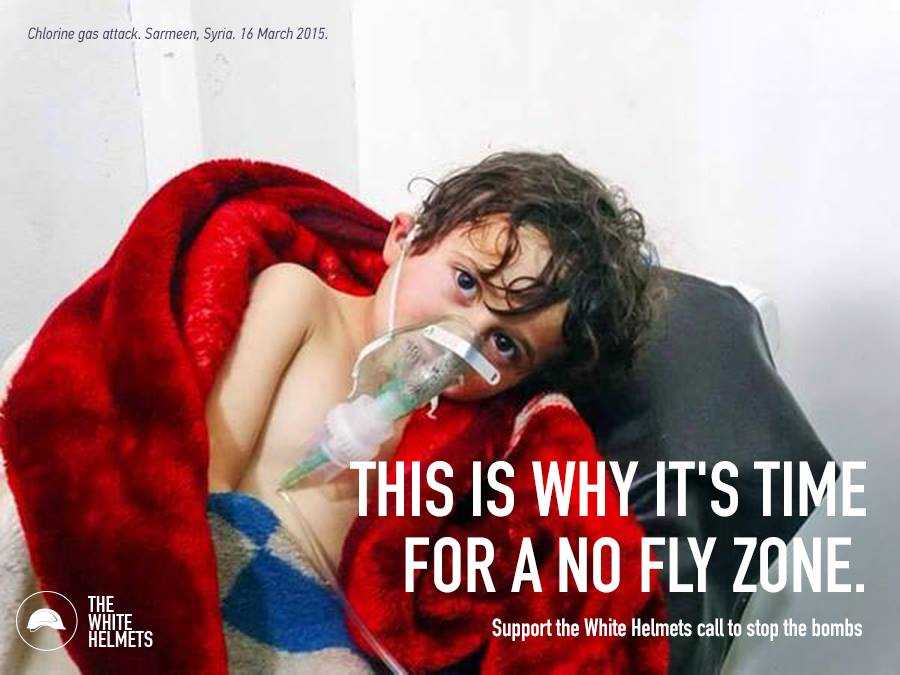
A heart-rending propaganda image designed to justify a  “no-fly zone,” 
a major U.S. military operation inside Syria against the Syrian military.


For example, Secretary of State Hillary Clinton described making sure that Twitter was primed for street protests in Iran following the 2009 election, ready to spread and manage news of protests following the election and the killing of a young woman, which was blamed on the Iranian government although the circumstances of her death were murky. [Hard Choices hardback, p 423]

The results of similar media manipulation can be seen in the widespread misunderstanding of the conflict in Syria, amid the demonization of the Syrian government and leadership and the skillful use of social media by anti-government activists. Influenced by both mainstream and this alternative media, most people in the West do not know that Bashar al-Assad remains popular with many Syrians. Nor do they realize that Assad won an election two years ago.

There were three contestants in the Syrian presidential election of June 2014. Turnout was 73 percent of the registered voters, with 88 percent voting for Assad. In Beirut, the streets were clogged with tens of thousands of Syrian refugees marching through the city to vote at the Syrian Embassy. Hundreds of Syrian citizens living in the U.S. and other Western countries flew to Syria to vote because Syrian Embassies in Washington and other Western capitals were shut down.

While Secretary of State John Kerry was condemning the Syrian election as a “farce” before it had even happened, a marketing company known as The Syria Campaign waged a campaign to block knowledge of the Syrian election. Along with demonizing President Assad, the company launched a campaign which led to Facebook censoring information about the Syrian election.

Incubating Propaganda


The Syria Campaign was created by a larger company named “Purpose,” which – according to its website – “incubated” The Syria Campaign. The company’s website says, “Purpose creates new movements, brands and organizations from the ground up to address complex global challenges. We apply this experience as movement creators to our work with progressive companies, nonprofits and philanthropies, helping them to put purpose and participation at the heart of what they do.”


Smoke billows skyward as homes and buildings are shelled in the
city of Homs, Syria. June 9, 2012. (Photo from the United Nations)


The major achievement of The Syria Campaign has been the branding and promotion of the “White Helmets,” also known as “Syria Civil Defense,” which began with a British military contractor, James LeMesurier, giving some rescue training to Syrians in Turkey with funding provided by the U.S. and U.K. The group stole this name from the REAL Syria Civil Defense as documented in this recent report from Aleppo.

The “White Helmets” are marketed in the West as civilian volunteers doing rescue work. On Sept. 22, it was announced that the Right Livelihood Award , the so-called “Alternative Nobel Prize,” is being given to the U.S./U.K.-created White Helmets “for their outstanding bravery, compassion and humanitarian engagement in rescuing civilians from the destruction of the Syrian civil war.”

But the White Helmets are largely a propaganda tool promoting Western intervention against Syria. Unlike a legitimate rescue organization such as the Red Cross or Red Crescent, the “White Helmets” only work in areas controlled by the armed opposition. As shown in this video, the White Helmets pick up the bodies of individuals executed by the terrorists; they claim to be unarmed but are not; and they falsely claim to be neutral.

Many of the videos from Al Qaeda/terrorist-dominated areas of Syria have the “White Helmets” logo because the White Helmets work in alliance with these extremist groups as primarily a media marketing tool to raise public support for continuing the support to the armed opposition as well as the demonization of the Syrian government.

The Rights Livelihood press release said the White Helmets “remain outspoken in calling for an end to hostilities in the country.” But that is false, too. The White Helmets actively call for U.S./NATO military intervention through a “No Fly Zone,” which would begin with attacks upon and destruction of government anti-aircraft positions and aircraft.

A Major Act of War


Taking over the skies above another country is an act of war that would require a major U.S. military operation, according to senior American generals.
 

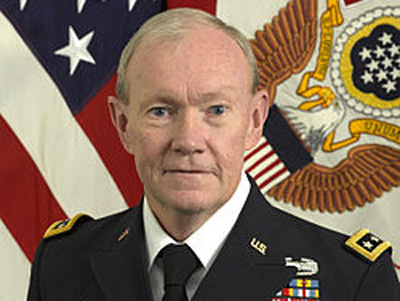
Army Gen. Martin Dempsey, former Chairman of the Joint Chiefs of Staff.


The New York Times reported that in 2012 General Martin E. Dempsey, chairman of the Joint Chiefs of Staff, told the White House that imposing a no-fly zone in Syria would require up to 70,000 American servicemen to destroy Syria’s antiaircraft system and then impose round-the-clock control over Syrian airspace.

General Carter Ham, former commander of the U.S. Africa Command who oversaw the aerial attacks on Libya in 2011, said on CBS News,

“I worry sometimes that, when people say ‘impose a no-fly zone,’ there is this almost antiseptic view that this is an easily accomplished military task. It’s extraordinarily difficult. …

“It first entails — we should make no bones about it. It first entails killing a lot of people and destroying the Syrian air defenses and those people who are manning those systems. And then it entails destroying the Syrian air force, preferably on the ground, in the air if necessary. This is a violent combat action that results in lots of casualties and increased risk to our own personnel.”

In other words, an appeal for a “no-fly zone” is not a call for a non-violent solution. It is seeking a bloody act of war by the United States against Syria, a nation that poses no threat to America. It also would almost surely be carried out in violation of international law since a United Nations Security Council resolution would face vetoes from Russia and probably China.

Also, the White Helmets have never criticized or called for the end of funding to extremist organizations including Nusra Front, Al Qaeda’s Syrian affiliate. On the contrary, White Helmets are generally embedded with this organization which is defined as “terrorist” by even the U.S., which is likely why the head of the White Helmets, Raed Saleh, was denied entry to the U.S.

The foreign and marketing company origins of the White Helmets were exposed over 1½ years ago – and since then, writer Vanessa Beeley has revealed the organization in more depth in articles such as “Who Are the White Helmets?” and “War by Way of Deception.”

Despite these exposés, understanding of the White Helmets is limited, with many liberal and progressive people uncritically accepting the propaganda and misinformation about Syria. Much of the progressive media has effectively blocked or censored critical examinations amid a flood of propaganda about “barrel bombs” dropped by the “brutal dictator” and his “regime.”

In the last week, Netflix started showing a 40-minute documentary movie about the “White Helmets” that amounts to a promotional video. A substantial portion of it takes place in Turkey where we see trainees in hotel rooms making impassioned phone calls to inquire about their families in Syria.

The “family values” theme is evident throughout, a good marketing angle. The political message of the video is also clear: after a bombing attack, “It’s the Russians …. they say they are fighting ISIS but they are targeting civilians.”

The movie includes video previously promoted by the White Helmets such as the “Miracle Baby” rescue, an incident that may or may not have been staged. The video includes self-promoting proclamations such as “You are real heroes.” While no doubt there are some real rescues in the midst of war, many of the videos purporting to show the heroes at work have an unrealistic and contrived look to them as revealed here.

Tricking Progressives


“Alternative media” in the West has echoed mainstream media regarding the Syria conflict. The result is that many progressive individuals and groups are confused or worse. For example, the activist group CodePink recently issued a media release promoting the Netflix White Helmets propaganda video.


U.S.-backed Syrian “moderate” rebels smile as they prepare to behead a 12-year-old boy (left), whose severed head is held aloft triumphantly in a later part of the video. [Screenshot from the YouTube video]The White Helmets video is produced by Grain Media and Violet Films/Ultra-Violet Consulting, which advertises itself as a marketing corporation specializing in social media management, grant writing, crowd building and campaign implementation. The only question is who paid them to produce this video.

There is growing resistance to this manipulation and deception. In response to a petition to give the Nobel Peace Prize to the White Helmets, there is a counter petition at Change.org. Following the Right Livelihood Awards’ announcement, there will soon be a petition demanding retraction of the award to the White Helmets.

The story of the White Helmets is principally a “feel good” hoax to manipulate public perception about the conflict in Syria and continue the drive for “regime change.” That’s why big money was paid to “Purpose” to “incubate” The Syria Campaign to brand and promote the White Helmets using Facebook, Twitter, etc. That’s why more big money was paid to create a self-promotional documentary.

The judges at Rights Livelihood were probably influenced by the documentary since critical examination of facts around Syria is so rare. It’s a sad commentary on the media. As veteran war correspondent Stephen Kinzer recently wrote,

“Coverage of the Syrian war will be remembered as one of the most shameful episodes in the history of the American press.”

Rick Sterling is an investigative journalist and member of Syria Solidarity Movement.

Setting Hillary's Table: Killing Syria Peace Hopes

The Hillary Clinton Presidency has Already Begun as Lame Ducks Promote Her War

by Diana Johnstone - CounterPunch


September 26, 2016

If the British Empire was built on the playing fields of Eton, United States world hegemony gets its training in Hollywood studios and advertising agencies. Selling your product, or yourself, by looking sincere is a cultivated American art.

Current top U.S. leaders are expert practitioners.

In the space of a few days, Samantha Power, John Kerry, and Barack Obama all turned in war-winning performances.

Three Deadly U.S. Blows to Hopes of Peace In Syria


Last August 8, on that serious think tank the Charlie Rose show, former acting CIA director Michael Morell said that U.S. policy in Syria should be to make Iran and Russia “pay a price”. Russians and Iranians should be killed “covertly, so you don’t tell the world about it”, he said. Morell proposed that U.S. forces begin bombing Syrian government installations, in order to “scare Assad”. Probably angling for a good job next year, he is on record supporting Hillary Clinton as a “highly qualified commander in chief” and a “strong proponent of a more aggressive approach” in Syria.

Act I – An Act of War


Then, on Saturday, September 17, the U.S. Air Force did exactly what that CIA insider had called for. In sustained air strikes, four U.S. jets bombed a key Syrian Army position that had been defending the town of Deir ez-Zor from ISIS/Daech fighters. More than sixty Syrian soldiers were killed and over a hundred wounded. Daech forces immediately took advantage of the strikes to overrun the government position. In effect, the U.S. Air Force acted as air cover for the Islamic fanatics U.S. to advance against the legitimate army of Syria.

This was not only a violation of the cease-fire painstakingly worked out by Russian foreign minister Sergei Lavrov and U.S. Secretary of State John Kerry. It was an open military aggression by the United States on the territory of a sovereign state.

The Russians immediately called an emergency session of the United Nations Security Council to respond to this deadly violation of the truce supposedly intended to facilitate peace negotiations and humanitarian aid. When Russian ambassador Vitaly Churkin took the floor to speak, his American counterpart, Samantha Power, draped in her long red mane, walked out to give a press conference that clearly illustrated the difference between Russian and U.S. diplomacy.

Churkin, like Lavrov a few days later, cited facts and analysed the situation rationally. Samantha Power put on a show of evasion and insults.

Why all the fuss? was her opening theme. After all, we halted the attack when we were informed that “it was possible we might be hitting Syrian regime personnel and vehicles”, she stated, adding that “if” we did so, “that was not our intention”. That should settle the question; who could believe that the United States might deliberately attack the regime their politicians have been saying “must go”?

The best defense is offensive, and Power can be most offensive:

“Even by Russia’s standards, tonight’s stunt – replete with moralism and grandstanding is uniquely cynical and hypocritical”, she declared.

Samantha Power, that conniving arriviste whose carefully constructed career has been built on moralism, grandstanding, cynicism and hypocrisy, had all the nerve in the world to turn these epithets against the prime target of her own habitual moralism, grandstanding, cynicism and hypocrisy.

If the air strikes hadn’t been enough to destroy Russian confidence in dealing with the United States, Samantha Power’s contemptuous reaction was sure to do the trick.

Act II – Change the Subject


Next ploy: change the subject. Our little accidental bombing is nothing, Power implied, compared to the alleged fact that “since 2011 the Assad regime has intentionally been striking civilian targets with horrifying, predictable regularity”. Here is the core of the Samantha Power fraud, containing two elements:

1/ While good-hearted bumbling America occasionally kills a few people by accident, the others do it all the time and above all intentionally.

2/ Killing civilians is what war is all about. War is not about battles between armed forces for control of territory. It is not about geopolitical power struggles. It is about “civilian victims”.

At the close of her stunt, grandstanding and scoring cheap points, Samantha Power exhorted Russia “to stop the cheap point scoring and the grandstanding and the stunts and focus on what matters, which is implementation of something we negotiated in good faith with them.” Good faith? They are supposed to believe we negotiated “in good faith” an agreement which we just flagrantly destroyed?

Lo and behold, only two days after the U.S. bombing of Deie ez-Zor, the subject was definitively changed when an international humanitarian aid convoy was attacked on its way to Aleppo. Twenty aid workers were killed and the aid mission was halted. Without waiting for any evidence, the unanimous cry went up from Washington that “the Russians did it!”

In the U.N. Security Council this time, John Kerry took the stage. Again, the critical point was the contrast between what we certainly did and what they allegedly did. Yes, we committed “a terrible accident”. But what they (allegedly) did was worse.

“I got to tell you, people running around with guns on the ground, from the air, is a very different thing from trucks in a convoy with big UN markings all over them,” Kerry declared. He was implying that the difference was between an understandable accident, whose victims were “running around with guns”, and an attack on civilians.

Yes, but in war, attacking soldiers is the whole point. It can make a difference in the outcome. Hitting an aid convoy is “collateral damage”, as the U.S. calls it when the bombs are American. By bombing Deir ez-Zor, the United States was taking part in a war in which Syria is fighting for its life.

It cannot be ruled out that Syrian forces attacked the aid convoy because the truce was already broken at Deir ez-Zor and they believed it concealed weapons being transported to Daech. Such things happen. Or the attack could have been carried out by rebels as an act of propaganda, a “false flag”, designed precisely to be used to accuse the adversary. Such things also happen.

It has already been established by careful research that the notorious Al Ghouta chemical weapons attack, attributed to Assad, was almost certainly carried out by rebels precisely in order to incite the United States to cross the “red line” set by President Obama and bomb Damascus. The War Party which by now controls the Pentagon, much of the State Department, most of Congress, as well as leading media and think tanks, has been castigating Obama ever since for not having seized that opportunity to wage a full-scale “regime change” war against Syria. The critics have never forgiven Obama for accepting the Russian proposal to use the occasion to rid Syria of its chemical arsenal, instead of overthrowing the Syrian government.

But in recent weeks, as the Hillary Clinton campaign grows more frantic, Obama himself has joined the War Party.

Act III – Wallow in Sentimentality


On September 20, President Obama used a Leaders Summit on Refugees to portray the Syrian episode in what increasing appears to be World War III as a sentimental children’s story. Obama read the letter from 6-year-old Alex, who lives in Scarsdale, New York, expressing his wish to adopt Omran Daqneesh, the bewildered 5-year-old boy with a mop of dusty hair whose photo sitting in an orange ambulance seat was iconized across the world. The letter, provided to mass media by the White House, with its childish writing but nearly perfect spelling, was full of touching details about butterfly collections and shared toys. Obama read the letter, as people reached for Kleenexes all over the country, and then commented:

“Those are the words of a six-year-old boy – a young child you has not learned to be cynical, or suspicious, or fearful of other people because of where they come from, how they look, or how they pray. We should all be more like Alex. Imagine what the world would look like if we were.”

The little boys are very cute, very sweet. Fortunately, Omran Daneesh’s parents are alive, so there is no need to adopt him. Many other children are dead, notably in Yemen, killed by Washington’s ally Saudi Arabia with arms provided by the United States. Too late to adopt them.

“We should all be more like Alex”, Obama tells his good people. Imagine indeed, if all Americans were as innocent and naïve as six-year-old children. And indeed, that seems to be the goal of government propaganda.

This propagandistic heartstring tugging is aimed at distracting from U.S. involvement in a long-term joint criminal enterprise to overthrow a government that indeed did not discriminate against people because of “how they pray”, and replace it by fanatics who are ready to behead people because of “how they pray”.

An infantilized public will believe that “geopolitics” and “national sovereignty” are just big words that don’t mean anything. An infantilized public will believe that when the United States goes to war, it is all about protecting little children from their bad, mean dictators, whose only aspiration is to “bomb their own people”. They will believe that the world out there is Little Red Riding Hood, threatened by the Big Bad Wolf, and that there really is a Santa Claus.

It will never occur to an infantilized public that the war to destroy Syria has been planned for years – even though someone like General Wesley Clark revealed this years ago. Or that it is carried out to eliminate Israel’s enemies, keep Arabs busy killing each other, and incidentally help Saudi Arabia spread its Wahhabite fanaticism. No, that will never occur to them.

They won’t even notice that the Obama administration has now effectively given up any effort to justify the Nobel Peace Prize so foolishly bestowed on the apprentice president, and is now engaged in a scenario designed to prepare for Hillary’s next successful regime change war in Syria.

And it won’t occur to them that the photo of the little boy in the orange seat was quite deliberately iconized by Western media as part of the campaign promoting the Islamic rebel-connected “White Helmets” for the future Nobel Peace Prize.

Another subtle step in demonizing the “Assad regime” before Hillary takes over to administer the planned coup de grace. The future chuckler-in-chief is looking forward to seeing another head fall. This is called “smart power”.
 
Diana Johnstone is the author of Fools’ Crusade: Yugoslavia, NATO, and Western Delusions. Her new book is Queen of Chaos: the Misadventures of Hillary Clinton. She can be reached at diana.johnstone@wanadoo.fr
More articles by:Diana Johnstone

Police Killings: When Lethal Force Is a First Resort

Police too often shoot to kill as a first resort: The Key Thing about the Latest Police Killing in Charlotte, NC is that It Was Totally Gratuitous

by Dave Lindorff  - This Can't Be Happening


September 25, 2016

Now that the Charlotte, NC Police Department has reluctantly released the body cam and squad-car videos in its possession of the police killing of Keith Lamont Scott, which make it clear that nobody knew whether or not Scott even had a gun in his SUV with him, and that he apparently didn't have one in hand when he exited his vehicle, and did not appear to be threatening anyone, one thing is abundantly clear: Whether he had a gun or not, there was absolutely no reason for police to kill him.

Scott's only "crime" -- a common one for frightened or confused people when suddenly confronted, initially in this case by armed plainclothes officers who may not even have identified themselves as policeman, and later by a bunch of shouting, angry armed cops with weapons aimed at him -- was to stay put in his seat with the doors locked when ordered to exit the vehicle.


Sequence of still images from video taken on a cellphone by Keith Scott' wife show his killer, officer Brentley Vinson, tossing (perhaps a gun?) onto the pavement near his dying victim (MSNBC video)

Sequence of still images from video taken on a cellphone by Keith Scott's wife show his killer, officer Brentley Vinson, tossing (perhaps a gun?) onto the pavement near his dying victim (MSNBC video)


The cops drove off and left Scott, reportedly because they didn't consider that he posed an urgent threat!and then donned bullet-proof vests and called for backup before returning to the scene. According to Scott's family, far from posing a threat to police and the community, Scott was at the time doing what he did every school day: waiting peacefully in his car for a young son to return from school on the bus. According to his family, Scott owned no gun and was reading a book, as was his habit.

But let's assume the worst. Let's assume for the sake of argument that for one reason or other, Scott actually was sitting in his SUV fondling a joint and a pistol, as police claim. First of all, in North Carolina, courtesy of that state's right-wing legislature which has made open carrying of sidearms legal, that gun would be perfectly okay. Except that Scott is black, and as far as police are concerned, the state's law about its being legal to carry a weapon in public on one's person doesn't apply to black people. (For blacks in North Carolina, as in other states, open carry law or not, having a gun on you, even licensed and holstered, is a capital offense justifying whatever actions police might take, including summarily executing you.)

Okay, so let's go a step further. Say one of the cops who arrived on the scene actually saw Scott sitting in the truck with a gun in his hand. Nobody has made that claim, but there is the claim that when they came back armed and ready to go after him, he was ordered to step out of the vehicle and to show his hands. When he didn't do that, an officer, according to the police department's official account of what transpired, is said to have came up to he car with a baton and reportedly tried to break the truck's window in order to get the door open.

Now ask yourself, if Charlotte cops honestly thought Scott had a gun in his hand in the car with him, would one of them have walked up to that car door armed with only a baton and tried to break the window? I think we all know the answer to that is a resounding no. One thing we've learned about cops in today's America: They don't take any risks with their own lives. Like the black officer Brentley Vinson who killed Scott, they shoot first and look later to see if the dead perp actually had a gun.

There are a lot of cars with their windows full of bullet holes and blood on their seats to prove that point.

In any event, the police video shows that Scott then exited the vehicle. Police continued to shout at him to "drop the gun" as he walked slowly away from them, facing backwards with hands at his sides, though even Charlotte Police Chief Kerr Putney concedes that it is unclear from the video that the slain man was even holding a gun. At that point he is shot four times, fatally.

In the videos belatedly and grudgingly released yesterday by police there is no evidence of a gun on the ground around the dying Scott lying on the pavement, but MSNBC has shown a slow-motion version of a video taken by Scott's wife of her husband's shooting which appears to show the black officer who shot him tossing something on the pavement [1] nearby that looks like it might be a black pistol like the one later claimed by police to be Scott's.

This fatal cop shooting, it seems increasingly clear, was all unnecessary. Sitting in the car as he was, and surrounded by a dozen armed policemen wearing bullet-proof vests, Scott posed no immediate threat to anyone. And get this: His wife was on the scene shouting at police that her husband had a "traumatic brain injury" (from a year earlier motorcycle accident) which should have right away made them more cautious about jumping to conclusions and about terrifying him needlessly, and she was also, through the shouting, offering to try and convince her husband to get out of the vehicle as suggested, first to get him to prevent the cop from breaking the car's window, and then to keep them from murdering him.

Did the police pull back from their assault mode and try to let Scott's desperate wife talk with him? No, instead they threatened her and made her stay away. Why?

Would they have done that to a wife if she and the person in the vehicle were white? Again we have to ask this, and my guess would be no. They would have more likely pulled back a bit and given her a chance to talk her husband out of a tough spot.

Again I want to stress that there was no urgency here. Scott wasn't going anywhere. His vehicle was hemmed in by cop cars, he was locked in it and surrounded by armed police, and if he had tried anything aggressive he would have been shot instantly. So what was the urgency of getting him out of the vehicle? Especially when there was a relative there offering to help?

Unless Charleston's police department is concerned about paying for unnecessary overtime, there was absolutely no urgency about this situation. It was a in fact an incident that should have been dramatically amped down. There should have been no yelling. Perhaps a trained psychiatrist or negotiation expert should have been called in. The wife of the victim should have been interviewed at length and offered a chance to talk to her husband. If there were fears for her safety, she could have been given a vest herself, or at least a bullhorn so she could talk to her husband from a safe distance. There are, in short, lots of things that could have been done that would have left Scott alive.

Scott wasn't holding a hostage, and he wasn't at any point in this whole event pointing a gun at anybody. He was just sitting in his SUV.

Now he's dead, and Charleston's Police Department is trying to make that killing look "justified," by claiming that the mere fact that Scott was holding a joint and a gun -- the former a minor infraction, not a crime, and the latter completely legal in North Carolina -- together made him a potential threat to police life and limb.

They cannot justify the killing of Keith Scott because it was simply gratuitous. There was no need for him to die.

Let's think about this scene for a moment. Police supposedly got involved in this tragic situation in the first place because Scott pulled up next to a car containing two plainclothes police officers allegedly about to serve a warrant on another man, and proceeded to roll what they thought was a marijuana "joint." Those officers reportedly claimed that they also saw him holding a gun. (How do you roll a joint while holding a gun? A skilled toker may be able to to a one-handed roll, but you still have to us the other hand to put the weed on the paper. For that matter how did they know it was weed and not tobacco?).

So now we have a new capital crime: Parking while Black.


Links:
[1] http://dailycaller.com/2016/09/23/msnbc-pushes-narrative-that-police-may-have-planted-gun-on-keith-lamont-scott-video/

Sunday, September 25, 2016

Prison As the American Way

There Oughta Be a Law... Should Prison Really Be the American Way?

by Rebecca Gordon - TomDispatch


September 25, 2016

You’ve heard of distracted driving? It causes quite a few auto accidents and it’s illegal in a majority of states.

Well, this year, a brave New Jersey state senator, a Democrat, took on the pernicious problem of distracted walking. Faced with the fact that some people can’t tear themselves away from their smartphones long enough to get across a street in safety, Pamela Lampitt of Camden, New Jersey, proposed a law making it a crime to cross a street while texting. Violators would face a fine, and repeat violators up to 15 days in jail. Similar measures, says the Washington Post, have been proposed (though not passed) in Arkansas, Nevada, and New York. This May, a bill on the subject made it out of committee in Hawaii.

That’s right. In several states around the country, one response to people being struck by cars in intersections is to consider preemptively sending some of those prospective accident victims to jail. This would be funny, if it weren’t emblematic of something larger. We are living in a country where the solution to just about any social problem is to create a law against it, and then punish those who break it. 
Tomgram: Rebecca Gordon, Arresting Our Way to "Justice"
The figures boggle the mind. Approximately 11 million Americans cycle through our jails and prisons each year (including a vast “pre-trial population” of those arrested and not convicted and those who simply can’t make bail). At any moment, according to the Prison Policy Initiative, there are more than 2.3 million people in our “1,719 state prisons, 102 federal prisons, 942 juvenile correctional facilities, 3,283 local jails, and 79 Indian Country jails as well as in military prisons, immigration detention facilities, civil commitment centers, and prisons in the U.S. territories.” In some parts of the country, there are more people in jail than at college.

If you want a partial explanation for this, keep in mind that there are cities in this country that register more arrests for minor infractions each year than inhabitants. Take Ferguson, Missouri, now mainly known as the home of Michael Brown, the unarmed black teenager shot and killed in 2014 by a town policeman. The Harvard Law Review reported that, in 2013, Ferguson had a population of 22,000. That same year “its municipal court issued 32,975 arrest warrants for nonviolent offenses,” or almost one-and-a-half arrests per inhabitant.

And then there are the conditions in which all those record-breaking numbers of people live in our jails and prisons. At any given time, 80,000 to 100,000 inmates in state and federal prisons are held in “restrictive housing” (aka solitary confinement). And those numbers don’t even include county jails, deportation centers, and juvenile justice institutions. Rikers Island, New York City’s infamous jail complex in its East River, has 990 solitary cells. And keep in mind that solitary confinement -- being stuck in a six-by-nine or eight-by-10-foot cell for 23 or 24 hours a day -- is widely recognized as a form of psychosis-inducing torture.

And that, of course, is just to begin to explore America’s vast and ever-expanding prison universe. The fact is that it’s hard to fathom even the basics of the American urge to lock people away in vast numbers, which is why today TomDispatch regular Rebecca Gordon focuses instead on what it might mean for justice in this country if we started to consider alternatives to prison. Tom

There Oughta Be a Law... 

Should Prison Really Be the American Way?

by Rebecca Gordon


I’ve been teaching an ethics class at the University of San Francisco for years now, and at the start of every semester, I always ask my students this deceptively simple question: What’s your definition of justice?

As you might expect in a classroom where half the students are young people of color, up to a third are first-generation college goers, and maybe a sixth come from outside the United States, the answers vary. For some students, justice means “standing up for the little guy.” For many, it involves some combination of “fairness” and “equality,” which often means treating everyone exactly the same way, regardless of race, gender, or anything else. Others display a more sophisticated understanding. An economics major writes, for instance,

“People are born unequal in genetic potential, financial and environmental stability, racial prejudice, geographic conditions, and nearly every other facet of life imaginable. I believe that the aim of a just society is to enable its citizens to overcome or improve their inherited inequalities.”

A Danish student compares his country to the one where he’s studying:

“The Danish welfare system is constructed in such a way that people pay more in taxes and the government plays a significant role in the country. We have free healthcare, education and financial aid to the less fortunate. Personally, I believe this is a just system where we take care of our own.”

For a young Latino, justice has a cosmic dimension:

“My sense of justice tends to revolve around my idea that the universe and life are so grand and inexplicable that everything you put into it comes back to you. This I can trace to my childhood, when my mother would tell me to do everything in life with ‘love, faith, and courage.’ Ever since, I believe that any action or endeavor that is guided by these three qualities can be considered just.”

Justice Is Punishment


The most common response to my question, however, brings us back to those street-crossing texters. For most of my students -- for most Americans in fact -- justice means establishing the proper penalties for crimes committed. “Justice for me,” says one, “is defined by the punishment of wrongdoing.” Students may add that justice must be impartial, but their primary focus is always on retribution. “Justice,” as another put it, “is a rational judgment involving fairness in which the wrongdoer receives punishment deserving of his/her crime.”

When I ask where their ideas about justice come from, they often mention the punishments (“fair” or otherwise) meted out by their families when they were children. These experiences, they say, shaped their adult desire to do the right thing so that they will not be punished, whether by the law or the universe. Religious upbringing plays a role as well. Some believe in heavenly rewards for good behavior, and especially in the righteousness of divine punishment, which they hope and generally expect to escape through good behavior.

Often, when citing the sources of their beliefs about justice, students point to police procedurals like the now-elderly CSI and Law and Order franchises. These provide a sanitary model of justice, with generally tidy hour-long depictions of crime and punishment, of perps whose punishment is usually relatively swift and righteous.

Certainly, many of my students are aware that the U.S. criminal justice system falls far short of impartiality and fairness. Strangely, however, they seldom mention that this country has 2.2 million people in prison or jail; or that it imprisons the largest proportion of people in the world; or that, with 4% of the global population, it holds 22% of the world’s prisoners; or that these prisoners are disproportionately brown and black. Their concern is less about those who are in prison and perhaps shouldn’t be, than about those who are not in prison and ought to be.

They are (not unreasonably) offended when rich or otherwise privileged people avoid punishment for crimes that would send others to jail. At the height of the Great Recession, their focus was on the Wall Street bankers who escaped prosecution for their part in inflating the housing bubble that brought the global economy to its knees. This fall, for several of them, Exhibit A when it comes to justice denied is the case of former Stanford student Brock Turner, recently released after serving a mere three months for sexually assaulting an unconscious woman. They are (perhaps properly) outraged by what they perceive as a failure of justice in Turner’s case. But they are equally convinced of something I struggle with -- that a harsher sentence for Turner would have been a step in the direction of making his victim whole faster. They are far more convinced than I am that punishment is always the best way for a community to hold responsible those who violate its rules and values.

In this, they are in good company in the U.S.

There Oughta Be a Law


Of course, the urge to extend punishment to every sort of socially disapproved behavior, including texting in a crosswalk, is hardly a new phenomenon. Since the founding of the United States, government at every level has tended to make unpopular behavior illegal. Just to name a few obvious examples of past prohibitions now likely to stop us in our tracks: at various times there have been laws against having sex outside marriage, distributing birth control, or marrying across races (as highlighted in the new movie Loving).

In 1919, for instance, a constitutional amendment was ratified outlawing the making, shipping, or selling of alcohol (although it didn’t last long). You might think that the experience of Prohibition, including the rise of violent gangs feeding on the illegal liquor trade, would have given us a hint about the likely effects of outlawing other mind-bending substances, but no such luck.

One big difference between the 18th Amendment and today’s drug laws was that, although Prohibition outlawed traffic in alcohol, it didn’t mention consumption. No one got arrested for drinking. By comparison, as the Huffington Post reported last year,

“Law enforcement officers made just over 700,000 arrests on marijuana-related charges in 2014... Of that total, 88.4 percent -- or about 619,800 arrests -- were made for marijuana possession alone, a rate of about one arrest every 51 seconds over the entire year.”

One marijuana arrest every 51 seconds. It should be no surprise, then, that drug possession is a major reason why people end up in debt (from court-imposed fines), locked up, or both -- but hardly the only reason. Punishment is the response of choice for all kinds of behavior, including drinking in public (which is why people wrap their beer bottles in paper bags and kids who look up to them do the same with their soda cans), indecent exposure, “lewd conduct,” prostitution, gambling, and all kinds of petty theft.

But doesn’t punishing undesirable behavior have a deterrent effect, and more and harsher punishment increase that effect? This is obviously a hard thing to measure, but there is data available suggesting that lighter penalties for a particular crime do not necessarily result in more of that crime.

Take petty theft. Different states have different thresholds for what counts as “petty” and what is the more serious crime of “grand” larceny. Petty theft is usually classified as a misdemeanor, a category of crime that carries sentences of up to a year in a county jail. Above a certain dollar amount, thefts become felonies, which means those convicted serve at least a year -- and often many years -- in state prison. Depending on the state, some felons also lose their voting rights for life. Those convicted of federal felonies may not serve on juries, may not be able to work for the federal government, and are often not permitted to work for labor unions. A felony conviction is a big deal.

The Pew Charitable Trusts wondered what would happen if states treated fewer thefts as felonies by raising the dollar cutoff for a felony prosecution. Pew asked: Would there be more minor theft because the penalties were lower? (Some state felony thresholds were, in fact, shockingly low. Until 2001, in Oklahoma, stealing anything worth more than $50 would throw you into that category. Even that state’s new limit, $500, is still on the low side.)

The Pew researchers examined “crime trends in 23 states” that have raised the dollar threshold for felony theft and concluded that it had “no impact on overall property crime or larceny rates.” In fact, since 2007 property theft has been declining across the country, with no difference between states with higher and lower felony thresholds. So at least in the case of petty theft, threatening to send fewer people to state prison does not seem to raise the crime rate.

What’s the Alternative?


In the late 1980s, the United Kingdom’s first woman prime minister, Margaret Thatcher, adopted the slogan “there is no alternative,” often shortened to TINA. In Thatcher’s case, she meant that there was no imaginable economic alternative to her campaign to destroy the power of unions, deregulate everything in sight, and gut the British welfare state. It’s hard indeed to imagine other ways of organizing things when there is -- or at least is believed to be -- no alternative. It’s hard to imagine a justice system that doesn’t rely primarily on the threat of punishment when, for most Americans, no alternative is imaginable. But what if there were alternatives to keeping 2.2 million people in cages that didn’t make the rest of us less safe, that might actually improve our lives?

Portugal has tried one such alternative. In 2001, as the Washington Post reported, that country “decriminalized the use of all drugs” and decided to treat drug addiction as a public health problem rather than a criminal matter. The results? Portugal now has close to the lowest rate of drug-induced deaths in Europe -- three overdose deaths a year per million people. By comparison, at 45 deaths per million population, the United Kingdom’s rate is more than 14 times greater. In addition, HIV infections have also declined in Portugal, unlike, for example, in the rural United States where a heroin epidemic has the Centers for Disease Control and Prevention worried about the potential for skyrocketing infection rates.

All right, but drug use has often been called a “victimless” crime. Maybe it doesn’t make sense to lock up people who are really only hurting themselves. What about crimes like theft or assault, where the victims are other people? Isn’t punishment a social necessity then?

If you’d asked me that question a few years ago, I would probably have agreed that there are no alternatives to prosecution and punishment in response to such crimes. That was before I met Rachel Herzing, a community organizer who worked for the national prison-abolition group Critical Resistance for 15 years. I invited her to my classes to listen to my students talk about crime, policing, and punishment. She then asked them to imagine the impossible -- other methods besides locking people up that a community could use to restore itself to wholeness.

This is the approach taken by the international movement for restorative justice. The Washington, D.C.-based Centre for Justice and Reconciliation describes it this way: “Restorative justice repairs the harm caused by crime. When victims, offenders, and community members meet to decide how to do that, the results can be transformational.”

Similarly, “transitional justice” is the name given to a range of measures taken in countries that have suffered national traumas, including ethnic cleansing and other massive human rights violations. According to the International Center for Transitional Justice, such measures to heal a wounded country and deal with often terrible crimes do “include criminal prosecutions,” but the emphasis is often placed on “truth commissions, reparations programs, and various kinds of institutional reforms,” or even, as the Centre for Justice and Reconciliation suggests, “meetings between victims, offenders, and other persons” to emphasize accountability and make amends.

The most famous of such experiments has undoubtedly been South Africa’s Truth and Reconciliation Commission. From 1948 to 1994, South Africa operated under the official policy of apartheid, the legal separation of South Africans into four different racial categories with four different levels of rights. The South African government employed all the usual tools of state terrorism -- murder, torture, beatings, incarceration, and daily repression -- to keep the oppressed majority out of power. Eventually, international sanctions and internal resistance, followed by an extraordinary negotiation between African National Congress leader Nelson Mandela and then-president F.W. De Klerk, brought a peaceful end to apartheid.

In 1994, after Mandela had become president and the crimes of that country’s white regime were at an end, that Truth and Reconciliation Commission was established to confront the country’s history of apartheid atrocities. Behind that process was a recognition that there could be no peaceable future without a public acknowledgement of the harm that had been done by those who had done it. In South Africa, even torturers and murderers under the apartheid system were granted amnesties for their crimes as part of a social healing process, but only after they had publicly admitted their actions and genuinely asked for forgiveness. It was not punishment but the acknowledgement of wrongdoing that marked the beginning of justice in that country and it seemed to work for many of those who had suffered grievously under apartheid.

A similar approach might work in the United States. Indeed, it already happens all the time on a small scale around the country, through community mediation services. These organizations help neighbors settle disputes that might otherwise result in a trip to civil courts or the pressing of criminal charges. An important aspect of the process is listening to and acknowledging the harm others have experienced. It might be possible to expand this kind of mediation to address more serious instances of harm to individuals or a community, and to work out means of restitution that did not involve prison time.

There are other alternatives to punishment as well. For example, as Critical Resistance suggests, instead of training police forces to “deal” with people experiencing mental health breakdowns by arresting them and putting them in the “justice” system, we might begin to treat such events as what they are: health crises. It’s a horror that jails and prisons have become the biggest mental “hospitals” in the country -- with the Justice Department reporting that half of those now incarcerated have some form of mental illness.

Some communities have also begun to question the wisdom of the “broken windows” approach to policing first proposed by criminal justice scholar George Kelling and political scientist James Q. Wilson. They argued that when the police enforce laws and informal rules against nuisance behavior in neighborhoods, reductions in more serious crimes followed. In their seminal 1982 article on the subject in the Atlantic, Kelling and Wilson suggested that just as an “untended” building with one broken window was eventually likely to end up with all its windows broken, “‘untended’ behavior also leads to the breakdown of community controls.” They wrote approvingly of a police officer who made a habit of arresting for vagrancy anyone who broke the “informal rules” of the neighborhood to which he was assigned -- by begging for money at a bus stop or drinking alcohol from an unwrapped container or on the sidewalk of a major street.

Bill Bratton, New York City’s just-retired police chief, championed this “broken windows” approach to policing, including a race-based “stop-and-frisk” policy in which police searched New Yorkers on the streets of their city five million times between 2002 and 2015. Nearly 90% of those stopped were, according to the New York Civil Liberties Union, “completely innocent” of anything and of the remaining 10%, only one-quarter, or 2.5% of all stops, resulted in convictions -- most often for marijuana possession. But hundreds of thousands of people, mostly young African American and Latino men, lived with the expectation that, at any time, the police might stop them on the street in a humiliating display of power. In a landmark 2013 decision, a New York federal court found the police department’s stop-and-frisk policy unconstitutional.

Here’s another idea: Even people of goodwill who are not yet ready to jump on any prison abolition bandwagon might agree that we could stop sending people to jail for many misdemeanors.

In my state, California, there were 762,002 arrests for misdemeanors in 2014 alone. Of these, 92,469 were for drug possession, 1,265 for glue sniffing (a “crime” of the truly poor and desperate), and another 90,061 for being drunk in public. The largest single category, however, was driving under the influence, or DUI, with 151,416 arrests. That’s a total of almost 335,000 people arrested in one state in one year for crimes connected with the use of either legal or illegal drugs. Add to that the 58,569 people arrested for petty theft, imagine similar figures across the country, and you can see how the jails might begin to fill with record-setting numbers of prisoners.

Even when never convicted, those arrested often end up spending time in jail because they can’t afford bail. And spending time in jail can cost you your job, your children, even your home. That’s a lot of punishment for someone who hasn’t been convicted of a crime. In August 2016, the U.S. Justice Department filed documents in federal court arguing that holding people in jail because they can’t afford to bail themselves out is unconstitutional -- a major move toward real justice.

So the next time you find yourself thinking idly that there oughta be a law -- against not giving up your seat on a bus to someone who needs it more, or playing loud music in a public place, or panhandling -- stop for a moment and think again. Yes, such things can be unpleasant for other people, but maybe there’s a just alternative to punishing those who do them.

I’ll leave the last words to a student of mine, who wrote, “My definition of justice is some sort of restitution and admission of wrongdoing from someone who wronged you in the past... My family has influenced my definition of justice in teaching me that even if someone does something wrong there should always be room for forgiveness and, if they are sincere, forgive them and that is justice.”

Now, it’s your turn to define the term -- and so our world.

Rebecca Gordon, a TomDispatch regular, teaches in the philosophy department at the University of San Francisco. She is the author of American Nuremberg: The U.S. Officials Who Should Stand Trial for Post-9/11 War Crimes (Hot Books). Her previous books include Mainstreaming Torture: Ethical Approaches in the Post-9/11 United States and Letters from Nicaragua.

Follow TomDispatch on Twitter and join us on Facebook. Check out the newest Dispatch Book, Nick Turse’s Next Time They’ll Come to Count the Dead, and Tom Engelhardt's latest book, Shadow Government: Surveillance, Secret Wars, and a Global Security State in a Single-Superpower World.

Copyright 2016 Rebecca Gordon

AP and Assad

AP interview with Bashar al Assad

via offGuardian


September 25, 2016

DAMASCUS, Syria (AP) He's been stigmatized internationally, a contentious figure presiding over a ruinous civil war that seems to slip into further depravity every day. But in his power base in the Syrian capital, President Bashar Assad projected confidence — conceding nothing to his critics, and accusing the U.S. of derailing a cease-fire and lacking the "will" to fight extremists in his country.

In an interview with The Associated Press, Assad rejected U.S. accusations that Syrian or Russian planes struck an aid convoy in Aleppo this week and that his troops were preventing food from entering the city's rebel-held areas. He maintained deadly airstrikes by the U.S.-led coalition on Syrian troops last weekend were intentional, dismissing American officials' statements that they were an accident.


President Assad gives his view of recent and dangerous developments in the proxy war between NATO and the Syrian Arab Army, and the short-lived “ceasefire.” 


Read the transcript here.

Being and Not: Between the Dock and the Boat

Decision Making for Dummies

by Ray Grigg - Shades of Green


September 25, 2016


The Books for Dummies series now comprises 274 titles, ranging from Tarot for Dummies and Hockey for Dummies to Sex for Dummies. So, in the complex and often confusing world of environmentalism, perhaps a few words on decision making are timely. As news reports on unfolding environmental crises stream from multiple directions, the pressure to make intelligent decisions has become palpable.

How do we function within this milieu of heightening pressure? Some people just shut down because the tension is too great, an escape strategy that is ultimately unhealthy for both themselves and everyone else. Avoidance is no longer an option.

Others feel overcome by idealistic expectations, immobilized by countless demands, as if the weight of the world — like Atlas in Greek mythology — has been placed on their shoulders. But a way does exist to ease this overwhelming sense of burden.

Begin by accepting that nothing you can do singularly will save the planet from ecological trauma. This spares you the debilitating burden of owning the whole problem as personally yours. But you can contribute to solutions. As a small part of a vast movement of altered awareness and behaviour, great changes can be effected. So, how do you participate wisely?

Begin with principles. Once you understand and accept the veracity of a particular principle, then the direction of many detailed decisions is essentially determined — once gravity is accepted as universally operative, then separate decisions do not have to be made about the safety of high places. Similarly, if you accept the notion that our planet is being overheated with anthropogenic greenhouse gas emissions, then the integrity of your thoughts and actions requires at least a token respect of this principle.

This doesn't necessarily mean a rigid and radical adherence to every detail relating to the principle. Once the principle is acknowledged and respected in general terms, your thinking and behaviour will automatically move in the direction of compliance and consistency. Education and simple awareness will reduce the effort required to adhere. Informed opinions are wise investments of consciousness — whatever is lost in efficiency will be gained in a clear sense of purpose and peace of mind. Inner contentment is worth more than outer gratification.

As another general principle, you might remember that you're only passing through this world; you're not staying here. If you can't improve the ecological fabric of your surroundings then, as a gift to future generations, try to leave it no worse than you found it.

Give less attention to your ego and self-gratification; you're not as important as you think you are. A sense of humility will help you make concessions to the living world that enfolds you. You are part of an ecological wholeness that is constantly striving for balance. You belong to it; it doesn't belong to you.

Go gently, patiently and respectfully wherever you are. Show compassion — moths, earthworms and even trees are engaged in the same struggles that occupy you. Avoid being forceful and aggressive. When the circumstances are not ready, change will be resisted; when the circumstances are ready, change will be received.

If, in the beginning, this seems difficult, it will eventually become easy enough to be effortless. Then you will wonder why instructions were necessary.

So Long Blue Planet: TPP Spells End of Climate Hopes

TPP Will Effectively Kill Climate Treaties

by TRNN


September 25, 2016

The Trans-Pacific Partnership will undermine the ability of countries to control polluting and extractive industries, says Ben Lilliston.


Ben Lilliston is the author of the Climate Cost of Free Trade. He has written frequently about climate change, trade and farm policy. He has worked as a researcher, writer and editor at a number of organizations including the Center for Study of Responsive Law, the Corporate Crime Reporter, Multinational Monitor, Cancer Prevention Coalition and Sustain. He�s a frequently published writer, most recently as a contributor to Mandate for Change (Lexington), and previously as the co-author of the book Genetically Engineered Foods: A Guide for Consumers (Avalon).