Friday, April 07, 2017

Who's Wagging Who: Media Swallows Dubious Trump War Narrative

Trump’s ‘Wag the Dog’ Moment

by Robert Parry  - Consortium News


April 7, 2017
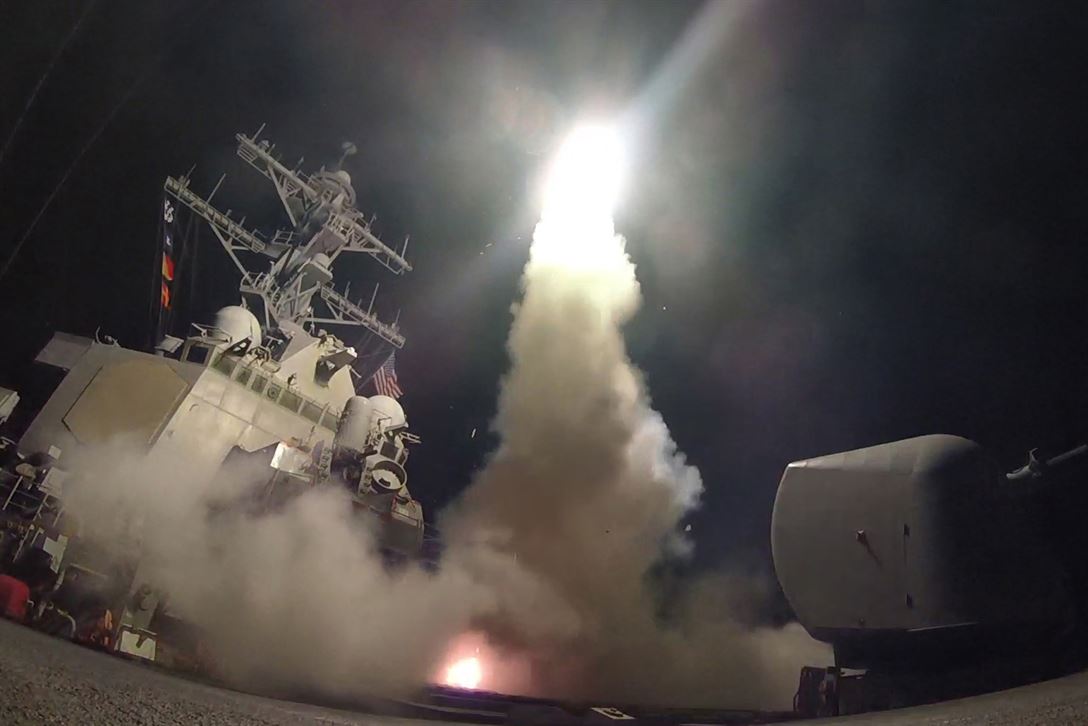
Just two days after news broke of an alleged poison-gas attack in northern Syria, President Trump brushed aside advice from some U.S. intelligence analysts doubting the Syrian regime’s guilt and launched a lethal retaliatory missile strike against a Syrian airfield.


Guided-missile destroyer USS Porter conducts strike 
operations while in the Mediterranean Sea, April 7, 2017. 
Navy photo: Petty Officer 3rd Class Ford Williams

Trump immediately won plaudits from Official Washington, especially from neoconservatives who have been trying to wrestle control of his foreign policy away from his nationalist and personal advisers since the days after his surprise victory on Nov. 8.

There is also an internal dispute over the intelligence. On Thursday night, Secretary of State Rex Tillerson said the U.S. intelligence community assessed with a “high degree of confidence” that the Syrian government had dropped a poison gas bomb on civilians in Idlib province.

But a number of intelligence sources have made contradictory assessments, saying the preponderance of evidence suggests that Al Qaeda-affiliated rebels were at fault, either by orchestrating an intentional release of a chemical agent as a provocation or by possessing containers of poison gas that ruptured during a conventional bombing raid.

One intelligence source told me that the most likely scenario was a staged event by the rebels intended to force Trump to reverse a policy, announced only days earlier, that the U.S. government would no longer seek “regime change” in Syria and would focus on attacking the common enemy, Islamic terror groups that represent the core of the rebel forces.

The source said the Trump national security team split between the President’s close personal advisers, such as nationalist firebrand Steve Bannon and son-in-law Jared Kushner, on one side and old-line neocons who have regrouped under National Security Adviser H.R. McMaster, an Army general who was a protégé of neocon favorite Gen. David Petraeus.

White House Infighting


In this telling, the earlier ouster of retired Gen. Michael Flynn as national security adviser and this week’s removal of Bannon from the National Security Council were key steps in the reassertion of neocon influence inside the Trump presidency. The strange personalities and ideological extremism of Flynn and Bannon made their ousters easier, but they were obstacles that the neocons wanted removed.

Though Bannon and Kushner are often presented as rivals, the source said, they shared the belief that Trump should tell the truth about Syria, revealing the Obama administration’s CIA analysis that a fatal sarin gas attack in 2013 was a “false-flag” operation intended to sucker President Obama into fully joining the Syrian war on the side of the rebels — and the intelligence analysts’ similar beliefs about Tuesday’s incident.

Instead, Trump went along with the idea of embracing the initial rush to judgment blaming Assad for the Idlib poison-gas event. The source added that Trump saw Thursday night’s missile assault as a way to change the conversation in Washington, where his administration has been under fierce attack from Democrats claiming that his election resulted from a Russian covert operation.

If changing the narrative was Trump’s goal, it achieved some initial success with several of Trump’s fiercest neocon critics, such as neocon Senators John McCain and Lindsey Graham, praising the missile strike, as did Israeli Prime Minister Benjamin Netanyahu. The neocons and Israel have long sought “regime change” in Damascus even if the ouster of Assad might lead to a victory by Islamic extremists associated with Al Qaeda and/or the Islamic State.

Wagging the Dog


Trump employing a “wag the dog” strategy, in which he highlights his leadership on an international crisis to divert attention from domestic political problems, is reminiscent of President Bill Clinton’s decision to attack Serbia in 1999 as impeachment clouds were building around his sexual relationship with intern Monica Lewinsky.
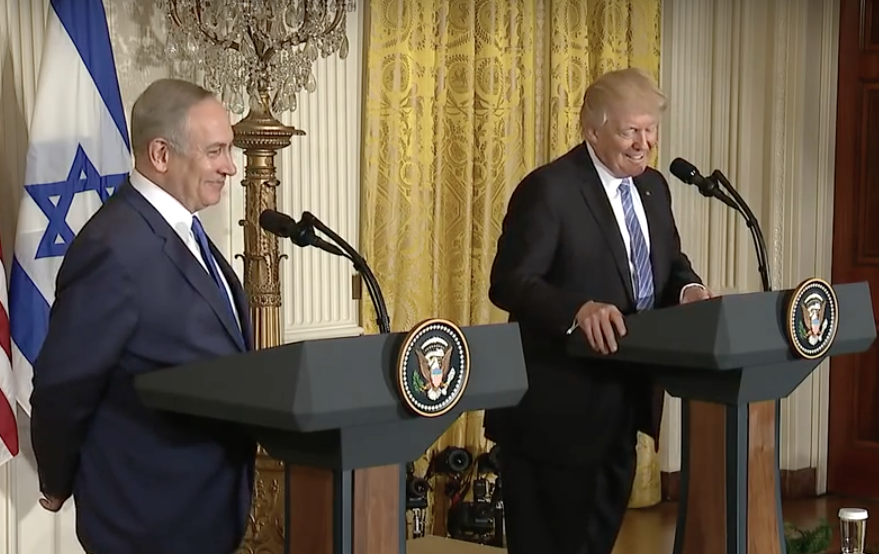


President Donald Trump and Israeli Prime Minister
Benjamin Netanyahu at joint press conference on
Feb. 15. 2017. (Screen shot from Whitehouse.gov)

Trump’s advisers, in briefing the press on Thursday night, went to great lengths to highlight Trump’s compassion toward the victims of the poison gas and his decisiveness in bombing Assad’s military in contrast to Obama’s willingness to allow the intelligence community to conduct a serious review of the evidence surrounding the 2013 sarin-gas case.

Ultimately, Obama listened to his intelligence advisers who told him there was no “slam-dunk” evidence implicating Assad’s regime and he pulled back from a military strike at the last minute – while publicly maintaining the fiction that the U.S. government was certain of Assad’s guilt.

In both cases – 2013 and 2017 – there were strong reasons to doubt Assad’s responsibility. In 2013, he had just invited United Nations inspectors into Syria to investigate cases of alleged rebel use of chemical weapons and thus it made no sense that he would launch a sarin attack in the Damascus suburbs, guaranteeing that the U.N. inspectors would be diverted to that case.

Similarly, now, Assad’s military has gained a decisive advantage over the rebels and he had just scored a major diplomatic victory with the Trump administration’s announcement that the U.S. was no longer seeking “regime change” in Syria. The savvy Assad would know that a chemical weapon attack now would likely result in U.S. retaliation and jeopardize the gains that his military has achieved with Russian and Iranian help.

The counter-argument to this logic – made by The New York Times and other neocon-oriented news outlets – essentially maintains that Assad is a crazed barbarian who was testing out his newfound position of strength by baiting President Trump. Of course, if that were the case, it would have made sense that Assad would have boasted of his act, rather than deny it.

But logic and respect for facts no longer prevail inside Official Washington, nor inside the mainstream U.S. news media.

Intelligence Uprising


Alarm within the U.S. intelligence community about Trump’s hasty decision to attack Syria reverberated from the Middle East back to Washington, where former CIA officer Philip Giraldi reported hearing from his intelligence contacts in the field that they were shocked at how the new poison-gas story was being distorted by Trump and the mainstream U.S. news media.


Giraldi told Scott Horton’s Webcast:

“I’m hearing from sources on the ground in the Middle East, people who are intimately familiar with the intelligence that is available who are saying that the essential narrative that we’re all hearing about the Syrian government or the Russians using chemical weapons on innocent civilians is a sham.”
Giraldi said his sources were more in line with an analysis postulating an accidental release of the poison gas after an Al Qaeda arms depot was hit by a Russian airstrike.

“The intelligence confirms pretty much the account that the Russians have been giving … which is that they hit a warehouse where the rebels – now these are rebels that are, of course, connected with Al Qaeda – where the rebels were storing chemicals of their own and it basically caused an explosion that resulted in the casualties. Apparently the intelligence on this is very clear.”

Giraldi said the anger within the intelligence community over the distortion of intelligence to justify Trump’s military retaliation was so great that some covert officers were considering going public.

“People in both the agency [the CIA] and in the military who are aware of the intelligence are freaking out about this because essentially Trump completely misrepresented what he already should have known – but maybe he didn’t – and they’re afraid that this is moving toward a situation that could easily turn into an armed conflict,” Giraldi said before Thursday night’s missile strike.

“They are astonished by how this is being played by the administration and by the U.S. media.”

One-Sided Coverage


The mainstream U.S. media has presented the current crisis with the same profound neocon bias that has infected the coverage of Syria and the larger Middle East for decades. For instance, The New York Times on Friday published a lead story by Michael R. Gordon and Michael D. Shear that treated the Syrian government’s responsibility for the poison-gas incident as flat-fact. The lengthy story did not even deign to include the denials from Syria and Russia that they were responsible for any intentional deployment of poison gas.
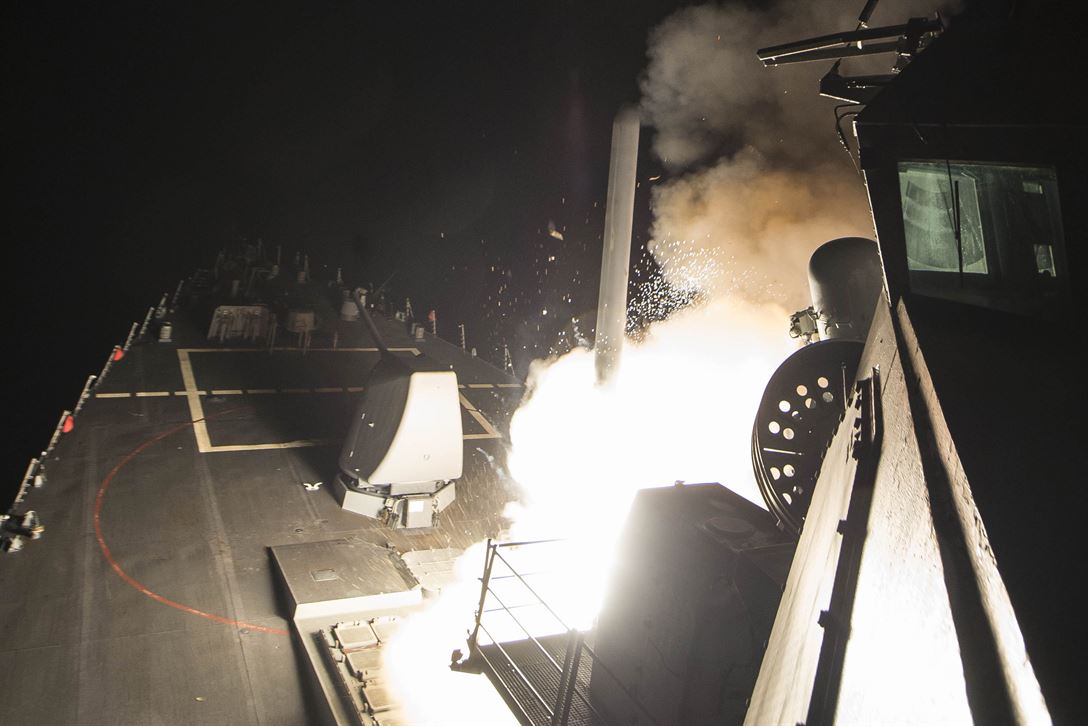

The Arleigh Burke-class guided-missile destroyer
USS Ross fires a tomahawk land attack missile from
the Mediterranean Sea, April 7, 2017.
(Navy photo by Petty Officer 3rd Class Robert S. Price)

The article also fit with Trump’s desire that he be portrayed as a decisive and forceful leader. He is depicted as presiding over intense deliberations of war or peace and displaying a deep humanitarianism regarding the poison-gas victims, one of the rare moments when the Times, which has become a reliable neocon propaganda sheet, has written anything favorable about Trump at all.

According to Syrian reports on Friday, the U.S. attack killed 13 people, including five soldiers at the airbase.

Gordon, whose service to the neocon cause is notorious, was the lead author with Judith Miller of the Times’ bogus “aluminum tube” story in 2002 which falsely claimed that Iraqi leader Saddam Hussein was reconstituting a nuclear-weapons program, an article that was then cited by President George W. Bush’s aides as a key argument for invading Iraq in 2003.

Regarding this week’s events, Trump’s desperation to reverse his negative media coverage and the dubious evidence blaming Assad for the Idlib incident could fit with the “Wag the Dog” movie from 1997 in which an embattled president creates a phony foreign crisis in Albania.


A fake war scene in the dark 1997 comedy
“Wag the Dog,” which showed a girl and her
cat fleeing a bombardment in Albania.

In the movie, the White House operation is a cynical psychological operation to convince the American people that innocent Albanian children, including an attractive girl carrying a cat, are in danger when, In reality, the girl was an actor posing before a green screen that allowed scenes of fiery ruins to be inserted as background.

Today, because Trump and his administration are now committed to convincing Americans that Assad really was responsible for Tuesday’s poison-gas tragedy, the prospects for a full and open investigation are effectively ended. We may never know if there is truth to those allegations or whether we are being manipulated by another “wag the dog” psyop.

Investigative reporter Robert Parry broke many of the Iran-Contra stories for The Associated Press and Newsweek in the 1980s. You can buy his latest book, America’s Stolen Narrative, either in print here or as an e-book (from Amazon and barnesandnoble.com).image_pdf

Dissecting Syria Attack Rationale

The Escalating War on Syria and Need for International Law

by Rick Sterling - Dissident Voice


April 7th, 2017

On Tuesday 4 April there were reports of children and other civilians killed by chemical poisoning in the town of Khan Sheikhoun, Syria.

There were contradictory reports, some saying they smelled the gas; others claiming it caused immediate death like odorless sarin.

On Wednesday 5 April, President Trump blamed the Syrian government despite conflicting reports and contradictory information and accusations.

He said,

“Yesterday’s chemical attack in Syria [was] against innocent people including women, small children and even beautiful little babies. Their deaths was an affront to humanity. These heinous actions by the Assad regime cannot be tolerated … my attitude toward Syria and Assad has changed very much.”

On Thursday, 6 April, Trump ordered a ‘targeted military strike’ on Syria with 50 tomahawk missiles attacking the primary Syrian air base near Homs. This base is used to support the combat with ISIS in eastern Syria and Nusra/Al Qaeda in Idlib province.

As I will show below, it is likely the deaths in Khan Sheikhoun were caused by an armed opposition faction, not the Syrian government. The goal was precisely what has happened: a media firestorm leading to direct U.S. aggression against Syria.

What Happened and How?


On April 4 news broke of a ‘chemical weapon’ attack in Syria. Western media and governments quickly blamed the Syrian government. Just as quickly, neoconservatives such as Sen. John McCain recalled the 2013 crisis when Pres Obama ultimately decided not to attack Syria. Israeli PM Netanyahu chimed in with a not-too-subtle renewed call for war on Syria. He tweeted that it’s time for the international community to “fulfill its obligations from 2013.”

Basic facts include:

– On 22 March, the government controlled town of Khattab was over-run by militants with some civilians kidnapped and taken to the nearby opposition controlled town of Khan Sheikhoun.

– On 4 April, up to 80 persons, including many children, died at Khan Sheikhoun. Some showed signs of chemical poisoning. Photographs, videos, analyses and other sources are documented at “A Closer Look At Syria”.

– one of the videos features a UK born and raised Dr. Shajul Islam. He received his UK medical license in 2012 but had the license suspended due to reports he was involved in the kidnapping in Syria of journalist John Cantlie.

– Many of the video scenes depict an area set into a limestone quarry with apparent caves and storage depots. There are flat bed trucks with bodies scattered on the ground in this semi-industrial area. Other video show scenes in medical clinic.

– Photographs show “White Helmet” individuals handling bodies without gloves which is very strange if they died or were dying from chemical poison.

Who is responsible?


There are three theories about what happened:

– The western government narrative is that the Syrian “regime” is responsible. They fired illegal chemical weapons into the town, primarily killing innocent civilians and many children.

– The Syrian army acknowledges firing air strikes but deny using chemical weapons at this or any time. This area was the base for militant attacks against government areas in Hama province in the preceding weeks. The Russian Ministry of Defense says that militants had a weapons production factory including chemical weapon ingredients, and that may have been hit and caused the chemical weapon deaths.

– A third theory is the kidnapped civilians from Khattab were killed or poisoned by the militants as part of a staged event.

Evidence Pointing to the Militants


Looking at the facts, history and overall circumstances, it is far more likely the armed opposition is responsible for this event. Here is why:

(1) The incident and publicity help the opposition and hurt the government.

Crime investigations usually begin with the question: Who has a motive? In this case, it’s strikingly clear that the armed opposition and their supporters benefit from this event. They have used the story to further demonize the Assad government and make renewed calls for US and “the world” to intervene.

The Syrian government is making steady advances in many parts of the country. They have no reason to use chemical weapons; they have every reason to NOT use chemical weapons. They know very well that the armed opposition has immediate access to major media.

Accusations that the Syrian government intentionally attacks civilians is contradicted by their policies and actions. As demonstrated last December in Aleppo, civilians are welcomed from opposition areas into government controlled areas. Even Syrian militants are welcomed after they sign an agreement to lay down arms.

It is also relevant to consider timing. There is a pattern of sensational events helpful to the armed opposition occurring simultaneous with critical international meetings or actions. In this case, the events in Khan Sheikhoun occurred the day before an important conference on Syria in Brussels. The conference titled “Supporting the future of Syria and the region” has been effectively sidetracked by news about the chemical weapons attack and the Syrian government being blamed.

(2) Extremists were responsible for the August 2013 Chemical Weapon attack in Damascus.

Western supporters of the armed opposition were quick to blame the Syrian government for the chemical attack in Ghouta on 21 August 2013. However, subsequent investigations by the most credible investigative journalists and researchers concluded the Syrian government was probably NOT responsible. Seymour Hersh and Robert Parry concluded the attack was most likely carried out by militants with support from Turkey. The in-depth examination titled Who Ghouta concluded “The only plausible scenario that fits the evidence is an attack by opposition forces.”

An MIT study made a detailed trajectory analysis, concluded that the missile could not have been fired from government territory and warned “Faulty intelligence could have led to an unjustified US military action.”

(3) Armed Opposition Groups have a history of Staging Incidents

From the start, the Syrian conflict has included an information war. Hillary Clinton boasted of “training for more than a thousand activists, students and independent journalists.” In December 2012, NBC journalist Richard Engel was reportedly kidnapped and abused by “shabiha” supporters of the Syrian government. Engel and his film crew were “liberated” by Free Syrian Army rebels after a gunfight with the Assad supporting kidnappers.

In reality, the entire episode from kidnapping to rescue was a hoax designed to demonize Assad supporters and glorify the “rebels”. The true story emerged years later after the actual events were leaked. When it was going to be made public, Engel finally admitted the truth.

(4) Supporters of the armed opposition have a history of fabricating stories which demonize the Syrian Government.

In February 2014, it was announced that a defecting Syrian military photographer, who was anonymous but code named “Caesar”, had 55 thousand photos showing the torture and murder of 11 thousand innocent Syrian civilians. This news received sensational media attention with live interviews on CNN and front page coverage throughout the western world. The news relied on the judgment of legal prosecutors who “verified” the story and produced a “Caesar Report”. This was released the day before the start of Geneva negotiations. It effectively disrupted the talks and facilitated the “rebels” refusal to negotiate and walk away.

In reality, the “verification” and report was commissioned by the government of Qatar which has been a major funder of the armed opposition. Since then it has been discovered that nearly half the 55 thousand photos show the opposite of what was claimed: they show dead Syrian soldiers and victims of explosions NOT tortured civilians. That is just one of the findings confirming the fraud involved in this sensational story. A concise expose of “Caesar” is here.

How the Public has been Misinformed on Syria


Historian and journalist Stephen Kinzer has said, “Coverage of the Syrian war will be remembered as one of the most shameful episodes in the history of the American press.” Here are a few examples showing the bias, half-truths and outright false statements regarding the events at Khan Sheikhoun:

– The PBS Newshour typically features two guests who are questioned by the host. The problem is that their guests consistently share the same basic viewpoint. On 4 April, one guest was from the Soros funded Physicians for Human Rights. She claimed, “We know that sarin has been used before by the Assad regime.” In fact that has NOT been confirmed by any credible organization. On the contrary, the most thorough investigations point to sarin being used by the armed opposition NOT the Syrian government. The other guest was Andrew Tabler from the neoconservative Israeli associated “Washington Institute”. His editorial from last Fall makes clear what he wants: “The case for (finally) bombing Assad.” The discussion on Syria at PBS Newshour is consistently biased.

– The New York Times feature story on 4 April was “Worst Chemical Attack in Years in Syria; U.S. Blames Assad“. One of the authors, Michael Gordon, was an influential proponent for “weapons of mass destruction in Iraq” that justified the 2003 invasion. But that has apparently not hurt his career. In this story on Syria, he and co-author Anne Barnard claim that “American intelligence agencies concluded” the 2013 attack was carried out by the Syrian government. That is false. The intelligence agencies did NOT agree and the “assessment” came from the White House not the intelligence agencies. It is astounding that they either do not know this or they are intentionally misleading the public. Veteran Intelligence Professionals for Sanity explained the significance in their memorandum “A Call for Syria – Sarin Proof”.

– DemocracyNow is a popular television/radio show. It is widely considered to be “progressive” but is also highly biased in its presentation on Syria. It almost solely promotes the perspective of those who support the armed opposition and/or western intervention in Syria. On April 5, they interviewed Dr. Rola Hallam. She is infamous for being the key player in the documentary “Saving Syria’s Children” which purports to show a chemical weapon attack in Aleppo but was actually staged. The “documentary” was then broadcast at a critical time trying to influence the 2013 vote in British parliament for an attack on Syria. On April 6, DemocracyNow interviewed another “Syrian” who lives in the West and promotes western intervention: Lina Sergie Attar. Viewers of DemocracyNow have no idea that the majority of Syrians support the government and especially the national Army in their struggle against invasion and terrorism.

Public understanding about what’s happening in Syria has been seriously confused by the bad analysis of prominent analysts. Some have suggested that Israel was content to live with Assad. Former Israeli Ambassador to the US Michael Oren clarified the truth as he said “we always wanted Bashar Assad to go, we always preferred the bad guys who weren’t backed by Iran to those who were backed by Iran.” In short, Israel prefers Al Qaeda or ISIS or, better yet, the conflict to continue so that both sides are destroyed.

Before the conflict began, in 2010, Secy of State Hillary Clinton made demands to Damascus that all revolved around Israeli interests. She wanted Syria to end its alliance with Hezbollah, to reduce its interactions with Iran and to come to an agreement with Israel. In contrast with what some analysts have said, Israeli interests have been a major factor driving and maintaining the conflict. With the liberation of Aleppo and prospect of a victory by Syria and allies, Israeli demands to escalate the war have probably increased.

Some of the world’s most famed political analysts have contributed to the confusion and lack of resistance as the war on Syria has continued. For example, Noam Chomsky on Democracy two days ago said “The Assad regime is a moral disgrace, the Russians with them.”

Evidently he believes all or most of the accusations which have been said about the ‘regime’. In sharp contrast with Chomsky’s assessment, it’s remarkable that Syria has held together as well as it has in the face of attack by some of the most powerful and rich countries on earth. Over 100 thousand Syrians have given their lives defending their country against the onslaught. Russia has supported their ally in compliance with international law, continually trying to work with the U.S. coalition as a “partner” against terrorism.

Evidently Chomsky is unaware or does not believe the extent of lies that have been created around Syria. Evidently he does not recognize the distorted and shameful media coverage mentioned by Kinzer. Everyone makes mistakes but Chomsky’s poor analysis here is a whopper. If he was to visit Syria and talk with real Syrians I think his perception would be dramatically changed just as described by the PBS Frontline crew here.

With consummate hypocrisy, both Syrian and Russian governments are now demonized by western neoconservatives and liberals who have done little or nothing to stop their own government’s collusion with terrorists raining havoc and destruction in Syria.

The need to restore International Law


International law has been undermined and replaced by “humanitarian law”. This has contributed to the current disastrous situation whereby the U.S. and NATO are waging aggression under a humanitarian pretext.

International law regarding attacks on sovereign states is clear: it is illegal unless authorized by the UN Security Council or in legitimate self defense. It is clear that Syria poses no threat to any of its neighbors or any other nation. It is also clear that Syria has been the victim for six long years of aggression by foreign states which have funded and promoted a proxy army of fanatics and mercenaries from around the world.

As the former Nicaraguan Foreign Minister and President of the UN General Assembly, Father Miguel D’Escoto, has said:

“What the U.S. government is doing in Syria is tantamount to a war of aggression, which, according to the Nuremberg Tribunal, is the worst possible crime a State can commit against another State.”

There has been a sustained attempt to derail Trump’s campaign pledge to stop the US “regime change” policy. This has been accompanied by a semi-hysterical demonization of Syria’s ally Russia. Liberals have been willing accomplices in this campaign which serves the interests of the U.S. military security complex, Israel and Saudi Arabia.

It looks like the foreign policy hawks and neocons have succeeded. Yesterday’s attacks on Syria mark an escalation in the war of aggression and violation of international law against Syria. This could lead to WW3 unless there is sufficient outcry and opposition.

Rick Sterling is an investigative journalist. He lives in the SF Bay Area and can be contacted at rsterling1@gmail.com.
Read other articles by Rick.

Background on Motives for Western War and Syria Regime Change

Assange on ‘US Empire,’ Assad govt overthrow plans & new book ‘The WikiLeaks Files’ 

by RT - Going Underground


9 Sep, 2015

WikiLeaks founder Julian Assange has opened up about his new book, 'The WikiLeaks Files,' speaking about the 'US empire' and telling RT's 'Going Underground' program that Washington had plans to overthrow Syria's government long before the 2011 uprising began.


Speaking to 'Going Underground' host Afshin Rattansi, Assange referred to the chapter on Syria, which goes back to 2006. In that chapter is a cable from US Ambassador William Roebuck, who was stationed in Damascus, which apparently discusses a plan for the overthrow of the Assad government in Syria.


[Please see: MintPressNews.com -
Refugee Crisis & Syria War Fueled by Competing Gas Pipelines by Mnar Muhawesh]

Admissions of Regime Change Past: Syria 1949

CIA Admits Orchestration Syria Coup 1949

by Youtube


CIA admits orchestrating Syrian Coup of March 1949.


Thursday, April 06, 2017

Growing Food Course at Haliburton Farm

Growing Food 

by Haliburton Farm 


April 6, 2017 

Royal Roads University, Gaia College, and Haliburton Farm have set the table for their delectable, hands-on Growing Food Course. It runs April 26 to September 6, AND you'll be mentored from seed to harvest.


Remember! Gaia also has online courses available:

Trump's Tonkin Moment: Will America Follow Don Into Syria Quagmire?

Trump’s War Whoop: a Gulf of Tonkin Moment?

by Mike Whitney  - CounterPunch


April 6, 2017


An attack on an ammunition dump that contained chemical weapons has touched off a massive propaganda blitz aimed at drawing the United States deeper into Syria’s six year-long war.

The incident which took place in the rebel-held town of Khan Sheikhoun, killed an estimated 72 people and left several hundred others severely ill. According to Russia Today:

Photo Jake Cunningham | CC BY 2.0

“The warehouse (that was bombed) was used to both produce and store shells containing toxic gas…The shells were delivered to Iraq and repeatedly used there… Both Iraq and international organizations have confirmed the use of such weapons by militants.” (RT)

Reports in the western media have dismissed the RT account as “nonsense” and placed the blame squarely on Syrian President Bashar al Assad. Leading the charge once again is the New York Times chief propagandist Michael R. Gordon who, readers may recall, co-authored fake news stories with Judith Miller about Saddam’s elusive Weapons of Mass Destruction. Here’s a sample of Gordon’s work from a piece he wrote (with Miller) in 2002. It helps to put Tuesday’s incident into perspective:

“More than a decade after Saddam Hussein agreed to give up weapons of mass destruction, Iraq has stepped up its quest for nuclear weapons and has embarked on a worldwide hunt for materials to make an atomic bomb, Bush administration officials said today. In the last 14 months, Iraq has sought to buy thousands of specially designed aluminum tubes, which American officials believe were intended as components of centrifuges to enrich uranium. American officials said….” (New York Times)

Gordon’s article helped pave the way for invasion of Iraq, the killing of hundreds of thousands of Iraqis and the destruction of one of the world’s oldest civilizations. Now he’s moved on to Syria. Here’s a blurb from his latest piece titled “Worst Chemical Attack in Years in Syria; U.S. Blames Assad”:

“The United States blamed the Syrian government and its patrons, Russia and Iran, on Tuesday for one of the deadliest chemical weapons attacks in years in Syria, one that killed dozens of people in Idlib Province, including children, and sickened scores more.

A senior State Department official said the attack appeared to be a war crime and called on Russia and Iran to restrain the government of President Bashar al-Assad of Syria from carrying out further chemical strikes.

Britain, France and Turkey joined Washington in condemning the attack, which they also attributed to Mr. Assad’s government. The United Nations Security Council was scheduled to be briefed on the attack on Wednesday.” (New York Times)

Does that sound like a justification for war? Gordon seems to think so.

And Gordon is not alone either. He is joined by the entire western media and their blood-thirsty colleagues on Capital Hill. Now it appears that President Donald Trump –who promised an end to Washington’s regime change wars– has joined their ranks. Here’s the statement Trump issued on Tuesday shortly after the attack:

“Today’s chemical attack in Syria against innocent people, including women and children, is reprehensible and cannot be ignored by the civilized world. These heinous actions by the Bashar al-Assad regime are a consequence of the past administration’s weakness and irresolution. President Obama said in 2012 that he would establish a “red line” against the use of chemical weapons and then did nothing. The United States stands with our allies across the globe to condemn this intolerable attack.” President Donald J. Trump, Office of the Press Secretary, April 04, 2017

Repeat: “These heinous actions by the Bashar al-Assad regime …cannot be ignored by the civilized world”.

Is Trump planning to lead the U.S. into a war with Syria?

Compare ‘President Trump’s’ comments this week to ‘Candidate Trump’s’ comments in December 2016:

“We will pursue a new foreign policy that finally learns from the mistakes of the past…We will stop looking to topple regimes and overthrow governments…. Our goal is stability not chaos, because we want to rebuild our country (the United States) …In our dealings with other countries, we will seek shared interests wherever possible and pursue a new era of peace, understanding, and good will.”

Quite a difference, eh? Now check out these blurbs on Trump’s Twitter account in 2013 when Citizen Trump was trying to persuade Obama that he should “stay the hell out” of the Syrian conflict.

From the Real Donald J. Trump– “We should stay the hell out of Syria, the “rebels” are just as bad as the current regime. WHAT WILL WE GET FOR OUR LIVES AND $ BILLIONS?ZERO”

5:33 PM – 15 Jun 2013

Donald J. Trump– “President Obama, do not attack Syria. There is no upside and tremendous downside. Save your “powder” for another (and more important) day!”

6:21 AM – 7 Sep 2013

Donald J. Trump– “What will we get for bombing Syria besides more debt and a possible long term conflict? Obama needs Congressional approval.”

11:14 AM – 29 Aug 2013

The difference between Citizen Trump and President Trump could not be starker. Citizen Trump was nearly a pacifist while President Trump has deployed more Marines and Special Forces to Iraq and Syria, 2,000 more US combat troops to Kuwait (in anticipation of a broader conflict) and stepped up US operations in Somalia, Yemen, Afghanistan and beyond. Even more troubling is the fact that he has loaded his foreign policy team with right-wing militarists like James “Mad Dog” Mattis (who leveled the Iraqi city of Falluja in a vicious fit of rage.) and Lt Gen HR McMaster, who was recently denounced by a retired senior US Military Police officer, Arnaldo Claudio, as a war criminal for “human rights abuses of detainees in Tal Afar, during the Iraq war.” (See: “US Army Investigator Accuses National Security Adviser McMaster of War Crimes in Iraq”, The Libertarian Institute)

What’s so disturbing about the appointments of Mattis and McMaster is that Trump has apparently relinquished control over foreign policy and handed it over to his generals whose political orientation is at the far right-end of the spectrum.. Check out this clip from an article at Antiwar.com by Jason Ditz:

“Trump Expands Pentagon’s War Authority– Trump Giving Commanders Increasing Autonomy to Conduct Operations

While most of the talk about the Pentagon’s proposals for various wars to President Trump has focused on requests for more troops in more countries, a much less publicized effort has also been getting rubber stamped, one giving commanders in those wars increasing autonomy on operations….

While President Trump is eager to make such moves early on to show that he is “listening to the generals,” granting so much autonomy to the military to fight its own wars without political oversight is risky business…. as it further distances America’s direct foreign interventions from politicians, and by extension from the voters, turning the details of major military operations into little more than bureaucratic details for career military brass.

These major changes are happening in almost complete silence, as while there have been mentions of the Pentagon seeking these new authorities, always as an afterthought to getting more troops, there is little to no interest in debating the question.” (antiwar.com)

Think about that for a minute: The world’s most lethal killing machine is now in the hands of career militarists who are trained to win wars not seek political solutions. How can this not lead to a dramatic escalation? Trump thinks that by abdicating his responsibility as Commander in Chief he is showing his support for his generals, but what he’s really doing is revealing his feeble grasp of how the system works. His approach can only lead to more needless carnage, that much is certain.

So what happens now, and how does all this fit with Tuesday’s chemical attack in Syria?

The western media and the political class have already decided that the incident is going to be used for two purposes:

1. Discredit Syrian President Bashar al Assad

2. Create a justification for increasing US military involvement.

The fact that Assad and Putin have already denied that Syria used chemical weapons (“We deny completely the use of any chemical or toxic material in Khan Sheikhoun town today and the army has not used nor will use in any place or time, neither in past or in future,” the army said in a statement, as quoted by Reuters) is not going to make any difference at all. The pretext has already been established and the Pentagon’s strategy may soon be launched.

At the very least, we can expect a more forceful attempt to seize and occupy the eastern quadrant of the country, establish military bases, impose a no-fly zone, and boost the number US combat troops in the theater. There’s also a good chance that the US will engage the Syrian Arab Army (SAA) at Deir Ezzor in their effort to clear and capture east Syria.

The prospects of a conflagration between the United States and Russia are increasing by the day.

God help us all.

 
MIKE WHITNEY lives in Washington state. He is a contributor to Hopeless: Barack Obama and the Politics of Illusion (AK Press). Hopeless is also available in a Kindle edition. He can be reached at fergiewhitney@msn.com.
More articles by:Mike Whitney

Surf's Up! Hanging 'Em in Gaza

Gaza Surf Club

TIFF Trailers - via CounterPunch


April 3, 2017


Trump Does Torquemada: Expect the Spanish Inquisition

Resurrecting the Unholy Trinity: Torture, Rendition, and Indefinite Detention Under Trump

by Rebecca Gordon - TomDispatch


April 6, 2017

When George W. Bush and Dick Cheney launched their forever wars - under the banner of a “Global War on Terror” - they unleashed an unholy trinity of tactics. Torture, rendition, and indefinite detention became the order of the day. After a partial suspension of these policies in the Obama years, they now appear poised for resurrection.

For eight years under President Obama, this country’s forever wars continued, although his administration retired the expression “war on terror,” preferring to describe its war-making more vaguely as an effort to “degrade and destroy” violent jihadists like ISIS.

Nevertheless, he made major efforts to suspend Bush-era violations of U.S. and international law, signing executive orders to that effect on the day he took office in 2009.

Executive Order 13491, “Ensuring Lawful Interrogations,” closed the CIA’s secret torture centers -- the “black sites” -- and ended permission for the Agency to use what had euphemistically become known as “enhanced interrogation techniques.”

On that same day in 2009, Obama issued Executive Order 13492, designed -- unsuccessfully, as it turned out -- to close the U.S. military prison at Guantánamo Bay, the site of apparently endless detention without charges or trials. In 2015, Congress reinforced Obama’s first order in a clause for the next year’s National Defense Authorization Act that limited permissible interrogation techniques to those described in the U.S. Army Field Manual section on “human intelligence collector operations.”

All of that already seems like such ancient history, especially as the first hints of the Trump era begin to appear, one in which torture, black sites, extraordinary rendition, and so much more may well come roaring back. Right now, it’s a matter of reading the Trumpian tea leaves. Soon after the November election, Masha Gessen, a Russian émigrée who has written two books about Vladimir Putin’s regime, gave us some pointers on how to do this. Rule number one: “Believe the autocrat.” When he tells you what he wants to do -- build a wall, deport millions, bring back torture -- “he means what he says.” Is Gessen right? Let’s examine some of those leaves.

Tomgram: Rebecca Gordon, Believe the Autocrat

Human whats? In the Middle East and elsewhere, the Trump administration has begun to signal that human rights aren’t exactly on its agenda. Secretary of State Rex Tillerson has taken the lead in this process in a round of personal diplomacy in the Middle East (with Trump’s generals not far behind). In early March, he wrote various "advocacy groups" that the administration was considering withdrawing from the U.N. Human Rights Council to protest the records of some of its members, including Saudi Arabia and China. And then, as if to hint at what the value of such rights might really be in Washington, he signaled to Congress that the administration would, as the New York Times reported, “lift all human rights conditions on a major sale of F-16 fighter jets and other arms to Bahrain.” This means American arms dealers can sell their weaponry to that Sunni Persian Gulf monarchy, despite its grim repression of its majority Shiite population. And that, in turn, means that we can finally put something like an initial price tag on human rights, at least for the Shiites of the tiny kingdom that houses the U.S. Fifth Fleet: $3.8 billion ($2.8 billion for those 19 new fighter planes and a billion dollars more to support that country’s air force in various other ways).

We can similarly put a very partial price tag on the value of human rights when it comes to Yemenis. The citizens of that riven land are living at the edge of a potentially catastrophic famine and under regular air attack from Saudi Arabia and its allies (including Bahrain) in a disastrous American-backed two-year-old war that was meant to check Iranian influence in the region. It has already cost at least 10,000 lives and displaced millions. As for that very partial price tag, it's $350 million for 16,000 Raytheon guided munitions kits that will turn dumb bombs into “smart” ones. Their sale to the Saudis had previously been blocked by the Obama administration in response to news about their air strikes against civilians in Yemen. Now, as a signal of the sort of heightened support the Trump administration expects to offer that country's royal family -- you know, the crew with that terrible human rights record -- in its fight against Iranian influence in the region, it is releasing them. (Undoubtedly, more cluster bombs will be next on the list.)

We are, of course, at the very beginning of the Trump era, which means so much yet remains to be known, though The Donald’s generals are clearly already ramping up America’s wars (and the civilian casualties that go with them) in Syria, Iraq, Yemen, and Somalia. In turn, that means sooner or later other classic aspects of America’s recent wars will undoubtedly be ramped up as well. With that in mind, we’ve turned to TomDispatch regular Rebecca Gordon, author of American Nuremberg and an expert on the “unholy trinity” of grim methods this country has brought to bear in its war on terror -- torture, extraordinary rendition, and indefinite detention (think: Guantánamo) -- to read Washington’s tea leaves and give us a preview of things to come and so of human rights in the age of Trump. Tom

Resurrecting the Unholy Trinity: Torture, Rendition, and Indefinite Detention Under Trump

by Rebecca Gordon


Torture Redux


It should come as no surprise to anyone who paid minimal attention to the election campaign of 2016 that Donald Trump has a passionate desire to bring back torture. In fact, he campaigned on a platform of committing war crimes of various kinds, occasionally even musing about whether the United States could use nukes against ISIS. He promised to return waterboarding to its rightful place among twenty-first-century U.S. practices and, as he so eloquently put it, “a hell of a lot worse.” There’s no reason, then, to be shocked that he’s been staffing his administration with people who generally feel the same way (Secretary of Defense James “Mad Dog” Mattis being an obvious exception).

The CIA was certainly not the only outfit engaged in torture in the Bush years, but it’s the one whose practices were most thoroughly examined and publicized. Despite his enthusiasm for torture, Trump’s relationship with the Agency has, to say the least, been frosty. Days before his inauguration, he responded to revelations of possible Russian influence on the U.S. election by accusing its operatives of behaving like Nazis, tweeting: “Intelligence agencies should never have allowed this fake news to 'leak' into the public. One last shot at me. Are we living in Nazi Germany?”

He quickly appointed a new director of the CIA (as hasn’t been true of quite a few other positions in his administration). He chose former Congressman Mike Pompeo, whose advice about torture he has also said he would consider seriously. A polite term for Pompeo’s position on the issue might be: ambiguous. During his confirmation hearings, he maintained that he would “absolutely not” reinstate waterboarding or other “enhanced techniques,” even if the president ordered him to. “Moreover,” he added, “I can’t imagine that I would be asked that.”

However, his written replies to the Senate Intelligence Committee told quite a different, far less forthright tale. Specifically, as the British Independent reported, he wrote that if a ban on waterboarding were shown to impede the “gathering of vital intelligence,” he would consider lifting it. He added that he would reopen the question of whether interrogation techniques should be limited to those found in the Army Field Manual. (“If confirmed, I will consult with experts at the Agency and at other organizations in the U.S. government on whether the Army Field Manual uniform application is an impediment to gathering vital intelligence to protect the country.”)

In other words, as the Independent observed, if the law prohibits torture, then Pompeo is prepared to work to alter the law. “If experts believed current law was an impediment to gathering vital intelligence to protect the country," Pompeo wrote to the Senate committee, “I would want to understand such impediments and whether any recommendations were appropriate for changing current law.” Unfortunately for both the president and him, there are laws against torture that neither they nor Congress have the power to change, including the U.N. Convention against Torture, and the Geneva Conventions.

Nor is Mike Pompeo the only Trump nominee touched by the torture taint. Take, for instance, the president’s pick for the Supreme Court. From 2005 to 2006, Neil Gorsuch worked in the Justice Department’s Office of Legal Counsel, the wellspring for John Yoo’s and Jay Bybee’s infamous “torture memos.” Gorsuch also assisted in drafting Bush’s “signing statement” on the 2005 Detainee Treatment Act. That act included an amendment introduced by Senator John McCain prohibiting the torture of detainees. As the White House didn’t want its favorite interrogation methods curtailed, Gorsuch recommended putting down “a marker to the effect that... McCain is best read as essentially codifying existing interrogation policies.” In other words, the future Supreme Court nominee suggested that the McCain amendment would have no real effect, because the administration had never engaged in torture in the first place. This approach was the best strategy, he argued, to “help inoculate against the potential of having the administration criticized sometime in the future for not making sufficient changes in interrogation policy in light of the McCain portion of the amendment.”

In his brief tenure at the Office of Legal Counsel, Gorsuch provided further aid to the supporters of torture by, for example, working on government litigation to prevent the exposure of further “Darby photos.” These were the shocking pictures from Iraq’s Abu Ghraib prison that came into the possession of U.S. Army Sergeant Joe Darby. He then passed them up the chain of command, which eventually led to the public revelation of the abuses in that U.S.-run torture palace.

Trump’s new attorney general, Jeff Sessions, is also a torture enthusiast. He was one of only nine senators to vote against the 2005 Detainee Treatment Act. The Act limited the military to the use of those interrogation methods found in the Army Field Manual. In 2015, he joined just 20 other senators in opposing an amendment to the next year’s military appropriations bill, which extended the Field Manual rules to all U.S. agencies involved in interrogation, not just the military.

Reviving the Black Sites?


So far, President Trump hasn’t had the best of luck with his executive orders. His two travel bans, meant to keep Muslims from entering the United States, are at present trapped in federal court, but worse may be in the offing.

Trump promised during the campaign to reopen the CIA’s notorious black sites and bring back torture. Shortly after the inauguration, a draft executive order surfaced that was clearly intended to do just that. It rescinded President Obama’s orders 13491 and 13492 and directed the secretary of defense and the attorney general, together with “other senior national security officials,” to review the interrogation policies in the Army Field Manual with a view to making “modifications in, and additions to those, policies.” That would mean an end run around Congress, since it doesn’t take an act of that body to rewrite part of a manual (and so reinstitute torture policy).

It also called on the director of national intelligence, the CIA director, and the attorney general to “recommend to the president whether to reinitiate a program of interrogation of high-value alien terrorists to be operated outside the United States and whether such program should include the use of detention facilities operated by the Central Intelligence Agency.” In other words, they were to consider reopening the black sites for another round of “enhanced interrogation techniques.”

As in so many such documents, that draft order included a cover-your-ass clause, in this case suggesting that “no person in the custody of the United States shall at any time be subjected to torture or cruel, inhuman, or degrading treatment or punishment, as proscribed by U.S. law.”

As we learned in the Bush years, however, such statements have no real effect because, as in a 2002 memo produced by John Yoo and Jay Bybee, “torture” can be redefined as whatever you need it to be. That memo certified that, to qualify as torture, the pain experienced by a victim would have to be like that usually associated with “serious physical injury, such as organ failure, impairment of bodily function, or even death.” In other words, if he didn't die or at least come close, you didn’t torture him.

After the recent draft executive order on these subjects was leaked to the media and caused a modest to-do, a later version appeared to drop the references to black sites and torture. While no final version has yet emerged, it’s clear enough that the initial impulse behind the order was distinctly Trumpian and should be taken seriously.

As soon as the draft order surfaced in the press in late January, the White House disclaimed all knowledge of it and no version of it appears on current lists of Trump executive actions since taking office. But keep in mind that presidents can issue secret executive orders that the public may never hear about -- unless the news spills out from an administration whose powers of containment so far could be compared to those of a sieve.

Déjà Vu, Rendition Edition


Notably, neither of Obama’s Inauguration Day executive orders addressed extraordinary rendition. In fact, this was a weapon he preferred to keep available.

What is extraordinary rendition? Ordinary rendition simply means transferring someone from one legal jurisdiction to another, usually through legal extradition. Rendition becomes “extraordinary” when it happens outside the law, as when a person is sent to a country with which the United States does not have an extradition treaty, or when it is likely (or certain) that the rendered person will be tortured in another country.

In the Bush years, the CIA ran an extraordinary rendition machine, involving the kidnapping of terror suspects (sometimes, as it turned out, quite innocent people) off the streets of global cities as well as in the backlands of the planet, and sending them to those brutal CIA black sites or rendering them to torturing regimes around the world. Rendition continued in a far more limited way during Obama’s presidency. For example, a 2013 Washington Post story described the rendition of three Europeans “with Somali roots” in the tiny African country of Djibouti and of an Eritrean to Nigeria. The article suggested that, in part because of congressional intransigence on closing Guantánamo and allowing the jailing and trial of suspected terrorists in U.S courts, rendition represented “one of the few alternatives” to the more extreme option of simply killing suspects outright, usually by drone.

Recently, there was news that a Trump associate might have been involved in planning a rendition of his own. Former CIA Director James Woolsey told the Wall Street Journal that, last September, Lieutenant General Michael Flynn discussed arranging an extralegal rendition with the son-in-law of Turkish President Recep Tayyip Erdogan and Turkish Foreign Minister Mevlut Cavusoglu. At the time, he was serving as an adviser to the Trump campaign. He later -- briefly -- served as President Trump’s national security adviser.

The target of this potential rendition? Fethullah Gulen, an Islamic cleric who has lived for decades in the United States. President Erdogan believes that Gulen was behind a 2016 coup attempt against him and has asked the U.S. to extradite him to Turkey. The Obama administration temporized on the subject, insisting on examining the actual evidence of Gulen’s involvement.

Flynn’s foray may have been an instance of potential rendition-for-profit, a plan to benefit one of his consulting clients. At the time, Flynn’s (now-defunct) consulting firm, the Flynn Intel Group, was working for a Dutch corporation, Inovo, with ties to Erdogan. The client reviewed a draft op-ed eventually published in the Hill in which Flynn argued that Gulen should be extradited, because he is a “radical cleric” and Turkey is “our friend.” In addition to lying about his contacts with the Russian ambassador during the election campaign, it turns out that Flynn was probably working as an unregistered foreign agent for Turkish interests at that time.

Mike Pompeo also appears to be bullish on renditions. In his written testimony to the Senate Intelligence Committee, he indicated that under him the CIA would probably continue this practice. When asked how the Agency would avoid sending prisoners to countries known to engage in torture, his reply could have come straight from the Bush-Cheney playbook:

“I understand that assurances provided by other countries have been a valuable tool for ensuring that detainees are treated humanely. In most cases other countries are likely to treat assurances provided to the United States government as an important matter.”

Asking for such assurances has in the past given the U.S. government cover for what was bound to occur in the prisons of countries known for torture. (Just ask Maher Arar rendered to Syria or Binyam Mohammed rendered to Morocco about what happened to them.)

We’ll Always Have Guantánamo...


“We’ll always have Paris,” Rick reminds Ilsa during their bittersweet goodbye in the classic film Casablanca. Our Guantánamo lease with Cuba (which reads, "for use as coaling [refueling] or naval stations only, and for no other purpose”) is a permanent one. So it looks like we’ll always have Guantánamo, with its memories of torture and murder, and its remaining 41 prisoners, undoubtedly stranded there forever.

As it happens, Supreme Court nominee Neil Gorsuch’s fingerprints are all over the Bush administration’s Guantánamo policy, too. While at the Office on Legal Counsel, he helped the administration fight a major legal challenge to that policy in Hamdan v. Rumsfeld.

In that case, the government argued that detainees at Guantánamo did not have the right of habeas corpus, that the president has the authority to decide not to abide by the Geneva Conventions, and that detainees could be tried by military “commissions” in Cuba rather than by U.S. courts. Given that history, it’s unlikely he’d rule in favor of any future challenge to whatever use President Trump made of the prison.

While on the campaign trail, Trump made it clear that he would keep Guantánamo eternally open. In a November rally in Sparks, Nevada, he told a cheering crowd:

“This morning, I watched President Obama talking about Gitmo, right, Guantánamo Bay, which by the way, which by the way, we are keeping open. Which we are keeping open... and we're gonna load it up with some bad dudes, believe me, we're gonna load it up.”

In mid-February, Trump Press Secretary Sean Spicer reiterated his boss’s affection for the prison, when he told the White House press corps that the president believes it serves “a very, very healthy purpose in our national security, in making sure we don’t bring terrorists to our seas.” Perhaps Spicer meant “our shores,” but the point was made. Trump remains eager to keep the whole Guantánamo prison system -- including, we can assume, indefinite detention -- up and running as an alternative to bringing prisoners to the United States.

It seems that the head of the Pentagon agrees. In December 2016, retired Marine General (now Secretary of Defense) James Mattis told the Senate Armed Services Committee that any detainee who “has signed up with this enemy” and is captured wherever “the president, the commander-in-chief, sends us” should know that he will be a “prisoner until the war is over.” Given that our post-9/11 military conflicts are truly forever wars, in Mattis’s view, pretty much anyone the U.S. captures in Syria, Iraq, Afghanistan, Somalia, Yemen, or who knows where else will face at least the possibility of spending the rest of his life in Guantánamo.

Reading the Tea Leaves


As far as we know, President Trump has yet to green-light his first case of torture or his first extraordinary rendition, or even to add a single prisoner to the 41 still held at Guantánamo. All we have for now are his ominous desires and promises -- and those of his underlings. These are enough, however, to give us a clear understanding of his intentions and those of his appointees. If they can, they will resurrect the unholy trinity of torture, rendition, and indefinite detention. The future may not yet be inscribed in Trumpian gold anywhere, but on such matters we should believe the autocrat.

Rebecca Gordon, a TomDispatch regular, teaches in the philosophy department at the University of San Francisco. She is the author of American Nuremberg: The U.S. Officials Who Should Stand Trial for Post-9/11 War Crimes. Her previous books include Mainstreaming Torture: Ethical Approaches in the Post-9/11 United States and Letters from Nicaragua.

Follow TomDispatch on Twitter and join us on Facebook. Check out the newest Dispatch Book, John Dower's The Violent American Century: War and Terror Since World War II, as well as John Feffer's dystopian novel Splinterlands, Nick Turse’s Next Time They’ll Come to Count the Dead, and Tom Engelhardt's Shadow Government: Surveillance, Secret Wars, and a Global Security State in a Single-Superpower World.

Copyright 2017 Rebecca Gordon

Wednesday, April 05, 2017

Full Press Courting Syria War

Another Dangerous Rush to Judgment in Syria

by Robert Parry  - Consortium News


April 5, 2017

With the latest hasty judgment about Tuesday’s poison-gas deaths in a rebel-held area of northern Syria, the mainstream U.S. news media once more reveals itself to be a threat to responsible journalism and to the future of humanity.


US UN Ambassador, Vikki Haley pulls out all the stops 
at UNSC Emergency Meeting April 5, 2017

Again, we see the troubling pattern of verdict first, investigation later, even when that behavior can lead to a dangerous war escalation and many more deaths.

Before a careful evaluation of the evidence about Tuesday’s tragedy was possible, The New York Times and other major U.S. news outlets had pinned the blame for the scores of dead on the Syrian government of Bashar al-Assad. That revived demands that the U.S. and other nations establish a “no-fly zone” over Syria, which would amount to launching another “regime change” war and would put America into a likely hot war with nuclear-armed Russia.

Even as basic facts were still being assembled about Tuesday’s incident, we, the public, were prepped to disbelieve the Syrian government’s response that the poison gas may have come from rebel stockpiles that could have been released either accidentally or intentionally causing the civilian deaths in a town in Idlib Province.

One possible scenario was that Syrian warplanes bombed a rebel weapons depot where the poison gas was stored, causing the containers to rupture. Another possibility was a staged event by increasingly desperate Al Qaeda jihadists who are known for their disregard for innocent human life.

While it’s hard to know at this early stage what’s true and what’s not, these alternative explanations, I’m told, are being seriously examined by U.S. intelligence. One source cited the possibility that Turkey had supplied the rebels with the poison gas (the exact type still not determined) for potential use against Kurdish forces operating in northern Syria near the Turkish border or for a terror attack in a government-controlled city like the capital of Damascus.

Reporting by investigative journalist Seymour Hersh and statements by some Turkish police and opposition politicians linked Turkish intelligence and Al Qaeda-affiliated jihadists to the Aug. 21, 2013 sarin gas attack outside Damascus that killed hundreds, although the Times and other major U.S. news outlets continue to blame that incident on Assad’s regime.

Seasoned Propagandists


On Tuesday, the Times assigned two of its most committed anti-Syrian-government propagandists to cover the Syrian poison-gas story, Michael B. Gordon and Anne Barnard.

The controversial map developed by Human Rights Watch and embraced by the New York Times, supposedly showing the flight paths of two missiles from the Aug. 21 Sarin attack intersecting at a Syrian military base.

Gordon has been at the front lines of the neocon “regime change” strategies for years. He co-authored the Times’ infamous aluminum tube story of Sept. 8, 2002, which relied on U.S. government sources and Iraqi defectors to frighten Americans with images of “mushroom clouds” if they didn’t support President George W. Bush’s upcoming invasion of Iraq. The timing played perfectly into the administration’s advertising “rollout” for the Iraq War.

Of course, the story turned out to be false and to have unfairly downplayed skeptics of the claim that the aluminum tubes were for nuclear centrifuges, when the aluminum tubes actually were meant for artillery. But the article provided a great impetus toward the Iraq War, which ended up killing nearly 4,500 U.S. soldiers and hundreds of thousands of Iraqis.

Gordon’s co-author, Judith Miller, became the only U.S. journalist known to have lost a job over the reckless and shoddy reporting that contributed to the Iraq disaster. For his part, Gordon continued serving as a respected Pentagon correspondent.

Gordon’s name also showed up in a supporting role on the Times’ botched “vector analysis,” which supposedly proved that the Syrian military was responsible for the Aug. 21, 2013 sarin-gas attack. The “vector analysis” story of Sept. 17, 2013, traced the flight paths of two rockets, recovered in suburbs of Damascus back to a Syrian military base 9.5 kilometers away.

The article became the “slam-dunk” evidence that the Syrian government was lying when it denied launching the sarin attack. However, like the aluminum tube story, the Times’ ”vector analysis” ignored contrary evidence, such as the unreliability of one azimuth from a rocket that landed in Moadamiya because it had struck a building in its descent. That rocket also was found to contain no sarin, so it’s inclusion in the vectoring of two sarin-laden rockets made no sense.

But the Times’ story ultimately fell apart when rocket scientists analyzed the one sarin-laden rocket that had landed in the Zamalka area and determined that it had a maximum range of about two kilometers, meaning that it could not have originated from the Syrian military base. C.J. Chivers, one of the co-authors of the article, waited until Dec. 28, 2013, to publish a halfhearted semi-retraction. [See Consortiumnews.com’s “NYT Backs Off Its Syria-Sarin Analysis.”]

Gordon was a co-author of another bogus Times’ front-page story on April 21, 2014, when the State Department and the Ukrainian government fed the Times two photographs that supposedly proved that a group of Russian soldiers – first photographed in Russia – had entered Ukraine, where they were photographed again.

However, two days later, Gordon was forced to pen a retraction because it turned out that both photos had been shot inside Ukraine, destroying the story’s premise. [See Consortiumnews.com’s “NYT Retracts Russian-Photo Scoop.”]

Gordon perhaps personifies better than anyone how mainstream journalism works. If you publish false stories that fit with the Establishment’s narratives, your job is safe even if the stories blow up in your face. However, if you go against the grain – and if someone important raises a question about your story – you can easily find yourself out on the street even if your story is correct.

No Skepticism Allowed


Anne Barnard, Gordon’s co-author on Tuesday’s Syrian poison-gas story, has consistently reported on the Syrian conflict as if she were a press agent for the rebels, playing up their anti-government claims even when there’s no evidence.

A heart-rending propaganda image designed to justify a major U.S. military operation inside Syria against the Syrian military.

For instance, on June 2, 2015, Barnard, who is based in Beirut, Lebanon, authored a front-page story that pushed the rebels’ propaganda theme that the Syrian government was somehow in cahoots with the Islamic State though even the U.S. State Department acknowledged that it had no confirmation of the rebels’ claims.

When Gordon and Barnard teamed up to report on the latest Syrian tragedy, they again showed no skepticism about early U.S. government and Syrian rebel claims that the Syrian military was responsible for intentionally deploying poison gas.

Perhaps for the first time, The New York Times cited President Trump as a reliable source because he and his press secretary were saying what the Times wanted to hear – that Assad must be guilty.

Gordon and Barnard also cited the controversial White Helmets, the rebels’ Western-financed civil defense group that has worked in close proximity with Al Qaeda’s Nusra Front and has come under suspicion of staging heroic “rescues” but is nevertheless treated as a fount of truth-telling by the mainstream U.S. news media.

In early online versions of the Times’ story, a reaction from the Syrian military was buried deep in the article around the 27th paragraph, noting: “The government denies that it has used chemical weapons, arguing that insurgents and Islamic State fighters use toxins to frame the government or that the attacks are staged.”

The following paragraph mentioned the possibility that a Syrian bombing raid had struck a rebel warehouse where poison-gas was stored, thus releasing it unintentionally.

But the placement of the response was a clear message that the Times disbelieved whatever the Assad government said. At least in the version of the story that appeared in the morning newspaper, a government statement was moved up to the sixth paragraph although still surrounded by comments meant to signal the Times’ acceptance of the rebel version.

After noting the Assad government’s denial, Gordon and Barnard added, “But only the Syrian military had the ability and the motive to carry out an aerial attack like the one that struck the rebel-held town of Khan Sheikhoun.”

But they again ignored the alternative possibilities. One was that a bombing raid ruptured containers for chemicals that the rebels were planning to use in some future attack, and the other was that Al Qaeda’s jihadists staged the incident to elicit precisely the international outrage directed at Assad as has occurred.

Gordon and Barnard also could be wrong about Assad being the only one with a motive to deploy poison gas. Since Assad’s forces have gained a decisive upper-hand over the rebels, why would he risk stirring up international outrage at this juncture? On the other hand, the desperate rebels might view the horrific scenes from the chemical-weapons deployment as a last-minute game-changer.

Pressure to Prejudge


None of this means that Assad’s forces are innocent, but a serious investigation ascertains the facts and then reaches a conclusion, not the other way around.

However, to suggest these other possibilities will, I suppose, draw the usual accusations about “Assad apologist,” but refusing to prejudge an investigation is what journalism is supposed to be about.

The Times, however, apparently has no concern anymore for letting the facts be assembled and then letting them speak for themselves. The Times weighed in on Wednesday with an editorial entitled “A New Level of Depravity From Mr. Assad.”

Another problem with the behavior of the Times and the mainstream media is that by jumping to a conclusion they pressure other important people to join in the condemnations and that, in turn, can prejudice the investigation while also generating a dangerous momentum toward war.

Once the political leadership pronounces judgment, it becomes career-threatening for lower-level officials to disagree with those conclusions. We’ve seen that already with how United Nations investigators accepted rebel claims about the Syrian government’s use of chlorine gas, a set of accusations that the Times and other media now report simply as flat-fact.

Yet, the claims about the Syrian military mixing in canisters of chlorine in supposed “barrel bombs” make little sense because chlorine deployed in that fashion is ineffective as a lethal weapon but it has become an important element of the rebels’ propaganda campaign.

U.N. investigators, who were under intense pressure from the United States and Western nations to give them something to use against Assad, did support rebel claims about the government using chlorine in a couple of cases, but the investigators also received testimony from residents in one area who described the staging of a chlorine attack for propaganda purposes.

One might have thought that the evidence of one staged attack would have increased skepticism about the other incidents, but the U.N. investigators apparently understood what was good for their careers, so they endorsed a couple of other alleged cases despite their inability to conduct a field investigation. [See Consortiumnews.com’s “UN Team Heard Claims of Staged Chemical Attacks.”]

Now, that dubious U.N. report is being leveraged into this new incident, one opportunistic finding used to justify another. But the pressing question now is: Have the American people come to understand enough about “psychological operations” and “strategic communications” that they will finally show the skepticism that no longer exists in the major U.S. news media?

Investigative reporter Robert Parry broke many of the Iran-Contra stories for The Associated Press and Newsweek in the 1980s. You can buy his latest book, America’s Stolen Narrative, either in print here or as an e-book (from Amazon and barnesandnoble.com).

UNSC Emergency Meeting on Syria April 5, 2017

Demonizing Syria and Russia - Show us the evidence

via ICH


April 5, 2017


Russian, U.S. UK And Syria Speaking At UN Emergency Meeting


President Donald Trump's envoy threatened unilateral U.S. action if the world body failed to act. "There are times in the life of states that we are compelled to take our own action," Haley declared.


"Terrorists sought to create a pretext for the use of military force against a sovereign State" -#Russia Ambassador to the #UNSC

Russia's Foreign Ministry has rejected a draft UN Security Council resolution condemning an apparent chemical-weapons attack in Syria’s Idlib Province that left dozens killed and injured.

Moscow said that the poison gas belonged to rebels and had leaked from an insurgent weapons depot hit by Syrian bombs.

Foreign Ministry spokeswoman Maria Zakharova said on April 5 that the resolution -- drafted by the United States, Britain, and France -- was "categorically unacceptable" and obviously was drawn up in haste.

Leaders and officials in other countries, including Britain and Israel, joined the U.S. in saying Assad's forces were responsible.

At least 72 people died in the town of Khan Sheikhoun. The World Health Organization said victims seemed to show symptoms consistent with nerve agent exposure. Videos from the scene showed volunteer medics using firehoses to wash the chemicals from victims' bodies and lifeless children being piled in heaps.

Lest we forget: Seymour M. Hersh: Whose sarin? The U.S. intelligence agencies produced evidence that the al-Nusra Front, a jihadi group affiliated with al-Qaida, had mastered the mechanics of creating sarin and was capable of manufacturing it in quantity.