Sunday, April 09, 2017

The US Navy's Total War (on Alaska)

War in the Gulf (No, Not That Gulf!): The U.S. Navy's Anti-Environmental Broadside in the Gulf of Alaska

by Dahr Jamail - TomDispatch


April 9, 2017

[This essay is a joint TomDispatch/Truthout report.]


It’s war in the Gulf and the U.S. Navy is on hand to protect us. No, not that Gulf! I’m talking about the Gulf of Alaska and it’s actually mock war -- if, that is, you don’t happen to be a fin whale or a wild salmon.

This May, the Navy will again sail its warships into the Gulf of Alaska. There, they will engage in military maneuvers and possibly drop bombs, launch torpedoes and missiles, and engage in activities that stand a significant chance of poisoning those once-pristine waters, while it prepares for future battles elsewhere on the planet. Think of it as a war against wildlife, an assault on the environment and local coastal communities.

And call it irony or call it American life in 2017, but the U.S. military's Alaska Command has branded Emily Stolarcyk "a troublemaker" for insistently pointing this out. In a state where such a phrase is the equivalent of an obscenity, some have bluntly called her "anti-military." The office of Republican Senator Lisa Murkowski has termed her a "rabble-rouser," while a Kodiak Assembly member labeled some of what she’s been saying about the Navy "just silly."
Tomgram: Dahr Jamail, Alaska in the Crosshairs

In 2003, not long after the American invasion, Dahr Jamail, a youthful freelance journalist from Alaska, headed to Iraq. He wasn’t then a reporter for anyone or, put another way, he was at that moment perhaps the most “unembedded” reporter on the face of the Earth. In the years to come, he would visit that occupied country numerous times, traveling alone (except for a translator) and remarkably fearlessly, as he reported vividly for a variety of publications, including (begining in 2005) this website, on the kinds of devastation the U.S. military brought to Iraq. He would write a book, Beyond the Green Zone, on his experiences.

Meanwhile, his own land still seemed far away indeed from war. Small groups of protesters aside, most Americans, even as their country militarized and the national security state became the fourth branch of government, continued with their lives as if the distant wars being fought in their name had nothing to do with them. Existing under the implacable buzz of Hellfire-missile-armed drones, experiencing special-ops raids, finding jihadists spreading in your town or city, watching your country shatter before your eyes, being uprooted from your home and put to flight, all of that and more was the unimaginable experience of foreign peoples in distant lands. All of it had nothing to do with Americans (or our policies or our military), even as so many of them became refugees or terrorists (neither of whom we wanted in this country).

So imagine Jamail’s surprise on discovering in Alaska that the U.S. military and its depredations were anything but far from our shores. He first covered the Navy’s war games in the Gulf of Alaska and the ways in which they represented a kind of war against the American environment in May 2015. It was a joint report for this site and the invaluable Truthout (where he continues, among other things, to write stunning monthly summaries of the latest news and scientific information on the effects of climate change on our world). Now, he returns with a jolting update. Tom

War in the Gulf (No, Not That Gulf!): The U.S. Navy's Anti-Environmental Broadside in the Gulf of Alaska

by Dahr Jamail

As a resident of the tiny fishing town of Cordova, Alaska, the most radical rabble-rousing thing about Stolarcyk may be the passion with which she loves this region of the planet in all its majesty. It’s why she’s taken a fierce and unwavering stand for years now against the ongoing training exercises the Navy carries out in the Gulf of Alaska during one of the largest migrations of birds and marine life on Earth. These exercises, which inject tons of toxic materials into the Gulf and use significant explosive ordnance, are once again scheduled to take place just as Alaska's commercial fishing season opens.

Located in the state’s massive Chugach National Forest, coastal Cordova is nestled between the glacial-clad Chugach Mountains, Prince William Sound, and the Copper River. Fishing is the heart and soul of the town, as well as the foundation of its economy. A rough and tumble place, it regularly lands on lists of the top 10 American fishing ports, whether measured in pounds of fish caught annually or their value. A fish tax pays for its schools and the upkeep of most of its infrastructure. At least a quarter of its jobs are connected to the commercial fishing industry. "Without fishing, the town wouldn’t even be here," says Stolarcyk, who knows the intricacies of the Navy's plans better than most people in the Navy do, as we tour Cordova’s harbor.

It is impossible to overstate how iconic salmon are here. “What we have in Cordova is one of the last wild places left in the world, and one of the last places on Earth where we still have healthy salmon runs," she tells me. She’s the program director for the Eyak Preservation Council, an environmental and social-justice-oriented nonprofit based in Cordova, whose primary mission is to protect wild salmon habitat.

Her partner is about to start his seventh season as a commercial fisherman. Their apartment building even has a fish smoker. "Salmon bring this town to life, you can feel the energy once the fish start returning, it's palpable," she explains, excitement in her voice. "You can hear the boats coming in and people go to stand on the shore to welcome them back."

However, this year, as in 2015, the Navy plans to conduct its part of Northern Edge 2017 (NE 17), a training exercise, right in her neighborhood. These war games, which occur every other year, include ships, aircraft, ordnance, and the widespread use of sonar across more than 42,000 square nautical miles of the marine environment of the Gulf of Alaska. And it is well known that sonar causes injury and death to whales, dolphin, and other marine life. It has been shown that whales will even beach themselves to escape the noise, which is more than 100 decibels louder underwater than even the loudest rock concert. Thanks to a major lawsuit against them, the Navy agreed to limit the use of certain kinds of sonar in Southern California and Hawaii, due to its impact on the endangered Blue Whale along with other species. But not in the Gulf of Alaska.

Fishing for an Answer


As in 2015, the Navy's plans threaten an area of the Gulf that couldn’t be more biologically sensitive or rich in wildlife. Their training area includes a State of Alaska Marine Protected Area, a National Oceanic and Atmospheric Administration Fisheries Protected Area, and both the Gulf of Alaska Seamount Protected and Slope Habitat Conservation areas.

Nevertheless, the Navy is requesting permits to use live ordnance including bombs, missiles, and torpedoes, along with active and passive sonar in "realistic" war-training exercises that could release as much as 352,000 pounds of "expended materials" into those waters including, according to the Navy’s own Environmental Impact Statement (EIS), missiles, bombs, and torpedoes.

These waters support some of the most valuable fisheries left in the United States and the commercial fishing industry is the single largest private sector employer in the state of Alaska, providing over 63,000 jobs. Nevertheless, the Navy's own EIS claims that fish in the area are at risk of chemical exposures of various sorts because the war games will introduce chromium, lead, tungsten, nickel, cadmium, cyanide, and ammonium perchlorate, along with numerous other heavy metals and toxic substances, into Alaskan waters. According to the EIS, "Little is known about the very important issues of nonmortality damage in the short and long-term, and nothing is known about the effects on behaviour of fish." It adds that “potential effects” include “death or damage” and that "fish not killed or driven from a location by an explosion might change their behavior, feeding pattern, or distribution."

While the Navy itself is aware of some of the damaging impacts of its exercises, others remain unknown and that service is making no effort to learn what they might be. The precautionary principle of do no harm is clearly not operative here.

The Navy's EIS does estimate that, during the years in which these war games are to be conducted, there will be more than 182,000 "takes" -- direct deaths of marine mammals or disruptions of their essential behaviors like breeding, nursing, or surfacing. On fish deaths, it offers no estimates at all.

A partial list of affected species includes blue, fin, gray, humpback, minke, sei, sperm, and killer whales, the highly endangered North Pacific right whale (of which there are only about 30 left), as well as dolphins and sea lions. No fewer than a dozen native tribes including the Eskimo, Eyak, Athabascan, Tlingit, Sun'aq, and Aleut rely on the area for subsistence living, not to speak of their cultural and spiritual identities.

As the May 1st launching day for NE 17 looms, we already have at least some inkling of just what kinds of damage might result. Immediately following Northern Edge 15, Alaska witnessed the single largest whale mortality event ever to occur in its waters. Eighteen carcasses of endangered whales were found floating near Kodiak Island within the area in which the Navy had conducted its exercises, attracting national media attention.

Statewide, in the year that followed, Alaska had its worst pink salmon fishing season in four decades. A federal disaster declaration was even issued to give salmon fishermen some relief, deferring the repayment of loans. That year also saw the biggest die off of Murres, a small seabird, ever recorded in the state.

Human-caused climate disruption impacts had long been noted across the North Pacific, whose climate-change-affected waters were warming to record temperatures that year. While this obviously played a role in such events, what impact the naval exercises had across the Gulf of Alaska remains largely unknown, in part because the Navy refused in 2015 -- as it will again this year -- to allow independent observers on its ships or to conduct follow-up studies focused on how their war games impacted the environment and marine life.

Local opposition is strong, as 10 Alaskan communities have passed resolutions requesting that the Navy move the timing and location of Northern Edge 2017 and all future training events to the fall or winter months and further offshore to minimize their impact on fisheries and migrations. Furthermore, the mayors of Cordova, Girdwood, Tenakee Springs, and Valdez sent letters to Senator Murkowski, requesting that she ask the Navy to relocate NE 17. The senator, hardly a critic of the military, nonetheless wrote the secretary of the Navy last September to "express concern over the manner in which the Navy is approaching its participation in Northern Edge 2017," and called a lack of naval public affairs guidance "extremely troubling."

Assistant Secretary of the Navy Dennis McGinn replied, "I readily admit we could have done a better job reaching out to potentially affected stakeholders leading up to NE 15."

Stolarcyk is truly a David going up against the naval Goliath. Her dedication to this region of the planet has been and continues to be unwavering.

"How could you live in this place and experience all this beauty and not get how precious this is," she asks with typical intensity as we walk near her town’s harbor and bald eagles soar above us. 
"I love this place so much, and I can't even let myself feel all my emotions when I'm working on this issue, because I wouldn't be able to function."

The late afternoon sun is just beginning to hint at the evening to come as she stares out into the waters of the Gulf, takes several deep breaths, and says, “We have to defend our lifestyle here, because if we don't do it, who else is going to do it? If the Navy destroys the Gulf of Alaska, they can just leave, while we’re the ones who have to live with whatever is left."

“The Navy Is Getting Away With Murder”


My trip to Alaska to report on the upcoming war games began in the small ski town of Girdwood, a 40-minute drive east of Anchorage. There, Stolarcyk and I met up with her colleague, Christina Hendrickson, as they continued their efforts to push the Navy’s schedule for the war games out of prime wildlife season. Hendrickson, who specializes in environmental law, is a former defense contractor. Like two high-octane lawyers before a big trial, she and Stolarcyk instantly begin talking a mile a minute about what their next moves should be.

They bring me up to speed on the latest Navy maneuvers in what is now a publicity war over Northern Edge 17 and the way its officials have officially opted to "work with the stakeholders." On the other hand, as Hendrickson points out to me, “they have refused to meet with Emily and myself" -- and, as it happened at that point, me, too. I'd recently contacted Captain Anastasia Schmidt, director of public affairs for Alaska Command in Anchorage, to arrange a meeting and my request had been denied.

Unfortunately, as Hendrickson points out, the permits the Navy requested from both the National Oceanic and Atmospheric Administration and the National Marine Fisheries Service allow them to war game their hearts out in the Gulf for the next five years without taking the slightest responsibility for analyzing the potential impact of their actions or dealing with the myriad species migrating through the area during the training period. While those who fish here must adhere to environmental standards, the Navy doesn’t have to.

"Imagine that you have a friend who is a subsistence fisherman,” Hendrickson says, “who is looking at his nets each season, and on the seasons the Navy trains, there seems to be less fish in them, and there are less whales returning, and then there’s a huge Murre die off. There are sick sea otters or sea otters not returning at all. It's obvious to me that the Navy is not connecting these dots."

I ask her what exactly drives her on this issue and she stares out the window at the still snow-covered trees, then looks me dead in the eyes and says, "The Navy is getting away with murder and that upsets me."

“If It Walks, Swims, or Crawls, I’ve Fished It”


Stolarcyk and I fly on to Kodiak Island where we meet up with Tom Lance, the natural resources director for the Sun'aq tribe. We’re there so that the two of them can make a presentation to the island’s Borough Assembly in hopes of inspiring another Alaskan community to pass a resolution against the timing of the exercises.

Lance and I sit down in a café on the outskirts of town and he immediately begins describing the massive whale carcasses floating in the Gulf of Alaska after Northern Edge 15, many of which washed ashore on Kodiak. As he points out, just before those war games began, the Sun'aq and Afognak tribes "admonished the DOD [Department of Defense] for not respecting their people and their resources, and demanded that NE 15 not take place. The Navy told the tribal council representatives, basically, 'thank you.'"

After essentially being blown off, the tribes requested another meeting, which only happened after the exercises were over. At that time, they insisted that the Navy change the season for the next set of exercises to late fall or winter and the location as well. 
"Another condition was for them to account for fish take [that is, the disturbance or destruction of fish populations], as if it were a commercial fishing operation where they are given a total allowable catch. To this they responded that they don't harvest fish, so why should they have to track that?"

"From my observation,” Lance says, “I see an undercurrent of frustration within the tribes and the community of fishermen that the Navy is going to do what they are going to do no matter what we say." He takes a last sip of coffee and concludes, 
"Everybody is so focused on the short run right now, they’re forgetting about the long run. If we don't save the ocean as a potential place to farm, we're not going to be able to feed ourselves in the future."

Later, I visit with Alexus Kwachka, a Kodiak commercial fisherman for the last 30 years. A bear of a man, he shakes my hand vigorously while welcoming me into his home, which overlooks Kodiak's massive harbor. When I ask him what he’s fished for, he responds, "If it walks, swims, or crawls, I've fished it."

He wastes no time going after the Navy. “I question their timing. They say they don't want to train in the winter and instead they plan it for during the largest migratory period of marine life and birds here." Fishermen on the island, he assures me, are increasingly apprehensive about the Navy's plans and its impact on their livelihoods, even though "folks here are patriotic and support the military.”

Prior to Northern Edge 15, Kwachka lined his boat up with dozens of others in the harbor in protest. Now, he’s concerned again and feels slighted that the military doesn’t consider his voice worth listening to. He says emphatically, "We’re worried about the fact that they are allowed to bring in a load of boats and blow shit up all over the place." If they do that, he tells me, the ill effects "start out with the little guys then go up through the whole food web, which is another reason not to do it in the Spring when the forage fish are both reproducing and traveling." 
"It’s just not a good time to be introducing toxins and blowing things up on top of them. The chemical fallout from those explosions goes down through the food web and is eaten or absorbed by the fish."

“Food Security Is National Security”


That evening, Stolarcyk, Lance, and I head over to the Kodiak Island borough building for their meeting. In a small, cramped basement room, several members of the assembly are around a table, while the rest of us are seated on chairs along the walls.

The two of them give their brief talks with a slide show. As soon as they’re done, Councilman Matt Van Deale indicates that he’ll sponsor the resolution they want, adding, "Food security is national security and we are a fishing town." A second councilperson responds favorably to the resolution as others nod.

Suddenly, Councilman Kyle Crow speaks up, questioning the threat of toxic wastes. "I know about how hazardous waste is defined and I've seen folks declare a block of concrete with a chip of paint on it as hazardous waste." Stolarcyk promptly projects a slide she’s already shown that displays a chart taken from the Navy’s environmental impact statement indicating that more than five tons of toxic materials could be introduced into the fertile fishing areas of the Gulf each time the Navy conducts a training event.

Crow also questions the dangers of the Navy's use of sonar, comparing theirs to what he uses on his own fishing boat. Again, Stolarcyk pulls up a slide showing that the Navy's sonar generates audible blasts up to 235 decibels -- humans begin to suffer hearing damage at 85 decibels -- that travel for thousands of miles across the ocean. Crow nods in response to the new information, given that it is straight out of the Navy's own documents.

Councilman Larry LeDoux then requests that the assembly hear the Navy's side of the story and insists that such war games are necessary, as is the missile testing already happening on Kodiak, because of North Korea's ability to reach the United States with a missile. (Not that it can yet.)

Despite these bumps, the majority of the assembly appears to favor the resolution.

The next morning Lance shares an email he sent to councilman Van Deale, thanking him for volunteering to sponsor the resolution. "It is hard to understand,” he wrote to Van Deale, “how some people in Kodiak's local government (and outside) distrust others who work to protect the sustainability of the very resources that have built the same Kodiak Archipelago economy and heritage!"

Two weeks later, Kodiak became the 10th Alaskan community to pass a resolution opposing the timing and location of the Navy’s exercises.

A day after that, in a letter to the commanders of the Navy's Pacific Fleet and U.S. Pacific Command, Senator Murkowski, who is also the chair of the Senate Committee on Energy and Natural Resources, requested that the Navy “give serious thought” to changing the timing of the 2019 war games and moving their location due to impacts on marine life. “I expect to address these issues with senior leaders when the Navy appears before the Defense Appropriations Subcommittee next month,” she wrote.

“We Just Don’t Know How Bad It’s Going to Be”


Cordova is the image of what coastal Alaska once was. There are no cruise ships and the fishing industry still dominates the town, although some of its fisheries were wiped out in 1989 when the tanker Exxon Valdez spilled at least 11 million gallons of crude oil and they have never recovered.

Two years ago, I met James Wiese here. He is an engineer on an Alaska Department of Fish and Game research vessel. A third generation Cordova mariner, he’s also a local city councilman. At that time, he was already expressing his fears that someday his children might not be able to eat the food that comes out of these waters. He returned to the subject recently, telling me, "Anyone trying to consume seafood here knows how fragile everything is and is very concerned about what is going to happen to it because it's part of their everyday life." He adds that, within his department, the bulk of his colleagues support the resolutions calling on the Navy to alter its plans.

Cordova, he assures me, is "very much in opposition to the training" and still can’t believe the Navy is unable to find a time for their exercises when the salmon and the rest of the sea life in the Gulf aren't at their height. "It's a food web and if salmon get tested and show contaminants from the Navy, everything is at stake. There are safer places for these Navy drills to happen. They need to be conscientious about what they are affecting."

Clay Koplin is Cordova’s mayor. "It's pretty simple," he tells me. "The Navy has the whole span of the year to practice and they picked the absolute worst time to do their exercise. We asked for a conversation in hope of changing the timing," he adds, turning his hands over in a gesture of puzzlement. 
"That's how a conversation works. We hoped to find some middle ground, but thus far there's been nothing to indicate they are willing to find that middle ground."

That same day, I meet Kelly Weaverling, the first Green Party mayor ever elected in this country. He took office in Cordova in 1990, right after the Exxon Valdez oil spill. A former naval navigator in nuclear fast-attack submarines, he is now a Zen Buddhist monk as well as a fisherman.

Sporting a shaved head and dressed in a black Zen robe, grey turtleneck, and sandals with wool socks, Weaverling strides in quietly, yet purposefully, having come straight from leading a three-hour meditation for the community. "What the Navy is doing, we know it is going to be bad," he begins calmly. "We just don't know how bad it's going to be. It's pretty easy to figure out. Anybody can do that."

I ask him to explain and he responds, as though instructing me before one of his meditation sessions, "Is something positive, negative, or neutral is the question. Anything you do is going to have an effect, even if it’s a non-action... So the question is, what effect is it going to have? The Navy's action will not have a positive effect on the ocean or any of its creatures. It's going to be a negative effect, we just don't know how bad."

“In Your Backyard?”


In the end, I even received a response from Captain Schmidt of the Alaska Command, who agreed to answer some of my questions by email. I asked her what measures the Navy had taken in the wake of NE 15 to mitigate impacts on marine life. She responded by claiming flatly and without qualification that the new exercises would have "no significant impacts to marine life," and that the Navy had already gone through "an extensive and comprehensive permit process" with the National Marine Fisheries Service (as they are, in fact, required to do by law).

Why then, I wondered, do its commanders refuse to allow independent wildlife observers aboard their vessels during the training exercises?

To do so, she insisted "would result in unacceptable impacts to readiness," an odd response given that the only “impact” would assumedly be the use of binoculars.

As Northern Edge 2017 approaches, one thing is clear enough. Despite growing opposition in Alaska, the Navy continues to do just what it wants in the state’s once-pristine, biologically rich Gulf waters.

Who knows how long it will be before parts of its vast marine web begin to test positive for the Navy's toxins?

As a journalist, I’ve spent time in Iraq and seen the devastation the U.S. military can visit on a society firsthand. But I must admit that I never expected to see it in Alaska, whose tallest mountains I spent a decade of my life climbing -- where, thanks to Denali (the highest peak in North America), I fell madly in love with this planet. As someone who now regularly reports on climate disruption, I wonder daily how many more decades whole areas of the biosphere will even remain habitable. At a purely personal level, that makes the Navy’s ongoing war against Alaska’s waters and the wildlife in them unconscionable to me. And in the age of Trump, it’s unlikely the Navy high command will spend much time worrying about the environmental damage its war games are likely to cause.

For most Americans, Alaska is, of course, a distant, almost mythic place. But don’t be fooled. In Alaska, there’s a broader lesson to be learned from these war games. Christina Hendrickson makes the point in a way that speaks vividly to my own life experience. “If the Navy is able to come up to this pristine, biologically, ecologically and economically important area and train for war across three training cycles spanning six years and not engage local communities,” she says, “and if we're allowing this to happen in areas where subsistence is carried out by people who have relied on it for millennia, why couldn't this happen in your backyard?"

Dahr Jamail, a TomDispatch regular, is a recipient of numerous honors, including the Martha Gellhorn Award for Journalism and the James Aronson Award for Social Justice Journalism for his work in Iraq. He is the author of two books: Beyond the Green Zone and The Will to Resist. His next book will be The End of Ice (the New Press). He is a staff reporter for Truthout. This is a joint TomDispatch/Truthout report.

Follow TomDispatch on Twitter and join us on Facebook. Check out the newest Dispatch Book, John Dower's The Violent American Century: War and Terror Since World War II, as well as John Feffer's dystopian novel Splinterlands, Nick Turse’s Next Time They’ll Come to Count the Dead, and Tom Engelhardt's Shadow Government: Surveillance, Secret Wars, and a Global Security State in a Single-Superpower World.

Copyright 2017 Dahr Jamail

From Deir Yassir to Egypt

Deir Yassir to Egypt

by Mazin Qumsiyeh - qumsiyeh.org 


April 9, 2017

Today is the anniversary of the massacre at Deir Yassin. On 9 April 1948, my mother’s friend in school (both studying to be teachers school in Jerusalem) chose to go back to her village of Deir Yassin. That was the last time my mother saw her young friend Hayah Balbisi and this victim of Zionism remains etched in memory of my 84 year old mother.

Deir Yassin was not the first, last, or the largest massacre committed by Zionist  forces during that era of ethnic cleansing. But it was prophetic and emblematic for us because its deliberate effect was magnified to  scare the villagers (even some survivors were paraded in the streets of Jerusalem and loudspeakers told of more impending massacres).

Dar Al-Tifl AlArabi orphanage was created to house the surviving orphaned children. Dozens of massacres were committed just in the six weeks leading up to Israel’s creation and dozens after. Over 500 villages and towns were depopulated in the bizarre 20th century attempt to transform a multi-cultural/multi-religious Palestine to become the “Jewish state of Israel”. And the price tag is still being paid in areas like Iraq,  Yemen, Syria, and Egypt.

Today also saw terrorists bombing Christian Churches on Palm Sunday over 120 were killed or severely injured. Our condolences to the victims and our thoughts and prayers with the injured. I look back at seven years ago on a palm Sunday when we breached the wall of apartheid (at least for a short while before we got arrested).


Please see this video: https://youtu.be/wsX3P_ADk34


Jesus rode a humble donkey into Jerusalem then. Our donkey and mule (and accompanying humans) were all arrested on that Palm Sunday 9 April 2010.

What would Jesus do in our troubled world today?

Alas, so many lies flood our airways, so much misinformation, so many deluded people (some Palestinians even supported the US bombings in Syria and Yemen).

I will end with a poem I wrote in 2011 when we commemorated Deir Yassin as Israel bombed Gaza killing so many civilians. Then I need to go back for the long nights as we prepare to open our museum and botanical garden (palestinenature.org).

Deir Yassin to Gaza by Mazin Qumsiyeh 

(Written on the way back home, dedicated to Juliano*)

My kind old mother laments
Decades of memory that transcends
Fake Gods and fake peace offers
who bless nichsayon** and slaughter
our eyes fail to see or just lament
blood of a child licked off a pavement
By stray thirsty cats
with more morals than army brats
Our ears fail to hear
voice of Dr. Izzeldinne echoes
“I shall not hate” anguished cries
After three beautiful daughters
With a tank shell and a niece in slaughters
Our noses fail to smell
The whiff of death mixed with gun powder
Or the vomit of our tortured
Our hearts fail to feel
the punctured womb by the old home
the severed girl’s head by the mosque dome
Mutilated,
dismembered,
disconnected
Our fingers fail to touch
an anguished young mother
Looking for a child
Jews, Christian, Muslims wail
The lost humanity to no avail
the generals must have their joy
to test their newest toy
in Gaza white phosphorous back in use yesterday
impunity from war crimes thanks to the US of A
billionaires must make more dollars
zealots must sacrifice children at altars
Gabriel can stay a knife but not drones
And hate can murder a thousand Julianos
While the apathetic multitude watch TV
Obliviously focused on their shopping spree
Bypassing love and responsibility
Chasing gadgets, hate, and vanity
Next news bulletin.... get the experience
Next anniversary..awaken the conscience??

*The Jenin Freedom Theater and Juliano in his own words (excellent video by Jen Marlowe) http://www.youtube.com/watch?v=pQGqmLyunm0

**Nichsayon: Hebrew for (Ethnic) cleansing

Stay human

Mazin Qumsiyeh
A bedouin in cyberspace, a villager at home
Professor and (volunteer) Director
Palestine Museum of Natural History
Palestine Institute of Biodiversity and Sustainability
Bethlehem University
Occupied Palestine
http://qumsiyeh.org
http://palestinenature.org
Join me on facebook https://www.facebook.com/mazin.qumsiyeh.9

Trump Kills Babies in Syria Bombing AP Reports

Activists: Civilians among 21 killed in US-led Syria strikes

by ABC News/AP


Apr 8, 2017

BEIRUT —  U.S.-led coalition aircraft struck two locations in northern Syria on Saturday, killing at least 21 people, including a woman and her six children who were on a boat fleeing clashes between the Islamic State group and U.S.-backed fighters, activist groups said.

Activist groups that operate in IS-held territory and are opposed to the militants have reported increasing numbers of civilian deaths from U.S.-led airstrikes in recent weeks. The coalition is providing support to a Syrian Kurdish-led force that is on the offensive against the extremist group.

Thousands of people in areas held by IS are trying to flee the violence as preparations are underway to capture the northern city of Raqqa, the extremists' de facto capital. Activists and residents have said the militants are forcing civilians to stay in order to use them as human shields once the offensive on Raqqa begins.

Leaflets dropped by coalition warplanes in recent weeks gave confusing directions — one suggests areas closer to the Euphrates River are safer, but another warns that boats crossing the river will be struck.

Raqqa is Being Slaughtered Silently, an activist group opposed to IS, said a boat carrying about 40 people was hit as it was crossing the Euphrates River in Raqqa province. It said the bodies of a woman and her six children were recovered, while the others are still missing. The Sound and Picture group, which tracks killings and other abuses in IS-held territory, reported the same casualty estimates. Journalists have virtually no access to areas held by IS, which has captured and killed a number of reporters.

The strike occurred in the Shuaib al-Zeker area, near where the Kurdish-led Syrian Democratic Forces are battling IS.

Earlier Saturday, activists and state media said an airstrike by the U.S.-led coalition on the northern IS-held village of Hneida killed at least 14 civilians, including children. The Britain-based Syrian Observatory for Human Rights said 15 people, including four children, were killed in the airstrike. The Sound and Picture group [claim] the airstrike hit an internet cafe, killing 14 people.

Saturday, April 08, 2017

After Trump: Is the Damage Media Wrought Irreversible?

Long-Term Damage: Media-Made Trump’s Rot Will Outlast Him

by Chris Floyd  - Empire Burlesque


04 April 2017

Even if they unearth videotape of Trump in bed with Putin – or with Putin's dog – and remove him from power, the vicious, nasty, little racist cretin Jeff Sessions will still be in office, doing untold damage.

He is now leading an aggressive crusade to “untie the hands” of militarized, brutalizing police forces across the country — especially the ones who have been slapped with federal restrictions for their confirmed, egregious, endemic, systematic racism.

Sessions wants to set them loose on the uppity darkies who stir up the ancestral ghosts in his slavers’ blood and trouble his dreams with quaking fears and forbidden desires.

Trump’s removal — as desirable as it is — will do nothing to rectify the damage he’s already done or stop the further wreckage that his regime will do for the next four years, whether he’s in the White House or not. It’s inconceivable that the genuinely weird and hateful Mike Pence would remove soulmates like Sessions from office should he take over from Trump. Pence could conceivably be even worse, as a relieved nation — and media/political establishment — give him a free ride (“The grown-ups are back in charge!”) while he accelerates the destructive policies of Trump and the radical extremists in Congress (and in state houses all over the country).

But the ascension of sinister little goobers like Session was always going to be the end result of the boundless free publicity the media gave Trump during the campaign, with even our lib-lauded "rock star" dissidents at SNL yukking it up with the Donald, normalizing him. As it happens, my first intimation of this involved Sessions.

I was in an airport on a visit to the US, with the ubiquitous TV screens hanging down everywhere, blaring the news, and the commercials. (God forbid anyone should be able to sit in a public place and think their own thoughts without constant bombardment by commercialized inanity.) During my long lay-over, I saw CNN showing an entire Trump rally -- the whole thing, unedited, uninterrupted, all the poison lies pouring out of his mouth and the nutball surrogates who preceded him on the stage. Then Trump introduced Sessions, who became the first US senator to endorse him.

I kept thinking: What the hell is going on? I’d been following US politics since the LBJ-Goldwater race, and I’d never seen ANY political rally by ANY candidate given that kind of wall-to-wall coverage. I could understand cutting to the rally for a few minutes of the Sessions endorsement as breaking news, but that's not what was happening. I was in the waiting area for more than two hours, and the entire time was given over to Trump and his sick crew. Why?

Even incumbent presidents running for re-election never got airplay like that. None of other GOP candidates were getting anything near that kind of coverage. Hillary Clinton got only a bit more than they did. It goes without saying that Sanders and his mass rallies of thousands of supporters where ignored almost entirely. But the cameras kept running for Trump.

We now know the president of CBS, Leslie Moonves, bragged about how good Trump was for the corporation's bottom line, even if he was "bad for the country." We also now know that the Clinton campaign itself had a deliberate, extensive strategy to push Trump to its many media contacts as a "serious" candidate, in order to undercut what they believed to be more credible threats to her chances. The media and political establishments — now so horrified by Trump that they’re begging the blood-soaked spies and covert operators of the “intelligence community” to save them from the big bad monster — were the chief engineers of his political rise.

They pushed him and promoted him, knowing full what he was — a dangerous ignorant demagogue with an openly authoritarian bent. They knew —CNN knew, CBS knew, Clinton knew — the risk such a figure posed to the nation should he get elected. They knew he was “bad for the country.” But their profits — and their personal ambitions — were more important to them. It was more important to Clinton to help elevate an existential threat to American society because she thought it would help her. It was more important to the networks to boost Trump because of the big bounce to their bottom line. (And if he won, his rapacious, pro-corporate economic policies would help them as well. With two eager pro-corporate candidates in play, the election was always going to be a win-win for them).

They knew the risk — but they took it anyway. And why not? Neither the multimillionaire Clinton nor the multibillion-dollar corporations would suffer the consequences of a Trump presidency.

Now here we are, and here we will be for the next four years – or even eight years, given the current state of the Democratic Party, and inability of that gaggle of corporate sellouts, war-profiteering pimps and neo-McCarthyite nutcases to offer any genuine, hopeful alternative to Republican extremism, beyond more of the same callous, soulless neoliberalism that has decimated the party in the first place. The wall-to-wall coverage — and Clinton’s secret promotion — of Trump are not the sole factors in his disastrous victory, of course; but without them, we almost certainly not be in the ever-deepening hell where we are today.

Where's Pompeo: CIA AWOL on Syria Attack?

Where Was CIA’s Pompeo on Syria?

by Robert Parry - Consortium News


April 8, 2017

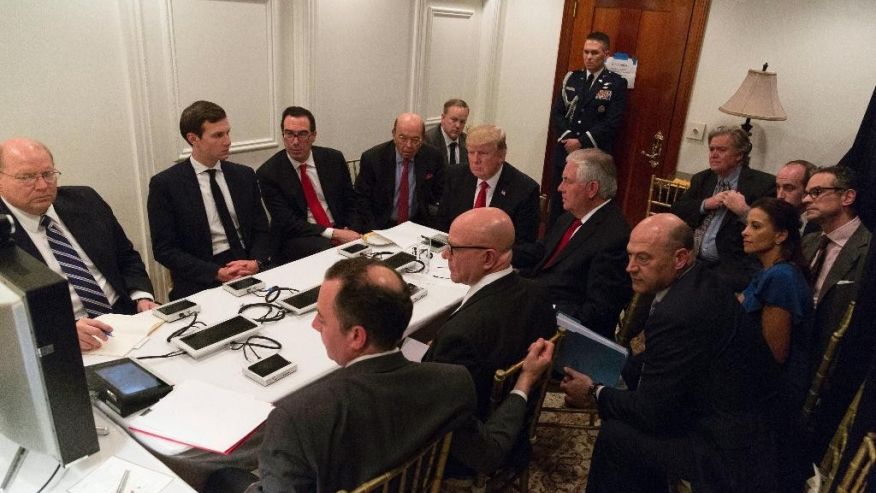
There is a dark mystery behind the White House-released photo showing President Trump and more than a dozen advisers meeting at his estate in Mar-a-Lago after his decision to strike Syria with Tomahawk missiles: Where is CIA Director Mike Pompeo and other top intelligence officials?

The photograph released by the White House of President 
Trump meeting with his advisers at his estate in Mar-a-Lago 
on April 6, 2017, regarding his decision to launch missile strikes against Syria.

Before the photo was released on Friday, a source told me that Pompeo had personally briefed Trump on April 6 about the CIA’s belief that Syrian President Bashar al-Assad was likely not responsible for the lethal poison-gas incident in northern Syria two days earlier — and thus Pompeo was excluded from the larger meeting as Trump reached a contrary decision.

At the time, I found the information dubious since Trump, Secretary of State Rex Tillerson and other senior U.S. officials were declaring quite confidently that Assad was at fault. Given that apparent confidence, I assumed that Pompeo and the CIA must have signed off on the conclusion of Assad’s guilt even though I knew that some U.S. intelligence analysts had contrary opinions, that they viewed the incident as either an accidental release of chemicals or an intentional ploy by Al Qaeda rebels to sucker the U.S. into attacking Syria.

As strange as the Trump administration has been in its early months, it was hard for me to believe that Trump would have listened to the CIA’s views and then shooed the director away from the larger meeting before launching a military strike against a country not threatening America.

After the strike against Syria by 59 Tomahawk missiles, which Syrian officials said killed seven people including four children, Trump gave a speech to the American people declaring flatly:

“On Tuesday, Syrian dictator Bashar al-Assad launched a horrible chemical weapons attack on innocent civilians. Using a deadly nerve agent, Assad choked out the lives of helpless men, women, and children. It was a slow and brutal death for so many. Even beautiful babies were cruelly murdered in this very barbaric attack. No child of God should ever suffer such horror.”

As much as Trump stood to benefit politically by acting aggressively in attacking Syria — and thus winning praise even from his harshest critics — the idea that he would ignore the views of the U.S. intelligence community on an issue of war or peace was something that I found hard to believe.

So, I put aside what I had heard from the source about the discordant Pompeo-Trump meeting as the sort of tidbit that may come from someone who lacks first-hand knowledge and doesn’t get all the details right.

After all, in almost every similar situation that I had covered over decades, the CIA Director or the Director of National Intelligence has played a prominent role in decisions that depend heavily on the intelligence community’s assessments and actions.

For instance, in the famous photo of President Obama and his team waiting out the results of the 2011 raid to kill Al Qaeda leader Osama bin Laden, CIA Director Leon Panetta is the one on the conference screen that everyone is looking at.

Even when the U.S. government is presenting false information, such as Secretary of State Colin Powell’s 2003 speech laying out the bogus evidence of Iraq hiding WMDs, CIA Director George Tenet was seated behind Powell to lend credibility to the falsehoods.

At the Table


But in the photo of Trump and his advisers, no one from the intelligence community is in the frame. You see Trump, Secretary of State Tillerson, National Security Adviser H.R. McMaster, White House chief of staff Reince Priebus, strategic adviser Steve Bannon, son-in-law Jared Kushner and a variety of other officials, including some economic advisers who were at Mar-a-Lago in Florida for the meeting with Chinese President Xi Jinping.

However, you don’t see Pompeo or Director of National Intelligence Dan Coats or any other intelligence official. Even The New York Times noted the oddity in its Saturday editions, writing: “If there were C.I.A. and other intelligence briefers around, … they are not in the picture.”

That made me wonder whether perhaps my original source did know something. The claim was that CIA Director Pompeo had briefed Trump personally on the analysts’ assessment that Assad’s forces were not responsible, but – then with Pompeo sidelined – Trump conveyed his own version of the intelligence to his senior staff.

In other words, the other officials didn’t get the direct word from Pompeo but rather received a second-hand account from the President, the source said. Did Trump choose to rely on the smug certainty from the TV shows and the mainstream news media that Assad was guilty, rather than the contrary view of U.S. intelligence analysts?

After the attack, Secretary of State Tillerson, who is not an institutional intelligence official and has little experience with the subtleties of intelligence, was the one to claim that the U.S. intelligence community assessed with a “high degree of confidence” that the Syrian government had dropped a poison gas bomb on civilians in Idlib province.

While Tillerson’s comment meshed with Official Washington’s hastily formed groupthink of Assad’s guilt, it is hard to believe that CIA analysts would have settled on such a firm conclusion so quickly, especially given the remote location of the incident and the fact that the initial information was coming from pro-rebel (or Al Qaeda) sources.

Thus, a serious question arises whether President Trump did receive that “high degree of confidence” assessment from the intelligence community or whether he shunted Pompeo aside to eliminate an obstacle to his desire to launch the April 6 rocket attack.

If so, such a dangerous deception more than anything else we’ve seen in the first two-plus months of the Trump administration would be grounds for impeachment – ignoring the opinion of the U.S. intelligence community so the President could carry out a politically popular (albeit illegal) missile strike that killed Syrians.

Investigative reporter Robert Parry broke many of the Iran-Contra stories for The Associated Press and Newsweek in the 1980s. You can buy his latest book, America’s Stolen Narrative, either in print here or as an e-book (from Amazon and barnesandnoble.com).

Pints Not Pipelines!

Pints Not Pipelines!

by Pull Together

Beer!


Tacos!


Human Rights!


Date and Time

Location

Performance Works
1218 Cartwright Street
Vancouver, BC V6H 3R8
 We will have local craft beer, food trucks and live music. Try the best of West Coast brews for an awesome cause!


EARLYBIRD/// 20 - admission gets you three beer tickets!

TICKETS AT THE DOOR /// 25

You get to vote on the best craft beer, all admission goes directly to Pull-Together- a fundraiser for First Nations lawsuits against the Kinder Morgan Transmountain tar sands pipeline.

For more information see https://pull-together.ca/

Sponsors include Dogwood Brewing Company, Faculty Brewing Strange Fellows Brewing Arturo's and Chickpea food trucks! More to be announced shortly, if you are part of a business and would like to donate, please get in touch!

Performance Works is an amazing venue on Granville Island!

If it is sunny out we will have the roll-up garage doors open and access to a great lawn! Regardless of weather we will have great dance jams Nikki Hebert from 90s night at the Astoria will be playing dark 80s pop and 90s jams!! and a bunch of great people celebrating this coast and standing with First Nations protecting it from tar sands expansion.

This event is organized on the unceded territory of the Coast Salish: the Musqueam Tsleil-Waututh and Squamish Nations.

Pull Together is donating to the Coldwater and Tsleil-Waututh First Nations and is organized by Force of Nature Alliance, RAVEN trust, Sierra Club BC and many passionate and dedicated volunteers.

This event is 19+
This venue is wheelchair accessible, and has wheelchair accessible washrooms

*beer responsibly* arrange a ride or take transit.

Canada Strengthens Ties, Signs "Defence" Deal with Kyiv Junta

Canadian-Ukranian Defence Deal Could Open Doors to Weapons Sales to Kyiv

by Levon  Sevunts - Radio International Canada

via New Cold War


April 5, 2017

Ukraine’s quest to get access to sophisticated Western weapons and defence technologies to fight Russian-backed rebels in the eastern part of the country got a step closer with a defence co-operation agreement signed in Ottawa earlier this week.

The bilateral deal, signed by Defence Minister Harjit Sajjan and his Ukrainian counterpart Stepan Poltorak on Monday, aims to identify “areas of mutual cooperation such as defence policy; defence research, development, and production; and military education.”

“Today’s signing of the Defence Cooperation Arrangement shows Canada’s steadfast commitment to Ukraine and the Ukrainian people,” Sajjan said in a statement.

“It strengthens the ties between our two nations and helps us continue to develop our rich, mutually beneficial relationships.”

The agreement is “a great sign of support for Ukraine,” said Ukraine’s ambassador to Canada Andriy Shevchenko in an interview with Radio Canada International.

(click to listen to the full interview with Andriy Shevchenko) - Listen

But it’s also a two-way street that would allow Canada to benefit from the cooperation with Ukraine, he said.

“One of the avenues of cooperation is to make sure that Ukraine shares the lessons that we learned fighting the war against Russia in the east of the country,” Shevchenko said.

“We pay a very high price for this experience and we want to make sure that our partners, our friends do get these lessons.”

The deal was also welcomed by the Ukrainian Canadian Congress (UCC), which had lobbied hard the previous Conservative and the current Liberal government of Prime Minister Trudeau to provide Ukraine with lethal military aid, in addition to the non-lethal assistance Ottawa began providing following Russia’s annexation [sic] of Crimea.

“Today’s signature is an important step forward in strengthening Canada and Ukraine’s bilateral security and defence relationship,” Paul Grod, national president of the UCC, said in a statement.

“At a time when Russia’s military aggression against Ukraine continues unabated, this Arrangement will help Ukraine’s military better defend their country and continue the reform of Ukraine’s defence institutions.”

After the collapse of the Soviet Union, Ukraine inherited a vast military industrial complex capable of producing everything from tanks and armoured vehicles to aircraft and ballistic missiles. However, without sustained investment in research and development, Ukraine’s defence industry has fallen behind of not only Western but also the Russian military industrial complex with which it was closely intertwined prior to the 2014 crisis in Eastern Ukraine.

The deal with Canada could give the once neglected Ukrainian defence industry access to state-of-the-art Canadian and Western technology, particularly in modern communications, electronics, night vision equipment, precision guided munitions, as well as target identification and acquisition systems.

“I think this agreement brings us one step closer to that objective,” Shevchenko said.

“We hope that it will help us to start a conversation with Canada about putting Ukraine into the Automatic Firearms Country Control List, but I think it’s important to look at this in the broader sense.”

The arrangement recognizes the fact that Canada and Ukraine have a very mature partnership, he said.

“I think there is very pragmatic common interest that we have that it comes to defence,” Shevchenko said.

“We share the same neighbour, which does not respect international law, which does not respect borders. And I think it’s a very clear pragmatic interest of Canada and Ukraine to make sure that we find a way to bring that neighbour back to respect international law.”

Coming on the heels of Trudeau’s decision to extend Operation UNIFIER, Canada’s military training mission in Ukraine until the end of March 2019, the deal signals further toughening of Ottawa’s line against Russia.

“Canada remains fully committed to providing assistance to Ukraine, helping to preserve and protect its sovereignty through Operation UNIFIER, and to supporting the implementation of key reforms,” Sajjan said.

However, as expected, the deal was met with stern criticism by Russian authorities.

“Rather than encourage Kiev regime’s military ambitions, real efforts should be taken by Ottawa to force the Ukrainian authorities to fully implement the Minsk accords, including direct political dialogue with Donetsk/Lugansk republics, as well as to push forward constitutional reform,” said Kirill Kalinin, the spokesperson of the Russian Embassy in Canada, referring to the pro-Russian self-declared republics in the rebel-controlled parts of Donetsk and Luhansk regions of Eastern Ukraine.

“Killings of civilians in Donbas by Ukrainian forces should have stopped a long time ago,” he added.

Both the pro-Western government in Kyiv and the pro-Russian rebels in the Donbas region accuse each other of undermining key elements of the 2015 Minsk Agreements to resolve the conflict by peaceful means.

Both sides also accuse of each other of indiscriminate shelling of civilian areas.

According to the UN human rights office, the total death toll from mid-April 2014 to early December 2016 stands at 9,758 with another 22,779 people injured. This includes more than 2,000 civilians killed and over 6,000 injured. Those numbers have only increased due to the recent flare-up of renewed fighting between government forces and rebels.

Related news on Radio Canada International:
Canadian troops to stay on in Ukraine, March 6, 2017

It’s called “Operation Unifier”. Canada’s two year mission to train Ukrainian military and police was due to expire at the end of this month. Ukrainian officials had been concerned at the delay in the decision by Canada to announce an end or extension of that mission. At a news conference today, it was announced the mission will be extended. Defence Minister Harjit Sajjan told reporters, the announcement sends the message that “we stand with Ukraine”.

It will now continue for another two years…

Nyet, Nyet: Trump Protests Too Much

Make America Neocon Again

by Gilad Atzmon


April 8, 2017

It doesn’t take a military analyst to grasp that the American attack on a remote Syrian airfield contradicts every possible military rationale.

If America really believed that Assad possessed a WMD stockpile and kept it in al-Shayrat airbase, launching a missile attack that could lead to a release of lethal agents into the air would be the last thing it would do.

If America was determined to ‘neutralise’ Assad’s alleged ‘WMD ability’ it would deploy special forces or diplomacy. No one defuses WMD with explosives, bombs or cruise missiles. It is simply unheard of.

America targeted al-Shayrat because it knew with certainty that there were no WMD in that location. It was a firework show. It had no military objective.

The first concern that comes to mind is why do you need a saxophonist to deliver the truth every military expert understands very well? Can’t the New York Times or the Guardian reach the same obvious conclusion? It’s obvious enough that if Assad didn’t use WMD when he was losing the war, it would make no sense for him to use it now when a victory is within reach.

So why did the White House launch a cruise missile blitz on a non-existent target?


We know who are the first to benefit from the current escalation. The Jewish State that gambled on regime change in Syria, consistent with the sinister Yinon Plan, accepts by now that Assad is there to stay. But here is the peculiar development: while the BBC, the Guardian, the New York Times and the White House refer to Assad and his ‘chemical warfare’ with certainty, the Israeli press is actually very careful. The Israeli Ynet only refers to Assad’s ‘alleged’ gas attack. The Israelis do understand that the story, as it stands, doesn’t make any sense.

But there may be another narrative that could introduce some method to the madness. The CIA and the FBI do not seem to drift away from Trump and his ties with Russia. This weekend we learned that former Trump adviser Carter Page 'gave documents to a Russian spy.' Carter Page, who was a foreign policy aide to the President before the election, met occasionally with Victor Podobnyy while the intelligence operative was working in the US. Mr Podobnyy was one of three men indicted by the FBI in 2015 on suspicion of working for Russia's SVR foreign intelligence service.

We also learned this weekend that Trump’s son-in-law Kushner failed to alert the FBI to several meetings with Russian officials despite a legal obligation to do so. His lawyer described the omission as an "administrative error."

The Guardian reports that the CIA actually reported to senior lawmakers in classified briefings last summer that it had information indicating that Russia was working to help elect Donald J. Trump as president, a finding that did not emerge publicly until after Trump’s victory months later.

President Trump has rejected any suggestion of a Russian connection as “ridiculous” and “fake news.” Trump could probably win the liberal press but the CIA and FBI have proved harder nuts to crack.

Trump was left with no other option, he needed a firework show to convey a clear image of a conflict between himself and Putin. He had to invent a war with Russia. The Mirror bought into this façade: ‘Donald Trump warned he is one step away from military clashes with Russia,' its headline read.

It seems as if launching a missile attack on a deserted Syrian airfield while alerting the Russians in advance would convey the necessary patriotic image to the American people. It would convince the Ziocons that the White House is ready to launch WWIII on their behalf.

The attack was there to convince the American people that Trump is not a Russian puppet. Shockingly enough, the liberal press was very quick to straighten line with Trump.

The uniquely banal Jonathan Freedland wrote in the Guardian today “sometimes the right thing can be done by the wrong person. Donald Trump’s bombing of a Syrian airfield seems to belong in that category.” Seemingly the Guardian never misses an opportunity to rally for a Ziocon war.

The only question that has remained open is whether such a drone blitz on an abandoned Syrian airbase will convince Trump’s constituency that by now ‘America is, once again great.’

Et Tu, Noam?

Is Noam Chomsky Manufacturing Consent for Regime Change in Syria?

by Kim Petersen - Dissident Voice


April 8th, 2017  

One might well expect the corporate/state media to twice be complicit for the “gas attack perpetrated by the Syrian regime” scenario. One would hope, however, media independent of the state and corporate sponsors would apply a higher journalistic standard. Yet Democracy Now! has been pushing the imperialist agenda for regime change in Syria.

Tendentious recent reports from DN make this abundantly clear. The so-called independent1 DN has also lured octogenarian professor Noam Chomsky to criticize the “Assad regime.”

DN begins with the leading statement of “worldwide outrage mounts over an alleged chemical weapons attack in Idlib province, which was reportedly carried out by the Assad government…” No evidence is presented to support the accusation, and the accusers also are unnamed. What kind of journalism is this?

It would be completely nonsensical and insane for Syria to use chemical weapons while the war is turning in its favor. And, of course, there is evidence that refutes the allegation. For the record, when a Zionist and war criminal Barack Obama was bent on attacking Syria in 2013 following false accusations that the Assad government used sarin gas in Ghouta, Syria – to preempt the threatened invasion Assad agreed (UN Resolution 2118) to give up Syria’s stockpile of chemical weapons (a deterrence against Israel’s nuclear weapons).

Now the Syrian government stands accused of using a chemical that was disposed of under international supervision. Is the Syrian government that stupid to risk another threat of invasion by using a non-conventional attack? And why is this new gas attack in Idlib taking place just after Rex Tillerson declared that it is the Syrian people who should decide the fate of their current president?

The professor tells DN:

“Syria is a horrible catastrophe. The Assad regime is a moral disgrace. They’re carrying out horrendous acts, the Russians with them.”

How about a dose of skepticism? After all, Chomsky speculated recently of a Donald Trump-orchestrated false flag. Chomsky’s opening omissions speak loudly. He goes straight at the Syrian government; he does not mention involvement by the US, Israel, and other western states. He does not mention the western, Saudi, and Qatari-backed terrorist mercenaries that seek to topple a foreign government through violence.

Indeed Chomsky, the linguist, has dipped into the imperialist lexicon. He criticizes the Assad “regime.” I am unaware of Chomsky ever referring to a Trump, Obama or other US “regime” or of an Israeli “regime.” To be sure, Chomsky has been a critic of US terrorism and imperialism and of Zionist crimes against Palestinians, but I am unaware of Chomsky referring to US, Israeli, or other western regimes as a “moral disgrace.” It might be implicit but not explicit.

Moreover, to criticize “the Assad regime” seems starkly at odds with a fundamental tenet of Chomsky’s philosophy: that his concern is primarily the terror and violence carried out by his own state, the USA.2

Chomsky is even on record as denying American-Israeli intent at regime change in Syria. If Chomsky is correct, then that would signal a profound change in American imperialist direction. In 2007, former US general Wesley Clark, told of a classified memo describing the US “tak[ing] out seven countries in five years, starting with Iraq, then Syria, Lebanon, Libya, Somalia, Sudan and Iran.”

DN asks Chomsky: “Why the Russians with them [the ‘Assad regime’]?”

Replied Chomsky:

“Well, pretty simple reason: Syria is their one ally in the whole region. Not a close ally, but they do have—their one Mediterranean base is in Syria. It’s the one country that’s more or less cooperated with them. And they don’t want to lose their one ally. It’s very ugly, but that’s what’s happening.”

That is Chomsky’s assessment, but it is factually inaccurate. Iran and Hezbollah are helping fight the terrorists in Syria. Also Chomsky does not discuss an important point: that Russia was invited to aid the Syrian government, as were Iran and Hezbollah.3

The US is uninvited and Syrian president Assad calls US forces in Syria “invaders.” Chomsky is well versed as to what happens when uninvited US forces show up in foreign lands – among them Korea, Viet Nam, Panama, Grenada, Somalia, Haiti, Afghanistan, Iraq, Libya, Yemen, etc: genocide, millions killed, millions displaced, economic infrastructure destroyed, and vassalage.

Later in the interview, Chomsky almost exculpates the Russians when he mentions

“an initiative from the Russians … for a negotiated settlement, in which Assad would be phased out, not immediately…. The West would not accept it, not just the United States. France, England, the United States simply refused to even consider it. At the time, they believed they could overthrow Assad, so they didn’t want to do this, so the war went on.”

Is the West’s refusal of a negotiated settlement not a “moral disgrace”?

Says Chomsky,

“Qatar and Saudi Arabia are supporting jihadi groups, [Italics added. Again Chomsky borrows from the imperialist lexicon. Why not characterize, then, western groups as “crusaders”?] which are not all that different from ISIS. So you have a horror story on all sides. The Syrian people are being decimated…. the country is simply being destroyed. It’s descending to suicide.”

Suicide? When US invaders are in Syria, when western governments and operatives are arrayed against the Syrian government, when Saudi and Qatari governments are supporting terrorists, and when Syrian people are being killed and made into refugees, then why describe this as a “suicide”? Does Chomsky want to imply that the Syrian people bear responsibility for the horror and decimation imposed upon them from outside? It sounds absurd.

Moral Imperatives


As a first imperative, all uninvited outsiders should vacate Syria immediately. As a second imperative, all parties responsible for aggression against Syria and its peoples must be charged and prosecuted. Third, any crimes committed by the Assad government in allegedly putting down peaceful protests must be investigated and where such charges are valid, then prosecution must be carried out.

Noam Chomsky has garnered enormous respect for his opposition to US crimes, support for social justice, and anarchist leanings. Yet, Chomsky also stakes out positions that appear flawed (his statement that the truth doesn’t matter as to 9-11), even morally questionable (his opposition to the Palestinian-led Boycott, Divestment, and Sanctions movement).

It is imperative is that people become informed. We should all listen to the words of intellectuals and persons who have demonstrated great integrity, but we must also pay heed to our internal dissonance to seemingly incongruous information; we must question and apply rigorous challenge to that information; and based on our assessment of the factual accuracy, logic, and morality of the information we must reach our own conclusions.

Avoid the allure of unquestioningly accepting the words of authority!

Regardless of personage, open-minded skepticism is the key to developing our own ability to cut through disinformation and thwart the insidious acts propaganda is intended to disguise. Critical and moral thinking is crucial to the revolution for a free and socially just world.


As the whistleblowing former FBI contractor Sibel Edmonds, among others, has pointed out DN receives large foundation grants:

Serious questions have arisen about how Democracy Now!, begun and developed with the resources of Pacifica Radio and grants from the Carnegie Corporation, the Ford Foundation, the J.M. Kaplan Fund and others, suddenly became independent and the effective property of Amy Goodman without recompense to Pacifica. This transfer apparently included valuable assets such as trademarks, ownership of years of archived programs, affiliate station access, and more. 


In a contract that remains secret, Amy Goodman is also receiving $1 million per year for a five-year period that began in 2002, according to Pacifica Treasurer Jabari Zakiya, to continue doing what has become Pacifica’s flagship morning news program. This is more than double Goodman’s officially stated stipend of $440,000 per year from Pacifica Radio. 

Democracy Now! receives indirect funding from George Soros, and direct funding from the Ford Foundation, the Glaser Foundation, Soros’ Open Society Institute… [emphasis in original] [1]
See Noam Chomsky, On Power and Ideology: The Managua Lectures (South End Press, 1987.) [2]
Colleague BJ Sabri and I concluded in part 6 — “A Russian White Knight or an Interventionist Power?” — of our 7-part series on “The Imperialist Violence in Syria”:
“Russia, although it entered the war on the side of the legitimate government, Russia has never declared any strategy or long-term objective in Syria except the one supporting a legitimate U.N. member from not being overrun by American/Saudi-supported terrorists and mercenaries.” [3]


Kim Petersen is a former co-editor of Dissident Voice. He can be reached at: kimohp@gmail.com. Twitter: @kimpetersen.
Read other articles by Kim.

Ghouta II: Try, Try Again for War Framers

Chemical Attack in Idlib — Duplication of Eastern Ghouta Scenario

by Mariam Alhijab - Inside Syria Media Center


April 8, 2017

On April 7, two U.S. Navy battleships USS Porter (DDG-78) and USS Ross launched 59 Tomahawk cruise missiles at al-Shayrat military airfield in Syria’s Homs province from the Eastern Mediterranean. The U.S. strikes particularly targeted the main landing strip, aircraft, radio locators, air defense system and fuel stations.

The strike was approved by U.S. President Donald Trump, who said that the Syrian Air Force had used affiliated al-Shayrat air base to prepare chemical attack on the city of Khan Shaykhun in Idlib.

 “It is in this vital national security interest of the United States to prevent and deter the spread and use of deadly chemical weapons”, Trump said.

Previously, on April 4, several European states accused Syrian Air Force of using warfare poisonous agents while striking Khan Shaykhun. Syrian government, in its turn, refuted these accusations, stating that the target of the strike was a militants’ position where they had organized a chemical depot. The strike led to the spread of poisonous agents and dozens of casualties among civilians.

Though the situation in Khan Shaykhun is still unclear, the U.S., France, and Great Britain have already prepared and sent a draft resolution to the U.N. In their draft, they put the responsibility for the death of civilians on the Syrian government. The tragedy in Khan Shaykhun allowed Washington to duplicate the scenario developed in 2013 for a chemical attack in Eastern Ghouta. Then the U.S. President Barack Obama also considered a possible military strike on Syria, allegedly in order to prevent the use of chemical weapons in future.

However, in 2013 several reasons prevented the U.S. from initiating large-scale aggression against Syria. Just after being published, the materials about the use of chemical weapons began to acquire additional details, which indirectly indicated the involvement of the U.S. and their allied groups in the false flag chemical attack. It turned out that this provocative act had been preliminary and carefully planned by the military experts. This is evidenced by hacked correspondence of U.S. Army Colonel Anthony Jamie MacDonald, who was General Staff Director, Operations and Plans Office of the Deputy Chief of Staff for Army Intelligence in 2013. On August 22, the day after the chemical attack, MacDonald received a message from his colleague Eugene Furst with congratulations on the “successful operation” and a link reference to an article on Eastern Ghouta in The Washington Post.

The media leak of MacDonald’s correspondence has become another piece of evidence proving that the Syrian government was not involved in the use of chemical weapons in Eastern Ghouta.

Earlier, Damascus had already been blamed for using poisonous substances, but all these attempts to make the accusations stick have failed. In the same 2013, the UN investigation proved that the militants were responsible for the use of sarin . Carla Del Ponte, the head of the UN commission, stated so publicly. Subsequently, it turned out that the availability of chemical ammunition among opposition groups was recorded on video.

Moreover, some American analysts also pointed out the doubtful nature of the information claiming the involvement of Damascus in chemical attacks. In an open message to Barack Obama, former CIA officers blamed CIA director George Bennett for providing unreliable information to the U.S. authorities regarding the incident in Eastern Ghouta and for using it to prepare members of the U.S. Congress, the media and the public for an attack on Syria.

Finally, under the pressure of the world community, Washington had to join the Russian initiative to eliminate chemical warfare agenda in Syria. This operation was held under the supervision of the Organization for the Prohibition of Chemical Weapons (OPCW) and was successfully completed in January 2015.

As in the case of Eastern Ghouta, Western media have given biased reporting of the incident in Khan Shaykhun, accusing the Syrian government of causing the death of civilians without seeing even preliminary results of an investigation. At the same time, as if not to burden its readers with unnecessary doubts about the official version of events, the Daily Mail removed from its website a 2013 article about the U.S. plans to stage false flag chemical attacks in Syria.

Against this background, Washington’s decision to fall back upon its original scenario for Eastern Ghouta raises many questions. First, it contradicts the promises made during Donald Trump’s election campaign, when he promised to stop military actions directed against Bashar Assad and to focus instead on fighting terrorism. Second, accusing Damascus of using chemical weapons contradicts the OPCW statement confirming the successful conclusion of its removal program, in which the U.S. also took part. Third, it is unclear what the White House wants to achieve by escalating conflict in Syria.

The chemical attack in Idlib appears to be another provocation by the U.S., an attempt to justify a military intervention in Syria. It seems also that the new American administration is paying for its approval ratings with the blood of innocent Syrians as it tries to strengthen its internal political position.

United Media Cheer for Trump Warmaking

As U.S. Politicians and Pundits Cheer Syria Bombing, Will ISIS and Al Qaeda Benefit? 

by TRNN


April 8, 2017

Independent journalist Rania Khalek discusses the near-uniform media and political support for President Trump's decision to bomb a Syrian military airfield, the need for an independent investigation into the Idlid chemical attack, and why she thinks the U.S. strike may benefit ISIS and Al Qaeda.


Rania Khalek is an independent journalist and co-host of the weekly podcast Unauthorized Disclosure. Her work has appeared at The Nation, FAIR, Vice, The Intercept, Alternet, Salon, The Electronic Intifada, Al Jazeera and more. 

Friday, April 07, 2017

After the Bombing: How Can Don Make It Up with Vlad?

The Impending Clash Between the U.S. and Russia

by Mike Whitney - CounterPunch 


April 7, 2017

President Donald Trump’s missile attack on the Shayrat Airfield in Western Syria was a poorly planned display of imperial muscle-flexing that had the exact opposite effect of what was intended.

While the attack undoubtedly lifted the morale of the jihadists who have been rampaging across the country for the last six years, it had no military or strategic value at all. The damage to the airfield was very slight and there is no reason to believe it will impact the Syrian Army’s progress on the ground.

The attack did however kill four Syrian servicemen which means the US troops in Syria can no longer be considered part of an international coalition fighting terrorism. The US is now a hostile force that represents an existential threat to the sovereign government.

Is that the change that Trump wanted?

As of Friday, Russia has frozen all military cooperation with the United States. According to the New York Times:

“In addition to suspending the pact to coordinate air operations over Syria, an accord that was meant to prevent accidental encounters between the two militaries, Russia also said it would bolster Syria’s air defense systems and reportedly planned to send a frigate into the Mediterranean Sea to visit the logistics base at the Syrian port of Tartus….

Dmitri S. Peskov, a spokesman for President Vladimir V. Putin of Russia, said that the cruise missile strikes on Friday represented a “significant blow” to American-Russian ties, and that Mr. Putin considered the attack a breach of international law that had been made under a false pretext. “The Syrian Army has no chemical weapons at its disposal,” Mr. Peskov said.” (New York Times)

The missile attack has ended all talk of “normalizing” relations with Russia. For whatever the reason, Trump has decided that identifying himself and the United States as an enemy of Moscow and Damascus is the way he wants to conduct business. That, of course, is the President’s prerogative, but it would be foolish not to think there will be consequences.

Russia’s Minister of Defense Maj. Gen. Igor Konashenkov issued a statement saying:

“All the accusations against Damascus that it violated the Chemical Weapons Convention of 2013 given by the USA as reasons for the strike are groundless. The Russian Defence Ministry has repeatedly explained that the Syrian troops had not used chemical weapons….

It is to be stressed that in the years 2013-2016 the Syrian government undertook all measures to eliminate chemical weapons, its delivery systems, production facilities. All chemical weapons stocks have been eliminated. The components for their production have been transported from the Syrian Arab Republic to the enterprises of the United States, Finland, Great Britain, and Germany where they have been destroyed.”

This is a hotly contested issue and one that requires greater clarification. The rational approach would be for the UN to send a team of chemical weapons and forensic experts to the site of the bombing to try to figure out what really happened. Trump decided he couldn’t be bothered with such trivialities as a formal investigation. He was more interested in projecting the image of a strong and decisive leader which is why he decided to shoot first and ask questions later. His action was applauded by leaders around the world including Angela Merkel, François Hollande, Recep Erdogan of Turkey, Saudi Arabia, and Israel none of who believe that the United States should have to get the nod from the UN Security Council before bombing a sovereign country.

I don’t know who is responsible for the chemical attack at Khan Shaikhoun, but there is an interesting interview on Thursday’s Scott Horton show that suggests that things may not be what they seem. In a 14 minute interview, former CIA officer and Director of the Council for the National Interest, Philip Giraldi, explains what’s happening behind the scenes in the Middle East where “military and intelligence personnel,” “intimately familiar” with the intelligence, say that the narrative that Assad or Russia did it is a “sham.”

I have transcribed a 5 minute segment of the interview here– not because it provides conclusive evidence one way or the other— but because curious readers will find it intriguing. (Any mistakes in the transcript are mine.)

Philip Giraldi– I am hearing from sources on the ground, in the Middle East, the people who are intimately familiar with the intelligence available are saying that the essential narrative we are all hearing about the Syrian government or the Russians using chemical weapons on innocent civilians is a sham. The intelligence confirms pretty much the account the Russians have been giving since last night which is that they hit a warehouse where al Qaida rebels were storing chemicals of their own and it basically caused an explosion that resulted in the casualties. Apparently the intelligence on this is very clear, and people both in the Agency and in the military who are aware of the intelligence are freaking out about this because essentially Trump completely misrepresented what he should already have known — but maybe didn’t–and they’re afraid this is moving towards a situation that could easily turn into an armed conflict.
Scott Horton– Tell me everything you can about your sources or how you are learning about this?

Philip Giraldi– Okay. These are essentially sources that are right on top of the issue right in the Middle East. They’re people who are stationed there with the military and the Intelligence agencies that are aware and have seen the intelligence And, as I say, they are coming back to contacts over here in the US essentially that they astonished at how this is being played by the administration and by the media and in some cases people are considering going public to stop it. They’re that concerned about it, that upset by what’s going on.

Scott Horton– So current CIA officers are thinking about going public right now?

Philip Giraldi– They are, because they’re that concerned about the way this thing is moving. They are military and intelligence personnel who are stationed in the Middle East and are active duty and they are seeing the intelligence the US government has in its hands about what happened in Syria, and the intelligence indicates that it was not an attack by the Syrian government using chemical weapons… There was an attack but it was with conventional weapons–a bomb– and the bomb ignited the chemicals that were already in place that had been put in there by the terrorist group affiliated with al Qaida.

Scott Horton– You say this thing is moving really fast. How fast is this thing moving?

Philip Giraldi– It’s moving really fast. Apparently the concern among the people who are active duty personnel is that the White House is anticipating doing something to take steps against the Syrian government What that might consist of nobody knows. But Trump was sending a fairly clear signal yesterday and so was our ambassador to the UN. about the heinousness of this act. Trump talked about crossing numerous “red lines” and they are essentially fearful that this is going to escalate . Now bear in mind, Assad had no motive for doing this. If anything, he had a negative motive. The Trump said there was no longer any reason to remove him from office, well, this was a big win for him. To turn around and use chemical weapons 48 hours later, does not fit ant reasonable scenario, although I’ve seen some floated out there, but they are quite ridiculous.” (The Scott Horton Show)

I think you’ll find that listening to the whole show is worth the time.

Giraldi’s observations are persuasive but not conclusive. There needs to be an investigation, that much is certain. (The show was taped before the missile attack, which does show that Giraldi was right about “how fast” things were moving.)

Media analysts appear to be surprised that Russia hasn’t responded militarily to Thursday’s attack. Some even see it as a sign of weakness. But Moscow’s approach to Washington’s impulsiveness has been fairly consistent for the last decade or so. With as little fanfare as possible, Moscow goes about its business and works discreetly to protect its interests. Unlike Trump, Putin is not a man who likes to attract a lot of attention to himself. He likes to operate off the radar. Even so, Russia has a coherent policy in Syria (fighting terrorism and preserving the sovereign government) and it’s not going to veer from that policy. Most Americans don’t seem to understand that. Russia’s not going to budge, which is why the Kremlin cut off cooperation with Washington, shored up its missile defenses in Syria, and moved a frigate to the Mediterranean. Moscow does not want a broader conflict, but it will be prepared if one breaks out.

The Russians are concerned about Trump’s sudden escalation, but they’re not surprised. They have spotted a pattern in US war-making and they’re able to comment on it quite calmly despite its terrible implications. Here’ more from the Russian Minister of Defense:

“The US administrations have changed but the methods for unleashing wars have remained the same since bombardments of Yugoslavia, Iraq, and Libya. Allegations, falsifications, grandstand playing with photos and test-tubes with pseudo results in international organizations became the reason for initiating aggression instead of an objective investigation.”

Lie, bomb, kill, repeat. Konashenkov doesn’t sound surprised at all, does he? It’s a pattern, a deadly, frightening pattern. The only thing that changes is the names of the victims.

And here’s another thing readers might find interesting: The Russians have an impressive grasp of Washington’s global strategy, in fact, their analysis is vastly superior to anything you’ll read in either the western journals or the establishment media. Here’s a short clip from a recent speech by Russian Foreign Minister Sergei Lavrov:

“The concept of managed chaos appeared long ago as a method of strengthening US influence. Its basic premise is that managed chaos projects should be launched away from the United States in regions that are crucial for global economic and financial development. The Middle East has always been in the focus of politicians and foreign policy engineers in Washington. Practice has shown that this concept is dangerous and destructive, in particular for the countries where the experiment was launched, namely Iraq, Libya, Syria, Yemen and Afghanistan…In Iraq, Syria and Libya, this chaos was created intentionally.

…Responsible politicians have come to see that the managed chaos theory is destroying life in many regions. Some parties can benefit in the short term from fluctuations on the raw materials markets provoked by the revolutions orchestrated by external forces, but this theory ultimately backfires at its engineers and executors in the form of massive migration inflows, which terrorists use to enter these countries. We can see this in Europe. Terrorist attacks have been staged even in the United States. The Atlantic Ocean has not protected it from the terrorist threat. This is the boomerang effect.” (Lavrov)

“Managed chaos”. Brilliant. That’s Washington’s foreign policy in a nutshell. That’s why there’s been no effort to create strong, stable, secular governments that can provide security for their people in any of the countries the US has destroyed in the last 16 years, because this long string of failed states that now stretches from North Africa, through the Middle East and into Central Asia (The ‘arc of instability’) create a permanent justification for US military intervention as well as strategic access to vital resources. So why waste money and time on nation building when nation building runs counter to Washington’s strategic objectives? Instead, decimate the nation state wherever you go, and leave the people to scratch out a miserable hardscrabble existence for themselves while fending off the relentless violence and persecution of tribal elders or local warlords.

Is that a fair assessment of US foreign policy?

Indeed, it is. And the Russian leadership understands the far-reaching implications of that policy. They know that Washington’s ambitions could result in a war between the two nuclear-armed adversaries. They fully understand that.

Even so, they’re not going to budge. They’re not going to let Syria become another Iraq. They’re not going to let that happen.

So, it’s all coming to a head. The unstoppable force is fast approaching the immovable object. There’s going to be a collision.
 
MIKE WHITNEY lives in Washington state. He is a contributor to Hopeless: Barack Obama and the Politics of Illusion (AK Press). Hopeless is also available in a Kindle edition. He can be reached at fergiewhitney@msn.com.
More articles by:Mike Whitney