Tuesday, May 16, 2017

A Palestinian Gardener Abroad

Luxembourg and Belgium

by Mazin Qumsiyeh - qumsiyeh.org


May 16, 2017

Colleagues and friends; I really do not like to leave Palestine even for short travels abroad but it is important to take the message especially to new audiences and build a world-wide movement for peace, justice, and sustainability. So here I am in Luxembourg and Belgium. Below are public lectures I am giving, (those nearby are invited).

There are also many other non-public events such as speaking to academics about collaboration, visiting natural history museums and botanical gardens, networking etc.

For example yesterday I had a nice visit to a cooperative organic farm (www.terra-coop.lu), a community garden, and dinner at a home with activists planning future events.

Meanwhile, staff and volunteers at the museum and the garden are doing well and work moves on. We had nice celebration with the Canadian representative of an end of a project on sustainability. We progress in two other funded projects and dozens of unfunded projects relating to biodiversity, environmental conservation, sustainability, and preserving cultural and natural heritage.

Every day whether in Palestine or abroad, I am reminded of how kind and decent human beings can be because I am surrounded by those types of people. People who genuinely care for the planet we live in and all those who share it. Surely we are far more numerous than those minorities that care only for their own short-term needs. The greedy are unfortunately in powerful positions in the media and politics and the common decent people are left to be "the opposition".

But we do organize and struggle and survive even against difficult odds. We believe "intentional communities" of caring human beings are the key to long term survival. The stakes are very high (no less than our future as a species). Indeed we may learn to live together as fellow human beings or perish together as fools.

16 May at 20:00 Haus vun der Natur. Kockelscheuer. 5, route de Luxembourg
L-1899 Kockelscheuer Parking: P&R Kockelscheuer Transport public: Ligne 18,
Kockelscheuer, Patinoire

18 May at 18:00 Conférence Lycée Michel Lucius + verre amitié. L’écologie
dans une situation d’occupation

21 May 12:00 brunch palestinien14:00 conférence-débat sur la résistance
palestinienne Marcinelle (Charleroi) rue de la Vieille Place, 67, 6001
Marcinelle.
Organisation : Plate-forme Charleroi-Palestine

Stay Human and come visit us in Palestine


Mazin Qumsiyeh
A bedouin in cyberspace, a villager at home
Professor and (volunteer) Director
Palestine Museum of Natural History
Palestine Institute of Biodiversity and Sustainability
Bethlehem University
Occupied Palestine
http://qumsiyeh.org
http://palestinenature.org
Join me on facebook https://www.facebook.com/mazin.qumsiyeh.9

HumanRights newsletter
http://lists.qumsiyeh.org/listinfo/humanrights

Monday, May 15, 2017

State of the Fourth Estate

American/Russian Vladimir Posner on the State of Journalism

by David Swanson - Let's Try Democracy


May 15, 2017

Vladimir Posner, who spent his youth in the U.S., France, and the Soviet Union, and co-hosted a TV show with Phil Donahue for years, met with a group of visitors to Moscow from the U.S. Monday, offering his well-informed views on a range of media-related topics.

Posner said that for years he worked on Soviet propaganda aimed at the United States. The first blow to his full belief in the rectitude of the USSR came, he said, with the Soviet invasion of Czechoslovakia in 1968. He eventually concluded that he was not telling the truth, that by telling only good things he was telling half the truth, which is a falsehood. He quit the job and he quit the Communist Party.

In the days of Gorbachev, Posner was permitted to travel, and moved back to the United States, where he co-hosted that program with Donahue until CNBC got a new president by the name of Roger Ailes. The new boss demanded the right to approve or reject topics or guests. “That’s censorship,” Posner told him. “I don’t give a rat’s ass what you call it,” Ailes replied.

So, back to Moscow it was. Posner has hosted his current weekly television show in Russia for 8 years. He says he will never again work for a government or a party, and he’ll sign a contract with a company only if it leaves him independent control.

We had heard from other Russian journalists in the preceding days who had painted a very positive picture of Russian media, telling us that there is no censorship, and that more newspapers in Russia oppose Putin than support him. Posner has a bit stricter definition of censorship, I think, as well as a television perspective.

“Anyone who told you there are no restrictions on Russian media was not telling you the truth,” he said.

He said that Russia’s state television channels (1, 2, and 4, and Red TV) serve the government and dominate the audience. “There are things you cannot say and people you cannot invite on,” he said. “You cannot criticize Putin on those networks.”

On smaller, private networks you can, as well as in print and on radio. “The smaller your audience, the greater your freedom.” Posner agreed that several newspapers oppose Putin, but denied that they are a majority, and dismissed their audience as no more than 1 million readers, albeit an elite readership. One of the main reasons that Putin has 80% support, Posner said, is state television. The party line in Russia and the company line in the U.S. amount to about the same thing, Posner said.

Asked later for the most common complaints with Putin, Posner didn’t offer any. Instead, he tried to explain Putin’s popularity; and the explanation may have been understood as functioning through television spin, but it also seemed factual. Posner said that people see Putin as having stood up to the 800-pound American gorilla, restoring pride to the disrespected federation of Russia. Russians were ready to be hugged when they got rid of communism. Instead they were given the rotten deals of the 1990s and now endure sanctions that have lowered incomes by 10% to 12% (while benefiting Russian agriculture) — a state of affairs that Posner predicted would win absolutely no concessions out of Russia.

Posner offered as an example of a dishonest company line Christiane Amanpour of CNN, who had never been to Crimea, reporting that people in Crimea voted to rejoin Russia only under the threat of Russian soldiers.

“She was lying.”

Posner suggested that David Remnick of the New Yorker is better informed yet seemingly writes something very different from what he must know. Posner said that the New Yorker‘s ownership by Conde Nast is typical of a trend away from independence in the U.S.

Asked about Russia Today (or RT, Russian TV for Americans) he dismissed it as propaganda showing only the good in Russia and only the bad in the United States. But for those of us who ignore RT reporting on Russia and appreciate its reporting on uncovered topics in the U.S., Posner seems right only up to a point when he states that no audience will ever turn to a foreign source over a domestic one.

In fact, Posner immediately offered the counter-example of the popularity of the Voice of America, the BBC, and German broadcasting in the USSR.

Posner glides effortlessly from criticizing Russian media to criticizing U.S. media and back again. The U.S. media, he says, has demonized Russia since 1918 and has done so far more than Russian or Soviet media has ever done the same to the United States. In Posner’s estimation, Putin is demonized in U.S. media in ways that even Stalin was never subjected to. He cited as an example a graphic depicting Putin’s shadow as falling over a downed airplane in Ukraine. Putin asked to join the EU, for goodness sake, he asked to join NATO, and the U.S. turned him down, explained Posner.

Posner said that when he was a kid in the United States, Americans knew that it was the Soviet Union that won World War II, and loved Russia for it. Now, Americans have no idea. Russians, meanwhile, have come to identify Americans with their government’s hostile policies to a degree not seen during the Cold War. Everyone used to like Americans and dress like Americans, etc.

Posner explains the Russian attitude as the product of Russian propaganda and of the absence of stories of Americans protesting Washington. (I gave Posner thousands of messages from Americans hoping to fill that gap.) Posner also blamed the failure of the U.S. to provide anything like a Marshall Plan in the 1990s, or to assist in the development of democracy, something Russia had never had. Asked whether the Marshall Plan in Germany and Japan had left Europe and Japan totally subordinate to the United States, and whether Russia would have suffered the same fate, Posner seemed inclined to believe that is not what would have happened.

In explaining Russia’s lack of a democratic tradition, Posner said that Putin actually believes that the U.S. president can call up the New York Times and ask them to print a story, and they will. Well, label me a Russian autocrat, but we know of many cases of the White House feeding stories to the New York Times, and many of it suppressing stories at the New York Times. The drone kill list story of 2014 comes to mind as an example of the former (or, if you prefer, the aluminum tubes story of 2003), and the NSA mass-surveillance story of 2004 as an example of the latter.

Asked why Russians are so attracted to capitalism, Posner explained that people used to wait in lines for everything, and then suddenly everything was available in stores for anyone who had money. Now, he said, nothing is more important than money.

He said that young people prefer the professions that make the most money. (That’s not my limited experience with young Russians.) Posner later said that Russia is like the United States in believing it has a mission.

He described the mission as being against materialism. Of course, both of these strains (money worshipping and money despising) can be present in Russians without contradiction, but which wins out seems undetermined, as well as whether both are real. Posner did not seem to believe the Russian belief in its anti-materialism was actually justified.

What advice would you give to Trump, someone asked Posner.

He would tell him that the big problems of the world (he listed climate change and terrorism, among others — one of which Trump doesn’t believe in, and both of which Trump enthusiastically engages in) cannot be solved without Russia, and without China as well.

Posner warned that Trump’s emotional reactions make accidental nuclear apocalypse more dangerous than ever.

The stories Posner told are too many for me to recount them all, but here are four.

“There is no patriotism in journalism.” Like a doctor on a battlefield who will not stop to determine nationality before aiding the wounded, a journalist must not consider national partisan interests before reporting the truth that will benefit the public.

Long ago, Fred Friendly gathered a group of journalists including Posner together and asked what they would do if they saw on a desk a top-secret document stating that their nation would launch a war in 10 days. He said that within 30 seconds they had all said they would do everything they could to report it. Today that would not be the same, Posner claimed. And even back then, he said, it would not have been the same in Russia.

The first American film  that Posner saw was “One Flew Over the Cuckoo’s Nest.” He said that he walked out of the theater a changed man. He points to the moral lesson in the main character’s comment “Well, at least I tried.” This line was spoken upon failing to rip a sink out of the floor. But only because of that attempt did a physically stronger character later attempt and succeed. Whether or not you fail, said Posner, the important thing is to try — echoing perhaps Camus on Sisyphus, or — more to the point — I.F. Stone on the only battles worth fighting being the ones that will only be won in a future generation.

Posner visited Georgia (not the peach one) for the first time, and his friend took him out eating and drinking with a bunch of people he hadn’t met before, all of whom proceeded to toast and drink to his superior character, his wonderful admirable self, for five hours or more.

Later, Posner asked why strangers would say such things about him. They seemed false and hypocritical to Posner. But his friend replied: First of all, they know that you are my friend. Second, if you are the last son of a bitch, then you will have never heard good words about yourself and maybe these words will change you.

Gorbachev on a New and Growing Nuclear Peril

Gorbachev Warns of Growing Danger

by Rick Sterling  - Consortium News


May 15, 2107

The former President of the Soviet Union, Mikhail Gorbachev, is 87 years old but still sharp. He told a delegation of 30 Americans on a two-week visit to Russia organized by the Center for Citizen Initiatives,

“This is a time to be concerned. We should worry about relations between our two countries. … Things cannot continue as they are.” 
Former Soviet leader Mikhail Gorbachev

President Gorbachev recalled his initial meetings with President Reagan, which came after six years of poor relations and hostility. In the first summit meeting, Reagan issued a long list of accusations against the Soviet Union; Gorbachev responded with his own accusations against the U.S. After that meeting Gorbachev said “He’s not a hawk; he’s a dinosaur” while Reagan said about Gorbachev “He’s a die-hard communist.”

At the next summit meeting, Reagan continued lecturing Gorbachev. After listening for 15 minutes. Gorbachev stopped Reagan saying,

“That’s enough. If you want to talk as equals we can go very far. Differences can be bridged. Problems can be resolved. But as equals.”

Reagan asked how the Soviet Union would respond if the United States was at risk because of some kind of natural calamity. When Gorbachev said his people would want to help, not take advantage, the mood changed.

Gorbachev recalled his own friendly experience talking with average Americans. He suggested that perhaps the U.S. needs its own perestroika. He reminded us that it was President John F Kennedy who said,

“We need peace but not a Pax Americana ….. not merely peace for Americans but peace for all men and women.”

Gorbachev continued saying,

“The current situation is not right. We need to change that. Let us stop provoking each other. Let us stop trying to tear up other countries. …. Our two countries are still central to world peace. We need peace in order to resolve other world problems. One percent of the world controls 90 percent of the wealth. The ruling class is happy with this but things cannot continue as they are. … Budgets smell of gunpowder. … Fear is being cultivated. This is resulting in a new arms race.”

Gorbachev asked, “Does the USA want Russia to just submit?” Referring to Russia’s history with invasions by France in the early 1800s and Germany in the 1940s, he explained,

“This is a country that can never submit…. There will be no winners in a nuclear war.”

The Ukraine Crisis


The 30-member delegation has been having informative meetings with numerous people to gain a better understanding of modern Russia and its relations with the United States and the world. Another especially interesting meeting was held with Vladimir Kozin, member of the Russian Academy of Military Science.


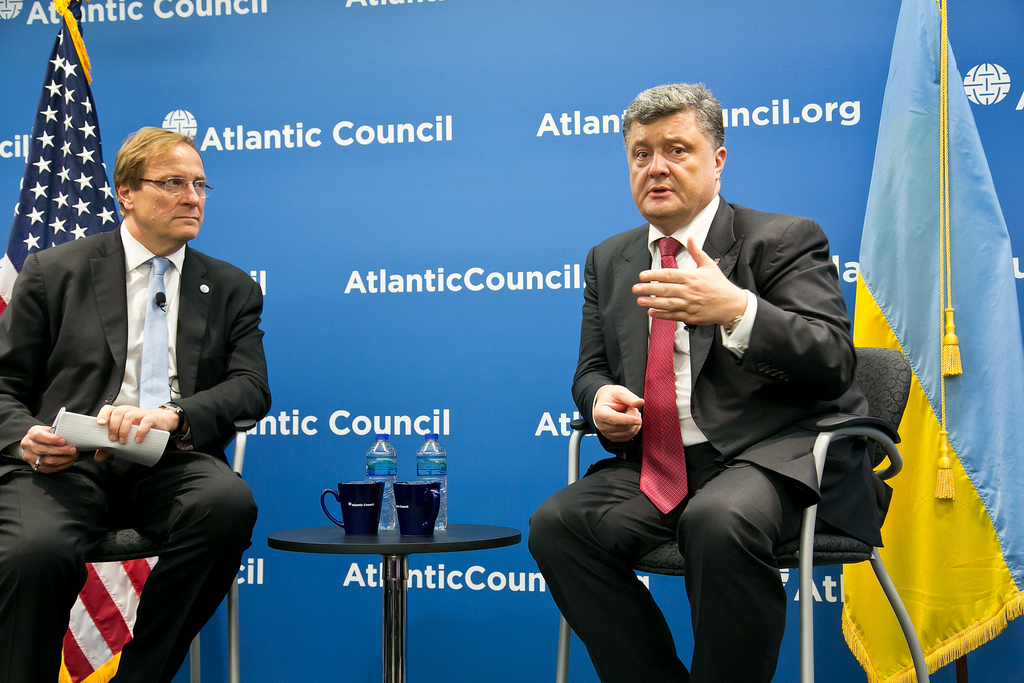
Ukraine’s anti-Russian President Petro Poroshenko speaking to 
the Atlantic Council in 2014. (Photo credit: Atlantic Council)


Vladimir Kozin is an arms control specialist and member of the Russian Academy of Military Science who has worked on arms control issues since the 1970s. Kozin says that Russians see themselves being encircled by NATO. Of the 16 countries bordering Russia, eight have anti-Russia sentiments. He notes that the U.S. military budget is 12 times greater than that of Russia and increasing.

Kozin said it is a “fairy tale” that Russia interfered in the U.S. election. What is NOT a fairy tale, he said, is that the U.S. has spent a huge amount of money to influence Russian elections in the past and funded 400 Non-Governmental Organizations (or NGOs), which were part of the destabilization campaign in Ukraine leading to the 2014 coup.

Regarding key conflict points emerging from the Ukraine crisis, Kozin noted that Crimea was part of Russia since 1783. He added that the despite the presence of 16,000 Russian troops (who were in Crimea as part of the Sevastopol naval base agreement) and 18,000 Ukrainian troops, the Crimea plebiscite to re-unify with Russia was handled without violence, with huge turnout and overwhelming vote in favor.

As for hostilities in eastern Ukraine, Kozin asked why this fighting has happened just because the largely ethnic Russian population resisted the overthrow of elected President Viktor Yanukovych and demanded some form of autonomy from Kiev.

If Scotland can consider secession from the United Kingdom and Catalonia from Spain, he argued, what’s wrong with Donbass (eastern Ukraine) wanting more autonomy within Ukraine? Why has Ukrainian President Petro Poroshenko turned to military conflict instead of negotiating with the dissidents in eastern Ukraine?

Kozin believes it is vital to have an arms control summit meeting between Presidents Trump and Putin. He thinks we should work toward the complete elimination of nuclear weapons by 2045. In the meantime, the easiest way to reduce tension and the risk of war would be an agreement on “No First Use of Nuclear Weapons,” he said.

In a sober assessment of Trump’s first 100 days as President, Kozin concluded, “Aggravating these facts of life is the deep degree of mistrust between Washington and Moscow, which the Americans spawned and have continued to nurse. A vicious circle has emerged in the interrelationship between weapons and trust … Clearly such an irrational phenomenon cannot go on indefinitely.”

From both Kozin and Gorbachev the message was clear: We need to do something to restore discussion and stop the slide toward ever greater tension and danger.
Rick Sterling is an investigative journalist who lives in the San Francisco Bay Area. He can be contacted at rsterling1@gmail.com

Nakba Day Commemorated

Nakba Day Commemorated Across the Globe 

by PalestineChronicle.com


May 15 2017

People across the world are commemorating the Nakba Day which marks the anniversary of the forcible eviction of hundreds of thousands of Palestinians from their homeland by Israelis in 1948.

The Day of Catastrophe is officially marked every year on May 15, but the occasion this year coincides with a hunger strike being observed by more than 1,600 Palestinian prisoners in Israeli jails.

(Photo: MEMO)

Some 750,000 Palestinians were expelled from their homes during the 1948 war. Today, more than 7 million Palestinian refugees are living in exile, while 1.8 million Palestinians are living in the world’s largest open-air prison in the Gaza Strip.

Ahead of the anniversary, the besieged Gaza Strip and several parts of the world witnessed protests against the Israeli oppression and occupation which has continued for decades.

Hani Islayim, a senior Hamas leader, said the march aimed at telling “hypocrites” that “we are staying in Palestine” to end the Israeli occupation.

“On the 69th anniversary, we say that the land is ours, al-Quds (Jerusalem) is ours and Palestine is ours,” he said.

“If some people have forgotten our cause, we say that we haven’t forgotten and the occupation will be forced out of our land soon, God willing, and Palestine will stay Islamic and Arab,” Islayim added.

Jailed Fatah leader Marwan Barghouti urged Palestinians to carry out acts of “civil disobedience” to commemorate the Nakba Day. He also appealed to Fatah and Hamas to enter into a national reconciliation agreement.

Elsewhere across the world, people rallied in Berlin in remembrance of the Nakba Day. Protesters also gathered outside the Israeli consulate in the Canadian city of Toronto in support of the hunger-striking Palestinians in Israeli jails.

(Press TV, PC, Social Media)

Russian FM Ices Freeland at Arctic Council Confab

Chrystia Freeland Exposed by Sergei Lavrov at Arctic Council; Drops “Canadian Democracy Destabilization” Charge Against Russia

by John Helmer - Dances with Bears


May 15, 2017

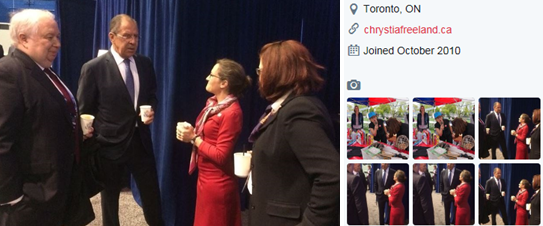
Moscow  - The first meeting of Canada’s new Foreign Minister Chrystia Freeland (lead image, left) with Russian Foreign Minister Sergei Lavrov (right) has backfired when Freeland addressed Lavrov in Russian.

Lavrov replied that speaking in Russian will soon be illegal according to a new law proposed by the Canadian-backed regime in Ukraine.

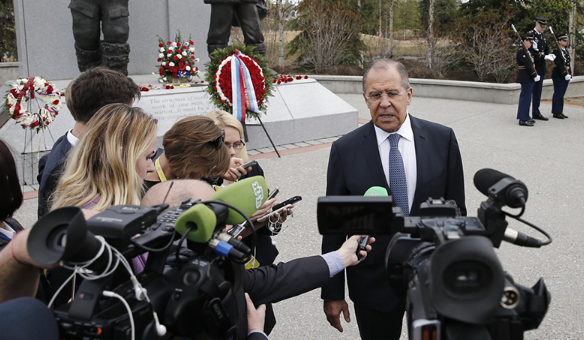
“While Chrystia Freeland is free to speak Russian here in Alaska,” Lavrov told the press, “in Ukraine, where Russian has long been a native language for a huge number of people, it could soon lose its standing and status.”

On March 31, Freeland announced that she and Lavrov would be attending the Arctic Council meeting in Fairbanks, Alaska, “and I would be absolutely prepared to have a bilateral meeting with Sergey Lavrov at Arctic Council if that works for both of our schedules.”

The Arctic Council, a group of eight Arctic Circle governments, six indigenous community representatives, and several government and organization observers, has been chaired for the past year by the US, and was winding up the American chairmanship at the Alaska session.

Freeland has been publicly misrepresenting the record of her meetings with Russian government officials for the past six months, according to this report.

Last week at the Fairbanks session, Lavrov cut Freeland short, and in answer to a Canadian press question, posted in Moscow on Friday morning, Lavrov said there had been “a brief conversation” before dinner.

At an interview Freeland gave Canadian CTV network at about the same time, she claimed:

“I had quite a few productive conversations with Minister Lavrov, both last night over supper and today.”

She added she,

“did speak with Minister Lavrov and also with the Russian delegation in Russian, which I think was a bit of a surprise to everyone.” 

Freeland did not report, however, what Lavrov told her.

The record from both the Russian and Canadian sides reveals that no bilateral meeting of the kind Freeland proposed earlier actually took place. Freeland did arrange for her Twitter feed photographer to snap pictures of her with Lavrov and the Russian Ambassador to the US, Sergei Kislyak, at a stand-up kaffeeklatch.

The meeting shot four times by the photographer from two angles took too little time for the plastic cups to move towards Freeland’s and Lavrov’s mouths.


“ArcticCouncil is forum where, notwithstanding differences in other
parts of the world,#Arctic nations come together to talk, including
pic.twitter.com/1Wkj3alj8A”
Egoogle%7Ctwcamp%5Eserp%7Ctwgr%5Eauthor

Freeland claims that,

“In one of the broader conversations Minister Lavrov did raise issues of Crimea and Ukraine, and as I think Canadians would expect me to do, I was very clear directly with Minister Lavrov in explaining to him that Canada is firm in condemning the Russian invasion of and annexation of Crimea. That is illegal.”

This wasn’t said between them, according to Lavrov, but in open discussion around the delegates’ table at the official dinner. According to Lavrov,

“Yesterday [Wednesday evening] we talked at the informal dinner reception that was open to ministers and representatives of the Arctic Council only. Russia-Canada relations were among the topics that were raised. We had a brief conversation ahead of this event. During the dinner the Ukraine issue was mentioned and how it affected Russia’s relations with western countries, which gave rise to a small debate. I highlighted the manifestations of neo-Nazism and chauvinism we are currently witnessing in Ukraine. 
“In fact, radicals have hijacked the agenda from the president and prime minister in our neighbouring country that we care about. I referred to the draft law on the state language whereby, if adopted, all the citizens of Ukraine would have to use only the Ukrainian language in their day-to-day activities regardless of the language they prefer (be it Russian, Hungarian, Romanian or Polish). This initiative is clearly discriminatory and runs counter to the European Charter for Regional or Minority Languages. My Canadian colleague was not aware of this draft law, and I promised to send it to her.”

A Canadian reporter asked Lavrov: “What are the prospects for removing her [Freeland] from Russia’s black list?” He ignored the question.


cKNonkJE02Bw/content/id/2752061/pop_up?_101_INSTANCE_
cKNonkJE02Bw_viewMode=tv&_101_INSTANCE_cKNonkJE02Bw_qrIndex=0

Freeland was asked: “Did Russian Minister Lavrov say Russia would lift those sanctions against you so that you can travel to Russia?” “That issue was not raised”, she replied.


After referring to Canadian media reporting of the Freeland family’s involvement in Ukrainian liquidation of Jews, Russians and Poles during World War II, Evan Solomon (pictured above, left), a CTV network reporter, asked Freeland:

“Did you actively tell Sergei Lavrov not to meddle in or undermine the Canadian democracy?” 

When Freeland replied by saying she had spoken to Lavrov in Russian, she was asked again:

“Right, but did you tell Minister Lavrov not to meddle in Canadian democracy?”

Freeland responded: “That issue did not come up.”

Argentina's Primero Mama

Hebe de Bonafini, Latin America's Most Famous Mother

by Telesur


14 May 2017

On Mother's Day, we spotlight Argentine activist Hebe de Bonafini, a tireless defender of human rights who has inspired thousands.

Kika, as she was called in a small village in Buenos Aires, had a quiet and reserved childhood. When she was 14, she got married and later had three children.

Hebe Maria Pastor de Bonafini, now
88 years old, continues fighting for
 human rights against impunity.
Photo: Asociacion Madres de Plaza de Mayo

She was born in the outskirts of Ensenada, nearby the city of La Plata, the capital of the province of Buenos Aires, on December 4, 1928.

As Argentina sank into a brutal dictatorship in the 1970s, the small-town girl saw her life turned upside down as two of her children and a daughter-in-law were kidnapped, tortured and killed for opposing the military government.

"Before my son was kidnapped, I was just another woman, another housewife," Bonafini said during an interview.

"I didn't know many things, I wasn't interested. The economic, the political situation of my country were totally foreign to me, indifferent. But since my son disappeared, the love I felt for him, the eagerness to seek him until I found him, to pray, to ask, to demand that they deliver it to me, the encounter and the anxiety shared with other mothers who felt the same yearning as mine, have put me in a new world."


Hebe Maria Pastor de Bonafini, now 88 years old, continues fighting for human rights against impunity as head of one of the most important human rights organizations: the association of Mothers of Plaza de Mayo.

Since 1977, Hebe and other women who had disappeared or murdered children meet every Thursday at the Plaza de Mayo square in Buenos Aires in front of the Casa Rosada presidential palace.

The women wear a signature white handkerchief over their heads and demand justice for more than 30,000 people who were disappeared by the military dictatorship between 1976 and 1983.

Protests at the time were met with armed suppression by military police. Despite the threat of injury and death, the Argentine mothers moved forward with speaking out against government violence.

When British musician Sting visited Argentina in 1987, he invited the organization to accompany him to the stage at the River Plate soccer stadium during the song "They Dance Alone," which was inspired by their struggle. Hebe also gave her white handkerchief to singer Bono, when the band U2 visited the country in 1998.


De Bonafini and her organization have suffered insults, death threats, attacks and even torture. She was wounded in the head by police in a university demonstration. Years ago, two people entered her home, and since Hebe was not found, they tortured her daughter Alejandra, beating her and burning her with cigarettes.

She also reported death threats after sending an open letter to Pope Francis asking the Argentina-born Catholic leader to help her country face “hunger” and “institutional violence.”

After Macri took office, she was charged by a federal prosecutor on charges of "incitement to collective violence" and "attempt against public order" and a court ordered her arrest after she refused to give continuous testimonies in a case of alleged embezzlement of public funds. The case, however, was dismissed after tens of thousands of Argentines poured into the streets to protest and defend Bonafini.

Macri has criticized the human rights activist, calling her "crazy" and saying there are only 8,000 cases of disappeared people during the country's Dirty War. The Dirty War was an offshoot of Operation Condor, a Cold War-era campaign of violence across Latin America backed by the U.S. to extinguish leftist movements.

She has also been an outspoken supporter of leftist leaders such as Che Guevara, Augusto Sandino, Fidel Castro, Hugo Chavez and Evo Morales.


Sunday, May 14, 2017

Flattened Earth, Flattened Society: Minding Mosul, Iraq

Mosul on My Mind: What It Really Means to Be on a “Flattening” Planet

by Tom Engelhardt - TomDispatch

 
May 14, 2017  

The closest I ever got to Mosul, Iraq’s second largest city, was 1,720.7 miles away -- or so the Internet assures me. Although I’ve had a lifelong interest in history, I know next to nothing about Mosul’s, nor do I have more than a glancing sense of what it looks like, or more accurately what it looked like when all its buildings, including those in its “Old City,” were still standing. It has -- or at least in better times had -- a population of at least 1.8 million, not one of whom have I ever met and significant numbers of whom are now either dead, wounded, uprooted, or in desperate straits.

Consider what I never learned about Mosul my loss, a sign of my ignorance. Yet, in recent months, little as I know about the place, it’s been on my mind -- in part because what’s now happening to that city will be the world’s loss as well as mine.

In mid-October 2016, the U.S.-backed Iraqi army first launched an offensive to retake Mosul from the militants of the Islamic State. Relatively small numbers of ISIS fighters had captured it in mid-2014 when the previous version of the Iraqi military (into which the U.S. had poured more than $25 billion) collapsed ignominiously and fled, abandoning weaponry and even uniforms along the way. It was in Mosul’s Great Mosque that the existence of the Islamic State was first triumphantly proclaimed by its “caliph,” Abu Bakr al-Bagdadi.

On the initial day of the offensive to recapture the city, the Pentagon was already congratulating the Iraqi military for being “ahead of schedule” in a campaign that was expected to “take weeks or even months.” Little did its planners -- who had been announcing its prospective start for nearly a year -- know. A week later, everything was still “proceeding according to our plan,” claimed then-U.S. Secretary of Defense Ashton Carter. By the end of January 2017, after 100 days of fierce fighting, the eastern part of that city, divided by the Tigris River, was more or less back in government hands and it had, according to New York Times reporters on the scene, been “spared the wholesale destruction inflicted on other Iraqi cities” like Ramadi and Fallujah, even though those residents who hadn’t fled were reportedly “scratching out a primitive existence, deprived of electricity, running water and other essential city services.”

And that was the good news. More than 100 days later, Iraqi troops continue to edge their way through embattled western Mosul, with parts of it, including the treacherous warren of streets in its Old City, still in the hands of ISIS militants amid continuing bitter building-to-building fighting. The Iraqi government and its generals still insist, however, that everything will be over in mere weeks. An estimated thousand or so ISIS defenders (of the original 4,000-8,000 reportedly entrenched in the city) are still holding out and will assumedly fight to the death. U.S. air power has repeatedly been called in big time, with civilian deaths soaring, and hundreds of thousands of its increasingly desperate and hungry inhabitants still living in battle-scarred Mosul as Islamic State fighters employ countless bomb-laden suicide vehicles and even small drones.

After seven months of unending battle in that single city, perhaps it shouldn’t be surprising that Mosul has receded from the news here, even as civilian casualties grow, at least half a million Iraqis have been displaced, and the Iraqi military has suffered grievous losses.

Though there’s been remarkably little writing about it, here’s what now seems obvious: when the fighting is finally over and the Islamic State defeated, the losses will be so much more widespread than that. Despite initial claims that the Iraqi military (and the U.S. Air Force) were taking great care to avoid as much destruction as possible in an urban landscape filled with civilians, the rules of engagement have since changed and it’s clear that, in the end, significant swathes of Iraq’s second largest city will be left in ruins. In this, it will resemble so many other cities and towns in Iraq and Syria, from Fallujah to Ramadi, Homs to Aleppo.

The Disappearance of Mosul


At a moment when Donald Trump makes headlines daily with almost any random thing he says, the fate of Mosul doesn't even qualify as a major news story. What happens in that city, however, will be no minor thing. It will matter on this increasingly small planet of ours.

What’s to come is also, unfortunately, reasonably predictable. Eight, nine, or more months after this offensive was launched, the grim Islamic State in Mosul will undoubtedly be destroyed, but so will much of the city in a region that continues to be -- to invent a word -- rubblized.

When Mosul is officially retaken, if not “ahead of schedule,” then at least “according to plan,” the proud announcements of “victory” in the war against ISIS will make headlines. Soon after, however, Mosul will once again disappear from our American world and worries. Yet that will undoubtedly only be the beginning of the story in a world in crisis. Fourteen years have passed since the U.S. invaded Iraq and punched a hole in the oil heartlands of the Middle East. In the wake of that invasion, states have been crumbling or simply imploding and terror movements growing and spreading, while wars, ethnic slaughter, and all manner of atrocities have engulfed an ever-widening region. Millions of Iraqis, Syrians, Afghans, Yemenis, Libyans, and others have been uprooted, sent into exile in their own countries, or fled across borders to become refugees. In Mosul alone, untold numbers of people whose fathers, mothers, grandparents, children, friends, and relatives were slaughtered in the Iraqi Army’s offensive or simply murdered by ISIS will be left homeless, often without possessions, jobs, or communities in the midst of once familiar places that have been transformed into rubble.

Mosul now lacks an airport, a railroad station, and a university -- all destroyed in the recent fighting. Initial estimates suggest that its rebuilding will cost billions of dollars over many years. And it’s just one of many cities in such a state. The question is: Where exactly will the money to rebuild come from? After all, the price of oil is at present below $50 a barrel, the Iraqi and Syrian governments lack resources of every sort, and who can imagine a new Marshall Plan for the region coming from Donald Trump’s America or, for that matter, anywhere else?

In other words, the Iraqis, the Syrians, the Yemenis, the Libyans, the Afghans, and others are likely, in the end, to find themselves alone in the ruins of their worlds with remarkably little recourse. With that in mind and given the record of those last 14 years, how exactly do you imagine that things will turn out for the inhabitants of Mosul, or Ramadi, or Fallujah, or cities yet to be destroyed? What new movements, ethnic struggles, and terror outfits will emerge from such a nightmare?

To put it another way, if you think that such a disaster will remain the possession of the Iraqis (Syrians, Yemenis, Libyans, and Afghans), then you haven’t been paying much attention to the history of the twenty-first century. You evidently haven’t noticed that Donald J. Trump won the last presidential election in the United States, in part by playing on fears of a deluge of refugees from the Middle East and of Islamic terrorism; that the British voted to leave the European Union in part based on similar fears; and that across Europe pressures over refugees and terror attacks have helped to alter the political landscape.

Where Is Globalization Now That We Need It?


To frame things slightly differently, let me ask another question entirely: In these last years, haven’t you wondered what ever happened to “globalization” and the endless media attention that was once paid to it? Not so very long ago we were being assured that this planet was binding itself into a remarkably tight knot of interconnectedness that was going to amaze us all. As Thomas Friedman of the New York Times put it in 1996, we were seeing “the integration of free markets, nation-states, and information technologies to a degree never before witnessed, in a way that is enabling individuals, corporations, and countries to reach around the world farther, faster, deeper, and cheaper than ever.” All of this was to be fed and led by the United States, the last superpower standing, and as a result, the global “playing field” would miraculously “be leveled” on a planet becoming a mosaic of Pizza Huts, iMacs, and Lexuses.

Who of a certain age doesn’t remember those years after the Soviet Union imploded when we all suddenly found ourselves in a single superpower world? It was a moment when, thanks to vaunted technological advances, it seemed blindingly clear to the cognoscenti that this was going to be a single-everything planet. We were all about to be absorbed into a “single market for goods, capital, and commercial services” from which, despite the worries of naysayers, “almost everyone” stood “to gain.” In a world not of multiple superpowers but of multiple “supermarkets,” we were likely to become both more democratic and more capitalistic by the year as an interlocking set of transnational corporate players, nations, and peoples, unified by a singularly interwoven set of communication systems (representing nothing short of an information revolution), triumphed, while poverty, that eternal plague of humanity, stood to lose out big time. Everything would be connected on what was, for the first time, to be a single, “flattened” planet.

It won’t surprise you, I’m sure, to be told that that’s not exactly the planet we’re now on. Instead, whatever processes were at work, the result has been record numbers of billionaires, record levels of inequality, and refugees in numbers not seen since much of the world was in a state of collapse after World War II.

Still, don’t you ever wonder where, conceptually speaking, globalization is now that we need it? I mean, did it really turn out that we weren’t living together on a single shrinking planet? Were the globalists of that moment inhabiting another planet entirely in another solar system? Or could it be that globalization is still the ruling paradigm here, but that what’s globalizing isn’t (or isn’t just) Pizza Huts, iMacs, and Lexuses, but pressure points for the fracturing of our world?

The globalization of misery doesn’t have the cachet of the globalization of plenty. It doesn’t make for the same uplifting reading, nor does skyrocketing global economic inequality seem quite as thrilling as a leveling playing field (unless, of course, you happen to be a billionaire). And thanks significantly to the military efforts of the last superpower standing, the disintegration of significant regions of the planet doesn’t quite add up to what the globalists had in mind for the twenty-first century. Failed states, spreading terror movements, all too many Mosuls, and the conditions for so much more of the same weren’t what globalization was supposed to be all about.

Perhaps, however, it’s time to begin reminding ourselves that we're still on a globalizing planet, even if one experiencing pressures of an unexpected sort, including from the disastrous never-ending American war on terror. It’s so much more convenient, of course, to throw the idea of globalization overboard and imagine that Mosul is thousands of miles away in a universe that bears next to no relation to our own.

What It Really Means to Be on a “Flattening” Planet


It’s true that in France last week extremist presidential candidate Marine Le Pen was defeated by a young, little known former investment banker and government minister, Emmanuel Macron, and the European Union preserved. As with an earlier election in Holland in which a similar right-wing candidate lost, this is being presented as potentially the high-water mark of what’s now commonly called “populism” in Europe (or the Brexit-style fragmentation of that continent). But I’d take such reassurances with a grain of salt, given the pressures likely to come. After all, in both Holland and France, two extreme nationalist parties garnered record votes based on anti-Islamic, anti-refugee sentiment and will, after the coming parliamentary elections in France, both be represented, again in record numbers, in their legislatures.

The rise of such “populism” -- think of it as the authoritarian fragmentation of the planet -- is already a global trend. So just imagine the situation four or potentially even eight years from now after Donald Trump’s generals, already in the saddle, do their damnedest in the Greater Middle East and Africa. There’s no reason to believe that, under their direction, the smashing of key regions of the planet won’t continue. There’s no reason to doubt that, in an expanding world of Mosuls -- the Syrian “capital” of the Islamic State, Raqqa, is undoubtedly the next city in line for such treatment -- “victories” won’t produce a planet of greater ethnic savagery, religious extremism, military destruction, and chaos. This, in turn, ensures a further spread of terror groups and an even more staggering uprooting of peoples. (It’s worth noting, for instance, that since the death of Osama bin Laden at the hands of U.S. Special Operations forces, al-Qaeda has grown, not shrunk, gaining yet more traction across the Greater Middle East.) So far, America’s permanent “war on terror” has helped produce a planet of fear, refugees on an almost unimaginable scale, and ever more terror. What else would you imagine could arise from the rubble of so many Mosuls?

If you don’t think that this is an ever-more connected planet still being “flattened” (even if in quite a different way than expected), and that sooner or later the destruction of Mosul will reverberate in our world, too, then you don’t get our world. It’s obvious, for instance, that future Mosuls will only produce more refugees, and you already know where that’s led, from Brexit to Donald Trump. Destroy enough Mosuls and, even in the heartland of the planet’s sole superpower, the fears of those who already feel they’ve been left in a ditch will only rise (and be fed further by demagogues ready to use that global flow of refugees for their own purposes).

Given the transformations of recent years, just think what it will mean to uproot ever vaster populations, to set the homeless, the desperate, the angry, the hurt, and the vengeful -- millions of adults and children whose lives have been devastated or destroyed -- in motion. Imagine, for instance, what those pressures will mean when it comes to Europe and its future politics.

Think about what’s to come on this small planet of ours -- and that’s without even mentioning the force that has yet to fully reveal itself in all its fragmenting and globalizing and leveling power. We now call it, mildly enough, “climate change” or “global warming.” Just wait until, in the decades to come, rising sea levels and extreme weather events put human beings in motion in startling ways (particularly given that the planet’s sole superpower is now run by men in violent denial of the very existence of such a force or the human sources of its power).

You want a shrinking planet? You want terror? You want globalization? Think about that. And do you wonder why, these days, I have Mosul on my mind?

Tom Engelhardt is a co-founder of the American Empire Project and the author of The United States of Fear as well as a history of the Cold War, The End of Victory Culture. He is a fellow of the Nation Institute and runs TomDispatch.com. His latest book is Shadow Government: Surveillance, Secret Wars, and a Global Security State in a Single-Superpower World.

Follow TomDispatch on Twitter and join us on Facebook. Check out the newest Dispatch Book, John Dower's The Violent American Century: War and Terror Since World War II, as well as John Feffer's dystopian novel Splinterlands, Nick Turse’s Next Time They’ll Come to Count the Dead, and Tom Engelhardt's Shadow Government: Surveillance, Secret Wars, and a Global Security State in a Single-Superpower World.

Copyright 2017 Tom Engelhardt

Castles in the Clouds: Google's Evil Panopticon

The Cloud Panopticon: Google, Cloud Computing and the Surveillance-Industrial-Complex

by Christopher Ketcham/Travis Kelly - CounterPunch


May 12, 2017

In June 2007, Privacy International, a U.K.-based privacy rights watchdog, cited Google as the worst privacy offender among 23 online companies, ranking the “Don’t Be Evil” people below Microsoft, Apple, Amazon, eBay, LinkedIn, Facebook and AOL.

According to the report, no other company was “coming close to achieving [Google’s] status as an endemic threat to privacy.”

What most disturbed the authors was Google’s “increasing ability to deep-drill into the minutiae of a user’s life and lifestyle choices.” The result: “the most onerous privacy environment on the Internet.”

Indeed, Google now controls an estimated 70 per cent of the online search engine market, but its deep-drilling of user information – where we surf, whom we e-mail, what blogs we post, what pictures we share, what maps we look at, what news we read – extends far beyond the search feature to encompass the kind of “total information awareness” that privacy activists feared at the hands of the Bush Jr. administration’s much-maligned Total Information Awareness program.

Kevin Bankston, a privacy expert and attorney at the Electronic Frontier Foundation, a nonprofit advocacy group engaged in questions of privacy, free speech, and intellectual property in the digital age, warns of the possibilities. “In all of human history,” he says, “few if any single entities, other than the National Security Agency, have ever possessed such a hoard of sensitive data about so many people.” This is the sort of thing that should make the intelligence agencies, says Bankston, “drool with anticipation.” And drooling they are.

Stephen Arnold, an IT expert who formerly worked at the defense and intelligence contractor Booz Allen Hamilton Inc. and who once consulted for Google, addressed this in a speech before a conference of current and former intelligence officials in Washington, D.C., in January 2006. According to an audio recording in our possession, he reported Google was increasingly sought out by the U.S. intelligence services because click-stream data – and everything else Google archives – “is a tremendous opportunity for the intelligence community.” Google, he said, “has figured out everything there is to know about data-collection.”

The relationship with the government had become intimate enough, Arnold said, that at least three officers from “an unnamed intelligence agency” had been posted at Google’s headquarters in Mountain View, Calif. What they are doing there, Arnold did not reveal.

“We don’t comment on rumor or speculation,” said Google spokesperson Christine Chen. When asked separately how many former intelligence agency officials work at Google, she responded,

“We don’t release personnel information.”

The conference, under the aegis of the Open Source Solutions Network, was hosted and organized by Robert David Steele, a former Central Intelligence Agency officer who left the agency 20 years ago and is now the founder and CEO of Open Source Solutions Network Inc., otherwise known as OSS.Net, an educational corporation that has worked with more than 50 governments to “advance the use of open source intelligence.” Steele considered Arnold’s item to be a bombshell. U.S. intel was now seated in the heart of the “Googleplex,” learning all it could from the masters in the private sector. Among Google’s critics, Steele who, since leaving the CIA, has spent 20 years promoting the digital commons, is about as fierce as they come.

“Google would have been an absolutely precious gift to humanity,” he says.
“But Google is positioning itself to take over the digital commons. I personally have resolved that unless Google comes clean with the public, the company is now evil.” 

The question today is whether Google, in fact, will be forced to change its ways – and whether Congress and the intelligence agencies want it to.

Google’s powers of data-collection depend on consumer choice – how much of your computing you put in Google’s hands. The more you choose Google applications, the more Google can know about you. At the extreme end of the spectrum, your every move can be tracked by some feature of Google. When you use the Google search box, as tens of millions of people do daily (with Google handling roughly 11,000 searches per second), the company can track all your search queries and the websites you visit as a result of those queries.

If you use Google toolbar, the company can watch the amount of time you surf a website – the three minutes or three hours you spend on every page of that website. With Google’s acquisition of YouTube in 2006, viewing habits can be tracked. Google’s FriendConnect and Orkut archive your social networks. Google News, Books, Feedburner or Blogger log your reading habits.

The writing you produce is stored on Google Docs, and your purchase habits and credit card numbers are captured by Google Checkout. Also gathered are voiceprint and call habits, through Google Voice; travel interests, patterns and place associations, through Google Maps, Google Earth and Google StreetView; medical conditions, medical history and prescription drug use, through Google Health; photos of friends and family, through Google’s Picassa images; and general activities, through Google Calendar.

Then, there’s Google Desktop, which, at one point, offered what appeared to be an innocuous feature called “Search Across Computers.” This allowed Google to scan your computer to archive copies of text documents. In other words, just about everything on your PC – love letters, tax returns, business records, bad poetry – was duplicated on a remote Google server. (This function was discontinued on all platforms in January of this year.)

Taken alone, the Google search box is an exquisitely intimate repository of user information.

“People treat the search box like their most trusted advisors,” says Kevin Bankston, the Electronic Frontier Foundation (EFF) attorney.
“They tell the Google search box what they wouldn’t tell their own mother, spouse, shrink or priest.” 

Think about your most recent queries, say, about your “anal warts” or “inability to love in marriage,” or “self-hatred,” or your interest in the mechanics of “making a pipe bomb.” The search box is as good a place as any to understand how the Googleplex keeps tabs on its users. When you do a search, “cookies” installed on your computer record your IP address (a series of unique numbers that may be used to identify your computer), so Google can, in many contexts, identify a user. And it can do so with any of its applications.

All this, one would think, ceases once your PC is shut down and you leave home. However, Google released a “geo-location” application in 2008, Gears Geolocation API, that can “obtain the user’s current position,” “watch the user’s position as it changes over time,” and “quickly and cheaply obtain the user’s last known position.”

According to a Google tech blog, the Gears application “can determine your location using nearby cell-towers or GPS for your mobile device or your computer’s IP address for your laptop.” A 2006 Technology Review article reports that Google’s director of research, Peter Norvig, even proposed the use of built-in microphones on PCs to identify television shows playing in the room, in order to display related advertising. Such data, it seems, could be processed as an audio fingerprint, which might aid in geolocation and profiling of users. (“Google had no plans to develop this,” Google spokesperson Christine Chen responded by e-mail. “And we haven’t.”)

Google’s data-mining interests go even deeper, to the core of our physical and mental being. Google co-founder Sergey Brin and his biotech specialist wife, Anne Wojcicki, according to The Economist, have “brainstormed” with at least one prominent human genome researcher and approach genetics as a “database and computing problem.” This would tie in nicely with Google Health, launched in 2008 to take advantage of the growing trend of storing health records online, for easier access among diverse health care providers.

Google has invested $3.9 million in Wojcicki’s biotech firm, 23andMe, whose “mission is to be the world’s trusted source of personal genetic information,” and which offers a basket of genetic tests to allow its customers to uncover ancestry, disease risks, and drug responses.

Speaking before a Google “Zeitgeist” conference in 2008, Brin revealed that he carried a Parkinson’s gene and then advocated the recording of individual genetic codes to enhance health maintenance and medical research. Taken to its logical conclusion, this suggests the prospect of your body’s blueprint registered with an eventual “Google Genome,” perhaps with the help of the databases gathered at 23andMe.

To drill further into the mind, Google has teamed up with marketing giant WPP to fund $4.6 million for research into online advertising, including one grant in the emerging field of “neuromarketing”: tracking everything from online navigation behavior to biofeedback metrics like heart rate, eye movement and brain wave activity in response to advertising stimuli. Google’s Chen points out that the results of this research will be available to industry as a whole and that “Google has no special right over, nor plans to use, any of the research funded by these grants.”

From Google’s standpoint, marketing – not surveillance – is the purpose of the informational harvest, as advertising generates most of Google’s $23 billion in annual revenue. The company is driving the evolution of the behavioral advertising model: more personal information gathered on consumers means more effectively targeted ads, thus higher ad rates and profits. (Gmail users often note how advertising, directly related to the subject matter of recently sent mails or searches, pops up on their browsers.)

The unsurprising offshoot of the behavioral advertising model is political advertising, a new market being pursued by Google’s Elections and Issue Advocacy Team in Washington, D.C. Campaigning online has become as important as dominating the broadcast networks for candidates and advocacy groups, and this will require broader profiling of political behavior – an area of compelling interest for the intelligence agencies.

EFF attorney Bankston had his own personal run-in with the company in 2007. He was walking outside his office on 19th Street in San Francisco, when one of Google’s StreetView photography crews – who gather surreptitious pictures of practically every street in the world – caught him smoking a cigarette. Wired magazine editor Kevin Poulsen tracked down Bankston at a Silicon Alley party, and pulled out his laptop. “Take a look at this,” said Poulsen. Bankston was not pleased. “At the time,” he says, “I had represented to my family and other people that I had cut down on my smoking and even stopped smoking.” When Bankston emailed Google requesting to have his face blurred, the spokesperson from the legal department told him he needed to fax in his driver’s license and a sworn statement to prove his identity. “I had to give up my privacy,” says Bankston, “to protect my privacy.” Finally, after a week of prodding – and a pair of articles in Wired – Google removed the photos that showed Bankston puffing away on 19th Street. In the summer of 2008, Google instituted face-blurring for all its StreetView shots.

But what most concerned Bankston as a privacy lawyer was that he had no clear legal protections against Google. “In legal terms, Google is in the Wild West,” says Bankston. “The law hasn’t kept up.” The reason for the lag is due to the revolution in how Google stores information.

Google has developed into a software provider rivaling Microsoft, with this major distinction: almost all Google software is server-side, residing on massive Google computer banks, not your local PC, which means they own the content, not you. This is the paradigm shift of “cloud computing,” and the atmospheric analogy is apt. Information evaporates from your desktop or laptop and condenses in the “cloud,” held there for whenever and wherever the user wants it to rain down.

For the customer, the advantages over desktop computing are appealing. You get software that is mostly free or relatively cheap; automatic upgrades; data backed up on redundant remote servers, thus crash proof (unless, of course, Google crashes); accessibility from any computer or wireless device; and there’s less strain on your desktop or laptop as most of the computation is handled by remote processors and data drives. Greasing the transition to the cloud, a new wave of inexpensive hardware – compact Netbooks specifically designed to configure with the cloud – is capturing a growing share of the PC market. Most ship with Windows, but, in a direct challenge to Microsoft, Google has announced the development of its own operating system, Chrome, to work more efficiently with its Chrome browser, both optimized for connecting online.

But one of the big problems with the cloud, and the danger it presents, is that the Fourth Amendment’s protections against search and seizure do not apply. The caveats are buried deep in the text that users usually skip over, and click “I agree,” to install a new application. But the consequences are huge, says Bankston.

“When private data is held by a third party like Google, the Supreme Court has ruled that you ‘assume the risk’ of disclosure of that data.” 

When you store e-mail at Gmail – or, similarly, in the cloud at Yahoo or Hotmail – “you lose your constitutional protections immediately.” To search and seize the information on your desktop, a law enforcement or intelligence agency requires a warrant or grand jury subpoena, after demonstrating probable cause before a judge or magistrate; or an order from the Foreign Intelligence Surveillance Court (authorized by FISA); or a National Security Letter issued by the FBI, Department of Defense or CIA. But to obtain that same information stored on Google’s servers, there is a shortcut: Google, like a telecom provider, may supply the information voluntarily as long as the government can argue the information is needed as part of an “emergency.”

“Your data is less legally protected in the cloud,” says Bankston.
“That’s a big issue when you have companies like Google that are soliciting more and more data into the cloud.” 

Take, for example, those records cached at Google Health: The Health Insurance Portability and Accountability Act protects the privacy of medical records stored with health care providers and insurance companies – but the law does not apply to the privacy of those records stored with third parties. Or, take Bankston’s smoking episode: Bankston had no recourse against public exposure. Google removed the photos simply as a sop to an outspoken privacy activist who made an outcry in the media.

As for search queries, we have no idea how the law applies. Presumably, the stipulations of the Electronic Communications Privacy Act of 1986 would come into play. The ECPA mandates different standards for privacy of information stored with a third party, depending on how old the information is. “But this has never been litigated,” says Bankston.

“I think it’s very important for Congress to amend this 23-year-old law, so that’s it clear how it applies. To the extent that the law is uncertain, it benefits the government.”

Certainly, the government has a variety of means for getting at Google’s data, but, again, this is shrouded in the unknown: the processing of national security letters, for example, is entirely conducted in secret, with gag orders on all parties involved. In other words, the determinant of your privacy is what Google and the government decide behind closed doors.

“The threat is real that the government is accessing more Google information than it should,” says Bankston. The company’s privacy policy is not exactly reassuring:
“In some cases, we may process personal information on behalf of and according to the instructions of a third party, such as our advertising partners … We restrict access to personal information to Google employees, contractors and agents who need to know that information in order to operate, develop or improve our services.”

Google’s links with the intelligence agency may stretch back to 2004. In 1999, the CIA founded an IT venture capital firm called In-Q-Tel to research and invest in new digital technologies focused on intelligence gathering. An In-Q-Tel-funded company, Keyhole, Inc., developed the satellite mapping technology that would be acquired in 2004 to become Google Earth. In-Q-Tel’s former director of technology assessment, Rob Painter, joined Google as a senior manager of Google Federal, his focus the “evangelizing and implementing [of] Google Enterprise solutions for a host of users across the Intelligence and Defense Communities.”

In turn, Google has sold versions of its technology, especially Google Earth, to many U.S. agencies, including the U.S. Coast Guard, National Oceanographic and Atmospheric Administration, National Highway Traffic Safety Administration, the state of Alabama, and Washington, D.C. For the CIA, Google provided servers to support Intellipedia, a Wikipedia-like intranet for sharing intelligence.

For the NSA, it supplied four “search appliances” and a maintenance contract, according to a FOIA investigation by the San Francisco Chronicle in 2008. (When asked about whether Google had supplied any other products or services to the National Security Agency or other intelligence agencies, Google’s Christine Chen wrote by email, “We don’t comment on any discussions we may or may not have had with any national intelligence agency.”)

According to Christopher Soghoian, a former CNet blogger and a doctoral candidate studying privacy and computing at the University of Indiana who has researched Google, the intelligence services would be particularly interested in Google’s “backdoor” programs for surveillance. Soghoian notes that Google applications launch without telling users that the processing and data storage is conducted on remote servers, as long as an Internet connection is maintained — easy enough, given the ubiquity of wireless broadband.

Even with no connection, software such as Google’s Gears enable “offline” access to the cloud, running applications and storing data on a PC (again, no cost, no fuss) until a connection is re-established and the new data can be uploaded to Google. Thus the naive user transmits information to a third-party unwittingly – a modus operandi close to the definition of covert surveillance.

Soghoian notes that Google likely receives thousands of subpoenas and warrants every year from government agencies demanding information (AOL gets approximately 1,000 requests a month related to civil and criminal cases), and it has hired former DOJ officials and U.S. intelligence officers as corporate legal compliance officers handling the traffic. “The government gets somebody on the other end of the line who’s from the intelligence or law enforcement community,” says Soghoian, “who knows how they work, and maybe is sympathetic to their cause. Google doesn’t put former ACLU lawyers in charge of its compliance team.”

According to Google’s Chen, such numbers are not publicly available. “Obviously, we follow the law like any other company,” she says.

“When we receive a subpoena or court order, we check to see if it meets both the letter and the spirit of the law before complying. And if it doesn’t, we can object or ask that the request is narrowed.” 

She points out that, in 2006, Google went to court to fight a Department of Justice subpoena for millions of search queries on the grounds that it invaded user privacy. The judge ruled in Google’s favor.

Soghoian, however, suggests a perverse incentive for cooperation: by law, Google and the telecoms must be compensated for their time and effort. Thus, the feeding of information to spooks and cops can become a profitable enterprise.

Google also works with some of the top players in the surveillance industry, notably Lockheed Martin and SRA International. SRA is listed as a Google “enterprise partner” – more than a hundred such partners are listed on the Google website. Both companies, Lockheed and SRA, have engineered and sold data-mining software to the intelligence agencies. SRA’s NetOwl program, for example, has been described by a blogger at Pennsylvania State University, who watched the application in action at a corporate recruiter forum, as “searching all kinds of documents using Google for a certain person.”

In response to our inquiries for further information on these programs and how they might have been developed in cooperation with Google, a Lockheed Martin spokesperson told us, “The work we do with Google is exclusively related to their Google Earth system.” SRA International’s vice president for public affairs, Sheila Blackwell, states, “We don’t discuss the specifics of our intelligence clients’ business.”

Former CIA officer Robert Steele says that the CIA’s Office of Research and Development had, at one point, provided funding for Google. According to its literature, ORD has a charter to push beyond the state of the art, developing and applying technologies and equipment more advanced than anything commercially available, including communications, sensors, semi-conductors, high-speed computing, artificial intelligence, image recognition and database management. Steele says that Google’s liaison at the ORD is Dr. Rick Steinheiser, a counterterrorism data-mining expert and a long-time CIA analyst. (No CIA response about Steinheiser’s work was forthcoming.)

Then, there are the intelligence officials allegedly working at Google’s Mountain View headquarters. When tech guru Stephen Arnold first revealed this information in the 2006 OSS conference. Anthony Kimery, a veteran intelligence reporter at Homeland Security Today, followed up with a report alleging a “secret relationship” between Google and U.S. intelligence. Google was “cooperat[ing] with U.S. intelligence agencies to provide national and homeland security-related user information from its vast databases,” with the intelligence agencies “working to ‘leverage Google’s [user] data monitoring’ capability as part of an effort to glean from this data information of ‘national security intelligence interest’ in the war on terror.” In other words, Google’s databases – or, some targeted portion – may have been dumped straight into the maw of U.S. intelligence agencies.

Like the giants of the surveillance-industrial complex, Google has backed its federal sales force in Reston, Virginia, with a D.C. lobbying operation – spending $2.9 million on lobbying in 2009 – to make sure that privacy is not a priority in the Obama administration. It also works with several industry-supported interest groups: the Interactive Advertising Bureau, the Technology Policy Institute, and the Progress & Freedom Foundation, whose mission statement espouses “an appreciation for the positive impacts of technology with a classically conservative view of the proper role of government… Those opportunities can only be realized if governments resist the temptation to regulate, tax and control.”

All these groups are funded by Google, along with a who’s-who of communications behemoths. Their mission: subvert any congressional legislation extending Fourth Amendment-style prohibitions to the data-mining private sector. Their argument, per the Technology Policy Institute: “More privacy … would mean less information, less valuable advertising, and thus fewer resources available for producing new low-priced services” – in other words, privacy is a threat to the economy.

Google has also managed to install favorites in the White House. Andrew McLaughlin, formerly chief of Google’s Global Public Policy and Government Affairs division while also serving as assistant treasurer for Google’s NetPAC lobby, has been appointed as Obama’s deputy chief technology officer for Internet policy, despite protests from privacy advocates. Vivek Kundra, now posted as the Obama administration’s chief information officer at the Office of Management and Budget, formerly served as the chief technology officer for the city of Washington, D.C., where he ditched the use of Microsoft programs for municipal operations in favor of Google products.

Concerns were heightened last spring by an administration initiative, proposed in Senate Bill 773, to grant the executive branch authority to disconnect and assume some measure of control over private networks in a declared “cybersecurity emergency.” That could be a quarantine operation to isolate and defeat a viral attack. It could also be an excuse for censorship of certain sites – or, for the cybersecurity agencies to data-mine where they have been hitherto forbidden. Google could be declared “critical infrastructure” in such an emergency, and its management temporarily assumed by federally certified “cybersecurity professionals,” as defined in S.773. It’s not wholly unfeasible that Google’s massive and much coveted behavioral profiles could then be fed into the NSA’s computers. And even without S.773, a long accumulation of executive orders over three decades has likely laid the groundwork for executive authority to take over critical communications networks in a “national emergency.”

But long before such an emergency comes to pass, if ever, the government and the regiments of data-mining companies it contracts with are seeing eye to eye. The commercial surveillance complex and the security surveillance complex have many common interests and methods: the ad gurus’ neuromarketing research complemented by the intel agencies’ longstanding research into mind control, from the CIA’s MK-ULTRA to the NSA’s current “cognitive neuroscience research”; the profiling of political behavior for campaign advertising complemented by the DHS’s elastic definitions of dissidents and “potential terrorists.”

Google is now anonymizing IP addresses from search logs after nine months, down from its previous eighteen-month retention policy. Company spokesperson Chen states, “We’re committed to using data both to improve our services and our security measures for our users and to protect their privacy, and we remain convinced that our current logs retention policy represents a responsible balance.” This is in contrast to Microsoft, which after six months throws out the search query data altogether.

“Remember that totally anonymized search queries can be linked together to build an identity,” says Bankston. 

“Why does Google need to store our data perpetually? They’re very vague about it.”

Indeed, Google could, without violating the law, reveal a lot more about how it cooperates with the intelligence agencies – how many requests for information it receives, from what government entities, how many it complies with. “They could talk about all this, but they don’t,” says Bankston.

“Google may not care a lot about your privacy, but they care a whole helluva lot about your perception of your privacy. To remind people of the risk of government access to your data is anathema.”


Christopher Ketcham, a freelance reporter in Brooklyn, NY, is writing a book about secession movements and the break-up of the United States. Write him at cketcham99@mindspring.com or find more of his work at christopherketcham.com.
Travis Kelly is a writer, cartoonist and web designer in Moab, UT. Write him at tkelly@citlink.net or find more of his work at traviskelly.com.

This article originally appeared in the April print edition of CounterPunch magazine.
Research support for this article was provided by The Investigative Fund at The Nation Institute.
 
More articles by Christopher Ketcham – Travis Kelly

Wobblying the Prison Slave Labor Industry

Rattling the Bars: Industrial Workers of the World Against Prison Slavery 

by TRNN


May 14, 2017

Executive Producer Eddie Conway speaks with IWW organizer Lauren Karaffa about the Industrial Workers of the World (IWW) and their solidarity with incarcerated people's struggle for human rights.