Wednesday, May 17, 2017

Saud's Other Nettlesome Neighbour: Bad Behaviour Over Iran's Fence

Deadly rhetoric: Saudi Arabia opens war of words with Iran 

by Sharmine Narwani - RT


May 17, 2017

For years the Saudis have waged proxy battles against Iran, with little success. Now, despite this history of losses, Riyadh appears to be mobilizing for an ill-conceived confrontation with the Islamic Republic.

"We know we are a main target of Iran," speculated Saudi Deputy Crown Prince Mohammed bin Salman (MbS) in an interview early this month.


Trump greets Mohammed bin Salman
in the White House May 17, 2017

Then came the threat.

"We are not waiting until there becomes a battle in Saudi Arabia, so we will work so that it becomes a battle for them in Iran and not in Saudi Arabia."

These are fighting words indeed. The Iranians certainly thought so, Defense Minister Hossein Dehghan responding with unusual ferocity: “We warn them (Saudis) against doing anything ignorant, but if they do something ignorant, we will leave nowhere untouched apart from Mecca and Medina.”

In other words, if the Saudis launch direct aggression against Iran, this will be Riyadh’s last war anywhere, ever.

It’s an important line to draw. The Saudis, after all, have been in meltdown since the 1979 Islamic Revolution in Iran saw popular protests dethroning a King (gasp).

And so, for the past 38 years, we have witnessed an increasingly aggressive Saudi Arabia in the region, chasing down Iranian/Shia enemies where there were none. Just look at Yemen, where the two-year Saudi bombing blitz has killed over 10,000 civilians, or Bahrain, where Saudi troops and tanks snuffed out dissent in the Shia-majority state, or Syria, where Saudis send weapons, cash and support to ISIS, Al-Qaeda and other head-chopping extremists. This Saudi hysteria has now touched every corner of the world, and by the $100+ billion Riyadh has invested in radical schools, mosques, and propaganda to indoctrinate an entire generation of Muslims in Wahhabi-style intolerance.

But while the Saudis are hell-bent on thwarting Iranian influence – real or imagined – Riyadh has never dared to take on the Islamic Republic directly.

As former US Secretary of Defense Robert Gates famously noted in a 2010 WikiLeaks cable, the Saudis always want to "fight the Iranians to the last American.” To which he then added, “it is time for them to get in the game.”

Now perhaps, under the direction of a 31-year old princeling, the Saudis are planning to do just that.

 Saudi Arabia vs. Iran


Some perspective first on these two Persian Gulf “rivals,” in which I borrow heavily from an earlier interview of mine:

Both Iran and Saudi Arabia are rich in energy resources and have used this rentier wealth to advance their national goals, albeit with vastly differing results. Iran’s economy is focused on diversification away from the energy sector, developing self-sufficiency and becoming a net exporter. Saudi Arabia is import-focused. Iran spends $15 billion per annum on its military – compared to Saudi’s $80 billion – yet has one of the most competent military forces in the region and builds its own hardware.

The Iranian political system is Constitution-based, diverse, and representative, with loudly competing political blocs that come with their own media and constituencies. The Saudi monarchy is based entirely on the rule of one family, with no meaningful elections or contesting political bodies, and little freedom of expression in the media.

Regarding power projection, Iran favors the soft power tools of diplomacy, trade, and alliance-building based on common worldviews/objectives, whereas the Saudis have expanded their influence far and wide by spreading Wahhabi doctrine through schools, mosques, media and other institutions globally – and by blatantly buying the loyalty of allies.

In the past few years, we have clearly observed how Iran and Saudi Arabia’s nation-building approaches have affected the success of their geopolitical strategies. Both states have experienced existential fears and threats, and their respective alliances have now confronted each other on a few battlefields. Iran has approached the matter of its strategic depth carefully and built alliances with partners that genuinely share the common values of independence, self-determination, and resistance against imperialism.

The Saudis, on the other hand, have forged their external alliances with hegemony or dominance as the primary objective – irrespective of the divergent interests and values of allies. There is little contest – one side is a nation- and region-building, while the other flails about with unreliable alliances, propped up by petrodollars and all the strategic brilliance of a sledgehammer.

How can this relationship be classed as a rivalry, when the two don’t even operate on the same playing field? Would Tehran even notice Riyadh outside of OPEC meetings if it weren’t so belligerent at every turn, on every border?

But MbS’s promise to bring “the battle” to Iran must be taken seriously because it will not be launched alone. The Saudi prince’s chest thumping comes courtesy of an upgrade in relations with Washington. US President Donald Trump is enthusiastically pushing billions of dollars in weapons sales to the Saudis, and has chosen Riyadh as the destination for his first official foreign visit, championing the establishment of an "Arab NATO” that partners with Israel to confront Iran.

Don’t expect a conventional military confrontation as the opening gambit, however. The US, Israel and Saudi Arabia are experienced in subversion and sabotage activities against the Islamic Republic, and this is where they are likely to focus their initial efforts.

Last week, Iran’s Supreme Leader Ali Khamenei warned of foreign interference in the lead-up to Friday’s presidential poll: “the security of the country should be fully protected during the elections. Anyone who violates this should know he will certainly be punished."

Calling for public vigilance, Khamenei outlined short, medium and long-term “enemy” goals in Iran: “to distort the country’s security and trigger chaos and sedition… targeting issues like that of the economy and living conditions of the people…(and) an effort to change the system.”

So how will the Saudis play a role? Riyadh’s hand in this “battle” will likely be seen on and inside Iran’s borders, in the same form we have witnessed in Syria, Iraq, Afghanistan and other theaters flooded with Saudi-backed militants.

Stirring up minority populations


Demographically, Iran is around 60 percent ethnically Persian, followed by a mix of Azeris, Kurds, Lurs, Turkmens, Arabs, and others. Some 99 percent of Iranians are Muslim, more than 90 percent of these Shia, the rest Sunni, and the remaining one percent a mix of Christians, Jews, Zoroastrians, and others.

The main pockets of Kurds are in the northwest on the Iraqi/Turkish borders and in the north-east bordering Turkmenistan – Iranian Kurds are both Sunni and Shia. The second largest ethnicity, Azeris, who are mainly Shia, are also in the northwest on Iran’s border with Azerbaijan and Armenia.

Iranian Arabs who are concentrated in the south near the Iraqi border and the Persian Gulf – as well as around the Strait of Hormuz – are also mostly Shia. Iranian Sunni populations consist mainly of Kurds, Turkmens, and Balochis, and this is the demographic where signs of foreign interference are most notable today.

In recent years, thousands of Iranian security forces have been killed on the border of Iran’s Sistan and Baluchistan province with Pakistan – most recently in April when ten Iranian border guards died in a cross-border terrorist raid.

Reportedly, the operation was conducted by Jaish al-Adl (Army of Justice), a sectarian terrorist group the Iranians say is being directed by the US and Saudi Arabia. The US has traceable ties to some of these groups, notably Jundallah which received Bush-era funds from Washington before being listed as a terrorist organization. That “terrorist” designation, Iran knows, means little. The Mojahedin-e-Khalq (MEK) was listed by the State Department for decades, but then de-listed in 2012 and is today being actively courted by US officials.

Jaish al-Adl is an offshoot of Sipah-e-Sahaba, an anti-Shia extremist group banned in Pakistan, but which appears to continue to enjoy both Saudi and Pakistani support. Sipah leaders are ferried around the border areas with Pakistani guards, and fill their ranks with young graduates of Saudi-funded Deobandi madrassahs rife inside the Pakistani border.

US hands are all over the minority map in Iran too. Media, think tanks and politicians highlight and encourage aspirations of Iranian minorities at every opportunity, and will undoubtedly take a more active role in stirring divisions as tensions escalate.

Cue the Kurds. Both US and Saudi fingerprints are all over this project of inciting a Kurdish rebellion inside Iran. Last June and July, for the first time in 20 years, Kurds in Iran’s northwest clashed with Revolutionary Guards, killing several on both sides.

The Kurdish group involved was the Democratic Party of Iranian Kurdistan (PDKI), a longtime Iranian-designated terrorist organization that announced in 2015 it would take up arms against the state. Not surprisingly, that declaration came shortly after PDKI leader Mustafa Hijri visited congressional leaders in Washington.
A vigilant Iran

American dirty tricks are certainly not new in Iran. Former Kennedy-era State Department official Richard J. Barnet wrote in 1968: “The (US) intervention in Iran in 1953 to unseat Premier Mohammed Mossadeq was America's first successful attempt in the postwar period to subvert a nationalist government.”

According to Barnet, “Five US agents and seven Iranian intelligence operatives” led by CIA operative Kermit Roosevelt “plotted the coup from a Tehran basement.” They were responsible for “recruiting street mobs to oppose the Mossadeq supporters… With the help of substantial sums, which Roosevelt used for hired demonstrators to whip up the growing anti-Mossadeq mobs, and the support of the Iranian army, heavily dependent on US equipment, the insurgents were able to turn the tide against the intractable premier and to drive him from office.”

Iran is intimately familiar with these foreign machinations and has been vigilantly countering them in the decades since the Islamic Revolution.

This is not the compliant Shah’s Iran – this Iran, today, is an independent, sovereign nation-state that came through an 8-year foreign-imposed war with Iraq and built with its own hands a formidable military deterrent.

As we have seen with Iran’s activities in Syria, Iraq, and Lebanon, the country’s ‘strategic depth’ is a red line – its national borders even more so. After warning the Iraqi government in 2014 that it would take decisive action if ISIS came within 40 kilometers of its border, the Iranian air force – for the first time since the Iran-Iraq war – used F-4 Phantom fighter jets to conduct airstrikes in Diyala province on its western border.

Iran’s armed forces chief Mohammad Hossein Bagheri has also now threatened military action on Pakistani territory unless Islamabad takes control of its borders, saying: “Unfortunately, the Pakistani border area has turned into a refuge and training ground for terrorists hired by Saudi Arabia, with the approval of the United States.”

In a letter this month to the UN Security Council, Iran’s UN Ambassador Gholamali Khoshroo addressed the Saudi threats:

"We have no desire, nor any interest, in an escalation of tension in our neighborhood...We continue to stand ready for dialogue and accommodation to promote regional stability, combat destabilizing extremist violence and reject sectarian hatred…We hope Saudi Arabia will be persuaded to heed the call of reason."

The Saudi princeling Mohammad bin Salman made a novice’s mistake by threatening to bring war to Iran – he put the world on notice. Any Iranian reaction now bears the full legitimacy of international law for a measured retaliation. The Saudi borders are long, its populations restive, and its soldiers have not seen this kind of war. We may yet live to see a Saudi royal eat his words.


Sharmine Narwani is a commentator and analyst of Middle East geopolitics. She is a former senior associate at St. Antony's College, Oxford University and has a master’s degree in International Relations from Columbia University. Sharmine has written commentary for a wide array of publications, including Al Akhbar English, the New York Times, the Guardian, Asia Times Online, Salon.com, USA Today, the Huffington Post, Al Jazeera English, BRICS Post and others.
You can follow her on Twitter at @snarwani

The statements, views and opinions expressed in this column are solely those of the author and do not necessarily represent those of RT.

Red Pill, Blue Pill, Poison...Washington Picks...

Putin Offers Washington Red Pill; Washington Takes the Blue One 

by Finian Cunningham - RT


May 17, 2017

In an extraordinary moment this week, Russian leader Vladimir Putin offered Washington a challenge to discover the truth over sensational US media claims that President Trump had leaked top-secret information to Russia. Washington rebuffed Putin’s offer.


It was akin to the iconic scene in the sci-fi movie, The Matrix, in which protagonists are offered a red or blue pill. Consuming the former leads them to awaken to the truth, however painful that awakening might be from shattering erstwhile illusions. Ingesting the alternative blue pill allows one to continue in a state of illusion, albeit in the form of slavery to The Matrix.

The US media this week went into overdrive with claims that President Donald Trump disclosed highly classified information during his meeting last week in the White House with Russian Foreign Minister Sergey Lavrov. Those claims of Trump talking about highly sensitive intelligence on the Islamic State terror group in Syria were rejected by the White House and separately by the Kremlin.

Trump’s top National Security Adviser General H.R. McMaster has since repeatedly denied US media reports of Trump’s alleged indiscretion in front of his Russian guests. McMaster called them “false.”

The next day another US media bombshell report claimed Trump had pressed former FBI chief James Comey into dropping his investigation into alleged Russian links to Trump’s previous National Security Adviser Michael Flynn. Combined, the stories – all based on anonymous claims – tend to lend credence to the long-running narrative that Trump is in some way compromised by Russia. The Kremlin is alleged to have “leverage” over the US Commander-in-Chief.

Further to the Kremlin rejecting claims of Trump sharing classified information with Lavrov, Russian President Vladimir Putin, who described the media frenzy gripping the US over Trump and his alleged Russian collusion as “political schizophrenia,” went one step further and offered to provide transcripts of the meeting in the Oval Office, which took place on May 10.

Putin said the internecine politics was far from amusing and actually portended a dangerous development. If political opponents of Trump can make up such false claims to discredit the president, calling for his impeachment, then such delusional thinking represents a real risk to global security matters in the future, said Putin.

On the Oval Office meeting between Trump and Lavrov, the US media and its anonymous sources are saying one thing; while the White House, Trump’s national security adviser and the Kremlin are saying the opposite. So, who is telling the truth?

One way to get to the bottom of the fog is to read a transcript of the discussion, which is what Putin just offered. He added, with due courtesy, the proviso, “if the White House considered it appropriate,” to provide the transcript.

In other words, Putin was offering a red pill moment.


The US media and congressional opponents of Trump scoffed at the idea of Russia interjecting to resolve the growing scandal surrounding the president. Republican Senator Susan Collins, who sits on the intelligence committee investigating allegations of collusion with Russia, told news outlet CNN that Russia was an adversary of the US and to accept the Kremlin’s word was “absurd.”

But is such an idea really absurd? Consider what is at stake. The President of the United States is being harangued by his opponents on Capitol Hill and in the media who are, in effect, accusing him of traitorous conduct, consorting with an enemy state, and lying through his teeth to the American people. There is a sense that Trump’s opponents can smell blood and think it is within their grasp to impeach him from office. Senator John McCain claims the crisis is reaching “Watergate” proportions, which led to President Richard Nixon’s downfall in 1974.

But just as the “Russia-gate” scandal seems to be reaching a climax, there is also this underlying moment of weakness in the whole alleged affair. Did Trump disclose top-secret information to Russia’s Lavrov last week or not? Trump and his colleagues, H.R. McMaster, Secretary of State Rex Tillerson, and Deputy National Security Adviser Dina Powell, reject this, as does Russia.

If the transcript supplied by Russia – and it would be easy to verify it as bona fide – did indeed show Trump is telling the truth, then that would exonerate him. More importantly, the “moment of truth” would expose the US media reports of Trump being some Russian stooge as nothing but a giant fabrication.

It would also confirm what Putin has decried as the “political schizophrenia” gripping large sections of the US corporate-controlled news media and politicians in Washington.

The US political establishment – mainly the Democratic party and their media surrogates – have never accepted the will of the American people in electing Donald Trump last November. Instead, they have sought to discredit the sovereign right of the people and the electoral mandate they gave to Trump with the tall-story of Trump being a Russian stooge.

This delusional story is a cover for a de facto coup against an elected president. And such is the intensity to make this subversion of democracy succeed, the US political and media have whipped themselves into a collective frenzy of Russophobia, paranoia, and schizophrenia.

This week the frenzy peaked with claims that Trump has “loose lips in front of his Russian handlers.”

What has it come to when Russia is now in a position to offer the Americans a red pill for sanity?

But evidently, Washington is balking and wants to take the blue pill instead.

Go on Trump and Putin, publish the Oval Office transcript, and let’s snap out of this dangerous mind-game eroding democracy and international relations.


Finian CunninghamFinian Cunningham (born 1963) has written extensively on international affairs, with articles published in several languages. Originally from Belfast, Ireland, he is a Master’s graduate in Agricultural Chemistry and worked as a scientific editor for the Royal Society of Chemistry, Cambridge, England, before pursuing a career in newspaper journalism. 
For over 20 years he worked as an editor and writer in major news media organizations, including The Mirror, Irish Times and Independent. Now a freelance journalist based in East Africa, his columns appear on RT, Sputnik, Strategic Culture Foundation and Press TV. 

The statements, views and opinions expressed in this column are solely those of the author and do not necessarily represent those of RT.

Hoover's Ghosts: Is Russophobia Behind FBI Comey Memo Leaks?

Why Did the FBI Leak the Comey Memo? 

by TRNN


May 16, 2017

On Tuesday, the New York Times reported that a memo written by James Comey states that President Trump asked Comey to drop the investigation into General Flynn. Now, this was all about Flynn's contacts with the Russians.


Robert English is a Professor of International Relations at the University of Southern California. He specializes in Russian and post-Soviet politics, US-Russian relations, and national security policy. He formerly worked for the US Department of Defense and the Committee for National Security, and has published widely in both academic and policy journals. 

Washington Post Reveal: Trump "Leaks" and Anatomy of Elite Press/Intelligence Community Operation

Washington Post Reveals ISIS was "Partner" Supplying Trump Intelligence Briefing for Russia Officials

by John Helmer - Dances with Bears


May 17, 2017

Moscow  - A Washington Post reporter has revealed that the Islamic State (IS) laptop plot story, which President Donald Trump mentioned to Russian Foreign Minister Sergei Lavrov at the White House last week came from IS itself, through the Central Intelligence Agency (CIA). The reason for the leaking against Trump, which followed in the Post and in the Anglo-American media, has also been disclosed by the Post.

The CIA and at least one senior staff official of the National Security Council, who briefed the CIA on what Trump had said, are angry at the President for revealing collaboration between IS operatives and their US Government handlers in attacks on Russian targets, including Russian airline travellers.

A report published by the Washington Post on Monday evening claimed Trump had,

“[R]evealed highly classified information to the Russian foreign minister [Lavrov] and ambassador [Sergei Kislyak] in a White House meeting last week, according to current and former U.S. officials, who said Trump’s disclosures jeopardized a critical source of intelligence on the Islamic State.”

The source, according to the Post, was,

“[A] U.S. partner through an intelligence-sharing arrangement considered so sensitive that details have been withheld from allies and tightly restricted even within the U.S. government, officials said. The partner had not given the United States permission to share the material with Russia, and officials said Trump’s decision to do so endangers cooperation from an ally that has access to the inner workings of the Islamic State.”

The text of the newspaper publication did not refer to the “partner” as a country, government, or foreign intelligence agency. Instead, referring to the source of intelligence as a “key partner”, the newspaper claimed,

“Trump revealed the city in the Islamic State’s territory where the U.S. intelligence partner detected the threat.”

That meant the geographic location where the “partner” was at work inside IS “territory”.

The publication also revealed that it been given access to a verbatim transcript of what Trump had said in his meeting with Lavrov, calling its source “an official with knowledge of the exchange.”

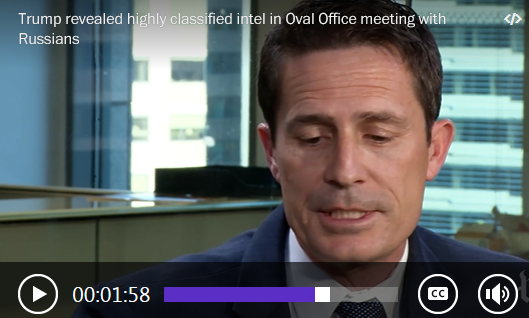
One of the newspaper reporters who wrote the story appeared in a videotaped interview which was published by the Post after the print version appeared. He is Greg Miller (pictured below). Miller, a Californian who worked for the Los Angeles Times before moving to Washington in 2010, “covers intelligence agencies and terrorism”.


Listen carefully to Miller reporting on himself, disclosing his sources in the senior staff of the National Security Council (NSC) and at the CIA. Starting at Minute 1:52, Miller’s identifies what he learned, and how, from “his [Trump’s] own National Security Council members, senior officials who see readouts of what happened. They call the CIA Director – call the NSA chief to warn them, to say, ‘Look, something happened in this meeting with the Russians that we need to tell you about.’ This is in part because they are alarmed and concerned about the blowback. These are agencies, the CIA, that would be directly communicating or dealing with this foreign partner. They would be most concerned about that.”


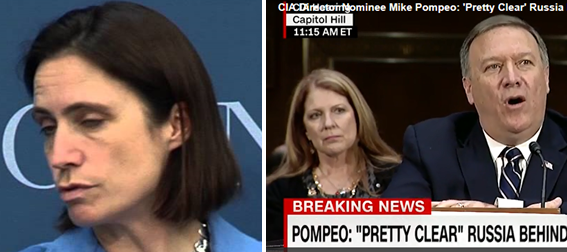
Miller doesn’t name the officials who read the May 10 Trump-Lavrov transcript and told him. Two senior officials directly concerned with US operations against Russia in Syria and worldwide are Fiona Hill, the NSC director for Russia, and Gina Haspel, appointed on February 2 as the new Deputy Director of the CIA; she is a former head of CIA terrorism and clandestine operations.

On Hill’s connections with Russia, read this. Haspel is a career CIA officer whose country postings and operations remain mostly secret; no verified or official photograph of her can be found.


Left: Fiona Hill at her previous employer, Washington think-tank Brookings; right, CIA Director Mike Pompeo testifying at his nomination hearing at the
US Senate, January 12, 2017; sitting behind Pompeo is his wife, Susan Pompeo.


According to the Washington Post text, “after Trump’s meeting, senior White House officials took steps to contain the damage, placing calls to the CIA and the National Security Agency.” For background on recent Post news fabrications, read this.

Senior White House officials, including Trump himself and National Security Advisor, General H.R. McMaster, have disputed the “damage”. According to McMaster, “the president and the foreign minister reviewed common threats from terrorist organizations to include threats to aviation.” According to the newspaper,

“the Washington Post is withholding most plot details, including the name of the city, at the urging of officials who warned that revealing them would jeopardize important intelligence capabilities.” 

The Post added editorially, without a source:

“For almost anyone in government, discussing such matters with an adversary would be illegal.”

McMaster replied the next day: “The premise of that article is false.”


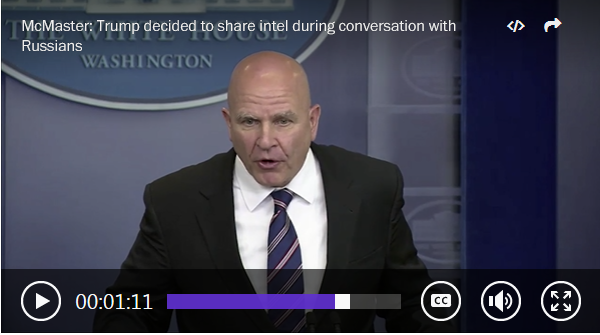
General McMaster on Tuesday at midday, Washington time. 
“If you were to say, from where do you think a threat might 
come from territory ISIS controls, you would probably be able to 
name a few cities, I would think. And so it was nothing you would not 
know from open-source reporting in terms of a source of concern.” 


The difference between the two versions, the general’s and the newspaper’s, is that the US “partner” is being run by the CIA for Islamic State (ISIS) operations against Russia. The “common threat”, to which McMaster referred – that is, an Islamic State plot against both American and Russian air travellers — is a plot which the senior NSC and CIA operatives do not want to reveal to their real adversary. This, according to Miller and his US official sources, is not Islamic State but Russia.

In his videoclip, Miller reveals his NSC source initiated a call to the CIA, and then Miller himself was told. That means at least one insider, possibly two – one at the NSC in the White House office compound, and one at the CIA, leaked to the Post a story intended to be damaging to Trump.

The reason, according to intelligence sources familiar with the terrorism operations against Russia, is that Trump identified a US tie to Islamic State which is operational against Russian targets. That the Obama Administration and the CIA have been doing this is no secret. Nor is the prospect of Islamic State and CIA plots against Russian and international aviation a secret. 


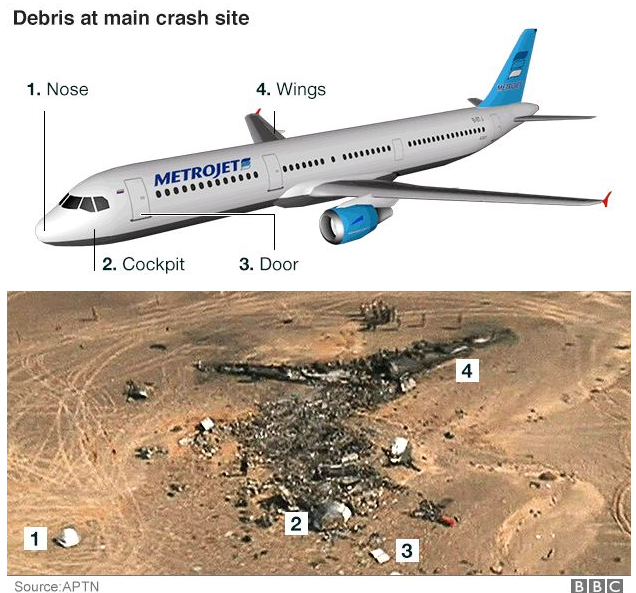
Result of an Islamic State (IS) bombing of a Russian airliner flying 
between Sharm el-Sheikh and St. Petersburg on October 31, 2015, 
as reported by the BBC. All 224 Russians on board Metrojet Flight 9268 
were killed. For more details, click.


Miller also reveals an attempt to cover up, then expose what he, his newspaper management and his US government sources believe was damage to their Islamic State collaborator. Between Minute 0:55 and 1:02 of the videoclip Miller says,

“the problem [sic] is that the United States knows much of this information because of intelligence that came from a partner, another country.” 

There is nothing in the published text of the story that says the “partner” was “another country”; that is, another country’s government or intelligence service. In Miller’s videoclip, he doesn’t mention the word “country” again.

Tuesday, May 16, 2017

Gorilla Radio with Chris Cook, Mark Lakeman, Amy Lubik, Janine Bandcroft May 17, 2017

This Week on GR

by C. L. Cook - Gorilla-Radio.com


May 17, 2017

The old saw says, "when every problem looks like a nail, all answers look like hammers." But when the problem is how people can live in rapidly and radically changing environments, it takes more than a hammer to build solutions. What it takes is insight and thinking outside the familiar, four-walls and a chimney pot picture of what makes our homes and communities work.  

Mark Lakeman is a Portland, Oregon-based community activist, architect, and lead hand at Communitecture, an architectural firm with a difference.

Communitecture says, "We design beautiful and sustainable places that bring people together in community...[w]ith an approach that explores new creative territories..."

Listen. Hear.

Mark brought that creativity to Portland City Council in 2001 when dreaming up a design for the city's now World famous "place-based community," Dignity Village. Sixteen years on, it's a model whose relevance and guiding principles has proven resilient and adaptable to a broader population of home seekers.

Mark Lakeman in the first half.

And; in the dying days of BC's recent election campaign, a group of professionals concerned an issue posing enormous deleterious environmental and human health effects was not getting the media coverage it deserved rallied supporters to make of it an election issue.

Hydraulic fracturing, or Fracking, is a process so detrimental it's been banned in a growing number of jurisdictions. But here in BC, under the innocuous rubric, "LNG" this clearly present and persistent threat carries on. In fact, expanding the Fracked Gas industry is the cornerstone of the government's economic plan for the province. 

Dr. Amy Lubik mobilized along with the BC chapter of CAPE, or the Canadian Association of Physicians for the Environment, in the operation hoping to deliver a moratorium on Fracking in BC.

Amy Lubik in the second half.

And, CFUV Radio broadcaster and activist, Janine Bandcroft will be here at the bottom of the hour to bring us up to speed with some of the good things planned for the coming week around here, and further afield too. But first, Mark Lakeman and making big community with tiny houses.

Chris Cook hosts Gorilla Radio, airing live every Wednesday, 1-2pm Pacific Time. In Victoria at 101.9FM, and on the internet at: http://cfuv.ca.  He also serves as a contributing editor to the web news site, http://www.pacificfreepress.com. Check out the GR blog at: https://gorillaradioblog.blogspot.ca/

G-Radio is dedicated to social justice, the environment, community, and providing a forum for people and issues not covered in the corporate media.

Fracking v. The Canadian Association of Physicians for the Environment

CAPE Calls for Moratorium on Fracking in B.C.

by Canadian Association of Physicians for the Environment (CAPE)


April 18, 2017

Liquefied Natural Gas (LNG) has been a hot topic of conversation in British Columbia for several years now, but many people still don’t realize that the vast majority of LNG will be coming from hydraulic fracturing (fracking) projects. Because of that, it is important to take a look at the emerging research around fracking as we debate LNG.

Technological developments in the fracking industry have outpaced health and environmental research. We are only now starting to get studies that tell us about the health impacts associated with fracking.

The information is still preliminary, but overwhelmingly raises red flags for health. One study, which looked at all the health-oriented research on fracking, found that 80% of all studies had been done between 2013 and 2015. Of the ones that looked at public health outcomes, 84% identified potential problems.

Preliminary studies on the human health effects of fracking have identified concerns with the hormone-disrupting properties of fracking fluids and their potential for reproductive and developmental toxicity, increased asthma rates, and congenital heart disease with greater proximity to natural gas development.

Development can bring new jobs to a community, but it can also bring an influx of male workers. A recent report has shown that this may increase violence against Indigenous women and girls in northeastern B.C.

Very few studies have examined longer-term health outcomes with longer latency periods such as cancer or developmental outcomes. To quote a review of the literature:

This is a clear gap in the scientific knowledge that requires urgent attention.”

Additionally, even the single Pacific Northwest LNG project and the greenhouse gas emissions associated with it will make it virtually impossible for B.C. to meet its 2050 greenhouse gas emissions targets. Given that the World Health Organization has identified climate change as the greatest health threat of the 21st century, failure to meet greenhouse gas targets must be viewed as a risk to human health.

In the face of incomplete information, the best approach is to act in accordance with the precautionary principle. As stated by the World Health Organization: “in the case of serious or irreversible threats to the health of humans or the ecosystem, acknowledged scientific uncertainty should not be used as a reason to postpone preventive measures.” CAPE Doctors in B.C. believe that this approach should be applied to fracking in B.C.

Both the New Brunswick and Newfoundland/Labrador chapters of the College of Family Physicians of Canada have urged fracking moratoria in those provinces in the interest of public health. Over 180 physicians and health professionals recently signed a letter asking that no new projects which increase the level of hydraulic fracturing in British Columbia, or in Canada as a whole, go ahead until the health risks are understood, communicated to communities, and mitigated.

Let the candidates in your riding know that you are concerned about the health impacts associated with fracking and LNG in B.C.:

http://www.cbc.ca/news/canada/british-columbia/who-s-running-in-the-2017-british-columbia-election-1.3786771

If you would like to see public health protected by a moratorium on further fracking projects in B.C., please click here to add your name to our petition.


Prepared by Dr. Courtney Howard and Dr. Larry Barzelai, B.C. CAPE Volunteer Committee, April 18, 2017

Join us in Vancouver on Friday April 28th for a discussion panel about the health impacts of fracking featuring environmental scientist Judi Krzyzanowski, PhD, Dene environmental activist and lawyer Caleb Behn, and CAPE board members Dr. Courtney Howard and Dr. Warren Bell.
Click here for more information and free registration.


Fleecing Asylum Seekers

Israel Begins to Confiscate 20% of Asylum-Seekers' Incomes

by TRNN


May 16, 2017

Documentary filmmaker Lia Tarachansky explains that the income garnishing measure targets African refugees and is intended to discourage asylum in Israel.


Lia Tarachansky is an Israeli-Russian journalist and documentary filmmaker who previously reported for The Real News Network on Israel and the occupied Palestinian territories. Born in the Soviet Union, Tarachansky grew up in a settlement in the occupied West Bank. She is the director of On the Side of the Road, a documentary on Israel's biggest taboo - the events of 1948 when the state was created. Tarachansky previously worked as a Newsroom Producer in The Real News' Washington D.C. and Toronto Headquarters, and her work appeared on BBC, Al Jazeera, USA Today, Canadian Dimension Magazine and others. 

Base Instincts: Trumping American Democracy One Garrison at a Time

Forty-Five Blows Against Democracy: How U.S. Military Bases Back Dictators, Autocrats, and Military Regimes

by David Vine - TomDispatch

 
May 16, 2017   

Much outrage has been expressed in recent weeks over President Donald Trump’s invitation for a White House visit to Rodrigo Duterte, president of the Philippines, whose “war on drugs” has led to thousands of extrajudicial killings
 
Criticism of Trump was especially intense given his similarly warm public support for other authoritarian rulers like Egypt’s Abdel Fatah al-Sisi (who visited the Oval Office to much praise only weeks earlier), Turkey’s Recep Tayyip Erdogan (who got a congratulatory phone call from President Trump on his recent referendum victory, granting him increasingly unchecked powers), and Thailand’s Prayuth Chan-ocha (who also received a White House invitation).

But here’s the strange thing: the critics generally ignored the far more substantial and long-standing bipartisan support U.S. presidents have offered these and dozens of other repressive regimes over the decades. 
 
After all, such autocratic countries share one striking thing in common. They are among at least 45 less-than-democratic nations and territories that today host scores of U.S. military bases, from ones the size of not-so-small American towns to tiny outposts. Together, these bases are homes to tens of thousands of U.S. troops.
 
Tomgram: David Vine, Trumping Democracy in America's Empire of Bases

War, American-style, in the twenty-first century hasn’t exactly been a sterling success story. (How did the Brits ever manage to run that empire of theirs for so many years with such modest numbers of troops?) Take Afghanistan, for example. We now know something of Washington's latest plans for pursuing the war in that country well into its 16th year. They are, according to media reports, just landing on President Trump’s desk with the enthusiastic support of his national security adviser, General H.R. McMaster, the Pentagon, the intelligence services, and General John Nicholson, the U.S. Afghan commander. Pushback seems to be coming only from the administration’s Bannonite wing. Basically, those plans seem to boil down to sending in more U.S. troops and more Special Operations forces, putting them in more combat-like situations, and supporting them with more U.S. air power -- or put another way, more of exactly what there has regularly been more of for the last 15 years. Call it a mini-surge. All of this, in turn, is supposed to “break the Afghan deadlock,” shift the war in the favor of the U.S.-backed government, and lead to successful peace negotiations. Oh, and it’s grounded in the conviction that Afghan President Ashraf Ghani is capable of weeding corrupt and ineffective commanders out of his military.

It might cross your mind that all of the above could only have been dreamt up by “strategists” who had been on another planet for the last decade and a half. However, the generals who came up with this brilliant plan (for a president who, in 2013, tweeted, “We have wasted an enormous amount of blood and treasure in Afghanistan. Their government has zero appreciation. Let's get out!”) have been deeply involved in America’s wars across the Greater Middle East in those years. And since it’s hard to believe that they meant to create a failing strategy, the only alternative is to assume that they’ve been involved in this sort of war-making for so long that they are no longer capable of imagining anything else. In other words, what we’re witnessing is a brain-dead version of strategizing that will leave another set of officials in Washington wondering what to do next somewhere down the line.

In the face of such “planning,” woefully typical of Washington's war on terror, it’s always good to look for some bright spot and there does happen to be one area where the U.S. military remains the undisputed global champ: military bases. As TomDispatch regular David Vine has shown in his essential book, Base Nation: How U.S. Military Bases Abroad Harm America and the World, the U.S. garrisons the globe without competitors and in a fashion previously unimaginable. That “rising power” China, for instance, is only now building its first base outside its own territory -- in the small African country of Djibouti, just miles from a large U.S. base, leaving it approximately 799 global garrisons short of Washington. Britain and France each still have some bases, generally left over from their days of imperial glory, and the Russians also have a handful, including two particularly active ones in Syria and another, just unveiled, in its own far northern territories near the Arctic Circle. That’s its second base in the melting north. About such moves, Washington is already raising the alarm. (Secretary of Defense James Mattis at his confirmation hearings typically said, “The U.S. must ensure that Russia doesn’t expand those efforts to dominate the region.”)

Still, at the moment, the U.S. stands alone when it comes to garrisoning Planet Earth, a success story that, strangely enough, never seems to impress the mainstream media enough to consider it a subject worthy of coverage, which is why it’s so useful to have David Vine on hand at moments like this. Tom 

Forty-Five Blows Against Democracy: How U.S. Military Bases Back Dictators, Autocrats, and Military Regimes

by David Vine


To ensure basing access from Central America to Africa, Asia to the Middle East, U.S. officials have repeatedly collaborated with fiercely anti-democratic regimes and militaries implicated in torture, murder, the suppression of democratic rights, the systematic oppression of women and minorities, and numerous other human rights abuses. Forget the recent White House invitations and Trump’s public compliments. For nearly three quarters of a century, the United States has invested tens of billions of dollars in maintaining bases and troops in such repressive states. From Harry Truman and Dwight D. Eisenhower to George W. Bush and Barack Obama, Republican and Democratic administrations alike have, since World War II, regularly shown a preference for maintaining bases in undemocratic and often despotic states, including Spain under Generalissimo Francisco Franco, South Korea under Park Chung-hee, Bahrain under King Hamad bin Isa al-Khalifa, and Djibouti under four-term President Ismail Omar Guelleh, to name just four.

Many of the 45 present-day undemocratic U.S. base hosts qualify as fully “authoritarian regimes,” according to the Economist Democracy Index. In such cases, American installations and the troops stationed on them are effectively helping block the spread of democracy in countries like Cameroon, Chad, Ethiopia, Jordan, Kuwait, Niger, Oman, Qatar, Saudi Arabia, and the United Arab Emirates.

This pattern of daily support for dictatorship and repression around the world should be a national scandal in a country supposedly committed to democracy. It should trouble Americans ranging from religious conservatives and libertarians to leftists -- anyone, in fact, who believes in the democratic principles enshrined in the Constitution and the Declaration of Independence. After all, one of the long-articulated justifications for maintaining military bases abroad has been that the U.S. military’s presence protects and spreads democracy.

Far from bringing democracy to these lands, however, such bases tend to provide legitimacy for and prop up undemocratic regimes of all sorts, while often interfering with genuine efforts to encourage political and democratic reform. The silencing of the critics of human rights abuses in base hosts like Bahrain, which has violently cracked down on pro-democracy demonstrators since 2011, has left the United States complicit in these states’ crimes.

During the Cold War, bases in undemocratic countries were often justified as the unfortunate but necessary consequence of confronting the “communist menace” of the Soviet Union. But here’s the curious thing: in the quarter century since the Cold War ended with that empire’s implosion, few of those bases have closed. Today, while a White House visit from an autocrat may generate indignation, the presence of such installations in countries run by repressive or military rulers receives little notice at all.

Befriending Dictators


The 45 nations and territories with little or no democratic rule represent more than half of the roughly 80 countries now hosting U.S. bases (who often lack the power to ask their “guests” to leave). They are part of a historically unprecedented global network of military installations the United States has built or occupied since World War II.

Today, while there are no foreign bases in the United States, there are around 800 U.S. bases in foreign countries. That number was recently even higher, but it still almost certainly represents a record for any nation or empire in history. More than 70 years after World War II and 64 years after the Korean War, there are, according to the Pentagon, 181 U.S. “base sites” in Germany, 122 in Japan, and 83 in South Korea. Hundreds more dot the planet from Aruba to Australia, Belgium to Bulgaria, Colombia to Qatar. Hundreds of thousands of U.S. troops, civilians, and family members occupy these installations. By my conservative estimate, to maintain such a level of bases and troops abroad, U.S. taxpayers spend at least $150 billion annually -- more than the budget of any government agency except the Pentagon itself.

For decades, leaders in Washington have insisted that bases abroad spread our values and democracy -- and that may have been true to some extent in occupied Germany, Japan, and Italy after World War II. However, as base expert Catherine Lutz suggests, the subsequent historical record shows that “gaining and maintaining access for U.S. bases has often involved close collaboration with despotic governments.”

The bases in the countries whose leaders President Trump has recently lauded illustrate the broader pattern. The United States has maintained military facilities in the Philippines almost continuously since seizing that archipelago from Spain in 1898. It only granted the colony independence in 1946, conditioned on the local government’s agreement that the U.S. would retain access to more than a dozen installations there.

After independence, a succession of U.S. administrations supported two decades of Ferdinand Marcos’s autocratic rule, ensuring the continued use of Clark Air Base and Subic Bay Naval Base, two of the largest U.S. bases abroad. After the Filipino people finally ousted Marcos in 1986 and then made the U.S. military leave in 1991, the Pentagon quietly returned in 1996. With the help of a “visiting forces agreement” and a growing stream of military exercises and training programs, it began to set up surreptitious, small-scale bases once more. A desire to solidify this renewed base presence, while also checking Chinese influence, undoubtedly drove Trump’s recent White House invitation to Duterte. It came despite the Filipino president’s record of joking about rape, swearing he would be “happy to slaughter” millions of drug addicts just as “Hitler massacred [six] million Jews,” and bragging, “I don’t care about human rights.”

In Turkey, President Erdogan’s increasingly autocratic rule is only the latest episode in a pattern of military coups and undemocratic regimes interrupting periods of democracy. U.S. bases have, however, been a constant presence in the country since 1943. They repeatedly caused controversy and sparked protest -- first throughout the 1960s and 1970s, before the Bush administration’s 2003 invasion of Iraq, and more recently after U.S. forces began using them to launch attacks in Syria.

Although Egypt has a relatively small U.S. base presence, its military has enjoyed deep and lucrative ties with the U.S. military since the signing of the Camp David Accords with Israel in 1979. After a 2013 military coup ousted a democratically elected Muslim Brotherhood government, the Obama administration took months to withhold some forms of military and economic aid, despite more than 1,300 killings by security forces and the arrest of more than 3,500 members of the Brotherhood. According to Human Rights Watch, “Little was said about ongoing abuses,” which have continued to this day.

In Thailand, the U.S. has maintained deep connections with the Thai military, which has carried out 12 coups since 1932. Both countries have been able to deny that they have a basing relationship of any sort, thanks to a rental agreement between a private contractor and U.S. forces at Thailand’s Utapao Naval Air Base. 
 
“Because of [contractor] Delta Golf Global,” writes journalist Robert Kaplan, “the U.S. military was here, but it was not here. After all, the Thais did no business with the U.S. Air Force. They dealt only with a private contractor.”

Elsewhere, the record is similar. In monarchical Bahrain, which has had a U.S. military presence since 1949 and now hosts the Navy’s 5th Fleet, the Obama administration offered only the most tepid criticism of the government despite an ongoing, often violent crackdown on pro-democracy protesters. According to Human Rights Watch and others (including an independent commission of inquiry appointed by the Bahraini king, Hamad bin Isa al-Khalifa), the government has been responsible for widespread abuses including the arbitrary arrest of protesters, ill treatment during detention, torture-related deaths, and growing restrictions on freedoms of speech, association, and assembly. The Trump administration has already signaled its desire to protect the military-to-military ties of the two countries by approving a sale of F-16 fighters to Bahrain without demanding improvements in its human rights record.

And that’s typical of what base expert Chalmers Johnson once called the American “baseworld.” Research by political scientist Kent Calder confirms what’s come to be known as the “dictatorship hypothesis”: “The United States tends to support dictators [and other undemocratic regimes] in nations where it enjoys basing facilities.” Another large-scale study similarly shows that autocratic states have been “consistently attractive” as base sites. “Due to the unpredictability of elections,” it added bluntly, democratic states prove “less attractive in terms [of] sustainability and duration.”

Even within what are technically U.S. borders, democratic rule has regularly proved “less attractive” than preserving colonialism into the twenty-first century. The presence of scores of bases in Puerto Rico and the Pacific island of Guam has been a major motivation for keeping these and other U.S. “territories” -- American Samoa, the Northern Mariana Islands, and the U.S. Virgin Islands -- in varying degrees of colonial subordination. Conveniently for military leaders, they have neither full independence nor the full democratic rights that would come with incorporation into the U.S. as states, including voting representation in Congress and the presidential vote. Installations in at least five of Europe’s remaining colonies have proven equally attractive, as has the base that U.S. troops have forcibly occupied in Guantánamo Bay, Cuba, since shortly after the Spanish-American War of 1898.

Backing Dictators


Authoritarian rulers tend to be well aware of the desire of U.S. officials to maintain the status quo when it comes to bases. As a result, they often capitalize on a base presence to extract benefits or help ensure their own political survival.

The Philippines’ Marcos, former South Korean dictator Syngman Rhee, and more recently Djibouti’s Ismail Omar Guelleh have been typical in the way they used bases to extract economic assistance from Washington, which they then lavished on political allies to shore up their power. Others have relied on such bases to bolster their international prestige and legitimacy or to justify violence against domestic political opponents. After the 1980 Kwangju massacre in which the South Korean government killed hundreds, if not thousands, of pro-democracy demonstrators, strongman General Chun Doo-hwan explicitly cited the presence of U.S. bases and troops to suggest that his actions enjoyed Washington’s support. Whether or not that was true is still a matter of historical debate. What’s clear, however, is that American leaders have regularly muted their criticism of repressive regimes lest they imperil bases in these countries. In addition, such a presence tends to strengthen military, rather than civilian, institutions in countries because of the military-to-military ties, arms sales, and training missions that generally accompany basing agreements.

Meanwhile, opponents of repressive regimes often use the bases as a tool to rally nationalist sentiment, anger, and protest against both ruling elites and the United States. That, in turn, tends to fuel fears in Washington that a transition to democracy might lead to base eviction, often leading to a doubling down on support for undemocratic rulers. The result can be an escalating cycle of opposition and U.S.-backed repression.

Blowback


While some defend the presence of bases in undemocratic countries as necessary to deter “bad actors” and support “U.S. interests” (primarily corporate ones), backing dictators and autocrats frequently leads to harm not just for the citizens of host nations but for U.S. citizens as well. The base build-up in the Middle East has proven the most prominent example of this. Since the Soviet invasion of Afghanistan and the Iranian Revolution, which both unfolded in 1979, the Pentagon has built up scores of bases across the Middle East at a cost of tens of billions of taxpayer dollars. According to former West Point professor Bradley Bowman, such bases and the troops that go with them have been a “major catalyst for anti-Americanism and radicalization.” Research has similarly revealed a correlation between the bases and al-Qaeda recruitment.

Most catastrophically, outposts in Saudi Arabia, Iraq, and Afghanistan have helped generate and fuel the radical militancy that has spread throughout the Greater Middle East and led to terrorist attacks in Europe and the United States. The presence of such bases and troops in Muslim holy lands was, after all, a major recruiting tool for al-Qaeda and part of Osama bin Laden’s professed motivation for the 9/11 attacks.

With the Trump administration seeking to entrench its renewed base presence in the Philippines and the president commending Duterte and similarly authoritarian leaders in Bahrain and Egypt, Turkey and Thailand, human rights violations are likely to escalate, fueling unknown brutality and baseworld blowback for years to come.

David Vine, a TomDispatch regular, is associate professor of anthropology at American University in Washington, D.C. His latest book is Base Nation: How U.S. Military Bases Abroad Harm America and the World (the American Empire Project, Metropolitan Books). He has written for the New York Times, the Washington Post, the Guardian, and Mother Jones, among other publications. For more information, visit www.basenation.us and www.davidvine.net.

Follow TomDispatch on Twitter and join us on Facebook. Check out the newest Dispatch Book, John Dower's The Violent American Century: War and Terror Since World War II, as well as John Feffer's dystopian novel Splinterlands, Nick Turse’s Next Time They’ll Come to Count the Dead, and Tom Engelhardt's Shadow Government: Surveillance, Secret Wars, and a Global Security State in a Single-Superpower World.

Copyright David Vine 2017