Wednesday, August 16, 2017

History Busters: America's Misguided War on Statuary

Smashing Statues, Seeding Strife 

by Moon of Alabama


August 16, 2017

In the aftermath of competing protests in Charlottesville a wave of dismantling of Confederate statues is on the rise. Overnight Baltimore took down four Confederate statues. One of these honored Confederate soldiers and sailors, another one Confederate women. Elsewhere statues were toppled or defiled.

The Charlottesville conflict itself was about the intent to dismantle a statue of General Robert E. Lee, a commander of the Confederate forces during the American Civil War.

The activist part of the political right protested against the take down, the activist part of the political left protested against those protests. According to a number of witnesses quoted in the LA Times sub-groups on both sides came prepared for and readily engaged in violence.

In 2003 a U.S. military tank pulled down the statue of Saddam Hussein on Firdos Square in Baghdad. Narrowly shot TV picture made it look as if a group of Iraqis were doing this. But they were mere actors within a U.S. propaganda show. Pulling down the statue demonstrated a lack of respect towards those who had fought under, worked for or somewhat supported Saddam Hussein. It helped to incite the resistance against the U.S. occupation.

The right-wing nutters who, under U.S. direction, forcefully toppled the legitimate government of Ukraine pulled down hundreds of the remaining Lenin statues in the country. Veterans who fought under the Soviets in the second world war took this as a sign of disrespect. Others saw this as an attack on their fond memories of better times and protected them. The forceful erasement of history further split the country:

“It’s not like if you go east they want Lenin but if you go west they want to destroy him,” Mr. Gobert said. “These differences don’t only go through geography, they go through generations, through social criteria and economic criteria, through the urban and the rural.”

Statues standing in cities and places are much more than veneration of one person or group. They are symbols, landmarks and fragments of personal memories:

“One guy said he didn’t really care about Lenin, but the statue was at the center of the village and it was the place he kissed his wife for the first time,” Mr. Gobert said. “When the statue went down it was part of his personal history that went away.”

Robert Lee was a brutal man who fought for racism and slavery. But there are few historic figures without fail. Did not George Washington "own" slaves? Did not Lyndon B. Johnson lie about the Gulf of Tonkin incident and launched an unjust huge war against non-white people under false pretense? At least some people will think of that when they see their statues. Should those also be taken down?

(People had better sex under socialism. Does not Lenin deserves statues if only for helping that along?)

As time passes the meaning of a monument changes. While it may have been erected with a certain ideology or concept in mind, the view on it will change over time:

[The Charlottesville statue] was unveiled by Lee’s great-granddaughter at a ceremony in May 1924. As was the custom on these occasions it was accompanied by a parade and speeches. In the dedication address, Lee was celebrated as a hero, who embodied “the moral greatness of the Old South”, and as a proponent of reconciliation between the two sections. The war itself was remembered as a conflict between “interpretations of our Constitution” and between “ideals of democracy.”

The white racists who came to "protect" the statue in Charlottesville will hardly have done so in the name of reconciliation. Nor will those who had come to violently oppose them. Lee was a racist. Those who came to "defend" the statue were mostly "white supremacy" racists. I am all for protesting against them.

But the issue here is bigger. We must not forget that statues have multiple meanings and messages. Lee was also the man who wrote:

What a cruel thing is war: to separate and destroy families and friends, and mar the purest joys and happiness God has granted us in this world; to fill our hearts with hatred instead of love for our neighbors, and to devastate the fair face of this beautiful world.

That Lee was a racist does not mean that his statue should be taken down. The park in Charlottesville, in which the statue stands, was recently renamed from Lee Park into Emancipation Park. It makes sense to keep the statue there to reflect on the contrast between it and the new park name.

Old monuments and statues must not (only) be seen as glorifications within their time. They are reminders of history. With a bit of education they can become valuable occasions of reflection.

George Orwell wrote in his book 1984: “The most effective way to destroy people is to deny and obliterate their own understanding of their history.” People do not want to be destroyed. They will fight against attempts to do so. Taking down monuments or statues without a very wide consent will split a society. A large part of the U.S. people voted for Trump. One gets the impression that the current wave of statue take downs is seen as well deserved "punishment" for those who voted wrongly - i.e. not for Hillary Clinton. While many Trump voters will dislike statues of Robert Lee, they will understand that dislike the campaign to take them down even more.

That may be the intend of some people behind the current quarrel. The radicalization on opposing sides may have a purpose. The Trump camp can use it to cover up its plans to further disenfranchise they people. The fake Clintonian "resistance" needs these cultural disputes to cover for its lack of political resistance to Trump's plans.

Anyone who wants to stoke the fires with this issue should be careful what they wish for.

Rubio "Plot" Spices Up the Military Option for Venezuela

Ginning Up A “Military Option” For Venezuela Puts Sen. Rubio In Imaginary Crosshairs

by Whitney Webb - MintPress News


August 16th, 2017

Venezuela, unlike North Korea, has never threatened the U.S. But President Trump last week suddenly added Venezuela to the list of nations the U.S. is threatening. According to Trump, “We have troops all over the world in places that are very, very far away. Venezuela is not very far away.”

MIAMI Last week, when all eyes were riveted on the escalating threats between President Donald Trump and North Korean leadership, Trump raised more than a few eyebrows and caused deep concern when he told reporters on Friday that the U.S. would not rule out a “military option” in response to the increasingly critical situation in Venezuela.

“We have many options for Venezuela, including a possible military option if necessary,” Trump stated during a press conference at his New Jersey golf club.

“We are all over the world and we have troops all over the world in places that are very, very far away,” he added.  
“Venezuela is not very far away and people are suffering and dying.”

With the media and political establishment working overtime to convince the public that North Korea was an imminent threat to U.S. national security, many were taken aback at the sudden suggestion of the use of military force targeted at the Venezuelan government. Indeed, Venezuela has never threatened the U.S., having asked only that the U.S. keep out of Venezuelan domestic affairs.

“A threat, a palpable threat” 


Over the weekend, those in Washington desperate to see a regime change in Venezuela may have gotten just the justification needed for a “military option,” in the form of a claim made by the Department of Homeland Security (DHS), one based entirely on unverified information.

According to the Miami Herald, the “sensitive” but unclassified DHS memo revealed that a well-known Venezuelan political figure, Diosdado Cabello, had issued an “order to have Senator [Marco] Rubio assassinated.”

Yet, the memo, which was sent to several law enforcement agencies last month, went on to state that.

“[N]o specific information regarding an assassination plot against Senator Rubio has been garnered thus far” and that no-one in the U.S. government had been able to verify the threat.

Given that the alleged assassination plot was based entirely on hearsay from an anonymous source, it is not surprising that DHS spokesman David Lapan stated that,

“[I]t would be inappropriate for DHS to comment on the seriousness of the threat.” 

To all appearances, the very existence of the threat was never even confirmed.

Despite the dubious nature of the supposed assassination plot, the Herald sought to correlate an apparent increase in Marco Rubio’s security detail with the “threat,” creating the implication that it was real enough – despite being entirely uncorroborated – to be taken seriously by federal authorities. This is especially perplexing, given that Cabello currently holds no position in President Nicolás Maduro’s government and was only recently elected to the National Constituent Assembly in late July.

In other words, Cabello is arguably influential but holds no official position that would enable him to carry out such a feat. However, the Herald has claimed that, despite the lack of an official position in the current government beyond his role in the recently-elected assembly, Cabello “controls all of Venezuela’s security forces.”

If anything, the friction between Cabello and Rubio appears to be more a matter of personal animus than of matters of state. Prior to the Herald’s article on the “threat” to Rubio’s life, Rubio and Cabello had publicly feuded on social media, with each accusing the other of involvement in illicit drug trafficking.


Diosdado Cabello R @dcabellor
El primer personaje que sale a defender el ataque terrorista es @marcorubio, ya sabemos de dónde viene todo, serás derrotado una y mil veces

Translation: The U.S. — might be behind the “terrorist attack,” given that Rubio was the first foreign official to comment on the short-lived insurrection.


Rising tensions between Rubio and Cabello came to light after the U.S. issued new sanctions against several Venezuelan officials — including President Maduro and Hugo Chávez’s brother, Adán Chávez, a career physicist — Cabello himself has yet to be included in U.S. sanctions. This would seem to indicate his lack of importance, from Washington’s perspective, as a Venezuelan policy-maker or representative of the Maduro government.

Unlike Cabello, Rubio has been a high-profile figure in the heightening tensions between the U.S. and Venezuela, making him made-to-order as the supposed target of a Venezuelan plot. He has been central in directing aggressive U.S. foreign policy decisions when it comes to Venezuela, particularly regime change. He has also pushed for harsher sanctions against Venezuela, including against its oil sector, and has authored legislation that, if passed, would give up to $20 million to the Venezuelan opposition, including its more extremist and violent elements.

Rubio has also publicly supported Leopoldo López, an imprisoned opposition figure, and CIA asset, even accompanying López’s wife to Washington D.C. for a “surprise” visit with Trump and Vice President Mike Pence.

Rubio has echoed pro-opposition media outlets like the Herald, which has called López “one of Venezuela’s best-known and popular political leaders” (this despite the fact that U.S. diplomatic cables have stated:
 
“For the opposition parties, Lopez draws ire second only to Chavez. The only difference between the two is that López is a lot better looking.).”

Aggression justification: the pretext for pre-planned action 


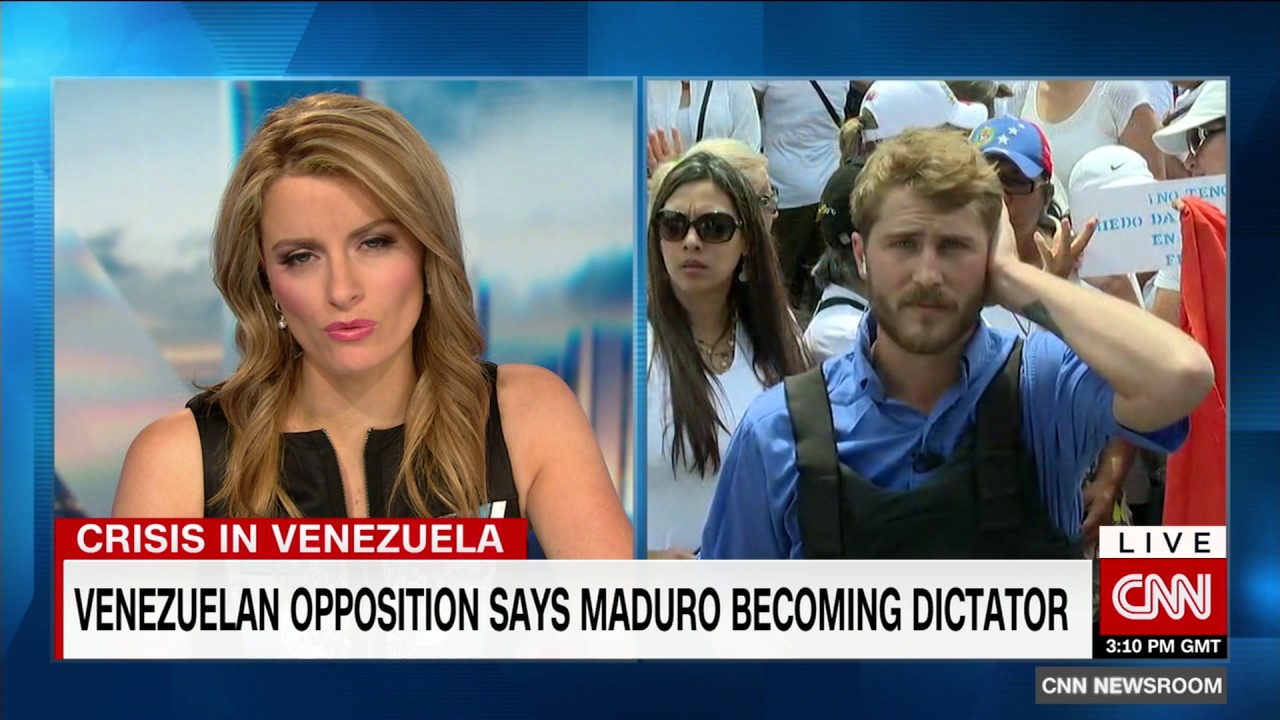
A screenshot of a CNN May 6, 2017 report covering opposition protests in Venezuela.

The timing of the report from the Herald — given that it came just days after Trump’s mention of the U.S.’ “military option” for carrying out regime change in Venezuela — is by no means random. Indeed, it is hardly the only report suggesting that Venezuela may pose a “threat” to the U.S.

CNN recently ran a story headlined “Maduro’s Son Threatens To Seize White House With Rifles.” The article omitted mention that Maduro’s 26-year-old son, who is currently coordinator of Venezuela’s National Film School, qualified this “threat” as one that would materialize only if Trump sent the U.S. military to Venezuela to depose its democratically-elected leadership.

It is ironic, to say the least, that the U.S. media would restrict its threat assessment focus to “incoming” threats, however implausible, while all but ignoring the U.S.’ repeated attempts to oust or even kill Venezuelan leadership ever since the election of Hugo Chávez, as well as U.S. assassination plots targeting numerous other Latin American leaders. Clearly, though the reality is precisely the opposite, a narrative is being created to suggest that Venezuela is a threat to U.S. national security.

The narrative is not being created just by the media. CIA Director Mike Pompeo, in a recent interview, stated that,

“Venezuela could very much become a risk for the United States of America. The Cubans are there; the Russians are there, the Iranians, Hezbollah are there. This is something that has a risk of getting to a very very bad place, so America needs to take this very seriously.” 

Pompeo, of course, provided no evidence for these claims — including his bizarre mention of Hezbollah, a Lebanese political party, being somehow involved in Venezuela.

On Tuesday, Vice President Mike Pence put his weight behind the narrative that Venezuela is a threat to U.S. national security. Speaking to reporters while visiting Colombia, Pence warned that the U.S. “will not stand by while Venezuela collapses into dictatorship,” and that the country risked becoming a “failed state” which would threaten “the security and prosperity of an entire hemisphere and the people of the United States of America.”

This flurry of narrative creation is apparently needed in light of the frosty initial reception Trump’s announcement of a potential “military option” received both domestically and abroad. In keeping with time-honored approaches to aggression justification, claims of influential Venezuelan figures linked to the Maduro government secretly plotting to kill a well-known U.S. Senator could easily become the pretext needed to justify such an intervention, even if no concrete evidence exists to support those claims. This flimsiness will, however, likely be of little concern to U.S. politicians, who have rarely been ones to require actual, verifiable evidence before launching an invasion.

"This Is a Lie" Presenting First Nations in Foreign Lands

Real Media: 'This is all a lie' - William Hawk Birdshead at the British Museum

by TRNN


August 16, 2017

This film records the reactions of William Hawk Birdshead, a DAPL water protector from the Oglala Nakota tribe, as he visits the JP Morgan Chase-sponsored North American gallery at the British Museum.


"This is all a lie...It's like a zoo. You go to a zoo and you see these things, and it's like, 
"Oh wow."" 


My name is William Hawk Birdsaid. I am from the Standing Rock and Oglala Lakota tribes in North Dakota, South Dakota, and I'm also enrolled of the Cheyenne and Arapaho tribes of Oklahoma and Montana. I come from a long history of indigenous revolutionaries. 

Tuesday, August 15, 2017

Canada's False Opposition: NDP In-Step with Trudeau and US Imperialism

Canada’s NDP backs American Empire

by Yves Engler - Dissident Voice


August 10th, 2017

Does the NDP consistently support a foreign policy that benefits ordinary people around the world? Or does the social democratic party often simply fall in line with whatever the American Empire demands?

Hélène Laverdière certainly seems to support the US-led geopolitical order.

While the NDP foreign critic has called for stronger arms control measures and regulations on Canada’s international mining industry, she’s aligned with the Empire on issues ranging from Venezuela to Palestine, Ukraine to Syria.

Echoing Washington and Ottawa, Laverdière recently attacked the Venezuelan government.

On the heels of Sunday’s illegitimate constituent assembly vote, it’s more important than ever for Canada to work with our allies and through multilateral groups like the OAS to secure a lasting resolution to the crisis,” she told the CBC.

But, the constituent assembly vote wasn’t “illegitimate”. Venezuela’s current constitution empowers the president to call a constituent assembly to draft a new one. If the population endorses the revised constitution in a referendum, the president – and all other governmental bodies – are legally required to follow the new constitutional framework.

Additionally, calling on Ottawa to “work with our allies” through the OAS may sound reasonable, but in practice it means backing Trudeau’s efforts to weaken Venezuela through that body.

Previously, Laverdière promoted that Washington-led policy. In a June 2016 press release bemoaning “the erosion of democracy” and the need for Ottawa to “defend democracy in Venezuela”, Laverdière said “the OAS Secretary General Luis Almagro has invoked the Inter-American Democratic Charter regarding Venezuela, and Canada, as a member of the OAS, should support his efforts.” But, the former Uruguayan Foreign Minister’s actions as head of the OAS have been highly controversial. They even prompted Almagro’s past boss, former Uruguayan president José Mujica, to condemn his bias against the Venezuelan government.

Laverdière has also cozied up to pro-Israel groups. Last year she spoke to the notorious anti-Palestinian lobby organization American Israel Public Affairs Committee. Months after AIPAC paid for her to speak at their conference in Washington, Laverdière visited Israel with Canada’s governor general, even participating in a ceremony put on by the explicitly racist Jewish National Fund.

The only Quebec MP to endorse Jagmeet Singh as next party leader, Laverdière has attended other events put on by groups aligned with Washington. She publicized and spoke to the weirdly themed “Demonstration for human and democratic rights in Venezuela, in solidarity with Ukraine and Syria.”

Laverdière supports deploying troops to the Russian border and repeatedly called for more sanctions on that country. She said the plan to send military trainers to the Ukraine “sounds good in principle” and only called for a debate in Parliament about sending 450 Canadians to head up a 1,000-strong NATO force in Latvia.

Since 2014 Laverdière has repeatedly called for stronger sanctions on Russia. In 2014 Laverdière told the Ottawa Citizen that “for sanctions to work, it’s not about the number of people but it’s about actually sanctioning the right people. They have to be comprehensive. And they have to target mainly the people who are very close to Putin. Our sanctions, the Canadian sanctions, still fail to do that.”

In May Laverdière applauded a bill modeled after the US Magnitsky Act that will further strain relations between Ottawa and Moscow by sanctioning Russian officials. “Several countries have adopted similar legislation and we are encouraged that the Liberals are finally taking this important step to support the Global Magnitsky movement,” she said.

In another region where the US and Russia were in conflict Laverdière aligned with the Washington-Riyadh position. In the midst of growing calls for the US to impose a “no-fly zone” on Syria last year, the NDP’s foreign critic recommended Canada nominate the White Helmets for the Nobel Peace Prize. A letter Laverdière co-wrote to foreign minister Stéphane Dion noted:

Canada has a proud and long-standing commitment to human rights, humanitarianism and international peacekeeping. It is surely our place to recognize the selflessness, bravery, and fundamental commitment to human dignity of these brave women and men.”

Also known as the Syrian Civil Defence, the White Helmets were credited with rescuing many people from bombed out buildings. But, they also fostered opposition to the Bashar al-Assad regime. The White Helmets operated almost entirely in areas of Syria occupied by the Saudi Arabia–Washington backed Al Nusra/Al Qaeda rebels. They criticized the Syrian government and disseminated images of its violence, but largely ignored those people targeted by the opposition and reportedly enabled some of their executions.

The White Helmets are closely associated with the Syria Campaign, which was set up by Ayman Asfari, a British billionaire of Syrian descent actively opposed to Assad. The White Helmets also received at least $23 million from USAID and Global Affairs Canada sponsored a five-city White Helmets tour of Canada in late 2016.

Early in the Syrian conflict Laverdière condemned the Harper government for failing to take stronger action against Assad. She urged Harper to raise the Syrian conflict with China, recall Canada’s ambassador to Syria and complained that energy giant Suncor was exempted from sanctions, calling on Canada to “put our money where our mouth is.”

Prior to running in the 2011 federal election Laverdière worked for Foreign Affairs. She held a number of Foreign Affairs positions over a decade, even winning the Foreign Minister’s Award for her contribution to Canadian foreign policy.

Laverdière was chummy with Harper’s foreign minister. John Baird said, “I’m getting to know Hélène Laverdière and I’m off to a good start with her” and when Baird retired CBC reported that she was “among the first to line up in the House on Tuesday to hug the departing minister.”

On a number of issues the former Canadian diplomat has aligned with the US Empire. Whoever takes charge of the NDP in October should think about whether Laverdière is the right person to keep Canadian foreign policy decision makers accountable.

Yves Engler is the author of A Propaganda System: How Canada’s Government, Corporations, Media and Academia Sell War and Canada in Africa: 300 years of aid and exploitation.
Read other articles by Yves.

Bluefin Down: Tuna Faces Imminent Extinction

Bluefin Tuna at the Brink 

by Robert Hunziker - CounterPunch


August 14, 2017

Bluefin tuna at 3%, that’s it!

Pacific bluefin tuna has unique worldwide status as one of the most awe- inspiring remarkable creatures on the planet. They grow to 12 feet and 1,500 pounds and live up to 35 years whilst swimming super-fast, crossing the entire ocean in 21 days.

They are the essence of nature’s wonderful creativity and beauty.
Photo by oliver.dodd | CC BY 2.0 

Unequivocally, the bluefin’s days are numbered, almost guaranteed to go extinct, prompting the question: Is bluefin tuna a metaphor for global warming’s impact on civilization? And if so, how so?

It’s a fair question as the impact of the Great Acceleration (BGNG 1940s) increasingly interjects humans into the finer workings of the ecosystem, which is rapidly morphing into “Humanature,” an embryonic field of scientific study that is not yet acknowledged.

Overfishing, greedy uncivilized thoughtless arrogance, bluster and audacity (sounds like the ‘neoliberal’ brand of capitalism) have chopped up physically destroyed the stock of bluefin tuna.

“The stock is down over 97 percent from pre-fishing levels, so there is no doubt the species needs to have some protection put in place,” according to Duke University research scientist Andre Boustany. (Source: Alastair Bland, Should Pacific Bluefin Tuna Be Listed As An Endangered Species? National Public Radio, June 29, 2016).

Bluefins caught today are mostly juveniles, up to 98% of total catch. They have not reproduced and never will because they’ll never have the opportunity. Pacific bluefin tuna reach reproductive maturity at five years and 125 pounds weight. Their predators are Japan (50%) and Mexico (30%) as the major perpetrators while the U.S. (2%) is a minor player.

Because bluefins travel the entire ocean, passing through complicated jurisdictional authorities, the probability of enforcing limits on fishing or conservation measures are not going to happen, especially with voluntary limits. Besides, they are doomed in large measure because bluefin is priced in the marketplace like a piece of artwork. The price of Bluefin at the market does not inhibit demand because the greed factor collapses capitalism’s laws of supply/demand. Inelastic demand is at work.

The impending extinction factor of bluefin tuna, in certain respects, resembles the issue of global warming. Similar to mindlessly butchering fishing stock down to 3%, nobody seems to care enough to seriously tackle global warming’s impending threat of human extinction. The world wears blinders, thereby ignoring reality.

After all, the best shot at tackling global warming is the Paris 2015 Agreement, which calls for 100% voluntary action to defeat the global warming leviathan. Voluntary… really? Whereas if they were actually, truly serious, there would be heavy, very heavy repercussions for failure to meet stringent guidelines, even though the U.S. demanded the Paris accord 2015 be voluntary to avoid a clash with the U. S. Senate, which must ratify treaties.

Voluntarism will not save any species. The economic model of the world, neoliberal capitalism, is too focused on profits, the invisible hand of free markets, deregulation of governments, and significantly, converting public assets to private ownership, to adhere to undependable anemic voluntarism.

Similar to humanity’s utter disregard for proper conservation measures to save the bluefin tuna, humanity fails at the threat of global warming, falling on its own sword, regrettably a powerful reflection of neoliberalism’s loathing of governmental regulations. Let the markets decide.

James Hansen, the father of climate change awareness, says of the Paris Agreement 2015: “It’s a fraud really, a fake.” (James Hansen, Father of Climate Change Awareness, Calls Paris Talks ‘A Fraud,’ The Guardian, Dec. 12, 2015)

Still in all, if the world community really truly cared, similarly for bluefin tuna, they’d establish brutal repercussions for failure to comply with stiff, very stiff restrictions. But similar to the bluefin tuna story, nobody’s serious enough. International agreements to curb catches of Pacific bluefin tuna are voluntary and wildly violated. It’s fluff, blah, blah, blah. Meanwhile, the bluefin’s remaining shot at existence is down to 3%. Afterwards, sayonara.

What then of global warming? According to NASA, over the past 800,000 years based upon ice-core data, CO2 has fluctuated between 170 ppm and 290 ppm. The safe level to prevent global warming from running out of control is below 350 ppm.

Today, it is over 400 and not safe, shockingly increasing like gangbusters, actually accelerating its rate of growth year over year, which is roughly equivalent to the 3% level for bluefin tuna’s future outlook of survival of the species.

In turn, CO2 blankets the earth’s atmosphere thus trapping heat in similar fashion to its sister planet Venus where average temps are 864 F. That’s real hot! The reason Venus has so much heat-trapping CO2 (96.5% of its atmosphere) is because that’s where all of its carbon is located. On Earth most of the carbon is still underground or trapped under ice, for now.

Meanwhile, as for the various species of the world, according to Dr. Stuart Pimm, conservation ecologist at Duke University: “In the next few decades we’ll be driving species to extinction a thousand times faster than we should be.” (Source: Racing Extinction, directed by Louie Psihoyos, Discovery Channel, 2015)

Begging the question, when will the last bluefin tuna swim across the Pacific?


Postscript: "If governments fail to take immediate action, a population collapse isn’t just possible—it’s inevitable." - The Pew Charitable Trust, July 19, 2017. pewtrusts.org/SavePacificBluefin

"By the end of the 20th century, up to 90 percent of the sharks, tuna, swordfish, marlins, groupers, turtles, whales, and many other large creatures that prospered in the Gulf for millions of years had been depleted by overfishing." - Legendary Oceanographer Sylvia Earle – American marine biologist and National Geographic Explorer-in-Residence
 
Robert Hunziker lives in Los Angeles and can be reached at roberthunziker@icloud.com
More articles by:Robert Hunziker

Transnationals, Oligarchs, and Neo-Cons, Oh My! Behind the Push to Partition Middle East

ExxonMobil, Kochs, Israel Pushing Washington To Partition Iraq and Syria

by Whitney Webb - MintPress News


August 14, 2017

The currently stateless Kurds sit astride the Iraq-Syria border on land blessed/cursed with oil, other resources, and geopolitical significance. Is it any wonder that mega-corporations and their client states are looking to use the Kurds, stoke conflict, and exploit the situation?

WASHINGTON, D.C.Years before the U.S. illegally invaded and then occupied Iraq, plans were circulating within the Pentagon to partition the country along “sectarian” lines, with the express purpose of allowing the U.S. and its regional allies to better control oil resource production and movement within the Middle East.

In Syria, the same narrative of partition has more recently been circulated as the “only” solution to the nation’s sectarian divisions, divisions which did not emerge until they were artificially created in 2011 when the current conflict began and later fomented by hostile foreign actors.

While the Bush and Obama administrations pushed for the partition of Iraq on several occasions, it was largely corporate actors during that time that took the most active steps towards creating an independent state within the Iraqi region controlled by the U.S.-allied Kurds, an area with sizeable energy reserves and other strategic resources.

The area of Syria controlled by the U.S.-backed Kurds conveniently connects directly with the Kurdish “statelet” in Iraq, making the possibility of a larger independent Kurdistan more feasible. This area also boasts the largest concentration of many of Syria’s most critical resources.

While past administrations avoided openly recognizing the partition of Iraq, the administration of President Donald Trump is striking a different tone, largely due to the influence within the administration of some of the biggest players who actively sidestepped Iraq’s government in favor of the Kurds years ago.

Chief among such players was ExxonMobil — whose CEO at the time, Rex Tillerson, is now Trump’s Secretary of State — along with other corporations whose financial and political support for the Trump administration is well-documented.


The geopolitical and economic motives for a partitioned Iraq 


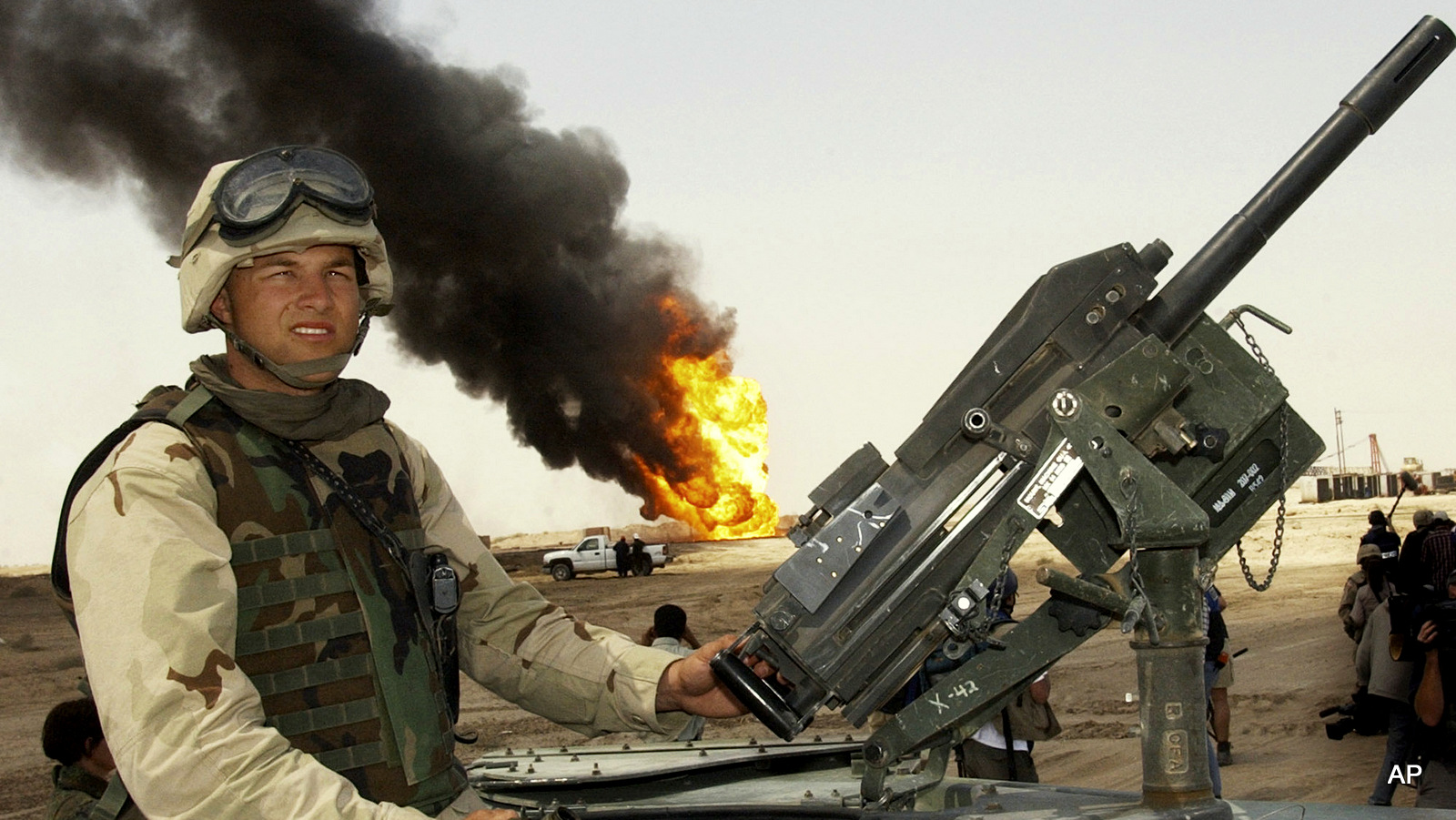
In this April 1, 2003 file photo, a U.S. soldier stands guard on top of 
a humvee as oil workers work on oil well fires at Rumaila oil field, southern Iraq.

The corporatist, neoconservative dream of partitioning Iraq has been around for well over a decade, first materializing a year before the U.S.’ ill-fated 2003 invasion of that nation. The plan, drafted by former Vice President Dick Cheney and Deputy Secretary of Defense Paul Wolfowitz, contemplated the division of Iraq into three autonomous, sectarian “statelets” for Iraqi Muslim Sunnis, Muslim Shi’as, and ethnic Kurds, who are also predominantly Muslim. This partition, it was believed, would allow the U.S. and its regional allies to more easily dominate Iraq and its important fossil fuel resources, along with conferring other “strategic advantages.”

As U.S.-based private intelligence firm Stratfor noted in 2002, the invasion and destruction of Iraq would pave the way for partition and thus greater U.S. control over Iraq and the entire Middle East:

“After eliminating Iraq as a sovereign state, there would be no fear that one day an anti-American government would come to power in Baghdad, as the capital would be in Amman [Jordan]. Current and potential U.S. geopolitical foes Iran […] and Syria would be isolated from each other, with big chunks of land between them under control of the pro-U.S. forces.

Equally important, Washington would be able to justify its long-term and heavy military presence in the region as necessary for the defense of a young new state asking for U.S. protection – and to secure the stability of oil markets and supplies. That, in turn, would help the United States gain direct control of Iraqi oil and replace Saudi oil in case of conflict with Riyadh.”


Creating the divisions needed to justify partition 


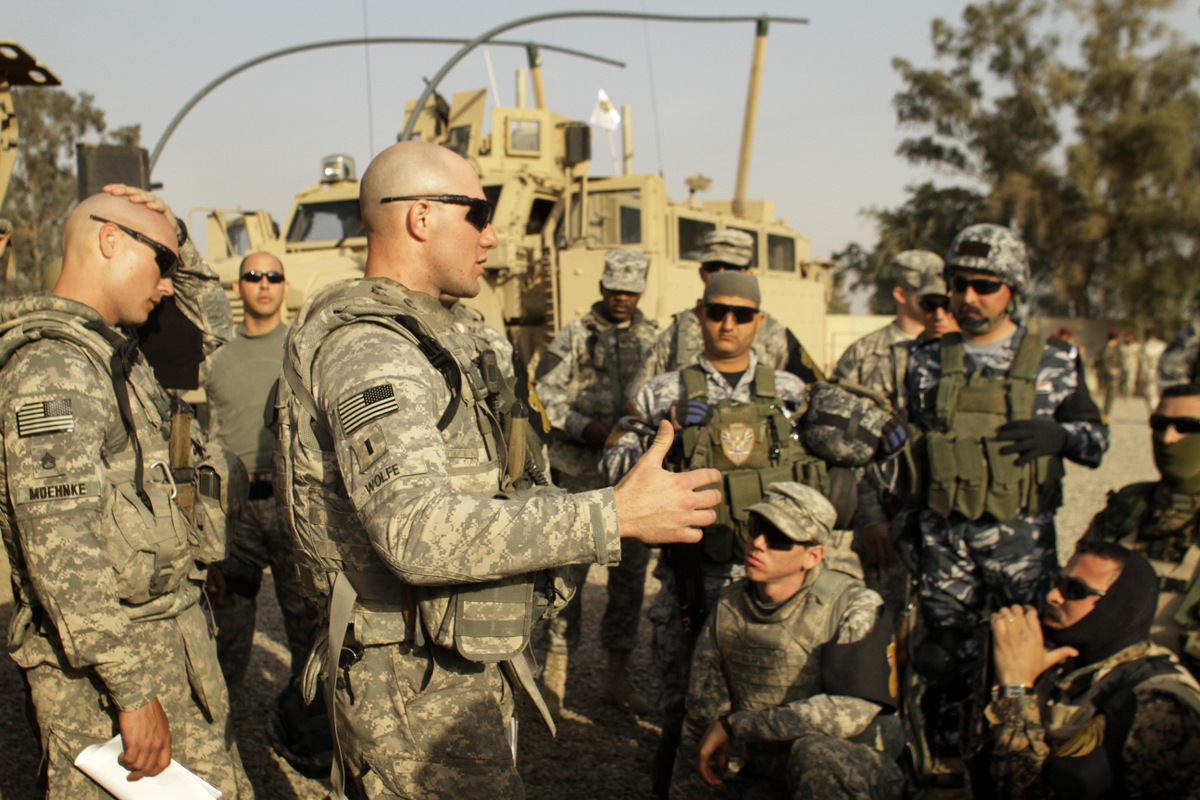
U.S. Army Lt. Douglas Wolfe, leads a pre-mission brief before the 
first patrol for new military unit comprised mainly of Kurdish security forces, 
on the outskirts of Kirkuk, north of Baghdad, Iraq, Feb. 17, 2010. 
Known as the Golden Lions, the security force is deployed along the ethnic 
fault line between Kurds and Arabs in northern Iraq. (AP/Maya Alleruzzo)

The big problem for the partition plan, however, was the simple fact that these diverse groups had coexisted with minimal sectarian violence in Iraq for centuries. This meant, of course, that the sectarianism that was needed to justify partition had to be engineered. The U.S., in its invasion and subsequent occupation of Iraq, happily obliged, sponsoring sectarian violence through the military training – including torture techniques – it gave to Iraqi militias, police and military forces that divided along particular ethnoreligious lines.

Many of these organizations have been found to be repeat human rights offenders and have targeted particular ethnoreligious groups within Iraq. Despite their egregious track record, the U.S. continues to financially support these armed groups.

The U.S. has also worked to create and strengthen ethnoreligious divisions within the country by promoting Iraqi organizations founded on religion or ethnicity rather than along political lines.

Though some analysts believe that the biggest winners in the U.S.-created environment of Iraqi sectarianism were the Iraqi majority population of the Shi’a – which, after all, was given control of the post-invasion government – it was really the Kurds who gained the most as a result of the U.S.’ machinations to divide and conquer Iraq.

The Kurds are the largest group of nomadic people in the world and have long existed without their own state. As journalist Sarah Abed has noted, “This fact has allowed Western powers to use the ‘stateless’ plight of the Kurdish people as a tool to divide, destabilize and conquer Iraq and Syria, where colonial oil and gas interests run deep.” Although the most powerful Kurdish political parties in these countries do not see themselves as pawns, history shows that Western colonial powers have used them that way in the past and continue to do so, often with their willing cooperation.

In recent decades the U.S. government and military have openly supported Kurdish separatist elements, though they have stopped short of recognizing “Kurdistan” as a state completely independent of the Baghdad-based government. This role fell instead to U.S. corporations, such as ExxonMobil, a major force in the fossil fuel industry. In 2011, ExxonMobil unilaterally brokered an oil deal with the Kurdistan region, bypassing Iraq’s central government in the process.

According to ExxonMobil, the move was partly motivated by problems it was having contracting with Iraq’s central government regarding oilfields in southern Iraq. However, the promise of oil reserves in Kurdistan said to be “one of the world’s most promising regions for the future [of] hydrocarbon discovery,” was also a clear motivator. As a result, ExxonMobil sided with the Kurdish separatists over the central government, giving clout to Kurdish goals of greater regional autonomy – and thus furthering their shared goal of a divided Iraq.

Other oil corporations – including Chevron and Gazprom, among others – followed Exxon’s lead.

By 2014, more than 80 foreign energy corporations had struck deals with Kurdistan. Oilman Ray Hunt, whose Hunt Oil Co. signed its own unilateral agreement with Kurdistan in 2007, has consistently heaped praises upon Kurdistan and has also made clear his vision for the future of Iraq: “In the end, you’ll end up with a soft partition of Iraq.”

Corporate connection to Trump’s change of heart on Iraq partition 


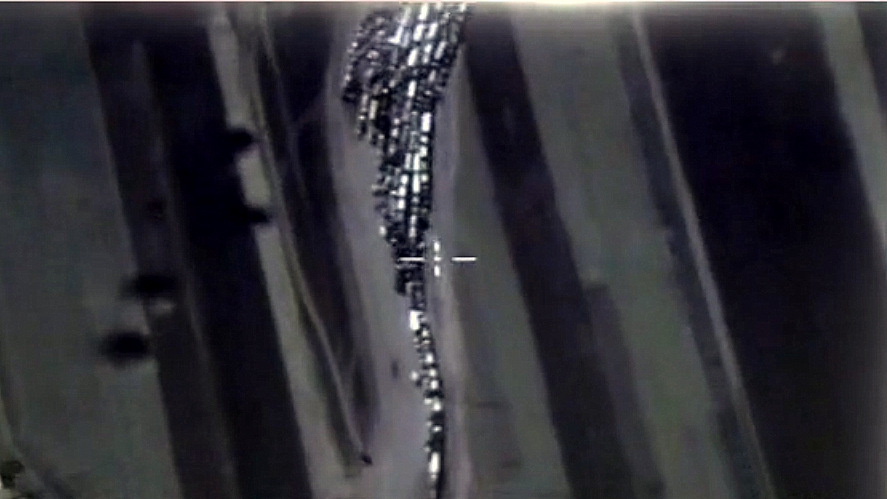
A photograph released by Russian intelligence depicting thousands 
of trucks laden with oil crossing from Syria into Turkey. December, 2015.

Over the years since these deals were struck, the Kurdish separatist parties in Iraq have benefited immensely, though more recently they have been hit hard by the global drop in oil prices. In 2014, they were exporting 280,000 barrels of oil every day. And, despite troubles with foreign companies brought on by falling oil prices and the rise of Daesh (ISIS), the Kurds – as of the end of 2016 – were exporting nearly 600,000 barrels a day.

Though Daesh was painted by the media as a scourge to the Kurds, they have in fact benefited from Daesh’s invasion of large swaths of Iraq. Indeed, the Kurds – trained, armed and provided with airstrike support by the U.S. and Israel – have taken control of many former Daesh territories and have thereby expanded the size of their own territory.

The U.S. and its regional allies have said that the Kurds’ ability to confront Daesh essentially entitles them to “have their way.” As Sadad Ibrahim al-Husseini, former head of exploration and development for the Saudi state oil company Aramco told The New York Times in 2014: “At the end of the day, the Kurds will have their way, because they are the only credible Sunni group that can confront ISIS.”

Not surprisingly, the Kurd’s oil riches have brought them into direct conflict with Iraq’s central government, which has since cut off national funding for the Kurdish region and threatened any country or company buying Kurdish oil with legal action for violating the nation’s constitution by not sharing its oil sale revenue equally among all Iraqis.

However, countries like Turkey and Israel continue to buy significant amounts of oil, as well as natural gas, from the Kurds. Turkey’s case is particularly interesting given Turkish President Tayyip Erdogan’s well-known hatred of the Kurds and opposition to Kurdish independence in Syria. However, when it comes to Iraqi Kurdistan at least, economic factors have won out, with Turkey’s ruling party having stated that Kurds in Iraq have the right to self-determination.

Kurdish control of Iraq’s oil-rich north is key to the partitioning plan. As Michael Makovsky, a former Pentagon official, told The New York Times: “I think Iraqi Kurdish independence is inevitable, at least eventually. They have natural allies in the United States because of the oil companies involved in drilling there. And the Turks and Europeans need their gas.”

Though candidate Trump had not voiced support for a partition of Iraq, spurred by his administration’s strong ties to the oil industry, Washington has become even more friendly to the Kurds – and to the idea of Kurdish secession – since Trump took office.

However, when the State Department was asked by journalist Nafeez Ahmed whether it still stood by the traditional position of supporting a unified Iraq, a department spokesperson answered: “With respect to the unity of Iraq, you’re right; that is something we make a point of saying. But ultimately, these are all internal political discussions that Iraq needs to have with all ethnic groups resident in the country.” As Ahmed notes, this is the first time that the State Department has officially announced the U.S.’ willingness to consider the partition of Iraq.


Why the sudden change of heart? 


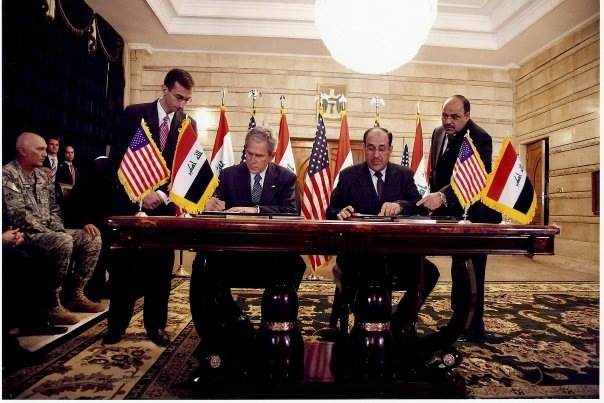
Ali Khedery, far left, watches as U.S. President George W. Bush, 
signs agreement with Iraqi Prime Minister Nouri al-Maliki. 
(Photo: Public Domain)

ExxonMobil once again emerges as a key player — not surprisingly, given that current Secretary of State Rex Tillerson was Exxon’s CEO when the unilateral contract with the Kurds was forged. Tillerson, however, is not the only former ExxonMobil employee with ties to the Trump administration. Ali Khedery — a former Pentagon official who served in the U.S. coalition authority in Iraq, and a former ExxonMobil executive — has repeatedly promoted the division of Iraq.

Khedery is also the founder of Dragoman Ventures, a firm connected to the Committee to Destroy ISIS, which has been instrumental in bringing about the Trump administration’s change of opinion regarding Iraq’s partition. The Committee’s executive director, Sam Patten, also shares deep connections to members of Trump’s campaign and transition teams, as well as to certain Iraqi oligarchs suspected of having ties to U.S. intelligence and insurgent elements in Iraq.

Nor is oil the only resource that has swayed the Trump administration and its corporate allies to view partition favorably. Iraq’s Anbar province was recently found to contain nearly a tenth of the world’s total deposits of phosphates, a key ingredient in the production of nitrogen fertilizer. Now — with control of more than 70 percent of the world’s phosphate supply, and with markets reaching a point where demand is beginning to outstrip supply — the world’s largest producer of nitrogen fertilizer is eager for access to Anbar province.

That company, Koch Fertilizer Inc., is owned by the infamous Koch Brothers. Fully one-third of Trump’s entire transition team had ties to Koch Industries.

The role of Israeli ties in pushing the partition plan 


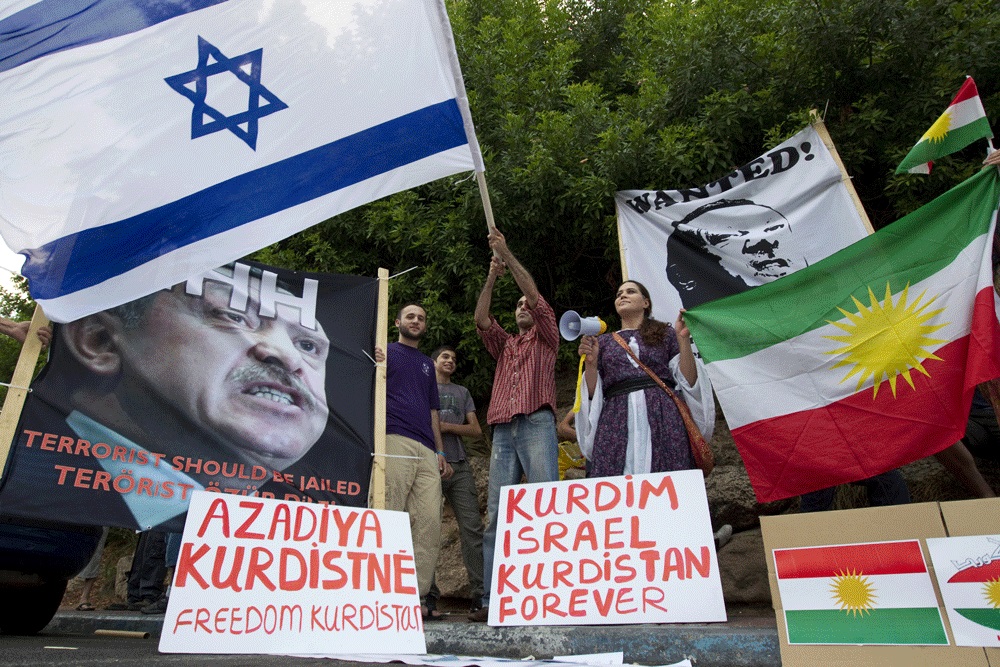
Ethnic Kurdish Israelis protest outside the Turkish embassy in 
Tel Aviv, Israel, July 8, 2010.

The Trump administration’s close ties to Israel may also be a factor in Trump’s willingness to consider Iraq’s partition. Though the U.S. is clearly driving partition in both Iraq and Syria, it is not alone. Israel stands to gain greatly from a partition of Iraq and has worked, like the U.S., to engineer sectarianism there and strengthen the Kurds. The Kurds have received weapons, training, and more from Israel — well before the rise of Daesh, with ties dating back to the 1960s.

Israel has also directly supported the Kurds’ economy. In 2015, despite warnings from Baghdad, Israel was importing as much as 77 percent of its oil supply from Iraqi Kurdistan, funneling much-needed money to the cash-stripped Kurdish regional government.

Israel has long recognized the potential role of the Kurds in dividing countries it and its allies seek to weaken. It is hardly a coincidence that Israel’s Greater Israel project aligns almost perfectly with “Kurdistan.” In the Oded Yinon plan, or the plan for a “Greater Israel,” the use of the Kurds is considered imperative as a means for dividing neighboring countries in order to aid in Israeli plans for greater domination and territorial expansion.

In addition, Israel considers the Kurds an important part of its long-standing goal to destabilize Iran. For instance, WikiLeaks revealed in 2010 that Israel’s intelligence agency Mossad had expressed interest in using the Kurds and other ethnic minorities to topple the Iranian government by manufacturing the country’s division. Given that the partition of Iraq would isolate Iran from Syria, Israel – like the U.S. – views partition as serving multiple goals, ultimately enabling Israel to dominate the entire Middle East.

Syria partition plan follows the Iraqi partition playbook 


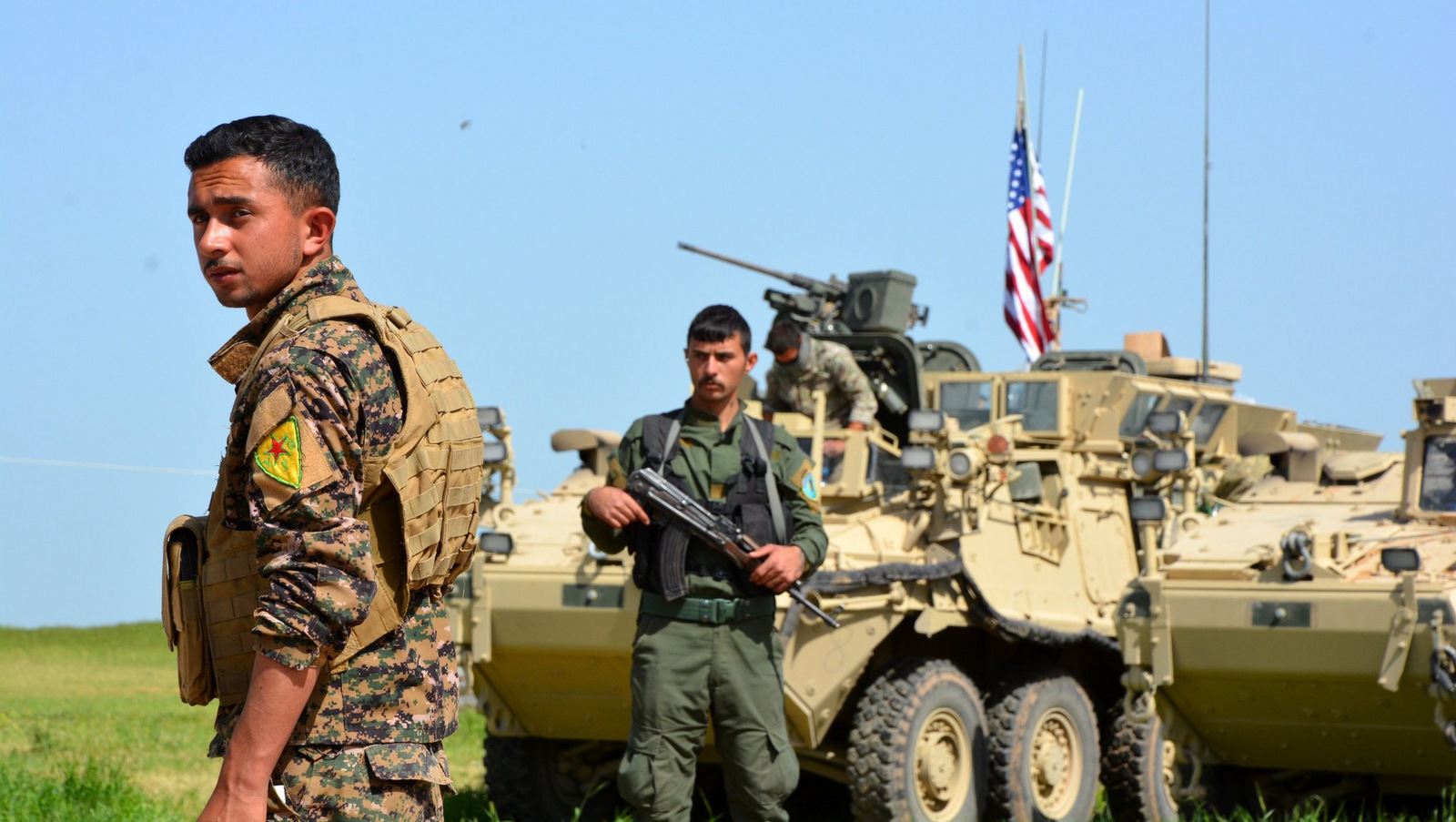
Kurdish fighters from the People’s Protection Units, (Y.P.G), stand guard 
next to American armored vehicles at the Syria-Turkey border, April, 2017. 
(Youssef Rabie Youssef/EPA)

Iraq is by no means the only Middle Eastern country that Western powers are seeking to partition. The partition of Syria has been repeatedly sold to the public as the “only” solution to Syria’s ongoing “sectarian” conflict, now well into its seventh year. However, this sectarianism was engineered and stoked by foreign powers to bring about the current conflict in Syria. WikiLeaks revealed that the CIA was involved in instigating anti-Assad and “sectarian” demonstrations as early as March 2011. Declassified CIA documents show the plan to engineer sectarianism in order to weaken the Syrian state dates back to at least the 1980s.

The partition idea was also repeatedly touted by the Obama administration, which stated that it “may be too late” to keep Syria whole.

In 2011, when the conflict was in its infancy, the U.S. and its allies – namely Israel, Qatar, Turkey, France, the U.K. and Saudi Arabia – began supplying tons upon tons of weapons to insurgent and sectarian elements within Syria, heavily arming the so-called “moderate” Wahhabi opposition like the Free Syrian Army and the Kurds. As the conflict raged on – and the “moderate” opposition was exposed time and again as sharing close ties with internationally recognized terror organizations like al-Qaeda – Washington’s support began to shift increasingly towards the Kurds.

As in Iraq, the spread of Daesh in the area became a pretext for the U.S. not only to arm the Kurds but also to allow them to take control of areas, such as Raqqa, once held by Daesh. Media and government sources repeatedly told the public that the Kurds must be armed, as they were the only group that had proven “effective” in countering Daesh. This past March, the Kurds declared the formation of a Kurdish federation under democratic self-rule. This declared federation has yet to obtain international recognition, but – given what has transpired in Iraq and in U.S.-Syrian relations – such an achievement doesn’t seem far off.

The Kurds and their U.S. allies currently have gained effective control of Syria’s north, which comprises about a quarter of the entire country but boasts over 90 percent of Syrian oil and gas potential. According to Yeni Şafak, the U.S. along with the Saudis, Egypt, and Kurdish officials have held meetings where decisions were made to extract, process and market the oil, with the Kurds being given a handsome share of the profits. As of 2015, they were said to be earning in excess of $10 million every month.

Syria’s Kurdistan exports its oil to Iraq’s Kurdistan, with which it conveniently shares a border. It is then refined and sold to Turkey. Though no corporations are explicitly involved, the deal between Syrian and Iraqi Kurds was brokered by unnamed “oil experts” and “oil investors.” The Kurds in Syria and Iraq did not even sign the agreement in person. They were subsequently “informed” and instructed to supervise the operation.

A source in Iraq’s Kurdistan Regional Government (KRG) told NOW News that “with regard to southern Kurdistan, it was a company and not the KRG that signed the deal, and it is [the company] that directly hands over the sums in cash every month.” Given that over 80 foreign companies are involved in the KRG’s oil trade, most of them based in the U.S., we can safely assume that many of the same players have also been involved in developing the oil trade of Syria’s Kurdistan.

Non-oil assets of Syrian Kurdistan also tempt corporations and governments 


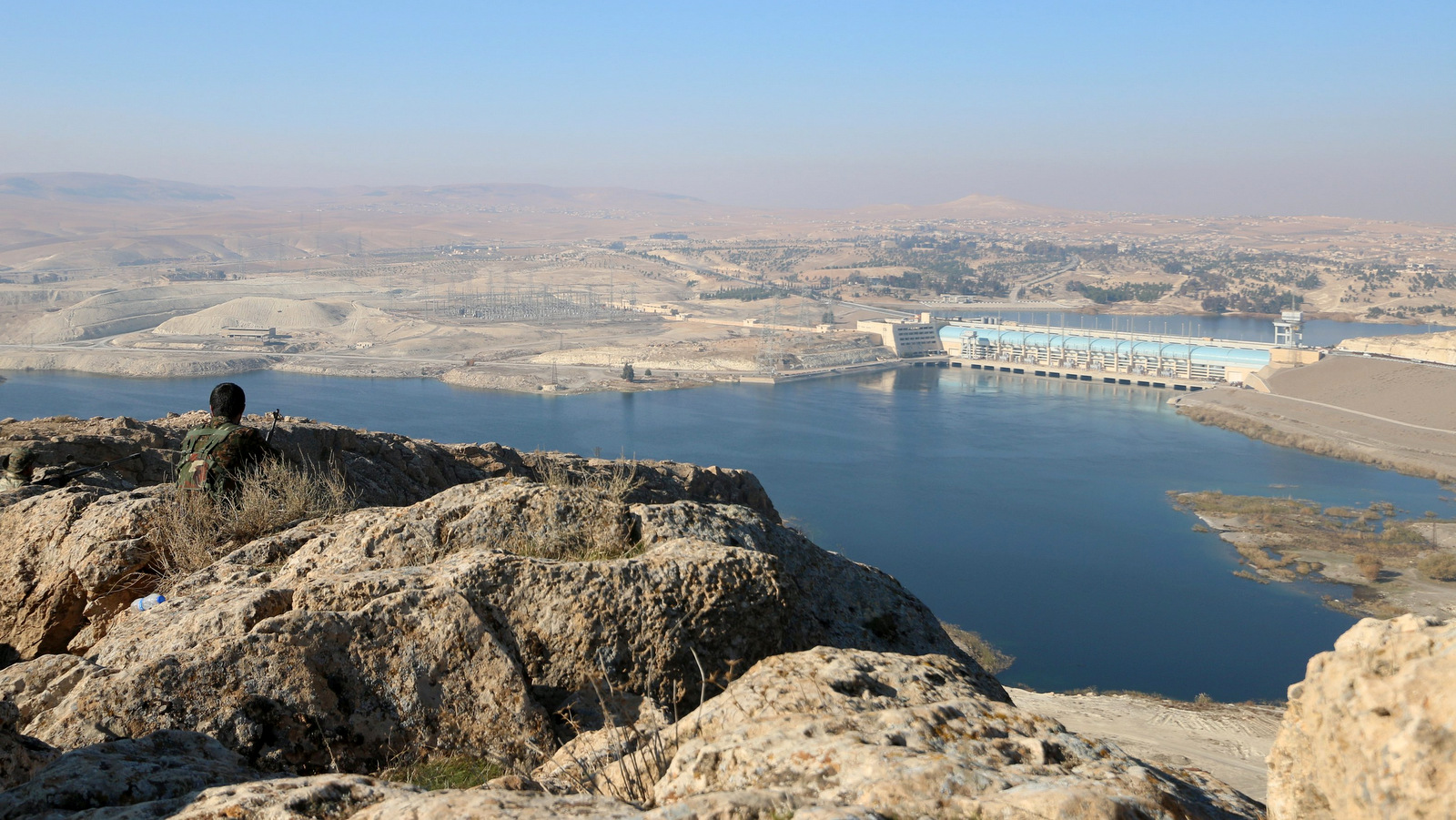
Kurdish Fighters take positions at the top of Mount Annan overlooking
the Tishrin dam, after they captured it from ISIS militants, south of Kobani, 
Syria December 27, 2015. (Photo: Rodi Said)


In addition to oil, the “Kurdistan” of Syria also includes much of Syria’s freshwater, including its three largest reservoirs, as well as much of its electricity (hydropower via Tabqa) and its agricultural resources. The growth of Syria’s Kurdistan also has major implications for one of Syria’s other key assets: its location. In 2013, The New York Times noted that “Syria’s prime location and muscle make it the strategic center of the Middle East.”

Syria’s strategic location makes it crucial to the regional flow of hydrocarbons. Having the northern section of Syria — and potentially the eastern as well, if the U.S. gets its way — under the control of a U.S. ally could have a profound effect on future and existing pipelines. Notably, it would complicate the land route between Syria and Iran, Syria’s staunchest regional ally and long-time foe of the U.S. and Israel — a scenario highlighted by U.S.-based intelligence firm Stratfor back in 2002.

The words of late journalist and historian Patrick Seale – “Whoever would lead the Middle East must control Syria” – ring true for the U.S. government now more than ever. With internal reports warning of the U.S.’ waning position as the “world’s only superpower,” the division of Iraq and Syria is essential to Washington’s designs to maintain its influence, as well as the influence of the corporate powers it protects.

Gorilla Radio with Chris Cook, Whitney Webb, Jacinda Mack, Janine Bandcroft August 16, 2017

This Week on GR

by C. L. Cook - Gorilla-Radio.com


August 16, 2017

Not content pointing his pistols at North Korea, America's 'Loose Cannon-in Chief' spared a salvo in the press over the weekend to menace Venezuela saying,

"We have many options for Venezuela. This is our neighbor ... we're all over the world, and we have troops all over the world in places that are very, very far away, Venezuela is not very far away, and the people are suffering, and they're dying. We have many options for Venezuela, including a possible military option, if necessary." 

Listen. Hear.

Maduro administration reaction to the threat was muted, given its substance, but did include nation-wide civilian and military mobilization drills; a gambit former president, Hugo Chavez pioneered as response to president George W. Bush sabre-rattling. Differing today however from the halcyon days of the Bolivarian Revolution, Venezuela now enjoys neither the inspired leadership of the charismatic Chavez, nor does it benefit from the favourable media coverage he garnered from certain sectors of the foreign media. Important points both, considering American attacks against his embattled successor, Nicolas Maduro are likely to grow more desperate as the buffoonish presidency of Donald Trump nears its inevitable train wreck.

Whitney Webb is a South America-based journalist writing about environmental, political, and economic issues in English and Spanish. She's a staff writer at MintPress News.com, and her articles have featured at ZeroHedge, the Anti-Media, and 21st Century Wire, among other places. Her recent work for MintPressNews includes the article, 'Alternative Media Is Ignoring Venezuela’s Regime Change Problem.'

Whitney Webb in the first half.

And; as the third anniversary of the Mount Polley mine tailings spill in BC's interior passed last week, so too passed the provincial statute of limitations providing for prosecution of the company responsible. Fortunately, employing a rarely used provision of the law, acting Xat’sull Chief at the time of the disaster and Indigenous advocate, Bev Sellars filed private charges against Imperial Metals, because she says,

"I could not bear to witness BC simply stepping aside and giving-up on its own responsibility to protect our shared environment and waters." 

Sellars is supported in her suit by various environmental groups and cohort, Jacinda Mack of First Nation Women Advocating For Responsible Mining, or FNWARM.

Jacinda Mack in the second half.


And; CFUV Radio broadcaster, Janine Bandcroft will be here at the bottom of the hour to bring us up to speed with some of what's good going on in and around our town scheduled for the coming week. But first, Whitney Webb and whither a word of media support for Venezuela as alternative to the right's Mighty Wurlitzer?
Chris Cook hosts Gorilla Radio, airing live every Wednesday, 1-2pm Pacific Time. In Victoria at 101.9FM, and on the internet at: http://cfuv.ca.  He also serves as a contributing editor to the web news site, http://www.pacificfreepress.com. Check out the GR blog at: https://gorillaradioblog.blogspot.ca/

G-Radio is dedicated to social justice, the environment, community, and providing a forum for people and issues not covered in the corporate media.

Monday, August 14, 2017

Moving Beyond Brutish: New British Columbia Government Announces End to Grizzly Bear Trophy Hunt

End to grizzly trophy hunt cause for wild celebration

by Wilderness Committee


August 14, 2017

VANCOUVERThe Wilderness Committee team are giving each other great big bear hugs this afternoon to celebrate the BC government’s announcement that the trophy hunting of grizzly bears will finally be banned by November 30.

“For 16 long years we’ve been demanding this ban,” exclaimed Joe Foy, Wilderness Committee National Campaign Director.
“Ever since Premier Gordon Campbell reinstated the bloody grizzly trophy hunt, we’ve been counting the days until the killing stops.”

Since the trophy hunt restarted about 250 grizzly bears a year have been shot dead for the fun of it.

“Nearly 4,000 grizzly bears slaughtered for so-called sport. Premier Horgan is to be commended for ending this cruel and barbaric blood sport for good,” said Foy.

According to the BC government there are around 15,000 grizzly bears in the province, which is about a quarter of the entire North American population. Hunting and habitat loss are the two biggest threats to grizzlies.

The Committee on the Status of Endangered Wildlife in Canada (COSEWIC) lists the western population of grizzly bears status as special concern. Within BC, grizzly bears have been wiped out of several areas including the south central part of the province from the US border to north of Quesnel. In the southwest, grizzly population numbers are dangerously low.

“We’re glad the senseless killing of grizzly bears is coming to an end. Now this at-risk species has a better chance to recover,” said Foy.


Related Campaign:  Grizzly Bears

Climate Change Report Leaked - NYT Publishes

Government climate scientists take action: Sobering 2018 National Climate Change Report is Leaked to the NY Times

by Dave Lindorff - This Can't Be Happening


August 8, 2017


Embattled climate scientists working in 13 various US government agencies threw down the gauntlet before the Trump administration by releasing, to the New York Times, an over 600-page report on climate change in the US [1], the work of several years intended to comply with a Congressional requirement for such a report every four years.

The scientists involved in releasing the leaked document — the fifth draft of the 2018 report — told the Times they were releasing the document early in draft form for fear that the Trump Administration and Trump’s Environmental Protection Agency Administrator, climate change denier Scott Pruitt, would attempt to deep-six, or at least drastically revise their work and conclusions.

Their fears are understandable. Trump has called climate change a hoax and a Chinese conspiracy designed to harm the US, and Pruitt, while recently at least acknowledging that the global climate is getting hotter, claims that it is both impossible to know to what extent human activity is to blame, and that the trend going forward is impossible to predict.

The latest report, however, debunks all of those ignorant assertions by the country’s current leadership, warning that the warming trend both globally and in the US is undeniable, and dire.
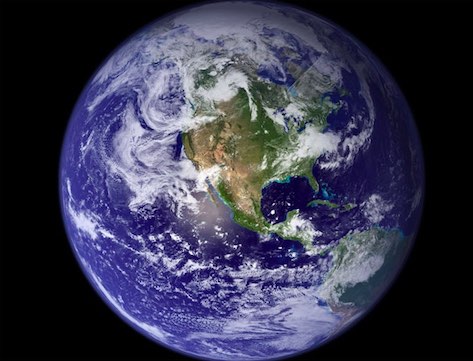
Blue Marble (NASA photo)

According to the document, which is dated June 28 and titled “US Global Change Research Program: Climate Science Special Report” (CSSR):

“Since the last National Climate Assessment was published (in 2014), 2014 became the warmest year on record globally, 2015 surpassed 2014 by a wide margin; and 2016 surpassed 2015. Sixteen of the last 17 years are the warmest years on record for the globe.”

The report goes on to state that “many lines” of scientific evidence “demonstrate that it is extremely likely” (meaning 95-100% certain) “that human influence has been the dominant cause of the observed warming since the mid-20th century.” They explain that “There are no convincing alternative explanations supported by the extent of the observational evidence. Solar output changes and internal natural variability can only contribute marginally to the observed changes in climate over the last century, and we find no convincing evidence for natural cycles in the observational record that could explain the observed changes in climate.”

The grim picture looking out to 2100, which it must be noted is easily within the lifetime of children living today:

“With significant reductions in emissions of greenhouse gases, the global annually averaged temperature rise could be limited to 3.6 degrees Fahrenheit or less. Without major reductions in these emissions, the increase in annual average global temperatures relative to pre-industrial times could reach 9 degrees Fahrenheit or more by the end of this century.”

Think about that last number. Imagine average temperatures where you live in summer rising by 9 degrees. This year, the temperature in Phoenix has been hitting 120. Adding nine degrees to that would make it a fatal risk to go outside for most people, even briefly. Even in the Northeast, it would mean many 100+ degree days in summer, which would preclude outdoor work like construction, roadwork, yard work or farming.

The study, in terms of its global conclusions, was based upon the last report of the United Nations Intergovernmental Panel on Climate Change, released in 2014. That data, though, has already been overtaken by events, from the unanticipated thawing of the ice sheet in Antarctica, to the ongoing pace of melting of both the ice sheet on Greenland and the ice sheet that covers the Arctic Ocean, now close to disappearing during the summer months, and even this past winter suffering some melting episodes.

Also not anticipated in the last IPCC report was the dramatic melting of permafrost, both in the Siberian and North American tundra regions, and also under the shallow parts of the Arctic Ocean north of Siberia, Alaska and Canada. That melting is starting to release vast quantities of long-trapped CO2 and worse yet, methane gas — a global warming chemical that is anywhere from 20-80 times as powerful as carbon dioxide and which could set off a runaway warming that could make the planet more like Venus than Earth.

The government scientists don’t talk about that possibility, but they do say that a 9-degree increase in global and US temperatures by then end of this century is a possibility if nothing is done soon to slow or reverse the continued pumping of more carbon into the atmosphere. And that is now increasingly likely given the Trump administration’s troglodyte and anti-science insistence on rolling back all Obama and Bush-era efforts to reduce carbon-based fuel use in cars, trucks and power plants.

But the report doesn’t limit itself to talking about temperatures rising.

It talks too about sea-level rise, increasing ocean acidification, and weather changes such as more powerful storms, worsening droughts and flooding, and of course threats to food supplies as droughts and intense weather events expand and increase in severity and frequency.

In the case of sea-level rise, the report says seas worldwide have risen an average of 7 inches since 1900. That might not seem like a lot to an landlubber, but for someone with a home near the shore it can mean the difference to having your house survive a major storm or wash away.

Furthermore, they note that sea levels are rising at the fastest rate they have risen in 2000 years, and that the pace is accelerating. Using 2014 IPCC data, the projections are for sea level to rise by another 1-4 feet by 2100, but that doesn't include new evidence of melting in Antarctica, which if it continues could mean a sea-level rise of 8 feet globally by the end of this century! Moreover that would not be the end of it. The rise would continue as increased global warming in turn leads to an increased rate of ice melting at both poles (which between them have enough water to raise the world's oceans by over 200 feet).

Perhaps more serious for the US over the near term, is the potential slowing down and reduction in volume of the Atlantic Meridional Overturning Circulation (AMOC), of which the Gulf Stream is a major part, the part which keeps the winters moderate along the Eastern Seaboard and in the UK and western Europe. “Under the high emissions scenario,” the scientists write dryly, “it is likely that the AMOC will weaken over the 21st century by 12% to 54%.” (A few years ago, a branch of the Gulf Stream that cuts across the mid-Atlantic to Europe simply stopped for a few weeks, to the consternation and terror of oceanographers, who couldn't explain it, but breathed a sigh of relief when it started back up again.)

Turning to ocean acidification — which is increasing as the oceans have absorbed a quarter of the increased human-caused atmospheric carbon over the past century — the report notes that while this process has helped keep climate change in check for the past century, at the same time it has increased the acidity of the ocean at a rate not seen since the end of the dinosaur age 66 million years ago. That acidification is expected to continue to increase by 100-150% over the rest of the century, with devastating consequences for marine life and ultimately life on land too, from sea birds to humans.

The base of the marine food chain is plankton most of which construct calcium-based exoskeletons which are now being eaten away by the increasing acidity of the water. If the plankton die, so do the fish that feed on them, and on up the chain to mammals and of course us humans. Dissolved oxygen in the oceans is also in decline, down by about 3.5% over the past decades, because of warming waters and decreased circulation, they note.

The government scientists, for the first time in such a document, also warn about the risks posed by the melting permafrost and the almost inevitable release of vast quantities of currently frozen and locked up carbon and methane gas. As they put it:

“Rising Alaskan permafrost temperatures (they don’t mention the must vaster permafrost regions in Canada and Siberia) are causing permafrost to thaw and become more discontinuous; this process releases additional carbon dioxide and methane resulting in additional warming. The overall magnitude of the permafrost-carbon feedback is uncertain; however it is clear that these emissions have the potential to complicate the ability to meet policy goals for the reduction of greenhouse gas concentrations.”
 

Sunday, August 13, 2017

Hyping Korea Threat

North Korea Points Missiles at Ocean, Washington Says Strike on Imminent

by Whitney Webb - MintPress News


August 11, 2017

When North Korea responded to U.S. President Donald Trump’s recent threats by “seriously considering a strategy to strike Guam,” the war sharks in Washington smelled blood in the water.

The next day, headlines across both the mainstream media and some independent media outlets stated that North Korea’s threat had become a reality and that Pyongyang would complete strike plans on Guam by mid-August, less than a week away.

The urgency was greatly emphasized, as was North Korea’s plan to engulf Guam in an “enveloping fire.” However, upon reading the entire statement issued by North Korea – on which these media reports were based – it is evident that this “news” is an outright lie, one intended to justify a U.S. “preemptive” strike on North Korea in proximity to China’s border.

In reality — and in complete contradiction to the mainstream narrative, one also propagated by some conservative-leaning independent media outlets – North Korea is not threatening to strike the island of Guam. They instead are developing a plan to launch missiles that will “hit the waters 30 to 40 km away from Guam.”

What was Pyongyang’s reasoning for preparing such a plan? Its statement directly cites Trump’s threatening rhetoric, particularly his now infamous “fire and fury” comment, as proving that “sound dialogue is not possible with such a guy bereft of reason.” The judgment made by North Korea was thus that a show of “absolute force can work on [Trump]” in defusing the situation and ending U.S. threats to North Korea.

It is also worth bearing in mind that Pyongyang’s announcement came after the UN approved a new round of sanctions against North Korea over its nuclear and missile development programs. The sanctions will drastically impact the North Korean economy, the GDP of which is half that of the U.S. state of Vermont. Sanctions are often perceived as a prelude to war or U.S. invasion – as they were in Libya, for example – though some maintain that the levying of sanctions is an act of war in and of itself.

This is particularly true in the case of North Korea, which has repeatedly offered to eliminate its nuclear activities and missile development programs if the U.S. would cease conducting war games with South Korea in close proximity to North Korean borders. Despite China’s repeated proposals of such a deal as a viable diplomatic solution, two U.S. presidential administrations – Barack Obama’s and now Trump’s – have rejected it every time. Given the U.S.’ refusal to negotiate – along with the drastic sanctions, the threatening rhetoric and U.S. hints of a “preventative war” against North Korea – is it so hard to believe that the country’s leadership feels desperate enough to carry out a show of force?

Given the media’s response and recent statements made by the U.S. government, the evidence is clear that Washington wants you to believe that North Korea is in no way reasonable and that the threat it poses to U.S. national security is grave. So grave is the threat, we are told, that it necessitates putting the lives of millions of South Koreans and Japanese at risk. They, along with the unfortunate Guamanians, sadly seem to amount to little more than pawns in this whole charade.

As of Wednesday, the Pentagon announced that it had completed a plan to carry out a “preemptive strike” against North Korea, with the Air Force stating in typically Gung-ho, warmongering fashion that they are “ready to fight tonight.”

The most hawkish senators in the United States, John McCain and Lindsey Graham, have supported Trump’s militaristic stance, stating that war with North Korea would be “bad” but manageable – at least for the United States.

However, analyses of how an actual war would play out predict complete devastation and potentially millions of lives lost. Even Secretary of Defense James Mattis warned that any military confrontation with North Korea would mean “probably the worst kind of fighting in most people’s lifetime.” Not only that, but North Korea borders both China and Russia, so any war against that nation is sure to send refugees pouring across its northern border. There has also been speculation that China and Russia could easily become entangled in a military conflict between North Korea and the United States.

The North Korean threat is being overblown and words are being twisted, as the Washington establishment – with Trump at the helm – threatens to bring about another needless war. Indeed, it is no coincidence that the “threat” of North Korea is being hyped right now. Many economists are sounding the alarm bells, while other respected analysts have been warning for months that the coming debt ceiling fight and subsequent budget battle in Congress could be enough to crash an already jittery economy. When faced with economic catastrophe, the U.S. has historically responded by starting a war.

Not only that, but Trump’s other problems, such as shrinking poll numbers and the collusion investigation, would also likely be set aside were the commander in chief to become embroiled along with his nation in a major military conflict. If this “preventative war” takes place, it will be one intended to save the Trump presidency, not the American people.

Whitney Webb is a MintPress contributor who has written for several news organizations in both English and Spanish; her stories have been featured on ZeroHedge, the Anti-Media, 21st Century Wire, and True Activist among others - she currently resides in Southern Chile.

More articles by Whitney Webb