Sunday, September 10, 2017

DSEI Arms Fair: Resisting the Masters of War-Profiteering in London

Photos: Festival of Resistance Against the DSEI Arms Fair in London’s Docklands, Sept. 9, 2017 

by Andy Worthington


10.9.17 

against the DSEI arms fair on Flickr here!


Yesterday (September 9, 2017), the Campaign Against Arms Trade and Stop the Arms Fair organised a Festival of Resistance against the bi-annual international arms fair that takes place in London’s Docklands at the ExCeL exhibition centre, which I visited, played at, and took photos of. See my photos here.

This UK government-backed orgy of trade in weapons of war and weapons of mass destruction tries to disguise itself by calling itself DSEI (Defence and Security Equipment International), but anyone perceptive can see through the PR-speak. As the festival’s Facebook page explains,

“As one of the world’s largest arms fairs, DSEI brings together over 1,500 arms companies and military delegations from over 100 countries. On display will be everything from crowd control equipment to machine guns, tanks, drones and even battleships.”

Countries invited to take part, all with dire human rights records, include Bahrain, Egypt, Israel, Saudi Arabia and the United Arab Emirates.

The resistance to the DSEI has involved protests all week in advance of the arms fair itself, which runs from September 12-15. Throughout the week, dozens of protestors were arrested stopping arms-laden vehicles arriving at ExCeL, and this pattern continued during the festival, as protestors locked on to each other in the road or locked on to vehicles. Protests are also continuing throughout the coming week — see here for further details.

My band The Four Fathers played at the festival, along with other performers (the Commie Faggots and the Strawberry Thieves Socialist Choir, to name just two), and I was honoured to have been able to take part. I can think of few things more exhilarating than playing a cover of Bob Dylan’s ‘Masters of War’ as an arms-laden lorry drives up, protestors block its passage, the police start swarming, and a helicopter swoops down low and menacing. Despite the moments of tension, there was, in general, a very positive atmosphere all day, with hundreds of activists of all ages and from all walks of life taking the time to protest against the disgusting and disgraceful international arms trade, and its facilitators here in the UK.

Unfortunately, although the passion on display yesterday reminded me of how, at heart, much of my activism is directed against war, and not just, as my work on Guantánamo has demonstrated over the last eleven and a half years, on illegal imprisonment and torture, it’s sadly true that the mainstream media in this country generally walks hand-in-hand with the government and the establishment as a whole when it comes to supporting our disgusting involvement in the international arms trade, and our general bellicosity and warmongering. Why else would Jeremy Corbyn — a lifelong CND member and opponent of the insanely expensive and ethically unacceptable Trident nuclear missile programme — have attracted so much hostility from the establishment as a whole after his election as Labour leader in September 2015?

Most of the British establishment supports Trident, and supports the arms trade, despite our business clearly contributing to murder and torture in the countries mentioned above, and in numerous other countries that are serial abusers of human rights.

As a timely article in the Guardian yesterday, ‘British arms sales to repressive regimes soar to £5bn since election’, explained, Campaign Against Arms Trade “found that of the 49 countries that are classed as ‘not free’ by Freedom House, the independent organisation that promotes democracy, 36 have bought British-made weapons under the current government.”

As the Guardian article proceeded to explain:

Since 2015, Saudi Arabia has agreed orders for more than £3.75bn worth of British defence equipment – mainly bombs and fighter aircraft – up from £160m in the 22 months leading up to the election. Even when Saudi’s massive order book is stripped out, arms exports to repressive regimes have almost doubled since the Tory government was elected: orders to such countries, excluding Saudi, amount to almost £1.2bn, compared with £680m in the 22 months before the election.

Among the major buyers were: Algeria, which agreed a military helicopter deal in September 2015, worth £195m; Qatar, which is buying military support aircraft worth £120m; and China, which is subject to an arms embargo. Despite the embargo, the UK agreed a £16m deal to export components for military radar. One notable new customer is Azerbaijan, which bought £500,000 of “targeting equipment.”

As the Guardian also explained, following the Brexit referendum last June, “the Defence & Security Organisation, the government body that promotes arms manufacturers to overseas buyers, was moved from UK Trade & Investment to the Department for International Trade,” where, soon after, the international trade secretary, Liam Fox (a corrupt right-wing fanatic so untrustworthy that he had to resign as defence secretary under David Cameron, after it was revealed that he had given his friend, the lobbyist Adam Werritty, inappropriate access to the MoD and had allowed him to join official British government trips abroad), would “spearhead the push to promote the country’s military and security industries exports.”

The Guardian described how “charities and other organisations that campaign against the arms trade fear that a post-Brexit Britain will see an increase in weapons sold to countries with poor human rights records,” and this is indeed what can be expected to happen without concerted action to prevent it — by, most logically, everyone with a shred of decency working assiduously to prevent Brexit from happening.

Speaking to the Guardian, Andrew Smith of Campaign Against Arms Trade said, “The UK has consistently armed many of the most brutal and authoritarian regimes in the world, and a number have been invited to London to buy weapons. These arms sales aren’t morally neutral, they are a clear sign of political and military support for the regimes they are being sold to. The government has played an absolutely central role, and has consistently put arms exports to despots and dictators ahead of human rights.”

For further coverage — proving an exception to the general desert of coverage, in both the broadcast and print media — see ‘Bahrain is buying arms in London – and my family is paying the price’ by Bahraini activist Sayed Alwadaei, who spoke at the event yesterday, and this Guardian article last week as the protests began.

Also see the album here


Andy Worthington is a freelance investigative journalist, activist, author, photographer, film-maker and singer-songwriter (the lead singer and main songwriter for the London-based band The Four Fathers, whose music is available via Bandcamp).

He is the co-founder of the Close Guantánamo campaign (and the Countdown to Close Guantánamo initiative, launched in January 2016), the co-director of We Stand With Shaker, which called for the release from Guantánamo of Shaker Aamer, the last British resident in the prison (finally freed on October 30, 2015), and the author of The Guantánamo Files: The Stories of the 774 Detainees in America’s Illegal Prison (published by Pluto Press, distributed by the University of Chicago Press in the US, and available from Amazon, including a Kindle edition — click on the following for the US and the UK) and of two other books: Stonehenge: Celebration and Subversion and The Battle of the Beanfield. He is also the co-director (with Polly Nash) of the documentary film, “Outside the Law: Stories from Guantánamo” (available on DVD here — or here for the US).

To receive new articles in your inbox, please subscribe to Andy’s RSS feed — and he can also be found on Facebook (and here), Twitter, Flickr and YouTube. Also see the six-part definitive Guantánamo prisoner list, and The Complete Guantánamo Files, an ongoing, 70-part, million-word series drawing on files released by WikiLeaks in April 2011. Also see the definitive Guantánamo habeas list, the full military commissions list, and the chronological list of all Andy’s articles.

Please also consider joining the Close Guantánamo campaign, and, if you appreciate Andy’s work, feel free to make a donation.

Cracks Folks Fall Through in Germany's "Model" Economy

'The Model Economy' in Germany is Growing a Class of Working Poor 

by TRNN


September 10, 2017

General election campaign is in full swing in Germany but little attention is being paid to the high proportion of working poor explains economist Heiner Flassbeck.

Flassbeck is Director of Flassbeck-Economics, a consultancy for global macroeconomic questions, and co-authored 2013's 'ACT NOW! The Global Manifesto for Economic Policy'.


Dr. Heiner Flassbeck graduated in April 1976 in economics from Saarland University, Germany, concentrating on money and credit, business cycle theory and general philosophy of science; obtained a Ph.D. in Economics from the Free University, Berlin, Germany in July 1987. 2005 he was appointed honorary professor at the University of Hamburg.

Off the Tracks: Why Trains Wouldn't Aid Florida's Evacuation

Why aren’t trains evacuating people from the path of Hurricane Irma?

by Jeff Lusanne - WSWS


9 September 2017

As Hurricane Irma threatens Florida with historic destruction, little to nothing is being done to help residents evacuate. On Friday, Florida Governor Rick Scott and FEMA officials warned millions of residents to flee the path of the storm. How to flee has been left up to residents, with no assistance provided.


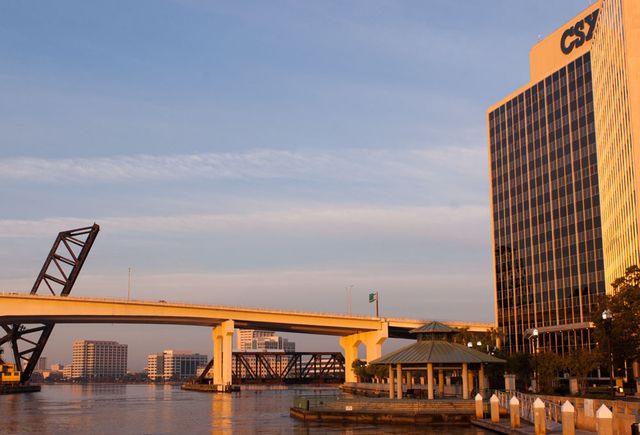
Jacksonville Union Terminal, now a convention
center, where 120  trains a day used to stop. Four 
Amtrak trains a day stop at a small station in Jacksonville. 

Over 20 counties are being told to evacuate, in what could be the largest evacuation in American history. It is quickly exposing the abysmal, anarchy-filled state of transportation in America. Those hoping to fly out were confronted with sky-high prices, in the hundreds or thousands of dollars, and now over 4,000 flights have been canceled. Extra flights were added, but operations wound down Friday afternoon, more than a full day before the storm. Many have been left stranded at the airport, with all shelters filled up.

For millions, their only way to flee is by car. Gas shortages have spread across the state, and drivers confront extremely heavy traffic that burns through gas with little progress. From southern Florida, there is only Interstate 95 or Interstate 75 to head north, both of which have had extensive delays for days. On Friday, northbound delays covering hundreds of miles were visible on I-75 and I-95 even into Georgia and South Carolina.

This “fend for yourself” method of evacuation presents an enormous inequality, where working people must spend hundreds or thousands of dollars to head to safety, assuming they even have a car. As a retirement destination, Florida also has many residents over 65 years old. This includes residents in nursing care, or with physical or mental impairments, that make them unable to drive or fly.

Why haven’t passenger trains, which could carry a thousand people a time, been sent to Florida to help? Residents without money or the ability to travel by car or plane could be taken to designated points of shelter and food.

Prior to Hurricane Gustav in 2008, there was a small successful example of this, as some 2,000 residents of New Orleans were taken to Memphis, Tennessee on special trains. A worker who participated in the rail operation noted that “At least 50% of the passengers were elderly, many in wheelchairs, on walkers or canes and generally unable to move very well without some assistance.” On a return trip, many passengers brought more luggage, as they could buy essential supplies in Memphis that would have been out of stock or priced-gouged in New Orleans. With baggage cars and plenty of space, the train accommodated this for free—compared to an airline that would charge $50 per bag.

That operation was minimal compared to what could be done, and yet with Irma, nothing similar has been attempted, despite a far larger forced evacuation. If the state and federal government, FEMA, and corporations cared to, dozens of sets of passenger train equipment could have been sent south during the week and made several trips from South Florida to points farther North. This would require workers trained in advance to conduct the operation, and designated points of shelter established in places like Atlanta, Georgia; Columbia, South Carolina; Charlotte and Raleigh, North Carolina; and other cities.

As one example, the commuter rail system of Chicago, Metra, has a daily ridership of 295,000 riders. If equipment on that scale were provided to a region at risk of a hurricane, an enormous number of people could be taken to safe shelter. Instead, all that has happened is that Amtrak ran its regular trains out of Florida up until Friday, which, of course, were sold out.

The abysmal state of passenger rail and infrastructure in the United States is a contributing factor. In 1960, dozens of trains served Florida, but now there are just three daily Amtrack round trips. One of the Amtrak trains, the Silver Star, has been referred to as the “Silver Starvation” after Amtrak cut its full dining service in 2015, leaving passengers to wait in a long line while a single food service worker prepares snack food on a trip that can take over 24 hours.

When special trains were run in 2008 in New Orleans, they used the minimal amount of spare equipment that Amtrak has. The service has survived on a shoestring budget since its creation in 1971, and most of its coach passenger cars were built in the 1970s and 1980s, most of which have no planned replacement. As one abysmal example, it was announced last week that railcar builder Nippon Sharyo had failed to successfully build an order of 130 passenger cars that was funded in 2009, ordered in 2012, and expected to be delivered in 2015. Now, the contract has passed to another builder.

Nationally, Amtrak has under 1,200 cars that carry passengers. In 1960, the three railroads serving Florida alone had about the same number. Little passenger rail investment in the South has occurred since then, leaving a minimal amount of equipment available for disaster relief.

Florida, like many Sun Belt states, grew massively in the post-war period when billions were poured into the Interstate highway network. Urban areas were expanded in a large and decentralized fashion, partly because extensive investment in roads and highways allowed more decentralized land use. Jacksonville, Florida, for example, has the largest land area of any city in the Continental United States, but is 12th largest in population. It has no commuter rail operation, while that of Miami and Orlando is minimal.

Another severe constraint to a rail evacuation is the private control of the major routes in Florida. CSX Railroad owns routes between Miami, Tampa, Orlando, Jacksonville, and points north, while Florida East Coast Railroad owns a route along the coast from Miami to Jacksonville. All of these routes have been cut back over several decades, with less capacity and fewer maintenance employees. As it is, CSX frequently delays the existing three Amtrak round trips that serve Florida.


CSX's waterside headquarters in Jacksonville, Florida, where 500 have been 
laid off. Recently, CSX announced that train dispatchers at nine regional 
offices will be relocated to Jacksonville.

CSX was recently taken over by a hedge fund that is instituting even deeper cuts, including over 500 layoffs at its Jacksonville, Florida headquarters. In another cost-cutting move, train dispatchers who control traffic are being taken away from regional locations and consolidated in Jacksonville. Dispatching jobs based in Selkirk, NY, were to be shifted to Jacksonville this September. The move is remarkable, considering that Jacksonville is a city that could be in the path of a hurricane. If weather closed that facility, the entire network covering the east and south would shut down. There is little doubt that dispatchers will be told to risk their lives to come to work, and forced to work extra hours.

In a rational, planned economy, the millions of residents in need of evacuation would be provided with a way out, and organized shelter. As the response to Hurricane Harvey showed, there is no doubt that people would work and volunteer to help provide the service, and aid the elderly and impaired.

Instead, nothing has been done. The response to Hurricane Irma, and to Hurricane Harvey before it, expresses the reality of American capitalism. Decades of social plunder, rising inequality and decaying infrastructure, combined with the disinterest and contempt of the ruling class for basic issues of public safety, have paved the way for another disaster.
Sign up for the WSWS Transport Worker Newsletter

The WSWS urges transport workers and supporters to sign up for the Transport Worker Newsletter for frequent updates and to leave your comments or questions. To do so, click here.

Saints, Prizes and the Rohingyas

Aung San Suu Kyi, Nobel Prizes and the Rohingyas

by Binoy Kampmark - Dissident Voice


September 8th, 2017

Scratch the skin of a saint, claimed George Orwell, and you are bound to find a sinner with an extensive resume. Such resumes are evaluated in these modern times by accolades, awards, and summits. The Noble Peace Prize tends to be crowning affirmation that somewhere along the line, you sufficiently fouled up to merit it.

The calls, some even shrill, to have the Nobel Prize taken off Aung San Suu Kyi, are distressed lamentations of misplaced loyalties, even love.

The de facto leader of Myanmar is showing what others have in the past: partiality, a harsh streak, and a cold blooded instinct.

The saint, in other words, has been scratched, and the unquestioning followers are startled.

When asked to respond to the arrival in Bangladesh of almost 150,000 stateless Muslim Rohingyas since August, the result of violence in Myanmar’s northern Rakhine state, the leader sternly rebuked suggestions that there was a problem. After all, the initial violence had been perpetrated by assaults on an army base and police posts by Rohingya insurgents since October.

The problem she sought to address was that others were faking the record to advance the interests of terrorists, supplying the world with “a huge iceberg of misinformation”. (How delightful is Trumpland, with its tentacles so global and extensive they have found themselves in the speeches and opinions of a secularly ordained saint.)

Faking the fleeing of tens of thousands of persecuted souls would surely be a challenge. The response from Suu Kyi is a salutary reminder that genocides, atrocities and historical cruelties can be often denied with untroubled ease. Her statement in response to the crisis was one of conscious omission: the Rohingyas barely warranted a mention, except as a security challenge.

The statement issued from her office on Facebook claimed that the government had “already started defending all the people in Rakhine in the best way possible.” The misinformation campaign, she insisted, was coming from such individuals as the Turkish deputy prime minister, who deleted images of killings on Twitter after discovering they were not, in fact, from Myanmar.

The approach to misinformation taken by the government has been one of silence and containment. National security advisor Thaung Tun has made it clear that China and Russia will be wooed in efforts to frustrate any resolution that might make its way to the UN Security Council.

“China is our friend and we have a similar relationship with Russia, so it will not be possible for that issue to go forward.”

As for calls of terrorists sowing discord, Suu Kyi may well get her wish. Protests organised in Muslim regional powers are already pressing for the cutting of ties with Myanmar. Turkey is pressing for answers. The Islamist tide, should it duly affect the Rohingyas, will itself become a retaliatory reality.

This sting of crisis and realpolitik was all too much for certain members of the Suu Kyi fan club. It certainly was for veteran Guardian columnist George Monbiot. He, along with others, had looked to her when jailed (house arrest or otherwise) as pristine, the model prisoner, the ideal pro-democracy figure. When held captive, the purity was unquestioned.

Hopes were entrusted, and not counterfeit ones.

“To mention her was to invoke patience and resilience in the face of suffering, courage and determination in the unyielding struggle for freedom. She was an inspiration to us all.”

Not so now. Crimes documented by the UN human rights report of February have been ignored. The deliberate destruction of crops, avoided. Humanitarian aid has been obstructed. The military, praised. When violence has been acknowledged, it has only been to blame insurgents who represent, in any case, an interloping people who are denied their ethnicity by the 1982 Citizenship Law.

“I believe,” writes Monbiot, “the Nobel Committee should retain responsibility for the prizes it awards, and withdraw them if its laureates later violate the principles for which they were recognised.”

How often has history shown that the prison is merely the prelude to a recurring nastiness, political calculation, and revenge? Far from enlightening the mind and restoring faith, it destroys optimism and vests the inmate with those survival skills that, when resorted to, can result in carnage and misery. Suu Kyi, in other words, is behaving politically, fearing the loss of her position, aware that behind her is a military that needs to be kept, at least partly, in clover.

Other Nobel Laureates have also added their voices to the roll call of concern, less of condemnation than encouragement. One is Professor Muhammed Yunus.

“These are her own people. She says ‘these are not my people, someone else’s people’, I would say she has completely departed from her original role which brought her the Nobel Prize.”

Yunus, however, is more optimistic that the selfish, distancing leader will return to her peaceful credentials. From a dark sleep, she will rise.

“I still think she is the same Aung San Suu Kyi that won the Nobel Peace Prize; she will wake up to that person.”

Another is Desmond Tutu, who took the route of an open letter:

“My dear sister: If the political price of your ascension to the highest office in Myanmar is your silence, the price is surely too steep… We pray for you to speak out for justice, human rights and the unity of our people. We pray for you to intervene.”

The Nobel Institute, obviously moved by a sufficient number of calls to comment on the status of the award for the 1991 recipient, deemed the decision immutable.

“Neither Alfred Nobel’s will nor the statutes of the Nobel Foundation,” confirmed its head Olav Njølstad, “provide the possibility that a Nobel Prize – whether for physics, chemistry, medicine, literature or peace – can be revoked.”

As for the prize itself, it is long axiomatic that persons who tend to get it have blood on their hands. The terrorist, reborn, is feted by the Nobel Prize Committee. Before ploughshares came swords. Before peace, there was the shedding of blood. But, in some cases, it may well be the reverse: from the ploughshares come the swords, and the Rohingyas are tasting that awful fact.

Binoy Kampmark was a Commonwealth Scholar at Selwyn College, Cambridge. He lectures at RMIT University, Melbourne and can be reached at: bkampmark@gmail.com.
 Read other articles by Binoy.

Saturday, September 09, 2017

Florida's Nuclear Plants

Florida's Nuclear Plants


September 9, 2017


Tragedy of Atlantic Salmon on the Pacific Coast

The Tragedy of Atlantic Salmon on the Pacific Coast

by Susanne Lawson


Sept. 7, 2017 

Wickaninnish Island


The diminishing returns of the Pacific salmon to west cost rivers can be attributed to many factors but the introduction of Atlantic salmon, to be raised on fish farms on the west coast, may mean the demise of wild salmon.

Atlantic Salmon are so different from our west coast salmon that it is inconceivable that the Department of Fisheries and Oceans, (DFO) could ever permit them here. They are more like a steelhead than a wild salmon, having lighter colored flesh than a salmon, more like a trout, (the reason fish farms feed them red dye for coloring their flesh).

The big factor in the loss of our wild salmon, other than the massive disease and sea lice problems the fish farms generate is the fact that Atlantic salmon don't return to die in the rivers like Pacific salmon do...they move in and out of the rivers throughout their 6 or more years of life, eating salmon smolts and trout that are living in the fresh water.

Atlantic salmon are voracious feeders, hanging out in mid or lower depths in the rivers, eating any small fish they see. They grow quickly on the smolts and young trout and migrate in and out of the rivers at will.
The escaped Atlantic farmed salmon can survive and reproduce on the west coast as has been proven in studies by professor John Volpe of UVic.

These factors along with the hundreds of thousands of Atlantic salmon that have escaped from farms on the west coast may spell disaster for the once magnificent wild west coast salmon. The struggle for survival of Pacific salmon after rampant logging and siltation in west coast rivers left their numbers in peril and DFO ignored obvious results, opting for fish farming of foreign species rather than protection, removing any laws that favored wild salmon. Here we are today with more sick and pellet fed Atlantic fish in our waters than exist on the Atlantic coast.

Counts of salmon in rivers on the west coast, where there have been over half a million escaped farmed fish, used to list the Atlantic salmon but now they are lumped in a category as "Other" in the counts by DFO. The department pretended to have an Atlantic salmon reporting site but that was never monitored or attended to - no one was there.

Our government should be sued for introducing a foreign species and held accountable for their removal Once and for All; including removal of fish farms before it is entirely too late for the wild Pacific salmon and all that depend upon them.

How the UN has Evolved to Enable "Aggressive War"

U.N. Enablers of ‘Aggressive War’

by Robert Parry  - Consortium News


September 8, 2017


Special Report: U.N. investigative reports, like a new one condemning Syria for alleged sarin use, are received as impartial and credible, but are often just more war propaganda from compromised bureaucrats, reports Robert Parry.

Many still want to believe the U.N. engages in impartial investigations, and is more trustworthy than, self-interested governments, whether Russia or the United States. But trust in U.N. agencies is not well placed; what independence they may have once had has been broken, a reality relevant to recent “investigations” of Syrian chemical weapons use.

There is also the larger issue of the U.N.’ peculiar silence about one of its primary and original responsibilities, shouldered after the horrors of World War II – to stop wars of aggression, which today include “regime change” wars organized, funded and armed by the US and other Western powers, such as the Iraq invasion in 2003, overthrow of the Libyan government in 2011, and series of proxy wars including the ongoing Syrian conflict.

After World War II, the Nuremberg Tribunals declared that a “war of aggression … is not only an international crime; it is the supreme international crime differing only from other war crimes in that it contains within itself the accumulated evil of the whole.”

That recognition became a guiding principle of the United Nations Charter, which specifically prohibits aggression or even threats of aggression against sovereign states.

The Charter declares in Article One that it is a chief U.N. purpose “to take effective collective measures … for the suppression of acts of aggression or other breaches of the peace.” Article Two, which defines the appropriate behavior of U.N. members, adds that “All Members shall refrain in their international relations from the threat or use of force against the territorial integrity or political independence of any state…”

However, instead of enforcing this fundamental rule, the United Nations has, in effect, caved in to the political and financial pressure brought to bear by the United States and its allies. A similar disregard for international law also pervades the U.S. mainstream media and much of the European and Israeli press as well.

There is an assumption that the United States and its allies have the right to intervene militarily anywhere in the world at anytime solely at their own discretion. Though U.S. diplomats and mainstream journalists still voice outrage when adversaries deviate from international law – such as denunciations of Russia over Ukraine’s civil war – there is silence or support when a U.S. president or, say, an Israeli prime minister orders military strikes inside another country. Then, we hear only justifications for these attacks.

Shielding Israel


For instance, on Friday, The New York Times published an article about Israel conducting a bombing raid inside Syria that reportedly killed two Syrians. The article is notable because it contains not a single reference to international law and Israel’s clear-cut violation of it. Instead, the article amounts to a lengthy rationalization for Israel’s aggression, framing the attacks as Israeli self-defense or, as the Times put it, “an escalation of Israel’s efforts to prevent its enemies from gaining access to sophisticated weapons.”


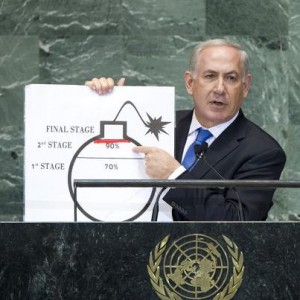
Israeli Prime Minister Benjamin Netanyahu at the United Nations in 2012, drawing his own “red line” on how far he will let Iran go in refining nuclear fuel.

The article also contains no reference to the fact that Israel maintains a sophisticated nuclear arsenal and is known to possess chemical and biological weapons as well. Implicit in the Times article is that the U.S. and Israel live under one set of rules while countries on the U.S.-Israeli enemies list must abide by another. Not to state the obvious but this is a clear violation of the journalistic principle of objectivity.

But the Times is far from alone in applying endless double standards. Hypocrisy now permeates international agencies, including the United Nations, which instead of pressing for accountability in cases of U.S. or Israeli aggression has become an aider and abettor, issuing one-sided reports that justify further aggression while doing little or nothing to stop U.S.-backed acts of aggression.

For instance, there was no serious demand that U.S. and British leaders who organized the 2003 invasion of Iraq, which resulted in the deaths of hundreds of thousands of Iraqis, should face any accountability for committing the “supreme international crime” of an aggressive war. As far as the U.N. is concerned, war-crimes tribunals are for the little guys.

This breakdown in the integrity of the U.N. and related agencies has developed over the past few decades as one U.S. administration after another has exploited U.S. clout as the world’s “unipolar power” to ensure that international bureaucrats conform to U.S. interests. Any U.N. official who deviates from this unwritten rule can expect to have his or her reputation besmirched and career truncated.

So, while harshly critical of alleged abuses by the Syrian military, U.N. officials are notoriously silent when it comes to condemning the U.S., Saudi Arabia, Jordan, Turkey, Israel and other countries that have been “covertly” backing anti-government “rebels” who have engaged in grave crimes against humanity in Syria.

The U.S. and its allies have even mounted overt military operations inside Syrian territory, including airstrikes against the Syrian military and its allies, without permission of the internationally recognized government in Damascus. Yet, the U.N. does nothing to curtail or condemn these clear violations of its own Charter.

Breaking the Independence


The reason is that, for much of this century, the U.S. government has worked to bring key agencies, such as the U.N. Commission on Human Rights (UNCHR), the International Atomic Energy Agency (IAEA), and the Organization for the Prohibition of Chemical Weapons (OPCW), under U.S. control and domination.


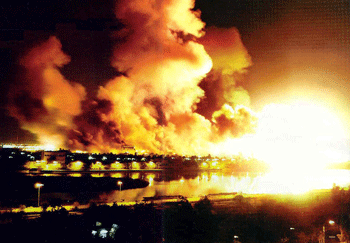
At the start of the U.S. invasion of Iraq in 2003, President George W. Bush ordered the U.S. military to conduct a devastating aerial assault on Baghdad, known as “shock and awe.”

This drive to neutralize the U.N.’s independence gained powerful momentum after the 9/11 attacks and President George W. Bush’s launching of his “global war on terror.”

But this effort continued under President Obama and now under President Trump.

In 2002, after opening the prison at Guantanamo Bay, Cuba, and effectively waiving the Geneva Convention’s protections for prisoners of war, Bush bristled at criticism from the United Nations High Commissioner for Human Rights Mary C. Robinson.

Soon, Robinson was targeted for removal. Her fierce independence, which also included criticism of Israel, was unacceptable. The Bush administration lobbied hard against her reappointment, leading to her retirement in 2002.

Also, in 2002, the Bush administration engineered the firing of OPCW’s Director General Jose Mauricio Bustani who was viewed as an obstacle to the U.S. plans for invading Iraq.

Bustani, who had been reelected unanimously to the post less than a year earlier, described his removal in a 2013 interview with Marlise Simons of The New York Times, citing how Bush’s emissary, Under-Secretary of State John Bolton, marched into Bustani’s office and announced that he (Bustani) would be fired.

“The story behind [Bustani’s] ouster has been the subject of interpretation and speculation for years, and Mr. Bustani, a Brazilian diplomat, has kept a low profile since then,” wrote Simons. “But with the agency [OPCW] thrust into the spotlight with news of the Nobel [Peace] Prize [in October 2013], Mr. Bustani agreed to discuss what he said was the real reason: the Bush administration’s fear that chemical weapons inspections in Iraq would conflict with Washington’s rationale for invading it. Several officials involved in the events, some speaking publicly about them for the first time, confirmed his account.”

The official U.S. explanation for getting rid of Bustani was incompetence, but Bustani and the other diplomats close to the case reported that Bustani’s real offense was drawing Iraq into acceptance of the OPCW’s conventions for eliminating chemical weapons, just as the Bush administration was planning to pin its propaganda campaign for invading Iraq on the country’s alleged secret stockpile of WMD.

Bustani’s ouster gave President Bush a clearer path to the invasion by letting him frighten Americans with the prospect of Iraq sharing its chemical weapons and possibly a nuclear bomb with Al Qaeda terrorists.

Dismissing Iraq’s insistence that it had destroyed its chemical weapons and didn’t have a nuclear weapons project, Bush launched the invasion in March 2003, only for the world to discover later that the Iraqi government was telling the truth.

Compliant Replacements


In comparison to the independent-minded Bustani, the biography of the current OPCW director general, Ahmet Uzumcu, a career Turkish diplomat, suggests that the OPCW could be expected to slant its case against the Syrian government in the current Syrian conflict.

Not only has Turkey, a NATO ally of the United States, been a key player in supporting the proxy war to overthrow Syrian President Bashar al-Assad, but Uzumcu also served as Turkey’s ambassador to Israel, which has long sought regime change in Syria and has publicly come out in favor of the anti-government rebels.


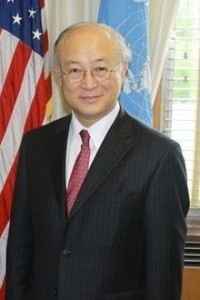
Yukiya Amano, a Japanese diplomat and director-general of the International Atomic Energy Agency.

Another one-time thorn in the side of the U.S. “unipolar power” was the IAEA when it was under the control of Director General Mohamed ElBaradei, an Egyptian. The IAEA challenged the Bush administration’s claims about Iraq having a nuclear program, when one really didn’t exist.

However, being right is no protection when U.S. officials want to bring an agency into line with U.S. policy and propaganda. So, early in the Obama administration – as Secretary of State Hillary Clinton was pushing for a hardline on Iran over its nascent nuclear program – the U.S. government engineered the insertion of a pliable Japanese diplomat, Yukiya Amano, into the IAEA’s top job.

Before his appointment, Amano had portrayed himself as an independent-minded fellow who was resisting U.S.-Israeli propaganda about the Iranian nuclear program. Yet behind the scenes, he was meeting with U.S. and Israeli officials to coordinate on how to serve their interests (even though Israel is an actual rogue nuclear state, not a hypothetical or fictional one).

Amano’s professed doubts about an Iranian nuclear-bomb project, which even the U.S. intelligence community agreed no longer existed, was just a theatrical device to intensify the later impact if he were to declare that Iran indeed was building a secret nuke, thus justifying the desire of Israeli leaders and American neoconservatives to “bomb-bomb-bomb” Iran.

But this U.S. ploy was spoiled by Pvt. Bradley (now Chelsea) Manning’s leaking of hundreds of thousands of pages of U.S. diplomatic cables. Among them were reports on Amano’s hidden collaboration with U.S. and Israeli officials; his agreement with U.S. emissaries on who to fire and who to retain among IAEA officials; and even Amano’s request for additional U.S. financial contributions.

The U.S. embassy cables revealing the truth about Amano were published by the U.K. Guardian in 2011 (although ignored by The New York Times, The Washington Post and other mainstream U.S. news outlets). Despite the silence of the major U.S. news media, Internet outlets, such as Consortiumnews.com, highlighted the Amano cables, meaning that enough Americans knew the facts not to be fooled again. [For details, see Consortiumnews.com’s “Did Manning Help Avert War with Iran?”]

A Collective Collapse


So, over the years, there has been a collective collapse of the independence at U.N.-related agencies. An international bureaucrat who gets on the wrong side of the United States or Israel can expect to be fired and humiliated, while those who play ball can be assured of a comfortable life as a “respected” diplomat.


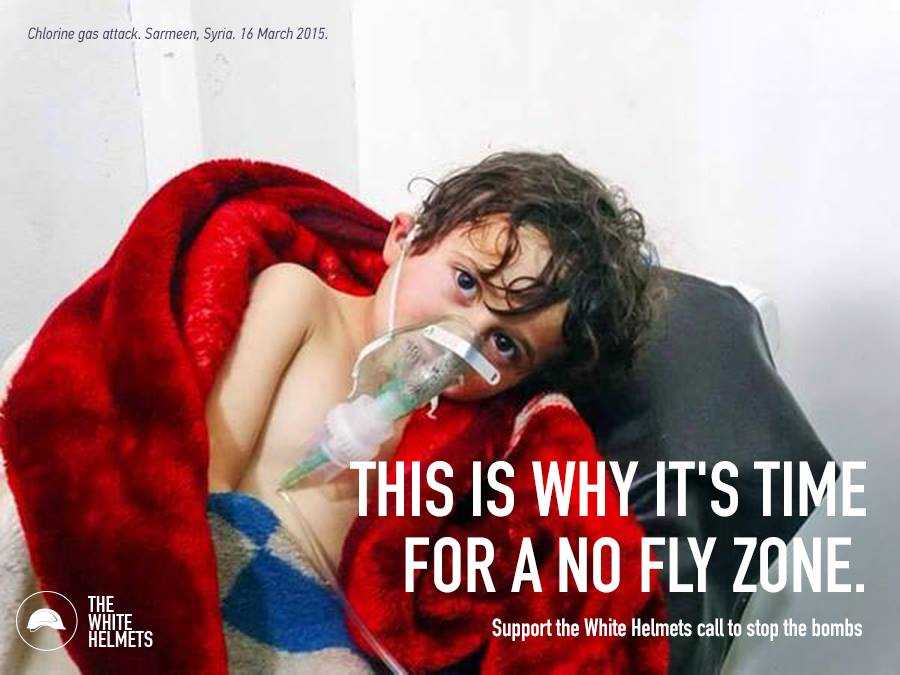
A heart-rending propaganda image designed to justify a major U.S. military operation inside Syria against the Syrian military.

But this reality is little known to most Americans so they are still inclined to be influenced when a “U.N. investigation” reaches some conclusion condemning some country that already is on the receiving end of negative U.S. propaganda.

The New York Times, CNN and other major U.S. news outlets are sure to trumpet these “findings” with great seriousness and respect and to treat any remaining doubters as outside the mainstream. Of course, there’s an entirely different response on the rare occasion when some brave or foolhardy human rights bureaucrat criticizes Israel’s treatment of the Palestinians. Then, the U.N. finding is just a sign of anti-Israeli bias and should be discounted.

In the far more frequent cases when a U.N. report is in line with U.S. propaganda, American journalists almost never turn a critical eye toward the quality of the evidence or the leaps of logic. We saw that happen this week with a thinly sourced and highly dubious U.N. report blaming the Syrian government for an alleged sarin incident on April 4. A major contradiction in the evidence – testimony given to OPCW investigators undercutting the conclusion that a Syrian warplane could have dropped a sarin bomb – was brushed aside by the U.N. human rights investigators and was ignored by the Times and other major U.S. news outlets.

But what is perhaps most troubling is that these biased U.N. reports are now used to justify continued wars of aggression by stronger countries against weaker ones. So, instead of acting as a bulwark to protect the powerless from the powerful as the U.N. Charter intended, the U.N. bureaucracy has turned the original noble purpose of the institution on its head by becoming an enabler of the “supreme international crime,” wars of aggression.

[For more on this topic, see Consortiumnews.com’s “How US Pressure Bends UN Agencies.“]

Investigative reporter Robert Parry broke many of the Iran-Contra stories for The Associated Press and Newsweek in the 1980s. You can buy his latest book, America’s Stolen Narrative, either in print here or as an e-book (from Amazon and barnesandnoble.com).

image_pdf

Friday, September 08, 2017

Syrian Government Reports Lethal Israeli Air Attacks Aimed at Bolstering Failing ISIS

Army General Command: Israeli warplanes target one of the Syrian military positions near Massyaf, killing two army personnel

by R.J/H.Zain SANA

September 7, 2017
Damascus - General Command of the Army and Armed Forces affirmed that the Israeli warplanes fired several rockets from the Lebanese airspace at 02:42 a.m. on Thursday targeting one of the Syrian military positions near Massyaf in Hama countryside , killing two army personnel and causing material damage to the site.

“This aggression comes in a desperate attempt to raise the collapsed morale of the ISIS terrorists after the sweeping victories achieved by the Syrian Arab Army against terrorism on several fronts, and it affirms the direct support provided by the Israeli entity to the ISIS and other terrorist organizations,” the Army Command said in a statement.

The Command warned against the dangerous repercussions of such hostile acts on the security and stability of the region, reiterating determination to eliminate terrorism and uproot it from all the Syrian territories whatever the type of support provided to these terrorist groups is.

Thursday, September 07, 2017

Always Israel’s War

The Conflict In Syria Was Always Israel’s War

by Whitney Webb - MintPress News


September 04th, 2017


Because Israel has staked first its survival and ultimately its growth into a dominant regional power on the disunity of its neighboring nations, it comes as no surprise that, faced with a winding-down of the Syrian conflict, it is now moving sharply against that development.

After years of fomenting the Syrian conflict from the shadows, the U.S. has recently seemed to back away from its push to militarily intervene in the embattled nation, instead choosing to focus its saber-rattling and destabilization efforts on other theaters. The consequence of this has seemingly been the winding down of the long-running conflict, now entering its seventh year.

Buoyed by Russia, Iran and Lebanon, the Syrian government led by President Bashar al-Assad has managed to retake vast swaths of territory, all while surviving and growing stronger over the course of a largely foreign-funded onslaught. As a result, many of the governments that were instrumental in funding and arming the so-called “moderate” opposition have begun to extricate themselves, unwilling to further test the resilience of Assad or the Syrian people.

With some anticipating the long-awaited conclusion of the Syrian conflict, recent threats from Israel’s government to assassinate Assad by bombing his residence seemed to appear out of the blue. According to the Jerusalem Post, a senior Israeli official accompanying Israeli Prime Minister Benjamin Netanyahu on a recent visit to Russia warned the Kremlin that if Iran continues to “extend its reach” in Syria, Israel would bomb the presidential palace in Damascus. 

Israel’s comments should come as no surprise, however, as the foreign-funded and manufactured conflict in Syria was always Israel’s war. The only real surprise is Israel’s growing isolation in pushing for the further escalation of the conflict.

WikiLeaks sheds light on the origins of the war


Though it has successfully avoided being labeled a major player in the effort to oust Assad, Israel has long been the mastermind of the plan, which stems in large part from the long-standing hostilities between the two nations as well as Israel’s own regional ambitions. State Department diplomatic cables released by WikiLeaks have shown that in 2006, five years before the conflict in Syria manifested, the government of Israel had hatched a plan to overthrow the Assad government by engineering sectarian strife in the country, creating paranoia within the highest-ranks of the Syrian government, and isolating Syria from its strongest regional ally, Iran.

Israel then passed this plan along to the United States, which would then involve Saudi Arabia, Turkey, Qatar and Egypt in fomenting the “breakdown” of the Assad regime as a way of weakening both Iran and Hezbollah — with the effect of empowering both Israel and the Gulf monarchies, two seemingly disparate forces in the region that are becoming increasingly allied.

Leaked emails belonging to former Secretary of State Hillary Clinton further reveal Israel’s role in covertly creating the conflict and its clear role in securing the involvement of the U.S. and other nations in executing its plan for Assad’s removal. One email, forwarded by Clinton to her advisor Jacob Sullivan, argues that Israel is convinced that Iran would lose “its only ally” in the region were Assad’s government to collapse.

It further stated that “The fall of the House of Assad could well ignite a sectarian war between the Shiites and the majority Sunnis of the region drawing in Iran, which, in the view of Israeli commanders would not be a bad thing for Israel and its Western allies.” This possible sectarian war was perceived as a potential “factor in the eventual fall of the current government of Iran.”

Another Clinton email released by WikiLeaks stated,

The best way to help Israel deal with Iran’s growing nuclear capability is to help the people of Syria overthrow the regime of Bashar Assad,”

Adding

Bringing down Assad would not only be a massive boon to Israel’s security, it would also ease Israel’s understandable fear of losing its nuclear monopoly.”

The email also notes:

A successful intervention in Syria would require substantial diplomatic and military leadership from the United States” and states that “arming the Syrian rebels and using western air power to ground Syrian helicopters and airplanes is a low-cost high payoff approach.”

Read the full Wikileaks release here.


Stated plainly, the U.S.’ decision to spend over $1 billion until 2015 to arm Syria’s terrorist-linked “rebels” — and to invoke the assistance of Wahhabi terrorism exporters like Saudi Arabia and Qatar in funneling weapons and funds to these same groups — was spurred by Israel, which not only drafted the original blueprint for the Syrian conflict but guided U.S. involvement by exerting its powerful influence over the foreign policy of that country.

Aiding the Rebels


Israel did more, however, than covertly instigate and guide the funding of opposition “rebels” — having secretly funded and aided opposition groups, including ones with overt terrorist affiliations, over the course of the six-year-long conflict.

Israeli involvement in direct funding and aiding the Syrian “rebels” was suspected for years before being officially made public by the Wall Street Journal in June of this year. The report revealed that Israel, since the beginning of the conflict, had been “supplying Syrian rebels near its border with cash as well as food, fuel, and medical supplies for years, a secret engagement in the enemy country’s civil war aimed at carving out a buffer zone populated by friendly forces.” Israel has also frequently brought wounded “rebels” into Israel for medical treatment, a policy it often touts as a “humanitarian effort.”

These “friendly” forces were armed groups that formed part of or were allied with al-Nusra Front, al-Qaeda’s Syrian branch, known for committing atrocities against thousands of Syrian civilians and slaughtering religious and ethnic minorities. Since 2013, al-Qaeda-affiliated terrorist groups have dominated the “eight-square-kilometer separation zone on the Golan.” Israel has stated officially that these fighters are part of the U.S. coalition-supported Free Syrian Army (FSA). However, it has long been known that the vast majority of the groups comprising FSA have pledged allegiance to the al-Qaeda-affiliated al-Nusra Front, and that those who still fight under the FSA banner meet with al-Nusra on a daily basis.

Israel’s support for terrorist groups went far beyond medical treatment, food supplies and cash. The Israeli army was also found to have been in regular communication with these terrorist groups and even helped “pay salaries of fighters and buy ammunition and weapons.” In addition, when the positions of the “rebel” groups it funded, armed and paid were in danger of being overtaken by Syrian government forces, Israel stepped in to directly bomb Syrian targets. For instance, in June, Israel attacked several Syrian military positions after claiming a stray mortar had landed within the boundaries of the Golan Heights, part of Syria that has long been occupied by Israel. However, the attack tellingly coincided with Syrian army advancements against the “rebel” groups that Israel has long cultivated as part of the so-called “buffer zone.”

Furthermore, Israel has launched attacks inside Syria “dozens and dozens of times,” according to a recent admission by Netanyahu. Earlier this year, Israel also threatened to “destroy” Syrian air defenses after the Syrian army fired missiles at Israeli warplanes striking targets within Syria.

Also very telling has been Israel’s position on Daesh (ISIS). In June of last year, Israel’s military intelligence chief, Major General Herzi Halevi, openly stated that Israel does not want to see Daesh defeated in Syria — expressing concern about the offensives against Daesh territory and lamenting their “most difficult” situation. Prior to Halevi’s comments, Israeli officials had regularly noted that Daesh conquering the whole of Syria would be preferable to the survival of the Assad government. These comments have been echoed by Israeli and NATO-affiliated think tanks, one of which called Daesh “a useful tool in undermining” Iran, Hezbollah, Syria and Russia — despite Daesh’s barbaric tactics, war crimes, enslavement of women and ethnic cleansing efforts.

Israel’s larger geopolitical agenda


Though Israel’s support of Wahhabi terrorists like Daesh (ISIS) and al-Nusra may seem counter-intuitive, Israel’s overarching purpose in expelling Assad from power is based on strategic geopolitical and economic goals that Israel is determined to meet at any cost. While Israel frequently mentions Iran as the pretext for its involvement in Syria, the strongest motivators for Israel’s participation in the destruction of its northern neighbor are oil and territorial expansion.

One of Israel’s clearest reasons for being interested in the destabilization of Syria is its ability to assert further control of the Golan Heights, an area of Syria that Israel has illegally occupied since 1967 and annexed in 1981. Despite filling the area with illegal settlements and military assets, Israel has been unable to convince the international community, and even its close allies such as the U.S., to recognize its sovereignty over the territory. However, the conflict in Syria has proven beneficial to this end, allowing Israel to send even more settlers into the Golan, an estimated 100,000 over five years.

Israel is largely interested in gaining control over the Golan for economic reasons, owing to the occupied territory’s oil reserves, which are estimated to contain “billions of barrels.” Under the cover of the Syrian conflict, the Israeli branch of an American oil company — whose investors include Dick Cheney, Jacob Rothschild and Rupert Murdoch — has been drilling exploratory wells throughout the region, as the Heights’ uncertain territorial status prevents Israel from financially exploiting the resource.

Despite the prohibitions of international law, Israel is eager to tap into those reserves, as they have the potential to “make Israel energy self-sufficient.” Israel has even offered, per the Galant plan, to “rebuild” Syria with billions in U.S. taxpayer dollars in exchange for the Golan Heights — though the plan received a tepid reception from all involved parties other than Israel itself.

As its stands, Assad’s removal and replacement with a government friendly to Israeli and Western interests is Israel’s only real means of claiming the Golan Height’s energy resources for itself.

Pawns blocking Israel’s endgame


Aside from the oil and the territory it seeks to gain in the Golan Heights, Israel is also seeking to expand well beyond that territory in order to more widely exert its influence and become the region’s “superpower.” This ambition is described in the Yinon Plan, a strategy intended to ensure Israel’s regional superiority in the Middle East that chiefly involves reconfiguring the entire Arab world into smaller and weaker sectarian states. This has manifested in Israel’s support for the partition of Iraq as well as Syria, abetted by its support for the establishment of a separatist Kurdish state within these two nations.

This goal, in particular, largely explains Israel’s obsession with curbing Iranian influence in the Middle East, whether in Syria or elsewhere. Iran – more than any other nation in the region – is the most likely to threaten the “superpower” status that Israel seeks to gain for itself, as well as Israel’s loss of monopoly as the region’s only nuclear power.

Given Israel’s compound interests in seeing the removal of Assad and the partition of Syria, it is hardly surprising that Israeli political rhetoric has reached new heights of saber-rattling as Tel Aviv becomes increasingly concerned that the conflict it masterminded could backfire. Prior to the explosive comments regarding Israeli threats to bomb Assad’s residence, an anonymous Israeli government minister blamed the U.S. for backing out of Syria, a move he argued sacrificed Israeli interests:

The United States threw Israel under the bus for the second time in a row. The first time was the nuclear agreement with Iran, the second time is now that the United States ignores the fact that Iran is obtaining territorial continuity to the Mediterranean Sea and Israel’s northern border [through Syria].”

Not only that but Israel has recently vowed to “nullify” the ceasefire deal brokered between Russia and the U.S. with Syrian and Iranian support if it fails to comply with Israel’s needs — an ultimatum based on rather subjective terms given that “Israel’s needs” are hardly static. Israel’s response again shows the perception among officials in Tel Aviv that the Syrian conflict is of primary importance to Israeli geopolitical interests.

Furthermore, given that the response suggested so far by Israeli officials – on more than one occasion – has been to assassinate Syria’s democratically-elected President – the contemplated means of Israel “nullifying” the ceasefire deal will likely have explosive implications. Israel — apparently refusing to accept that the conflict it orchestrated is not going, and may not end, as planned — is now willing to escalate the situation militarily, with or without allies, resorting to dangerous brinkmanship with global implications.

Republish our stories! MintPress News is licensed under a Creative Commons Attribution-NonCommercial-ShareAlike 3.0 International License.

Loving the World's Children to Death

The president’s strange way of showing his ‘love’ of children: Trump Dumps DACA as Well as Child-Maiming Cluster Weapons


by Dave Lindorff  - This Can't Be Happening


September 7, 2017

When Donald Trump says he “loves children” as he did in trying to make the case that his termination of the Deferred Action for Childhood Arrivals (DACA) program was not a case of child abuse, it’s important to remember that Trump has also amped up US support for Saudi Arabia’s brutal war on Yemen, and has specifically continued to supply the Saudi air force with US-made cluster bombs, the primary victims of which are children.

A UN Convention on Cluster Munitions that prohibits the “use, transfer and stockpiling” of cluster bombs and shells was adopted in Dublin, Ireland in 2008, went into force on August 1, 2010 after being signed by 30 nations, and today has 116n countries that have ratified it.

Among the holdouts are the US, Russia, China, India, Israel, Pakistan and Brazil — all countries that both produce and stockpile such weapons.

In the US, the last company manufacturing these horrific Weapons of Child Destruction Textron, Inc., announced last September that it would no longer make them, most likely because of massive global and domestic objections to their use. Last year too, the Obama administration, which had been supplying these weapons to Saudi Arabia for it’s war on Yemen (and which had been using them in its wars in Afghanistan and Iraq, and probably Syria, too), cancelled shipments to Saudi Arabia, allegedly because of concerns that the Saudi’s were indiscriminately bombing hospitals and other civilian targets with them.  
 

Here is what President and Commander in Chief Trump really thinks of kids.


Trump's war on children in Yemen: Child victims of Saudi-dropped cluster bombs, and images of unexploded US-made cluster weapons

A report by the Intercept [1] in December says that the US continues to supply cluster weapons to its client state Saudi Arabia, and to allow it to use the stockpile of these bombs that were already shipped there from Pentagon stockpiles.

Clearly if this president “loved” children, he would order an immediate halt to their use by US client states and by US forces. According to research by the group Cluster Munitions Monitor [2], 97 percent of the victims of cluster munitions are civilians — the majority of them children.

And the “gift” of cluster murder is one that keeps on giving long after wars in which the weapons are used have ended. Ask the long-suffering people of Laos, where the US dropped colossal numbers of them on peasant fields to disrupt support for the Pathet Lao, and where farmers and young children still inadvertently trigger them when working or playing in the fields. (It's a safe bet that Trump chief of staff Gen. John F. Kelly, isn't letting Cluster Munitions Monitor reports reach the Oval Office!)

I visited Laos in the mid 1990s, a full two decades after the US air war on that impoverished Southeast Asian nation had ended, and was struck by the number of young children, clearly born after the war, that I saw I saw on the street. It was explained to me that they were the victims of the “bombis” — small ball-shaped bomblets that had been released over 20 years earlier from US cluster bomb casings, to become buried, unexploded, in the soft earth. It is known that some 30 percent or more of such cluster bomb bomblets don’t not explode on impact, leaving them lying around to be found by curious children years later.

It’s worth remembering President Trump’s support for this horrific weapon to put his politically calculating termination of DACA in context.

In the case of DACA, some 800,000 young people who were brought to the US without documentation by their parents as babies or young children, opted to register themselves with the government, trusting promises that they would be allowed to stay on without fear of deportation. They provided information about their address, where they worked or attended school, and about their families.

Now, with DACA being terminated, there is the distinct risk, if the Republican-led Congress does not or cannot pass DACA-type legislation, that the very information they provided will be used to hunt them down and deport them to a country where they will be strangers, in many cases not even speaking the local language.

In some cases, they will be getting deported to places where their lives could even be in danger, such as Mexico or Honduras, where drugs and gang violence are endemic, and were the reason many of their parents fled with their young children.

The cold political calculation of this president is clearly that he can use the popular support for DACA among Democrats, and the rear of inflaming Latino voters among at least some Republican members of Congress, to win passage of his much loathed and ridiculed plan for a “beautiful wall” along the Mexican border.

He may or may not be right. But the game he is playing with almost a million young lives of people who are as American as any native-born citizen, and who entrusted their fate to the US government when they registered for DACA is nothing short of obscene.

Maybe not as obscene as his continued support for the US use of and export of WCDs — cluster munitions that primarily kill children — but obscene nonetheless.


As this recent Lao child victim of America's Indochina War-era cluster bombing of the Laotian countryside demonstrates, cluster weapons are a 'gift' that just keeps giving long after hostilities end (only one percent of the cluster bombs dropped by the US on Laos have been recovered to date, nearly half a century after they were dropped)


Links:
[1] https://theintercept.com/2016/12/14/banned-by-119-countries-u-s-cluster-bombs-continue-to-orphan-yemeni-children/
[2] http://www.the-monitor.org/en-gb/our-research/cluster-munition-monitor.aspx

What Do Foreign Minister Freeland's Denied Ties to Plutarch Soros Book Deal Mean?

Canadian Foreign Minister Freeland Hid Light Under Bushel Until Toronto Globe & Mail Exposé

by John Helmer - Dances with Bears


September 4, 2017

Moscow

A Toronto newspaper has revealed that Canada’s leading Russia hater, Foreign Minister Chrystia Freeland, had a deal with George Soros (left) to write his biography after losing her journalist jobs at the Financial Times and Reuters, and before starting her run for election to the Canadian parliament.

On August 16 Toronto's Globe and Mail reported Soros is a “close friend” of Freeland, and that with her he has “very great hopes for Canada”.

Before she decided to run for parliament, the newspaper says Freeland had a “deal” for “a sort of authorized biography of George Soros”. Soros’s spokesman in New York, Laura Silber, refused to answer repeated questions last week for clarification of the terms of this deal or the compensation Soros agreed with Freeland.

Freeland’s first filing to the Canadian parliament’s ethics watchdog was registered on May 1, 2014. There is no mention of Soros, but there is “income received under a book collaboration agreement with an individual”. Freeland refused last week to identify that individual by name.


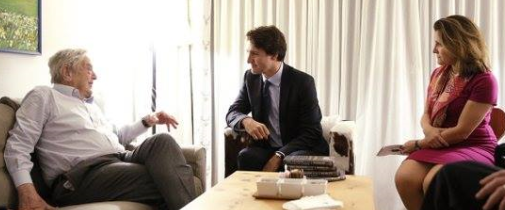
Freeland’s parliamentary website ran this picture of Soros (l),
Canadian Prime Minister Justin Trudeau (c) and Freeland (r)
at a World Economic Forum meeting she arranged in
Davos in January 2016 

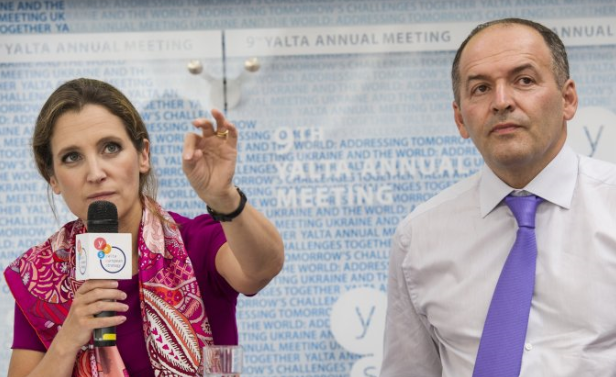
In her parliamentary filing on income and assets Freeland also mentions “speaking fees and honoraria” she received for “10th Annual Yalta Meeting, Yalta, Ukraine”. That’s a roundabout way of reporting that Ukrainian oligarch Victor Pinchuk’s eponymous foundation paid Freeland for her participation in the annual conference of his Yalta European Strategy (YES), an expensive lobbying effort to drive Ukrainian membership of the European Union and combat the Russian alternatives.

At the conference for which Pinchuk paid Freeland, others on the tab included Bill Clinton, Hillary Clinton and Tony Blair. For more detail on Pinchuk’s funding of an anti-Russian lobby effort in the US, and for the source of his funds in a Russian insurance company fraud, read this and this.


Freeland and Pinchuk at YES.

Freeland refuses to say how much money she has received from organizations associated with Pinchuk.

She also won’t explain why in her list of assets, which she is required to file each year with the Canadian parliament’s Office of the Conflict of Interest and Ethics Commissioner, she has omitted to identify the asset she has publicly admitted to owning with her sister, an apartment in Kiev overlooking Maidan Square. This is Freeeland’s disclosure file and here is Freeland’s admission in February 2014 to Maclean’s magazine that she owns an apartment on the Maidan.

In March 2016, according to her parliamentary income and assets reports, Freeland filed what the Ethics Office calls a “confidential report”. The brief mention omits to say what has been kept a state secret, or why, except to conclude that “all initial reporting and compliance measures have been taken to comply with the Conflict of Interest Act.” Freeland was required to sell her company share portfolio.

Freeland’s concealment of the personal interests she and backers like Soros and Pinchuk share in their pursuit of policy towards Ukraine and Russia has not been investigated by the Canadian press or the parliament’s conflict of interest commissioner. The Financial Times management in London proved to be more inquisitive of Freeland’s closeness to the subjects of her reporting.

According to the Globe and Mail, she “clashed with editor-in-chief Lionel Barber”, and was ousted from her post in Europe, removed to New York in what was reported as “not a promotion”. Last week Freeland was asked to clarify whether the Financial Times investigation related to possible conflict of interest, and what the outcome was. She won’t say.

In Canada the Globe and Mail and other newspapers and media networks defend Freeland from the evidence that she has concealed her long family collaboration with the German Army occupation of the Galician region of Poland and Ukraine during World War II, and the family’s active support of the Galician programme for the liquidation of Poles, Jews and Russians. For more on that story, read this.

The promotion of ethnic cleansing for the installation of a Greater Galicia, centered in Lviv (Lemberg in German, Lvov in Russian) had a bloody history before Michael Chomiak, Freeland’s maternal grandfather, slipped out of Soviet Ukraine in 1939 and volunteered for training and service to the German occupation authorities in Cracow, Poland.

Newly read documents of Chomiak’s, including several discovered in Warsaw this year, establish that Chomiak and his family were rewarded by the Germans with apartment, car, and other assets all taken from Jews who were shipped to death camps. So high-ranking in the German programme for Galicia was Chomiak that he was evacuated by the German Army back to Germany in 1945. The Polish intelligence services were still hunting for Chomiak until the 1980s – without knowing he had fled for refuge to an Alberta farm in Canada; that continues to be one of Freeland’s real estate assets today.

The latest Globe & Mail report dismissed this history and Freeland’s refusal to address it, by calling it a Moscow operation to “to discredit Ms Freeland by making hay of unpleasant family history about her grandfather serving as editor of a Nazi-controlled newspaper.” The Globe and Mail reporter, Adam Radwanski, also comes from the family of a Pole, Piotr Radwanski, a eugenics specialist, who ended up in Baden-Baden, Germany, after the war ended, and then migrated to Montreal.

Freeland’s promotion of her grandfather’s programme for the military takeover of Ukraine as German, now Canadian policy, is one of several Galician operations in Ottawa. The family of Lieutenant-General Paul Wynnyk, appointed commander of the Canadian Army in July 2016, is from Stryi, 40 kilometres south of Lviv; his family’s record is “truly inspirational”, according to the Ukrainian-Canadian Congress.

The head of the Canadian Army’s force in Ukraine, Operation UNIFIER, is Lieutenant-Colonel Mark Lubiniecki, whose family also comes from the Galician region, and who was named to his Galician post in March of this year. The operational headquarters is at Starychi, 40 kilometres northwest of Lviv in an area notorious for its Ukrainian and German killing grounds of Jews and Poles.

Lubiniecki’s unit had been restricted to Galicia at the start of its deployment in 2015, but in March of this year Freeland and Wynnyk decided to extend their operational area eastwards.

“While Canadian troops are still required to stay away from the border with Russia and the fighting in eastern Ukraine,” Lubiniecki told a Toronto reporter, “the rest of the country is now fair game.” 


Left photo: Wynnyk (r) with Ukrainian Lieut-Gen. Serhii Popko (l), 
Ukraine -- November 14, 2016.
Right photo: Lubiniecki (r) with Ukrainian Lieut-General Pavlo Tkachuk (l), 
Lviv – August 17, 2017. 

On a visit to the Galician front in July, Wynnyk told the Ukrainian state news agency: “[W]e are also learning from our Ukrainian counterparts based on their recent experiences.”

Lubiniecki told the Ukrainian media:

“That’s what allies do for one another. They share lessons learned… That’s certainly what occurs between Ukrainians and Canadians.”

Another Galician is Canada’s ambassador to Ukraine, Roman Waschuk. His family comes from Ivano-Frankivsk and Buchach. Waschuk was posted to the Canadian embassy in Kiev in 1994-98, and then appointed ambassador in October 2014. As a youngster in Canada, Waschuk trained as a member of the Galician Plast youth organization.

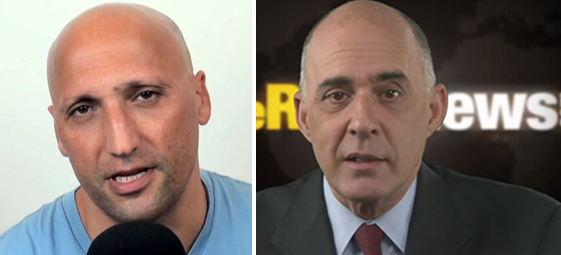
In mid-August a report on the new evidence on Freeland was commissioned from me by a Canadian politician and former member of the Green Party, Dimitri Lascaris. He doubles as a reporter, interviewer and member of the board of directors of The Real News Network (TRNN), a provincial internet broadcaster in Baltimore, in the US. Lascaris (pictured below left) is supervised by Paul Jay (right), a former Canadian Broadcasting Corporation journalist and now editor in chief of TRNN.


Lascaris recorded a 30-minute interview with me on August 21. At first he delayed its broadcast, claiming he was “fact-checking”. Lascaris then claimed that Soros had issued a “definitive rejection” of the reported deal with Freeland, and cancelled the broadcast. He and his TRNN colleagues refuse to reveal the email exchange with Soros.

Lascaris added last week that he hasn’t had the time to check with Freeland on her side of the Soros deal, or her Ukrainian sources of income and real estate. His reason, he said, is that “both of my kids are leaving home to go to university and I am moving them into their new accommodations far from our home. I am not going to drop everything and neglect my family’s needs to respond immediately to your email.”

Update: Dimitri Lascaris answers...