Wednesday, December 20, 2017

"Green" Canada Ranks Worst on OECD G7 List

What Green Economy? New OECD Report Finds Canada Worst of G7 on Recycling, Minerals Efficiency 

by Mining Watch Canada


December 19, 2017

The OECD’s 2017 Environmental Performance Review of Canada, released today, finds Canada ill-prepared to shift its economy towards greater environmental sustainability.

A continuing emphasis on a “rip it and ship it” economy that pushes extraction ahead of value-added processing and manufacturing has left Canada lagging badly in innovation, in materials efficiency and recycling.

The report also points to environmental regulatory oversight and enforcement deficiencies in Canada.

The report highlights that Canada remains one of the most energy-intensive and material-intense economies in the OECD, noting that:

Resources consumed per capita (measured by weight) and resources needed to generate a unit of GDP are high even compared to other resource-rich OECD economies with strong mining and construction industries. Technological and process innovation, as well as greater use of recycled materials, would help Canada improve its resource efficiency. This would also contribute to green growth objectives, including climate mitigation and growth in clean tech segments. (p. 23)

Recent reports have highlighted the need for more metals in building green energy capacity, without fully taking into account either the real costs of mining or the potential for materials efficiency and recycled materials to fill that need. Ugo Lapointe, Canada Program Coordinator for MiningWatch Canada, said,

“The OECD’s observations are very revealing, and should help push Canada develop appropriate policy to shift away from primary resource extraction and its attendant destructive economic and environmental effects, and towards greater materials efficiency, recycling, and sustainability, whether through economic incentives and disincentives, or through legislation and regulation.”

As the report notes, “Even when compared to other OECD economies with high reliance on minerals and metals, Canada displays low material productivity.” The urgency of this problem was recently underlined by a United Nations-backed study that found that the amount of electronic waste around the world grew to a record 45 million tons in 2016, with only 20% being recycled. Canada produces over 20 kg of e-waste per inhabitant per year, ahead of all other countries in the Americas, including the USA, and there is no national legislation or strategy on the management of e-waste or of metal recycling from the construction, infrastructure and transportation sectors.

The OECD report also took aim at Canada’s poor enforcement of environmental regulations, noting:

At the same time, there is evidence of “regulatory capture” in enforcement against powerful industries. A recent report by British Columbia’s Auditor General concluded that neither the Ministry of Environment nor the Ministry of Energy and Mines conducts effective compliance monitoring and enforcement in the province’s mining sector. In many cases, operators who violate the law are given repeated warnings and opportunities to return to compliance, but never face real sanctions, even for clear and dangerous violations. Furthermore, neither ministry has adequately evaluated the effectiveness of its compliance assurance efforts (B.C. Auditor General, 2016). (p. 96)

Lapointe commented,

“There is currently a very limited insurance liability of up to $25 million for mine spills and accidents, and a recent UNEP report found Canada had some of the highest rates of mining spills in the world.”
He added that MiningWatch is pressing federal, provincial, and territorial governments to take meaningful action. “Beyond this report, we’d like to know what ability or mechanisms does the OECD have to follow up on the UNEP recommendations to protect the environment and the safety of people downstream of these large, primary mining waste facilities.”


For more information:

Ugo Lapointe, MiningWatch Canada,
ugo@miningwatch.ca

Meanwhile in Barcelona... Catching Up with Catalunya

What is Happening in Catalonia and Spain?

by Vicente Navarro - CounterPunch


December 20, 2017

On October 1, 2017, the police of the Spanish State (known as the National Police) endeavored to take the polling boxes where Catalan people were voting in a referendum with two choices: for or against Catalonian independence from the Spanish State.

The voting took place in barricaded buildings (most of them public schools) to protect the boxes containing the votes. With the intent to collect the boxes and stop the voting, the National Police used all types of repressive measures, from rubber bullets, to gas and batons.

Nearly 900 people were seriously hurt, and two were in critical condition in area hospitals.

These televised images of the police brutality shocked the population, who responded by going to the streets in masses to protest against the National Police.

These popular protests forced the repression to end by early afternoon, allowing people to keep voting until 8:00 p.m. It was the victory of the population over the Central State and its police. The repression was not able to stop the referendum, with 2.5 million voting (approximately 43% of the electorate) and 90 percent favoring independence. The police assault not only failed to stop the vote, it infuriated people who had not planned to vote because they did not sympathize with the pro-independence movement led by the Catalan government. Many of them were from the working-class districts of Barcelona. After seeing the National Police brutality, they voted as a protest against the police behavior. It also showed, among other things, the incompetence of the Spanish government and its police.

Why Did This Happen?


Most of the international press has reported on the police riots, but they did not explain the political context that has led to the current situation. Two visions of Spain have always existed. One sees Spain as a uninational state, centered in the capital of the Spanish Kingdom, Madrid. This vision denies the existence of other nations in Spain. It is based on the Borbonic Monarchy and is the vision of the Monarchic State, including the armed forces and the Catholic Church; it is the conservative version of Spain.

Another vision of Spain, however, is plurinational, which recognizes other nations in Spain, including Catalonia, the Basque Country, and Galicia. Each one of these nations has its own language, culture, and history, and all of them prefer a republic rather than a monarchy as a form of state. It has always been the left republican vision of Spain. It had its full expression during the Second Spanish Republic, from 1931 to 1939, known for its famous reforms that included land reform, stronger unions, the establishment of the public school system, women’s suffrage, divorce, abortion, and many other highly popular reforms.

The institutions whose interests were negatively affected by these reforms—the large land owners, the bankers, and the church, among others—stimulated a military coup led by General Francisco Franco, whose troops (helped by Nazi German and Italian Fascist troops) needed three years to defeat the Second Republic. Initially they thought the coup would take just three months, but it took much longer than expected because of the enormous resistance offered by the popular classes (whose republican government only received assistance from the Soviet Union and to a lesser extent from Mexico). The so-called Non-Intervention Treaty (signed by most Western democracies and also by Hitler and Mussolini) was not respected by the Fascist states of Germany and Italy, and they continued to arm the Spanish Army. The victory of the Fascist forces led to the triumph of Franco’s regime, one of the cruelest dictatorships established in Western Europe. According to Professor Edward Malekafis, an expert on European Fascism at Columbia University in New York, for every political assassination of Mussolini’s Fascist regime, Franco completed 10,000. This Fascist state brutally repressed Catalonia, forbidding the Catalan language and culture. The dictatorship became the extreme expression of the uninational view of Spain. Before dying, Franco appointed Juan Carlos I as king (the grandson to the former king of Spain, Alfonso XIII).

How Democracy Came About in Spain in 1978


Two factors intervened to explain the transition of the Spanish State from a dictatorship to a democracy. One was the popular movements against the dictatorship, particularly accentuated in the most industrial parts of Spain, including Barcelona, Bilbao, and Madrid. All strikes were forbidden during the dictatorship and, as a consequence, every illegal strike became a political strike against the regime. This working-class pressure was very important to force a change in the dictatorship.

The second factor to stimulate Spain’s transition to a democracy was the need of the large business community (very influential in the dictatorial regime) to become integrated into the European Union. This required the dictatorial regime to open and adopt democratic features, such as the existence of political parties and the ability to carry out elections, that allowed the European Union to accept Spain. The governing right-wing forces (who were inheritors of the Fascist regime) derived enormous power from their control of the apparatuses of the state and most of the media. This power explains why the transition from dictatorship to democracy took place under conditions very favorable to those right-wing forces. They forced the left-wing parties—who were persecuted during the dictatorship—to abandon some key elements of their platforms and projects elaborated during their anti-Fascist struggle. One of those elements was their commitment to develop a plurinational state. In the new constitution, approved by the parliament in 1978, only one nation—the Spanish nation—was allowed, assigning the armed forces the task of maintaining the unity of Spain. The Socialist Party (PSOE), which in the clandestine period had proposed to establish a plurinational state, abandoned that intent (because of the pressure from the king and the armed forces) and became a major pillar of the new monarchic uninational state. And the Communist Party, which maintained its plurinational commitment, was marginalized by an electoral law that discriminated against major urban centers where the electoral base of that party—the working class—was situated. This is the origin of the events that occurred on October 1. This abandonment of the plurinational vision of the state took place at the same time that the historical memory (the intent to recover the history of the Republic) was basically forbidden and the achievements of Second Republic were completely forgotten. This silence about the past, in practice, meant the complete silence of the plurinational view of Spain. The Republic flag was forbidden, and the Borbonic Monarchic flag became the national flag.

What Happened in Catalonia?


In Catalonia, however, the plurinational vision of Spain did not disappear; the left parties continued to call for a redefinition of Spain. In 2005, a left-wing Catalan government, led by the Socialists (the Pasqual Maragall government), proposed an “Estatuto” (an autonomous law) calling for recognition of Catalonia as a nation within Spain. The proposal was approved by the Catalan Parliament, later on by the Spanish Parliament and finally, the Catalan population in a referendum.

It was vetoed, however, by the Constitutional Court, which the Popular Party (PP) controlled. The PP was founded by leading figures of the Fascist regime and still holds enormous power in the Central State. That veto was the starting point of the large demonstrations in Catalonia asking the Spanish government to approve what the Constitutional Court had vetoed. Since then, every year, more than one million people have gone to the streets on Catalonia Day, September 11, in memory of the day in 1714 when Borbonic forces defeated Catalan forces and Catalonia lost the right to self-government. The Spanish government ignored the demands by successive Catalan governments to get more autonomy, causing the radicalization of the mass movement that asked for Catalonia to be recognized as a nation and to have more autonomy within the Spanish State. That radicalization meant a major change in the type of demand they were asking for: they started calling for independence. The pro-independence sector of the Catalan population—which was never larger than 15 percent of the adult population—increased to 48 percent during the period when Spain was governed by the PP (the Spanish right-wing party.) This 48 percent translated into a majority in the Catalan parliament, because the electoral laws favored rural and conservative areas over urban and working-class areas. The pro-independence parties governed Catalonia as the majority in the Catalan parliament, led by the Convergència Democràtica de Catalunya (CDC -a right-wing party), which later changed its name to Partit Demòcrata Europeu Català (PDeCAT.) This party has governed Catalonia most of the democratic period, 1978–2016 (almost 30 years). It controls most of the apparatus of the Catalan regional government, including the public TV and the Catalan public radio. The other two parties that allied with the CDC are a center-left party, the Esquerra Republicana de Catalunya (ERC) (although its economic team is neoliberal), and the Candidatura d’Unitat Popular (CUP), a very radical nationalist party that claims to be socialist and revolutionary (which has approved the Catalan budget containing strong austerity policies proposed by PDeCAT and ERC.) The pro-independent parties, however, are a minority in Barcelona, the capital city of Catalonia. Barcelona is governed by a new left-wing party, En Comun, allied with Unidos Podemos (a coalition of a new left-wing party in Spain, Podemos, with the renewed Communist Party, Izquiera Unida (IU).)

The Current Situation


The approval of the independence of Catalonia in the Catalan parliament generated two responses. One was that all the parties opposed to independence abandoned the parliament (which represented the majority of the Catalan population) in protest of the way the pro-independence parties, two of them governing Catalonia in a coalition (Junts per Si in alliance with the CUP), had declared independence. A decision such as this should have been approved by two-thirds of the parliament (according to the Catalan and the Spanish law), which was not the case. The pro-independence parties argued that they had obtained independence on October 1 with 90 percent of the referendum votes in favor of independence. The anti-referendum parties considered this argument to be fallacious, since the referendum was illegal and did not have the democratic guarantees to allow for a full debate on the issues raised by the referendum. But most importantly, this 90 percent in favor of independence was only 43 percent of the voting population. The actual number of supporters for independence was a minority of Catalans. The majority of the population—and particularly working-class people, who come primarily as immigrants from other parts of Spain—was, and continues to be, against independence. They were not pro-independence, although they were outraged by the actions of the Spanish police. This explains why the Catalan trade unions (who were not in favor of independence) called a very successful general strike on October 3, two days after the actions of the Spanish police. The strike was called by the key players in civil society, such as the two largest unions, the small employer associations, the major neighborhood associations of Catalonia, the widely popular firefighters, and many others.

The other response was the approval by the Spanish State (controlled by the PP) of an exceptional clause 155 of the Spanish constitution, allowing the Spanish government to dismiss the Catalan government, the Catalan autonomy, and the Catalan parliament, governing Catalonia from Madrid. In addition, the Spanish State called for elections on December 21. This highly unpopular law in Catalonia eliminated the already limited Catalan autonomy. This law, however, became popular in the rest of Spain. The call for elections, on the other hand, is favored in large sectors of the popular classes. Today Catalonia is divided (by class) into two Catalonias. In the last elections in Barcelona, all urban districts with levels of income above the city average voted for pro-independence parties, those below (which were the majority) for parties against independence.

What the Flags Are Hiding


The PP, the right-wing party (which in the European spectrum is an ultra-right-wing party and successor of the Fascist Party), is extremely corrupt. These past weeks, several courts are judging cases of corruption that show how that party has been funded illegally. The president of that party and of the Spanish government, Mariano Rajoy, is involved in that corruption. The major national media attention and coverage, however, is on the national question. Rajoy and his party, the PP, appear as the great defender of the “unity of Spain,” the call of the Fascist military coup of 1936. His policies are strongly anti-working-class and have included labor market reforms that have reduced salaries and increased precariousness to record levels, while holding the flag calling for the “unity of Spain.” The same is happening with another right-wing neoliberal party, Ciudadanos (the Citizens), founded and funded by the major corporation of Spain (the Ibex 35).

On the Catalonia side, a similar situation has occurred. The leading party in the pro-independence government is PDECAT, which has been applying identical neoliberal policies (voting for the same labor market reforms in the Spanish parliament that were proposed by the PP), is also using the flag “defending Catalan identity” to hide the enormous cuts in the public sectors of the Catalan welfare state and the same labor market reforms that increase unemployment and precariousness and reduce salaries and social protection. Like the PP, PDECAT is one of the most corrupt parties in Europe.

A New Catalonia and a New Spain


Catalan and Spanish nationalist feelings in Spain have been used to hide the conflict of class interests. The public policies inspired by the governing nationalist parties have led to an unequal distribution of income. The income derived from labor has declined dramatically during the period of great nationalist tensions, while income derived from capital has increased significantly. Meanwhile, the national question has occupied all the attention from the political and media establishments.

A very important development occurring in Spain and in Catalonia has not been covered by the media. It is the Indignados movement (clearly inspired by the Arab Spring) that mobilized millions of people against the political establishment. Their slogan, “they do not represent us,” became very popular, and the movement has created new left-wing forces in many parts of Spain: in Madrid (Podemos), in Galicia (Mareas), and in Catalonia (en Comun). Along with a renewal of leadership of the traditional left party (IU), these left-wing parties have established a new political formation, Unidos Podemos (UP), which in a very short period of time (three years) has become the second largest political formation in the opposition and already governs in some of the most important cities in Spain (Barcelona, Madrid, Coruña, Cadiz, etc.). In Catalonia, it has won the last two elections in the Spanish parliamentary elections. It has been a political tsunami and has created an enormous hostility from the major media and the political establishment. This alliance is against the law 155 and against independence. It calls for a plurinational state and for the right of self-determination of the different nations of Spain. It is a new development that is changing the political climate in Spain as a response to people’s rejection of the highly repressive Spanish State against Catalonia, side by side with a demand for recognition of the plurinational nature of Spain. We will see what will happen next.

Vicente Navarro is Professor of Political Science and Public Policy at Johns Hopkins University and the University Pompue Fabra Public Policy Center Barcelona, Spain.
More articles by:Vicente Navarro

Tuesday, December 19, 2017

Gorilla Radio with Chris Cook, Ray Grigg, Douglas Gook, Janine Bandcroft December 21, 2017

This Week on GR

by C. L. Cook -  Gorilla-Radio.com


December 21, 2017

Merry Christmas, Happy Hanukkah, Jolly Kwanzaa and a very Cosmic Solstice as we enjoy today the great turning of the Sun too! It's normal at this late date to cast an eye back across the year's happenings and accomplishments, and it's been an eventful year here in BC, with a new government brought in - and brought in in such a novel way.

Many on the greener side of the political spectrum hoped the change would bring with it a new way of looking at the way things are done in this province, and my first guest may well be one of those.

Listen. Hear.

Ray Grigg is the author of seven books on Taoism and Zen, and the columnist behind the long-running environmental column, Shades of Green.

He recently released The EcoTrilogy, a compendium of sixteen years worth of his weekly column, comprising the books, Ecologos, Ecopathy, and Ecocide.

Ray Grigg in the first half.

And; where British Columbia's ecological record during the sixteen-plus years reign of the BCLiberal party was never great, the last years, culminating as they did with the Mount Polley mine tailings disaster, proved particularly destructive. So, hope for change was especially buoyant when the electorate discharged the Liberals in favour of a coalition government featuring, for the first time in the nation's history, a Green Party component. But those hopes were dealt a cruel blow last week, when John Horgan's New Democratic Party refused to stop the contentious, and ecologically deleterious, Site C dam project.

Douglas Gook is a Quesnel-based ecology activist and farmer who’s focused on Eco forestry alternatives in the woods there and beyond for more than forty years. The Nechako Lakes Green Party of BC candidate is a director of the BC Environmental Network and Spirit Dance Cooperative Community, and leads Forest Protection Allies, one of the many environmental organizations pressuring government to get effective cleanup processes going, and appropriate compensation for those effected three years after the infamous Mt. Polley spill. He's also one of a growing chorus who do not accept the Site C decision as final.

Douglas Gook maintaining the fight against Site C in the second half.

And; Victoria-based activist and CFUV Radio broadcaster at-large, Janine Bandcroft will join us at the bottom of the hour with the Left Coast Events bulletin of good things you can get up to around here in the coming week. But first, Ray Grigg and The EcoTrilogy.

Chris Cook hosts Gorilla Radio, airing live every Thursday between 11-Noon Pacific Time. In Victoria at 101.9FM, and on the internet at: http://cfuv.uvic.ca.  He also serves as a contributing editor to the web news site, http://www.pacificfreepress.com. Check out the GR blog at: http://gorillaradioblog.blogspot.ca/

In Praise of Deliberative Abstinence in a Time of General Ignorance

Montaigne's Tip for the New Year - And for Another Year of American War Against Russia

by John Helmer - Dances with Bears


December 18, 2017

Moscow - A man who hates the subject of his writings is as pitiable as a coprophagic with haemorrhoids. The more he consumes of what he desires, the more painful he knows will be the consequence.

Termites and rabbits do plenty of the former, but Mother Nature has relieved them of the latter. Russia-hating writers on Russia are not so favoured; they are the only cases I know which combine, and enjoy, the perversity with the pain. In their cases, there’s always been something missing between their upper and lower holes – I mean more is missing than a sense of taste and a sense of humour.

Michel de Montaigne, the French politician and writer of sixteenth century France – inventor of the essay – is their antithesis. He deserves to be remembered for two mottoes we shall need in 2018.

Re-read the essays in the translation by Donald Frame here. Ignore the recent biography by a Chicago professor of French origin named Philippe Desan; he has spent an academic career and eight hundred fresh printed pages revealing his envy that Montaigne will be read for longer than Desan will be forgotten. Envy like this will also have to be overcome to get through the coming year; more of that in a moment.

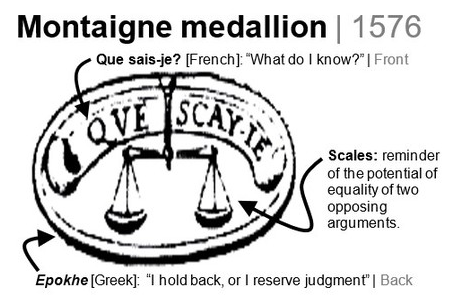
ἐποχή (EPOKHE, I ABSTAIN) and QUE SAIS-JE (WHAT DO I KNOW) were the mottoes Montaigne adopted for himself, and cast on either side of a medallion he wore around his neck; on one side, the more literary and contemplative second replacing the more politically active one which came first. In his attempts to make a political career (fame, money, glory) at the municipal, regional and national level, Montaigne claimed that mediating between parties in conflict and abstention from taking sides would be the successful lines to advance himself. They weren’t. It was a time of civil war, the French Wars of Religion.


Along the way, Montaigne started dictating his reflections on success and failure. Then, noticing these collections of thoughts, cribbed quotes, and primers from the Greek and Latin classics were more esteemed by those he wanted to impress than the political power he wanted to exercise, he kept writing more essays. He also kept trying to do better politically. The more frustrated he grew, the more essays he wrote. Montaigne was also racing his mind against his body, as he knew the symptoms of kidney disease would kill him, as it had his father. It did.

WHAT DO I KNOW was a pose, and almost a half-millennium later, a marvelously successful one. That’s because everyone can join in, though not everyone can be so stylish as Montaigne was in holding the pose. By pretending his penis was independent — “it imperiously contests for authority with our will” – he gave all of us, hmmm, those of us with penises, an alibi for our fantasies, and our failures. Not everyone needs a penis; everyone needs an alibi.

Actually, Montaigne was making the case for his exceptional self, and that’s a pretence. No, for Montaigne it was a paradox – the more ordinary his personality, the more exceptional his expression of it. As a national ideology, exceptionalism is nothing more than a pretence for force, fraud, subversion aimed against other people and their property. Everybody tries it, some several times – Athenians, Spartans, Israelites, Romans, Germans, French, British.

Exceptionalism is the doctrine which motivates Russia-hating as US Government policy for this war which cannot be negotiated to a conclusion; and which will destroy the world if it escalates to nuclear arms. Exceptionalism is also the ideology of envy for what another has, and the alibi for stealing it.

Russians are human, so exceptionalism is also a Russian doctrine. But since December 25, 1991, the day the Soviet flag came down in Moscow, Russians have all wished to be loved by Americans; especially, the Russian oligarchs, the Church, the intelligentsia, the Kremlin. The reason is that once the mental discipline and conviction of the communist period evaporated, what remained was nothing but envy for what Americans had, and what perchance could be taken from them, if Americans reciprocated the Russian wish to be loved. But honeymoons are always short — noone can be so enamoured for long.

The unreciprocated love of American exceptionalism by Russians made the Kremlin a sitting duck for regime change. Boris Yeltsin and his cronies were the ducks. Russia has been saved by others – not by the oligarchs, the Church, the intelligentsia, or the Kremlin. US exceptionalism has triggered its Russian reciprocal; the clumsiness of US policy has been successfully defeated by the performance of unnamed soldiers, little green men, military officers who have defeated the US on the battlegrounds of Ukraine and Syria.


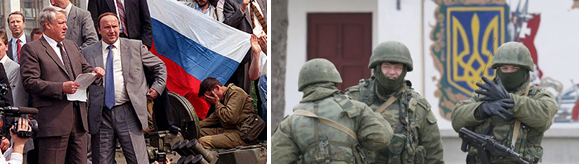
Left: Boris Yeltsin makes a speech in front of the Russian republic 
parliament during the Soviet countercoup of August 1991; he was 
accompanied by Alexander Korzhakov, a KGB general and Yeltsin’s 
bodyguard; and by a soldier who appears to be weeping. The State 
Department history of the event can be read here
Right: Russian soldiers, dry-eyed, support the secession of Crimea 
following the US coup in Kiev, March 2014.

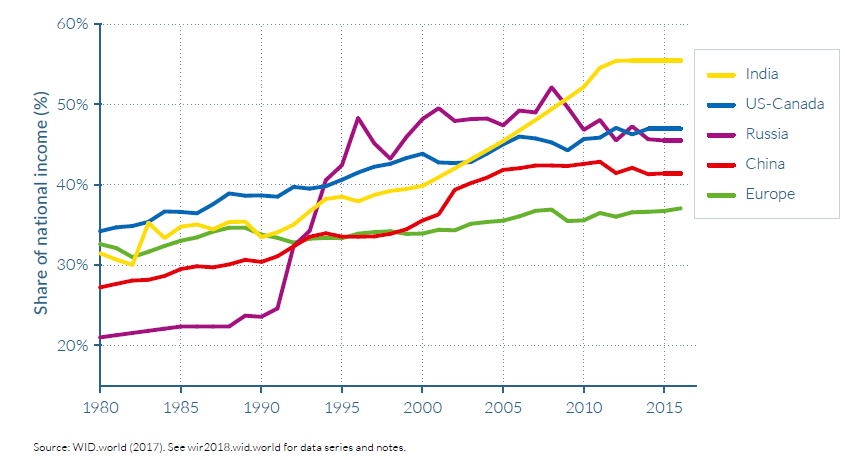
Montaigne’s mottoes will come in handy as President Vladimir Putin starts his third term based on an oligarchy which has transformed Russia from the least unequal to the most unequal state in Europe in just one decade.

WHAT ALL RUSSIANS KNOW — RUSSIAN INEQUALITY BY THE YELTSIN OLIGARCHY, AND WHAT THERE IS TODAY


Read more from the World Inequality Report 2018 at: 

Montaigne’s mottoes are also useful as the US Government’s war to overthrow Putin and his friends enters its fifth year – a war not for the sake of egalitarian reform of Russia but in order to replace Russian larcenists with American ones. Putin is esteemed by Russians for not being as bad as the alternatives which presented themselves during the 1990s, nor those since 2000 — Mikhail Khodorkovsky, Boris Berezovsky, Dmitry Medvedev, Patriarch Kirill, Igor Sechin.

If Dances with Bears hasn’t demonstrated the evidence of just how bad those alternatives were – ahem, still are — you haven’t been reading carefully enough.

Montaigne wrote as a consolation for himself and a warning to everyone else. When his idea turned out unexpectedly to be a hit with a tiny group of readers who were his well-off neighbours and politicians in Paris, who had defeated his every other gambit, Montaigne started writing as revenge – to be remembered longer than they would be. On that wager Montaigne started by hedging his bet, so he knew he was certain to win. He has.

MONTAIGNE’S FOREWORD TO THE READER


More than four hundred years later, we appreciate Montaigne knew what it means to lose most everything of value in the country he loved, after the failure of a career of attempting to save the peace and spare the blood of his countrymen. He wrote: “My world is done for; my form is emptied; I belong entirely to the past.” A spell in the Bastille prison helped confirm his conviction that the body can be done for swiftly, but the mind not so.

By the way, in saying he belonged to the past, Montaigne wasn’t speaking of memory. “There is no man who has less business talking about memory. For I recognize almost no trace of it in me… in my part of the country if they want to say that a man has no sense, they say he has no memory. And when I complain of the defectiveness of mine, they argue with me and do not believe me, as if I was accusing myself of witlessness. They see no distinction between memory and understanding.”

Dances with Bears began more than fifteen years and more than two thousand essays ago, with the idea that Russia’s history is past – that’s to say, nothing good was happening to the country which wasn’t understandable from the past. To understand the good Putin has done for Russia, most Russians remember Yeltsin. That isn’t saying very much, you understand.

For the future of one more year, you have a choice that wasn’t available to Montaigne sitting in his tower, facing his books, alone.


A modern reconstruction of Montaigne’s study; see: 

Nowadays you can send, receive, and re-tweet understandings that are about one minute long in composition and receipt. They add up to a history which interprets itself endlessly as if the process of repetition equals or increases understanding. In some of the essays Montaigne did much the same thing, pulling a book off his shelf and scribbling an excerpt on to his own page.

Montaigne’s view of tweeting was that it’s nothing but vanity publishing, though Montaigne had enough respect for himself that he thought this bluff worth trying on others. “My mind does not always move straight ahead but backwards too. I distrust my present thoughts hardly less than my past ones and my second or third thoughts hardly less than my first.”

Montaigne again, applying nowadays to the Russian agitprop media operating in English, such as Russia Insider, The Duran, The Saker, Fort Russ, RT, Sputnik, Russia Beyond The Headlines, ValdaiClub.com, etc. “There is more ado to interpret interpretations than to interpret things, and more books upon books than upon any other subject; we do nothing but comment upon one another. Every place swarms with commentaries; of authors there is great scarcity. Is it not the principal and most reputed knowledge of our later ages to understand the learned? Is it not the common and final end of all studies? Our opinions are grafted upon one another; the first serves as a stock to the second, the second to the third, and so forth; thus step by step we climb the ladder; whence it comes to pass that he who is mounted highest has often more honour than merit, for he is got up but an inch upon the shoulders of the last, but one.”

“How often, and, peradventure, how foolishly, have I extended my book to make it speak of itself; foolishly, if for no other reason but this, that it should remind me of what I say of others who do the same: that the frequent amorous glances they cast upon their work witness that their hearts pant with self-love, and that even the disdainful severity wherewith they scourge them are but the dandlings and caressings of maternal love; as Aristotle, whose valuing and undervaluing himself often spring from the same air of arrogance. My own excuse is, that I ought in this to have more liberty than others, forasmuch as I write specifically of myself and of my writings, as I do of my other actions; that my theme turns upon itself; but I know not whether others will accept this excuse.”

The excuse for Dances with Bears is that with enough time, it’s likely that more truth will appear from losing in politics than happens from winning in politics. This isn’t a law of human nature, though. It also wasn’t Montaigne’s preference. He didn’t pick truth as his first choice; he almost certainly would have picked winning in politics to being remembered for telling the truth. Exceptionalists, whether American or Russian, Christian, Jew or Muslim, can’t imagine losing in politics, or in anything else. They make poor companions in truth-telling, and in suffering, for they believe theirs is the greater, the superior truth, the superior suffering. For the exceptionalists, envy is a superior form of suffering.


Cartoon published in Lianhe Zaobao (Singapore) on 
March 29, 2012, by Tan Zhong; translation into English.

Thus it came about earlier this year that Princeton University Press dropped in the marketplace a biography of Montaigne by a University of Chicago professor called Philippe Desan. That’s to say, an autobiography of Desan’s envy of a man who tried to hide the fact, according to Desan’s meticulous research, that his forebears sold salted fish for a living; who plagiarized phrases from others in order to ingratiate himself with his superiors; and was an exhibitionist as a young man in bed, and as an old man on paper. Montaigne’s chateau, writes Desan, was not a genuine noblemen’s castle but a bourgeois house. The book also reveals Desan’s finding that Montaigne arranged through a well-connected neighbour to be awarded a knighthood of the Order of St. Michael by a king so desperate for support he handed out dozens of the knighthoods the same year.

Desan’s own biography reveals the position he’s in to judge Montaigne’s vulnerabilities. According to Desan’s university resumé, he has obtained triple the number of knighthoods Montaigne managed – the Chevalier de l’Ordre des Palmes Académiques (1994), Chevalier de l’Ordre National du Mérite (2004), and the Chevalier de l’Ordre des Arts et Lettres (2011); the resumé misspells the titles of the knighthoods. He adds he has topped even those with medals from the Académie Française, all to honour Desan’s work on… Montaigne. If it’s the meaning of these honours that Montaigne’s essays are, as Desan concludes, an insincere apology for a conniving career of hapless ambition, then we can appreciate how envy can become, by application of the doctrine of exceptionalism, an excuse for stealing from the dead.

Montaigne himself proposed to be thick-skinned about this. In the essay On Sadness he claimed: “I am little subject to these violent passions. My susceptibility is naturally tough.” Maybe that was so; maybe that was Montaigne’s riposte to the likes of Desan. “I harden and thicken it every day by force of reason,” he added.

For the coming year, will reason have a force equal to the enemies of reason lying in ambush? Is it contrary to the law of nature that one man can dance with many bears?

The method for answering can be found in the two mottoes – I ABSTAIN and WHAT DO I KNOW. Be sure the answer, if it materializes, will not be exceptional. But it will be said. “If I can,” Montaigne wrote in 1580, twelve years before his demise, “I shall keep my death from saying anything that my life has not already said.”

FOOTNOTE TO LEAD IMAGE: the image is Salvador Dali’s illustration for Montaigne’s essay On Vanity. Dali was commissioned to illustrate the essays by the New York publisher Doubleday; they appeared in print in 1947. The book’s first edition is now rare and moderately expensive. Click to view for free. Russian academic appreciation for Montaigne came after the end of the Soviet curriculum, but it has been a decade since he was discussed in public. Here was that last occasion, when Natalia Basovskaya, a professor of history at the Russian State University for the Humanities, talked about Montaigne for three-quarters of an hour on Moscow radio Ekho Moskvy, on February 25, 2007.

Monday, December 18, 2017

We're All Pests Now: Pesticide Ecocide

Pesticide Suicide

by Robert Hunziker - CounterPunch


December 18, 2017

Pesticide suicide refers to toxic chemicals mucking up the health of animals, plants and insects. This worldwide causatum may be totally out of control or maybe not; nobody knows for sure. Therein lies the scary part.

However, what is known is not encouraging: “Industrial toxins are now routinely found in new-born babies, in mother’s milk, in the food chain, in domestic drinking water worldwide… Humans emit more than 250 billion tonnes of chemical substances a year, in a toxic avalanche that is harming people and life everywhere on the planet.” (Source: Scientist Categorize Earth as a Toxic Planet, Phys Org, February 7th 2017)

For obvious reasons, it is not at all comforting to hear Earth referred to as a “toxic planet.” Indeed, it would be insulting, if not true. In that regard, there may be connecting dots around “toxic planet.”

A huge increase in the incidence and prevalence of chronic diseases has been reported in the United States over the last 20 years during the same time frame as pesticide/chemical usage has become ubiquitous. (Journal of Organic Systems) At the beginning of the 20th century infectious diseases like tuberculosis, pneumonia, and diarrheal disease were the leading causes of death. By the 21st century mortality by infectious diseases was replaced by chronic illnesses like heart disease, stroke, and cancer. Regrettably, there is a pronounced trend in America. A Rand Corporation study states that 60% of Americans have one and 40% have multiple chronic conditions. (Source: Incidence and Prevalence of Chronic Disease, Autoimmunity Research Foundation)

Sixty percent (60%) of Americans with a chronic condition is almost impossible to grasp because it’s a mind-boggling statistic. How is this possible? And, why so many?

Whether pesticide suicide (inclusive of all chemicals) is reality is not known 100% certain. But, the indicators aren’t hopeful. The rate of growth of chronic problems increasingly suggests serious problems exist within ecosystems, border-to-border from Maine-to-California and Canada-to-Mexico. Of course, given enough time, truth is revealed via ecosystem breakdowns (already starting) and/or advancing cases of autism, gastrointestinal issues such as inflammatory bowel disease, chronic diarrhea, colitis, Crohn’s disease, obesity, cardiovascular disease, depression, cancer, cachexia, Alzheimer’s disease, Parkinson’s disease, multiple sclerosis, and ALS, or none of above, which would, in part, be indicative of no ecosystem toxicity.

Further to the point, Jennifer Hsaio’s article, “GMOs and Pesticides: Helpful or Harmful,” Harvard University, August 19, 2015: “According to the National Institutes of Health (NIH), the health effects of pesticides are not well understood, but their use has been associated with conditions such as cancer, diabetes, and neurological effects.”

Once again, the phrase “pesticides are not well understood.” Yet sprayed coast-to-coast to kill things. “Health effects of pesticides not well understood,” prompts a logical response: Is society totally delusional, deranged, crazed? Answer: Yes, it probably is! How can a well-adjusted society permit use of chemicals manufactured to kill things helter skelter throughout the countryside when… “Health effects of pesticides are not well understood?”

The following quote from Julian Cribb’s Surviving the 21st Century (Springer Int’l Publishing, Switzerland 2017) likely tells the story:

“The evidence that we ourselves— along with our descendants, potentially for the rest of history— are at risk from the toxic flood we have unleashed is piling up in literally tens of thousands of peer-reviewed scientific research reports. Despite this mass of evidence, the public in most countries is only dimly aware, or even largely unaware of what is being done to them. The reason is twofold: First, most of these reports are buried in scientific journals, written in the arcane and inaccessible language used by specialists. The public may hear a little about certain chemical categories of concern, like pesticides and food additives, or the ‘dirty dozen’ (Stockholm C0nvention 2013) industrial super-poisons, or ‘air pollution’ in general. However, these represent only a scant few pixels in a much larger image now amassing in the scientific literature of tens of thousands of potentially harmful substances which are disseminating worldwide. Second, the proportion of chemicals which have been well-tested for human safety is quite small…” (Page 108)

In short, humanity is poisoning itself with a massive flood of chemicals all across the world, dripping wet with toxicity, and shockingly, nobody is really sure of the impact! Yet, there are dizzying numbers of academic research papers, literally tens of thousands of peer-reviewed scientific research that discuss the issue. Duh!

Still, by all appearances, in the public domain, absolutely nobody knows for sure what’s going on, which is a national tragedy, as well as a facsimile of the “unknown” world at Fukushima Daiichi Nuclear Power Plant. Yet, chemicals may be more ubiquitous worldwide than Fukushima Daiichi, who knows for sure? Could be a tie.

One of the chemicals that is most newsworthy, most discussed, and most entangled in controversy is glyphosate, which is one of the most widely used herbicides in the U.S. for agriculture, forestry, lawns, gardens, and industrial weed areas. In fact, since 1974, glyphosate usage has increased by leaps and bounds. Two-thirds of the total volume applied from 1974 to 2014 has been sprayed in the past 10 years alone. Glyphosate agricultural usage in the U.S. in 1974 was 1400 (1000 lb) growing to 249,906 (1000 lb) by 2014.

“Genetically engineered herbicide-tolerant crops now account for about 56% of global glyphosate use. In the U.S., no pesticide has come remotely close to such intensive and widespread use. This is likely the case globally, but published global pesticide use data are sparse. Glyphosate will likely remain the most widely applied pesticide worldwide for years to come, and interest will grow in quantifying ecological and human health impacts. Accurate, accessible time-series data on glyphosate use will accelerate research progress.” (Source: Charles M Benbrook, Trends in Glyphosate Herbicide Use in the United States and Globally, Environmental Sciences Europe, 28:3 January 2016)

Monsanto sold the first commercial glyphosate product in the U.S. in 1974. The brand name is Roundup. Subsequently, many crops have been genetically engineered to be herbicide-tolerant or GE-HT. But, does GE-HT herbicide-tolerance really work?

It was only a few weeks ago that the EU granted glyphosate a new five-year lease throughout Europe, closing one of the most bitterly fought pesticide relicensing battles ever, as 1.3 million EU citizens endorsed a petition to ban the product.

“But the enzyme-blocking chemical has also become a mainstay of modern agricultural techniques that farmer’s unions see as environmentally friendly, even as critics condemn it as a ‘pesticide treadmill’ of danger to plants, animals, and people.” (Source: Arthur Neslen, Controversial Glyphosate Weedkiller Wins New Five-Year Lease in Europe, The Guardian, Nov. 27, 2017) Are farmer’s unions correct or are 1.3 million petitioners correct?

Still, there may be serious problems with GE-HT: According to the following article: Genetically Engineered Crops, Glyphosate and the Deterioration of Health in the United States of America, Journal of Organic Systems, Vol. 9, No. 2, 2014:

“A huge increase in the incidence and prevalence of chronic diseases has been reported in the United States (US) over the last 20 years. Similar increases have been seen globally. The herbicide glyphosate was introduced in 1974 and its use is accelerating with the advent of herbicide-tolerant genetically engineered (GE) crops. Evidence is mounting that glyphosate interferes with many metabolic processes in plants and animals and glyphosate residues have been detected in both. Glyphosate disrupts the endocrine system and the balance of gut bacteria, it damages DNA and is a driver of mutations that lead to cancer.”
“The World Health Organization recently announced that glyphosate is a probable carcinogen… Although studies have shown conflicting conclusions about the link between glyphosate and cancer in humans, glyphosate has been linked to cancer in rats and mice and experiments in human cells have shown that exposure to glyphosate can cause DNA damage,” Ibid.

GE crops are typically far more contaminated with glyphosate than conventional crops, courtesy of the fact that they’re engineered to withstand extremely high levels of Roundup without perishing along with the weed.

“Monsanto has steadfastly claimed that Roundup is harmless to animals and humans because the mechanism of action it uses (which allows it to kill weeds), called the shikimate pathway, is absent in all animals. However, the shikimate pathway is present in bacteria, and that’s the key to understanding how it causes such widespread systemic harm in both humans and animals,” (Source: Monsanto’s Roundup Herbicide May Be Most Important Factor in Development of Autism and Other Chronic Disease, Mercola, June 9, 2013)

According to The Institute of Responsible Technology d/d May 10, 2013: “It was ‘supposed’ to be harmless to humans and animals—the perfect weed killer. Now a groundbreaking article just published in the journal Entropy points to Monsanto’s Roundup herbicide, and more specifically its active ingredient glyphosate, as devastating—possibly ‘the most important factor in the development of multiple chronic diseases and conditions that have become prevalent in Westernized societies.

That’s right. The herbicide sprayed on most of the world’s genetically engineered crops—and which gets soaked into the food portion—is now linked to autism … gastrointestinal issues such as inflammatory bowel disease, chronic diarrhea, colitis and Crohn’s disease, obesity, cardiovascular disease, depression, cancer, cachexia, Alzheimer’s disease, Parkinson’s disease, multiple sclerosis, and ALS, among others.” Prompting the logical question: What chronic health-related problems are not listed?

For more details about pesticide issues as discovered by The Institute of Responsible Technology, Jeffrey Smith interviewed Stephanie Seneff, PhD, Senior Research Scientist at MIT. Dr. Seneff has been involved in research at MIT for over three decades. A video by The Institute of Responsible Technology follows:


According to Dr. Seneff: Monsanto has steadfastly claimed that Roundup is harmless to animals and humans because the mechanism of action it uses (which allows it to kill weeds), called the shikimate pathway, is absent in all animals. However, the shikimate pathway is present in bacteria, and that’s the key to understanding how it causes such widespread systemic harm in both humans and animals. The bacteria in your body outnumber your cells by 10 to 1. For every cell in your body, you have 10 microbes of various kinds, and all of them have the shikimate pathway, so they will all respond to the presence of glyphosate!

Glyphosate causes extreme disruption of the microbe’s function and lifecycle and glyphosate preferentially affects beneficial bacteria, allowing pathogens to overgrow and take over. At that point, your body also has to contend with the toxins produced by the pathogens. Once the chronic inflammation sets in, you’re well on your way toward chronic and potentially debilitating disease.

According to The Detox Project: Anresco Laboratories has found glyphosate in a range of U.S. food products, and the chemical also tested positive in urine, conducted by the University of California San Francisco (UCSF), using validated LC-MS/MS method.

Here’s the problem, as stated by The Detox Project:

“The cultivation of Roundup Ready GMOs has considerably increased food contamination by glyphosate. Roundup Ready plants do not degrade glyphosate but tolerate it, so they accumulate Roundup residues during their growth. As a consequence, glyphosate has among the highest maximum residue limits for pesticides with up to 500,000 parts per billion authorized in some GM feed. A recent study on 10 batches of GM soybeans from Iowa found glyphosate at an average concentration of 11,900 ppb (maximum of 20,100 ppb). According to Monsanto, residues levels of up to 5,600 ppb in GM soy represent ‘extreme levels.”

In the main, this article has dealt with one chemical, i.e., glyphosate, at the expense of further investigation of the entire complex of chemicals. That’s an encyclopedic task over decades just to get to the bottom of whether pesticide suicide is truly a reality. Therein lies the horrifying, frightening aspect of a world ubiquitously covered with chemicals. By the time you know for sure, it’s late.

Meanwhile, a Rand Corporation study states that 60% of Americans have one and 40% have multiple chronic conditions: “Nearly 150 million Americans are living with at least one chronic condition; around 100 million of them have more than one. And nearly 30 million are living, day in and day out, with five chronic conditions or more. (Source: Chronic Conditions in America: Price and Prevalence, Rand Review, July 2017)

A colossal crisis? Answer: Without doubt, yes!

 
Robert Hunziker lives in Los Angeles and can be reached at rlhunziker@gmail.com.
More articles by:Robert Hunziker

British Columbia Announces Immediate Ban on Grizzly Bear Hunt

Grizzly bear hunt banned for good in B.C.

by Wilderness Committee 


December 18, 2017

It’s about time this grisly hunt comes to an end. We can “bearly” believe it!

The government has just announced a complete ban of the grizzly bear hunt effective immediately. The Wilderness Committee and a majority of B.C. residents have been asking for a ban to this barbaric hunt for more than 20 years.

“This is tremendous news,” said Wilderness Committee National Campaign Director Joe Foy.

“Clearly the people of B.C. have asked for this for a long time. We are very grateful that the government has finally stepped up to do what the people have asked for which is an end to this barbaric, bloody sport hunt.”

The B.C. government held a public consultation process in October with First Nations, stakeholders and the public on proposed changes to the regulation on the grizzly bear hunt. A total of 4,180 emails were received with 78 per cent of respondents telling the government that the grizzly hunt needed to end.

“This means that around 300 grizzly bears a year won’t get killed,” said Foy.
“We now want to see the government aggressively working to re-establish the populations where they are dangerously low or gone altogether, like the Cascades region in southwestern B.C.”

Southern B.C. grizzly populations are listed as threatened or endangered, with each population numbering fewer than 100. Hunting grizzlies in that region was so severe that it led to only one grizzly being left in the North Cascades.

“The next step is a combination of habitat protection and, in emergency cases grizzly bear relocation to bring the numbers back up,” said Foy.
“The province needs to establish standalone endangered species legislation if the grizzlies are going to have a chance at survival and recovery.”


- 30 -


For more information, please contact:
Joe Foy | National Campaign Director, Wilderness Committee
joe@wildernesscommittee.org


Related Campaign: Grizzly Bears

Sunday, December 17, 2017

World on Fire and a Box of Matches

The President Plays with Matches: And the Whole World Burns

by Rebecca Gordon - TomDispatch


December 15, 2017 

I’ve just heard that my family home near Carpenteria is literally in flames at this moment,” a friend told me recently.

She was particularly worried, she said, because “my mom has MS. She and my dad got the call to evacuate after midnight last night. They were able to grab a few photos, my sister’s childhood teddy bear, and the dog. That’s it. That’s all that’s left.”

My friend’s parents are among the thousands of victims of the 240,000-acre Thomas fire, one of California’s spate of late-season wildfires.

Stoked by 80-mile-an-hour Santa Ana winds, plenty of dry fuel, and 8% humidity, such fires are devouring huge swaths of southern California from Los Angeles to Santa Barbara. Months of dry weather and unseasonably warm temperatures have turned the southern part of the state into a tinderbox.

Once again the country watches in horror as firefighters struggle to contain blazes of historic voracity -- as we watched only a couple of months ago when at least 250 wildfires spread across the counties north of San Francisco. Even after long-awaited rains brought by an El Niño winter earlier in 2017, years of drought have left my state ready to explode in flames on an increasingly warming planet. All it takes is a spark.

Sort of like the whole world in the age of Donald Trump.

Tomgram: Rebecca Gordon, Trump the Flamethrower
In June, an American Green Beret was reportedly strangled to death in Mali by U.S. Navy SEALs, allegedly in connection with a shadowy money-skimming scheme. (The military is currently investigating.) In July, The Intercept, the London-based research firm Forensic Architecture, and Amnesty International revealed that a drone base used by U.S. forces in Cameroon was also a site for illegal imprisonment, brutal torture, and even killings on the part of local forces. (The military is investigating.) In August, according to a blockbuster investigation by the Daily Beast, U.S. Special Operations forces took part in a massacre in which 10 Somali civilians were killed. (The military is investigating.) In October, four Special Operations soldiers were killed in murky circumstances during an ambush by militants in Niger. (The military is investigating.)

This spate of questionable, scandalous, or even criminal activity involving U.S. forces in Africa should come as little surprise. Over the last decade and a half, operations on that continent have been expanding and evolving at an exponential rate. A token number of U.S. troops has grown into a cast of thousands now carrying out about 10 separate missions per day, ranging from training to combat operations, which are up 1,900% since last year alone. U.S. commandos sent to that continent have jumped from 1% of special ops forces deployed overseas in 2006 to nearly 17% today, the highest total outside the Middle East. There have also been numerous indications of U.S. forces behaving badly from one side of the continent to the other. Few in the mainstream media or among those tasked with oversight of such operations have, however, taken any significant notice of this.

“We don’t know exactly where we’re at in the world, militarily, and what we’re doing,” said Senator Lindsey Graham, a member of the Senate Armed Services Committee, in the wake of the ambush in Niger. More recently, Congressman Ted Lieu of the House Foreign Affairs Committee added, “From combating al-Shabaab in Somalia to Boko Haram in Nigeria, U.S. military personnel are deployed across the African continent with little public scrutiny or awareness.” This attention deficit helped set the stage for the recent scandals that have forced lawmakers and the public to take some notice.

The situation of the U.S. military in Africa is, in some respects, not unlike that in California, where TomDispatch regular Rebecca Gordon begins her latest article. There, climate-change-charged dry weather and unseasonably warm temperatures made the state a tinderbox that recently burst into a series of devastating wildfires. The U.S. military has created its own tinderbox in Africa, where longtime expansion without oversight has led to a series of blazing scandals. And all of this is just a small part of the larger story told by Gordon -- of a world filled with the dry underbrush of decades of failed U.S. policies and of a president with a penchant for setting fires. Once, ignoble political calculations, futile strategies, ideological idiocy, and intellectual ineptitude provided flashpoints capable of sparking foreign policy failures, conflicts, or ruinous domestic policies. Today, writes Gordon, the commander-in-chief functions as a one-man flamethrower, setting blazes the world over as a matter of whim and embracing the inferno as an end in itself. Nick Turse

The President Plays with Matches: 

And the Whole World Burns

by Rebecca Gordon


Torching Jerusalem


The crazy comes so fast and furious these days, it’s easy to forget some of the smaller brushfires -- like the one President Trump lit at the end of November when he retweeted three false and “inflammatory” videos about Muslims that he found on the Twitter feed of the leader of a British ultra-nationalist group.

The president’s next move in the international arena -- his “recognition” of Jerusalem as the capital of the state of Israel -- hasn’t yet slipped from memory, in part because of the outrage it evoked around the world. As Moustafa Bayoumi, acclaimed author of How Does It Feel to be a Problem? Being Young and Arab in America, wrote in the Guardian, “The entire Middle East, from Palestine to Yemen, appears set to burst into flames after this week.” Not surprisingly, his prediction has already begun to come true with demonstrations in the West Bank, Gaza, and Lebanon, where U.S. flags and posters of President Trump were set alight. We’ve also seen the first rockets fired from Gaza into Israel and the predictable reprisal Israeli air attacks.

Trump’s Jerusalem announcement comes as his son-in-law, Jared Kushner, pursues his so-called Middle East peace initiative. Kushner's new BFF is Mohammed bin Salman, the heir apparent to the Saudi throne. We don’t know just what the two of them talked about during a late night tête-à-tête as October ended, but it probably involved Salman’s plans to jail hundreds of prominent Saudis, including 11 fellow princes. They undoubtedly also discussed a new, incendiary Israeli-Palestinian “peace plan” that the U.S. and Saudi Arabia are reportedly quietly circulating.

Under this proposal, according to the New York Times,

“The Palestinians would get a state of their own but only noncontiguous parts of the West Bank and only limited sovereignty over their own territory. The vast majority of Israeli settlements in the West Bank, which most of the world considers illegal, would remain. The Palestinians would not be given East Jerusalem as their capital and there would be no right of return for Palestinian refugees and their descendants.”

If this is the “deal of the century” that President Trump plans to roll out, then it's no surprise that he’d prepare the way by announcing his plans to move the U.S. embassy to Jerusalem.

That move reveals a lot about Trump’s much vaunted deal-making skills when it comes to the international arena. Here he has made a major concession to Israel without receiving a thing in return, except words of praise from Prime Minister Benjamin Netanyahu (and from evangelicals in this country). Given that Israel came into possession of the eastern half of Jerusalem through military conquest in 1967, a method of acquiring territory that international law views as illegal, it was quite a concession. The ultimate status of Jersalem is supposed to be a subject for the final stage of Palestinian-Israeli negotiations, not a gift to one side before the talks even begin.

Behind this concession, as far as can be seen, lies no strategic intent of any sort, not in the Middle East at least. In fact, President Trump was perfectly clear about just why he was making the announcement: to distinguish himself from his predecessors. (That is, to make himself feel good.) 

“While previous presidents have made [moving the U.S. embassy to Jerusalem] a major campaign promise, they failed to deliver. Today, I am delivering.”

“Some say,” he added, that his predecessors failed because “they lacked courage.” In point of fact, Trump did not exactly “deliver” either. Just like his predecessors, he promptly signed a semi-annual waiver that once again delayed the actual embassy move for six months.

Pyromania?


Rather than serving a larger Middle East strategy, Trump’s Jerusalem announcement served mainly his own ego. It gave him the usual warm bath of adulation from his base and another burst of the pleasure he derives from seeing his name in the headlines.

In his daily behavior, in fact, Trump acts less like a shrewd dealmaker than a child with pyromania, one who relieves anxiety and draws attention by starting fires. How else to explain his tendency every time there’s a lull in the coverage of him, to post something incendiary on Twitter? Each time, just imagine him striking another match, lighting another fuse, and then sitting back to watch the pyrotechnics.

Here is the grim reality of this American moment: whoever has access to the president also has a good shot at pointing this human flamethrower wherever he or she chooses, whether at “Little Rocket Man” in North Korea or Doug Jones in Alabama (although that flame turned out to be, as they British say, a damp squib).

The Middle East has hardly been the only part of the world our president has taken visible pleasure in threatening to send up in flames. Consider the situation on the Korean peninsula, which remains the greatest danger the world faces today. Who could forget the way he stoked the already glowing embers of the Korean crisis in August by threatening to rain “fire and fury like the world has never seen” -- an obvious nuclear reference -- on North Korea? And ever since it’s only gotten worse.

In recent weeks, for instance, not only Trump but his coterie have continued to ramp up the rhetoric against that country. Earlier this month, for instance, National Security Adviser General H.R. McMaster renewed the threat of military action, saying ominously, “There are ways to address this problem short of armed conflict, but it is a race because [North Korean leader Kim Jong-un]’s getting closer and closer [to having a nuclear capacity to hit the United States], and there’s not much time left.”

In September, Trump’s ambassador to the United Nations, Nikki Haley, reinforced this message in an interview with CNN. “If North Korea keeps on with this reckless behavior, if the United States has to defend itself or defend its allies in any way, North Korea will be destroyed.”

Indeed, Vipin Narang, a nuclear nonproliferation specialist at MIT, thinks the Trump administration may already have accepted the inevitability of such a war and the near-guarantee that South Korea and Japan will be devastated as well -- as long as it comes before North Korea can effectively launch a nuclear strike on the U.S. mainland. “There are a lot of people who argue that there’s still a window to stop North Korea from getting an ICBM with a nuclear warhead to use against the United States,” he commented to the Washington Post. “They’re telling themselves that if they strike now, worst-case scenario: only Japan and South Korea will eat a nuclear weapon.”

You don’t exactly have to be an admirer of Kim Jong-un and his sad outcast regime to imagine why he might be reluctant to relinquish his nuclear arsenal. North Korea remains the designated U.S. enemy in a war that, almost seven decades later, has never officially ended. It’s situated on a peninsula where the most powerful nation in the world holds military exercises twice a year. And Kim has had ample opportunity to observe how Washington has treated other leaders (Saddam Hussein and Muammar Gaddafi) who gave up their nuclear programs. Certainly, threats of fire and fury are not going to make him surrender his arsenal, but they may still make Donald Trump feel like a real commander-in-chief.

Home Fires Burning


It’s not only in the international arena that Trump’s been burning things up. He’s failed -- for now -- to destroy the Affordable Care Act (though not for lack of striking matches), but the GOP has successfully aimed the Trump flamethrower at any vestiges of progressive taxation at the federal level. And now that the House and Senate are close to reconciling their versions of tax legislation, the Republicans have made it clear just why they’re so delighted to pass a bill that will increase the deficit by $1.5 trillion dollars. It gives them a “reason” to put to flames what still remains of President Franklin Roosevelt’s New Deal of the 1930s and President Lyndon Johnson’s Great Society of the 1960s.

House Speaker Paul Ryan gave a vivid sense of where that presidential flamethrower could be aimed soon when he told radio host Ross Kaminsky, “We're going to have to get back next year at entitlement reform, which is how you tackle the debt and the deficit.” The goal? Cutting appropriations for Medicare and Medicaid, programs shepherded through Congress in the mid-1960s by Lyndon Johnson. These achievements helped realize his vision of the United States as a Great Society, one that provides for the basic needs of all its citizens.

Meanwhile, when it comes to setting the American social environment on fire, President Trump has already announced his post-tax-bill target du jour: welfare "reform."

Welfare reform? Not a subject he even mentioned on the campaign trail in 2016, but different people are aiming that flamethrower now. The Hill reports the scene as Trump talked to a group of lawmakers in the Capitol basement:

“Ticking through a number of upcoming legislative priorities, Trump briefly mentioned welfare reform, sources in the room said.

“‘We need to do that. I want to do that,’ Trump told rank-and-file lawmakers in a conference room in the basement of the Capitol. The welfare line got a big applause, with one lawmaker describing it as an ‘off-the-charts’ reception.”

We know that getting “big applause” guarantees that a Trump line will also get repeated.

At a time when “entitlement” has become a dirty word, we’d do well to remember that not so long ago it wasn’t crazy to think that the government existed to help people do collectively what they couldn’t do as individuals. As a friend said to me recently, taxes are a more organized way of crowd-funding human needs.

Who even remembers that ancient time when candidate Trump, not yet an arsonist on the home front, promised to protect Medicare, Medicaid, and Social Security? President Trump is a different matter.

It seems likely, however, that at least for now the Republicans won’t push him on Social Security because, as Paul Ryan told the Washington Post’s "Wonkblog," the Republicans don’t have enough votes to overcome a Senate filibuster and the program is too popular back home for a super-majority of Republicans to go after it.

Why can they pass a tax “reform” bill with only a simple majority, but not Social Security cuts? The tax bill is being rushed through Congress using the “reconciliation” process by which differences in the Senate and House versions are smoothed over to produce a single bill. This only requires a simple majority to pass in each house. The Senate's “Byrd Rule,” adopted in 1974, prohibits the use of the reconciliation process to make changes to Social Security. Thank you, former West Virginia senator Robert Byrd!

In addition to the programs that made up Johnson’s “War on Poverty,” he also signed the 1964 Civil Rights Act and the 1965 Voting Rights Act. Trump’s Presidential Advisory Commission on Election Integrity is already hard at work setting fire to the latter, as the president continues to demand evidence for his absurd claim that he won the popular vote in the 2016 election. He must be having an effect. At least half of all Republicans now seem to believe that he indeed did win that vote.

And before we leave the subject, just a couple of final notes on literal fires in the Trump era. His Department of Transportation has been quietly at work making those more likely, too. In a move supported by fans of train fires everywhere, that department has quietly reversed an Obama-era rule requiring that trains carrying crude oil deploy, as Reuters reports, “an advanced braking system designed to prevent fiery derailments... The requirement to install so-called electronically controlled pneumatic (ECP) brakes was included in a package of safety reforms unveiled by the Obama administration in 2015 in response to a series of deadly derailments that grew out of the U.S. shale boom.”

Government data shows there have been 17 such derailments of trains carrying crude oil or ethanol in the U.S. since 2006.

Then there’s the fire that has probably destroyed my friend’s house in southern California even as I wrote this. Donald Trump can hardly be blamed for that one. The climate in this part of the world has already grown hotter and drier. We can certainly blame him, however, for turning up the heat on planet Earth by announcing plans to pull the United States out of the 2015 Paris agreement on climate change, overseeing the slashing of tax incentives for alternative energy (amid a bonanza of favors for the fossil fuel industry), and working to assert an oil, gas, and coal version of American “energy dominance” globally. From the world’s leading economic power, there may be no larger “match” on the planet.

A Flame of Hope


What hope is there of quenching the Trumpian fires?

There is the fact that much of the world is standing up to him. At this month’s climate accord follow-up meeting in Paris, billionaires Bill Gates and Richard Branson announced “a dozen international projects emerging from the summit that will inject money into efforts to curb climate change.” The head of the World Bank insisted that the institution would stop funding fossil fuel programs within the next two years. Former American officials spoke up, too, as U.S. News & World Report observed:

“One by one, officials including former California Gov. Arnold Schwarzenegger, billionaire [and former New York City mayor] Michael Bloomberg, and former U.S. Secretary of State John Kerry insisted the world will shift to cleaner fuels and reduce emissions regardless of whether the Trump administration pitches in.”

I take comfort, too, in the extraordinary achievements of international civil society. Consider, for example, the work of the International Campaign to Abolish Nuclear Weapons (ICAN), this year’s recipient of the Nobel Peace Prize. This summer, as a result of a campaign it led, two-thirds of the world’s nations -- 122 of them -- signed the Treaty on the Prohibition of Nuclear Weapons, which outlaws the use, production, and possession of nuclear arms. That treaty -- and the Nobel that rewarded its organizers -- didn’t get a lot of coverage in the United States, perhaps because, predictably, we didn’t sign it.

In fact, none of the existing nuclear powers signed it, but the treaty remains significant nonetheless. We should not underestimate the moral power of international agreements like this one. Few of us remember the 1928 Kellogg-Briand pact, which outlawed recourse to war for the resolution of international disputes. Nevertheless, that treaty formed the basis for the conviction of Nazi war criminals at Nuremberg for their crimes against peace. By implication, the Kellogg-Briand treaty also legalized a whole set of non-military actions nations can now take, including the use of economic sanctions against countries that violate international norms or laws.

ICAN leaders Beatrice Fihn and Setsuko Thurlow (herself a Hiroshima survivor) believe that, over time, the treaty will change how the world thinks about nuclear weapons, transforming them from a necessary evil to an unthinkable one, and so will ultimately lead to their elimination. As Fihn told the BBC’s Stephen Sackur, “If you’re uncomfortable with nuclear weapons under Donald Trump, you’re probably uncomfortable with nuclear weapons” in general. In other words, the idea of Trump’s tiny fingers on the nuclear trigger is enough to start a person wondering whether anybody’s fingers should be on that trigger.

The world’s reaction in Paris and ICAN’s passionate, rational belief in the moral power of international law are like a cool drink of water on a very hot day.

Rebecca Gordon, a TomDispatch regular, teaches in the philosophy department at the University of San Francisco. She is the author of American Nuremberg: The U.S. Officials Who Should Stand Trial for Post-9/11 War Crimes. Her previous books include Mainstreaming Torture: Ethical Approaches in the Post-9/11 United States and Letters from Nicaragua.

Follow TomDispatch on Twitter and join us on Facebook. Check out the newest Dispatch Book, Alfred McCoy's In the Shadows of the American Century: The Rise and Decline of U.S. Global Power, as well as John Dower's The Violent American Century: War and Terror Since World War II, John Feffer's dystopian novel Splinterlands, Nick Turse’s Next Time They’ll Come to Count the Dead, and Tom Engelhardt's Shadow Government: Surveillance, Secret Wars, and a Global Security State in a Single-Superpower World.

Copyright 2017 Rebecca Gordon