Monday, February 19, 2018

Force, Fraud and Subversion: Old Beginners Lessons in Modern Politics of Power

A Lesson in Political Sociology for Robert Mueller - A Lesson in Warfare for Dmitry Peskov

by John Helmer - Dances with Bears


February 18, 2018

Moscow - The three types of power which decide the fate of regimes are force, fraud and subversion; that’s to say, arms, money, media.

The Roman Empire was good at using small armies to take on much bigger ones; by adeptly concentrating their force they managed to rule much larger large territories than the legions could cover.

The Byzantine Empire excelled at using bribery of locals to stay loyal; the pre-requisite for that was the intelligence to identify who to pay, how much, and how often. The British Empire used subversion to divide and rule most of their colonial targets, but if the British were matched for firepower and intelligence, they failed and were defeated – by the American colonists, the Maoris, the Boers, the Germans, the Japanese.

The American Empire excels at subversion on the home front. But abroad it usually combines fraud with subversion. When these two fail to preserve or topple regimes, US-made wars have been a consistent failure. The Russians are better than Americans at force and fraud. Schemes of subversion like the US plots to promote Boris Yeltsin, Anatoly Chubais, Mikhail Khodorkovsky, and Alexei Navalny to rule the Kremlin, are not winners with Russians; they are judged successful only by foreigners who read the Washington Post and London Times.

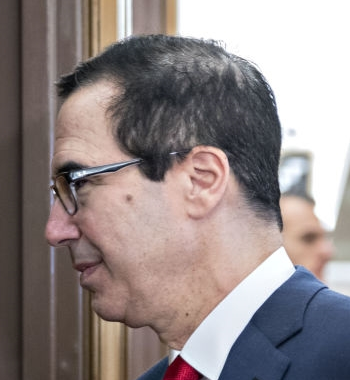
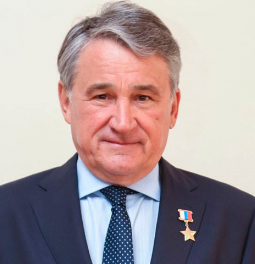
The Kremlin official responsible for Russian media involvement in the US presidential election of 2016 was Dmitry Peskov (2nd image, left); he doubles as spokesman for President Vladimir Putin. For Peskov’s intention to employ social media he has not been indicted nor identified as a co-conspirator by Special Prosecutor Robert S. Mueller III ( right). For the evidence Mueller has revealed of incompetence in the Russian campaign, the waste of money expended, and the failure of the campaign’s objectives, there are calls in Moscow for Peskov to be sacked.

He has so far avoided responding. “We have not yet familiarized ourselves [with the Mueller indictment], ” he told Reuters.

The 37-page indictment, dated February 16 and signed personally by Mueller, can be read in full here.

Mueller’s indictment reveals how much evidence was gathered from the internet server companies and social media platforms, Facebook, YouTube-Google, Twitter and Instagram, together with their banks and the PayPal payment service. But this is circumstantial evidence; the corpus delicti is absent.

Missing from the charge sheet is identification of the victims of the crime alleged, the numbers of victims, and the money spent to subvert or defraud them, as Mueller charges. The indictment alleges that “significant numbers of Americans” were targeted, “significant funds spent”, and “thousands of US dollars [paid for advertising] every month”; but no evidence is presented of these numbers. No witness has come forward to testify to having suffered; no alleged perpetrator or conspirator to substantiate criminal intention. Also, these aren’t the crimes formally charged against the accused Russians.

THE FIVE-CHARGE ALLEGATION, BUT ONLY TWO CRIMINAL COUNTS CHARGED


In short, the Russians are accused of violating the US law on registering as foreign agents, as well as the crimes of stealing identity data from real Americans and fabricating false identities to open and operate US bank accounts, credit cards and the PayPal system. Although “interfer[ence] in US political and electoral processes” is alleged, it’s an orphan — no such crime is charged in the indictment.

Another orphan is the charge of obtaining visas “through false and fraudulent statements” and “false pretenses in order to collect intelligence for their interference operations”. Mueller alleges this offence was committed in 2014, when three of the thirteen Russians named in the indictment visited the US briefly. However, the “intelligence” they are alleged to have gathered at the time wasn’t used, according to the indictment, until two years later. What this “intelligence” by “false pretenses” might have been isn’t provided in the evidence because Muller and his grand jury don’t charge anyone with visa fraud.

Fourteen weeks before last Friday’s indictment, executives of Facebook, Twitter, YouTube and Google testified in open congressional hearings on the same set of allegations as Mueller presented to his grand jury behind closed doors.

From left to right: Facebook General Counsel Colin Stretch, Twitter Acting General Counsel 
Sean Edgett, and Google Law Enforcement and Information Security Director Richard Salgado 
appearing on October 31, 2017, at the Senate Judiciary Committee's Crime and Terrorism Subcommittee.

The media company witnesses started by identifying very small numbers of accounts, advertising messages, reader clicks, and bots (automated relayed messages). Subsequently, these numbers have been multiplied in US media commentaries by estimates of audience reach, although reach is not a measure of actual exposure. Still, compared with the aggregate volumes of internet traffic associated with the presidential election but unconnected to Russian sources, the numbers for Russian-source material amounted to minuscule fractions of one percent. The media companies weren’t asked for, and volunteered no report of how much money they had received from their Russian content sources.

In his indictment Mueller provided less precision than the rules of evidence and the defendants’ rights require under the US Constitution; Mueller is not expecting to try the thirteen named defendants in a court of law. In one example of an “overt act” of the alleged Russian crime (Par. 71), Facebook is reported as publishing an advertisement on August 4, 2016, for a “Florida Goes Trump” rally. Facebook charged the Russians for audience reach of 53,000, according to Mueller. But only 8,300 clicked on the ad (14%). Although the allegation is that this audience was then “routed to the ORGANIZATION’s ‘Being Patriotic’ page”, Mueller withholds his count of how many – more likely, how few readers followed the route. The Russians were still paying to advertise the same rally on Instagram two weeks later, on August 16, but no evidence is presented by Mueller that it happened at all. No route, no rally, no American victims, no evidence of Russian intention to commit a crime of election interference.

Four bank accounts have been identified at six banks “in order to receive and send money into and out [sic] of the United States to support the ORGANIZATION’s operations in the United States and for self-enrichment”. These banks, as well as the US dollar-clearing banks in New York, have provided Mueller with details of the originating banks for the transactions. The indictment identifies fourteen Russian company names as holding these bank accounts. The Russian company names are mentioned in evidence, but not the originating banks. If they were Russian state banks under US and European Union sanctions since 2014 (Gazprombank, for example), Mueller’s indictment doesn’t say so; noone has intimated that the Russian money was anything but lawfully earned and then legally transferred from source.

Details of fake or stolen names, driver’s licences or social security numbers have been reported by Mueller to substantiate the count of conspiracy to commit wire fraud and bank fraud. But this was a fraud with a twist. No sum of money is identified in the evidence as having been taken from an unwitting victim; all of it, however much or little, was sent to the US bank accounts from the alleged Russian conspirators and their companies, and spent on social media placements. As for enrichment – again, no sum reported in the indictment – this appears to have been earned by the US media companies and the US banks. Lawfully, according to Mueller. The only losers were the Russians, but the accused haven’t been complaining of not getting their money’s worth.

The criminal counts set out in the indictment turn out to be crimes without victims – that’s to say, no American victim, according to the charge sheet.

Mueller’s indictment is precise about the names of the Russian companies established by the principal defendant Yevgeny Prigozhin, allegedly “for operations to interfere with elections and political processes”. Mueller also claims that the only link he could find to the Russian government was the official registration of the “ORGANIZATION [Internet Research Agency] as a Russian corporate entity” “in or around July 2013.” Although the allegation is that Prigozhin’s organization had an “annual budget [of] the equivalent of millions of US dollars”, there is no evidence, nor even an allegation that this money came from a Russian government source. Instead, other companies operated by Prigozhin are reported to have had “various Russian government contracts”.

Prigozhin’s parent company called Concord is alleged to have funded “the ORGANIZATION as part of a larger CONCORD-funded interference operation it referred to as ‘Project Lakhta’.” This name is a valuable clue, but Mueller and his US intelligence sources failed to realize.
Intelligence agency practice the world over, including the US services and the Russian ones, generate operational codenames by computer randomization. Lakhta isn’t one of them. It is the well-known historical name of a district of St. Petersburg on the shore of the Gulf of Finland. Lakhta is the Finnish word for gulf; it corresponds to the Russian word zaliv. But Lakhta is much better known these days in St. Petersburg as the name for the Lakhta Center.

This is the 462-metre skyscraper (right) being constructed to serve as Gazprom’s headquarters, and as a recreational and commercial complex. It is planned to be the tallest building in the city, in Russia, and Europe-wide. Many, if not most St. Petersburgers didn’t want the building, so the prominence of the name starts with strong negative connotations.

Budget overruns, corrupt tendering, and construction contract kickbacks under criminal investigation by the city authorities add to the Lakhta name’s notoriety. The likelihood that a Russian government intelligence or security agency would give such a name to one of its operations is zero, Moscow sources believe.

That Prigozhin would have named his operation Lakta hints at a link to Gazprom which the company, already under several different US sanctions, will be embarrassed to contemplate. Mueller doesn’t make the link, and the US media have failed to cast the innuendo.
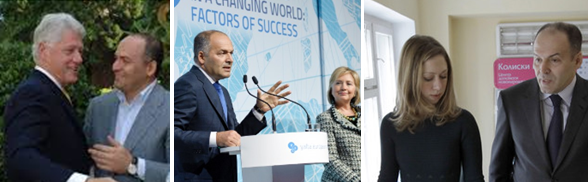

Left: Yevgeny Prigozhin (left) with Gazprom chief executive, Alexei 
Miller. Right, Prigozhin with Rusal chief executive, Oleg Deripaska.

Since Mueller makes no allegation of Russian government funding or intelligence service involvement in Prigozhin’s Project Lakhta, the indictment appears to be US evidence in reverse. It contradicts allegations of Russian intelligence service interference in the presidential election. Those claims have come from US intelligence community reports, congressional testimony, and press leaks. For more details, read this.

Mueller noted in passing that Project Lakhta wasn’t targeted only in the US. The indictment alleges that by September 2016 it was working on a budget exceeding Rb73 million ($1.25 million) per month, with bonus payments to its Russian employees of Rb1 million (1.4%). The money was being spent, according to Mueller, on “multiple components, some involving domestic audiences within the Russian Federation, and others targeting foreign audiences in various countries, including the United States”.

This is another clue to Prigozhin’s real line of business, and the reason for the multiplicity of company names and functional departments through which he operated; and for an employment roll Mueller counted as “more than eighty” in Project Lakta alone. Russian sources believe Prigozhin’s organization has contracted for domestic Russian operations paid for by Russian corporations and local politicians. Some of the operations are believed to be conventional positive advertising of events, products, campaigns, and ideas. Some reportedly involve the circulation of kompromat against business and election rivals; some to defend against botnet and denial of service attacks on corporate websites and communication systems; some to attack the websites of business adversaries or investigative journalists, Russia-based or Russia-related.

Investigations by Russian media and government regulators have been reporting for some time allegations that Prigozhin has been diverting money from state procurement contracts for himself, and for clandestine purposes approved by state officials and state company executives. For a sample of the details, start in 2014 with the St. Petersburg website Fontanka’s investigation of Mikhail Bystrov and Mikhail Burchik, the second and third defendants in the Mueller indictment. Fontanka said it had uncovered evidence that paying clients of the Prigozhin, Bystrov and Burchik organization included a youth group of the Russian Orthodox Church, the St. Petersburg municipal authorities, and a Gazprom media promotion company. The payroll of the organization was reported in mid-2014 to be Rb180,000 per month (about $5,500).


For a more recent sample of the Russian allegations against Prigozhin, read and this.

In December 2016 Prigozhin was listed on the US Treasury’s sanctions list, the evidence for which appears to have been cribbed from Fontanka and other Russian press reports. Prigozhin was accused of,

“having materially assisted, sponsored, or provided financial, material, or technological support for, or goods or services in support of, senior officials of the Russian Federation. Prigozhin has extensive business dealings with the Russian Federation Ministry of Defense, and a company with significant ties to him holds a contract to build a military base near the Russian Federation border with Ukraine. Russia has been building additional military bases near the Ukrainian border and has used these bases as staging points for deploying soldiers into Ukraine.”

Mueller’s indictment fails to mention this Treasury charge or its Russian media sources. Mueller claims the reason for the multitude of Russian corporate names used by Prigozhin in Project Lakhta was to “obscure its conduct” and conceal the Russian source of funds from the US media and US regulators. For much longer, however, Russian investigators have been reporting that Prigozhin has created corporate chains of this type to conceal personal enrichment schemes from Russian regulators and commercial competitors.

Prigozhin has replied publicly to the US prosecutor’s charges, not to the Russian ones. “The Americans are very impressionable people; they see what they want to see,” he is quoted by a state news agency as saying last Friday. “I have a lot of respect for them. I am not upset at all that I ended up on this list. If they want to see the devil, let them see him.”

Russian sources believe Prigozhin’s Project Lakhta was ordered by someone in a position to exercise a call on Prigozhin’s cashflow. They exclude Russian officials on the Kremlin Security Council — Sergei Ivanov, Sergei Lavrov, Sergei Shoigu, Anton Vaino, Nikolai Patrushev, Sergei Naryshkin – and dismiss the possibility that Project Lakhta had either President Putin’s or Russian intelligence service support.

President Vladimir Putin chairs the January 26 meeting of the Security Council, 
the last to have been recorded on the Kremlin website. Attending were  Prime 
Minister Dmitry Medvedev (3rd from left); Federation Council Speaker 
Valentina Matviyenko (on Putin’s left); State Duma Speaker Vyacheslav 
Volodin (2nd from left); Chief of Staff of the Presidential Executive Office 
Anton Vaino; Security Council Secretary Nikolai Patrushev (1st left); Foreign Minister 
Sergei Lavrov; Interior Minister Vladimir Kolokoltsev (front right); and Special 
Presidential Representative for Environmental Protection, Ecology and 
Transport Sergei Ivanov. Defense Minister Sergei Shoigu was absent. 

The suspicion of Russian sources is that the American campaign element in Project Lakhta was “so hare-brained there is only one official who could have considered Prigozhin’s project worth the money and the attempt – Dmitry Peskov”. Peskov is officially titled Deputy Chief of the Presidential Executive Office and Presidential Press Secretary. From the Kremlin he supervises the budgets for the state television broadcaster RT, the state news agency Sputnik, and special US-targeted propaganda programmes, such as the Valdai Discussion Club for academics and the Oliver Stone films.

The Christopher Steele dossier accused Peskov of arranging negative media against Hillary Clinton during 2016; for an analysis of the veracity of that claim, read this. For a painstaking analysis of how the Mueller indictment discredits the Steele dossier, read Alexander Mercouris’s account.

Russian experts charge that the Russian targeting of Americans through social media, as described by Mueller, was a colossal mistake because the US audience for social media was young and overwhelmingly committed to Clinton. Between their intention to vote and the vote they cast, the social media made next to no difference.

GEOGRAPHY OF THE INTENTION TO VOTE FOR HILLARY CLINTON AND DONALD TRUMP AMONG 18-24 YEAR OLDS


how-the-future-voted-has-one-big-problem/news-story/10d00bc9c9c0e02491f7f1e6a92a0e0f

Charts from the CIRCLE-Tufts University survey of how young Americans actually voted – compiled from exit polling — show the proportion of young whites voting for Hillary Clinton remained unchanged (within the statistical margin of error) compared to their votes for Barack Obama in 2012 and for the Democratic candidate in 2004, John Kerry. The corresponding young white male vote for Donald Trump in 2016 turns out to have been less than the vote for Mitt Romney, the Republican candidate against Obama in 2012; Kerry and Romney were the losers. Read the CIRCLE report in full here. Turnout among young voters was also unchanged from 2012.

According to the CIRCLE report,

“President-elect Donald Trump, while ‘losing’ the youth vote overall by 55% to 37%, garnered support from segments of the youth electorate: Whites, evangelicals, and young people in rural areas. Not surprisingly, he also drew significant support from young people whose ideas and concerns tracked closely with the key themes of his campaign: the state of the country, an interest in stronger immigration controls, and a perceived untrustworthiness of his opponent, Hillary Clinton.” 


11/CIRCLE-Full-Exit-Poll-Analysis_Final.pdf

The big difference in voting pattern among the young social media audience was gender-based, according to the CIRCLE polling. Young females went for Clinton; young males for Trump. “While Clinton won by large margins among demographic groups like unmarried young women and youth of color, she lacked key support from young Whites, young men, and young White moderates. Some of these groups previously backed President Obama by wide margins in 2008 and 2012.” There is no evidence in the Mueller indictment that Prigozhin’s organization understood this.

The trend in candidate preference between the Democrat and Republican was much too small among both young men and young women for the CIRCLE sociologists to identify social media as making an impact on the vote outcome between Clinton and Trump. The biggest shift in the young male vote was not towards Trump, but against Clinton in the direction of the alternative candidates.


11/CIRCLE-Full-Exit-Poll-Analysis_Final.pdf

This political sociology of the presidential election isn’t news. The CIRCLE report was first published on November 17, 2016, just nine days after the votes were cast. The findings of voter alienation from both presidential candidates are well-known. “Young people may also be showing their disagreement and discontent with both parties,” the CIRCLE report concluded. “The Republican Party has a small base among youth, who are increasingly liberal as a whole, and even young conservatives’ ideology does not necessarily align well with that of older Republicans. Given young people’s ideologically leftward shift, it may become even more difficult for Republicans to increase their youth base. In this election, the GOP faced an additional challenge: some young Republicans’ aversion to their own party’s nominee.”

Brookings, the Washington think-tank most supportive of Clinton, reached the conclusion that her defeat was caused by “blowback” among older voters. In other words, Clinton’s defeat, Trump’s victory came from voting by older Americans. They were not the ones targeted by the Russian social media campaign; they didn’t see the advertisements and tweets the Mueller indictment is now reporting as a criminal conspiracy to “defraud the United States by impairing, obstructing and defeating the lawful functions of the government.”

Official Russian reaction to the indictment has been to ridicule the election interference allegation but avoid addressing the foreign registration and false identity charges. “Thirteen people interfered in the US elections?!” responded the Foreign Ministry spokesman Maria Zakharova.

“13 against an intelligence services budget of billions? Against intelligence and counterintelligence, against the latest developments and technologies? Absurd? Yes.” 

Her minister Sergei Lavrov claimed: “unless we see the facts, all the rest will be just twaddle, I am sorry for my not so diplomatic expression.”

The unofficial Russian reaction towards Prigozhin’s activities in the US is more quizzical, and under the American pressure, more private. It acknowledges that Prigozhin is a commercial operator, and for every outlay he has a paying client. Who that client was for Project Lakhta is the object of speculation so far unreported in the Russian press.

To Russian lawyers the facts presented in the Mueller indictment suggest the big crime in the affair may have been a Russian one. If Mueller’s small numbers are correct, then Prigozhin may have spent much less money, and to lesser effect and purpose than he had led his client to believe and pay for. If there’s a difference between what Prigozhin was paid and what the Mueller indictment suggests he spent, Prigozhin may have a case for fraud to answer to Russian prosecutors – and his client, the charge of abuse of authority.

“If the US prosecutor makes it a crime for a Russian to pretend to be an American,” commented a Moscow lawyer, “will the [Russian] General Prosecutor investigate Prigozhin for the crime of spending such money with the pretence of having brains?”

Rachel Off the Rails: Notley No Friend of Labour, Justice, Or Academic Freedom

Rachel Notley’s Alliance with the Enemies of Tenure, Peer Review, and Academic Freedom at Alberta’s Universities - An Open Letter to the NDP Premier of Alberta

by Prof. Tony Hall  - AHT


February 18, 2018

Dear Premier Rachel Notley; I am writing you this open letter to defend myself against your attack on me personally and professionally.

What is the evidentiary basis behind your characterization of my academic work as “repulsive, offensive and not reflective of Alberta”?

Why have you decided to set yourself up, Premier Notley, as some sort of arbitrator of what scholarly work in Alberta universities meets the criteria of being “reflective of Alberta”?

Is your opinion about what is or is not reflective of Alberta to become a new test of how curriculum will be created and how faculty members will be chosen in this province?

What lies behind your decision to disseminate a caricature of me “standing at the head of the class” in order to “spread lies and conspiracy theories”? [1]

Since I began teaching in the Department of Native American Studies at the University of Lethbridge in 1990, I have never once seen in a student evaluation that reflects the kind of accusations you are pressing publicly on me. How is it you think you know more about me, including and what goes on in my classroom, than my own students?

After a year and a half of being subject to a ruthless trial-by-media, a new process is only now being initiated that from my perspective allows me to come forward for the first time to tell my side of the story before an investigating tribunal operating within the terms of our collective agreement. The process is going forward because of a court contestation that the U of L Board of Governors lost due to its unwillingness to adhere to the laws of labour relations in Alberta. Whose advice was the Board depending on when its members put themselves in such an untenable position?

Before we have even started the process that has come about because of the determined stand of the University of Lethbridge Faculty Association (ULFA) and the Canadian Association of University Teachers (CAUT), you, Premier Notley, chose to inject a politicized salvo into the onslaught of vituperation against me that began on Aug. 26 of 2016.

Here is how the University of Lethbridge Faculty Association described your ill-advised political intervention:


15 Jan., 2018
Re: Premier’s statement re Anthony Hall

The Faculty Association wishes to express its disappointment in the Premier’s words. As the union that represents Professor Hall in his employment relationship with the University of Lethbridge, the Faculty Association has endeavoured to have a fair and objective process employed for adjudicating Professor Hall’s academic scholarship and accountability through procedures in the collective agreement. We finally achieved this following significant effort and cost on our part and have a great deal of confidence in the appropriate academic procedures to which Professor Hall is now subject.
Having the Premier draw conclusions about the acceptability of Professor Hall’s academic work prior to any decision rendered by an expert panel of qualified academics has the potential to undermine this very process we have fought to achieve. At worse, though, these words have the real potential to bias the outcome of any such fair and objective process.
The Faculty Association has greatly appreciated the hard work the Premier and her government have done to advance the rights of post-secondary labour. We believe it is a dangerous precedent, however, for elected officials to intervene so directly in a complex labour matter such as this one.

Sincerely,
Andrea Amelinckx,
ULFA President

Cc Honourable Minister M Schmidt

One of the core points I intend to bring forward in my self- defense in the forthcoming process, is to describe the mounting of a negative media campaign against me based on the atrocious contents of a maliciously-engineered Facebook post. According to B’nai Brith Canada, the core agency in orchestrating this media deception, the post appeared on, and then disappeared from, my Facebook wall during an interval of a few hours on Aug. 26, 2016. I did not invite this digital item onto my Facebook wall. I did not sanction its abhorrent contents. In fact I condemned the post’s contents publicly in mid-Sept. when I first became aware of the digital item and the way that it was being deployed to destroy my reputation.

You, Premier Notley, were presented with a deceptive account of my relationship to the Facebook post long before I even knew about the B’nai Brith Canada operation. Recently I learned from the results of a FOIP investigation of the Alberta Ministry of Justice that on Aug. 27, 2016 you and other Alberta cabinet ministers were sent a slanderous account of the Facebook post as if it “came from my lips.” People in the inner circle of your office reported you had seen the communication that slanderously misrepresented me as an “advocate for the murder of Jews.”

If you would actually take a genuine interest in my academic work, Premier Notley, you would realize I have a record of studying all sorts of genocide and condemning this crime against humanity in all its manifestations, including the Jewish Shoah. [2]

Perhaps the people who lied to you about me in late August of 2016 are still holding you captive in terms of filtering the information that has caused you to think whatever it is you believe you know about me. The President of the University of Lethbridge, Dr. Michael J. Mahon, went along with the Facebook deception to suspend this tenured full professor on Oct. 3 and 4, 2016. I was pulled from the classroom in mid-term and banned from stepping foot on campus. This purge took place entirely outside the terms of the collective agreement between the university’s faculty and administration.

This suspension initially without pay essentially declared me guilty until proven innocent. Severe punitive measures were imposed on me all without even an ounce of adjudication by a neutral third-party. From the correspondence I have been receiving from all over the world, I can say my suspension quickly became a shot heard throughout the global academic realm, a shot signaling that an Albertan university is leading an attack on the institutions of tenure, peer review and academic freedom.

Now you have joined in that attack too Premier Notley. You have allied yourself with the position of B’nai Brith Canada, the organization that recently interfered in the leadership race for the new leader of the federal NDP. The same people that set in motion the trial-by-media aimed at me attacked the NDP leadership candidate, Niki Ashton. According to B’nai Brith’s CEO Michael Mostyn, Ms. Ashton’s concern for the violated human rights of Palestinians people made her “an advocate for vile terrorists” and “convicted murders.” It revealed Ms. Ashton’s “defective moral compass.” [3] 


What is your view, Premier Notley, of the condemnation directed at the new NDP federal leader, Jagmeet Singh, when B’nai Brith Canada took aim at him for intervening to provide a venue at the Ontario provincial legislature for a presentation by academic advocates of the rights of educator Nadia Shoufani. The condemnation came in late Augusts of 2016 when Mr. Singh was MLA for the riding of Bramalea-Gore-Malton and Deputy Leader of the Ontario NDP.

At the same time as it was attacking Jagmeet Singh, B’nai Brith Canada was leading the effort to have Ms. Shofani, a Canadian of Palestinian and Christian background, criminalized by police and fired from her teaching job in the Dufferin-Peel Catholic School Board. The criticisms directed at Ms. Shoufani are similar to those directed at Ms. Ashton. Similarly, the effort to criminalize Ms. Shoufani and bar her from the classroom anticipated the similar treatment to which I was about to be subjected. The attack on Ms. Shoufani’s job and her reputation was based on allegations about her supposed “terror-supporting remarks” made in a Quds Day speech in Toronto in July of 2016. [4] 


It seems, Premier Notley, your political intervention on the wrong side of the University of Lethbridge case reflects your reactionary alliance with the thought police and speech police at B’nai Brith Canada. Your reactionary stance identifies you with the backward policies of former NDP leader, Tom Mulcair, when he purged pro-Palestinian candidates from the federal election of 2015. This atrocious move was in all probably a significant factor in the disappointing electoral showing of the NDP as it lost its position of Canada’s Official Opposition Party. [5]

Now in Feb. of 2018 B’nai Brith Canada has resumed its efforts to quarterback the NDP, lobbying aggressively to stop a resolution from being put on the floor of the recent NDP convention. The vote, neverthess, was close, 189 for putting the resolution forward and 200 for sidelining it. The resolution included provisions on a Canadian boycott against products produced in the illegal Israeli settlements in the Occupied West Bank.

Those supporting the boycott resolution included the unanimous support of the Young New Democrats, 28 electoral riding associations covering six provinces and many current and former MPs. Geneviève Nevin, a supporter of the resolution from Victoria, observed, “There’s a generational divide on this issue.” In his account of this divide within the NDP, journalist Derrick O’Keefe suggested Jagmeet Singh would be wise to look to the example of Jeremy Corbyn in the UK. Mr. Corbyn has mobilized on behalf of the Labour Party considerable electoral support from his attentiveness to the plight of Palestinian people under Israeli occupation. [6]

By siding so strongly, Premier Notley, with the U of L administration’s collaboration with the Isreal lobby including B’nai Brith Canada and the Centre for Israel and Jewish Affairs, you have identified yourself and your government with agencies that condemned Hassan Diab wrongly as a terrorist. B’nai Brith Canada played a major role in calling for pulling the sociology teacher from his Carleton University classroom in Ottawa. This intervention helped set in notion a miscarriage of justice that saw the Lebanese Canadian academic incarcerated for a decade in Canada and France for a crime he didn’t commit. [7]

You have identified yourself and your government, Premier Notley, with notorious enemies of academic freedom who brought forward during the 50th anniversary of York University all sorts of false allegations much like those I am facing now. This fiasco unfolded when B’nai Brith Canada, the CIJA, the Canadian Jewish Congress and the Jewish Defence League tried to shut down an academic conference on Israel/ Palestine at York University in 2009.

The effort to sabotage this academic initiative was foiled because the York University President, Mamdou Shoukiri, and the York University Board of Governors stood up for the imperatives of academic freedom. [8]

In 2018 in Alberta the equation is very different. The President and Board of University of Lethbridge have adopted the position of the Israel lobby. Now Premier Notley, you have intervened to strengthen this political coalition favouring the stiffling of free and open debate at Alberta universities. Please consider revisiting you provocative and intellectually bankrupt position on this matter.

Yours Sincerely,

Anthony J. Hall
Professor of Globalization Studies,
University of Lethbridge

Endnotes

[1] Chuck Millar’s Letter to the Alberta Premier—11 January, 2018 at

https://academicfreedomanthonyhall.ca/chuck-millars-letter-to-the-premier-january-11-2018/

Premier Notley indicated on November 24, 2017

There is no question that the views of this individual are repulsive, offensive and not reflective of Alberta. Our classrooms are a place for freedom of speech and expression but that does not mean individuals get to stand at the head of the class and spread lies and conspiracy theories. I am terribly disappointed to learn that this individual has been reinstated, but let me be clear that legislation that our government introduced did not give him his job back. I can confirm that this individual is now under investigation by a committee at the University.”

[2] See, for instance Hall, Earth into Property” Colonization, Decolonization, and Capitalism (Montreal: McGill-Queen’s University Press, 2010), Chapter 14, “Genocide and Global Capitalism,” pp. 655-711

[3] Tony Hall, “Palestinians, B’nai Brith and Canada’s New Democratic Party, Canadian Dimension, 30 July, 2017 at

https://canadiandimension.com/articles/view/palestinians-bnai-brith-and-canadas-new-democratic-party

[4] B’nai Brith Canada, “NDP Deputy Leader Facilitates Pro-Shoufani Press Conference at Queen’s Park,” 24 Aug., 2016 at

http://www.bnaibrith.ca/ndp_deputy_leader_facilitates_pro_shoufani_press_conference_at_queen_s_park

[5] Marion Kawas, “New Democratic Party Purges Candidates over pro-Palestinian positions in lead up to Canadian elections, Mondoweiss, 24 Aug., 2015 at

http://mondoweiss.net/2015/08/democratic-candidates-positions/

[6] Derick O’Keefe, “Palestinian Resolution Narrowly Stopped from Hitting NDP Convention Floor, Richochet, 16 Feb. 2018 at

https://ricochet.media/en/2130/palestine-resolution-narrowly-stopped-from-hitting-ndp-convention-floor

[7] Judy Haven, “After 10 Years Hassan Diab is Finally Free,” Independent Jewish Voices Canada, at

http://ijvcanada.org/2018/diab-is-finally-free/

[8] Susan G. Drummong, Unthinkable Thoughts, Academic Freedom and the One-State Solution for Israel and Palestine (Vancouver: UBC Press, 2014); Jon Thompson, No Debate: The Israel lobby and free speech in Canadian universities (Toronto: Lorimer, 2011)

*(Premier Rachel Notley. Image credit: Premier of Alberta/ flickr)

Sunday, February 18, 2018

Final Battle: Israel Readying for Golan Resource Grab

Israel Preps for Syrian War with Golan’s Oil and Water in its Sights

by Whitney Webb - MintPress News


While news of Saturday’s dangerous escalation involving Syria’s downing of an Israeli fighter jet is fizzling out, Israeli plan’s for a broader war to secure water and oil reserves in the resource-rich Golan Heights are just getting underway.

Soon after Saturday’s dangerous escalation involving Syria’s downing of an Israeli fighter jet in its airspace seemed to fizzle out, the Jerusalem Post reported that Israel was approaching the de-escalation period as a time to prepare for large-scale war with its northern neighbor by boosting its air defenses.

According to those cited by the Post, convoys of missile-defense batteries have been relocated to the Israeli-Arab city of Baka al-Gharbiya and numerous other batteries have been sighted on highways throughout northern Israel.

A topographical representation of the Golan Heights,
including it’s precious water resources centering around
the Sea of Galilee. (Graphic courtesy of Mashregh News)

While the deployment of air defenses to the country’s north seems to forebode an imminent conflict, some experts, like Ofer Zalzberg of the International Crisis Group think tank, have asserted that the recent escalation between Syria and Israel will remain contained, despite Israel’s apparent preparations for a large-scale conflict.

“I think this incident is more likely to be contained because fundamentally it is a gradual attempt to renegotiate the so-called rules of the game,” Zalzberg told AFP, further suggesting that Russia should mediate in order to prevent the weekend’s events from sparking a regional war. Russia, for its part, seemed eager to halt the hostilities, as it urged the need to “avoid any measure that could lead to a dangerous escalation.”

Indeed, any escalation that would lead to a state of open conflict between Syria and Israel would surely spread, quickly involving Syrian allies including Iran and Lebanon’s Hezbollah and, potentially, more powerful nations like the United States and Russia. 

Even if recent events fail to translate into a war between Israel and its northern neighbors, any attempts to prevent such a war – no matter how “successful” they may seem – will only be temporary at best. Israel, even prior to its establishment as a state in 1948, has been ever eager to annex southern Syria in order to gain access to key resources – first, fresh water and now, oil. It is this same desire that continues to motivate Israel’s aggression against its neighbors.

As Syria will not relinquish what is theirs as long as their sovereignty remains intact, Israel has sought to take such prizes through a variety of tactics ranging from illegal occupation to fomenting covert regime-change efforts. As those efforts have continued to fail, Israel has grown more and more desperate to lay claim to those resources that lie just beyond its reach. Unless Israel relinquishes its desire for its neighbor’s resources, the next war is inevitable.

The Golan: Israeli goal in pushing Syria to war


Though casual observers of the Syrian conflict may find the weekend’s events as having come out of nowhere, those who have closely followed the conflict and appreciate the context will note that Israel seems to have finally gotten the war with Syria it has long sought.

However, Israel is not hungry for war in and of itself. Instead, it is eager to cement its claim to the Golan Heights, a plateau bordering Israel, Lebanon and Syria. In order to accomplish that, regime change in Syria is essential, as the international community still refuses to recognize Israel’s seizure and continued occupation of the Golan as legal. This bars Israel from commercially developing the area’s rich resources, which are key to understanding Israel’s willingness to go to war over a seemingly small and insignificant tract of land. However, a new Syrian government, one more “friendly” to Israeli interests, could officially relinquish Syria’s claim to the Golan, paving the way for the complete and official annexation of the territory by Israel.

Though measuring no more than roughly 460 square miles, the Golan is of great strategic importance for several reasons. The most commonly cited by Israeli media is that it offers a bulwark against northern “hostile” nations due to its rugged geography, helping Israel to “defend” against incoming attacks from either Syria or Lebanon.

However, much more important to Israel’s “national security” than the oft-stated “barrier” advantage is the fact that the Golan Heights houses significant fresh-water resources. Under occupation, the Golan is one of three sources of fresh water to the Israeli state — and is the largest in size and most plentiful, as it comprises the mountain streams that feed Lake Kinneret (the Sea of Galilee) and the headwaters of the Jordan river. Currently, over a third of all the fresh water made available to Israelis originates in the Golan Heights.

Though fresh water is an especially important resource in the Middle East, it is now more important to Israel than ever before. Israel is in its fourth year of a drought so massive that a NASA study called it the worst drought in the region in nearly 900 years. As a result, the water in the Golan Heights is essential to Israel and its attempts to expand.

This resource was a major motivating factor in Israel’s 1967 takeover and subsequent 1981 annexation of the Golan Heights. During that period, Israel expelled nearly all of the area’s original inhabitants and demolished their villages. As Israeli newspaper Haaretz reported in 2010, more than 100,000 Syrians lost their homes and property as a result of the occupation. Israel has no intention of letting the Golan’s original inhabitants return, however. The area is currently home to some 20,000 settlers and a plan is currently underway to settle 100,000 more in the next several years in order to strengthen Israel’s claim to the area.

Though the abundant fresh water in the Golan Heights is of crucial importance to Israel, the Golan’s value grew sharply following the discovery of a major oil reserve in the area, estimated to contain “billions of barrels” of crude oil that could turn Israel – which currently imports the vast majority of its fuel – into a net oil exporter. Yet, because the Golan Heights are internationally recognized as being under occupation and not an official part of Israel, the commercial extraction and export of this vast oil reserve cannot go forward — until this status changes. As a result, only exploratory wells have been drilled, mostly by a division of Genie Energy Co., a U.S.-based oil company connected to well-known figures such as Rupert Murdoch, Jacob Rothschild, and Dick Cheney.

The Golan and the genesis of the Syrian conflict


The desire to claim the Golan Heights and all of its resources under internationally recognized circumstances is also, in part, to blame for Israel’s key role in the genesis of the current violence in Syria.

Five years before the current conflict in Syria began, the government of Israel hatched a plan to overthrow Syrian President Bashar al-Assad by creating sectarian strife in the country and isolating Syria from its strongest regional ally, Iran. As mentioned, the Assad-led government has refused to recognize Israel’s hold on the Golan and has vowed to retake it as part of Syria.

The plan was never designed to be enacted by Israel but instead by its “staunch ally” the United States. The U.S. adopted the plan and the communications of former Secretary of State Hillary Clinton revealed that this plan was a major factor in U.S. policy leading up to the genesis of the Syrian conflict. One of her leaked emails, published by WikiLeaks, stated that,

“the best way to help Israel deal with Iran’s growing nuclear capability is to help the people of Syria overthrow the regime of Bashar Assad.”

That same email also noted that,

“a successful intervention in Syria would require substantial diplomatic and military leadership from the United States.” It also added that, “arming the Syrian rebels and using Western air power to ground Syrian helicopters and airplanes is a low-cost high-payoff approach.”

Unsurprisingly, official recognition of Israel’s annexation of the Golan was prominent among the regime-change promises touted by the Syrian “rebels.” Throughout the now seven-year-long war, rebels have offered to “trade” or sell the Golan to Israel in exchange for military aid or an Israeli-imposed “no-fly zone” in their bid to overthrow Assad.

The match is lit


Despite Israel and U.S.’ best efforts, the“low-cost high-payoff approach” has not gone as planned. Instead, Assad has managed to consolidate large parts of Syrian territory once lost to the “rebels,” the bulk of which are terrorist groups or their affiliates. As its past efforts and more recent plans to annex southern Syria through regime change have failed, Israel has grown more desperate, as evidenced by everything from the “dozens and dozens” of attacks it has launched against Syria to last year’s threats to assassinate Assad by bombing his residence. Experts have long noted that these are attempts to provoke Syria into a conflict.

In addition to these provocations, Israel has been creeping further into southern Syria under the guise of establishing a “safe-zone” or buffer region that extends from the Golan into the southern Syrian provinces of Quneitra and Daraa. According to Syrian opposition sources and Israeli-American NGOs, this safe zone is “intended to keep the Syrian army and its Iranian and Lebanese allies as far away from Israel’s border as possible, as well as solidify Israel’s control over the occupied Golan Heights.”

Alongside the buffer zone’s expansion, Israel has “offered” to occupy Syrian villages to “protect” them from the very Syrian rebels that Israel has been funding, arming, and offering medical treatment to throughout the conflict — even though most are allied with al-Nusra Front (Al Qaeda) or Daesh (ISIS).

While Israel has, for much of the war, been conducting these attacks against, and illegal incursions into, Syria with impunity, all of that has now changed due to this past weekend’s events. Now that Syria is responding to flagrant violations of its sovereignty, Israel knows the match is lit and, by all indications, are preparing for what comes next.

Whitney Webb is a staff writer for MintPress News who has written for several news organizations in both English and Spanish; her stories have been featured on ZeroHedge, the Anti-Media, and 21st Century Wire among others. She currently lives in Southern Chile.


Republish our stories! MintPress News is licensed under a Creative Commons Attribution-NonCommercial-ShareAlike 3.0 International License. 

Israel's Offshore Claims and Oil Man Tillerson's Ulterior Motives in Lebanon

Lebanon Rejects US Proposal on Maritime Borders with Israel

by Ramzy Baroud - Palestine Chronicle


February 18, 2018

Speaker of Lebanese Parliament Nabih Berri Friday told state National News Agency (NNA) a US proposal concerning the disputed Lebanon-Israel maritime border was “unacceptable.” During a meeting with acting Assistant US Secretary of State David Satterfield, Berri stressed, borders could only be demarcated based on the April 1996 Understanding between Israel and Hezbollah, brokered by the US to end the conflict initiated by Israel’s Grapes of Wrath operation.


Israeli soldiers leaving Lebanon after
the failed invasion of 2006.
(Photo: Wikimedia Commons)

After the conflict, a Monitoring Committee was set up to implement the Understandings; it was composed of US, France, Syria, Israel and Lebanon

Beside meeting with Berri, Satterfield met on Friday with Lebanon’s Foreign Minister Gebran Bassil and Prime Minister Saad al-Hariri.

In a statement issued by Berri’s office, he insisted that borders’ demarcation could only be decided by the Monitoring Committee.

The statement added that this stance was expressed during a discussion about regional issues and the maritime borders with Israel.

According to Anadolu Agency, Satterfield offered a previous US proposal, which is based on Lebanon conceding 360 square kms out of its 860 square kms of water to Israel. This area is known as the disputed Number 9 oil field.

Saturday, February 17, 2018

Democracy Under Threat: When the Free Market Isn't Free

The Free Market Threat to Democracy

by TRNN


February 16, 2018

Democratic institutions are not under stress--they're under aggressive attack, as unconstrained financial greed overrides democratic decisions, says economist John Weeks.


John Weeks is a professor emeritus of the University of London's School of Oriental and African Studies and author of Economics of the 1%: How Mainstream Economics Serves the Rich, Obscures Reality and Distorts Policy. His recent policy work includes a supplemental unemployment program for the European Union and advising the central banks of Argentina and Zambia. 

Bethlehem Beyond the Wall, Media Hypocrisy and More

Bethlehem Beyond the Wall, Hypocrisy and More

by Mazin Qumsiyeh - qumsiyeh.org


February 16, 2018

Hypocrisy in the Western world becomes more obvious by the day. For example, there's a debate about Russian interference in US elections but this is minuscule compared to Israeli Zionist interventions shaping US elections (a topic not up for debate).

Another example: Media and politicians debate mental issues and send prayers and thoughts to victims of mass shootings by whites that kill far more Americans than anyone else.

Compare that coverage with any act by a Muslim which is labeled a terrorist act that threatens America. No one talks about the Zionist controlled major media outlets and Hollywood (and even games) that promote violence and mass killings.

And with over 20 trillion in debt not much discussed, there is not one word that over 3 trillion of that debt was created to serve Israel (due to the shadowy Israel lobby). These are just examples that came to mind this week and people will forget about these soon and wait for the next disaster to again watch mindlessly as the media manipulates thinking away from the real issues. Some of those are listed below (like the 20+ trillion debt).

Bethlehem Beyond the Wall: An Exhibition Organized by the Museum of the Palestinian People Manhattan College, NY, February 19th – 27th

https://mpp-dc.org/bethlehem-beyond-wall/

More on boycotts, divestment, and sanctions


- Former president of Modern Language Association resigns following decision to ban debate on BDS
http://mondoweiss.net/2018/02/president-association-following/

- French Arab Singer Banned: Freedom to Speak? Freedom to Lie?
http://www.arabamerica.com/freedom-to-speak-freedom-to-lie/

- New York bookseller bowed to Israel supporters after violent threats. Ali Abunimah The Electronic Intifada
https://electronicintifada.net/content/new-york-bookseller-bowed-israel-supporters-after-violent-threats/23301

- The Boomerang Effect: How Netanyahu Made Israel an American Issue, and Lost. Despite massive sums of money spent to channel public opinion in the United States in favor of Israel, unmistakable trends in opinion polls are attesting to the changing dynamics of Israel’s support among ordinary Americans.
http://www.palestinechronicle.com/boomerang-effect-netanyahu-made-israel-american-issue-lost/

More on Ahed Tamimi and other abductees


- Over 10 Million Indian Women Demand Freedom For Ahed Tamimi, Endorse BDS
https://bdsmovement.net/news/over-10-million-indian-women-demand-freedom-ahed-tamimi-endorse-bds

- BBC report: is a slap an act of terror
http://www.bbc.co.uk/programmes/p05wqg1f

- Artist behind iconic Che Guevera portrait paints Ahed Tamimi as the real life wonder woman https://youtu.be/z9AMsbAtyxY

- Journalist, activist Bushra al-Tawil ordered to another four months in prison without charge or trial
http://samidoun.net/2018/02/journalist-activist-bushra-al-tawil-ordered-to-another-four-months-in-prison-without-charge-or-trial/

Seymour Hersh says Hillary approved sending Libya’s Sarin to Syrian rebels

[fascinating read and explains how the government works]
https://www.blacklistednews.com/article/63714/seymour-hersh-says-hillary-approved-sending-libyas-sarin-to-syrian.html

Has Our Government Spent $21 Trillion Of Our Money Without Telling Us?


https://www.forbes.com/sites/kotlikoff/2017/12/08/has-our-government-spent-21-trillion-of-our-money-without-telling-us/#99c59ba7aef9

https://www.rt.com/usa/413411-trillions-dollars-missing-research/

US Debt Data/Clock

Amazing information
http://usdebtclock.org

Stay Human.


Mazin Qumsiyeh
A bedouin in cyberspace, a villager at home
Professor,  Founder, and (volunteer) Director
Palestine Museum of Natural History
Palestine Institute for Biodiversity and Sustainability
Bethlehem University
Occupied Palestine
http://qumsiyeh.org
http://palestinenature.org
Join me on facebook https://www.facebook.com/mazin.qumsiyeh.9

Friday, February 16, 2018

Between Zijlstra and Freeland: What Lies An Ocean Apart Mean

What is the Difference Between the Lies the Dutch Foreign Minister and the Canadian Foreign Minister Have Been Telling About President Vladimir Putin? There's No Difference 

by John Helmer - Dances with Bears


February 14, 2018 

Moscow 

Dutch Foreign Minister Halbe Zijlstra (lead image, left) resigned his post this week after admitting he had publicly and repeatedly lied about meeting with President Vladimir Putin. The Dutch press, which initiated the investigation exposing the lie, reports that in his resignation speech to the Dutch parliament Zijlstra confessed,

“the biggest mistake of my political life…The Netherlands deserves a minister who is above any doubt.”

In Canada, Foreign Minister Chrystia Freeland (right) – appointed by Prime Minister Justin Trudeau in January 2017 — has been lying about meeting President Putin when she did not.

No Canadian newspaper has investigated Freeland’s lying, and she has expanded the lie to meetings with other Russian officials, which also did not happen. The Toronto Globe and Mail, the Ottawa Citizen and the state-owned Canadian Broadcasting Corporation (CBC) have also failed to report Zijlstra’s resignation for his Putin lie; their editors blocked the Reuters and Bloomberg wire reports, which have been running on Canadian newsroom screens, from appearing in print.

The lie, which Zijlstra started during election campaigning in 2006 in The Netherlands and repeated over the decade following, was compounded because Zijlstra also claimed he had heard Putin say Russia was making territorial claims on Ukraine, Belarus, Kazakhstan, and the Baltic states as part of a “Greater Russia”. Putin said nothing of the sort.

Neither had the Shell oil company executive, who told Zijlstra what he had heard Putin remark at a meeting with Dutch executives. Zijlstra had fabricated what his source told him in order to exaggerate his importance to Dutch voters, and make the Russian threat he had conjured a vote-winner for himself. In 2006 Zijlstra was elected to the Dutch House of Representatives for the first time. He was re-elected in 2012, and appointed foreign minister in October 2017.

The Dutch newspaper De Volkskrant, whose reporting forced the removal of Zijlstra, concluded that Zijlstra’s lie,

“ha[s] exploded in his face… His attempt to reinvent himself as a senior diplomat stranded by a lie [makes him] an ambitious politician who told one story too much.”

In Canada, Zijlstra’s counterpart as foreign minister is Chrystia Freeland . She too has been repeatedly lying in public about meeting Putin. Initially, her motive was the same as Zijlstra’s – to exaggerate her own importance and qualification to be foreign minister.


metromorning/freeland-trump-metro-morning-1.3934305


In an interview with CBC News in Toronto on January 13, 2017, three days after her promotion to foreign minister, Freeland declared:

“So I’ve spoken with the top guy [Putin] in Russia quite recently and we spoke in Russian and we had quite a long conversation.” 

This was a lie — Freeland had not met Putin. The story of the lie, and Freeland’s efforts to get the Canadian media to repeat it as if true, was first told here. This was published in April of 2017. Since then no Canadian medium has investigated the truth, or challenged Freeland to admit it.

With the encouragement of reporters from the Canadian media, Freeland has continued to lie about her Russian meetings. Here, in May 2017, she was lying again:

“I had quite a few productive conversations with Minister Lavrov, both last night over supper and today”. 

For the full story, read this.


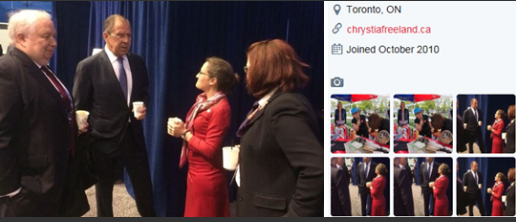
Source: Freeland’s Twitter feed, May 13, 2017, showing Freeland with 
Russian Foreign Minister Sergei Lavrov (centre) and Russian Ambassador 
to the US, Sergei Kislyak (left). 

The encounter lasted seconds during a coffee-break at an Arctic Council meeting in Fairbanks, Alaska. Freeland had pre-positioned her photographer; the Russian officials didn’t have time to raise their cups to their mouths.

For the archive of more Freeland lies as a minister of state, click to open.

The Times Ain't-a-Changing: NYT "Russia Election Meddling" Meme Drones On

Agitprop Is Not News

by James Howard Kunstler - Clusterfuck Nation


February 15, 2018

Forget about sharks. In their Valentine’s Day editorial: Why Does Trump Ignore Top Officials’ Warnings on Russia?, The New York Times jumped several blue whales (all the ones left on earth), a cruise ship, a subtropical archipelago, a giant vortex of plastic bottles, and the Sport’s Illustrated swimsuit shoot.

The lede said:

The phalanx of intelligence chiefs who testified on Capitol Hill delivered a chilling message: Not only did Russia interfere in the 2016 election, it is already meddling in the 2018 election by using a digital strategy to exacerbate the country’s political and social divisions.

Hmmm…. After almost two years of relentless public paranoia about Russia and US elections, don’t you suppose these Ruskie gremlins would find some other way to make mischief in our world — maybe meddle in the NHL playoffs, or hack WalMart’s bookkeeping department, or covertly switch out the real Dwayne Johnson with a robot? I kind of completely and absolutely doubt that they’ll bother with our elections.

Let’s face it, the United States is doing a stellar job of destroying itself with bad ideas, foolish ideologies, and pervasive self-deceit. If I was running the Russian intel services, I’d just pay to send a few Nebraska county commissioners to Disneyland — that would keep our seventeen US intel agencies busy until kingdom come trying to figure out the angle. And it would cheaper than spending a hundred grand to fuck with Facebook.

Actually the Times’s editorial seems to have CIA/NSA fingerprints all over it, or at least Deep State paw prints. By stating that the Russians are already “meddling” in 2018 elections that haven’t happened yet, aren’t our own security agencies setting up the public to lose faith in the electoral process and fight over election results? Oh, by the way, the Times presented no evidence whatsoever that this alleged “meddling” is taking place. They just assert it, as if it were already adjudicated.

But then they take it another step, making the case that because Mr. Trump does not go along with the Russian Meddling story, he is obstructing efforts to prevent Russian interference in the elections that haven’t happened yet, and is therefore by implication guilty of treason. A fine piece of casuistry.

The longer this fantasy about Russia continues from the Left side of the political transect, the deeper the nation sinks into a dangerous collective psychosis. After all this time, the only known instances of American political figures “colluding” with Russians involve the shenanigans between the DNC, the Hillary Clinton campaign, and US intel services including the FBI and CIA, in paying for the “Steele Dossier” and the activities of the Fusion GPS company that claimed Russia hacked Hillary’s and John Podesta’s email.

There is now a ton of evidence about all this monkey business, and no sign (yet) that Special Prosecutor Robert Mueller may be taking a good hard look at it, not to mention the professional misconduct of a half dozen senior FBI, NSA, and CIA officials, especially former CIA chief John Brennan, who has now morphed into a CNN “analyst,” taking an active role in what amounts to a psy-ops campaign to shove the public toward war.

The “resistance” may think it is getting some mileage out of this interminable narrative, but its arrant inconsistencies only undermine faith in all our political institutions, and that is really playing with fire. We are already choking this polity to death by endlessly litigating the past, insuring that the country doesn’t have the time or the fortitude to deal with much more important quandaries of the present — especially a financial system that is speeding into the most colossal train wreck in history. That will de-rail Mr. Trump soon enough, and then all the rest of us will have enough to do to keep our lives together or to refashion them in some that will work in a very different economy.

PS: Readers may wonder why I did not devote this space to the school shooting in Parkland, Florida. It is exactly what you get in a society that wants to erase behavioral boundaries. It is especially dangerous where adolescent boys are concerned. The country has a gigantic boundary problem. We have also created perfect conditions — between the anomie of suburbia and the dreariness of our school systems — to induce explosions of violent despair. That’s why these things happen. Until we change these conditions, expect ever more of it.

Is the NDP Ready to Face It's Foreign Policy Contradictions?

Burying Canada’s Anti-Palestinian Consensus

by Yves Engler - Dissident Voice


February 15th, 2018

The anti-Palestinian consensus among Canada’s three main political parties is crumbling and NDP members could bury it this weekend.

After taking an all-expense paid trip to the American Israel Public Affairs Committee’s conference in Washington and participating in a Jewish National Fund event in Israel 14 months ago, the NDP’s foreign critic has begun challenging Canada’s contribution to Palestinian dispossession.

Hélène Laverdière has repeatedly criticized the Trudeau government’s silence on Donald Trump’s decision to move the US Embassy to Jerusalem. In response she tweeted,

“a devastating day for those who believe in peace, justice and security in the Middle East. Where is Canada’s voice in protest of Trump’s decision on #Jerusalem? I urge Canada to condemn this decision in the strongest of terms.”

The party’s foreign critic also asked the federal government to condemn Israel’s detention of 16-year-old Ahed Tamimi and hundreds of other Palestinian children who are usually tortured by Israeli forces. Similarly, Laverdière has pressed Ottawa to properly label products from illegal Israeli settlements and submitted a petition to Parliament calling “upon the Government of Canada to demand that Israel immediately and completely cease all settlement activities in the occupied Palestinian territory, including East Jerusalem.”

Two weeks ago I received an email on behalf of party leader Jagmeet Singh titled “all people deserve the same human rights”, which listed the party’s recent support for Palestinian rights. It noted,

“the NDP shares your concerns about Palestine. NDP Leader Jagmeet Singh and his team of New Democrats have a consistent record of defending Palestinian rights as well as raising concerns over Islamophobia.”

A series of factors are likely driving Laverdière’s shift. She probably never backed former NDP leader Tom – “I am an ardent supporter of Israel in all situations and in all circumstances” – Mulcair’s position. Additionally, last year’s NDP leadership race unleashed ever bolder expressions of support for the Palestinian cause.

Amidst the campaign, Laverdière was criticized for speaking at AIPAC’s 2016 conference in Washington and participating in an event put on by the explicitly racist Jewish National Fund. In August the NDP Socialist Caucus called for her resignation as foreign critic and it has submitted a motion to this weekend’s convention calling for her to be removed from that position.

Ottawa’s high-profile abstention at the UN General Assembly after Donald Trump announced that he would move the US Embassy to Jerusalem has given the NDP an opportunity to distinguish itself from the Trudeau government. And media coverage of subsequent Palestinian resistance, most notably Ahed Tamimi’s courageous slaps, has provided additional opportunities to highlight the Liberal’s extreme anti-Palestinianism.

The NDP leadership is also trying to head off members’ calls to boycott Israel (according to a 2017 Ekos poll, 84% of NDP members were open to sanctioning Israel).

At least five resolutions (among more than ten concerning Palestine/Israel) submitted to the convention call for some type of boycott of Israel. The NDP Socialist Caucus has called on the party to “actively campaign” in support of the (just nominated for the Nobel Peace Prize) Boycott, Divestment and Sanctions‘ movement’s demands.

With probably more backing than any of the 100+ resolutions submitted, 30 riding associations and youth committees endorsed “Palestine Resolution”, which calls for “banning settlement products from Canadian markets, and using other forms of diplomatic and economic pressure to end the occupation.” Of course, party leaders fear the media response to any type of boycott resolution being adopted.

Whatever the reason for Laverdière’s shift away from anti-Palestinianism, it remains insufficient. As I’ve detailed, the NDP continues to provide various forms of support to Israel and the party has an odious anti-Palestinian history. In the mid-1970s the party opposed Palestinian Liberation Organization participation in two UN conferences in Toronto and Vancouver and party leader Ed Broadbent called the PLO “terrorists and murderers whose aim is the destruction of the state of Israel.”

That year NDP icon Tommy Douglas also told the Histadrut labour federation: “The main enmity against Israel is that she has been an affront to those nations who do not treat their people and their workers as well as Israel has treated hers.” (Douglas’ 1975 speech was made while Israel occupied the West Bank, Gaza Strip, Golan Heights and Sinai, after it repeatedly invaded its neighbours and ethnically cleansed 750,000 Palestinians from their homeland.)

A progressive party worth its salt campaigns on an international issue in equal measure to its government/society’s contribution to that injustice.

Over the past century Canada has played no small part in Palestinians’ dispossession. Hundreds of Canadians provided military force to realize the crassly anti-Palestinian Balfour Declaration and this country’s diplomats played a central role in the UN’s decision to give the Zionist movement most of Palestine in 1947.

Today, Ottawa regularly votes against Palestinian rights at the UN and subsidizes dozens of charities that channel tens of millions of dollars to projects supporting Israel’s powerful military, racist institutions and illegal settlements. Additionally, Canada’s two-decade-old free trade agreement with Israel allows settlement products to enter Canada duty-free and over the past decade Ottawa has delivered over $100 million in aid to the Palestinian Authority in an explicit bid to advance Israel’s interests by building a security apparatus to protect the corrupt Palestinian Authority from popular disgust over its compliance in the face of ongoing Israeli settlement building.

Hopefully, in the years to come the NDP can help Canada make up for its sad anti-Palestinian history. Perhaps this weekend the party will finally bury official Canada’s anti-Palestinian consensus.

I will be speaking about “What’s Wrong with NDP Foreign Policy?” on the sidelines of the convention.

Yves Engler is the author of A Propaganda System: How Canada’s Government, Corporations, Media and Academia Sell War and Canada in Africa: 300 years of aid and exploitation.
Read other articles by Yves.

Koching Up Canada's "Socialists": The (Mildly) Surprising Alignment of NDP and Oiligarch's Interests

Canada vs. Venezuela: Have the Koch Brothers Captured Canada’s Left?

by Joyce Nelson - CounterPunch


February 16, 2018

With a U.S.-backed military coup or invasion in Venezuela looking ever more likely, Canada’s progressive leftists are pushing for the federal New Democratic Party (NDP) to abandon its “reactionary” foreign policy position on that country. As well, at the annual NDP convention (February 15 – 18), the NDP Socialist Caucus will present a motion requesting the removal of NDP Foreign Affairs Critic Helene Laverdiere from that role.
 

 Image: Eden, Janine and Jim | CC BY 2.0


In December, the Canadian Dimension published a lengthy Open Letter from Dr. John Ryan, a retired University of Winnipeg professor, documenting the “reactionary foreign policy positions” on a variety of issues that the NDP has adopted in recent years, especially through Laverdiere’s role.

Regarding Venezuela, Dr. Ryan wrote,

“One would think that Canada’s NDP, as a social democratic party, would be supportive of the progressive policies that have been enacted in Venezuela. Surely the bulk of the people who vote NDP would be far more supportive of Venezuela than they would be of U.S. policies to undermine that country. So how is it that the NDP’s maverick foreign affairs critic is capable of aligning herself with American imperialist reactionary policies? There wasn’t a word from her when President Trump threatened to invade Venezuela and she has yet to criticize the recently announced Canadian sanctions [by the federal Liberal government]. [1]

On February 12, Canadian writer Yves Engler extensively documented Helene Laverdiere’s stance toward Venezuela in recent years, and he noted:

“In what may be the first ever resolution to an NDP convention calling for the removal of a party critic, the NDP Socialist Caucus has submitted a motion to next weekend’s convention titled ‘Hands Off Venezuela, Remove Helene Laverdiere as NDP Foreign Affairs Critic.’ It notes: 
 Be It Resolved that the NDP actively oppose foreign interference in Venezuela, defend Venezuela’s right to self- determination, reject alignment with U.S. policy in Europe, the Middle East, Africa and beyond, and request the immediate removal of MP Helene Laverdiere as NDP Foreign Affairs Critic.” [2]

Engler wrote that Laverdiere recently failed to criticize,

“Canada’s role in the so-called Lima Group of anti-Venezuelan foreign ministers. Laverdiere remained silent when foreign minister Chrystia Freeland organized a meeting of the Lima Group in Toronto four months ago.” [3]

Lima Group


Despite U.S. hopes and predictions, in October 2017 Maduro’s PSUV party won the gubernatorial elections by a wide margin, increasing its voter support to 54% and winning 18 of 23 governor posts. As Dr. James Petras noted,

“Over a thousand independent outside observers, who had monitored the Venezuela elections and voting procedures, declared the elections to be the free and valid expression of the citizens’ will.” [4]

The results showed that the right-wing opposition had lost sizeable support and was in disarray.

Nonetheless, foreign ministers from the Lima Group – Argentina, Brazil, Canada, Chile, Colombia, Costa Rica, Guatemala, Honduras, Mexico, Panama, Paraquay, Peru – met in Toronto on October 26 and issued a statement claiming that the gubernatorial elections had been marked by “acts of intimidation, manipulation, social coercion and voting conditioning, among other irregularities.” [5]

It was a strange message, given that even the defeated opposition candidates had conceded the election’s fairness.

During the Munk School of Global Affairs panel that followed the Lima Group meeting that same day, Canada’s Minister of Foreign Affairs Chrystia Freeland said the message of the Lima Group to the Venezuelan opposition is “Get your act together, guys!”

Freeland called for the further “isolation” of President Maduro and said that,

“Canadians feel strongly about human rights for people in other countries … This is our neighbourhood,” she stated, “this is our hemisphere…”

“Our Hemisphere”


Freeland’s rhetoric about “our neighborhood” and “our hemisphere” raises an issue that is rarely discussed when it comes to Canada’s foreign policy toward Venezuela.

In 2013, investigative reporter Greg Palast told RT’s Abby Martin that the reason Venezuela’s Hugo Chavez became U.S. “enemy number one” in 2001 is that he decided that he wasn’t going to give away the country’s oil anymore.

“Big U.S. oil companies were paying a royalty for Venezuela’s super-heavy oil of about 1 per cent – 1 percent! Okay? – And for the regular oil, it was 16 per cent. So the oil companies were keeping 84 per cent, and Chavez said, ‘You’re going to have to pay 30 per cent, you can only keep 70 per cent of our oil …You gotta split off a bit for the people of Venezuela’.” [6]

According to Palast, that change in Venezuela’s royalty rates became a huge irritant to the billionaire Koch Brothers, who own a refinery in Texas that has long imported Venezuelan heavy crude. The Koch Brothers are also a top lease-holder in the Alberta tar sands, and their Pine Hills refinery in Minnesota refines millions of barrels of imported tar sands crude.

As the price of oil escalated to more than $100 per barrel, Palast said the Koch Brothers determined that it would be cheaper – by about $2 billion per year – for them to substitute Canadian tar sands crude in their Texas refinery than to keep on importing Venezuelan heavy oil, so they became a big advocate for the Keystone XL pipeline to bring more tar sands crude all the way to the Gulf coast. The Koch Brothers’ Flint Hills Resources refinery in Corpus Christi, Texas is right next to Venezuela’s Citgo refinery.

In an Op-Ed for the Financial Post (March 7, 2013), business consultant Ryan W. Lijdsman noted that'

“Canada and Venezuela are both producers of heavy oil and compete for the limited number of customers that can refine heavy bitumen …A slide in Venezuelan production would be good for Canadian producers, which could meet the additional demand for heavy oil in the U.S. market.” [7]

Unlike Venezuela, Canada had taken no such stand to raise royalty rates for its oil, and as of December 2016 it has the lowest royalty rates in the world. Similarly, the Justin Trudeau Liberal government (like the previous Harper Conservative government) is in favour of the Keystone XL pipeline (and others) that would replace Venezuelan heavy oil in Gulf Coast refineries.

So when Chrystia Freeland acts to target Venezuela because “this is our hemisphere,” she is acting in concert with the Koch Brothers’ (and oil patch) desires – of course, without ever mentioning the tar sands.

Is this the reason why the NDP’s foreign affairs critic Helen Laverdiere has also been so reactionary towards the Venezuelan government? It’s hard to know, but these days politically (and wherever you look) it’s usually always about the oil.

Perhaps the Koch Brothers role in all this will prompt the NDP to listen to its Socialist Caucus.

Footnotes:
[1] John Ryan, “Open Letter to Jagmeet Singh: NDP’s reactionary foreign policy positions must be changed,” Canadian Dimension, December 17, 2017.
[2] Yves Engler, “Canada’s New Democratic Party Seeks to Topple Venezuela’s Government,” Dissident Voice, February 12, 2018.
[3] Ibid.
[4] Prof. James Petras, “Ten Reasons Why the United Socialist Party of Venezuela (PSUV) Won the Election,” Global Research, October 25, 2017.
[5] “Latin, Canada FMs urge UN to get involved in Venezuela,” AFP, October 26, 2017.
[6] Abby Martin interview with Greg Palast, RT, March 27, 2013.
[7] Ryan W. Lijdsman, “Chavez: the impact,” Financial Post, March 6, 2013.
 
Joyce Nelson’s sixth book, Beyond Banksters: Resisting the New Feudalism, can be ordered at: http://watershedsentinel.ca/banksters. She can be reached through www.joycenelson.ca.
More articles by: Joyce Nelson