Wednesday, March 14, 2018

Gorilla Radio with Chris Cook, David Swanson, John Helmer, Janine Bandcroft March 15, 2018

This Week on GR

by C. L. Cook - Gorilla-Radio.com


March 15, 2018

It’s not the Ides Iraqis are wary of in March, but the 20th day. That marks the date in 2003 their lives changed forever. It was of course when America and its allies, its “Coalition of the Willing”, launched the infamous, ‘Operation Iraqi Liberation’.

You may recall the shock and awe of watching a nation blown to pieces LIVE on CNN; not in living colour, but rather transmitted in the eerie iridescence of infrared night vision?

Despite serial declarations to the contrary, the "operation" in Iraq never really was accomplished and fifteen years later the country, with its cities in shambles, millions killed, maimed, or driven into exile is, like fellow invadee Afghanistan, still a chaos; is still at war.

Listen. Hear.

David Swanson is a peace and political justice activist, journalist, radio host, and author whose book titles include: ‘War No More: The Case for Abolition,’ ‘When the World Outlawed War,’ ‘War Is a Lie,’ and ‘The Military Industrial Complex at 50’ among others. He’s director of WorldBeyondWar.org, blogs at Let's Try Democracy (DavidSwanson.org) and WarIsACrime.org, and hosts the public affairs program, Talk Nation Radio.

David Swanson in the first half.

And; as though tensions between the World's nuclear titans weren't taut enough, a bizarre alleged poisoning in Britain has Western fingers pointing again at a Russian conspiracy. Former spy and exile, Sergei Skripal and his daughter, Yulia were discovered collapsed on a Salisbury park bench a week past Sunday last.

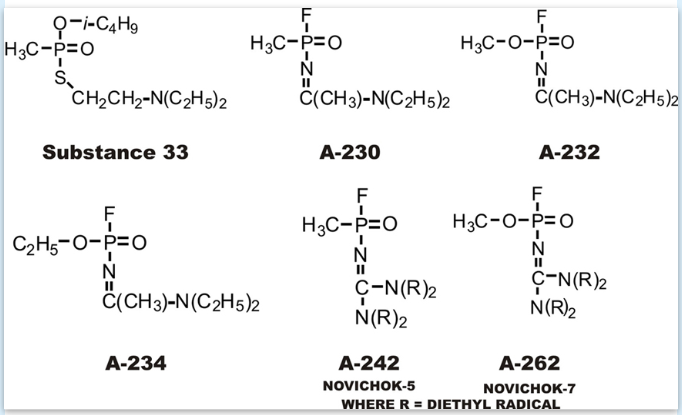
Though the pair have not been seen or heard from outside of hospital since, authorities claim they were poisoned with Novichok, a nerve agent believed once to be part of the USSR's chemical arsenal. Now, British prime minister, Theresa May says, "Putin did it!" But what she won't, or perhaps can't say is, why.

John Helmer is a Moscow-based journalist and author. His latest article, 'Fourteen and a Half Certainties in the Case of Sergei Skripal' is up now at his website, Dances with Bears.

John Helmer and uncertain certainties in the second half.

And; Victoria-based activist and CFUV Radio broadcaster at-large, Janine Bandcroft will be here at the bottom of the hour with the Left Coast Events Bulletin. But first, David Swanson and the enduring legacy of war in Iraq and beyond.

Chris Cook hosts Gorilla Radio, airing live every Thursday between 11-Noon Pacific Time. In Victoria at 101.9FM, and on the internet at: http://cfuv.uvic.ca.  He also serves as a contributing editor to the web news site, http://www.pacificfreepress.com. Check out the GR blog at: http://gorillaradioblog.blogspot.ca/

What Does Pompeo Nomination Mean for Peace?

Does Pompeo at State Mean War with Iran?

by TRNN


March 13, 2018

President Trump's ouster of Rex Tillerson as Secretary of State in favor of Mike Pompeo is a step closer to US war on Iran, says national security reporter Marcy Wheeler.


Visit http://therealnews.com for more stories and help support

our work by donating at http://therealnews.com/donate.

Tuesday, March 13, 2018

Knowns, Half-Knowns, and Unknowns in the Skripal Poisoning Case

Fourteen and a Half Certainties in the Case of Sergei Skripal

by John Helmer - Dances with Bears


March 13, 2018

MoscowIn cases like the poisoning of Sergei and Yulia Skripal, the only way to proceed is by identifying the evidence which proves with certainty what happened; or failing that, proves with certainty what did not happen. Perpetrator, co-conspirators, method, motive, intention – all come later, if they come at all.

At the moment, according to police and government releases and the British state media, the crime scene in Salisbury is being combed by at least 250 police officers; with another 180 military personnel specializing in chemical warfare. Dozens more electronic surveillance and cyber-warfare agents are also engaged.

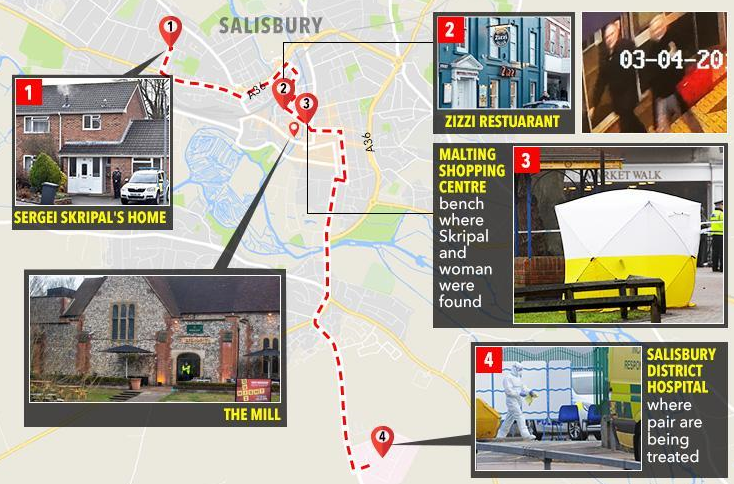
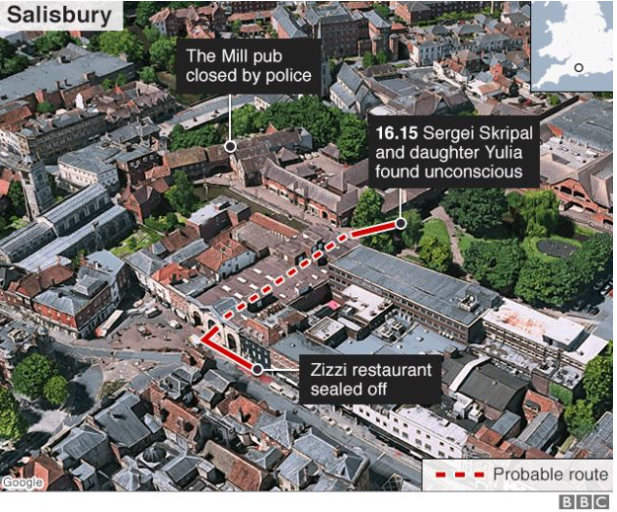
The crime scene locations include the Skripal house; the cemetery graves of Skripal’s wife and son; the Mill public house where Skripal and his daughter had a drink; the Zizzi restaurant where they ate before collapsing; and the public areas where they walked between house, pub, restaurant, the Maltings shopping precinct, and park bench.

At least 240 pieces of evidence have reportedly been identified as such, not counting the Skripal house, and 200 witnesses interviewed, including Wiltshire Police Detective Sergeant Nick Bailey. He developed symptoms after being despatched to the Skripal house. That is, after the Skripals had been found and hospitalized.

According to Lord Ian Blair, a former Metropolitan Police Commissioner,

“[T]here are some indications that the police officer who was injured had been to the house, whereas there was a doctor who looked after the patients in the open, who hasn’t been affected at all. So there maybe some clues floating around in here.” 

Blair said this on the BBC.

His disclosure, also confirmed in several newspapers, provides the first certainty in the case: the Skripals came into contact with the poison for the first time inside their own home. They then went out to the pub and the restaurant.

Certainty No. 2 – the poison cannot have been fast-acting for them at home. Certainty No. 3 – the poison was faster-acting for Sgt Bailey because he developed symptoms almost immediately at the Skripal house.

Follow the next eleven certainties. 


Certainty No. 4. 

Prime Minister Theresa May has identified the poison as a “military grade nerve agent…part of a group of nerve agents known as Novichok.”

Listen to May making her announcement in the House of Commons yesterday.


Certainty No. 5. 

Novichok components are harmless until they are combined.

Once that is done, and the mixture dispersed, the poison acts swiftly to attack the nervous system, triggering heart and lung failure, and death by suffocation.


Note: the Soviet development of Novichok was designed to be
undetectable by NATO standard chemical detection equipment.
It is not certain how the British could detect an undetectable
Russian substance; read more.


Certainty No. 6. 

The time between exposure and death is minutes. Sgt Bailey suffered contact with Novichok at the Skripal house, and developed symptoms very quickly.


After they had left their home on Sunday afternoon, the Skripals spent more than an hour before developing symptoms. It is certain, therefore, that there were two sites of active poisoning. The Skripals must have carried the poison from their home through the streets to the mall, the pub, and the restaurant, before they were exposed.

The large numbers of police, special service agents and soldiers have been deployed in order to trace the route the Skripals took, and all points at which they stopped, in order to identify, measure and map all concentrations, then dilute or destroy them for public safety.


Certainty No. 7. 

The British forces have inventoried all contents of the Skripal home, and verified all deliveries to the house, including mail and packages before last Sunday. They are certain to know if there are traces of the chemical components required for the Novichok combination, and whether these traces are in separate locations of the house.

It is certain they have asked themselves how the nerve agent was active in the house to strike Sgt Bailey, but inactive for the Skripals until hours later. 


Certainty No. 8.

The British secret services and the Porton Down Defence Science and Technology Laboratory near Salisbury know what contact, if any, there has been recently between Skripal, his British secret service contacts and the Porton Down lab.


Certainty No. 9. 

The British Government agencies have informed Prime Minister May if samples of Novichok components, and of the active nerve agent itself, are in stock at Porton Down.


Certainty No. 10

The Prime Minister has not informed the House of Commons if Novichok is — or was until Sunday evening — in stock at Porton Down.


Certainty No. 11. 

Although the British, American, and Russian secret services have the electronic capability to have been monitoring the Skripal house, Yulia Skripal on her travel from Moscow to Salisbury, and Sergei Skripal at home, in advance of the poisoning, they are unlikely to have been doing so on Sunday afternoon.

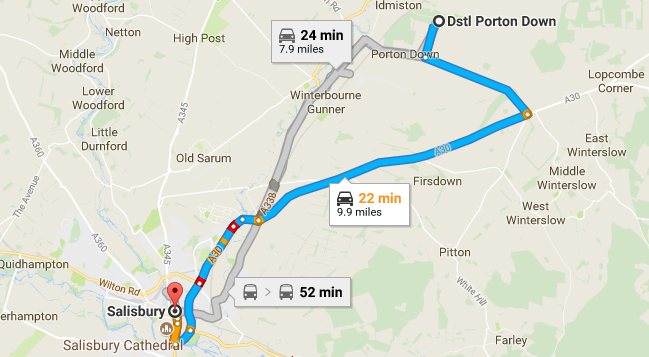
British sources add that the security perimeter for the Porton Down establishment doesn’t extend the nine kilometres (twelve by road) to Salisbury town. 


However, it is certain, the sources acknowledge, that in retrospect the British and American services will have identified all unusual mobile telephone, other electronic signals and encrypted messaging around the Skripals on Sunday, including computer, internet and mobile telephone signals the Skripals sent and received before the Sunday events.

Just as certainly, the Russian services will have the retrospective capacity to follow the communications of all their agents in the vicinity, if any there were. It is sure that if there had been a Russian operation targeting Skripal, an unusual volume of electronic evidence would now be visible to the British and Americans — and the Russians would know it.


Certainty No. 12.

The Russian Foreign Ministry has not yet summoned the British Ambassador, Laurie Bristow, to present the electronic evidence — if the British Government has it. Alexander Yakovenko, the Russian Ambassador in London, has yet not been to the Foreign Office to request the Foreign Secretary’s evidence. Nor has he been recalled to Moscow for consultations, yet.


Certainty No. 13. 

 The Russian Security Council has not been called into formal session since February 26. This two-week gap is an unusually long one. It is certain that President Vladimir Putin has requested Council members Sergei Lavrov of the Foreign Ministry, Sergei Shoigu, the Defense Minister, and the heads of the security and intelligence services to report what evidence they have; their assessment of what happened to the Skripals; and their view of the seriousness of the Skripal case for Russian state interests.


Certainty No. 14.

It is the ministerial consensus, particularly Lavrov’s and Shoigu’s, that the seriousness of the case is very grave.


Half-certainty.

Sir Andrew Wood, 78, was the British Ambassador to Russia between 1995 and 2000. Since then he has been making his living selling opinions on Russia to commercial organizations and think-tanks.

He has also been caught lying in public about his commercial involvement with Christopher Steele, and the role the two of them played together during the American presidential election campaign to accuse President Donald Trump of improper collusion with the Kremlin.

Wood’s story can be followed here.

On March 10, the Guardian reported Wood as accusing the Russian intelligence services of an official assassination attempt against the Skripals.

“I don’t doubt”, Wood told the newspaper, “[the poisoning] had general approval from senior heads – that’s the system he’s [Putin] created. Since 2012 Russia has been going backwards, rejecting economic reform and better courts in favour of renewed state control and repression, a fear of anything that is other. It’s the revival of Stalinism and the idea that Russia has the right to dominate its neighbours.” 

Read the newspaper report in full.

It is certain Wood had no evidence to substantiate his allegation at the time he spoke. It is equally certain he had no doubt of it. With Wood’s record for veracity, these two certainties add up to a fraction less than one.

Monday, March 12, 2018

Facts Defying Debate on Ghouta and Intervention Continue

Debate: Syria, Ghouta, and the Left

by TRNN


March 12, 2018

In a complex proxy war that has killed so many, where should leftists and people of conscience stand? Independent journalist Rania Khalek and scholar Yasser Munif debate the ongoing siege of Eastern Ghouta and the wider Syrian war.


Rania Khalek is an independent journalist and co-host of the weekly podcast Unauthorized Disclosure. Her work has appeared at The Nation, FAIR, Vice, The Intercept, Alternet, Salon, The Electronic Intifada, Al Jazeera and more.


Yasser Munif Assistant Professor of Sociology in the Institute for Liberal Arts and Interdisciplinary Studies at Emerson College. He is the co-founder of the Global Campaign of Solidarity for the Syrian Revolution.


Kinder Morgan's Burnaby "Bubble Zones"

Burnaby bubble zone puts recreation sites under potential lockdown

by Wilderness Committee


March 12, 2018


Vancouver, B.C. – Friday, Justice Kenneth Affleck of the Supreme Court of B.C. granted an interim injunction as requested by oil pipeline company Kinder Morgan. Section F of the document creates a 50-metre buffer zone around the Westridge Marine Terminal and Burnaby Tank Farm.

This injunction puts anybody within 50 metres of Kinder Morgan's properties at-risk of arrest, placing common recreational sites such as trails, a soccer field, part of a golf course, even roads to Simon Fraser University and some homes in the Forest Grove neighbourhood within the no-go zone.

“If you sliced a drive on the 5th tee of the golf course and went to retrieve your ball you could technically be in contempt of court,” said Wilderness Committee Climate Campaigner Peter McCartney.

“This ruling essentially places a substantial swath of suburban Burnaby on lockdown so people can’t even walk near Kinder Morgan’s property — or heaven forbid — protest the company’s unpopular pipeline scheme without fear of arrest.”

After a few arrests last week, Kinder Morgan applied for an injunction to prevent anyone from disrupting its work. Opponents argue that existing laws regarding trespass and mischief already allow the police to arrest anyone impeding the company. Now with an injunction and the creation of a no-go buffer zone around company facilities, people out walking their dog for exercise or simply exercising their right to legal protest are put at risk of arrest.

“This injunction could technically impact many people simply going about their daily lives,” said McCartney.
 
“Of course it will mostly disrupt peaceful protesters who are simply exercising their right to gather and speak out against Kinder Morgan’s reckless pipeline and tanker project.”

This injunction will also hinder groups like the Wilderness Committee from doing their critical public education work to document construction impacts on local ecosystems as well as potential impacts on the ocean and climate should the project ever be built.

“We were out there every day last week taking photographs, gathering data and keeping people informed on the work Kinder Morgan is doing,” said McCartney.

“Now with this injunction, the company will be better able to hide behind this court-ordered wall of secrecy. It makes our work much tougher.”

– 30 –

For Immediate Release - March 12, 2018

For more information, please contact:
Peter McCartney | Climate Campaigner, Wilderness Committee

US/Israel Operation Juniper Cobra Less Exercise Than Rehearsal for Regional War

US Commander: ‘US Troops Prepared to Die for Israel’ in War against Syria, Hezbollah

by Whitney Webb - MintPress News


March 12, 2018

Operation Juniper Cobra is not a routine exercise; it is a portent of a potentially devastating war against Syria, Hezbollah and Gaza for which Israel is actively preparing — a war likely to erupt within the coming months.

Last Sunday, the largest joint military exercise between the United States and Israel began with little fanfare. The war game, dubbed “Operation Juniper Cobra,” has been a regular occurrence for years, though it has consistently grown in size and scope. Now, however, this year’s 12-day exercise brings a portent of conflict unlike those of its predecessors.

Previous reports on the operation suggested that, like prior incarnations of the same exercise, the focus would be on improving Israeli defenses. However, this year’s “Juniper Cobra” is unique for several reasons. The Post reported on Thursday that the drill, set to end on March 15, was not only the largest joint U.S.-Israeli air defense exercise to ever happen but it was also simulating a battle “on three fronts.”

US and Israeli troops deploy a Patriot missile
defense battery during the 2018 Juniper Cobra air
defense exercise in March 2018. (Israel Defense Forces)

“Juniper Cobra 2018 is another step in improving the readiness of the IDF [Israeli Defense Forces] and the IAF [Israeli Air Force] in particular to enhance their operational capabilities in facing the threat posed by high-trajectory missiles,” Brig. Gen. Zvika Haimovitch, the IDF’s Aerial Defense Division head, told the Jerusalem Post. 

In other words, Israel and the U.S. are jointly simulating a war with Lebanon, Syria, and Palestine – namely, the Gaza strip – simultaneously.

What makes this last part so concerning are Israel’s recent statements and other preparations for war with all three nations, making “Juniper Cobra” anything but a “routine” drill. It is instead yet another preparation for a massive regional conflict, suggesting that such a conflict could be only a matter of months away.

As MintPress recently reported, Israeli officials recently told a bipartisan pair of U.S. Senators that it needed “ammunition, ammunition, ammunition” for a war against Hezbollah in Lebanon — a war that will expressly target Lebanese civilians and civilian infrastructure, such as hospitals, schools, and apartment buildings. The alleged motive for the invasion is the presence of Iranian rocket factories. However, this allegation is based solely on the claims of an anonymous deputy serving in the Iranian Revolutionary Guard and was first reported on by a Kuwaiti newspaper known to publish stories planted by the Israeli government.

In addition, Israel has been laying the groundwork for an invasion of Syria since last year and is largely responsible for the current conflict in Syria that has raged on for seven years. Israel’s current push to invade Syria is also based on flimsy evidence suggesting that Iran is establishing bases in Syria to target Israel.

Israel has also been preparing for a conflict on the embattled Gaza strip, which – owing to the effects of Israel’s illegal blockade and the devastation wrought by past wars – is set to be entirely uninhabitable by 2020. Reports have quoted officials of the Palestinian resistance group Hamas, which governs the Gaza strip, as saying that they place the chances of a new war with Israel in 2018 “at 95 percent” and that war games, like Operation Juniper Cobra, were likely to be used to plan or even initiate such a conflict.

This concern was echoed by IDF Chief of Staff Gadi Eizenkot, who stated that another Israeli invasion of Gaza, home to 1.8 million people, was “likely” to occur this year. Eizenkot ironically framed the imminent invasion as a way to “prevent a humanitarian collapse” in Gaza.

U.S. lights match, prepares troops 


Such a war is likely to be ignited by the unrest destined to follow the U.S.’ imminent move of its embassy from Tel Aviv to Jerusalem. The move, set to take place in May, led Hamas to call for a third intifada, or uprising, in response to the U.S.’ unilateral decision to recognize Jerusalem as the capital of Israel in defiance of the international consensus.

Beyond the fact that Israel is preparing to go to war with several countries simultaneously is the fact that U.S. ground troops are now “prepared to die for the Jewish state,” according to U.S. Third Air Force Commander Lt. Gen. Richard Clark. “We are ready to commit to the defense of Israel and anytime we get involved in a kinetic fight there is always the risk that there will be casualties. But we accept that, as in every conflict we train for and enter, there is always that possibility,” Clark told the Post.

However, more troubling than the fact that U.S. troops stand ready to die at Israel’s behest was Clark’s assertion that Haimovitch would “probably” have the last word as to whether U.S. forces would join the IDF during war time. In other words, the IDF will decide whether or not U.S. troops become embroiled in the regional war for which Israel is preparing, not the United States. Indeed, Haimovitch buoyed Clark’s words, stating that: “I am sure once the order comes we will find here U.S. troops on the ground to be part of our deployment and team to defend the state of Israel.”

Operation Juniper Cobra is not a routine exercise; it is a portent of a potentially devastating war for which Israel is actively preparing, a war likely to erupt within the coming months. In addition to overtly targeting civilians, these preparations for war — as Juniper Cobra shows — directly involve the United States military and give the war-bent Israeli government the power to decide whether or not American troops will be involved and to what extent. This is a devastating giveaway of national sovereignty by U.S. President Donald Trump.

While the potential involvement of the U.S. forces in such a war is being framed as limited in scope, there is no indication that such a war will be so in practice. Indeed, the U.S. is currently occupying 25 percent of Syria and the Trump administration has economically attacked Palestinians living in Gaza by withdrawing crucial aid, as well as Hezbollah by enforcing new sanctions against the group. Furthermore, Israel’s nuclear arsenal and the fact that Iran — and even Russia — could become involved in such a conflict means that it could quickly spiral out of control.

Whitney Webb is a staff writer for MintPress News who has written for several news organizations in both English and Spanish; her stories have been featured on ZeroHedge, the Anti-Media, and 21st Century Wire among others. She currently lives in Southern Chile

Republish our stories! MintPress News is licensed under a Creative Commons Attribution-NonCommercial-ShareAlike 3.0 International License. 

America's War-Losing Ways (According to Ullman)

Anatomy of Failure - Why America Will Lose Every War It Starts

by John Helmer - Dances with Bears


March 12, 2018

 Moscow  - It’s novel for a US military institution to publish a report which contradicts its own conclusions, and adds up to evidence instead for the opposite of its proposals. This feat has just been achieved by the Naval Institute Press and Harlan K. Ullman in a book dedicated to the US Naval Academy Class of 1945. The title is Anatomy of Failure, Why America Loses Every War It Starts.

Ullman’s case is that because the US military lacks a “brains-based approach to strategic thinking”, it keeps losing the wars it starts.

Ullman isn’t against the US starting wars. What he proposes is that the only brains for winning these wars are his own. Naturally, the London media have clicked their collective heels, saluting Ullman with reviews declaring, among other things, that “there is not an army in the world that could stand up to the Americans in a fair fight. But winning wars is a different matter”.

In short, the adversaries of the US don’t fight fair. They win by fighting dirty. Americans need to use their brains, er Ullman’s brains, to compensate.

What those brains propose is a combination of “extensive knowledge and understanding of the enemy at all levels, brilliance in execution, rapidity, and sufficient control of the environment in all dimensions to impose our will.”

Ullman expands the IMPOSE-OUR-WILL phrase into a warfighting doctrine he claims to have invented himself in 1994. He was sitting, he claims, on a Pentagon committee of retired generals and admirals he calls by their diminutives – Bud, Fred, Chuck, Tom, Jim and Snuffy. Ullman says he first called the doctrine “shock and awe”. But this is Ullman’s selfie, as fake as the photograph on the book’s dust jacket (lead image, left). This is also Ullman’s recapitulation of the old force concentration and mobility doctrines of Julius Caesar, Richard the Lionheart, Napoleon, German blitzkrieg, and Georgy Zhukov.

It’s a battlefield idea which, as the Germans learned on the Soviet Front, doesn’t win wars. The Americans are also learning the same these days on the Syrian, Ukrainian, Korean and South China Sea fronts where they lack air superiority and on the ground have no better than parity of firepower with the other side. Ullman and the US Navy have produced this book revealing they still don’t comprehend.

Ullman is better known in Washington for boots on his own ground, according to the testimony of a local brothel madam who identified him publicly as her client before she was prosecuted and committed suicide. That’s a doctrine of schlock and whore.

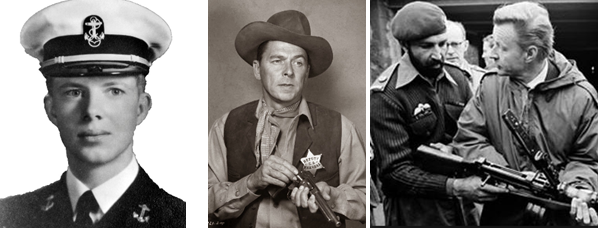
Ullman’s book is organized into seven chapters, each dedicated to the mistakes of the president in charge since John Kennedy took office in 1961. In this time frame Ullman particularly dislikes the only US Navy officer who became president, Jimmy Carter; and he’s especially partial to the Hollywood cowboy, Ronald Reagan . He’s uncommonly respectful toward three Harvard armchair strategists – Stanley Hoffmann, Zbigniew Brzezinski, and Henry Kissinger.


Left: Jimmy Carter in 1946; centre, Ronald Reagan in 1953; 
right, Osama bin Laden with Zbigniew Bzrezinski in 1981.

There are just seven references to Ullman’s sources of evidence on the enemy, all of them American — three by journalists; one by a Clinton Administration appointee; a US general’s ghost-written autobiography; a British compendium of military data; and another book by Ullman himself. For his own brains approach to each of the wars he analyzes, Ullman refers to no source on the enemy side. The only foreigner he claims to have known personally was Benazir Bhutto, the ill-fated prime minister of Pakistan. Nothing she may have told him of military strategic value is reported by Ullman – only what he told her.

Ullman provides a great many Big Notes in which he reports himself telling the highest officials of the US state what they should do – advice he subsequently blames them for not taking. Ullman’s big-noting includes Defense Secretary Robert McNamara, President Lyndon Johnson, National Security Advisor Brzezinski, Secretary of State Colin Powell, and a clutch of general staff officers – all failures because they ignored Ullman.

Not an insuperably difficult task considering how much of what Ullman was saying was tautological cliché, such as “personalties count”, “know your enemy”, “seasoned diplomat”, “superior weaponry and technology”.

Ullman’s analyses of American wars in Vietnam, Afghanistan, Yugoslavia, Kuwait, Iraq, Libya, and Syria are filled with stunning errors of his “cultural intelligence” – “prerequisite of success” — in place of intelligence.

In reporting the ethnic, religious and tribal balance of Iraq during Saddam Hussein’s rule, his miscount of the Sunni-Shia balance in the population is colossal. His account of the clashes between US forces and Libya’s Muammar Qaddafi during the Reagan years stops at White House and Pentagon newsfeed such as “Libya’s illegal territorial claims” and Qaddafi’s “foolhardiness”.

He compounds this ignorance by repeating the discredited evidence of “Qaddafi’s agents” in the bombing of the Pan American flight at Lockerbie in 1988.

Omitting the story of the last years in power of the Shah of Iran, Ullman claims he and the Pentagon believed in “the threat of the Soviet Union marching south across the Zagros Mountains to capture Iran’s oil assets.”

Because he ignores the role of the Central Intelligence Agency entirely, Ullman claims Yugoslavia just “dissolved”, while in Afghanistan and elsewhere, the mujahideen “metastasized”. The US Army’s practices at the Abu Ghraib prison near Baghdad “sullied the American reputation for ethical behaviour”.

When something sensible comes out of Ullman’s mouth, his ears seem unable to hear it. He acknowledges that US faking of enemy attacks have been used to justify many military interventions. Still, he repeats President George Walker Bush’s lie that Saddam had tried to assassinate his father in Kuwait in 1993.

Ullman warns against over-confidence in US military technology. But after the Russian use of cruise missiles in Syria, he claims “the US Tomahawk cruise missiles were far more effective.” Ullman reported this after the firing of 59 Tomahawks by two US Navy destroyers at Syrian targets in April of 2017 reached less than half their targets, disabling none of them.

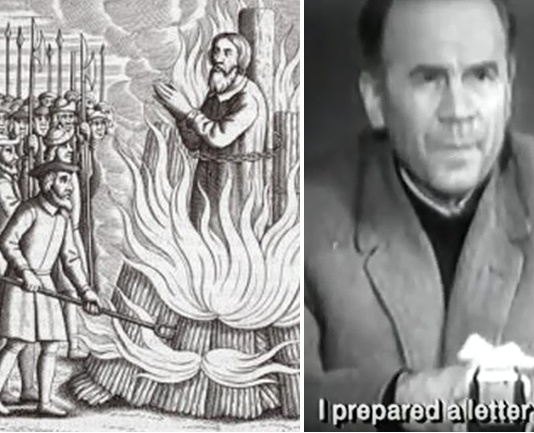
Ullman writes that demonizing the enemy defeats the understanding required for effective strategy. The point is obvious, but not so obvious Ullman knows when he’s demonizing himself. Oleg Penkovsky, the GRU colonel caught spying for the US and UK, was tried and executed in May 1963. His execution was by firing squad, according to all Russian sources and the CIA. But according to Ullman, “one story has it that Penkovsky was thrust alive into a blast furnace”.


Left: Richard Bayfield, a London book importer and publisher of the Bible, 
being slow-burned to death on the order of the Lord Chancellor Thomas More, in 1531. 
Right: Oleg Penkovsky’s public confession. For more details, click.

Not only are Ullman’s demons obvious. So are his gods, er God. With approval he quotes the well-known US Army counter-insurgency expert, Lieut.Col. John Paul Vann. “I guess God put all the good guys on the other side.” For the US to continue to repeat past failures in Afghanistan Ullman claims to be certain “unless God or luck intervenes.” Ullman’s theology is the holy trinity of American exceptionalism – God, Luck, Self.

For a strategist keen to denigrate his superiors for lacking his own knowledge of the enemy, Ullman is unusually self-assured when reporting what “[Nikita] Khrushchev knew” in 1962, in the runup to the Cuban missile crisis; to Ullman, “Khrushchev’s strategic thinking was clear”. Just so, forty years later, “the Russians fully understood”, according to Ullman, “that the United States and NATO had unmatched conventional superiority over Moscow”.

Ullman’s assessment of the Caucasus war of 2008 starts because “Putin set a trap for Georgia that its president, Mikheil Saakashvili, foolishly ignored.” In the Ukraine in 2014, Ullman accepts that “by using social media, including Facebook and Twitter, unimpeachable unclassified evidence of Russian military presence was collected”. A year later, “the Atlantic Council with which I am affiliated, presented a brilliant demonstration of… incontrovertible proof of the presence of Russian forces in Ukraine.” When on a visit to Moscow in 2016, Ullman reports being told by a Russian official “we cannot trust the United States to do the right thing”, Ullman reports himself as replying that he and his military associates at the Pentagon are more trustworthy than those at the White House or State Department. “Let me urge you,” Ullman quotes himself as advising the Russians, “to seek some sort of military-to-military dialogue or ‘Track II’ [nongovernmental, unofficial diplomacy between influential elites].”

Later, when Ullman’s Track II turns out to be exactly what led to the firing of Lieutenant-General Michael Flynn as President Donald Trump’s national security advisor after three weeks in office, Ullman concludes “Flynn was not a good choice.” Just weeks after that, in April 2017, Ullman reports himself as a guest of the Institute for the USA and Canada Studies in Moscow. There he accuses the Russian chief of staff, General Valery Gerasimov, of having “greatly exaggerated NATO’s military capability… He also wrongly implied that Supreme Allied Commander had the authority to deploy forces and hence [sic] start a war.”

Ullman’s brain-based strategy for dealing with Gerasimov’s mistakes is “providing the Baltic and Black Sea NATO members with a ‘porcupine defense’, one that would badly bloody any attack”; despatch Javelin anti-tank missiles “along with other weapons to stop or kill ‘little green men’ at [sic] the border”; and then “finding new confidence-building measures.” Ullman’s third brainwave is contradicted by his first two, but he blames this “on virtually all members of Congress [who] see Russia as an adversary, if not an enemy.” How this could be and Ullman’s fourth brain-wave be true at the same time is a puzzle he doesn’t try to explain. Putin , according to Ullman, “is sweeping the public-relations battlefield.”

Ullman’s final brain-wave is the military application, not of cypher-breaking of World War II vintage, but cyber warfare of the Google type. “A twenty-first century equivalent of Bletchley Park must be created to employ against our adversaries to understand them better and to use that knowledge to defeat them. This capability can be achieved by exploiting ‘big Data’, social media, the universally available Google Earth, and other public platforms.”

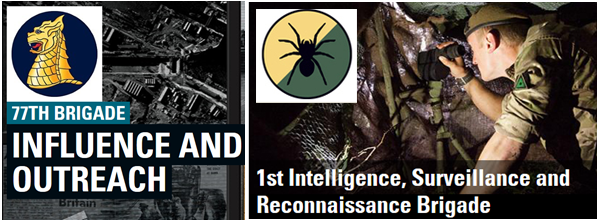
If that sounds like an internet and social media attack on Russia, it is. “The British Army…has already begun. Two brigades – 77 Brigade and 1 ISR (that is, Intelligence, Surveillance, Reconnaissance) – have been formed for this effort. The former is tasked with employing nonkinetic forms of war to achieve military purposes. The latter exploits open and civilian sources of information to gain knowledge.”


For the unit websites, click and here.

Ullman is very firm that the US has made profound mistakes of warmaking strategy because “unfortunately, the ‘What next?’ was never considered.“ But then he ran out of paper at page 242 of his book – that’s before he has time to clarify what will happen if the Russians defend themselves in cyber space and media and counterattack. This is a story we already know. And if we are forgetful, there isn’t an American or British newspaper or broadcaster which doesn’t remind us several times a day.

Sunday, March 11, 2018

Unadulterated NBC Putin Interview

Putin’s FULL Interview with Megyn Kelly on NBC

by Office of the President of Russia

via OffGuardian


March 11, 2018

Vladimir Putin interviewed by NBC anchor Megyn Kelly. The interview was recorded in the Kremlin on March 1, 2018, and in Kaliningrad on March 2, 2018. NBC showed an edited version only. The following transcript is courtesy of the Kremlin office of the President of Russia.


America's De Facto Occupation in Syria

The (Largely Unrecognized) US Occupation of Syria 

by Stephen Gowans - What's Left


March 11, 2018

The United States has invaded Syria with a significant military force, is occupying nearly one-third of its territory, has announced plans for an indefinite occupation, and is plundering the country’s petroleum resources. Washington has no authorization under international or even US law to invade and occupy Syria, much less attack Syrian forces, which it has done repeatedly. Nor has it a legal warrant to create new administrative and governance structures in the country to replace the Syrian government, a project it is undertaking through a parallel invasion of US diplomatic personnel.

These actions—criminal and an assault on democracy internationally—amount to a retrograde project of recolonization by an empire bent on extending its supremacy to all the Arab and Muslim worlds, including the few remaining outposts of resistance to foreign tyranny.

Moreover, US actions represent an escalation of Washington’s long war on Syria, previously carried out through proxies, including the Muslim Brotherhood and Al Qaeda, into a full-scale conventional war with direct US military involvement. Yet, despite the enormity of the project, and the escalation of the war, the US occupation of Syria has largely flown under the radar of public awareness.

Atop multiple indignities and affronts to liberty and democracy visited upon the Arab world by the West, including the plunder of Palestine by European settlers and the political oppression of Arabs by a retinue of military dictators, monarchs, emirs and sultans who rule largely at the pleasure of Washington and on its behalf, now arrives the latest US transgression on the ideals of sovereignty, independence, and the equality of nations: marauders in Washington have pilfered part of the territory of one of the last bastions of Arab independence—Syria.

Indeed, Washington now controls “about one-third of the country including most of its oil wealth”, [1] has no intention of returning it to its rightful owners, has planned for an indefinite military occupation of eastern Syria, and is creating a new Israel, which is to say, an new imperialist outpost in the middle of the Arab world, to be governed by Kurdish proxies backed by US firepower. [2] The crime has been carried out openly, and yet has hardly been noticed or remarked upon.

Here are the facts:


In January, US Secretary of State Rex Tillerson announced that US “troops will remain in Syria” indefinitely “to ensure that neither Iran nor President Bashar al-Assad of Syria will take over areas” [3] the United States captured from ISIS, even though these areas belong to the Syrian Arab Republic, by law and right, and not to Washington, or to Washington’s Kurdish proxy, the SDF. The SDF, or Syrian Democratic Force, is a US-constructed outfit which, in journalist Robert Fisk’s words, is neither Syrian (it’s dominated by Kurds, including those of Turkish origin) nor democratic (since it imposes Kurdish rule over traditionally Arab areas and dances to a tune called by a foreign master.) Moreover, it’s not much of a force, since, without US airpower, artillery, and Special Operations support, it is militarily inconsequential. [4]

“US President Donald Trump’s rollout of an updated Syria policy,” reports Aaron Stein, writing in the unofficial journal of the US State Department, Foreign Affairs, “commits US forces to maintaining a presence” in northeast Syria in order to “hedge against” any attempt by Damascus to assert sovereignty over its own territory. [5]

The Pentagon officially admits to having 2,000 troops in Syria [6] but a top US general put the number higher, 4,000, in an October press briefing. [7] But even this figure is an “artificial construct,” as the Pentagon described a previous low-ball figure.

On top of the infantry, artillery, and forward air controllers the Pentagon counts as deployed to Syria, there is an additional number of uncounted Special Operations personnel, as well as untallied troops assigned to classified missions and “an unspecified number of contractors” i.e., mercenaries. Additionally, combat aircrews are not counted, even though US airpower is critical to the occupation. [8] There are, therefore, many more times the officially acknowledged number of US troops in Syria, operating out of 10 bases in the country, including “a sprawling facility with a long runway, hangars, barracks and fuel depots.” [9]

In addition to US military advisers, Army Rangers, artillery, Special Operations forces, satellite-guided rockets and Apache attack helicopters [10], the United States has deployed US diplomats to Syria to create government and administrative structures to supersede the legitimate government of the Syrian Arab Republic. [11] Plus, the United States “is now working to transform Kurdish fighters into a local security force” to handle policing [12] while US diplomats on the ground work to establish local governments to run the occupied territory’s affairs. [13]

“The idea in US policy circles” is to create “a soft partition” of Syria between the United States and Russia along the Euphrates, “as it was among the Elbe [in Germany] at the end of the Second World War.” [14] On top of the 28 percent of Syria the United States occupies, it controls “half of Syria’s energy resources, the Euphrates Dam at Tabqa, as well as much of Syria’s best agricultural land.” [15]

During the war against ISIS, US military planning called for the Kurds to push south along the Euphrates River to seize Syria’s oil-and gas-rich territory. [16] While the Syrian Arab Army and its allies focused mostly on liberating cities from Islamic State, the Kurds, under US direction, went “after the strategic oil and gas fields”, [17] “robbing Islamic State of key territory,” as The Wall Street Journal put it.

The US newspaper correctly designated the seizure of key territory as a robbery, but failed to acknowledge the victim, not Islamic State, which itself robbed the territory, but the Syrian Arab Republic. But this skein of equivocation needs to be further disentangled. It was not the Kurds who robbed ISIS which earlier robbed the Syrians, but the United States which robbed ISIS which robbed Syria. The Kurds, without the backing of the US armed forces, are a military cipher incapable, by their own efforts, of robbing the Arab republic. The Americans are the robbers, the Syrians the victims.

The United States has robbed Syria of “two of the largest oil and gas fields in Deir Ezzour”, including the al-Omar oil field, Syria’s largest. [18] Last September, the United States plundered Syria of “a gas field and plant known in Syria as the Conoco gas plant” (though its affiliation with Conoco is historical; the plant was acquired by the Syrian Gas Company in 2005.) [19] Russia observed that “the real aim” of the US forces’ (incontestably denominated) “illegal” presence in Syria has been “the seizure and retention of economic assets that only belong to the Syrian Arab Republic.” [20] The point is beyond dispute: the United States has stolen resources vital to the republic’s reconstruction (this from a country which proclaims property rights to be humanity’s highest value.)

Joshua Landis, a University of Oklahoma professor who specializes in Syria, has argued that by “controlling half of Syria’s energy resources…the US will be able to keep Syria poor and under-resourced.” [21] Bereft of its petroleum resources, and deprived of its best farmland, Syria will be hard-pressed to recover from the Islamist insurgency—an operation precipitated by Washington as part of its long war on nationalist influence in the Arab world—a war that has left Syria in ruins. The conclusion that “Assad has won” and that the war is over except for mopping up operations is unduly optimistic, even Pollyannaish. There is a long road ahead.

Needless to say, Damascus aspires to recover its lost territory, and “on February 7 sent a battalion-sized column to [recuperate] a critical gas plant near Deir Ezzour.” [22] This legitimate exercise of sovereignty was repulsed by an airstrike by US invaders, which left an estimated 100 Syrian Arab Army troops and their allies dead. [23] The significance of this event has been under-appreciated, and perhaps because press coverage of what transpired disguised its enormity.

An emblematic Wall Street Journal report, for example, asserted that the US airstrike was a defensive response to an unprovoked attack by Syrian forces, as if the Syrians, on their own soil, were aggressors, and the invading Americans, victims. [24] We might inquire into the soundness of describing an aggression by invaders on a domestic military force operating within its own territory as a defensive response to an unprovoked attack. Likewise, we can inquire into the cogency of Washington’s insistence that it does not intend to wage war on the Syrian Arab Army. That this statement can be accepted as reasonable suggests the operation of what Charles Mills calls an epistemology of ignorance—a resistance to understanding the obvious.

It should be evident—indeed, it’s axiomatic—that the unprovoked invasion and occupation of a country constitutes an aggression, but apparently this is not the case in the specially constructed reality of the Western media. Could Russia invade the United States west of the Colorado River, control the territory’s airspace, plunder its resources, establish new government and administrative structures to supplant local, state, and federal authority, and then credibly declare that it does not seek war with the United States and its armed services? Invasion and occupation are aggressive acts, a statement that shouldn’t need to be made.

Washington’s February 7 attack on Syrian forces was not the first. “American troops carried out strikes against forces loyal to President Bashar Assad of Syria several times in 2017,” reported the New York Times. [25] In other words, the United States has invaded Syria, is occupying nearly a third of its territory, and has carried out attacks on the Syrian military, and this aggression is supposed to be understood as a defensive response to Syrian provocations.

It is incontestable that US control of the airspace of eastern Syria, the invasion of the country by untold thousands of US military and diplomatic personnel, the plunder of the Levantine nation’s resources, and attacks on its military forces, are flagrant violations of international law. No country has more contempt for the rule of law than the United States, yet, in emetic fashion, its government incessantly invokes the very rule of law it spurns to justify its outrages against it. But what of US law?

If, to Washington, international law is merely an impediment to be overcome on its way to expanding its empire, is the US invasion and occupation of Syria, and attacks on Syrian forces, in harmony with the laws of the United States?

If you ask the White House and Pentagon the answer is yes, but that is tantamount to asking a thief to rule on his or her theft. The question is, does the US executive’s claim that its actions in Syria comport with US law stand up to scrutiny? Not only does it not, the claim is risible. “Under both Mr. Obama and Mr. Trump,” explains the New York Times’ Charlie Savage,

“the executive branch has argued that the war against Islamic State is covered by a 2001 law authorizing the use of military force against the perpetrators of the Sept. 11 attacks [my emphasis] and a 2002 law authorizing the invasion of Iraq.” 

However, while “ISIS grew out an offshoot of Al Qaeda, the two groups by 2014 had split and became warring rivals,” and ISIS did not perpetrate the 9/11 attacks. What’s more, before the rise of ISIS, the Obama administration had deemed the Iraq war over. [26]

Washington’s argument has other problems, as well. While the 2001 law does not authorize the use of military force against ISIS, is does authorize military action against Al Qaeda. Yet from 2011 to today, the United States has not only failed to use force against the Syrian-based Jabhat al-Nusra, Al Qaeda’s largest branch, it has trained and equipped Islamist fighters who are intermingled with, cooperate on the battle field with, share weapons with, and operate under licence to, the group, as I showed in my book Washington’s Long War on Syria, citing the Wall Street Journal, New York Times, and Washington Post, which have extensively reported on the interconnections between US trained and armed fighters and the organization founded by Osama bin Laden. [27]

Finally, by implication, since the law does not authorize the use of force against ISIS, it does not authorize the presence of US aircrews in Syrian airspace or US military and diplomatic personnel on Syrian soil. In addition, it certainly does not authorize the use of force against a Syrian military operating within its own borders.

Let’s look again at Washington’s stated reasons for its planned indefinite occupation of Syria: to prevent the return of ISIS; to stop the Syrian Arab Republic from exercising sovereignty over all of its territory; and to eclipse Iranian influence in Syria. For only one of these reasons, the first, does Washington offer any sort of legal justification. The latter two objectives are so totally devoid of legal warrant that Washington has not even tried to mount a legal defense of them. Yet, these are the authentic reasons for the US invasion and occupation of Syria.

As to the first reason, if Washington were seriously motivated to use military force to crush Al Qaeda, it would not have armed, trained and directed the group’s auxiliaries in its war against Arab nationalist power in Damascus.

Regarding Washington’s stated aim of eclipsing Iranian influence in Syria, we may remind ourselves of the contents of a leaked 2012 U.S. Defense Intelligence Agency report. That report revealed that the insurgency in Syria was sectarian and led by the Muslim Brotherhood and al-Qaeda in Iraq, the forerunner of Islamic State. The report also disclosed that the United States, Arab Gulf oil monarchies and Turkey supported the insurgents.

The analysis correctly predicted the establishment of a “Salafist principality,” an Islamic state, in eastern Syria, noting that this was desired by the insurgency’s foreign backers, which wanted to see the secular Arab nationalists isolated and cut-off from Iran. [28] The United States has since decided to take on the role that it had once planned for a Salafist principality. A planned Saudi-style state dividing Damascus from Tehran has become an indefinite US occupation, from whose womb US planners hope to midwife the birth of a Kurd mini-state as a new Israel.

The reality that the US operation in Syria is illegal may account for why, with Washington’s misdirection and the press’s collusion, it has largely flown under the radar of public awareness. Misdirection is accomplished by disguising the US occupation of eastern Syria as a Kurd-, or SDF-effort, which the United States is merely assisting, rather than directing. The misdirection appears to be successful, because the narrative has been widely mentally imbibed, including by otherwise critical people.

There are parallels. The United States is prosecuting a war of aggression in Yemen, against a movement that threatens US hegemony in the Middle East, as the Syrian Arab Republic, Iran and Hezbollah do. The aggression against Yemen is as lacking in legal warrant as is the US war on Syria. It flagrantly violates international law; the Houthis did not attack Saudi Arabia, let alone the United States, and therefore there is no justification for military action on international legal grounds against them. What’s more, the Pentagon can’t even point to authorization for the use of force against Yemen’s rebels under US domestic law since they are not Al Qaeda and have no connection to the 9/11 attacks.

To side step the difficulty of deploying military force without a legal warrant, the war, then, is presented as “Saudi-led”, with the involvement of the United States relegated in the hermeneutics to the periphery. Yet Washington is directing the war. The United States flies its own drones and reconnaissance aircraft over Yemen to gather intelligence to select targets for Saudi pilots. [29] It refuels Saudi bombers in flight. Its warships enforce a naval blockade. And significantly, it runs an operations center to coordinate the bombing campaign among the US satellites who participate in it. In the language of the military, the United States has command and control of the aggression against Yemen. The only US absence is in the provision of pilots to drop the bombs, this role having been farmed out to Arab allies. [30]

And that is the key to the misdirection. Because Saudi pilots handle one visible aspect of the multi-dimensional war, (whose various other dimensions are run by the Americans), it can be passed off to the public as a Saudi affair, while those who find the Saudi monarchy abhorrent (which it is) can vent their spleen on a scapegoat. We do the same to the Kurds, hurling rhetorical thunderbolts at them, when they are merely pawns of the US government pursuing a project of empire-building. Jeremy Corbyn, the British Labour Party leader, has seen through the misdirection, declaring that it is the West, not the Saudis, who are ‘directing the war’ in Yemen. [31]

It would profit us to heed the words of Ibrahim Al-Amin, who, on the occasion of the White House recognizing Al-Quds (Jerusalem) as the capital of Israel, asked Arabs whether it wasn’t time to realize that the United States is the origin of all that plagues them. Let us leave ‘Israel’ aside, he counseled. “Whatever is said about its power, superiority and preparation, it is but an America-British colony that cannot live a day without the protection, care and blind support of the West.” [32] The same can be said of the Saudi monarchy and the SDF.

I leave the last word to the Syrian government, whose voice is hardly ever heard above the din of Western war propaganda. The invasion and occupation of eastern Syria is “a blatant interference, a flagrant violation of [the] UN Charter’s principles…an unjustified aggression on the sovereignty and independence of Syria.” [33]

None of this is controversial.

For his part, Syrian president Bashar al-Assad has pointed out incontestably that foreign troops in Syria “without our invitation or consultation or permission…are invaders.” It is time the US invasion and occupation of Syria—illegal, anti-democratic, plunderous, and a project of recolonization—was recognized, opposed, and ended.

There is far more to Washington’s long war on Syria than Al Qaeda, the White Helmets and the Kurds. As significant as these forces are, the threat they pose to the Syrian center of opposition to foreign tyranny has been surpassed by a more formidable challenge—the war’s escalation into a US military and diplomatic occupation accompanied by direct US military confrontation with the Syrian Arab Army and its allies.

1. Neil MacFarquhar, ‘Russia’s greatest problem in Syria: It’s ally president Assad,’ The New York Times, March 8, 2018.
2. Anne Barnard, “US-backed force could cement a Kurdish enclave in Syria,” The New York Times, January 16, 2018; Domenico Losurdo, “Crisis in the Imperialist World Order,” Revista Opera, March 2, 2018.
3. Gardiner Harris, “Tillerson says US troops to stay in Syria beyond battle with ISIS, The New York Times, January 17, 2018.
4. Robert Fisk, “The next Kurdish war is on the horizon—Turkey and Syria will never allow it to create a mini-state,” The Independent, January 18, 2018.
5. Aaron Stein, “Turkey’s Afrin offensive and America’s future in Syria: Why Washington should be eying the exit,” Foreign Affairs, January 23, 2018.
6. Nancy A. Yousef, “US to remain in Syria indefinitely, Pentagon officials say, The Wall Street Journal, December 8, 2017.
7. Andrew deGrandpre, “A top US general just said 4,000 American troops are in Syria. The Pentagon says there are only 500,” the Washington Post, October 31, 2017.
8. John Ismay, “US says 2,000 troops are in Syria, a fourfold increase,” The New York Times, December 6, 2017; Nancy A. Yousef, “US to remain in Syria indefinitely, Pentagon officials say,” The Wall Street Journal, December 8, 2017).
9. Dion Nissenbaum, “Map said to show locations of US forces in Syria published in Turkey,” The Wall Street Journal, July 19, 2017.
10. Michael R. Gordon, “In a desperate Syrian city, a test of Trump’s policies,” The New York Times, July 1, 2017.
11. Nancy A. Yousef, “US to send more diplomats and personnel to Syria,” The Wall Street Journal, December 29, 2017.
12. Dion Nissenbaum, “US moves to halt Turkey’s drift toward Iran and Russia,” the Wall Street Journal, February 21, 2018.
13. Nancy A. Yousef, “Some US-backed Syrian fighters leave ISIS battle to counter Turkey,” The Wall Street Journal, February 6, 2018.
14. Yaroslav Trofimov, “In Syria, new conflict looms as ISIS loses ground,” The Wall Street Journal, September 7, 2017.
15. Gregory Shupak, “Media erase US role in Syria’s misery, call for US to inflict more misery,” FAIR.org, March 7, 2018.
16. Trofimov, September 7, 2017.
17. Raj Abdulrahim and Ghassan Adnan, “Syria and Iraq rob Islamic State of key territory,” The Wall Street Journal, November 3, 2018.
18. Raj Abdulrahim and Ghassan Adnan, “Syria and Iraq rob Islamic State of key territory,” The Wall Street Journal, November 3, 2018.
19. Abdulrahim and Adnan, November 3, 2018.
20. Raja Abdulrahim and Thomas Grove, “Syria condemns US airstrike as tension rise,” the Wall Street Journal, February 8, 2018.
21. Joshua Landis, “US policy toward the Levant, Kurds and Turkey,” Syria Comment, January 15, 2018.
22. Yaroslav Trofimov, “As alliances shift, Syria’s tangle of war grows more dangerous,” The Wall Street Journal, February 15, 2018.
23. Raja Abdulralhim and Thomas Grove, “Syria condemns US airstrike as tensions rise,” The Wall Street Journal, February 8, 2018; Nancy A. Yousef and Thomas Grove, “Russians among those killed in US airstrike is eastern Syria,” The Wall Street Journal, February 13, 2018.
24. Yousef and Grove, February 13, 2018.
25. Charlie Savage, “US says troops can stay in Syria without new authorization,” The New York Times, February 22, 2018.
26. Savage, February 22, 2018.
27. Stephen Gowans. Washington’s Long War on Syria. Baraka Books. 20017. Pp. 149-150.
28. DIA document leaked to Judicial Watch, Inc., a conservative, non-partisan educational foundation, which promotes transparency, accountability and integrity in government, politics and the law.
http://www.judicialwatch.org/wp-content/uploads/2015/05/Pg.-291-Pgs.-287-293-JW-v-DOD-and-State-14-812-DOD-Release-2015-04-10-final-version11.pdf
29. Mark Mazzetti and Eric Schmitt, “Quiet support for Saudis entangles U.S. in Yemen,” The New York Times, March 13, 2016.
30. Stephen Gowans, “The US-Led War on Yemen, what’s left, November 6, 2017.
31. William James, “May defends Saudi ties as Crown Prince gets royal welcome in London,” Reuters, March 7, 2018.
32. Ibrahim Al-Amin, “Either America or Al-Quds,” Alahednews, December 8, 2017.
33. Syria condemns presence of French and German special forces in Ain al-Arab and Manbij as overt unjustified aggression on Syria’s sovereignty and independence, SANA, June 15, 2016.

Measuring Putin's Missile Message

Putin’s Missiles: Deterring an American Attack?

by Israel Shamir - UNZ


March 11, 2018

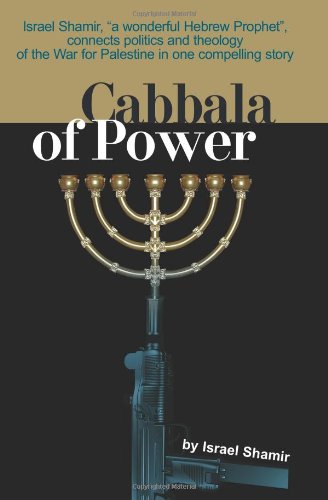
Putin’s March 1st presentation of new Russian weapons has been greatly misunderstood as a declaration of strategic parity or triumphalism. There was a much more urgent need, namely, to prevent an imminent strike.

This danger is not over yet, for a week later, on March, 7, President Putin emphasised his readiness to employ the nuclear weapons for retaliation purposes, even if it would end the world.

“Certainly, it would be a global disaster for humanity; a disaster for the entire world,” Putin said, 

“but, as a citizen of Russia and the head of the Russian state I must ask myself: Why would we want a world without Russia?”

This was a bold answer. A lesser man would probably reply hypocritically, dodging the brutal “yes, I shall destroy the world.” It means that the danger is still imminent, and that by these frank words President Putin wants to dissuade whoever intends to push him too far.

Why indeed, all of a sudden, did the Russian President decide now, of all times, to tell the world about these new weapons? It’s not that the Russians (or the Americans, for that matter) are accustomed to deliver hardware updates orbi et urbi. And 2002, the year the US withdrew from the ABM treaty, was consigned to history years ago. What was the reason, or at least the trigger?

Some observers bet it was a wily pre-election trick aimed at a domestic audience. This could be a consideration, but a minor one. The leading opponent of Mr Putin, the communist candidate Mr Grudinin, didn’t argue against Putin’s foreign policy or defence spending; the voters do approve of Putin’s foreign policy, anyway. Putin’s revelation made Russians proud, but they would vote Putin anyway.

The reason for Putin’s speech was a different and more urgent one: a terrible crescendo of threats had made Russia feel very vulnerable. Presumably their spy agencies convinced the Russian leader the threats were real.

The US establishment has been looking for a way to humiliate and punish Russia since Mueller’s indictment of 13 Russians. The indictment alleged that “the Russian conspirators wanted to promote discord in the United States and undermine public confidence in democracy,” in the words of Rod Rosenstein, the deputy attorney general overseeing the Mueller’s inquiry. It did not matter that the indicted Russians weren’t officials of the Russian state; that their effort (if these existed at all) were puny: a few ads at the cost of about $100,000, a drop in the ocean compared to the vast amounts of money spent by both the Clinton and Trump campaigns. However, the US establishment called these minor actions of private Russian citizens an “act of war.”

On February 19, Glenn Greenwald summed up the US reactions in the piece called A Consensus Emerges: Russia Committed an “Act of War” on Par With Pearl Harbor and 9/11. He reminded us that Senators from both parties, such as Republican John McCain and Democrat Jeanne Shaheen, have long described Russian meddling in 2016 as an “act of war.” Hillary Clinton described Russia’s alleged hacking of the DNC and John Podesta’s email inbox as a “cyber 9/11.” Tom Friedman of the New York Times said on “Morning Joe” that Russian hacking “was a 9/11-scale event. They attacked the core of our democracy. That was a Pearl Harbor-scale event.”

After the indictment, this comparison became a common place rhetoric.

“The Washington Post’s Karen Tumulty, complaining about President Donald Trump’s inaction, asked readers to
“imagine how history would have judged Franklin D. Roosevelt in the aftermath of Pearl Harbor, if he had taken to the radio airwaves to declare that Tokyo was ‘laughing their asses off.’ Or if George W. Bush had stood in the rubble of the World Trade Center with a bullhorn and launched a name-calling tirade against the Democrats.”

Greenwald concluded:

“If Russian election meddling is on par with the Pearl Harbor and 9/11 attacks, then should the U.S. response be on par with its response to those attacks?” 

In other words, the US politicians and media called to give Russia the same treatment the US gave to Japan (Hiroshima and Nagasaki) and to Afghanistan (invasion followed by 16 years of occupation).

In the search for escalation from fiery talk to fire, the Anglo-American establishment turned to the familiar device of alleged Syrian gas attacks. People have been trained to respond to such accusations (and alternatively, to keep mum while the US bombs Mosul and Raqqa, or prepares to nuke North Korea). Assad and Russia were accused of gassing the rebel stronghold of Eastern Ghouta, the West’s last chance to enforce regime change in Syria by virtue of its location near the capital.

The alleged gas chlorine attack was reported on February 25th, and it was immediately denied by the Russians and the Syrians. The Russian Foreign Minister Sergey Lavrov said that this anonymous ‘bogus report’ had been originated in the US in order to denigrate Syrian government and its troops, to accuse them of war crimes and to cause permanent breakup of Syria. The US and its allies, he said, were “simply exploiting baseless allegations of toxic weapons use by Damascus as a tool of anti-Syrian political engineering”.

The rebels said they were attacked by chlorine gas, as opposed to previous times when they claimed gas sarin was used. Chlorine gas is a tricky stuff; it is not deadly though unhealthy for inhaling. It is also quite difficult to monitor and verify, for chlorine is widely used for domestic purposes from cleaning bathrooms to purifying water and is not a banned substance (though the gas chlorine is forbidden). This difficulty to verify had made it an easy one to claim.

The situation in E. Ghouta was a replay of Aleppo; reports of wounded children, films produced by the White Helmets, and stubborn attempts by the rebels to prevent civilian exodus from the area. Whenever the rebels are pushed hard, they produce a story of suffering civilians and of gas attacks, hoping the US will force the Syrian government and their Russian allies to relent.

Undoubtedly civilians have suffered in the Syrian war; however, there is a way to end their suffering. The rebels could lay down their arms and join the political process, like everybody else. There are plenty of Americans unhappy with the Trump regime, but they do not shell Washington DC; they hope for a better and different outcome at the next elections. Their example can be emulated by the Syrian rebels, and then, the civilians won’t suffer.

If that’s too much to ask for, they can let the civilians leave; and fight to the bitter end. But no, they do not let the civilians out; instead, they produce reports of civilians suffering and wait for the Mounties to ride in and save them.

There was an extra angle. The rebels of E. Ghouta are trained and led by British and American intelligence officers, and they came under Russian fire. Perhaps it was a Russian payoff for the bombardment of oil field installations near Deir ez-Zor where the Russian private military company (called Wagner after their leader nickname’s) bore the brunt of and suffered many casualties. Thierry Meyssan, the well known French journalist resident in Damascus claimed that Russian ground troops also participated in the assault on Eastern Ghouta. It is possible that the Russians and the Americans are already fighting directly, though both sides are loth to admit their losses.

The British Foreign Secretary Boris Johnson was the first to “seriously consider” air strikes in Syria. He missed the fun of Libya (“we came, we saw, he died”) and now the redhead is eager to bomb anybody. However, his Parliament does not allow him to do so.

The ball was taken up by the Americans. Bloomberg editorialized:

“It’s time for another red line, one that the U.S. won’t back away from. Trump should tell Assad and his Russian backers that any more proved use of any chemical weapon, including chlorine, will be met with even greater retaliation than what happened in April.”

[This is a reference to Trump’s cruise missile strike on Syria’s Shayrat air base, allegedly in revenge for Syrian sarin gas attack in Khan Sheikhoun. Doubts about this “sarin gas attack” emerged right away, and Unz.com published it quickly. In June 2017, Seymour Hersh exposed the full story behind Shayrat: there was no “sarin attack”, and President Trump was told by his own intelligence officers to drop the case. He still insisted and attacked but warned the Russians in advance, and there were no Russian or Syrian casualties, and very little damage at the cost of $100 million to the US taxpayer. The US mainstream media was exuberant, and congratulated Trump with this example of Presidential behaviour.]

The American Conservative, the Republican and Trump-friendly site objected to plans to bomb Syria:

“Trump had no authority to order the attack on Syrian forces last year, and he still doesn’t have it now. There is no international mandate for U.S. forces to be in Syria, nor is there any authorization for military action against Syrian government forces or their allies. If Trump orders another illegal attack, the U.S. will be committing more acts of war against a government that poses no threat to us, has done nothing to us or our treaty allies, and is still fighting inside its own internationally recognized borders.”

But voices of those supporting the strikes and punishing Russians and Syrians sounded stronger. “White House considers new military action against Syrian regime,” wrote The Washington Post on March, 5. The newspaper added details who pushed for the attack (national security adviser H.R. McMaster) and who objected (Defense Secretary Jim Mattis).

“Other officials, particularly at the White House and the State Department, appear more open to renewed action against Assad,” said the report.

This is the background of Putin’s speech of March 1st. The Russian president spoke of the new Russian missiles impervious to Aegis and unstoppable by ground fire that can turn the US aircraft carriers, the most potent symbol of the US power, into sitting ducks. Russia will sink them in case of an attack on Russia or on her allies, said Putin.

‘Allies’ is the keyword in the message. The threatened ally of Russia is Syria. Putin warned the Americans that their air strike on Syria may be answered with a strike upon their Carrier Strike Group (CSG) in the area. If you bomb Damascus, we shall send your CSGs in the Med and in the Gulf down to the sea bottom. We can incinerate your air bases in the area, too.

The sharply raised stakes were a game-changer. Who knows what will be the Russian response on this or other action of the Western allies? The warlike neocons say Russia is all talk, all bluff. Realists say that the US may suffer the humiliating and painful loss of its CSGs with thousands of lives at sea. The US President had enjoyed the previous strike of Syria with dozens of Tomahawks before returning to his beautiful chocolate cake. If the strike were revisited upon the striking SCGs – this is totally different matter. Did you say Pearl Harbour?

Even if this exchange would not lead to massive nuclear strikes of the mainland US and Russia and total world-destroying war, it would have a very high price tag. The Russians can even strike President Trump’s private club in Palm Beach, Fla as they naughtily presented on the mock video.

Apparently, President Trump discussed it now with the UK Prime Minister Theresa May. The Brits are for some reason more keen to push for war with Russia. Now they try their best to stop the rapprochement between the US and Russia.

The peculiar story of poisoning their own ex-spy with a nerve gas adds spice to their effort, and the Russian Embassy UK Twitter troll twitted:

“In today’s papers: pundits call on @Theresa_May to disrupt possible Russia-US thaw. No trust in Britain’s best friend and ally?”

The nuclear poker game just became more exciting.

Are the Russians bluffing, or aren’t they? Will they play, or will they drop their cards, this is the question. There is no answer yet. Only history can answer it.

Meanwhile, judging by the tense calm in the Middle East and elsewhere, Putin’s game had been successful. The US missiles rested at their launching sites, and so did the Russian ones. The Russian-Syrian offensive in E. Ghouta proceeds unabated, while the US ground operations in Syria came to standstill, as the Kurds are too busy confronting the Turks. Perhaps we shall survive this almost-confrontation, as we have survived the 2011 almost-confrontation.
Israel Shamir can be reached at adam@israelshamir.net
This article was first published at The Unz Review.

Covering Up Israel's US Democracy Meddling Offences

Israel Lobby Doesn't Want Al Jazeera to Spill its Secrets 

by TRNN


March 10, 2018

Qatar is under pressure to bury an undercover Al Jazeera documentary that exposes the Israel Lobby in the US. Asa Winstanley of the Electronic Intifada says the film's key revelations include the close cooperation between the neocon Foundation for the Defense of Democracies and the Israeli government.


Asa Winstanley is an Investigative Journalist and Associate Editor at The Electronic Intifada.