Wednesday, April 04, 2018

Canada's Sorta Legalization of Cannabis

Pending Legalization of Pot Leaves Dispensaries in the Dust

by Krystalline Kraus - Rabble


April 5, 2018

July 1 could see implementation of Bill C-45, making marijuana legal in Canada for the first time in 94 years.

Currently, only access for medical reasons are legal under the Access to Cannabis for Medical Purposes Regulations (ACMPR), with licenses issued by Health Canada. Regulated medical cannabis became legal back in 2001.

Spurred by public opinion, as part of his platform, Justin Trudeau committed to legalizing small amounts of cannabis strictly for personal use if elected prime minister in the 2015 federal poll. Liberals went on to form a majority government, which made passing the laws legalizing easier as the Conservative Party - which came out against legalization - didn't have the votes to oppose.
Photo: Duncan C/Flickr

[This is the first of a two-part series on cannabis in Canada. Part two here.]


Bill C-45 was passed by the federal House of Commons in late November 2017, but the final vote in the House will not occur until June. If approved by the Senate in time, personal consumption of cannabis should be legal July 1, 2018. Bill Blair, the former Toronto police chief, is the key point person on the marijuana file.

But that is a big If. Just because July 1st has been floated around as the set date for the legalization of marijuana, if the Senate has its way, the set date might be pushed back until August. The delayed timeline is a political victory for Conservatives, who have demanded more time to study the implications of legalizing cannabis.

The federal government estimates indicate that the illegal sale of marijuana is worth over seven billion dollars per year, so we know that the government's decision to legalize marijuana sales wasn’t purely based on a desire to make cannabis users' lives easier.

Ottawa will still be responsible for licensing the producers, but the provinces have been charged with the power to determine the exact method of distribution and sale, as well as establishing the legal age limit for cannabis sale and use. Ottawa has originally stated that the legal age will be 18, but the provinces have the right to raise that age limit as they see fit. The provinces also have the right to set the price.

Canadians who want to grow their own marijuana will be limited to four plants per household.

The party's plan was to remove cannabis possession for personal consumption from the federal Controlled Drugs and Substances Act. This said, however, new laws will be enacted for greater punishment of those convicted of supplying cannabis to minors and impairment while driving a motor vehicle.

Driving under the influence of cannabis is still a contested issue, regarding both getting the message out to Canadians that driving while impaired is illegal whether the substance be alcohol or cannabis, and how exactly laws will be enforced on the roads, including how police officers will be best able to test someone's level of intoxication.

This has not kept cannabis dispensaries from trying to sell cannabis to consumers for public use. There have been regular and high-profile raids of dispensaries such as Cannabis Culture, run by Marc and Jodi Emory. Their Toronto dispensaries were searched and the employees arrested as part of Project Gator, a Toronto Police Service project targeting marijuana dispensaries.

In total, Emery, the so-called Prince of Pot, and his wife Jodie run about a dozen marijuana shops in Canada under the brand Cannabis Culture.

Toronto police charged both Emerys with drug trafficking, conspiracy and possession on March 9, 2017, at Pearson Airport as the couple prepared to leave for a cannabis festival in Spain. Charges against them included conspiracy to commit an indictable offense, trafficking and possession. The Emerys plead guilty to the charges in December of 2017.

Police forces across Canada will continue to raid dispensaries that flout current cannabis laws, which state that the sale of cannabis can only be done through licensed distributors and the product couriered through the mail, not bought off the street from dispensary storefronts which have been popping up in cities big and small.

Since federal legislation gives provinces and territories the power to determine the method of sale, each will be different. For example, Ontario Premier Kathleen Wynne has proposed using the already established LCBO for the logistical support needed for controlling and selling of cannabis products, including marijuana and cannabis oils.

This would not take place in the same stores that already sell alcoholic beverages. Despite being the sole vendor, a subsidiary called the Ontario Cannabis Retail Corporation (OCRC) will open an initial 40 stores for the July launch and another 40 stores by July of 2019. Online sales would also be permitted through the OCRC.

Patients with a prescription for medical cannabis currently purchase their product strictly online, and this won’t likely change.

But the one thing these distributors are unhappy with is the fact that they won’t be able to sell their products to recreational users, despite the fact that there is already a structure in place.

Gorilla Radio with Chris Cook, Michael Jabara Carley, Ted Smith, Janine Bandcroft April 5, 2018

This Week on GR

by C. L. Cook - Gorilla-Radio.com


April 5, 2018

Good news out of Britain: Former Russian double agent, Sergei Skripal and his daughter Yulia, apparently poisoned in Salisbury a little more than a month ago, are still alive. Sergei is said to be in critical but stable condition still, and it seems Yulia is strong enough to speak, though is as yet being held incommunicado.

While being of particular relief to the friends and families of the stricken, the recovery of the three provides too much needed diplomatic space for a thus far vitriolic Prime Minister Theresa May to climb down from her government's vilification campaign against Russia - at least long enough to ascertain why the Skripal's fell sick in the first place, and then determine the provenance, if any, of alleged agents, chemical and otherwise involved.

After all, no-one wants to create an international incident of it - do they?

Listen. Hear.

Michael Jabara Carley is an author, educator, and essayist. A professor of history at the Université de Montréal, his research and writing focuses on relations between Russia, the USSR, and the "West". His book titles include: 'Revolution and Intervention: The French Government and the Russian Civil War, 1917-1919', '1939: The Alliance That Never Was and the Coming of World War II', and his latest, 'Silent Conflict: A Hidden History of Early Soviet-Western Relations,' and he's in the process of writing a book chronicling the "serendipitous" creation of the "Grand Alliance," key to the defeat of Hitler in World War II.

His articles can be found online at Voltaire Net.org, Global Research, and the Strategic Culture Foundation, where I discovered his article, 'Why Canada Defends Ukrainian Fascism'.

Michael Jabara Carley in the first half.

And; it's said, "Success has many fathers, but failure is an orphan" and no axiom fits more aptly the situation with Cannabis in Canada today. While Johnnie-come-lately former police officials and politicians join the boards of newly formed weed corporations, hitching their wagons to the shooting star of profitability legal access affords, the people who fought the law to help the sick watch on. But not to be sidelined, in its 23rd year, the Vancouver Island Cannabis Buyer's Club is still going strong and ready to continue the fight for truly unfettered access.

Ted Smith founded the Vancouver Island Cannabis Buyer's Club to provide cannabis-based products to people with terminal and incurable medical conditions. He faced harassment and arrest, and took his case all the way to Canada's Supreme Court - and won!

Ted Smith and Canada's new legal understanding of cannabis in the second half.

And; long-time Victoria activist and CFUV Radio broadcaster at-large, Janine Bandcroft will join us at the bottom of the hour to bring us up to speed with some of what's good to get up to in and around Victoria in the coming week. But first, Michael Jabara Carley and stoking a hotter Cold War 2.0 with Russia.

Chris Cook hosts Gorilla Radio, airing live every Thursday between 11-Noon Pacific Time. In Victoria at 101.9FM, and on the internet at: http://cfuv.uvic.ca.  He also serves as a contributing editor to the web news site, http://www.pacificfreepress.com. Check out the GR blog at: http://gorillaradioblog.blogspot.ca/

Tuesday, April 03, 2018

Fighting Back: As Britian's Case for Skripal Poisoning Grows Murkier, Russia Asks Tough Questions of May

Operation Hades - A Model For The 'Novichok' Case? 

by Moon of Alabama


April 3, 2018

(This is a 'working thread' to collect various items related to the alleged 'Novichok' incident in Salisbury and the fate of the British spy Sergej Skripal and his daughter Yulia. For a wider overview of the case please check our longer write-ups linked at the end of this post.)

The Russian government sent fourteen specific questions to the British government and thirteen questions to the OPCW. There seems to be some French involvement in the investigation of the alleged nerve agent and Russia ask why that is the case.

Alexander Yakovenko, the Russian ambassador to Britain, further increased the pressure on Theresa May by publicly asserting that the Skripal case was a 'provocation' carried out by British intelligence.

Telepolis points out (in German) that this would not be the first time that a 'western' service would stage such a 'provocation'. The Skripal case is indeed quite comparable to Operation Hades.


Time Cover August 29 1994

On August 10 1994 German officials in Munich 'found' 363 grams of plutonium on a plane coming from Moscow. They immediately asserted, that the plutonium 'must' have come from a Russian reactor. There was a lot of media panic, international political noise and condemnation of Russia.

This put pressure on the Russian government to increase its security at its nuclear sites. The U.S. offered to 'help' with nuclear security and thus got easy access to Russia's nuclear secrets. The case broke in the mid of the federal election campaign in Germany and helped chancellor Kohl to get re-elected.

Months later first leaks appeared, enterprising reporters dug deeper into the story and it started to unravel.

Der Spiegel filled ten pages (in German) with the explosive story.

"How German secret agents invented the plutonium hazard" 


It turned out that the plutonium was not from Russia but had been planted by the German equivalent of the MI6, the Bundesnachrichtendienst (BND).

Later leaks and counter-leaks created a convoluted story to hide the truth behind it.

A parliamentarian commission investigated the case but the Kohl government eventually shut it down without any political consequences. Shortly thereafter the deeply involved BND head, Bernd Schmidbauer, was sent into retirement.

SPIEGEL Cover May 10 1995 "The BND's Nuke Hustle"

The Russians depict the 'Novichok' case as a staged 'provocation'. There is a historic ante-type for such a 'provocation' by a 'western' intelligence service. That gives the Russian claim some significant merit.

It took only nine month for the 1994 'Operation Hades' story to fall apart. The 'Novichok' fairy-tale may now see an even earlier end.

Sky News Breaking @SkyNewsBreak - 2:59 PM - 3 Apr 2018

Chief executive of Porton Down research laboratory has told Sky News scientists have not been able to prove the Novichok nerve agent used to poison Sergei and Yulia Skripal came from Russia or establish its country of origin

Mind the gap, Mrs. May. Mind the credibility gap.


Video of Mr. Aitkenhead's Sky News interview. (Nice word play included: He only provides scientific evidence. The government may additionally have 'other' (i.e. unscientific) evidence to make a case.)

In light of the Proton Down statement we can now state that Boris Johnson, on March 20 on DW, proved to be an 'absolutely categorical' liar:

You argue that the source of this nerve agent, Novichok, is Russia. How did you manage to find it out so quickly? Does Britain possess samples of it?

BJ: Let me be clear with you … When I look at the evidence, I mean the people from Porton Down, the laboratory …

So they have the samples …

BJ: They do. And they were absolutely categorical and I asked the guy myself, I said, "Are you sure?" And he said there's no doubt.

In the interview Boris Johnson tried to preemptively put any eventual fault in the case on Porton Down. Today he received the response.

Payback is a bitch, Mr Johnson. A biting bitch.


The Working Group on Syria, Propaganda and Media, a number British academics, published an update to their briefing ‘Doubts about Novichoks’ at Tim Hayward's site.

The update carefully distinguishes and discusses the various chemical substances and research programs relevant to the British 'Novichok' claims. The 'Novichok' nerve agents Vil Mirzayanov describes in his book seem to differ from the substances other Russian scientists talked about in their recent interviews. The U.S. though, as well as other countries, has evidently worked on some of the substances described by Mirzayanov and concealed these efforts from the OPCW. The Working Group concludes:

The UK government has asserted that “No country bar Russia has combined capability, intent and motive” to carry out the Salisbury poisonings. Published studies show that these compounds can be synthesized at bench scale (sufficient for an assassination) in other countries. The UK government’s declared case therefore rests only on subjective judgements of “intent and motive”, which are open to question.

A few days ago Victoriya Skripal, a cousin of Yulia Skripal, was interviewed by the Russian website MKRU (Ru). The Stalkerzone provides an English translation of the full interview. From it we learn that:

  • Victoriya Skripal tried to get information on her allegedly poisoned cousin Yulia and uncle Sergej from the British embassy in Russia since March 5. She also unsuccessfully tried to contact the hospital in Salisbury. She heard from the Russian embassy in Britain that Yulia is awake, can eat and drink and can say a few words.
  • Shortly before the incident Yulia had gained access to some $200,000 owned by her deceased brother. This, for now, seems to have nothing to do with the case.
  • Sergej Skripal is not a lone man but has a number of friends and family in Russia and in Britain who visited him regularly in Salisbury.
  • Sergej Skripal has two cats and two guinea pigs. Victoriya Skripal asks: What happened to them? (They licked the doorknob and turned into walking-dead?)
  • Victoriya Skripal wants to travel to Britain and bring at least Yulia back home with her.

Victoriya Skripal apparently also did an interview with the Mail Online (or the Mail plagiarized its piece from MKRU). There seems to be no additional information in it.

British officials spread various theories about where and how the Skripal's were poisoned. According to 'official' leaks to the British press the alleged nerve agent was smeared to the door of Sergej Skripal's car, was in a pizza, in Yulia Skripal's luggage or perfume, or in the car's air vent. I may have been sprayed by a mini drone, or the stuff was smeared onto to the doorknob of Skripal's house or maybe it was, as claimed yesterday, in buckwheat cereals brought from Russia on Sergej Skripal's request.

In my view none of these explanation is plausible. The multitude of the discussed possibilities alone shows that either no one has a clue of what happened and how it happened, or someone is trying to bury the case in a heap of misinformation. We shall call this phenomena 'Novi-fog'. It unmasks headlines like this one as mere propaganda: Poisoned Door Handle Hints at High-Level Plot to Kill Spy, U.K. Officials Say. "It was on the doorknob (maybe)! Thus Putin himself did it!"

John Helmer, who reports from Moscow, documents that the British government is breaking several British laws as well as international agreements by keeping the family and the consular service of the Russian embassy in Britain away from the Skripals.

Previous Moon of Alabama reports on the Skripal case: 

March 8 - Poisioned British-Russian Double-Agent Has Links To Clinton Campaign
March 12 - Theresa May's "45 Minutes" Moment
March 14 - Are 'Novichok' Poisons Real? - May's Claims Fall Apart
March 16 - The British Government's 'Novichok' Drama Was Written By Whom?
March 18 - NHS Doctor: "No Patients Have Experienced Symptoms Of Nerve Agent Poisoning In Salisbury"
March 21 - Russian Scientists Explain 'Novichok' - High Time For Britain To Come Clean (Updated)
March 29 - Last Act Of 'Novichok' Drama Revealed - "The Skripals' Resurrection"
March 31 - Hillary Clinton Ordered Diplomats To Suppress 'Novichok' Discussions

Confirming the Doubts of May: Mystery of Porton Down Poisoning Becoming Clearer

Of A Type Developed By Liars

by Craig Murray


March 16, 2018 - [UPDATED BELOW]

I have now received confirmation from a well placed FCO source that Porton Down scientists are not able to identify the nerve agent as being of Russian manufacture, and have been resentful of the pressure being placed on them to do so.

Porton Down would only sign up to the formulation “of a type developed by Russia” after a rather difficult meeting where this was agreed as a compromise formulation.

The Russians were allegedly researching, in the “Novichok” programme a generation of nerve agents which could be produced from commercially available precursors such as insecticides and fertilisers.

This substance is a “novichok” in that sense. It is of that type. Just as I am typing on a laptop of a type developed by the United States, though this one was made in China.

To anybody with a Whitehall background this has been obvious for several days.

The government has never said the nerve agent was made in Russia, or that it can only be made in Russia. The exact formulation “of a type developed by Russia” was used by Theresa May in parliament, used by the UK at the UN Security Council, used by Boris Johnson on the BBC yesterday and, most tellingly of all, “of a type developed by Russia” is the precise phrase used in the joint communique issued by the UK, USA, France and Germany yesterday:

“This use of a military-grade nerve agent, of a type developed by Russia, constitutes the first offensive use of a nerve agent in Europe since the Second World War.”

When the same extremely careful phrasing is never deviated from, you know it is the result of a very delicate Whitehall compromise. My FCO source, like me, remembers the extreme pressure put on FCO staff and other civil servants to sign off the dirty dossier on Iraqi WMD, some of which pressure I recount in my memoir Murder in Samarkand. She volunteered the comparison to what is happening now, particularly at Porton Down, with no prompting from me.

Separately I have written to the media office at OPCW to ask them to confirm that there has never been any physical evidence of the existence of Russian Novichoks, and the programme of inspection and destruction of Russian chemical weapons was completed last year.

Did you know these interesting facts?


OPCW inspectors have had full access to all known Russian chemical weapons facilities for over a decade – including those identified by the “Novichok” alleged whistleblower Mirzayanov – and last year OPCW inspectors completed the destruction of the last of 40,000 tonnes of Russian chemical weapons

By contrast the programme of destruction of US chemical weapons stocks still has five years to run

Israel has extensive stocks of chemical weapons but has always refused to declare any of them to the OPCW. Israel is not a state party to the Chemical Weapons Convention nor a member of the OPCW. Israel signed in 1993 but refused to ratify as this would mean inspection and destruction of its chemical weapons. Israel undoubtedly has as much technical capacity as any state to synthesise “Novichoks”.

Until this week, the near universal belief among chemical weapons experts, and the official position of the OPCW, was that “Novichoks” were at most a theoretical research programme which the Russians had never succeeded in actually synthesising and manufacturing. That is why they are not on the OPCW list of banned chemical weapons.

Porton Down is still not certain it is the Russians who have apparently synthesised a “Novichok”. Hence “Of a type developed by Russia”. Note developed, not made, produced or manufactured.

It is very carefully worded propaganda. Of a type developed by liars.

UPDATE

This post prompted another old colleague to get in touch. On the bright side, the FCO have persuaded Boris he has to let the OPCW investigate a sample. But not just yet. The expectation is the inquiry committee will be chaired by a Chinese delegate. The Boris plan is to get the OPCW also to sign up to the “as developed by Russia” formula, and diplomacy to this end is being undertaken in Beijing right now.

I don’t suppose there is any sign of the BBC doing any actual journalism on this?

Erratum – I originally typed “nerve gas” and not “nerve agent” in the first line – purely my error.

UPDATE II (April 3, 2018)

Absolute confirmation today my FCO sources were correct and Porton Down scientists not saying substance made in Russia. Awaiting apologies from all the mainstream media "journalists" who attacked me.  

Monday, April 02, 2018

On the Other Front Palestinian Culture War Must Be Won

Rim Banna and the Cultural War that Palestinians Must Win

by Ramzy Baroud


April 2, 2018

Rim Banna passed away at the age of 51. Her death on March 24, after a decade-long battle with cancer, brought grief to Palestinians everywhere. Rim, a Palestinian Christian from Nazareth, united the Palestinian people across political and geographic divides. When she sang for the Homeland, nothing mattered but Palestine.

Christians and Muslims, Fatah and Hamas, Gaza and Ramallah, all became one. Through her soulful and warm voice, she imparted sorrow, yet celebrated life. Her songs 'Fares Odeh' and 'Sarah' were poetic interpretation of precious young Palestinian lives cut short by Israeli soldiers.

The butterfly will carry you to the back of a cloud
The gazelle will run with you to a hollow of sycamore
The scent of bread will take you, a martyr, to the embrace of your mother
The star said to him, "Bring me to the courtyard of my house"
"Take me to the mattress of my slumber"
Sleepiness climbed up my sides
And settled in my head."

Music unites Palestinians when politicians fail. In fact, while for years the collective calls for 'Palestinian unity' has gone unheeded, Palestinian music has continued to bring Palestinians closer.

Deep-rooted Palestinian culture is what makes Palestinians who they are, a people with a unique and lucid identity, despite 70 years of exile, ethnic cleansing, sieges, numerous borders and wanton killings.

And when Rim sang, her voice penetrated through the seemingly impregnable Apartheid walls, checkpoints, military curfews and unbridgeable distance.

It was during the First Intifada (popular uprising) of 1987 that Rim gained access to the hearts and homes of many Palestinians; initially in Palestine and, eventually, all over the world. Her voice, soft and reassuring, gave hope to those who lived under a 7-years long relentless Israeli military campaign. Israeli tactics, then, aimed at breaking the spirit of the rebelling Palestinian people.

Rim’s music offered new, modern renditions of Palestinian traditional songs, but without erasing the historical and cultural identity of that music.

Her music belongs to the Palestinian music genre of nationally-driven and culturally-centered art form, aimed at reintroducing – and, sometimes, reinventing - the past in a more relatable fashion.

While Israel is doing its utmost to deny and erase Palestinian culture, such cultural icons, as Rim Banna, but also Reem Kelani, Kamilya Jubran and Shadia Mansour, among others, have reasserted Palestinian culture, thus identity, around the globe.

Although a rarely publicized form of resistance, cultural resistance is at the heart of the Palestinian fight for freedom.

Italian thinker, Antonio Gramsci, who was imprisoned by fascist Italy for much of his life specifically because of his ideas on cultural resistance, had warned of how cultural hegemony is as much the enemy as outright dictatorship.

Palestinians contend with cultural hegemony, not as an academic notion, but as a daily reality.

Israel has spent decades launching and perfecting its cultural war against Palestinians, aimed at erasing Palestinian culture, on the one hand, while imposing its own cultural alternatives on the other.

Oddly, much of what Israel brands as Israeli culture is, in fact, the very Palestinian and Arab culture spanning millennia; from food, to music, to fashion and everything in between, the 'Israel brand' is essentially a Palestinian, Arab brand, stolen and rebranded.

But, unlike military and political war, cultural wars are often invisible and incremental. While the Israeli government is now busy replacing Arabic street names with Hebrew ones and outlawing the commemoration of the Nakba - the destruction of the Palestinian homeland in 1947-48 - it also aims at breaking the unity of Palestinian culture altogether.

Historically, early Zionists promoted the false idea that Palestine was a land with no people and that the natives of the land were nomads, passers-by with no cultural roots, no identity, thus no collective political aspirations.

Such propaganda was essential to promote the idea of a Jewish state in Palestine. The supposed 'nomads' who existed in Palestine eventually evolved to become the 'refugee problem.' To this day, Zionists and their rightwing supporters still encourage the cruel idea that Palestinians are an 'invented people'.

So, when Rim Banna, Reem Kelani, Mohammed Assaf, and numerous others - joined by poets, artists, and other Palestinian cultural warriors - celebrate the traditions, music and culture of their people, they stand at the frontlines of fighting a violent Zionist discourse that has, for over a century, been committed to the total erasure of Palestine.

In her music, Rim fought against the Israeli attempts at the cultural dispossession of the Palestinian people, while humanizing the likes of Fares, Sarah and many others.

This is why many Palestinians wept when Rim died; it is also why millions wept tears of joy when Mohammad Assaf - a refugee from Gaza - won the ‘Arab Idol’ competition in 2013.

It was not merely because Mohammad had a beautiful voice and that he deserved to win, but because of the representation of that thundering, self-asserting voice, his lyrics and, of course, the singer himself.

Assaf is a Gazan refugee. His family was driven from historic Palestine during the violent Zionist ethnic cleansing campaign of 1947-48. He was born in shattat (diaspora) and eventually returned to Gaza, only to live under a hermetic Israeli siege. He broke the siege to participate in the competition.

When Assaf sang, millions watched in wonder as he skillfully demolished all the walls, erased the checkpoints and bridged all the distance. Suddenly, Gaza, Ramallah, Nazareth, Haifa were once more united. Those in diaspora returned. The homeland became one.

Rim too offered that multi-layered representation, which supersedes politics and geography into a realm in which the Palestinian nationhood was made of shared culture, grief, resistance, poetry and hope.

Rim has died, but the generation of artistes she patiently nurtured will continue to sing, to celebrate a culture and a civilization that cannot be tamed by guns or imprisoned by walls.

Rim Banna was the voice of Palestine that can never be muted.

Ramzy Baroud is a journalist, author and editor of Palestine Chronicle. His latest book is ‘The Last Earth: A Palestinian Story’ (Pluto Press, London, 2018). Baroud has a Ph.D. in Palestine Studies from the University of Exeter and is a Non-Resident Scholar at Orfalea Center for Global and International Studies, University of California Santa Barbara. His website is www.ramzybaroud.net.

Media Whiting-Out of Gaza Massacre

Israeli Bombs Are Raining down on Gaza and No One Is Talking About It

by Darius Shahtahmasebi - MintPress News


April 2, 2018

Gaza does not have an air force, does not have air defenses of its own, and in essence represents 2 million Palestinians trapped in what is widely regarded as an open-air prison, which is predicted to become uninhabitable in less than two years.

THE GAZA STRIP  —  With close to zero media coverage, particularly any analysis that is critical of the Israeli government and its policies, Israel has continued to pound the Gaza Strip with air strikes since the beginning of this year.


Muslih Sheikh Khalil, 24, is treated at Gaza City’s al-Shifa
hospital for an injury caused by a bullet that fragmented in his leg.
photo: Mohammed Asad - Electronic Intifada

In a separate report, MintPress News has documented the various human-rights abuses that Israel has unleashed on the Palestinian people in recent times, particularly in the Gaza Strip. But one would be hard pressed to find any serious media coverage of the fact that, despite the overwhelmingly harsh conditions that Israel has inflicted on the Gaza Strip, it still routinely delivers sophisticated bombs to maximize the suffering.

The United States is not a passive player in this particular conflict, which shows no signs of de-conflicting in the near future. According to Human Rights Watch, the U.S. taxpayer paid to Israel $3.1 billion in military aid in 2017 alone.

Airstrikes persist despite war-crimes warning


In January of this year, Israel’s National Security Council allegedly warned members of the Knesset’s Foreign Affairs and Defense Committee that the International Criminal Court (ICC) could open an investigation at some point this year into the 2014 war on Gaza (as well as Israel’s illegal settlement constructions).

Despite this warning, Israel has continued to bombard the Gaza Strip with airstrikes, receiving little to no condemnation from the international community or the media. One needs to bear in mind that Gaza does not have an air force, does not have air defenses of its own, and in essence represents 2 million Palestinians trapped in what is widely regarded as an open-air prison, which is predicted to become uninhabitable in less than two years.

In 2014, Israel’s bombardment of Gaza led to the displacement of thousands of people. According to Human Rights Watch, there are still some 29,000 people who had lost their homes at the time and who remain displaced to this day.

A brief timeline of strikes in 2018


In early January of this year, Israeli airstrikes targeted a site in the Gaza Strip in a night-time raid, allegedly in response to Palestinian rocket fire. No substantive details were provided regarding who or what was targeted, and whether or not there were any casualties. In turn, the rocket fire from Palestinian territory, a significant portion of which was intercepted by Israel’s Iron Dome defense system, was reportedly in response to U.S. President Donald Trump’s decision to declare Jerusalem as Israel’s capital city.

Even Reuters acknowledged that in the course of close to four years of relative quiet from Gaza, it is Donald Trump’s Jerusalem decision that has accounted for at least one third of Gazan-based rocket attacks.

In mid-January, Israel continued its aerial bombardment of Gaza, using a combination of airstrikes and other unspecified means to reportedly destroy a tunnel stretch from the Gaza Strip and continuing into Egypt.

In mid-February, Israel launched a barrage of airstrikes on Gaza, hitting up to 18 Hamas targets right throughout the weekend. At the time, the BBC acknowledged that a rocket from Gaza struck near a house in the south of Israel but that there were no casualties. When it comes to reporting on Israeli airstrikes in Gaza, there is no such scrutiny or documentation of civilian casualties.

That being said, Gaza medics said they had retrieved the bodies of two 17-year-old Palestinians killed by Israeli tank fire during the incident, but these casualties were barely highlighted anywhere else, according to Reuters.

Furthermore, the Israeli barrage was such that Haaretz reported Israel and Gaza were looking at the “biggest flare-up” since Operation Protective Edge in 2014, which allegedly killed over 2,000 Palestinians at the time and displaced tens of thousands more.

The Jerusalem Post also warned that, according to IDF Chief of Staff Lt. Gen. Gadi Eisenkot, a war with Hamas could take place this year if the Palestinian humanitarian situation is not improved upon. This in spite of the fact that the Post also intimated that Hamas has no will to fight against the IDF after the war in 2014.

Not long after this latter assault, Israel then conducted 10 airstrikes on Gaza’s agricultural land.

On March 18, Israeli media reported on yet another aerial bombardment in central Gaza. This time, the strike was allegedly in response to the placement of explosive devices on the border fence.

Over the past weekend, Israeli planes carried out further airstrikes in the southern Gaza strip, allegedly in response to a group of four masked Palestinians who had entered Israeli territory and attempted to destroy military equipment. Right now, the Israeli military is working on completing a security barrier, specifically designed to counter border-crossing attack tunnels that certain groups have used against IDF troops.

“The IDF will continue to thwart all attempts to harm the State of Israel and will respond severely against those who wish to harm Israeli civilians,” the IDF tweeted, adding that, 
 “Hamas is held responsible for all aggression coming from the Gaza Strip.

Hidden agendas?


Israel is now well known for its infamous policy of assassinating people with whom it disagrees. Much like its “secret” nuclear weapons supply, it used to be the case that Israel was suspected of conducting assassination attempts throughout the world, but not that these allegations had actually been proven. Nowadays, the Israeli assassination enterprise is openly talked about without dispute, even while Israel has admittedly targeted scientists and researchers who have committed no crime of any sort.

On March 14, 2018, Al-Jazeera reported that an “explosion” targeted Palestinian Prime Minister Rami Hamdallah’s convoy, wounding several security guards but leaving him unharmed. The attack occurred shortly after Hamdallah’s convoy passed through the Israeli-controlled Erez checkpoint in northern Gaza, as confirmed by an Al-Jazeera correspondent at the scene.

Hamdallah was in the process of inaugurating a wastewater-treatment plant in Hamas-run Gaza, which has been battling with a water supply that is 97 percent contaminated by sewage and salt as a direct result of Israel’s brutal policies.

It seems more than clear that the explosion was not an Israeli air strike, and the West Bank-based political party Fatah was quick to blame Hamas for the attack. However, even prominent Israeli outlet Haaretz reported that Hamas “could not have any interest in attacking senior Palestinian Authority officials on their way to inaugurate a sewage treatment plant that residents of the Gaza Strip have long awaited.”

Unsurprisingly, Hamas accused Israeli intelligence of the assassination attempt – which, may not be completely unlikely with Israel’s over 2,700 assassination attempts in just 70 years of existence as a state. It is also worth noting that the convoy had just passed through Israeli-controlled territory; as well as the fact that the White House had also just held a conference on the humanitarian crisis in Gaza that was not attended by any Palestinian officials, who had rejected the invitation.

Now, no members of Hamdallah’s government are reportedly interested in making the trip to Gaza in the short term “due to the security problems.” In order to understand the true motives of the attack, one has to look at who benefits from such a scenario in order to try to make sense of the assassination attempt and its outcome. In the resulting scenario, the status quo has been maintained, whereby the Palestinian people can continue to live under harsh conditions without basic human rights such as clean water, as attempts to provide decent services to Gaza continue to be thwarted and/or disrupted.

Prediction of what’s to come


Perhaps Israel’s bombardment of Gaza, combined with its brutal blockade, criminally low flow of electricity and devastated water supply — culminating in a complete humanitarian disaster — as well as Donald Trump’s declaration of Jerusalem as Israel’s capital city, are all rooted in a desire to provoke a response from the Gaza Strip.

“The recent weeks of rockets and Israeli bombardment proved an explosion is possible,” said Gaza political analyst Akram Attalla, according to Reuters, adding:

“How long will Hamas continue to take Israeli strikes to its positions without a response? And how long will Israel’s Netanyahu tolerate internal criticism? There is no guarantee.”

Things are slowly but surely building up and if the situation does not materialize in a devastating conflict any sooner, the issue will more than likely explode around May 14 this year, the official date for the planned U.S. embassy move to Jerusalem — set to coincide with Israel’s date of independence, May 14, 1948.

In reality, however, May 14 promises to be one of the most catastrophic events to rock the Middle East this year. On May 15, one day later, the Palestinian people will observe Nakba Day (which literally means “catastrophe”), as they do every year. For the Palestinian people, May 15 is the day that symbolizes the expulsion of hundreds of thousands of Palestinians from their ancestral homes, and it is often rife with emotion, hatred, and anger.

On Friday this week, IDF forces killed 12 Palestinians and injured hundreds more, who they claimed were “rioting.” This may be a worrying sign of things to come, particularly for the major protests already set to take place in May this year.

While the world ignores Israel’s routine bombardment of Gaza, the truth is that there is something far more sinister on the horizon. Right now, Israel is preparing for war on multiple fronts, and a grand war may be the only thing that can save the scandalous political career of its current prime minister.

Darius Shahtahmasebi is a practicing attorney with an interest in human rights, international law, and journalism. He is a graduate of the University of Otago, where he obtained degrees in Law and Japanese. Follow him on Twitter at @TVsLeaking.

Killing Marielle Franco the Making of a Movement in Brazil

The Murder of Marielle Franco and the Birth of a Movement 

by TRNN


April 1, 2018

Massive protests against the killing of Marielle Franco blanketed Brazil in recent weeks. An anti-police violence activist from the favelas of Rio de Janeiro was killed to silence her, it appears her assassination has done just the opposite.


FERNANDA GARCIA: She was not killed in a robbery. She was not killed by everyday violence. She was assassinated. She was assassinated to silence her. To stop everything that she fought for.

US Vetoes UN Statement on Gaza Massacre

US Blocks UN Statement for Investigation into Israeli Use of Live Fire in Gaza

by Randi Nord - MintPress News


April 2, 2018

The United Nations and European Union have called for a “transparent and independent” investigation into Israel’s killing of protestors in Gaza, but the US already blocked a UN statement on the matter.


Israeli forces responded to several thousand Palestinian protestors in Gaza with live fire this weekend: killing 17 and injuring over 1,400. The United Nations and European Union urged a “transparent and independent” investigation into Israel’s Gaza massacre. The United States has already blocked a UN statement on the matter.

About 30,000 Palestinians planned the protests to take place on Friday, March 30th. Dubbed the “Great Return March,” demonstrators seek to lift the devastating Israeli siege on the Gaza strip and assert their right to return home.

Prior to the demonstration, Israel announced plans to use live ammunition on protestors for “security” concerns such as damaging fences. The Israeli forces also fortified area around Gaza with tanks, troops, and over 100 specialized snipers.

This resulted in the deadliest massacre since the 2014 Gaza War: 17 Palestinians died and over 1,400 were injured without justification. About 20 remain in critical condition.

Israeli forces killed at least one teenager in the deadly Gaza massacre named Abdel Fattah Abdel Nabi. Gaza’s health ministry says fire from the tanks killed at least two Palestinians while the United Nations reported a devastating shortage of medical supplies.

“Medical facilities in Gaza, which have already been overstrained by the longstanding shortages of medical supplies, electricity, and fuel, are struggling to cope with the overwhelming number of casualties,” a UN spokesperson stated.

US Blocks UN Statement to Conduct Independent Investigation


Israeli prime minister, Benjamin Netanyahu, praised the occupational forces for their Gaza massacre.


Benjamin Netanyahu @netanyahu
כל הכבוד לחיילינו ששומרים על גבולות המדינה ומאפשרים לאזרחי ישראל לחגוג את החג בשקט. ישראל פועלת בתקיפות ובנחישות כדי להגן על ריבונותה וביטחון אזרחיה.
Translation: All the best to our soldiers guarding the country’s borders and allowing Israeli citizens to celebrate the holiday quietly. Israel acts with determination and determination to protect its sovereignty and the security of its citizens.

Much of the international community does not share this sentiment regarding Israel’s deadly attacks.

Iran’s foreign ministry swiftly and strongly condemned the deadly attacks.

“Although the Zionist regime (of Israel) has a long record in occupation, killing and (committing) crimes, Mr. Trump and the US ruling elites’ unwavering support as well as shameful efforts by some regional leaders in order to establish overt, covert, disgraceful and ignominious relations with the (Israeli) regime have unfortunately further emboldened Zionist regime leaders to turn Palestinian youth’s peaceful rally into a bloodbath on the Eve of Passover,” Bahram Qassemi said on Saturday.

“Overt, covert, disgraceful, and ignominious relations” likely refers to Saudi Arabia’s recent warming of ties with the Israeli entity: a blatant backstabbing to the Palestinian people and the entire region. Qassemi’s comments also likely refer to Egypt’s facilitation of Israel’s occupation bordering the Sinai at the heavily fortified Rafah crossing.

The European Union also condemned Israel’s Gaza massacre. Diplomatic chief Federica Mogherini called for an “independent and transparent” investigation to determine circumstances surrounding the 17 deaths and nearly 1,500 injuries.

“The use of live ammunition should, in particular, be part of an independent and transparent investigation,” Mogherini said.

The United Nations also urged a probe into this weekend’s deadly attacks. Secretary-general António Guterres mirrored Mogherini’s statements calling for an “independent and transparent” investigation.

The Security Council held an emergency meeting on Saturday to discuss Israeli forces’ use of live fire on 30,000 non-violent protestors. Kuwait proposed a draft statement calling for a transparent investigation which the United States unsurprisingly vetoed. The statement also reportedly called “for respect for international human rights law and international humanitarian law, including protection of civilians.”

U.S.-backed Israeli Siege and Occupation of Gaza


Israel has forcibly occupied the Gaza Strip and other Palestinian territories since the Six-Day War in 1967. At this time, Israel began building settlements not only on Palestinian land in Gaza but also Syrian land in the Golan Heights and Egyptian territory in the Sinai Penninsula.

Although Israel dismantled Gaza settlements in 2005, their military occupation remains. After Hamas won the popular election in 2007, Israel initiated their blockade. Israel continues to expand settlements throughout the occupied West Bank as well.

Israeli forces have become increasingly violent towards the occupied population following the U.S. regime’s announcement to relocate their embassy from Tel Aviv to Jerusalem. Most of the Arab world knows “Jerusalem” as “al-Quds” — Palestinians consider this city their eternal capital despite the U.S.-supported Israeli occupation and imposed state.

Protests planned throughout Gaza began six weeks ago and culminate on May 15th marking Nakba Day: the mass expulsion of Palestinians from their homelands.

Randi Nord is a journalist and co-founder of Geopolitics Alert. She covers U.S. foreign policy in the Middle East with a special focus on Yemen. 
 
Geopolitics Alert is licensed under a Creative Commons Attribution-NonCommercial-ShareAlike 4.0 International License.

A Glowing Preview of Japan's Five Ring Circus, or Doin' the Fukushima Jitter

Fukushima Jitters

by Robert Hunziker - CounterPunch


April 2, 2018

Fukushima is full of nasty surprises, similar to John Carpenter’s classic film The Thing (1982), which held audiences to the edge of their seats in anticipation of creepy monsters leaping out from “somebody, anybody, nobody knows for sure,” but unlike Hollywood films, Fukushima’s consequences are real and dire and deathly. It’s an on-going horror show that just won’t quit.

Only recently, a team of international researchers, including a group of scientists from the University of Manchester/UK and Kyushu University/Japan made a startling discovery.

Within the nuclear exclusion zone in paddy soils and at an aquaculture center located several miles from the nuclear plant, the research team found cesium-rich micro-particles.

Evidently, the radioactive debris was blown into the environment during the initial meltdowns and accompanying hydrogen blasts.

Accordingly, the environmental impact of radiation fallout may last much longer than previously expected. (Source: New Evidence of Nuclear Fuel Releases Found at Fukushima, University of Manchester, Phys.org, Feb. 28, 2018)

Dr. Gareth Law, senior lecturer in Analytical Radiochemistry at the University of Manchester says,

“Our research strongly suggests there is a need for further detailed investigation on Fukushima fuel debris, inside, and potentially outside the nuclear exclusion zone. Whilst it is extremely difficult to get samples from such an inhospitable environment, further work will enhance our understanding….” Ibid.

Their discovery dispels the long-held view that the initial explosion only emitted gaseous radionuclides. Now, it is clear that solid particles with very long-lived radionuclides were emitted. The research team did not discuss the likely impact, as more analysis is necessary before drawing conclusions.

Decidedly, they’d best hurry up, as the Olympics are scheduled for 2020.

Still, this discovery smacks in the face the government’s and TEPCO’s statements about successful cleanup efforts and pressuring prior residents to return to homes in the exclusion zones.

In another recent development, lethal levels of radiation have unexpectedly popped up in leaks at the nuclear plant facility, as explained in an article by Jeff Farrell: Fukushima Nuclear Disaster: Lethal Levels of Radiation Detected in Leak Seven Years After Plant Meltdown in Japan, Independent/UK, Feb. 2, 2018.

TEPCO has discovered lethal levels of radiation leaking around the facilities, radiation that would kill a person within one-hour of exposure.

Even though this is not entirely a surprise with 100% total meltdowns and tons of radioactive corium sizzling wildly underneath, irradiating like crazy. This is why radioactive water continues flowing into the Pacific Ocean, necessitated to cool white-hot sizzling corium. Nobody knows what the long-term effect will be for the ocean, but guaranteed, it cannot be good.

Furthermore and distressingly, Mycle Schneider of the World Nuclear Industry Status Report claims, “TEPCO does not have a clue” to decommissioning the plant.

That’s not comforting, knowing that mistakes could circumnavigate the planet much worse than the current flow of radioactive water into the Pacific, thus turning into a global catastrophe of unspeakable proportions.

After all, according to the Japan Meteorological Agency, the country has 100,000 earthquakes every year. Who knows what can happen to rickety broken down nuclear reactors in a country that slip slides so easily, so readily, so often, totally unpredictably.

According to Schneider, “It’s a disaster of unseen proportions.” The radiation leaks, coupled with inappropriate storage of radioactive waste has global consequences. Schneider is aghast at the sloppiness and ignorance of TEPCO, in charge of handling the disaster.

“This is an area of the planet that gets hit by tornadoes and all kinds of heavy weather patterns, which is a problem. When you have waste stored above ground in inappropriate ways, it can get washed out and you can get contamination all over the place…
This can get problematic anytime, if it contaminates the ocean there is no local contamination, the ocean is global, so anything that goes into the ocean goes to everyone…
It needs to be clear that this problem is not gone; this is not just a local problem. It’s a very major thing.” (Schneider)

And remarkably, the Olympics are coming to Tokyo and Fukushima in 2020.

For the world’s best and clearest understanding of the power and imposing danger inherent with nuclear power, the following is a spectacular power point demonstration that discusses the ABCs of nuclear power: The Age of Nuclear Waste, From Fukushima to Indian Point, prepared for the Fukushima anniversary on March 11, 2017 by Gordon Edwards, Ph.D., president Canadian Coalition for Nuclear Responsibility. It’s the best-ever most important-ever description of nuclear power, the process, and inherent dangers.

See a list of 211 man-made radionuclides (p.59 of the power point) contained in irradiated nuclear fuel, not found in nature, which should be a big tipoff of potential dangers inherent with irradiated isotopes… umm, not part of nature!

Gordon Edwards discusses the nuclear waste “word game” as follows: (1) Clean-up is moving nuclear waste from one place to another;(2) Decontamination is collecting and repacking, but not eliminating; (3) Nuclear Waste Disposal is abandoning nuclear waste “somewhere.” In short, there is no such thing as “getting rid of nuclear radiation waste.”

According to The Age of Nuclear Waste, From Fukushima to Indian Point, it’s impossible to dispose of nuclear waste!

Postscript: “It would be irresponsible and morally wrong to commit future generations to the consequences of fission power… unless it has been demonstrated beyond reasonable doubt that at least one method exist for the safe isolation of these wastes….” Sir Brian Flowers, UK Royal Commission on Environmental Pollution, London, 1976.
 
Robert Hunziker lives in Los Angeles and can be reached at rlhunziker@gmail.com.
More articles by:Robert Hunziker

An International Call to End the Internment of Julian Assange

The Isolation of Julian Assange Must Stop 

by Noam Chomsky, Chris Hedges, John PIlger, et al - CounterPunch


April 2, 2018

We call on the government of Ecuador to allow Julian Assange his right of freedom of speech.

If it was ever clear that the case of Julian Assange was never just a legal case, but a struggle for the protection of basic human rights, it is now.

Photo by thierry ehrmann | CC BY 2.0 

Citing his critical tweets about the recent detention of Catalan president Carles Puidgemont in Germany, and following pressure from the US, Spanish and UK governments, the Ecuadorian government has installed an electronic jammer to stop Assange communicating with the outside world via the internet and phone.

As if ensuring his total isolation, the Ecuadorian government is also refusing to allow him to receive visitors.

Despite two UN rulings describing his detention as unlawful and mandating his immediate release, Assange has been effectively imprisoned since he was first placed in isolation in Wandsworth prison in London in December 2010. He has never been charged with a crime. The Swedish case against him collapsed and was withdrawn, while the United States has stepped up efforts to prosecute him. His only “crime” is that of a true journalist — telling the world the truths that people have a right to know.

Under its previous president, the Ecuadorian government bravely stood against the bullying might of the United States and granted Assange political asylum as a political refugee. International law and the morality of human rights was on its side.

Today, under extreme pressure from Washington and its collaborators, another government in Ecuador justifies its gagging of Assange by stating that “Assange’s behaviour, through his messages on social media, put at risk good relations which this country has with the UK, the rest of the EU and other nations.”

This censorious attack on free speech is not happening in Turkey, Saudi Arabia or China; it is right in the heart of London. If the Ecuadorian government does not cease its unworthy action, it, too, will become an agent of persecution rather than the valiant nation that stood up for freedom and for free speech. If the EU and the UK continue to participate in the scandalous silencing of a true dissident in their midst, it will mean that free speech is indeed dying in Europe.

This is not just a matter of showing support and solidarity. We are appealing to all who care about basic human rights to call on the government of Ecuador to continue defending the rights of a courageous free speech activist, journalist and whistleblower.

We ask that his basic human rights be respected as an Ecuadorian citizen and internationally protected person and that he not be silenced or expelled.

If there is no freedom of speech for Julian Assange, there is no freedom of speech for any of us — regardless of the disparate opinions we hold.

We call on President Moreno to end the isolation of Julian Assange now.

List of signatories (in alphabetic order):


Pamela Anderson, actress and activist

Jacob Appelbaum, freelance journalist

Renata Avila, International Human Rights Lawyer

Sally Burch, British/Ecuadorian journalist

Alicia Castro, Argentina’s ambassador to the United Kingdom 2012-16

Naomi Colvin, Courage Foundation

Noam Chomsky, linguist and political theorist

Brian Eno, musician

Joseph Farrell, WikiLeaks Ambassador and board member of The Centre for Investigative Journalism

Teresa Forcades, Benedictine nun, Montserrat Monastery

Charles Glass, American-British author, journalist, broadcaster

Chris Hedges, journalist

Srećko Horvat, philosopher, Democracy in Europe Movement (DiEM25)

Jean Michel Jarre, musician

John Kiriakou, former CIA counterterrorism officer and former senior investigator, U.S. Senate Committee on Foreign Relations

Lauri Love, computer scientist and activist

Ray McGovern, former CIA analyst, Presidential advisor

John Pilger, journalist and film-maker

Angela Richter, theater director, Germany

Saskia Sassen, sociologist, Columbia University

Jeffrey St. Clair, journalist

Oliver Stone, film-maker

Vaughan Smith, English journalist

Yanis Varoufakis, economist, former Greek finance minister

Natalia Viana, investigative journalist and co-director of Agencia publica, Brazil

Ai Weiwei, artist

Vivienne Westwood, fashion designer and activist

Slavoj Žižek, philosopher, Birkbeck Institute for Humanities

 
More articles by: Noam Chomsky, Chris Hedges, John Pilger, et al

Incommunicado: Why Is the Foreign Secretary Refusing Poisoning Victim Skripal Outside Contact?

Yulia Skripal Is Not Allowed to Telephone Her Grandmother

by John Helmer - Dances with Bears


April 2, 2018

Moscow - The British public telephone is two years short of a century old.

The Salisbury Hospital has dismantled the outdoor models because it is now possible for patients to receive and make telephone calls from their bedside.

The hospital has contracted with a company called Hospedia to provide patients with personal access to telephones (television, internet, games too).

The patients must pay.

The business of overcharging them for incoming and outgoing calls was such a corrupt scandal, Hospedia’s predecessor company went bankrupt. The Royal Bank of Scotland took over the assets, and then went even more corruptly bankrupt itself. So the bank sold the hospital telephone business to Marlin Equity Partners. That company presently controls most British hospital patient telephones; it is an American group specializing in investment in signal and cyber operations of every sort. It is based in Los Angeles and London.

If you are Yulia Skripal, you are likely to want to use Salisbury Hospital’s Hospedia telephone system to call home in Moscow. There she has a family consisting of a grandmother and a cousin; an uncle lives in St. Petersburg and another cousin in Primorye. All of them have been identified by name and address in the Russian press.

Yulia Skripal also has a fiancé with whom she was living, and about whom considerable detail of his marital intentions, occupation, mother, father, home address and black Land Rover have also been published. Their 90-second telephone call before Yulia took off on her fateful Aeroflot flight to London on March 3 has been published. So have details of her father Sergei’s request that she bring him packages of kasha and bay leaf in her luggage. Even the address of the pet hotel where Yulia Skripal’s dog Noir is staying at Rb800 per day is reported in the free Russian press.

Two Moscow reporters have specialized in this investigation – Lev Speransky and Yekaterina Sveshnikova. They have also published excerpts from the Skripal family photo album. Their evidence is that Yulia Skripal is human enough to want to call home.

However, she cannot do so. Salisbury Hospital officials, who have confirmed her capacity to listen and speak by telephone, will not say why.

On March 22, a High Court judge ruled in London that Yulia Skripal was almost totally incapacitated. She was alive, comatose, stable medically, but “unable to communicate in any meaningful way… It is not possible to say when or to what extent Mr or Ms Skripal may regain capacity.”

For the court judgement, click to open. For the larger story of the court proceeding, read this.

High Court Justice David Williams (right) repeatedly decided he knew what the Skripals would want if they could talk.

He wrote that they “would wish for the further analysis [of blood samples]”; that testing for poison was what they “would wish be conducted and they would want to assist in that by providing samples”; that they “would be likely to want to support the work of the international body [Organization for the Prevention of Chemical Weapons] set up by international law knowing that its processes are unimpeachable”; and “they would want to support the UK Government in taking steps on the international plane to hold those responsible to account.”

Despite this volubility of the Skripals, the judge didn’t say whether they would wish to use the telephone to take a call or make a call with their next of kin. He ruled instead that in their comatose state, “it did not appear practicable or appropriate to seek the views of others who might be interested in the welfare of Mr Skripal (his mother perhaps) or Ms Skripal’s (perhaps a fiancé).”

Williams wrote that on March 22. Three days later, Speransky and Sveshnikova reported in Moskovsky Komsomolets (MK) how the court and the hospital could get in contact with both Skripal’s mother, Yulia’s grandmother, and Yulia’s fiancé. By then, and for several days earlier, Yulia’s Moscow cousin Victoria Skripal had reportedly made telephone contact with Salisbury Hospital and with the Russian Ambassador to the UK, Alexander Yakovenko. Yakovenko requested proofs of Victoria’s identity and relationship, and Victoria has told reporters Speransky and Sveshnikova that she provided them.

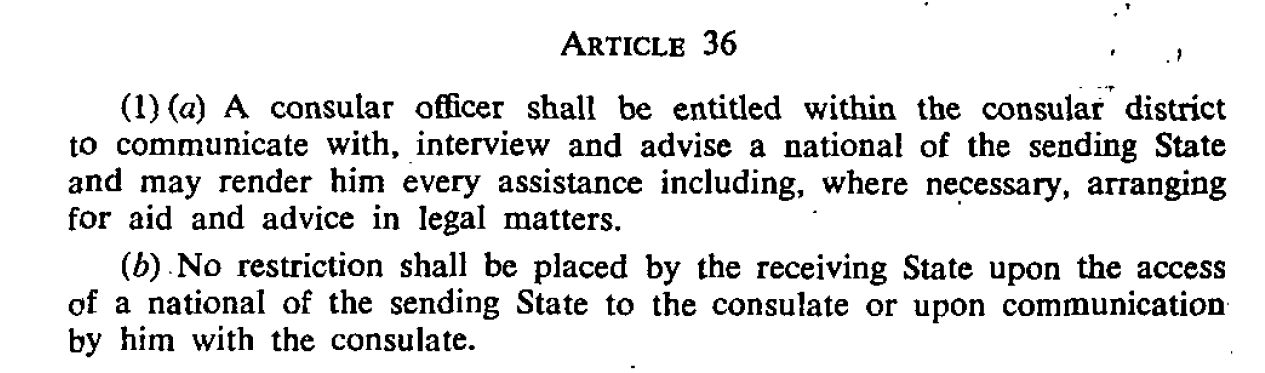
Justice Williams also ruled there was no legal obligation for the Russian Embassy in London to be informed by the hospital or the government “pursuant to Articles 36 and 37 of the Vienna Convention on Consular Relations of 24 April 1963 as Ms Skripal is a Russian national.” The reason the judge gave was that because Article 37 had not been incorporated in domestic British law, it did not apply to the case of Yulia Skripal.

Noone in court challenged this. Neither the court-appointed lawyer for Skripal, Vikram Sacheva, nor the judge appears to have known that a bilateral consular convention between the United Kingdom and the Soviet Union was ratified by the British parliament and became legally binding domestic law in 1968; it is much more explicit than the Vienna Convention. The treaty text, signed in Moscow in 1965 and presented to the House of Commons in November 1968, can be read here.

Russian Embassy access to Yulia Skripal is required by Articles 30, 31(f), 35 and 36. The last of these is the most explicit. In British statutes the word “shall” means must — obligatory, mandatory, required, no discretion allowed.

For a detailed review of the law, read Alexander Mercouris.

Article 36(1)(a) makes it illegal under British law for the British Government to prevent Russian Embassy officials from having access to Yulia Skripal in hospital directly or indirectly. One of the indirect measures the Russian Embassy has yet to take is the engagement of British lawyers to represent her in a court action for habeas corpus and to require the Home Office to justify to a judge the restrictions they have imposed on Skripal at the hospital; for details, read this.

The second sub-section of the Article makes it illegal for the Salisbury Hospital to prevent Yulia Skripal communicating with Russian Embassy officials in London and their lawyers, or vice versa.

On March 29, the hospital reported she was “improving rapidly and is no longer in a critical condition. Her condition is now stable. Her father remains in a critical but stable condition.” The British state radio has reported “separate sources that Ms Skripal is conscious and talking.”

Following these reports, the head of the hospital Cara Charles-Barks (left) and her two press spokesmen were asked what telephone contact Yulia Skripal has made with her next of kin in Moscow. They are refusing to answer.

They were also asked to clarify the hospital’s policy on contact between patients and next of kin, and to give their legal authority for blocking communication between Yulia Skripal and her next of kin in Russia. They do not reply.

Yesterday Speransky reported that cousin Victoria Skripal is applying for her international passport so she can travel to Salisbury. She has yet to file for a British visa.

“I hope I will be able to understand something there on the place,” Victoria Skripal told the newspaper.

Sunday, April 01, 2018

Bloody Friday: Israel's Latest Massacre

Israel Massacres Unarmed Gaza Protesters, Shooting 773 with Live Ammunition 

by TRNN


March 31, 2018

The Israeli military brutally crushed a protest on the Gaza border led by tens of thousands of Palestinians, killing 16 and injuring 1,400. Journalist Max Blumenthal speaks of Israel's suffocating blockade of the strip and the biased media reporting on the "Great Return March."


Ben Norton is a producer and reporter for The Real News. His work focuses primarily on U.S. foreign policy, the Middle East, media criticism, and movements for economic and social justice. Ben Norton was previously a staff writer at Salon and AlterNet. You can find him on Twitter at @BenjaminNorton.


Max Blumenthal
is an award-winning journalist and bestselling author whose articles and video documentaries have appeared in The New York Times, The Los Angeles Times, The Daily Beast, The Nation, The Guardian, The Independent Film Channel, The Huffington Post, Salon.com, Al Jazeera English and many other publications. His most recent book is Goliath: Life and Loathing in Greater Israel. His other book,
Republican Gomorrah: Inside The Movement That Shattered The Party, is a New York Times and Los Angeles Times bestseller. Max is co-host of the podcast Moderate Rebels.