Thursday, July 05, 2018

Electrification and a Burgeoning Buyers' Bourse Challenge OPEC

The New Oil Cartel Threatening OPEC

by Irina Slav - Oilprice.com


July 3, 2018

When reports emerged that India and China are in talks about forming an oil buyers’ club, OPEC was probably too busy with its upcoming June 22 meeting to concern itself with that dangerous alliance.

Now, it may be time for it to start worrying.

“The timing is right. The boom in U.S. oil and gas production gives us greater leverage against OPEC,” the Times of India quoted an Indian official as saying last month after the formal start of said talks.

The two countries, after all, account for a combined 17 percent of global oil consumption and they are the ones that would be the hardest hit if prices rise as a result of OPEC’s actions.

What’s more, they might not be alone in this attempt to curb OPEC’s clout on the global oil market. According to Bloomberg’s Carl Pope, Europe and Japan, previously reluctant to take part in any anti-OPEC projects, may now join in. The reason they are likely to join in is that unlike in previous oil price cycles, now there are alternatives to fossil fuels. Electrification is where OPEC may have to face off with a future oil buyers’ cartel.

India, China, and Europe are all very big on EV adoption. Japan is a leader in battery manufacturing. If they set their minds to it, these four players could upend the oil market and effectively cripple OPEC. Of course, this is a best-case scenario of the kind that rarely unfolds in reality. Related: Why Oil Prices Are Surging

Let’s take India, for example. A recent survey suggested that as many as 90 percent of Indian drivers were willing to switch to EVs if the government built the necessary charging infrastructure, reduced road taxes, and increased subsidies. Another survey identified price and range as additional roadblocks towards the mass adoption of EVs in India. Because of these challenges, New Delhi recently amended its ambitious goal of having an all-EV fleet on the roads of the country by 2030 to having 30 percent of the fleet electric.

China, for its part, is the undisputed leader in global EV adoption: the country accounted for more than 50 percent of global EV sales last year in case you were thinking, “Wait, wasn’t that Norway?” However, this was in large part made possible by generous government subsidies for EV manufacturing. These subsidies are due to be wound down to 0 by 2020, and carmakers are already beginning to brace for a future without the support of the state.

It remains uncertain if the EV boom will continue after 2020


This precarious situation with EVs is reason enough for China and India to seek more clout on international oil markets dominated by OPEC and would justify the formation of a “buyers’ club.” Europe, for its part, is, as a whole, a top performer in EV adoption and it is also very big on environmentalism. At the same time, it still imports crude and quite a lot of it, so it cares about oil prices as a large buyer.

China and India are facing challenges in EV adoption. Europe could help and benefit from it. After all, taken together, Europe, China, India, and Japan account for the manufacturing of as much as 65 percent of the world’s cars, and a lot of these are manufactured in Europe. These four also consume 35 percent of the world’s crude oil and would like to reduce this number.

According to Pope, if they get together, they would be able to negotiate either a more gradual or a faster shift to EVs. It would all depend on whether OPEC would agree to maintain lower prices or not.

A more skeptical view would note the challenges in EV adoption such as subsidies and infrastructure. These would take time to be overcome even if everyone played together. Yet long-term, an oil buyers’ alliance could be a force to be reckoned with by the oil producers, and the latter need to start paying attention now.

Wednesday, July 04, 2018

Pass the AMLO: Mexico Reloaded

Mexico’s AMLO Gets Massive Mandate to Stand Up to the US 

by TRNN


July 2, 2018

Andres Manuel Lopez Obrador, the leftist frontrunner in Mexico’s presidential race, won Sunday’s election by an overwhelming margin with fifty-three percent of the vote. That is at least twenty-five ahead of his nearest rival. This is according to the preliminary results that were released Sunday night.


As the center-left candidate Andres Manuel Lopez Obrador wins the presidency by an overwhelming margin, Laura Carlsen and Alex Main talk about the election results, what this means for Mexico, and how it will affect U.S.-Mexico relations.

Resurrecting the Skripals: Brit Media Invokes the "Salisbury Incident"

Wheel Out the Skripal Story Again

by Craig Murray


4 Jul, 2018

Just as the World Cup had forced the British media to grudgingly acknowledge the obvious truth that Russia is an extremely interesting country inhabited, like everywhere else, by mostly pleasant and attractive people, we have a screaming reprise of the “Salisbury incident” dominating the British media.

Two people have been taken ill in Amesbury from an unknown substance, which might yet be a contaminated recreational drug, but could conceivably be from contact with the substance allegedly used on the Skripals, presumably some of which was somewhere indoors all this time as we were told it could be washed away and neutralised by water.

Amesbury is not Salisbury – it is 10 miles away. Interestingly enough Porton Down is between Amesbury and Salisbury. Just three miles away from Muggleton Road, Amesbury.

The news reports are not mentioning that much.

“I am all out of ideas Inspector. What can possibly be the source of these mysterious poisonings?”

Neither Porton Down nor the Organisation for the Prohibition of Chemical Weapons has any idea where the substance to which the Skripals were allegedly exposed was made. Boris Johnson’s great “coup” of obtaining a majority vote at the OPCW to expand its powers to place blame for chemical attacks, has proven rather otiose as the OPCW has no evidence on which to base any blame for Salisbury. In fact, four months on, May and Johnson’s shrill blaming of Russia remains entirely, 100% evidence free.

I do however wish to congratulate the neo-con warmongers of the Guardian newspaper for verbal dexterity. They have come up with a new formulation to replace the hackneyed “Of a type developed by Russia”, to point the finger for a substance that could have been made by dozens of state or non state parties.

The Guardian today came up with “Russian-created novichok”. This cleverly employs a word that can encompass “developed” while also appearing to say “made”. It also again makes out that novichok is a specific substance rather than a very broad class of substances.

The Guardian’s Steven Morris, by this brilliant attempt deliberately to mislead his readers, runs away with this week’s award for lying neo-con media whore of the week. His achievement is particularly good as the rest of his report is largely a simple copy and paste from the Press Association.

I most certainly hope that the couple in Salisbury hospital recover from whatever is afflicting them.

The media is, by making this the lead story on all broadcast news after last night’s football, inviting us to make the connection to the Skripals. In which case I assume the couple were perfectly well for five hours after contact, able to be very active and even to eat and drink heavily, before being mysteriously instantly disabled at the same time despite different ages, sexes, weights, and metabolisms and random uncontrolled dosages.

Replicating that would be quite a feat.

Gorilla Radio with Chris Cook, Joel Gregory Hayes, Nathalie Chambers, Janine Bandcroft July 5, 2018

This Week on GR

by C. L. Cook - Gorilla-Radio.com


July 5, 2018

Crisis and opportunity are, as the ancient Chinese philosophers knew, opposite sides of the same koan. It is, they say, the attitude governing our reaction to the matter at hand ultimately determining the path we choose and outcomes that follow.

By those calculations, right now we are at a very opportune moment in history; a moment that will determine not just what kind of future we'll have, but if there is to be a future at all.

It seems our species' irresistible cleverness has at last met the immovable environmental reality of existence within the finite context of living on a small orb in space, and how we deal with this imminent crisis/opportunity is the question of the age.

Listen. Hear.

Joel Gregory Hayes is scientific technician and adventurer currently embarked on a journey to create and prove a new solar charged Electric Vehicle, or SEV. It is his and his partners' plan to engineer and pilot their vehicle between the north tip and southern reaches of the Americas.

Joel Gregory Hayes in the first half.

And; as the small informs the large, so too the way we live our little lives can have great effects on the broader World. Here in our green and pleasant Victoria we are seeing a drastic diminishment of not only what little remains of the wild spaces once surrounding us, but the parks, urban forest, and rural spaces closer to home too; all sacrificed for industry, and a real estate business booming out of control.

Nowhere is the loss more evident than in Saanich, a jurisdiction blessed with all these attributes, and where the latest facing the developer's axe is the as yet unrecognized, Kings Road Park.

Nathalie Chambers is an organic farmer, business owner, progressive community leader, fundraiser, project manager, public speaker on biodiversity and local food security, author of the book, 'Saving Farmland: The Fight for Real Food,' and past candidate for Saanich council.

Nathalie Chambers and the fight of our lives; saving Saanich, one green space at a time in the second half.

And; Victoria-based activist and CFUV Radio broadcaster at-large, Janine Bandcroft will be here at the bottom of the hour with the Left Coast Events Bulletin of some of the good things to be gotten up to in around our town in the coming week. But first, Joel Gregory Hayes and SEV for the Americas.

Chris Cook hosts Gorilla Radio, airing live every Thursday between 11-Noon Pacific Time. In Victoria at 101.9FM, and on the internet at: http://cfuv.uvic.ca.  He also serves as a contributing editor to the web news site, http://www.pacificfreepress.com. Check out the GR blog at: http://gorillaradioblog.blogspot.ca/

Tuesday, July 03, 2018

Ice Cubes for Eskimos: Setting the Table for Upcoming Trump-Putin Summit

The Sale of Another Century – The Putin-Trump Summit

by John Helmer - Dances with Bears


July 2, 2018

Moscow - When cynical and unscrupulous men are desperate, they become as predictable as if they were principled. The difference between such men is hard to tell.

Not since the Alaska Purchase of 1867 have the rulers of Moscow and Washington been as desperate to sell something to each other for a price the press and public opinion on both sides are unprepared to calculate or accept.

When President Vladimir Putin (lead image, left) and President Donald Trump (right) meet in a fortnight, this price will be a secret both of them will agree to keep to protect themselves from adversaries at home more powerful than they are themselves.

With two weeks still to go for preparations, so far only the terms the US side intends to table are in the public domain. No Russian government official, think-tank expert, or reporter has published an account of what the Russian terms will be.

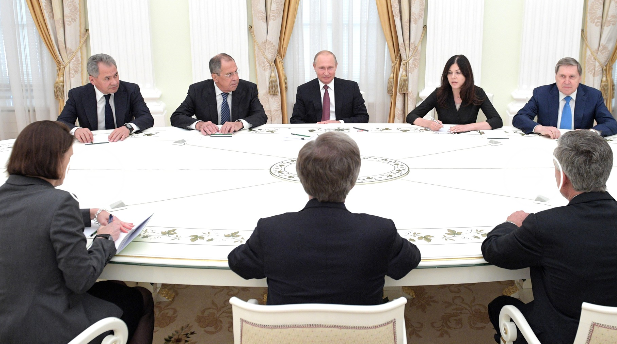
During the Kremlin meeting last week between Putin and Trump’s national security advisor, John Bolton, one clue was visible. This was the appearance of the Defence Minister Sergei Shoigu on the Russian side of table, alongside the president’s foreign affairs advisor Yury Ushakov and Foreign Minister Sergei Lavrov. Shoigu wasn’t matched by a military officer or Pentagon counterpart on the American side of the table. So Shoigu wasn’t present to speak. He was there to listen, and to report to the General Staff what the US side is proposing – and not less significant, what Putin had to say. Shoigu’s presence was a signal that on the Russian side, the military do not quite trust the president — their own, not the other one.

Tsar Alexander II’s decision to sell the Alaskan colony to the US started with the military defeat the Russians suffered during the Crimean War, which ended in 1856. The military weren’t to recover against the Ottoman Turks for another twenty years. In the interval, the tsar had debts to cover from his Crimean losses, as well as from the indemnity Alexander paid to Russian landowners for their loss of serfs in the emancipation of 1861.

Developers of eastern Siberia believed that if Alaska were sold, they could divert its state cashflow into investment schemes in the Amur territory. Also, the imperial treasury could ill afford the subsidies required for the Russian American Company, which had failed to turn otters, seals and whales into profit-making for Alaska. So the assessment in St. Petersburg was that if gold were to be discovered in Alaska, as it had been already in California, the American rush would overwhelm the Russian defences and the territory would be lost. Selling before the forfeit seemed prudent at the time.

A decade was required to raise the price from $5 million the Americans offered to $7.2 million, the figure which the Russians accepted; about $110 million in current money. In the process, the Russian Ambassador in Washington arranged bribes for US officials and journalists, as well as kickbacks for himself, and so encouraged a policy of a sale at any price; US Secretary of State William Seward was also on the give and take. As was the Russian custom then and now, the proceeds of the Alaska deal were shared among those closest to the sell-out.

For the Putin-Trump meeting the only non-negotiable point on the Russian side is Crimea; its status as a Russian territory will not be discussed. Concessions are negotiable on the other warfronts.

The Kremlin’s position on the war in the Donbass is to play for time enough to gauge what Petro Poroshenko’s successor (Yulia Timoshenko) as Ukrainian president will settle for after the election next March. If the US does not back an escalation of operations by the Ukrainian military, including the use of the newly supplied US Javelin anti-tank missile, then the Russian offer will be to secure the Novorussian forces in place and exchange non-offensive undertakings.

On the Syrian front, Putin has already demonstrated his readiness to withdraw Russian air and ground forces – before the US and its allies have made a reciprocal move.

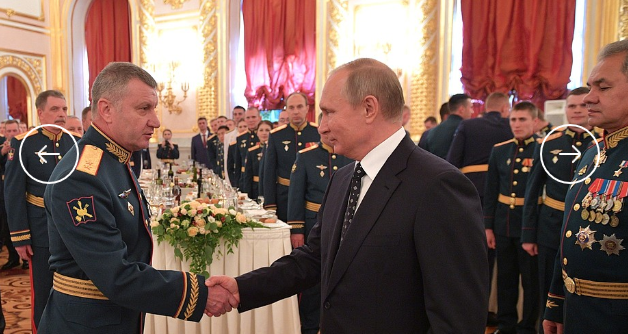
“Comrades,” Putin told a Kremlin ceremony for graduating cadets last week “over the past years a great deal has been done to develop the Russian Armed Forces. The Russian Army demonstrated its increased potential and coordination when it fought terrorists in Syria. It is now up to you and your comrades-in-arms to make full use of this operation in your military training.
As you know, we started the withdrawal of our forces during my visit to Khmeimim. The withdrawal carries on as we speak: 13 aircraft, 14 helicopters, and 1,140 personnel were withdrawn over the past few days. All these people were tested in combat. You and your comrades-in-arms will have to make full use of this experience…”

Right to left: Defense Minister Shoigu and President Putin meet 
military officers at the academies’ graduation ceremony June 28; for the record, click

The official transcript concludes with this toast by Major-General Alexander Maksimentsev, commander of Russian air operations in Syria:

“Let us drink to the Supreme Commander-in-Chief of the Russian Federation Vladimir Putin, to Russia, and to its glorious Armed Forces and the unconquerable Russian soldier!”

The problem for the Russian military is that they believe US military undertakings at the field level, and at the political level, cannot be trusted. Consequently, they doubt Trump or his White House staff can command, even if they wish to control, the operations in Syria of the CIA or the Israelis. In such a situation, Shoigu’s post at the meeting with Bolton was to ensure that Putin left no opening for a US offer that may lead to Russian casualties in the field.


The Kremlin meeting on June 27 with the US delegation: in foreground, 
left to right, Fiona Hill, a Russian speaker on the staff of the US National 
Security Council; Bolton; and US Ambassador to Russia, John Huntsman. 
In the rear, the Russian delegation from left to right: Shoigu, Lavrov, 
Putin, interpreter, and Ushakov. 

Bolton himself conceded after the meeting that in Syria the US is looking to reduction of Russian support for Iranian operations, not Syrian ones.

“There are possibilities,” Bolton claimed on television on Sunday, “for doing a larger negotiation on helping to get Iranian forces out of Syria and back into Iran which would be a significant step forward…
I don’t think Assad is the strategic issue. I think Iran is the strategic issue. It’s not just their continuing nuclear weapons program, it’s their massive support for international terrorism and their conventional forces in the Middle East and I would say there – this is something that the two presidents will want to discuss at length because I think President Trump’s decision to withdraw from the misbegotten Iran nuclear deal, reimpose our sanctions begin to put much more pressure on Iran is having an effect on their decision making.”

Denuclearisation of the Middle East is an impossibility. Although Putin has committed Russia to continuing the Joint Comprehensive Plan of Action (JPCOA) for cutting Iran’s capacity to defend itself with nuclear weapons, there is no Russian commitment to denuclearising Israel, or restricting US nuclear-armed operations from the Persian Gulf to the Mediterranean, targeted at Iran and Syria. What is left for Putin to negotiate are short-term expedients to limit the likelihood of US-backed Israeli, Saudi or other attacks on Iranian territory.

Again, the problem for the Stavka – as the Russian military command is known – is that political undertakings by the US and its allies are consistently proved to be worthless. Political concessions by Putin are therefore regarded as letting down Russia’s guard, with the risk of escalating adversary operations and Russian losses, tactically now, strategically for the future. From the point of view of the Stavka, deterring the Americans with ready military force is the only effective position from which Putin can negotiate.

“It is important”, a Kremlin-financed think-tank, the Valdai Discussion Club, cautioned last week, “that the decisions taken at the summit are to be exercised, not sabotaged, as the American side has done a number of times. This is the only way to lay the foundation for future Russian-American relations, where not only Washington, but also Moscow will benefit.”

Disengagement of forces to reduce the likelihood of accidental clashes and fatalities is easier to announce than to implement if there continues to be a steady advance of US naval missile and ground-based Aegis missile batteries in the Black Sea and the Baltic. What then can be negotiated between Trump and Putin on this; on NATO readiness exercises and forward force deployments; and on the eroding limits of the Intermediate-Range Nuclear Forces Treaty (INF) for the positions of the two sides?

Naturally, it’s not for the Stavka to discuss in public the price they are planning to inflict on the Americans and their allies if they keep moving forward. Instead, military and security analysts in Moscow were asked what terms of a military or security type, in any operational theatre around the world, they think Putin can offer the Americans at the summit.

They were also asked to say what they believe are the priorities Putin will want to negotiate in exchange with Trump. If they know, they won’t answer. One source went so far as to say he isn’t going to make any comments at the moment — and requested this be off the record.

The Trump attack on NATO allies for failing to spend more of their domestic budgets on military undertakings is read in Moscow as an opening to less costly escalation by the European powers, especially Germany and France. Relegating the British is also a tactical objective on the Russian side; Moscow sources believe this is best left to the British themselves to accomplish as they have been doing.

Undermining Germany’s control of the European Union is a tactical objective on the American side. Moscow sources think Trump is too incompetent to match Putin on this score; the smaller European powers are all moving in a less Russia- threatening direction, they note. Those which remain hostile are within a stone’s throw of Russian forces – much too close to survive an engagement if they push too provocatively.

The conclusion, according to the state news agency Tass reporting an editorial of Nezavisimaya Gazeta:

“Moscow and Washington won’t be able to resolve their key military differences on Syria and Europe in the near future. The forthcoming meeting between Putin and Trump will be apparently devoted to searching for some insignificant compromises and concessions…”

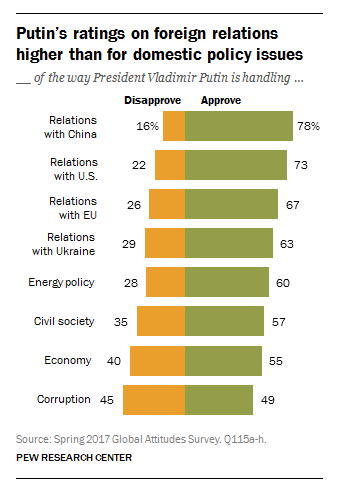
Popular support for Putin is sustainable so long as the military confrontation with the US is acute. For Trump, it’s the reverse – if he appears to be reducing the risks of war with Russia, China, or North Korea, his domestic support rises. Putin’s domestic support evaporates on the widespread voter perception that he and the officials he appoints run the economy for the benefit of the oligarchs, and are rewarded corruptly for this policy.


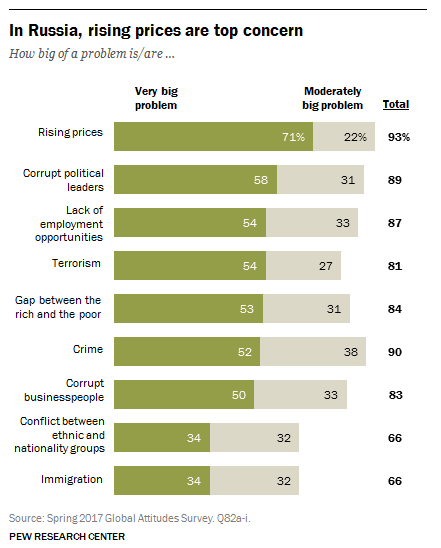
It is also the near-universal Russian conviction that there is no policy which the government has decided which is not pursued for corrupt reasons. This is what has made the recently announced decisions to increase value-added tax from 18% to 20%, and to extend the retirement age from 60 to 65 (for women from 55 to 63) bellwether issues for the president and the voters. For Putin’s support among voters is the default position — if not Putin, the alternative would be worse — except in the war conditions which the Americans have created.


There is now no Russian business source in Moscow, London, Geneva or Berlin who doesn’t understand this, along with their western lawyers, bankers, insurers, and wealth managers. “So long as the oil price stays up and Trump makes enemies of the Germans and the Chinese,” a veteran international banker to Russian corporations acknowledges.

“Putin has a margin for manoeuvre. His reappointments of exactly the same men as he’s trusted for years to govern the country show he doesn’t trust anyone else in Russia for the future.
In the medium term this means sclerosis. But right now Putin must keep happy the two powers which, if they get angry, threaten him – the military and the oligarchs. It takes American and British stupidity, and of course their media, not to see this.”

Russian businessmen advertise in the press; their foreign advisors don’t talk publicly at all. What they agree among themselves is that they are expecting Putin to look for a way he and Trump can agree on a return to the business as usual in which they used to be comfortable.

Foreign Minister Lavrov claimed on June 29 in an interview with a London television channel:

“I have mentioned sanctions only in the context of the deterioration of relations. We are not pleading to remove them. It is not our business, it is for those, who introduced sanctions, to decide whether they want to continue or whether common sense would prevail.”

Lavrov also conceded: “we would not mind them lifted.”

Since the Kremlin assessment is that Trump is too weak politically to attempt this, and Putin is hard-pressed by the oligarchs to save their businesses in Russia and their fortunes abroad, the question that is being considered for a private exchange between Putin and Trump is a modern-day version of the Alaska Purchase.

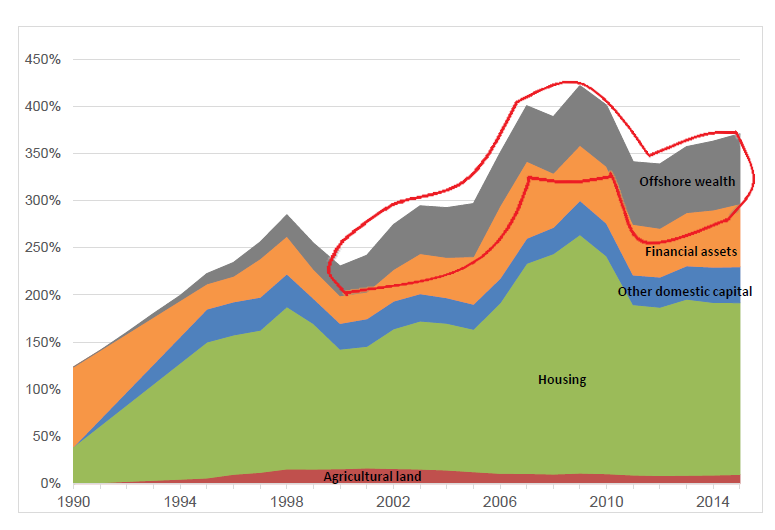
Today, the offshore Russian colony is of vastly greater wealth than Alaska ever was to the imperial tsar. Alaska fetched a small fraction of the value of Russia’s national income in 1867. The offshore Russian colony today is almost equal in value to the national income. This is how it looks on the map:

GROWTH OF THE RUSSIAN COLONY OF EL DORADO, 2000-2015

Types of Russian private wealth as a percentage of national income


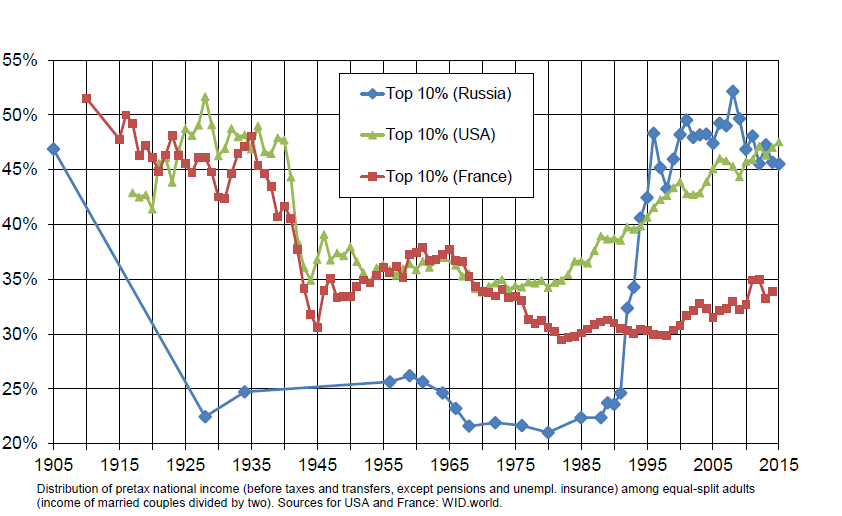
How this capital in cash, real estate, shareholdings, and other assets was first generated at the start of the Yeltsin administration, and then transferred offshore during the Putin administration, can be followed here:


RUSSIAN TAKE-OFF FOR THE TOP 10% INCOME-EARNERS, 1990-2015


Today’s offshore colony isn’t for sale to the Americans, for it’s already been bought and sold – not only to the US, but to the UK and the other capital havens of Europe and the Caribbean.

The US economic war against Russian finance and against the oligarchs and their interests is severing the flow of cash between the homeland and this colony, and between the colony and its host, the international capital market.

This is not yet total war. The British have attacked Roman Abramovich’s residency permit for London, but welcomed the Otkritie Bank fraudsters Vadim Belyaev and Boris Mints. The US has barred Oleg Deripaska and Victor Vekselberg from their homes in New York, Washington, and Connecticut, but left Abramovich undisturbed at his addresses in Manhattan and Aspen.

Last week the French abandoned all effort to prosecute Russians for money-laundering and released Suleiman Kerimov to move between Moscow and Cap D’Antibes as he pleases, along with his partner, German Gref, the chief executive of Sberbank.

“We would not mind,” says Lavrov, who has been particularly close in the past to Deripaska, and at present to Alexander Vinokurov, “to build up our own capacity in key sectors of economy, security and other areas on which an independent state depends.
In the recent years, we have learned a lot, including the fact that in these issues you cannot rely on the West. You cannot rely on Western technologies, because they can be abruptly stopped at any moment. You cannot rely on the items, which are essential for the day-to-day living of the population, coming from the West, because this could also be stopped.”

An obvious option, the nationalization of these key sectors is not the Kremlin’s policy, not even when the banks have been looted and the manufacturers have lost their export markets. Also, despite repeated public commitments to de-offshorization, recovering Russia’s offshore wealth is not Putin’s policy.

How far Trump will withdraw on the economic warfare front and support Putin with the oligarchs on these points is certain to be tested, oligarch sources believe. They expect Putin to ask Trump what shareholding for Deripaska’s companies will satisfy him for the April 6 sanctions to be modified, and at least part of their business returned to normal. Trump’s conversation with Putin on the Deripaska sanctions will be kept secret at least until the US Treasury has agreed to rule on Deripaska’s application for sanctions relief in August for some of his companies, in October for others. In the interval, the market value of such inside information may be more difficult to keep secret in Moscow.

When cynical and unscrupulous men are desperate, they become as predictable as if they were principled. The difference between such men is hard to tell.

NOTE: the original of the lead image was an American newspaper caricature, published on May 25, 1867, showing the Russian tsar offering Secretary of State Seward an unequal trade – bears, seals, icebergs and Eskimos for more valuable American assets.

Realliances: America Finding Friends Harder to Make in Middle East

Is the US-Kurdish Alliance Over? New Agreement Between Kurds and Assad Could Spell End for U.S. Role in Syria

by Whitney Webb - MintPress News


July 2, 2018

The agreement came as a result of recent negotiations between Kurdish and Syrian government officials in both Damascus and Qamishli.


For over a year, much of northeastern Syria has found itself under de facto occupation by the United States and its military proxy, the Syrian Democratic Forces (SDF). The occupied territory, accounting for nearly a third of Syria’s total landmass and including large portions of the al-Hasakah, al-Raqqa and Deir Ez-Zor regions, has largely been overseen by the SDF, an umbrella group of militias dominated by the Kurdish People’s Protection Units (YPG), which allied with the U.S. early in the conflict.

While the SDF has seemingly had complete control of the occupied territory — which boasts most of Syria’s oil, gas, freshwater and agricultural resources — it seems that increased local resistance to the SDF’s control of the region, as well as the U.S.’ failure to protect its allies elsewhere in Syria, has now pushed the YPG to reconsider its alliance with the United States and instead consider allying with the Syrian government, led by Syrian President Bashar al-Assad.

The clearest indication yet that the YPG’s relationship with the Syrian government is set to change dramatically came on Monday, when Al Masdar News reported that the YPG and the Syrian Arab Army (SAA) had reached a preliminary agreement in the al-Hasakah region that is set to lead to increased SAA influence in areas under YPG control. Per the agreement, the YPG has announced that it will remove all posters of Abdullah Ocalan — one of the founding members of the Kurdistan Workers’ Party (PKK), which is associated with the YPG — from areas under its control and will also allow the SAA to reopen recruitment offices throughout the region. The agreement came as a result of recent negotiations between Kurdish and Syrian government officials in both Damascus and Qamishli.

However, this agreement is hardly the end of future YPG and SAA cooperation in the area, as negotiations continue. As Al Masdar noted, new talks between the two groups are currently underway with the aim of establishing joint YPG/SAA checkpoints throughout the al-Hasakah region.

The agreements are part of a wider effort by the Syrian government to convince Kurdish factions in Syria’s northeast to abandon their alliance with the United States. Those negotiations are aimed at convincing the Kurds to join forces with the SAA throughout Syria and to give control of key border crossings into Iraq and Turkey to the SAA.

In exchange, the Syrian government has offered to include the Kurdish language in the Syrian educational system, consider military service in the YPG as analogous to service in the SAA, and create a permanent post for a Kurdish official in the Syrian state oil ministry.

Realignment accelerating


The unprecedented negotiations between the YPG and Syrian government come less than a month after local tribes of the al-Hasakah, Aleppo and al-Raqqa regions met in the Syrian government-controlled city of Deir Hafer. During that meeting, over 70 tribes — whose territory is either partially or entirely under occupation by the United States and the SDF — expressed their commitment to rejoining the Syrian state, re-establishing Syrian territorial integrity, and creating a joint military force with the SAA that would seek to expel foreign troops and militants from Syria. During that meeting, it was announced that this joint military force would directly target SDF and U.S. forces in Syria’s occupied northeast.

The formation of this military force followed smaller-scale efforts launched earlier this year by guerilla-style resistance groups in occupied Syria, particularly in the city of Raqqa, where local fighters targeted U.S. military installments in and around the city earlier this year.

However, growing local resistance to Kurdish and U.S. rule is only part of what motivated the YPG to consider an alliance with the Syrian government. Another major reason is the fact that Assad recently asserted that the Syrian government would soon turn its attention towards “liberating” northeastern Syria from the SDF and the U.S. by force if efforts to negotiate with the Kurdish-majority SDF failed.

In an interview with RT, Assad stated:

We’re going to use two methods to deal with the SDF: The first one, we started opening doors for negotiations – because the majority of them are Syrians. And supposedly they like their country, they don’t like being puppets to any foreigners – that’s what we suppose. […] We all don’t trust the Americans, [so] the one option is to live with each other as Syrians.”

If negotiations with the SDF fail, Assad warned that the Syrian army would have no choice but to “liberate” areas occupied by the SDF, “with the Americans, or without the Americans.” Assad emphasized this point, stating:

“This is our land, it’s our right, it’s our duty to liberate [these areas], and the Americans should leave. Somehow, they’re going to leave.” 

The reality of allying with the U.S.


In addition to Assad’s vow to “liberate” northeastern Syria from the SDF regardless of the U.S. presence in the region, the U.S.’ recent abandonment of its allies elsewhere in Syria bodes poorly for the future of the YPG-U.S. alliance that has made the occupation of northeastern Syria possible.

When the Syrian government’s offensive to retake the Dara’a region in southern Syria was announced last month, the U.S. government warned that it would respond “decisively” in order to protect the “rebel” groups in the area, some of which are funded and supported by the U.S. However, soon after the offensive began, the U.S. backed out of its promise to its allied groups in the region, warning them not to expect any assistance from the U.S. in repelling the Syrian government offensive. As a result, the offensive is expected to result in a major victory for the Syrian government.

For the U.S.-allied Kurds in the northeast of Syria, the Dara’a offensive is a strong indication that the U.S. is hardly a dependable ally. Particularly after the Kurds lost the city of Afrin after the U.S. failed to aid the YPG in repelling a Turkish offensive earlier this year, many Kurds felt “betrayed” by the U.S. and began to question the YPG-U.S. alliance outright. Now, with the U.S. failing to protect its allies elsewhere in Syria, the Kurds seem to have all the indications they need that the U.S. is unlikely to offer them military protection against the Turks or the Syrian government.

The new agreement between the Kurds and the Syrian government is a major indication that U.S. influence in Syria is quickly waning and that its control over Northeastern Syria could soon be lost. Though the Trump administration seems to have accepted that it is only a matter of time until it is ousted from Syria, rumored efforts by the U.S. to deepen its involvement in the country — such as by using a false-flag chemical weapons attack as pretext — could throw a wrench into the Syrian government’s efforts to restore Syria’s territorial integrity and prevent the long-standing, U.S.-backed goal of partitioning Syria.

Whitney Webb is a staff writer for MintPress News and a contributor to Ben Swann’s Truth in Media. Her work has appeared on Global Research, the Ron Paul Institute and 21st Century Wire, among others. She has also made radio and TV appearances on RT and Sputnik. She currently lives with her family in southern Chile.


Republish our stories! MintPress News is licensed under a Creative Commons Attribution-NonCommercial-ShareAlike 3.0 International License. 

Monday, July 02, 2018

Stealing Mexico: Southern "Bernie" Hombres Trump Trumpitos

How the "Bernie of Mexico" Won the Presidency

by Greg Palast


July 2, 2018

This is Trump’s nightmare.
 

I’m writing minutes after the victory of the Bernie Sanders of Mexico, Andres Manuel Lopez Obrador. Everyone calls him, “AMLO.” This is actually AMLO’s re-election: He first won the presidency in 2006. But back then the thieving, scheming, blood-stained criminal gang that rules Mexico (and I’m being polite), declared AMLO’s dissolute opponent the winner.

In 2006, rather than concede to vote thievery, lick his wounds and toddle off on a book tour, AMLO took his supporters into the streets, raised hell, blocked the capital’s central square for months, held a People’s Inaugural, and vowed to never, ever concede.

And tonight, twelve years later, AMLO has won a crushing, too-big-to-steal victory in Mexico’s presidential election.

And while the Good and Great told him he’d be finished if he kept protesting the stolen election, he made counting every vote the very first of his five-point campaign platform. He understands that even those with empty stomachs also hunger for democracy.

And there’s a lesson here. Are you listening, Al Gore? Mr. Kerry and Mrs. Clinton?

Bernie or Hugo?


And AMLO gave the people something to vote for. The rest of his platform included expanding free college education, raising the minimum wage, fighting income inequality and creating a massive infrastructure-fixing jobs program.

If that sounds like Bernie Sanders, that’s no accident. AMLO, like Bernie, said he is taking his program from that great Mexican hero, Franklin Delano Roosevelt.

Nevertheless, Mexican media blared apoplectic prophesies that AMLO would be the Second Coming of Hugo Chavez, with mass nationalizations to follow. (The hysteria was parroted in the New York Times, not coincidentally, owned by Mexico’s richest man.)

I can tell you, AMLO is way more Bernie Sanders than Hugo Chavez (and I’ve known all three).

Both AMLO and Sanders were mayors who ran their cities as what I’d call, “Pothole Populists.” It’s get-the-job-done socialism with the emphasis on social not -ism.

AMLO proved he could tamp down corruption, keep a stingy hold on budgets while increasing pensions and providing education grants. Mayor AMLO, unlike a certain Mr. Trump, completed major city infrastructure projects—all out of the savings from cutting waste and corruption.

But unlike Bernie, who did his good works in the mean streets of Burlington, Vermont, AMLO worked nothing less than a miracle in Mexico City, which is bigger than New York and ten times as ungovernable.

(And like Bernie, AMLO is a working class kid who worked in the social movement trenches: Sanders as a SNCC organizer in Chicago, while Lopez Obrador spent six years living with, sharing the lives of and fighting for the poorest Mayan families.)

But they are stealing it right now 


Let’s not get carried away with our democracy high. This election is being stolen as I write.

Not the presidency. AMLO’s poll lead of 52% to 25% for his nearest competitor, is just too much to steal. But every seat of the Mexican Congress is up for grabs, and the Powers that Be, the laughably named Institutional Revolutionary Party (PRI) and the right-wing National Action Party (PAN) are fighting for their lives – and sometimes they fight with bullets.

So, far, 132 officials and candidates have been murdered in this election cycle. I spoke with voting rights activist (and movie star) Yareli Arizmendi in Mexico City, who told me that the old guard politicians were tied up with the Zetas and other drug gangs.

In all fairness, I should note that many victims were not just AMLO allies but also PRI, Green Party and independents who challenged the control of their cities and states by narco-traficantes.

Indeed, AMLO’s campaign gained fuel when, in 2014, the public learned of the disappearance of 43 students (and 3 investigating journalists). Evidence now indicates they were hacked to pieces and dissolved in acid by the Guerreros Unidos gang – on orders from a politician connected to the ruling party.

Arizmendi reports that ballots have been burnt in gang- and ruling-party controlled districts. She sent me a video of a woman pre-marking a stack of ballots.

I saw this game up close in 2006 when I was sent by the Guardian and Democracy Now to investigate AMLO’s shock loss by just half a percent of the vote.

On election night, AMLO was way ahead when the official count was halted—then resumed with a massive reversal in the final count. Our investigators found massive ballot-box stuffing, ballot box dumping and intimidation of voters at gunpoint. There were games with electoral rolls apparently orchestrated by the Bush Administration which, I found, had used the same company that helped Katherine Harris rig the 2000 election in Florida, ChoicePoint, to steal Mexico’s entire voter roll!

(Watch this 2006 Democracy Now! report, "Florida con Salsa," from Mexico City.) 


And this time, the incumbent PRI hired Cambridge Analytica. Trump’s social-media manipulators and data thieves were paid $7.2 million on their promise—I can’t make this up—to repeat a Mexican variant of their “Corrupt Hillary” campaign to smear AMLO.

It was a hard sell, especially as the wife of the current President, PRI man Enrique Peña Nieto, was caught taking a $7 million condo from a government contractor.

As I write, it looks like AMLO has crushed the second-highest candidate vote two-to-one and swept the House of Deputies. However, his coalition of parties is, as of the moment, showing poorly in the Senate race, way below pre-election polling data.

AMLO: Arrest Trump 


Mexicans have had enough of the Trump-ito grifters who have held the Mexican presidency, usually by theft, for decades.

President Peña Nieto made his nation cringe with his invitation to Trump during the US Presidential campaign, boosting Trump’s candidacy. And he’s not had much to say about the caging of children on the border.

Although Trump’s child prisoners and their families detained at the border are not Mexican citizens (most come from Central America), AMLO has called for Trump’s arrest for the kidnappings as violating international law.

That’s just one indication AMLO’s victory is Trump’s nightmare. AMLO has shown he is not afraid of privileged pricks, even if they try to make themselves look fierce by staining themselves orange.

NAFTA 


Weirdly, Lopez Obrador has also been called “The Trump of Mexico,” simply because they both speak to the desperation of their nation’s working classes. And both have few good words for NAFTA.

But Trump’s act, the billionaire turned class warrior, was always a fake. AMLO is for real.

Commerce Secretary Wilbur Ross has demanded that Mexico raise the wages of all auto workers so that the US can better compete within NAFTA.

AMLO is calling Trump’s bluff: he said, “yes” – which may come as a shock to Secretary Ross… Ross owns eight of those auto factories.

Hope and Danger 


The slogan of AMLO’s coalition is, Juntos Haremos Historia. Together, we’ll make history. But history has a way of bleeding to death in Mexico.

In March 1994, Luis Donaldo Colosio was on the cusp of winning Mexico’s presidency. But his political turn to the Left infuriated his PRI bosses. At a public rally where he supposedly had government protection, one assassin, and possibly a second, put two bullets in his head.

I hope AMLO’s story will have a happier ending.


Greg Palast (Rolling Stone, Guardian, BBC) is the author of The New York Times bestsellers, The Best Democracy Money Can Buy and Billionaires & Ballot Bandits, now out as major motion non-fiction movie: The Best Democracy Money Can Buy: The Case of the Stolen Election, now available on Amazon and Amazon Prime.
Follow Palast on Twitter and Instagram | Like Palast on Facebook | Forward to a friend
Subscribe to Palast's Newsletter or his separate list for Poems & Stories.

Sunday, July 01, 2018

But Why Do They Come?

Why do they flee?

by William Blum – The Anti-Empire Report #158 


June 26th, 2018  

The current mass exodus of people from Central America to the United States, with the daily headline-grabbing stories of numerous children involuntarily separated from their parents, means it’s time to remind my readers once again of one of the primary causes of these periodic mass migrations.

Those in the US generally opposed to immigration make it a point to declare or imply that the United States does not have any legal or moral obligation to take in these Latinos.

This is not true.

The United States does indeed have the obligation because many of the immigrants, in addition to fleeing from drug violence, are escaping an economic situation in their homeland directly made hopeless by American interventionist policy.

It’s not that these people prefer to live in the United States. They’d much rather remain with their families and friends, be able to speak their native language at all times, and avoid the hardships imposed upon them by American police and other right-wingers.

But whenever a progressive government comes to power in Latin America or threatens to do so, a government sincerely committed to fighting poverty, the United States helps to suppresses the movement and/or supports the country’s right-wing and military in staging a coup. This has been the case in Guatemala, El Salvador, Mexico, Nicaragua and Honduras.

The latest example is the June 2009 coup (championed by US Secretary of State Hillary Clinton) ousting the moderately progressive Manuel Zelaya of Honduras. 

The particularly severe increase in recent years in Honduran migration to the US is a direct result of the overthrow of Zelaya, whose crime was things like raising the minimum wage, giving subsidies to small farmers, and instituting free education. 
It is a tale told many times in Latin America: The downtrodden masses finally put into power a leader committed to reversing the status quo, determined to try to put an end to two centuries of oppression … and before long the military overthrows the democratically-elected government, while the United States – if not the mastermind behind the coup – does nothing to prevent it or to punish the coup regime, as only the United States can punish; meanwhile Washington officials pretend to be very upset over this “affront to democracy” while giving major support to the coup regime. 

The resulting return to poverty is accompanied by government and right-wing violence against those who question the new status quo, giving further incentive to escape the country.

Talk delivered by William Blum at the Left Forum in New York, June 2, 2018


We can all agree I think that US foreign policy must be changed and that to achieve that the mind – not to mention the heart and soul – of the American public must be changed. But what do you think is the main barrier to achieving such a change in the American mind?

Each of you I’m sure has met many people who support American foreign policy, with whom you’ve argued and argued. You point out one horror after another, from Vietnam to Iraq to Libya; from bombings and invasions to torture. And nothing helps. Nothing moves these people.

Now why is that? Do these people have no social conscience? Are they just stupid? I think a better answer is that they have certain preconceptions. Consciously or unconsciously, they have certain basic beliefs about the United States and its foreign policy, and if you don’t deal with these basic beliefs you may as well be talking to a stone wall.

The most basic of these basic beliefs, I think, is a deeply-held conviction that no matter what the US does abroad, no matter how bad it may look, no matter what horror may result, the government of the United States means well. American leaders may make mistakes, they may blunder, they may lie, they may even on many occasions cause more harm than good, but they do mean well. Their intentions are always honorable, even noble. Of that the great majority of Americans are certain.

Frances Fitzgerald, in her famous study of American school textbooks, summarized the message of these books: 
“The United States has been a kind of Salvation Army to the rest of the world: throughout history it had done little but dispense benefits to poor, ignorant, and diseased countries. The U.S. always acted in a disinterested fashion, always from the highest of motives; it gave, never took.”

And Americans genuinely wonder why the rest of the world can’t see how benevolent and self-sacrificing America has been. Even many people who take part in the anti-war movement have a hard time shaking off some of this mindset; they march to spur America – the America they love and worship and trust – they march to spur this noble America back onto its path of goodness.

Many of the citizens fall for US government propaganda justifying its military actions as often and as naively as Charlie Brown falling for Lucy’s football.

The American people are very much like the children of a Mafia boss who do not know what their father does for a living, and don’t want to know, but then they wonder why someone just threw a firebomb through the living room window.

This basic belief in America’s good intentions is often linked to “American exceptionalism”. Let’s look at just how exceptional America has been. 
Since the end of World War 2, the United States has: 

  • Attempted to overthrow more than 50 foreign governments, most of which were democratically-elected.
  • Dropped bombs on the people of more than 30 countries.
  • Attempted to assassinate more than 50 foreign leaders.
  • Attempted to suppress a populist or nationalist movement in 20 countries.
  • Grossly interfered in democratic elections in at least 30 countries.
  • Led the world in torture; not only the torture performed directly by Americans upon foreigners, but providing torture equipment, torture manuals, lists of people to be tortured, and in-person guidance by American teachers, especially in Latin America.

This is indeed exceptional. No other country in all of history comes anywhere close to such a record. But it certainly makes it very difficult to believe that America means well.

So the next time you’re up against a stone wall … ask the person what the United States would have to do in its foreign policy to lose his or her support. What for this person would finally be TOO MUCH. Chances are the US has already done it.

Keep in mind that our precious homeland, above all, seeks to dominate the world. For economic reasons, nationalistic reasons, ideological, Christian, and for other reasons, world hegemony has long been America’s bottom line. And let’s not forget the powerful Executive Branch officials whose salaries, promotions, agency budgets and future well-paying private sector jobs depend upon perpetual war. These leaders are not especially concerned about the consequences for the world of their wars. They’re not necessarily bad people; but they’re amoral, like a sociopath is.

Take the Middle East and South Asia. The people in those areas have suffered horribly because of Islamic fundamentalism. What they desperately need are secular governments, which have respect for different religions. And such governments were actually instituted in the recent past. But what has been the fate of those governments?

Well, in the late 1970s through much of the 1980s, Afghanistan had a secular government that was relatively progressive, with full rights for women, which is hard to believe, isn’t it? But even a Pentagon report of the time testified to the actuality of women’s rights in Afghanistan. And what happened to that government? The United States overthrew it, allowing the Taliban to come to power. So keep that in mind the next time you hear an American official say that we have to remain in Afghanistan for the sake of the women.

After Afghanistan came Iraq, another secular society, under Saddam Hussein. And the United States overthrew that government as well, and now the country has its share of crazed and bloody jihadists and fundamentalists; and women who are not covered up properly are sometimes running a serious risk.

Next came Libya; again, a secular country, under Moammar Gaddafi, who, like Saddam Hussein, had a tyrant side to him but could in important ways be benevolent and do some marvelous things. Gaddafi, for example, founded the African Union and gave the Libyan people the highest standard of living in Africa. So, of course, the United States overthrew that government as well. In 2011, with the help of NATO, we bombed the people of Libya almost every day for more than six months.

Can anyone say that in all these interventions, or in any of them, the United States of America meant well?

When we attack Iran, will we mean well? Will we have the welfare of the Iranian people at heart? I suggest you keep such thoughts in mind the next time you’re having a discussion or argument with a flag-waving American. 

In case you haven’t noticed


No evidence of “Russian interference in the 2016 US presidential election” has yet been presented. And we still await even a believable explanation of how the supposedly advanced American nation of 138 million voters could be so crucially influenced by a bunch of simplistic, often-crude, postings on Facebook and elsewhere on the Internet.

In May, the House Intelligence Committee began releasing the text of numerous of these postings as evidence of Russian interference. The postings dealt with both sides of many issues, including football players who knelt during the national anthem to bring attention to issues of racism, and pro- and anti-Trump and Clinton messages. Most did not even mention Trump or Clinton; and many were sent out before Trump was even a candidate.

So what did any of this have to do with swaying the result of the election? The committee did not say. However, Cong. Adam Schiff (Calif.), the top Democrat on the committee, stated: “They sought to harness Americans’ very real frustrations and anger over sensitive political matters in order to influence American thinking, voting and behavior. The only way we can begin to inoculate ourselves against a future attack is to see first-hand the types of messages, themes and imagery the Russians used to divide us.”

Aha! So that’s it, dividing us! Imagine that – the American people, whom we all know are living in blissful harmony and fraternity without any noticeable anger or hatred toward each other, would become divided! Damn those Russkis!

Many of the Facebook postings were done well after the presidential election. That alone should have made the congressmen think that perhaps the ads had nothing to do with the US election, but that is not what they wanted to think.

This all lends credence to the suggestion that what actually lay behind the events was a so-called “click-bait” scheme wherein certain individuals earned money based on the number of times a particular website is accessed. The mastermind behind this scheme is reported to be a Russian named Yevgeny Prigozhin of the Internet Research Agency of St. Petersburg, which is referred to by the House committee as “Kremlin-sponsored”, without explanation.

The organization has been named in an indictment issued by special counsel Robert Mueller’s investigating committee, but as the Washington Post reported: “The indictment does not accuse the Russian government of any involvement in the scheme, nor does it claim that it succeeded in swaying any votes.”

In the new Cold War, as in the old one, the powers-that-be in America seldom miss an opportunity to make Russia look bad, even to the point of farce. Evidence is no longer required. Accusation is sufficient. 

Another charming example of American exceptionalism


The Washington Post coverage of the football World Cup in Russia couldn’t allow all the joy and good vibes to go unchallenged of course. So they found “a pipe worker named Alexander” who had a joke to tell: “An adviser comes to Putin and says, ‘I have good news and bad news. The good news is that you were elected president. The bad news is that no one voted for you.’”

Now let’s imagine an American adviser coming to President Trump and saying: “I have good news and bad news. The good news is that you were elected president. The bad news is that you didn’t get the most votes.”

This has now happened five times in the United States, five times that the “winner” received fewer popular votes than any of his opponents; this insult to democracy and common sense has now happened twice within the most recent five presidential elections.

And I find the worst news is that a year and a half after Trump’s election I haven’t heard or read a word of anyone in the US Congress or a state legislature who has taken the first step in the process of modifying the US Constitution to finally do away with the stupid, completely outmoded Electoral College system. If it’s such a good system, why doesn’t the United States use it for local and state elections? Why doesn’t it exist anywhere else in the world? Is it to be regarded as part of our beloved “American exceptionalism”? 

The other “n” word is even more prohibited


The city of Seattle on June 12 voted to repeal a tax hike on large employers that it had instituted only weeks before. The new tax would have raised $48 million annually to combat Seattle’s homelessness and affordable-housing crisis. The Seattle area has the third-largest homeless population in the country.

The plan had passed the City Council unanimously but was fiercely opposed by Amazon.com and much of the city’s business community.

Many American cities are sincerely struggling to deal with this problem but are faced with similar insurmountable barriers. The leading causes of homelessness in the US are high rents and low salaries. A report released June 13 by the National Low Income Housing Coalition stated that there is nowhere in the country where someone working a full-time minimum-wage job could afford to rent a modest two-bedroom apartment. Not even in Arkansas, the state with the cheapest housing.
More than 11.2 million families wind up spending more than half their paychecks on housing. How did America, “the glorious land of opportunity” wind up like this?

The cost of rent increases inexorably, year after year, regardless of tenants’ income. Any improvement in the system has to begin with a strong commitment to radically restraining, if not completely eliminating, the landlords’ profit motive. Otherwise nothing of any significance will change in society, and the capitalists who own the society – and their liberal apologists – can mouth one progressive-sounding platitude after another as their chauffeur drives them to the bank.

But to what extent can landlords be forced to accept significantly less in rents? Very little can be done. It’s the nature of the beast. Rent control in some American cities has slowed down the steady increases, but still leaving millions in constant danger of eviction or crippling deprivation. The only remaining solution is to “nationalize” real estate.

Eliminating the profit motive in various sectors, or all sectors, in American society would run into a lot less opposition than one might expect. Consciously or unconsciously it’s already looked down upon to a great extent by numerous individuals and institutions of influence. 
For example, judges frequently impose lighter sentences upon lawbreakers if they haven’t actually profited monetarily from their acts. And they forbid others from making a profit from their crimes by selling book or film rights, or interviews. It must further be kept in mind that the great majority of Americans, like people everywhere, do not labor for profit, but for a salary. 
The citizenry may have drifted even further away from the system than all this indicates, for American society seems to have more trust and respect for “non-profit” organizations than for the profit-seeking kind. 
Would the public be so generous with disaster relief if the Red Cross were a regular profit-making business? Would the Internal Revenue Service allow it to be tax-exempt? Why does the Post Office give cheaper rates to non-profits and lower rates for books and magazines which don’t contain advertising? For an AIDS test, do people feel more confident going to the Public Health Service or to a commercial laboratory? Why does “educational” or “public” television not have regular commercials? What would Americans think of peace-corps volunteers, elementary and high-school teachers, clergy, nurses, and social workers who demanded well in excess of $100 thousand per year? Would the public like to see churches competing with each other, complete with ad campaigns selling a New and Improved God?
 Why has American Airlines just declared,“We have no desire to be associated with separating families, or worse, to profit from it.”?

Notes
  1. See Mark Weisbrot, “Top Ten Ways You Can Tell Which Side The United States Government is On With Regard to the Military Coup in Honduras.” Also see William Blum, Killing Hope, chapters on Guatemala, Nicaragua and El Salvador.
  2. Moon of Alabama, “Mueller Indictment - The ‘Russian Influence’ Is A Commercial Marketing Scheme”, February 17, 2018
  3. Washington Post, June 23, 2018
  4. Washington Post, June 9 and 16, 2018

Any part of this report may be disseminated without permission, provided attribution to William Blum as author and a link to williamblum.org is provided.

← Issue #157

Saturday, June 30, 2018

An Unexpected Democrat Champion for a Disappearing 'Peace'

Why It Matters That Peace Is Gone from Ocasio-Cortez Website

by David Swanson - AHT


June 30 ,2018

Newly popular Democratic politician hero and nominee for a seat in the U.S. Congress Alexandria Ocasio-Cortez used to have these words on her website:

A Peace Economy

“Since the invasion of Iraq in 2003, the United States has entangled itself in war and occupation throughout the Middle East and North Africa. As of 2018, we are currently involved in military action in Libya, Syria, Iraq, Afghanistan, Yemen, Pakistan, and Somalia.
According to the Constitution, the right to declare war belongs to the Legislative body, not the President. Yet, most of these acts of aggression have never once been voted on by Congress.
Alex believes that we must end the forever war by bringing our troops home and ending the air strikes and bombings that perpetuate the cycle of terrorism and occupation throughout the world.”
*(Image credit: Jesse Korman/ Alexandria Ocasio-Cortez's Facebook Page)

Now they’re gone. Asked about it on Twitter, she replied:

“Hey! Looking into this. Nothing malicious! Site is supporter-run so things happen -we’ll get to the bottom of it.”

A lot of people have been publicly encouraging her to proceed with getting to the bottom of it. One person has even designed a logo for her to use with the above text to match the logos she’s used with other “Issues” sections of her website. Tech-pro volunteers stand ready to help with the task of re-adding the words to the website at a moment’s notice.

Why does this matter? It’s just five pretty vague, non-committal sentences. It gives no indication even within, say, $300 billion what the nominee would like where in the federal budget, what steps she might take to end which wars, or what wars, if any, she considers impeachable offenses, or what initiatives she might undertake to advance peace, diplomacy, the rule of law, or conversion to a peace economy. What’s the big deal?

For one thing, the bar is very low in these matters. I’m not aware of a single candidate for Congress who has so much as hinted at what the federal budget should look like or even been asked to do so. I searched Democratic Congressional campaign websites and found a grand total of eight that mentioned any sort of opposition to war at all. (Most don’t even mention the existence of foreign policy.) Of those eight statements, Ocasio-Cortez’s five sentences are (were) in some ways the strongest.

She lists major current wars. She calls them acts of aggression. She says she wants to end the forever war, strongly implying that she wants to end each of the wars she named and any others like them. She says she wants to end bombings, not just troop deployment. And she notes that the bombings are counterproductive on their own terms.

While the obviousness with which these wars are in fact acts of aggression is staggering, it is not possible to hire a political consultant in the United States who would advise you to leave that on your website. Acts of aggression are indisputably illegal, as well as being something that very serious people only accuse non-U.S. governments of when trying to fuel the cycle of violence that Ocasio-Cortez opposes (opposed). If you run for Congress admitting that the U.S. government is engaged in a criminal enterprise, that in fact the majority of what the government does is what was characterized at Nuremberg as the supreme international crime, people should have the right to expect you to do something about it.

Now we’re getting to why this really matters. Some 60% of federal discretionary spending goes to militarism. Most candidates for Congress are only campaigning for 40% of a job. They’re saying literally nothing about foreign policy, and nobody is asking them. So, Ocasio-Cortez is (was) exceptional, but exceptional in even touching fleetingly on the majority of the job for which she is applying. She’s done so in a couple of instances that I’m aware of beyond the now-deleted five sentences. She tweeted opposition to an Israeli massacre of Palestinians, and she spoke in support of the same position in a video interview with Glenn Greenwald. She also tweeted in opposition to an AUMF, including these words:

“War doesn’t bring peace. Alleviating poverty does. Education does. Representative gov does.”

That’s not a Bernie Sanders candidate. That’s a better than Bernie Sanders candidate.

But why does it matter what she says on her website? I’ll tell you why. When people campaign on peace they tend to win, and that fact tends to be erased, either by silence or by the elected official turning toward war after the election. When someone wins a primary campaigning for peace, others need to learn of it. And when they win a general election campaigning for peace, others need to learn of it. This is how you get more candidates to support peace.

The notion that someone will secretly plan to work for peace while going silent or pretending to favor war until they are elected has very few examples to support it and thousands going against it. Very rare is Congressman Ro Khanna whose website is silent on peace but whose career actually works for it. Far more common is one of the other seven candidates with peace on their campaign websites, Pramila Jayapal, an incumbent who has yet to distinguish herself through actions.

While those who campaign on peace may do little for it, those who do anything for it tend to have campaigned on it.

A candidate who surrounds himself or herself with people who delete peace from a website is a candidate hearing bad advice, and a future official likely to go on hearing bad advice.

Now, of course, I’m hoping that Ocasio-Cortez does indeed replace her words on her website. I’m hoping that some of her passionate supporters who have baselessly claimed that she’s preparing a longer better statement on a peace economy turn out to be right. Nothing would please me more. And I would indeed immediately start promoting Ocasio-Cortez for Congress. She is, after all, excellent on many other issues, and her positions on other issues would actually make sense and be achievable with a peace economy.

I hope the new, better statement is on her website by the time I publish this. I hope all of her fans have a chance to call me a fool for mentioning such a thing at all. I hope they accept me as a fellow fan despite my lack of total blind loyalty.

But what’s been revealed during the time that the five sentences have been gone from the website has been quite disturbing, even if typical and predictable. People haven’t just invented excuses. Some have denounced any criticism or questioning as inappropriate. Others have claimed that Ocasio-Cortez should not be held responsible for her own website at all. Others have suggested that she shouldn’t have time to deal with a website until after she’s elected (and has less important work to do than campaigning?).

Others have, of course, used the Argumentum Obamatum which proposes that any candidate you like is secretly for peace but wise to pretend otherwise while campaigning (and perhaps even while governing).

So, when I say that others need to hear that a candidate campaigned on peace and won, I don’t just mean other candidates, I mean other people in general. The main reason, bigger even than financial corruption and corporate media, that more candidates don’t win while campaigning for peace is that almost never do any of them try it.

David Swanson is an author, activist, journalist, and radio host. He is director of WorldBeyondWar.org and campaign coordinator for RootsAction.org. Swanson's books include War Is A Lie.