Thursday, August 09, 2018

Western Media's Imaginarium in Full Gear for "Alleged" Venezuelan President Assassination Attempt

Venezuela Assassination Attempt: Maduro Survives but Journalism Doesn’t

by Ricardo Vaz - Venezuela Analysis


August 7, 2018

Political analyst Ricardo Vaz looks at the mass media's bias with regard to the recent attack and in its long‐term Venezuela coverage.

Venezuela was rocked this past Saturday by an attempted assassination of President Nicolas Maduro, during a public event, using drones armed with explosives.

But as more details started to become available, the coverage of the mainstream media actually moved in the opposite direction: one after the other they have looked to sow doubt on the events, using words such as “apparent” or “alleged”, focusing instead on the government using this “alleged” event to step up repression.

In the end, it is hard to tell apart the media coverage from the statements of John Bolton, one of the more hawkish advisers to the US president.

Although there are plenty of examples to choose from, we are going to focus on our personal champion of dishonest Venezuelan coverage – The Guardian.

A quick search of Guardian headlines with “assassination attempt” shows that a qualifier such as “alleged” is never used. Be it Jacques Chirac, Guinea’s president, or even Saddam Hussein’s deputy, nobody had their assassination attempts questioned as a hoax to be used as a pretext to stamp out dissent. Such is the dishonesty of the media coverage of Venezuela. (1)

Yet this is the Guardian’s opening paragraph:

“Venezuela’s opposition has warned that President Nicolas Maduro may launch a political crackdown after he accused adversaries of attempting to assassinate him with drones loaded with explosives on Saturday.”

Remarkably, it is the Venezuelan opposition takes precedence in an article describing an assassination attempt against Maduro. This would be akin to a report on 9/11 opening with “Al-Qaeda warns of increased US involvement in the Middle East.” Then there is the usual trick of encapsulating the events under “Maduro said”, so that all the previous work smearing Maduro can be used to discredit this version.

Several videos and testimonies, some even mentioned by the Guardian piece, corroborate the Venezuelan government’s version of events. Two drones armed with explosives targeted the stage where Maduro was giving a speech on the 81st anniversary of the National Guard. One of them, because of signal jammers, crashed in front of a nearby building. Residents testified to this, and some of them captured the events, thus demolishing the nonsensical thesis that the explosion had been due to a gas leak.

The second drone detonated closer to the stage, resulting in seven injured officers while bodyguards quickly moved to shield Maduro. Despite all this evidence The Guardian insists that “exactly what happened still remained unclear on Sunday”. Perhaps Maduro, his wife and everyone around them looked at the sky at the same time and soldiers in formation scattered as part of some devious coordinated plan to ramp up repression.

We are before the Caribbean version of 9/11 Truthers


The Venezuelan opposition, in their newly-minted Frente Amplio coalition, which is sure to have its fingerprints all over this, can count on The Guardian as a megaphone to accuse the government of “making “irresponsible” accusations without any proof” and preemptively denounce upcoming repression. Nevermind the fact that opposition leaders have repeatedly been involved in violent attempts to overthrow the government. Also, just a few tweets later, one of the parties in the Frente Amplio, Primero Justicia, threatened Maduro with actions “like this one or worse”.

Following that we are told that “No one has claimed responsibility for the alleged assassination attempt”, although the group Soldados de Franelas, whose members are unknown, claimed this attempt as a victory, and later published a statement on a so-called Operation Fenix, read by notorious anti-government journalist Patricia Poleo in Miami (2). The statement affirms that it is the duty of the armed forces to remove the current government which, among other things, is guilty of indoctrinating children with communism!

The Guardian then continues to find other victims, since they are not sure the assassination attempt took place, and mentions six people arrested, two of them having previously taken part in “street protests”. According to interior minister Nestor Reverol, one of those detained had been involved in the 2014 guarimbas, which were a little more than “street protests”. They involved violent barricades, shooting at bystanders, beheading motorcyclists, and a great deal more. He had been released by the government in a (clearly futile) gesture of goodwill. The second one was sought after an attack on the Paramacay barracks last year, and we can all agree that calling this a “street protest” is a bit of a stretch, even for The Guardian.

Then we are treated to two paragraphs replete with distortions. There is a mention of the economic crisis, which is fair enough but referring to an IMF prediction which is utter nonsense. Next we read that Maduro “replaced” Chavez (he was elected), that he repressed anti-government demonstrations left 100 dead (opposition violence was responsible for a large part of the casualties), and that he sidelined the opposition-led congress (they are in contempt of court) by installing (there were elections, 8M+ voted) a body stacked with loyalists (again, there were elections and 6.120 candidates ran for 545 seats).

To top it all off, there is a mention of last year’s terrorist attack by Oscar Perez, who hijacked a helicopter and went on to throw grenades and open fire on public buildings full of people . It is priceless that The Guardian should bring this up, because back then it also ran with ludicrous theories that it might have been all a government stunt, and then had a great deal of fun looking at Perez’s Instagram page and his past acting activities. Pérez’s repeated calls for a coup and his appearance in an anti-government protest days later were not enough for The Guardian to clarify that he actually was an anti-government terrorist. (3)

The icing on this cake of dishonesty is that Perez was “hunted down and killed”, when even the Guardian hyperlink has the word “shootout”. Perez and his group were surrounded by security forces, and there were videos showing him urging the soldiers to join his rebellion, while the commanding officer tried to get him to surrender. After Perez allegedly refused, a shootout ensued in which two policemen of the FAES special forces were killed, which is not exactly the picture suggested by “hunted down and killed”.

All in all, it seems like the US Empire, its allies and the stenographers in the mainstream media are trying to play a game in which they never lose. They constantly call for a coup, even report on foiled attempts, (4) but when something actually takes place, the reaction is along the lines of “the US/Colombia/Venezuelan opposition had nothing to do with this coup/assassination attempt which maybe did not even happen”.

Had it succeeded, as the 2002 coup did briefly, they would be celebrating “a victory for freedom”. Since it failed, it was all in the dictator’s imagination! But the crackdown is certain, which will then justify people wanting to kill Maduro or attempt a coup, and the cycle starts again.

The reactionary plotting against the Bolivarian Revolution by the Venezuelan bourgeoisie, their northern masters and the latter’s regional puppets, only now and then materialises into actual operations or terrorist attacks. But there is a constant set of background assumptions being created to endorse and provide cover for these actions, and this is achieved through the western media’s systematically dishonest coverage of Venezuela.

Notes

(1) This is in stark contrast to two recent episodes. An anti-Assad filmmaker and an anti-Putin journalist faked an assassination attempt and their own death, respectively. Both were immediately reported as absolute certainties, even though the details were fishy, only to be revealed within hours to be publicity stunts.

(2) Patricia Poleo has been formally accused of being involved in the assassination of Danilo Anderson in 2004. Like Posada Carriles and plenty of other terrorists, she found safe haven in Miami.

(3) Pérez was aboard the loony train that claims that the Cubans are running the show in Venezuela. Patricia Poleo’s statement also hinted at this, and opposition leaders have also run with this time and again. Yet this gets filtered out because these characters need to remain credible.

(4) Donald Trump has gone so far as to raise the possibility of a US invasion, repeatedly, in public.


This work is licensed under a Attribution Non-commercial 
No Derivatives Creative Commons license
 

US Media Mum on Saudi/al Qaeda Alliance in Yemen

Why the US Silence over Saudi-Al Qaeda Alliance in Yemen?

by TRNN


August 8, 2018

The Associated Press has revealed that the US-backed Saudi-led coalition in Yemen has made secret deals with the local Al Qaida affiliate, AQAP, even recruiting its militants to fight Houthi rebels.


Saudi analyst Ali Al-Ahmed says that the US is not just looking the other way — it’s involved.

Wednesday, August 08, 2018

Something to Fear and Plenty of Loathing on the Perpetual Campaign Trail

Fear and Loathing In and Of the USA

by NEO


August 8, 2018 

As I write this news came of the attempt on President Maduro’s life, additional “sanctions” against Iran, North Korea, Syria and Russia, a ramping up of the economic warfare against China through the use of trade tariffs, threats of war against all of those nations and dangerous alarms from within the USA that the upcoming midterm elections for Congress are being threatened by Russia. 


The western media have spun the failed attempt on Maduro as a staged event so he can “clampdown on democracy” and so act as co-conspirators in the plot. If the attempt had succeeded they would have been jubilant that it worked but they are so corrupt we could not put it past them to claim that his murder would be justified. But what strikes me about all these circumstances is the connection between the domestic situation in the USA and its external aggression.

The defeat of the US and its NATO and Middle Eastern allies in Syria dealt them a major strategic blow. They had hoped to be able to take over the land and air space of Syria and ISIS controlled Iraq to build up forces so they could attack Iran. Now that is only possible by air attack and they know as we all know that despite the destruction they can wreak air bombardment alone does not win wars. So the US reneged on the Iran nuclear deal in order to have its pretext to impose crippling economic warfare on Iran, which has had the effect of devaluing its currency and making life difficult.

Already some unrest has been provoked because of this and the actions of western agents in Iran. The Americans hope to cause enough unrest to bring down the Iranian government and impose their own puppets or direct western colonial rule but they do not understand either the will to resist nor the Persian culture and people. Nor did they expect to be frustrated by Iran’s friends who refuse to obey US diktats to reduce Iranian oil sales to zero. India, China, Russia, Turkey and some EU countries that need it will continue to by Iranian oil.

The Syria defeat, along with their defeat in Iraq and their inability to fully control Afghanistan has enraged the US ruling elite who want revenge and of course the big targets, all allies of Syria are Russia, Iran, North Korea and China. So “sanctions” orders are being issued in a steady stream. Just last week sanctions were slapped on a NATO ally Turkey because it refused to hand over one of their evangelical ministers, a Mr. Brunson, who claimed to be in Turkey for years proselytising for his dominionist church and yet after many years of being there only had 24 members in his flock. Not much of a success and certainly not enough to give him an income and so one has to ask where he gets his money from and why he would stay there with such dismal results unless of course he is exactly what Turkey claims he is, a US agent acting against the interests of Turkey.

The very loud hue and cry in the US against Erdogan for refusing to release Brunson and threats from Vice president Pence that “Erdogan will pay for this” all indicate that Mr. Brunson is more than just a small time preacher. Countries do not impose sanctions on allies to save private citizens from being prosecuted for crimes in foreign countries. Turkey, which only recently lifted its emergency laws after the failed US backed coup in 2016 has defiantly responded by imposing some counter sanctions which infuriates the Americans even more, seemingly at a loss as to why nations around the world are no longer obeying them.

Their strategy to make America “great” again, meaning the dominant power in the world, therefore requires the weakening of the powers that oppose them and so the sudden trade war on China, the continual pressure on Russia, and threats of war against Iran and North Korea, despite their stated willingness to talk. Iran has kept its honour and refused to talk to these gangsters under the threat of a gun and North Korea has expressed its deep frustration that its overtures to denuclearise the Korean Peninsula have gone nowhere and resulted only in more diktats from the US to completely disarm or else.

The cruel economic war being conducted against North Korea, imposed on them illegally and without any justification by the Security Council, has even backfired on Russia which inexplicably supported the “sanctions” even though it knows that North Korea is not in violation of any international law in having a nuclear weapons defence nor in violation of any valid UN resolutions and only has nuclear weapons for the same reasons Russia does, to defend itself against the American Godzilla. Just on the 3rd of August the US imposed further sanctions on Russia for allegedly violating the sanctions imposed on North Korea, and how can Russia complain when they voted for the sanctions in the first place. They are hoist on their own petard.

But, while the northern hemisphere cooks under the extreme heat caused by a rapidly warming climate that will not stabilise at a “new normal” but, left unchecked will keep accelerating exponentially, and while people die in fires, from heat stress, and crops are damaged, threatening the world food supply, the leaders of the western world squabble about dominance and money and how to save their own skins.

The NATO axis refuses President Putin’s continual offers to resolve differences amicably, they sabotage President Xi’s win-win trade and foreign policies. They refuse any possibility of peace and continue their preparations for war. Not only are they increasing their forces on Russia’s borders, they are now shifting more forces to regions around China and are again supporting the renegade Chinese province of Taiwan. They are increasing the number of US Marines in Australia to engage in sea patrols, ready to cut the Straights of Malacca through which the bulk of Chinese trade flows going west and through which China receives most of its oil. At the same time the US increases its presence in Africa to threaten China’s supply of resources. The whole world has become a tinderbox ready to blow. But it is the situation inside the US that is alarming many.

The canard put out by the US intelligence services in service of the Democratic Party that the Russians somehow, and for reasons no one can explain, “influenced” the vote in the US presidential election is now amplified by the new claims that the Russians are intent on “influencing” the vote in the US midterm elections for Congress this summer. The television networks are working nonstop to foster this myth from the self-styled “progressive” media such as PBS and National Public Radio to the lunatic CNN whose only reason for being these days to is pump this anti-Russian propaganda out 24 hours a day.

Many believe it.

But the danger the American republic faces is not from Russian interference in its sorry excuse for a democracy, its two party system which the American writer, Gore Vidal, rightly described as a one party system, run by the business party that has two factions. The danger is from the forces behind the propaganda about Russian influence. They are now claiming that votes for the Republican Party, Trump’s party, will be illegitimate, gained through Russian tricks whereas votes for the Democrats will be considered legitimate. They are in reality setting up the conditions for one party rule, for a dictatorship.

Hillary Clinton began to arrange the stage set when, in the presidential campaign she labelled all the Trump supporters the “deplorables” at one and the same time devaluing their votes and opinions as less than worthless, and feeding into the idea that they can be ignored in determining national policies. Millions of people have been reduced, in this propaganda paradigm to subhumans who do not deserve to have their opinions considered. It seems to me this was a carefully considered word and not chosen by her. It was the opening curtain in the drama unfolding in which the forces in and behind the Democratic Party now claim that only they have the legitimacy to rule.

That Mr. Trump seems to go along with this charade and this attack on what is left of American democracy is puzzling. He is constantly under attack as “soft on Russia” and “Putin’s agent” yet no coup has been mounted, no impeachment proceedings begun and he carries on the Obama, Bush, Clinton policies of beggaring the people while attacking the world. One can think that he is a knowing foil in this plot and dutifully plays his role to provide the set-up for a move towards one party rule. Why the economic powers in the US that control the government want to harass a man who is acting in their favour by encouraging the use of oil, by allowing more oil drilling in banned areas, by imposing trade wars on everyone in the world to force them to buy American products, and by threatening every country that poses a threat to US markets and resources, is a bit of a mystery. Capital should be happy with him.

So, what is going on? It seems to this writer that everything in this scenario is geared towards world war.

The campaign against Trump is a campaign against Russia. American capital thought it had control of Russian capital and resources when the US backed Russian capitalist took power. They lost it when Russian nationalists took back that control for themselves and the Americans will not be happy until they take it back again or destroy their competitor.

The “Russia influenced the elections propaganda” is a device to generate so much fear and hatred against Russia that the people will tolerate and support a major war against Russia.

The anti-Russian campaign is a precursor to a major war and its own logic demands a continual escalation of that propaganda.

So, following their logic we can expect serious trouble inside the US around the elections, and a disruption of them by these forces to justify even more fear and hatred, and, if I am correct, to essentially establish one party rule to make it easier to engage in war without political opposition.

For that is the road down which they are headed and to adopt a phrase the great American social critic and writer, Hunter S. Thompson, used for the title of his book on the American election that brought Nixon to power, we can only sit back in fear and loathing of these people who, to increase their power, threaten to destroy democracy in America and all of us along with it.

Christopher Black is an international criminal lawyer based in Toronto. He is known for a number of high-profile war crimes cases and recently published his novel “Beneath the Clouds. He writes essays on international law, politics and world events, especially for the online magazine “New Eastern Outlook.”

Dr. Swee Ang on sailing with the Freedom Flotilla

Dr. Swee Ang on sailing with the Freedom Flotilla

by Going Underground - RT


August 8, 2018

In this episode, we speak to the General Secretary of United Voices of the World who are today striking for more pay in one of the richest areas in Europe. Dr. Swee Ang, who has just returned to safety after sailing with the Gaza Freedom Flotilla, tells us about her fight for justice in Palestine. Plus, we review this week’s news with Lembit Opik.


LIKE Going Underground http://fb.me/GoingUndergroundRT 

FOLLOW Going Underground http://twitter.com/Underground_RT 

FOLLOW Afshin Rattansi http://twitter.com/AfshinRattansi 

FOLLOW on Instagram http://instagram.com/officialgoingund...

Oily Truth Beneath Saudi's "Thin-Skinned" Canada Flip-Out

Is Oily Econo-Politics Behind Saudis’ Crude Canadian Diplomacy?

by Whitney Webb - MintPress News


August 8th, 2018

For such an ugly and bizarre international fistfight to spring full-blown from a single critical tweet strains credulity. Underlying the Saudis hostile anti-Canadian actions may be a desire to signal the world to stay blind to the kingdom’s internal repressions. Or it may be an economic play with Canadian oil.

In a near repeat of Saudi Arabia’s feud with Qatar last year, the diplomatic spat between the Saudis and the Canadian government seems to have spiraled out of control after it began last Friday.

Apparently beginning as a result of the Canadian Foreign Ministry’s decision to criticize via Twitter the Saudi government’s arrest of the sister of detained Saudi activist Raif Badawi, the days since have seen the Saudis expel the Canadian ambassador, suspend flights to Canada, recall around 15,000 Saudi students studying abroad, and freeze new trade and investment in Canada, among other measures.

The most disturbing exchange between the two countries took place on Monday when a Saudi state-sponsored Twitter account tweeted a graphic appearing to show an Air Canada airliner heading toward the Toronto skyline in a way similar to the September 11th attacks, in a gesture that seemed to imply that the Saudis would target Canada for its “interference” in the kingdom’s internal affairs.

Then, early Wednesday, Saudi resolve to punish Canada for its criticism of the kingdom’s treatment of domestic dissenters and activists was again made clear after the Saudi central bank and state-managed pension funds ordered their foreign-based asset managers to liquidate their Canadian equities, bonds and cash holdings “no matter the cost.” Those funds were estimated by the Financial Times at around $100 billion.

That announcement was then followed by a statement from Saudi foreign minister Adel Al-Jubeir, who asserted that,

“What Canada did was unacceptable […] There is no need for mediation, Canada knows what it needs to do, it must change its policies, ways with The Kingdom.”

He then ominously warned that the “Saudis are still weighing other measures to take against Canada.” 

If Riyadh’s on-going squabble with Qatar is any indication, the Saudis are likely to continue to flexing their political and economic muscle in an effort to push the Canadian government to capitulate, even if it results in the Saudis pushing truly bizarre countermeasures.

Yet, while the Saudis themselves and much of the media coverage have painted the increasingly bizarre stand-off as a result of “human rights” concerns, it is unlikely that Saudi Arabia’s offense at a single tweet from the Canadian Foreign Ministry is to blame for the rapid decay in bilateral relations.

Indeed, some have speculated that the fierce response from the Saudis is intended to serve as a warning to any other government that would seek to criticize Saudi policy, particularly those policies ordered by the kingdom’s “reformer,” Crown Prince Muhammad bin Salman (MBS). If this is the case, the high price Canada is paying for a single tweet critical of the Saudi government is a clear sign to other nations that the Saudi government will not tolerate dissent in any form, whether from its own people or from other nations.

Is oil lurking under the Saudis’ thin skin?


Another possible reason for the spat, however, is that the tweet from Canada’s Foreign Ministry offered MBS an opening to go after its top competitor in the U.S. oil market — one of the most important oil markets, given that the U.S. is the second largest importer of crude oil in the world and the U.S. military is the largest consumer of oil in the entire world.

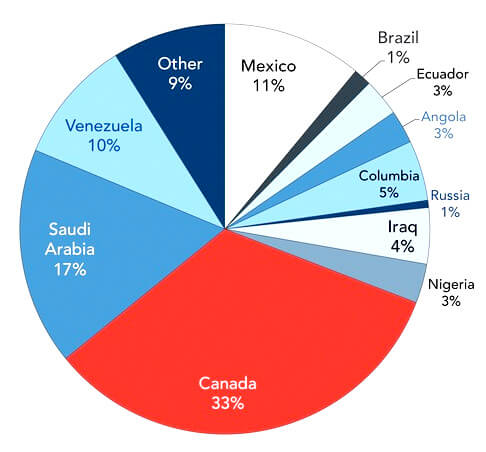
Despite forging close ties with the Trump administration and their historical cooperation with the U.S. through the petrodollar system, the Saudis were displaced by the Canadians starting in the late 1990s as the top exporter of crude oil to the United States. Since then, the gulf has widened largely thanks to the fast growth of Canadian oil imports — which now account for more than half of all U.S. crude imports, while U.S. imports of Saudi crude have dropped to 8.5 percent of the total.


US crude imports by country in 2013. Source | EIA


This may explain why the Saudis have targeted the Canadian economy in particular as the current diplomatic crisis has worsened. Indeed, rejections of Canadian wheat exports by the Saudis is expected to cost the Canadian of region of Alberta alone over $132 million a year, weakening Alberta’s already struggling agricultural sector. Canada’s total exports to Saudi Arabia, now under threat, total on average $1.45 billion annually. Even the Saudi decision to remove 15,000 Saudi students from Canadian universities is expected to remove around $2 billion in investment from the Canadian economy.

Furthermore, restrictions on future investment and the removal of some $100 billion in Saudi money from Canada — in addition to impacting Canada’s economy directly — may also spook investors from Saudi-allied countries, particularly considering how Saudi has handled its dispute with Qatar. This may be a large concern giving the number of Middle Eastern and North African countries that have backed the Saudis in their current spat with Canada.

Thus, the already in-place measures the Saudis have levied against Canada are likely to destabilize the Canadian economy to some extent though the Saudi’s recent promises that more is to come may increase that effect in the days and weeks ahead.

Another consequence of the rift could target Canadian oil exports directly. If Canada responds to the rift with the Saudis by halting the relatively small amount of Saudi oil it currently imports, Canadian oil will be used to meet that demand. While such a move is of no great consequence for Canada, it would mean that an estimated 31 million barrels of crude would be used domestically and not exported to the United States or elsewhere on an annual basis, conveniently offering the Saudis an opportunity to replace that deficit by exporting more to the United States.

However, 31 million barrels of crude oil is not very significant in terms of Canada’s and the Saudi’s total oil exports. The more likely reason for a Saudi effort to hamper the Canadian economy and its oil exports has to do with the larger reshuffle in the oil economy resulting from the U.S. government’s efforts to stop Iranian oil exports.

Indeed, as the U.S. government’s main plan to offset the void that would be left by an end to international purchases of Iranian oil has been its push to force the Saudis to dramatically increase oil production to a record 11 million barrels a day in order to meet the existing demand.

Yet not all has gone as planned. First, some countries, like Turkey, announced that they would continue to import Iranian crude despite the threat of U.S. sanctions. Complicating matters further is the prospect that the U.S. would “soften” its demand that countries halt Iranian oil imports by the November 4th deadline.

Then, the most troubling news of all, from the Saudi perspective, came last Friday when the world’s largest oil importer, China, announced that it plans to continue importing Iranian oil, a major boon to Iran given that China accounts for 35 percent of Iranian oil purchases. Furthermore, China announced earlier this year in May that it would be severely reducing Saudi oil imports.

With the gap caused by reduced Iranian oil exports to fill likely smaller than it had thought, the Saudis need buyers for their increased oil production and, if all else fails, it is likely that they will expect the default buyer to be the United States, given that Washington pushed for the production increase in the first place. Yet, with U.S. oil purchases from Canada at an all-time high, there isn’t much room for an increase in the Saudi market-share — that is, unless Canadian oil currently being exported were to be redirected for domestic Canadian use, thus offering less of a challenge to Saudi oil exports.

Perhaps then it is no coincidence then that the Chinese announcement preceded the Saudi-Canadian spat by a matter of hours.

Saudi history of oil-spank and troubles on the horizon


If this is the case, it certainly wouldn’t be the first time that Saudi diplomatic attacks have been motivated by fossil-fuel markets. In fact, the Saudis’ ongoing dispute with Qatar was ultimately caused by Qatar’s lifting of a moratorium on developing the world’s largest natural gas field it shares with Iran and its related normalization of diplomatic ties with Iran’s government in light of their shared interests in the gas field.

Furthermore, Saudi Arabia has a history of using unconventional means to damage the economies of its oil rivals — though this has normally occurred through the Saudis’ manipulation of oil prices, enabled by their privileged position as a top oil producer. Past efforts to this effect have been successful in several cases, such as when the Saudi-led price war against Russia in the 1990s led Russia to default on its debt in 1998 and thus neutralized what the Saudis had perceived as a major threat to its oil supremacy at the time.

The Saudis, with prompting from the U.S., attempted a similar scheme to squeeze out higher-cost and smaller producers beginning in 2014, and largely succeeded in weakening smaller countries with oil-dependent economies, such as Venezuela and Ecuador.

With the oil market now facing several unknowns — from the effect of looming U.S.-backed Iran sanctions to the U.S.-China trade war — Saudi Arabia is likely looking for a way to maintain its market supremacy. While Canada may have offended Saudi leaders with a recent tweet, it seems very possible that the Saudis saw the tweet as an opening to justify economic attacks of increasing severity against a major oil-market rival.

Now, with Saudi foreign cash reserves still very low, reforms aimed at diversifying its economy moving at a snail’s pace, and warnings that the kingdom could face bankruptcy in less than two years, even small fluctuations in the oil market — along with growing domestic dissent — threaten to derail the kingdom or loosen the grip of the ruling family. It is most likely that Canada has reminded the Saudis of both of their weaknesses — economic and political — at a time when the Kingdom finds itself faces an uncomfortable and perhaps unforgiving future.

Whitney Webb is a staff writer for MintPress News and a contributor to Ben Swann’s Truth in Media. Her work has appeared on Global Research, the Ron Paul Institute and 21st Century Wire, among others. She has also made radio and TV appearances on RT and Sputnik. She currently lives with her family in southern Chile. 

Republish our stories! MintPress News is licensed under a Creative Commons Attribution-NonCommercial-ShareAlike 3.0 International License. 

La Audacia de la Esperanza: Mexico's Great Hope

Best National Government in North America: Mexico 

by David Swanson - Let's Try Democracy


August 8, 2018

At least that’s the hope of those who elected Andrés Manuel López Obrador, aka AMLO, aka Peje, on a platform of sweeping out the corruption — a platform promoted in Obrador’s book, A New Hope for Mexico.

That Barack Obama did not permanently decommission the word “hope” for credible electoral campaigns on this continent may be the least of the book’s surprises.

Thus far 14,000 people in the United States have signed a letter that has made news in Mexico congratulating Obrador on his victory. Donald Trump is not one of them.

Obrador campaigned against the Trumpian menace, denouncing his statements and policies toward Mexicans as akin to Hitler’s statements and policies toward Jews.

While campaigns against foreign targets typically move a nation to the right, this one moved Mexico to the left. But, then, Obrador’s platform — unlike, say, that of the Democratic Party in the United States — is not simply anti-Trump. There’s a lot more to it.

In his book, Obrador denounces Trump’s budget proposals as moving money from housing, transportation, education, heath, justice, agriculture, development, and environmental protection to the military. Already he’s ahead of most Democrats who have pretended Trump was “cutting” the federal budget and acted as if the military didn’t exist.

Obrador goes on to blame this shift in priorities for the poor quality of life in the United States in comparison with Ireland, Norway, Sweden, Iceland, Denmark, Italy, and Spain.

“Why, instead of blaming migrants,” asks Obrador,
“don’t politicians speak honestly? . . . I am sure that the problems that plague Mexico and the U.S. could be resolved were the governments of both nations to commit to overcoming inequality, poverty, and corruption in their respective territories.”

“In recent years,” writes Obrador of Northern Mexico, “we’ve seen a policing problem escalate into a full-fledged ‘war’ that has claimed thousands of lives without achieving anything at all. . . . No one has been held accountable for the vast majority of these deaths.”

Despite peppering his book with such “nobody’s been held accountables,” Obrador also includes an Obamesque promise of immunity for all crimes due to the importance of looking forward. Yet most of his book could never be called Obamesque. He begins with a discussion of what Obama would call “our founding fathers” or “wise Wall Street advisors,” but Obrador refers to the Mexican equivalents of these groups as “a gang of thugs.” And he names names, including those of many previous Mexican presidents and various Mexican oligarchs.

Obrador opposes the financial corruption of the Mexican government, and promises to abolish it. He also promises New Deal-style jobs and education programs, agriculture, tourism, a duty-free zone along the U.S. border, and the top priority of serving the poor, not the rich. He promises vast savings through the ending of corrupt benefits and contracts, as well as through steps to keep resources in Mexico. Rather than export raw fossil fuels and then re-import them refined, Obrador wants to refine them in Mexico.

Tragically, the fact that either policy will help render the entire earth uninhabitable does not seem to have crossed his mind. (If you think I’m not allowed to say that because I live in the top destroyer of the planet, the United States, I encourage you to think about what the consequences will be of still more people not saying that.)

The new President of Mexico says that migrants die in the Southwestern United States just as in the Mediterranean, but that U.S. media has a preference for one over the other. His comments on Trump’s incitement of racist violence are equally honest. Obrador made many of these comments in speeches in the United States, from which the book is compiled. He has countless kind things to say as well as tough ones.

Not only does he cite the example of Franklin Roosevelt’s New Deal in positive terms, but he even praises Woodrow Wilson as a global peace maker, omitting entirely his racism, his horrendous failure to shape a just peace at Versailles, and even his military adventures in Mexico.

Trump, writes Obrador, is acting like a Nazi, and his policies are criminal:

“The plans to construct a border wall and persecute migrants in this country are in violation of the Universal Declaration of Human Rights; the International Covenant on Civil and Political Rights; and the International Covenant on Economic, Social, and Cultural Rights.”

On March 15, 2017, in Washington, D.C., Obrador brought a complaint signed by over 11 million Mexican and U.S. citizens to the Inter-American Commission on Human Rights challenging two executive orders by Trump from January 25, 2017, alleging that the orders “violate the presumption of innocence, disregard the right to asylum, ignore due process, and omit protections relevant to child migrants. . . . The United States of America is subject to its obligations under the American Declaration of Rights and Duties of Man according to the Statute of the Inter-American Commission on Human Rights as set out in Articles 20 and 51.”

The United States should be subject to the treaties it is party to. The problem is that in the United States corruption has been normalized, while compliance with the rule of law has not been.

Truth the Last Victim of Hiroshima and Nagasaki

Hiroshima and Nagasaki: Fictions and Facts

by John Laforge - CounterPunch


August 8, 2018


About the US atomic destruction of Hiroshima and Nagasaki in 1945, popular accounts still stick to the false but “greatest generation” story that, “Without [them], more Japanese would have died in a US assault on the islands, as would have tens of thousands of Americans,” as Mike Hashimoto wrote in the Dallas Morning News in 2016.

The New York Times reported that year,

“Many historians believe the bombings [of] Hiroshima and then Nagasaki, which together took the lives of more than 200,000 people, saved lives on balance, since an invasion of the islands would have led to far greater bloodshed.” 

Many historians, perhaps; but not that many.

On the contrary the chief historian of the US Nuclear Regulatory Commission, J. Samuel Walker, wrote in the journal Diplomatic History in 1990,

“The consensus among scholars is that the bomb was not needed to avoid an invasion of Japan and to end the war within a relatively short time. It is clear that alternatives to the bomb existed and that Truman and his advisers knew it.”

Historian Martin Sherwin has debunked the tale of the “good” atom bombs, citing in his 2003 book A World Destroyed “a ‘considerable body’ of new evidence that suggested the bomb may have cost, rather than saved, American lives. That is, if the US had not been so determined to complete, test, and finally use the bomb, it might have arranged the Japanese surrender weeks earlier, preventing much bloodshed on Okinawa.”

Historian Gar Alperovitz wrote in Atomic Diplomacy (Vintage Books, 1967), “available evidence shows the atomic bomb was not needed to end the war or to save lives — and that this was understood by American leaders at the time.” Further declassification of wartime secrets and 28 additional years of research make Alperovitz’s definitive 1995 history The Decision to Use the Atomic Bomb even stronger on this point.

Admirals and Generals Destroy the Myth


Combat veterans and bomber crews defeated Japan well before August 6, 1945 by fighting and dying in dreadful battles over Midway, Guadalcanal, Iwo Jima, Okinawa, and elsewhere, a fact corroborated by dozens of military commanders, as Maj. Gen. Curtis LeMay, head of the 21st Bomber Command, boasted. LeMay said publicly on Sept. 20, 1945:

“The war would have been over in two weeks without the Russians entering and without the atomic bomb.” 

Asked to clarify, the general who directed the destruction of 67 Japanese cities using mass incendiary attacks doubled down saying, “The atomic bomb had nothing to do with the end of the war at all.”

Gen. George Kenny, who commanded parts of the Army Air Forces in the Pacific, was asked in 1969 for his opinion and said,

“I think we had the Japs [sic] licked anyhow. I think they would have quit probably within a week or so of when they did quit.” 

Alperovitz notes further that Adm. Lewis Strauss, an assistant to WW II Navy Secretary James Forrestal, wrote to historian Robert Albion in 1960:

“[F]rom the Navy’s point of view, there are statements by Admiral King, Admiral Halsey, Admiral Radford, Admiral Nimitz and others who expressed themselves to the effect that neither the atomic bomb nor the proposed invasion of the Japanese mainland were necessary to produce the surrender.”

In Mandate for Change, President Dwight Eisenhower admitted that when Sec. of War Henry Stimson told him atomic bombs were going to be used, “I voiced to him my grave misgivings, first on the basis of my belief that Japan was already defeated and that dropping the bomb was completely unnecessary….”

President Truman’s Chief of Staff, Adm. William Leahy, agreed. As Robert Lifton and Greg Mitchell, report in Hiroshima in America: 50 Years of Denial, Leahy said,

“It is my opinion that the use of this barbarous weapon at Hiroshima and Nagasaki was of no material assistance in our war against Japan. The Japanese were already defeated and ready to surrender.…” 

Even official histories have debunked the fiction. “[T]he US Strategic Bombing Survey published its conclusion that Japan would likely have surrendered in 1945 without atomic bombing, without a Soviet declaration of war, and without an American invasion,” Alperovitz recounted in The Decision.

Still, the myth that the mass destruction of 200,000 was necessary to save lives is believed by millions in the US who refuse to consider or accept the historical record. This greatest of the “greatest generation’s” yarns may help some sleep at night, and to think better of killing civilians than does the rest of the world, but it doesn’t help abolish nuclear weapons.
 
John LaForge is a Co-director of Nukewatch, a peace and environmental justice group in Wisconsin, and edits its newsletter.
More articles by:John Laforge

Gorilla Radio with Chris Cook, Will Tuttle, Kevin Zeese, Janine Bandcroft August 9, 2018

This Week on GR

by C. L. Cook - Gorilla-Radio.com


August 9, 2018

War, war, and rumours of more wars; God knows it's long past time for peace. But Peace, as the great Gil Scott Herron reminds, is not merely the absence of War. "It is the time when we will all bring ourselves closer to each other; closer to building a structure that is unique within ourselves, because we have finally come to Peace within ourselves."

Dr. Will Tuttle is a visionary speaker, educator, musician, editor of Circles of Compassion, and author of the books, 'Your Inner Islands' and 'The World Peace Diet', which the former Zen monk and long-time vegan says provides an approach to life that, "blends mindfulness with kindness and respect for each other and all expressions of life."

Listen. Hear.

Dr. Tuttle will be in Victoria for a number of events beginning August 20th, including presenting workshops based on his book that address and, "make explicit the hidden connections between our culture, our food, and the source of our broad range of problems..."

Will Tuttle in the first half.

And; the peace enjoyed by the people of Nicaragua since the overthrow of dictator and tyrant Anastasio "Tachito" Somoza was hard-won, and not without reversals. In the last months, an attempt to unseat the elected government of leftist, Daniel Ortega however has seen what many fear could be the beginning of the end of that peace, and revival of the dark forces of fascism once buried, perhaps too shallowly, there.

Kevin Zeese is an American lawyer, political activist, essayist, and author. He's also co-founder of the Drug Policy Foundation and current co-director of Popular Resistance.org, from where his and colleague, Dr. Margaret Flowers' weekly podcast, Clearing The Fog emanates.

His frequent essays and articles on social justice issues in America and abroad appear at Popular Resistance, CounterPunch, and Gorilla Radio Blog among other places, and his book titles include: 'Drug Law: Strategies and Tactics', 'Drug Prohibition an the Conscience of Nations', and 'The Great Issues of Drug Policy'.

Kevin Zeese and the Lessons Learned from the Failed Violent Coup in Nicaragua in the second half.

And; Victoria activist and CFUV Radio broadcaster at-large, Janine Bandcroft will be here with the Left Coast Events Bulletin of some of the good things to get up to in and around our town in the coming week. But first, Will Tuttle and a World of Peace on your plate.

Chris Cook hosts Gorilla Radio, airing live every Thursday between 11-Noon Pacific Time. In Victoria at 101.9FM, and on the internet at: http://cfuv.uvic.ca.  He also serves as a contributing editor to the web news site, http://www.pacificfreepress.com. Check out the GR blog at: http://gorillaradioblog.blogspot.ca/

Tuesday, August 07, 2018

Saudi's Take a Shot at Canada

Why Did Saudi State Media Threaten a 9/11 on Canada?

by TRNN


August 7, 2018

Ottawa’s criticism of a crackdown on dissidents has prompted Saudi Arabia to freeze its Canadian ties, and a kingdom-linked Twitter account to even threaten a 9/11-style attack.


Saudi analyst Ali Al-Ahmed says Riyahd’s behavior is a reminder that its claims of reform are a sham.

Now, Mamoud Abbas Charges to Ahed Tamimi's Rescue

Mahmoud Abbas: Stop Exploiting Ahed Tamimi for Personal Gain

by Ramzy Baroud  - The Palestine Chronicle 


August 7, 2018

The father of 11-year-old, Abdul Rahman Nofal contacted me, asking for help. His son was shot in the leg during Gaza's ‘Great March of Return’ protests. The Strip's dilapidated health care system could not save the little boy's leg, as it was later amputated. His father, Yamen, himself a young man from the Buraij Refugee Camp in central Gaza, only wants his child to receive a prosthetic leg so that he can walk to school.

The Israelis are refusing the boy a permit to cross into Ramallah to receive treatment. Desperate, Yamen composed a video, where he pleads with Palestinian Authority President, Mahmoud Abbas, to help his son. So far, his pleas have gone unanswered.

"What did this innocent child do to deserve such mistreatment?" he asks in the short video. 

The same question can be asked regarding the ill-treatment of all of Gaza’s children, of all Palestinian children.

Abbas, along with Israel, has subjected Palestinians in Gaza to a prolonged campaign of collective punishment. As cruel as Israel's repeated wars on the impoverished and besieged Strip have been, it is consistent with Tel Aviv's history of war crimes and apartheid. But what Abbas is doing to Gaza is not just unfair, but also puzzling.

Why is an 83-year-old leader so keen on engaging Israel through the so-called security coordination, and, yet, so insistent on isolating and punishing his own people in the Gaza Strip?

Instead of helping Gazans who are reeling under the destructive outcomes of Israeli wars and over a decade of hermetic siege, he has been tightening the noose.

Abbas’ Authority has, thus far, cut salaries it previously paid to Gaza employees, even those loyal to his own faction, Fatah; he has cut salaries to the families of Gaza prisoners held in Israel; he has even withheld payments to the Israeli electric company that provided Gaza with some of its electricity needs, plunging the Strip even further into darkness.

Like Israel, Abbas also wants to see Gaza on its knees. But, unlike Israel, he is humiliating his own brethren.

Starting on May 14, when thousands of Palestinians in Gaza went out to the fence separating the imprisoned enclave from Israel, Abbas' supporters in the West Bank understood the 'March of Return' protests as a validation of Fatah’s rival, Hamas. So they, too, took to the streets in ‘celebration’ of Abbas’ imaginary achievements.

Hundreds of Palestinians in Gaza were killed and thousands more wounded in the ongoing ‘March of Return’, many of them children; but Abbas and his Fatah allies were far more interested in ensuring their own relevance rather than joining the protests in demanding an end to the Gaza blockade.

When much larger rallies were held in Ramallah and elsewhere in the West Bank calling on Abbas to end his punishment of the Gaza Strip, they were attacked by Abbas' security goons. Men and women were beaten up, and many were arrested for solidarity with Gaza, now an unforgivable act.

The truth is that Palestinians in the West Bank, not just in Gaza, loathe Mahmoud Abbas. They want him and his violent corrupt apparatus to go away. He refuses, however, crafting all sorts of tactics to ensure his dominance over his opponents, going as far as working with Israel to achieve such a dishonorable objective.

However, Abbas still wants to convince Palestinians that he is resisting, not the type of 'useless resistance' displayed by Gazans, but his own style of 'peaceful civil resistance' of Palestinian villages in the West Bank.

Such emphasis was made once more in recent days.

As soon as Palestinian teenage protester, Ahed Tamimi, was released from an Israeli prison after spending 8 months in jail for slapping an Israeli soldier, Abbas was ready to host her and her family.

Footage of him hugging and kissing the Tamimi family was beamed all over Palestine and across the world. His official media apparatus was keen on placing him at the center of attention throughout the days following Ahed's release.

Abbas then, once more, lectured about 'peaceful civil resistance', failing, of course, to underscore that thousands of Gaza children, who were injured near the Gaza fence in recent months, were also 'peacefully resisting.'

True, Ahed is a symbol for a rebellious Palestinian young generation which is fed up with having no rights and no freedoms, but Abbas' shameless attempt at harnessing that symbolism to polish his own image is pure exploitation.

If Abbas truly cared for Palestinian children and agonized over the pain of Palestinian prisoners - as he claims he does – why, then, worsen the plight of Gaza children and punish the families of Palestinian prisoners?

Of course, Ahed, a strong young girl with an empowered political discourse to match, cannot be blamed for how others, like Abbas, are exploiting her image to uphold their own.

The same can be said of Pakistani activist, Malala Yousafzai, who was shot in the head by Taliban militants at the age of 14. The West's exploitation of her struggle to recover from her wounds and breach peace and justice for her people, is unfortunate. In Western psyche, Malala's struggle is often, if not always, used to highlight the dangers of so-called radical Islam and to further validate US-western military intervention in Afghanistan and Pakistan.

This issue was addressed firmly by Ahed’s mother, Nariman, who was also imprisoned in an Israeli jail and released 8 months later. Nariman bravely spoke of the racist notions that made Ahed popular in Western media.

“Frankly it is probably Ahed’s looks that prompted this worldwide solidarity and that’s racist, by the way, because many Palestinian children are in Ahed’s position but weren’t treated in this way,” she said.

With this in mind, it is important that Ahed Tamimi is not turned into another Malala, where her 'peaceful resistance' is used to condemn Gaza's ongoing resistance, and where the fascination with her blonde, uncovered hair, drowns the cries of the thousands of Ahed Tamimis throughout besieged Gaza, in fact throughout Palestine.

Ramzy Baroud is a journalist, author and editor of Palestine Chronicle. His latest book is ‘The Last Earth: A Palestinian Story’ (Pluto Press, London). Baroud has a Ph.D. in Palestine Studies from the University of Exeter and is a Non-Resident Scholar at Orfalea Center for Global and International Studies, University of California Santa Barbara. His website is www.ramzybaroud.net.

Ramzy Baroud, Ph.D, University of Exeter, UK. Non-Resident Scholar at Orfalea Center for International Studies, UCSB.

Learn about his latest book: The Last Earth (Pluto Press, London)

UK Column: Covering the Weekly Media Cover-Ups

Bana 2.0 in Idlib, Twitter’s Orwellian Hand, Guardian Fake ‘Russian Spy’ News and more

by 21wire  - UK COLUMN


August 7, 2018

Just when you thought it was safe to turn on your TV again, or open your Sunday paper, or check your Twitter feed. Learning how to swim in a sea of mainstream and government propaganda…


UK Column anchor Mike Robinson is joined by 21WIRE’s Patrick Henningsen with the top stories from weekend and this week. 

Ukraine Connection: Tymoshenko Still a Force Despite Legal 'Entanglements"

Secret Meeting in Warsaw Between Yulia Tymoshenko and Igor Kolomoisky - New Plan for Ukraine, More War with Russia

by John Helmer - Dances with Bears


July 29, 2018

Moscow  - In the Polish capital of Warsaw a fortnight ago, Igor Kolomoisky met secretly with Yulia Tymoshenko. The reason for the secrecy is the terms of exchange which they discussed.

These include Tymoshenko’s agreement that if she is elected president in Kiev in eight months’ time with Kolomoisky’s support, he will get relief from Ukrainian state pursuit of billions of his dollars currently frozen on British court orders.

Kolomoisky wants relief from prosecution by the Ukrainian courts and the National Bank of Ukraine (NBU) for theft, fraud and unjust enrichment of $1,911,877,385 from Privatbank, which Kolomoisky lost control of in a state takeover in December 2016.

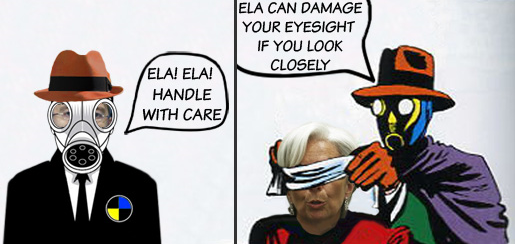
For the story of the looting of Privatbank, and the diversion of the International Monetary Fund’s Emergency Liquidity Assistance (ElA) loans to the NBU, and from there to Privatbank, read this archive.


Ukrainian prosecutors now charge that the NBU-Privatbank money was stolen by a scheme of sham loans from Privatbank to offshore companies Kolomoisky ran for his personal benefit. He claims the money was recycled and returned to the bank.

The Ukrainian prosecution resulted in a worldwide freeze of Kolomoisky’s assets ordered by the High Court in London on December 19, 2017. Subsequent rulings by the High Court in January of this year, in February, and on July 24, have tightened control by the courts and the Ukrainian government over Kolomoisky’s business operations. Together with the assets of Gennady Bogolyubov, Kolomoisky’s shareholding partner in Privatbank, the High Court has frozen a total in asset value of $2.6 billion. In last week’s High Court judgement, Kolomoisky was allowed to continue making payments of some inter-company loan debts; the charges of his lawyers; and $250,000 per month for flying on board his personal aircraft.

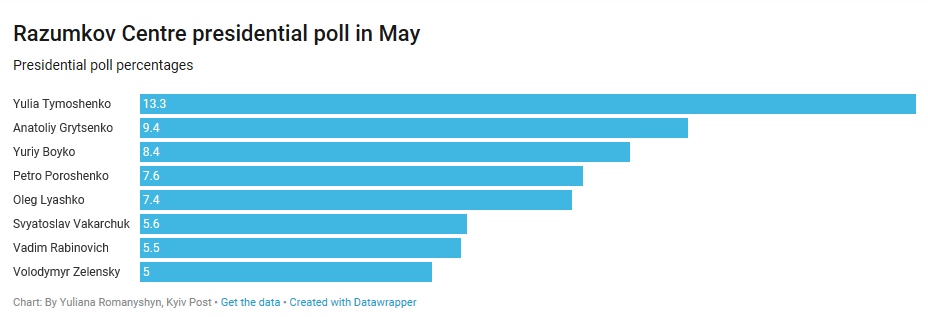
Tymoshenko wants Kolomoisky’s financial backing for her campaign to win the Ukrainian presidency from Petro Poroshenko and other challengers in the election scheduled in eight months’ time, on March 31, 2019. With most of her support from Galicia in western Ukraine, Tymoshenko is the front-runner in the most recent Ukrainian poll with 13.3%. Yury Boyko, whose support comes from Russian-speaking eastern Ukraine, has 8.4%; Poroshenko is running far behind at 7.6%.


UKRAINIAN PRESIDENTIAL ELECTION PREFERENCES


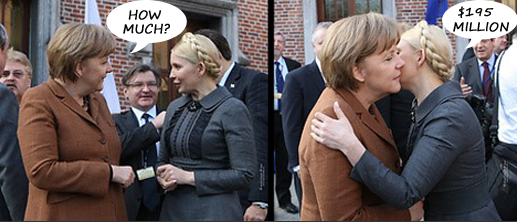
Delivery of $200 million in fresh arms supplies from the US threatens to intensify the fighting against the Novorussian regions of Donetsk and Lugansk. This in turn would help Poroshenko, if the arms are not used and Ukrainian forces not defeated on the battlefield.If there is a military victory, Poroshenko will gain; if a defeat, Tymoshenko will gain. She will also capitalize if Poroshenko were to accept President Vladimir Putin’s proposal for a new referendum in the Donbass. Tymoshenko has long been the Ukrainian politician preferred by the German Chancellor, Angela Merkel.


For the story of the Merkel-Tymoshenko alliance, read this.

Polish sources believe the Warsaw meeting between Kolomoisky and Tymoshenko was leaked by the German government to the Berlin-based Axel Springer media group, which passed on the information to Onet, the online Polish portal which Springer owns.

Onet’s report was published on the morning of Sunday, July 15. The meeting had taken place three days earlier. Onet had almost nothing to say beyond the fact of the meeting itself, for which no source was identified. Translated from the Polish, this is what Onet reports:

“Former Ukrainian Prime Minister Yulia Tymoshenko on Thursday [July 12] secretly met in Warsaw with oligarch Igor Kolomoisky. Tymoshenko and Kolomoisky are opposed to the current authorities and together they want to overthrow Petro Poroshenko, according to the Ukrainian media RMF FM.
Kolomoisky is the former governor of the Dniepropetrovsk region. He manages the largest media holding in Ukraine and finances extreme nationalist battalions of volunteers fighting in the Donbass. It is not known what the prime minister and the oligarch set for the Warsaw meeting, but Tymoshenko has already announced that she will take part in next year’s presidential election.”

The remainder of the Onet news item reports the Ukrainian presidential election of Petro Poroshenko in May 2014, and an opinion poll of February of this year in which “Tymoshenko was in the lead. Support for the former prime minister was declared by 18.7% of the respondents. The incumbent president Petro Poroshenko could count on 15.6% of the votes, and in third place would be the leader of the opposition Yury Boyko’s bloc with a score of 11.7%.”

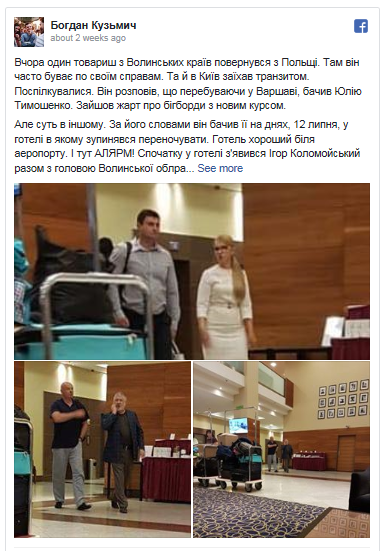
Onet may have been cribbing from another source, a Ukrainian Facebook blogger named Bohdan Kuzmych. Overnight between July 13 and 14, he posted a report claiming that a friend of his from Volyn region (in Galicia, on the border between Poland and Ukraine) had spotted the head of the Volyn region parliament, Ihor Palytsia, on July 12 at a hotel near Warsaw airport.

Palytsia was photographed by the source with Kolomoisky in the hotel lobby. In the same lobby fifteen minutes later, according to Kuzmych, his source spotted and photographed Tymoshenko with an unidentified man. The hotel is reported to have been the Courtyard Marriott.


Top: Yulia Tymoshenko; bottom, Ihor Palytsia and Igor Kolomoisky. 

The Kuzmych report doesn’t say Kolomoisky and Tymoshenko met, but hints they had. The Ukrainian and Russia media, which picked up the reported sightings, claim they did meet.

Onet in Warsaw reported certainty there had been a meeting. The Russian state medium RT, reporting in Russian late on the same Sunday, said a source from Tymoshenko’s political party Batkivshchyna (“Fatherland”) not only confirmed it, but added it wasn’t the first this year.

“Yes, there really was the [Warsaw] meeting. It became the second for Tymoshenko and Kolomoisky since the beginning of the year. They have a good relationship, and the conversation turned out to be constructive.”

Kolomoisky and Tymoshenko have had many fallings-out in the past. “God forbid this devil in a skirt will come to power!” Kolomoisky announced in 2016. Now he is backing her as the candidate most capable of beating Poroshenko. According to Ukrainian political analysts quoted in the RT story, the political reconciliation between Tymoshenko and Kolomoisky has long been known; and the rewards each seeks from the other no surprise.

Polish political analyst and reporter Stanislas Balcerac has investigated Kolomoisky’s Polish business. “He has extensive interests in ferroalloys in Poland, as well as aviation. Some of his Dniproavia planes are still stored at Katowice airport.” Balcerac suspects that when Kolomoisky was operating the Ukrainian Aviation Group (Dniproavia, Aerosvit, Donbassaero) with a near-monopoly of commercial civil aviation in Ukraine, he wanted to take over the Polish national airline LOT on the cheap”. The LOT attempt was reported here; the collapse into bankruptcy of Kolomoisky’s airline companies here.

Balcerac has also tabulated evidence that corrupt payments Tymoshenko made to former Ukrainian prime minister Pavel Lazarenko went through Poland. The evidence was assembled by US prosecutors and presented in an indictment of July 2001; note that one of the prosecutors then was Robert Mueller, currently the special persecutor of President Donald Trump and the Russian Government. Lazarenko was convicted and jailed.

Read the US evidence against Tymoshenko in the section titled “UESU Frauds” at page 8 of the indictment. For a brief summary of the very long story of Tymoshenko’s corruption, read this.

For details uncovered by Balcerac of the use of Polish go-betweens in these corrupt schemes, read this.

YULA TYMOSHENKO’S PAYMENTS TO PRIME MINISTER PAVEL LAZARENKO


Wall-Mad Israel Extends Gaza Prison Project into the Sea

Revealed: first images of Israel’s sea barrier blockading Gaza

by Middle East Monitor


August 6, 2018

Israel’s underwater barrier designed to further blockade the besieged Gaza Strip

Israel’s Ministry of Defence yesterday released the first images of its sea barrier designed to further blockade the besieged Gaza Strip. The barrier is located on Zikim beach, approximately three kilometres from Gaza’s northern frontier. The project is slated to be completed by the end of 2018 and is likely to cost an estimated 25 million shekels ($6.7 million).

When completed, the structure will stretch 200 metres out into the Mediterranean Sea, further cutting off the Gaza Strip from Israel. The barrier will consist of three layers: an underwater base level; a 50-metre-wide sea-level platform made of armoured stone, and a six-metre-high barbed wire fence.

A further fence will also surround the barrier itself as “an additional security measure.”

The barrier has been praised by Defence Minister, Avigdor Liebermann. “The construction of the barrier around the Gaza Strip, both on land at sea, is progressing at a rapid and impressive pace,” said the extreme right-winger.

“Every day that passes, our counterterrorism capabilities around the Gaza Strip are growing stronger.”
According to Ma’an, Liebermann added that, “Hamas is losing its capability to attack Israel every day.”

READ: Israel ‘employs unlawful tactics’ to control Gaza’s land, sea


The initiative will likely be seen as a further attempt by Israel to tighten its siege of the Gaza Strip, which has been ongoing since 2007. Israel has closed all pedestrian and commercial crossings into and out of the enclave and has constructed a “security fence” along the Green (1949 Armistice) Line which serves as a border. Alone of all UN member states, Israel has never formally declared where its borders actually are. A no-go area of approximately 300 metres is also imposed on the Gaza side of the fence, restricting the access of many families and farmers to their land.

Israel has also imposed a naval blockade on the Gaza Strip, which currently limits Gaza’s fishermen to a distance of three nautical miles, some 17 less than was original proposed under the Oslo Accords of the early 1990s. Last week, two ships belonging to the Freedom Flotilla attempted to break the naval blockade, but were intercepted by Israeli naval forces in international waters. Crew members of Al-Awda, the first ship to be intercepted, have accused Israeli forces of violence and other governments have said that Israel’s actions broke international law.

The impact of the siege has been severe. Gaza’s industrial and commercial sectors have been damaged, with Israel’s ban on imports of fuel and gas leading to shortages and high unemployment. Last week, senior UN officials voiced concern over the humanitarian situation facing Gaza’s children and the continued violation of their rights. Deputy spokesman for UN Secretary-General, Farhan Haq, said that the officials “called on all sides to put children’s rights ahead of any other considerations, and to take immediate steps to alleviate their suffering.”

READ: Exhibition in Gaza displays products denied by Israel


This work by Middle East Monitor is licensed under a Creative Commons Attribution-NonCommercial-ShareAlike 4.0 International License. If the image(s) bear our credit, this license also applies to them. 

Monday, August 06, 2018

Ahed Tamimi Speaks: Democracy Now!

Meet Ahed Tamimi, 17 Year-Old West Bank Activist Jailed for 8 Months for Slapping Israeli Soldier

by Democracy Now!


August 6, 2018

Seventeen-year-old Palestinian activist Ahed Tamimi has been freed from Israeli prison after eight months behind bars. Known to some as the Rosa Parks of Palestine, Tamimi became a hero to Palestinians and people around the world last year after a viral video showed her slapping a heavily armed Israeli soldier near her family’s home in the occupied West Bank. The incident came just after Tamimi learned her cousin had been gravely wounded by an Israeli soldier who shot him in the head using a rubber-coated steel bullet.


Ahed Tamimi and her mother, Nariman, were released in late July. We speak with Ahed Tamimi from her home in the West Bank village of Nabi Saleh.