Tuesday, September 25, 2018

A Sharp Understanding of Political Defiance

The Machiavelli of Nonviolence: Gene Sharp and the Battle Against Corporate Rule  

by Mark Engler - Dissent Magazine


Fall 2013  

If there are some things in life that should not be bet on, the question of who will next win the Nobel Peace Prize somehow feels like it should be among them. Internet bookmakers, however, will place odds on almost anything, and they are not above taking wagers on Nobel prospects.

Over the past two years, some of the safest money has not been on a head of state, a major nongovernmental organization, or a charismatic resistance leader, but rather on a soft-spoken, eighty-five-year-old academic. His name is Gene Sharp.

Sharp, a theorist and author of groundbreaking works on the dynamics of nonviolent conflict, has been called the “dictator slayer,” the “Machiavelli of nonviolence,” and the Clausewitz of unarmed revolution.

His circumstances are humble: he runs his research outfit, known as the Albert Einstein Institution, out of the ground floor of his row house in East Boston, and the organization has just one other staffer. For the most part, Sharp has labored for decades in quiet obscurity—well respected within a small field of study but virtually unknown outside of it.

At the same time, Sharp’s work has had an unusually broad impact. His pamphlet From Dictatorship to Democracy, a ninety-three-page distillation of his core insights and a handbook for overthrowing autocrats, has been translated into more than thirty languages. The slim volume has a habit of turning up in hot spots of global resistance. Originally written in 1993 to help dissidents in Burma use nonviolent action against the ruling junta, the book made it into the library of Serbian students seeking to overthrow the regime of Slobodan Milošević, circulated among activists during successful uprisings in Georgia and the Ukraine, and was downloaded in Arabic amid mass protests in Tunisia and Egypt.

The Iranian government has denounced the book and its author by name. In the summer of 2005, two independent bookshops in Russia were burned down after stocking the newly available Russian translation. (“I still keep a half-burned copy on a shelf in my office,” one opposition leader told the Wall Street Journal.) Particularly in the wake of the Arab Spring, Sharp’s renown has grown, and he was the subject of a feature documentary, entitled How to Start a Revolution, released just as the Occupy movement took shape in 2011.

Of course, the idea that any mass movement can be attributed to one person is dubious. With regard to the Arab Spring, Middle Eastern analysts have taken exception to the Western media’s eagerness to credit an American “Lawrence of Arabia” for rebellions that have deep local roots. Similarly ignoring indigenous agency, conspiracy theorists on the far left have painted their own picture of Sharp as a puppet master at the center of a sinister CIA-led scheme to overthrow governments disliked by Washington.

Those who recognize such notions as wildly off base but are intrigued by the evident power of Sharp’s work may be curious for a more sober assessment of the scholar’s contributions. And those involved in U.S. social movements might pose a more pressing question: can Sharp’s ideas about nonviolent conflict, which have proven potent in challenging dictators abroad, be used to oppose the corporate takeover of democracy at home?

Gene Sharp spent his first years of political life immersed in a mainstream current of the pacifist tradition, and he has spent much of the rest of his career declaring independence from it. During the Korean War, Sharp refused to cooperate with the draft. He proudly possesses a letter from Albert Einstein in which the physicist told the young resister that he could only hope “that I would have acted as you did, had I found myself in your situation.” But that sentiment held little weight with the state. Sharp ultimately served nine months and ten days in prison—an act of civil disobedience he now regards as entirely ineffectual, except in reinforcing his sense of personal integrity.

Upon his release in 1954, Sharp worked briefly as an assistant to prominent pacifist A.J. Muste before moving to Oslo and researching how teachers during the Second World War used nonviolent tactics to resist the imposition of fascist schooling in Norway. His investigations into nonviolence ultimately led to a doctorate at Oxford and a seminal three-volume, 900-page treatise called The Politics of Nonviolent Action, published in 1973 and still in print today.

Pacifism—moral opposition to war and violence—has existed for hundreds if not thousands of years. It can trace its roots to the core texts of many major world religions. But Sharp discovered that he was interested in something different. Reading through old newspaper coverage of Gandhi’s 1930 satyagraha in India, he found evidence that most participants in the resistance campaign did not embrace nonviolence out of a sense of moral commitment. Instead, they used nonviolent action because they believed it worked. This was a discovery that contradicted the cherished convictions of many pacifists he knew—adherents to what is now known as “principled nonviolence”—who believed that the practice requires deep ethical resolve. As Sharp explained in a 2003 interview, he considered omitting the finding from his research:

“I wondered: Should I put that down? Better just leave it out!
“But I put it down. And later it dawned on me that, rather than that being a threat, it was a great opportunity, because it meant that large numbers of people who would never believe in ethical or religious nonviolence could use nonviolent struggle for pragmatic reasons.

Embracing the position known as “strategic nonviolence,” Sharp began arguing that people turn to violence not because they are wicked or warmongering but because they do not see any other option for resolving intractable conflicts. If you show how a strategy of nonviolent conflict can be an effective alternative, he urged, you will be able to win over far more people than you will by merely making “exhortations in favor of love.”

He would ultimately come to eschew the term “nonviolence” altogether, believing that it is too ambiguous and loaded with connotations of passivity and religious belief, and he now uses the word only as an adjective, referring to “nonviolent struggle” or “nonviolent conflict.” Recently, academic researchers influenced by Sharp have made a further break in terminology: they now discuss campaigns of unarmed action simply as “civil resistance.”

Can Sharp’s ideas about nonviolent conflict, which have proven potent in challenging dictators abroad, be used to oppose the corporate takeover of democracy at home?

As he emerged as a writer, Sharp saw his role as being one of correcting common misconceptions about nonviolent action: that people have to be pacifists or saints to undertake it, that strategic nonviolence somehow involves avoiding conflict, and that it can only be used in democracies. He set out to show that nonviolent action is “a technique of struggle involving the use of psychological, social, economic, and political power,” and that it can be used even against viciously repressive regimes.

To explain how it works, Sharp first presents a theory of political power. 


Contrary to the assumption that, in the end, “power comes from the barrel of a gun,” Sharp draws on a wide range of political thinkers in the first volume of The Politics of Nonviolent Action to argue that all rulers fundamentally rely on the cooperation and consent of their people to survive. “Obedience is at the heart of political power,” he writes. Countless institutions—including the police, the courts, the civil service, and the army—must carry out orders for the system to function. If individuals and institutions start to withdraw their cooperation, a regime is weakened. If enough of them withdraw, the regime collapses. At Oxford, fueled with excitement over his discovery of this theory, Sharp dug through historical records to uncover dozens of examples, large and small, of how nonviolent action has succeeded by encouraging the withdrawal of obedience, eroding the authority and bureaucratic capacity of rulers.

This idea also allowed him to theorize about how future campaigns might take shape. Just like armed struggle, nonviolent conflict involves the “waging of ‘battles,’ requires wide strategy and tactics, and demands of its ‘soldiers’ courage, discipline, and sacrifice.” Perhaps for this reason, Sharp believes, those with a military background have often been quicker than peace activists to catch on to his ideas.

Sharp’s analysis of nonviolent struggle is unflinching. He recognizes that withdrawing cooperation is not always easy. If the target of nonviolent action is a tyrannical regime, repression can be severe. “There must be no illusions,” he writes. “In some cases nonviolent people have not only been beaten and cruelly treated but killed…in deliberate massacres.” Nor does he promise success: “the simple choice of nonviolent action as the technique of struggle,” Sharp explains, “does not and cannot guarantee victory, especially on a short-term basis.”

That said, it can produce remarkable, and sometimes counter-intuitive, results. While violent uprisings play to the strengths of dictatorships—which are deft at putting down armed rebellions and using security challenges to justify police state measures—nonviolent action often catches these regimes off guard. Through what Sharp calls “political jiu-jitsu,” nonviolent campaigns turn repression into a weakness for those in power. Violent crackdowns against unarmed protests end up exposing the brutality of a ruling force, undermining its legitimacy, and, in many cases, resulting in wider withdrawal of cooperation.

In a 2005 interview, Sharp lamented that nonviolent struggle is held to an unfair standard, even if its human cost is relatively minimal.

“Guerrilla warfare has huge civilian casualty rates. Huge,” he said.
 “And yet Ché Guevara didn’t abandon guerrilla warfare because people were getting killed. The same is true in conventional war, of course. But then they say if you get killed in nonviolent struggle, then nonviolent struggle has failed.”

With a similar lack of sentimentality, Sharp breaks with pacifists in his understanding of how movements achieve success. He argues that, while it may be desirable, it is not necessary that activists express love for their adversaries or make enemies see the errors of their ways. In fact, insistence on “conversion” of the opponent can be counterproductive. As an alternative, Sharp approvingly quotes civil rights leader James Farmer:

“In the arena of political and social events, what men feel and believe matters much less than what, under various kinds of external pressures, they can be made to do.” 

Farmer elsewhere concludes:
 
“Where we cannot influence the heart of the evildoer, we can force an end to the evil practice.”

Those determined to force such an end have a variety of options for getting started—indeed, a great many options. Discussion of Sharp’s work invariably includes his list of “198 methods of nonviolent action,” originally presented in detail in the second volume of The Politics of Nonviolent Action.

It includes approaches as varied as vigils, fasting, land occupations, “protest disrobings,” display of flags and symbolic colors, mock funerals, humorous skits and pranks, deliberate bureaucratic inefficiency, and civil disobedience, not to mention several dozen distinct types of strikes and boycotts. Despite Sharp’s suggestions that there would be “considerable expansion” of the list as movements innovated and other researchers added to the documentary record, the total has remained frozen in the four decades since it first appeared, gaining totemic status.

Sharp’s admirers and enemies alike have a tendency to treat the list with undue reverence. Sympathetic accounts act as if the theorist had somehow invented the tactics, rather than merely cataloging them. Hostile regimes, meanwhile, have viewed the items as a sort of nefarious recipe: in 2009 the Iranian government referenced the list in a televised trial of 110 dissidents, noting, as the Boston Globe reported, that “More than 100 of the 198 steps in the Gene Sharp manual of instructions for Velvet Revolution have already been executed.”

In fact, the list can be both arbitrary and exhausting, reflecting Sharp’s taxonomic writing style. A variety of the items on the list are needlessly specific. (Should “turning one’s back” as a means of protest really be singled out as its own method, apart from similar nonverbal expressions of disrespect?) Other methods, such as “skywriting and earthwriting,” seem dated and obscure. Conversely, activist innovations based on post-1970s technology remain outside Sharp’s classification. There are no cell-phone-driven flash mobs here.

At one point Sharp borrows a story from Saul Alinsky about a protest in a depressed area of Chicago. Members of a community organization, angry about the mayor’s refusal to address deteriorating housing conditions, took dead rats from their neighborhood and piled them up on the steps of city hall. For Alinsky the tale is a chance to highlight the creativity of the activists and to show off his storytelling élan. For Sharp it is an example of Method #21, “Delivering symbolic objects.” A lack of self-awareness about the danger of pedantry in Sharp’s lengthy enumeration produces some moments of unintentional humor, as when he notes that the “illustrations could go on indefinitely.”

Yet whatever the limitations of the list, the 198 methods have considerable strengths. At a time when little attention was granted to nonviolent tactics, Sharp’s catalog hinted at a new world of possibility—both for action and for research. The list encourages dissidents to be creative in their planning and not to simply repeat their previous approaches. Sharp likens the methods to the various weapons in the arsenal of a violent army: each has different range and effects, and each is adapted to distinct circumstances. They can be used separately or together, and their wise selection can help determine the outcome of a battle.

The differences between Sharp and Alinsky are not merely stylistic. While Alinsky favored the creation of stable “organizations” to the outbreak of “movements,” Sharp’s ideas would prove most useful to those seeking to spark, guide, and maximize the power of sometimes short-lived mass uprisings. His list of 198 tactics shows that those plotting such outbreaks are often more methodical than popularly imagined. And the field of study that rose in the wake of Sharp’s pioneering work has sought to understand how unarmed insurrections have been far more politically significant than observers focused on military warfare have cared to admit.

Given the impact of Sharp’s ideas, reporters visiting the scholar often express surprise that he is working out of his home in East Boston and not enjoying the salary and research budget typical of eminent professors a few miles away in Cambridge. But Sharp’s standing among academics is actually somewhat tenuous. Although he is sometimes described as a former Harvard professor, this is not quite true. Sharp held appointments for decades at the university’s Center for International Affairs, directing its Program on Nonviolent Sanctions, but these were research positions, outside the tenure track of any particular discipline. Sharp is also a professor emeritus at the University of Massachusetts Dartmouth, but his life there as a teacher and colleague is never much emphasized—by him or others.

While Sharp acknowledges intellectual debts to figures such as Gandhi and Richard Gregg, an early philosopher of nonviolence, his work gives off a hint of autodidacticism. Sociologists take issue with his application of terms such as “pluralist” and “consent” in ways that are inconsistent with accepted usage in their field. They object that his theory of power is too voluntarist, too focused on individual choice, and that it fails to take into account how power is embedded in culture and in social structures. Sharp, for his part, has never shown much interest in the sometimes-tedious processes of peer review. As a result, he has placed himself in a nether region: he writes like a professor and is regarded as such by outsiders, but he is not fully accepted within academia.

There is some irony in his scholarly fate. Had he started his career today, rather than in the 1970s, Sharp could have much more easily found an academic home—thanks to the field of study his writing has done so much to spawn. In his 1973 magnum opus, Sharp predicted that his work might inaugurate a “new stage in the development of nonviolent alternatives.” Remarkably enough, this turned out to be the case. Stephen Zunes, a professor at the University of San Francisco and expert on nonviolent social movements, comments that prior to Sharp, lectures on Gandhi took place almost exclusively in religion and ethics courses. Slowly, consideration of Gandhian campaigns moved into sociology. Today, the study of nonviolent conflict and civil resistance is a respectable subfield within political science and strategic studies.

These developments have taken place too slowly to benefit Sharp’s professorial career, however, and he has instead achieved his greatest acclaim outside of the academy. His most famous work, From Dictatorship to Democracy, is conspicuously lean, stripped of any significant scholarly references. A modern-day Art of War, it provides a short, powerful glimpse into the universe of strategic thinking about nonviolent conflict. In that work, the value of Sharp’s conception of power is that it is useful—in contrast to highly nuanced sociological theories that do nothing to help social movements understand how they might leverage change.

While Saul Alinsky favored the creation of stable “organizations” to the outbreak of “movements,” Sharp’s ideas would prove most useful to those seeking to spark, guide, and maximize the power of sometimes short-lived mass uprisings.

Sharp’s theories have been widely adapted by other writers and incorporated into popular training manuals for nonviolent activism. To credit a single theorist for insights into the art of political uprising that are often independently rediscovered and shaped by activists to suit local circumstances is to assume a type of direct, linear causality that rarely exists in protest movements. The relationship between ideas and action tends to follow muddier and more circuitous paths. Still, like the Egyptian protester who told the BBC that he had been handed a photocopy of the 198 methods printed without any reference to the list’s provenance, many dissidents who have never heard Sharp’s name have nonetheless been exposed to his thinking.

For an intellectual opponent of autocracy, being featured as an animated character in an Iranian propaganda film surely counts as a high honor. Sharp received this strange accolade in 2008, when Iran aired a video that showed a computer-generated version of the theorist scheming with Senator John McCain and philanthropist George Soros. It accused Sharp of being a CIA agent “in charge of America’s infiltration into other countries.”

These claims represented a move by right-wing theocrats to piggyback off of the delusions of the far left. In 2005 French anti-imperialist Thierry Meyssan charged that Sharp “helped NATO and the CIA train the leaders of the soft coups of the last 15 years.” In Meyssan’s view, the Serbian students who respected Sharp were Washington shills used to overthrow a leader, Milošević, “who was very popular for resisting NATO.” That Meyssan is also author of a book entitled 9/11: The Big Lie unfortunately did not stop the late Venezuelan president Hugo Chávez from swallowing the Frenchman’s accusations whole. In 2007 Chávez publicly denounced Sharp as being part of a U.S. plot to oust his government.

Like most conspiracy theories, Meyssan’s case against Sharp depends on using guilt by association to establish a shadowy network of intrigue. 


It doesn’t help that rabid neoconservatives such as Max Boot support Sharp’s Nobel candidacy, that right-wing students in Venezuela have sought out nonviolence training, or that organizations with close ties to the U.S. foreign policy establishment, such as Freedom House, have taken recent interest in the long-neglected role of nonviolent resistance in international affairs. But the fact that Sharp’s influence has transcended ideological lines hardly invalidates his advocacy of nonviolent movements.

Defenders such as Stephen Zunes have issued point-by-point rebuttals of charges by the likes of Meyssan. Along with prominent academics such as Noam Chomsky and Howard Zinn, as well as antiwar leaders associated with the Fellowship of Reconciliation, Code Pink, and the War Resisters League, Zunes signed a letter of support for the Albert Einstein Institution, stating,

“Rather than being a tool of imperialism, Dr. Sharp’s research and writings have inspired generations of progressive peace, labor, feminist, human rights, environmental, and social justice activists in the United States and around the world.”

While there is genuine reason to be concerned about U.S. activity undertaken in the name of “democracy promotion,” Sharp is a red herring. Not insignificantly, his ideas have frequently been used against U.S.-supported dictatorships (in places such as Egypt and the Philippines), and Palestinian activists referenced them during the first Intifada in the 1980s. In response to Chávez’s complaints, Sharp wrote the Venezuelan president a letter recommending his volume The Anti-Coup, which explains how nonviolent action—just as it can be unleashed against an unjust regime—can also be used to repel an armed putsch that does not have the backing of the majority.

Sharp’s theory is, at base, democratic, because without mass support nonviolent campaigns cannot ultimately succeed. To imagine that imperialist conniving is at the heart of Sharp’s project is to avoid the task of actually reading his books.

Progressives who do read Sharp’s books may wonder whether his ideas have implications for those who do not live under dictatorships—if, for example, they can be applied to confronting climate change, runaway economic inequality, and the corporate hijacking of democracy.

The 2011 release of How to Start a Revolution, the documentary about Sharp, coincided almost exactly with the establishment of the encampment in Zuccotti Park, and the film’s Wikipedia entry cites claims that it served as “the unofficial film of the Occupy movement.” This notion is a stretch at best. Sharp was not widely known among Occupy activists, nor were his strategic insights widely applied.

Could his ideas have been a threat to Wall Street? Labor disputes and economic boycotts play a prominent role in Sharp’s histories of unarmed conflict. Moreover, he consistently includes economic injustice in his lists of grievances that nonviolent activists might choose to address. That said, his focus is clearly on challenging the power of authoritarian regimes.

Several factors contribute to this emphasis.

When Sharp began his career, popular opinion held that nonviolence could only work in democratic societies—within states that, at least in principle, respect basic civil liberties. Gandhi could succeed against the British Empire, the argument goes, but he would have been wiped out by a fascist foe, just as the civil rights movement relied on the Kennedy and Johnson administrations to constrain southern racists. Sharp took it upon himself to refute such notions, and that commitment has shaped his career.

Today, the list of undemocratic governments ousted by “people power” uprisings is so expansive that conventional wisdom about nonviolent conflict may well have reversed: one might argue that nonviolent action can be effective in challenging tyrannies but holds little value in places where dissent can be channeled through lobbying and electoral politics. The onus now is for activists to show how the same types of tactics used to oust Mubarak and Miloševi´c might also cause discomfort for the West’s wealthiest 1 percent.

A second factor influencing Sharp’s focus relates back to his theory of power. In a 1989 essay, Brian Martin of the University of Wollongong noted that when The Politics of Nonviolent Action discusses structures of power “it is usually using historical examples such as feudalism or Fascism,” rather than modern capitalism.

While contemporary “authoritarian regimes…most closely approximate the ruler-subject picture” presented by Sharp, Martin argues, “the complexity of power structures [in liberal democracies] limits the relevance of his theory.” Such limits are not insurmountable.

The insight that withdrawal of cooperation can force change remains valid in the economic sphere—it is, after all, the core principle behind the boycott. But for campaigns of nonviolent action to take on structures of corporate influence that are sometimes violent but more often seductive, Sharp’s analysis of the subject-ruler dynamic needs to be integrated with more subtle analyses of how public opinion forms and shifts in contemporary consumer society.

As he undertook his most important writing, Sharp saw himself at the beginning of a new stage in the development of nonviolent action. He has made a major contribution by pioneering a field of study devoted to understanding strategic nonviolence free from the biases and constraints of traditional pacifism. That field now extends well beyond the work of one person and consistently provides insights into protest movements that diverge from conventional labor organizing, Alinskyite schools of thought, and mainstream political campaigning.

When moments of widespread defiance arise—outbreaks such as the global justice movement after Seattle, the vast immigrant rights protests of 2006, or the Occupy encampments—these other organizing traditions are largely mystified, while the study of strategic nonviolence has much to say about how mass action can escalate, garner public sympathy, and ultimately win concrete gains.

Contrary to the claims of his detractors, Sharp is not a puppet master of global revolt; rather, he is an inspiration to many who have dared confront some of the world’s most brutal dictatorships. The difference speaks to the deeply democratic core of Sharp’s ideas. That there is now a need for a next stage of nonviolent conflict—one that may bring his theories back home to a country whose democratic institutions are threatened by oligarchic influence—is merely further testament.

Mark Engler is an editorial board member at Dissent, a contributing editor at Yes! Magazine, and author of How to Rule the World: The Coming Battle Over the Global Economy (Nation Books). With Paul Engler, he is writing a book about the evolution of political nonviolence. He can be reached via the website www.DemocracyUprising.com.

Putin's Mistake

by John Helmer - Dances with Bears


September 25, 2018

Moscow - Last week President Vladimir Putin triggered the most serious crisis of his presidency, as the Defence Ministry and the Russian General Staff (Stavka) declared that Putin’s explanation for the downing of the Ilyushin-20 electronic reconnaissance aircraft by Israeli fighters was false, and worse –capitulation to Israel.

Sources in Moscow report the military’s loss of confidence in the Commander-in-Chief has not been seen in public since President Boris Yeltsin countermanded orders for Russian military aid to Serbia under NATO bombing between March and June 1999, dismissing Prime Minister Yevgeny Primakov on the US demand.

“[Putin] has blundered with Erdogan, with Netanyahu,” commented one Moscow source.

“In making all his concessions, one after another, Putin has been watched very carefully. His civilian advisors – [Foreign Policy Advisor Yury] Ushakov in particular – are making mistakes. They expect[ed] the show of strength in Syria would have changed US and European attitudes, and they would listen. They didn’t. So the Russian military have reminded Putin – we told you so.”

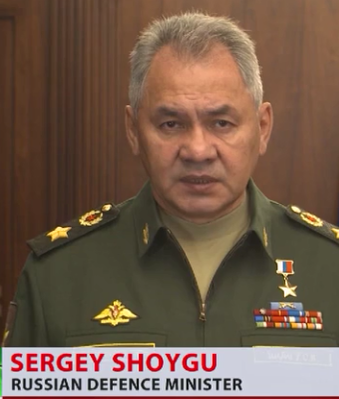
On Monday morning, following an unprecedented Sunday briefing at the Defence Ministry, Defence Minister Sergei Shoigu announced measures which Putin has repeatedly dismissed over many years. The new Russian war policy puts a stop to Putin’s assurances to the US, the European NATO powers and Israel that he was resisting the recommendations of his General Staff. Putin’s resistance ended on Monday morning. Shoigu and the Stavka ended it.

Shoigu’s measures were announced (right) between 11 and 12 noon on Monday, and broadcast on the state media within minutes. In effect, Shoigu declared a 400-kilometre no-fly zone for all foreign aircraft over Syria or the sea and land approaches to Syria from Israel, Jordan, Lebanon, Turkey and Iraq.

Also excluded are aircraft from the US base at Al-Tanf, inside Syria, and the British airbase at Akrotiri, Cyprus.

“The Syrian Armed Forces will be supplied with the advanced S-300 air defense missile system within two weeks,” Shoigu declared.

“It is capable of intercepting air threats at a range of more than 250 kilometers and simultaneously hitting several aerial targets… Command posts of the Syrian troops and military air defense units will be equipped with [the] automatic control systems, which have been supplied only to the Russian Armed Forces. This will ensure the centralized management of all Syrian air defense forces and facilities, monitoring of the situation in the airspace and prompt target designation.”

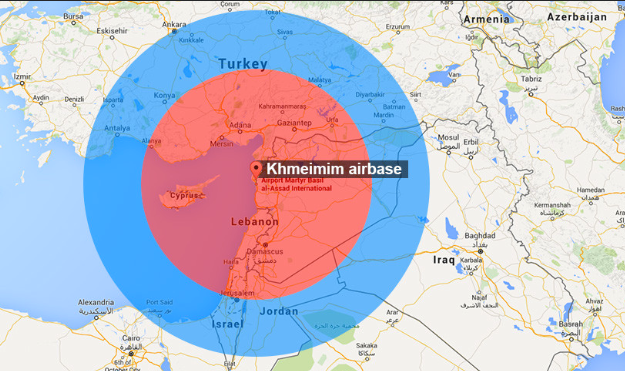
Shoigu’s double reference — to the range of the S-300 and to centralized command-and-control – means that the S-400 radars already installed for the defence of the Russian air base at Khmeimim and the naval base at Tartous will extend Syrian air defence to a range of more than 400 kilometres.

DETECTION AND STRIKE RANGES FOR THE RUSSIAN AIR DEFENCES OF SYRIA


The red zone is the maximum strike range of the S-400s based at Khmeimim; the blue zone is the maximum zone of detection by the Russian radars and other sensors on the ground at Khmeimim. The Tartous base is on the coast 60 kilometres due south. Both ranges can of course be extended by reconnaissance and strike aircraft flying out of Khmeimim; the operations centre at Tartous coordinating Russian Navy deployments; and additional Russian aircraft flying out of Iran. Source: http://warnewsupdates.blogspot.com

“Russia will jam satellite navigation, on-board radars and communication systems of combat aircraft, which attack targets in the Syrian territory, in the regions over the waters of the Mediterranean Sea bordering with Syria,” Shoigu added in the Monday morning declaration.

He explained the Stavka’s rationale:
 
“We are convinced that the implementation of these measures will cool hotheads and prevent ill-considered actions threatening our servicemen. Otherwise we will have to respond in line with the current situation.”

Shoigu’s references to “hotheads” and “ill-consiodered actions” were not only meant for foreign military, but also for those lobbying President Putin in favour of Israel, Turkey and the US.

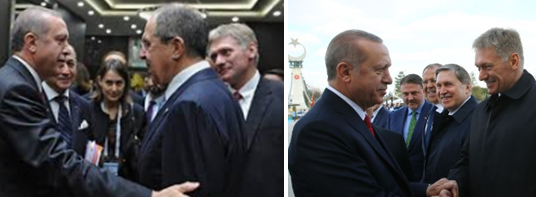
Dmitry Peskov, Kremlin spokesman and the principal lobbyist on Putin’s staff for Turkey, tried to dilute the meaning of the new measures.


Left: Erdogan with Peskov and between them Foreign Minister Sergei Lavrov, 
at Antalya, November 2015. Right: Erdogan with Peskov, and on his right, 
Lavrov and Yury Ushakov, Ankara, April 2018.

At 13:27 Peskov broadcast on the state news agency Tass:

“Russia’s actions aimed at ensuring security for its troops are necessary. This is why in this case, Russia is guided solely by these interests, these actions are not directed against third countries, they are meant to protect our own troops.”

Within minutes, the Kremlin posted a record of a telephone conversation between Putin and Syrian President Bashar al-Assad. This was the first contact reported by the Kremlin with the Syrian president over the week since Putin had negotiated an agreement in Sochi with President Recep Tayyip Erdogan for Turkish occupation of Idlib governorate; the text of their pact was leaked by Turkish media. For details, read this.

Syrian Government officials have refused to comment on the Putin-Erdogan agreement.
 
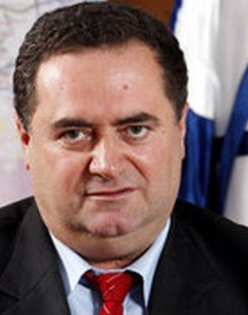
The Israeli Intelligence Minister Israel Katz (right) has claimed “the Russian president did not answer Assad’s phone calls…Assad tried to reach him and Putin didn’t answer.”

The Kremlin has said the Israeli claim has “nothing to do with the reality.”

In the Kremlin communiqué of Monday afternoon, Assad initiated the telephone conversation. The official record claims Putin “informed his Syrian counterpart about his decision to introduce additional measures in order to ensure the security of Russian military personnel in Syria and to improve Syria’s air defence system, including by handing over a modern S-300 missile system.”

Assad asked Putin to clarify what the Idlib agreement with Erdogan means. The Kremlin record says:

“The two presidents noted their readiness for further joint efforts to achieve a long-term peace in Syria, and restore its sovereignty, unity and territorial integrity, specifically, in view of the outcome of the trilateral meeting of the heads of state, guarantors of the Astana process, in Teheran and the recent Russian-Turkish summit in Sochi.”

The Kremlin record of Assad’s call was marked 13:30. Five hours later at 18:15, the Kremlin reported a telephone-call between Putin and Israeli Prime Minister Benjamin Netanyahu.

This was the second conversation between the two men in the Kremlin’s public record following the destruction of the Russian Il-20 aircraft on the evening of September 17. The first of their conversations occurred on the day after the air attack. Netanyahu conveyed “condolences” and “promised to provide detailed information on the activities of the Israeli Air Force over Syrian territory on that day, which will be delivered soon to Moscow by the Israeli Air Force commander.”

Putin was recorded as saying:

“Russian-Israeli agreements on preventing dangerous incidents had not been observed either, and that resulted in the Russian aircraft coming under Syrian air defence fire. The Russian President called on the Israeli side to prevent such incidents in the future.”

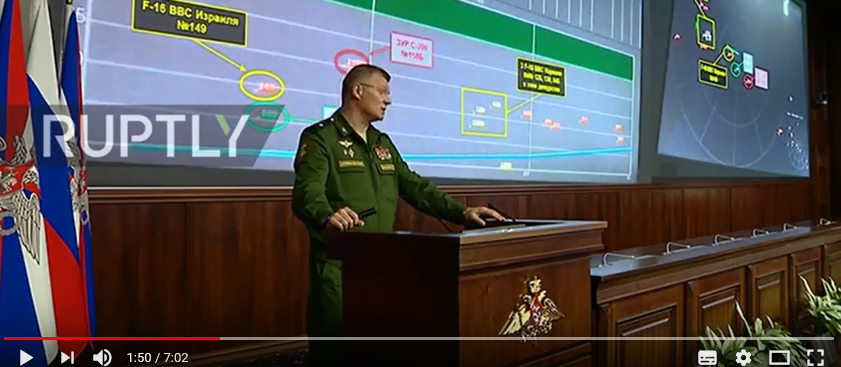
With the Israeli prime minister Putin ignored the Stavka’s detailed assessment of that morning, although Putin claimed elsewhere during the day that the briefing had been “fully coordinated with me”. Major General Igor Konashenkov had accused the Israelis of spoofing Syrian air defences and creating an ambush for the Russian aircraft. For details of Konashenkov’s first briefing, read this and watch the presentation.

Konashenkov held a second briefing on Sunday morning, September 23. Russian military correspondents cannot remember a Sunday briefing at the Defence Ministry before. Asked if the timing was aimed at Israel where Sunday is a working day, a Moscow source responds:

“I believe Sunday was [chosen by Shoigu] for Putin because the [Defence Ministry] did not want Kremlin to undermine the message or dilute it. They were telling Kremlin – we have done what you asked but they are killing us now and how low do you want to go. I don’t think [the briefing was] directed at Israel at all.”

Watch as it was broadcast on the Sunday evening national television news by Rossiya-24.

 
Source for English-subtitled version: http://thesaker.is/

Konashenkov announced:

“objective data says that the actions of Israeli pilots, which led to the death of 15 Russian military personnel, point to either lack of professionalism or criminal negligence. This is why we believe that the Russian Il-20 aircraft tragedy is solely the fault of the Israeli Air Force and those who made decisions concerning such actions.” 

Konashenkov also charged the Israeli military command with lying to the Russian operational command at Khmeimim in identifying in advance their target areas; lying about their manoeuvres around the Il-20 as it began its approach for landing at Khmeimim; lying about their attack aircraft positions off Latakia when the Il-20 was hit; and lying about the Israeli reponse after they had been notified the Russian aircraft was “in distress”.

Konashenkov revealed that the captain of the Russian aircraft was in communication with ground control for four minutes after his plane was struck and before it crashed into the sea. Konashenkov also said the Israeli attackers remained over the crash scene for eleven minutes before they returned to their base.

The day after the second briefing, yesterday morning, the Defence Minister announced the new Russian war policy in the Middle East. He was followed in the afternoon by a fresh briefing, the third by Konashenkov, with new radar tracking evidence showing exactly how the Israeli F-16 fighter-bombers had ambushed the Russian reconnaissance aircraft by drawing Syrian S-200 missile defences away from their initial lock on the Israeli targets.


Source: https://www.youtube.com/ For partial English translation and text, read this.

The Russian radar images, Konashenkov said, “clearly showed the direction of the flight of the S-200 missile launched by the Syrian air defense system, as well as the locations of the Russian and Israeli aircraft. It is quite clear that the missile was targeting the Israeli jet.”

“Today’s data does not just suggest but prove that the blame for the tragic [downing] of the Russian Il-20 airplane lies entirely with the Israeli Air Force. [Israel’s] claims about its alleged non-involvement in this tragedy that claimed lives of 15 Russian servicemen are false.”

Putin’s conversation with Netanyahu in the early evening followed Konashenkov; the Kremlin communiqué was posted at 18:15. “Russia proceeds from the premise”, Putin reportedly qualified Konashenkov, “that the actions of the Israeli Air Force were the main [sic] cause of the tragedy.”

Putin then undercut Shoigu’s policy by telling the Israeli:

“Russia’s decisions to bolster the combat capabilities of Syrian air defences are appropriate [sic] at this juncture and primarily [sic] intended to thwart any potential threat to the lives of the Russian military service members fulfilling the tasks of combatting international terrorism.”

Monday, September 24, 2018

Celebrating Iranian Hardship with Rudy G.

Trump War Whore Celebrates Starvation Of Iranian Civilians At MEK Rally

by Caitlin Johnstone - Rogue Journalist


September 24, 2018

Just when you thought this administration couldn’t get more cartoonishly villainous, Trump lawyer and Simon Bar Sinister stunt double Rudy Giuliani takes to the stage and enthuses about how US sanctions are making Iranian citizens so desperate they are offering to sell their internal organs for $500 in order to stay alive.

“Probably a fortune in Iran today. This is truly pitiful!” he crowed triumphantly to the crowd at the Iran Uprising Summit in New York on Saturday, pleased as punch by the US government’s success in torturing everyday Iranians with starvation.

Giuliani, who is basically what you’d get if necrophilia and racist police shootings had a baby, fumbled his way through a paid speech for the MEK terror cult with all the grace of a drunken creepy uncle MCing his way through a family wedding. In it he not only gloated over the starvation and severe impoverishment of Iranian civilians, but openly proclaimed that regime change was coming to Iran due to the actions of the Trump administration.

“I don’t know when we’re going to overthrow them. It could be in a few days, months, a couple of years, but it’s going to happen. They’re going to be overthrown.” Guiliani said definitively.

“The people of Iran have obviously now had enough. The sanctions are working. The currency is going to nothing! They’re where Russia was. They’re where Poland was. We see signs of young men and women saying ‘Give me some food!’ We saw a sign of a man trying to sell his internal organs for five hundred American dollars – probably a fortune in Iran today! This is truly pitiful. These are the kinds of conditions that lead to successful revolution, and God willing, non-violent revolution.”

Truly pitiful, he reckons. That’s like standing on a patient’s oxygen hose at the hospital and then making fun of them for gasping for air. Sanctions are the only legal act of war that deliberately target innocent civilians, and here is Giuliani mocking people for the suffering he is gleefully supporting inflicting.

Corpse bride Nikki Haley was quick to distance the Trump administration from Giuliani’s regime change rhetoric, as was the US State Department in a statement to Reuters, because as we saw them do with Libya and as we’ve seen them attempt with Syria, the US government has ever since the disastrous Iraq invasion had a standing policy of denying that it is pushing for regime change in key strategic regions while doing exactly that.

But Giuliani has been repeatedly appearing at these events spouting the exact same regime change rhetoric while retaining employment as Trump’s lawyer, and at no time has the president or anyone else in the administration made him stop. The administration can’t actually have that much of a problem with Giuliani’s schtick; if it did Giuliani would either stop or be fired.

Neither has happened. Giuliani keeps getting these lucrative speaking gigs where he champions regime change again and again, which was also done at another such event by murderous psychopath John Bolton not long before he was hired as Trump’s National Security Advisor. Giuliani’s words have the tacit blessing of the Trump administration.

Giuliani was hired to speak alongside Maryam Rajavi, the leader of the Mujahideen e Khalq (MEK), a paramilitary cult that was only recently delisted by Hillary Clinton as a designated terror group at the behest of CIA and FBI insiders and other shadow government stalwarts. The MEK was originally listed as a terrorist group because it has killed Americans and has an extensive history of committing acts of terrorism, and has recently been exposed in operating an extensive social media propaganda campaign to manufacture support for Iranian regime change in the west.

Rajavi boasted at the event that her group has organized special “Units of Rebellion” to run riots and interference inside Iran, which was a pretty interesting thing to say on the very same day that there was a terror attack on a military parade in the Iranian city of Ahvaz that slaughtered 24 people and wounded many more.

There was no inference that the MEK was responsible for this particular attack, but it’s kind of fascinating that while Nikki Haley was telling Iran to “look in the mirror” with regard to the attack on Ahvaz because in her view, the attack came from organic civil unrest which is the fault of the Iranian government, Giuliani was celebrating that the sanctions applied by the US were working because they were causing the kind of intense suffering on civilians that leads to civil unrest and a “successful revolution”, while Rajavi was saying that her (exiled) group was planning on riots and provocations to stimulate civil unrest. Not to mention the fact that the coup-staging CIA recently escalated covert operations in that nation.

How exactly do they think this works? You can’t be boasting about your success at provoking civil unrest while pretending you’re just an innocent-but-concerned bystander who had his hands in his pockets the whole time, officer. Not a thing.

They think we’re stupid. They must, or they’d never try to get away with this bullshit. Eyes and ears open, clear-eyed rebels. The veils are being pulled back almost quicker than we can process.

______________________

Thanks for reading! The best way to get around the internet censors and make sure you see the stuff I publish is to subscribe to the mailing list for my website, which will get you an email notification for everything I publish. My articles are entirely reader-supported, so if you enjoyed this piece please consider sharing it around, liking me on Facebook, following my antics on Twitter, checking out my podcast, throwing some money into my hat on Patreon or Paypal,buying my new book Rogue Nation: Psychonautical Adventures With Caitlin Johnstone, or my previous book Woke: A Field Guide for Utopia Preppers.


Bitcoin donations:1Ac7PCQXoQoLA9Sh8fhAgiU3PHA2EX5Zm2
 

Sunday, September 23, 2018

Running Off the Rails: America's Dangerous New Political Reality

Trump’s New (Non-Democratic) Normal: What Happens When the Adults in the Room Are as Scary as the Crying Baby?

by John Feffer  - TomDispatch

 
September 23, 2018


During a lifetime of make-believe, Donald Trump has never pretended to be a conventional politician. When he finally decided to make a serious bid for office, he built his presidential aspirations on the flimsiest of foundations: a wild conspiracy theory about Barack Obama’s birthplace. His leadership bona fides were equally laughable, having presided over bankrupt casinos and failed real-estate projects, fabricated the persona of a lady-killer, and created a reality TV show about a tin-pot entrepreneur.

It wasn’t difficult to predict how all this would end up politically. Plenty of oddballs had run for president, from Jello Biafra to Roseanne Barr, and gotten nowhere. The guardrails of American democracy were set up to prevent just such outsiders from making it anywhere near the Oval Office. 
 
Donald Trump’s three presidential qualifications -- money, name recognition, and unbounded arrogance -- were obviously not enough to overcome his lack of sway with party bosses. Seasoned politicians and backroom operators, the putative “adults in the room,” had spent years ridiculing the blowhard with the bad hair banging on the door and demanding red-carpet treatment.
 
And then, of course, he won. 
 
Tomgram: John Feffer, Say Goodbye to the Guardrails of Governance

[Note for TomDispatch Readers: For a $100 contribution ($125 if you live outside the U.S.), you can still get a signed, personalized copy of John Feffer’s spine-tingling dystopian novel, Splinterlands, a book about a future Planet Earth that each Trumpian month seems to make more relevant. Just go to the TomDispatch donation page to check out the details. (Note that my own latest book, A Nation Unmade by War, is also available there.) And don’t forget that, less than two months from now, volume two of Feffer’s Splinterlands series, Frostlands, will be published by Haymarket Books. Signed copies will then be available for that one as well. You have the Engelhardt guarantee that it couldn’t be more gripping! Tom]

It’s been quite a time for, in the phrase of the moment (which TomDispatch regular John Feffer wields particularly effectively today), “the adults in the room.” We’re talking, of course, about the very Washington insiders whom a “senior administration official” in an anonymous op-ed in the New York Times patted on the back for saving us all from Donald Trump. Recently, as Hurricane Florence swamped North Carolina, I thought about that state’s version of those same adults. You know, the ones in the Republican-dominated legislature who insisted, not so long ago, that a climate-change-induced rise in sea level, expected to drown parts of that state’s low-lying coast by 2100, was essentially a hoax. They even passed a thoroughly adult law -- H.B. 819 -- in 2012 that, as the New York Times reported, “effectively ordered state and local agencies that develop coastal policies to ignore scientific models showing an acceleration in the rise of sea levels.” The result: a wave of new building and yet more development along that same endangered coast -- of structures some of which have only recently been boarded up and whose fates, now or later, will likely spell disaster for insurance companies and others. And keep in mind that Florence was only the beginning of the “hoax” to come as intensifying storms, crossing ever-warmer ocean waters, bring yet more drenching rains, while sea levels continue to rise.

As we know, updated versions of those 2012 “adults” in North Carolina now dominate all environmental and climate-change policy-making in Washington. They are the only “adults” in the (heating) Trumpian room and they are now doing their damnedest to heat it further. Think about that as you consider Feffer’s distinctly dystopian vision -- what other kind could there be? -- of Donald Trump’s new normal in Washington and the so-called adults in that room with him. (And then, if you’re in the mood for a little dystopian fiction, rather than fact, pick up his riveting novel, Splinterlands, which focuses on the potentially grim fate that awaits this planet or, if you’ve already done that, pre-order his newest Dispatch Book, Frostlands, number two in his series about how we are, in fact, changing everything. It’s coming in November.) Tom

Trump’s New (Non-Democratic) Normal: What Happens When the Adults in the Room Are as Scary as the Crying Baby?

by John Feffer

 
In the 2016 presidential election, the guardrails of democracy collapsed. The Electoral College, designed to weed out all those with what Alexander Hamilton had once called “talents for low intrigue and the little arts of popularity,” delivered a victory to a candidate who had talents for little else. 
 
As Jeff Greenfield wrote at Politico immediately after the elections,

“The blunt fact is that many of the guardrails that were supposed to protect the world’s oldest functioning democracy have been shown to be perilously weak, as vulnerable to assault as the Maginot Line was in the face of the German army some 75 years ago.”

In the wake of The Donald’s upset victory, journalists and pundits hastened to recommend a slate of advisers who could inject some gravitas into the new administration and restore an approximation of that Maginot Line. Under counsel from such grey eminences as former national security advisors Henry Kissinger and Condoleezza Rice, the new president brought a bevy of such “adults” into his administration, including ExxonMobil oil executive Rex Tillerson as secretary of state and active duty Lieutenant General H.R. McMaster as national security advisor. Two “adults,” Republican Party grandee Reince Priebus and retired Marine Corps General John Kelly, have similarly tried, as White House chiefs of staff, to manage Trump. Recently, a New York Times op-ed written by an anonymous “senior administration official” suggested that a “steady state” of “adults in the room” has been covertly ensuring that President Trump doesn’t blow up the country or the world.

In response, President Trump has done his best to fire or at least ignore all such adult supervisors. After the departures of Tillerson, McMaster, and economic adviser Gary Cohn, the New Republic lamented that Trump was “systematically removing the guardrails in his cabinet” (which proved no more effective than the electoral ones). In fact, after the latest “crazytown” revelations in the bestselling new book by veteran Washington Post journalist Bob Woodward, perhaps it’s time to retire those creaky metaphors of American politics. No more “guardrails,” no more “adults.” They represent thinking that has proven woefully inadequate for understanding Donald Trump’s rise to power or the America of this moment.

Forget Donald Trump for a second and just think to yourself: Who’s responsible for the last 17 years of never-ending American wars that have convulsed the planet? Babies? Teenagers? Grown men acting like babies? Let’s face it: perfectly sober adults, including the man who left ExxonMobil to become secretary of state, have long seemed intent on ensuring the flooding, burning, and general destruction of this planet. And don’t forget that the adults in the Republican Party, backed by their deep-pocket funders, were responsible for getting Donald Trump over the hump and into the Oval Office. Ultimately they, and not the policy-ignorant president, are to blame for the devastation that followed.

As for those guardrails, they represent, at best, the most imperfect of metaphors. Despite all the actual guardrails on American highways, traffic fatalities have risen to more than 40,000 a year and cars are now the top killers of Americans between the ages of 15 and 24. Guardrails may prevent the occasional drunk from driving into a ravine, but they obviously don’t stop a significant portion of the population from committing autocide.

The truth is: those guardrails of democracy were faulty long before Trump came along and some of the adults in the room are scarier than the squalling infant. Such metaphors, in fact, make it increasingly difficult to see what Trump and his babysitters are really doing: not just destroying a culture of civility or undoing the accomplishments of the Obama administration but attacking the very pillars of democracy.

Moving the Guardrails


Donald Trump, The Washington Post concluded a year after his election, had broken through “the guardrails of presidential behavior.”

Given the sheer number of lies he’s spewed in his tenure in office -- more than eight mistruths a day and rising -- the Post’s conclusion seems incontrovertible. However, when it comes to wrongdoing, Trump has plenty of presidential precedents, from the high crimes and misdemeanors of Richard Nixon to the torture policies of George W. Bush. Trump is as crude as Lyndon Baines Johnson, as ill prepared as Ronald Reagan, as sexually predatory as Bill Clinton. All of these presidents prepared the American public for a leader who, like some super villain in a comic strip, would combine the worst qualities of his predecessors in one explosive package.

Trump broke through no guardrails (a feature of highway safety that he once disparaged in a Wall Street Journal interview as the “worst crap”). Rather, generations of politicians and operatives incrementally moved them to such a degree that his behavior became acceptable to enough Americans to elect him.

Admittedly, his actions are now breaking new ground. He’s elevated family members -- daughter Ivanka and son-in-law Jared Kushner -- to senior policy positions, while ensuring that his business empire profits from his presidency in unprecedented ways. Still, to understand the more lasting impact of the Trump administration requires a look at how his crew is transforming the underlying structures of American democracy, whether it’s the influence of money on politics, the hijacking of the judiciary, or the undermining of media watchdogs.

Trump grabs the daily headlines with his loose tweets and outrageous acts. The savvy operators and implementers lurking in his shadow use the cover of scandal to move those guardrails in a big league fashion. The defenders of today’s Maginot Line will wake up some morning to discover that the enemy never had to storm the battlements. They just uprooted the fortifications and shoved them out of the way.

Boosting the Rich


Many democratic countries wouldn’t tolerate the way the rich and corporations call the shots in American elections. To win a House seat, for example, now costs, on average, $1.5 million; a Senate seat, nearly $20 million. By contrast, in Canada, where neither corporations nor unions can make campaign contributions and individuals are restricted to a very modest $1,500 cap on party donations, a typical campaign for parliament costs in the tens of thousands of dollars and nearly half of the biggest spenders lose.

In 2010, the situation in the United States became incomparably worse when the Supreme Court decided, in the Citizens United case, that campaign contributions are constitutionally protected free speech. Super PACs can now spend unlimited amounts of money on elections, giving rich individuals unparalleled impact and a way to cover their tracks through “dark money” contributions. Former president Jimmy Carter has accurately labeled that decision “legalized bribery.”

Meanwhile, money has come to play a remarkable role in policymaking, too. Where other countries struggle to expunge bribery and corruption from their political systems, the United States has simply institutionalized it under the rubric of lobbying. 
 
As Michael Maiello wrote in Forbes back in 2009:

“[I]n an open society like the U.S., our brightest minds are unable to draw meaningful distinctions between handing someone an envelope full of cash and flooding a senator's campaign war chest, except to point out that lobbying is far more effective. A briber wants to circumvent the law. A lobbyist wants to change it.”

Trump famously declared his independence from donors and lobbyists. He told the Koch brothers, for instance, that he didn’t “need their money or bad ideas.” In the end, however, he would prove just as beholden to big donors as any conventional politician. He rode to power with the backing of casino magnate Sheldon Adelson, Home Depot co-founder Bernard Marcus, World Wrestling Entertainment co-founder Linda McMahon, hedge fund operator Robert Mercer, and philanthropist Betsy DeVos. After the election, he immediately rewarded McMahon and DeVos with administration positions, then pushed through a tax reform bill that was a bonanza for his billionaire buddies and transformed Middle East policy to reflect the demands of Adelson, Marcus, and Mercer. And though he promised to clean out the Washington swamp, his appointees have been embroiled in one scandal after another.

The Trump team is also making structural changes to restrict the ways that ordinary citizens can, in the future, challenge such a plutocratic form of government. Building on successful Republican Party efforts in, for instance, Florida leading up to the 2000 presidential election, the Trump administration is going all out to suppress the electoral participation of minorities and the poor. New voter ID laws helped him win key states like Wisconsin, so no surprise that he wants to make such a voter ID system a nationwide one.

Leading up to the midterms, the Republican Party has also been rushing to purge voter rolls and put in place racial gerrymandering, even using the Americans with Disabilities Act as an excuse to close polling places in rural Georgia to tamp down the African-American vote. In a team effort by the Justice Department and Immigration and Customs Enforcement, the president has also directed federal agencies to gather voting records in areas of North Carolina with large Latino populations in order to keep likely Democratic Party voters away from the polls.

In this way, Trump is working to return America to its glory days -- when only well-off white men had the right to vote.

Tilting the Courts


Trump controls (if that’s the term for it) the White House; the Republicans, in part through voter suppression and gerrymandering, control Congress. But pollsters predict that the Democrats are likely to win back at least the House in the coming midterm elections and the 2020 presidential election is clearly still up for grabs. So, in its quest to move the political guardrails more permanently, the Trump administration has focused on the third branch of government: the courts. There, it can not only neuter one of the most powerful checks on Trump’s 1% agenda, but have an impact that will last for decades.

With the Supreme Court, the Republicans in Congress proved both lucky and strategic. President Trump was immediately able to fill a vacancy, thanks to the Republican Party’s successful Hail Mary decision to block Merrick Garland’s nomination in the waning months of the Obama administration. Then, by nominating Neil Gorsuch to fill the vacancy created by Antonin Scalia’s death, the Trump team began to make a play for the retirement of swing-voting justice Anthony Kennedy. Gorsuch had clerked for Kennedy and so had the two key candidates (Brett Kavanaugh and Raymond Kethledge) that Trump fingered for his seat, should it become vacant. The president then played up his business relationship with Kennedy’s banker son, while Ivanka worked her charms on the judge over lunch. Administration officials swore that they would honor Kennedy’s legacy, as long as he resigned quickly enough to squeeze in another confirmation before those midterms threatened Republican majorities in Congress.

Meanwhile, the Trump team barreled along making judicial appointments to the lower courts at a time when it could barely be bothered to fill key positions in the State Department. The new president came into office with 105 unfilled judicial vacancies, a legacy of Republican congressional foot-dragging during the Obama years. While conservative allies supplied him with a wish list of judicial ideologues, Trump acted with all deliberate haste by appointing 22 appeals court judges and 20 district judges (all lifetime positions). These new judges -- in the 12 federal judicial circuits with regional jurisdiction -- have already made their mark in cases involving campaign finance, presidential authority, and abortion, among other issues. “After just 18 months, Trump has ‘flipped’ two circuits -- the Sixth and Seventh -- from what Trump’s supporters in the conservative legal movement consider ‘liberal’ to more properly conservative,” writes Jason Zengerle in the New York Times Magazine, pointing out that other circuits are also now nearing the tipping point.

This judicial transformation extends to federal agencies. Administrative law judges are basically civil servants who handle a varied caseload from Social Security benefit claims to regulatory enforcement. After making a broad interpretation of a recent Supreme Court decision, the Trump administration is now transforming these 1,900 judges into the equivalent of political appointees. It also argues that it can fire judges and hire new ones to pack such administrative courts, which will then help push a Republican anti-regulatory revolution from within.

At one point, Donald Trump casually remarked that he thought the United States should try out the Chinese system of “president for life.” While that’s not likely to happen any time soon, with his judges for life, the president is institutionalizing the 1% ideology of the adults in that room of his before the voters can kick him out of office.

Sidestepping the Watchdogs


After a lifetime using the media to build his brand, Donald Trump is now systematically trying to blow up one of the cornerstones of American democracy. He has called the press the “enemy of the American people,” repeatedly labeled reputable media outlets as “fake news,” and legitimized far-right sources by parroting their claims.

Trump didn’t create such a climate. The rise of Fox News, the spread of websites like Infowars, and the persistent popularity of right-wing radio shock jocks have all contributed to the demonization of the “liberal” media. As a result, for a significant number of Americans, trying to gather facts -- as opposed to expressing opinions at top volume -- has become a suspect occupation. According to the 2018 Edelman Trust Barometer, when it comes to the general population, trust in the media has dropped five points since 2017 and an astounding 22 points for the “informed public” (defined as college-educated and in the top 25% of household income).

The mainstream media have long aspired to serve a watchdog role. Reporters are supposed to fact-check the powerful, sniff out corruption, and peel away government propaganda to expose the hidden histories behind it. Granted, journalists have blind spots and the economically powerful often don’t receive the sort of scrutiny that the politically powerful do, but media operations with budgets for investigative journalists and fact-checkers are an integral part of any democratic society.

Donald Trump hasn’t just disparaged the mainstream media, he’s done an end run around it. He feels little need to hold press conferences -- only one in his first year of office (compared to Obama’s 11) -- because he communicates with the America he wants to reach directly through his Twitter account. The news media then have to play catch-up reporting on his tweets.

In doing so, he creates the appearance of candor, since he speaks his mind without PR specialists getting in the way -- but not to the entire American population. Typically, he avoids making speeches in blue states (places that his administration’s policies are deliberately crafted to harm). His strategy is to preach to the choir 24/7 in a communications universe free of the mainstream media. When it comes to reporters, the president’s supporters follow his lead and pay them little attention. Indeed, 72% of Republicans trust Trump over the media and nearly half believe that "the president should have the authority to close news outlets engaged in bad behavior." His attacks on the media, deliberately designed to distract attention from his various scandals, are undermining the entire institution.

In effect, Trump has cultivated a constituency that lies outside the democratic conversation, building on the 22% of Americans who believe autocracy to be superior to democracy and the slightly larger percentage who would support a military coup to combat crime or corruption. Independent media wouldn’t last long in either scenario.

The New Normal


The most dangerous part of Trump’s onslaught on democracy is the cynicism it’s likely to generate, which will only reinforce the goals of the Trumpistas if a significant chunk of the 99% decide that voting isn’t worth it, politics is a game best avoided, and Twitter is superior to a newspaper. Democracy doesn’t just die in darkness. It can die of indifference -- not with a bang or a whimper, that is, but with a yawn.

Of course, there’s nothing like a famously corrupt politician to reinvigorate civic action. In the aftermath of the Watergate scandals, a new wave of reformers won places in Congress, immediately launching investigations into covert operations, establishing new rules for campaign finance, and attempting to rein in the power of the presidency through measures like the War Powers Act. In other words, after the scandals of the early 1970s, reformers surveyed the wreckage of the political landscape and attempted to repair the infrastructure of American democracy. At best, they offered quick fixes, while during the Reagan years that followed, the putative adults in the room returned to their favorite activity: moving the guardrails to favor the wealthy and the powerful.

After the midterms in November, new voices like Alexandria Ocasio-Cortez and Rashida Tlaib will be in Congress and there will undoubtedly be renewed energy to stop, if not roll back, Trumpism. All those whom the president has insulted -- and it’s an ever-lengthening list -- may join hands in an effort to break the vicious circle of ignorance, apathy, and anger Trump has encouraged. This will be no easy task. But it would be poetic justice if what’s left of the mechanisms of democracy -- voting, the courts, and the press -- can still be used to defeat a potential autocrat, his family, and all the putative adults he’s brought into the room to implement his profoundly anti-democratic program. The question is: Will it already be too late?

John Feffer, a TomDispatch regular, is the author of the dystopian novel Splinterlands (a Dispatch Books original) and the director of Foreign Policy In Focus at the Institute for Policy Studies. His latest book is Aftershock: A Journey into Eastern Europe’s Broken Dreams. This November, Frostlands, book two of his Splinterlands series, will be published by Haymarket Books.

Follow TomDispatch on Twitter and join us on Facebook. Check out the newest Dispatch Books, Beverly Gologorsky's novel Every Body Has a Story and Tom Engelhardt's A Nation Unmade by War, as well as Alfred McCoy's In the Shadows of the American Century: The Rise and Decline of U.S. Global Power, John Dower's The Violent American Century: War and Terror Since World War II, and John Feffer's dystopian novel Splinterlands.

Copyright 2018 John Feffer

Russian Defense Ministry Accuses Israel of Criminal Negligence in Friendly Fire Transport Downing

Il-20: Russian MoD Accuses Israeli Military of CRIMINAL NEGLIGENCE

by The Saker 

via Russia Defense Ministry

September 23, 2018 


- Watch the Official Briefing -

Rosenstein's Real Threat

Deputy AG Rosenstein a 5th Column Threat

by Stephen Lendman


September 22, 2018

Rosenstein is part of a sinister Washington cabal, wanting Trump impeached and removed from office – for the wrong reasons, not the right ones. True enough, he’s bombastic, a racist, a serial liar (like most everyone in Washington), part of the nation’s bipartisan criminal class, and a myognynist.

Philosophy Professor Kate Manne says the later trait isn’t about male hostility or hatred toward women. It’s about wanting to control and punish them for challenging male dominance – “because they’re women in a man’s world, a historical patriarchy” in America and most other societies.

There’s plenty about Trump to criticize, mainly his endless wars of aggression, exclusive support for privileged interests, and advancing the nation toward totalitarian rule – major high crimes his critics ignore.

Throughout the 2016 presidential campaign, media-supported dark forces plotted against him, wanting him prevented from being elected.

Pre-inauguration, a slow-motion coup d’etat against him began, continuing throughout his tenure, pursued by US intelligence community extremists, undemocratic Dems and some Republicans, supported by media scoundrels – wanting him impeached and removed from office, Pence a convenient puppet in waiting to replace him.

No president in US history was ever removed from office by impeachment.

Under the Constitution’s Article II, Section 4, impeachment and conviction require proving “treason, bribery, or other high crimes and misdemeanors.”

The Constitution’s Article I, Section 2 empowers House members to impeach a sitting president. Senate members alone are empowered to try them.

Like most of his predecessors, Trump is guilty of high crimes of war and against humanity and other serious offenses – unmentioned by critics.

No legal basis exists for charging him with obstruction of justice. No evidence suggests it. Nothing indicates he or his team colluded improperly or illegally with anyone in Russia.

Anything related to his private sex life isn’t an impeachable offense. Nor are his views on any issues – no matter how extreme, offensive and unacceptable.

Trump’s deputy AG Rosenstein is his sworn enemy – in cahoots with other dark forces in Washington, wanting him impeached and removed from office.

On Friday, the anti-Trump NYT said he,

“suggested last year that he secretly record [the president] in the White House to expose the chaos consuming the administration, and he discussed recruiting cabinet members to invoke the 25th Amendment to remove Mr. Trump from office for being unfit.”

It provides procedures for replacing the president or vice president in case of death, removal, resignation, or incapacitation.

Abuse of power and other high crimes are impeachable offense, not unfitness, illness or emotional disorders.

Lincoln was elected president despite suffering from lifelong depression.

Washington, John Adams, Jefferson, Madison, Chester Arthur, Woodrow Wilson, FDR, JFK and Reagan were affected by illnesses during their tenure, hampering their ability to govern – none targeted for removal from office by impeachment, Kennedy removed by state-sponsored assassination.

Trump is accused of narcissism, likely applying to most seekers of high office in America and elsewhere. It’s not an impeachable offense.

Section 4 of the 25th Amendment states:

“Whenever the Vice President and a majority of either the principal officers of the executive departments or of such other body as Congress may by law provide, transmit to the President pro tempore of the Senate and the Speaker of the House of Representatives their written declaration that the President is unable to discharge the powers and duties of his office, the Vice President shall immediately assume the powers and duties of the office as Acting President.”

No evidence suggests Trump is “unable to discharge the powers and duties of his office.” Unlike many of his predecessors, he’s not too ill or otherwise unable to serve.

Claiming otherwise is all about plotting a coup to remove him from office. Section 4 was never invoked against sitting presidents unable to perform his duties because of illness, no matter how serious.

Lincoln, Franklin Roosevelt, Kennedy, William Henry Harrison, Zachary Taylor, James Garfield, William McKinley, and Warren Harding died in office – Section 4 never invoked to remove them from office before death.

Rosenstein is a fifth column threat to an elected president, ample just cause to remove him for coup plotting.

In cahoots with undemocratic Dems and special counsel Robert Mueller, he’s involved in the diabolical Russiagate witch-hunt to delegitimize Trump for the wrong reasons – waging political war to remove him from office, along with falsely accusing Russia of meddling in the US political process.

An administration member plotting against its leader should be sacked straightaway. Rosenstein opposed Trump’s summit with Putin to improve relations.

Dark forces in Washington, including the deputy AG, want them kept implacably hostile, serving the interests of the military, industrial, security, media complex.

World peace, stability, and cooperative relations with all nations defeat their diabolical aim for unchallenged global dominance by whatever it takes to achieve it – endless wars of aggression their favored strategy.

According to the Times, “(n)one of Mr. Rosenstein’s proposals apparently came to fruition,” adding he told deputy FBI director Andrew McCabe “he might be able to persuade Attorney General Jeff Sessions and John F. Kelly, then the secretary of homeland security and now the White House chief of staff, to mount an effort to invoke the 25th Amendment” against Trump.

“A Justice Department spokeswoman also provided a statement from a person who was present when Mr. Rosenstein proposed wearing a wire. The person, who would not be named, acknowledged the remark but said Mr. Rosenstein made it sarcastically.”

The Times claimed unnamed other DOJ officials said his proposal was serious, wanting the FBI involved in secretly wiretapping Trump.

Whether the Times-reported scenario is partly or entirely true or fabricated is unknown. Unnamed sources are always suspect.

Rosenstein denied the Times’ report. AG Jeff Sessions recused himself from the Russiagate probe over legitimate contacts with Russia’s envoy to Washington Sergey Kislyak when serving as a US senator.

At the time, his spokeswoman Sarah Flores said he had over 25 conversations with foreign ambassadors in the past year, including from Australia, Britain, Canada, China, Germany, India, Japan, South Korea, as well as Russia – part of his job as a Senate Armed Services Committee member.

Numerous other Republican and undemocratic Dems also met with Kislyak, Sessions alone unjustifiably criticized over nothing.

His recusal and national security advisor Michael Flynn ousting was all about bashing Trump and Russia.

Undemocratic Dems, other dark forces in Washington, hostile media scoundrels, and Rosenstein’s hostility toward Trump are part of a plot to remove him from office for the wrong reasons.

Succeeding will drive another stake into the heart of the republic, things on a slippery slope toward full-blown tyranny.

The way things are going, whether Trump survives or is ousted, it’s just a matter of time.

VISIT MY NEW WEB SITE: stephenlendman.org (Home – Stephen Lendman). Contact at lendmanstephen@sbcglobal.net.

My newest book as editor and contributor is titled “Flashpoint in Ukraine: How the US Drive for Hegemony Risks WW III.”

www.claritypress.com/LendmanIII.html
Stephen Lendman was born in 1934 in Boston, MA. In 1956, he received a BA from Harvard University. Two years of US Army service followed, then an MBA from the Wharton School at the University of Pennsylvania in 1960. After working seven years as a marketing research analyst, he joined the Lendman Group family business in 1967. He remained there until retiring at year end 1999. Writing on major world and national issues began in summer 2005. In early 2007, radio hosting followed. Lendman now hosts the Progressive Radio News Hour on the Progressive Radio Network three times weekly. Distinguished guests are featured. Listen live or archived. Major world and national issues are discussed. Lendman is a 2008 Project Censored winner and 2011 Mexican Journalists Club international journalism award recipient.

Dogs of the Yemeni War: Trained in Israel, Paid by UAE

Mercenaries Leading Assault on Yemen Port City Were Trained by IDF in Israel

by Whitney Webb - MintPress News


September 23, 2018

Foreign mercenaries, trained covertly at secret IDF camps in the Negev desert, are now leading the new assault on the Yemen port city of Hodeida, an assault that observers warns threatens to dramatically worsen Yemen’s already catastrophic humanitarian crisis.


A new report from Emirati news website Al-Khaleej Online reveals many of the mercenaries leading the assault against Yemeni port city of Hodeida were trained in Israel by Israeli soldiers, shedding light on Israel’s covert role in the war in Yemen.

According to U.S. officials close to the House Intelligence Committee with knowledge of the operation, hundreds of mercenaries of various nationalities fighting on behalf of the United Arab Emirates (UAE) in Yemen recently received “instance combat training” at camps in the Negev desert, created through a secret agreement reached between the UAE and Israel.

UAE's hired Colombian soldiers fight its war on Yemen

Mercenaries at the camp were trained under the “personal supervision” of the Israel Defense Forces (IDF).

The camp’s creation was spearheaded by UAE Security Adviser Mohammed Dahlan, who has personally overseen the recent hiring of a fresh force of foreign mercenaries, the majority of whom are Colombian or Nepalese, to fight on the UAE’s behalf in Yemen.

Dahlan, a Palestinian, was a central figure in the U.S.-backed plot funded by the United Arab Emirates to arm and train militias to overthrow Hamas after they won Gaza elections in 2007. Dahlan has since lived in exile in the UAE where he has developed a close relationship to the Emirati royal family and now serves as one of their advisers. Dahlan also has close ties to Israeli Defense Minister Avigdor Lieberman.

The report noted that Dahlan had personally visited the training camps in Israel on more than one occasion in order to supervise the training received by mercenaries from the IDF. Al-Khaleej’s sources also stated that Dahlan had chosen the Negev desert as the site for the camps due to the similarities the region shares with Yemen in terms of its climate, environment and tribal structure.

These mercenaries, trained at IDF-led camps in Israel and funded by the UAE, are now leading the renewed assault on the Yemeni port of Hodeida, which began earlier this week on Tuesday. The UAE/Saudi Arabia coalition had previously launched an assault in Hodeida in June but that effort failed to make headway despite the coalition’s superior firepower. The new assault was launched after the coalition recently succeeded in cutting off the main road between Hodeida and the Yemeni capital of Sana’a.

Over 90% of Yemen’s food is imported through Hodeida, prompting the UN and several NGOs to warn that any disruption to food and fuel supplies coming through the Hodeida port “could cause starvation on an unprecedented scale” as the country’s humanitarian crisis – a direct consequence of the coalition’s actions – is now more dire than ever.

An Open Secret: Israel’s Covert Involvement in Yemen’s War


Notably, the revelation of the Israel-based UAE mercenary training camps is not the first indication of covert Israeli involvement in the Yemen conflict. Indeed, when the war first began in 2015, the coalition led by Saudi Arabia and the UAE were known to use Israeli-made weapons.

In addition, paperwork seized by the Saudi Embassy in the Yemeni capital of Sana’a that same year revealed that the U.S. was seeking to build a military base near Yemen’s Bab al-Mandab strait in order to “ensure the security of Israel,” suggesting a strong motive for the U.S.’ and Israel’s support for the coalition.

More recently, rumors about new Israel-Saudi weapons deals, including alleged plans to sell Saudi Arabia the Iron Dome missile defense system, have received press attention, suggesting that the covert sale of Israeli weapons to the Saudi-led coalition continues to the present.

Al-Khaleej Online had previously reported that Israel had covertly sold weapons and ammunition to the Saudis, including internationally prohibited weapons that have since been used in the coalition’s brutal bombing campaign in Yemen that consistently targets civilian infrastructure. Just last month, 43% of the coalition’s targets were civilian structures, despite the fact that the U.S. now directly aids the coalition in choosing its strike targets as part of an alleged effort to reduce civilian casualties in the war.

While Israeli involvement in the war in Yemen has thus far been covert, Israeli Prime Minister Benjamin Netanyahu stated last month that he would consider sending Israeli troops to Yemen to fight on behalf of the Saudi-led coalition if the Yemeni resistance gained control over the strategic Bab al-Mandab strait, which serves as a chokepoint on Saudi oil exports and other important Red Sea commerce.

Given Israel’s support for countries involved in genocidal wars in the past and its own treatment of Palestinians, it is unlikely that Israel’s government would feel constrained by any moral dilemmas if it chose to formally join the coalition’s war in Yemen despite the humanitarian crisis that war has provoked.

The humanitarian crisis in Yemen, considered the worst in the world, has brought 17.8 million Yemenis to the brink of starvation including 5.2 million children. In addition, 66,000 children in Yemen die annually from preventable diseases due to the coalition’s blockade of Yemen which has also allowed the worst cholera outbreak in history to proliferate.

Despite the huge death toll that has resulted from the coalition blockade and airstrikes, the “mastermind” of the conflict, Saudi Crown Prince Mohammad bin Salman, has vowed to continue to target Yemeni civilians, including women and children, in order to “leave a big impact on the consciousness of Yemenis [for] generations.”

Whitney Webb is a staff writer for MintPress News and a contributor to Ben Swann’s Truth in Media. Her work has appeared on Global Research, the Ron Paul Institute and 21st Century Wire, among others. She has also made radio and TV appearances on RT and Sputnik. She currently lives with her family in southern Chile. 

Republish our stories! MintPress News is licensed under a Creative Commons Attribution-NonCommercial-ShareAlike 3.0 International License. 

Germany's Shame: Environment Defender Martyred in the Hambach Forst

Response to The Tragic Death of Our Comrade 

by Hambi Bleibt!


09/22/2018

When not just one but millions of lives are taken by coal particulates, climate change and repression, even to those proactively resisting those destructive and deadly dynamics those lives seem rather distant as if an important but almost as if a statistic.

It is a different matter altogether when that life that perishes is one of one that you have known, shared meals and stood on the front-line with.

When our friend, comrade and documentarian lost his life, when the people mostly affected were still processing what has happened the police lines below the Beechtown occupation were being reinforced with barking police dogs, as the affected tree sitters surrounded by an eviction on just what seemed temporary media-gimmick hold were denied access of therapists and counselors.

 [Listen to David Rovics' Report, Death in Hambach Forest here.]

During that time the news drifted in that last company providing the cherry picker lifts was removing their equipment from use in forest evictions, there was also a statement from board of Rhein Energie advisor/Interior Minister of NRW that evictions would now seize.

This was as if surreal news in that context as if begging a question of why with hundreds of millions suffering from the effects of coal and its number 1 strongest effect on climate instability and with 10s of millions of premature deaths as conservatively declared by World Health Organization, why does it take a human life to be extinguished so closely to home for corporation and their representing state organs to temporarily withdraw, show contrition and declare the present illusory seize fire.

Illusory for as these statements were being made there has been no let down of police presence and intimidation and even arrests.

Right after over 20 Hambi prisoners were being released new persons begun to be arrested immediately.

To make that point clear that despite what has taken place there would be no stop to the cutting, the evictions and no promised coal exit the point was made clearly especially to the occupants of Beachtown itself by having two tanks drive by and maneuvered back and forth right to point where our comrade has passed where to that point there has been no vehicle accessing the forest.

Once again when so many find so few words how to express what we feel and convey this to others, family members, comrades and supporters it was and is the later that were once again so phenomenal in extending group support, “counseling” and “listening” to those affected with their mere presence, by putting on solemn musical performances and turning the spot of this tragedy into a shrine in memory of one whom is not only missed but whom should not be missed or who should have never lost their life at all for the authorities/corporations to temporarily halt, slow down or at least pretend publicly that they have done as this this globally catastrophic process of combined deforestation and carbon emissions continues and Hambacher Forst continues not only to be a symbol of the climate justice struggle but a habitat and existence facing destruction.


Having a presence being taken away also brought it closer to many in and outside of the forest what might have been distant or externalized before, always seeming to happen in places like Bangladesh, Puerto Rico, Philippines or countless other places where extractionist repression kills, destroys and removes the possibility to enjoy stable and livable planet and climate.

It is a realization that even one life is too many. One life resonating with all that is also disappearing in front of lives: ecosystems, indigenous communities, stable climate, and our dear, phenomenal and forever with us in our hearts, minds and spirits comrade, artist and activist. Who only recently chose a forest name of “Sun”.

Sun Presente!!! 


Expressions from one among many of heartfelt sorrow, and solidarity with all who have lost, grieve at this moment for one who in so many way as if continues to be here with his smiles, wit and inseparable camera…


Bookmark the permalink.