Sunday, November 25, 2018

Freezing Panorama Skripal Poisoning Narrative

Thanks to the BBC Propaganda Show, the Plausibility of the Door Handle Theory Just Plummeted to Freezing Point

by Rob Slane - The Blogmire


November 25, 2018

Having now watched the rest of the BBC Panorama programme, Salisbury Nerve Agent Attack – the Inside Story, I have to say that I’m really very thankful.

Thankful that after being subjected to an hour of what can only be described as relentless propaganda, half-baked truths, and fully-baked untruths, I have lived to tell the tale and emerged to come up for air.

One of the worst aspects of this programme was the fact that the BBC is surely well aware that large numbers of people have been sceptical about the Government and Metropolitan Police narrative from the start.

Yet you wouldn’t know from the show that there was ever any room for doubt, and the number of questions that the nation’s public service broadcaster asked which might have represented the views of the many people who have had nagging doubts was less than one.

I want to make one big observation about the programme, which I believe pretty much destroys The Met’s narrative, but before I do here are 10 other points.

First: At one point the presenter, Jane Corbin, stated the following:

“In Salisbury, it takes two weeks of painstaking investigation for scientists and police to work out exactly how the Skripals came into contact with the Novichok.”

Dept Asst Commissioner Dean Haydon is then seen saying:

“To find the source of the Novichok, actually was our first breakthrough. We identified that it was Novichok on the front door the front door handle of their home address.”

This two week period makes little sense. From the moment it was known that Detective Sergeant Nick Bailey had been poisoned, it should have been very straightforward to start zeroing in on the location of the poisoning. The reason for this is that logically it could only have been in a place that both he and the Skripals had been. And according to Mr Bailey’s story, which was completely different than what many officials previously told us about his movements, this can only have been at the house (not even the bench according to his testimony, as he now apparently wasn’t there when the Skripals were). And so the house should have been locked down, with swabs taken as early as 6th March, and the location of the poison identified. But instead, we got two weeks of “it could be here, it could be there” — all in various places which couldn’t possibly have been the location because Mr Bailey hadn’t actually been to them.

Second: Despite the fact that the programme portrayed “Novichok” as “deadly,” “lethal,” “10X more toxic than any nerve agent created before or since,” “unique in its ability to poison individuals at quite low concentrations,” “the tiniest dose can be fatal,” there is of course the fact that it singularly failed to kill a 65-year-old, overweight diabetic, his daughter, and Mr Bailey. In order to get around this, Mrs Corbin interviewed one of the men who worked on the original Foliant (not “Novichok”) project, Vil Mirzyanov, who said:

“Maybe the dose was not high enough. Salisbury was rainy and muggy. Novichok breaks down in damp conditions, reducing its toxicity. It’s the Achilles Heel of Novichok.”

Perhaps it is the Achilles Heel of Novichok. But if it is, it is also the Achilles Heel of the whole premise of the Panorama programme, since it raises two vital questions: firstly, given that the English weather in general is often damp, and the weather conditions on that weekend in particular were very damp, how likely exactly do you think it that professional assassins would place a substance that breaks down in damp conditions on an outside door handle? And secondly, if the substance had already broken down within an hour of its application, as The Met’s case relies on to explain how a deadly nerve agent didn’t kill, how exactly were the OPCW able to find traces of the toxic chemical which they described as high purity and with “almost complete absence of impurities,” nearly three weeks later after much rain, much snow, and much general dampness?

Third: I was struck by the fact that Mrs Corbin stood by the bed of Mr Skripal’s mother, and heard that clearly very distressed lady say that she just wanted to hear her son’s voice, and yet it did not appear to occur to Mrs Corbin to ask anyone in officialdom back home, “Why won’t you let the son talk to his mother?”

Fourth: Mrs Corbin claimed of Yulia Skripal that in her Reuters statement, she:

“appears in public, to deny continuing Russian claims that the Skripals have been abducted by the British.”

This is simply a falsehood. You can look at that video or the transcript and you will find no such statement from Yulia Skripal.

Fifth: The ex head of MI6, Sir John Sawers, who in the immortal words of Anne Widdecombe about Michael Howard, appears to have “something of the night” about him, stated the following:

“The GRU probably chose a time when she [Yulia] was coming here and would be in the house, because that would give them certainty that Sergei Skripal would be in the house as well. They weren’t targeting Yulia Skripal, but she was entirely dispensable.”

The first part of this statement may well win the prize for the most ridiculous statement of the whole programme. I’ll leave you to work out why. As for the second part, in the light of his comments, Sir John should explain the following: If it’s the case that the GRU carried out this reckless attempt on her father’s life, and viewed her as entirely dispensable, why is it that Yulia has, on numerous occasions, expressed a desire to go back to live in Russia? Has MI6 failed in its attempt to persuade her who was behind the poisoning and why this means she can never go back?

Sixth: A reconstruction of the alleged events on 4th March was shown, including the two suspects at Salisbury train station, followed by the Wilton Road, and then on the bridge at Fisherton Street. This was accompanied by a comment from Deputy Assistant Commissioner Dean Haydon, who said:

“I don’t think they were expecting to be captured on CCTV in the way they have.”

Here, he was seemingly vying with Sir John for the title of silliest comment on the programme, since:

a) Britain is well known for being the CCTV capital of the world, and the GU are likely to be aware of this, and

b) It’s not like Petrov and Boshirov made attempts not to be seen, but got caught all the same, as Mr Haydon’s comment implies. No, the most obvious point about the men in the footage is that at no point do they make any attempt to keep their identities hid from the cameras.

Seventh: Mr Haydon also made the following comment during the “reconstruction”:

“Past the petrol station, what the CCTV shows is the two suspects on the way to Christie Miller Road. On the way to the Skripals home.”

This is simply misleading. The CCTV does not show them “on their way to Christie Miller Road”. When you see the two men walking next to the garage, Christie Miller Road is roughly perpendicular to them, about 400-500 yards away. It is true that they might have crossed the road and gone up Canadian Avenue, and then onto Christie Miller Road, but this CCTV doesn’t show this, and no other evidence was presented to show that this is what they actually did. And so without any further evidence that they crossed the road to go to Christie Miller Road, it is simply misleading to say that it “shows them on the way to Christie Miller Road.”

What the CCTV does do, however, is almost certainly rule out one of the possible routes they might have taken to get to Christie Miller Road, which is to go through a passageway just past the Shell garage, which leads to Montgomery Gardens and then onto Christie Miller Road. To take this passage, they would have had to cross the road, and the easiest way of doing this would be to cross to a small island just opposite the garage. But as you can see from the footage, they are walking straight on, and there is no sign whatsoever of them crossing to this island. Though not conclusive, it makes it extremely doubtful that they were intending to, or ever did, walk through this passage.

I also have to say that if I was walking that way up the Wilton Road (as I have done), and wanted to go up Canadian Avenue, I would cross at that small island, since it is by far the easiest way to get there.

Eighth: One of the more glaring things about the programme was who was missing. Although Mr Bailey’s appearance was something of a surprise, hardly any of the key witnesses at the bench were interviewed, nor was Charlie Rowley, who seems to have disappeared after his claim about the bottle he found being cellophane wrapped kind of muddled things up a bit. And then of course Yulia Skripal, who has been mysteriously silent since July, when she informed her cousin that she finally understood what had happened. And the biggest one of all — Sergei Skripal himself. Strangely, Mrs Corbin expressed no surprise that he has not been seen of or heard of during this whole saga, and she made no reasonable attempt to explain why she had not been given access to him for an interview.

Ninth: Mrs Corbin asserted the following:

“Within a few weeks, the investigative website, Bellingcat, reveals their [Petrov and Boshirov] true identities.”

The odd thing about this, however, is that in their latest statement released on 22nd November, The Met does not mention the identities Bellingcat has claimed for them. They still refer to the two as Petrov and Boshirov, and although they state that these are aliases, they make no mention of the names Chepiga and Mishkin. I find it odd that these identities have yet to be confirmed or denied officially, but even odder that the BBC went with Bellingcat and not the official investigators.

Tenth: Deputy Assistant Commissioner Haydon stated the following:

“My ambition remains to bring these two individuals, and anybody else involved in this attack to justice through the British Criminal Justice System. I will not give up.”

Very difficult to stop oneself bursting out laughing at this point. There was Mr Haydon, taking part in a programme that, with its cast iron claims of guilt against the two suspects making it absolutely impossible for a fair trial to ever take place, saying that his aim is to see justice done. Hmm!!!

Now to the big revelation in the programme — the one that made it worth watching. This was it, from Mrs Corbin, describing the reconstruction of the moment that the two suspects went to the house:

“The Skripals are at home, oblivious to what is happening right outside.”

Aha! So they were at home were they? Since this programme was put together with the assistance of The Metropolitan Police, we can therefore assume that it is their official position that the Skripals were at home at 12:00pm and following, before they left some time around 13:30 to go to the City Centre.

There are many interesting things about this, not least of which is that it’s the first time that we have been officially told where the Skripals were before they went into town. In the early days of the inquiry, a few appeals were made for information as to what the pair were doing that morning, before their car was seen driving into town at just after 13:30. But that timeline was never completed, and quietly forgotten after the last update, which was on 17th March (last time I looked, even this incomplete timeline was no longer on their website).

So why did the Met, for the first time, come out with this piece of information, and what is its significance?

On the first question, my hunch is that the answer is connected with Mr Skripal’s best friend, Ross Cassidy. Here’s an extract from an article that appeared in the Mail, just after the police released their timeline of the two suspects back in September:

“Police say Novichok was sprayed on to the front door handle of the Skripal’s house the following afternoon between midday and about 1pm. Sergei and Yulia became ill around three hours later.

But Mr Cassidy questions the police timeline. It is his understanding that Sergei and Yulia were at home until 1pm. And he said Mr Skripal’s ‘heightened state of awareness’ would have frustrated any attack in broad daylight.”

I believe that Mr Cassidy put a bit of a spanner in the works of the Met’s claims with this interview. As I stated back here:

“For the claims of the Metropolitan Police to be true, that these two men were the assassins and that they placed “Novichok” on Mr Skripal’s door handle, two things must be shown to be true:

Firstly, the Skripals must have been out between the hours of 12:10 and 13:30.

Secondly, the Skripals must have returned at some point between these two times.

Why so?

Firstly, if the Skripal’s were at home before 12:10, the claims collapse since firstly the “assassins” would almost certainly not have targeted them whilst they were at home (Mr Skripal’s garage was used as an office, and so the car would be in the drive), but more crucially both Sergei and Yulia could not have both touched the outside door handle.

Secondly, if the Skripals were out at 12:10, but did not return between then and 13:30, again the claims would be proven false since there would be no possible way that they could have touched the door handle.”

Yet because Mr Cassidy somehow knew that they were in between 12:00 and 13:00, the BBC could hardly come out on a programme going out to millions and say that they were not there at the time. Why, Mr Cassidy and perhaps some neighbours might have popped up to say that actually they were in. How embarrassing would that be?

To get around this, the BBC employed what you might call a little craft. Prior to the reconstruction section, Mrs Corbin made the following statement, after talking about Yulia leaving Moscow:

“In Salisbury, her father has no idea how much danger he is in.”

But this is yet another of the programme’s many deceptions. Numerous reports stated that in the weeks prior to the incident, Mr Skripal began to get very nervous and to even change his routine. Apparently, he very much knew that he was in danger, and we can see this very clearly by once again turning to the interview with Ross Cassidy:

“Sergei was very apprehensive. It was as though he knew something was up. Had he been tipped off or heard that things were moving against him back in Russia? One thing is for sure. He was unusually twitchy. He was spooked …

Something had spooked Sergei in the weeks prior to the attack. He was twitchy, I don’t know why, and he even changed his mobile phone.”

You might say the precise timings [about when the alleged door handle daubing took place] don’t matter. But they do matter because they don’t currently make sense.’”

He’s dead right, they don’t make sense. All the more so when you consider what he had to say about the possibility of a daylight assassination with the Skripals at home:

“However, I was surprised that they said the Novichok was placed on the Sunday lunchtime. I have always thought it was placed on the Saturday afternoon when we were collecting Yulia from Heathrow, or even Saturday night. These guys are professional assassins. It would have been far too brazen for them to have walked down a dead-end cul-de-sac in broad daylight on a Sunday lunchtime. Sergei’s house faces up the cul-de-sac. He had a converted garage that he used as his office — this gives a full view of the street. Almost always, Sergei used to open the door to us before we had chance to knock. Whenever we visited, he’d see us approaching [my emphasis].”

So even under normal circumstances, because of the position of the house, Mr Skripal would see people approaching. But factor in that Mr Skripal was “very apprehensive,” “unusually twitchy,” “spooked,” “knew something was up,” and “even changed his mobile phone,” and now ask yourself these three questions:

1. What are the chances that two people could have walked up to Mr Skripal’s house, in broad daylight, gone right up to the door, whilst the “twitchy” Mr Skripal and his daughter were inside, and sprayed a chemical on the handle, without being noticed?

2. What are the chances that two highly trained GU assassins would walk up to a door in broad daylight, with people inside the house, and the car in the drive, and spray a chemical which breaks down in damp conditions, onto the door handle in damp conditions, in order to try to kill one of the occupants (apart from anything, the driver car door handle would have been far more targeted)?

3. And if either of these ridiculously implausible scenarios had hypothetically happened, what are the chances that both of them would have come out of the house and touched the door handle, in order to have got said chemical on their hands?

This, in my view, is the significance of the admission, for the very first time, that the Skripals were at home when the suspects were alleged to have done their deed. This was the real big takeaway from this programme. What it does is effectively relegates the door handle theory to the realm of “crackpot conspiracy theories not to be believed by rational people”. The chances of it happening were already low, given that the Skripals went for a drive, a duck feed, a meal and a drink after apparently becoming contaminated. I would say that, thanks to this BBC propaganda show, its plausibility as an explanation just plummeted even further, all the way to freezing point.

Bigger Than the Tar Sands: Alberta's Inestimably Vast Clean-up Costs

Oil Industry Cleanup Costs Vastly Exceed Alberta Government’s Estimates

by TRNN


November 25, 2018

Regan Boychuk of Reclaim Alberta explains that Canadian taxpayers could ultimately be on the hook for hundreds of billions of oil industry cleanup costs.


Burnt Offerings: What Have We Learned from California?

Lessons From the California Wildfires


The recent wildfires in California make me feel even more worried about the fate of anyone whose homes are built in the woods. California has experienced the 9 of the largest fires in its history in the past two decades, but large fires have occurred in many other western states during the same period.

What is going on? Are there too many dense forests due to fire “suppression” as some like President Trump suggest or is something else going on?

Keep in mind more than half of all the acreage burned in the West has occurred in non-forest vegetation like chaparral, sagebrush, and grasslands.

Therefore, it’s questionable to suggest if we only thinned the forest we would see fewer large fires.

Furthermore, under extreme fire in weather, you cannot stop a wildfire. There is much anecdotal and scientific evidence for this. The most severe fires occur in previously logged forests.

For instance, the Camp Fire which destroyed the town of Paradise began in an area which had burned a mere ten years before, and was salvage logged.

What drives massive wildfire is drought (California is in the midst of a thousand-year drought), high temperatures (CA had the warmest summer in 127 years which of course dries out all vegetation), low humidity (at the time of ignition there was extremely low humidity of less than 5 percent), and finally the most significant factor in all large fires is wind.

The wind was pushing the wildfire at a rate of up to 1 football field a second! Indeed, within 12 hours, the fire traveled 17 miles and had burned 55,000 acres!

Anyone who believes that thinning the forest or prescribed burns would stop a blaze under these conditions is sadly misinformed.

If you see photos of Paradise, one notes that there are many green trees, indicating that the actual wildfire did not enter much of the town. What burned the city down were embers blown on to flammable surfaces of which there were far too many in Paradise. Burning homes put out much higher heat and embers than a forest blaze. With propane tanks and other burnable materials, Paradise burned down house by house in a domino pattern.

What’s going on here? Well first, we are building communities in the fire plain, and like the floodplain of a river, sooner or later, homes will burn.

But the bigger factor as the above statistics about drought, temperature, wind, and so forth reveal is a strong climate/weather signal. With the warming of the Arctic, there is a weaker temperature gradient between the pole and equator. This temperature change causes the Jet Stream to weaken and wobble more resulting in the near rainless fall experienced in California, and a longer “fire season.”

Some suggest this is the “new normal.” It’s the new “Abnormal” because it is entirely due to human burning of fossil fuels and CO2 admission into the atmosphere.

Extreme weather means extreme fire behavior. The idea that we can influence fires by logging the forest is delusional. Beyond the fact that thinning and even prescribed burning can often increase flashy fuels like grass and shrubs that rapidly grow back on such sites, there is the probability factor.

Studies have demonstrated the odds of a fire encounter a treated forest stand in the time when it “might” provide some benefits is extremely small-about 1-2%. And the chance that a fire burning under extreme fire weather will encounter a treated stand is many times smaller—well below 0.1%.

The only strategy that has been shown to work most of the time is the reduction of the flammability of homes and community. But these measures must be mandatory. If you put a metal roof on your home or clean needles from your gutter, but your neighbor does not. If the neighbor’s house ignites, your house may still burn.

In the long run, the only measures that will successfully change the “abnormal” conditions are for society to reduce Green House Gas (GHG) emissions.

Without such changes, we will see many more Paradise tragedies.
 
George Wuerthner has published 36 books including Wildfire: A Century of Failed Forest Policy. He serves on the board of the Western Watersheds Project.
More articles by: George Wuerthner

Saturday, November 24, 2018

Missionary Connections: Canada's Zealous Complicity with Tanzania's Homophobia

The Canadian missionary connection to Tanzania’s homophobia

by Yves Engler 


November 21, 2018

Canadians should express their solidarity with Tanzanians facing politically inspired homophobia. But, we must also be suspicious of journalism that ignores Canadian complicity in the promotion of anti-gay ideology.

Last weekend the Globe and Mail and CBC both reported on a Christian politician in Dar es Salaam who announced a scheme to track down and arrest gays. Titled “Tanzania’s homophobic crackdown casts a shadow on Canadian aid”, the Globe story insinuated that Ottawa should sever assistance to the country in protest while the CBC noted,

official anti-gay prejudice in Tanzania is causing Canadian officials to reassess this country’s relationship with one of Canada’s biggest aid recipients.”

While raising the subject of “Canadian aid”, the Globe and CBC both ignored how this country’s “assistance” to the region has, in fact, fostered the social conservatism that the stories bemoan.

For example, while the Stephen Harper Conservative government was in power international aid funding for religious NGOs increased substantially. In an MA thesis titled “Canadian Foreign Aid and the Christian Right: Stephen Harper, Abortion, and the Global Culture Wars in Sub-Saharan Africa, 2006-2015” Erin Jex details Ottawa’s support for socially conservative forces on the continent. In a high-profile example Crossroads Christian Communications, an Ontario group that listed “homosexuality” with pedophilia and bestiality as a “sin” and “perversion”, was granted more than half a million dollars for a project in Tanzania’s neighbour Uganda.

But Canada’s contribution to social conservatism in Tanzania goes back over a century. During the 100th anniversary of Tanzania’s St. Philip Theological College in 2014 Ontario Anglican Reverend Gary Badcock claimed homosexuality was a “first world” problem and that homosexuals would steal their children. A Western University professor, Badcock delivered the keynote speech because St. Philip Theological College was founded by a graduate of Huron College (now part of Western) in London, Ontario. Thomas Buchanan Reginald Westgate was a Canadian missionary who joined the Church Missionary Society in German East Africa (Tanzania) in 1902.

With the support of the Ontario branch of the Church Mission Society, Westgate remained in the German colony for over a decade. As I detail in Canada and Africa: 300 years of Aid and Exploitation, Westgate worked with a German colonial administration that killed hundreds of thousands between 1905 and 1907. The Watford, Ontario, born missionary translated parts of the Old Testament into Cigogo, the language spoken by the Gogo nation in central Tanzania. He promoted a Christian ideology antagonistic to homosexuality in what would become a British colony. (Three-dozen former British colonies have some version of the United Kingdom’s 1533 Buggery Act, which makes homosexuality illegal.)

Another Ontario native by the name of Marion Wittich (later Marion Keller) set off with her husband to proselytize in Tanzania in 1913. Her husband died in Tanzania and several years later she remarried a man by the name of Otto Keller, a German-born US émigré, who the Pentecostal Assemblies of Canada (PAOC) sponsored to set up a mission station in Kenya, which borders Tanzania.

In 1914 Otto Keller claimed that,

“here [Africa] we see the power of the devil in an astonishing form, almost beyond belief. The noise of drunken men and women, fulfilling the lusts of the flesh come to our ears. All seemingly bound and determined to fulfill the cup of their iniquity.” 

By the time Marion Keller died in 1942, the socially conservative PAOC had over 200 branch churches in Kenya.

PAOC missionaries served in a number of colonies and set up a publishing house in 1928 that distributed Pentecostal literature in numerous African languages. PAOC remains active across the continent and promotes anti-gay views. A registered charity, it has also received substantial sums from Canada’s international development agency.

The first Canadian missionary arrived on the continent in 1860 and by the end of the colonial period as many as 2,500 Canadians were proselytizing across Africa. The largest interdenominational Protestant mission on the continent was founded in 1893 by Torontonians Walter Gowans and Rowland Victor Bingham. The Sudan Interior Mission, which initially focused on Nigeria but operated across Africa, was boldly fundamentalist.

In a book about the organization titled Evangelical Christians in the Muslim Sahel, Barbara M. Cooper notes that to be a SIM missionary one had to accept that “the Bible is the ‘inerrant’ word of God (a rejection of historically grounded Biblical criticism); God consists of three persons (father, son, and Holy Spirit); all humans suffer from original sin and must be reborn; humans will go to heaven or hell in the afterlife as a consequence of their spiritual condition (their rebirth or failure to be ‘born again’); Jesus was born of the Virgin Mary, he atoned for human sin with his bodily resurrection, and his second coming is imminent; Satan exists literally (not simply figuratively) and acts in the world; the Christian church is the whole body of those who have been reborn (implicitly excluding Christians who are not ‘born again’); and Christ’s great commission was to order his followers to share these ‘truths’ to every people (therefore to be a Christian is to evangelize).” A registered Canadian charity, SIM remains active across the continent.

In addition to its ability to offer tax credits for donations, SIM has received significant sums from Canada’s international development agency.

To support Tanzanians facing politically inspired homophobia Canadians should press Ottawa to re-evaluate its relationship — both charitable status and aid funding —to anti-gay groups. And, to set the record straight, perhaps the Globe and Mail could publish a follow-up piece headlined “Tanzania’s homophobic crackdown casts a shadow on Canadian missionaries in Africa.”

Spinning "No" in BC's ProRep Referendum

Youth reject big media disinformation on PR Referendum

by Peter Ewart - PG Daily News


November 24, 2018

Special to the News - Big media, which includes the big corporate chains and monopolies, has waged a relentless campaign against proportional representation and its advocates in British Columbia for going on a year now.

As such, it has served as the “spin doctor” for the No side in the referendum by propagating half-truths, fearmongering and outright lies, as well as attacking PR advocates.

What has been the result? Yes, big media has been able to sow considerable confusion, but what has been the effect on the younger generation?

According to a recent poll, despite all the big media disinformation over the last year, 53 per cent of youth between the ages of 18 and 34 are likely to vote for proportional representation while only 22 per cent say they will likely vote for the existing First Past the Post (FPTP) system.

Whatever the eventual outcome of the referendum, this is a stunning repudiation of big media, as well as the No side. Instead of opening a path for youth in renewing the voting system, big media has stood squarely blocking the way. But this will have consequences. For one thing, it will result in even more youth abandoning big media as a source of credible news, a trend that has been developing for some time, with many news outlets closing or going bankrupt because of declining readership, especially amongst youth.

Instead, young people are extremely active on social media and are empowering themselves by developing their own communication networks, as well as connecting to alternative and independent news sites. This trend promises to only further develop. After all, why should youth bother with big media’s smug editorialists and windbag pundits who stand in the way of renewing the electoral process and who, as Bill Phillips points out, will now be going cap in hand to big government for bailouts?

Indeed, there has been a stark contrast between the Yes and No campaigns as can be seen in the activity each engaged in during the referendum. From the beginning, the Yes side has relied on thousands of volunteers across the province who have organized many public meetings, distributed countless leaflets, canvassed door-to-door and by phone, and numerous other activities. The critical thing in this work has been public engagement and discussion. In these last few days of the referendum campaign, youth on college and university campuses have been especially active getting the vote out with their own “Pro Rep is Lit” organizing campaign.

In contrast, the No side has organized hardly any public events, instead relying on negative attack ads financed by corporate CEOs, a few debates organized by anti-PR business groups, and, especially, big media disinformation and fearmongering. It is quite fitting that the No side has admitted that its activities in the last weeks of the campaign will focus on more expensive attack ads to run in big media outlets.

In the PR referendum, it’s been people power against big media. However, in the long term, it’s big media that could lose the most as young people reject it and develop their own alternatives.

Peter Ewart is a columnist and writer based in Prince George, British Columbia. He can be reached at: peter.ewart@shaw.ca

Washington's Economic Hitmen Illustrated

The Story of Washington’s Economic Hitmen

by 21st Century Wire


November 23, 2018

The ‘Economic Hitmen’ has come to represent the process in which American plutocrats identify a country which has resources that their corporations covet, like minerals, oil, and gas, and then arrange a massive loan to the said government from one of the multilateral globalist institutions like the World Bank, therefore holding the country hostage indefinitely.

The following brief animation is great illustration on how US transnational corporations take control of target countries, and how a special brand of predatory capitalism and IMF lending provides the foundation for the global expansion of the Military Industrial Complex. It is narrated by best-selling author John Perkins, who wrote the book, Confessions of an Economic Hit Man, an autobiographical book published in 2004 which provides Perkins’ firsthand account of his career with a notorious CIA front company, the consulting firm, Chas. T. Main, out of Boston.


The following film was produced by Studio Joho (2017)


MORE GLOBALIZATION NEWS AT: 21st Century Wire Globalization Files

Ladies First: On Female Sexuality

On Orgasm And Female Sexuality

by Caitlin Johnstone - Rogue Journalist


November 24, 2018

This article contains graphic sexual content, which I guess is pretty obvious from the title. I have written the following in broad generalities that any mature adult will be able to read with the understanding that there are obviously exceptions. When I say “women” I do not mean “all women all the time in every possible situation”, and when I say “men” I do not mean “all men all the time in every possible situation.” I write here about heterosexual cis sex because that is what I know, not because I believe that’s the only form of sexual expression.


I got my first vibrator as a gift back in 1993. I looked at the pink, smooth plastic phallus, leaned in to my friend who’d given it to me, and said, “Uhh, I don’t think this will work for me?”

She knew exactly what I meant. “Oh, you just lay it on top of your pussy so it sits on your clit,” she said.

I remember thinking to myself, then why bother shaping it like a penis? Men don’t do that during sex. They don’t lay their cocks on our clitorises and buzz them until we come. They shove it in and out until they come.

They sucked at making vibrators back in 1993. This was before they started making them with those rabbit clit stimulator parts, or even really building them with an understanding of what actually gives women orgasms. Mine was built to be inserted into the vagina, with no hope of it ever even brushing against my clit. Even to get the straight cylindrical plastic to hit my g-spot I’d have to twist around and insert it into myself from behind at a difficult angle, and, let’s face it ladies, g-spot orgasms aren’t all that.

They’re not. I know we’re all meant to pretend that what happens to our bodies when men porn fuck us at the right angle is at least as pleasurable and satisfying as a clitoral orgasm, if not more so. Men love it when we gush about the magical and wonderful the sort of orgasm we have when they’re deep dicking us like Ron Jeremy, so some women say exactly that, because most women expend a great deal of mental energy throughout their lives working to prevent men from feeling sexually inadequate. They do that for all sorts of reasons, mostly to do with their own safety.

It’s an outrageous heresy to say otherwise, but if you get a group of trusting girlfriends together in a safe space to compare notes you’ll come up with a general consensus that clitoral orgasms are where the actual pleasure and satisfaction are located, while g-spot orgasms just kinda give you a really big feeling, send you to a trippy head space, and make your body do strange things. They look spectacular, especially when men give them to us on purpose with their fingers; there’s lots of shaking and moaning, maybe even some squirting, but the actual experience of a g-spot-only orgasm, if we’re really honest with ourselves, is not anything you’d call pleasure. When women masturbate themselves, they stimulate the clit for a reason. The clit orgasm is the pleasurable one. For the most part, g-spot orgasms are an emotional crutch both genders have given themselves to compensate for the fact that female sexual pleasure is still very much on the back burner in 2018.

And that, obviously, is a problem. It is a problem that most sex still happens in a way that is disinterested in whether or not there is a severe pleasure disparity between participants. In a healthy world, sex would happen because both partners want to experience sexual pleasure, not because one partner wants to experience sexual pleasure and the other partner has been pressured into it by guilt, by marital expectations, by manipulation, by fear of losing a provider for her children, or by a society-enforced sense of obligation. And we should all want to help create a healthy world.

There is no valid reason sex should happen if both partners aren’t into it. Wives and girlfriends should not “put out” just because their partner is horny; if a man wants sex from his partner, he should get it by making himself desirable. Making himself desirable means treating her right and being a good partner; her sexual desire won’t open up to him if he is unkind or unreliable.

Making himself desirable means making sure that there are no pressing financial or domestic concerns, because female sexuality, tied as it is to her reproductive system, tends to shut down when her life isn’t at the level of stability and abundance you’d want if you were going to bring a baby into the world. 

Making himself desirable means taking all the burdens of sexual obligation off of her and telling her sincerely that he only wants to have sex with her if she desires it, and waiting patiently while she peels back the layers of culturally-enforced sexual subjugation to discover her own organic sexual desire for herself. And making himself desirable means learning to pay tons of attention to the clitoris, so she’ll enjoy sex and want more rather than less.


When female sexual pleasure is treated with the same importance as male sexual pleasure, sex looks nothing like what you see in porn. Porn is generally where most men and women are getting their ideas about what sex is supposed to look like, and it’s no more enlightened than when people were taking their instructions on how to have sex from the Catholic Church. Porn, simply put, is professional actresses acting out what male sexuality looks like. It is not what female sexuality looks like.

How often do you see a porn scene where the man licks and sucks a woman’s clitoris until she reaches orgasm? How often do you see the male porn star fucking the woman’s pussy while stimulating her clitoris with his hand until she comes? Basically never. A heterosexual couples porn scene typically consists of a penis going in and out of various orifices while the actress moans, and concludes when he ejaculates all over her face/dignity.

And minus the obligatory face mask of reproductive fluids, this is how most couples tend to have sex. It’s a straight line toward the male orgasm, with perhaps some polite gestures in the direction of her pleasure known as “foreplay” if he’s feeling generous, and she’s welcome to try and find some way to get off before he ejaculates and loses interest. The word “foreplay” itself tells you all you need to know about where the priority of emphasis is placed in most bedrooms; the stuff that actually gives women orgasms is just some brief playing you do to warm her up before the real show.

Sex is actually a lot more mutually enjoyable if this is switched around. Rather than making the cock and its orgasm the center and goal of sex, make the clit and its orgasm the center and goal. Basically the only advantage in having the clitoris so far from the opening of the vagina is that we can be fucked with great enthusiasm after we come without it causing discomfort to our clits, which are sensitive after orgasm. After we’ve had a roaring clitoral orgasm, our pussies are wet and warmed up and ready to be fucked, and our clits are sufficiently out of the way to avoid discomfort.

And the man’s fun needn’t wait to start when ours ends; there are many ways for him to have tons of pleasure while still keeping his attention focused on the clit until she comes. I haven’t spoken with many women who can reach orgasm in the 69 position, but if both partners enjoy that and the woman can come that way, more power to them both. He can also stimulate her clit with the tips of his first two fingers while she rubs his cock with her hand. Use a nice thick lubricant like paw paw ointment on the clit, because orgasms take time, dry friction on the clit ruins everything, and thin lubes don’t last long enough.

And you’d never guess this by watching porn, but it is both possible and easy to have intercourse while the man stimulates the clit with his hand, and it’s intensely pleasurable for both partners. The best position for this is with the woman on her back and the man on his side, either with her near leg laying across his body or her near foot braced on the wall behind him while he fucks her. If he lays on his left side he can easily reach under her near leg with his right hand and can rub her clit (don’t forget the lube) while fucking her very easily and comfortably with his head resting on a pillow, for as long as it takes until she comes on his cock.

Clitoral stimulation makes the pussy tighten up, so it’s actually ideal for both partners: him because tightness feels great and for her because the cock gives her pussy something to chew on while her clit is being pleasured. 

I can’t find an image of this position anywhere online, so I’ve drawn a G-rated illustration of it below:


But that can be a bit of an advanced move. For many women, just letting a man patiently pleasure her with his hand until she comes can be very confrontational, and take a lot of inner work to process. Motherhood and other social pressures often warp women’s psyches against the act of receiving to such an extent that simply receiving pleasure can be a mighty tall order by itself without adding penetration and all that jazz on top of it all, to say nothing of the challenge of having an orgasm in front of a man she may never have come for previously.

The key with all of this is patience. The reason most women fake orgasms during sex is because they feel pressure from the man to get off, and to get off a certain way. To have the real thing means removing all that pressure and letting her really deeply trust that he’ll lay by her side rubbing her clit while she learns to let the pleasure in, even if it means her stopping everything after an hour without even coming and she spent half that time crying and processing weird memories. If he makes her feel confident that he will keep touching her how she likes to be touched for as long as it takes, she will begin having orgasms, and having them more and more easily.

Not all women will need to work through it in this way, but a lot will, and if their partners truly love them they’ll be happy to join them in this adventure. Putting her sexuality first without pressuring her or leaning on her in any way and helping her discover how to share her own pleasure and sexual desire is one of the most loving things a man can do for a woman.

If a man truly loves a woman, he’ll want the real thing. He’ll want her to have real orgasms with him and real desire for him, and he’ll patiently do whatever it takes to get it. He won’t want to have sex with her unless she’s really hot for it, and will make her feel confident knowing that he’ll be fine going any length of time without sex until that happens. Depending on how conscious the man’s sexuality is, he can either jerk off when he’s horny until she’s ready for him, or he can learn to channel his powerful male sexual energy into creativity and self development. Contrary to the misogynistic doctrine of our culture, men are able to go an indefinite period of time without inserting their penises into a body, and a loving man will acknowledge this to his lover rather than trying to pressure or manipulate her into something she doesn’t truly desire.

A woman’s authentic sexual desire is the hottest thing in the world. When a man helps a woman create space for herself to let that desire flourish, he’ll see immediately that this was what he’s wanted all along, and that it’s what men have been reaching for but failing to grasp with all the porn and prostitutes and societal pressures to make women “put out” even when they don’t want to.

Any man who loves his lover can have a woman who desires sex from him the way he desires it from her; he just has to be willing to work through some layers of cultural conditioning with her to get there. And then the world will be freer by that much.

This essay is probably going to make as many women uncomfortable as it does men. Many many women have been lying and faking and not asking for what they want for so very long now and the thought of him finding out is terrifying. If you’re one of those women reading this now, just relax and let me say my thing. Don’t double down and make a big social media show of how like you love it porn-style; you know you stimulate your clit when you masturbate. Getting yourself an ongoing pleasure-filled life is more important than his fleeting embarrassment. If he loves you, he wants this for you more than he wants the idea that you are already getting it from him.

And for the men who suspect that this might be their woman, remember that for her, it all started with one little white lie to save your feelings. She lied that first time because she was falling for you and she wanted your happiness more than she needed to get off. That one lie necessarily lead to another and another, but this all started because she really really liked you and she didn’t want you to feel bad. She likes you, man! She really likes you. Take heart. Take heart, and take direction. You won’t regret it.

___________________________

Thanks for reading! The best way to get around the internet censors and make sure you see the stuff I publish is to subscribe to the mailing list for my website, which will get you an email notification for everything I publish. My articles are entirely reader-supported, so if you enjoyed this piece please consider sharing it around, liking me on Facebook, following my antics on Twitter, throwing some money into my hat on Patreon or Paypal, buying my new book Rogue Nation: Psychonautical Adventures With Caitlin Johnstone, or my previous book Woke: A Field Guide for Utopia Preppers.


Bitcoin donations:1Ac7PCQXoQoLA9Sh8fhAgiU3PHA2EX5Zm2

Friday, November 23, 2018

Nader: Destroying Market Fundamentalist Myths

Ralph Nader: Destroying the Myths of Market Fundamentalism

by TRNN


November 21, 2108

Market fundamentalism’s ideological tyranny is metastasizing, afflicting the young, silencing politicians and hoodwinking the media.

Too few progressives have a handle on the powerful arguments that can be made to counter market fundamentalism.

It’s time to confront the myths with compelling empirical reality that deconstructs and destroys the plutocratic hoax.


A roundtable recorded at the Carnegie Institution of Washington DC, on October 19, 2018 


Visit https://therealnews.com for more stories and help support our work by donating at https://therealnews.com/donate.

BBC's Panorama: The Best & Worst of Our Propagandized Times

Trial by Propaganda

by Rob Slane - The Blogmire


November 23, 2018

I mentioned in a couple of comments yesterday that I don’t own a television. In fact, I haven’t had one since 2001. To begin with it’s hard, but if you stick with it you very soon come to see it as remarkably odd that you’ve spent a significant amount of your time sitting in front of a box, wondering if there’s anything on, and still watching it even if there isn’t, and letting other people drip their agenda and propaganda into your head night after night, through perhaps the most powerful medium ever created.

The downside is of course that there are sometimes things that are worth watching. I’m not that into football, but I quite fancied watching some World Cup games with my children this summer.

But not having a TV or a licence I had to resort to watching the games broadcast on some dodgy website direct from Kazakhstan. So there is that.

But by and large the plusses far outweigh the minuses, one of which is the fact that I don’t have to hand over a penny of cash to an institution I have come to loathe — the BBC. But perhaps the biggest plus is that when I do get to watch a programme — especially a documentary on some political or social issue — I find that I’m better able to spot propaganda than I ever would have done had I been immersed in TV culture on a regular basis.

And so it was with the BBC’s Panorama programme. I’ve only managed to watch the first 20 minutes so far, and so I’m only able to comment on that (my thanks to David S for uploading it to YouTube). But what I’ve seen so far is one of the best — or worst depending on how you look at these things — examples of political propaganda I’ve seen in a long time.

There was of course lots of creepy music. There were of course no dissident voices. There were of course no difficult questions put to those in charge of an operation which has seen the narrative changing on a regular basis, and not making any more sense despite the changes.

Why, if the boot had been on the other foot, so to speak, and this sort of thing had been put out by Russian state television, I would find it hard to know whether to laugh or cry at it. But the one thing I would be certain of is that it was clear evidence that that country was slipping back into the dark days of Soviet propaganda, only using modern technology to make it all feel a lot more cool and spangly.

Let me say firstly that the worst thing by a country mile in the section I’ve watched so far came right at the very beginning, where the presenter, Jane Corbin, made the following statement:

“Now, moving images, never seen before of the Russian assassins just after the attack [my emphasis].”

I don’t know whether Mrs Corbin has any idea of what she just did, or whether she even cares, but in one foul swoop she completely undermined the concepts of due process, and innocent until proven guilty, and she also made it impossible for the two suspects to ever receive a fair trial, were it ever to come to that.

This is really bad. No, it’s worse than that: it’s really, really, stonkingly terribly bad. On the same day as the Panorama programme, The Metropolitan Police released CCTV footage of the men from 4th March, and the header at the top of their statement says,

“Counter Terrorism Police continue appeal over Salisbury suspects [my emphasis]. 

In the statement itself they refer to the two men, Petrov and Boshirov, no less than five times using the word “suspects”. Yet the national broadcaster has just informed the populace that they are not suspects in an investigation, but assassins. Case closed by the Bellingcat Broadcasting Corporation?

It was basically this issue that got my goat about this case in the first place. The fact that the British Government came out and made pronouncements about what had happened, before an investigation had really properly started, literally tore up hundreds of years of English common law and indicated to me that we really are heading towards arbitrary, tyrannical Government. The fact that the BBC has now come out and pronounced authoritatively on a case that is still ongoing, where no facts whatsoever have been proven in open court, only serves to reinforce this view.

It seems that we need reminding of the following: it really doesn’t matter two hoots what our views are of what happened on 4th March in Salisbury, or whether we think that Alexander Petrov and Ruslan Boshirov were responsible, the principles of due process and the presumption of innocence, which were enshrined by people immensely wiser than our current foolish generation of leaders, still apply. They must apply, else we are done for. But the Government doesn’t seem to care about that. And the BBC doesn’t seem to care about it either. Do you?

As for the actual details of the programme, just two observations, and then maybe some more in another piece once I’ve had time to look at the rest of it.

Firstly, it seems to me that the programme contained an astonishingly glaring contrast between what we are supposed to believe about the substance apparently used, and what actually happened. Here are some quotes the programme put out about the substance itself:

“It’s very unique in its ability to poison individuals at quite low concentrations.” – Porton Down Professor Tim speaking about Novichok.

“The Russians called it Novichok. Thought to be 10X more toxic than any nerve agent created before or since.” – Jane Corbin.

“To kill a person, you need only 1mg. To be sure, 2mg.” – Vil Mirzyanov, who worked on the Foliant project.

“The person starts to go blind, that’s the first sign. The second is difficulty breathing, even to the point that they stop breathing. The third sign is constant vomiting. The fourth, uncontrollable convulsions.” – Vil Mirzyanov, on the effects of “Novichok”.

“The Russians weaponised Novichok for the battlefield. The tiniest dose can be fatal.”– Jane Corbin.

It’s like they had to keep reminding us of just how deadly the substance is. But if it is unique in its ability to poison individuals at quite low concentrations, if it is 10X more toxic than the next deadliest nerve agent, and if the tiniest dose can be fatal why — a reasonably person might ask — are the Skripals and Nick Bailey still alive? Why is the BBC reinforcing to us just how deadly a substance it is, then in the next breath telling us all about the 65-year-old diabetic who survived, even thought he must have got much more than a tiny dose, since he apparently left trails of it all over the City (though interestingly, not at the duck feed, the car park meter, or the door handles at Zizzis and The Mill). And I’m afraid that the explanation of “excellent medical care will not do.”

By their own admission, the hospital staff did not know how to treat it for a long while after the poisoning. And so either “Novichok” is not as deadly as they kept making out on the programme. Or “Novichok” was not used. Simple as that. But you can’t have it both ways. If you can square that particular circle, good luck. There’s a highly paid job out there for you somewhere.

The other huge anomaly was of course the movements of Nick Bailey. The account that he and a colleague went to 47 Christie Miller Road at about midnight raises some huge questions, not least because it flatly contradicts numerous previous reports. Very briefly, here are some questions that arise from what was said:

1. Many of the first reports said he was a first responder to the Skripals, but from his account on the BBC programme, I got the impression that he arrived at the bench after the Skripals had already been taken to hospital. Why then was he named as the hero cop who went to help the Skripals if he did not do this?

2. He states at one point that, “There was nothing lying near the bench”. This is a bit strange as Freya Church mentioned that both Mr Skripal and Yulia had bags with them on the floor next to the bench when she saw them. What had happened to these bags before Mr Bailey got there, and was the person who removed them also taken to Salisbury District Hospital (SDH) for tests?

3. He says that he and a colleague went to the house wearing “full protective suits.” How, then, could he have become contaminated at the house?

4. According to the report, Mr Bailey and his colleague went to 47 Christie Miller Road at around midnight on 4th March. Since their visit must have been known by his seniors, why did it take until 9th March before any news of his visit to the house was made public (by a man not even part of the investigation – former Met Commissioner, Lord Ian Blair)?

5. Assistant Commissioner Neil Basu claimed that Mr Bailey had worn a body camera when he went to the house. Why did the BBC not show this footage, but instead did their own reconstruction?

6. In his book, the BBC’s Mark Urban stated that Mr Bailey couldn’t get in the front door, and so went around the back. The programme directly contradicted this. Which one is correct?

7. Mr Bailey states that:

“Once I’d come back from the house, the Skripals house, my eyes were like … my pupils were like pinpricks, and I was quite sweaty and hot. At the time I put that down to being tired and stressed.”

But according to the programme, it was not until the Tuesday, well over 24 hours later, that he was apparently driven to SDH. How on earth could it have taken that time for him or his superiors to put two and two together, since the whole point in him doing the search and wearing the forensic suit was because it was known by that time that an unknown chemical had been used?

8. The claim that Mr Bailey was first at the house, and that this was at midnight flatly contradicts the testimony of a number of Mr Skripal’s neighbours. For instance, the Salisbury Journal reported the following on 5th March:

“Police arrived at Skripal’s home in Christie Miller Road, Salisbury, yesterday at 5pm, according to neighbours.”

And The Mirror said this:

“Neighbours say police have been at the ex-spy’s home since 5pm that day.”

If the lights are still on at either publication, perhaps the journalists who wrote those pieces might want to take it up with the BBC.

And if the lights are still on in the country, perhaps we might want to reflect on whether it really is a very good idea to give up our precious legal safeguards, like due process, the presumption of innocence, and trial by jury, in favour of what we now appear to have, which is basically Trial by Propaganda.

Vial Lies: BBC Presents New "Evidence" in Skripals "Novichok" Poisoning Case

BBC Reveals New Truth-Defying Evidence in Skripal Poison Case

by John Helmer - Dances with Bears


November 23, 2018

Moscow - A British Broadcasting Corporation (BBC) film, broadcast on Thursday evening, has presented the first direct evidence of Wiltshire Police Detective Sergeant Nick Bailey, the investigating officer who inspected the home of Sergei and Yulia Skripal about twelve hours after they were exposed, allegedly to the nerve agent Novichok sprayed on their home’s outside door-handle.

Bailey’s testimony corrects some of the British press misreporting and internet speculation about the circumstances of his exposure.

But Bailey’s statements, along with other claims broadcast by the BCC, raise new doubts; they settle none of the key forensic questions of who delivered the poison; where Bailey and the Skripals, Sergei and his daughter Yulia, were exposed; what the poison was and where it came from. Importantly, Bailey’s description of his symptoms leading to his hospitalization bears almost no resemblance to the symptoms of the Skripals, and of the Salisbury couple , Dawn Sturgess and Charlie Rowley, who were hospitalized in Salisbury for exposure to Novichok on June 30. Sturgess is the only one of the four victims who died.

The BBC’s interviewing of the chief police officer leading the investigation, Deputy Assistant Commissioner Dean Haydon, also exposes two vital pieces of evidence for judging the credibility of the British Government’s charge that the poisoning was a Russian state operation carried out by agents of Russian military intelligence, the GRU. Haydon does not claim, and the BBC fails to show, any CCTV evidence that the two alleged GRU assassins, Ruslan Boshirov (Anatoly Chepiga) and Alexander Petrov (Alexander Mishkin), came directly to the Skripals’ home to administer the poison to the door-handle. Instead, Haydon acknowledged there may have been others – one or more – in the poison attack.

Haydon also fails to say that the traces of the poison police later discovered at the London hotel room occupied by Russian duo were of the same agent as had been found in the bloodstreams of the four victims in Salisbury. Instead, Haydon equivocated. The London evidence, he told the BBC, were “traces of Novichok which is the same type of Novichok that linked it to the Salisbury poisoning.”

The 59-minute film bills itself as the “inside story” of the Skripal case, almost ten months after the March 4, 2018, incidents in Salisbury. The BBC’s print report can be read here. Watch the film here on BBC I-player by clicking.


For the most detailed analysis available and for a point-by-point forensic challenge to the British police and media versions of the case, follow Rob Slane’s Blogmire coverage. For additional analysis of what the publicly displayed evidence, including Yulia Skripal’s statements, mean according to British legal standards, read this.

Det. Sgt. Bailey has not spoken in public since the March 4 incidents. His appearances in the BBC film indicate that about four hours after the Skripals were hospitalized, Bailey discussed the case with fellow officers at their station. Bailey then decided, he now says (min. 03:51) “I will have a wander down there.” He was referring to the park bench in the centre of the town where the Skripals had been found. According to Bailey, “there was nothing around the bench we could see.” Bailey was at the scene at about 8 pm, according to the BBC.

Four hours later, after the police had identified Skripal, Bailey and two other policemen went to the house (min. 06:48). They donned “full forensic suits”, including gloves and face masks. Bailey says he was the first of the three to enter the house; the BBC film reconstruction shows just two men entering the house and shining torches. Bailey reports “the house was in darkness. It just looked normal. There was nothing untoward”. The police trio then left the house, took off their forensic suits, “bagged them up”, and returned to the police station. Bailey describes feeling initial symptoms of sweating and pin-prick pupils. He says he returned home that night, early Monday. He was not hospitalized until the next day – more than 24 hours later.

There are two major questions from Bailey’s testimony. Although two other policemen entered the house, also in forensic gear, the movements of the other two, including their contact with the outer door-handle and with objects in the house, have not been disclosed. The implication is that they have suffered no symptoms.

Whether their kit has subsequently revealed traces of the same poison as attacked Bailey is bound to be known to the police; it has not been revealed by the BBC. Nothing in Bailey’s statements to the BBC indicates that he believes he was contaminated by the door-handle. That is the theory of the policeman heading the investigation in London, Commissioner Haydon.


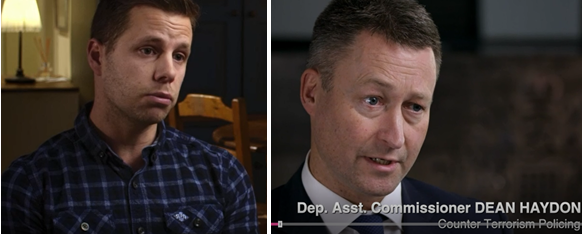
Left: Detective Sergeant Nick Bailey, Wiltshire Police; right, Deputy 
Assistant Commissioner of the Metropolitan Police, Dean Haydon; 
for more details on Haydon, read this.

Asked how he believes he could have been exposed, Bailey says (min. 31:21): “I don’t know whether it’s gone through the gloves. I could have adjusted my face mask.” No evidence of the subsequent analysis of the gloves, inside or out, has been disclosed.

Haydon was not asked to explain. Haydon also presents his account of the poison on the door-handle as his theory of the crime. At no point in the film does Haydon, other police, the intelligence services spokesman, or “Professor Tim”, the BBC’s expert from Porton Down, the Defence Science and Technology Laboratory, identify their evidence that the door-handle or another object at the Skripal house was contaminated.

Instead, the Porton Down spokesman says (min. 09:32): “we identified that the material was a nerve agent called Novichok.” The “material” isn’t in any identifiable chain of evidence required by standard British criminal investigation and prosecution. It appears to have been found by Porton Down analysis of the blood samples taken from the Skripals and Bailey at Salisbury Hospital.

The BBC reconstruction now claims the Skripals were at home on the Sunday afternoon, March 4, when the poison was applied to their outside door-handle. The BBC also claims the Skripals left their house at 1:30. Although all published expert evidence about Novichok indicates it is deadly and fast-acting, there is no explanation by the BBC film of the three-hour interval after the Skripals left home, before they showed symptoms; nor of the 11-hour interval before Bailey was first exposed. Also, Bailey confirms it was more than 24 hours before his symptoms deteriorated to the point where he and his wife decided to go to hospital.

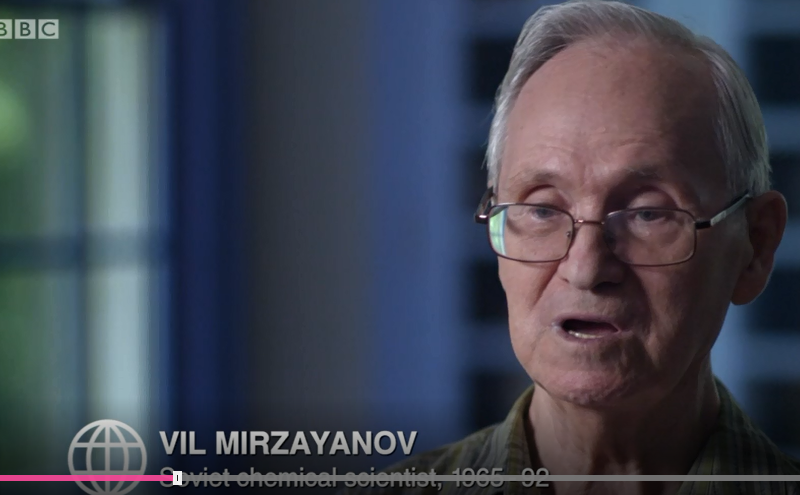
There are also serious discrepancies between the symptoms of Novichok reported for the Skripals and the later victims Sturgess and Rowley, and those which Bailey reports for himself. Vil Mirzayanov, the Soviet researcher who claims to have been the developer of Novichok in the 1980s, before he moved to the US, enumerated the symptoms for the BBC. They start, he said (min. 12:00), with sudden blindness, followed by difficulty breathing, then constant vomiting and “uncontrollable convulsions”.


Source: https://www.bbc.co.uk/ -- min. 12:00.

Witnesses in the Salisbury city centre who responded to the Skripals in collapse, confirm most of these symptoms. A friend of Sturgess and Rowley, who witnessed Sturgess being taken from her home by ambulance men and was present when Rowley fell ill, told the BBC both were foaming at the mouth and displaying convulsions. Bailey’s symptoms, according to the account he has given, were none of these.

The BBC has labelled its version of the attack a “reconstruction” using actors, props, and film shot in Salisbury spliced together. The BBC voice-over claims “it is CCTV that unlocks the mystery of who tries to kill [Sergei Skripal]”. Haydon then tells the BBC the police had combed through more than eleven thousand hours of CCTV. He also claims this process achieved a “gotcha moment of – we identified the two attackers. We were now on to them” (min. 43:24). The film claims to show the Skripal door-handle being sprayed with Novichok from a dispenser made to appear to be a perfume bottle (Min. 44:54). Haydon for the Metropolitan Police does not claim to have CCTV evidence of the alleged attackers at the Skripal house or on their street. He says: “these two individuals were around where the two Skripals actually lived” (min. 43:30) – he doesn’t say when; he doesn’t show the pictures.

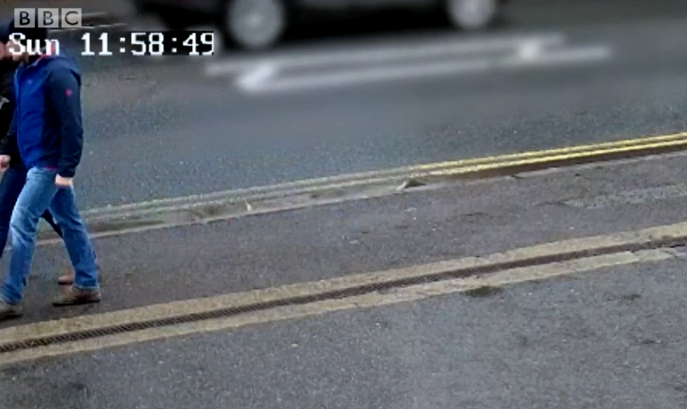
The BBC displays one CCTV picture of the two Russians “on the way to the Skripals’ home”, according to Haydon’s commentary. The frame’s time identification shows it was then 11:58:49. If Haydon’s evidence is accurate, that is more than 90 minutes before the Skripals suffered the alleged attack. Multiple independent calculations reported from Salisbury place the location of this CCTV image at less than 5 minutes’ walk from the Skripal house. If the BBC reconstruction is accurate, the attackers were arriving at the scene of the crime much too early. At that time, the alleged assassins were risking detection for themselves and discovery of their weapon; or if they arrived early and got clean away, the dilution and loss of lethal effect for their poison.


Source: https://www.bbc.co.uk/ -- min.44:35.

According to Haydon, “they would have been there for, literally, a matter of seconds” (min. 45:05). Earlier British press reports have quoted their police sources as claiming that “about an hour after the attack, at 1.05pm, they [Russian attackers] were in the city centre on Fisherton Street, according to the British authorities.” The BBC version of Haydon’s evidence doesn’t identify when the door-handle was sprayed.


Source: https://www.bbc.co.uk/ -- min.44:54.

In the BBC reconstruction of the crime, the Skripals were contaminated at 1:30, as “father and daughter head out for lunch” (min. 45:13). It is now uncertain whether the poison had been on the handle for an hour or more.

Haydon’s commentary is that “ Sergei came out first of all; he got Novichok on his hands [plural], and then Yulia came out second, and then she also got Novichok on her hands [plural]” (min. 45:00).


Source: https://www.bbc.co.uk/ -- min. 45:15.

In the reconstruction, the Sergei figure is bare-handed when he touches the outside door-handle to close the door. The Yulia figure doesn’t touch the handle and appears to be wearing gloves.

US Sanctions Hammer Falls on Venezuelan Nail (Again)

Trump Considering to Put Venezuela on ‘State Sponsor of Terrorism’ List and Intensify Sanctions

by TRNN


November 23, 2018

According reports in Washington Post and Reuters, the Trump administration is actively exploring the option of placing Venezuela on the state sponsor of terrorism list, to further intensify sanctions that have already caused significant damage to Venezuela’s economy.


We speak to Steve Ellner about the sanctions’ effects

Thursday, November 22, 2018

Spinning Interpol: US/UK Succeed in Cleaving World Police

The Interpol Vote - US & UK Political Intervention Splits World Police Organization Down the Middle

by John Helmer - Dances with Bears


November 22, 2018

Moscow - The US and the UK have claimed that Interpol’s vote yesterday for a retired South Korean policeman to be the new president of the global police organization was a convincing defeat of the Russian candidate who was rejected by a two-thirds majority of Interpol’s member states.

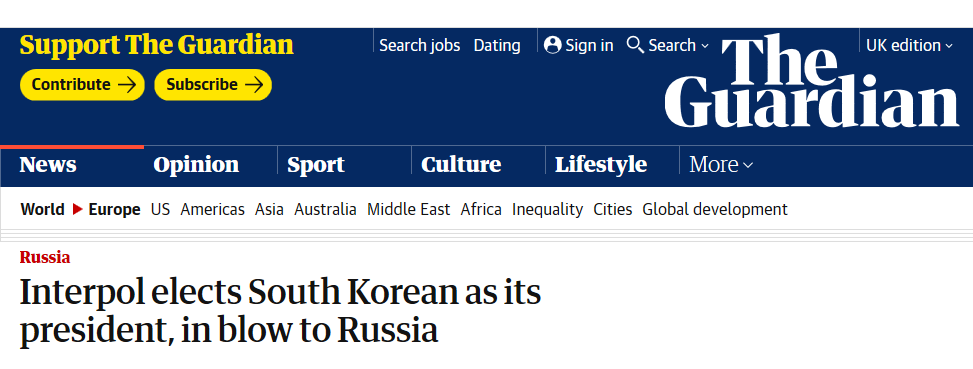
“Blow to Russia” headlined the London Guardian. The US Government’s Voice of America reported the ballot as the defeat of the Russian “front-runner in the race”. “Russia in surprise loss to South Korea”, the British Government’s BBC claimed. “Blow to Russia… Decision comes after successful push by western countries to thwart Moscow’s candidate”, trumpeted the Financial Times.

This was the fake news.

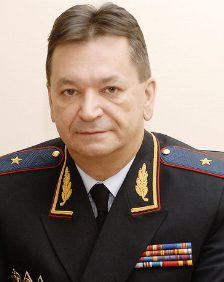
When the tallies of three rounds of balloting by the 162 members of the General Assembly who cast votes are examined carefully, it is clear the Anglo-American candidate, Kim Jong-Yang, fell short of a two-thirds majority at every round; that the Russian candidate, Alexander Prokopchuk (lead image, log), started with almost 40% of the vote; and that when all the abstentions and absentees among the member states eligible to vote are counted, the outcome of the election was a split of the Interpol membership almost exactly in half.

It is also clear that the six-week Anglo-American campaign to defeat the Russian because he is Russian was a violation of Article 3 of Interpol’s Constitution. That says:

“It is strictly forbidden for the Organization to undertake any intervention or activities of a political, military, religious or racial character.”

Interpol has 194 member states; each can cast one vote for the President, the formal but part-time head of the organization, and one for the Director-General, the full-time executive. Until this week’s annual general assembly of member states in Dubai, there had been 192 members. Two new members, the South Pacific islands of Kiribati and Vanuatu, were approved in the assembly voting on Tuesday by the constitutionally required two-thirds majority.

Kosovo, the secessionist territory which the US and the NATO alliance created by the 1999 war against Serbia, was defeated in its third application for membership, despite heavy NATO lobbying. The vote for Kosovo, including the US and UK, was 68. Russia voted with Serbia and 49 other member states to defeat Kosovo. Another 16 states officially abstained; 57 absented themselves.

In sum, the Anglo-American scheme for Kosovo was defeated by 64% of Interpol’s members. Interpol reported the defeat in a single line; the Serbian press reported the outcome as a defeat of the US and the European Union (EU). The EU press reported the outcome as a victory for Serbia.

The next day, November 21, the vote on the new Interpol president was scheduled.


The election had been forced on October 7 when the Chinese incumbent, Meng Hongwei, a vice minister of public security in Beijing, resigned. A few days earlier he had been recalled from Lyon, the Interpol headquarters, to Beijing; arrested; and charged with corruption. Elected in 2016, Meng’s term had two more years to run.

The Interpol Director-General, a German who defeated the Indian candidate for the post in 2014, named Kim Jong-Yang acting president until an assembly vote could be called for the remaining two years of Meng’s term. At that moment in October Kim was one of four vice presidents on Interpol’s Executive Committee, representing Asia. Alexander Prokopchuk represented Europe; the two other vice presidents represented Africa and the Americas. Kim had the longest seniority at Interpol.

Because the US was flatly opposed to the Russian, and because Asia region representatives have dominated the presidency for the past thirty years, Kim was the front-runner to succeed.

From October 8 to November 21, what happened was that a Russian campaign backed by China, India, and leading states in Africa and South America, demonstrated that Kim’s vote would add up to little more than 100 – just half Interpol’s membership. The harder the US and NATO governments lobbied the smaller member states, the more reluctant they became to vote at all. Rather than declare that position to the Americans, they planned to absent themselves.

The Russian Interior Ministry, where Prokopchuk (right) holds major-general’s rank, has declined to release details of the Interpol voting on Wednesday. But Russian press reporting of the three rounds of balloting, together with other sources, indicate that preliminary calculations by the Russian Government were that Prokopchuk’s was a long shot to win, but that he had a better than 50/50 chance to expose the election manipulation by the Americans and British.

The UK press campaign then started with the lie that Prokopchuk was the front-runner and favourite to win.

As the New York Times reported the story, the lie started in the Rupert Murdoch-owned press in London. According to the New York Times,

“a report from The Sunday Times in London said that British officials expected Alexander Prokopchuk, 56, a veteran of Russia’s Interior Ministry, to become the next Interpol president. It could not be independently confirmed by The New York Times.” 

The last line was the truth. The Sunday Times was inventing British government sources and exaggerating Prokopchuk’s support in order to rally enough votes for Kim’s election to appear convincing. That meant a two-thirds majority.


But Kim didn’t have that at the start of the campaign in October; he didn’t have it at the end, during the November 21 balloting. There was no two-thirds majority vote for Kim.

The American media amplified what the London press was printing. “If accurate”, Forbes reported about the London Times claim,

“this report raises fundamental questions for all democratic nations in Interpol.”

The conditional lie was turned into an innuendo, and then into a definitive conclusion.

“Interpol rests on the belief — or the assumption — that its member nations are willing to abide by its rules. If a majority of them vote to elect Prokopchuk, that can only prove they do not care about those rules.”

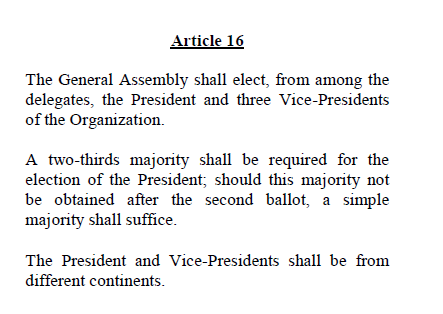
The Interpol constitution requires voting by a two-thirds majority to accept a new member; lacking that number, Kosovo has failed. The constitution’s Article 16 also requires a two-thirds majority for election of a president. But in a tight race there’s a sudden-death provision:


Western press coverage of Kim’s election has claimed he won by a two-thirds majority. He didn’t – and that’s because he failed to win enough votes on the first and second rounds of the balloting.

Interpol’s press office has announced Kim’s election, but omitted all details of the voting. Instead, the release claimed:

“The General Assembly democratically elects the President and other Executive Committee members on a ‘one country one vote’ basis with each vote carrying equal weight.” 

Just how equal the weight was between votes for Kim and for Prokopchuk depends on the count of abstentions and unexplained non-votes.

For this to be clear, Interpol’s press office was asked to clarify how many member states actually cast votes in the election; how many votes for Kim; how many for Prokopchuk. The press office doesn’t identify itself by name, telephone number, or email address. Instead, the organization’s website requires journalists to fill in a blank form. A form asking these questions – how many votes in all, how many for the two candidates, how many non-votes, and how many rounds of voting – was despatched, and receipted.


Interpol has refused to answer.

According to The Independent of London,

“Mr Kim’s win means he secured at least two-thirds of votes cast at Interpol’s general assembly in Dubai on Wednesday.” 

A European internet site, funded by the EU in Brussels, reported that Kim “needs two-thirds of the 177 Interpol member states which are attending its meeting in Dubai this week to vote for him to win.”

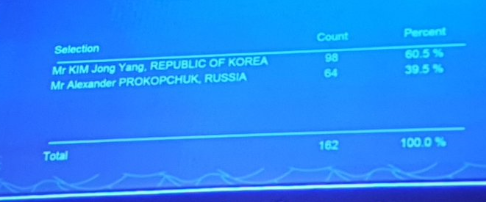
The actual rounds of voting tell a different story. These are screen shots taken from the general assembly hall during the balloting and published by the Russian internet site, Gazeta.ru. They were posted originally by Arsen Avakov, the Ukrainian Interior Minister.

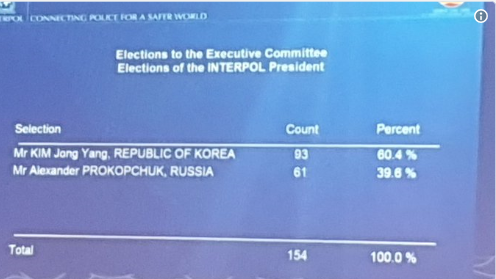
In the first round, 162 votes were cast; this represented 84% of the total membership eligible to vote; 34 states did not vote. The US-UK alliance was able to muster 98 for Kim, or 60.5%. Prokopchuk won 64 votes, just short of 40%.


In the second round, the Russian candidacy was gaining, as 154 countries voted and 8 countries dropped out. There were 5 fewer votes for Kim (93); 3 less votes for Prokopchuk (61). At that point the Russian percentage was almost 40%.


The US-UK campaign had failed to win the two-thirds majority required by Interpol’s election rule. But the constitution forced a final round, to be decided by a simple majority.

The screen shot shows that in this, the third round, 162 votes were cast, the same aggregate as in Round 1. But this time the returning 8 votes went altogether to Kim. Prokopchuk’s 61 votes remained firm, but by a simple majority they were defeated.


With 162 votes posted, there were 32 eligible votes uncast, uncounted. Add them to Prokopchuk’s 64 in the first round, or 61 in the second and final rounds, and the aggregate against Kim summed to between 93 and 96. The aggregate against Prokopchuk was between 93 and 101. Out of Interpol’s membership of 194 this outcome was a split decision. The significance has been concealed by Interpol, and by the Anglo-American media.


The Hong Kong newspaper, South China Morning Post, reported the outcome as political intervention, identifying “the US-backed Kim” as the candidate of “Western nations”. The vote result, according to the Post, was “that Kim Jong-Yang of South Korea had been chosen as its new president, beating a Russian official whose candidacy had unnerved Western nations.”