Monday, January 28, 2019

Venezuela 2.0: Anatomy of an Attempted Overthrow

Venezuela: What Activists Need To Know About The US-Led Coup

by Kevin Zeese and Margaret Flowers - Popular Resistance | Newsletter 


January 27, 2019

Two things stand out about the US coup in Venezuela. First, it is unusually open. Typically, the US tries to hide its coups. Second, the coup is built on a series of obvious falsehoods, yet the bi-partisans in Washington, with a few exceptions, keep repeating them.

First, we will correct the falsehoods so readers are all working from the same facts. Second, we will describe how this coup is being defeated. It will be another major embarrassment for the Trump administration and US foreign policy.
Above photo: John Zangas, DC Media Group.

It is important to understand Venezuela has become a geopolitical conflict as Russia and China are closely allied with Venezuela. China and Russia coming into the backyard of the United States challenges the antiquated Monroe Doctrine.

Venezuela has the largest oil reserves in the world and the second largest gold reserves, as well as diamonds and other minerals such as coltan (needed for electronic devices). And, Venezuela is taking over as president of OPEC and will be in a position to push for oil payments in non-dollar currencies or in cryptocurrencies, a major threat to the US dollar.
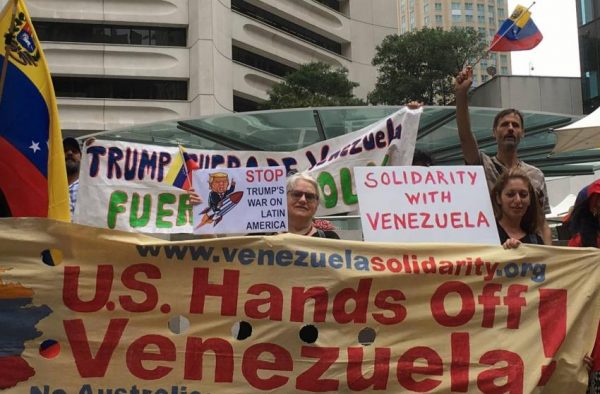

A protest outside the United States Consulate in Sydney on January 23 
to demand no US intervention in Venezuela. Photo: Peter Boyle


Correcting the Record


There are a series of false statements repeated by DC officials and corporate media to justify the coup that are so obvious, it is hard to believe they are not intentional. In his two-paragraph comment on the coup, even Senator Bernie Sanders repeated them.

1. Truth: President Nicolás Maduro is the legitimate president


President Maduro was re-elected on May 20, 2018, in response to the opposition demanding an early election. The legitimacy of the election of Maduro is so evident that it must be assumed those who say he is illegitimate are either intentionally false or ignorant. The election was scheduled consistent with the Venezuelan Constitution and in consultation with opposition parties. When it became evident that the opposition could not win the election, they decided, under pressure from the United States, to boycott the election in order to undermine its legitimacy. The facts are 9,389,056 people voted, 46% of eligible voters. Sixteen parties participated in the election with six candidates competing for the presidency.

The electoral process was observed by more than 150 election observers. This included 14 electoral commissions from eight countries among them the Council of Electoral Experts of Latin America; two technical electoral missions; and 18 journalists from different parts of the world, among others. According to the international observers, “the elections were very transparent and complied with international parameters and national legislation.”

Venezuela has one of the best electoral systems in the world. Voter fraud is not possible as identification and fingerprints are required for each voter. Voting machines are audited before and immediately after the election. Venezuela does something no other country in the world does — a public, citizen’s audit of a random sample of 53% of voting machines that is televised. All 18 parties signed the audits.

Maduro won by a wide margin, obtaining 6,248,864 votes, 67.84%; followed by Henri Falcón with 1,927,958, 20.93%; Javier Bertucci with 1,015,895, 10.82%; and Reinaldo Quijada, who obtained 36,246 votes, 0.39% of the total.

This same voting system has been used in elections that Maduro’s party has lost in governor’s and legislative elections. Venezuela is a real democracy with transparent elections. The United States could learn a good deal about real democracy from Venezuela.

2. Truth: The economic crisis is caused by outside intervention, internal sabotage and the decline in oil prices


There is no doubt the economic situation in Venezuela is dire. The cause is the economic war conducted by the United States, the major decline in oil prices and economic sabotage by the opposition. In essence, the United States and opposition created problems in the Venezuelan economy and now say Maduro must be replaced because of problems they created.

Oil was discovered in Venezuela in the early part of the 20th Century and has dominated the economy since then. The Dutch Disease, the negative impact of an economy based on one natural resource, causes a sharp inflow of foreign currency, which raises the value of the country’s currency, making the country’s other products less price competitive. It is cheaper to import products rather than create them. This makes it more difficult for segments of the economy like agriculture and manufacturing to develop.

Chavez/Maduro sought to diversify the economy. They put in place thousands of communes and hundreds of thousands of people working in cooperatives to build agriculture and manufacturing. When the global price of oil was cut by more than half, it collapsed Venezuela’s public finances undermining these efforts. The economic war by the US made it difficult for Venezuela to borrow and trade with some countries.

Economic sanctions against Venezuela began under President Obama, and the Trump administration escalated them with financial sanctions. United States sanctions cost Venezuela some $6 billion since August, according to an October analysis. Measures against the nation’s oil industry have prohibited the Venezuelan majority-owned company, CITGO, from sending profits back to Venezuela, a $1 billion loss to the government yearly. Now, the Bank of England is refusing to return $1.2 billion in gold reserves after US officials, including Secretary of State Michael Pompeo and National Security Adviser John Bolton, lobbied them to cut Venezuela off from its overseas assets.

The US economic war and sabotage of the economy by business interests has been exposed as part of the effort to remove Maduro by creating social unrest and lack of confidence in the government. This has included hoarding of goods, storing essentials in warehouses and selling Venezuelan goods in Colombia.

In September 2018, Venezuela pointed to a false media campaign exaggerating migration from Venezuela. They highlighted statistics from the United Nations High Commissioner for Refugees to affirm that Venezuela has the fewest volunteer migrants in the continent. They pointed out 5.6 million Colombians have fled violence in their country and live in Venezuela. Venezuela has programs that have helped thousands of Venezuelans return home.

Socialism strengthens economies, as demonstrated in Portugal. Indeed, one criticism of Venezuela is that the Bolivarian Process is moving too slowly to put in place a socialist economy. There is a need for more sectors to be nationalized and put under democratic control of the people.

3. Truth: The opposition is violent, not the Maduro government


Opposition protesters have been extremely violent. One tactic of the opposition was to be violent and then film the government’s response to make the government look violent. When Abby Martin was confronted by opposition protesters, they told her, “Do not film anything that we do. Just film what the government does to us.” She reported on the violence saying, “the vast majority has been caused by either indirect or direct violence by the opposition.”

Martin reports the opposition attacked hospitals, burned down the Housing Ministry, assassinated Chavistas and attacked citizen communes such as an art commune that gave free dance and music lessons to local children. Afro-Venezuelans were burned alive. Protesters pulled drivers out of buses and torched the buses. When photos and videos of opposition violence were put on social media, Martin and her colleague, Mike Prysner, became the target of a false media campaign on social media. The opposition did all they could to prevent them from reporting the truth using hundreds of death threats and threats they would be lynched.

In 2017, Venezuela Analysis reported that violent opposition protests included an attack on a maternity hospital endangering the lives of more than 50 newborn babies. Another report described the opposition using snipers to shoot government officials and civilians. Opposition newspapers urged that blunt objects be used to “neutralize” pro-government protesters, resulting in serious injuries and death.

Steve Ellner also reported that violence was coming from the opposition. He pointed to attacks at grocery stores, banks, buses, and government buildings. Other commentators described specific incidents of violence by the opposition including killing people. Maduro ordered the arrest of a retired general who tweeted how to use wire to decapitate people on motorcycles, which happened, and how to attack armored vehicles with Molotov cocktails.

Documents show that violence was the opposition’s strategy. They sought to “Create situations of crisis in the streets that will facilitate US intervention, as well as NATO forces, with the support of the Colombian government. Whenever possible, the violence should result in deaths or injuries.”

The tales of government violence are rooted in lies. The government’s response was Maduro calling for a peace conference describing it as “a national peace conference with all the country’s political sectors … so we Venezuelans can try to neutralize violent groups.”

4. Truth: The National Assembly acted in violation of the law and is in contempt of court


The National Assembly is not the only democratic body in Venezuela. Indeed, its actions since the opposition won a majority have violated the law and protected the violence of the opposition with an embarrassing amnesty bill.

On December 6, 2015, the opposition won a parliamentary majority in the Assembly. There were allegations of vote buying in Amazonas state that were investigated by the National Electoral Council, another branch of the government. The Supreme Court barred four legislators from Amazonas taking office, two from the opposition, one allied with the opposition and one from the ruling party. The National Assembly allowed three candidates to take office. The Assembly has been held in contempt of court since July 2016 and their decisions were nullified.

Before the court ruling, the Assembly passed an amazing amnesty law, which granted amnesty for crimes the opposition has committed since 1999 (Chavez’ election). The law is an admission of guilt and provides a well-organized catalog of crimes including felonies, crimes committed at public rallies, terrorist acts involving explosives and firearms and undermining the economy. They essentially admitted exactly what Chavez/Maduro have claimed — crimes to overthrow the government for 17 years. Venezuela’s Supreme Court ruled the amnesty law was unconstitutional. Inaccurately, the Trump administration calls the Assembly Venezuela’s only remaining democratic institution.

This January, a subsidiary of the state oil company asked the Assembly to intervene claiming the president cannot make reforms to mixed public-private oil businesses without the prior approval of the National Assembly. On January 16, the court ruled that the Assembly was still in contempt of court and could not act. This is also when the Assembly elected Juan Guaidó as their president, who would later appoint himself President of Venezuela, as part of the US-led coup. Guaidó’s election to head the legislature was illegal and nullified by the court.

The Assembly still exists but remains in a state of contempt of the judiciary. It can rectify the situation by removing the lawmakers accused of electoral fraud. The Assembly refuses to do so because their goal is to remove Maduro from office and they need a super-majority to do so.
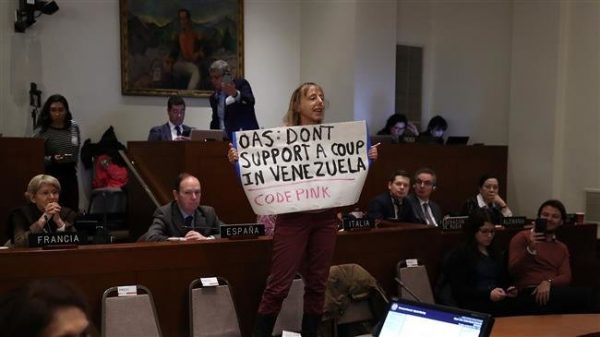

Medea Benjamin of CODEPINK disrupts Pompeo at OAS. Press TV


A Timeline of the US Coup in Venezuela


In “Anti-Maduro Coalition Grew from Secret Talks,” the Associated Press explains the coup was “only possible because of strong support from the Trump administration, which led a chorus of mostly conservative Latin American governments that immediately recognized Guaidó.”

Since August 2017, Donald Trump has been saying that military intervention against Venezuela was a distinct possibility. AP describes this as a “watershed moment” in the coup planning. They report Trump pressuring aides and Latin American countries to invade Venezuela. In September, the New York Times reported that the Trump administration had been meeting with coup plotters since mid-2017.

The Wall Street Journal reports Trump has long viewed Venezuela as one of his top-three foreign policy priorities, with Iran and North Korea. Trump requested a briefing on Venezuela on his second day in office, talking of the immense potential of Venezuela to become a rich nation through its oil reserves. AP reports that Trump “personally sparked” this as he brought up regime change in Venezuela in every meeting with Latin American leaders.

After Maduro was re-elected, administration plans began taking shape, driven in part by key members in the National Security Council and anti-Maduro advocates in Congress like extreme interventionist Senator Marco Rubio.

On November 1, John Bolton zeroed in on Latin America, calling Cuba, Nicaragua, and Venezuela a “troika of tyranny.” On January 2, Bolton met with his Brazilian and Colombian counterparts to collaborate to “return Venezuela to its democratic heritage.”

On January 10, Maduro was sworn in for his second term, Pompeo spoke with opposition leader Guaidó, pledging support. Canada also played a key role, AP reports that Foreign Minister Chrystia Freeland spoke to Guaidó the night before Maduro’s inauguration offering Canada’s support. This was 13 days before Guaidó announced he was president of Venezuela.

On January 12, the State Department backed Guaidó’s move to invoke his authority as president of the assembly, saying, “It is time to begin the orderly transition to a new government.” On January 15, the National Assembly declared Maduro as illegitimate. The Trump administration worked to get allies lined up to support Guaidó’. By January 18, the Venezuela Foreign Minister was describing a US coup in progress.

The night before Guaidó’s announcement on January 23, Vice President Mike Pence put out a video message encouraging Venezuelans to overthrow their government, saying, “We are with you. We stand with you, and we will stay with you.” Guaidó also received a phone call from Pence the night before he appointed himself president where he pledged that the U.S. would back Guaidó.

Guaidó declared that Maduro’s government was illegitimate and he was assuming the presidency. In a well-coordinated charade, almost instantly, Trump recognized Guaidó as the country’s rightful leader. To further demonstrate the preconceived, tightly coordinated and efficiently carried out the coup, US allies, among them Canada, Brazil, Argentina, Colombia, Chile, and Peru, quickly recognized the coup president.

The Trump administration is claiming Guaidó represents the lawful government and is entitled to all Venezuelan revenues. The State Department notified the Federal Reserve that Guaidó is the agent for access to Venezuelan assets in US banks.

Nearly as quickly, Maduro drew statements of support from Russia, China, Turkey, Mexico, Cuba, Bolivia, and others. The Venezuelan Supreme Court called for an investigation into the National Assembly and Guaidó, regarding the illegal usurpation of Executive power. The Venezuelan military announced it supported Maduro and Russia warned the US not to intervene militarily.

On January 25, the Organization of American States, which is traditionally a US tool, rejected a resolution to recognize Guaidó. Medea Benjamin of CODE PINK interrupted Pompeo at the OAS holding a sign that said: “a coup is not a democratic transition!” Venezuelan Foreign Minister Jorge Arreaza thanked Benjamin, saying, “With her protest, she revealed the macabre coup plan against Venezuela, we will always prevail, thank you!” Eighteen countries defeated the proposal.

At the UN Security Council meeting on January 26, Russia’s UN Ambassador Vassily Nebenzia accused the United States of attempting “to engineer a coup d’etat.” He demanded to know whether the Trump administration “is ready to use military force” against Venezuela. European countries gave Venezuela eight days to hold an election, a suggestion Venezuela rejected. Secretary of State Mike Pompeo called Venezuela an “illegitimate mafia state.” He accused Russia and China of trying “to prop up Maduro.”

Both China and Russia have told the US not to intervene in Venezuela’s internal affairs. In December, Russia sent two nuclear-capable strategic Tu-160 bombers to Venezuela along with an An-124 heavy military transport plane and an II-62 long-haul plane. As of December, Russia has one brigade in Venezuela and was discussing sending a second military brigade to Venezuela even before the coup due to the continued threat of intervention from the United States.

China has lent over $50 billion to Venezuela through oil-for-loan agreements over the past decade and has become a partner in the Venezuelan oil industry. In December, seven months since signing a financial business venture with China, Venezuela’s oil production has doubled to 130,000 barrels per day. The take-over of Venezuela’s oil would also be an attack on China. China and Venezuela signed 28 bilateral strategic cooperation agreements on September 14 in the areas of oil, mining, security, technology, finance, and health.

Demonstrating the nature of the coup president, the first acts that Guaidó took were to seek a loan from the International Monetary Fund, which would put Venezuela in debt to western bankers and under their control, and to privatize the Venezuelan oil industry, which would rob Venezuela of the funds being used to lift up the poor and working class.

The appointment by Mike Pompeo of Elliott Abrams as the person in charge of overseeing operations “to restore democracy in Venezuela” is an ominous sign. It is scandalous and demonstrates the most extreme elements of the US establishment are leading the charge.

Abrams was convicted during the Iran-Contra scandal, supported US-backed death squads in Guatemala and El Salvador in the 1980s, played a key role in the Reagan administration support for the murderous Contras in Nicaragua and was the person who gave approval for the US-backed coup in Venezuela in 2002.

Analyst Vijay Prashad writes the coup violated the charters of the United Nations and of the Organisation of American States and describes efforts to call on the military to rise up against the government have failed. The Trump administration is now threatening a total oil embargo on Venezuela and is leaving the “military option” open.

The concerted campaign by the US and Canada to install Juan Guaidó as the new ‘self-declared’ interim President of Venezuela has been met with initial failure. Unfortunately, the illegal and undemocratic attempts to destabilize the country and overthrow the democratically-elected President will continue with harmful consequences.

The people of Venezuela are rising once again to defend their country against hostile foreign intervention. It is essential that we support them in this fight. Many groups are holding solidarity rallies and issuing statements of support. Find rallies and protests here and here.

While Sanders got all the facts wrong about Venezuela, he did reach the right conclusion: “The United States has a long history of inappropriately intervening in Latin American countries. We must not go down that road again.” People in the United States have an important role to play in supporting Venezuela and defeating the coup.

Before the Tempest: What Has Nicolas Maduro Ever Done for Venezuelans?

4 Gains Maduro’s Venezuela Made That Mainstream Media Ignores

by TeleSur


April 13, 2017

Four years ago today, a former bus driver with humble working class origins became the President of Venezuela. Promising to continue the revolutionary legacy of deceased former president Hugo Chavez, Nicolas Maduro pledged to advance the living standards of Venezuela’s poor and oppressed.

But since taking office in 2013, Maduro and the Bolivarian Revolution have faced non-stop attacks from Venezuela’s U.S.-backed right-wing opposition, making advancements difficult.

Improving upon destabilization tactics used during Chavez’s administration, the opposition, it seems, has perfected the art of sabotage.

For years, the opposition has used violent protests, fake news, currency manipulation, food hoarding and calls for international intervention to undermine the Bolivarian Revolution.

Mainstream media, falsely portraying the opposition as a peace-loving democratic movement, has used textbook examples of psychological projection to create a false narrative about Venezuela.

Corporate news outlets like CNN and Fox News unilaterally hold the socialist government responsible for crimes committed by anti-government forces. Perhaps even more sinister, mainstream media intentionally leave out social accomplishments achieved by Maduro’s administration in an attempt to make him seem “unfit to rule.”

Despite right-wing sabotage, Maduro’s government has lived up to its promise to continue improving living conditions for Venezuela’s poor and oppressed. Here are four major gains made in Venezuela by Maduro’s government that mainstream media won’t tell you about.

Healthcare

 
Neonatologists watch over premature babies in a public maternity hospital near Caracas. | Photo: Reuters

Since his first day in office, Maduro has prioritized making improvements to Venezuela’s free public healthcare system.

Under his administration, Venezuela expanded its free health care coverage to more than 60 percent of the population, according to the country’s Ministry of People's Power for Health. The Venezuelan president has also made free health care available to people in historically impoverished departments like Amazonas, Bolivar and Delta Amacuro.
 
And last March, Maduro’s government announced a decree that increased salaries for all doctors working in the public health sector by 50 percent. The salary increase served to incentivize medical professionals to provide the best quality of treatment for patients.

The results of his investments in public healthcare are undeniable.

Earlier this year, the United Nations Program for Development placed Venezuela among the countries with the highest Human Development Index, surpassing most Latin American countries. Since 2013, Venezuela has also decreased infant mortality rates, heart disease HIV/AIDS rates, according to the World Health Organization.

Housing 


 Public housing for all Venezuelans has also been a mantra of Maduro’s administration.

Last January, he announced that his government reached its goal of delivering 1,400,000 homes to Venezuelans across the country. The public housing program is either free or low of cost, depending on the family's means. The project aimed to involve Venezuelans in the process as much as possible, with homeowners responsible for 60 percent of town planning.

A month prior, Maduro announced plans to internationalize Venezuela’s public housing program, creating homes for hurricane victims from Cuba and Haiti, the country's Housing and Habitat Ministry reported.

Since January, the Housing and Habitat Ministry has constructed thousands more public housing units in remote regions across the country.

Venezuela currently has the second lowest rate of homelessness in Latin America, with only 6.68 percent of its population being unhoused, Habitat for Humanity reports. At 5.6 percent, Peru has the lowest rate of homelessness in the region.

Education


Maduro, who actively supported Venezuela’s student movement against neoliberalism during the 1980s, has made important strides in public education since coming to power.

The Venezuelan president has significantly grown the country’s Canaima program, a computer literacy and technology education campaign established by Chavez in 2009. Maduro’s administration has provided more than 4,800,000 computers and over 100 million technology textbooks to students across the country.
 
Despite the country's economic difficulties over the last three years, more than 20,000 schools have received new computer equipment.

Maduro has also pumped millions into free transportation, music, art, sports and culture programs at schools across the country.

Maduro’s progressive education policies have made Venezuela rank sixth in the world in terms of enrollment in primary education and has increased its coverage of secondary education to 73 percent of the population. His policies have also made Venezuela a country with the highest literacy rates in Latin America, with 95.4 percent of the population knowing how to read and write, the U.N. reports.

Civil Rights 


Maduro has also made tremendous advancements in improving the representation and civil rights of historically oppressed sectors of Venezuelan society, like women, Afro-Indigenous people and the LGBTQ community. Here are some examples.

Since 2013, Maduro has boosted funds for the Venezuelan Ministry for Women and Gender Equality, which provides resources such as child care, medical attention, job training and political education. And in 2014, he appointed Delcy Rodriguez, a politician and active member of Venezuela’s feminist movement, to head the country’s Ministry of Foreign Affairs.

Along with elevating members of Venezuela’s Black and Indigenous-descendant communities to important political positions, he has also created institutions like the Centre of African Knowledge and the Ministry of Popular Power for Indigenous Peoples.

Moreover, Maduro’s administration has also improved rights for LGBTQ people. In 2016, Venezuela’s Supreme Court declared that the state will provide protection without distinction to all families, including to children born into same-sex families. In the same year, Venezuela’s Public Ministry announced that transgender people may request a new identity card according to their gender identity.

Although many improvements for women, Afro-Indigenous people and the LGBTQ community remain to be carried out, Maduro’s improvement of civil rights in the country is undeniable.

Flushing Out the Truth on "Full O'Nuts" Official Novichok Narrative

NOVICHOK FULL O’ NUTS — IN THE CASE OF SERGEI SKRIPAL POLICE COMMISSIONER ANGUS MACPHERSON LIFTS THE LID

by John Helmer - Dances with Bears


January 28, 2019

Moscow

The Wiltshire county police have revealed in separate statements last week they were at the house of Sergei Skripal within minutes of his having fallen ill on a park bench in the centre of Salisbury last year, in the case which has damaged relations between Britain and Russia beyond foreseeable repair. The speed of response was much faster than Wiltshire Police and Crime Commissioner Angus Macpherson had given reason for at the time; in the eleven months of his tweeting after the incident; or under direct questioning over several days last week.

“We can confirm that police attended Christie Miller Road in Salisbury on the evening of 4 March 2018”, Macpherson said through a spokesman, “as part of our early enquiries into the incident.” 

That was not an answer to the question Macpherson was asked.

The new police evidence — an excerpt from the Wiltshire police incident response log and Macpherson’s cover-up of the particulars — contradicts the allegations the British government and police in London have made that the outside door-handle of the Skripal house had been sprayed by Russian assassins with a “military grade nerve agent” named by the British authorities as Novichok.

An unpublished Wiltshire police report indicates the likelihood that British secret service surveillance of the Skripals was under way on March 4, during their movements around Salisbury on March 4, before their collapse, and led to an anonymous call to the emergency services. That call was the first to report the incident to the police.

Secret service agents then appear to have been at the Skripal house, with a police guard, several hours before local detectives conducted a search of the interior, telling the BBC later that the house “looked normal. There was nothing untoward.”

“The incident was reported at 16:16 hours on the 4 March 2018,” according to the Wiltshire police report, “by way of what we term a silent 999, i.e. with nothing said to the operator. A further call was then received stating that there was a male and female on a bench ‘passed out’ this was deemed to be a medical incident and an ambulance was tasked as well as police unit”.

For an explanation of what British police mean by a “silent 999”, read this.


The Wiltshire police log excerpt does not say whether the extra 55 code 
was received. The police have not reported that Sergei or Yulia Skripal 
used their telephones to make the first 999 call.

A comprehensive compilation by Liane Theuer of witness reports at the scene reveals that neither Skripal activated a telephone in the minutes they were seen before their medical condition made telephoning impossible. Theuer’s report identifies by name, timing at the Skripal scene, and verbatim statement fourteen eye-witnesses; one ambulance paramedic; two air ambulance officers; and three uniformed Wiltshire police officers.

Subsequent Salisbury media reporting has identified the second of the callers on the police log. “Abigail McCourt has spoken about the Salisbury Novichok incident for the very first time”, SpireFM reported on January 21.

“The 16 year old, from Larkhill [10 miles north of Salisbury], was the first to spot two people collapsed on a bench in the Maltings on March 4th and didn’t hesitate to help. Abigail believed Sergei Skripal was having a heart attack.” 


Left image: Alison McCourt and daughter Abigail at the “Local Hero” awards 
ceremony in Salisbury this month; right image, Alison McCourt in Army uniform.

Abigail McCourt told a radio interviewer that when she saw the Skripals on the bench, in the city centre, “at this point people were walking past. I don’t think anyone had really noticed them.” The police record reveals now that the emergency for the Skripals had already been reported by an anonymous caller.

McCourt says she did not call the police immediately. Several minutes elapsed because she telephoned her mother first “because I thought he was having a heart attack and so we went over and obviously it developed from there.” Abigail says she then discovered that Yulia Skripal was not breathing and moved her into the “recovery position”. Abigail’s mother, Alison McCourt, was reported in the local press as a “nurse”. Colonel McCourt is head of nursing for the British Army and Senior Health Advisor.

Days earlier, on February 20, the annual Army chemical warfare exercise TOXIC DAGGER concluded three weeks of troop training with the Defence Science and Technology Laboratory at Porton Down, near Salisbury. “Casualty treatment was a key part of the Salisbury Plain exercise,” according to a Royal Marines release.

Colonel McCourt has told the press she was nearby in the city centre with her husband, when telephoned by her daughter. She said she and her husband joined her daughter and son at the scene of the Skripals’ collapse. Col. McCourt was treating them when the police and ambulance paramedics first arrived.

The Wiltshire police control room log’s next entry reads:

“The police unit arrived first at 16:24 hours and an off-duty medical person at the scene stated to the officers that she believed the male and female (later identified as the Skripal’s) had taken something. Further units were tasked at 16:27 to keep back onlookers.” Col. McCourt was the “off-duty medical person”; it was her diagnosis the police logged in.

A police interview, reported in December, gave a slightly different account, but confirmed the timing of the first emergency call. Examination of personal belongings, including Sergei Skripal’s wallet with his driver’s licence and home address, did not occur until after the 16:27 cordon had been set up around the Skripals.

At that point, the police at the scene say they “called CID [Criminal Investigation Division] and a duty inspector…CID officers attended. ‘They were like: ‘That’s fine, everything’s OK’, and off they went again,’ said Holloway.”


The Wiltshire police log’s next entry does not reveal the CID call nor the arrival of the CID officers, but it corroborates the sequence of events. It reads:

“From documentation found on Mr Skripal officers obtained his name and birthplace. At 16:48 officers were tasked to cordon off the immediate area, but a search of the immediate vicinity of the Skripal’s revealed no trace of any drug paraphernalia or other possible substance containers; CID attended. At 17:37 hours the incident was still a medical incident with no signs of crime.”

This is not what the evidence at the Skripal house on Christie Miller reveals. Neighbours on the road reported to a local newspaper that evening that a police van had arrived at the house at 5 pm. The timing is significant. This was just 12 minutes after the 16:48 police log report; the despatch and arrival of the van have been omitted from the police report.


The newspaper photograph with caption, published on the morning of March 5, shows a police van, headlights illuminated, at the entrance to the Skripal house on the evening before, March 4. The driver-side seat of the vehicle appears to be empty; the front passenger seat occupied by an officer.

Next to the van is an unmarked official car, parked in front of the Skripal garage. It is not the Skripal-owned BMW, plate number HD09WAO (insert upper right) documented in press photographs; that vehicle was left by Skripal at a carpark in the city centre before he and his daughter spent three hours walking, eating, and drinking ahead of their collapse. The newspaper reported that the police van arrived the house at 5 pm. Source: https://www.salisburyjournal.co.uk/ In another newspaper account, a neighbour in the street said: “Police have been here since Sunday afternoon”.

The published photograph is unlikely to have been taken at 5 pm, because the darkness in the eastern sky and the illumination of the council street light indicate a later time. In Salisbury that day, sunset was recorded at eight minutes before six, while the moon did not rise until 9 pm. So it is likely the Salisbury Journal photographer took the shot, not at 5, when the van was first seen by the neighbours, but before 9, when the moon appeared. No light from the front windows of the house suggests the police were on guard outside the house to prevent anyone getting in.

The identity of the security officials who had arrived in the unmarked car, where they were, and if inside the house, why they were moving about in the dark, are questions which remain to be answered. Newspapers publishing photographs of the scene have allowed the police van’s registration plate to be read, but they have censored the plate of the second vehicle so that it cannot be traced.

Wiltshire Council was asked what time the street lights were turned on that evening; the Council’s press office promised to reply. It hasn’t done so.

A BBC reporter, Mark Urban, reported in a Book (right) published in October that,

“people at MI5 and MI6 jointly responsible for the team looking after Sergei [Skripal] had known [of the city centre incident] since the police phone call of the previous evening.” 

The police record shows the first police call to the secret services was made as soon as Skripal’s name was checked on the police computer; that was in the afternoon, before 5 pm.

Urban, who received secret service sponsorship to interview Skripal months before the March 4 incident, also reported in his book that when Skripal’s name was entered into the national police computer, the Wiltshire police discovered a Don’t Stop notice.

“On screen”, according to Urban, “there is a note beside his [Skripal’s] listing and a number to ring.”

Urban confirmed the secret services were alerted from the Wiltshire police control room, and that the telephones of “seven or eight officers” on duty at the police station “were buzzing”.

Angus Macpherson, a chartered accountant by profession, has worked in the Wiltshire police since 2005. In 2012 he was first elected as the Conservative Party candidate for police commissioner; he was re-elected in 2016.

Macpherson (above) operates a Twitter account in which he has regularly
 issued details of his personal involvement in the police operations which 
followed the Skripal incident on March 4. 

Macpherson’s tweets – as yet unredacted – also claim personal credit for successfully negotiating an agreement with the Home Office and other central government agencies in London to pay £10 million in costs for the local police work on the Skripal case and its alleged sequel, the case of Dawn Sturgess and Charles Rowley. For more on the sequel, read this.

“Operational costs for Wiltshire Police are projected to exceed £10 million pounds, with the Government having reimbursed £4.1 million pounds previously this further £2.5 million pounds brings the total costs reclaimed by the Force to £6.6 million pounds. In a letter to Wiltshire and Swindon Police and Crime Commissioner, Policing Minister Nick Hurd MP, acknowledged the ‘excellent work undertaken by officers and staff in response to these incidents’ and recognised that the incidents had ‘placed an unprecedented pressure on Wiltshire Police.’ PCC Angus Macpherson has said that he fully expects all costs associated with the operation to be met centrally by the Government.”

Macpherson is emphatic the Wiltshire police report to him. “I am the person accountable to the people when it comes to crime and anti-social behaviour. I hold the Chief Constable [of Wiltshire, Kier Pritchard] and the force to account for how they are doing the job; and the voters in turn hold me to account.”

Macpherson was asked to clarify the time the police van arrived at the Skripal house, how many officers were in the van, and how long they stayed. Through a spokesman, Macpherson replied with this email:


CLICK ON IMAGE TO ENLARGE

Macpherson was then asked follow-up questions:


Macpherson refuses to answer.

Chief Constable (CC) Kier Pritchard told the Salisbury Journal last June that officers had been sent to the Skripal house,

“looking for information to establish a timeline of events and explain why the Skripals had fallen ‘gravely ill’, as well as making sure there was nobody else affected.
That [information] could be a suicide note, it could be evidence of drugs, it could be evidence of some form of substance, CC Pritchard added.”

Pritchard also told the newspaper: “officers at the scene underwent a ‘decontamination process” at Salisbury District Hospital overnight on Sunday [March 4] and into Monday morning [March 5], after details of the attack became clearer.”

Pritchard did not distinguish between the police at the scene of the Skripals’ collapse in the city centre and the police despatched to the Skripal house. Nor did he mean Detective Sergeant (DS) Nick Bailey; Bailey was not one of the “officers at the scene” to whom the Chief Constable was referring. The later testimony of Bailey suggests that he and one (possibly two) other police officers did not arrive at the Skripal house until late on Sunday evening, and that when they did, they came in a police car. Bailey reported to the BBC that he did not go to Salisbury District Hospital until twenty-fours after he had returned from the Skripal house to the police station, and then to his home. “By Tuesday [March 6] he was so unwell, he was rushed to hospital,” the BBC reported.

One London newspaper has reported that “DS Bailey went to A&E [Accident & Emergency] and was initially discharged – but returned when his condition worsened.”

Subsequent local media reports indicate that Bailey’s police car, the evidence room and two individual lockers at Bailey’s station Bourne Hill, were subsequently investigated by chemical warfare specialists; they have not reported finding Novichok traces.

“After extensive testing and cleaning by specialist teams Defra [Department for Environment, Food and Rural Affairs] have handed Bourne Hill back to the Salisbury recovery group stressing it is ‘safe to return to public use.’ The deep clean focused on two areas of the building, the evidence store used by Wiltshire Police and two lockers. All other areas of the building were decontaminated as a precautionary measure.”

Macpherson’s refusal now to clarify discrepancies between the evidence given by the police to the press and the police incident response log contrasts with the commissioner’s loquaciousness on Twitter and in the Salisbury media. After being criticized by Wiltshire critics for “draining vital police resources” on his own job and salary (£85,000), Macpherson has been tweeting to emphasize his value to the security of Wiltshire voters. On March 7, at his first press conference after the Skripal incident, Macpherson said it,

“appears to have happened on a quiet Sunday afternoon in our cathedral city. In the past couple of days I’ve been briefed regularly by the chief constable and can say with confidence that the matter has received the full support of both the police and our partner agencies in a coordinated major response. Measures necessary to ensure the safety of the public in and around the scene have also been taken.”

On March 8, Macpherson tweeted: “I am pleased to hear from the Chief Constable that [Detective Sergeant Bailey] was sitting up and talking today.” His record of Bailey’s two-day recovery from an allegedly lethal nerve agent raised a question not intended by the commissioner at the time, intent as he was to show he was in charge. The question, not asked since, was what evidence is there that Bailey had been exposed to Novichok since the Salisbury Hospital had missed it when he first presented himself (if the report of his first decontamination and discharge was true); and since he recovered his faculties much faster than the other alleged victims?


Detective Sergeant Nick Bailey in his BBC interview, broadcast on 
November 22, 2018. Source: https://www.bbc.com/ 

Bailey did not tell the BBC he had been to the hospital and given the all-clear in the night between March 4 and 5, between his torch-light search of the Skripal house and the onset of symptoms which led to his emergency hospitalization on March 6. What was “very confusing”, Bailey told the BBC in this segment of the interview, was that the hospital staff treating him were in full protective garb while his wife and children visiting him were not.

According to the BBC, the evidence for Novichok poisoning came from testing of Bailey’s blood samples; the source for that claim was identified by the BBC as “Professor Tim Government Scientist”. In the book of BBC correspondent Urban, written and published before Bailey himself appeared on the BBC, Urban claimed:

“Detective Sergeant Nick Bailey extended a gloved hand to grasp the front door handle – always worth a try. It wouldn’t open so he went around to the back of the property, where he managed to gain entry. What was he looking for? Signs that their house had been searched, perhaps, or maybe even the presence of a would-be assassin. Everything seemed to be in order.” 

The BBC film reconstruction of Bailey’s entry in the Skripal house shows him entering the house by the front door. Neither Urban nor the BBC film-makers explained why Bailey and his colleague did not turn on the house lights to aid their search.

In his tweeting over the weeks to follow, Macpherson repeated announcements on the Skripal case from the Metropolitan Police in London and the statements of Prime Minister Theresa May in parliament. For the backfile reports of those stages in the case, click to read.

Repeating what he was told as often as he did to convince Wiltshire voters that he was in command has produced a record of how the local and national authorities changed their narrative. Examined now in retrospect, Macpherson’s reports of the investigation of the hospitalization of Dawn Sturgess and Charles Rowley on June 30, Sturgess’s death on July 8, and the allegations from London that they were exposed to the same Novichok as had caused the collapse of the Skripals on March 4, are contradicted by what Macpherson shows he was doing himself.

For details of the Sturgess-Rowley case and the coroner’s court inquest, read this.

On July 4 the BBC version of what had happened to Sturgess and Rowley reported the,

“man and woman are in a critical condition after being exposed to an unknown substance, which counter terrorism officers are investigating. The pair, believed to be Charlie Rowley, 45, and Dawn Sturgess, 44, were found unconscious at a house in Amesbury, Wiltshire, on Saturday. It is understood tests are being carried out on the substance at a government chemical weapons laboratory.”

The BBC also reported Macpherson as denying there was any connexion to the Skripal case.

“Wiltshire’s Police and Crime Commissioner Angus Macpherson said the police had worked hard at ‘containing any risk that might be there.’ ‘There’s no reason to think it’s connected with matters of last month,’ he said. ‘I haven’t seen anything in this incident yet that I would consider to be an overreaction in terms of previous incidents, it all seems fairly textbook.’”

Late in the same day, the Metropolitan Police in London announced “test results from Porton Down [government chemical weapons laboratory] which show that the two people have been exposed to the nerve agent Novichok,” Neil Basu, Britain’s most senior counter-terrorism officer, told reporters.” He added the tests confirmed the Novichok “was the same nerve agent that contaminated both Yulia and Sergei Skripal.”


Scotland Yard’s chief of anti-terrorism operations, Assistant Commissioner 
Neil Basu, making his Novichok announcement on the evening of July 4. 

Basu also claimed: “We are not in a position to say whether the nerve agent was from the same batch that the Skripals were exposed to. The possibility that these two investigations might be linked is clearly a line of enquiry for us.”

The record of Macpherson’s tweets of what happened next contradicts Basu’s announcement. On July 6 Macpherson tweeted statements he and Chief Constable Pritchard had made the evening before. Pritchard: “Our thoughts are with the two individuals who remain critically ill following their exposure to Novichok” — Macpherson:

“Good Evening, I’m Angus Macpherson, the Police and Crime Commissioner for Wiltshire and Swindon. The safety of the public continues to be of paramount importance to all agencies involved in this ongoing major incident… It is important to state that the information being issued by agencies involved has to be based on the available facts.”

On July 7 Macpherson tweeted that a local police officer involved in the Sturgess-Rowley incident “is seeking medical advice at Salisbury District Hospital in connection with the ongoing incident in Amesbury. This is a precautionary measure.” The time of Macpherson’s tweet was 1:49 in the afternoon. One hour later at 2:47, Macpherson tweeted “assessed & given the all clear.” Macpherson was confirming the police officer had not been contaminated by Novichok — where and how the policeman might have been exposed the commissioner did not disclose.

Just how confident Macpherson was that there was no risk of Novichok exposure at the home where Sturgess and Rowley had fallen ill was revealed in his tweets on July 8, four days after the couple had been publicly identified by Scotland Yard as having been exposed to the same lethal nerve agent as had felled the Skripals. Macpherson tweeted that at the site of Rowley’s home on Muggleton Road, Amesbury, he welcomed Home Secretary Sajid Javid, together with Chief Constable Pritchard.

This was three days before the Novichok bottle was purportedly found by the police in Rowley’s kitchen.


Left to right: Wiltshire Police Commissioner Angus Macpherson; H
ome Secretary Sajid Javid, and Wiltshire Chief Constable Kier Pritchard 
outside Rowley’s home on July 8. Source: https://twitter.com/

Javid was reported by the BBC as saying:

“What our expert scientists have determined is that the nerve agent in this incident is the same exact nerve agent that was used back in March…We know back in March that was the Russians. We know it was a barbaric, inhuman act by the Russian state…Again for this particular incident we need to learn more and let the police do their work.”
The BBC report of July 8 added:
Police believe the couple handled an item contaminated with the nerve agent Novichok.”

On July 10, Macpherson tweeted an announcement from the chief constable: “As confirmed by the Counter Terrorism Policing Network, we now know Dawn’s death is being treated as murder.”

Macpherson added his statement at the same time:

“I am horrified and appalled that an illegal and lethal nerve agent has been used on the streets of our county. And while the city of Salisbury has bounced back so resiliently, it saddens me greatly that Ms Sturgess, and now her family, are bearing the devastating impact of this incident.
AC Neil Basu announced today that they are unable to say at this moment that the nerve agent found in this incident is linked to the attack on Yulia and Sergei Skripal. However this remains their main line of enquiry.”

Three days later, on July 13, Macpherson tweeted the police announcement:

“On Wednesday, 11 July, a small bottle was recovered during searches of Charlie Rowley’s house in Amesbury. It was taken to the Defence, Science and Technology Laboratory (DSTL) at Porton Down, Wiltshire, for tests. Following those tests, scientists have now confirmed to us that the substance contained within the bottle is Novichok.
Further scientific tests will be carried out to try and establish whether it is from the same batch that contaminated Sergei and Yulia Skripal in March – this remains a main line of enquiry for police. Inquiries are under way to establish where the bottle came from and how it came to be in Charlie’s house.”

Much later, on September 5, Scotland Yard’s Basu announced that on July 10 police searching Rowley’s kitchen garbage container had found a perfume box. The next day, July 11, according to Basu, the police had found a perfume bottle on the kitchen table. The bottle, Basu said, contained the Novichok to which Sturgess had been fatally exposed. For details of Basu’s disclosure, read this.


September 5, 2018: Assistant Commissioner Basu announces the 
police discoveries in Rowley’s kitchen of box (July 10) and bottle (July 11). 

Re-reading the sequence in reverse, the evidence of Macpherson and Basu, the local and national police, is that they had failed to search Rowley’s home for several days after they believed they had been exposed to Novichok. They also reveal that they were confident the site was safe for the government minister to visit. Not until three days after Javid, Macpherson and Pritchard had made their tour was the discovery of box and bottle made. The police discoveries in Rowley’s kitchen did not occur until ten days after Sturgess and Rowley were hospitalized; six days after the couple were reported to have been contaminated by Novichok.

Did the evidence of the box and bottle appear after the narrative of the government in London had changed?

Local media reports and Macpherson’s tweets indicate that on July 4, and then again on July 25 the police cordoned off a Boots pharmacy on Stonehenge Walk in Amesbury; the store is almost two kilometres from Rowley’s home. A friend of Rowley’s, Sam Hobson, told the police and press he had taken Rowley to the store on June 30 in order to collect a prescription for methadone, which Rowley was taking for treatment of heroin addiction. That was after Sturgess had been hospitalized in the morning, but before Rowley took ill and went to hospital in the afternoon.


The police releases confirm that on July 4 they were looking for evidence of Novichok at several locations which Sturgess and Rowley had visited in Amesbury and Salisbury. A press report from Amesbury in the afternoon of July 4 confirmed that “counterterror police are working on the investigation, while the unknown substance used is undergoing testing at the nearby Porton Down military research facility.”

On July 25 – that is, two weeks after the box and bottle were reportedly found in Rowley’s kitchen, three weeks after the police had been to the Boots store the first time – Macpherson re-tweeted a Wiltshire police announcement that they were investigating CCTV footage at Boots.


Local sources say it is well-known in the area that drug addicts needing cash to feed their habits steal from Boots products they know to be popular for resale in local pubs. Rowley, according to Macpherson’s tweet, appears to have been suspected of obtaining something from Boots in addition to his methadone prescription, and to have left a CCTV trace of his doing it.

Local media reported on October 12 that the Boots store had been closed for four months by the police after the July 4 operation. Quoting from announcements by Boots management and the Wiltshire county council, SpireFM reported

“the Stonehenge Walk store has been closed since June following the nerve agent incident. Defra [Department for Environment, Food and Rural Affairs] has announced this morning (Friday October 12th) that the clean-up process at the pharmacy has now been completed. We’re told ‘extensive testing’ has been carried out on site to make sure the building’s clean, and it’s now been handed back to Boots…The store will remain closed for the time being while some maintenance work is done on site though.” 

Boots issued a public announcement that it had re-opened on October 29.

The manager of the Boots store on Stonehenge Walk is Vincenzo Vecchio. Last week he was asked if the store stocks and sells brands of perfume. He refused to say. He was also asked what period of time was covered by the CCTV records taken by the police from the store on July 25, and whether the records have been returned He refused again to answer, saying the press office at Boots headquarters in Nottingham would respond.

Emma Bull, a press spokesman for Boots, refused to answer the same questions.

The searches of Boots on July 4 and July 25 were for evidence that Rowley or Sturgess had been in the store and obtained products, possibly perfume there. Commissioner Macpherson and Assistant Commissioner Basu have acknowledged that they lack evidence of where the box and bottle were between March 4 and June 27; they have appealed publicly for witnesses to come forward.

Boots has come forward, but not publicly. The police have not reported what the Boots tapes show, or fail to show. If the evidence recovered on July 25 revealed the box and bottle of perfume reportedly found in Rowley’s kitchen a fortnight earlier, then there would be no link between the Sturgess-Rowley case and the Skripal case.

The Novichok narrative connecting the two would be nuts.

Sunday, January 27, 2019

Organization #1: Mueller's Main Target

Roger Stone Indictment: My Friend, “Person 2”

by Greg Palast


January 26, 2019

The unnamed “Person 2” in the Roger Stone indictment is my friend: comic and journalist Randy Credico. I’ve been in constant contact with Credico for two years as Stone tried to bully him into perjury.

Trump stooge Stone is a bucket of pus. And he lied to the House Intelligence Committee, as the indictment states. But, frankly, this is small potatoes, not evidence of collusion with Russia. In fact it’s evidence of Stone’s slapstick, self-promoting failed attempts to collude.


Randy Credico at the launch of
Greg Palast’s “Vultures’ Picnic” in New York (2011)

What concerns me is that this indictment reveals Mueller’s real targets are what he terms “Organization 1,” Wikileaks, and Julian Assange.

Let’s not get tangled up in debates about Assange’s unsavory personality or conduct. WikiLeaks is an important investigative news service, giving us Chelsea Manning’s inestimably vital evidence of official, deadly misconduct; US State Department cables about oil company crimes I’ve used in my own reporting — and yes, those Democratic Party emails about operations to subvert the Bernie Sanders campaign in possible violation of federal elections law.

By providing a haven for whistleblowers, WikiLeaks has successfully exposed crimes against our democracy. And Mueller, true to his FBI roots, can’t stand it.

Did Russian hackers slip the DNC emails to Wikileaks to help their buddy Trump? Well, no sheet, Sherlock. I can tell you now that not every source of inside documents I receive is from a selfless informer. Everyone, including your mom, has an agenda. But neither Putin nor Assange forged the emails; isn’t that correct, Mr. Blumenthal? Are we afraid of truth, or the facts?


Credico co-hosted a half dozen radio shows with Assange and visited him in Ecuador’s London Embassy. That Mueller hauled Credico before a grand jury to ask about his contacts with Wikileaks should scare those of us who are trying to hold on to the last shreds of Freedom of the Press.

While I enjoy seeing that reptile Roger Stone get his time in the barrel, I am sickened watching Democratic pols and too many progressives, all in the name of cutting up Trump, applaud the return of a witchhunt against journalists and investigative journalism using tropes about foreign influence worthy of Joe McCarthy. Calls from mainstream media to shut down fake news sites have a price:

My own sites and outlets face real threats of electronic blockade and censorship.

The memory of my uncle, the black-listed writer Oliver Crawford, for years in hiding from the precursor of Adam Schiff’s Committee, stands as an ever-admonishing warning, that, as journalist Ben Franklin said,

“Those who would give up essential Liberty, to purchase a little temporary Safety, deserve neither Liberty nor Safety.” 

Or to purchase a temporary political advantage against an odious President.

I admit to a little thrill watching the CNN footage of FBI agents made-for-TV dawn raid on Stone’s home. But I worry that, in the not too distant future, the door they knock on will be mine.


Greg Palast has written four New York Times bestsellers, including Armed Madhouse, Billionaires & Ballot Bandits, and The Best Democracy Money Can Buy, now a major non-fiction movie, available on Amazon — and can be streamed for FREE by Prime members!

Stay informed, get the signed DVD of the updated, post-election edition of The Best Democracy Money Can Buy: The Case of The Stolen Election, a signed copy of the companion book — or better still, get the Book & DVD combo.

Support The Palast Investigative Fund and keep our work alive! Become a monthly contributor and automatically receive Palast's new films and books when they're released!

Or support us by shopping with Amazon Smile. AmazonSmile will donate 0.5% of your purchases to the Sustainable Markets Foundation which automatically goes to the benefit of The Palast Investigative Fund and you get a tax-deduction! More info .

Subscribe to Palast's Newsletter or his separate list for Poems & Stories.

GregPalast.com

Attempting Coup: Venezuela Defies El Norte, Again

Attempted Coup in Venezuela with Abby Martin, Greg Wilpert, Paul Jay

by TRNN


January 25, 2019

To talk about the unfolding coup, or the crisis in Venezuela, we have three guests. One, we have Abby Martin coming to us from Los Angeles. She’s the host of Empire Files. And in our studio, we have Gregory Wilpert, Managing Editor of The Real News Network and author of Changing Venezuela by Taking Power. And, The Real News Senior Editor Paul Jay joins us.


Sharmini Peries hosts a wide ranging conversation about the US backed attempted coup in Venezuela

Capo Canada Enforces Imperial Mafia Hit on Venezuela

Canada joins with imperial ‘Mafia’ to threaten Venezuela

by Yves Engler


January 27, 2019

Most Canadians think of their country as a force for good in the world, but recent efforts by Justin Trudeau’s government to overthrow Venezuela’s elected government have once again revealed the ugly truth about the Great White North.

We are an important partner in imperialism, willing to interfere in the internal affairs of other countries, up to and including the use of military force, to benefit the perceived self-interest of our elites.

Over the past two years Canadian officials have campaigned aggressively against President Nicolás Maduro. Foreign Minister Chrystia Freeland has repeatedly criticized Caracas’ democratic legitimacy and human rights record. Recently she said, “the Maduro regime is now fully entrenched as a dictatorship” while in September Ottawa asked (with five South American nations) the International Criminal Court to investigate the Venezuelan government, which is the first time a government has been formally brought before the tribunal by another member.

In recent weeks Canadian diplomats have played an important role in uniting large swaths of the Venezuelan opposition behind a US-backed plan to ratchet up tensions by proclaiming the new head of the opposition-dominated National Assembly, Juan Guaido, president. The Canadian Press quoted a Canadian diplomat saying they helped Guaido “facilitate conversations with people that were out of the country and inside the country” while the Globe and Mail reported that,

Freeland spoke with Juan Guaido to congratulate him on unifying opposition forces in Venezuela, two weeks before he declared himself interim president.” 

Alongside Washington and a number of right-leaning Latin American governments, Ottawa immediately recognized Guaido after he proclaimed himself president on Wednesday. Canadian officials are lobbying European leaders to recognize Guaido as president as well.

Ottawa has long provided various other forms of direct support to an often-violent opposition. In recent years Canada channelled millions of dollars to opposition groups in Venezuela and 18 months ago outgoing Canadian ambassador, Ben Rowswell, told the Ottawa Citizen that “we became one of the most vocal embassies in speaking out on human rights issues and encouraging Venezuelans to speak out.”

Alongside its support for the opposition, Ottawa expelled Venezuela’s top diplomat in 2017 and has imposed three rounds of sanctions on Venezuelan officials. In March the United Nations Human Rights Council condemned the economic sanctions the US, Canada and EU have adopted against Venezuela while Caracas called Canada’s move a “blatant violation of the most fundamental rules of International Law.”

Since its August 2017 founding Canada has been one of the most active members of the “Lima Group” of governments opposed to Venezuela’s elected government. Canada is hosting the next meeting of the “Lima Group”. Freeland has repeatedly prodded Caribbean and Central American countries to join the Lima Group’s anti-Maduro efforts.

In September, 11 of the 14 member states of the “Lima Group” backed a statement distancing the anti-Venezuelan alliance from “any type of action or declaration that implies military intervention” after Organization of American States chief Luis Almagro stated:

As for military intervention to overthrow the Nicolas Maduro regime, I think we should not rule out any option … diplomacy remains the first option but we can’t exclude any action.” 

Canada, Guyana and Colombia refused to criticize the head of the OAS’ musings about an invasion of Venezuela.

Alongside the head of the OAS, US president Donald Trump has publicly discussed invading Venezuela. To the best of my knowledge Ottawa has stayed mum on Trump’s threats, which violate international law.

Why? Why is Canada so eager to overthrow an elected government? 


Recent headlines in the Globe and Mail (“Venezuelan crisis buoys prospects for Canadian heavy crude oil producers”) and Wall Street Journal (“Bond Prices in Venezuela Jump on Prospect of Regime Change”) suggest some short term reasons.

But looking at the situation from a historical perspective confirms Noam Chomsky’s claim that international affairs is run like the Mafia. The godfather cannot accept disobedience.

Thus, while the scope of the Trudeau government’s current campaign against Venezuela is noteworthy, it’s not the first time Ottawa has supported the overthrow of an elected, left leaning, government in the hemisphere.

Canada passively supported military coups against Guatemalan President Jacobo Arbenz in 1954 and Brazilian President João Goulart in 1964 as well as ‘parliamentary coups’ against Paraguayan president Fernando Lugo in 2012 and Brazilian President Dilma Rousseff in 2016.

Ottawa played a slightly more active role in the removal of Dominican Republic president Juan Bosch in 1965 and Chilean president Salvador Allende in 1973. In a more substantial contribution to undermining electoral democracy, Ottawa backed the Honduran military’s removal of Manuel Zelaya in 2009.

Canada played its most forceful role in the removal of a progressive, elected, president in the hemisphere’s most impoverished nation. Thirteen months before Jean-Bertrand Aristide was, in his words, “kidnapped” by US Marines on February 29, 2004, Jean Chrétien’s Liberal government organized an international gathering to discuss overthrowing the Haitian president. JTF2 special forces secured the Port-au-Prince airport the night Aristide was ousted and 500 Canadian troops were part of the US-led invasion to consolidate the coup.

With regards to Venezuela it’s unclear just how far Ottawa is prepared to go in its bid to oust Maduro. But, it is hard to imagine that the path Canada and the US have chosen can succeed without Venezuela being plunged into significant violence.

Maduro's Legitimacy Questioned: Ten Facts to Fight Media Falsehoods

Is President Maduro ‘Illegitimate’? 10 Facts to Counter the Lies

by Pascualina Curcio - GreenLeft Weekly


January 27, 2019

Have those who state that Nicolás Maduro is a dictator, a usurper, and that the 2019-2025 presidential period lacks legitimacy, asked themselves why he is illegitimate? Or do they just repeat what they hear?

The leaders of the Venezuelan opposition, the non-democratic ones, repeat ceaselessly, and without arguments, that Maduro is a usurper.

This opinion was first advanced by the 12 Latin American countries that make up the Lima Group.

Their statement reads:

“The electoral process carried out in Venezuela on 20th May 2018 lacks legitimacy in that it didn’t have the participation of all Venezuelan political actors, nor the presence of independent international observers, nor the international guarantees and standards needed for it to be a free, just, and transparent process.”

In a desperate act, the United States Vice-President Mike Pence, having had to call personally for the opposition march on January 23 due to the incompetence of the opposition’s leaders, insisted and repeated that President Nicolás Maduro is a dictator, usurper, and illegitimate.

The strategy is clear: repeat the lie a thousand times to turn it into truth. Let’s dismantle this lie.

***

1. There was a presidential election. It was carried out on May 20, 2018, months before January 10, when according to articles 230 and 231 of the Constitution, the 2013-2019 presidential period runs out. The Constitution would have been contravened if the election was carried out after January 10 — or never held.

2. It was the Venezuelan opposition that requested an early election. It was held in May rather than December, as is tradition, because the opposition asked, during a dialogue with the government held in the Dominican Republic, for it to be conducted in the first term of 2018.

3. In Venezuela voting is a right, but not compulsory. Those who freely, although influenced by undemocratic political organisations that called for abstention, decided not to vote had every right to do so. But in no way does this delegitimise the electoral process, especially when this would imply disregarding the 9,389,056 people who decided to vote and exercised democratically their right to suffrage.

4. Sixteen political parties participated in the electoral contest, including governing PSUV and the MSV, Tupamaro, UPV, Podemos, PPT, ORA, MPAC, MEP, PCV, AP, MAS, Copei, Esperanza por el Cambio, and UPP89.

In Venezuela it is not compulsory that all political parties participate in electoral processes. It is their right to choose whether to participate or not. That’s exactly why our system is democratic. The fact that three parties (AD, VP, and PJ) decided freely not to participate does not delegitimise the electoral process.

5. Six candidates competed for presidency: Nicolás Maduro, Henri Falcón, Javier Bertucci, Reinaldo Quijada, Francisco Visconti Osorio and Luis Alejandro Ratti (the last two later decided to withdraw.)

6. Maduro won by a wide margin, obtaining 6,248,864 votes, that is 67.84%; followed by Henri Falcón with 1,927,958, or 20.93%; Javier Bertucci with 1,015,895, 10.82%; and Reinaldo Quijada, who obtained 36,246 votes, or 0.39% of the total. The difference between Maduro and Falcón was of 46.91 percentage points.

7. The electoral process was observed by about 150 people, including 14 electoral commissions from eight countries; two technical electoral missions; 18 journalists from different parts of the world; one member of the European Parliament, and one technical-electoral delegation from the Russian Electoral Centre.

8. This election was carried out with the same electoral system used in the election for Venezuela’s National Assembly in December 2015, in which the Venezuelan opposition won. This system is automated, and audited before, during, and after the elections. The system guarantees the principle of “one voter, one vote” because only fingerprints enable the voting machine, as well as guaranteeing secrecy of vote.

9. Eighteen audits were carried out on the automated system. The representatives of Henri Falcón participated in all 18 and signed the minutes in which they state their conformity with the voting system.

The audits are public and broadcast live by the National Election Council’s TV channel. Once the audits are done, the system locks, and the only way of accessing it again is by introducing simultaneously the passwords that each political organisation has.

10. None of the candidates that participated in the electoral process contested the results. There is no proof of fraud; no evidence or concrete reports of fraud have been presented. The presidential elections of May 20, 2018 were free, transparent, reliable, secure, and conforming with the Constitution and the law, despite the anti-democratic calls to abstention from a sector of the opposition.

***

It is others who aspire to usurp the presidency. They argue there is a supposed absent power, which is not contemplated in our Constitution, and seek to establish a “transition government”, a concept that does not exist in the Constitution either. Furthermore, they aspire to exercise power outside our borders, in violation of article 18, which defines Caracas as the location for the public office.

In view of all this, it is clear that it is not Maduro but others who are the usurpers, illegitimate and anti-democratic.

The fact that some sectors of the opposition intend to assert themselves, with the support of foreign imperialist governments, to exercise an authority that neither the people nor the Constitution gives them is clearly illegitimate and an attempt to usurp.

Let’s repeat this truth a thousand times.


Pascualina Curcio is an economist based at the Simon Bolivar University in Caracas, Venezuela. 
Translated by Pedro Alvarez from 15yUltimo and appeared first on GreenLeft Weekly

Disrupting OAS Muster: Media Medea Proves Grit in the War Makers Gears, Again

Antiwar Hero Medea Benjamin Disrupts Venezuela Coup Circle Jerk

by Caitlin Johnstone - Rogue Journalist


January 25, 2019

Before they launch missiles, they launch narratives. Before they drop bombs, they drop talking points. Before they implement crushing starvation sanctions, they demonize and condemn. Before they invade, they propagandize. Before the killing starts, manipulation paves the way.

For this reason, the front line of any antiwar movement is a fight against the establishment narratives about disobedient nations that are aggressively promulgated by the political/media class.

And right now one of the very most adept Americans at doing that is an activist named Medea Benjamin.


Benjamin once again displayed her knack for getting her message seen in high-
profile spaces in a way that grabs attention and punches through cleanly and 
concisely as she crashed the warmongering bloviations of Secretary of State 
Mike Pompeo at meeting of the Organization for American States (OAS) in Washington, DC.

Following a speech in which Pompeo regurgitated already established Trump talking points referring to Venezuela’s president Nicolas Maduro as the “former president”, accusing him of being “economically incompetent”, “profoundly corrupt” and “undemocratic to the core,” Benjamin cut off his applause by standing at the end of the council room with a sign reading “OAS: DON’T SUPPORT A COUP IN VENEZUELA” and decrying the Trump administration’s attempts to topple the Venezuelan government.

“Don’t support the coup!” Benjamin shouted.
“A coup is not a democratic transition! Do not listen to Secretary Pompeo! Do not support the coup! Do no support the coup in Venezuela!”

“We call on the OAS to support the democratically elected leader and work for a negotiated solution,” Medea continued to yell as security staff cajoled her out of the room.
“Coups only bring more violence, war and destruction!”

And of course Medea Benjamin is correct. This US-led coup is not different from all the other US-led coups in South America and in oil-rich nations around the world; it is designed to be profitable for the already wealthy and strategically advantageous for the already powerful, with none of the interest in humanitarianism and democracy that it always pretends to have.

For those of you who haven’t been following this story, here’s a quick breakdown:

  • Venezuela has the largest proven oil reserves of any nation on the planet, and if that one fact right there doesn’t raise your suspicions, you’ve got a lot to learn about US interventionism. US foreign interventions often boil down to resource control, so if a resource-rich nation refuses to be absorbed into the blob of the US-centralized power alliance it’s a safe bet that you’ll eventually hear the US State Department saying that the people in that nation are in bad need of some Freedom and Democracy (read: starvation sanctions and CIA coups). 


  • Add in the fact that the CIA Director all but admitted in 2017 that the agency was working to topple the Venezuelan government, and it’s not surprising that we’re seeing civil unrest there today.

Anyway, on Wednesday some guy named Juan declared that he was the real president of Venezuela and not Nicolas Maduro, who was democratically elected by an overwhelming majority in May of last year in an election which was found to have been perfectly legitimate by the international Council of Electoral Experts of Latin America. Juan Guaido did not win any election to this position, nor indeed has he ever campaigned for it.

The basis for the claim of Maduro’s illegitimacy, a congressional interpretation of Article 233 of Venezuela’s Constitution, was struck down by the nation’s highest court as fraudulent. Nevertheless, on Wednesday the Trump administration announced that it would no longer be recognizing Venezuela’s elected government and would only be recognizing the office of Juan the guy. This move was copied by Canada and a host of South American US allies.

This is of course a huge move by the United States. The only thing that holds governments in place is people’s recognition of them, and on an international level that means their being recognized by other governments. If China ceased recognizing America’s current government and instead conducted all its diplomacy through some guy named Steve who works at the Home Depot in Newark, New Jersey, all diplomatic relations between the two nations would instantly crumble.

In light of this brazen act, Maduro said all US diplomats have 72 hours to leave the nation, to which the Trump administration replied that it has no intention of doing since the order came from Maduro and not the rando named Juan (who as noted by Moon of Alabama is very keen on changing Venezuela’s oil policies to America’s advantage).

So now the US is, as WikiLeaks observed, effectively conducting “a small occupation” of Venezuela by keeping its diplomats in the nation illegally. If the Venezuelan government (the actual one, not the imaginary one) were to make a move to throw them out, things could get really ugly.

“And so the confrontation begins, as I anticipated just hours ago,” tweeted Venezuelan-American attorney and journalist Eva Golinger when this news broke.

“Maduro expels US diplomats, they refuse to leave. If he tries to force them out, US will respond, with ‘all options on the table’ (military intervention). This is a total reality show, invent a reason to invade.”

And the Trump administration has indeed made it clear that it considers “all options on the table” up to and including a full-scale military invasion of Venezuela.

“All options are on the table for the United States in regards to actions to be taken,” a senior administration official told reporters on Wednesday, adding,
“When we say ‘all options are on the table’ that means all options are on the table.”

So this is a full-fledged coup attempt, being pushed along by starvation sanctions, CIA covert ops, and copious amounts of propaganda, and it has become a tinder box that could erupt into a US-funded “civil” war or direct US military involvement at the drop of a hat. The mass media is as usual moving almost exclusively in the direction of unquestioning support for this trajectory. The time to protest is not when the bombs start falling, but when the war propaganda gets rolled out, as is happening right now.

Medea Benjamin is showing the way for anyone who’s sick of standing by feeling helpless while the US steamrolls another nation beneath the treads of its insatiable war machine. If you’re looking for ideas on how to disrupt the narratives of war, she’s setting a very good example for everyone.

______________________

Thanks for reading! My articles are entirely reader-supported, so if you enjoyed this piece please consider sharing it around, liking me on Facebook, following my antics on Twitter, throwing some money into my hat on Patreon or Paypal, purchasing some of my sweet merchandise, buying my new book Rogue Nation: Psychonautical Adventures With Caitlin Johnstone, or my previous book Woke: A Field Guide for Utopia Preppers. The best way to get around the internet censors and make sure you see the stuff I publish is to subscribe to the mailing list for my website, which will get you an email notification for everything I publish.


Bitcoin donations:1Ac7PCQXoQoLA9Sh8fhAgiU3PHA2EX5Zm2