Friday, February 01, 2019

US Escalation, As Venezuelans Head to Streets for Saturday Showdown

US escalates threats against Venezuela

by Bill Van Auken - WSWS


1 February 2019

A little more than a week after the US-orchestrated coup began in Venezuela with the self-proclamation of right-wing politician Juan Guaidó as “interim president,” tensions within the country continue to rise and the threat of a direct US military intervention has escalated.

Washington’s immediate recognition of Guaidó, whose action was coordinated with US officials beforehand, and its subsequent dismissal of the government of President Nicolas Maduro—elected in 2018 in a poll boycotted by the right-wing opposition—as “illegitimate,” have been followed by punishing sanctions against Venezuela’s oil industry as well as repeated threats of US intervention.

Valero, the second-largest US importer of Venezuelan crude, announced on Thursday that it was stopping all purchases of the country’s oil because of the US sanctions, which block all revenues from Venezuelan oil exports from flowing back to the country.

A company executive acknowledged that there were still “some holes to fill in our supply plan,” but that the sweeping US sanctions—described by some analysts as the “nuclear option” —made continued business impossible.

The purpose of the sanctions is to crater the already crisis-ridden Venezuelan economy in order to create the conditions for a military coup or US intervention. The impact will be felt by millions of workers and impoverished layers of the population in a further acceleration of skyrocketing inflation, the scarcity of basic goods, a further slashing of social programs and more layoffs and shutdowns.

Venezuelan President Maduro issued a video statement Wednesday directed to the people of the United States, charging that a “campaign has been prepared to justify a coup d’etat in Venezuela that has been set, financed and actively supported by the Trump administration.”

“As they cannot invent that Venezuela and Maduro have weapons of mass destruction … they now invent lies every day, false news, to justify an aggression against our country,” he continued.

He urged the people of the United States to “not allow another war like Vietnam in Latin America,” warning that if the US intervened militarily, “they will have a much worse Vietnam than you could imagine.”

Speculation that the US is preparing to use military force was sparked Monday by US National Security Adviser John Bolton’s appearance at a press briefing announcing the US oil sanctions carrying a yellow notepad on which the words were written, “5,000 troops to Colombia.”

Colombia, which borders Venezuela, has a right-wing government which constitutes Washington’s closest ally in South America. The only country on the continent designated a “global partner” of NATO, Colombia has provided the US military with virtually unrestricted access to its military bases.

In December of last year, during precisely the same period in which Guaidó was visiting Colombia, Brazil and Washington to coordinate the coming coup, US Navy Admiral Craig Faller, the chief of US Southcom, the Pentagon’s command overseeing operations in Latin America, was also in Bogota for discussions with the country’s president and top military brass.

The threat of a US military intervention has been raised continuously by the Trump administration, with the US president threatening a “military option” for Venezuela in 2017 and then repeatedly raising the possibility with both his military and intelligence chiefs as well as selected Latin American heads of state.

Since the launching of the coup operations with Guaidó’s swearing himself in as “interim president,” Trump and his top aides have repeatedly declared that “all options are on the table,” while threatening unspecified dire consequences should the Venezuela government seek to suppress the coup.

Among the schemes floated by US officials is the opening of a “humanitarian corridor” into Venezuela for the ostensible purpose of sending in food, medicine and medical supplies. Secretary of State Mike Pompeo announced last week that the US was appropriating a paltry $20 million for that purpose, but Washington is also attempting to shift all assets and bank accounts that it can lay hold of into the hands of Guaidó.

The patent hypocrisy of Washington’s supposed “humanitarian” concerns is underscored by the absence of any such proposal for a “corridor” for food and medicine into Yemen where at least 14 million people are on the brink of starvation as the result of a US-backed Saudi bombing campaign and blockade of the impoverished Arab country.

The Trump administration’s newly appointed special envoy for Venezuela, Elliott Abrams, the veteran US war criminal who played a leading role in defending the near-genocidal repression by US-backed dictatorships in Central America and in organizing the illegal CIA “contra” terrorist war against Nicaragua, floated the “humanitarian corridor” proposal Wednesday, declaring that “it is something we are looking at.”

Mauricio Claver-Carone, the right-wing anti-Castro activist elevated to the position of senior director for Western Hemisphere Affairs at the National Security Council, was somewhat more explicit, telling reporters that Washington was looking for “the best peaceful way” to deliver aid to Venezuela, but was “exploring many options” and would not rule out military intervention to open up a “corridor.”

On Thursday, Guaidó and his supporters unveiled their “Country Plan” for Venezuela which could have been—and in all likelihood was—drafted by the US State Department and the Republican Party. The “interim president” proclaimed that its main emphasis was “No more social control, no more depending on subsidies,” an end to “regulation” and the “lifting of controls that strangle national production.”

The plan listed among its aims “reinserting the country into the concert of free nations of the world,” i.e., restoring the unfettered domination of US imperialism over Venezuela.

It called for “re-establishing the mechanisms of the market and economic freedoms which permit society to organize itself in an autonomous manner to solve its problems,” a formulation that means the unrestricted exploitation of Venezuela by both domestic and foreign capital.

It promises to “promote international investments within a regulatory framework that generates confidence and effective protection of private property.”

It further calls for all state-owned enterprises to be opened up to private investment “especially in the provision of social services” and for attracting “in a significant manner, private national and international capital” to take over PDVSA, the state-owned oil corporation.

Thursday also saw a demonstration of PDVSA workers outside the company’s headquarters in Caracas in opposition to the US oil sanctions. The president of the state-owned company, Manuel Quevedo, an army major general, denounced Washington for its “shameless theft” of PDVSA’s US-based subsidiary Citgo and charged that Guaidó and the right-wing opposition “wants to sell off all of the resources of the Venezuelan people and has offered 50 percent of the oil industry to the United States.”

Quevedo added that in its coup operation in Venezuela, Washington was following “the same script as in Libya.”

US officials have made no secret that control over Venezuelan oil, and its denial to Russia and China, which both have major investments in PDVSA, are the driving force of the coup. In a Fox News interview on Monday, Bolton declared that if Washington’s regime change operation succeeds, “It will make a big difference to the United States economically if we could have American oil companies really invest in and produce the oil capabilities in Venezuela.”

Maduro has called for the opening up of “dialogue” with both the right-wing opposition and the Trump administration, while also supporting the call by Mexico and Uruguay for the convening of an international conference to seek a mediated resolution of the Venezuelan crisis. Guaidó, acting on the orders of the State Department, has ruled out any such negotiated settlement.

At the same time, the Venezuelan president has made visits to military bases and sought to shore up his support within the armed forces command. The military top brass has served as the principal pillar of so-called “Bolivarian Socialism,” which combined social welfare measures funded by now dwindling oil revenues with unprecedented profits for finance capital and the fostering of a whole new capitalist ruling layer, the boliburguesia, which enriched itself from government contracts, financial speculation and corruption.

The Maduro government has reportedly reached out to Venezuelan businesses, offering concessions on foreign exchange regulations and import controls that would boost profits. These attempts at winning support have apparently provided little result, as the predominant layers of the capitalist ruling class are banking on regime change.

The government is not able, however, to make any appeal to the Venezuelan working class, which is overwhelmingly opposed to imperialist intervention, but has grown increasingly hostile to the Maduro government, which has imposed the full burden of the country’s deep economic crisis on workers while carrying out repressive measures against strikes and protests.

For his part, Guaidó is viewed with suspicion and contempt by Venezuelan workers, who recognize him as a representative of the old right-wing parties of the country’s ruling oligarchy, which seek to suppress the working class and the oppressed layers of Venezuelan society. Far from “democracy” and “freedom,” these layers promise a bloody dictatorship along the lines established by Pinochet in Chile and Videla in Argetina. Revealingly, the latest rally called Wednesday by Guaidó was in a wealthy district in eastern Caracas and attended by a small crowd composed largely of wealthy reactionaries.

Mass rallies have been called for Saturday in Caracas by both Guaidó and the Maduro government, setting the stage for a potential confrontation.

The Greater Stakes of Legitimizing Venezuela Coup

Former UN Expert: US Sanctions in Venezuela Largely Responsible for Crisis, Possible “Crime Against Humanity”

by Whitney Webb - MintPress News 


January 28, 2019

“What’s at stake is the enormous, enormous natural resources of Venezuela. And I sense that if Venezuela had no natural resources no one would give a damn about Chavez or Maduro or anybody else there.” — Former UN official Alfred de Zayas

In a comprehensive interview with the U.K.-based outlet The Independent, former special UN rapporteur Alfred de Zayas claimed crippling U.S. sanctions imposed on Venezuela for the past several years are illegal and amount to “economic warfare” against the Bolivarian Republic.

De Zayas also asserted, U.S. sanctions targeting Venezuela could amount to “crimes against humanity” under international law, share much of the responsibility for the current economic crisis in Venezuela, and have resulted in needless deaths of Venezuelans.

De Zayas, who completed his term at the UN less than a year ago, has been critical of the U.S. sanctions regimen — which began in earnest in 2015 when former President Barack Obama declared Venezuela a “national security threat” without evidence. Since then, President Donald Trump has intensified sanctions and has also openly mulled a military intervention in the country, which has the world’s largest proven oil reserves.

Notably, this is not the first time that de Zayas has spoken up about the dangerous consequences of U.S. sanctions. Last September, de Zayas presented an explosive report he had helped compile to the UN Human Rights Council, showing that “economic warfare,” and sanctions in particular, practiced by the U.S. and its allies have greatly exacerbated Venezuela’s economic crisis. The U.S. had withdrawn from the UN Human Rights Council a few months prior to the release of de Zaya’s report, citing the body’s alleged bias against Israel. 

Though de Zayas also blamed the Venezuelan government, led by President Nicolás Maduro, for overdependence on oil, poor governance and corruption, his report called for the International Criminal Court to investigate economic sanctions imposed by the U.S. against Venezuela as a possible crime against humanity per Article 7 of the Rome Statute.

In his report, which de Zayas claims has been largely ignored by the UN since its release, the former UN rapporteur wrote:

“Modern-day economic sanctions and blockades are comparable with medieval sieges of towns….Twenty-first-century sanctions attempt to bring not just a town, but sovereign countries to their knees.”

De Zayas went on to the tell The Independent that “sanctions kill” and discussed how these measures disproportionately affect the poorest of society and often cause deaths from the resulting shortages in food, medicine and other essential goods. He also told The Independent that these tactics aimed at a country’s most vulnerable civilians were intended to coerce economic chaos and regime change in Venezuela.

Challenging the narrative, only to be ignored


In his interview, de Zayas opened up about why he felt that the UN and much of the international community had ignored his findings despite the fact that he was the first UN official to visit and report from the country in 21 years:

“When I come and I say the emigration [of Venezuelans to other countries] is partly attributable to the economic war waged against Venezuela and is partly attributable to the sanctions, people don’t like to hear that. They just want the simple narrative that socialism failed and it failed the Venezuelan people.”

Indeed, de Zaya’s past report and recent interview are at odds with the narratives commonly promoted by many media outlets and even some prominent NGOs, which lay the entirety of the blame for the country’s economic crisis on the Maduro-led government.

De Zayas, who was also formerly the UN Independent Expert on the Promotion of a Democratic and Equitable International Order, added:

“When I came back [the UN and media were] not interested. Because I am not singing the song I’m supposed to sing so I don’t exist … And my report, as I said, was formally presented but there has been no debate on the report. It has been filed away.”

He also recounted to The Independent that he had been given the “cold shoulder” by top UN officials, including then-UN Human Rights Commissioner Zeid Ra’ad Al Hussein, because they “are only interested in a rapporteur who is going to … do grandstanding, is going to condemn the government and ask for regime change. And I went there to listen. I went there to find out what’s actually going on.”

Ultimately, de Zayas — a Cuban-born American citizen — felt that the U.S.’ methods of “persuasion” were largely responsible for the decision of top UN officials to ignore his report. The former UN official noted:

“I’ve seen that happen in the Human Rights Council, how the United States twists arms and convinces countries to vote the way they want them to vote, or there will be economic consequences, and these things are not reflected in the press.”

However, some incidents to this effect have received coverage in recent years.

“No one would give a damn”


De Zayas also pulled no punches went it came to discussing the U.S.’ true motives for waging “economic warfare” and last week’s decision by the Trump administration to recognize the unelected 35-year-old politician of the CIA-linked, U.S.-funded Popular Will party, Juan Guaidó, as the “legitimate” interim president of Venezuela:

“What’s at stake is the enormous, enormous natural resources of Venezuela. And I sense that if Venezuela had no natural resources no one would give a damn about Chavez or Maduro or anybody else there…
“If you crush this government and you bring in a neoliberal government that is going to privatize everything and is going to sell out, a lot of transnational corporations stand to gain enormous profits and the United States is driven by the transnational corporations.”

De Zayas then added:

“The business of the United States is business. And that’s what the United States is interested in. And they can’t [currently] do business with Venezuela.”

Given his nuanced perspective on the crisis in Venezuela, it seems that de Zayas’ recent remarks — much like his past report on the country — will go ignored by the UN and the international media for challenging the “simple narrative” that not only manufactures consent for U.S.-backed regime change in Venezuela but also absolves the U.S. of responsibility for the country’s current crisis.

Whitney Webb is a staff writer for MintPress News and a contributor to Ben Swann’s Truth in Media. Her work has appeared on Global Research, the Ron Paul Institute and 21st Century Wire, among others. She has also made radio and TV appearances on RT and Sputnik. She currently lives with her family in southern Chile. 


Republish our stories! MintPress News is licensed under a Creative Commons Attribution-NonCommercial-ShareAlike 3.0 International License.

Thursday, January 31, 2019

INSTEX: Finding a Euro Route Around Iran Sanctions

France, Germany, UK Launch a New 'Non-Dollar' Mechanism to Trade with Iran, But Will It Work?

by Patrick Henningsen - 21st Century Wire


January 31, 2019

Money talks, and no one knows this better than the current occupant of 1600 Pennsylvania Avenue. It’s how the Trump Administration communicates with its enemies, as well as with its allies – through the application powerful long-range financial instruments. But Europe is moving in for another attempt at breaking Washington’s blockade of Iran.

After ripping up the JCPOA Iran Nuclear Deal in May 2018, the US began constructing a comprehensive global economic blockade designed to starve and break the Iranian economy.

Of course, no one is happier about this than Israel (arguably, the architect of the JCPOA sabotage), along with regional rival Saudi Arabia.

If Washington choking-off Iran wasn’t enough, it has also also vowed to sanction anyone who dared to trade with Iran. In the fall of 2018, Europe tried to bypass this by devising an alternative clearing mechanism for financial transactions for avoiding using the US dollar, called the “Special Purpose Vehicle” (SPV). When the US nixed it, it seemed any chance for an economic lifeline for Iran was off the table.

Still, Europe seems to be determined to try and bypass the ramparts of American economic statecraft.

This week France, Germany and the UK have announced the creation of a new payment system is called INSTEX – short for ‘Instrument in Support of Trade Exchanges’, to be based in Paris. This new improved version of the previous ‘SPV’ vehicle, now ready to facilitate “legitimate trade” with Iran by bypassing any US dollar transactions, and with an initial focus on crucial goods like food and medical supplies. Later on, organisers hope to expand its capabilities to cover all goods and services.

In their official joint statement, the working group have indicated that they will seek to expand the number of countries using this new channel.

Corporate Concerns, Fears


In light of this week’s INSTEX announcement, the question now remains whether of not Mnuchin’s sanctions armada will pursue European countries attempting to bust Washington’s unilateral measures. While the INSTEX may provide the framework for a viable work-around, it is still yet to be seen just how many companies will want to risk drawing the gaze of Washington’s financial Eye of Mordor. In other words, a company like Thyssenkrupp could deliver product to Iran via INSTEX, but by doing so they may risk losing their access to the lucrative US market – should Washington decide to punish the German corporation for its insubordination.

No doubt firms will be deploying teams of lobbyists to Washington in search of exemption wavers. This same risk applies to small to medium size enterprises too, although smaller players cannot afford Washington’s pay-to-play lobby game.

Multipolar Weakness


Immediately after the initial Special Purpose Vehicle, or “SPV” idea was floated in Brussels this past fall, the US immediately began threatening to sanction anyone who defied its decree by continuing to trade with Iran. France, Germany and the EU itself, had vowed to bust Trump’s Iran sanctions through the SPV. This is an important concept, because it signals the first deliberate move by major state actors to move away from the US dollar as a world reserve currency.

The reserve currency issue is paramount because it’s one of the fundamental prerequisites in transitioning from a unipolar world order with America in the cat bird seat, to establishing what many analysts and international relations scholars refer to as a ‘multipolar world order’ with power-sharing arrangements among ‘multiple equals.’ Naturally, the US was having none of it, and proceeded to threatened to sanction the international inter-bank financial messaging clearing system known as SWIFT, based in Belgium.

Trump’s éminence grise and master of the coin, the US Treasury Secretary Dept’s resident Little Finger, Steve Mnuchin, then threw down the gauntlet to the Brussels rebellion saying,

“We have advised SWIFT that it must disconnect any Iranian financial institutions that we designate as soon as technologically feasible to avoid sanctions exposure.” 

And that was that. No more SPV for the Europe’s multipolar crusaders.

Will INSTEX meet a similar fate? That depends on whether the European partners have the political will and determination to see this initiative through to the end.

Washington is certain to launch a counter move in order to try and intimidate western corporations from participating in trade with Iran, so onus is really on France, Germany and the UK to prove they have the stones to stand to Trump and be ready to elevate this issue to the UNSC level – and openly challenge the US on principle, and international law, something they have not yet been willing to do, and thus reducing any independent EU actions to remain merely symbolic and ‘good natured’, but never implemented to the point of being effective.

They could start by asking Washington and Tel Aviv to present the evidence that they claim to have and which proves that Iran is in breach of the JCPOA by still pursuing a nuclear weapon.

To date, no such evidence has been produced, other than a bizarre off-Broadway show and Powerpoint presentation delivered by Bibi Netanyahu. Team Europe has to be ready to tell Trump: put up, or shut up, and we’ll see you in court. If they aren’t, then their status as an offshore outpost of the US will persist.

Worse than that, the EU will continue to be a paper tiger in terms of its federalist foreign policy aspirations. If Brussels and its member states are unable to pursue a foreign policy independent of Washington’s, then it will be another nail in the coffin of the European Project.

Patrick Henningsen is an American writer and global affairs analyst and founder of independent news and analysis site 21st Century Wire, and is host of the SUNDAY WIRE weekly radio show broadcast globally over the Alternate Current Radio Network (ACR). He has written for a number of international publications and has done extensive on-the-ground reporting in the Middle East including work in Syria and Iraq.

READ MORE IRAN NEWS AT: 21st Century Wire Iran Files

SUPPORT 21WIRE – SUBSCRIBE & BECOME A MEMBER @21WIRE.TV

Wednesday, January 30, 2019

May Novichok Narrative a Shambles As Government Moves to "Renovate" Skripal Evidence

British Government Demolishes Skripal House, Roof Falls in on Theresa May as Evidence Grows that Sergei Skripal Poisoned Himself by Accident

by John Helmer - Dances with Bears


January 17, 2019

Moscow - The British state broadcaster BBC and other media have disclosed that the Salisbury house (lead image) owned by Sergei Skripal is to be partially demolished and rebuilt over the next four months.

A Wiltshire Council notice to residents in the neighbourhood of the Skripal home is the source of the news reports.

The January 4 notice, a media briefing by the Wiltshire Council, and a press release by a spokesman at the Ministry of Defence do not say how much of the house will be reconstructed.

“We are working with the site owner, Wiltshire Council and other partners to ensure that the house will be fully repaired and returned to a fit state to live in,” the anonymous Defence Ministry official was quoted as saying by the Salisbury Journal.

The British Government, London and Wiltshire police, and media reports have claimed that a fast-acting, lethal nerve agent was administered to the handle of the front-door of the Skripal house eleven months ago, on March 4. The alleged attackers have been identified by Prime Minister Theresa May as two Russians. No allegation nor evidence has been reported to date that they or their poison penetrated inside the Skripal residence.

Two senior Wiltshire Council officials, Tracy Daszkiewicz, Director of Public Health and Protection, and Alistair Cunningham, coordinator of the recovery programme, were asked to clarify how much of the Skripal house will be replaced. Replying today through spokesman David Perrett, they said “there are no plans to demolish the property at 47 Christie Miller Road. The roof and garage roof are being removed and replaced.”

Because the front-door handle was the sole identified site of the attack, and decontamination has been under way for eleven months, the two officials were asked to explain their reason for the reconstruction.

“Every decontamination site is different”, Perrett responded.

“Each one has a tailored decontamination plan. As you would expect this site is more complex than others… we are taking a highly precautionary approach and that is why the clean-up work is so extensive and meticulous.
It is vitally important we are thorough on all the sites so that local residents can be fully confident that each one is safe when returned to use.”

Perrett added: “In the more contaminated sites some hard surfaces might be removed.”

Angus Macpherson, the Wiltshire police commissioner, told the press on Monday that Detective Sergeant Nick Bailey, who entered the Skripal house on the evening of the poison attack and who was hospitalized later for nerve agent exposure, returned to active duty this week. Bailey has told the BBC he has “lost everything” in his house. Commissioner Macpherson, together with Daszkiewicz and Cunningham, were asked to say if the Bailey house is also to be demolished and why. Through Perrett, they answered.

“Sgt Bailey’s house has been fully cleaned. There are no plans to demolish this property.”

Sergei Skripal and his daughter Yulia fell ill in the centre of Salisbury town several hours after leaving their home in the afternoon of March 4. They did not return to the house before they were hospitalized. A BBC reconstruction of their departure and the alleged door-handle attack was published on November 22. The BBC claims the door handle was sprayed with a nerve agent for “a matter of seconds”; and that minutes later Sergei Skripal touched the handle bare-handed, on his way out of the house. In the BBC reconstruction, Yulia Skripal was shown as wearing gloves and as not touching the door-handle.


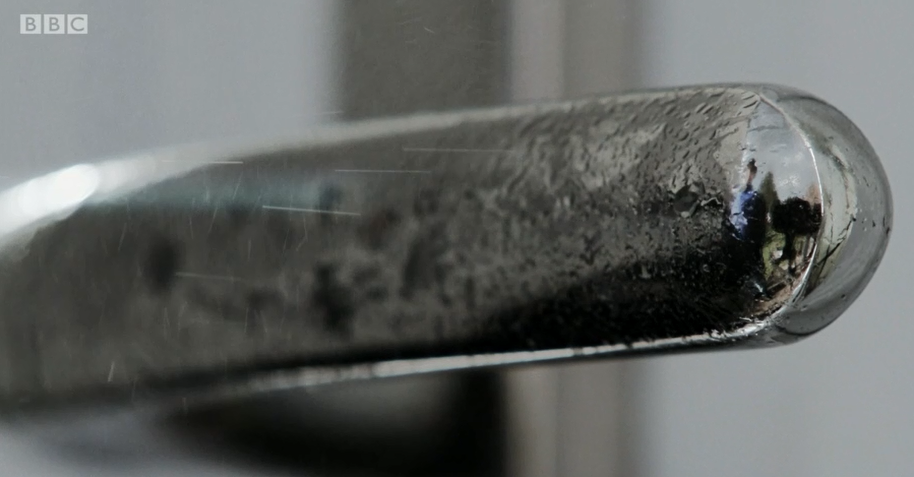
BBC photographic reconstruction of the Skripal front-door handle 
at the alleged instant of attack. Source: https://www.bbc.co.uk/ -- min.44:54.

Both Skripals have been released from hospital. Public statements, including one filmed appearance and telephone calls, have been made by Yulia. Sergei has made no statement; no telephonic or photographic evidence of his condition has been published.

The Skripal poisoning case, and Prime Minister May’s charge that Russian government agents were to blame, have triggered international concern and sanctions against the Russian state. According to May’s House of Commons statement on March 14,

“there is no alternative conclusion other than that the Russian State was culpable for the attempted murder of Mr Skripal and his daughter – and for threatening the lives of other British citizens in Salisbury, including Detective Sergeant Nick Bailey.” 

No British prosecution indictment of attempted murder has been presented to a court nor have charges of a criminal conspiracy by the Russians been tested by a British judge.

In September, when decontamination works were under way at the Skripal home, the Guardian reported:

“there has been speculation that the house may be knocked down but it is not believed a final decision has been made on its long-term future.” 

The Wiltshire Council statements this morning suggest the final decision has been made to reconstruct the Skripal house and to “clean” the Bailey house.

In November, during the BBC interview with Bailey, the police detective said that accompanied by at least one, possibly two other police officers, garbed in “full forensic suits” with gloves and face masks, he had inspected the Skripal house late in the evening of March 4. According to Bailey, “the house was in darkness. It just looked normal. There was nothing untoward”. The police trio left the house, took off their forensic gear, “bagged them up”, and returned to the police station.


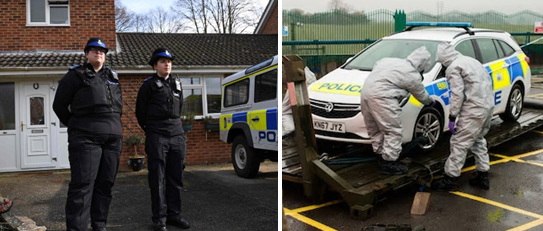
Left: Wiltshire police stand guard, unprotected, in front 
of poisoned door-handle; Skripal’s study to right of door. 
Right: Sgt Bailey’s police car is examined by investigators.

Bailey subsequently reported to the BBC that “everything the kids owned, we lost all that, the cars, we lost everything.”

There has been no report that the Wiltshire police station where Bailey’s forensic suit, gloves and mask were returned before he went home and then developed symptoms requiring hospitalization, has been demolished as part of the decontamination process. None of the locations where the Skripals spent time before their collapse, including a car park, pub, and restaurant has been demolished. Local authorities have issued bulletins confirming that following expert checks and decontamination procedures, they are safe for public use.

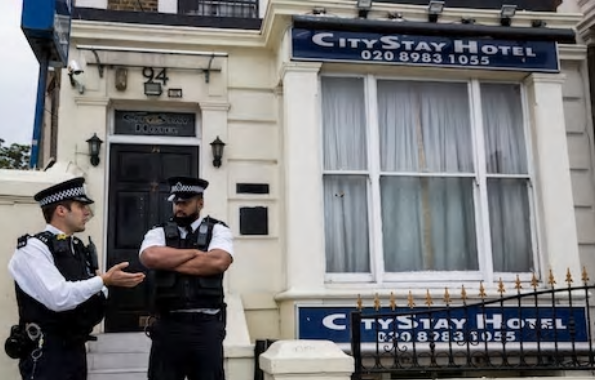
The London hotel, where the alleged Russian poison attackers stayed together before they travelled to Salisbury for their alleged attack, has also been reported by the police and media to have revealed nerve agent traces. “Novichok was found in bedroom”, reported the Telegraph last September.


The newspaper also reported that no part of the 
hotel has been demolished.

According to Perrett of the Wiltshire Council, at the present time “there are only two remaining sites being cleaned, Mr Skripal’s house at Christie Miller Road, Salisbury, and Charlie Rowley’s residence at Muggleton Road, Amesbury.” Rowley survived later exposure, on June 30, to the poison in a bottle which he found abandoned and took home. His partner, Dawn Sturgess, to whom Rowley presented the bottle, died following her exposure.

“All other sites,” said the Wiltshire Council spokesman, “have been cleaned and handed back to their owners.”

The destruction of the main roof of the Skripal house and of the roof above Skripal’s study is the first evidence that the alleged nerve agent has been found in the interior, far beyond the range which the alleged Russian agents’ spray could have penetrated. The demolition plan also covers areas of the interior which Bailey did not reach in his March 4 inspection.

Forensic sources believe this is circumstantial evidence for two new conclusions. The first is that the poison was inside the Skripal house and inside Sergei Skripal’s study before the alleged attack on the door handle. Until and unless the British authorities explain why they are demolishing the roofs and other interior property, which only Sergei Skripal, not Sgt Bailey, could have contaminated on March 4, the sources believe no other inference is probable.

The second conclusion is that it was Skripal who exposed himself to a poison he was handling inside the house. That he did so by accident is likely; the accident theory was first reported here, on March 25, 2018.

The only independent British investigator of the affair, Rob Slane, has announced that he is retiring from the case. Here is his last word.

“Even as I was finishing this piece off, yet another round of nonsense was unleashed; this time, the news that the roof of 47 Christie Miller Road (including the roof of the study) is to be taken off and replaced. Remember, we’re talking about a substance that can be cleansed with baby wipes. Remember, we’re talking about a substance that apparently breaks down after 80 minutes of exposure to the air. But 11 months later, it is again so deadly, that a whole roof needs replacing!
Of course the media is not bothering to ask the obvious questions about this action, such as: How exactly could the roof timbers have become contaminated? Who could have contaminated them? D.S. Bailey? But why would he have been in the attic? Why is the ceiling/roof in Zizzis [restaurant] not being replaced? Why has the roof in The Mill [pub] not been dismantled? What was really in the attic? Obvious questions, yet none of them will be asked.

In conclusion, I think it abundantly clear that what we have been told about what took place on 4th March in the beautiful city of Salisbury is not, in fact, true. It is clear that something else happened, and much of what we have seen since then has been theatre and an attempt to cover up what actually took place.”

What Is Democracy? A New Film by Astra Taylor

What Is Democracy?

by Astra Taylor - Zeitgeist Films


January 31, 2019


Coming at a moment of profound political and social crisis, What Is Democracy? reflects on a word we too often take for granted.


What Is Democracy?

US Release Date: January 16, 2019

Directed by Astra Taylor 

Synopsis: Director Astra Taylor’s idiosyncratic, philosophical journey spans millennia and continents: from ancient Athens’ groundbreaking experiment in self-government to capitalism’s roots in medieval Italy; from modern-day Greece grappling with financial collapse and a mounting refugee crisis to the United States reckoning with its racist past and the growing gap between rich and poor. Featuring a diverse cast—including celebrated theorists, trauma surgeons, activists, factory workers, asylum seekers, and former prime ministers—this urgent film connects the past and the present, the emotional and the intellectual, the personal and the political, in order to provoke and inspire. If we want to live in democracy, we must first ask what the word even means.

French Foreign Lesson: Macron's Egyptian Protest Repression Primer

French President Macron visits the hangman of Cairo 

by Will Morrow and Alex Lantier - WSWS


30 January 2019

President Emmanuel Macron’s trip to Cairo on Sunday for talks with Egypt’s bloodstained military dictator General Abdel Fattah al-Sisi was a barely veiled threat, tacitly endorsed by governments around the world, against the working class.

For eleven weeks, hundreds of thousands of “yellow vest” protesters in France have marched every weekend to demand higher living standards, tax increases for the wealthy, and an end to repression and militarism.

But the financial aristocracy will make no concessions to workers’ social and political demands.

Rather, it is preparing a drastic intensification of repression of social protest amid a universal turn of the capitalist class around the world towards authoritarian forms of rule.

The meaning of Macron’s visit to Sisi is unmistakable. Sisi is infamous for his resort to mass murder to drown in blood revolutionary struggles of the working class that erupted in Egypt in 2011. During the 2013 coup against Islamist President Mohamed Mursi, his troops shot thousands in broad daylight on the streets of Egypt’s cities. Since then, more than 60,000 people have been jailed, as the Sisi junta carries out mass show trials of its opponents and resorts to systematic torture, documented by human rights groups, of thousands of political prisoners.

Macron’s claim Sunday night that he is visiting the hangman of Cairo so that he can “speak more openly” about “human rights” is ludicrous. Sisi banned the sale of yellow vests in Egypt last year for fear that mass protests would spread from France to Egypt. Macron’s meeting with Sisi doubtless concentrated on a feverish discussion of repression.

Faced with a parasitic financial oligarchy that cannot and will not make concessions, the working class faces a political struggle that can have one of only two outcomes: revolution or counterrevolution.

In Cairo, Macron made clear France would continue arming Sisi to the teeth against the Egyptian workers. French sales of Rafale fighters and other military hardware to Sisi are to continue despite Macron’s mealymouthed comments on human rights.

“I would differentiate between the two subjects,” he said.
“They are not linked for us and they never were.”

Asked about Amnesty International’s report that French armored vehicles were used in the 2013 repression in Egypt, Macron said France “foresaw they would be used for military purposes.” He claimed that there is “no possible ambiguity” in French weapons sales, that they are intended for the “defense of Egyptian territory against external enemies,” not against the Egyptian people.

Who does Macron think he is kidding? 


French armored vehicles serve to repress the workers not only in Egypt, but also in France—since Macron took the hitherto unprecedented step of deploying armored vehicles against the “yellow vests.”

As Macron escalates repression in France and showers Cairo with weaponry, Sisi can take Macron’s toothless remarks as a green light to use French arms for further crackdowns in Egypt.

The authoritarian regimes and police-state policies of the capitalist class are now facing a challenge from the working class. After over a quarter century of imperialist war in the Middle East since the Stalinist dissolution of the Soviet Union in 1991, and a decade of European Union (EU) austerity after the 2008 crash, the mechanisms used to suppress the class struggle are collapsing.

Jerome Rodrigues - Highly Visible Gilets Jaunes

A global upsurge of the class struggle, of which the 2011 uprising in Egypt was a forerunner, is underway.

The beginning of 2019 has seen a wildcat rebellion by 70,000 autoworkers in Matamoros, Mexico, the largest strike on the North American continent in 20 years, as well as strikes and anti-austerity protests across Europe, and continued mass “yellow vest” demonstrations in France.

On January 14, after nationwide demonstrations in December, a general strike of 700,000 public sector workers in Tunisia brought the country to a standstill, as tens of thousands in Tunis chanted, “The people want the fall of the regime.”

Last week, Sisi met with Sudanese President Omar al-Bashir, whose government has arrested hundreds and killed dozens since protests began last month over the rising cost of bread and other basic commodities.

As masses of workers and youth internationally enter into struggle, it is critical to draw the lessons of Macron’s trip to Cairo. Macron’s hailing last year of French fascist dictator Philippe Pétain, or German Interior Minister Horst Seehofer’s endorsement of neo-Nazi riots in German cities, are not isolated accidents. Faced with a challenge from below, the ruling class will seek to use the most ruthless methods.


[Damn Their Eyes - "Defense Balls" Head Shots (via Frenchly)]


The French ruling elite’s response to the “yellow vest” protests has been to launch mass arrests and repression on a scale unseen in metropolitan France since the Nazi Occupation.

Over 5,000 protesters have been arrested, including more than 1,700 on a single day on December 8.

At least four protesters have had their hands blown off by police stun grenades, another 20 have lost eyes from police bean-bag bullets, and one person has been permanently deafened.

Jerome Rodrigues - May Lose Eyesight

Photos have emerged showing riot police in Paris carrying Heckler & Koch G36 assault rifles loaded with live ammunition, and a furious debate is ongoing in the French ruling class about attempting to implement the repressive policies pioneered by Sisi in Egypt against the “yellow vests.”

On January 7, Luc Ferry, a former education minister and self-proclaimed “philosopher,” lashed out on radio against the “yellow vests,” demanding that the military fire live ammunition at them:

“We have the fourth largest army in the world, and it is able to put an end to these c—ts,” he said.
“These kinds of thugs … from the extreme right, the extreme left and from the housing estates that come to hit the police—enough!”

This statement sums up the sentiments prevailing not just in the ruling classes of France, but of the whole world, who see the turn to dictatorship and repression as the only means to prop up the increasingly hated capitalist system.

The most basic needs of the working class today, including the defense of the most fundamental democratic rights, cannot be met outside of a frontal assault on the fortunes and prerogatives of the capitalist class—a struggle of the international working class for the expropriation of the ruling class and the building of socialism.

Tuesday, January 29, 2019

Ending Canada's "Nice Guys" Image

Trudeau Pushes Trump’s Regime Change in Venezuela

by TRNN


January 28, 2019

The Lima group will meet in Canada on February 4 to address the Venezuela crisis. For those of you who doesn’t even know who the Lima Group is, don’t worry; neither did we, many of us who are in the business of following this stuff. It is a multilateral body formed by Canada of Latin American countries that includes Argentina, Brazil, Canada, Chile, Colombia, Costa Rica, Guatemala, Honduras, Mexico, Panama, Paraguay, Peru, Guyana, and St. Lucia. The last two countries just joined.

The group was established in August of 2017 as an opposition to the OAS because they couldn’t get the decisions that they wanted to get out of the Organization of American States. So they formed a organization to address the Venezuela crisis. And in its mandate it states that it is established to bring about a peaceful resolution to the Venezuela crisis.


Why is Canada violating the UN Charter and leading the way for regime change in Venezuela? Paul Jay and Yves Engler join Sharmini Peries

Smears, Lies, and the Western Press "Fact Check" Machine

‘Media Bias Fact Check’ Smears WikiLeaks, Supports Western Propaganda Machine

by Elizabeth Vos - Disobedient Media


January 29, 2019

With the latest US-backed coup underway in Venezuela and Roger Stone’s arrest as much an exercise in theater as the rest of his political career, one may wonder what a critique of Media Bias Fact Check (MBFC) and similar sites could contribute to the conversation in our tempestuous news cycle.

We examine the issue now, as attacks made on the credibility of independent media outlets damage the ability of independent journalists across the board to have their voices heard.

In order to provide context for this report, we must reintroduce Disobedient Media’s recent report on multiple attacks against this outlet stemming from proxies of the Integrity Initiative.

Wad "The Welder" Guano - The Man
Who Would Be King of Venezuela

The Integrity Initiative was revealed to have been a front organization for British intelligence, and partnered with groups including the Atlantic Council in order to push neo-McCarthyist propaganda.

Within days of this outlet’s coverage of the Integrity Initiative, the website ‘Media Bias Fact Check‘ produced an updated page appraising Disobedient Media as right-leaning, supportive of conspiracy theories, and “supportive of Guccifer 2.0.” In characterizing Disobedient Media as a hard-right news source, a smear lands on not only the writers producing work with this outlet, but also those whose stories this outlet has covered.

The first article cited by Media Bias Fact Check in its report on Disobedient Media is a clearly-labeled opinion piece authored by this writer, which focused on the multiple unprosecuted felonies committed by former Broward County Elections Supervisor Brenda Snipes, and the unaddressed election-rigging of the congressional race in Florida’s 23rd district. In MBFC’s opinion, an opinion piece which decries documented crimes that have cheated progressives of a voice is an example of hyperbole. MBFC omits the fact that the article in question and many other opinion pieces penned by this author have shown clear support for progressives and greens, not the right-wing.

In other words, the same articles MBFC finds fault with actually contradict their own verdict on Disobedient Media’s “right-wing bias.” Apparently, anyone who publicly discusses the corruption within the Democratic Party is now an alt-right Putin troll.

Later in the page, Media Bias Fact Check writes:

DM is a staunch defender of Julian Assange, Wikileaks, and Guccifer 2.0. All of which have known and factually proven ties to Russia. In multiple articles they claim that Guccifer is not a Russian operative, or is being framed as such, when multiple factual sources, such as Ars Technica, have verified that not only did the files they shared came from Russian sources, but that Guccifer is actually a persona run by GRU, the Russian Intelligence Service.” [Emphasis Added]

Most readers will not need reminding that Disobedient Media has never “defended” Guccifer 2.0, but has published ground-breaking coverage of research on the subject for over two years. The ongoing analysis covered and produced by this outlet has thoroughly deconstructed the Guccifer 2.0 persona. In addition to never having “defended” Guccifer 2.0, this outlet has neither published nor supported any analysis that claims Guccifer 2.0 was “framed.”

That Media Bias Fact Check would outright lie in this manner might at first seem to be the result of faulty research or lazy editing. However, the placement of WikiLeaks in the same sentence with Guccifer 2.0, followed by the claim that WikiLeaks, Assange, and Guccifer 2.0 have “factually proven ties to Russia,” reaches beyond bad research, amounting to deliberate propaganda designed to create a false link between WikiLeaks and Russia.

The false representation of WikiLeaks by MBFC is not limited to its report on Disobedient Media. At the time of writing, Media Bias Fact Check has labeled WikiLeaks a “center-right” leaning outlet. Unbelievably, the site also assesses WikiLeaks’s accuracy rating as “mixed,” despite the organization’s unparalleled record of 100% accuracy.

Lest we forget, WikiLeaks has never had to retract a single document, much less an entire publication. In direct contrast, outlets like The Guardian have a history of publishing altered documents and entirely fabricated stories, the latest of which has yet to be retracted or explained.

In the opinion of many, The Guardian’s track record reveals a bias so strong that it would be better appraised as a mouthpiece of UK intelligence interests than a news service. Astoundingly, despite this record, Media Bias Fact Check rates The Guardian’s factual accuracy as “high.”

Again: MBFC rates The Guardian, who just published an entirely false story that has yet to be retracted, as more accurate than WikiLeaks, an organization that has published millions of documents, none of which have been fraudulent.

What explains this discrepancy between reality and the Media Bias Fact Check’s appraisal of various outlets? While some news sources may be represented fairly by MBFC, a single instance of clear and irrefutable dishonesty on the part of MBFC rends their credibility as a reliable judge of bias completely.

Most readers are by now aware that the Atlantic Council is not simply a biased news source, but a mouthpiece for Western intelligence interests and specifically aimed towards the ministration of propaganda to the public. Mintpress News described the Atlantic Council as a: “leading geopolitical strategy think-tank seen as a de facto PR agency for the U.S. government and NATO military alliance.”

Media Bias Fact Check’s page devoted to Disobedient Media sources in part from none other than the Atlantic Council’s “Defense Research Lab” to substantiate lies put forward in its hit-piece. As Mintpress News reported, the same DFRlab has partnered with Facebook on the latter’s censorship policy.

As previously mentioned, the Atlantic Council was recently reported to have been a partner with the Integrity Initiative, a front for UK intelligence and a vehicle of anti-Russian hysteria. Absurdly, Media Bias Fact Check also describes the Atlantic Council as totally unbiased. One should not need to belabor the absurdity of this categorization being applied to the Atlantic Council when contrasted with the description of WikiLeaks as right-leaning and of “mixed” accuracy on the same platform.

Though this article has focused on MBFC’s manipulative representation of Disobedient Media as an illustrative example and for the sake of brevity, the point stands for all independent journalists and non-corporate news outlets. Likewise, Media Bias Fact Check is not the first and will not be the last self-described arbiter of bias that deserves heightened scrutiny as we witness escalating establishment-backed efforts to discredit independent media sources. Many journalists, including Caitlin Johnstone, have observed this ongoing phenomenon.

Newer organizations like NewsGuard have rightly drawn criticism in this regard over recent weeks, and Disobedient Media‘s Adam Carter previously covered attempts by “Hamilton 68 Dashboard” to misconstrue domestic social media activity as the work of Kremlin-controlled bots. We’ve also seen the ongoing editing of Wikipedia pages to reflect establishment-endorsed lies about a variety of voices outside the corporate-news-bubble.

Overall, such fallacious attacks on outsider-opinion represent an effort to strangle social discourse from the top down. In this writer’s opinion, sites like Media Bias Fact Check constitute a desperate retaliatory measure in the wake of the legacy media’s loss of collective attention, and seek to reinforce narrative control in the hands of organizations like the Atlantic Council while smearing reliable sources of scientific journalism like WikiLeaks.

For this reason, addressing the conflicts of interest and clear, factually obvious inaccuracies put forward by organizations and websites which purport to accurately categorize bias is crucial if free-thinking opinions and non-corporate media sources are to continue to be heard.

Gorilla Radio with Chris Cook, Astra Taylor, John Helmer, Janine Bandcroft January 31, 2019

This Week on GR

by C. L. Cook - Gorilla-Radio.com


January 31, 2019

From the barricades of France's Gilets Jaunes and America's Black Lives Matter marches, to Venezuela's Bolivarian reactionary mobilizations, and the "coloured revolutions" manifesting around the globe, it's clear: we're living in an age of political upheaval. But are scenes of the People taking to the streets an ominous precursor of chaos and civilization's end to come, or hopeful sign of civic renewal and democratic vibrancy?

Astra Taylor is a political activist, organizer, and co-founder of Debt Collective, a "community of debtors... working to build a new economy." She is too an award-winning filmmaker, whose credits include, 'Examined Life', 'Zizek!', and her most recent, 'What Is Democracy?', featured at the upcoming Victoria Film Festival.

Listen. Hear.

Astra's also the American Book Award-winning author of, 'The People’s Platform: Taking Back Power and Culture in the Digital Age', and an essayist whose writing has appeared at The New York Times, London Review of Books, and The Walrus among other places. Her new book, 'Democracy May Not Exist, But We’ll Miss It When It’s Gone' is due out any day.

Astra Taylor in the first half.

And; the long-running fiasco that has become Great Britain's political reality may prove H.L. Menken's maxim: "Under democracy one party always devotes its chief energies to trying to prove that the other party is unfit to rule - and both commonly succeed, and are right."

John Helmer is a journalist, former academic, government policy advisor, author, and broadcaster. He's the longest-serving Russia-based foreign correspondent, and sole western journalist directing his own news bureau, independent of any single national or commercial encumbrance, and principal behind the news website, Dances with Bears, where his recent article, 'Novichok Full O'Nuts - In the Case of Sergei Skripal Police Commissioner Angus MacPherson Lifts the Lid' is one of a series chronicling the continuing inability, or unwillingness, of the May government to provide a consistent narrative surrounding the case that strained Anglo-Russian relations to breaking point.

Helmer's titles include, (with Max van der Werff) 'The Lie That Shot Down MH17 - The True Story of Who Did', Grand Strategy for Small Countries, Case Studies in Transforming Weakness into Power,' Russian State Strategy on the Cheap,' among others. His latest, newly released book is his political memoir, 'The Man Who Knows Too Much About Russia'.

John Helmer and clearing finally the malodorous May miasma shrouding the sinister Skripal affair in the second half.

And; Victoria-based activist and long-time Gorilla Radio contributor, Janine Bandcroft will be here at the bottom of the hour with the Left Coast Events Bulletin of some of the good things to be gotten up to in the coming week. But first, Astra Taylor asking, "Just What Is Democracy?"

Chris Cook hosts Gorilla Radio, airing live every Thursday between 11-Noon Pacific Time. In Victoria at 101.9FM, and on the internet at: http://cfuv.uvic.ca.  He also serves as a contributing editor to the web news site, http://www.pacificfreepress.com. Check out the GR blog at: http://gorillaradioblog.blogspot.ca/

Monday, January 28, 2019

Beholding Venezuela's Most Vocal, If Not Neediest Revolutionaries

The Vultures of Caracas

by Craig Murray


January 26, 2019

We are frequently told that people in Venezuela have no food, clothing or toilet paper, and that popular discontent with the left wing government is driven by real hunger. There are elements of truth in this story, though the causes of economic dislocation are far more complex than the media would have us believe.

But I ask you to look at this photo of supporters of CIA poster-boy, the West’s puppet unelected “President” Juan Guaido, taken at a Guaido rally in Caracas two days ago and published yesterday in security services house journal The Guardian. Please take a really close look at the photo. Blow it up as big as you can. Scan individual people in the crowd, one by one. 


Click Image to Enlarge

These are not the poor and most certainly not the starving. As it chances I have a great deal of life experience working amongst seriously deprived, hungry and despairing people. I know the gaunt face of want and the desperate glance of need. Look at these Guaido supporters, one by one by one. This designer bespectacled, well-coiffed, elegantly dressed, sleekly jowled group does not know hunger. This group does not know want.

This is a proper right wing gathering, a gathering of the nicely off section of society. This is a group of those who have corruptly been siphoning Venezuela’s great wealth for decades and who want to make sure the gravy train flows properly in their direction again. It is, in short, a group of exactly the kind of people you would expect to support a CIA coup.

Those manicured hands raised in the air will never throw rocks, or get involved in violence unless against a peasant strapped to a chair for them. It is not this crowd which will suffer as public disorder is manipulated and directed by the CIA. These wealthy ones are immune, just as Davos serves as nothing but an annual reminder of how very poorly God aims avalanches.

There is real suffering in Venezuela. The CIA is working hard to stoke violence, and the genuine poor will soon start to die, both in those egged on to riot and in the security services. But do not get taken in by the complete nonsense that this is a popular, democratic revolution. It is not. It is yet another barefaced CIA regime change coup.

Venezuela: A Democracy You Can't Refuse

When Is a Democracy not a Democracy? When It’s Venezuela and the US is Pushing Regime Change

by Joe Emersberger  - MintPress News


January 28, 2019

Venezuela has as much right to call itself a democracy as does the United States. Until that is understood by enough people, the Trump administration will continue to devastate Venezuela’s economy with illegal sanctions and push it towards civil war. 

CARACAS, VENEZUELA Venezuela has as much right to call itself a democracy as does the United States. Until that is understood by enough people, the Trump administration will continue to devastate Venezuela’s economy with illegal sanctions and push it towards civil war. People can oppose President Donald Trump’s economic sanctions and incitement of a military coup without acknowledging President Nicolas Maduro’s democratic legitimacy, but by not acknowledging his legitimacy they needlessly weaken their position.

Millions around the world opposed the U.S. invasion of Iraq in 2003, and the many years of sanctions that came before that invasion, while also accepting, in that case appropriately, that Saddam Hussein was a monstrous dictator. However, massive global opposition to U.S. aggression in Iraq failed to prevent the war that killed hundreds of thousands of people.

The most horrifying thing about Venezuela’s case is that it shows (for at least the third time in this century alone) that democratic legitimacy provides very little defense for a government when the U.S. and its allies decide that it “must go.”

On May 20 of last year, Maduro received the votes of 6.2 million people, about 31 percent of the eligible voters, about the same percentage that U.S. presidents generally receive (Obama received 31 percent in 2008 and 28 percent in 2012, while Trump received 26 percent in 2016). Four different groups of international observers (reports here, here, here and here) concluded that Maduro’s electoral victory was clean. If you look beyond vague appeals to the authority of establishment groupthink — statements that typically say the election was “widely dismissed as fraudulent” — you’ll find the arguments to support that claim appallingly thin. 

Turnout (at 46 percent) was very low by Venezuelan standards because the bulk of the U.S.-backed opposition to Maduro not only called for a boycott and refused to run candidates, it also attacked Henri Falcon, who defied U.S. threats to run in the election. On May 6, Falcon’s economic advisor, Francisco Rodriguez, said on Twitter that people from the opposition side promoting theories that he was in cahoots with Maduro must have taken a “strong dose” of drugs. In another tweet on the same day, Rodriguez asked the opposition party Voluntad Popular to “stop spreading lies” that a secret pact existed between Maduro and Falcon. Incidentally, Voluntad Popular is the party of the previously obscure legislator, Juan Guaido, whom Trump just anointed as Venezuela’s president.

Falcon began his presidential campaign with an incendiary 35-minute speech on Venezuelan state media, in which he repeatedly called Maduro the “hunger candidate.” In an interview on a large private network, Falcon said that Maduro’s government was an “unscrupulous monster” but insisted that Maduro was also “beatable” at the polls. During the interview, Falcon also advised government opponents that it’s foolish to wait for a “military invasion to save Venezuela.” Aside from hinting at the obvious objective of the electoral boycott, it’s surreal that this was said on TV in a country labeled a “dictatorship” and accused of perpetrating a “crackdown” on dissent. Falcon’s advisor also traveled all over Venezuela and made numerous TV appearances (examples here, here and here) campaigning for Falcon.

A secret ballot precludes vote-buying


Reuters, whose headlines have often been quite open in their contempt for Maduro’s government, conceded that voting is secret in Venezuela, but tents set up by the government close to voting centers on Election Day (known as Punto Rojos) were hyped as “voting buying.” Puntos Rojos (Red Points) are used for exit polling, and have also been used by the opposition, except in a different color, in numerous elections over the past 20 years. By law, they are required to be 200 meters away from voting centers.

On May 3, Maduro said that people who came to a Puntos Rojo after voting could “probably” win a prize. This is hardly an exemplary practice, but voting is secret, so nothing prevents people from voting for the opposition and then showing up for a chance at a prize. An opposition blog referred to these tents as “The Perfect Blackmail” but even this account concedes that the government can’t know how people voted.

U.S. sanctions as the real “blackmail”


As an argument for calling the election invalid, this is stunningly weak and that’s before you consider a huge offsetting factor: U.S. economic sanctions that effectively hold a gun to the Venezuelan electorate. It’s perfect blackmail indeed when Western journalism can’t detect a disqualifying electoral problem with sanctions that have cost Venezuela’s government $6 billion dollars in the 12 months following August of 2017 when Trump imposed financial sanctions. That’s about 6 percent of its GDP in a region where most countries spend about 7 percent of GDP annually on health care.

Bear in mind also that Venezuela was only able to import $11.7 billion in goods in 2018 according to Torino Capital, where Rodriguez is the chief economist. Aside from being electoral blackmail, U.S. sanctions are clearly murderous, as they drastically cut into the government’s capacity to import essential items like food and medicine. This is simply ignored by a media that often hyperventilates over very dubious allegations of significant “Russian interference” in U.S. elections through email hacking and clickbait operations.

Francisco Rodriguez has noted (approvingly) that Trump’s recognition of a “new government” could prevent Venezuela from getting paid for oil shipments to the United States. In other words, Trump is now poised to make the sanctions still more devastating.

Apologists for Trump have dismissed the impact of U.S. sanctions by saying that Venezuela’s crisis was not caused by them. It’s true that Maduro could have prevented the crisis — most easily in the first year and a half of his government when oil prices were still very high – and therefore prevented Trump from ever being able to put his foot on the throat of Venezuela’s economy. But would it have been acceptable for a foreign government to deliberately make the financial crisis in the United States worse in 2008 by arguing it was not the original cause? Is it acceptable to assault a cancer patient provided the assailant can prove he did not give the patient cancer?

Confusing competence with legitimacy


The competence of a government is also a totally separate issue from its democratic legitimacy, but the two are often conflated in Venezuela’s case. If bad policies that produce needless suffering make a country a dictatorship then was the United States a dictatorship during the Great Depression, or is it today as a result of its scandalously poor health care system for a wealthy country? Was Greece a dictatorship during its economic meltdown after 2010?

Moreover, U.S. support for coup attempts in Venezuela since 2002 was partly responsible for the policies that led to the crisis. It saddled Venezuela with opposition leaders who knew they’d be supported by the world’s most powerful country no matter how they seized power. The exchange rate system that ended up being the Achilles heel of the government’s economic policy, was set up after the second major attempt by the U.S.-backed opposition to depose the government by force: that time through the sabotage of the state oil company.

The first coup “attempt” briefly succeeded and established a dictatorship under Pedro Carmona that was welcomed by the Bush Administration, the New York Times editorial board (among others), and the IMF, which immediately stepped forward to offer Carmona’s dictatorship loans.

Another complaint about Maduro’s electoral victory last year was that two prominent opposition leaders were disqualified from running: Leopoldo Lopez and Henrique Capriles.

Both were participants in, not just supporters of, the coup that installed Carmona. In the United States, anyone who participates in a violent uprising that threatens the life of a sitting president would not be complaining about being disqualified from running for office. That would be the least of their worries, for them and any foreign government foolhardy enough to support them.

Additionally, opposition-aligned pollster Datanalisis claimed, three months before the election, that Falcon was one of the opposition’s most popular leaders — basically in a statistical tie with Leopoldo Lopez for the top spot.

The U.S. pot and the Venezuelan kettle


The opposition has other reasons for rejecting Maduro’s legitimacy but, even when they have some validity, one struggles to see how very similar objections could not also apply to the United States. It was certainly a disproportionate Venezuelan Supreme Court ruling that disqualified the entire National Assembly in 2017 because it flouted the court’s authority. In 2000, the U.S. Supreme Court made a very dubious ruling that gave George W. Bush the presidency. Should the Democrats, backed by a foreign power, have disregarded the Supreme Court and named their own president? Then there is mass incarceration, political brutality, voter suppression, and other forms of corruption in the U.S. political system. The U.S. Electoral College is a bad joke that has, twice since 2000, allowed the loser of the popular vote to take the White House.

Does all that make United States a dictatorship? Which foreign government (if a powerful enough government existed) is anyone willing to authorize to “fix” the U.S. political system through economic blackmail, threats of invasion, or by inciting the U.S. military to perpetrate a coup?

Trump has predictably found some willing allies around the world for his recent escalation against Venezuela. Unpopular as the Iraq War was around the world in 2003, the U.S. managed to get dozens of governments to join the ”coalition of the willing” to perpetrate the supreme international war crime – including two with very progressive reputations: Norway and Denmark. The more widely loathed the U.S. president, the more important allies become. Hence, on February 29, 2004, George W. Bush — who was thoroughly discredited around the world, owing to the invasion of Iraq — was happy to be fully supported by the governments of Canada and France when U.S. troops kidnapped Haiti’s democratically elected president and installed a dictatorship under which thousands of loyalists to the deposed government were murdered.

It is possible that Trump may eventually succeed in producing a kind of “electoral victory” similar to that which Ronald Reagan produced in 1990 in Nicaragua through a combination of terrorism and economic strangulation. It is fine and necessary to promote dialogue and negotiations, but if Maduro’s democratic legitimacy is not recognized, a “negotiated solution” is not only less likely but also less likely to lead to anything good.

Joe Emersberger is a Canadian engineer and UNIFOR member with Ecuadorian roots. He writes primarily for Telesur English and Znet.

Republish our stories! MintPress News is licensed under a Creative Commons Attribution-NonCommercial-ShareAlike 3.0 International License.