Tuesday, February 05, 2019

Gorilla Radio with Chris Cook, Daniel Kovalik, Denis Halliday, Christopher Black, Janine Bandcroft February 7, 2019

This Week on GR

by C. L. Cook - Gorilla-Radio.com


February 7th, 2019

The Lima Group met Monday in Ottawa to make official its determination to overthrow the government of Venezuela, as detailed in its 'Ottawa Declaration'.

An offshoot of the Organization of American States, the Lima Group formed following the OAS's failure to agree on the forced removal of president Nicolas Maduro.

In addition to hosting the meeting, and adding its capital's name to the Group's declaration, Canada's foreign minister promised 53 million Canadian dollars in "humanitarian and development aid" to be delivered to what Chrystia Freeland termed, its "trusted partners" in the embattled South American nation.

Listen. Hear.

Daniel Kovalik is a labor and human rights lawyer, essayist, and author of the critically-acclaimed books, ‘The Plot to Scapegoat Russia’, and ‘The Plot to Attack Iran’. The third in his “plot to” trilogy, ‘The Plot to Control the World: How the US Spent Billions to Change the Outcome of Elections Around the World’ is newly out and couldn’t be more timely. Dan has too served as an election observor multiple times in Venezuela, and other Latin American countries, and is just returned from Caracas.

Dan will be in eastern Canada presenting The Media Undermining Venezuela, sponsored by the Canadian Peace Council, starting February 13th.

Dan Kovalik in the first half.

And; despite a gruesome colonial past, and more recent history of supporting dictatorships, Canada still gets a lot of mileage out of its "democracy-loving" reputation. It scores a solid six on The Economist's annual rating of global democratic performance, and does almost as well on international justice indices. In fact, Canada's "rule of law" bona fides is wielded more and more by the prime minister, even as the country diverges further and further from it.

Christopher Black is a Toronto-based criminal lawyer specializing in international war crimes cases, and executive member of the Canadian Peace Congress. He’s also an author, poet, and essayist who’s latest book is, ‘Beneath the Clouds’. Black’s articles on international law, politics and World events appear at New Eastern Outlook among other places, and his latest, ‘The Lima Group: International Outlaws’ serves as indictment of a gang of nations gone rogue.

Christopher Black and declaring Ottawa outlaws in the second half.

And; Victoria-based activist and long-time Gorilla Radio contributor, Janine Bandcroft will be here at the bottom of the hour with the Left Coast Events Bulletin of some of the good things to be gotten up to around our town in the coming week. But first, Dan Kovalik and a kettle of vultures over Caracas.

Chris Cook hosts Gorilla Radio, airing live every Thursday between 11-Noon Pacific Time. In Victoria at 101.9FM, and on the internet at: http://cfuv.uvic.ca.  He also serves as a contributing editor to the web news site, http://www.pacificfreepress.com. Check out the GR blog at: http://gorillaradioblog.blogspot.ca/

Democracy's Naked Lunch in Ottawa

Regime Change Canadian Style for Venezuela

by TRNN


February 5, 2019

The Lima Group met in Ottawa and signed the Ottawa Declaration to oust President Maduro from power in Venezuela. 13 conservative Latin American governments, plus Canada, officially recognized Juan Guaido as the transitional President of Venezuela and accepted Venezuela’s membership to the Lima Group.


Yves Engler, Dimitri Lascaris, Greg Wilpert discuss the outcome.

Portrait of a Modern Coup: The (Media) Making of Wad Guano

Venezuela Blitz – Part 1: Tyrants Don’t Have Free Elections

by Media Lens - In Alerts 2019 


05 February 2019

In our new book, we describe a 'Propaganda Blitz' as a fast-moving campaign to persuade the public of the need for 'action' or 'intervention' furthering elite interests.

Affecting great moral outrage, corporate media line up to insist that a watershed moment has arrived – something must be done!

A classic propaganda blitz was triggered on January 23, when Venezuelan opposition leader Juan Guaidó declared himself 'interim President'.

This was presented as dramatic new evidence that the people of Venezuela had finally had enough of Nicolas Maduro's 'regime'.

In reporting this news the following day, the BBC website featured a disturbing graphic of a captive with arms tied behind his back being tortured. The caption read:

'Inside Venezuela's secret torture centre'

The image linked to a complex interactive piece that allowed readers to explore the torture centre. There was also a long report on the same centre. The interactive report included this statement by a former prisoner, Rosmit Mantilla:

'In a country like Venezuela there's no difference between being in or out of prison. You are equally persecuted and mistreated, and you can die either way.'

Venezuela, then, is a giant gulag. The interactive piece had clearly taken a good deal of time and effort to produce – odd that it should appear on the same day that news of Guaidó's coup attempt was reported. The BBC followed this up with a piece on January 25 openly promoting 'regime' change:

'Venezuela's Maduro "could get Amnesty"

'Self-declared leader Guaidó also appeals to the powerful army, after receiving foreign backing.'

In fact, Guaidó, also received foreign rejection from China, Russia, Turkey, Greece, Syria and Iran. On January 29, the BBC front page headline read:

'Venezuela, "living under dictatorship"

'The opposition leader tells the BBC President Maduro has abused power, and renews calls for polls.'

Echoing the BBC's 'amnesty' front page story, the Guardian's Simon Tisdall, also talked up the merits of the coup:

'It seems clear that Juan Guaidó, the opposition leader, has the backing of many if not most Venezuelans.'

A remarkable claim, given that George Ciccariello-Maher reported in The Nation that an opinion poll in Venezuela conducted between January 7-16 had found that 81 per cent of Venezuelans had never heard of Juan Guaidó. But then this is the same Simon Tisdall who wrote in 2011:

'The risky western intervention had worked. And Libya was liberated at last.'

The Guardian may currently be Guaidó's greatest UK cheerleader. After the opposition leader gave the paper an exclusive interview, former Guardian journalist Jonathan Cook tweeted:

'Extraordinary even by the Guardian's standards. Juan Guaido, the CIA's pick to lead a coup against Venezuela's govt, gives the paper one of his first interviews – and it simply acts as a conduit for his propaganda. It doesn't even pretend to be a watchdog'

On February 1, Cook added:

'Oh look! Juan Guaido, the figurehead for the CIA's illegal regime-change operation intended to grab Venezuela's oil (as John Bolton has publicly conceded), is again presented breathlessly by the Guardian as the country's saviour'

The BBC continues to administer a daily dose of propaganda. On January 31, the big morning news story was:

'Venezuela opposition "speaking to army"

'Opposition leader Juan Guaidó says his team has held talks with the army about regime change'

As we noted, if a US version of Guaidó made that admission in public, he would soon be paid a visit by Navy Seals, perhaps shot on the spot and dumped at sea, or bundled away to a life on death row for probable later execution.

On February 4, the front page of the BBC website featured a heroic picture of Guaido's mother kissing her son on the forehead at a protest rally. Sombre, stoic, the saviour's head appears bowed by the weight of the hopes and expectations of his people (people who, until recently, had no idea who he was and had never voted for him).

This was a pure propaganda image. More will certainly follow. We discussed earlier BBC efforts here.

'Tyranny' As A Motive For Corporate Media Concern


The BBC, of course, is not alone in promoting the view that Venezuela is a 'dictatorship'. The Times offered a typically compassionate 'view on Venezuelan protests against Maduro':

'paradise lost - A ruthless dictator has driven his people to the brink'.

The reference to 'paradise lost' recalled a famously foolish remark on Venezuela made by BBC journalist John Sweeney in the Literary Review in 2013:

'The country should be a Saudi Arabia by the sea; instead the oil money has been pissed away by foolish adventurism and unchecked corruption.'

Apart from any obvious issues of head-chopping tyranny, the fact is that Saudi Arabia is 'by the sea'.

The Economist focused on:

'How to hasten the demise of Venezuela's dictatorship

'Recognising an interim president instead of Nicolás Maduro is a start'.

The Mail on Sunday wrote of the 'despot of Venezuela'. In the Telegraph, Ross Clark discussed 'brutal dictatorships like Venezuela and Zimbabwe'. The editors of the Sun appeared to be holding a vigil for the suffering people of Venezuela:

'We hope too that Venezuelans finally topple Nicolas Maduro, the crooked hard-left tyrant Corbyn once congratulated, and rebuild their economy.'

The Sun's Westminster correspondent Kate Ferguson reported that John McDonnell, the shadow chancellor, was backing 'the hard-left Venezuelan despot Nicolas Maduro'. The Express wrote of 'the corrupt regime in Venezuela'.

Writing in The Australian, Walter Russell Mead observed that 'dictator Nicolas Maduro clings to power'. (Walter Russell Mead, 'Moscow savours latest Latin American crisis to destabilise region,' The Australian, 31 January 2019)

Under the title, 'Venezuelan spring,' Mary Anastasia O'Grady wrote in the Wall Street Journal:

'The latest Venezuelan effort to topple dictator Nicolas Maduro is a pivotal moment in Latin American history...'

The Guardian habitually uses the term 'regime' to signal the illegitimacy of the Maduro government.

An emotional Minister for Europe, Sir Alan Duncan - who once worked as a trader of oil and refined products, initially with Royal Dutch Shell, and who, in 1989, set up Harcourt Consultants, which advises on oil and gas matters - told Parliament:

'The UK and our partners cannot and will not stand by and allow the tyranny of Maduro's regime to continue. He has caused endless suffering and oppression to millions of his own people...

'The people of Venezuela do not need the weasel words of a letter to The Guardian, from assorted Stalinists, Trotskyists, antisemites and, apparently, dead people, and also from members of Labour's Front Bench. What they need is our solidarity with the legitimate, elected, social democratic president of the National Assembly: interim President of Venezuela, Juan Guaidó.'

Writing in the Independent, Patrick Cockburn commented in September 2016:

'Sir Alan does have a long record of befriending the Gulf monarchies, informing a journalist in July that Saudi Arabia "is not a dictatorship".'

Sir Alan tweeted:

'The dictatorial abuses of Nicolás Maduro in #Venezuela have led to the collapse of the rule of law and human misery and degradation.'

We replied:

'How much human misery and degradation did *you* cause by voting for war on oil-rich Iraq in 2003 and by supporting oil-rich Saudi tyrants attacking famine-stricken Yemen? Your compassion for the people of oil-rich Venezuela is completely and utterly fake.'

US Secretary of State Mike Pompeo also tweeted:

'We stand with the people of #Venezuela as they seek to build a better life. We cannot ignore the suffering or tyranny taking place in this proud nation. Neither should other countries who care about freedom and prosperity.'

Political analyst Charles Shoebridge commented:

'now speaking of "US standing with the people of #Venezuela against tyranny", when just days ago he was also speaking of the US standing with US allied repressive tyrannies such as UAE Saudi Arabia Bahrain'

Glenn Greenwald made the same point, adding:

'I'd have more respect for the foreign policy decrees of US officials if they'd just admit what everyone knows - "we want to change this country's government to make it better serve our interests" - rather than pretending they give the slightest shit about Freedom & Democracy.'

Writing on the Grayzone website, Dan Cohen and Max Blumenthal describe how:

'Juan Guaidó is the product of a decade-long project overseen by Washington's elite regime change trainers. While posing as a champion of democracy, he has spent years at the forefront of a violent campaign of destabilization.'

Almost entirely overlooked in 'mainstream' coverage, the New York Times reported last September:

'The Trump administration held secret meetings with rebellious military officers from Venezuela over the last year to discuss their plans to overthrow President Nicolás Maduro, according to American officials and a former Venezuelan military commander who participated in the talks.'

Associated Press reported last week:

'The coalition of Latin American governments that joined the U.S. in quickly recognizing Juan Guaido as Venezuela's interim president came together over weeks of secret diplomacy that included whispered messages to activists under constant surveillance and a high-risk foreign trip by the opposition leader challenging President Nicolas Maduro for power, those involved in the talks said.

'In mid-December, Guaido quietly traveled to Washington, Colombia and Brazil to brief officials on the opposition's strategy of mass demonstrations to coincide with Maduro's expected swearing-in for a second term on Jan. 10 in the face of widespread international condemnation, according to exiled former Caracas Mayor Antonio Ledezma, an ally.'

Labour MP, Chris Williamson, virtually a lone honest voice on this issue in the UK Parliament, commented:

'Donald Trump, who received nearly 3m fewer votes than Hillary Clinton, throws his weight behind a guy [Guaidó] who didn't even stand in last year's Venezuelan presidential election and UK foreign secretary, Jeremy Hunt, gives Trump his servile support'

Williamson was impressively rational in this interview with Going Underground. Sir Alan remains unimpressed, commenting shamefully of Williamson in Parliament:

'I'm astonished he's even been prepared to show his face in this House today.'

Lack Of Free Elections As A Motive For Corporate Media Concern


As we have seen, the corporate media's first great reason for opposing Maduro is that he is a ruthless 'dictator'. This label is credible only if he prevents free elections, which of course are intolerable to any self-respecting tyrant.

Again, corporate media are as one in their opinion. The Guardian's Latin America correspondent, Tom Phillips, writes that Maduro was 're-elected last May in a vote widely seen as fraudulent'. The 'impartiality' of Phillips' reporting on Venezuela is clear even from the tweet 'pinned' to his Twitter feed:

'It is 20 years since Hugo Chávez's election kicked off his ill-fated Bolivarian dream.'

A Guardian editorial noted that Maduro had won a 'dodgy presidential vote boycotted by the opposition'. The Economist went further: 'The election he won in May was an up-and-down fraud.' Ross Clark in the Telegraph:

'Opposition politicians have been jailed, while observers in last May's election reported inflated vote tallies.'

The Observer editors opined on January 27:

'Nicolás Maduro was re-elected Venezuela's president last May by fraudulent means, as regional governments and independent observers noted at the time, and his leadership lacks legitimate authority.'

Echoing its positions on earlier 'regime change' efforts that brought utter catastrophe to Iraq and Libya, the Observer added:

'Given this grim record, Venezuela would be well rid of him and the sooner the better. If Maduro truly has the people's best interests at heart, he should recognise that he has become an obstacle to national renewal – and step aside.'

Venezuela needs 'national renewal', or 'modernisation' in Blairspeak. Like the Guardian, the Observer then insisted that reasonable options 'emphatically do not include US intervention in Venezuela'. Nobody should be fooled by this apparent anti-war sentiment. US media analyst Adam Johnson of FAIR made the point:

'I love this thing where nominal leftists run the propaganda ball for bombing a country 99 yards then stop at the one yard and insist they don't support scoring goals, that they in fact oppose war.'

A further prime example of propaganda ball-running was supplied by The Intercept's Mehdi Hasan:

'I'm no expert on Venezuela but I'm pretty sure you can think Maduro is a horrible/bad/authoritarian president *and* also think it's bad for the US to back coups or regime change there.'

Beyond the 'mainstream', credible voices have argued that last May's elections were free and fair. Human rights lawyer Daniel Kovalik of the University of Pittsburgh School of Law, writing for Pittsburgh Post-Gazette, commented:

'I just returned from observing my fourth election in Venezuela in less than a year. Jimmy Carter has called Venezuela's electoral system "the best in the world," and what I witnessed was an inspiring process that guarantees one person, one vote, and includes multiple auditing procedures to ensure a free and fair election.

'I then came home to the United States to see the inevitable "news" coverage referring to Venezuela as a "dictatorship" and as a country in need of saving. This coverage not only ignores the reality of Venezuela, it ignores the fact that the U.S. is the greatest impediment to democracy in Venezuela, just as the U.S. has been an impediment to democracy throughout Latin America since the end of the 19th century.'

More than 150 members of the international electoral accompaniment mission for the elections published four independent reports. Their members 'include politicians, electoral experts, academics, journalists, social movement leaders and others'. The mission's General Report concluded:

'We the international accompaniers consider that the technical and professional trustworthiness and independence of the National Electoral Council of Venezuela are uncontestable.'

The Council of Electoral Experts of Latin America, a grouping of electoral technicians from across the continent, many of whom have presided over electoral agencies, commented:

'The process was successfully carried out and that the will of the citizens, freely expressed in ballot boxes, was respected...the results communicated by the National Electoral Council reflect the will of the voters who decided to participate in the electoral process.'

The African Report:

'Our general evaluation is that this was a fair, free, and transparent expression of the human right to vote and participate in the electoral process by the Venezuelan people, and that the results announced on the night of May 20 are trustworthy due to the comprehensive guarantees, audits, the high tech nature of the electoral process, and due to the thirteen audits carried out previous to and on the day of elections which we witnessed.

'We can also conclude that the Venezuelan people who chose to participate in the electoral process of May 20 were not subject to any external pressures.'

And also the Caribbean Report:


'The mission was satisfied that the elections were conducted efficiently in a fair and transparent manner. All of the registered voters who wanted to exercise their right to vote participated in a peaceful and accommodating environment. Based on the process observed, the mission is satisfied that the results of the elections reflect the will of the majority of the voters in the Bolivarian Republic of Venezuela.'

If all of this has been ignored in the current debate, it is because corporate media in fact do not care about free elections in Venezuela.

Consider the elections held in Iraq on January 30, 2005. On the BBC's main evening news that month, reporter David Willis talked of 'the first democratic election in fifty years' (Willis, BBC News at Ten, January 10, 2005). A Guardian leader referred to 'the country's first free election in decades'. The Times, the Financial Times, the Telegraph, the Sunday Telegraph, the Observer, the Independent, the Express, the Mirror, the Sun and numerous other media repeated the same claim hailing Iraq's great 'democratic election'.

But this was all nonsense. Iraq was not just under illegal, superpower occupation; invading armies were waging full-scale war against the Iraqi resistance. Just weeks before the election, Fallujah, a city of 300,000 people, was virtually razed to the ground by US-UK forces. Six weeks before the election, the UN reported of the city that,

'70 per cent of the houses and shops were destroyed and those still standing are riddled with bullets.' 

A quarter of a million people had been displaced from this one city alone by the onslaught. One year later, The Lancet reported 655,000 excess Iraqi deaths as a result of the 2003 invasion.

There was obviously no question of a free election under these lawless, extremely violent conditions. The corporate press was not the least bit interested or concerned. Indeed, our search of the LexisNexis media database at the time of the elections showed that there had not been a single substantive analysis of the extent of press freedom in Iraq under occupation anywhere in the UK press over the previous six months.

And yet the media were all but unanimous in describing the elections as free and fair.

DE

Part 2 will follow shortly...

Monday, February 04, 2019

A Crack in the Ice: NASA's Worrying Antarctica Find

Thwaites Glacier Startles Scientists 

by Robert Hunziker - CounterPunch


February 4, 2019

It’s a disturbing discovery,” according to Pietro Milillo, a radar scientist at NASA’s Jet Propulsion Lab, who co-authored a recently published study: Heterogeneous Retreat and Ice Melt of Thwaites Glacier, West Antarctica, Science Advances, Vol. 5, No. 1, Jan. 30, 2019.

It’s only within the past 10 years that NASA’s IceBridge Mission has served as the largest airborne survey of Earth’s polar ice, providing unprecedented three-dimensional views of Antarctica’s ice sheets, ice shelves and sea ice.

Scientists are now able to peer into glaciers with remarkable accuracy to see what’s happening.

Indeed, scientists are getting an eyeful, and they are discovering the true impact of global warming, which is much more powerful and happening considerably faster than they ever dreamed possible.

After all, the ocean has been absorbing most of the planet’s heat, and that heat finds its way underneath in the water, thus creating gigantic melt holes, like the recently discovered Thwaites Big Cavity. As such, considerable damage is/has been hidden from view.

The new NASA study, utilizing IceBridge, shows a surprising loss of 14B tons of ice in only three years from the Thwaites Glacier, where a humongous hole lurks beneath the glacier’s icy/snowy surface, a massive cavity nearly the size of NYC but hidden within the core of the ice sheet.

Fascinatingly, it’s calculated that Thwaites is responsible for anywhere from 5% to 10% of worldwide annual sea level rise (“SLR”). By the time the monster glacier disappears from the face of the planet, it alone will equal nearly two feet of SLR. But, how soon Thwaites fades away within Antarctica’s mid-summer 24-hour endless sunlight is a big mystery.

Thwaites Glacier is one of West Antarctica’s big kahunas. It’s 100 miles across and 4,000 feet deep. Surprisingly, and disturbingly, it’s melting earlier and much much faster than ever thought possible, which is downright spooky for a humongous icy glacier that has a permanent face in Antarctica ever since the dawn of humanity.

It should be noted that Thwaites, assuming it collapses and triggers a series of collapsing glaciers surrounding it, serves as a major-major backstop to a larger potential catastrophe on West Antarctica. Still, an event that catastrophic would likely happen well beyond current lifetimes. However, on a cautionary note, timelines for climate change have become moving targets, almost always way too timid.

Thwaites is one more crushing example of scientists exclaiming: “Uh-oh, this is happening much faster than we ever thought possible.” That’s become a common acknowledgment by scientists. Climate change is happening faster and faster, surprising scientists, as their “models” get blown away by new data.

It was only 5 years ago when scientists said the Western Antarctica ice sheet “collapse had started” but the same researchers said: “Even though sea level rise could not be stopped (10-13 feet) it is still several centuries off, and potentially up to 1,000 years away.” No sweat!

Now they are sweating.


Making matters dicey-er yet as for urban coastal planners, the United Nations’ IPCC most recent report did not factor in a melting of the Western Antarctica ice sheet into calculations of sea level rise this century.

Surprise, surprise, it’s happening so much faster.

According to the aforementioned study:

“The Amundsen Sea Embayment (ASE), (Thwaites is one of several glaciers in the embayment) sector of West Antarctica is a dominant contributor to sea level rise at present and for decades to come,” Ibid.

Furthermore, it’s worth noting that, unfortunately: The fast-flowing main trunk of Thwaites accelerated 33% between 1973-1996, but lo and behold, the rate quadrupled in 2003-2010, flowing at a rate of 9.5 Gt/yr versus 2.2 Gt/yr previously. That’s 4xs faster, blowing away the old 1973-96 rate of 33%. Geologically speaking, Thwaites is a virtual supersonic melt speed demon.

Of course, once there’s a big new discovery (surprise-surprise) like Thwaites, the odds of similar glacier scenarios are quite high. After all, Antarctica is the largest desert in the world covered by a couple miles of ice equivalent to about 200 feet of sea level rise. There are plenty of potential additional scenarios.

With a sense of urgency, the U.S. and Great Britain have announced a $50M joint venture known as the International Thwaites Glacier Collaboration to probe the glacier in every conceivable manner to discover ahead of time how precarious it may be.

And, collaterally, whether science has been way too tardy in identifying the risks associated with global warming.
 
Robert Hunziker lives in Los Angeles and can be reached at rlhunziker@gmail.com.
More articles by:Robert Hunziker 

The (Silent) Canadian Connection to Brazil's Vale Mine Disaster

Three Canadian Mining Companies in Brazil Silent on Tailings Dam Structures following Brumadinho Disaster 

by MiningWatch Canada


February 4, 2019

Following the tragic breach of the upstream tailings dam, “Dam I” at Vale’s Córrego do Feijão Mine in Minas Gerais, Brazil, MiningWatch Canada is concerned about the state of Canadian-operated tailings dams in Brazil.

According to the GRID-Arendal Report and an independent panel Report following the Mount Polley disaster, “upstream” or “cascading” dams are the most dangerous. This design builds dams inwards, with upper levels added partly on top of accumulated tailings, not a solid engineered base.

Indeed, recent examples of catastrophic mine spills have come from these kinds of dam structures.

Aftermath of Brumadinho Spill (source: Gazeta do Povo)

MiningWatch has identified at least 65 Canadian-owned mining projects in the prospecting to production stage spread out across Brazil. The majority of these mines and projects are gold mines, but also include other minerals like iron, nickel and graphite. Of these 65 projects, fifteen are in production, and another five are in development or construction.

MiningWatch contacted the companies with mines beyond post-feasibility stage, requesting they identify the dam-type present at or planned for their mines. Out of the nine companies contacted, responses were received from six. Three out of the six companies who responded are still storing wet tailings, but are using a variation of downstream and centreline construction methods. The other three are using dry stacking tailing storage.

The silence on the part of those three Canadian companies who have not yet responded is alarming. Between them, these companies have six operating mines and one in temporary suspension. Jaguar Mining’s (TSX- JAG) Cayete Complex in Minas Gerais (the State where both the Brumadinho and Mariana disasters occurred) houses two producing mines a mere 40km from the urban centre of Belo Horizonte. Its Turmalina mine is also in Minas Gerais. Aura Minerals (TSX-ORA) has been silent on its Pau-a-Pique and São Francisco mines.

Finally, and potentially most concerning, is Yamana Gold (TSX-YRI). Yamana currently has two operating mines in northern Brazil, the Jacobina (gold) and Chapada (gold-copper) mines. The mines are large: Jacobina has a daily mill capacity of 6500 tonnes and Chapada has flotation plant capacity to treat up to 22 million tonnes annually (over 60,000 tonnes/day).

How Canadian-companies store their tailings are of significant concern for us, making Yamana’s silence even more worrisome. With the shadow of the Mount Polley disaster looming in our own country’s recent history, there is definite need for Canadians to reflect on what our companies do at home, and abroad.

As Brazilians attempt to sift through the debris of the most tragic spill the country has experienced in terms of human cost, we worry that a Canadian-owned mine could be next.

The Jackal's Persist: Outlaw Lima Group Convenes in Ottawa

The Lima Group: International Outlaws

by Christopher Black - NEO


February 4, 2019

The covert and overt interventions taking place against Venezuela by the United States and its allies are a form of aggression and a violation of the fundamental principles of the United Nations Charter making the nations involved international outlaws.

The attempted coup against President Maduro may have failed so far but the jackals that instigated it have not given up their objective of forcing the majority benefiting from the Bolivarian revolution begun by President Chavez back to the misery the revolution is trying to save them from.

The United States and its allied governments and media, working with American military and civilian intelligence services, are pumping out a constant flow of propaganda about the start of affairs in Venezuela to mislead and manipulate their own peoples so that they support their aggression and to undermine Venezuelans support for their revolution.

We have seen this type of propaganda before, the fake stories about “human rights” abuses, economic conditions, the cries of “democracy,” the propaganda about an “authoritarian” leader, a “tyrant,” “dictator”, all labels they have used before against leaders of nations that they have later murdered; President Arbenz, Allende, Torrijos, Habyarimana, Milosevic, Hussein, Ghaddafi are examples that come quickly to mind, so that the same threats against Maduro are not just propaganda but direct physical threats.

We see the same pretexts for military aggression used and same euphemisms being employed, the same cries for “humanitarian intervention,” which we now know are nothing more than modern echoes of Hitler’s pretexts for the invasion of Czechoslovakia, to “save the oppressed Germans.”

We see the same smug lies and hypocrisy about the rule of law as they openly brag about their violation of international law with every step they take and talk as if they are gods ruling the world.

The United States is the principal actor in all this but it has beside it among other flunkey nations, perhaps the worst of them all, Canada, which has been an enthusiastic partner in crime of the United States since the end of the Second World War. We cannot forget its role in the aggression against North Korea, the Soviet Union, China, its secret role in the American aggression against Vietnam, against Iraq, Rwanda, Yugoslavia, Afghanistan, Syria, Ukraine, Haiti, Iran, and the past several years Venezuela.

Canada will take the lead in the aggression against Venezuela on Monday February 4th when it hosts a meeting in Ottawa of a group of international war crime conspirators, known as The Lima Group, a group of Latin American and Caribbean lackeys of the United States, including Mexico and Canada which was set up by the United States at a meeting in Lima, Peru on August 8, 2017 with the express purpose of overthrowing President Maduro.

Canada’s harridan of foreign affairs, Chrystia Freeland, stated to the press recently,

“Canada needs to play a leading role in the Lima Group because the crisis in Venezuela is unfolding in Canada’s global backyard. This is our neighbourhood. We have a direct interest in what happens in our hemisphere.”

“In Canada’s global backyard?” It’s astonishing to read it. Canada regards the globe as its backyard? She manages to reveal a severe case of megalomania and insult the rest of the nations of the world at the same time. Her statement that Venezuela “is our neighbourhood” is almost a direct adoption of the American claim to hegemony and “interventionism” in the western hemisphere as if Canada completely identifies itself with the United States, that is, in terms of foreign policy, has completely merged with the United States.

But, by doing so, the Canadian elite show themselves to be the enemies of progress and economic and social justice; shows them to be the antihuman reactionaries that they are. They also make themselves world outlaws.

Freeland claims that the Lima Group meeting will “address the political and economic crisis in Venezuela,” yet it is Canada that, along with the United States that has created the very crisis they are using as a pretext to attack President Maduro.

It is they that have tried to topple both him and Chavez through assassination plots, threatened military invasion and economic warfare that has the sole purpose of disrupting the social and economic life of Venezuela, of making life as miserable as possible in order to foment unrest while conspiring with internal reactionary forces.

The Lima Group, began its dirty work in 2017 by issuing statements condemning the Bolivarian revolution, claimed that there was a break down of law and order in Venezuela and attempted to cancel the elections just held which gave President Maduro a solid majority of 68% of the votes in what all international elections observers judged free and fair.

Following the election of Maduro all of these nations withdrew their ambassadors from Venezuela. They did all this while claiming that their actions were taken “with full respect for the norms of international law and the principle of nonintervention” when they are plainly violating all norms of international law and the principle of non-intervention. They are also violating the UN Charter that prohibits any nation or group of nations from taken action outside the framework of the UN Security Council against any other nation.

The Ottawa meeting is in fact a meeting of criminal conspirators that are intent on committing acts of aggression, the supreme war crime against a sovereign nation and people.Intervention is generally prohibited under international law because it violates the concept of independent state sovereignty. All nations have the right to govern themselves as they deem fit and that no nation could rightfully interfere in the government of another.Since there can be no intervention without the presence of force or threats of its use the actions taken and threats made against Venezuela constitute the crime of aggression under international law.

The US and Canada are now threatening the use of armed force against Venezuela. John Bolton (left) stated that all options are on the table and has even threatened Maduro with imprisonment in the US torture chambers of Guantanamo Bay.

Britain has seized Venezuelan funds sitting in London banks, and the US and its flunkies are now trying to stop Venezuela and Turkey from dealing in Venezuelan gold, and, to add to their net, accuse them of sending the gold to Iran in violation of their illegal “sanctions.”

The hypocrisy hits you in the face especially when some of the same nations in the Lima Gang recognised as far back as 1826 at the Congress of Panama the absolute prohibition of intervention by states in each other’s internal affairs.

In attendance, were the states of Columbia, Central America, Mexico, and Peru. Led by Simon Bolivar, the Congress declared its determination to “maintain the sovereignty and independence of all and each of the confederated powers of America against foreign subjection.”

At the Seventh International Conference of American States held in Montevideo in 1933,The Convention on Rights and Duties of States, issued at the conclusion of the conference, to which the U.S. was a signatory, declared that “no state has the right to intervene in the internal or external affairs of another.” The legal position of the doctrine of nonintervention was solidified three years later at Buenos Aires with the adoption of the Additional Protocol Relative to Non-Intervention. This document declared “inadmissible the intervention of any of the parties to the treaty, directly or indirectly, and for whatever reason, in the internal or external affairs of any other of the Parties.” The U.S. government agreed to this treaty without reservation as well.

The United Nations has become the primary source of the rules of International behavior since World War II. The principle of nonintervention between states is everywhere implicit in the Charter of the United Nations. Article 1 of the U.N. Charter sets out the four purposes of the organization, one of which is “to maintain international peace and security,” a task which includes the suppression of “threats to the peace,” “acts of aggression” and “other breaches of the peace.” Another is “to develop friendly relations among nations based on respect for the principle of equal rights and self-determination of people.” Article 2(1) goes on to base the organization on “the principle of the sovereign equality of all its members.”Articles 2(3) and 2(4) require Member States to utilize peaceful means in the settlement of disputes and to refrain from the use of force.

Article 2(4) states:

“All Members shall refrain in their international relations from the threat or use of force against the territorial integrity or political independence of any State, or in any manner inconsistent with the Purposes of the United Nations.”

Thus, Article 2(4) prohibits the use of the economic and political pressures and the indirect subversion which is an integral part of covert action.

That covert action is forbidden under the law of the U.N. is supported by the numerous resolutions passed by the General Assembly which assert the right to national sovereignty and the principle of nonintervention in general, while specifically condemning particular tactics used in covert action.

At the risk of tiring the reader, I think it is worthwhile to reiterate what the General Assembly of the United Nations has stated over and again beginning with Resolution 290 (iv) in 1949. Referred to as the “Essentials of Peace” Resolution, this enactment called upon every nation to “refrain from any threats or acts, direct or indirect, aimed at impairing the freedom, independence or integrity of any State, or at fomenting civil strife and subverting the will of the people in any state.”

Resolution 1236(XII) passed in 1957, declared that “peaceful and tolerant relations among States” should be based upon “respect for each other’s sovereignty,equality and territorial integrity and nonintervention in one anothers' internal affairs.”

The first General Assembly resolution specifically prohibiting covert action was Resolution 213 1(XX). Entitled the “Declaration on the Inadmissibility of Intervention in the Domestic Affairs of States and the Protection of Their Independence and Sovereignty,” this resolution was based on proposals made by the Soviet Union, nineteen Latin American States, and the United Arab Republic, whose draft resolution

was co-sponsored by 26 other non-aligned countries. The declaration restated the aims and purposes of the U.N. and noted the importance of recognizing State sovereignty and freedom to self-determination in the current political atmosphere. The eighth preambular paragraph of Resolution stated that, “direct intervention, subversion and all forms of indirect intervention are contrary” to the principles of the U.N. and, “consequently, constitute a violation of the Charter of the United Nations.”‘ The operative portion of the declaration consists of eight paragraphs, the first of which makes clear there can be no “intervention as of right”:

“1. No State has the right to intervene, directly or indirectly, for any reason whatever, in the internal or external affairs of any other State. Consequently, armed intervention and all other forms of interference or attempted threats against the personality of the State or against its political, economic and cultural elements, are condemned.”

In another paragraph the Resolution precisely defined the scope of its prohibition against intervention, demonstrating the illicit status of covert activities:

“2. No State may use or encourage the use of economic, political or any other type of measures to coerce another state in order to obtain from it the subordination of the exercise of its sovereign rights or to secure from it advantages of any kind. Also, no state shall organize, assist, foment, finance, incite or tolerate subversive, terrorist or armed activities directed toward the violent overthrow of the regime of another State, or interfere in civil strife in another State.”

Resolution 2225(XXI) reaffirmed the principles and rules ex-pressed in Resolution 2131 (XX), and urged “the immediate cessation of intervention,in any form whatever, in the domestic or external affairs of States,” and condemned “all forms of intervention . . . as a basic source of danger to the cause of world peace.”

Finally, the Resolution called upon all states to, “refrain from armed intervention or the promotion or organization of subversion, terrorism or other indirect forms of intervention for the purpose of changing by violence the existing system in another State or interfering in civil strife in another State.”

By Resolution 2625 (XXV), the General Assembly adopted the “Declaration on Principles of International Law concerning Friendly Relations and Co-operation among States in Accordance with the Charter of the United Nations.” The Declaration had its origins with the first meeting of the Special Committee on the Principles of International Law held in 1964 in Mexico City. This document asserted seven basic principles of international law, then elaborated how these principles were to be realized.

The seven principles embodied in the Declaration were: a) the principle prohibiting the threat or use of force in international relations; b) the principle requiring the peaceful settlement of disputes; c) the duty of nonintervention; d) the duty of states to cooperate with each other; e) the principle of equal rights and self-determination of all people;f) the principle of sovereign equality of states, and; g) the good faith duty of states to fulfill their obligations under the Charter.

In its discussion of the first principle – that states refrain from the threat or use of force – the Declaration emphasizes the duty of each state “to refrain from organizing or encouraging the organization of irregular forces or armed bands, including mercenaries, for incursion into the territory of another state.” In addition, the Declaration insists that every state has a duty “to refrain from organizing, instigating, assisting or participating in acts of civil strife or terrorist acts in another State or to allow such acts to be operated from its territory.”

I can go on listing other UN resolutions stating the same. Again and again the General Assembly hammered home the importance of the principle of nonintervention as a central maxim of international law.

Resolution 34/103 addressed the inadmissibility of the policy of “hegemonism” in international relations and defined that term as the “manifestation of the policy of a State, or a group of States, to control, dominate and subjugate, politically, economically, ideologically or militarily, other States, peoples or regions of the world.”

The resolution, inter alia, called upon states to observe the principles of the Charter and the principle of nonintervention. By this resolution it was declared that the General Assembly, Resolutely condemns policies of pressure and use or threat of use of force, direct or indirect aggression,occupation and the growing practice of interference and intervention,overt or covert, in the internal affairs of states.”

In 1981, the “Declaration on the Inadmissibility of Intervention and Interference in the Internal Affairs of States” was adopted by the General Assembly through Resolution 36/103. One of the duties imposed upon states by the Declaration was:

“The duty of a State to refrain from armed intervention, subversion, military occupation or any other form of intervention and interference, overt or covert, directed at another State or group of States, or any act of military, political or economic interference in the internal affairs of another State, including acts of reprisal involving the use of force.”

In addition, the Declaration called upon states to refrain from any action which seeks to disrupt the unity or to undermine or subvert the political order of other States, training and equipping mercenaries or armed bands, hostile propaganda, and the use of “external economic assistance” programs or “transnational and multinational corporations under its jurisdiction and control as instruments of political pressure and control.”

So, there you have it; the law.


The world can see that the Lima Gang, who like to use the phrase “the rule of law” in their diktats to others, are committing egregious crimes under international law and together these crimes are components of the supreme war crime of aggression. The Lima Group therefore is a group of international criminal conspirators and the every individual involved is a war criminal.

So when the Lima conspirators issue their press statement after the Ottawa meeting, planning aggression against Venezuela, calling for the overthrow, for the head of President Maduro and dressing it up in the usual language of the aggressor, of “human rights” and “democracy” and their fake and illegal doctrine of “responsibility to protect” it will not be issued by nations interested in peace or who have respect for international law but by a gang of criminals, of international outlaws.

Christopher Black is an international criminal lawyer based in Toronto. He is known for a number of high-profile war crimes cases and recently published his novel “Beneath the Clouds. He writes essays on international law, politics and world events, especially for the online magazine “New Eastern Outlook.”

Lima Group Lies, and Damn Lies on Venezuela

What the mainstream media doesn’t tell you about Venezuela

by Yves Engler


February 3, 2019


The corporate media is wholeheartedly behind the federal government’s push for regime change in Venezuela. The propaganda is thick and, as per usual, it is as much about what they don’t, as what they do, report. Here are some important developments that have largely been ignored by Canada’s dominant media:

  • At the Organization of American States meeting called by US Secretary of State Mike Pompeo on January 25 the Canadian-backed interventionist resolution was defeated 18-16.
  • The “Lima Group” of governments opposed to Venezuela’s elected president was established 18 months ago after Washington, Ottawa and others failed to garner the votes necessary to censure Venezuela at the OAS (despite the head of the OAS’s extreme hostility to Venezuela’s President Nicolas Maduro).
  • Most of the world’s countries, with most of the world’s population, have failed to support the US/Canada push torecognize National Assembly head Juan Guaidóas president of Venezuela.
  • The UN and OAS charters preclude unilateral sanctions and interfering in other countries’ affairs.
  • UN Human Rights Council Special Rapporteur for sanctions, Idriss Jazairy, recently condemned US/Canadian sanctions on Venezuela.

As well, here are some flagrant double standards in Canadian policy the media have largely ignored:

  • “Lima Group” member Jair Bolsonaro won the recent presidential election in Brazil largely because the most popular candidate, Lula Da silva, was in jail. His questionable election took place two years after Lula’s ally, Dilma Rousseff, was ousted as president in a ‘parliamentary coup’.
  • Another “Lima Group” member, Honduras president Juan Orlando Hernandez, defied that country’s constitution a year ago in running for a second term and then ‘won’ a highly questionable
  • “At the same time”as Canada and the US recognized Juan Guaidó, notes Patrick Mbeko, “in Democratic Republic of Congo they refuse to recognize the massive recent victory of Martin Fayulu in the presidential election, endorsing the vast electoral fraud of the regime and its ally Félix Tshisekedi.”

Beyond what the media has ignored, they constantly cite biased sources without offering much or any background. Here are a couple of examples:

  • The Globe and Mail has quoted Irwin Cotler in two recent articles on Venezuela. But, the decades-long anti-Palestinian and anti-Hugo Chavez activist lacks any credibility on the issue. At a press conference in May to release an OAS report on alleged rights violations in Venezuela, Cotler said Venezuela’s “government itself was responsible for the worst ever humanitarian crisis in the region.” Worse than the extermination of the Taíno and Arawak by the Spanish? Or the enslavement of five million Africans in Brazil? Or the 200,000 Mayans killed in Guatemala? Or the thousands of state-murdered “subversives” in Chile, Argentina, Uruguay, Brazil?
  • CBC and Canadian Press (to a slightly lesser extent) stories about former Venezuelan Colonel Oswaldo Garcia, whose family lives in Montréal, present him as a democracy activist. But, notes Poyan Nahrvar, Garcia participated in a coup attempt last year and then launched raids into Venezuela from Colombia until he was captured by the Venezuelan military.
  • The media blindly repeats Ottawa’s depiction of the “Lima Group”, which Prime Minister Justin Trudeau described as an organization established to “bring peace, democracy and stability in Venezuela.” One report called it “a regional block of countries committed to finding a peaceful solution” to the crisis while another said its members “want to see Venezuela return to democracy.” This portrayal of the coalition stands its objective on its head. The “Lima Group” is designed to ratchet up international pressure on Maduro in hopes of eliciting regime change, which may spark a civil war. That is its reason for existence.

As part of nationwide protests against the “Lima Group” meeting taking place in Ottawa on Monday, activists in Montréal will rally in front of Radio Canada/CBC’s offices. They will be decrying not only Canada’s interference in Venezuela but the dominant media’s effort to “manufacture consent” for Canadian imperialism.

Canadians Call for Resignation of Environmental Pretender, Justin Trudeau

Trudeau Must Resign

by Bill Henderson - Pacific Free Press


February 4, 2019

"Real climate leadership means rejecting permits for new pipelines, saying no to more leasing or fossil fuel extraction, and putting policies in place to wind down this industry and encourage a just transition."

Prime Minister Trudeau promised to be a climate leader. There is no issue more important to Canadians than protecting a safe climate. But subsequent to pretending leadership at the COP in Paris, Justin Trudeau has failed miserably at emission reduction. The Liberal's Pan-Canadian Framework mitigation plan is in tatters; the puny, ineffectual carbon pricing proposed turned into a tool for dividing Canadians.

Canada will not meet its Paris 2030 target - which was the old Harper-era too low by half measure to stay even below 2°C target. Canada must reduce GHG emissions by half (at least) by 2030, but instead we dither, wasting very precious time.

And the world needed leadership post-Paris, but our Canadian government had other intentions. While failing to lead in needed emission reduction Trudeau has done everything in his power to expand fossil fuel production in Canada including buying the Trans Mountain pipeline. Trudeau has kept expanding fossil fuel production as his government's climate frame instead of effective mitigation and as a result key constituencies continue to push for new fossil infrastructure when we surely should know better.

With Hothouse Earth threatening all of our futures and as close as another decade of failed mitigation, Canada has perversely led at not taking climate seriously. Canada, the worlds sixth largest producer of fossil fuels, has led in ignoring the need to wind down fossil fuel production with our PM being widely quoted about how nobody would leave 173 billion barrels of oil in the ground. Enough.

The pretend climate leadership would be laughable if not so tragic. 


Climate mitigation is a life and death issue. Trudeau must resign. Those who do take climate seriously must force Trudeau to resign in this election year to show the world that failure at climate mitigation - while stoking fossil fuel expansion - is not acceptable and will be punished. Politicians world-wide must change their ways and throw off the petrostate corruption and actually lead in keeping fossil fuels in the ground and carbon out of our atmosphere before it is too late.

Realistically, most ENGOS and most politically active people are not going to be supportive - they are working for what a Liberal government might do, and dread a return of the Conservatives. But youth activists who do take climate seriously, and those activists who recognize how important the example of a forced ministerial resignation for climate mitigation failure could be globally, may support such a campaign.

The case against Trudeau is dynamite and should provoke media coverage, and could force Trudeau and the Liberals into a difficult defense and real consciousness raising, (while not really helping the denier Conservatives).

If you are informed and serious about climate change, if you recognize the now existential dangers and support government leading in effective mitigation, and you recognize that real change is needed urgently: Justin Trudeau, the pretend climate leader, must be forced to resign.

We need a Green New Deal with managed decline teeth and leadership from Canada to help get us there.

Sunday, February 03, 2019

Acte 12: Gilets Jaunes Will Not Disappear

French Yellow Vest Protests Continue for 12th Week, Despite Government Resistance

by TRNN


February 2, 2019

According to government estimates, 84,000 so-called Yellow Vest protesters took to the streets across France on the tenth consecutive Saturday of protests. Yellow Vest protesters themselves say the number is an underestimate. These protests, with at times violent clashes with the police, have been roiling France for well over two months now.

[High profile Gilets Jaunes, Jerome Rodrigues - Deliberately targeted?]

The protests are named after the yellow emergency vest that protesters wear, and that all private cars are in France are required to carry for an emergency. They began, apparently, spontaneously in reaction to a gasoline tax that President Macron imposed last November, but have morphed into a far broader expression of discontent against the economic situation of working class and lower middle class families in France.


Despite a brief lull over the holidays, the anti-neoliberal and anti-tax yellow vest protests continued in France for a 12th consecutive Saturday. We speak to Cole Stangler in Paris, shortly after the 10th week of protests

Mexico's Andres Manuel Lopez Obrador Defies Yanqui Regime Changers

Mexico’s AMLO Rejects Venezuela Coup and Becomes a Bulwark Against US Imperialism

by José Luis Granados Ceja - MintPress News


January 31st, 2019

“AMLO is trying to carve out an autonomous space for foreign policy that signals to the United States especially that Mexico will not be subserviently going along with the United States but also tries to make claims as to what democratic legitimacy looks like in Latin America.” — Christy Thornton, Johns Hopkins University  


MEXICO CITY — The night before Venezuelan opposition leader Juan Guaidó declared himself interim president, U.S. Vice President Mike Pence personally called him up and pledged the support of the U.S. government should he try to seize power.

Sure enough, on January 23, before a large opposition demonstration, Guaidó declared himself interim president of the South American country and set in motion a coup plot that had been in the works for weeks.

The United States had once again waded into dangerous water with its latest effort to engage in regime change in Venezuela. However, it was not just the United States involved in the conspiracy to oust the democratically elected government of Nicolas Maduro.

Shortly after Guaidó’s declaration, in what suggested a certain degree of coordination, a series of countries immediately came out with statements publicly backing him. 

One after another right-wing government in the region — including Colombia, Chile, and Brazil — affirmed their support for Guaidó. The wave of support in the hours after Guaidó’s proclamation suggested the coup plot had momentum.

Then, in a break in what had appeared to be a unified front, a spokesman for the Mexican government of Andres Manuel Lopez Obrador said that it would not recognize Juan Guaidó and would maintain diplomatic relations with the government of Nicolas Maduro.

With Mexico’s declaration, the façade that had been sold to the public — that this was a legitimate transition and not a coup — collapsed. Numerous other countries, including Russia and China, also came out against Guaidó’s unconstitutional attempt to seize power, interrupting Washington’s plans to install a U.S.-friendly regime in Venezuela.

AMLO, as the Mexican president is known, was met with heavy criticism from the punditry, many of whom claimed that he was out of step with Mexico’s allies in the region and that his government would be treated as a pariah as a result. Lopez Obrador’s leftist administration is already somewhat isolated, with votes throughout the region in recent years resulting in the election of right-wing and U.S.-friendly governments.

AMLO’s election in 2018 bucked that trend, but Mexico is still only one of only a handful of countries in Latin America with an independent foreign policy that remains willing to go against the wishes of Washington. However, AMLO presides over Latin America’s second-largest economy and is traditionally seen as a diplomatic heavyweight, making his government’s positions difficult to ignore.

A principled foreign policy stance


Lopez Obrador defended his decision to continue recognizing Maduro as the legitimate president of Venezuela by pointing to the Mexican constitution, which calls on the country to pursue a non-interventionist stance in its foreign affairs.

According to Christy Thornton — assistant professor at Johns Hopkins University, whose research involves the history and sociology of Mexico and Latin America — AMLO’s position represented “a principled stance in foreign policy” and “important bulwark.”

Rather than represent a departure in Mexican foreign policy, as some commentators claimed, Thornton argued that Lopez Obrador’s non-interventionist position marked a return to Mexico’s traditional stance in foreign affairs, one that traces its roots to the Mexican Revolution of the early 20th century.

This non-interventionist stance eventually came to be known as the Estrada Doctrine — after Genaro Estrada, secretary of foreign affairs during the presidency of Pascual Ortiz Rubio — which made respect for sovereignty the core tenant of Mexico’s foreign policy for decades before a series of neoliberal governments began to align their foreign policy with that of Washington.

The government of Lopez Obrador has worked to avoid provoking a direct confrontation with the Trump government, despite a number of simmering issues and the ideological differences between the two leaders.

However, in the case of Venezuela, Lopez Obrador refused to toe Washington’s line. Thornton told MintPress:

AMLO is trying to carve out an autonomous space for foreign policy that signals to the United States especially that Mexico will not be subserviently going along with the United States but also tries to make claims as to what democratic legitimacy looks like in Latin America.”

Rather than sideline Mexico, AMLO’s position has raised his country’s profile, as Maduro has accepted Mexico’s proposal for dialogue between his government and the opposition.

More than a hint of “First they came for . . .”


With a hostile neighbor to the north that has shown itself willing to pursue regime change, the Mexican president is also seeking to ensure that the principles of non-intervention and respect for sovereignty are maintained when it comes to his own government.

“There is a long historical record of Mexico using its interventions in the international sphere to signal not only its standing in the region but also to signal something to its domestic political constituencies,” said Thornton. 

By refusing to abandon Maduro, AMLO also made clear both to Mexico and the international community that his government would not tolerate interference in Mexico’s internal affairs.

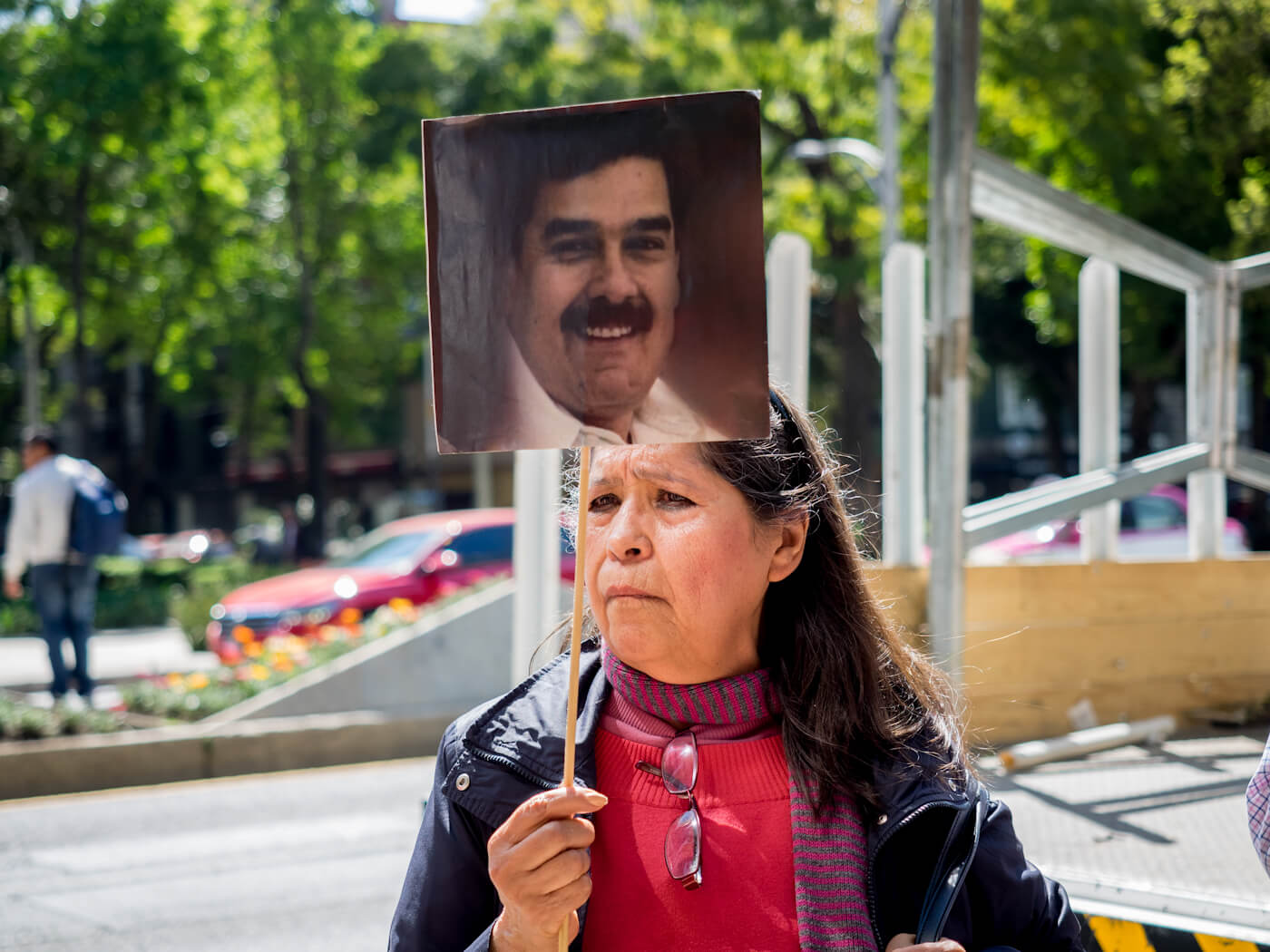
At a demonstration in support of Maduro in front of the U.S. Embassy in Mexico City, speakers not only rejected Washington’s efforts to oust the president of Venezuela but also praised AMLO’s stance.


A woman holds an image of Venezuelan President Nicolas Maduro 
at a protest against the US-backed coup attempt, in front of the 
US Embassy Mexico City, January 26, 2019.

“This is just one more link in the chain of U.S. interventions and history has shown that when people do not prevent aggression against other people this becomes a domino effect,” Jesus Escamilla, who addressed the rally, told MintPress.

For Escamilla the defense of Venezuela is also the defense of Mexico.

“What is at stake here is the right of a country to decide its own destiny for itself, that is what we want for Mexico, nothing more,” said Escamilla.

A coup plot stalled but not defeated


Despite setbacks, the United States and its right-wing allies have not abandoned their quest to oust the Maduro government in Venezuela.

U.S. officials announced yet another series of harsh sanctions, many of which target Venezuela’s oil industry, the country’s number one source of income. These sanctions are likely to further punish Venezuela’s already battered economy, leading to further suffering of the population.

The Trump administration has also brought in notorious figures with dark pasts, such as Elliot Abrams as special envoy to Venezuela. Abrams was Washington’s point-man in Central America when the U.S. was involved in propping up brutal regimes there, providing diplomatic cover for the death squads that operated with the U.S.’ consent; he even pled guilty for lying to Congress in connection to the Iran-Contra scandal.

At the Organization of American States (OAS)— currently led by Luis Almagro, a vicious opponent of Maduro — the U.S. was unable to gin up enough votes to get the body to recognize Guaidó as president of Venezuela.

According to Thornton, the United States “uses these multilateral institutions when they help its case and it ignores them when they are blocking the action that the United States wants to take.”

Instead, international pressure on the Maduro government will come from the Lima Group, an ad-hoc body that has no legal standing in international law, created by right-wing governments in the region after repeated failures to get the OAS to formally support their regime-change agenda.

The government of Andres Manuel Lopez Obrador inherited its place in the Lima Group after the handover of power in December and pushed its non-interventionist position there as well, refusing to sign onto anti-Maduro declarations issued by the body.

“The pushback that Mexico has done against the Lima Group … is an important demonstration that each country has its own voice and vote at these multilateral institutions,” Thornton told MintPress.

Thornton argued that the Mexican government is taking a risk by betting on a diplomatic resolution to the Venezuelan crisis, but one that will strengthen multilateral institutions in the region if successful:

Mexico calling for this to be slowed down, for it to be negotiated diplomatically, is a really important move and it’s something the AMLO administration is taking that chance to demonstrate its faith in democracy and the international system. There is a danger that, as this situation further deteriorates, Mexico’s decision not to go along with the Lima Group and the United States in not recognizing Guaidó will come to be seen as a real outlier in the region.”

U.S. officials, including President Donald Trump himself, have insisted that a military option remains on the table. Indeed, National Security Advisor John Bolton was recently seen with notes that suggested the U.S. was considering placing 5,000 troops across the border in Colombia.

Foreign military intervention would represent a significant setback in international relations in Latin America; would mark a return to a dark era where coups and invasions were common; and would set a dangerous precedent that would threaten every government in the region that refuses to bow to Washington, including Mexico.

As in Venezuela, however, that kind of interference would be met with stout resistance inside Mexico. As Jesus Escamilla told Mint Press:


In Mexico there is a people with historical memory, through its history it has received various interventions and the people of Mexico have always responded correctly, in a patriotic manner, and it would not be the exception if the U.S. or any other country tried to intervene in the internal affairs of Mexico.”

José Luis Granados Ceja is a writer and photojournalist based in Mexico City. He has previously written for outlets such as teleSUR and the Two Row Times and has also worked in radio as a host and producer. He specializes in contemporary political analysis and the role of media in influencing the public. He is particularly interested in covering the work of social movements and labor unions throughout Latin America. 

Republish our stories! MintPress News is licensed under a Creative Commons Attribution-NonCommercial-ShareAlike 3.0 International License.