Saturday, March 16, 2019

Bombing Gaza Seen As Necessary Prelude to Netanyahu Election Campaign

Israel mounts savage air bombardment on Gaza

by Jean Shaoul  - WSWS


16 March 2019

Israel Defense Forces launched a massive aerial attack on 100 sites in Gaza in the early hours of Friday morning, injuring at least four people in the southern city of Rafah. Hours later, strikes were still pummeling the town of Khan Younis.

According to Palestinian witnesses, IDF planes bombed security facilities belonging to Hamas, the bourgeois Islamist group that has controlled the Gaza Strip since winning the Palestinian legislative elections in 2006, as well as 30 sites held by Islamic Jihad, causing significant damage.

Prime Minister Benjamin Netanyahu ordered the strikes in retaliation for two rockets that set off air raid sirens across Tel Aviv, Israel’s most populous city.

Israel’s Iron Dome defence system intercepted one of the missiles, while another landed in open space, causing no damage or injuries.

Hamas denied any responsibility for the rockets launched against Tel Aviv. It pointed out that the attack took place at the very time when its negotiators were meeting with Egyptian mediators, supported by the United Nations and Qatar, to try to reach an accommodation with Israel to ameliorate the terrible conditions in Gaza due to the crippling 12-year-long blockade by Israel, imposed with the active support of Egypt and President Mahmoud Abbas’s Fatah-led Palestinian Authority.

Such is the determination for negotiations to succeed that Palestinians stopped the night-time protests that were part of the Great March of Return movement, as well as Friday protests at one of the five gathering points demonstrators have used since 30 March 2018.

Hamas reportedly made these concessions in response to Israeli demands, transmitted by Egypt, calling for the “stopping the coarse tools” used by Palestinians after Israel again halted Qatari aid to Gaza. The talks follow the breakdown of an earlier agreement brokered by Egypt in November, following Israel’s raid on Gaza that triggered renewed fighting. Israel repeatedly broke the agreement, which allowed Qatari payments to Israel for fuel and power as well aid into Gaza.

Netanyahu explained at Monday’s Likud faction meeting that it was better for Israel to serve as the conduit for aid rather than the PA.

“Now that we are supervising, we know it’s going to humanitarian causes,” he said. Whoever “is against a Palestinian state should be for” transferring funds to Gaza because maintaining a separation between the PA in the West Bank and Hamas in Gaza helps prevent the establishment of a Palestinian state.

A spokesperson for Gaza’s interior ministry insisted the rocket fire went “against the national consensus” and promised to take action against the perpetrators.

Two other Palestinian groups, Islamic Jihad and the Popular Resistance Committees, likewise denied responsibility. Daoud Shihab of Islamic Jihad told the Palestinian news agency Quds Network,

“These accusations are mere lies by the Israeli occupation. Our movement and its military wing the Al-Quds Brigades did not fire any rockets.”

IDF spokesperson Brigadier-General Ronen Manelis admitted they did not know who had fired the rockets.

In the wake of the Israeli air raids, the Palestinians have called off their Friday protests along the Gaza-Israel fence entirely, the first time the marches have been stopped since they were launched nearly a year ago.

Netanyahu, for his part, is determined to prevent a large protest planned for 30 March. This date marks one year since the start of the demonstrations demanding the Palestinians’ right of return to their homes from which they were driven out in 1948-49 and 1967 and the lifting of the illegal siege that has left much of Gaza without power, sanitation, clean water and basic commodities.

Israel’s massive aerial assault on Gaza takes place in the run-up to elections on April 9, with Netanyahu, who has been indicted on multiple charges of corruption, fighting for his political life.

His strategy is based on an escalated far-right orientation, including the cultivation of neo-fascist forces both within Israel and internationally, that is shifting official Israeli politics to the right.

He has brokered a merger between the fascist Otzma Yehudit (Jewish Power) party and the more established right-wing party of religious Zionists, Jewish Home. This is aimed at securing sufficient support from the ultra-nationalist and religious parties to form another Likud-led coalition under his leadership. In so doing, he has legitimized an organization that traces its roots to the long-outlawed Kach party of Meir Kahane, which the United States declared a terrorist organization.

Otzma Yehudit, like Jewish Home, encourages violence against Palestinians, calls for the expulsion of Arabs from Israel and the occupied territories, and advocates a ban on intermarriage or sex between Jews and Arabs. This fascistic outfit could, following its electoral alliance with Jewish Home, win seats in the Knesset and become part of the next government.

The two leaders that head the Otzma Yehudit list and could win parliamentary seats—Michael Ben Ari and Itamar Ben Gvir—are cofounders of a group implicated in a 2014 arson attack on a school for Jewish and Arab children in Jerusalem. Ben Ari was denied a visa to the US in 2012 as a member of a terrorist organization. Ben Gvir has acknowledged having a picture in his home of Baruch Goldstein, the Kahane supporter who murdered 29 Palestinians at a mosque in Hebron in 1994.

While Israel’s Elections Committee has allowed these Jewish supremacists to run in the elections, it has barred the Arab nationalist Balad Party along with Dr Ofer Cassif, the sole Jewish candidate on the combined Arab list of Communist Hadash and Ta’al, headed by Ahmed Tibi. They have appealed to the High Court to overturn the decision.

At the same time, Netanyahu has forged alliances with far-right and neo-fascist forces and leaders around the world, including Viktor Orban of Hungary, Matteo Salvini of Italy, Sebastian Kurz of Austria, Rodrigo Duterte of the Philippines, Jair Bolsonaro of Brazil and, above all, Donald Trump in the US.

Accompanying this turn, Netanyahu is whipping up virulent nationalism against the Palestinians, Iran and its regional allies, Syria and Hezbollah in Lebanon, prompting Israel’s mainstream parties to compete over who is the most ardent defender of Israel’s security.

Netanyahu’s bourgeois political rivals competed with each other to demonstrate an even more bloodthirsty attitude toward the Palestinians. Education Minister Naftali Bennett of Hayamin Hehadash demanded that Netanyahu draw up plans for the assassination of Hamas leaders.

“I call on Netanyahu to order that the IDF present the cabinet a plan to defeat Hamas.”

Benny Gantz, the former general who heads the Kahol Lavan party demanded that the Israeli military take “significant and harsh” measures to “renew its deterrence.”

Similar statements were issued by other leading Israeli politicians. While competing with Netanyahu, all of them like him, aim to deflect social tensions within Israel outwards.

Israel is among the most economically unequal advanced economies in the world and has the highest poverty rate of any country in the Organization for Economic Cooperation and Development (OECD). It has seen a growing wave of working class strikes and demonstrations, including a mass protest of thousands of people demanding an investigation into the fatal police shooting of Yehuda Biadga, a mentally unstable Ethiopian-Israeli.

Netanyahu has responded to the weekly Palestinian protests along the Gaza-Israel fence with the utmost brutality. The IDF has killed at least 267 Palestinians in the Gaza Strip since March 30 last year and injured 29,000 more. Many of them are disabled for life. The UN Independent Commission of Inquiry that investigated Israel’s actions in Gaza during the protests stated that they “may constitute war crimes or crimes against humanity.”

A further 60 Palestinians have been killed in the West Bank and East Jerusalem, while Israel has lost just two soldiers.

The authorities have continually escalated tensions around Al-Aqsa Mosque in East Jerusalem, the third holiest site in Islam, over the last month, sparking repeated protests and demonstrations. On Tuesday, Israeli police sealed off the entrances to Jerusalem’s Al-Aqsa Mosque compound, following an alleged firebombing of a police station on the site that in fact was caused by children playing with fireworks, leading to scuffles between Palestinian worshippers and the police, injuring at least 10 Palestinians and leading to several arrests.

Friday, March 15, 2019

Can Trump Veto on Yemen Resolution Kill Peace Hopes?

Historic Yemen Vote: Despite Possible Veto, ‘Great Leverage for Peace Talks’

by TRNN


March 15, 2019

Wednesday evening, the U.S. Senate took a historic vote, claiming its constitutionally granted power to declare war. The resolution directs the president to remove U.S. support for Saudi Arabia’s war in Yemen. The resolution passed with a vote of 54 to 46 and invoked the 1973 War Powers Act, which regulates the conditions under which the U.S. may enter into war. Seven Republican Senators voted with all Democrats in favor of the resolution. Senator Bernie Sanders was the resolution’s main sponsor.


The Senate’s vote, invoking the War Powers Act and withdrawing U.S. support for the war in Yemen, could still be vetoed by Trump, but it can provide a way forward for ending this horrific war, say Shireen Al-Adeimi and Hassan El-Tayyab

Breaking News: News Broken!

BREAKING: Everyone Who Opposes War Is A Russian Antisemite

by Caitlin Johnstone - Rogue Journalist


March 15, 2019

In order to appease the internet censors, today’s Caitlin Johnstone article has been replaced with a breaking report from the National News Conglomerate. NNC: Obey.


Washington, D.C. (NNC) — Following the publication of the results of a groundbreaking new study this week, experts are now reporting that every single person who questions western military interventionism is both an antisemitic bigot and a Russian national.

Research analyst Les Overton is a senior fellow at the American Society for the Prevention of Cruelty to Democracy (ASPCD), a Washington, D.C.-based think tank whose motives we can only assume are perfectly truthful and unbiased. He told NNC that the ASPCD’s research clearly shows that the rate of correlation between an individual opposing western foreign policy, harboring a virulent hatred of Jewish people, and being a citizen of the Russian Federation is “at least a hundred percent, if not more.”

“This is not to suggest that all Russians are antisemites or that all antisemites oppose American wars,” Overton reports.
“Our research shows only that people who do oppose western military interventionism are both of these things.”

These findings track with revelations exposed by respected foreign policy analyst Max Boot in an article published yesterday in the Washington Post titled “It’s time to retire the ‘neocon’ label.” Boot explains that those who criticize the relentless warmongering of neoconservatism are actually facilitating antisemitism, writing that antiwar voices have been known to use that label “to suggest that Jews are running U.S. foreign policy.”

These findings also help explain the fact that British Labour leader Jeremy Corbyn and US Congresswomen Tulsi Gabbard and Ilhan Omar have all been found to be arousing suspicion with their irrational affection for Vladimir Putin and irrational disdain for people of Jewish ancestry.

“Take Tulsi Gabbard, a longtime critic of US interventionism,” Overton said while explaining how ASPCD reached its conclusions.
“Her affection for Syria’s Bashar al-Assad is well-documented, and Assad, being an ally of Putin, is effectively Russian. This makes Tulsi Gabbard a Russian by proxy, which probably explains why Putin loves her so much.”

“Interestingly, we have also found this same correlation between individuals who believe that poor people should be treated with kindness, and those who believe Palestinians are human beings,” added Overton.

“We found a direct, causal and completely ubiquitous correlation between sympathy for impoverished and Palestinian people, a hatred of Jews, and an unwavering loyalty to Mother Russia.”

Overton advises westerners who find themselves questioning the wisdom and beneficence of the current liberal democratic world order that they can avoid the overpowering urge to betray their country to the Kremlin and begin loading Jews onto cargo trains by “watching lots of television and just kind of zoning out about everything.”

__________________

Thanks for reading! My shamefully seditious articles are entirely reader-supported, so if you enjoyed this piece please consider sharing it around, liking me on Facebook, following my antics on Twitter, throwing some money into my hat on Patreon or Paypal, purchasing some of my sweet merchandise, buying my new book Rogue Nation: Psychonautical Adventures With Caitlin Johnstone, or my previous book Woke: A Field Guide for Utopia Preppers. The best way to get around the internet censors and make sure you see the stuff I publish is to subscribe to the mailing list for my website, which will get you an email notification for everything I publish.


Bitcoin donations:1Ac7PCQXoQoLA9Sh8fhAgiU3PHA2EX5Zm2
 

The Man Who Learned Nothing: What Can Be Learned Now from Mikhail Gorbachev?

When the Fruit Fell in the Basket - What Can Be Learned Now from Mikhail Gorbachev, the Man Who Learned Nothing

by John Helmer - Dances with Bears


March 15, 2019

“We have the right to expect,” Mikhail Gorbachev, then President of the Soviet Union, declared to James Baker, US Secretary of State, in Washington on February 10, 1990, “that you won’t just wait until the fruit falls into your basket”.

Moscow - Baker relaxed. By “right” he knew Gorbachev was holding out a begging bowl. By “expect” Baker understood Gorbachev was crossing his fingers. By “just wait” Baker marvelled that Gorbachev appeared to be deaf to his advisors and the Soviet chief of staff, Marshal Sergei Akhromeyev.

By “fruit” Gorbachev meant Russia and the Soviet Union. Of course, Baker and his colleagues and successors did more than wait, as Akhromeyev warned they would.

The fruit did fall, Gorbachev first of all.

The lesson of Gorbachev’s political biography is that every Russian has the duty to expect the US Government will be doing much more than wait for Russia to fall into the American basket. Instead, to accelerate the fall and make it irreversible, the US Government wages permanent war against Russia.

Failing to understand this was one of the reasons for Gorbachev’s retreat from the advance of American forces on all of Russia’s frontiers – the advance which President Vladimir Putin must defend against today.

What fresh lessons can an American historian’s study of Gorbachev add to the story which Gorbachev’s subordinates, one-time friends and former allies have already told in their own memoirs? Lessons which ordinary Russians have acknowledged for years? The lessons start with the Russian proverb President Ronald Reagan used to repeat at Gorbachev — Доверяй, но проверяй, trust but verify. This cannot be Russian policy towards the US because it’s never been American policy towards Russia. The correct expression should be: Никогда не доверяй, они мошенничают — never trust, they always cheat.

When Gorbachev was appealing to Baker, the Central Intelligence Agency (CIA) assessment was that Gorbachev was so desperate and vulnerable, the Agency should intensify its regime-change operations, so it did. A few months later, the CIA made its assessment official that Gorbachev was finished; Secretary of Defense Dick Cheney made finishing him off Pentagon strategy. Gorbachev’s end should be hastened, he argued, in order that the successor — Boris Yeltsin had already been selected — would break up the Soviet Union “thereby reducing the chance they could ever threaten our security again.”

In William Taubman’s book, Gorbachev, His Life and Times, the obviousness of this as American policy doesn’t dawn on Taubman until page 587; his history was 90% finished by then.

Taubman’s myopia and prejudice are so pervasive, this is not a history that can be read for truthfulness. It’s a symptom of US ethnocentrism, exceptionalism and triumphalism, not evidence of anything except Gorbachev’s folly in ignoring, then encouraging, and finally rewarding all three. In 1979 “Soviet troops invaded Afghanistan”, Taubman (right) claims.

“By the beginning of 1980s détente was dead [because of] seeming Soviet gains in the Third World (particularly Angola, the Horn of Africa, and Nicaragua)…[followed by an unprovoked] massive buildup in Soviet nuclear forces”. In September 1983, Korean Airlines flight 007 was shot down because it “had blundered into Soviet airspace en route from Alaska to Seoul”.

In 1990 Japan refused to provide loans to Gorbachev “until it got back the northern islands it had been forced to yield to the Soviets after World War Two.” “The capitalist threat, which Moscow had used for so long to justify one-party rule, had substantially abated”. If you know too little of the history Taubman ignores in order to accept these claims, then stop reading this essay at once and go to the library.

It isn’t worth repeating the evidence for the Russian opinion of Gorbachev and his wife, Raisa Gorbacheva, as fatally flawed characters – vain, arrogant, snobbish, deceitful, greedy, envious, obsessive — except that Taubman reveals that they managed to learn nothing from the education they vaunted over others; from their own social mobility; and from immersion in the Soviet ideology of class conflict.


“Why do five to seven percent of people born in the world turn out to be capable of running their own business whereas the rest become hired hands?” Taubman quotes Gorbachev from one of his autobiographical memoirs.

“It’s a question of character,” he answered himself. He repeated the line often.
“We ourselves made our own fate. We ourselves became who we were.”

If you know so little economics and sociology you’re inclined to agree, then quick – it’s back to the library for you.

Gorbachev also told Taubman he had been “inspired by rereading Lenin”. Taubman didn’t know enough Lenin himself to raise an eyebrow. When he recounts the after-dinner dacha episode in March 1987, when then-Prime Minister Margaret Thatcher asked Gorbachev if there was a Soviet working class, and who was in it, Taubman isn’t surprised by Gorbachev’s answer: “[working class was] largely an historical or scientific term which did not do justice to the diversity of today’s society”.

Exposed to much less of Gorbachev’s talking and thinking than Taubman, the better educated communist, Chinese leader Deng Xiaoping, is cited by Taubman as concluding Gorbachev was “an idiot”.

The history of such a faulty character shouldn’t obscure the continuities for Russian leadership. Gorbachev failed to acknowledge them when he was in power; he still doesn’t. But the US war for regime change in Russia is just as pressing today, so the lessons are even more urgent. Here are the Famous Five.


Character makes no difference. Gorbachev not only believed his character was fated to rule; he was also convinced the character of American presidents makes a difference when they negotiate with Moscow. If he could persuade Reagan or George Bush as individuals, Gorbachev told himself, that would be decisive politically.

For a time Boris Yeltsin thought the same of Bill Clinton; so did Putin of Clinton, George W. Bush, Barack Obama, and Donald Trump. For learning this lesson, Gorbachev had just five years in power; Yeltsin ten; Putin has had nineteen. It can’t be said Gorbachev was the slowest learner of the three.


Lobbying makes no difference. Gorbachev didn’t spend state money lobbying in Washington. He believed his own charisma, amplified by the American media, would do the trick.

Putin calculated that if he released the Russian oligarchs to export capital, borrow from US banks, and invest in American sports teams, steel mills, and mansions, the outcome would be favourable for Moscow.

For a time too, he thought the outcome of US presidential and congressional elections might be marginally better or worse for Russian interests, depending on the candidates and the vote outcomes. So he approved Russian money for American PR, lobbyists and fellow-travellers from universities and think-tanks.

This has proved to be a bigger mistake than Gorbachev’s. Putin empowered and then enriched a Russian constituency which has ended up owing more to the US than it does to Russia, and a US constituency which is impotent. Because the pro-American constituency in Moscow is a target for recruitment to the American cause for regime change, it is a threat, not an asset to Putin.


Words make no difference. Throughout his career Gorbachev talked too much. After he became General Secretary this got worse; distinctively so, because his Russian was full of clumsy abstractions and stumbling syntax. He repeatedly ignored the advice of his staff to be brief. The psychopathology was reinforced by his wife.

Alexander Yakovlev, one of the advisors he recruited who ended up losing confidence in him, diagnosed Gorbachev’s logorrhea as “a way to escape from concrete problems into a dense, almost impenetrable thicket of words.”

Putin has used his four-hour talkathons – the mid-year Direct Line and the December press conference –- to demonstrate a concreteness and approachability which Gorbachev lacked. Putin has also proved that no politician in Europe or North America can match him in capacity to memorize the details of a script.

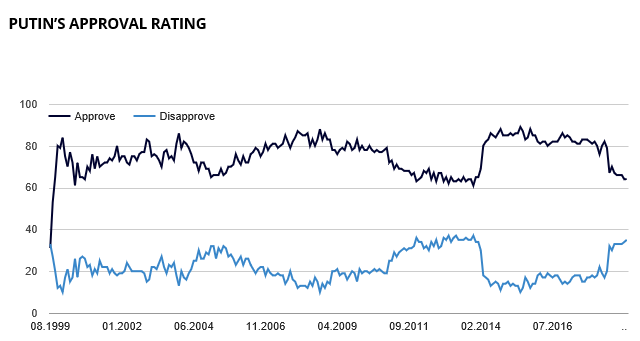
But in domestic policy the words have belied the reality. Still, Putin’s approval rating has managed to defy the scepticism and pessimism of his audience. This is partly due to the impact of US warmaking since 2014. In time of war, arms must do the talking.


Intelligentsia versus intelligence. Syntax wasn’t Gorbachev’s only disability; he also couldn’t count. From Gorbachev’s former staffs, former friends and legion of enemies, from meeting papers, and from interviews with Gorbachev himself, Taubman has compiled a record of the vote counts which preceded each of Gorbachev’s political advances. That is until the last five years, when he reveals that Gorbachev abandoned counting altogether.

In April 1988, for example, he quotes him as saying: “We’ve got to act like revolutionaries, to set the process in motion and then we’ll see.”

From later recriminations, Taubman reports that Gorbachev counted only one political constituency between 1985 and 1991 – the Russian intelligentsia of writers, artists, filmmakers, actors, journalists, and media publicists; to them Gorbachev and his wife were equally attracted on their foreign travels.

By glasnost and perestroika Gorbachev believed he was empowering intelligentsia to support him. When instead the revolution of rising expectations and freedom to choose released an anarchy of choice, and a storm of criticism of his performance, Gorbachev thought he had been betrayed. He then discovered he had no other constituency in the country to fall back on.

The example Gorbachev set – Yeltsin likewise – has made Putin’s political calculation easier. Gorbachev and Yeltsin believed that in politics the winner was the first one over the finish line. Putin understood the race is won if there are no other runners at the starting line. Putin’s voter support has been high and relatively stable because Russians agree there has been no alternative to him. US war against Russia has reinforced this.


The force multiple. Gorbachev abandoned the Army in Afghanistan at the start of 1988 without assuring US restraint of the mujahideen. Over the next two years he did the same to the Army in Germany. In parallel he negotiated nuclear arms reduction agreements on terms the US side dismissed at the staff level and prevaricated in Gorbachev’s face.

He had never studied strategy or Russian military history, nor would he allow the General Staff to advise him. He ignored Akhromeyev.

When the Army intervened in Baku (January 1990) and Vilnius (January 1991), inflicting casualties, Gorbachev pretended he wasn’t in charge. “You don’t know what pressure I’m under”, he confessed to Senator Edward Kennedy on March 26, 1990. “Many in our leadership want to use force right now.”

Force was an instrument of power Gorbachev disclaimed, or so he kept promising the US in private. From Putin’s speech in Munich on February 10, 2007, he demonstrated he had learned the lesson of Akhromeyev’s suicide and of Gorbachev’s folly. Listen to it again.


“What is a unipolar world?” Putin asked. “However, one might embellish this term, at the end of the day it refers to one type of situation; namely, one centre of authority, one centre of force, one centre of decision-making. It is a world in which there is one master, one sovereign. And at the end of the day, this is pernicious, not only for those within this system, but also for the sovereign itself because it destroys itself from within.”

If the idea had ever crossed Gorbachev’s mind that only by force can Russia be defended from the US, Taubman has composed a very long book to conceal it. But this is where we are today.

Thursday, March 14, 2019

Wad Guano Claims Right to Invite Mercenaries to Venezuela

Guaidó Claims He Can Authorize Foreign Military Intervention in Venezuela

by TRNN


March 14, 2019

The crisis in Venezuela is escalating, and a number of destabilization efforts are underway to ensure that significant pressure is put on President Maduro to step aside. In recent days we have seen the most extensive power outage, covering roughly 70% of the country. The Communications Minister of Venezuela Jorge Rodriguez was swift to point out that Marco Rubio knew in advance that an attack on the electrical grid was pending, since he tweeted just a minute or two after the blackout began. He said: “Alert: Reports of complete power outage all across Venezuela at the moment. 18 of 23 states and the capital district are currently facing complete blackouts.”

Now, Mike Pompeo, secretary of state, was also swift to tweet “The power outage and the devastation hurting ordinary Venezuelans is not because of the U.S., it is not because of Colombia, it is not because of Ecuador or Brazil, Europe, or anywhere else. Power shortages and starvation are the result of Maduro’s regime’s incompetence,” he wrote. Then he quickly followed up to say: “No food. No medicine. No power. Next, no Maduro.” Now that Juan Guaido, the president of the National Assembly, is back in the country, he is agitating for intervention. He says according to the Venezuela’s Constitution Article 187, he has the right to invite and authorize foreign military missions within the country.


Temir Porras, Former Deputy Minister of Foreign Affairs under Hugo Chavez, says Guaidó’s assertion on Fox News is a violation of the Venezuelan constitution; Porras says the only way to avoid a blood bath is a negotiated political solution.

British Bull Dog Wagging the European Tail?

How Brexit and Integrity Initiative Exposed Britain's Foreign Policy Plans for Europe

by Wiliiam Craddick - Disobedient Media


March 14, 2019

It has been an interesting past several years for the United Kingdom.

In 2018, a series of hacks targeted Integrity Initiative, a program run by the UK’s military intelligence and Foreign Office-supported Institute for Statecraft exposing its involvement in creating a covert network for the purposes of countering “Russian disinformation.”

The venture was popularly compared to the CIA’s infamous Project Mockingbird and involved many government and private institutions around Europe.

In the United States, Integrity Initiative contacts included individuals in the Department of State, DC think tanks, the FBI and the DHS as well as former and current administration officials such as Sebastian and Katharine Gorka.

While the connections of the Integrity Initiative, who engaged in a campaign of attacks against Disobedient Media, have been extensively reported the foreign policy goals they pursued have received less attention.

With the rejection of Brexit, the British government’s plans for their own country and Europe have now finally become clear. The focus of individuals connected to Integrity Initiative also reveals much about the policy issues considered a priority by the United Kingdom. Specifically, the UK has pursued objectives such as fomentation of “Russiagate” to distract American allies and use them as proxies against Russia globally, weaponization of anti-establishment factions in Europe, replacement of the British domestic population with migrants and remaining in the European Union or otherwise attempting to influence the regional union by controlling the European Union Army.

I. Russiagate As Diplomatic Tool


The connections of individuals tied to British intelligence services to the Russiagate narrative have been extensively reported by Disobedient Media. Promotion of anti-Russian narratives by the United Kingdom serves multiple foreign policy interests. On a basic level, the UK’s promotion of such messages allows them to use the United States as a proxy in their centuries-long competition with Russia for political dominance both in Europe and around the globe.

As former NSC staff member Richard Levine has previously explained, Britain maintains some of the power and control it enjoyed during the British Empire through its influence over members of the Commonwealth of Nations (albeit in a reduced capacity). Security magazine European Geostrategy ranked the UK as a “Global Power” second only to the United States in terms of its international reach. As Britain no longer overtly rules any of the nations in the Commonwealth, this influence must be maintained in part by infiltration and shadow networks. This means that in situations where soft power is not sufficient to counter the hard power of a military giant like Russia, manipulation of other global powers is necessary to maintain British interests. Russiagate serves this purpose very well as it creates an increased likelihood that President Donald Trump will escalate tensions with Russia in part to demonstrate that he is not “soft” on President Vladimir Putin.

Additionally, Russiagate distracts President Trump, causing him to waste time fighting an alleged conspiracy that has yet to produce actual evidence of collusion that could result in his impeachment. This benefits not only Europeans who dislike Trump for the threat he poses to transatlantic ties but also American factions who wish to keep Trump from achieving policy goals detrimental to their interests. Americans aligned with UK interests do not exist merely in the camps of parties who are opposed to Donald Trump. Integrity Initiative connections to individuals such as Sebastian Gorka show that even Trump’s so-called “allies” can be used to keep him fixated on alleged Russian collusion narratives.

II. Infiltration Of Anti-Establishment Movements In Europe


In order to maintain total control over political narratives and movements, the United Kingdom has undertaken extensive efforts to control both establishment and anti-establishment forces around Europe.

In 2009, the Guardian revealed that a British police officer had traveled to 22 different countries on a fake passport including Ireland, Iceland and Spain. Targeted movements included green, “anti-racist” and anarchist groups. Kennedy was a member of the National Public Order Intelligence Unit, a secretive organization run by a private limited company which allows it to remain exempt from freedom of information laws and other public accountability checks and balances. A database published by the Guardian on October 15th, 2018 revealed that British police had infiltrated 124 movements since the 1970’s and would even engage in sexual relationships with targets.

However, British intelligence has not targeted left wing groups alone. This became heavily apparent over the course of the Yellow Vest protests in France, which Disobedient Media warned were likely to be manipulated by Britain for geopolitical gain. While the Atlantic Council-connected Facebook was instrumental to helping French protestors organize to destabilize the mainland, they have crippled any attempts by groups to organize and protest in the UK. The Atlantic Council was one of many think tanks connected to the Integrity Initiative. In January 2019, Disobedient Media reported that British Intelligence infiltrated the nationalist publication Voice of Europe which could allow the UK to manipulate right wing populist groups against mainland governments while also targeting populist leadership.

III. Replacement Of Population To Reverse Declining Birth Rates


Great Britain has for many years sought to use immigration as a way to culturally bolster a country that British elites view as being in decline. This is partially a response to unsustainable birth rates that create incentive to use immigration not only as an immediate fix, but also one for the long term since newcomers are more likely to have larger families than their European counterparts. Another reason is that according to Integrity Initiative leaks, the British government seems to believe that Islamic immigrants can be shown the importance of support for NATO. Currently the UK’s population has a considerable amount of euroskeptics who are opposed to organizations such as the European Union and NATO. The alliance is one of many transatlantic and trans-European projects which have come under fire amid a surge in public support for policies such as Brexit.

IV. Attempts To Control European Union Army


Once decried as a “conspiracy theory,” an EU Army is now publicly acknowledged as a real policy objective being spearheaded by France and Germany. Public discussion about the issue intensified after sightings of armored vehicles bearing the EU flag appeared in France during the December 2018 Yellow Vest protests.

Disobedient Media’s previous coverage of the EU Army noted the role of NATO in covertly supplying the new fighting force with equipment and weaponry that was being shipped to Europe under the auspices of Operation Atlantic Resolve. Atlantic Resolve is an ongoing NATO operation intended to counteract Russia, a major geostrategic opponent of the United Kingdom. It further linked the mysterious death of NATO Chief Auditor Yves Chandelon to the fighting force’s creation, noting that he would have been in a position to discover shipments of arms and munitions that had gone missing.

The primary purpose of an EU fighting force would likely be domestic policing, a task that would be easy to accomplish given that enough troops would be drawn from around different areas of Europe to avoid mutinies by soldiers unwilling to enforce laws against their countrymen.

Just who would be in control of such an organization is not immediately clear. While most analysis points to mainland nations such as France and Germany as likely leaders based on their efforts to form the army there is no guarantee that this would be the case. Angela Merkel, long viewed as a powerhouse in the European Union, will not seek re-election after her current term. Emmanuel Macron, a candidate who was heavily supported by the City of London, has predictably found his policies unpopular in France and faced widespread unrest during the Yellow Vest protests. With the British government continuing to refuse to enact an exit from the European Union their intended strategy seems clear. A continuation of UK involvement in the European Union will allow them an opportunity to enjoy an advantage over their weakened mainland counterparts. This would include increased control over the military units intended to police European citizens.

The United Kingdom’s foreign policy in Europe is truly bold in its aims and vast in scale. Although exposed by leaks, sensitivity from media assets and other revelations, the necessary decisions to counter these strategies will ultimately be the responsibility of mainland governments. Will Europe respond, or have the crumbling remnants of the British Empire perhaps perhaps not breathed their last death rattle?


William Craddick
Editor, Founder of Disobedient Media.


Putting the Arms Race into Hyper

The Insanity of a New Hypersonic Nuclear Cruise Missile Arms Race

by Dave Lindorff - This Can't Be Happening


March 12, 2019

Here's what happens when you cancel a treaty that's working.

The Bush, Obama and Trump administration have broken two very important promises, or treaties, with Russia and it’s going to be very costly and dangerous for us and for the world thanks to them.

The first broken promise was the decision by President George W. Bush to ignore the documented promise made by President Reagan to Russian President Mikhail Gorbachev that if he took down the Berlin Wall and allowed the Eastern European nations under Russian domination to go their own ways politically, the US would not seek to bring any of them into NATO.

Bush in in first term of office, invited seven former Russian satellite states — Romania, Bulgaria, Slovakia, Lithuania, Slovenia, Estonia and Latvia — two of them, Lithuania and Estonia, actually bordering Russia itself, to join NATO.

After his own state department helped fund and organize a coup that overthrew the elected government of Ukraine in 2014, President Obama then provocatively held out the possibility of Georgia, another country formerly part of the Soviet Union and sharing a long border with Russia, joining NATO and also began providing arms to Ukraine.

All of this was perceived as a serious threat by Russia, especially when the Obama administration began providing US military equipment to countries bordering Russia or its ally, Belarus, and conducting joint military operations even in border countries like Estonia and Lithuania, and began sending military supplies to Ukraine when it was engaged in actual fighting with ethnic Russian secessionists in the eastern part of that country.

{Just recall the hysteria a few months back when Russia flew just two aging long-range bombers to an airbase in Venezuela! There were Congressmembers and news pundits warning darkly that the hulking planes might be carrying nukes, as if the two planes might launch a war.)

Compare that to President Trump, who has upped the ante in Ukraine by providing lethal weapons to that country to aid its fight with Russian-armed secessionists in the Donbass region, has also put US forces in those border countries near Russia, set up anti-missile batteries along the Russian border, and most seriously, cancelled the Reagan/Gorbachev Intermediate Force Nuclear Treaty that since 1987 had eliminated America’s Pershing II ballistic missiles and Tomahawk cruise missiles from Europe.

The Trump administration also has begun plans, long on the drawing board at the Pentagon, to base hundreds of the Air Force’s new F-35A stealth fighter-bombers along Russia’s borders. Each of these planes, equipped to carry a new variable-power nuclear bomb called the B61-12, which can produce an explosion of between 0.3 kilotons and 50 kilotons (the latter two to three times the power of the bombs dropped on Hiroshima and Nagasaki), is specifically designed to sneak across the Russian border undetected to deliver nuclear strikes on missile launch platforms, silos and government and command-center locations as part of an all-out first-strike nuclear assault.

In response to all these very real threats, Russia, which has no parallel ability to respond to US basing of short-range nuclear missiles near its borders able to strike targets in minutes, has responded by developing fully maneuverable hypersonic missiles capable of flying to various targets in the US at over Mach 5, which makes them almost impossible to intercept. China, also fearing a US attack, is working hard to develop a similar type of weapon. (It is important to note that such hypersonic missiles, while fast, could not function as first-strike weapons — only retaliatory ones — as they would give plenty of warning of an attack, allowing the target country to launch it’s retaliatory arsenal.)

While this strategic response on Russia’s and China’s part may keep the US from launching a first strike on them, it has also prompted the Pentagon to call for new funding for a crash program to “catch up” with Russia and China in hypersonic missile capability.

So, what the US breakout of the Reagan no-NATO-move-towards-Russia promise and the Reagan-Gorbachev INF Treaty has accomplished is not increased US security, but rather a new full-scale nuclear arms race. Only this time we have a military that can barely be called at war (the one ongoing war in Afghanistan only involves some 10,000 US troops, less than 5% of what we had fighting in Vietnam at the height of that last real US war) with a whopping 2019 budget of $717 billion, and with President Trump calling for $750 billion for next year. A fair part of the increase will be not just to fund the US part of the new hyperspeed missile race, but to goose the arms race further by establishing Trump’s insane new “Space Force.” That, if it happens, will lead to a hugely destabilizing and incomprehensibly expensive space arms race, even as funds for actual space science get slashed.

Clearly what is needed is not more weapons and more spending on weapons, but negotiations to restore the INF treaty that removed nuclear weapons from Europe, and negotiations elsewhere to defuse all the tensions in trouble spots around the globe — especially those in places like Syria, Ukraine and Venezuela, as well as off the coast of China and in Korea, that threaten to pit US military forces directly against Russian and/or Chinese forces.

Make no mistake: There are crazy people in positions of power and influence, from John Bolton, heading the National Security Council to Armageddon-believing fundamentalist Christian Secretary of State Mike Pompeo, the nameless nuclear strategists at the Pentagon and the war-gamers at the Rand Corporation — people who actually think the US should try to develop a strategy for “winning” a nuclear war with its two nuclear rivals. Some of these whack-jobs are talking about the “inevitability” of war with Russia and/or China by 2030 — in Bolton’s case with a smirk under his Stalin-like mustache.

This of course is all pure madness.

And the driver of this madness? The United States.

It is the US, after all, that is operating a global military, with over 200,000 military personnel based overseas in over 800 locations, with over a dozen aircraft carriers, each carrying the equivalent of an entire middle-sized country’s air force, and nuclear capable, with a fleet of giant Trident II missile-carrying subs patrolling silently around the globe mostly keeping in range of Russia and China, each with 24 huge and hugely accurate 10-warhead missiles capable of wiping out a country or all of its retaliatory potential in minutes, and with an army of over 2 million, a force which it has demonstrated repeatedly that Washington is ready to ship abroad to launch wars when the US doesn’t get its way.

It is the US that accounts for 34% of all global military spending (more than three times China’s spending level and more than 11 times Russia’s), and the US that is also the world’s biggest arms merchant, sowing instability everywhere it peddles its deadly wares.

It is then the US that needs to turn this madness around. And since we’re unlikely to see either of our two political parties, both pro-war and pro-military, do anything like that, it is going to have to be up to the American people to say “Enough!”

Tax season is upon us. By April 15, we will all be forking over more than a trillion dollars of our hard-earned money in taxes to the federal government. When you are paying your share of that bill, remember that 57 cents out of every dollar you pay for all discretionary spending in the federal budget is going straight to the Pentagon. Everything else aside from separately funded Social Security, Medicare and payments on the national debt — funding for transportation, health care, education, environmental protection, parks, welfare, border security, Justice, NASA, energy, the FDA, the National Institute of Medicine, etc. — is paid out of what is left after the Pentagon gets its outsized majority of the tax take.

And what are we getting for all that money? Insecurity, a promise of catastrophic war within a decade, and no attention at all paid to the looming and even greater catastrophe headed our way like a runaway freight train of a real as opposed to biblical armageddon: an unlivable overheated planet.

It’s time to take action folks, and shut down the Pentagon, replacing it with a Department of Peace. Out with the warmongers and madmen!

Wednesday, March 13, 2019

Gorilla Radio with Chris Cook, Yves Engler, William S. Geimer, Janine Bandcroft March 14, 2019

This Week on GR

by C. L. Cook - Gorilla-Radio.com


March 14, 2019

Justin Trudeau's government began the new year much as it left the old; mired in the mess of bad decision-making, and a foreign policy devoid not only of a moral compass, but lacking any coherent direction at all.

The scandale du jour surrounding the Liberals' blind-eyeing of SNC/Lavalin's Libya bribes and kickback schemes has Trudeau's enemies seeing their opportunity to sunset at last the seemingly impervious prime minister; but are they and the hounds of the Ottawa press corps missing the real scandal?

Listen. Hear.

Yves Engler is a Montréal-based activist, essayist, and author. Some of his ten book titles include: 'A Propaganda System-How Canada's Government, Corporations, Media and Academia Sell War and Exploitation', 'Canada in Africa - 300 Years of Aid and Exploitation', 'The Ugly Canadian - Stephen Harper's Foreign Policy', and his latest is, 'Left, Right: Marching to the Beat of Imperial Canada'.

Yves' numerous articles appear at his site, YvesEngler.com, Dissident Voice, The Palestine Chronicle, and Pacific Free Press among other places.

Yves Engler in the first half.


And; Wednesday night UVic hosted, Human Rights in Israel and Palestine: Canada's Response and Responsibility. The expert panel, sponsored by the University's Social Justice Studies, Independent Jewish Voices, KAIROS Victoria, and the Vancouver Island Peace and Disarmament Network questioned this country's unquestioning support of Israel as no party in Parliament, or Big Media is willing to do.

William S. Geimer is an author, peace activist, Professor Emeritus of Law at Washington and Lee University, and military veteran who resigned his 82nd Airborne commission in opposition to the war against Vietnam. He's gone on to represent U.S. conscientious objectors of subsequent wars, and advised peace groups near Fort Bragg, North Carolina, long the focus of peace demonstrations. William serves too as advisor on peace and war policy issues for the Green Party of Canada, and his book is, 'Canada: The Case for Staying Out of Other People's Wars'.

William Geimer, arguing for peace in the second half.

And, Victoria activist and long-time Gorilla Radio contributor, Janine Bandcroft will be here at the bottom of the hour with the Left Coast Events Bulletin of some of the good things to be gotten up to in and around our town in the coming week.

But first, Yves Engler and SNC/Lavalin bringing Canada’s corrupt foreign policy practices coming home to roost.

Chris Cook hosts Gorilla Radio, airing live every Thursday between 11-Noon Pacific Time. In Victoria at 101.9FM, and on the internet at: http://cfuv.uvic.ca.  He also serves as a contributing editor to the web news site, http://www.pacificfreepress.com. Check out the GR blog at: http://gorillaradioblog.blogspot.ca/

He's Baaaaacking Military Hegemonism - Big Time

Arnold Schwarzenegger Now Doing Military Outreach in Hollywood

by Tom Secker - Spy Culture


March 11, 2019

Arnold Schwarzenegger is famous for many things – being Mr Universe, The Terminator, the Governator and Commando.

Now he’s trying to add one more to the list – unofficial military entertainment liaison.

The USC Schwarzenegger Institute for State and Global Policy recently hosted a workshop to help Hollywood bigshots mingle with military leaders from across the world.

As reported by military glorification website We Are the Mighty, the workshop combined the likes of Jerry Zucker and Jon Turteltaub with pilots from the Air War College International fellow program, and reps from the Navy’s entertainment liaison office.

As Arnie put it:

"Hollywood wouldn’t be the same without the stories of our military’s heroism that have inspired Americans and taught the world our values. I’m proud the Institute can support this important collaboration by bringing together top military and entertainment talent."

Bizarrely the article goes on:

"This pairing of two seemingly different worlds couldn’t come at a better time. All branches of the military continue to work tirelessly each year to meet their recruiting, retention, and readiness goals, while Hollywood has continued to push mega-movies with a military spin, like the freshly released Captain Marvel, and create new platforms for military storytelling, like Netflix, Hulu, and We Are The Mighty (yeah, yeah… shameless plug)."

It is particularly odd to claim these are ‘two seemingly different worlds’ having just mentioned that the Navy has an entire office dedicated to working with Hollywood. In fact, the founder of We Are the Mighty met with the Army’s entertainment liaison office in 2015 to explore areas of mutual benefit.


Why they’re playing dumb and acting like there isn’t a relationship between Hollywood and the military that goes back over a century is anyone’s guess. However, the article is up front about the influence the military’s Hollywood outreach efforts can wield, with one writer admitting she created an entire character because of the Hollywood To The Navy program.

"In addition, many of the writers expressed how participating in a short visit with the military changed their entire view of military stories. Writer and showrunner Sarah Watson recounted how impressed she was with the female sailors she met on an aircraft carrier visit. As a result, Sarah has dedicated herself to creating a female military character in her next project."

Yet another woman serving up women to be abused and sexually assaulted by her military counterparts.

The article is also honest about the importance of films as a tool of soft power:

"The discussions throughout the day included deep dives into how various successful collaborations between the US military and Hollywood, such as The Last Ship and Transformers, can shape public affairs, recruiting, and soft power diplomacy. Basically, the military leaders asked if movies can make the world safer, and the answer was a resounding yes (especially if we are one-day attacked by Predator aliens)."

Of course, by ‘safer’ they mean ‘more subject to US military hegemony’…


SNC-Lavalin: The Site C Connection

Canada’s SNC-Lavalin Affair: The Site C Dam Project and Bulk Water Export

by Joyce Nelson - Global Research


March 13, 2019

In all the press coverage of the “the SNC-Lavalin affair,” not enough attention has been paid to the company’s involvement in Site C – the contentious $11 billion dam being constructed in B.C.’s Peace River valley. The Liberals say that any pressure they put on Jody Wilson-Raybould to rubber-stamp a “deferred prosecution agreement” for SNC-Lavalin was to protect jobs at the company.

But the pressure may have been to protect something much bigger: the Liberals’ vision for Canada’s future. Site C epitomises that vision.

The “Many Lives” of Site C


Birthed in 1959 on the drawing boards of the U.S. Army Corps of Engineers and BC Electric (then owned by Montreal-based Power Corp), the Site C dam has been declared dead, then alive, then dead again several times over the next five decades until 2010, when BC Premier Gordon Campbell announced that Site C would proceed. [1]

Tracking SNC-Lavalin’s involvement in Site C during recent years has been difficult, but Charlie Smith, editor of The Georgia Straight, has filled in some of the missing information.

Sometime in 2007, the Site C dam project was quietly moved to Stage 2 of a five-stage process. Smith wrote,

“SNC-Lavalin and Klohn Crippen Berger were prime consultants for Stage 2 of the Site C project. This had to occur before the project could proceed to Stage 3 in the five-stage planning process.
The decision to advance to Stage 3 was based on a prediction in the Stage 2 report that demand for B.C. electricity will increase 20 to 40 percent over the next 20 years. ‘As extensive as BC Hydro’s hydroelectric assets are, they will not be enough to provide future British Columbians with electricity self-sufficiency if demand continues to grow as projected,’ the Stage 2 report [Fall, 2009] declared. Bingo. This gave the pro-Site C politicians in the B.C. Liberal party … all the justification they needed.” [2]

On April 19, 2010 Premier Campbell announced that Site C would proceed. At the time, Chief Roland Willson of the West Moberly First Nation called the entire five-stage process a “farce” and said the government hadn’t finished the second stage of the development process, so he doesn’t know how it can go ahead to the third. Willson said First Nations in the area haven’t seen studies on land use, wildlife, the fishery or the cultural significance of the region, and the process can’t move on to environmental assessments [Stage 3] without that work.” [3]

Nevertheless, the process did move on, and SNC-Lavalin may have been involved in the next stage of the planning process, as well.

The Dogwood Institute recently reported that SNC Lavalin was “an environmental consultant for Site C.” [4]

In 2011, SNC-Lavalin Chair Gwyn Morgan (image on the right) became an advisor to BC Liberal leadership winner Christy Clark during her transition to the premiership.

Morgan had joined the SNC-Lavalin board in 2005 and was chair of the company from 2007 until 2013. As The Tyee reported in 2014,

“Morgan retired in May 2013, the month after SNC-Lavalin agreed to a 10-year corruption-related ban from the World Bank related to a power project in Cambodia and a bridge in Bangladesh. Among the SNC-Lavalin companies on the World Bank [corruption] blacklist are divisions involved in publicly funded B.C. projects like the Bill Bennett Bridge, Canada Line and Evergreen Line.” [5]

Going Forward


At the time of Gwyn Morgan’s 2013 retirement from the SNC-Lavalin Chairmanship, the company was being investigated in at least ten countries, including: Bangladesh, Cambodia, Ghana, India, Kazakhstan, Malawi, Mozambique, Nigeria, Uganda and Zambia. [6]

While we have no way of knowing whether Gwyn Morgan, as an advisor to Christy Clark as of 2011, in any way lobbied on behalf of SNC-Lavalin, we do know that “Morgan’s personal, family and corporate donations to the BC Liberals totalled more than $1.5 million.” [7]

At the same time, in 2011 SNC-Lavalin had won the engineering, procurement and construction management (EPCM) contract for the Muskrat Falls hydro project in Newfoundland. But the company was apparently so “distracted” by corruption charges internationally that eventually crown utility Nalcor had to take over the project, which went way over budget and is now the subject of an inquiry. [8]

That didn’t dissuade the B.C. Premier from going forward. On December 16, 2014, the Christy Clark provincial government gave approval for Site C, despite recommendations by the Joint Review Panel (JRP), which had concluded two months previous that Site C’s hydropower was not needed in the time-frame that BC Hydro was arguing. (Recall that the Stage 2 report had claimed a 20-40% increase in demand over the next 20 years.) JRP member Harry Swain had concluded that demand for electricity in B.C. has been flat dating back to 2005.

While the newly elected B.C. NDP government in 2017 debated the cancellation or suspension of Site C, the Financial Post reported that Montreal’s SNC-Lavalin is “part of the lead design team for the [Site C] project.” [9] That little-known contract may have been signed much earlier.

On February 21, 2018 the Journal of Commerce reported on the progress being made by Site C’s lead design team, comprised of SNC-Lavalin and Klohn Crippen Berger and involving “approximately 40-plus engineers, nine modellers and 15 drafters”. [10] SNC-Lavalin Building Information Modeling (BIM) Manager Rodrigo Freig told the Journal that,

“In three years and 43 models later, we only had two model crashes, related to slow server speeds.” [11]

That comment would suggest that the lead design contract had quietly been issued to SNC-Lavalin and Klohn Crippen Berger sometime in 2015.

A few days ago (March 7), the Canadian Press reported:

“SNC-Lavalin is working on the five biggest infrastructure projects in Canada, according to trade magazine ReNew Canada. Those contracts alone amount of $52.8 billion, and include projects for Bruce Power and the Darlington nuclear plant in Ontario as well as the Site C dam in B.C.” [12]

While the exact amount of the Site C lead design contract is not known, it is likely at least $1 billion in B.C. taxpayer dollars. If the lead design contract was indeed issued in 2015, this would fit with Christy Clark’s effort to push the project past “the point of no return.”

Help From Trudeau


In February 2015, under the Harper government, federal fraud and corruption charges were filed against three of SNC-Lavalin’s legal entities over its dealings in Libya. But after the Trudeau Liberals were elected in Fall 2015, the company “signed a deal with Ottawa that will allow the engineering and construction company to continue bidding on federal contracts until criminal charges it faces are resolved.” [13]

As we know now, SNC-Lavalin also began lobbying extensively for a Deferred Prosecution Agreement (DPA) that would effectively free the company of charges without forcing it to admit wrongdoing. In exchange, the company would pay a fine and prove that it has changed its practices to prevent a repeat of any wrongdoing. The Trudeau government quietly inserted changes to the criminal code allowing for DPAs in its 2018 Budget. According to recent report by the Buffalo Chronicle (March 11), SNC-Lavalin’s in-house attorney Frank Iacobucci “was instrumental in persuading” Trudeau to insert that new legal provision into the budget bill. [14]

The Buffalo Chronicle also notes that in October 2018, Trudeau asked Iacobucci to lead the government’s negotiations with indigenous communities in B.C. regarding the TransMountain Pipeline expansion project – a project that SNC-Lavalin hopes to construct. Quoting an unnamed source, the Chronicle states:

“Iacobucci, who was already angry that [Jody] Wilson-Raybould was refusing to allow his client [SNC-Lavalin] to negotiate a deferred prosecution agreement, feared that his consultations in British Columbia could be construed as improper. He would only agree to take the role on the condition that Trudeau replaced her with a ‘more doting’ Member of Parliament.” [15]

The full story of Iacobucci’s role in the SNC-Lavalin scandal has yet to emerge, but it’s clear that the Trudeau government has been exceedingly accommodating to the company’s wishes.

The Georgia Straight’s Charlie Smith has further spelled out the Trudeau government’s help:

“Keep in mind that Trudeau helped SNC-Lavalin with its World Bank problem by endorsing the Asian Infrastructure Investment Bank. This entity was created by China as a rival to the U.S.-led World Bank on infrastructure financing. SNC-Lavalin might be debarred from World Bank financings, but it can bid on AIIB-backed projects. Trudeau also helped SNC-Lavalin and other companies involved in huge public projects by creating the Canada Infrastructure Bank. And the Trudeau government accelerated construction of the Site C dam by awarding federal permits over the opposition of First Nations in the area.” [16]

Bulk Water Export


In two slightly different chapters within two recent books, I have argued that the Site C dam on the Peace River is perfectly placed to facilitate bulk water export east of the Rockies and into the American Southwest. Readers can consult my Chapter 10, “Water Export: The Site C End-Game” in editor Wendy Holm’s Damming the Peace: The Hidden Costs of the Site C Dam (Lorimer 2018), and the chapter entitled “Site C and NAWAPA: Continental Water Sharing” in my latest book Bypassing Dystopia: Hope-filled Challenges to Corporate Rule (Watershed Sentinel Books 2018).

SNC-Lavalin’s involvement in Site C has been so well-hidden that the company name does not appear anywhere in Damming the Peace. But by the time I was writing the water-chapter for my own book, SNC-Lavalin’s connections to Site C were becoming clear enough for me to state that the company “is intricately involved in Site C”. Only now are we learning just how involved they are.

SNC-Lavalin has had its eye on continental water-sharing for at least three decades. Back in the 1980s the SNC Group (as it was called at the time) was part of a consortium called Grandco, which was promoting a continental water-sharing plan entitled the Grand Canal Project. Grandco’s other consortium members included the UMA Group of Calgary, Underwood McLellan Ltd. of Saskatoon, Rousseau, Sauve & Warren Inc. of Montreal, and Bechtel Canada Ltd. (son of U.S. Bechtel, the world’s largest engineering firm).

Grandco’s head lobbyist was Canadian financier Simon Reisman (uncle of current Bilderberg member Heather Reisman). After Simon Reisman publicly advocated for Canadian water export, Prime Minister Brian Mulroney (himself an advocate for large-scale water exports) appointed him as Chief Negotiator for the 1988 Canada-U.S. Free Trade Agreement (FTA), the predecessor to NAFTA, signed by Jean Chretien in 1994. Both the FTA and NAFTA essentially strip Canada’s sovereign right to protect our water resources and make Canada vulnerable to massive water export.

While Site C may provide energy and water for fracking in B.C. and potentially for tar sands mining in Alberta, in the long term the “end-game” of Site C, according to Wendy Holm, is water export because that freshwater water “will have a far higher value” than oil and gas. The vast 83-kilometres-long reservoir needed for the Site C dam will submerge 78 First Nations heritage sites (including burial grounds) and flood about 3,816 hectares (9,430 acres) of prime agricultural land in the Peace River Valley

A similar scenario is being played out in Quebec with Hydro-Quebec’s massive $5 billion Romaine Complex, which is damming the River Romaine and flooding 100 square miles of land; in Newfoundland where the Muskrat Falls mega-dam project “boondoggle” is now the subject of a public inquiry; in Manitoba where several mega-dam projects are poised to flood First Nations land.

Now, thanks to the Trudeau government’s Mid-Century Long-term Strategy, that same scenario is poised to repeat itself many times in the coming years.

Long-Term Strategy


In 2017, the Trudeau government released its Mid-Century Long-Term Strategy (MCS) intended to reduce emissions of greenhouse gas (GHG) at rates to comply with its Paris Climate commitments.

Scientist David Schindler has summarized the MCS:

“In brief, Canada has agreed to reduce its GHG emissions by 80 per cent by 2050, using 2005 emissions as a baseline. This sounds wonderful, until one reads how this is to be done, as described in the report. All the scenarios used to achieve the miraculous carbon reduction goals rely on replacing fossil fuels by generating massive amounts of hydroelectric power, which is assumed to emit no GHG. … The required hydro development would require the equivalent of building over one hundred Site C dams in the next thirty-two years, an extraordinary plan…” [17]

Once all that water has been impounded behind the dams, it is subject to NAFTA treatment (including in the rewritten USMCA agreement) as a tradable “good” or commodity. Chrystia Freeland and the negotiators for the USMCA did not secure an explicit exemption for water under the goods, services, and investment provisions of the deal. According to Bill C-6 (which became law in 2001), as Minister of Foreign Affairs, Freeland has water-export licensing authority and can issue permits for water export.

As I explain in some detail in Damming the Peaceand Bypassing Dystopia, massive drought and over-use of freshwater in the Colorado River region and in the U.S. Southwest have prompted big investors like the Blackstone Group (with Brian Mulroney on its board) to look north for water-investment opportunities. The Blackstone Group has been involved in water issues for years, and in 2014 it announced a new portfolio company called Global Water Development Partners to “identify, develop, finance, construct, and operate large-scale independent water development projects.”

The Blackstone Group is just one of many investment firms eyeing Canada’s freshwater resources. The Bank of America Merrill Lynch – which designed the Canada Infrastructure Bank – has predicted a global water market worth $1 trillion by 2020.

Obviously, SNC-Lavalin wants to be in on all that MCS hydroelectric development and other projects to be financed by Trudeau’s Canada Infrastructure Bank in the coming years. But if they have to face prosecution, the company risks being barred from federal contracts for ten years.

The Trudeau government says it is attempting to protect SNC-Lavalin jobs. That may be true, but it is also likely that the Trudeau government is attempting to protect its long-term vision for Canada: a vision that jettisons “reconciliation” and the environment in favour of damming the country and then draining it.

Freshwater has been turned into a commodity and it will be worth far more than oil or gold in the near future. Follow the money. That’s what SNC-Lavalin is doing.

Joyce Nelson is the author of seven books, including Beyond Banksters and its sequel Bypassing Dystopia. She can be reached via www.joycenelson.ca

Notes

[1] “The Site C Dam: a Timeline,” The Narwhal, December 12, 2017.

[2] Charlie Smith, “Does Andrew Weaver’s response to Site C justify his removal as head of the B.C. Greens?” The Georgia Straight, December 15, 2017.

[3] Quoted in “Site C dam project moving forward on Peace River,” The Canadian Press, April 19, 2010.

[4] Lisa Sammartino, “SNC-Lavalin tentacles reach deep into B.C.,” dogwoodbc.ca, February 25, 2019.

[5] Bob Mackin, “Ex-Head of Troubled SNC-Lavalin Named Chair of BC Crown Corp,” The Tyee, May 5, 2014.

[6] “Public Risks, Private Profits: Profiles of Canada’s Public-Private Partnership Industry,” Polaris Institute & CUPE, June 2013.

[7] Sammartino, op. cit.

[8] Andrew Nikiforuk, “Redeemable? SNC-Lavalin’s Criminal Record,” The Tyee, February 22, 2019.

[9] Jesse Snyder, “’It’s going to cost a fortune’: Cancellation of $8.8B Site C dam would scrap billions of dollars in contract work,” The Financial Post, June 2, 2017.

[10] Warren Frey, “UPDATED: Site C’s virtual construction a complicated endeavour,” Journal of Commerce, February 21, 2018.

[11] Quoted in ibid.

[12] Christopher Reynolds, The Canadian Press, “Here’s what a 10-year ban on federal contract bids would mean for SNC-Lavalin,” Toronto Star, March 7, 2019.

[13] Ross Marowits, “SNC-Lavalin Gets OK From Ottawa To Bid on Contracts, Despite Criminal Charges,” The Canadian Press, December 10, 2015.

[14] “’Political grandmaster’ Frank Iacobucci is at the center of SNC Lavalin, Kinder Morgan scandals,” The Buffalo Chronicle, March 11, 2019.

[15] Ibid.

[16] Smith, op. cit.

[17] David Schindler, “Will Canada’s Future Be Dammed? Site C Could Be the Tip of the Iceberg,” chapter in Wendy Holm, editor, Damming the Peace: The Hidden Costs of the Site C Dam, Toronto: James Lorimer & Co., 2018.

Featured image is from HuffPost Canada
The original source of this article is Global Research
Copyright © Joyce Nelson, Global Research, 2019

Have They, At Long Last, Found a Sense of Decency? Feeling the Ilhan Heat

The Shameful Attack that Backfired

by Dr. James J. Zogby - Arab American Institute


March 9, 2019

What happened to Congresswoman Ilhan Omar was troubling. On the one hand, because she dared to challenge the way supporters of Israel have worked to silence debate on US policy toward the Israeli-Palestinian conflict, she became a victim of incitement, and the target of legislation meant to shame her.

At the same time, however, the heavy-handed tactics employed against her by some pro-Israel members of Congress backfired, exposing new fault lines in the US-Israel relationship.

The weapon of choice utilized by Omar's opponents was to demonize her as an anti-Semite.

Her "sin,” it appears, was her continued umbrage over the double-standard that exists in American policy toward Israel and its treatment of Palestinians.

During Israel's assault on Gaza, for example, she criticized the failure of the US media to pierce through Israeli propaganda and see what was actually happening to Palestinians in that impoverished strip of land. Once in Congress, she was deemed to have "sinned" again when she challenged the power of AIPAC to intimidate politicians and silence debate on Israel/Palestine.

New to Washington and the "acceptable language" one should use to discuss these issues, she admitted that her word choices had been unfortunate and apologized for the pain she may have caused.

Despite her apology, she remained a target. Because she is a hijab-wearing Muslim, who was critical of Israel, the GOP sought to exploit her in their continuing effort to drive a wedge between the Jewish community and Democrats. For their part, some Democrats reacted with hyperventilated outrage. Extreme language was used to denounce Omar. Her words were described as "bigoted," "vile," and, of course, "anti-Semitic slurs."

Never, in all this time, was there a critical examination of what she actually said. In fact, she never accused the Jewish community of controlling the media (unless one assumes that Israel's ability to dominate media coverage of events occurring in the occupation can be attributed to the Jewish community). Nor did she accuse the Jewish community of using money to buy influence in Washington (unless one suggests that AIPAC speaks for and acts on behalf of the entire Jewish community).

It didn't matter, her opponents continued to call her an "anti-Semite," and did so with such frequency that the term stuck, putting her at risk to threats of violence from bigots.

The entire affair came to a head when, at a town hall last week, Omar attempted to explain herself. Asked to address the controversy that had erupted over her advocacy of Palestinian rights, Omar's colleague, Congresswoman Rashida Tlaib, spoke first noting that to her the question of Palestine is personal – her grandmother still lives in the West Bank and Congresswoman Tlaib desires that she receive equal justice and recognition of her rights to live in dignity.

Reacting to what she had just heard, Omar said that she couldn't agree with those who fight for human rights and dignity for others and yet exclude Palestinian rights and dignity. For her part, she said, the focus should be universal ­– leaving no one out. She then chided those in Congress who have pressed her to reject her commitment to call out Israeli abuses and ignore Palestinians rights.

Because she is a Muslim, Omar said, her criticism of Israel has been automatically seen as anti-Semitic in order to silence her. Even more troubling she noted was that, as a result of the manufactured controversy over her words, the discussion became whether or not she was an anti-Semite, while ignoring "the broader debate about what is happening in Palestine."

At that point, Omar said that she resented those who are pushing her to demonstrate allegiance to Israel. She concluded by saying that she wanted to have this conversation about "the political influence in this country that says it’s okay to push for allegiance to a foreign country."

The reaction to this newest "sin" was near hysteria. Without ever listening to what she actually said, some members of Congress accused her of saying that the Jews had dual-loyalty – despite the fact that she had said no such thing. They demanded that Omar be censured or removed from her committee posts. And the chairman of the Foreign Affairs Committee proposed a resolution that would have denounced anti-Semitism in a way that was clearly directed at the congresswoman.

What was disturbing about this proposed resolution was that none of "Whereas" clauses included had anything to do with what Omar actually said. She never accused Jews of "dual loyalty because they support Israel"; nor did she display "prejudicial attitudes" towards Jews; nor did she ever make "mendacious, dehumanizing, demonizing, or stereotypical allegations about Jews".

What she did do was: challenge official American, and in particular, Congressional silence on the suffering of the Palestinians; the efforts by pro-Israel groups to silence debate on this issue; and the way that some have sought to create a virtual identity being pro-Israel and American interests.

Despite the obvious falseness of their claims, Omar's opponents in Congress plowed ahead with their proposed bill in order "to teach her a lesson." In their remarks rebuking Omar, they unwittingly made her point. One congressman said, "Questioning support for the US-Israel relationship is unacceptable." Another said, "there are many reasons to support Israel, but there is no reason to oppose Israel." While still another said that Democrats and Republicans, alike, are committed to insuring that the "United States and Israel stand as one."

It is exactly this attitude to which Omar objected when she wrote, "I am told everyday that I am anti-American if I am not pro-Israel...I know what it means to be an American and no one will ever tell me otherwise...I have not said anything about the loyalty of others, but spoke about the loyalty expected of me."

Because Omar has touched what some have come to say is "the third rail of American politics" she was being exploited by some Republicans and hung out to dry by some Democrats. They put a target on her back. And haters were quick to respond with frightening death threats and shameful bigoted assaults on her as a Muslim woman. There is no question that these threats against Omar were the byproduct of the sustained campaign of incitement.

It's important to note, however, that outside of the halls of Congress a different reality was unfolding. The attacks on Congresswoman Omar were rejected by many Democrats, including progressive Jewish groups, and a debate was sparked by the issues she raised and the over-reaction to them by Congress.

By week's end, the entire effort appeared to backfire. Instead of being the "slam dunk" they expected, the proposed resolution ran into blocks. Some members objected to singling out of anti-Semitism, without also denouncing racism, sexism, xenophobia, Islamophobia, etc. Others protested that Omar was being singled out and put at risk. And a few of the more prominent Democratic presidential hopefuls (Senators Bernie Sanders, Elizabeth Warren, and Kamala Harris) insisted that charges of anti-Semitism should not be used to silence debate on Israeli policy.

By week's end, Congress passed a resolution denouncing all forms of hate or intolerance against any religious, ethnic, or religious community. Since it made no mention of Ilhan, it was clearly a loss for those who began the push to shame or punish her

Two final points must be made:

Firstly, Representative Omar is owed an apology. False charges and a manufactured crisis have sullied her name and put her at risk.

And secondly, it is clear that Omar's courage has helped to open a door enabling a discussion of Israeli policy and the US-Israel relationship. While her opponents attempted to slam it shut, it seems that their behavior and incitement against her backfired stirring a debate that has helped to pry the door even further open.