Tuesday, March 26, 2019

Those That Observe No Law: America's Exceptionalists and the International Court

How to Make Yourself an Exception to the Rule of Law: John Bolton and Mike Pompeo Defy the International Criminal Court

by Rebecca Gordon - TomDispatch


March 26, 2019   

Events just fly by in the ever-accelerating rush of Trump Time, so it’s easy enough to miss important ones in the chaos.

Paul Manafort is sentenced twice and indicted a third time! Whoosh! Gone!

The Senate agrees with the House that the United States should stop supporting Saudi Arabia in Yemen (and Mitch McConnell calls this attempt to extricate the country from cooperation in further war crimes “inappropriate and counterproductive”)! Whoosh! Gone!

Twelve Republican senators cross party lines to overturn Trump’s declaration of a national emergency on the U.S.-Mexico border, followed by the president’s veto! Whoosh! Gone!

Delegates to the March 2019 U.N. Environment Assembly meeting agree to a non-binding but important resolution drastically reducing the production of single-use plastic. The United States delegation, however, succeeds in watering down the final language lest it “endorse the approach being taken in other countries, which is different than our own”! Once again, the rest of the world is briefly reminded of the curse of American exceptionalism and then, whoosh! Gone!

Under the circumstances, it wouldn’t be surprising if you had missed the Associated Press report about Secretary of State Mike Pompeo announcing that the United States,
“will revoke or deny visas to International Criminal Court personnel seeking to investigate alleged war crimes and other abuses committed by U.S. forces in Afghanistan or elsewhere.” 

In fact, said Pompeo, some visas may already have been denied or revoked, but he refused to “provide details as to who has been affected and who will be affected” (supposedly to protect the confidentiality of visa applicants).

Tomgram: Rebecca Gordon, Turning Our Backs on Nuremberg
[Note for TomDispatch Readers: Parts of today’s chilling piece by Rebecca Gordon on the Trump administration’s wholesale rejection of the International Criminal Court were adapted from her (sadly) all-too-relevant book, American Nuremberg: The U.S. Officials Who Should Stand Trial for Post-9/11 War Crimes. Should you want to get your hands on a copy, signed and personalized, you can do so by going to our donation page and giving $100 to TD ($125 if you live outside the U.S.). And while you’re at it, you'll lend us a helping hand, which is always truly appreciated! Tom]

If a tree falls in a forest and no one is around to hear it, does it make a sound?

The advent of sound recording deep-sixed this age-old thought experiment and offered a definitive answer: Yes!

I’ve got another one for you, though: if you water-torture someone at a secure military compound and no one is around to see it, is it a war crime?

Tricky, right?

Well, what if someone does see it? And what if you admit to it -- and to a criminal investigator, no less? And what if you add that you also used electrical torture, too? Is that, in fact, a war crime?

More cut and dried, right?

And what if criminal investigators identified 28 other members of your military unit as having beaten prisoners, tortured them with electric shocks, and water-boarded them? And what if 15 of them actually admitted to those acts? Is that, I ask you, a war crime?

Some people are charged with, tried, or even convicted, of torture: Nazis, Ford Motor Company executives in Argentina, and high-ranking Guatemalan military officers, for example. But others aren’t.

Years ago, when I investigated the particular set of crimes mentioned above that were carried out by U.S. military intelligence personnel in Vietnam, I found that only three of the soldiers involved were even punished. And by punished, I mean that the three received fines or reductions in rank. None served any prison time.

One of the admitted torturers I spoke with was still unrepentant. He explained to me that, were he placed in the same situation again, he would do exactly the same things. And why wouldn’t he? You don’t find Americans in the dock at the International Criminal Court (ICC). But if the Trump administration has its way, as TomDispatch regular Rebecca Gordon reports so strikingly today, the ICC’s judges and prosecutors might be the ones who find themselves charged and -- though it's a stretch of the imagination -- behind bars. And given what we know about the U.S. prison system, that might also mean finding themselves at risk of torture.

“We were... nothing short of criminals in the eyes of everyone except our parents and close friends,” the admitted torturer told me, while complaining about the postwar treatment of Vietnam veterans. But he was never charged, let alone tried or convicted for the torture he admitted to meting out. Will ICC officials one day be convicted in American courts of meting out justice? For the moment, the jury is still out. Nick Turse

How to Make Yourself an Exception to the Rule of Law: John Bolton and Mike Pompeo Defy the International Criminal Court

by Rebecca Gordon


National Security Advisor John Bolton had already signaled such a move last September in a speech to the Federalist Society. In what the Guardian called an “excoriating attack” on the International Criminal Court, or ICC, Bolton said,
“The United States will use any means necessary to protect our citizens and those of our allies from unjust prosecution by this illegitimate court.”

By “unjust prosecution,” he clearly meant any attempt to hold Americans accountable for possible war crimes. An exception even among exceptional nations, the United States simply cannot commit such crimes. Hence, by the logic of Bolton or Pompeo, any prosecution for such a crime must, by definition, be unjust.

In calling it “this illegitimate court,” Bolton was referring to the only international venue now in existence for trying alleged war criminals whose countries cannot or will not prosecute them. By “our allies,” Bolton appeared to mean Israel, a supposition Pompeo confirmed last week when he told reporters, “These visa restrictions may also be used to deter ICC efforts to pursue allied personnel, including Israelis.”

And when it came to threats, Bolton didn’t stop there. He also suggested that the U.S. might even arrest ICC officials:
“We will ban its judges and prosecutors from entering the United States. We will sanction their funds in the U.S. financial system, and we will prosecute them in the U.S. criminal system. We will do the same for any company or state that assists an ICC investigation of Americans.”

This is a dangerous precedent indeed, as the director of the American Civil Liberty Union’s Human Rights Project, Jamil Dakwar, told Democracy Now. It’s outrageous, he pointed out, that the U.S. would prosecute, 
“judges and the prosecutors of the ICC for doing their job and for doing the job that the United States should have done -- that is, to investigate, credibly and thoroughly, war crimes and crimes against humanity that were committed in the course of the war in Afghanistan.”

What’s all this about?


The story goes back to December 2017, when Fatou Bensouda, the ICC’s chief prosecutor, announced an investigation into the possibility that U.S. military and CIA personnel had committed war crimes during America’s Afghan War or in other countries “that have a nexus to the armed conflict in Afghanistan.” These included some of the countries that hosted the CIA’s so-called black sites, where, in the earlier years of the war on terror, detainees were held incommunicado and tortured. Specifically, the ICC opened an investigation into the possible commission of “war crimes, including torture, cruel treatment, outrages upon personal dignity, rape, and other forms of sexual violence by U.S. armed forces and members of the CIA on the territories of Afghanistan, Poland, Romania, and Lithuania.”

When Bensouda made her announcement, it looked as if at least some Americans might finally be held accountable for crimes committed in the post-9/11 “war on terror” launched to avenge the criminal deaths of 3,000 souls in New York City and Washington, D.C. That never-ending war has seen the United States illegally invade and occupy Iraq; directly kill at least 210,000 civilians (not to mention actual combatants) in Iraq and Afghanistan; torture an unknown number of prisoners; and continue to detain without trial or conviction 39 men at the Guantánamo Bay prison in Cuba.

But wait. Aren’t U.S. personnel immune from ICC prosecution, because Washington never ratified the treaty that created the court?

That’s true, but the alleged crimes didn’t take place in the United States. They were committed in Afghanistan, Poland, Romania, and Lithuania, all of which have ratified the treaty. Note that Thailand, site of egregious CIA abuses, doesn’t appear on the ICC’s list, nor does Iraq (the site of the now infamous Abu Ghraib prison, among other things), presumably because neither is a signatory to the treaty.

However, before it could prosecute such crimes, the ICC would have to investigate any potential charges, interview possible witnesses, and gather the evidence necessary to prepare an indictment. That would undoubtedly require its investigators to visit the United States. This, say Bolton and Pompeo, will never be permitted.

What Is the International Criminal Court and Why Does It Matter?


The ICC’s origins go back to the Nuremberg trials at the end of World War II. In 1943, the leaders of the Allied powers -- England, France, the United States, and the Soviet Union -- met in Tehran, Iran. One subject on the table: how, once the war was won, the Allies would deal with Nazi war criminals. Soviet dictator Joseph Stalin is said to have proposed simply lining up and executing 50,000 Nazis. American President Franklin Delano Roosevelt reportedly tried to break the resulting tension by jokingly suggesting that 49,000 might be sufficient.

Two years later, at war’s end, confronting evidence of barbarism on a scale previously unseen in history, the war’s victors found themselves responsible for bringing accountability to the perpetrators of genocide and some modicum of justice to its victims. It was decided then to establish a tribunal, a court, where such criminals could be tried. The problem the Great Powers now faced was how to create a process that the world would consider something more than vengeance masquerading as righteousness, something more than “victors’ justice.”

The solution was to demonstrate that their prosecutions had a basis in the Geneva Conventions and other international treaties -- in, that is, the already existing laws of war. In the process of designing those prosecutions, they consolidated and advanced the meaning and power of international law itself, a concept particularly needed in a postwar world of atomic weapons and a looming U.S.-Soviet conflict. Three-quarters of a century and many wars and weapon systems later, enforceable international law still remains humanity’s best hope for adjudicating past war crimes and preventing future ones -- but only if great nations like the United States do not declare themselves exceptions to the rule of law.

In addition to the verdicts rendered, the Nuremberg tribunal produced other enduring results, including the 1950 Nuremberg Principles, commissioned and adopted by the new United Nations. Those principles established that actions violating international law were punishable crimes, whether they violated any specific country’s domestic laws or not. Even heads of state or other high government officials were not considered immune from prosecution for such war crimes or crimes against humanity. And no one could be exonerated for them on the sole grounds of following the orders of a superior.

In the end, however, was Nuremberg really anything more than victors’ justice? There were those who said that was all it was, invoking what was called the “tu quoque” (Latin for “you did it, too”) argument. After all, hadn’t the allies also committed war crimes? Hadn’t the British and Americans, for example, firebombed the German city of Dresden, killing 25,000 civilians in one night and destroying 75,000 homes? Indeed, it’s been argued that, because the Allies didn’t want to answer for Dresden, they excluded the earlier German air war against England from the charges brought at Nuremberg.

Nevertheless, many observers there believed that, after rendering verdicts for Nazi crimes, a more permanent tribunal would turn its attention to the crimes of the Allies. It might even, for example, have taken up the legality of the U.S. use of the world’s first atomic weapons to obliterate the Japanese cities of Hiroshima and Nagasaki. This, of course, never happened.

Nor has any court ever prosecuted those responsible for the U.S. firebombing of 67 Japanese cities. Those lesser-known attacks killed hundreds of thousands of civilians and reduced many of that country’s largely wooden urban areas to ashes. Robert McNamara, secretary of defense under Presidents John F. Kennedy and Lyndon Johnson (and an architect of American policy in Vietnam), described those attacks in Errol Morris’s brilliant documentary The Fog of War
Reflecting on his own actions in World War II when, as an Air Force captain, he served in the Office of Statistical Control (where he analyzed the efficiency of bomber aircraft), he told Morris: 
“What one can criticize is that the human race, prior to that time -- and today! -- has not really grappled with what are called the rules of war. Was there a rule that said you shouldn’t bomb, shouldn’t kill, shouldn’t burn to death a hundred thousand civilians in one night? [General Curtis LeMay, who oversaw the firebombing campaign in Japan] said if we’d lost the war, we’d all have been prosecuted as war criminals.”

What does any of this have to do with today’s International Criminal Court? The ICC is itself an outgrowth of the Nuremberg process. Even during the original Nuremberg trial, observers expected that the newly established United Nations would create a permanent war crimes court as one of its earliest actions.

In the end, it took more than half a century, but in 1998, at a United Nations General Assembly convention in Rome, 120 countries adopted the “Rome Statute,” which established the court at The Hague in the Netherlands and described its jurisdiction and rules of operation. (Among the 148 votes, there were 21 abstentions and seven “no” votes, including the United States.) The ICC officially opened in 2002, when 60 nations ratified the Rome Statute. It took up its first prosecution in 2005. Today, about 120 member states back its role on this planet.

(A side note: The ICC is often confused with the International Court of Justice, commonly called the World Court. The ICC deals with the criminal prosecution of individuals. The World Court deals with civil disputes between nations. Unlike the ICC, the United States is a member of the World Court, although its record of abiding by that court’s decisions is spotty at best.)

The United States and the ICC -- a Strange Dance


Despite having participated in the work of formulating the Rome Statute, the United States never ratified it or joined the court. The first administration to deal with it would take a confusing and contradictory stance. In 1999, President Bill Clinton signed a Foreign Relations Authorization Act that included language prohibiting federal funding for the ICC and the extradition of any U.S. citizen to a country that might surrender him or her to that court for prosecution.

The following year, however, Clinton actually signed the Rome Statute, the treaty creating the ICC. In fact, the United States had been instrumental in drafting the court’s procedures, rules of evidence, and definitions of various crimes. In spite of that Foreign Relations Authorization Act, it looked as if the U.S. was on the way to future full participation in the ICC. The year 2000, however, saw the election of George W. Bush.

In 2002, the Bush administration rescinded Clinton’s signature and notified the United Nations that the United States would not ratify the treaty. It was hardly a surprising move given that the Bush-Cheney administration had already begun torturing detainees in its newly born war on terror. (Torture techniques would even reportedly be demonstrated to some of those officials, including Vice President Dick Cheney and National Security Advisor Condoleeza Rice, in the White House.)

It was John Bolton, then Bush’s undersecretary of state for arms control and international security, who sent the notification letter to U.N. Secretary General Kofi Annan and personally trekked to U.N. headquarters in New York City to “unsign” the Rome Statute. 
That, of course, is the very John Bolton who now is Donald Trump’s national security advisor and who attacked the ICC at the Federalist Society last September. This was hardly surprising, since his record of opposing any international constraints on Washington has been long and consistent. In fact, when George W. Bush tapped him as ambassador to the United Nations in 2005, the Senate refused to confirm him. It took a recess appointment to get him the job. The Senate’s reluctance was reasonble, given Bolton’s contempt for the institution. (He’d once said that if its headquarters building “lost ten stories, it wouldn’t make a bit of difference.”)

In 2002, Bush signed the American Servicemembers Protection Act (ASPA), which, as the American Bar Association explains, contained “several provisions meant to prohibit or otherwise complicate U.S. cooperation with the ICC.” These included “restricting U.S. participation in U.N. peacekeeping operations, and prohibiting use of any appropriated funds to support or cooperate with the Court.” They also included a provision authorizing the use of military force “to liberate any American citizens held by the Court,” leading it to be dubbed by critics “the Invade The Hague Act.”

And yet even the ASPA demonstrated an American ambivalence towards the ICC. It had an amendment allowing the U.S. to cooperate with the court in order to bring “other foreign nationals accused of genocide, war crimes, or crimes against humanity” to justice. In other words, the ICC was considered good enough to try other countries’ accused war criminals, just not ours.

Under President Barack Obama, the United States began a rapprochement with the court, opening diplomatic relations and starting to attend meetings of its Assembly of States Parties as an observer, which it continues to do today. In 2011, the U.S. sent a delegation to an ICC meeting in Kampala, Uganda, where important language was adopted defining the crime of aggression.

Making an aggressive war was the first of the three categories of crimes under which Nazi leaders were charged at Nuremberg. At the time, Washington officials strongly advocated for the position that all other Nazi atrocities sprang from that initial crime. The same could well be said of the Bush-Cheney administration’s decision to invade first Afghanistan and then Iraq. Cooperation with the ICC continued under Obama, who also signed a law providing rewards of up to $5 million for the capture of individuals indicted by the court.

It should be noted that the ICC is not without its critics. African nations in particular have rightly complained that the only people who have stood trial so far are from that continent, leading some to threaten to withdraw. In 2017, Burundi did leave, but so far no other African members have followed suit. Nonetheless, the ICC remains a court of last resort when it comes to bringing war criminals to justice.

Reversing Course Under Trump


Given Trump’s “America First” rhetoric, it should hardly be surprising that the ICC is among the international organizations he and his top foreign-policy officials particularly despise. As a result, his administration has already rolled back Obama’s rapprochement and then some. In view of the president’s lack of attention to detail (not to mention his short attention span), it seems likely that John Bolton is the true architect of this latest move. It’s the State Department that grants (or doesn’t grant) visas, so Mike Pompeo made the official announcement, but this approach fits Bolton’s M.O.

The poison now seeping out of Washington continues to spread. On March 18th, Rodrigo Duterte’s Philippines became the second country to leave the ICC, where it, like the U.S., is being investigated for possible crimes -- in its case, against its own people. As the Washington Post reports, the country is “under preliminary examination [by the ICC] for thousands of [domestic drug war] killings since Duterte rose to the presidency in 2016.”

In its menacing rejection of the court, the Trump administration is turning its back on the system of international law and justice the United States helped establish at Nuremberg. The rule of law must not hold only, as hotelier Leona Helmsley once said about taxes, for “the little people.” If Donald Trump had truly wanted to “make America great again,” he would have recognized that international law is not just for the little countries. 
The greater a world power, the more consequential is its submission to the rule of law. The attacks of John Bolton and Mike Pompeo on the ICC, however, simply represent a new spate of lawless actions from a lawless administration in an increasingly lawless era in Washington.

Rebecca Gordon, a TomDispatch regular, teaches at the University of San Francisco. She is the author of American Nuremberg: The U.S. Officials Who Should Stand Trial for Post-9/11 War Crimes. (Some of the material in this piece has been adapted from that book.) Her previous books include Mainstreaming Torture: Ethical Approaches in the Post-9/11 United States and Letters from Nicaragua.

Follow TomDispatch on Twitter and join us on Facebook. Check out the newest Dispatch Books, John Feffer’s new dystopian novel (the second in the Splinterlands series) Frostlands, Beverly Gologorsky's novel Every Body Has a Story, and Tom Engelhardt's A Nation Unmade by War, as well as Alfred McCoy's In the Shadows of the American Century: The Rise and Decline of U.S. Global Power and John Dower's The Violent American Century: War and Terror Since World War II.

Copyright 2019 Rebecca Gordon

Land Day, AIPAC Lobby, Apartheid Week, and the Great March of Return One Year On

Land Day, Lobby, And More

by Mazin Qumsiyeh -  Palestinenature.org


March 26, 2019

Positive things first then we give you important links about how policy is hijacked by the Zionist Lobby (currently meeting in Washington DC).

This week, many positive actions are ongoing for the Israel Apartheid Week around the world, and also Land Day (March 30th) which happens to be also the one year anniversary of the Great March of Return, which the occupying apartheid army continues to suppress with lethal force that amounts to a crime against humanity.

(See this independent UN commission of inquiry adopted report).


The BDS movement also has many activities (see bdsmovement.net).


Resistance is also accompanied by actions to build and grow.


We have planting activities next week in many places reconnecting to our land. We are also building human capacity via education (workshop on education tomorrow at museum and one on Friday on tourism) and our students are making scientific discoveries even under very difficult circumstances (follow us on facebook at https://www.facebook.com/Palestine-Museum-of-Natural-History-1454309858180882/).

We welcome volunteers.


Join us also and travel Palestine (life changing)
https://youtu.be/OUpjoEpbWsM
https://youtu.be/PLNkP7nJ4hg
And check out what happened in the Palestine Marathon
https://www.facebook.com/PalestineMarathon.org/

AIPAC (Zionist lobby) is holding its annual convention in its other occupied territory (Washington DC) and many American politicians are pledging allegiance Israel was bombing civilian targets in Gaza and continuous daily violations of human rights (https://pchrgaza.org/en/?p=12174 ).

See rational citizens in Washington DC mobilize against the lobby:
https://youtu.be/VhuNNEc9r38
https://youtu.be/WJlXMZy06rM
https://youtu.be/I4I2DBz0bG0

And here is the suppressed (never aired) undercover Al-Jazeera documentary on how the lobby works
https://youtu.be/ceCOhdgRBoc
https://youtu.be/Vuk1EhkEctE
https://youtu.be/L3dn-VV3czc

Let us resist as if our life depends on it (and it actually does on more ways than we can imagine). Yet, Stay Human and come visit us in Palestine where we are still free from mental colonization!

With love and peace


Mazin Qumsiyeh
A bedouin in cyberspace, a villager at home
Professor, Founder, and (volunteer) Director
Palestine Museum of Natural History
Palestine Institute of Biodiversity and Sustainability
Bethlehem University
Occupied Palestine
http://qumsiyeh.org
http://palestinenature.org

Facebook pages
Personal https://www.facebook.com/mazin.qumsiyeh.9
Museum
https://www.facebook.com/Palestine-Museum-of-Natural-History-1454309858180882/
_______________________________________________
HumanRights newsletter
http://lists.qumsiyeh.org/listinfo/humanrights

Horrible Tales of Human Uplift: Stories That Warm Your Heart, (And Shouldn't)

The Homeless 8-Year-Old Chess Champion and Other Horrific ‘Uplifting’ Stories

by Alan MacLeod - FAIR


March 25, 2019

There’s a certain genre of light-hearted human-interest stories that are common across most news platforms.

Soft news, such as an autistic Arkansas teen winning a basketball scholarship (NBC, 11/29/18), a Tampa Bay area photographer helping animals get adopted (ABC Action News, 3/20/19) or an injured tortoise receiving a new 3D-printed shell (Huffington Post, 5/23/16) are designed to pique interest and raise viewers’ spirits.

However, in the worsening economic climate, a growing number of these supposedly “uplifting” stories become unintentionally horrifying after a moment’s reflection.

A case in point is the New York Times’ recent article (3/16/19) about Tanitoluwa Adewumi, (left) a homeless 8-year-old New York chess champion—a story, the headline assures, will “make you smile.”

The Times details Adewumi’s refugee background, his personal drive and his aggressive playing style, but neither it nor the many other outlets (USA Today, 3/19/19; NBC New York, 3/19/19; London Independent, 3/17/19) that also picked up the story pondered how it was possible for a child in one of the richest cities in the world to be homeless, and what that said about an economic and political system that allows this in the first place.

The homeless 8-year-old chess champion is a prime example of a fast-growing sub-genre of unintentionally horrifying stories that are meant to uplift the reader, but instead highlight the hellish nightmare much of the country lives in. The New York Post (3/7/19) ran an article on a teenager who saved up for two years to buy his friend an electric wheelchair.

MSNBC (1/17/19) covered the story of a furloughed government worker so desperate for cash she sold her wedding ring. When her family found out, they bought the ring back for her. Host Stephanie Ruhle breathlessly told her viewers, “That is such a great story” and “that is who we are as a nation.” Others may have believed the latter, but not the former.

People (10/18/18) picked up a story about the wife of an 85-year-old McDonald’s cleaner with two disabled grandsons who died in the restaurant’s toilets, and how the local community rallied around to pay for her funeral. The story was covered by the Washington Post (10/9/18), many local news outlets, and also the website Sunny Skyz (10/23/18), whose tagline is “Live. Laugh. Love.”


Good news! Government workers were so impoverished by the government 
shutdown that they were forced to sell their most treasured possessions (MSNBC, 1/17/19).

The questions of why a government worker is so desperate that she has to pawn her wedding ring, or why we live in a system where disabled children don’t have adequate wheelchairs and are at the mercy of the charity of their teenage friends, are not asked. The media simply invite readers to delight in these tales of generosity.

And perhaps the story of an 85-year-old man forced to continue cleaning the toilets where his wife died so that he and his disabled grandchildren are not out on the streets is a vision of a post-industrial hell world, rather than an uplifting human interest piece suitable for InspireStory.com (11/20/18).

Likewise, an “uplifting” story of a Chicago woman who paid for hotel rooms for dozens of homeless people during the recent polar vortex was widely covered across the media (CBS, 2/1/19; Huffington Post, 1/31/19; Miami Herald, 2/1/19). Reading the reporting, the distinct impression given is that those people would have died of exposure if not for the Good Samaritan’s actions. Indeed, the final sentence of the London Independent’s (2/1/19) report casually notes that at least nine people had already died in Chicago alone. But this is not presented as a problem, or even worthy of note, in most of the coverage.


Having raised $11,000 recycling trash since he was a toddler, 
this seven-year-old will have saved enough to pay for four years 
of tuition at USC by the time he’s 74 (CNN, 1/15/18).

Some parts of these stories—the protagonists’ determination or generosity, for instance—are certainly admirable. But the accounts as a whole can only be seen as uplifting if we unquestioningly accept the brutal logic of neoliberalism, where a person’s worth, standard of living and even their continued existence are determined completely by their wealth and what they can earn on the market. Neoliberal ideology that promotes individualism and “free enterprise” does not see the rights to housing, healthcare or an adequate standard of living (enshrined in the Universal Declaration of Human Rights) as inalienable, but rather as commodities to be bought, sold and bargained for on the market.

Thus, the story of an Alabama man who walked 20 miles to a blue-collar job (ABC, 7/17/18; Washington Post, 7/18/18; CNN, 7/17/18) is not an example of a broken public transport system, but of the media’s grim addiction to what Adam Johnson has dubbed “perseverance porn” (FAIR.org, 8/3/17).

Perhaps the two most common subjects for these unintentionally horrifying “uplifting” stories are paying for education and healthcare, the cost of which is off the scale in America compared to the rest of the industrialized world. CNN (1/15/18) shared the story of the “inspiring” Ryan Hickman, who, at just three years old, began recycling trash to help pay for college. After three and a half years, CNN noted, Hickman had saved $11,000 (a sum that covers less than one-fifth of a year’s basic undergraduate tuition at his local University of Southern California).

CNBC (8/5/16) also found a North Carolina kid with a “can-do attitude” who did the same (making barely $3 a week doing so). Neither network asked why children have to literally wade through garbage to hope for a decent education in the richest country in world history.

Medical costs are a problem crippling many Americans. Hospital bills are the leading cause of bankruptcy in America, while one-third of all GoFundMe donations are for medical expenses. CBS (9/17/18) shared a supposedly “touching” story about a man who sold his beloved Ford Mustang to pay for his wife’s cancer treatment and how, 12 years later, his children bought it back for him. The twist? The owner sold it back to fund her own mother’s cancer treatment, according to the San Antonio Express News (9/13/18).


The United States is the only wealthy country where small children 
have to work to help pay for life-saving medicine for their parents— 
or where such labor is referred to as a “sweet story” (KTSM, 8/4/18).

A local KTSM El Paso (8/4/18) anchor smiled as she said, “When life gives you lemons, make lemonade,” informing viewers they were about hear a “sweet story” of a six-year-old girl who set up a lemonade stand to help pay for her mother’s chemotherapy. What could possibly be more heartwarming than that? A different six-year-old setting up a lemonade stand to help pay for her own chemotherapy, whom Fox News (4/29/11) reported on. None of the featured stories explore the fact that if they lived in New Zealand, Norway or Nova Scotia, none of this would be necessary due to free healthcare.

Any of these stories could have been used as a gateway to discuss many of the crippling economic and social problems the US is facing. But under neoliberalism, every problem is understood through an individualist lens, and not a result of systemic forces that dominate society. To be clear, there are elements of triumph over adversity or impressive and admirable feats in these stories, but they occur in a neoliberal framework that forces them into these actions, and that framework is never questioned.

The fact that the media, unable to look past their own ideological biases, do not explore these most basic issues, instead presenting these stories as human interest pieces, goes to show how engulfed in ideology they really are.

Alan MacLeod @AlanRMacLeod is a member of the Glasgow University Media Group. His latest book, Bad News From Venezuela: 20 Years of Fake News and Misreporting, was published by Routledge in April. 

US Coast Guard Playing Chicken with China in Taiwan Strait

US stages another provocation in the Taiwan Strait

by Ben McGrath  - WSWS


26 March 2019

The United States sent two warships through the Taiwan Strait on Sunday, only days before the opening of trade talks with China in Beijing. This deliberate provocation over Taiwan, China’s most sensitive diplomatic issue, is a clear threat aimed at forcing the Chinese to accept a US-dictates trade deal.

The USS Curtis Wilbur, (left) a naval destroyer, and the Bertholf, a US Coast Guard (USCG) cutter entered the strait dividing Taiwan from the Chinese mainland from the south.

The US incursion was the third in as many months, as the Trump administration ramps up measures to bring further military pressure to bear on Beijing. Washington also sent warships through the strait last year in July, October and November.

“The ships’ transit through the Taiwan Strait demonstrates the US commitment to a free and open Indo-Pacific,” declared Commander Clayton Doss, a spokesman for the US Navy’s Seventh Fleet.
He added, in an implicit threat to Beijing, “The US will continue to fly, sail and operate anywhere international law allows.”

China’s Foreign Ministry Spokesman Geng Shuang urged the US to “cautiously and appropriately handle the Taiwan issue to avoid harming Sino-US relations and peace and stability in the Taiwan Strait.” He also stated that “China has lodged stern representations with the US.”

The presence of a US Coast Guard vessel raised some eyebrows in the media, summed up by the headline of a Navy Times article, “Why did a Coast Guard cutter take a jab at China?” The idea of using the Coast Guard for so-called “freedom of navigation” operations, i.e., provocations against China, has been discussed in US ruling circles since at least January 2017, the same month Trump came to office.

That year, Admiral Paul Zukunft, then head of the Coast Guard, called for “a permanent USCG presence in the South China Sea and related areas. This would allow us to expand our working relationship with Vietnam, the Philippines, and Japan. We can spearhead work with allies on freedom of navigation exercises as well.” Proponents claimed Coast Guard vessels would be less provocative, in an attempt to justify the further US military buildup in the South China Sea and throughout the region in preparation for war with China.

Trump has continually stoked tensions with China over Taiwan, which Beijing views as a renegade province. While Taiwan and Beijing both adhere to the 1992 Consensus recognizing the “One China” policy, the current government in Taipei of Tsai Ing-wen and the Democratic Progressive Party has cautiously leaned towards Taiwanese independence, though not making any formal declarations.

Beijing has maintained that it will use military force to retake Taiwan should it ever declare independence. In this regard, the US navy’s moves are not routine, but purposely risk a clash to further US geopolitical interests and measure how far China can be pushed. Beijing, however, has no intention of allowing an independent, US-aligned Taiwan to become a military base for Washington.

Chief Hu Xijin, editor of China’s state-owned Global Times, said in a statement on Monday, “[US] warships must pass through the Taiwan Strait in an orderly way. They shouldn’t make dangerous moves such as interacting with Taiwan’s military or docking at a Taiwan port. Or else, the Chinese mainland is bound to retaliate.”

China has previously threatened to attack Taiwan if a US warship docks at a Taiwanese port, a red-line the Trump administration came close to breaching last October when an American naval scientific research vessel docked at the Taiwanese city of Kaohsiung during heightened tensions.

Washington, however, is already moving to build up its relations with Taiwan’s military. According to a March 22 Bloomberg article, sources within the White House stated that advisors to Trump have urged Taiwan to submit a request for the sale of sixty-six F-16 fighter jets, produced by Lockheed Martin.

The approval of the deal would be the first since 1992, when the US sold Taiwan 150 F-16 jets. The Obama administration rejected a similar request in 2011, instead agreeing to upgrade Taiwan’s existing fleet as part of a larger arms deal. Overall, the US has sold more than $15 billion in weaponry to Taiwan since 2010.

In addition, the Trump administration approved the Taiwan Travel Act last March, allowing increased visits between US and Taiwanese officials. The massive US military spending bill passed last year called for further arms deals and increased cooperation with Taiwan’s military, including “opportunities for practical training and military exercises with Taiwan” and “exchanges between senior defense officials and general officers of the United States and Taiwan consistent with the Taiwan Travel Act.”

In this regard, the sale of the F-16s to Taiwan is not simply a bargaining chip in trade talks. The build-up of Taiwan’s military is part of an overall strategy, backed by the Republicans and the Democrats, to militarily encircle China and force Beijing to acquiesce to US demands.

“There is a consensus that’s almost bipartisan in Washington that it’s time to be a bit more assertive against China,” noted Richard Aboulafia, an analyst from the Teal Group. 
 “This is the part where fighters are geopolitics with wings.”

The trade war instigated by Trump is part of this strategy. It centers on demands for “structural reforms” in China that would give US corporations access to cheap labor and resources while eliminating an economic competitor.

US Trade Representative Robert Lighthizer and Secretary of the Treasury Steven Mnuchin will be in Beijing for trade talks on March 28. China’s Vice Premier Liu He will lead a delegation to Washington on April 3.

On the negotiations, Wei Zongyou, an expert on China-US relations at Fudan University in Shanghai, stated that “the US has constantly emphasized the verification mechanism and use of punitive tariffs as a counterweight.” Washington has threatened to more than double the current ten percent tariffs on $200 billion of Chinese goods while imposing new tariffs.

In essence, Washington is demanding Beijing relinquish sovereignty over its economy and return to a period of semi-colonial status. Naturally, Beijing will be unable to meet such conditions, leaving the US to further inflame tensions, risking the outbreak of a catastrophic war.

Monday, March 25, 2019

The Haiti Caper: A "Half-Baked Scheme" to "Liberate" Millions for Crooked President

American Mercenaries Arrested in Haiti Were Part of a Half-Baked Scheme to Move $80 Million on Behalf of Embattled President 

by Matthew Cole and Kim Ives - Haiti Liberté

(In partnership with The Intercept)

March 20, 2019

Most of the Americans arrived in Port-au-Prince from the U.S. by private jet early on the morning of Feb. 16.

They’d packed the eight-passenger charter plane with a stockpile of semi-automatic rifles, handguns, Kevlar bullet-proof vests, and knives.

Most had been paid already: $10,000 each up front, with another $20,000 promised to each man after they finished the job.

A trio of politically connected Haitians greeted the Americans when their plane landed around 5 a.m.

An aide to embattled Haitian President Jovenel Moïse and two other regime-friendly Haitians whisked them through the country’s biggest airport, avoiding customs and immigration agents, who had not yet reported for work.

The American team included two former Navy SEALs, a former Blackwater-trained contractor, and two Serbian mercenaries who lived in the U.S. Their leader, a 52-year-old former U.S. Marine C-130 pilot named Kent Kroeker, had told his men that this secret operation had been requested and approved by Moïse himself.

The Haitian president’s emissaries had told Kroeker that the mission would involve escorting the presidential aide, Fritz Jean-Louis, to the Haitian central bank, where he’d electronically transfer $80 million from a government oil fund to a second account controlled solely by the president. In the process, the Haitians told the Americans, they’d be preserving democracy in Haiti.

It was too good a deal for the band of semi-employed military veterans and security contractors to turn down.

But a day after the Americans landed in Haiti, they would find themselves in jail and at the center of a political uproar, with Haitians asking what a group of foreign mercenaries was doing at the central bank and who they were working for. Within three days, Kroeker and his team would be released and sent back to the U.S., having somehow managed to escape criminal charges in Haiti.

Many details of the operation remain murky, but based on interviews with Haitian law enforcement and government officials, as well as a person with direct knowledge of the plan, a picture of the clumsy effort emerges. What at first resembled a comedic plot about a group of down-on-their-luck ex-soldiers looking for a quick and easy mercenary score was in fact a poorly executed but serious effort by Moïse to consolidate his political power with American muscle.

Neither Moïse nor the Haitian Embassy in Washington, DC responded to requests for comment.

None of the Americans spoke directly with Moïse or received official paperwork from the Haitian government authorizing them to undertake the mission, according to the person with direct knowledge of the operation. Yet Jean-Louis and the plot’s other key organizer, Josué Leconte, a Haitian-American from Brooklyn and close friend of Moïse, do not appear to have been rogue operators.

The Americans arrived at a tumultuous political and economic moment in a country with a history of unrest. Since Feb. 7, Haiti had been “locked down” – as demonstrators said – by fierce street protests demanding Jovenel’s resignation. Since last July, when President Moïse tried to raise fuel prices by as much as 50%, intermittent protests have paralyzed Haiti.

From 2008 to 2017, Venezuela provided Haiti with about $4.3 billion in cheap oil under the PetroCaribe Accord, which Venezuela signed with Haiti and 16 other Caribbean and Central American neighbors. Haiti had a particularly favorable deal: 40% of the money owed to Venezuela was repayable over 25 years at a 1% annual interest rate. That portion of Haiti’s oil revenues went into the PetroCaribe Fund, which was supposed to support hospitals, clinics, schools, roads, and other social projects; it helped prop up the Haitian government after the devastating 2010 earthquake and Hurricane Matthew in 2016.


From early on Sat., Feb. 16 until noon on Sun., Feb. 17, the mercenaries 
stayed at the Montana Hotel in Pétion-Ville. Credit: Kim Ives/Haiti Liberté

But Trump administration sanctions on Venezuela and financial mismanagement by the Haitian government led the Haitian central bank to halt payments to Venezuela in October 2017, and the PetroCaribe agreement effectively stumbled to an end by early 2018.

In November 2017, a Haitian Senate investigation found that nearly $2 billion of the fund had been largely misappropriated or embezzled primarily under Haitian President Michel Martelly’s administration between 2011 and 2016.

Jovenel Moïse came to power on Feb. 7, 2017, but the day before his inauguration the Port-au-Prince district attorney (commissaire du gouvernement) accused him of money laundering. The corruption allegations, combined with the end of cheap Venezuelan oil and credit and Moïse’s betrayal of Venezuela, created a perfect storm of popular outrage. In recent months, Moïse and Haitian Prime Minister Jean-Henry Céant have been vying for power, and Moïse’s decision to back the Trump administration’s recent efforts to undermine Venezuelan President Nicolas Maduro set off a new round of popular street protests in Haiti, with protestors continuing to call for Moïse to step down. Under the Haitian Constitution, that would have made Céant the country’s president.

The Americans were told that the PetroCaribe fund is controlled by Moïse, Céant, and the central bank’s president, Jean Baden Dubois. Because of the widening political rift between the president and the prime minister, that arrangement left the $80 million effectively frozen, according to the person with direct knowledge of the operation.


The Banque de la République d’Haïti in downtown 
Port-au-Prince on March 8, 2019.
Credit: Kim Ives/Haïti Liberté

Leconte and Jean-Louis told the Americans that by moving the money into an account Céant and Dubois could not access, Moïse could more effectively lead the country, hence the promise that they would be supporting Haiti’s democracy. The fund was the government’s only significant economic instrument, and the move would secure Moïse’s position and freeze out his prime minister. It is unclear what Moïse intended to do with the money once he gained control of it.

Leconte paid the Americans for the operation, according to the source with direct knowledge. Leconte and his business partner, Gesner Champagne, who also met the Americans at the airport in Port-au-Prince, were acting as cut-outs, giving Moïse plausible deniability, the Americans were told.

In return for helping Moïse, the president promised Leconte and Champagne that he would give a nationwide telecom contract to Preble-Rish Haiti, the engineering and construction company the men co-own, Jean-Louis and Leconte told the Americans.

Jean-Louis, Kroeker, and his five teammates arrived the Banque de la République d’Haiti in downtown Port-au-Prince around 2 p.m. on Sun., Feb. 17, roughly 36 hours after the Americans had landed. In addition to being a presidential aide, Jean-Louis was the former director of the national lottery, which is run out of the central bank. It is unclear if his previous job was related to his having been selected to transfer the money.

The Americans pulled up in three cars and got out. They were heavily armed and stood protectively around Jean-Louis. The bank was closed, but Jean-Louis told a security guard at the door that they were there on bank business, according to the source with direct knowledge. Suspicious of their intent, the security guard refused. Instead, someone alerted the police.

A two-hour stand-off ensued on Rue des Miracles. Penned in by the police, Kroeker called a seventh member of his team to help negotiate their release. Dustin Porte, an electrical services contractor and former member of the Louisiana National Guard who spoke French, showed up and spoke to the police on his team members’ behalf. The contractors eventually surrendered, telling the police it was all a big misunderstanding — and that they were there on a government mission, according to the Miami Herald.

The police asked the Americans why, if their mission was legitimate, they hadn’t gone through official channels, a senior Haitian law enforcement source told The Intercept.

“Because the president doesn’t trust you guys,” one of the contractors replied, according to the Haitian law enforcement official who asked not to be named because he was not authorized to speak publicly about what happened.

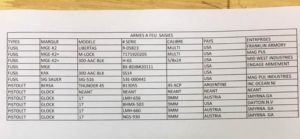
Haitian police arrested Kroeker, the team leader; former Navy SEALs Christopher McKinley, 49, and Christopher Osman, 44; former Blackwater contractor Talon Burton, 51; and Porte, 43. They also detained the two Serbians, 36-year-old Danilo Bajagic and Vlade Jankovic, 40. Photos of their weapons and tactical gear, which included six semi-automatic assault rifles, six handguns, knives, and at least three satellite phones, soon surfaced on social media.

Haitian police sources say that some if not all of the mercenaries brought their arms with them and that the makes, models, and serial numbers of the weapons have been provided to the U.S. Bureau of Alcohol, Tobacco, Firearms and Explosives. U.S. authorities have so far failed to bring charges against the contractors for illegally traveling out of the United States with their weapons, which requires a license.


A list, created by Haitian police and acquired by Haïti Liberté, 
of the serial numbers of weapons the mercenaries had.

Fritz Jean-Louis had apparently managed to flee during the lengthy standoff. But after the Americans were booked into the jail, Michel-Ange Gédéon, the director general of Haiti’s National Police, fielded calls from Jean-Louis, senior presidential aide Ardouin Zéphirin, and Haitian Justice Minister Jean Roudy Aly, who claimed variously that the Americans were conducting “state business” and doing “work for the bank,” according to a well-placed police source. In each case, the callers conveyed that President Moïse had authorized the Americans and that they should be released. Gédéon refused.

Céant did not respond to multiple requests for comment. Shortly after the Americans were arrested, he took to the airwaves to call the team “terrorists” and “mercenaries” who had been trying to get to the bank’s roof so they could assassinate him and unspecified parliamentarians. He later walked back the statements, saying they were a “hypothesis.”

On Mon., Mar. 18, Haiti’s Deputies voted to oust Céant as prime minister, but Céant has remained defiant.

“There are MPs who have decided to do something illegal and unconstitutional and that goes against principles, Republican traditions, and parliamentary traditions,” he told the Haitian daily Le Nouvelliste.
“I am still in office as Prime Minister.”

The caper might have been successful had any of the American participants had previous experience conducting a clandestine mercenary mission in a sovereign country. Instead, they were a mixed bag of mostly military veterans, including one former SEAL who had recently been charged with assault for a road rage incident in Southern California and another who was a body builder with a sideline as a country music singer. There was Kroeker, who among other ventures, ran a truck suspension business; a former Army military police officer and State Department security contractor; and the owner of a small electrical contracting firm that won a one-time $16,000 contract with the Department of Homeland Security.

Kroeker, according to a person with direct knowledge, had assured his colleagues that the mission would be easy. But while the Americans were well armed, they lacked other basic provisions of a secret security operation for hire: insurance coverage, a medical evacuation plan, legal authority to bring their weapons into Haiti, or an escape plan if things went bad.

“They had no idea what they were doing,” said the person with direct knowledge, who requested anonymity to speak publicly about the clandestine mission.

After the State Department secured the Americans’ release, everyone involved in the operation scattered. By the time the Americans were freed, Jean-Louis and Leconte had fled Haiti. Leconte flew back to the U.S. from the Dominican Republic, according to the person with knowledge of the operation; a day after he landed in New York, his Facebook profile was taken down. On Feb. 24, Leconte fled from a reporter who asked for comment outside his Brooklyn home and hid in a parking garage.

Chris Osman, one the ex-Navy SEALs and the only member of the team to publicly discuss the Haiti operation so far, wrote on Instagram that he was in Haiti doing security work for “people who are directly connected to the current president.” Osman hinted at the Haitian political intrigue behind the scheme, posting that he and his colleagues “were being used as pawns in a public fight between [Moïse] and the current Prime Minister of Haiti.” Osman has since deleted his post.

Leconte and Champagne had discussed a possible follow-up contract with Kroeker if the money transfer was successful, according to the person with direct knowledge of the mission, but it is unclear what that assignment might have been.

Haiti Liberté would like to acknowledge the invaluable assistance provided by the National Human Rights Defense Network (RNDDH) during the course of this investigation.

Dog Wagging the Law: Can Netanyahu Outrun Corruption Clock to Election Win?

Will Corruption Scandal Sink Netanyahu Weeks Before Election?

by TRNN


March 25, 2019

New revelations about the arms deal between Israel and Germany is rocking the Israeli election campaign just two weeks before the elections. The state witness Mickey Ganor, who was the agent of the German Thyssenkrupp arms company in Israel, has been arrested by the police after he suddenly changed his story and violated the terms of the deal he made with Israeli police. At the same time, new evidence emerged that Israeli Prime Minister Netanyahu has sold stocks in the GrafTech international company, which is a steel company providing components for the German company, making a profit of 400 percent, about four and a half million dollars.


The upcoming election in Israel is increasingly focused on the corrupt arms deals between Israel and Germany, from which Prime Minister Netanyahu personally profited millions of dollars. TRNN’s Shir Hever discusses the implications.


It was also revealed that the German government requested Netanyahu’s permission before selling similar submarines to Egypt. Netanyahu claimed before that he never gave such permission, but new evidence has shown that he lied and in fact authorized the German-Egypt arms deal, boosting the profits of GrafTech international, in which he was a stockholder. Major General Benny Gantz heads the party Blue and White, which is trying to unseat Netanyahu in the upcoming election. At a recent press conference, he had the following things to say.

The How To's of Shutting Down US Foreign Military Bases

Dear World, Here's How to Close Your U.S. Military Bases

by David Swanson - World Beyond War


March 24, 2019


Dear Brothers and Sisters,

If you live among the Other 96% — that portion of humanity that the U.S. government does not claim to represent, but where the U.S. military maintains some 1,000 major military bases, here are some helpful tips and past examples of success.

First of all, do everything you can to let people in the United States know how much they are paying financially for the bases in your country. While some of us in the United States primarily object to bases because of their use in creating and conducting campaigns of mass murder, many, including some who control U.S. media outlets, find the topic of financial cost far more acceptable.

One of those many is a rather insignificant and dimwitted member of the U.S. population who nonetheless matters because he is the president of the country. We want to encourage him to demand of your country higher and higher fees for the “benefit” of being “served” by your occupation by the U.S. bases that endanger your lives and pollute your water. And then we want to encourage your government to reply with a hearty “Don’t let the door hit you on your way out.”

Secondly, make sure that every liberal militarist in the United States understands, and that everyone in your country understands the motivation for the bases. It is not to colonize or to extract resources. It is not to be close to areas of the world where wars are likely to spontaneously erupt and require U.S. participation for the good of us all. The United States can fly its instruments of death to anywhere on earth quite rapidly from the U.S. mainland, not to mention actual U.S. colonies. The reason for keeping bases on your land is that you are, in the eyes of the U.S. government, inferior creatures incapable of properly determining your own fate. So, the superior and whiter and more divinely favored U.S. government has a duty to dominate everyone else, and that includes you. Remember that U.S. liberals like to think they aren’t bigoted, so you’ll have to explain this to them several times.

Third, study the examples of what has worked before.

Austria in 1955 created a Constitutional ban on foreign bases, removed Soviet and all other foreign bases and troops

Farmers in Japan prevented the construction of a U.S. base in 1957.

In 1963, the U.S. departed from bases in Trinidad and Tobago.

In 1963 and 1977, the United States left its bases in Morocco.

In 1967, France evicted U.S. troops from all bases.

In 1969, the Ogasawara Islands were returned to Japan.

In 1970, the U.S. departed from its base in Libya.

The people of Puerto Rico kicked the U.S. Navy out of Culebra in 1974, and after years of effort, out of Vieques in 2003.

In 1975, the U.S. departed from at least four air bases in Thailand.

A U.S. Army base in Eritrea closed in 1977.

Native Americans evicted a Canadian military base from their land in 2013.

People of the Marshall Islands shortened a U.S. base lease in 1983.

The people of the Philippines kicked out all U.S. bases in 1992 (though the U.S. later returned).

The U.S. left an air base in Zaragosa, Spain, in 1992.

A women’s peace camp helped get U.S. missiles out of England in 1993.

U.S. bases left Midway Island in 1993 and Bermuda in 1995.

Hawaiians won back an island in 2003.

In 2007 localities in the Czech Republic held referenda that matched national opinion polls and demonstrations; their opposition moved their government to refuse to host a U.S. base.

Saudi Arabia closed its U.S. bases in 2003 (later reopened), as did Uzbekistan in 2005, Kyrgyzstan in 2009.

The U.S. military decided it had done enough damage to Johnston/Kalama Atoll in 2004.

Activists compelled the United States to give up a firing range in South Korea in 2005.

Activism in Vicenza, Italy, (and around Italy and Europe and in Washington, D.C.) between 2005 and 2010 resulted in the United States getting only 50% of the land it wanted for its new bases.

In 2007, the President of Ecuador answered public demand, and exposed hypocrisy, by announcing that the United States would need to host an Ecuadorean base in Miami, Florida, or shut down its base in Ecuador.

In 2010, bases were blocked by the Colombian Supreme Court.

Iraq closed bases in 2011, reopened in 2013.

As ever so slightly touched on in the preceding list, there have been a great many partial and short-live successes. We need to study what has worked most often and most lastingly.

At World BEYOND War we are putting a major focus on this effort, and have helped to start up a D.C. insider coalition called Overseas Base Realignment and Closure Coalition, drawing heavily on the work of David Vine and his book Base Nation. We’ve also been part of launching a global activist coalition to educate and mobilize people for the closure of U.S. and NATO military bases. This effort has produced a conference in Baltimore, Md., in January 2018, and one in Dublin, Ireland, in November 2018.

Some of the angles finding traction and being shared around the world are environmental. U.S. bases are poisoning ground water, not just all over the United States, where the Pentagon is seeking to legalize such practices, but all over the world, where it needn’t bother.

The reasons the Pentagon needn’t bother legalizing destruction abroad ultimately depend on the last remaining widely accepted bigotry in U.S. culture, namely that against every non-U.S. culture. When the world figures that out, and when the people of the United States figure that out, who knows what could happen.

Sincerely,

David Swanson, Director,
World BEYOND War


Sunday, March 24, 2019

French Resistance: Gilets Jaunes Defy Macron's Fascist Tactics in Acte 19

Yellow Vests Hold Protests Across France Despite Bans

by RT 


March 24, 2019


Note: Telesur reports on the use of the French military against the Yellow Vest protests in week 19, writing:

French “yellow vest” demonstrators began their 19th consecutive weekend of protests against President Emmanuel Macron’s government Saturday as military units were deployed to assist police.

Police and demonstrators clashed sporadically in Paris and other French cities Saturday as “yellow vest” protests against President Emmanuel Macron’s government took place.

The demonstration in the capital was largely peaceful for most of the day, but later in the afternoon police fired tear gas on protesters near Boulevard de Strasbourg, close to the capital’s Gare du Nord and Gare de L’Est railway stations.

Skirmishes also erupted in cities including Lille in northern France, and Toulouse and Montpellier in the south, but there were no immediate reports of injuries.

KZ  - Popular Resistance


[Above photo: ‘Yellow Vest’ protesters stage their 19th round of protests in Nice, France. Photo Reuters.]


Yellow Vest protests continue in France for the 19th straight weekend. In Paris, they have been banned from demonstrating on the Champs-Elysees, and those daring to violate the ban face fines.

Following the previous violent weekend, French authorities have banned the Yellow Vests from the most popular protest locations, including the Champs-Elysees in Paris, Pey-Berland square in Bordeaux, and the Capitole in Toulouse.

According to the latest official figures from the Ministry of Interior, some 40,500 people demonstrated across France, including 5,000 in Paris.

The ban on protesting on the Champs-Elysees and the surrounding area was announced by Prime Minister Edouard Philippe on Monday. Those who violate the ban face fines of up to €135.

While the restrictions imposed by the authorities have seemingly scared off some protestors, many believe that it’s just a temporary setback and next week more people will take to the streets. Banning the Yellow Vests from certain locations won’t stop the protests, one of the main figures of the movement, Éric Drouet, told RT France.

“Last Saturday we’ve seen great activation and I think it will repeat during future demonstrations,” Drouet said. 


Yellow Vest protests blocked by a police convoy at the Champs-Elysees
avenue in Paris, France on March 23, 2019. Benoit Tessier for Reuters

“I am not disappointed at all, considering how much pressure they’ve put on us. There was this story with the military – even if it was misinterpreted, it is a little scary; a fine of 135 euros also scares, so you can understand why some people were quite restrained,” another protester stated.
“This weekend is a short break, after which people will come even more motivated next weekend.”

Demonstrators steered clear of the iconic avenue itself, but gathered in central Paris, heading towards Montmartre. Upon reaching Montmartre, the Yellow Vests gathered at the stairs of the Sacré-Cœur Basilica, waving flags and displaying banners.

One of the protesters said he was determined to demonstrate every Saturday as long as President Emmanuel Macron is in office – as of now, that’s 163 Saturdays to go, he calculated.

“We’re asking not that much,” he said. “I have less than €500 in my bank account right now. In the past, probably, I reached the end of the month with a zero balance, yet once a year I could get holidays for my daughter, a Christmas gift for her.
For several years already that’s impossible. Christmas is at her grandparents’ and the holidays on the couch at home. They [the government] are to blame for this.”

Protesters have draped the iconic Basilica with yellow cloth, a correspondent with RT France reported.