Wednesday, May 01, 2019

Fairly Unbalanced: US Media Consensus on Venezuela Overthrow

Zero Percent of Elite Commentators Oppose Regime Change in Venezuela 

by Teddy Ostrow - FAIR


April 30, 2019


Featured image: New York Times cartoon by Patrick Chappatte 
(1/31/19) featuring Nicolás Maduro and Juan Guaidó.


A FAIR survey of US opinion journalism on Venezuela found no voices in elite corporate media that opposed regime change in that country. Over a three-month period (1/15/19–4/15/19), zero opinion pieces in the New York Times and Washington Post took an anti–regime change or pro-Maduro/Chavista position. Not a single commentator on the big three Sunday morning talkshows or PBS NewsHour came out against President Nicolás Maduro stepping down from the Venezuelan government.

Of the 76 total articles, opinion videos or TV commentator segments that centered on or gave more than passing attention to Venezuela, 54 (72 percent) expressed explicit support for the Maduro administration’s ouster. Eleven (14 percent) were ambiguous, but were only classified as such for lack of explicit language. Reading between the lines, most of these were clearly also pro–regime change. Another 11 (14 percent) took no position, but many similarly offered ideological ammo for those in support.


From the beginning, elite media have worked strenuously to narrow the options available for consideration (New York Times, 4/3/19).

The Times published 22 pro–regime change commentaries, three ambiguous and five without a position. The Post also spared no space for the pro-Chavista camp: 22 of its articles expressed support for the end to Maduro’s administration, eight were ambiguous and four took no position. Of the 12 TV opinions surveyed, 10 were pro-regime change and two took no position.

(The Times and Post pieces were found through a Nexis search for “Venezuela” between 1/15/19–4/15/19 using each paper as a source, narrowed to opinion articles and editorials. The search was supplemented with an examination of each outlet’s opinion/blog pages. The TV commentary segments were found through Nexis searches for “Venezuela” and the name of the talkshow during the same time period, in the folders of the corresponding television network: NBC News/CBS News transcripts, ABC News transcripts, and PBS NewsHour. Non-opinion TV news segments were omitted. The full list of items included can be found here.)

Corporate news coverage of Venezuela can only be described as a full-scale marketing campaign for regime change. If you’ve been reading FAIR recently (1/25/19, 2/9/19, 3/16/19)—or, indeed, since the early 2000s (4/18/02; Extra!, 11–12/05)—the anti-Maduro unanimity espoused in the most influential US media should come as no surprise.

This comes despite the existence of millions of Venezuelans who support Maduro—who was democratically elected twice by the same electoral system that won Juan Guaidó his seat in the National Assembly—and oppose US/foreign intervention. FAIR (2/20/19) has pointed out corporate media’s willful erasure of vast improvements to Venezuelan life under Chavismo, particularly for the oppressed poor, black, indigenous and mestizo populations. FAIR has also noted the lack of discussion of US-imposed sanctions, which have killed at least 40,000 Venezuelans between 2017–18 alone, and continue to devastate the Venezuelan economy.

Many authors in the sample eagerly championed the idea of the US ousting Maduro, including coup leader Juan Guiadó himself, in the Times (1/30/19) and Post (1/15/19), and on the NewsHour (2/18/19).

The Times made its official editorial opinion on the matter crystal clear at the outset of the attempted coup (1/24/19): “The Trump administration is right to support Mr. Guaidó.” Followed by FAIR’s favorite Times columnist, Bret Stephens (1/25/19):

“The Trump administration took exactly the right step in recognizing National Assembly leader Juan Guaidó as Venezuela’s constitutionally legitimate president.

It’s generally a nation’s supreme court that has the final say on who is constitutionally legitimate, but in this case they can apparently be overruled by a foreign government—or a foreign newspaper columnist.

The Post editorial board also joined Team Unelected President (1/24/19):

“The [Trump] administration’s best approach would be to join with its allies in initiatives that would help Venezuelans while bolstering Mr. Guaidó.


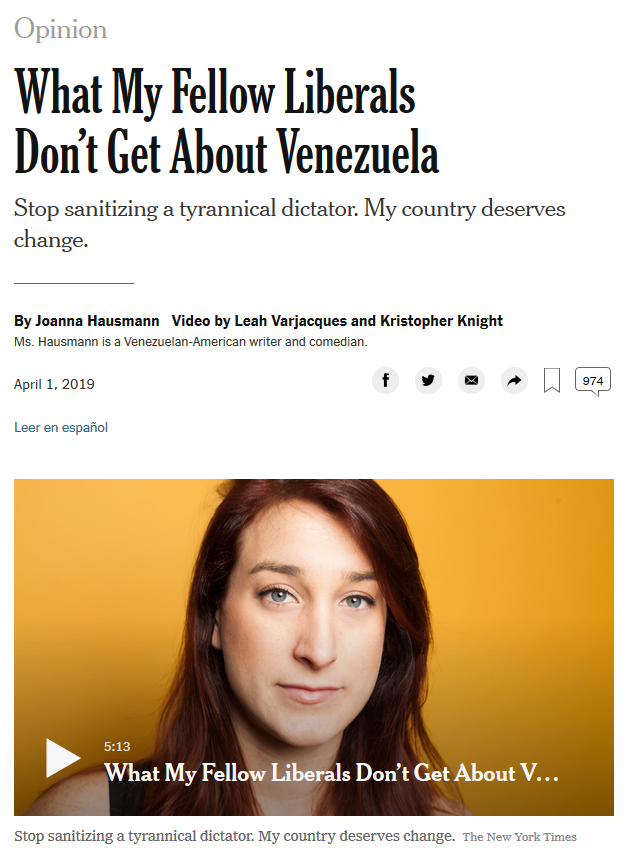
The New York Times (4/1/19) neglected to mention that, unlike most of her “fellow liberals,” Joanna Hausmann is the child of an official in the Venezuelan coup government.

The Times even produced an opinion video (4/1/19) with Joanna Hausmann, “a Venezuelan American writer and comedian,” as she is described in her Times bio.

Between sarcastic stabs at Venezuela’s “tyrannical dictator” and cute animations of “Ruth Bader Ginsburg in workout clothes”—Hausmann’s self-described “spirit animal”—come more serious declarations about the nation’s political situation:

“Juan Guiadó is not an American right-wing puppet leading an illegitimate coup, but a social democrat appointed by the National Assembly, the only remaining democratically elected institution left in Venezuela…. Let’s provide humanitarian aid and support efforts to restore democracy.

Odd that the Times didn’t find it necessary to note a blaring conflict of interest: Hausmann’s father is Ricardo Hausmann, Juan Guaidó’s appointed Inter-American Development Bank representative. Mint Press News (3/19/19) bluntly described him as the “neoliberal brain behind Juan Guaidó’s neoliberal agenda.”

It would be ludicrous to think the Times would withhold as blatant a connection to Maduro if one of his aides’ daughters made a snarky opinion video calling Juan Guaidó a would-be “brutal dictator”—even if our theoretical commentator was “an independent adult woman who has built a popular following on her own,” as Times opinion video producer Adam Ellick said in defense of the omission. Such a crucial relationship to a powerful Chavista politician would never go undisclosed—in the unlikely event that such a perspective would be tolerated in the opinion pages of an establishment paper.

These are just a few of many media pundits’ endorsements of Guaidó—someone whose name most of the Venezuelan population did not even recognize before he declared himself interim president. Put more accurately, they are endorsements of a US-backed coup attempt.

One of the more muddled regime change endorsements came from Rep. Ro Khanna’s Post op-ed (1/30/19), in which he says no! to military intervention, no! to sanctions, yet yes! to… “diplomatic efforts”:

“The United States should lend its support to diplomatic efforts to find some form of power-sharing agreement between opposition parties, and only until fair elections can take place, so that there is an orderly transition of power.

“Diplomatic” is a reassuring term, until you realize that US diplomacy, as FAIR’s Janine Jackson explained on Citations Needed podcast (3/20/19), is “diplomacy where we try to get other countries to do what we want them to do”—in this case, effecting a “transition of power” in another country’s government.


By viewing Venezuela through the lens of Russiagate, Fareed Zakaria (Washington Post, 3/28/19) was able to present backing an attempted coup as a pro-Resistance™ position.

Francisco Rodríguez and Jeffrey D. Sachs (New York Times, 2/2/19) envision similar efforts for a “peaceful and negotiated transition of power,” and Khanna made sure to characterize Maduro as “an authoritarian leader who has presided over unfair elections, failed economic policies, extrajudicial killings by police, food shortages and cronyism with military leaders.”

In other words, Maduro the Dictator must be overthrown—but don’t worry, the US would be diplomatic about it.

Those that didn’t take explicit positions nonetheless wrote articles blaming all or most of Venezuela’s woes on Maduro and Chávez. Economics wiz Paul Krugman (New York Times, 1/29/19) gave his spiel:

“Hugo Chávez got into power because of rage against the nation’s elite, but used the power badly. He seized the oil sector, which you only do if you can run it honestly and efficiently; instead, he turned it over to corrupt cronies, who degraded its performance. Then, when oil prices fell, his successor tried to cover the income gap by printing money. Hence the crisis.

Note that Krugman failed to mention the 57 percent reduction in extreme poverty that followed Chávez’s replacement of management of the state-owned oil industry (which has been nationalized since 1976, long before Chavismo). Nor does he acknowledge the impact of US sanctions, or any other sort of US culpability for Venezuela’s economic crisis.

Caroline Kennedy and Sarah K. Smith (Washington Post, 2/5/19) did not explicitly blame Maduro and Chávez for Venezuela’s “spiral downward,” but similarly ignored evidenced US involvement in that spiral. There are only so many places where you can point fingers without naming names.

Dictatorship-talk—writers lamenting the horrific and helpless situation under an alleged “dictator”—characterized many of the ambiguous and no-position articles. In the Post (1/24/19), Megan McArdle asked:

“You have to look at Venezuela today and wonder: Is this what we’re seeing, the abrupt end of Venezuela’s years-long economic nightmare? Has President Nicolás Maduro’s ever-more-autocratic and incompetent regime finally completed its long pilgrimage toward disaster?

By simply describing the declining situation of a country (Times, 2/12/19, 4/1/19) and using words like “regime” (Times, 2/14/19), “authoritarian” (Post, 1/29/19) and, of course, “dictatorship” (Post, 1/23/19; Times, 2/27/19) in reference to government officials, commentators create the pretext for regime change without explicitly endorsing it.

The Sunday talkshows and NewsHour also couldn’t find a single person to challenge the anti-Maduro narrative. They did find room, however, for three of the most passionate advocates of regime change in Venezuela: Sen. Marco Rubio (Meet the Press, 1/27/19), Donald Trump (Face the Nation, 2/3/19) and Guaidó himself (NewsHour, 2/18/19).

Other TV regime change proponents included Florida Sen. Rick Scott (Meet the Press, 2/3/19), 2020 Democratic presidential hopefuls Peter Buttigieg (This Week, 2/3/19) and Amy Klobuchar (Meet the Press, 3/17/19), Sen. Tim Kaine (Face the Nation, 3/17/19), and Guaidó-appointed, Mike Pence-approved “chargé d’affaires” Carlos Vecchio (NewsHour, 3/4/19).

But leave it to Nick Schifrin of the NewsHour (1/30/19) to bring on “two views” of the US intervention question that are both pro-regime change and pro-US intervention. View No. 1 came from Isaias Medina, a former Venezuelan diplomat who resigned from his post in protest against Maduro. Medina made the unlikely claim that 94 percent of the Venezuelan population—or 129 percent of the population over the age of 14—support US intervention to overthrow the Maduro government:

Not only I, but 30 million people, support not only the US circumstance, but also the Latin American initiative to restore the rule of law, democracy and freedom in Venezuela.


The PBS NewsHour (1/30/19) had a debate over intervention in Venezuela where the “anti” side saw the US’s goal as “assist[ing] the Venezuelan people [to] promote a peaceful transition in Venezuela.”

View No. 2, the ostensibly anti-regime change take, came from Benjamin Gedan, who served on the Obama administration’s National Security Council as director for Venezuela and the Southern Cone.

When asked if he supported Trump’s moves to sanction Maduro and possibly use US troops to oust him, Gedan responded:

“I think both of those steps are problematic. I think the sense of urgency that the United States administration has shown is absolutely correct…. The question is, how can we assist the Venezuelan people [to] promote a peaceful transition in Venezuela, without harming the people themselves, or fracturing the coalition that we have built over two administrations?

In other words, how can we overthrow the Venezuelan government without destroying the country—or “fracturing the coalition we have built”? The US has many options on the table, but none of them involve not pursuing the overthrow of Maduro.

In the “no position” camp for TV news, New York Times chief Washington correspondent David Sanger (Face the Nation, 1/27/19) noted that the problem with US support for Guaidó is one of “both history and inconsistency”:

“Our history in Latin America of intervening is a pretty ugly one, and the inconsistency of not applying the same standards to places like Saudi Arabia and Egypt, where the president has embraced strong men, I think may come back to make the United States look pretty hypocritical, not for the first time.

Sanger indulged in the popular “hypocrisy takedown”: The problem, as presented, isn’t that the US disrupts democracies, destroys economies and kills people, but rather that it does so inconsistently. While vaguely acknowledging the US’s horrific track record of Latin American interventions, and Trump’s cherry-picking of governments worthy of regime change, Sanger didn’t take the logical next step of calling for the US to keep its hands off Venezuela.

Instead, he called Maduro’s supporters—defined as “China, Russia and Cuba”—“not a great collection,” and failed to push back against the claim that Maduro “fixed the last” election. Without a formal declaration, Sanger did all the ideological preparation for foreign-backed regime change.

That elite media didn’t find a single person to vouch for Maduro or Chavismo, and that almost all the opinions explicitly or implicitly expressed support for the ouster of Venezuela’s elected president, demonstrates a firm editorial line, eerily obedient to the US government’s regime change policy.

This isn’t the first time that FAIR (e.g., 3/18/03, 4/18/18) has found a one-sided debate in corporate media on US intervention. When it comes to advocating the overthrow of the US government’s foreign undesirables, you can always count on opinion pages to represent all sides of why it’s a good thing. And the millions of people who beg to differ? Well, they’re just out of the question.

Victorian Justice: British Court Doubles Down on Assange Bail Sentence

Assange Sentenced 50 Weeks For Bogus Bail Charge

by Caitlin Johnstone - Rogue Journalist


May 2, 2019

Following seven years of imprisonment at the Ecuadorian embassy fighting US extradition, WikiLeaks founder Julian Assange has been sentenced to 50 weeks behind bars for an entirely bogus bail charge. Sky News reporter Jordan Milne live-tweeted events as they unfolded, reporting that Assange’s defense argued that his fears of rendition and torture at the hands of the US government were well-founded.

His life in the Ecuadorian embassy and the physical and psychological detriments which came with it were described, including deteriorated health and depression.

The judge rejected his entire defense and delivered nearly the harshest sentence possible.

“Your continued residence in the Embassy has necessitated a concentration of resources, and expenditure of £16 million of taxpayers’ money in ensuring that when you did leave, you were brought to justice,” Judge Deborah Taylor told Assange upon his sentencing.

This is bullshit. Assange’s residency at the embassy never cost taxpayers a penny; it was the British government’s decision to pour money into patrolling the embassy around the clock with police who had orders to arrest Assange on sight over a petty bail charge. It was the British government’s decision to persuade the Swedish government not to drop its investigation in 2013 so that it could pursue the agenda to arrest Assange for US extradition.

Assange’s residency didn’t cost British taxpayers anything; the agenda to imprison and extradite a journalist for publishing facts is what cost taxpayers £16 million. There is one reason and one reason only that the British government saw fit to spend £16 million of taxpayers’ money patrolling that embassy, and it wasn’t because they really, really hate bail violations.

No, the one and only reason the UK government found it reasonable to invest £16 million in patrolling the Ecuadorian embassy is because it had an agenda to help the US war machine punish someone who embarrassed it. And now the cost of that UK government agenda is being used to justify nearly a year behind bars after years of arbitrary detention.

“Julian Assange’s sentence, for seeking and receiving asylum, is twice as much as the sentencing guidelines,” WikiLeaks tweeted.
“The so-called speedboat killer, convicted of manslaughter, was only sentenced to six months for failing to appear in court.”

The bail charge itself is entirely illegitimate. As scholar and WikiLeaks advocate Simon Floth explains, under British law bail is only legally breached if there’s a failure to meet bail “without reasonable cause”, which the human right to seek asylum certainly is. The UK itself was clearly unconvinced of its own authority to charge someone who was under political asylum for jumping bail, waiting a full nine days before issuing an arrest warrant in 2012.

After the Swedish government decided to drop its sexual assault investigation in 2017 without issuing any charges, Assange’s legal team attempted last year to get the warrant dropped. The judge in that case, Emma Arbuthnot, just happens to be married to former Tory junior Defence Minister and government whip James Arbuthnot, who served as director of Security Intelligence Consultancy SC Strategy Ltd with a former head of MI6. Arbuthnot denied Assange’s request with extreme vitriol, despite his argument that British law does have provisions which allow for the time he’d already served under house arrest to count toward far more time than would be served for violating bail.

All this of course pales in comparison to the far more grave threat Assange faces tomorrow, when his hearing for US extradition begins.

The US charge accompanying Assange’s extradition request is even more bogus than the bail charge; a re-interpretation of standard journalistic practices like source protection to create a charge which the Obama administration declined to prosecute based on the same evidence for fear of endangering press freedoms.

Assange is charged with “conspiring” to help Chelsea Manning avoid detection while leaking evidence of US war crimes and malfeasance, which is something any investigative journalist who publishes leaks would do. The charge is a bunch of words designed to twist standard journalistic practices into just enough of a crime to get Assange onto US soil for “non-political” reasons.

As Pentagon Papers lawyer James Goodale explains, “Under the U.S.-U.K. extradition treaty, one cannot be extradited from the United Kingdom if the extradition is for ‘political purposes.'” Once he’s on US soil, far more serious charges may be added that are of a very political nature indeed. If that happens, Assange will not be spending the five years behind bars for computer offenses that his current charge allows, he’ll be spending decades.

“I don’t think Julian is looking at five years in prison, I think he’s probably looking at 50 years in prison,” said CIA whistleblower John Kiriakou, adding, “I think that there are many more charges to be considered for Julian. I would expect a superseding indictment, possibly to include espionage charges.”


There is simply no such thing as a fair national security trial in the Eastern District of Virginia, which is where Assange will be heading if extradited to the US.

“No national security defendant has ever won a case in the EDVA,” Kiriakou told RT upon Assange’s arrest.

“In my case, I asked Judge Brinkema to declassify 70 documents that I needed to defend myself. She denied all 70 documents. And so I had literally no defense for myself and was forced to take a plea.”

“He will not, he cannot get a fair trial,” Kiriakou said on a Unity4J vigil when Assange was still at the embassy.

“It’s impossible, because the deck is stacked. And everybody knows what’s gonna happen if he comes back to the Eastern District of Virginia. This is the same advice I gave Ed Snowden: don’t come home, because you can’t get a fair trial here. Julian doesn’t have the choice, and that’s what frightens me even more.”

This is why it’s imperative for everyone who stands for truth, press freedoms or government accountability to oppose this extradition request tooth and claw, wherever they’re at in the world. Australians should be pushing their government to intercede against US extradition, Britons should be doing the same, and Americans should be pushing their government not to extradite. It’s too late to keep Assange from being pried loose from the embassy and imprisoned by the UK, so now we need to put all our energy into keeping Assange out of the clutches of the same government which tortured Chelsea Manning.

Go to demonstrations, make phone calls to your local representatives, donate get posters spread around Australia, write letters to the editor, and share information about what’s going on with your friends and family and anyone you can. We can’t rely on the legal system to sort this one out, because, as we’ve seen today, the legal system can very easily be manipulated to serve the interests of the powerful.

________________________

Everyone has my unconditional permission to republish or use any part of this work (or anything else I’ve written) in any way they like free of charge. My work is entirely reader-supported, so if you enjoyed this piece please consider sharing it around, liking me on Facebook, following my antics on Twitter, throwing some money into my hat on Patreon or Paypal, purchasing some of my sweet merchandise, buying my new book Rogue Nation: Psychonautical Adventures With Caitlin Johnstone, or my previous book Woke: A Field Guide for Utopia Preppers. The best way to get around the internet censors and make sure you see the stuff I publish is to subscribe to the mailing list for my website, which will get you an email notification for everything I publish. For more info on who I am, where I stand, and what I’m trying to do with this platform, click here.


Bitcoin donations:
1Ac7PCQXoQoLA9Sh8fhAgiU3PHA2EX5Zm2

Coup de Farce: The Venezuelan Uprising That Did Not

A Desperate Empire Crashes in Venezuela

by Maximilian C. Forte - ZeroAnthroplogy


May 2, 2019

The April 30, 2019, coup attempt in Venezuela has come and gone. The coup has failed


Failed state” theory just got a lot more complicated. No longer can the “failed state” designation apply only to those states targeted for recolonization after a prolonged period of destabilization and foreign intervention. Now “failed state” theory has to apply to a degenerate imperial state at its wit’s end, and to the failure of its proxies on the ground, as well as the failure of its invented political fictions to materialize.

Even worse than any “failed state,” is the failure of aspirants to power who pretend to have power—namely, the incompetent Venezuelan opposition activist, Juán Guaidó. It’s time that even the few critical media outlets left stop dignifying Guaidó, opposition activist, with the title of self-declared “interim president,” because even that is too grandiose.

This so-called “interim president” is, by the tortured logic of Elliot Abrams, the president of an interim that has not yet begun. So that means he is not the interim president even. Or, he was the interim president, but his 30-day term (as specified by the Constitution), expired months ago. Or, he is still the interim president, but only if a defunct opposition body, that calls itself the National Assembly, believes it has the authority to unilaterally overwrite the Constitution—it does not, so he is still not even a self-declared interim president. This is what the US wants the world to recognize as “interim president”: a total fiction that cannot be sustained without reference to other fictions.

This bundle of fictions has not even been wielded by people who have the good sense to know when it’s time to shut up. No, instead the authors of these inventions spin even more, as if wanting to be spotted in all their foolishness.

So we had the US government almost triumphantly declaring that it was withdrawing US diplomats from Venezuela—when Venezuela’s government was the one that ordered them out.

Then we had US officials rejoice that Venezuela’s representatives had been expelled from the Organization of American States—when Venezuela already declared it was withdrawing from the OAS two years ago, and this month marked the final step in the process.

Then we had the US State Department pretend that it could hand the Venezuelan Embassy in Washington, DC, over to representatives of an interim president of an interim that had not even started, or that already ended. One has to really have faith in the stupidity of audiences, and be unflinching about treating everyone as idiots, to mount such an absurd production in public. It also means that they literally have no shame.


Impressive “uprising” you have there.

As a bad work of fiction, Guaidó could not mount even a lame imitation of a military-backed coup on April 30, which is just the latest in a long line of his failures this year. This character, unknown to 80% of Venezuelans a few months ago, leader of a minority party in a defunct parliament, who never campaigned for the presidency and was never elected to it—this same character posed in front of cameras and claimed military backing which he never had. So he calls on the resources of a hostile foreign power in the vain hope it make his fiction reality, clearly showing he understands nothing at all. Even worse: it shows a total lack of any care for all those who would suffer and die in war—Guaidó is ready to sacrifice them all. It’s an ill bird that fouls its own nest.

The response to Guaidó’s call? A few hundred violent protesters showed up, traded rocks with the Bolivarian National Guard, and then stood around talking to each other for hours on end. John Bolton, pushing US intervention in the name of keeping Venezuela free of external dominance (he knows no irony), even tried to nudge Venezuelans in a pitiful attempt at bribery, promising US economic relief if Guaidó took power. As far as attempted coups go, this was fortunately among the most pathetic, lame farces.

There is now no resemblance between Venezuela 2019 and Libya 2011, where in the latter case opponents actually seized towns and cities and mounted protests that lasted days on end. What remains the same in the two cases is the determination of the US to implement through violent proxies a fiction of rule.

One also has to wonder how John Bolton, Mike Pompeo, and Elliot Abrams still have jobs today. Trump is not a tower of managerial business acumen after all—if one ever believed the fiction constituting his performance on The Apprentice. Bolton, who was most prominent during the April 30 coup farce, could not even keep himself from tripping over his own excremental attempt at a “narrative”.

First, John Bolton called on the Venezuelan military to side with Guaidó—but then invalidated his call, turning around and asserting that, in any case, Venezuela was under (imaginary) Cuban occupation, and it was Cuban troops who were really in charge. So everything fell apart…because of Cuba, and thus Trump threatened Cuba with an embargo, which it has already been under for six decades. Cuba was the fiction used to mask another fiction—the only thing that was real here was how utterly ridiculous US empire has become.


All the action, caught live on camera.

On the night of April 30, as I often do I listened to live radio from Caracas, where the assembled panelists spent a good amount of time engaged in the healthiest, most robust guffawing I have heard in ages. The subject of their laughter? Erik Prince, the war criminal who headed BlackWater and is now begging Trump for cash in return for a “plan”—a plan to send a grand total of 5,000 mercenaries to Venezuela.

On RNV radio they wondered if the Americans had really become so stupid and psychotic to think that 5,000 clowns could take and hold so much as a bakery in a country which has 2,000,000 armed citizens in militias alone, not counting the hundreds of thousands in the armed forces and the paramilitary police. Apparently Prince mixed up Venezuela with Grenada—and even in Grenada it took US Marines a week to subdue armed opposition from a comparatively tiny group of diehard patriots.

Nothing is working for the US, not even what might be the most extreme sanctions ever imposed, and weeks of power outages. Certainly, none of the “humanitarian” theatre worked, whether it was the forced “aid” stunt, or the myth that Venezuelan troops set their fake aid on fire. The US was forced to imagine and fantasize about Maduro fleeing the country: witness Mike Pompeo’s bout of deranged lying about Maduro getting on a plane to Cuba, until Russia stopped him.

Fictions, lies, propaganda, disinformation, fake news. To top it all off, the news came: this was not even a coup, you see. The real problem here, with such a monumental loss of face, in such a magnificent failure as April 30, is that the US will turn to even more desperate and thus more dangerous measures. However, that comes at a real cost: if the US invades, Trump has to go into an electoral contest with a new war on his back, and it’s not like such a war would come even close to a “cake walk”.

One has to wonder: will those national leaders who—without the authorization of their citizens—unilaterally “recognized” Guaidó as this so-called “interim president” thing, now take stock finally? Or will they cling to this science-fiction that there is a popular movement opposing Nicolás Maduro’s legitimate and very real government?

Clearly, very clearly as it was televised live worldwide all day on April 30 for all to see, Guaidó does not lead a popular movement. He has no authority, no legitimacy, and only a paltry amount of futile support. This so-called “uprising” was an embarrassing failure for his own image as a supposed leader. Then he takes shelter and says “tomorrow, more protests”—yes, junior, that will do the trick. Remember, sport, more always works, and besides, “there’s always tomorrow”. Keep at it, son.

This is what practice without theory looks like. This is what a “movement” without support looks like. This is what science-fiction looks like when it tries to escape the theatre and mingle with real people in the street.

Meanwhile, members of the Lima Group such as Canada, and those members of the European Union that have called for a “peaceful transition” in Venezuela, there is a lot for which they must answer. What “democracy” do they think it is where someone, not elected by the people, marshals the forces of violence in an effort to impose a government on a country?


If this were to be done in their countries, would they accept it as democracy? This is the other outrageous fiction that we face: that we in North America live in democratic polities. Democracy should recognize itself in democracy—but when you instead recognize your partner in a violent clutch of putschists, then what are you?

Tuesday, April 30, 2019

Gorilla Radio with Chris Cook, Andy Worthington, Pablo Ouziel, Janine Bandcroft May 2, 2019

This Week on GR

by C. L. Cook - Gorilla-Radio.com


May 2, 2019

Last week marked the eighth anniversary of the WikiLeaks release of 'The Guantánamo Files'. A lot has changed since their original airing, and a lot hasn't.

Obama has come and gone, the immediate closure of "Gitmo" now just another of his hoped for but unkept promises, while both the publisher of the files revealing the horrors of the camp, and the person Obama pardoned for leaking them are themselves now imprisoned; Julian Assange held in solitary at London's infamous Belmarsh Prison, and Chelsea Manning, after a month of solitary confinement, facing "indefinite detention" for refusing a Virginia Grand Jury's subpoena to testify in its investigation of Assange and WikiLeaks.

Listen. Hear.

Andy Worthington is an investigative journalist, author, campaigner, commentator and public speaker. A recognized authority on Guantánamo and the “war on terror”, Andy is co-founder of the Close Guantánamo and We Stand With Shaker campaigns, both dedicated to bringing justice for inmates of that place past and present.

The London-based Worthington is also a singer, songwriter, founding member of the band, The Four Fathers, (currently searching for a new bass player) and urban photographer whose State of London series is a seven years-long daily chronicle of that great city.

Andy Worthington in the first half.

And; despite the rightward trend in European politics, Spain's Socialist Party, the PSOE, held power in Sunday's elections there, though again with a minority. While the government's renewal, and seat increase gives Pedro Sánchez' party a strong mandate to govern, the admission to Parliament of 24 members of the ultra-right VOX party is grabbing the headlines. It's the first far-right party to gain seats since democracy replaced the dictatorship of Generalissimo Francisco Franco more than 40 years ago.

Dr. Pablo Ouziel is Postdoctoral fellow at the University of Victoria’s Political Science Department and Centre for Global Studies. He’s a native of Barcelona, and his Post-Doctoral Fellowship project at UVic is, ‘Democracy Here and Now: The Exemplary Case of Spain’.

Pablo Ouziel and political breathing space for Spain's left in the second half.


And; Victoria-based activist and long-time Gorilla Radio contributor, Janine Bandcroft will be here at the bottom of the hour with the Left Coast Events Bulletin of some of the good things to be gotten up to in and around our town in the coming week. But first, Andy Worthington and eight years later, the Guantánamo Files then and now.

Chris Cook hosts Gorilla Radio, airing live every Thursday between 11-Noon Pacific Time. In Victoria at 101.9FM, and on the internet at: http://cfuv.uvic.ca.  He also serves as a contributing editor to the web news site, http://www.pacificfreepress.com. Check out the GR blog at: http://gorillaradioblog.blogspot.ca/

About Facebook: Canadian Privacy Commission Concerns Iced

Facebook refuses to address serious privacy deficiencies despite public apologies for “breach of trust” 

by Office of the Privacy Commissioner of Canada


April 25, 2019

Joint investigation finds major shortcomings in the social media giant’s privacy practices, highlighting pressing need for legislative reform to adequately protect the rights of Canadians

OTTAWAFacebook committed serious contraventions of Canadian privacy laws and failed to take responsibility for protecting the personal information of Canadians, an investigation has found.

Despite its public acknowledgement of a “major breach of trust” in the Cambridge Analytica scandal, Facebook disputes the investigation findings of the Privacy Commissioner of Canada and the Information and Privacy Commissioner for British Columbia.

The company also refuses to implement recommendations to address deficiencies.

“Facebook’s refusal to act responsibly is deeply troubling given the vast amount of sensitive personal information users have entrusted to this company,” says Privacy Commissioner of Canada Daniel Therrien.

“Their privacy framework was empty, and their vague terms were so elastic that they were not meaningful for privacy protection.
“The stark contradiction between Facebook’s public promises to mend its ways on privacy and its refusal to address the serious problems we’ve identified – or even acknowledge that it broke the law – is extremely concerning.”

“Facebook has spent more than a decade expressing contrition for its actions and avowing its commitment to people’s privacy,” B.C. Information and Privacy Commissioner Michael McEvoy says, “but when it comes to taking concrete actions needed to fix transgressions they demonstrate disregard.”

Commissioner McEvoy says Facebook’s actions point to the need for giving provincial and federal privacy regulators stronger sanctioning power in order to protect the public’s interests.

“The ability to levy meaningful fines would be an important starting point,” he says.

The findings and Facebook’s rejection of the report’s recommendations highlight critical weaknesses within the current Canadian privacy protection framework and underscore an urgent need for stronger privacy laws, according to both Commissioners.

“It is untenable that organizations are allowed to reject my office’s legal findings as mere opinions,” says Commissioner Therrien.

In addition to the power to levy financial penalties on companies, both Commissioners say they should also be given broader authority to inspect the practices of organizations to independently confirm privacy laws are being respected. This measure would be in alignment with the powers that exist in the U.K. and several other countries.

Giving the federal Commissioner order-making powers would also ensure that his findings and remedial measures are binding on organizations that refuse to comply with the law.

The complaint that initiated the investigation followed media reports that Facebook had allowed an organization to use an app to access users’ personal information and that some of the data was then shared with other organizations, including Cambridge Analytica, which was involved in U.S. political campaigns.

The app, at one point called “This is Your Digital Life,” encouraged users to complete a personality quiz. It collected information about users who installed the app as well as their Facebook “friends.” Some 300,000 Facebook users worldwide added the app, leading to the potential disclosure of the personal information of approximately 87 million others, including more than 600,000 Canadians.

The investigation revealed Facebook violated federal and B.C. privacy laws in a number of respects. The specific deficiencies include:

Unauthorized access

Facebook’s superficial and ineffective safeguards and consent mechanisms resulted in a third-party app’s unauthorized access to the information of millions of Facebook users. Some of that information was subsequently used for political purposes.

Lack of meaningful consent from “friends of friends”

Facebook failed to obtain meaningful consent from both the users who installed the app as well as those users’ “friends,” whose personal information Facebook also disclosed.

No proper oversight over privacy practices of apps

Facebook did not exercise proper oversight with respect to the privacy practices of apps on its platform. It relied on contractual terms with apps to protect against unauthorized access to user information; however, its approach to monitoring compliance with those terms was wholly inadequate.

Overall lack of responsibility for personal information

A basic principle of privacy laws is that organizations are responsible for the personal information under their control. Instead, Facebook attempted to shift responsibility for protecting personal information to the apps on its platform, as well as to users themselves.

The failures identified in the investigation are particularly concerning given that a 2009 investigation of Facebook by the federal Commissioner’s office also found contraventions with respect to seeking overly broad, uninformed consent for disclosures of personal information to third-party apps, as well as inadequate monitoring to protect against unauthorized access by those apps.

If Facebook had implemented the 2009 investigation’s recommendations meaningfully, the risk of unauthorized access and use of Canadians’ personal information by third party apps could have been avoided or significantly mitigated.

Facebook’s refusal to accept the Commissioners’ recommendations means there is a high risk that the personal information of Canadians could be used in ways that they do not know or suspect, exposing them to potential harms.

Given the extent and severity of the issues identified, the Commissioners sought to implement measures to ensure the company respects its accountability and other privacy obligations in the future. However, Facebook refused to voluntarily submit to audits of its privacy policies and practices over the next five years.

The Office of the Privacy Commissioner of Canada plans to take the matter to Federal Court to seek an order to force the company to correct its privacy practices.

The Office of the Information and Privacy Commissioner for B.C. reserves its right under the Personal Information Protection Act to consider future actions against Facebook.

Related documents:


Report of Findings

Chart: Facebook findings highlight the need for legislative reform

Remarks by the Privacy Commissioner of Canada regarding the Facebook/Cambridge-Analytica investigation

- 30 -


For more information, please contact:

Office of the Privacy Commissioner of Canada
Tobi.Cohen@priv.gc.ca
819-994-5689

Office of the Information and Privacy Commissioner for British Columbia
Jane Zatylny
jzatylny@oipc.bc.ca
250-415-3283

Monday, April 29, 2019

Responsibility to Report: Assange and the Duty to Expose War Criminals

WikiLeaks and Julian Assange: The Duty to Expose War Crimes

by Maximilian C. Forte - ZeroAnthropology


April 29, 2019

On Thursday, April 25, 2019, I had the honour of participating in two separate radio interviews concerning the case of Julian Assange and WikiLeaks.

The first was with Glen Ford of Black Agenda Radio, and the second was with Chris Cook of “Gorilla Radio” at CFUV 101.9 FM—both of the sound files are available below.

In the interview with Glen Ford, I was particularly honoured to follow Mumia Abu-Jamal, a noted US political prisoner whose reports from prison I have long admired and appreciated—Mumia speaks about Julian Assange in the latest of his calls from prison, with his trademark clarity of thought and depth of insight.

Chris Cook somehow figured out that Kobo-Town was one of my favourite bands, and played my favourite song of theirs, “Sing Out, Shout Out,” before bringing me on air—it was very encouraging. I am very grateful to both Glen Ford and Chris Cook for the opportunity to speak.

A Political Prosecution with Predetermined Outcomes


One of the key points that I tried to present in both interviews is that—contrary to my initial optimism two weeks’ ago—we should not expect a fair trial for Julian Assange, but instead a succession of kangaroo courts driven by a political agenda, and with a predetermined political outcome.

If Julian Assange were to have a truly fair trial, the case would immediately be thrown out of court. Assange has done what other journalists did in assisting sources to deliver their leaks to the press, and that does not constitute espionage. Not only is what Assange did not illegal, what in fact is illegal is the attempt to cover up war crimes. It was thus illegal and unjust to persecute Chelsea Manning, and to do so again right now, but it does prove that politics predetermine judicial outcomes.

US soldiers have a legal duty to report war crimes, not to cover them up, and they have a duty to disobey unlawful orders, such as the orders that contravene the laws of war in the Geneva Conventions. Even in the last few days, we have seen more news about the US military’s attempts to suppress knowledge of war crimes and prevent prosecution, in the case of Edward Gallagher (a US Navy SEAL)—with Donald Trump himself intervening to help make life more comfortable for a war criminal. On Fox News the savagery practiced by Gallagher is masked by praise for him as if he were some sort of saint. If you can stomach it, it’s actually quite sickening to read this latest report.

Assange has no legal duty to cover up US war crimes—and once he possessed the information, he had every ethical obligation to expose those war crimes. In a fair trial, the US would have no right to prosecute Assange or Chelsea Manning for exposing US war crimes. The very suggestion that it was wrong, on any level, for US war crimes to be exposed has to be one of the most perverse corruptions of ethics, morality, and law that you will ever encounter. It boils down to making the obstruction of justice, justice itself.
The War on Free Speech

As I argue in the radio interviews below, what’s at stake is the meaning and reality of our citizenship. To what does our citizenship actually amount? To what do we have a right as citizens? How can we exercise citizenship in the absence of information and knowledge about our system of government, about those who presume to govern us?

Also at stake is the legitimacy of the governing system—primarily, that it has lost all legitimacy, and the system knows it. We are dealing with states that are guilty of trying to conceal their crimes—that is the real obstruction of justice that exists in Washington. It’s not the obstruction of justice of Donald Trump allegedly trying to smother investigation into non-existent, conspiratorial Russia-related crimes concocted by the hysterical elite of the bipartisan War Party.

Shock and Awe
Baghdad March, 2003

The obstruction of justice that really happened in the time WikiLeaks became prominent, was George W. Bush’s invasions of Iraq and Afghanistan, committing torture and war crimes, and then covering up those crimes; followed by Obama’s failure to prosecute Bush administration officials, while his government committed even more war crimes, and cracked down on whistle-blowers to an unprecedented level; to Trump maliciously turning on WikiLeaks in the final act of punishing those who revealed the truth. That is the only obstruction of justice that should concern any of us—the rest is a deliberate distraction.

The Pentagon has also long claimed that what WikiLeaks published was essentially “nothing new”. Then that makes the question even more compelling: why has the US government failed, for so long, to act to prosecute the obvious cases of war crimes committed by US forces? It’s not because of ignorance—since, after all, there is “nothing new” about the WikiLeaks’ publications. This only underlines the fact that higher-ups in the Pentagon and the US government have been fully aware of the crimes—remember, “there is nothing new”—and chose not to act and, indeed, even tried to cover up those crimes by not disclosing this information.

One crime is to commit actual war crimes; the other crime is trying to conceal those crimes. As Ray McGovern put it recently: “there is no good counter-argument to exposing war crimes”.

Freedom of speech is the actual “threat” here—in other words, a basic right of citizenship. It’s about the right of citizens not to be ruled by secret, shadow governments that commit crimes against humanity and war crimes.

Let’s remember that it was WikiLeaks itself that was forced to resuscitate the following speech by President John F. Kennedy, as a reminder to Americans about what’s at stake:

“The very word ‘secrecy’ is repugnant in a free and open society; and we are as a people inherently and historically opposed to secret societies, to secret oaths and secret proceedings. We decided long ago that the dangers of excessive and unwarranted concealment of pertinent facts far outweighed the dangers which are cited to justify it.
Even today, there is little value in opposing the threat of a closed society by imitating its arbitrary restrictions. Even today, there is little value in insuring the survival of our nation if our traditions do not survive with it. And there is very grave danger that an announced need for increased security will be seized upon those anxious to expand its meaning to the very limits of official censorship and concealment. That I do not intend to permit to the extent that it is in my control. And no official of my Administration, whether his rank is high or low, civilian or military, should interpret my words here tonight as an excuse to censor the news, to stifle dissent, to cover up our mistakes or to withhold from the press and the public the facts they deserve to know.” 

The US Department of Defense: A Calculated Fear


The authorities use fear to prod us into self-censorship and heightened self-monitoring. Everything is now criminalized, including the very revelation of crimes.

Whenever those in power try to distract you by pointing to the fact that a given piece of information was revealed by unlawful and unethical means—and then stop there, without discussing the nature of what was revealed—then what we have is an attempt at censorship, plain and simple.

The Pentagon has tried to impress on us that what matters, first and foremost, is “the safety of US forces,” and protecting knowledge of the methods they use. That is plainly wrong—in fact, it’s almost perverse.

First of all, if you are worried about the safety of US troops, then don’t fling them far and wide into endless wars in countries where the US does not belong.

Second, the safety of US troops cannot be our first concern—our first concern has to be with what those troops are doing to other people, in other people’s countries, while acting in the name of their citizens and with funds that taxpaying citizens supplied.

Third, it’s base propaganda for the Pentagon to cry about lives being put at risk: the very essence of its core mission is to put the lives of millions around the world at risk.

What the Pentagon wants is to commit a heist against democracy, and not be called out for it—the only two acceptable responses are either applause, or silence. It’s a heist against democracy when you say, “here, give me your money, and now I won’t tell you what I’m really going to do with it, and I will shut you up if you try to find out”. That is both theft, a denial of democracy, and an obstruction of justice.

Obama promised repeatedly, and he was amplified on this by Hillary Clinton, that his government would be all about transparency, accountability, and openness. Freedom of information, we were lectured by them, was essential to preventing authoritarian and dictatorial regimes from cementing their power. A free Internet, and freedom of government information, were said to be the lifeblood of democracy. What they actually delivered was almost the exact opposite.

American Exceptionalism, American Criminality


American exceptionalism demands that US war crimes be concealed, and that the US military be greeted either with applause or silence. The US’ imperial security state is absolutely desperate that it cannot control what we know, and what we think. Consider this: years after the initial mass of WikiLeaks publications based on leaks from Chelsea Manning, a huge treasure trove of sensitive data was leaked from no less than the CIA itself, which we now have under the heading of Vault 7. Nothing can stop future leaks when a state is so determined to commit crimes of naked aggression against weaker states around the world, while imprisoning its own population in a mass surveillance and mass disinformation regime that fuels permanent war. Such a system is not tenable.

Assange did endanger US national security, if US national security is honestly defined as a structure that commits numerous war crimes as a fundamental part of its global modus operandi, as a purveyor of violence on an unprecedented international scale.


After the Revolution: What Happens When Macron and French Elite Fall?

Tipping Point: The Gilets Jaunes are winning, what’s next?

by Dave Studdert - OffGuardian


April 29, 2019

The weekend just gone, Manifestation 23, marked a seismic shift in the five month battle between the Gilets Jaunes and the French state. The Notre Dame fire has brought into the open the strategic shift in public opinion that has occurred over the winter; shifts all to the advantage of the Gilets Jaunes. While the cold winter months with their looming darkness only allowed us to glimpse two equal parties grinding away at each other in the gloom, the advent of spring and its clear light, reveals how the Gilets are gathering reserves of strength all over France, and how, now, they are slowly winning in Paris as well.

The sight of French police surrounding Notre Dame and denying access to its ‘own’ population, starkly illustrates what the state seeks to deny. After all, these sort of monuments are the materiality through which states demonstrates their connection to the population, their right to rule and their own power.

The Neo-liberal state is crumbling and Macron is going be the sacrificial lamb. At this stage he will be lucky to last two months. His clumsy handling of the Notre Dame blaze has outraged and enraged more sections of the French population. Indeed throughout the five months of protest, and despite the wall to wall media propaganda, opinion polls consistently show continued and unwavering sympathy and support of the Gilets Jaunes.

In the sharp light of spring it is clear that Macron’s winter strategy: the Great National Debate, has achieved nothing for the government and more tellingly perhaps, has further revealed Macron’s own incapacity to either change himself or shift course. As one anonymous French state official reportedly said: ‘Mitterrand gave them an extra week’s holiday, but Macron can’t manage anything’. He simply seems unable in any form to communicate with either the Gilets or the people of France. His constant speeches, with their casual insults and lack of empathy, remain one of the best recruitment tools the Gilets possess.

His recent pronouncements continue this trend. His promise to rebuild the cathedral in five years was met with scorn – ‘this is not a railway line’, said one commentator, while his invitation to the world (a typical empty gesture) angered and aroused traditionalists. Indeed, as has been widely reported, his endorsement of cash donations from billionaires, simply provided the Gilets with yet more free sticks to beat him and the state.

Even his big showpiece speech was cancelled when the Cathedral burst into flames. And what was his big announcement? A freeze on hospital and school closures, the index-linking of pensions to inflation and the closing of the École Nationale d’Administration (ENA), the university that produces the country’s political and civil elite, all of which, particularly the last, were seen as too late and totally irrelevant. After all it doesn’t put food on the table or help the people get to the end of the month with any money. As I noted in previous articles, this is typical of Macron, revealing only how his personal authority is slipping away, and strangely enough, how irrelevant he is becoming to the entire debate.

Above all, Macron is guilty of being one of those stupid/intelligent middle class people; the sort neo-liberalism delights in providing for us in many guises: administrators, legacy media editors, heads of departments, councillors, politicians. He is bright, he is buffed, he has aspiration, he can speak fluently on subjects for hours, yet for all of that, every speech he makes simply inflames the situation. And this, coupled with his inability to convey a shred of empathy and his apparent lack of understanding concerning both politics and national history, reveal him to be nothing so much as a messenger boy for the rich and the powerful. Once again none of this escapes the French population.

Clearly Macron much prefers international summits to meeting his own people and in truth his dreams of the future, which is all he has, are as banal as Marinetti’s.

All of this was starkly obvious in the course of the great National Debate. Billed as a listening exercise, every photo showed Macron not listening, but lecturing, while his rolled shirt sleeves made him look like a boy, inexperienced and out of his depth. The state PR is simply not working and one can’t believe that any worker in France was fooled by this nonsense.

So Macron is finished and he’ll be gone soon, but the question remains where does this revolt go from here? For the manner in which his removal occurs, how long it takes and who replaces him, will determine the next stage.

Unfortunately for the French neo- liberal state, Macron’s dismissal will not solve the problem.

Firstly because, in an immediate sense, there is no alternative candidate within ruling circles acceptable to the Gilets.

Secondly, because it is becoming increasingly apparent that neo-liberalism as a form of governance can only succeed in a climate of profligate personal credit, which, along with rising house prices (not counted as inflation), remains the only method available to Neo-Liberalism for generating wealth among all social classes.

They simply are unwilling or unable to give anything to the people.

The dismissal of the Paris police chief and the calls by the state for the police to use greater violence and employ more weaponry, simple confirm the gridlock which has entangled the neo-liberal state and its bureaucratic class. A gridlock which not only depresses and represses the rest of us, but also, within the current ruling dogma, is impossible to transcend; violence and exclusion are all the contemporary state has left.

And what of the Gilets? Well, they are everywhere. Every week Facebook is full of online Gilet house-parties, where films, discussion and reinforcement abound. When they don’t demonstrate they talk.. Nor, despite the toil required, is there any sign the people of France are quitting the movement. My roundabout still has people each week-end, as they have been every week-end through what was a cold and desolate winter, and in this they are simply duplicating events at the other twenty or so occupied roundabouts in Gers and all through France. Recently the group at my roundabout distributed a flyer saying that they were finding it difficult to continue every weekend and could others come and assist them, something which according to locals, met with an influx of new recruits. ‘Nous le faisons pour vous’ is their standard speech as they hand out flyers to passing motorists, almost all of whom appear friendly and sympathetic; something entirely to be expected, given all of them are locals.

Some liberal commentators still persist in presenting the Gilets as supplicant Oliver Twists, begging for more from their superiors table and these same commentators love to speak of the revolt as being the periphery verses the centre. As I have made clear in my previous articles, this is the opposite of the truth.

For the Gilets are showing rising levels of political consciousness; with an apparent endless enthusiasm for debates concerning violence, socialism and their demands – debates which are still, even after five months, managed online with toleration and respect for the diversity of people’s opinions.

Additionally, from a strategic perspective the Gilets have already demonstrated their capacity to bring every major French city to a halt. Toulouse, Marseilles, Bordeaux, Lyon, have all seen large, persistent demonstrations coupled with massive arrests.

Concurrently, smaller provincial centres like Tarbes in the south west continue to host their own weekly demonstrations, something duplicated in similar centres all over France. And with that is rising, both a hatred of the police, particularly the metropolitan police, and a sense of unity and determination among the Gilets. Naturally most of this escapes the metropolitan elite and the official media, preoccupied as they are with head counts and privates on parade. Yet even in Paris, there is considerable evidence of the movement’s growing support, with people increasingly prepared both to manifest at demonstrations and to express sympathy in media interviews, phone-ins and online.

This narrows the state’s room for manoeuvre drastically. In short the invisible hand is now visible. Something clear when the government, in a brief and crude attempt, sought to blame the Gilets for the Notre Dame blaze – accusations howled down and swiftly rescinded.

Slowly, slowly this battle is developing into a life or death struggle for the neo-liberal state and we can, over the next few months, expect them to intensify their violence during demonstrations, inaugurate house arrests, seal of more railways routes and Paris monuments and ultimately intensify various false flag operations aimed at splitting the movement and fermenting inter-communal conflict.

For the Gilets, this sense they are winning will only increase their determination. If I could make a prediction this will lead ultimately to increased demonstrations, perhaps beyond the self-imposed week-end boundaries, as well as larger, longer blockades of railways and motorways. The French word for demonstration is manifestation and that is a useful word here, because in every sense and every action the Gilets are manifesting their unity, their vision for France and their commitment to that vision.

The last week has been a good week for those who believe that neo-liberalism is a con trick, incapable of providing most a reasonable life, or indeed frankly of governing an increasingly sophisticated social world and an increasingly savvy citizenry. The simplistic nostrums of neo-liberalism remain incapable of confronting the huge problems facing us as a species – a simple truth which is becoming increasingly obvious.

Finally, this week, both the Gilets Jaunes and the Extinction Rebellion in London, are revealing that, despite massive surveillance, militarized, violent policing and the state’s propaganda apparatus, contemporary populations are developing new methods and new visions capable of surmounting these obstacles and finally, after this endless decade of stagnation, moving us forward in a positive, inclusive and effective manner.

David Studdert is a political commentator and musician. His recent books include “Conceptualising Community: Beyond The State And The Individual” (Palgrave 2006) and “Rethinking Community Research” with Valerie Walkerdine (Palgrave 2016). He has also released 18 albums of his own music world wide, some of which can be found here. His forthcoming album ‘For the Early Shift at Charles De Gaulle’ will be released in May on Gaga records available on Spotify.

Care About the Orca? Try Saving Them Now!

Deadline May 3, 2019 to Try to Save the Orcas!

by Lifeforce Ocean Friends 


April 29, 2019

Fisheries and Oceans Canada, Environment and Climate Change Canada, and Transport Canada, are asking for public comment regarding the development of further protection and recovery measures for Southern Resident Killer Whales (SRKW).

The website hosts information on the proposed measures and a survey form. Your important written submissions can be submitted directly to:

Lifeforce Feedback Suggestions: Support an Emergency Order under the Species at Risk Act for these orcas who have been facing imminent human threats to their survival and recovery.

They can make a difference and save the orca families from extinction!

The emergency order should include:


  • Guarantee Safe, Abundant, and Healthy Food - Moratoriums must be implemented to rebuild the presently broken ocean food chain. Harmful fish farms, that threaten wild salmon, must be closed;
  • Stop Vessel Traffic Noise and Harassment;
  • Prevent and Clean up Pollution;
  • Enforce Marine Protected Areas (MPAs) - MPAs must restrict activities, such as fishing, that interferes with and threaten orca’s lives. They must be increased in Canada and the US;
  • Stop Invasive Experiments and the Cumulative Impact of Research on Orcas - As other orca populations are also at low numbers all satellite darting (spearing), that permit a pathway for infections and cause deaths, must be stopped.

Support and Share this Lifeforce Petition: Save the Orca Families from Extinction!


https://www.change.org/p/join-us-in-asking-johnathan-wilkinson-catherine-mckenna-marc-garneau-and-justine-trudeau-to-save-the-orca-families-from-extinction

For the Orcas!

Peter Hamilton

Dreams of Palestine Persist Yet

Thinking Big - Dreams Do Come True (And an Invitation)

by Mazin Qumsiyeh - PalestineNature.org


April 29, 2019

We just celebrated Easter in the Holy Land and we look with anticipation to Ramadan. While many of us are not religious, we do recognize the value of these “traditions” to social fabric in our society.

Tradition and culture actually has much more nuance and mix than meets the eye. Easter is Ishtar and a fertility holiday, and Passover is not a historical event but based on earlier mythologies of Gods and redemption.

*Tomorrow/Tuesday at 10 AM we invite you to the opening of our cultural heritage exhibition (ethnography) at the Palestine Museum of Natural History (location here palestinenature.org/visit

For more on this exhibit project funded by the BritishCouncil’s Cultural Protection Fund, in partnership with the Department for Digital, Culture, Media and Sport, see https//www.palestinenature.org/cultural-heritage-project/*

If you can't join us donate and support


Staff and volunteers worked over the holidays. Some work every single day to achieve what would otherwise be an impossible dream: to build positively an institute for biodiversity and sustainability in the middle of an area of mayhem, greed, ecocide and genocide. A dream to join hands and shape the future we want instead of merely complaining about the present and past circumstances.

If you will it, it can happen. Dreams only come true with hard COLLABORATIVE work (not petty selfishness so easily seen in political leaders around the world). Our motto is: Respect for ourselves, for others, and for nature.

A short video of our earlier activities (before this new exhibit and the many other projects we worked on) is here: https://youtu.be/BPhFLOsEIM0. (8000 views so far!).

In response to my Easter message, a student said that Jesus was not born in Palestine but in Israel and that he was Jewish.

1) Palestine (geographic name used for nearly 4000 years*) was used at the time of Jesus' birth under Roman rule. There was no "Israel" then. There was Judea and Philistia (geographic parts of Palestine). But Jesus was not Judaic, He was Nazarene (GALILEE). Geography is why even Israel Academy of Sciences publishes book series Fauna Palestina and Flora Palestina (not Israeliana!).

2) Jesus was a follower of the Mosaic law (law of Moses and Abraham at the time). That is not being "Jewish" since that designation as a religious one only came in the fourth century AD (after the writing of the Talmud).

Samaritans who lived in Samaria (now Nablus) for example, even today would be insulted if you called them Jewish (even though they follow/ed the Torah).

But even if you assume a religion why are Christians not called Jews if Jesus is called a Jew by religion. Jesus was neither Judaic by geography (he was Nazarene) nor Jew or Samaritan by religion (though he was a follower of the Mosaic law).

*If you want more info I suggest this book "Palestine: A Four Thousand Year History"

https://www.goodreads.com/book/show/36645450-palestine


Readers and some media outlets asked me to comment on the pledge of Arab countries to support the Palestinian authority via $100 million in funds every month. Here are my thoughts: The Palestinian authority was created by the faulty process of Oslo negotiations. The Israeli plan for this was a permanent self-rule that can act as (unpaid) subcontractor for the occupation (a la "Vichy government " of France under the Nazi occupation).

The PLO leadership thought of it as an interim 5 years arrangement leading to statehood (this was naive at best and complicit at worst).

Here we are 26 years later and the PLO assets of over $1 billion were turned to a debt of >$4.1 billion (on the Pal Authority) and settlers went from 150,000 to over 900,000 and land access to Palestinian shrunk significantly (not to mention walls and restrictions and home demolitions etc).

This context is important to understand that even the Arab countries do give $100 million a month (unlikely since previous pledges were not met), it will do little to correct the structural problem of a captive Vichy economy under occupation/colonization. What is needed is to dissolve the PA, recreate the PLO and get liberation first. This will happen anyway because band-aids on severed main artery will not solve the problem of need for radical surgery!

  • This is important: Court rules that anti-boycott laws violate US Constitution
https://www.aclutx.org/en/press-releases/court-rules-texas-anti-boycott-law-unconstitutional-protects-first-amendment-right
  • Join Israelis calling for the return of Palestinian refugees to their homes and lands (per international law)
https://mailchi.mp/c7294310ffbf/zochrotmovementen
  • May 15 marks the anniversary of the Nakba. In this petition, Global Kairos for Justice, a partner of Kairos Palestine, asks to the world to support its call to action, to sign the petition
https://www.gopetition.com/petitions/global-kairos-signature-campaign-2.html
  • Ronnie Kasrils, a leading Jewish anti-apartheid activist who subsequently served as a South African government minister, offers a very well-informed perspective on yesterday's and today's apartheid states.
https://www.theguardian.com/commentisfree/2019/apr/03/israel-treatment-palestinians-apartheid-south-africa

“We have assumed the name of peacemakers, but we have been, by and large, unwilling to pay any significant price. And because we want peace with half a hear and half a life and will, the war, of course, continues, because the waging of war, by its nature is total—but the waging of peace, by our own cowardice, is partial. So a whole will and a whole heart and a whole national life bent toward war prevail over the velleities of peace.” — Dan Berrigan

Stay Human and come visit us in Palestine


Mazin Qumsiyeh

A Bedouin in cyberspace, a villager at home. Professor, Founder, and (volunteer) Director Palestine Museum of Natural History Palestine Institute of Biodiversity and Sustainability Bethlehem University Occupied Palestine.

http://qumsiyeh.org
http://palestinenature.org
facebook pages
Personal https://www.facebook.com/mazin.qumsiyeh.9
Museum
https://www.facebook.com/Palestine-Museum-of-Natural-History-1454309858180882/
http://lists.qumsiyeh.org/listinfo/humanrights

Sunday, April 28, 2019

Passing: Tonks

Resting in Power - Our Tonks Gone

April 26, 2019


Where's The Little Cat,
The One So Recently That
Fill'd Our Heart Spaces?