Thursday, May 09, 2019

Meanwhile...Somewhere On Spotify

Somewhere On Spotify: My Own Industrial Collapse, Part 2

by David Rovics - Dissident Voice


May 9th, 2019

Spotify is not single-handedly responsible for my relatively impoverished financial state as a working musician. But it is certainly one of the most prominent reasons for it.

I could agree with myself on the heading for this one, but I’m having trouble with the subheading. This is the kind of thing writers, and editors, agonize over for some reason. Nobody else probably cares or notices, or at least that’s what they think. There are so many things like that. But I digress. The subheading to follow up Somewhere On Spotify: How To Throw the Baby Out With the Bathwater was one idea. How To Become A Dinosaur was another. But then this is basically a followup to missive #27 from a few months ago, My Own Industrial Collapse, so, My Own Industrial Collapse, Part 2 made sense.


Listeners of my podcast will be aware that I always end it with an original song relevant to the subject at hand, sometimes one I just wrote. Often it’s a song related to recent events somewhere in the world — Gaza, London, California, or wherever else. This week I’ll stay closer to home — my own, specifically. And by extension, millions of other people in the world who used to make a living traveling, playing music, and selling their recordings at their shows and through the mail.

The song I wrote that predicated this missive was not inspired by international, national or even local news. Maybe local, but really, really local. The news of my windowsill, in front of which sits a laptop on a desk, through which I have access to so much of the world’s knowledge, art and music, basically for the cost of the Xfinity corporation’s usurious monthly broadband fee. I got one of those emails from CDBaby that I get every three months, telling me I can use their platform to upload a new album to all the various music streaming services — use this code to get their fee waived, because I use them for web hosting, and that’s part of the deal. Then that email reminded me that I intended around now to make my most recent album, Historic Times, available on Spotify.

It’s been quite a while since I’ve put an album up on Spotify. The last one was Ballad of a Wobbly, in 2017. With that recording and several others before it — Punk Baroque, Live in Rostrevor — over ten thousand dollars altogether went into making the recordings I made between 2016 and 2017, and I never had any intent of making that money back, or turning a profit on it, or releasing the recordings in physical form. For two of the aforementioned recordings, I crowdfunded the recording costs, as I have done on many other occasions, with varying degrees of success.

The album I’m about to put up on Spotify, however, is a bit different. It was, it is, a vinyl record — my first and last. I’m guessing I will have boxes full of vinyl records sitting on top of my closet, along with the boxes of CDs under my daughter’s bed, for years to come. The broad lack of interest in vinyl appears to me to be just as total as the lack of interest in CDs or any other kind of merch I might try to sell at shows or on my website.

Which makes perfect sense from a consumer viewpoint, and, of course, we all do it every time we search on the internet — find free information, news, music, art, movies, podcasts, whatever else. But from the vantage point of those of us who are what they call “content creators” it’s an unmitigated disaster at this point.

Those of us born yesterday might take heart at recent Spotify-related news. Spotify has invested half a billion dollars into becoming a major podcasting platform. I don’t know if this is related, but my listenership on Spotify has recently doubled — up from 2,700 monthly listeners to over 5,000, each of whom are streaming about an album’s worth of music about once a month. My monthly revenue from Spotify has risen from a three-digit number beginning with a “1” to a three-digit number beginning with a “2.”

In the business cycle of a touring musician there are times when you’re making money and times when you’re spending it. Well, you’re always spending it, but there are times when you’re also making it, and other times when you’re just spending. Like when you buy lots of plane tickets for tours coming up that you haven’t done yet, so you haven’t actually made any money yet, you’ve just put a whole bunch of plane tickets on your credit card. The hope, and sometimes the reality, is that at the end of the tour, you’ve paid off your credit card and you’ve even got some money in the bank.

So as I was contemplating uploading my latest album to Spotify, I actually found myself looking at my $9,000 in credit card debt after all those plane tickets and everything else, contrasting it with the $2,000 currently in my bank account after having just paid rent for the month of May, and thinking, if I upload this album now, maybe by next month there’ll be an extra $50 coming from Spotify.

That’s when I was suddenly overwhelmed with the kind of emotion that leads a songwriter to write a song, let’s just say. Sometimes it seems too dangerous just to let yourself feel what you’re feeling, and to acknowledge it to yourself. You can always put a positive spin on most things, if they’re not totally dire — I’m putting my album up on Spotify, cool, now I’ll make an extra dollar a day for a little while, in ten years or so I will have paid for the cost of the recording, and hey, all those people out there who are too lazy or otherwise will never bother downloading the album for free on my website can now get it the way they prefer to consume all of their music, on Spotify, without leaving that particular Swedish corporation’s now-ubiquitous platform. I might get dozens of new fans around the world because of this album being on Spotify. Maybe some of them will even come to my shows, on the unlikely occasion that I happen to be playing wherever on the planet they happen to live.

Sometimes my internal voice of motherly optimism just gets squelched by the reality of my collapsing industry. The act of putting this album on Spotify, which I invested so much time and money and effort into, this album that represents everything that went into four different recording projects, including a days-long session to record new songs specifically for this album — it hit me that the feeling was almost exactly like how I felt as a kid on behalf of my friend whose parents forced him to “give away” his dog to someone who lived on a farm in the countryside, because the dog would be happier there. In retrospect, they probably made up the bit about the farm in the countryside. But, assuming, as we did, that it was true the dog was going to live out the rest of its days on a nice farm somewhere, romping around in the fields, our overwhelming sense as children was one of loss. We wanted to keep the dog, even though we only lived in the suburbs, not the countryside, where dogs apparently belonged, according to my friend’s parents.

This record isn’t alive, but I raised it. I wrote all those songs. Each one represents a day or several days or sometimes weeks of spending much of my time reading, writing and playing to get the song right. Most of the money for making most of the recordings was crowdfunded, it’s true, but the idea of being compensated in some real way for my time and effort in this whole process, the idea that there’s any direct relationship between making these recordings and paying my rent, is at this point a cruel joke. If the money for the recordings weren’t crowdfunded, where would it possibly come from? There are no sales.


 Putting the album up on Spotify feels like nothing more or 
less than an admission of this fact.

I had a wonderful concert at a labor history conference last weekend in Portland. These are my people — I recognized a lot of the faces in the room, labor organizers and leftwing academics from all over western Canada and the US. There were 130 people at the show, I believe. An enthusiastic and appreciative crowd in the triple digits. A decade ago at a show like that I would have easily sold enough CDs to pay that month’s rent. As it is, I was happy that I sold a handful of recordings. Let’s see, I still have the cash right here, let me count it — $110.

I know that depending on what you do for a living, whether you’re paid by the hour or on a salary — or not at all — it’s hard to get your head around the workings of someone else’s profession, and the expenses and costs involved with it. But you probably get the basic idea. I made a lot more money at gigs when I was in my thirties than I do now, in my fifties. I didn’t crowdfund for making expensive recordings because I didn’t need to. Now it would be impossible any other way.

But wait, people say, when I whine about the state of the profession I’m in. There’s home recording — you can get a nice microphone and set up a studio in your nonexistent extra room in your overpriced apartment or perhaps somewhere in between the cribs and the diapers.

Which brings me to the bits about throwing the baby out with the bathwater, and being a dinosaur. I am, I now realize, a dinosaur, and I presumably will be for the rest of my life. Because I remember what it was like to make a living as a touring musician, largely from income derived from selling your physical recordings to people who liked your music so much they wanted to listen to it at home, which more or less required that they buy physical albums. I remember those days, and I always will, and so will everyone else who had that experience, which now seems like a fantasy. Hard to believe that there was once a time where it made sense to spend thousands of dollars of your own hard-earned money on making another recording every year, because if you made it, you’d sell more during that year of touring than you would otherwise, such that it would easily make up for the expenditure involved, and then some.

I’ll be the dinosaur who remembers the days before we embraced USB mics and technological optimism at the expense of recording studios with engineers and producers in them. My well-meaning fans, friends and acquaintances on Facebook and Twitter give me advice — cut costs, record at home. Some of them are even musicians, most of whom are too young or outside of the realm of more professional music circles to have ever worked with a professional engineer and producer in a real studio. If even musicians don’t know the difference, why would anyone possibly expect music consumers to know how much of a difference such professionals can make? One of the fantasies currently being promoted by the pop music industry is about this one young woman who supposedly makes her recordings in her brother’s bedroom. Maybe they live in a mansion somewhere in Beverly Hills and her brother is a producer.

You’ve probably heard about George Martin, the producer who was behind many of the Beatles’ albums. He’s one of those producers that people have heard about. One of those producers where people might have some idea that his contributions to the music of the Beatles were as incalculable in their impact as the contributions of any of the actual members of the band. They call him “the fifth Beatle” because he was. Now multiply George Martin by thousands and thousands. Behind most great albums is a great producer. That is certainly true of anything I’ve ever recorded with other musicians.

I was recently stranded at the Los Angeles airport overnight by a late flight and a tight connection. Exhausted, I booked a nearby hotel room, though it was outrageously expensive on my budget, rather than spend the night as a zombie wandering the airport until my new flight left at 6 the next morning. I wanted to get to the hotel, and I didn’t see any taxis anywhere. I asked someone who worked at the airport where the taxis were to be found. He looked at me, confused. “Oh, you mean like Uber?”

I lived with two cab drivers in San Francisco for years, and I have never yet paid to ride in an Uber. But I discovered that near where the Ubers were, there was still a taxi stand. It had three taxis in line — a far cry from the dozens that would have been in the line there years ago. I know that those taxi drivers have all been told by their friends, why don’t you just drive for Uber? It’s something about the tens of thousands of dollars they spent on those medallions that are now worthless, that keeps them from driving for Uber. Others give up on cab-driving, sabotaged and betrayed by capitalism, technology and government corruption, and drive for Uber, as the debt they incurred from the medallions that they never finished paying for now mounts, since they don’t make enough on Uber to keep making those payments. In the space of eight months, six such cab drivers in New York City killed themselves last year.

Unlike with the medallion system, with all its flaws, recording studios with engineers and producers didn’t exist just as some kind of control on the industry. It’s not like, get rid of medallions and you have freedom — get rid of medallions and you have total unregulated capitalist insanity in the form of the terribly exploitative Uber corporation. By the same token, it’s not like you get rid of recording studios and then you get lots of great home recording. You get rid of recording studios and people will still write songs and make recordings. However, they certainly won’t be nearly as great as they could be. But there will be fewer and fewer people alive who know that to be true as the years go by, and people like me will seem more and more dino.

And, of course, although the great producers we are losing may never be replaced, the skills of the engineers in the real studios are gradually being replaced by technology. As the software improves, it can increasingly compensate for everything — background noise, bad microphone technique, bad microphone placement. We have more and more control with software over making adjustments to pitch and rhythm and so much else. I’m sure that someday soon the idea that anyone used to go through the trouble of soundproofing rooms for recording purposes will become as obscure as the notion that cars once had drivers, or that there were once people who made a living by recording albums and selling them at their concerts.

I’m one of the lucky dinosaurs. One of the ones who was lucky enough to record a dozen albums back in the days when they paid for themselves, who developed a following around the world because of those albums and the fact that they paid for themselves, and who can now beg my relatively numerous fans for support in the form of the Patreon-style program I run from my website — I call it my CSA, which stands for Community-Supported Art. To really make the whole thing work without needing to crowdfund for recordings and such, I would need four times as many CSA members than are signed up at present or at any given time. But the support I do get has allowed me to at least stay in the running as someone making some kind of a living from making music.

But before I put the next album up for adoption, out to pasture on the Spotify ranch, I will memorialize it first, too, and all the time and effort I put into creating the next album that I will give away — whether or not it involved a producer, an engineer, an assistant engineer, seasoned studio musicians, soundproofed isolation booths with really thick windows, or if the next album is made somewhere in between the cribs and the diapers, while carefully avoiding the days when the guys with the leaf-blowers are outside my window.

David Rovics is a singer-songwriter who tours regularly throughout North America, Europe, and occasionally elsewhere.
Read other articles by David, or visit David's website.

Chrystia Freeland and the Failure of the 'Super Elite'

The Strange Case of Chrystia Freeland and the Failure of the 'Super Elite'

by Matthew Ehret - SCF


May 9, 2019

Canadian Foreign Minister Chrystia Freeland has become a bit of a living parody of everything wrong with the detached technocratic neo-liberal order which has driven the world through 50 years of post-industrial decay. Now, two years into the Trump presidency, and five years into the growth of a new system shaped by the Russia-China alliance, the world has become a very different place from the one which Freeland and her controllers wish it to be.

Having been set up as a counterpart to the steely Hillary Clinton who was supposed to win the 2016 election, Freeland and her ilk have demonstrated their outdated thinking in everything they have set out to achieve since the 2014 coup in Ukraine. Certainly before that, everything seemed to be going smoothly enough for End of History disciples promoting a script that was supposed to culminate in a long-sought for “New World Order”.

The Script up until Now


Things were going especially well since the collapse of the Soviet system in the early 1990s. The collapse ushered in a unipolar world order with the European Union and NAFTA, followed soon thereafter by the World Trade Organization and the 1999 destruction of Glass-Steagall (1). The trans-Atlantic at last was converted into a cage of “post-sovereign nations” that no longer had actual control of their own powers of credit generation. Under NATO, even national militaries were subject to technocratic control. This cage was perfect for the governing elite “scientifically managing” from above while the little people bickered over their diminishing employment and standards of living from below.

Even though the former Soviet bloc nations were in tatters by 1992, their sovereign powers could only be undone by applying the liberalization process which took 30 years in the west in a short space of only a decade. This was done under the direction of such monetarist “reformers” such as Anatoly Chubais and Yegor Gaidar under Yeltsin. Similar privatization and liberalization reforms were applied viciously to Ukraine and other Warsaw pact countries during the same period.

Those pirates that became the “nouveau riche” of the west were joined by such contemporary modern oligarchs such as Oleg Deripaska, Boris Berezovksy, Mikhail Fridman, Roman Abramovich in Russia, alongside Petro Poroshenko, Rinat Akhmetov, Mikhail Khodorkovsky and Viktor Pinchuk of Ukraine (to name a few). Not to forget their spiritual roots, many of these oligarchs soon purchased houses in the swank upmarket sections of London which has come to be known as “Moscow on Thames.” (2)

By the end of the 1990s a new phase of this de-nationalization was unleashed with the unveiling of the Blair doctrine explicitly calling for a “post-Westphalia” world order which unleashed a wave of hellish regime change wars in the Arab World beginning with 9-11, and with a long term intention to target Libya, Syria, Iran, and Lebanon while expanding NATO’s hegemony against the potential re-emergence of Russia and China.

The Economic Meltdown Was Always the Intention


Let’s be clear: the whole point of the post-1971 world was directed with the intention of destroying the moral-political and economic foundations for western society. The belief in scientific progress and industrial growth was the cause of all true progress from the 15th century Golden Renaissance to the assassinations of the 1960s. The intended consequences of this post-1971 (zero growth) policy were:

1) The destruction of the productive forces of labor vis a vis outsourcing to “cheap labour markets” driven by shareholder profit.

2) The consolidation of wealth into an ever smaller array of private multi-billionaire owners under a logic of Darwinian survival of the fittest.

3) The creation of a vast speculative bubble supported by ever greater rates of unpayable debt and totally detached from the physically productive forces of reality.

Just like 1929, after years of speculation known as the roaring twenties, the “plug could be pulled” on the bubble in order to impose a bit of shock therapy onto a sleeping population who would beg for fascism as a solution if only it would put bread on their tables. Though this plan failed 80 years ago due to the American rejection of fascism under President Roosevelt, the belief that the formula could succeed in the 21st century was adhered to most closely as long as America was brought firmly under control of the City of London and their Wall Street lackies (3).

Although the fascist “solution” to their manufactured crisis was put down during WWII, this new attempt was premised upon the policy that a new system of Global Government managed by draconian regulation would be imposed under a “Green New Deal” framework whereby the instruments of banking regulation, state directed capital and centralized government (not evils unto themselves), would be directed only to green, low energy flux density forms of energy which inherently lower the population of the earth. This is very different from the protectionism, bank regulation, state credit and central authority exerted by America during the 1930s New Deal (or Eurasian New Silk Road policy today).

The difference is that one system empowers sovereign nations, and increases the productive powers of labor and energy flux density of humanity while increasing quality of life, the other “Green” agenda has the opposite effect whereby monetary incentives are tied to decreasing the “carbon footprint” of the earth. The image of a drug addict getting paid heroine as an incentive to bleed himself to death is useful here.

With the slow collapse of first world economies after the assassination of nationalist leaders in the 1960s, the plan for depopulation and global government seemed to be unfolding without serious opposition.

The Role of Chrystia Freeland


Freeland’s bizarre role in this whole affair was to do what every good Rhodes Scholar is conditioned to do upon their completion of their indoctrination at Oxford: facilitate the tough transition of the “pre-collapse” world economy into a new operating system that was meant to be the “green post-collapse” world economy. It wasn’t going to be easy to tell a new “pirate class” of billionaires that they would have to accept losing much of their wealth (less population equals less money), and operate under a strict new global operating system of regulation necessary to contract the society. The Rhodes Scholarship program begun in 1902 to advance a re-organized British Empire and had worked alongside the Fabian Society for over a century producing more than 7000 scholars who have permeated across all fields of society (media, education, government, military and corporate).

In his 1877 will, Cecil Rhodes said this group should be “a society which should have its members in every part of the British Empire working with one object and one idea we should have its members placed at our universities and our schools and should watch the English youth passing through their hands just one perhaps in every thousand would have the mind and feelings for such an object, he should be tried in every way, he should be tested whether he is endurant, possessed of eloquence, disregardful of the petty details of life, and if found to be such, then elected and bound by oath to serve for the rest of his life in his Country. He should then be supported if without means by the Society and sent to that part of the Empire where it was felt he was needed.”

After leaving Oxford in 1993, Chrystia Freeland learned the ropes of “perception management” by working for the London Economist, Washington Post, Financial times and Globe and Mail and Reuters. After serving a stint as editor-at-large of Reuters, the time had come for her to play the role of Valery Jarrett to the “Barack Obama” of Canada then being prepped for Prime Ministership of Justin Trudeau.

She was perfect.

As an asset of the global propaganda system, Freeland had made high level contacts with those Ukrainian, Russian, and Western oligarchs mentioned above including Viktor Pinchuk and Mikhail Khodorkovsky. Larry Summers, George Soros and Al Gore, were just a few players in the west whom she considered her “close friends” and whom she was happy to bring into Canada during the period of re-organization of the Liberal Party (2011-2014) as it prepared to take power under the banner of the Canada 2020 think tank

What made Freeland even more special was that she was bred from a zealous family of Ukrainian nationalists under the patriarchy of her Nazi grandfather Michael Chomiak. This network was brought to Canada after WWII by Anglo-American intelligence and cultivated as a force with ties to pro-Nazi Ukrainian counterparts ever since.

Freeland’s admission into politics was managed by another Rhodes Scholar named Bob Rae who served as interim controller of the Liberal Party during several of the Harper years and was a major player in Canada 2020. Rae, who had been the NDP Premier of Ontario from 1990-1995 was happy to abdicate his seat to Freeland ensuring her entry into Trudeau’s inner circle and thus becoming his official handler (4).

Freeland Promotes the New Global Elite


Freeland has made it clear that she understands well that there is a fundamental difference in cultural identities of the “new rich” relative to the older oligarchic families which she serves. In the 2011 Rise of the New Global Elite, she describes it as follows:

“To grasp the difference between today’s plutocrats and the hereditary elite, who “grow rich in their sleep” one need merely glance at the events that now fill high-end social calendars.”

Freeland then breaks down the categories of “new plutocrats” into two subcategories: the good, technocratic friendly plutocrats who are ideologically compatible with the New World Order of depopulation, such as Bill Gates, Warren Buffet, George Soros, et al and the “bad” plutocrats who tend not to conform to the British Empire’s program of global governance and depopulation under the green agenda.

In Freeland’s world “good oligarchs” are those who adhere to this agenda, while “bad oligarchs” are those who do not. Trump is a terrible Plutocrat, and – Viktor Yanukovych was a good plutocrat until he decided to not sacrifice Ukraine on the altar of the collapsing European Union and chose to throw Ukraine’s destiny into the Eurasian Economic Union in October 2013.

In the same paper, Freeland wrote:

“if the plutocrats’ opposition to increases in their taxes and tighter regulation of their economic activities is understandable, it is also a mistake. The real threat facing the super-elite, at home and abroad, isn’t modestly higher taxes, but rather the possibility that inchoate public rage could cohere into a more concrete populist agenda– that, for instance, middle-class Americans could conclude that the world economy isn’t working for them and decide that protectionism… is preferable to incremental measures.”
Quoting billionaire Mohamed El-Erian, the CEO of Pimco she wrote: “one of the big surprises of 2010 is that the protectionist dog didn’t bark.”

Freeland ended her article with this message:

“The lesson of history is that, in the long run, super-elites have two ways to survive: by suppressing dissent or by sharing their wealth… Let us hope the plutocrats aren’t already too isolated to recognize this”.

But what does Freeland really think of the technocratic management under a plutocratic governance of society? In Plutocrats vs. Populists (Nov. 2013), Freeland lets her pro-plutocratic worldview out of the bag when she gushes:

“At its best, this form of plutocratic political power offers the tantalizing possibility of policy practiced at the highest professional level with none of the messiness and deal making and venality of traditional politics… a technocratic, data-based, objective search for solutions to our problems”

Since a technocratic managerial class committed to a common ideology must be solidified for this system to work, Freeland goes on to make the case to recruit young people to the imperial civil service:

“Smart, publicly minded technocrats go to work for plutocrats whose values they share. The technocrats get to focus full time on the policy issues they love, without the tedium of building, rallying– and serving– a permanent mass membership. They can be pretty well paid to boot.”

The End of a Delusion?


Now that Russia and China’s new operating system shaped by the Belt and Road Initiative has created a force of opposition to this British-run Deep State design, nothing which those would-be gods of Olympus have attempted to achieve has succeeded. Syria stands strong and the Arab nations are increasingly joining China’s Belt and Road Initiative. Venezuela has failed to fall the way so many regimes have done before 2014 and NAFTA has been seriously challenged by a nationalistic president in the USA who has also totally rejected the Malthusian agenda with the killing of COP21 and the Green New Deal. 

Trudeau’s usefulness has withered away quicker than you can say “SNC Lavalin” and now the decision appears to be seriously rumored whether Freeland will take the reins of Canada after Trudeau is eliminated in order to “preserve the dying British Empire” and the dream of Cecil Rhodes. While the universe may be organized by a principle of reason, no one can say the same applies to the mind of an oligarchic.

Notes

(1) The separation of speculative from commercial banking was the bedrock of financial regulation since its implementation in 1933. Its destruction as Clinton’s last act in office resulted in the creation of the largest bubble in history amounting to a $700 trillion derivatives time bomb now ready to explode.

(2) When Putin began exiling many of these unrepentant oligarchs, they quickly made their way to London where many became disposable playthings of the British Empire.

(3) The self-professed “Fabian Society of Canada” was set up in the height of the Depression by five Rhodes Scholars in order to create a Canadian fascist regime in 1932. This organization known as the League of Social Reconstruction, set up a political party called the Cooperative Commonwealth Federation (CCF) which later changed its name to the New Democratic Party (NDP) in 1961. While good people have found themselves members of the NDP and Liberals over the years, it is useful to keep in mind that this rotten core tied to the highest echelons of the British oligarchy are real.

(4) It is a useful point to make here that as Premier of Ontario Bob Rae brought in Maurice Strong as President of Ontario Hydro from 1992-1994 during which time Canada’s nuclear sector was nearly shut down and a prototype for a “green New Deal” was applied. Strong had famously described a “fiction book he wished to write someday saying: “What if a small group of world leaders were to conclude that the principal risk to the Earth comes from the actions of the rich countries? And if the world is to survive, those rich countries would have to sign an agreement reducing their impact on the environment. Will they do it? The group’s conclusion is ‘no’. The rich countries won’t do it. They won’t change. So, in order to save the planet, the group decides: Isn’t the only hope for the planet that the industrialized civilizations collapse? Isn’t it our responsibility to bring that about?”

To See a World View in an Embassy Stand: The D.C. Siege of Venezuela

Humanitarian Aid Blocked from Entering Venezuelan Embassy in Washington D.C. 

by David Swanson - Let's Try Democracy


May 9, 2019

Two months ago, I heard a story. You heard it too, if you went anywhere near a television or a newspaper in the United States. The government of Venezuela needed to be overthrown because it wouldn’t allow in humanitarian aid.

The story was false, of course.

The United States had imposed brutal sanctions on Venezuela for years, resulting in 40,000 deaths (with more being added every day) and sought to cut off electricity, and had no more interest in aiding humanity than ExxonMobil has in sunrises, children, and rainbows.

There are many places on earth in desperate need of humanitarian aid, so that someone actually concerned about humanity would have had no trouble finding somewhere else to deliver their aid.

Not only that, but Venezuela was in fact busy allowing in tons of humanitarian aid (needed largely because of U.S. sanctions) from any nation or agency not attempting to overthrow the Venezuelan government. The United States was apparently trying to ship weapons in with which to take over Venezuela — an overthrow that the U.S. National Security Advisor said would be on behalf of U.S. oil companies.

The outrages and atrocities of the Venezuelan government are, of course, matched by those of dozens of other governments, including the U.S. government, and would be far outstripped by a U.S. war on Venezuela. Moreover, the U.S. wars and coups marketed as humanitarian that have ended up (shockingly each time) as devastating crimes against humanity have included Libya, Yemen, Iraq, Syria, Afghanistan, and dozens and dozens more. The only humanitarian wars that have ever benefitted humanity have been the imaginary ones that people at think tanks funded by weapons makers keep telling us should have happened but didn’t — as the Secretary General of the Organization of American States (OAS) did on Wednesday citing Rwanda in the usual false manner.

But let’s set all context and actual facts aside for a moment in order to play along with the propaganda. Let’s assume that the media outlets that seem unaware of the U.S. sanctions or eager to support them, that falsely report that Juan Guaidó has been elected president, that falsely report that government forces block humanitarian aid and burn aid trucks (actually burned by coup proponents), that falsely report that Guaidó has taken over an airport, and that fail to acknowledge the illegality of overthrowing governments or even to recall Donald Trump’s acknowledgement that such actions are disastrous prior to entering the White House (Trump went so far as to pretend to have opposed the 2003-begun war on Iraq) — let’s assume that these media outlets all mean well.

Operating under that pretense, their goal is not to kickstart another catastrophic bloody war generating millions of refugees who will be duly blamed for it. Au contraire! Their interest is in aiding humanity. If the Venezuelan government were to allow in the aid that we’re pretending it’s not allowing in, then all would be right with the world, and there would be no need to overthrow another nation’s government and install servants of U.S. oil companies.

Let’s pretend that we’re giving the media the benefit of the doubt, and — more than that — the viewers the benefit of the doubt. Certainly many viewers of U.S. media actually believe this stuff at least momentarily. 

Well, then, here’s my question:


Why is it unacceptable to keep humanitarian aid out of Venezuela, but acceptable to keep it out of the Venezuelan Embassy in Washington, D.C.? Again, the facts are not what is most widely reported. The U.S. government ordered the Embassy staff out but did not lose its obligation to protect the embassy from takeovers. The Embassy staff asked peace activists to protect the Embassy, and they are trying to do so. But the Secret Service, the D.C. Police, and a gang of pro-coup thugs threatening and engaging in violence and vandalism have created a siege.


The nonviolent protectors inside the embassy are now cut off from food, water, medicine, electricity, and communications. Those attempting to deliver humanitarian aid have not yet had their vehicles burned but have been assaulted and thrown to the ground and arrested by “law enforcement” soldiercops.

If we’re in favor of delivering humanitarian aid to those in need, why are we in favor of it in Venezuela, North Korea, and Iran (while trying to starve residents through sanctions) but against it in most of the world, on the streets of Washington, D.C., itself, and in the Venezuelan Embassy in Georgetown? If the protectors of the embassy leave it, it will be taken over by an armed gang hoping to spark the takeover of the nation of Venezuela by the oil interests that many of us claim to be aware are out to destroy the world slowly whenever they’re not making us too uneasy by trying to destroy the world quickly.

On Wednesday in Washington, at a stink tank funded by the world’s biggest weapons dealers, the Secretary General of the OAS Luis Almagro got up and declared that the “archaic” concept of non-intervention has never existed in law. Therefore, he suggested, the United States must attack Venezuela in order to protect it under the banner of “the responsibility to protect.”

Again, the first casualty is truth.


The so-called responsibility to protect (by bombing) actually does not exist in any law anywhere and never has. Meanwhile, the United Nations Charter forbids not only war but also the threat of war, meaning that war mongers who ignore it also violate it, and that “All options are on the table” is both narrower and wider than those who utter it intend: narrower, because what they’re threatening is criminal; wider, because the option exists of arresting them for their crime.

Luis Almagro declares that we must “act” or not. “Act” — like “do something” — is defined as “start another war,” while “not act” is defined as: engage in diplomacy or send actual aid with good intentions or join the world’s treaties and courts and begin cooperating with the rule of law or abolish the Monroe Doctrine before its 200th birthday or literally anything whatsoever other than “start another war.”

I wrote War Is A Lie precisely so that nobody would have to wonder whether to believe a word such people say.

The real tragedy, of course, is that Venezuela, just like the rest of the world, actually needs an intervention from some actually sane and generous group able to develop alternatives to drilling, selling, or burning the oil that is going to kill us all. But U.S. aggression creates predictable demands for sovereignty and oil rights and oil profits and glorification of a flawed government being threatened by a worse one. We’re three steps backward from the starting line in trying to save this beautiful little world. And the environmental groups’ unwillingness to notice the existence of wars for oil, wars as burners of oil, or wars as pits of money needed to convert away from oil exacerbates the problem.

So, I’m not going to tell you to choose between some horrible action or nothing. There are a million and one ways to help. But one of them is this: Go and send others and send food to the Venezuelan Embassy in Washington, D.C. Right now. Go there. Do not wait. And — while you’re on your way — tell the U.S. Congress to prevent the war and to protect the Embassy Protection Collective.

Resisting the Irresistible: How China, India, Japan and Russia Established Alternative Trade and Investment Blocs

Resisting the New World Order: How China, India, Japan and Russia Established Alternative Trade and Investment Blocs

by T.J. Coles - AxisofLogic


Apr 20, 2019

This article is an excerpt from my new book, Privatized Planet: “Free Trade” as a Weapon Against Democracy, Healthcare and the Environment (2019, New Internationalist).

A report by Britain’s Royal Institute for International Affairs (Chatham House) acknowledges that “[g]lobalization is a brutal process.

Societies accustomed to being at the top of the pyramid are being forced to make harsh structural adjustments” in order to keep their GDPs high; hence the Brussels and City of London-led austerity policies of the last decade, which have killed literally thousands of people.

The report concludes, “[i]t will be important … to engage rising powers inside existing international institutions as equal partners,” meaning that the Western elites hope to keep others in an illusion of equality.

The US model favours economic isolation and military “containment.”

CHINA: NEW SILK ROAD


The only real “threat” that China poses to US elites is that it might pursue an independent course in global affairs, hence US elites’ massive military build-up in the Asia Pacific, or “pivot to Asia” as the Obama-Clinton administration called it.

According to a report from 2009 by the business-linked US Council on Foreign Relations (CFR), China has pursued a nationalistic agenda since the 1990s, challenging NATO and Japan, both of which are key US tools of influence. China’s alleged move towards independence is mixed, however; it has “enhanc[ed] its position with other major powers in the region, particularly Japan and the United States.” The Clinton-Obama-era Trans-Pacific Partnership, from which Trump withdrew, was designed in part to create a regional framework to which China would have to adhere. The CFR report notes that “[c]oping with China in a multilateral setting not only gives th[e]” smaller, regional nations (Vietnam, Singapore, etc.) “the power of collective bargaining but also enhances their security.”

In 1991, a newly reformed China joined the Asia-Pacific Economic Cooperation (APEC). APEC was promoted in the late-1980s by Australia’s neoliberal champion, PM Bob Hawke. The US joined the APEC 21, as did Russia, and describes it as “the premier forum for facilitating economic growth, cooperation, trade and investment.”

Founded in the 1960s, the Association of Southeast Asian Nations (ASEAN) contrasts APEC in that it initially excluded the USA. It has grown as a regional, mutual-interest bloc, which has succeeded in making the region a nuclear weapons-free zone, minus Japan, which probably hosts US nuclear missiles, and China, which developed nuclear weapons in the 1960s. China is not a member of ASEAN, but has associate status through various treaties. One of which is the ASEAN-China Free Trade Area signed in 2002. Members include Brunei, Cambodia, Indonesia, Laos, Malaysia, Myanmar, Philippines, Singapore, Thailand and Vietnam.

In 2001, China, Kazakhstan, Kyrgyzstan, Russia and Tajikistan formed the Shanghai Cooperation Organization (SCO). In 2017, both India and its supposed enemy, Pakistan, joined SCO. The project is designed to integrate countries in the region, cooperate on military affairs and expand infrastructure projects. In 2006, the APEC states entered into negotiating the Free Trade Area of the Asia-Pacific (FTAAP). The ASEAN-China FTA is a significant organization. In effect since 2010, it is the third largest economic bloc in world.

At the ASEAN Summit in Cambodia 2012, several countries entered into negotiations for a Regional Comprehensive Economic Partnership (RCEP); a kind of TPP designed to work in China’s favour. Other signatories are Australia, Brunei, Cambodia, India, Indonesia, Japan, Laos, Malaysia, Myanmar, New Zealand, Philippines, Singapore, South Korea, Thailand and Vietnam. The agreement created one of the biggest economies in the world ($49.5 trillion) and included 3.4bn people. Both FTAAP and ASEAN-China FTA seem to have stalled with the advent of RCEP.

In 2013, President Xi Jinping announced China’s new Silk Road Economic Belt in a speech delivered in Kazakhstan. The supposed aim is to foster economic, trade and cultural cooperation across Eurasia and Southeast Asia. This is a rival to America’s Silk Road Strategy Act 1999, which sought to absorb some of the ex-Soviet states into the “free market”: Armenia, Azerbaijan, Georgia, Kazakhstan, Kyrgyzstan, Tajikistan, Turkmenistan and Uzbekistan. In 2011, having occupied Afghanistan (a key route along the “Silk Road”) for a decade, Obama announced a New Silk Road of America to capture “South Asia’s ... population of more than 1.6 billion,” including its “vast energy resources -- including oil, gas, and hydropower” (US State Department).

INDIA


In addition to participating in some of the above trade and investment agreements, India’s economy has been largely Americanized since its adoption of “free market” principles in the 1990s.

After India kicked out the murderous British, the rulers pursued a closed economy until the early-1990s. Unlike the brutal Maoist model in neighbouring China, which had mixed effects ranging from genocidal levels of starvation to improved infant mortality and life expectancy, India’s poverty-induced death toll failed to bring about improvements in living conditions for hundreds of millions of people. With rivals like China gaining power and enemies like Pakistan gaining prestige, India decided to boost its GDP and join the “free market.” This included turning large parts of the country into sweatshops, call centres and assembly plants for American and European businesses. This was called “Shining India.” It also meant turning more of the agricultural sector into an export market, despite the fact that hunger and starvation affects one quarter of the population.

According to a report by the right-wing Brookings Institution, despite joining the WTO, India has not strengthened its rules on intellectual property. This means that it retains some controls over domestic technology patents and drugs. This kind of protectionism has dissuaded the US from investing as much in India as it does in, for instance, South Korea.

Despite some political tensions, such as a border dispute, trade between India and China boomed from under $3bn in 2000 to $66.57bn by 2012. In 2017, however, India boycotted a meeting of 30 heads of state who discussed participation in China’s Silk Road. The so-called China-Pakistan corridor passes through Kashmir, a region whose status remains unresolved since the Partition of India in 1947 and the founding of the Islamic Republic of Pakistan. India’s opposition to the Silk Road might affect its relations with China at the Asian Infrastructure Investment Bank and the New Development Bank—both of which receive substantial British investments, to the chagrin of the US, which sees the banks as a threat to its World Bank.

As for India’s relationship with Russia: Following the collapse of the Soviet Union, Kazakhstan suggested that the ex-Soviet states form a Eurasian Economic Union (EEU). It was not until 2015 that the EEU came into force. Its members are Armenia, Belarus, Kazakhstan, Kyrgyzstan and Russia. In 2017, India announced plans to work with Russia on a “free trade” zone under the auspices of the EEU. The Economic Times (India) reports that such a deal could create a $37bn (or stronger) market.

JAPAN-EU: JEFTA


During WWII, the US slaughtered 3 million Japanese people, many with incendiary bombs, burning to death over 80,000 civilians in a single bombing raid (March 9-10, 1945). The new symbols of global power—atomic bombs—murdered a further 200,000 or so in Hiroshima and Nagasaki. Despite minor trade spats, like the ‘80s protectionism imposed by Reagan in the US to protect American corporations against superior Japanese vehicles, Japan has been largely subservient to US interests.

Today, Japan hosts approximately 23 US military bases. After WWII, America made Japan include a peace clause in its Constitution. This was to ensure that the bourgeoning US Empire would not be challenged by a resurgent Japan. When it suited America to use Japan as a proxy against a rising China, however, the Obama administration ordered Japan to revoke the peace clause in its Constitution, much to the opposition of the Japanese public. In 2006, Japan proposed forming a Comprehensive Economic Partnership for East Asia (CEPEA) with Australia, China, India, New Zealand and South Korea. At present, CEPEA has not been ratified.

The subservience of Japan’s political elite to the United States is so embarrassing that when PM Shinzo Abe (pronounced Abay) met with Donald Trump—in the USA, of course—Abe actually uttered these words:

“My name is Abe, but in the United States some people mistakenly pronounce my name as ‘Abe.’ But that is not bad, because even in Japan everybody knows the name of that great President, that a farmer and carpenter’s son can become a President. And that fact, 150 years ago, surprised the Japanese, who were still under the shogunate rule [sic]. The Japanese opened their eyes to democracy. The United States is the champion of democracy.” 

The US State Department refers to Abe as the kind of reformer it wants: easing of monetary policy to tackle low growth, “revisions to Japan’s legal code, and pro-active Japanese government policies to welcome [foreign direct investment] and promote corporate restructuring.” The “challenges” include Japan’s “insular and consensual business culture that is resistant to hostile mergers and acquisitions’ and ‘[l]abor practices that tend to inhibit labor mobility.” There is a conspicuous lack of interest in America, at least publicly, concerning the Japan-EU Free Trade Agreement (JEFTA). According to the European Commission’s trade assessment impact, JEFTA is a response to TPP and is designed to boost trade between the EU and Japan, particularly in the timber, motor vehicles and services sectors.

Europe’s trade assessment concludes that the main aim of JEFTA is to export more European-made products. One of the concerns, to give an example, is that Japan still retains some state controls over some of its services, despite Abe’s reforms. This is particularly bothersome in the public railway services (PRS) sector, which is a significant mode of transportation for Japanese people and thus a hindrance to the European automakers. “Ownership of PRS operators has been a critical topic of the EU-Japan FTA negotiations,” says the trade assessment report. “Concerns have been expressed about the possibility of more effective access to the sector given the former or current public ownership of PRS operators.” The report also envisages Japanese farmers requiring more skills in order to manage agriculture-related hi-technologies imported from Europe. The opening of “large-scale production plants” might result in “adjustments in labour” and the “closure or sell-off” of smaller plants, the report concludes.

RUSSIA


Turning finally to Russia, the only real challenge to US global domination:

Following US-led efforts to facilitate the collapse of the Soviet Union, the ex-Soviet states and Russia adopted so-called neoliberal free markets (i.e., US-led) in the early-1990s. But when an-ex KGB agent, Vladimir Putin, came along and dismantled many “free market” structures, the demonization process began. A US military study looks back on the Putin years and notes that under Boris Yeltsin, Russia was “economically depressed, militarily enfeebled, and dependent on Western assistance, giving the impression of being pliant and often subservient.” It laments that under Putin, there has been large-scale “de-privatization.” The report notes that Russian nationalism and nationalization is an assault on “Western values, such as respect for contracts and private property.” Putin’s nationalism is a “major obstacle to a more constructive and legal international order.”

In 2011, Russia and the US fought a mini trade war over the former’s accession to the WTO. The US Congress failed to adopt legislation granting Russia most-favoured nation status. Russia retaliated by blocking GATT Article XIII, prohibiting imports. Around the same time, Britain, France and the US began training and organizing Islamic extremists in Jordan and Turkey to invade Syria and depose Russia’s remaining Middle East ally, the government of Bashar al-Assad. The agenda is called the Broader Middle East and North Africa Initiative and involves demolishing much of the region in order to rebuild it along lines conducive to Euro-American interests.

Sponsoring a coup largely orchestrated by the US State Department and related private interests, America, Britain and NATO then moved into Ukraine, Russia’s next-door neighbour. US military reports preceding the events predicted that if NATO encroached on Ukraine, Russia would annex Crimea in an effort to save its navy port. This is what happened. As neo-Nazis and Ukrainian nationalists launched attacks against ethnic Russians primarily living in the East, Russia engaged in military action.

Shortly after the escalation of proxy wars between the three nuclear-armed powers (Russia vs. Britain and the US), America and the EU imposed sanctions. Obama signed executive orders sanctioning Russia. Ukraine is strategically significant because it is a key energy corridor, bringing Russian oil and gas to markets in Europe. In addition to the general policy of encircling Russia with missile systems in Turkey, Poland and Romania, the US and EU negotiated “free trade” deals with Ukraine during the reign of pro-Western leaders. The coup was, in part, an effort to make long-term investments in Ukraine safe for the US and European Union. In September 2014, the EU also tightened sanctions.

CONCLUSION


The US elites and their commitment to “Full Spectrum Dominance … to protect U.S. interests and investment” don’t take kindly to challenges to their assumed right to dominate the world by force and shape it in their own interests. The major changes in world order are the result of frictions between those nations attempting to pursue independence and the US and its allies trying to keep them in line.
Dr. T.J. Coles is an Associate Researcher at the Organisation for Propaganda Studies and the author of several books, including Human Wrongs (iff Books) and Privatized Planet (New Internationalist).

Maté Pere and Fils: On the Politcs of Our Times

This Talk Between Aaron & Gabor Maté Is The Best Political Video I’ve Ever Seen

by Caitlin Johnstone - Rogue Journalist


May 9, 2019


The Grayzone‘s Aaron Maté has done an interview with his father titled “America in denial: Gabor Maté on the psychology of Russiagate”, and it is the single best and most insightful political video I’ve ever seen. In 27 minutes it essentially describes the fundamental problems of our times, not just with Russiagate but with world politics as a whole, from the overarching behaviors of globe-dominating forces all the way down to the ways our own inner reluctance to face reality objectively helps to prop up those forces. 
So it deserves its own article.

Back when I learned that Gabor was Aaron’s father my first thought was, “That makes so much sense.” Aaron had exploded onto the Russiagate debate scene seemingly out of nowhere and quickly became the most thorough and lucid voice on the subject, holding to strict principles of valuing facts and evidence over the aggressive pressure to conform from his media peers and the authoritative assertions of government agencies.

Gabor I’d known of for years because of how widely respected he is in other circles I’ve moved in for his penetrating insights into the human psyche. It makes perfect sense that someone with the moral fortitude to swim against the Groupthink current and speak the truth no matter what would have someone like that as part of his personal formation.

I highly recommend watching the full interview, but since I know many of my readers aren’t big on watching videos I’ll sum up what I consider the highlights here with excerpts from the Grayzone transcript, because I really do think it’s that good and that important.


The elder Maté talked about the public support for the Russiagate narrative, and the inevitable disappointment which followed after Robert Mueller failed to turn up any evidence of collusion between the Russian government and the 2016 Trump campaign, as the result of emotional investment.


“Now, disappointment means that you’re expecting something and you wanted something to happen, and it didn’t happen,” Maté said.
“So that means that some people wanted Mueller to find evidence of collusion, which means that emotionally they were invested in it. It wasn’t just that they wanted to know the truth. They actually wanted the truth to look a certain way. And wherever we want the truth to look a certain way, there’s some reason that has to do with their own emotional needs and not just with the concern for reality.”

Gabor explained that the reason for this emotional investment ensued from the trauma of seeing Trump elected. They had the choice between consciously feeling through the pain and fear of that trauma and then doing some serious examinations of the factors that led to Trump’s election, or blaming the whole thing on a foreign boogeyman and avoiding that self-confrontation altogether.

“You can look at that,” Maté explained.
“Or you can say there must be a devil somewhere behind all this, and that devil is a foreign power, and his name is Putin, and his country is Russia. Now you’ve got a simple explanation that doesn’t invite you or necessitate that you explore your own pain and your own fear and your own trauma.”

“So I really believe that really this Russiagate narrative was, on the part of a lot of people, a sign of genuine upset at something genuinely upsetting,” Maté continued.
“But rather than dealing with the upset, it was an easier way to in a sense draw off the energy of it in to some kind of a believable and comforting narrative. It’s much more comforting to believe that some enemy is doing this to us than to look at what does it say about us as a society.”

Maté went on to discuss Trump himself as not just traumatizing, but traumatized. Someone acting out his own inner issues in the world in a deeply unconscious way:

Donald Trump is the clearest example of a traumatized politician one could ever see. He’s in denial of reality all the time. He is self aggrandizing. His fundamental self concept is that of a nobody. So he has to make himself huge and big all the time and keep proving to the world how powerful and smart, what kind of degrees he’s got and how smart he is. It’s a compensation for terrible self image. He can’t pay attention to anything, which means that his brain is too scattered because it was too painful for him to pay attention.

What does this all come down to? The childhood that we know that he had in the home of a dictatorial child disparaging father… who demeaned his children mercilessly. One of Trump’s brothers drank himself to death. And Trump compensates for all that by trying to make himself as big and powerful and successful as possible. And, of course, he makes up for his anger towards his mother for not protecting him by attacking women and exploiting women and boasting about it publicly. I mean, it’s a clear trauma example. I’m not saying this to invite sympathy for Trump’s politics. I’m just describing that that’s who the man is.

Maté tied his observations about the refusal of Russiagaters to confront their inner trauma and Trump’s refusal to confront his to the refusal of Americans as a whole to confront the horrors that their own country has inflicted upon the world which dwarf even the most severe things the Russian government has been accused of doing to America.

“No serious student of history can possibly deny how the United States has interfered in the internal politics of just about every nation on earth,” Maté said, adding that this interference often consists of mass murder.
“For example, in Chile, there’s an elected government that America cheerfully overthrows, even boasts about it. Not to mention the current interference in Venezuela, the internal politics. Not to mention, how as you’ve pointed out, many others have pointed out, and [Time] boasts about it on its cover, about how United States helped Boris Yeltsin get elected… Even if the worst thing that’s alleged about the Russians is true, it’s not even on minuscule proportion of what America has publicly acknowledged it has done all around the world.”

Maté talked about how “it’s always easier to see ourselves as the victims than as the perpetrators,” adding that “whether it’s Great Britain, or whether it’s France with their vast colonial empires, they’re always the victims of everybody else. The United States is always the victim of everybody else. All these enemies that are threatening us. It’s the most powerful nation on earth, a nation that could single handedly destroy the earth a billion times over with the weapons that are at its disposal, and it’s always the victim.”

“So this victimhood, there is something comforting about it because, again, it allows us not to look at ourselves,” Maté said.
“And I think there was this huge element of victimhood in this Russiagate process.”

Maté talked about how Mueller, despite his horrible track record of supporting the WMD lie in the lead-up to the Iraq invasion, has been made into a hero, because Hollywood has trained the public psyche to seek out “good guys” and “bad guys” in every intense situation. This is what led Putin to be depicted as an omnipotent supervillain capable of infiltrating the highest levels of the US government, and Mueller as a knight in shining armor who was going to rescue us all.

“Rather than saying, okay, there’s a big problem here. We’ve elected a highly traumatized grandiose, intellectually unstable, emotionally unstable, misogynist, self-aggrandizer to power. Something in our society made that happen. And let’s look at what that was. And let’s clear up those issues if we can. And let’s look at the people on the liberal side who, instead of challenging all those issues, put all their energies into this foreign conspiracy explanation. Because to have challenged those issues would have meant looking at their own policies, which tended in the same direction.
“Rather than looking at how under the Clinton, they’ve jailed hundreds of thousands of people who should never have been in jail. Looking at how under the Bushes and under Obama, there was this massive transfer of wealth upwards. Instead of asking why Barack Obama gets $400,000 for an hour speech to Wall Street, which means that maybe our faith in how our system operates needs to be shaken a bit so we can actually look at what’s really going on, let’s just put our attention on some foreign devil again.”

Maté talked about how Obama, despite being a warmonger like the other US presidents, represented a nice ideal in people’s minds, so the contrast between that ideal and Trump’s election made it especially traumatic. This made people unwilling to look at the actual root causes of Hillary Clinton’s loss, which taken together are far more threatening to democracy than anything Russia is accused of doing, even if those accusations are all 100 percent true.

In conclusion the younger Maté asked his father for his advice on what people can do going forward to avoid the mistakes that led to Trump’s election, and to the years of Russia hysteria that followed, or at least to deal with similar challenges in a more mature way.

“Well, first of all, I advise people to do something that I find hard to do myself, but I think it’s essential,” replied the elder Maté.

“Which is that when there’s hard emotions there, just own them. Just own that you’re hurt. Own that you’re confused. Just own it. Say I’m hurt, I’m confused, I’m terrified. And rather than try and find an explanation right away, just own the feeling. And then when you’re ready, then actually ask, what happened here? What actually happened here? What are the facts? What behaviors or beliefs on my part maybe contributed to the situation? So be curious. Be really curious.”

With regard to the press, Gabor advised to be objective and skeptical of the government agencies which have so consistently deceived America into wars:

“At least be objective. Don’t be so quick to jump on board. Don’t be so quick to assume that because almost the whole media is broadcasting, trumpeting a certain line, that that line represents reality. Learn from history. Learn from this one. Learn from this Russiagate thing that they were all saying for years that this is a given fact. All of a sudden it turns out not to be a given fact. Well, next time, don’t be so quick to believe them.”

Gabor pointed out that for all people’s efforts at avoiding the internal confrontations which necessarily come along with disillusionment, it is much better to be disillusioned than illusioned.

“Would you rather believe in something that’s false, which means to have an illusion? Or would you rather be disillusioned?” Maté asked.
“In other words, to see the truth. And I’m saying that we should be glad to be disillusioned. So this Russiagate and this ignoble end to the Russiagate narrative, it’s a disillusionment for a lot of people, but that’s a good thing. If they say, okay, I had this illusion, this illusion I no longer have, which means I’ve been disillusioned, now I can actually look at the truth. So it’s good to be disillusioned.”

“So this could be a positive beginning for a lot of people if they take the right attitude,” Maté concluded.

Man, I really hope so.

____________________________

Everyone has my unconditional permission to republish or use any part of this work (or anything else I’ve written) in any way they like free of charge. My work is entirely reader-supported, so if you enjoyed this piece please consider sharing it around, liking me on Facebook, following my antics on Twitter, throwing some money into my hat on Patreon or Paypal, purchasing some of my sweet merchandise, buying my new book Rogue Nation: Psychonautical Adventures With Caitlin Johnstone, or my previous book Woke: A Field Guide for Utopia Preppers. The best way to get around the internet censors and make sure you see the stuff I publish is to subscribe to the mailing list for my website, which will get you an email notification for everything I publish. For more info on who I am, where I stand, and what I’m trying to do with this platform, click here.


Bitcoin donations:
1Ac7PCQXoQoLA9Sh8fhAgiU3PHA2EX5Zm2

Wednesday, May 08, 2019

New Sino-Russo Link-up Threatens Yankee Gang's Turf

Russia-China Alignment Challenges U.S. Hegemony

by TRNN


May 8, 2019

Markets are reeling from Trump's declaration via Twitter that tariffs will be increased from 10 percent to 25 percent on $200 billion worth of Chinese goods. This is happening in the same week in which U.S. Navy destroyers sailed near islands in the South China Sea claimed by China, and as the Pentagon published the 2019 China Military Report.

The report says China is building an army capable of global intervention and accuses China of conducting espionage in order to accumulate military knowledge.

Actual Chinese foreign policy, however, is currently focused not on the United States, but westwards towards Central Asia and Europe as part of the One Belt, One Road Initiative (OBOR). China has one offshore military base in Djibouti and the One Belt, One Road Initiative will place another in Pakistan.


“What's happening is that China is finally going global,” Richard Sakwa told The Real News Network’s Sharmini Peries. “[China] is leveraging its growing economic power into a network of relationships which are spanning not just Eurasia all the way to Europe, but also in Africa.”

How Julian Assange Changed Journalism (And How the State Aims to Undo Those Changes)

Stefania Maurizi on How Julian Assange Changed Journalism

by Dennis J Bernstein and Randy Credico

Special to Consortium News

May 8, 2019

The Italian journalist and WikiLeaks collaborator speaks with Dennis J. Bernstein and Randy Credico about the implications of Assange’s struggle against U.S. extradition.

Julian Assange was back in court twice last week, and will return to a high British court next month for the major legal battle of his life. It will determine whether the U.S. is allowed to extradite the WikiLeaks publisher to the U.S. for prosecution.

In the first of a series of extradition hearings on May 2, Assange appeared in court via video screen. He seemed composed and focused and ready to fight. He told the British High Court:

“I do not wish to surrender for extradition. I’m a journalist winning many, many awards and protecting many people.” 

            Stefania Maurizi


The next procedural hearing is scheduled for May 30 and another substantive hearing for early June.

Stefania Maurizi is an investigative journalist for the Italian daily la Repubblica and the author of two books; “Dossier WikiLeaks: Segreti Italiani” and “Una Bomba, Dieci Storie.” She has for years worked closely with Assange on some of the most significant WikiLeaks releases including “Collateral Murder.” Maurizi also worked closely with Edward Snowden, who blew the whistle on National Security Agency surveillance.

On May 2, right after Assange’s high court appearance, Maurizi told us that she fears for the health and welfare of Assange. She said she also fears for what it might mean to other journalists and whistleblowers if Assange is convicted in a U.S. court for his crucial work with whistleblowers, which has been used widely by news organizations.

Dennis Bernstein: Stefania Maurizi, I’d like you to start by giving us your gut reaction to what we have seen so far in terms of the treatment of Julian in recent days.

Stefania Maurizi: For me it has been really shocking to witness how Julian Assange has declined in the last nine years. I have been able to see changes in Julian’s health and psychology. It was so sad, and no one could do anything. I could report on it and expose it but the other media and public opinion did absolutely nothing to make the government understand how terrible his treatment was. And all this is happening not in Russia, not in North Korea, this is happening in London, in the heart of Europe. I now realize how little we can do in our democracy.

If you look at what has happened to high-profile whistleblowers like Chelsea Manning and Edward Snowden, and an important publisher like Assange, who had the courage to publish these important revelations, what did your democracy do to save them, to treat them in a human way? Chelsea Manning was put in prison for seven years, where she tried to commit suicide twice. Now she is back in prison. Edward Snowden was forced to leave the U.S. Julian Assange has spent nine years in detainment and no one did anything. We were reporting, we were denouncing, we were exposing how seriously his health was declining. Nothing happened.

Dennis Bernstein: You’ve worked very closely with Julian Assange in Italy. You were in a sense a co-publisher in getting out crucial documentation. Could you talk about why you consider Assange not only a publisher, but one of the most important publishers of our time?

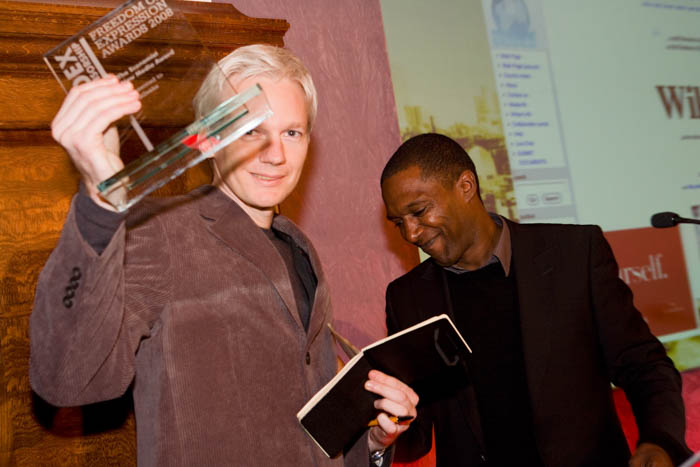
Assange and WikiLeaks won The Economist New Media Award
at the 2008 Freedom of Expression Awards. (Index on Censorship)

Stefania Maurizi: I started working with WikiLeaks in 2009 when very few people knew about them. They hadn’t yet published important documents like “Collateral Murder” or the “War Logs.” I immediately saw that they were going to start a revolution. And that is what has happened: They have changed journalism. Their model of journalism spread and we see now leaks everywhere. We see this model of collaborative media partnership used by many media, like the Panama Papers Consortium.

In addition, you have to realize the importance of what they have revealed. They have revealed the true face of the wars in Afghanistan and Iraq. They have revealed the inner working of U.S. diplomacy, for example, how they put pressure on Italian prosecutors who were trying to convict a CIA agent responsible for the extraordinary renditions here in Italy. Or they published revelations of how the U.S. forced the Italian government to purchase a Lockheed jet fighter.

This information is now available to everyone. You can see how The Washington Post used emails to investigate the [Jamal] Khashoggi murder and they were able to do so because they had the courage to publish these files. Even in the case of the Panama Papers, only the journalists inside the partnership can access the original files. WikiLeaks made these files fully accessible to everyone, so that every journalist, ever activist, every scholar, every citizen can be empowered by this information free of charge. That is the revolution.

Dennis Bernstein: Chelsea Manning is now in jail, refusing to cooperate with the grand jury. This is someone who spent so much time in solitary confinement. One of the key collaborations had to do with the activities of the U.S. government in Central America, destabilizing, undermining governments. Now they say they never get involved. If you look at the documentation in the context of the current attempt by [U.S. Special Representative for Venezuela] Elliot Abrams to destabilize Venezuela, here comes WikiLeaks again.

Stefania Maurizi: Absolutely. Whenever we have a scandal, we can go to the WikiLeaks website and search for any pertinent information. The information they publish continues to inform the public. They are now paying a huge price. I myself feel guilty because I was able throughout the past 10 years to work on all these documents, to verify them and publish them without any risk.

Julian and WikiLeaks are paying a huge price and all the editors are silent. People accuse me of acting as an activist. I am not acting as an activist, I am speaking out because I feel uncomfortable when I see how professional journalists have all sorts of protection and are not facing imprisonment or extradition.

Randy Credico: The last time I saw you was in December of 2017. I had seen Julian three months earlier and his health had declined noticeably in those few months. Now that he is in jail, is he able to see doctors? What is his physical health like at this point?

Stefania Maurizi: I am not sure whether he is able to see visitors. It is a very strict regime, there are very strict rules for suspected terrorists. He spends most of his time completely alone. This comes after spending the last seven years at the embassy almost entirely alone, apart from occasional visits. So you can imagine how his forced isolation is affecting his health.


 (FNPI via Flickr)

Randy Credico: I look at the sentence that judge Deborah Taylor handed down: a year in jail for allegedly skipping bail. Can you go into the bogus charges that were never filed against Julian, and how they were perpetuated with the assistance of the Crown Prosecution Service?

Stefania Maurizi: Five years had passed since the Swedish case was closed. No journalistic organization had ever tried to access these documents. Thousands of journalists had covered the case but no one had the facts clear. At that point I realized that it was important from a journalistic point of view to try to access the documentation. These documents allow us to establish important facts, such as that it was the U.K. that advised the Swedish prosecutors against questioning Assange in London.

The whole case began with this refusal by the Swedish prosecutor. Now we know that behind this decision there was the Crown Prosecution Service. Let’s not forget that this agency is the very same agency which is in charge of deciding whether to extradite Julian Assange to the U.S. now. The Crown Prosecution Service entered the case at the very beginning and they advised the Swedish prosecutor against questioning Assange in London. Julian Assange never refused to be questioned, he refused to be extradited because he was convinced that the extradition to Sweden could pave the way for his extradition to the U.S.

Now we see that he was right.

And it was the Crown Prosecution Service which advised the Swedish prosecutor against dropping the case in 2013. At that time the Swedish prosecutor conceded to drop the case but the Crown Prosecution Service advised them against this.

Finally, it was the Crown Prosecution Service who destroyed crucial emails about the case, even though the case is still ongoing. I am still fighting in the U.K. tribunal because I want to access these documents and fill in the gaps. Now the Swedish prosecutor is evaluating whether to open this case once again. The statute of limitations is in August 2012. There is a massive campaign about Julian being a rapist. After one or two years of this campaign, who will care about Julian Assange being extradited to the U.S.? That is a possible scenario.

Dennis Bernstein: Again, Julian had his first hearing today [May 2, 2019] regarding extradition to the United States. He looked okay but he is definitely in danger. Stefania, what responsibility do we have as journalists to stand up? According to Daniel Ellsberg, if they go after Julian and Chelsea the way they want to in the United States, it is the end of journalism.

Stefania Maurizi: Absolutely. This case is about whether the press is allowed to publish documents like the video “Collateral Murder,” which records war crimes and whether the press is allowed to publish documents about the NSA spying on world leaders, whether the press is allowed to publish documents on Guantanamo Bay.

We saw what happened after 9/11: habeas corpus came to an end with Guantanamo, the Fourth Amendment [of the U.S. Constitution] was trampled by the NSA. Now they want to destroy the First Amendment and they will do it using Julian Assange. They will not go after The New York Times or The Washington Post.

Dennis Bernstein: Wouldn’t you say that part of the genius of WikiLeaks was the ability to guarantee anonymity?
The reason why Assange has been successful and all these major journalistic organizations were willing to work with him is because of this process he created to guarantee anonymity.

Stefania Maurizi: Julian Assange understands technology and he understands the nature of power. Most geeks know very little about power, about empire. Thanks to his knowledge in the technology field, we have this platform. But let’s not forget that WikiLeaks is in trouble now not because they have this platform, but because they have the courage to publish.

It is not enough to get the documents. Most newsrooms hide such documents. One of the journalists at The Washington Post had the video “Collateral Murder” and he didn’t publish it. WikiLeaks did. It is not enough to have the platform: you have to have the integrity and the courage to publish. The New York Times didn’t publish the important story that the NSA was intercepting the communications of U.S. citizens.

 For years The New York Times didn’t want to use the word “torture,” preferring instead “enhanced interrogation.” The reason the U.S. authorities are hostile toward WikiLeaks and Julian Assange is because they publish what the U.S. media and many other media don’t want to publish.

Dennis Bernstein: Would you like to do a shout-out from one courageous woman there in Italy to a woman who became a woman in solitary confinement and was arrested again on International Women’s Day?

Stefania Maurizi: I feel a huge debt of gratitude because I have worked on Chelsea Manning’s documents for years. I supported her defense fund, I wrote to her in prison. I have tried to explain to my readers why she is tremendously courageous. I really would like to see her go free because I cannot accept that one of the most important journalistic sources of all time is again in prison.

Dennis Bernstein: Both Randy and I are extremely grateful for your work, Stefania Maurizi, investigative journalist for la Repubblica and author of “Dossier WikiLeaks,” which describes the power of a courageous publisher like Julian Assange, who has worked with extraordinary sources to get information out which we would otherwise never have heard.

Dennis J. Bernstein is a host of “Flashpoints” on the Pacifica radio network and the author of “Special Ed: Voices from a Hidden Classroom.” You can access the audio archives at Flashpoint. You can get in touch with the author at dbernstein@igc.org.

Randy Credico is an American perennial political candidate, comedian, radio host, activist and the former director of the William Moses Kunstler Fund for Racial Justice.

Please Make a Donation to Our

Spring Fundraising Drive Today!

Gunning for Gabbard: "Left" & Right Media Agree to Disagree with Anti-Interventionist Candidate

Corporate Media Target Gabbard for Her Anti-Interventionism—a Word They Can Barely Pronounce

by Owen Walsh - FAIR


May 8, 2019

Featured image: Tulsi Gabbard on CNN‘s Van Jones Show (1/12/19).

Presidential hopeful Tulsi Gabbard has not garnered much press coverage since announcing her bid on February 2; she’s the 13th-most-mentioned Democratic candidate on TV news, according to FAIR’s most recent count (4/14/19).

But when corporate media do talk about the Hawaii congressmember, they tend to reveal more about themselves than about her.


Tulsi Gabbard being challenged on The View (2/20/19) by Ana Navarro:
“Why are you so against intervention in Venezuela?”

A veteran of the Iraq War, Gabbard is centering her presidential campaign around anti-interventionism (2/3/19): the belief that US interference in foreign countries, especially in the form of regime-change wars, increases the suffering of the citizens in those countries.

When corporate outlets talk about this anti-interventionist position, they primarily use it to negatively characterize the candidates who espouse it. Few in establishment media seem interested in going any deeper or considering the veracity of arguments raised by anti-interventionists.

The Washington Post (1/15/19) listed Gabbard’s anti-interventionism as a factor that hurts her electability in a video titled, “Why Some See Tulsi Gabbard as a Controversial 2020 Candidate.” Part of the video’s explanation: “The congresswoman has raised concern among Democrats in the past when she criticized Obama’s strategy on Iran, ISIS and Syria.”

CBS News (2/4/19) briefly interviewed Honolulu Civil Beats reporter Nick Grube regarding Gabbard’s campaign announcement. The anchors had clearly never encountered the term anti-interventionism before, struggling to even pronounce the word, then laughing and saying it “doesn’t roll off the tongue.”

When asked to define the candidate’s position, Grube equated it to President Trump’s foreign policy. But “America First” rallying cries aside, it hardly seems accurate to call Trump an anti-interventionist, given his administration’s regime change efforts in Venezuela, his unilateral reimposition of sanctions on Iran (FAIR.org, 5/2/19) and his escalation of the drone wars (Daily Beast, 11/25/18).

When Gabbard appears on talkshows, she is typically on the receiving end of baseless questions coated in assumptions of military altruism. Gabbard appeared on ABC’s The View (2/20/19) and articulated her argument that US intervention does more harm than good to the people purportedly being helped.

Rather than respond to any of the points she raised, however, the hosts resorted to the kinds of shallow questions that have been supporting interventionism for decades.

Sunny Hostin asked, “So should we not get involved when we see atrocities abroad?” Fellow panelist Ana Navarro elaborated:

“I’m very troubled by the tweets about Venezuela that you’ve put out…. [Maduro] is not allowing humanitarian aid, he is a thug, he is a dictator, he is corrupt. And I am very supportive of what the United States is doing right now…. Why are you so against intervention in Venezuela?

Tulsi Gabbard being asked by CBS‘s Stephen Colbert (3/11/19) why
she doesn’t see the US as a “force for good in the world.”

On CBS’s Late Show With Stephen Colbert (3/11/19), the host resorted to old-fashioned American exceptionalism and Cold War–style paranoia to counter the congressmember:

“Nature abhors a vacuum. If we are not involved in international conflicts, or trying to quell international conflicts, certainly the Russians and the Chinese will fill that vacuum…. That might destabilize the world, because the United States, however flawed, is a force for good in the world, in my opinion.

Comments like these may seem harmless; why not, after all, fight “atrocities”? In fact, they contain the same language that media have used for decades to justify interventionism and quiet dissenters.

Colbert’s exceptionalism argument, in particular, is reminiscent of the centuries-old vision of the US as a “shining city upon a hill.” It’s also a frame historically employed by media to rationalize the country’s foreign policy. As communications scholar Andrew Rojecki wrote in his 2008 research article (Political Communication, 2/4/08) on elite commentary of George W. Bush’s military interventions in Afghanistan and Iraq,

“Over the course of the two crises, American exceptionalist themes made up a constant background presence in elite commentary and opinion.”

In other words, the assurance that Colbert has that the US has been “a force for good in the world” has paved the way for some of the greatest disasters of the modern world, including the 17-year-old war in Afghanistan (or almost 40 years, if you date from the US deliberately provoking the 1979 Soviet intervention) and the half-million-plus killed in the Iraq War.

Other difficult cases for proponents of intervention include Libya, where removing an authoritarian ruler devastated the nation and brought back slave markets, and Syria, where hawks evade responsibility for the hundreds of thousands killed in a US-backed effort to overthrow the government by pretending that the US has failed to intervene.

Currently, in Venezuela, where Navarro is “very supportive of what the United States is doing,” Washington has imposed sanctions that are blamed for killing 40,000 in the last two years (CEPR, 4/25/19). Meanwhile, the US offers as a publicity stunt a convoy with “humanitarian aid” valued at less than 1 percent of the assets it has blocked Venezuela from spending.


Fox News screenshot from a Washington Post video (1/15/19) titled
“Why Some See Tulsi Gabbard as a Controversial 2020 Candidate.”

Another easy to way to discredit anti-war critics is to accuse them of siding with the enemy (FAIR.org, 4/1/06).

So it’s not much of a surprise that when Gabbard gets mentioned in establishment news, a comment about her meeting with Syrian President Bashar al-Assad is usually soon to follow.

Gabbard traveled to Syria in 2017, on what her office called a “fact-finding mission.” During her trip, she met and spoke with al-Assad, prompting the media to question her loyalties ever since, equating her meeting to tacit support of his regime. (Gabbard calls Assad a “brutal dictator,” but says US efforts to overthrow his government are “illegal and counterproductive.”)

New York Times columnist Bari Weiss appeared on the popular Joe Rogan Experience podcast (1/21/19) and confidently called Gabbard an “Assad toadie.” When Rogan asked her what “toadie” meant, she couldn’t define the word, asking the show’s producer to look it up for her. (It means “sycophant”).

The New York Times (1/11/19) and Associated Press (Washington Post, 5/2/19) both identified Gabbard’s meeting with Assad as a factor that made her a controversial candidate. In an article about Gabbard’s apparent fall from grace within the Democratic party, Vox (1/17/19) characterized Gabbard’s opposition to the funding of Syrian rebels as “quasi-support for Syrian President Bashar al-Assad, the dictator responsible for the outbreak of the Syrian civil war and the conflict’s worst atrocities.”

Interviewers from MSNBC’s Morning Joe, ABC’s The View, CBS’s Late Show and CNN’s Van Jones Show all asked Gabbard to justify her meeting with Assad, or pressured her to renounce him as an enemy. None were interested in asking even the most basic question of substance,

“What did you and Assad talk about during your meeting?” 

The implication is clear: When it comes to those designated by the state as official enemies, communication is suspect.

So perhaps the simplest explanation for corporate media’s treatment of Gabbard is that she opposes the kind of intervention that they have historically been complicit in.

FAIR (e.g, 4/91, 3/19/07, 8/11) has documented mainstream media’s consistent support for US intervention across the globe. FAIR has also been documenting corporate media’s support for intervention in Venezuela, finding recently that zero percent of elite commentators opposed regime change in that country (4/30/19) and noting corporate media’s harsh admonishment of Bernie Sanders after he tepidly questioned US intervention in Venezuela (3/5/19).

Gabbard’s campaign is just one small piece of a larger phenomenon in the mainstream media: Space for dissenting opinions on the US’s neoliberal, interventionist foreign policies must not be allowed.