Friday, May 10, 2019

Monsanto, Bayer and the Vultures of Venezuela

How GMO Seeds and Monsanto/Bayer’s “RoundUp” are Driving US Policy in Venezuela

by Whitney Webb - MintPress News 

via Aletho

May 6, 2019

CARACAS, VENEZUELAAs the political crisis in Venezuela has unfolded, much has been said about the Trump administration’s clear interest in the privatization and exploitation of Venezuela’s oil reserves, the largest in the world, by American oil giants like Chevron and ExxonMobil.

Yet the influence of another notorious American company, Monsanto — now a subsidiary of Bayer — has gone largely unmentioned.

While numerous other Latin American nations have become a “free for all” for the biotech company and its affiliates, Venezuela has been one of the few countries to fight Monsanto and other international agrochemical giants and win.

However, since that victory — which was won under Chavista rule — the U.S.-backed Venezuelan opposition has been working to undo it.
"Vulture" Capitalist, Paul Singer
smelling an opportunity

Now, with Juan Guaidó’s parallel government attempting to take power with the backing of the U.S., it is telling that the top political donors of those in the U.S. most fervently pushing regime change in Venezuela have close ties to Monsanto and major financial stakes in Bayer.

In recent months, Monsanto’s most controversial and notorious product — the pesticide glyphosate, branded as Roundup, and linked to cancer in recent U.S. court rulings — has threatened Bayer’s financial future as never before, with a litany of new court cases barking at Bayer’s door. It appears that many of the forces in the U.S. now seeking to overthrow the Venezuelan government are hoping that a new Guaidó-led government will provide Bayer with a fresh, much-needed market for its agrochemicals and transgenic seeds, particularly those products that now face bans in countries all over the world, including once-defoliated and still-poisoned Vietnam.

U.S.-Backed Venezuelan opposition seeks to reverse Chavista seed law and GMO ban


In 2004, then-president of Venezuela, Hugo Chávez, surprised many when he announced the cancellation of Monsanto’s plans to plant 500,000 acres of Venezuelan agricultural land in genetically modified (GM) soybeans. The cancellation of Monsanto’s Venezuela contract led to what became an ad hoc ban on all GM seeds in the entire country, a move that was praised by local farmer groups and environmental activists. In contrast to anti-GM movements that have sprung up in other countries, Venezuela’s resistance to GM crops was based more on concerns about the country’s food sovereignty and protecting the livelihoods of farmers.

Although the ban has failed to keep GM products out of Venezuela — as Venezuela has long imported a majority of its food, much of it originating in countries that are among the world’s largest producers of genetically modified foods — one clear effect has been preventing companies like Monsanto and other major agrochemical and seed companies from gaining any significant foothold in the Venezuelan market.

In 2013, a new seed law was nearly passed that would have allowed GM seeds to be sold in Venezuela through a legal loophole. That law, which was authored by a member of the Chavista United Socialist Party of Venezuela (PSUV), was widely protested by farmers, indigenous activists, environmentalists, and eco-socialist groups, which led to the law’s transformation into what has been nicknamed the “People’s Seed Law.”


That law, passed in 2015, went even farther than the original 2004 ban by banning not just GM seeds but several toxic agrochemicals, while also strengthening heirloom seed varieties through the creation of the National Seed Institute.

Soon after the new seed law was passed in 2015, the U.S.-backed Venezuelan opposition led by the Roundtable of Democratic Unity (MUD) — a group comprised of numerous U.S.-funded political parties, including Guaidó’s Popular Will — took control of the country’s National Assembly. Until Venezuela’s Supreme Court dissolved the assembly in 2017, the MUD-legislature attempted to repeal the seed law on several occasions. Those in favor of the repeal called the seed bill “anti-scientific” and damaging to the economy.

Despite the 2017 Supreme Court decision, the National Assembly has continued to meet, but the body holds no real power in the current Venezuelan government. However, if the current government is overthrown and Guaidó — the “interim president” who is also president of the dissolved National Assembly — comes to power, it seems almost certain that the “People’s Seed Law” will be one of the first pieces of legislation on the chopping block.

The AEI axis


Some of the key figures and loudest voices supporting the efforts of the Trump administration to overthrow the Venezuelan government in the United States are well-connected to one particular think-tank, the American Enterprise Institute (AEI). For instance, John Bolton — now Trump’s national security advisor and a major player in the administration’s aggressive Venezuela policy — was a senior fellow at AEI until he became Trump’s top national security official. As national security adviser, Bolton advises the president on foreign policy and issues of national security while also advising both the Secretary of State and the Secretary of Defense. As of late, he has been pushing for military action in Venezuela, according to media reports.

Another key figure in Trump’s Venezuela policy — Elliott Abrams, the State Department’s Special Representative for Venezuela — has been regularly featured at AEI summits and as a guest on its panels and podcasts. According to Secretary of State Mike Pompeo, Abrams’ current role gives him the “responsibility for all things related to our efforts to restore democracy” in Venezuela.

Other top figures in the administration, including Vice President Mike Pence and Secretary of State Mike Pompeo, were featured guests at the AEI’s “secretive” gathering in early March. As MintPress and other outlets have reported, Guaidó declared himself “interim president” of Venezuela at Pence’s behest. Pompeo is also intimately involved in directing Trump’s Venezuela policy as the president’s main adviser on foreign affairs.

Other connections to the Trump administration include Secretary of Education Betsy DeVos who was previously on AEI’s board of trustees.

AEI has long been a key part of the “neoconservative” establishment and employs well-known neoconservatives such as Fred Kagan — the architect of the Iraq “troop surge” — and Paul Wolfowitz, the architect of the Iraq War. Its connections to the George W. Bush administration were particularly notable and controversial, as more than 20 AEI employees were given top positions under Bush. Several of them, such as Bolton, have enjoyed new prominence in Trump’s administration.

Other key Bush officials joined the AEI soon after leaving their posts in the administration. One such was Roger Noriega, who was the U.S. representative to the Organization of American States (OAS) during the failed, U.S.-backed 2002 coup and went on to be assistant secretary of state for Western Hemisphere affairs from 2003 to 2005, where he was extremely influential in the administration’s policies towards Venezuela and Cuba.

Since leaving the Bush administration and promptly joining the AEI, Noriega has been instrumental in pushing claims that lack evidence but aim to paint Venezuela’s current President Nicolas Maduro-led government as a national security threat, such as claiming that Venezuela is helping Iran acquire nuclear weapons and hosts soldiers from Lebanon’s Hezbollah. He also lobbied Congress to support Venezuelan opposition leader Leopoldo López, Guaidó’s political mentor and leader of his political party, Popular Will.

Not only that, but Noreiga teamed up with Martin Rodil, a Venezuelan exile formerly employed by the IMF, and José Cardenas, who served in the Bush administration, to found Visión Américas, a private risk-assessment and lobbying firm that was hired to “support the efforts of the Honduran private sector to help consolidate the democratic transition in their country” after the U.S.-backed Honduran coup in 2009. In recent months, Noriega and his associates have been very focused on Venezuela, with Cardenas offering Trump public advice about how “to hasten Maduro’s exit,” while Rodil has publicly offered “to get you a deal” if you have dirt on Venezuela’s government.

While the AEI is best known for its hawkishness, it is also a promoter of big agricultural interests. Since 2000, It has hosted several conferences on the promise of “biotechnology” and genetically modified seeds and has heavily promoted the work of former Monsanto lobbyist Jon Entine, who was an AEI visiting fellow for several years. The AEI also has long-time connections to Dow Chemical.

The most likely reason for the AEI’s interest in promoting biotech, however, can be found in its links to Monsanto. In 2013, The Nation acquired a 2009 AEI document, obtained through a filing error and not intended for public disclosure, that revealed the think tank’s top donors. The form, known as the “schedule of contributors,” revealed that the AEI’s top two donors at the time were the Donors Capital Fund and billionaire Paul Singer.


The Donors Capital Fund, which remains a major contributor to the AEI, is linked to Monsanto interests through the vice chairman of its board, Kimberly O. Dennis, who is also currently a member of the AEI’s National Council. According to AEI, the National Council is composed of “business and community leaders from across the country who are committed to AEI’s success and serve as ambassadors for AEI, providing us with advice, insight, and guidance.”

Dennis is the long-time executive chairwoman of the Searle Freedom Trust, which was founded in 1988 by Daniel Searle after he oversaw the sale of his family pharmaceutical company — G.D. Searle and Company — to Monsanto in 1985 for $2.7 billion. The money Searle had made from that merger was used to fund the trust that now funds the AEI and other right-wing think tanks. Searle was also close to Donald Rumsfeld, who led G.D. Searle and Co. for years and was Secretary of Defense under Gerald Ford and George W. Bush. Searle was also a trustee of the Hudson Institute, which once employed Elliott Abrams.

After the family company — which gained notoriety for faking research about the safety of its sweetener, aspartame or NutraSweet — was sold to Monsanto, G.D. Searle executives close to Daniel Searle rose to prominence within the company. Robert Shapiro, who was G.D. Searle’s long-time attorney and head of its NutraSweet division, would go on to become Monsanto’s vice president, president and later CEO. Notably, Daniel Searle’s grandson, D. Gideon Searle, was an AEI trustee until relatively recently.

Why is a top donor to Marco Rubio increasing his stake in Bayer while others flee?


Yet, it is AEI’s top individual donor noted in the accidental “schedule of contributors” disclosure who is most telling about the private biotech interests guiding the Trump administration’s Venezuela policy. Paul Singer, the controversial billionaire hedge fund manager, has long been a major donor to neoconservative and Zionist causes — helping fund the Foreign Policy Initiative (FPI), the successor to the Project for a New American Century (PNAC); and the neoconservative and islamophobic Foundation for the Defense of Democracies (FDD), in addition to the AEI.

Singer is notably one of the top political donors to Senator Marco Rubio (R-FL) and has been intimately involved in the recent chaos in Venezuela. He has been called one of the architects of the administration’s current regime-change policy, and was the top donor to Rubio’s presidential campaign, as well as a key figure behind the controversial “dossier” on Donald Trump that was compiled by Fusion GPS. Indeed, Singer had been the first person to hire Fusion GPS to do “opposition research” on Trump.

However, Singer has largely since evaded much scrutiny for his role in the dossier’s creation, likely because he became a key donor to Trump following his election win in 2016, giving $1 million to Trump’s inauguration fund.

Singer has a storied history in South America, though he has been relatively quiet about Venezuela. However, a long-time manager of Singer’s hedge fund, Jay Newman, recently told Bloomberg that a Guaidó-led government would recognize that foreign creditors “aren’t the enemy,” and hinted that Newman himself was weighing whether to join a growing “list of bond veterans [that have] already begun staking out positions, anticipating a $60 billion debt restructuring once the U.S.-backed Guaidó manages to oust President Nicolas Maduro and take control.” In addition, the Washington Free Beacon, which is largely funded by Singer, has been a vocal advocate for the Trump administration’s regime-change policy in Venezuela.

Beyond that, Singer’s Elliott Management Corporation gave Roger Noriega, the former assistant secretary of state for Western Hemisphere affairs under Bush, $60,000 in 2007 to lobby on the issue of sovereign debt and for “federal advocacy on behalf of U.S. investors in Latin America.” During the time Noriega was on Singer’s payroll, he wrote articles linking Argentina and Venezuela to Iran’s nonexistent nuclear program. At the time, Singer was aggressively pursuing the government of Argentina in an effort to obtain more money from the country’s prior default on its sovereign debt.

While Singer has been mum himself on Venezuela, he has been making business decisions that have raised eyebrows, such as significantly increasing his stake in Bayer. This move seems at odds with Bayer’s financial troubles, a direct result of the slew of court cases regarding the link between Monsanto’s glyphosate and cancer. The first ruling that signaled trouble for Monsanto and its new parent company Bayer took place last August, but Singer increased his stake in the company starting last December, even though it was already clear by then that Bayer’s financial troubles in relation to the glyphosate court cases were only beginning.

Since the year began, Bayer’s problems with the Monsanto merger have only worsened, with Bayer’s CEO recently stating that the lawsuits had “massively affected” the company’s stock prices and financial performance.

Forcing open a new market for RoundUp


Part of Singer’s interest in Bayer may relate to Venezuela, given that Juan Guaido’s “Plan País” to “rescue” the Venezuelan economy includes a focus on the country’s agricultural sector. Notably, prior to and under Chavismo, agricultural productivity and investment in the agricultural sector took a backseat to oil production, resulting in under 25 percent of Venezuelan land being used for agricultural purposes despite the fact that the nation has a wealth of arable land. The result has been that Venezuela needs to import much of its food from abroad, most of which originate in Colombia or the United States.

Under Chávez and his successor, Maduro, there has been a renewed focus on small-scale farming, food sovereignty and organic agriculture. However, if Maduro is ousted and Guaidó moves to implement his “Plan País,” the opposition’s coziness with foreign corporations, the interests of U.S. coup architects in Bayer/Monsanto, and the opposition’s past efforts to overturn the GM seed ban all suggest that a new market for Bayer/Monsanto products — particularly glyphosate — will open up.

South America has long been a key market for Monsanto and — as the company’s problems began to mount prior to the merger with Bayer — it became a lifeline for the company due to less stringent environmental and consumer regulations than many Western countries. In recent years, when South American governments have opened their countries to more “market-friendly” policies in their agricultural sectors, Monsanto has made millions.

For instance, when Brazil sought to expand biotechnology (i.e. GM seed) investment in 2012, Monsanto saw a 21% increase in its sales of GM corn seed alone, generating an additional $1 billion in profits for the company. A similar comeback scenario is needed more than ever by Bayer/Monsanto, as Monsanto’s legal troubles saw the company’s profits plunge late last year.

With countries around the world now weighing glyphosate bans as a result of increased litigation over the chemical’s links to cancer, Bayer needs a new market for the chemical to avoid financial ruin. As Singer now has a significant stake in the company, he — along with the politicians and think tanks he funds — may see promise in the end of the anti-GM seed ban that a Guaidó-led government would bring.

Furthermore, given that Guaidó’s top adviser wants the Trump administration to have a direct role in governing Venezuela if Maduro is ousted, it seems likely that Singer would leverage his connections to keep Bayer/Monsanto afloat amid the growing controversy surrounding glyphosate. Such behavior on the part of Singer would hardly be surprising in light of the fact that international financial media have characterized him as a “ruthless opportunist” and “overly aggressive.”

Such an outcome would be in keeping with the increased profit margins for Monsanto and related companies that have followed its expansion into countries following U.S.-backed coups. For instance, after the U.S.-backed coup in Ukraine in 2014, the loans given to Ukraine by the International Monetary Fund and the World Bank forced the country to open up and expand the use of “biotechnology” and GM crops in its agricultural sector, and Monsanto, in particular, made millions as the prior government’s ban on GM seeds and their associated agrochemicals was reversed.

If Maduro is ousted, a similar scenario is likely to play out in Venezuela, given that the Guaidó-led government made known its intention to borrow heavily from these institutions just days after Guaidó declared himself “interim president.”

Whitney Webb is a MintPress News journalist based in Chile. She has contributed to several independent media outlets including Global Research, EcoWatch, the Ron Paul Institute and 21st Century Wire, among others. She has made several radio and television appearances and is the 2019 winner of the Serena Shim Award for Uncompromised Integrity in Journalism.
Kieran Barr contributed to the research used in this report.

One Month in Belmarsh: May 10 Vigil for Julian Assange

One Month in Belmarsh: 29th Vigil for Julian Assange Live at 4 PM EDT

by Consortium News


May 10, 2019

Join us for a live discussion online on the latest news about Julian Assange, who has now spent one month behind bars in London.

https://unity4j.com/

 Live stream link to come.

https://www.youtube.com/watch?v=YTOYQUqUbQM&feature=youtu.be

Another Whistleblower Blown by The Intercept

Trump Continues Obama’s War On Whistleblowers, Arrests Another Alleged Intercept Source

by Caitlin Johnstone - Rogue Journalist


May 10, 2019

New drone whistleblower at The Intercept,” tweeted the outspoken CIA whistleblower John Kiriakou, (left) in October 2015.

“For God’s sake don’t let @MatthewACole learn his identity.”

Intercept investigative reporter Matthew Cole has been tied both to Kiriakou’s discovery and prosecution and to that of Reality Winner, who leaked classified documents to The Intercept in 2017. Kiriakou’s comment came after the first in a series of articles was published in The Intercept titled “The Drone Papers” by Jeremy Scahill on October 15, 2015.

Today, the alleged source of this report has been arrested, the third alleged Intercept source to have been prosecuted by the Trump administration.

Former US Air Force language analyst Daniel Hale has been arrested and charged with violating the Espionage Act and other offenses related to leaking classified documents to the press. Court documents didn’t reveal the identity of the journalist who received the documents, but AP reports that “details in the indictment make clear that Jeremy Scahill, a founding editor of The Intercept, is the reporter who received the leaks.”

“The source said he decided to provide these documents to The Intercept because he believes the public has a right to understand the process by which people are placed on kill lists and ultimately assassinated on orders from the highest echelons of the U.S. government,” Scahill’s 2015 article reads, quoting his source as saying,

“This outrageous explosion of watchlisting — of monitoring people and racking and stacking them on lists, assigning them numbers, assigning them ‘baseball cards,’ assigning them death sentences without notice, on a worldwide battlefield — it was, from the very first instance, wrong.”
“The person who leaked these documents to The Intercept revealed that the government classified anybody killed by U.S. drone strikes—even if they weren’t the target—as militants, and that’s how they were able to insist that civilians weren’t being killed in significant numbers,” reports Reason‘s Scott Shackford.


Hale’s arrest has understandably brought harsh criticism against The Intercept for losing yet another source to federal prosecutors. In addition to Hale and Reality Winner, former FBI officer Terry James Albury was sentenced to four years in prison for leaking documents to The Intercept on the Hooveresque powers that the FBI has given itself in the wake of 9/11. It is absolutely right that people should be asking questions of a billionaire-funded outlet which keeps losing sources despite a solemn promise of source protection, and that discussion should continue to happen.

What in my opinion hasn’t received enough attention as of this writing, and what is far more dangerous than one moderate-sized outlet failing to protect its sources, is the fact that a US president is continuing and expanding on his predecessor’s unprecedented war on whistleblowers.

“The Trump admin is on pace to shatter the record for the most prosecutions of journalistic sources,” reads a statement by the Freedom of the Press Foundation.

“Hale is at least the sixth alleged journalistic source charged by the Trump administration in just over two years in office. The Justice Department has previously indicated dozens more leak investigations are ongoing.”

“Prosecuting journalistic sources chills investigative reporting and poses an enormous threat to whistleblowers, press freedom rights, and the public’s right to know,” explained Freedom of the Press Foundation Executive Director Trevor Timm.

“Whistleblowers should be lauded for their courage, not charged with felonies and imprisoned. The Trump administration is on pace to shatter the Obama administration’s record for the number of prosecutions of alleged sources, and everyone who cares about brave national security reporting should loudly condemn Hale’s arrest.”

“If the allegations are true, the U.S. government is prosecuting another whistleblower in its zeal to crackdown on leaks and control the flow of information, particularly on national security matters,” explains Kevin Gosztola in a very thorough article for Shadowproof.

“They are also criminalizing another source, who provided information to The Intercept.”

http://archive.is/tPAZJ

You’d never know it from the debates in the mass media on both sides of America’s imaginary partisan divide, but the real story isn’t in the differences between Trump and his predecessors. It’s in the similarities.

Barack Obama made a promise to protect whistleblowers and have the most transparent administration in history, which was very well-received by the public after the frightening Orwellian advancements of George W Bush. People understood that in order for democracy to exist, the public needs to be able to see what its government is doing in all possible ways, and the prospect of a president who would give that to them made a lot of people feel hopeful. Obama then he went on to prosecute more whistleblowers than all previous administrations combined, and his successor, despite all the partisan chatter about how wildly different the two presidents are, is following right in his footsteps.

Information about targeted drone assassinations and distortions of civilian casualties are things the US government had no business keeping from its people in the first place. These are taxpayer-funded actions, and taxpayers have a right and a need to know that this sort of thing is being done with their money. The US government isn’t prosecuting someone who allegedly blew the whistle on this because he endangered national security in any way; clearly it did not. This was not a matter of national security, it was a matter of government embarrassment and inconvenience. That is not a legitimate reason to try to make an example of someone for revealing the truth about it. We should not accept that this is the kind of society that we’ll have to live in.

I mean, what do you do at this point if you’re someone who wants to blow the whistle on government malfeasance? Go to The Intercept, which keeps losing sources? Go to WikiLeaks, which the Trump administration has pledged to take down and whose founder is currently awaiting US extradition in Belmarsh Prison? A mainstream outlet like the New York Times, AP, Fox News, WikiLeaks, the Baltimore Sun, the Guardian, or the Washington Post, all of whom had sources prosecuted under Obama? The fact of the matter is that the deliberate intimidation of future whistleblowers will necessarily have its desired effect; many people who work with the US government will refrain from speaking out about atrocities they discover out of fear of spending years behind bars for doing the right thing.

At this point the only thing that will change this is the US populace rising up against its oppressive totalitarian rulers and ferociously demanding the transparency that it is entitled to from its government. This will continue to get worse until it’s forced to get better.

_________________

Everyone has my unconditional permission to republish or use any part of this work (or anything else I’ve written) in any way they like free of charge. My work is entirely reader-supported, so if you enjoyed this piece please consider sharing it around, liking me on Facebook, following my antics on Twitter, throwing some money into my hat on Patreon or Paypal, purchasing some of my sweet merchandise, buying my new book Rogue Nation: Psychonautical Adventures With Caitlin Johnstone, or my previous book Woke: A Field Guide for Utopia Preppers. The best way to get around the internet censors and make sure you see the stuff I publish is to subscribe to the mailing list for my website, which will get you an email notification for everything I publish. For more info on who I am, where I stand, and what I’m trying to do with this platform, click here.


Bitcoin donations:
1Ac7PCQXoQoLA9Sh8fhAgiU3PHA2EX5Zm2

Assange Case a Crucible for America's Conscience

Assange’s US Extradition Battle: The Fight to Defend the Conscience of America 

by Nozomi Hayase - CounterPunch


May 10, 2019

It has been over three weeks since Ecuador illegally terminated political asylum of WikiLeaks founder Julian Assange and the UK police violently arrested him. Assange is now held in solitary confinement in what many have called the UK’s Guantanamo Bay. On Thursday, Assange’s fight against US extradition began at a UK court. The US charged him with conspiracy to commit computer intrusion with former US military intelligence analyst Chelsea Manning related to the 2010 release of classified material. His extradition was framed as a case about “hacking”.

But, let’s make this clear. Assange was charged for doing journalism, publishing information critical for democracy in the public interest, at a scale and speed that was unprecedented. Although the Department of Justice press release on the indictment accuses him of hacking a government computer, the actual indictment accuses him for protecting the anonymity of his source.

This indictment against Assange signals the criminalization of journalism, specifically punishing critical aspects of journalistic practice, related to a story gathering for a newsworthy story published in the public interest. The criminal investigation into WikiLeaks began in 2010. It was part of Obama’s aggressive war on whistleblowers. Now, the Trump administration carries on this legacy, by expanding a combat zone to include journalists as their target. But this is more than an attack on press freedom.

WikiLeaks exposed the US government’s illegal wars, dirty trade deals, spying, and its secret offshore prison and torture. These documents that they published with a pristine record of accuracy, were not just information. It was her conscience that called Chelsea Manning to engage in a search for moral clarity, as she watched the scenery of a US military airstrike killing Iraqi civilians including journalists in New Baghdad. It was a tiny voice in a heart that remembered our inherent obligation to one another and awakened this young whistleblower to the truth described in her words, “we are human … and we’re killing ourselves …”.

This conscience that was brought forward by Manning and then amplified by WikiLeaks through their method of transparency shone the light into our history. The release of the collateral murder video didn’t just expose Bush’s war crimes. It revealed darkness inside this nation that goes all the way back to its very inception.

In the original 38-minute video footage that captured the everyday life of the brutal military occupation in the oil-rich Middle East, the colonization of the past was carried over. In the shadow of Iraqi civilians who are paralyzed under the US military gun sight, those who remain frozen in lost pages of history began to reveal themselves.

The cynical naming of the Apache helicopter evokes a memory of the killing of natives that took place long ago in the US. Through access to this forbidden view, made possible by WikiLeaks, we were given an opportunity to witness the historic crimes committed against the indigenous people of America.

In the uncensored images of modern war, what did we see? We saw our government violating the highest laws of the land. These were ideals that inspired America’s independence from the British monarchy, expressed in the words of Thomas Jefferson, “all men are created equal”.

America represented a new land for freedom-loving people around the world to come together in, to form a new union governed not by the King, but by a rule of law. Yet, despite these ideals, America was never a democracy. From the onset, it contained internal contradiction manifested in the genocide of natives, the slavery of blacks and the suppression of women. But the words in the Declaration of Independence were a promise and the Constitution was meant to be its fulfillment.

The conscience of ordinary people was a vital link that could fill the gap and create a democracy. Out of conscience springs the power of We the People that could truly perform checks and balances of our government. When the laws themselves become unjust, conscience reminds us of our duty to break these laws in order to uphold our ideals.

In our history, we have seen individuals who fought to keep those words of promise through their acts of civil disobedience. Dr. Martin Luther King, Jr, who demonstrated extraordinary courage for the struggle of Black people to fight against racist laws once said:

“Cowardice asks the question, ‘Is it safe?’ Expediency asks the question, ‘Is it politic?’ Vanity asks the question, ‘Is it popular?’ But, conscience asks the question, ‘It it right?’ And there comes a time when one must take a position that is neither safe, nor politic, nor popular, but one must take it because one’s conscience tells one that it is right.”

Decades after the civil rights movement, a young US soldier in her act of delivering information to WikiLeaks, risked her life to carry on this American tradition of civil disobedience. As a consequence, she was sentenced to 35 years in prison and served seven years until her sentence was commuted in 2017. Now, by refusing to testify against a publisher at a secret grand jury targeting WikiLeaks, she is once again sent back to jail.

After having witnessed Manning confessing her role as the WikiLeaks whistleblower at her court-martial, the late attorney Michael Ratner acknowledged how locking her up “for even a day is to lock up the conscience of our nation”.

Julian Assange is a journalist, but foremost, he is a defender of this America’s conscience. Now, the Department of Justice tries to punish him for his courageous act of providing protection to his source, by framing it as though he had conspired with his source to assist in espionage in order to hack into a Pentagon computer.

So, we are now clear what this US extradition case against Assange is all about. This prosecution of Assange and the detainment of Manning are assaults on our conscience. Vicious attacks came from both Republicans and Democrats. Rep. Peter King, a New York Republican, designated WikiLeaks as a terrorist organization. Former Vice President Joe Biden compared Assange to a “high-tech terrorist”, while California senator Dianne Feinstein urged that Assange be prosecuted for espionage.

Corporate media engages non-stop in smearing, depicting this Nobel Peace Prize nominee as a rapist and Putin’s intelligence asset. The former CIA chief and Trump’s Secretary of State, Mike Pompeo called WikiLeaks a hostile intelligence service. Now, using the rhetorical descriptions of “traitor” and “threat to national security”, the DOJ tries to extradite Assange and sentence him to life in prison or worse, to execute him.

But, who are the traitors? Who are those who engaged in conspiracy, working in secret to betray ideals promised in America’s proclamation of independence to the world?

WikiLeaks’ publication of documents concerning wars in Afghanistan and Iraq revealed the US government’s conspiracy to perpetuate racism in a War on Terror, with Muslim as the new Black. WikiLeaks’ release of the DNC and John Podesta emails pierced the veil of the illusion of an American democracy. It let us see that the Democratic establishment conspired against people, by secretly colluding to undermine Bernie Sanders during the primary and that the Hillary Clinton campaign strategy was to get friendly media to elevate “Pied Piper” GOP candidates like Donald Trump.

Their publication of Vault 7, the largest leak of confidential documents in CIA history revealed that the agency has developed cyber weapons that enable them to spy on us through smartphones and smart TVs. It exposed the intelligence community as a true ruling elite of our society, growing its power with surveillance, military occupation, and financial terrorism.

The US government, with the UK, Sweden and Spain as its allies, bullied a small South American nation to hand over Assange, who exposed the national security state and their conspiracy against people.

There is the other America we have forgotten, the America that has been here from the very beginning, before Columbus discovered this land. It is the heart of the earth that stretches its veins across four corners, sustaining the life of all living beings. This is the true America before it was assaulted by guns and canons and before it was occupied by the few.

By forgetting our own collateral murder, massacre, theft, treaty violations, and cultural genocide that happened on this soil, we have forgotten who we are. As our memory fragmented, We the People became a narrow tribe of Democrats and Republicans. By plunging into national and ideological battle, we wave flags to justify the killing of our brothers and sisters in the name of national security and together we engage in our self righteous destruction of this planet that we all inherit.

Chelsea Manning and Julian Assange reminded us of the highest law of the land inscribed in our hearts. They are real patriots who fought to secure Life, Liberty and the Pursuit of Happiness. With their love for humanity, they sacrificed their personal liberty so that these unalienable rights can be enjoyed by everyone around the world.

Now the beast of secret law tries to devour them. The conscience has no chance for a fair trial in the empire’s justice system. It is defenseless before the Espionage Act. For this vulnerable love of humanity, the public is the only line of defense.

Assange’s fight against extradition has just begun. He is fighting for his life, but also he is fighting for all of us. We now must join this battle to defend and free the conscience of America that has become imprisoned in this war on truth. We must become a shield for whistleblowers and publishers.

Only through us forming a court of public opinion, can we end this empire and its conspiracy and redeem the torch of liberty that this nation once held as a beacon of light for the world.
 
Nozomi Hayase, Ph.D., is a writer who has been covering issues of freedom of speech, transparency and decentralized movements. Find her on twitter @nozomimagine
More articles by:Nozomi Hayase 

Raising the Alarm: Tracking XR London

The London Climate Protests – Raising The Alarm

by Media Lens


09 May 2019
 
The feeling is often there at night, of course, in the wee small hours. But it can arise at almost any time – looking at someone we care about, listening to birdsong on an unusually warm spring morning, shopping.


It is like being trapped on a sinking ship, with the captain and crew refusing to admit that anything is wrong. The passengers are mostly oblivious, planning their journeys and lives ahead. Everything seems 'normal', but we know that everything will soon be at the bottom of the sea. Everything seems ordinary, familiar, permanent, but will soon be gone. It feels as if our happiness, our every moment spent with the people and places we love, is irradiated by the fear of impending climate collapse.

Last month, the Extinction Rebellion protests in London (and globally) finally challenged some aspects of this waking nightmare – at last, a sense that human beings are not completely insane, that we are capable of responding with some rationality and dignity. In the end, 1,100 people allowed themselves to be arrested, with 70 charged, for all our sakes.

While many people thrill to the prospect of pouring milkshake over political opponents, Extinction Rebellion proved, conclusively, once and for all, that non-violent protest is the superpower of democratic change. And this was not just non-violent protest; it was non-hating, rooted in love of the planet, love of people, love of life. The mystic Lao-Tzu wrote:

'Nothing in the world
is as soft and yielding as water.
Yet for dissolving the hard and inflexible,
nothing can surpass it.

'The soft overcomes the hard;
the gentle overcomes the rigid.'

The special forces in this compassionate revolution are the 83-year-old grandfather who spoke so eloquently atop a blocked train in Canary Wharf. They are the little children sitting quietly in the middle of Oxford Street, the mums with toddlers, and of course the extraordinary Greta Thunberg whose insight and intelligence have stunned many veteran climate activists.

Where the adults have been cautioning for years that we should not be too 'alarmist', too 'pessimistic' for fear of upsetting a lily-livered public, Thunberg has said simply:

'I want you to panic. I want you to act as if the house was on fire... To panic, unless you have to, is a terrible idea. But when your house is on fire and you want to keep your house from burning to the ground then that does require some level of panic.'

She is exactly right. In his recent BBC documentary, 'Climate Change: The Facts', 93-year-old David Attenborough missed 16-year-old Thunberg's point. The first half of Attenborough's film did an excellent job of drawing attention to the threats, but the second half was much too positive on the prospects for individual and collective action. It ended on a hopeful, reassuring note. It should have ended on a note of deep alarm and, yes, panic.

When governments seek to mobilise the public for action, they terrify us with tales of Huns bayonetting babies, of weapons of mass destruction ready to destroy us within 45 minutes. They do this because it works – people are willing to kill and be killed, if they think their own lives and those of the people they love are at stake.

We have always argued that climate scientists and activists should also emphasise the terrifying prospects – not in the dishonest, hyped way of state cynics, but honestly, sticking to the facts. When the science is punching great holes in the blind conceit of industrial 'progress' we should not pull our punches. Again, the Extinction Rebellion protests – the name makes the point - have powerfully vindicated this strategy. An opinion poll after the protests found:

'Two-thirds of people in the UK recognise there is a climate emergency and 76% say that they would cast their vote differently to protect the planet.'

John Sauven, executive director of Greenpeace UK, said the debate around environmentalism had been fundamentally altered:

'Climate activists, young and old, have put the UK government under enormous pressure to officially recognise the climate emergency we are facing. There is a real feeling of hope in the air that after several decades of climate campaigning the message is beginning to sink in. What we need now is to translate that feeling into action.'

As a result of this pressure, the UK last week became the first parliament to declare a climate emergency – previously unthinkable. Leading climate scientist, Professor Michael Mann, tweeted of the declaration:

'Yeah, there's a lot going on in the current news cycle. But this is undoubtedly the most important development of all'

Light-years beyond his Conservative opponents on this issue, Labour leader Jeremy Corbyn commented:

'We have no time to waste. We are living in a climate crisis that will spiral dangerously out of control unless we take rapid and dramatic action now.

'This is no longer about a distant future we're talking about nothing less than the irreversible destruction of the environment within our lifetimes of members of this house. Young people know this. They have the most to lose.'

By contrast, the voting record of Michael Gove, Secretary of State for Environment, Food and Rural Affairs, indicates that he 'Generally voted against measures to prevent climate change.' Prime Minister Theresa May has maintained a studied, shameful silence, clearly hoping the issue and the protests will go away. Action is clearly not on her agenda.

As if the climate crisis was not bad enough, a new UN report reveals that one million animal and plant species are now threatened with extinction. The world is experiencing a rate of destruction tens to hundreds of times higher than the average over the past 10 million years. Dr Kate Brauman, from the University of Minnesota, a lead author of the assessment, commented:

'We have documented a really unprecedented decline in biodiversity and nature, this is completely different than anything we've seen in human history in terms of the rate of decline and the scale of the threat.'

The following day, only two UK newspapers, (Guardian and i) led with the UN report on species extinction, most preferring to focus on a royal birth. The BBC News website featured no less than six stories about the royal baby before the headline, 'Humans "threaten 1m species with extinction".' This was a classic example of why Erich Fromm warned in his book 'The Sane Society', that it truly is possible for an entire society to be, in effect, insane.

Manufactured Dissent?


Without a sense of alarm, we will likely continue to be stifled by the huge campaign of corporate disinformation and outright lies designed to prevent profit-unfriendly actions. The key to the strategy to maintain public indifference was explained by Phil Lesley, author of a handbook on public relations:

'People generally do not favour action on a non-alarming situation when arguments seem to be balanced on both sides and there is a clear doubt. The weight of impressions on the public must be balanced so people will have doubts and lack motivation to take action. Accordingly, means are needed to get balancing information into the stream from sources that the public will find credible. There is no need for a clear-cut "victory". ... Nurturing public doubts by demonstrating that this is not a clear-cut situation in support of the opponents usually is all that is necessary.' (Lesly, 'Coping with Opposition Groups', Public Relations Review 18, 1992, p.331)

Given the need for a very clear alarm to counter this propaganda, it is disturbing, but not surprising, that critics on the left have joined with the likes of Lesly to attack the messengers trying to raise the alarm (unsurprising because the left has an extremely poor record on climate change. See our Cogitation.)

In her article, 'The Manufacturing of Greta Thunberg – for Consent: The Political Economy of the Non-Profit Industrial Complex' - which is intended to remind of Edward Herman and Noam Chomsky's classic work, 'Manufacturing Consent – The Political Economy of the Mass Media' – independent investigative journalist and environmental activist Cory Morningstar headlines a key claim at the top of the piece and throughout the very long, almost impenetrable mixture of text and screenshots that follows:

'In ACT I, I disclose that Greta Thunberg, the current child prodigy and face of the youth movement to combat climate change, serves as special youth advisor and trustee to the burgeoning mainstream tech start-up We Don't Have Time.'

The claim is that Thunberg was involved in launching new business opportunities to capitalise on green concerns. Morningstar mentions the 'We Don't Have Time' organisation involved in 'tech start-up' dozens of times in Act I of her piece alone. And yet, as Thunberg responded on Facebook in February:

'I was briefly a youth advisor for the board of the non profit foundation "We don't have time". It turns out they used my name as part of another branch of their organisation that is a start up business. They have admitted clearly that they did so without the knowledge of me or my family [Our emphasis]. I no longer have any connection to "We don't have time". Nor does anyone in my family. They have deeply apologised for what has happened and I have accepted their apology.'

Thunberg did not, in fact, 'serve as a trustee' for the start-up business branch; her name was added without her knowledge or permission and she no longer has any links to the organisation. Three months after they were published on Facebook, Morningstar has still not added an addendum to her article responding and linking to Thunberg's comments.

Morningstar wrote:

'Greta Thunberg and [teenage climate activist] Jamie Margolin who both have lucrative futures in the branding of "sustainable" industries and products, if they wish to pursue this path in utilizing their present celebrity for personal gain (a hallmark of the "grassroots" NGO movement).'

Thunberg again:

'I am not part of any organization. I sometimes support and cooperate with several NGOs that work with the climate and environment. But I am absolutely independent and I only represent myself. And I do what I do completely for free, I have not received any money or any promise of future payments in any form at all. And nor has anyone linked to me or my family done so.

'And of course it will stay this way. I have not met one single climate activist who is fighting for the climate for money. That idea is completely absurd.

'Furthermore I only travel with permission from my school and my parents pay for tickets and accommodations.'

Everything we have seen suggests that Thunberg is completely sincere and not at all minded to exploit her celebrity for money. Considering her age, the suggestion, in the absence of evidence, is ugly indeed.

Morningstar's basic theme is that climate activists are being exploited by the same old cynical interests who will decide who and what will 'save the planet' in a way that makes them rich. And who will these people be?

'we know full well the answer: the same Western white male saviours and the capitalist economic system they have implemented globally that has been the cause of our planetary ecological nightmare. This crisis continues unabated as they appoint themselves (yet again) as the saviours for all humanity – a recurring problem for centuries'.

On Twitter, 'polirealm' commented on Morningstar's piece:

'It looks at the establishment bodies, NGOs, their main characters, their connections, their main influences, networks, but it doesn't look at the actual people on the ground at all, except as defenseless victims of social engineering.'

And:

'The truth is, many of the activists are 100% aware of the goal of their usurpation, they're aware that capitalism has nothing to lose and will take no prisoners in this fight, in fact, many are remarkably well informed.'

Indeed, the protests are being joined and supported by literally millions of intelligent, motivated, frightened people around the world, who will absolutely not be content with yet more corporate dissembling, profiteering and greenwash. Not only that, as evidence continues to mount of approaching disaster - and it will increase, dramatically - corporate executives, journalists and political executives will themselves increasingly reject these cynical machinations. 'Polirealm's' concluding point:

'So whoever believes the agenda and outcome of the climate movement are predetermined today simply has no idea what they're talking about. The organizational structures are still quite chaotic, but there are many very motivated people with very good ideas, who've only just started.'

Morningstar is clearly sincere and well-intentioned, and her argument of course has some merit. We have been documenting for decades, in media alerts, articles and books, how corporate interests have been working all-out to co-opt Green concern. The problem with Morningstar's focus is that it plays into the hands of corporate climate deniers and delayers whose strategy we have already described:

'The weight of impressions on the public must be balanced so people will have doubts and lack motivation to take action.'

After thirty years of mortifying indifference and inaction, now is not the time to promote the belief that the crucial alarm that is at last being raised by Thunberg and Extinction Rebellion has been cynically 'manufactured'. It is our job to ring the alarm and ensure that something is done. But first we must ring the alarm!

Even if corporate interests were crazed enough to think they could promote mass public dissent on this scale in the cause of profit, they would have no way of controlling the outcome. In the spring of 1968, with more than half a million troops in Vietnam, with military leaders asking for 200,000 more, President Johnson was advised by a Pentagon study group not to escalate the war, making this comment:

'The growing disaffection accompanied, as it certainly will be, by increased defiance of the draft and growing unrest in the cities because of the belief that we are neglecting domestic problems, runs great risks of provoking a domestic crisis of unprecedented proportions.' (Quoted, Howard Zinn, 'The Zinn Reader', Seven Stories Press, 1997, p.401)

If that was true of mere anti-war sentiment based on concern for human rights, how much more is it true of sentiment based on concern for literal human survival - the prospect that we, and every last person we love, may soon be dead?

The Propaganda Model – Going Extinct?


Herman and Chomsky's 'propaganda model' describes how state-corporate priorities – power and profit – tend to shape media performance in a way that supports the status quo. During the Extinction Rebellion protests, there was a clear sense that fewer and fewer commentators could think of good reasons for opposing what was happening. Even 'mainstream' politicians lined up to give their support; even 'centrist' liberal journalists, reflexively opposed to all progressive politics, applauded. Guardian columnist George Monbiot went much further than he ever has before in scorning the media:

'If you asked me: "which industry presents the greatest environmental threat, oil or media?", I would say "the media". Every day it misdirects us. Every day it tells us that issues of mind-numbing irrelevance are more important than the collapse of our life support systems.'

If we like, we can interpret all of this as a sign that the protests are viewed as harmless, or as evidence that they have been captured by corporate interests pulling the strings behind the scenes. But there is an alternative interpretation, which we favour.

When famously sober, conservative, anti-alarmist climate scientists are warning that human beings will become extinct unless drastic action is taken within the next decade, so that even prime-time BBC TV features the venerable David Attenborough warning that 'the collapse of our civilisations and the extinction of much of the natural world is on the horizon', then we have entered unknown territory. As Attenborough said:

'The world's people have spoken, their message is clear – time is running out. They want you, the decision-makers, to act now.'

Herman and Chomsky's 'propaganda model' was not designed for this scenario. When individual corporate media editors, journalists, advertising and political executives realise that they and their families are genuinely facing death, it is not at all certain that they will continue to support the subordination of people and planet to profit to no purpose. At this point – the point where the mortally-threatened corporate lions lie down with the mortally-threatened activist lambs - the propaganda model may start to break down. Either way, it is our job to continue pressuring corporate media and, more importantly, replacing them with honest, non-corporate alternatives pushing for real change.

The protests must continue, must escalate, and governments must be made to adopt a kind of war-footing subordinating everything – especially profit – to the survival of our own and all other species.

DE

"Hold the Ice!" - Mike Makes Arctic Melt Lemonade

Pompeo’s Arctic Shipping Lanes 

by Robert Hunziker - CounterPunch


May 10, 2019  

America’s Secretary of State Mike Pompeo, speaking at the prestigious Arctic Council biannual meeting in Finland, christened the Arctic meltdown:

“A wonderful economic opportunity for international trade.” 

In a nutshell, here’s a critique of the Secretary’s advice: An ice-free Arctic reduces travel time for shipping lanes between Asia and the West by three weeks, which qualifies as one of the biggest transport revolutions since cargo planes first crossed the Atlantic in the early 20th century.

Additionally, more goodies are at stake, as highlighted by the portly stout Secretary in his address to the biannual in Finland:

“Arctic sea lanes could become the 21st century Suez and Panama Canals. Pompeo also called the region, which has lost nearly 90,000 square miles of sea ice since last year, the forefront of opportunity and abundance. It houses 13 percent of the world’s undiscovered oil, 30 percent of its undiscovered gas, an abundance of uranium, rare earth minerals, gold, diamonds, and millions of square miles of untapped resources, fisheries galore, he said.” (Mike Pompeo: Reductions in Sea Ice Will Open Up Trade Opportunities, The Daily Beast, May 6, 2019)

The Arctic is the newest frontier for commercial interests, drilling, mining, and fishing galore, with remarkably little concern for spills or accidents in one of the harshest yet most sensitive ecosystems on the planet. The Secretary also emphasized American supremacy, by putting both China and Russia on notice for their “aggressive behavior.”

Surprisingly, there is a silver lining within this exercise of pomposity and heavy-duty bombast by Mr. Secretary ignoring, rejecting the inherent dangers of global warming and clearly stating a preference for complete meltdown of the Arctic. Thereafter, the most powerful forces of nature will be un-leashed much sooner than would otherwise be the case. Still, there is a surprising silver lining to all of this nonsense.

Counter-intuitively, Pompeo’s blatant push for celebration of an ice-free Arctic helps the world community to avoid the gravity of circumstances. Further to that point, for the first time ever, the Arctic Council did not issue a joint statement after the Finnish summit concluded. The sticking point was U.S. insistence upon “watering down the climate change statement,” in turn, disrupting worldwide efforts to wholeheartedly address the issue in proper forum.

Not surprisingly, upon leaving the summit, Secretary Pompeo mysteriously, on very short notice, canceled his scheduled meeting with German Chancellor Angela Merkel in Berlin, wondering whether she might slap the daylights out of him, until his beetling jowls turn pink.

Again, the silver lining within Pompeo’s pomposity is the inescapable conclusion that the world needs a wakeup call, a kick in the shins, or a hard knock on the head that an ice-free Arctic could be absolutely devastating. So far, the world community doesn’t seem to take the risks seriously, as CO2 emissions are ready/set for all-time records in 2019.

Therefore, the sooner that rising sea levels hit uncomfortable levels, as an ice-free Arctic serves to hurry up Greenland’s big melt, and the sooner that weird weather patterns destroy more agricultural crops, like the damage done to Upper Midwest Floods (2019) in the U.S., the sooner people will get the message loud and clear that something needs to be done on a coordinated worldwide basis. Therefore, in a weird twisted fashion, Pompeo does the world a favor by helping the climate crisis cruise along uninterrupted by any human influence to reduce or ameliorate, instead knocking the world in the head with a strong dose of reality.

Henceforth, at the very least, as that reality of iceless Arctic-related problems in the Northern Hemisphere hit in a big way, nation/states will be forced to prepare their citizens with infrastructure projects like building seawalls around every major coastal city, storing additional grains, closing down or moving nuclear power plants away from coastal flood-surge zones and other preventative measures in anticipation of all hell breaking lose.

In that respect, Pomposity Pompeo will have served the world well by opening its eyes much sooner than otherwise would be the case to a major existential threat so that people are forced, for the first time ever, to deal with the harsh reality of upcoming bigger threats.

Scientists know that an ice-free Arctic could take the world down to its knees via (1) Amplification of the big Greenland meltdown, but alarmingly rain is already melting Greenland, even in winter – Ouch! (2) Worldwide grain-production will suffer extreme havoc as loopy jet streams over the Arctic force tropical weather north, Arctic weather south. Kansas, Missouri, Nebraska (2019 record snow & record flooding) already have experienced loopy jet streams influencing weird, harsh, record-setting damaging weather, and (3) A massive 50gt burst of methane clathrates out of the East Siberian Arctic Shelf, kick-starting Runaway Global Warming… the end game.

Regarding the end game, the East Siberian Artic Shelf, similar to a growling creature in the back of a dark cave, is in waiting, eerily similar to the circumstances behind the Permian Mass Extinction, when pretty much every living creature got bumped off, dead as doornails, according to the science:

“The release of methane… from permafrost and shelf sediment methane hydrate is deemed the ultimate source and cause for the dramatic life-changing global warming… and oceanic negative-carbon isotope excursion observed at the end Permian. Global warming triggered by the massive release of carbon dioxide may be catastrophic, but the release of methane from hydrate may be apocalyptic.” (Source: Uwe Brand, et al, Methane Hydrate: Killer Cause of Earth’s Greatest Mass Extinction, Paleoworld, Vol. 25, issue 4, December 2016)

Repeating the scariest sentence of the 21st century: “Global warming triggered by the massive release of carbon dioxide may be catastrophic, but the release of methane from hydrate may be apocalyptic,” caustically, Pompeo’s epitaph, lest ignoring the rapidly thinning layer of underwater permafrost that barely covers the massive deposits of methane hydrates in shallow waters (easily warmed up w/o ice cover) in the East Siberian Arctic Shelf warrants some kind of final recognition.

Postscript: Mauna Loa CO2 emissions, as of April 2019 @ 413.32 ppm versus 410.24 ppm in April 2018, or an increase of +3.08 ppm. That rate of increase is nearly twice the rate +1.61 ppm in the year 2000. By way of contrast, in 1960 CO2 increased +0.54 ppm (see a trend?) As more CO2 emits into the atmosphere, global warming heats up more and more.
And, as for the celebrated 2015 Paris climate agreement… Where’s Waldo?
 
Robert Hunziker lives in Los Angeles and can be reached at rlhunziker@gmail.com.
More articles by:Robert Hunziker

Hanging Revisionist Narratives of Russia's War Heroes

RICHARD SORGE SURVIVES NEW BRITISH ASSASSINATION ATTEMPT

by John Helmer - Dances with Bears


May 10, 2019

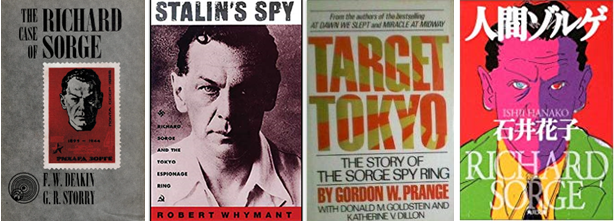
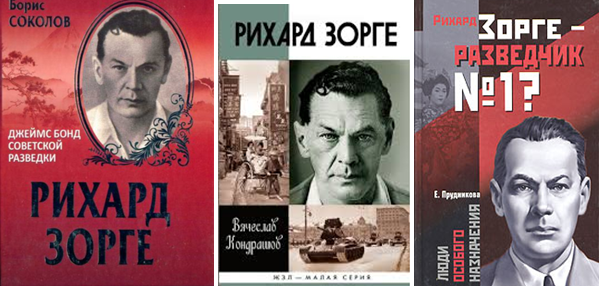
Moscow - The British author of a new biography of Richard Sorge (lead image, left), the Soviet spy hanged by the Japanese on November 7, 1944, disqualifies himself from being believed on the very first page of his book, and on the last.

Sorge, reads the first line, “was a bad man who became a great spy.” On the last page, “Sorge was a flawed individual but an impeccable spy – brave, brilliant, relentless. It was Sorge’s tragedy that his masters were venal cowards who placed their own careers before the vital interests of the country that he laid down his life to serve.”

Owen Matthews (Russian family name Bibikov) reveals that after studying at Oxford University he worked as a journalist for The Moscow Times, the London Times, and The Economist. They are the well-known covers for US and British secret service employment in information warfare, as well as espionage. They aren’t credentials for understanding the history of Soviet intelligence before, during, or after World War II. Still, when a journalist like this one toes his proprietor’s and his secret service’s line, there is much that is revealing — about Matthews’ toes, and the Achilles Heel he and his masters display in this book.

Matthews is obsessed by Sorge’s sexual attractiveness. On page 1 Sorge is reported to have been “a drunk and a womaniser”; on page 5, “an indefatigable ladies’ man”; on page 6 appear his “base appetites”. Page after page, Matthews keeps this up. Sorge was a cuckolder of his men friends with their wives; a bordello-cruiser; a debauch who married his Russian wife to enlarge his apartment and ration-card; an “exhibitionist”; the possessor of a “prodigious libido” and “booze-fuelled charm”; the “advocate of free love”; performer of a “louche alcoholic act” and “cavalier bedding”; “never one to take no for an answer”.

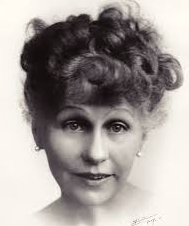
The women who had been Sorge’s lovers contradict Matthews. In Japanese Hanako Miyake, Sorge’s Japanese lover (lead image, right) and the guardian of his memory and grave until her death in 2000, said Sorge made no sexual advance for many months after they got to know each other. Later, she said: “he was very passionate, but gentle, not like a wild animal bearing its teeth. That wasn’t Sorge’s way.”

Then there is the record of Eta Harich-Schneider, (right), a celebrated German harpsichordist, who had left Germany after rejecting her husband and the Nazis. She played Beethoven to soothe Sorge’s despair at the wartime news. Years later, she wrote in a memoir, she had been attracted at their first meeting by his “striking face and deep blue, vigilant eyes.”

She also remembered his jokes; his observations about the Japanese character; his fondness for the Chinese. But Matthews puts her down. She “was the last to fall for the romanticism of the robber-baron persona Sorge had adopted since his schooldays.”

So obsessed by Sorge’s women is Matthews that he calls them by their first names – Christiane, Katya, Helma, Hanako, Eta — never the surnames with which every man in the book, including Sorge himself, is named. This is a telling symptom.

There are two reasons for the Matthews case. One is commercial – he is pitching his script for a movie, or at least a Netflic. Sorge’s sex is presented as if it’s a trailer for a fresh James Bond series; yet none of the memoirs on which Matthews relies substantiates this. What Sorge told Harich-Schneider turns out to have been unusually perspicacious for the time – Japan’s racism towards Asia was worse than Nazism, he said; Stalin would destroy Hitler; Japan would not invade Siberia.

According to Matthews, this monologue by Sorge in front of Miyake was a “drunken rant”. But what Miyake heard him say was:

“Sorge is going to die…Japan will be in bad shape. Everyone will die. I know it. The United States is very strong. Japan can’t win. Russia won’t fight the United States.”

The second reason for Matthews’ preoccupation with sex is pathological. The biographer – bald, overweight, flap-eared, goggle-eyed – is jealous of Sorge.

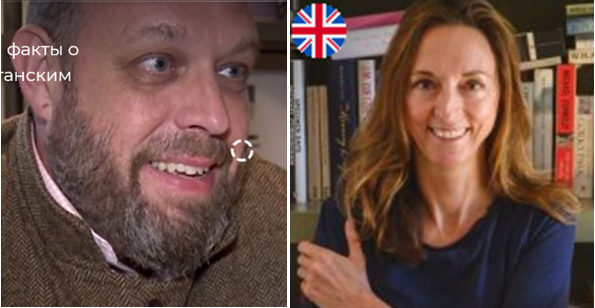
Left: Owen Matthews in a Russian television interview, April 2019;
Right: Natasha Fairweather, a London literary agent who specializes in 
Russia-attack books by British authors. 

In the acknowledgements of his book, Matthews thanks Fairweather for representing his book negotiations with “enthusiasm and energy”. Russia-hating and the British secret services also run in Fairweather’s family; her husband Richard Beeston was the Murdoch newspaper correspondent in Moscow during the Yeltsin period, 1994-98; her author list includes Boris Johnson, the former British foreign minister.

Matthews adds to his meretriciousness by trying to recruit John Le Carré to endorse his book in several of the chapter head quotes, including this line: “In the atheists’ paradise, their souls, like Sorge’s, may survive in peace”. David Cornwell (Le Carré) fabricated that one for payment by the CIA-financed magazine Encounter in 1966. Le Carré’s plots, which purport to be about British espionage operations against the KGB, and concomitantly KGB operations against its British counterparts, are in point of fact a repeating documentary of the British betraying each other for no discernible value in the outcome of war. For more on the insight Le Carré provides into the British, not the Russians, read this.

Matthews tries convincing readers with selfies, placed throughout the book, to make himself appear to be a red-blooded Russian patriot no less than the half-German Sorge. At the beginning, for example, Matthews shows off that he is married to a Russian; holidays at her father’s dacha in Nikolina Gora, an upper-class section outside Moscow; and that his father-in-law was an artist (the Bown Dictionary of Russian and Soviet Painters assigns him a paragraph revealing he “produced some painting”; none illustrated).

Then there’s Matthews’ disclosure that his city apartment is on Chisty pereulok, in the upper-class quarter of the old city. His reason for this disclosure, claims Matthews, is that the apartment below his had once been lived in by an NKVD veteran who had been a spy in Tokyo in the 1930s, when Sorge started there. By the time Matthews moved in above him, the veteran wasn’t available as a source; he was as dead as Sorge, and his walls didn’t talk.

The selfies don’t stop – three of Matthews’ Bibikov relatives are reported, though they have nothing whatever to do with Sorge. One of them reveals Matthews’ fondness for the anti-Russian regimes which have rolled through the Ukraine. He was grandfather Boris Lvovich Bibikov, “a party official executed in the Purge of 1937 in Kiev.”

Matthews acknowledges there is an enormous literature, academic and popular, on Sorge. Matthews promises the difference he and his book make is that he’s read the recently opened Russian archives. Maybe. There are snippets from Sorge’s own reports, as well as from assessments and instructions from his superiors at military intelligence (GRU) headquarters in Moscow, including its chief, General Filipp Golikov. But there is no sign that from them that Matthews has understood what Russian, American and British specialists on intelligence operations already know.


“Dear Ramsay,” Golikov cabled Sorge in February 1941, “having carefully studied your materials for 1940, I believe they do not answer to the tasks set before you….The majority of your materials are not secret and not timely.” 

Golikov was reacting to a December 28, 1940, report from Sorge which mentioned a large German force assembling on the Soviet border with Romania to secure German access to the Romanian oilfields. If the Soviet Union, Sorge wrote,

“begins to develop activities against German interests, as happened in the Baltic, the Germans could occupy territory on a line from Kharkov through Moscow to Leningrad. The Germans know that the USSR would not risk this, as the Soviet leadership is aware, particularly after the Finnish campaign, that it will take twenty years for the Red Army to become a modern army like that of Germany.”

This is op ed journalism — was Golikov mistaken in his negative assessment?

Sorge responded on May 2, 1941, with a report of what the German Ambassador to Tokyo, Jurgen Ott, and his military staff were saying. “Hitler is full of determination to destroy the USSR and seize the European part of the USSR as a grain and raw materials base in order to control all of Europe…A decision about war against the USSR will be taken by Hitler alone, either already in May, or after the war with Britain.”

On May 21, Sorge cabled:

“German officials arriving here from Berlin inform us that war between Germany and the USSR may begin at the end of May.” He added an extra subjunctive. “They also say that for this year the danger might pass.”
From Moscow the reply came back, expressing doubt. This followed a marginal notation by Stalin on the report that it had come from, “a shit who has set himself up with some small factories and brothels in Japan.”

Stalin was referring to Max Clausen, Sorge’s code man and radio operator. At the time he was running a lucrative business producing blueprints for Japanese factories. Clausen had stopped sending all of Sorge’s texts without letting Sorge know. According to Matthews, Clausen didn’t send 90% of Sorge’s May 21 despatch. He also garbled the remainder of the message. Was Golikov wrong to conclude at GRU that the cables were “suspicious”?

On May 30 Sorge sent an urgent cable.

“Berlin informed Ott that the German attack [on Russia] will commence in the latter part of June. Ott 95% certain that war will commence…In order to eliminate all the dangers from the USSR side, Germany has to drive off the Red Army as soon as possible. This is what Ott said.”

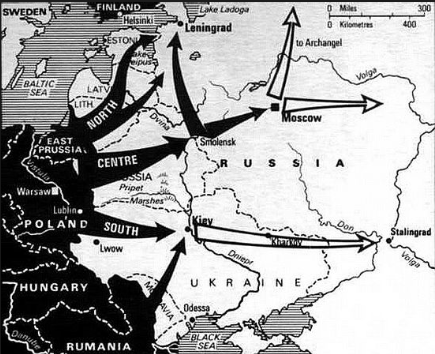
On June 1 Sorge reported the details of a conversation with a German courier just arrived from Berlin. “The beginning of the German-Russian war is expected around June 15th. In my conversation with Scholl I established that the German advance against the Red Army is founded on a major tactical mistake by the USSR. From the German point of view, the Soviet disposition of forces against German positions does not have any significant depth, which is a grave error. It will help them smash the Red Army in the first major battle. Scholl informed me that the strongest strike will be undertaken by the left [north] flank of the German Army.” This was Sorge’s “most important-ever dispatch”, Matthews judges.

MAP OF THE GERMAN ATTACK ON THE USSR COMMENCING JUNE 22, 1941 


Stalin wrote on his copy of the text: “Suspicious. To be listed with telegrams intended as provocations.” Golikov replied sceptically. Sorge responded on June 13:

“I repeat, nine armies with the strength of 150 divisions will most likely begin an offensive by the end of June.”
A week later, on June 20, Sorge cabled:
“War between Germany and the USSR is inevitable. German military superiority will allow the destruction of the Soviet Army as effectively as was accomplished at the beginning because the strategic defensive positions of the USSR are still as weak as the Polish ones were.”
He also reported his source inside the Japanese prime ministry as having,
“told me that the Japanese General Staff is already discussing the question of the positions that will be taken in the event of war.”

On June 22 the German attack began. In retrospect, Sorge’s warnings had proved correct; Stalin and Golikov had misjudged the value of Sorge’s intelligence. But were their mistakes “the fatally self-reinforcing circle of delusion between dictator and intelligence chief” which Matthews tells his readers?

No – and the evidence for this is at least much American as it is Russian. It’s the classic analysis of mistaken conclusions by political leaders from apparently obvious intelligence leading to catastrophic outcomes on the battlefield; this is Roberta Wohlstetter’s 1962 book, Pearl Harbor, Warning and Decision. Wohlstetter analyzed the overwhelming advance evidence of the Japanese plan to attack Pearl Harbor in 1941, and then demonstrated why the US military leadership and the Roosevelt Administration were taken by surprise — how the true signals were lost or misinterpreted among what Wohlstetter called the noise. The study is more than fifty years old now, but Matthews hasn’t heard of it.

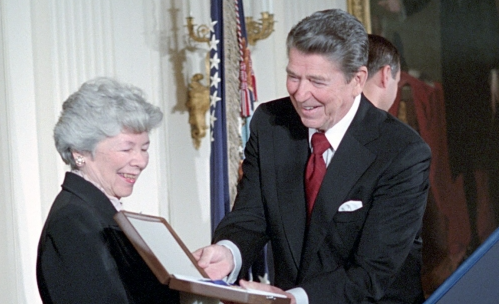
Roberta Wohlstetter receiving the Medal of Freedom from 
President Ronald Reagan on November 7, 1985

According to her employer, the RAND think-tank, her Pearl Harbor analysis “was later used as a lens for analyzing the Cuban Missile Crisis and the 2001 terrorist attacks. Defense Secretary Donald Rumsfeld reportedly made it required reading for his staff.” The Wohlstetter house in California was designed in the Japanese style in 1945 by a friend, the architect Josef van de Kar, who had been a US Communist Party member, and who was targeted by the McCarthy purges. Roberta Wohlstetter’s husband Albert was the nuclear attack strategist who inspired the character of Dr Strangelove in the film of the same name.

Stalin was convinced that Sorge was relaying what the Germans, Japanese, British and Americans wanted him to believe; the signal was a disinformation and deception operation, Stalin decided. The rest was noise. Immediately after the German attack was confirmed, however, Stalin needed to know if the Japanese would launch an attack from the east, as the Germans had been lobbying for. Sorge reported on July 12 it was the German Ambassador’s view that the Japanese were biding their time, and would not launch an attack into Siberia and against Vladivostok until and unless the German advance took Sverdlovsk.

“If the Red Army suffers defeat,” Sorge wrote, “then there is no doubt that the Japanese will join the war, and if there is no defeat, then they will maintain neutrality.”

Stalin initialled his copy, along with the chiefs of the Army, Foreign Ministry and intelligence services, with the notation from GRU:

“in consideration of the high reliability and accuracy of previous information and the competence of the information sources, this information can be trusted.”

Stalin’s big mistake is well understood in hindsight. Matthews makes the mistake of thinking Stalin’s mistake was a Soviet or Communist pathology. He fails to understand that all large organizations the world over – governments, intelligence services, newspapers, industrial conglomerates, banks — behave in the same fashion.

“Neither Sorge nor Ozaki were modest men,” judges Matthews.
“Like many advisers, they both came to believe they knew better than their masters… Both understood that knowledge is power.” 

Matthews is so impressed with his own line he repeats it.

“Every piece of information that passed back and forth served to buoy the reputations of Ott [with the German command in Berlin], Sorge, and Ozaki [with Prime Minister Konoe in Tokyo] in the eyes of their respective superiors. Information was power, not just to governments, but to all the principals of the spy ring, both witting and unwitting.”

Can Sorge, the Marxist academic, have been so unlearned? Can Ozaki have not understood Mao Tse-Tung’s adaptation — that power comes, not from information, but out of the barrel of a gun? Frustrated, disappointed, despairing, depressed, Sorge and Ozaki certainly were as the three countries they cared for most went into a war they knew would be disastrous for each.

According to Matthews-Bibikov, at GRU headquarters and in Stalin’s office Sorge was both suspected of duplicity and at the same time his reports believed to be accurate: this was “the crazy illogic of the period”, the Anglo-Russian writer claims. That’s his display of incompetence in the subject of intelligence analysis. He hasn’t even studied the British bible on the subject, John Keegan’s “Intelligence in War” (2002).

“Intelligence, however good, is not necessarily the means to victory,” Keegan concluded after analyzing cases from the Napoleonic Wars, through the American Civil War, to the German wars in Europe, the war against Japan, and military intelligence since 1945.

“Ultimately it is force, not fraud or forethought, that counts.”

Matthews-Bibikov doesn’t know the theory, but where does he stand in his own practice today, with all the intelligence available to a reporter based between Moscow, London and Washington? For example, on Crimea’s accession to Russia following the 2014 putsch in Kiev, Matthews has taken the side of NATO, claiming:

“You [Russians] all believe in this, I understand you believe in this, but nobody believes you and the whole world knows the truth.” 

To which, Vladimir Zhirinovsky’s response is memorable. After reciting the imperial seizures of Scotland, Ireland, India, and Africa in English history, he went on to tell Matthews:

“You need to shut up. You need to be taught a good lesson, Anglo Saxons.”

Matthews returned to form in the London Spectator, a year ago, spelling out his plan of attack against Russia: “if the political will existed, Brussels and Washington could devastate Russia’s economy overnight.” This is what Matthews stands for. It is his very own “fatally self-reinforcing circle of delusion.” Sorge, he concluded, “steamrollered people into either loving or hating him.” The record Matthews has compiled counts a great many people who loved Sorge, but none who hated him – except for Matthews himself.

At the very end of the book, Matthews claims Sorge was turned into a hero because “the KGB, and its director Yury Andropov, were rising in power and prestige and they needed a hero-spy …to glamorize the image of the KGB.” Matthews describes the sculpture by Vladimir Tsigal, which was erected on Andropov’s order in 1985, at the head of Sorge Street in northeast Moscow.

“It shows”, Matthews claims, “a statue of a commanding figure in a flowing trench coat stepping out of a curtain of bronze shadow.”

I have lived off Sorge Street for thirty years, and I have passed the statue more than a thousand times. Why do I make this selfie? What possible relevance to this story can the geography of my apartment in Moscow be?

In the monument Sorge is shown stepping out of a wall of black granite (lead-image, left); it is a cut-out symbolically releasing Sorge from the secret cover of his lifetime and from the death the Japanese inflicted on him. But there is no curtain, no bronze. Deafened by his hatred for everything Communist and Soviet in Russian history; dumbed down by his British agent, publisher and employer; ignorant of intelligence as the professionals on all sides practise it, Matthews, it turns out, is blind to the obvious.