Tuesday, June 04, 2019

A (Very) Short History of Alliances: Sending the Putin-Erdogan Pact Packing

SHORT MEMORIES MAKE BRIEF ALLIANCES, LIKE THE PUTIN-ERDOGAN PACT OF SEPTEMBER 17, 2018

by John Helmer - Dances with Bears


June 4, 2019

Just three and a half years ago, on January 20, 2016, the Turkish leader Recep Tayyip Erdogan had good reason to congratulate himself. He had successfully arranged a scheme of payoffs for two men who were intimate advisors to the presidents of the United States and Russia — at the very same time.

They were Lieutenant-General Michael Flynn, the National Security Advisor to Donald Trump; and Dmitry Peskov, the spokesman for Vladimir Putin.

Noone had pulled off the simultaneity before; but it was short-lived. Flynn was forced to resign after just 24 days in office and charged with lying to the FBI.

He subsequently pleaded guilty and is now facing a prison sentence. Investigation of his lucratively paid lobbying for Turkey is still under way.

Peskov remains in his Kremlin office, as he has for the past seven years. However, the Defence Ministry led by Sergei Shoigu and the General Staff headed by General Valery Gerasimov, have rebelled against Peskov’s line with Putin, ending for all practical purposes the terms of agreement Putin and Erdogan signed last September for a Turkish protectorate of Idlib governorate in northwestern Syria.

History is repeating itself. A newly published book, The Thirty-Year Genocide, Turkey’s Destruction of its Christian Minorities, 1894-1924, is the most detailed record to date of the policies of the Ottoman sultanate and its successor, the nationalist government led by Mustafa Kemal Ataturk, to destroy the entire populations living on Turkish territory of Armenians, Greeks and Assyrians. The 650-page work explains region by region, year by year, what the Turkish methods of ethnic cleansing were, and why.

“The Armenians were the main victims of Turkish atrocity,” the authors, Benny Morris and Dror Ze’evi, write, “in terms of the numbers slaughtered in 1894-96 and 1915-1916. Certainly, the Turks appear to have hated them the most.” 

Left to right: front cover of The Thirty-Year Genocide, released April 24 
by Harvard University Press; Lieut-Gen. Michael Flynn during the US 
presidential election campaign of 2016; President Erdogan with Dmitry Peskov.

The book also documents the continuous efforts of successive Turkish regimes to erase all trace of their genocidal policy. The military archives remain closed; the non-military state documents have been edited so that they “contain almost no direct evidence of Turkish culpability… Knowing that they were ordering or engaged in criminal activity, the political leaders in Constantinople and in the provinces, often in real time, ordered all copies of telegrams destroyed after reading. Sometimes they transmitted instructions orally, to avoid leaving paper trails, or used euphemisms to camouflage their intentions and deeds.”

The evidence on which this history is based has been compiled by cross-checking Turkish records against German, Austrian, American, British, French and other foreign sources.

“We realize that a great deal is missing. This was, after all, the intention of those covering their tracks.”

Why read this history in Moscow today? One reason is that the intention of Turkish state policy to destroy Christian populations and to expand Turkish state power into the territories cleansed thereby is an ongoing one, just as it remains Turkish state policy to dissemble and deceive outsiders that this is so. Syria, Cyprus, Iraq, Kosovo and Albania are contemporary cases in point.

Another reason is that over the 30-year genocide period documented, both Tsarist Russia and Communist Russia were the strongest defenders of the region’s Christians, and the most steadfast enemies of the Turkish state. Only very briefly, in 1920-21, did the Kremlin support Kemal’s (Ataturk) Turkish nationalist movement when, for strategic reasons, he was judged capable of obstructing the British and French attempts to attack southern Russia.

Arming the enemy of my enemy was a short-lived Russian ploy then. If arming Turkey today with the Russian S-400 anti-aircraft missile system is the Kremlin’s ploy today, with the same strategic purpose, relearning this history will illustrate just how deceptively, and also how briefly, the Turks can be expected to serve Russian interests.

The outcome of World War I, as the Turks interpreted it, was that their army had not been defeated in the field, nor had they surrendered. Instead, they thought they had survived the onslaught of the western powers, whose plots to carve up Turkish territory had been liquidated. The mass murders and forced deportations, which started in 1894 and continued until 1924, were the requirements of territorial and wartime defence — so Turkish officials kept telling the western powers and also their own people. The toll was colossal.

The number of Armenians killed “exceeded one million, perhaps substantially.” Another quarter of a million fled, most of them to Russia. The killing of Greeks didn’t start in 1894; it accelerated during the war, reaching its climacteric between 1919 and 1924. The estimates are about one million dead by murder and privation; another 1.2 million forced to flee to the Greek mainland. The estimate of Assyrian lives destroyed is at least 250,000 out of a total of 619,000.

Altogether, Morris and Ze’evi calculate, “the Turks and their helpers murdered, straightforwardly or indirectly through privation and disease, between 1.5 and 2.5 million Christians between 1894 and 1924.” The Christian population of the Ottoman Empire had been 20 percent of the total at the end of the nineteenth century; by 1924 this had been brought down to just 2 percent. Conversely, the Moslem population rose from 80 to 98 percent.

The main local helpers in the killing were the Kurds; the Turkish Army also hired Bedouin Arabs, Caucasian tribesmen (Chechens, Circassians), and Balkan Moslems to do the dirty work. The French ended the period making a deal with Ataturk to withdraw their forces from Turkey and from protecting the Armenians and Greeks in return for railroad and mining concessions. The US did a deal to save Greek tobacco industry workers in Smyrna on whom the American cigarette companies depended.

US missionaries reported in horror what was happening; as did Major-General James Harbord, head of an American military mission to Turkey in September 1919.

“Never…has the Turk done other than destroy wherever he has conquered”, Harbord wrote to Washington. 


US diplomats and journalists from the New York papers invited to make inspection tours of western Turkey, judged the Armenians were getting their payback for attempts to create their own state in eastern Turkey.

Winston Churchill, at the British Admiralty when his Gallipoli invasion force was defeated by Ataturk in 2015, was Secretary of State for War in 1919 and 1920 (pictured right). His policy was to acquiesce in Ataturk’s genocidal policies in order to encourage him to fight against the Bolsheviks in the Caucasus and Azerbaijan.

When Ataturk died in 1938, Churchill commented:

“The tears which men and women of all classes shed upon his bier were a fitting tribute to the life work of a man at once the hero, the champion, and the father of modern Turkey. During his long dictatorship a policy of admirable restraint and good­will created, for the first time in history, most friendly relations with Greece.”

“What’s the magic number at which ethnic cleansing becomes hardcore genocide?” a Russian analyst has asked rhetorically in order to make the point that the answer is one of political partisanship, because both victimizers and victims have perpetrated genocide in one period of their history or another. That, he added, “has very little to do with any detailed and dispassionate statistical and comparative analysis of the historical facts. Instead, it’s all about my genocide being so much bigger than yours…”

Morris and Ze’evi stick to the historical facts.

“Since the bouts of atrocity were committed under three very different ideological umbrellas, we must resist the temptation to attribute what happened to an aberrant ideology or to an evil faction or person.” 

They also conclude that the state killing and cleansing policy has prevailed, not because the Turkish propaganda is believed outside the country, but because the western powers and Russia have their own reasons of state for looking the other way.

Looking the other way is now Kremlin policy towards Turkish military operations. In Cyprus, where until recently Russia has supported the Cypriot Government’s defence against Turkish occupation of the north of the island, the new line is to tolerate Turkish expansion into the waters of the Cyprus Exclusive Economic Zone (EEZ), to the east and west of the island coast.

Ambassador Stanislav Osadchiy told Haravghi, the Cyprus Communist Party newspaper, last week, “the increase of tension is not a solution. This is why we believe that each side must avoid such steps that aggravate the situation in the Mediterranean.” He also said he is opposed to any step “that undermines the situation required for a resumption of the talks for a Cyprus settlement.”

He meant the Cypriots shouldn’t defend themselves.
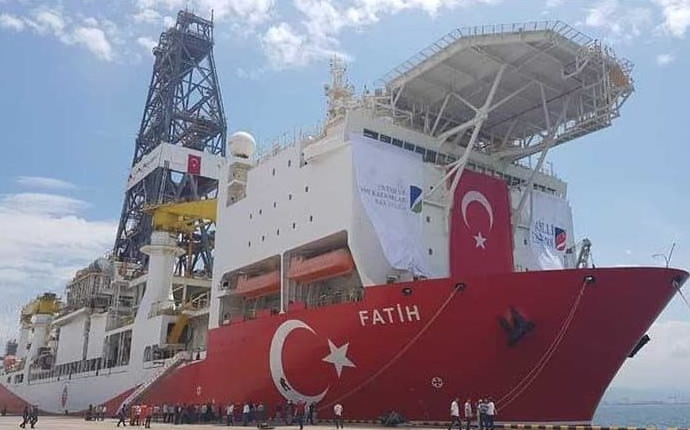
The Turkish seabed drilling vessel Fatih. Turkish notices to mariners 
last month have declared the intention to drill in waters off Paphos 
on the southwest coast of Cyprus between May 3 and September 3

Earlier Turkish announcements have identified the Cyprus EEZ as a drilling target, protected by Turkish Navy escorts. A year ago, the latter blocked ENI from drilling in waters to the southeast of the island. In March 1987, a similar attempt by Turkey to drill in Aegean waters of the Greek EEZ led to war mobilization by Greek and Bulgarian forces, and a Greek attack to halt US intelligence operations in the area. The Turks retreated.

Looking the other way in the border areas between Turkey and Syria has been the Kremlin line since last September. On September 17, in Sochi, Putin signed with Erdogan what was described as the “Memorandum of Understanding on Stabilization of the Situation in Idlib’s De-escalation Zone”. This allowed Turkey to ignore Syria’s western and northern borders and reinforce Turkish occupation of the Syrian province of Idlib.

“Russia and Turkey have reaffirmed their commitment to fight terrorism in Syria in all its forms and guises,” Putin and Erdogan agreed on paper. On the ground this meant the Kremlin was accepting the continuing Turkish campaign to take over deployment, armament and operations of opposition Arab groups in Idlib.

A deadline of October 10 was set in the Memorandum for the Turks to disarm the Arabs inside the de-escalation line and halt their attacks on Russian and Syrian Army positions outside the line. Nothing of the sort occurred; the Turks have had no intention to abide by the deadline; Putin has looked the other way.

That is until last month when re-armed Arab units escalated their attacks from Idlib into the adjoining areas, west, south and east, of Latakia, Hama and Aleppo.
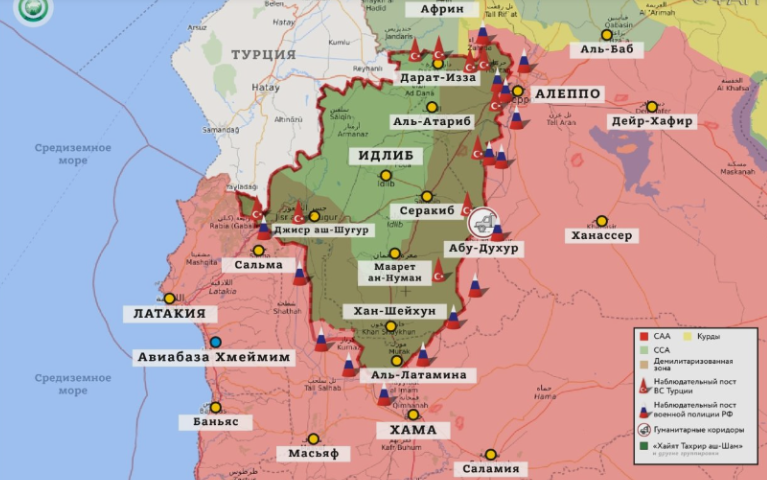
The Russian Army newspaper Krasnaya Zvezda (Red Star) reported 
that Idlib is now “a huge military camp”. 

The Russian military command has responded by launching intensive air attacks and by covering new advances on the ground by the Syrian Army. Unsaid by the General Staff, unacknowledged by the Kremlin, the Putin-Erdogan Memorandum is a dead-letter.

History is repeating itself.


NOTE: The lead image is a political cartoon published in Moscow in 1920, when Lenin’s policy was to covertly arm the Ataturk-led nationalists against the Ottoman Sultan’s regime. The caption reflects the overt Russian policy and traditional Russian public opinion. It says:
“Behold the cowardice of the Turk, and the prowess of our lad.”

Clearcut Colonialism: Devastation for Rainforest in Tsitika Valley, Schmidt Creek Region

BC Timber Sales Clearcutting Old-growth Rainforest in Tsitika Valley, Schmidt Creek Region

by Wilderness Committee/Sierra Club BC


June 4, 2019

Clearcuts in climate-resilient rainforest lack Kwakwaka’wakw consent, threaten ecosystems and downstream orca rubbing beach habitat in Robson Bight


VICTORIA
Recent fieldwork conducted by the Wilderness Committee, Sierra Club BC and community researchers within Tlowitsis-Ma’amtagila territories on northeastern Vancouver Island reveals BC Timber Sales (BCTS) is responsible for widespread forest degradation, unbridled old-growth logging and a troubling track record of selective Indigenous consultation.

Last month, a field team documented clearcutting on steep slopes, logging immediately beside creeks and riparian zones and degradation of cultural ecosystems in some of the last largely intact watersheds on Vancouver Island. Basic archeological assessments of the forests and ecosystem integrity analysis was conducted in the impacted areas of the Upper Tsitika Valley, Naka Creek, Tessium Creek and Schmidt Creek, all of which drain into Johnstone Strait.

“I am sick and tired of government agencies and branches completely ignoring our rights and sovereignty,” said Rande Cook, Head Chief Makwala, Hamatam (Seagull) House of the Ma’amtagila Nation, part of the Kwakwaka'wakw people.
“These logging corporations only want to consult with the First Nations they know they can get a pro-business outcome with. It’s fraught and it pits our community members against one another.”

BCTS is a standalone government agency managing around 20 per cent of the annual cut on provincial land. The B.C. government has committed to uphold the United Nations Declaration on the Rights of Indigenous Peoples (UNDRIP), which holds that Indigenous Nations have the right to free, prior and informed consent when it comes to resource extraction within their territories.

“It’s infuriating that clearcut logging of old-growth rainforests is happening in these important ecosystems without fulsome Indigenous consent,” said Torrance Coste, Vancouver Island campaigner for the Wilderness Committee.
“The fact that this is being done by the government of British Columbia should make everyone’s blood boil.”

Controversial logging company Lemare Lake Logging, subcontracting for San Group and Supercut Lumber Ltd., is the primary operator for the current round of logging.

The risk of serious landslides so close to orca rubbing beaches at Robson Bight has local whale experts worried. Northern resident orcas rub themselves along beaches with a specific slope and size of rocks. Increased sediment from logging activities and human-caused erosion lead to the cumulative loss of these special ecosystem characteristics.

“It boggles my mind to think that this outdated practice is still legal,” said Mark Worthing, climate and conservation campaigner with Sierra Club BC.
“The public trust has been deeply violated. The B.C. government and these logging companies no longer have the social licence to continue logging ancient forests.”

The B.C. NDP promised to “apply an evidence-based scientific approach to land use planning, using the ecosystem-based management of the Great Bear Rainforest as a model for managing old-growth forests.” But two years later, the B.C. government has not made any meaningful progress toward implementing this election commitment.

Last month, BCTS postponed the auction of several cutblocks near Port Renfrew after public outcry from local residents and environmental groups.

“The postponement of the blocks near the Juan de Fuca Trail is a good first step, but this is the furthest thing from an isolated incident — up and down the Island, BCTS is hammering old-growth without public input or proper consultation. It’s time for BCTS to suspend all current and upcoming auctions in old-growth forests,” Coste said.

Sierra Club BC, the Wilderness Committee and the Ancient Forest Alliance, along with tens of thousands of B.C. residents, have called on Premier John Horgan and Forests Minister Doug Donaldson to protect remaining old-growth rainforests in sensitive areas like Schmidt Creek, the Nahmint Valley and the Manning Park Donut Hole on the mainland. The B.C. government has ignored these calls to date.

–30–


Images of recent old-growth clearcuts and remaining old-growth rainforest slated for logging in Tsitika Valley, Naka Creek, Tessium Creek and Schmidt Creek are available here.

For more information on threats to orca rubbing beaches from logging click here.

The Horror of Julian Assange's Position: No Time to Wait for Action

No Time to Wait: We Must Act Now to Save Julian Assange

by Charlotte Gracias - 21st Century Wire


June 4, 2019

Why are the general public not outraged by the psychological torture and deterioration in Julian’s Assange’s health?

The answer is as simple as it is abominable: because the corporate and state media oracles have conducted an eight-year campaign of vilifying Julian Assange.

On Thursday 30 May, was the first time that many of us realised that we might lose Julian Assange due to his deteriorating health.

That same day he was due to speak by video link at the extradition hearing at Westminster Magistrates Court. I had hoped the decision to postpone this extradition hearing regarding his extradition to Sweden would have been made several days earlier. Instead we were informed that he was too unwell to speak by video link from Belmarsh prison as it would add to his own anxiety and fragile mental state. “He’s in fact far from well,” said one of Assange’s defense lawyers Gareth Peirce, to the court. That hearing on Swedish extradition has been moved to a later date.

A few days previous, the alarm had been raised about the seriousness of Julian Assange’s health by Emmy Butlin of the Julian Assange Defence Committee on 28 May, following a report in the Swedish press. His Swedish defence lawyer, Per Samuelson had visited him at Belmarsh prison on Friday 24 May. Samuelson explained to the Swedish media that,

“Assange’s health situation on Friday was such that it was not possible to conduct a normal conversation with him.”

A request to postpone the hearing regarding Assange’s detention en absentia for the Swedish rape allegations had been rejected.

Speculation and concern over his well-being was growing on social media as his supporters searched for information and confirmation from those close to Julian Assange. There were unconfirmed reports that Assange had been transferred to the hospital unit at Belmarsh prison. Finally, on 29 May, Wikileaks issued a statement confirming Julian Assange had been moved to the hospital unit at Belmarsh prison, ending much of the speculation but not the news we all wanted.


This raised more questions about the gravity of Julian’s Assange’s health situation. Why were the mainstream media so reluctant to report on his condition after his arrest on 11 April 2019? At that point he should have been taken to hospital and given urgent medical treatment. To understand how his mental and physical health has declined to such a point that he required hospitalisation, it’s important to understand he had only sought refuge at the Ecuadorian Embassy in 2012 after losing his appeal to the UK Supreme Court against possible extradition to Sweden – despite never having been actually charged with any crime in Sweden.

Assange was eventually questioned by the Swedish prosecutor in 2016, after wich time the case was dropped for a second time by Swedish prosecutors. Still, detention at the embassy had not only deprived him of his freedom, but also direct sunlight, as well as adequate medical care for several ongoing health issues he was experiencing.

In February 2016, the UN Working Group on Arbitrary Detention concluded in their report that, ‘the arbitrary detention of Mr. Assange should be brought to an end, that his physical integrity and freedom of movement be respected, and that he should be entitled to an enforceable right to compensation”

Again, in December 2018 the WGAD repeated their demand that the UK government abide by international obligations and allow Julian Assange to walk free from the from the Ecuadorian embassy. The UK government failed to abide by those obligations and its commitment in ratifying the International Covenant on Civil and Political Rights (ICCPR).

After almost seven years of arbitrary detention at the embassy, Julian Assange was already frail and since his incarceration at Belmarsh, according to those who saw him, was effectively confined to his cell for most of the day, has dramatically lost weight and was suffering from Vitamin C and D deficiency.

On 31 May the UN Special Rapporteur Professor Nils Melzer, published his full report based on his visit to Julian Assange on 9 May. He was accompanied by two medical experts, both specialising in assessing potential victims of torture. Their assessment concludes:

“It was obvious that Mr Assange’s health has been seriously affected by the extremely hostile and arbitrary environment he has been exposed to for many years,” “Most importantly in addition to physical ailments, Mr Assange showed all the symptoms typical for prolonged exposure to psychological torture, including extreme stress, chronic anxiety and intense psychological trauma.”

Professor Melzer expressed fears that Assange’s human rights would be violated if he were to be extradited to the U.S. and strongly condemned the US, UK, Swedish and Ecuadorian governments for a sustained and relentless campaign of intimidation and personal defamatory attacks of Julian Assange’s character through ‘humiliating, debasing and threatening’ statements made in the mainstream media and on social media. He also directed his criticism at the Australian government for failing to intervene and protect one of their own citizens.

The report was powerful and shocking in its detail of the sustained emotional and mental abuse suffered by Julian Assange. Melzer also noted that Assange was agitated and took some time to understand questions posed to him. Assange has been emotionally and mentally destroyed but to add to his distress, he has limited visits from his lawyers and his lack of access to case files and which make it difficult to adequately prepare any defence. See the official summary of Dr. Melzer’s report here:

https://www.ohchr.org/EN/NewsEvents/Pages/DisplayNews.aspx?NewsID=24665

This was followed by a concerted media cover-up. Despite being provided with overwhelming evidence by Nils Melzer in interviews conducted on 31 May, why had media outlets like the BBC decided not to air their ‘exclusive’ interview? Why did Sky News refuse to make the interview available online?


Is it possible that the corporate media was acting in concert with the British government, and in particular Foreign Secretary Jeremy Hunt, who in a deplorable tweet attacked the UN Special Rapporteur’s report and suggesting that Prof Melzer is interfering in British justice? In his own words:


I was disgusted, and so I felt compelled to respond on social media to Jeremy Hunt:

It’s difficult to dismiss the possibility that the UK, US and Swedish governments are working together to ensure he is extradited to the US to face 18 indictments, possible life sentence or at worse the death penalty. Corporate and state media are still failing to highlight the years of psychological and physical damage to Julian Assange.

With some irony Jeremy Hunt attended the World News Media Congress in Glasgow on 1 June and said the following:

“We can’t physically stop journalists from being locked up for doing their jobs, but we can alert global public opinion and make sure the diplomatic price is too high.”

Clearly, Hunt was not referring to Julian Assange who is a brave and unique journalist – a spokesperson for free speech and freedom of the press, who has been demonised because he and Wikileaks exposed war crimes. He has suffered enormously for his actions and may well die in prison if his conditions are not improved immediately. We should aim to do everything in our power as individuals to prevent the worst from happening.

Earlier this week, a Swedish court ruled that it will not seek to detain Assange in relation to their recently re-opened sexual misconduct investigation, stating that Assange would not be extradited to Sweden for questioning, and that he can instead could be questioned in Britain, where he is currently detained. Per Samuelsson said his client will “be happy” that he’s not being extradited to Sweden, but is still remains in a perilous state at Belmarsh.

Julian’s mother, Christine Assange, posted a powerful and emotional tweet which captures the full horror of Julian’s situation.


So, what can we all do to help? 


We can talk to our friends and families and raise awareness of his plight, sway public opinion, hold protest and rallies and write to our MPs and most importantly, ask them the following questions:

  • Why was Julian Assange not given urgent medical treatment on the day of his arrest at the Ecuadorian embassy on 11 April 2019? Why has Julian Assange not been given access to his legal documents so he can prepare his defence?
  • Does the British government still recognise international law and the determinations of multilateral institutions like the UN, or will the UK simply fall in line with the unilateral dictates of the US?

We must act now to protect Julian Assange.


For more information on Julian Assange and how you can help please go to the Wise Up Action website at: https://wiseupaction.info


Author Charlotte Gracias is an activist and contributor to 21st Century Wire. See more of her work at Charlotte’s archive.

READ MORE WIKILEAKS NEWS AT: 21st Century Wire WikiLeaks Files

SUPPORT 21WIRE – SUBSCRIBE & BECOME A MEMBER @21WIRE.TV

Gorilla Radio with Chris Cook, Joan Roelofs, Nils Melzer, Janine Bandcroft June 6, 2019

This Week on GR

by C. L. Cook - Gorilla-Radio.com


June 6, 2019

America's vast military apparatus is much more multi-dimensional than even its most fervent fans realize. Beyond war and readying for war-fighting, America's Army, Navy, Marines, and Space Force also work hard at preserving wildlands and vital marine habitat, where wildlife and sea creatures alike can take refuge from the increasingly noisome presence of human industry.

REPI, or the Readiness and Environmental Protection Integration Program could be described as the Department of Defense's version of a "New Green Deal", (if you're inclined to believe it) or as it says, "a key tool for combating encroachment that can limit or restrict military training, testing, and operations."


Listen. Hear.

Joan Roelofs is an educator, author translator, prolific academic writer, and essayist with an especial focus on the political power of the nonprofit sector. The Keene State College Political Science Professor Emerita is also author of the books, 'Foundations and Public Policy: The Mask of Pluralism', and 'Greening Cities: Building Just and Sustainable Communities.' Her recent article at CounterPunch.org, '“Get Your Endangered Species Off My Bombing Range!”' questions the ways and means of one of the lesser known arms of today's ubiquitous military octopus.

Joan Roelofs in the first half.

And; journalist and publisher, Julian Assange is in dire physical and mental condition. He was to appear for his extradition hearing in London's Westminster Magistrates’ Court Thursday last, but was deemed too ill to attend either in person or via video link from Belmarsh Prison. Assange has been held in isolation since his forced extraction from the Ecuadorian embassy April 11th, with few visits being allowed for his lawyers and supporters.

On May 9th, United Nations Special Rapporteur on torture, Nils Melzer and "two medical experts specialised in examining potential victims of torture and other ill-treatment" were granted access and their assessment is a blistering indictment of both his current and would-be jailors.

Nils Melzer and the case for Julian Assange's immediate release in the second half.


And; Victoria-based activist and long-time Gorilla Radio contributor, Janine Bandcroft will be here at the bottom of the hour with the Left Coast Events Bulletin of some of the good things to be gotten up to in and around our town in the coming week. But first, Joan Roelofs and when nature endangers the Pentagon.

Chris Cook hosts Gorilla Radio, airing live every Thursday between 11-Noon Pacific Time. In Victoria at 101.9FM, and on the internet at: http://cfuv.uvic.ca.  He also serves as a contributing editor to the web news site, http://www.pacificfreepress.com. Check out the GR blog at: http://gorillaradioblog.blogspot.ca/

Monday, June 03, 2019

Abuse of Assange Is Abuse of International Law

Abuses Show Assange Case Was Never About Law

by Jonathan Cook - Jonathan-Cook.net 

via Consortium News

June 3, 2019

17 glaring legal anomalies provide overwhelming evidence that the WikiLeaks publisher has been the victim of political persecution.

It is astonishing how often one still hears well-informed, otherwise reasonable people say about Julian Assange: “But he ran away from Swedish rape charges by hiding in Ecuador’s embassy in London.”

That short sentence includes at least three factual errors. In fact, to repeat it, as so many people do, you would need to have been hiding under a rock for the past decade — or, amounting to much the same thing, been relying on the corporate media for your information about Assange, including from supposedly liberal outlets such as the Guardian and the BBC.
Assange: Victim of legal persecution.
(YouTube screenshot)

A recent Guardian editorial — the paper’s official voice and probably the segment most scrutinized by senior staff — made just such a false claim:

Then there is the rape charge that Mr. Assange faced in Sweden and which led him to seek refuge in the Ecuadorian embassy in the first place.

The fact that the Guardian, supposedly the British media’s chief defender of liberal values, can make this error-strewn statement after nearly a decade of Assange-related coverage is simply astounding. And that it can make such a statement days after the U.S. finally admitted that it wants to lock up Assange for 175 years on bogus “espionage” charges — a hand anyone who wasn’t being willfully blind always knew the U.S. was preparing to play — is still more shocking.

Assange faces no charges in Sweden yet, let alone “rape charges.” As former U.K. ambassador Craig Murray recently explained, the Guardian has been misleading readers by falsely claiming that an attempt by a Swedish prosecutor to extradite Assange — even though the move has not received the Swedish judiciary’s approval — is the same as his arrest on rape charges. It isn’t.

Also, Assange did not seek sanctuary in the embassy to evade the Swedish investigation. No state in the world gives a non-citizen political asylum to avoid a rape trial. The asylum was granted on political grounds. Ecuador rightly accepted Assange’s concerns that the U.S. would seek his extradition and lock him out of sight for the rest of his life.

Assange, of course, has been proven – yet again – decisively right by recent developments.

Herd Think


The fact that so many ordinary people keep making these basic errors has a very obvious explanation. It is because the corporate media keep making these errors.

These are is not the kind of mistakes that can be explained away as an example of what one journalist has termed the problem of “churnalism:” the fact that journalists, chasing breaking news in offices depleted of staff by budget cuts, are too overworked to cover stories properly.

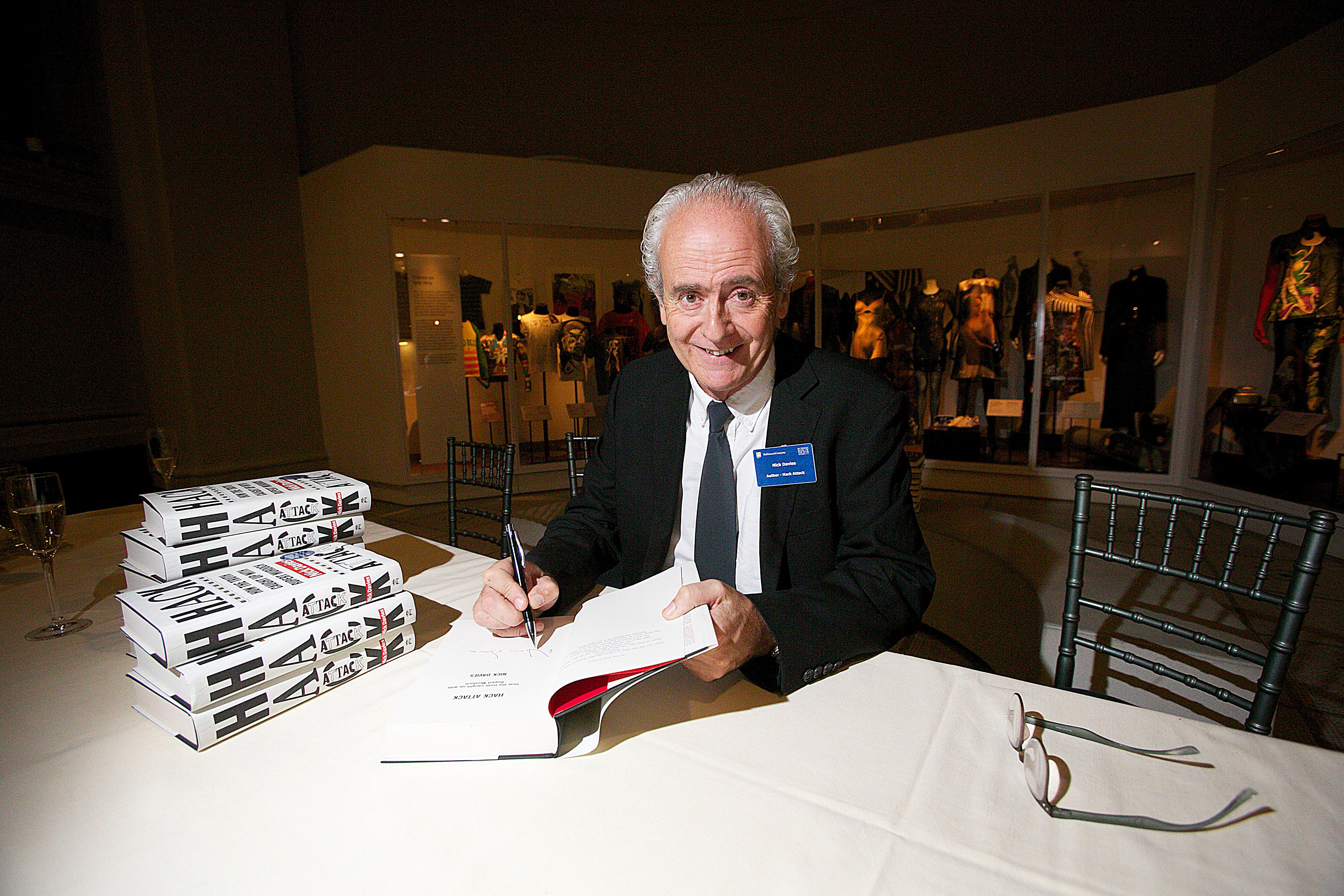
Nick Davies’ “churnilism” coinage does not apply.
(FT/McKinsey BBYA 2014, CC BY 2.0, Wikimedia Commons)

British journalists have had many years to get the facts straight.

In an era of social media, journalists at the Guardian and the BBC have been bombarded by readers and activists with messages telling them how they are getting basic facts wrong in the Assange case. But the journalists keep doing it anyway. They are trapped in a herd-think entirely divorced from reality.

Rather than listen to experts, or common sense, these “journalists” keep regurgitating the talking points of the British security state, which are as good as identical to the talking points of the US security state.

What is so striking in the Assange coverage is the sheer number of legal anomalies in his case — and these have been accumulating relentlessly from the very start. Almost nothing in his case has gone according to the normal rules of legal procedure. And yet that very revealing fact is never noticed or commented on by the corporate media. You need to have a blind spot the size of Langley, Virginia, not to notice it.

If Assange wasn’t the head of WikiLeaks, if he hadn’t embarrassed the most important western states and their leaders by divulging their secrets and crimes, if he hadn’t created a platform that allows whistleblowers to reveal the outrages committed by the western power establishment, if he hadn’t undermined that establishment’s control over information dissemination, none of the last 10 years would have followed the course it did.

If Assange had not provided us with an information revolution that undermines the narrative matrix created to serve the U.S. security state, two Swedish women — unhappy with Assange’s sexual etiquette — would have gotten exactly what they said in their witness statements they wanted: pressure from the Swedish authorities to make him take an HIV test to give them peace of mind.

He would have been allowed back to the U.K. (as he in fact was allowed to do by the Swedish prosecutor) and would have gotten on with developing and refining the WikiLeaks project. That would have helped all of us to become more critically aware of how we are being manipulated — not only by our security services but also by the corporate media that so often act as their mouthpiece.

Which is precisely why that did not happen and why Assange has been under some form of detention since 2010. Since then, his ability to perform his role as exposer of serial high-level state crimes has been ever more impeded — to the point now that he may never be able to oversee and direct WikiLeaks ever again.

His current situation — locked up in Belmarsh high-security prison, in solitary confinement and deprived of access to a computer and all meaningful contact with the outside world — is so far based solely on the fact that he committed a minor infraction, breaching his police bail. Such a violation, committed by anyone else, almost never incurs prosecution, let alone a lengthy jail sentence.

So here is a far-from-complete list — aided by the research of John Pilger, Craig Murray and Caitlin Johnstone, and the original investigative work of Italian journalist Stefania Maurizi — of some of the most glaring anomalies in Assange’s legal troubles. There are 17 of them below. Each might conceivably have been possible in isolation. But taken together they are overwhelming evidence that this was never about enforcing the law. From the start, Assange faced political persecution.


No Judicial Authority


- In late summer 2010, neither of the two Swedish women alleged Assange had raped them when they made police statements. They went together to the police station after finding out that Assange had slept with them both only a matter of days apart and wanted him to be forced to take an HIV test. One of the women, SW, refused to sign the police statement when she understood the police were seeking an indictment for rape. The investigation relating to the second woman, AA, was for a sexual assault specific to Sweden. A condom produced by AA that she says Assange tore during sex was found to have neither her nor Assange’s DNA on it, undermining her credibility.

- Sweden’s strict laws protecting suspects during preliminary investigations were violated by the Swedish media to smear Assange as a rapist. In response, the Stockholm chief prosecutor, Eva Finne, took charge and quickly cancelled the investigation: “I don’t believe there is any reason to suspect that he has committed rape.” She later concluded: “There is no suspicion of any crime whatsoever.”

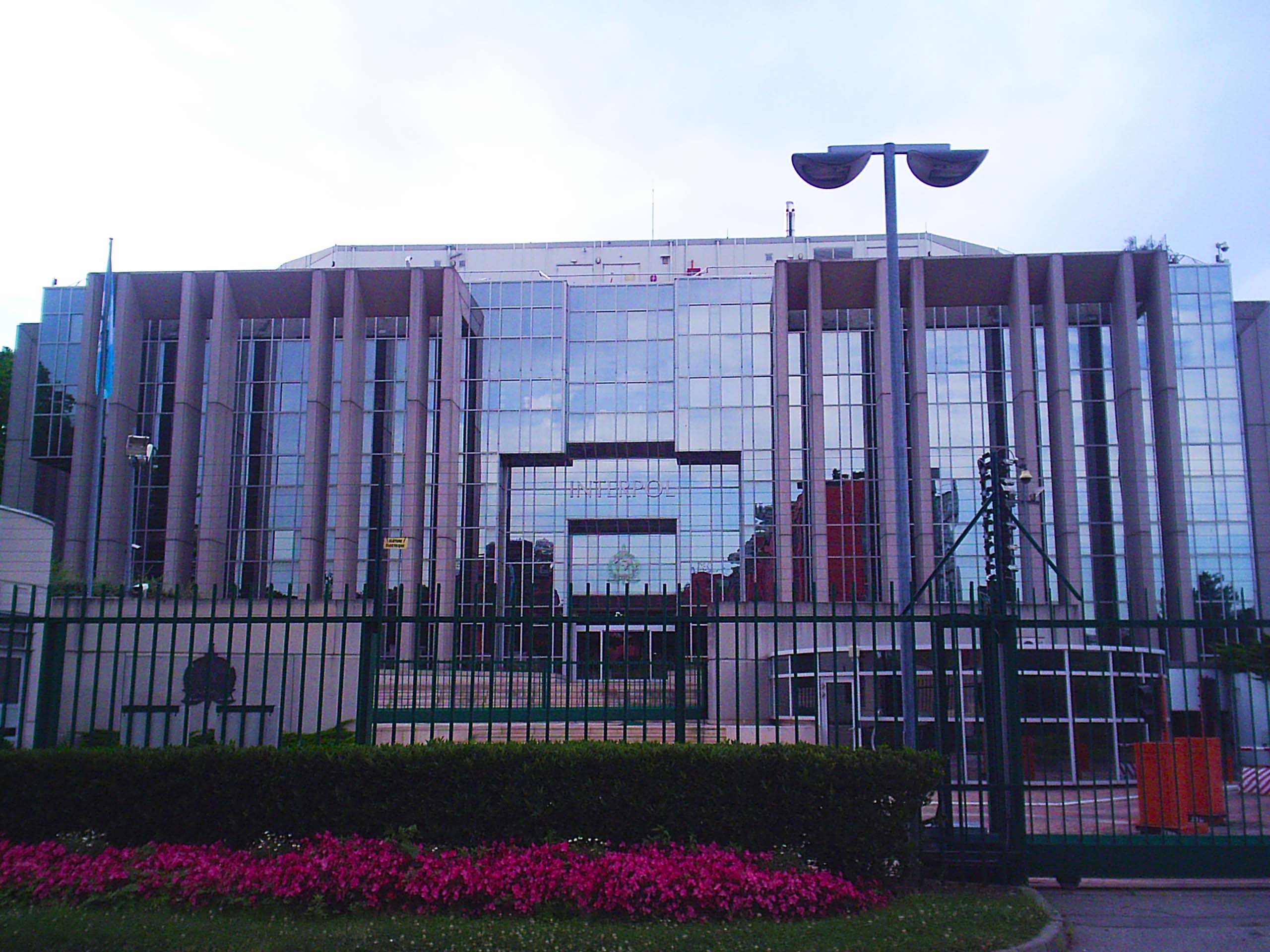
- The case was revived by another prosecutor, Marianne Ny, although she never questioned Assange. He spent more than a month in Sweden waiting for developments in the case, but was then told by prosecutors he was free to leave for the U.K., suggesting that suspicions against him were not considered serious enough to detain him in Sweden. Nonetheless, shortly afterwards, Interpol issued a Red Notice for Assange, usually reserved for terrorists and dangerous criminals. 

Lyon, France, headquarters of Interpol, which issued a Red Notice for Assange.
(Massimiliano Mariani via Wikimedia Commons)

- The U.K. supreme court approved an extradition to Sweden based on a European Arrest Warrant in 2010, despite the fact that it was not signed by a “judicial authority,” only by the Swedish prosecutor. The terms of the EAW agreement were amended by the U.K. government shortly after the Assange ruling to make sure such an abuse of legal procedure never occurred again.

- The U.K. supreme court also approved Assange’s extradition even though Swedish authorities refused to offer an assurance that he would not be extradited onwards to the U.S., where a grand jury was already formulating draconian charges in secret against him under the Espionage Act. The U.S. similarly refused to give an assurance they would not seek his extradition.

- In these circumstances, Assange fled to Ecuador’s embassy in London in summer 2012, seeking political asylum. That was after the Swedish prosecutor, Marianne Ny, blocked Assange’s chance to appeal to the European Court of Human Rights.

- Australia not only refused Assange, a citizen, any help during his long ordeal, but Prime Minister Julia Gillard even threatened to strip Assange of his citizenship, until it was pointed out that it would be illegal for Australia to do so. 

Gillard, right, with Gen.David Petraeus, commander of the Intl. 
Security Assistance Force, Afghanistan, Oct. 2, 2010. 
(U.S. Army/Lorie Jewell)

- Britain, meanwhile, not only surrounded the embassy with a large police force at great public expense, but William Hague, the foreign secretary, threatened to tear up the Vienna Convention, violating Ecuador’s diplomatic territory by sending U.K. police into the embassy to arrest Assange.

Six Years of Heel-Dragging


- Although Assange was still formally under investigation, Ny refused to come to London to interview him, despite similar interviews having been conducted by Swedish prosecutors 44 times in the U.K. in the period Assange was denied that right.

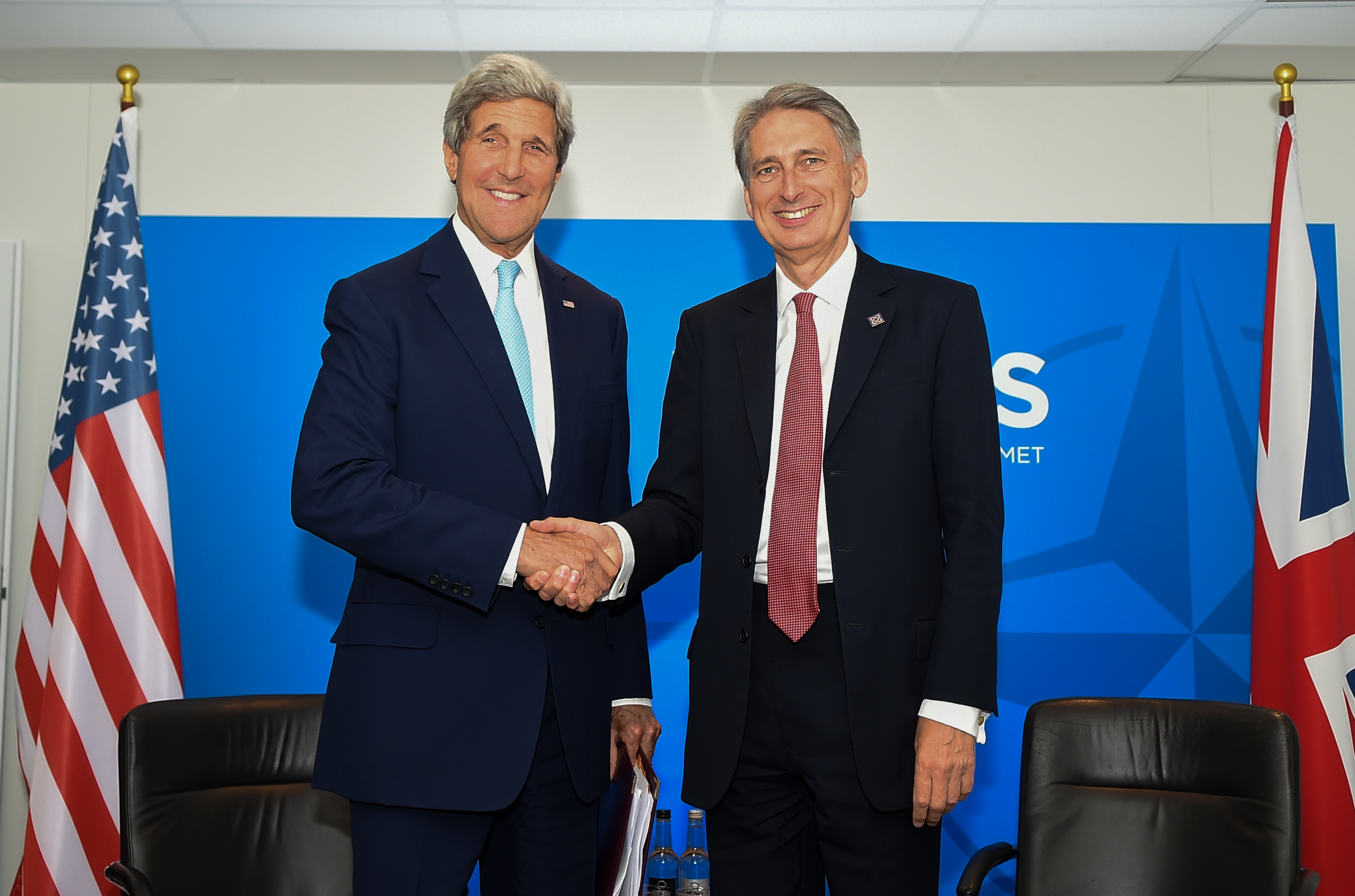
- In 2016, international legal experts in the United Nations Working Group on Arbitrary Detention, which adjudicates on whether governments have complied with human rights obligations, ruled that Assange was being detained unlawfully by Britain and Sweden. Although both countries participated in the UN investigation, and had given the tribunal vocal support when other countries were found guilty of human rights violations, they steadfastly ignored its ruling in favor of Assange. U.K. Foreign Secretary Phillip Hammond flat-out lied in claiming the UN panel was “made up of lay people and not lawyers.” The tribunal comprises leading experts in international law, as is clear from their resumes. Nonetheless, the lie became Britain’s official response to the UN ruling. The British media performed no better. A Guardian editorial dismissed the verdict as nothing more than a “publicity stunt.” 

U.K.’s Hammond at right, with U.S. Secretary of State John Kerry. 
(State Department)

- Ny finally relented on Assange being interviewed in November 2016, with a Swedish prosecutor sent to London after six years of heel-dragging. However, Assange’s Swedish lawyer was barred from being present. Ny was due to be questioned about the interview by a Stockholm judge in May 2017 but closed the investigation against Assange the very same day.

- In fact, correspondence that was later revealed under a freedom of information request – pursued by Italian investigative journalist Stefania Maurizi – shows that the British prosecution service — the Crown Prosecution Service, or CPS — pressured the Swedish prosecutor not to come to the London to interview Assange through 2010 and 2011, thereby creating the embassy standoff.

- Also, the CPS destroyed most of the incriminating correspondence to circumvent the freedom of information requests. The emails that surfaced did so only because some copies were accidentally overlooked in the destruction spree. Those emails were bad enough. They show that in 2013 Sweden had wanted to drop the case against Assange but had come under strong British pressure to continue the pretense of seeking his extradition. There are emails from the CPS stating, “Don’t you dare” drop the case, and most revealing of all: “Please do not think this case is being dealt with as just another extradition.”

- It also emerged that Marianne Ny had deleted an email she received from the FBI.

- Despite his interview with a Swedish prosecutor taking place in late 2016, Assange was not subseqently charged in absentia — an option Sweden could have pursued if it had thought the evidence was strong enough.

- After Sweden dropped the investigation against Assange, his lawyers sought last year to get the British arrest warrant for his bail breach dropped. They had good grounds, both because the allegations over which he’d been bailed had been dropped by Sweden and because he had justifiable cause to seek asylum given the apparent U.S. interest in extraditing him and locking him up for life for political crimes. His lawyers could also argue convincingly that the time he had spent in confinement, first under house arrest and then in the embassy, was more than equivalent to time, if any, that needed to be served for the bail infringement. However, the judge, Emma Arbuthnot, rejected the Assange team’s strong legal arguments. She was hardly a dispassionate observer. In fact, in a properly ordered world she should have recused herself, given that she is the wife of a government whip, who was also a business partner of a former head of MI6, Britain’s version of the CIA.

- Assange’s legal rights were again flagrantly violated last monthwith the collusion of Ecuador and the U.K., when U.S. prosecutors were allowed to seize Assange’s personal items from the embassy while his lawyers and UN officials were denied the right to be present.

Information Dark Ages


Even now, as the U.S. prepares its case to lock Assange away for the rest of his life, most are still refusing to join the dots. Chelsea Manning has been repeatedly jailed, and is now facing ruinous fines for every day she refuses to testify against Assange as the U.S. desperately seeks to prop up its bogus espionage claims. In Medieval times, the authorities were more honest: they simply put people on the rack.

Back in 2017, when the rest of the media were still pretending this was all about Assange fleeing Swedish “justice,” John Pilger noted:

“In 2008, a secret Pentagon document prepared by the ‘Cyber Counterintelligence Assessments Branch’ foretold a detailed plan to discredit WikiLeaks and smear Assange personally. The ‘mission’ was to destroy the ‘trust’ that was WikiLeaks’ ‘centre of gravity.’ This would be achieved with threats of ‘exposure [and] criminal prosecution.’ Silencing and criminalising such an unpredictable source of truth-telling was the aim.’ …

According to Australian diplomatic cables, Washington’s bid to get Assange is ‘unprecedented in scale and nature’. …

The US Justice Department has contrived charges of ‘espionage,’ ‘conspiracy to commit espionage,’ ‘conversion’ (theft of government property), ‘computer fraud and abuse’ (computer hacking) and general ‘conspiracy.” The favoured Espionage Act, which was meant to deter pacifists and conscientious objectors during World War One, has provisions for life imprisonment and the death penalty. …

In 2015, a federal court in Washington blocked the release of all information about the ‘national security’ investigation against WikiLeaks, because it was ‘active and ongoing’ and would harm the ‘pending prosecution’ of Assange. The judge, Barbara J. Rothstein, said it was necessary to show ‘appropriate deference to the executive in matters of national security.’ This is a kangaroo court.

All of this information was available to any journalist or newspaper that cared to search it out and wished to publicize it. And yet not one corporate media outlet — apart from Stefania Maurizi — has done so over the past nine years. Instead they have shored up a series of preposterous U.S. and U.K. state narratives designed to keep Assange behind bars and propel the rest of us back into the information dark ages.

Jonathan Cook is a freelance journalist based in Nazareth. This article first appeared on his blog at Jonathan Cook.net. 

Return of the Hole: Ozone Depletion Again an Issue of Global Survival

Ozone-Depleting CFCs Return 

by Robert Hunziker - CounterPunch


May 31, 2019

In August of 1987 the world came together after a panic-attack over ongoing depletion of atmospheric ozone, aka: The Ozone Hole. Subsequently, global agreements to stop ozone depletion became the first ever “universally ratified treaties in UN history.” The world banned CFCs.

  Photograph: ISS Expedition 23 crew – Public Domain


Thereafter, an era of good feelings about ozone restoration swept the world community and 25 years afterwards Science News magazine reported: “Ozone Hole at Smallest Size in Decades” d/d October 26, 2012.

Glory hallelujah! As a glorious Great Exhale spread across the land, similar to releasing pressurized air out of a humongous balloon, wheezing and hissing for days on end, in celebration of The Shrinking Ozone Hole! It was the first time in history that people celebrated a Shrinking Hole, and for good reason.

Ozone molecules are crucial to sustaining life. Those feisty powerhouse molecules shield the planet from destructive Ultraviolet B or UV-B, which can become big-time killers if left unchecked. According to NASA: “Without ozone, the Sun’s intense UV radiation would sterilize the Earth’s surface” which is a gentle way of saying “Mass Extinction.”

The problem is multiplied as CFCs have a lifetime in the atmosphere of 20 to 100 years, thus, one free chlorine atom from a CFC molecule can do a lot of damage by destroying crucial life-supporting ozone molecules over lengthy periods of time.

Sadly, the world must now reconsider holding its collective breath once again. On May 22nd 2019, the same Science News magazine that broke the good news and celebrated “A Shrinking Ozone Hole in 2012” newest headline reads: “Emissions of a Banned Ozone-Destroying Chemical Have Been Traced to China.”

As it happens, CFC-11 was, and is, used in manufacturing foams for construction materials, refrigerators, aerosol sprays, blowing agents, packing materials, solvents, and other consumer goods.

The Montreal Protocol of 1987 called for phasing out production of chlorofluorocarbons by 2010 when CFC-11 production was banned. However, by all appearances, China never got the memo.

Atmospheric observations, as well as on-the-ground investigations, have discovered a link of illegal CFC-11 in manufacturing districts in China. It should be noted that there are substitutes for CFC, but CFC-11 is less costly, easier, and faster than substitutes.

Ergo, it’s simply mind-blowing that “costs and profits and markets” supersede careful husbandry of the planet. Actually, more to the point, ignoring the CFC ban goes well beyond mind-blowing; it’s (1) criminal, (2) insane, (3) underhanded, and (4) deplorable, beyond reproach!

Air samples collected in South Korea and Japan point a very big fat guilty finger directly at eastern China where CFC-11 emissions averaged 6,400 metric tons annually from 2008-2012. That number increased to 13,400 metric tons annually from 2014-17. Additionally, on-the-ground investigations by the International Environmental Investigation Agency confirmed the atmospheric tests of Chinese manufacturing of CFC-11, the infamous killer of the world’s precious ozone layer.

Dismally, it’s not only China. There are additional increases of CFC-11 detected from other parts of the world that have not yet been specifically identified. Those signals come from parts of Asia, Africa and South America.

According to the most recent Scientific Assessment of Ozone Depletion: 2018, Executive Summary, commissioned by the World Meteorological Organization, the UN Environment Programme, NASA, NOAA, and the European Commission:

“There has been an unexpected increase in global total emissions of CFC-11. Global CFC-11 emissions derived from measurements by two independent networks increased after 2012, thereby slowing the steady decrease in atmospheric concentrations reported in previous Assessments.”

As for the timing of CFC’s impact on ozone molecules, there’s a lag effect, meaning it takes two to five years for CFC molecules to become exposed to ultraviolet radiation, resulting in chlorine molecules that then seek and destroy ozone molecules. Zap!

It’s the chlorine from CFC-11, as well as similar molecules, collectively referred to as chlorofluorocarbons that destroy thousands of atmospheric ozone molecules per chlorine atom. Therefore, disproportionately, one chlorine atom searches, finds, and zaps thousands (1000s) of ozone molecules; keeping in mind the fact that one atom is a sub-component of a molecule.

Appallingly, and sure enough, chlorine atoms have been turned loose once again to feast on precious ozone molecules located at 6 miles to 30 miles altitude, widely dispersed hither and thither to an extreme.

Remarkably, if all of the ozone molecules that are scattered in a 24-mile zone of atmosphere could be squeezed together into an encircling dome over Earth, it would be no more than the thickness of one copper penny. It’s true!

All of which brings to mind the astounding realization that the planet is, and always has been, very resilient over millennia of earthquakes and asteroid collisions but in certain crucial aspects, meaning life support systems, it can be dreadfully fragile.

Are cheaper consumer goods really worth it?

 
Robert Hunziker lives in Los Angeles and can be reached at rlhunziker@gmail.com.
More articles by:Robert Hunziker

Yes! Canada Can Hit Paris Carbon Targets by 2050

Canada Can Hit Paris Targets, ‘Zero Out Carbon’ by Mid-Century, Study Shows

Primary Author Tom Green - David Suzuki Foundation 


June 2, 2019

Canada can get its energy system on track to meet its targets under the Paris Agreement and “zero out carbon pollution” by mid-century by adopting a menu of 10 technically feasible options to cut carbon emissions, the David Suzuki Foundation concludes in a report issued last week.

“Responding to the urgency of climate change can feel overwhelming, but our research confirms we have the solutions and strategies needed to drive national actions and innovations to meet our climate commitments,” report author and DSF climate solutions policy analyst Tom Green said in a release.


Image: Kenuoene/pixabay

The report sets out a three-year Clean Power Pathways project to build support for dramatic cuts in energy-related GHG emissions by mid-century.

“Now, we need to build consensus on a thoughtful, widely-supported plan to speed up the energy transition.”
“These 10 strategies are a litmus test that all climate plans during the 2019 federal election should be held accountable to,” Green said. 
“Actions such as pricing and limiting carbon pollution, prioritizing electrification with clean energy sources, and accelerating industry investment in zero-carbon solutions must be part of any credible climate plan in 2019.”

The 10 steps include:


Accelerating clean power, with provinces and utilities moving to “aggressively dial down” electricity system emissions until they reach zero;

Doing more with less energy, recognizing that energy efficiency offers the best return of any energy investment;

Electrifying “just about everything”, including space heating and transportation;

Freeing heavy industry from emissions by decarbonizing existing industrial processes;

Switching to renewable fuels for sectors like aviation, marine, and heavy transportation that won’t be easily electrified;

Mobilizing investment dollars away from carbon-intensive sectors and towards the clean economy;

Leveling the playing field between polluting and cleaner energy through incentives and government price signals;

Reimagining cities to maximize the role of “complete, compact, livable communities” in the transition;

Focusing on “what really matters” by embracing measures of human well-being over purely economic calculations like GDP;

Managing the transition and supporting vulnerable workers and communities to be sure to “bring everyone along”.

The report says the 10 strategies were based on past decarbonization studies in Canada and around the world, and show that “deep reductions in emissions are possible while maintaining our quality of life.”

“Although the transition will require considerable effort by industry, government, and people living in Canada, modelling results show that, in general, households and the business sector will face manageable costs, especially as improved energy efficiency and cleaner production deliver a range of ancillary benefits like improved air quality and health. Cleaner energy and fuel sources also create less air, water, and land contamination than alternatives.”

The transition off fossil fuels “also provides opportunities for technological innovation, as well as employment and economic opportunities in the growing cleantech sector,” the report adds.

“While some businesses, such as furnace manufacturers, may face falling sales and revenue if they do not adapt, others, such as heat pump manufacturers, will see rapid growth in opportunity.” 

All of that will depend on policies that “shift investment toward the clean economy,” the report adds, warning that “delay will be costly. Power plants, industrial boilers, buildings, transportation infrastructure, and heavy machinery have long operational lifetimes—some of the plant and equipment built in the 2020s will still be in use in 2050.”

“If investments continue in GHG-intensive infrastructure and equipment, the cost of meeting Canada’s climate targets will increase.”

Sunday, June 02, 2019

"First the Exectuion!" - Jeremy Hunt's Wonderland Logic

UK Foreign Secretary Defends Torturing Journalists, Then Says We Must Protect Journalists

by Caitlin Johnstone - Rogue Journalist


June 2, 2019

British Foreign Secretary Jeremy Hunt has just given a speech extolling the virtues of a free media, praising the journalists who’ve been brave enough to expose the truth about wicked governments in the face of tyrannical oppression.


While he was preparing to give this speech, without any indication of any self-reflection at all, he defended the torture of WikiLeaks founder Julian Assange.

After news broke that UN Special Rapporteur on torture Nils Melzer had found that Julian Assange has been the victim of psychological torture for years, Hunt, who is gunning to become the UK’s next Prime Minister, accused him of interfering in British affairs and making “inflammatory statements”.

“This is wrong,” Hunt tweeted. “Assange chose to hide in the embassy and was always free to leave and face justice. The UN Special Rapporteur should allow British courts to make their judgements without his interference or inflammatory accusations.”

“With all due respect, Sir: Mr Assange was about as ‘free to leave’ as a someone sitting on a rubber boat in a shark pool,” Melzer replied. “As detailed in my formal letter to you, so far, UK courts have not shown the impartiality and objectivity required by the rule of law.”


Hours after his defense of the torture of a journalist who exposed the truth about the malfeasance of a powerful government, Hunt was giving a speech at the World News Media Congress in Glasgow, praising journalists who expose the truth about the malfeasance of powerful governments.

If you want to stare aghast at some of the most appallingly cartoonish hypocrisy from a western politician you’ll ever see, I highly recommend clicking this hyperlink and reading through the transcript of Hunt’s speech in the context of what he just said about Assange.

Hunt decried the murder of Jamal Khashoggi, ignoring the inconvenient fact that his own government had just been found guilty of participating in the brutal torture of a far more impactful journalist spanning many years. Hunt sang the praises of two Reuters journalists who’d recently been released from prison in Burma after exposing a massacre of 10 Rohingya Muslims, right after defending the torture of the journalist who released the Collateral Murder video showing the massacre of 18 civilians, the fatalities from which included two Reuters journalists.

“The latest World Press Freedom Index describes how the ‘number of countries regarded as safe, where journalists can work in complete security, continues to decline’,” Hunt said.
 “And yet despite all the pressure, the risk – from physical threats, from insidious self-censorship – journalists in many countries press on with holding the powerful to account, exposing wrongdoing, deterring corruption, and strengthening democracy and openness.”

Other choice excerpts:


“We cannot physically stop journalists from being locked up for doing their jobs. But we can alert global public opinion and make sure the diplomatic price is too high.”

“Authoritarian states might launch sudden ‘crackdowns’ against corruption – which mysteriously target political opponents while leaving others untouched – but the risk of exposure by a free media is far more effective than any theatrical campaign.”

“But in the end, we must promote a free media not solely for practical reasons but because it’s what we stand for. Democracy and freedom of expression mean nothing unless independent journalists are able to scrutinise the powerful – and discover the stubborn facts – however inconvenient this might sometimes be for the politicians on the receiving end.”

“A free media is not an optional extra, still less a ‘Western’ value: it forms one pillar of a thriving society, benefiting people in every corner of the world.”

Hunt’s tweet defending Assange’s torture and his sanctimonious, self-congratulatory tweet about the speech he’d just given were about 29 hours apart. Twenty-nine hours.

Hunt, who has been leading the charge in smearing Assange since his arrest and imprisonment, is scheduled to co-host a London summit next month on media freedom.

We criticize this kind of hypocrisy in prominent figures not because self-contradiction is necessarily an indication of weakness in character or policy, but because it illustrates the phony and self-serving nature of their positions. Jeremy Hunt does not care about press freedoms. Jeremy Hunt does not care about the abuse of journalists. He does not care about the things he claims to care about. When it comes to the western empire of which Hunt is a loyal guardian, the policy is “Press freedoms for me but not for thee.”

The “liberal democratic values” that these self-righteous windbags pretend to promote at their conferences and their summits are neither liberal nor democratic. We are led by smiling sociopaths who are selling us Nice Guy Fascism. A jackboot wearing a “Coexist” button. A smiley-faced mask covering a hateful, blood-spattered grimace.

____________________

Everyone has my unconditional permission to republish or use any part of this work (or anything else I’ve written) in any way they like free of charge. My work is entirely reader-supported, so if you enjoyed this piece please consider sharing it around, liking me on Facebook, following my antics on Twitter, throwing some money into my hat on Patreon or Paypal, purchasing some of my sweet merchandise, buying my new book Rogue Nation: Psychonautical Adventures With Caitlin Johnstone, or my previous book Woke: A Field Guide for Utopia Preppers. The best way to get around the internet censors and make sure you see the stuff I publish is to subscribe to the mailing list for my website, which will get you an email notification for everything I publish. For more info on who I am, where I stand, and what I’m trying to do with this platform, click here.


Bitcoin donations:
1Ac7PCQXoQoLA9Sh8fhAgiU3PHA2EX5Zm2

Saturday, June 01, 2019

Julian's Today and All Our Tomorrows

John Pilger speaks out: “Today it’s Julian Assange, tomorrow it could be you”

by WSWS Reporters


31 May 2019

Investigative journalist, broadcaster and film maker John Pilger told the media outside the Westminster Magistrates Court that Julian Assange’s “‘crime’ here, is the crime of good journalism, and every journalist who practices their craft in a conscientious way, and in a truthful way, and who investigates the power that imposes itself on people, be it the government or their vested interests, should be deeply concerned about this.

Because today it’s Julian Assange, tomorrow it could be you. 


John Pilger speaking to the media outside the court

“I am here to show support for a distinguished fellow journalist and someone whose one crime was free journalism. As a journalist myself of many years and actually as a friend of Julian Assange as well, I am here to support that. I think the level of public support for Julian Assange is very high, you should never judge public support by media. That’s a completely false reality, a false impression.
“My understanding is in this country, in the United States, certainly in his home country of Australia, there is enormous public support for Julian Assange. People understand that he has been singled out as an example, of a concerted assault on freethinking, free speech and certainly on free-journalism.

“He couldn’t appear today because he was unwell, he’s in the prison hospital. When I saw him a couple of weeks ago he wasn’t very well then. But then he’s been in an embassy, in a confined space, without natural light for almost seven years. He needs a great deal of diagnostic care and rehabilitation. He’s gone through an extraordinary physical and mental ordeal, and now he has to go through this.

“This is so shameful, so shameful that we are even here today to consider the extradition of a journalist for trying to protect his sources. Or even the extradition of Julian Assange to Sweden to an entirely bogus case when much of it has been suppressed. That’s what is shameful. But that’s what I think many people understand.”

Asked if he had a message for readers of the World Socialist Web Site, Pilger said. “Your website has done some of the best reporting, best analysis [on Assange’s case].

“This is one of the most serious attacks in a society that considers itself to be free. George Orwell says you can have totalitarianism in a free society; it doesn’t have to be totalitarian. And that’s what we are seeing with this kind of ordeal that Julian Assange is going through. It was a totalitarian act. All those who believe in freedom, it doesn’t matter really what political affiliation they have, if they believe in true freedom, should be supporting Julian Assange.”

Giving further details on Assange’s extensive health problems, Pilger added,

“When I saw him, he was unwell; he was having difficulty keeping food down. But he was extraordinarily resilient at the same time. We spoke for a couple of hours. Now I think his conditioned has worsened.
“He couldn’t appear today because he is in the prison hospital. None of this ought to be surprising. He spent seven years in a confined space without natural light. For many years, he had a terrible cough. He hasn’t been able to have the kind of diagnosis that all of us would take for granted, to have an x-ray or whatever, because he was denied free passage out of the embassy.”

Brazilian Students School Bolsonaro on Education "Reforms"

Brazilian Students Stage New Mass Protests Against Bolsonaro’s Education Reform

by TRNN


May 31, 2019

As President Jair Bolsonaro's approval ratings plummet, students make a massive show of force, opposing his plans to drastically cut education budgets.


Mike Fox reports from Brazil.


Friday, May 31, 2019

UN Special Rapporteur Charges Assange Being Subjected to Psychological Torture

U.N. Special Rapporteur Calls for Julian Assange to Be Freed, Citing “Psychological Torture”

by DemocracyNow!


May 31, 2019

The United Nations special rapporteur on torture is warning that WikiLeaks founder Julian Assange is suffering from the effects of “psychological torture” due to his ongoing detention and threats of possible extradition to the United States.

The U.N. expert, Nils Melzer, also warned that Assange would likely face a “politicized show trial” if he were to be extradited to the United States.

Melzer writes, “In 20 years of work with victims of war, violence and political persecution, I have never seen a group of democratic states ganging up to deliberately isolate, demonize and abuse a single individual for such a long time.” 


Julian Assange is currently serving a 50-week sentence for skipping bail in 2012 at London’s Belmarsh Prison, after he was forcibly removed from the Ecuadorean Embassy by British police last month. 


Last week, the U.S. Justice Department announced it was charging Assange with 17 counts of violating the Espionage Act for his role in publishing U.S. classified military and diplomatic documents exposing U.S. war crimes in Iraq and Afghanistan. Assange, who had already been charged on one count of hacking a government computer, now faces up to 170 additional years in prison under the new charges—10 years for each count of violating the Espionage Act. Assange was due to appear by video link before a magistrates’ court on Thursday but failed to appear, reportedly due to health problems. We speak with U.N. Special Rapporteur on Torture Nils Melzer.