Thursday, June 06, 2019

American Justice As Collateral Damage in EverWar

Clemency for the Lowly: Free Passes for the Mighty

by Rebecca Gordon - TomDispatch


June 6, 2019 

Memorial Day has come and gone and President Trump did not issue his pardons after all. There was substantial evidence that he was planning to use the yearly moment honoring the country’s war dead to grant executive clemency to several U.S. soldiers and at least one military contractor. All have been accused, and one already convicted, of crimes in the never-ending war on terror. But apparently Trump received enough resistance from serving and retired senior military officers and former soldiers, including presidential candidate Pete Buttigieg, to change his mind -- for now.

The Friday before Memorial Day, the president was evidently still undecided but moved, so he told reporters, by his compassion for former fighters who are being “really treated very unfairly.” After all, he explained, “Some of these soldiers are people that have fought hard and long. You know, we teach them how to be great fighters, and then when they fight...” -- well, we’re sometimes cruel enough to hold them to the standards set by U.S. and international law.

Of course, there are those, including ethics students of mine in the Reserve Officer Training Corps, who might argue that part of the training to be a “great fighter” is learning to obey the laws of war, including, for example, the Geneva Conventions.

Tomgram: Rebecca Gordon, Of Crimes and Pardons
[Note for TomDispatch Readers: A small reminder that we appreciate (and need) your contributions. They really do keep us going. So after you’ve read Rebecca Gordon’s latest piece, check out our donation page. For $100 ($125 if you live outside the U.S.), you can get a signed, personalized copy of her now-classic book, American Nuremberg: The U.S. Officials Who Should Stand Trial for Post-9/11 War Crimes, or historian Alfred McCoy’s hit volume In the Shadows of the American Century: The Rise and Decline of U.S. Global Power, or John Feffer’s remarkable dystopian novel Frostlands, or for that matter books by Nick Turse and me, among others. Many thanks in advance! You really do make all the difference.

There will be no TomDispatch post Sunday. The next piece will appear on Tuesday, June 11th. Tom]
How about a little round of Auld Lang Syne? After all, when it comes to war crimes, whatever he ends up doing, Donald Trump will still be a johnny-come-lately. Remember, for instance, that top officials in the administration of George W. Bush, including Vice President Dick Cheney and National Security Advisor Condoleezza Rice, reportedly had methods of torture demonstrated to them in the White House and officially green-lighted such methods in their post-9/11 campaign to, as they put it, “take the gloves off” in the Global War on Terror. Similarly, Secretary of Defense Donald Rumsfeld, on hearing about stress techniques being used by the CIA on prisoners in the war on terror, complained that they were too timid. "I stand for 8-10 hours a day,” he wrote. “Why is standing limited to 4 hours?" Meanwhile, Justice Department lawyers were promoting what were then being euphemistically called “enhanced interrogation techniques” as anything but torture. They even redefined “severe physical or mental pain or suffering” in the classic legal description of such acts more or less out of existence. An act would not be considered torture, they decided, if “intent” wasn’t there -- and the only way to know about intent would be to ask the potential torturer. (Even then, he or she would need to have “specific intent to cause pain" in mind.)

This was the mentality of the Bush White House as CIA “black sites” (essentially secret torture prisons) spread around the planet, while Guantánamo was set up as the administration’s offshore Bermuda Triangle of injustice. The CIA even waterboarded -- in a blunter age, it was known as “the water torture” -- one prisoner 83 times in a single month (a technique banned after Barack Obama came into office). So candidate Donald Trump was in good company in 2016 when he began claiming that he would load up Gitmo "with some bad dudes," while bringing “back waterboarding, and a hell of a lot worse.” In that campaign year, he repeatedly called for its use and swore that, as president, he’d approve it “in a heartbeat” because “only a stupid person would say it doesn’t work... [and] if it doesn’t work, [the terrorists] deserve it anyway, for what they’re doing.” We’re talking, of course, about a candidate without pity who swore that, in fighting ISIS, he would do more than just kill its members. “When you get these terrorists,” he said, “you have to take out their families.”

His rally audiences ate it up and so a man who was openly and preemptively proud of being a future war criminal -- no euphemisms for him -- was elected president of the United States. Think of that as you consider what TomDispatch regular Rebecca Gordon has to say today about his urge to pardon convicted (or accused) war criminals in the lower ranks of the U.S. military. It’s a small, small world we live in and it's getting smaller every day. Tom

Clemency for the Lowly: Free Passes for the Mighty

by Rebecca Gordon


Trump has already pardoned one war criminal. On May 6th, he granted full executive clemency to Michael Behenna, convicted in 2009 of murdering an Iraqi prisoner named Ali Mansur Mohammed. Behenna served five years of a 25-year sentence and was paroled in 2014. What did Behenna do to Mansur? Guardian columnist Gary Younge offers some details: “On Mansur’s release Behenna was supposed to take him home, but instead took him to a secluded area, stripped him naked and shot him dead, later claiming Mansur had made a lunge for his gun.” Now, Behenna has a presidential pardon and Ali Mansur Mohammed is still dead.

Who else is in line for a possible pardon? The list includes Nicholas Slatten, a former contractor for Blackwater, twice convicted of murder in federal court for his part in the infamous Nisour Square massacre of 14 civilians in Baghdad in 2007. Blackwater, you may recall, was a mercenary outfit owned until 2010 by Erik Prince, a Trump confidant and the brother of Secretary of Education Betsy DeVos. Also under consideration for pardons:

  • Army Major Matthew Golsteyn, a Green Beret accused of murdering an unarmed Afghan
  • Navy Special Warfare Operator Chief Edward Gallagher, accused among other things of “stabbing a defenseless teenage captive to death, picking off a school-age girl and an old man from a sniper’s roost,” and “indiscriminately spraying neighborhoods [in Mosul, Iraq] with rockets and machine-gun fire,” according to the New York Times
  • A “group of Marine Corps snipers charged,” as the Times also reported, “with urinating on the corpses of dead Taliban fighters”

Trump seems to have taken an interest in Gallagher’s case as early as this March, when he tweeted, “In honor of his past service to our Country, Navy Seal #EddieGallagher will soon be moved to less restrictive confinement while he awaits his day in court. Process should move quickly!” For once, Trump wasn’t lying and soon afterwards he ordered the Navy to release the prisoner from the brig while he awaits trial. Gallagher is now merely restricted to his base.

Small Fry Get Tried, Big Fish Walk


Both military figures and civilians have expressed disgust at Trump’s Memorial Day pardon talk. Some, like Buttigieg, argue that pardons for war crimes endanger those now serving in the military. “If the president blows a hole in” the military justice system, the Democratic candidate for president told the Washington Post, “he is blowing a hole in the military and he is putting troops’ lives at risk” by signaling to adversaries that the United States is not bound by the laws of war, so they needn’t be either.

Other critics point to potential harm to the integrity of the military justice system, which requires that military commanders refrain from seeking to influence ongoing judicial processes. Presumably the category of “military commanders” includes the commander-in-chief. Yet Trump has done just that, most recently by telling reporters he might wait until after the trials are over to consider issuing those pardons, a pretty strong signal to the courts of the outcomes he’d like to see.

Outrageous as these potential and actual pardons may be, even the most outraged of observers continue to avoid a more significant issue: only relatively low-level soldiers and contractors have been held responsible for crimes committed in the war on terror. With all the recent discussion of pardons and war crimes, who’s talking about holding responsible the authors of the policies that put those soldiers in Afghanistan and Iraq in the first place? (Or, for that matter, in Syria, Yemen, Niger, or any of the other acknowledged and unacknowledged battlefields in our forever wars?) If the crime is big enough -- like creating or countenancing a U.S. torture archipelago that stretched from Thailand to Poland to Guantánamo Bay, or lying to the world to justify launching an aggressive war on Iraq -- the risk of trial is nonexistent. No pardons required.

Should pictures surface of you tormenting Iraqis in some foreign prison like Iraq’s Abu Ghraib, as Army reservists Charles Graner and Lynndie England did, you might indeed end up in jail for a while and become the possible object of a presidential pardon. If, however, you’re Major General Geoffrey Miller, who ran the Guantánamo prison for then-Defense Secretary Donald Rumsfeld -- well, you’re a hero. In 2003, Rumsfeld dispatched Miller from Cuba to take charge of U.S. military prisons in Iraq, especially Abu Ghraib, and to “Gitmo-ize them,” which he certainly did. And if you’re Donald Rumsfeld himself, who approved the use of torture at Guantánamo in an infamous December 2002 memo requested by Miller, you’re an elder statesman and honored philanthropist.

War Crimes and Cover-Ups


Of course, the war on terror isn’t the first American conflict in which higher-ups have escaped responsibility for war crimes. I was only 17 in November 1969, but I still remember when investigative reporter Seymour Hersh broke the story of the My Lai massacre in Vietnam. He recounted the events of a day of horror in March 1968 when a small band of U.S. soldiers, led by Lieutenant William Calley, systematically murdered somewhere between 350 and 570 Vietnamese civilians, all of them old men, women, or children. It would later emerge that, in addition to shoving Vietnamese peasants into ditches and machine gunning them, executing people kneeling outside a temple, setting fire to homes, and shooting people as they ran out to escape the flames, soldiers raped many women and girls.

A witness told Hersh, “They didn’t put up a fight or anything. The women huddled against their children and took it. They brought their kids real close to their stomachs and hugged them, and put their bodies over them trying to save them. It didn’t do much good.”

Alone among the 26 servicemen tried for My Lai, Lieutenant Calley was convicted in 1971 of murder. All the rest were acquitted. Calley was sentenced to life in the military prison at Fort Leavenworth, later reduced to 20 years. However, in a move that would presage Donald Trump's order to release Eddie Gallagher, the day after Calley's conviction, President Richard Nixon arranged for him to be moved to Fort Benning, Georgia, where he lived under house arrest until his parole a mere three-and-a-half years later.

As Nick Turse revealed in the Nation 40 years later, My Lai was no aberration. It was part of a larger operation called Speedy Express, conceived at the highest military levels, involving civilian murders committed across a wide swath of South Vietnam’s Mekong Delta. As Turse wrote in 2008:

“From December 1968 through May 1969, a large-scale operation was carried out by the Ninth Infantry Division, with support from nondivision assets ranging from helicopter gunships to B-52 bombers. The offensive, known as Operation Speedy Express, claimed an enemy body count of 10,899 at a cost of only 267 American lives. Although guerrillas were known to be well armed, the division captured only 748 weapons.”

Quoting an anonymous sergeant who in 1970 wrote a 10-page letter to Army Chief of Staff General William Westmoreland, Turse added that,

"these killings all took place for one reason: 'the General in charge and all the commanders, riding us all the time to get a big body count. Nobody ever gave direct orders to "shoot civilians" that I know of, but the results didn’t show any different than if... they had ordered it. The Vietnamese were dead, victims of the body count pressure and nobody cared enough to try to stop it.'"

No one was ever prosecuted for the crimes of Operation Speedy Express and only William Calley was ever convicted for the horrors of My Lai, themselves but one example of what Westmoreland’s anonymous correspondent called, “a My Lay [sic] each month for over a year.” Indeed, the expression “a Lieutenant Calley” came to signify a low-level scapegoat for war crimes ordered (however implicitly) by higher ups who managed to keep their hands -- and their legacies -- clean of the taint of atrocity.

Of course, no high-ranking officer, cabinet-level official, or U.S. president would ever stand trial for the crimes of the Vietnam War. Not for the extensive use of the incendiary napalm against defenseless civilians; not for the CIA’s infamous Phoenix Program in which between 20,000 and 40,000 Vietnamese were murdered (often after being tortured); not for the carpet bombing of parts of North Vietnam and significant parts of South Vietnam; not for the deaths of as many as two million civilians in North and South Vietnam.

Remember Nuremberg?


The United States was not always so reluctant to put national leaders on trial for their war crimes. That’s exactly what this country, along with the other three “Great Powers” of World War II -- France, Great Britain, and the Soviet Union -- did when they tried high-ranking Nazis and their enablers at Nuremberg.

In his opening remarks at the first Nuremberg trials in 1945, Robert Jackson, the chief prosecutor for the United States (and an associate justice of the Supreme Court), issued a warning: “We must not forget that the record on which we judge the defendants today is the record on which we will be judged tomorrow.”

As it turned out, he was wrong. The practices established at Nuremberg, and the understandings behind them, later codified in the 1950 Nuremberg Principles, have not proved to be the record by which U.S. actions in war, whether in Vietnam or in today’s never-ending war on terror, have been judged. Nonetheless, it’s worth taking a look at those ideas, because they provide an excellent basis for assessing just who are the real war criminals still walking among us.

Nuremberg established the principle that the international laws of war are real laws and that breaking them is a real crime. That’s what the International Criminal Court in The Hague, Netherlands, was created to adjudicate -- even though the United States quickly removed itself from the ICC in 2002, the year it began functioning. It was then that President George W. Bush’s top officials started getting nervous about their new CIA torture program. And lest we think of that as ancient history, remember that it was John Bolton, President Trump’s current national security advisor, who delivered the news to the United Nations that the U.S. was leaving the court.

Under the Nuremberg Principles, even heads of state or other high government officials are not immune from prosecution for war crimes or crimes against humanity, nor can anyone be exonerated for them on the sole grounds of a superior’s orders. (That defense was nevertheless used by the My Lai killers and some of those President Trump is now thinking about pardoning.)

Before the Nuremberg tribunals could begin, the organizers had to decide what the charges would be. They settled on three major kinds of offense, which still frame the way we think about war crimes today. The first (which generated the most disagreement among the four Great Powers) was “crimes against peace” -- in other words, involvement in launching a war of aggression. The French and the Soviets were dubious about trying Nazi officials for a crime that wasn’t explicitly identified in international law when the war started. Ironically, in view of this country’s twenty-first-century wars, it was Robert Jackson, backed by Secretary of War Henry Stimson, who in 1945 argued that all the rest of Germany’s war crimes sprang from this initial crime of waging an unprovoked war of aggression. In short (and logically enough), no war, no war crimes.

“War crimes” -- violations of the laws of war such as mistreatment, torture, or execution of prisoners, or disproportionate harm to civilians -- formed the second category. The third was, like the first, a new kind of crime made necessary by the unprecedented genocide of the Holocaust, and it was called “crimes against humanity.”

As I argued in my book American Nuremberg: The U.S. Officials Who Should Stand Trial for Post-9/11 War Crimes, there’s a sense in which most of the crimes of the U.S. war on terror -- the tortures, the drone assassinations, the hundreds of thousands of pointless civilian deaths, the millions of people displaced and turned into refugees -- sprang from the determination of then-Vice President Dick Cheney and his coterie of neocons to commit a crime against peace by invading Iraq. (Some of his acolytes like Elliott Abrams and John Bolton have ominously resurfaced in the Trump administration and have been doing their best lately to gin up new wars of aggression against Venezuela and Iran.)

Some (myself among them) have argued that the invasion of Afghanistan was also a crime against peace. Starting what has become the longest war in U.S. history was not the only option available to the Bush administration after the 9/11 attacks. It could have, for example, treated them as a horrendous crime, rather than an act of war, and used international channels like the International Criminal Court to prosecute those responsible. It could have continued its negotiations with the Taliban government for the extradition of Osama bin Laden and other al-Qaeda leaders. After all, the Trump administration is talking to the Taliban now. How many lives might have been saved with a little more patience in 2001?

In any case, U.S. war crimes, including torture, sprang from the desire to invade Iraq. Within a few days of the al-Qaeda attacks of 9/11, Donald Rumsfeld and his deputy Paul Wolfowitz were already pushing for a war against Iraq, according to George W. Bush’s autobiography. At a Camp David "war council" held four days later, Bush wrote, Rumsfeld told him that “dealing with Iraq would show a major commitment to antiterrorism.”

As many of its victims have reported, one of the original purposes of the CIA’s infamous torture program (and its archipelago of “black sites” around the planet) was not to prevent further attacks on the United States, but to get someone, anyone, to admit to a connection between Iraqi autocrat Saddam Hussein and al-Qaeda and the 9/11 attacks. (There was none, of course.)

One of those prisoners was a Libyan named Ibn al-Shaykh al-Libi who was shipped to Egypt and waterboarded until he agreed to the proposition that, as President George W. Bush put it in an October 2002 speech to the nation, “Iraq has trained al-Qaeda in bomb-making and poisons and deadly gases.” In the same speech, Bush even explained where he got this “information,” saying, “Evidence from intelligence sources, secret communications, and statements by people now in custody reveal that Saddam Hussein aids and protects terrorists, including members of al-Qaeda.” Secretary of State Colin Powell then repeated this claim in an infamous speech to the U.N. Security Council justifying the U.S. invasion of Iraq. Al-Libi later recanted, saying his statement implicating Iraq had been forced out of him under torture, but by then, of course, Washington’s war in Iraq was well underway.

The Other War Criminals


If the United States had been judged by the standard set at Nuremberg, people of much higher position than Eddie Gallagher would be lining up today for Trump pardons. The list would be long indeed, but would certainly include President George W. Bush, Vice President Dick Cheney, Secretary of Defense Donald Rumsfeld, CIA Director George Tenet, Attorneys General Alberto Gonzales and John Ashcroft, and Zalmay Khalilzad, who was Bush’s ambassador to both Afghanistan and Iraq and is presently serving as U.S. special representative for Afghanistan reconciliation.

Meanwhile, our current criminal president contemplates pardoning the small fry, even as he orders an investigation into the agencies that had the temerity to investigate the Russian hacking of the 2016 election. We can only hope that one day soon he also finds himself in need of a pardon -- like the one President Gerald Ford gave Richard Nixon after he avoided impeachment by resigning from office.

Rebecca Gordon, a TomDispatch regular, teaches at the University of San Francisco. She is the author of American Nuremberg: The U.S. Officials Who Should Stand Trial for Post-9/11 War Crimes. Her previous books include Mainstreaming Torture: Ethical Approaches in the Post-9/11 United States and Letters from Nicaragua.

Follow TomDispatch on Twitter and join us on Facebook. Check out the newest Dispatch Books, John Feffer’s new dystopian novel (the second in the Splinterlands series) Frostlands, Beverly Gologorsky's novel Every Body Has a Story, and Tom Engelhardt's A Nation Unmade by War, as well as Alfred McCoy's In the Shadows of the American Century: The Rise and Decline of U.S. Global Power and John Dower's The Violent American Century: War and Terror Since World War II.

Copyright 2019 Rebecca Gordon

Wednesday, June 05, 2019

Dropping Justice: Breaking Down UK Law and Assange Sentence

Miscarriage of Justice: Why Assange's Belmarsh Sentence is Wrong

by Nina Cross - 21st Century Wire


June 4, 2019

The statement by UN Special Rapporteur on torture, Nils Melzer, on the psychological effects on Julian Assange of years of state-sponsored abuse by self-professed democratic countries, exposes an evident breakdown of international law. 

One of the signs that there is a collective persecution is the flagrant lack of proportionality in the way the law is applied to Julian Assange by countries involved.

It is increasingly apparent that the sentence passed by Judge Deborah Taylor on 1st May at Southwark Crown Court is a critical part of the ‘systematic judicial persecution‘ of Assange by the UK.

Judge Taylor gave Assange effectively a year in Belmarsh Category A prison for skipping bail in 2012. Assange was required to prove he had good reason to skip bail:

Under s. 6(3) of the Bail Act 1976, it is for the defendant to prove that he had a reasonable cause for failing to surrender.

Taylor dismissed Assange’s mitigating reasons for jumping bail, citing the previous judges’ rejection. This is a collective dismissal of what has been a very public aggression towards Assange by the US government and its allies. Examples of threats to Assange, which appeared in his statement, are seen here, here, here and here.

The question we must ask in the case of Assange is what type of mitigating proof (threats of assassination, torture and abuse aside) would have stood up in Taylor’s court? Had Assange had a note from Mike Pompeo threatening capital punishment or a life sentence without parole in a high security prison for exposing US war crimes, signed prior to June 2012, would that have got Assange into a B Category prison for 6 months instead?

Taylor dismissed Assange’s fear of persecution by the US, sentencing him to 50 weeks in Belmarsh prison, where his condition, already identified as deteriorating, has worsened to the extent he is now in the prison health ward. Her reason was that Assange had a choice:

“Whilst you may have had fears as to what may happen to you, nonetheless you had a choice…”

This may be technically true. An individual chased by their attacker may have the choice of hiding, if they can, to avoid being attacked; if their attacker hangs around they can choose to come out and risk being hurt or stay out of sight. This ‘choice’ has been presented as an illusion of freedom, and in turn, an illusion of due process.

This reality of the ‘choice’ facing Assange has been summed up by Melzer in a response to Foreign Secretary Jeremy Hunt’s denial of UK abuse on Twitter:


And so roll on barely three weeks after Taylor’s dismissal of Assange’s pleas, and we see a fresh spate of indictments by the US of 18 charges against him, including espionage charges that have been widely regarded an attack on journalism. Not only are these politically driven, but they bring with them a sentence of 175 years in prison. Most reasonable and fair people would see this risk to his life as the mitigating reason Assange took asylum in 2012, which his proof supports.

What we have in British courts so far could only be described as hear no evil, see no evil, speak no evil, where US political interests are clearly at stake.

What Assange has been left with is a severe prison sentence passed on the premise there were no mitigating circumstances and that he had no reasonable cause for failing to surrender to bail. The courts systematically dismissed his fear of extradition to the US, now in play, and the fear of politically driven charges being issued, and life in prison. There’s also no guarantee that future charges won’t result in the death sentence.

Regarding the Assange situation, the British courts have so far failed to show a shred of humanity, proportionality, or common-sense.

Nor have they shown any deference to international law. Assange’s Belmarsh sentence from Taylor should be seen in the context of Melzer’s comments on the rule of law:

“Mr. Assange has been deliberately exposed, for a period of several years, to progressively severe forms of cruel, inhuman or degrading treatment or punishment, the cumulative effects of which can only be described as psychological torture.“

In giving Assange this sentence, Taylor has placed a vulnerable political prisoner, of which the world can now bear witness, in an environment designed to crush him. This punishment is likely to make him more vulnerable to his persecutors, to force him to give up hope.

Melzer points out that Assange’s sentence in Belmarsh also strips him of the ability to defend himself against his US persecutors through the lack of access to his case files and documents, and limited frequency and duration of lawyers’ visits. The needless isolation of Assange in Belmarsh has achieved this deprivation at this most crucial and dangerous stage, making him more vulnerable.

The UN Working Group on Arbitrary Detention (UNGWAD) has condemned Taylor’s sentence:


The Working Group is further concerned that Mr. Assange has been detained since 11 April 2019 in Belmarsh prison, a high-security prison, as if he were convicted for a serious criminal offence. This treatment appears to contravene the principles of necessity and proportionality envisaged by the human rights standards

In sentencing Assange, Taylor discredited UNGWAD. She could not credit the human rights experts because it would mean conceding the UK had acted in contravention to human rights law for several years, including the previous judges’ rulings on Assange, given the 2015 opinion by the UNGWAD that Assange was being held in arbitrary detention. Taylor described that opinion as:
“…underpinned by misconceptions of fact and law.”

In other words, the UNWGAD panel, of which each member is an authority on international law, and which answers to the UN Human Rights Commission, and is considered authoritative by the European Court of Human Rights, drew their opinion from ignorance and stupidity. Taylor’s view would appear to lack proportionality.

A further reason Taylor gave for the crushing sentence in Belmarsh was the money the Home Office squandered on surveillance while Assange was in the Ecuadorian embassy:

“… your continued residence in the Embassy has necessitated a concentration of resources, and expenditure of £16 million of taxpayers’ money in ensuring that when you did leave, you were brought to justice. It is essential to the rule of law that nobody is above or beyond the reach of the law. Orders of the Court are to be obeyed.”

Following Taylor’s logic, we must believe that the British government sees skipping bail as the worst crime imaginable, and will fund up to 150 police officers to stand at the front door of every bail skipping perpetrator. At least that is what Taylor wants us to think.

Between 2012 and 2016 some 48,340 people skipped bail in the UK. For argument’s sake let’s say they, like Assange, they were all accused, not charged or convicted, of some crime. Moreover, as in Assange’s case, let’s also assume they had actually been given bail, as he was in 2010, on the basis he was considered cooperative and likely to be acquitted – suggesting he was not considered a risk to the public.

Are we to believe there would be proportionality or a limit in how taxpayers’ money would fund each one of these cases, or could they each potentially ratchet up a surveillance budget of £16 million, as Taylor’s reasoning infers?

To give this further context, if we take the number of bail skippers in 2016 (7,586) and use that to estimate figures for 2017 and 2018, we arrive at an estimated 63,512 people skipping bail in the UK between 2012 and 2018, roughly representing the time Assange spent in the embassy. If we apply this figure to the total cost of just overt surveillance for Assange, £16 million, we arrive at just over a budget £1 trillion in public funds.

To show the scale of this disproportionate use of taxpayers’ money on just one bail skipper, we should consider the UK public sector borrowing figure which, between April 2012 and April 2019, totaling almost £490 billion. In other words, such an expenditure applied evenly and proportionately to all bail skippers would have potentially bankrupted the United Kingdom.

A further question, if we follow Taylor’s reasoning further, would be to ask if all these individuals would be sent to Belmarsh prison for helping to bankrupt the country.

For anyone weighing up whether there has been any kind of bias against Assange, the spectacular availability of funds for police surveillance should be a clue. Taylor’s disproportionate sentencing of Assange is based on this questionable and disproportionate use of surveillance, as well as the categorical dismissal of any threat to his human rights, only Assange and his legal team are now vindicated by the confirmation of the threat of extradition to a US authority (outraged over his revelations of their own war crimes).

The inclusion of Judge Taylor’s claim during the sentencing of that the state was over-burdened with having to spend £16 million on police surveillance on Assange, should be recognised for what it is: completely arbitrary, and supportive of politically-driven government narratives. It relates in no way to any other case of bail skipping surveillance in the country’s history, and seems to be accepted for no reason other than the fact the individual skipping bail was Julian Assange.

Why should Assange be any more accountable to policing costs than any other of the 63,511 bail skippers, some of whom were inevitably considered a serious risk to the public? Do all bail skipping sentences come with a tariff of prison time reflecting policing costs? This disproportionate use of UK law in the case of Assange must be recognised as a violation of the spirit of the law, and of human rights.

State Sponsored Abuse


We can see the UK establishment is tightly pulling rank to save collective necks and faces, while serving its foreign master, the US. We know Assange is being abused because we can see it happening; this is not some mysterious case taking place behind closed doors. We are sitting in a huge public gallery and we are witnesses.

The ruling by a Swedish district court on June 3, 2019, against the issuing of a European Arrest Warrant (EAW) against Assange, already imprisoned and posing no flight risk, was a source for relief. The Swedish judge decided it was disproportionate to have an arrest warrant on Assange who is already detained in Belmarsh high security prison. Swedish prosecutors will instead question him in person in the UK over their renewed sexual allegations case, as was always requested by Assange. It suggests there are some courts holding on to their integrity, applying proportionality.

What this latest Swedish decision also revealed is that the UK bail order appears to have been based on an illegitimate issuance of a European Arrest Warrant by Sweden in late 2010. As former diplomat Craig Murray reported previously, the original Swedish extradition order was followed by an EAW that had not been issued by a judge, which would have been the normal legal due process, but rather by a Swedish prosecutor. Put simply, judges represent legal authority, while prosecutors often represent political interests. Such a quandary is far from trivial. Murray explains:

“… the original European Arrest Warrant for Julian Assange from Sweden was not issued by any court but by a prosecutor; that this was upheld in the UK Supreme Court despite the Court’s open acknowledgement that this was not what the UK Parliament had intended by the phrase that the warrant must come from a “judicial authority”; and that the law had been changed immediately thereafter so it could not be done again.”

Murray went on to note that it should be no surprise that when eight years later, “the European Arrest Warrant request for Assange was finally put before a Swedish court, the court refused to issue it. In other words, that is what should have happened back in 2010 if things had been done legally, and not politically. Here Assange’s defense team can rightly argue that the UK original bail order on Assange in 2012 was based on an abuse of Sweden’s own due process. Based on this analysis, the initial EAW should never have been issued, which means Assange would not have been forced to claim asylum with Ecuador in order to avoid being extradited to the US, nor would he be detained in Belmarsh now.

Meanwhile, the UN rapporteurs continue to make a courageous stand by condemning the unlawful and immoral behaviour of supposed enlightened democratic countries. It is no surprise leaders, such as Jeremy Hunt, would attempt to vilify and discredit them as this is the tactic they have used against Assange. This is how they treat people who expose the truth.

This week, Secretary Hunt announced for the benefit of the US government, that he would not block an extradition ruling of Assange if selected as the next Prime Minister. This indicates that under his premiership, the UK may well descend into further lawless chaos, given Hunt’s brazen disregard for human rights and international law.

The risk to Assange is very great if extradited, as expressed by Melzer:

“My most urgent concern is that, in the United States, Mr. Assange would be exposed to a real risk of serious violations of his human rights, including his freedom of expression, his right to a fair trial and the prohibition of torture and other cruel, inhuman or degrading treatment or punishment”

Assange cannot be extradited; it would result in the extraterritoriality of the US justice department, the criminalisation of journalism and the possibility of Assange’s death. British prosecuting services and courts have so far shown they are willing to cross that line. However, we must now see them exercise proportionality and demonstrate human rights and freedom of the press have a chance.

We are the witnesses to state crimes against Julian Assange and press freedom.


Author Nina Cross is an independent writer and researcher, and contributor to 21WIRE. To see more of her work, visit her Nina’s archive.

READ MORE ASSANGE NEWS AT: 21st Century Wire Assange/Wikileaks Files

SUPPORT 21WIRE – SUBSCRIBE & BECOME A MEMBER @21WIRE.TV

In Victoria Wednesday - The End of Ice: Bearing Witness and Finding Meaning in the Path of Climate Disruption

The End of Ice: Bearing Witness and Finding Meaning in the Path of Climate Disruption

by SJS


June 5, 2019

Please join us tonight for a conversation with Dahr Jamail, celebrated author of: The End of Ice: Bearing Witness and Finding Meaning in the Path of Climate Disruption


Wednesday, June 5
  
7 pm

University of Victoria

David Turpin Bldg A110


Dahr Jamail, based in Port Townsend, Washington, is an independent, award-winning journalist and author of four books as well as more than 100 articles on what he prefers to call “climate disruption.”

He was one of a few unembedded journalists in Iraq during the 2003 invasion. His stories have been published in The Guardian, The Nation, Huffington Post, and The Independent and elsewhere, and he is a full-time writer for Truthout.

“My book and my talks provide a full and comprehensive overview of how far along we are on this runaway climate disruption path,” said Jamail.
“Then I take a deep dive into answering the question: ‘How, then, shall we live?’”

Jamail’s book tour will also include: Salt Spring Island, Sooke and Duncan. The tour is sponsored by UVic Social Justice Studies, KAIROS Victoria, Council of Canadians Victoria, Sierra Club BC, Transition Sooke, and One Cowichan.

A Media Analysis of Julian Assange’s Superseding Indictment

Media Analysis of Julian Assange’s Superseding Indictment 

by Defend WikiLeaks


June 2019

The precedent


Glenn Greenwald: The indictment of Assange is a blueprint for making journalists into felons


The argument offered by both the Trump administration and by some members of the self-styled “resistance” to Trump is, ironically, the same: that Assange isn’t a journalist at all and thus deserves no free press protections. But this claim overlooks the indictment’s real danger and, worse, displays a wholesale ignorance of the First Amendment. Press freedoms belong to everyone, not to a select, privileged group of citizens called “journalists.” Empowering prosecutors to decide who does or doesn’t deserve press protections would restrict “freedom of the press” to a small, cloistered priesthood of privileged citizens designated by the government as “journalists.” The First Amendment was written to avoid precisely that danger.

Most critically, the U.S. government has now issued a legal document that formally declares that collaborating with government sources to receive and publish classified documents is no longer regarded by the Justice Department as journalism protected by the First Amendment but rather as the felony of espionage, one that can send reporters and their editors to prison for decades. It thus represents, by far, the greatest threat to press freedom in the Trump era, if not the past several decades.

The vast bulk of activities cited by the indictment as criminal are exactly what major U.S. media outlets do on a daily basis. The indictment, for instance, alleges WikiLeaks “encouraged sources” such as Chelsea Manning to obtain and pass on classified information; that the group provided technical advice on how to obtain and transmit that information without detection, and that it then published the classified information stolen by its source. The indictment also explicitly states “part of the conspiracy [is] that ASSANGE and Manning used a special folder on a cloud drop box of WikiLeaks to transmit classified records containing information related to the national defense of the United States.” It includes as part of the criminal conspiracy the fact that Assange and his source “took measures to conceal Manning as the source” by using encrypted chat programs.

Outside the parameters of the Trump DOJ’s indictment of Assange, these activities are called “basic investigative journalism.”

Justifying Assange’s prosecution on the grounds that he is “not a journalist” reveals a grand, dark irony: To declare that publishing relevant materials about powerful actors is a right possessed only by those designated by the government to be “real journalists” is itself an obvious threat to press freedom. That was the historical danger the First Amendment sought to avoid.

The criminal case against Assange, if it were to succeed, would provide the perfect blueprint, the most powerful precedent imaginable, for criminalizing journalism in the United States. Once it is established that working with sources to publish classified information is no longer journalism but espionage, it will be impossible to limit that menacing principle.


Matt Taibbi: Julian Assange Must Never Be Extradited


The 18-count indictment is an authoritarian’s dream, the work of attorneys who probably thought the Sedition Act was good law and the Red Scare era Palmer raids a good start. The “conspiracy to commit computer intrusion” is there again, as the 18th count. But counts 1-17 are all subsection 793 charges, and all are worst-case-scenario interpretations of the Espionage Act as pertains to both the receipt and publication of secrets.

Look at the language:


Count 1: Conspiracy to Receive National Defense Information. Counts 2-4: Obtaining National Defense Information. Counts 5-8: Obtaining National Defense Information. And so on.

The indictment is an insane tautology. It literally charges Assange with conspiracy to obtain secrets for the purpose of obtaining them. It lists the following “offense”:

To obtain documents, writings, and notes connected with the national defense, for the purpose of obtaining information respecting the national defense…

Slowly – it’s incredible how slowly – it is dawning on much of the press that this case is not just an effort to punish a Russiagate villain, but instead a deadly serious effort to use Assange as a pawn in a broad authoritarian crackdown.

The very news outlets that have long blasted Donald Trump for his hostility to press freedoms are finally coming around to realize that this case is the ultimate example of all of their fears.

this is a genuine effort to expand the ability of the U.S. government to put a vice-grip on classified information, scare whistleblowers into silence, and scare the pants off editors across the planet.

The Assange case is more than the narrow prosecution of one controversial person. This is a crossroads moment for the whole world, for speech, reporting, and transparent governance.

It is happening in an era when the hegemonic U.S. government has been rapidly expanding a kind of oversight-free zone within its federal bureaucracy, with whole ranges of activities – from drone killings to intelligence budgets to surveillance – often placed outside the scope of either congress or the courts.

One of the few outlets left that offered any hope of penetrating this widening veil of secrecy was the press, working in conjunction with the whistleblower. If that relationship is criminalized, self-censorship will become the norm, and abuses will surely multiply as a result.


Bruce Shapiro: Trump’s Charges Against Julian Assange Would Effectively Criminalize Investigative Journalism


The DNA of these new charges runs deep into the history of presidential abuse of power. President Trump and Attorney General William Barr are explicitly picking up the foiled press-punishment ambitions of President Richard Nixon in the Pentagon Papers case. When The New York Times first published the Pentagon Papers in June of 1971, Nixon might have let the storm pass. After all, the papers, leaked by former Pentagon analyst Daniel Ellsberg, didn’t directly critique the new Republican president; they exposed the disastrous, cynical Vietnam policies of Nixon’s hated Democratic predecessor, who had been repudiated by his own party. But Nixon saw in the publication of a secret Defense Department study of US involvement in Vietnam something else: his opportunity to muzzle restive, critical journalists. So his Justice Department went to court and, citing the Espionage Act, won an injunction blocking the Times from continuing to publish its series.

The legal theory


Kevin Gosztola: Trump Justice Department’s Prosecution Of Julian Assange Relies On Contrived Conspiracy Theory


At Chelsea Manning’s trial, prosecutors pushed a contrived theory:

Manning worked for Assange, as if she was an insider or spy that WikiLeaks turned against the U.S. government and recruited to steal documents for the media organization.

This theory is fundamental to the allegations in the superseding indictment against Assange, yet one massive dilemma for prosecutors exists — Chelsea Manning’s statement during her court-martial.

On February 28, 2013, Manning outlined in great detail her role in disclosing over a half million documents to WikiLeaks. She meticulously described each set of information, why she was drawn to releasing the documents to the public, and how she downloaded, prepared, and electronically transferred the documents to WikiLeaks.

Manning’s statement conflicts with the government’s theory so they are abusing the grand jury process. They are punishing her so she bends to their will and testifies in front of the grand jury, where they hope they will be able to discredit her statement.

In the superseding indictment, prosecutors emphasize the fact that the list requested “bulk databases,” including Intellipedia, a classified Wikipedia for U.S. intelligence analysts. Yet, Manning never released this database to WikiLeaks nor did she release the complete CIA Open Source Center database or PACER database containing U.S. federal court records, which were listed as “important bulk databases.”

Assange, who was WikiLeaks editor-in-chief, allegedly established a relationship with Manning, a source, via encrypted chat. She submitted materials that were reviewed. They engaged in discussions of the materials, and she asked for help from WikiLeaks to protect her identity. They employed privacy tools to try and avoid detection by military or government authorities.

What Assange did with Manning is fairly standard in journalism. Perhaps that is why media organizations and press freedom groups unanimously opposed the decision to charge Assange with Espionage Act offenses.

Evidence showing Assange recruited Manning to act as an insider for WikiLeaks does not exist. Yet, that is exactly why the government will not withdraw the subpoena against her.

The government knows it is unlikely to succeed in prosecuting Assange unless they undercut the truth Manning asserted in a military court. They must abuse the grand jury process and use confinement and steep financial penalties to force her testimony. She has to be tripped up or baited into making statements useful against Assange or else all they have is a preposterous conspiracy theory that not even the anti-leaks Obama administration was willing to pursue.

The Espionage Act


Miriam Schneir: The Law Being Used to Prosecute Julian Assange


Few would dispute that governments may need to keep certain data secret in the interest of national security. At the same time, the decision not to divulge information must be scrupulously weighed in a democracy against the public’s right to know.

The 1917 Espionage Act does not concern itself with such quibbles, however; it comes down wholeheartedly on the side of secrecy and national security. It does not require proof that the information at issue is highly significant or even that it is secret, but merely that it is “connected with” or “relating to” national defense. Nor does it demand that the alleged perpetrator must actually have harmed the United States or benefited a foreign country, only that he or she intended to do so. Partly because demonstrating intent is so difficult (and refuting it even more so), attorney Susan Buckley, a specialist in media litigation, pronounced the act “one of the scariest statutes around.” Although it is widely acknowledged to be a woefully crude legal instrument—the eminent First Amendment attorney Floyd Abrams recently characterized it as “almost farcically overbroad”—it remains on the books essentially as it was written a century ago.

Over the years the Supreme Court has handed down a number of decisions that have reined in the Espionage Act. Still, during the hundred-year lifetime of the act, the government has been able to use it to restrict freedom of speech; imprison anti-war activists, socialists, anarchists, communists, and ideological whistle-blowers; and help to destroy numerous progressive organizations and publications. Moreover, who knows how many people have been dissuaded from speaking or acting politically because of the harsh penalties inflicted on some defendants. Eugene Debs was sentenced to 10 years at the age of 63, Emma Goldman was imprisoned for two years and then deported, both Rosenbergs were executed, Rosenberg co-defendant Morton Sobell was given 30 years and sent to Alcatraz, Chelsea Manning suffered prison conditions verging on torture and received a 35-year sentence (later commuted).

Now, we wait to see whether a president who has insulted individual journalists and has labeled the news media “the enemy of the people” will succeed in wielding this ill-formed statute to strike at freedom of the press.

The specific charges 


Count 1: Conspiracy to violate § 793(b)-(e) of the Espionage Act in violation of § 793(g);
Count 2: Violation of § 793(b) and 18 U.S.C. § 2 in connection with Manning obtaining the Guantanamo Bay detainee assessment briefs;
Count 3: Same as count 2, but with the State Department cables;
Count 4: Same as count 2, but with the Iraq rules of engagement files;
Count 5: Attempt to obtain national defense information from SIPRNet in violation of § 793(c) and § 2.
Count 6: Unlawfully obtaining and receiving detainee assessment briefs in violation of § 793(c) and § 2.
Count 7: Same as count 6, but with State Department cables;
Count 8: Same as count 6, but with Iraq rules of engagement files;
Count 9: Causing unlawful disclosure by Manning of detainee assessment briefs in violation of § 793(d) and § 2;
Count 10: Same as count 9, but with State Department cables;
Count 11: Same as count 9, but with Iraq rules of engagement files;
Count 12: Causing Manning to communicate, deliver and transmit the detainee assessment briefs to Assange in violation of § 793(e) and § 2;
Count 13: Same as count 12, but with the State Department cables;
Count 14: Same as count 12, but with the Iraq rules of engagement files;
Count 15: “Pure publication” of the Afghanistan SIGACTs in direct violation of § 793(e);
Count 16: Same as count 15, but with the Iraq SIGACTs;
Count 17: Same as count 15, but with the State Department cables;
Count 18: Conspiracy to violate the Computer Fraud and Abuse Act, 18 U.S.C. §§ 371 (the general conspiracy statute), 1030(a)(1) (the rarely used hacking access-restricted government information provision), 1030(a)(2) (unauthorized access to obtain information from government), and 1030(c)(2)(B)(ii) (establishing 5 year sentence).

Gabe Rottman: The Assange Indictment Seeks to Punish Pure Publication


The 17 Espionage Act charges in the indictment can be grouped in three categories.

The first category includes just count one, a conspiracy charge under § 793(g) of the Espionage Act.

The second category includes counts two through 14. Those look similar to the only other case involving a non-governmental third party charged under the Espionage Act: the unsuccessful prosecution of two employees at the American-Israel Public Affairs Committee (AIPAC) for allegedly conspiring with a Pentagon analyst to receive and disseminate information about Iran. In that case, the government charged one AIPAC employee, Steven Rosen, with aiding and abetting the analyst’s disclosures under both the Espionage Act and 18 U.S.C § 2, the federal statute that permits someone who induces or causes another to commit a crime to be punished just like the offender. The Assange charges do the same but go further than the § 2 claim in the Rosen case. They allege that Assange “aided, abetted, counseled, induced, procured and willfully caused” Manning to leak the documents in violation of the Espionage Act (emphasis added).

But it’s the third category—counts 15 through 17—that gets at pure publication. These counts focus only on Assange’s having posted the documents on the internet and do not depend on some other action, such as encouraging the leak or receiving the information. Of course, those are also activities similar to newsgathering, which should also receive First Amendment protection . But counts 15 through 17 are totally divorced from any concerted action between Assange and Manning. The theory behind them would permit prosecution even if Assange had received the material anonymously in the mail.

Those counts allege that Assange directly violated the Espionage Act when he “communicated” significant activity, SIGACT, reports from the Afghanistan and Iraq wars, and State Department cables, “by publishing [the documents] on the internet.” In other words, counts 15 through 17 allege a direct violation of 18 U.S.C. § 793(e) based purely on publication.

Reporters Committee for a Free Press: Special Analysis of the May 2019 Superseding Indictment of Julian Assange


Does it matter if Julian Assange is a journalist?

No. The First Amendment covers everyone. If, for instance, a private citizen had received the Pentagon Papers, recognized their newsworthiness, and published them in a small-town newsletter, the epic 1971 Supreme Court ruling rejecting the government’s injunction should not have turned out differently. The First Amendment also covers non-citizens such as Assange.

Furthermore, there is no journalist carve-out in the Espionage Act. It applies to anyone who obtains or discloses national defense information. So answering the question of whether Assange is a journalist is immaterial in this regard. Indeed, given the risk in permitting the government to determine who is or is not a journalist, advocates of Espionage Act reform often argue for a new protection that would not turn on that question, but would create a “public interest defense” that would protect those who disclose information about, among other things, government misconduct.

Does the First Amendment apply to the publication of government secrets?


because the government has never tried to prosecute someone for the pure publication of classified information, we would argue that the government must allege that Assange did something in coordination with Manning that takes him out of these long-standing protections for the publication of truthful information. The indictment’s general allegations begin with three primary claims against Assange — that he “encouraged sources to (i) circumvent legal safeguards on information; (ii) provide that protected information to Wikileaks for public dissemination; and (iii) continue the pattern of illegally procuring and providing protected information to WikiLeaks for distribution to the public.”

It is true that trained investigative reporters will be more circumspect in how they seek the disclosure of government secrets, but it’s difficult to see how one could legally distinguish less sophisticated journalists from this alleged conduct. National security reporting, in particular, relies on the disclosure and occasional publication of government secrets, as well as developing relationships with sources who have access to classified information and are willing to provide it to journalists.

If those three allegations are enough to bring Assange out of the scope of Bartnicki protections, it would be a challenge, as a legal matter, to draw principled distinctions that could be consistently applied between Assange’s conduct and that of an investigative reporter, sufficient to protect that reporter from a similar Espionage Act claim.

Beyond Assange or WikiLeaks: War On Journalism Escalates

More Police Raids As War On Journalism Escalates Worldwide

by Caitlin Johnstone - Rogue Journalist


June 5, 2019

The Australian Federal Police have conducted two raids on journalists and seized documents in purportedly unrelated incidents in the span of just two days.


Yesterday the AFP raided the home of News Corp Australia journalist Annika Smethurst, seeking information related to her investigative report last year which exposed the fact that the Australian government has been discussing the possibility of giving itself unprecedented powers to spy on its own citizens.

Today they raided the Sydney headquarters of the Australian Broadcasting Corp, seizing information related to a 2017 investigative report on possible war crimes committed by Australian forces in Afghanistan.

In a third, also ostensibly unrelated incident, another Australian reporter disclosed yesterday that the Department of Home Affairs has initiated an investigation of his reporting on a story about asylum seeker boats which could lead to an AFP criminal case, saying he’s being pressured to disclose his source.

“Why has AFP suddenly decided to carry out these two raids after the election?” tweeted Australian Sky News political editor David Speers during the Sydney raid.
“Did new evidence really just emerge in both the Annika Smethurst and ABC stories?!”

Why indeed?


“If these raids unconnected, as AFP reportedly said, it’s an extraordinary coincidence,” tweeted The Conversation chief political correspondent Michelle Grattan.
“AFP needs to explain ASAP the timing so long after the stories. It can’t be that inefficient! Must be some explanation – which makes the ‘unconnected’ claim even more odd.”

Odd indeed.


It is true that the AFP has formally denied that there was any connection between the two raids, and it is in fact difficult to imagine how the two could be connected apart from their sharing a common theme of exposing malfeasance that the government wanted kept secret. If it is true that they are unconnected, then what changed? What in the world could have changed to spark this sudden escalation of the Australian government’s assault on the free press?

Well, if as I suggested recently you don’t think in terms of separate, individual nations, it’s not hard to think of at least one thing that’s changed.


“The criminalization and crack down on national security journalism is spreading like a virus,” WikiLeaks tweeted today in response to the ABC raid.
“The Assange precedent is already having effect. Journalists must unite and remember that courage is also contagious.”

“The arrest and espionage charges against Assange was just the beginning, as many in the media, even those who hate Assange, feared,” tweeted Consortium News editor-in-chief Joe Lauria in response to the News Corp raid.

“The home of a mainstream Australian journalist was raided Wed. morning by police because of a story she worked on.”

“Shameful news from Australia as the police raid journalists’ offices and homes,” tweeted legendary Australian journalist John Pilger.

“One warrant allows them to ‘add, copy, delete or alter’ computer files at the ABC. The assault on Julian Assange was a clear warning to all of us: it was only the beginning.”

If you think about it, it would have been far less disturbing than the alternative if there were a connection between the two raids, because the alternative is vastly more sinister: that the Australian government’s attitude toward the free press has changed. And that it has perhaps done so, as Australia has been doing for decades, in alignment with the behavior of the rest of the US-centralized empire.

In an article for Consortium News titled “After Assange’s Espionage Act Indictment, Police Move Against More Journalists for Publishing Classified Material”, Joe Lauria reminds us that Australia is not the first nation within the western power alliance to see such an escalation since the paradigm-shifting imprisonment of Julian Assange in the UK.


“Police in Paris arrested two journalists who were covering Yellow Vest protests on April 20,” Lauria writes.

“One of the journalists, Alexis Kraland, said he was taken into custody after refusing to be searched and to turn his camera over to police at Gare du Nord train station. The largest journalism union in France demanded an explanation from police.”
“And on May 10 in San Francisco, police using sledgehammers to break down the door, raided the home of Bryan Carmody, a freelance journalist, to get him, while handcuffed, to reveal his source who leaked him a police report into the sudden death the city’s elected public defender,” Lauria added. “Police took away computers, cameras, mobile phones and notes.”

So we’re seeing a pattern already. You can choose to ignore it or dismiss it with a pleasant story, or you can acknowledge that we appear to be in the midst of a rapidly escalating shutdown of the free press in the western world.

There does not necessarily have to be any centrally-planned conspiracy behind this trend; it can simply be the natural result of an ailing empire seeing that it’s going to need a lot more war, lies and deception in order to keep from collapsing, and responding accordingly.

Once the Assange line was crossed, it could simply have served as a precedent for the other governments within the empire to begin doing things they’d already wanted to do anyway.


Julian Assange is the dot of a question mark at the end of a historically important question which we are all being asked right now. That question reads as follows:

Does humanity wish to create a society that is based on truth and holds power to account, or does it want the exact opposite?

So far, the general consensus answer to that question has been going somewhere along the lines of “We’re actually fine with a headlong plunge into Orwellian dystopia, thanks.” But as the implications of that answer become clearer and clearer, we may yet see some stirrings in the other direction before it is too late.

_____________________

The best way to get around the internet censors and make sure you see the stuff I publish is to subscribe to the mailing list for my website, which will get you an email notification for everything I publish. My work is entirely reader-supported, so if you enjoyed this piece please consider sharing it around, liking me onFacebook, following my antics on Twitter, throwing some money into my hat on Patreon or Paypal, purchasing some of my sweet merchandise, buying my new book Rogue Nation: Psychonautical Adventures With Caitlin Johnstone, or my previous book Woke: A Field Guide for Utopia Preppers. For more info on who I am, where I stand, and what I’m trying to do with this platform, click here. Everyone has my unconditional permission to republish or use any part of this work (or anything else I’ve written) in any way they like free of charge.


Bitcoin donations:
1Ac7PCQXoQoLA9Sh8fhAgiU3PHA2EX5Zm2

Malaysian Prime Minister Makes Accusations of MH17 Crash Cover-up

MALAYSIAN PRIME MINISTER MAHATHIR ACCUSES US AND ALLIES OF MH17 FABRICATION, VIOLATION OF RULE OF LAW

by John Helmer - Dances with Bears


June 5, 2019

The Malaysian Prime Minister, Mahathir Mohamad, has announced in a new documentary film on the shooting-down of Malaysia Airlines Flight MH17 that the claim the Russians were responsible was invented from the start. He emphasized that Malaysian officials have been stopped from reviewing the evidence.


Moscow - Forty-three Malaysian nationals were among the 298 passengers and crew who were killed on board the aircraft on July 17, 2014. One of them was Puan Sri Siti Amirah, 83, step-grandmother of Najib Razak, who was the Malaysian prime minister when the aircraft was struck by a ground-fired missile.

Speaking at his office on May 26, Mahathir said:

“They never allowed us to be involved from the very beginning. This is unfair and unusual. So we can see they are not really looking at the causes of the crash and who was responsible. But already they have decided it must be Russia. So we cannot accept that kind of attitude.
We are interested in the rule of law, in justice for everyone irrespective of who is involved. We have to know who actually fired the missile, and only then can we accept the report as the complete truth.”

By “they”, the Malaysian prime minister was accusing the Dutch and Australian governments, as well as the US, of faking the narrative that Russian forces under Moscow’s command fired the fatal missile.

That allegation was published as the justification for the sanctions which the US and the European Union imposed on July 29, 2014. These measures were the first to commence economic and trade warfare against Russian banks and the Russian ship-building sector.

Late last year the Russian Defence Ministry provided evidence that the missile which had exploded to destroy the Malaysian passenger jet had been manufactured in a Russian plant in 1986, and then shipping to the Ukraine. Its last recorded location was at a Ukrainian military base; for more details, read this.

Mahathir is not the first senior Malaysian official to accuse the US, Dutch and Australians of lying about the MH17 crash.

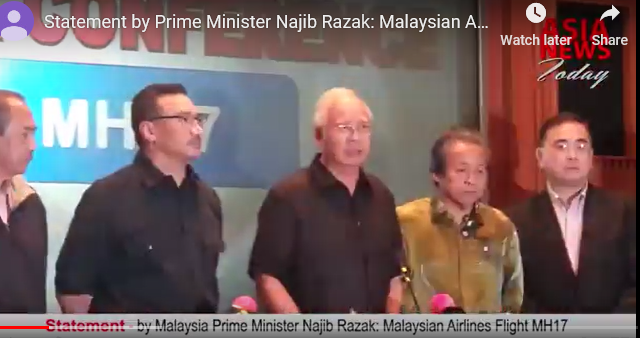
In Washington, DC, time on the day of the crash, President Barack Obama telephoned Prime Minister Najib in Kuala Lumpur; the US and Malaysian records of their conversation indicate Obama did not make any claim about Russian responsibility. After the Obama call, Najib was more explicit in not assigning culpability.

 “We will find out what happened to the plane,” Najib said at a press conference on July 18.

“If it was indeed shot down, we will press for the culprit to be brought to book. The Ukraine government believes the plane was shot down. However, at this stage, Malaysia has yet to identify the cause of the tragedy.
If it transpires that the plane was indeed shot down, we insist that the perpetrators must swiftly be brought to justice. Emergency operations centres have been established. In the last few hours, Malaysian officials have been in constant contact with their counterparts in Ukraine and elsewhere.”

Najib told the press he had spoken to the Dutch prime minister and the Ukrainian president; he did not reveal the call from Obama.

Prime Minister Najib (centre) at press conference on July 18, 2014. 

An important detail in Najib’s statement was that the Malaysian Government and Malaysia Airlines had received confirmation from international aviation authorities that the Ukrainian airspace through which MH17 was flying when it was attacked was “not subject to restrictions.”

The failure of the government in Ukraine to close the airspace above the fighting in eastern Ukraine is now the target of a negligence lawsuit at the European Court of Human Rights by families of the dead passengers; read more.

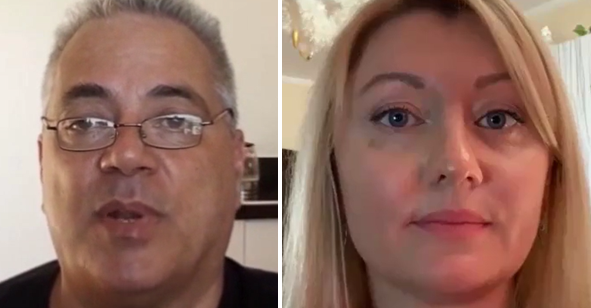
Max vander Werff and Yana Yerlashova filmed their interview with Mahathir on May 26. This week they released an excerpt of the interview in a preview of their film, “MH 17 – Five Years On”. In May they created Bonanza Media TV Channel, a start-up platform for independent journalists. Their MH17 documentary is the first to air on the platform.

Watch the film by clicking here. The full film will be broadcast next month.


Vander Werff is the leading independent investigator of MH17’s destruction over eastern Ukraine; he is Dutch. Yana Yerlashova is a Russian documentary film-maker; she formerly worked with RT, the Russian media organization equivalent to the BBC and Voice of America state broadcasters.

Left: Max vander Werff; right, Yana Verlashova. In this clip
they explain why Verlashova left RT, the Russian state media network, 
in order to make independent documentary films. 

The new film, “MH17 – Five Years On”, has been funded by a worldwide subscription through Kickstarter. Attempts by the BBC and by Dutch bloggers supporting their government to discredit Vander Werff and Yerlashova can be followed here. “I am unbiased and not stupid”, the pro-government Dutch blogger Marcel van den Berg claims on his website.

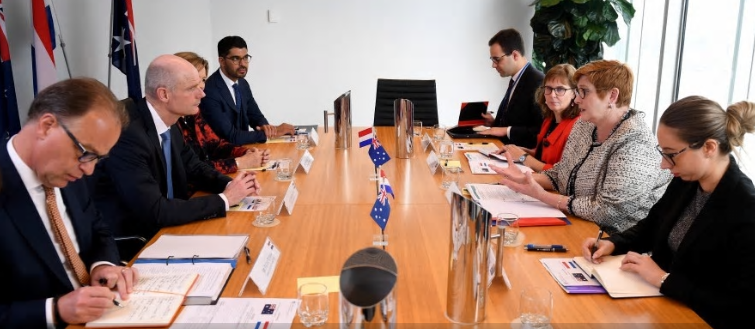
On March 26, the Australian and Dutch foreign ministers made a public appearance in Sydney. They said that earlier in the month they had held with Russian representatives “the first iteration of state responsibility talks between Australia, the Netherlands and Russia.” Disclosing no details of the negotiations, the Dutch minister Stefan Blok repeated the earlier “decision to hold Russia responsible in international law for its role in the downing of Flight MH17. Following this step we entered into contact with Russia.”

The two officials did not explain why Malaysia has been excluded from “state responsibility talks” although its losses in the crash are second only to the 193 Dutch nationals, and exceed the 28 Australian casualties.

Centre left, Dutch Foreign Minister Stefan Blok; 
right, Australian Foreign Minister Marise Payne. 

Dutch and Australian officials have met regularly to put pressure on the Malaysians not to break with their version of the MH17 crash. For more details, read this.

The Dutch-Australian talks led to Mahathir’s remarks recorded in the interview with vander Werff and Yerlashova on May 26.

Four days later, on May 30, Mahathir went public with his reaction to the Dutch and Australians. At a press conference in Tokyo, Bernama, the Malaysian state media agency, reported what the prime minister said.

“You need strong evidence to show it was fired by the Russians,” Mahathir commented.

“It could be by the rebels in Ukraine, it could be Ukrainian government because they too have the same missile…
We don’t know why we are excluded from the examination but from the very beginning, we see too much politics in it and the idea was not to find out how this happened but seems to be concentrated on trying to pin it to the Russians. This is not a neutral kind of examination.”

The Murdoch media in Australia, cribbing from the Malaysian press coverage, added this editorial line: “Dr Mahathir is known to enjoy a good conspiracy theory and it’s not the first time his opinions have raised eyebrows.”

Galloway Gives Tutelage on the Methods of the Modern Media Smear

George Galloway Fired from TalkRADIO After 'Anti-Semitic' Tweet

Good Morning Britain - ITV 


June 4, 2019

Former Labour MP and radio broadcaster has been fired from talkRADIO after being accused of anti-semitism in a tweet following the Liverpool v Tottenham Hotspur Champions League final. George Galloway and Lord Alan Sugar join GMB as they discuss the tweet in question.


Join Susanna Reid, Piers Morgan, Ben Shephard, Kate Garraway, Charlotte Hawkins and Sean Fletcher every weekday on ITV from 6am.