Tuesday, June 11, 2019

Saving Canada's Coasts from Regulatory Capture: Senate Votes Down New Impact Assessment Act

This Bill Cannot Stand. Rescue The New Impact Assessment Act Before It's Too Late.

by Sierra Club.ca


June 11, 2019

In spite of what has been referred to as a "flood" of evidence from fishing organizations, indigenous leaders, and environmental groups, the Senate has voted down an amendment to fix the new Impact Assessment Act, Bill C-69.

The amendment proposed by Senator Cordy in response to overwhelming criticism of the Bill from Atlantic Canadians, would have prevented offshore boards from chairing assessment panels that will determine where, when, and if oil drilling will go ahead in Canada's Atlantic waters.

As you know, I have little faith in the ability of offshore boards to credibly assess the risks of offshore drilling.

(For more, see my presentation [copied below] and that of many others who presented to the Senate's Energy, the Environment, and Natural Resources Committee when they travelled to Halifax, St. John's, and St. John).


  • Because of what this will mean for Canada's Atlantic waters, the whales, fish, and fisheries that need protection from oil drilling, this Bill cannot stand.
  • Because the fallout from this will be rubber-stamping of 100 new exploratory wells and massive, seismic programs off Newfoundland and Nova Scotia, this Bill cannot stand.
  • Because Newfoundland and Labrador’s offshore oil and gas ambitions will produce enough greenhouse gas emissions to produce almost 10% of the global carbon budget to keep us within the 1.5-degree Celsius limit, this Bill cannot stand.

With your help, we can get our elected leaders to fix this Bill before the government rises for the summer. But we don't have much time.


Please write now.

Thank you for taking action.


Gretchen Fitzgerald - National Program Director


Gretchen Fitzgerald, National Programs Director, Sierra Club Canada Foundation:
I would like to acknowledge that we are on unceded territory of the Mi’kmaq people.
My focus today is to ask you that the offshore petroleum boards have less, not more, power under the new Impact Assessment Act.
Sierra Club Canada Foundation is a national grassroots organization with the mission to empower people to be leaders in protecting, restoring and enjoying a healthy and safe environment.
Sierra Club has been involved in the development and amendments of environmental assessment laws since their inception in Canada. We have participated in numerous environmental assessments over the years, including the cleanup of the Sydney Tar Ponds, the Muskrat Falls mega hydro project, the Digby Quarry, and various offshore oil and gas projects off the East Coast.
Because of this experience, we know that offshore boards do not have the mandate or the expertise that would enable them to assess accurately and without bias offshore oil and gas projects.
The phase-out of fossil fuel development and the just transition for those affected by this change is what the Senate Energy Committee should be holding hearings on today.
Offshore oil and gas development usually occurs over the time scale of decades, but the Intergovernmental Panel on Climate Change has told us all that we do not have decades, as you are all very well aware. We have a matter of 11 to 12 years to prevent a climate crisis and limit global temperatures from rising above 1.5 degrees Celsius.
According to the IPCC report issued last fall, the final tick box is political will for achieving these safe levels. As senators you must be part of this will.
The Government of Newfoundland and Labrador plans to increase oil and gas development off its coast with potentially devastating impacts on climate and our oceans. Calculations performed by my colleague’s organization, Ecology Action Centre, indicate that if Newfoundland and Labrador develop oil and gas reserves as proposed in its advanced 2030 document on the way forward on oil and gas, this single province will be responsible for almost 10 per cent of the global allowable GHG emission budget to keep our planet within 1.5 degrees Celsius.
To us, it is not a weakness but a strength that the Bill C-69 will require us to take into consideration the impact of proposed projects on our obligations to meet climate targets. The early planning phase proposed in Bill C-69 is also a step in the right direction because it will engage community members and Indigenous communities earlier in the process and allow them a window into planned projects that will affect them.
Sierra Club Canada Foundation has concerns about Bill C-69 in that it does not go far enough to ensure there is science-based decision making by requiring independent review of assessment reports or by ensuring that decision making on proposed projects happens free from political interference.
Bill C-69 does not commit to ensuring we uphold the rights of Indigenous peoples by obtaining free, prior and informed consent. It does not propose a method for engaging in collaborative consent processes, a concept proposed by the expert panel on Bill C-69.
Given the reason for engaging in the process of drafting a new Impact Assessment Act was to make environmental assessments credible again. We are very concerned about giving greater powers to the offshore boards as is proposed in the draft bill.
The offshore petroleum boards have a dual mandate to promote oil and gas development and to protect the environment and the safety of workers.
Members of the boards are often drawn from the fossil fuel sector and do not have expertise in protecting the environment, ecology and endangered species or in reflecting the concerns of other marine industries such as fishing and tourism.
Some examples of poor decision making on behalf of the offshore boards in recent memory include having no rules in place that would halt attaching a drill to the seafloor when there were nine-metre waves occurring off Newfoundland last November, resulting in an estimated spill of 250,000 litres of oil into our oceans, not a single drop of which has been recovered. We do not know the death toll of seabirds caused by this spill.
Another bad example is allowing seismic blasting to proceed when critically endangered blue whales were migrating into the Gulf of St. Lawrence in 2010. There is growing evidence that seismic blasting can be devastating for marine mammals and other ocean life.
Recently, the Nova Scotia Offshore Petroleum Board issued a call for bids for oil exploration that includes Sable Island National Park Reserve. This would allow drilling within one nautical mile of this precious island.
Perhaps there is no greater example of the failure of offshore boards to deal with the impact of oil and gas development than allowing offshore oil and gas to occur in the Gulf of St. Lawrence.
The Gulf of St. Lawrence is bounded by the coasts of five of Canada’s ten provinces. The Mi’kmaq, Maliseet, Innu and Inuit people have fished and travelled in the gulf for thousands of years.
The Newfoundland Offshore Board is responsible for issuing calls for bids and permitting oil and gas development in its section of the gulf, even though this is a single shared ecosystem.
A spill in the gulf could impact the coast of five provinces, threaten multi-billion dollar fishing and tourism industries. Noise from seismic blasting, chronic pollution and a major spill from oil development in the gulf could spell the extinction for critically endangered whales and other threatened species in the gulf.
We are particularly concerned about the critically endangered North Atlantic right whale. They had major deaths in the gulf two years ago.
A recent scientific paper indicates that the Gulf of St. Lawrence, because it is such a unique place, where arctic waters and the warm gulf stream waters mix, will be greatly impacted by climate change. It may be more than any other marine ecosystem on this planet.
Scientists warn that the warming of waters in the gulf may create hypoxic or low oxygen levels that will not enable it to sustain life in some areas.
In spite of these multiple threats and calls for a moratorium from numerous organizations and the chiefs of Indigenous communities in the gulf, the offshore petroleum board has allowed oil and gas exploration to continue.
Offshore petroleum boards should not be getting more power under the new Impact Assessment Act. Certainly, they should not be able to appoint two members to a review panel or even chair an assessment panel. Our recommendation is that they would play an advisory role to assessments but not sit on review panels at all.
The influence of the oil industry over the drafting of Bill C-69, which has already been weakened, is making it difficult to see how the government will accomplish its mandate to make assessments credible again.
We know as practitioners that this influence will be brought to bear once impact assessments are undertaken for specific projects. Giving more power to offshore boards in Bill C-69 is simply a bridge too far.
In conclusion, our major recommendation to the committee today is to limit the role of offshore boards in reviewing offshore oil and gas projects. Thank you very much.
Senator Mercer: My question is actually a fairly simple one. It should have been directed at the previous panel as well. We have done some things right, though, even without heavy regulations being in place.
The regular route of whales coming into the Bay of Fundy was constantly having trouble with shipping. Industry came up with a solution to move the shipping route coming into the Bay of Fund and over to Saint John, New Brunswick, farther east and closer to Nova Scotia. Guess what? That is where the whales aren’t. Since they have moved that, there have been very good results with fewer incidents of ship/whale encounters in the Bay of Fundy.
At all our committees we tend to end up hearing the bad news stories. I wish people would tell us some of the good news stories, and that is a good news story.
Ms. Fitzgerald: Yes. We are very heartened to see that there are seven new baby right whales were born over the winter months. They are coming back, but they are coming back through a pathway of hazard. You will be hearing presentations on the impact of seismic on marine mammals later today.
The noise from that blasting is so loud that it can be heard halfway to Europe. If we are blasting off Newfoundland, as we plan to do this spring, and if we are blasting for the next 10 years, as we are proposing to do off Nova Scotia, those whales all the way down the seaboard will be hearing that noise and experiencing it as a constant stress. It is a blast that happens every 10 to 14 seconds.
It is like having a strobe light in your face for days, to weeks, to months. That is the comparison because whales use sound as we use vision to find their mates, to find their babies and to find their food. The impacts of seismic are far reaching.
I am glad to see the shipping industry is taking action. The rapid action of the fishing community in response to the deaths of whales in the gulf is wonderful to see.
We need to understand the scope of what we are doing with regard to ocean noise, offshore oil and gas development, and their impacts on global biodiversity and the entire seaboard.
It is interesting to note that in the United States there has been action to limit this development unlike in Canada.
Senator Simons: My question is for Mr. Butler this morning. We have heard from other witnesses as we have been around the country that we need to strengthen language in the bill around science, scientific integrity, scientific analysis. But I do not think anybody has given us much language around specific amendments.
You referenced a report that some of your organizations that you have partnered with had written about strengthening the language around science. And I am wondering if you have the text of that, could you share it with the clerk, could you read to us? What would you have us do to give to you the assurance that scientific credibility is given its due weight in the process?
Mr. Butler: Thank you for your question. I mean my main frustration with IA or EA over the years has been the quality of the document that the whole process centres around and that is it quantity but not quality. It is pages and pages of description without much analysis, without, I would, say good peer-reviewed science.
So finding a way to make the document that should ultimately be the guide to the project, more scientifically credible, is crucial.
And we had some early proposals in our submission to the expert panel that toured the country that the government appointed. I am happy to share our submission. I think at that time we were still exploring how the process could be improved, but when I reread the expert panel’s recommendations on science, I thought they were very good.
So I think if you are looking for guidance on how to make the act stronger with respect to science and make science a key part along with traditional knowledge, be it Indigenous knowledge or community knowledge, then the expert panel which is a distillation of 1,000 presentations, I think that is a good place to look.
The Chair: Senator Carignan.
[Translation]
Senator Carignan: My question is about the composition of the list recommended by the board. I’m trying to understand your concern about bias. Looking at your list, I see that the word “oil” appears on it. I know that the mandate and composition of this board is based on an agreement between Canada and Nova Scotia, that the members are appointed by both governments and that they have a mandate for environmental analysis. So there is an expertise that has developed within this organization. People will be appointed by this office or, in any case, will be on a list.
However, there are the provisions of clause 2 that indicate that appointees must not be in a conflict of interest and must maintain an appearance of bias. I’m a little uncomfortable with this question. I’m trying to find a balance between seeking the expertise of an individual or group without necessarily giving the appearance of bias. I have difficulty with the fact that the board is recommending a list of members to be selected by the minister. The members selected must not be in a conflict of interest. So it can create a fear of institutional bias, from the public perspective. What do you propose? Ultimately, the minister will have to choose someone. Is it better to proceed as illustrated by The Globe and Mail this morning, when the Prime Minister makes a choice after considering potential contributions or support?
[English]
Ms. Fitzgerald: I have a few responses. I just think it is dangerous to make an analogy between Indigenous rights holders and the fossil fuel industry.
[Translation]
Senator Carignan: However, it is in the legislation. The body that will decide, according to the legislation, could be indigenous groups, which are considered a body. They could do an impact assessment and measure the impact on indigenous rights. It is set out in the legislation....
The Chair: Senator Carignan, let the witness answer the question.
Senator Carignan: It’s dangerous to make an analogy, but that’s what’s stated in the legislation. I’m taking it as it is; I didn’t write it.
[English]
Ms. Fitzgerald: With Indigenous peoples, I think we in Canada are in a process in acknowledging reconciliation and the truth of history that they are the rights holders. I hope the role of the fossil fuel industry is a different one on this land.
That is why I think it is appropriate. Actually it is not even in place as far as the expert panel recommended with regard to the bill.
One must be very careful making a parallel between Indigenous rights holders and the fossil fuel industry. It is a very different legal standing. I would hope in the process of reconciliation that is acknowledged by the entire Senate.
You asked with regard to fairness. What would be a good list for the minister to use to select unbiased panellists I think is the heart of the question.
Before I go to answering that, you talked about fairness. I don’t know the story, but apparently the federal government has appointed or cherry-picked a new commission, it sounds like from what you are suggesting.
We feel the same way with regard to offshore boards and their role. They will pick people whether or not it is conscious. It is not about individuals. It is about being part of a process, a system and learning. By being part of an industry that is what you know and that is where you are most expert and comfortable. This would be all people. It is called regulatory capture.
We saw that with the pipeline assessment of Energy East. It blew up in the face of the government because that regulatory capture became too flagrant. It did not pass the sniff test for Canadians.
We would not want to see that happen again on review panels for offshore oil and gas. It was a regulatory fail from all perspectives whether or not you wanted that pipeline to go ahead.
One of the best panels I have seen selected independent experts linked to universities. They had expertise in planning, ocean environments and geology. This was the Digby Quarry panel. They were selected from independent academic institutions. With that, as you were mentioning, there could be seats for Indigenous rights holders as well if acceptable to those communities.
That would be the gold standard. It would achieve the level of credibility the government says it is trying to achieve here.
The Chair: Do you want to add something?
Mr. Butler: We recognize the expertise of the regulator, but there are ways to integrate their expertise into the process without putting them on the panel. We have other regulators like Transport Canada, DFO and Environment Canada. They are regulators that are not on the panel.
There is more I would like to say on that topic, but I will stop.
Senator Woo: Let me get to the heart of your recommendation to reduce the power of the offshore boards on review panels.
We actually heard a rather curious recommendation from one of the oil companies yesterday, saying that projects in the offshore should not have mandatory review panels but should be allowed to go through the Impact Assessment Agency itself as an option. I want you to comment on that idea. It is a curious recommendation because it seems to go against their interests.
On your point about consistency, which is a fair one, one could argue that having two offshore board members out of the five on the review panel is in fact consistent with what the rest of the bill is trying to do with CNSC and with the new NEB. The chair issue is separate. The NEB are advocates, calling for the possibility of somebody from the new NEB to be the chair of that review panel. That would be consistent as well.
To the extent that we already have the possibility of CNSC and NEB members in a minority position on review panels for their projects, why would we not have a minority of C-NSOPB and C-NLOPB members in those review panels?
Mr. Butler: Our colleagues in the rest of the country are more comfortable with the situation. That does not make it any easier for us to accept here, given our experience with the petroleum boards. This is actually an increase in their influence over the process.
I would say that allowing a petroleum board member to chair a panel is inconsistent. I would encourage this committee to make an amendment so that is not allowed. If your argument is to be consistency, you need to use that argument all the time and not be inconsistent in your use of the consistency argument.
Lisa Mitchell pointed out to me the other scenario. There could be two petroleum board appointees on a panel and a third industry person on the panel, perhaps with an oil and gas industry background. This would result in a majority of members on the panel.
If the purpose here is to make EA credible and to try to generate greater social licence, regardless of who are these individuals, that will not help.
Senator Massicotte: I certainly share your comments that this is the most significant challenge we have in our generation. The consequences are immensely serious, and I am a bit discouraged by our little progress so far.
Be that as it may, let me talk to you about an issue though. Obviously, markets are determined by supply and demand. I want to seek your comment, but, in my opinion, it does not change one iota of CO2 in the air if we import our oil and gas, as Quebec does to a large agree, or we produce it locally. Therefore, whether nor not we build another pipeline will not change our situation on global CO2.
We should do more but not on the supply side. In other words, everybody talks about supply but I say that is irrelevant. What is relevant is that we have to reduce consumption, which means the government should do a lot more to discourage us or to encourage us to find innovation to consume a lot less CO2.
Would you agree with that?
Mr. Butler: I think it is everything. I would say that it is.
Senator Massicotte: So what if you build or do not build? Do you think we will have a shortage of oil and gas in the world? In other words, on the supply side, if you are convinced that the world will not run out of oil and gas, it makes no difference whether we increase the supply of oil and gas from the oil sands, let’s say. Therefore that issue is irrelevant.
What is relevant is that we have to reduce our consumption of CO2.
Mr. Butler: Maybe my colleague wants to jump in here. I think it is both a question of supply and consumption. We have to tackle it at all ends.
I appreciate your acknowledgement of science. We should acknowledge the critical situation we are in and try to do everything we can to address it.
If you live in Nova Scotia, you will know about coastal flooding. I was in a fish shop two days ago and the guy was telling me that in the silver hake trawls they are now finding fish they have never seen before, such as John Dory and other species from southern waters. We are really seeing the impacts here.
Senator Massicotte: Let me be specific. Let’s say Trans Mountain and let’s say we build it or do not build it. If we build it, maybe some Canadian consumers will consume that oil and gas. If they do not consume it, I suppose, with the world supply, we will just ship it in as we are doing currently in Quebec to a large part.
Mr. Butler: That is the argument that what we do here does not make a difference because they are building more coal plants in China. We will never solve the problem if we take that attitude. Somebody has to lead.
Ms. Fitzgerald: It would be rare on a global issue as important as climate change, if you think of the other global issues where Canada is active internationally, for Canadians to throw up their hands and say, “We can’t play a role.”
Senator Massicotte: I do not recommend that though.
Ms. Fitzgerald: What we do does matter. By shifting supply, we are helping our communities with the challenge ahead and hopefully helping those workers that will be affected through just transition plans.
I think we also send a strong signal to what we want in this world. We are actually part of a global movement that is shifting this way.
I do not think pointing fingers is the way to solve any problem. I am so proud of some of the things Canada has done internationally to help with global crises. This is one where what we do does matter.
Senator McInnis: I join with Senator Mercer and Senator MacDonald in welcoming all the senators to Nova Scotia. It is nice to see the sun breaking through. It is nice to see you, Mark Butler. I have talked to you on the phone in the past on issues, and I truly appreciate what both of your organizations do.
Here in Nova Scotia, and, of course, in Newfoundland, we have vast oil and gas resources. I have the figures back in my office in Ottawa, but there are huge amounts of resources which will ultimately be produced.
I could predict pretty much what you were going to say this morning. I know who you are and what you represent, and I appreciate what you do. At the same time, I think you will all agree that we have natural resources and we do need an economy. All of us today should also recognize that we need a protected environment.
I do not want to make this too general, but I want to hear from particularly your two organizations. Where is the reasonable ground to meet this? We have to produce and do what we can with the natural resources we have particularly in the energy sector. Where is the ground from where we can go forward?
Ms. Fitzgerald: I guess the ground would be meeting and exceeding our existing climate targets. Unfortunately we are not in a place where we can say we are doing it as Canadians. I think it would be looking to that. Assessments show time and time again that the emissions from the oil and gas sector are a great hindrance to achieving those targets.
We are here to talk about Bill C-69. Incorporating a good assessment of the climate impacts in what we are doing would be a step in that direction, I would argue.
You said there are huge amounts of resources. There are also huge amounts of renewable resources in our energy efficiency resources. I was at a presentation yesterday that was ostensibly about fracking in Nova Scotia. The most exciting part of what I heard was about solar. There are tons of other things we should be doing that is about the economy.
Climate assessments are showing time and time again that the economy will be devastated by climate change. We have to meld those two goals. This bill is a step in that direction if it remains strong.
Mr. Butler: I am very passionate about this topic. I care a lot about the prosperity of Nova Scotia. I see our job is not just to hug trees but to hug people. We need to care about both.
If Nova Scotia cannot make the transition away from fossil fuels, I question if any jurisdiction can do it. We have abundant resources here. They are not just fossil fuels, but tidal, wind, small-scale biomass and even some hydro.
We can do it here. I think that is the direction we should be heading in and I think that is where prosperity lies.
There was a billion dollar offshore proposal. It was not oil and gas; it was Beothuk wind. In the end it did not go ahead. I am not sure of the reasoning. I would love to know why. It was a billion dollars and it was not oil and gas. It was the wind. It was offshore. It was European pension money coming in looking to develop wind offshore.
Those are the kinds of opportunities I think we should be pursuing. Those projects should go through a rigorous environmental assessment too to protect the environment and industries that currently rely on the ocean like fishing.
Senator Patterson: First of all, let me say that I am delighted to be in Nova Scotia. I was counsel for the Ecology Action Centre in 1972 on the Quinpool Road project. Hopefully I have some credibility with you guys.
For Ms. Fitzgerald, I have a real quick question. Seismic blasting every 10 to 14 seconds for days, weeks and months. Which is it? Days, weeks or months? What other evidence are we going to get today?
Ms. Fitzgerald: I think you are going to be hearing from Dr. Hal Whitehead, a professor at Dalhousie University who is an expert in marine mammals.
It depends on the project. Perhaps it is a really short-term project, but it tends to be weeks or months. It depends.
If you look at the maps of seismic planned for Newfoundland and Labrador and for Nova Scotia in particular, there is a nine-year plan that would entail blasting over a large swath of the entire Scotian Shelf. It is large geographic areas over time.
Senator Patterson: Both of you have advocated, to my surprise, a reduction in the role of offshore boards. I understand there are some concerns about the board appointment process.
I believe that Nova Scotians should be looking at the impact of development and protection of the environment in their waters.
On the role of a life-cycle regulator on a panel, we heard from the Nunavut Impact Review Board, where I come from, about this issue of balancing roles as an impact assessor, licensor and life-cycle regulator.
NIRB said that the way our system was designed meant that things had less certainty during environmental assessment. When they are on the ground and projects are actually operating, the precautionary approach we take yields new information that allows us to adjust in terms of approval, as needed, as the project goes ahead.
We have many instances where that has become necessary when something that in theory seemed like a good idea and then, when it goes to licensing, does not work as expected. We go to an alternate means of still allowing the project to go ahead and protect the environment.
I would like to ask a question of both of you. Would it not be important for life-cycle regulators to have familiarity with the project and use their knowledge of the project, the promises made in the assessment phase and their expert knowledge to manage potential issues as they occur throughout the life of a project? That is the logic of it.
With all respect, university professors will not have knowledge whether the promises made in impact assessment were actually realized during the life of the project.
Ms. Fitzgerald: I guess I would argue that sequential learning from experience is not happening with regard to environmental assessment now. In the offshore in particular we are not learning from past mistakes.
It would be appropriate if there were a requirement. For instance, if we have learned from past projects that there is methyl mercury contamination downstream from mega hydro, then what do we know for future assessments? If we know that when you try to attach to a well in nine-metre waves there might be a major spill, perhaps we should have some regulations about that.
I am not seeing that happening with the offshore petroleum boards frankly. Definitely, with regard to seismic blasting, we have a code of practice right now but we do not even have regulations for that.
I am not seeing the learning from science or the learning from experience. International experts evaluated what happened with the BP spill in the Gulf of Mexico. They looked at what is happening here in Canada and said that the risk assessment was 10 to 100 times off what it should be, from what they can tell from looking at our assessments.
It is inadequate. If that sequential learning is to happen, it would be best housed in the Department of Fisheries and Oceans, the Environmental Assessment Agency and the Impact Assessment Agency, whatever it is renamed, and not within the boards with regard to protecting the environment.
As we have tried to convey, the boards have expertise with regard to the industry. They have way less expertise with regard to meeting our climate targets and protecting our obligations to the environment, endangered species, Indigenous people and endangered species.
The Chair: Could you please send us the BP report on the comparison with the gulf?
Ms. Fitzgerald: Yes.
The Chair: Thank you very much.


Sea Lice "Epidemic" in Clayoquot Sound UNESCO Biosphere Region

Unprecedented salmon lice epidemic 

by Dan Lewis - Clayoquot Action


May 30, 2019

Clayoquot Sound UNESCO Biosphere Region wild salmon are heavily infected with sea lice from Norwegian salmon farming giant Cermaq.

This is an emergency situation pushing wild salmon stocks in the region towards rapid extinction unless the open-net pen salmon farms stop breeding sea lice.

Researchers sampling wild smolts are finding up to a 100% infection rate, with counts as high as 20-50 lice per smolt—this is unprecedented in BC.

One to three lice is a fatal load for tiny young salmon without protective scales. This means salmon farms are pushing Clayoquot Sound wild salmon to extinction.


Photo Tavish Campbell Coastal Photography

Lice are out of control


Wild salmon began leaving rivers around March 1st to start their lives at sea. This outmigration will continue until the end of June, and the fish will be rearing in nearshore waters during the summer. Sea lice numbers on Cermaq’s Clayoquot salmon farms have been up to 5 times over the threshold set by DFO. When drug treatments fail to keep numbers below the threshold, companies are expected to harvest infested fish in time to protect wild salmon. Cermaq has clearly failed to do this—for the second year in a row.

Making matters worse DFO staff report that DFO sea lice regulations are unenforceable. Their hands are tied as sea lice pour out of the farms. The salmon farming industry helped write these regulations.

Clayoquot Action on the frontlines


Clayoquot Action has been on the frontlines of this crisis. Our Clayoquot Salmon Investigation (CSI) volunteer crews have been in the field observing Cermaq’s emergency harvest of heavily lice-infected salmon, while collecting samples for our new virus monitoring program. Meanwhile in the office we’ve been working hard to get the story out in the media—here’s one example of the coverage quoting campaigns director Bonny Glambeck, and another featuring CA footage.

Clayoquot Action members have been sending a message to Ottawa, which is pushing politicians to act. Tofino’s MP Gord Johns (NDP Fisheries critic) has been challenging the Minister in the House of Commons. Fisheries Minister Jonathan Wilkinson has sent a warning letter to Cermaq, but this is not enough.

It’s time to demand that Fisheries Minister Jonathan Wilkinson take a stand for wild salmon. He needs to immediately amend the salmon farm Conditions of License coastwide to make them enforceable, with stiff penalties for companies that put wild salmon at risk of infection with deadly sea lice. This must include every farm over the limit today.

Add your voice today!


Show Minister Wilkinson that you are not going to stand by and let sea lice from salmon farms destroy BC’s wild salmon! Please send your letter today—add how this makes you feel to add even more impact.


Dan Lewis is Executive Director of Clayoquot Action.

Photo courtesy of Tavish Campbell Coastal Photography

Monday, June 10, 2019

UK Election Meddling Campaign Proven (Culprits Don't Deny It!)

Forget Russia-gate, now it's US-gate! US Election Meddling Extends to Britain

by Dave Lindorff - This Can't Be Happening


June 10, 2019


So now we have pompous Mike Pompeo, America’s current Secretary of State, on a visit to the UK, assuring a group of British Jewish leaders in a closed-door meeting that the US would work to prevent Labour leader Jeremy Corbyn from becoming prime minister if his party were to win enough votes in the next national parliamentary election to get the opportunity to try and form a new British government.

In a recording leaked to the Washington Post, Pompeo assured a group of Jewish leaders in Britain yesterday that the US government would “push back” against Corbyn becoming prime minister in such a case, working behind the scenes to prevent a victorious Labour party from voting in Corbyn as Prime Minister.

US Secretary of State (and chief foreign
election meddler) Mike Pompeo, helping
Benjamin Netanyahu with his latest election challenge.

In the British parliamentary system, the party with the most votes after an election, if it wins an outright majority, or, as the Conservatives did in the last election, a plurality of votes and then is able to successfully cobble together a majority by bringing in other parties, then can use that majority to elect a new prime minister. Normally the new PM is the leader of the party that won the most votes, but that need not be the case.

A questioner on the tape is heard asking Pompeo, “Would you be willing to work with us to take on actions if life becomes very difficult for Jews in the UK?” — an obvious reference to a rabid ongoing campaign in the largely conservative UK media and among zionist groups in the UK to tar Corbyn as an anti-semite because of his outspoken defense of Palestinians under Israeli occupation.

Pompeo, obviously not aware he is being taped, appears to suggest in his answer on the leaked recording that the US would seek to prevent Corbyn from becoming PM.

“It could be that Mr Corbyn manages to run the gauntlet and get elected,” he says.
“It’s possible. You should know, we won’t wait for him to do those things [presumably making life ‘difficult for the Jews in the UK’] to begin to push back. We will do our level best. It’s too risky and too important and too hard once it’s already happened.”

This — an acknowledgment that the US would try to influence the selection of Britain’s parliamentary leader — is truly an astonishing statement coming from a top US government official, and particularly a secretary of state. I mean we all know that the US routinely messes with elections all over the third world, and even in European countries, but our leaders don’t normally admit it, even in private, preferring to tout the US as a paragon of “democratic values.”

Imagine if Corbyn were Prime Minister in 2020, and his foreign minister were caught on tape in the US telling a group of black leaders or Muslim leaders that his government would try mightily to prevent Donald Trump from winning re-election?

Oh, I know, he or she would immediately be given a ticker-tape parade in San Francisco, New York and Boston! But seriously, much of the nation, and the media, would go ballistic.

Of course, AIPAC, Israel’s lobbying organization in the US. does exactly that kind of thing every election year, but still, as a matter of decorum and at least the pretense of respect for other nations’ sovereignty, one doesn’t expect to hear a secretary of state talking about such crude interference in the democratic process in another country, particularly in a nation which is America’s closest ally aside from perhaps outright dependencies like Taiwan or Dubai.

Not surprisingly, the response in the UK has been mostly outrage.


A Labour Party official told the British Guardian newspaper, “President Trump and his officials’ attempts to decide who will be Britain’s next prime minister are an entirely unacceptable interference in the UK’s democracy.”

The dust-up over Pompeo’s leaked remarks should be recalled as one contemplates the absurd obsession among Democrats here about alleged Russian meddling in the 2016 US election continues apace.

Yet certainly nothing Russia is accused of doing — like buying ads allegedly intended to promote division in the US on Facebook, or using bots to promote disharmony on various social media platforms — comes close to what Pompeo is proposing doing: actually using the full weight of the US government, with its ability to offer gifts of free weapons or conversely to impose punitive tariffs, not to mention making available the nefarious abilities and persuasive powers of the CIA and NSA to prevent the selection of a chosen party leader as prime minister following victory in an election (Pompeo was CIA director before becoming Secretary of State).

The hubris of this grotesque Tea Party Congressman-turned “top diplomat” is simply appalling.


One would have thought any self-respecting British Tory politician would have instantly denounced Pompeo’s suggested intrusion into the workings of the British electoral system, but so far there hasn’t been a peep from any of that party’s leaders, who no doubt actually support the idea of the US preventing their nemesis Corbyn from ever moving into 10 Downing Street.

His comments may, however, have the effect of bolstering support for Corbyn among Labour’s rank-and-file. Corbyn has already survived several concerted attempts from the Blairite faction of his party to unseat him as party leader, always emerging stronger from those attacks. My guess is the same thing will happen here, when a clumsy outsider from across the Atlantic offers to do the same thing.

Meanwhile American liberals should keep this incident in mind as they continue to wallow in the self-destructive effort to conjure up a fake story line that the Russians “stole” the 2016 election for Trump by undermining Hillary Clinton’s campaign, when in fact it was the Democratic Party leadership and Clinton herself who blew that election. Those leaders are well on the way to blowing the next one, too, for example by refusing to hold a a presidential debate focused on the existential issue of climate change.

Pompeo may think he has to “save” the Jews of Britain from Corbyn and Britain from the anti-Brexiters in the Labour Party, but at the rate things are going here in the US, nobody is going to have to come in from the outside to “save” America from a Democratic president and a Democratic Congress in 2020. The Democrats, with their continuing whining about Russiagate, look like they’ll manage that all by themselves.

Sunday, June 09, 2019

Palestinian Resistance Icon Ahmed Tamimi Speaks with George Galloway

Palestinian Resistance Icon Ahmed Tamimi

by George Galloway - Sputnik Orbiting the World


June 9, 2019

Ahed Tamimi’s main crime was to attract attention to a conflict in the occupied West Bank which most want to keep quiet. George Galloway welcomes her on his ‘Sputnik Orbiting the World’ show.


RT LIVE https://www.youtube.com/watch?v=IFAcq... 

Check out http://rt.com 

Subscribe to RT! http://www.youtube.com/subscription_c... 

Like us on Facebook http://www.facebook.com/RTnews 

Follow us on VK https://vk.com/rt_international 

Follow us on Twitter http://twitter.com/RT_com 

Follow us on Instagram http://instagram.com/rt 

Follow us on Google+ http://plus.google.com/+RT 

Follow us on Soundcloud https://soundcloud.com/rttv


Western Shadows: Resisting the New Fascism in Nicaragua

Nicaragua in the Shadow of Western Fascism

by Tortilla con Sal


May 21, 2019

Current US and EU foreign policy embodies fascism in terms of its aspect combining corporate power with State power and policy.


In her Sorbonne University exam results, French philosopher Simone Weil scored better than Simone de Beauvoir or Jean-Paul Sartre. She well understood the varieties of Western fascism and imperialism. So it’s worth paying attention to her remark that Europeans were shocked by Nazi crimes because the Nazis did to them what Europeans did to the people in their colonies. Weil’s remark was hardly news to people in the majority world, but it bears repeating to people in North America and Europe now.

Current US and EU foreign policy embodies fascism in terms of its aspect combining corporate power with State power and policy. The glitzy contemporary version prioritizes monopoly corporate finance and media as a means to achieving what the US and EU elites want, avoiding the mass destruction of war with uncertain global outcomes against obdurate, determined antagonists. That is the underlying meaning of contemporary sanctions and psychological warfare against Russia, China, North Korea, Syria and, in Latin America, against Cuba, Venezuela and Nicaragua.

In Latin America and the Caribbean, this reality is self-evident given the nature of US and EU proxies. The US and the EU support repressive organized-crime regimes in Colombia, Brazil and Argentina and those regimes’ counterparts among the political opposition of Bolivia, Cuba, Nicaragua and Venezuela. A corollary of that support is the inability of these subaltern political blocs to tell the truth or honor agreements, exactly like their overseers in North America and Europe.

Examples abound of this reality. Early in 2018 the Venezuelan opposition was on the point of signing an agreement with President Nicolas Maduro’s government but dropped out at the very last minute on orders from US Secretary of State Rex Tillerson. Similarly, the US authorities unilaterally abandoned the process easing tensions with Cuba after years of negotiations and just recently they intensified sanctions by activating previously unused measures under the notorious Helms-Burton Act.

In Colombia, the latest violation of the increasingly debased peace agreement has been the re-arrest of Jesus Santrich on phony narcotics charges after his release under the agreement’s key judicial provision, the Special Peace Jurisdiction. That abuse of the agreement follows over 120 murders of demobilized FARC fighters by Colombia’s army and their narco-terror paramilitary allies. Similar gross bad faith characterizes right-wing abuse of judicial practice in Argentina, Brazil and Ecuador and the desperate, unsuccessful maneuvers of the opposition in Bolivia against the presidential candidacy of Evo Morales.

This is the regional context for the political negotiations here in Nicaragua between President Daniel Ortega’s Sandinista government and the US bought-and-paid-for opposition. In contrast to the political opposition in Venezuela, in Nicaragua, the talks are not even with elected politicians. The US controlled opposition representatives have deliberately excluded electorally bankrupt right-wing political parties from the talks The opposition negotiators are almost without exception individuals from organizations dependent one way or another on US financial support.

The Nicaraguan government has accepted talks with these unrepresentative opposition figures in a process mediated by the Papal Nuncio and a delegate from the Organization of American States. The discussions have been continuing formally since March this year with some progress on issues like the conditional release of prisoners convicted of crimes during last year’s failed coup attempt, the return of opposition supporters who fled the country last year, electoral reforms and reinforcing existing constitutional guarantees. All of these are important concessions by the government.

For their part, the opposition refuses to commit either to renouncing future violence or to a joint call with the government for an end to sanctions damaging the Nicaraguan economy. Nor do they seem open to agreeing on a mechanism guaranteeing the implementation of any final agreement that may be reached. In effect, they seem to think the threat of continuing US sanctions and even intervention exonerates them from making any meaningful concessions.

As the talks wear on, the government’s good faith contrasts more and more strongly with the opposition’s bad faith, both to the majority of Nicaragua’s people and to the mediating delegates. As a smokescreen for their perfidy, the opposition periodically stages distractions either via media theatricals or calculated violence. The latest example of this has been a series of attacks by opposition prisoners in the penitentiary where they are detained. But the Nicaraguan authorities preempted the propaganda value of those attacks by inviting the Red Cross to monitor conditions for those prisoners, a measure which has undercut the opposition’s false claims of abuse.

Two things remain absolutely clear at this stage of the failed US and EU attempts to overthrow Nicaragua’s Sandinista government. Firstly, people supporting the Nicaraguan opposition are accomplices to profoundly anti-democratic, anti-humanitarian Western government efforts at regime change against a successful progressive government. Secondly, like their fascist counterparts in Venezuela and Colombia, the Nicaraguan opposition is treacherous quislings committed to serving and obeying foreign corporate interests. They have nothing to offer in response to the impeccable national human development plan of President Ortega’s Sandinista government.

Everything suggests that the opposition delegates are determined to find an excuse either to walk away from the current talks or to renege on any eventual agreement. President Ortega’s government negotiators have already made and implemented important concessions but are sticking to their demand that the opposition call for an end to sanctions. In the end, a final agreement may well be reached, but the US and EU owners of Nicaragua’s opposition will never let them honor it. In fact, it may not be entirely true that Nicaragua’s opposition has no plan for their country: they want to be the rulers of a neoliberal hell like Honduras or Haiti.

RELATED:
Blood of Augusto Sandino Runs Through Nicaragua's Veins: Ortega

Saturday, June 08, 2019

A Dark Night for Journalism: 5 Eyes Link to International Media Crack Down

Australian police chief links media raids to US-led “Five Eyes” spy network

by Mike Head  - WSWS


8 June 2019  

The Australian Federal Police (AFP) called a news conference on Thursday to justify its raids targeting journalists at two media organisations this week.

Police spent seven hours ransacking a News Corp political reporter’s home in Canberra on Tuesday, and eight hours poring over and seizing files at the Australian Broadcasting Corporation’s (ABC) Sydney headquarters on Wednesday.

In an extraordinary admission, the AFP’s acting commissioner Neil Gaughan blurted out that the real reason for the raids was to protect the information that the Australian police and intelligence agencies receive from their “Five Eyes” counterparts.


Acting AFP commissioner Neil Gaughan
[source: Australian Broadcasting Corporation]

Five Eyes is a top-level network of intelligence agencies dominated by the US that also includes Britain, Australia, Canada and New Zealand.

“The Australian government, or particularly the Australian enforcement and intelligence communities, rely on secret and top-secret information from our international partners, particularly our Five Eyes partners,” the police chief said.
“If we can’t be seen to protect our own internal information, [then] we are concerned that the information flow to us dries up.”

Citing government demands for investigations into leaks of secret information, Gaughan said the AFP received “numerous referrals to us [of leaks] and to be honest we get too many. But the premise of investigating these matters is to ensure the international community knows that we take the leaking of information, sensitive information, seriously.”

In other words, the AFP is under pressure not just from Canberra, but from Washington, to ensure that information, including about criminal actions of governments and its agencies, is kept from public view. This takes place amid the Trump administration’s mounting threats of war against Iran and Venezuela, as well as its escalating confrontation with China.

The AFP search warrants related to leaked documents exposing war crimes perpetrated by the Special Air Service (SAS) in Afghanistan and plans to legalise domestic mass surveillance by the Australian Signals Directorate (ASD), which are both central to Five Eyes operations.

Gaughan’s remarkable declaration went virtually unreported throughout the establishment media in Australia and internationally. His admission vindicates the analysis made by the WSWS on Thursday:

“[I]t is inconceivable that the Australian government would have instigated and pursued the investigation of the ABC and Murdoch media journalists without the agreement, if not urging, of Washington. Both the SAS and the ASD surveillance agency are closely integrated into all the wars and war preparations of the US.”

Gaughan’s statement also underscores the warnings made by the WSWS that the persecution of WikiLeaks founder Julian Assange for exposing the war crimes, mass spying and regime-change operations of Washington and its allies, including Australia, is setting a precedent for the criminalisation of journalism.

By specifically targeting journalists, as well as whistleblowers, the Australian government is following the lead of the Trump administration. The US has charged Assange, a journalist and publisher, with multiple counts under the Espionage Act, for which he faces life imprisonment.

At his press conference, Gaughan refused to rule out laying charges against News Corp journalist Annika Smethurst or ABC reporters Dan Oakes and Sam Clark for publishing alleged “national security” secrets. Such charges against journalists would be without precedent in Australia since World Wars I and II.

In a pointed warning, Gaughan said “no sector of the community should be immune” from police investigations into alleged law-breaking. Gaughan said the police are probing the “publication” of documents marked “secret” and “top secret,” placing journalists and publishers squarely under threat of prosecutions.

The AFP is investigating breaches of the Crimes Act, which criminalises unauthorised disclosures by public servants, and also contains offences that apply to journalists. Journalists, as well as alleged leakers, can be jailed for up to seven years. Dating back to World War I, the legislation outlaws “receiving” information that “prejudices the security or defence” of Australia.

But, asked what was the harm of revealing wrongdoing by Australian troops or plans to extend spying laws, Gaughan said the substance of the reports was “irrelevant.” The mere disclosure of protected information was a crime. He bluntly stated: “The issue of whether or not the public has the right to know is really not an issue that comes into our investigation process.”

The Crimes Act provisions were recently replaced by even more far-reaching measures embedded in the “foreign interference” legislation that the Liberal-National government pushed through parliament at Washington’s urging late last year, supported by the Labor Party. The maximum penalties were increased to 10 years’ imprisonment. However, the new laws could not be applied to the current cases, because the alleged leaks occurred in July 2017 and April 2018.

Gaughan tried to refute accusations that the AFP was acting at the government’s behest. He denied that the police had waited until after the May 18 federal election to execute warrants and claimed no contact had been made with the government since the AFP informed Home Affairs Minister Peter Dutton when the investigations first began.

These claims fly in the face of the facts. The government itself instigated both AFP investigations, and the Labor Party fully supported it in doing so. And Dutton and other government ministers immediately defended the raids. When Prime Minister Scott Morrison was asked at a press conference if he was bothered by police raiding journalists’ homes, he replied:

“It never troubles me that our laws are being upheld.”

Above all, as Gaughan himself revealed, the raids were mounted to satisfy the Five Eyes powers, which means the US above all. Successive governments, both Liberal-National and Labor, have committed Australia to be a key partner in this network as part of its military alliance with the United States.

The police raids are part of a global crackdown on freedom of speech, including in the US and other countries, such as France, where governments are taking the Trump administration’s repressive lead.

This assault is targeted directly at the basic right of the working class to know the crimes, war plans and conspiracies of the capitalist ruling elites and the state apparatuses they control. It is being mounted amid growing struggles by workers around the world against soaring social inequality and declining living and working conditions.

The Australian police chief’s open threats highlight the urgency of the worldwide campaign being waged by the WSWS and the Socialist Equality Parties for the defence of Julian Assange and the jailed whistleblower Chelsea Manning. Their plight is a test case in the struggle against the lurch toward war and dictatorial forms of rule.


The author also recommends:
The global war on journalism
[6 June 2019]

US Department of Justice Pads Assange Charge Sheet

US Department of Justice Pads Assange Charge Sheet

via WikiLeaks

June 6, 2019


WikiLeaks Must Fall: Getting at the Roots of the Assange Persecution

Freeing Julian Assange: Part One 

by Suzie Dawson - ContraSpin


June 8, 2019

We’ve been so busy sifting through the ashes that too few of us have noticed what’s been staring us in the face all along.

Let’s change that.


The Big Picture


With millions of words written about Julian Assange, WikiLeaks and its associates, swirling all around us daily, it’s easy not to see the wood for the trees.

The first port of call for those defending the world’s most at-risk publishing organisation and its staff has been tackling the individual narratives of its oppressors. Focusing on Sweden, or Ecuador, or the US Department Of Justice, the Grand Juries or the United Kingdom and debunking their spin seems a necessary task. But we have to face the reality: Years of arguing til we’re blue in the face about the intricacies of all the various aspects of the aforementioned – plenty of which I’ve engaged in myself – hasn’t achieved victory. We aren’t better off, or stronger for it. Things are slipping, and slipping fast.

A decade into this battle, it’s time to reflect upon the sum total of the parts. We need to acknowledge what has happened not just to Julian – but to his organisation as a whole. We need to examine WikiLeaks at an architectural level, just as its opponents have. In doing so, we see that the desecration of Julian’s reputation and the attacks against his work, relationships and his physical person were actually never about him – it was always about his organisation, what it is and what it does, all along.

Sweden and the cases against Julian were only ever a distraction, a red herring. To get a crystal clear picture of the situation we must zoom out to an eagle eye’s view.

What that lofty vantage point reveals is an obvious and protracted systematic destabilisation of the key pillars of the organisation. The social decapitation of its most effective members. The undermining of their ability to continue to serve and add value to it.

These are the rotten fruits of the transnational agenda to eradicate WikiLeaks. A state-level, international conspiracy which long pre-dates then-CIA Director Mike Pompeo’s declaration of war against WikiLeaks in 2017. His overt threats were merely a cover for covert operations that track back at least as far as 2009.

Those who oppose WikiLeaks are closer to their goal of destroying it than ever before. If we’re to turn that tide, we must examine what made WikiLeaks good at its best, find the missing pieces between then and now, and reinstitute them with haste.

What A Strong WikiLeaks Looks Like


The organisation Julian engineered was robust. This is self-evident: it has been able to withstand 10 years of unceasing attacks by state intelligence agencies across multiple jurisdictions. That it has so far survived them is a historic accomplishment.

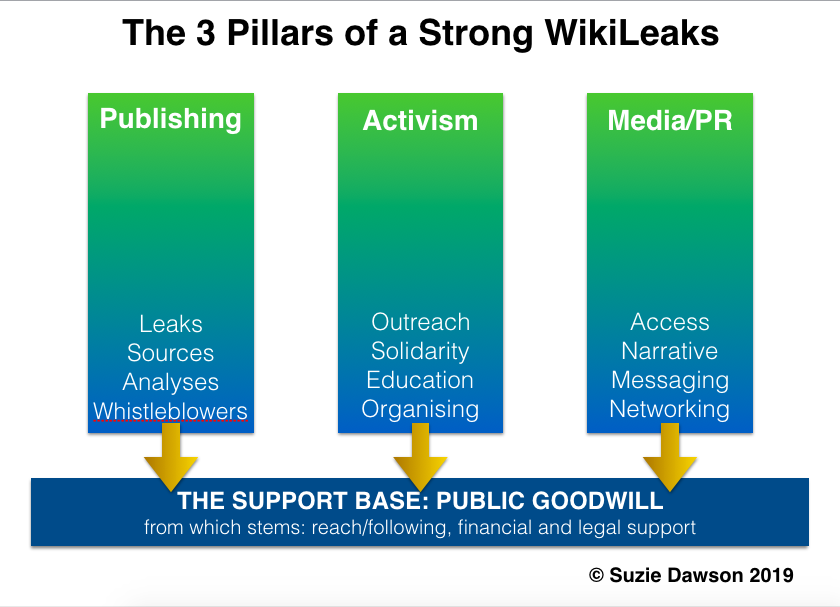
This is what WikiLeaks in its prime looked like: a publishing wing, an activism wing, and a media/PR wing.

Each of these three pillars were championed by individuals with very public facing roles. 
Specialists in their field. Taking huge powers head on, and huge risks.

In their competent hands, WikiLeaks was the world’s premiere publisher; the pearl of the tech activism sphere; and platformed on major cable news networks, with opinion pieces in major MSM publications. WikiLeaks controlled the narrative; WikiLeaks was always on the front foot; WikiLeaks critics were forced into a defensive posture, always having to respond to whatever WikiLeaks was doing next.

WikiLeaks pulled rabbits out of hats. We always knew to expect the unexpected. Whenever it appeared that the chips were down, they bounced back better than ever before.

It was a golden age and I refer to the three major components of it as the dream team. Quite frankly, they rocked this shit.

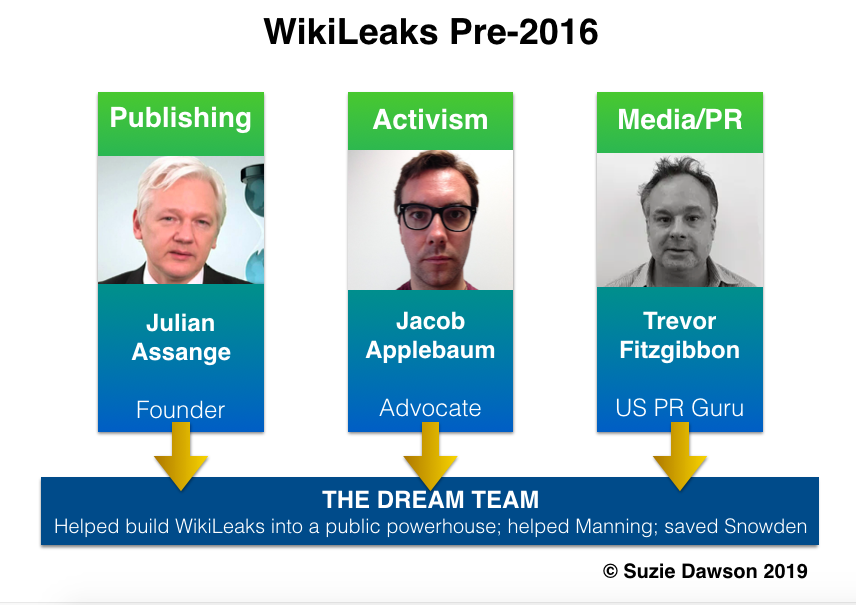
The Dream Team


Julian Assange controlled policy, process, publishing and protected sources. He established satellite organisations and was the managing director of the WikiLeaks empire. Jacob Appelbaum went on stages around the world, speaking to hundreds of thousands of people about the value and importance of utilising and supporting WikiLeaks. He was a major conduit to the tech crowd and a constant presence at developer, privacy and journalism conferences. Trevor Fitzgibbon liaised with media bigwigs, musicians and celebrities, recruiting them to the cause and utilising them to enhance WikiLeaks public profile. He managed media relationships, engineered and pushed proactive narratives.

These three men relentlessly championed WikiLeaks.

These three men built the original campaign to save Chelsea Manning.

These three men helped to save Edward Snowden.

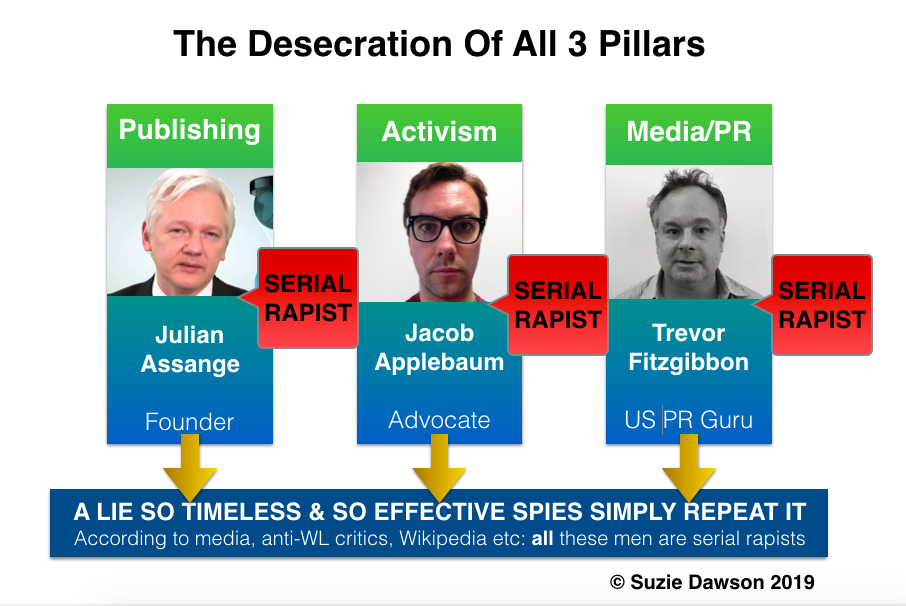
These three men all had their public reputations destroyed.

Victims Of Their Success


You don’t have to look hard on social media or the web to see how often Julian Assange is described as a serial rapist.

Nor to discover that Jacob Appelbaum is described as a serial rapist too.

And Trevor Fitzgibbon? Yup, also called a serial rapist.

What is the likelihood of all three public figures representing 
the key pillars of WikiLeaks, conveniently being serial rapists?

In retrospect, it defies logic.

In aggregate, the subterfuge is so obvious as to be ludicrous.

But when the CIA is targeting you there’s always more in store.

One rapist, two rapists, three rapists, four.

Rapists! Rapists Everywhere!


When celebrated Icelandic journalist Kristinn Hrafnsson was appointed Editor-in-Chief of WikiLeaks in October 2018, the announcement was lauded across the aisles.

The accolades would be short-lived however, as within a week of his accepting the mantle, he was being smeared as “a hostile and abusive person toward women“, and a “violent drunk with a history of being physically and emotionally abusive of women”.

The wording of the smear article is as limp as the accusations – “An air of allegations… He may now face allegations… unable to independently confirm the veracity of these allegations…”

No victims came forward. No charges were filed. No investigation launched. They just threw their mud at the new head of the WikiLeaks publishing pillar and hoped it would stick, as it had with the others.

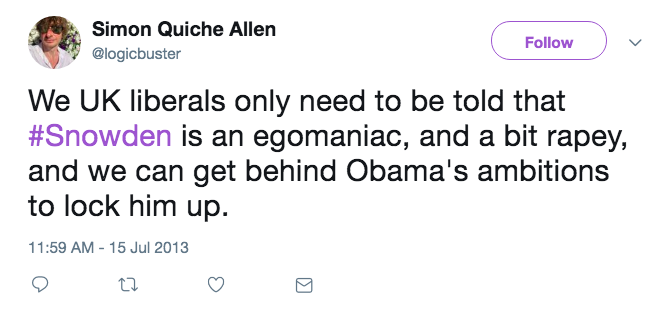
This is a tactic often applied in social media as well as in print. Other towering figures in activism and whistleblowing have been tarred with the same brush. Matt DeHart had highly questionable child pornography charges manufactured against him. So did the alleged Vault7 whistleblower. Even Edward Snowden has trolls online baselessly attacking him along the same lines, despite there being zero suggestion whatsoever of such thing ever having occurred.


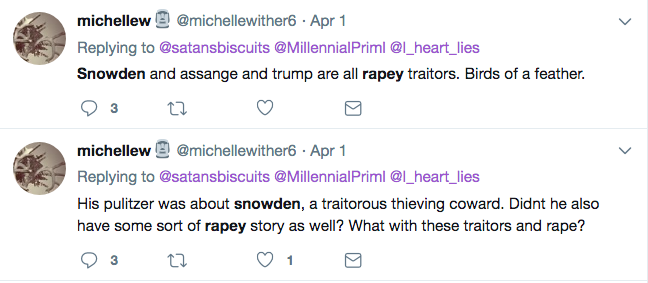
One commenter with a dark sense of humour nailed it perfectly: 


Why is this tactic utilised time and time again? Because it works. Because we continue to let it work.

Our failure to protect those who put themselves in the firing line on our behalf, sharpens the sword used to cull us.

That Sinking Feeling


In 2016 I wrote a series of articles about Jacob Appelbaum. The more I dug into the rabbit hole, the deeper it went. Linguistic anomalies, smear websites, false accusations, retracted allegations, censorship, collusion, professional malice, jealousy, spurious claims, career and social ladder climbing – it was an ugly picture. Eventually my series totalled five pieces and over 20,000 words.

But I stumbled across something huge, when I was researching the Jake case. I read about someone called Trevor Fitzgibbon from Fitzgibbon Media. While I’d seen the results of his P.R. and advocacy work many times, I’d never known it was him behind it all. It turns out he owned the firm that ran US media and P.R. for WikiLeaks, Chelsea Manning, for Edward Snowden, Glenn Greenwald and The Intercept, and multiple nation states including Venezuela and Ecuador.

In my reading, I learned that six months prior to the branding of Jacob Appelbaum as a serial rapist, Trevor Fitzgibbon had gone through the same thing. It destroyed his P.R. firm, his career, his marriage, his finances and his life. Just as the JakeGate scandal had robbed WikiLeaks of one of its most outspoken and powerful public advocates and organisers, the Fitzgibbon scandal before it had robbed WikiLeaks and the whistleblowers it represents, of their most capable media and P.R. liaison.

Because I didn’t know Fitzgibbon and had no contact with him, I filed away what I learned about his case in the back of my mind. But I couldn’t escape the eerie, disquieting feeling that this was all an echo. An echo of what had been done to Julian.

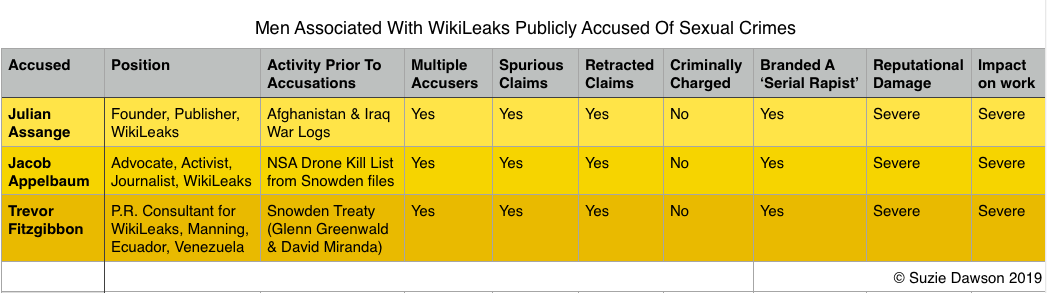
These last few months I have been investigating the three cases in tandem, overlaying and analysing them. The patterns are impossible to ignore.

  • A target engaged in activity that was highly threatening to the global intelligence complex
  • Multiple accusers of rape, sexual assault, sexual harassment or sexual misconduct
  • Spurious claims that don’t qualify as any of the aforementioned
  • Retracted claims
  • Lack of criminal charges
  • Target publicly branded and smeared as a “serial rapist”
  • Massive reputational damage
  • Severe impact on the productivity of the target and their ability to perform in their professional capacity

This is a table of my findings:

(Click on the above picture to see an enlarged version of it.)

In each of the three cases, there is material evidence that suggests no rape ever took place.


In Julian’s case, one of the women involved submitted a condom that was found to have contained no trace of DNA – either his or hers. She then went on to state publicly that she was not raped. The other complainant told friends she had been “railroaded by police” and did “not wish to charge him with anything”.

In Jacob Appelbaum’s situation, what turned out to be the sole rape complainant (despite promises by his detractors of the existence of dozens of victims) emailed him after the fact to tell him what a wonderful time she’d had and how she looked forward to coming back to Berlin to visit again. Another supposed victim said that the story told by Appelbaum’s accusers about her was factually incorrect and had been used against him without her consent.

In Trevor Fitzgibbon’s case, the sole accusation of rape came from a woman who it eventuated had sent him a slew of nude and semi-nude photos before the alleged incident, and then another text message afterwards to congratulate and praise him for his sexual performance. She then immediately thereafter asked him to do a number of professional favours for her and her clients. Her rape claim was investigated by authorities – who after a year-long inquiry, struck them down as baseless and declined to charge him. He subsequently took the evidence of her duplicity to a court, and successfully sued her for defamation. She has now publicly retracted her allegations against him.

Despite all of the above, the mantra of “there are multiple accusers” continues to be used against all three men. Julian was seen explaining in the Laura Poitras documentary ‘Risk’ why there being multiple accusers is problematic, and was promptly deemed a ‘misogynist’ for having dared to utter such a basic observation. He was portrayed as a guilty man plotting counter-narratives against victims to evade justice, instead of an innocent man marvelling at the intricacy of the chains being used to bind him.

In all three cases, spurious claims were made that either barely meet the standard of a sexual crime or simply don’t at all. Despite nine years worth of invocations of the word “rape”, and the term “serial rapist”, the accusations against Julian don’t amount to rape at all. They are what the Swedish law books describe as “a lesser rape” and describe activities which are not crimes in most Western countries. In Jacob’s case, his accusers saw fit to drag in career disputes, jokes made in bars, a third-party allegation about a simple kiss, and the back-washing of an accuser who failed to disclose when writing about the incident, that after said back-washing, she had in fact decided to have consensual sex with Appelbaum. In Trevor Fitzgibbon’s case, the retracted-rape complainant was accompanied to the police station by two other complainants. One claimed that Fitzgibbon had “hugged her inappropriately.” The other claimed that his hand had brushed her backside during a hug. These complaints were also struck down by the investigating agency.

I’ve written at length elsewhere about how such spurious claims effectively water down the seriousness of rape. I’ll save myself the discomfort of doing so again, other than to say: to those of us who have experienced the violence and trauma of rape, gang rape and serious sexual abuse, it is an unforgivable affront to see such pitiful, shallow complaints, conflated as rape. Those engaging in this behaviour damage the credibility of, and in fact endanger, all genuine rape complainants, and should be deeply ashamed of themselves.

None of the three men – Julian, Jacob or Trevor – have ever been charged with a crime. Nor have they had any civil suits filed against them, even though the evidential barrier is lower. Yet all three continue to be abused by their political opponents, who brand them “serial rapists”.

This has caused irreparable harm to them and to those close to them. It also materially damaged their careers.

And that’s really what this is all about. It was never about them. It was about their professional pursuits: what they are good at doing, what they love doing, who was inconvenienced by them doing it, and who stood to benefit from inhibiting their ability to continue doing it.

The Playbook


The playbook of the intelligence agencies, is to divert, control and consume the attention of their targets. Once they can direct your attention, they can control your entire life.

Julian’s attention and resources were diverted to trying to defend himself. The Swedish accusations against him were used as a cover to detain him in the UK while secret US grand jury indictments for his publishing activities were prepared. A Swedish researcher I spoke with told me that NGO’s that had dared to show support for Julian in 2010 such as Amnesty Sweden, were hounded by state-affiliated detractors who decried them for daring to support a “rapist”, compelling them to alter their positions.

Jacob was made persona non grata within his own community – outcast. Denied his places of refuge, expelled from organisations. I wrote previously of how certain tech activism figures took it upon themselves to lobby conference organisers and hacker organisations around the world to issue public bans of Appelbaum from their events, their member lists and their premises. Many, many organisations caved in to the pressure.

In “Orwell’s Swan Song: Free Speech Activists Whitewashing Wikipedia To Silence Dissent” I wrote of Jake’s “almost wholesale removal from the stages on which he shared pleas for people to leak sensitive intelligence information, to take direct action at NSA sites, his revelations about the dystopian surveillance complex affecting us all and of the tactics being employed against persons of interest.” Prior to Jake’s smearing, he had been doing all of that, as well as studying, writing about and making presentations on the NSA drone kill list from the Snowden files.

Trevor had the same experience. Seventy progressive and media organisations signed an open letter declaring that they would never work with him again. This was not a spontaneous synchronicity at work – it was a coordinated effort driven by malignant figures to prevent him from ever being able to work in his sector again. Ultimately, to prevent him from working for WikiLeaks, for Manning, for Snowden, for Ecuador, for Venezuela. To prevent him working for active, high-priority, political targets of the US government. To prevent him working on endeavours like The Snowden Treaty, on which he was collaborating with Glenn Greenwald’s husband, Brazilian Senator David Miranda, in negotiation with multiple countries to create a network of states willing to be safe havens for whistleblowers.

“They took me out of the [2016] election cycle, that’s what they did” Fitzgibbon told me. The timing of the smears of Appelbaum similarly occurred in the lead-up to the 2016 US Presidential election.

The timing of the rape smears against Julian Assange was similarly suspicious. Events immediately prior to the accusations against him have been all but memory holed. In all the talk about Sweden, it is never mentioned that Julian was already on a Pentagon manhunt list when he traveled to the country.

Revisionist History


The truth about the months prior to Julian being targeted with the “serial rapist” smear are meticulously detailed in his affidavit on the matter, which is available online.

Below, I paraphrase relevant portions from subsection 3: “Known intelligence operations prior to travelling to Sweden.”

March 2010: Collateral Murder publishing team subjected to intense physical surveillance

May 2010: Manning arrested

June 2010:

* Pentagon “conducting an aggressive investigation”
* Prosecutor joining “Terrorism and National Security Unit” of Eastern District Court of Virginia is involved with the WikiLeaks grand jury
* Pentagon investigators reported to be “desperately trying to track [Julian] down… would not discuss the methods being used to find Assange, nor would they say if they had information to suggest where he is now”
* Department of Defence spokesperson confirms an ongoing investigation into WikiLeaks involving the Army Criminal Investigation Division and other agencies

July 2010:

* Department of Homeland Security agencies gatecrash the HOPE Conference in New York City trying to find Julian, in whose stead Jacob Appelbaum appeared
* White House Press Secretary calls WikiLeaks “a very real and potential threat“
* Australians confirmed to be assisting US “counter-espionage investigation”
* Then-FBI Director Mueller engaged in WikiLeaks investigation
* Ex CIA and NSA Director Hayden pens an op-ed denouncing WikiLeaks
* Justice Department investigators “exploring whether Mr. Assange and WikiLeaks could be charged with inducing, or conspiring in, violations of the Espionage Act.”
* While Assange still in the UK prior to visiting Sweden, “FBI was carrying out operations on UK soil in relation to its investigation into WikiLeaks publishing activities”
* “Prominent commentators and former White House officials championed extraterritorial measures and the violation of international law ‘if necessary'”

Early August, pre-accusations:


* “Former speech writer for President George W. Bush, Marc Thiessen, published a Washington Post article entitled ‘WikiLeaks Must Be Stopped.'”
* Announcement of an “anti-WikiLeaks Task Force at the Department of Defence”, operating 24 hours a day with 80 staff.
* Brig. General Robert A. Carr “who runs “the Pentagon’s equivalent to the CIA”, the Defense Counterintelligence and Human Intelligence Center of the Defense Intelligence Agency (DIA), was “handpicked” by Defense Secretary Robert Gates” to run the Task Force.
* US pressuring allies to prosecute WikiLeaks under their own counter-terrorism laws and to refuse Julian entry into their territories
* Australian government “publicly entertained the possibility of cancelling [Julian’s] passport”, again confirmed to be assisting US authorities
* US pressured Switzerland not to grant Julian asylum

11 August 2010: Julian travels to Sweden

13 August 2010: Julian’s personal bank cards blocked. Left without any access to funds.

19 August 2010: “Swedish Security Service (SÄPO) requested information about [Julian] from an Australian intelligence organisation”

20 August 2010: Sweden launches a “preliminary investigation” into Julian for “lesser rape”.

In researching this article, I read literally every tweet that had been sent by or about WikiLeaks or Julian Assange for the year of 2010 (no small task). I found that 90% of source links are broken. Countless articles appear to have been obliterated from the internet.

Just as I showed in “Being Julian Assange” that much of the history of the original WikiLeaks-led support campaign for Chelsea Manning had been disappeared, it appears that much of WikiLeaks early history has been as well.

Julian once said:

“George Orwell said that he who controls the present controls the past and he who controls the past controls the future. This is never more true than with electronic archives… the electronic archive of most major newspapers is not trustable and the same goes with every other organisation.
We have seen many, many examples of major newspapers such as The Guardian or The Telegraph pull material from their archive permanently, material that had been published… if you go to the URLs for those stories, you won’t see ‘this story has been removed’… you will see ‘Not found’ and if you search for the indexes of the newspapers you will see ‘Not found’.
Those stories not only have ceased to exist, they have ceased to have ever existed. So the centralisation that is occurring in archive repository means that the censorship is very easy.”

In my research, I also reviewed mountains of related media. A collection of the most pertinent examples are below:

Julian’s 22 August 2010 interview with Al Jazeera is a must watch. He says he had received tips prior to the accusations against him to expect something like this could happen to him.

That same day, the spokesperson for the Swedish Prosecution Authority, Karin Rosanger, was giving one of the most bizarre interviews I’ve ever seen. The insane exchange between her and an Al Jazeera news anchor went like this:

AJ Anchor: “Have you spoken to [Julian]?”

Swedish Spokesperson: “No”
AJ Anchor: “Any idea where he is?”
Swedish Spokesperson: “No”
AJ Anchor: “Are you looking for him?”
Swedish Spokesperson: “Not at the moment and the prosecutor in question doesn’t know yet whether she wants to interview him or not. She’ll be deciding that matter later.”
AJ Anchor: “Well surely that would be the first step – to try to contact the person at the centre of such an allegation, whether it turns out to be baseless or whether it has some basic in fact – surely the first step is to contact the person who has been accused?”
Swedish Spokesperson: “I can’t give you any details cos it’s under investigation.”
AJ Anchor: “Wouldn’t it be logical to try and talk to him?”
Swedish Spokesperson: “I can’t comment on that unfortunately.”
AJ Anchor: “Do you feel a bit embarrassed by all of this?”
Swedish Spokesperson: “No not at all, it’s not embarrassing.”
AJ Anchor: “Why not?”
Swedish Spokesperson: “Because this is normal procedure.”
AJ Anchor: “It’s quite normal to accuse somebody of rape then 2 hours later say, no, it’s not the case?”
Swedish Spokesperson: “Yeah it’s quite common that new information gets into a case and we have to revise earlier positions.”

It wouldn’t be the last time Sweden revised their position. Some days later, the case they opened then closed would be opened again, by a new prosecutor. Then closed again seven years later, only to recently be opened again. What a farce.

The desperation of the powers that be to separate the accusations against Julian from his publishing work with WikiLeaks was palpable and is evidenced in the wording used by major US news sources when reporting on the situation. A reporter for CBS News, on 1st December 2010 said,

“Well, in fact, he’s been put on a Wanted List in connection with a case of alleged sexual assault in Sweden. The prosecutors simply want to question him, no charges have been laid. And it has nothing at all to do with the thousands of documents leaked by WikiLeaks over the last few days.[Emphasis added]

In stark contrast to this, Mark Stephens, Julian’s UK lawyer told the ABC on December 7th 2010: “I think there’s an attempt to criminalise Julian Assange and I think that’s what we’re seeing here. And it’s a traditional method of the black arts and the dark operatives – to criminalise somebody. And obviously when they’re fighting it they’re distracted from their main activities.”

On December 11th, 2010 Julian appears on Larry King Live alongside Daniel Ellsberg. Julian wants to talk about the tens of thousands of civilian deaths uncovered by WikiLeaks, but Larry just wants to talk about the rape accusations. Ellsberg says: “The so-called plumbers were looking for information with which to blackmail me into silence and I’m sure that kind of operation is going on now to try to – quote – neutralise – to use the Pentagon or the White House word, for the bearer of these messages…”

To Ellsberg and other seasoned targets of the US government, what was being done to Julian was plain as day. Yet all too soon, the allegations against him would be wielded not just as a tool to smear him, but as a wedge to attempt to divide him from his own organisation – WikiLeaks.

The Double-Edged Sword


It’s a refrain we’ve heard often from Julian’s critics – that the allegations against him, and he himself, should be separated from the support base for WikiLeaks. 
http://bit.ly/g9JVXN Lets separate support for wikileaks from support for Assange – and his rape trial.— :- (@subzerochi) December 29, 2010

This agenda has three effects: firstly, it upholds the fantasy that Julian wasn’t targeted for his work with WikiLeaks when he clearly was. Secondly, it pressures WikiLeaks to divorce itself from Julian, it’s founder, thereby agitating internal conflicts within the organisation itself, splitting it between those who understand that Julian was being scapegoated and were loyal to him, and those who would rather put their heads in the sand in the hopes of somehow salvaging the organisation from being tarnished by the association with something as hideous and provocative as the words “serial rape”.

But thirdly, and as I have no doubt the engineers of this narrative were fully aware – it is no more possible to divorce Julian from WikiLeaks in the public mind, than it was possible to divorce Kim Dotcom from the Internet Party in 2014, when this precise same tactic was used against him and it. Kim Dotcom is the founder, visionary and creative genius behind the Internet Party. Yet his 2014 election campaign staff were infected with this exact same insidious narrative: “We have to separate Kim Dotcom from Internet Party in the public mind in order not to associate ourselves with the charges against him.” They then spent half a year trying to do so and failing miserably, because in the public’s mind, Kim Dotcom was the Internet Party, just as the public quite rightly will never be able to be convinced that WikiLeaks isn’t Julian Assange.

The correct tack to take would have been for WikiLeaks to come out off the bat and say strongly: “Our publisher is being persecuted because of his work with us. We stand by him unequivocally.” Eventually, they did exactly that, but it took a lot of drama, and the departure of a few either gullible, faint-hearted or malignant people, to get there.

Take Back The Tried And True And Never Let Go


Jacob Appelbaum used to say that he was a proud member of the cast-iron club – an NSA term William Binney and he once had a public discussion about. It means those who have raised their head above the parapet sufficiently that they are going to be targeted and spied on by the intelligence agencies forever more, unceasingly.

I think of the cast-iron club a little differently. I think of it as those who have had everything that can be thrown at them, thrown at them; who have paid massive prices, and yet still continue to sacrifice, still continue to speak, still remain active. Still remain spiritually alive.

One of the few differences in Julian, Jacob and Trevor’s cases, was the way they responded to what happened to them.

Indomitable, Julian refused to let being smeared worldwide as a “serial rapist”, stop him doing what he did best. Although what he’s had to endure commandeered his attention, sapped his resources, and has ultimately come at a severe physical and mental price, so long as he was and is able to speak, to whatever extent he could or can, he never stopped speaking.

For Jacob it was harder. His social circle, his community, and much of what he held dear, were ripped asunder in 2016, pre-election, (and then likely again post-election). Tor was ripped in half, Chaos Communications Club was ripped in half, using tactics that I will touch upon in more detail at a later date. Berlin was ripped in half. De-platformed, shunned and scorned, he had little choice but to fade from the public eye. Although it is the most common advice to men who find themselves in that situation – apologise, step back, seek therapeutic remedy, take some time out – I personally believe it is the wrong approach.

Because it rewards the agencies who are behind the smears. The snuffing out of voices is why they keep using these tactics time and again. They benefit from it, we lose.

Likewise with Trevor Fitzgibbon. The entire infrastructure he had built with his P.R. company lay in ruins – even rendered into non-existence – the colossal damage to his professional and family life must have seemed insurmountable. It is a miracle that we did not lose any of these men to permanent despondency, mental illness or suicide. But I thank God for it. Because we need them.

We need their voices, their skills, their drive, their commitment, their experience, their loyalty to WikiLeaks and Julian and their advocacy work now more than ever before.

The vacuum left by their absence is undeniable. The damage to WikiLeaks as an organisation is undeniable. Now, at the time of greatest peril to Julian and to his life’s work, we need the cast-iron club back in action. We need them redeemed and we need them active.

Only we, the support base, can create the environment for that to occur. We need the truth about what happened to these men, and why, to be spread far and wide. We need to let them know that despite everything they have gone through, they are still loved, welcome and appreciated.

It is my personal hope that if enough voices are brave enough to stop worrying about their own social capital and set aside the implanted fear of being associated with “serial rapists”, embrace the truth of what really occurred, and lend our vocal support to restoring the ability of these men to again publicly pursue their life’s work, that they will feel comforted enough to return to their public advocacy.

We need Kristinn Hrafnsson to publish. Publishing is the strongest and most vital thing WikiLeaks could do right now. We need Jacob out there talking to his 100k followers about WikiLeaks again. We need Trevor writing and issuing press releases, responding to media inquiries, devising and pushing narratives and hooking up press opportunities again.

I believe WikiLeaks will be stronger as a result. Further – I believe it would greatly enhance the chance that the organisation will ultimately survive what has befallen it. You don’t have to look far to see that sources, whistleblowers, activists and journalists need WikiLeaks not to die. We need it active and strong. We must protect it, as it has protected so many others before.

WikiLeaks saves lives. It has saved the lives of at-risk journalists and whistleblowers. It has revolutionised journalism and source protection. It can only have a hope of continuing to do so, with our unrelenting support.

Sabotage, Threats and Defiance


As I was diligently working to complete this article and prepare it for publishing, I had a long-term close friend come to me in desperation, with what they said were critically important messages to me.

They wanted to talk to me about the content of this article, which I had shared with no one other than a trusted member of the WikiLeaks team and my own self.

They warned me against writing about Trevor Fitzgibbon. They referenced historical tweets from figures in his PR organisation, trying to convince me that Trevor Fitzgibbon was in fact a serial abuser (tweets I had long since examined). They threatened me that if I dared to publish the above content about him, that there would be massive backlash and attacks on me “in a few weeks” that they wouldn’t be able to protect me from.

They said they were coming as an emissary on behalf of someone who was close to Julian and to Jacob. They claimed that Julian wouldn’t approve, and that Jacob explicitly did not want to be mentioned in any article about Trevor Fitzgibbon. They said I would be attacked by “Anons”. They then cited word for word lines from my article to me, even though it was password protected and not available to the public.

I care about this person a lot, but I smelled the rat instantly. The RAT in fact. Yes, the Remote Access Tunnel. Throughout my crafting of this article, I had watched the familiar screen blink of a Remote Access link being established on my computer. For those that don’t know what that means, it means that someone was watching my screen in real time, or recording it, as I wrote this piece.

The funny thing about all this modern day spyware is that some of the basic functions are dependent on 90’s technology. Remote Access being one of them. To experienced targets who know what they’re looking for, it is recognisable, it has its own distinct fingerprint.

Being spied on, and certainly while I craft important and long-awaited articles, is nothing new to me. Nor is having people attempt to hoodwink me, distract me, or sabotage my work.

I reached out to Jacob to see if it was true that he had said he didn’t want to be written about in this article alongside my reporting on Trevor Fitzgibbon. He stated that he had never said any such thing, and suggested that it was important that I make note of what had occurred.

I asked my friend to divulge who it was that had compelled them to approach me with this lie about Jacob. He refused to disclose the source. Out of respect, I will not name my friend. But nor will I alter my reporting to suit unknown watchers and spies, or liars who feed me misinformation in an attempt to influence my writing.

So I told my friend that, in explicit terms. That he was being played, and that my reporting was MY reporting, and I sent the following tweet:

To the people obsessing over the idea that they're exposed by my article / named in my article – you aren't. Get over yourselves.
To those sending me proxy threats through my friends – if you want to smear or attack me, you can take a number and get in line. It's a long one.— Suzie Dawson (@Suzi3D) June 7, 2019

I have no doubt that I will suffer major attacks on my reputation and perhaps even my person, this year. I have pending campaigns and actions that I have not announced publicly yet, which will put me on the shit list even worse than I already am from everything I’ve done to date, or from writing articles like this.

Those who threaten me are messing with the wrong Kiwi.

I fully anticipate pending tabloid exposes and slanted depictions of my past or present relationships; dumpings of the contents of my social media accounts, or the Unity4J Discord channels, of my DM’s, audio or video files of my personal life, exposures of my relationships with my children or family, my phone calls, Zoom chats or any other miserable, underhanded, lowlife, intelligence agency-backed smear operation that comes my way. They operate with deniability, so it will appear to be a personal betrayal rather than a state-level attack, but we aren’t stupid, and we know full well who will ultimately be behind it, no matter how good their cover or their coordination is.

I fully expect to be meted out in part or in whole, exactly the type of treatment that Trevor, Jacob or Julian have been dished up. I expect more smear articles about me, Wikipedia pages with surreptitious negative edits, accusations that I am a terrible person/friend/mother/activist/political party President, take your pick, or all of the above.

And despite it all I will continue to work. And I will continue to speak. Even if they depict me as the greatest monster known to humankind: I will continue to work, and I will continue to speak.

It is only when we remain impervious to their attacks and prove our resilience to them, that we will undermine their effectiveness.

When we, as viewers, readers and supporters, cease to be hooked in by tabloid narratives, bottom-feeding trolls and Reality TV-style salaciousness, we can finally transcend these methods of the destruction of activists and movements, and start to achieve some real change.

Bob Marley said “How long shall they kill our prophets, while we stand aside and look?” In this day and age – “How long shall they call our prophets serial rapists while we stand aside and look?”

When I think of Julian, I think of his work and his contribution, and the significance of it. When I think of Jacob, I think of his work and his contribution, and the significance of it. When I think of Trevor, I think of his work and his contribution, and the significance of it.

That is why they were and are attacked. That is why I have been and will continue to be attacked. Their courageous endeavours are what we all must mimic, or at the very least stubbornly support, so that it’s not just a few pariahs brave enough to stand up to Empire. So that it can be all of us.

I have watched every whistleblower and journalist of worth before me be relentlessly persecuted and attacked. Indeed, I’ve spent many years defending them, debunking the smears at length. I’ve seen them attacked from every direction and desecrated in every way. Any time that it happens to me, no matter how scurrilous, vicious or humiliating, it is a badge of honour.

I am not scared and I will not be cowed.


To Be Continued…

There will be two more parts to this article. In the second, we are going to talk extensively about WikiLeaks in the context of Trump and Russia. In the third part, I’m going to talk about the movement to free Julian past, present and future, and provide my very own survival guide for activists and organisers jumping into the fray on this; the most important emancipation movement of our generation.

Stay tuned!


Suzie Dawson
Journalists who write truth pay a high price to do so. If you respect and value this work, please consider supporting Suzie’s efforts via donation. To support the incredible work that WikiLeaks does please donate to WikiLeaks here. To contribute to Julian Assange’s legal defence fund click here. Or donate to help the Courage Foundation save the lives of whistleblowers. Thank you!
Like this? Please share!