Tuesday, June 25, 2019

Stuxnet's Epic Fail; How the United States and Israel Attacked Iran

Cyber-Terrorism: How the US and Israel Attacked Iran - And Failed

by Maximilian C. Forte - ZeroAnthropology


June 25, 2019

Sabotaging another nation’s power grids, or blowing up industrial plants, are actual acts of war under international law. The term “cyber-terrorism” as used in the title, almost softens the impact of that fact. In recent months and weeks, the US has been active—either by its own account, or according to target nations—in new acts of war that use the digital realm in order to produce concrete effects on the ground.

Venezuela, which suffered debilitating power outages in March, laid at least some of the blame on alleged cyber attacks by the US. The US certainly possesses the means to engage in such cyber-warfare, and has actually done so.

Iran is a case in point. Not only has Iran allegedly been targeted in recent days, it was also targeted by Obama with the aid of Israel. This requires that we review the case of the Stuxnet Worm.

            Zero Days (2016)


Why does it matter that we should be aware and informed about the Stuxnet Worm? What is Stuxnet, and what can it do? Who has actually used it, and to what effect? What are the consequences for all of us, now that Stuxnet has been unleashed worldwide?

Americans live under a state which tells them that their country is “the target” of nefarious foreign attackers that engage in cyber-terrorism or other cyber-crimes against the US. They will rarely, if ever, be aware of the fact that it is their own country which has committed the most dangerous and widespread cyber-terrorism—and that as a result, Americans are now vulnerable to the very same computer technologies that their country first deployed against others. This is yet another instance of what others have critiqued as “American innocence”.


Written and directed by Alex Gibney, Zero Days (2016) is a documentary film that runs for just over 113 minutes. The film is briefly described on IMDB as follows: “A documentary focused on Stuxnet, a piece of self-replicating computer malware that the U.S. and Israel unleashed to destroy a key part of an Iranian nuclear facility, and which ultimately spread beyond its intended target”.

Alex Gibney has made several important and well received documentaries, a number of which will be reviewed on this site. He certainly is a prolific filmmaker, focusing on topics that have generated the biggest headlines, or focusing on major personalities. The fact that he is able to churn out such large documentaries in relatively short order (showing that he must be working on another film even before finishing the latest work), is a fact that has attracted some critical commentary, especially when some see work such as Zero Days being little more than a film version of the Wikipedia entry on Stuxnet.

For my part, I am quite sceptical of Gibney’s political aims—at the very least, he is guilty of some hypocrisy.

While Gibney is proud to showcase the fact that he sought out leakers for his Zero Days film, in order to tell us the secrets about Stuxnet, he nonetheless smeared Julian Assange and WikiLeaks for doing the same thing, only better, and on a wider range of topics. We Steal Secrets—a damning title by itself—was one of Gibney’s previous films, which of course won high praise by the media in the US. The fact that NPR has come out and positively publicized Zero Days should be a warning that we view this film with some caution. Otherwise, I will continue to view and review other films by Gibney, just as I do with other filmmakers whose productions deserved criticism.

You can view a trailer for Zero Days below: 


The Sheriff is the Outlaw


The film begins with an extract from an Iranian state TV documentary that reenacts the Israeli terrorist assassination of two nuclear scientists in Iran on November 29, 2010. Voice-overs from the mainstream US media refer to the terrorism as “major strategic sabotage”. The film accompanies the Iranian documentary’s action with an Israeli speaker—an anonymous Mossad senior operative—silhouette only, voice distorted electronically, speaking to us from the shadows about the “nature of life” as being one where “evil” and “good” live “side by side”.

He continues by “explaining” that there is an “unbalanced” and “unequivalent” (i.e., asymmetric) conflict between “democracies” that “play by the rules”—the rules shown include the targeted murder of scientists—versus “entities” that “think democracy is a joke”. Presumably terrorism is about making enemies take democracy a little more seriously? In other words, the opening of the film is appropriately sinister, cynical, and menacing.

There is also a certain candour to the film as presented in the words of the Israeli Mossad speaker. There is indeed an asymmetric battle. Had Iran attacked nuclear scientists on the streets of Israel, the Western media would call it a terrorist attack, and Iran would likely be bombed. Instead, Iran is just supposed to absorb Western terrorism, like Americans tolerate rain or a windy afternoon. It is somehow Iran’s natural duty to suffer us.

There is also a candidly twisted interpretation of “the rules”: Western powers get to invent their own special rules, ones that are in direct violation of international law. This is what is actually meant by the “rules-based international order” slogan one hears from the mouths of Western leaders today. The sheriff is the outlaw. The punishment is the crime.

What the anonymous Mossad operative refuses to answer is whether the murder of the Iranian scientists was related to the Stuxnet computer attacks—which are the central focus of this documentary. He is followed by a whole array of experts (one of whom is Gen. Michael Hayden, former CIA and NSA director), each refusing to speak about the Stuxnet Worm, and they all seem visibly uncomfortable just for having been asked. Some explain that it is because it is “classified”. Whomever was behind the Stuxnet attack, they have refused to take official responsibility. However, what is interesting is that these individuals even refuse to simply comment on the press reports of an event that actually happened.

The narrator adds: “Even after the cyber-weapon had penetrated computers all over the world, no one was willing to admit that it was loose, or talk about the dangers it posed”. This film is an attempt to counteract the silence that has been imposed, so that it can be debated publicly.

The question posed by the filmmaker is this: “What was it about the Stuxnet operation that was hiding in plain sight?” And they suggest that maybe there was a way that the computer code could speak for itself.

How Does Stuxnet Work? Who Made It? Who was the Target?


The Stuxnet Worm, which can be delivered by a USB memory stick, is not meant to steal information. It is instead meant to cause industrial systems to malfunction dangerously, while impeding the ability to electronically monitor such systems and to shut them down before a catastrophic event occurs. Stuxnet was used against Iran’s nuclear infrastructure.


The films seeks the insight of experts at Symantec Research Labs in Santa Monica, California (Eric Chien, emergency security response), and at Kaspersky Lab in Moscow, where the filmmaker speaks with Eugene Kaspersky himself. Also at Kaspersky, Vitaly Kamluk explains that there are three principal types of cyber-attackers:

1) “traditional cyber-criminals interested only in illegal profit” looking for “quick and dirty money”;
2) activists, or “hacktivists,” hacking either for the sport of it or to promote a particular political idea; and,
3) nation-states, “interested in high-quality intelligence or sabotage activity”.

Much of the commentary from cyber-security analysts is about the size and nature of the Stuxnet code, and how they collaborated across companies to share the code and their analyses of it. We learn some interesting details here.

Stuxnet first surfaced in Belarus. Sergey Ulasen is interviewed in the film; he was the anti-virus expert who first discovered Stuxnet. Ulasen discovered it when his clients in Iran began to call him in a panic over an epidemic of mysterious computer shutdowns. The malware was first identified on June 17, 2010. What stood out about this code was its “zero days” components.

A “zero day exploit,” as explained by Eric Chien, is simply a piece of computer code that allows it to spread without having to be activated by anyone. One does not need to download an infected file and run it. A zero day exploit is also defined as an exploit that nobody knows about except those who created it—and therefore no patch has been released to counteract it. There are thus “zero days [worth of] protection” against the code.

Stuxnet itself contained four zero days exploits, all by itself, when typically cyber-security might find 12 zero days in an entire year, among millions of viruses. Stuxnet, with so many zero days in it, would probably fetch half a million dollars—and therefore it was unlikely to have been the product of some ordinary criminal gang, but a much more powerful entity. Eugene Kaspersky also discounts the possibility that it was produced by cyber-activists or hacktivists. A consultant in Hamburg came to the conclusion that, given the sophistication of Stuxnet, it had to be the product of at least one nation-state.

Stuxnet’s creators stole its digital certificates from two companies, both in Taipei, and both in extremely close physical proximity to each other, as Eric Chien of Symantec explains. “Human assets” had to be involved—spies—in order to extract the digital certificates, which are guarded behind multiple layers of physical security and not resting on a machine connected to the Internet.

The other significant aspect of the Stuxnet code is that it was designed to specifically target Siemens machinery, but the code analysts were not sure which kind of machinery. Then they discovered that Siemens PLCs (programmable logic controllers) were the intended target. A PLC is typically attached to large pieces of industrial equipment, like valves, pumps, or motors. PLCs are also used to control electrical power plants and power grids.

The next big discovery made by cyber-security analysts was that Stuxnet actively surveyed the systems with which it came into contact, and would run a series of checks to determine whether or not the target PLC has been reached. If it had instead come into contact with some other equipment, it would not activate. The amount of effort put into targeting one specific target, suggested to the analysts that the target had to be mightily significant.

Symantec detected Stuxnet infections across the globe, since it would infect any Windows computers anywhere in the world. Industrial installations across the US itself were/are infected with Stuxnet. Cyber-security specialists were immediately alarmed about the dangerous consequences, where any power system, any industrial production, could be shut down without warning anywhere in the world. However, they soon discovered that Iran was the one country in the world that was most infected with Stuxnet, and this immediately suggested that Iran was the prime target.

To make sense of their findings, the code analysts had to turn to what was making the news, geopolitically. They learned that a number of sensitive oil and gas pipelines coming into and out of Iran were mysteriously exploding. There had also been assassinations of nuclear scientists.

The next advance came in identifying the exact industrial control systems that were being targeted, since the PLC identifier numbers were embedded within Stuxnet’s code. That is when they discovered that the targets were frequency converters from two specific manufacturers, one of which was in Iran. Since the frequency converters were export-controlled by the US nuclear regulatory commission, this told the analysts that the target in Iran was a nuclear facility.

One of the distinctive features of Stuxnet was that it lacked a “call back” component that would enable direct instructions to be given by an operator to the infecting program. Stuxnet was thus fully autonomous. Stuxnet was fashioned to unfold in a facility such as Iran’s Natanz nuclear facility, which is entirely unconnected to the Internet—it is an “air-gapped” facility. However, as no computer system is ever truly and fully air-gapped, as long as new code and new equipment is being introduced, vulnerabilities remain. NSA sources in this film state that the CIA and/or Mossad used “human assets” to infiltrate Natanz. The way that was done was to infect various industrial plants that serviced Natanz, so that contractors would unknowingly carry Stuxnet on a USB key into the facility at some point, to either conduct a software update or introduce new code.
Iranian Nuclear Development

Leaving aside the cyber-security world, the film turns to David Sanger of The New York Times, who was investigating the intersections of cyber-crime, espionage, and nuclear weapons. The emergence of the code alerted Sanger to the fact that an attack was underway. Sanger found Israelis and Americans who were involved in either building a piece of Stuxnet, or who had witnessed its construction—the first big cyber-weapon to be used for offensive purposes. Sanger investigated the history of Iran’s nuclear program, noting that Iran obtained its first nuclear reactor from the US itself, during the reign of the Shah.

For more on the history of Iran’s nuclear development, see:

Sabrina M. Guerrieri, “A War of Words: U.S.-Iran Relations in the Nuclear Debate,” in Maximilian C. Forte (Ed.), Interventionism, Information Warfare, and the Military-Academic Complex (pp. 45-66), Montreal: Alert Press, 2011.

The film then detours into a retelling of the history of Iran’s nuclear development, and its alleged interest in acquiring nuclear weapons. This was a troubling part of the film: given that this film is aimed at Western, primarily American audiences, speaking to them through a language and set of narratives that are familiar to them, Gibney seemed to be framing Iran as a valid target deserving of US aggression. Iran is shown as the potential “danger,” ironic given the history of US interventions and invasions in that part of the world.

Note also that virtually all of Gibney’s “expert” sources on Iran consist of former US intelligence operatives and military officials—we thus hear from Gary Samore, WMD “czar” from 2009 to 2013, and Rolf Mowatt-Larssen, a CIA officer from 1982 to 2005, among others, including Israeli officials. Totally absent from the discussion is anyone in the Iranian government, or anyone in Iran.

The president of the American Iranian Council is interviewed, somewhat mitigating the otherwise complete voicelessness of Iranians. Interestingly, he explains how stringent the International Atomic Energy Agency’s monitoring regime has been, clearly suggesting that Iran was not in violation of its international agreements since it was being thoroughly supervised. He also explained that, under international treaties, Iran has a right to develop nuclear energy. Thus the president of the American Iranian Council ends up being the one moderating voice that offers a little balance in the film, and he is a particularly articulate and intelligent speaker.

However, the problem is not with who supervises the weak, but the fact that no one supervises the strong. The film sometimes seems to miss this basic point, especially by framing Iran as a dangerous nuclear threat.

A Scandinavian former IAEA inspector—who in the film says that he has been to Iran both very few times, and very many times (just one sentence apart)—claims that the agency found residues of weapons-grade uranium (isotope 236), which suggested that Iran had imported it from Pakistan, possibly through the black market.

The one significant observation that arises is that if Iran sought to build nuclear weapons, it was in response to the US invasion of Iraq as part of Operation Desert Storm in 1991. This demonstrated to Iran the extent of the threat posed by the US to even the most formidable militaries of the region, and thus the need for an extra layer of defense.

Iranian fears were further amplified with the direct threats made by George W. Bush from 2002 onward, when he labelled Iran as part of an “axis of evil”. If this argument is correct—the film tends to present speculation from US officials as incontestable fact—then Iran was certainly justified and its response was both reasonable and wise. Indeed, the real mystery is why Iran would not pursue, or is not pursuing nuclear weapons development.

The Cyber Option and Israel’s Role


What led to the deployment of Stuxnet? By 2007/2008, the Bush administration was bogged down in Iraq and Afghanistan, and after the WMD fiasco, the film narrative suggests, Bush was not confident about openly challenging Iran over its nuclear program. According to one of the film’s sources, Condoleeza Rice essentially told Bush, “you know, Mr. President, I think you’ve invaded your last Muslim country, even for the best of reasons”.

Bush also did not want to let the Israelis attack Iran, since that would have immediately drawn the US into war with Iran. In fact, as Gen. Michael Hayden attests in the film, Israel lacks the independent capacity to launch and sustain a military attack on Iran without US assistance. General Hayden then adds an astute observation: “there would be many of us in government thinking that the purpose of the raid wasn’t to destroy the Iranian nuclear system, but the purpose of the raid was to put us at war with Iran”.

Another key point made by Hayden in the film is that the Bush administration wanted to avoid a situation where a future president was reduced to one of only two options: either bomb Iran, or Iran developed a nuclear bomb. This seems to be the corner into which Trump is painting himself.

Since the US, under Bush, was not willing to engage Iran in a direct military confrontation, it was the Israeli government under Netanyahu that proposed an alternative means to attacking Iran. A joint group of Israeli and US intelligence officials then advanced the idea to Bush of devising and deploying what came to be known as the Stuxnet worm.
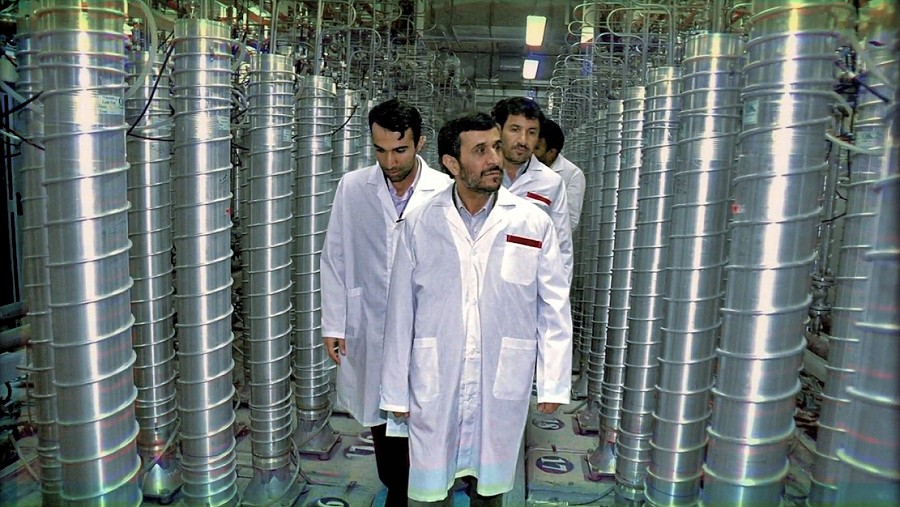


One of the mistakes made by Iran was the publication of a large number of photographs showing Mahmoud Ahmadinejad touring the Natanz nuclear facility, in the company of numerous key scientists—thus inadvertently aiding Israel in its targeting. One of the scientists appearing in a photo, standing behind Ahmadinejad was assassinated a few months later.

Another thing shown by the photos were computer screens displaying arrays of centrifuges that were being monitored. The array of centrifuges showed six groups, each group with 164 items—numbers that perfectly matched what was found in the Stuxnet code. Thus the photos seem likely to have aided the process of devising the attack code.

The Attack


Centrifuges for enriching uranium contain rotors spinning at the speed of sound, with some parts of the centrifuge made of carbon fibres (which shrink with heat), and other parts made of metal (which expand with heat). Maintaining the integrity of a centrifuge is thus delicate and sensitive. Iran’s centrifuges are proudly featured every April for “National Nuclear Day”. The IAEA inspector in the film is particularly impressed with the complexity, professionalism, and sophistication of Iranian facilities. Iran’s centrifuges were specifically targeted by Stuxnet.

How Stuxnet actually operates is graphically demonstrated in the film—and for me, this was the most memorable feature of the documentary. See the extracted clip for a complete demonstration:

The demonstration aside, what Stuxnet was designed to do was sit and wait within the Natanz nuclear facility, and to record and save all operations. Once the required amount of time had passed for the full cascade of centrifuges to be filled with uranium being enriched, Stuxnet would then activate. Its first step was to vastly increase the revolutions of centrifuge rotors to the point that uncontrollable revolutions would rupture the centrifuge. The second step was to block any communication of an emergency to the controllers, by reproducing the old data that it had recorded. The third step was to prevent the controllers from shutting down the centrifuges, by disabling all the kill switches.

The only cyber-security specialists who appears resistant to attributing Stuxnet to the US, is the US-based analyst at Symantec, Eric Chien. He does make the valuable point—one deliberately sidestepped by the US media and US politicians—that attribution is very difficult to make, and the traces that lead back to a supposed origin can be faked. (The assertion made by US intelligence agencies about having evidence suggesting Russian hacking was thus always, at best, highly dubious from the outset.)

The Voice of the Leakers


To ascertain the facts of US and Israeli collaboration in the production and use of Stuxnet, Gibney avails himself of leaks and whistle-blowers in Washington, DC. (It’s only permissible to do so when Gibney does it, unlike his treatment of WikiLeaks’ Julian Assange who did the same.) Gibney comments: “while D.C. is a city of secrets, it is also a city of leaks. They’re as regular as a heartbeat and just as hard to stop”—which again underscores the opportunism of his critique of WikiLeaks in another of his films.

Gibney’s anonymous sources, compiled into one fictionalized character speaking in the film as if she were a hologram, testify that “we” created Stuxnet (“we” was undefined at that point). At the same time—and this strained credulity—these intelligence operatives somehow felt remorse because “we came so fucking close to disaster,” and for some reason, on this subject alone, it is necessary that the intelligence agencies “get the story right” for the public interest. It seemed a like a charming idea: democratic accountability—all of a sudden. It’s possible, but also suggests we interpret their statements with due caution.

Gibney’s sources claim that Stuxnet was the product of a huge “multinational, interagency operation”. The agencies were the CIA, NSA, the Pentagon’s Cyber-Command; in the UK, the GCHQ; “but the main partner” was the Israeli Mossad. The technical work was done by Mossad’s Unit 8200. Now the narrative shifts: “Israel is really the key to the story”. Another source claims that “much of the coding work was done by the [US] National Security Agency and Unit 8200”.


Further bolstering the case against the so-called “Libya model”—ending a nuclear weapons program, disarming, and transferring all materials to the US—this film’s anonymous NSA sources testify to Libya’s centrifuges (P1s) having been studied at Oak Ridge National Laboratory because they were the same kind in use in Iran. Having Libya’s equipment allowed the US to use the items to help engineer Stuxnet, or what the NSA and Cyber-Command called “Olympic Games” or OG. The Israelis aslo did tests using the Libyan P1 centrifuges.

The US: Against International Law


Through espionage, the US also obtained the plans for Iran’s newer centrifuges, the IR2s. In the tests run by the US, they were able to explode the centrifuges by manipulating the rotors. After inviting President Bush to examine shards of the destroyed centrifuges, he reportedly approved the use of Stuxnet. There were no reported concerns expressed by anyone in Bush’s cabinet about the fact that using Stuxnet would constitute an undeclared act of war.

To avoid any legal troubles with the incoming Obama administration, operatives under Bush installed a kill date in the Stuxnet code (January 11, 2009). This was just days before Obama’s inauguration. The desire to bring the operation to a close before Obama’s team took over, is at least tacit recognition of the illegality of the program. Of course, Obama reauthorized the program within his first year in office.

Obama was devoted to cyber-“defense” to protect critical infrastructure in the US—which actually meant he was committed to offensive operations aimed at paralyzing other countries’ critical infrastructure. One can never escape the American international modus operandi of inversion and projection. In fact, the overwhelming majority of cyber-spending under Obama’s budget was devoted to the development of cyber-weapons for offensive purposes.

Under Obama, a whole range of new and powerful cyber-weapons were to be developed. Stuxnet was just the opening shot.

International law, with strict reference to the use of cyber-weapons, is “written” by custom, as explained by a US official in the film. Customary law requires a nation-state to at least say what it did, and why—which the US will not do. Thus the norm has become: do whatever you can get away with doing. This is a world which the US has created, as much as it cries innocence today.

Initially, Stuxnet was deemed a success. Centrifuges did blow up in Iran’s nuclear facilties, a fact verified by IAEA inspectors. Whole groups of centrifuges were dismantled, and a number of nuclear scientists were fired. There were other consequences, as will always be the case, which the US could not control.

Coming Home to Roost

After the attack, Obama only then began to worry about how Russia and China could do the same to the US, with the added justification of the precedent set by the US itself. Obama knew that word would get out eventually, as it did. Nonetheless, Obama persevered with the program.

Another problem with Stuxnet is that it was spread all over the world, infecting all sorts of machines, just so the US and Israel could get at their Iranian targets. The charge made by NSA sources in the film is that the Israelis took the US code, changed it, making it much more aggressive, and then launched it without US agreement. These sources, (feigning?) great indignation at the rude and inconsiderate Israelis, contradict earlier claims in the film that Stuxnet was approved for use by both Bush and Obama.


By spreading far and wide, the Stuxnet code ended up in Russian hands, where Russian state security experts could study it and potentially use it, while Iran itself also did the same. Unlike other weapons, when cyber-weapons are used they can be apprehended intact on the receiving end. 

The Department of Homeland Security, supposedly unaware of what the NSA and CIA had done, grew alarmed when it encountered the Stuxnet malware, and its potential to do massively destructive and lethal damage in the US itself. The DHS Cybersecurity Director, Sean McGurk, who speaks in this film, was not aware that he was dealing with a possible case of the chickens coming home to roost. 

Likewise, Senator Joseph Lieberman, on the Homeland Security and Governmental Affairs Committee, appears in Senate footage asking—apparently innocently—about the origins of Stuxnet, and if a nation-state was behind it…not knowing that it was his own. Of course, what the film does not raise is the question of whether this was all theatre, to cover for the US violating international law and engaging in war against Iran.


David Sanger says in the film:
“the United States government has never acknowledged conducting any offensive cyber attack anywhere in the world. But thanks to Mr. Snowden, we know that in 2012 president Obama issued an executive order [Presidential Policy Directive 20] that laid out some of the conditions under which cyber weapons can be used. And interestingly, every use of a cyber weapon requires presidential sign-off”.
Given the extensive over-classification of information on the US role in producing and using Stuxnet, and the fact that  every US government official interviewed or shown in the film denied any knowledge of US involvement, no real public discussion can develop. This in itself does further harm to democracy in the US. Even the former NSA and CIA director, Gen. Hayden, criticizes over-classification in his interview for this film.

Rather than invite public debate, the Obama White House went after the whistle-blowers, going as far as targeting Gen. James Cartwright, Vice Chairman of the Joint Chiefs of Staff, in a criminal investigation. The US and Israel have yet to acknowledge the existence of the operation, to this day.

The Failure and the Response

On top of everything else, Stuxnet did not make a huge impact on the Iranian nuclear program. In fact, the tiny dip in the number of centrifuges caused by Stuxnet, was counteracted by a vast and rapid increase in the number of centrifuges installed by Iran, along with new nuclear facilities. Iran’s nuclear program became even more advanced, even as it suffered every single known coercive action thrown at it by the US and its allies, short of direct combat.


The US is itself highly vulnerable to cyber attacks. US attacks on Iran encouraged Iranians to form a Cyber Army to fight back. Iran now has one of the largest cyber-armies in the world, according to the president of the American Iranian Council. Stuxnet did minimal and temporary damage to Iran, yet unleashed a wave of responses that showed how use of the cyber-weapon was a major strategic error.

Iran launched two attacks against the US, according to Richard Clarke in the film: first, Iran attacked ARAMCO in Saudi Arabia, the world’s largest oil company, and they erased all software, every line of code, from about 30,000 computer devices; second, Iranians allegedly launched a surge attack on US banks. The clear message was that, if provoked further, Iran had it within its means to disrupt the US financial system and the world energy market.

Had Iran not responded, the US apparently had a much larger plan (“Nitro Zeus”) for total cyberwar against Iran, which included shutting down its power grids, disrupting military and civilian communications, and disabling defenses.

Conclusion

There is a great deal of information in this film that would be interesting to those who are new to geopolitics, but that is also largely peripheral to the film’s core story. Thus a lot of time is spent (wasted) on self-flattering operational histories told by Israeli fighter pilots and US spies, or a New York Times journalist reciting the most basic essentials of his published stories, or American government officials presenting their preferred version of Iranian history. On the whole, the film is about one full hour too long, and it can make for long stretches of tiresome viewing of tendentious material.

This film would be appropriate for courses in International Relations, Political Science, Middle East Studies, and any courses dealing with US intervention and/or cyber-terrorism. Generally, the more critical reviews of this film are on solid ground, particular those targeting the film’s deficit of any new information, and the fact that it provides very little that is not already covered by books, news reports and even Wikipedia. 

The visuals in the film are mostly limited to talking heads, news footage from Iran, and endless animations of layers of computer code—visually, it is not a very engaging or memorable film. However, given that the film can provoke numerous important questions and in some cases provides some very interesting answers, plus the fact that it effectively condenses available knowledge, it merits a score of 6.75/10.


(This documentary review forms part of the cyberwar series of reviews on Zero Anthropology. This film was viewed five times before the review was written and published.)

Iran: Setting the Defence Dial to "Auto"

AGAINST THE BLITZ WOLF — Russian Reinforcements for Iran's Defence in War Against All

by John Helmer - Dances with Bears


June 25, 2019

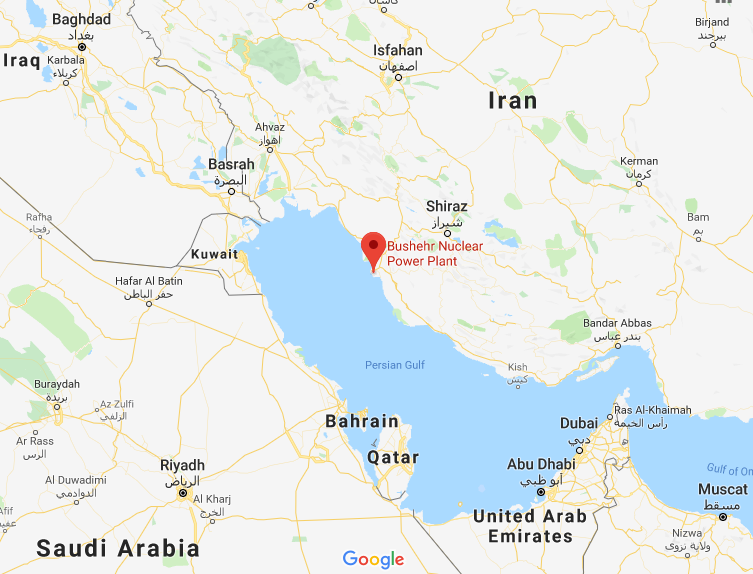
Moscow - The Russian General Staff has reinforced the air defences for Russians at the Iranian nuclear reactor complex at Bushehr, on the Persian Gulf, according to sources in Moscow. At the same time, Iran has allowed filming of the movement of several of its mobile S-300 air-defence missile batteries to the south, covering the Iranian coastline of the Persian Gulf and the Gulf of Oman. More secretly, elements of Russian military intelligence, electronic warfare, and command and control advisers for Iran’s air defence systems have been mobilized to support Iran against US and allied attacks.

The range of the new surveillance extends well beyond the S-300 strike distance of 200 kilometres, and covers US drone and aircraft bases on the Arabian peninsula, as well as US warships in (and under) the Persian Gulf and off the Gulf of Oman. Early warning of US air and naval-launched attacks has now been cut below the old 4 to 6-minute Iranian threshold.

Counter-firing by the Iranian armed forces has been automated from attack warning and target location.

This means that if the US is detected launching a swarm of missiles aimed at Iran’s air-defence sites, uranium mines, reactors, and military operations bunkers, Iran will launch its own swarm of missiles at the US firing platforms, as well as at Saudi and other oil production sites, refineries, and pipelines, as well tankers in ports and under way in the Gulf.

“The armed forces of Iran,” said a Russian military source requesting anonymity, “have air defence systems capable of hitting air targets at those heights at which drones of the Global Hawk series can fly; this is about 19,000 to 20,000 metres. Iran’s means of air defence are both foreign-purchased systems and systems of Iran’s own design; among them, in particular, the old Soviet system S-75 and the new Russian S-300. Recently, Iran transported some S-300’s to the south, but that happened after the drone was shot down [June 20]. Russian specialists are working at Bushehr now and this means that the S-300’s are also for protection of Bushehr.”

Flight distance between Bushehr and Bandar Abbas is about 570 kms. 
From Bandar Abbas southeast to Kuhmobarak, the site of the Iranian missile 
firing against the US drone, is another 200 kms.

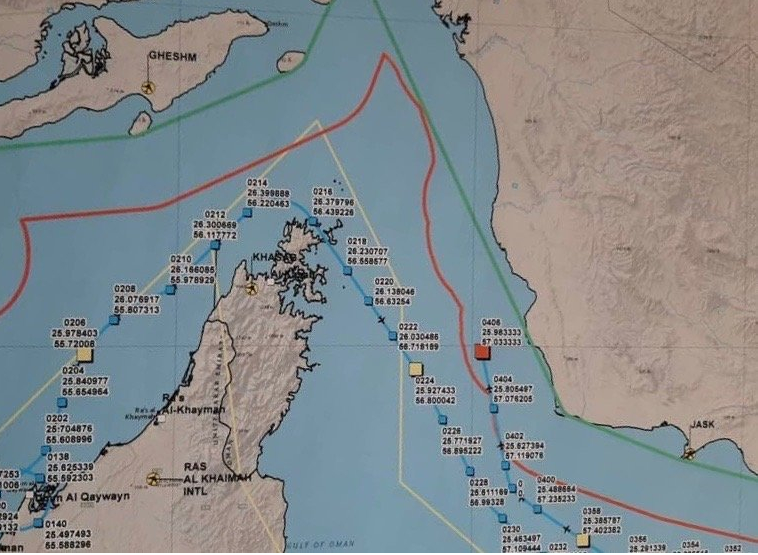
Last Thursday, June 20, just after midnight, a US Global Hawk drone was tracked by Iran from its launch at an airbase in the United Arab Emirates (UAE), south of Dubai. The take-off and initial flight route appear to have been more than 300 kms from Iranian tracking radars. Four hours later, the aircraft was destroyed by an Iranian missile at a point at sea off Kuhmobarak. Follow the route tracking data published by the Iranian Foreign Minister, Javad Zarif here.

KEY: blue line=drone flight path; yellow line=Iranian Flight Information Region (FIR); 
red line=Iranian territorial waters; green line=Iranian internal waters; yellow dots=Iran 
radio warnings sent; red square=point of impact. 
Source: Iranian Foreign Minister Javad Zarif: https://twitter.com/ 
The US claims the point of impact was outside the red line.

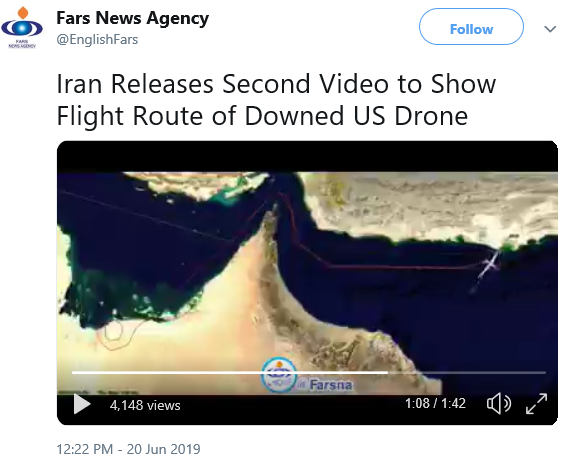
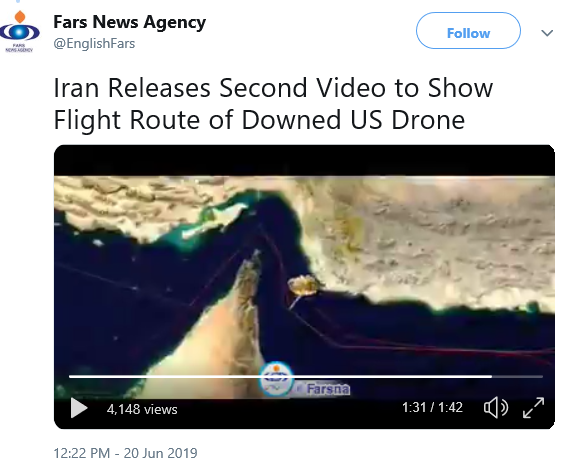
Additional tracking data on the US drone operation have been published in a simulation by the Iranian state news agency, Fars. The news agency claims the successful strike was by the Iran-made Khordad missile, an S-300 copy; the altitude has not been reported (design ceiling for the aircraft is 18,000 metres).

The US aircraft turns at the easternmost point of its route, at the Strait of Hormuz. 

Missile impact destroys the US drone off Kuhmobarak, inside the red line 
of Iranian territorial waters. Source: https://twitter.com/

The Russian military source says there is now active coordination between Russian and Iranian military staffs.

“About coordination, of course there is participation of Russia in intelligence-sharing because of Bushehr and ISIS. We have a long and successful partnership with Iran, especially in terms of fighting against international terrorism.” 

Two days after the drone incident, Russian specialist media published Iranian video footage of the movement of S-300’s on trailer trucks. This report claims that although the S-300’s are wheeled and motorized for rapid position changes, the use of highway transporters was intended to minimize road fatigue on the weapons.

Iranian military sources have told western reporters they have established “a joint operations room to inform all its allies in Lebanon, Syria, Iraq, Yemen and Afghanistan of every step it is adopting in confronting the US in case of all-out war in the Middle East.”

Maps published to date in open Russian military sources show the four main anti-air missile defence groups (PVO) on Iranian territory, and the strike range of their missiles. The 3rd and 4th PVOs are now being reinforced to oppose US reinforcements at sea and on Saudi and Emirati territory.

Key: yellow=units of the main air-defence (PVO) groups; 
split blue circles=military bases; blue diamond=nuclear industry sites; 
red rings=kill range for missiles; solid red=command-and-control operations centres. 
Source: Anatoly Gavrilov, “Before the storm”, National Defence, April 2019

The weaknesses and vulnerabilities of Iranian defences against US air attack are, naturally, state secrets. The open-source discussion by Russian air-defence expert Anatoly Gavrilov can be followed here. According to Gavrilov writing in March, the expected plan of US attack will be the use of precision missiles and bombs at.

“primary targets…plants for the production and processing of nuclear fuel, uranium mines, production for its enrichment, refineries, other industrial centers. But initially [the objective] will be to suppress (completely destroy) the air defense system. The mass use of cruise missiles for various purposes and guided aircraft bombs will disable the control system of Iran’s troops and suppress the system of reconnaissance and anti-aircraft missile fire. In this case, the task of the attacking side will be the destruction in the first two or three days of 70% to 80% of the radar, and after that, up to 90%… manned aircraft will begin to bomb only after the complete suppression of the air defense system. The West protects its professional pilots, and it does not matter that the civilian population of Iran will also suffer.”

The main Iranian vulnerability facing American attack, reports Gavrilov, is less the range, volume and density of firepower with which the Iranians can respond than the relatively slow time they have shown to date for processing incoming attack data, fixing targets, and directing counter-fire.

“In today’s conditions of organization and conduct of rapid air combat, a high degree of automation of the processes of collection, processing, transmission and exchange of radar information, development of solutions for repelling strikes, and conducting anti-aircraft missile fire is extremely necessary.”

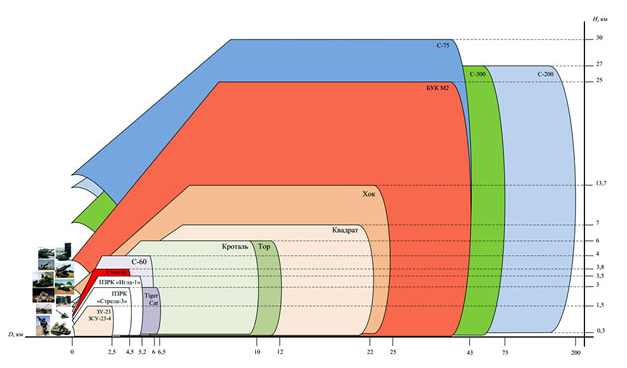
RANGE AND ALTITUDE OF MAIN IRANIAN AIR DEFENCE WEAPONS

CLICK ON IMAGE TO ENLARGE
Horizontal axis, range in kilometres for each identified weapon; vertical axis, 
altitude of interception. Source: Anatoly Gavrilov, National Defence, April 2019

Gavrilov does not estimate how far the Iranians have been able to solve by themselves, and with Russian help, the problems of automation and coordination of fire. To offset whatever weakness may remain, he recommends specific technical contributions the Russians can make. These include the technology of electronic countermeasures (ECM) to jam or deflect US targeting signals and ordnance guidance systems.

While Gavrilov believes the Iranian military have already achieved high enough density of fire against incoming weapons, he isn’t sure the range and altitude of Iranian radars will be good enough to match the attack risks. To neutralize those, he recommends,

“Russian-made electronic warfare systems. The complex of EW systems is able to significantly reduce the ability of attack aircraft to search for, detect and defeat ground targets; disrupt the onboard equipment of cruise missiles in the GPS satellite navigation system; distort the readings of radio altimeters of attack aircraft, cruise missiles and UAV’s [unmanned aerial vehicle, drone]…”

In briefings for sympathetic western reporters, Iranian commanders are emphasizing the Armageddon option; that is, however weak or strong their defences may prove to be under prolonged US attack, the Iranian strategy is not to wait. Their plan, they say, is to counter-attack against Arab as well as American targets as soon as a US missile attack commences; that’s to say, at launch, not inflight nor at impact.

Left: Kremlin photograph of the Security Council meeting at the Kremlin 
on the afternoon of June 21. Source: http://en.kremlin.ru/ 
Right: Major General Mohammad Baqeri, Iran’s armed forces chief of staff.

The day following the US attack and Iranian success, President Vladimir Putin chaired a meeting of his regular Security Council members in Moscow. The military were represented by the Defence Minister, Sergei Shoigu. The US attack on Iran was the main issue on the table. “The participants,” reported the Kremlin communiqué,

“discussed, in particular, the developments in the Persian Gulf. They expressed serious concern over the rising tension and urged the countries involved to show restraint, because unwise actions could have unpredictable consequences in terms of regional and global stability.”

Unpredictable consequences in Russian is being translated in Farsi to mean the cessation of the oil trade in the Persian Gulf. “As oil and commodities of other countries are passing through the Strait of Hormuz, ours are also moving through it,” Major General Mohammad Baqeri, the Iranian chief of staff, said on April 28.

“If our crude is not to pass through the Strait of Hormuz, others’ [crude] will not pass either.”


 @bears_with

Monday, June 24, 2019

Gulf of Oman Mystery: Silence of the Satraps, or Dogs That Don't Bark in the Light

Will the Australian Government Join in a "Nuremberg Class" Attack on Iran?

by David Macilwain - American Herald Tribune


June 24, 2019

As my father used to say in response to difficult questions – “ask no questions and you’ll be told no lies”. This seems to be the approach of Australia’s media organizations to our government’s extraordinary silence over events in the Gulf of Oman.

Barring an anodyne statement condemning the attacks on civilian shipping, neither Australia’s foreign minister Marise Payne nor Prime Minister Scott Morrison has ventured an opinion on who might have been responsible for these provocative actions. This remains the case even when subsequent developments included a narrowly averted war with global repercussions, with no questions asked and no lies proffered.

U.S. Secretary of State Michael R. Pompeo,
Australian Foreign Minister Marise Payne
U.S. Department of State/ flickr

In the aftermath of recent attacks on journalistic freedoms and intimidation of whistleblowers, many people have expressed the view that it is the job of journalists to hold governments and public servants to account. That the governments of both Australia and its parent Britain seek to avoid such scrutiny is clear from their actions. Draconian punishments now apply to those who are thought to “threaten national security” by revealing inconvenient truths.

So we might wonder whether the ABC’s failure to ask questions of Government ministers about the dangerous confrontation in the Persian Gulf is connected to these recent developments, which included a highly provocative police raid on the headquarters of the ABC. The ABC purports to be independent of Government, and is expected to interview ministers on behalf of the public when necessary, as well as seeking the view of shadow ministers from the opposition Labor party.

In those recent raids, which concerned an Australian equivalent of the “Collateral Murder” crime exposed by an insider in Australia’s Special Forces in Afghanistan and leaked to an ABC journalist two years ago, there was a widespread shock at the actions authorized under the police warrant. In examining the ABC’s files relating to the case, it was revealed that the recently expanded powers of police forensic officers included the deletion and alteration of computer files – though this was explained as limited to the removal of irrelevant material and identities. This could be true given that the need to rewrite history is now minimized thanks to current controls over access to information.

What was more shocking to some, however, was a widely expressed but ill-informed view from the “Murdoch Right” that the ABC raids were justified, as its actions had endangered national security. Similar views were expressed over the alleged crimes of Julian Assange, whether “narcissist” or “cyber-terrorist”, with little sympathy from fellow Australians for his persecution and torture by the UK regime.

Australian sentiment towards the Islamic Republic of Iran is similarly prejudiced, so persuading the public that Iran would have launched an attack on two tankers near the Straits of Hormuz on the basis of minimal evidence was never going to be difficult; a mere dog-whistle sufficed.

What now seems worrying is that “Central Narrative Control” knew this in advance – that they could show a blurry video of Iranian forces rescuing a ship’s crew, while saying it showed them “removing a limpet mine”, and the US aligned media audience would believe that this was what they saw.

But how could people be fooled by this ridiculous story, presented with a video that didn’t stand the slightest scrutiny?

Why anyway would Iran sabotage two ships as a direct provocation, while trying to make it look as though the US or its allies were responsible? This wouldn’t make any sense, as the US would have no motive for such an attack – other than to frame Iran for it as a pretext for what has now followed!

The corollary of this perverse provocation by the US or its local agents is that while an Iranian strike on the two tankers could have been understood as a response to newly imposed sanctions targeting Iran’s petrochemical industry, such an attack on civilian shipping by the US with the sole object of framing Iran would be an undoubted war crime. As in fact, it was – and we need to remember this as subsequent events and silence from the media relegate it to a later investigation, or the memory hole. (Iran has also registered a protest over the US accusations with the UN)

Those subsequent events, which we now discover have brought us to the point of a major military escalation, allow current news reports to state that “following the Iranian attack on two ships in the Gulf of Oman” – tensions on both sides are increasing; no longer is the ship attack “alleged”. Instead, a new “limpet mine” narrative has been created to reinforce the idea of the Iranian threat, and this, in turn, feeds into talk of new Uranium enrichment above the agreed levels in the JCPOA, despite this being an entirely legitimate Iranian response to the US’ failure to keep to the agreement. Contrary to the immediate wild accusations from the usual suspects that Iran is now “again” working on a nuclear bomb (it never was, since 2003 [if ever] ), the renewed enrichment remains only to the 3.7% base limit, as those nuclear-armed suspects know perfectly well.

The need to be reminded of these stages in the development of the false narrative that Iran is the aggressor is that the silence from both media and politicians has actually enabled it, simply by drawing on the prejudices of the population. It seems that only those who doubt or deny the US-led accusations against Iran have noticed the deafening silence of Australia’s leaders and the failure of the main media to ask them to show their hand. Is it possible that we could find ourselves supporting the real aggressors in a criminal attack on a peaceful and friendly nation – a classic case of “sleepwalking into war”?

Well, now it appears that this is the case. The ABC hasn’t thought to ask the foreign minister whether we agree with the US story, and whether we would support them in military action against Iran despite the lack of evidence, because there is already that assumption.

Despite the early skepticism of US claims from some mainstream commentators, and parallels drawn with the proverbial Iraqi WMD fraud, those reservations appear to now be forgotten. With this comes the realization that my father’s riposte does not apply to our national broadcaster; it doesn’t fear being told lies but rather fears having to admit the obvious truth, which is that of course, we believe the US story, and will support any action that our alliance demands.

Such blindness to the truth, and blind submission to the whims of the world’s most dangerous state, was brought home by this quote from Sydney Morning Herald correspondent Michael Bachelard:

“Some have likened the escalating atmosphere to the feeling leading up to George Bush’s invasion of Iraq in 2003. So why are we suddenly using the “w” word in the Middle East again, and should Australia brace to be invited into another Coalition of the Willing?”

Bachelard presents – and perhaps believes – “Australia” to be a well-intentioned onlooker on the mixed-up politics of the Middle East, whose “contribution” would always be towards peace and security and resolution of conflict. It is a rosy-eyed view of Australia sadly prevalent amongst people whose own intentions are honorable – assuming that the leaders of our traditional allies and partner “democracies” share their honesty and integrity and benevolence.

By contrast, these same people seem happy to assume the worst about our “enemies”; Bachelard’s inappropriate use of a photo of a smiling President Assad greeting Ayatollah Khamenei in Tehran in February in the above article nicely reflects this ingrained prejudice.

The reality of Australia’s role in Middle Eastern politics, on the battlefields of Syria, Iraq and Afghanistan and over Palestine and Israel is sadly very different. Despite a “modest contribution” to the Iraq invasion force, John Howard was George Bush’s closest ally, notably refusing to accept that Saddam Hussein had no WMD until around 2010.

More recently the involvement of Australian fighter jets in the 2016 US coalition attack on the Syrian Army near Deir al Zour was symptomatic of Australia’s illegitimate presence in Syria, and complicity in NATO allies’ support for the insurgent forces. This intimate alignment with the US also saw Australia copying Trump’s “recognition” of Jerusalem as Israel’s capital, despite the damage this did to relations with our closest neighbor Indonesia.

In the light of this record, and the catalog of unasked questions and untold lies, we can only speculate on the Australian Government’s RSVP to America’s “invitation” to join in a “Nuremberg class” attack on Iran. With Foreign Minister Marise Payne’s record of meetings with both Pompeo and Bolton, and our shared bases and assets in the region, it seems likely such an invitation was a mere formality, likely preceding the first strikes on tankers in the Gulf of Oman.

And as with the story of the war crimes in Afghanistan, there won’t be any desire to rewrite the history of how the third Great War began, should the truth finally surface. That history has already been certified as true by the silence of “Australia’s most trusted news source” and recorded in the mind of the nation; no-one would now believe otherwise.

Cracked Priorities: Government Frack Tax Subsidies

How much is BC giving to natural gas companies? 

by Ben Parfitt - Policy Note


June 24, 2019

All British Columbians have a stake in the pricing of natural resources. When trees are logged, when minerals are mined, when fossil fuels are drilled, the companies doing the extracting pay fees to the Province in recognition that the resources are publicly owned.

It is therefore in everybody’s interest to know how the government prices resources on the public’s behalf.

Nowhere may this be more important than with the royalty fees the government sets for companies extracting natural gas.

Like the previous Liberal government, the current NDP government is turbocharging natural gas industry developments in BC through a raft of subsidies that allow companies to reduce their royalty payments by hundreds of millions of dollars each year.

For two years, the Canadian Centre for Policy Alternatives has tried to shed light on those subsidies by asking for information on the credits that the government allows companies to claim against future royalty payments through Freedom of Information requests.

The government has done its best to block those requests at every turn.

British Columbians have a right to know which companies are benefiting—and by how much—from massive public subsidies.

At present, there are three broad subsidy programs all designed to maximize fossil fuel extraction by allowing qualifying companies to claim a portion of their development costs against what they pay in royalties.

The “infrastructure royalty credit program” allows companies to claim credits for road-building and pipelines.

The “clean infrastructure royalty credit program” allows companies to claim credits for installing solar panels and other “clean” technology at industry operations.

But by far the most important subsidy stream is the “deep-well royalty credit program”, which allows companies to claim credits for drilling deep and horizontal gas wells.

Earlier this year, BC’s Ministry of Energy, Mines and Petroleum Resources finally released information on the first two credit streams.

The information released shows that in the last two fiscal years, 21 companies claimed more than $72 million in such credits. The companies with the largest claims were Cutbank Ridge Partnership (Encana and Mitsubishi), with a claim of $27.5 million; Shell Canada Ltd., with a claim of $13.7 million; and three companies controlled by Malaysia’s Petronas, with claims of $10.2 million.

Credits from Infrastructure and Clean Infrastructure royalty credit programs, April 2016 – March 2018 


Company Royalty credits received
Devon Canada Corporation $62,372
UGR Blair Creek Ltd. $102,762
Murphy Oil Company Ltd. $116,238
ConocoPhillips Canada $120,207
Chevron Canada Limited $131,268
Woodside Energy International (Canada) Ltd. $131,268
Apache Corporation $154,671
Pengrowth Energy Corporation $376,633
Chinook Energy (2010) Inc. $536,643
Venturion Oil Limited $597,236
ARC Resources Ltd. $662,869
Leucrotta Exploration Inc. $1,170,894
Canadian Natural Resources Limited $1,240,771
Encana Corporation $1,416,146
Saguaro Resources Ltd. $2,625,098
Storm Resources Ltd. $2,683,660
Black Swan Energy Ltd. $3,535,769
Crew Energy Inc. $4,971,197
Petronas $10,214,442
Shell Canada Limited $13,698,323
Cutbank Ridge Partnership $27,518,675
Total credits $72,067,142
Data from Ministry of Energy, Mines and Petroleum Resources.
Note: In this table, Petronas royalties are those of three of its subsidiaries: Progress Energy Canada Limited, Progress Energy Resources Corporation, and Progress Energy Canada Ltd.

Sizeable as those subsidies are, they pale in comparison to the deep-well credits. As of last fiscal year, the total accumulated deep-well credits stood at $2.6 billion, having risen nearly $700 million in the previous year.

The accumulated credits will be higher still when the government releases its latest Public Accounts later this year. All of that money represents future reductions in royalty payments—money that otherwise would help fund schools, hospitals, courts, transportation infrastructure and other public institutions and programs.

The public has a right to know which companies are benefitting—and by how much—from this massive public subsidy. Yet the Ministry of Finance still refuses to divulge this information on grounds that it would “harm” the interests of unnamed third parties.

When the resources in question are publicly owned, full public disclosure is the only reasonable policy.

This is a puzzling assertion. Virtually all companies drilling and fracking for natural gas in BC today drill deep wells and horizontal wells. It’s standard industry practice. If all such wells qualify for credits, there is no harm to any single company in disclosing credit information because all its competitors get credits too.

No, the real issue here is why our provincial government continues with these credits at all. Why, exactly, does it subsidize companies drilling deep and horizontal wells? If companies cannot drill such wells profitably, why is the public on the hook to offset a portion of such costs?

These are pressing questions—especially as a massive liquefied natural gas plant inches toward reality in Kitimat. The plant itself will be heavily subsidized with a raft of tax breaks. It will also require thousands more new gas wells to be drilled and fracked—all of which will inflate an already bloated, murky credit account that represents foregone public revenues.

It’s time the government stopped cherry-picking what subsidies it discloses. When the resources in question are publicly owned, full public disclosure is the only reasonable policy.

Flogging a New "Oslo" for Palestine

Dead Horse

by Mazin Qumsiyeh - Popular Resistance


Jun 23, 2019

This is a letter I address publicly to Mahmoud Abbas and all Palestinian (and other) people 

A while back I was invited to a meeting of Palestinian business and political leaders. One of the prominent speakers was a prominent member of the revolutionary council of Fatah. Wikepedia said he was accused of corruption repeatedly.

The meeting was to address the financially precarious situation of the Palestinian Authority in Ramallah and ways to respond to the Bahrain conference.

I heard much “political” posturing and useless talk including an interesting note that the politician said that the authority “cannot” prevent people from going to Bahrain (because then it could be said that the people did not attend because of “pressure”).
       
    Cart before the dead horse.

I commented: “If our objection to the Bahrain conference is that it is trying to subvert Palestinian legitimate rights of return to their homes and lands and self-determination via “bribes” of economic improvement, then this is precisely what the Oslo agreements were about.

If we disagree with that approach, then we should start by removing all the agreements of Oslo and its appendages like the Paris economic agreement that gave Israel responsibility to continue its economic profiting from the occupation.”

Someone asked what is your solution? I said go back to being a real Palestine Liberation Organization:

  • Palestine is all of Palestine not 22% of it; 
  • Liberation is self-explanatory and it is for all 13.5 million of us Palestinians; 
  • and organization means more than one person we “pledge loyalties” to. 

The well-dressed politician came after the meeting to chastise me before he got into his fancy black Mercedes (which was left running all the time) with his body guards. Many of those attending came to tell me that they supported what I said (I told them they should have spoken out in public). Many are genuinely afraid but it is now an existential issue and we cannot remain silent. I told them more people are speaking out. The social media is a very strong tool in our hands.

The Bahrain conference concocted by racist Zionists Kushner/Greenblatt/Freedman uses exactly the same language as encoded in Oslo. You can compare for example the economic texts of Oslo II agreement signed in Paris (available here: https://www.paltrade.org/upload/agreements/Paris%20Economic%20Protocol.pdf ) with the text of the Bahrain “Peace to prosperity” working documents (available here: https://www.whitehouse.gov/peacetoprosperity/ ).

To be blunt: those who signed on to Oslo I and II and still follow them are no more or less than those who sign on to Bahrain I (yes, there will be Bahrain II).

In public speeches they claimed it is somehow a different thing and now putting the cart (economy under occupation) in front of the horse (political solution of two states). Sorry, the cart had run over the horse and killed it back in 1993 (some say the beginnings was in 1974 and 1988).

So it is time to get a new horse proverbial horse (A PLO reclaiming its charter of a secular democratic state), remove the trash that was accumulated in the cart and get a new beginning. It is thus not enough for us to protest things. It is time to take our own initiatives. It is time for a new PLO that reflects the will of the people and can then harness their amazing power.

If anyone wants to know about the amazing power of the Palestinian people to get new horses, please read my book “Popular Resistance in Palestine: A history of Hope and Empowerment.” In it I explain for example how the uprising of 1936 forced dissolution of many factions, reshaped others, and created new ones.

We must learn from our history the right lessons. The best lesson to learn is that it is never too late to admit mistakes and go back to the people. I do have real faith in the people.

The self-declared leaders know in the deep recess of their calcified hearts these facts and know that risking positions and money is nothing compared to the certainty that if they stay the course, the end will be clear.

We all die. The question is how do you want to be remembered?

You have two models

1) Collaboration/selfishness: e.g. Marshal Philippe Pétain (head of the French Vichy regime 1940-1942) and Nguyá»…n Văn Thiệu (corrupt US puppet president of South Vietnam 1967-1975), or 

2) enlightened leadership like Omar Al-Mukhtar and Che Guevera.

The choice is yours/ours.


MH-17: Charges Finally as False as Investigation Was Bogus

Four men charged with murder based on bogus MH-17 investigation

by Clara Weiss - WSWS


24 June 2019  

On June 19, the Joint Investigation Team (JIT) set up in 2014 to investigate the crash of the MH-17 Malaysian Airlines flight over East Ukraine on July 17, 2014, which resulted in 298 deaths, announced the criminal prosecution of four individuals for murder by the Public Prosecution Service of the Netherlands.

The four suspects—Igor Girkin, Sergey Dubinsky, Oleg Yuldashevich (all three Russian) and Leonid Kharchenko (a Ukrainian citizen)—were, and in some cases still are, active as leaders of the Russian-backed eastern Ukrainian separatists. They now face international arrest warrants and will be put on trial on March 9, 2020.


Since the Netherlands cannot demand extradition from either Russia or Ukraine, it is likely that they will be tried and sentenced in absentia.

The four men, as well as the Russian government, maintain that they had no involvement whatsoever with the plane crash. Russian President Vladimir Putin reiterated Russia’s rejection of the JIT commission, saying at a “direct line” Q&A on Russian television on Friday that he “completely disagrees” with the evidence it put forward.

Malaysian President Mahathir Mohamad denounced the charges as politically motivated:

“As far as we are concerned, we want proof of guilt. But so far, there is no proof. Only hearsay.”

The shooting down of the plane occurred at the height of the Ukraine crisis and civil war in 2014, triggered by the US- and German-backed coup in Kiev in 2014 led by fascist forces and sections of the Ukrainian oligarchy working closely with Washington and Berlin. The Ukrainian and the US governments, the EU and the international bourgeois media rushed to blame Russia for the downing of the plane before any purported evidence was even presented. It was exploited as a new “Gulf of Tonkin,” an unclear and dubious military incident that the imperialist powers could use as a pretext for war.

The MH-17 case has fallen out of the limelight in recent years. However, the military build-up against Russia, led by the US and NATO, and US-led economic warfare against the country have accelerated.

The announcement of the criminal prosecution last week came amid an escalation of both the Trump administration’s war preparations against Iran, which might trigger a direct conflict with Russia, and the Democratic Party’s ongoing campaign against Trump, focusing on his allegedly “soft” stance on Russia. It also comes amid growing conflicts between the European imperialist powers, especially Germany, and the United States, including over Russian gas supplies to Germany through the NordStream2 pipeline.

The Western bourgeois press latched upon the announcement, issuing a flood of commentaries, with the editorial board of the New York Times suggesting the plane’s downing was nothing less than “state-sponsored murder.” International media like Der Spiegel largely presented the JIT’s announcement and “findings” as facts to their readership.

The Washington Post wrote that “international investigators” had “worked diligently to uncover the truth” and were “peeling away Russia’s lies about the downed Malaysian Airlines flight.” The paper dismissed out of hand evidence of possible Ukrainian involvement presented by Russia as “fabricated.”

In reality, the JIT’s announcement of the criminal prosecution of these four men is based on old findings that have no credibility. The JIT investigation is heavily biased, and part of a massive campaign to exploit the tragic death of 298 people to escalate anti-Russia war preparations. In almost five years of this “investigation,” no proof of Russian state involvement has been presented, and significant evidence pointing to potential Ukrainian involvement has been deliberately suppressed.

The JIT’s “finding” that a Russian SA-11 BUK missile system was allegedly brought by the Russian army to the Russian-backed East Ukrainian separatists was continuously cited as “evidence” of Russian involvement.

A 2016 investigative report by journalist Robert Parry pointed to multiple gaps and contradictions in this version. The second piece of “evidence” are barely audible phone conversations, allegedly tapped from Russian military sources, suggesting that the SA-11 BUK missile system was deliberately delivered to the separatists. However, these phone conversations do not at any point explicitly refer to the missile system nor to transport across the Russian-Ukrainian border.

The fact that not only Russian but also US and Dutch intelligence have found evidence suggesting Ukrainian involvement has been completely omitted from the official press coverage.

In October 2015, the Dutch intelligence service MIVD determined that the only high-powered anti-aircraft missile systems in Eastern Ukraine that could have shot down the MH-17 at 33,000 feet belonged to the Ukrainian military.

An anonymous US intelligence analyst explained in 2015 that “definitive analysis pointed to a rogue Ukrainian operation implicating one of the pro-regime oligarchs.” Malayasian news media reported as early as August 2014 that American intelligence officials assumed that the plane had been shot down by a Ukrainian fighter jet. Russian military officials have also released radar data that seemed to show a Ukrainian Sukhoi-25 jet fighter trailing MH 17 at the time it was shot.

The JIT’s investigation’s primary aim has been to suppress and divert attention from any evidence suggesting Ukrainian rather than Russian involvement. Not a single report produced by the commission in the past five years has even tried to disprove the evidence pointing to Ukrainian military involvement in the shoot-down of the plane. They were simply ignored.

This is no coincidence. Contrary to how it is presented by the media, the JIT is not an independent body of “international investigators.” It includes representatives of the Dutch, Belgian, Malaysian and Ukrainian government and secret services. The Russian government has from the beginning been barred from participating in the investigations.

Though Ukraine should itself have been considered a suspect in any serious investigation, the JIT not only collaborated with Kiev, but also operated under an agreement allowing the Ukrainian government to veto the release of information. There could hardly be a more glaring conflict of interest.

The Ukrainian secret service (SBU), which was heavily involved in both the imperialist-backed fascist coup in Kiev in February 2014 and subsequent operation of far-right forces in the civil war, was Ukraine’s official representative on the JIT. It massively influenced the investigation.

An internal JIT report from 2016 said:

“Since the first week of September 2014, investigating officers from The Netherlands and Australia have worked here [in Kiev]. They work in close cooperation here with the Security and Investigation Service of the Ukraine (SBU). Immediately after the crash, the SBU provided access to large numbers of tapped telephone conversations and other data.
…At first rather formal, cooperation with the SBU became more and more flexible. ‘In particular because of the data analysis, we were able to prove our added value’, says [Dutch police official Gert] Van Doorn. ‘Since then, we notice in all kinds of ways that they deal with us in an open way. They share their questions with us and think along as much as they can.’”

It was the SBU, moreover, that supplied the phone intercepts and other material now universally cited as “evidence” of Russian involvement.

Despite these glaring contradictions and violations of proper investigative procedure, the “findings” and actions of the JIT are presented as credible, definitive “proof” of “Russian guilt.” This testifies yet again to the lengths the bourgeois media and Western imperialists are prepared to go in their criminal and dangerous campaign against Russia—a reckless campaign which could spark a war between the world’s two largest nuclear-armed powers.

Gorilla Radio with Chris Cook, Bonny Glambeck, Greg Palast, Janine Bandcroft June 27, 2019

This Week on GR

by C. L. Cook - Gorilla-Radio.com


June 27, 2019

It's difficult to accept news of the epidemic-sized outbreak of sea lice at fish farms in Clayoquot Sound with anything but a weary sigh of unsurprise; afterall, why would Cermaq's much contested operations there differ from everywhere else concentrated fish feed lots operate?

Cermaq, the formerly Norwegian company newly acquired by Japanese behemoth, Mitsubishi Corporation issued an apology, published in the local Tofino-Ucluelet Westerly News, admitting their inability to manage operations in the Sound safely, saying, "we were unable to effectively manage sea lice populations for a variety of reasons including unusually hot and dry weather...". 

Listen. Hear.

For those long chronicling the damage the industry does on a good day, and long predicting just such "unmanageable" outbreak scenarios, Mitsubishi's "so sorry's" arrive dead in the water.

Bonny Glambeck is director of Clayoquot Action, an organization dedicated, they say: “to keep Clayoquot Sound clean and green for future generations, to preserve the diversity and integrity of the ecosystems, and to maintain and develop community and cultural richness.”

Bonny Glambeck in the first half.

And; journalism is in crisis, and it's not the good kind! Beyond the bane of "fake news" and journotainment upchucked by network television and the marquee legacy presses, whether in shooting wars, or digging through the muck of corrupt politicos and their big business patrons, real journalists are now considered fair game targets. From the remote reaches of Russia and the Middle and Far East, to the marbled capitals of Britain and America, the new contempt for them has made an always difficult and precarious profession almost impossible. Just as intended.

Greg Palast is an investigator, journalist, author, and filmmaker. He's reported the news from both sides of the Atlantic for the better part of two decades, breaking stories for BBC flagship news program, Newsnight and The Guardian newspaper in Britain, and filing with The Nation magazine and Rolling Stone stateside. He's the recipient of plaudits, laudatory recognition, and numerous awards for his work; the most recent being The Association of Mexican Journalists' 2019 prize for International Reporter for his exclusive exposés of the theft of elections from Georgia to Mexico and corporate media ban-busting reportage from Venezuela.

Greg's books, 'Billionaires & Ballot Bandits', 'Armed Madhouse', and 'The Best Democracy Money Can Buy' have all resided on the New York Times’ bestseller list, while his 'Vultures’ Picnic' was named Book of the Year by BBC Newsnight Review. His latest documentary film, The Best Democracy Money Can Buy: A Tale of Billionaires & Ballot Bandits is recut, and available at Gregpalast.com.

Greg Palast and the media's crisis of stenography in the second half.


And; Victoria-based activist and long-time Gorilla Radio contributor, Janine Bandcroft will be here at the bottom of the hour with the Left Coast Events Bulletin of some of the good things to be gotten up to in and around our town in the coming week. But first, Bonny Glambeck and Clayoquot Sound plague of sea lice.  

Chris Cook hosts Gorilla Radio, airing live every Thursday between 11-Noon Pacific Time. In Victoria at 101.9FM, and on the internet at: http://cfuv.uvic.ca.  He also serves as a contributing editor to the web news site, http://www.pacificfreepress.com. Check out the GR blog at: http://gorillaradioblog.blogspot.ca/

Sunday, June 23, 2019

Israel/Palestine: New Deal or No Deal, Same As It Ever Was

Forget Trump’s Deal of the Century: Israel Was Always on Course to Annexation 

by Jonathan Cook - CounterPunch


June 21, 2019

When Israeli prime ministers are in trouble, facing difficult elections or a corruption scandal, the temptation has typically been for them to unleash a military operation to bolster their standing. In recent years, Gaza has served as a favourite punching bag.

Benjamin Netanyahu is confronting both difficulties at once: a second round of elections in September that he may struggle to win; and an attorney general who is widely expected to indict him on corruption charges shortly afterwards.

Netanyahu is in an unusually tight spot, even by the standards of an often chaotic and fractious Israeli political system. After a decade in power, his electoral magic may be deserting him. There are already rumblings of discontent among his allies on the far right.

Given his desperate straits, some observers fear that he may need to pull a new kind of rabbit out of the hat.

In the past two elections, Netanyahu rode to success after issuing dramatic last-minute statements. In 2015, he agitated against the fifth of Israel’s citizens who are Palestinian asserting their democratic rights, warning that they were “coming out in droves to vote”.

Back in April, he declared his intention to annex large chunks of the occupied West Bank, in violation of international law, during the next parliament.

Amos Harel, a veteran military analyst with Haaretz newspaper, observed last week that Netanyahu may decide words are no longer enough to win. Action is needed, possibly in the form of an announcement on the eve of September’s ballot that as much as two-thirds of the West Bank is to be annexed.

Washington does not look like it will stand in his way.

Shortly before April’s election, the Trump administration offered Netanyahu a campaign fillip by recognising Israel’s illegal annexation of the Golan Heights, territory Israel seized from Syria in 1967.

This month David Friedman, US ambassador to Israel and one of the chief architects of Donald Trump’s long-delayed “deal of the century” peace plan, appeared to offer a similar, early election boost.

In interviews, he claimed Israel was “on the side of God” – unlike, or so it was implied, the Palestinians. He further argued that Israel had the “right to retain” much of the West Bank.

Both statements suggest that the Trump administration will not object to any Israeli moves towards annexation, especially if it ensures their favoured candidate returns to power.

Whatever Friedman suggests, it is not God who has intervened on Israel’s behalf. The hands that have carefully cleared a path over many decades to the West Bank’s annexation are all too human.

Israeli officials have been preparing for this moment for more than half a century, since the West Bank, East Jerusalem and Gaza were seized back in 1967.

That point is underscored by an innovative interactive map of the occupied territories. This valuable new resource is a joint project of the Israeli human rights group B’Tselem and Forensic Architecture, a London-based team that uses new technology to visualise and map political violence and environmental destruction.

Titled Conquer and Divide, it reveals in detail how Israel has “torn apart Palestinian space, divided the Palestinian population into dozens of disconnected enclaves and unravelled its social, cultural and economic fabric”.

The map proves beyond doubt that Israel’s colonisation of the West Bank was never accidental, defensive or reluctant. It was coldly calculated and intricately planned, with one goal in mind – and the moment to realise that goal is fast approaching.

Annexation is not a right-wing project that has hijacked the benign intentions of Israel’s founding generation. Annexation was on the cards from the occupation’s very beginnings in 1967, when the so-called centre-left – now presented as a peace-loving alternative to Netanyahu – ran the government.

The map shows how Israeli military planners created a complex web of pretexts to seize Palestinian land: closed military zones today cover a third of the West Bank; firing ranges impact 38 Palestinian communities; nature reserves are located on 6 per cent of the territory; nearly a quarter has been declared Israeli “state” land; some 250 settlements have been established; dozens of permanent checkpoints severely limit movement; and hundreds of kilometres of walls and fences have been completed.

These interlocking land seizures seamlessly carved up the territory, establishing the walls of dozens of tightly contained prisons for Palestinians in their own homeland.

Two Nasa satellite images of the region separated by 30 years – from 1987 and 2017 – reveal how Israel’s settlements and transport infrastructure have gradually scarred the West Bank’s landscape, clearing away natural vegetation and replacing it with concrete.

The land grabs were not simply about acquisition of territory. They were a weapon, along with increasingly draconian movement restrictions, to force the native Palestinian population to submit, to recognise its defeat, to give up hope.

In the immediate wake of the West Bank’s occupation, defence minister Moshe Dayan, Israel’s hero of the hour and one of the architects of the settlement project, observed that Palestinians should be made “to live like dogs, and whoever wants to can leave – and we shall see where this process leads”.

Although Israel has concentrated Palestinians in 165 disconnected areas across the West Bank, its actions effectively won the international community’s seal of approval in 1995. The Oslo accords cemented Israel’s absolute control over 62 per cent of the West Bank, containing the Palestinians’ key agricultural land and water sources, which was classified as Area C.

Occupations are intended to be temporary – and the Oslo accords promised the same. Gradually, the Palestinians would be allowed to take back more of their territory to build a state. But Israel made sure both the occupation and the land thefts sanctioned by Oslo continued.

The new map reveals more than just the methods Israel used to commandeer the West Bank. Decades of land seizures highlight a trajectory, plotting a course that indicates the project is still not complete.

If Netanyahu partially annexes the West Bank – Area C – it will be simply another stage in Israel’s tireless efforts to immiserate the Palestinian population and bully them into leaving. This is a war of attrition – what Israelis have long understood as “creeping annexation”, carried out by stealth to avoid a backlash from the international community.

Ultimately, Israel wants the Palestinians gone entirely, squeezed out into neighbouring Arab states, such as Egypt and Jordan. That next chapter is likely to begin in earnest if Trump ever gets the chance to unveil his “deal of the century”.


A version of this article first appeared in the National, Abu Dhabi.
 
Jonathan Cook won the Martha Gellhorn Special Prize for Journalism. His latest books are “Israel and the Clash of Civilisations: Iraq, Iran and the Plan to Remake the Middle East” (Pluto Press) and “Disappearing Palestine: Israel’s Experiments in Human Despair” (Zed Books). His website is http://www.jonathan-cook.net/
More articles by:Jonathan Cook 

Canada's New Spy Bill OK's "Cyberattacks"

Canada's national security landscape will get a major overhaul this summer: Introduced in 2017, Bill C-59 received royal assent this week

by Catharine Tunney - CBC News


Jun 23, 2019

The Communications Security Establishment will soon be able to launch cyberattacks for the first time in Canadian history.

Canada's national security architecture is about to undergo a major demolition and rebuild this summer, now that C-59 has received royal assent.

The bill — which, after two years, passed through both houses of Parliament this week — gives Canada's signals intelligence agency new powers, although most of its new authority will come into force down the road.

Once the prime minister and cabinet issue an order, the Communications Security Establishment will be permitted under C-59 to launch cyberattacks (also called "active cyber operations") for the first time in Canadian history.

Such cyberattacks could be used to stop a terrorist's cellphone from detonating a car bomb, for example, or to impede a terrorist's ability to communicate with others by obstructing communication infrastructure, according to the Department of Public Safety.

"You don't need to do things that are Hollywood scenarios to actually achieve a great outcome and still be lawful in doing so," said a government official, speaking to reporters earlier this week on background.

In order to launch a cyberattack, CSE would first need to obtain clearance from both the ministers of national defence and foreign affairs, among other conditions. It also would need authorization from the defence minister for any defensive operations.

"We're not going to start hacking things right away," said Stephanie Carvin, a former analyst for CSIS and an assistant professor of international affairs at Carleton University.

CSE is explicitly prohibited from directing its foreign intelligence, cyber security and foreign cyber operations at Canadians.

New 'super-watchdog' coming


The bill also tasks a new intelligence commissioner with overseeing espionage activities and sets up a watchdog — the National Security and Intelligence Review Agency — to keep tabs on the agencies dealing with national security: the Canadian Security Intelligence Service, the Royal Canadian Mounted Police, the Communications Security Establishment and the Canada Border Services Agency.

Government officials said it could take between six months and a year to set up the agency. Officials said they're confident it wouldn't take as long to set up the commissioner's role.

"This is why some of us were so concerned, because the election is coming up and we need the CSE and CSIS working on things like election security. Just because you've passed Bill C-59, that's step one," said Carvin.

A cabinet order will be needed to give the Canadian Security Intelligence Service the authority to collect, retain and use datasets — electronic archives of information.

Civil liberty groups have warned that section of C-59 dealing with CSIS and datasets has the potential to usher in mass surveillance.

"Once again, Canadian lawmakers have failed to act to ensure that national security laws do not come at the cost of privacy, free expression, due process and government transparency," said Tim McSorley, national co-ordinator of the Ottawa-based International Civil Liberties Monitoring Group.

"The national security field is an opaque one, and staying informed of all the negative consequences of this bill will be difficult."

McSorley said he also sees the potential for problems in a section of the bill granting immunity to CSIS employees if they break certain laws in the course of their work. (RCMP officers already are covered by this type of legislation during investigations.)

Some sections of the bill kicked in immediately after royal assent, including tweaks to CSIS's ability to actively disrupt terror plots.

Changes to the Criminal Code to revise the offence of counselling terrorism also take effect immediately.

Bill C-59 also addresses the plight of individuals — some of them children — who are falsely flagged as being on the 'no-fly list" by including changes to the protection program. The government is still working out the details of that portion of the bill.

The Liberals are promising to introduce a redress system for people falsely flagged by the no-fly list sometime next year.

Links of Interest:
As clock ticks down to election, senator vows national security bill will pass in time
Liberals introducing bill to boost oversight for border officers
Canada's electronic spy agency to get new rules for sharing data with allies

Some of CSIS's practices still fall outside the law: spy watchdog
NewNational security vs. individual freedoms: How the Liberals aim to strike a balance
Spy agency chief says new powers would help stop cyberattacks before they happen

Rogues' Law and Pirates of the High Seas

What About International Law and Invasions Requiring UN Security Council Approval?

by Dave Lindorff - This Can't Be Happening


June 19, 2019

President Trump’s National Security Advisor John Bolton and Secretary of State Mike Pompeo are saying that they have proof that Iran blew holes in two oil tankers in the Strait of Hormuz linking the Persian Gulf to the Arabian Sea, and so, we’re being told in a report in the Jerusalem Post and earlier in Newsweek magazine, they are considering, along with Pentagon brass, having the US launch an intense missile attack on Iran’s main uranium refining plant.

There’s a lot of breathless, exciting reporting about this prospect in the US media, with some news organizations talking enthusiastically about the idea, and with others opposing it, but their opinions on the matter are in either event, based only upon the question of whether or not Iran can be proven to have been behind the attack on the tankers, or on whether or not Trump can launch such a war without advance Congressional approval.

European countries’ leaders — with the exception of in Britain — are saying that there’s no solid evidence pointing to Iran. And many US news organizations appear to agree. So does Japan, whose flag one of the damaged ships flies and whose leader was in Iran meeting leaders there at the time of the alleged attacks (which seems rather unlikely as an Iranian strategy!).

But none of them — critics or opponents of a US attack on Iran — are raising a more significant question: Does the US have any legal or even moral right to launch a war against Iran if Iran does not pose an “imminent threat” to the US, to US interests or to US allies whom it has an obligation to defend.

The answer is a resounding “No!”

UPDATE: Francis Boyle, professor of international law at the University of Illinois, has this to say about the legality of a US attack on Iran:
“Iran has not committed an “armed attack” upon the United States that would trigger the right of self-defense set forth in UN Charter Article 51. So under the current circumstances as they stand now, a U.S. military attack upon Iran would constitute Armed Aggression and a Nuremberg Crime against Peace as set forth even in US Army Field Manual 27-10 (1956), which is still valid and binding. Also the Trump administration has no authorization from the United States Congress to wage war against Iran and thus an attack upon Iran would violate the War Powers Clause of the United States Constitution and Congress’s own War Powers Resolution. For these reasons, such an attack would also constitute an Impeachable Offense under the U.S.Constitution. As a preventive measure, it would be my advice that a Member of the U.S. House of Representatives immediately introduce Bills of Impeachment against John Bolton and Mike Pompeo. I hereby offer my services free of charge to any Member of the U.S. House willing to do so.”

Iran has no navy that can threaten the US, it has no army that can reach the US, and it has no planes or missiles that can reach the US. It does threaten some countries that the US would not like to see attacked — oil-rich countries the UAE, Kuwait and Saudi Arabia, for example, but it is unlikely to do so and isn’t threatening to do so, and in any event, the US is now obligated to defend any of those countries. It doesn’t even, as a net oil exporter, need any of those countries’ oil! Iran could conceivably launch missiles that might reach Israel, but as it has no nuclear weapons, and even with a crash program wouldn’t by any stretch of the imagination (or of the English language) have them “imminently,” such missiles, if they could even strike the target from that distance, would do little damage with conventional explosives, as Saddam Hussein proved with his Scud missiles launched at Israel.

And if that’s the case, the only way the US can legally attack Iran, even in retaliation for the alleged and unproven “attack” on two tankers in the Strait of Hormuz, would be following a United Nations Security Vote endorsing such an attack or invasion. And there has been no such resolution, nor would one be possible given Russia’s and China’s veto power.

Attacking Iran under the present circumstances, even it the US could prove that the two tankers in the Strait were damaged by Iranian mines or rockets, would be a war crime of the highest order, a so-called “Crime Against Peace” akin to Hitler’s attack on Poland or Japan’s attack on Pearl Harbor.

Of course, if Iran were to attack an American ship in international waters, or to orchestrate a terror attack on US citizens or US soldiers, the picture would change, but that’s not happening, and is unlikely to.

The mere fact that Iran might “violate” the international agreement it signed with six other nations to limit the extent to which it is refining uranium to just a fuel-grade mix of U238 and U235 isotopes, and to limit its total stock of refined uranium at that level of permitted percentage of fissionable material, is no justification for the US launching a war or an attack. This is because, firstly, such overproduction of refined uranium would not mean Iran was “imminently” liable to obtain a nuclear weapon and, secondly, because the US already dropped out of the international agreement negotiated during the Obama administration that set those limits on what Iran could do. Iran is obviously no longer bound by that agreement since the US, a key party to it, has walked away.

No US news organization reporting on this serious global crisis is reporting on this reality. There is talk about whether Trump, before ordering a missile blitz on Iran’s nuclear refining operation, must first gain Congressional authorization, but that’s a purely domestic Constitutional question, not a question of international law.

In terms of international law, the matter is clear: The US has no right to attack Iran, and anyone who does so, from the soldiers, sailors and pilots who actually attack, to the officers who order them to or who push the buttons to launch the missiles or drop the bombs, to the politicians who tell them too will be war criminals.

Morally though, all of us who allow this to happen and don’t hold our politicians and our military to account, are also criminals in the same way that the “good Germans” and “good Japanese” and the “good Italians” who allowed their countries to launch wars of aggression in the early days of WWII were morally responsible for putting in power the criminals they enabled.

It needs to be said that America and its leaders have all been war criminals. 


This true from Harry Truman (the Hiroshima and Nagasaki atom bombs) to Dwight Eisenhower (POW death camps in Europe, the saturation bombing of all of North Korea and approval of a US-backed invasion of Cuba), to John Kennedy (the Bay of Pigs invasion of Cuba and other CIA sabotage of that nation), to Lyndon Johnson (invasion of Vietnam, carpet bombing of North Vietnam, “Pacification Program,” Phoenix mass murder and assassination program, invasion of Dominican Republic), to Richard Nixon (bombing of dikes, schools and hospitals in North Vietnam, launching of air war on Cambodia and Laos), to Jimmy Carter (secret war on Afghanistan, support, as commander of UN forces in South Korea, for the massacre of civilians in the Guangju Uprising), to Ronald Reagan (invasion of Grenada, arming and funding an army to invade Nicaragua from Honduras, nerve gas ingredients supplied to Iraq), to George H.W. Bush (the Gulf War, launched on fake pretenses with a claim, false, of an impending Iraqi invasion of Saudi Arabia, Invasion of Panama), to Bill Clinton (War on Serbia and Kosovo, War on Iraq in the form of a no-fly zone imposition and crippling sanctions on needed, items like chlorine for water purification), to George W Bush (War on Iraq and Afghanistan), and of course Barack Obama (Continued illegal wars in Iraq and Afghanistan, drone wars against Pakistan, Afghanistan, Sudan and Yemen) have been war criminals. it’s also already true of Trump, for his continuation and expansion of the wars in Syria and Afghanistan, his attack on Yemen and his continuation of the drone wars on other countries.

Most earlier US presidents have been war criminals too. In fact, as the late Alex Cockburn once told me when we were discussing Obama’s war crimes, “Dave, all US president have been war criminals, with the possible exception of Warren Harding, who died early in his term and who was too busy while he was president lining his pockets to commit any.”

That doesn’t mean we should not take responsibility for the crimes of our elected leaders. And it certainly means we should be acting now to prevent a major war crime by this already war criminal president (war in Syria, including Tomahawk missile strikes). We must not allow Trump and his war criminal advisors John Bolton and Mike Pompeo to launch a criminal war against Iran.

The first step is to let the American people know that attacking Iran is not America’s god-given right. It continues America’s decades-long practice of being, by far, the world’s leading “rogue” nation, responsible for the deaths of more than 20 million people since the end of World War IInearly half a million just since 9-11-2001 according to Brown University’s Costs of War Project.

This is all information that the American people largely remain ignorant about because of the cheerleader nature of our mainstream media.

Please take the time to alert everyone you know of the reality by forwarding a link to this article, and urge them to forward it too, and to post it on the Facebook page and tweet it far and wide.

F.O.F. - Don't Frack Our Future

Don't Frack Our Future

by Peter McCartney - WildernessCommittee.org

via Vancouver Island Water Watch Coalition

June 18, 2019

There's nothing natural about fracking


From the eastern slopes of the Rocky Mountains in northern B.C. and Alberta you can see a vast swathe of boreal forest, pockmarked with tens of thousands of fracking wells, seismic lines, access roads and wastewater ponds. These alien hieroglyphs etched into the landscape stretch to the horizon and beyond. Underneath lies the Montney shale formation, the epicentre of the fracking industry in Canada.

Hydraulic fracturing, commonly known as fracking, uses pressurized water, sand and a cocktail of chemicals to shatter shale rock deep below the Earth’s surface and release oil or gas stored inside. These wells are drilled every few hundred metres, using an enormous amount of water from local rivers and lakes, with the leftovers dumped in toxic pits.

Over 200,000 fracking wells have been drilled across Canada, mostly into shale gas deposits in northeastern B.C. and central Alberta. Along the U.S. border, Saskatchewan and Manitoba also hold a portion of the Bakken shale formation that is fueling a shale oil frenzy in North Dakota. On the east coast, Quebec, New Brunswick and Nova Scotia are home to shale gas and oil deposits. All three have moratoriums — albeit fragile ones.

These moratoriums are a response to strong public concern about the impacts of fracking — as numerous as they are dangerous. Chief among them are worries about water, both quantity and quality. This industry sucks water out of local ecosystems and turns it into toxic fracking fluid to be left underground or stored in wastewater ponds, posing severe health risks to nearby communities.

Perhaps most alarming is the industry’s staggering impact on the global climate. Fracked gas is methane, an extremely potent greenhouse gas. Leaks from fracking operations are mostly behind a massive spike in levels of this gas in the atmosphere and scientists say we need to get this industry under control.

There are too many impacts to detail in this report. Seismic lines and access roads fragment the habitat of threatened boreal caribou, leaving them more vulnerable to wolves. Flaring of excess gas releases harmful chemicals into the air. Ranchers and hunters report poisoned livestock and wild game. Fracking even causes earthquakes.

What’s clear is this industry is operating almost entirely in the dark. An astonishing lack of research and data means we don’t know the full extent of the damage fracking is doing. At the same time, regulators are more than happy to allow their friends in the industry to skirt the rules.

With liquefied natural gas (LNG) proposals on both coasts requiring tens of thousands of new fracking wells, we urgently need to shed some light on the threat of fracked gas. At the very time we need to be phasing out this fossil fuel, our governments plan to spark an explosion of new drilling. Thankfully, everyday citizens like you and I won’t stand for it.

Click here to read the full report!

Action you can take is found on the back page of the report.


The Semantics of Mass Incarceration

Are Immigration Detention Centers Concentration Camps?

by TRNN


June 23, 2019


Aviva Chomsky discusses the reality of refugees coming to the U.S in light of the controversial statement of Rep. Alexandria Ocasio-Cortez that refugees are kept in concentration camps.


Mega-Mexico: Say a Prayer and Pass the AMLO

AMLO in office: from megaprojects to militarization

by Caitlin Manning - ROAR Magazine


June 17, 2019

While hiding behind a mask of progressiveness, Mexican president AMLO is championing a neoliberal regime and promoting highly controversial megaprojects.

Many on the left, both in Mexico and abroad, welcomed the new president of Mexico, hoping that his progressive rhetoric of a “fourth transformation” augured a new era of positive change in Mexico. Andrés Manuel López Obrador (AMLO) even convinced a number of Indigenous resistance groups that his administration would be favorable to their struggles against the neoliberal extractivist megaprojects that are devastating their lands.

Indigenous rights supporter Richard Gere recently met with AMLO in the National Palace, and even Noam Chomsky spoke up favorably after a meeting with AMLO during his campaign last year.

Obrador’s “National Development Plan,” unveiled in January, reads like a leftist dream come true, criticizing neoliberalism and the Washington Consensus, promoting renewable energy and agricultural independence, and, of course, championing the poor and dispossessed.

The plan was promoted as a moral regeneration, and even invoked the ethics of “leading by obeying” (mandar obedeciendo), a famous Zapatista phrase that encapsulates their dedication to self-government from below.

Six months on, he has proven that nothing could be farther from the truth.